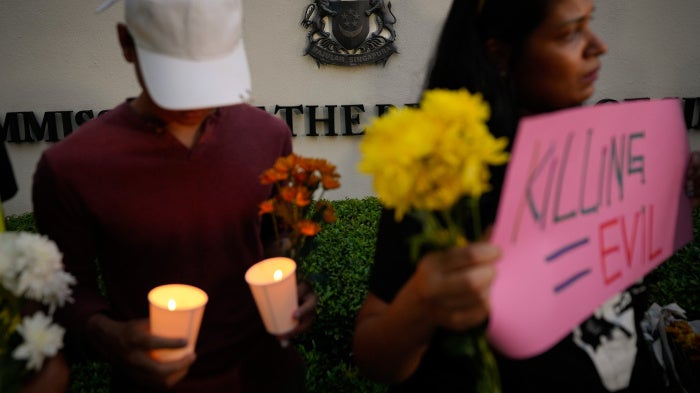
On May 3, Singapore’s ruling People’s Action Party led by Prime Minister Lawrence Wong won the general election with an overwhelming majority, securing 87 of 97 parliamentary seats. Wong’s government drew international condemnation from United Nations experts, foreign politicians, and human rights groups for its continued use of the death penalty, particularly for drug-related offenses. The authorities also continued their crackdown on dissent, leveraging censorship laws to target international media outlets, social media platforms, and foreign comedians.
Criminal Justice System
The use of the death penalty for a range of crimes remains central to Singapore’s criminal justice system, despite the growing global trend towards abolition. Authorities executed 15 people for drug-related offenses in 2025, 7 more than the previous year, despite some signs of flexibility in a handful of capital punishment cases.
On February 19, the Court of Appeal granted Malaysian national Pannir Selvam Pranthaman, convicted of drug importation in 2017, a stay of execution. UN experts had earlier urged Singapore to halt his execution and commute his sentence. On September 5, the Court of Appeal rejected Pannir’s latest appeal. He was executed on October 8.
On August 14, President Tharman Shanmugaratnam commuted the death sentence of Tristan Tan Yi Rui, the first clemency since 1998.
Freedom of Expression and Peaceful Assembly
Singapore continued to use its overly broad and restrictive laws to crack down on civic freedoms and silence criticism of the government.
The Public Order Act (POA) requires a police permit for any “cause-related” assembly—even for an individual acting alone—if it is held in a public place. It also gives the police commissioner authority to reject applications for an assembly “directed towards a political end” if any foreigner is involved.
On February 3, human rights defender Jolovan Wham was charged under the POA for allegedly attending five candlelight vigils for death row prisoners without a permit between March 2022 and April 2023. Activists who gathered outside the court on the day of his hearing are currently under investigation, believed to be linked to their peaceful assembly. Wham has long faced judicial harassment for his activism, with charges dating back to 2017.
On June 27, 2024, three women—Annamalai Kokila Parvathi, Siti Amirah Mohamed Asrori, and Mossammad Sobikun Nahar—who helped organize a “Letters for Palestine” event on February 2, 2024, were charged under the POA for holding a public gathering without a permit. On October 21, 2025, a Singapore district court acquitted them.
The government continued to use the Protection from Online Falsehoods and Manipulation Act (POFMA) to target critics. The act gives the government broad discretionary powers to censor online content, such as requiring recipients of corrections notices to post government-determined “corrections.” International media outlets, Bloomberg and East Asia Forum, as well as local outlets, including The Online Citizen and The Edge Singapore, received POFMA corrections notices for their reporting. The Online Citizen was barred from receiving any financial benefits from its platforms until 2027.
Singapore designated the website and social media platforms of the Transformative Justice Collective (TJC) as “Declared Online Locations” under section 32 of the POFMA. Issued on December 20, 2024, the order requires TJC to display a notice on all its platforms stating that it “had communicated multiple falsehoods.” Rights groups, including Human Rights Watch, condemned the move and urged the government to end its harassment and intimidation of TJC.
Migrant Workers
Migrant workers remain excluded from the country’s Employment Act and many key labor rights protections, including limits on daily work hours, and face restrictions on participating in union activities or protests without explicit government permission. Instead, they are covered by the Employment of Foreign Manpower Act, which ties workers’ visas to their employers, who retain the unilateral power to cancel workers employment contracts and repatriate them at will, including to unsafe countries.
Women and Girls’ Rights
In Singapore’s General Elections, over 30 percent of the seats in parliament were secured by women, the highest proportion since the city-state’s independence in 1965. However, the election campaigning was marred by several reports of sexist and racist abuse suffered by a number of the new women candidates.
Sexual harassment remains prevalent in the workplace. Singapore has not ratified the International Labour Organization Violence and Harassment Convention (C190), which mandates comprehensive protections to end violence and harassment, including gender-based violence, at work.
On January 8, Singapore passed the Workplace Fairness Act, which prevents employers from discriminating against workers based on sex, age, marital status, pregnancy, disability, and caregiving responsibilities, among others. Women’s rights groups commended the law as a “major step forward” but criticized the exclusion of sexual orientation and gender identity as protected characteristics. Disability rights groups also criticized the omission of reasonable accommodation, noting its denial constitutes a key form of disability-based discrimination.