The Eritrean government maintained an iron grip on its population at home and abroad. It continued to repress the population’s rights, including freedom of opinion, religion, and expression, and forced much of its adult population into indefinite military/national service. Tensions between Eritrea and Ethiopia escalated, notably over Ethiopia’s ongoing quest for access to the sea.
The country has had no elections since independence in 1993, and the unelected president, Isaias Afewerki, in power since then, has not implemented the country’s constitution guaranteeing civil rights and limiting executive power. The legislature has not met since 2010. No political party except the ruling People's Front for Democracy and Justice has been allowed to exist. Unlawful detentions and enforced disappearances, particularly of perceived critics, government officials, journalists, and alleged draft evaders, are widespread.
The government also severely restricted religious freedoms and unlawfully detained individuals of ‘non-recognized faiths,” including children.
Eritrean forces still occupy parts of Ethiopia’s Tigray region where they continue to commit serious abuses.
Impunity for grave abuses, both at home and abroad, remains the norm.
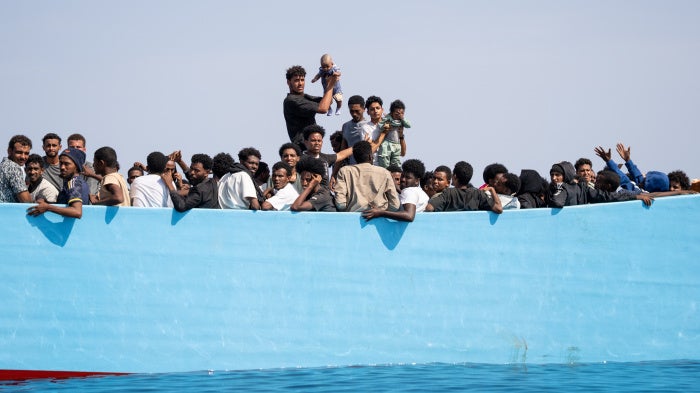
Eritreans continued to flee the repression only to face further challenges in neighboring countries. In Sudan, where hundreds of thousands of Eritreans sought refuge before the country’s conflict, warring parties have committed abuses against refugees, including sexual violence. Ethiopia’s security forces have arbitrarily detained and deported Eritrean refugees in the country’s capital Addis Ababa, who have also faced insecurity in Ethiopia’s conflict-affected areas. The Eritrean government has intimidated Eritreans in the diaspora, resulting in increasing polarization between government supporters and opposition.
Eritrea ratified the convention on the Rights of Persons with Disabilities in December 2024 but still refused to cooperate with key international and regional rights mechanisms. In July, the UN Human Rights Council firmly rejected the government’s bid to terminate the mandate of the UN special rapporteur on the situation of human rights in Eritrea, instead renewing the mandate citing “deep concern” at ongoing abuses. Eritrea remains one of very few countries to have never accepted a visit by a UN independent human rights expert.
Indefinite Military/National Service, Forced Labor
The Eritrean government pursued its uniquely abusive policy of indefinite military and national service to control its population.
National service should legally end at 18 months. In practice, it has been extended indefinitely with no clear criteria since the government declared a state of emergency in 1998. Most Eritreans serve for years, some for decades, with paltry pay and arbitrary punishments, some amounting to torture.
The government continued to push students into military service before they finish secondary school, with a devastating impact on their education.
The UN Office of the High Commissioner for Human Rights reported other serious abuses including torture, sexual and gender-based violence, and abusive labor practices within the context of indefinite conscription and ongoing punishment of families of draft evaders.
Unlawful Detentions, Enforced Disappearances
Due process rights continue to be systematically violated with detainees subjected to arbitrary and prolonged detention without charges, trials, or judicial review.
Many Eritreans, notably perceived dissidents, government critics, human rights defenders, religious leaders, and journalists, are subjected to enforced disappearances for years or even decades. Some are held in solitary confinement in undisclosed locations, while others are thought to have been killed or to have died in detention. The fate or whereabouts of the 11 former senior government officials known as the G-15 and of 10 independent journalists arrested since September 2001 remains unknown.
Freedom of Religion
Religious leaders and Christians affiliated with both the officially recognized and “unrecognized” faiths continue to face unlawful detentions and other abuses linked to their beliefs.
Since 1993, the government has arrested and imprisoned dozens of Jehovah’s Witnesses without trial or formal charges, with 64 behind bars, including three in their 80s, as of April 2025. Hundreds of evangelical Christians are also detained, as well as Muslim teachers and Imams, according to the UN special rapporteur. From late September through November 2024, the government detained an additional 30 Jehovah’s Witnesses; it has since released at least four including two children and an 82-year-old man. Conscientious objection to military service is prohibited.
According to the UN special rapporteur, more than 100 Orthodox priests, monks, and followers of the late Orthodox Patriarch Abune Antonios, who had spent over 15 years in house arrest, remain in detention.
Freedom of Expression and Association
Civic space remains closed with no opposition parties, independent civic organizations, or media. The government controls the domestic media and independent media have been banned since September 2001. Nongovernmental gatherings of over seven people are prohibited.
The UN special rapporteur reported ongoing transnational repression, with Eritrean authorities’ suppression of dissent in the diaspora, including through intimidation, and the refusal of consular services. This contributed to greater mobilization of opposition groups and polarization abroad.
Refugees and Returnees
Eritrean asylum seekers, refugees, and migrants continue to suffer arbitrary detention, displacement, and violence in host countries. Over 660,000 Eritreans were in exile as of late 2024, representing roughly 18 percent of an estimated 3.8 million population.
Space for Eritrean asylum seekers in neighboring countries remained constrained.
Egypt and Ethiopia detained and deportedEritreans in late 2024. In February 2025, Switzerland decided to end development assistance to Eritrea by May, due to the government’s refusal to accept Eritrean deportees from Switzerland. UK courts halted the deportation of an Eritrean man who claimed to be a victim of trafficking to France.
In Sudan, the Rapid Support Forces (RSF) have subjected women and girls, including Eritrean and other refugees, to widespread sexual violence.
In Ethiopia, Eritreans refugees have faced insecurity in camps in the conflict-affected Amhara region, with many fleeing towards Addis Ababa where they risked arrest. According to the UN special rapporteur, police officers shot and killed several Eritreans in Addis Ababa while they were fleeing to escape arrest in 2025. Since 2021, Eritrean asylum-seekers have been denied access to asylum procedures due to Ethiopia's suspension of asylum claim registrations, documentation issuance, and refugee status determinations.
Eritrean forces in Ethiopia
Eritrean forces still occupy parts of Ethiopia's Tigray region, where they continued to commit serious abuses including sexual violence, disappearances, and looting of livestock.
Sexual Orientation and Gender Identity
Eritrea’s penal code, under article 310, punishes same-sex relations with up to seven years' imprisonment. This provision encourages prosecution, discrimination, and violence.