Armenia’s human rights record remained uneven. While authorities pursued anti-corruption and rule of law reforms, serious human rights concerns persisted, including increased state surveillance, restrictions on media freedom, domestic violence, discrimination against persons with disabilities, and violence and discrimination based on sexual orientation and gender identity. Civil society organizations highlighted ineffective investigations into police abuse, lack of judicial independence, and excessive use of pre-trial detention in criminal proceedings. Armenia also lacks comprehensive anti-discrimination legislation.
Authorities struggled to provide adequate social protection for more than 100,000 ethnic Armenians displaced from Nagorno-Karabakh. As the government phased out state rent subsidies, it introduced means-tested assistance for children, older people, some persons with disabilities, students, and families that had lost a primary breadwinner. The approach left many displaced persons struggling to pay rent and meet basic needs.
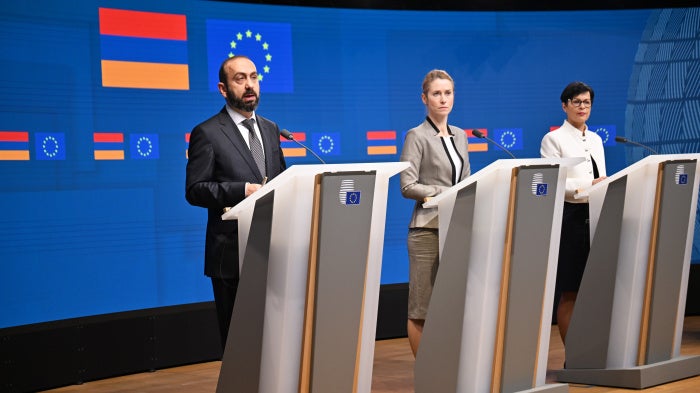
In March, parliament adopted the EU Integration Act, enshrining Armenia’s ambition to join the EU and incorporate the respective legal framework and reforms in Armenian law.
Armenia and Azerbaijan signed the US-mediated Washington Declaration in August, which set out a broad political framework for peace aimed at ending the decades-long conflict over Nagorno-Karabakh, establishing diplomatic relations, and promoting regional cooperation. The agreement grants the United States exclusive rights to develop a 42-kilometer trade route across Armenian territory that would also connect Azerbaijan proper to its Nakhichivan exclave. The agreement also led to the dissolution of the OSCE Minsk Group, the US-Russia-France-led conflict resolution format. The declaration raised mixed reactions in Armenian society, reflecting concerns over enforcement mechanisms, the continued detention of 23 ethnic Armenians in Azerbaijan, and the closure of the International Committee of the Red Cross (ICRC) operations, which left families without independent contact with detainees or assurances of their well-being.
Right to Privacy
In June, authorities adopted amendments to the Law on Police granting the police live and on-demand access to video surveillance systems operated by state and municipal bodies, state-affiliated institutions, parking lots, emergency medical services, and airports. The final version was less intrusive than the initial draft, which would have required private businesses in Armenia to install surveillance cameras and provide police with live access and recordings.
However, serious concerns remained. The law lacks adequate safeguards for personal data protection in the processing of surveillance footage. For example, it permits police access to cameras in social care institutions and mental health facilities, where surveillance is insufficiently regulated and risks violating residents’ privacy and personal data protection rights.
The law also authorizes municipal authorities to process personal data from video surveillance systems in their jurisdiction—an amendment adopted without public consultation—and introduces a mechanism for revenue-sharing with police from fines imposed for violations detected by such systems.
In addition, the law leaves open the possibility for the use of facial recognition and other forms of video analytics; Armenian authorities have indicated their intention to use such technology, raising concerns over surveillance and other rights implications.
Freedom of Expression and Information
In the first six months of 2025, a local media advocacy group, documented four incidents of physical violence by law enforcement and 61 incidents of other types of pressure against media outlets, including threats and insults. During the same period, media outlets faced 29 new defamation lawsuits, 15 of which were filed by state bodies or current and former officials, and six by private businesses.
The suspension of the US$15 million USAID media development program launched in 2023 left dozens of independent media outlets struggling to sustain operations. In April, the Armenian government created the “Public-Benefit Media Environment” fund to support licensed broadcasters to produce socially beneficial content. Local media organizations criticized the decision as unilateral for lacking consultations with relevant stakeholders and warned that it unfairly favors certain broadcasters and risks state interference in editorial independence.
Disability Rights
Armenia continues to lack a comprehensive plan to develop community-based services for people with psychosocial and intellectual disabilities, prioritizing institutional care instead. Investments in small group homes for adults largely replicate institutional models rather than strengthen home- and community-based support. With poor physical infrastructure, social care and mental health institutions lack rights-respecting psychosocial and therapeutic services that could support people to live independently, trapping many people in prolonged, often lifelong, institutionalization and facilitating detention on the basis of disability.
Armenia’s justice system reinforces discriminatory and punitive practices against people with psychosocial and intellectual disabilities. Courts continue to deprive them of legal capacity, while the government has failed to introduce supported decision-making mechanisms. In August 2024, following a violent incident involving a family member, authorities placed Vahagn Petrosyan, then 45 years old, in involuntary psychiatric confinement and denied him due process guarantees, including the right to effective legal assistance, to attend his own hearings, and to manage his personal affairs and resources. Petrosyan had been deprived of legal capacity from 2015 to 2023 on the basis of his psychosocial disability.
As of August 2025, 261 people with psychosocial disabilities were held in nine of Armenia’s ten penitentiary institutions, where they receive little or no psychosocial support or therapy beyond limited medication. Local human rights organizations and the independent prison monitoring group report neglect, lack of individualized support, poor staff training, undignified treatment, and a severe shortage of specialized staff, including psychiatrists and psychologists.
In the first half of 2025, six people reportedly died by suicide in penitentiary institutions, the majority had psychosocial disabilities. As of July, 112 people had reportedly engaged in 243 incidents of self-harm. The Ombudsperson’s office reported that no suicide cases in custody had been effectively investigated.
In September, the Constitutional Court struck down the absolute ban on appointing persons who are deaf or blind as judges.
Domestic Violence and Violence against Women and Girls
As of July 2025, Armenian police reported 893 new cases of domestic violence. Only 87 cases were referred to court. Thirty-seven survivors were persons with disabilities, including 22 women. Armenia’s shelter and support services for survivors of domestic violence are not inclusive for survivors who have psychosocial or intellectual disabilities.
In a positive development, in April, the government adopted the 2025–2028 Gender Policy Strategy and Action Plan, which sets priorities to advance gender equality, including by promoting equal representation of women in leadership, strengthening protections against gender-based violence, and fostering equal access to economic opportunities for women.
Sexual Orientation and Gender Identity
Discrimination and police inaction or abuse continue to deter many lesbian, gay, bisexual, and transgender (LGBT) people from reporting hate crimes. When complaints are filed, investigations are often ineffective, and charges rarely reflect homophobic or transphobic motives. Armenia’s criminal code does not recognize sexual orientation or gender identity as aggravating factors in crimes.
Homosexuality remains classified as a psychosocial “disorder,” used to exempt gay men from military service due to perceived risks in the army, while given tacit state support for discrimination in employment and healthcare.
Through July 2025, local groups documented 12 cases of physical violence against LGBT people, including at least three children, with five of the cases perpetrated by family members. They also reported cases of psychological abuse, including by law enforcement officials, as well as incidents of forced conversion practices, extortion, threats, employment discrimination, and psychologists’ non-consensual disclosure of children’s sexual orientation to parents.