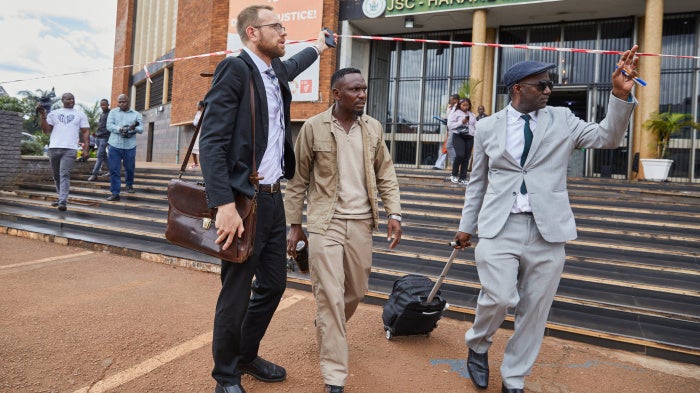
In 2025, Zimbabwe’s government continued its crackdown on dissent. The authorities intimidated, harassed, threatened, and arbitrarily arrested journalists, political opposition members, and civil society activists.
The government intensified restrictions on civic space and freedom of expression, association, and peaceful assembly, including through legislation.
Regressive Laws
On April 11, 2025, President Emmerson Mnangagwa signed the Private Voluntary Organizations Amendment Act into law, sharply curtailing freedom of association and expression. Zimbabwean authorities have long used domestic law as an instrument of repression. The new law empowers the authorities to deregister and seize the assets of nongovernmental groups deemed to be acting in a “politically partisan manner,” with little to no judicial recourse. The law also allows authorities to monitor the operations of nongovernmental organizations, including by scrutinizing their ownership structures, funding sources, and affiliations. Violations of the law can result in criminal prosecution, with penalties ranging from heavy fines to imprisonment.
The organization, Zimbabwe Lawyers for Human Rights, sought a court order to declare provisions of the law unconstitutional. The case has yet to be heard in the High Court.
The European Union withdrew its funding for Zimbabwe’s good governance framework following passage of the Private Voluntary Organizations Amendment Act.
In June, the High Court struck down part of the Criminal Law Codification and Reform Act, commonly known as the “Patriotic Act,” as unconstitutional. The Patriotic Act, which President Mnangagwa signed into law in July 2023, contained overly broad provisions that unjustly limit freedom of expression, peaceful assembly, and association. In its ruling, the court stated that the drastic penalties in section 22A(3) of the act, including life imprisonment, the death penalty, termination of citizenship, and suspensions from voting and holding public office, violated constitutional rights.
Crackdown on Freedom of Speech, Critics of the Government
The rights to freedom of expression and the media came under serious threat. Authorities misused the criminal justice system and conducted politically motivated arrests and prosecutions of human rights defenders, activists, and journalists.
On October 27, 2025, the Southern African Political Economy Series (SAPES) Trust’s offices were destroyed in a suspected arson attack. The assailants reportedly abducted the night guard and locked the property’s gates with new padlocks before fleeing. They were set to host a dialogue of civil society and opposition leaders on the constitutional crisis in response to moves by ZANU-PF to extend President Mnangagwa’s term beyond 2028. A similar event, in Bulawayo, was shut down by the police and suspected ZANU-PF supporters.
On August 21, 2025, the Harare Magistrates Court acquitted three human rights activists—Robson Chere, 41, Namatai Kwekweza, 26, and Samuel Gwenzi, 40— over a year after their arrest on politically motivated disorderly conduct charges. On July 31, 2024, state agents had pulled the three off a plane before takeoff at Harare’s international airport and held them incommunicado for nearly eight hours. At the trial, the activists’ lawyers presented evidence of torture and other ill-treatment. The case highlighted the authorities’ misuse of the criminal justice system against critics. To date, no one has been held to account for the arbitrary arrest, torture, and ill-treatment of the activists.
Blessed Mhlanga, a senior journalist for the independent media outlet Heart and Soul TV, was arrested on February 24, 2025, and spent 71 days in pretrial detention. Authorities charged Mhlanga with transmitting information that incites violence or causes damage to property under section 164 of Zimbabwe’s Criminal Law (Codification and Reform) Act. Mhlanga had interviewed a member of the ruling ZANU-PF party who demanded the resignation of President Mnangagwa, accusing him of nepotism, corruption, and incompetence.
In March, the authorities arrested Ismael Maukazuva, a local government council member for the opposition and charged him with undermining the authority of, and insulting, President Mnangagwa. Zimbabwe Lawyers for Human Rights reported that the council member had shared a TikTok video of a woman criticizing Mnangagwa, accusing him of bringing “misfortunes” among Zimbabweans and urging him to relinquish power to a “young person.” The council member was released after two days, after the National Prosecuting Authority withdrew the charges.
Authorities also arrested and detained for one month Alfred Machakaire, 34, on charges of undermining the authority of, and insulting, President Mnangagwa after he allegedly shouted, “down with Mnangagwa” and praised the president’s rival.
In July, authorities arrested Faith Zaba, editor of the Zimbabwe Independent, a weekly known for its independent journalism and critical reporting. Zaba was arrested after the outlet published a satirical column and was charged with “undermining the authority of the president.” The journalist was granted bail after spending three nights in detention, on condition that she report to the police weekly, surrender her passport, and not interfere with investigations.
Impunity for Abuses
On August 30, 2025, unidentified perpetrators bombed the home of Job Sikhala, a prominent government critic and leader of the National Democratic Working Group, a pro-democracy movement. A video shared on social media shows damage to Sikhala’s house, including to the windows, facade, roof, and a car parked outside. Sikhala reported that his children were in the house at the time but escaped unharmed. In a statement posted to X, he said that he reported the attack but his “family has not received any response from the police.” In September, the opposition leader offered a reward of $20,000 for information leading to the identification of suspects behind the bombing.
In July, Sikhala had launched a book, and members of the youth wing of the ZANU-PF party violently disrupted the event, assaulting guests and seizing copies of the book, according to media reports. Police reportedly refused to act against the assailants, despite victims and witnesses filing multiple complaints.
Abolition of the Death Penalty
President Mnangagwa signed into law a bill, passed by parliament in December 2024, to abolish the death penalty for all crimes. Although Zimbabwe carried out its last executions in 2005, courts had continued to impose the death sentence. At the time of the abolition, Zimbabwe had 63 prisoners on death row. The European Union welcomed the abolition of the death penalty but called on Zimbabwe to remove the provision allowing for the temporary reintroduction of the death penalty during a state of public emergency.
Violence Against Women in Politics
Impunity for violence against women in politics persisted. Zimbabwean authorities failed to investigate and prosecute rape, sexual assault, abductions, and beatings of women opposition political candidates and supporters before, during, and after the August 2023 elections. Survivors told Human Rights Watch that the perpetrators were suspected ZANU-PF supporters and youth militia.
Sexual Orientation and Gender Identity
Zimbabwe’s Criminal Code at section 73 punishes same-sex relations between men with up to one year imprisonment and a fine. Article 78(3) of the Constitution prohibits same-sex marriage. The National Assembly is considering a law that prohibits “promotion” of lesbian, gay, bisexual, and transgender (LGBT) rights. If passed, the law would fuel discrimination and restrict freedom of speech, expression and assembly.