The human rights environment in Zambia in 2025 became increasingly hostile to perceived dissent, criticism, and political opposition to the government ahead of the 2026 elections.
Former president Edgar Lungu died in June. In December 2024, the Constitutional Court had barred him from running for another term, stating that he had served the maximum two terms allowed by law.
Freedoms of Association, Assembly, and Expression
In April, the Zambian Parliament enacted the Cyber Security Act and the Cyber Crimes Act. Zambian civil society organizations said that some provisions of the laws did not adhere to international human rights standards, and were a threat to the principles of democracy, transparency, accountability, and rights.
The Cyber Security Act raised the risk of unjustified surveillance, as it allows a law enforcement officer to request providers of electronic services, such as an internet provider, to intercept a person’s communications without a warrant or other safeguards if they suspect a person may cause harm to another person, property damage, or financial loss. Further, law enforcement is granted broad interception powers including real-time data collection and communication interception and extensive search-and-seizure powers.
Zambia's foreign ministry released a statement saying that the Cyber Security Act was "not intended to invade any person's privacy" and that it did “not authorize mass or random surveillance.” The government argued that the law had “legal safeguards to prevent abuse, aligning with international digital rights frameworks.”
In July, the Law Association of Zambia petitioned the High Court to declare provisions of the Cyber Crimes Act unconstitutional. The association argued that the law infringed freedom of expression, speech, conscience, association, and media freedom. As of October, the court had not heard the case.
Zambian authorities have increasingly weaponized provisions of the Public Order Act of 1955 to restrict and disrupt the political opposition from holding rallies or peaceful protests. The act allows authorities to stop a procession for which a permit has not been issued.
A report by Zambia’s Electoral Reform Technical Committee, appointed by the country’s electoral commission to propose electoral reforms, found that the Public Order Act was applied “without regard to the basic human rights of freedom to associate and free speech, thus having a negative impact on democracy.” The committee expressed concerns about police impartiality, political interference, and restrictions on freedoms of assembly and expression during elections. The committee called for reform of the Public Order Act and Police Act, without which it stated that “Zambia Police Service will continue to be susceptible to being used for political expedience, rather than acting as an impartial guardian of peace.”
Journalists, and government critics often face prosecution on criminal charges of defaming the president. In January, two brothers, Ernest Kaumba, 22, and Elijah Kaumba, 26, appeared at the Lusaka Magistrate Court on charges of insulting President Hakainde Hichilema. Their lawyer told court that police held them for over two months before bringing them to court where they were granted bail. In July, a magistrate court sentenced two women to two years and three years in prison respectively for insulting President Hichilema. While the offenses carry the option of a fine, the presiding magistrate imposed custodial sentences to “deter would-be offenders and give integrity and dignity to the office of the President.”
In September, a Lusaka Magistrate Court sentenced two men to two years in prison with hard labor for attempting to use witchcraft to kill President Hichilema. Authorities used a colonial-era Witchcraft Act that criminalizes witchcraft, and carries a maximum term of two years in prison. Critics have argued that witchcraft accusations can be used to bring baseless prosecutions against political rivals ahead of elections.
Right to Health
On February 18, 2025, the walls of a dam holding mining waste from Chinese mining company, Sino-Metals Leach Zambia, in Chambishi, Copperbelt province burst and released acidic effluent into Kafue River’s watershed. The spill led to pollution that posed health risks to residents, killed fish and livestock, and burned maize and groundnut crops.
In August, six months after the acid spill, Drizit, a South Africa-based environmental company said that Sino-Metals contracted it to investigate the spill. It reported that approximately 900,000 cubic meters of toxic tailings were present, exceeding the World Health Organization’s safe threshold values. Drizit stated that “unless the remaining toxic tailings are removed and safely contained in a properly engineered facility, communities will remain at risk for decades.”
The government has denied that the acid spill still posed a serious health risk. However, Zambian authorities have yet to conduct a comprehensive investigation with international and domestic experts to identify environmental health risks, and test affected communities for possible acute and cumulative heavy metal poisoning.
Lead Contamination in Kabwe
Three decades after the closure of a lead and zinc mine in Kabwe, communities in and around the city suffer lead poisoning from severe lead contamination. An estimated 200,000 people are exposed to lead, including children who often experience impaired cognitive development.
In January 2025, the African Committee of Experts on the Rights and the Welfare of the Child called on the Zambian government to reinforce remediation efforts and expand lead testing and treatment in Kabwe. Between May and July, the interministerial committee announced by the president in 2024 met a few times. However, the committee’s work appeared to be stalled.
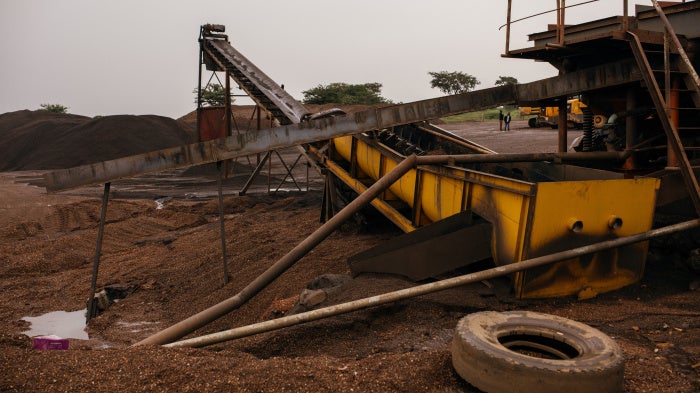
South African, Zambian, and Chinese businesses continued to conduct hazardous mining and processing of lead-contaminated waste at Kabwe’s mine area to extract zinc and other minerals. Companies removed significant waste and placed open piles across Kabwe, exacerbating existing health concerns. One Zambian company removing waste, Chitofu, has links to the ruling United Party for National Development (UPND) party. The Zambian government facilitated these activities by issuing mining and processing licenses to businesses. In August, media reported that province and district officials suspended operations at Chinese processing companies, citing violations of environmental regulations. In most cases, though, the government failed to intervene against violations of Zambian environmental and mining law by mining and processing companies in Kabwe.
Sexual Orientation and Gender Identity
Zambia’s penal code in article 155 punishes same-sex relations with up to 14 years in prison. In July, the Constitutional Court dismissed a petition by two activists on the decriminalization of homosexuality. Lesbian, gay, bisexual, and transgender (LGBT) people face threats, discrimination, harassment, extortion, and detention.