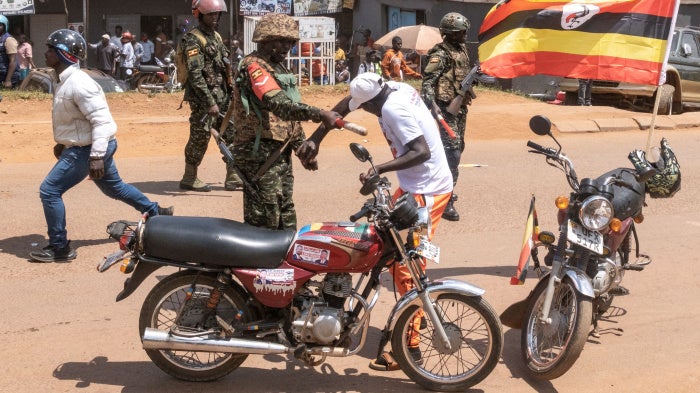
Uganda’s human rights situation remains repressive, with the government violently cracking down on the political opposition, journalists and protesters, and restricting free expression.
The government reinstated the trial of civilians before military tribunals. Environmental activists opposing the East African Crude Oil Pipeline (EACOP) faced arrest and prolonged detention. Authorities initiated prosecutions against Kampala city officials over the Kiteezi landfill collapse, marking a rare instance of accountability for environmental negligence.
LGBT people remain at high risk under the 2023 Anti-Homosexuality Act, which fuels arbitrary arrests, extortion, and abuse.
State surveillance continued to expand significantly.
Uganda announced its agreement to accept citizens of other countries expelled from the United States, making it one of at least five African countries to do so.
Freedoms of Expression and Assembly
The Ugandan authorities continue to clamp down on free expression and peaceful assembly, arresting and charging political opponents and their supporters, as well as critics of government officials.
On August 5, a court convicted and sentenced university student, Elson Tumwine, to two months in prison under the Computer Misuse Act for a TikTok video criticizing President Yoweri Museveni and speaker of parliament, Anita Among. Media reported Tumwine had gone missing in Hoima, Western Uganda, on June 8, and was found at a police station in Entebbe, some 230 kilometers away, in mid-July. Similarly, on August 29, a court sentenced Juma Musuuza to 12 months imprisonment for hate speech and spreading “malicious information” about Museveni, Among, and Museveni’s son, Gen. Muhoozi Kainerugaba, also on TikTok.
Security officials arrested and beat opposition supporters and journalists covering opposition candidate Elias Luyimbazi Nalukoola’s parliamentary campaign. On February 26, hooded security officers beat and arrested Nalukoola, together with his supporters, after the Electoral Commission approved him to stand in the Kawempe North by-election on March 13. They released him the same day without charge.
Journalists covering the incident also came under attack. Media reported that two officers from the Joint Anti-Terrorism Taskforce (JATT), a security agency, beat journalist Ibrahim Miracle repeatedly in the face with a truncheon, causing him to nearly lose sight in one eye. On the same day, security forces also attacked four other reporters from NBS TV and NTV Uganda and fired live bullets in their direction.
On March 3, JATT officers beat Nalukoola’s supporters, fired live bullets and teargas, and arrested 22 people, as they attempted to leave his party’s headquarters for a campaign rally. The authorities charged the 22 with “public nuisance,” obstructing traffic, and malicious damage to property, before releasing them on bail on March 7.
Restrictions on freedom of expression intensified during the campaign. On March 12, Uganda’s media regulatory body, the Uganda Communications Commission (UCC), suspended Pearl FM after it reported on vote-rigging allegations during the Kawempe North by-election. UCC claimed the station had broadcast “unsubstantiated statements that were sensational, alarmist, and capable of inciting violence.” Armed forces reportedly severely beat at least 18 journalists covering the by-election on March 13. The military announced in a press statement that it would investigate these allegations although no public information on any progress is available.
Military Trials of Civilians
The authorities have used military courts against President Museveni’s political opponents, including former presidential candidate Kizza Besigye, who was charged on November 2024 with allegedly being in possession of guns and ammunition belonging to the military. At least 44 other civilians, mostly opposition party supporters arrested around the 2021 general elections, have been imprisoned as a result of military trials.
The same military court sentenced Besigye’s lawyer, Eron Kiiza, on January 7 to nine months imprisonment for “contempt of court.” Kiiza had been publicly critical of the military and was convicted and sentenced without a fair trial or legal representation. The High Court released Kiiza on bail in April, pending his appeal of the military court decision.
On January 31, the Supreme Court banned military trials of civilians, ruling them unconstitutional. After this ruling, Besigye’s case was transferred to the ordinary courts. He remains in detention awaiting trial.
In June, President Museveni signed the Uganda Peoples’ Defence Forces (Amendment) Bill into law authorizing military tribunals to try civilians and substantially revising Uganda’s military justice system.
Environment and Human Rights
The security forces have arrested students and youths who raised concerns over EACOP and other fossil fuel projects.
On April 2, the police arrested nine youth activists in Kampala after protesting against banks supporting the project. On April 23, they again arrested 11 people as they attempted to deliver a letter to Kenya Commercial Bank (KCB) protesting the pipeline. They were detained in Luzira Maximum Security Prison before being released on July 22, pending trial. In August, the police also arrested 12 people during a similar protest.
On July 3, a magistrates court committed Dorothy Kisaka, the director of the Kampala Capital City Authority (KCCA), and her deputy David Luyimbazi, to the High Court for trial over manslaughter for the August 10, 2024 landslide at the Kiteezi landfill. The landslide, on the outskirts of Kampala, killed 35 people and injured 23, destroyed homes, and displaced hundreds. Prosecutors said Kisaka and Luyimbazi were aware of the imminent risks of the Kiteezi landfill over four months before its collapse.
Sexual Orientation and Gender Identity
Since the 2023 Anti-Homosexuality Act was enacted, authorities have perpetrated widespread discrimination and violence against lesbian, gay, bisexual, and transgender (LGBT) people, their families, and their supporters. The penal code punishes “carnal knowledge” between people of the same gender with up to life in prison.
Disability Rights
Healthcare workers in some public health facilities in Uganda continue to use seclusion and restraints on people with psychosocial disabilities. The Mental Health Act, which legalizes seclusion in mental health facilities, remains in force.
A hearing in a court case, scheduled for March 2025, challenging the use of seclusion rooms for people with psychosocial disabilities, was postponed. The case was brought on appeal by mental health care reform activist Benon Kabale and the Centre for Human Rights and Development (CEHURD). They had sued the government for use of seclusion rooms in 2015 and the High Court ruled against Kabale in 2018, dismissing his testimony due to his mental health history.
Accountability for Serious Crimes
In September, the International Criminal Court held pre-trial proceedings against Joseph Kony, leader of the rebel group Lord’s Resistance Army (LRA), in absentia. Kony is accused of war crimes and crimes against humanity in northern Uganda between 2002 and 2005 and remains a fugitive.
Government Surveillance
The Ugandan government continued to expand its surveillance capacity, including installing video surveillance technology to monitor public spaces. The government also collects and stores vast personal information, including names, signature, photo, and fingerprints of nationals. Uganda’s laws provide for collecting person data and government interception of communications under the pretext of “national security”.
On January 6, the Ugandan government rolled out digital number license plates for private vehicles, purportedly enabling real-time location tracking for vehicles ostensibly for road safety and crime prevention.