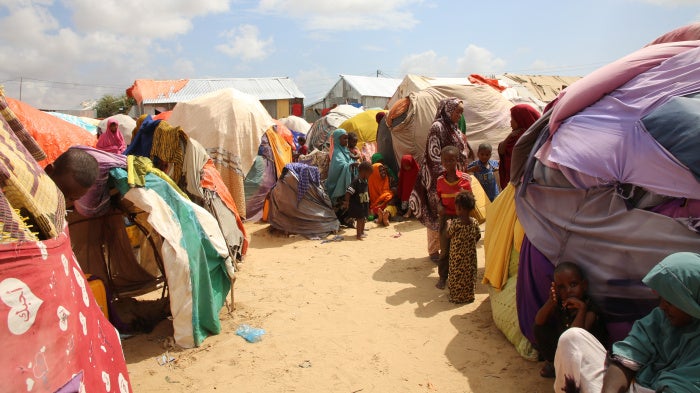
Somalia’s civilian population bears the brunt of ongoing conflict, political violence, and extreme weather shocks. The authorities severely restricted independent reporting, particularly on security issues. The Islamist armed group, Al-Shabab, continued to commit numerous indiscriminate and targeted attacks, as well as other serious violations, against civilians. Forced evictions in the country’s capital, Mogadishu, continued.
Below average rainfall, continued fighting, and reduced humanitarian funding led to a deterioration in the humanitarian situation with 4.4 million people expected to need urgent food aid in late 2025.
Al-Shabab’s offensives regained territory previously recovered by the government in 2022, especially in central Somalia, including locations south of Mogadishu. Strikes against Al-Shabab by the United States, and against Islamic State-Somalia Province (IS-Somalia) in Puntland by the US and United Arab Emirates (UAE), increased. Ethiopia also conducted some strikes against Al-Shabab.
Progress on the electoral roadmap ahead of elections expected in 2026 triggered tensions, and on occasion, fighting. Deadlocks over the electoral model persisted, as federal officials and opposition politicians pushed back on plans by President Hassan Sheikh Mohamud to move ahead with universal suffrage, and to reduce the number of political parties. Parliament passed a law to allow one-person-one-vote to replace the clan-based indirect voting system in November 2024.
Tensions were particularly rife in Jubaland and in the contested territories between Puntland and Somaliland where Mogadishu recognized the formation of a new federal state. Fighting between federal forces and regional forces in Jubaland led to reported unlawful killings and displacement of civilians. The contentious constitutional review process continued.
The federal government relied again on clan militia to lead operations against Al-Shabab.
Bumpy transitions from existing United Nations and African Union missions continued, with the UN expected to hand over responsibilities to Somali institutions and the UN country team by late 2026, raising questions about how key capacities, especially on human rights, will be maintained. On October 8, the UN Human Rights Council did not renew the mandate of the independent expert on Somalia, but instead enhanced the monitoring, reporting, and technical assistance role of the UN human rights office (OHCHR), retaining some independent international scrutiny on the country.
Tensions with Ethiopia, which had escalated throughout 2024 following Ethiopia’s efforts to gain access to the sea, de-escalated after Turkey’s mediation. Ethiopia and Somalia restored diplomatic relations and greater cooperation on security. This included the renewed agreement for the deployment of 2,500 Ethiopian troops to the new African Union Support and Stabilization Mission in Somalia (AUSSOM) in early 2025.
The government’s review of laws to ensure compliance with international standards stalled, with the parliament failing to review and approve key rights bills, including on sexual violence, female genital mutilation, and children’s rights and juvenile justice. In September, the government finally restored the review of the country’s outdated penal code, and established a national human rights commission.
Attacks on Civilians
Al-Shabab’s attacks using improvised explosive devices (IEDs), suicide bombings, and shelling, as well as targeted assassinations, resulted in the highest numbers of civilian casualties.
Repeated cycles of clan conflict, notably in Luuq district of the Gedo region and Hiraan region, killed and displaced civilians.
Military operations against ISIL-Somalia in Puntland, using airpower, supported by the UAE and the US, escalated. In January, media reported that an unidentified strike in Puntland killed four members of the same family. Social media reported on a March 10 strike that allegedly killed at least eight family members; the Puntland authorities said that an UAE strike was conducted that day.
Military courts, which fail to meet basic fair trial standards, continued to try alleged terrorism-related crimes and sentence people to death. The UN special rapporteur on counter-terrorism and human rights raised concerns about ongoing due process violations in terrorism-related cases, and the related legal framework, including broad powers given to the National Security Agency.
Displacement and Access to Humanitarian Assistance
Over half of the 300,000 people newly internally displaced in Somalia between February and September had fled because of conflict and insecurity, according to the UN.
Media reported that authorities had carried out waves of forced evictions in Mogadishu, including of internally displaced people who had settled in camps.
Humanitarian agencies continued to face serious challenges due to hostilities, targeted attacks on aid workers, generalized violence, restrictions imposed by warring parties, and extreme weather patterns. The UN warned that cuts to its funding have already impacted key sectors. As of September, the Somalia Humanitarian Funding Plan was only 19 percent funded.
Women’s Rights
Women’s rights in Somalia remain heavily constrained by legal, structural, and social barriers including early marriage, limited educational opportunities, discrimination, and pervasive gender-based violence. Somalia has not ratified the Convention on Elimination of All Forms of Discrimination against Women (CEDAW). Aid groups raised concerns about conflict-related sexual and gender-based violence affecting mostly internally displaced women and girls.
Children’s Rights
Somalia remained one of the countries where the UN verified the highest numbers of grave violations against children between mid-2024 and mid-2025.
The UN independent expert on Somalia commended the federal government’s adoption of age verification guidelines, but raised concerns about ongoing child recruitment by community defense forces and clan militia. The UN secretary-general removed the Somali National Army from its list of actors responsible for grave violations against children.
Freedom of Expression
Regional and federal authorities continued to intimidate, detain and charge journalists and media workers and severely restricted reporting on key issues, particularly on security.
On March 6, the minister of information announced a ban on reporting on issues that could pose a “security threat.” Following the bombing of the presidential convoy on March 18, the police temporarily detained at least 22 journalists and media workers and shut down a media outlet for reporting on it.
Media reported in mid-September that the government had arrested four TikTokers and another person for a dance video allegedly insulting the president.
Somaliland
The authorities in Somaliland continued to restrict discussions on issues deemed controversial by arresting journalists, politicians, and other perceived government critics.
According to a local rights group, 16 journalists were unlawfully detained in the first six months of 2025. In mid-August, a journalist who posts on Facebook, was detained, reportedly for a post in which he referred to the constitution’s prohibition of unlawful detentions.
Sexual Orientation and Gender Identity
Somalia criminalizes consensual same-sex conduct with up to three years in prison.