In 2025 Pakistani authorities suppressed dissenting voices amid a crackdown on media freedom, political opposition, and civil society, often using vague and overbroad laws to stifle criticism.
Blasphemy-related attacks on religious minorities increased, fueled by discriminatory legislation and government inaction. Militant groups carried out violent attacks on security forces and civilians, killing hundreds. The government used the latter attacks to justify the continued expulsion of Afghan refugees that were in no way connected to the attacks.
Freedom of Expression and Attacks on Civil Society
Government threats and attacks on the media created a climate of fear among journalists and civil society groups, with many resorting to self-censorship. Journalists faced harassment, arbitrary arrests, enforced disappearances, and physical attacks for reporting critical of the government and security forces.
In January, the National Assembly passed an “anti-disinformation” law criminalizing “false and misleading” online content—which the law does not define—with up to three years in prison.
In March, masked men abducted prominent journalist Waheed Murad in Islamabad; Murad later appeared in court and was charged under Pakistan’s draconian Prevention of Electronic Crimes Act (PECA) and held for 48 hours. Also in March, Federal Investigation Agency officers arrested Farhan Mallick, an online media entrepreneur, in Karachi. In August, the National Cybercrime Investigation Agency (NCIA) arrested journalist Khalid Jamil at his Islamabad residence under PECA for “publishing and spreading anti-state narratives on social media” and sharing “false, misleading, and baseless information.”
Authorities registered some 689 cases under PECA between January and August, targeting many journalists. Television channels critical of the government experienced signal disruptions during broadcasts of opposition rallies.
At least three Pakistani journalists were killed in 2025.
Nongovernmental organizations (NGOs) reported intimidation, harassment, and surveillance by government authorities. The government tightened its regulation of international NGOs, impeding the registration and functioning of international humanitarian and human rights groups.
Freedom of Religion and Belief
Pakistani authorities enforced blasphemy law provisions that have provided a pretext for violence against religious minorities, leaving them vulnerable to arbitrary arrest and prosecution. Despite dozens of mob and vigilante attacks on people for alleged “blasphemy” in recent years, the government has failed to hold the perpetrators of such attacks accountable.
In June, Human Rights Watch published a report documenting how blasphemy laws have been exploited for blackmail and profit and have targeted the poor and minorities in unlawful evictions and land grabs. According to the statutory National Commission for Human Rights (NCHR), at least 450 people were falsely charged with blasphemy through an organized scheme of blackmail and extortion. In a significant development in July, the Islamabad High Court ordered the federal government to form a commission within 30 days to investigate the growing misuse of blasphemy laws. No commission had been formed as of December.
Members of the Ahmadiyya religious community were targeted under blasphemy laws and specific anti-Ahmadi legislation. In April, Laeeq Cheema, an Ahmadi man, was beaten to death by a mob in Karachi that had surrounded an Ahmadi place of worship. In May, Dr. Sheikh Mahmood, an Ahmadi doctor, was shot dead in Sargodha district, Punjab.
Militant groups and the Islamist political party Tehreek-e-Labbaik (TLP) have accused Ahmadis of “posing as Muslims,” a criminal offense in Pakistan.
Terrorism, Counterterrorism, and Law Enforcement Abuses
Militant groups including Tehrik-i-Taliban Pakistan, the Islamic State of Khorasan Province (ISKP), Al-Qaeda, the Balochistan Liberation Army, and their affiliates carried out suicide bombings and other attacks against security personnel that killed hundreds of people. In March, the Balochistan Liberation Army attacked and hijacked a train traveling from Peshawar to Quetta and killed 28 people, including 21 civilian passengers. In May, a suicide attack on a school bus in Khuzdar district, Balochistan, killed eight people, including four children. Pakistan law enforcement agencies were responsible for grave human rights violations, including arbitrary detention and extrajudicial killings. The authorities often denied civil society and independent media access to information regarding counterterrorism operations.
In July, police arrested dozens of protesters in a march to Gwadar, Balochistan, detaining many under preventive public order laws without charge. The authorities cut phone and internet services in parts of Balochistan to disrupt protests throughout the year.
In May, the Supreme Court ruled that military courts could try civilians involved in violent protests on May 9, 2023; the proceedings were held in secret and suspended many due process protections. The courts announced verdicts for 85 civilians already in custody.
Despite serious fair trial concerns, in September an Anti-Terrorism Court sentenced 18 people, including several opposition Pakistan Tehrik-i-Insaf (PTI) members, among them fashion designer Khadija Shah, to prison sentences of up to 10 years on charges of setting a police vehicle on fire during the protests on May 9, 2023.
Abuses against Refugees
Government officials blamed Afghan refugees in Pakistan for a surge in militant attacks, providing a pretext for the authorities to expel hundreds of thousands of Afghans, some of whom have lived in Pakistan for generations. Undocumented Afghans were particularly vulnerable to abuse by Pakistani police and local officials.
The government’s “Illegal Foreigners Repatriation Plan” systematically targeted Afghans, beginning with unregistered nationals and expanding to holders of Proof of Registration (PoR) cards issued by the UN refugee agency (UNHCR). The campaign accelerated dramatically in July with the authorities targeting PoR cardholders for deportation despite their status as refugees. In 2025, at least 531,700 Afghans were coerced to leave Pakistan for Afghanistan. In August alone, 145,200 Afghans returned, with 54 percent being PoR cardholders who previously had legal protection. Between September and April alone, authorities arrested and detained over 57,300 Afghans, including recognized refugees.
Violence against Women and Girls
The authorities failed to meaningfully address widespread violence against women and girls, including rape, murder, acid attacks, domestic violence, denial of education, sexual harassment at work, and child and forced marriage. In July, a viral video of an alleged honor killing in Balochistan triggered national outrage, leading to the arrests of over a dozen suspects. The police ultimately filed a criminal case against nearly two dozen people, including a tribal chief who was alleged to have ordered the killing. According to the Human Rights Commission of Pakistan (HRCP), an independent human rights monitor, between January and May 2025 at least 268 individuals, including 155 women, were killed in the name of “honor.”
In a regressive decision in September, the Lahore High Court held that under Islamic law a marriage entered into after reaching puberty is valid, even for children under the legal minimum age of marriage, which is 16 for girls in Punjab. The United Nations has estimated that 18.9 million of the country’s women and girls were married before age 18, including 4.6 million before age 15, with many forced into dangerous early pregnancies. Women from religious minority communities have been particularly at-risk for forced marriage and conversion.
Two in three women in Pakistan are deprived of their reproductive autonomy and face pressure and abuse in decisions about their reproductive health, according to a 2025 UN report.
UNICEF reported that over 7 million primary and 14 million secondary school-age children were out of school, mostly girls, due to social pressure, poverty, child labor, and discrimination.
Pakistan ranked last among 148 countries in the Global Gender Gap Index.
Economic Rights and Climate Change
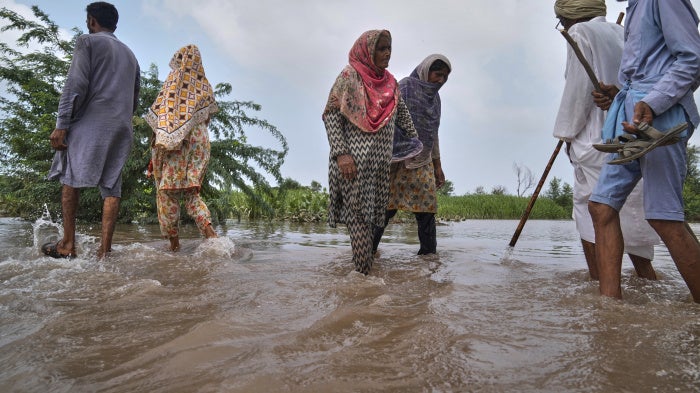
Catastrophic floods in Pakistan in August killed at least 900 people, displaced four million, destroyed thousands of acres of crops, and severely damaged critical infrastructure. Pakistan is among the countries most vulnerable to the climate crisis, facing rates of warming considerably above the global average and frequent, extreme climate events. These events are particularly threatening for marginalized and at-risk populations.
The floods threaten to exacerbate Pakistan’s continuing economic crisis. Debt servicing consumed 48 percent of federal revenues, leaving minimal resources for social services and development expenditures. In May, the International Monetary Fund (IMF) completed its first review of Pakistan’s funding program, which includes stringent measures that have raised fuel and electricity costs and the price of other necessities without adequate measures to protect rights.
The impact of both the floods and IMF-mandated measures have strained Pakistan’s limited social protection services, including the Benazir Income Support Program (BISP), a cash transfer initiative targeting women living in extreme poverty.
Sexual Orientation and Gender Identity
Same-sex sexual conduct between men remains a criminal offense under Pakistan’s criminal code, placing men who have sex with men and transgender women at a high risk of police abuse and other forms of violence and discrimination.
Transgender women continue to be targeted with violence. At least eight were killed in Khyber Pakhtunkhwa province in 2025, and the authorities failed to hold perpetrators accountable in most cases. In September, three transgender women were killed by unidentified assailants in Karachi. A 2018 transgender rights law saw partial implementation, with identity cards issued, but discrimination in health care and employment persisted.
International Actors
In a January visit, the EU Special Representative for Human Rights warned Pakistan not to take its GSP+ status for granted, as the trade benefits are linked to respect for human rights. In November, an EU monitoring mission was deployed to assess Pakistan compliance with its human rights obligations.