In 2025, insecurity remained prevalent across Nigeria, underscoring the authorities’ failure to protect communities or ensure accountability. Deadly attacks in Borno State, the epicenter of the Boko Haram conflict, signaled a resurgence of the Jama’atu Ahlis Sunna Lidda’awati wal-Jihad (JAS) faction of Boko Haram. Killings, kidnappings, and violent raids by criminal groups continued to impact the Northwest region. In response to the violence, Nigerian security forces have been implicated in abuses, including airstrikes which have killed people. Meanwhile, deadly intercommunal violence linked to decades-long farmer-herder tensions in the Northcentral region persisted.
Violence in the Northwest and Northcentral Regions
In the Northwest region, killings, kidnappings for ransom, and violent raids by criminal gangs that emerged from conflict between farming and herding communities, popularly called bandits, persisted while the authorities failed to protect those targeted and hold perpetrators of attacks accountable.
A report by geopolitical research firm SBM Intelligence found that 2,938 people were kidnapped in the Northwest region between July 2024 and June 2025—over 60 percent of reported incidents nationwide. According to the report, Zamfara State, the center of the banditry crisis, recorded the highest number, 1,203 abductions, followed by Kaduna with 629, Katsina with 566, and Sokoto with 358.
On August 19, armed attackers killed 32 people during an attack on worshippers at a mosque in Unguwan Mantau village, Malumfashi Local Government Area (LGA) of Katsina State. The authorities committed to ensuring justice for the killings but have yet to provide any information on efforts to investigate, arrest, and prosecute those responsible.
Protracted intercommunal violence between predominantly Muslim herders and Christian farming communities in north-central Nigeria persisted, resulting in killings and displacement.
In April, suspected herder-allied assailants killed 52 people and displaced nearly 2,000 during attacks on six villages in Bokkos LGA, Plateau State. In June, suspected herder-allied assailants also attacked Yelewata, a farming community in Guma LGA of Benue State, killing 59 people, according to the state government. However, residents provided a list of over 100 people they allege had been killed, to the media.
Authorities announced that they arrested 53 suspects, including 26 linked to the Yelewata attack in Benue State, and recovered weapons with promises of prosecution. However, there are no confirmed arrests or prosecutions for the April killings in Bokkos, and publicly available details on court proceedings or any convictions related to the Yelwata attack remain unclear, highlighting persistent gaps in accountability.
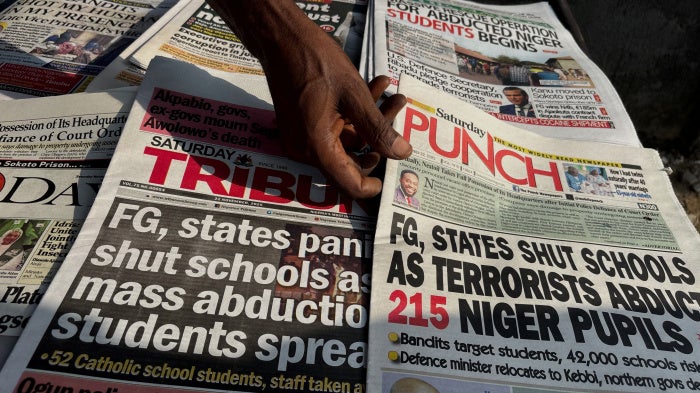
Between November 18 and 21, hundreds of schoolchildren were kidnapped by unidentified armed men in Kebbi and Niger states. Twenty-four children abducted on November 18 were released a week later, while 100 of those taken on November 21 were freed on December 8 and another 130 on December 21. President Tinubu recognized the efforts of security agencies in securing the releases but did not disclose who was responsible for the kidnappings or whether any investigations, arrests, or prosecutions have followed the releases. Nigerian authorities have failed to apply lessons from previous attacks to take measures that could prevent these atrocities.
Boko Haram Conflict in the Northeast
While the Islamic State West Africa Province (ISWAP) faction of Boko Haram continued to target military personnel and assets, the JAS faction resumed targeted, deadly attacks on civilians. This resurgence in attacks follows an earlier decline after the reported death of its leader, Abubakar Shekau, in 2021.
In May, at least 57 people were killed and around 70 reported missing after suspected JAS fighters attacked Mallam Karamti and Kwatandashi villages in Kukawa LGA, Borno State. According to media reports, the insurgents gathered over 100 villagers and marched them into the bush, where some of the victims’ bodies were discovered by community members and military during search operations.
In September, insurgents attacked Darul Jamal, a recently resettled community in Bama LGA, Borno State. According to media, the attackers killed at least 60 people including soldiers. Many victims had reportedly returned from internal displacement camps closed by authorities a month earlier.
This attack underscores Human Rights Watch’s previous concerns about the Borno State Government’s plans to shut IDP camps and force returns to insecure communities lacking basic services or infrastructure.
Separatist Agitations in the Southeast
Attacks by gunmen reported to be linked to the Indigenous People of Biafra (IPOB), a separatist group in Nigeria’s Southeast region, continued in 2025.
In March, the trial of IPOB leader Nnamdi Kanu for treason and terrorism-related charges, restarted with a new judge after the former trial judge recused herself in 2024. The court will rule in October on a ‘no-case’ submission made on behalf of Kanu by his lawyers in July arguing that the prosecution has not shown enough proof for the case to go on.
Amnesty International reported that in May, at least 30 people were killed when gunmen, suspected to be IPOB members, attacked travelers along the Okigwe–Owerri highway in Imo State, setting over 20 vehicles and trucks on fire. IPOB has, however, refuted these allegations.
On September 1, the Päijät-Häme District Court in Finland sentenced Simon Ekpa, an IPOB leader, to six years in prison on terrorism-related charges, finding that he committed illegal acts in support of IPOB, including helping to equip the group with weapons.
Abuses by Security Forces
In August, activist Omoyele Sowore was arrested on charges of forgery and cyberstalking. While the Nigeria Police Force denied allegations of torture following Sowore’s appearance in court wearing a sling across his arm, Sowore claimed he was tortured and assaulted during his detention.
In January, a Nigerian Air Force airstrike hit Tungar Kara village in Maradun LGA of Zamfara State, killing at least 20 people, according to media reports. The victims, including members of the Zamfara Community Protection Guard and residents, were reportedly responding to a bandit raid at the time. The military claimed the strike was targeted at bandits terrorizing villages in the area but announced they were undertaking an investigation following public outcry; however, no information has been provided since.
Similar airstrikes have killed hundreds in Nigeria, in previous years, during counter-banditry operations without transparent, clear, and meaningful steps towards accountability or reparations.
Freedom of Expression and Media
Authorities arrested and prosecuted journalists and social media commentators, often under the Cybercrimes Act which criminalizes a broad range of online interactions.
In January, charges against human rights lawyer Dele Farotimi were dropped after the complainant, prominent legal figure Afe Babalola, withdrew his petition. They stemmed from statements in Farotimi’s book and a podcast which Babalola alleged were libelous. Farotimi’s arrest by the police in late 2024 on defamation and cybercrime charges sparked concern over freedom of expression. He was detained for weeks, denied bail initially, and later released under strict conditions.
Similar cases include the June arrest of journalist Nurudeen Adegbenro Adenekan for alleged cyberstalking and defamation after publishing content critical of a local government chairman in Lagos. In July, journalist Buhari Olanrewaju Ahmed and activist Saidu Musa Tsaragi in Kwara State were arrested over online criticism of the government’s crackdown on protesters in the state. While Adenekan was released without charge shortly after, Ahmed and Tsaragi were charged with defamation and cyberstalking and granted bail pending trial.
In February, the European Parliament adopted a resolution calling for the immediate release of singer Yahaya Sharif-Aminu and a moratorium on the death penalty leading to its full abolition. Sharif-Aminu was sentenced to death by hanging after being found guilty of blasphemy under the Kano State Sharia Penal Code for song lyrics circulated via WhatsApp deemed insulting to Islamic tenets. While waiting for Supreme Court appeal proceedings, he has reportedly been denied access to medical care.
Although the Nigerian Constitution guarantees freedom of expression, thought, and conscience, blasphemy remains a criminal offense punishable by death in some state criminal laws; Sharia (Islamic law), applicable in 12 northern states, also criminalizes blasphemy.
Sexual Orientation and Gender Identity
In January, the Initiative for Equal Rights (TIERs) published a report documenting 556 incidents affecting 850 LGBT+ individuals across 29 states. It highlighted abuses including assaults, blackmail, extortion, and ‘kito’ attacks, where victims are lured online and then harassed or extorted. According to the report, state officials participated in some attacks.
Women’s and Girls’ Rights
In May, President Bola Tinubu announced a review of the Violence Against Persons Prohibition (VAPP) Act, signaling a shift from the 2024 attempt to repeal the law. This review aims to expand protections against sexual and gender-based violence, address gaps in implementation, and ensure enforcement.
In September, federal lawmakers held a public hearing on a constitutional amendment to reserve additional legislative seats for women at federal and state levels.
Disability Rights
People with psychosocial disabilities face human rights violations in facilities, including chaining despite a nationwide legal ban in 2021.