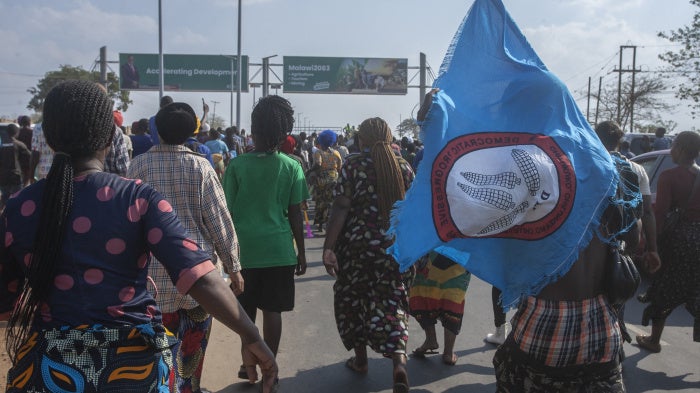
In September 2025, Malawi voted in a general election. The lead-up to the election was marked by democratic backsliding, undermining reforms which took place after the Constitutional Court annulled the country’s 2019 elections. The 2025 election was characterized by unequal campaign conditions for the political opposition. Civil society and political opposition parties also raised concerns about the impartiality of the electoral commission. Reports of politically motivated violence increased before the election, and the authorities’ failure to investigate them risked normalizing impunity.
In July, the Constitutional Court found Malawi’s criminal defamation laws disproportionately restricted freedom of expression and were incompatible with Malawi’s commitments under regional and international human rights law. The court struck down section 200 of the Penal Code, which had criminalized defamation.
Civil and Political Rights
Malawians went to the polls on September 16 to vote for the president and members of parliament. Despite commending the peaceful elections, observer missions urged Malawi to undertake electoral reforms, including establishing continuous voter registration and a permanent electoral roll, enabling diaspora participation, clarifying the legal framework for electronic systems, and addressing electoral-related criminal acts.
Before the election, reports of politically motivated violence surged. On June 26, 2025, the police stood by as weapon-wielding men attacked demonstrators calling for an independent audit of the voters’ roll and the resignation of top electoral commission officials. Civil society groups and opposition parties alleged that those behind the political violence had links to the ruling Malawi Congress Party, though the party denied such claims.
The police’s apparent unwillingness to intervene to stop the violence – or to arrest those responsible, even when their identities were known – raised grave concerns about the government’s willingness to hold the perpetrators accountable. The authorities’ muted response to attacks on peaceful assembly risks normalizing impunity that could undermine the country’s democratic gains.
Freedom of Expression
In an important step towards protecting free speech, Malawi’s Constitutional Court decriminalized defamation in July. Social media activist Joshua Chisa Mbele had challenged the constitutionality of the penal code’s Section 200. He argued it infringed his right to freedom of expression and was inconsistent with Malawi’s obligations under regional and international human rights law. Mbele lodged the constitutional challenge while facing criminal proceedings for alleged defamatory statements concerning a top public official.
In its decision, the court found criminal defamation laws incompatible with freedom of expression and stated that Section 200 “could not be justified as necessary or proportionate and failed to provide adequate safeguards to prevent arbitrary or excessive interference with free speech”. The court ruled it had a “chilling effect” on public discourse and democratic participation. For years, journalists and government critics have been arrested and faced criminal defamation charges, under a law the Media Institute of Southern Africa (MISA Malawi) said hindered free speech and a free press.
Journalists and all Malawians can now express themselves more freely without fear of criminal sanctions. However, Malawi continues to enforce the Electronic Transaction and Cyber Security Act which has been used to charge journalists for their work.
Refugee and Migrant Rights
Malawi has longstanding reservations to the UN Refugee Convention, which recognizes the right to freedom of movement and choice of residence for refugees lawfully within a country. Malawi’s encampment policy restricts the freedom of movement of refugees and asylum seekers by requiring them to live in Dzaleka camp. This has resulted in significant lack of protection for refugees, who experience ongoing human rights violations.
Malawi’s 1989 Refugee Act provides for procedures to determine refugee status but does not address the rights of refugees. Refugee rights groups have lobbied for amending the law, which requires refugees to live in the camp indefinitely, and to ensure refugees’ rights to freedom of movement, work, and education.
In May, a government official was quoted in the media as saying that the government might consider reviewing the encampment policy so that refugees can live and work outside Dzaleka camp. According to the UN Refugee Agency (UNHCR), Dzaleka camp was originally established to accommodate up to 12,000 refugees but is now home to more than 50,000 people, mainly from the Democratic Republic of Congo, Burundi, and Rwanda.
Due in part to overcrowding, residents of Dzaleka camp have been denied access to sufficient food, physical safety, health care, education, social security, and other vital assistance. UNHCR says Dzaleka camp has become a hotspot for human trafficking, and media outlets reported that some of the refugees have turned to sex work to survive.
Right to Health
Despite government efforts to work toward its commitments to realize universal health coverage by 2030, Malawi’s public healthcare system has insufficient trained healthcare providers, facilities, and resources, including equipment, commodities, and essential medicines.
The 2024/25 national budget allocated 12 percent of public spending to healthcare. While this is a significant increase compared to previous years, it falls short of the target set by the Abuja Declaration of allocating at least 15 percent of national budgets to improve health care. In 2001, the government of Malawi committed to allocating at least 15 percent of its national budget to healthcare.
Maternal mortality in Malawi is 381 deaths per 100,000 live births, placing Malawi among the 25 countries with the highest maternal mortality rates in the world.
Many women and girls still experience poor quality maternal healthcare services. In Malawi, obstetric violence — abuse and mistreatment of pregnant women and girls seeking reproductive health services, including antenatal, intra-partum, and post-natal care — persists.
Sexual Orientation and Gender Identity
Malawi’s penal code, under sections 153, 154, and 156, criminalizes anyone who has “carnal knowledge” of any person “against the order of nature,” attempts to commit an “unnatural offence” or undertake “indecent practices.” These vague and overly broad provisions facilitate discrimination against lesbian, gay, bisexual, and transgender (LGBT) people and can result in corporal punishment and sentences of up to 14 years’ imprisonment.
Rights of Older People
Malawi enacted the Older Persons Act in 2024 to safeguard older people’s rights and welfare. However, violence against older people continues. The Malawi Network of Older Persons Organizations (MANEPO) reported that between January and October, 18 older people had been killed as a result of witchcraft accusations. While the Older Persons Act of 2024 seeks to address violence and abuse of older people alongside other rights, it is not fully compliant with Malawi’s human rights obligations under regional and international human rights standards, including on older people’s right to live a secure and dignified life.