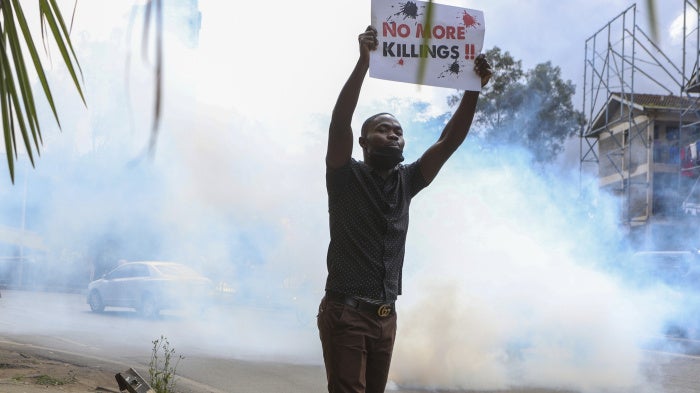
Kenya’s human rights situation remained worrying over the past year. The authorities continued cracking down on peaceful protesters. Plain clothed security forces reportedly abducted, tortured, and forcefully disappeared individuals suspected of organizing and supporting anti-government protests and social media activists. The authorities have done little to ensure accountability for these and other abuses.
Several factors prompted continued protests in 2025 – outrage at the previous year’s tax hikes given a lack of accountability for government spending, the death in custody of blogger Albert Ojwang in June, and the commemoration of the 2024 protests in June. Despite protests, the government failed to address entrenched corruption and misuse of public resources, further fueling public anger.
The independent media, activists, human rights defenders and organizations, and government critics faced threats, intimidation, harassment, arbitrary arrest, and malicious prosecution. In June and July 2025, the authorities switched off signals of at least three media houses and blocked livestreaming of protests by social media activists.
Abuses by Security Forces
State security forces continued killings, abductions, and arbitrary arrests. On June 7, plain clothes officers from the Directorate of Criminal Investigations (DCI) arrested Albert Ojwang, a 31-year-old high school teacher and blogger, over a blog deemed critical of the Deputy Inspector General of Police, Eliud Langat. They drove over eight hours with him to Nairobi’s Central Police Station where, according to the autopsy report, he was confirmed dead allegedly due to torture on June 8, sparking public protests.
Ojwang’s was just one of the many alleged cases of killings, abductions, disappearances, and arbitrary arrests by state security forces reported by media and human rights organizations, including Human Rights Watch, since the beginning of the 2023 cost of living protests and the 2024 anti-Finance Bill protests. During the nationwide street demonstrations over Ojwang’s killing, a video appeared on social media which appeared to show a police officer deployed to quell protests in Nairobi shooting a street vendor, Boniface Kariuki Mwangi, at close range on June 17. Media and human rights organizations reported that police killed at least another 31 people during protests over the killing of Ojwang while the Kenya National Commission on Human Rights reported that at least 26 and 15 people are still missing from the 2024 and 2025 protests respectively.
Lack of Accountability for Security Forces Abuses
Kenyan authorities have not investigated or prosecuted security forces in most cases of excessive and lethal force during protests from 2023 to 2025. A joint report by Human Rights Watch and Amnesty International Kenya in November 2024 found that Kenyan authorities had failed to investigate or prosecute any police officer or government official over the killing of at least 31 people during the 2023 cost-of-living protests. In April 2025, the Independent Policing Oversight Authority (IPOA), in response to a BBC documentary over the 2024 protests, said it had registered 60 killings, of which “it had completed 22 investigations, while it was actively pursuing 36” and had charged two cases to court.
Although the state-funded Kenya National Commission on Human Rights reported that at least 26 people abducted by the police were still missing in the aftermath of the 2024 protests, IPOA did not mention investigations into allegations of abductions and disappearances. The authorities have also yet to investigate or prosecute anyone for at least 65 killings and at least 400 others who sustained life threatening injuries during the 2025 protests as reported by various local media groups.
In August, President William Ruto appointed an 18-member panel “…to design and establish an operational framework to verify, categorize, and compensate eligible [protests] victims...” since 2017. In September, a High Court in Kerugoya issued orders halting the panel’s activities pending the hearing of a petition challenging its legality. In December, the court ruled that the compensation panel was unconstitutional and directed KNCHR to take over that responsibility.
Attacks on Civil Society, Freedom of Expression, and Media
The authorities escalated formal and informal attacks against activists, civil society groups, and the media. On June 25, during protests to commemorate the June 2024 protests, the Communications Authority of Kenya (CAK) ordered media, including social media blogs, to stop live coverage of protests. The CAK later switched off three television stations – KTN, NTV and K24 – over their coverage of the protests. A High Court ordered CAK to restore the signal of the three television stations and declared the ban on live coverage illegal.
Security forces physically attacked journalists covering protests, injuring at least five in 2025. During the June 25, 2025, protests, Ruth Sarmwei of NTV was hit by a rubber bullet while covering the protests in Nakuru County. On July 6, a day before the Sabasaba [seven seven in Kiswahili] protests that take place annually to commemorate the struggle for democracy in Kenya, an armed gang attacked activists who had gathered at the Kenya Human Rights Commission, a nongovernmental organization to call for “…an immediate end to arbitrary arrests, enforced disappearances, and extrajudicial killings.” The authorities further continued to target social media activists critical of the government, including those posting on Facebook, TikTok and X, arbitrarily arresting and charging them with offences related to cybercrime and terrorism. In June, police raided 35-year-old Rose Njeri’s home, arrested and detained her for three days. Njeri had developed a software through which Kenyans could send directly to their members of parliament views opposing possible new measures seeking to hike taxes. Police charged Njeri with cybercrime related offences but later dropped the charges.
Lack of Transparency in Government Spending
Kenyan authorities implemented tax measures passed in the previous year, such as a housing levy and social health insurance, and increased ten times the contribution rates to the National Social Security Fund (NSSF) pension fund, despite public concerns about lack of transparency and difficulties accessing services.
While these taxes are part of domestic revenue mobilization to fulfil rights, the government lacks proper oversight and accountability for misuse of public resources. The housing levy, which the government implemented in 2024, has no mechanism for management and oversight of the fund or criteria for determining beneficiaries of the houses to be built from the levy. In June 2025, parliamentarians questioned a government decision to invest the levy funds in treasury bills and the failure to account for over Ksh4.2 billion (US$32.5 million) interest accrued from the investment.
Hospital workers and other experts have also said that, despite contributions to the Social Health Authority (SHA) increasing more than ten times since SHA’s establishment, patients continued to ill afford or access health services. Audit reports have revealed mismanagement of the health authorities’ resources, with several hospitals linked to influential individuals allegedly defrauding the authority.
Women’s Rights
In January, the government established a 42-member Technical Working Group on Gender-Based Violence (GBV) including Femicide in response to a record-high of reported femicides in 2024, heightened media coverage, including of slain female athletes, and public protests. The Working Group was mandated to assess, review, and recommend measures to strengthen institutional, legal, and policy responses. In August, it briefed the deputy president and prepared to present to the president. The report remains unpublished, and its future policy impact is unclear.
Sexual Orientation and Gender Identity
Consensual same-sex sexual acts continue to be criminalized, with punishment of up to 14 years in prison. While President Ruto has publicly supported U.S. President Trump’s executive order recognizing only two sexes, in August 2025 the Eldoret High Court ordered the Kenyan government to create legislation to protect the rights of transgender people.
Disability Rights
In May 2025, Kenya enacted a new Persons with Disabilities Act, replacing the 2003 law and introducing a rights-based framework that references Article 54 of the Constitution and draws from principles in the UN Convention on the Rights of Persons with Disabilities.