Civilians in much of Ethiopia faced humanitarian crises during the year. Armed hostilities continued between federal forces and armed groups in Amhara and in parts of Oromia, while in Tigray, internal tensions and renewed clashes along regional borders deepened instability. Relations between the federal government and Eritrea remained fragile, raising concerns of possible future fighting.
The government intensified its crackdown on independent media and civil society ahead of elections slated for 2026. Security forces arbitrarily detained healthcare workers protesting poor pay and living conditions.
Humanitarian needs remained acute. The UN estimated that over nine million children were out of school due to conflict and natural disasters. The US government’s cuts to aid deeply impacted Ethiopia, which has been one of the largest recipients of assistance in Africa.
Consensual same-sex relations are outlawed and carry a penalty of up to 15 years in prison.
The transitional justice process stalled, while impunity for serious crimes and abuses remained the norm.
Armed Conflict and Abuses
The armed conflict between the government and Fano militia in Amhara continued throughout 2025, with warring parties committing war crimes and other serious abuses.
There were reports of drone strikes harming civilians in Amhara. In early February, a strike in North Shewa hit a house and killed a pregnant woman, her 6-year-old daughter, and a young man. On February 20, a strike killed 16 people, including children, and injured 10 in East Gojjam.
Fano forces in towns in Gojjam Zones abducted and threatened teachers to prevent schools from opening. On March 20, gunmen abducted and later killed four teachers in Merawi, accusing them of violating a general strike called by Fano militia.
Aid agencies’ access remained deeply restricted in Amhara, where aid workers faced high incidents of violence, including kidnappings for ransom. On August 15, gunmen abducted Honelign Fentahun, an Ethiopian Red Cross Society aid worker, and his two colleagues in North Gondar Zone. Honelign was tortured and subsequently died from his injuries.
In Tigray, Eritrean troops committed rape and sexual violence against women in occupied areas. Despite the 2022 cessation of hostilities agreement, Tigrayans continued to be forcibly displaced from Western Tigray. Tensions between rival political factions led to clashes between Tigrayan forces in southern Tigray and along the border with Afar region, causing displacement.
Fighting between the federal government and the Oromo Liberation Army, in addition to clashes among armed groups, continued in parts of Oromia and resulted in civilian casualties and displacement.
Between late 2024 and early 2025, local communities and regional militias clashed in the Dacawaley area of Ethiopia’s Somali region, a site of long-standing grievances over land, killing and injuring dozens.
Shrinking Civic Space
The space for independent civil society, already extremely narrow, shrank further. Ethiopian officials continued their harassment and threats against human rights organizations and activists, forcing several government critics into exile.
Since late 2024, the Authority for Civil Society Organizations, a government body that oversees civil society groups, suspended five prominent rights groups, including the Ethiopian Human Rights Council on vague and politicized grounds, inconsistent with the country’s 2019 civil society law.
Though the civil society authority lifted the suspensions in March, repression continued. In early June, the authority suspended the Ethiopian Health Professional Association (EHPA) after the group endorsed the demands of protesting health workers. At time of writing, EHPA remains suspended.
In June, the Ministry of Justice and the civil society authority began a process to amend the 2019 civil society law. The proposed amendments would grant the government sweeping powers to restrict civil society groups and include onerous bureaucratic requirements and harsh criminal and administrative penalties.
Freedom of Expression
The government tightened its grip on Ethiopian media. Journalists working for independent outlets faced harassment, arbitrary arrest, and incommunicado detention by authorities.
In August and September, Ethiopian authorities arbitrarily arrested at least six journalists and media workers, holding some incommunicado. On September 3, Addis Ababa police arrested Tigist Zerihun, Mintamir Tsegaw, and Eshete Assefa, who work for Sheger FM 102.1, accusing the radio station of bias and inciting violence following their August 29 broadcast of a report on Ethiopian health workers. While police released Eshete the same day, Tigist and Mintamir were released on bail on September 24, following a Federal Supreme court ruling ordering their release.
On August 13, masked gunmen, some allegedly in military uniform, abducted Yonas Amare, a senior editor at The Reporter newspaper. His whereabouts remained unknown for eight days until his release.
In April, police raided Addis Standard’s newsroom, detained three managers and seized devices. In June, a plainclothes intelligence officer arrested Tesfalem Woldeyes, editor-in-chief of Ethiopia Insider, on allegations of “disseminating false information.” He was released on bail on June 13.
Authorities in the Somali region detained several journalists after they posted critical views on social media. On August 5, Khadar Mohamed Ismail, a reporter with a government-owned station, was detained after he published a video showing people complaining about regional authorities on the station’s social media page.
The government used the 2020 hate speech and disinformation law to target journalists. In April, parliament also passed problematic amendments to the country’s 2021 media law, increasing government control by shifting the authority to suspend or revoke media licenses from the board of the media regulatory body to its head, whom the prime minister now appoints.
Economic and Social Rights
Ethiopians grappled with continued inflation, rising external debt, and a cost-of-living crisis as the government restructured its debt with external creditors and implemented IMF-backed reforms, including subsidy cuts, monetary tightening, and tax reforms.
Public health workers demanding better pay and improved working conditions began striking in May after months of organizing online. Authorities clamped down, including by suspending a key professional association, detaining striking health workers, and threatening disciplinary measures. Police charged Dr. Daniel Fentaneh, a prominent figure in the movement, with organizing a strike and held him for 27 days before his release on bail.
Large-scale urban redevelopment projects—most prominently the federal government’s Corridor Development Project (CDP)—precipitated waves of forced evictions in Addis Ababa and other towns. Authorities removed residents from homes with little or no prior consultation, inadequate notice, and without meaningful compensation or resettlement options that meet international standards.
Internally Displaced Persons (IDPs) and Refugees
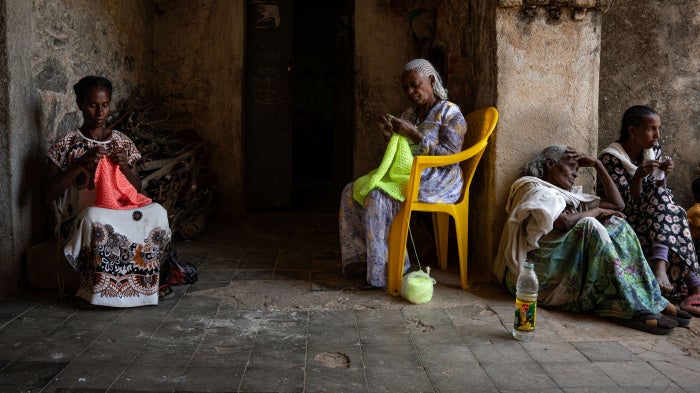
As of mid-2025, the UN estimated 3.3 million people were internally displaced in the country. In Tigray and Amhara, hundreds of thousands of IDPs lived in precarious conditions in formal and informal camps with limited access to food and other assistance. In June, IDPs in Tigray staged a three-day protest outside government offices in the regional capital, calling for safe, urgent, and voluntary returns.
In late May, escalating violence between armed groups in border areas of Oromia and Benishangul-Gumuz regions displaced over 11,000 people.
Ethiopia hosts over one million refugees—mainly from neighboring South Sudan, Somalia, Eritrea, and Sudan—but growing political instability and funding shortfalls undermined protection. In March, thousands of refugees fleeing conflict in South Sudan entered Ethiopia’s Gambella region following escalating fighting between South Sudanese military and opposition forces and affiliated militia near the border.
Justice and Accountability
The government made little visible progress towards ensuring meaningful accountability for past and ongoing atrocities, while its transitional justice process effectively stalled.
In July, Médecins Sans Frontières (MSF) released the findings of its internal review into the killing of three of its staff members in 2021 during the conflict in Tigray. The report found that the team had been intentionally targeted and killed, and that a convoy of Ethiopian soldiers was present at the incident. Despite repeated assurances from the government of an investigation, authorities failed to provide credible answers.
The EU led two joint statements at the UN Human Rights Council in March and September highlighting the lack of progress on transitional justice and an end to violations in conflict areas. The EU nevertheless committed 240 million Euros to Ethiopia in April, which included support to transitional justice and democratic reforms.
In May, the African Commission on Human and Peoples’ Rights (ACHPR) heard a case by Legal Action Worldwide and partners accusing the Ethiopian government of human rights violations in Tigray.