Australia is a democracy with a strong human rights record in many areas, but significant failings in others. Australia’s vibrant multicultural society was tested in 2025 by racist attacks, including an attack by gunmen on a Jewish event in Sydney that killed 15 people.
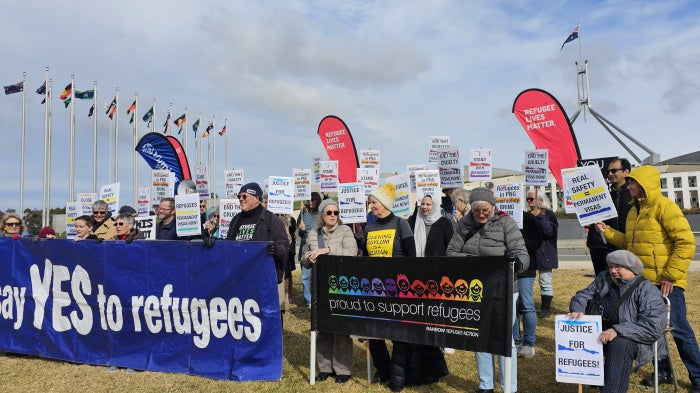
Despite promises to uphold international obligations to refugees, the government revealed plans to deport hundreds of migrants and refugees to the island nation of Nauru and is contributing to a global erosion of refugee law and norms. Other ongoing concerns include systemic discrimination against First Nations people; violations of the rights of children held in youth detention; the approval of new fossil fuel projects that exacerbate the climate crisis; and inconsistent support for rights in its foreign policy.
Australia is the only Western democracy without a national human rights act or charter. In 2025, Attorney General Michelle Rowland indicated she was considering a human rights act.
In May 2025, the Labor government, led by Prime Minister Anthony Albanese, was re-elected.
Asylum Seekers and Refugees
Australia has violated the rights of asylum seekers for decades by forcibly transferring them to offshore detention where they face abuse.
In January, the United Nations Human Rights Committee found Australia remained responsible for violations against asylum seekers transferred to Nauru.
In September, the Australian government reached an agreement with Nauru to deport a reported 350 people to the Pacific island. The government had previously been forced to release these people from onshore immigration detention after the high court ruled indefinite detention illegal. The deportation deal could cost Australia A$2.5 billion (US$1.6 billion). In October, the government confirmed the first deportation had taken place. Australia also rushed through new laws to strip deportees of basic procedural fairness rights.
Although Australia claims the Nauru agreement ensures refugees “proper treatment and long-term residence,” laws enabling the deal do not guarantee freedom from detention or protection from return to persecution.
Racial and Ethnic Discrimination
Australia has seen increasing racism. This includes, but is not limited to, antisemitism, Islamophobia, anti-Arab and anti-Palestinian racism, racism targeting people of Indian heritage and racism towards First Nations people.
From late 2024 through 2025, there was a spate of antisemitic attacks in Sydney and Melbourne. In August, Albanese said there was evidence that Iran had directed some attacks and expelled the Iranian ambassador, severed diplomatic ties, and sanctioned the Iranian Revolutionary Guard Corps.
In December 2025, two gunmen opened fire on people celebrating the Jewish festival of Hanukkah at Bondi beach. Sixteen people were killed including one of the assailants, with at least 42 injured. This was the deadliest mass shooting in Australia in three decades.
Neo-Nazis increased their activities in 2025. In September, members of the National Socialist Network promoted national anti-immigration rallies. Neo-Nazis attacked Camp Sovereignty in Melbourne—a First Nations protest and gathering site.
Youth Justice
Under international human rights law, detention of children should be a last resort. However, three jurisdictions in Australia have passed laws removing this principle. The Queensland government removed the principle in December 2024; Victoria in March 2025; and the Northern Territory in July.
In May, Queensland expanded its so-called “adult crime, adult time” laws by adding 20 new offenses to which they apply. The laws treat children charged and convicted of certain crimes as adults, subjecting them to harsher penalties including life sentences. Victoria announced a plan to introduce similar laws in November.
The age of criminal responsibility in most Australian jurisdictions is 10, well below the UN-recommended minimum of at least 14. In July, the Australian Capital Territory became the first jurisdiction to raise the age to 14.
About 700 children aged 10-17 are incarcerated; over 60 percent are First Nations children.
Children are detained in “watch houses”—adult police holding cells. A Tasmanian report found that children held in watch houses cannot be adequately separated from adults, and staff are not trained to work with children. In Western Australia, authorities incarcerated children in a cellblock of an adult men’s prison.
In May, First Nations legal experts complained to the UN Committee on the Elimination of Racial Discrimination seeking urgent action on Australia’s “discriminatory youth justice policies.”
In September, nongovernmental organizations called on the federal government to raise the age of criminal responsibility nationwide, citing legal advice affirming it has constitutional power to do so.
First Nations Rights
First Nations children are over 12 times more likely than other children to be separated from their families by child protection authorities. In Western Australia, Human Rights Watch found authorities removed children from mothers fleeing domestic violence and parents without adequate housing, rather than providing appropriate support.
In May 2025, the Western Australian government announced a reparations program for the “Stolen Generations,” Indigenous children who were forcibly removed from their families under racist policies that lasted into the 1970s.
Victoria’s Yoorrook Justice Commission, Australia’s first Indigenous-led truth-telling process, found the decimation of the First Nations population in Victoria “was the result of a coordinated plan of different actions aimed at the destruction of the essential foundations of the life of national groups … [which] was genocide.”
In November, Victoria signed the nation’s first treaty with Indigenous peoples.
Right to Protest
Protest rights are increasingly under threat, with protesters risking criminalization including fines and imprisonment.
Climate protesters often face arrest. In February, a Victorian court ruled that an activist arrested protesting outside a fuel depot could not use climate evidence in their defense.
In June, a New South Wales police officer allegedly punched a 35-year-old woman in the face during a pro-Palestinian protest in Sydney. Police allegedly issued “move-on” orders because the protesters lacked authorization under laws widely criticized by civil liberties advocates. In September, the police officer in question was charged with assault occasioning actual bodily harm.
In August, a court rejected an attempt by the New South Wales police block a pro-Palestinian Sydney Harbour Bridge protest; the protest proceeded and was attended by tens of thousands of people.
Environment
Australia is one of the world’s largest fossil fuel exporters. In September, the government approved the North West Shelf project, extending its operations until 2070. The liquefied natural gas project is projected to release 90 million tons of emissions annually. Its pollution is already damaging nearby ancient rock carvings that are culturally significant to Indigenous people.
Days after the approval, the government released Australia’s national climate risk assessment, which found among other impacts that 1.5 million coastal residents would be at risk from rising sea levels by 2050. The government announced a target to reduce emissions by 62 to 70 percent from 2005 levels by 2035. Environmentalists have said this is “dangerously short” of what is needed to limit warming.
Older People’s Rights
Chemical restraint, the use of medications to control behavior without a therapeutic purpose, is widespread in aged care facilities. A new Aged Care Act came into effect in November but failed to ban the practice, merely aiming to minimize it.
Children’s Online Safety
Australia’s social media ban for children under 16 came into effect in December 2025. The ban requires platforms to verify users’ ages; however, a government-backed study noted age estimation accuracy and privacy risks.
Foreign Policy
The federal government’s approach to diplomacy with China continues to be “cooperate with China where we can, disagree where we must.” In practice, the Australian government has taken few concrete actions to press China on serious domestic rights violations or address China’s extraterritorial targeting of overseas critics of the government, including Australian nationals. Hong Kong national police issued two additional arrest warrants and bounties in 2025 for Australian residents and citizens. The Australian government’s response was to express “strong objection.”
The Australian government has promised to prioritize accountability for Afghan victims of rights violations and has taken some positive actions though at times with significant delay. In December, the government introduced a sanctions framework for Afghanistan that it described as part of its efforts to hold the Taliban accountable for abuses.
In June, Australia imposed Magnitsky-style sanctions on Israel’s national security minister, Itamar Ben-Gvir, and the finance minister, Bezalel Smotrich, who also serves as a minister in the Defense Ministry, for their role in inciting settler violence against Palestinians in the West Bank.
In September, Australia launched a new multi-state declaration for the protection of humanitarian personnel.
Australia has reiterated its support for international law, but has been inconsistent. In February, after US President Donald Trump issued an executive order authorizing sanctions targeting the International Criminal Court, Australia did not join 79 other countries in reaffirming “unwavering support” for the court.