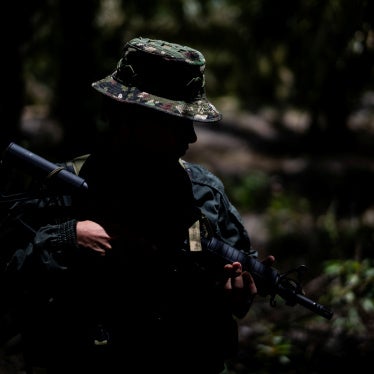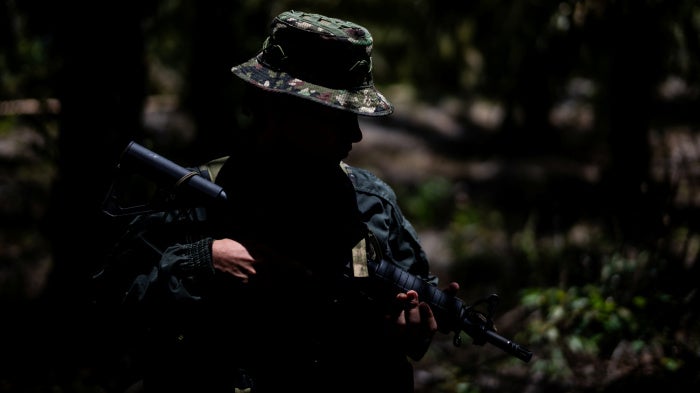
Summary
I was recruited while I was studying. I thought I would never see my mom again.
– 16-year-old girl taken by armed groups while returning home from school at night
On October 15, 2025, the Indigenous Guard, an unarmed voluntary group that legally patrols Indigenous territories, rescued two girls, ages 14 and 15, who the Central General Staff (Estado Mayor Central, EMC), a dissident coalition that emerged from the demobilized Revolutionary Armed Forces of Colombia (FARC), had taken from their community in Timba, Cauca, southwestern Colombia. While the Guard was driving the girls to safety, armed men from the EMC shot at their vehicles, slashed their tires, and took the girls away again, a member of the Guard said. “There was nothing we could do.” After significant national pressure, the girls were released on October 20.
Like these girls, hundreds of children have been recruited by armed groups in Colombia in recent years. By all accounts, child recruitment has been increasing. According to Ombudsperson Office data reviewed by Human Rights Watch, approximately 1,500 children have been victims of recruitment by armed groups since 2021.
This report examines the dynamics of child recruitment, the factors that place children at risk, the strategies armed groups utilize to recruit them, and how children are used by the groups. It also analyzes the government’s response and its shortcomings in preventing child recruitment, protecting and rescuing children, assisting in the recovery and reintegration of those who have been released, and prosecuting the armed groups responsible. Human Rights Watch conducted 184 interviews with government officials, humanitarian workers, Indigenous and community leaders, members of human rights and children’s rights organizations, and Colombian state child protection officers. We also held in-person and virtual group meetings with children who had been victims of recruitment or had been at risk of recruitment, and obtained data and other information from multiple government sources.
Our research found that in Colombia’s current violent landscape, where organized crime has an increased presence, remote communities across the country have witnessed an increase in child recruitment since 2023. While the 2016 peace agreement between the Colombian government and FARC guerrillas led to the demobilization of the country’s main armed group, a myriad of competing armed groups and criminal organizations have continued to fight for territorial control, intimidate and extort communities, and profit from coca production and other illicit economies—while recruiting children to bolster their ranks.
According to our analysis of the Ombudsperson’s Office data, former FARC dissident groups have allegedly been responsible for 74 percent of the child recruitment cases the office has documented between 2021 and 2025. Of those groups, the EMC appears to have been implicated in most of them. Cauca, a state in southwestern Colombia, is home to nearly 57 percent of all the children reported as being recruited nationally.
Nearly half of all reported child recruitment cases involve Indigenous children, despite the fact that Indigenous people represent only about four percent of Colombia’s total population. “They are taking away an entire generation,” an Indigenous leader said. “They are putting the existence of our community and culture at risk.”
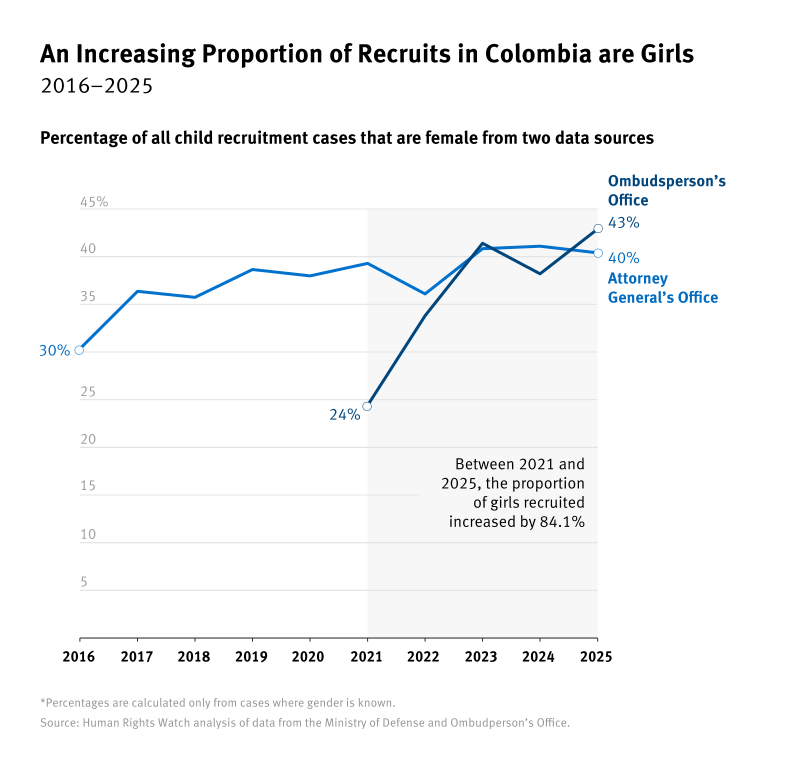
Girls accounted for roughly 40 percent of all recruited children, and their share of reported recruitment cases increased between 2021 and 2025.
More than 30 percent of the cases reported involved children between 10 and 14 years old. Under the Rome Statute of the International Criminal Court, the recruitment of children under the age of 15 can be considered a war crime.
As they have done for decades, armed and criminal groups have taken advantage of poverty, social exclusion, and barriers to education to recruit children with promises of power, money, and prestige.
More recently, they have also begun using social media platforms to recruit children. Dozens of accounts and posts disseminate propaganda that glorifies life in armed group ranks, promote deceptive job offers or show apparent children in military uniforms carrying weapons. Worryingly, our research indicates that platforms have not been able to effectively detect and prevent the proliferation of such content. In some cases, their algorithms appeared to have actively promoted such content, likely expanding the reach of armed groups’ efforts to target children.
After recruitment, armed groups frequently transfer children to other regions to isolate them, break family and community ties, and make any escape more difficult. Children are then used to perform various tasks including intelligence gathering, handling of drones, and engaging in fighting. Girls are particularly exposed to sexual violence, including being forced into relationships with commanders.
The government has failed to respond adequately to the increased child recruitment across the country. Colombia has established a range of policies and strategies to fulfill its international obligations to prevent child recruitment, protect and rescue children, ensure the recovery and reintegration of those released, and investigate and prosecute those responsible. But in practice, these policies have serious shortcomings, as several government officials confirmed to us.
The National Public Policy on Prevention, passed in 2018, is outdated and lacks a clear action plan, a dedicated budget and a monitoring system. The body charged with coordinating its implementation lacks enforcement capacity and resources to implement the policy at the local level. Recent efforts, such as a 2025-2030 prevention strategy, are too limited in scope and unable to match the expanding scale of the problem.
Local governments often lack capacity, funding and support to carry out policies effectively. State and municipal governments are responsible for the implementation of the National Public Policy on Prevention, but budgetary and capacity constraints and the absence of a functional search-and-rescue mechanism for recruited children leave many communities without meaningful state protection.
In the absence of meaningful state protection mechanisms, local community organizations, such as the Indigenous Guard, have taken a leading role in protecting children—and even rescuing them from the hands of armed groups. They have done so at grave risk, and some local leaders and members of the Indigenous Guard have been killed in retaliation.
The government’s recovery and reintegration efforts for released children have failed to adapt to the new realities of Colombia’s violent landscape. These efforts provide unequal treatment for children recruited by armed groups considered parties to the armed conflict compared to those who suffered at the hands of criminal groups not considered parties to the armed conflict—a hard line to draw. The former are entitled to comprehensive, even if imperfect, care and support programs throughout their lives. The latter may be subject to criminal prosecution.
Accountability for child recruitment remains the exception rather than the rule. In the last decade, roughly 1 percent of the criminal complaints into child recruitment have led to an investigation, and only 0.2 percent led to a conviction. Human Rights Watch was only able to identify one court ruling against an armed group commanders accused of ordering child recruitment while a handful of other cases led to the sentencing of low-level perpetrators. Limited prosecutorial capacity, security constraints for justice officials, obstacles to reporting, and the growing challenge of investigating recruitment conducted through social media contribute to the justice system’s overwhelming failure to stand up for child victims of recruitment.
The new administration of President Abelardo de la Espriella should adopt decisive steps to end these grave human rights violations. Such change will not take place through an increased military deployment or the use of lethal force alone, which the administration has signaled it intends to prioritize. Rather, it requires a comprehensive security and justice policy that is focused on protecting the population, prosecuting commanders responsible for violations, and adopting meaningful steps to address underlying issues that allow armed groups to thrive—including illicit economies, widespread rural poverty, and corruption. To address child recruitment, the government should simplify the existing mechanisms and, most importantly, make sure that the agencies in charge, especially at the local level, have the resources and capacity needed to address this scourge. Crucially, the government should also support, and work with, Indigenous and other community leaders that have adopted crucial steps to protect children across Colombia.
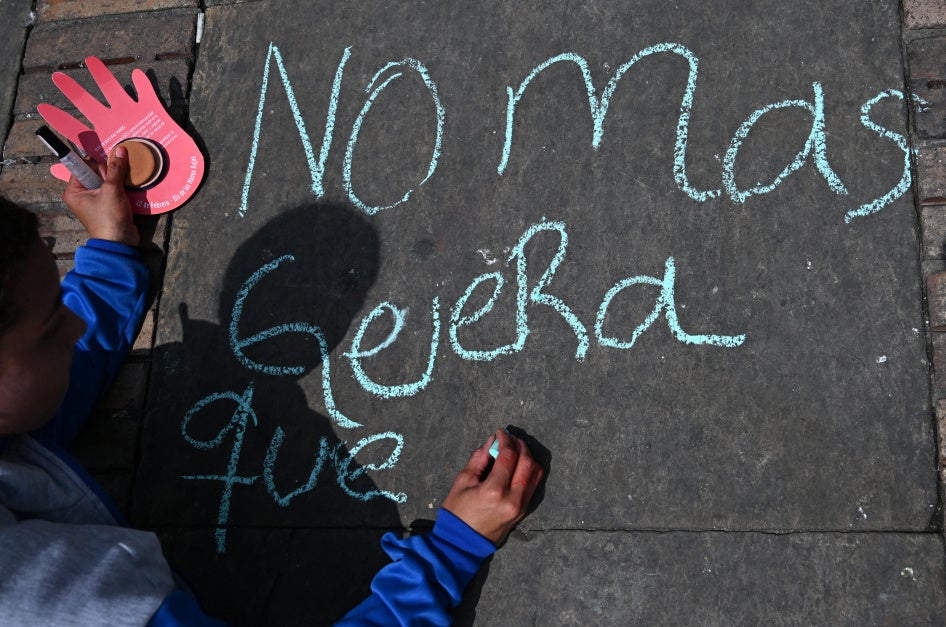
Glossary
Children: Under the Convention on the Rights of the Child, a child is every human being below the age of 18, unless under the law applicable to the child, majority is attained earlier.[1] Colombian law distinguishes two specific age groups: children, any person under the age of 12, and adolescents, any person between 12 and 17 years old.[2] Consistent with international legal standards, the term “children” in this report refers to persons under the age of 18.
Recruitment: In the context of this report, “recruitment” refers to compulsory, forced and voluntary conscription or enlistment of children into any kind of armed force or armed group.[3] Under Additional Protocol II to the Geneva Conventions of 1949 and the Convention on the Rights of the Child, children under the age of 15 may not take part in hostilities.[4] Under the Optional Protocol to the Convention on the Rights of the Child on the involvement of children in armed conflict, ratified by Colombia in 2005, armed groups should not recruit people under the age of 18. State armed forces shall not compulsorily recruit children or use those voluntarily recruited in hostilities.[5] Colombian law criminalizes the recruitment of children under the age of 18.[6]
Use: Children may be utilized and exploited by armed groups for a wide array of activities, including direct participation in hostilities, serving as cooks, porters, messengers, spies, or being used for sexual purposes, among others.[7] The Colombian Criminal Code punishes with up to 20 years in prison the “use” of children and adolescents in illegal activities.[8] Colombian state policies also refer to “utilization” when children and adolescents participate, occasionally or permanently, in organized armed groups or criminal groups, for the purpose of carrying out activities of various kinds, whether illegal or informal in nature.[9]
Release: Refers to the process of formal and controlled disarmament and demobilization of children from an armed group as well as the informal ways in which children leave by escaping, being captured, or by any other means. It implies a disassociation from the armed force or armed group and the beginning of the transition from military to civilian life.[10]
Methodology
In researching this report, Human Rights Watch conducted 184 interviews, including with humanitarian workers, Indigenous leaders, members of human rights and children’s rights organizations, officials from the Ombudsperson’s Office, the Attorney General’s Office, the Colombian Family Welfare Institute (Instituto Colombiano de Bienestar Familiar, ICBF), the Office of the Presidential Advisor for Human Rights, the Ministry of Defense, and state and municipal governments.
Human Rights Watch also held in-person and virtual group meetings with five children who had been victims of recruitment and another five who had been threatened and rescued before being recruited. Given concerns about security risks for children and their families, as well as the potential for re-traumatization when discussing traumatic experiences, Human Rights Watch prioritized careful, low-risk formats over individual interviews.
Interviews were conducted in person and online in Spanish between January 2025 and June 2026. In-person meetings were held in Bogotá and during research trips to Cúcuta, North Santander state; Puerto Asís, Mocoa, Orito, and La Hormiga, in Putumayo state; Montería, Puerto Libertador, Montelíbano, and Tierralta, in Córdoba; and Popayán, in Cauca.
Most interviewees spoke with researchers on condition of anonymity. As a result, the report omits details that could lead to their identification. Certain details about cases or the individuals involved have also been withheld when Human Rights Watch believed that publishing the information could put someone at risk.
Before each interview, Human Rights Watch informed participants of the purpose of the interview, its voluntary nature, and how the information would be used. Researchers obtained verbal consent from each interviewee. Interviewees did not receive any compensation, benefits, or other incentives for speaking with us.
Additionally, Human Rights Watch reviewed 72 accounts and 41 posts on TikTok and Facebook that glorified armed life and encouraged children to join armed groups. Where possible, researchers assessed whether the videos showed individuals who could be children. Human Rights Watch has preserved the footage.
This report also draws on official statistics and documents from the Ombudsperson’s Office, the Attorney General’s Office, the Special Jurisdiction for Peace, a court system created under the 2016 peace accord, the Ministry of Defense, the Ministry of Education, the ICBF, and other institutions, as well as publications by the Office of the United Nations High Commissioner for Human Rights in Colombia, the UN secretary-general, and other international and national humanitarian and nongovernmental organizations, and news articles. Data analysis was conducted in R, a statistical programming language, and code is on file with Human Rights Watch.
Human Rights Watch sent multiple information requests to government authorities between October 2025 and July 2026, including to the Agency for Reincorporation and Normalization, the Office of the Presidential Advisor for Human Rights, the Ombudsperson’s Office, the Attorney General’s Office, the ICBF, the Ministry of Defense, the Ministry of Education, the Ministry of Justice, the Ministry of Foreign Affairs, the Ministry of the Interior, the Office of the High Commissioner for Peace, the Inspector General’s Office, and the Victims’ Unit. All requests were answered in full or in part during President Gustavo Petro’s administration. The responses received are reflected in this report.
Human Rights Watch also sent information requests in March 2026 to 15 mayor’s offices in some of the municipalities with the highest levels of child recruitment in the country, located in the states of Cauca, North Santander, Huila, Antioquia, Vaupés, Arauca, and Putumayo. Seven of them were answered in full or in part. The responses received are reflected in this report.
Human Rights Watch also provided a summary of findings and requested information from Meta (Facebook) and ByteDance (TikTok) in July 2026. Both replied. The responses received are reflected in this report and included in Appendices I and II.
Background
Colombia’s Armed Conflict and Violence
For more than five decades, Colombia has experienced an armed conflict marked by grave violations of international human rights and humanitarian law, including enforced disappearances, extrajudicial executions, sexual and reproductive violence, massacres, kidnappings, and the recruitment and use of children, among others.[11]
In 2016, the Revolutionary Armed Forces of Colombia (FARC) guerrillas and the government signed a landmark peace accord that disarmed the country’s oldest guerilla group and contributed to decreasing violence, which in nationwide terms has been in decline since 2002. But in recent years, the armed conflict and violence have taken new forms, with an increased presence and the proliferation of armed groups in many remote areas.[12]
Currently, a myriad of armed and organized crime groups, with varying size, structure, and origins, operate in Colombia. Among them are the following: [13]
The National Liberation Army (ELN), a guerrilla group formed in the 1960s, which is believed to have roughly 7,000 members (including fighters and militia members) and operates mostly in states along the border with Venezuela, such as Arauca and North Santander, and in the west of the country, including in Chocó and Cauca.
The Gulf Clan (Clan del Golfo), which currently calls itself the Gaitanist Army of Colombia (Ejército Gaitanista de Colombia, EGC), an armed group that emerged in part from a flawed demobilization process of paramilitaries in the early 2000s, and is believed to have roughly 10,000 members. It operates in much of the Caribbean region and in northwestern Colombia.
The Central General Staff (Estado Mayor Central, EMC), a coalition of FARC dissident groups that operates in several states of the country such as Cauca, Valle del Cauca, Meta, Caquetá, Guaviare, and Arauca on the border with Venezuela and is believed to have roughly 4,000 members.
The General Staff of Blocs and Fronts (Estado Mayor de Bloques y Frentes, EMBF), a coalition of FARC dissident groups that operates mostly in the states of Guaviare, Caquetá and Putumayo in the south of the country and Antioquia, Bolívar and North Santander in the north, and is believed to have roughly 3,000 members.
The National Coordinator of the Bolivarian Army (Coordinadora Nacional Ejército Bolivariano, CNEB), a coalition of organized crime groups and FARC dissident groups that operates mostly in the southwest of the country and is believed to have roughly 2,000 fighters.
The Conquistador Self-Defense Forces of the Sierra Nevada (Autodefensas Conquistadoras de la Sierra Nevada, ACSN, or Pachenca), an armed group that emerged in part from a flawed demobilization process of paramilitaries in the early 2000s, and is believed to have roughly 600 members. It operates mostly in Magdalena state in the Caribbean region of the country.
Armed groups no longer have the capacity or the interest to confront the national government directly or to seize power. Instead, they are primarily focused on controlling illicit economies, including drug production and trafficking, illegal mining, and extortion.[14] To do so, armed groups exercise social control over communities, including by threatening and killing social leaders, and imposing rules on the civilian population.[15]
The illicit drug trade and mining are the main financial drivers of conflict. Colombia remains the world’s leading producer of cocaine, accounting for 70 percent of global production.[16] Additionally, 85 percent of the country’s gold exports come from illegal sources, with 70 percent of its trade alleged to be controlled by armed groups, according to one study.[17]
Decades of Child Recruitment in Colombia
Children have faced widespread and serious human rights violations during the armed conflict in Colombia. Thousands were killed, forcibly disappeared, kidnapped, and displaced over decades of violence, according to the Truth Commission established by the government pursuant to the 2016 peace accord.[18]
The Truth Commission, analyzing information from over 100 governmental and human rights groups’ databases, found that at least 16,238 children were forcibly recruited between 1990 and 2017, 44 percent of whom were under the age of 15. However, the Commission estimated that the real number of victims during that period could range between 27,101 and 40,828.[19]
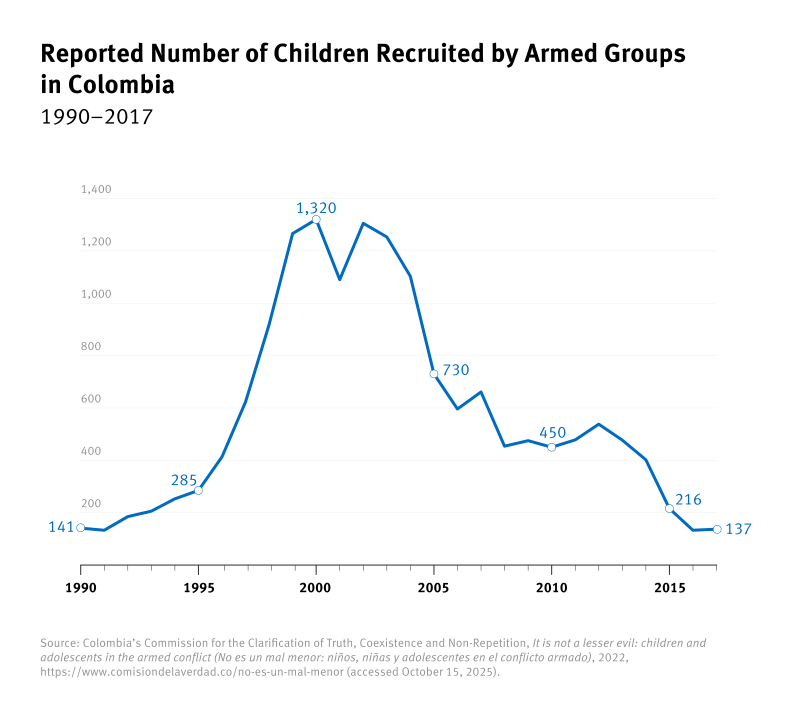
The commission found that all armed groups engaged in child recruitment. It reported that the FARC were the armed group responsible for the highest number of child recruitment cases, with 12,038 documented cases between 1964 and 2019, followed by the United Self-Defense Groups of Colombia (Autodefensas Unidas de Colombia, AUC), with 2,038 cases, and the ELN with 1,391 cases.[20]
The Special Jurisdiction for Peace, a court system created under the 2016 peace accord, found that the FARC’s child recruitment was a “systematic and frequent practice in different territories of the country, by all the blocks of the former guerrilla.”[21] It also identified grave abuses that children suffered in the ranks of the FARC, including torture, homicide, and gender-based violence.[22]
In a 2003 report, Human Rights Watch documented that many children were recruited at a very young age. The report found that life inside armed groups was highly regimented and violent, with children subjected to strict discipline, harsh punishments, and constant control over their daily lives. Children were forced to undergo military training, carry weapons, perform forced labor, and obey rigid rules governing behavior, relationships, and movement. Violations of the rules imposed on children—including attempts to escape—were often punished with severe beatings or execution. Girls were disproportionately exposed to sexual violence, forced contraception, and forced abortions. Children were not only used as fighters, but also frequently to take care of hostages, as informants, or for intimidation tasks in urban and rural areas, and were exposed early to extreme brutality, including participation in killings, as a means of enforcing obedience.[23]
Child Recruitment and Use of Children After the 2016 Peace Accord
Following the 2016 peace accord, armed groups’ recruitment and use of children adapted to a changing violent environment.
As the Ombudsperson’s Office has noted, armed groups no longer operate under a unified hierarchical structure, but rather through flexible alliances and networks that combine elements typical of armed and organized crime groups.[24] Children are increasingly used in support roles, including surveillance, intelligence gathering, logistics, and social control of local communities.[25]
There is no unified tally of reported child recruitment cases in Colombia, nor of how many children have been rescued or released from armed groups.[26] Human Rights Watch’s review of data from seven sources, including the United Nations, the Ombudsperson’s Office, the Attorney General’s Office, the Ministry of Defense and others, indicates that there has been a significant increase in reported cases of child recruitment since 2023.[27]
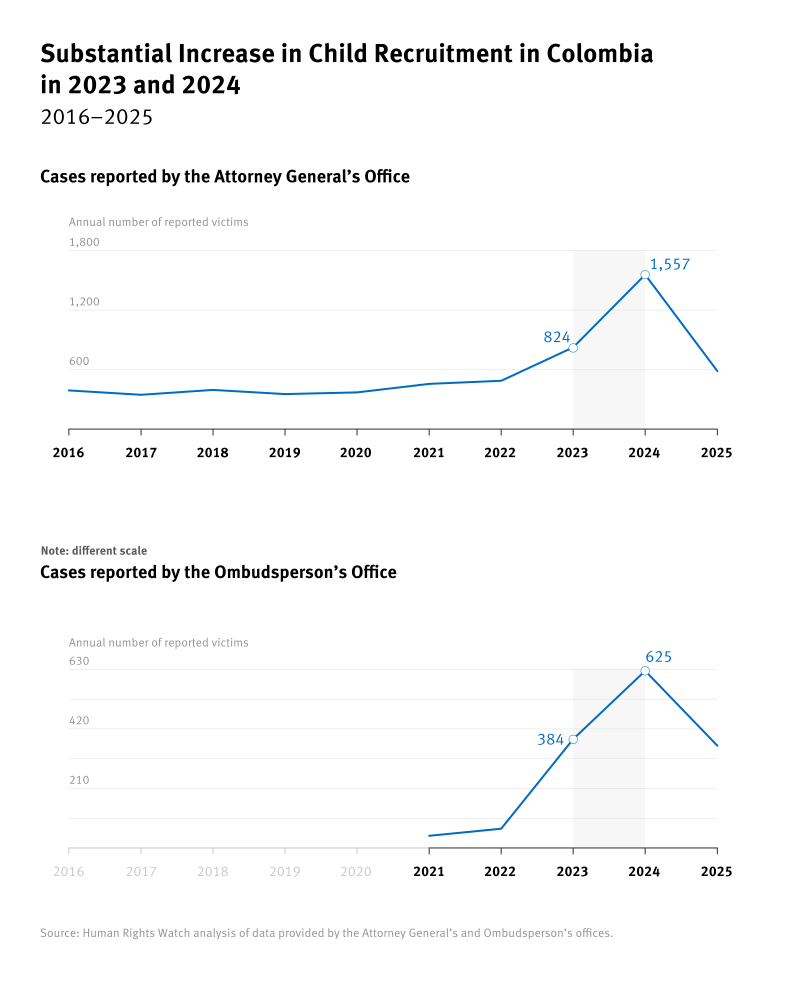
While the reported case counts are not identical, the trends shown in the Ombudsperson’s Office and Attorney General’s Office monthly tallies do correlate.[28] Data from both sources show a sharp surge of cases beginning in early 2023 with levels remaining elevated throughout 2024.[29] This trend is associated with an increase in recruitment, concentrated primarily in Cauca and driven by Central General Staff (Estado Mayor Central, EMC) dissident groups, as described in the following sections.
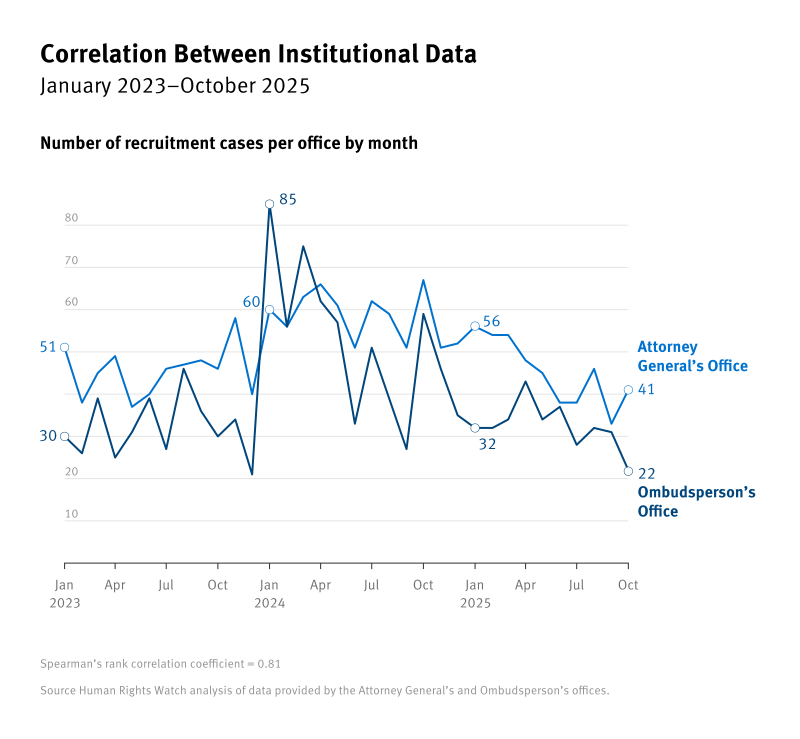
The director of a civil society organization that has worked for decades with children at risk of recruitment told Human Rights Watch in September 2025: “I had never seen so much recruitment—so many cases in such a short period of time.”[30]
Given the extent of underreporting, the decline in the number of cases recorded in 2025 does not necessarily indicate a reduction in the actual number of cases. Over time, previously unknown cases may come to light and be incorporated into official records. For example, during 2025 and 2026, the Ombudsperson’s Office updated its registry of child recruitment cases from 2024 on multiple occasions: in January 2025, it reported 409 cases for 2024, but by November 2025, the figure had increased to 625.
Regions and Municipalities Most Impacted
Child recruitment is geographically concentrated in specific areas of the country. According to the Ombudsperson’s Office, between 2021 and 2025, 69.5 percent of recorded cases occurred in three of Colombia’s 32 states: Cauca (57 percent), North Santander (6.9 percent), and Antioquia (6.5 percent). One hundred and seventy-two municipalities in the country (15.3 percent of the total) recorded at least one case of recruitment during that period and 20 of these municipalities account for 61 percent of all cases—13 in Cauca, 2 in Arauca, and 1 each in Antioquia, Caquetá, Huila, Nariño, and North Santander.[31]
When comparing the geographic distribution of the Ombudsperson’s Office reports to those of the Attorney General’s Office, the two sources broadly agree on the most affected states, with Cauca, North Santander, and Antioquia appearing prominently in both. However, the Ombudsperson’s Office has warned of the challenges of documenting cases in remote states with large Indigenous populations, such as Amazonas and Vaupés.[32]
The Attorney General’s Office data shows that the states of Chocó, Antioquia and Meta accounted for a higher proportion of cases in 2016-2020 but since 2019, there has been a surge in Cauca and the surrounding areas of Nariño and Valle del Cauca.
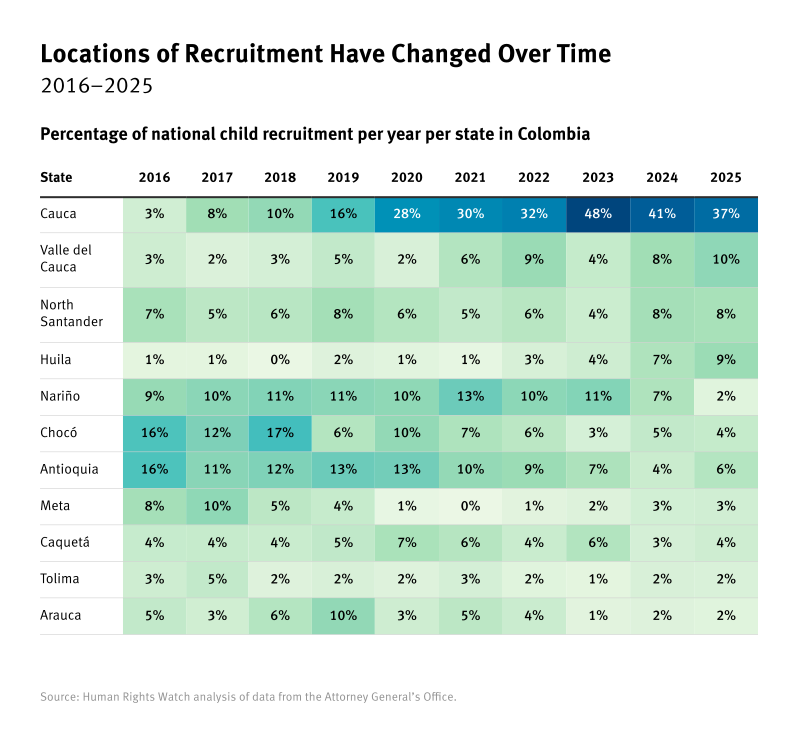
Human Rights Watch compared counts of recruitment cases reported by the Attorney General’s Office to reports of political violence collected by the conflict-monitoring group Armed Conflict Location and Event Data (ACLED) between 2018 and 2025.[33] Child recruitment cases recorded by the Attorney General’s Office correlate strongly with broader trends of political violence recorded by ACLED at the yearly and state-year levels, suggesting that armed conflict and child recruitment are geographically and temporally linked.[34] The relationship weakens when using finer geographic (for example, municipality) or temporal (for example, monthly) resolution, indicating that while violence and recruitment tend to occur in the same states, they do not always co-locate precisely within states or follow each other month to month.
At the municipality level, the data is consistent with the geographic concentration of recruitment in Cauca, which accounts for 14 of the 20 municipalities reporting the highest levels of child recruitment between 2021 and 2025.
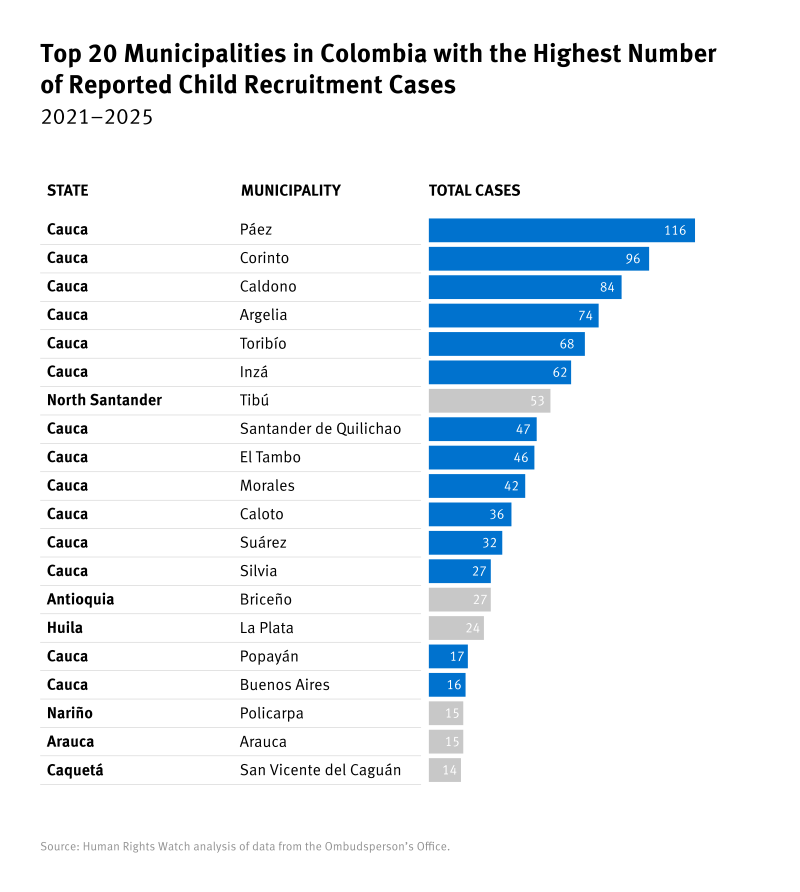
The concentration of cases in Cauca could be linked to several factors, including that the state is a stronghold of the EMC and the state’s large Indigenous population and the poverty and vulnerability many of these communities face, as shown below. The higher figures could at least partly reflect better reporting, as growing collaboration between authorities and Indigenous communities may be surfacing cases that previously went undetected.
Responsible Armed Groups
In Colombia, all armed groups are involved in the recruitment of children. According to data from the Ombudsperson’s Office, between 2020 and 2025, dissident groups that emerged from the demobilized Revolutionary Armed Forces of Colombia (FARC) were responsible for the highest number of child recruitment cases, followed by the National Liberation Army (ELN) and the Gulf Clan (Clan del Golfo).[35] In 2025, the armed group responsible for the highest number of recruitments was the EMC, led by Iván Mordisco, accounting for 43.4 percent of reported cases, followed by the ELN (9.5 percent), the Gulf Clan (6.5 percent), and the General Staff of Blocs and Fronts (Estado Mayor de Bloques y Frentes, EMBF) (5.5 percent). Groups such as the Second Marquetalia (La Segunda Marquetalia) and the Border Commands (Comandos de la Frontera) were also responsible for child recruitment.[36]
The surge of reported cases in Cauca was driven almost entirely by former FARC dissident factions, especially the EMC, the largest faction, which engaged in peace negotiations with the government between October 2023 and April 2024. Out of 850 cases recorded by the Ombudsperson’s Office in the state, 654, approximately 77 percent, were attributed to those groups, rising from 17 cases in 2022 to 237 in 2023 and 290 in 2024. Cauca alone accounted for approximately 60 percent of all former FARC dissident recruitment cases documented nationally.[37]
The Ministry of Defense, whose data source is distinct from that of the Ombudsperson’s Office, also indicates that FARC dissident groups are responsible for the highest levels of child recruitment, particularly in the states of Cauca, Nariño, and North Santander.[38] According to a senior prosecutor, among these groups, the EMC recruits the largest number of children, followed by the EMBF.[39]
Victims
According to data from the Ombudsperson’s Office, between 2020 and 2025, armed groups recruited children most frequently at ages 15 and 16. Similarly, according to data provided by the Ministry of Defense, between January 2016 and October 2025 demobilized children were 7 to 17 years old at time of recruitment, with the median age at 15 for both boys and girls.[40] However, more than 30 percent of the cases reported involved children between 10 and 14 years old.[41] Child protection officers told Human Rights Watch that they have learned about an increasing number of younger children recruited, including some as young as 9 or 10.[42]
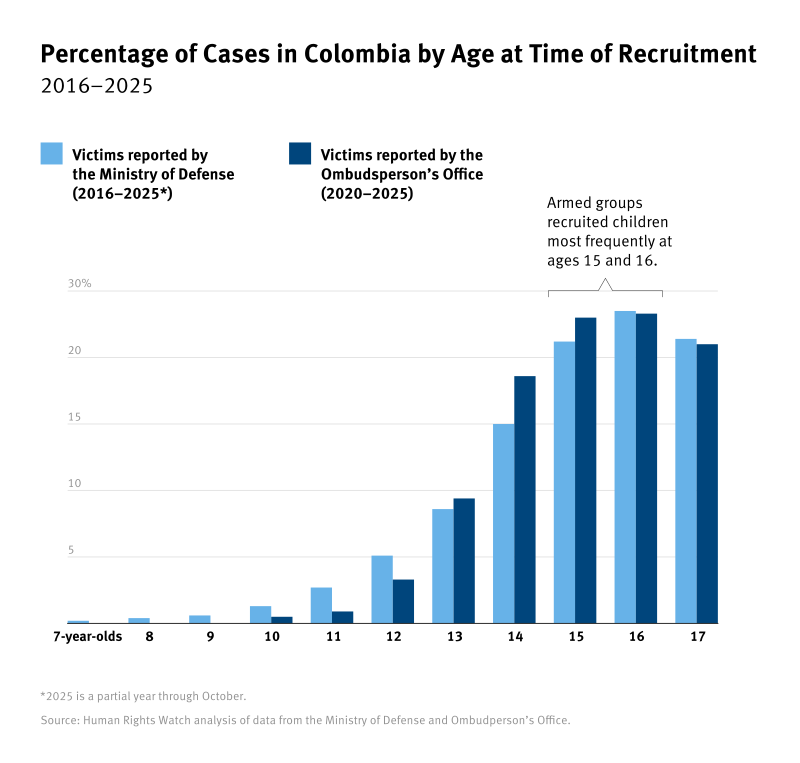
The Ombudsperson’s Office estimates that, on average, 60 percent of the children recruited between 2020 and 2025 were boys, and 40 percent were girls. Since 2021, the proportion of girls recruited increased.[43]
The increase in the recruitment of girls is also evident from a historical perspective. According to the Truth Commission, between 1990 and 2017, girls accounted for 31.8 percent of children recruited by the FARC and 34.3 percent of those recruited by the ELN. By contrast, girls represented approximately 43 percent of all documented child recruitment cases in 2025.[44]
Ethnic Identity
According to Ombudsperson’s Office data, child recruitment disproportionately affects Indigenous communities. Nearly five out of ten recorded cases of children recruited between 2021 and 2025 were Indigenous.[45] Indigenous people represent approximately 4.3 percent of Colombia’s population according to the 2018 census, meaning indigenous children are documented as recruitment victims at more than ten times their share of the population.[46] The proportion of recruited children who are Indigenous has increased substantially since 2022.[47]
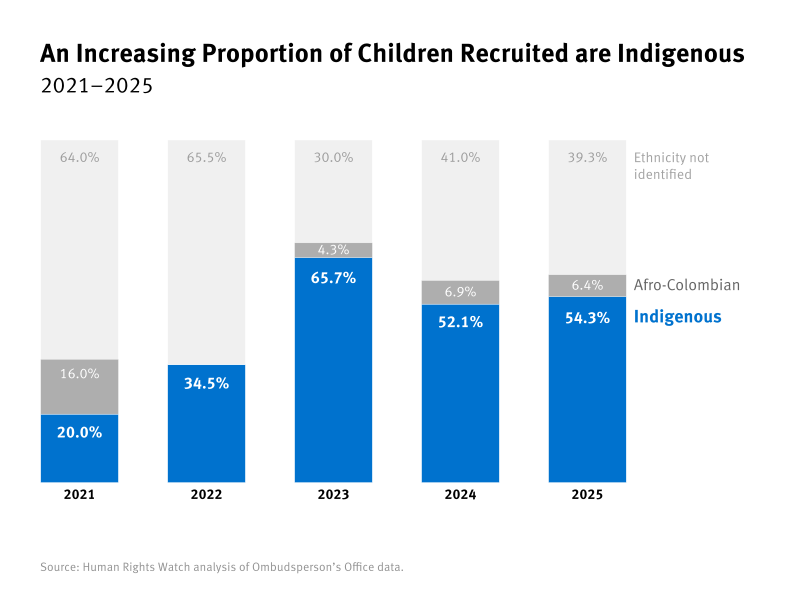
The state of Cauca accounts for 80 percent of Indigenous children recruited in the entire country between 2021 and 2025.[48] It has the second-largest Indigenous population in the country, representing 16 percent of Colombia’s total Indigenous population.[49] Members of the Regional Indigenous Council of Cauca (Consejo Regional Indígena del Cauca, CRIC) and the Association of Indigenous Cabildos of Northern Cauca (Asociación de Cabildos Indígenas del Norte del Cauca, ACIN), two indigenous associations, said that socioeconomic vulnerability, family neglect, and the loss of interest in traditional lifestyle due to increased exposure to social media facilitate the recruitment of Indigenous children.[50]
Afro-Colombian children accounted for 5.4 percent of documented cases, roughly proportionate to their 6.8 percent share of the national population according to Colombia’s 2018 census. Cases involving Afro-Colombian children were heavily concentrated in departments along the Pacific coast: Cauca, Valle del Cauca, Nariño, and Chocó together accounted for 88 percent of all Afro-Colombian cases.[51]
Indigenous children are more likely to be in poverty in Colombia. Poverty among households who self-identify as Indigenous is nearly four times the national average. In rural areas, one in two Indigenous families lives in poverty.[52]
Armed groups take advantage of this vulnerability by presenting joining the group as an opportunity to earn money and prestige with their communities.[53] As an Indigenous Embera-Katío leader and local government official in the state of Córdoba told Human Rights Watch:
Indigenous children face extremely difficult circumstances; they are required to work from a very early age. The Gulf Clan exploits this situation and uses them to transport goods, operate boats, act as informants, and even cook for its members. After that, some go on to join the group, and it becomes very difficult to persuade them to return to their communities and to live according to their Indigenous culture.[54]
Some Indigenous leaders indicated that child recruitment also puts at risk their culture. One said, “It is deeply painful to see children joining armed groups, because our culture is put at risk.”[55]
Risk Factors
Armed violence and conflict in Colombia take part largely in areas of structural poverty, where there is little to no presence of government institutions, and high levels of drug production and trafficking, and illegal mining. This section documents how these factors facilitate the recruitment of children.
Poverty and Social Exclusion
Armed groups exploit situations of poverty, limited public services, and the state’s failure to guarantee children their right to an adequate standard of living, including their rights to food, clothing, and adequate housing. They recruit children by offering money for their families, food, clothing, or protection, filling gaps that public institutions have failed to address.[56]
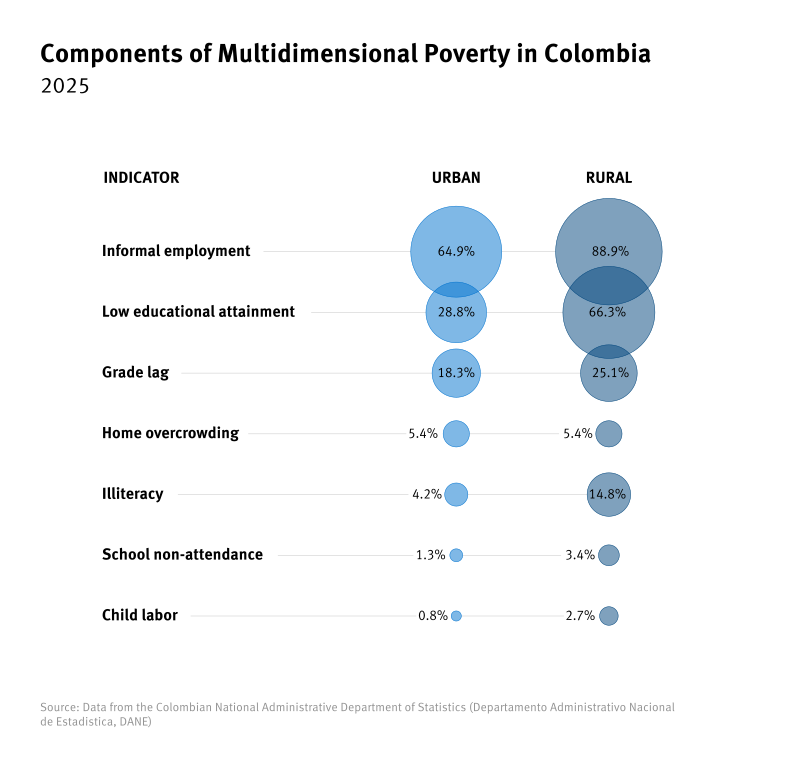
According to the National Administrative Department of Statistics (Departamento Administrativo Nacional de Estadística, DANE), 17 of the 20 municipalities with the highest number of recruitment cases between 2021 and 2025 have mostly rural populations.[57] In 2025, multidimensional poverty in Colombia was 9.9 percent, but in rural areas it reached 22.4 percent, more than three times higher than in urban areas.[58]
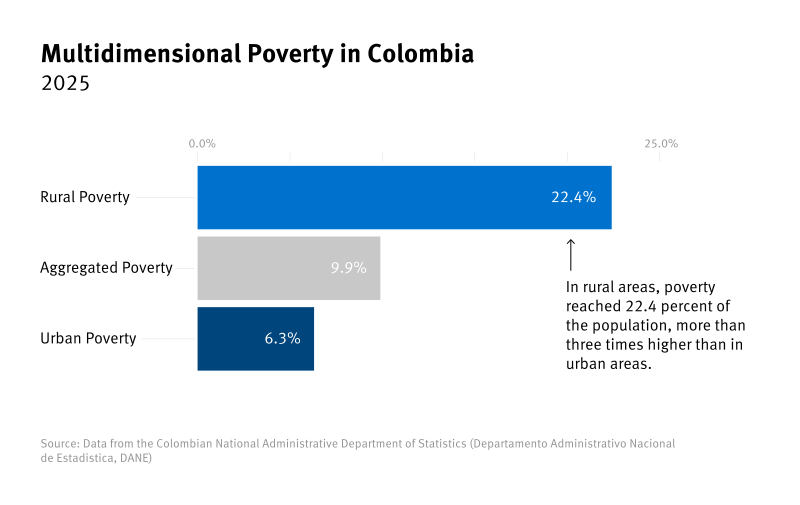
Multidimensional poverty reflects deprivations that affect people’s access to adequate housing, public services, health care, and formal work that pays a fair wage, impacting the life, education, and development of many children.[59] In rural areas, 88.9 percent of workers are in informal employment, where earnings tend to be lower and more volatile, and workers often have weaker or no access to labor and social security protections compared to those in formal employment.[60]
In 2024, Cauca, accounting for more than 55 percent of all cases of recruitment between 2021 and 2025, had a poverty rate of 43.1 percent, one of the highest in the country. North Santander, the state with the second-highest number of cases, recorded a rate of 35.3 percent. In contrast, states with less than five cases of recruitment between 2021 and 2025, such as Caldas and Cundinamarca, had poverty rates of around 20 percent.[61]
Illicit Economies
Colombia has approximately 261,000 hectares of coca crops, mainly in the states of Nariño, Putumayo, Cauca and North Santander.[62] According to Ombudsperson’s Office data, these four states concentrated 66.5 percent of reported cases of child recruitment in 2024 and 2025.[63]
A study by UNICEF and the Colombian Institute for Family Welfare (Instituto Colombiano de Bienestar Familiar, ICBF) based on information gathered from released children found that the first activities recruited boys typically perform for armed groups are linked to drug trafficking. Both boys and girls may be assigned to coca leaf harvesting and processing or small-scale drug distribution, or to illegal mining.[64] Similarly, the Office of the United Nations High Commissioner for Human Rights (OHCHR) found that armed groups use children to expand their capacity to produce and traffic cocaine.[65]
An Indigenous leader in Putumayo told Human Rights Watch that for children ages 14 or 15, work in coca fields becomes the first “hook” for recruitment by armed groups.[66] Children are taken to other regions with the promise of working on farms or harvesting coca, and once separated from their communities, they are offered a place within the group, according to a municipal human rights officer.[67] “Those who labor in coca harvesting become especially exposed to daily contact with armed actors,” said a child protection officer assisting children who had been involved in coca harvesting.[68]
“In rural areas, there are no resources and no state presence. The only option left is to harvest coca to help your family. That is how I started getting involved with the group,” a child who was released from an armed group said.[69]
Barriers to Accessing Education
Armed groups take advantage of poor security conditions for students and teachers, low-quality education, lack of schools or barriers to education access.[70]
In some rural areas, teachers are forced to leave schools due to threats, sometimes because they oppose child recruitment or other actions by armed groups.[71] “Where I come from, children sometimes go half a year without teachers. That’s why you end up joining the guerrillas,” said a 17-year-old boy from the Catatumbo region, who had been recruited by a FARC dissident group.[72]
According to the Ministry of Education, in 2019 Colombia’s school dropout rate was 3 percent. Following the 2020 pandemic, dropout rates increased, peaking in 2022, when 4.1 percent of students left school—the highest figure in a decade. Although dropout rates have since declined, they remain higher than pre-pandemic levels. In 2024, roughly 300,000 children nationwide dropped out of school, representing 3.4 percent of all students registered. In rural public schools, the dropout rate was 3.9 percent. In the 20 municipalities with the highest levels of recruitment between 2021 and 2025, the average urban school dropout rate in 2024 was 3.6 percent, while the rural rate was 4.2 percent.[73]
Quality of education in rural areas is often low and students in rural and public schools score significantly lower on nationwide standardized tests than those in private schools or in urban areas.[74] For students whose families cannot afford private higher education, these results often determine whether they can secure a place in public universities. “Getting a spot at a university in the interior of the country [referring to major cities such as Bogotá, Medellín or Cali] is like winning the lottery. Young people in rural areas don’t even aspire to that. But that has to change, because every educated person is one less person in armed groups,” an Indigenous authority told Human Rights Watch.[75]
Children in rural areas also lack transportation to access schools. Many must walk long distances, which sometimes discourages attendance and, in other circumstances, increases the risk of them being targeted by armed groups on their way home. Human Rights Watch documented the case of a 16-year-old girl who was taken by armed men while returning home from school at night in a rural area of Mitú, close to the Vaupés River, in southeastern Colombia. After a week with the armed group, she escaped during fighting and surrendered to the Colombian Army. “I thought I’d never see my mom again,” she said.[76]
Given the lack of teachers and schools in rural areas, many children attend public boarding schools. As a senior human rights officer explained, “most rural schools only go up to ninth grade. To complete high school (eleventh grade), children attend boarding schools far from their families, where the risk of recruitment is higher.”[77]
The Ombudsperson’s Office and government officials said that child recruitment is often higher during school holiday periods, as children have more free time or travel to places where they are exposed to greater risk.[78] Ombudsperson’s Office data shows that over the past five years, January and June, the months when schools are closed for vacations, have been the months with the highest number of child recruitment cases.[79]
Domestic Violence
For some children coming from violent or abusive households, armed groups are perceived as a way to escape from domestic violence.[80]
According to several interviewees who have worked with released children in Cauca, some of them see armed groups as a means of escape from abuse at home and may even come to view armed group commanders as figures replacing parents. Similarly, a youth leader in Córdoba said:
Children who experience violence at home are the most vulnerable. Members of armed groups present themselves as their closest friends; they invite them out for drinks and claim to listen to them. Very quickly, children begin to collaborate with them, trust them, and gain access to clothing and cell phones. In this way, they gradually draw in others.[81]
Indigenous leaders and an Ombudsperson’s Office official also noted that, in some cases, victims of sexual or physical violence seek to join armed groups in order to gain a sense of power they feel they need to exact revenge.[82]
Recruitment Strategies
Armed groups often contact children through social media or intermediaries, or during school or community activities, and offer them promises of social prestige, power, and money to lure them into their ranks.
Use of Social Media and Other Technologies
Social media platforms play a crucial role in the recruitment strategies used by armed groups.[83] According to the Special Jurisdiction for Peace, 44 percent of children recruited in 2025 were recruited through social media.[84] Through platforms such as TikTok and Facebook, armed groups disseminate propaganda that glorifies life in armed group ranks, promote deceptive job offers as a recruitment mechanism, and engage with children through public chat forums and private messaging services.[85]
Human Rights Watch identified and reviewed 52 accounts and 37 posts on TikTok that encouraged users to join armed groups through content that glorified and normalized life in the ranks. Some accounts are named after an armed group or one of its factions, while others are individuals who claim to belong to or support armed groups. Taken together, these accounts had more than 85,000 followers, and some videos reached over 250,000 views and had over 50,000 likes. After Human Rights Watch sent a list of 35 accounts to ByteDance, the company that owns TikTok, in July 2026, it informed us in August that it had removed all of them.[86] Meanwhile, new content appeared, and researchers reviewed an additional 17 accounts between July and August 2026 that produced content substantially similar to that of the accounts TikTok had removed.
Researchers also identified and reviewed 20 accounts on Facebook reaching over 15,000 followers. Profiles claimed to belong to or support armed groups and regularly shared propaganda glorifying armed group life, threatening to attack other armed groups, and setting forth the groups’ rules for communities. Some profiles also appeared to facilitate recruitment by advertising joining, encouraging interested individuals to contact them privately, or offering transportation to those willing to join. After Human Rights Watch sent a list of 16 profiles to Meta, Facebook’s parent company, in July 2026, it stated in August that it had removed all of them.[87] Meanwhile, new content appeared, and researchers reviewed an additional four accounts between July and August 2026 that produced content substantially similar to that of the accounts Meta had removed.
After viewing content linked to armed groups, the account that Human Rights Watch used to view this content received content recommendations that appeared to promote armed groups and suggestions to follow additional accounts, including profiles linked to the Gulf Clan or FARC dissident groups. This suggests that social media platforms’ algorithms may direct users who engage with such content toward more of the same content by armed groups.

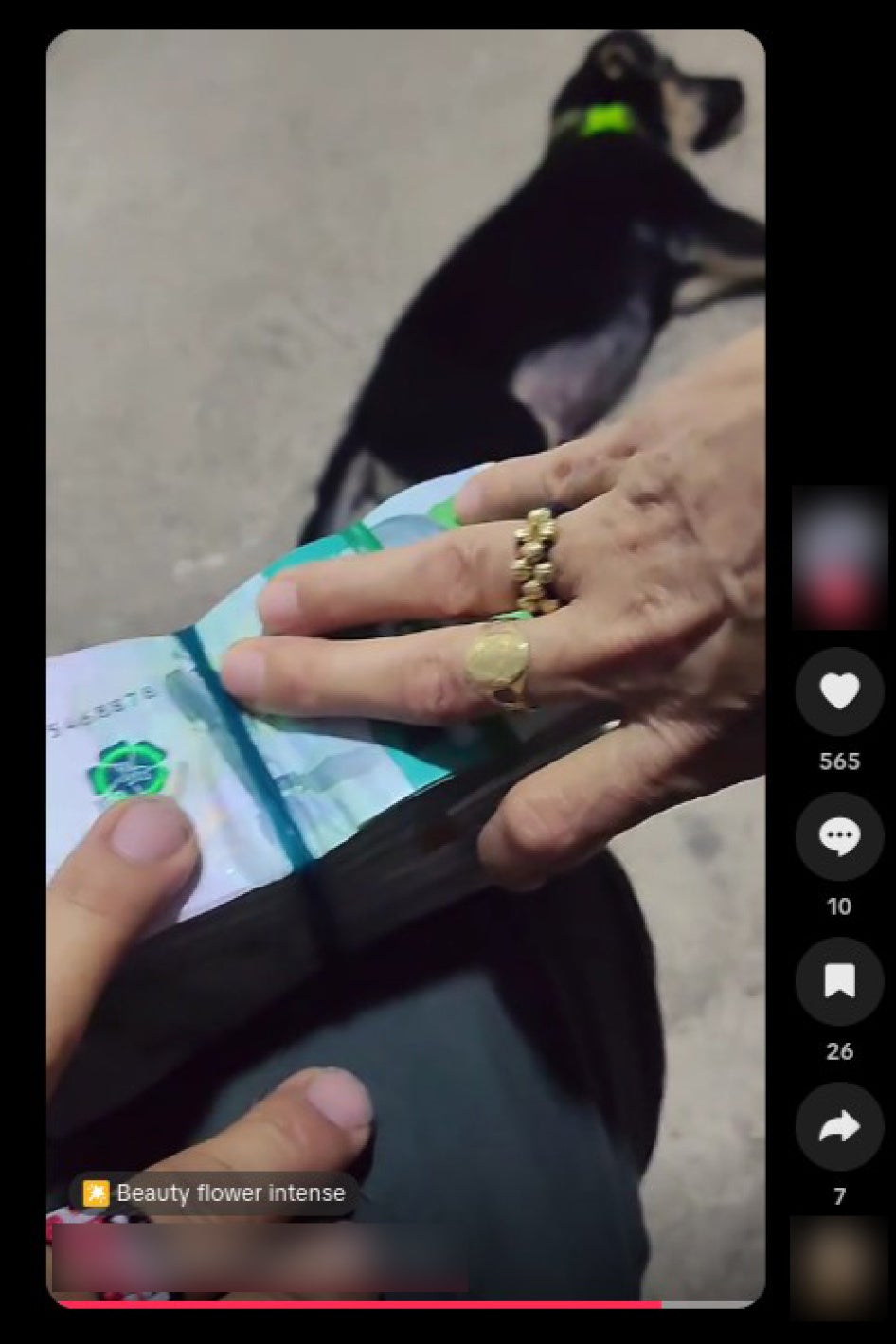
The videos reviewed by Human Rights Watch displayed weapons, uniforms, bundles of cash, armbands, and military-style clothing, and portrayed daily life within the group through clips of training exercises, meals, and leisure activities. The videos are overlaid with narcocorridos, a type of ballad, originally from Mexico, that narrates the lives of drug traffickers, and similar music genres that romanticize armed group membership. For example:
A post shows a man’s hands wearing an ELN ring while displaying a stack of cash. In the comments section, users asked how they could join the armed group.
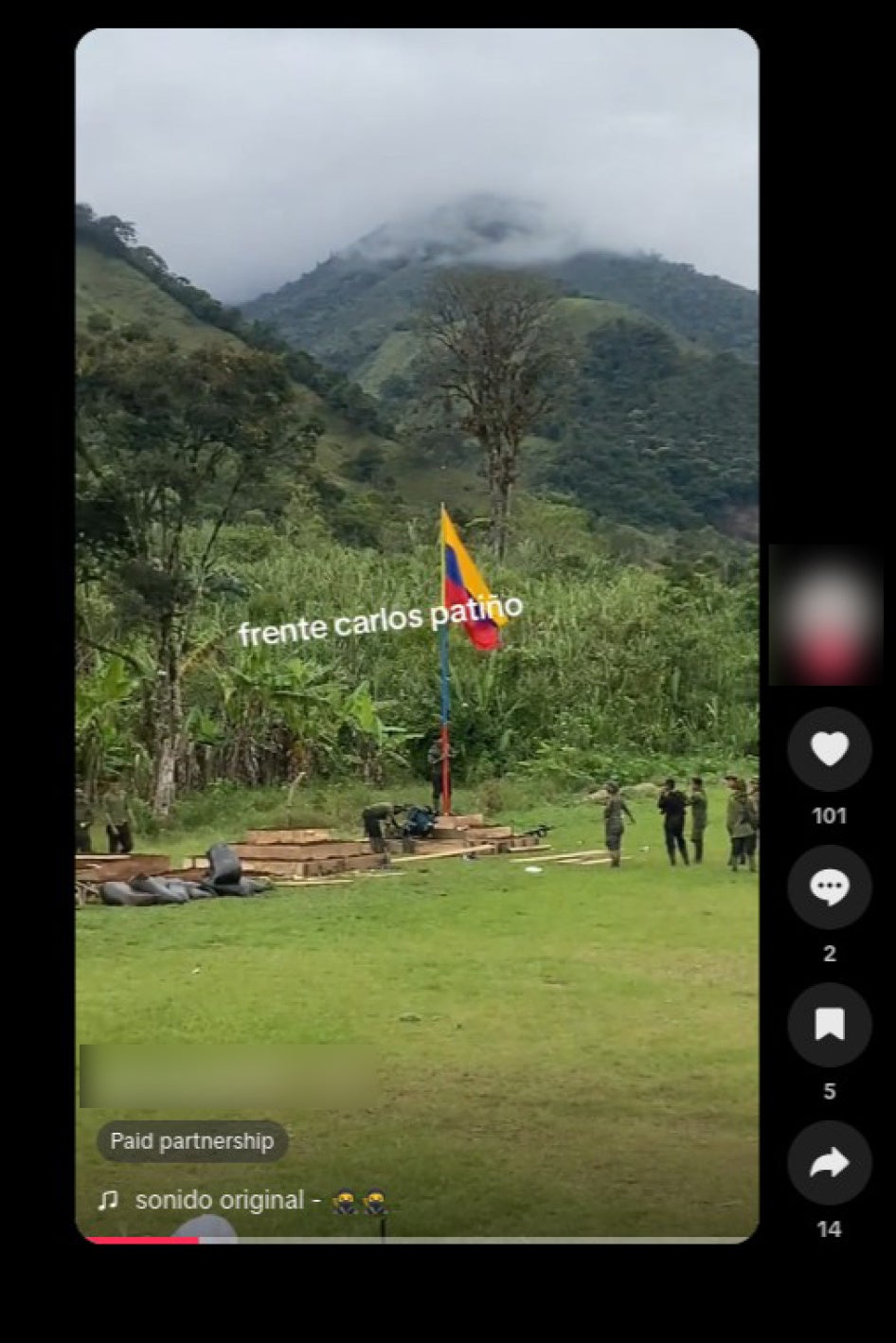
Another post shows a location in the mountains, an apparent training camp operated by the EMC’s Carlos Patiño Front, which operates in Cauca. The video shows around 27 people in military clothing building some kind of infrastructure. Some appear to be children.
In one video, a female, apparently a child, wears black clothing and displays a radio. She uses the hashtag #farfromhome with a ninja emoji and the Colombian flag and an audio clip of a narcocorrido song.
In another post, a female, apparently a child, has a radio hanging from her pocket. The video is overlaid with an audio clip of Jhon Jairo Velásquez, a former hitman for the Medellín Cartel led by Pablo Escobar, referring to the involvement of children in drug trafficking. In the comments section, users asked how to join armed groups.
In another post, a man, apparently a child, is seen wearing military clothing and an armband bearing the Colombian flag. Based on other posts from the same profile, the boy appears to have been recruited by the Jaime Martínez Front of the EMC.
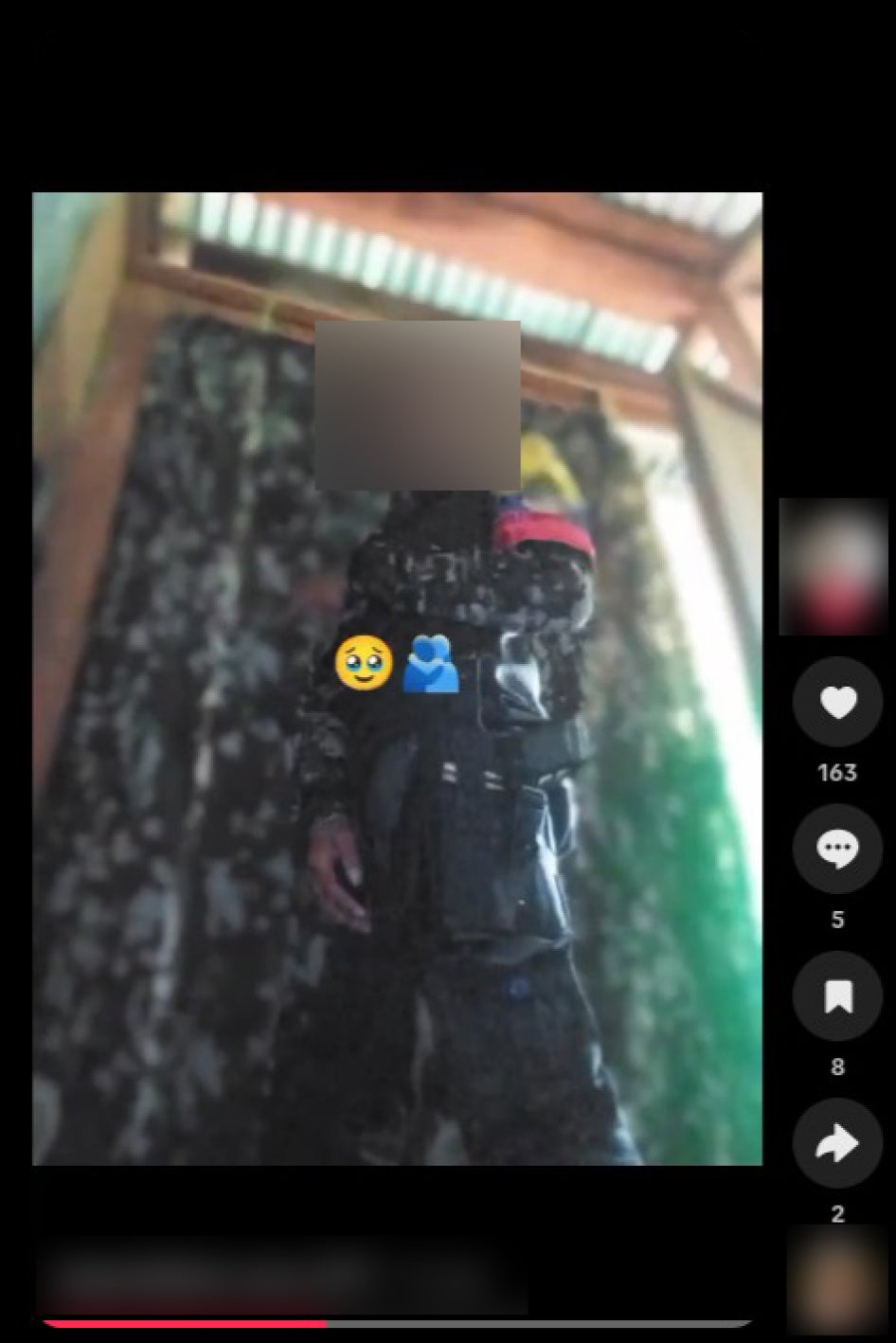
In another post, a female, apparently a girl, according to other posts from the same profile, wears black and green clothing. She uses an audio clip from a rap song with the lyrics “At 14, I got involved and joined the guerrillas,” but with text stating that she was 13 years old when she joined.
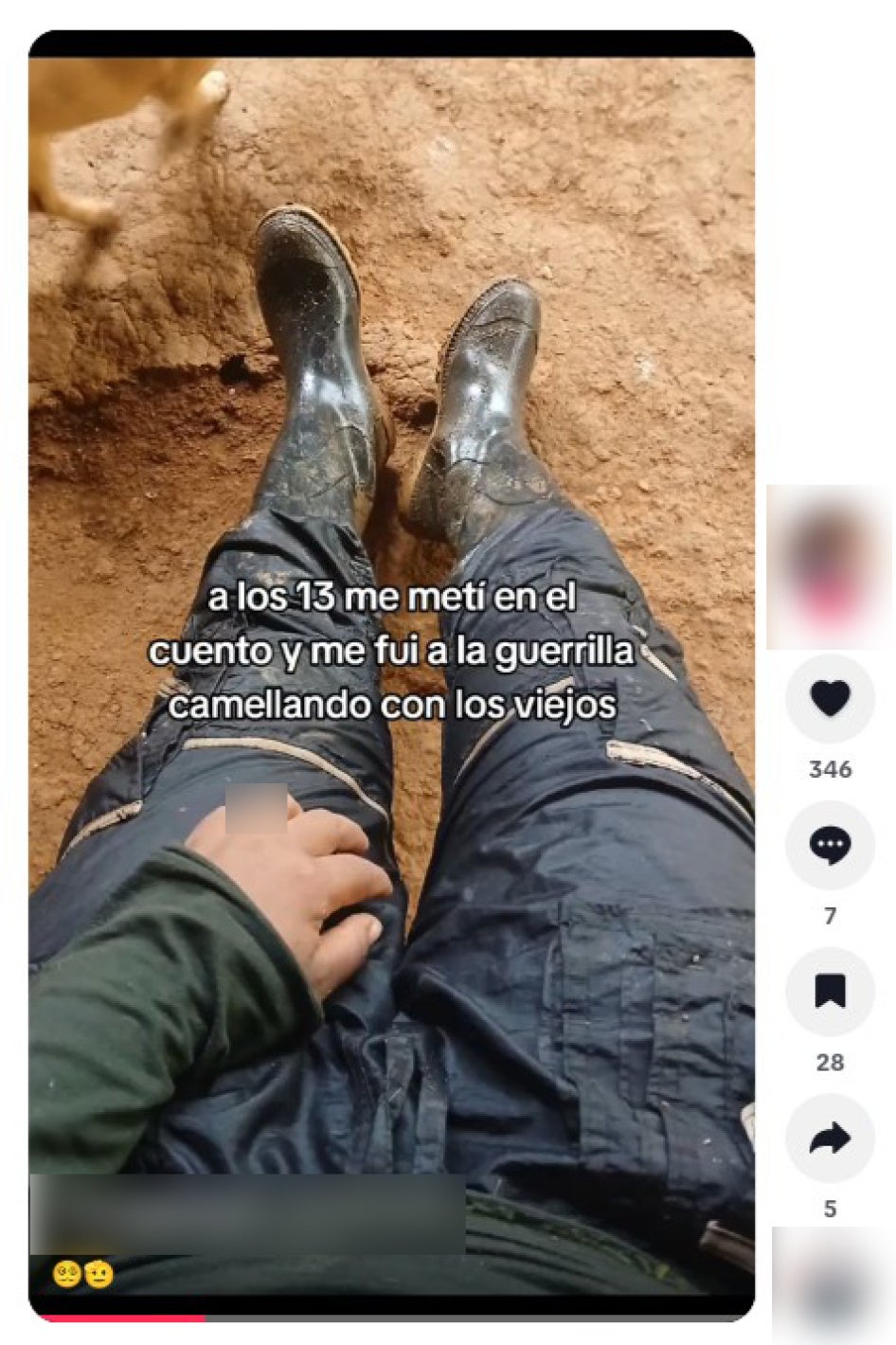
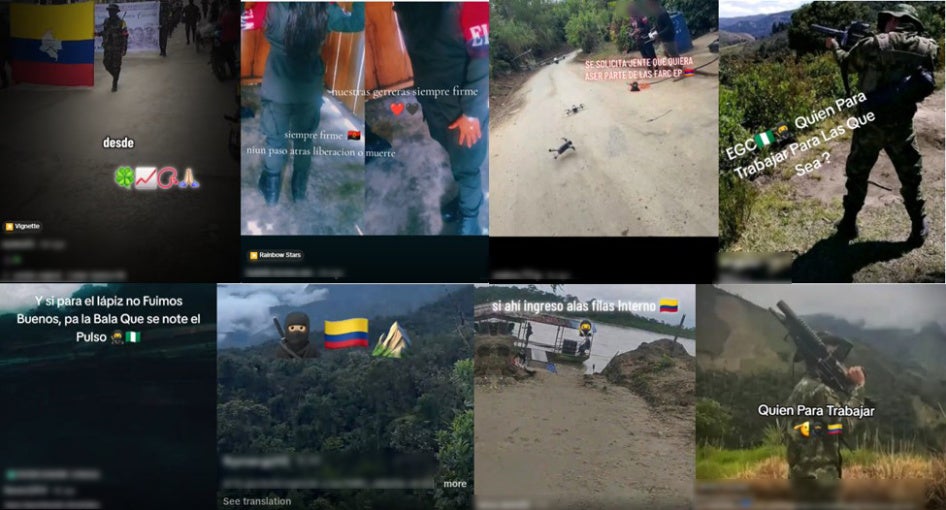
Many accounts and posts reviewed included content linked to the EMC, the ELN, the EGC, and other armed groups. Researchers were able to associate some accounts and posts with specific groups through a combination of visual markers such as uniforms, flags, and insignia specific to each group, self-identification in bios, captions, emojis and hashtags. Group names are disguised using numbers—F4RC and 3LN instead of FARC and ELN, for example—to bypass platform controls. Groups also use emojis such as ninjas, clovers, or stacks of money, as well as specific country flag combinations to signal affiliation. For example, some accounts use the Colombian and Armenian flags to allude to FARC dissident groups, while others use the Angolan flag to refer to the ELN, because the colors of those flags resemble the groups’ identifying colors.
Some of the accounts and posts reviewed openly or implicitly sought to recruit. In some cases, users comment on posts asking how to join a group, while in others, posts directly invite users to contact them through direct message or offer logistical support, such as covering transportation costs, for prospective group members. For example, researchers monitored three posts by apparent FARC dissident groups and the Gulf Clan in which the captions or text in the video explicitly sought new combatants in areas such as Catatumbo, Cauca and Tolima. Several of these posts remained active for over a month, accumulating dozens of comments from users expressing interest in joining armed groups.
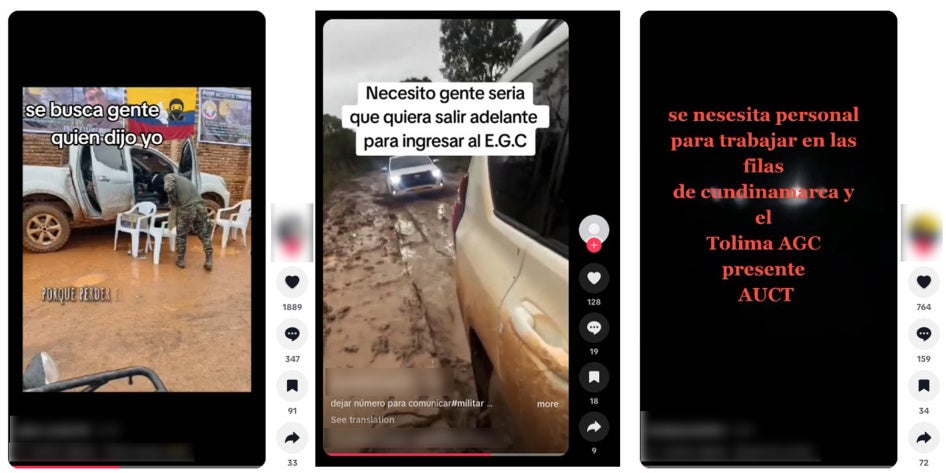
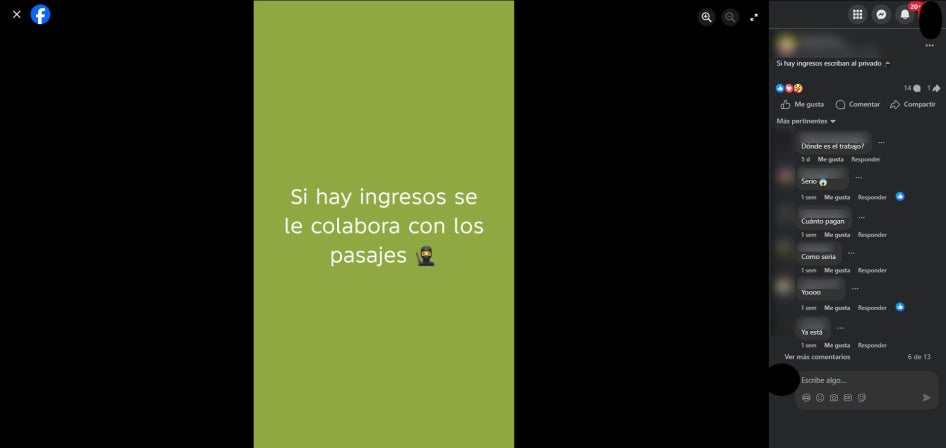
Similarly, in May 2025, the Special Jurisdiction for Peace identified 146 social media accounts on TikTok and Facebook linked to alleged child recruitment practices.[88] In February 2026, it told Human Rights Watch that 37 of these accounts remained active. The other 109 were removed. They also identified “patterns of digital reconfiguration,” where suspended accounts are replaced with new ones that publish similar content.[89]
A prosecutor in Cauca described specific “patterns” of recruitment on social media platforms. He said that on TikTok, individuals he described as “armed influencers” shared videos of themselves dressed in camouflage uniforms, flaunting money and weapons to project the group’s power, and to attract new recruits, including children. On Facebook, he said, armed groups often contact children directly to offer them the “opportunity” to join the groups.[90]
Human Rights Watch received credible allegations about cases where armed groups contacted children through direct messages on social media to offer them to join their ranks in other parts of Colombia.[91]
Under Colombia’s Law No. 2489 of 2025, digital platforms and internet services have a responsibility to promote safe and healthy digital environments and protect children from online harm, including exposure to inappropriate content.[92] In addition, under Law No. 2590 of 2026, the Colombian government is required to develop and implement a protocol for coordinating with social media platforms to prevent and block digital content associated with child recruitment.[93] Moreover, Decree No. 769 of 2026, which regulates Law No. 2489 of 2025, requires social media platforms to incorporate the principles of safety and privacy by design and by default into their products, establish a mechanism for addressing complaints related to online violence, and submit semiannual reports on the implementation of protection measures and compliance with safe design requirements.[94]
Meta (Facebook) told Human Rights Watch in August 2026 that it condemns the recruitment of children by armed groups and “constantly strives to refine [its] approach to combating it across [its] platforms” through its Community Standards and proactive enforcement measures, including protections built into teen accounts for users under 18, parental supervision tools, collaboration with authorities, and prevention initiatives.[95] It said it does not allow organizations or individuals that proclaim a violent mission or are engaged in violence to maintain a presence on its platforms, including the ELN, the Gulf Clan, and FARC dissident groups, who are subject to “the most extensive enforcement because [Meta] believes these entities have the most direct ties to offline harm.”[96]
According to Meta, the company often sees new tactics used by groups and individuals to avoid detection and evade policies and enforcement, but it “refines enforcement and continues to improve [its] ability to catch content that violates [its] policies.” It also removes content that “facilitates or coordinates the exploitation of humans,” including recruitment of children.[97] Regarding content recommendations, Meta said that its Recommendations Guidelines seek to prevent the recommendation of content that could be low-quality, objectionable, or particularly sensitive, and that it uses technology to detect content, accounts, and entities that do not meet these guidelines.[98]
For its part, TikTok told Human Rights Watch in August 2026 that it “proactively [prevents] illegal armed groups and organized criminal groups from using TikTok, including to target, exploit or recruit minors.” TikTok said it does this through its Community Guidelines, automated and human content moderation systems, age-based protections for teenagers, reporting and law enforcement escalation channels, and work with experts, nongovernmental organizations, and the Colombian government, including the ICBF, the National Police, National Army and the Attorney General’s Office.[99]
According to TikTok, it does not allow violent or hateful organizations or individuals on TikTok. It prohibits content or behavior that “promotes, supports, recruits for, or otherwise facilitates the activities of such actors” and the “glorification of violence and criminal behavior, as well as the promotion of criminal activities that could harm people, animals, or property.”[100] The company said that it aims to remove violent content before it is viewed, and it also endeavors to remove accounts belonging to children under 13 years old. The company informed Human Rights Watch that between January and March 2026, it removed 99.4 percent of the content in Colombia that breached their Violent and Hateful Organizations and Individuals policy before it was reported.[101]
In addition to digital content on social media platforms that glorifies weapons and combat, armed groups have also increasingly used other new technologies as recruitment tools, including through online multiplayer and shooter video games. Through the games, armed groups allegedly contact children and identify their skills.[102]
Intermediaries and Civilian Recruiters
Armed group members and civilians, including other recruited children, help persuade children to join armed groups.
According to a prosecutor and an official in the Ombudsperson’s Office, in Cauca and Valle del Cauca, EMC members pay “civilian recruiters” who persuade Indigenous children to leave their communities with the promise of jobs on coca crops plantations or farms. However, children stop receiving the money they were promised upon arrival and are forced into the armed group’s activities, according to the prosecutor and the official. They said the EMC pays recruiters up to US$1,000 per child.[103] According to the official, the fee depends on several factors, including the gender, height, and physical characteristics of the child, as well as the complexity of the transportation.[104]
Indigenous authorities in Cauca said that children are used as intermediaries in recruitment efforts. Members of the Dagoberto Ramos and Jaime Martínez Fronts, part of the EMC, allegedly pay recruited children who encourage their peers to join.[105] Similarly, a 16-year-old boy from Arauca told Human Rights Watch that some of his classmates, who are in the armed group, visited his school two or three times a week to persuade others to join the armed group.[106] Some interviewees said that armed groups use children in their last two years of high school (10th and 11th grade) to gather information and facilitate the recruitment of other children.[107]
Some girls are recruited into armed groups through what interviewees described as “romantic manipulation.”[108] “Girls are often led to believe they are entering a relationship, which is then exploited as a pathway into the armed structure,” an Indigenous authority in Putumayo told Human Rights Watch.[109]
Recruitment During Community Activities
Armed groups also use sports and community events as opportunities to recruit children.
In Putumayo, the Border Commands, for example, have reportedly organized mandatory community events known as “rondas.” According to community leaders and humanitarian workers, communities are required to participate in these events under threat of sanctions, such as fines and forced labor.[110] These events often include football tournaments for children aged 14 to 18 which, one of them said, the armed group uses to select the children they want to recruit.[111]
In Puerto Libertador, Córdoba, the Gulf Clan organizes sports and cultural events.[112] A youth leader who witnessed one of these events said there were more than one hundred young people, divided into four groups, each wearing different colored T-shirts referring to the Gulf Clan. “On the stage there was a man encouraging them, telling them they were the youth of the Clan, and one of the group’s commanders gave the closing speech,” he said.[113]
Recruitment in and Around Schools
Interviewees said that risk of recruitment in and around schools is pervasive in some regions like North Santander, Putumayo and Valle del Cauca.[114] In some cases, the risk has forced entire families to flee their homes.[115]
Members of armed groups enter schools and organize activities for students or parents, some interviewees said.[116] “We were in a rural township in Córdoba holding discussions with community leaders when members of the Gulf Clan entered the school wearing military-style clothing, including caps bearing the group’s name, the [armed group] block, and each member’s blood type,” a humanitarian worker said.[117] In a video reviewed by Human Rights Watch published to TikTok on March 28, 2026, at least four individuals dressed in camouflage and wearing EMC armbands can be seen distributing notebooks to groups of boys and girls in school uniforms. According to the reported post location, the incident would have taken place at a school in El Plateado, Cauca.[118]
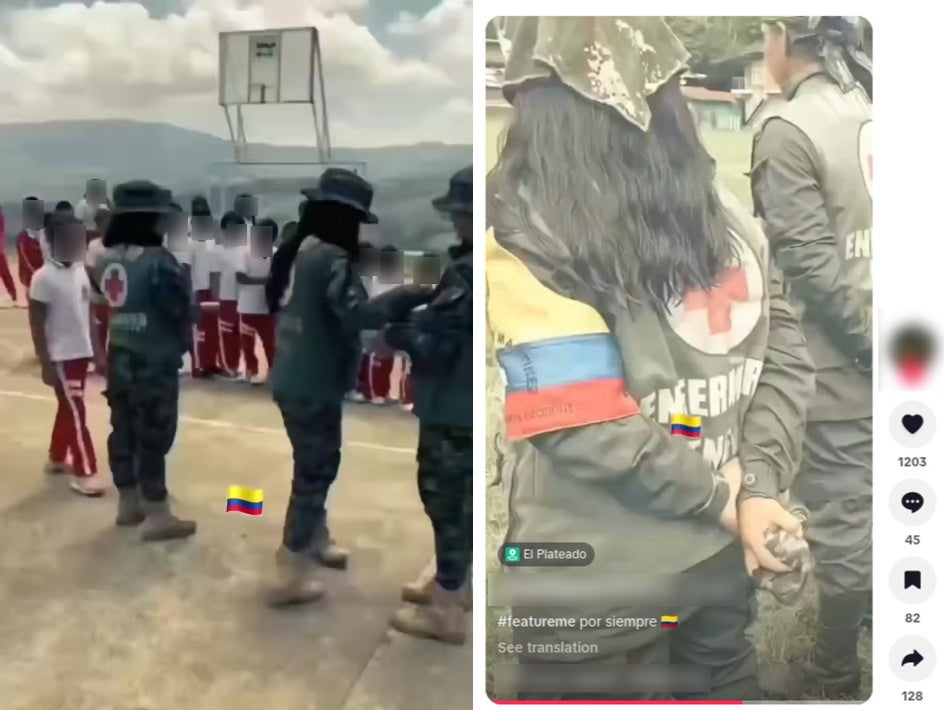
Some armed groups try to impose their social control over schools and boarding facilities, attending parent-teacher meetings, establishing “rules” inside the schools, and imposing “sanctions” on parents and students for misconduct, such as drug use, according to an Indigenous leader and teachers.[119]
In some cases, members of the group have entered schools to take children away in the middle of their classes.[120] Human Rights Watch received several credible allegations of children being recruited by armed groups at boarding schools in Putumayo. According to interviewees, in July 2025, the EMC’s Carolina Ramírez Front entered a rural boarding school in the municipality of Puerto Leguízamo and recruited a 16-year-old Indigenous boy. The parents, fearing reprisals, chose not to report the case to authorities. They also said that at least two similar cases occurred in 2025.[121] “They do not waste time. They contact them beforehand through social media, confirm their interest, and when they arrive at the school, the children stand up and leave with them,” said an Indigenous authority.[122]
Some community leaders, humanitarian workers and members of the Office of the Presidential Advisor for Human Rights pointed to the lack of physical barriers, like fences or walls, as a key factor allowing armed groups to enter schools, though it is not clear how often such measures would be effective.[123]
Promises of Social Prestige and Power
Armed groups manipulate narratives and cultural ideas of success, prestige, and power to their advantage. Through symbols, uniforms, weapons, and ideological discourse, they present violence as meaningful, justified, or even as an honorable pathway to recognition and belonging.[124]
Recruited children are used to ridicule those who continue studying, by showing off material goods like money, motorcycles and cell phones to convince others to join the groups. “Before joining the group, I saw a friend who was already there posting many luxuries, like money and motorcycles, and that’s how I was convinced. But the reality inside is very different,” said a 17-year-old boy from the Catatumbo region, who was recruited by a FARC dissident group.[125]
Payments
While in previous decades the FARC, the ELN, and the United Self-Defense Groups of Colombia (Autodefensas Unidas de Colombia, AUC) combined persuasion tactics with coercive recruitment, recently armed groups have relied primarily on promises of money, prestige, and access to motorcycles, weapons, food, and cell phones, as a way to recruit children.
Several interviewees in Putumayo said that the Border Commands offers a monthly salary of more than $650 for children to join the group.[126] This is highly attractive to children, as it is higher than Colombia’s minimum wage in the formal economy, which is approximately $520. Pay is much lower in the informal economy, where most people in rural areas find work.[127] Some interviewees said that children are required to sign contracts indicating that they will stay in the group for at least three or six months. These contracts are used to threaten children and their families if they attempt to escape before the term is over.[128]
According to interviewees in Cauca and Córdoba, the ELN deceives young people by offering them jobs on farms in other regions. Upon arrival, they are informed that they have been recruited and are forced to begin training and carry out tasks for the armed group, including burying bodies.[129]
According to the CRIC, in Cauca, in addition to offering money to join the EMC, members of the armed group have offered to pay for girls’ cosmetic or orthodontic treatments.[130]
Training and Deployment of Recruited Children
Training and Indoctrination
The kind of training and indoctrination recruited children experience varies depending on the armed group, region, and the role assigned to the child.
Community leaders, the presidential advisor for human rights and a prosecutor told Human Rights Watch about training camps in regions such as Cauca, Antioquia, and Córdoba, where they said armed groups provide basic military training for children.[131] The Colombian Army has also reported on similar camps in southwestern Colombia.[132]
For example, according to interviewees, the EMC has training camps located in the Naya region, an area between the states of Valle del Cauca and Cauca.[133] Indigenous leaders who have rescued recruited children said that the group teaches children how to handle rifles and carries out “political indoctrination.”[134] They said they have documented cases of children as young as 11 and 12 who have spent between 15 and 30 days in these camps, before they are sent off to other assignments.
An official with the Ombudsperson’s Office and a community leader said that in the Paramillo Massif, a difficult-to-access jungle region between Antioquia and Córdoba, the Gulf Clan runs a training center where young people undergo three months of training followed by nine months of performing tasks elsewhere for the group, such as surveillance or collecting extortion payments.[135] After that year, they said, the armed group decides if the trainees will be part of the military structure or act as lookouts in towns.
Many children receive no training at all, particularly those used as informants or in support roles that do not require weapon handling. In these cases, indoctrination occurs gradually through exposure to armed structures, obedience to orders, and acting as the de facto authority in the community. Over time, children come to normalize violence and perceive coercion, punishment, and armed authority as an accepted part of everyday life.[136]
Local Deployment and Relocation to Other Regions
Some armed groups relocate the children they recruit to other parts of Colombia.
According to Indigenous authorities and a prosecutor investigating child recruitment, children are transferred to other regions to isolate them, break family and community ties, and make escape more difficult, while increasing their economic dependence on the armed group.[137]
In Putumayo, while the Border Commands have, in some cases, allowed children to remain at home and continue attending school to persuade peers to join, other armed groups like the Carolina Ramírez and Raúl Reyes Fronts often remove children from their communities and relocate them far from their families.[138]
According to data from the Ministry of Defense, 35 percent of children released from armed groups in 2024 and 2025 were found in a state different from the one in which they said they had been recruited. Children recruited in Cauca and Nariño account for roughly half of these cases. In cases recorded by the Ministry of Defense, 51 percent of children from Nariño were found in Cauca and 67 percent of children from Cauca were found in Huila, Valle del Cauca, and Meta.[139] Similarly, several interviewees told Human Rights Watch that children recruited in Cauca are often transferred to training camps in El Naya or to Guaviare and Caquetá, passing through the states of Huila and Meta.[140]
According to a prosecutor investigating cases of recruitment, armed groups use public buses, private vehicles and motorcycles to move children across the country.[141]
Roles of Recruited Children
The roles that children perform within armed groups are diverse and depend on the group, the child’s age, gender, and the region. According to child protection officers, these activities include intelligence gathering, serving as messengers, providing medical care, engaging in combat, and handling weapons, drones, and explosives, as well as guarding hostages, participating in drug trafficking, and serving as bodyguards for commanders.[142] In some cases, children are sent to participate in hostilities without training, effectively as “cannon fodder,” according to the presidential advisor for human rights.[143]
Children are also taught how to use armed drones. According to child protection officers, released children who report having operated drones say that armed groups describe the activity as a game rather than as participation in armed fighting.[144] In one video reviewed by Human Rights Watch, which gained national attention after being reported by a news outlet in May 2026, a male, apparently a child, is seen setting up a drone and attaching what appears to be an artisanal explosive device.[145]
According to humanitarian workers and community leaders, armed groups initially assign children low-visibility roles to ensure that they can later join the group without being identified by authorities. These include serving as couriers, informants, and messengers. These roles are frequently presented as opportunities rather than as recruitment. Children are given gifts, food, or small payments for their activities, deepening their ties to and dependency on the armed group.[146] “I have seen children working as ‘lookouts’ who later appear wearing camouflage,” a community leader from San José de Uré, Córdoba, said.[147]
Children and adolescents, especially boys, have also been instrumentalized in activities such as small-scale drug dealing, contract killing, and extortion.[148] A notorious case was the killing of senator and would-be presidential candidate Miguel Uribe Turbay, who according to prosecutors was shot by a 15-year-old boy, acting on behalf of the Second Marquetalia, a FARC dissident group.[149]
Additionally, girls are frequently assigned to cooking duties and trained by armed groups to approach other children and try to persuade them to join the armed groups’ ranks.[150]
According to child protection officers, members of armed groups often perpetuate sexual violence and impose forced contraception on girls.[151] In Cauca, interviewees said that sexual violence is used as a specific form of punishment against girls who are perceived as “rebellious” or who disobey the orders of commanders.[152] “Women feel less safe [within the armed groups] because they experience more abuses,” said a girl who was recruited.[153]
Release of Recruited Children
The ways in which recruited children leave armed groups vary. Interviewees described cases of children escaping, being released through negotiations led by their communities or being rescued by community organizations, Indigenous Guards, and, in some instances, the Colombian Army. Some children surrender to authorities during fighting between the armed groups and the army.[154]
During peace negotiations under the Petro administration, some children were released through informal processes that did not ensure adequate protection. For example, according to the ICBF, in 2024, the Comuneros del Sur Front, an ELN splinter group, released 12 children without first notifying the authorities. The ICBF subsequently tried to locate them to initiate the reintegration process but was only able to find four of them.[155]
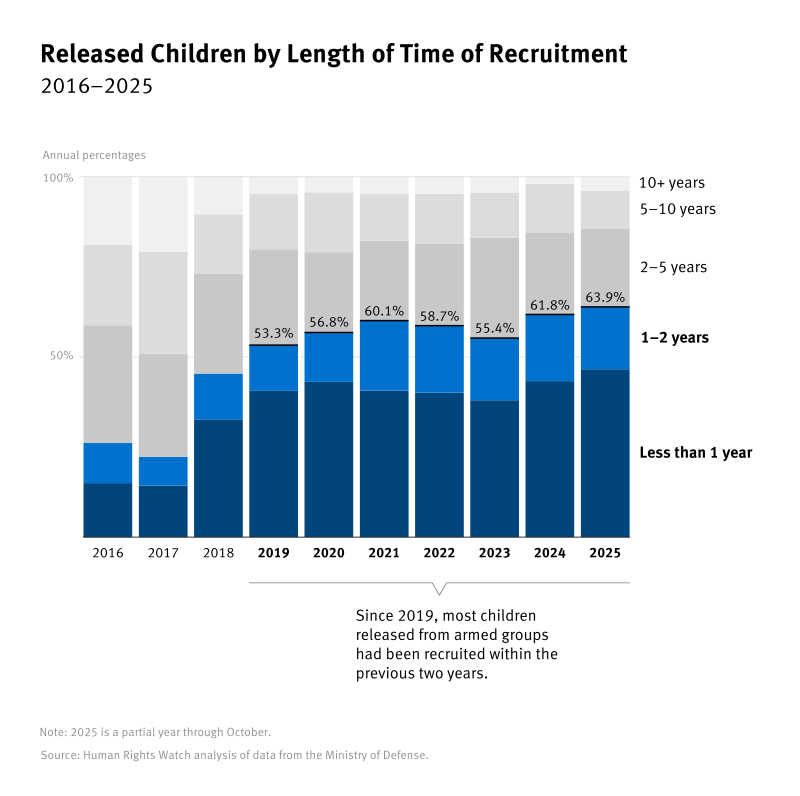
Between January 2016 and October 2025, the Ministry of Defense reported the release of 3,564 people who were recruited by armed groups as children, 2,129 of whom were released as children. The vast majority of those released between 2016 and 2025 had been recruited recently, though some had first been recruited decades prior. The median length of time between recruitment and release was three years, but since 2019, most children who were released from armed groups had been recruited less than two years before their release. For those released in 2025, 47 percent had been recruited within the previous year, and 74 percent were released while the child was still under the age of 18.[156]
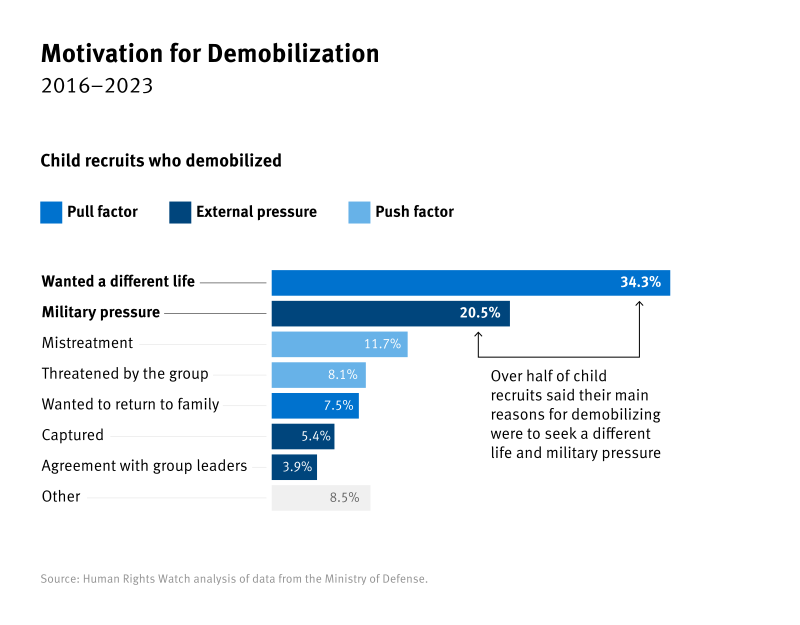
Data from the Ministry of Defense analyzed by Human Rights Watch shows that among the main reasons children want to leave an armed group are to seek a different life and “military pressure” on the armed groups by security forces.[157]
In many cases, recruited children surrender to the military and police during operations against armed groups. Under Colombian law, authorities must transfer children to the ICBF within 36 hours, ensure their safe evacuation, provide medical assistance when necessary, and immediately activate the protection pathway.[158] Security forces are prohibited from interviewing released children or using them as intelligence sources.[159] However, members of organizations working with recruited children and child protection officers told Human Rights Watch that security forces often do not comply with these provisions, and use children as sources for their operations.[160]
Armed groups often severely punish children who attempt to leave. In one notorious case from November 2024, the Gulf Clan tracked down and executed several boys who fled an armed group in Córdoba.[161] Similarly, the Ombudsperson’s Office reported that in 2023, the Carolina Ramírez Front, a FARC dissident group, killed four Indigenous Murui boys in Caquetá who had tried to escape the group.[162]
According to interviewees in Cauca, the EMC and the ELN often carry out “war councils” to try and execute children who attempt to escape.[163] “We have cases of children who arrive with severe trauma because their friends were killed in front of them for trying to escape,” a staff member of Enraizamiento, a community-based program for the restoration of Indigenous children’s rights, told Human Rights Watch.[164]
Government Response
Under Colombian and international law, Colombian authorities have a duty to protect the rights of children, including by preventing and investigating child recruitment, and prosecuting those responsible.[165]
Colombia has established a range of policies and strategies that aim to fulfill these obligations. Colombian law distinguishes between “early,” “urgent” and “protective” child recruitment prevention efforts, and establishes specific initiatives to recover and reintegrate children subjected to recruitment, and to investigate and prosecute those responsible.
However, as described in more detail below, Colombia’s prevention efforts are under-resourced and ineffective. The country’s National Public Policy on Prevention is outdated and lacks a clear action plan, budget, and monitoring system, while the body charged with coordinating its implementation has limited power to make sure concrete measures are implemented. Municipal governments, which often conduct important efforts to prevent child recruitment, lack sufficient technical capacity and funding.
The system to recover and reintegrate released children is designed in a way that creates unequal outcomes. It supports children recruited by armed groups that are considered parties to the armed conflict by recognizing them as victims and enlisting them in a specialized reintegration program. Meanwhile, children recruited or used by armed groups deemed to be criminal groups that are not parties to the armed conflict are not recognized as victims and are more likely to face prosecution. The system also faces challenges in providing appropriate care to Indigenous children and sexual violence survivors.
Efforts to investigate and prosecute child recruitment have also fallen short because of limited capacity of prosecutors and investigators, security concerns for justice officials, obstacles to filing criminal complaints, and novel investigative challenges connected to the use of social media.
The government should simplify existing mechanisms and ensure that agencies in charge, especially at the local level, have the resources and capacity needed to address child recruitment through stronger prevention plans, search and rescue mechanisms that build on and support community-led efforts, including those of the Indigenous Guard, and programs that guarantee children’s recovery and reintegration without discrimination. It should also strengthen the capacity and security of prosecutors investigating recruitment.[166]
Early Prevention
Under the Optional Protocol to the Convention on the Rights of the Child on the involvement of children in armed conflict, Colombia is required to take all feasible measures to prevent the recruitment and use of children.[167] Colombia’s Childhood and Adolescence Code (Law No. 1098 of 2006) recognizes children’s right to be protected against “recruitment and utilization.”[168] To this end, the Colombian government has developed a national public policy on prevention, along with other plans and strategies aimed at addressing the underlining factors that increase risks of recruitment.
The National Public Policy on Prevention and the Intersectoral Commission
In 2007 the Colombian government created the Intersectoral Commission for the Prevention of the Recruitment and Use of, and Sexual Violence against, Children and Adolescents by Illegal Armed Groups and Organized Criminal Groups (CIPRUNNA) with the purpose of guiding, coordinating, and promoting the design and implementation of a National Public Policy on Prevention. The commission is led by the Office of the Presidential Advisor for Human Rights and is comprised of 19 national-level institutions, including the Ministries of Interior, Justice, National Education, Foreign Affairs, Defense, and Health.[169]
In 2010, through CIPRUNNA, Colombia developed the National Public Policy on Prevention.[170] This policy was updated most recently in 2018.[171]
The 2018 National Public Policy on Prevention is outdated, even by the Petro government’s admission. As then-Presidential Advisor for Human Rights Lourdes Castro said in 2025, “the state’s pathways and actions are designed for older conflict dynamics. Today, the public policy framework is outdated, but we no longer have time [during the 2022-2026 Petro administration] to change it.”[172] The policy fails to include plans to address newer dynamics such as the outsourcing of recruitment through criminal networks and recruitment through social media.[173]
The policy requires that national institutions such as the Ministries of Education, Health, Defense, Justice, and other state agencies formulate a coordinated four-year action plan to prevent recruitment, which must be updated by each new administration. However, the 2022-2026 Petro administration did not establish its own action plan, meaning it lacked a specific budget to prevent child recruitment, and specific benchmarks to assess the implementation of the policy.[174] According to a former official from the Office of the Presidential Advisor for Human Rights, the delay of more than a year in appointing a permanent presidential advisor limited their capacity to formulate and advance this plan.[175]
CIPRUNNA’s Institutional Challenges
CIPRUNNA meets without a fixed schedule to coordinate and monitor government actions aimed at implementing the National Public Policy on Prevention. Between 2007 and December 2025, CIPRUNNA met 36 times, including 10 meetings during President Petro’s administration.[176]
CIPRUNNA has made little progress in agreeing on and implementing measures aimed at preventing child recruitment. Out of the ten meetings held under the Petro administration, three were conducted in Bogotá or virtually and were aimed at agreeing on administrative proceedings and on a schedule of future meetings.[177] The other seven meetings were held in places affected by recruitment, such as Cauca, Nariño, or Magdalena Medio. Authorities agreed to take concrete steps to prevent child recruitment, such as carrying out projects in specific schools.[178]
According to a former official from the Office of the Presidential Advisor for Human Rights, the institution lacks the capacity to comprehensively track all commitments undertaken by members of CIPRUNNA. However, the official said that during the final months of Petro’s term, efforts were underway to develop a monitoring system, with support from international cooperation partners, to strengthen oversight and accountability mechanisms.[179] For example, in May 2024, CIPRUNNA established a prevention plan for Cauca that includes 39 commitments, such as providing technical assistance to municipal teams, facilitating the acquisition of vehicles for these teams, and improving and building sports facilities to offer activities that could provide alternatives to recruitment. However, according to Cauca’s Departmental Prevention Committee, nearly two years later, implementation of the response plan commitments has been slow.[180] A humanitarian worker that tracks the implementation of these commitments on the ground told Human Rights Watch that, as of December 2025, 25 percent of the commitments had been fulfilled, and 33 percent were underway. The rest remained pending.[181]
“CIPRUNNA is not working … few participants take responsibility in meetings, and those institutions that do make commitments tend to propose activities they were already carrying out; there is no strategic response to the problem,” a Colombian Army general who participated in CIPRUNNA’s sessions told Human Rights Watch.[182] As a humanitarian worker put it, “almost everything under CIPRUNNA amounts to a compilation of actions that state entities were already implementing.”[183]
Additionally, civil society organizations working on recruitment consider that CIPRUNNA has taken similar actions for years without analyzing whether they’ve had an impact.[184]
Budgetary Constraints
CIPRUNNA’s budget was not clearly defined. According to information provided by the Office of the Presidential Advisor for Human Rights to Human Rights Watch, there was no unified budget for CIPRUNNA during 2025, and each member institution determined its own budget allocation for the agreed actions and implemented them autonomously.[185]
Between 2019 and 2023, the Office of the Presidential Advisor for Human Rights had an investment project, a budget category distinct from routine operating expenditure tied to specific initiatives, focused on the implementation of the National Public Policy on Prevention, with a budget of US$0.53 million in 2021, $1.15 million in 2022 and $1.27 million in 2023.[186]
For the 2024-2026 period, a new investment project was created with a broader scope. The new project began to finance the general work of the Office of the Presidential Advisor for Human Rights on human rights issues, including child recruitment prevention. The budget was $1.47 million in 2024 and $2.2 million in 2025, but in 2026 it dropped to $0.9 million. The 2026 budget is not only smaller, but also no longer focuses on child recruitment.[187]
According to a former official from the Office of the Presidential Advisor for Human Rights, the uncertainty surrounding the possible elimination of the office during the first year of the Petro administration, combined with staffing shortages, weakened the institutional capacity required to maintain a dedicated project focused exclusively on the prevention of child recruitment.[188] She said that the budget decrease was also explained in part by the Trump administration’s massive cuts to US foreign aid and its decision to shutter the US Agency for International Development (USAID), whose support enabled the Office of the Presidential Advisor for Human Rights to hire personnel.[189]
Local Implementation
According to the Office of the Presidential Advisor for Human Rights, states and municipalities are responsible for the implementation of the National Public Policy on Prevention at a local level through the Departmental Prevention Committees and the Immediate Action Teams (Equipos de Acción Inmediata, EAIs).[190] The policy also encourages governors’ and municipal offices to establish their own early prevention territorial plans, outlining the specific measures they will adopt to prevent child recruitment in coordination with the national government.[191]
The Departmental Prevention Committees are state coordination bodies responsible for implementing the prevention policy and supporting protection actions. They are typically established through decrees issued by state governments and include representatives from local authorities and national institutions such as the Colombian Institute for Family Welfare (Instituto Colombiano de Bienestar Familiar, ICBF) and the Victims’ Unit—a body charged with providing humanitarian assistance and reparations for victims of the armed conflict. They may also provide financial support to municipalities for the implementation of protection measures.[192]
According to the Office of the Presidential Advisor for Human Rights, of 32 departments in the country, 20 have established committees.[193] According to the office and an Ombudsperson’s Office official, many of these committees are established “on paper” but are not fully functional.[194]
One particularly effective Departmental Prevention Committee appears to be the one in Cauca, where the committee serves as a bridge for coordination between municipalities and the national government and plays a key role in managing child recruitment cases. Its members highlighted that the committee has achieved significant progress in the last three years, including by consolidating a unified database of cases, activating agile response mechanisms, and creating a “sponsorship plan” through which national institutions and UNICEF support local municipalities to ensure that all of them have EAIs.[195]
EAIs, generally composed of the mayor’s office, the local human rights official, the Ombudsperson’s Office, a child protection officer, a representative of the ICBF, the police, the military forces, Indigenous leaders, the Victims’ Unit, and the Attorney General’s Office, are municipal teams responsible for activating urgent prevention and protection efforts when children are at risk. They also coordinate the institutional response and services available to support victims. They are typically established through municipal decrees, and their budget depends on municipal resources, but they may also receive national or departmental co-financing, as well as support from international cooperation.[196]
The Office of the Presidential Advisor for Human Rights told Human Rights Watch in May that of 1,123 municipalities in the country, 320 have issued a decree creating the team. According to one of the office’s officials, “having the decree in place does not necessarily mean that the teams are working.”[197]
Seven mayor’s offices of municipalities with the highest number of cases of recruitment–Argelia, Caldono and Corinto in Cauca, Tame in Arauca, Carurú in Vaupés, Orito in Putumayo and Jamundí in Valle del Cauca—told Human Rights Watch they have insufficient budget, personnel, and national support to enact preventive measures. Some of these municipalities said that armed groups limit local government action and create security risks for officials, social leaders, and victims’ families, who often hesitate to report cases.[198]
2025-2030 Prevention Strategy
Since 2025, CIPRUNNA focused on developing a prevention strategy for 2025-2030.[199] The strategy has the purpose of consolidating “protective environments” in at least 16 states by creating an urgent prevention pathway for crises, promoting a “cultural transformation in the digital environment,” strengthening coordination between local and national governments, and establishing guidelines for peace negotiation processes.[200]
The executive summary of the strategy, which Human Rights Watch reviewed, identifies nine subregions as having high levels of child recruitment, including the departments of Cauca, Valle del Cauca, and Huila, and the Catatumbo region.[201]
It remains unclear whether the new government plans to implement this strategy as President Abelardo de la Espriella announced plans to eliminate the Office of the Presidential Advisor for Human Rights and, at time of writing, no government institution had been designated to lead CIPRUNNA.[202] It is also unclear how the strategy would work or complement the National Public Policy on Prevention, or whether it would include a plan to operationalize its strategic lines through clearly assigned responsibilities, indicators, and budget allocations.
Other Plans or Strategies
National Immediate Action Team (ENAI)
In June 2026, Petro’s government created a National Immediate Action Team (Equipo Nacional de Acción Inmediata, ENAI) intended to respond to emergency situations and support the work of local EAIs. It is led by the ICBF with the participation of the Office of the Presidential Advisor for Human Rights, Ombudsperson’s Office, Ministry of Defense, Colombian Army, the police and the Victims’ Unit.[203] According to a former official from the Office of the Presidential Advisor for Human Rights, it functions with the existing budgets of the institutions that are part of it.[204]
The former official told Human Rights Watch that between January and May 2026, the ENAI had evacuated 36 boys and girls at risk of being recruited through urgent, individualized evacuations.[205] However, its capacity was limited to rescuing individual children on a case-by-case basis when municipal governments lack capacity to respond, and the ENAI was unable to respond to risks affecting larger groups of children, schools, or entire communities.[206]
Law No. 2590 of 2026 legally orders CIPRUNNA to create the ENAI, meaning it should continue to exist in future administrations, including during President de la Espriella’s mandate.[207]
Safe Schools Declaration Commitments
The Safe Schools Declaration is an intergovernmental political commitment that emerged from an international conference held in Oslo, Norway, in May 2015. It is designed to protect students, teachers, and educational facilities from attacks during armed conflict. The Colombian government endorsed the declaration in November 2022.[208]
The government committed to implementing nine “actions” between 2022 and 2026 to implement the Safe Schools Declaration, such as identifying and mapping schools and universities in areas affected by conflict-related attacks, coordinating plans among government institutions to protect schools’ infrastructure, and strengthening investigations on reported violations. However, the Ministry of Education’s National Plan outlining these commitments does not indicate which entities are responsible for implementing them, nor whether there is a specific budget allocated to these actions.[209] In response to an inquiry from Human Rights Watch regarding progress on these actions, the ministry highlighted the creation of four technical working groups that were “meeting, under the leadership of the Ministry of Foreign Affairs, with the aim of reaching coordination and operational agreements to advance each of the proposed lines of action.”[210]
Escuela, Territorio de Vida Plan
In April 2025, the Ministry of Education adopted the Public Policy on Comprehensive School Risk Management and Education in Emergencies, also known as the Escuela, Territorio de Vida plan. It includes three specific objectives and more than ten actions to protect the right to education from risks associated with climate change and armed conflict.[211]
To pilot the plan, the government entities that comprise CIPRUNNA are scheduled to carry out awareness-raising activities and training in 26 rural schools located in 13 municipalities across six states. These municipalities only include two of the 20 with the highest number of child recruitment cases: Argelia and Tibú.[212]
The plan remains limited considering the scale of the problem. “While prioritizing schools was a good idea, it [came] too late. It should have been an action taken in the first year of the government, not the last,” a senior official from the Ombudsperson’s Office told Human Rights Watch.[213]
Atrapasueños Strategy
Since 2023, the ICBF has been implementing the Atrapasueños strategy, which seeks to create “protective environments” and promote children’s development through activities that build their skills and talents, and support their life plans and mental health care.
The strategy operates through two modalities:
Casa Atrapasueños, an ICBF facility, or Atrapasueños Comunitarios, a community-based space where the ICBF carries out workshops and trainings aimed at highlighting children’s talents and discussing their life plans.
Mochila Atrapasueños, which works through local nonprofit organizations in areas where ICBF facilities do not exist to implement community-based activities aimed at developing children’s skills, callings, and talents.[214]
According to interviewees, ICBF teams supporting the strategy face difficulties accessing certain territories due to budget constraints and security risks linked to armed groups. As the director of a nonprofit organization working on child recruitment put it:
The Atrapasueños strategy is interesting, but it is very urban and does not reach the places where recruitment actually needs to be prevented, particularly Indigenous communities. It is absurd, for example, that it does not reach Puerto Leguízamo (in Putumayo), given the scale of the needs there.[215]
Generación Futuro
The Ministry of Defense implements a strategy called Generación Futuro to coordinate its efforts to prevent child recruitment with local institutions.
According to information provided by the ministry to Human Rights Watch, in 2025 security forces carried out 12,062 “activities” across the country to prevent child recruitment. These include discussions and prevention workshops, sports and cultural events, communication campaigns to raise awareness about the illegality and impact of recruitment and sexual violence, and promoting reporting hotlines (the ICBF’s 141 and the national emergencies number 123).[216]
Community-Led Efforts According to Indigenous authorities, government efforts to prevent child recruitment do not include culturally appropriate measures for Indigenous children, including consideration of Indigenous languages, spiritual beliefs, and cultural practices. They also said that prevention programs hardly reach rural communities at risk due to armed group control.[217] Of the 2,700 prevention activities reported by CIPRUNNA to Human Rights Watch, 91 were specifically targeted at Indigenous communities.[218] Due to these issues, Indigenous communities themselves have played a leading role in some parts of Colombia to protect these children. For example, the Regional Indigenous Council of Cauca (Consejo Regional Indígena del Cauca, CRIC), a coalition of Indigenous groups, has established its own human rights observatory to gather information and document cases. It also runs a strategy known as escuelitas de guardia (guard schools), in which children as young as five years old are educated about Indigenous spirituality, as part of an effort to dissuade them from joining armed groups in the future.[219] Similarly, the Association of Indigenous Cabildos of Northern Cauca (Asociación de Cabildos Indígenas del Norte del Cauca, ACIN), another Indigenous coalition, has created 19 training groups, known as Kiwe Thegnas, where between 80 and 300 children from the age of five learn about Indigenous practices, governance, economic systems, and the risks of joining armed groups. “The strategy responds to families’ concerns about how children spend their free time, so we train them in crafts, the Indigenous language, and tulpas—traditional gardens with crops that are part of our culture,” a member of ACIN involved in the training groups told Human Rights Watch.[220] |
Urgent and Protective Pathways
To respond to collective risks of recruitment, when it is not possible to identify a specific child at risk, the Colombian government has developed the Urgent Prevention Pathway. Typical scenarios that trigger its activation include armed groups conducting school censuses, distributing pamphlets threatening to take children away from their communities, or making mass recruitment offers within a community.[221]
Once such risks become known to any public authority, the municipal EAI is required to activate an urgent prevention mechanism, including in some cases by convening a security meeting at the municipal level.[222]
If a collective threat becomes individualized and there are concrete and personalized threats or actions against a specific child, the EAI’s institutional response must immediately transition to what is called a Protective Prevention Pathway.[223] This means that the municipal EAI must convene a meeting, provide resources for the relocation of the child, and report the case to judicial and other authorities, among other measures.[224]
Budgetary constraints, low reporting and lack of local capacity undermine these protective mechanisms.
Budgetary and Capacity Constraints
According to several interviewees, budgetary constraints are typically the main obstacle for urgent and protective pathways. Municipalities have limited budgets and must use them to respond to all humanitarian emergencies, including mass forced displacement. Relocating a child at risk of recruitment, and sometimes the child’s family, can be very costly and, in some cases, an insufficient measure.[225] The mayor of one municipality told Human Rights Watch:
We have made efforts, but the budget we were able to allocate for emergencies is insufficient. In some urgent situations, we have had to pool money among staff to pay for the children’s transportation in order to save their lives.[226]
According to a former official from the Office of the Presidential Advisor for Human Rights official, there is no national fund to manage urgent cases, and municipalities often lack the resources to respond.[227] In Cauca, the department with the highest number of cases, the departmental government lacks a humanitarian fund to manage these cases.[228] A humanitarian worker told Human Rights Watch that the army provides the greatest support in such cases, but there should be a civilian response.[229]
The institutional response has also been affected by the reduction in international cooperation funding by the United States and budgetary cuts at the United Nations level.[230] “EAIs previously received substantial support from international cooperation. With the reduction in funding in 2025, their capacity to manage cases has been significantly affected,” a humanitarian worker told Human Rights Watch.[231] Similarly, a municipal government official in Putumayo said that losing support from UN agencies has greatly hindered their response.[232]
Local officials also said they lack sufficient support from the national government. “We feel abandoned by the national government,” one of them said.[233] Some mayors’ offices in municipalities with the highest numbers of child recruitment cases said that support from the national government has been insufficient, focused primarily on technical assistance, and at times too slow to respond to the urgency of child recruitment cases.[234]
They also pointed to the limited capacity by the ICBF to respond to incidents outside regular working hours. They said their local offices do not have capacity to address cases after 5 p.m. or on weekends.[235] Child protection officers said that some offices in Chocó and Cauca organize shifts to provide 24-hour coverage, but others are unable to do so because of lack of staff, labor protections, and night and weekend pay, as well as mental and emotional exhaustion.[236]
Training of local government officials is also limited. Despite efforts by the Office of the Presidential Advisor for Human Rights, members of civil society organizations said that many staff across the country need more training, in part due to the high turnover.[237]
Low Reporting
According to several interviewees, relatives of children at risk have few incentives to report cases. Many believe that public institutions have been co-opted by armed groups and organized crime or that they would fail to prevent the recruitment of children for other reasons. The director of a civil society group in Córdoba, who has worked for decades on child recruitment, said “people do not trust state institutions to recover their children; reporting cases may expose them to greater risks.”[238] A community leader also told Human Rights Watch that “it takes less time for the armed group to find out about a report than for authorities to act.”[239]
Search for Recruited Children
Government efforts to search for and rescue recruited children are very limited.[240] This means that often this responsibility falls on families, community leaders and other local civil society actors.
In the absence of a specific mechanism to respond to child recruitment, children who appear to have been recruited need to be reported as “missing.”[241] When that happens, a prosecutor or a judge activates an institutional mechanism known as the Urgent Search Mechanism, and orders the police and other authorities, such as the National Institute of Legal Medicine and the National Civil Registry, to immediately search for the missing child. However, the Attorney General’s Office told Human Rights Watch that it has activated this mechanism for only 40 children since 2016—an extraordinarily low number compared to the nearly 4,000 criminal cases related to child recruitment opened during the same period. The office said that it believed that only two of the 40 cases concerned the recruitment of children.[242] However, a prosecutor told Human Rights Watch that the office lacks a “unified registry” of these cases, and therefore the figures reported may be inaccurate.[243]
In September 2024, the Attorney General’s Office and authorities of the Special Indigenous Jurisdiction signed a protocol to allow Indigenous authorities to activate the Urgent Search Mechanism in cases of disappearances within their territories.[244] According to a prosecutor, this protocol is a key step in improving the search for children, particularly because Indigenous authorities can act quickly and order searches for children in communities across the country.[245] According to a member of the CRIC, the protocol has enabled Indigenous authorities to launch search efforts quickly through social and community networks, while also improving coordination with state authorities such as the police, which have located some recruited children at road checkpoints.[246]
Another mechanism to search for recruited children is the “Pink Alert” national system. Created in 2023, the system uses media and telecommunications services to alert the population about a missing person and establishes Local Search Teams, led by the police and with the participation of Attorney General’s Office, local authorities, and others, to search for missing persons including, among others, children recruited by armed groups.[247]
According to several interviewees, existing mechanisms are insufficient to locate and rescue recruited children since they are not tailored to the specific characteristics of recruitment in rural areas and Indigenous and peasant communities. Effective responses require rapid response capabilities that are lacking in rural areas, and dedicated funding to support the evacuation of children and their families. In addition, search efforts often require operations on the ground in areas that state institutions are frequently unable to enter because armed groups control them.[248]
Community-Led Initiatives In the absence of robust mechanisms to search and rescue children recruited by armed groups, Indigenous and campesino (peasant) communities and women’s organizations have played a leading role by organizing their own search mechanisms and engaging with armed groups to seek the release of children. In Cauca, the CRIC and the ACIN have Indigenous Guards that work to rescue children.[249] A member of the Guard who has participated in dozens of rescues told Human Rights Watch that the Guard accompanies the family and the Indigenous governor of the community to speak with the commanders of the armed group that recruited the child.[250] Sometimes the Guard also hides children who have escaped from armed groups to ensure they are not taken away again and do not suffer retaliation.[251] Peasant movements in Córdoba and Indigenous groups in Putumayo have engaged in similar efforts.[252] In 2024, the National Movement of Mothers and Women for Peace (Movimiento Nacional de Madres y Mujeres por la Paz), a civil society group, created the Interethnic Guard composed of Indigenous, Afro-descendant and rural women, tasked with locating recruited children. According to a member of the Interethnic Guard, it searches for a child on social media or by speaking directly with members of the armed group. “We do this because the [government] authorities do not act in time and lack capacity,” she said. Since its creation, the Interethnic Guard has secured the release of at least seven recruited children.[253] Part of the success of these community-led rescue initiatives stems from strong community organization, including the presence of Indigenous and Interethnic Guards, communities’ deep knowledge of their territories, and their ability to engage in dialogue with commanders of armed groups. Community leaders conduct these efforts despite grave risk. For example, in 2024, Border Commands (Comandos de la Frontera) in Putumayo allegedly killed Néstor Erney Noa Papa, a 32-year-old Indigenous Guard leader, reportedly in retaliation for his efforts to rescue recruited children.[254] In March 2024, in Cauca, Central General Staff (Estado Mayor Central, EMC) members killed Indigenous leader Carmelina Yule as she was trying to rescue a recruited child.[255] A year later, in Cauca, EMC members allegedly killed Edgar Tumiñá, a Nasa Indigenous leader who had led the rescue of dozens of children from his community.[256] On October 15, 2025, members of the EMC’s Jaime Martínez Front attacked the Indigenous Guard in Timba, a village in Buenos Aires, Cauca, while they were transporting two Indigenous girls, aged 14 and 15, who they had rescued.[257] |
Recovery and Reintegration
Colombian legislation includes detailed programs to ensure the recovery and reintegration of children who have been released from armed groups. Colombian law uses the term restablecimiento de derechos (restoration of rights) to describe what is meant to be a comprehensive process to restore the full enjoyment of rights for children whose rights have been violated.[258]
However, a significant shortcoming of Colombian legislation is that it differentiates between children who have been recruited or used by armed groups that are parties to the armed conflict and those who have been recruited or used by armed or criminal groups that are not considered parties to the armed conflict.[259] This means that the recovery and reintegration efforts meant to benefit children in substantially similar circumstances differ greatly, based not on the specific rights violations children suffer, but rather on the identity of the armed group involved, impacting the type of program and support they receive:
Children who are recruited by armed groups recognized as parties to the armed conflict are referred to the Specialized Care Program for Released Children. They are recognized as armed conflict victims and have access to reparation, economic compensation and reintegration support.
Children who are recruited or used by other armed or criminal groups are referred to a broader program designed for every child who has suffered abuse, including cases of domestic violence or child labor, and they are treated as criminally liable.
As the director of a civil society organization working on armed conflict put it:
Today, it is not easy to determine what constitutes armed conflict and what constitutes organized crime. The burden of making that determination falls on administrative authorities—usually child protection officers—who often lack sufficient information to make decisions that have deep consequences for children.[260]
An important aspect of this distinction is that only children recruited by parties to the armed conflict can receive a waiver for their criminal responsibility. The rest are subject to the criminal processes established under Colombia’s juvenile justice system, known as the Adolescent Criminal Responsibility System (Sistema de Responsabilidad Penal para Adolescentes), which establishes deprivation of liberty in specialized centers for adolescents, ages 16-18, convicted for any crime, and for children and adolescents ages 14-16 convicted of committing violent crimes, such as murder and extortion.[261] “Many children end up being prosecuted by the state instead of being protected,” the director of a civil society organization working on child recruitment prevention told Human Rights Watch.[262]
In accordance with international standards, children who have been recruited and used by armed groups should be treated first and foremost as victims. Criminal prosecution should be exceptional, carried out only in accordance with international juvenile justice standards and with rehabilitation as the primary objective.[263]
Specialized Care Program for Released Children
In 1999, the Colombian government created the “Specialized Care Program for the Restoration of Rights and Contribution to the Comprehensive Reparation Process for Children and Adolescents Who Are Victims of Illegal Recruitment and Have Left Organized Armed Groups Outside the Law” to guarantee comprehensive recovery and reintegration for disengaged children who had been recruited by armed groups that were parties to the armed conflict.
The program first seeks to ensure the emotional stability of the child and to cover their basic needs. Later on, the program addresses the child’s social inclusion and skills development and, eventually, prepares the child for family reunification or independent living.[264]
Since its creation, the program has assisted more than 8,200 released children, according to the ICBF. In 2025, 420 children entered the program, the highest number in 20 years.[265]
Children in the program are assigned to different care modalities, such as Protection House (full-time residence in ICBF facilities); Group Home (full-time residence in an ICBF-run foster home for a maximum of 12 adolescents); Foster Tutor Home (placement with foster families); and Managing Family Home (support provided within the child’s own family environment).[266] According to a child protection officer, the Group Home model has never operated because of ICBF budgetary and administrative problems.[267]
Throughout the program, children are under the care and representation of a child protection officer who is tasked with processing any additional measures deemed necessary for the child.[268]
One key limitation of the program is that it lasts up to 18 months and may be extended every six months at the discretion of ICBF leadership. Several child protection officers told Human Rights Watch that this means that children who have been recruited at a very young age lose protection and government support even before turning 18.[269] As one of them said, “some enter the process at age 12, with serious challenges, and by the time they are 14 and a half, they can be left outside the program and without protection.”[270] Since 2026, Law No. 2590 allows child protection officers, in exceptional circumstances, to extend care and recovery measures when risks to the child’s life, personal integrity, or reintegration process persist.[271]
After turning 18, if the victim was recognized as a former combatant (through a specific certificate issued by the Operational Committee for the Abandonment of Arms (Comité Operativo para la Dejación de las Armas, CODA), the child protection officer transfers the case to the Agency for Reincorporation and Normalization (ARN), charged with the reincorporation of former fighters. The ARN continues the reintegration process, including through measures to ensure access to the social security system, educational opportunities, a monthly allowance of about US$130, a business start-up subsidy of about $2,150, and other benefits.[272]
Many children face challenges returning to their communities and reuniting with their families. Many families live in areas where armed groups are present, which creates serious risks. Children may face threats of being killed, re-recruited, or forcibly displaced along with their families.[273]
According to interviewees, the program faces particular challenges in supporting the reintegration of Indigenous children. After their release, Indigenous children are frequently relocated to other cities as part of protection measures, where they must adapt to different customs, and, in some cases, a different language.[274] “To protect them we uproot them from their land, their traditions, and their way of life. It is not easy for them to adapt to the city and its different dynamics. I think the ethnic approach needs to be strengthened so they can feel more comfortable,” a child protection officer told Human Rights Watch.[275]
According to an Ombudsperson’s Office senior official and child protection officers, another problem with the program is the lack of specialized care for children who faced sexual violence during their recruitment.[276] A child protection officer told Human Rights Watch that is difficult for girls who survived sexual violence to develop trust in the members of the support team. For instance, many girls do not want to talk to male officials.[277]
General Programs for Children Who Suffered Abuse
Children who are used by armed or criminal groups who are not parties to the armed conflict do not have access to the Specialized Program for Released Children, reparations or economic compensation established under the Victim’s Law, or to the reintegration mechanisms of the ARN.[278] The mechanism available to them, which is used for other children who suffered abuses, including family violence, is focused solely on removing the child from the “activity generating the threat” to their rights and placing them temporarily in emergency centers.[279]
Several child protection officers said that children used by organized crime face violations and risks similar to those experienced by children recruited by recognized armed groups.[280] One of them said:
We have had cases of children involved in criminal gangs who were at very high risk of being killed. Unfortunately, they do not have access to the same protection and relocation measures available under the specialized program for demobilized children, and we have to place them in foster homes here in the municipality.[281]
Additionally, these mechanisms may not exceed 18 months, although, in exceptional circumstances, a six-month extension may be authorized, which means that children may lose access to these mechanisms even before they turn 18.
Mutual Care Strategy
Since 2023, the ICBF has created a pilot strategy separate from the care programs described above for children used by armed and criminal organizations. The strategy involves families and local communities, provides psychological support to children who appear to have been victims of use, and involves them in sports, arts, and other activities.[282] The strategy also provides school-based support aimed at preventing children from dropping out of school.[283] It is currently being implemented in 21 municipalities, including Caucasia (Antioquia), Guapi (Cauca), Riosucio (Chocó), Tumaco (Nariño), and Cali (Valle del Cauca).
Community-Led Initiatives In Cauca, CRIC and ACIN have developed their own strategies for the recovery and reintegration of released children in part due to the difficulties government programs face in incorporating an ethnic lens. CRIC runs the Camino de Enraizamiento (Pathway to Rootedness) program, which receives funding from the ICBF. The program, established in 2025, has 55 employees and aims to “re-root” children in their families, communities, and Indigenous culture. The program has nine stages, with a strong emphasis on emotional and spiritual stabilization in accordance with Indigenous traditions, as well as health and psychological support, and access to education. The program also provides support to families both before and after children return home.[284] “Unlike the state’s official pathway, which often sends children to institutions outside their territory, this program allows them to remain in their cultural environment under the supervision of Indigenous authorities,” said a CRIC member working in the program.[285] ACIN runs the Recomponer el camino de vuelta a casa (Reestablishing the path back home) program, which has been in place since 2007. Like the program run by CRIC, it includes spiritual stabilization of children—what they describe as “healing”—as well as psychological and social work support for families. It also emphasizes education in Indigenous knowledge, such as crafts and native languages.[286] |
Investigation and Prosecution of Child Recruitment
Article 162 of Colombia’s Penal Code (Law No. 599 of 2000) criminalizes the recruitment of children under 18 years old and their direct participation in hostilities in the context of the armed conflict. Article 188D criminalizes the use of children for the commission of crimes.[287]
Investigations into child recruitment are opened when the Attorney General’s Office decides to investigate a crime on their own initiative or receive a formal complaint from families, competent authorities or others.
For alleged acts of unlawful recruitment committed between 2016 and 2025, prosecutors opened 3,947 preliminary inquiries under Article 162 of the Criminal Code. Of those, 45, that is roughly 1 percent, moved forward to a proper investigation, 25 reached trial and 9 ended in a conviction.[288]
The few cases of criminal convictions for child recruitment appear to focus on low-level perpetrators, such as people who moved recruited children to other parts of Colombia, as opposed to focusing on those most responsible for these crimes. Human Rights Watch was able to find only one ruling served in the last decade against someone accused of ordering child recruitment: a 2024 decision sentencing leaders of the EMC and the General Staff of Blocs and Fronts (Estado Mayor de Bloques y Frentes, EMBF) to between 11 and 15 years and 4 months in prison for their responsibility in the recruitment of ten children, nine of whom were killed on August 29, 2019, in a military bombing in San Vicente del Caguán, Caquetá.[289]
According to prosecutors, the low number of cases advancing into investigation stage, trial and sentencing is explained by several factors, including limited capacity and security constraints of prosecutors and investigators, lack of reporting and overlapping of complaints, and novel investigative challenges related to recruitment through social media.
Additionally, prosecutors opened 262 preliminary inquiries involving 356 alleged victims of sexual violence related to the unlawful recruitment and use of children committed between 2016 and 2025. All of these inquiries advanced to formal investigations, 17 resulted in criminal trials, and 14 ended in convictions.[290] However, child protection officers told Human Rights Watch, there is likely significant underreporting of these cases, as girls often avoid talking about these experiences and, when they do, it is usually after a long period of trust-building and psychological support.[291]
Limited Capacity and Security Constraints
In September 2024, the Attorney General’s Office created the “Group for the Investigation of the Crime of Unlawful Recruitment and Related Offenses.” The group operates from Bogotá, under the Specialized Directorate against Human Rights Violations, which reports to the Deputy Attorney General’s Office against Organized Crime.[292] The group handles recruitment cases nationwide, but with a particular focus on Cauca, Antioquia, North Santander and the Orinoco region, which have the highest numbers of child recruitment, and investigates crimes committed in rural areas and in the context of the armed conflict where victims are Indigenous, Afro-descendant, campesino (peasant) or LGBTQI+.[293] The regional offices of the Attorney General’s Office also handle recruitment cases.
As of July 2026, the group had five prosecutors handling 249 cases. According to information provided by the Attorney General’s Office to Human Rights Watch, of those cases, 243 are at the preliminary inquiry stage and 6 are under investigation, meaning that, on average, each prosecutor is responsible for 48 cases at the preliminary inquiry stage and one case under investigation. The most recent case under investigation is about events that occurred in 2019. The others involve alleged recruitments that occurred between 2008 and 2012.[294]
The group has one analyst who analyzes patterns and consolidates information to support priority investigations, and is supported by 86 judicial police investigators. However, none of these officers is dedicated exclusively to investigating child recruitment cases; they can be assigned to investigate various other crimes related to human rights abuses, such as the killings of human rights defenders and enforced displacement or disappearance.[295] “The number of judicial police officers is insufficient to meet investigative needs,” a prosecutor told Human Rights Watch.[296]
Regional offices handle the recruitment cases that are not investigated by the group. Only three states have prosecutors dedicated to investigating these abuses inside regional offices: Popayán (Cauca), Cali (Valle del Cauca) and Pasto (Nariño).[297] In the case of Cauca, as of March 2026, only one prosecutor was charged with investigating 423 recruitment complaints.[298] Human Rights Watch asked the Attorney General’s Office for the total number of cases handled by all its regional offices, but at time of writing, it had not yet received a response.
In 2025, the Attorney General’s Office created a committee tasked with investigating child recruitment cases that occurred between 2022 and 2025 in the southwest of the country, including the departments of Cauca, Nariño, Valle del Cauca, and Meta. The committee’s approach involves developing strategies to allocate financial, technological, and technical resources to support prosecutors in their investigations, including requests for evidence and court hearings. The committee meets at least once a month and includes prosecutors from the Group for the Investigation of the Crime of Unlawful Recruitment and Related Offenses, regional offices, and specialized offices of the Attorney General’s Office investigating human rights crimes, including the killings of human rights defenders and massacres, as well as investigating organized crime.[299]
However, ongoing violence restricts access to territories and hinders evidence collection. According to information provided by the Attorney General’s Office to Human Rights Watch, prosecutors and investigators face difficulties accessing areas where armed groups are present.[300] For example, Tibú, in the Catatumbo region, one of the municipalities with the highest levels of recruitment in the country, has not had prosecutors since an unidentified gunman shot and killed the local prosecutor in 2021, as she was leaving her home.[301]
Lack of Reporting and Overlapping of Complaints
Lack of reporting is one of the significant challenges raised by local authorities, community leaders and humanitarian workers.[302]
As prosecutors, government officials and experts explained, there is a wide range of reasons why families do not report child recruitment. These include:
Fear, as discussed above, that armed groups will learn that families have reported the crime and retaliate against them, compounded by the belief that authorities tip off armed groups about complaints made against them.[303]
A belief that government officials will achieve little, if anything, through their efforts to investigate, prosecute, and punish those responsible, or that any such prosecution will not effectively prevent these crimes from recurring. Families and communities often view other means of securing children’s release as more effective than reporting cases to the Attorney General’s Office.[304]
A perception, in some communities that have been affected by violence for decades, that child recruitment is “normal.” [305] As an academic and director of a foundation working on the prevention of child recruitment said, “Children and communities tend to perceive recruitment as employment, which is why they do not report it.”[306]
A problematic practice by some government officials by which they advise families to report cases as “enforced disappearances” or “forced displacement” in order to obtain reparations as victims of the armed conflict. While this practice may facilitate access to emergency humanitarian assistance in the short term, it contributes to the underreporting and misclassification of child recruitment cases.[307]
At the same time, the Attorney General’s Office lacks an adequate system to filter duplicate complaints and to ensure centralized statistics among the regional offices and the Group for the Investigation of the Crime of Unlawful Recruitment and Related Offenses in Bogotá.[308]
Access to Information and Victims
Prosecutors face significant challenges accessing information and victims in child recruitment cases to build their cases against recruiters, contributing to the low number of convictions.
When children remain within armed groups, prosecutors must rely on other methods to get information on the victim in the case they are investigating, a prosecutor told Human Rights Watch.[309] In those cases, prosecutors search the National Institute of Legal Medicine’s Information System for Missing Persons and Human Remains (Sistema de Información Red de Desaparecidos y Cadáveres, SIRDEC) to check if there is a missing person report and to locate family members. When possible, prosecutors try to build through family members a database of DNA samples and images to cross-check with SIRDEC and against demobilized members of armed groups in order to determine whether they may know the recruited child and have information about the child’s condition and whereabouts.[310]
When children have left armed groups, prosecutors rely primarily on the child’s statement given to the ICBF and the CODA during their investigation. However, these statements are often incomplete or inconsistent, requiring additional interviews that must be approved and conducted in the presences of child protection officers, who sometimes raise concerns of revictimization. Children may also be reluctant to cooperate throughout judicial proceedings or may change their statements, particularly because of security concerns or because they rejoined armed groups, making it harder to advance in the investigations and reach a conviction, said a prosecutor.[311]
Investigative Challenges Related to the Use of Social Media
Prosecutors referred to challenges faced during investigations related to the use of social media. Some said that online content frequently promotes armed violence but does not constitute a crime per se. “The only way we can move forward [with a formal investigation] is if a victim reports being contacted through a specific account,” a prosecutor said.[312]
An important challenge is preserving information. According to prosecutors, some TikTok and Facebook accounts reported by the Office of the Presidential Advisor for Human Rights were deleted and the metadata was not preserved for criminal investigations. The Attorney General’s Office raised this issue with social media platforms, which responded by providing training to prosecutors on how to request and handle this information.[313]
On February 7, 2025, the specialized office of the Attorney General’s Office investigating human rights violations opened an ex officio investigation into the alleged recruitment of children through digital media and social media platforms nationwide.[314]
Recommendations
To the Administration of President Abelardo de la Espriella:
Strengthen the National Public Policy on Prevention, CIPRUNNA and Related Strategies
- Update the National Public Policy on Prevention, aligning it with other existing efforts such as the 2025-2030 Prevention Strategy, the Safe Schools Declaration action plan, and the Public Policy on Comprehensive School Risk Management and Education in Emergencies, also known as the Escuela Territorio de Vida plan. This update should address changes to strengthen both the policy itself and the capacity of responsible institutions, including by:
- Addressing differences in the treatment of children recruited by armed groups that are parties to the armed conflict and those recruited and used by criminal groups that are not, while ensuring that all such children are treated primarily as victims;
- Establishing indicators and measurable targets covering processes (for example, programs implemented, officials trained, communities reached) and outcomes (for example, changes in reported recruitment cases, children enrolled in protection or education programs, reintegration outcomes) to monitor both implementation progress and impact of the policy;
- Designating entities at the national and local levels responsible for the implementation and dedicated budget for each action outlined in the policy;
- Ensuring public policy and programs have a gender, ethnic and age-sensitive approach, and are culturally appropriate;
- Creating a monitoring and evaluation system that produces an annual report and maintains a regularly updated, publicly accessible dashboard providing updates on implementation of the policy;
- Adopting measures to support young people in building plans for their future, expanding income-generation opportunities and linking vulnerable populations to existing social policy programs and financial support mechanisms;
- Developing and implementing a media and communications strategy to raise awareness about child labor and recruitment.
- Strengthen the work of the Intersectoral Commission for the Prevention of the Recruitment and Use of, and Sexual Violence against, Children and Adolescents by Illegal Armed Groups and Organized Criminal Groups (CIPRUNNA) by ensuring it operates with adequate and guaranteed budget allocation, and establishes a system of participation and decision-making that guarantees compliance with commitments, including by:
- Designating high-level representatives of the institutions that are part of CIPRUNNA to attend the sessions;
- Establishing mandatory compliance mechanisms for member institutions;
- Ensuring that CIPRUNNA’s decisions are binding on participant institutions and subject to follow-up and public reporting;
- Establishing a planning and monitoring system to track and assess institutional compliance with agreed commitments;
- Establishing that an institution such as the Colombian Institute for Family Welfare (Instituto Colombiano de Bienestar Familiar, ICBF) should lead the implementation of prevention measures at the territorial level, with the support and participation of other national institutions.
- Strengthen the implementation of the Safe Schools Declaration action plan, aligning it with the National Public Policy on Prevention, in order to avoid duplication of institutional efforts, including by:
- Prioritizing territories affected by recruitment and use;
- Adopting measures to reinforce school attendance and protect children at risk;
- Providing training in emotional support skills and tools for teachers and family members to identify recruitment risks and prevent child recruitment through existing institutional pathways.
Secure Sufficient Budget
- Create a specific investment project for the prevention of child recruitment, including the resources necessary to strengthen early, urgent, and protective prevention pathways.
- Through the National Development Plan Law of the new 2026-2030 administration, establish a budget tracking mechanism to monitor resources invested in prevention, protection, and restoration of rights for children who are victims of recruitment, use, and utilization.
Strengthen Institutional Coordination and Territorial Capacity
- Establish, through a decree, an operational framework for the National Immediate Action Team (Equipo Nacional de Acción Inmediata, ENAI), clearly defining its responsibilities in rescuing children and allocating the budget required for its effective functioning.
- Promote the creation and effective functioning of Departmental Prevention Committees and ensure that they have the institutional backing, budget, and operational capacity to fulfill their roles at the territorial level.
- Direct the National Planning Department, in coordination with the Office of the Presidential Advisor for Human Rights or any institution that assumes its functions under the new government, to develop guidance for the formulation of territorial development plans that include prevention measures aligned with the National Public Policy on Prevention, as well as dedicated budget allocations for the operation of Immediate Action Teams (Equipos de Acción Inmediata, EAIs), Departmental Prevention Committees, and urgent and protective prevention measures.
- Direct the Interior Ministry to work with the Ombudsperson’s Office to develop guidelines that ensure that the Inter-Agency Commission for the Rapid Response to Early Warnings (Comisión Intersectorial para la Respuesta Rápida a las Alertas Tempranas)—charged with responding to early warnings by the Ombudsperson’s office regarding risk situations for the civilian population due to the armed conflict—responds promptly and effectively to early warnings, and ensure meaningful evaluation of past responses and their impact.
Establish Monitoring, Early Warning, and Information Systems
- Establish and finance a unified system for monitoring, recording, and verifying cases and figures related to the recruitment, use, and utilization of children capable of integrating and cross-referencing data from multiple sources. The system should be led by the Human Rights Observatory of the Office of the Presidential Advisor for Human Rights, or whichever institution that assumes its functions under the new government, and bring together information from different state entities, including the Ombudsperson’s Office, the ICBF, the Attorney General’s Office, the Ministry of Defense, as well as non-state sources such as the United Nations and civil society organizations. The system should publish quarterly reports and maintain a publicly accessible dashboard with anonymized and disaggregated data on recruitment and release by source, year, month, department, municipality, gender, age, ethnicity, and responsible armed group.
- As part of the Safe Schools Declaration action plan, create a mechanism for the Human Rights Observatory of the Office of the Presidential Advisor for Human Rights, or whichever institution that assumes its functions under the new government, to record and track attacks on schools, threats against teachers and students, forced displacement of education personnel, and recruitment in or near school premises. The system should coordinate with the Ministry of Education and local educational authorities to ensure timely reporting and response. The system should publish quarterly reports and maintain a publicly accessible dashboard with anonymized information.
- Create a national early warning system for school dropouts, based on information provided by schools and municipal and state education secretariats on students’ attendance, academic performance, participation in school meal programs, and other indicators. The system would trigger outreach strategies to identify children who have dropped out of school or are at risk of dropping out. The strategy should be led and funded by the Ministry of Education in coordination with departmental and municipal education secretariats, with the participation of the ICBF, and should publish annual reports on dropout trends, outreach actions taken, and children reached.
- Require regular exchange of information among the three systems above, joint analysis of patterns and risk factors, and consolidated public reporting, ensuring that data on case incidents, school attacks, and dropout trends are read together as part of an integrated early warning and response framework.
Advance Search, Rescue, and Emergency Response
- Fully implement the “Pink Alert” national system as a state-led and state-funded search and rescue mechanism for recruited children, ensuring it functions at the local and regional level across all affected territories. The mechanism should coordinate with experienced civil society organizations involved in locating and rescuing recruited children. Authorities should also ensure coordination between the “Pink Alert” national system and the urgent and protective prevention pathways established under the National Public Policy on Prevention, as well as municipal EAIs, in order to avoid duplication of efforts.
- Create and finance a national emergency response fund for the urgent protection of released children or those at imminent risk of recruitment, administered by the ICBF or the Office of the Presidential Advisor for Human Rights, or any institution that assumes its functions. Access to the fund should be triggered by formal identification of a child through the “Pink Alert” national system, the urgent and protective prevention pathways established under the National Public Policy on Prevention, or a determination of imminent risk by a competent administrative authority. The fund should complement, and not replace, the responsibilities of local authorities, and should guarantee children’s swift access to restoration-of-rights pathways, including shelter, psychosocial support, and legal protection measures.
Strengthen Recovery and Reintegration Programs, and Institutional Capacity of the ICBF
- Ensure that children who are victims of use and utilization by armed or criminal groups have access to a specialized restoration-of-rights program within the ICBF, recognizing their needs, experiences, and vulnerabilities. To this end, the government should either create a dedicated program specifically for these victims or expand the existing Specialized Program for Released Children with a specific focus to include victims of use and utilization by criminal groups.
- Ensure that the ICBF has the guaranteed budget and administrative capacity necessary for all measures under the Specialized Program for Released Children, and any expanded or new program for child victims of use, to be fully implemented nationwide.
- Adopt internal regulations within the ICBF to guarantee minimum standards of trauma-informed, emotional and psychosocial training for all personnel working in the Specialized Program for Released Children, and any expanded or new program for child victims of use, including child protection officers and their teams, as well as private service providers responsible for implementing program measures. Ensure that this training incorporates a culturally sensitive approach and addresses the specific needs of cases involving sexual violence.
- Hire, train, and deploy more child protection officers in regions heavily affected by the recruitment and use of children, with the goal of ensuring 24-hour, seven-day-a-week coverage.
- Ensure that, in accordance with Article 12 of Law No. 2590, the Administrative Process for the Restoration of Rights for children who are victims of recruitment can be extended beyond the time limit established for other rights violations when risks to the victim’s life, personal integrity, or reintegration process persist.
Integrate Child Protection into Security and Peace Policies
- Formulate and implement an effective security policy grounded in human rights that prioritizes criminal prosecutions against armed and organized crime groups responsible for the recruitment and use of children, based on assessments by the Attorney General’s Office, the National Police, and all state intelligence agencies. The policy should ensure that affected communities, particularly children, are protected, and serve as an overarching framework establishing prioritization guidelines for other policies, such as the National Criminal Policy Plan and the Public Policy on the Dismantling of Criminal Organizations.
- Ensure that any negotiations with armed and criminal groups incorporate measures to prevent child recruitment and promote the release of children already in armed groups. Any agreements, whether ceasefire arrangements or implementation measures, should include concrete and appropriate safeguards to protect civilians, such as child protection clauses, age verification mechanisms, and commitments to cease recruitment. Compliance with these safeguards should be monitored by independent bodies, including the UN and civil society organizations with experience in child protection.
- Ensure that any demobilization or surrender legislation submitted by the government to Congress explicitly addresses the situation of children who have been recruited, used, or utilized by armed groups. Such legislation should treat children primarily as victims rather than perpetrators, guaranteeing the full restoration of their rights, their access to truth and reparation mechanisms, and the investigation and prosecution of those responsible for their recruitment, use, and utilization.
Address the Underlying Risk Factors that Drive Child Recruitment
Prioritize the implementation of social protection programs in territories most affected by child recruitment to ensure families suffering from poverty and social exclusion have access to at least a basic standard of living that reduces their vulnerability to the economic incentives offered by armed groups.
- Intensify efforts to expand the presence of state agencies and programs in remote areas and address the root causes of violence by implementing the Development Programs with a Territorial Focus (Programas de Desarrollo con Enfoque Territorial, PDET) established in the 2016 peace accord and other programs or strategies aimed at strengthening state institutions in remote municipalities.
Design and implement strategies to reduce barriers to access to education in high-risk territories, aligning them with other existing efforts such as the Safe Schools Declaration action plan and the Escuela Territorio de Vida plan, including through the provision of transportation, school supplies, meals, and flexible learning modalities for children in remote or conflict-affected areas. These strategies should be coordinated between the Ministry of Education, local governments, and the ICBF, and should be linked to the national early warning system for school dropouts recommended above.
Reduce community dependence on illicit economies, like drug trafficking and illegal mining, in territories most affected by recruitment, including through security operations grounded in human rights, and alternative development programs for families dependent on illicit economies.
Strengthen the response to domestic violence in high-risk territories by expanding access to specialized attention services, establishing child-friendly reporting mechanisms, training local authorities and teachers to identify and respond to situations of domestic violence, and ensuring that children fleeing violence at home have access to immediate protection and psychosocial support.
Address Digital Environments and Online Risks
Ensure that efforts to address the recruitment and use of children by armed and criminal groups through digital platforms are implemented in a manner consistent with international human rights law. Relevant authorities, in coordination with social media platforms and civil society organizations, should improve collaboration, ensure timely referrals to child protection services where appropriate, clarify operational responsibilities, and promote transparency and accountability through regular and proactive reporting on actions taken and outcomes achieved.
- Design and implement a national strategy for digital literacy and safe internet access for children and adolescents in territories most impacted by the armed conflict, led by the Ministry of Information Technologies and Communications in coordination with the Ministry of Education and the ICBF, with a focus on recognizing and reporting online recruitment tactics. This strategy should prioritize communities with limited connectivity and digital education resources, and should include specific components for teachers, families, and community leaders.
To the Colombian Congress:
Conduct oversight of implementation of relevant laws in line with Colombia’s obligations under international human rights law, including review of annual reports, cooperation among responsible institutions and effectiveness in addressing child recruitment online.
Promote policies and regulatory frameworks that encourage digital platforms operating in Colombia to conduct human rights due diligence; provide meaningful human oversight of content moderation and recommendation systems; ensure adequate moderation capacity in Spanish and relevant Indigenous languages; and increase transparency regarding risks to children, including risks associated with recruitment by armed groups, in line with international human rights standards.
Assess whether existing legal frameworks adequately address the recruitment, use or utilization of children, particularly through digital technologies, and where necessary, adopt narrowly tailored measures that provide legal clarity, in line with international human rights standards.
To the Attorney General’s Office:
- Strengthen the capacities of the justice system and criminal and forensic investigations, particularly through the “Group for the Investigation of the Crime of Unlawful Recruitment and Related Offenses” within the Attorney General’s Office, by increasing the presence of prosecutors and investigators in areas most affected by recruitment and ensuring they have the technical capacity and protection to conduct both physical and digital investigations. Ensure that the group has a dedicated judicial police unit with sufficient resources to conduct investigations and maintain territorial reach.
- Deepen investigative efforts aimed at dismantling child recruitment networks, including those involving civilians, by developing subregional investigations to identify criminal patterns that may facilitate the prosecution of those who order or command child recruitment, including senior commanders of armed groups.
- Strengthen reporting channels for the recruitment and use of children by ensuring safe, confidential, and accessible mechanisms for rural and ethnic communities, including tailored pathways for anonymous and remote reporting, and implement strengthened protection measures for victims and witnesses to help reduce underreporting driven by fear of reprisals.
- Develop clear procedures for the preservation, collection and lawful access to relevant digital evidence in specific investigations involving the online recruitment, and use of children, including mechanisms for timely cooperation with social media platforms while ensuring robust human rights safeguards.
- Ensure that prosecutors and investigators handling cases involving the online recruitment and use of children receive adequate and ongoing training on conducting rights-respecting digital investigations; identifying, preserving and documenting relevant digital evidence; submitting effective legal requests for information; interviewing children in a trauma-informed, age-appropriate, and non-revictimizing manner; and understanding available restoration-of-rights programs and protection pathways to ensure effective referral and coordination.
- Establish a unified, trauma-informed testimony protocol for children who are victims of recruitment and use, ensuring that a child’s account is collected only once, under the highest evidentiary standards, and in conditions that protect their dignity and wellbeing. This protocol should be developed jointly by the Attorney General’s Office, the ICBF, and the Operational Committee for the Abandonment of Arms (Comité Operativo para la Dejación de las Armas, CODA) and should include clear procedures for the admissibility of testimony collected by non-judicial entities in criminal proceedings, reducing the need for children to retell their story multiple times.
To the Ombudsperson’s Office:
- Strengthen the mechanism for monitoring cases of child recruitment, use, and utilization, ensuring that they are regularly shared and cross-referenced with the mechanism established by the National Government for the monitoring, recording, and verification of cases and figures related to recruitment and use. The office should keep publishing periodic public reports on its findings, disaggregated by territory, armed group, age, gender, and ethnicity, and should flag patterns and emerging risks to CIPRUNNA and the Office of the Presidential Advisor for Human Rights, or whichever institution that assumes its functions under the new government, in a timely manner.
To State and Municipal Governments:
- Ensure the establishment, effective functioning, and adequate resourcing, both budget and personnel, of EAIs and Departmental Prevention Committees, in coordination with CIPRUNNA and the Office of the Presidential Advisor for Human Rights, or whichever institution that assumes its functions under the new government, to guarantee coherent and complementary action between national and local levels.
- Include specific measures to prevent recruitment, use, and utilization in territorial development plans and municipal and departmental policies, in line with the National Public Policy on Prevention and guidance from the National Planning Department. These measures should include dedicated budget allocations, and coordination mechanisms with national-level bodies and civil society organizations operating in the territory.
- Establish a local emergency response fund for the urgent protection of released children or those at imminent risk of recruitment, designed to complement, and not duplicate, the national emergency response fund and the responsibilities of national authorities. These funds should guarantee timely access to protection and restoration-of-rights pathways, including shelter, psychosocial support, and legal protection measures.
To Social Media Platforms:
Conduct ongoing human rights due diligence to identify, assess, prevent, mitigate, and account for the risk that social media platforms, including their moderation and recommendation systems, may contribute to the recruitment, use, or utilization of children by armed groups.
Implement and publicly report on compliance with child safety obligations and risk-mitigation measures under applicable international human rights and Colombian law for the detection and moderation of content linked to armed groups, organized crime and the recruitment and use of children, ensuring that such content is not amplified or recommended by platform algorithms. When content is removed, platforms should preserve relevant evidence and facilitate lawful access to such information in specific investigations involving children, consistent with international human rights law.
Conduct regular, independent, and publicly available audits of recommendation systems to identify and mitigate risks of exposure of children to content or accounts linked to recruitment by armed groups, share the findings with Colombian authorities and civil society organizations, and mitigate associated risks, in line with international human rights standards.
Establish and implement clear and rights-respecting mechanisms to identify and respond to content and conduct associated with the recruitment, use, or utilization of children, including procedures for escalating credible cases involving imminent risk of harm to appropriate child protection authorities.
Publicly report on measures taken to address recruitment-related content and accounts, including removals, referrals and risk-mitigation efforts.
Establish dedicated, accessible, and child-friendly reporting channels in Spanish and relevant Indigenous languages for users to flag content related to the recruitment and use of children, ensuring that reports are reviewed promptly and that users—including children—receive timely information about actions taken, as well as opportunities to appeal or seek redress where appropriate.
Work with the Attorney General’s Office to provide training for prosecutors and investigators on navigating platform environments and tools, submitting effective and lawful requests for information, identifying and preserving digital evidence, and using such evidence in judicial proceedings.
To UN Agencies and Mechanisms:
Continue and strengthen monitoring of grave violations against children’s rights in Colombia through the UN Monitoring and Reporting Mechanism established under UN Security Council Resolution 1612.
Through UNICEF, the Office of the UN High Commissioner for Human Rights, the Office of the UN High Commissioner for Refugees, the UN Office on Drugs and Crime, the International Organization for Migration and other relevant UN agencies, provide technical and financial support to the Colombian national government and state and municipal governments for the implementation of the National Public Policy on Prevention, the Specialized Program for Released Children, and any new or expanded program for children who are victims of use, prioritizing territories most affected by recruitment and with the weakest institutional capacity.
Strengthen the Office of the UN High Commissioner for Human Rights’ presence in the country and its capacity to document cases in the region, as well as its ability to provide technical assistance to the government in the development of public policies.
To Donor Governments, including the United States, Canada and European Countries:
- Express concern, both publicly and through diplomatic channels, about the recruitment, use, and utilization of children by organized armed groups or criminal groups and press the Colombian government to adopt effective and measurable actions to prevent recruitment, protect at-risk children, and restore the rights of those affected.
- Urge the president of Colombia to make the prevention of child recruitment and the protection and reintegration of children associated with armed groups a top priority in any negotiations or demobilization processes, ensuring that any agreements include concrete, enforceable, and independently monitored child protection commitments.
- Provide sustained funding for programs aimed at preventing child recruitment, use and utilization, protecting children at risk, and restoring the rights of victims.
Acknowledgments
This report was researched and written by Nelson González Sánchez, Colombia research assistant, and Martina Rapido Ragozzino, North Andes researcher, in the Americas Division at Human Rights Watch under the supervision of Juan Pappier, Americas deputy director.
Brian Root, senior advisor in the Technology, Rights and Investigations Division, conducted and wrote the quantitative analysis sections.
The report was reviewed and edited by Juanita Goebertus, Americas director; Jo Becker, Children’s Rights advocacy director; Sam Dubberley, Technology, Rights and Investigations director; Hilary Power, UN Geneva director; Louis Charbonneau, UN New York director; Widad franco, UN advocate; Cristina Quijano Carrasco, Women’s Rights researcher; Lena Simet, Economic Justice and Rights senior advisor; Tomiwa Ilori, Technology and Human Rights senior researcher; Friederike Mager, European Union advocacy senior coordinator; Kate Weine, Washington advocacy senior coordinator. Eric Goldstein, senior editor, Joseph Saunders deputy program director, and Chris Albin-Lackey, senior legal advisor, provided program and legal review, respectively.
The charts in the report were designed and prepared by Travis Carr, publications manager, and Victória Sacagami, information designer, and Brian Root.
Delphine Starr, Americas editorial officer, and Valentina Gómez, Americas associate, contributed to the production of the report. The report was prepared for publication by Travis Carr.
Human Rights Watch would like to thank the numerous individuals who contributed to this report. We are very grateful for the support provided by the local offices of the Office of the UN High Commissioner for Human Rights, the UN Office for the Coordination of Humanitarian Affairs, the OAS Mission to Support the Peace Process in Colombia, the UN Verification Mission in Colombia and the Ombudsperson’s Office during our research trips. We would also like to thank Fundación Mi Historia, the Coalition Against the Involvement of Boys, Girls and Youth in the Armed Conflict in Colombia (Coalición contra la vinculación de niños, niñas y jóvenes al conflicto armado en Colombia, COALICO), Save the Children, and other partners for their invaluable support.
Above all, we are deeply grateful to the impacted children, families and communities who generously shared their stories with us.