
Summary
Among the flurry of immigration-related executive orders marking the second presidential administration of Donald Trump is Executive Order 14159, establishing the policy of detaining individuals apprehended on suspicion of violating immigration laws for the duration of their removal proceedings “to the extent permitted by law.” President Trump’s call for mass deportations was matched by a surge in immigration detention nationally. In line with this policy, Trump issued dozens of other immigration-related executive orders and executive actions and signed into law the Laken Riley Act as part of a broader rollback of immigrants’ rights in the United States.
Within a month of the inauguration, the number of people detained by Immigration and Customs Enforcement (ICE) began increasing. Throughout 2024, an average of 37,500 people were detained in immigration detention in the US per day.[1] As of June 20, 2025, on any given day, over 56,000 people were in detention across the country, 40 percent more than in June 2024, and the highest detention population in the history of US immigration detention. As of June 15, immigration detention numbers were at an average of 56,400 per day, and nearly 72 percent of individuals detained had no criminal history.
Between January and June 2025, thousands were held in immigration detention at the Krome North Service Processing Center (Krome), the Broward Transitional Center (BTC), and the Federal Detention Center (FDC), in Florida, under conditions that flagrantly violate international human rights standards and the United States government’s own immigration detention standards. By March, the number of people in immigration detention at Krome had increased 249 percent from the levels before the January inauguration. At times in March, the facility detained more than three times its operational capacity of inmates. As of June 20, 2025, the number of people in immigration detention at the three facilities was at 111 percent from the levels before the inauguration.
The change was qualitative as well as quantitative. Detainees in three Florida facilities told Human Rights Watch that ICE detention officers and private contractor guards treated them in a degrading and dehumanizing manner. Some were detained shackled for prolonged periods on buses without food, water, or functioning toilets; there was extreme overcrowding in freezing holding cells where detainees were forced to sleep on cold concrete floors under constant fluorescent lighting; and many were denied access to basic hygiene and medical care.
Five years ago, in April 2020, Human Rights Watch, together with the American Civil Liberties Union and the National Immigration Justice Center, reported on conditions in immigration detention under the first Trump administration. Human Rights Watch, along with other governmental and nongovernmental expert and oversight bodies, have carried out numerous investigations of immigration detention conditions in the United States. This report reveals that while the second Trump administration is using similar abusive practices, their impacts are exacerbated due to severe overcrowding caused by new state and local policies, including in Florida, where this report is focused. While these latest findings in Florida inform some of the policy recommendations in this report, the recommendations are also grounded in these years of investigations and findings.
This report finds that staff at the three detention facilities researchers examined subjected detained individuals to dangerously substandard medical care, overcrowding, abusive treatment, and restrictions on access to legal and psychosocial support. Officers denied detainees critical medication and detained some incommunicado in solitary confinement as an apparent punishment for seeking mental health care. Facility officers returned some detainees to detention directly from hospital stays with no follow-up treatment. They detained others in solitary confinement or transferred them without notice, disrupting legal representation. They forced them to sleep on cold concrete floors without bedding and gave them food which was sometimes substandard, and in many instances ignored their medical requirements. Some officers treated detainees in dehumanizing ways.
These findings match those of an April 2025 submission by Americans for Immigrant Justice (AIJ) to the United Nations Human Rights Council, which documented severe and systemic human rights violations at Krome. Combined with years of investigations by Human Rights Watch and other independent experts and groups in the US, they paint a picture of an immigration detention system that degrades, intimidates, and punishes immigrants.
The report is based on interviews with eleven currently and recently detained individuals, some of which took place at Krome and BTC; family members of seven detainees; and 14 immigration lawyers, as well as data analysis. Two of the facilities, Krome and BTC, are operated by private contractors under ICE oversight. On May 20, 2025 and again on June 11, 2025, Human Rights Watch sent letters to the heads of all three prison facilities, the acting director of ICE, the director of the Federal Bureau of Prisons, and the heads of the two companies managing Krome and BTC, with a summary of our findings and questions. At the time of publication, Human Rights Watch had only received one response from Akima Global Services, LLC (Akima), the company that runs Krome, stating “we cannot comment publicly on the specifics of our engagement.”


One woman described arriving at Krome–a facility that typically only holds men–late at night on January 28. Officers then confined her for days with dozens of other women without bedding or privacy, in a cell normally used only during incarceration intake procedures. “There was only one toilet, and it was covered in feces,” she said. “We begged the officers to let us clean it, but they just said sarcastically, ‘Housekeeping will come soon.’ No one ever came.”
A man recalled the frigid conditions in the intake cell where he was detained: “They turned up the air conditioning... You could not fall asleep because it was so cold. I thought I was going to experience hypothermia.”
This report documents serious violations of medical standards. Detention facility staff routinely denied individuals with diabetes, asthma, kidney conditions, and chronic pain their prescribed medications and access to doctors. In one case at Krome, a woman with gallstones began vomiting and lost consciousness after being denied care for several days. Officers returned her to the same cell after emergency surgery to remove her gallbladder—still without medication.
It is concerning that women were held for intake processing that could take days or even weeks at a facility primarily and historically used to detain men. Officers at Krome used the facility’s role as a men’s detention center to justify denying women held there access to medical care and appropriate sanitation conditions.
Authorities transferred a man with chronic illnesses from FDC to BTC without the prescription medication he needed daily, despite his having repeatedly reminded staff of his medical record. After he collapsed and was hospitalized, his family discovered he had been registered at the hospital under a false name. He was returned to detention in shackles.
This substandard medical care may have been linked to two deaths, one at Krome and one at BTC.
Staff were dismissive or abusive even when detainees were undergoing a visibly obvious medical crisis. For example, staff ignored a detained immigrant who began coughing blood in a crowded holding cell for hours. In that case, unrest ensued, and a Disturbance Control Team stormed the cell, forcing the men in it to lie face down on the wet, dirty floor while officers zip-tied their hands behind their backs. A detainee said he heard an officer order the cell’s CCTV camera feed to be turned off. Another detainee said a team member slapped him while shouting, “Shut the f*ck up.”
During another incident, officers made men eat while shackled with their hands behind their backs after forcing the group to wait hours for lunch: “We had to bend over and eat off the chairs with our mouths, like dogs,” one man said.
Women and men alike reported that seeking help—especially mental health support—could lead to punishment and retaliation. At BTC, authorities put detainees who complained of emotional distress in solitary confinement for weeks, creating a chilling effect. One woman said: “If you ask for help, they isolate you. If you cry, they might take you away for two weeks. So, people stay silent.”
With the exclusion of trips to a prison library at Krome, and painting sessions at BTC, authorities provided no educational or vocational activities whatsoever.
Lockdowns—during which staff denied detained people access to medical staff and basic recreation—were sometimes imposed only because the facility was short-staffed. Staff denied individuals access to medical staff and the ability to go outdoors at all, sometimes for days at a time. Detention center lockdowns, transfers without notice, and limited phone privileges have disrupted people’s ability to communicate with their families and their lawyers, hindering their ability to prepare their cases and exacerbating ongoing mental health concerns.
The treatment of detainees by staff at the three detention facilities appears to be in clear violation of ICE’s own standards, including the 2011 Performance-Based National Detention Standards (PBNDS) governing Krome and BTC, and the 2019 National Detention Standards (NDS) governing the detention of immigrants at FDC. Conditions in the centers also violated US obligations under the International Covenant on Civil and Political Rights (ICCPR), the Convention Against Torture (CAT), and key standards articulated under the UN Standard Minimum Rules for the Treatment of Prisoners (the Mandela Rules).
The Trump administration’s one-track immigration policy, singularly focused on mass deportations will continue to send more people into immigration detention facilities that do not have the capacity to hold them and will only worsen the conditions described in this report.
There is a growing number of agreements—223—between Florida’s local law enforcement and ICE related to detention and/or deportation of immigrants that come to the attention of, or are in custody of local law enforcement, but are non-citizens. These are known as 287(g) agreements, authorized by Section 287(g) of the Immigration and Nationality Act (INA). These agreements, combined with Florida’s state-level policies regarding immigration enforcement, and the broad application of federal mandatory detention policies, have led to a dramatic increase in arrests and detentions. Florida has, by large measure, the highest proportion of law enforcement agencies enrolled in the program of any state. Over 76 percent of Florida’s agencies have signed an agreement. In the next ranked state, Wyoming, only 11 percent of agencies have signed up.[2]
Under a January 2025 national law, the Laken Riley Act, an immigrant charged with any one of a broad range of criminal offenses, including theft and shoplifting, is subject to mandatory detention by ICE.
Other actions taken since January 2025 at the national level include designating some immigrants as “enemy aliens” and deporting them to incommunicado detention and abusive conditions in El Salvador; removing migrants and asylum seekers to countries like Panama and Costa Rica, of which they are not nationals, while denying them any opportunity to claim asylum; targeting birthright citizenship; expanding the use of rapid-fire “expedited removal” procedures (allowing the entry of removal orders without procedural guarantees such as the right to counsel, to appear before a judge, to present evidence, or to appeal); terminating parole and temporary protected status for people from various countries with widespread human rights violations, such as Venezuela, Haiti, and Afghanistan; and ending refugee admissions entirely except for South Africans of Afrikaner ethnicity or other racial minorities, under a policy “justified” by fear of future persecution.
Layered on top of all of this is the Trump administration’s decision to rescind the “sensitive locations” memo that previously protected immigrants from enforcement actions when at schools, medical clinics, churches and courts, putting even more people at risk of detention.
One person interviewed for this report was detained after attending a scheduled appointment with United States Citizenship and Immigration Services (USCIS) and another was detained while at an appointment with ICE. An activist who provides support to immigrants outside the ICE office in Miramar, Florida every Wednesday said people are increasingly skipping their appointments out of fear they will be arrested on the spot. “I’ve seen cars gathering dust in the parking lot,” she said, “because people went inside for an appointment and never came out.”
The result of all of these federal and state developments is an increasing climate of fear in which immigrants—many with no criminal conviction—avoid police, immigration appointments, and even hospitals, places of worship, and schools for fear of being detained and deported. Avoiding these institutions and services has a profound effect on daily life and potentially on the prospects of that individual and their family members for the future. Putting people in a position that they are too fearful to seek needed medical care and practice their religion is a violation of basic human rights.
A man from Colombia, detained while he was at someone else’s home and detained for 63 days but never accused of any crime, said:
We want to be in the United States. It seems like a great country to us. It seems like a country of many opportunities but from the bottom of my heart, I tell you that all of this has been poorly handled through a campaign of hate… You see it inside immigration detention—the guards treat you like garbage. Even if they speak Spanish, they pretend not to understand. It’s like psychological abuse... you feel like your life is over.
To address the abuses documented in this report, Human Rights Watch calls on the United States government to end the use of 287(g) agreements that entwine local law enforcement and immigration enforcement and in doing so erode community trust and public safety.
ICE, its contractors, and local governments should use immigration detention only as a last resort and increase rights-respecting case management programs, such as alternatives to detention. ICE and its contractors should also end the use of solitary confinement and ensure timely medical and mental health care. To ensure that conditions for detained immigrants comply with the United States’ own standards, staff in detention facilities should be trained in human rights and trauma-informed care. Facilities should adopt policies that guarantee access to legal counsel, and that prioritize safety, dignity, and due process for all individuals in custody. Detention facilities should also meet international and national standards, and independent oversight is urgently needed to investigate abuses and enforce accountability.
Recommendations
To the US Executive
Shift toward humane, rights-based alternatives to detention
Replace immigration detention to the extent possible with community-based case management programs that provide holistic services, including legal aid, housing, and employment assistance, or, as necessary, with the least intrusive forms of supervision and monitoring to ensure compliance with immigration proceedings and removal.
- To the maximum extent permitted by law, direct ICE to refrain from detaining individuals participating in the processes authorities have laid out for them.
Avoid detaining asylum seekers to the extent possible.
Avoid detaining those with disabilities to the extent possible.
Prevent further harm and abuse, and safeguard the wellbeing of immigrants while shifting
- To the maximum extent permitted by law, direct ICE to use immigration detention only as a measure of last resort, for the shortest possible duration.[3]
To the maximum extent permitted by law, prohibit Immigration and Customs Enforcement (ICE) and the Office of Refugee Resettlement (ORR) under the Department of Health and Human Services (HHS) from detaining children due to immigration status.
If detention cannot be avoided, ensure access to reasonable accommodations and the necessary medical treatment to safeguard health and maintain dignified conditions.
Protect access to essential services and spaces
- Restore and improve upon the October 27, 2021, Guidelines for Enforcement Actions in or Near Protected Areas (also known as the “Sensitive Locations Memo which forbids, with few exceptions, immigration enforcement activities in schools, places of worship, health care facilities and other protected locations.[4]
- Codify the substance of the memo into regulation, law, or at the very least binding policy through the proper and lawful administrative procedures.
- Mandate regularly scheduled trainings on protected and sensitive areas.
- Require documentation of any exceptions applied, to be audited routinely.
- Include disciplinary consequences for violations by agents and relevant personnel.
- Expand the prohibited actions at sensitive or protected locations to include not just physical enforcement, but also surveillance, license plate scanning, and questioning.
- Direct agents to provide advance notice before entering protected or sensitive areas, including notice to facility owners and leadership (e.g., school principals), unless exigent circumstances are present, properly documented, and subject to review (e.g., providing additional security at a school during an emergency).
- Make clear that the locations listed in the memo as sensitive, protected, or providing essential services is non-exhaustive.
- Expand named locations to include the following in the non-exhaustive list:
- Public transportation and related facilities
(bus terminals and stops, train stations, other transit centers or terminals). - Courthouses and other venues where individuals must appear for legal proceedings or obligations (e.g., immigration court, family court, probation check-ins, traffic court).
Government offices where individuals complete administrative processes.
(e.g., USCIS field offices, DMV, Social Security offices, WIC and SNAP offices, tax preparation or collection offices).Non-government facilities that provide legal or civic support services (e.g., legal aid clinics, immigration nonprofits, domestic violence shelters, community-based service centers).
- Public transportation and related facilities
Establish a grievance system for community members to report inappropriate enforcement or presence in sensitive and protected areas.
Publish compliance reports regularly, including number of enforcement actions that occurred at or near protected and sensitive areas, use of exceptions, complaints received, and outcomes of investigated grievances.
- Restore the April 27, 2021, Guidance to Limit ICE and CBP Civil Enforcement Actions In or Near Courthouse.[5]
Ensure accountability and independent oversight
- Retain or reinstate all congressionally designated independent oversight bodies—such as the Office of Immigration Detention Oversight (OIDO) and DHS Office for Civil Rights and Civil Liberties (CRCL)—and request additional congressional funding to strengthen their capacity through staffing and resources to monitor detention conditions, ensure access to adequate complaint procedures, investigate abuses, and ensure accountability for rights violations.
- Prohibit the use of solitary confinement in immigration detention facilities, including for individuals with psychosocial disabilities (mental health conditions), as its prolonged use constitutes cruel, inhuman, or degrading treatment and can amount to torture.
Rebuild and expand humanitarian protections and pathways
Re-designate or extend, as appropriate, Temporary Protected Status (TPS) for people fleeing countries where extraordinary conditions continue to make return unsafe, including Haiti, Afghanistan, Venezuela, and Nicaragua.
Restore humanitarian parole for people from Cuba, Haiti, Nicaragua and Venezuela.
To the U.S. Congress
- Repeal sections 236(c) and 235(b) of the Immigration and Nationality Act and any other provision of law requiring mandatory immigration detention and ensure that any decision to detain is based on an individualized assessment subject to judicial review and prioritization of alternatives to detention.
- Immediately reduce harms and the number of people needlessly held in detention by:
Reducing and rescinding annual appropriated funds for immigration detention.
Opposing all requests to fund expanded detention capacity.
Exercising meaningful oversight and withholding funds should ICE fail to abide by reporting deadlines, meeting ICE/DRO Detention Standards, and the 2019 National Detention Standards for Non-Dedicated Facilities (NDS 2019), or fulfilling other obligations.[6]
- Ensure all congressionally designated independent oversight bodies— such as the OIDO, DHS Office of Inspector General and DHS CRCL— have adequate funding and the capacity, staff, and resources needed to effectively monitor detention conditions, ensure detainees have access to adequate complaint procedures, investigate abuses, and ensure accountability for violations of detainees' rights.
- Reinstate and expand appropriations for the Legal Orientation Program and ensure that the program is available in all immigration detention facilities where immigrants are held for longer than a 72-hour period.
- Immediately conduct robust oversight of ICE detention, including through aggressive use of subpoena authority and investigations into the conditions documented in this report and asking the Government Accountability Office (GAO) and the Congressional Research Services (CRS) to investigate immigration detention conditions.
- Establish a special or select congressional committee to investigate deaths in ICE custody, healthcare services, including mental health services, and the use of solitary confinement in immigration detention.
- Pass legislation requiring timely and appropriate healthcare, including mental health services, for all detainees, with oversight mechanisms to prevent neglect and abuse.
- Pass legislation that prohibits the use of solitary confinement in immigration detention facilities, including for individuals with psychosocial disabilities (mental health conditions), as its prolonged use constitutes cruel, inhuman, or degrading treatment and can amount to torture.
To the Department of Homeland Security (DHS) and Immigration and Customs Enforcement (ICE)
- End use of FDC, other federal and state prisons, local jails, and other criminal incarceration facilities—including those privately owned and operated—for civil immigration detention.
- Refrain from detaining individuals with serious medical and mental health conditions.
- Ensure that all ICE detention operations conform with applicable international human rights and national immigration detention standards.
Remedy ongoing and systemic failures in health, hygiene, and custodial care, and redress harms already inflicted
Amend the PBNDS 2011 and the NDS 2019 to include more detailed treatment standards, and reintegrate the provisions laid out in the 2008 ICE/DRO Detention Standards around “Hold Rooms” (referred to in this report as processing cells).
- Provide necessities, including menstrual and other hygiene products and adequate bedding, and limit the duration of confinement in holding cells to prevent inhumane conditions.
- Ensure all people in immigration detention have access to timely, quality health care, including mental health services and regular distribution of all prescribed medications.
- Ensure staff working at detention facilities uphold timely and appropriate healthcare standards, including for mental health care, for all detainees, with oversight mechanisms to prevent neglect and abuse.
- Provide reasonable accommodations and auxiliary aids and services to detained people with disabilities, including assistive devices such as wheelchairs, walkers, and hearing aids, among other devices, and professional personal assistance for daily living tasks for people who need such services.
- Train staff in trauma-informed care to appropriately support detainees, including asylum seekers, who have experienced trauma and ensure mental health services are easily accessible, are of good quality, and non-punitive.
- Ensure all detention facilities have appropriate staffing for their health services, including mental health services, and publicly disclose whether positions are filled or vacant as a compliance component during ICE Enforcement and Removal Operations (ERO) and OIDO inspections.
- As part of inspections, interview detainees directly about all aspects in their conditions of confinement, including access to medical services, overcrowding, physical and verbal abuse, and access to hygienic products.[7]
- Ban the use of prolonged or indefinite solitary confinement in immigration detention, whether for administrative or disciplinary reasons—especially for people with psychosocial disabilities (mental health conditions), any history of receiving mental health treatment or any identified risk of dying by suicide, and anyone with a serious medical condition.
Guarantee legal access and oversight
- Guarantee detainees' access to legal counsel by providing private meeting spaces, sufficient phone access, and timely information about legal rights and proceedings during the detainees’ processing period.
- Conduct unannounced inspections to ensure accurate assessment of conditions of confinement.
As required by previous Congresses, make ERO inspections, OIDO inspections, and Detainee Death Reports (including those conducted by OIDO, DHS Office of the Inspector General, and DHS Office of Civil Rights and Civil Liberties) available to the public within 60 days of the inspection or, in the case of death reports, within 30 days of the death.
Provide regular public and congressional reporting on the frequency and circumstances of unanticipated events resulting in death or serious physical or psychological injury to a patient or patients in detention (also known as sentinel events).
To Florida’s State and Local Governments
- Terminate 287(g) agreements due to their harmful effects on community trust and public safety.
- Increase state and local oversight capacity, especially over subcontracted prisons and jails, by authorizing and funding monitoring and reporting on immigration detention conditions.
Decline to contract with ICE and private prison companies to expand immigration detention capacity; should such contracts proceed, ensure that they fully comply with the PBNDS 2011 and the NDS 2019.[8]
Safeguard the basic rights of people in detention by passing state legislation or enacting policy reforms enabling and ensuring oversight of conditions in detention by state authorities and ending prolonged or indefinite solitary confinement, including by banning the use of solitary confinement for people at heightened risk of experiencing harm in isolation including people with psychosocial disabilities (mental health conditions).
To Private Contractors Operating Detention Facilities
- Ensure that facility operations comply with international standards, including the UN Standard Minimum Rules for the Treatment of Prisoners (the Mandela Rules), to uphold detainees' rights and dignity.
- Ensure that all facility operations comply with the PBNDS and the NDS.
- Enact policies and procedures that align with international human rights law, relevant domestic laws and jurisprudence on the rights of detainees, anti-discrimination practices, medical and mental healthcare procedures and standards, appropriate use of segregation, and appropriate use of force, to prevent abuses and misconduct, and train staff on those policies and procedures.
To the UN Committee Against Torture, the UN Human Rights Committee, the UN Special Rapporteur on Torture, the UN Special Rapporteur on the Human Rights of Migrants, and the UN High Commissioner for Refugees
- Investigate the allegations of ill-treatment in US immigration detention in this and other reports.
- Consider fact-finding visits and regular monitoring of the Krome North Service Processing Center (Krome), the Broward Transitional Center (BTC), and the Federal Detention Center (FDC), and other ICE detention facilities.
- Hold the US government accountable for any failures to meet the UN Standard Minimum Rules for the Treatment of Prisoners (the Mandela Rules) or specialized standards, such as UNHCR ExCom Conclusion 44 on the Detention of Refugees and Asylum-Seekers and UNHCR’s Detention Guidelines.
Methodology
Between May and June 2025, with the support and expertise of lawyers from Americans for Immigrant Justice, Catholic Legal Services, and Sanctuary of the South, Human Rights Watch documented in detail the experiences of 17 immigrants in detention at three detention facilities in Florida.
Human Rights Watch interviewed eight men and three women who had spent time in custody between January and June 2025 in South Florida at the Krome North Service Processing Center (Krome), the Broward Transitional Center (BTC), and the Federal Detention Center (FDC).[9] Researchers conducted these interviews during visits to Krome and BTC in May, and through phone calls with detained immigrants, including some detained at FDC.
Human Rights Watch researchers also spoke to family members of seven people who had been detained—at least three of whom were subsequently deported—and to one woman whose husband died in custody.[10] In addition, Human Rights Watch interviewed 14 direct services and civil rights attorneys working on immigrants’ rights cases at the three detention facilities, and reviewed Detainee Death Reports and over a dozen documents shared by detained individuals, their lawyers, and their family members.[11] Human Rights Watch also reviewed applicable US government guidelines and agreements governing immigration detention conditions, as well as the relevant international human rights standards.
Most interviews were conducted in Spanish—some with the assistance of interpreters—and in English. Researchers informed all interviewees about the purpose and voluntary nature of the interviews and explained how Human Rights Watch would use the information. All participants gave their informed consent and understood they would receive no compensation for their participation.
We have withheld the names of most of those interviewed, and in some cases provided pseudonyms, to protect their identities and to protect them from retaliation. Full names in the report are actual names; first names only are pseudonyms.
Human Rights Watch also conducted extensive analysis of ICE detention data.[12] ICE intermittently releases updates to overall and facility-specific detention statistics every several weeks. When it does so, it includes the average daily population (ADP) of individual detention facilities over the fiscal year to date (FYTD). ICE does not provide up-to-date data on the total currently detained population at individual detention facilities. Human Rights Watch generated estimates of the recent daily average populations at individual detention facilities using the interval ADP method.[13] We also estimate daily populations disaggregated by gender, criminal history, and mandatory detention status. In addition, we have conducted statistical analysis of 287(g) agreements.
On May 20, 2025, Human Rights Watch sent letters summarizing our findings, posing questions, and offering the opportunity to comment to the heads of all three detention facilities, the acting director of ICE, Todd M. Lyons, the director of the Federal Bureau of Prisons, William “Billy” Marshall III, the president of Akima Global Services, LLC (Akima), Laura Mitchell, and the chief executive officer of the GEO Group, J. David Donahue. Akima and GEO Group operate and provide services under contract with ICE for Krome and BTC, respectively.
Human Rights Watch sent follow up letters to the group on June 11 and also wrote to the president and chief operating officer of CoreCivic, Damon Hininger, and the executive director of La Salle County Regional Detention Center, Rodney Cooper, detailing additional allegations, including allegations relating to two Texas facilities–Houston Processing Center and La Salle County Regional Detention Center in Texas. CoreCivic, which operates and provides services under contract with ICE for the Houston Processing Center, replied on June 24 saying it was unaware of the specific allegations included in the letter, and requested more information so that it could investigate further.
On June 3, Akima responded to Human Rights Watch’s May 20 letter, stating, “In accordance with federal security protocols and contractual requirements, we cannot comment publicly on the specifics of our engagement.” It said all questions needed to be transmitted to ICE, and added, “Akima operates our contracts to the highest standards and as set forth by the federal government. We remain committed to fulfilling our contractual obligations professionally, responsibly, and consistent with our Iñupiat values.”[14] Human Rights Watch received no other responses to our letters.
Background
Federal immigration officials, through the Department of Homeland Security (DHS) and its component agencies, Customs and Border Protection (CBP) and Immigration and Customs Enforcement (ICE), have the authority to enforce immigration laws in the United States, which includes the ability to apprehend, and if warranted, detain and place into removal proceedings anyone in the country or at its border who they believe is present in violation of, or otherwise removable under, US immigration law.[15]
The first Trump administration claimed its immigration detention and removal efforts were primarily focused on targeting people with serious, especially violent, criminal convictions.[16] However, the current administration has demonstrated that any noncitizen, not just those with criminal convictions, are prone to apprehension and detention.[17] DHS’ authority to apprehend, detain, and place people into removal proceedings also includes anyone out of lawful status, including those who enter the country without authorization or who overstay a tourist or work visa.[18] It also includes those who had a lawful status such as a student visa revoked, those benefiting from humanitarian parole or temporary protection after termination or expiration of those protections, and those who let a previous lawful presence in the country lapse.[19] Under previous administrations, there was significantly less focus on these categories of immigrants for detention and deportation.[20]
Within a month of the inauguration of Donald Trump to his second presidential term, the number of people detained by ICE began increasing.[21] Throughout 2024, about 37,500 people were detained in immigration detention in the US per day on average. As of June 20, 2025, on any given day, over 56,000 were in detention across the country, 40 percent higher than in June 2024.[22]
At Krome, the average daily population skyrocketed and by March, 2025, it had increased nearly 240 percent, or over three-fold, from the levels before the January inauguration, and nearly three times the operational capacity rating for the facility. By late June, the population was still nearly double the operational capacity. Over 56 percent of the detained population at Krome did not have any criminal conviction or pending charge, as of June 20, 2025. At FDC, which had not been holding immigration detainees prior to February 2025, nearly 340 people were being detained by ICE as of late June.[23]
The Florida state government’s rapid expansion of its own involvement in immigration enforcement since January 2025—through new legislation, executive actions, and agreements with federal authorities—has increased detentions in the state.[24] Legal and political shifts have contributed to these trends, including the Laken Riley Act, 287(g) agreements, and Florida Senate Bill 4-C (see below, “Federal and State Context Leading to Escalating Detainee Numbers in Florida” for more detail on these legislative initiatives). Advocates have argued that these new developments have exacerbated historical patterns of abuse in the federal immigration detention system in Florida.[25]
Conditions in Detention
Current and former detainees described harrowing conditions during their “processing” at the Krome North Service Processing Center (Krome), and subsequently while being detained at Krome, the Broward Transitional Center (BTC), and the Federal Detention Center (FDC) in Miami. They detailed to Human Rights Watch an inhuman intake process, overcrowded cells, unsanitary conditions, and inadequate access to basic hygiene, food, medical care, and legal counsel. These conditions violate human rights protections and ICE’s own detention standards, raising concerns about systemic abuse and institutional neglect.
In interviews, Krome consistently emerged as an abusive and degrading facility, with failures spanning intake, detention, and medical care. Individuals described prolonged confinement in frigid, overcrowded processing cells without bedding, adequate clothing, or access to hygiene. Women were also detained there for processing despite its being a male-only facility. They had no showers or privacy, and some were exposed to voyeurism by male detainees. This processing took place over a matter of days, not hours. Overcrowding persisted beyond intake, with cells holding more than double their intended capacity. Medical neglect appeared prevalent: detainees were denied essential medications and subjected to long delays for care. In at least two cases, the denial of essential medications and the delays in receiving healthcare may have contributed to detainees’ deaths. Interviewees also consistently maintained that the facility failed to provide adequate food, mental health support, or structured activities, compounding the psychological toll of detention.
FDC, a Bureau of Prisons (BOP) facility originally designed for criminal defendants awaiting trial, started holding ICE detainees in late February, in response to the increase in overall detention numbers.[26] FDC detained roughly 400 ICE detainees as of late May 2025. Those detained at FDC told Human Rights Watch of incidents of extreme overcrowding, unsanitary conditions, and abusive treatment.[27] Detainees were confined in cells with broken toilets and inadequate ventilation. They described being denied essential medical care and medication and subjected to arbitrary lockdowns. They experienced verbal harassment and acts of humiliation, including invasive cavity searches. A particularly violent incident occurred on April 15, 2025 in which FDC staff used stun grenades and physical force against detainees protesting the denial of food, water, and medical attention.
Those detained at BTC said they were denied adequate medical and psychological care. Some suffered delayed treatment for injuries and chronic conditions, and dismissive or hostile responses from staff. BTC failed to ensure communication with families and legal counsel, especially during medical emergencies. The April 2025 death of a Haitian woman, Marie Ange Blaise, following a delayed emergency response, underscores the potentially life-threatening consequences of these systemic failures.
Violations During Initial Intake/Processing at Krome
Beginning in late January 2025, ICE detained large numbers of people in Florida—including many who had lived and worked in their communities for decades—and transported them by bus to the Krome Detention Center.[28]
Eight of the individuals interviewed by Human Rights Watch arrested by ICE between late January and April 2025 were first detained in Krome.[29] They described prolonged exposure to very cold temperatures, overcrowding, and degrading treatment during the initial period when people are brought into the facility and undergo intake procedures before being placed in cells (referred to in this report as the “intake” or “processing” period).
Harpinder Chauhan, a 56-year-old British man, said that after being detained at a routine annual ICE appointment, he was shackled by ICE officers for up to three hours on a bus parked outside Krome while waiting to be processed in early February.[30] Andrea and Rosa, two women from Argentina and Honduras respectively, said that in late February, ICE officers transported them and several other women to Krome, along with a group of men seated on the other side of a metal cage on the same bus.[31] Their hands were cuffed at the waist, and their feet were bound.[32]
Andrea said the bus made several stops to pick up other detained people and that, by the time it arrived at Krome, the facility was closed for the night.[33] She said people were forced to sleep on the bus. Although the bus had a toilet, officers would only untie one hand when someone needed to use it. She said officers did not provide food or water during the journey, only offering water and sandwiches once they reached the Krome parking lot.[34]
The conditions detailed on the buses match those AIJ documented in its April submission to the United Nations Human Rights Council.[35] One man described in his declaration how the situation on the bus deteriorated over 17 hours:
The bus became disgusting. It contained a single toilet that did not really flush. It was the type of toilet in which normally people only urinate. But because we were on the bus for so long, and we were not permitted to leave it, others defecated in the toilet. Because of this, the whole bus smelled strongly of feces.[36]
Another man in a written declaration said, “[t]he whole bus started to stink.”[37]
Juan, a 47-year-old man from Colombia who was transferred from Krome to FDC on March 6, 2025, and then back to Krome on March 14, 2025 at roughly 4 p.m., said that when returning to Krome, officers left him and others on the bus, parked outside the entrance, for almost 24 hours.[38] They did not give the detained individuals any food or water or let them use the bathroom, he said. Finally, on Saturday afternoon, they took them out of the bus, gave them some food and water, and let them use the bathroom, but then forced them back onto the bus where they stayed for about 24 hours more until Sunday afternoon, when officers put them into a very cold and overcrowded processing cell. The group was there for eleven days. The man had already spent six days in the cold cell when he was first in Krome between February 11 and February 17, 2025.[39]
All eight interviewees said they had been detained for up to 12 days at a time in what they referred to as “la hielera” —a Spanish term meaning “ice box” which is commonly used to describe the frigid processing cells.[40] These rooms lacked any bedding, and people were not provided with proper clothing. Except for one man who received a thermal blanket, they were forced to sleep on cold floors or hard benches without jackets or blankets.[41]
“We had on very light clothing, and they would turn up the air conditioning to 500 miles an hour,” said Josué Aguilar Valle, a 27-year-old man from Honduras.[42] “You could not fall asleep because it was so cold. I thought I was going to experience hypothermia.”[43]
Those interviewed described severe overcrowding, with Juan reporting over 60 men confined in a single room and Pedro, a 21-year-old man from Guatemala, reporting over 50.[44] Chauhan reported being moved repeatedly over three-and-a-half days between rooms, including to a medical unit, ultimately ending up in a room with 40 other men. He described the processing period as “days in hell.”[45]
Andrea said the cell she was detained in for her first five days at Krome was tiny.[46] Officers initially placed 25 women in it, and the number later grew to 31. During her time in that cell, she said she saw five or six visitation rooms fill up with men. “By the time I left, almost all the visitation rooms were full. A few [such rooms] were so full, men couldn’t even sit—[they] all had to stand,” Andrea said.[47]
Carlos, a man who has been detained at Krome since 2024, said in late June overcrowding including in the processing cells had continued, something he witnessed because he spent time in the cells each time he left the facility for medical treatment.[48] He said on June 25 that the visitation rooms were still being used to house new arrivals, with some waiting for up to two weeks to be processed.
These overcrowded conditions match those detailed by AIJ in its April submission to the United Nations Human Rights Council, including this man’s description:
The first week was hellish. I was brought to a room where there were about 60 to 80 other men. The room was extremely crowded, and at night there was barely enough room for everyone to lie down. One man slept sitting on a toilet, and others were sleeping right next to the toilet.[49]
According to AIJ’s submission, thirty to forty people were packed into one room designed for six people.[50] Around eighty people were jammed into a room that displayed a sign establishing a maximum occupancy of 25. One individual was sent into a “cell [that] was grossly overcrowded and intended only for short-term use.”[51]
Two videos filmed by a Mexican man and posted to TikTok apparently captured the overcrowded scene in one of these cells in late March.[52] In one video, at least 25 men are either lying on the ground or sitting on benches, attempting to sleep under bright fluorescent lights. Several people are using clothes or items as face masks to cover their eyes. A wheelchair is in the middle of the room and one person can be seen walking using a cane. A local television news channel, WPLG Local 10, reported on the three videos in a report aired in March 2025.[53] In the report, an immigration attorney says that they “have no doubt” that the videos were filmed in the facility, and those interviewed who were detained at Krome all confirmed the videos were filmed there.

The rooms had no access to showers and contained a single exposed toilet. According to AIJ, in one instance, officers gave detained individuals a bucket in which to relieve themselves in front of each other.[54] When people sleeping on the floor needed to use a toilet at night, they had to “wake up everyone around us to clear a path to the toilets,” a detainee said in his declaration to AIJ.[55] Another said, “The room smelled really bad, and men were lying down right next to the toilet—even as others did their business right next to their heads. It was disgusting.”[56]
Rosa was detained in processing for three days.[57] She said the one toilet in her cell was covered in feces. Despite repeated requests for cleaning supplies so that she and her cellmates could clean it, officers told her sarcastically, “Housekeeping will come soon.” No one ever came.[58]
Andrea and another woman detained with her, Maria, said they were detained for the first five days in a cell with an exposed toilet that was visible through the windows of adjacent visitation rooms—rooms that, due to overcrowding, were housing men.[59] Andrea said, “If the men stood on a chair or on the desk, they could see right into our room and the toilet. And sometimes they got up to look at us.”[60]
Andrea said they repeatedly asked officers to be allowed to shower but were told that Krome is a male-only facility and that clearing a section for women to shower was not feasible.[61] Only after protesting by placing signs in the window stating that they were being treated inhumanely, four days into their detention, were they taken—shackled—to the mental health wing to shower and receive clean clothes. That walk was the first time they had been out in the fresh air in four days. None of the women was detained at Krome after their processing had been completed; they were transferred to BTC.
Those who retained legal counsel all said they had very limited opportunities to contact their lawyers while in processing. Andrea said she was only allowed to speak to her lawyer for five or ten minutes.[62] Chauhan said officers allowed him to make a phone call but told him he was not allowed to discuss anything about the detention center and its conditions, and forced him to make the call on speakerphone, with an officer present.[63] Juan said for the first two days he was not allowed to call anyone, and his family had no idea where he was.[64]
One man said in his declaration to AIJ:
Since my detention … I was unable to communicate with my wife or family, as the Krome officers had not yet set up my detention center account as part of the processing into Krome. My wife was unable to deposit any money into my account, and I was not able to make an outgoing call during my time detained at Krome.[65]
AIJ alleged in its April submission that the ICE strategy was partly designed to coerce detained individuals to sign departure documents consenting to their removal from the United States and foregoing further immigration proceedings. Some signed those waivers.[66] Maksym Chernyak, a 44-year-old Ukrainian man who later died at Krome, told his wife he was pressured to sign documents without a translator, despite requesting one. He did not understand what he had signed, she said.[67]
The man who was unable to get his wife to add money to his account told AIJ, “The guards brought me paperwork to sign to leave [the country]. I decided against the option of leaving, and I refused to sign the document. The officers kept pressuring me to sign the paperwork, and I refused to sign any documentation related to my departure.”[68] AIJ said, according to its clients, officers are repeatedly telling people that they might as well sign their deportation orders because they will be deported no matter what.
The men interviewed who were processed at Krome said that during the processing period, they spoke briefly to a nurse who would ask them some basic questions concerning their health and then send them back into their cell.[69] At no time did medical staff carry out any health assessment, they said. (See below, “Barriers to Basic Medical Access at Krome,” for more on detained individuals’ health-related experiences during the processing period at Krome.)
Human Rights Watch believes that intake conditions at Krome documented in this report meet the threshold for inhuman and degrading treatment, particularly when experienced over multiple days and in combination. Key elements of that maltreatment include:
prolonged detention in very cold temperatures;
denial of blankets;
overcrowding;
inoperative sanitation, exposure to feces-covered toilets;
lack of privacy for both female and male detainees using the toilet;
lack of fully gender-segregated spaces for women’s personal hygiene;
lack of medical care;
denial of beds, sleeping on cold floors; and
denial of basic hygiene, being prevented from washing.
These conditions are not merely uncomfortable, but rather they represent a denial of dignity and humane conditions that violates Article 7 of the ICCPR, which prohibits torture and cruel, inhuman, or degrading treatment or punishment, and Article 16 of the Convention Against Torture (CAT), which extends many of CAT’s core protections and prohibitions to forms of inhuman or degrading treatment that do not amount to torture.[70] The ICCPR also guarantees humane treatment of all people deprived of liberty under Article 10(1).[71] These conditions further raise concerns under Article 3 of the ICCPR, which guarantees equal rights for men and women.[72]
The conditions described above are also inconsistent with the Nelson Mandela Rules, an international standard that lays out guidance for the humane treatment of prisoners in accordance with human rights law. The Mandela Rules set a relatively low bar—they do not map out an ideal vision of detention conditions but rather a set of minimum expectations that all states should be able to adhere to. In that sense the U.S. government’s failure to live up to them is particularly indefensible. The Mandela Rules stipulates that all accommodation must meet health requirements, including adequate heating and bedding.[73] They also contravene Rules 12 and 15, which lay out minimum standards related to space, sanitation and privacy, Rule 18, which describes minimum acceptable standards related to hygiene in detention, and Rule 2, which prohibits discrimination including on the basis of gender.[74]
The conditions described by interviewees also provide evidence of apparent non-compliance with the 2011 Performance-Based National Detention Standards (PBNDS), guidelines established by ICE itself to ensure safe and secure conditions in detention.[75] Prolonged, chaotic intake—marked by multi-day waits in unhygienic holding cells without adequate food, water, or rest—violates the requirement of timely and humane processing under Standard 2.1 (Admission and Release).[76]
Failure to maintain acceptable temperature control, provide proper bedding, or treat urgent medical conditions such as exposure-related illness and feces-contaminated toilets constitutes a clear breach of Standard 4.1 and 4.3 of the PBNDS (Environmental Health and Medical Care).[77] The denial of showers for four or more days, limited access to clean clothes and basic hygiene products violate Standard 4.5 (Personal Hygiene).[78] Overcrowded cells and visitation rooms repurposed for sleeping, with detainees forced to stand due to lack of space, should be seen as violating requirements for safe, appropriate housing under the PBNDS.
The exposure of detained women to voyeurism by men, combined with dirty toilets and the failure to provide sanitary conditions, violates detainee protection policies under PBNDS Standard 4.4 (Sanitation and Hygiene) and Standard 2.10 (Sexual Abuse Prevention).[79]
Overcrowded and Inhuman Cell Conditions
Those men interviewed by Human Rights Watch who were detained at Krome following the initial processing period, and at FDC, described dangerously overcrowded and degrading conditions in their cells that persisted at time of writing in late June 2025.[80]
Krome Conditions
The men detained at Krome after January 20 said their housing cells—designed for 66 individuals based on the number of bunk beds according to all the men who were detained there—were holding far more men, with some sleeping on the floor for several days. One man estimated that his cell held as many as 155 men at one point; another said there were 150; and a third said there were 140.[81] All four described sleeping arrangements that included mattresses on the floor and makeshift cots.[82] “There were mattresses everywhere. You couldn’t walk without stepping over someone,” said one man.[83] Although the population reportedly decreased by early May, men still described cells holding 80 to 90 people—well above capacity—including into early June, at the time this report was drafted.[84]
The men said that in April, staff at Krome set up a large tent structure to accommodate detainees.[85] They said they had heard it was housing dozens of detainees, with one or two partitions inside. Satellite imagery of the facility from May 15 shows a large white tent structure built on top of the sports field in the northern corner of the facility. The structure is approximately 200 feet (60 meters) long and 130 feet (40 meters) wide—about 26,000 square feet (2,400 square meters). A path connects the structure to the facility’s main road.

One man detained at Krome said that for 20 consecutive days, he and others in his cell were denied access to soap or water to wash their hands.[86] During this period, those detained were also forced to improvise bedding using polystyrene from food trays and containers because of the poor quality of the mattresses provided. With no pillows, many used their shoes to rest their heads.[87]
One man at Krome said that in late May, he was in a cell with about 70 other men.[88] The air conditioning was broken for days, and the detention staff had given them a single small fan. In South Florida, the average temperature in mid-May typically ranges from 84°F to 88°F (29°C to 31°C) during the day.[89]
The conditions described at Krome violate Article 10(1) of the ICCPR, which mandates humane treatment of all persons deprived of liberty.[90] They are also inconsistent with the standards laid out by the Mandela Rules, including Rule 12, which requires that accommodation provide adequate space and ventilation, and Rules 15 and 18, which require access to hygiene supplies and bedding.
Additionally, these conditions appear to be in breach of PBNDS 2011, Standard 4.1 (Environmental Health and Safety), which requires facilities to maintain safe, sanitary, and uncrowded living conditions.[91]
FDC Conditions
At FDC, Chauhan said the toilet in his cell was broken and would not flush.[92] He and his cellmate repeatedly asked Bureau of Prisons (BOP) officers for use of a functioning toilet in an empty cell. Not only were their requests denied, but one officer allegedly responded, “I don’t give a f*ck,” and threatened the man with retaliation: “We’ll create a problem [you] won’t like.” The combination of a malfunctioning toilet and inadequate ventilation significantly compromised both men’s health, they said.[93]
Also at FDC, Antonio, a Brazilian man, told a man who is his chosen family member that he was assigned to a top bunk, despite repeated requests to be moved to a bottom bunk due to serious knee injuries sustained while in custody at Krome that forced him to use a wheelchair.[94]
Access to Medical Care
ICE asserts that “[c]omprehensive medical care is provided from the moment individuals arrive and throughout the entirety of their stay.”[95] But some detainees described facing life-threatening delays or outright denial of medical treatment. They said that prison staff erected barriers to basic medical care, including neglect during intake, denial of medications, and inadequate care for chronic medical conditions. Failures in the system resulted in preventable hospitalizations and contributed to deaths of detained individuals. This violated both international law and ICE’s own medical standards. ICE’s previous systemic failures to provide immigrants with adequate medical care in detention facilities throughout the United States have been the subject of previous Human Rights Watch reports, including in 2017 and 2018.[96]
Detained individuals said they were denied treatment as well as access to medication at all stages of their stay in Krome, including during the intake/processing period, and subsequent period of detention. At FDC and BTC, too, medical neglect was acute, detainees said.
Denial of Treatment
Those interviewed for this report who were detained at Krome after being processed said that only five individuals per cell were permitted to request an appointment with medical personnel each morning.[97] Outside this narrow window, healthcare access was restricted to emergency requests made via an officer under limited criteria.
Despite numerous requests, Carlos waited three weeks to receive medical attention for severe and persistent flu-like symptoms, only to be told by a nurse that his illness was due to marijuana withdrawal. The nurse only provided him with basic pain relief and antihistamines, he said.[98] He eventually received effective treatment for his flu-like symptoms from a different nurse.
Brian, a man with multiple chronic conditions, said he was supposed to have lab tests every 60 days but had only been tested twice over a seven-month period in detention.[99] He said he collapsed while sitting at a table in late April: “They took me out on a stretcher to the medical team. All they did was sit with me for 30 minutes and then send me walking back to my cell.” In late May, after four months of complaining to medical staff about pain in his side, he received a diagnosis. “The medical team has just informed me that there is a problem with my kidney, and they will need to put me under to do an examination,” Brian said. “Why did I have to wait so long? Why didn’t they take action sooner?”[100]
Juan said that while he was detained in processing at Krome for six days, he called over an officer to assist a cellmate who had become very sick:
The guard said “No.” We could not get medical attention until the processing was done. I told him, “He is not well, he is not well.” The next day the nurse came and examined him, and said he suffered high blood pressure and had probably had a [mild] heart attack.[101]
In late March or early April, Antonio sustained knee injuries during recreational time at Krome.[102] Despite what his chosen family member described as visible swelling and signs of infection, he was denied timely care. By the time Antonio was hospitalized, medical staff had to drain fluid from both knees, and he required a wheelchair. Antonio told his chosen family member that hospital staff had told him that any further delay in treatment could have resulted in amputation.
Antonio said a fight broke out between detainees in the canteen at Krome in late January, which he got dragged into. Staff broke up the fight and took him outside and beat him. He said one of the guards even started to choke him so he bit the guards in a desperate attempt at self-defense. One guard then yanked his arm backwards, causing him a serious arm injury. He was denied an arm sling and provided only basic pain medication and an antihistamine for a few days, with no further treatment despite multiple requests to see a doctor.[103]
José, a 26-year-old man from Cuba, said a cellmate developed an acute cough and kept asking to see medical personnel.[104] Officers ignored his requests for a week until he showed one of them a tissue stained with blood.
One man said in his declaration to AIJ that he had sought medical help for pain, but guards “laughed and said I was faking it.” He said he later tested positive for tuberculosis.[105]
Rosa said she fell from her bunk at BTC in March.[106] Although an X-ray showed no fracture, her ankle became swollen and bruised. She walked in pain for a week before receiving crutches, after repeated requests for some form of relief.[107]
Carlos said he woke up on May 28 in extreme abdominal and back pain. He called over an officer and asked him to see a medical provider.[108] The officer refused, saying he did not think it was a medical emergency. Carlos said:
I had to throw myself on the floor and when the officer told me to go outside for rec time, I said I could not get up. Finally, staff wheeled me to the medical team, where the doctor told me I likely just had gas, and offered me a Pepto-Bismol and two Tylenols. I had to again refuse to leave until the doctor finally agreed to send me to the hospital. The doctor at the hospital did a CAT scan and saw that I had a strangulated abdominal wall hernia. The doctor told me that if I had not come in then, my intestines would have likely ruptured.[109]
By late June, access to medical care at Krome had significantly worsened, interviewees said. Carlos said on June 25 that detention staff had not allowed anyone in his cell, which was housing 98 men, to make a sick call in six days.[110] He said that on June 24, an older man started complaining to him about having trouble breathing and severe chest pains. “I called the lieutenant over and told him what was happening. He said, ‘That’s not a medical emergency, do a sick call.’ I told him that we had not been allowed to do sick calls in six days. He said, ‘Yeah? Well, that’s the same situation for everyone right now.’” Carlos said his cellmates then launched a hunger strike to protest worsening conditions and only after this did officers come and take the older man to see a medical provider.
Denial of Medication
All eleven of those interviewed for this report who had been detained at Krome said they were denied access to medication including during their processing period at Krome.[111]
Andrea and Rosa, who both arrived in late February, said officers refused to provide them even the medications they had with them when they were taken into ICE custody, claiming the facility was not authorized to provide medical care to women because it was a male-only detention facility.[112]
Andrea was detained with a woman with diabetes who was hospitalized after officers refused to give her insulin to her.[113] Andrea also recalled another young woman with gallstones asking repeatedly for her medication:
After two days, she started vomiting green bile. She started to lose consciousness, and we were yelling for help. It took two hours to get the officers’ attention, and then another 20 minutes before they took her to the hospital. There, doctors removed her gallbladder. They brought her back to the cell in Krome within two days.[114]
Andrea said that a third woman in her cell also had to be taken to the hospital.[115] When the three women returned to Krome, officers refused to give any of them the medication the hospital staff had prescribed, again saying they were not authorized to provide medical treatment to women.
On their seventh day at Krome, by which time Andrea, her cellmate, and the other women detained with them had been moved from the initial holding cell into small cells in the mental health wing, officers drove them to BTC. “We got to BTC and off the bus,” said Andrea. “Then we got in a line and someone asked us, ‘Do you feel ok?’ Then they scratched our name off a list and sent us all back to Krome.”[116]
Rosa said while she was detained in Krome’s processing room, she asked officers for pain relief for menstrual cramps, but officers refused to give her any pain relief and only provided her with a menstrual pad.[117]
Sam, a man who has been detained at Krome since mid-2024, explained he has been prescribed seven daily medications for conditions including severe migraines, but said staff sometimes failed to provide any of his medications—once for three consecutive days: “Then I get my migraines and sometimes they are so bad I need to call a medical emergency.”[118] At Krome, “calling a medical emergency” refers to when detainees have to attract a guard’s attention and then convince the guard they have a serious medical issue.
Brian had previously been detained at Krome in 2020 for 14 months, and said that at the time, he had shared his medical status and was given daily treatment for undetectable HIV.[119] He was re-arrested and brought to Krome on February 2, 2025. Brian was kept in the processing cell for six days and despite pleas, was not allowed to see medical personnel or get his medication. After being processed, he had to wait another six days before staff let him see a doctor who could restore his medication, even though the facility already had his medical record on file. Brian showed a Human Rights Watch researcher his detainee bracelet that lists his entry date at the facility as 2020, demonstrating that the staff knew of his record there.
José said officers refused to provide him with his HIV medication for six days of processing, and for another week after that. His HIV had been undetectable when he was detained, but after he had been denied medication for 13 days, his viral load rose to detectable levels.[120]
Carlos said he had hypertension and was repeatedly denied his blood pressure medication and was not granted his sick call to see a medical health professional. After calling three medical emergencies, he finally saw a doctor who restored his daily dosage.[121]
Others reported multiple people losing consciousness in processing without receiving medical attention.
Chauhan suffers from diabetes, pancreatitis, and heart disease. His family delivered a three-month supply of medications to Krome—including insulin he needs four times daily—but staff failed to administer them consistently. Chauhan said he began passing white stool, which he said was an indication of serious health issues. When he was transferred to FDC in early March, Chauhan received some heart medication and minimal insulin, but no medication for pancreatitis.[122]
During his transfer out of FDC on April 15, guards sent his medications to Krome while transferring him to BTC—despite his repeated attempts to alert staff that his medication needed to travel with him.[123]
After arriving at BTC, Chauhan was denied all medications. A doctor there dismissed his asthma diagnosis, saying, “No one has asthma over [the age of] 18,” and refused to hear about his medical history. Chauhan said, “He just wanted to lecture me on what I had done wrong in my life to get these conditions.”[124] Five days later, on April 20, he collapsed while standing in the dinner line.
His son, Aaron, was informed by a relative of Chauhan’s cellmate that Chauhan had been taken to the hospital, but BTC staff refused to provide any information.[125] Aaron eventually learned from the local sheriff’s department that Chauhan had been taken to Broward Health North Hospital and, after hundreds of calls, got through to a supervisor who told him the staff had been told by ICE that they could not share anything about his father because he was in custody and because the “information is confidential.”
After three days in the hospital, ICE transferred Chauhan back to BTC in shackles and he only then began receiving his medications regularly.[126]
The wife of Jesus, a man from Nicaragua detained at BTC, said that after he was hospitalized on May 8, she was told she was not allowed to speak to him for two weeks. She said:
The last time I spoke to him, he said that he was going to go on a hunger strike and that he wanted to die… I don’t know if he’s alive, if he’s dead, if they’re hurting him. I always believed these things didn’t happen in this country... My husband has no [criminal] record here. He’s a hard worker, a family man. He’s being held incommunicado. I don’t understand.[127]
The conditions described by these detained individuals violate Article 10(1) of the ICCPR, which requires that all persons deprived of liberty be treated with humanity and respect for their dignity, as well as article 7 of the ICCPR and Article 16 of the CAT, which prohibit cruel, inhuman, or degrading treatment.[128]
Under Rule 24 of the Mandela Rules, prisoners must have prompt access to medical care.[129] The denial of care based on gender also contravenes Rule 2 of the Mandela Rules, which prohibits discrimination and mandates equal treatment for all detainees.[130] Some of these incidents contravene Rule 26 of the Mandela Rules, which requires continuity of care during transfers.[131]
These practices appear to violate PBNDS 2011, Standard 4.3 (Medical Care) and NDS 2019, Standard 4.3, which require that detainees have timely access to appropriate medical services, including chronic and emergency care.[132] The standards mandate that medical requests be triaged by qualified health professionals—not guards—and that care be provided without unreasonable delay.
Any denial of medical care to women detained at Krome would also violate PBNDS 2011, Standard 4.4 (Women’s Health Care), which requires that all facilities housing female detainees provide access to gender-specific medical care, including medications.[133] The denial of care based on gender also contravenes Standard 2.2 (Custody Classification System), which prohibits discrimination in access to services.[134]
Some of the practices at issue in these incidents also likely violate PBNDS 2011, Standard 4.3, which requires continuity of care during transfers, and Standard 7.4 (Transfers of Detainees), which mandates that medical needs be communicated and accommodated during transport.[135]
Inadequate Psychosocial (Mental Health) Support
Detained people who spoke to Human Rights Watch said requests for psychological help were often met with punishment or solitary confinement. Such practices deter help-seeking, violate international human rights norms, and indicate a punitive, rather than therapeutic, approach to mental health care inside detention facilities.
Carlos said he struggled psychologically and asked officers at Krome for support but only got it after he said he was suicidal. Then he was given an appointment with a mental health professional who prescribed medication for him. Carlos said he got to speak to her once a month for between five and ten minutes.[136] Sam, who said he had been diagnosed with PTSD from being kidnapped several years earlier in Haiti, said he got to see the mental health professional twice a month for 15 minutes.[137]
People detained at BTC in Florida described a climate of fear and mistrust surrounding access to mental health care. Rosa said that although mental health services are offered at BTC, those who request to see a mental health professional risk being placed in solitary confinement for extended periods, sometimes weeks.[138] As a result, many avoid disclosing mental health concerns altogether.
“If you ask for help, they isolate you. If you cry, they might take you away for two weeks. So, people stay silent,” Rosa said. She said one woman detained with her at BTC had been taken to the psychiatric ward numerous times, for several weeks at a time, because she was often crying. When she was back in her cell, the woman told Rosa that in the ward her feet and hands had been restrained, and that spending weeks in the ward had further traumatized her.[139]
Pedro described witnessing a cellmate at BTC beg for mental health support and be denied. The man then began to self-harm. In response, nine officers removed him from his cell and placed him in solitary confinement for a week. Upon his return, the man told Pedro that he had not received any medical or psychological care during his time in solitary confinement.[140]
These accounts suggest a system that fails to provide adequate, proactive mental health care, as required by Mandela Rules 24–27, 45, and 109, which mandate access to adequate mental health care, prohibit punitive isolation for mental health conditions, and require that psychological support be provided in a therapeutic—not punitive—manner.[141]
The use of solitary confinement as a response to psychological distress is in direct contravention of Rule 45 of the Mandela Rules, which prohibits the use of solitary confinement for individuals with mental health conditions and mandates that it never be used as a substitute for appropriate mental health care.[142]
These accounts also point to apparent violations of PBNDS 2011, Standard 4.6 (Significant Self-Harm and Suicide Prevention and Intervention), which requires timely and appropriate mental health services.[143] The chilling effect on help-seeking behavior directly contradicts PBNDS 2011, Standard 2.12 (Special Management Units).[144] This use of solitary confinement as a response to psychological distress would violate ICE’s 2013 Directive on Segregation, which is incorporated into both the 2011 and 2019 standards. It would also breach PBNDS 2011, Standard 4.6, which mandates that individuals at risk of self-harm receive clinical intervention—not punitive isolation.[145]
Deaths in Custody
Since the beginning of 2025, at least eleven people have died in ICE custody, five of them in Florida.[146] Failures in medical response, staff neglect, and inadequate monitoring appear to have been linked to at least two of the deaths. The deaths of Maksym Chernyak and Marie Ange Blaise underscore the deadly consequences of medical neglect and raise serious concerns regarding accountability.
Maksym Chernyak
Maksym Chernyak, a 44-year-old Ukrainian man, died on or around February 20, 2025, at HCA Florida Kendall Hospital after being transferred from the Krome North Service Processing Center. According to his wife, Chernyak was in good health prior to his detention. Shortly after being placed in a cell at Krome, he began experiencing fever, chest pain, and other symptoms. Despite repeated requests, he was not seen by a doctor for several days.[147]
When he finally received medical attention, he was diagnosed with elevated blood pressure and given basic pain relief and an antihistamine for a painful bruise sustained during his arrest, according to his wife. His elevated blood pressure went untreated.[148]
On February 17, Chernyak told his wife he was experiencing an irregular heartbeat and blood in his stool.[149] Carlos, who was detained in the same cell as Chernyak, confirmed that Chernyak had been visibly ill and had repeatedly asked for medical help. In the early hours of February 18, Chernyak began vomiting, drooling, and defecated on himself, the man said.[150] Those in the cell screamed for help, but staff reportedly took 15 to 20 minutes to respond and then accused him of drug use. Carlos said one officer shouted, “What drugs are you smoking? It’s that paper dope, isn’t it?” Paper dope refers to synthetic drugs soaked into pieces of paper and smuggled into facilities. These drug-laced papers are then smoked or otherwise ingested by inmates. Carlos said he could attest to the fact that Chernyak had not ingested any drugs.[151]
Chernyak was eventually carried out on a stretcher, Carlos said.[152] He was later declared brain dead and died two days later, according to ICE’s Detainee Death Report.[153]
Marie Ange Blaise
Marie Ange Blaise, a 44-year-old Haitian woman detained at BTC, died on April 25, 2025. Rosa said she heard screams from a nearby cell and then saw Blaise in a kneeling position, experiencing what Rosa thought was a seizure. She said:
We started yelling for help, but the guards ignored us. Finally, one officer approached slowly, looked at her without intervening, and then walked away. After that, it took eight minutes for the medical provider to arrive, and then another 15 or 20 before the rescue team came. By then, she was not moving.[154]
After a brief examination, a staff member signaled that further treatment would be futile, Rosa said. Blaise was pronounced dead shortly thereafter.[155]
Rosa said following Blaise’s death, BTC staff warned her and the other women to “stop making comments about things you don’t know,” which Rosa perceived as an attempt to silence them.[156]
According to ICE’s Detainee Death Report, her death followed a series of medical issues primarily related to chronic hypertension and kidney disease. Despite being prescribed medication and receiving repeated medical evaluations, she frequently refused her blood pressure treatments and other prescribed medications, the report says. Her condition worsened over time, with persistent elevated blood pressure readings and signs of chronic kidney disease.[157]
The treatment of Chernyak and Blaise appears to have violated Article 6 of the ICCPR, which protects the right to life and obligates states to take appropriate steps to safeguard the lives of those in custody. It also contravenes Mandela Rules 24–27, which require prompt access to medical care and prohibit delays in emergency response.[158]
The treatment of Chernyak and Blaise also appears to have violated multiple ICE standards, including PBNDS 2011, Standard 4.3 (Medical Care); Standard 4.6 (Significant Self-Harm and Suicide Prevention and Intervention), which mandates immediate staff response to medical emergencies and requires that all health complaints be treated seriously; and Standard 2.13 (Staff-Detainee Communication), which requires that detainees be able to communicate urgent needs to staff and receive timely responses.[159]
Access to Appropriate Food
Those interviewed described inadequate food conditions and food being served in a degrading manner at Krome and FDC. They complained of erratic meal schedules, reduced portion sizes, poor food quality, and the denial of medically appropriate diets for individuals with chronic health conditions such as diabetes and cancer. These failures not only undermine basic human dignity but also violate international standards and ICE’s own requirements for nutritional adequacy and medically indicated diets.
Three men detained at Krome since October 2024 described a sharp decline in food quality and access following a surge in the number of people detained there after January 20, 2025.[160]
They said that due to overcrowding, they were no longer permitted to eat in the canteen and were instead forced to take their meals in their cells. Mealtimes became erratic, with lunch sometimes arriving as late as 6 p.m. and dinner as late as 10 p.m. Portion sizes also decreased significantly.[161]
Chauhan and Juan recounted how a French man who was a pancreatic cancer survivor requested a medically necessary special diet at Krome.[162] Juan said he had been with the French man who asked officers three times for authorization to get the special diet. “It eventually got authorized on paper, but at mealtime they gave him the same food as they gave us,” Juan said.[163] “He needed protein, and they would give him lettuce.” Chauhan said he heard an ICE officer telling the French man, “I know more than your doctor does,” when he again asked for a special diet.[164]
The men detained at FDC described the food as nearly inedible. Meals included meat that was sometimes still frozen. Chauhan said the facility failed to provide a diet appropriate for managing his conditions, putting his health at serious risk.[165]
These conditions contravene Rule 22 of the Nelson Mandela Rules, which requires that prisoners be provided with nutritious food at usual hours and in adequate quantity and quality, and Rule 26, which requires that detainees with special dietary needs receive appropriate nutrition and that medical needs be accommodated.[166] Article 10(1) of the ICCPR further mandates that all people deprived of liberty be treated with humanity and dignity, which includes access to adequate food.
These conditions also appear to violate PBNDS 2011, Standard 4.1 (Food Service) and the NDS 2019 Food Service Standard, which require that detainees be provided with nutritionally balanced meals served at reasonable and consistent times.[167] Under that standard, facilities must ensure that meal service is not compromised by operational issues such as overcrowding, and that meals are served in a sanitary and humane manner, with adequate time and space for consumption. Both PBNDS 2011, Standard 4.1 and NDS 2019 require that special diets be provided when prescribed by medical staff for medical, religious, or other appropriate reasons. Medical staff—not security personnel—must make dietary decisions based on clinical need. Detainees with chronic conditions such as diabetes should receive appropriate nutritional support to manage their health.
Use of Force
During a violent incident on April 15 at FDC, a Bureau of Prisons Disturbance Control Team used force against a group of ICE detainees who were protesting their conditions of confinement and pleading for medical attention and basic necessities.[168] Brian and José said that guards used stun grenades, physical violence, punitive restraints, and verbal threats, matching allegations in a written declaration from another man who was present.[169] Brian said officers disabled a surveillance camera.
On April 15, 2025, between 50 and 56 men were transferred from Krome to FDC in Miami. As they entered the building, one Bureau of Prisons (BOP) officer said to the group, “Welcome to hell,” before yelling, “Face the wall, motherf*ckers.” José said he asked the officers why they were speaking to them so disrespectfully, and the officer responded, “This isn’t Krome, this is Federal.”[170] Brian and José said the group was put into a single small holding cell for nearly nine hours without access to food or water.
During this time, Brian—who had not received his daily dose of medication and had been denied his inhaler—began spitting up blood and struggling to breathe.[171] Despite repeated pleas for help, officers ignored the group for two hours, until Brian and José threw a tray against the wall to draw attention. Only then did guards move Brian from the cell to a smaller, adjoining cell separated from the main cell by bars.
The remaining men in the main cell began shouting for food and water.[172] When their demands were again ignored, they flooded the room by overflowing the toilet in another attempt to get the guards’ attention. In response, a BOP Disturbance Control Team deployed. Brian said he saw staff use a ladder to disable the sprinkler system and then saw a second Disturbance Control Team join the first team, and they both entered the cell armed with shields, pellet guns, and stun and smoke grenades. [173]
The team ordered the men in the cell to put their heads down and launched two stun grenades into the cell. The team then forced the men to lie face down on the wet, dirty floor while officers zip-tied their hands behind their backs.[174] Brian said he heard an officer order the camera feed in the room to be turned off and right after that, José said a team member slapped him while shouting, “Shut the f*ck up.” He said others threatened the group, saying they were all criminals and would be deported to El Salvador.
José fell backwards and, because his hands were zip-tied tightly behind his back, his pinky finger bent backwards as he fell against a chair. He tried to lurch forward to avoid the pressure against his finger, but the officer pushed him into the chair even harder, breaking his finger.[175] Another man—who had not been present during the incident but shared a cell with the injured man—confirmed witnessing the injury.[176] Over a month later, when Human Rights Watch interviewed José, his finger remained swollen and painful.
José and the other men in the cell were detained overnight on the 15th floor of FDC without mattresses, blankets, food, water. They remained bound and without basic necessities for the duration of their confinement. Despite visible injuries and chronic health conditions among some in the group, including high blood pressure and diabetes, none of the men received medical care during their time at FDC. They were sent back to Krome the next day.[177]
On June 5, a group of detainees at Krome carried out a silent protest against their prolonged detention on the outdoor basketball court.[178] According to two detainees there, on June 6 officers began transferring many detainees, including those who had participated in the protest, out of the facility.[179] Carlos said that on the day of the protest, his pod had housed about 140 people, but dropped the next day to 45. He said that he was in a processing cell on June 6, because he had just returned from the hospital following a medical procedure. In the processing cell, he saw guards trying to force a group of detainees onto a bus to FDC. Carlos said that some of the men refused to move, so a group of four or five offices began to jump on a detainee, start beating him onto the ground, then hogtie him, and drag him out to the bus. He said he saw the officers do this to at least four men. During the incident, he heard the men calling to an ICE officer who was present, asking for him to intervene. Carlos said the ICE officer said, “It doesn’t matter, you need to get on the bus.”
The treatment described by these interviewees violates Article 10(1) of the ICCPR, which mandates humane treatment of all persons deprived of liberty.[180] Mandela Rule 45 stipulates that solitary confinement shall be used only in exceptional cases as a last resort, for as short a time as possible and subject to independent review, and only pursuant to authorization by a competent authority.[181]
In general, it does not appear there was any possible justification for the use of force described by interviewees in these circumstances, and that the use of force was excessive and entirely indiscriminate. Additionally, the conduct at FDC appears to violate NDS 2019, Standard 2.8 (Use of Force and Restraints), which prohibits the use of force as punishment and requires that any use of force be necessary, proportionate, and documented.[182] The reported disabling of surveillance equipment and physical abuse raises serious concerns about accountability and possible cover-up.
The conduct at Krome appears to violate PBNDS 2011, Standard 2.15 (Use of Force and Restraints) which stipulates that officers only use necessary and reasonable force after all reasonable efforts to otherwise resolve a situation have failed.
Degrading Treatment
Those interviewed for this report recounted physical abuse, verbal harassment, and degrading treatment by detention facility staff. They shared details of forced restraint, unjustified invasive searches, humiliating conduct by officers, and punitive transfers. Such treatment can not only cause lasting psychological harm but also violates international human rights standards and ICE’s own detention guidelines.
Three men who were detained at FDC and who spoke to Human Rights Watch said they were mocked by officers and medical staff.[183] Chauhan said a BOP officer taunted him for having once owned a restaurant and now being reduced to serving food in detention. Chauhan said an officer regularly played a vulgar song, “Culo Con Caca,” over the intercom, shouting the lyrics. A second officer joined in, playing the same song from his phone—turning the facility’s sound system into a tool of humiliation.[184]
Brian had protested his transfer from Krome to FDC. He said an officer told him the transfer, conducted just days before a congressperson visited Krome following reports of worsening conditions, would be temporary.[185] Upon arrival at FDC Brian started spitting up blood and was taken from the main cell, where he was being held with a larger group, to a smaller cell. Then, BOP officers took him to see a doctor. Brian said he heard the doctor tell staff “He’s not our problem,” in a way that felt deeply degrading and instructed them to ensure Brian’s return to Krome. Then, Brian said, BOP officers denied him his essential medications and locked him overnight in particularly inhuman conditions—in a bloodstained medical exam room without food or water. “There was blood on the bed and around the toilet. I was sick, alone, and they left me there… I felt as if I was going to die… I just wanted my medication,” Brian said. [186]
Chauhan and Pedro said that, upon arrival at FDC in late March and early April, and again after receiving visitors, including legal counsel, officers forced them to undergo invasive visual cavity searches.[187] Pedro described: “When I returned to my cell after a visit, I had to get completely naked in front of a guard, turn around, bend down, and get on all fours and cough.”[188]
These searches were apparently conducted without justification. Chauhan said that after a subsequent legal visit on April 6, he was not subjected to the search and overheard one guard telling another that ICE detainees did not need to undergo such procedures, raising questions about why these invasive searches had been used initially.
Chauhan and Pedro described a transfer process in mid-April in which dozens of men were gathered into a single cell early in the morning, their feet shackled, and their hands tied behind their backs.[189] They were then left in the room for hours. Chauhan said:
By then it was 5 p.m. and no one had had lunch. Some had not even had breakfast. We could see the food through the bars of our holding cell in styrofoam containers on a cart. The food was in front of us, but the guards refused to give it to us. At 7 p.m., they finally gave us lunch, but only after another guard protested on our behalf. We were chained though, so we could not reach the plates with our hands. We had to put the plates on chairs and then bend down and eat with our mouths, like dogs.[190]
“We had to eat like animals,” Pedro also said.[191]
The group remained restrained until they were loaded onto transfer buses at 10 p.m., which only departed at approximately 1 a.m. the following morning.[192]
Chauhan said that in early February when he was first brought to Krome for processing, he witnessed an ICE officer kick an injured older man during a headcount in the processing cell.[193]
In an incident at BTC, in late May during roll call an officer made fun of Chauhan by calling him “Chihuahua.” The officer proceeded to make fun of the last names of men in other neighboring cells. Later, after the lawyer of Chauhan’s cellmate raised a complaint with BTC staff, an officer came to Chauhan and asked him why he thought this had been taunting behavior, and that it was just a mistake. Chauhan said he was told the officer was suspended for a few days with pay, but he saw the officer back on duty not long after.[194]
The treatment described above violates Article 10(1) of the ICCPR, which requires that all persons deprived of liberty be treated with humanity and respect for their dignity.
The dehumanizing transfer conditions described by interviewees violate CCPR Article 10(1) and CAT Article 16, which prohibit degrading treatment.[195] They also contravene Mandela Rule 22, which requires that meals be served in a humane and dignified manner; Mandela Rule 47, which limits the use of restraints and prohibits their use as punishment or for prolonged periods.
The acts of humiliation and verbal abuse would violate PBNDS 2011, Standard 2.10 (Searches of Detainees) and NDS 2019, Standard 2.10, which require staff to treat detainees with dignity and prohibit verbal abuse, harassment, or humiliation.[196] The use of facility equipment to degrade detainees reflects a failure of oversight and a culture of impunity.
The dehumanizing transfer conditions appear to violate NDS 2019, Standard 4.1 (Food Service), which requires that meals be served in a humane and sanitary manner, and Standard 2.8 (Use of Restraints), which prohibits prolonged or punitive use of restraints and mandates that detainees be able to eat and use the restroom safely.[197]
The officer kicking a detainee on the floor also constitutes a clear violation of PBNDS 2011, Standard 2.10, which prohibits physical abuse under any circumstances.[198]
Lockdowns
Interviewees said frequent and prolonged lockdowns, during which all people in custody are required to remain in their cells, were often imposed at FDC without clear justification. This resulted in men being confined to their cells for extended periods, sometimes days, without access to recreation, medical care, or communal spaces. Pedro recalled a lockdown that lasted nearly four days.[199] Pedro and Chauhan observed that lockdowns were routinely triggered when the facility was short-staffed—sometimes with only a single officer on duty—and lasted until the next shift arrived.[200] During these lockdowns, the men were confined to their cells without exception.
These lockdowns suggest a misuse of restrictive measures to manage operational deficiencies.
These practices not only caused significant physical and psychological harm but also violate international human rights standards and ICE’s own detention guidelines, which prohibit arbitrary confinement and require that all individuals in custody be treated with dignity, provided with daily outdoor exercise, and granted timely access to medical care and communal facilities.
The denial of recreation, medical care, and access to communal spaces contravenes multiple provisions of the Nelson Mandela Rules, including Rule 23, which requires that all prisoners have at least one hour of daily outdoor exercise; Rule 24, which mandates prompt access to medical care; and Rule 43, which prohibits the use of prolonged cell confinement as a substitute for adequate staffing or facility management.[201]
Lockdowns without justification would violate PBNDS 2011, Standard 2.12 (Special Management Units), which requires that any restriction on movement or access to services be based on clearly documented and justified reasons.[202] The use of lockdowns as a routine response to staffing shortages undermines the standard’s intent to ensure that detainees are not subjected to arbitrary or prolonged confinement. The denial of recreation, medical care, and communal access further contravenes multiple provisions of the NDS, including Standard 5.2 (Recreation), which mandates that detainees be provided with at least one hour of outdoor recreation daily, weather permitting; Standard 4.3 (Medical Care), which requires timely access to medical services, including during facility emergencies or operational disruptions; and Standard 4.1 (Environmental Health and Safety), which ensures that detainees have access to clean and safe communal spaces.[203]
Lack of Recreational or Educational Activities
All of the men interviewed who were detained for longer periods at Krome described a near-total absence of meaningful activities, including during periods of severe overcrowding.[204] The lack of structured recreational programming and opportunities for engagement undermines detainees’ mental and physical well-being and violates both international standards and ICE’s own guidelines, which call for humane and rehabilitative detention conditions.
During the height of overcrowding at Krome in February and March 2025, the men interviewed said access to recreation was severely restricted. For some weeks, they said, recreation time was offered only once every few days, and in a few instances, only once a week for 30 minutes. Although daily recreation at Krome had resumed by early May, those interviewed said it was limited to just one hour per day. This single hour also served as the only time they could access the commissary, forcing them to choose between physical activity and purchasing basic goods.[205]
Beyond this, the men reported a near-total absence of structured activities. Aside from prison labor or visits to the law library inside the prison, no educational, vocational, or rehabilitative programs were available.[206]
Mandela Rule 23(1) mandates that all prisoners, without exception, be allowed at least one hour of suitable exercise in the open air daily.[207] The restriction of recreation to once a week for 30 minutes during overcrowding, and the forced trade-off between exercise and commissary access, fall far short of this standard.
Mandela Rule 4 emphasizes the importance of rehabilitation and reintegration, requiring that prison regimes offer education, vocational training, and recreational programs.[208] The absence of such programming at Krome reflects a failure to meet even the most basic expectations for humane detention.
The complete absence of structured programming also appears to violate multiple provisions of the 2011 PBNDS, including Standard 5.5 (Religious Practices) and Standard 5.8 (Voluntary Work Program), which encourage the provision of structured activities, including religious services and volunteer-led programs, to support detainees’ well-being. Standard 5.4 (Recreation) recommends that facilities provide educational and vocational opportunities, including ESL classes and access to reading materials, to promote personal development and reduce idleness.[209]
Federal and State Context Leading to Escalating Detainee Numbers in Florida
The abusive conditions detailed above took place within a broader federal and state policy context, including the passage of the Laken Riley Act, the rollback of humanitarian immigration statuses, and the proliferation of 287(g) agreements, which have dramatically expanded the scope of detention, fueling many of the abuses described in this report.
Federal Legislative Developments
Laken Riley Act
In January 2025, the US government adopted the Laken Riley Act, a sweeping piece of legislation that mandates the detention of undocumented immigrants who are “charged with, arrested for, convicted of, admi[t] having committed, or admit[t] committing acts which constitute the essential elements of” a range of enumerated crimes.[210] The Act creates a regime of unjustifiable mass detention and fuels other abuses, including through the consequences of entangling state power with federal immigration enforcement.[211]
The range of offenses that trigger mandatory detention under the Act is extremely broad and includes many non-violent offenses. For example, it mandates the detention of undocumented immigrants arrested for theft-related crimes such as shoplifting.[212]
The law also empowers state attorneys general to sue the federal government for failing to detain or deport individuals as required under the Act.[213] A state can bring legal action if it claims to have suffered financial harm as minor as $100 due to such federal inaction.
The Act would compound the consequences of a traffic stop or false accusation, exposing more people to indefinite detention.
The Act will likely impact communities of color disproportionately, particularly Latino and Black immigrants, who are already over-policed and under-protected.[214]
The enactment of the Laken Riley Act is part of a broader rollback of immigrant rights in the United States, which has included designating some immigrants as “enemy aliens” and deporting them to incommunicado detention and abusive conditions in El Salvador;[215] removing migrants and asylum seekers to countries like Panama and Costa Rica, of which they are not nationals, while denying them any opportunity to claim asylum;[216] targeting birthright citizenship;[217] expanding the use of rapid-fire “expedited removal” procedures;[218] terminating parole and temporary protected status for people from various countries with widespread human rights violation, such as Venezuela, Haiti, and Afghanistan;[219] and ending refugee admissions entirely except for South Africans of Afrikaner ethnicity or other racial minorities, under a policy justified by fear of future persecution.[220]
Terminating Temporary Protected Status and Humanitarian Parole
Temporary Protected Status (TPS) is a humanitarian immigration status created by the US Congress in 1990 to protect foreign nationals in the United States who cannot safely return to their home countries due to extraordinary conditions.[221] These include ongoing armed conflict, environmental disasters, and other extraordinary and temporary conditions that prevent safe return.
TPS is granted by the Department of Homeland Security (DHS) Secretary when they determine that a country is unsafe to return to. Cuban, Haitian, Nicaraguan and Venezuelan (CHNV) humanitarian parole is granted by the DHS Secretary on a case-by-case basis and requires a US-based sponsor. Both require a background check of individuals.
TPS was designed to fill protection gaps in the US asylum system, especially for people fleeing generalized violence or instability, whose individual circumstances do not necessarily meet the definition of a refugee in US law.[222] TPS has shortcomings: it is a temporary status that is often extended for years but does not offer a path to permanent status. Despite this, it has saved many lives by offering blanket protection.
TPS is currently at risk, as the Trump administration has resumed efforts it began under his first term to scale back or terminate TPS designations for several countries, including Afghanistan, Haiti, Nicaragua, and Venezuela.[223] The Trump administration argues that many of the conditions that originally justified TPS no longer exist, and that the program has been extended beyond its intended temporary scope.[224]
TPS for Venezuelan citizens under the 2023 designation was terminated by the administration though a federal court temporarily blocked that termination.[225] As of May 19, 2025, the US Supreme Court allowed the Trump administration to end TPS for Venezuelan citizens even as legal proceedings continue.[226] Florida is reportedly home to over 200,000 Venezuelans with TPS.[227]
TPS for Nicaraguans and Hondurans terminates on September 8, 2025, and terminates for Venezuelans on September 10, 2025.[228]
TPS for Haitian citizens is slated for termination on September 2, 2025, affecting over 520,000 Haitian immigrants nationwide, with a large concentration in Florida, but by court order cannot be terminated before February 3, 2026.[229]
TPS for Afghans was also slated for termination on July 14, 2025, but a court order delayed that termination by one week, to July 21, 2025.[230]
Additionally, the Trump administration has revoked humanitarian parole, which provides a separate protection from deportation, in particular, for Cubans, Haitians, Nicaraguans, and Venezuelans, who were allowed to enter the United States under specific circumstances, including having a sponsor in the United States. On May 30, the US Supreme Court overturned a federal judge’s order that initially halted the Trump administration’s plan to revoke humanitarian parole for Cubans, Haitians, Venezuelans, and Nicaraguans. Nearly half a million people may be affected by this decision.[231]
State Legislative Developments
287(g) Agreements
The increase in detention of immigrants by US Immigration and Customs Enforcement (ICE) in Florida is intimately linked to the proliferation of arrangements under the US Immigration and Nationality Act (INA), Section 287(g) (referred to in this report as the “287(g) program” or “287(g)”). The 287(g) program allows ICE to delegate enforcement of federal immigration laws to state and local law enforcement agencies.[232] Section 287(g) was added to the INA through the Illegal Immigration Reform and Immigrant Responsibility Act of 1996. Florida was one of the first states to participate, signing its first 287(g) agreement in 2002.[233]
In 2022, Florida lawmakers passed SB 1808, which requires any law enforcement agency operating a detention facility to enter into a 287(g) agreement with ICE.[234] Every county in Florida now has at least one 287(g) partnership with ICE.[235]
Despite the 2022 law, the greatest proliferation of 287(g) agreements in Florida has occurred since President Trump’s second inauguration. Over 83 percent of the 285 active 287(g) agreements signed as of June 3, 2025, were signed since February 7, 2025. After Governor Ron DeSantis directed Florida law enforcement to enter into a Memorandum of Agreement with ICE, 234 agreements have been signed.[236]
Florida’s cooperation with ICE far exceeds that of any other state. As of June 2025, of the 718 active 287(g) agreements signed nationwide, 285 were signed with law enforcement agencies in Florida, with another 15 pending in that state at the time of writing.[237] Texas, the state with the next highest number of agreements, has signed 100. Florida has, by large margins, the highest rate of agreements per law enforcement agency as well as rate per population. Over 75 percent of Florida law enforcement agencies have signed agreements, a far greater proportion than the next ranking state, Wyoming, where 11 percent of law enforcement agencies have signed agreements.[238] These agreements in Florida include the campus police of at least 15 educational institutions, 12 of them universities.[239]
Florida Senate Bill SB 1718
Florida Senate Bill SB 1718 went into effect in July 2023 and requires hospitals to ask about immigration status. It seems to have deterred many from seeking care—even in emergencies.[240]
A 2024 University of South Florida report found that 66 percent of non-US citizens in Florida reported increased hesitation to seek healthcare services.[241] This has led to lower immunization rates, untreated chronic conditions, and increased public health risks, including the spread of infectious diseases. The current context of heightened fear of detention and deportation will exacerbate these risks.
A medical professional at a Miami healthcare center serving the homeless—including many US citizens without documents—said patient no-show rates have increased. In early May, she told researchers, “I had a patient come in yesterday with mental health needs. When she left, she saw immigration officers at the bus station. She was supposed to return today for follow-up but called to say she was too scared.” The medical professional said doctors are adapting, adding, “We are discussing whether we should be giving people three months’ worth of prescriptions rather than one month, so they don’t need to come back to us as frequently.”[242]
A woman whose domestic partner was detained said her father, who has diabetes, went to his local pharmacy to pick up medication but found ICE officers stationed there. He had to wait several days before returning when they were no longer present. She added that she would not go to a hospital unless she was critically ill.[243]
Florida Senate Bill 4-C
Senate Bill 4-C (SB 4-C) is a state law that imposes criminal penalties on individuals who transport undocumented immigrants into Florida, regardless of their intent or relationship to the person being transported.[244] In April 2025, the Florida Immigrant Coalition (FLIC), alongside Americans for Immigrant Justice (AIJ), the Farmworker Association of Florida and several individual plaintiffs, filed a lawsuit against Florida Attorney General James Uthmeier, targeting the bill and arguing that it is unconstitutional.[245]
In a significant early victory for the plaintiffs, US District Judge Kathleen Williams issued a preliminary injunction in April, blocking enforcement of the law.[246] The court found among other things that the plaintiffs articulated a colorable argument that SB 4-C violates the Supremacy Clause of the US Constitution by intruding on the federal government’s exclusive authority over immigration enforcement. The court later held the Attorney General’s office in contempt of court for failing to comply with the injunction.[247] In response, Florida’s Attorney General appealed to the U.S. Supreme Court in attempt to block the injunction.
Florida has appealed the ruling to the 11th Circuit Court of Appeals, and the 11th Circuit upheld the injunction on June 6, 2025.[248] The Attorney General filed a motion to stay the injunction on June 17, 2025.[249]
Increased Detention of Immigrants Nation-Wide
As of late June 2025, the number of people detained in immigration detention has reached over 56,000, an all-time high and the highest since 2019 during the first Trump administration. Since Donald Trump’s second inauguration, the daily population has increased by over 42 percent.[250]
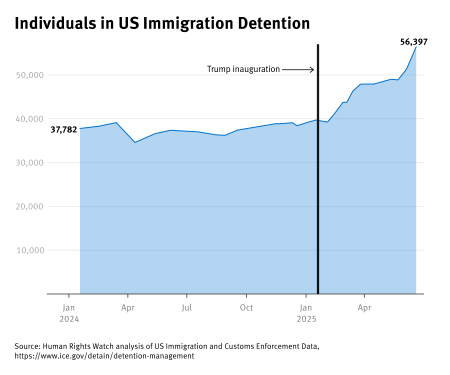
ICE usually makes immigration arrests inside the United States, and Customs and Border Protection (CBP) arrests people who are inadmissible at ports of entry and people who enter unlawfully between designated ports of entry, typically within 100 miles of the border. The growth in the detention population since January 20 has been driven by ICE arrests in the interior of the country, while CBP “encounters” have decreased.[251]
The number of people in immigration detention in May 2025 who were arrested by ICE was more than double the number from January 2025 or from May the previous year.
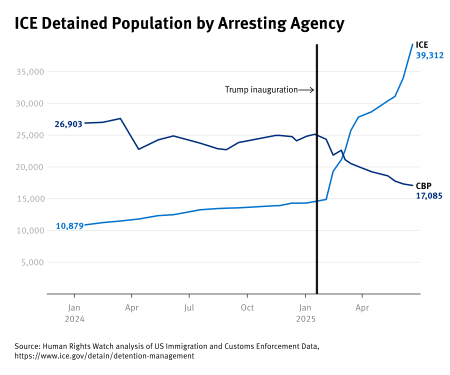
ICE releases facility-level population data intermittently but only releases the average daily population (ADP) of individual detention facilities over the fiscal year to date (FYTD) which does not allow understanding of the current or time-sensitive population levels but only how the average since the fiscal year beginning on October 1 has shifted. Human Rights Watch estimated the facility-level average daily population (ADP) for different time periods using the interval ADP methodology.[252]
Increased Detention of Immigrants in Florida
Immigration detention in Florida has followed a similar direction to the national trend. The estimated daily population in Florida facilities in late May was 130 percent higher than it was in the week prior to January 20, 2025, when Donald Trump was inaugurated as US president.
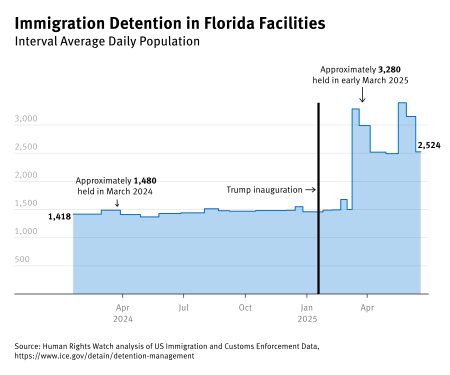
From April 21 to 26, 2025, law enforcement in Florida initiated the largest state and federal joint immigration enforcement operation in the state’s history, dubbed Operation Tidal Wave.[253] The operation was a coordinated effort between ICE, the Department of Homeland Security, US Customs and Border Protection, and Florida state and local law enforcement agencies, many of which operate under 287(g) agreements. During the six-day sweep, 1,120 individuals were arrested across the state—the highest number of immigration-related arrests in a single state in one week in ICE’s history.[254] According to officials, 63 percent of those arrested had prior criminal convictions (which includes people whose only conviction was crossing the border without authorization or crossing the border after a previous deportation) or outstanding removal orders. The remaining 37 percent did not have criminal records.[255]
As of May 25, 2025, about 78 percent of all immigration detainees in Florida were detained in one of the three Miami-area facilities that this report focuses on, including nearly half (43 percent) in Krome, 21 percent in BTC, and another 13 percent in FDC.
There was a striking increase in those being detained at Krome, and the advent, at least in recent years, of new ICE detainees at FDC. In the year prior to the Trump inauguration, the average daily population in Krome averaged about 580 people, which is its operational capacity according to ICE records. By mid-March 2025, almost three times as many people—approximately 1,677—were detained per day in the same space.
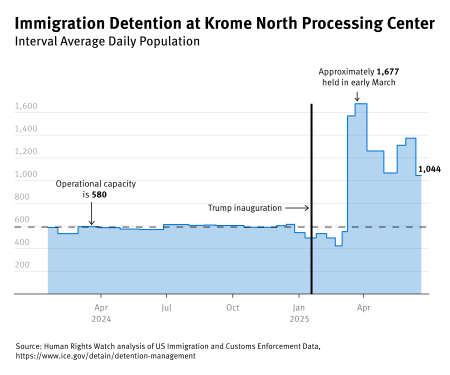
As detention has increased, a much larger proportion than usual of Krome detainees do not have a criminal conviction or pending case. In the 18 months leading up to the inauguration of Trump on January 20, 2025, about a third of Krome detainees did not have a criminal conviction or pending charge, while two-thirds did. As of early June, two out of three people detained there on any given day did not have any criminal conviction or pending charge. In the latest data available, as of May 25, Krome was holding roughly 850 people—about 146 percent of Krome’s capacity—who do not have a criminal conviction or pending charge.
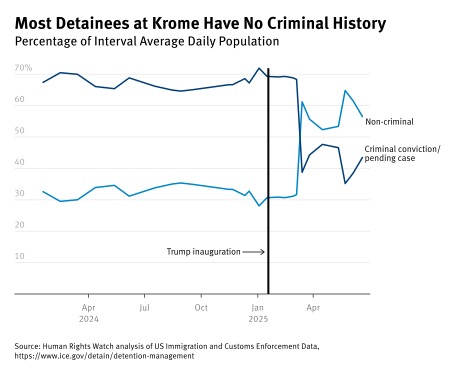
Many of the detainees detained in extremely overcrowded conditions at Krome do not legally need to be detained under immigration law, including under the Laken Riley Act. Since the population increases in early March, somewhere between 50 and 62 percent of Krome detainees are detained by ICE under a broad patchwork of federal statutes, regulations and jurisprudence. The remainder could, it appears, be released.[256]
FDC is a Bureau of Prisons (BOP) facility that typically holds people convicted of crimes in federal courts. Prior to February 27, 2025, FDC had not detained an immigration detainee for the previous year or longer. By mid-March, it was holding over 600 men for ICE, according to Human Rights Watch estimates. The ADP data shows that between 42 and 52 percent of the men detained for ICE since March have no criminal conviction or pending charge.
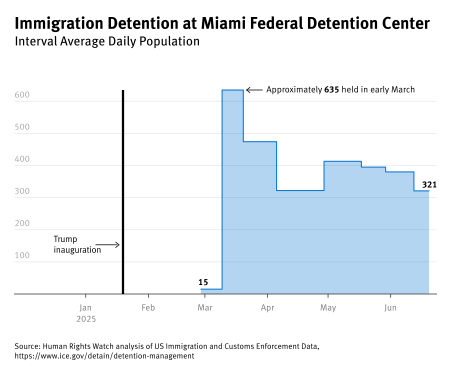
Immigration detention at BTC has remained relatively flat since January 2025. In the beginning of the year, about 700 detainees were detained there. By late May, that number was down to 644. About 20 percent of those detained there are women. Approximately 77 percent of the immigration detainees at BTC are held under mandatory detention policies. About 80 percent do not have any criminal history or pending charges.
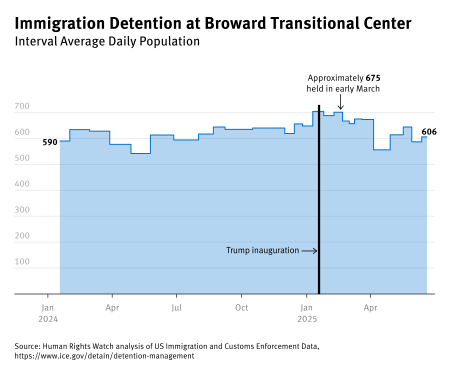
Applicable Legal Standards
United States immigration detention facilities are bound by international and national legal frameworks governing the treatment of individuals in detention. The United States has binding obligations under treaties such as the International Covenant on Civil and Political Rights (ICCPR) and the Convention Against Torture (CAT) that relate directly to its treatment of people in detention. Its policies and practices should also align with the UN Standard Minimum Rules for the Treatment of Prisoners (the Mandela Rules), which offer a detailed framework for detention policies and practices that are consistent with international human rights law.
In addition, ICE's own detention standards—the 2011 Performance-Based National Detention Standards (PBNDS 2011) and the 2019 National Detention Standards for Non-Dedicated Facilities (NDS 2019) —set out minimum requirements for housing, medical care, hygiene, and oversight in detention facilities holding immigrants.[257]
International Human Rights Standards
The International Covenant on Civil and Political Rights (ICCPR), which the United States ratified in 1992, requires that all persons deprived of liberty be treated with humanity and respect for their inherent dignity (Article 10).[258] It prohibits arbitrary detention (Article 9), guarantees access to legal counsel in determining criminal charges, and affirms the right to challenge the lawfulness of detention before a court. Under the ICCPR, governments should provide “adequate medical care during detention.”[259] These protections apply to all individuals under US jurisdiction, including non-citizens in immigration custody.
The Convention Against Torture and Other Cruel, Inhuman or Degrading Treatment or Punishment (CAT), which the United States ratified in 1994, prohibits torture and all forms of cruel, inhuman, or degrading treatment or punishment (Articles 1 and 16).[260] The Committee Against Torture has repeatedly emphasized that poor detention conditions, medical neglect, and excessive use of force may constitute violations of the Convention.[261]
Though not legally binding, the UN Standard Minimum Rules for the Treatment of Prisoners (also known as the Mandela Rules) are recognized as the global benchmark for the humane treatment of detainees.[262] They offer concrete, authoritative, and practical guidance as to what a rights-respecting approach to detention should look like in practice.
National Applicable Detention-Related Standards
In US immigration detention facilities operated or overseen by ICE, the 2011 Performance-Based National Detention Standards (PBNDS 2011) apply to dedicated ICE facilities and some contract facilities, including Krome and BTC.[263] The purpose of these standards is to ensure safe, secure, and humane conditions of confinement tailored to the civil nature of immigration detention.[264] The PBNDS covers medical and mental health care, recreation and structured activities, legal access and visitation, grievance procedures, disability accommodations, and sexual abuse prevention aligned with the Department of Homeland Security’s implementation of the Prison Rape Elimination Act, PREA, of 2003, specifically tailored to immigration detention and other DHS confinement facilities.[265] The PBNDS was revised in 2016 to align with federal legal and regulatory requirements.[266]
If a private company is sub-contracted by ICE to run a facility or to provide services within facilities to civil immigration detainees, that company is required by ICE to follow the PBNDS.
The 2019 National Detention Standards for Non-Dedicated Facilities (NDS 2019) apply to federal, state and local criminal legal system jails and prisons, but which (as in the case of Florida’s FDC) also contract with ICE to hold civil system immigration detainees alongside other populations.[267] The purpose is to provide streamlined standards that allow integration with existing criminal legal system jail and prison operations while maintaining ICE’s minimum requirements. The NDS covers medical care and suicide prevention, use of force and restraints, recreation and visitation, telephone and legal access, and grievance systems and staff conduct. In the case of the facilities covered in this report, Florida’s FDC is also covered by an inter-agency agreement between the federal Bureau of Prisons, the corrections department for the federal criminal legal system, and ICE, which cross-references the NDS 2019.[268]
ICE’s Enforcement and Removal Operations (ERO) conducts regular inspections and compliance reviews to ensure facilities holding ICE detainees are meeting these standards through Detention Service Managers (DSMs), Detention Standards Compliance Officers (DSCOs), Third-party inspection contractors, DHS Office of Civil Rights and Civil Liberties, and DHS Office of the Inspector General.[269]
Acknowledgments
This report was researched and written by Belkis Wille, associate director in the Crisis, Conflict and Arms division. Vicki B. Gaubeca, US immigration and border policy associate director in the US program, Nīa Knighton, senior associate, and Robin Taylor, research assistant, both in the in the Crisis, Conflict and Arms division, contributed research and writing support. Brian Root, senior quantitative analyst in the Technology, Rights, and Investigations division, conducted data analysis and contributed research and writing support.
Anagha Neelakantan, senior Crisis, Conflict and Arms division editor, and Ida Sawyer, Crisis, Conflict and Arms division director, edited the report. Chris Albin-Lackey, senior legal advisor, provided legal review. Tom Porteous, acting program director, provided programmatic review.
Specialist reviews were provided by A. Kayum Ahmed, program lead for the Global Health Initiative in the Economic Justice and Rights division; Heather Barr, associate Women’s Rights director; Michael Bochenek, senior legal advisor; Sam Dubberley, Technology, Rights, and Investigations division director; Carlos Ríos Espinosa, associate Disability Rights director; Bill Frelick, Refugee and Migrant Rights director; Yulia Gorbunova, senior Europe and Central Asia division researcher; Juan Pappier, Americas deputy director; Alison Leal Parker, US program deputy director; Nicole Widdersheim, Washington deputy director; and Sarah Yager, Washington director.
The report was prepared for publication by Nīa Knighton, senior Crisis, Conflict and Arms division associate; Travis Carr, publications manager; and Fitzroy Hepkins, senior administrative manager.
The work for this report was done in partnership with Americans for Immigrant Justice, Inc. (AIJ) and Sanctuary of the South (SOS).
Americans for Immigrant Justice is a nonprofit law firm that fights for justice for immigrants through direct representation, impact litigation, advocacy, and outreach. In the state of Florida and on a national level in the United States, it champions the rights of unaccompanied immigrant children; advocates for survivors of trafficking and domestic violence; serves as a watchdog on immigration detention practices and policies; fights to keep families informed, empowered, and together; and pursues redress on behalf of immigrant groups with particular and compelling claims to justice.
Sanctuary of the South is a workers collaborative with a mission of justice and liberation through communal love and support. We are a network serving and rooted in the South providing legal services, growing sanctuary spaces, and supporting grassroots projects with the aim of forever breaking the systems of oppression that have kept us separated from our collective joy and power. Our legal services include deportation defense, civil litigation, and advocacy campaigns centering those most impacted by unjust systems of enforcement, detention, and deportation.
We would like to thank the individuals who made this report possible by sharing their experiences with us despite the trauma they and their communities were experiencing at the time of the interviews. We would also like to thank the lawyers at Americans for Immigrant Justice, Catholic Legal Services, and Sanctuary of the South, for being so generous with their time and expertise. This research would not have been possible without the support of their teams. We would like to extend a special thank you to Oliver Torres and Lissie Albornoz for helping us conduct this research in Miami thoughtfully and compassionately.
