
Summary
Brazil is a custodian to two thirds of the Amazon, the world’s largest rainforest. The biome is home to millions of Brazilians, including hundreds of Indigenous peoples and traditional communities, with distinct cultures. The rainforest boasts exuberant biodiversity, stores millions of tons of carbon in its soil and plants, and absorbs carbon dioxide from the atmosphere every day, helping to cool the planet.
Several Brazilian governments have made commitments to preserve the Amazon and Congresses have passed historic legislation to this effect, such as the Forest Code. Critically, Brazil has demarcated hundreds of Indigenous territories and nature reserves that act as important buffers against environmental destruction. Despite these efforts, however, the Amazon rainforest has substantially shrunk over the past four decades.

Read a text description of this video
SOUNDBITES
Toto Arara
Every year, the invaders clear more land for cattle. Then they burn it.
SOUNDBITES
Givanildo dos Santos Lima
Today, the biggest driver of deforestation in the Amazon region is cattle ranching.
DATE/PLACE
February 2025
Cachoeira Seca Indigenous Territory, Brazil
Powdem Arara
I don't know why the government doesn't remove the invaders from our land.
Pyjaka Arara
We, the Arara people, are very afraid of ranchers.
Maria Márcia de Melo
The landgrabbers made me lose 17 years of work in a matter of minutes. Look! It's all dead.
DATE/PLACE
November 2024
PDS Terra Nossa, Brazil
Maria dos Reis
We can't say anything, or the land grabbers threaten us.
Cleve Gonçalves da Silva
And it's very dangerous here in Terra Nossa. They've already killed many people in this settlement.
TITLE
Invaded
Watch full video at HRW.org
Historically, cattle ranching is the largest driver of deforestation in the Brazilian Amazon and this remains true today. Since the 1980s, most of the deforested land has been turned into pasture. Today, more than 90 percent of deforestation in the rainforest is illegal under Brazilian law, and most of the deforested land is converted into pasture to graze cattle.
The combination of environmental destruction and pervasive illegality associated with deforestation has had devastating consequences for the rights and livelihoods of forest peoples in the Amazon.
The toll is particularly evident in the state of Pará, home to extensive deforestation, an expanding pasture area, and a growing cattle herd. The state also boasts the second largest area subject to illegal land claims among all Brazilian states. These claims are often made by individuals that seek to illegally register private rural properties inside protected forests. In 2024, Pará also recorded the second largest number of land conflicts.
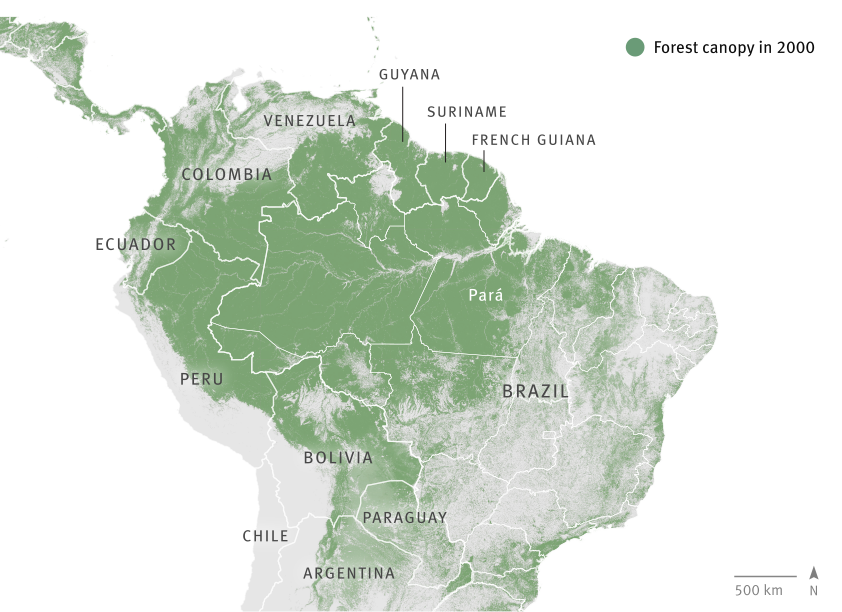
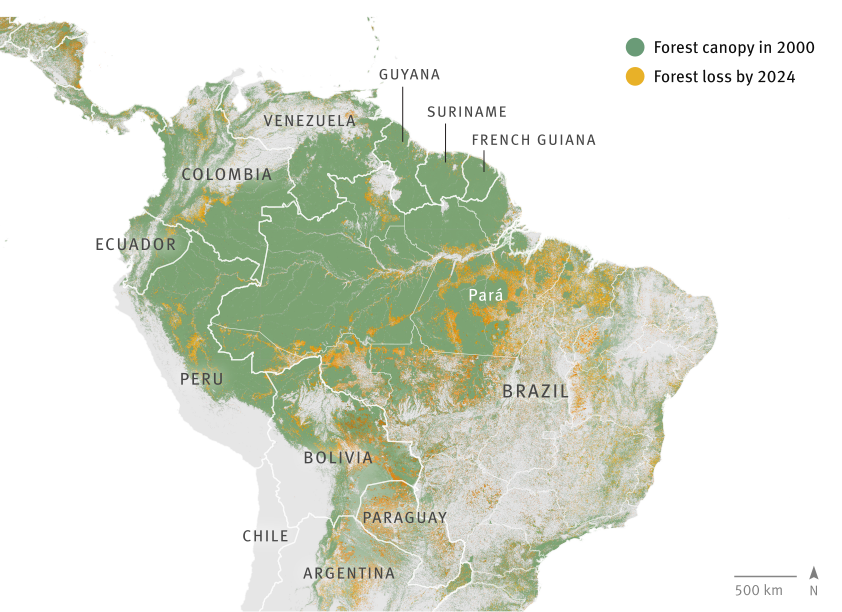
2000: © 2025 Human Rights Watch 2024: © 2025 Human Rights Watch
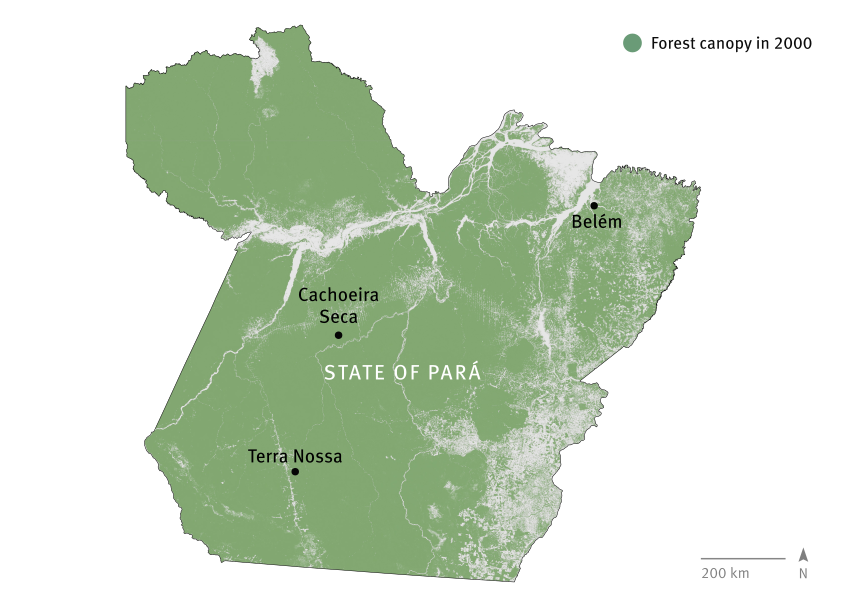
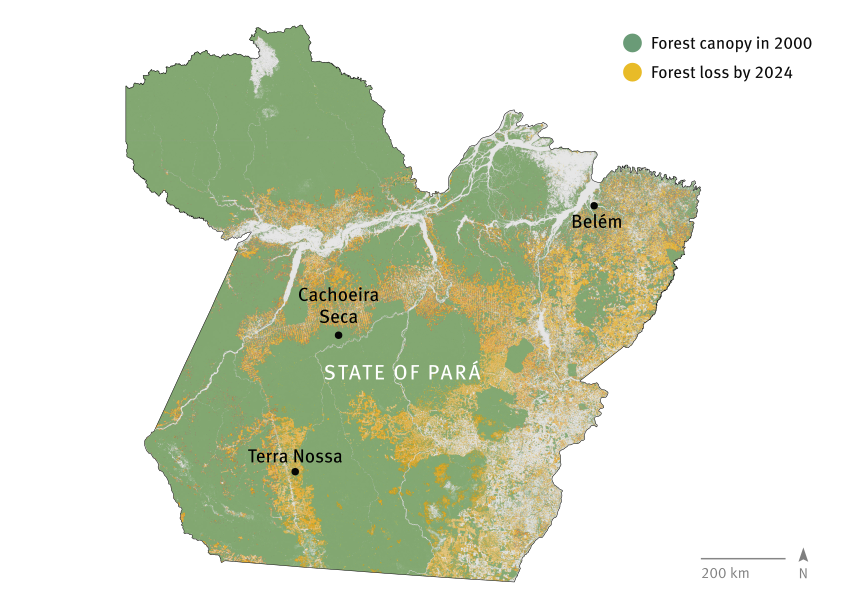
2000: © 2025 Human Rights Watch 2024: © 2025 Human Rights Watch
Between 2024 and 2025, Human Rights Watch documented cattle ranching in two locations in Pará: the Cachoeira Seca Indigenous territory, the ancestral land of the Arara Indigenous people, and the sustainable development settlement (PDS) Terra Nossa, intended as a home for smallholders engaging in sustainable practices. The farms investigated by Human Rights Watch were illegal under Brazilian law.
Landgrabbers – including powerful individuals – have encroached on the protected forests of these territories, cleared vegetation, repeatedly set fires, registered fraudulent land claims, and established cattle ranches on the illegally claimed land. The loss of land and forest has a devastating toll on Indigenous peoples and local communities’ livelihoods, depriving them of valuable crops, fruit and nut trees, and animals for food, and leaving some residents destitute.
In the PDS Terra Nossa, landgrabbers have violently retaliated against residents who denounced their illegal activities. “The entire settlement is invaded by landgrabbers… depending on the things people do, or say, they even threaten to kill… If someone starts to denounce them, they kill,” one resident told Human Rights Watch in November 2024. By 2019, 13 years after it was first created, nearly half of the PDS Terra Nossa had been turned into pasture by illegal landgrabs.
In Cachoeira Seca, landgrabbers and their illegal ranches obstruct the community’s ability to practice its culture and pass on traditional knowledge about the rainforest to younger generations, endangering its cultural survival. “The forest is our home, from which we take our painting, handicraft, food,” a female village chief told Human Rights Watch in February 2025. “We, the Arara people, don’t feel safe at home because of the invaders who are destroying our forest, putting cattle on our territory.”
The sum of landgrabbers’ actions has ultimately restricted or completely impeded the access of lawful residents to land they are legally entitled to use and inhabit in these territories. Landgrabbers’ encroachment and illegal seizure of land, as well as the violence they have used to enforce their fraudulent claims, coupled with Brazilian authorities’ continued failure to remove landgrabbers, amount to forced evictions of lawful residents in violation of Brazil’s human rights obligations.
The cattle ranches that Human Rights Watch investigated in these territories are illegal under Brazilian federal law, but they have prospered, enabled by the state of Pará, which authorized the movement of cattle through its animal health agency, Adepará.
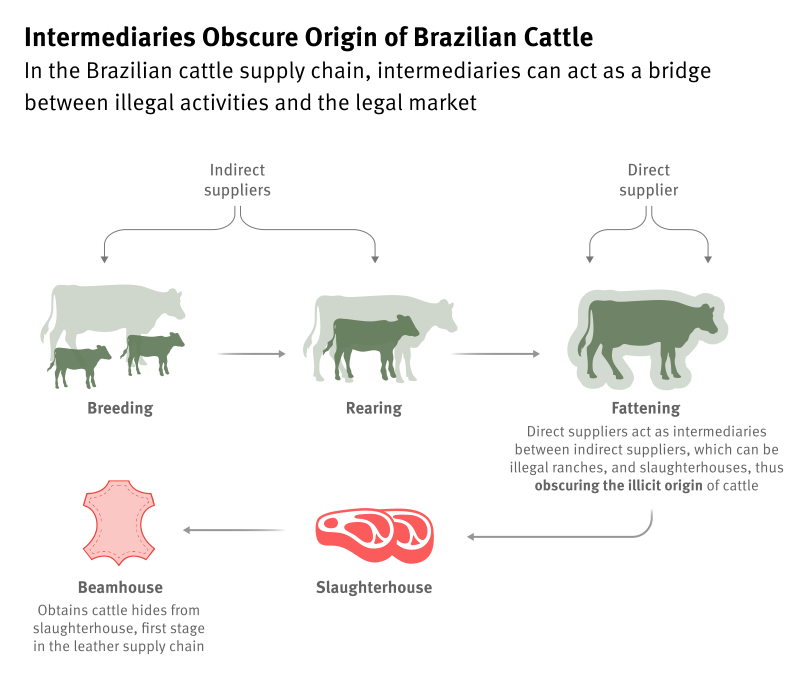
Adepará repeatedly authorized the movement of cattle raised on illegal ranches inside the PDS Terra Nossa and Cachoeira Seca to ranches outside these protected areas. The intermediate farmers then sold cattle to major slaughterhouses. Through this “laundering” system, the illegal origin of cattle raised in protected areas can be concealed by the illegal cattle farmers and their intermediaries, enabling them to reap significant profits at the expense of the PDS Terra Nossa and Cachoeira Seca.
JBS S.A. (JBS) is a multinational company and the world’s largest beef producer. In Brazil, JBS owns a total of 33 beef processing facilities and 15 leather/hides facilities.
In the cases documented by Human Rights Watch for this report, JBS slaughterhouses procured cattle from ranches outside protected areas. Those ranches had previously obtained cattle from illegal farms inside the PDS Terra Nossa and Cachoeira Seca, between 2019 and 2022. Human Rights Watch could not definitively establish that the tainted cattle had passed through to JBS slaughterhouses, because cattle is not currently traceable in Brazil. Instead, cattle movements are documented in batches, whereby the sex and age of the animals are noted at the time of the transport, as well as the date of the movements. However, each batch is created sequentially and does not contain information about animals’ prior history of movements.
Nonetheless, we found that the batches that JBS procured from its direct suppliers contained cattle of sex and age that could be the same ones its direct suppliers had obtained from illegal farms, making it possible that the cattle did pass on to JBS.
JBS does not currently track its indirect suppliers but has pledged to require all its direct suppliers to declare indirect suppliers by January 2026. Direct suppliers would have to submit animal transit permits to support their statements, JBS told Human Rights Watch. However, it is not yet clear how direct suppliers’ assertions will be confirmed. Direct suppliers clearly have a vested interest in declaring false information if they are procuring cattle from illegal farms. Given the above, at the time of writing JBS could not guarantee that tainted cattle from the PDS Terra Nossa and Cachoeira Seca did not enter its supply chain.
Through these transactions and its persistent failure to identify its indirect suppliers despite known risks, JBS ended up fueling economic incentives for illegal deforestation in the Amazon that resulted in environmental crimes and human rights violations such as the ones committed in the PDS Terra Nossa and Cachoeira Seca.
The JBS slaughterhouses we identified as having potentially acquired tainted cattle from the PDS Terra Nossa and Cachoeira Seca were the slaughterhouses in the municipalities of Andradina (São Paulo state), Colíder (Mato Grosso), and Marabá (Pará), evidencing the cross-border inter-state dynamics of cattle laundering.
Given JBS also has tanneries in Colíder and Marabá, that those tanneries are less than 15 kilometers from the JBS slaughterhouses, and that JBS claims to source 90 percent of its cow hides from its own slaughterhouses, Human Rights Watch considers that the JBS tanneries may have also acquired tainted cattle originating from illegal farms in the PDS Terra Nossa and Cachoeira Seca.
Our analysis of Brazilian and European Union (EU) legislation, as well as the JBS facilities and Brazil’s own trade data, show that beef or leather products made from the illegal cattle raised in the PDS Terra Nossa and Cachoeira Seca could have been exported to the EU. Italy is by far the main destination for Brazilian leather exports, while Belgium, Denmark, France, Germany, Ireland, Netherlands, Spain, and Sweden also imported beef from the municipalities that host the JBS facilities identified in this report.
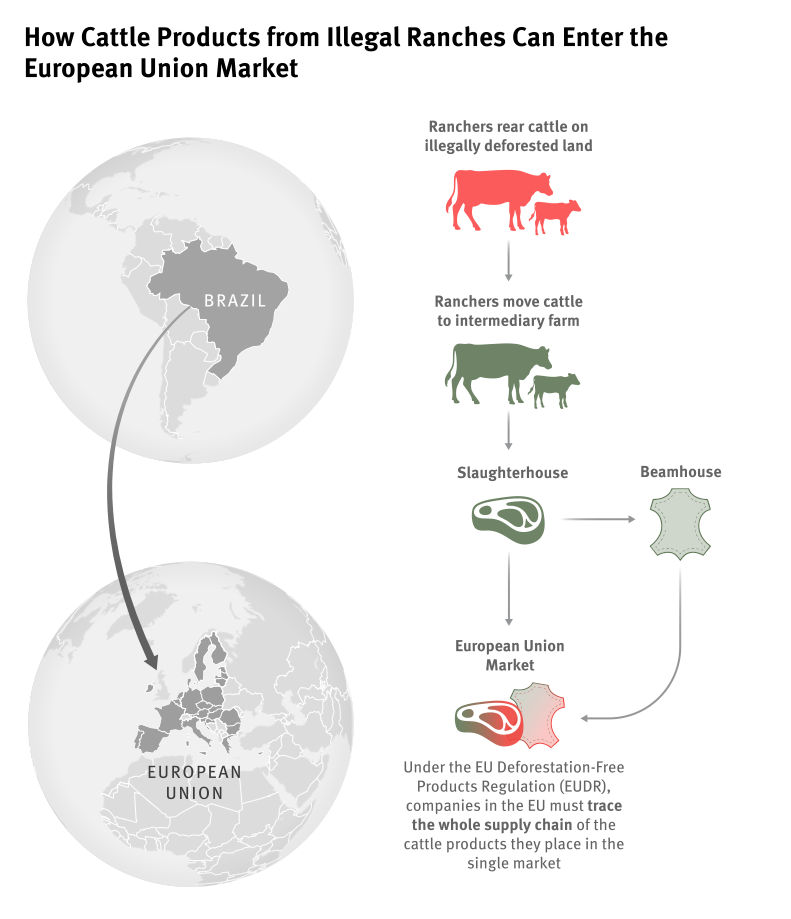
In an effort to take responsibility for the global deforestation toll of their consumption, and after persistent pressure from the public and civil society, in 2023 the European Union adopted the EU Regulation on Deforestation-Free Products (EUDR). The milestone legislation requires products derived from cattle and six other commodities to be deforestation-free, compliant with local environmental and land laws in the country of origin, and respectful of Indigenous people’s rights to be placed on the EU market. Member states will start enforcing it for EU companies on December 30, 2025.
A critical requirement of the EUDR is that companies must submit a due diligence statement. The statement must identify the country of production and the geolocation of “all the establishments where the cattle were kept.” If the product has been made using cattle raised in different plots of land, “the geolocation of all plots of land shall be included.”
As noted above, however, in nearly all of Brazil, cattle movements are not traceable to the animal’s place of birth. Government agencies have historically refused to disclose data about cattle movements to judicial and environmental authorities. This system enables sellers and buyers to conceal the origin of animals in provenance from cattle ranches that are manifestly illegal under Brazilian law.
Efforts are now underway in Brazil to better regulate the country’s cattle industry. In 2023, the Pará governor issued a decree that required the movements of every animal in Pará’s enormous cattle herd to be tracked by the end of 2026. Already in 2025, Adepará is barred from authorizing cattle movements in protected areas like the PDS Terra Nossa and Cachoeira Seca and is required to work with environmental authorities to issue such permits.
The Brazilian federal agriculture ministry announced in December 2024 that it would require all Brazilian states to put in place systems like Pará’s, but they would have until 2032 to do so. The delay in implementing the federal plan risks sabotaging Pará’s efforts: as documented by this report, illegal farms in Pará have laundered their tainted cattle in ranches located in Mato Grosso state, and tainted intermediaries do business with slaughterhouses as far as São Paulo state. Only a federal system with nationwide application can address the porousness between illegal ranches and slaughterhouses.
In both cases, the Pará and the Brazilian federal government have explicitly claimed to want to meet the demands of international markets. Key among those international markets is the EU. Without a traceability system that enables companies to identify each farm the cattle passed through, many Brazilian exports are not likely to be able to meet EUDR traceability requirements.
To forestall this possibility, and, crucially, to assist law enforcement in curbing violence and illegal deforestation driven by cattle ranching, Brazilian animal health agencies could already facilitate batch traceability by rendering information about cattle movements publicly available. Additionally, individual states can opt to accelerate implementation of individual traceability systems, as Pará has done.
Key Recommendations
Human Rights Watch urges the federal government to take swift action to remove the illegal cattle ranches from the PDS Terra Nossa and Cachoeira Seca, to seek damages against those responsible for unlawful occupation and use of land there, and, in consultation and with participation from residents, undertake projects to restore their forests and support their sustainable livelihoods.
Additionally, the federal government should accelerate the implementation, and effective enforcement of its cattle traceability system, including through incentives for those states like Pará that put in place traceability systems ahead of schedule. The federal system’s information should be available to all state and federal authorities to facilitate law enforcement. The federal government should establish dissuasive penalties for slaughterhouses that buy tainted cattle, in line with Brazil’s obligation to regulate businesses to protect rights.
Human Rights Watch urges the state of Pará to support operations for the removal of illegal cattle ranchers and landgrabbers from federal protected areas, including by sharing information on illegal cattle movements and deploying law enforcement personnel to support operations. The Pará government should stay the course for implementation of its individual traceability system and press the federal government to accelerate its plan.
Human Rights Watch urges JBS to take responsibility for its contribution – even if unintentional - to illegal deforestation, land fraud, and human rights abuses throughout its operations, including by contributing to the restoration of the PDS Terra Nossa and Cachoeira Seca.
EU member states that import Brazilian cattle products, and in particular Italy as one of the world’s main importers of Brazilian leather, should scrutinize imports from Andradina, Colíder, and Marabá in light of the requirements of the EU Regulation on Deforestation-Free Products. They should also support positive reforms in Brazil, such as federal cattle traceability, through development aid and knowledge sharing.
Tackling deforestation and human rights abuses embedded in cattle products is a shared responsibility between sellers and buyers. Brazil and the EU should work together to protect the Amazon and its forest peoples, regulate businesses to protect rights, and tackle the climate crisis.
Glossary
Adepará | Acronym for Agência de Defesa Agropecuária do Estado do Pará, or Agency of Agriculture and Livestock Control of the State of Pará. The state government agency in charge of animal health. |
CAR | Acronym for Cadastro Ambiental Rural, or Rural Environmental Registry. A database where farmers are required to register their rural properties. |
CPF | Acronym for Cadastro de Pessoa Física, the federal registry of individual taxpayers. |
FUNAI | Acronym for Fundação Nacional dos Povos Indígenas, or National Indigenous Peoples Foundation. The federal agency that implements policies regarding Indigenous peoples and their territories. |
GTA | Acronym for Guia de Trânsito Animal, or Animal Transit Permit. A permit issued by animal health agencies authorizing the movement of cattle. In the state of Pará, these permits are issued by Adepará. |
IBAMA | Acronym for Instituto Brasileiro do Meio Ambiente e dos Recursos Naturais, or Brazilian Institute of the Environment and Renewable Natural Resources. Federal environmental protection agency tasked with civil enforcement of federal environmental law throughout Brazil. |
INCRA | Acronym for Instituto Nacional de Colonização e Reforma Agrária, or the Colonization and Land Reform National Institute. The federal agency that carries out land reform by creating rural settlements for poor farmers, administers public lands, and maintains a registry of rural properties. |
Illegally grazed | Cattle that were brought to an area where commercial cattle ranching is prohibited under domestic law and left to graze -or feed- on that land. |
MAPA | Ministério da Agricultura e Pecuária, the federal ministry of agriculture and cattle ranching. |
SEMAS | Secretaria de Estado de Meio Ambiente e Sustentabilidade do Pará, or Secretariat of Environment and Sustainability. Pará state environment agency in charge of, among others, analyzing and cleaning up the CAR of fraudulent entries. |
Methodology
Human Rights Watch’s research for this report focused on the state of Pará due to a combination of environmental, social, and policy factors that make it a high-risk area for deforestation, human rights violations, and cattle laundering.
Human Rights Watch focused on the company JBS S.A. (JBS) because it is the world’s largest beef producer.[1] In 2020 – the year for which Human Rights Watch was able to gather publicly available information – JBS was also the largest Brazilian exporter of beef products to the EU, accounting for 41.9 percent of the volume exported.[2] JBS is also among the top five largest Brazilian exporters to the EU of two types of cow hides: tanned or crust hides and prepared hides.[3]
Sources
Human Rights Watch held a group meeting with approximately 30 residents of the sustainable development project (Projeto de Desenvolvimento Sustentável, PDS) Terra Nossa in November 2024. Researchers presented the scope and objective of the investigation, and residents made comments and asked questions. Additionally, researchers conducted individual interviews with seven residents, of whom three were women.
Human Rights Watch also held group meetings in the village Pyrewa of the Indigenous territory Cachoeira Seca in February 2025. Additionally, we conducted individual interviews with 10 residents, of which three were women and three were village chiefs.
All interviewees provided oral informed consent and were assured that they could end the interview at any time or decline to answer any question. Interviewees were not compensated. Some who traveled to meet Human Rights Watch researchers were reimbursed for the travel expenses they incurred.
Researchers met with officials working at Adepará, the Secretariat of Environment and Sustainability (Secretaria de Estado de Meio Ambiente e Sustentabilidade, SEMAS), and the federal prosecutor’s office (Ministério Público Federal, MPF) based in Belém, the state capital of Pará. Researchers also met officials working at the Brazilian Institute of the Environment and Renewable Natural Resources (Instituto Brasileiro do Meio Ambiente e dos Recursos Naturais, IBAMA) and the National Indigenous Peoples Foundation (Fundação Nacional dos Povos Indígenas, FUNAI) who are based in other locations in Pará, and federal prosecutors based in several cities in the state, between November 2024 and February 2025. Human Rights Watch researchers inquired about the public policies to combat deforestation and cattle laundering in the state. In the town of Novo Progresso in Pará, Human Rights Watch met with military police officers in charge of the security of those PDS Terra Nossa residents who are included in the program for human rights defenders at risk.
In Brasilia, Human Rights Watch met with Marina Silva, Minister of Environment, Rodrigo Agostinho, head of IBAMA, Sonia Guajajara, Minister of Indigenous Rights, and several officials at the Ministry of Agrarian Development (Ministério do Desenvolvimento Agrário, MDA), and at the Environment Commission of the MPF. Similarly, Human Rights Watch made general inquiries about federal public policies, enforcement operations, and budgetary constraints to combat deforestation and violence against environmental defenders.
Human Rights Watch researchers also interviewed academics and representatives of non-governmental organizations that have expertise on the issues covered by this report.
Human Rights Watch filed multiple freedom of information requests with Adepará, the MDA, and the federal agriculture ministry (Ministério de Agricultura e Pecuária, MAPA) to obtain further official government data.
Multiple sources informed Human Rights Watch about the identity of ranchers operating in the areas where we conducted our research. To protect our sources from retaliation, the individual farms identified in this report have been anonymized. Some of the witnesses who gave testimony on human rights abuse were also anonymized in this report to protect them from retaliation.
To identify movements of cattle reared in the Cachoeira Seca Indigenous territory and the PDS Terra Nossa, Human Rights Watch used the following sources:
- A dataset of farmers and cattle ranches registered with Adepará, obtained through a freedom of information request.[4] The dataset includes the names of the farmers, their individual taxpayer registry (Cadastro de Pessoa Física – CPF), name and code of the cattle ranches, whether the farmer was registered as the owner or tenant of the farm, and a single GPS point identifying the location of the cattle ranch.
- Pará’s rural environmental registry (Cadastro Ambiental Rural - CAR), through which farmers register the rural properties they claim to own.[5] CAR entries include shapefiles of properties indicating their boundaries and location and details about the owners. Based on that information, Human Rights Watch matched existing CAR registries to ranches registered with Adepará.
- Official animal health control documents (Guias de Trânsito Animal, GTA), which document cattle movements.[6] The investigative journalism outlet Repórter Brasil collaborated in the analysis of those documents.
- Specifically with regard to PDS Terra Nossa, two reports produced by the National Institute of Colonization and Agrarian Reform (Instituto Nacional de Colonização e Reforma Agrária, INCRA) in 2017 and 2018, which identified ranchers who illegally occupied land in the settlement, as well as a third report from 2023 that INCRA shared with Human Rights Watch detailing the legal processes to remove landgrabbers.[7] Additionally, Human Rights Watch consulted a report on the situation of Terra Nossa prepared by a group of experts and that was commissioned by the MPF.[8]
To identify slaughterhouses authorized to export beef products to the EU, Human Rights Watch consulted EU and Brazilian laws and official documents. Human Rights Watch also submitted freedom of information requests to Brazil’s INCRA and MAPA and received responses from both governmental bodies between April 2024 and January 2025.
Human Rights Watch consulted data from Brazil’s Ministry of Development, Industry, Trade, and Services (Ministério do Desenvolvimento, Indústria, Comércio e Serviços, MDIC) on exports of beef and cow hides to the EU, based on the 6-digit codes of the Harmonized System, and disaggregated by states.[9] We also consulted export data disaggregated by municipality, for which the classification of products is limited to 4-digit codes.[10] The export data disaggregated by municipality indicates the tax domicile of the company exporting the product, though the exporting company is not necessarily the same as the one that produced it.
Human Rights Watch shared its preliminary findings and requested comment from JBS on July 7, 2025. JBS sent a statement via email on August 1, 2025.
I. Background
The Brazilian Amazon and its traditional communities are threatened by rampant deforestation. There is pressure to transform even Brazil’s protected forests into pastures to accommodate Brazil’s growing cattle herding business, a major industry in the country.
Cattle-Driven Deforestation
Between 1985 and 2022, “satellite images clearly show that the conversion of forests into pastures and other uses is strongest in Brazil [out of all Amazon countries] – notably in the Arc of Deforestation, which runs from Pará to Acre,” according to a study by a consortium of scientists.[11] During the same period, Pará’s pasture area more than quadrupled.[12]
This historical trend continues to hold for Pará to this day. Of the ten states with the largest pasture area expansion between 2019 and 2022, nine are in the Legal Amazon region.[13] Pará accounts for both the largest pasture area and the largest recent expansion of pasture, with a growth of 10 percent during those three years.[14]
Overall, between 2016 and 2024, Pará has consistently been the state in the Brazilian Amazon that deforested the most.[15] In 2024, it was also the state that recorded the most forest degradation in the Amazon, with a total of 17,195 square kilometers of degraded forest, an increase of 421 percent over the degraded area in 2023.[16]
Approximately half of all deforestation in the Amazon takes place in privately held areas, while a quarter impacts areas held by the federal or state governments, including nature reserves and Indigenous territories, and another quarter takes place in rural settlements.[17] When deforestation is the result of encroachment, it often carries devastating human rights consequences for the traditional inhabitants of the Amazon.
Land Fraud and Rural Violence
The Brazilian Amazon is home to Indigenous peoples and Afro-descendent communities (Quilombolas). Brazilian law and regulations codify processes to survey, demarcate, and title their territories, in recognition of their customary rights over their lands and resources. Through its agrarian reform agency, the Brazilian government also establishes settlements for landless peasants. Additionally, the government has established “extractive reserves” to protect the rainforest while enabling local communities to gather non-timber forest products such as nuts, fruits, and the sap of rubber trees. Forests are sources of sustainable livelihoods and cultural identity for all these communities.
Despite their protected status, landgrabbers will often encroach on the territories of traditional communities, with devastating consequences for their rights and livelihoods. An analysis of Brazil’s Rural Environmental Registry (Cadastro Ambiental Rural, CAR) provides a good indicator of these pressures.
The CAR is a publicly accessible database where landowners must declare their rural properties.[18] Due to its self-declaratory nature, the registry is often abused to lodge fraudulent land claims that overlap with protected forests. Environmental authorities must individually assess each entry to determine if the land claim is legal and whether it presents any irregularities. If irregularities are found, a CAR entry could be cancelled or suspended pending the implementation of remedial measures; if no irregularities are found, the entry is validated.
In January 2024, a total of 303,762 rural properties located in Pará were registered with the CAR, according to official government data. Of those, 56 percent had been through some type of government evaluation, but only 11.5 percent had a final assessment of environmental compliance.[19] Thus, it is still to be determined whether the vast majority of land claims lodged in the CAR are in compliance with state and federal environmental legislation, but, in the meantime, they are neither suspended nor cancelled.
A significant percentage of the claims registered in the CAR database are for land that is or should be protected from private claims by Brazilian law. According to an analysis of CAR entries by the civil society network Forest Code Observatory (OCF), as of October 2024, the area of overlap between CAR entries and protected forests in Pará amounted to more than 11.3 million hectares.[20] Pará is the state with the second largest area of CAR entries overlapping with conservation units, Indigenous territories, undesignated forests, Quilombola territories, and rural settlements.[21]
As far as Indigenous and Quilombola territories are concerned, this estimate only considers the overlap with those territories that have already secured final legal recognition by the government. However, Pará has 19 Indigenous territories that are pending demarcation and 66 Quilombola communities that are seeking land titles.[22]
Widespread encroachment has translated into conflicts over land. According to the Pastoral Land Commission (Comissão Pastoral da Terra, CPT), a non-profit organization affiliated with the Catholic Church that monitors conflicts over land in all of Brazil, Pará has consistently been among the states ranking most poorly:
In 2024, Pará registered 234 conflicts over land, second only to Maranhão, and accounted for 20 percent of the conflicts driven by illegal deforestation,[23]
In 2023, Pará registered 227 conflicts over land, second only to the state of Bahia,[24]
In 2022, Pará registered 238 conflicts over land, more than any other state, impacting more than 33,200 families and resulting in five murders.[25]
JBS Footprint in the Amazon and the EU
JBS S.A. (JBS) is a multinational company and claims to be the world’s largest animal protein company.[26]
JBS’ operations have reportedly caused or contributed to significant deforestation in the Amazon since 2008, according to a study led by the Brazilian research center Imazon.[27] When compared to other meatpackers in the Amazon, JBS is alleged by Imazon to bear responsibility for almost four times more deforestation than the company ranked second.[28]
In Brazil, JBS owns a total of 33 beef processing facilities and 15 leather/hides facilities.[29] Based on the most recent available data, in 2020, JBS was the largest Brazil-based exporter of beef products to the EU, accounting for 41.9 percent of the volume exported.[30] JBS is also among the top five largest Brazilian exporters to the EU of two types of cow hides: tanned or crust hides and prepared hides.[31]
JBS also supplies beef and leather products to the domestic Brazilian market, as well as the United States, the United Kingdom, China, and many others.[32]
EU Regulation on Deforestation-Free Products
Until December 29, 2025, beef and leather tainted by deforestation, rights abuses, and illegality can be imported into the EU without legal exposure for EU importers. This will change once the EU begins enforcing the Regulation on Deforestation Free Products (EUDR). The EUDR covers cattle, cocoa, coffee, oil palm, rubber, soy, and timber, as well as derived products such as beef, leather, chocolate, and palm oil.[33]
The EUDR requires that cattle products originate from land that was not deforested after December 2020 to be placed on the EU market.[34] These products must also be produced in conditions that respect domestic environment, labor, and land laws.[35] Additionally, products should be compliant with the principle of free, prior, and informed consent as defined under the United Nations Declaration on the Rights of Indigenous Peoples (UNDRIP).[36]
In effect, the EUDR will require the traceability of both direct and, just as importantly, indirect suppliers of cattle. To sell beef and leather products on the EU market, companies must upload a due diligence statement to the EUDR information system. The statement must identify the country of production and the geolocation of all plots of land where the commodities were produced. For cattle products, the geolocation “shall refer to all the establishments where the cattle were kept.”[37] Additionally, where the product has been made using cattle raised in different plots of land, “the geolocation of all plots of land shall be included.”[38] To comply with this requirement, importers will require information about all the farms where cattle were raised before they were exported to the EU.[39]
Penalties for EU companies that breach the law include fines up to 4 percent of the company's total annual Union-wide turnover; confiscation of non-compliant products; seizure of revenues derived from tainted products; and exclusion from procurement processes and access to public funding. Repeat offenders could also be temporarily banned from placing on the EU market commodities or products covered by the EUDR.[40]
A cornerstone of the EUDR’s enforcement will be country risk benchmarking, which the European Commission published in May 2025. As per the text of the regulation, the Commission should assign risk levels to countries primarily based on the incidence of deforestation and forest degradation and could also consider human rights risks like labor rights abuses and forced evictions, as well as UN sanctions.[41] (The Commission may also benchmark parts of countries, enabling it to do a regional risk classification.) The higher the risk assigned to a jurisdiction, the larger the number of checks that EU customs should perform on goods originating from that jurisdiction.
In the rating revealed in May, Brazil as a whole was rated standard risk despite registering more tropical primary forest loss than any other country in 2024.[42] Meanwhile, only four countries–Belarus, Myanmar, North Korea, and Russia–were rated high risk. The Commission stated that “it is impossible to conduct due diligence along the value chains in these countries” because they were subject to UN Security Council or EU Council sanctions, justifying their high-risk status.[43] The Commission also stated they considered qualitative criteria, but failed to disclose the details of the latter.[44] Neither explanation justifies the country, or the regions within that country, that most deforested in the world not being rated high risk.
II. Findings
Human Rights Watch conducted research in two locations in Pará where cattle ranching is driving human rights abuses and illegal deforestation: the Cachoeira Seca Indigenous territory and the sustainable development project (Projeto de Desenvolvimento Sustentável, PDS) Terra Nossa.
In both locations, landgrabbers forcibly evicted residents to convert the rainforest into pasture for grazing cattle, including setting fires to burn off forest growth. Deforestation and fires have devastated residents’ crops and forest resources. Landgrabbers’ actions have destroyed most, if not all, sources of income and the livelihoods of many residents and instilled fear throughout these communities. Additionally, several Terra Nossa residents were intimidated, killed, or disappeared after denouncing illegal land seizures and illegal deforestation.
The Pará government agency tasked with overseeing animal health, Adepará, has registered cattle ranches inside the PDS Terra Nossa and Cachoeira Seca and authorized the movement of cattle into and out of these areas, even when these activities were illegal in these protected forests. When describing its mandate in general terms, Adepará told Human Rights Watch that its role is to ensure the health of the cattle herd, and that the agency has not historically been tasked with observing environmental criteria when authorizing movements.[45]
Human Rights Watch identified five cases where illegal ranches in the PDS Terra Nossa and Cachoeira Seca supplied cattle to ranches outside these two protected forests, and subsequently those ranches sold cattle to JBS slaughterhouses. The JBS slaughterhouses we identified were either authorized to export beef products to the EU or had very likely supplied hides to JBS tanneries that exported leather products to the EU.
The movements of cattle between illegal ranches located inside protected forests, ranches located outside the protected forests, and slaughterhouses help conceal the illegal origin of tainted cattle.[46] This “laundering” system – whether or not conducted with the knowledge of JBS, such fraud risk is clearly known to the company—ultimately enables JBS and other companies to procure tainted cattle while evading responsibility for illegalities and human rights abuses in their supply chain, which are obscured by the multiple sequential cattle movements.
JBS has committed to eliminating legal and illegal deforestation from its direct and indirect suppliers by 2025, the year of this writing.[47] Additionally, under the United Nations Guidelines on Business and Human Rights, JBS has a responsibility to respect human rights, including by adopting policies and deploying processes to:
Avoid causing or contributing to adverse human rights impacts through their own activities (both actions and omissions) and address such impacts when they occur.[48]
Prevent or mitigate adverse human rights impacts that are directly linked to their operations, products, or services by their relationships, even if they have not contributed to those impacts.[49]
“Enable the remediation of any adverse human rights impacts they cause or to which they contribute” and use their business leverage to do so.[50]
Human Rights Watch cannot state with absolute certainty that JBS’ direct suppliers passed the tainted cattle from illegal farms on to JBS slaughterhouses, because cattle is not traceable in Brazil.[51] Cattle movements are documented in batches in so-called “animal transit permits” (Guías de Tránsito Animal, GTA). In Pará, these permits are issued by Adepará. A permit will note the sex and age of animals in the batch at the time of the movement, as well as the date of the movement. The permit does not include the history of the individual animals’ previous movements. Human Rights Watch obtained several of these permits and found that the batches that JBS procured from its direct suppliers contained cattle of sex and age that could be the same as the ones its direct suppliers obtained from illegal farms in the PDS Terra Nossa and Cachoeira Seca.[52]
While the methodology of this report focused on tracking transactions for which there were GTA records, we note that a significant number of illegal cattle movements are not tracked at all. For example, the Environmental Investigation Agency (EIA), a non-government environmental organization, found that a rancher was illegally raising cattle inside the Apyterewa Indigenous territory, also located in the state of Pará, and transferred these tainted cattle to a farm outside the territory without any GTAs to document the movement, before reportedly selling the tainted cattle to JBS and other slaughterhouses.[53] Some of the landgrabbers operating illegal ranches inside the PDS Terra Nossa also have ranches adjacent to the settlement, which would enable them to seamlessly move illegal cattle without permits in and out of the settlement.
Since JBS does not currently track its indirect suppliers, and, overall, there is no mandatory traceability for cattle in Brazil, JBS cannot guarantee that tainted cattle from the PDS Terra Nossa and Cachoeira Seca did not enter its supply chain. At the time of writing, JBS was unable to guarantee its clients in the EU or elsewhere that they have not purchased products made from tainted cattle that originate from illegal ranches.
JBS has explicitly admitted this major gap in a document from April 2025 it submitted to the U.S. Securities Exchange Commission (SEC), as part of its bid to be listed on the New York Stock Exchange:[54]
The GTA, for example, provides information only with respect to the direct supplier of the head of cattle. While this permits verification of compliance for the direct supplier, the GTA does not capture information relating to any indirect suppliers (suppliers in the supply chain prior to the direct supplier to us of the animal). As a result, there can be no assurance that available monitoring procedures can ensure that the origin of any head of cattle was in full compliance with applicable laws, regulations or our RPP [Responsible Procurement Policy].[55]
For decades, JBS has failed to conduct due diligence on the riskiest parts of its supply chain–the indirect suppliers–despite overwhelming and publicly available evidence of illegal deforestation in cattle ranches in the Brazilian Amazon.[56] In the absence of mandatory cattle traceability in Brazil, JBS should voluntarily track its indirect suppliers and ensure birth to slaughter traceability for all its cattle products. It does not appear that JBS had such a traceability mechanism at the time of writing and unless such a mechanism is instituted by JBS, EU importers of JBS beef or leather products may not be able to meet the requirement under the EUDR to identify all the establishments where cattle were kept along the supply chain, or to credibly establish that there is no or negligible risk that JBS products are not compliant with the EUDR. [57]
Our findings on the destination of cattle from Cachoeira Seca and the PDS Terra Nossa are not exhaustive. Given the extent of illegal cattle ranching in Cachoeira Seca and the PDS Terra Nossa, other tainted supply chains would likely be identified if information about cattle movements were publicly available.
PDS Terra Nossa
The PDS Terra Nossa is a rural settlement created in June 2006 by the National Institute of Colonization and Agrarian Reform (Instituto Nacional de Colonização e Reforma Agrária, INCRA), the federal agency in Brazil responsible for land reform. Approximately 200 families of smallholder farmers lawfully reside there. It straddles the municipalities of Altamira and Novo Progresso, with an area of 150,000 hectares.[58]
PDS settlements such as Terra Nossa are intended to combine environmental conservation with efforts to secure sustainable livelihoods for landless peasants.[59] For PDS settlements located in the Brazilian Amazon, 20 percent of the land is parceled as individual plots for residents. Residents are permitted to clear their individual plots of rainforest to establish their homes and farms. By law, the remaining 80 percent of the land in the PDS must be conserved as rainforest.
In Terra Nossa, the area designated by law for the forest reserve amounts to approximately 120,000 hectares.[60] There, residents should be able to collect fruits and nuts, and engage in other sustainable forest management activities, for subsistence and income generation purposes. Standing forests should be a cornerstone of residents’ livelihoods in the PDS.
“I like the forest, nature,” a resident told Human Rights Watch. “Ten or nine years ago, I planted all kinds of fruit trees: Surinam cherry, jabuticaba, acerola, about 50 species of fruit trees.”[61] Another resident said the forest was “very important” for her family, who gathered Brazil nuts, babassu coconuts, cupuaçu, and açaí fruits.[62] “The forest offers more than what 1,000 cattle can give you,” a PDS Terra Nossa community leader told Human Rights Watch.[63]
Forced Evictions and Loss of Livelihoods
The guy would fly right over our farm, throwing grass seeds … after that, they fence [the land] off and put cattle in, the remaining trees are cut with a chainsaw.
— Resident of the PDS Terra Nossa, November 2024
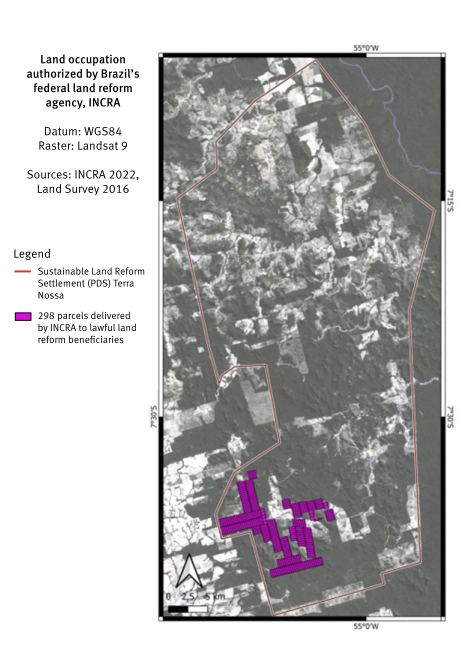
Established in 2006, Terra Nossa is intended to provide 1,000 landless peasants and their families with their own plot. As of April 2025, INCRA had only delineated 298 plots (marked in purple in the satellite image below.)[64] Of these, 291 plots had been assigned to families of landless peasants, five were destined for communal use, and two were not in use. While INCRA has neither delineated nor assigned the remaining 700 plots it should grant to landless families, the external boundary of the settlement has been delineated (marked in red in the satellite image to the right).[65]
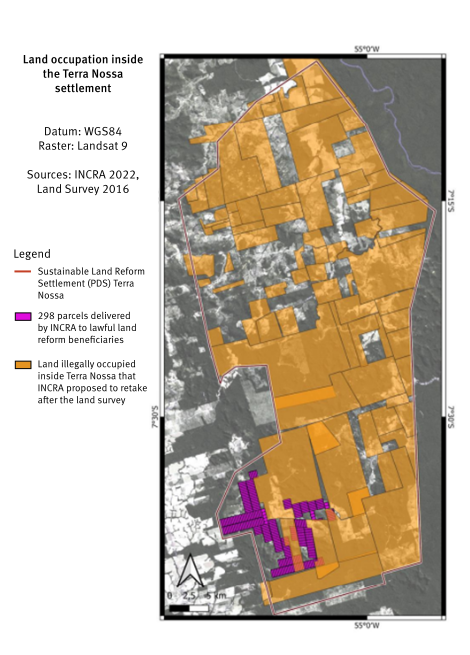
When INCRA surveyors conducted an inspection in 2016, 10 years after the creation of the PDS Terra Nossa, they found that landgrabbers had illegally occupied almost four-fifths – 78.5 percent – of the settlement.[66] The annotated satellite image to the left shows in yellow the area that INCRA found to be illegally occupied.[67] In addition to taking up most of the forest reserve, it is apparent that landgrabbers are also laying illegal claims to the plots that have already been delineated and assigned to the lawful residents of the PDS Terra Nossa. Indeed, there is significant overlap between the yellow area and lawful residents’ plots, the latter which are marked in purple.
A 2018 assessment by INCRA inspectors found that landgrabbers had claimed, with no legal basis, 77 rural properties in the settlement’s forest reserve extending over 117,939.60 hectares.[68] The inspectors recommended to their superiors that INCRA take immediate action to remove those landgrabbers from the settlement.[69]
In March 2025, the federal prosecutor’s office in Pará sued INCRA to compel it to complete the removal of landgrabbers by September 2025 and delineate new plots to settle 700 more families of landless peasants, in line with the original plans for the settlement.[70]
In its response to this lawsuit, INCRA informed the court that, as of April 2025, it had completed 37 out of 76 administrative procedures concerning illegal occupation of land and sent those to the Federal Specialized Prosecutor’s office (Procuradoria Federal Especializada, PFE), which is responsible for filing lawsuits to obtain judicial orders of eviction. The 37 procedures account for nearly 79,000 hectares—or 52 percent—of PDS Terra Nossa’s area. Out of the 76 procedures, 11 remain under analysis by INCRA.[71]
According to the same document, INCRA had suspended 27 of the 76 administrative procedures. These concern areas that could be cut from the PDS Terra Nossa under a proposal to shrink the settlement that is currently being considered by INCRA.[72] If enacted, it would pave the way for landgrabbers to seek regularization of their illegal land holdings.
Lawful residents’ anger and frustration at government authorities’ failure to remove illegal occupants was palpable during interviews with Human Rights Watch. “INCRA delivered us to the landgrabbers,” a Terra Nossa community leader said in November 2024.[73] “The government abandoned us here and didn’t see the project through in the way it should have implemented it,” another resident complained.[74] “INCRA came, but never resolved anything. [Meanwhile] many people have already been killed in Terra Nossa,” said another smallholder.[75]
Landgrabbers have increasingly converted forest to farmland through clear-cut logging, by setting fires to prepare the fields, planting grass, and establishing pastures for grazing cattle. Between 2018 and the end of 2021, more than 11,931 hectares were deforested in the settlement.[76] Furthermore, between 2016 and 2022, more than 20,800 active fires were recorded in the areas illegally claimed by landgrabbers within the settlement, based on data from the government’s monitoring system DETER.[77] Overall, more than 28,000 hectares have been burned in the PDS Terra Nossa since 2016.[78]
This illegal destruction of protected forests has dire consequences for the lawful residents of the settlement. Deforestation and fires have devastated residents’ crops and forest resources. Many of them have lost most, if not all, sources of income and livelihood.
“The worst thing is fire, it makes one want to give up,” a smallholder from Terra Nossa said. “The joy of a farmer is to plant and see things grow. [With the fire] we become desolate, everything we planted, the fire destroyed.”[79]
“We had a very beautiful farm, where we earned our living,” another resident of Terra Nossa, told Human Rights Watch.[80] “This year [2024], we lost all our crops… we lost more than 200 fruit trees… at the time, I was despairing… the whole farm was on fire,” she lamented.
Illegal cattle ranching is the critical driver of the settlement’s illegal occupation and environmental destruction: in 2023, 45.3 percent of the PDS Terra Nossa had been turned into pasture.[81]
“They set the fire and then drop grass [seeds] from a plane,” a resident told Human Rights Watch.[82] Describing the process through which landgrabbers illegally seize land in the forest reserve area neighboring his plot, the resident said: “The guy would fly right over our farm, throwing grass seeds … after that, they fence [the land] off and put cattle in, the remaining trees are cut with a chainsaw.”[83]
“This year [2024] the landgrabber set a fire that burned everything,” a Terra Nossa smallholder told Human Rights Watch. “The following week, [the landgrabbers] were already building a fence in that area and planting grass,” he added.[84]
“When we arrived in this settlement, this forest was the most beautiful thing,” a resident of Terra Nossa, told Human Rights Watch.[85] “They burned our forest, which had a lot of Brazil nut trees,” he continued. He explained that the landgrabber who set fire to his forest was now raising 100 cattle on land where his trees used to stand.
The destruction of the settlement’s forest reserve and smallholders’ crops is forcing Terra Nossa’s rightful residents to abandon their plots. “They burn it to try to expel us,” a Terra Nossa resident told Human Rights Watch.[86] “Because of these invasions in the settlement, many people are leaving,” he said.[87]
Landgrabbers are effectively preventing lawful residents of the settlement from accessing the land and forest resources that they are legally entitled to. The landgrabbers’ actions amount to a forced eviction of the PDS Terra Nossa’s lawful residents. Government agencies’ delay to remove landgrabbers from the settlement amounts to a breach of Brazil’s obligation to protect the rights of the lawful residents of the PDS Terra Nossa.[88]
Intimidation and Violence
The entire settlement is invaded by land grabbers… depending on the things people do, or say, they even threaten to kill… If someone starts to denounce, they kill.
— Resident of the PDS Terra Nossa, November 2024
Landgrabbers have repeatedly intimidated lawful residents who denounce their illegal activities. Given the government’s failure to remove landgrabbers, lawful residents live side-by-side with them in the PDS Terra Nossa, heightening the risk of violent retaliation. In at least one case, civil and military police officers acted in support of the landgrabbers, as documented by Human Rights Watch for this report.
In 2022, landgrabbers sought to encroach on the land of Clever “Tiririca” Gonçalves da Silva, a lawful resident of Terra Nossa, he told Human Rights Watch.[89] Da Silva is enrolled in a federal government program to protect human rights defenders, given the numerous threats he has received in retaliation for his activism.[90]
With a chainsaw, the landgrabbers dismantled the fence installed by INCRA to delineate the boundaries of da Silva’s plot. In response, Da Silva filed a complaint at the local civil police station. Officers of the local civil police station then came to da Silva’s home and threatened him.
“The police officers pointed guns to my head, my chest, said I had ‘stolen’ from the landgrabber, told me to shut up and that if I didn’t, they would shoot me,” da Silva told Human Rights Watch.[91] The officers then took da Silva to the police station, where he was temporarily detained. He was allowed to place a call, and he phoned Maria Márcia Elpidia de Melo, president of the Nova Vitória Rural Producers Association that represents smallholders from the PDS Terra Nossa, who is also enrolled in the program for at-risk defenders.
Upon learning of his arrest, de Melo informed the at-risk defenders program. Officials at the program sent three military police officers to her house.[92] But instead of helping her, the military police officer also threatened de Melo, telling her that “things would go wrong” if she continued to denounce da Silva’s arrest.[93]
Despite these efforts to intimidate her, de Melo demanded the officers drive her to the civil police station to file a report of da Silva’s arbitrary detention.[94] She was turned away by the officers on duty when they arrived.[95] During the drive back to her home, the military police officers once again threatened de Melo that “things would get bad” if da Silva didn’t accept the encroachment.[96] “I understood he was going to kill me,” de Melo told Human Rights Watch, referring to the police officer.[97]
The officer, who was sitting next to her in the car, began pressing his service gun against de Melo until the skin on her ribs was raw. When they arrived at her house, she sprang out of the car, and the officers did not follow her.[98]
After she complained about the military police officers’ harassment to various authorities, one of the officers was removed from the station, de Melo said.[99]
Da Silva was later released from detention without charge. He told Human Rights Watch that one of the civil police officers who mistreated him was subsequently relocated to another station.[100]
Beyond being transferred to alternate stations, none of the police officers – federal or civil – involved in the acts of intimidation and violence were subject to disciplinary action, as far as da Silva and de Melo are aware.
Both defenders continue to live in fear of retaliation. “I fear for my life… I told my son that I was going to get a tattoo and that if they found my decomposed body, he would know it was me [because of the tattoo],” de Melo told Human Rights Watch. De Melo had a large tattoo of her son on her chest when Human Rights Watch researchers interviewed her in person in November 2024.[101]
Killings and Assassination Attempts against Human Rights Defenders in the PDS Terra NossaIn 2019, Human Rights Watch published a report that described how several human rights defenders from Terra Nossa faced violent retaliation after speaking up.[102] As of 2025, most of those crimes remain unresolved.
|
JBS Exposure to Illegal Ranches in Terra Nossa
Illegal TN Farm 1 and JBS Andradina
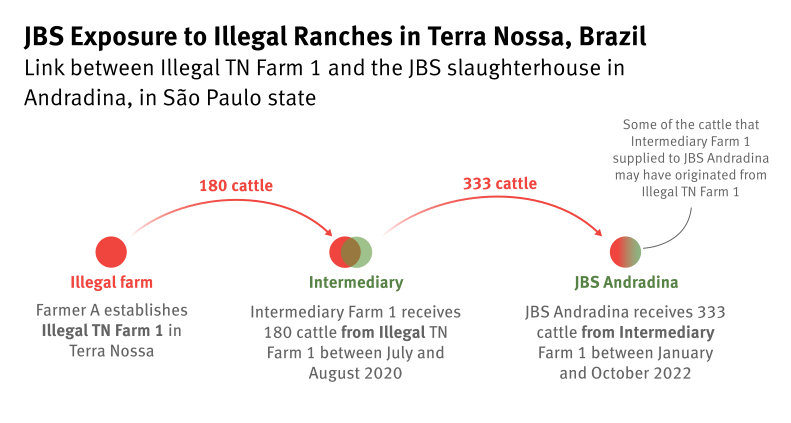
A 2018 INCRA report identified Farmer A as illegally occupying nearly 400 hectares in Terra Nossa, a ranch that we will call “Illegal TN Farm 1.”[108] Adepará documents also show that Farmer A grazed cattle at Illegal TN Farm 1, located in Terra Nossa.[109] The Adepará database provided the geographic coordinates of Illegal TN Farm 1, placing it inside the PDS Terra Nossa.[110] Human Rights Watch also found a CAR registry of Illegal TN Farm 1 in the name of Farmer A and in the same location.[111]
Farmer A moved 180 cattle from Illegal TN Farm 1 between July and August 2020 to “Intermediary Farm 1,” in São Paulo state, owned by Farmer B. In turn, Farmer B moved 333 cattle from Intermediary Farm 1 to the JBS slaughterhouse in Andradina, also in São Paulo state, between January and October 2022.[112] Considering the cattle’s sex and age ranges in the animal health control documents for the two transfers, and the dates on which these documents were issued, it is possible that some of the cattle supplied by Intermediary Farm 1 to JBS Andradina originated from Illegal TN Farm 1.
Illegal TN Farm 2 and JBS Colíder
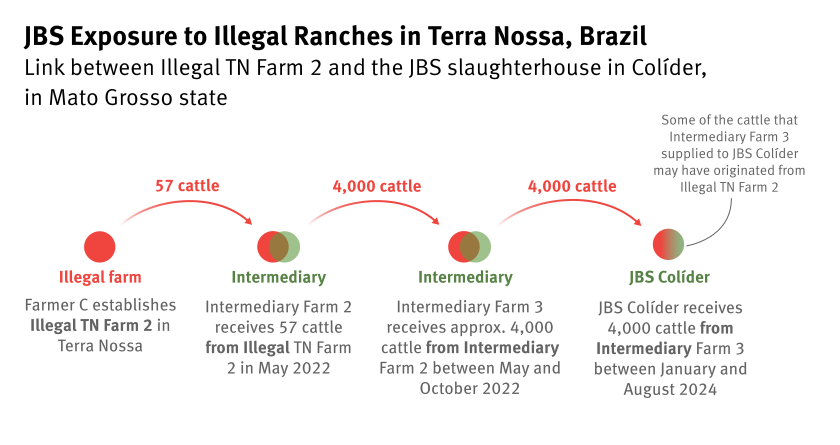
A 2018 INCRA report identified Farmer C as illegally occupying more than 1,000 hectares in the PDS Terra Nossa, a ranch that we will call “Illegal TN Farm 2.”[113] Adepará documents also show that Farmer C grazed cattle at Illegal TN Farm 2. The Adepará database provided the geographic coordinates of Illegal TN Farm 2, placing it inside PDS Terra Nossa.[114] Human Rights Watch also found two CAR registries of Illegal TN Farm 2 in the same location.[115]
In May 2022, Farmer C moved 57 cattle from Illegal TN Farm 2 to Intermediary Farm 2. The latter is registered in the name of Farmer D and is adjacent to the PDS Terra Nossa. Farmer D is also on 2018 INCRA’s list of illegal occupants inside the PDS Terra Nossa.[116] Subsequently, between May and October 2022, Farmer D moved approximately 4,000 cattle from Intermediary Farm 2 to Intermediary Farm 3, also in his name and located in the municipality of Sinop, Mato Grosso state.[117]
Lastly, between January and August 2024, Farmer D supplied 4,000 cattle from Intermediary Farm 3 to the JBS slaughterhouse in Colíder, also in Mato Grosso state. [118] Considering the cattle’s sex and age ranges in the animal health control documents for the three movements, and the dates on which these documents were issued, it is possible that some of the cattle supplied by Intermediary Farm 3 to JBS Colíder originated from Illegal TN Farm 2.
Cachoeira Seca Indigenous Territory
We, the Arara people, don’t feel safe at home because of the invaders that are destroying our forest, putting cattle in our territory. (…) The forest is our home, from which we take our painting, handicraft, food.
— Tyapompo Arara, Iriri village female chief [119]
The Indigenous territory Cachoeira Seca extends over more than 733,000 hectares and is the Arara people’s ancestral land.[120] More than 200 Arara live on the territory.[121] It was formally recognized by the Brazilian government through presidential decree in April 2016.[122] When it announced the demarcation of Cachoeira Seca, the Brazilian government stated its intention that demarcation would “combat the process of predatory deforestation” in the territory.[123]
The Arara people practice subsistence farming, gather forest products and fish in the Iriri river that flows through their territory. Arara hunters catch tortoises, macaques, tapirs, and wild pigs as an important component of their diet, and to mark festivities.[124] To generate cash income, community members also collect nuts and seeds of valuable trees to sell in markets.[125] The Arara were first officially contacted in 1987, having previously lived in isolation from mainstream Brazilian society.
“We take our food from nature, we collect Brazil nuts, cumaru, mogno seeds,” said Yoru Arara, the Awi village chief. “That’s why it’s important for us not to deforest, otherwise where will we live? These are our customs.”[126]
In addition to the Arara, Xipaya Indigenous people live in three villages within Cachoeira Seca Indigenous territory and have also felt the negative impact of illegal loggers and ranchers.[127] This is not uncommon in Brazil, where many demarcated Indigenous territories are home to several peoples, including uncontacted peoples living in voluntary isolation.
Forced Evictions and Loss of Livelihoods
Within the Cachoeira Seca territory, the Arara people are outnumbered by cattle ranchers who cut down the forest of their traditional lands and establish pasture to illegally graze cattle in violation of the area’s protected status.
In 2016, the Ministry of Justice and Public Security committed to the removal of non-Indigenous occupants.[128] Since 2016, however, removals have not been carried out and, in fact, landgrabbers have established more illegal cattle ranches in Cachoeira Seca. (Separately from these illegal occupants, INCRA previously created a settlement of smallholders inside the territory that it must now relocate; as of this writing, however, INCRA had not relocated the affected community.)
The demarcation of Cachoeira Seca should have been followed by the removal or relocation of non-Indigenous occupants from their territory, in line with Brazilian law, inaugurating a chapter when the Arara could enjoy their rights to live on and off their land, in accordance with their culture.[129] Instead, the Arara have had to organize to defend their territory from the deforestation and illegal cattle ranching that ravages their rainforest.
The Arara created an association, KOWIT, to coordinate efforts from the community and allies to advocate for their rights.[130] Arara women are organized, and every village has a female chief in addition to a male chief.[131]
Outnumbered by cattle ranchers, the Arara have deliberately established villages to cover as much of their territory as possible. The Pyrewa male village chief Toto Arara told Human Rights Watch:
We did not have the logistics to monitor our territory… So, we sat down and decided [to create new villages] to occupy our territory where there are more invaders. That’s when we came here. We decided to divide the community to occupy [more space]. Show them the land has owners.[132]
The Iriri female village chief Powdem Arara also said:
We established new villages to defend our land, because there were a lot of loggers felling our forest. We didn’t want them deforesting.[133]
Environmental authorities have made sporadic efforts to combat encroachment on Cachoeira Seca. For example, in May 2022, law enforcement seized 1,000 cattle that were being illegally raised in the territory and issued fines for a total of BRL $2 million (about US$350,000) for the illegal occupation and deforestation of 500 hectares.[134] In July 2023, law enforcement conducted another operation to crack down on an illegal logging site.[135] However, the lack of permanent presence of IBAMA or FUNAI along the borders of the Indigenous Territory has allowed ranchers to continue multiplying and expanding their illegal activities.[136]
The government’s failure to expedite the removal of illegal cattle ranches and prevent further illegal operations on the territory has resulted in devastating harm. In 2024, Cachoeira Seca lost 1,400 hectares of forest, the largest deforested area in an Indigenous territory in the Brazilian Amazon that year.[137] This represented a 56 percent increase over the area deforested in 2023, reflecting a concerning acceleration of the territory’s illegal destruction.[138] Similarly, the fires recorded in the territory between 2017 and 2020 were nearly triple the number between 2010 and 2016.[139] The fires primarily take place at the edges of the highway that runs north of the territory, evidencing efforts to encroach into the territory.[140]
Similar to the situation in the PDS Terra Nossa, most of the deforestation in Cachoeira Seca is intended to create pasture for cattle ranching, Arara community members told Human Rights Watch. “They clear and burn the forest, in the summer they burn a lot to [make pasture for] cattle, it shouldn’t happen inside an Indigenous area,” said Tjotjogulo Arara.[141] Pasture areas covered more than 58,400 hectares in the Cachoeira Seca Indigenous territory in 2023, according to Mapbiomas, which represents an increase of 13 percent in pasture within the Indigenous territory in comparison to 2020.[142]
During a trip to Cachoeira Seca in February 2025, Human Rights Watch researchers observed cattle ranching throughout the territory. Researchers drove on a road that cuts across the territory and links the Iriri river to its northern border, with multiple cattle ranches along the road. While navigating on the Iriri river, researchers also saw many cattle grazing riverside.
In interviews with Human Rights Watch, Arara community members explained that the removal of landgrabbers and their illegal ranches was an urgent priority for their territory. “Our land has been demarcated, we want intruders to be removed,” Powdem Arara, female chief of Iriri village, told Human Rights Watch. “Our concern is the land, our territory. We urgently want intruders removed from Cachoeira Seca,” said Wai Arara.[143]
Due to the encroachment by landgrabbers and successive governments’ persistent failure to remove them or effectively curtail their illegal activities for nearly 10 years after the demarcation of Cachoeira Seca, the Arara people have been cut off, arbitrarily and without consultation or consent, from large parts of their territory. This amounts to forced eviction, given that community members are effectively prevented from living on or using land that has been clearly demarcated as theirs.[144] Furthermore, as a result of the largescale deforestation and illegal occupation of their territory, Arara community members face increased challenges to secure traditional foods as game stocks dwindle.
“We go hunting, and we hardly kill anything. [Game] has drastically diminished,” the Awi village chief told Human Rights Watch.[145]
“The açaí palms were felled and the area was turned into pasture… as a result of the cattle ranches,” another resident told Human Rights Watch.”[146]
Paynaré Xipaya, a Xipaya village chief, said that until around 2008 members of his community managed hundreds of Brazil nut trees in the forest within Cachoeira Seca.[147] In February, they collected the nuts, which brought them up to BRL 30,000 (about US$ 18,000 at the exchange rate at that time), their largest source of income. In February 2025, he showed Human Rights Watch researchers the areas where the Brazil nut trees once stood. They had all been turned into pasture. (Brazil nut trees are an endangered species and cutting them is prohibited everywhere in the country.)[148]
Another consequence of living side by side with intruders is a pervasive sense of fear and insecurity among community members. “We go out hunting together, feeling afraid,” Wai Arara told Human Rights Watch. “It’s dangerous, we cannot go far.”[149]
Arara women also said that while they used to keep orchards far from their villages, they now farm close to home for fear of meeting intruders.[150]
“It’s not good to live like this, trapped and with fear,” Yoru Arara, the Awi male village chief told Human Rights Watch.[151]
Violations of the Right to Culture
“When we have a celebration, we spend five days in the forest hunting to bring [food] to the main village for the celebration. It is our culture. Now we don’t do [that] anymore. We no longer have the freedom to hunt in peace,” said Toto Arara, the chief of Pyrewa village.[152] Other community members echoed his frustration with the effects of land grabbing on their culture.[153]
The restrictions on the Arara’s freedom to move through the rainforest are also obstructing the transmission of traditional knowledge to new generations. A FUNAI expert who has worked with the Arara told Human Rights Watch:
Places that were used to hunt are not anymore. This has repercussions not only for the nutrition of the Arara people, but something more consequential which is cultural survival, because it’s through the hunt that Arara people pass on knowledge from the elders to the youth. It’s not only the act of hunting in search of food, but the act of teaching youth to get to know the animals, know their environment, know the rainy season, the dry season, the fruits that grow in their territory. And it’s through this knowledge that they care for the environment and know which animals to hunt.[154]
The Xipaya Indigenous communities are facing similar challenges to transmit their traditional knowledge of the forest to new generations. Leo Xipaya said that groups of up to 10 people of all ages used to spend several days in hunting and gathering trips.[155] “The old people would come with us and explain about the rivers and the forest. Now the children don´t have that experience,” he said.
JBS Exposure to Illegal Ranches in Cachoeira Seca
Human Rights Watch documented three cases in which some of JBS’s direct suppliers had previously procured cattle illegally raised in the Cachoeira Seca Indigenous Territory. In all three cases, the direct suppliers then sold cattle to the JBS slaughterhouse located in the municipality of Marabá, Pará state.
Illegal CS Farm 1 and JBS Marabá
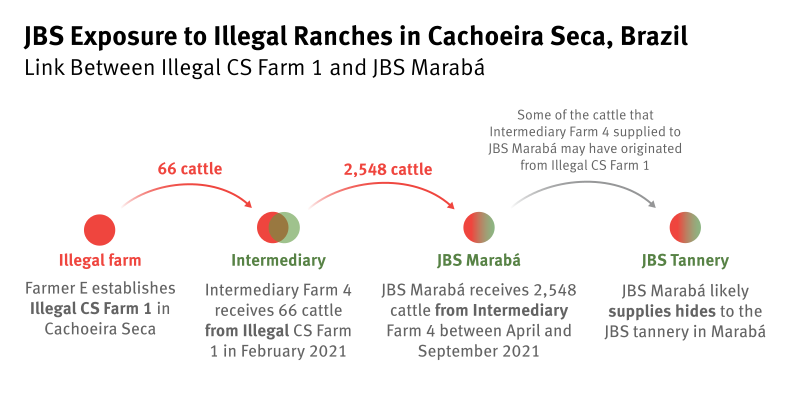
Farmer E grazed cattle at a ranch we will call “Illegal CS Farm 1” located in Cachoeira Seca. The Adepará database obtained by Human Rights Watch provided geographic coordinates of the cattle ranch that place it inside Cachoeira Seca.[156] Human Rights Watch found a CAR registry of Illegal CS Farm 1 in the name of Farmer E, located in the same area.[157]
In February 2021, Farmer E moved 66 cattle from Illegal CS Farm 1 to Intermediary Farm 4, which is owned by Farmer F outside of Cachoeira Seca, in Pará state. In turn, Farmer F supplied 2,548 cattle to the JBS slaughterhouse in Marabá (JBS Marabá) between April and September 2021.[158] Considering the cattle’s sex and age ranges in the animal health control documents for the two transfers, and the dates on which these documents were issued, it is possible that some or all of the cattle supplied by Intermediary Farm 4 to JBS Marabá originated from Illegal CS Farm 1.
Illegal CS Farm 2 and JBS Marabá
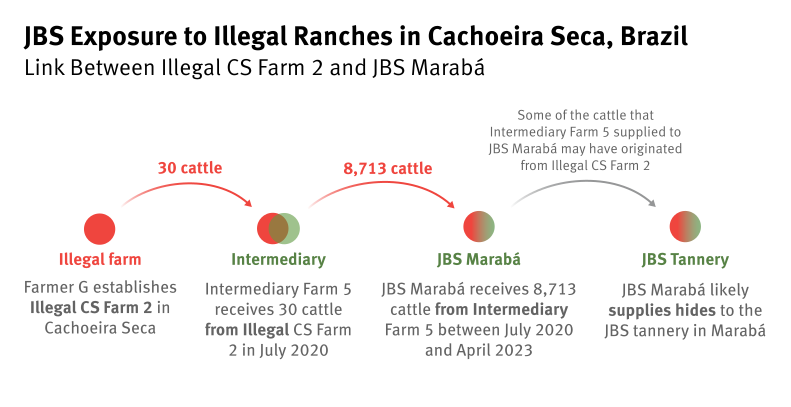
Farmer G grazed cattle at a ranch we will call “Illegal CS Farm 2” located in Cachoeira Seca.[159] The Adepará database Human Rights Watch obtained provided geographic coordinates for the cattle ranch that place it in Cachoeira Seca.[160] The CAR registry of Illegal CS Farm 2 under the name of Farmer G matches the location in the Adepará database.[161]
In July 2020, Farmer G moved 30 cattle from Illegal CS Farm 2 to Farmer H at Intermediary Farm 5, a cattle ranch outside Cachoeira Seca, in Pará state. Subsequently, Farmer H supplied 8,713 cattle from Intermediary Farm 5 to the JBS slaughterhouse in Marabá between July 2020 and April 2023.[162]
Considering the cattle’s sex and age ranges in the animal health control documents and the dates these documents were issued, it is possible that some or all of the cattle sent from Intermediary Farm 5 to JBS Marabá is the cattle that originated from Illegal CS Farm 2.
Illegal CS Farm 3 and JBS Marabá
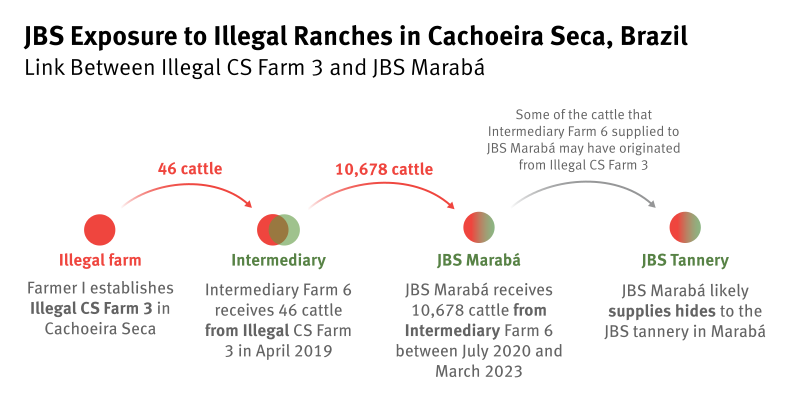
Farmer I grazed cattle at a ranch we will call “Illegal CS Farm 3,” located in Cachoeira Seca.[163] Human Rights Watch confirmed the location of Illegal CS Farm 3 based on official documents. The Adepará database provided geographic coordinates for the cattle ranch that place it in Cachoeira Seca.[164] The CAR registry of Illegal CS Farm 3 under the name of Farmer I, matches the location in the Adepará database.[165]
In April 2019, Farmer I moved 46 cattle from Illegal CS Farm 3 to Farmer J at Intermediary Farm 6, a farm located outside Cachoeira Seca, in Pará state. In turn, Intermediary Farm 6 supplied a total of 10,678 cattle to the JBS slaughterhouse in Marabá on several occasions between July 2020 and March 2023.[166]
Considering the cattle’s sex and age ranges in the animal health control documents and the dates these documents were issued, it is possible that some of the cattle sent from Intermediary Farm 6 to JBS Marabá is the cattle that originated from Illegal CS Farm 3.
JBS Monitoring of Suppliers
In 2009, JBS entered the so-called G4 Cattle Agreement with nongovernmental organization Greenpeace, pledging to identify all its indirect suppliers by 2011.[167] JBS failed to meet that deadline, and Greenpeace has continued to monitor the company’s (non)compliance with the agreement.[168]
JBS adopted several iterations of a Responsible Procurement Policy for raw materials that applies to its cattle acquisition operations.[169] According to the current version of this policy, adopted in 2022, JBS commits not to purchase cattle from ranches that:
are involved with deforestation in the Amazon or the Cerrado biomes;
are involved in invasions of Indigenous territories, Quilombola territories, or environmental conservation areas (“unidades de conservação ambiental”);
are “embargoed,” meaning that authorities have banned them from selling cattle following environmental infractions; [170] and
where workers are subject to slavery-like conditions.[171]
JBS monitors the farms of its direct suppliers to oversee compliance with its procurement policy. JBS states that their monitoring system currently evaluates 85,000 direct suppliers daily across Brazil. However, it does not monitor indirect suppliers.[172]
Nonetheless, the procurement policy states that JBS launched a Livestock Transparency Platform that enables its direct suppliers to declare their suppliers (with the latter being JBS’ indirect suppliers). As of 2026, the policy states, JBS will no longer buy from ranches that do not declare their suppliers on this platform.[173]
The company specifically states on its website that, as of January 1, 2026, “it will be mandatory for direct suppliers to join the JBS Livestock Transparency Platform and provide information on their indirect suppliers to enable application of JBS socioenvironmental criteria throughout the cattle supply chain.”[174]
JBS’ new mandatory system will essentially rely on direct suppliers to provide information about indirect suppliers. Direct suppliers have a vested interest in not declaring truthful information if they buy from illegal ranches in protected areas, as some do and as described in the cases documented in this report.
In response to a letter from Human Rights Watch, JBS restated the January 2026 deadline for its direct suppliers to begin naming their indirect suppliers and further specified that “one of the [JBS Livestock Transparency] platform’s main features is the Cattle Origin Declaration (DOG), a document issued by the direct supplier to ensure traceability of the production chain, especially regarding social, environmental, and regulatory compliance.”[175]
“To issue the DOG,” JBS also wrote, “the supplier must provide information on all farms from which the animals in the batch being sold originate,” but did not specify whether this required the supplier to declare all establishments that the animals had passed through since birth or only the last one they were at before being acquired by the direct supplier.[176]
“Validation of the production chain requires proof of animal movement between properties via valid GTAs (Animal Transit documents), establishing the link between them,” JBS stated.[177] Given that the DOG is issued by the supplier itself, it is unclear who conducts the validation of such documents and what the process for validation will be.
According to JBS, “The issuance of the DOG is only permitted after signing the agreement and meeting the social and environmental criteria defined by the current protocol.” JBS did not specify, however, which criteria these were or whether they are the same as those in its raw materials procurement policy.[178]
Additionally, JBS stated that “all livestock suppliers in the Amazon who sell to JBS must adhere to the Beef on Track Protocol, developed by the non-governmental organization Imaflora and the Brazilian Federal Prosecutor’s Office.”[179] JBS did not specify whether it would apply these requirements to its indirect suppliers. (The Beef on Track Protocol does not monitor indirect suppliers.)[180]
JBS did not reply to the follow up questions sent by Human Rights Watch on August 4, 2025, to clarify the ambiguities highlighted above.
In response to previous reporting about tainted cattle potentially or in fact entering JBS’ supply chain, JBS has reportedly stated that “the definitive solution to the environmental issue in Brazilian livestock lies in a mandatory national traceability program, capable of establishing a common set of socioenvironmental monitoring information for farms to expedite progress.”[181] While a structural traceability solution driven by the federal government is indeed a desirable solution, it does not exempt JBS from its responsibility to address risks in its own operations.
Separately, JBS has also pledged to end Amazon deforestation, both illegal and legal under Brazilian law, by its direct and indirect cattle suppliers by 2025.[182]
Despite the scope and fast approaching deadline of its latest pledges, in January 2025, the JBS global chief sustainability officer was quoted in a news story stating that the company had “zero operational, contractual or legal control of its supply chain.”[183]
JBS’ new commitments appear to have important ambiguities regarding their implementation and effectiveness. These would be best addressed by a binding federal requirement of traceability for Brazil’s cattle herd. In the meantime, JBS should monitor its indirect suppliers.
EU Trade with Exposed JBS Facilities
In 2020, JBS was the largest Brazil-based exporter of beef products to the EU, accounting for 41.9 percent of the volume exported.[184] JBS is also among the top five largest Brazilian exporters to the EU of two types of cow hides: tanned or crust hides and prepared hides.[185]
To determine which JBS slaughterhouses or tanneries are likely exporting cattle products to the EU, Human Rights Watch consulted MAPA’s list of Brazilian slaughterhouses authorized to export beef products to the EU, which identifies the name, address, municipality, and state of the facilities, as well as the categories of beef products each facility is authorized to export to the EU.[186] Additionally, we consulted a list of cattle ranches authorized to export beef products to the EU under Brazil’s System of Identification and Certification of Origin for Bovine Animals (SISBOV, see text box below).[187] Lastly, we consulted the EU’s list of establishments that are authorized to export beef products to the EU.[188]
Exports of cow hides to the EU are not restricted like meat.[189] As a result, there is not an EU list of establishments authorized to export these types of hides.
System of Identification and Certification of Origin for Bovine Animals (SISBOV)The EU has sanitary requirements for imports of “bovine fresh meat,” but these requirements do not apply to other beef products.[190] The Brazilian System of Identification and Certification of Origin for Bovine Animals (Sistema Brasileiro de Identificação Individual de Bovinos e Búfalos, SISBOV) is the official Brazilian system developed to meet EU requirements for the exports of fresh meat. According to MAPA, less than 1 percent of Brazil’s cattle herd was registered with SISBOV in 2023.[191] In response to a freedom of information request filed by Human Rights Watch, MAPA stated that it is not possible to know how many of the cattle that are registered with SISBOV have been registered since birth, because many are enrolled during other phases of their life.[192] Based on the information provided by MAPA, it appears SISBOV is not able to provide traceability to the point of origin for cattle, as required by the EUDR. |
JBS Andradina, São Paulo
Intermediary Farm 1 in Pará state procured cattle from an illegal ranch in the PDS Terra Nossa in 2020, before it supplied cattle to JBS Andradina in São Paulo state in 2022. Intermediary Farm 1 is not a SISBOV-certified farm.
The JBS slaughterhouse in Andradina is authorized to export different meat products to the EU, but only three of these products require SISBOV certification.[193] Thus, JBS Andradina could have exported to the EU beef products that did not require SISBOV certification and that were made from tainted cattle supplied by Intermediary Farm 1.
While Brazil’s government does not produce export data per exporter, only per municipality, according to data from MAPA, the JBS slaughterhouse is the only facility in the municipality of Andradina authorized to export meat to the EU.[194] Brazilian official trade statistics show that the municipality of Andradina exported hundreds of millions of dollars’ worth of beef products to the EU between January 2020 and July 2025.
Beef* exports from Andradina Municipality, São Paulo state, to the EU (US$ FOB**) | ||||||
Country | 2020 | 2021 | 2022 | 2023 | 2024 | 2025 (Jan-July) |
Italy | 4,612,297 | 11,454,968 | 8,246,737 | 7,128,873 | 6,200,255 | 7,411,107 |
Netherlands | 8,920,737 | 11,815,116 | 7,039,869 | 10,548,066 | 9,067,189 | 8,259,213 |
Spain | 114,424 | 670,239 | 1,737,300 | 16,833 | 117,007 | 1,308,686 |
Germany | 820,695 | 1,097,096 | 4,649,463 | 518,747 | 315,446 | 218,370 |
Sweden | 490,534 | 69,471 | 0 | 466,612 | 0 | 248,528 |
Belgium | 0 | 737,952 | 424,023 | 958,203 | 0 | 0 |
Slovakia | 0 | 0 | 0 | 0 | 0 | 0 |
Denmark | 0 | 599,850 | 748,490 | 500,669 | 0 | 0 |
France | 0 | 0 | 0 | 88,234 | 0 | 0 |
Ireland | 0 | 0 | 125,387 | 0 | 0 | 0 |
Total | 14,958,687 | 26,444,692 | 22,971,269 | 20,226,237 | 15,699,897 | 17,445,904 |
Source: Ministry of Development, Industry, Trade and Services (Ministério de Desenvolvimento, Indústria, Comércio e Serviços), Comex Stat, Brazil's exports data by municipality, https://comexstat.mdic.gov.br/pt/municipio (accessed August 7, 2025). *Human Rights Watch mined information specifically for HS codes 0201 (meat of cattle, fresh or chilled), 0202 (meat of cattle, frozen), and 0206 (edible offal of cattle, fresh or chilled). ** Free on Board (FOB) value refers to the value of the goods at the exporter’s customs frontier. | ||||||
According to the same source, there were no leather exports from Andradina to the EU between January 2020 and July 2025.
JBS Colíder, Mato Grosso
Intermediary Farm 3 located in Mato Grosso procured cattle from Intermediary Farm 2 located in Pará between 2022 and 2023, which procured cattle from an illegal ranch in Terra Nossa in Pará in 2022. Intermediary Farm 3 supplied cattle to the JBS slaughterhouse in Colíder in 2024. Intermediary Farm 3 is not a SISBOV-certified farm.
JBS Colíder is authorized to export different meat products to the EU, of which only one product requires SISBOV certification.[195] Thus, JBS Colíder could have exported to the EU beef products that did not require SISBOV certification and that were made from tainted cattle supplied by Intermediary Farm 3.
According to data from MAPA, the JBS slaughterhouse is the only facility in the municipality of Colíder authorized to export to the EU.[196] Brazilian official trade statistics show that the municipality of Colíder exported more than 2.5 million dollars’ worth of meat products between 2023 and 2025.
Beef* exports from Colíder Municipality, Mato Grosso state, to the EU (US$ FOB**) | ||||||
Country | 2020 | 2021 | 2022 | 2023 | 2024 | 2025 (Jan-July) |
Netherlands | 0 | 0 | 0 | 123,777 | 439,319 | 513,863 |
Germany | 0 | 0 | 0 | 131,887 | 647,837 | 314,881 |
Spain | 0 | 0 | 0 | 0 | 497,142 | 0 |
Total | 0 | 0 | 0 | 255,664 | 1,584,298 | 828,744 |
Source: Ministry of Development, Industry, Trade and Services (Ministério de Desenvolvimento, Indústria, Comércio e Serviços), Comex Stat, Brazil's exports data by municipality, https://comexstat.mdic.gov.br/pt/municipio (accessed August 7, 2025). *Human Rights Watch mined information specifically for HS codes 0201 (meat of cattle, fresh or chilled), 0202 (meat of cattle, frozen), and 0206 (edible offal of cattle, fresh or chilled). **Freen on Board (FOB) value refers to the value of the goods at the exporter’s customs frontier. | ||||||
Additionally, JBS also has a tannery in the municipality of Colíder, which is located only 12 kilometers away from the company’s slaughterhouse. The JBS tannery is the only tannery in the municipality of Colíder, according to an investigation into Brazilian leather supply chains by Rainforest Foundation Norway (RFN).[197]
According to JBS, more than 90 percent of the hides it processes come from its own slaughterhouses.[198] Based on the above, it is very likely that the JBS Colíder slaughterhouse is supplying hides to the JBS tannery in the same municipality.
According to Brazilian official trade statistics, the municipality of Colíder exported millions of dollars’ worth of leather to Italy between 2020 and 2024.
Leather exports from Colíder municipality, Mato Grosso state, to Italy* | ||||||
2020 | 2021 | 2022 | 2023 | 2024 | 2025 (Jan-July) | |
Tons | 1,757 | 1,029 | 1,081 | 497 | 1,384 | 635 |
US$ FOB** value | 1,818,873 | 1,256,514 | 1,754,331 | 604,844 | 1,617,856 | 1,619,538 |
Source: Ministry of Development, Industry, Trade and Services (Ministério de Desenvolvimento, Indústria, Comércio e Serviços), Comex Stat, Brazil's exports data by municipality, https://comexstat.mdic.gov.br/pt/municipio (accessed August 7, 2025). Human Rights Watch mined information specifically for HS4 codes 4101 (raw hides and skins of cattle, whether or not dehaired or split), 4104 (tanned or crust hides and skins of cattle, without hair on, whether or not split, but not further prepared), and 4107 (leather of cattle, further prepared after tanning or crusting, without hair on, whether or not split, other than leather of heading 4114). *Italy was the only EU country receiving leather exports from this municipality for the years consulted. ** Free on Board (FOB) value refers to the value of the goods at the exporter’s customs frontier. | ||||||
JBS Marabá, Pará
Intermediary Farm 4 in Pará state procured cattle from an illegal ranch in Cachoeira Seca in February 2021, before it supplied cattle to JBS Marabá between April and September 2021. Additionally, Intermediary Farm 5 procured cattle from an illegal ranch in Cachoeira Seca in July 2020, before it supplied JBS Marabá between July 2020 and April 2023. Lastly, Intermediary Farm 6 procured cattle from an illegal farm in Cachoeira Seca in April 2019, before repeatedly supplying JBS Marabá between July 2020 and March 2023.
The JBS slaughterhouse in Marabá is not authorized to export beef products to the EU. However, it is very likely that the JBS tannery in Marabá has exported hides to the EU. The JBS tannery is located less than one kilometer away from the JBS slaughterhouse. More than 90 percent of the hides JBS processes come from its own slaughterhouses, suggesting it is very likely that the JBS slaughterhouse is supplying hides to the JBS tannery in Marabá.[199]
According to Brazilian official trade statistics, the municipality of Marabá exported several tons of leather to Italy in 2020 and in 2025. The JBS tannery appears to be the only tannery in the municipality of Marabá.[200] As the only tannery in Marabá, it is likely that all leather exports going to the EU from this municipality are from the JBS tannery. While the cases that Human Rights Watch documented in Cachoeira Seca span several years during which Marabá did not export leather goods to the EU, Human Rights Watch has not excluded these cases from consideration because cow hides may be placed in storage.
Leather exports from the municipality of Marabá, state of Pará, to Italy* | ||||||
2020 | 2021 | 2022 | 2023 | 2024 | 2025 (Jan-July | |
Tons | 452 | 0 | 0 | 0 | 0 | 25 |
US$ FOB** value | 259,484 | n/a | n/a | n/a | n/a | 28,913 |
Source: Ministry of Development, Industry, Trade and Services (Ministério de Desenvolvimento, Indústria, Comércio e Serviços), Comex Stat, Brazil's exports data by municipality, https://comexstat.mdic.gov.br/pt/municipio (accessed August7, 2025). Human Rights Watch mined information specifically for HS4 codes 4101 (raw hides and skins of cattle, whether or not dehaired or split), 4104 (tanned or crust hides and skins of cattle, without hair on, whether or not split, but not further prepared), and 4107 (leather of cattle, further prepared after tanning or crusting, without hair on, whether or not split, other than leather of heading 4114). *Italy was the only EU country receiving leather exports from this municipality for the years consulted. ** Free on Board (FOB) value refers to the value of the goods at the exporter’s customs frontier. | ||||||
III. Policy and Judicial Responses
Brazil’s federal government and the Pará state government have recently announced important new policies to address illegality, deforestation, and land conflicts.
However, the federal and state responses are moving at different speeds, which will critically undermine overall effectiveness. While Pará plans to individually track all its cattle herd by December 2026, the federal government only plans to institute the same requirement by December 2032, six years later.
Yet, as documented by this report, there is a tangible risk that illegal cattle grazed in the PDS Terra Nossa may have moved to JBS facilities beyond Pará, reaching as far as Mato Grosso and São Paulo. The cross-border inter-state dynamics of cattle laundering in Brazil pose a challenge that cannot be addressed without a nationwide response matching Pará’s efforts.
As long as Brazil’s cattle herd is not traceable, and the federal response lags, many of Brazil’s cattle products will struggle to demonstrate compatibility with EUDR requirements. This new market reality should encourage individual states to step up and speed up implementation, as Pará has already decided to do, and encourage the federal government to incentivize this speedy implementation.
Pará State Government
On November 27, 2023, Pará Governor Helder Barbalho signed into law Decree no. 3533, establishing Pará’s Official Individual Traceability System of Bovines (SRBIPA).[201]
The decree orders that by December 2026, Pará’s entire cattle herd shall be individually traceable.[202] If implemented by this time, Pará will be only the second state in all of Brazil to have individual traceability for cattle.[203] Pará’s government also announced plans to analyze the validity of 75 percent of the state’s CAR entries by December 2025 and 100 percent by December 2026.[204]
Human Rights Watch researchers met with the Adepará staff in Belém in charge of overseeing the implementation of SRBIPA.[205] They described the program as a “priority” for the state government and for Adepará.[206] Further, they stressed the program aimed to reduce the pasture area used per animal.[207] (The decree itself states the program seeks to develop “cattle rearing of high productivity, with economic and socio-environmental integrity.”[208])

In practice, the implementation of SRBIPA will require that each animal has tags with a unique number affixed to its ear.[209] One of the tags is electronic, and is loaded with the date of birth, the sex and age of the animal, the name of the rancher, and the registration number of the ranch.[210]
Crucially, Decree No. 3533 requires the movement of cattle to be subjected to legality and environmental criteria. As of November 11, 2024, Adepará has to request authorization from Pará’s State Environment Secretariat (SEMAS) to issue animal transit permits (GTAs) authorizing the movement of cattle.[211] Furthermore, according to the officials, since 2023, Adepará no longer issues GTAs for rural properties registered inside protected areas.[212]
Previously, Adepará narrowly interpreted its mandate, concerned only with animal health, and did not observe environmental legality criteria when authorizing cattle movements.[213]
The Adepará staff told Human Rights Watch that the changes ushered in by SRBIPA were, among others, intended to make Pará’s exports more competitive in the EU and Japan.[214] The state is also anticipating higher traceability requirements they expect China to soon impose.[215]
Brazilian Federal Government
In December 2024, MAPA announced the establishment of a federal traceability system for individual cattle and buffaloes.[216] The system would be established through the implementation of the National Plan for the Individual Identification of Bovines and Buffaloes (PNIB), and it would require ear tags being attached to each animal at the latest before their first movement, carrying information about their place and date of birth, among others.[217]
The implementation of the PNIB is slated to run for eight years, and it would be not until December 2032 that tagging becomes mandatory before any animal can be moved and ranchers can be held accountable for non-compliance.[218]
MAPA told the BBC news outlet that the new system “has strictly sanitary objectives [to oversee the health of the animal]” and that the plan does not contemplate “the environmental question.”[219] Federal environmental authorities were not consulted for the elaboration of the plan, they told Human Rights Watch.[220]
In addition to undermining the speedier action of Pará state, the slow implementation of the PNIB works against the Action Plan for Prevention and Control of Deforestation in the Amazon (PPCDAm), the pillar of Brazil’s federal policy for the Amazon.[221] Indeed, as presently designed, the PNIB would not prevent state-level animal health agencies across Brazil from continuing to authorizing the illegal movement of cattle into protected forests until at least 2032, contributing to deforestation that could be avoided if such illegal movements were not authorized in the first place.
Court Decisions
In January 2025, the Supreme Court ordered the National Council on the Environment (Conselho Nacional do Meio Ambiente, CONAMA) to prepare a regulation requiring federal, state, and municipal authorities to disclose animal transit permits (GTAs) to environmental agencies and the federal prosecutor’s office. The Supreme Court also ordered that the federal government submit a plan to make GTA data accessible to the environmental agencies in the states that make up the Brazilian Amazon and that have the highest deforestation rates.[222]
Pursuant to the decision, the federal government informed the Supreme Court in May 2025 that a new platform and database are under development as part of the implementation of the PNIB. From 2026, MAPA will allow the sharing of GTA data with environmental agencies through this new platform. The federal government also noted that the full implementation of the PNIB depends on CONAMA’s regulation obliging states to make GTA data accessible to environmental agencies and the federal prosecutor’s office, as well as the forwarding of the data to MAPA in a regular and standardized way.[223]
Prosecutorial Initiatives
In 2009, the Federal Prosecutor's Office of the state of Pará (MPF-PA) filed lawsuits against companies that purchased cattle from areas with illegal deforestation.
Subsequently, three companies, including JBS, signed agreements with the MPF-PA, called Terms of Adjustment of Conduct (Termo de Ajustamento de Conduta, TACs). They committed not to buy cattle from ranches with environmental and social irregularities.[224] TACs were subsequently implemented in four other Amazon states.[225] The agreements only cover direct suppliers.
The MPF-PA published the first audit of compliance with the TAC agreements in 2018 and then again in 2019, 2021, 2022, and 2023.[226] . In the 2023 audit which analyzed cattle purchases between July 2020 and December 2021, JBS was ranked tenth out of 12 companies, with 6.2 percent of the cattle audited found to be non-compliant with the TAC criteria.[227]
The absence of individual traceability mechanisms in Brazil has been a major loophole through which tainted cattle products have been sold in the domestic market and exported to foreign markets, including the EU. However, with the new requirements of the EUDR, this loophole is closing in the EU, encouraging a matching response in Brazil to clean up its own supply chains and enforce its own environmental regulations in that process. The policies are now in place: states can and should implement them as soon as possible and, in any case, before 2032, and the federal government can and should encourage them to do so. Beyond the EUDR, such actions would be aligned with Brazil’s own policies to tackle illegal deforestation in the Amazon and its obligation to protect human rights and mitigate climate change.
IV. Legal Standards
Brazil’s Duty to Protect Human Rights and Environmental Defenders
As a state party to the International Covenant on Civil and Political Rights (ICCPR), under articles 6 (1) and 9 (1), and the American Convention on Human Rights, under articles 5 and 7, Brazil is obliged to protect the rights to life, physical, mental and moral integrity, and liberty and security of person, including of human rights and environmental defenders.[228] This obligation is further emphasized in articles 2, 9, and 12 of the UN Declaration on Human Rights Defenders (the ‘Declaration’). Article 12 (2) of the Declaration sets out the government’s obligation to “take all necessary measures to ensure the protection...against any violence, threats, retaliation... pressure or any other arbitrary action as a consequence of his or her legitimate exercise of the rights referred to in the ... Declaration.”[229]
While states’ obligations apply to all within its jurisdiction, the Inter-American Court on Human Rights has recognized that the significance of protecting human rights defenders gives rise to increased duties, particularly taking into account the heightened vulnerability of human rights defenders as a result of their work.[230]
As a party to the American Convention on Human Rights, Brazil's efforts against impunity should be guided by the jurisprudence of the Inter-American Court on Human Rights. In Kawas Fernández v. Honduras, a case concerning violence against environmental human rights defenders, the court determined that:
States have the duty to provide the necessary means for human rights defenders to conduct their activities freely; to protect them when they are subject to threats in order to ward off any attempt on their life or safety; to refrain from placing restrictions that would hinder the performance of their work, and to conduct serious and effective investigations of any violations against them, thus preventing impunity.[231]
In March 2018, 24 Latin American and Caribbean states adopted the Regional Agreement on Access to Information, Public Participation, and Access to Justice in Environmental Matters of Latin American and Caribbean Countries, also known as the Escazú Convention.[232] It sets out standards of protection for environmental human rights defenders, including requiring from States measures to prevent, investigate, and sanction attacks or threats against environmental human rights defenders.[233] Brazil signed the agreement on September 27, 2018, and ratification by its Congress was pending at the time of writing.[234]
Indigenous Peoples’ Rights over their Territories
Brazil’s constitution recognizes the rights of Indigenous peoples to “the lands they traditionally occupy.”[235] It defines those lands as “those on which they live on a permanent basis, those used for their productive activities, those indispensable to the preservation of the environmental resources necessary for their well-being and for their physical and cultural reproduction, according to their uses, customs and traditions.”[236]
In September 2023, Brazil’s Supreme Court upheld Indigenous peoples’ rights to their traditional lands by ruling against the so-called cutoff date, a legal argument that Indigenous peoples should not obtain title of their ancestral territories if communities were not physically present on them on October 5, 1988, the day Brazil’s current constitution was adopted.[237]
Despite this clear decision by the country’s highest court, Brazil’s Congress adopted a law that enshrined the cutoff date in December 2023, overruling most vetoes by the President on several of the articles that would be unconstitutional pursuant to the court’s decision.[238] The law is the subject of a special conciliation commission headed by a supreme court justice.[239] FUNAI has asked the STF to strike down the provisions of the law that would be unconstitutional as per its decision from September 2023.[240]
As party to the Indigenous and Tribal Peoples Convention of the International Labour Organization, also known as ILO Convention 169, Brazil should prevent “unauthorised intrusion upon, or use of, the lands” of Indigenous peoples.[241] Brazil should also safeguard “the right of these peoples to participate in the use, management and conservation” of the natural resources pertaining to their lands.[242]
As a party to the multiple treaties underwriting the Inter-American System of Human Rights, Brazil is also bound by the system’s jurisprudence. The Inter-American System of Human Rights has developed extensive protection of the rights of Indigenous peoples, including over their ancestral lands and territories, such as through landmark rulings of the Inter-American Court of Human Rights such as Awas Tingni v Nicaragua and Saramaka People v Suriname.[243]
These rights are grounded in Article 21 of the American Convention on Human Rights, which protects the right to property, interpreted in light of Indigenous cultural and spiritual relationships with land.[244] The Court has also held that the failure to secure these rights can violate multiple other rights, including the rights to life, culture, judicial protection, and equal treatment.
The Court has made clear that states must take measures to identify and protect Indigenous territories, including demarcation and legal titling. These protections are reinforced by the Inter-American Commission on Human Rights, which has set out the requirements for strong protection against displacement, environmental degradation, and exploitation of Indigenous land without proper consent and compensation.
The Inter-American Commission on Human Rights has also stated that Indigenous peoples have the right to “the recognition of [Indigenous peoples’] property and ownership rights with respect to lands, territories and resources they have historically occupied.”[245] Where property and user rights of Indigenous peoples arise from rights existing prior to the creation of a state, the Commission interprets international standards as requiring state recognition of the permanent and inalienable title of Indigenous peoples to the land: finding that such title may only be changed by “mutual consent between the state and respective Indigenous peoples when they have full knowledge and appreciation of the nature or attributes of such property.”[246]
Brazil has also endorsed international declarations and principles that should guide its public policy. The United Nations Declaration on the Rights of Indigenous Peoples (UNDRIP), which Brazil voted in favor of at the UN General Assembly, states that Indigenous peoples have a specific right to autonomy or self-government in their internal or local affairs, and that Indigenous peoples shall not be removed from their territories without their consent.[247]
The Rights of Peasants
The UN Declaration on the Rights of Peasants and Other People Working in Rural Areas, adopted at the UN General Assembly in 2018, calls upon states to uphold the right of peasants and other people working in rural areas to “have access to and to use in a sustainable manner the natural resources present in their communities that are required to enjoy adequate living conditions. … They also have the right to participate in the management of these resources.”[248]
Furthermore, the declaration calls upon states to “promote the participation, directly and/or through their representative organizations, of peasants and other people working in rural areas in decision-making processes that may affect their lives, land and livelihoods.”[249] It also states that:
Peasants and other people working in rural areas who have been arbitrarily or unlawfully deprived of their lands have the right, individually and/or collectively, in association with others or as a community, to return to their land of which they were arbitrarily or unlawfully deprived, […], and to have restored their access to the natural resources used in their activities and necessary for the enjoyment of adequate living conditions, whenever possible, or to receive just, fair and lawful compensation when their return is not possible.[250]
Prohibition against Forced Evictions
The right to an adequate standard of living is enshrined in article 11 of the International Covenant on Economic, Social and Cultural Rights (ICESCR), to which Brazil is party.[251] The ICESCR states explicitly that the right to an adequate standard of living includes the right to “adequate housing.” [252]
The UN Committee on Economic, Social and Cultural Rights (CESCR), which provides authoritative interpretations of the ICESCR, stated in its General Comment No. 4 that tenure “takes a variety of forms, including … occupation of land or property.”[253] The committee also called upon states to increase “access to land by landless or impoverished segments of the society” as “a central policy goal.”[254]
International human rights law prohibits forced evictions.[255] The CESCR has defined forced evictions as “the permanent or temporary removal against the will of individuals, families and/or communities from the homes and/or land which they occupy, without the provision of, and access to, appropriate forms of legal or other protection.”[256] (Emphasis added.) The UN special rapporteur on the right to adequate housing has characterized forced evictions as “gross violations of a range of internationally recognized human rights, including the human rights to adequate housing, food, water, health, education, work, security of the person, freedom from cruel, inhuman and degrading treatment, and freedom of movement.”[257]
Governments are prohibited from conducting forced evictions themselves and are obligated to ensure through law and regulation that private parties do not carry out forced evictions. These obligations apply regardless of whether residents have formal land title entitling them to the land they occupy. In the event a person or group of people are subject to forced eviction, they are entitled to compensation. The UN Office of the High Commissioner for Human Rights (OHCHR) and UN Human Settlements Programme (UN Habitat) in 2014 issued a fact sheet that stated:
Compensation should be provided for any economically assessable damage, as appropriate and proportional to the gravity of the violation and the circumstances of each case, such as: loss of life or limb; physical or mental harm; lost opportunities, including employment, education and social benefits; material damages and loss of earnings, including loss of earning potential; moral damage; and costs of legal or expert assistance, medicine and medical services, and psychological and social services.
Cash compensation should in principle not replace real compensation in the form of land and common property resources. Where land has been taken, the evicted should be compensated with land commensurate in quality, size and value, or better.[258]
The Right to a Healthy Environment
In August 2022, the UN General Assembly adopted a resolution declaring access to a clean, healthy, and sustainable environment a universal human right.[259] The resolution “affirms” that the promotion of this right “requires the full implementation of the multilateral environmental agreements under the principles of international environmental law.”[260]
Brazil’s constitution, which preceded the UN General Assembly’s resolution, recognizes that: “All have the right to an ecologically sound environment, which is an asset of common use and essential to a healthy life, and both the Government and the community shall have the duty to defend and preserve it for present and future generations.”[261]
In 2015, Brazil signed the Paris Agreement on Climate Change.[262] The agreement aims to strengthen the global response to climate change “including by holding the increase in the global average temperature to well below 2°C above pre-industrial levels and to pursue efforts to limit the temperature increase to 1.5 °C above pre-industrial levels.”[263]
Since 2018, however, governments have increasingly recognized the 1.5°C goal as an imperative, owing to the UN’s Intergovernmental Panel on Climate Change (IPCC) report that warned that crossing the 1.5°C threshold risks unleashing far more severe climate change impacts, including more frequent and severe droughts, heatwaves, and rainfall.[264]
At the 2021 climate summit, state parties to the Paris Agreement adopted the Glasgow Declaration recognizing that “impacts of climate change will be much lower at the temperature increase of 1.5°C compared with 2°C” and resolving to “pursue efforts to limit the temperature increase to 1.5°C.”[265]
Brazil championed the creation of “Road map to Mission 1.5,” adopted at the 28th global climate summit, aimed at strengthening international cooperation and stimulating the ambition of countries in their next commitments to be presented in 2025, when Brazil will host COP30 in Belém.[266]
Pursuant to their obligations in the Paris Agreement, each state party must communicate “nationally determined contributions” (NDCs) every five years to the UNFCCC Secretariat. Each successive NDC should represent a progression beyond the party’s then current NDC and reflect its highest possible ambition.[267]
In its NDCs from 2016, Brazil committed to eradicating illegal deforestation – as defined under Brazilian law – in the Amazon by 2030.[268] Brazil committed to reaching this goal “with full respect for human rights, in particular rights of vulnerable communities [and] Indigenous populations.”[269] Yet, to date, roughly 90 percent of deforestation in the Amazon is illegal.[270]
In its most recent NDC, submitted in November 2024, Brazil adopted an emissions reduction goal that constituted an improved target in relation to its 2016 NDC, but – crucially – did not make new commitments in relation to deforestation.[271] The bulk of Brazil’s greenhouse gas emissions, however, comes from land use, land use change, deforestation, agriculture, and livestock.[272] Additionally, President Luiz Inácio Lula da Silva repeatedly pledged to end deforestation and degradation in all biomes by 2030.[273]
Government Obligation to Regulate Businesses
Under the multiple human rights treaties that Brazil has signed, the state has a positive obligation to prevent and punish third party interference with the enjoyment of rights. This duty to protect includes preventing corporations from violating rights and taking steps to hold them accountable and provide reparation to victims when they do so.[274]
In its General Comment 31, the UN Human Rights Committee (HRC) states the duty to protect rights holders against violations by private persons or entities.[275] (The HRC provides authoritative interpretations of the ICCPR.) Failure to investigate violations by private actors or entities could amount to a “breach of the Covenant.”[276] Investigations should be carried out “promptly, thoroughly and effectively through independent and impartial bodies.”[277] Finally, should states fail “to take appropriate measures or to exercise due diligence to prevent, punish, investigate or redress the harm caused by such acts by private persons or entities,” it could also constitute a breach of their obligations.[278]
In its General Recommendation 23, the UN Committee on the Elimination of Racial Discrimination (CERD) notes that Indigenous peoples have lost resources to commercial companies and calls for recognition and protection of Indigenous people’s rights to “own, develop, control and use their communal lands, territories and resources.”[279] (The CERD provides authoritative interpretations of the International Convention on the Elimination of All Forms of Racial Discrimination, ICERD, to which Brazil is a state party.) Where deprivation of land or resources does occur, states should “take steps to return those lands and territories.”[280] The implication is that states should regulate and adjudicate the acts of commercial companies to prevent abuse of rights enjoyed by Indigenous peoples and to ensure effective remedies, including reparation, where necessary.
In its General Commentary 24, the CESCR notes:
The obligation to protect means that States parties must prevent effectively infringements of economic, social and cultural rights in the context of business activities. This requires that States parties adopt legislative, administrative, educational and other appropriate measures, to ensure effective protection against Covenant rights violations linked to business activities, and that they provide victims of such corporate abuses with access to effective remedies.
States parties should consider imposing criminal or administrative sanctions and penalties, as appropriate, where business activities result in abuses of Covenant rights or where a failure to act with due diligence to mitigate risks allows such infringements to occur; enable civil suits and other effective means of claiming reparations by victims of rights violations against corporate perpetrators, in particular by lowering the costs to victims and by allowing forms of collective redress[…]. States parties should regularly review the adequacy of laws and identify and address compliance and information gaps, as well as emerging problems.
The obligation to protect entails a positive duty to adopt a legal framework requiring business entities to exercise human rights due diligence in order to identify, prevent and mitigate the risks of violations of Covenant rights, to avoid such rights being abused, and to account for the negative impacts caused or contributed to by their decisions and operations and those of entities they control on the enjoyment of Covenant rights. States should adopt measures such as imposing due diligence requirements to prevent abuses of Covenant rights in a business entity’s supply chain and by subcontractors, suppliers, franchisees, or other business partners.[281]
Business Responsibility to Respect Human Rights
Business enterprises have human rights responsibilities under the 2011 UN Guiding Principles on Business and Human Rights (UN Guiding Principles) and the OECD MNE Guidelines on Multinational Enterprises.[282] While the UN Guiding Principles are non-binding, they provide important guidance and apply to private organizations involved in commercial activities.[283] The responsibility to respect human rights means that businesses should have “policies and processes appropriate to their size and circumstances” to:
- Avoid causing or contributing to adverse human rights impacts through their own activities (both actions and omissions) and address such impacts when they occur.[284]
- Prevent or mitigate adverse human rights impacts that are directly linked to their operations, products or services by their relationships, even if they have not contributed to those impacts.[285]
- “Enable the remediation of any adverse human rights impacts they cause or to which they contribute” and use their business leverage to do so. [286]
- “Communicate externally… particularly when concerns are raised on behalf of affected populations,” and “provide information that is sufficient to evaluate the adequacy of the enterprise’s response.”[287]
These responsibilities apply to all businesses regardless of their size and structure but apply commensurately based on size and business leverage. In the Brazilian cattle industry, the individual farmers, intermediary farmers, and those owning and operating slaughterhouses all have commensurate human rights responsibilities.
Recommendations
To the Ministry of Agriculture and Livestock Rearing (Ministério da Agricultura e Pecuária, MAPA)
In consultation with the Ministry of Labor and Employment (MTE), the Ministry of Environment (MMA), IBAMA, and ICMBio, MAPA should implement the National Plan for the Individual Identification of Bovines and Buffaloes (PNIB) by adopting a regulation that:
Establishes that the PNIB’s objectives also include supporting compliance of rural producers with domestic legislation;
Establishes that the PNIB’s implementation could be realized sooner than currently envisaged, but cannot be delayed longer than the deadline foreseen in the plan, and provides meaningful incentives for those states that implement the plan sooner or that already have traceability systems in place;
Establishes that environmental, agrarian reform, labor, and judicial authorities, within the scope of their mandate and competences to enforce and uphold Brazilian law, will have access to the Central Database foreseen in the PNIB in preparation for judicial and enforcement actions;
Establishes that the record of the rural properties in the Central Database includes a shapefile of the rural property in question as registered in the Rural Environmental Registry (Cadastro Ambiental Rural, CAR);
Establishes that the record of the rural properties in the Central Database includes beneficial ownership information of the rural property;
Establishes monitoring mechanisms that generate warnings for potential incidents of fraud in the traceability system or cattle laundering and communicate those warnings to state and federal environmental agencies, as well as police and prosecutors for verification and law enforcement;
Establishes dissuasive penalties for fraudulent cattle movements that violate Brazilian law, including seizure of cattle and other assets, fines designed to deprive offenders of the profits of their wrongdoing, loss of access to government credit programs, and temporary denial of access to procurement contracts, among others. The penalties established in federal regulations should constitute a minimum to be observed by all states, which may opt for more but not less stringent penalties.
Modernize the CAR to equip the database with anti-fraud technology, including, at a minimum, automated rejection of registry attempts where claimed private rural properties overlap with undesignated public forests, conservation units, Indigenous territories, and INCRA settlements.
Support states to professionalize the cattle ranching industry with the explicit objective to reduce the pasture area per head of cattle, ultimately aiming to reduce the overall land area destined for pasture.
To the National Environment Council (Conselho Nacional do Meio Ambiente, CONAMA)
Swiftly implement the January 2025 decision of the Federal Supreme Court to draft a regulation obliging federal, state, and municipal authorities to grant unfettered access to the GTAs to state and federal environmental agencies and the federal prosecutor’s office.
To the Colonization and Land Reform National Institute (Instituto Nacional de Colonização e Reforma Agrária, INCRA)
Accelerate the ongoing processes to expel landgrabbers involved in illegal deforestation, fraudulent land claims, and illegal cattle ranching in the PDS Terra Nossa.
With participation and in consultation with residents of the PDS Terra Nossa, structure, fund, and launch projects to restore the forest reserve area of the settlement and support the sustainable livelihoods of lawful residents.
Permanently shelve any plan to reduce the size of Terra Nossa that would allow landgrabbers to consolidate their control over part of the settlement’s territory.
Consult non-Indigenous residents in Cachoeira Seca Indigenous Territory who settled in good faith in the territory under INCRA’s instructions prior to the territory’s demarcation to develop a rights-respecting process for their relocation.
Support legal actions by the MPF against landgrabbers, illegal loggers, and cattle ranchers, with data and other inputs as requested, in a timely manner.
To the National Foundation of Indigenous Peoples (Fundação Nacional dos Povos Indígenas, FUNAI)
Urgently conduct a review of non-Indigenous occupants in Cachoeira Seca Indigenous Territory, as well as the existence of CAR entries overlapping with the territory, with a view to differentiate fraudulent land claims from good-faith occupants, and support law enforcement in the prompt implementation of a plan to remove all non-Indigenous occupants.
In consultation with the Arara, IBAMA, the federal police, and the MPF, design a plan to protect Indigenous residents from reprisals before, during, and after law enforcement operations aimed at the removal of all non-Indigenous occupants. (The Arara have developed their protocol for consultation–Protocolo de consulta dos Arara da Terra Indígena Cachoeira Seca–which should be observed for this process.)
In consultation and with the participation of the Arara and other relevant federal agencies, map degraded and deforested areas in the Cachoeira Seca Indigenous Territory and design, fund, and execute a project to reforest those areas and support the community to reclaim their territory.
Assign staff to permanently occupy the two FUNAI bases established in the Cachoeira Seca Indigenous Territory.
To the Brazilian Institute of the Environment and Renewable Natural Resources (Instituto Brasileiro do Meio Ambiente e dos Recursos Naturais Renováveis, IBAMA)
Conduct and publish an internal needs assessment to determine the number of civil servants required to adequately staff IBAMA intelligence and enforcement operations and increase number of agents accordingly.
Lead a law enforcement operation to destroy fences and other structures illegally built by ranchers in the forest reserve of the PDS Terra Nossa and provide support to INCRA as needed for the removal of illegal ranches and the seizure of cattle.
Lead a law enforcement operation to remove non-Indigenous occupants, destroy infrastructure associated with illegal ranches and illegal sawmills, and seize the wood and cattle associated with such illegal entities in the Cachoeira Seca Indigenous Territory.
To the Federal Prosecutors’ Office (Ministério Público Federal, MPF)
Seek damages against landgrabbers in the PDS Terra Nossa and Cachoeira Seca for environmental destruction and human rights harms to local residents, including violence and intimidation against human rights defenders, forced evictions, loss of livelihoods, and infringements on the constitutional right of the Arara people to practice their culture and benefit from the exclusive use of their territory.
Pursue dissuasive penalties against companies that fail required compliance rates with TAC agreements, including JBS.
Track cases of intimidation and violence in rural conflicts and work in collaboration with state law enforcement authorities and prosecutors to ensure that acts of violence and intimidation against human rights and forest defenders are rigorously investigated and prosecuted and those responsible are held to account.
To the Brazilian Federal Congress
Adopt the Escazu Agreement on access to environmental information, participation in decision-making processes on environmental matters, and protection of environmental defenders.
Enact comprehensive legislation prohibiting Strategic Lawsuits against Public Participation (SLAPPs) to protect freedom of speech and expression and prevent retaliation against workers, human rights defenders, and journalists.
T0 the Governor of Pará
Pursue the implementation of the state’s cattle traceability system and press the federal government to accelerate their plan.
Order state police to set up controls in roads near protected areas to check that trucks carrying cattle have valid transport permits and that the origin of the cattle is not protected areas or areas under IBAMA embargoes, and request support from federal police to carry out these checks.
To the Secretariat of Public Security and Social Defense of Pará
Support operations for the removal of illegal cattle ranchers and landgrabbers from federally protected areas, including by deploying state police to support federal agencies for enforcement actions.
To the Agency of Agriculture and Livestock Control of the State of Pará (Agência de Defesa Agropecuária do Estado do Pará, Adepará)
Disclose animal transit permit (GTA) information to the Office of the Federal Prosecutor, environmental law enforcement agencies, and labor authorities.
Robustly cooperate with Pará’s Secretariat of Environment and Sustainability to avoid issuing animal transit permits for illegal cattle movements in protected forests, including the territories of traditional communities and rural settlements.
Ensure Pará cattle traceability system is equipped with fraud monitoring mechanisms that generate warnings for potential incidents of fraud in the traceability system or cattle laundering and communicate those warnings to state and federal environmental agencies, as well as police and prosecutors for verification and law enforcement;
Ensure Pará cattle traceability system establishes dissuasive penalties for fraudulent cattle movements that violate Brazilian law, including seizure of cattle and other assets, fines designed to deprive offenders of the profits of their wrongdoing, loss of access to government credit programs, and temporary denial of access to procurement contracts, among others.
To Pará’s Secretariat of Environment and Sustainability (Secretaría de Estado de Meio Ambiente e Sustentabilidade, SEMAS)
Publicly report on progress to analyze the validity of entries in CAR pursuant to the Pará Governor’s Decree No. 3533 and disclose the number of entries that have been validated and cancelled, and the reason for cancelling them, to provide transparency in the state government’s efforts to combat land fraud.
Prepare a plan to continue a timely analysis of new CAR entries logged after 2026 and make public monthly disclosures of the number of new entries and the number of entries analyzed by SEMAS, as well as the outcome of the analysis.
To the European Commission
Do not delay the enforcement of the EU Deforestation-Free Products Regulation (EUDR).
Do not exclude cattle hides and other leather products from the products required to comply with the EUDR.
Benchmark the state of Pará high risk under the EUDR.
Offer funds and technical support for the development and speedy implementation of (a) the federal traceability mechanism for cattle and its implementation in Pará, (b) law enforcement operations to remove landgrabbers, (c) the development of sustainable livelihood opportunities for Indigenous peoples and local communities.
To EUDR Competent Authorities in Belgium, Denmark, France, Germany, Ireland, Italy, Netherlands, and Sweden
Inspect imports of cattle products covered under the EUDR from the municipality of Andradina to assess whether operators’ due diligence statements effectively demonstrate that no or only a negligible risk of non-compliance was found.
To Italy’s Ministry of Agriculture, Food Sovereignty, and Forestry (Ministero dell’agricoltura, della sovranità alimentare e delle foreste)
Instruct the department of the Central Inspectorate of Quality Protection and fraud repression of agri-food products (Dipartimento dell’Ispettorato centrale della tutela della qualità e della repressione frodi dei prodotti agroalimentari), as the competent authority to enforce the EUDR, to inspect cow hides originating from Pará and in particular from the municipalities of Colíder and Marabá, to assess whether operators’ due diligence statements effectively demonstrate that no or only a negligible risk of non-compliance was found.
To JBS
Take steps to remediate any land fraud, illegal deforestation, or human rights abuses that the company has contributed to, even if unintentionally.
End illegal Amazon deforestation carried out by JBS cattle suppliers–including indirect suppliers–by the end of 2025 and adopt a company policy to effect this commitment.
Develop a monitoring system to identify and evaluate indirect suppliers of cattle in JBS’ value chain. The system should exclude any indirect suppliers implicated in illegal deforestation or human rights abuses, as well as direct suppliers that buy from tainted indirect suppliers.
Support the speedy implementation of the PNIB and a cap on the expansion of pasture areas.
Acknowledgments
This report was written by Luciana Téllez Chávez, senior environment and human rights researcher, and a consultant, both at Human Rights Watch. It is based on research conducted jointly by Téllez Chávez and the consultant. Andrea Carvalho, Brazil researcher, and César Muñoz Acebes, Brazil director, contributed to the research. Carolina Jordá Álvarez and Léo Martine, both senior geospatial analysts at the Digital Investigations Lab of Human Rights Watch, produced geospatial analysis in support of this report.
The report was reviewed and edited by Richard Pearshouse, environment and human rights director; Maria Laura Canineu, deputy environment and human rights director; Muñoz Acebes; a staff member from the economic justice and rights division; Juliana Nnoko-Mewanu, senior women’s rights researcher; Claudio Francavilla, EU advocacy associate director; Friederike Mager, EU advocacy coordinator, all at Human Rights Watch. Holly Cartner, acting deputy program director, and Clive Baldwin, senior legal advisor, provided programmatic and legal reviews respectively.
