Warning: This story contains video and
images of violence and disturbing audio.
Viewer discretion is advised.
6973bb9e-d9c1-41b4-93ca-c1ca46a4939d

Machine-Enabled Forensics

How Human Rights Watch used Artificial Intelligence to Analyze Body Camera Footage from Brazil’s Deadliest Police Raid

By Damir Khairat, Research Technologist, Technology, Rights, and Investigations


Between March 6 and June 10, 2026 Human Rights Watch received nearly 2 terabytes of digital material from officials in Brazil. This data contained the Rio de Janeiro Prosecutor’s Office’s full investigation into Operação Contenção, or Operation Containment, the October 28, 2025 police operation that resulted in 117 non-police and five police deaths–making it the deadliest documented one-day police operation in Brazilian history. In addition, early in the morning of the same day, police killed two additional people who fled the area after receiving leaked information that a raid was imminent.

The trove of data Human Rights Watch received contained 8,800 pages of investigative material, autopsies for the 122 victims, which included two children, as well as 4,400 hours of footage from body cameras worn by police. When Human Rights Watch received the material, it was already conducting research into Operation Containment; the body camera footage, in particular, would provide critical evidence for the investigation.

But watching such a massive quantity of footage sequentially—that is, with no breaks for sleep or meals—would have required half a year of uninterrupted time.

Read a text description of this video

TEXT ON SCREEN

October 28, 2025

Rio de Janeiro, Brazil

NARRATION

On the morning of October 28th, 2025, hundreds of police officers surrounded two low-income neighborhoods in Rio de Janeiro.

By nightfall, the operation would become the deadliest in Brazil's history.

TEXT ON SCREEN

WARNING. This video contains graphic content, including blurred images of dead bodies. Viewer discretion advised.

NARRATION

122 people were killed, including two children and five police officers. According to the autopsy records, over eighty five percent of non-police victims were Black.

Police in Rio de Janeiro are required by Supreme Court order to wear body cameras. 

However, only twenty-three percent of officers wore body cameras that day, and in the footage reviewed by Human Rights Watch, not a single killing was captured on camera.

LOWER THIRD

Damir Khairat

Research Technologist

Digital Investigations Lab

NARRATION

Human Rights Watch was given access to the prosecutor's investigation into the operation, including 8,800 pages of records, 122 autopsies, and nearly 4,000 hours of body camera footage.

TEXT ON SCREEN

Prosecutors have released the body camera footage shown in this video. Most footage is sealed as evidence and cannot be published.

NARRATION

Watching all the footage day and night without any breaks would have taken a single researcher almost six months. So, we trained several artificial intelligence models to help us identify the moments that mattered most.

First, we needed to organize everything.

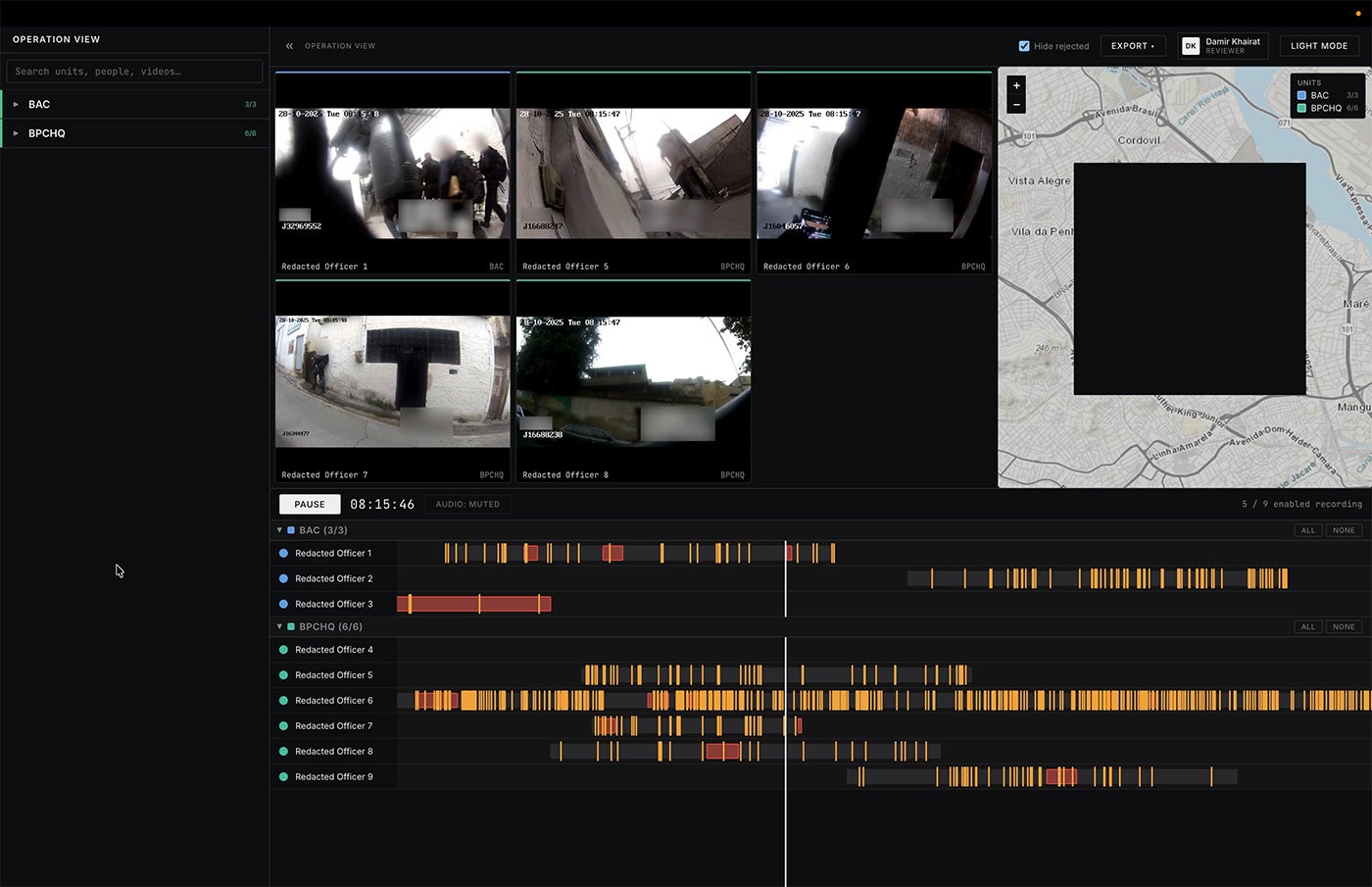
The models, alongside software that Human Rights Watch developed, synchronized recordings from different officers, mapped their locations, and scanned footage for gunshots and signs of camera tampering.

From there we had a searchable platform that let us view the operation as one coordinated event, rather than thousands of separate recordings.

What we found was evidence of widespread tampering and obstruction of body cameras. And it consistently happened at the exact moment cameras should have been recording, during arrests, shootouts, or while officers entered homes.

Authorities said that the purpose of the raid was to arrest suspected drug traffickers. The evidence we found points to an operation that appeared lethal by design.

To explain how we came to this conclusion, let's look at some examples of the moments we trained our AI models to detect.

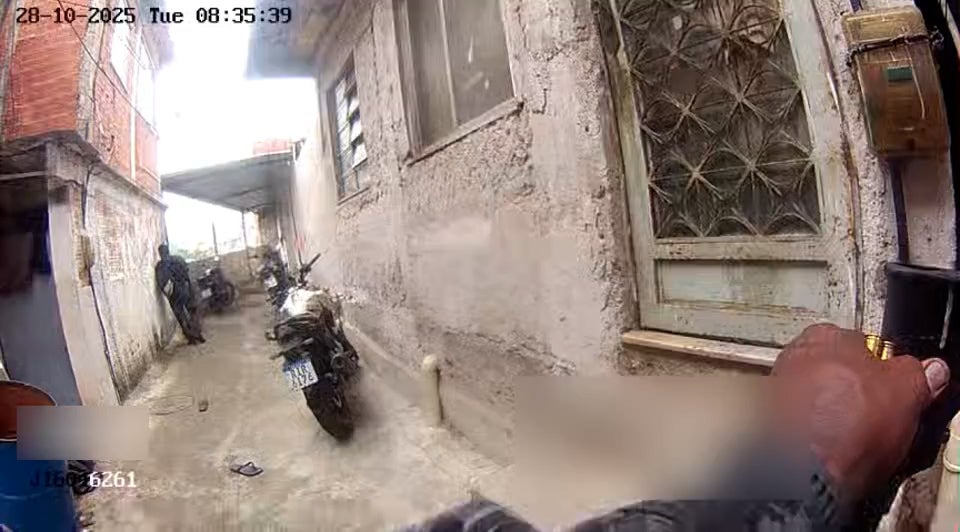
An officer's camera captured this video in an alleyway as a large group of his colleagues pass by, after which the officer quickly covers his camera.

He or another officer then flags that there's a camera recording.

SOUNDBITE [IN PORTUGUESE]

The team has a camera. The team has a camera. No, no I’m talking about the thing there.

NARRATION

It's unclear why he covered it, but prosecutors later charged him with camera tampering.

SOUNDBITE

So, this would be the kind of like overall operational view.

NARRATION

To find incidents like this across almost 4,000 hours of footage from nearly 500 officers, we trained a model to detect similar moments when a camera continued recording, but the lens was covered.

Here, an officer is seen struggling to pick the lock on the door of someone's home. Once it's open, he removes his camera and leaves it unattended for over an hour, presumably while he's inside the home.

Because the camera was still capturing an image, this recording wasn't initially flagged by our software.

So, we trained a second model to identify "stale scenes" where the recording stays the same for long periods of time.

As our models learned and improved, they uncovered lots of suspicious recording gaps.

In the end, we documented more than 250 camera obstructions. 

Moments like these are exactly the situations that body cameras are meant to document, helping ensure that any unlawful behavior is captured and that circumstances surrounding the 122 killings can be properly investigated.

Another method we used was an AI system that analyzes audio to detect gunshots.

After we trained it specifically for Rio police body cameras and local conditions, the model successfully detected most gunshots in a test set of videos.

We were also able to use AI to pull text directly from the videos, like the date, time, location and ID number of the officer wearing the camera.

But one of the most striking findings came from what we didn't see.

Despite the scale of the operation and the number of deaths, we found no footage showing the killings themselves.

NARRATION

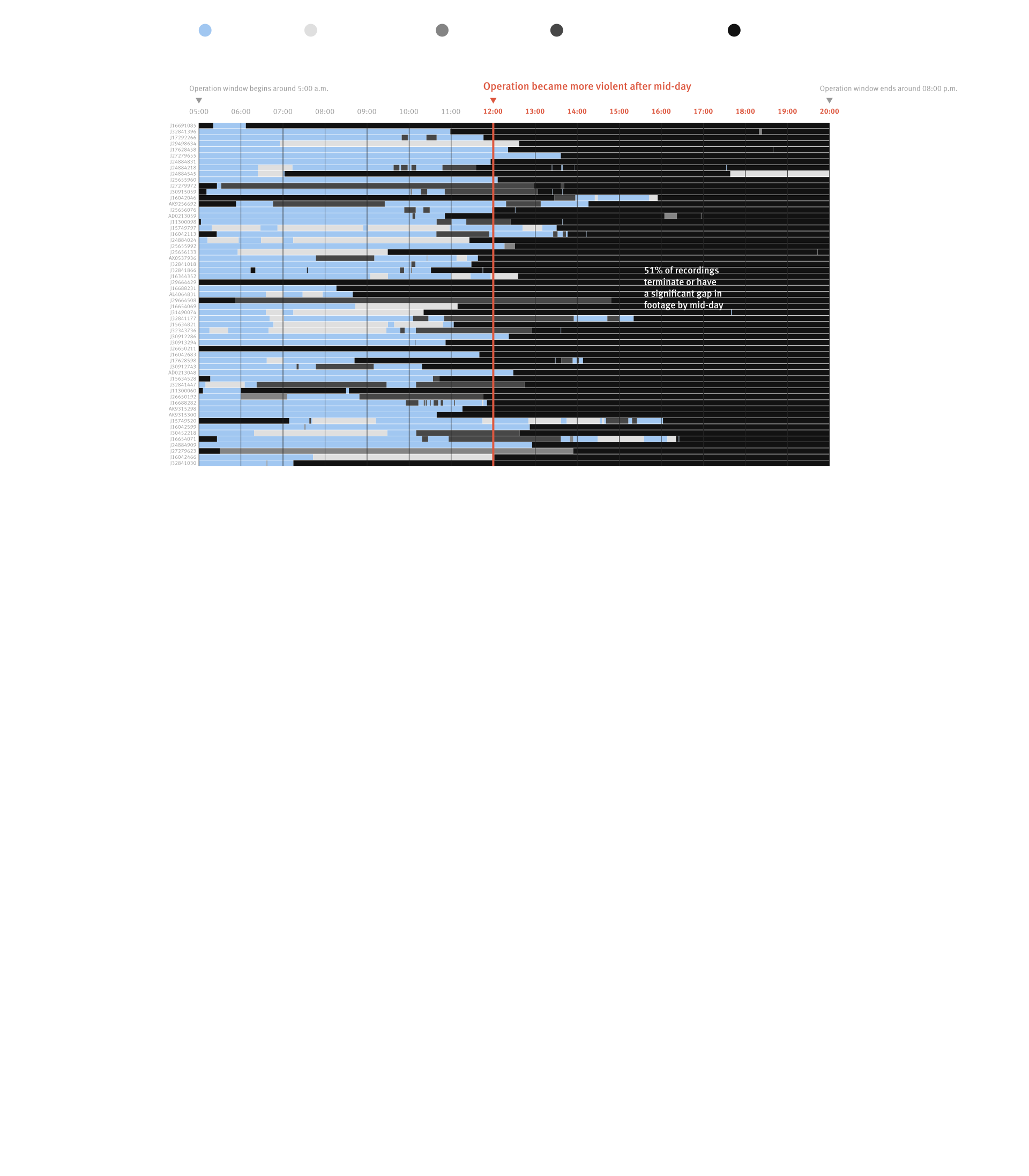
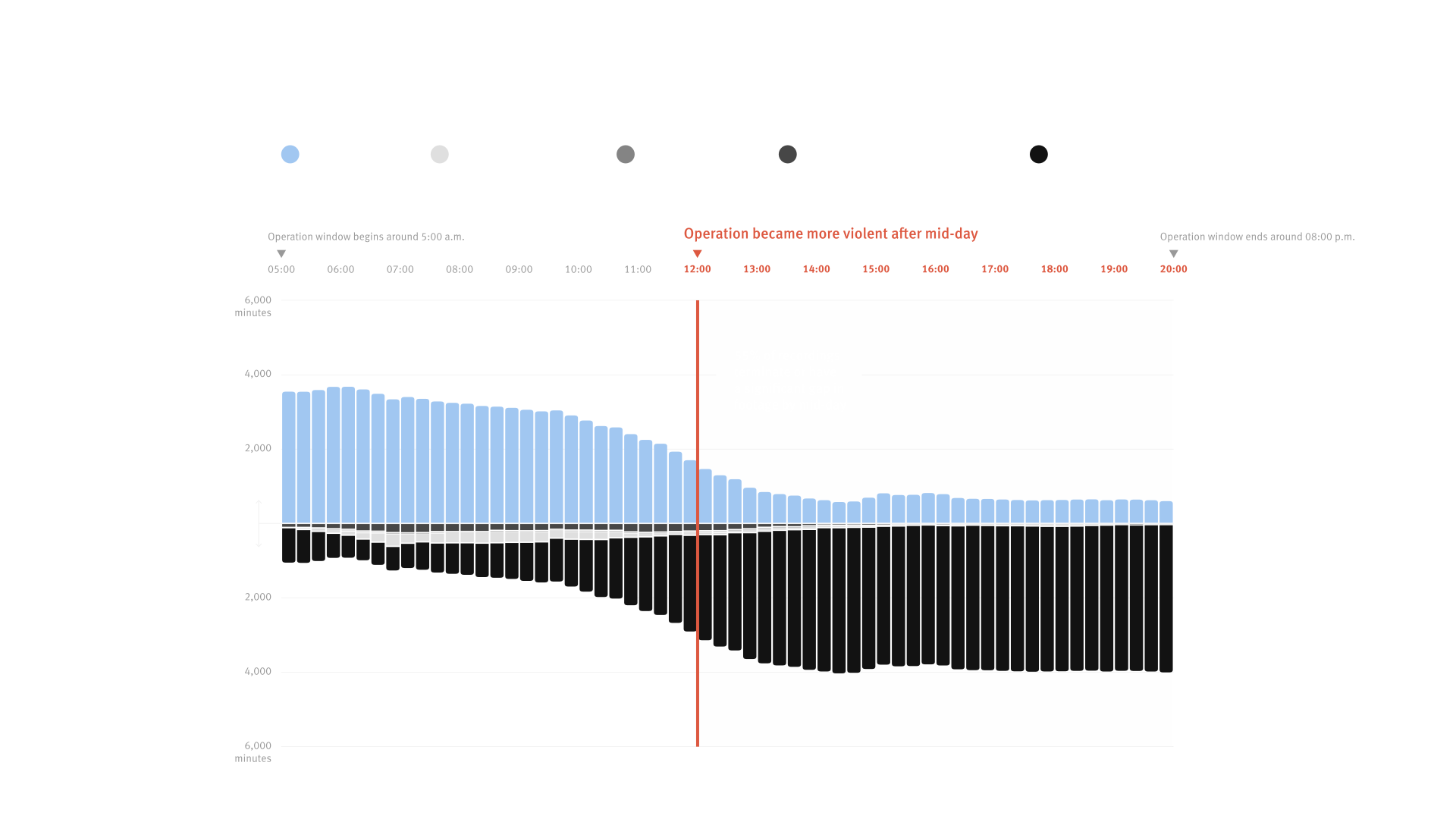
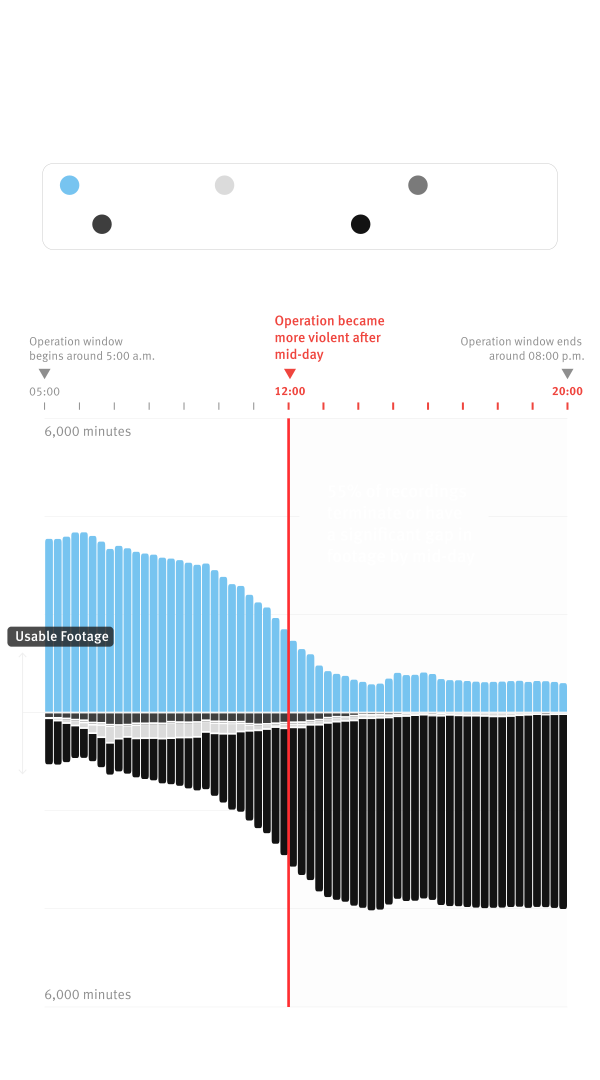
To understand what was missing, we organized body camera recordings across the operation using extracted timestamps.

TEXT ON SCREEN

Unusable footage

Usable footage

NARRATION

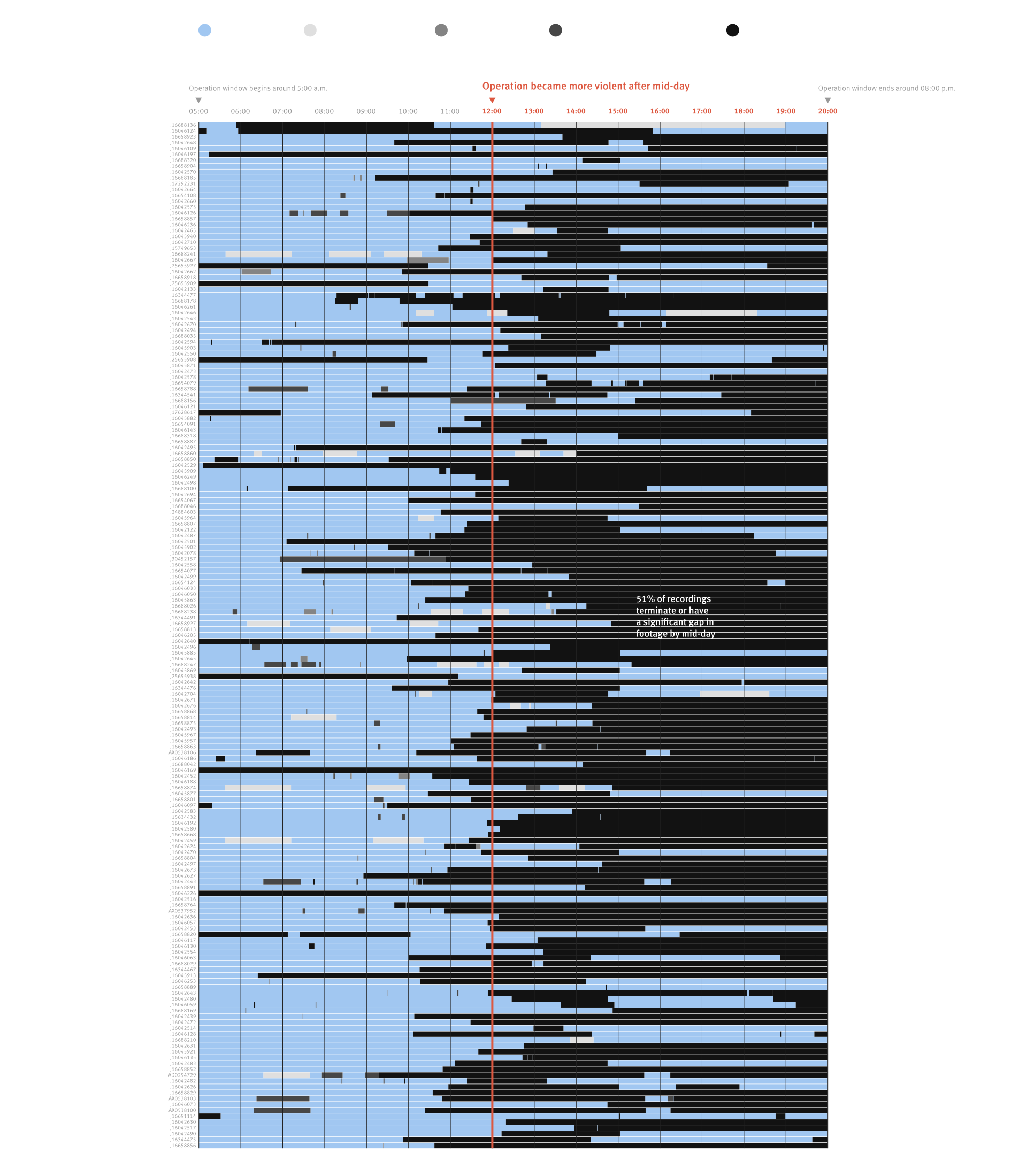
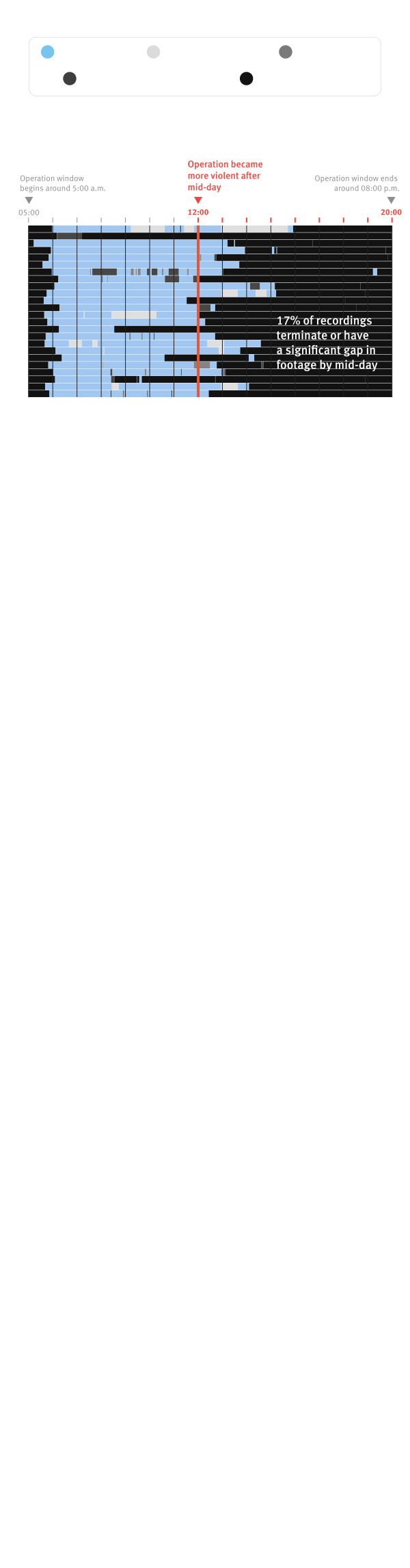
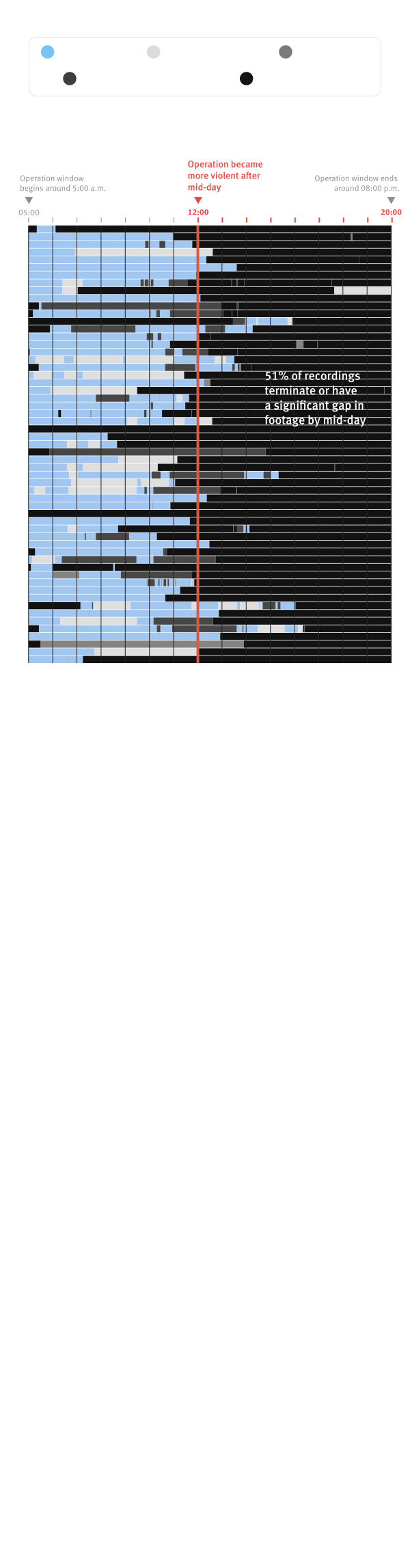
We found that more than half the officers’ recordings had either ended or had significant gaps by noon. From there, the usable footage continued to decline, just as the operation became most deadly.

The missing footage, combined with extensive evidence of camera tampering, suggests that body cameras were deliberately misused to prevent killings from being recorded.

Throughout our investigation, AI was one tool out of many.

Our team of researchers interviewed witnesses in Rio, visited the neighborhood where the killings took place, analyzed police records and autopsies, verified photographs and videos, and manually reviewed AI findings.

What AI provided was speed and scale. 

It helped us process thousands of hours of footage, connect pieces of evidence, and focus our attention where it mattered most.

In other words, AI helped us find needles in a very large haystack.

Now, it's up to Brazilian prosecutors to thoroughly investigate both the killings and the decisions that led to such a deadly operation.

Those who use disproportionate force or misuse body cameras should be held accountable.

To learn more about the events of October 28th and Human Rights Watch’s findings, visit HRW.org and read our investigation, A Strategy of Death.
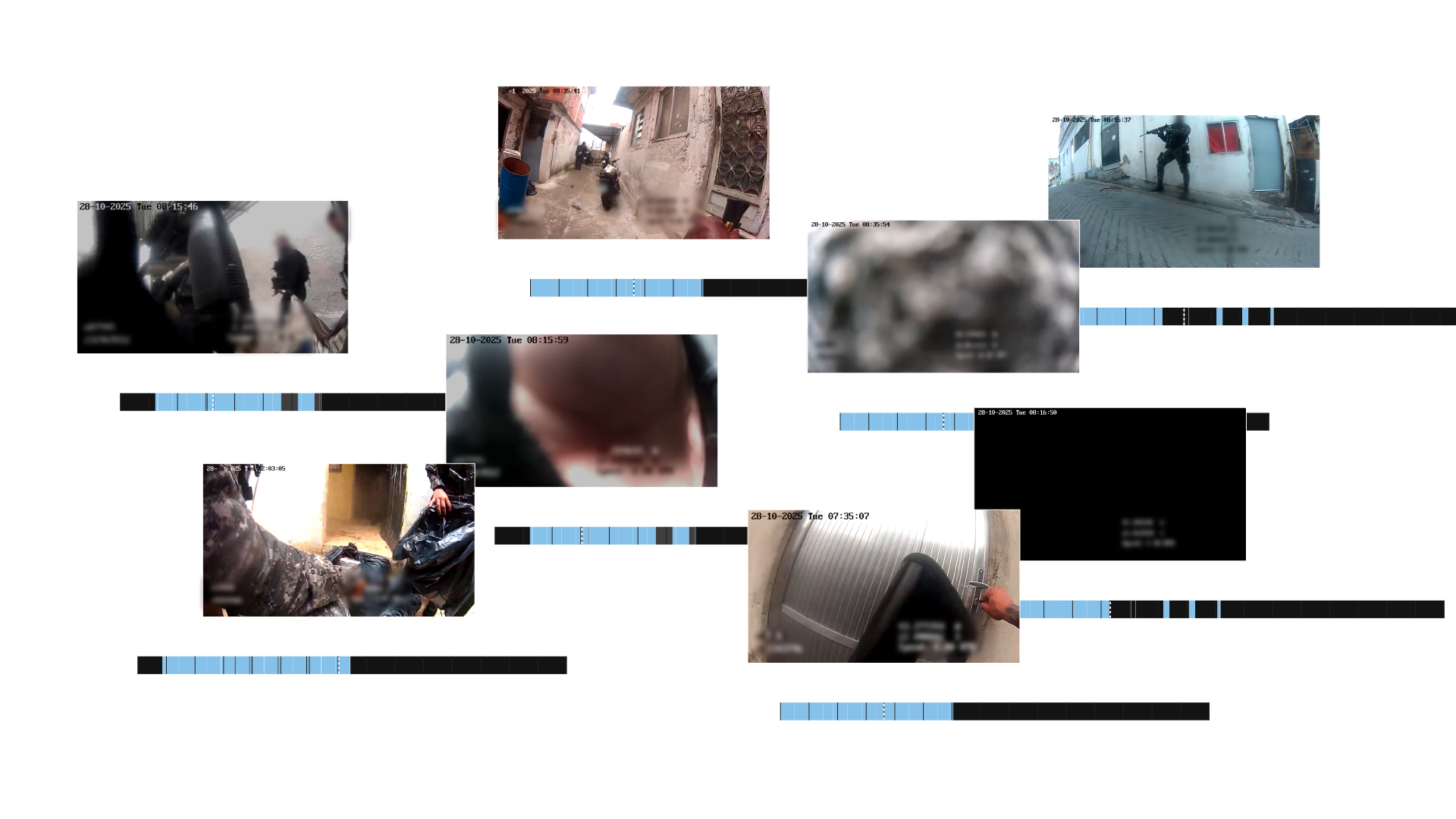
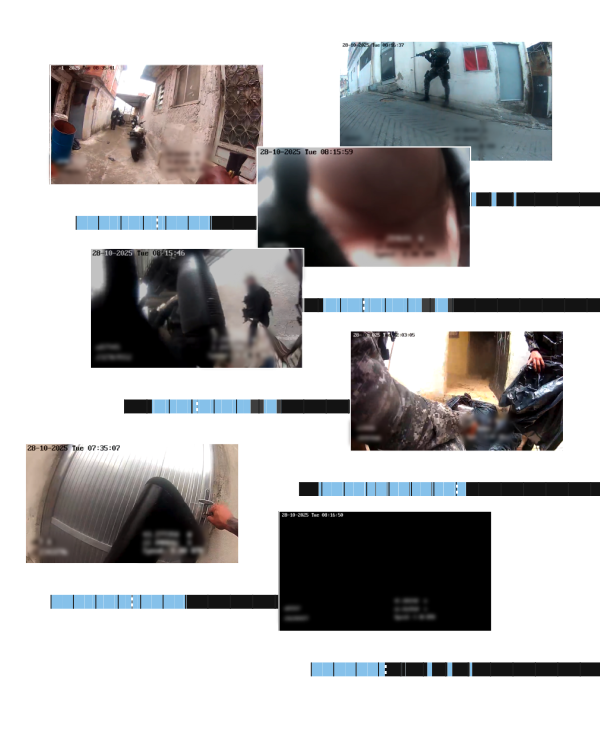
Instead, the research team turned to machine learning to efficiently process and analyze this mountain of data. Specialist researchers built a suite of classifier models to flag key criteria, such as gunfire in audio, and to extract relevant metadata from the bodycam footage, including locations and officer names. Human Rights Watch researchers then manually reviewed the footage. Together, this built a comprehensive picture of the violations that happened that day and the likely perpetrators.

Massive quantities of body camera footage was not the only challenge that researchers faced where additionally, some footage was patchy. In many cases, these gaps appeared to be due to police tampering and, at the time of writing, prosecutors had filed charges against a few officers for allegedly tampering with their body cameras. To understand the scale of body camera tampering, especially as it related to killings of non-police victims, researchers built a separate classifier model to identify a variety of camera obstructions: cases when officers used their hand to cover the camera lens; left their body cameras behind in their vehicles, where they were on and recording but captured hours of nothing; or when the camera was left outside a person’s home as an officer entered–rendering the camera unable to capture the events that took place inside. 

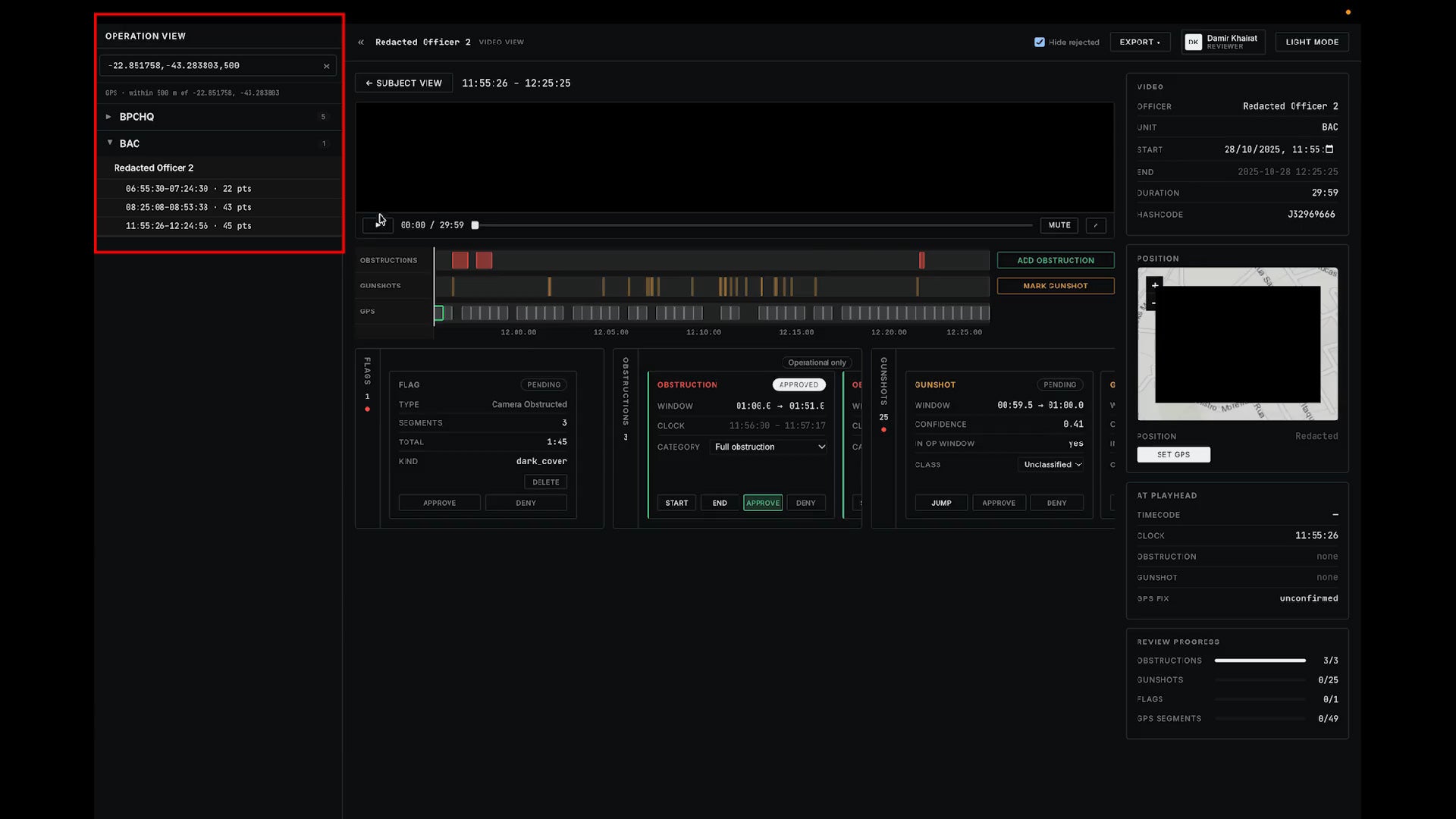
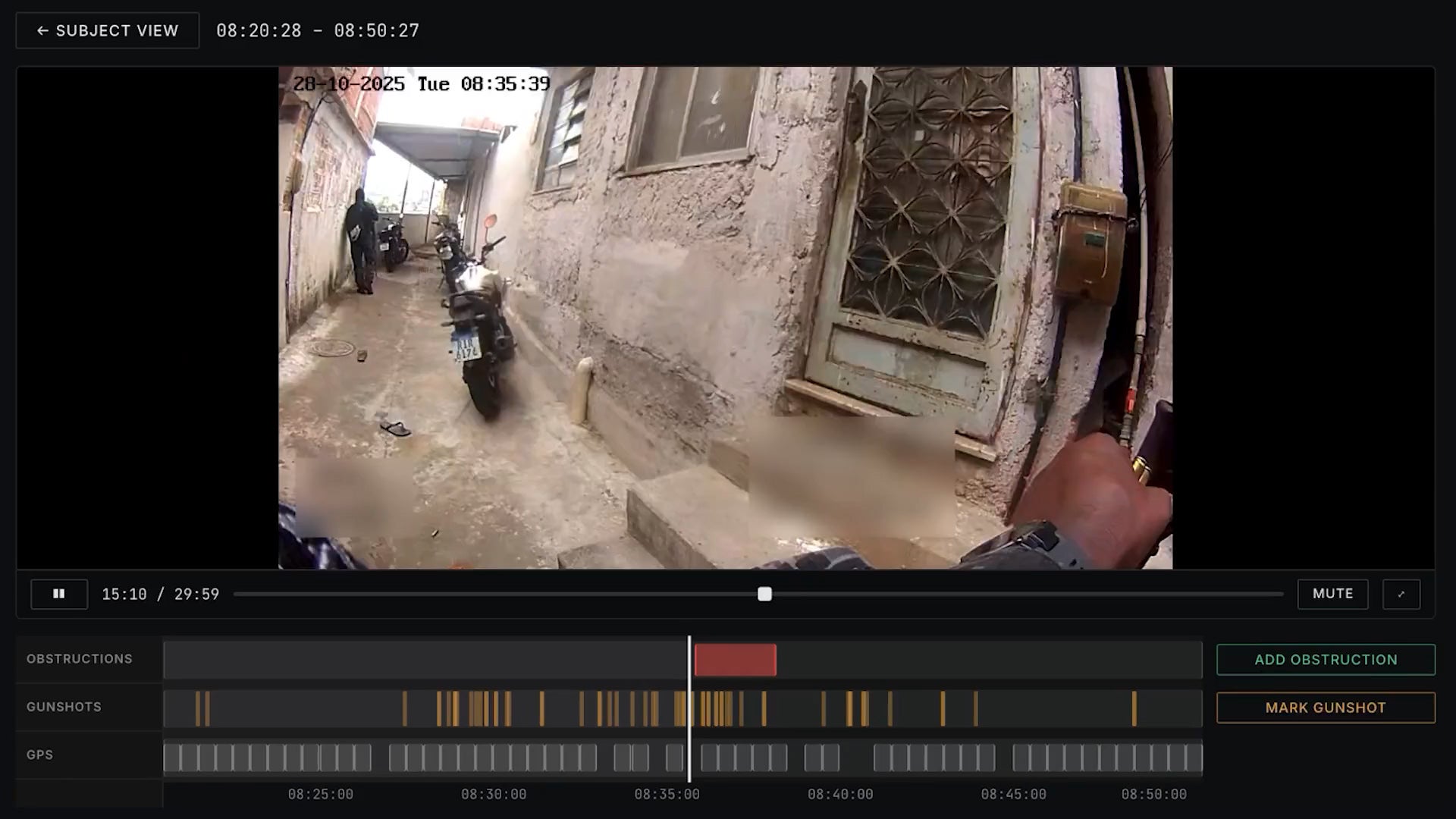
The segments of footage identified by these models, along with the original footage, were fed into a visual platform which cataloged the material and organized it using extracted metadata. This offered researchers a bird’s eye view of the footage; it also allowed researchers to systematically comb through what was, otherwise, an impossibly large amount of footage and to focus on key moments highlighted by gunshots and camera obstructions.

Despite the scores of people killed during the operation and the legal requirement that police always have their body cameras recording, Human Rights Watch found no footage showing killings. Instead, researchers found repeated tampering with and obstruction of body cameras. This includes dozens of egregious cases, where officers removed body cameras before apparently engaging in gunfire, which can be heard on camera and was detected by our software. Combined with suspicious patterns in the autopsies, the repeated tampering with and obstruction of body cameras point to apparently willful and common procedural violations in favor of an operation that appeared lethal by design.

Human Rights Watch has documented key findings in its investigative feature, A Strategy of Death. Here, we illustrate how the Human Rights Watch research team used machine learning models to help establish those findings.
Receiving, Securing, and Managing the Data 

Because Human Rights Watch has conducted research and advocacy on public security in Brazil for decades, our researchers were well-positioned to begin digging into the killings and assessing police actions as soon as the first reports about Operation Containment emerged. With extensive contacts in the prosecutor’s and public defender’s offices, forensic experts’ units, and civil society groups, Human Rights Watch researchers quickly identified serious failures in the first investigative steps following the raid. 

Additionally, in July 2025, Human Rights Watch had signed an agreement with the Rio de Janeiro Public Defender’s office to further research on police conduct. After Operation Containment, this cooperative agreement allowed public defenders to transfer the investigative material, including the body camera recordings Rio de Janeiro prosecutors used in their charges against police officers, to Human Rights Watch. Because the material included sensitive personal data critical to an ongoing criminal investigation, processing this data with machine learning systems required close collaboration with Human Rights Watch’s Information Security and Technology department to ensure that information was handled in a legal, ethical, and secure manner. When considering the models, systems, and providers that were used for our research, Human Rights Watch conducted a human rights assessment and addressed issues of accuracy, bias, privacy, and security. As a result, researchers built their own classifier models and used lightweight, open-source models that ran locally on their devices, ensuring that sensitive data never went outside of Human Rights Watch’s system. Specialist researchers trained machine learning models to address issues with accuracy and human reviewers checked each result included in the analysis. 

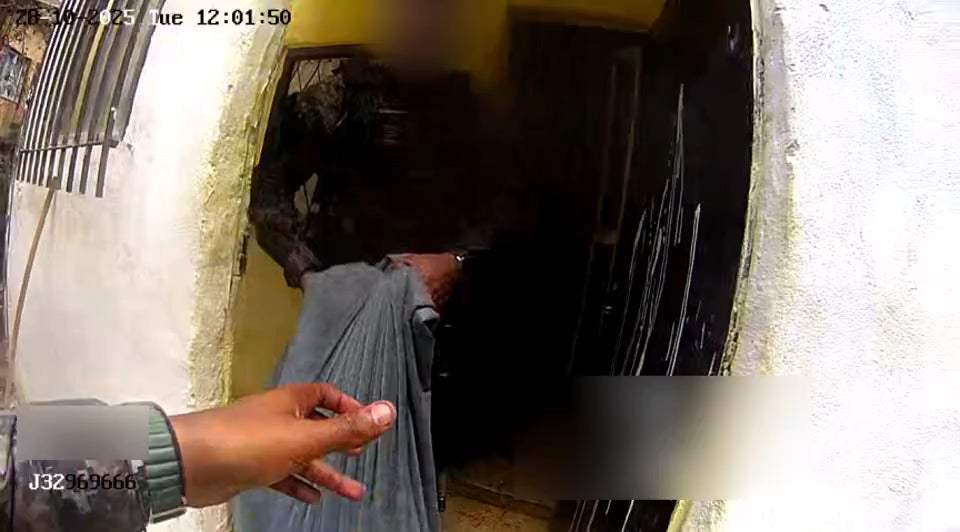
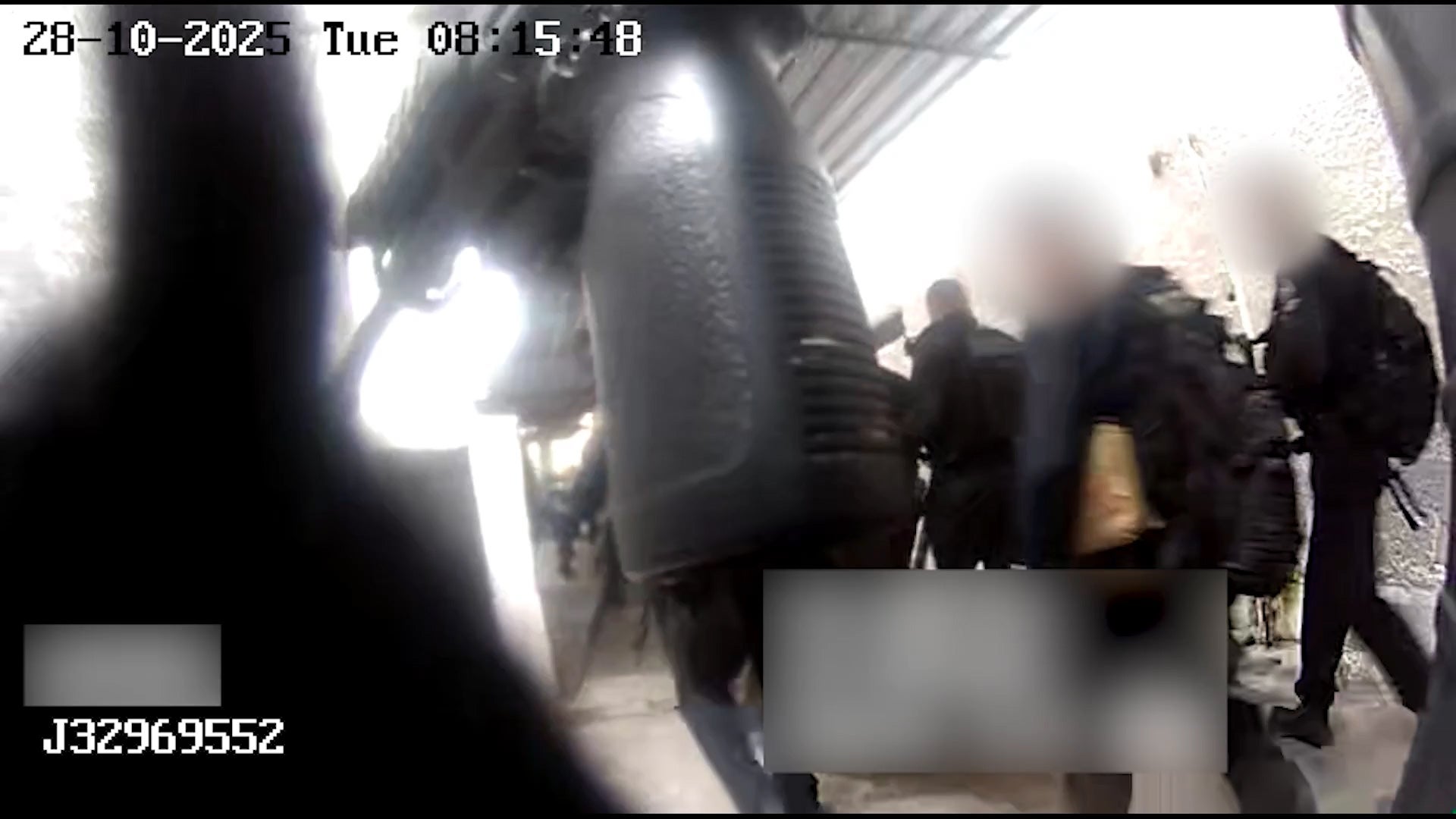
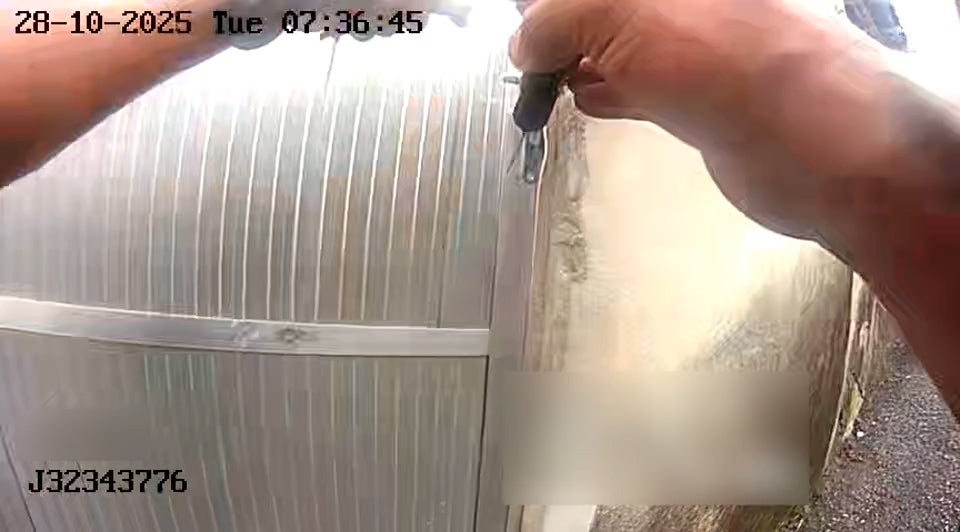
As the investigation is sealed, Human Rights Watch cannot publish footage that has not already been publicly released by prosecutors. The above three videos were made public by Rio’s Prosecutor’s Office and captured the actions of three canine unit officers who were charged with camera tampering, among other crimes, offering a snapshot of the 4,400 hours of body camera footage that Human Rights Watch received. 

Each video features a distinct obstruction, incident, and metadata that Human Rights Watch researchers trained AI models to detect and flag so that researchers could further investigate the incidents and circumstances. 

The Obstruction: Camera Tampering

This video was recorded by an officer who was in an alleyway as a large group of his colleagues passed by, after which he quickly covered his camera. While the camera was obstructed, an officer–possibly the one recording–was heard warning others that a camera was actively recording: “The team has a camera… I am talking about the thing there.”

To detect similar instances, Human Rights Watch built a classifier model to flag camera obstructions—video frames where the camera continued running but the lens was covered, so the recording contained audio but no discernable image. 

To provide examples for the model to learn from, researchers needed to build a training data set. This dataset was produced from a subset, which included body camera footage from a sample of 52 officers of the total 527 officers for whom Human Rights Watch received footage. Researchers flagged frames as likely obstructed based on the presence of mostly black pixels or a lack of clear edges, as in the video above.

The first iteration of model training surfaced several shortcomings, including a disproportionate number of obstructions flagged in the early morning hours—a strange pattern considering that most bloodshed occurred later in the day. When researchers reviewed these scenes, they understood the detections came from officers driving towards the operation under darkness, often in crowded vehicles, creating the illusion of an obstruction that triggered the software to incorrectly flag this footage. 

To account for such false-positives, researchers made several adjustments to the software. This included introducing several model parameters—pieces of information that the model considered when making a classification—including the uniformity of darkness on screen, as well as the time of day, where early hours were weighted less heavily. Additionally, to prevent excessive flagging of routine obstructions, such as the strap of a gun covering the camera during movement, obstructions shorter than 10 seconds were ignored.

The review of the training subset also challenged researchers’ understanding of what a camera obstruction entailed. The footage above was recorded by the camera of a separate officer who was charged with camera tampering as well as trespassing. Here, the officer was seen struggling to open the door of a home with a lock-pick tool before eventually succeeding with a knife. Once the door was opened, the officer removed his camera and left it unattended for over an hour, presumably while he was inside the home. 

Such footage was not flagged by the original classifier model because it displayed visible content. To resolve this, researchers introduced a second classifier model to account for “stale scenes,” where a camera is left stationary and displays a near identical image for an extended period of time.

This differentiation revealed that there are several categories of obstructions, each carrying its own likelihood of intent. To account for this, researchers classified each obstruction as: 

1. Potentially intentional obstructions

The camera was covered by an officer's hand, removed, or placed in a pocket or backpack during the operation. Intent was suspected when this lasted more than 20 minutes or coincided with suspicious circumstances — such as gunfire on camera audio, the officer entering a residence, or officers seen motioning to or discussing the camera beforehand.

2. Unclear removal of camera

Officer intent was unclear, but they may have violated protocol due to temporary removal of body cameras during the operation. During this period, officer activity was not visible.

3. Routine obstructions

Cameras were likely obstructed by equipment or normal activities, such as lying prone or, alternatively, the camera was removed but the officer can be seen in the recording.

Human Rights Watch researchers did not include routine obstructions in their analysis of camera tampering; when they were uncertain about the nature of the obstruction, they classified it as a routine obstruction. 

Officer Body Camera Timelines

In our review, researchers found that similar instances of potential camera tampering consistently occurred when cameras should have been recording, such as in the footage above; when officers entered homes; and before gunshots can be heard in the audio of the footage. The purpose of officer-worn body cameras is to ensure that such moments are documented so violations of the law are captured on camera and those responsible can be held accountable. In the case of Operation Containment, body cameras–had they been used properly–would have helped investigators and researchers determine whether the 117 non-police victims were killed through unlawful uses of force.

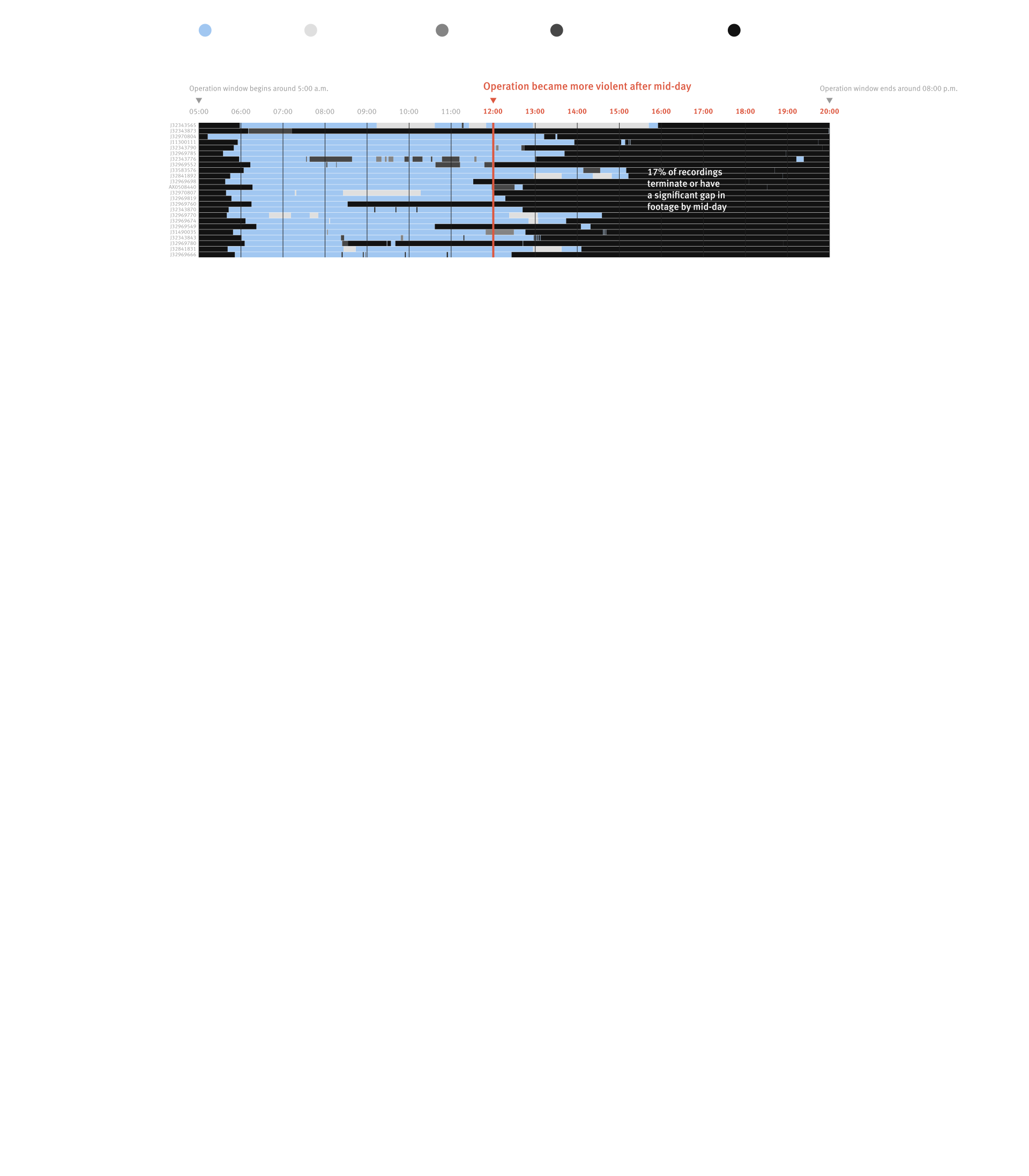
Footage from “front-line” units engaged directly in the area of operations, rather than on stand-by or acting as crowd control at the operation perimeter, would have been particularly important. Instead, the interactive visual above provides detailed data on the 278 instances of potential camera tampering that researchers documented among 132 front-line officers. 

The Incident: Gunshots

Researchers also built an AI model to detect another signal: a high density of gunshots. After such videos were flagged, researchers closely reviewed and analyzed the content. As shown in the interface above, researchers watched footage–in this case, depicting gunshot audio that was present out of frame, before the officer removed his camera for a short period of time–with a visual indicator marking when each cluster of gunshots was detected. 

To flag similar audio signatures, researchers leveraged YAMNet, a popular open-source model for classifying sound types, including gunshots. On its own, YAMNet was overly-sensitive to loud noises often flagging false positives. This is because YAMNet is a general-purpose audio classification model and is not purpose-built for gunfire recorded by HikVision body cameras (standard for Rio de Janeiro police) nor the acoustic conditions of dense urban neighborhoods in Rio.

Using a training data set of videos, which were manually flagged for gunshots by researchers, a second-stage classifier was introduced to make the final judgement for each flagged noise. This allowed YAMNet to be run at highly sensitive settings so that it caught as much gunfire as possible. This classifier weighed YAMNet's readings, the audio signature, as well as contextual signals, such as the density of gunfire detected. The model was not used to determine if gunfire picked up by the body cameras was outgoing or incoming. 

Researchers tested this system only on segments it had not been trained on, across 1,743 labelled segments from 251 videos. Without the additional classifier, 41 percent of audio segments classified as “has gunshot” would have been false positives at the original detection sensitivity. Using the second-stage classifier, false positives in this testing dropped to 16 percent, and the system detected 83 percent of the segments that researchers had confirmed as gunfire. 

The Metadata: Who, When, and Where

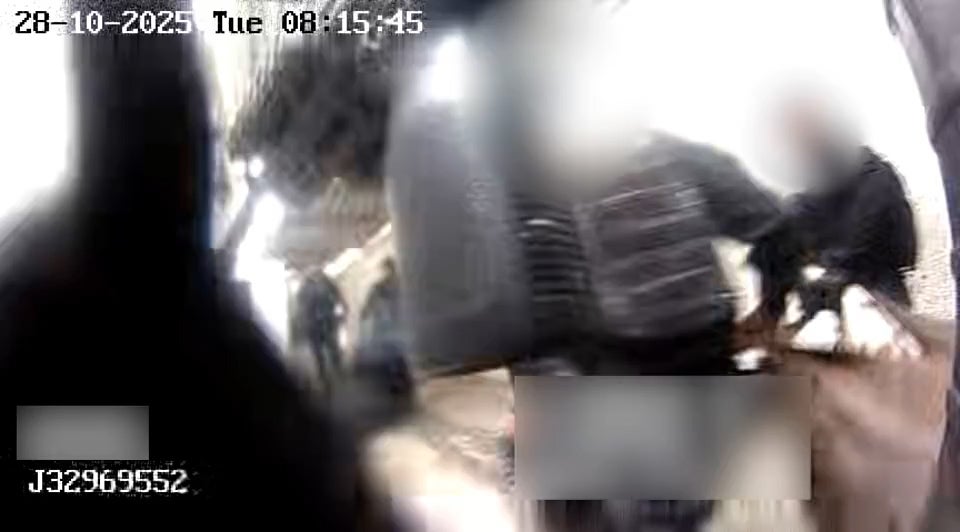
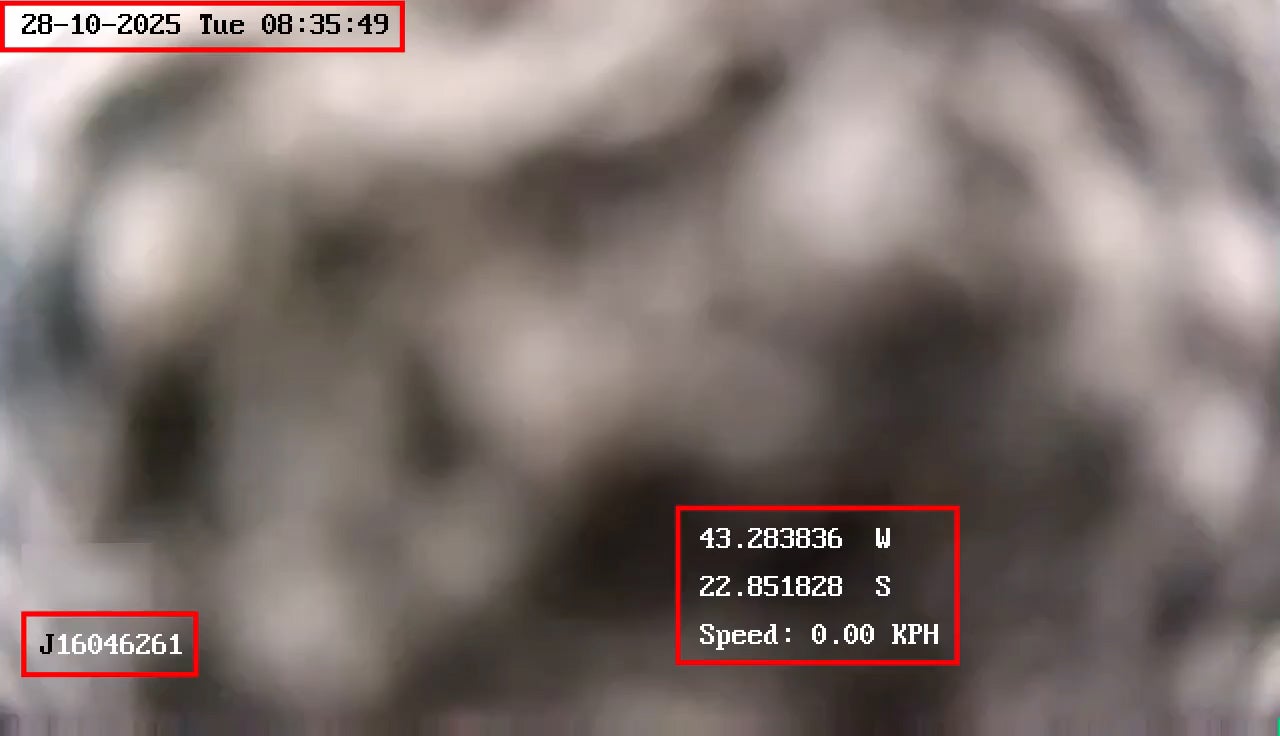
Continuing from the last video, where the officer removes his camera as gunshots are heard, though the officer's actions were not captured on screen, the footage contained several pieces of metadata superimposed on the frame, as is standard for footage captured by Rio de Janeiro police body cameras. The information (highlighted by Human Rights Watch in red) denoted the time and location of recording as well as the identification number of the camera and recording officer.

To extract this metadata, researchers built a custom classifier model that read each character by exploiting the consistent font, format, and location of text displayed in the recordings. The ID of the officer was then cross-referenced with a manifest found in the prosecutor’s investigation, which mapped officer IDs to their name and unit.

This metadata suggested that the footage was recorded on Rua Seis in the Penha neighborhood at 8:16 a.m. by an officer with the canine unit of the military police. 

It is important to note that the GPS coordinates in this metadata came with a degree of uncertainty. This seemed to be an underlying issue with the HikiVision camera provided by the supplier, L8 Group. Coordinates frequently displayed null coordinates or stayed fixed at one position while the footage clearly showed the officer moving. To compensate for this, researchers introduced several heuristics that discarded noisy readings, including those with null or fixed coordinates, those with significant spikes in distance, and those located outside Rio de Janeiro. Moreover, coordinates used in the final analysis were subject to a secondary manual validation.

These GPS coordinates provided a starting point for mapping evidence. Such coordinates could be used in the web platform to search for other videos within a specified radius. Searching for videos within a half kilometer radius of the coordinates displayed in the footage above provided a hit for another officer that may have been operating in the vicinity. 

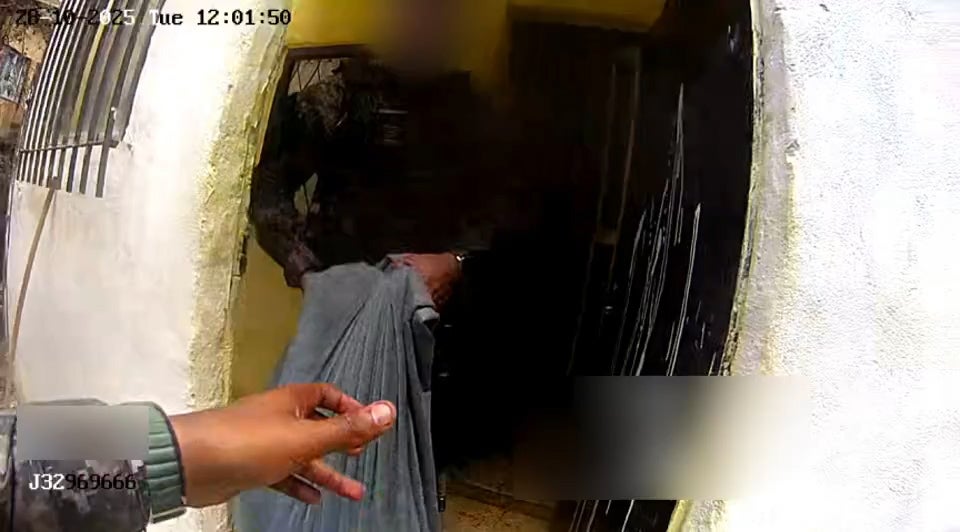
This search result told a similar story to the officer who removed his camera and would later be charged with trespassing. In the resulting video, an officer, along with two colleagues, were seen at 12:02 pm removing several plastic bags containing items from a home. While it was not possible to see what was in the plastic bags, the officers discussed dividing the items amongst themselves: “Let’s split it up. Some in the backpack, some in the bag.”

These two videos, recorded within half a kilometer of one another, indicated that officers entered people’s property without permission. Human Rights Watch’s review of the full 4,400 hours of footage found multiple examples of officers entering homes without permission, including examples of officers stealing food or covering their cameras while going through personal belongings.

What Transpired When the Cameras Weren’t Recording?

Upon review of the body camera footage from Operation Containment, Human Rights Watch did not find any videos that showed killings. A prosecutor told researchers that the digital investigations unit of the Rio de Janeiro Prosecutors’ Office (DEDIT) had not either, as of September 2026.

206c5f00-88cf-4d79-8421-31af2fa3b4b1

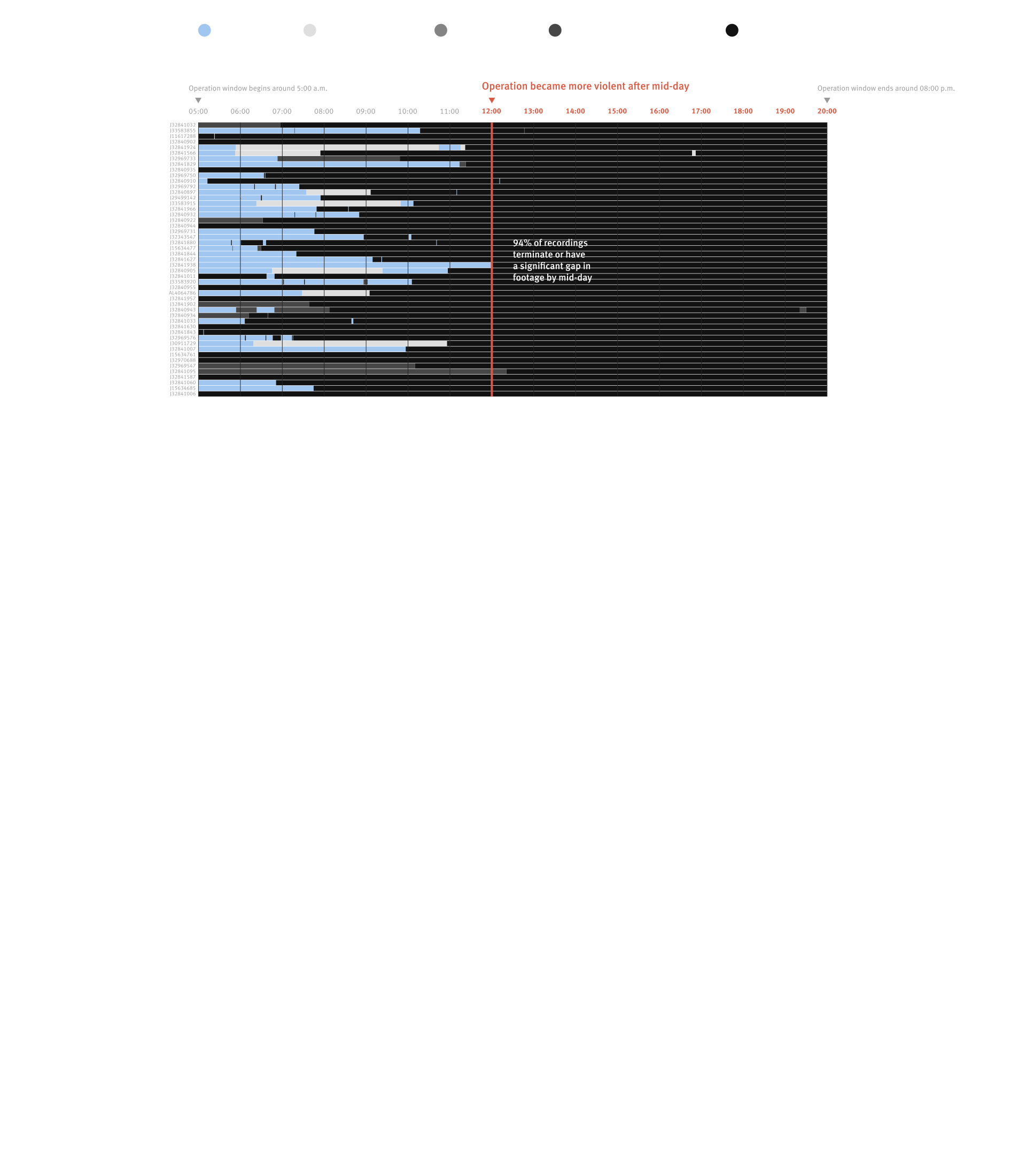
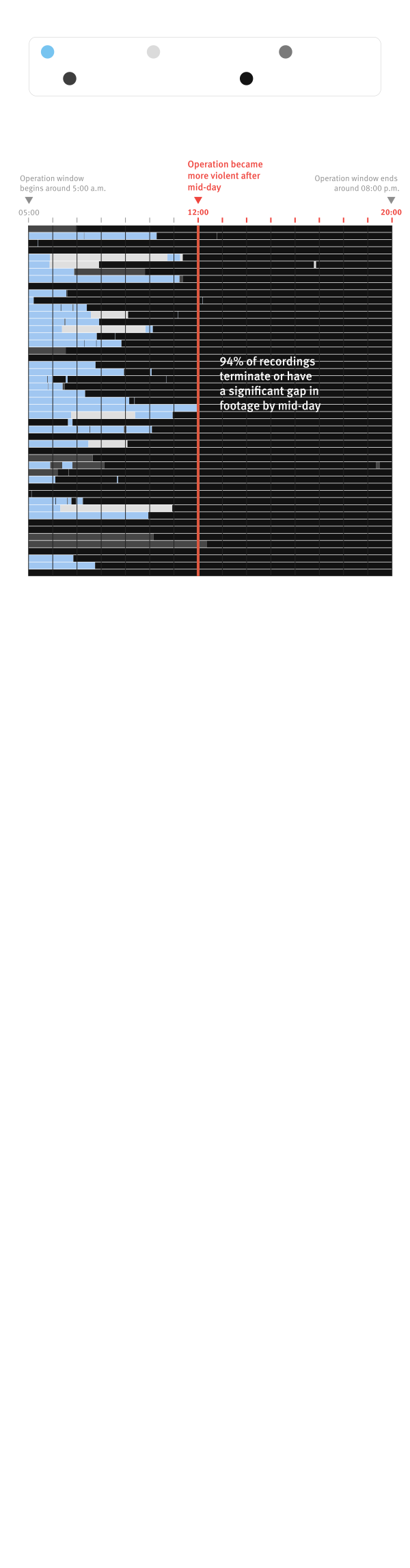
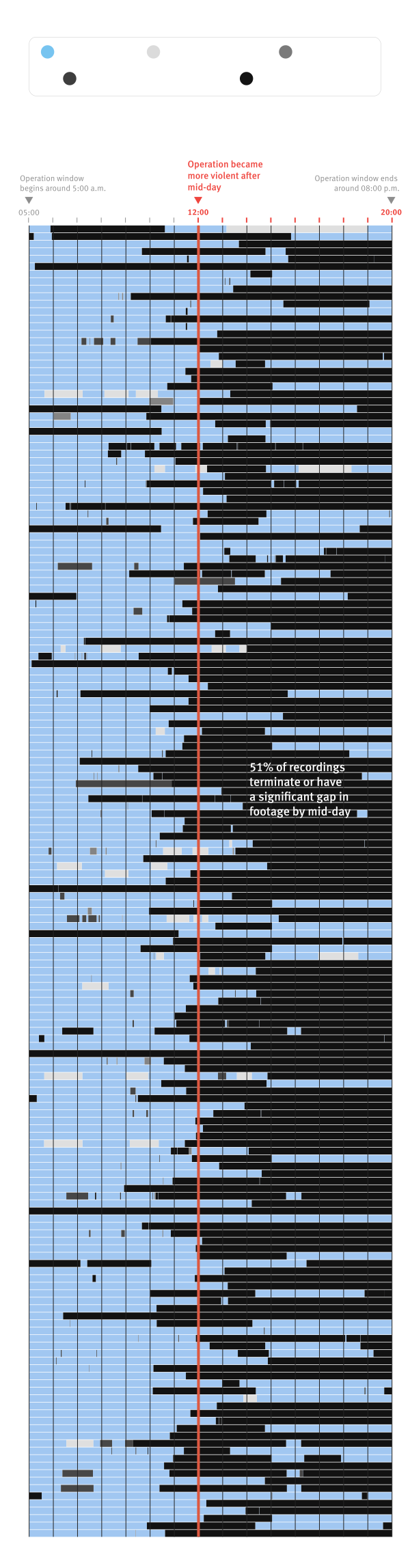
Despite Supreme Court rulings requiring Rio police to wear body cameras, only roughly 23 percent of the 2,500 officers participating in the operation wore body cameras, the Rio de Janeiro government said. Of the footage that Human Rights Watch received, researchers found that 55 percent terminate or have a significant gap in footage by 12:00 p.m.–and most killings occurred after midday. This was calculated by cataloging the recordings using extracted timestamps from the footage.

This contrasts directly with police protocols, which state that cameras should be charged to at least 95 percent battery and that battery life is 12 hours. Additionally, officers are required to carry an extra battery for operations lasting longer than 12 hours. Given this combined 24 hours of battery life and that the operation started just after 5 a.m., this footage should have lasted through and even beyond the time officers were seen leaving around 8 p.m.

The significant amount of missing footage–combined with the evidence of widespread camera tampering, especially in moments where gunshots are heard in camera audio–suggests that law enforcement officers intentionally misused cameras to prevent recordings of killings carried out during Operation Containment. 

To understand the nature of the killings, Human Rights Watch’s investigation supplemented the footage with several streams of information. Researchers, with support from independent forensic experts, analyzed the autopsy reports of the 122 killed, which suggest that police used excessive use of force and intended to kill. Additionally, the research team analyzed evidence from the thousands of pages of records from the prosecutor’s official investigation; conducted interviews with witnesses, relatives of those killed, and officials; and obtained records via freedom of information requests. 

The team coordinated closely with a working group of local partners, including Papo Reto, Frente Penha, Redes da Maré, and Projeto Mirante, who collected 579 photographs and videos taken by residents. Researchers also conducted open source research to analyze and, when possible, verify videos, photographs, and messages posted online as well as those shared by the working group. In cases where geolocation proved impossible, researchers matched specific victim wounds and clothing with photographs in autopsy files to verify victims' names.

The AI workflow and platform provided connective tissue between the footage and these disparate streams of evidence, structuring the footage in a way that researchers could search and then use as comparison points. For example, once researchers geolocated videos found online of arrests or piles of dead bodies, the platform could be used to search for footage recorded in the vicinity — verifying that a given unit, or even specific persons, were operating in that location.

Machine Learning as Connective Tissue

Human Rights Watch increasingly works with large troves of video to analyze a particular event or conflict. With extraordinarily large hours of video to watch and investigations relying on many incomplete streams of information, such raw data will likely always be unwieldy–making machine learning an incredible tool for Human Rights Watch researchers. It supplements and complements a suite of methodological approaches as researchers piece together events where suspected human rights violations took place.

This is why Human Rights Watch is building upon the systems used in this investigation–applying machine learning systems to tackle data of this scale in a way that prioritizes both empirical rigor and efficiency. Human Rights Watch researchers are collecting and storing data securely, training bespoke models suited to a given context, using metadata to catalog videos in a structured manner, and cross-checking all outputs with other quantitative and qualitative evidence.

With the right legal, security, and ethical guardrails in place, software, including AI, can support human rights researchers to investigate and expose evidence at new degrees of scale. Human Rights Watch is experimenting, carefully, with ways to translate researchers’ expertise, and deploy machines to help them find the needles across many haystacks.