|
|
Human Rights Watch, which chairs
the international Coalition to Stop the Use of Child Soldiers, celebrated
an important victory with the passage of a treaty banning the use of children
as soldiers.
After six years of negotiations, governments finally agreed
on a treaty establishing eighteen as the minimum age for participation
in armed conflicts. The treaty, which has been formally adopted by the
U.N. General Assembly, will likely enter into force in 2001.
The coalition, led by Human Rights Watch, generated pressure that helped
persuade the United States to reverse its position on the treaty. We argued
that the U.S. government, having opposed international treaties to ban
anti-personnel landmines and to establish an international criminal court,
risked losing influence and credibility as a defender of human rights
if it also opposed the child soldiers treaty.
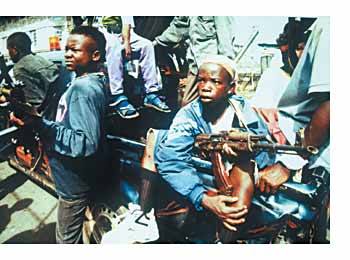
Child soldiers in Monrovia head into a fighting
zone.
Liberia, 1996. Photo Corinne Dufka
In early 2000, the United States consented for the first time to end the
deployment of minors in combat. Until then, it had vigorously opposed
the eighteen-year minimum. This major policy shift allowed the treaty
to go forward and marked the first time that the United States had ever
agreed to change its practices in order to support an international human
rights standard.
The new treaty could help spare hundreds of thousands of children from
having to participate in armed combat. An estimated 300,000 children under
the age of eighteen are currently engaged in such conflicts around the
world. Human Rights Watch has documented the use of children as soldiers
in Uganda, Sudan, Sierra Leone, Colombia, Angola, Liberia, and Lebanon.
Children are often given the most dangerous assignments, such as deployment
on the front lines of combat. Others are forced to serve as porters, spies,
guides, and in the case of many girls, as sexual slaves to military commanders.
The treaty also requires states to cooperate in the demobilization of
child soldiers and to assist in their rehabilitation and reintegration.
For thousands of children who have been deprived of safe environments,
this transition cannot happen quickly enough.
|
|