|
|
“We are poor people,
and this is the kind of justice
poor people get,”
said the double-amputee, who had stopped by Corinne Dufka’s
office in Freetown to discuss the recent amnesty for the leaders of the
Revolutionary United Front (RUF).
Dufka, an experienced photojournalist and Human Rights Watch’s researcher
in Sierra Leone, found the man’s remarks dispiriting, but true. She
had spent months documenting, in words and pictures, the unspeakable butchery
of RUF rebels, who had hacked off limbs of innocent civilians to spread
terror throughout the small West African country. To Dufka, who received
numerous visitors to her office and spoke to hundreds of people around
the country, it seemed that few people had been spared the rebels’
murder, rape, and mutilation. Despite the group’s murderous rampage,
it was granted amnesty from prosecution of these crimes as part of an
internationally brokered peace agreement.
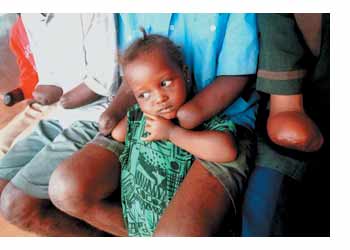
This two-year-old girl lost her right arm
when her grandmother was shot and killed by Revolutionary United Front
rebels. She was being carried on her grandmother's back and was injured
by the same bullet that killed her grandmother. The four other men all
had their hands amputated by rebels. Sierra Leone, 1999.
Photo Corinne Dufka
Few people had heard of the atrocities in Sierra Leone
until Human Rights Watch’s shocking photographs and testimonies appeared
on the front pages of major newspapers worldwide. As the only international
human rights organization with a full-time presence in Sierra Leone, Human
Rights Watch became the leading source of information about RUF brutality.
Through our reports, press releases, letters, and photographs, we sounded
the alarm for this human rights tragedy.
We also decried the ineffectual global response and the amnesty granted
to the rebels. We warned that peace built on such impunity would only
encourage the rebels to renew their barbarous ways. Human Rights Watch
helped persuade the United Nations to deny the amnesty international recognition,
but immunity within Sierra Leone was granted. The amnesty was, in Dufka’s
words, “the worst crime,” because it shattered Sierra Leoneans’
hopes for justice.
The Sierra Leonean government had no choice but to accept this flawed
deal because the international community was unwilling to continue defending
the government. As part of the deal, RUF leader Foday Sankoh was rewarded
with a government job and control over Sierra Leone’s diamond mines,
whose revenues allowed him to purchase more weapons. Unfortunately, as
we predicted, Sankoh’s forces continued to commit atrocities, culminating
in the taking of hundreds of U.N. peacekeepers as hostages in May 2000.
The hostages were ultimately released, but the crisis provided an opportunity
to reflect on the world’s lackluster response to Sierra Leone.
Human Rights Watch called on the major international powers to establish
an international criminal tribunal for Sierra Leone to try the rebel leaders.
We also sought a strong peacekeeping presence capable of standing up to
the rebel threat, rather than the under-equipped, ill-prepared forces
that had been taken hostage. And we demanded enforcement of an embargo
restricting the sale of diamonds and the purchase of weapons by the RUF.
As this report went to press, the U.N. Security Council had finally begun
to address these needs.
Though saddened by the world’s inadequate initial response to the
Sierra Leone crisis, Dufka is heartened by the knowledge that, ultimately,
her work “translated outrage into concrete action.” Yet with
peace still precarious, she understands all too well the need for the
global community to learn from the past and build a firm and effective
commitment to Sierra Leone.
|
|