|
|
Peter Bouckaert felt the train lurch and knew what was
coming. As Human Rights Watch’s emergency researcher, he was interviewing
refugees who had fled Russian bombing, looting, and murder in Chechnya
to seek refuge in the neighboring republic of Ingushetia.
Forced from their homes, the Chechen refugees were living
in train cars, with fifty to sixty people to a car. When the train jolted,
Bouckaert feared that it would start a journey back to Chechnya, where
the refugees would be forcibly returned. In a heated exchange, Bouckaert
challenged the Russian official who was preparing to repatriate the displaced
Chechens to the war zone. Identifying himself as a researcher with Human
Rights Watch, Bouckaert threatened to expose the officer’s action
to the international community. The authorities relented, and the Chechens
were able to remain in Ingushetia.
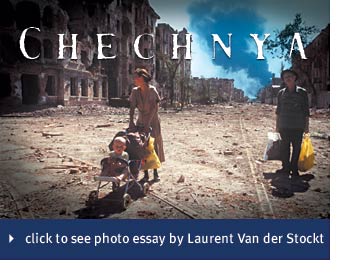
Working closely with Sasha Petrov and Malcolm Hawkes of our Moscow office,
Bouckaert spoke to hundreds of Chechens who had lost loved ones, homes,
and communities in the latest Russian offensive. By carefully recording
testimonies and corroborating accounts, Bouckaert was able to verify three
massacres in Chechnya – in Alkhan-Yurt and the Aldi and Staropromyslovski
districts of Grozny; horrendous conditions in “filtration camps,”
where Chechen detainees were tortured; and numerous instances of indiscriminate
bombing of civilians and deliberate targeting of refugees en route to
Ingushetia.
Without Human Rights Watch’s investigation and exposure of these
atrocities as they were occurring, the international community probably
would never have known of them. As the only human rights organization
stationed on the Chechnya border throughout the Russian offensive, Human
Rights Watch became the primary source of information about Russian violations.
“We had a duty to get the truth out,” said Bouckaert, who met
daily with journalists on deadline to provide them the latest information
on Russia’s conduct of the war. During the conflict’s most intensive
six months, Human Rights Watch produced more than sixty bulletins, press
releases, and letters that detailed the assault against Chechen citizens.
We then used this evidence to build international pressure on Russia to
curb the abuses. Based largely on our information, the United Nations
Commission on Human Rights adopted a resolution condemning Russia’s
conduct in Chechnya. The resolution marked the first time the commission
had censured one of the five permanent members of the U.N. Security Council.
In addition, the Council of Europe’s Parliamentary Assembly suspended
the voting rights of the Russian delegation and urged member states to
take Russia to the European Court of Human Rights over violations we had
uncovered.
Bouckaert also testified before the Senate Foreign Relations Committee
and urged the United States to put greater pressure on the Russian government,
establish an international monitoring presence in Chechnya to investigate
war crimes, and suspend loan payments by the World Bank and International
Monetary Fund.
This barrage of press attention and international pressure was clearly
felt in Moscow, where senior Russian officials met with Human Rights Watch
representatives and vowed to curtail the atrocities and prosecute offenders.
We have no illusions about how difficult it will be to hold them to their
word. But by raising the political costs of such abusive warfare, the
work of Bouckaert and his colleagues allows hope for a more secure future
for people in Chechnya.
|
|