|
|
What started as a Human Rights Watch project to investigate
and publicize violence and discrimination against India’s “untouchables,”
or Dalits, has catalyzed a national campaign that some liken to the U.S.
civil rights movement.
In India, Dalits – literally “broken people”
– are routinely abused, even killed, at the hands of the police and
higher-caste groups that enjoy the state’s protection. They are denied
access to land and are forced to work in degrading conditions. Women are
frequent victims of sexual abuse, and children are made to sit in the
back of classrooms. In what has been called India’s “hidden
apartheid,” entire villages in many Indian states remain completely
segregated by caste. Although “untouchability” was abolished
under India’s constitution in 1950, members of lower castes still
find that their status circumscribes their rights and determines their
social and economic prospects.
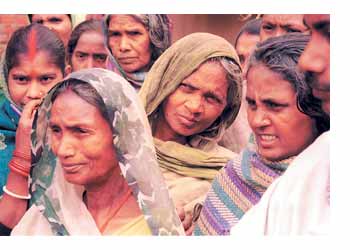
Dalit survivors of a massacre in Bihar. India,
1998.
Photo Smita Narula
Smita Narula, Human Rights Watch’s researcher
on India, investigated how caste has been used to deprive India’s
160 million Dalits – more than one sixth of the country’s population
– of the most basic resources, freedoms, and dignity. To prepare
the recommendations of her report and an advocacy strategy, she convened
a series of meetings with forty activists from eight Indian states. The
meetings launched a national campaign of grassroots organizations working
together to protect Dalit rights. Its aim is to hold the Indian government
accountable for its failure to genuinely abolish untouchability and to
press the government to prevent and prosecute widespread human rights
abuses against Dalits.
The Dalit campaign has reached far and wide throughout India. National
discussion of human rights is now infused with attention to Dalit issues.
Some 2.5 million people signed a petition demanding basic human rights
for Dalits, which was presented to the Indian prime minister. The campaign
so far has emphasized mobilizing Dalit women to secure greater protection
from sexual violence; ending degrading, unpaid labor; and, with the help
of Human Rights Watch, drawing national and international attention to
the Dalit plight.
Human Rights Watch’s report, Broken People, has been translated into
several local languages and widely read throughout India and elsewhere.
We are now working with the Dalit campaign and an international coalition
to promote caste-based discrimination as a central agenda item at the
U.N. conference against racism, to be held in September 2001. The campaign
illustrates the power of Human Rights Watch’s research and advocacy
to spark broad movements for change.
|
|