|
|
What can we do when people who abuse human rights are beyond
shame? That is the problem presented by Angola. The challenge has forced
us to adopt new and innovative techniques to improve human rights.
After more than twenty-five years of destruction and the
displacement of nearly one million people, Angola is a human rights disaster.
Human Rights Watch has documented extensive torture, “disappearances,”
summary executions, and the use of landmines by the government, as well
as widespread indiscriminate shelling, mutilations, hostage-taking, and
the use of child soldiers by the UNITA rebel group. Our Angolan colleagues
who speak out for justice have been jailed. The abuses have been so long-lasting
and persistent that the world seems to have stopped caring. That is what
led Human Rights Watch researcher Alex Vines, a leading expert on Angola,
to learn the diamond and oil industries.
A seemingly benign luxury item, diamonds have financed arms purchases
by UNITA. This fatal trade has persisted despite U.N. sanctions to curtail
it. To expose this diamonds-for-weapons trade, Vines gathered evidence
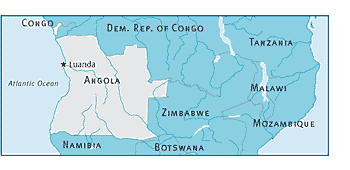
over a four-year period in Angola, Zambia, South Africa, Belgium, Britain,
Bulgaria, Burkina Faso, France, the Netherlands, and the United States.
His research showed the elaborate steps that UNITA had taken to bypass
the U.N. embargo and obtain arms.
Similarly, the Angolan government, enriched by its own oil wealth, purchased
arms from Belarus, Brazil, Bulgaria, China, and South Africa. This influx
of weapons undermined the uneasy peace agreement signed by both parties
in 1994.
A Human Rights Watch report that included documentation on the Angola
diamond trade became essential reading for a panel of U.N. experts assigned
to reinforce the Angola sanctions. Canadian Ambassador Robert Fowler,
chair of the U.N. committee that sponsored the panel, commended Human
Rights Watch publicly for revealing information that countries with full-fledged
intelligence operations had been unable to discover.
Our report and advocacy with DeBeers were influential in the giant diamond
cartel’s decision to cease buying Angolan rough diamonds and diamonds
from other conflict zones. We are also in dialogue with oil companies
such as BP, Royal Dutch-Shell and Chevron about how they can ensure that
the revenue they generate not underwrite the government’s war-related
abuses.
The tragedy of Angola highlights the need for constant innovation in the
ways we defend human rights. One way or another we try to raise the cost
of human rights abuse. If sometimes we can no longer shame abusive forces,
the least we can do is try to deprive them of the revenue needed to purchase
the arms they use to violate rights.
|
|