Waiting for Justice
Accountability before Guinea’s Courts for the September 28, 2009 Stadium Massacre, Rapes, and Other Abuses
Summary
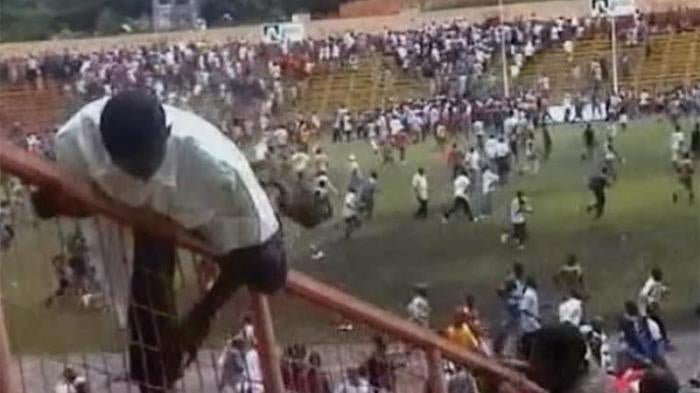
Shortly before noon on September 28, 2009, several hundred members of Guinea’s security forces burst into a stadium in Guinea’s capital, Conakry, and opened fire on tens of thousands of opposition supporters peacefully gathered there for a rally. By late afternoon, at least 150 Guineans lay dead or dying, and dozens of women had been individually or gang raped, and sexually assaulted with objects such as batons, rifle butts, and bayonets. In the hours and days that followed, the security forces engaged in an organized cover-up to hide the number of dead by sealing off and removing bodies from the stadium and morgues and burying them in mass graves.
Guinea’s people have been repeatedly subjected to human rights violations during successive authoritarian and repressive regimes since the country gained independence from France in 1958. However, the September 28 massacre, rapes, and other abuses were among the country’s worst episodes of abuse.
In October 2009, a Human Rights Watch investigation suggested that the killings, rapes, and other abuses that security forces committed on and after September 28 rise to the level of crimes against humanity due to their widespread and systematic nature, and evidence that the crimes were premeditated and organized. A United Nations (UN) International Commission of Inquiry (ICOI) set up in October 2009 also found it was “reasonable to conclude” that crimes against humanity had occurred.
Based on research in Conakry in June 2012 and follow-up interviews with government officials, justice practitioners, civil society members, journalists, victims, and international partners, this report analyzes Guinea’s efforts to hold perpetrators of the September 28, 2009 massacre, rapes, and other abuses to account with a view to promoting fair, effective investigation and prosecutions of the crimes. It builds upon two previous Human Rights Watch reports—“We Have Lived in Darkness”: A Human Rights Agenda for Guinea’s New Government (2011) and Bloody Monday: The September 28 Massacre and Rapes by Security Forces in Guinea (2009).
Guinea began a new era in December 2010when Alpha Condé became its first democratically elected leader since independence. President Condé and other Guinean officials have on multiple occasions voiced their support for accountability, including for the September 28 crimes. However, this report finds that official rhetoric has not adequately translated into action, and that Guinea’s government has taken too few meaningful steps to support justice for victims of the September 28 massacre, rapes, and other abuses.
A domestic panel of judges investigating the September 28 crimes has taken important strides, including hearing from many victims and filing charges against multiple suspects. However, its work has been stymied by lack of basic supplies, security, and other assistance from the Guinean government, and three years after the crimes were committed, and well over two years after the panel was appointed, pre-trial investigation has yet to be completed.
While cases involving serious crimes can be sensitive and difficult, the potential costs of failing to hold perpetrators to account and take into account victims’ needs underscore the vital importance of fair, effective, and independent investigation and prosecution. Lack of greater government support for the investigation raises questions as to the government’s political will to ensure accountability for the September 28 massacre, rapes, and other abuses—as Guinean civil society, victims, practitioners, and international observers have noted with concern.
Important Steps
Over the past two years, the investigative judges have heard from more than 200 victims, many of whom are formal parties to the investigation—known as partie civile[1]— and are represented by private lawyers, with legal and financial assistance from Guinean and international nongovernmental organizations (NGOs). The judges also have filed charges against, or questioned, at least seven suspects, several of whom have been taken into custody. Of these, one has since been released.
In February 2012 the investigation took a meaningful step forward when Colonel Moussa Tiégboro Camara—Guinea’s current minister in charge of fighting drug trafficking and organized crime (ministre à la présidence chargé de la lutte anti-drogue et du grand banditisme)—became the highest-level suspect to face questioning and charges. According to Guinean legal practitioners, the Guinean judiciary has never brought such a high-level official in for questioning in a criminal case where the victims are civilians. Human Rights Watch and the ICOI both identified Tiégboro Camara as warranting investigation for the September 28 crimes.
More recently, in September 2012, the judges brought charges in relation to the September 28 massacre, rapes, and other abuses against Colonel Abdoulaye Cherif Diaby, who was health minister on September 28, 2009.[2] The ICOI identified Diaby as someone whose role in the September 28 crimes should be investigated.
Undermining Factors
Despite these advances, the investigation that has taken place has progressed very slowly, and several key steps are needed to bring it to a close. Some 100 or more victims are still waiting to give statements to the judges, who have also yet to interview key suspects. These include Guinea’s former President Captain Moussa Dadis Camara, Minister of Presidential Security Captain Claude “Coplan” Pivi, and witnesses who are members of Guinea’s security services who are neither victims nor suspects. The judges also have yet to access potential mass graves or to interview individuals in nearby areas. Meanwhile, some suspects have already been in pre-trial detention longer than the two years permitted by Guinean law.
Four major factors appear to have undermined momentum in the judicial investigation of the alleged perpetrators of the September 2009 crimes:
- An insecure political landscape;
- Lack of judicial independence;
- Limited government support for the investigation; and
- Other legal and institutional obstacles, namely: insufficient protection of rights of the accused, lack of witness and victim protection and support, and inadequate laws.
Insecure Political Landscape
Guinea’s political and security situation remains precarious following the country’s transition in 2010 from 50 years of abusive and authoritative rule. The continued strength of the military is a major factor in this instability, as is the lack of parliamentary elections since Condé took office in late 2010.
In principle, this landscape should have no bearing on the work of the panel of judges. However, at the very least, the context appears to foster an environment in which pursuing cases against officials implicated in crimes that likely constitute crimes against humanity is more difficult and sensitive.
Lack of Judicial Independence
Guinea’s chronically underfunded and neglected justice system—and especially the lack of judicial independence—compounds the difficulties of fair, credible investigation and prosecution of the September 28 crimes.
While the constitution recognizes judicial independence, Guinean law and practice do not. The president and justice minister are involved in appointing and disciplining judges and low salaries make judges vulnerable to corruption. Guinean legal experts indicated to Human Rights Watch that the tradition of lack of judicial independence also appears to contribute to reticence by judges to act without clear encouragement from the executive.
Limited Government Support for Investigation
Guinean authorities have expressed a commitment to ensure justice for the crimes, but have taken inadequate action to ensure this happens.
For example, the investigative judges were initially assigned premises in a building shared with a gendarmes and police unit (Force spéciale de sécurisation du processus électoral, FOSSEPEL) tasked with ensuring security around the 2010 presidential election. This posed a security risk for the judges and their visitors, as sensitive activities became visible and vulnerable to monitoring by people with possible ties to security service members implicated in the 2009 crimes. The judges remained in that location for about a year, without any personnel dedicated to their security, until they were moved in September 2011 to the premises of the Court of Appeal.
Security continues to present challenges. While a team of gendarmes was assigned to provide the judges with ongoing security at their offices in 2011, the judges appeared to feel obliged to end this due to lack of resources.
In 2011 and 2012 the Justice Ministry took many months, if not more than a year, to begin to address the panel’s lack of basic supplies, including pens, paper, equipment, and transport. This led to a near-total halt in the panel’s work from May to September 2012, when the judges finally received a computer and a weekly stipend, and resumed taking victims’ statements. In addition, the justice minister had for multiple months declined for Guinea to avail itself of international technical assistance to support the investigation offered by the United Nations Office of the Special Representative of the Secretary-General on Sexual Violence in Conflict since late 2011, although the government formally accepted such expertise in late October 2012.
Judicial police, who are overseen by prosecutors—the procureur de la république and procureur général, have also failed to respond to the judges’ request submitted to its director in 2010 to access a potential mass grave and interview individuals in the surrounding area.
Furthermore, it is unclear as to how actively Foreign Ministry officials have pursued obtaining a response from the Burkina Faso government regarding an international request for legal assistance. Known as a rogatory commission, the ministry submitted the request to judges in 2011 to interview former President Dadis Camara in Burkina Faso, where he is in exile. Guinean Justice Ministry officials were unable to provide Human Rights Watch with a detailed update as to the status of the request or explain why it is still outstanding. When Human Rights Watch sent a query to Burkina Faso’s Foreign Ministry, it was unclear whether officials there knew about the rogatory commission.
Finally, at least two high-level officials implicated in the crimes, Moussa Tiégboro Camara and Captain Claude “Coplan” Pivi, remain in their government posts instead of being placed on leave pending investigation. This is despite the fact that their positions could influence the criminal investigation and prosecution, and runs counter to a credible judicial process.
Legal and Institutional Obstacles
Several other legal and institutional obstacles continue to raise concern for fair, effective proceedings. These include insufficient protection of rights of accused, lack of a protection and support scheme for witnesses and victims, and inadequate laws.
Extended pre-trial detention—exceeding two years—and access to counsel are significant problems for suspects of the September 28 crimes, and are contrary to international fair trial standards. With regard to witness protection, trials of serious crimes can be extremely sensitive and create risks for witnesses and victims who may testify to deeply traumatic events. Guinea has no tradition of providing witnesses or victims protection and support, although Guinean law does provide some sanctions for intimidating witnesses.
Guinean law also does not define as crimes torture and crimes against humanity (defined by the widespread or systematic nature of their commission, as part of an “attack,” or state or organizational policy, against a civilian population). As a result, the September 28 crimes are expected to be prosecuted as ordinary crimes, such as murder, rape, and organized crime. However, prosecuting the abuses as if they were ordinary crimes may not capture their gravity, nor may it address the needed range of liability. For example, liability such as “command responsibility,” can be important to encompass liability beyond physical commission of the crime. The death penalty also is available as a punishment, but should not be available due to its inherent cruelty.
Necessary Steps: Guinea
The Guinean government—the president and justice minister in particular—should meet a number of key benchmarks to ensure the panel of investigative judges can operate effectively, namely: ensuring adequate resources and security for the judges, facilitating the appointment of relevant international experts to support the investigation, placing key suspects on leave from their government posts, and redoubling efforts to secure an affirmative response to the judges’ request to interview former President Dadis Camara.
The procureur général and the procureur de la république should ensure that the judges are able to work exclusively on the September 28 investigation, access potential mass graves, and interview persons in surrounding areas.
The judges should swiftly address any illegal pre-trial detention of suspects of the September 28 crimes, bringing any persons who need to remain in pre-trial detention to a speedy trial or release. In addition, access to representation should be made available as soon as one is detained, and if suspects lack means, representation should be available free of charge consistent with Guinean and international law.
The justice minister should initiate the development of a witness and victim protection and support scheme. With regard to legal reform, International Criminal Court (ICC) implementing legislation is needed that makes genocide, war crimes, and crimes against humanity consistent with international standards punishable crimes under Guinea’s domestic law. A law is also needed that incorporates a specific crime of torture consistent with Guinea’s obligations under the Convention against Torture and Other Cruel, Inhuman or Degrading Treatment or Punishment (Convention against Torture). Since these crimes were already established as such under international law, prosecuting the crimes committed before their domestic codification would not violate the principle of non-retroactivity. The death penalty should be abolished.
Some Guinean civil society and victims indicate they are waiting for the International Criminal Court— to which Guinea is a state party, and whose Office of the Prosecutor has placed Guinea under preliminary examination—to open an investigation in Guinea so that perpetrators are held to account. Whether this happens is an open question: under the ICC’s complementarity principle, the court only acts where national authorities are unable or unwilling to prosecute. But even if it were to open an investigation, its scope to ensure justice is limited since it is based thousands of miles away in the Netherlands, and only focuses on suspects with the greatest alleged levels of responsibility, and on genocide, war crimes, and crimes against humanity.
Necessary Steps: International Community
Guinea’s international partners—the United States (US), European Union (EU) and Office of the High Commissioner for Human Rights (OHCHR) in particular—juggle a wide range of objectives vis-à-vis Guinea, and diplomats sometimes view pressing for accountability there as too sensitive or difficult. However, experience has shown that the risks of not prioritizing justice for serious crimes are too high to ignore.
The international community can play a crucial role in maximizing prospects for fair, credible justice for the September 28 crimes through encouragement, pressure, and support. In particular, international partners can build upon the expressed commitments of Guinea’s government and the investigative panel’s work to press its authorities to ensure justice for crimes that day.
Several international partners—notably the ICC and the UN Office of the Special Representative of the Secretary-General on Sexual Violence in Conflict— have made vital contributions to encouraging effective investigation by privately and publicly pressing for accountability, supporting the process with relevant expertise, and identifying gaps in the investigation’s progress. The ICC has played a pivotal role in keeping accountability on the government’s agenda and fostering progress in the investigation by regularly visiting Guinea and discussing progress in the investigation with media—activities that should continue.
The OHCHR has raised concerns over impunity and provided some informal supplies, such as paper, to the judges. However, as a primary international actor in Guinea with a mandate to promote human rights and implementation of the ICOI’s recommendations, Human Rights Watch believes the OHCHR should take a more active role via more in-depth and robust public and private pressure on the government to resolve impediments to the investigative panel’s effective functioning.
A number of Guinea’s international partners are involved in wider efforts to promote domestic accountability globally for serious crimes. In particular, states parties to the ICC are increasingly focused on identifying ways to better ensure that its complementarity principle—by which the ICC only intervenes where national courts are unable or unwilling to prosecute—is effectively put in practice. In this context, Guinea’s efforts to ensure justice for the September 28 massacre, rapes, and other abuses are a potentially important test case for the international community to help ensure accountability at the domestic level.
Key government and intergovernmental actors—the EU, Economic Community of West African States (ECOWAS), US, France, and Germany—should substantially increase public and private diplomacy with Guinean officials to ensure investigative judges can work effectively. While public pressure may not always be appropriate, limited public statements by such actors on accountability for the September 28 crimes over the past two years risks signaling that the issue is not a serious concern.
International partners also appear to provide no direct support for investigating and prosecuting the September 28 crimes. The EU, ECOWAS, US, France, Germany, UN Development Program (UNDP), and UN Peacebuilding Fund (PBF) should raise with Guinean officials the issue of assistance that could be made available. They should invite requests for support, such as in the areas of witness and victim protection and support; forensic investigation and relevant expertise; training for practitioners on serious crimes investigation, prosecution, and defense; and law reform.
International partners should also assess whether international security for the judges is needed and provide support that is requested. As proceedings advance, support for adequate defense representation, and outreach and public information to the local population about the process also are likely to be important.
The UN Peacebuilding Commission (PBC) is a more recent partner that has raised accountability and secured commitments by the Guinean government to support the September 28 investigation. It should press the government to deliver on these commitments and use its unique role as an intergovernmental advisory body to promote coordination among Guinea’s partners to insist on credible prosecutions for the September 28 crimes.
The Imperative to Act
International law mandates prosecuting serious crimes that violate international law—genocide, war crimes, and crimes against humanity. This duty to prosecute lies primarily with domestic authorities, but can also rest with international courts and with countries where suspects are present.
But justice has a human—not just legal—imperative. Guinean victims have repeatedly called for perpetrators of the September 28, 2009 crimes to be held to account. Justice gives victims a chance to achieve a measure of redress for the harms they have suffered, and strengthens the rule of law, which in turn helps to promote long-term peace and stability. Notably, the World Bank’s 2011 report, Conflict, Security, and Development, identified justice as one of three crucial elements needed “to break cycles of violence.” This is particularly true in Guinea where the persistent state failure to investigate and hold accountable alleged perpetrators has contributed to more violations.
Intensified efforts by UN, government, and intergovernmental actors can promote fair, credible justice and demonstrate the international community’s commitment to hold perpetrators accountable for their crimes. Ultimately though, Guinea’s government should deliver on its expressed dedication to ensure justice is served by increasing its support for investigation and prosecution related to the crimes committed around September 28, 2009.
Domestic accountability has its challenges: cases involving serious crimes are often sensitive and need resources that are scarce. But failure to act and impunity for perpetrators of abuse also carry high costs by potentially fueling renewed abuses that are devastating for the population and national development, and sending a strong signal that Guinea is not committed to accountability. Credible domestic investigation and prosecution would not only help victims to achieve some redress, it would be a major contribution in moving Guinea to a new era characterized by respect for rule of law and human rights.
Recommendations
To the Guinean Government, Particularly the President and Justice Minister
- Reaffirm respect for the independent investigation of the perpetrators of crimes committed during the September 28 violence and its aftermath, leading to credible prosecution within a reasonable time frame.
- Ensure adequate supplies, equipment, and transport assistance to the panel of judges investigating the September 28, 2009 massacre, rapes, and other abuses.
- Ensure the judges have adequate security at their office and additional security during non-business hours as needed.
- Place on administrative leave those in government positions who have been identified as implicated in crimes committed during the September 28 violence and its aftermath, and are in a position to influence or appear to influence any criminal investigation and prosecution, pending a final prosecution or conclusion of the investigation.
- Redouble efforts to secure an affirmative answer to the international rogatory commission submitted to Burkina Faso to interview former President Dadis Camara.
- Discuss with the European Union, Economic Community of West African States, United States, France, Germany, United Nations Development Program, and UN Peacebuilding Fund assistance that may be available to support justice for the September 28 crimes, such as regarding a witness and victim protection and support scheme, forensic investigation and expertise, training for practitioners on serious crimes, international security assistance, law reform, defense representation, and outreach and public information to the local population.
- Avail Guinea of international expertise to support investigation of the September 28 crimes.
- Support abolition of the death penalty and adoption of legislation to implement the International Criminal Court’s Rome Statute and the Convention against Torture domestically.
- Ensure the prompt establishment and independence from government control and direction of the Conseil supérieur de la magistrature tasked with the discipline, selection, and promotion of judges.
To the Procureur de la République and Procureur Général
- Encourage compliance by the judicial police with any and all requests by the panel of judges, including to access an identified possible mass grave and to question individuals in the surrounding area.
- Ensure the judges are able to work exclusively on the September 28 investigation.
To the Panel of Investigative Judges
- Move swiftly to address illegal pre-trial detention of suspects, including ensuring all detainees appear promptly before a judge, and are informed of criminal charges against them.
- Question key suspects of the September 28, 2009 massacre, rapes, and other abuses.
- Question witnesses, including members of the security services, who are neither suspects nor victims.
- Access potential mass graves and interview individuals in the surrounding areas.
- Ensure all suspects have access to legal representation, regardless of whether they have the means for such representation.
- Withhold identifying information for witnesses and victims who may be at risk from the investigation dossier until such information becomes necessary to enable accused and their lawyers to adequately prepare their defense.
To the Government of Burkina Faso
- Affirmatively respond to the international rogatory commission submitted by Guinea to Burkina Faso to interview former President Dadis Camara in relation to the investigation of crimes committed during the September 28, 2009 violence and its aftermath.
To United Nations, Intergovernmental, and Government Partners
(including the Office of the High Commissioner for Human Rights, the United Nations Peacebuilding Fund and Development Program, the European Union, the Economic Community of West African States, the United States, France, Germany, and the Peacebuilding Commission)
- Intensify communication with Guinean officials and issue public statements regarding the importance of fair, independent investigation and prosecution of the September 28 massacre, rapes, and other abuses.
- Call for and actively discuss with Guinean officials—particularly the president and the justice minister—the need to ensure the investigative panel can work effectively, including by having adequate resources and security for the judges, facilitating the appointment of relevant international experts to support the investigation, placing key suspects on leave from government posts, and securing a satisfactory response to the judges’ request to question former President Dadis Camara.
- Call for the procureur de la république and procureur général to ensure the judges are able to work exclusively on the September 28 investigation and the judicial police comply with any and all requests by the panel of judges, including to access an identified possible mass grave, and to question individuals in the surrounding area.
- Call for the Guinean government and parliament, once elected, to abolish the death penalty and enact legislation to implement the ICC’s Rome Statute and the Convention against Torture domestically.
- Discuss with Guinean officials international assistance that could be made available to support accountability for the September 28, 2009 crimes and invite relevant requests for assistance from the Guinean government in areas such as a protection and support scheme for witnesses and victims acting as partie civile; forensic investigation of mass graves and relevant expertise; training for relevant practitioners in investigating, prosecuting, and defending cases involving serious crimes; and law reform to abolish the death penalty, and implement the ICC’s Rome Statute and the Convention against Torture domestically. As proceedings advance, discuss possible needed support for adequate defense representation to suspects of the September 28 crimes and outreach and public information to the local population on the process.
- Increase coordination among international partners to press for and support accountability for the September 28 crimes.
To the International Criminal Court Prosecutor
- Continue to press for fair, credible prosecutions for those implicated in serious crimes committed during the September 28 violence and its aftermath, including through regular visits and comments to the media about the investigation’s progress.
- Continue to call for Guinean officials—particularly the president and the justice minister—to ensure the investigative panel can work effectively, including by having adequate resources and security for the judges, facilitating the appointment of relevant international experts to support the investigation, placing key suspects on leave from government posts, and securing a satisfactory response to the judges’ request to question former President Dadis Camara.
- Call for the procureur de la république and procureur général to ensure the judges are able to work exclusively on the September 28 investigation and the judicial police comply with any and all requests by the panel of judges, including to access an identified possible mass grave, and to question individuals in the surrounding area.
- Discuss with Guinean officials international assistance that may be available to assist accountability efforts and identify areas where ICC officials may have practical expertise to share, such as with regard to witness protection.
- Intensify communication with Guinean civil society to ensure they have accurate expectations concerning the timing of the ICC prosecutor potentially seeking to open an investigation into the September 28 crimes.
To the United Nations Office of the Special Representative of the Secretary-General on Sexual Violence in Conflict and the Office’s Team of Experts for Rule of Law/Sexual Violence in Conflict
- Continue to call publicly for accountability for the September 28 crimes.
- Continue to work with Guinean officials to ensure the effective deployment of an expert to support the investigation of sexual crimes committed on September 28, 2009 and during its aftermath, including in investigative methods, case management, victim and witness protection, civil society interaction, and public information.
Methodology
The report is based primarily on research conducted by two Human Rights Watch staff in Conakry between June 18 and June 29, 2012.
During the mission, staff conducted approximately 25 interviews in French and English with Guinean government officials, including in the Justice Ministry; practitioners with knowledge of the September 28, 2009 investigation, including judges, prosecutors, lawyers, and legal support staff; international partners, including Western diplomats, United Nations officials, and NGO staff; and Guinean civil society members, journalists, and victims.
Between July 2012 and November 2012, staff conducted additional interviews in French and English in New York and by telephone with United Nations officials, Western and West African diplomats, International Criminal Court officials, and Guinean government officials, along with obtaining further information through email exchanges.
Guinea’s justice minister was not in the country when Human Rights Watch staff conducted research there in June 2012. Human Rights Watch researchers sent a letter to the minister in September 2012 to obtain information from him on issues detailed in this report. At time of writing, the justice minister had not yet responded to the letter.
Many individuals interviewed wanted to speak candidly, but did not wish to be cited by name, citing the sensitivity of the issues discussed. As a result, generic descriptions of all interviewees are used throughout the report to respect the confidentiality of these sources.
In October and November 2012, Human Rights Watch circulated an earlier version of this report in English around diplomatic meetings in New York and The Hague where delegates discussed the ICC’s complementarity principle.
I. Background
Shortly before noon on September 28, 2009, several hundred members of Guinea’s security forces burst into a stadium in Guinea’s capital, Conakry, and opened fire on tens of thousands of opposition supporters peacefully gathered there.[3] By late afternoon, at least 150 Guineans lay dead or dying in and around the stadium.
Inside the complex, bodies lay strewn across the field, crushed against half-opened gates, draped over walls, and piled outside locker room doors pulled shut by the terrified few who had managed to get inside them. There was also evidence of violence outside the stadium, where security forces and men in civilian dress armed with sticks and knives had waited for panicked opposition supporters escaping from the main stadium. Among those killed outside the stadium was a man who was trying to use his taxi parked outside to assist the wounded. Members of the elite Presidential Guard, commonly referred to as “red berets,” had approached him and demanded the keys, then shot him dead when he refused.
Dozens of women at the rally suffered particularly brutal forms of sexual violence at the hands of the security forces, including individual and gang rape and sexual assault with objects such as sticks, batons, rifle butts, and bayonets. At least four women and girls were murdered during or immediately after being raped. In addition to the rapes at the stadium, five victims whom Human Rights Watch interviewed described being taken by the Presidential Guard to at least two private residences, where they endured days and nights of gang rape and other forms of physical and psychological abuse.
During the afternoon and evening of September 28, tens of soldiers wearing red berets also ransacked the houses of three opposition party leaders. In addition, in the hours and days after the stadium violence, heavily armed soldiers dressed in camouflage and wearing red berets, and civilians armed with knives, machetes, and sticks, committed scores of abuses in those neighborhoods where the majority of participants in the September 28 rally lived. In some cases, the soldiers and armed civilians appeared to be collaborating to commit abuses.
In the hours and days following the violence, as desperate mothers, fathers, and other family members attempted to find their loved ones, the security forces engaged in an organized cover-up to hide the number of dead. Security forces sealed off the stadium and morgues, removed scores of bodies, and buried them in mass graves.
A Human Rights Watch investigation found that most killings, sexual assaults, and other abuses were committed by members of the Presidential Guard, in particular the unit directly responsible at the time for the personal security of Guinea’s president, Moussa Dadis Camara. Others who committed serious abuses included gendarmes, police, and men in civilian clothes armed with machetes and knives.
The evidence that Human Rights Watch gathered suggested that the killings, rapes, and other abuses that were committed by the security forces on and after September 28, 2009 rise to the level of crimes against humanity due to their widespread and systematic nature and evidence that the crimes were premeditated and organized.
A commission of inquiry established by the United Nations secretary-general (International Commission of Inquiry) had similar conclusions, stating: “The [c]ommission believes that it is reasonable to conclude that the crimes perpetrated on 28 September 2009 and in the immediate aftermath can be described as crimes against humanity. These crimes are part of a widespread and systematic attack launched by the Presidential Guard, the police responsible for combating drug trafficking and organized crime and the militia, among others, against the civilian population.”[4]
A national commission of inquiry established by the Guinean government also found in February 2010 that murder and rape were committed during the September 28 violence. However, contrary to investigations by Human Rights Watch and the ICOI, the commission found that the death toll was less than 75 and that the former president was not implicated in the crimes.[5]
II. The Need for Justice
The people of Guinea have been repeatedly subjected to human rights violations during successive authoritarian and repressive regimes since the country became independent in 1958.[6] At the same time, the September 28 massacre, rapes, and other abuses were among the country’s worst episodes of abuse.[7]
International law mandates prosecution of those against whom there is evidence suggesting responsibility for serious crimes committed in violation of international law—namely genocide, war crimes, and crimes against humanity.[8] The duty to prosecute lies primarily with the domestic authorities but can also lie with the countries where suspects are present and international courts.
But justice is also crucial from a more human perspective. Guinean victims have repeatedly called for perpetrators to be held to account.[9] Victims stress the need to secure the truth of what has happened, to see justice done, and to have prosecutions without delay; many of the victims suffer poor health due to injuries they suffered and are concerned they may not have the chance to see accountability done.[10]
Fair, credible prosecutions of the September 28 crimes can give these victims a measure of redress for the horrific harms they have suffered. Accountability for the gravest crimes also helps to strengthen respect for the rule of law, which in turn helps to promote long-term peace and stability. As the United Nations secretary-general’s 2004 seminal report on the rule of law indicates, justice can play an essential role in transitional societies:
[E]xperience in the past decade has demonstrated clearly that the consolidation of peace in the immediate post-conflict period, as well as the maintenance of peace in the long term, cannot be achieved unless the population is confident that redress for grievances can be obtained through legitimate structures for the peaceful settlement of disputes and the fair administration of justice.[11]
More recently, the World Bank’s 2011 World Development Report, Conflict, Security, and Development stated as its “central message … that strengthening legitimate institutions and governance to provide citizens security, justice, and jobs is crucial to break cycles of violence.” [12]
This is particularly the case in Guinea. Persistent impunity for human rights violations for decades has been a major problem that has emboldened perpetrators.[13] Victims and civil society repeatedly told Human Rights Watch that they view the lack of justice for previous human rights abuses as having fueled the intense level of brutality during the September 28 massacre.[14] As highlighted in the ICOI report,
The Guinean people have long been subject to coups d’états accompanied by grave and repeated violations of human rights. This situation is made possible by the existence of a very particular kind of army in Guinea and the repeated violations of human rights is a consequence of the impunity that is virtually institutionalized. These two phenomena—an atypical army and institutionalized impunity—are the real and profound weaknesses of the political system in Guinea.[15]
In October 2009 the Office of the Prosecutor of the International Criminal Court indicated that the situation in Guinea was under preliminary examination.[16] Shortly thereafter, then-Guinean Minister of Foreign Affairs Alexandre Cécé Loua indicated to the ICC that Guinea would ensure justice domestically.[17]
The primary obligation to provide accountability for the perpetrators of the September 2009 violence rests with national authorities in Guinea. Although Guinea is a party to the ICC, the latter has a mandate that limits it to prosecute the crimes of genocide, war crimes, and crimes against humanity only when national authorities are unable or unwilling to bring justice for them, which is known as the “complementarity principle.”[18]
Complementarity respects the principal role of national courts and encourages the development of credible and independent domestic judicial systems. Moreover, national trials of serious crimes are most often best placed to ensure justice efforts have maximum resonance with local populations, and in turn to strengthen respect for rule of law in the relevant country. In addition, international tribunals will only ever be able to prosecute a limited number of individuals—usually at the greatest levels of alleged responsibility—while the fight against impunity requires a more far reaching response.
The value of domestic accountability does not negate its challenges. Cases involving serious crimes are often highly sensitive and necessitate resources in often-tight funding environments. But the alternative, impunity, threatens high costs too by risking fueling renewed abuses, with devastating consequences for the population and national development. Credible domestic efforts to ensure perpetrators are held to account not only provide communities directly affected by the crimes access to the proceedings and to redress, but also send a strong signal that human rights violations will not be tolerated.
III. Steps toward Justice
Since 2010 Guinea has made important strides in investigating the September 28 massacre, rapes, and other abuses. While much of the detail of the investigation is secret, consistent with Guinean criminal procedure,[19] available information on its progress is discussed below.
Establishment and Offices
In early 2010 a Guinean prosecutor assigned a three-judge panel to investigate crimes committed around September 28, 2009, consistent with Guinean law.[20]
Several months after beginning work, the upper floor of the small building in which the judges had received office space was allocated to the Special Force for a Safe Electoral Process (Force spéciale de sécurisation du processus électoral, FOSSEPEL), a unit comprised of gendarmes and police with a mandate to ensure security around the 2010 presidential election. This created significant security risks for the judges and their visitors, including victims, as sensitive activities became visible and vulnerable to monitoring by individuals with possible ties to security service members implicated in the crimes.[21]
For about a year, the judges remained in the same premises as FOSSEPEL—and without any personnel dedicated to their security. Civil society and international partners pressed for these security concerns to be addressed.[22] The judges’ offices were ultimately moved to the premises of the Court of Appeal in Conakry in September 2011, and a team of gendarmes was assigned to provide dedicated security for the judges during business hours.[23] As discussed in Section V, security challenges remain, however.
Victims
Practitioners working with the investigation indicate that since the panel was established, more than 200 victims have appeared before the judges to give statements concerning crimes committed during the September 28, 2009 violence.[24]
Some victims have appeared without counsel. Others have been accompanied by lawyers who are representing them in connection with a partie civile[25] action to the September 28 investigation, which the International Federation for Human Rights (Fédération internationale des ligues des droits de l'homme, FIDH) and the Guinean Organization for Human Rights (Organisation guinéene de défense des droits de l’homme et du citoyen,OGDH) has initiated with victims’ associations and individual victims.[26] Some victims who initially appeared without counsel have since returned to give additional statements with the assistance of counsel.[27]
Estimates of the time victims spend with the judges range from approximately thirty minutes to four hours, and statements tend to be substantially longer and more thorough when a lawyer is present.[28] Victims have described giving statements as a positive experience in which the judges listen to them, although practitioners also have noted that the questions posed by the judges are few in number and not detailed.[29] After the victim concludes, the judges dictate a summary of the statement to a court official, known as the greffier, and all statements are kept in an investigation dossier.[30] Consistent with standard Guinean law and practice, lawyers for both victims and suspects can access the dossier.[31]
Suspects
Information available to Human Rights Watch indicates that to date at least seven individuals have been charged, questioned, or detained in relation to their alleged involvement in the September 28 crimes; one was later released on the basis that he was not present during the September 28 violence.[32] Given that crimes against humanity and a specific crime of torture are not incorporated into Guinea’s domestic law, suspects are charged with ordinary crimes, such as murder, rape, or organized crime.[33]
Second Lieutenant Marcel Kuvugi, a member of the red berets, was first taken into custody in June 2010.[34] Human Rights Watch and the International Commission of Inquiry both identified Kuvugi as someone who should be investigated for his role in the crimes.[35] Kuvugi’s detention documents identify him as being suspected of murders, assassinations, rapes, and torture committed during the events of September 28, 2009.[36]
According to a defense lawyer, Kuvugi was questioned by the judges several weeks after he was first detained, during which he indicated that he was not present at the stadium on September 28, 2009, as he was recovering from oral surgery. [37] Kuvugi was offered the opportunity to secure a lawyer to represent him during questioning but declined citing lack of resources. [38] This is contrary to international fair trial standards that require that defendants should be afforded a lawyer free of charge should they lack means to pay for one. [39]
In February 2011 Kuvugi obtained legal representation, and in March 2011 Kuvugi’s lawyer requested that Kuvugi be released subject to conditions by the judges based on poor health.[40] The request was denied and his detention renewed.[41] In December 2011 the judges renewed his detention for six months.[42] As of September 2012 he remained in custody without a legal basis for his continued detention.[43]
Three other individuals whose identities are unknown to Human Rights Watch have also been taken into custody for their role in the crimes; one was later released on the basis that he was not present during the September 28 violence.[44]
Lieutenant Aboubakar “Toumba” Diakité, former President Camara’s aide-de-camp and head of his personal security in September 2009, also faces charges, but his whereabouts are unknown. Human Rights Watch and the ICOI identified Toumba as someone whose role in the September 28 crimes should be investigated.[45]
Toumba fled Guinea after the former president was shot in December 2009, and Toumba told the media he shot him because Camara sought to place primary responsibility for the September 28 crimes on Toumba.[46] On January 19, 2011, Interpol issued an international notice for Toumba’s arrest and extradition, listing crimes against humanity and sex crimes among the offenses for which he is sought.[47]
In February 2012 the investigation took a meaningful step forward when Moussa Tiégboro Camara became the highest-level suspect to face charges and questioning.[48] Tiégboro Camara is Guinea’s minister in charge of fighting drug trafficking and organized crime (ministre à la présidence chargé de la lutte anti-drogue et du grand banditisme), a position he held during the September 28 violence and its aftermath and has retained to the present. In this role, he has a visible and influential role in Guinea’s security forces. Human Rights Watch and the ICOI both identified Tiégboro Camara as an individual whose role should be investigated.[49]
On February 8, 2012, Tiégboro Camara appeared before the judges. He was questioned for several hours, during which he denied involvement in the crimes.[50]
The Guinean judiciary has never brought such a high level official in for questioning in association with a criminal case where the victims are civilians, according to information available to Human Rights Watch.[51] Some civil society members and legal practitioners noted that Tiégboro Camara’s charging and questioning was a significant move that increased both their confidence in the Guinean judiciary and their expectations that justice for the September 28 crimes might be possible in Guinea.[52] Others were less optimistic about the implications of these developments, however, as Tiégboro Camara was not removed from his government post after being charged and had previously indicated his interest in giving a statement to the judges.[53]
More recently, in September 2012, the judges brought charges against Colonel Abdoulaye Cherif Diaby, who was Guinea’s health minister on September 28, 2009. The ICOI identified Diaby as someone whose role in the September 28 crimes should be investigated. [54]
The judges have also asked to interview former Guinean President Moussa Dadis Camara. Human Rights Watch and the ICOI identified Dadis Camara as someone who should be investigated. [55]
In addition to being president, Dadis Camara held the positions of commander-in-chief of the Guinean armed forces and leader of the National Council for Democracy and Development (Conseil national pour la démocratie et le développement, CNDD) in September 2009. The CNDD represents a group of military officers that had effectuated the bloodless coup in Guinea after President Lansana Conté died in December 2008.
Dadis Camara stepped down as president in December 2009, as he was largely incapacitated after being shot. He went into exile in Burkina Faso, where he has since apparently substantially recovered.[56] According to those close to the investigation, in 2011 the Guinean government transmitted an international request for legal assistance, known as a rogatory commission, to Burkina Faso’s Foreign Ministry for the judges to question Dadis Camara, which remains outstanding.[57]
Investigating Possible Mass Graves
In 2010 the judges submitted a request to the director of judicial police to access a potential mass grave site and to interview individuals in the surrounding area, although there has been no response to the request.[58] The judges learned of additional possible mass grave sites in 2011, but did not request access to them or to interview those in the surrounding areas due to what an interlocutor described as a “lack of resources.”[59]
IV. The Need for Greater Progress
Despite important advances, much more remains to be done to achieve fair, effective investigation and prosecution of the September 28 massacre, rapes, and other abuses.
Three years after the crimes and over two years after the appointment of the panel of judges, the pre-trial investigation has yet to be completed. The process has proceeded slowly and a number of key steps are needed to bring the investigation to a close. Meanwhile, some suspects have been in custody more than two years, the legally permissible period for pre-trial detention.[60]
Consistent with Guinean legal procedure, the process of prosecuting those responsible for the September 28, 2009 massacre is divided into two phases: pre-trial investigation and trial.[61] Pre-trial investigation comprises two levels: first, investigation by the investigating judges and second, if appropriate, investigation by the Chamber of Accusation.
The investigating judges are tasked with confirming the identity of suspects and examining the evidence supporting the charges against them. [62] If the investigating judges determine that the alleged offenses qualify as crimes under Guinean law they order the procureur de la république to transfer the case record, along with all evidence, to the Chamber of Accusation. [63]
The Chamber of Accusation conducts a second level of investigation, during which it may order new investigative actions and issue subpoenas, arrest warrants, pre-trial detention orders, and summons to appear.[64] The purpose of this stage is to confirm any charges already brought against alleged perpetrators and determine whether there are sufficient grounds to begin a trial.[65] Should the case proceed to trial, it will go before the court of first instance in matters involving the most serious domestic crimes, known as the cour d’assises.[66] Appeals from the cour d’assises are heard by the Supreme Court.[67]
At time of writing, the process remained within the first level of investigation and the work of the investigative judges had basically ground to a halt between May and September 2012 as the government—and the justice minister in particular—had failed to ensure the judges had basic supplies, equipment, and transport assistance.[68]
Meanwhile, some 100 or more victims await the opportunity to provide statements to the judges, and key officials implicated in the crimes, notably Captain Claude “Coplan” Pivi and Dadis Camara, have yet to be questioned.[69]
Pivi, the current minister of presidential security under the new government, held the same post during the September 28 violence and its aftermath. Human Rights Watch and the International Commission of Inquiry identified Pivi as someone whose role in the crimes should be investigated.[70] According to Human Rights Watch’s investigation, there are conflicting reports as to whether Pivi was present at the stadium on September 28, but many witnesses stated that he participated in the violent crackdown that followed, including attacks on the homes of political opposition leaders.[71]
The ICOI also identified a number of additional individuals who should be investigated as possible suspects.[72] In addition, there are likely many witnesses to the crimes in the security services that are neither suspects nor victims.[73] The judges do not appear to have questioned additional potential suspects, or witnesses who are not suspects or victims, and the judges should question these individuals.
Finally, the judges have not accessed potential mass grave sites or interviewed individuals in the surrounding areas.
V. Challenges to the Investigation’s Progress
Four major factors appear to have undermined momentum in the judicial investigation of the alleged perpetrators of the September 2009 crimes and engendered a climate that is not conducive to progress:
- An insecure political landscape;
- Lack of judicial independence;
- Inadequate efforts by Guinea’s government to support the investigation; and
- Other legal and institutional obstacles, namely: insufficient protection of rights of accused, lack of protection and a support scheme for witnesses and victims, and inadequate laws.
The lack of greater government support raises questions as to the government’s political will to ensure accountability for the September 28 massacre, rapes, and other abuses. Guinean civil society repeatedly raised concern that the Guinean authorities are not committed to ensuring justice is served.[74]
Several individuals whom Human Rights Watch interviewed indicated that they are waiting for the International Criminal Court to open an investigation so that perpetrators are held to account. [75] Whether the ICC does so is an open question. But even if it were to, the scope of such an investigation would be limited since the ICC is based thousands of miles away in the Netherlands, focuses only on suspects with the greatest levels of responsibility, and on genocide, war crimes, and crimes against humanity—as opposed to a wider range of abuses. [76]
While some interlocutors cite the fragile political landscape as a reason why the government has not better supported the investigation, the government should not lose sight of the potential implications of failing to ensure justice.[77] As highlighted in Section II of this report, impunity has been a major factor in fueling violence and abuse in Guinea.
In addition, although some interlocutors cite Guinea’s many pressing problems—such as the need to hold parliamentary elections and reform the security services—to explain the lack of greater focus on accountability,[78] some of the most important steps to support the investigation’s advance have involved quite limited measures, such as providing pens and paper to the judges.
There are a number of key benchmarks the Guinean government—and the president and justice minister in particular—should meet to ensure the panel of investigative judges is able to operate effectively, as discussed below, namely:
- Ensure the panel of judges have adequate resources and security;
- Facilitate the appointment of relevant international experts to support the investigation;
- Place key suspects on leave from their government posts; and
- Redouble efforts to secure an affirmative response to the judges’ request to interview former President Dadis Camara.
Prosecutors—the procureur général and procureur de la république—should also ensure that judges can work exclusively on the September 28 investigation, access potential mass graves, and interview persons in the surrounding areas.
Failure by Guinea to take these steps can be expected to critically hinder the prospects for justice for the September 28 crimes to be delivered and will send a strong signal that Guinea is not committed to accountability. On the other hand, credible domestic investigation and prosecution would make a major contribution to moving Guinea to a new era characterized by respect for rule of law and human rights.
An Insecure Political Landscape
Guinea’s political and security situation remains precarious. Guinean officials and international observers consistently emphasize that the situation is “uncertain” and “fragile,” and that the country’s transition from 50 years of abusive and authoritative rule, from which it recently emerged, is not complete.[79] While a civilian government is in place, a stable democracy characterized by respect for rights has yet to be entrenched.
The continued strength of the military is a major factor, and specific individuals implicated in the September 28 crimes, in particular Claude Pivi, continue to wield considerable power and influence.[80] There are efforts to reform the security sector and to bring the security services under civilian oversight.[81] Four thousand members of the armed forces were recently decommissioned and the military presence in Conakry has decreased.[82] These steps are positive but limited, and do not shift overall perceptions that the security forces remain a threat to the country’s stability.[83]
The lack of parliamentary elections since Condé took power in late 2010 is another significant issue. The elections have been repeatedly postponed in the face of political conflicts and machinations.[84]
In principle, this landscape should have no bearing on the work of the panel of judges. Yet, it was repeatedly and very widely cited by individuals interviewed by Human Rights Watch as an impediment to advancing justice for the September 28 crimes. [85] At the very least, the context appears to foster an environment in which pursuing cases against officials implicated in crimes that likely constitute crimes against humanity is more difficult and sensitive.
Lack of Judicial Independence
The weak state of Guinea’s justice system—and especially lack of independence of the judiciary—compounds these difficulties.[86] Marginalization, neglect, and manipulation of the Guinean judiciary have led to striking deficiencies in the sector. Problems include inadequate funds to conduct judicial investigations, ensure legal representation for accused, and care for prisoners.[87]
Lack of judicial independence is particularly concerning. [88] While the constitution recognizes judicial independence, [89] Guinean law and practice do not. Notably, the president and justice minister are involved in appointing and disciplining judges. [90] Low salaries also make judges vulnerable to corruption, and government officials, businessmen, and military figures have regularly interfered with and influenced judicial proceedings. [91]
Far reaching reforms have been proposed since Condé took office in 2010, but the government has stalled on implementing such measures.[92] Guinean legal practitioners told Human Rights Watch that essentially no measures to increase judicial independence have been implemented since Condé took office.[93]
For example, while the government has established a secretariat for justice reform, the secretariat has lacked an accessible office from which to work for multiple months. The government also continues to lag on establishing the Superior Council of Judges (Conseil supérieur de la magistrature), which would help promote judicial independence as a body responsible for the discipline, selection, and promotion of judges. Moreover, funding for the justice sector remains less than one-half of one percent of the country’s budget.[94]
According to Guinean lawyers, one legacy of the lack of independence appears to be a reticence by judges to take action without clear encouragement from the executive.[95] Interviews with Guinean officials suggested that some Justice Ministry officials also believe that the investigation of September 28 crimes should proceed “slowly” or “gently” given the sensitivity of the cases.[96] This risks having a chilling effect on the judges’ work and, more directly, threatens judicial independence.
Limited Guinean Government Support
While President Condé and other Guinean officials have on multiple occasions voiced their support for accountability, including for the September 28 crimes,[97] they have taken too few meaningful steps to move the rhetoric into action.
Expressed Support for Accountability
When Condé was elected, he emphasized that change in Guinea must begin with an end to impunity and corruption, and at his December 2010 swearing-in ceremony affirmed that Guinea “will put an end to impunity.”[98] In November 2011 the government also committed to lend all technical assistance that the investigating judges needed and to implement the recommendations of the International Commission of Inquiry in an agreement with the United Nations.[99] More recently, Guinean government officials affirmed to the UN Peacebuilding Commission[100] its intention “to go all the way in the fight against impunity.”[101] Guinean officials also have assured ICC officials that the panel of judges would receive resources to effectively carry out their work.[102]
Lack of Basic Support and Limited Security for the Panel of Judges
These statements have not been backed up by concrete action. In particular, in 2011 and 2012, the government took many months, if not more than a year, to begin to resolve the panel’s lack of basic supplies—including pens and paper, equipment, and assistance to transport the judges or victims to participate in interviews—which undercut the panel’s ability to function.[103]
Information on efforts to resolve resource concerns was conflicting. Some sources suggested that a request for resources was pending with the Ministry of Finance, while others suggested that a request was pending in the Justice Ministry; meanwhile, an official who deals with budgets indicated that no such request was pending at any ministry.[104]
Some officials also indicated that donors had received, and rejected, requests for support, although donors with whom Human Rights Watch spoke said they were unaware of such requests. [105] Several practitioners told Human Rights Watch they view the lack of resources for the panel as a sign the government lacks the will for the investigation to advance. [106]
The lack of resources led to a near-total halt in the work of the panel from May to September 2012. According to information available to Human Rights Watch, the judges on the investigative panel received a computer, along with a weekly stipend, in September 2012, after which they resumed taking statements from victims.[107]
In addition, the procureur de la république and procureur général, who—according to a Guinean legal expert—determine the cases to which the investigating judges are assigned, have failed to ensure the judges on the investigative panel work exclusively on the September 28, 2009 investigation as they did when the investigation began.[108] Interlocutors noted that the judges are rarely present at their office and it can be very difficult to secure meetings with all three of them together.
The Guinean government—and the justice and defense ministries in particular—also have failed to ensure security for the panel of judges investigating the September 28 crimes. Given the sensitivity of the cases, threats to judges and other practitioners involved in investigation or trial of crimes committed during the September 28 violence and its aftermath can be anticipated. While a team of gendarmes was assigned to provide ongoing security at the judges’ offices in 2011, the judges appeared to feel obliged to end this due to lack of resources.[109] Local custom provides that gendarmes receive food from the persons to whom they provide full-time duty and as the judges have received no funds for this purpose, the judges relieved the gendarmes from their dedicated security duties.[110]
The gendarmes instead provide security on an as-needed basis during business hours, and no security is provided during non-business hours. [111] Several practitioners close to the investigation noted that the judges are understandably concerned for their safety, that the lack of security is slowing down the investigation’s progress, and that the inability of the government to ensure full-time security for the judges is a signal of the government’s lack of commitment to the investigation. [112]
Furthermore, the justice minister had declined for Guinea to avail itself of an international expert to support the investigation for multiple months, which was offered by the UN Office of the Special Representative of the Secretary-General on Sexual Violence in Conflict and is discussed in greater depth in Section VI. Trials of serious crimes tend to involve specialized skills and experience, which numerous persons have now accumulated through the practice of international and hybrid international-national tribunals over the past two decades. Human Rights Watch is not in the position to definitively assess whether Guinean law poses challenges to utilizing international experts.[113] Nevertheless, it should be possible for the justice minister to structure arrangements in such a way as to overcome any such challenges to ensure that Guinea does not squander the opportunity to benefit from international expertise.
Key Suspects in Government Posts
Key officials who are implicated in the crimes, namely Moussa Tiégboro Camara and Claude Pivi, remain in their government posts where they can potentially influence the investigation, as opposed to being placed on leave.
Guinean officials have argued that it is important to allow the suspects to remain in their posts to avoid interfering in the investigation, thereby respecting judicial independence.[114] However, internationally accepted practice provides that officials who are implicated in crimes should be removed from positions where they could threaten or influence investigation of those crimes.[115] By allowing them to remain in their posts, the government is undercutting the appearance of a credible justice process.
Outstanding Requests for Assistance
There are questions as to how actively Guinean officials have pursued the international request for legal assistance, known as a rogatory commission, requesting that the judges interview former president Dadis Camara, which was submitted to Burkina Faso in 2011. Guinean Justice Ministry officials were unable to provide any detailed update as to the status of the request or why it continues to be outstanding; when Human Rights Watch sent a query to Burkina Faso’s Foreign Ministry, it was also unclear whether officials there knew about the rogatory commission.[116]
The judges’ request to the director of judicial police to access an identified potential mass grave and interview individuals in the surrounding area also have been pending for more than two years without response.[117] The procureur de la république and procureur général, who oversee the work of the judicial police and are ultimately under the authority of the Justice Ministry, should ensure compliance with the request.[118]
Legal and Institutional Obstacles
Several other legal and institutional obstacles also continue to raise concern for fair, effective proceedings. As discussed below, these are: insufficient protection of rights of accused, lack of protection and a support scheme for witnesses and victims, and inadequate laws.[119]
Insufficient Protection of Rights of the Accused
Respect for internationally agreed upon rights of the accused ensures judicial processes are, and appear to be, fair and credible.[120] Failure to uphold these rights in law and practice risks casting a shadow over efforts to hold perpetrators to account.
Given that the September 28 accountability efforts remain at the investigation phase, the full range of issues that may arise to ensure the rights of the accused has likely not yet materialized.[121] Nevertheless, extended pre-trial detention and access to counsel are already significant problems. Ensuring the presumption of innocence also presents a challenge. The judges should ensure as a matter of urgency that all suspects are lawfully detained and have adequate access to lawyers.
Currently at least one, and potentially several more, suspects of the September 28 crimes have been in custody for more than two years.[122] The manner in which Guinean law on detention applies to these suspects could be subject to debate as to whether the relevant pre-trial detention period should be six months or one year.[123] However, there appears to be general agreement amongst Guinean lawyers that there is no legal basis in domestic law for pre-trial detention for more than two years and that some suspects in the September 28 investigation are currently illegally detained.[124] The judges should swiftly address any illegal pre-trial detention of suspects of the September 28 crimes, bringing any persons who need to remain in pre-trial detention to a speedy trial or release.
Moreover, some of these suspects were not given meaningful access to a lawyer when they were first detained and questioned. Kuvugi, for example, did not access a lawyer until more than seven months after he was taken into custody.[125] Access to representation should be made available as soon as one is detained, and if suspects lack means, representation should be available free of charge consistent with Guinean and international law.[126] Persons arrested or otherwise detained under suspicion of committing a criminal offense must be brought promptly before a judge or equivalent to rule on the legality of their detention, and promptly informed of any charges against them.[127]
Lack of Framework for Protection and Support for Witnesses and Victims
Trials of serious crimes can be extremely sensitive and create risks for witnesses and victims who may testify to deeply traumatic events. The continued strength of the armed forces in Guinea is a particular concern; members of the security forces who are directly implicated in the September 28, 2009 violence or who are opposed to their colleagues being investigated pose potential threats.[128] Practitioners who work with victims also told Human Rights Watch that some victims were threatened and told not to tell their stories soon after the crimes were committed, although no physical attacks have been reported.[129]
Guinea’s criminal law procedure may heighten the risks at an early stage as defense counsel are permitted to access the case dossier—which includes identities of those who have given statements to the judges—during the investigation phase.
Guinea has no tradition of providing witnesses or victims protection and support, although Guinean law does provide some sanctions for intimidating witnesses.[130] Protection in practice has, until now, been assisted informally by foreign diplomatic missions and NGOs.[131] Practitioners indicated that Guinea’s judges also could withhold names and other identifying information of victims and witnesses from the dossier due to security concerns, but this had not been done to date.[132] Any such efforts would need to respect the right of defendants to confront witnesses and evidence against them during trial or earlier in the procedure, during the investigation phase.[133]
A framework to ensure witnesses and victims are adequately protected and supported is vital to promote the well-being of those involved, along with facilitating their continued cooperation with the process. This should include risk assessment and providing physical and psychological assistance before, during, and after the proceedings; facilitating court appearances, including through the use of pseudonyms and private courtroom sessions as needed; and measures to protect the confidentiality, integrity, and autonomy of the proceedings, while overall ensuring a fair trial, including the right of all persons to be able to challenge the evidence and witnesses against them.[134]
Notably, witness protection and support are areas where accumulated expertise exists among international and hybrid international-national courts, including the ICC and the Special Court for Sierra Leone.[135] The Ministry of Justice should take steps to develop an appropriate witness and victim protection scheme with financial and technical assistance from the international community.
Inadequate Laws
Crimes against humanity are not defined as crimes under Guinean law, and the September 28 crimes are expected to be prosecuted as ordinary crimes, such as murder, rape, and organized crime.[136] However, ordinary crimes may not capture the gravity of the crimes that were likely committed. Unlike ordinary crimes, crimes against humanity are defined by the widespread or systematic nature of their commission, as part of an “attack,” or state or organizational policy, against a civilian population.[137]
In addition, prosecuting the abuses as though they were ordinary crimes may not address the needed range of liability. For example, modes of liability in international law, such as “command responsibility,” can be important to encompass liability beyond physical commission of the crime. [138] While some sources indicated that suspects could be charged with complicity under Guinean law to address responsibility by those who did not physically commit the crime, it is not clear that complicity would effectively cover the full scope of command responsibility, which encompasses military and civilian commanders whose subordinates commit international crimes, and who knew or should have known about these crimes, and failed to prevent them or hand over those who carried them out for prosecution.
ICC implementing legislation is needed that makes genocide, war crimes, and crimes against humanity consistent with international standards punishable crimes under Guinea’s domestic law, as is a law that incorporates a specific crime of torture consistent with Guinea’s obligations under the Convention against Torture.[139]
Since these crimes were already established as such under international law, prosecuting crimes committed prior to their domestic codification in Guinean law would not violate the principle of non-retroactivity.[140] Notably, the minister of justice has indicated interest in Guinea moving forward with enacting ICC implementing legislation and the European Union has indicated willingness to support this initiative with technical expertise.[141]
The death penalty is also available as a punishment. While interlocutors indicated that a moratorium on the death penalty exists in practice in Guinea,[142] this does not guarantee that the death penalty will not be imposed.
Human Rights Watch opposes the death penalty in all circumstances due to its inherent cruelty. Moreover, international human rights law favors severely restricting, if not directly abolishing, capital punishment.[143] Recent state practice recognizing that the death penalty violates basic human rights has fuelled a growing global movement to eliminate it.[144] Imposing the death penalty moreover can send the message of exacting vengeance rather than rendering justice. The statutes of various international and hybrid international-national courts, as well as the ICC’s Rome Statute, notably do not permit the death penalty.
The Justice Ministry and parliament, once elected, should remove the death penalty as an available punishment.
VI. International Partners
The international community can play a crucial role in maximizing the prospects for fair, credible justice for the September 28 crimes through encouragement, pressure, and financial support. While Guinea’s international partners juggle a wide docket of objectives vis-à-vis Guinea, and diplomats sometimes view pressing for accountability as sensitive or too difficult,[145] experience has shown that the risks of not prioritizing justice for serious crimes are too high to ignore.[146] As discussed in Section II of this report, persistent impunity for human rights violations in Guinea has fueled abuses and undermined the country’s positive development and risks doing so again in the future.
Moreover, a number of Guinea’s partners are involved in wider efforts to promote domestic accountability for serious crimes. States parties to the International Criminal Court in particular are increasingly focused on identifying ways to better implement the ICC’s complementarity principle.[147] In this context, Guinea represents a potentially important test case for the international community to ensure domestic authorities effectively implement commitments to accountability and that perpetrators are held to account.
To date, several international partners—most notably the ICC and the Office of the Special Representative of the Secretary-General on Sexual Violence in Conflict—have made vital contributions to encourage effective investigation by privately and publicly pressing for accountability, seeking to support the process with relevant expertise, and identifying gaps to progress in the investigation. These activities should be continued.
The United Nations Office of the High Commissioner for Human Rights has also raised concerns over impunity and has provided some informal supplies to the judges. However, as a primary international actor in Guinea with a mandate to promote human rights and implementation of the International Commission of Inquiry’s recommendations, OHCHR should more actively call publicly and privately for Guinea’s government to ensure the investigative panel can work effectively.
Key government and intergovernmental actors—the European Union, the United States, the Economic Community of West African States, France, and Germany—also should substantially increase public and private diplomacy with Guinean officials to resolve outstanding impediments to the judges’ work. While public pressure is not always appropriate, limited public statements on the importance of justice over the past two years risks signaling that the issue is not a serious concern.
The EU, ECOWAS, the US, France, Germany, the UN Development Program, and the UN Peacebuilding Fund also currently appear to provide no direct funding or technical assistance to investigation and prosecution of the September 28 crimes. Support—such as in the areas of witness and victim protection and support; forensic investigation and relevant expertise; training for practitioners on serious crimes investigation, prosecution and defense;[148] and law reform—could be a key way to promote fair, credible justice for the crimes in Guinea.
Given that much of the threat to the judges likely emanates from members of the armed forces, there is also a question as to whether local gendarmes can provide them with adequate security. Partners should assess whether international assistance in security is needed and provide such support as is necessary and when requested. As proceedings further advance, support to ensure adequate defense representation, and outreach and public information to make the process accessible to the local population is likely to become important.[149]
The Peacebuilding Commission is a more recent player that has secured government commitments to support the September 28 investigation. It should continue to raise these issues, intensify pressure for the government to deliver on its commitments, and use its unique role as an intergovernmental advisory body to promote more effective coordination among Guinea’s partners to insist on fair, credible prosecution for the September 28 crimes.
As discussed in the previous section, significant hurdles to fair, credible investigation and prosecution exist. However, the expressed commitments of the Guinean government and the progress of the investigative panel provide an important foundation that international partners can build off in pressing the Guinean authorities to ensure fair, credible justice for the September 28 crimes.
The International Criminal Court
The ICC’s jurisdiction over serious crimes committed in Guinea gives the court unique leverage vis-à-vis domestic accountability efforts, which it has actively used to promote justice for the September 28 crimes. Guinea government officials, civil society members, and international observers all agree that the ICC has been pivotal in keeping accountability on the agenda and promoting support and progress in the judicial process.[150] It will be vital that the ICC continues and intensifies its engagement with Guinean officials—including through regular visits to the country and comments to the media on the progress of the investigation.
Guinea ratified the treaty that establishes the ICC, the Rome Statute, on July 14, 2003. In the weeks following the September 28 massacre, rapes, and other abuses, then-ICC Prosecutor Luis Moreno-Ocampo placed the situation in Guinea under preliminary examination. [151]
The ICC’s Office of the Prosecutor (OTP) completed its first visit to Guinea on February 19, 2010, during which then-Deputy Prosecutor Fatou Bensouda indicated that “this visit has left me certain that crimes constituting crimes against humanity were committed” and that those responsible should be brought to justice.[152] The ICC also requested that Guinean authorities identify focal points to be responsible for maintaining contact with the ICC as needed, and two such points were assigned, which helps facilitate regular communication with the court.[153]
Since the OTP’s first visit, it has returned on five separate occasions. Key features of these visits are meetings with government officials, civil society, victims, and interaction with the media. This approach allows for assessment of progress in the investigation and encouragement of further advances.[154] During the March 2012 visit, for example, Bensouda met with high-level officials, including President Condé, and received assurances from Guinean government officials that the panel of investigating judges would have necessary support to conduct its work and be able to operate independently.[155]
The ICC has actively engaged with Guinean media to publicize its findings as to progress in the investigation, the parameters of the ICC’s role, and the importance of justice. At the end of an OTP March 2011 visit, the head of international cooperation of the OTP, Amady Ba, for example, stated, “[w]e have noted with great satisfaction that justice is at the heart of the priorities of the new government.... It would be advisable, however, to redouble efforts so that this process comes to a close.”[156]
The ICC has publicly indicated that it will open an investigation if justice for the September 28 crimes is not delivered domestically.[157] During her first visit, Bensouda indicated that the ICC will prosecute if Guinea leaves the September 28 crimes unpunished, noting “[t]here is no third way.”[158] During her most recent visit in March 2012, she reaffirmed that “the ICC will investigate and prosecute only if the national authorities do not; it’s one or the other, there is no third option.”[159]
The ICC has not indicated a time frame in which the ICC may open an investigation if Guinea does not ensure justice is done. However, some civil society members came away from the court’s March 2012 visit with the impression the OTP will open an investigation in Guinea if the domestic investigation is not finished by the end of 2012.[160] This underscores the importance of the ICC intensifying efforts to manage civil society expectations.
The effect of the ICC’s engagement is impossible to quantify, but information obtained by Human Rights Watch suggests it has had important impact. One Guinean official, for example, described the ICC’s engagement as useful because it “augments the political willingness to move forward,” while another highlighted that the ICC prosecutor’s involvement helps create a sense that domestic accountability efforts should advance, noting that “people fear Ms. Bensouda.”[161] Civil society members and victims also stressed that the ICC prosecutor is able to underscore that accountability for the September 28 crimes cannot be left aside.[162] In addition, victims indicated that they trust the ICC.[163]
International observers reinforced these views, indicating that the ICC “remains a critical element” that “energizes” the process. International and domestic interlocutors moreover both have a strong perception that ICC visits spur further forward movement in the investigation.[164] While causation is difficult to prove, it is notable that the team of gendarmes assigned to provide the judges’ security first appeared at the judges’ office a week before one of the ICC’s visits in late October 2011, and the Justice Ministry sought to establish a more comprehensive budget for the panel of judges directly after another ICC visit in April 2012.[165]
The United Nations
The UN has played an important role in encouraging accountability for the September 28 crimes, especially the ICOI and Office of the Special Representative of the Secretary-General on Sexual Violence in Conflict.
OHCHR also has been involved in raising concerns over impunity and providing some support to the judges. However, it should increase its efforts to press the government to resolve outstanding obstacles to the panel’s work. Meanwhile, other UN actors, such as the UN Development Program and the UN Peacebuilding Fund, should take up the issue and consider support for key needs such as witness and victim protection and support.
The Office of the
Special Representative of the Secretary-General on Sexual Violence
in Conflict
The Office of the Special Representative of the Secretary-General on Sexual Violence in Conflict has repeatedly stressed the importance of accountability for the September 28 crimes in public statements and actively sought to support the domestic investigation by making an international expert available to the investigation facilitated by the office’s Team of Experts for Rule of Law/Sexual Violence in Conflict (TOE).[166] These efforts provide vital contributions, which should be continued.
The TOE conducted two missions to Guinea in November 2011 and March 2012 and negotiated terms of reference with the Guinean government to assign an advisor to the investigation. While the advisor’s focus was to be investigating crimes of sexual violence, much of the expertise would be applicable to the investigation more generally. Specific areas to be covered included investigative methods, case management, victim and witness protection, civil society interaction, public information, and technical and logistical assistance.[167]
The terms of reference provided that the advisor would be appointed to the panel of judges, although Guinean officials subsequently raised concerns that this arrangement would undermine the panel’s independence and confidentiality.[168] Further consultations produced revised terms of reference to address these concerns, which provided that the advisor would be assigned to the Ministry of Justice as opposed to the panel.[169]
Those close to the investigation indicate that the panel of investigative judges does not believe that the appointment of the advisor poses concerns as revised.[170] Nevertheless, in June 2012, the justice minister indicated that the arrangement would be declined due to continued concerns over its implications for the independence and impartiality of the panel.[171] Consultations continued to explore whether any way to overcome the concerns could be identified.[172] On October 30, 2012, the Guinean government formally agreed to the deployment of a judicial advisor to be housed within OHCHR to provide technical assistance to the panel of judges and the justice ministry, and the advisor was expected to be deployed at the end of November 2012.[173]
The Human Rights Council and the Office of the High Commissioner for Human Rights
The UN Human Rights Council has issued three resolutions on Guinea, which stress the need for accountability for the September 28 crimes and provide for opening an OHCHR office in Guinea.[174] The ICOI also recommended that OHCHR establish a significant presence in Guinea, including “to serve as a deterrent to potential violators of international law.”[175] OHCHR, which began operating in Guinea in June 2010, has identified combating impunity as a priority and has a mandate to assist the government in implementing the ICOI report.[176]
OHCHR is in regular contact with Guinean officials about accountability for the September 28 crimes, alongside other human rights issues, and has expressed concern about continued impunity in its monitoring reports.OHCHR also provided basic supplies, such as paper, to the panel of judges on an informal basis, although no support is provided currently. [177]
However, Human Rights Watch believes that OHCHR—as a primary international actor with a mandate to promote human rights and to assist in the implementation of the ICOI’s recommendations in Guinea—should take a more active role. This includes more in-depth and robust pressure on the government to resolve outstanding impediments to the investigative panel’s work by ensuring adequate resources and security to the judges, facilitating the assignment of international experts to support the investigation, placing suspects on leave from government posts, and ensuring the judges’ request to interview the former president receive satisfactory responses. OHCHR should also call for the procureur général and procureur de la république to ensure the judges are able to work exclusively on the September 28 investigation and to access potential mass graves, and to interview persons in the surrounding areas.
In addition, OHCHR should call for Guinea to abolish the death penalty and adopt domestic legislation in Guinea that implements the ICC’s Rome Statute and the Convention against Torture. Finally, OHCHR should, in public declarations and press statements, more actively raise the importance of the government ensuring fair, credible investigation and prosecutions—such as around the September 28 anniversary—to underscore to Guinean authorities the significance of accountability.
Other United Nations Actors
The UN Development Program and the UN Peacebuilding Fund provide substantial assistance to Guinea, and their mandates and priorities should allow support to investigation and prosecution of the September 28 crimes. UNDP is deeply engaged in security sector reform, which is structured to encompass the justice sector, and the PBF’s priorities—which closely align with those of the Peacebuilding Commission as discussed below—including security sector reform and national reconciliation.[178]
UNDP and the PBF are not involved in advancing investigation and prosecution of the September 28 crimes. UNDP and the PBF should discuss with Guinean officials international assistance that could be made available to support accountability for the September 28, 2009 crimes and invite requests for assistance, including with respect to a witness and victim protection and support scheme, forensic investigation and expertise, trainings on serious crimes, international security for the judges as needed, and law reform. These actors are also well-placed to regularly underscore the importance of the government providing support to the panel of judges so that they may complete the investigation.
The European Union, the Economic Community of West African States, the United States, France, and Germany
A number of intergovernmental and government actors have diplomatic representation in Guinea or are donors to the country. Following the September 28 violence, the EU, US, and ECOWAS—which expressly called for the secretary-general to establish the ICOI—spoke out against the crimes and urged for justice to be done.[179] More recent public statements and remarks have been more limited. Governmental and intergovernmental actors failed to speak out on the need for justice on the second anniversary of the September 28 violence, and only the US spoke publicly on the importance of justice on the third anniversary of the September 28 violence.[180]
While public calls for accountability may not always be appropriate, moments such as the September 28 anniversary should be important opportunities to stress the need for accountability and greater progress in the investigation. The failure of key players, such as the EU, France, and ECOWAS to weigh in publicly on such relevant dates risks sending a signal that justice is not a significant issue to the international community.
These players also should seize more opportunities to press the government to resolve outstanding impediments to the panel’s work. Although some diplomats regularly raise progress of the investigation in private meetings with Guinean officials, more robust, frequent discussion is necessary to intensify pressure on the Guinean government to resolve gaps in its support for the investigation, including by having adequate resources and security, facilitating the appointment of relevant international experts to support the investigation, having key suspects placed on leave from government posts, and securing satisfactory responses to the judges’ request to question former President Dadis Camara.
These players should also call for the procureur de la république and procureur général to ensure the judges can work exclusively on the September 28 investigation and the judicial police comply with any and all requests by the panel of judges, including to access an identified possible mass grave and question individuals in nearby area.
Major government and intergovernmental donors also appear to currently provide no direct financial assistance to the government’s investigation and prosecution of the September 28 crimes, although the EU supports the process indirectly through financial support to the partie civile action.[181]
The EU is set to be the largest donor of Guinea’s overall justice system, with a €20 million project under development, although this funding cannot be released until legislative elections are held as discussed above.[182] Allocations to the September 28 investigation and prosecution as part of this project were under consideration at time of writing. Germany is also currently providing US$1 million to Guinea’s justice sector, with a focus on capacity building, access to justice, and law reform. Germany’s allocations are set for 2012 and 2013, but funding beyond the period has yet to be determined.[183] ECOWAS is also engaged on justice sector reform through the UNDP security sector reform efforts.[184]
The EU, ECOWAS, US, France, and Germany should discuss with Guinean officials assistance that could be made available to support accountability for the September 28, 2009 crimes and invite requests for assistance from the Guinean government. In the short-term, this should include a witness and victim protection and support scheme, forensic investigation and relevant expertise, trainings on serious crimes, international security for the judges as needed, and law reform. As proceedings advance, additional areas for consideration would be adequate defense representation and outreach and public information to the local population on accountability efforts.
The Peacebuilding Commission
The PBC placed Guinea on its agenda in February 2011 following a request by the Guinean government.[185] To date, the PBC has raised accountability with Guinean officials and ensured the government made an express commitment to the PBC to ensure resources for the investigative panel in its agreement with the Guinean government.[186]
One important aspect of the PBC is its authority to bring together government, intergovernmental, and UN actors, which can better promote coordinated international pressure and support to fair, credible investigation and prosecution. The PBC should press the Guinean government to resolve impediments to the September 28 investigation and to encourage Guinea’s other key international partners to work more closely on targeted pressure, encouragement, and support to ensure perpetrators of the September 28 massacre, rapes, and other abuses are fairly and credibly held to account.
XII. Domestic Constituencies
Domestic constituencies that support accountability may be able to play significant roles in promoting positive progress by government authorities and judicial actors. In Guinea, two main constituencies are the victims and domestic civil society groups, although Guinean civil society remains weak and fractured after years of authoritarian rule.[187]
As discussed in Sections II and III of this report, victims of the September 28 crimes have expressed a strong desire for justice, and have officially joined the judicial process by acting as partie civile to the investigation.[188] These efforts help to create a sense that justice cannot be sidelined, and that victims will seek justice until it is delivered.
Guinean civil society has also played an important role in pressing for justice; groups have continued to publicly call for accountability, and some civil society groups are assisting victims as partie civile to the investigation.[189] However, Guinean authorities also have stymied some civil society initiatives—such as to hold a public demonstration on the second anniversary of the September 28, 2009 massacre, rapes, and other abuses.
Acknowledgements
This report was researched and written by Elise Keppler, senior counsel in the International Justice Program of Human Rights Watch. The interviews upon which this report is based were conducted by Elise Keppler and Marianna Enamoneta, associate in the Africa Division of Human Rights Watch.
The paper was edited by Corinne Dufka, West Africa Team leader of the Africa Division and Richard Dicker, director of the International Justice Program. Clive Baldwin, senior legal adviser, provided legal review, and Danielle Haas, senior editor, provided program review. Scout Katovich, associate for the International Justice Program, provided production assistance, and Grace Choi, Kathy Mills, and Fitzroy Hepkins prepared the report for publication.
Will Colish, intern with the International Justice Program, provided valuable desk research and essential assistance in cite checking, proofreading, finalizing citations, and preparing drafts. Hanna Morrill, Danielle Fritz, and Brandon Golob, interns with the International Justice Program, also assisted with finalizing citations.
Human Rights Watch wishes to express appreciation to all of those who agreed to be interviewed for this report, and whose insights made this report possible. Human Rights Watch also thanks several organizations for their assistance that work to promote human rights and accountability in Guinea: International Federation for Human Rights (Fédération internationale des ligues des droits de l'homme, FIDH); the Guinean chapter of Lawyers Without Borders; Guinean Human Rights Organization (Organisation guinéenne de défense des droits de l’homme et du citoyen, OGDH); Association of Victims, Parents and Friends of September 28, 2009 (Association des victimes, parents et amis du 28 septembre 2009, AVIPA); and Equal Rights for All (Mêmes droits pour tous, MDT).
[1]Partie civile is a feature of civil law systems that allows victims to participate in proceedings more fully than if they serve as witnesses, such as by having the opportunity to inspect documents related to the proceedings.
[2] More specific details of the charges could not be obtained at time of writing.
[3] Unless otherwise noted, information in this summary is taken from Human Rights Watch, Bloody Monday: The September 28 Massacre and Rapes by Security Forces in Guinea, December 2009, http://www.hrw.org/sites/default/files/reports/guinea1209web_0.pdf.
[4] United Nations Security Council, “Report of the International Commission of Inquiry mandated to establish the facts and circumstances of the events of 28 September 2009 in Guinea,” (“ICOI Report”), S/2009/693, December 18, 2009, http://www.unhcr.org/refworld/docid/4b4f49ea2.html (accessed July 20, 2012), p. 3.
[5] See “Guinea commission absolves junta chief of blame for massacre,” Agence France-Presse (AFP), February 2, 2010, http://www.google.com/hostednews/afp/article/ALeqM5g1dEZ8ugUp5PPjG9IbPBrd1opslQ (accessed September 6, 2012); “National Inquiry Finds Guinea’s Military Leader Not Guilty of Killing Protesters,” Voice of America, February 1, 2010,http://www.voanews.com/content/national-inquiry-finds-guineas-military-leader-not-guilty-of-killing-protesters-83395807/153030.html (accessed September 6, 2012).
[6] See Human Rights Watch, “We Have Lived in Darkness”: A Human Rights Agenda for Guinea’s New Government, May 2011, http://www.hrw.org/sites/default/files/reports/guinea0511webwcover_1.pdf, pp. 9-18.
[7] Human Rights Watch separate interviews with two Guinean civil society members, Conakry, June 20 and 22, 2012. See also Human Rights Watch, “We Have Lived in Darkness,” pp. 20-26; Bloody Monday, pp. 95-96.
[8] A review of the state of international law on justice for serious crimes is available in Human Rights Watch, Selling Justice Short: Why Accountability Matters for Peace, July 2009, http://www.hrw.org/node/84264, pp. 10-17.
[9] Human Rights Watch separate group interviews with two victims and four victims, Conakry, June 23 and 24, 2012. See also Human Rights Watch, “We Have Lived in Darkness,” pp. 19-30.
[10]Human Rights Watch group interview with four victims, Conakry, June 24, 2012.
[11] UN Security Council, “Report of the U.N. Secretary-General on the Rule of Law and Transitional Justice in Conflict and Post-Conflict Societies,” S/2004/616, August 23, 2004, http://www.un.org/Docs/sc/sgrep04.html (accessed September 17, 2012), para. 2.
[12] World Bank, World Development Report 2011: Conflict, Security, and Development (Washington, D.C.: The World Bank, 2011), http://siteresources.worldbank.org/INTWDRS/Resources/WDR2011_Full_Text.pdf (accessed October 19, 2012), p. 2.
[13] See Human Rights Watch, “We Have Lived in Darkness,” pp. 19-20, 49-50.
[14]Human Rights Watch group interview with four victims, Conakry, June 24, 2012. See also Human Rights Watch, “We Have Lived in Darkness,” pp. 19-30.
[15] ICOI Report, para. 259.
[16] “ICC Prosecutor confirms situation in Guinea under examination,” International Criminal Court (ICC) press release, ICC-OTP-20091014-PR464, October 14, 2009, http://www.icc-cpi.int/menus/icc/structure%20of%20the%20court/office%20of%20the%20prosecutor/comm%20and%20ref/guinea/icc%20prosecutor%20confirms%20situation%20in%20guinea%20under%20examination (accessed September 7, 2012).
[17] “Guinea Minister visits the ICC – Prosecutor Requests Information on National Investigation into 28 September violence,” ICC press release, October 21, 2009, http://www.icc-cpi.int/menus/icc/structure%20of%20the%20court/office%20of%20the%20prosecutor/comm%20and%20ref/guinea/guinea%20minister%20visits%20the%20icc%20_%20prosecutor%20requests%20information%20on%20national%20investigations%20into%2028 (accessed October 10, 2012).
[18] Rome Statute of the International Criminal Court (Rome Statute), A/CONF.183/9, July 17, 1998, entered into force July 1, 2002, arts. 5-7, 17-19.
[19] Code de procédure pénale (“CPP”), République de Guinée, 1998, http://www.ecoi.net/file_upload/1504_1217429951_loi-n-037-du-31-decembre-1998-portant-code-de-procedure-penale.pdf , art. 10.
[20]Practitioners offered different information as to which prosecuting official—the procureur de la république or procureur général, to whom the procureur de la république reports—opened the investigation. Human Rights Watch separate telephone interviews with two legal practitioners, Conakry, October 11, 2012, and interview with legal practitioner, Conakry, June 19, 2012. See also International Federation for Human Rights (FIDH) and the Guinean Organization for Human Rights (OGDH), “Commemoration Of 28 September Massacre Overshadowed By Political Tension” (“Commemoration Note”), September 2011, http://www.fidh.org/IMG/pdf/note_guinee_28092011_en.pdf (accessed August 14, 2012).
[21] Human Rights Watch interview with Guinean Justice Ministry official, Conakry, June 20, 2012. See also Human Rights Watch, “We Have Lived in Darkness,” pp. 27-28; FIDH-OGDH, Commemoration Note, pp. 6-7.
[22] Human Rights Watch interview with Guinean civil society member, Conakry, June 24, 2012. See also Letter from Human Rights Watch to Guinea’s Justice Minister on security for judges, July 6, 2011, on file with Human Rights Watch; FIDH-OGDH, Commemoration Note, p. 6.
[23] Human Rights Watch group interview with legal practitioners, Conakry, June 22, 2012. See also UN General Assembly (UNGA), “Report of the United Nations High Commissioner for Human Rights on the situation of human rights in Guinea,” A/HRC/19/49, January 17, 2012, http://www.ohchr.org/Documents/HRBodies/HRCouncil/RegularSession/Session19/A-HRC-19-49_en.pdf (accessed August 10, 2012); “28 septembre 2009: des actes de guerre commis dans un pays qui n’est pas en conflit,” Guinee libre, October 6, 2011, http://www.guineelibre.com/article-28-septembre-2009-des-actes-de-guerre-commis-dans-un-pays-qui-n-est-pas-en-conflit-86015181.html (accessed August 14, 2012); FIDH-OGDH, Commemoration Note, pp. 6-7.
[24] Human Rights Watch interview with Guinean civil society member, Conakry, June 24, 2012, and legal practitioner, Conakry, June 26, 2012.
[25]Partie civile is a feature of civil law systems that allows victims to act as formal parties in criminal cases and participate in proceedings more fully than if they serve as witnesses, such as by having the opportunity to inspect documents related to the proceedings. See FIDH, “Victims’ Rights Before the ICC,” http://www.fidh.org/IMG/pdf/4-CH-I_Background.pdf (accessed September 6, 2012); See also FIDH-OGDH, Commemoration Note.
[26]Human Rights Watch interview with legal practitioner, Conakry, June 26, 2012, and telephone interview with legal practitioner, Conakry, October 5, 2012.
[27] Human Rights Watch separate interviews with two legal practitioners, Conakry, June 22 and June 26, 2012.
[28] Human Rights Watch separate interviews with four legal practitioners, Conakry, June 19, 21, 22, and 26, 2012.
[29] Human Rights Watch interview with Guinean civil society member, Conakry, June 24, 2012, and separate telephone interviews with two legal practitioners, Conakry, September 11 and October 5, 2012.
[30] Human Rights Watch separate interviews with two legal practitioners, Conakry, June 19 and 21, 2012.
[31] Human Rights Watch interview with legal practitioner, Conakry, June 19, 2012.
[32] Some sources suggested some suspects were initially taken into custody for another case, but others disagreed with this assessment. Human Rights Watch telephone interview with legal practitioner, Conakry, October 5, 2012, and separate interviews with Guinean civil society member, Conakry, June 26, 2012 and three legal practitioners, Conakry, June 21, 22, and 26, 2012, and group interview with legal practitioners, Conakry, June 22, 2012. See also UNGA, “Report of the United Nations High Commissioner for Human Rights on the situation of human rights in Guinea,” A/HRC/19/49, January 17, 2012, para 28.
[33]Human Rights Watch review of detention documents, Conakry, June 23, 2012. See also Human Rights Watch, “We Have Lived in Darkness,” p. 28.
[34] Human Rights Watch interview with Guinean defense lawyer, Conakry, June 24, 2012.
[35] Human Rights Watch, Bloody Monday, p. 99; ICOI Report, paras. 64, 231.
[36] Human Rights Watch review of detention document, Conakry, June 24, 2012.
[37] Human Rights Watch interview with Guinean defense lawyer, Conakry, June 24, 2012.
[38] Human Rights Watch interview with Guinean defense lawyer, Conakry, June 24, 2012.
[39] International Covenant on Civil and Political Rights (ICCPR), adopted December 16, 1966, G.A. Res. 2200A (XXI), 21 U.N. GAOR Supp. (No. 16) at 52, U.N. Doc. A/6316 (1966), 999 U.N.T.S. 171, entered into force March 23, 1976, art. 14.
[40] Human Rights Watch interview with Guinean defense lawyer, Conakry, June 24, 2012.
[41] Human Rights Watch review of detention documents, Conakry, June 23, 2012. See also CPP, art. 142.
[42] The basis for multiple renewals of Kuvugi’s detention was unclear as this would appear to be inconsistent with Guinean law on pre-trial detention. Human Rights Watch review of detention documents, June 23, 2012, and interview with Guinean civil society member, Conakry, June 26, 2012. See also CPP, art. 142.
[43] Human Rights Watch telephone interview with legal practitioner, Conakry, September 6, 2012. See also FIDH-OGDH, “The Fight Against Impunity in Guinea: Progress Observed, Actions Awaited,” September 2012, http://www.fidh.org/IMG/pdf/rapguinee596ang.pdf (accessed October 17, 2012).
[44] Human Rights Watch separate interviews with two legal practitioners, Conakry, June 21 and 22, 2012, and group interview with legal practitioners, Conakry, June 22, 2012.
[45] Human Rights Watch, Bloody Monday, p. 41; ICOI report, para. 229.
[46] See “Guinea aide admits shooting junta leader Camara,” BBC News Online, December 16, 2009, http://news.bbc.co.uk/2/hi/8415659.stm (accessed September 6, 2012); “Soldier who shot ex-junta chief wants to return to Guinea,” Radio Netherlands Worldwide, January 12, 2011, http://www.rnw.nl/africa/bulletin/soldier-who-shot-ex-junta-chief-wants-return-guinea (accessed September 7, 2012).
[47] Interpol, Red Notice for Aboubacar Sidiki Diakite, http://www.interpol.int/Wanted-Persons/(wanted_id)/2011-205 (accessed July 14, 2012); “Guinea: Progress in Massacre Probe,” Human Rights Watch news release, February 9, 2012, http://www.hrw.org/news/2012/02/09/guinea-progress-massacre-probe.
[48] The French term for the charges brought against Tiégboro and the other suspects is inculpation. Some sources translate this term as indictment. However, such a translation may be misleading as the charges will need to withstand a second level of investigation and confirmation before a trial may go forward. For further discussion of the process, see Section IV of this report.
[49] Human Rights Watch, Bloody Monday, pp. 99-100; ICOI Report, para. 236.
[50] Human Rights Watch interview with legal practitioner, Conakry, June 21, 2012. See also Ahmed Tounkara, “Inculpation du Lieutenant Colonel Tiegboro: Cellou Dalein est sceptique,” Africaguinée.com, http://www.africaguinee.com/index.php?monAction=detailNews&id=11716 (accessed August 9, 2012); “Guinea: Progress in Massacre Probe,” Human Rights Watch news release, February 9, 2012, http://www.hrw.org/news/2012/02/09/guinea-progress-massacre-probe; Ursula Soares, “Guinée: un haut responsable de l’armée inculpé pour le massacre au stade de Conakry,” Radio France Internationale (RFI), February 9, 2012, http://www.rfi.fr/afrique/20120209-guinee-haut-responsable-armee-inculpe-le-massacre-stade-conakry (accessed August 16, 2012).
[51] Human Rights Watch interview with legal practitioner, Conakry, June 20, 2012, and Guinean civil society member, Conakry, June 20, 2012, and telephone interview with legal practitioner, Conakry, September 11, 2012. See also FIDH, “Guinea: Major breakthrough in the case of the 28 September 2009,” February 24, 2012.
[52] Human Rights Watch separate interviews with two civil society members, Conakry, June 26 and 28, 2012, and legal practitioner, Conakry, June 22, 2012.
[53] Human Rights Watch interview with legal practitioner, Conakry, June 21, 2012, group interview with UN officials, Conakry, June 22, 2012, and group interview with four victims, Conakry, June 24, 2012.
[54] ICOI Report, para. 243. See also Human Rights Watch, Bloody Monday, pp. 76-79.
[55] Human Rights Watch, Bloody Monday, pp. 97-98; ICOI Report, para. 216.
[56] “Guinea junta blames Toumba Diakite for massacre,” BBC News, February 2, 2010, http://news.bbc.co.uk/2/hi/8493875.stm (accessed August 14, 2012); “Guinea leader Camara breaks exile silence,” BBC News, http://news.bbc.co.uk/2/hi/8464712.stm (accessed August 14, 2012).
[57] Human Rights Watch interview with Guinean Justice Ministry official, Conakry, June 20, 2012, and legal practitioner, June 24, 2012, and group interview with legal practitioners, Conakry, June 22, 2012.
[58] Human Rights Watch interview with legal practitioner, Conakry, June 24, 2012, and telephone interview with legal practitioner, August 10, 2012.
[59] Human Rights Watch telephone interview with legal practitioner, August 10, 2012.
[60] CPP, art. 142.2.
[61] See Ibrahima Sidibe, “Guinean Legal System and Research,” Globalex, http://www.nyulawglobal.org/globalex/Guinea1.htm#secondinstancecourt (accessed, August 8, 2012).
[62] CPP, art. 84.
[63] CPP, art. 187. Human Rights Watch interview with legal practitioner, Conakry, June 19, 2012.
[64] CPP, art. 206.
[65] CPP, art. 216; Human Rights Watch interview with legal practitioner, Conakry, June 19, 2012.
[66] The court is composed of professional judges and a jury of citizens, and trials are normally public. The court is supposed to hold sessions several times a year, although it often sits far more irregularly due to lack of resources. Human Rights Watch interview with legal practitioner, Conakry, June 20, 2012, and Guinean civil society member, Conakry, June 26, 2012, and telephone interview with legal practitioner, Conakry, September 11, 2012. See also Sidibe, “Guinean Legal System and Research.”
[67] Human Rights Watch telephone interview with legal practitioner, Conakry, September 11, 2012.
[68] Human Rights Watch separate interviews with three practitioners, Conakry, June 19, 21, and 22, 2012, and Guinean civil society member, June 24, 2012.
[69] Human Rights Watch interview with Guinean civil society member, June 24, 2012, and legal practitioner, Conakry, June 22, 2012.
[70] Human Rights Watch, Bloody Monday, p. 99; ICOI Report, para. 243.
[71] Human Rights Watch, Bloody Monday, p. 99.
[72] ICOI Report, paras. 243, 252-53.
[73] Human Rights Watch telephone interview with legal practitioner, Conakry, September 11, 2012.
[74] Human Rights Watch separate interviews with two Guinean civil society members, Conakry, June 22 and 28, 2012.
[75] Human Rights Watch group interview with four victims, Conakry, June 24, 2012, and interview with Guinean civil society member, Conakry, June 20, 2012. See also Human Rights Watch, “We have Lived in Darkness,” p. 25.
[76] See Human Rights Watch, Courting History: The Landmark International Criminal Court’s First Years, July 2008, http://www.hrw.org/sites/default/files/reports/icc0708webwcover.pdf, p. 59.
[77] See Human Rights Watch, Selling Justice Short, pp. 75-92.
[78] Human Rights Watch separate interviews with international expert, Conakry, June 22, 2012, two legal practitioners, Conakry, June 21 and 22, 2012, Guinean government official, June 22, 2012, and three Western diplomats, Conakry, June 20, 21, and 23, 2012. See also UNGA, “Report of the High Commissioner for Human Rights on the situation of human rights in Guinea,” A/HRC/16/26, February 25, 2011, http://www2.ohchr.org/english/bodies/hrcouncil/docs/16session/A.HRC.16.26_en.pdf (accessed September 7, 2012), para. 34; Human Rights Watch, “We Have Lived in Darkness,” pp. 34-46; Peacebuilding Commission, “Statement of mutual commitments on peacebuilding in Guinea between the Government of Guinea and the Peacebuilding Commission” (“Mutual Commitments”), PBC/5/GUI/2, September 23, 2011, http://www.un.org/ga/search/view_doc.asp?symbol=PBC/5/GUI/2 (accessed September 6, 2012).
[79] Human Rights Watch separate interviews with two Guinean Justice Ministry officials, Conakry, June 21, 2012, Western diplomat, Conakry, June 20, 2012, and legal practitioner, Conakry, June 20, 2012.
[80] Human Rights Watch separate interviews with two Guinean Justice Ministry officials, Conakry, June 21, 2012, Guinean government official, June 22, 2012, and two Western diplomats, Conakry, June 21 and 23, 2012.
[81] See Human Rights Watch, “We have Lived in Darkness,” pp. 49-56.
[82] Human Rights Watch interview with Guinean Justice Ministry official, Conakry, June 20, 2012, and legal practitioner, Conakry, June 21, 2012, and group interview with UN officials, Conakry, June 22, 2012. See also “En Guinée, plus de 4 000 militaires vont devoir partir en retraite,’’ RFI, December 30, 2011, http://www.rfi.fr/afrique/20111230-guinee-plus-4000-militaires-vont-devoir-partir-retraite (accessed July 14 2012).
[83] Human Rights Watch interview with Guinean government official, June 22, 2012, interview with Guinean Justice Ministry official, Conakry, June 20, 2012, and separate interviews with two legal practitioners, Conakry, June 20 and 21, 2012.
[84] Human Rights Watch separate interviews with two Western diplomats, Conakry, June 21 and 23, 2012.
[85] Human Rights Watch separate interviews with four Guinean Justice Ministry officials, Conakry, June 20 and 21, 2012, three Western diplomats, Conakry, June 20, 21, and 23, 2012, international expert, Conakry, June 22, 2012 and legal practitioner Conakry, June 20, 2012.
[86] Human Rights Watch interview with Western diplomat, Conakry, June 21, 2012. See also UNGA, “Report of the High Commissioner for Human Rights on the situation of human rights in Guinea,” A/HRC/16/26, February 25, 2011, para. 34; Human Rights Watch, “We Have Lived in Darkness,” pp. 34-46.
[87] Human Rights Watch, “We Have Lived in Darkness,” pp. 34-46.
[88] Human Rights Watch separate interviews with two practitioners, Conakry, June 19 and 28, 2012. See also Human Rights Watch, “We Have Lived in Darkness,” p. 41.
[89] Guinean Constitution, May 2010, arts. 107-112, http://unpan1.un.org/intradoc/groups/public/documents/unpan/unpan049269.pdf (accessed October 16, 2012).
[90] Human Rights Watch telephone interview with legal practitioner, Conakry, October 5, 2012.
[91] Human Rights Watch, “We Have Lived in Darkness,” pp. 39-42
[92] Human Rights Watch interview with legal practitioner, Conakry, June 21, 2012, and international expert, Conakry, June 22, 2012.
[93] Human Rights Watch group interview with legal practitioners, Conakry, June 22, 2012, and telephone interview with legal practitioner, Conakry, October 5, 2012.
[94] Human Rights Watch separate interviews with international expert, Conakry, June 22, 2012, and two legal practitioners, Conakry, June 21 and 28, 2012, and group interview with legal practitioners, Conakry, June 22, 2012. See also Annual Budget-2012, Ministry of Justice, on file with Human Rights Watch; Human Rights Watch, “We Have Lived in Darkness,” p. 36.
[95] Human Rights Watch interview with legal practitioner, Conakry, June 21, 2012, and Western diplomat, Conakry, June 23, 2012.
[96] Human Rights Watch separate interview with Guinean Justice Ministry official, Conakry, June 20, 2012, and Guinean government official, Conakry, June 21, 2012.
[97] Human Rights Watch interview with Guinean Justice Ministry official, Conakry, June 20, 2012. See also, for example, UNGA, “Report of the United Nations High Commissioner for Human Rights on the situation of human rights in Guinea,” A/HRC/19/49, January 17, 2012, paras. 3, 24.
[98] See Donaig Le Du, “Alpha Condé, nouveau président de Guinée, parle sur RFI,” RFI, December 10, 2010, http://www.rfi.fr/afrique/20101206-alpha-conde-nouveau-president-guinee-parle-rfi (accessed August 17, 2012); “Prestation de serment: Alpha Condé prend fonction,” Amdys, December 22, 2010, http://amdys.over-blog.com/article-prestation-de-serment-alpha-conde-prend-fonction-63560674.html (accessed August 17, 2010).
[99] Communiqué conjoint du Gouvernement de Guinée et l’Organisation des Nations Unies (ONU) sur la lutte contre les violences sexuelles, November 22, 2011, on file with Human Rights Watch.
[100] The Peacebuilding Commission was established in 2005 by the UN General Assembly as an “intergovernmental advisory body” to promote peacebuilding in countries emerging from conflict. Its core functions are: “(1) bringing together all of the relevant actors, including international donors, the international financial institutions, national governments, troop contributing countries; (2) marshalling resources and (3) advising on and proposing integrated strategies for post-conflict peacebuilding and recovery and where appropriate, highlighting any gaps that threaten to undermine peace.” United Nations Peacekeeping Commission, “The Peacebuilding Commission (PBC),” http://www.un.org/en/peacebuilding/; United Nations Security Council, Resolution 1645 (2005), S/Res/1645 (2005), http://www.unrol.org/files/N0545417.pdf (accessed October 10, 2012).
[101] UN Peacebuilding Commission, “Conclusions and recommendations of the first review of the Statement of Mutual Commitments between the Government of Guinea and the Peacebuilding Commission,” PBC/6/GUI/2*, June 8, 2012, http://www.betterpeace.org/files/conclusions%20and%20recommendations%20GoG%20and%20PBC.pdf, (accessed September 12, 2012), para. 17.
[102] Human Rights Watch telephone interview with ICC official, The Hague, July 16, 2012. See also “Massacres du 28 septembre 2009: Fin de mission de la Cpi en Guinée,” Guinée-Conakry Info, April 6, 2010, http://www.guineeconakry.info/index.php?id=118&tx_ttnews%5Btt_news%5D=11266&cHash=1c33b65904c620aff648e0a47f4f0538 (accessed August 2, 2012).
[103]Human Rights Watch interview with Guinean Justice Ministry official, Conakry, June 20, 2012, and legal practitioner, June 24, 2012. See also UNGA, “Report of the High Commissioner for Human Rights on the situation of human rights in Guinea,” A/HRC/16/26, February 25, 2011, para. 54(b); FIDH-OGDH, Commemoration Note, p. 6.
[104] Human Rights Watch separate interviews with legal practitioner, Conakry, June 29, 2012, Finance Ministry official, Conakry, July 17, 2012, and two Guinean Justice Ministry officials, Conakry, June 20 and 21, 2012, and group interview with legal practitioners, Conakry, June 22, 2012.
[105] This is with the exception of OHCHR which informally provided some material resources to the process as discussed below. Human Rights Watch interview with Guinean Justice Ministry official, Conakry, June 20, 2012, Western diplomat, Conakry, June 21, 2012, and group interview with UN officials, Conakry, June 22, 2012.
[106] Human Rights Watch interview with legal practitioner, Conakry, June 24, 2012, and Guinean Justice Ministry official, Conakry, June 21, 2012.
[107] Human Rights Watch telephone interview with two legal practitioners, September 13 and October 5, 2012. See also FIDH-OGDH, “The Fight Against Impunity in Guinea”, p. 7.
[108] Human Rights Watch group interview with legal practitioners, Conakry, June 22, 2012, interview with legal practitioner, Conakry, June 26, 2012, and telephone interview with legal practitioner, Conakry, October 5, 2012.
[109] Human Rights Watch group interview with legal practitioners, Conakry, June 22, 2012, interview with Guinean Justice Ministry official, Conakry, June 20, 2012, and separate interviews with two legal practitioners, Conakry, June 22 and 26, 2012. See also UNGA, “Report of the United Nations High Commissioner for Human Rights on the situation of human rights in Guinea,” A/HRC/19/49, January 17, 2012, para. 26.
[110] Human Rights Watch separate interviews with two practitioners, Conakry, June 21 and 26, 2012, and group interview with legal practitioners, Conakry, June 22, 2012.
[111] Human Rights Watch group interview with legal practitioners, Conakry, June 22, 2012, and interview with legal practitioner, Conakry, June 28, 2012.
[112] Some interlocutors disagreed that security was a current challenge, however. Human Rights Watch separate interviews with three practitioners, Conakry, June 23, 24, and 28, 2012, interview with Guinean civil society member, Conakry, June 28, 2012.
[113] Two legal practitioners Human Rights Watch interviewed did not believe Guinean law was an obstacle to use of such expertise, however. Human Rights Watch telephone interviews with two legal practitioners, Conakry, September 6 and 11, 2012.
[114] Human Rights Watch interview with Western diplomat, New York, July 27, 2012.
[115] See European Court of Human Rights, Gafgen v. Germany {GC}, no. 22978/05, Judgment of 01 June 2010; available at http://hudoc.echr.coe.int/sites/eng/pages/search.aspx?i=001-99015 (accessed October 19, 2012), para. 125. See also Human Rights Watch, Waiting for Justice: Unpunished Crimes from Nepal’s Armed Conflict, September 2008, http://www.hrw.org/sites/default/files/reports/nepal0908web_0.pdf, p. 58.
[116] Human Rights Watch email correspondence and telephone interview with Burkina Faso official, Ouagadougou, August 13 and September 13, 2012.
[117] Human Rights Watch interview with legal practitioner, Conakry, June 24, 2012, and telephone interview with legal practitioner, Conakry, October 5, 2012. See also CPP, arts. 12, 38.
[118] Human Rights Watch telephone interview with legal practitioner, Conakry, October 5, 2012. See also CPP, arts. 12, 38.
[119] For previous analysis of these concerns, see Human Rights Watch, “We Have Lived in Darkness,” pp. 25-30. Some of these problems also are major challenges for the delivery of justice more generally in the country.
[120] ICCPR, arts. 10, 14; African [Banjul] Charter on Human and People’s Rights, adopted June 27, 1981, OAU Doc, CAB/LEG/67/3 rev. 5, 21 I.L.M. 58 (1982), entered into force October 21, 1986, arts. 3, 6, 7.
[121] See Human Rights Watch, “We Have Lived in Darkness,” pp. 40-41; UNGA, “Report of the High Commissioner for Human Rights on the situation of human rights in Guinea,” A/HRC/16/26, February 25, 2011, paras. 34-35.
[122] Human Rights Watch interview with Guinean defense lawyer, Conakry, June 24, 2012, and legal practitioner, June 24, 2012. See also FIDH-OGDH, “The Fight Against Impunity in Guinea,” p. 8.
[123] Human Rights Watch separate interviews with two legal practitioners, Conakry, June 22 and 24, 2012, and Guinean defense lawyer, Conakry, June 24, 2012, and group interview with legal practitioners, Conakry, June 22, 2012. See also CPP, art. 142.
[124] Human Rights Watch separate interviews with Guinean defense lawyer and legal practitioner, Conakry, June 24, 2012, telephone interview with legal practitioner, Conakry, September 6, 2012, and email correspondence with Guinean civil society member, Conakry, July 31, 2012. See also FIDH-OGDH, “The Fight Against Impunity in Guinea,” p. 8.
[125] Human Rights Watch interview with Guinean defense lawyer, Conakry, June 24, 2012.
[126] Guinean Constitution, May 2010, art. 9; African [Banjul] Charter on Human and People’s Rights, art. 7; ICCPR, art. 14; African Commission on Human and Peoples’ Rights, Principles and Guidelines on the Right to Fair Trial and Legal Assistance in Africa, adopted May 2003, DOC/OS(XXX)247, para. H, M(2)(f), 4.
[127] ICCPR, art. 9.
[128] See Human Rights Watch, “We Have Lived in Darkness,” pp. 27-28.
[129] Human Rights Watch separate interviews with two legal practitioners, Conakry, June 22 and 23, 2012.
[130] Human Rights Watch interview with legal practitioner, Conakry, June 22, 2012, and Guinean civil society member, Conakry, June 28, 2012. See also Code pénal de la République de Guinée, Assemblée Nationale de la République de Guinée, 98/036, December 31, 1998, http://sd-2.archive-host.com/membres/up/20780571839269935/Codes/CODEPENAL.pdf (accessed October 22, 2012), arts. 238, 239, 372.
[131] Human Rights Watch interview with legal practitioner, Conakry, June 22, 2012. See also Human Rights Watch, “We Have Lived in Darkness,” pp. 27-28.
[132] Human Rights Watch interview with legal practitioner, Conakry, June 22, 2012, and separate telephone interviews with two legal practitioners, Conakry, September 6 and 11, 2012. See also, for example, ICC Rules of Procedure and Evidence, http://www.icc-cpi.int/NR/rdonlyres/F1E0AC1C-A3F3-4A3C-B9A7-B3E8B115E886/284955/RPE4thENG08Feb1200.pdf (accessed October 19, 2012), rules 76, 77, and 81; Rome Statute, art. 68; Rules of Procedure and Evidence, Special Court for Sierra Leone, http://www.sc-sl.org/LinkClick.aspx?fileticket=yNjqn5TIYKs%3d&tabid=176 (accessed October 19, 2012), rules 66, 67, and 68.
[133] ICCPR, art. 14 (e).
[134] UNGA, Report of the United Nations High Commissioner for Human Rights on the Right to the truth, U.N. Doc. A/HRC/15/33 (2010), July 28, 2010, http://www2.ohchr.org/english/bodies/hrcouncil/docs/15session/A.HRC.15.33_en.pdf (accessed November 16, 2010).
[135] See, for example, Human Rights Watch, Bringing Justice: The Special Court for Sierra Leone Accomplishments, Shortcomings, and Needed Support, vol. 16, no.8(A),September 2004, http://www.hrw.org/sites/default/files/reports/sierraleone0904.pdf, pp.29-31; Human Rights Watch, Courting History, pp. 149-176.
[136] Human Rights Watch review of detention documents, Conakry, June 23, 2012. See also Human Rights Watch, “We Have Lived in Darkness,” p. 28.
[137] Rome Statute, art. 7(1).
[138] Rome Statute, art. 28.
[139] Guinea ratified the ICC’s Rome Statute in 2003 and ratified the Convention against Torture in 1989. Under the Convention against Torture, a state must “take effective legislative, administrative, judicial or other measures to prevent acts of torture in any territory under its jurisdiction.” Convention against Torture and Other Cruel, Inhuman or Degrading Treatment or Punishment, adopted December 10, 1984, G.A. res. 39/46, annex, 39 U.N. GAOR Supp. (No. 51) at 197, U.N. Doc. A/39/51 (1984), entered into force June 26, 1987.
[140] For further analysis of this issue, see Human Rights Watch, Benchmarks for Justice for Serious Crimes in Northern Uganda, September 2, 2008, http://www.hrw.org/news/2008/09/01/benchmarks-justice-serious-crimes-northern-Uganda, pp. 25-27.
[141] Human Rights Watch interview with international expert, Conakry, June 22, 2012.
[142] Human Rights Watch separate interviews with two legal practitioners, Conakry, June 22 and June 24, 2012.
[143] ICCPR, art. 6.
[144] Moratorium on the Use of the Death Penalty, adopted December 18, 2008, G.A. Res. 63/168, U.N. Doc. A/RES/63/168 (2008); Moratorium on the Use of the Death Penalty, adopted December 18, 2007, G.A. Res. 62/149, U.N. Doc. A/RES/62/149 (2007).
[145] Human Rights Watch separate interviews with four Western diplomats, Conakry, January 30 to February 5, 2009.
[146] See Selling Justice Short, pp. 75-92.
[147] ICC Review Conference of the Rome Statute, “Taking stock of the principle of complementarity: bridging the impunity gap,” RC/11, http://www.icc-cpi.int/iccdocs/asp_docs/RC2010/RC-11-Annex.V.c-ENG.pdf (accessed September 18, 2012); “Focal points’ compilation of examples of projects aimed at strengthening domestic jurisdictions to deal with Rome Statute Crimes,” RC/ST/CM/INF.2, May 30, 2010, http://www.icc-cpi.int/iccdocs/asp_docs/RC2010/Stocktaking/RC-ST-CM-INF.2-ENG.pdf (accessed September 18, 2012).
[148] Practitioners involved in domestic prosecutions of serious crimes in other countries have benefitted from a range of focused training such as on investigation methods, preparing indictments, researching international law, and engaging vulnerable victims of serious crimes. Human Rights Watch, Justice for Serious Crimes before National Courts: Uganda’s International Crimes Division, January 2012, http://www.hrw.org/sites/default/files/reports/uganda0112ForUpload_0.pdf, p. 26.
[149] For a discussion of the role of outreach and public information in domestic accountability efforts, see ibid., pp. 16-18, 22-25.
[150] Human Rights Watch group interview with UN officials, Conakry, June 22, 2012, and separate interviews with two legal practitioners, Conakry June 19 and June 20, 2012, Guinean Justice Ministry official, Conakry, June 20, 2012, Guinean government official and international expert, Conakry, June 22, 2012, and telephone interview with Western diplomat, Brussels, July 23, 2012.
[151] “ICC Prosecutor Confirms Situation In Guinea Under Examination,” ICC press release.
[152] “Guinea, The International Criminal Court And The Entire International Community Will Work Together To Deliver Justice To The Victims Of Guinea,’’ ICC (OTP) statement, February 19, 2010, http://www.icc-cpi.int/NR/rdonlyres/25184FEE-1BCF-48EF-B358-B7F9D3F5FCA9/281566/FatousstatementGuinesENG1.pdf (accessed July 17, 2012). See also Office of the Prosecutor, International Criminal Court, “Report on Preliminary Examination Activities,” December 13, 2011, http://www.icc-cpi.int/Menus/ICC/Structure+of+the+Court/Office+of+the+Prosecutor/Comm+and+Ref/OTP+Report+on+Preliminary+Examinations_+13+December+2011.htm (accessed October 23, 2012).
[153] Human Rights Watch interview with Guinean Justice Ministry official, Conakry, June 21, 2012, and legal practitioner, Conakry, June 20, 2012.
[154]See, for example, “Déclaration à la presse Guinéenne,” ICC (OTP) press release, May 24, 2010, http://www.icc-cpi.int/NR/rdonlyres/E8ECD7CD-963E-403F-8E64-A7FAAE595E5/281955/Guinea3.pdf (accessed July 18, 2012); “Statement to the press by Ms. Fatou Bensouda, Deputy Prosecutor,” ICC (OTP) press release, November 10, 2010, http://www.icc-cpi.int/NR/rdonlyres/B59BE3D8-0824-41A0-8D1E-BF231A16531B/282901/FatouGuineaENG.pdf (accessed July 18, 2012); “La CPI se prononçant sur les évènements du 28 septembre: ‘si nul résultat tangible n'est atteint, le Bureau du Procureur prendra ses responsabilités’,” Le jour, April 2, 2011, http://www.lejour.info/index.php?option=com_content&view=article&id=2176:la-cpi-se-prononcant-sur-les-evenements-du- (accessed July 18, 2012); “Massacres du 28 septembre 2009: fin de mission de la Cpi en guinée.” Guinée-Conakry Info.
[155] Human Rights Watch telephone interview with ICC official, The Hague, July 16, 2012. See also “Guinée: La Cpi exige un ‘dénouement rapide’ du dossier du massacre de 2009,” AFP, April 5, 2012, http://www.jeuneafrique.com/actu/20120405T194207Z20120405T194206Z/ (accessed October 19, 2012).
[156] "La CPI se prononçant sur les évènements du 28 septembre: ‘si nul résultat tangible n'est atteint, le Bureau du Procureur prendra ses responsabilités’,” Le jour, (informal translation by HRW). See also “Déclaration à la presse Guinéenne,” ICC (OTP) press release; “ICC team in Guinea for follow-up of probe into September 2009 killings,” BBC Monitoring Africa, May 21, 2010; “ICC 'satisfied' with Guinea's handling of massacre probe,” AFP, May 21, 2010.
[157] See, for example, “Guinea, The International Criminal Court And The Entire International Community Will Work Together To Deliver Justice To The Victims Of Guinea.”
[158] “Statement to the press by Ms. Fatou Bensouda, Deputy Prosecutor.”
[159] “Massacres du 28 septembre 2009: fin de mission de la Cpi en guinée” Guinée-Conakry Info (informal translation by Human Rights Watch).
[160] Human Rights Watch interview with legal practitioner, Conakry, June 23, 2012, and group interview with four victims, Conakry, June 24, 2012.
[161]Human Rights Watch interview with Guinean Justice Ministry official, Conakry, June 20, 2012, legal practitioner, Conakry, June 20, 2012, and Guinean government official, June 22, 2012.
[162] Human Rights Watch interview with Guinean civil society member, Conakry, June 23, 2012, and group interview with four victims, Conakry, June 24, 2012.
[163] Human Rights Watch group interview with four victims, Conakry, June 24, 2012.
[164] Human Rights Watch group interview with UN officials, Conakry, June 22, 2012, and separate interviews with international expert, Conakry, June 22, 2012, Guinean Justice Ministry official, Conakry, June 20, 2012, and two Western diplomats, Conakry, June 20 and 21, 2012.
[165] Human Rights Watch interview with international expert, Conakry, June 22, 2012, and telephone interview with ICC official, The Hague, November 7, 2011.
[166] Office of the Special Representative of the Secretary General on Sexual Violence in Conflict, “Annual Report 2011: Team of Experts: Rule of law/Sexual Violence in Conflicts,” http://www.stoprapenow.org/uploads/advocacyresources/1334926044.pdf (October 19, 2012), p. 17. “Perpetrators of mass rapes in Guinea must be brought to justice, stresses UN Official,” UN News Centre, September 28, 2012, http://www.un.org/apps/news/story.asp?NewsID=43120&Cr=sexual+violence&Cr1=#.UGaaYnthic0 (accessed October 10, 2012); UN Office of the Special Representative of the Secretary-General on Sexual Violence in Conflict, Statement by Special Representative of the Secretary-General on Sexual Violence in Conflict Margot Wallström, “Guinea-Conakry: Political Rape Unpunished Two Years On,” September 28, 2011, http://www.stoprapenow.org/uploads/files/statement_srsg_wallstrom_guinea_conakry_5.pdf (accessed October 10, 2012).
[167] Human Rights Watch group interview with UN officials, New York, July 18, 2012.
[168] Human Rights Watch group interview with legal practitioners, Conakry, June 22, 2012, group interview with UN officials, Conakry, June 22, 2012, interview with UN official, New York, July 27, 2012, and group interview with UN officials, New York, July 18, 2012.
[169] Human Rights Watch group interviews with UN officials, Conakry, June 22, 2012, and UN officials, New York, July 18, 2012.
[170] Human Rights Watch email correspondence with UN official, New York, July 20, 2012, and group interview with legal practitioners, June 22, 2012.
[171] Human Rights Watch group interview with UN officials, Conakry, June 22, 2012, interview with UN official, New York, July 27, 2012, group interview with UN officials, New York, July 18, 2012, and email correspondence with Guinean official, Conakry, November 9, 2012.
[172] Human Rights Watch interview with UN official, New York, July 27, 2012, and email correspondence with UN official, New York, July 20, 2012.
[173] Human Rights Watch email correspondence with Guinean official, Conakry, November 9, 2012, and group interview with UN officials, New York, November 27, 2012.
[174] UNGA, “Strengthening of technical cooperation and consultative services in Guinea,” Resolution 16/36, A/HRC/RES/16/36, April 13, 2011, http://www.unhcr.org/refworld/pdfid/4dbffc982.pdf(accessed August 9, 2012); UNGA, “Strengthening of technical cooperation and consultative services in the Republic of Guinea,” Resolution 13/21, A/HRC/RES/13/21, April 15, 2010 (http://www2.ohchr.org/english/bodies/hrcouncil/13session/resdec.htm) (accessed September 7, 2012), paras. 5(a), 8(b).
[175] ICOI Report, para. 276.
[176] UNGA, “Report of the High Commissioner for Human Rights on the situation of human rights in Guinea,” A/HRC/16/26, February 25, 2011; “OHCHR and Guinea sign agreement for presence,” UN OHCHR, May 5, 2010, http://www.ohchr.org/EN/NewsEvents/Pages/MOUOHCHRGuinea.aspx, (accessed September 6, 2012).
[177] Human Rights Watch group interview with UN officials, Conakry, June 22, 2012, and email correspondence with UN official, Conakry, August 28, 2012. See also UNGA, “Report of the United Nations High Commissioner for Human Rights on the situation of human rights in Guinea,” A/HRC/19/49, January 17, 2012; OHCHR, “OHCHR in Guinea (2010-2011),” http://www.ohchr.org/EN/Countries/AfricaRegion/Pages/GNSummary20102011.aspx (accessed September 17, 2012); UNGA, “Report of the High Commissioner for Human Rights on the situation of human rights in Guinea,” paras. 52, 53.
[178] Human Rights Watch interview with UN official, Conakry, June 20, 2012, and telephone interview with UN official, New York, July 27, 2012. See also UN Peacebuilding Fund, Guinea Overview, http://www.unpbf.org/countries/guinea/ (accessed September 17, 2012).
[179] See“ECOWAS Condemns Acts of Repression in Guinea,” ECOWAS Press Release, ECOWAS n.096/2009, September 29, 2009, http://news.ecowas.int/presseshow.php?nb=096&lang=en&annee=2009 (accessed October 22, 2012); “Council Common Position of 27 October 2009 concerning restrictive measures against the Republic of Guinea,” 2009/788/CFSP, Official Journal of the European Union, October 28, 2009, http://eur-lex.europa.eu/LexUriServ/LexUriServ.do?uri=OJ:L:2009:281:0007:0011:EN:PDF (accessed October 22, 2012); Adam Nossiter, “U.S. Envoy Protests Violence in Guinea,” The New York Times, October 6, 2009, http://www.nytimes.com/2009/10/07/world/africa/07guinea.html?_r=0 (accessed October 22, 2012); ICOI Report, pp. 2-3.
[180]“Call for Peaceful Demonstrations in Guinea,” US State Department press statement, September 28, 2011, http://www.state.gov/r/pa/prs/ps/2011/09/174103.htm (accessed October 20, 2012); “Statement by High Representative Catherine Ashton on Guinea,” European Union press statement, September 26, 2011, http://www.consilium.europa.eu/uedocs/cms_Data/docs/pressdata/EN/foraff/124743.pdf (accessed October 20, 2012); “Anniversary of the 2009 Massacre at a Pro-Democracy Rally in Guinea,” US State Department press statement, September 28, 2012, http://www.state.gov/r/pa/prs/ps/2012/09/198460.htm (accessed October 20, 2012). This is in contrast to strong statements by the Office of the Special Representative of the Secretary General on Sexual Violence in Conflict on both anniversaries referenced above.
[181] Human Rights Watch interview with legal practitioner, Conakry, June 19, 2012, and telephone interview with Western diplomat, Brussels, July 23, 2012.
[182] Human Rights Watch separate telephone interviews with two Western diplomats, Brussels, July 11 and July 23, 2012.
[183] Human Rights Watch interview with Western diplomat, Conakry, June 28, 2012.
[184] Human Rights Watch interview with UN official, New York, July 27, 2012.
[185] Peacebuilding Commission, Mutual Commitments, para. 4.
[186] See Peacebuilding Commission, Mutual Commitments, para. 41, Peacebuilding Commission, “Report of the first review of the Statement of Mutual Commitments between the Government of Guinea and the Peacebuilding Commission,” PBC/6/GUI/3, June 19, 2012, http://www.un.org/ga/search/view_doc.asp?symbol=PBC/6/GUI/3 (accessed September 7, 2012), paras. 66, 67.
[187] Human Rights Watch interview with international expert, Conakry, June 24, 2012. See also UNGA, “Report of the High Commissioner for Human Rights on the situation of human rights in Guinea,” A/HRC/16/26, February 25, 2011, paras. 19, 24, 33, 38.
[188] See also UNGA, “Report of the United Nations High Commissioner for Human Rights on the situation of human rights in Guinea,” A/HRC/19/49, January 17, 2012, para. 5; FIDH-OGDH “Guinée-Conakry 1 an après le massacre du 28 septembre 2009: nouveau pouvoir, espoir de justice?” September 2010, http://www.fidh.org/IMG//pdf/Guineedcona546fconjOGDH.pdf (accessed September 6, 2012).
[189] Human Rights Watch interview with legal practitioner, Conakry, June 23, 2012, and interview with legal practitioner, Conakry, June 19, 2012. See also UNGA, “Report of the United Nations High Commissioner for Human Rights on the situation of human rights in Guinea,” A/HRC/19/49, January 17, 2012, para. 4.