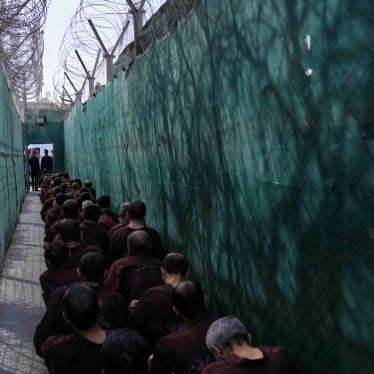

• Police patrol al-Hasab neighborhood in the Yemeni city of Taizz on December 6, 2011.
    Yemeni security forces stormed and shelled hospitals, evicted patients at gunpoint, and beat medics during an assault on Yemen’s protest movement that killed at least 120 people in the flashpoint city of Taizz last year. Yemeni President Ali Abdullah Saleh, who is in the United States receiving medical treatment, received amnesty in Yemen for such attacks.

Featured Content

Reports

Middle East/N. Africa

  • Feb 22, 2012

    Yemen’s incoming president, Abd Rabu Mansur Hadi, should take immediate steps to ensure Yemen’s transition to the rights-respecting democracy that thousands of protesters have sought.

  • Feb 21, 2012
    Authorities in and around Misrata are preventing thousands of people from returning to the villages of Tomina and Kararim and have failed to stop local militias from looting and burning homes there.
  • Feb 21, 2012
    Khader Adnan may live to see his 34th birthday after all. He has been on hunger strike for 66 days to protest against his “administrative detention,” which allows the Israeli military to detain Palestinians without charge, indefinitely, on the basis of evidence the detainees are not allowed to see. Today, in the face of mounting pressure, Israel reportedly promised to release him in April if it could not discover any new evidence against him. His lawyer said that Adnan will end his strike.
  • Feb 20, 2012
    Torture occupies a special place in international law – it is banned at all times and in all places, no exceptions. Most countries, including the UK and Jordan, have signed up to the UN Convention Against Torture, which means they agree not only to the absolute ban on torture, and inhuman and degrading treatment, but also to refrain from any complicity in the crime. They cannot send people to a country where there is a real risk of torture, or use evidence in court obtained through torture.
  • Feb 19, 2012
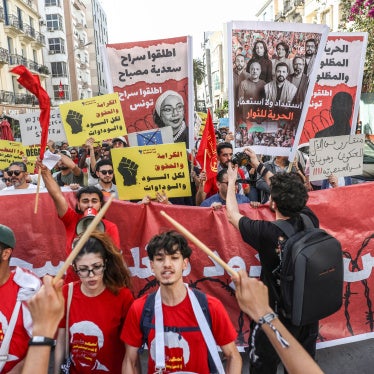
    Morocco is prosecuting activists who campaigned peacefully for a boycott of elections held three months ago. These prosecutions contradict statements by Moroccan officials that authorities arrested no one for advocating a boycott.
  • Feb 15, 2012
    As the world prepares for the 2012 Olympics, the Saudi government is systematically discriminating against women in sports and physical education, and has never sent a female athlete to the Olympics, with no penalty from the international Olympic authorities. Human Rights Watch called on the International Olympic Committee (IOC) to make ending discrimination against women in sports in the kingdom a condition for Saudi Arabia’s participation in Olympic sporting events, including the 2012 London Games.
  • Feb 15, 2012
  • Feb 14, 2012
    Abuzaid Dorda, the detained former Libyan prime minister and head of foreign intelligence under Muammar Gaddafi, needs immediate access to a lawyer and specialized medical care for injuries sustained in custody. The Libyan government should bring Dorda, in custody for five months, before a judge and charge him with a recognizable offense or release him.
  • Feb 13, 2012
    Saudi authorities should free Hamza Kashgari and drop any charges against him based on comments he made on Twitter expressing his personal religious views. On the morning of February 12, 2012, Malaysian authorities deported Kashgari back to Saudi Arabia to face charges of apostasy there, hours before lawyers obtained a Malaysian High Court injunction against his deportation.
  • Feb 13, 2012

    At 80 years of age, Ebrahim Yazdi has the distinction of being Iran’s oldest political prisoner. Yazdi was one of Ayatollah Ruhollah Khomeini’s closest confidants, accompanied him during his triumphant return to Tehran in February 1979, and briefly served as deputy prime minister and foreign minister. Authorities arrested him three times after the disputed 2009 presidential election for his membership in a political opposition group. Yazdi spent months in jail, then was released for medical treatment