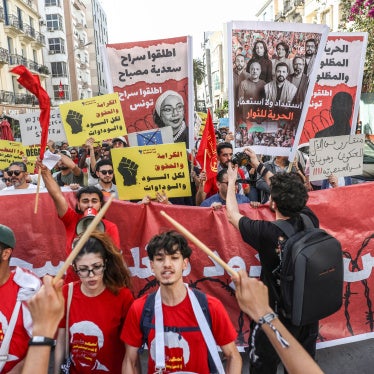

• Women in Tahrir Square chant slogans against Mubarak on February 1, 2011.
    Egypt’s newly elected parliament should urgently reform the arsenal of laws used by the Mubarak government to restrict freedoms, Human Rights Watch said in a report released today outlining priority areas for legislative and institutional reform. These laws were used to curb free expression and criticism of government, limit association and assembly, detain people indefinitely without charge, and shield an abusive police force from accountability.

Featured Content

Reports

Middle East/N. Africa

  • Feb 4, 2012
    Vetoes by Russia and China of the UN Security Council resolution on Syria are a betrayal of the Syrian people, Human Rights Watch said today. A resolution urging the Syrian government to end all human rights violations and cooperate with the UN commission of inquiry and the Arab League observer mission was approved by 13 council members, including India, South Africa, and Pakistan, before being vetoed.
  • Feb 3, 2012
  • Feb 2, 2012

    A Libyan diplomat who served as ambassador to France died less than 24 hours after he was detained by a Tripoli-based militia from the town of Zintan.

  • Feb 2, 2012

    The Iranian government has been intimidating and detaining relatives and friends of foreign-based Persian-language journalists to obtain information or silence them.

  • Feb 2, 2012

    Will history repeat itself at the United Nations Security Council? The last time South Africa was called to vote on a resolution on Syria, on October 4 last year, it chose to abstain, along with India and Brazil.

  • Jan 30, 2012

    Iranian authorities should immediately release dozens of labor and independent trade union activists imprisoned for speaking out peacefully in defense of workers. Convictions solely for the peaceful exercise of freedom of association and assembly should be quashed, and charges should be dropped against others facing prosecution for these reasons.

  • Jan 30, 2012

    Recent decisions by Israel’s high court aim to legitimize clear violations of Israel’s international legal obligations. In one decision, the court disregarded international law prohibiting discrimination, and in another, it ignored international law on the use of resources in an occupied territory. Israel should annul a law preventing Israeli citizens from living with their Palestinian spouses and end policies that permit private Israeli companies to strip rocks and other construction materials from quarries in the occupied West Bank for their own economic gain.

  • Jan 30, 2012

    Thirty five Ethiopian Christians are awaiting deportation from Saudi Arabia for “illicit mingling,” after police arrested them when they raided a private prayer gathering in Jeddah in mid-December, 2011. Of those arrested, 29 were women. They were subjected to arbitrary body cavity searches in custody, three of the Ethiopians told Human Rights Watch.

  • Jan 29, 2012
    Yemeni President Ali Abudllah Saleh’s arrival in the United States for medical treatment highlights the need for international action to serve justice for serious crimes in Yemen.
  • Jan 28, 2012

    During an artillery barrage last Nov. 11, Yemeni security forces killed 13 civilians in the city of Taizz. One of them was a patient at al-Rawdha Hospital, which mortar rounds and tank fire struck seven times as the wounded poured in for emergency care.