VO:
On October 13, 2023, Israeli strikes in southern Lebanon killed Issam Abdullah, a Reuters journalist. The attack injured six other journalists from Reuters, Agence France-Presse (AFP),
and Al Jazeera.
SOUNDBITE: Dylan Collins AFP Journalist
I will always remember his, his wit and his humor. He was the dynamo of the press scene and of Reuters in general.
SOUNDBITE: Carmen Joukhadar Al Jazeera Journalist
I don’t think there is anyone that is funnier than Issam. I don’t think there’s anyone more supportive than Issam.
VO:
Human Rights Watch investigated the attack to determine the cause, who carried it out and its legality.
SOUNDBITE: Dylan Collins AFP Journalist
I don't know what justice looks like. We lost someone and he’s not coming back. And Christina [injured AFP colleague], her life will never be the same. I don't know how you, I don't know how you replace that. For me, justice, the only type of justice that we can get now is accountability.
VO:
Visual evidence suggests that Israeli forces targeted the journalists, who were filming at a known live position far from military targets. The attacks were likely deliberate and an apparent war crime.
SOUNDBITE: Dylan Collins AFP Journalist
We’re a group of seven journalists, all wearing press vests, all wearing helmets with cameras, with three live feeds for three international agencies. And we were hit twice directly in a matter of 37 seconds.
VO:
The digital investigations team at Human Rights Watch verified 49 videos and dozens of photos from before, during and after the incident, analyzed satellite imagery of the area,
interviewed witnesses, and consulted with arms and audio experts. Among the visual evidence collated by Human Rights Watch is the feed from the cameras of the journalists who were there that day.
VO:
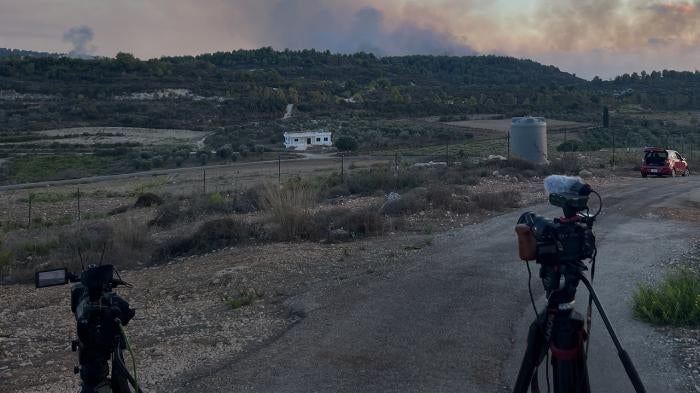
Just before 5 p.m. on October 13th the seven journalists from Reuters, Agence France-Presse and Al Jazeera congregated in Alma Al-Shaab in southern Lebanon, roughly one to two kilometers from the Israeli border.
SOUNDBITE: Carmen Joukhadar Al Jazeera Journalist
For us it was a good location because we were able to film the strikes without putting our lives at risk.
VO:
They were there to report on clashes between the Israeli military and Lebanese and Palestinian armed groups in southern Lebanon.
SOUNDBITE: Dylan Collins AFP Journalist
When we arrived around 5 p.m. We were really only just filming this this huge pillar of smoke that was coming, rising up beyond a hill to our south, along the border. And maybe about 15 minutes later, we started to see incoming shelling from the Israeli side hitting the
the areas in Lebanon along the border. We were calm, collected, working as safe as you can in this kind of environment.
VO:
Evidence reviewed by Human Rights Watch indicates that the Israeli military knew or should have known that the group of people they were firing on were civilians.
Around 5:54, Elie Brakhia, an Al Jazeera journalist, took a selfie with Issam Abdallah, the Reuters journalist, with the sun setting behind them. “Good evening,” Elie texted, in Arabic.
SOUNDBITE: Dylan Collins AFP Journalist
So around a little bit before 6 p.m., about one minute before we were hit, there was a what looked to be a tank fire fired from the “Hanita military base (in Israel),” fired across the valley
into a hilltop, basically maybe a kilometer and half away from us.
And I took out my phone to take a video of it. And basically, as soon as I took out my phone to take a video, I was going to inform our newsroom about the development. And as soon as I took out my phone, we were hit the first time. But basically big explosion.
The first one. I looked to my right and I saw my colleague Christina on the ground screaming,
saying, “I can't feel my legs.”
VO:
Human Rights Watch has verified footage from four cameras that caught captured the first attack. The first strike directly hit and killed Issam Abdallah, who was near the short rock wall.
SOUNDBITE: Carmen Joukhadar Al Jazeera Journalist
I see a flame and soil and then I hear the sound. I see Christina and I see Issam. And then I run in the other direction. I go to the car, our car the Al Jazeera car. I sit next to it for a little bit. But then I told myself no, cars are targets. This is what they tell you in training. So as I was running to get away from it......another missile hit the car. And it exploded, all of it.
And this is what caused all the shrapnel in my back because I was running to get away.
SOUNDBITE: Dylan Collins AFP Journalist
Getting hit once or firing once could be a mistake. But there were two direct it was two direct shots at us. You can't say that's a mistake.
VO:
Audio analysis, witness testimony and satellite images reviewed by Human Rights Watch suggests that at least one munition was fired from Israeli territory, approximately 1.5 kilometers to the southeast. Analysis of the video taken in the minutes before the attack further suggests that the group was targeted by the Israeli military.
Three cameras captured the same scene, but in each one light appears to be either static, blinking, or absent, depending on the camera. Experts said this could suggest the
use of infrared targeting or range-finding technology, suggesting the Israeli military was actively observing the journalists and proceeded to target them.
SOUNDBITE: Dylan Collins AFP Journalist
We lost a colleague. My colleague has, life altering injuries, and I want to know, I want to know who pulled the trigger.
SOUNDBITE: Carmen Joukhadar Al Jazeera Journalist
Today it was us. Tomorrow it will be someone else. Justice is that those who committed all these crimes are held accountable.
VO:
Since Human Rights Watch began this investigation, two journalists, Rabih Al-Maamari and Farah Omar were reportedly killed in an Israeli strike in the southern Lebanese town of Tayr Harfa, some 2.3 kilometers from where Issam Abdullah was killed.
At least 61 journalists have been killed in the hostilities in Israel and Gaza, according to the Committee to Project Journalists. The committee said the first month of hostilities marked “the deadliest month for journalists” since they began documenting journalist fatalities in 1992.
Journalists are protected under international humanitarian law against direct attacks. Targeting journalists constitutes a breach of the Geneva Conventions.
Intentionally or indiscriminately attacking civilians is a war crime.