“You Will Be Punished”
Attacks on Civilians in Eastern Congo
Maps
North and South Kivu
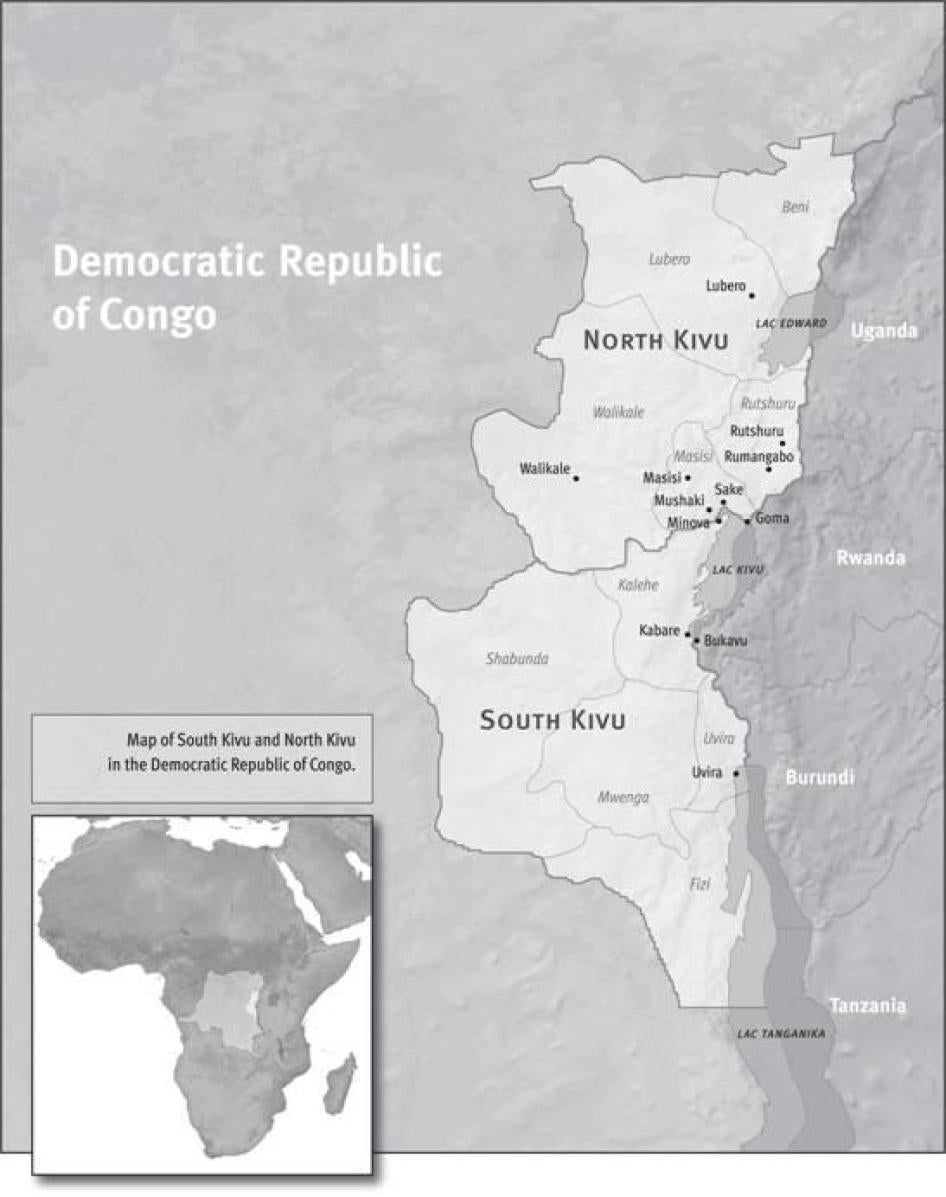
© 2009 Human Rights Watch
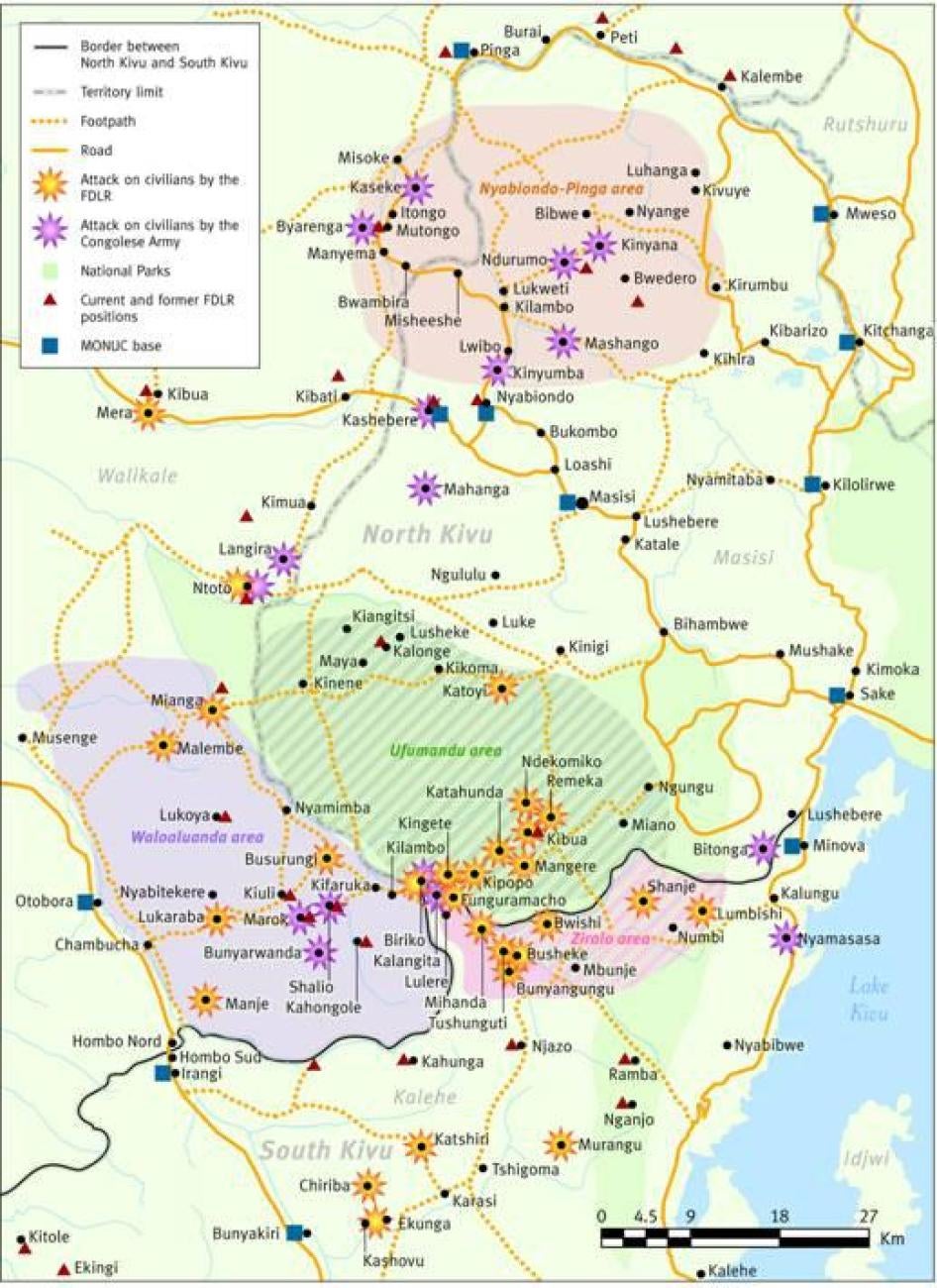
Attacks on Civilians in North and South Kivu*As documented by Human Rights Watch in this report
*This map marks attacks where at least 5 civilians were killed, 10 women were raped, or 50 homes burned in a single incident between January and September 2009. © 2009 John Emerson/Human Rights Watch |
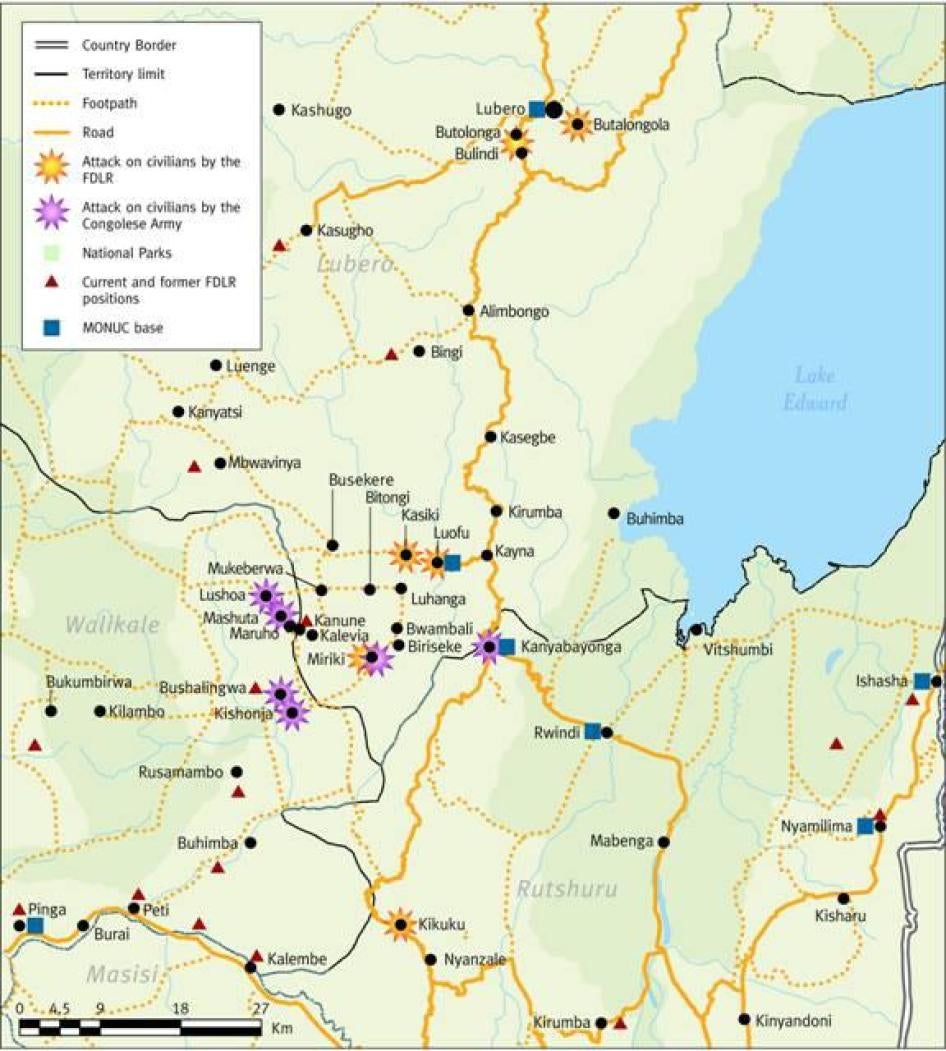
Attacks in the Lubero Area, North Kivu*As documented by Human Rights Watch in this report
*This map marks attacks where at least 5 civilians were killed, 10 women were raped, or 50 homes burned in a single incident between January and September 2009. © 2009 John Emerson/Human Rights Watch |
Summary
In January 2009, the Democratic Republic of Congo and Rwanda, following a dramatic shift in political alliances, launched joint military operations in eastern Congo against an abusive Rwandan Hutu militia, some of whose leaders had participated in the Rwandan genocide in 1994. The operations were intended to neutralize the group, the Democratic Forces for the Liberation of Rwanda (Les Forces démocratiques de libération du Rwanda, FDLR), which over the previous 15 years had preyed on Congolese civilians in the mountainous provinces of North and South Kivu.
Government representatives said the operations would bring peace and security to the region. They have not. Two successive Congolese military operations—one conducted with Rwandan military forces, known as operation Umoja Wetu, and the second conducted with the direct support of United Nations peacekeeping troops, known as operation Kimia II—have been accompanied by horrendous abuses by both government and rebel forces against a civilian population in eastern Congo that has long suffered so much.
The attacks against civilians have been vicious and widespread. Local populations have been accused of being “collaborators” by one side or the other and deliberately targeted, their attackers saying they are being “punished.” Human Rights Watch has documented the deliberate killing of more than 1,400 civilians between January and September 2009, the majority women, children, and the elderly. The attacks have been accompanied by rape. In a region already known as the “worst place in the world to be a woman or child,” the situation has deteriorated even further. Over the first nine months of 2009, over 7,500 cases of sexual violence against women and girls were registered at health centers across North and South Kivu, nearly double that of 2008, and likely only representing a fraction of the total.
In addition to killings and rapes, thousands of civilians have been abducted and pressed into forced labor to carry weapons, ammunition, or other baggage across the treacherous terrain by government forces and FDLR militia as they deploy from place to place. Some civilians have been killed when they refused. Others have died because the loads they have been forced to carry were too heavy. Between January and September, the attacks forced more than 900,000 people to flee for their lives, seeking safety in the remote forests, with host families, or in displacement camps. During the attacks or as they fled, FDLR combatants or Congolese army soldiers pillaged their belongings and then burned their homes and villages. Over 9,000 houses, schools, churches and other structures have been burned to the ground in North and South Kivu. Many civilians, already poor, have been left with nothing.
Civilians have been targeted by all sides: the FDLR, the Congolese army and, in some instances, the Rwandan army. Civilians look to the UN peacekeeping mission in Congo, MONUC, for desperately needed protection. MONUC has a strong mandate from the UN Security Council to protect civilians and to use force to do so, but it has become a partner of the Congolese army in the military operations, and it failed to put in place adequate measures for civilian protection before operations were launched. Peacekeepers have made notable efforts to protect civilians which undoubtedly have helped to save lives, but in many instances they have arrived too late or not at all, leaving local people exposed to attacks with nowhere else to turn.
The first military operation, Umoja Wetu (“0ur unity” in Swahili), began on January 20, 2009, following a secret agreement between Congolese President Joseph Kabila and his Rwandan counterpart, President Paul Kagame. It resulted in the removal of Congolese rebel leader Laurent Nkunda, whose armed group, the National Congress for the Defense of the People (Congrès national pour la défense du peuple, or CNDP), had received substantial support from Rwanda and had defeated the Congolese army in successive battles in 2007 and 2008. Rwandan authorities detained Nkunda and promoted Bosco Ntaganda, the CNDP’s military chief of staff, to take his place. Ntaganda promptly agreed to integrate his troops into the Congolese army and to give up the CNDP’s rebellion.
In exchange for Rwanda’s assistance in removing the CNDP threat, President Kabila permitted Rwandan troops to return to eastern Congo and to conduct joint operations against the FDLR. Ntaganda, who has a track record of human rights abuses and is wanted on an arrest warrant from the International Criminal Court (ICC) in The Hague, was made a general in the Congolese army. An estimated 4,000 Rwandan troops, and possibly many more, then crossed the border into eastern Congo, where they stayed for 35 days.
Following the departure of Rwandan troops on February 25 at the end of operation Umoja Wetu, Rwandan and Congolese officials emphasized that the military operations were not complete. They pressed MONUC to join forces with the Congolese army to finish the FDLR. MONUC had been authorized by the UN Security Council to support and participate in military operations against the FDLR in December 2008, as long as such operations were conducted in accordance with the laws of war. But MONUC had been deliberately excluded from operation Umoja Wetu and many UN officials were deeply troubled at the turn of events that had returned Rwandan forces to Congolese soil. According to MONUC insiders, the MONUC leadership was worried about the consequences of being excluded from future military operations, concerned about a return of Rwandan troops if they did not step in, and confident civilians would be better protected were the peacekeepers to be part of military operations—so MONUC agreed to support the Congolese army.
In the rushed preparations that followed, MONUC officials did not set out clear conditions for their support, did not insist on the removal of known human rights abusers from the ranks of the Congolese army, and did not adequately prepare for the protection of the civilian population. On March 2, the Congolese army, with the direct support of MONUC peacekeepers, launched operation Kimia II (“quiet” in Swahili), an operation that continued at this writing.
Abuses by the FDLR
The FDLR responded to the offensive of the Congolese government, which had previously supported the group, by committing attacks against Congolese civilians. FDLR forces deliberately attacked civilians in whose communities they had lived, accusing their neighbors of “betrayal” and telling them that they would be “punished” for their government’s policy. The evidence of their brutal strategy was clear in letters from FDLR commanders, public meetings, oral threats to individuals, and written messages left on footpaths, many of which Human Rights Watch has collected. These messages and subsequent interviews with FDLR combatants who fled the group, demonstrate a deliberate tactic of retaliatory killings coming from a central FDLR command.
Human Rights Watch has documented previous attacks on civilians by FDLR combatants, but this time the killings and other abuses were significantly more numerous and widespread, and showed clear signs of being systematic. Between late January and September 2009, the FDLR deliberately killed at least 701 civilians in North and South Kivu. Many people were chopped to death by machete or hoe. Some were shot. Others were burned to death in their homes. The FDLR targeted and killed village chiefs and other influential community leaders, a tactic that spread fear throughout entire communities. In the worst single incident, the FDLR massacred at least 96 civilians in the village of Busurungi, in the Waloaluanda area, on May 9-10, 2009. Some of the victims were first tied up before the FDLR “slit their throats like chickens.” Others were deliberately locked in their homes that were then burned to the ground. Some of the victims knew their attackers by name.
The killing of civilians was invariably accompanied by rape. Most of the victims were gang-raped, some so viciously that they later bled to death from their injuries. Others were abducted to be sexual slaves. In over 30 cases documented by Human Rights Watch, victims told us that their FDLR attackers said that they were being raped to “punish” them.
Human Rights Watch’s field investigations found the FDLR forces to be responsible for numerous serious human rights abuses and violations of the laws of war. On November 17, 2009, the FDLR’s president, Ignace Murwanashyaka, and his deputy, Straton Musoni, were arrested in Germany by German judicial authorities for alleged war crimes and crimes against humanity committed between January 2008 and July 2009 by FDLR combatants under their command. They were also charged with belonging to a terrorist group. Other members of the FDLR’s political and military leadership, including the group’s military commander in eastern Congo, Gen. Sylvester Mudacumura, and the group’s executive secretary, Callixte Mbarushimana, based in Paris, France, should also be investigated for ordering alleged war crimes and crimes against humanity, or as a matter of command responsibility.
Abuses by the Congolese army and other forces
Congolese civilians received little or no protection from their government’s armed forces against the FDLR attacks. The Congolese army, initially in joint operations with the Rwandan army in operation Umoja Wetu, and later with the support of MONUC peacekeepers in operation Kimia II, also targeted civilians, especially those they claimed collaborated with the FDLR. Congolese forces violated their obligation under the laws of war to minimize harm to civilians. They failed to distinguish civilians from combatants and targeted the former, did not give effective advance warning of attack when circumstances permitted, and made no efforts to permit civilians caught up in the fighting to flee to safety. Most egregiously, they summarily executed hundreds of civilians under their effective control. Between January and September 2009, Human Rights Watch documented the deliberate killing of at least 732 civilians, including 143 Rwandan Hutu refugees, by Congolese army soldiers and their coalition partner (during Umoja Wetu, the Rwandan Defence Force (RDF)).
Human Rights Watch has documented the killing of 201 civilians during the Umoja Wetu phase of military operations, many in the area between Nyabiondo and Pinga, bordering Masisi and Walikale territories in North Kivu. In two of the worst attacks during this phase of operations, 90 civilians were massacred in late February in the remote village of Ndorumo and a further 40 civilians were killed in the village of Byarenga. The attacks were perpetrated by Rwandan and Congolese coalition forces, although witnesses found it difficult to distinguish between Rwandan army soldiers and former CNDP combatants newly integrated into the Congolese army, who wore similar uniforms and spoke the same language. In Ndorumo village, the coalition forces began killing civilians after they had been called to a gathering at the local school. One witness said the soldiers told the population they were “being punished for being complicit with the FDLR.”
The killings continued during operation Kimia II, often by newly integrated CNDP combatants. Human Rights Watch has documentedthe deliberate killing of a further 531 civilians between March and September 2009. The real figure is likely to be much higher—Human Rights Watch also received credible reports of an additional 476 civilians killed by Congolese army forces and their allies in the area between Nyabiondo and Pinga. However, due to the remoteness of the area, we have not been able to confirm whether they were caught in the crossfire or were deliberately killed, so these numbers have not been included in our calculations.
Congolese forces also targeted Rwandan Hutu refugees living in eastern Congo, whom they often accuse of being FDLR combatants or “wives.” From April 27 to 30, 2009, in the worst incident documented by Human Rights Watch, Congolese army soldiers deliberately killed at least 129 Rwandan Hutu refugees, mostly women and children, when they attacked the neighboring hills of Shalio, Marok, and Bunyarwanda in Walikale territory (North Kivu).While there were FDLR combatants deployed in these hills, all witnesses interviewed by Human Rights Watch reported that the FDLR combatants had fled in advance of the attacks and were not present in any of the makeshift refugee camps targeted by the Congolese army.
At Shalio Hill, Congolese army soldiers killed at least 50 refugees as they tried to flee. After the attack, one group of soldiers took 50 refugees from Shalio to Biriko, where the soldiers beat them to death with wooden clubs and shot three refugees who tried to escape. Only one person survived. A second group of soldiers took 40 refugees, all women and girls, from Shalio to a nearby Congolese army position where they were kept as sexual slaves, gang-raped and mutilated by the soldiers. Ten of the women managed to escape, but the fate of the others is unknown. One who was later interviewed by Human Rights Watch bore the marks of her mutilation: her attackers had cut off chunks from her breast and stomach.
As with the FDLR, the killing by Congolese army soldiers was often accompanied by the rape of women and girls. In North Kivu, 268 out of 410 sexual violence cases documented by Human Rights Watch were perpetrated by government soldiers. In at least 15 cases, the women and girls were summarily executed after being raped, some by being shot in the vagina. Husbands, children and parents who desperately tried to stop the rape of their loved ones were also attacked. In cases documented by Human Rights Watch, at least 20 family members were killed when they cried out or otherwise protested against the rape.
The protection of civilians in Congo is primarily the responsibility of the Congolese government and its security forces. Yet Congolese government officials have failed to take adequate or effective steps to protect civilians in eastern Congo. Human Rights Watch found that Congolese army forces repeatedly violated international human rights and humanitarian law. Responsible commanders should be investigated for ordering alleged war crimes and crimes against humanity, or as a matter of command responsibility.
Congolese military planners, given the past practice of both the FDLR and the government’s own forces, should have foreseen the grave risks to the civilian population. Previous military operations in North Kivu in 2007 and 2008 had resulted in frequent FDLR retaliatory attacks against civilians and Congolese army abuses. But Congolese decision-makers gave little or no attention in planning the military operations to providing for the protection of the civilian population. The authorities integrated highly abusive militias into government forces, and failed to seriously address the deeply entrenched problem of impunity.
On July 5, 2009, following exposure of some abuses by its soldiers, the Congolese government announced a policy of “zero tolerance” for human rights violations and put commanders on notice that they would be held to account for the behavior of their troops. Four officers were later arrested for their involvement in sexual violence, but Gen. Bosco Ntaganda and other commanders implicated in serious human rights violations remain in operational command.
Results of the operations
The Congolese government’s goal in both operation Umoja Wetu and Kimia II was to neutralize the FDLR. The military operations have had some impact on disrupting the FDLR. During nine months of military operations, 1,087 FDLR combatants were repatriated to Rwanda by the UN’s Disarmament, Demobilization, Repatriation, Reintegration, and Resettlement (DDRRR) program, representing a significant increase compared to 2008.[1] The FDLR have also been cut off, at least temporarily, from access to some markets and other traditional economic supply routes. But the FDLR is also reportedly recruiting new combatants and continues to raise funds and obtain weapons and ammunition through its international networks. A UN Group of Experts in November 2009 reported that military operations against the FDLR had failed to dismantle the group’s political and military structures on the ground in eastern Congo. The FDLR’s ability to conduct attacks on civilians remains intact.
A comparison of the impact of military operations on the FDLR and the harm to civilians starkly conveys the suffering endured by the population. For every FDLR combatant that was repatriated to Rwanda during the first nine months of operations, at least one civilian was deliberately killed, seven women and girls raped, eight homes destroyed, and over 900 people forced to flee for their lives. These are incomplete figures covering the period January to September—and the military operations still continue.
Operation Kimia II has also not given sufficient attention to the protection of the Rwandan Hutu refugees, who have been isolated and preyed upon for years by all sides, nor to facilitating their return to Rwanda. The establishment of safe humanitarian corridors, protected by MONUC peacekeepers, could help to facilitate the repatriation of the refugees and reduce abuses against them, including by the FDLR, who rely on this community for filling its ranks and providing support.
The military operations are also likely to have a significant future impact on local political and economic dynamics in eastern Congo that might undermine sustainable peace and efforts to bring the rule of law to this troublesome region. Former CNDP commanders newly integrated into the Congolese army appear to be using the operations as cover to gain control over mineral-rich areas and to clear the land for the return of Congolese Tutsi refugees and for cattle being brought in from Rwanda. The perceived dominance and preferential treatment given to former CNDP commanders has already led a number of local militia groups, often called Mai Mai, to abandon army integration. Some have joined forces with the FDLR.
MONUC and civilian protection
MONUC has provided substantial support to operation Kimia II including logistical and operations support, and an estimated US$1 million worth of service support such as daily rations during each month of operations. MONUC disregarded crucial elements of formal legal advice given by the UN Office of Legal Affairs on January 13 and did not establish conditions for respecting international humanitarian law, as required by its mandate, before it began to support the operations. On November 1, after eight months of support to operation Kimia II, Alain Le Roy, the head of the UN Department of Peacekeeping Operations announced during a visit to Congo that MONUC would suspend its support to the Congolese army’s 213th Brigade. MONUC’s own investigations had revealed army soldiers had killed at least 62 civilians in the Lukweti area, just north of Nyabiondo. At the time of writing, MONUC support was not suspended to any other army units despite credible information that gross human rights violations were occurring elsewhere and none of the commanders implicated in past serious human rights violations had been removed from involvement in Kimia II operations.
The MONUC leadership ignored the important role played by Bosco Ntaganda in operation Kimia II, where he was the de facto deputy commander. MONUC could not legally support an operation in which Ntaganda, wanted on an ICC arrest warrant for war crimes, played a part, as the UN’s legal office pointed out to the MONUC leadership in a legal note on April 1, 2009. But the MONUC leadership disregarded the mounting evidence of Ntaganda’s role, including copies of orders he had signed, minutes of Congolese army internal meetings, his presence at the Kimia II command center, and his frequent visits to the troops in the field. Instead MONUC hid behind false assurances from the Congolese government that Ntaganda was not a part of operation Kimia II. Other commanders who had a track record of serious human rights violations and were commanders in operation Kimia II were also not removed, despite concerns raised by MONUC staff about the presence of these commanders and the risk they posed for civilians.
On June 2, 2009, the UN Policy Committee, which includes the heads of all UN agencies, decided that MONUC should not participate in any form of joint operations with Congolese army units if there were a real risk of human rights violations. MONUC staff in Congo’s capital, Kinshasa, struggled, belatedly, to put in place a policy of conditionality for the mission’s support to operation Kimia II.
MONUC’s support of the Congolese armed forces, particularly after receiving credible reports of gross violations of human rights, raises serious concern that MONUC itself is implicated in these grave abuses. In conflict with its mandate, MONUC ’s continued backing of operation Kimia II has undermined its primary objective to protect civilians. Until there are clear, measurable, and actionable conditions in place to ensure operations with Congolese forces do not violate international humanitarian law, MONUC should immediately cease all support for operation Kimia II.
Proper investigations are needed into the serious abuses documented in this report, many of which amount to war crimes and could be crimes against humanity. In line with the UN Security Council’s commitment, as expressed in Resolution 1894 to advance and ensure protection of civilians, the council should urgently deploy a Civilian Protection Expert Group to eastern Congo to investigate the situation, including the measures taken by MONUC to implement its mandate to protect civilians, and to recommend concrete measures to improve civilian protection and end impunity for the serious crimes.
Methodology
This report is the result of extensive field research carried out from January through November 2009 in eastern Congo. It is based on information collected during 23 fact-finding missions to 30 different locations in North and South Kivu provinces where military operations have taken place, or where displaced people have fled to escape the violence. Four Human Rights Watch researchers were involved. Human Rights Watch conducted 689 interviews with witnesses, victims, their family members, and those who buried the dead, as well as an additional 300 interviews with local and provincial authorities, church officials, civil society representatives, health workers, former and current FDLR and Mai Mai combatants, their commanders, Congolese army officers and soldiers, MONUC military and civilian officials, representatives of other United Nations agencies, diplomats, and international nongovernmental (NGO) representatives in North and South Kivu. We have also conducted interviews with UN officials and foreign diplomats in Kinshasa, New York, Washington, DC, London, Paris, Brussels and Pretoria.
Human Rights Watch also met with and discussed many of the issues raised in this report with Congolese government authorities including President Joseph Kabila; the Vice Minister of Defense, Oscar Masamba Matebo; the Minister of Justice, Luzolo Bambi Lessa; and with Maj. Gen. Dieudonné Amuli Bahigwa, the military commander responsible for operation Kimia II and a number of his subordinates. In August 2009, Human Rights Watch also met with the FDLR head, Dr. Ignace Murwanashyaka, in Mannheim, Germany.
The research for this report greatly benefited from reporting by United Nations sources including internal UN documents and legal memos, reporting from the UN Group of Experts, the UN special rapporteur on extrajudicial executions, the UN’s DDRRR program and reporting by diplomats, other national and international human rights and humanitarian organizations, legal papers from judicial officials and other government documents.
This report documents killings and other abuses where witnesses were able to clearly identify the group or armed forces to which the assailants belonged. Cases where the perpetrator was not clear have not been included in this report. Our statistics on the numbers killed are based on eyewitness accounts, information from family members, and testimony from those who helped to bury the dead. We have made every effort to corroborate our findings and dismiss accounts that we did not find credible.
Many of those we interviewed were deeply traumatized by their experiences yet were desperate to tell their stories about what had happened to them. This report is, in part, a testimony to their immense courage and will for the truth to be known.
Recommendations
To the Congolese Government and Army
- Cease immediately all attacks on civilians. Urgently put into place measures and mechanisms to deter, prevent and punish violations of international humanitarian and human rights law by Congolese army soldiers.
- Develop with United Nations assistance a clear strategy for civilian protection, with specific attention to protecting women and girls.
- Develop with the UN and other international partners a comprehensive multi-pronged disarmament strategy for armed groups, including the FDLR (see below).
- Immediately establish safe humanitarian corridors, protected with MONUC peacekeepers where possible, to permit Rwandan refugees and FDLR dependents who wish to return to Rwanda to do so in safety and dignity.
- Take the following measures in response to the serious human rights violations committed by Congolese army soldiers and to implement the declared policy of “zero tolerance” of abuses:
- Conduct impartial and credible investigations into the serious violations of human rights and war crimes committed during operations Umoja Wetu and Kimia II. Discipline or prosecute as appropriate those responsible, regardless of rank or position.
- Suspend from operational command officers implicated in serious human rights or laws of war violations pending investigation, including Lt. Col. Innocent Zimurinda.
- Instruct judicial authorities to immediately arrest Gen. Bosco Ntaganda and to transfer him to the jurisdiction of the International Criminal Court.
- Instruct judicial authorities to immediately re-arrest Col. Jean-Pierre Biyoyo, who was sentenced to five years in prison in March 2006 for child soldier recruitment but escaped from prison later that year.
- Introduce a vetting mechanism for the Congolese army to remove military officers implicated in serious human rights abuse, including those newly integrated from the CNDP and other armed groups.
- Strengthen the capacity of the military justice system by devoting greater resources for investigations.
- Establish a special chamber with Congolese and international judges and prosecutors within the Congolese justice system. The chamber’s mandate should be to prosecute serious violations of international humanitarian law, including sexual violence, and should include the capacity to investigate and prosecute senior military and civilian officials responsible for crimes, including as a matter of command responsibility.
- Increase cooperation with the UN’s DDRRR efforts to encourage FDLR and other foreign combatants to disarm voluntarily and return to Rwanda. Take all necessary measures to end immediately attacks, threats and intimidation by Congolese forces against DDRRR staff and their bases and to cooperate fully with their efforts.
- To discourage looting and other abuses, ensure all soldiers receive a regular and adequate salary. Create military barracks that provide a base for soldiers and their families.
To the FDLR Leadership
- Cease immediately all attacks on civilians. Take all necessary measures, including making public statements, to ensure that FDLR forces do not commit human rights abuses and violations of the laws of war.
- Carry out investigations into war crimes committed by FDLR forces and take appropriate disciplinary measures against any member of the FDLR, regardless of rank, found responsible.
- Stop blocking the return of Rwandan refugees to Rwanda. Support the establishment of safe humanitarian corridors to allow refugees to return home.
To the Rwandan Government
- Cooperate with Congolese and other judicial investigations into alleged violations of international human rights and humanitarian law committed by Rwandan armed forces during operation Umoja Wetu. Ensure that any commanders or soldiers found responsible are disciplined or prosecuted as appropriate, including as a matter of command responsibility.
- Publish an updated list of current FDLR combatants who are wanted on charges of genocide.
To the UN Mission in Congo (MONUC)
- Immediately cease all support to operation Kimia II until there are clear, measurable and actionable conditions in place to ensure the operation does not violate international humanitarian law and until all known commanders with a record of human rights abuses have been removed from any operational responsibilities. Make the conditions public.
- In cooperation with Congolese justice officials, arrest Bosco Ntaganda. Make his arrest a condition for future support to the Congolese army.
- Establish “protection support bases” in areas where civilians are most at risk. Deploy civilian and military teams to such bases, including protection specialists for a minimum of two months to build confidence with the local population and authorities. Use such bases to help state authorities reestablish security for the civilian population.
- Urgently develop a civilian protection plan with specific responsibilities for both civilian and military staff. Include critical elements of the protection plan in the memoranda of understanding between MONUC and troop contributing countries, in the rules of engagement, and in directives from the Force Commander. Regularly assess its effectiveness. Such a plan should include, but not be limited to:
- Ensuring that MONUC troops are deployed to areas that are designated as “must protect” within fourteen days, but that patrols are sent immediately.
- Ensuring that MONUC field base commanders are in regular communication with local authorities, traditional chiefs, and civil society and displaced person representatives in their area of responsibility, with special attention given to women’s groups and to identifying the risks to civilians and mitigating such risks.
- Ensuring that all MONUC field bases have sufficient interpreters available around the clock and seven days a week.
- Ensuring that MONUC peacekeepers carry out regular foot and vehicle patrols to the areas most at risk in their area of responsibility, as well as escorts to civilians, and women and girls in particular, who are traveling along potentially dangerous roads or paths to their fields, to the market or to collect firewood or water, and to displaced people either fleeing violence or returning to their village of origin along roads or paths where they may be at risk of attack.
- Ensuring the removal of all illegal roadblocks in their area of responsibility.
- Give priority to implementation of the comprehensive strategy to combat sexual violence, launched by MONUC in April 2009, and ensure it is integrated into MONUC’s protection strategy.
- Ensure that the DDRRR program has adequate human and other resources and the support needed from other components of MONUC to carry out its tasks, including sufficient radio transmitters, vehicles, access to MONUC helicopters, interpreters, and more resources devoted to information collection and intelligence gathering on FDLR movements, leadership structure, chain of command, financial support, and recruitment efforts.
To the UN Security Council, the UN Secretary-General, the European Union, the United States, and Other International Donors
- In line with UN Security Council Resolution 1894 to advance and ensure protection of civilians, urgently deploy a Civilian Protection Expert Group to eastern Congo to inquire into, and rapidly report on, civilian protection needs and challenges, including: (a) attacks against civilians, gender specific violence, and abuses against children by all parties in violation of international humanitarian law; (b) measures taken by MONUC to implement its mission-wide strategy on protection of civilians; and (c) the extent to which protection of civilians is sufficiently integrated into the Concept of Operations (CONOPS). The Civilian Protection Expert Group should recommend concrete measures to advance the protection of civilians, ensure unhindered humanitarian access and assistance, and end impunity for serious crimes in violation of international law.
- Ensure MONUC has the means to carry out its mandate, including the urgent deployment of additional peacekeepers authorized in November 2008, and the rapid response capabilities, helicopters, and intelligence gathering support the mission has requested to provide civilian protection.
- Develop a new and comprehensive approach for disarming armed groups, including the FDLR, that emphasizes protection of civilians, apprehending those wanted for crimes in violation of international law, a reformed disarmament and demobilization program, and options for temporary resettlement of combatants and their dependents within or outside of Congo, among other measures.
- Conduct in-country investigations on the participation of the FDLR leadership in Europe and elsewhere on the alleged war crimes and crimes against humanity documented in this report, with particular attention on Ignace Murwanashyaka, based in Germany and currently under arrest for his role in alleged war crimes and crimes against humanity committed in eastern Congo, and Callixte Mbarushimana, based in France.
- Open up contact with the FDLR to explore options for temporary resettlement of FDLR combatants and their families within Congo or to a third country as agreed between the Rwandan and Congolese government in the Nairobi communiqué of November 2007.
- Implement changes to the memoranda of understanding (MOU) with troop contributing countries to permit greater flexibility and fewer limitations on the physical location of troop deployment, the number of field bases, and the structural requirements necessary before a temporary base is established.
- Ensure that MONUC peacekeepers receive appropriate training on civilian protection before being deployed.
- Ensure that there is a significant human rights component in current security sector reform programs, including the creation of a vetting mechanism.
- Support measures to strengthen the military justice system and to create a special chamber to prosecute serious violations of international humanitarian law committed in Congo, as described above.
- Separate the UN human rights section from MONUC’s peacekeeping mission, with a direct reporting line to OHCHR to ensure it has the ability to investigate and report independently, credibly, and effectively on human rights violations by all sides.
To UN High Commissioner for Refugees
- Encourage and provide assistance to the establishment of safe humanitarian corridors to facilitate the return of Rwandan refugees.
- Increase the number of re-groupment sites and sensitization efforts for the repatriation of Rwandan Hutu refugees living in more remote areas such as the region between Nyabiondo and Pinga.
To the Prosecutor of the International Criminal Court
- As part of ongoing investigations in North and South Kivu, investigate the serious crimes committed by perpetrators from all sides since January 2009 including those documented in this report. Reopen investigations on alleged war crimes committed by Bosco Ntaganda to include serious crimes committed in both the Ituri District and the Kivu region such as those in the Shalio Hill area in April 2009, the massacre at Kiwanja in November 2008, and ethnic massacres in Ituri including those at Mongbwalu in November 2002, among others.
Key PlayersThe Congolese Armed Forces (Forces armées de la République démocratique du Congo, FARDC): The Congolese national army, FARDC, created in 2003 has an estimated strength of 120,000 soldiers, many from former rebel groups who were incorporated following various peace deals. About half of the Congolese army is deployed in eastern Congo. Since 2006, the government has twice attempted to integrate the 6,000 strong rebel CNDP, but failed each time. In early 2009 a third attempt was made to incorporate the CNDP as well as other remaining rebel groups, a process known as “fast track accelerated integration.” Many who agreed to integrate, however, remained loyal to their former rebel commanders, raising serious doubts about the sustainability of the process. National Congress for the Defense of the People (Congrès national pour la défense du people, CNDP): The CNDP is a Rwandan-backed rebel group launched in July 2006 by the renegade Tutsi general, Laurent Nkunda, to defend, protect, and ensure political representation for the several hundred thousand Congolese Tutsi living in eastern Congo, and some 44,000 Congolese refugees, most of them Tutsi, living in Rwanda. It is estimated to have some 6,000 combatants, including a significant number recruited in Rwanda; many of its officers are Tutsi. On January 5, 2009, Nkunda was ousted as leader by his military chief of staff, Bosco Ntaganda, and subsequently detained in Rwanda. Ntaganda, wanted on an arrest warrant from the International Criminal Court, abandoned the three-year insurgency and integrated the CNDP’s troops into the government army. On April 26, 2009, the CNDP established itself as a political party. Democratic Forces for the Liberation of Rwanda (Les Forces démocratiques de libération du Rwanda, FDLR): The FDLR is a Hutu militia group based in eastern Congo, some of whose leaders participated in the genocide in Rwanda in 1994. It seeks to overthrow the government of Rwanda and promote greater political representation of Hutu. In late 2008, the FDLR was estimated to have at least 6,000 combatants, controlling large areas of North and South Kivu, including many key mining areas. The FDLR’s president and supreme commander is Ignace Murwanashyaka, based in Germany. He was arrested on November 17, 2009, on charges of war crimes and crimes against humanity. The group’s military commander in eastern Congo is Gen. Sylvester Mudacumura. The Congolese government has often supported and shown general tolerance for the FDLR, until early 2009 when its policy changed and the government launched military operations against the group. Rally for Unity and Democracy (RUD)-Urunana: RUD-Urunana is a splinter group of the FDLR estimated at some 400 combatants based in North Kivu, made up largely of dissident FDLR combatants. It was created in 2004 by the United States-based former FDLR 1st vice-president, Jean-Marie Vianney Higiro. Other political leaders are in Europe and North America. Since the start of military operations against RUD and the FDLR in January 2009, the two groups have reunited militarily. Mai Mai militia: The Mai Mai militia groups are local defense groups often organized on an ethnic basis who have traditionally fought alongside the government army against “foreign invaders,” including the CNDP and other Rwandan-backed rebel groups. In 2009 there were over 22 Mai Mai groups, ranging greatly in size and effectiveness, in both North and South Kivu. Some joined the Congolese army as part of the rapid integration process, while others refused, angry at the perceived preferential treatment given to the CNDP and unwilling to join the army unless they were able to stay in their communities. The various Mai Mai groups are estimated to have some 8,000 to 12,000 combatants. Coalition of Congolese Patriotic Resistance (Coalition des patriotes résistants congolais, PARECO): PARECO is the largest of the Mai Mai groups, created in March 2007 by joining various other ethnic-based Mai Mai militias including from the Congolese Hutu, Hunde, and Nande ethnic groups. Throughout 2007 and 2008, PARECO collaborated closely with the FDLR and received substantial support from the Congolese army, especially in their battles against the CNDP. In 2009, many PARECO combatants, particularly the Hutu, joined the Congolese army and its military commander, Mugabu Baguma, was made a colonel. The Hunde and Nande commanders were not offered equivalent command positions and remained outside the integration process, along with the majority of the Hunde and Nande combatants Patriotic Alliance for a Free and Sovereign Congo (Alliance des patriotes pour un Congo libre et souverain, APCLS): The APCLS is a breakaway faction of PARECO. Created in April 2008, it is largely made up of ethnic Hunde and is led by General Janvier Buingo Karairi. It is based in the area to the north of Nyabiondo, in western Masisi, with its headquarters in Lukweti village and has an estimated 500 to 800combatants. The APCLS is allied with the FDLR and refuses to integrate into the Congolese army without guarantees that they will be deployed in their home region and that the newly integrated CNDP soldiers will leave. |
I. Background
Conflict in Eastern Congo
When the Democratic Republic of Congo held its first multiparty elections in over 40 years in June 2006, there was widespread optimism that the country would emerge out of years of brutal war. Congolese citizens in the densely populated provinces of North and South Kivu in eastern Congo on the border with Rwanda, an area deeply affected by two consecutive wars from 1996 to 1997 and again from 1998 to 2003, were desperate for peace. They voted overwhelmingly for presidential candidate Joseph Kabila, who promised to end conflict in this troublesome region. Yet in the three years following the elections, eastern Congo has remained locked in brutal conflict. In 2009 alone, botched peace attempts combined with badly organized and abusive military operations have led to nearly a million people fleeing their homes, hundreds massacred, and thousands more women and girls raped. As one resident of eastern Congo told Human Rights Watch, “We voted for peace, but all we got was more war. When are they going to stop killing us?”[2]
The ongoing conflict in eastern Congo has been marked by a constant shift in alliances between a confusing array of belligerents. One-time enemies turn into allies and back into enemies again in swift succession, confusing Congolese citizens and political analysts alike. In the three years since the elections, the Congolese government has failed to address the underlying causes of the conflict and to effectively extend state control to areas once occupied by the Rwandan army and its proxy forces. Instead the government has sought secret deals with various rebel groups and, when unsuccessful, used military force. To date, neither course of action has brought peace or security to the area.
Two armed rebel groups have dominated recent events in eastern Congo: a Rwandan Hutu militia called the Democratic Forces for the Liberation of Rwanda (Les Forces démocratiques de libération du Rwanda, FDLR), and the Congolese Tutsi-led National Congress for the Defense of the People (Congrès national pour la défense du peuple, CNDP). At different times, both groups have been either allies or enemies of the Congolese government depending on its relationship with Rwanda. The difficulty in finding lasting solutions to the crisis is exacerbated by the struggle for control of one of the richest regions in Congo.
The ongoing conflict in eastern Congo is also linked to the after-effects of the Rwandan genocide in 1994 and can only be understood by looking at political dynamics in both Congo and Rwanda. In Rwanda, growing restrictions on political space have promoted views among some Hutu, including those in the FDLR, that they have little or no say in Rwandan political life and that the Hutu population are being collectively punished for the genocide. Political parties that oppose President Paul Kagame are blocked from operating freely and the media faces severe restrictions on political reporting.
The Rwandan government often accuses its critics of “divisionism” or “genocide ideology,” vaguely defined offenses to punish the spreading of ideas that encourage ethnic animosity between the country's Tutsi and Hutu populations and the expression of any ideas that could lead to genocide.[3] Largely aimed at the Hutu population, such offenses permit, among other measures, the government to send away children of any age to rehabilitation centers for up to one year—including for the teasing of classmates—and for parents and teachers to face sentences of 15 to 25 years for the child’s conduct. The government has repeatedly accused the Voice of America, the British Broadcasting Corporation and other media outlets, as well as Human Rights Watch, of promoting genocide ideology; accusations these organizations deny.[4]
The tight control over political space, civil society and the media has forced a number of moderate Hutu and some Tutsi to leave Rwanda. Critics of the Rwandan government, including many Congolese civil society groups and the Congolese government, repeatedly call for an inter-Rwandan dialogue to ease the tension between Hutu and Tutsi in Rwanda. Congolese civil society groups claim that the failure to open political space in Rwanda is one of the underlying reasons for the continued suffering in eastern Congo. A European diplomat who agreed with this analysis said to Human Rights Watch, “The FDLR problem will not be solved if there is no political space for Hutu in Rwanda.”[5]
Democratic Forces for the Liberation of Rwanda (FDLR)
The FDLR are a predominately Rwandan Hutu armed group that uses military force to seek political change and greater representation for Hutu in Rwanda.[6] Some of the FDLR leaders are believed to have participated in the genocide in Rwanda in 1994 and the group has important ideological links to the former Hutu Power movement.[7] In the years since the genocide, the Rwandan Hutu militia reorganized politically and militarily, going through various name and leadership changes.[8] In 2000 the current configuration, the FDLR, was created. As of January 2009, the group was estimated to have some 6,000 combatants in eastern Congo.[9] The vast majority of these combatants did not participate in the genocide since they were too young at the time to have played a role.[10]
The Congolese government has repeatedly turned to the FDLR (and its predecessor movements) for support in its fight against Congolese rebel groups backed by Rwanda and against the Rwandan army. In the 1998-2003 war, the well-trained Rwandan Hutu militias soon became some of the most important frontline troops for the then Congolese national government of Laurent Désiré Kabila, fighting alongside the Congolese army and its other allies throughout the war.[11]
Following the signing of a peace agreement ending the war, a transitional government was launched in Kinshasa in June 2003, led by Laurent Kabila’s son, Joseph. As part of the agreement, the Congolese government was nominally committed to disbanding the FDLR and facilitating its members’ return to Rwanda. Some minimal attempts were made to do so, but the effort was half-hearted and unsuccessful. With no outright war to fight and support from Kinshasa less frequent than before, the FDLR sought other sources of revenue. It turned to the illegal trade in mineral resources and control over other economic activities. In December 2008, the UN Group of Experts investigating arms trafficking estimated the FDLR’s economic activities brought them millions of dollars a year, including from the trade in minerals.[12]
In 2006, the Kinshasa government again turned to the FDLR for military support when a new Tutsi-led rebel group, the CNDP, emerged in North Kivu (see below). From late 2007 through 2008, the Congolese government continued to support, arm, and collaborate extensively with the FDLR.[13] In December 2008, the UN Group of Experts provided detailed evidence of this collaboration and support, including specific examples in which the FDLR cohabited with the Congolese army and supported the Congolese army in operations against the CNDP.[14]
National Congress for the Defense of the People (CNDP)
To deal with the continued threat of Rwandan Hutu militias across its border and to exercise influence in the fertile and mineral-rich North and South Kivu provinces, the Rwandan government has repeatedly backed Congolese rebel groups willing to fight the Hutu militias. Since 1996, Rwanda has backed three different Congolese rebel groups (and sometimes other splinter factions) who agreed to fight the Rwandan Hutu militias, but who also all sought to overthrow the government in Kinshasa.[15] The most recent Rwandan-backed rebel group is the CNDP, which until January 2009 was led by a former Congolese Tutsi general, Laurent Nkunda.
While the degree of military and political support for each of these groups has varied, Rwanda’s policy of continued support and influence over Congolese proxy groups willing to fight the Rwandan Hutu militias and enhance its influence in eastern Congo has been unmistakable.
Nkunda’s CNDP emerged during Congo’s historic national elections in 2006, when it became clear that Tutsi political clout was about to rapidly diminish. In the aftermath of the dramatic electoral defeat of RCD-Goma, the former Rwandan-backed rebel group that had become a political party, Nkunda presented himself as spokesman for and protector of Congolese Tutsi. His program, he said, was to eliminate the FDLR, prevent the exclusion of Tutsi from national political life, assure the security of Tutsi soldiers in the national army, and bring about the return of some 45,000 Congolese Tutsi refugees living in camps in Rwanda.[16] Some Tutsi leaders, fearful of losing economic gains made during the war years and an ethnic backlash against them, insisted that Nkunda’s troops constituted their last bulwark of protection.[17]
From 2006 through 2008, Nkunda’s CNDP cemented and expanded their area of control in Masisi and Rutshuru territories (North Kivu), where they created what one of Nkunda’s officers called “our little state” with their own local administrators and an extensive taxation system that brought in hundreds of thousands of dollars.[18] Nkunda’s CNDP also collected significant sums of money through voluntary donations from the Congolese Tutsi diaspora and businessmen in Goma, sent to bank accounts controlled by CNDP agents in Rwanda.[19]
Support and recruitment in Rwanda
Nkunda was joined by hundreds of former RCD-Goma troops and new recruits, including Hutu, Tutsi, and other ethnic groups, although the vast majority of the senior military officers were Tutsi. Nkunda also actively recruited combatants in Rwanda. Between 2006 and 2008, hundreds joined the CNDP’s ranks, including from the refugee camps in Rwanda, former demobilized Rwandan soldiers, and active Rwanda Defence Force (RDF) soldiers, some of whom were on “temporary” leave from their army.[20] Many joined voluntarily, but others were forcibly recruited or joined after false promises of jobs; some were children. By late 2008, the CNDP were estimated to have between 4,000 and 7,000 troops.[21]
The number of Rwandan citizens recruited into the CNDP remains unknown, but an indication of the scale can be deduced from the UN’s Disarmament, Demobilization, Repatriation, Reintegration, and Resettlement (DDRRR) program, which is tasked with facilitating the return of foreign combatants. Between January and October 2009, DDRRR staff had repatriated 448 former CNDP combatants to Rwanda, including 83 children (see below).[22]
The full extent of Rwanda’s support for Nkunda’s CNDP was evident in the December 2008 report of the UN Group of Experts monitoring arms trafficking in Congo. The report provided detailed evidence of Rwanda’s ongoing support for the CNDP, including evidence that Rwandan authorities “had been complicit in the recruitment of soldiers, including children, facilitated the supply of military equipment, and sent officers and units from the Rwanda Defence Force (RDF) to the Democratic Republic of the Congo in support of the CNDP.”[23] The report also provided specific evidence of Rwandan army support to a CNDP offensive against the Congolese army on October 26-30,[24] and showed how Rwanda has served as a rear base for the CNDP’s financial and communications networks.[25]
Clashes and the Failure of Mixage
Nkunda’s CNDP posed a significant problem for Kabila’s new government. Kabila’s election success had largely come from eastern Congo, where the population voted overwhelmingly for him on the basis that he promised to bring peace. In August and November 2006, Nkunda’s forces fought against the Congolese national army, producing substantial losses for both sides but no clear victor. In an effort to avoid further military operations, President Kabila in December 2006 dispatched Gen. John Numbi, the then head of the air force, to secretly negotiate a deal with Nkunda. The two sides met in Rwanda in January 2007 in talks facilitated by the chief of staff of the Rwandan army, Gen. James Kabarebe, where an agreement was reached. Nkunda accepted a limited form of integration of his CNDP troops into the ranks of the Congolese army, called mixage. In return the government agreed to deploy these troops in the Kivu provinces to conduct military operations against the FDLR. Nkunda gave a vague commitment to leave Congo temporarily for South Africa, a point that was later much disputed by both sides.
The deal failed. The integration did not work, and instead of bringing much needed security to North Kivu, the deployment of the mixed brigades led to a further deterioration of the security and human rights situation. Nkunda-affiliated units killed, raped, and otherwise attacked Congolese civilians to punish them for supposedly collaborating with the FDLR. For their part, the Congolese army units of the mixedbrigades loyal to Kinshasa showed little willingness to fight the FDLR. By August 2007 the two sides were once again on opposite sides of the frontline and fighting resumed.
In October and November 2007, diplomatic efforts led by the United States and the European Union to broker a ceasefire between the government and Nkunda’s CNDP rebels failed, with both sides blaming the other for the failure of mixage. In December 2007, the Congolese army launched a major offensive against the CNDP in Masisi, with logistical support from MONUC peacekeepers. The offensive failed. Government forces were defeated and soldiers deserted the battlefield in the thousands. Holding a strong military position, Nkunda again called for peace talks.
More Peace Talks Fail Again
In late 2007 and early 2008 two important agreements were struck, which diplomats hoped would end the conflict in eastern Congo. The first was signed on November 9, 2007, in Nairobi, Kenya, and was known as the “Nairobi Communiqué.” The agreement between the Congolese and Rwandan governments stipulated that the Congolese government would stop all support to the FDLR and would undertake military operations against the group if its members refused to return voluntarily to Rwanda. The Rwandan government agreed to block any support for armed groups in eastern Congo coming from its territory, including to the CNDP.[26]
The second agreement, known in English as the “Goma Agreement” (Acte d’Engagement in French), was signed on January 23, 2008, following three weeks of intense peace discussions in Goma, North Kivu, between the Congolese government and 22 armed groups, the most important of which was the CNDP. It committed all parties to an immediate ceasefire, disengagement of forces from frontline positions and integration of troops into the Congolese army. The agreement also established a separate commission[27] to provide a forum for negotiations of the armed groups’ political demands, particularly those of the CNDP, to be facilitated by foreign diplomats.
Following these talks, the government launched a peace program for eastern Congo, known as the Amani Program, or “Peace Program” in Swahili. It quickly became clear that the Amani Program sought to minimize the role of the new commission established by the Goma Agreement, which Nkunda’s CNDP rebels saw as a crucial forum to negotiate their political demands. Despite efforts by international representatives to move the process forward, by July 2008 the Goma Agreement had collapsed.
Applicable Legal Standards
International humanitarian law (the laws of war) is binding on all parties to an armed conflict, including non-state armed groups such as the FDLR. Applicable international humanitarian law in Congo includes article 3 common to the four Geneva Conventions of 1949, the Second Additional Protocol of 1977 (Protocol II) to the Geneva Conventions, and customary international humanitarian law.
International humanitarian law requires the humane treatment of civilians and captured combatants, prohibits violence to life and person, including murder, torture and other mistreatment, the taking of hostages, collective punishment, and outrages upon personal dignity. It prohibits rape and other forms of sexual violence.
International humanitarian law also regulates the methods and means of armed conflict. A fundamental principle is that all parties to a conflict must distinguish between combatants and civilians, and may not deliberately attack civilians or civilian objects. Acts or threats of violence whose primary purpose is to spread terror among the civilian population is prohibited.
Individuals who willfully commit serious violations of the laws of war, that is deliberately or recklessly, are responsible for war crimes. This includes those who participate in or order war crimes, or are culpable as a matter of command responsibility. States have an obligation to investigate alleged war crimes committed on their territory.
Serious offenses, including murder, torture and rape, deliberately committed as part of a widespread or systematic attack against any civilian population are crimes against humanity.
Congo is party to the Rome Statute of the International Criminal Court (ICC), which may exercise jurisdiction for “the most serious crimes of concern to the international community as a whole,”[28] specifically genocide, crimes against humanity, and war crimes. In March 2004, the Congolese government referred the situation in the country to the ICC,[29] inviting the ICC prosecutor to investigate crimes within the jurisdiction of the Rome Statute on its territory. In June 2004 the ICC prosecutor announced the opening of an investigation in the Congo,[30]initially focused on Ituri, northeastern Congo, and in November 2008 announced the investigations were being expanded to include the Kivu provinces of eastern Congo.[31] The crimes committed by FDLR forces, the Congolese army and its allies, documented in this report, are subject to ICC jurisdiction.
Individual responsibility
Under international law, individuals are criminally liable for the commission of war crimes and crimes against humanity. This includes attempting to commit such a crime, as well as assisting in, facilitating, and aiding and abetting an offense. Commanders and other superiors are criminally responsible for war crimes and crimes against humanity committed or attempted pursuant to their orders.Finally, commanders and other superiors may be criminally liable as a matter of command responsibility for crimes committed by their subordinates if they knew, or had reason to know, of such crimes and failed to prevent the crimes or to punish those responsible.
Command responsibility as a basis of liability for crimes in violation of international law is well-established. The doctrine is provided in the Rome Statute of the International Criminal Court,[32] ad hoc international courts,[33] and customary international law.[34] It applies both to military commanders and to civilians in leadership roles, and during internal as well as international armed conflicts.[35]
Under article 28 of the Rome Statute, a superior shall be criminally responsible for crimes within the jurisdiction of the court, committed by subordinates under the superior’s effective authority and control, as a result of his or her failure to exercise control properly over such subordinates, where:
(i) The superior either knew, or consciously disregarded information which clearly indicated, that the subordinates were committing or about to commit such crimes;
(ii) The crimes concerned activities that were within the effective responsibility and control of the superior; and
(iii) The superior failed to take all necessary and reasonable measures within his or her power to prevent or repress their commission or to submit the matter to the competent authorities for investigation and prosecution.
The concept of crimes against humanity has been incorporated into a number of international treaties and the statutes of international criminal tribunals, including the Rome Statute of the International Criminal Court.The definition of crimes against humanity has been defined as a range of serious human rights abuses committed as part of a widespread or systematic attack by a government or organization against a civilian population.[36]Murder, rape, and other inhumane acts intentionally causing great suffering all fall within the range of acts that can qualify as crimes against humanity.[37]
Crimes against humanity include only abuses that take place as part of an attack against a civilian population. So long as the targeted population is of a predominantly civilian nature, the presence of some combatants does not alter its classification as a “civilian population” as a matter of law.[38]Rather, it is necessary only that the civilian population be the primary object of the attack.[39]
The attack against a civilian population underlying the commission of crimes against humanity must be widespread or systematic. It need not be both.[40]“Widespread” refers to the scale of the acts or number of victims.[41] A “systematic” attack indicates “a pattern or methodical plan.”[42]International courts have considered to what extent a systematic attack requires a policy or plan. For instance, such a plan need not be adopted formally as a policy of the state.[43]
Lastly, for individuals to be found culpable for crimes against humanity requires their having the relevant knowledge of the crime.[44]That is, perpetrators must be aware that their actions formed part of the widespread or systematic attack against the civilian population.[45]While perpetrators need not be identified with a policy or plan underlying crimes against humanity, they must at least have knowingly taken the risk of participating in the policy or plan.[46] Individuals accused of crimes against humanity cannot avail themselves of the defense of following superior orders nor benefit from statutes of limitation. Because crimes against humanity are considered crimes of universal jurisdiction, all states are responsible for bringing to justice those who commit crimes against humanity. There is an emerging trend in international jurisprudence and standard setting that persons responsible for crimes against humanity, as well as other serious violations of human rights, should not be granted amnesty.
II. Lead-Up to Military Operations
Crisis Point
In August 2008, the Congolese army launched a military offensive against the CNDP. Despite their superior numbers, the government forces quickly lost ground. In September 2008, Nkunda held a conference with CNDP members to review the group’s political position. The CNDP decided to demand direct bilateral talks with the government and to broaden their demands to include the removal of President Kabila from power.[47] On October 8, 2008, the rebels unexpectedly attacked and captured Rumangabo military camp, one of the most important military bases in eastern Congo, and seized a large stock of weapons and ammunition. Then, on October 26, the CNDP launched a major military offensive, rapidly overrunning Congolese army positions in quick succession. Military support from UN peacekeepers to the Congolese army was not enough to halt the advance and on October 29, 2008, Nkunda’s rebels approached Goma, causing widespread panic. The Congolese army disintegrated, its soldiers looting, raping, and killing as they fled.[48] UN peacekeepers remained as the only credible military force to protect Goma and its 500,000 inhabitants.
A diplomatic flurry ensued. US, European and other governments quickly urged Rwandan President Kagame to intervene and use his influence with Nkunda to halt the CNDP advance. Kagame protested that Nkunda’s rebels were acting of their own accord and not on Rwanda’s orders, but he nevertheless intervened. Nkunda called a halt to the advance and demanded face-to-face peace talks with Kabila’s government.
To resolve the crisis, diplomats called an emergency summit. International and regional leaders, including Presidents Kagame and Kabila, and UN Secretary-General Ban Ki-moon met in Nairobi on November 7, 2008. The UN and African Union (AU) agreed to appoint special envoys to help mediate a solution: the UN appointed former Nigerian president Olusegun Obasanjo and the AU appointed former Tanzanian president Benjamin Mkapa. The two former presidents immediately began their shuttle diplomacy and in the weeks that followed met separately with both President Kabila and Laurent Nkunda. In early December both sides agreed to send negotiating teams to Nairobi to begin direct talks. Nkunda’s CNDP brought an extensive list of demands to the table.
Meanwhile, Kabila attempted to shore up his defeated army. He sought military support from his former allies in the Southern Africa Development Community (SADC), but no member state was willing to send troops. The UN Security Council on November 20, 2008, authorized 3,000 additional troops for MONUC,[49] but it soon became clear that the new troops would take months to arrive. Fearful that Nkunda’s CNDP rebels would march on Goma should talks fail once again, and aware that the Congolese army was in tatters, Secretary-General Ban on December 4, 2009, requested the EU to urgently deploy a short-term bridging force to Goma to help fill the gap until UN troops could arrive.But the EU declined to help.[50]
Unable to find military support to back up his beleaguered army, faced with a superior CNDP force, and engaged in talks in which the Congolese government was in a weak position, Kabila turned to Rwanda for help. As one diplomat told Human Rights Watch, Kabila’s “back was up against the wall.”[51]
Rwanda-Congo Deal
Rwanda too faced difficulties following the CNDP’s advance on Goma. Rwandan President Paul Kagame had started to feel the political costs associated with his support for Nkunda’s CNDP. The December 12, 2008 publication of the UN Group of Experts report, which had been made available to governments a month earlier, detailed evidence of Rwanda’s support for the CNDP and led Sweden and the Netherlands to withdraw nearly US$20 million in aid to Rwanda in protest.[52] In addition, officials in Rwanda had found it difficult to control the increasingly headstrong Nkunda. The CNDP’s announcement that its goals were national and included the removal of Kabila was not well received in Kigali.[53]
On December 5, 2008, the Congolese minister of foreign affairs, Alexis Thambwe Mwamba, and his Rwandan counterpart, Rosemary Museminali, announced the upcoming joint military operation against the FDLR, named Umoja Wetu.[54] For several weeks, bilateral talks continued in secret. Like previous negotiation attempts, the key players included Rwandan General James Kabarebe and Congolese General John Numbi.
In January 2009 the plan was put into operation. On January 5, Bosco Ntaganda, Nkunda’s military chief of staff, announced he was removing Nkunda as leader of the CNDP for hindering peace in eastern Congo.[55] Ntaganda was being sought on an arrest warrant from the International Criminal Court for war crimes committed in Ituri, northeastern Congo, between 2002 and 2004. According to CNDP insiders interviewed by Human Rights Watch, Ntaganda had had many rifts with Nkunda since he joined the CNDP movement in 2006, which may, in part, explain his decision to head the “putsch” against Nkunda.[56] He was also likely urged on by Rwandan officials who knew Ntaganda well (he had served in the Rwandan army) and who sought to exploit the divisions between the two men for their own purposes.
Shortly after announcing Nkunda’s removal, Ntaganda’s spokesperson announced that the CNDP delegation in Nairobi no longer had the authority to negotiate at the peace talks on behalf of the CNDP.[57] Ten senior CNDP officers, under immense pressure from General Kabarebe, joined Ntaganda’s putsch and signed a declaration of the cessation of hostilities on January 16, which stated that the CNDP would integrate into the Congolese army to disarm the FDLR through joint Rwandan and Congolese military operations.[58] The declaration was read aloud by Ntaganda, flanked by Generals Kabarebe and Numbi, and the Congolese minister of the interior, Célestin Mbuyu, at a hastily organized press conference in Goma the same day. Seeing support ebbing away, Nkunda responded to a request from General Kabarebe to come to Gisenyi, Rwanda, for consultations. On his arrival the next day, Rwandan authorities promptly detained Nkunda and placed him under house arrest. Ntaganda was made a general in the Congolese army.
Later on March 23, a new CNDP negotiating delegation signed a political agreement with the Congolese government, which provided its troops with amnesty for acts of war and insurgency (but not for war crimes, crimes against humanity or genocide), release of political prisoners, and political participation in Congo’s government.[59]
Joint Military Operations
Umoja Wetu
On January 20, at least 4,000 Rwandan troops, and possibly many more, crossed the border into eastern Congo to fight the FDLR in a joint Rwandan-Congolese offensive named operation Umoja Wetu (“Our Unity” in Swahili).[60] Although a joint offensive in name, many Congolese troops were distracted by the complicated integration of former combatants from the CNDP, and other armed groups into their ranks and were largely absent from the operation. Concerned about negative public opinion from having concluded a deal in which Rwandan troops were invited into Congo, Kabila’s government at first maintained that the Rwandan soldiers present in Congo were only military advisors[61] to the joint operations and would not stay long. Then in a televised statement on January 31, President Kabila extended the invitation declaring that the joint operation would be finished by the end of February 2009, without making any mention of the extent of Rwanda’s military involvement.[62]
Rwandan troops quickly forged ahead, sometimes together with former CNDP troops, attacking one of the main FDLR bases at Kibua, in Masisi territory (North Kivu), and other FDLR positions around Nyamilima, Nyabiondo, Pinga and Ntoto (North Kivu). While there were some military confrontations, mostly notably in the area around Nyabiondo and Pinga, FDLR combatants often retreated into the surrounding hills and forests in advance of the attacks.
After 35 days of military operations in North Kivu, and in what was likely an agreed timeframe between Presidents Kabila and Kagame, the Rwandan army withdrew from Congo on February 25. A goodbye ceremony and military parade in Goma were attended by the Rwandan and Congolese foreign and defense ministers, the head of MONUC, Alan Doss, and diplomats from Kinshasa and Kigali. General Numbi, one of the key architects of the deal, announced that the operation had been a success.[63]
Kimia II
Government representatives from both Rwanda and Congo emphasized that the mission was not complete and pressed MONUC to join forces with the Congolese army to finish off the FDLR problem in North and South Kivu. In meetings following the Rwandan army’s departure, government officials from both countries raised similar expectations in private.[64] MONUC, which had deliberately been kept out of the planning and execution of Umoja Wetu,
was put in a difficult position. While some diplomats and UN officials recognized the serious limitations of the Congolese army’s capacity to conduct these operations effectively and the potentially catastrophic consequences for the civilian population in the Kivus, they believed they had no choice but to go ahead. Some UN officials believed they could do more to protect civilians by being part of the operations, rather than being on the outside.
On March 2, the Congolese army jointly with MONUC peacekeepers launched the second phase of military operations against the FDLR, known as operation Kimia II (“quiet” in Swahili). On April 7, President Kabila appointed Maj. Gen. Dieudonné Amuli Bahigwa as the Congolese army commander of the operation.[65] Former CNDP officers received important command positions. Bosco Ntaganda, a newly made general in the Congolese army, was in effect deputy commander of operation Kimia II. Aware that Ntaganda was wanted on an arrest warrant from the ICC, and that the Congolese government, as a state party to the ICC, had a legal obligation to arrest him, Congolese government officials kept Ntaganda’s name out of the official organizational structure of operation Kimia II. On May 29, the Congolese minister of defense wrote to Alan Doss, the head of MONUC, to say that Ntaganda was not playing a role in Kimia II.[66] The assurances, however, were false. According to at least five Congolese army officers interviewed by Human Rights Watch, and internal Congolese army documents, Ntaganda was the de facto deputy commander of operations for Kimia II and was in charge of integrating CNDP soldiers into the Congolese army. His regular presence in Goma and his repeated visits to troops on the frontlines all demonstrated he played an important role.
Outcome of Military Operations since January 2009
As a result of the Congolese army’s military operations, a significant number of FDLR combatants have given up their weapons and returned to Rwanda. Since the start of military operations in January 2009, more FDLR combatants have voluntarily decided to give up their arms and return to Rwanda than in previous years. Between January and September 2009, the UN’s Disarmament, Demobilization, Repatriation, Reintegration, and Resettlement (DDRRR) program, tasked with facilitating the return of foreign combatants, repatriated 1,087 FDLR combatants to Rwanda. They have been joined by 1,798 family members and 12,387 Rwandan refugees.[67]
The return of such a large number of combatants and civilians to Rwanda is significant. In combination with the destruction of a number of FDLR bases, their exclusion from mining zones and other areas of economic activity, where they previously reaped financial benefits, has, according to some analysts, weakened the FDLR militarily.[68]
However, the FDLR still retains capacity to carry out attacks against villages and towns. Human Rights Watch has received reports that the FDLR is recruiting new combatants and that the movement continues to raise funds and collect weapons and ammunition through numerous international networks, including through Tanzania, Burundi, Zambia, and Uganda.[69] The UN Group of Experts in their November 2009 final report concluded that military operations against the FDLR had failed to dismantle the group’s political and military structures on the ground in eastern Congo. The report added that the FDLR had regrouped in a number of locations in the Kivus, is recruiting new combatants, continues to benefit from support from some senior commanders in the Congolese army, and has formed alliances with other armed groups in both North and South Kivu.[70] While the FDLR have been pushed out of some mining areas and they no longer have access to certain markets they previously depended on, the militia group continues to control many important gold and cassiterite (tin) mining areas in North and South Kivu providing it with crucial financial income.[71]
The military operations may have also fanned the flames of underlying issues in eastern Congo that have often led to conflict in the past, namely land and control over natural resources. Many of the offensive operations of Kimia II have been led by former CNDP commanders, who according to some sources, have also sought to use the operations to gain control over mineral-rich areas and to clear the land for returning Congolese Tutsi refugees and cattle being brought in from Rwanda. The perceived leadership roles and preferential treatment given to former CNDP commanders has also led a number of former Mai Mai combatants, along with other disgruntled Congolese army soldiers, to abandon the Congolese army, or refuse to join the integration process. Some have joined forces with the FDLR, strengthening their ranks.[72]
The human cost of the military operations can only be described as devastating. Human Rights Watch researchers have collected interview testimony indicating that between January and September 2009, over 1,400 civilians were deliberately killed by the FDLR, the Congolese army, and their allies. This figure does not include civilians who may have been killed by crossfire during the fighting and, furthermore, Human Rights Watch has credible reports of 476 civilians killed by the Congolese army and its allies in a remote area that Human Rights Watch has not been able to access in order to establish the circumstances of the deaths.
In the same period, over 7,500 women and girls were raped and over 900,000 people forced to flee their homes in North and South Kivu. Thousands of civilians have been pressed into forced labor and hundreds have been abducted or arbitrarily arrested. In most locations where the FDLR or the Congolese army has attacked, houses have been looted, with over 9,000 homes and other structures destroyed, leaving already poor and destitute people with nothing.
A comparison of the impact of military operations on the FDLR and the harm to civilians starkly conveys the suffering endured by the population. For every FDLR combatant that has been removed from combat through being repatriated, one civilian has been killed, seven women and girls have been raped, eight homes have been destroyed, and nearly 900 people have been forced to flee for their lives. This human cost shows the need in the event of continuing military operations for the Congolese armed forces and UN peacekeepers to undertake comprehensive measures to ensure that civilians at risk are better protected.
Rape as a weapon of war
The widespread use of sexual violence as a weapon of war is a dramatic and appalling aspect of the military operations. Its continued impact on the women and girls of eastern Congo is evident in the statistics. Since the start of Congolese army operations in January, rape cases in many conflict areas have doubled or even tripled compared to 2008. While the exact number of victims is unknown, the United Nations Population Fund (UNFPA), the UN agency responsible for coordinating efforts on tackling sexual violence in Congo, recorded that 7,540 women and girls were raped in North and South Kivu provinces between January and September 2009, and possibly many more. UNFPA recorded 3,207 new cases of rape in North Kivu and 4,333 in South Kivu for rapes by all perpetrators between January and September 2009, nearly surpassing the figures recorded during all of last year.[73]
Since many victims are unable or unwilling to seek assistance at health centers, these figures are likely to represent only a fraction of the total. During the course of its research, Human Rights Watch has interviewed numerous rape victims who had no access to healthcare or other assistance, largely because humanitarian actors were not present due to the insecurity caused by ongoing military operations. Cases such as these are therefore not included in UNFPA’s statistics. Figures are also incomplete because some actors providing assistance to victims of sexual violence do not report their statistics to UNFPA.
Individual health centers and small rape counseling centers near the zones of conflict visited by Human Rights Watch reported sharp increases in sexual violence. For one assistance provider in North Kivu, for example, monthly cases of sexual violence tripled between late 2008, when the average was less than 15 cases per month, and September 2009, when the average was over 40 cases per month.[74] In Kaniola health zone, Walungu territory, 33 rape cases were reported for the first six months of 2009, all by the FDLR, up from 16 cases reported in all of 2008.[75] There was a similar spike in rape cases along the Kigulube-Luyuyu axis in northeastern Shabunda territory where FDLR combatants arrived in May 2009 and Congolese army troops were preparing an offensive. Approximately 164 cases were reported in this area in the month of May alone, up dramatically from previous months.[76]
The vast majority of the victims were raped by Congolese army soldiers or FDLR combatants. In South Kivu, nearly 90 percent of cases of sexual violence recorded by UNFPA in 2009 were perpetrated by armed men.[77] The breakdown of cases perpetrated by Congolese army soldiers and other armed groups is unknown. One assistance provider for victims of sexual violence in North Kivu recorded 3,106 cases of sexual violence between January and July 2009 perpetrated by armed men. Half of these cases were perpetrated by Congolese army soldiers.[78] Human Rights Watch’s own research also found that the over half of the rapes in North Kivu were perpetrated by soldiers of the Congolese army.[79]
III. Human Rights Abuses by FDLR and Allies
FDLR Structure
The FDLR is a highly organized armed group with a clear chain of command. It has a political wing led by its president, Ignace Murwanashyaka, based in Mannheim, Germany, who is the supreme commander of the group, and a military wing known as the Forces Combattantes Abacunguzi (FOCA) led by General Sylvester Mudacumura, based in eastern Congo. On November 17, 2009, German authorities arrested Murwanashyaka, and his deputy, Straton Musoni, in Germany for alleged war crimes and crimes against humanity committed between January 2008 and July 2009 by FDLR combatants under their command.
Political structure
Ignace Murwanashyaka has presided over the FDLR’s “Directors Committee,” made up of about 35 political and military representatives of the FDLR, including the military high command led by General Mudacumura.[80] The FDLR’s executive secretary is Callixte Mbarushimana, based in France, who regularly issues press releases and other documents. The FDLR also has 10 other executive commissions, including for political affairs, defense, foreign affairs, propaganda and mobilization, finance, social affairs, gender, and legal affairs, among others.[81]
In an interview with Human Rights Watch in August 2009, Murwanashyaka explained that the Directors Committee meets every six months and decides on the FDLR’s overall strategy, although the members do not need to be physically present and can participate via phone or email. Murwanashyaka said that in between regular meetings he is authorized to make decisions on his own within the parameters of the general strategy decided upon in the Directors Meeting.[82]
Military wing
Research conducted by independent experts, the UN’s DDRRR program responsible for the voluntary demobilization of FDLR combatants, and the UN Group of Experts investigating arms trafficking into Congo, has further clarified the FDLR’s military command structures.[83] According to their research, often based on interviews with former combatants, the FDLR’s military wing, FOCA, until January 2009 was based in Kalonge, in the Ufumandu area of Masisi territory near Kibua, where General Mudacumura was based.[84] The FDLR’s estimated 6,000 combatants were divided into two divisions, each consisting of four battalions. One division was based in North Kivu, commanded by Colonel Pacifique Ntawunguka (also known as Omega). The second division was based in South Kivu, commanded by Colonel Léopold Mujyambere (also known as Musenyeri Achille). The FDLR also has a separate Reserve Brigade, which was based near Kibua (Masisi territory), commanded by Lt. Colonel Félicien Nzabanita (also known as Kalume André.) The Reserve Brigade is sometimes called the Protection Unit, and is charged with protecting the military high command, in particular General Mudacumura.[85]
The Reserve Brigade has a special forces unit made up of 120 of the best-trained combatants. According to former combatants interviewed by Human Rights Watch, UN DDRRR specialists, and the UN Group of Experts, since January 2009 this unit has been charged with operations to retake areas that the FDLR lost following military operations against them, and to carry out missions “to do damage,” likely including targeted attacks against civilians.[86] The unit is commanded by Capt. Vainquer Mugisha (possibly not his real name) who reports directly to Lt. Col. Nzabanita, the commander of the Reserve Brigade.[87]
Since the start of Congolese army operations against the FDLR in January 2009 and the destruction of their bases in and near Kibua, much of the military high command moved to the Ntoto area of eastern Walikale.[88]
FDLR diaspora
According to independent experts, the FDLR has cells or satellites in various countries around the world including in Burundi, Zambia, Congo-Brazzaville, Tanzania, Cameroon, Zimbabwe, Mozambique, Malawi, South Africa, Sudan, Uganda, Norway, Sweden, Austria, Switzerland, Denmark, Canada, Belgium, France, and the United States. Representatives in these countries raise funds and facilitate money transfers to the leadership in eastern Congo. They also carry out lobbying activities, recruit within the Rwandan diaspora, facilitate travel for their leaders and help to spread the FDLR’s message through contacts with the media and others.[89]
The UN Group of Experts told Human Rights Watch that throughout operations Umoja Wetu and Kimia II, the FDLR’s international supporters have continued to facilitate money transfers and be involved in the coordination of arms deliveries to FDLR troops on the ground. FDLR support networks operating in Burundi facilitate ongoing recruitment for the FDLR, as well as arms deliveries from Tanzania.[90] The Group has also tracked frequent telephone communications between FDLR military commanders based in eastern Congo to at least 25 different countries in Europe, North America, and Africa.[91]
Rally for Unity and Democracy (RUD)-Urunana: an FDLR Ally
RUD-Urunana is a small splinter group of the FDLR based in North Kivu with an estimated 380 combatants, mostly former FDLR dissidents. It operates largely in Lubero and northeastern Walikale territories, with its headquarters in the Mashuta locality of Walikale. The RUD was created in 2004 by the US-based former FDLR first vice-president, Jean-Marie Vianney Higiro. Other political leaders are based in France, Canada, the Netherlands, and Cameroon, as well as two political leaders based in North Kivu. Like the FDLR, its political objective is an inter-Rwandan dialogue and power-sharing in Rwanda. The Congolese military operations starting in January targeted the RUD as well as the FDLR, leading them to agree a mutual pact of cooperation and to ally militarily.[92] Since the fighting began, their tactics have followed the same path as the FDLR’s.
A Strategy of Deliberately Targeting Civilians
Before January 2009 and the launch of operations Umoja Wetu and Kimia II, FDLR members lived in numerous towns and villages spread across North and South Kivu, intermixed with Congolese civilians. Their relationships with local communities varied. In some locations, the FDLR lived in relative harmony, while in others the relationship was more violent. One constant was the FDLR’s ruthless economic exploitation of local populations. In many of the areas controlled by the FDLR, Congolese state authorities and administrative services were non-existent. FDLR commanders often acted as local authorities and imposed a system of forced cohabitation, administration, and exploitation on Congolese civilians who had no choice but to live side-by-side with FDLR combatants.
When the Congolese army launched military operations against the FDLR in mid-January 2009, the relationship between the FDLR and local Congolese communities suddenly changed. Almost overnight the FDLR brutally turned on their Congolese neighbors. The FDLR responded to the dramatic shift in the Congolese government’s policy toward them and the launch of joint Congo-Rwanda military operations by carrying out a strategy of unlawful retaliatory attacks against the civilian population. FDLR combatants deliberately targeted Congolese civilians with what they considered punishment for their government’s policy and for what the FDLR perceived as the population’s “betrayal.”
The scale and ferocity of the attacks depended on the nature of the military operations against the FDLR. In some areas, FDLR combatants attacked civilians before the Congolese army and their allies had arrived, sometimes deliberately taking the civilians into their military positions as hostages, perhaps to be used as human shields. In other areas, the FDLR retreated, waited for the Rwandan or the Congolese army soldiers to come and go, and then returned to punish the civilian population for “welcoming” or “collaborating” with their enemies.
Between late January and September 2009, FDLR forces deliberately killed at least 701 civilians. Many were chopped to death by machete or hoe. Some were shot. Others were burned to death in their homes. More than half of the victims were women and children. The FDLR also targeted and killed village chiefs and other influential community leaders, a tactic especially effective at spreading fear throughout entire communities.
The widespread killing of civilians was accompanied by rape. In the first six months of 2009, the cases of sexual violence registered at health facilities near the areas of conflict in North and South Kivu doubled or tripled. FDLR combatants were responsible for nearly half of all the rapes documented by Human Rights Watch. In over 30 cases documented by Human Rights Watch, victims told us that their FDLR attackers said that they were being raped to “punish” them.[93] Most of the victims were gang-raped, some so viciously that they later bled to death as a result of their injuries. Some of the victims were killed when they were shot in the vagina.[94] The killing and rape was accompanied by widespread and wanton burning of homes, schools, health centers and other civilian structures. In dozens of places across North and South Kivu, entire villages were burned to the ground and the population’s goods were looted, leaving families utterly destitute.
The widespread and systematic nature of the attacks on civilians across North and South Kivu in areas sometimes hundreds of kilometers apart, the similarity of the messages from the FDLR to local communities—including in public meetings, warning letters and direct verbal threats—as well as the similarity of methods used during attacks, strongly indicate that the retaliatory attacks were ordered from the FDLR’s central command. Dozens of former FDLR combatants interviewed by Human Rights Watch and others confirmed that no significant military operations could be carried out without clear orders from the military leadership.[95] A senior FDLR commander who deserted in April 2009 told a European diplomat in a transcribed interview that the FDLR leadership had ordered “punitive action” against those who collaborated with the Congolese military operations.[96] The UN Group of Experts also collected information from FDLR “signalers” who pass on commands from the FDLR military command to individual units, some of whom later deserted, that they communicated orders to attack population centers, to carry out “reprisal” attacks against the Congolese population and to treat all collaborators of the Congolese army as their “enemies.”[97]
Some local authorities and health workers who had lived near FDLR positions for many years and knew the group well told Human Rights Watch they believed the FDLR’s strategy of attacking civilians may have been aimed at causing a humanitarian disaster with a high human cost so that the Congolese government would be forced to call off the military operations.[98] A number of FDLR combatants who left the group since January 2009 and entered the UN’s DDRRR program told UN officials that they had been given orders to create a humanitarian catastrophe with the intention of pressing the international community to call off its support for the military operations against them.[99]
Whatever the FDLR’s aims, under international law, deliberate attacks on civilians are war crimes, and serious offenses committed against civilians as part of a widespread or systematic attack against any civilian population are crimes against humanity.
Explicit Threats to “Punish” Civilians
The FDLR strategy of retaliatory attacks against civilians was clearly evident in threatening letters the FDLR wrote to local authorities, written announcements left on roads, public meetings FDLR commanders held with civilian populations, and in oral threats FDLR combatants gave to civilians. In dozens of such verbal messages collected by Human Rights Watch across towns and villages in North and South Kivu, the FDLR explicitly said that the civilian population would be “punished” for the Congolese army’s military operations.
Warning letters
The FDLR and its RUD-Urunana ally deposited letters and other notes for civilian populations before, during, and after attacks in which they explicitly warned people that they would be targeted or that further attacks would follow. Human Rights Watch researchers collected information about at least 16 such letters and written notes,[100] of which eight are on file at Human Rights Watch. Some letters bear the FDLR stamp, others are signed by known FDLR commanders, and others are unsigned. The letters are either in French or Kiswahili, the language commonly used in eastern Congo.
In one such letter from during the Umoja Wetu operation, addressed to the governor of South Kivu, a copy of which was given to the UN peacekeepers on February 11, 2009, an FDLR commander warned that anyone who collaborated with the Rwandan army would be considered a “mortal enemy.” The letter added that if the population collaborated with Rwandan soldiers, they would be considered as a “belligerent party” with all “imaginable consequences.”[101]
In the Waloaluanda area of Walikale territory (North Kivu), the FDLR left threatening letters on footpaths frequently used by civilians. One such letter was left on a footpath near Biriko village and found by two teenage boys on March 6. According to a person who saw the letter, it said, “You the Congolese population and you the FARDC, since you have decided it's good to force us out of our positions, we also will attack you the population and you the FARDC.... [W]e will hit you hard.”[102]
Dozens of kilometers away in the village of Mihanda, near Ziralo, Masisi territory, the FDLR left another letter for local authorities. According to a person who saw the letter, it said, “You, the population of Mihanda, be on guard. We are going to kill the pregnant women and open their stomachs and we are even going to kill the young girls. The men will be decapitated like the salted fish. Since they are trying to force us out of Congo, we will punish the population of Ziralo.”[103]
Some letters were left after attacks and warned of further bloodshed. On July 28, the FDLR left a letter during an attack on Ihembe town in Kabare territory (South Kivu) where the hospital was looted, and several houses burned, including the home of the traditional chief.[104] The letter the FDLR left behind, a copy of which is on file at Human Rights Watch, said, “Today we burn, tomorrow we slaughter. We are only at the beginning.”[105]
Some letters referred to business relations between FDLR combatants and local people and warned that the FDLR would attack if debts were not paid, goods were not returned, or access to local markets were restricted. One FDLR commander based near Karasi (South Kivu), Simba Guillaume, signed three letters, copies of which are on file at Human Rights Watch. In one letter, dated March 25, 2009, Guillaume asked the Karasi local authorities to return goods that he claims were stolen from the FDLR. He warns that if “such practices continue, the zone risks falling victim to desolation and suffering” and goes on to make reference to attacks against civilians further north in Masisi by adding, “What is happening in Masisi should serve as a lesson to whoever wants to start a fire without knowing how to put it out.”[106]
In southern Lubero, RUD commanders also wrote similar letters. In April, RUD combatants left a letter in Miriki, a copy of which is on file at Human Rights Watch, which said, “Those who will die, do not say you were not informed in advance...We are angry against all people who provoke us...Leave the area, our brothers... Those who refuse this advice will pay the price!”[107]
Public meetings
During the course of its research, Human Rights Watch interviewed individuals who were present at 11 separate public meetings held by FDLR or RUD commanders in North and South Kivu.[108] In each of these meetings the message was the same: if you are not with us, you are against us and will be punished.[109] In some meetings FDLR or RUD combatants warned that if local populations did not take action to stop the Congolese army’s operations, they would be punished, indicating that some of the attacks on civilians may have been carried out in an attempt to influence government officials to halt operations. In a number of areas, following the public meetings, FDLR combatants deliberately blocked and sometimes killed civilians who tried to flee.
In a meeting in late January in Funguramacho, a village near Remeka in Masisi territory, the FDLR called everyone to attend a meeting, including the local mwami (traditional chief). According to several persons present, once everyone had gathered, the FDLR said, “We have heard that they [the coalition forces] are coming to attack us. If you are against us, before they come to kill us, we're going to kill you.”[110]
In a similar meeting around the same time in Katoyi, Masisi territory, a senior FDLR commander known as Vainquer Mogisha, also held a public meeting. Persons present at that meeting told Human Rights Watch that Commander Vainquer addressed the crowd and said, “Even if we were together before, we are now enemies” and added that the FDLR were “sharpening their spears and machetes.”[111] Another person at the meeting said, “The FDLR told us that if they were shot at by anyone that they would hold us responsible and kill us.” Following the meeting the FDLR “put up barriers so we couldn't go anywhere. Then they started killing civilians.”[112] During the three-week period which followed between January 23 and mid-February, FDLR forces deliberately killed at least 86 civilians in this area.[113]
In Lubero territory, an area hundreds of kilometers away from the FDLR’s bases in Masisi, the RUD was also calling public meetings and threatened the civilian population in ways similar to FDLR combatants. In one such meeting in early February in Mbwavinya, RUD commanders said to those they had gathered: “You need to revolt against these operations that were sent to chase us out. You should call the authorities in Kinshasa and tell them that you live well with [us] and that they need to stop the operations.” When local authorities present at the meeting responded that they did not know to whom to send such a message, the RUD commander replied, “If you don't send this message, we will cause trouble for you. Even if you leave, we'll follow you and cause problems for you wherever you go.”[114]
Other oral threats
The FDLR also delivered numerous oral warnings and threats to civilians whom they met in the market, on the road, or during an attack. The threats were similar to those they pronounced at public meetings and in their letters. Human Rights Watch interviewed 23 civilians who consistently described oral threats they received from FDLR combatants, warning them that the Congolese civilian population would be punished as long as the Congolese government continued its military operations against the FDLR.
A health worker in the Waloaluanda region who treated FDLR combatants as well as members of the local community reported to Human Rights Watch the warning he received from one FDLR combatant in January at the beginning of the military operations. The FDLR combatant said, “The day when your soldiers come to force us out, that will also be the day when you die. We'll only return to Rwanda after exterminating the Congolese population here and burning your villages.[115]
A health worker from a different village in Waloaluanda received a similar warning. He told Human Rights Watch that four FDLR combatants came to the health center and told him the FDLR was planning to attack the population to show the FARDC and the international community that they were strong and had the force to commit atrocities. They told him they believed that if the FDLR massacred the population, the international community would pay attention, call off the military operations, and allow for an Inter-Rwandan dialogue.[116]
In Kibua, Masisi territory, in late January, FDLR combatants told a group of civilians, “You have lived with us like brothers. But now you have betrayed us and you will pay for your treason....”[117] Nearby in Kitarema village, FDLR combatants warned local people before the operations started, “If the Rwandan soldiers arrive here, we will turn this village into a battlefield.”[118]
Once military operations were underway, FDLR combatants threatened to punish civilians who, they said, had cooperated with their attackers. After the FDLR attack on Mianga village on April 12, killing some 44 civilians and the local chief, the FDLR sent an oral warning to villagers in nearby Ntoto. According to a villager present, the message was, “If we had to kill the population of Mianga and their chief, it's because they welcomed the Congolese and Rwandan forces who came to chase us out. We're ready to attack again if anyone welcomes these forces.”[119]
Massacres and Killings
The FDLR threats to punish Congolese civilians in response to government military operations against them were not empty. Following the launch of operation Umoja Wetu in January, FDLR forces began to brutally attack dozens of villages and towns across North and South Kivu. Between late January and September 2009, they deliberately killed at least 701 civilians. More than half of the victims were women and children, and at least 10 percent were elderly.
Some of the worst and most brutal attacks documented by Human Rights Watch occurred in the remote and mountainous region that straddles the border between North and South Kivu provinces, covering the areas of Ufumandu (Masisi territory), Waloaluanda (Walikale territory), and Ziralo (Kalehe territory). The FDLR had many bases in this region, including their main bases at Kibua and Kalonge in the Ufumandu area. They carried out economic activities and had lived side-by-side with local populations in this area for many years and as a result many victims were able to identify their attackers as FDLR combatants, sometimes knowing them by name. The FDLR killed at least 135 civilians in the Ufumandu area, at least 253 civilians in Waloaluanda, and 84 civilians in Ziralo.
Human Rights Watch also documented attacks by the FDLR in other areas of North and South Kivu provinces, including in Lubero and Rutshuru territories of North Kivu and Kalehe, Kabare, Shabunda, Mwenga and Uvira territories in South Kivu. In addition, Human Rights Watch documented killings by RUD combatants, allied to the FDLR, in Lubero territory. (See annex for further details.)
Killings in Ufumandu area
The Rwandan army crossed the border into eastern Congo on January 20, just as many FDLR commanders had gathered at their base in and around Kibua for the annual meeting of the high command.[120] The FDLR called a meeting with the population from several nearby villages at which they accused the population, local leaders, and the Mai Mai armed group with whom they had been allied, of having betrayed them. Seeing their support collapse, the FDLR turned against the population and their Mai Mai allies.
As the Rwandan and Congolese coalition forces engaged in operation Umoja Wetu advanced toward Kibua around January 25, the FDLR barricaded roads and blocked civilians from fleeing the area. According to witnesses interviewed by Human Rights Watch, when some civilians tried to flee, the FDLR attacked them, killing dozens with gunfire, rocket-propelled grenades, and machetes. “As I ran, I saw bodies everywhere,” said one person. “They had all been killed by the FDLR.”[121]
The FDLR also abducted as hostages at least 46 local residents and took them to their military camp, apparently intending to use them as “human shields” against the impending attack. Witnesses said that when coalition forces attacked Kibua on January 27, the trapped civilians tried to flee, but the FDLR hacked many to death while others died in the crossfire. One person at Kibua abducted by the FDLR told Human Rights Watch that he saw FDLR combatants kill at least seven people, including a pregnant woman, whose womb was slit open.[122] Another saw an FDLR combatant beat a 10-year-old girl to death against a brick wall.[123] One man taken to the military camp by the FDLR told Human Rights Watch:
When the FDLR learned that the coalition forces were coming to chase them away, they went to hide in the Kibua forest. They forced many of us to go with them to their camp... They took everyone—men, women, and children. We had to stay with them there for two days. They threatened us and killed anyone who tried to leave. Then we heard bombs [mortars], and as the bombs came closer to us, we tried to flee. But many people didn't make it and were killed. Some were shot and others were killed by machete.[124]
In the days following the attack, the FDLR abandoned their Kibua base heading south toward Ziralo or west toward Waloaluanda, taking with them some of the civilians they had abducted, who were forced to carry the FDLR’s baggage. Two men who had been abducted were later found killed; the whereabouts of many of the others remain unknown.[125]
On their route out of Kibua the FDLR continued to kill in the days and weeks that followed, punishing the civilian population for the attacks against the rebel group. In Kishonja in early February the FDLR forced their way into a house and shot and killed a five-year-old and a six-year-old boy in front of their mother. “We kill animals, and we're killing you so you must be animals,” they shouted at her as they killed the boys.[126] In Nyakabasa village around February 13, during a nighttime attack, the FDLR killed a 25-year-old man as his mother looked on and then threw his body into a burning house. She told Human Rights Watch that after they killed her son,
I ran outside, and an FDLR [combatant] grabbed me and cut me everywhere with his machete. I was almost dead. He cut me on my head and on my arms. He wanted to cut my neck, but I put up my hands to block it... There were many combatants. Some were burning houses and others were killing people. While two of them were beating me and cutting me with machetes, I pleaded, ‘Please, can't you pardon me?’ They said, ‘No, we can't pardon you. You went to get the government and the Tutsi so they would come to kill us and steal your farms. But you won't have your farm anyway because we're going to kill you.’ I said, ‘But I didn't get the government....I'm just an old woman.’ They said, ‘No, it was you and we will kill you.’ Then they continued to beat me and left when they thought I was dead.[127]
In some areas the FDLR returned to punish and kill civilians after Rwandan and Congolese coalition forces had passed through. This was the case in Kipopo village, about 10 km southwest of Kibua where coalition forces camped for two days before moving on. On February 13, just after their departure, FDLR combatants attacked Kipopo at night, locking people in their homes and setting them on fire. Seventeen civilians, including eight children, were killed.[128]
During a three-week period between January 23 and mid-February, FDLR forces deliberately killed at least 86 civilians in Kibua and neighboring villages, including many of those they had taken as hostages and used as human shields in their camp.[129] According to family members and witnesses interviewed by Human Rights Watch, including those who helped to bury the bodies, the victims included at least 16 children, 22 women, and nine elderly men.[130] Nearly half of the victims had been hacked to death by machete, knife, axe, or hoe, or had been beaten to death with clubs. Another 18 were burned to death, and at least 11 were shot.[131] Dozens of others were left injured. Following the attacks, thousands of local residents fled the area, seeking safety in remote forest regions or in displacement camps near Goma. To date many remained too frightened or traumatized to return.
Killings in Waloaluanda area
Following their departure from Kibua, significant FDLR forces moved westward to the Waloaluanda area, just across the border in Walikale territory (North Kivu). Rwandan army forces pursued the FDLR into Walikale but did not stay long and at the end of February 2009 withdrew from eastern Congo. In March 2009, the Congolese army, with the backing of UN peacekeeping troops, launched its Kimia II operations against the FDLR. The change in military operations did not alter the tactics of the FDLR and they continued to attack and terrorize civilians. In the Waloaluanda area the FDLR carried out some of their most brutal and deadly massacres, killing at least 253 civilians.
As in the Kibua area of Masisi, the FDLR had long established military and civilian bases in the Waloaluanda area and had intermixed with the local population for many years. In March, Congolese army forces arrived in the area and established military positions in some villages and towns, heightening tensions. FDLR combatants, sometimes together with their dependents, withdrew from the villages, retreating to mountaintops or other more remote positions. As in Masisi territory, they threatened local civilians and said anyone who cooperated with the FARDC would be punished.
In rare instances, members of the FDLR may have sought to reconcile with civilians. One FDLR member known as Gregoire, who claimed to be the FDLR’s representative in the Waloaluanda region responsible for “civilian affairs,” sent a letter on April 3, 2009 to the Waloaluanda administrative chief and other community leaders. He requested reconciliation between the FDLR and the local population and a return to the “peaceful coexistence” they enjoyed before military operations began.[132] It is unclear whether the request was genuine. Before community leaders had a chance to respond, the FDLR attacked.
Mianga massacre, April 2009
According to witnesses interviewed by Human Rights Watch, early in the morning on Easter Sunday, April 12, 2009, the FDLR attacked the village of Mianga in the Waloaluanda area. FDLR combatants went directly to the home of the local chief, Adrien Balume Lubula. The attackers burst into the house, found the chief in his bed, and severed his head with a machete.[133] The FDLR then sought out and killed three other local authorities who worked with the chief, whom they accused of collaborating with the FARDC. That same day and in the days that followed, the FDLR deliberately killed a further 41 civilians, injured many others, and then torched the village, burning it completely to the ground.[134]
Congolese army forces had a small base in Mianga, but they proved no match for the FDLR. When the FDLR attacked, at least 35 FARDC soldiers were killed; the remainder fled, leaving the local population with no protection. No Congolese army forces returned to Mianga in the weeks following the attack, despite appeals from the local population and others to do so.[135]
Twelve days after the initial attack, on April 24, a local Mai Mai group, known as the Mai Mai Kifuafua, made up of local men and boys from the area, went to assess the damage. They found many of the bodies still in the open air, decomposing and barely recognizable. A Mai Mai Kifuafua combatant who helped bury 38 bodies described to Human Rights Watch what he saw:
Some [of the victims] had been hacked to death in their homes. Others were shot outside their homes and others were killed in the forest. We buried them each in their own grave according to the custom. There were children, women, and men.[136]
Busurungi massacre, May 2009
During the night of May 9-10, FDLR forces attacked Busurungi, one of the main towns in Waloaluanda, and its two neighboring villages, Bunyamwasa and Moka. The FDLR combatants massacred at least 96 civilians, including 25 children, 23 women, and seven elderly men. It was the largest single massacre by the FDLR since the start of military operations against the group. Nearly half of the victims were shot or hacked to death by machete. Some had been tied up and then had their throats slit. Others were deliberately locked in their homes and burned to death or killed as they tried to flee into the nearby forests for safety. A further 26 civilians were seriously injured, the vast majority women and children. Two later died of their injuries. Before they withdrew, the FDLR forces destroyed Busurungi, burning to the ground 702 houses, three health centers, and several schools and churches.[137]
On the night of the attack, a witness whose son was killed described what happened:
I was hiding in the house with my three children when the FDLR attacked. They came into our house and said, ‘You the Congolese people, you are here with these soldiers who don’t know how to fight. We will kill you, and we will exterminate you.’ Then they grabbed my 18-year-old son, pulled him out of the house and killed him. After that, they hacked to death by machete a 42-year-old woman and a 3-month-old baby girl who were also hiding in my house.[138]
The FDLR entered a church compound in Busurungi and abducted and killed a local church official and his family. The FDLR first tied the official to his wife and then slit both their throats. Then, according to a witness, “The [church official’s] son was tied up with 10 other men in a separate group, all in a line, before the FDLR slit their throats like chickens.”[139] His daughter-in-law was burned to death with her four-year-old daughter and baby son.
Another witness told Human Rights Watch,
When the FDLR came, they circled the entire village and started killing people. They stopped those who tried to flee with their own hands. They raped the women, even the young girls, and then they started to burn the houses. Some people who tried to leave their homes were stopped by the FDLR and thrown back into their burning houses, even the children.
The FARDC tried to fight back a bit, but the FDLR outnumbered them and a lot of FARDC soldiers were killed. The others fled into the forest.
I came back the next morning and saw bodies decapitated, burned, and raped. I was scared so didn’t stay for long.... The women were all naked so we knew they had been raped. Some of them were in their homes, others next to the houses. Some were killed by bullet and others by knife or machete. I saw two women who were pregnant, and the FDLR had cut open their stomachs and removed the fetuses from their bodies. The nine children’s bodies I saw had all been burned. One of them was killed first with a knife... I left that day for Goma.[140]
The massacre in Busurungi occurred just days after Congolese army forces attacked Rwandan Hutu refugee camps and FDLR military positions in the nearby hills of Shalio, Marok, and Bunyarwanda, killing many refugees (see below). Local residents of Busurungi and FDLR combatants interviewed by Human Rights Watch said they believed the Busurungi massacre may in part have been revenge for this earlier attack.[141]
As in Mianga, the Congolese army had a military base in Busurungi but government soldiers were unable to repulse the FDLR attack and protect civilians. An estimated 50 FARDC soldiers were killed; the remaining soldiers fled.[142]
As in other FDLR attacks, the attack on Busurungi did not come without warning. The FDLR had sent threatening letters and messages to the population of Busurungi before the attack, accusing them of betrayal for supporting the government’s military operations against the FDLR. One man from Busurungi recalled seeing these warnings, “We often found letters from the FDLR saying that they would be in Busurungi soon to burn the village because the people of Busurungi supported the government army and [supported] the operation to chase the FDLR. We gave these letters to the FARDC commander.”[143]
Two weeks before the massacre, on April 28, the FDLR raped and killed two women and a 14-year-old girl on their farm just outside Busurungi. A man who later found the bodies said the victims had been tied up with sticks in their vaginas, suffered cuts all over their bodies, and had their skulls crushed.[144]
Manje massacre, July 2009
On the night of July 20-21, the FDLR attacked Manje village, some 20 kilometers southwest from Busurungi. Manje had become a haven for many displaced people who had fled from the surrounding villages, hoping to find safety with Congolese army forces based in the area. It proved to be wishful thinking. The FDLR massacred an estimated 30 civilians, more than half being shot or hacked to death by machete. Others were deliberately burned to death in their homes.[145] The insurgents also burned an estimated 182 houses to the ground.[146] As in the earlier massacres, witnesses reported that they were accused by the FDLR of being collaborators of the Congolese army and for failing to have paid off their debts to the FDLR.[147]
One victim, interviewed by Human Rights Watch, was raped and abducted by the FDLR during the attack in Manje. She lost her mother, father, grandmother, and cousin during the attack, as well as 15 of her neighbors. She told Human Rights Watch:
They attacked at night, locked people in their houses and then burned them in their homes. I was saved by the grace of God, but nobody in my family survived. I went to the toilet when the bandits [FDLR] were already in the village. I heard them attacking and burning houses, so I didn't go back inside the house. But then they found me while I was trying to flee and took me and 10 other women and girls into the forest to rape us. I was raped by four of them at least, but then I lost consciousness and couldn't count them. I was in the bush with them for one week. I don't know what happened to the others. When I managed to escape, they were still in the camp with about 30 FDLR combatants.[148]
FDLR forces may have initially pretended to be Congolese army soldiers to gain easy access to the village. According to one woman who was in Manje the night of the attack, “When the FDLR came, they pretended to be FARDC. Others welcomed them and they ate together and didn't realize it was the enemy because they spoke the same language. But then they started to attack.”[149] A later MONUC assessment mission to Manje found the FDLR had been able to enter the village freely because they knew the Congolese army password.[150]
During the attack, the FDLR also took three men hostage, two of whom they later killed. The third was given a letter warning that the FDLR would soon attack Hombo, a town some five kilometers from Manje.[151] Many people had fled from Manje to Hombo after the July 21 attack but when they received the message from the FDLR they fled again, fearing further attacks.[152]
Killings in Ziralo area
Following the fall of the FDLR’s Kibua base, some FDLR forces moved south toward the Ziralo area, crossing the border into Kalehe territory (South Kivu). Here too the FDLR continued to spread terror, deliberately targeting civilians and burning villages. The FDLR attacked some 19 villages and towns, deliberately killing at least 84 civilians in this area between January and July 2009. In each case they accused the local population of betraying them by supporting military operations against the FDLR. In some cases the FDLR killed people they alleged to be supporters of its former allies, the Mai Mai.
After leaving Kibua some FDLR forces deployed in the Kinono forest just south of the provincial border. From there they attacked the surrounding villages, including Lulere, Kalangita, and Kirambo, among others, killing local residents and abducting dozens of civilians, possibly to serve as human shields, but likely also for sexual and other purposes for the combatants.[153]
In late January 2009, the FDLR attacked Busheke village, near Tushunguti, one of the main towns in the Ziralo area, killing 14 civilians, including 12 women and girls whom they raped before killing. A young woman who had been married shortly before the attack told Human Rights Watch the horror of that day and the ensuing months:
The FDLR attacked just after I got married. I was in the house with my husband. My sister came in and said the [FDLR] were raping women in the village and had captured our mother and father. We decided to flee, but as soon as we got outside of the house, they caught us as well. There were five of them. They entered our house and started to loot all our goods. They then killed my husband with a machete and two of them raped me. They also killed my father and raped my mother and sister before killing them as well, all with machete. Ten other Hutu women and girls from my village were raped and killed with machete the same night. They abducted me and brought me to their camp where I was made the “wife” of Captain Jean Claude. He raped me every day until I managed to escape six months later... The FDLR said they were brothers of the Congolese Hutu and didn't understand why we had welcomed the FARDC. That's why they were punishing us.[154]
Throughout the following months the FDLR continued to attack civilians in Busheke, Lulere, Shanje, Mihanda, Bunyangungu, Bwishi, and other villages and towns. As in other areas, the FDLR sometimes left letters or messages behind saying they were punishing the population because it had allegedly welcomed the Congolese army.[155]
On May 15, 2009, the FDLR attacked Mihanda, a village in the Ziralo area of Kalehe territory (South Kivu), killing seven civilians who were hiding in the forest and burning some 135 houses. One eyewitness told Human Rights Watch:
The FDLR attacked when the FARDC had left the village to attack an FDLR position. They killed seven civilians who were hiding in the forest, including two women, two girls, a man, and two baby boys. Another civilian was wounded. Three of the women and girls were raped before being killed by machete... I buried them all in a mass grave two days after they were killed. They [the FDLR] left a letter on the road as they left which said they were punishing the population because we had welcomed the FARDC and that they had attacked in revenge because the FARDC had gone after them in the bush.[156]
Killings in other areas
Human Rights Watch also documented killings by the FDLR in other areas apart from Ufumandu, Waloaluanda and Ziralo, including in May in Chiriba village, Kalehe territory (South Kivu); in Burai, Rutshuru territory (North Kivu) on May 22; in Ntoto, Walikale territory (North Kivu) in April, May, and August; and in Mikumbi and Mungazi, Walikale territory in April. (See chart for full list of killings.) In each of these incidents the pattern was the same: the FDLR deliberately killed men, women and children, hacking them to death with machetes, burning them in their homes or shooting them, nearly always accusing their victims of betraying them and collaborating with the Congolese army and its allies.
Targeting local chiefs
Since the start of military operations in January 2009, the FDLR has summarily executed at least eight local chiefs whom they accused of having welcomed the Congolese and Rwandan armies, failing to stop the military operations against the FDLR, or providing information to the coalition forces about their whereabouts. Family members and those who worked with local authorities have also been targeted. In some instances, local chiefs were executed publicly in a clear attempt to terrorize the population.
One local authority worried about the attacks on chiefs told Human Rights Watch:
All of this [targeting of chiefs] is to show us that things will get even worse. The chief is the reference point of the population. People will flee if the chief is gone. The FDLR have started a tactic of targeting the chiefs, and the military planners haven’t considered this when carrying out the operations.[157]
According to informed sources interviewed by Human Rights Watch, the following chiefs, local administrators, and their subordinates have been killed by the FDLR since January 2009:
- On January 27, 2009, the FDLR assassinated a local administrator in Kikoma, Masisi territory, along with some of his colleagues.[158]
- On February 14, in Pinga, Walikale territory, the FDLR assassinated a local chief one hour after he had participated in a meeting with a MONUC protection officer.[159]
- In late February, the FDLR killed Ngeleza, the Bayangana chief, near Oninga, Walikale territory, saying that he had encouraged the population to flee.[160]
- In mid-March, FDLR combatants shot dead the secretary of the chief in Kailenge, near Pinga in Walikale territory.[161]
- On April 12, the FDLR decapitated Adrien Balume Lubula, the local chief in Mianga, Waloaluanda area, Walikale territory, while he was in bed at his home. The FDLR then went on to kill several men who worked for the chief.[162]
- In late May in Shabunda territory, the FDLR killed the village chief of Nzovu, Kabakenge, along with several of his family members as they tried to flee. Three of the chief’s female relatives were raped before they were killed.[163]
- On June 17-18, the FDLR abducted and killed by machete Chiza Nyamaboba, the secretary of Chiriba locality, in the Mubugu area of Kalehe territory.[164]
- On July 16, the FDLR publicly executed the acting chief of Mulambula locality, in Walungu territory (South Kivu). FDLR combatants accused him of collaborating with the Congolese army, and then chopped off his head and paraded it around the village as a warning to those who collaborated with the government.[165]
- On July 27, the FDLR assassinated the chief of Irhegabarhonyi in Kabare territory (South Kivu), with hammer blows to the head.[166] The chief had earlier been visiting his family in Bukavu and when he returned the FDLR accused him of visiting “FARDC areas.”[167]
- On September 26, when the FDLR attacked the village of Kafukiro in the Nindja area (Kabare territory, South Kivu), they brutally killed the village chief in his home with blows of a machete and club, then burned 42 homes.[168]
The FDLR attempted to kill another two village chiefs, but were unsuccessful. On March 29, a local chief in the Ufumandu area, Masisi territory, was burned alive in his home by the FDLR. He later received emergency treatment and survived.[169] On July 28, following an FDLR attack on Ihembe, the main town of the Nindja area, in which the FDLR burned the chief’s home, the attackers left a letter with a specific warning to the village chief saying, “Even if you escaped today, there are no guarantees for tomorrow. You could be killed any day, whether during the day or night.”[170]
FDLR combatants also abducted and injured village and other traditional chiefs, often through severe beatings with sticks or with their guns. On July 30, the FDLR abducted the chief of Chulwe village, Kabare territory, soon after the Congolese army set up a base in the area. He was taken to an FDLR position, where he was badly beaten but managed to escape four days later.[171]
In February, in Buhuli, Masisi territory, the FDLR attacked the local chief at his home. They beat him so badly that he needed hospitalization, and then looted all his goods before burning down his home.[172] In March 2009, an elderly local chief from the Katoyi, Masisi territory, was detained and beaten by the FDLR before he was tied up, taken to a neighboring village and ordered to give the FDLR five goats or be killed. With assistance from the community, the chief was able to obtain the demanded goats and he was released. Weeks later he was still sick and suffering from the injuries inflicted during the beating.[173]
Killings by RUD-Urunana in Southern Lubero
Since January, RUD forces have attacked civilians in a manner similar to the FDLR, likewise calling it punishment for civilians’ perceived support of Congolese army operations. Human Rights Watch has documented 70 civilians deliberately killed by RUD and FDLR combatants in Lubero, northeastern Walikale, and Rutshuru territories (North Kivu).
One such attack occurred on the night of April 17, 2009, when RUD combatants attacked Luofu and Kasiki villages in southern Lubero territory, killing at least seven civilians, including five young children who burned to death in their homes. At least seven other civilians were injured and 300 houses were burned to the ground.[174]
The father of three young boys (ages three, four, and six) who burned to death in their home told Human Rights Watch what happened,
[RUD] came and circled my house. When we tried to leave, they said, ‘You can’t leave or we’ll kill you.’ I was able to move out a bit and get some distance from the house, but my three young boys were still inside, sleeping on a single bed. Then I saw the combatants light a fire directly on my house and my three boys burned to death.[175]
Earlier the same day, RUD had sent a warning that Luofu would be attacked if a local businessman was unable to pay a debt the rebels said he owed them. A few days before the attack on Luofu, Congolese army soldiers supported by MONUC peacekeepers had begun operations against the rebels in the area. The timing of the attack on Luofu strongly suggests it was retaliation for these operations.
Rape and Sexual Slavery
The FDLR has a long and horrific record of perpetrating rapes and other forms of sexual violence against the women and girls of eastern Congo. But since the start of military operations against the group in January their involvement in such crimes has increased dramatically. As part of its strategy to target and punish Congolese civilians for the government’s military operations, the FDLR has deliberately used sexual violence as a weapon of war.
Between January and September 2009, Human Rights Watch documented 290 cases of sexual violence perpetrated by FDLR combatants in North and South Kivu in areas affected by military operations. This information was compiled through interviews with the victims, family members, and rape counselors or health workers who interviewed the victims.[176] In case after case, rape victims told the same story: during the rape, FDLR combatants accused their victims of “siding with the government,” of “welcoming the coalition forces,” or being the “wives” of Rwandan or Congolese army soldiers. The FDLR attackers repeatedly told their victims they were being raped to “punish” them.[177]
For example, on February 9, 2009, FDLR combatants raped a 48-year-old woman in the Ufumandu area in Masisi territory. “The FDLR hit me on the back and on the head,” she told Human Rights Watch. “Then they took me by the throat and tried to strangle me....They said ‘We're raping you because you've joined the government side.’”[178]
On March 25, in the Ziralo area of Kalehe territory, seven FDLR combatants gang-raped a 60-year-old woman. When her daughter resisted being raped, the attackers shot her in the vagina, killing her. Before the FDLR departed they turned to the mother and reportedly said, “You voted for your President Kabila... Now he is sending his soldiers to chase us out. Since your president sent soldiers to kill us, we will take it out on you and rape and kill you.”[179]
In another case in May, the FDLR abducted five women on their way to the market near Mihanda village in Ziralo. One of the victims told Human Rights Watch her attackers said, “You made us suffer. We’ve always been here, and now they’re trying to chase us out. You, the mothers and fathers here, are complicit with the government forces, and because of that, we are going to punish you. Since you’re Congolese, we can never pardon you.”[180] Then the FDLR attackers raped the women.
In the cases investigated by Human Rights Watch, most victims of sexual violence by FDLR combatants were gang-raped, in some cases by as many as seven or eight soldiers at a time. The FDLR sometimes tied their victims to trees before raping them, violently inserted objects into the victims’ vaginas, such as sticks or the barrel of a gun, cut them with machetes or knives, or brutally beat them during the rape. Some women and girls were killed after being raped, sometimes by being shot in the vagina. Others were killed if they resisted when the FDLR tried to rape them. Some victims were so violently raped that they later bled to death; others suffered debilitating and often chronic injuries. The psychological harm to the survivors is undoubtedly immense.
A doctor working with rape victims at a hospital in Bukavu, South Kivu, described to Human Rights Watch the brutality he had witnessed. “When the FDLR rape, it’s not just rape, but torture afterwards... Some burn their victims, some introduce objects into their vaginas, some shoot into their victims’ vaginas... From a medical perspective, the cases of rape by the FDLR are the most severe.”[181]
In mid-May, the FDLR raped three women and a 16-year-old girl in Mirenge, near Kibua in Walikale territory. The only survivor told Human Rights Watch that the 16-year-old girl died immediately after the rape when her uterus ruptured, and the two other women died three weeks later because they were unable to access medical treatment.[182]
On April 5, the FDLR attacked Lulere village, in the Ziralo area. A 30-year-old woman who was raped during the attack told Human Rights Watch what happened to her,
It happened in the evening. I went out to get water, and when I came back, I saw everyone fleeing. I ran into the house to get my baby, but when I got there, the Interahamwe [FDLR] immediately came in and closed the door with us inside. There were four Interahamwe who came in the house. And there were four of us inside: my oldest daughter who was 23 years old, another woman, me, and the baby. They wanted to rape my daughter, and when she resisted, they shot her. After killing her, they tortured and raped me. They used the barrel of the gun as a bat and hit me on my ears and on my head. Three of them raped me, and they said, ‘If you resist only once, we will kill you like we just killed your daughter.’ After each of them raped me, they went on to the other woman who was in the house.[183]
On March 4, FDLR soldiers raped a 30-year-old woman at her farm near Lulere village (Ziralo). She was eight months pregnant and lost her baby. When her 16-year-old daughter, who was with her, resisted being raped, the FDLR combatant took her by force, inserted the barrel of his gun into her vagina and shot her dead.[184]
On May 18, FDLR combatants tied a 32-year-old woman to a tree near Katahunda (Ufumandu) before four of them raped her. The woman told Human Rights Watch, “When they found me, they put me on a tree and tied my feet and my hands to the trunk. Then four of them raped me. They told me, ‘If you try to move, we'll kill you.’ I was tied so tightly that it wasn't possible to move at all... Now I suffer a lot. My uterus came out because of the rape.”[185]
FDLR combatants raped the old and the young alike. The youngest case documented by Human Rights Watch was the rape of a nine-year-old girl on January 27 in Ngwilo village, Masisi territory. A rape counselor who later interviewed the victim said the girl had fled with her mother when they ran into the FDLR. They first raped her mother and inserted a large stick in her vagina, which led to her death. When the young girl cried out, the FDLR raped her as well.[186]
The oldest rape victim documented by Human Rights Watch was an 85-year-old woman raped by five FDLR combatants in early July in a village in Masisi territory. She later told a rape counselor that her attackers had found her on a footpath as she fled from the fighting. According to the notes taken by the counselor, the elderly woman told the FDLR that she was fleeing, that she was tired and asked them to pardon her. But the FDLR forced her down on the ground, beat her and dragged her into the nearby forest by her legs where she was gang-raped by five FDLR combatants.[187]
Scores of women were abducted and forced to serve as sex slaves in FDLR camps, where they were raped repeatedly for weeks or months at a time.
One such case was of a 60-year-old woman from Lumbishi, near Ziralo, abducted in January 2009. She was with the FDLR for four months before managing to escape:
I was on the road going to my daughter's house in Ziralo. They took all my money and raped me. Then they took me into the bush, and I was there for four months. A lot of women were taken hostage by the FDLR in Lumbishi. They beat me if I was tired when they wanted to have sex. When there was an attack, everyone moved together, the FDLR and those who were taken hostage. They shot those who weren't capable of moving so they wouldn't give out any secrets. I left many unburied corpses behind me in the forest, especially those of women and young girls who weren't capable of having sex anymore.[188]
A number of women became pregnant because of the rape. Despite increased sensitization and awareness in eastern Congo about sexual violence, the stigma is still strong. After FDLR combatants raped or held them as sex slaves, women and girls, and their babies born from rape, are rarely accepted back into their families and communities. One 15-year-old girl, ostracized by her family after giving birth following months of sexual slavery to the FDLR, despairingly asked a Human Rights Watch researcher, “Should I kill my baby or should I kill myself? I have no future.”[189]
In some cases, the FDLR forced civilian men and boys to rape women or girls, sometimes their own family members. In February 2009 in Miriki, Lubero territory, the FDLR stopped a group of six young people and forced the three boys to rape the three girls in the group.[190] On July 2, in Remeka, Masisi territory, the FDLR tried to force a man to rape his 28-year-old daughter-in-law, after she had already been raped in his presence by seven FDLR combatants. When he refused, they killed him.[191]
Burning and Pillage
The FDLR’s strategy of retaliatory attacks against Congolese civilians to “punish” them also included the widespread and wanton burning of thousands of homes, schools, health centers, churches and other structures throughout North and South Kivu. In some villages, not a single structure was left standing. According to information collected by Human Rights Watch in missions across North and South Kivu, the FDLR burned or otherwise destroyed at least 7,051 homes and other structures between January and September 2009. The destruction was often accompanied by the pillaging of goods, leaving civilian populations utterly destitute. In many cases, civilians were forced at gunpoint to transport the looted goods to an FDLR camp. Many of the civilians were later beaten, raped, or disappeared.
One man told Human Rights Watch what he saw in Masiba village, in the Mubugu area of Kalehe territory, on April 25 when the FDLR attacked and burned some 200 homes in the village,
They came at night when we were in our houses. They made us get out of our homes, and then they looted all our goods and set our houses on fire. When they finished the operation, they made the youth transport all their looted goods to their camp in the forest.[192]
The same thing happened in nearby Mwenga village (Kalehe territory) where 50 houses were burned on the same day.[193]
Some local officials believed the FDLR were deliberately burning homes to create large numbers of displaced people as part of their strategy to influence the government to call off its offensive.[194]In some places, the FDLR burned villages that were deserted after local populations had fled earlier attacks, possibly in an attempt to stop them from returning. This was the case on July 30, when the FDLR burned the village of Kingete, in the Ufumandu area of Masisi territory, destroying nearly 100 homes.[195]
In the Nindja area of Kabare territory (South Kivu), a MONUC mission confirmed that in June and July 2009, the FDLR systematically pillaged and burnt down 706 houses in Mudaka, Tshololo, Buhira, Kabuye II, Kalinganya, Lwizi and Kabona villages.[196] Many of these villages had been former FDLR bastions taken over by the Congolese army. But as the government soldiers advanced, they left no soldiers behind to protect the villages, allowing FDLR combatants to return, burn homes, and otherwise punish the civilians.
Satellite imagery collected by the American Association for the Advancement of Science (AAAS) provides visual and shocking confirmation of the widespread destruction of homes and villages. Analyzing pre- and post-attack imagery in a 100-square-kilometers radius around Busurungi, in Walikale territory (North Kivu), AAAS estimated that 1,494 homes and other structures were destroyed between January 19 and September 22, 2009. The damage amounted to an estimated 80 percent destruction rate. Some of the destruction in the satellite imagery was recent, having taken place between August 31 and September 22. In its report published on October 13, AAAS added that it believed further destruction had taken place outside the bounds of the imagery it had in its possession.[197]
IV. FDLR Responsibility
According to international humanitarian law, all parties to a conflict must distinguish between combatants and civilians, may not deliberately attack civilians or civilian objects, and must treat all persons under their control humanely. Individuals who willfully commit serious violations of the laws of war, that is deliberately or recklessly, are responsible for war crimes, including those who participate in or order war crimes, or are culpable as a matter of command responsibility.
The similarity of FDLR threats to civilians, the determination that civilians were legitimate targets and needed to be “punished,” plus the numerous similar attacks across areas that were hundreds of kilometers apart, all point to crimes by the FDLR being systematic and ordered from a central command. On November 17, 2009, the FDLR president, Ignace Murwanashyaka, and his deputy, Straton Musoni, were arrested by authorities in Germany for their role in alleged war crimes and crimes against humanity committed by FDLR forces under their command in eastern Congo between January 2008 and July 2009. They were also charged with belonging to a terrorist group. Research by Human Rights Watch found that Murwanashyaka, as well as several other FDLR leaders and commanders, should be investigated for ordering alleged war crimes and crimes against humanity committed by FDLR forces and as a matter of command responsibility.
Ignace Murwanashyaka
Dr. Ignace Murwanashyaka is the president, legal representative, and supreme commander of the FDLR. Murwanashyaka himself confirmed this in a meeting with Human Rights Watch on August 10 when he said, “I am the president and I preside over the military and the political branches. As such, I am the supreme commander. [General] Mudacumura does not give me orders, I give him orders.”[198]
While Murwanashyaka lives thousands of miles away from the forests of eastern Congo, and probably has not been in eastern Congo since 2006, he wields a powerful influence over the FDLR combatants and is in regular communication with FDLR commanders on the ground. In various individual and group meetings with FDLR commanders and low-ranking combatants held by Human Rights Watch and others over the past few years, FDLR members have confirmed that decisions for the group are made by their president, Murwanashyaka, including decisions about military operations.[199] Two recent interviews provide clear examples. A commander from General Mudacumura’s protection unit who deserted the FDLR in April 2009 said during an interview with a diplomat that the FDLR leadership in Congo was in regular contact with the leaders in Germany and that military and political instructions are made and coordinated from Europe.[200] In September 2009, senior FDLR commanders met with a small number of UN DDRRR specialists to discuss the ongoing military operations and opportunities for voluntary disarmament, and they said they could make no decision without “orders from our hierarchy,” and referred specifically to needing instructions from “our president, Ignace” before they could act.[201]
The regular contact between Murwanashyaka and FDLR military commanders in eastern Congo, including General Mudacumura, is also clear from telephone records. Between September 2008 to August 2009, the UN Group of Experts recorded 240 phone communications between Murwanashyaka and FDLR commanders based in eastern Congo, an average of at least one phone communication per day.[202] According to witnesses interviewed by the Group of Experts, Murwanashyaka “was involved in giving military orders to the high command during some of these communications.”[203] The Group of Experts also documented that Murwanashyaka had been “involved in coordinating the transfer of arms and ammunition to FDLR units and relaying specific instruction on their use.”[204]
In an interview with Human Rights Watch, Murwanashyaka confirmed he played a direct role in the FDLR’s chain of command, was seen by commanders and combatants as the ultimate decision-maker, and said that he was “the supreme commander.”[205]
On August 10, Human Rights Watch presented information to Murwanashyaka about alleged crimes by FDLR combatants, including copies of threatening letters and messages to villagers from FDLR forces. Murwanashyaka said he was “not informed about these abuses,” but that it was possible they had been carried out by Rwandan army soldiers or Congolese Hutu to “blacken our [the FDLR’s] name.”[206] When Human Rights Watch said a number of the victims of abuses had clearly been able to identify their attackers as FDLR since they knew them by name and had lived side-by-side with them for many years, he said he would “verify the information” and “order an immediate investigation into the events.”[207]
Regarding the massacre at Busurungi on May 9-10, documented in the previous chapter, where the FDLR allegedly slaughtered at least 96 civilians, Murwanashyaka said he had heard about killings in this village but “after consulting with the FDLR’s assistant executive secretary and following their own investigation,” he had been informed that “no civilians had died there but only soldiers.”[208] He did not respond when asked if the FDLR’s own investigation considered the children who died at Busurungi, including babies, to be soldiers.
Phone records recorded by the UN Group of Experts, however, demonstrate that Murwanashyaka had frequent communication with FDLR commanders at the time of the Busurungi massacre. Between May 5 and May 16, the Group recorded 14 communications between Murwanashyaka and FDLR commanders in the field. On May 9, the day the attack began, Murwanashyaka received four text messages from two satellite phones used by General Mudacumura’s staff, and he replied to the last one almost immediately after receiving it. The next direct communication between Murwanashyaka and General Mudacumura’s staff was on May 11, at the end of the attack on Busurungi, when Murwanashyaka received another text message. While the contents of the messages are unknown, it is plausible that Murwanashyaka was being informed of preparations for the attack on Busurungi, and could have been involved in issuing the attack order.[209]
In addition to information provided by Human Rights Watch, Murwanashyaka had access to information on FDLR abuses reported by others, including an October 15 report by the UN special rapporteur on extrajudicial executions that documented serious violations of human rights committed by his subordinates.
Murwanashyaka told Human Rights Watch that he would launch his own investigations into the allegations made by Human Rights Watch, including those documented in this report, and agreed to share the results by August 24, 2009.[210] At the time of this report’s publication no response had been received, despite reminders sent to Murwanashyaka by email on September 24 and 30, 2009.[211]
Human Rights Watch believes there is sufficient information linking Murwanashyaka to specific FDLR attacks in which widespread abuses occurred that he should be investigated for his role in ordering alleged war crimes and crimes against humanity.
Murwanashyaka should also be investigated for criminal liability as a matter of command responsibility. Information on ongoing abuses provided by Human Rights Watch and others indicates that he knew or should have known of serious international crimes by forces that were under his command. Human Rights Watch has, to date, found no instance where Murwanashyaka sought to prevent or take serious action to punish individuals under his effective control who were responsible for serious crimes in violation of international law.
On November 17, 2009, Ignace Murwanashyaka was arrested by German authorities for his role in alleged war crimes and crimes against humanity committed in eastern Congo between January 2008 and July 2009 by FDLR combatants under his command. He was also charged with belonging to a terrorist group.[212]In a press statement issued on the day of Murwanashyaka’s arrest, German authorities said, “FDLR militias are believed to have killed several hundred civilians, raped numerous women, plundered and burned countless villages, forcing villagers from their homes and recruiting numerous children as soldiers.”[213]
Gen. Sylvester Mudacumura
Gen. Sylvester Mudacumura has been the military commander of FDLR forces in eastern Congo since 2003.[214] According to former FDLR combatants interviewed by Human Rights Watch and others, General Mudacumura has clear and immediate command responsibility over FDLR forces. “It is Mudacumura who gives all the overall instructions and commands, and others follow his orders... No operation could ever be done without his consent,” one former FDLR combatant told Human Rights Watch.[215] In another case, a senior FDLR deserter from the Reserve Brigade told UN officials that Lt. Col. Félicien Nzabanita, commander of the Reserve Brigade, which conducted several of the larger attacks on civilians during Umoja Wetu and Kimia II, “never made any decisions unless they were coming from Mudacumura.”[216]
The UN Group of Experts has collected information from FDLR “signalers” who pass on commands from the FDLR military command, under General Mudacumura’s authority, to individual FDLR units. A directive delivered in March 2009, at the start of operation Kimia II, was particularly telling. According to the “signaler” who passed on the message, later interviewed by the Group, General Mudacumura ordered all FDLR units in North and South Kivu to do the following:
(i) to “attack population centers in order to create a humanitarian catastrophe” with the aim of forcing the international community to react by “forcing the Rwandan government to negotiate with the FDLR”;
(ii) to “prioritize re-supplying operations by attacking the FARDC to recover weapons and ammunition”;
(iii) to “cut off main roads by attacking vehicles in order to paralyze commercial activities so that the local population becomes unhappy towards its government and demands the end of hostilities against the FDLR”; and
(iv) to consider “all Congolese as our enemies” and as such “all resupply operations are authorized to assure the survival of our men and to destabilize the security of the local population which will increase their unhappiness with their government.”[217]
Human Rights Watch believes there is sufficient information linking General Mudacumura to specific FDLR attacks in which widespread abuses occurred and that he should be investigated for his role in ordering alleged war crimes and crimes against humanity.
General Mudacumura should also be investigated for criminal liability as a matter of command responsibility. Information on ongoing abuses provided by Human Rights Watch and others indicates that he knew or should have known of serious international crimes by forces that were under his command. Human Rights Watch is not aware of any action taken by General Mudacumura to prevent or take serious actions to punish individuals under his command who were responsible for serious crimes in violation of international law.
Other Commanders
The FDLR’s operational commanders who are also in the chain of command of the FDLR and should be investigated for their role in alleged war crimes and crimes against humanity include Col. Pacifique Ntawunguka, commander of the FDLR’s North Kivu division; Col. Léopold Mujyambere, commander of the South Kivu division; Lt. Col. Félicien Nzabanita (also known as Kalume Andrei), commander of the Reserve Brigade; and Capt. Vainquer Mugisha (likely not his real name), commander of the Special Forces Unit.
According to one former FDLR commander interviewed by Human Rights Watch, the attack on Busurungi described above was ordered by Lt. Col. Nzabanita, who stayed at a military base near Shalio throughout the massacre.[218] Former FDLR combatants interviewed by the UN Group of Experts also reported that Lt. Col. Nzabanita ordered the attack on Busurungi and gave the following directive, “Attack those who killed our population at Shalio.” (The order appears to refer to the earlier Congolese army attack on Rwandan Hutu refugees in the area of Shalio Hill, discussed below.)[219]
Research conducted by Human Rights Watch indicates that Capt. Vainquer Mugisha played a direct role in the attacks on civilians in the Ufumandu area in January and February 2009, including attacks at Kibua, Remeka, and Katoyi, among others, and that he was responsible for taking civilians hostage to be used as human shields at an FDLR military base where many were subsequently killed.[220] In Katoyi, numerous persons heard Captain Vainquer tell a crowd of people in late January, “Even if we were together before, we are now enemies... we are sharpening [our] spears and machetes.” Shortly thereafter the FDLR began to kill civilians.[221] According to numerous former FDLR combatants interviewed by the UN Group of Experts, Captain Vainquer also led the operation in Busurungi, with various units of the Reserve Brigade, under Lt. Col. Nzabanita’s command.[222]
Research conducted by Human Rights Watch and the UN Group of Experts indicates that attacks in the Bunyakiri area of Kalehe territory (South Kivu) between April and June 2009 may have been planned and executed by commander “Simba Guillaume,” likely an alias for Capt. Pierre-Célestin Rurakabije, the commander of the 1st company of the Reserve Brigade’s 3rd Battalion, known as the Mirage Battalion, located in Ramba near Bunyakiri.[223] In March 2009, Simba Guillaume sent three letters to the population and local leaders in Karasi (Mubugu groupment, Kalehe territory) in which he explicitly warned of attacks on civilians (see above). Soon after these messages were delivered, the FDLR launched several attacks on villages in the area, including the attack on Chiriba in May 2009 when 10 civilians were killed. Accounts from former FDLR combatants and other witnesses collected by the UN Group of Experts identified Guillaume as the military commander of these attacks. The Group also recorded regular phone communication between Guillaume and General Mudacumura’s staff, including a total of 107 communications between January and April 2009.[224]
Human Rights Watch believes there is sufficient information linking each of the above military commanders to specific FDLR attacks in which widespread abuses occurred that they should be investigated for their role in ordering alleged war crimes and crimes against humanity.
V. Abuses by the Congolese Army and Other Forces
Congolese civilians desperately seeking protection from the brutal FDLR attacks were cruelly let down. The Congolese army, the FARDC, in joint operations with the Rwanda Defence Forces (RDF), in operation Umoja Wetu, and later with the support of MONUC peacekeepers in operation Kimia II, also targeted and committed horrific abuses against civilians. The Congolese army effort drew extensively on units from the former Tutsi-led rebel group, the CNDP, which had been hastily integrated into the army in January and February and had previously fought the FDLR.
During offensive operations, the coalition forces repeatedly accused civilians of collaborating or sympathizing with the FDLR, with horrific consequences. Between January and September 2009, Human Rights Watch documented the deliberate killing of at least 732 civilians, including 143 Rwandan Hutu refugees (see next chapter), by Congolese army forces and their coalition partner. The majority of the victims were women and children.[225] Human Rights Watch also received reports of hundreds of other deaths that we have not yet been able to confirm.
In 2009, the killing of civilians began during the Umoja Wetu operation. At least 201 civilians were killed during this phase of military action, including 90 people massacred in late February in the remote village of Ndorumo and a further 40 in the village of Byarenga, both in North Kivu. The attacks were perpetrated by Rwandan and Congolese coalition forces, although witnesses found it difficult to distinguish between Rwandan army soldiers and former CNDP soldiers newly integrated into the Congolese army, as they wore similar uniforms and spoke the same language.
During the Kimia II operations, the killing of civilians by government forces got worse. Human Rights Watch has collected testimony relating to the killing of 388 Congolese civilians between March and September 2009 by Congolese army soldiers, often former CNDP soldiers. Many of the killings took place in the area between Nyabiondo and Pinga, bordering Masisi and Walikale territories, in North Kivu province. This remote area, where Congolese government authority has been sorely lacking, had long been a political and military stronghold of the FDLR. It was also home to the Patriotic Alliance for a Free and Sovereign Congo (Alliance des patriotes pour un Congo libre et souverain, APCLS) militia, a primarily Hunde armed group led by self-appointed General Janvier Buingo Karairi, allied to the FDLR. Apart from these armed groups, the area was also populated with thousands of local inhabitants, as well as displaced people and refugees who had fled there from other zones of conflict.
Human Rights Watch has received reports, including lists with names of victims, of an additional 476 civilians allegedly killed by Congolese army soldiers and their allies in the area between Nyabiondo and Pinga, including 90 killed during Umoja Wetu and 386 killed during Kimia II. However, due to the remoteness of the area, Human Rights Watch has not to date been able to confirm whether they were caught in the crossfire or were deliberately killed. These numbers have not been included in our figure of 732 deliberate killings by government forces.
In addition to the area between Nyabiondo and Pinga, Human Rights Watch also documented killings by Congolese army soldiers in Masisi, Walikale, Lubero, Rutshuru, Kalehe, Shabunda, and Walungu territories of North and South Kivu.
During both Umoja Wetu and Kimia II operations, Congolese and coalition forces violated their obligations under the laws of war to minimize harm to civilians. They failed to distinguish civilians from combatants and targeted the former, failed to treat humanely persons under their control, did not give effective advance warning of attack when circumstances permitted, and made no efforts to permit civilians caught up in the fighting to flee to safety. While some civilians may have been caught in the crossfire during military confrontations with the FDLR, the cases documented by Human Rights Watch in this report are those where civilians were deliberately targeted or summarily executed.
The Congolese army and coalition forces appeared to consider civilians who had lived in close proximity to the FDLR for many years as “sympathizers” or “collaborators” with the FDLR and who deserved “punishment.” In numerous accounts collected by Human Rights Watch, Congolese army soldiers reportedly told civilians variations of: “Since you collaborated with the FDLR, we will punish you.”[226] Dozens of victims and witnesses said to Human Rights Watch that at the time of the attacks, there were few or no FDLR combatants or their allies present. In the vast majority of cases, the combatants had temporarily retreated or fled into the forests in advance of government or coalition soldiers arriving.
Some of the killings were extraordinarily vicious. Victims had limbs severed, and some of the bodies were chopped into pieces almost beyond recognition. Many of the victims were killed by machetes or knives; others were stabbed to death with a bayonet or were clubbed to death by large wooden sticks. Some were shot dead at close range while trying to flee.
Alongside the killings, thousands of women and girls were raped. In North Kivu, in 349 of the 639 sexual violence cases documented by Human Rights Watch, the victim or other witnesses clearly identified the perpetrators as government soldiers.[227] In at least 15 cases documented by Human Rights Watch, Congolese army soldiers summarily executed the women and girls they had raped. Family members, including husbands, children and parents who tried to stop the rape of their loved ones, were also targeted, and at least 20 were killed when they cried out or otherwise protested the violence.
Hundreds of civilians were pressed into forced labor by Congolese army soldiers to carry ammunition or other baggage, or to fetch water and firewood. Some were killed when they refused; others died because the loads they were forced to carry were too heavy. The violence against civilians was often accompanied by widespread looting and the wanton destruction of homes, schools, and other structures, leaving victims with no hope for the future.
Massacres and Killing of Civilians during Operation Umoja Wetu
Rwandan army soldiers entered Congo in late January 2009 and joined Congolese army units in operation Umoja Wetu against the FDLR. The five-week operation was jointly commanded by Rwandan and Congolese army officers based in Goma, North Kivu, and the neighboring border town of Gisenyi, Rwanda. In some locations coalition soldiers were well-behaved. Congolese civilians reported that Rwandan troops, in particular, paid for the food they bought from local people while on operations and made a deliberate effort to maintain good relations.[228] But such good behavior was not repeated everywhere. In a number of areas, coalition forces were responsible for the targeted killing of civilians, rape, arbitrary arrests, and the destruction of homes. According to Human Rights Watch research, at least 201 civilians were killed by coalition forces during operation Umoja Wetu.
Human Rights Watch documented the massacres of civilians by coalition forces in Ndorumo and Kinyumba villages in Masisi territory, and in Byarenga and Langira villages in Walikale territory. Human Rights Watch also documented the killings of civilians in other villages including in Ibondo, Maniema, Muirya, Bwambira, and Kailenge in Walikale territory; in Matanda and Chirundo, Masisi territory; and in Kitcho village, Lubero territory.
Victims and witnesses interviewed by Human Rights Watch found it difficult, if not impossible, to distinguish Rwandan army soldiers from former CNDP combatants recently integrated into the Congolese army who played an important role in the operation. The soldiers of both armies often wore identical camouflage uniforms, many were Tutsi, and spoke Kinyarwanda (the main language of Rwanda). Rwandan army soldiers did have a small Rwandan flag on the upper sleeve of their uniforms, but this was not always easy to spot. In some cases former CNDP combatants had the same army uniforms though they usually removed the Rwandan flag.[229] A significant number of CNDP combatants were in fact former Rwandan army soldiers or were Rwandan citizens who had been recruited into the CNDP in 2007 and 2008.[230] In most cases witnesses simply identified their attackers as “Tutsi soldiers” in camouflage uniforms.
The responsibility for investigating the human rights abuses committed by coalition forces, some of which are described below, and to determine who was involved, is ultimately the responsibility of the Congolese government, which invited Rwandan troops to participate in the joint operations and on whose territory the abuses were committed. The Rwandan government should provide full support to such investigations and commit to holding to account any of their soldiers who may have participated in the war crimes.
Ndorumo massacre
In late February, Rwandan and Congolese soldiers arrived in Ndorumo, Masisi territory, a remote village nestled among the forested hills largely made up of ethnic Hunde, with a small minority of Hutu. The coalition soldiers set up a military position at the local primary school and told the population not to be frightened since they were government soldiers who had come to bring peace. The APCLS militia, an ally of the FDLR, had a military position in Lukweti, a few kilometers from Ndorumo, but according to witnesses interviewed by Human Rights Watch, there were no APCLS or FDLR combatants present in Ndorumo the day the coalition forces arrived.[231]
Within just two hours of their arrival, the coalition forces called a meeting at the local school, but as people gathered they began to shoot and kill civilians. There was no military combat in the village, nor did the FDLR or APCLS militia attack the coalition forces. Instead the coalition forces randomly and without warning began to attack local civilians who they accused of collaborating with the FDLR. A local chief told Human Rights Watch:
The soldiers arrived at the school and said they wanted to meet with the population. Some civilians had already gathered in the classrooms when they instead started killing us. They said we were being punished for being complicit with the FDLR, but there weren’t even FDLR in our village when they attacked.[232]
During a two-day killing spree, coalition soldiers killed some 90 civilians in and around Ndorumo village, sending a stark warning that civilians would be punished for their perceived support of the FDLR and its allies. The victims included 30 women, four children and eight elderly men.
A woman whose husband, father-in-law, and sister-in-law were killed during the attack described what happened:
When the Tutsi soldiers came to our village, they said that peace had arrived. But then they started killing us. My husband was shot in the head while I was with him. His whole skull shattered into several pieces. My father-in-law was shot in his side. They cut my sister-in-law into pieces with a machete. They put the pieces together in different piles. That’s what I found when we went to look for her. It’s hard to know how many were killed in total, but every family has their own story.[233]
According to witnesses interviewed by Human Rights Watch, coalition soldiers also killed a 20-year-old female student, who was studying at her home, by chopping her to pieces with a machete. They tied a 40-year-old woman’s hands behind her back, shot her in the breast, and then threw her body in the river. Coalition soldiers cut to pieces a 70-year-old man with a machete and battered to death a 54-year-old man with a club. They cut off the hand and decapitated a 50-year-old man they found at his farm, and then left with both the head and the hand. As they attacked civilians they repeatedly accused them of collaborating with the FDLR or their APCLS allies.[234]
After two days of brutality, the coalition soldiers left Ndorumo. Villagers who had survived the attacks by fleeing to neighboring villages or hiding in the surrounding forests returned to bury the dead. A local authority told Human Rights Watch he participated in the burial of 90 civilians.[235] He reported that the victims were all civilians and did not include any FDLR or APCLS combatants. Many of the victims had been shot in the head, indicating they may have been summarily executed. Others were killed by machetes. He believed an additional 30 civilians may have been killed in the forests surrounding Ndorumo, but their bodies were never found.[236]
Byarenga massacre
In February, coalition forces attacked civilians in Byarenga village in the Mutongo area of Walikale territory. FDLR and APCLS combatants who were present in the village during the attack reportedly put up some resistance before they fled, leaving the civilian population behind. The coalition soldiers deliberately attacked civilians. According to a witness interviewed by Human Rights Watch, a coalition soldier told the local population, “We will exterminate all of you because it’s you who guard the FDLR.”[237]
At least 40 civilians were killed, the majority women, children and the elderly. Most were killed by machetes or knives, others were stabbed to death with bayonets, and some were shot dead while trying to flee. The coalition forces stayed in Byarenga for four days. According to a local chief who participated in the burials after the coalition forces had departed, the victims included 11 women, nine children, and 20 men. According to witnesses, coalition soldiers also raped 10 women during the attack. Before leaving the village, the coalition soldiers burned the primary school, and destroyed at least 10 houses, including the home of the customary chief.[238]
Other killings
Coalition forces also killed scores of civilians in smaller attacks or individual incidents where they accused civilians of being FDLR combatants, even when they carried no weapons, or of collaborating with the FDLR.
In one such incident around January 27, 2009, soldiers beat to death a 25-year-old man and his four-year old daughter from Masiza village, near Bibwe, as they fled fighting in their village. A witness told Human Rights Watch,
We were fleeing... we saw the soldiers just ahead of us. They told us to stop. I ran immediately into the forest. It was a big group of soldiers. They were wearing tache tache [camouflage] uniforms with little flags. The soldiers had radios with big antennas. We were a group of five civilians. My friend and his daughter were captured by the soldiers... They asked my friend, ‘Where are the FDLR?’ He replied that they had already fled. Then another soldier said, ‘No, this one here is an FDLR. We should kill him.’ So they killed my friend and his daughter, by beating them to death with a large stick covered with nails.[239]
The Rwandan flag on the soldiers’ uniforms indicates that the assailants in this incident may have been Rwandan army soldiers.
In an incident on February 6 in Bunje village, Kalehe territory, coalition soldiers killed a 55-year-old man after gang-raping his wife and tying him up outside the house. His wife told Human Rights Watch:
The soldiers came saying they were going to chase out the FDLR....That night the soldiers arrived at my house and knocked on the door. They only spoke Lingala. I thought peace had arrived, so I opened the door. Then as soon as they entered, they tied up my husband and three of the soldiers raped me. My husband said, ‘We thought peace had arrived. What are you doing?’ Then they took my husband outside and I heard a gunshot. I later realized they had killed him. Another woman in my compound was raped the same night.[240]
The use of Lingala, the most popular language in western Congo, by the attackers in this incident, suggests that the perpetrators were likely soldiers from the Congolese army.
Other Abuses during Operation Umoja Wetu
Sexual violence
The attacks on civilians by the coalition soldiers during operation Umoja Wetu often included sexual violence against women and girls, and also in at least one case, against a man. Human Rights Watch documented 42 cases of rape by coalition soldiers who were deployed against the FDLR in January and February 2009.
As with other attacks, the perpetrators accused their victims of being wives or supporters of the FDLR. In late January in Remeka, Masisi territory, a 21-year-old woman was raped by two coalition soldiers soon after they arrived in her village. She told Human Rights Watch what happened,
I was in my house preparing the food when the soldiers arrived. It was the morning. They were in camouflage military uniforms, and they spoke Kinyarwanda. They said that I was a wife of the FDLR, even though I'm not. I'm a Congolese Hutu, and I lived in the same village with the FDLR, but to them we were all FDLR wives. They asked me to sleep with them. I refused. Then they started to beat me with a bat and they kicked me. Then they raped me. I was already pregnant and I lost my baby. It was my first pregnancy. Now I can't sleep. My head hurts, my whole body hurts, and I'm always cold.[241]
There appears to have been an increase in cases of male rape since the launch of military operations against the FDLR.[242] However, there are almost no statistics due to the shame and fear associated with male rape in Congo. At least one of those cases occurred during operation Umoja Wetu. On February 20, soldiers raped a 52-year-old man at his home in Murambi, near Ngungu in Masisi territory. According to a rape counselor who later interviewed the victim, he identified his attackers as former CNDP combatants integrated into the Congolese army. The soldiers accused the man of having built his house on a hill that belonged to the Tutsi. First they raped the man’s wife and then killed her by shooting her in the vagina. Then the attackers turned on him, raped him, tied his penis tightly with a cord, and dragged him by the cord through his farm. Three weeks later the victim managed to make it to a rape counseling center seeking help, but he died shortly after as a result of his wounds.[243]
Unlawful destruction of homes and other structures
Coalition soldiers also engaged in wide-scale and wanton destruction of homes and villages. During operation Umoja Wetu, coalition forces burned at least 1,357 homes in 14 different villages in Lubero, Walikale, and Masisi territories of North Kivu. In most cases, soldiers blamed civilians for having lived with the FDLR or their allies and punished them by burning their homes, sometimes in apparent frustration after they were unable to find the FDLR. The widespread destruction of homes and other civilian structures without a militarily justified reason is a form of collective punishment against the civilian population.
On February 14, 2009, for example, coalition soldiers, retreating from a frontline position and reportedly angry that they had failed to find FDLR members, instead attacked the three neighboring villages of Lushoa, Mashuta, and Numoo, near the border of Walikale and Lubero territories, to “punish” the civilian population for having collaborated or lived with the FDLR. They burned 97 houses and a health center in Lushoa, 63 houses and three classrooms in Mashuta, and 13 houses in Numoo.[244] The next day, on February 15, coalition soldiers burned another 170 houses, a health center, two classrooms, and a school office in the village, Bushalingwa,[245] and 135 houses in neighboring Kishonja village.[246] The destruction of health facilities and schools violates the laws of war and has severely increased the health risks to the population, who in many cases have also lost their homes, and sharply curtailed their children’s education.
Arbitrary arrests, torture and illegal transfers to Rwanda
Human Rights Watch documented the arbitrary arrest in Goma of at least two Congolese Hutu civilians during operation Umoja Wetu, who were taken across the border to Rwanda, where they were held illegally for days or weeks. The detainees were tortured by Rwandan military authorities to force them to confess to being FDLR combatants or sympathizers. Human Rights Watch received credible reports of 23 similar cases.[247]
In interviews with Human Rights Watch, two of these civilians detained at different times and locations described similar practices used. They were initially arrested in Goma by soldiers in Congolese army or police uniforms who later changed into Rwandan army uniforms before transferring the detainees to Rwanda. The change of uniforms and the subsequent detention in Rwanda strongly indicates that those carrying out the arrests were Rwandan officials. In both cases, the detainees were tortured, including by being badly beaten, and reported that other detainees with whom they were held were also beaten.
In one case, on February 13, a 27-year-old Congolese Hutu trader who sold potatoes, charcoal, and maize was arrested in Goma along with three other men and held for 17 days. He said:
I was outside my home in Goma when a FARDC soldier and two policemen stopped and put me in their car, along with three other Hutu civilians. They took us first to Kinyangote, near Buhimba [outside Goma], and then they took us back to a house in Goma near ... the public beach. There they beat me with pieces of wood and [kicked me with] their military boots. I now have scars all over my legs and lower back. They told me that I needed to accept that I’m Rwandan and that I was a member of the FDLR.
At midnight the same night, they made us cross the border to Rwanda...Two of those who had arrested us in Goma switched into Rwandan army camouflage uniforms before taking us across the border. One of them had been wearing a police (PNC) uniform, and the other was in a solid green FARDC uniform... When we got to Rwanda, they took us to Mutobo camp,[248] and we spent the night there.
The next morning, they took us back to Gisenyi where they brought us to a military camp. We spent four days there without eating, and they beat us a lot. They put each of us in little cells. They would put my arms above my head with my wrists chained together, and my legs spread out. Then two soldiers would come and beat me at the same time with a baton from my feet up to my hips. They did this regularly for four days....They kept telling us to say that we’re Rwandan. Once when I said that I was Congolese, a Rwandan major who was there put his pistol in my mouth. I don’t know if he wanted to kill me, but by chance another soldier of a higher rank came and took the pistol from him. Eventually [I was released] and they took me in a military vehicle back to the border. I have no idea why I was targeted, why they arrested me, or why they freed me when they did.[249]
In a separate incident, a 28-year-old Congolese Hutu civilian told a similar story. He too was arrested in Goma on February 13, taken to a house in Goma near the public beach on Lake Kivu where some of the arresting officials changed into Rwandan military uniforms before transferring him across the border to a military camp in Gisenyi, where he was held and regularly beaten until February 26, when he was released. He told Human Rights Watch: “They beat us and tortured us, trying to get us to say we were FDLR. We refused, and then they said, ‘Even if you’re not FDLR, you work with the FDLR.’”[250]
In both of these cases, the detainees said that General James Kaberebe, the Chief of Defense staff of the Rwandan army, who played a leading role in Umoja Wetu, was present at the camp and gave the order to beat the detainees. Other soldiers in the camp had identified the officer as General Kaberebe to the detainees. One former detainee said, “One day James Kabarebe came to meet us. He gave the orders to beat us because we wouldn’t say we were FDLR. When he arrived, he asked me the same questions and wanted me to accept that I’m an FDLR... Then he gave the order to his men to beat us. I heard him give the order.”
Of the 25 cases of arbitrary arrest by the coalition forces involving the illegal transfer of Congolese civilians to Rwanda reported to Human Rights Watch, none of the detainees was ever charged with any offense.[251]
On February 25, 2009, Rwandan soldiers began to withdraw from eastern Congo and in the following days ended the joint Rwandan-Congolese military operation Umoja Wetu. The Rwandan government praised the operation and said it had “seriously weakened” the FDLR and urged the Congolese government to continue its military operations against the FDLR.[252]
Massacres and Killings during Kimia II
On March 2, the Congolese army launched its next phase of operations against the FDLR, called Kimia II, this time with substantial logistical, tactical, and other support from MONUC peacekeepers (see below).[253] Despite MONUC’s mandate under UN Security Council Resolution 1856 to help protect civilians[254] and the insistence of UN officials that their support of the operations would help to decrease any harm to civilians, this phase of military operations was even more deadly to civilians than operation Umoja Wetu.
Human Rights Watch has documented the deliberate killing by Congolese army soldiers of 505 civilians in North and South Kivu since the start of operation Kimia II from March through to September 2009. Many of the killings occurred in the remote forest region between Nyabiondo and Pinga, on the border between Walikale and Masisi territories. Others were killed by Congolese army soldiers on operations against the FDLR in Masisi, Walikale, Lubero, and Rutshuru territories in North Kivu and Kalehe, Shabunda, and Walungu territories in South Kivu. As previously described, the cases Human Rights Watch has documented do not represent the full scale of killings.
Massacres in Nyabiondo-Pinga area
As during the Umoja Wetu operation, the area between Nyabiondo and Pinga was the target of military operations during the Kimia II operations, demonstrating that the FDLR had not been pushed out of this area during operation Umoja Wetu, as had been claimed. As before, civilians paid the price. Although this zone had been attacked by coalition forces in February, FDLR forces and their APCLS militia allies had not been defeated and had simply fled or retreated to the surrounding forests and returned to the villages soon after the coalition forces departed. In March, Congolese army forces, largely drawn from CNDP soldiers newly integrated into the Congolese army, some of whom may have participated in the earlier Umoja Wetu operation, returned to the edges of the area to continue their offensive. The soldiers established military positions surrounding the zone[255] from where they launched dozens of attacks. As before, FDLR and APCLS combatants retreated or fled in the face of the offensive. When Congolese army soldiers arrived into the villages where the combatants had previously been based, they often found only civilians, whom they accused of supporting the FDLR and its allies.
According to dozens of victims and witnesses interviewed by Human Rights Watch, Congolese army forces deliberately killed at least 270 civilians in this area alone between March 5 and September 29. Victims and witnesses repeatedly identified the perpetrators of these attacks as “Tutsi soldiers” in camouflage uniforms, indicating that they may have been former CNDP soldiers newly integrated into the Congolese army.
Some local authorities speculated that the brutal attacks may in part have been motivated by long-standing land disputes and ethnic hostilities, and that the primarily Tutsi former CNDP soldiers were seeking to empty the area of its primarily Hunde[256] inhabitants to prepare the way for the return of Congolese Tutsi refugees residing in refugee camps in Rwanda (see below).[257] Others speculated that the soldiers may have been interested in gaining control over the rich mineral resources found in this region, including gold, diamonds, and cassiterite (tin ore).[258]
Very little information about the wide-scale brutalities has come out of this area. MONUC has a peacekeeping base at Nyabiondo, but at the time of writing did not regularly patrol further north than Lwibo, in part because the area is controlled by the FDLR and its APCLS allies who view the peacekeepers as enemies, since they support Congolese army operations. Fearing possible attack, and also due to poor road conditions that permit only foot patrols, MONUC has not regularly patrolled past Lwibo, the last Congolese army position north of Nyabiondo.[259] The fear of being attacked by Congolese army soldiers along the 10-kilometer stretch of road between Lwibo and Nyabiondo has restricted population movement and thereby significantly limited information flows.
Mashango massacre
One of the deadliest attacks by Congolese army soldiers occurred in early August at Mashango hill, just east of the town of Lwibo. During the course of the day, Congolese army soldiers killed at least 81 civilians as they attacked in quick succession five hamlets within a few kilometers of each other around the hill. According to witnesses, only one of the hamlets, Buboa, housed a number of APCLS combatants. The other four hamlets—Mashango, Bubangi, Butsindo, and Katanda—housed only civilians. The attacking soldiers made no distinction between the two and killed civilians by decapitating them, chopping some victims with a machete, clubbing others to death or shooting them as they tried to flee.[260] The victims included 30 women, 12 children, and five elderly men.
A woman who survived the attack described to Human Rights Watch what happened,
We were in our homes in Mashango when the [soldiers] arrived. They started shooting and we all fled into the forest. A 60-year-old man in the same group with me was shot dead while we were fleeing. I also saw the soldiers kill a 14-year-old boy and a 12-year-old boy while they were trying to flee. When we got here [Lukweti], I realized that my husband had also been killed during the attack. There were no Mai Mai or APCLS combatants in our village. The soldiers only came to attack us, the civilians.[261]
In Katanda hamlet, the last one attacked during the offensive, Congolese army soldiers decapitated four young men, cut off their arms, and then threw their heads and limbs 20 meters away from their bodies.[262] They also raped 16 women and girls, including a 12-year-old girl. They later killed four of the women and girls.[263]
Ndorumo massacre
On around August 15, Congolese army soldiers again attacked Ndorumo village (see above for the first attack). The attack followed a failed offensive against APCLS militia earlier that day in Lukweti, a few kilometers from Ndorumo. The consequences were again horrific for the civilian population: an estimated 50 civilians were killed including at least 20 women and 3 young boys.[264] As before, witnesses reported that no APCLS combatants were present at the time of the attack. But Congolese army soldiers apparently angry at their earlier failure in Lukweti to defeat the APCLS militia wanted to punish the civilians for their perceived support to their enemies.
One woman lost three of her young children when they were burned to death in their home. She also witnessed her father being killed. She told Human Rights Watch:
The Tutsi soldiers want to exterminate us. They come to attack us in places where there are no combatants or soldiers to provide for our security. When they come, they say they want to push us out of our land so they can occupy it. Some have already come with their cows and are taking over the land just above our village.[265]
Other killings in Nyabiondo-Pinga area
Congolese government soldiers also randomly but repeatedly killed civilians on their way to or from military operations against the FDLR and the APCLS militia. The killings often occurred as army soldiers passed through the villages and towns in the Nyabiondo-Pinga area or as they encountered civilians on the roads and footpaths. The incidents were often short in duration and included soldiers randomly shooting at civilians, beating them, or burning their homes with no advance warning. Human Rights Watch received credible information from local authorities and eyewitnesses about 139 civilians killed in such incidents between March and September 2009. The widespread nature of the killings over a period of many months indicates that Congolese army soldiers perceived the local population of this area as collaborators of the FDLR and APCLS militia and sought to punish them.
For example, in March, the FARDC attacked Lukweti, killing four civilians with no warning and without any attempt to verify if combatants were in the area. As they marched through the village, they randomly set fire to homes and shot those who ran away. A mother whose six-year-old son died during the attack told Human Rights Watch, “The soldiers set fire to our house, and my son burned to death inside. They burned four other houses, and another baby boy burned to death inside one of them as well.” The witness then recounted how soldiers shot and killed a 24-year-old woman and a 50-year-old man as they attempted to flee the area.[266]
Killings along road between Nyabiondo and Lwibo
Congolese army soldiers also targeted civilians on the 10-kilometer stretch of road running northeast between Nyabiondo and Lwibo. Since the start of operation Kimia II in March, at least 83 civilians have been killed and dozens of women and girls raped on this isolated stretch of road.[267] Since March, Congolese army soldiers have controlled the road and established military positions at Nyabiondo, Kinyumba and Lwibo, key villages along this axis.[268] The victims were all civilians coming from APCLS and FDLR-controlled areas north of Lwibo. They were attempting to reach the main market in Nyabiondo to sell their goods or buy essential supplies. According to information received from local authorities and eyewitness accounts, the perpetrators of these killings were Congolese government soldiers who attacked the civilians because of their perceived collaboration with the FDLR and its allies. The Congolese government soldiers also apparently sought to steal the civilians’ goods.[269]
Due to the frequent attacks, many civilians stopped traveling along this road. As a result, the population has suffered from further poverty, a lack of supplies, and greater isolation in an already desolated area. When a Human Rights Watch researcher traveled the road in early October 2009, all villages between Nyabiondo and Lwibo were completely deserted. MONUC peacekeepers carry out some patrols on this road from their base in Nyabiondo, but their presence has not been regular enough to prevent the attacks on civilians.
Local authorities to the area north of Lwibo have been keeping a record of the attacks and killings along the Nyabiondo-Lwibo road. In an interview with Human Rights Watch, they presented detailed information about the deaths of 56 civilians from the village of Misheeshe, who had been killed by FARDC soldiers on the road near the Congolese army’s base at Kinyumba, from March through September.[270] At least 25 civilians from other villages were also killed along the same stretch of road during the same period.[271] Although Human Rights Watch was unable to confirm the circumstances in each of the killings, the information provided by local authorities was consistent with eyewitness accounts that we collected.
In July, Congolese army soldiers near Lwibo decapitated a male civilian who was on his way to the market in Nyabiondo. The soldiers then paraded his head around Nyabiondo, telling the population they had killed an APCLS combatant.[272]
“I’ve never seen the Kimia II soldiers actually track the FDLR,” a local chief in Nyabiondo told Human Rights Watch. “They launch operations in Kinyumba, Lwibo, and Kilambo, but there are no FDLR there. What we see instead is them going after civilians. The whole population is viewed as a member of or complicit with either the FDLR or the APCLS.”[273]
On September 28, a group of young women and girls were on their way to market in Nyabiondo to buy notebooks, pens, and uniforms for the start of the school year. Several of them told Human Rights Watch that the group was abducted while on the road and gang-raped by Congolese army soldiers deployed at Kinyumba. The women and girls were kept overnight. Another group of women and girls was abducted early the next day and also raped. In total, the two groups numbered about 20 young women and girls.
The commander of the APCLS, General Janvier, told Human Rights Watch that because of the continued attacks by the Congolese army on civilians, especially those going to the market, the APCLS militia attacked the FARDC at Kinyumba on the afternoon of September 29.[274] “People consider us as sub-humans that don’t exist. So we wanted to show them that we have power,” General Janvier said. “The people have the right to go freely to get their provisions.”[275] During the FARDC counter-attack on the APCLS militia, with support from MONUC attack helicopters, some of the abducted women and girls managed to escape, but at least five were killed by FARDC soldiers as they tried to flee, including a 13-year-old.[276]
Motivation for attacks in Nyabiondo-Pinga area
Several local authorities, Congolese army commanders and others told Human Rights Watch that they believed the motivation for the attacks on civilians by former CNDP soldiers integrated into the Congolese army in the Nyabiondo-Pinga area is about control over land and the return of Congolese Tutsi refugees from Rwanda.[277] One former CNDP officer now integrated into the Congolese army told Human Rights Watch that the operations in the Nyabiondo-Pinga area were intended to “kill civilians and terrorize the Hunde and Hutu population” so that the land would be cleared for the return of Congolese Tutsi coming back from Rwanda.[278]
Several thousand Tutsi civilians lived in the mountainous area between Nyabiondo and Pinga[279] including many Tutsi who came to Congo from Rwanda following ethnic pogroms there in 1959.[280] In 1992-93, ethnic clashes erupted between Hutu, Hunde and Tutsi ethnic groups who lived in this area and in other towns and villages in Masisi. The clashes, which were largely about control over land, left thousands dead. Many Tutsi fled the area to seek refuge in other parts of Congo and eventually fled to Rwanda following the arrival into Congo of a large number of Hutu refugees and those responsible for the genocide in Rwanda.
One of the CNDP’s main political objectives is the return of the Congolese Tutsi refugees from Rwanda back to Congo. There are an estimated 44,000 Congolese refugees in official refugee camps in Rwanda, in addition to other unregistered Congolese Tutsi who live in host families or who bought their own land in Rwanda.[281] Some acquired Rwandan citizenship. Many harbored the desire to return to Congo one day.
UNHRC has not yet officially begun the process of returning Congolese Tutsi refugees from Rwanda back to Congo, deeming the situation too insecure. Yet between April and November 2009, several thousand refugees and possibly other Rwandan citizens crossed the border to Congo, the majority since August.[282] On November 16, 2009, Human Rights Watch witnessed an estimated 90 civilians who had crossed the border from Rwanda into Congo at Kibumba (27 kilometers northeast of Goma) between 4 a.m. and 8 a.m., before the border post officially opened. Once on the Congolese side of the border, the refugees boarded mini-buses which took them to Kitchanga, Kilolirwe and other locations still considered areas controlled by the CNDP. Some were escorted by Congolese army soldiers who local people said were former CNDP combatants.[283] Upon arrival in Kitchanga, most have settled in a camp for displaced people waiting for the security situation to improve in their villages of origin; for some this is the area between Nyabiondo and Pinga.[284]
It is unclear what has sparked this seemingly sudden population movement. Those interviewed by Human Rights Watch in Kibumba and Kitchanga cited hunger in Rwanda, educational opportunities in Congo, possibilities of accessing their land in Congo, and news of peace and security in eastern Congo as the reasons why they decided to leave Rwanda this year.[285]Yet given that most are still living in camps once they arrive in Congo, it is possible they may have been encouraged to return or they believe there are new opportunities.
The lack of transparency on the returns process and a formal agreement with UNHCR and the Congolese government to facilitate such returns is fuelling renewed ethnic tension in Masisi. Ongoing military operations in the area are likely to put both the returnees and local populations at risk of further attacks.
Killings in other areas during Kimia II
Congolese army soldiers also killed civilians in other areas where they conducted operations against the FDLR, including in several villages in southern Lubero territory in March and April; in Kalangita village in the Ziralo area, Kalehe territory, on September 27; and in other villages in Rutshuru, Masisi, Walikale, Lubero, Kalehe, Walungu, and Shabunda territories of North and South Kivu (see annex for further details). Killings took place during rape and looting incidents; when the FARDC failed to find FDLR combatants during an operation and instead fired randomly at civilians; when soldiers accused civilians of being collaborators or sympathizers with the enemy; or when civilians collapsed after soldiers forced them to carry loads that were too heavy. Human Rights Watch recorded the deaths of a least 118 civilians in such incidents.
On July 8, the FARDC killed a 33-year-old man and his four-year-old son in Miano, in the Ufumandu area of Masisi territory, when the man tried to protect his wife from being raped. His wife told a rape counselor what happened:
I was in the house when the soldiers came. There were gunshots and I didn't know what to do. They called my husband and asked for $500. They said they would kill him if he didn't give it to them. We only had $200 so we gave them that. They said it wasn't enough, so we gave them two radios and three goats. When they were getting ready to leave, one of them said that I was pretty and he couldn't leave without raping me. When my husband begged him not to rape me, the soldier shot at my husband and the same bullet hit my oldest son. Both of them died. Then he raped me.[286]
On June 30, the Congolese army soldiers killed a two-year-old boy in Lusirantaka, Masisi territory, because he had started to cry when his mother was gang-raped by seven Congolese army soldiers.[287]
In May, in the Bunyakiri area, Kalehe territory, a 40-year-old man was forced to transport goods for the FARDC from Mubongo to Bulambika, but the load was too heavy for him and he collapsed. He later died at a health center.[288] In a similar case also in May, 150 civilians were forced to transport baggage for the Congolese army from Ufumandu to Hombo, a distance of over 50 kilometers. According to witnesses, one of the civilians died on the way because the load was too heavy.[289]
On March 22 in Mubugu, Kalehe territory, the FARDC abducted a local man to serve as their guide and show them the location of nearby FDLR positions. When the man succeeded in leading them to a path used by the FDLR, the soldiers summarily executed him, claiming he must have been an FDLR combatant to know where the position was.[290]
Other Abuses during Kimia II
Sexual violence
Operation Kimia II continued the brutal trend of sexual violence that had begun during operation Umoja Wetu. In North Kivu, in 350 of 527 sexual violence cases documented by Human Rights Watch during Kimia II, the victim or other witnesses clearly identified the perpetrators as Congolese army soldiers. More than half of the victims were gang-raped by two or more soldiers, sometimes by as many as seven or eight. In research conducted by Human Rights Watch, the youngest victim was only three years old, and the oldest was 70 years old. Human Rights Watch documented cases of rape by newly integrated soldiers, including those from the former CNDP and Mai Mai groups, but also by soldiers who were previously in the Congolese army.
The very soldiers tasked to protect Congolese women and girls were instead targeting them, sometimes accusing them of being FDLR wives or supporters.[291] But in many cases, the sexual violence was linked to pillage and looting, whether in the victims’ homes, their farms, or while women and girls were on their way to the market. The government’s failure to pay its soldiers and provide them adequate food rations while on operation contributed to an environment where such violence flourished (see below for further information).[292]
On March 24 in Nyamatovu village, Kalehe territory (South Kivu) Congolese army soldiers looted a home, raping a woman. She told Human Rights Watch:
It was at night. Three soldiers came in with military uniforms and rifles. They knocked their guns on the door and said, ‘If you refuse to let us in, we'll kill you.’ Then they came into the house and said, ‘Get on the bed. You, animal, if you don't do it, we'll kill you.’ When my children heard this, they fled, and until now I don't know where they are. I was raped by two of the soldiers. When the third soldier wanted to, he heard cries outside so they left. The others had already pillaged everything in my house. They were so violent. When they raped me, they said, ‘If you cry, we're going to kill you.’ I was scared of their guns and knew it would be my death if I made any noise.[293]
In Katoyi, Masisi territory, in early July, Congolese army soldiers came to the home of a young pregnant woman. She told a rape counselor:
I was seven months pregnant and in the house with my husband when the soldiers came in and asked for a casserole dish. We gave them one, but they refused it and said it was too small. My husband said we didn't have a bigger one. When he said that, they started to beat my husband. Then they went into the bedroom and started looting all our goods. When my husband protested, they shot him dead. Then they turned to me and said, 'Look, your husband is dead and we can kill you too.' Then they told me to get down and take my clothes off. They said they didn't have time to touch me but they wanted to see how a baby stays in his mother's stomach. Then they pulled my legs apart and started to rape me. When the blood started to flow, they left me. One of them wanted to cut open my stomach, but the other refused. The next day I lost my baby. It was a boy. I thought I was going to die.[294]
Sometimes women and girls were attacked as a group when on the way to market and raped by government soldiers, often after they pillaged their goods. For example, in Chambombo, in the Ziralo area, six soldiers stopped a group of four women returning from the market in Lumbishi in late March 2009. A woman in the group who was six-months pregnant at the time and later miscarried, told a rape counselor:
While coming back from the market, we met soldiers who had put up a barrier on the road. They asked us each to give them $5. If we didn’t have it, we couldn’t pass. We all had just bought beans, so we didn’t have any money left...They made us put our sacks on the ground and their boss gave the order to the others to take our beans from us. They took the beans and said, ‘We’re going to put our hands in your vaginas to look for money because women always hide money there. Then they started to beat us. There were a lot of them. Each group of soldiers searched one of us. Six soldiers then took each of us into the bush. They started to rape us at 3 p.m., and it continued all night. When they finished the operation in the morning, they shot in the air and left. Because I was pregnant, I started to bleed immediately and lost my child. When my husband found out what happened, he chased me away and said he couldn’t stay with me... So now I am left alone. The soldiers were wearing camouflage uniforms. They were Tutsi and very tall. They’re now integrated into the FARDC.[295]
Congolese army soldiers also abducted women and girls and held them as sexual slaves for weeks or months at a time. A 27-year-old woman raped in mid-April by two soldiers in Bitonga in the Ziralo area and then taken as a sexual slave for a month, told Human Rights Watch:
I was in the farm with nine other women when the soldiers came and raped us. I was raped by two soldiers. They were in military uniforms with guns. They spoke Kinyarwanda, and there was a mix of Hutu and Tutsi. They then took me into the bush with them for one month. During all this time, hour by hour, whoever wanted to, came and had sex with me. We were in a camp in the forest near Bitonga. Every few days they moved to a new location. There were a lot of other women in the camp who had been abducted from different villages. One day they sent me to get firewood, and I took advantage of the opportunity to flee.[296]
Human Rights Watch also documented an increase in rape of men and boys in 2009, mostly by Congolese army soldiers.[297] In early May, five men and 10 women were raped when Congolese army soldiers attacked Kaseke village, near Mutongo in the Nyabiondo-Pinga area. The men were holding a meeting when their attackers arrived and accused them of being Mai Mai. According to one of the men, who was raped five times by different soldiers, the soldiers who raped them were Tutsi soldiers in green FARDC uniforms who spoke Kinyarwanda and came from the direction of Pinga. Another soldier eventually came and helped the victims flee.[298]In early October 2009, soldiers in Masisi territory raped a man after raping his wife. The rape was so violent that the man died one hour later.[299]
Many victims, health workers and counselors faced retaliation after reporting on sexual violence cases committed by Congolese army soldiers. A 19-year-old woman who complained to the authorities after she was raped by soldiers in Masisi was then attacked and raped a second time.[300] A 14-year-old girl who was raped by a Congolese army officer on the road between Masisi and Loashi in mid-2009 wanted to complain, but before she was able to do so she was arrested by army soldiers and accused of being a spy for the FDLR. When local human rights activists intervened, they received anonymous death threats.[301]
A rape counselor in South Kivu was herself raped in January 2009 by newly integrated CNDP combatants who accused her of denouncing them and reporting on the rapes. They said they knew her name, but not her face and demanded to know if it was her. She tried to give a different name, but the soldiers did not believe her. She was badly beaten and violently raped. The soldiers put a shoe into her vagina and spit at her. Despite the pain and the violence of the rape, and the dangers associated with her work, she told Human Rights Watch that she would not give up. She continues to serve other victims of rape.[302]
Forced labor
Since the start of military operations against the FDLR, Congolese army forces have pressed hundreds of civilians into forced labor to carry their supplies, ammunition, and other equipment to the frontlines. The journeys are long and difficult, and the loads often very heavy. At least two men died after collapsing under loads that were too heavy for them to carry and at least ten others were killed when they refused or were physically unable to lift the load assigned to them. Human Rights Watch researchers were direct witnesses to the forced labor of civilians by Congolese army soldiers in five different locations throughout North and South Kivu during the course of their research.[303]
Civilians have also been abducted to serve as “guides” and show the FARDC soldiers the paths usually taken by the FDLR or their military positions. These civilians risked being punished and beaten either for not knowing where the FDLR may be hiding, or, if they did seem to know where to go, sometimes they have been accused of being an FDLR member or collaborator. Civilians traveling with soldiers as porters or guides also risked falling into ambushes by the FDLR or being targeted later by FDLR combatants who accused them of having “collaborated with” or supported the enemy forces.
In March 2009, 100 men were forced to transport supplies for the FARDC from Kirundu to Busurungi and then to Kibua (Masisi). One man in the group described what happened:
The FARDC there made us transport their baggage all the way from Kirundu to Busurungi and then to Kibua. It took three days. There were over 100 civilians, all men taken from villages along the way to transport their baggage. If you walked slowly, they beat you. They beat me badly several times, and that's why I'm still sick and can't walk well. Some beat me with the butt of their gun and others whipped me on my legs. The soldiers didn't give us food so we had to find what we could in the villages. It was when I was looking for food that I managed to flee. [304]
The same man was twice again pressed into forced labor by army soldiers.
An 18-year-old student from Funguramacho (near Remeka, Ufumandu) had a similar story:
Our soldiers go in front of each house every morning to force all the men to transport their baggage. I've been taken three times, and each time they whipped me badly. The first time was in February. I was taken in Funguramacho and transported baggage to Kibua...There were 12 civilians and we transported 12 boxes of ammunition. If we said we were tired, they beat us and told us to walk faster. There were children among us—five kids from the primary school, some as young as eight, who had to carry the soldiers' children on their backs. The second time I was taken was also in February. They were waiting for us outside my school in Funguramacho. When we came outside, they took us and forced us to carry all the beer for the soldiers to Katahunda. There were two of us...The third time was in May 2009. I was taken at Funguramacho and had to go to Kashovu and then back to Funguramacho. There were four of us, and they made us transport four jerry-cans of whiskey.[305]
Many civilians suffered serious and long-term injuries as a result of the physical beatings and the heavy loads. A 29-year-old man from Remeka, in the Ufumandu area, was stabbed in the eye on May 27, 2009, when he refused to transport baggage. “The doctors say they don't know if I'll see again,” he told Human Rights Watch.[306]
In many areas, Congolese army soldiers also forced civilians to carry out services for them such as collecting firewood and water, or constructing their temporary huts. In some locations the use of civilians for this work led local authorities to bitterly complain that their populations were being used as “slaves.”[307]
Extortion and pillage
Congolese army soldiers deployed on operations against the FDLR systematically pillaged villages, extorted illegal “taxes” from civilians, and looted their goods as they fled combat or traveled to and from the market. The problem of extortion and looting was compounded by the failure to pay soldiers or when salaries were months delayed. Even when salaries were paid, the current wage of $45 per month for a foot soldier is not enough to feed him and his family, making looting and extortion of civilians during military operations almost inevitable. Looting and pillage were part of nearly all attacks on villages by the Congolese army documented by Human Rights Watch during the course of its research in North and South Kivu throughout 2009. The effect on civilian populations already suffering from immense poverty, displacement, and other hardships has been incalculable.
Congolese army soldiers regularly erected roadblocks and other checkpoints where they extorted money from civilians. Sometimes the sole purpose of such a roadblock was to engage in illegal taxation. Former CNDP soldiers newly integrated into the army, often still unpaid and whose ranks had yet to be confirmed, were at the forefront of such extortion. The soldiers erected illegal barricades on important road junctions at Kilolirwe, Kitchanga and Mushake, in Masisi territory (North Kivu), for example, where they demanded payment for passage, especially from trucks required to pay US$100, and sometimes up to US$300, and 20 liters of petrol to pass.[308] In another case in Ngungu, also Masisi territory, civilians were forced to pay 300 Congolese francs (about US$0.38) to enter and exit the twice-weekly markets at Gasake, Remeka, Ngungu, Miano, and Murambi. Traders were required to hand over 5 to 6 kilograms from each sack of consumable merchandise they were carrying such as flour, rice, or beans. The barriers in this area were controlled by Col. Innocent Zimurinda, formerly of the CNDP.[309]
The extortion increased tensions between the soldiers and the local population and on a number of occasions, MONUC peacekeepers had to intervene. In one incident, at an important road junction on the road near Sake, MONUC peacekeepers fired warning shots in the air to try to force the newly integrated CNDP soldiers to comply with MONUC’s request to immediately remove a barrier, after the soldiers had demanded money from the peacekeepers.[310]
In some areas Congolese army soldiers acted like common criminals to extort money. In Kirumba, Lubero territory, soldiers regularly conducted extortion raids known by local people as “Operation Fenêtre” (“window” in French). Soldiers would arrive at the window of a home, put the barrels of their guns through the window and then demand money. Fearful the soldiers might shoot, local people handed over whatever they could to save themselves. Then the soldiers moved on to the next house.[311]
Arbitrary arrests
Congolese army soldiers arbitrarily arrested civilians whom they accused of being collaborators or sympathizers of the FDLR and detained them without charge for days or weeks, often beating them and demanding payment before they were released. During the course of its research, Human Rights Watch documented over 160 such cases.
In Miriki, Lubero territory, between February 13 and March 7, 2009, just after Congolese army forces arrived in this former FDLR stronghold, they arrested 40 people, including the local police commander, Lubiho Maruho. They were all accused of having collaborated with the FDLR. When the FDLR attacked Miriki on March 7, most of the detainees were able to escape. When the Congolese army soldiers counter-attacked and retook the town, they again arrested Maruho, the police commander, whom they summarily executed for his perceived collaboration with the FDLR.[312]
A local chief from southern Lubero was arrested on March 9, 2009, by soldiers who accused him of telling the FDLR to attack. He was released when his family members and friends paid over $1,000.[313] A displaced person from Iroba, in the Mubugu area (South Kivu), told Human Rights Watch about the arrest of his mother in April 2009 by Congolese army soldiers after she was accused of being close to the FDLR. She was released only after her son paid the soldiers a goat, a chicken, and $100.[314]
In Mikumbi village, in Walikale territory, several young men were arrested in April and held in underground prisons by soldiers who accused them of having accepted to live with the FDLR. They were freed after the local community paid 27 goats and $1 per prisoner.[315]
Responsibility for the Crimes
As noted above, international humanitarian law applies to all parties to a conflict, including the Congolese and Rwandan armies, who must distinguish between combatants and civilians, not deliberately attack civilians or civilian objects, and treat humanely all persons in their custody. Individuals who willfully commit serious violations of the laws of war, that is deliberately or recklessly, are responsible for war crimes. This includes those who participate in or order war crimes, or are culpable as a matter of command responsibility. States have an obligation to investigate alleged war crimes committed on their territory.
Crimes committed during Umoja Wetu
Operation Umoja Wetu was a joint military operation with Congolese and Rwandan armed forces. Both governments are responsible for investigating the behavior of their troops during the operations, including the massacres committed at Ndorumo and Byarenega documented above, among others. As the alleged violations took place on Congolese territory, the Rwandan government should actively cooperate with Congolese and other judicial investigations into alleged violations of international human rights and humanitarian law committed by Rwandan armed forces during operation Umoja Wetu, and provide any information it may have on abuses committed by former CNDP troops. The Rwandan government should also ensure that any commanders or soldiers found responsible are disciplined or prosecuted as appropriate, including as a matter of command responsibility.
The Rwandan government should also order an investigation into the arbitrary arrest, illegal transfer and torture of Congolese citizens in Gisenyi, Rwanda, including the alleged criminal responsibility of Gen. James Kaberebe.
Crimes committed during Kimia II
Responsibility for Nyabiondo-Pinga area killings
The attacks in the area between Nyabiondo and Pinga were largely commanded by former CNDP officers operating under the command of the 2nd Operational Zone of North Kivu (a designated military zone where operations were being conducted), whose headquarters was in Mushake (Masisi territory). The overall commander of the 2nd Operational Zone at the time of the attacks was Col. Bernard Biamungu. Each operational zone is designated into sectors and the 21st and 22nd Sectors were involved in the military operations that carried out attacks on civilians. According to Congolese army commanders interviewed by Human Rights Watch and local authorities in the area, the units responsible for the attacks in the area between Nyabiondo and Pinga attacked from Congolese army military positions at Lwibo, Kinyumba, Kinyana, Kivuye, Miaandja, Pinga, and Kitchanga, all locations under the control of the 21st and 22nd Sectors.[316]
As in other locations in North and South Kivu, officers in these sectors have been frequently moved around, tactics that may be deliberate to make it difficult to identify command responsibility. Based on information received from Congolese army commanders, local authorities and witnesses, the following Congolese army commanders should be investigated for ordering alleged war crimes and crimes against humanity committed by Congolese soldiers in the Nyabiondo-Pinga area, and as a matter of command responsibility:
- Col. Innocent Kabundi, a former CNDP officer who was commander of the 22nd Sector based in Kitchanga from February through June 2009.[317]
- Col. Innocent Kahina, also known as “India Queen,” commander of the 22nd Sector based in Kitchanga since around August 2009. Colonel Kahina was released from prison in Kinshasa in early 2009, apparently for health reasons, where he was awaiting trial for alleged crimes against humanity committed in Ituri, northeastern Congo.[318]
- Lt. Col. Salongo Ndekezi, deputy commander of the 21st Sector based in Katale. Colonel Salongo was previously a commander of an armed group in Ituri where he participated in massacres on an ethnic basis in Mongbwalu amongst other locations. He joined the CNDP along with Bosco Ntaganda in 2006 or 2007.[319]
- Lt. Col. Ngabo Alphonse, a former CNDP officer and commander of the 213th Brigade based north of Nyabiondo under the command of the 21st Sector.[320]
Others in chain of command
Other senior officers not present during the attacks in the Nyabiondo and Pinga area, as well as in other locations, should also be investigated for their role in alleged war crimes and crimes against humanity.
According to informed sources with knowledge of the chain of command in the Congolese army, Gen. Bosco Ntaganda, the de facto deputy commander of Operation Kimia II, and the most senior former CNDP officer, gave the order for military operations to proceed in the area between Nyabiondo and Pinga.[321] The majority of the commanders who participated in the operation were former CNDP and retained a direct link to General Ntaganda.
According to the same sources, Col. Bobo Kakudji, the North Kivu commander for Operation Kimia II, and General Amuli, the overall commander of Kimia II, had little control over commanders in this area, had not approved the operations, and may not even have been aware of them when they first began.[322] While there is no evidence that links these two officers to the crimes, as the two most senior military commanders in North Kivu, they should ensure that judicial investigations are promptly carried out and those responsible held to account.
In November 2008, the government established and sent a special military tribunal, called the Military Operational Court (cour militaire opérationnelle) to prosecute crimes committed by its soldiers in the context of military operations. Between January and September 2009, 35 army soldiers and officers, including two commanding officers, were tried for crimes related to human rights violations in North Kivu and a further 10 army soldiers in South Kivu.[323] See below for further information.
Human Rights Watch repeatedly met with General Amuli and Colonel Kakudji to inform them about human rights violations documented in this report. On October 22, 2009, following a detailed briefing on the abuses committed in the area between Nyabiondo and Pinga, General Amuli committed to create a small team to work alongside MONUC to identify incidents where the chain of command might have broken down and where incidents were not reported to him. He further agreed to launch a joint verification mission with MONUC to look into the allegations of killings and massacres in the area between Nyabiondo and Pinga.[324] At the time of writing, the investigations had not yet begun.
Human Rights Watch also advocated for investigations into alleged crimes committed in other areas of North and South Kivu by Congolese army soldiers, including crimes of sexual violence.
VI. Congolese Army Attacks on Rwandan Hutu Refugees
Thousands of Rwandan Hutu refugees live in eastern Congo, though the exact figure is unknown.[325] These refugees were part of the nearly one million Hutu who fled to Congo (then Zaire) in 1994 following the Rwandan genocide and after the then-Tutsi rebels, led by Paul Kagame, overthrew the Hutu government responsible for it. The refugees congregated in sprawling refugee camps based around Goma and Bukavu where they were intermixed with militia forces and others who had perpetrated the genocide.[326] The Hutu combatants quickly regrouped and transformed several refugee camps into military bases from where they launched attacks against the new Tutsi-led government in Rwanda.
In 1996, Rwandan troops[327] invaded Congo and attacked the refugee camps, killing thousands of civilians as well as combatants. In the chaos, the Rwandan Hutu refugees fled in different directions: some returned to Rwanda while thousands of others fled westwards into Congo’s thick jungles. The Rwandan army together with a hastily constituted Congolese rebel group, the Alliance for Democratic Liberation (AFDL), pursued the Hutu combatants and fleeing refugees, killing tens of thousands of the refugees in remote forest locations as they moved westwards.[328] Many of the remaining Rwandan refugees were scattered across Congo, some eventually turning up in neighboring countries such as Congo-Brazzaville (Republic of Congo), Angola and the Central African Republic.
Many of the Hutu refugees who remained in Congo regrouped, often living close to Rwandan Hutu militias for protection (including since 2000 the FDLR) but also because the militias manipulated the refugees for their own political purposes and discouraged them from returning to Rwanda. Today, the refugees are effectively hostage to the FDLR combatants. FDLR commanders use the refugees for forced labor, recruit the youth into their ranks, and continue to actively discourage any return to Rwanda.
Despite the obstacles imposed by the FDLR, some 12,387 refugees returned to Rwanda from Congo between January and October 2009.[329] Many of them left in a large wave following the fall of the FDLR’s main bases in Masisi territory when control over the refugees appeared to temporarily weaken.[330] During February alone, UNHCR was able to repatriate 3,211 Rwandan refugees, a monthly figure much higher than at any time over the past few years.[331]
But the numbers of returnees dropped soon after Congolese army soldiers arrived in Hombo, on the border between North and South Kivu, where many of the refugees had gathered, waiting for transportation assistance back to Rwanda. A number of factors contributed to the reduction, including the slow speed at which UNHCR was able to get trucks to the area to assist in the returns, as well as stricter control by some FDLR commanders who wanted to prevent refugees from returning.[332] But the most important factor appears to have been the Congolese army attacks on Hutu refugees during military operations against FDLR forces, and the failure to provide the refugees and other civilians an effective humanitarian corridor by which to escape from FDLR zones of control.
Human Rights Watch documented the slaughter of at least 143 Rwandan Hutu refugees by Congolese army soldiers during operation Kimia II since March 2009. The vast majority were women and children killed in the area around Shalio, some 40 kilometers northeast of Hombo. Many of the refugees were summarily executed after they were taken into custody by Congolese army soldiers, while others have “disappeared.” Dozens of women and girls were raped, and some were kept as sexual slaves, and then killed. Deeply traumatized and fearful of further attacks, many refugees hid in small groups in the forests of North and South Kivu, avoiding main roads or towns, with little or no access to healthcare or adequate food, and with few possibilities to find ways to return to Rwanda.
Operation Kimia II has not given sufficient attention to the protection of the refugees, who have been isolated and preyed upon for years by Hutu militias, nor to facilitating their return to Rwanda. The establishment of safe humanitarian corridors, protected by MONUC peacekeepers, could help to facilitate the repatriation of the Rwandan Hutu refugees and reduce abuses by the FDLR, which relies on this community for filling its ranks and providing support.
Shalio Area Massacre
After Congolese and Rwandan coalition forces pushed the FDLR out of their main bases in Kibua and Kalonge in late January 2009, hundreds of refugees living there fled south and west, sometimes alongside FDLR combatants, sometimes on their own. After days of walking, many gathered in Biriko, a village on the border between Masisi, Walikale, and Kalehe territories. After an attack in March by Congolese army soldiers left at least 13 refugees dead, the survivors continued west where many gathered on the hills near the small town of Busurungi, in the Walualoanda area of Walikale territory. They set up make-shift camps on three of the hills known as Shalio, Marok, and Bunyarwanda, where they found other Rwandan refugees. The area had previously hosted a number of FDLR camps and is likely to have been known to the refugees.
Between April 27 and 29, Congolese army soldiers—many of them former CNDP fighters—attacked the refugees and carried out one of their worst massacres, killing 129 refugees, mostly women and children.[333] While there were FDLR combatants positioned in these hills, all witnesses interviewed by Human Rights Watch reported that the FDLR combatants fled in advance of the attacks and were not present in any of the make-shift refugee camps targeted by the Congolese army soldiers.[334]
In Shalio, the refugee camp was located halfway up the hill and housed between 450 and 550 refugees, mostly women and children, in about 100 thatch huts covered with plastic sheeting. Early in the morning on April 27 Congolese army soldiers surrounded the refugee camp and started firing. According to persons present during the attack and interviewed by Human Rights Watch, there was no warning, and at least 50 refugees were killed as they tried to flee.[335] Some of the victims were shot in the neck; others were killed by machete. A number were tied up first and then were clubbed to death with blows to the head. One man was buried alive up to his chest and then stabbed in the eye with a bayonet. Another man had his legs and arms tied together before the soldiers shot him.[336]
One woman told Human Rights Watch:
When the Tutsi soldiers attacked us at Shalio, I lost six members of my family, including my eight-year-old daughter, 12-year-old son, and 15-year-old son, who were all beaten to death by wooden clubs in front of me. Then four of the soldiers took me and raped me. They told me that I’m the wife of an FDLR and they can do whatever they want to me. I was able to flee, but I’ve been very sick since then, and I have constant pains in my stomach.[337]
Many women and girls were raped during the attack, some of whom were later killed.[338]
After some five hours, the soldiers left the camp and burned it to the ground.[339] One group of Congolese army soldiers took at gunpoint a group of 50 of the refugees, mostly women and children. At Biriko, a short distance from Shalio Hill, the soldiers beat 46 refugees to death with wooden clubs and shot three men who tried to flee. Only one man in the group, who had been used by the FARDC soldiers to transport goods from Shalio to Biriko, managed to escape.[340] According to an FDLR commander later interviewed by UN officials, the bodies of the refugees were then thrown into the Nyabarongo River.[341]
According to some reports, another group of soldiers took a second group of refugees from Shalio to Kaleta to be presented to Lt. Col. Innocent Zimurinda, the Congolese army commander in charge of the operations in the area, before being sent on to Ngungu (see below).[342] Human Rights Watch, however, has been unable to ascertain their fate or confirm whether they ever made it to Kaleta or Ngungu.
A third group of refugees comprising 40 women was taken from Shalio to the nearby Congolese army military position at Busurungi, where they were kept as sexual slaves, gang-raped and mutilated by Congolese army soldiers. A week later, 10 of the women managed to escape. Human Rights Watch interviewed several of these women. One bore marks of mutilation: her attackers had cut chunks from her breasts and stomach.[343] The fate of the remaining 30 women is unknown.
In the days following the attack on Shalio, Congolese army soldiers continued their attacks on the Rwandan refugees, targeting the make-shift camp on the nearby hills of Bunyarwanda and Marok, which housed hundreds more refugees. At Bunyarwanda, they killed at least 15 refugees, including one man and fourteen women and children, though some reported that as many as 35 refugees may have been killed.[344]
One woman described the attack to Human Rights Watch:
We were in a group of about 60 refugees... After I had been there for a little over a week, we heard gunshots and then realized the Tutsi soldiers had come to attack us. There were no FDLR combatants around. I was very pregnant so I tried to hide while watching the population fleeing... Then the soldiers found me and took me to the side of the path and raped me. During this time there were lots of gunshots and I heard the cries of people dying in the forest without any help. I was able to escape when I asked the soldiers who had taken me for authorization to relieve myself. As I fled, I saw the bodies of one man and fourteen women and children who had been killed. When I eventually found my husband, he rejected me because he’d heard that I had been raped.[345]
At Marok, Congolese army soldiers killed at least 15 civilians, and possibly as many as 40. According to witnesses interviewed by Human Rights Watch, some of the victims were shot, and others were beaten to death with wooden clubs or stabbed with bayonets.[346] After the attack, the soldiers set up a position in Marok and stayed there for three days. Twenty women were held hostage and gang-raped, five of whom were later killed with bayonets. Before the soldiers left, they burned the camp to the ground.[347]
Individual Responsibility for Killings in Shalio area
Neither the Congolese armed forces nor MONUC has undertaken an investigation into the April mass killings in the Shalio area. The Congolese armed forces have committed many acts of murder, rape and other atrocities in several large-scale attacks targeting a civilian population—Rwandan Hutu refugees. As such, Human Rights Watch believes that offenses committed during these attacks may amount to crimes against humanity as well as war crimes under international law.
Since the Shalio killings, some Congolese army officers expressed concern to UN officials about the killings.[348] On May 12, MONUC sent a joint assessment mission to Hombo to look into the allegations, but upon arrival the team was distracted by the Busurungi massacre committed by FDLR forces (see above), which had occurred only two days earlier, in a location that was easier to access than Shalio. Because the attack was by FDLR combatants, survivors fled to government-controlled areas, making them much easier for MONUC to access compared to the Shalio survivors, most of whom fled into the forests and areas controlled by the FDLR and their allies, where MONUC had limited or no access. While in the circumstances this was understandable, it is less easy to understand why no subsequent MONUC investigation into the events at Shalio has taken place.
On October 15, Philip Alston, the UN special rapporteur on extrajudicial executions, issued a press statement following a 10-day mission to Congo, and called for a thorough investigation into the killing of refugees in the Shalio area.[349]
The following Congolese army commanders should be investigated for ordering alleged war crimes and crimes against humanity committed by Congolese army forces in the Shalio area and as a matter of command responsibility:
Lt. Col. Innocent Zimurinda
Lt. Col. Innocent Zimurinda, a former CNDP Tutsi officer integrated into the Congolese army, played an important role in the Shalio attack. Colonel Zimurinda was based in Gasake (between Ngungu and Remeka, Masisi territory) and was responsible for the army’s 231st Integrated Brigade, under the command of Col. Baudouin Ngaruye.[350] According to a Congolese army soldier who was in the 231st Brigade at the time, Zimurinda sent the 2312 battalion under the command of Maj. Eric Badege to carry out an operation against the FDLR in the Shalio area. Soon after the operations began, Badege called Zimurinda to tell him they had captured a refugee woman and her children. According to Congolese army sources who were present Zimurinda replied that the refugees should not be spared. He then gave an order via radio overheard by others, “I want no prisoners of war in this operation.”[351]
According to Congolese army sources, Major Badege was unwilling to carry out the order he received from Zimurinda to kill the refugees. Colonel Zimurinda sent an order directly to the battalion’s S2 (intelligence officer), Capt. Jules Hareremana, who was loyal to Zimurinda, instructing him to lead an attack on the refugee camps along with some of Zimurinda’s escorts who had accompanied the battalion.[352]
According to credible reports received by Human Rights Watch, including interviews with Congolese army soldiers present during the attacks, Colonel Zimurinda directly ordered the killing of all persons taken by their forces, including refugees.[353] This order, which appears to have been acted upon, violates the prohibitions under the laws of war against ordering that no quarter be given to enemy troops,[354] against summarily executing persons taken into custody,[355] and failing to distinguish civilians from combatants during attacks.[356]
Philip Alston’s October 15 press statement specifically cited the responsibility of Colonel Zimurinda for the massacre of Rwandan Hutu refugees in Shalio on April 27.[357] The Congolese government spokesperson, Lambert Mende, responded that the government was aware of the massacre but was not prepared to take action against Colonel Zimurinda.[358] Mende added, “Zimurinda's arrest would have had worse consequences than the crimes of which he is accused.”[359]
The government might have been reluctant to act against Colonel Zimurinda because he is a cousin and close ally of Gen. Bosco Ntaganda, the de facto deputy commander of operation Kimia II and the person responsible for integrating former CNDP troops into the Congolese army. General Ntaganda was in Ngungu during the Shalio massacre, not far from where Colonel Zimurinda was based. Given the close relationship between Ntaganda and Zimurinda, there is a strong basis for concluding that Ntaganda was aware of the massacre and possibly gave the orders to Zimurinda to carry out the attack. Ntaganda is wanted on war crimes charges by the International Criminal Court and is also listed in MONUC’s internal report on officers responsible for gross human rights violations.[360] The Congolese government said the “demands of peace override the traditional needs of justice” to justify their refusal to arrest Ntaganda for fear of upsetting the peace process and the integration of former CNDP troops into the army.[361] Congolese civil society groups as well as Human Rights Watch had denounced incorporating combatants from this highly abusive force into the Congolese army.[362]
Colonel Zimurinda also appears in another confidential internal MONUC document from mid-2009, which lists 15 Congolese army officers responsible for past gross human rights violations who continue to serve in Kimia II operations. In the document he is listed as having taken part in the March 2007 massacre in Buramba, North Kivu.[363]
Other Killings and “Disappearances” of Rwandan Hutu Refugees
In addition to the killings in the Shalio area, Human Rights Watch also received unconfirmed reports that Congolese army forces killed 15 refugees in Mihanda (North Kivu) in late February,[364] 20 refugees in May near Ramba (South Kivu),[365] and 30 refugees in Rusamambo (North Kivu) in July.[366]
Dozens of other Rwandan refugees, often held by Congolese army soldiers under the pretense that they would be transferred to relevant agencies for repatriation to Rwanda, have later “disappeared” and not been presented to DDRRR or UNHCR repatriation centers. This was the case near Luvingi, Uvira territory, where according to MONUC officials, 10 women and 15 children, possibly family members of FDLR combatants, were being held by Congolese army soldiers for intelligence purposes. After direct intervention with senior Congolese army commanders, MONUC officials were eventually informed that the individuals were being transferred to the Kimia II operations center in Bukavu, but they never arrived. Their whereabouts remain unknown.[367] One MONUC official who followed the incident later told Human Rights Watch, “My fear is that this is just the tip of the iceberg... who knows what else is happening in the forests and on the other side of the frontline in areas we have no access to.”[368]
Many of the Rwandan refugees in Congo feel targeted by all sides. The despair of this community was vividly expressed by one refugee woman interviewed by Human Rights Watch. She said,
I can’t go back to Rwanda because the situation hasn’t changed, and we [the Hutu] are still treated like animals. Soon after my brother went back [to Rwanda], he was put in prison without judgment and then they killed him for unknown reasons. His wife also died in very suspect circumstances. But here in Congo, we are all treated as FDLR and are forced to hide in the forest to avoid being attacked. I want to be recognized as a refugee, and I want to be able to leave the forest and live with honor and dignity, either here in Congo, back in Rwanda, or in another country.[369]
VII. Congolese Government and Army’s Failure to Protect Civilians
The protection of civilians in Congo is primarily the responsibility of the Congolese government and its security forces. Yet Congolese government officials have failed to take adequate or effective steps to protect civilians in eastern Congo. Congolese army troops have committed widespread violations of international humanitarian and human rights law, but few have been held to account.
During military operations in Umoja Wetu and Kimia II, the Congolese armed forces made little if any planning for civilian protection, integrated highly abusive militias into its forces, and failed to seriously address the deeply entrenched problem of impunity. In some cases, the Congolese army launched attacks in areas where they knew civilians and humanitarian workers would be put at particular risk.[370]
Inadequate Civilian Protection Planning
Before the Congolese government embarked on the military operations Umoja Wetu and Kimia II, little or no provision for civilian protection in conflict areas was put into place. Once operations were underway and FDLR retaliatory attacks against civilians were launched, the government and army officials made few, if any, adjustments to military operations to account for the increased risk to civilians.
In July, several months after the operations began, instructions were issued to troops that the government had “zero tolerance” for human rights violations and that commanders would be held to account for the behavior of their troops (see below), but there have been no other instructions that would facilitate the protection of civilians from FDLR abuses. When asked by Human Rights Watch researchers what measures were being taken to protect civilians during the ongoing military operations, some senior army commanders responded that civilian protection was the responsibility of MONUC.[371]
The government should have foreseen and taken into account that its military operations would be placing civilians at greatly heightened risk of abuses from FDLR combatants and its own forces. Previous military operations in North Kivu in 2007 and 2008, including a short-lived joint operation in 2007 when CNDP troops temporarily “mixed” with Congolese army soldiers to fight the FDLR,[372] had also resulted in FDLR retaliatory attacks against civilians and abuses by government soldiers. But Congolese decision-makers appeared to focus entirely on the offensive military operations against the FDLR without giving adequate, if any, serious attention to the additional risks to civilians. Civilians suffered tremendously because the Congolese government, with the support of its international partners (discussed below), sought to achieve the twin goals of making a peace deal with the CNDP rebels and weakening the FDLR by launching military operations without adequate provision for the protection of civilians. This had horrific consequences for the people of eastern Congo.
Integration Problems Increase Risks
In a hasty “fast track accelerated integration” process that was part of the arrangement struck between Congo and Rwanda, the Congolese army welcomed an estimated 20,000 former rebels, mostly from the CNDP but also other Mai Mai groups, into its ranks. After registering their names, giving them Congolese army uniforms, and, for some, a cursory health check, the Congolese government deployed them within days on military operations against the FDLR alongside their existing soldiers. At the launch of operation Kimia II, there were an estimated 50,000 government soldiers deployed on military operations in North and South Kivu.[373] The rapid integration process provided no opportunity for vetting the rebels to dismiss human rights abusers, nor were child soldiers removed from the rebel ranks before being integrated into the government army. Once former rebels became government soldiers, their conduct became the responsibility of the Congolese army.
The rapid integration process led to immediate problems. There was confusion over chain of command with newly integrated former rebels and government soldiers who were already in the army often remaining loyal to their old commanders rather than to their new officers. Soldiers’ salaries were seriously delayed or not paid at all, and there were inadequate food rations for the troops. The government, already cash-strapped due to the economic downturn, had not planned in its budget for an increase in troop numbers nor for the cost of major military operations.[374] As troops deployed to frontline locations, there was also no clear record of which soldier had been deployed where, making payments and food distributions even more difficult. Within months, some of the soldiers and their families began to protest, such as those in Kanyabayonga, Beni and Goma (North Kivu). In some locations they deserted or even mutinied. In at least one case, on June 15, in Pinga, Walikale territory, the soldiers tried to kill their commander for the failure to pay their salaries and then attacked a MONUC base.[375]
The payment and logistical shortfalls played a significant role in contributing to attacks on civilians as hungry, unpaid troops looted and pillaged from local populations, often raping the women and girls they attacked and sometimes killing those who stood in their way. Months into the military operations, the Congolese government still had not resolved these problems. While officials acknowledged that the problem existed, and that it increased the risk to civilians,[376] they did not in any significant way curtail military operations while they sought to find solutions.
Problems in the rapid integration process also led a number of former rebel forces to withdraw altogether. Several Mai Mai groups, angry at the lack of salary payments and what they perceived as preferential treatment given to their former CNDP adversaries, dropped out of the process.Some of the groups ended up joining forces with the FDLR.[377]
Entrenched Impunity
Several factors contributed to the numerous serious abuses committed by Congolese army forces against civilians, including commanders who ordered or tolerated atrocities, lack of discipline among the Congolese national troops and the hastily inducted rebel forces, and the failure to pay salaries and provide sufficient food for the troops on operations. Perhaps most crucial was the government’s failure to hold to account those responsible for war crimes and other violations. Impunity for serious abuses, already prevalent in Congo, has intensified since the launch of military operations.
In January 2009 the government promoted Bosco Ntaganda, wanted on an arrest warrant by the International Criminal Court for war crimes, to the rank of general in the Congolese army. Since then he has become the de facto deputy commander of operation Kimia II. The government also promoted or permitted other known human rights abusers to play important operational roles in the military operations, including former CNDP and other commanders:
- Bernard Biamungu, appointed a colonel in charge of the 2nd Operations Zone in Mushake, who is accused of participating in dozens of summary executions in Kindu (Maniema province) in 2003 and Kisangani in 2002;[378]
- Jean Pierre Biyoyo, found guilty by a Congolese military court in March 2006 of recruiting children into a militia group, who was appointed to serve as a lieutenant colonel and the deputy commander of operations in the 32nd sector in Kalehe territory (South Kivu);[379]
- Innocent Zimurinda, accused of participating in the massacres at Kiwanja in 2008 and Buramba in 2007, was appointed to be a lieutenant colonel and commander of the 23rd Operational Sector in North Kivu;
- Sultani Makenga, accused of child recruitment and participation in massacres at Katwiguru, Kiseguru, Buramba, and Rubare, was named colonel and deputy commander of Kimia II operations in South Kivu;
- Delphin Kahimbi, a colonel, was appointed Kimia II commander in South Kivu despite repeated allegations by MONUC officials, as well as Human Rights Watch, of his involvement in the arbitrary arrests, torture, and ill-treatment of detainees, especially Tutsi, in North Kivu and for ordering his troops to fire on UN peacekeepers.[380]
When many of these commanders continued to commit the same atrocities for which they were already notorious, as was the case of Colonel Zimurinda mentioned above, the government claimed it was unable to act to arrest them for fear of causing more harm to civilians should the peace process unravel.[381]
Not only do such decisions violate the Congolese government’s international and national legal obligations to investigate and prosecute individuals responsible for war crimes, they are also horribly misguided. Forgoing accountability effectively sanctions the commission of more grave crimes and puts civilians at even greater risk. All too often a peace that is conditioned on impunity for the most serious crimes is not sustainable.[382] As Philip Alston, the UN special rapporteur onextrajudicial executions, said at the end of his mission to Congo in October 2009, “Peace will not come, nor will justice, until the government and the international community take seriously the notion that those accused of heinous crimes must be indicted immediately.”[383]
Some Good Intentions
The government has attempted to take some measures to tackle abuses by its troops, including the establishment of a special military tribunal and the adoption in July 2009 of a policy of “zero tolerance” for abuses committed by government soldiers.
As noted above, in November 2008, the government established and sent a special military tribunal, called the Military Operational Court (cour militaire opérationnelle), to North Kivu to prosecute crimes committed by its soldiers in the context of military operations. Between January and September 2009, 35 army soldiers and officers, including two commanding officers, were tried for crimes related to human rights violations in North Kivu.[384] The government established a similar tribunal in South Kivu on July 12, which has tried 10 soldiers.[385] Unfortunately, many of those charged escaped detention and were tried in absentia, therefore limiting the tribunal’s impact.[386] The tribunal also lacks important due-process guarantees, including the right to appeal.
Regular military tribunals have also tried some cases of serious human rights violations. For example, in April 2009, a military tribunal in Walikale sentenced 16 soldiers to life imprisonment for crimes against humanity after the soldiers committed widespread rape, in some cases resulting in the death of the victim. Three other soldiers received the death sentence for rape and armed robbery and one soldier was sentenced to 15 years’ imprisonment for raping a minor.[387] Ten of the soldiers convicted had fled prior to the trial and were therefore tried in absentia; two others escaped after sentencing.[388]
Between February and August 2009, the Military Prosecutor’s offices in North and South Kivu prosecuted fewer than 100 cases of sexual violence crimes, the vast majority lower ranking officers or soldiers. In the handful of cases where mid-level or senior level officers were prosecuted, sentences are rarely being carried out.[389]
“Zero tolerance”
On July 5, shortly after a meeting between Human Rights Watch and President Joseph Kabila in Goma, the Congolese government issued a policy of “zero tolerance” for human rights violations committed by its soldiers, putting commanders on notice that they would be held to account for the behavior of their troops, including for crimes of sexual violence.[390] The announcement marked an important policy shift and sent a strong signal that human rights abuses would not be tolerated.
Soon after the announcement, on July 11, a Public Court Martial was held in Kavumu (South Kivu) to try an army sergeant accused of raping a pregnant woman in Mwenga a few days earlier. The soldier was convicted and sentenced to 15 years’ imprisonment without the possibility of parole. The one-day trial was attended by top army and police officials to show their seriousness in tackling such crimes, though the speed of the trial and the unusual official attention likely compromised the rights of the defendant.[391] On July 27, a high-ranking officer, Lt. Col. Ndayambaje Kipanga, an integrated former CNDP officer, was tried in absentia and sentenced to life imprisonment for crimes against humanity relating to the rape of three teenage girls and illegal detention of two others by the military court in North Kivu. He had escaped two days after his arrest because of lax detention procedures and remains at large.[392] His co-accused, Major NjolokoLusungu, was sentenced to ten years in prison.[393]
The real impact of the zero-tolerance policy can only be measured by its implementation. Despite a handful of more high-profile trials, the vast majority of crimes described in this report have neither been investigated nor prosecuted. Human Rights Watch has also not documented any decrease in human rights violations by Congolese army soldiers since the policy was announced in July.
Army Response
As of November 2009, no investigations had begun by Congolese military or justice officials into the large-scale human rights violations documented in this report, including the massacres and killings in the area between Nyabiondo and Pinga and the massacre of Rwandan Hutu refugees in the Shalio area. None of the senior officers implicated in these crimes, such as Lt. Col. Innocent Zimurinda, was suspended from operational command pending investigations.
On July 1, Human Rights Watch met with Maj. Gen. Dieudonné Amuli Bahigwa, the Congolese army overall commander of operation Kimia II, and Col. Bobo Kakudji, commander responsible for operation Kimia II in North Kivu, and informed them of many of the human rights violations documented in this report, including the Shalio area massacre of Rwandan Hutu refugees.[394] The commanders said they were unaware of the Shalio incident, but committed to looking into the allegations. During a second meeting with Col. Kakudji on October 2, he informed Human Rights Watch that no investigation had yet been launched.[395]
On October 22, 2009, during a meeting hosted by MONUC, Human Rights Watch again met with General Amuli and other senior Congolese military and justice officials to inform them of the killings and other abuses by Congolese army soldiers in the area between Nyabiondo and Pinga and to reiterate calls for an investigation into the Shalio area massacre. General Amuli told Human Rights Watch that new, clear orders had recently been given, following instructions from President Kabila and Gen. Didier Etumba, the army chief of staff, that commanders of military units were responsible for arresting human rights violators among their troops, and that commanders would be held responsible for massive human rights violations committed by their units. General Amuli also committed to create a small team to work alongside MONUC to identify incidents where the chain of command might have broken down and where incidents were not reported to him. He further agreed to seek MONUC’s direct assistance to investigate allegations in a timely fashion in order to give meaning to the zero-tolerance policy. General Amuli specifically committed to launching an investigation into the allegations of killings and massacres in the area between Nyabiondo and Pinga.[396] On October 30, UN peacekeepers and the Congolese army established a joint provincial committee in North Kivu to investigate human rights violations committed by army soldiers, including those in the area between Nyabiondo and Pinga, and to remove abusive commanders. At the time of writing, the investigations had not yet begun.[397]
While encouraging, it was not clear whether these new commitments by General Amuli would result in genuine action. The continued failure to investigate the killing of Rwandan refugees at Shalio and the failure to arrest Gen. Bosco Ntaganda and other senior officers responsible for gross human rights violations raise serious doubts about the political will to apply the policy of zero tolerance to those most responsible who hold a senior military rank. As long as such individuals remain untouchable, zero tolerance will remain a policy only of good intentions.
VIII. MONUC and Civilian Protection
Subject to horrific abuses from both the FDLR and the government armed forces, civilians in Congo looked to the UN peacekeeping mission, MONUC, to bring them desperately needed protection. MONUC was first established in 1999. With nearly 20,000 peacekeepers, MONUC is currently the largest UN peacekeeping mission in the world,[398] with a strong mandate from the UN Security Council to protect civilians “under imminent threat of physical violence” and to use force to do so.[399] In December 2008, the Security Council specifically requested MONUC to attach “the highest priority to addressing the crisis in the Kivus, in particular the protection of civilians.”[400]
Since 2004, MONUC’s mandate also authorized the mission to participate in and support military operations led by and jointly planned with Congolese army integrated brigades against foreign and national armed groups, including the FDLR.[401]The Security Council emphasized that such operations must be “in accordance with international humanitarian, human rights and refugee law and should include appropriate measures to protect civilians.”[402]
MONUC has faced significant challenges in fulfilling this mandate. In March 2009 it joined forces with the Congolese armed forces to carry out the Kimia II military operations against the FDLR. But preparations for the operation were hurried, permitting little time for full reflection on how an international peacekeeping force could appropriately provide protection to civilians while backing a national army with a terrible human rights record. Well into Kimia II, the conditions around MONUC’s involvement were not yet properly clarified and no concrete plan to provide protection to civilians at risk was in place. To make matters worse, MONUC lacked the necessary logistical resources and rapid response capabilities to effectively carry out its mandate to protect civilians, and it had trouble grappling with the fragmented and catastrophic conflict on the ground.
In spite of these and other obstacles, MONUC to its credit made some notable and important efforts in 2009 to improve civilian protection, which undoubtedly saved lives. However, in many other instances peacekeepers arrived too late or not at all, leaving local populations exposed with nowhere else to turn for their basic security.
Origin of Operation Kimia II
During 2007 and 2008, MONUC had already supported Congolese army military operations in North Kivu, but the focus then was countering the CNDP rebels, whom the government viewed as the most important threat to its authority in the east. MONUC repeatedly urged the Congolese government to increase its military pressure on the FDLR as well, and had been training Congolese army units to carry out military strikes against FDLR positions with support from MONUC peacekeepers in what was known as Kimia I. But throughout 2008, the Congolese government had no real interest in such operations and as soon as peacekeepers finished training Congolese army units to be deployed in an offensive against the FDLR, army officials diverted the new units to attack the CNDP instead.[403]
In January 2009 the political landscape changed dramatically. After Rwandan forces intervened in Congo, the CNDP ousted their leader, Laurent Nkunda, ended their rebellion, and agreed to integrate into the Congolese army if the Congolese government agreed to launch joint military operations with the Rwandan army against the FDLR (see background above). Congo agreed, and when Rwandan forces crossed the border later in the same month for the launch of operation Umoja Wetu jointly with the Congolese army, MONUC officials were caught off-guard. Not only had they not been informed of the impending operation against the FDLR by either government, but MONUC officials were excluded from the operational planning and the execution.[404] After protests and pressure from diplomats, six MONUC military officers were eventually permitted to join the Congolese and Rwandan army planning and command center in Goma with the objective of ensuring that civilian protection was part of military operations. But the officers had minimal access to information and limited influence.[405] MONUC continued some of its logistical support to the Congolese army and quickly established a number of bases in strategic locations in North Kivu. But as one frustrated MONUC military official told Human Rights Watch, “We were kept in the dark.”[406]
MONUC officials publicly hailed the improved relations between Congo and Rwanda that brought about the joint operations against the FDLR, but privately many MONUC officials were troubled at the turn of events that saw Rwandan soldiers return to eastern Congo. Some were worried that the international peacekeeping mission appeared out 0f the loop. When Rwandan troops in late February 2009 began their withdrawal from Congo, as had been agreed with the Congolese government, bothRwandan and Congolese government representatives emphasized that the operation against the FDLR was not yet completed, which raised expectations that MONUC would have to support continued military operations to finish the job.[407]Worried about again being excluded from the planning and execution of future military operations, and the possibility of a return of Rwandan forces if MONUC did not step in, MONUC officials agreed to support further military operations by the Congolese army. “We were left with no choice, either we were in or we were out,” one UN official later told Human Rights Watch. “We believed that being on the inside would give us a better chance to help protect civilians.”[408]
Some UN officials also believed that the dramatic political shift by the Congolese government to launch operations against the FDLR was an opportunity that could not be missed, and the momentum launched by operation Umoja Wetu had to continue.[409] “Finally Kinshasa agreed to fight the FDLR, something we have been urging them to do for years,” one UN official told Human Rights Watch. “Politically we had to support the continuation of military operations.”[410]
In March 2009, MONUC force commander, Gen. Babacar Gaye and the Congolese army chief of staff, Gen. Didier Etumba signed a Joint Operations Directive to engage in military operations against the FDLR to be known as Kimia II.[411] The agreement thrust MONUC into a crucial role in the next phase of military operations.
Concerns about Operation Kimia II
On March 2, the Congolese army with direct MONUC participation launched operation Kimia II. MONUC’s role included logistical and operations support such as intelligence and operations planning, fire support, air strikes, transportation, joint patrolling, and medical evacuations.[412] MONUC also agreed to supply daily rations for 16,000 soldiers, plus fuel for FARDC vehicles and other transport support worth over $6 million for the first six months of the operation.[413]
The preparations had been rushed and gave no time for adequate planning. One senior MONUC military official told Human Rights Watch that MONUC was trying to get operations started as quickly as possible in order to “harness the fighting spirit of the CNDP,”[414] a reference to the opportunity presented by the newfound allegiance of this rebel group with the Congolese army. CNDP combatants were perceived as being more experienced and better motivated fighters, especially against the FDLR. While some MONUC officials were keen to progress quickly, others expressed concern. A number of diplomats and MONUC officials recognized the potentially catastrophic human cost of the planned operations and were aware of the serious limitations in the Congolese army’s capacity to conduct the operations effectively and in compliance with international humanitarian law.[415] Civilian staff members in MONUC told Human Rights Watch there was little to no consultation between MONUC military and civilian staff before plans went forward with Kimia II, giving those wary about MONUC’s support for the operation little opportunity to voice their concerns or to develop advance plans to enhance civilian protection.[416]
One Western diplomat told Human Rights Watch that MONUC was feeling “false pressure” to keep up the momentum on military operations and questioned what results the military operations would achieve. “Reprisal killings are what the FDLR do, and we should expect more of [such attacks]. But are we ready to deal with this?” the diplomat asked.[417]
A senior MONUC military commander also voiced skepticism. In an interview with Human Rights Watch on April 28, he said, “The United Nations is saying we need a purely military solution.... It’s clear that the Congolese army is not capable of succeeding in this operation, but at this junction, how can we tell the FARDC to stop?” He then added, “You’re living in a fool’s paradise if you think that we can solve [the FDLR problem] purely militarily.”[418]
There is no evidence that MONUC officials pressed the Congolese government to address serious shortcomings before the launch of Kimia II, including completing integration of the CNDP and other armed groups in the Congolese army, resolving salary and logistical problems for the armed forces involved in the operation, and putting into place a strategy for adequate civilian protection. In an internal document in November 2009, MONUC said that conducting military operations against the FDLR was a sovereign decision by the Congolese government and insisted that if MONUC had not supported the military operations, it risked a “chain reaction” that could have unraveled the integration process, seen a re-emergence of armed groups, and a deterioration of relations between Congo and Rwanda. The document further said that the mission had to face “hard choices” in managing “competing priorities of immediate protection with [seeking] longer-term change.”[419] MONUC officials took the decision to provide substantial military support to operation Kimia II with the apparent hope that in the short term, the presence of peacekeepers in support to Congolese army soldiers would significantly lower the risk to civilians, and that in the longer term, it would lead to improved security for civilians. They were sadly mistaken on both counts.
Debates on conditionality
MONUC officials emphasized both publicly and privately that the Kimia II operations should respect international humanitarian and human rights law, but no formal conditions were put in place defining MONUC’s role in the operations. It was not clear how respect for international humanitarian law would be ensured—especially by Congolese army forces with a record of war crimes—or under what circumstances MONUC would withdraw its support if violations occurred. The dilemma led to intense discussions within MONUC and also at the Department of Peacekeeping Operations in New York. As some saw it, MONUC had entered into an agreement to support military operations with one of Africa’s most abusive armies without clear pre-conditions or clarity on how human rights violations would be avoided.[420]
On January 13, March 6, and April 2, the UN Office of Legal Affairs provided formal legal advice to MONUC. According to the confidential legal note in April, MONUC “cannot participate in any form of joint operations with FARDC units, or support an operation by those units, if there are substantial grounds for believing there to be a real risk of them violating international humanitarian law, human rights law or refugee law in the course of the operation.”[421] The legal advice added that should such violations occur, “MONUC must immediately intercede with the FARDC at the command and operations levels, with a view to dissuading the unit concerned from continuing such violations.”[422] If such action did not bring results and the violations were widespread and serious, MONUC was advised “to cease its participation in the operations as a whole.”[423]
On June 2, the UN Policy Committee, which includes the heads of all UN agencies, held a meeting in New York chaired by Deputy Secretary-General Asha-Rose Migiro to discuss the situation in eastern Congo. At issue were the difficulties of trying to balance MONUC’s mandate to protect civilians with its support to the Congolese army to disarm Congolese and foreign armed groups. Some participants voiced concerns that MONUC could be considered complicit in the crimes committed by the Congolese army. The Policy Committee endorsed advice from the Office of Legal Affairs and decided that MONUC should not participate in any form of joint operations with FARDC units if there were substantial grounds for believing there to be a real risk of human rights violations.[424]
Following this decision and the earlier legal advice, MONUC officials belatedly began to develop a policy on conditionality. According to MONUC officials, it was found difficult to implement the policy when military operations were already well underway and human rights violations were being regularly reported. The FARDC’s confusing chain of command and the lack of information about which Congolese army troops were in which locations made the task even harder. MONUC officials said that they did not have enough information even to know whether the rations and fuel it was providing to Congolese army soldiers were actually reaching individual units and, if they did, whether those units knew that support was coming from the United Nations.[425]
In September 2009, several months into its joint operations with the Congolese army, MONUC developed a draft policy note on conditionality, which it presented to the Congolese government for comment. It sought to present the proposed new conditions as helping the government implement its own policy of “zero tolerance.” The draft policy stated that MONUC would “seek to suspend its support to battalions who committed grave violations of human rights and who, after notification from MONUC, took no action and continued to commit such violations.” The policy note added, however, that “such targeted measures would have no effect on the global envelope of support from MONUC to the FARDC” and that the support taken from the abusive battalion would be “redirected” toward another battalion whose behavior was more exemplary.[426]
The UN Office of Legal Affairs advised that if MONUC had reason to believe that such violations continued after intervention to stop them, the mission “must cease its participation in [the operations] completely.” In reviewing the draft policy note, the legal affairs office said that MONUC’s continued support for the entire operation, even if only certain units were repeatedly violating human rights, was in conflict with MONUC’s mandate.[427]
MONUC officials worked to change the draft policy note on conditionality to incorporate the legal advice. In an internal document from November 2009, MONUC said that it was doing its best to incorporate the legal advice in very challenging circumstances. “The mission has not had the luxury of devising an airtight policy and then implementing it under controlled conditions,” the internal document said. MONUC has had “to take action to deal with a rapidly evolving situation on the ground.”[428] At the time of writing the draft policy note had not yet been finalized or implemented.
MONUC and accountability for FARDC abuses
While internal discussions continued on the legal questions, MONUC did seek to act on the abuses committed by Congolese soldiers in the area between Nyabiondo and Pinga. On November 1, after eight months of support to operation Kimia II, Alain Le Roy, the head of the UN Department of Peacekeeping Operations announced during a visit to Congo that MONUC would suspend its support to the Congolese army’s 213th Brigade. MONUC’s own preliminary investigations had revealed Congolese army soldiers had killed at least 62 civilians in the Lukweti area, just north of Nyabiondo.[429] MONUC support, however, was not suspended to any other army units despite credible information that gross human rights violations were occurring elsewhere. Following strong protests from Congolese government officials about the suspension, MONUC quickly responded that its overall support to Kimia II operations would continue.
MONUC’s withdrawal of support to the 213th Brigade consisted of halting all supplies of food rations for the soldiers for the month of November. But since there is no system in place to track whether the rations MONUC provides to Congolese army units participating in operation Kimia II actually make it to the troops on the ground, it is unclear what, if any, impact this suspension of support will bring. None of the commanders responsible for the abuses in the Nyabiondo or Shalio areas, nor other commanders known for previous serious human rights violations, had been removed from involvement in Kimia II operations at the time of writing.
MONUC officials privately raised some concerns with Congolese army commanders about the behavior of their troops and in an internal document of November 2009, describing its support to the Congolese army, MONUC said it had acted and would continue to act “on many fronts” to prevent violations of human rights and bring perpetrators to justice. MONUC said that where it “had reliable information, it is presented to military and government authorities for them to take necessary action.”[430] But action by the government was not forthcoming and MONUC’s interventions were not systematic, nor were they followed up by MONUC officials. In mid-2009, for example, the MONUC human rights section drew up a list of 15 individuals believed to be involved in operation Kimia II who had records of gross violations of human rights documented by MONUC over a number of years. The continued presence of such commanders dramatically increased the risk that human rights violations would continue and that civilians would be put at risk in areas where these commanders conducted operations. The list included Gen. Bosco Ntaganda and Col. Innocent Zimurinda, among others, and was presented to the MONUC leadership for action. It is not clear what action, if any, the MONUC leadership took on the basis of this list. By December, nine months into the military operations, the abusive commanders were still in operational command.
MONUC’s failure to use its leverage with the government to prevent and punish abuses by these and other high-ranking army officials increased the risk to civilians and contributed to rampant atrocities and continuing impunity in eastern Congo.
Sexual violence
The UN Security Council in its various resolutions on MONUC has specifically and repeatedly requested MONUC to pay particular attention to the issue of sexual violence. This request has been reinforced by other UN resolutions, including Resolution 1820, adopted in June 2008, which condemns the use of rape and other forms of sexual violence during wartime, and announces targeted measures against responsible parties to the conflict.[431] In September 2009, the Security Council adopted Resolution 1888, which urges all parties to a conflict to ensure that all reports of sexual violence committed by military personnel are thoroughly investigated and the perpetrators brought to justice. This resolution requested that the secretary-general appoint a special representative to provide coherent and strategic leadership to address sexual violence in armed conflict.[432]
In response to the Security Council’s various resolutions, MONUC in April 2009 launched a comprehensive strategy to combat sexual violence. It was swiftly adopted by all UN agencies as a joint platform, and the Congolese government also welcomed it.[433] One of the strategy’s key pillars is an action plan on civilian protection and the prevention of sexual violence. It sets out actions that should be taken, including profiling patterns of sexual violence, introducing a risk model, reviewing and possibly adjusting the MONUC force commander’s directive to put special attention on sexual violence, and adjusting the rules of engagement if necessary, among others. The strategy also underscores the importance of prosecuting civilian and military high-ranking officials implicated in sexual violence.[434] The strategy was developed before the launch of operation Kimia II, but not adopted until a month after the operation began.
During operations Umoja Wetu and Kimia II, sexual violence cases increased dramatically in the areas of conflict. Yet MONUC gave little or no specific attention in advance as to how operation Kimia II might affect this already vulnerable section of society, nor were specific actions taken to help prevent such attacks. By October 2009 a senior staff member due to lead the implementation of MONUC’s comprehensive strategy on sexual violence had still not arrived in Congo.
MONUC human rights officials have made some efforts to support the Congolese military justice system in prosecuting crimes of sexual violence by providing information on violations and assisting during investigations. This has helped bring some perpetrators to justice. Yet in the vast majority of cases, sexual violence crimes are never prosecuted, or, as with Colonel Kipanga in Rutshuru (see above), those implicated appear to have little difficulty evading punishment.[435]
The deeply troubling reality is that sexual violence cases in Congo are increasing rather than decreasing despite the adoption of a comprehensive strategy to combat sexual violence and increased attention by the Security Council and other actors.
Insufficient resources
The lack of sufficient resources has hampered MONUC’s ability to protect civilians. The UN Security Council provided MONUC a strong mandate to protect civilians, but UN member states did not back up this commitment with adequate resources to ensure the full implementation of the mandate. The 3,000 additional peacekeepers authorized by the Security Council in November 2008 had still not arrived in eastern Congo by October 2009, despite promises from council members that they would urge a rapid deployment. Alan Doss, the head of MONUC, repeatedly warned that, without such assets, MONUC’s “capacity to respond quickly to emerging threats and protect civilians would be curtailed.”[436]
On August 26, an advance team from Bangladesh arrived in Congo. Egypt, Jordan, Tanzania and Uruguay had pledged more troops but they were not yet operational as of October 2009.[437] The Belgian government contributed one out of the two C-130 cargo planes requested by MONUC, but as of October 2009 MONUC was still looking for the contribution of 16 military helicopters to give troops greater mobility and allow them to react quickly to events on the ground.
While these resources are still urgently needed, they are unlikely to solve the structural problems within MONUC that constrain the mission’s flexibility and ability to respond promptly to changing situations. One important constraint on MONUC has been the limitations of the agreements, known as memoranda of understanding (MOUs), which troop-contributing countries sign with the UN in advance of deployment. Often these agreements spell out the number of bases a troop-contributing country will establish, their rough locations, and the minimum conditions required such as electricity and water needs. Usually an MOU limits each troop-contributing country to one permanent base and four satellite locations, which might not match MONUC’s needs on the ground.[438]
The constraints imposed on MONUC by the MOUs sometimes result in bizarre yet very real problems. For example, MONUC troops require generators to deploy to new areas where there is no electricity, a problem encountered in most locations in eastern Congo, but the cost of generators is only covered by some troop-contributing countries and usually only to a certain limit. If the limit is exceeded, the UN should provide the generators, but there are no budget allocations within MONUC for this type of expense.[439] As a result, for want of generators MONUC troops may be seriously delayed in deploying to remote regions where they are desperately needed to protect civilians.
There are also serious staffing problems within MONUC. Key posts are often left vacant for many months. Staff also frequently are constrained by UN security guidelines or do not wish to be deployed for adequate lengths of time in remote locations where civilian protection needs are most urgent. In September 2009, for example, MONUC had 109 unfilled interpreter positions, including 40 in the Kivus.[440] According to a former senior UN official, the DDRRR unit, crucial to helping FDLR combatants to return to Rwanda, was more than 50 percent understaffed in June 2009.[441]
Problems for demobilization
The Demobilization, Disarmament, Repatriation, Resettlement and Reintegration (DDRRR) program is an essential component of the UN’s mission, with an objective to encourage and facilitate foreign combatants, particularly the FDLR, to voluntarily return to Rwanda. Between January and October 2009, in part due to the military pressure from Kimia II operations, the DDRRR program repatriated 1,274 FDLR combatants to Rwanda, representing a significant increase compared to previous years.[442] They have been joined by 1,798 family members and 12,387 Rwandan refugees. FDLR combatants were also removed from many of their bases, although often only temporarily.
Despite these developments, the UN Group of Experts concluded in their final report in November 2009 that “operations against the FDLR have failed to dismantle the organization’s political and military structures on the ground in eastern DRC” and that the FDLR militia “has regrouped in a number of locations in the Kivus, and continues to recruit new fighters.”[443] The Group also found that the FDLR continues to benefit from support from certain senior commanders in the FARDC, particularly officers in the 10th military region in South Kivu, and has formed alliances with other Congolese armed groups in both North and South Kivu.[444] While the FDLR have been pushed out of some mining areas and they no longer have access to some markets they previously depended on, they continue to control important gold and cassiterite (tin) mining areas in North and South Kivu, providing them with crucial financial revenues.[445]
The UN Group of Experts also found strong evidence of the ongoing support from the FDLR diaspora leadership based in Europe, North America and Africa, provided through “fundraising and propaganda exercises and money laundering activities”[446] and said that significant weapons and ammunitions deliveries to the FDLR came from Tanzania, smuggled across Lake Tanganyika to South Kivu.[447] It further reported that Burundi is being used as a rear base for FDLR recruitment and support networks.[448] It is unknown how many new combatants have joined the FDLR’s ranks since the start of military operations in January.
The UN’s DDRRR program has also been deliberately blocked from carrying out its work by former CNDP commanders newly integrated into the Congolese army. The problem is not linked to FDLR combatants who wish to return to Rwanda, but rather concerns those former CNDP combatants who are Rwandan citizens and wish to return home. Throughout 2007 and 2008, the CNDP actively recruited in Rwanda, including among former demobilized Rwandan army soldiers, Rwandan army soldiers temporarily on leave from the army, Congolese Tutsi refugees living in camps in Rwanda, and other Rwandan citizens, some of whom were duped into joining by false promises of jobs in eastern Congo. Many of those recruited were children.[449] Since then, a significant number of these recruits have presented themselves at DDRRR centers requesting to be repatriated to Rwanda, and as foreign combatants in Congo they are eligible to enter the program. From January 2007 through October 2008, the DDRRR program repatriated over 150 former CNDP combatants to Rwanda, including 29 children.[450] From January to October 2009, the figure jumped to 448 former CNDP combatants repatriated to Rwanda, including 83 children.[451]
Fearful of losing these combatants, some of whom have extensive military experience, and perhaps also concerned at the evidence this presents of the extent the CNDP was linked to Rwanda, former CNDP commanders have deliberately tried to block attempts to demobilize these combatants. As of June 7, 2009, the DDRRR program had counted 10 hostile attempts by former CNDP elements to interfere in their demobilization efforts, mostly in Walikale territory.[452] The former CNDP commanders maintained that these soldiers were deserting and were falsely claiming to be Rwandan citizens.[453] On June 17, the Congolese army commander in charge of operation Kimia II, General Amuli, made an agreement with the DDRRR program that all soldiers who wished to surrender and claimed to be foreigners would be jointly screened by DDRRR officers and Congolese military intelligence officers. Despite this agreement, former CNDP officers continued to disrupt DDRRR’s work.
For example, in early July, Lt. Col. Antoine Manzi, a former CNDP officer deployed to Walikale territory, repeatedly attempted to block DDRRR officials from transferring to Goma seven soldiers who claimed to be Rwandan citizens and wished to return home. DDRRR officials insisted and were eventually successful in transferring the combatants, but their staff were later threatened, and some beaten, by former CNDP soldiers forcing the DDRRR program to temporarily close its base in Walikale.[454] Also in Walikale territory, troops under Colonel Manzi’s command in Musenge threatened to use force if MONUC did not hand back three former CNDP soldiers, likely children, after they sought to voluntarily disarm. The peacekeepers had to threaten the use of force before safely transferring the combatants to the DDRRR program.[455]
As a result of these incidents and the threats to its staff, the DDRRR program adopted a provisional measure on July 17 to no longer accept any Congolese army soldiers into the program, regardless of their nationality.[456]This decision undermines the very essence of the DDRRR program to voluntarily disarm and repatriate foreign combatants to their country of origin. It also violates the rights of Rwandan citizens, including children, who may have been forced to join the CNDP or who joined under false pretenses, to safely return home. By early September 2009, there was still no clear strategy on how MONUC would resolve this problem; however, some MONUC military commanders and DDRRR officials did continue to accept former CNDP Rwandan combatants who fled to their bases for repatriation.[457]
New Initiatives for Civilian Protection
Despite the lack of a concrete protection plan, the disregard of UN legal advice, and insufficient resources, MONUC took some important steps in 2009 to improve the protection of civilians. It increased the number of field bases, placing peacekeepers throughout North and South Kivu in locations where they were better able to protect civilians and respond to incidents. By August 2009, MONUC had 40 bases in North Kivu province, up from 25 bases in September 2008, and had decreased the amount of time required to establish a temporary base to a minimum of 14 days, though it still often took longer.
During operations Umoja Wetu and Kimia II, MONUC peacekeepers tried to deploy to high-risk areas before offensives began.[458]In some cases, they were able to escort civilians out of conflict zones to safe areas before operations were launched. This was the case, for example, in Pinga and Kashebere during operation Umoja Wetu.[459]MONUC peacekeepers have also launched foot patrols on high-risk paths that civilians, and women in particular, frequently used to access their farms, go to markets,[460] and collect firewood.[461] During national examinations in June, peacekeepers in some areas provided escorts to students as they walked from their villages to the towns where exams were being administered.[462] These important initiatives undoubtedly helped to save and protect civilian lives.
Some MONUC field base commanders, such as the commander in Kiwanja (North Kivu), have made exemplary efforts in 2009 to communicate with local authorities, civil society representatives, school directors, and traditional chiefs in their areas of responsibility, and ensured that they had information on how to contact the MONUC base in case of an emergency. But this was not the case everywhere. In the majority of MONUC field bases visited by Human Rights Watch researchers in North and South Kivu in 2009, commanders were rarely in communication with members of the local population.
Joint Protection Teams
In an effort to overcome some of these challenges and bridge the divide between MONUC peacekeepers and the civilian population, MONUC established Joint Protection Teams (JPTs) in early 2009. These teams, made up of members of MONUC’s civil affairs, human rights, political affairs, and child protection divisions, are deployed to MONUC field bases for up to five days at a time. Their mandate is to develop a greater understanding of local dynamics in the area, create links between MONUC and the local population, and act as an early warning mechanism by seeking to predict threats and suggest courses of action to MONUC leadership.[463] In some cases, JPTs also work to mediate disputes between non-integrated armed groups and the Congolese army or the local population, separate children from armed groups and the Congolese army, provide protection advice for MONUC military officers at their bases, and discuss possible protection responses in the event of an attack.[464] By November 2009, MONUC had organized more than 50 JPTs.
JPTs have been limited in their effectiveness because of their short stays in the field. Because of staffing limitations, MONUC civilian staff members normally cannot be in the field for longer than five days.[465] As the North Kivu Brigade commander told Human Rights Watch, “Confidence building can’t happen in five days. I would like for them to go to places for two months at a time, instead of five days.”[466] There is also a shortage of civilian staff members who can be deployed on JPTs, and even fewer qualified protection specialists. At any given time, only one JPT can be deployed in all of North Kivu.[467] Because of these constraints, JPTs have acted more as fact-finding missions that deploy to areas after major incidents, rather than early-warning mechanisms to predict threats and quickly plan a protection strategy.
“Must protect” areas
MONUC military and civilian officials have instigated regular meetings with the DRC Protection Cluster, an official grouping of UN agencies and other humanitarian and human rights actors who seek to coordinate action on the protection of civilians. These monthly meetings, known as “priority protection planning meetings,” are used to decide where MONUC peacekeepers are most urgently needed and what action is possible, given the often competing demands for MONUC’s limited resources. The participants at these meetings analyze information they have received on threats to civilians and categorize the threats into three protection categories: (i) “Must protect”areas where MONUC troops should be physically present with a base deployed to the area; (ii) “Should protect” areas where MONUC should be physically present if the resources are available, and if not, MONUC troops should at least do regular patrols to the area; and (iii) “Could protect” areas where MONUC troops should carry out patrols, especially on market days.[468]
This methodology and the action that has resulted from it have contributed to enhanced protection for civilians, especially through the increase in bases and patrols in areas where civilians are at risk. But in a number of cases, the system has been ineffective, often because it took too long to establish a base in a “must protect” area. While sometimes the delays were due to logistical constraints, in other cases it was due to inefficient decision-making and internal bureaucracy that should have been overcome.
Remeka and Kibua, both in the Ufumandu area of Masisi territory where significant human rights abuses were being committed (see above), were designated as “must protect” areas in February 2009. A MONUC temporary base was briefly established in Kibua for one week in February, but it was later removed because of the difficulties in supplying the base, leaving civilians in the area without protection. Despite two visits to Remeka by the JPTs in March and their strong recommendation that a MONUC base be established, no action was taken, again due largely to logistical difficulties and an apparent lack of adequate water supplies. By the time the logistical challenges were overcome, Remeka was no longer deemed a “must protect” area because most of the population had fled.[469]
Also in February, Itebero town in the Waloaluanda area of Walikale territory, was designated a “must protect” area because of the widespread atrocities being committed by FDLR combatants against civilians there (see above). Yet no MONUC base was established in the area until July 9, five months later, and after two massacres in Mianga and Busurungi by the FDLR and one in the Shalio area by Congolese army soldiers, leaving scores of civilians dead.
This remote area in North Kivu, close to the South Kivu border, fell under the Indian Brigade’s area of responsibility, but it was physically impossible to access due to a number of destroyed bridges. The area was, however, accessible from South Kivu, where Pakistani peacekeepers had a base close to the North and South Kivu border at Hombo, some five kilometers away. The Pakistanis argued, however, that it was not their area of responsibility.[470] Debates over which peacekeepers had responsibility for patrolling and protecting the civilians in the area persisted for months and created a perception that this area was a “no man’s land” for MONUC troops.
In May 2009 a MONUC joint assessment mission[471] highlighted the lack of protection in this area due to the “jurisdictional” confusion and said it would urgently refer the problem to MONUC senior management. The assessment mission lamented the “peacekeeping vacuum,” concluding that the civilians had not seen any MONUC presence “in the last 2 months in spite of the area being a place of displacement with a high incidence of violence.”[472] The assessment mission also again raised the lack of advance planning for the humanitarian consequences of operation Kimia II which, if it had been done, it said, would “have dictated the importance of having peacekeepers and JPTs operating in [this] area.”[473]
Despite these recommendations, as well as other urgent warnings from within and outside of MONUC,[474] no base was established and there were no further MONUC patrols in the Waloaluanda area until July 9, when Indian peacekeepers established a base in Musenge, although they were still unable to reach the worst-affected areas because of a broken bridge.[475] On July 20 the FDLR again attacked civilians in the area, killing some 30 people at Manje. It took six days for MONUC peacekeepers to respond. On July 26, peacekeepers from the Pakistani South Kivu Brigade carried out a one-day patrol to assess the damage after the population had already fled.
Finally, on September 5, nearly seven months after the area had been designated as “must protect,” the MONUC Indian Brigade established a base at Otobora, a village south of Musenge, from which peacekeepers could now reach some of the worst-affected areas.
The seven-month delay in establishing a base that could reach civilians in need of urgent protection in the Waloaluanda area seriously undercut MONUC’s claims that civilian protection was its highest priority. One MONUC civilian official, frustrated at the slow response and the lack of concrete protection plans explained to Human Rights Watch some of the challenges in the system,
[The UN] needs to figure out how to institutionalize some of these procedures so that “must protect” recommendations... are then actually implemented.The force commander’s directives are only directives. The military ultimately follow standard operating procedures and their rules of engagement. But there is no one telling them they need to follow our recommendations. That would require an entire re-shaping of peacemaking. We would have to change the culture altogether...There is no guiding document on protection of civilians in field missions anywhere in Goma. We all talk about it, but no one knows how to actually implement it.[476]
In June 2009, MONUC and the DRC Protection Cluster developed a “Protection Handbook” for MONUC peacekeepers. While an important initiative, there is no formal training on the guidelines, no mechanism for monitoring and evaluation on whether and how these guidelines are followed, and nothing in the MOUs, rules of engagement, or force directives instructing troops to follow these guidelines.[477]By September 2009, there was still no clear document that spelled out MONUC’s protection plan.[478]
Challenges for Human Rights Monitoring
As an integrated mission, MONUC’s human rights section is joined together with the UN Office of the High Commissioner for Human Rights (OHCHR). Human rights section staff members have two reporting lines: one to MONUC leadership in Kinshasa and another to the OHCHR in Geneva. MONUC’s participation in operation Kimia II effectively makes the mission a party to the armed conflict, creating a conflict of interest for MONUC human rights staff, undermining their impartiality and thus their credibility when reporting on human rights abuses, despite their reporting being done with utmost integrity. Furthermore, because reporting on such abuses risks upsetting MONUC’s military relationship with the Congolese army, publicly reporting on them has become much more difficult. Since military operations began in January 2009, the MONUC human rights section has not published a single report on the abuses committed, although its staff members have worked hard to raise human rights concerns internally.
Following an October 2009 mission to Congo, Philip Alston, the UN special rapporteur on extrajudicial executions, raised concerns about the problem of having a human rights monitoring section under the authority of a peacekeeping mission which he said could delay, dilute, or discourage human rights reporting if it was considered, as it often is, as a hindrance or obstacle to securing political reform. He also raised concerns about the perceived lack of independence of MONUC’s human rights reporting due to its role in Kimia II and urged that “consideration be given to the creation of a new mechanism to ensure that the necessary monitoring and reporting roles are carried out independently, effectively, and credibly.”[479]
The MONUC leadership has in some cases inaccurately portrayed the humanitarian and human rights realities in eastern Congo and disregarded information reported by MONUC’s own human rights division or other UN agencies. In a letter to Alan Doss, the head of MONUC, on October 28, 2009, the DRC Protection Cluster expressed their concern about the “inaccurate picture of the humanitarian situation” described in the UN secretary-general’s report on MONUC in September 2009. In the letter, the protection cluster said the report presented to the UN Security Council was in contradiction with their own findings during the same period and “present[ed] a picture far removed from the realities our members have witnessed and reported on over the same period.”[480]
International Response
Encouraged by the historic rapprochement between Congo and Rwanda in late 2008 and early 2009, governments with interests in the region were reluctant to raise any concerns that might upset the new relationship between the former foes. Questions of accountability and respect for human rights in particular were considered too troublesome to mention for fear of upsetting the peace process. Only by September 2009, did some governments and regional intergovernmental bodies, notably the US and EU, raise concerns about the promotion of Bosco Ntaganda to the rank of general in the Congolese army, despite an arrest warrant from the ICC. Many governments also chose to remain silent when it was clear he would play an important role in the UN-backed operation Kimia II.[481]
Instead, in March the French president, Nicolas Sarkozy, speaking before Congo’s parliament, hailed the “courageous decision” by President Joseph Kabila to invite his former Rwandan enemies into the country for joint military operations.[482] Western governments applauded the launch of operation Umoja Wetu, which they said marked an important policy shift on the part of Kabila’s government to finally break all ties with the FDLR. When operation Umoja Wetu ended after five weeks, the UK and US governments, among others, pressed for continued action against the FDLR. They supported MONUC’s decision to push ahead quickly with operation Kimia II.[483]
These governments proved unwilling to call into question the potentially catastrophic humanitarian and human right consequences of the operations. “We believed we had to support the improved relations between Congo and Rwanda which we saw as crucial to peace in the region,” one diplomat later told Human Rights Watch. “This consideration took precedence over everything else. In hindsight we should have given much more attention to the horrible consequences military operations could bring.”[484]
A number of high-level foreign delegations visited Congo, and Goma, in particular, during 2009. UN Secretary-General Ban Ki-moon, ambassadors from the UN Security Council, President Nicolas Sarkozy of France, US Secretary of State Hillary Clinton and a number of other African and EU ministers all highlighted their concerns about the humanitarian and human rights situation in eastern Congo and some, such as Clinton and Ban, specifically highlighted the issue of sexual violence. But they all fell short of putting real pressure on the Congolese government or MONUC to rethink their strategy and ensure that civilians were protected and abusive commanders were removed.
By mid-2009, some diplomats, especially those from EU countries, began to privately question the direction of operation Kimia II and the Congolese army’s effectiveness, and the dire consequences for civilians.[485] The private concerns were rarely raised publicly, and few hard questions were asked during UN Security Council discussions. In November 2009, US Special Envoy for the Africa Great Lakes Region, Howard Wolpe, publicly raised concerns about the human cost of the military operations.[486]
The most vocal and detailed criticism of the lack of accountability and the pervasive human rights abuses resulting from military operations came from UN human rights officials. On September 9, the High Commissioner for Human Rights, Navanethem Pillay, following publication of a report into the killings in the town of Kiwanja that had occurred nearly a year earlier, declared, “I am deeply concerned that members of the CNDP who may be implicated in these crimes—especially Bosco Ntaganda, against whom there was already an International Criminal Court arrest warrant—are either still at large, or have even been absorbed into the FARDC.”[487]
The UN special rapporteur on extrajudicial executions, Philip Alston, was the most severe in his analysis of operation Kimia II. Following a 10-day mission to Congo in October 2009, Alston was the first UN official to publicly acknowledge that MONUC’s mandate and role in operation Kimia II had transformed the peacekeeping mission into “a party to the conflict in the Kivus.” He condemned “the lack of planning, coordination and cooperation in Kimia II,” which he said had led to “predictable and repeated killings.”[488] In a stark warning, he said, “alarm bells are ringing loudly in the DRC.” From a human rights perspective, Alston concluded, operation Kimia II had “produced catastrophic results.”[489]
Annex I: Civilians Killed by FDLR Combatants
January–September 2009
North and South Kivu
The information in the following tables is based on eyewitness accounts, information from family members, and testimony from those who helped to bury the dead. It was collected by Human Rights Watch during 23 field missions in North and South Kivu between January and October 2009. In many cases, the victims were identified by name. This information is on file at Human Rights Watch. We have made every effort to corroborate our findings and dismiss accounts that we did not find credible.
This information is only partial and represents some of those killed. Human Rights Watch received credible information about additional civilians killed which we have not been able to verify nor were we able to visit all areas affected by the military operations.
Waloaluanda Area, Walikale Territory (North Kivu) | |||
Date |
Village |
Territory |
Number of civilians killed |
January 18, 2009 |
Malembe |
Walikale |
1 |
Late January/ Early February |
Nyamimba, Katambira, Mianga, Malembe |
Walikale |
32 |
February 1, 2009 |
Nyakansinsi |
Walikale |
3 |
March 3, 2009 |
Lukaraba |
Walikale |
1 |
March 6, 2009 |
Kilambo |
Walikale |
2 |
March 7, 2009 |
Biriko |
Walikale |
2 |
March 7-12, 2009 |
Malembe and Mumba |
Walikale |
6 |
March 12, 2009 |
Lukaraba |
Walikale |
10 |
March 13, 2009 |
Biriko |
Walikale |
1 |
March 23, 2009 |
Lukaraba |
Walikale |
1 |
April 6, 2009 |
Busurungi |
Walikale |
1 |
April 12, 2009 |
Mianga |
Walikale |
45 |
Mid-April 2009 |
Bikunje |
Walikale |
2 |
April 28, 2009 |
Busurungi |
Walikale |
4 |
Early May 2009 |
Bikunje |
Walikale |
1 |
May 1, 2009 |
Busurungi |
Walikale |
1 |
May 9-10, 2009 |
Busurungi |
Walikale |
96 |
July 19-20, 2009 |
Manje |
Walikale |
30 |
August 12, 2009 |
Malembe |
Walikale |
6 |
August 31, 2009 |
Kitchanga |
Walikale |
1 |
September 15, 2009 |
Kando |
Walikale |
3 |
September 15, 2009 |
Malembe, Mumba, Miere, Kando |
Walikale |
4 |
Total |
253 |
Ufumandu Area, Masisi Territory (North Kivu) | |||
Date |
Village |
Territory |
Number of civilians killed |
January 25, 2009 |
Kishonja |
Masisi |
2 |
January 25, 2009 |
Kishonja |
Masisi |
1 |
January 27, 2009 |
Kibua |
Masisi |
11 |
January 27, 2009 |
Kikoma |
Masisi |
4 |
Late January 2009 |
Bukumbiriri |
Masisi |
1 |
Late January 2009 |
Katoyi |
Masisi |
2 |
Late January 2009 |
Kihundu |
Masisi |
1 |
Late January 2009 |
Mangere |
Masisi |
6 |
Late January 2009 |
Lushebere (near Minova) |
Masisi |
3 |
Late January 2009 |
Ngungu |
Masisi |
1 |
Late January 2009 |
Nyakabasa |
Masisi |
1 |
Late January 2009 |
Remeka |
Masisi |
7 |
Late January 2009 |
Ufumandu |
Masisi |
9 |
Late January/early February 2009 |
Bunyakagendo (Katahunda) |
Masisi |
5 |
Late January/early February 2009 |
Funguramacho |
Masisi |
1 |
Late January/early February 2009 |
Katahunda |
Masisi |
2 |
Early February 2009 |
Chirambo |
Masisi |
1 |
Early February 2009 |
Katahunda |
Masisi |
2 |
Early February 2009 |
Kishonja |
Masisi |
2 |
February 5, 2009 |
Kishonja |
Masisi |
1 |
February 8, 2009 |
Remeka |
Masisi |
1 |
February 10, 2009 |
Kitarema/Bongo |
Masisi |
3 |
February 12, 2009 |
Kitarema |
Masisi |
2 |
February 13, 2009 |
Kipopo |
Masisi |
17 |
February 17, 2009 |
Buhongo |
Masisi |
2 |
Late February/early March 2009 |
Katahunda |
Masisi |
1 |
Early March 2009 |
Kikoma |
Masisi |
1 |
March 5, 2009 |
Funguramacho |
Masisi |
9 |
March 15, 2009 |
Buhongo |
Masisi |
3 |
March 20, 2009 |
Buhuli |
Masisi |
5 |
Late March/early April 2009 |
Katahunda |
Masisi |
1 |
April 20, 2009 |
Miano |
Masisi |
4 |
April 2009 |
Katahunda |
Masisi |
2 |
Early May 2009 |
Katahunda |
Masisi |
7 |
May 5, 2009 |
Kirambo |
Masisi |
2 |
May 7, 2009 |
Kirambo |
Masisi |
4 |
May 2009 |
Katahunda |
Masisi |
2 |
July 2, 2009 |
Remeka |
Masisi |
1 |
July 9, 2009 |
Bunyakagendo |
Masisi |
3 |
August 4, 2009 |
Bunyakagendo |
Masisi |
1 |
August 7, 2009 |
Byolo |
Masisi |
1 |
Total |
135 |
Ziralo Area, Kalehe Territory (South Kivu) | |||
Date |
Village |
Territory |
Number of civilians killed |
January 28, 2009 |
Busheke |
Kalehe |
14 |
February 1, 2009 |
Lulere |
Kalehe |
4 |
February 4, 2009 |
Mpanama |
Kalehe |
1 |
February 7, 2009 |
Bunyangungu |
Kalehe |
1 |
February 7, 2009 |
Ramba |
Kalehe |
1 |
February 7, 2009 |
Makonge |
Kalehe |
1 |
February 8, 2009 |
Tushunguti |
Kalehe |
1 |
February 15, 2009 |
Mulunguzi |
Kalehe |
1 |
February 22, 2009 |
Ramba |
Kalehe |
3 |
February 2009 |
Shanje |
Kalehe |
2 |
February 2009 |
Bunyangungu |
Kalehe |
1 |
Early March 2009 |
Lulere |
Kalehe |
1 |
March 7, 2009 |
Mihanda |
Kalehe |
2 |
March 13, 2009 |
Bukundu |
Kalehe |
2 |
March 18, 2009 |
Kalangita |
Kalehe |
1 |
March 25, 2009 |
Chambombo |
Kalehe |
1 |
March 31, 2009 |
Bukondo |
Kalehe |
1 |
April 5, 2009 |
Lulere |
Kalehe |
4 |
April 10, 2009 |
Shanje |
Kalehe |
1 |
April 27, 2009 |
Shanje |
Kalehe |
1 |
May 2, 2009 |
Mihanda |
Kalehe |
2 |
May 10, 2009 |
Kashebere |
Kalehe |
1 |
May 15, 2009 |
Tushunguti |
Kalehe |
7 |
May 20, 2009 |
Tushunguti |
Kalehe |
7 |
May 31, 2009 |
Lumbishi |
Kalehe |
1 |
Early July 2009 |
Bunyangungu |
Kalehe |
8 |
July 3, 2009 |
Lulere |
Kalehe |
2 |
July 11, 2009 |
Makoma |
Kalehe |
1 |
July 17, 2009 |
Tushunguti |
Kalehe |
2 |
July 30, 2009 |
Bwishi |
Kalehe |
9 |
Total |
84 |
Other Areas, North and South Kivu | |||
Date |
Village |
Territory |
Number of civilians killed |
January 20, 2009 |
Kalinga (near Buhimba) |
Lubero |
1 |
January 20, 2009 |
Kyandikiro (near Buhimba) |
Lubero |
1 |
January 20, 2009 |
Mbombi (near Buhimba) |
Lubero |
2 |
January 28, 2009 |
Masekeseke |
Lubero |
2 |
Late January 2009 |
Mahanga |
Masisi |
2 |
Late January 2009 |
Ntoto |
Walikale |
1 |
Late January/ Early February 2009 |
Oninga |
Walikale |
2 |
Early February 2009 |
Kibati |
Walikale |
1 |
February 14, 2009 |
Minova |
Walikale |
1 |
February 14, 2009 |
Pinga |
Walikale |
1 |
February 15, 2009 |
Mbwavinya |
Lubero |
2 |
February 20, 2009 |
Vusigho |
Lubero |
1 |
February 20, 2009 |
Sarambwe |
Rutshuru |
1 |
February 23, 2009 |
Mpeti |
Masisi |
3 |
February 23, 2009 |
Sarambwe |
Rutshuru |
1 |
Late February 2009 |
Oninga |
Walikale |
1 |
February 2009 |
Ngululu |
Masisi |
3 |
February 2009 |
Busekere |
Lubero |
1 |
Early March 2009 |
Hombo Sud |
Kalehe |
1 |
March 5, 2009 |
Mingazi |
Walikale |
1 |
Mid-March 2009 |
Kailenge |
Walikale |
1 |
March 18-19, 2009 |
Katambira |
Walikale |
1 |
April 1, 2009 |
Kanyatsi |
Lubero |
1 |
April 4, 2009 |
Musasa |
Butembo |
1 |
April 4-5, 2009 |
Ntoto |
Walikale |
3 |
April 5, 2009 |
Mungazi |
Walikale |
1 |
April 8, 2009 |
Ndoluma |
Lubero |
1 |
April 15, 2009 |
Kashala |
Rutshuru |
1 |
April 17, 2009 |
Kasiki |
Lubero |
1 |
April 17, 2009 |
Luofu |
Lubero |
6 |
April 23, 2009 |
Murangu |
Kalehe |
2 |
April 25, 2009 |
Katshiri |
Kalehe |
2 |
April 28, 2009 |
Kasiki |
Lubero |
1 |
April 28, 2009 |
Mikumbi |
Walikale |
1 |
April 26-May 2, 2009 |
Mikumbi/Muganzi |
Walikale |
5 |
Early May 2009 |
Bitumbi |
Walikale |
1 |
May 1, 2009 |
Ntoto |
Walikale |
1 |
May 3-9, 2009 |
Kalembe |
Masisi |
1 |
May 3-9, 2009 |
Mpito |
Walikale |
1 |
May 9, 2009 |
Oninga |
Walikale |
2 |
May 13, 2009 |
Mwenga |
Mwenga |
1 |
May 14-15, 2009 |
Mbongo |
Kalehe |
1 |
May 15, 2009 |
Mera |
Walikale |
2 |
May 15, 2009 |
Ntoto-Masisi road |
Walikale |
1 |
May 15-18, 2009 |
Misoke |
Walikale |
5 |
May 18, 2009 |
Rudaga |
Uvira |
1 |
May 20, 2009 |
Between Hombo and Bunyakiri |
Kalehe |
1 |
May 20, 2009 |
Kihito |
Rutshuru |
2 |
May 20, 2009 |
Kanjanja |
Rutshuru |
1 |
May 20, 2009 |
Kimba |
Walikale |
2 |
May 20, 2009 |
Mera |
Walikale |
2 |
May 20, 2009 |
Mirenge |
Walikale |
3 |
May 22, 2009 |
Burai |
Rutshuru |
12 |
May 26-27, 2009 |
Chiriba |
Kalehe |
10 |
May 28, 2009 |
Kinono forest |
Kalehe |
2 |
May 29, 2009 |
Nyamimba |
Walikale |
10 |
Late May 2009 |
Luwamba |
Shabunda |
5 |
January-June 2009 |
Kaniola groupement |
Kabare |
19 |
May-June 2009 |
Kayirengi |
Kalehe |
1 |
June 4, 2009 |
Nyamilima |
Rutshuru |
1 |
June 5, 2009 |
Kasegbe |
Lubero |
3 |
June 8, 2009 |
Kasegbe |
Lubero |
5 |
June 9, 2009 |
Mabungu |
Kalehe |
2 |
June 11, 2009 |
Kirumba |
Lubero |
1 |
June 11-16, 2009 |
Bingi, Kamandi, Kitsumbiro |
Lubero |
2 |
June 14, 2009 |
Basilembo |
Mwenga |
2 |
June 17-18, 2009 |
Chiriba |
Kalehe |
1 |
June 20, 2009 |
Near Rwindi |
Rutshuru |
3 |
June 27, 2009 |
Kiseguru |
Rutshuru |
1 |
June 29, 2009 |
Kasegbe |
Lubero |
4 |
July 11, 2009 |
Mulambula |
Kabare |
1 |
July 15, 2009 |
Lemera |
Uvira |
1 |
July 26-August 1, 2009 |
Mwenga |
Mwenga |
1 |
July 27, 2009 |
Irhegabarhonyi |
Walungu |
1 |
July 29, 2009 |
Kalambi |
Mwenga |
1 |
July 29, 2009 |
Kiyonvu |
Mwenga |
1 |
July 29, 2009 |
Kiloboza |
Shabunda |
2 |
August 3, 2009 |
Kalengera |
Uvira |
2 |
August 3, 2009 |
Nymukriri |
Uvira |
1 |
August 5, 2009 |
Kalengera |
Uvira |
1 |
August 5, 2009 |
Lulumba |
Walungu |
4 |
August 6, 2009 |
Rugari |
Rutshuru |
3 |
August 7, 2009 |
Nyamutiri |
Uvira |
1 |
August 9, 2009 |
Kitu, Kalungwe |
Uvira |
2 |
August 10-16, 2009 |
Chulwe |
Kabare |
1 |
August 16, 2009 |
Kangole |
Mwenga |
1 |
August 18, 2009 |
Nyawarungo |
Kalehe |
1 |
August 18, 2009 |
Kanune |
Lubero |
3 |
August 30, 2009 |
Sugulu |
Mwenga |
1 |
August 2009 |
Ntoto |
Walikale |
19 |
August 31, 2009 |
Luzingu |
Mwenga |
3 |
September 10, 2009 |
Tshigoma |
Kalehe |
2 |
September 10, 2009 |
Bingi |
Lubero |
1 |
September 10, 2009 |
Kikuku |
Rutshuru |
2 |
September 16, 2009 |
Kamituga |
Mwenga |
2 |
September 19, 2009 |
Katwe |
Rutshuru |
2 |
Total |
229 |
TOTAL CIVILIANS KILLED BY FDLR COMBATANTSJanuary–September 2009 |
701 |
Annex II: Civilians Killed by the Congolese Army and Their Coalition Partner
January‒September 2009
The information in the following tables is based on eyewitness accounts, information from family members, and testimony from those who helped to bury the dead. It was collected by Human Rights Watch during 23 field missions in North and South Kivu between January and October 2009. In many cases, the victims were identified by name. This information is on file at Human Rights Watch. We have made every effort to corroborate our findings and dismiss accounts that we did not find credible.
This information is only partial and represents some of those killed. Human Rights Watch received credible information about additional civilians killed which we have not been able to verify nor were we able to visit all areas affected by the military operations.
Operation Umoja Wetu
Civilians killed by Congolese and/or Rwandan army coalition forces[490], late January–February 2009
Date |
Village |
Territory |
Number of civilians killed |
January 22, 2009 |
Chirundo |
Masisi |
3 |
January 27, 2009 |
Masiza |
Masisi |
2 |
Late January 2009 |
Ngwenda |
Rutshuru |
7 |
Early February 2009 |
Kitcho |
Lubero |
1 |
Early February 2009 |
Langira |
Walikale |
20 |
February 6, 2009 |
Bunje |
Kalehe |
1 |
February 10, 2009 |
Kailenge |
Walikale |
1 |
February 18, 2009 |
Kamandi |
Lubero |
1 |
February 20, 2009 |
Matanda |
Masisi |
4 |
February 20, 2009 |
Murambi |
Masisi |
1 |
February 2009 |
Byarenga |
Walikale |
40 |
February 2009 |
Bulisi |
Masisi |
3 |
February 2009 |
Kyamatembe (Mashango) |
Masisi |
3 |
February 2009 |
Mashango |
Masisi |
9 |
February 2009 |
Ndorumo |
Masisi |
90 |
February 2009 |
Nyabiondo-Lwibo road (villagers from Misheeshe) |
Masisi |
13 |
February 2009 |
Bitonga and Kiluku |
Kalehe |
2 |
Total civilians killed by Congolese and/or Rwandan army soldiers during Umoja WetuLate January–February 2009 |
201 |
Operation Kimia II
Rwandan Hutu refugees killed by Congolese army soldiers, March–September 2009
Date |
Village |
Territory |
Number of civilians killed |
March 2009 |
Biriko area |
Masisi |
13 |
April 27, 2009 |
Biriko (abductees from Shalio) |
Walikale |
49 |
April 27, 2009 |
Shalio |
Walikale |
50 |
April 28, 2009 |
Marok |
Walikale |
10 |
April 29, 2009 |
Bunyarwanda |
Walikale |
15 |
April 29, 2009 |
Marok |
Walikale |
5 |
July 2009 |
Musanga |
Lubero |
1 |
Total Rwandan Hutu refugees killed by Congolese army soldiers duringKimia IIMarch–September 2009 |
143 |
Congolese civilians killed by Congolese army soldiers, March – September 2009
Area North of Nyabiondo | |||
Date |
Village |
Territory |
Number of civilians killed |
March 5, 2009 |
Lwibo |
Masisi |
5 |
March 2009 |
Lukweti |
Masisi |
4 |
March 2009 |
Nyabiondo-Lwibo road (villagers from Misheeshe) |
Masisi |
2 |
April 17, 2009 |
Kilondo |
Masisi |
1 |
April 17, 2009 |
Lwibo |
Masisi |
1 |
April 2009 |
Mashango |
Masisi |
5 |
April 2009 |
Nyabiondo-Lwibo road (villagers from Misheeshe) |
Masisi |
11 |
May 2009 |
Kaseke |
Walikale |
2 |
May 2009 |
Nyabiondo-Lwibo road (villagers from Misheeshe) |
Masisi |
5 |
June 15, 2009 |
Nyabiondo-Lwibo road (villagers from Misheeshe) |
Masisi |
6 |
July 2009 |
Kyamatembe |
Masisi |
22 |
July 2009 |
Lwibo |
Masisi |
1 |
July 2009 |
Majengo |
Masisi |
3 |
July 2009 |
Ndorumo |
Masisi |
5 |
July 2009 |
Nyabiondo-Lwibo road (villagers from Misheeshe) |
Masisi |
7 |
Early August 2009 |
Lwibo |
Masisi |
6 |
August 15, 2009 |
Ndorumo |
Masisi |
50 |
August 18, 2009 |
Lukweti |
Masisi |
3 |
August 2009 |
Mashango (Bubangi) |
Masisi |
17 |
August 2009 |
Mashango (Buboa) |
Masisi |
20 |
August 2009 |
Mashango (Butsindo) |
Masisi |
7 |
August 2009 |
Mashango (Katanda) |
Masisi |
9 |
August 2009 |
Mashango (Mashango) |
Masisi |
28 |
August 2009 |
Nyabiondo-Lwibo road (villagers from Misheeshe) |
Masisi |
16 |
September 2009 |
Nyabiondo-Lwibo road (villagers from Misheeshe) |
Masisi |
9 |
September 29, 2009 |
Kilambo, Kibuache, Myumba |
Masisi |
1 |
September 29, 2009 |
Kinyumba |
Masisi |
6 |
September 2009 |
Kilambo |
Masisi |
8 |
September 2009 |
Mashango (Nyamatembe) |
Masisi |
3 |
September 2009 |
Ndorumo |
Masisi |
7 |
Total Congolese civilians killed by Congolese army soldiers in the area north of Nyabiondo during Kimia IIMarch – September 2009 |
270 |
Other Areas of North and South Kivu | |||
Date |
Village |
Territory |
Number of civilians killed |
March 11, 2009 |
Mbwavinya |
Lubero |
2 |
March 12, 2009 |
Kasiki |
Lubero |
3 |
March 12, 2009 |
Mbwavinya |
Lubero |
1 |
March 15, 2009 |
Kashebere |
Masisi |
2 |
March 15, 2009 |
Kirumba |
Lubero |
1 |
March 17, 2009 |
Kanyabayonga |
Lubero |
1 |
March 18, 2009 |
Matsiva |
Lubero |
1 |
March 22, 2009 |
Mubugu |
Kalehe |
1 |
March 26, 2009 |
Paysana |
Lubero |
1 |
March 26, 2009 |
Vurumbya farm |
Lubero |
1 |
March 29, 2009 |
Kamandi |
Lubero |
1 |
Late March 2009 |
Buhimba |
Masisi |
1 |
Early April 2009 |
Kalungu |
Kalehe |
1 |
April 5, 2009 |
Kikoma |
Masisi |
2 |
April 8, 2009 |
Kakobero hill |
Lubero |
1 |
April 13, 2009 |
Kirumba farm |
Lubero |
1 |
April 14, 2009 |
Kashugo |
Lubero |
4 |
April 14, 2009 |
Kahunga |
Rutshuru |
1 |
April 16, 2009 |
Kiwanja (Buhunda quartier) |
Rutshuru |
1 |
April 18, 2009 |
Kinyamuyaa |
Rutshuru |
1 |
April 20, 2009 |
Kiriba |
Masisi |
2 |
April 22, 2009 |
Rusinga (near Mahanga) |
Masisi |
1 |
April 26, 2009 |
Katwiguru |
Rutshuru |
1 |
April 27, 2009 |
Bugaramana (near Nyamasasa) |
Kalehe |
9 |
April 28, 2009 |
Kashugo |
Lubero |
4 |
April 28, 2009 |
Katwiguru |
Rutshuru |
1 |
April 29, 2009 |
Burai |
Rutshuru |
1 |
April 30, 2009 |
Nyamilima |
Rutshuru |
3 |
April 2009 |
Remeka |
Masisi |
2 |
May 6, 2009 |
Bulambika |
Kalehe |
1 |
May 20, 2009 |
Hombo Sud farm |
Kalehe |
1 |
Late May 2009 |
Remeka |
Masisi |
2 |
May 2009 |
Hombo |
Walikale |
1 |
Early June 2009 |
Mitongo |
Shabunda |
1 |
June 12, 2009 |
Kibumba |
Rutshuru |
2 |
June 13, 2009 |
Nyamilima |
Rutshuru |
1 |
June 15, 2009 |
Nyamasasa |
Kalehe |
1 |
June 18, 2009 |
Between Kahunga and Mabenga |
Rutshuru |
2 |
June 18, 2009 |
Buoye |
Walikale |
1 |
June 25, 2009 |
Ziralo |
Kalehe |
1 |
June 25-28, 2009 |
Chulwe |
Walungu |
2 |
June 30, 2009 |
Luzirantaka |
Kalehe |
1 |
July 8, 2009 |
Miano |
Masisi |
2 |
July 10, 2009 |
Katoyi |
Masisi |
1 |
July 14, 2009 |
Kishonja |
Masisi |
1 |
July 20, 2009 |
Kiwanja |
Rutshuru |
1 |
July 20-22, 2009 |
Katasomwa |
Kalehe |
1 |
August 4, 2009 |
Bitonga |
Kalehe |
2 |
August 6, 2009 |
Kiringye, Nyamutiri |
Uvira |
1 |
August 8, 2009 |
Katwiguru |
Rutshuru |
2 |
August 9, 2009 |
Mabumbi, Miriki |
Lubero |
2 |
August 21, 2009 |
Virunga Park |
Rutshuru |
6 |
August 22, 2009 |
Kasugho |
Lubero |
1 |
August 23, 2009 |
Katiri |
Masisi |
3 |
August 25, 2009 |
Rubare |
Rutshuru |
6 |
August 30, 2009 |
Bilobilo |
Walikale |
1 |
August 30, 2009 |
Kalangita |
Kalehe |
10 |
September 3, 2009 |
Kanyabayonga |
Lubero |
1 |
September 3, 2009 |
Vutsorovia |
Lubero |
2 |
September 9, 2009 |
Chombo |
Kabare |
1 |
September 14, 2009 |
Kanyabayonga |
Lubero |
1 |
September 27, 2009 |
Kalangita |
Kalehe |
4 |
Total Congolese civilians killed by Congolese army soldiers in other areas during Kimia IIMarch–September 2009 |
118 |
Total civilians killed (including refugees) by Congolese army soldiers during Kimia IIMarch–September 2009 |
531 |
TOTAL CIVILIANS KILLED (including refugees) BY CONGOLESE AND/OR RWANDAN ARMY SOLDIERS DURING UMOJA WETU AND KIMIA IIJanuary–September 2009 |
732 |
Annex III: Civilians Raped by FDLR Combatants
January–September 2009
The information in the following tables represents cases of rape documented by Human Rights Watch through interviews with victims, their family members, witnesses, and health-workers or rape counselors who interviewed the victims. It was collected by Human Rights Watch during 23 field missions in North and South Kivu between January and October 2009. This information is only partial and represents just a fraction of the thousands of women, girls, and in some cases men and boys, who were raped in North and South Kivu between January and September 2009. UNFPA, the UN agency responsible for coordinating efforts on tackling sexual violence in Congo, recorded that 7,500 women and girls were raped in North and South Kivu between January and September 2009. We have made every effort to corroborate our findings and dismiss accounts that we did not find credible. We have not included cases where the victim or other witnesses were not able to clearly identify the perpetrator.
Kalehe Territory (South Kivu) | |||
Date |
Village |
Territory |
Number of civilians raped |
January 1, 2009 |
Lulere |
Kalehe |
1 |
January 1, 2009 |
Rutshuru village |
Kalehe |
1 |
January 20, 2009 |
Shanje |
Kalehe |
1 |
January 22, 2009 |
Busheke |
Kalehe |
13 |
January 30, 2009 |
Lumbishi |
Kalehe |
1 |
January 2009 |
Kusisa locality |
Kalehe |
1 |
Late January 2009 |
Katahunda |
Kalehe |
2 |
January – February 2009 |
Kihonga |
Kalehe |
1 |
January – June 2009 |
Ziralo |
Kalehe |
1 |
February 1, 2009 |
Chebumba |
Kalehe |
1 |
February 8, 2009 |
Chebumba |
Kalehe |
1 |
February 2009 |
Shanje |
Kalehe |
1 |
March 1, 2009 |
Shanje |
Kalehe |
9 |
March 1, 2009 |
Ziralo |
Kalehe |
1 |
March 2, 2009 |
Mulonge |
Kalehe |
4 |
March 2, 2009 |
Shanje |
Kalehe |
1 |
March 4, 2009 |
Lulere village |
Kalehe |
1 |
March 7, 2009 |
Mihanda |
Kalehe |
3 |
March 22, 2009 |
Chiriba |
Kalehe |
2 |
March 25, 2009 |
Chebumba |
Kalehe |
1 |
March 25, 2009 |
Rutshuru village |
Kalehe |
1 |
March 29, 2009 |
Mbunje |
Kalehe |
7 |
March 2009 |
Ziralo area |
Kalehe |
5 |
April 4, 2009 |
Mbunje |
Kalehe |
1 |
April 5, 2009 |
Lulere |
Kalehe |
1 |
April 7, 2009 |
Shanje |
Kalehe |
1 |
April 10, 2009 |
Shanje |
Kalehe |
1 |
April 19, 2009 |
Chebumba |
Kalehe |
1 |
April 23-24, 2009 |
Rumono |
Kalehe |
2 |
April 27-28, 2009 |
Karali |
Kalehe |
1 |
April 27, 2009 |
Shanje |
Kalehe |
1 |
April 28, 2009 |
Kahunga |
Kalehe |
1 |
April 2009 |
Chebumba |
Kalehe |
1 |
April 2009 |
Nyamasasa |
Kalehe |
7 |
May 10, 2009 |
Kashebere |
Kalehe |
1 |
May 15, 2009 |
Mihanda |
Kalehe |
3 |
May 15, 2009 |
Tushunguti |
Kalehe |
1 |
May 16, 2009 |
Chiriba |
Kalehe |
1 |
May 17, 2009 |
Lumbishi |
Kalehe |
10 |
May 17, 2009 |
Tushunguti |
Kalehe |
1 |
May 24, 2009 |
near Mihanda |
Kalehe |
1 |
May 31, 2009 |
Lumbishi |
Kalehe |
1 |
June 3, 2009 |
Rutshuru village |
Kalehe |
1 |
June 10, 2009 |
Chilirimo |
Kalehe |
1 |
June 14, 2009 |
Chebumba |
Kalehe |
3 |
June 17, 2009 |
Burora |
Kalehe |
1 |
June 27, 2009 |
Shanje |
Kalehe |
18 |
June 30, 2009 |
Tushunguti |
Kalehe |
1 |
Early July 2009 |
Bunyangungu |
Kalehe |
1 |
July 5, 2009 |
Mihanda |
Kalehe |
1 |
July 12, 2009 |
Mbunje |
Kalehe |
1 |
July 15, 2009 |
Chirimiro |
Kalehe |
1 |
July 15, 2009 |
Nyamasasa |
Kalehe |
1 |
July 19, 2009 |
Manja |
Kalehe |
1 |
July 30, 2009 |
Bwishi |
Kalehe |
2 |
Early August 2009 |
Lumbishi |
Kalehe |
1 |
Total |
131 |
||
Walikale Territory (North Kivu) | |||
Date |
Village |
Territory |
Number of civilians raped |
January 26, 2009 |
Rambo |
Walikale |
1 |
January - February 2009 |
Pinga area |
Walikale |
28 |
Early February 2009 |
Mpemba |
Walikale |
1 |
February 15, 2009 |
Biriko |
Walikale |
2 |
February 7, 2009 |
Mukimbi |
Walikale |
1 |
April 1, 2009 |
Buenji |
Walikale |
5 |
April 25, 2009 |
Chambucha area |
Walikale |
1 |
April 28, 2009 |
Busurungi |
Walikale |
3 |
April 2009 |
Lukaraba |
Walikale |
3 |
April 2009 |
Mianga |
Walikale |
1 |
May 2, 2009 |
near Mera |
Walikale |
1 |
Early May 2009 |
Malembe |
Walikale |
4 |
May 10, 2009 |
between Mera and Nsindo |
Walikale |
1 |
May 15-18, 2009 |
Mirenge |
Walikale |
4 |
July 20, 2009 |
Manje |
Walikale |
1 |
Total |
57 |
Masisi Territory (North Kivu) | |||
Date |
Village |
Territory |
Number of civilians raped |
January 24, 2009 |
Ngungu area |
Masisi |
1 |
January 25, 2009 |
Lwizi |
Masisi |
1 |
January 27, 2009 |
Ngwilo |
Masisi |
1 |
February 9, 2009 |
Rwangara |
Masisi |
1 |
February 27, 2009 |
Remeka |
Masisi |
1 |
Late February 2009 |
Kishonja |
Masisi |
1 |
March 1, 2009 |
Remeka |
Masisi |
1 |
March 18, 2009 |
Katoyi |
Masisi |
1 |
March 20, 2009 |
Miano |
Masisi |
5 |
April 20, 2009 |
Chilundu |
Masisi |
1 |
April 22, 2009 |
Luhanga |
Masisi |
3 |
April 24, 2009 |
Kashindi |
Masisi |
7 |
April 27, 2009 |
Ngululu |
Masisi |
1 |
May 5, 2009 |
Kirambo |
Masisi |
1 |
May 7, 2009 |
Kirambo |
Masisi |
6 |
May 17, 2009 |
Mutindi |
Masisi |
1 |
May 18, 2009 |
Katahunda |
Masisi |
1 |
May 28, 2009 |
Ngungu area |
Masisi |
1 |
June 15, 2009 |
Mbunje |
Masisi |
1 |
July 2, 2009 |
Mbunje |
Masisi |
1 |
July 2, 2009 |
Remeka |
Masisi |
1 |
Total |
38 |
Lubero Territory (North Kivu) | |||
Date |
Village |
Territory |
Number of civilians raped |
January 2009 |
Southern Lubero |
Lubero |
2 |
Early February 2009 |
Kasingiri |
Lubero |
2 |
February 11, 2009 |
Bwavinywa |
Lubero |
1 |
February 18, 2009 |
Kalevia |
Lubero |
3 |
February 18, 2009 |
Kanyatsi |
Lubero |
1 |
February 19, 2009 |
Kanyatsi |
Lubero |
3 |
February 21, 2009 |
Kalevia |
Lubero |
2 |
February 21, 2009 |
Kasiki |
Lubero |
2 |
February 24, 2009 |
Busekera |
Lubero |
2 |
February 24, 2009 |
Bwambali |
Lubero |
2 |
February 24, 2009 |
Kalevia |
Lubero |
1 |
February 2009 |
Miriki |
Lubero |
3 |
February 2009 |
Southern Lubero |
Lubero |
1 |
March 11, 2009 |
Southern Lubero |
Lubero |
1 |
March 13, 2009 |
Between Miriki and Luofu |
Lubero |
1 |
March 2009 |
Southern Lubero |
Lubero |
5 |
March 17, 2009 |
Luhanga |
Lubero |
3 |
April 3, 2009 |
Bitimba |
Lubero |
1 |
April 11, 2009 |
Southern Lubero |
Lubero |
1 |
April 12, 2009 |
Busavali |
Lubero |
1 |
Total |
38 |
Shabunda Territory (South Kivu) | |||
Date |
Village |
Territory |
Number of civilians raped |
April-May 2009 |
Luyuyu |
Shabunda |
12 |
April-May 2009 |
Nduma area |
Shabunda |
1 |
May 2009 |
Makotano |
Shabunda |
1 |
Mid-May 2009 |
Nzovu |
Shabunda |
2 |
Mid-May 2009 |
Nzovu (farm outside) |
Shabunda |
1 |
June 2009 |
Kaligi |
Shabunda |
3 |
June 2009 |
Kiluma (near Kigulube) |
Shabunda |
3 |
Total |
23 |
Rutshuru Territory (North Kivu) | |||
Date |
Village |
Territory |
Number of civilians raped |
Early May 2009 |
Kinyandoni |
Rutshuru |
1 |
Early May 2009 |
Nyarukongara |
Rutshuru |
1 |
Early May 2009 |
Nyongera |
Rutshuru |
1 |
Total |
3 |
TOTAL DOCUMENTED CASES OF CIVILIANS RAPED BY FDLR COMBATANTSJanuary – September 2009 |
290 |
Annex IV: Civilians Raped by the Congolese Army and Their Coalition Partner
January–September 2009
The information in the following tables represents cases of rape documented by Human Rights Watch through interviews with victims, their family members, witnesses, and health-workers or rape counselors who interviewed the victims. It was collected by Human Rights Watch during 23 field missions in North and South Kivu between January and October 2009. This information is only partial and represents just a fraction of the thousands of women, girls, and in some cases men and boys, who were raped in North and South Kivu between January and September 2009. UNFPA, the UN agency responsible for coordinating efforts on tackling sexual violence in Congo, recorded that 7,500 women and girls were raped in North and South Kivu between January and September 2009. We have made every effort to corroborate our findings and dismiss accounts that we did not find credible. We have not included cases where the victim or other witnesses were not able to clearly identify the perpetrator.
Operation Umoja Wetu
Civilians raped by Congolese and/or Rwandan army coalition forces, late January–February 2009
Date |
Village |
Territory |
Number of civilians raped |
January 2009 |
Kalehe |
Kalehe |
1 |
January 2009 |
Miyobwe |
Lubero |
1 |
January 22, 2009 |
Chirundo village |
Masisi |
1 |
January 24, 2009 |
Bukimba |
Kalehe |
1 |
January 24, 2009 |
Bwanga |
Masisi |
2 |
January 25, 2009 |
Karasa |
Kalehe |
1 |
January 2009 |
southern Lubero |
Lubero |
2 |
January 26, 2009 |
Remeka |
Masisi |
1 |
January 27, 2009 |
Lwizi |
Masisi |
1 |
February 1, 2009 |
Bwambari |
Lubero |
1 |
February 3, 2009 |
Luhanga |
Lubero |
2 |
February 6, 2009 |
Bunje |
Kalehe |
1 |
February 12-13, 2009 |
Luofu |
Lubero |
7 |
Mid-February 2009 |
Lumbishi |
Kalehe |
1 |
February 2009 |
Bwatsinge |
Lubero |
3 |
February 2009 |
Kashebere |
Masisi |
2 |
February 2009 |
Langira |
Walikale |
2 |
February 17, 2009 |
Numbi |
Masisi |
1 |
February 20, 2009 |
Murambi |
Masisi |
1 |
February 22, 2009 |
Bulembe |
Lubero |
1 |
Late February 2009 |
Bitonga |
Masisi |
2 |
Total |
35 |
Total documented cases of civilians raped by Congolese and/or Rwandan army soldiersJanuary – February 2009 |
35 |
Operation Kimia II
Rapes by Congolese army soldiers, March – September 2009
Masisi Territory (North Kivu) | |||
Date |
Village |
Territory |
Number of civilians raped |
March 1, 2009 |
Bitonga |
Masisi |
1 |
March 2, 2009 |
Bitonga |
Masisi |
1 |
March 3, 2009 |
Bitonga/Chebunda |
Masisi |
1 |
March 3, 2009 |
Chirundo village |
Masisi |
1 |
March 5, 2009 |
Bweremana |
Masisi |
1 |
March 10, 2009 |
Bitonga |
Masisi |
1 |
March 16, 2009 |
Bwanga |
Masisi |
1 |
March 22, 2009 |
Kashebere |
Masisi |
2 |
March 25, 2009 |
Nyamatovu |
Masisi |
1 |
April 1, 2009 |
Kashebere area |
Masisi |
10 |
Mid-April 2009 |
Bitonga |
Masisi |
10 |
April 22, 2009 |
Nyamasasa |
Masisi |
1 |
April 25-26, 2009 |
Mahanga |
Masisi |
15 |
April 26, 2009 |
Kihonga |
Masisi |
1 |
May 1, 2009 |
Masisi |
Masisi |
2 |
June 5, 2009 |
Remeka |
Masisi |
1 |
July 1, 2009 |
Majengo |
Masisi |
5 |
July 1, 2009 |
Ndorumo |
Masisi |
5 |
July 8, 2009 |
Miano |
Masisi |
1 |
July 10, 2009 |
Katoyi |
Masisi |
1 |
August 1, 2009 |
Mashango |
Masisi |
16 |
August 15, 2009 |
Ngungu |
Masisi |
9 |
September 28-29, 2009 |
Kinyumba |
Masisi |
20 |
Total |
107 |
Walikale Territory (North Kivu) | |||
Date |
Village |
Territory |
Number of civilians raped |
April 24, 2009 |
Kangambili |
Walikale |
1 |
April 27, 2009 |
Shalio |
Walikale |
40 |
April 28, 2009 |
Bunyarwanda |
Walikale |
1 |
April 30, 2009 |
Marok |
Walikale |
20 |
Early May 2009 |
Kaseke |
Walikale |
15 |
Total |
77 |
Kalehe Territory (South Kivu) | |||
Date |
Village |
Territory |
Number of civilians raped |
March 10, 2009 |
Numbi |
Kalehe |
1 |
March 14, 2009 |
Bukaka |
Kalehe |
1 |
March 14, 2009 |
Kashovu |
Kalehe |
1 |
March 15, 2009 |
Maliba |
Kalehe |
1 |
March 17, 2009 |
Bishange |
Kalehe |
1 |
March 17, 2009 |
Luzirantaka |
Kalehe |
1 |
March 17, 2009 |
Shanje |
Kalehe |
1 |
| March 18, 2009 | Luzirantaka | Kalehe | 1 |
March 20, 2009 |
Nyamatovu |
Kalehe |
1 |
March 24, 2009 |
Chebumba |
Kalehe |
5 |
March 24, 2009 |
Nyamatovu |
Kalehe |
1 |
March 26, 2009 |
Nyamatovu |
Kalehe |
1 |
March 27, 2009 |
Nyamatovu |
Kalehe |
1 |
Early April 2009 |
Nyamasasa |
Kalehe |
1 |
April 3, 2009 |
Bishange |
Kalehe |
1 |
April 7, 2009 |
Nyamatovu |
Kalehe |
1 |
April 13, 2009 |
Kinyazire |
Kalehe |
1 |
April 15, 2009 |
Chebumba |
Kalehe |
2 |
April 17, 2009 |
Chebumba |
Kalehe |
1 |
April 25, 2009 |
Kihonga |
Kalehe |
1 |
April 25 – May 8, 2009 |
Ziralo |
Kalehe |
9 |
April 26, 2009 |
Bitonga |
Kalehe |
1 |
April 27, 2009 |
Rugarama |
Kalehe |
1 |
April 28, 2009 |
Karango |
Kalehe |
1 |
April 30, 2009 |
Kambale |
Kalehe |
2 |
May 1, 2009 |
Kambale |
Kalehe |
1 |
May 2, 2009 |
Bitonga |
Kalehe |
4 |
May 4, 2009 |
Kalungu |
Kalehe |
1 |
May 4, 2009 |
Kihonga |
Kalehe |
1 |
May 4, 2009 |
Minova |
Kalehe |
1 |
May 5, 2009 |
Karango |
Kalehe |
1 |
May 5, 2009 |
Kihonga |
Kalehe |
1 |
May 6, 2009 |
Karasi |
Kalehe |
1 |
May 11, 2009 |
Karango |
Kalehe |
1 |
May 20, 2009 |
Minova |
Kalehe |
4 |
May 25, 2009 |
Hombo Sud |
Kalehe |
1 |
May 30, 2009 |
Kalungu |
Kalehe |
2 |
June 2, 2009 |
Nyamasasa |
Kalehe |
2 |
June 13, 2009 |
Kitalimwa |
Kalehe |
1 |
June 21, 2009 |
Nyamatovu |
Kalehe |
1 |
June 25, 2009 |
Ziralo |
Kalehe |
1 |
June 30, 2009 |
Luzirantaka |
Masisi |
1 |
July 5, 2009 |
Between Kalungu and Numbi |
Kalehe |
1 |
July 5, 2009 |
Nyamasasa |
Kalehe |
1 |
July 7, 2009 |
Bulenga |
Kalehe |
1 |
July 7, 2009 |
Nyamasasa |
Kalehe |
1 |
July 15, 2009 |
Chebumba |
Kalehe |
1 |
July 20, 2009 |
Nyamasasa |
Kalehe |
1 |
August 4, 2009 |
Bitonga |
Kalehe |
1 |
August 7, 2009 |
Bunje |
Kalehe |
1 |
August 11, 2009 |
Nyamasasa area |
Kalehe |
1 |
Total |
73 |
Lubero Territory (North Kivu) | |||
Date |
Village |
Territory |
Number of civilians raped |
March 1, 2009 |
Kanyabayonga |
Lubero |
1 |
March 1, 2009 |
southern Lubero |
Lubero |
8 |
March 3, 2009 |
Kasiki |
Lubero |
1 |
March 9, 2009 |
Busekera |
Lubero |
2 |
March 9, 2009 |
Kasiki |
Lubero |
1 |
March 9, 2009 |
Kitcho |
Lubero |
1 |
March 11, 2009 |
Busekera |
Lubero |
1 |
March 11, 2009 |
Bwatsinge |
Lubero |
1 |
March 12, 2009 |
Busekera |
Lubero |
2 |
March 13, 2009 |
Luofu |
Lubero |
1 |
March 13, 2009 |
Miriki |
Lubero |
1 |
March 15, 2009 |
Miriki |
Lubero |
1 |
March 17, 2009 |
Kanyabayonga |
Lubero |
1 |
March 17, 2009 |
Kasiki |
Lubero |
1 |
March 18, 2009 |
Kasiki |
Lubero |
2 |
March 28, 2009 |
Kaholero |
Lubero |
1 |
April 1, 2009 |
southern Lubero |
Lubero |
3 |
April 9, 2009 |
Miriki |
Lubero |
1 |
April 9, 2009 |
Miriki |
Lubero |
1 |
April 10, 2009 |
Busekera |
Lubero |
1 |
April 11, 2009 |
Luofu |
Lubero |
1 |
April 13, 2009 |
Luofu |
Lubero |
1 |
Total |
34 |
Rutshuru Territory (North Kivu) | |||
Date |
Village |
Territory |
Number of civilians raped |
April 1, 2009 |
Mabenga (farm nearby) |
Rutshuru |
2 |
April 25, 2009 |
Rutshuru |
Rutshuru |
5 |
May 2, 2009 |
Nyamalima |
Rutshuru |
1 |
May 5, 2009 |
Katwiguru |
Rutshuru |
8 |
May 5, 2009 |
Rutshuru |
Rutshuru |
1 |
July 16, 2009 |
Ngoroba |
Rutshuru |
1 |
July 17, 2009 |
Kamandi |
Rutshuru |
1 |
Total |
19 |
Shabunda Territory (South Kivu) | |||
Date |
Village |
Territory |
Number of civilians raped |
April 1, 2009 |
Zanukusu mine |
Shabunda |
2 |
May 1, 2009 |
Katchungu |
Shabunda |
1 |
May 1, 2009 |
Nduma |
Shabunda |
1 |
Total |
4 |
Total documented cases of civilians raped by Congolese army soldiersMarch – September 2009 |
314 |
TOTAL DOCUMENTED CASES OF CIVILIANS RAPED BYCONGOLESE AND/OR RWANDAN ARMY SOLDIERSJanuary – September 2009 |
347 |
Annex V: Deliberate Burning of Civilian Homes and Other Structures
January–September 2009
The information in the following tables is based on eyewitness accounts. It was collected by Human Rights Watch during 23 field missions in North and South Kivu between January and October 2009. We have made every effort to corroborate our findings and dismiss accounts that we did not find credible.
This information is only partial and represents only some of the homes and other structures burned during military operations. Human Rights Watch received further credible information about the burning and destruction of other villages which we have not been able to verify nor were we able to visit all areas affected by the military operations.
Homes and other structures burned by Congolese and/or Rwandan coalition forces during Operation Umoja Wetu
Date |
Village |
Territory |
Number of houses burned |
Early February 2009 |
Kashalala (near Langira) |
Walikale |
26 |
Early February 2009 |
Chumba (near Langira) |
Walikale |
84 |
Early February 2009 |
Langira |
Walikale |
160 |
Early February 2009 |
Ntoto |
Walikale |
500 |
Early February 2009 |
Majengo |
Lubero |
30 |
Early February 2009 |
Mbuhi |
Lubero |
30 |
February 14, 2009 |
Lushoa |
Walikale |
97 |
February 14, 2009 |
Mashuta |
Walikale |
63 |
February 14, 2009 |
Numo |
Walikale |
13 |
February 15, 2009 |
Miriki-Kanune road |
Lubero |
10 |
February 15, 2009 |
Bushalingwa |
Walikale |
170 |
February 15, 2009 |
Kishonja |
Walikale |
135 |
February 23-24, 2009 |
Bushalirwe |
Masisi |
30 |
February 2009 |
Ndorumo |
Masisi |
9 |
Total |
1,357 |
Homes and other structures burned by Congolese army soldiers during Operation Kimia II (up until September 2009)
Date |
Village |
Territory |
Number of houses burned |
March 8, 2009 |
Miriki |
Lubero |
150 |
March 15, 2009 |
Biriko |
Masisi |
30 |
March 15, 2009 |
Mirandano |
Masisi |
30 |
April 23, 2009 |
Mahi |
Masisi |
7 |
April 27, 2009 |
Shalio |
Walikale |
50 |
June 5, 2009 |
Kanyabayonga |
Lubero |
35 |
June 9-10, 2009 |
Kanyabayonga |
Lubero |
100 |
June 11, 2009 |
Kinyondo |
Lubero |
16 |
June 12, 2009 |
Lusamambo |
Walikale |
23 |
June 30-July 1, 2009 |
Miriki |
Lubero |
137 |
August 29, 2009 |
Vusavali |
Lubero |
30 |
August 31, 2009 |
Luvungi |
Uvira |
20 |
August 2009 |
Katando (Mashango) |
Masisi |
9 |
August 2009 |
Buboa (Mashango) |
Masisi |
2 |
August 2009 |
Butsindo (Mashango) |
Masisi |
3 |
August 2009 |
Mashango |
Masisi |
4 |
September 2, 2009 |
Busavali |
Lubero |
4 |
Mid-September 2009 |
Nyamatembe (Mashango) |
Masisi |
12 |
September 27, 2009 |
Kalangita |
Kalehe |
67 |
September 30, 2009 |
Vutsorovia |
Lubero |
18 |
Total |
747 |
Total homes burned by Congolese and/or Rwandan army soldiersJanuary–September 2009 |
2,104 |
Homes and other structures burned by the FDLR, February – September 2009
Date |
Village |
Territory |
Number of houses burned |
February 13, 2009 |
Kipopo |
Masisi |
100 |
February 15, 2009 |
Lulere |
Kalehe |
10 |
Mid-February 2009 |
Buhongo |
Masisi |
17 |
February 22, 2009 |
Charamba |
Kalehe |
25 |
February 23, 2009 |
Remeka |
Masisi |
15 |
February 25, 2009 |
Buongo |
Masisi |
15 |
February 25, 2009 |
Mangere |
Masisi |
100 |
Early March 2009 |
Luofu |
Lubero |
8 |
March 1, 2009 |
Mololo |
Masisi |
20 |
March 5, 2009 |
Kalonge |
Kalehe |
22 |
March 7, 2009 |
Biriko |
Walikale |
300 |
March 31, 2009 |
Bukondo |
Kalehe |
40 |
April 7, 2009 |
Bikunje (Remeka) |
Masisi |
14 |
April 8, 2009 |
Buruso |
Masisi |
30 |
April 8, 2009 |
Ndekomiko |
Masisi |
90 |
April 8, 2009 |
Biriko |
Walikale |
70 |
April 11, 2009 |
Mirenzo |
Kalehe |
23 |
April 12, 2009 |
Mianga |
Walikale |
50 |
Mid-April 2009 |
Bikunje (Remeka) |
Masisi |
150 |
April 17, 2009 |
Kasiki |
Lubero |
90 |
April 17, 2009 |
Luofu |
Lubero |
255 |
April 20, 2009 |
Kirumba |
Lubero |
10 |
April 23, 2009 |
Murangu (Bunyakiri) |
Kalehe |
511 |
April 25, 2009 |
Masiba |
Kalehe |
200 |
April 25, 2009 |
Mwenga (Kachiri) |
Kalehe |
50 |
April 26-27, 2009 |
Karasi |
Kalehe |
11 |
April 28, 2009 |
Limangi |
Walikale |
3 |
Early May 2009 |
Butalongola |
Lubero |
131 |
May 10, 2009 |
Busurungi |
Walikale |
702 |
May 15, 2009 |
Mihanda |
Kalehe |
135 |
May 20, 2009 |
Mera |
Walikale |
50 |
May 26-27, 2009 |
Chiriba |
Kalehe |
125 |
May - June 2009 |
Kayirenge |
Kalehe |
21 |
June 4, 2009 |
Kalenga |
Masisi |
15 |
June 7, 2009 |
Vuvua |
Lubero |
42 |
June 7, 2009 |
Kikuku |
Lubero |
60 |
June 8, 2009 |
Kaseghe |
Lubero |
40 |
June 8, 2009 |
Kinyondo |
Lubero |
5 |
June 10, 2009 |
Mabingu |
Kalehe |
3 |
June 12-13, 2009 |
Kashovu and Ekunga |
Kalehe |
61 |
Mid-June 2009 |
Bingi, Kamandi, Kitsumbiro |
Lubero |
20 |
June 18, 2009 |
Kasambura |
Uvira |
15 |
June 20, 2009 |
Mihanda |
Kalehe |
118 |
June 21, 2009 |
Chindunbi |
Walungu |
3 |
June 21, 2009 |
Chisaza |
Walungu |
3 |
June 22, 2009 |
Kaniola |
Walungu |
10 |
June 25, 2009 |
Lushebere |
Kalehe |
30 |
June 27, 2009 |
Kiseguru |
Rutshuru |
35 |
June 30, 2009 |
Miriki |
Lubero |
120 |
June - July 2009 |
Mudaka, Tshololo, Buhira, Kabuye II, Kalinganya, Lwizi and Kabona |
Kabare |
706 |
Early July 2009 |
Nyalusandula |
Shabunda |
40 |
July 4, 2009 |
Kinyandoni |
Rutshuru |
3 |
July 9, 2009 |
Mwenga |
Mwenga |
20 |
July 13, 2009 |
Itara |
Uvira |
13 |
July 13, 2009 |
Kalonge |
Kalehe |
12 |
Mid-July 2009 |
Kashohosho |
Kalehe |
7 |
Mid-July 2009 |
Chenga |
Kalehe |
17 |
July 20-21, 2009 |
Manje |
Walikale |
182 |
July 25, 2009 |
Miriki |
Lubero |
15 |
July 29, 2009 |
Kalambi |
Mwenga |
120 |
July 29, 2009 |
Lubumba |
Uvira |
10 |
July 29, 2009 |
Kiyonvu |
Mwenga |
63 |
July 30, 2009 |
Kingete |
Masisi |
99 |
Late July 2009 |
Buhimba |
Lubero |
17 |
August 3, 2009 |
Bwishi |
Kalehe |
12 |
August 4, 2009 |
Bunyakagendo (Katahunda) |
Masisi |
80 |
August 4, 2009 |
Katoyi |
Masisi |
64 |
August 4, 2009 |
Ndekomiko |
Masisi |
100 |
August 5, 2009 |
Butolonga/Bulindi |
Lubero |
135 |
August 5-6, 2009 |
Bushamba |
Kabare |
115 |
August 8, 2009 |
Isopo and Kakanga |
Mwenga |
47 |
August 8, 2009 |
Nyamutiri |
Uvira |
10 |
August 9, 2009 |
Kitu, Kalungwe |
Uvira |
4 |
August 11, 2009 |
Malembe |
Walikale |
600 |
August 12, 2009 |
Bungalama Mawe |
Mwenga |
32 |
August 12, 2009 |
Ndolera |
Uvira |
10 |
Mid-August 2009 |
Ihembe |
Kabare |
115 |
Mid-August 2009 |
Mushaka |
Kabare |
115 |
August 15, 2009 |
Kasambura |
Uvira |
14 |
August 15, 2009 |
Katahunda |
Masisi |
5 |
August 15, 2009 |
Kishanga |
Masisi |
5 |
August 16, 2009 |
Kangole |
Mwenga |
37 |
August 17, 2009 |
Tanda |
Mwenga |
4 |
August 18, 2009 |
Kanune |
Lubero |
12 |
August 20, 2009 |
Kalungu |
Masisi |
3 |
August 24, 2009 |
Nyakabere |
Uvira |
53 |
August 25, 2009 |
Lwashoga, Kalyola |
Walungu |
2 |
August 26, 2009 |
Kaboge and Sugulu |
Mwenga |
32 |
August 30, 2009 |
Sugulu |
Mwenga |
32 |
August 30, 2009 |
Kibua |
Walikale |
20 |
September 15, 2009 |
Malembe, Mumba, Miere, Kando |
Walikale |
80 |
Late September 2009 |
Kakuku, Mbuhi, Kilambo, Bese (Pinga) |
Walikale |
16 |
Total homes burned by the FDLRJanuary–September 2009 |
7,051 |
Homes and other structures burned by unknown perpetrators, February – September 2009
Date |
Village |
Territory |
Number of houses burned |
March 12, 2009 |
Mahanga |
Masisi |
48 |
May 24-25, 2009 |
Mulonge |
Kalehe |
75 |
June 5, 2009 |
Ikobo and neighboring villages |
Walikale |
85 |
June 13, 2009 |
Lushoa |
Walikale |
42 |
June 17-18, 2009 |
Boote (Ramba locality) |
Kalehe |
47 |
June 23, 2009 |
Kanyabayonga |
Lubero |
35 |
July 25-26, 2009 |
Luofu |
Lubero |
17 |
Total |
349 |
TOTAL HOMES BURNEDJanuary – September 2009 |
9,504 |
Acknowledgements
This report was researched and written by Ida Sawyer and Anneke Van Woudenberg, researchers in the Africa Division of Human Rights Watch. Additional research was provided by Gerry Simpson of the Refugees Division and Juliane Kippenberg of the Children’s Rights Division.
This report was reviewed and edited by Rona Peligal, deputy director of the Africa Division; Andrew Mawson, deputy program director; and James Ross, legal and policy director. The report was also reviewed by Janet Walsh, deputy director of the Women’s Rights Division; Steve Crawshaw, UN advocacy director; and Juliane Kippenberg, senior researcher in the Children’s Rights Division. Production, coordination and research assistance was provided by Rachel Nicholson, associate in the Africa Division. Anna Lopriore, creative manager and photo editor assisted with the selection and layout of the photos, and John Emerson designed the maps. Grace Choi, publications director, and Fitzroy Hepkins, mail manager, prepared the report for publication.
This report was translated into French by Danielle Serres and Françoise Denayer. The French translation was vetted by Peter Huvos.
We especially wish to thank our Congolese colleagues and partners for their assistance, commitment, and dedication to defending the rights of others, as well as the hundreds of victims and witnesses to abuses who spoke to our researchers. While they cannot be named for security reasons, this report is a tribute to their courage, perseverance, and desire for the truth to be known.
[1] An additional 198 combatants were repatriated to Rwanda in October 2009. The total figure includes 1,274 combatants repatriated to Rwanda, four to Uganda, and seven to Burundi.
[2] Human Rights Watch interview with displaced person, Minova, February 6, 2009.
[3] Rwanda adopted a law on genocide ideology in July 2008. Law N° 18/2008 of 23/07/2008 Relating to the Punishment of the Crime of Genocide Ideology, Official Gazette of the Republic of Rwanda.
[4] Human Rights Watch, World Report 2009 (New York: Human Rights Watch, 2009), Rwanda chapter, http://www.hrw.org/en/world-report-2009/rwanda; Human Rights Watch, World Report 2008, Rwanda chapter; Human Rights Watch, World Report 2007, Rwanda chapter.
[5] Human Rights Watch interview with European diplomat, November 12, 2009.
[6] Democratic Forces for the Liberation of Rwanda (FDLR), “Who are the FDLR and Why the FDLR?” http://www.fdlr.org (accessed September 24, 2009).
[7] Hutu Power is a movement which cut across party lines and embodied ethnic solidarity among Hutu against Tutsi who were seen as outsiders, invaders or suppressors. Radio Télévision Libre des Mille Collines was a radio station closely associated with the Hutu Power movement. It broadcast hate media and played an important role in the genocide. Alison Des Forges, Leave None to Tell the Story: Genocide in Rwanda (New York: Human Rights Watch and International Federation of Human Rights (FIDH) 1999), http://www.hrw.org/en/reports/1999/03/01/leave-none-tell-story.
[8] These included the Armed People for the Liberation of Rwanda (PALIR), the Liberation Army of Rwanda (ALIR), the Committee of Coordination for the Resistance (CCR), among others. See African Rights, “A Welcome Expression of Intent: The Nairobi Communiqué and the Ex-FAR/Interahamwe,” December 2007.
[9] Human Rights Watch electronic communication with UN DDRRR official, Goma, November 2, 2009.
[10] Labeling the FDLR as “genocidaires” or “interahamwe” (participants in the 1994 genocide), as is frequently done by commentators and diplomats alike, is incorrect. In a region where ethnic tensions remain high and where the use of such labels is often misused for political purposes, it can also be dangerous.
[11] During the 1998-2003 war, Kabila’s allies included troops from Zimbabwe, Namibia, and Angola. The opposing Rwandan forces were supported by troops from Uganda and Burundi. For further details, see Gerard Prunier, Africa's World War: Congo, the Rwandan Genocide, and the Making of a Continental Catastrophe(New York: Oxford University Press, USA, 2008).
[12] UN Group of Experts on the Democratic Republic of Congo, Final Report of the Group of Experts on the Democratic Republic of Congo, November 21, 2008, published in Letter dated 10 December 2008 from the Chairman of the Security Council Committee established pursuant to resolution 1533 (2004) concerning the Democratic Republic of Congo addressed to the President of the Security Council, S/2008/773, paras. 72-73. See also Global Witness, “Faced with a Gun, What Can You Do?”: War and the Militarisation of Mining in Eastern Congo (London: Global Witness, 2009).
[13] UN Group of Experts, Final Report, November 21, 2008, para. 102.
[14] Ibid, para. 110.
[15] In 1996 Rwanda first backed Laurent Kabila’s AFDL rebellion which overthrew Mobutu’s government and included many prominent Tutsi in its ranks. In 1998 Rwanda backed a second rebel group, the Rally for Congolese Democracy (RCD, later referred to as RCD-Goma), intent on overthrowing Kabila who had turned against Rwanda, and sent its own troops to occupy large swathes of eastern Congo until 2002.
[16] Human Rights Watch interview with Laurent Nkunda, Kilolirwe, August 26, 2006; National Congress for the Defense of the People, “Seven Points Program,” http://www.cndp-congo.org/minimumprog.php (accessed November 16, 2009).
[17] Human Rights Watch interviews with businessman, Goma, August 26, 2006, and MONUC official, Goma, February 21, 2007; see Human Rights Watch, Democratic Republic of Congo – Renewed Crisis in North Kivu, October 23, 2007, http://www.hrw.org/en/reports/2007/10/22/renewed-crisis-north-kivu, p. 13.
[18] UN Group of Experts, Final Report, November 21, 2008, paras. 33 and 35.
[19] Ibid., para. 30.
[20]Ibid., para. 63.
[21] Ibid., para. 20.
[22] Official statistics from UN DDRRR program, November 4 2009, on file with Human Rights Watch. The UN DDRRR program also repatriated 15 former CNDP combatants to Uganda and 12 to Burundi during the same time period.
[23] UN Group of Experts, Final Report, November 21, 2008, para.61.
[24] Ibid., para.66.
[25] Ibid., para.68.
[26] “Joint Communiqué of the Government of the Democratic Republic of Congo and the Government of the Republic of Rwanda on a common approach to the threat posed to peace and security in both countries and the Great Lakes Region,” Nairobi, Kenya, November 9, 2007.
[27] It was known as the Mixed Technical Commission on Peace and Security.
[28] Rome Statute of the International Criminal Court, U.N. Doc. A/CONF.183/9, July 17, 1998, entered into force July 1, 2002, ratified by the Democratic Republic of Congo on September 8, 2000, art. 5.
[29]“Prosecutor receives referral of the situation in the Democratic Republic of Congo,” ICC press release, April 19, 2004, http://www.icc-cpi.int/pressrelease_details&id=19&l=en.html (accessed October 26, 2009).
[30]“The Office of the Prosecutor of the International Criminal Court opens its first investigation,” ICC press release, June 23, 2004, http://www.icc-cpi.int/pressrelease_details&id=26&l=en.html (accessed October 26, 2009).
[31] Luis Moreno-Ocampo, Address to the Assembly of State Parties, The Hague, November 14, 2008 at http://www.icc-cpi.int/NR/rdonlyres/50F9D0FA-33A0-48B3-942E-4CFF88CA3A27/0/ICCASPASP7StatementProsecutor.pdf (accessed October 26, 2009).
[32]Rome Statute, art. 28.
[33]Statute of the International Criminal Tribunal for the former Yugoslavia, SC Res. 827, UN Doc. S/RES/827 (1993), as amended, www.un.org/icty/legaldoc-e/basic/statut/statute-feb06-e.pdf (accessed July 10, 2008), art. 7(3); Statute of the International Criminal Tribunal for Rwanda, SC Res. 955, UN Doc. S/RES/955 (1994), as amended, http://69.94.11.53/ENGLISH/basicdocs/statute.html (accessed July 10, 2008), art. 6(3).
[34] See International Committee of the Red Cross (ICRC), Customary International Humanitarian Law (Cambridge, UK: Cambridge University Press, 2005), pp. 558-63.
[35] See Prosecutor v. Fatmir Limaj et al, International Criminal Tribunal for the former Yugoslavia, Case No. IT-03-66-T, Judgement (Trial Chamber II), November 30, 2005, para. 519: “The principle of individual criminal responsibility of superiors for failure to prevent or to punish crimes committed by subordinates is… applicable to both international and internal armed conflicts.”
[36]See Rodney Dixon, “Crimes against humanity,” in Otto Triffterer, ed., Commentary on the Rome Statute of the International Criminal Court (Baden-Baden: Nomos Verlagsgesellschaft, 1999), p. 122. This is the standard applied by article 7 of the Rome Statute of the International Criminal Court.
[37] Murder and torture are among the core offenses that have been included within the definition of crimes against humanity at least since the adoption of the charter establishing the Nuremberg tribunal after World War II. Deportation (to another country) was listed but not (internal) forced transfer. Rape was not explicitly included in the charter’s definition of crimes against humanity in article 6(c), although it could be derived from that definition’s general prohibition against “other inhumane acts.” This ambiguity has been resolved in recent years; the statutes of the International Criminal Tribunals for Rwanda and the former Yugoslavia, as well as the Rome Statute, all explicitly include rape in the list of enumerated offenses that can constitute crimes against humanity. The Rome Statute also lists: extermination, enslavement, deportation, and forcible transfer of population, imprisonment, persecution, enforced disappearance, apartheid, and “other inhumane acts.” Rome
Statute, article 7(1).
[38]See, for example, Prosecutor v. Naletilic and Martinovic, International Criminal Tribunal for the former Yugoslavia (ICTY), Case No. IT-98-34, Judgement (Trial Chamber I), March 31 2003, para. 235 (“The population against whom the attack is directed is considered civilian if it is predominantly civilian”); Prosecutor v. Akayesu, International Criminal Tribunal for Rwanda (ICTR), Case No. ICTR-96-4-T, Judgement (Trial Chamber I), September 2, 1998, para. 582 (“Where there are certain individuals within the civilian population who do not come within the definition of civilians, this does not deprive the population of its civilian character”); Prosecutor v. Jelisic et al, ICTY, Case No. IT-95-10, Judgement (Trial Chamber I), December 14, 1999, para. 54 (“The presence within the civilian population of individuals who do not come within the definition of civilians does not deprive the population of its civilian character.”).
[39] See Prosecutor v. Naletilic and Martinovic, International Criminal Tribunal for the former Yugoslavia (ICTY), Case No. IT-98-34, Judgement (Trial Chamber I), March 31 2003, para. 235.
[40]See Prosecutor v. Dusko Tadic, ICTY, Case No. IT-94-1-T, Opinion and Judgment (Trial Chamber), May 7, 1997, para. 646 (“it is now well established that…the acts…can…occur on either a widespread basis or in a systematic manner. Either one of these is sufficient to exclude isolated or random acts.”).
[41]Akayesu defined widespread as “massive, frequent, large scale action, carried out collectively with considerable seriousness and directed against a multiplicity of victims,” Prosecutor v. Akayesu, ICTR, Case No. ICTR-96-4-T, Judgement (Trial Chamber I), September 2, 1998, para. 579; see also Prosecutor v. Kordic and Cerkez, ICTY, Case No. IT-92-14/2, Judgement (Trial Chamber III), February 26, 2001, para. 179; Prosecutor v. Kayishema and Ruzindana, ICTR, Case No. ICTR-95-1-T, Judgement (Trial Chamber II), May 21, 1999, para. 123.
[42]Prosecutor v. Dusko Tadic, ICTY, Case No. IT-94-1-T, Opinion and Judgment (Trial Chamber), May 7, 1997, para. . 648. In Prosecutor v. Kunarac, Kovac and Vokovic the Appeals Chamber stated that “patterns of crimes—
that is the non-accidental repetition of similar criminal conduct on a regular basis—are a common expression of [a] systematic occurrence.” Prosecutor v. Kunarac, Kovac and Vokovic, ICTY, Case No. IT-96-23 and IT-96-23-1A, Judgement (Appeals Chamber), June 12, 2002, para. 94.
[43]Prosecutor v. Akayesu, ICTR, Case No. ICTR-96-4-T, Judgement (Trial Chamber I), September 2, 1998, para. 580.
[44]See Prosecutor v. Kupreskic et al., ICTY, Case No. IT-95-16, Judgement (Trial Chamber), January 14, 2000, para. 556.
[45] See Prosecutor v. Kupreskic et al., ICTY, Case No. IT-95-16, Judgement (Trial Chamber), January 14, 2000, para. 556: “[T]he requisite mens rea for crimes against humanity appears to be comprised by (1) the intent to commit the underlying offence, combined with (2) knowledge of the broader context in which that offence occurs.” See also Prosecutor v. Dusko Tadic, ICTY, Case No. IT-94-1, Judgement (Appeals Chamber), July 15, 1999, para. 271; Prosecutor v. Kayishema and Ruzindana, ICTR, Case No. ICTR-95-1-T, Judgement (Trial Chamber II), May 21, 1999, paras. 133-134.
[46] See Prosecutor v. Blaskic, ICTY, Case No. IT-95-14-T, Judgement (Trial Chamber), March 3, 2000, para. 257. Blaskic (paras. 258-259) listed factors from which could be inferred knowledge of the context: (a) the historical and political circumstances in which the acts of violence occurred; (b) the functions of the accused when the crimes were committed; (c) his responsibilities within the political or military hierarchy; (d) the direct and indirect relationship between the political and military hierarchy; (e) the scope and gravity of the acts perpetrated; and (f) the nature of the crimes committed and the degree to which they are common knowledge.
[47] Human Rights Watch interview with CNDP officers and political leaders, Rutshuru, November 30, 2008.
[48]“DR Congo: International Leaders Should Act Now to Protect Civilians,” Human Rights Watch news release, October 30, 2008, http://www.hrw.org/en/news/2008/10/30/dr-congo-international-leaders-should-act-now-protect-civilians. See also Human Rights Watch, Democratic Republic of Congo - Killings in Kiwanja: The UN’s Inability to Protect Civilians, December 2008, http://www.hrw.org/en/reports/2008/12/11/killings-kiwanja-0.
[49] “UN Security Council approves more Congo peacekeepers,” New York Times, November 20, 2008, http://www.nytimes.com/2008/11/20/world/africa/20iht-congo.4.18009567.html (accessed November 24, 2009). UN Security Council, Resolution 1843 (2008), S/RES/1843 (2008).
[50] Helen Warrell and Harvey Morris, “EU sidesteps urgent appeal for Congo force,” Financial Times, December 8, 2008, http://www.ft.com/cms/s/0/8d057606-c565-11dd-b516-000077b07658.html?nclick_check=1 (accessed November 4, 2009);
“European Union: Urgently Deploy a "Bridging" Force to North Kivu in the eastern DRC,” Human Rights Watch letter, December 9, 2008, http://www.hrw.org/en/news/2008/12/09/european-union-urgently-deploy-bridging-force-north-kivu-eastern-drc.
[51]Human Rights Watch interview with international diplomat, Goma, January 27, 2009.
[52] Frank Nyakairu, “Rwanda dismisses aid suspensions over UN report,” Reuters, December 17, 2008, http://uk.reuters.com/article/idUKLH482423 (accessed November 16, 2009).
[53] International Crisis Group, “Congo: A Comprehensive Strategy to Disarm the FDLR,” Africa Report, No. 151, July 9, 2009, p. 3. http://www.crisisgroup.org/library/documents/africa/151_congo___a_comprehensive_strategy_to_disarm_the_fdlr_english.pdf (accessed November 16, 2009).
[54] Joint communiqué by Rosemary Museminali, Rwandan minister of foreign affairs, and Alexis Thambwe Mwamba, Congolese minister of foreign affairs, Goma, December 5, 2008, http://www.minaffet.gov.rw/index2.php?option=com_docman&task=doc_view&gid=14&Itemid=132 (accessed November 9, 2009)
[55] John Kanyunyu, “Dissident says Nkunda obstructing east Congo peace,” Reuters, January 8, 2009.
[56] Human Rights Watch interview with former CNDP officers, Goma, February 1, 2009.
[57] Franz Wild, “Congo's CNDP Rebels May Sign Pact to End Fighting,” Bloomberg, January 14, 2009.
[58] “Déclaration de fin de guerre,” Bwisa, January 16, 2009, on file with Human Rights Watch. “Congo Tutsi rebel commanders say ending hostilities (Update 2),” Reuters, Goma, January 16, 2009.The declaration was signed by the following CNDP commanders: Gen. Bosco Ntaganda, Col. Sultani Makenga, Col. Muhindo Faustin, Colonel Ruhorimbere, Col. Claude Mucho, Colonel Munyakazi, Col. Baudouin Ngaruye, Lieutenant Colonel Mulomba, and Lieutenant Colonel Wilson.
[59] “DR Congo government, CNDP rebels reach peace deal,” Agence France-Presse, March 23, 2009.
[60] “UN says up to 4,000 Rwandan troops in DR Congo,” Agence France-Presse, January 21, 2009.
[61] Eddy Isango, “Congo says Rwandans could open fire on militias,” AssociatedPress, January 22, 2009. “Rwandan Soldiers Enter Congo,” BBC News, January 20, 2009, http://news.bbc.co.uk/1/hi/world/africa/7839510.stm (accessed November 23, 2009).
[62] “Verbatim Conférence de presse du Président Joseph Kabila,” Kinshasa, January 31, 2009, on file with Human Rights Watch.
[63] General John Numbi, “Discours officiel lors de la cérémonie de clôture de l’opération ‘Umoja Wetu’”, Goma, February 25, 2009, cited in International Crisis Group, “Congo: A Comprehensive Strategy to Disarm the FDLR”, Africa Report, No. 151, July 9, 2009, http://www.crisisgroup.org/library/documents/africa/151_congo___a_comprehensive_strategy_to_disarm_the_fdlr_english.pdf (accessed November 9, 2009), p. 9.
[64] MONUC North Kivu weekly report, February 22-28, 2009, on file with Human Rights Watch.
[65] MONUC North Kivu daily report, April 7, 2009, on file with Human Rights Watch.
[66] UN Security Council, Twenty-Eight Report of the Secretary-General on the United Nations Organization Mission to the Democratic Republic of Congo, S/2009/335, June 20, 2009, para. 3.
[67]Statistics from the UN DDRRR program from January through October 2009, on file with Human Rights Watch. An additional 198 combatants were repatriated to Rwanda in October 2009. The total figure includes 1,274 combatants repatriated to Rwanda, four to Uganda, and seven to Burundi.
[68] Human Rights Watch interviews with US diplomats and FDLR experts, Washington, DC, September 9, 2009.
[69] Human Rights Watch consultation with member of the UN Group of Experts, Goma, October 28, 2009.
[70] UN Group of Experts on the Democratic Republic of Congo, Final Report of the Group of Experts on the Democratic Republic of Congo, November 2009, Introduction, on file with Human Rights Watch.
[71] UN Group of Experts, Final Report, November 2009, paras. 125-126.
[72] Human Rights Watch interview with APCLS leader General Janvier Buingo Karairi, Lukweti, October 6, 2009; MONUC North Kivu weekly reports, February 15-21 and May 3-9 2009, on file with Human Rights Watch; MONUC South Kivu weekly report, July 12-18, 2009, on file with Human Rights Watch.
[73] UNFPA official statistics, received electronically on November 26, 2009, on file with Human Rights Watch. In 2008, UNFPA recorded 4,823 cases of rape in North Kivu and 2,883 in South Kivu covering a period of 12 months, from January to December 2008.
[74] Human Rights Watch interview with NGO worker, North Kivu, October 12, 2009.
[75] Human Rights Watch interview with local authority, Bukavu, July 31, 2009.
[76] Human Rights Watch interview with humanitarian worker, Bukavu, June 26, 2009.
[77] UNFPA official statistics, received electronically on November 26, 2009, on file with Human Rights Watch; UN Group of Experts, Final Report, November 2009, para.337.
[78] UN Group of Experts, Final Report, November 2009, para.339.
[79]Human Rights Watch has documented 639 cases of sexual violence between January and September 2009 in areas where operations have taken place in North and South Kivu, through interviews with victims, family members, and rape counselors or health workers who interviewed the victims. Three hundred and forty-nine of the victims were raped by Congolese army soldiers or their coalition ally during Umoja Wetu, the Rwanda Defence Force (RDF), including 82 in South Kivu and 267 in North Kivu. Two hundred and ninety of the victims were raped by FDLR combatants, including 154 in South Kivu and 136 in North Kivu. These figures are by no means exhaustive but provide an indication of the breakdown by perpetrator in the areas affected by military operations in 2009. These figures do not include cases where the victim was not able to clearly identify the perpetrator.
[80] Human Rights Watch interview with Ignace Murwanashyaka, president of the FDLR, Mannheim, Germany, August 10, 2009.
[81] Rakiya Omaar, consultant to the Rwanda Demobilization and Reintegration Commission, “The Leadership of Rwandan Armed Groups Abroad with a Focus on the FDLR and RUD/Uranana,” December 2008; “Probable FDLR Structure,” compiled by UN DDRRR officials, received October 14, 2009, on file with Human Rights Watch.
[82] Human Rights Watch interview with Ignace Murwanashyaka, August 10, 2009.
[83] Hans Romkema,“Opportunities and Constraints for the Disarmament & Repatriation Of Foreign Armed Groups in the Democratic Republic of Congo: The cases of the FDLR, FNL and ADF/NALU,” June 2007; Rakiya Omaar, “The Leadership of Rwandan Armed Groups Abroad,” December 2008; African Rights, “A Welcome Expression of Intent: The Nairobi Communiqué and the ex-FAR/Interahamwe,” December 2007; Human Rights Watch consultation with UN Group of Experts, Goma, October 28, 2009; “Probable FDLR Structure,” compiled by UN DDRRR official, on file with Human Rights Watch.
[84] African Rights, “A Welcome Expression of Intent,” December 2007, p. 27.
[85] Rakiya Omaar, “The Leadership of Rwandan Armed Groups Abroad,” December 2008; Human Rights Watch consultation with UN Group of Experts, Goma, October 28, 2009.
[86] Human Rights Watch interview with UN DDRRR official, Goma, July 3, 2009. Human Rights Watch consultations with UN Group of Experts, Goma, October 26, 2009; Human Rights Watch interview with former FDLR combatant in the Reserve Brigade, Goma, August 10, 2009.
[87] Human Rights Watch interview with former FDLR combatant in the Reserve Brigade, Goma, August 10, 2009; Human Rights Watch interview with UN DDRRR official, Goma, May 6, 2009; Human Rights Watch consultation with UN Group of Experts, Goma, October 28, 2009.
[88] Human Rights Watch interview with independent FDLR expert, Goma, October 3, 2009; Human Rights Watch consultation with UN Group of Experts, Goma, October 28, 2009.
[89] African Rights, “A Welcome Expression of Intent,” December 2007, p. 7.
[90] Human Rights Watch consultation with UN Group of Experts, Goma, October 28, 2009; UN Group of Experts, Final Report, November 2009, para.68.
[91] UN Group of Experts, Final Report, November 2009, para.99; The UN Group of Experts has recorded 2,492 communications (telephone calls and text messages) from FDLR combatants in eastern Congo to individuals in 28 different countries between September 1, 2008, and August 15, 2009. The most frequent communications were to/from: Uganda (650 calls/texts), Tanzania (572 calls/texts), Belgium (351 calls/texts), Germany (258 calls/texts), and Congo Brazzaville (152 calls/texts). The longest total duration of calls were made to or from Germany (15,116 seconds in total), France (8,688 seconds in total), Belgium (7,846 seconds in total), Uganda (7,399 seconds in total), Rwanda (5,927 seconds in total), and Congo-Brazzaville (5,357 seconds in total). Human Rights Watch consultation with UN Group of Experts, Goma, October 28, 2009.
[92] UN Group of Experts, Final Report, November 2009, para.15.
[93] Human Rights Watch interviews with rape victims in North and South Kivu from January through September 2009.
[94] Human Rights Watch has documented cases of 20 women and girls who were killed or died after being raped: Five of them were shot in the vagina; ten were chopped to death by machete; and five bled to death.
[95] For example, Human Rights Watch interview with Ignace Murwanashyaka, August 10, 2009; Human Rights Watch interview with former FDLR combatant in the Reserve Brigade, Goma, August 10, 2009; Record of interview with an international diplomat and former FDLR commander, April 26, 2009, on file with Human Rights Watch; Human Rights Watch consultation with UN Group of Experts, Goma, October 28, 2009; Record of UN interview with former FDLR combatant, June 27, 2009, on file with Human Rights Watch.
[96] Record of interview between a European diplomat and a former FDLR commander, Rwanda, April 26, 2009, on file with Human Rights Watch.
[97] Human Rights Watch consultations with the UN Group of Experts, Goma, October 21 and 28, 2009.
[98] Human Rights Watch telephone interview with local authority, South Kivu, August 2, 2009; Human Rights Watch interview with local authority, Bukavu, November 25, 2009; Human Rights Watch interview with health workers, North Kivu, June 17, 2009.
[99] Human Rights Watch interview with UN DDRRR official, Goma, October 21, 2009.
[100] The letters and notes were received by populations in Busurungi, Mera, Biriko and Hombo in Walikale territory (North Kivu); Kipopo in Masisi territory (North Kivu); Miriki, near Kasiki, and Kanyabayonga in Lubero territory (North Kivu); Ihembe in Kabare territory (South Kivu) and Mihanda and Karasi in Kalehe territory (South Kivu).
[101]The letter was signed by an FDLR commander, Biche-YZ, of the FDLR’s 21st Brigade. MONUC South Kivu daily report, February 11, 2009, on file with Human Rights Watch.
[102] Human Rights Watch interview with health worker, Chambucha, June 17, 2009.
[103] Human Rights Watch interview with displaced person from Mihanda, Minova, May 9, 2009.
[104] Human Rights Watch telephone interview with local chief, South Kivu, August 4, 2009; Human Rights Watch telephone interview with second local chief, South Kivu, August 4, 2009.
[105]Letter from the FDLR to the population of Ihembe, dated July 28, 2009, copy received by Human Rights Watch on August 6, 2009, on file with Human Rights Watch.
[106] Letter (in French) from “Simba W. Guillaume, Chef Bn Romeo” to “le Chef de Centre de Karasi,” March 7, 2009, on file with Human Rights Watch.
[107] “Celui qui va mourir, qu’il ne dise pas qu’il n’a pas été informé avant… Nous serons fâchés contre toute personne qui nous provoquera… Quittez les chemins, nos frères… Quiconque refuse le conseil, se casse le pied !’” Letter from RUD to the population of Miriki, undated and signature unclear, copy received by Human Rights Watch on April 26, 2009, on file with Human Rights Watch.
[108] These meetings were held in Buhimba, Kanyatsi, and Bwavinya in Lubero territory; Funguramacho, Maya, and Katoyi in Masisi territory; Lushoa, Mwima, Mungazi, and Ntoto in Walikale territory; and Nduma in Shabunda territory.
[109] Human Rights Watch interviews with persons present at meetings in Minova, February 6, 2009; in Luofu, April 15; in Kanyabayonga, April 16, 2009; in Lushebere, April 29, 2009; in Loashi, April 30, 2009; and in Chambucha, June 24, 2009.
[110] Human Rights Watch interview with displaced person from the Remeka area who attended the meeting, Minova, February 6, 2009.
[111] Human Rights Watch interview with displaced person from Katoyi who attended the meeting, Minova, February 6, 2009.
[112] Human Rights Watch interview with displaced person from Katoyi who attended the meeting, Minova, February 6, 2009.
[113] The FDLR deliberately killed civilians in the following villages near Kibua during the first three weeks of Umoja Wetu: Remeka, Katahunda, Mangere, Kishonja, Kitarema, Bongo, Mushebere, Ngungu, Nyakabasa, Bunyakagendo, Funguramacho, and Chirambo, among others.
[114] Human Rights Watch interview with civil society representatives, IDP committee, and priests, Luofu, April 16, 2009.
[115] Human Rights Watch interview with health worker from the Waloaluanda region, Chambucha, June 17, 2009.
[116] Human Rights Watch interview with health worker from the Waloaluanda region, Chambucha, June 17, 2009.
[117] Human Rights Watch interview with displaced person who was in group held hostage in Kibua and escaped, Minova, February 6, 2009.
[118] Human Rights Watch interview with displaced person from Kitarema , Minova, May 9, 2009.
[119] Human Rights Watch interview with Mianga area local authority, Nyasi, June 11, 2009.
[120] Human Rights Watch interview with Congolese FDLR analyst, Goma, July 5, 2009.
[121] Human Rights Watch interview with displaced person from Ufumandu, Minova, February 6, 2009.
[122] Human Rights Watch interview with displaced person from Ufumandu, Minova, February 6, 2009.
[123] Human Rights Watch interview with displaced person from Ufumandu, Minova, February 6, 2009.
[124] Human Rights Watch interview with displaced person who was in group held hostage in Kibua and escaped, Minova, February 6, 2009.
[125] Human Rights Watch interviews with displaced people from Ufumandu, Minova, February 6, 2009.
[126] Human Rights Watch interview with victims’ mother, Minova, May 10, 2009.
[127] Human Rights Watch interview with injured woman from Nyakabasa, Minova, May 8, 2009.
[128] Human Rights Watch interviews with victims’ family members, Minova, May 10, 2009; Human Rights Watch interviews with victims’ family members, Minova, July 9, 2009; list of victims compiled by displaced people from Kipopo in Minova, on file with Human Rights Watch, March 28, 2009. Fifteen of the victims burned to death, one woman was shot in her side, and another woman was stabbed to death with knife wounds to her back, side, and feet.
[129] The FDLR deliberately killed civilians in the following villages near Kibua during the first three weeks of Umoja Wetu: Remeka, Katahunda, Mangere, Kishonja, Kitarema, Bongo, Mushebere, Ngungu, Nyakabasa, Bunyakagendo, Funguramacho, and Chirambo, among others.
[130] The victims also included 36 adult men under 50 years of age. The age and sex is unclear for the remaining nine victims.
[131] Out of 56 victims where the cause of death is clear, 27 were hacked or beaten to death; 18 were burned to death; and 11 were shot.
[132]Letter from Gregoire to local authorities, religious leaders, a health worker, a trader, the local Mai Mai Kifuafua commander, and the local FARDC commander, April 3, 2009. Copy on file with Human Rights Watch.
[133] Human Rights Watch interview with Mianga resident, Chambucha, June 17, 2009.
[134] Human Rights Watch interview with displaced people from Mianga, Mubi, June 10, 2009; Human Rights Watch interview with health workers from the Waloaluanda area, Chambucha, June 17-18, 2009; Human Rights Watch interview with local authority, Chambucha, June 18, 2009; Human Rights Watch interview with displaced woman from Mianga, Chambucha, June 18, 2009; Human Rights Watch interview with school director from Mianga, Chambucha, June 19, 2009; Human Rights Watch interview with Mai Mai Kifuafua combatants who buried the dead in Mianga, Chambucha, June 19, 2009; Human Rights Watch interview with hospital worker, Chambucha, June 20, 2009.
[135] Human Rights Watch interview with Colonel Delphin, Mai Mai Kifuafua commander, Chambucha, June 19, 2009.
[136] Human Rights Watch interview with Mai Mai Kifuafua combatant who buried the bodies in Mianga, Chambucha, June 19, 2009.
[137] “Rapport de reference sur la situation securitaire du groupement Waloaluanda,” report on the Busurungi massacre by the Waloaluanda chief, Chambucha, June 8, 2009, received by Human Rights Watch in Walikale on June 10, 2009, on file with Human Rights Watch; Human Rights Watch interviews with Waloaluanda chief and Chambucha local administrator, Chambucha, June 18, 2009; Human Rights Watch interview with Mai Mai Kifuafua combatants who buried bodies in Busurungi, Chambucha, June 19, 2009; Human Rights Watch interview with Chambucha hospital director, Chambucha, June 17, 2009; Chambucha hospital files seen by Human Rights Watch, Chambucha, June 19, 2009; Human Rights Watch interview with Bunyakiri hospital administrator, Bunyakiri, June 20, 2009; Human Rights Watch interviews with wounded civilians and their family members, Goma, May 16, 2009; Human Rights Watch interview with FARDC soldier in Busurungi during the attack, Goma, May 16, 2009; Human Rights Watch interviews with witnesses in Goma, May 15, May 16, and June 3, 2009; in Minova, on June 7, 2009; in Mubi, on June 10, 2009; in Nyasi, on June 11, 2009; in Chambucha, on June 17, 2009; and in Hombo Sud, on June 18, 2009.
[138] Human Rights Watch interview with man from Bunyamwasa, Goma, May 16, 2009.
[139] Human Rights Watch interview with displaced person from Busurungi, Goma, May 15, 2009.
[140] Human Rights Watch interview with displaced person from Busurungi, Goma, May 15, 2009.
[141] Human Rights Watch interview with displaced people from Busurungi, Goma, May 15, 2009; and Chambucha, June 18, 2009; Human Rights Watch interview with former FDLR combatant, Goma, August 10, 2009; Human Rights Watch interview with FDLR combatant, Lukweti, October 6, 2009.
[142] Human Rights Watch interviews with Waloaluanda chief’s secretary and Chambucha local administrator, Chambucha, June 18, 2009; Human Rights Watch interview with FARDC soldier who was in Busurungi during the attack, Goma, May 16, 2009.
[143] Human Rights Watch interview with displaced person from Busurungi, Goma, May 15, 2009.
[144] Human Rights Watch interview with displaced person from Busurungi, Goma, May 15, 2009; Human Rights Watch interview with displaced person from Busurungi, Mubi, June 10, 2009; Human Rights Watch interview with local authority, Chambucha, June 18, 2009.
[145] Human Rights Watch telephone interview with Waloaluanda chief in Musenge, Goma, July 26, 2009.
[146] Human Rights Watch telephone interview with Waloaluanda chief in Musenge, Goma, July 26, 2009; Human Rights Watch interviews with displaced people from Manje, Minova, and Kalungu, August 9, 2009.
[147] MONUC weekly human rights report, August 2-8, 2009, on file with Human Rights Watch.
[148] Human Rights Watch interview with victim, Minova, August 9, 2009.
[149] Human Rights Watch interview with witness from Manje, Kalungu, August 9, 2009.
[150] MONUC weekly human rights report, August 2-8, 2009, on file with Human Rights Watch.
[151] Human Rights Watch interview with IDP committee members, Minova, August 9, 2009.
[152] A MONUC human rights assessment mission to Manje confirmed the deaths of 14 civilians and three Congolese army soldiers. The mission also confirmed that 40 houses were burned to the ground. MONUC weekly human rights report, August 2-8, 2009, on file with Human Rights Watch.
[153] Human Rights Watch interview with school director from Ziralo, Kalungu, February 11, 2009.
[154] Human Rights Watch interview with survivor from Busheke, Minova, August 9, 2009.
[155] Human Rights Watch interview with displaced person from Mihanda, Minova, August 9, 2009.
[156] Human Rights Watch interview with displaced person from Mihanda, Minova, August 9, 2009.
[157] Human Rights Watch interview with local authority, Bukavu, July 31, 2009, and telephone interview, August 2, 2009.
[158] Human Rights Watch interview with Masisi authority, Goma, February 2, 2009.
[159] Human Rights Watch interview with MONUC official, Goma, April 24, 2009; International Crisis Group, “Congo: A Comprehensive Strategy to Disarm the FDLR,”July 9, 2009, http://www.crisisgroup.org/library/documents/africa/151_congo___a_comprehensive_strategy_to_disarm_the_fdlr_english.pdf, p. 8
[160] Human Rights Watch interview with displaced people from Oninga, Kirumba, April 18, 2009.
[161] Human Rights Watch interview with displaced people from Kailenge, Mubi, June 10, 2009.
[162] Human Rights Watch interviews with Mai Mai Kifuafua combatants who buried the bodies in Mianga, Chambucha, June 19, 2009; Human Rights Watch interview with displaced people from Mianga, Mubi, June 10, 2009.
[163] Human Rights Watch interview with displaced people from Nzovu, Lulingu, June 26, 2009; Human Rights Watch interview with humanitarian worker, Bukavu, June 26, 2009.
[164] Human Rights Watch interview with civil society representatives, Bunyakiri, June 21, 2009.
[165] Human Rights Watch interview with local authority, Bukavu, July 31, 2009.
[166] Human Rights Watch telephone interview with Congolese human rights representative, Goma, July 27, 2009; Human Rights Watch interview with local authority, Bukavu, July 31, 2009.
[167] Human Rights Watch interview with local authority, Bukavu, July 31, 2009.
[168] Human Rights Watch telephone interview with local authority, September 27, 2009.
[169] Human Rights Watch interview with displaced person from Biriko, Minova, May 8, 2009.
[170] Human Rights Watch interview with local chief, Bukavu, July 31, 2009; Human Rights Watch telephone interview with chief whose house was burned, South Kivu, August 2, 2009; Letter from the FDLR to the population of Nindja, received by the population on July 28, 2009, on file with Human Rights Watch.
[171] Human Rights Watch telephone interview with local chief, August 4, 2009.
[172] Human Rights Watch interview with displaced person from Buhuli (3 km from Remeka), Minova, March 28, 2009.
[173] Human Rights Watch interview with displaced people from Katoyi, Lushebere, April 29, 2009.
[174] Human Rights Watch interviews with witnesses, priests, civil society representatives, and FARDC soldier, Luofu, April 18, 2009.
[175] Human Rights Watch interview with witness, Luofu, April 18, 2009. Many witnesses refer to both RUD and FDLR-FOCA combatants as “FDLR” or “Interhamwe.”
[176] 154 of the cases were in South Kivu and 136 in North Kivu. This represents 45 percent of the total cases documented by Human Rights Watch, 35 percent of the cases in North Kivu, and 64 percent of the cases in South Kivu. Human Rights Watch interviews with rape victims, their family members, rape counselors and health workers, North and South Kivu, January-October 2009.
[177] Human Rights Watch interviews with rape victims in North and South Kivu from February-October 2009.
[178] Human Rights Watch interview with victim, Minova, February 11, 2009.
[179] Human Rights Watch interview with rape counselor, Minova, June 2, 2009.
[180] Human Rights Watch interview with victim, Minova, June 7, 2009.
[181] Human Rights Watch interview with doctor, Bukavu, April 3, 2009.
[182] Human Rights Watch interview with victim, Ngora, June 12, 2009.
[183] Human Rights Watch interview with victim, Minova, May 9, 2009.
[184] Human Rights Watch interview with rape counselor, Minova, May 8, 2009.
[185] Human Rights Watch interview with victim, Minova, June 7, 2009.
[186] Human Rights Watch interview with rape counselor, Minova, February 11, 2009.
[187] Human Rights Watch interview with rape counselor, Minova, August 9, 2009.
[188] Human Rights Watch interview with victim, Minova, May 9, 2009.
[189] Human Rights Watch interview with victim, Minova, June 30, 2009.
[190] Human Rights Watch interview with rape counselor, Kanyabayonga, April 14, 2009.
[191] Human Rights Watch interview with rape counselor, Minova, August 9, 2009.
[192] Human Rights Watch interview with displaced person from Masiba, Minova, May 10, 200 9.
[193] Human Rights Watch interview with displaced person from Mwenga (Katshiri area, Kalehe territory), Minova, May 10, 2009.
[194] Human Rights Watch telephone interview with local authority, South Kivu, August 2, 2009.
[195] Human Rights Watch interview with IDP committee, Minova, August 9, 2009.
[196] MONUC weekly report, July 19-25, 2009, on file with Human Rights Watch.
[197] American Association for the Advancement of Science (AAAS), “Evidence of Destruction in the Democratic Republic of Congo: Case Study Report,” October 13, 2009, http://shr.aaas.org/geotech/drcongo/drcongo.shtml (accessed October 18, 2009).
[198] Human Rights Watch interview with Ignace Murwanashyaka, president of the FDLR, Mannheim, Germany, August 10, 2009.
[199] Human Rights Watch interviews with UN DDRRR official, Goma, July 3, 2009; with former FDLR combatants, Goma, August 10, 2009; and with independent FDLR expert, Goma, July 5, 2009.
[200] Record of interview with an international diplomat and former FDLR commander, April 26, 2009, on file with Human Rights Watch.
[201] Human Rights Watch interview with independent FDLR expert, Goma, July 5, 2009.
[202] Human Rights Watch consultation with UN Group of Experts, Goma, October 28, 2009; UN Group of Experts, Final Report, November 2009, para.92.
[203] UN Group of Experts, Final Report, November 2009, para.92.
[204] Ibid., para.94.
[205] Human Rights Watch interview with Ignace Murwanashyaka, August 10, 2009.
[206] Ibid.
[207] Ibid.
[208] Ibid.
[209] Human Rights Watch consultation with UN Group of Experts, Goma, October 28, 2009; UN Group of Experts, Final Report, November 2009, para.356.
[210] Human Rights Watch interview with Ignace Murwanashyaka, August 10, 2009.
[211] Email correspondence from Human Rights Watch to Dr. Murwanashyaka, September 24 and 30, 2009, copy on file with Human Rights Watch.
[212] “Arrest of alleged commanding officials of the Forces Démocratiques de Libération du Rwanda (FDLR)” [“Festnahme mutmaßlicher Führungsfunktionäre der Forces Démocratiques de Libération du Rwanda (FDLR)”], Chief Federal Prosecutor press release, November 17, 2009, http://www.generalbundesanwalt.de/de/showpress.php?themenid=11&newsid=347 (accessed on November 23, 2009).
[213] Ibid.
[214] Human Rights Watch interview with UN DDRRR official, Goma, July 3, 2009.
[215] Human Rights Watch interview with former FDLR combatant, Goma, August 10, 2009.
[216] Human Rights Watch interview with UN DDRRR official, Goma, July 3, 2009. Other former combatants said that Nzabanita was in Kibua when he gave the orders for the Busurungi attack. Record of interview with former FDLR combatant, June 27, 2009, on file with Human Rights Watch.
[217] Human Rights Watch consultation with UN Group of Experts, Goma, October 28, 2009. Full text of message from the “signaler” on file with Human Rights Watch.
[218] Human Rights Watch interview with former FDLR combatant in the Reserve Brigade, Goma, August 10, 2009.
[219] In French, “Attaquez ceux qui ont tué notre population à Shalio.” Human Rights Watch consultation with UN Group of Experts, Goma, October 28, 2009.
[220] Human Rights Watch interview with UN DDRRR official, Goma, July 3, 2009; Human Rights Watch interview with UN Group of Experts, Goma, October 26, 2009; Human Rights Watch interview with two displaced persons who were held hostage in Kibua, Minova, February 6, 2009; Human Rights Watch interview with displaced person from Katoyi who was at a meeting with Vainquer in late January, Minova, February 6, 2009.
[221] Human Rights Watch interview with displaced person from Katoyi who was at a meeting with Vainquer in late January, Minova, February 6, 2009.
[222] Human Rights Watch consultation with UN Group of Experts, Goma, October 28, 2009.
[223]Rakiya Omaar, “The Leadership of Rwandan Armed Groups Abroad with a focus on the FDLR and RUD-URUNANA,” December 2008, p. 97. This report lists “Simba Guillaume” as the alias for Capt. Pierre-Célestin Rurakabije.
[224] Human Rights Watch consultation with UN Group of Experts, Goma, October 28, 2009.
[225] Of the cases documented by Human Rights Watch, 35 percent of the victims (where the age and sex is known) were women, 20 percent children, and 10 percent elderly.
[226] Human Rights Watch interview with civil society representatives, displaced people, and church officials, Luofu, April 14, 2009.
[227]This represents cases of sexual violence that occurred between January and September 2009 in areas where operations have taken place in North and South Kivu, documented by Human Rights Watch through interviews with victims, family members, and rape counselors or health workers who interviewed the victims. The 349 cases perpetrated by Congolese army soldiers or their coalition ally during Umoja Wetu, the Rwanda Defence Force (RDF), includes 82 in South Kivu and 267 in North Kivu. This represents 55 percent of the total cases documented, 65 percent of the cases in North Kivu, and 36 percent of the cases in South Kivu.
[228] Human Rights Watch interview with international journalist who traveled on the Masisi-Pinga axis during Umoja Wetu, Goma, October 21, 2009.
[229] UN Group of Experts, Final Report, November 21, 2008, para. 27.
[230] Human Rights Watch, Democratic Republic of Congo ‒Renewed Crisis in North Kivu, vol. 19, no. 17 (A), October 23, 2007, http://www.hrw.org/en/reports/2007/10/22/renewed-crisis-north-kivu; UN Group of Experts, Final Report, November 21, 2008
[231] Human Rights Watch interviews with a local chief, 11 female witnesses and one male witness to the massacre, Lukweti, October 13, 2009.
[232] Human Rights Watch interview with local chief, Lukweti, October 13, 2009.
[233] Human Rights Watch interview with witness, Lukweti, October 13, 2009.
[234] Human Rights Watch interviews with witnesses, Lukweti, October 13, 2009.
[235] Human Rights Watch interview with local authority, Lukweti, October 13, 2009.
[236] Human Rights Watch interview with local authority, Lukweti, October 13, 2009.
[237] Human Rights Watch interview with local chief, Maniema (Walikale), October 14, 2009.
[238] Human Rights Watch interview with local chief, Maniema (Walikale), October 14, 2009; Records of interviews with witnesses conducted by international NGO worker, October 14, 2009, on file with Human Rights Watch.
[239] Human Rights Watch interview with displaced person from Pinga locality, Lushebere, May 1, 2009.
[240] Human Rights Watch interview with rape victim, Minova, March 28, 2009.
[241] Human Rights Watch interview with victim, Minova, February 11, 2009.
[242] Very few statistics are available on male rape. The increase in reported cases may in part be explained by increased sensitization about the issue.
[243] Human Rights Watch interview with rape counselor, Minova, July 30, 2009.
[244] Human Rights Watch interview with displaced local authority, Kanyabayonga, April 14, 2009.
[245] Human Rights Watch interview with civil society and IDP representatives, Kanyabayonga, April 13, 2009.
[246] Human Rights Watch interview with civil society and IDP representatives, Kanyabayonga, April 13, 2009.
[247] Human Rights Watch interviews with representatives of the Congolese Hutu community, Goma, July 8, and September 22, 2009; Human Rights Watch interview with victim, Goma, July 3, 2009; Human Rights Watch interview with victim, Goma, July 8, 2009.
[248] A camp in Rwanda where former FDLR combatants are sent for training after demobilization.
[249] Human Rights Watch interview with victim, Goma, July 3, 2009.
[250] Human Rights Watch interview with victim, Goma, July 8, 2009.
[251] Human Rights Watch interview with representative of the Congolese Hutu community, Goma, July 8, 2009.
[252] “Rwanda Troops Withdraw from Congo,” BBC News, February 25, 2009, http://news.bbc.co.uk/1/hi/world/africa/7909897.stm (accessed October 19, 2009).
[253] UN Security Council, Twenty-Eighth report of the Secretary-General on the United Nations Organization Mission in the Democratic Republic of the Congo, S/2009/335, June 30, 2009, para. 3.
[254] UN Security Council Resolution 1856, S/Res/1856(2008), December 22, 2008.
[255] The bases were in Lwibo, Kinyumba, Kinyana, Kivuye, Miaandja, Pinga, and Kitchanga.
[256] The area also includes some Hutu, Pygmy, and Nyanga ethnic groups.
[257] Human Rights Watch interviews with local authorities and civil society representatives, Nyabiondo, October 6, 2009; Human Rights Watch interviews with local authorities, Lukweti, October 13, 2009; Human Rights Watch interviews with local authorities, Maniema (Walikale) and Misheeshe, October 14, 2009.
[258] Human Rights Watch interviews with local authorities, Lukweti, October 12, 2009.
[259] Human Rights Watch interview with MONUC commander, Nyabiondo, October 15, 2009.
[260] Human Rights Watch interviews with local chief and witnesses, Lukweti, October 13, 2009.
[261] Human Rights Watch interview with witness, Lukweti, October 13, 2009.
[262] Human Rights Watch interview with witness who found the bodies, Lukweti, October 13, 2009.
[263] Human Rights Watch interview with witness, Lukweti, October 13, 2009.
[264] Human Rights Watch interview with local chief who buried 50 bodies after the attack, Lukweti, October 13, 2009; Human Rights Watch interviews with 11 female displaced people from Ndorumo, Lukweti, October 13, 2009.
[265] Human Rights Watch interview with witness, Lukweti, October 13, 2009.
[266] Human Rights Watch interview with displaced person from Lukweti, Lushebere, May 1, 2009.
[267] The villages of Kinyumba, Kishee, Kinyaongo, and Lwibo along this stretch of road have been deserted since May due to attacks by FARDC soldiers deployed in the area.
[268] Human Rights Watch interview with MONUC commander, Nyabiondo, October 5, 2009.
[269] Human Rights Watch interviews with local authorities and civil society representatives, Nyabiondo, October 6, 2009; Human Rights Watch interviews with local authorities and APCLS commanders, Lukweti, October 6, 2009.
[270] Human Rights Watch interview with local chiefs, Misheeshe, October 14, 2009; list of victims on file with Human Rights Watch. The victims included two in March, 11 in April, five in May, six in June, seven in July, 16 in August, and nine in September.
[271] Human Rights Watch interviews with local chiefs, Lukweti, October 6, 2009; List of victims on file with Human Rights Watch.
[272] Human Rights Watch interviews with health worker, local chiefs and civil society representatives, Nyabiondo, October 6, 2009.
[273] Human Rights Watch interview with local chief, Nyabiondo, October 6, 2009.
[274] Human Rights Watch interview with General Janvier, Lukweti, October 12, 2009. Human Rights Watch interviews with victims, Maniema (Walikale), October 14, 2009. According to other reports, the APCLS attacked because they knew the FARDC had just received salaries. Human Rights Watch interview with MONUC official, Goma, October 4, 2009.
[275] Human Rights Watch interview with General Janvier, Lukweti, October 12, 2009.
[276] Human Rights Watch interviews with five victims who were held hostage and managed to escape during the combat, Maniema (Walikale), October 14, 2009.
[277] Human Rights Watch interview with local authorities, Masisi territory, November 17, 2009; Human Rights Watch interview with FARDC officer, Goma, November 22, 2009.
[278] Human Rights Watch interview with FARDC officer, Goma, November 22, 2009.
[279] In particular in the area northeast of Lukweti, around Ndorumo, Bibwe, Nyange, and Kivuye.
[280] According to one estimate, 10,000 Tutsi from this area fled to Rwanda in 1994, while another 6,000 Tutsi from the area were displaced within Congo to Kitchanga, Kilolirwe, and Goma. Human Rights Watch interview with Congolese Tutsi from Kivuye, Goma, November 23, 2009.
[281] Human Rights Watch interview with UNHCR officials, Goma, November 12, 2009.
[282] Human Rights Watch interview with UNHCR officials, Goma, November 12, 2009; Human Rights Watch interviews with diplomats, Goma, November 24, 2009; Human Rights Watch interview with Tutsi leader, Goma, November 23, 2009; Human Rights Watch interviews with Congolese Drivers’ Association representatives in Kibumba and Kitchanga, November 16-17, 2009.
[283] Human Rights Watch mission to Kibumba, November 16, 2009.
[284] Human Rights Watch interviews with returning refugees, mini-bus drivers, immigration authorities, FARDC officers, UNHRC officials, and local authorities, Kibumba, Nyamitaba, and Kitchanga, November 16-17, 2009; Human Rights Watch interview with Tutsi leader, Goma, November 22, 2009.
[285] Human Rights Watch interviews with returning refugees, Kibumba and Kitchanga, November 16-17, 2009.
[286] Human Rights Watch interview with rape counselor based on transcribed interview notes, Minova, August 9, 2009.
[287] Human Rights Watch interview with rape counselor, Minova, July 4, 2009.
[288] Human Rights Watch interview with Bunyakiri civil society representatives, Bunyakiri, June 21, 2009.
[289] Human Rights Watch interview with IDP committee, Minova, June 7, 2009.
[290] Human Rights Watch interview with displaced people from Mubugu, Minova, May 10, 2009.
[291] Human Rights Watch interview with rape counselor, Lubero, April 18, 2009; Human Rights Watch interviews with victims and family members, Lukweti, October 6 and 13, 2009; Human Rights Watch interviews with victims and family members, Maniema (Walikale), October 6, 14, 2009.
[292] Human Rights Watch, Soldiers Who Rape, Commanders Who Condone: Sexual Violence and Military Reform in the Democratic Republic of Congo, July 2009, http://www.hrw.org/en/reports/2009/07/16/soldiers-who-rape-commanders-who-condone-0, pp. 43-45.
[293] Human Rights Watch interview with victim, Minova, March 28, 2009.
[294] Human Rights Watch interview with rape counselor, Minova, August 9, 2009.
[295] Human Rights Watch interview with rape counselor, Minova, August 9, 2009.
[296] Human Rights Watch interview with victim, Minova, May 9, 2009.
[297] Human Rights Watch interview with international NGO worker, North Kivu, October 12, 2009.
[298] Human Rights Watch interview with international NGO worker, Goma, October 21, 2009.
[299] Human Rights Watch interview with international NGO worker, North Kivu, October 12, 2009.
[300] Human Rights Watch interview with international NGO worker, North Kivu, October 12, 2009.
[301] Human Rights Watch interview with international NGO worker, North Kivu, October 12, 2009. Human Rights Watch, Soldiers Who Rape, Commanders Who Condone: Sexual Violence and Military Reform in the Democratic Republic of Congo, July 2009, http://www.hrw.org/en/reports/2009/07/16/soldiers-who-rape-commanders-who-condone-0.
[302] Human Rights Watch interview with rape counselor, South Kivu, March 29, 2009.
[303] Human Rights Watch researchers witnessed forced labor on the road from Kayna to Luofu, April 15, 2009; in Luofu town, April 16, 2009; from Lushebere to Masisi, April 29, 2009; from Masisi to Nyabiondo, April 30, 2009; and in Bunyakiri town, June 21, 2009.
[304] Human Rights Watch interview with displaced person from Kipopo (Ufumandu), Minova, July 9, 2009.
[305] Human Rights Watch interview with displaced person from Funguramacho, Minova, July 9, 2009.
[306] Human Rights Watch interview with displaced person from Remeka, Minova, June 2, 2009.
[307] Internal MONUC notes, August 7, 2009, on file with Human Rights Watch.
[308] Internal MONUC notes, August 7, 2009, on file with Human Rights Watch. Human Rights Watch has on file two receipts given to truck drivers after paying US$100 at a road barrier in Mushake (Masisi territory) in June 2009.
[309] Internal MONUC notes, August 7, 2009, on file with Human Rights Watch.
[310] Human Rights Watch electronic communication with MONUC official, Goma, May 15, 2009.
[311] Human Rights Watch interviews with displaced people from Oninga, Kirumba, April 18, 2009.
[312] Human Rights Watch interview with civil society representatives and priests, Luofu, April 16, 2009.
[313] Human Rights Watch interview with local authority, Kirumba, April 18, 2009.
[314] Human Rights Watch interview with displaced person from Iroba, Minova, May 10, 2009.
[315] Human Rights Watch interview with displaced person from Mukimbi, Mubi, June 10, 2009.
[316] Human Rights Watch interviews with witnesses and local authorities, Lukweti and Misheeshe, October 6, 13, and 14, 2009; Human Rights Watch interviews with FARDC officers, in Masisi and Goma, October 15, 2009 and November 22, 2009; FARDC Chart with brigade commanders and locations for Kimia II, April 9, 2009, on file with Human Rights Watch; “Effectifs administré par le 8ième RM”, FARDC official statistics, July 14, 2009, on file with Human Rights Watch.
[317] In June 2009, Colonel Kabundi was deployed to Walungu (South Kivu), although there are reports he frequently traveled to Kitchanga in August 2009 and was present in Kinyana on October 15 when the FARDC attacked the neighboring village of Ndorumo. UNJHRO Mission Report, Nyabiondo, October 13-20, 2009, on file with Human Rights Watch.
[318]Kahina was not a member of the FARDC or any of the armed groups which integrated into the FARDC in early 2009, and it is therefore not clear how he became a member of the army. UN Group of Experts Final Report, November 2009, para.372.
[319] Human Rights Watch, Democratic Republic of Congo ‒The Curse of Gold, June 2005, http://www.hrw.org/en/reports/2005/06/01/curse-gold.
[320] Human Rights Watch interview with FARDC officer, Masisi, October 15, 2009; Human Rights Watch interview with FARDC officer, Goma, November 22, 2009; FARDC Chart with brigade commanders and locations for Kimia II, April 9, 2009, on file with Human Rights Watch; “Effectifs administré par le 8ième RM”, FARDC official statistics, July 14, 2009, on file with Human Rights Watch.
[321] Human Rights Watch interview with FARDC officer, Goma, November 22, 2009; Human Rights Watch interview with former combatant, Goma, October 23, 2009.
[322] Human Rights Watch interview with FARDC officer, Goma, November 22, 2009; Human Rights Watch interview with former combatant, Goma, October 23, 2009.
[323] UN Security Council, Twenty-ninth report of the Secretary-General on the United Nations Organization Mission in the Democratic Republic of the Congo, S/2009/472, September 18, 2009, para. 35.
[324]Human Rights Watch participation in meeting with General Amuli and other senior commanders, Goma, October 22, 2009.
[325] Human Rights Watch electronic communication with UNHCR official, Kinshasa, November 5, 2009.
[326] These included combatants of the Interahamwe militia and former Rwandan army soldiers (Forces Armées Rwandaises, or Ex-FAR).
[327] Rwandan troops were supported by a hastily constituted Zairian rebel group, the Alliance for Democratic Liberation (AFDL) led by Laurent Desire Kabila (the father of Joseph Kabila) who in May 1997 overthrew Zairian dictator Mobutu Sese Seko with the support of Rwandan troops.
[328] Human Rights Watch/Africa and Fédération Internationale des Ligues des Droits de l’Homme, What Kabila is Hiding: Civilian Killings and Impunity, vol. 9, no. 5, October 1997, http://www.hrw.org/en/reports/1997/10/01/what-kabila-hiding. Attempts by the UN to investigate the reports of the mass slaughter of the Rwandan Hutu refugees were blocked by Kabila’s new government. In June 1998 the UN investigation team issued a preliminary report indicating that gross human rights violations, and possible genocide, had been committed by the Rwandan army and their AFDL allies during the pursuit of the Rwandan Hutu refugees and the militias. Failure by the UN and others to follow-up on these serious allegations became an important grievance for many Rwandan Hutu. In 2008 the Office of the High Commissioner for Human Rights launched a “mapping project” to investigate serious human rights abuses committed in Congo, by all actors, between 1993 and 2003. The report is due to be published in late 2009 or early 2010.
[329] UNHCR repatriation statistics, November 5, 2009, on file with Human Rights Watch.
[330] Some reports claim FDLR commanders may for a short time have encouraged the refugees to return. Human Rights Watch interview with an official who assisted in repatriation of refugees back to Rwanda, South Kivu, June 17, 2009; Human Rights Watch interview with former FDLR combatant, Goma, August 10, 2009; Human Rights Watch interview with Rwandan refugee, Maniema (Walikale), October 14, 2009.
[331] UNHCR repatriation statistics, November 5, 2009, on file with Human Rights Watch.
[332] Human Rights Watch interview with an official who assisted in repatriation of refugees back to Rwanda, South Kivu, June 17, 2009.
[333] Human Rights Watch interviews with two male and nine female Rwandan Hutu refugee witnesses to the Shalio massacre, Lukweti, October 6 and 13, 2009; Human Rights Watch interviews with one male and one female witness to the Shalio massacre, Maniema (Walikale), October 14, 2009; Human Rights Watch interview with one female witness to the Bunyarwanda massacre, Lukweti, October 13, 2009; Human Rights Watch interview with one female witness to the Marok massacre, Lukweti, October 13, 2009; Human Rights Watch interview with FDLR commander, Lukweti, October 6, 2009; Human Rights Watch interview with former FDLR combatant who was based around Shalio, Goma, August 10, 2009; Record of confidential interviews with former FDLR, FARDC, and CNDP combatants, May 2009, on file with Human Rights Watch.
[334] Human Rights Watch interview with Congolese Hutu representative in contact with Shalio survivors, Goma, September 22, 2009.
[335] Human Rights Watch interviews with witnesses, Lukweti, October 6 and 13, 2009; Human Rights Watch interviews with witnesses, Maniema (Walikale), October 14, 2009.
[336] Human Rights Watch interview with witness who returned to Shalio the day after the massacre, buried 50 civilians, and helped compile a list of names of 63 civilians who were killed in Shalio and the surrounding forest area, Lukweti, October 6, 2009. List on file with Human Rights Watch. Human Rights Watch interviews with other Shalio witnesses, Lukweti, October 13, 2009.
[337] Human Rights Watch interview with witness who was raped during attack, Lukweti, October 6, 2009.
[338] Human Rights Watch interview with witness, Lukweti, October 6, 2009.
[339] Human Rights Watch interviews with witnesses, Lukweti, October 6 and 13, 2009; Human Rights Watch interviews with witnesses, Maniema (Walikale), October 14, 2009; Human Rights Watch interview with FARDC soldier who visited Shalio days after the attack and saw the remains of a burned camp, as well as freshly dug earth where dozens of victims had been buried, North Kivu, November 22, 2009.
[340] Human Rights Watch interview with refugee who was in group abducted and taken to Biriko, witnessed killings at Biriko, and then managed to escape, Walikale, October 13, 2009.
[341] Record of confidential interview with former FDLR captain, July 22, 2009, on file with Human Rights Watch.
[342] Record of confidential interviews with former FDLR, FARDC, and CNDP combatants, May 2009, on file with Human Rights Watch.
[343] Human Rights Watch interview with victim, Lukweti, October 6, 2009.
[344] Human Rights Watch interviews with witnesses, Lukweti, October 13, 2009.
[345] Human Rights Watch interview with witness, Lukweti, October 13, 2009.
[346] Human Rights Watch interview with witness, Lukweti, October 13, 2009.
[347] Human Rights Watch interviews with witnesses, including one of the women who was held hostage, Lukweti, October 13, 2009; Human Rights Watch interview with FARDC soldier who visited Marok days after the attack and saw the remains of a burned camp, as well as freshly dug earth where victims had been buried, North Kivu, November 22, 2009.
[348] Internal MONUC notes, August 7, 2009, on file with Human Rights Watch.
[349] Press statement by Professor Philip Alston, UN special rapporteur on extrajudicial executions, “Mission to the Democratic Republic of the Congo, 5-15 October 2009,” October 15, 2009.
[350]The area was under the overall command of Gen. Bernard Biamungu, commander of the 2nd Operational Zone, which covered much of Masisi and Walikale territories (North Kivu). Human Rights Watch has not received any evidence that he was directly involved in the operation.
[351] Human Rights Watch interview with FARDC soldier in Zimurinda’s brigade, North Kivu, November 22, 2009; UN confidential interview notes with Congolese army officer present at Shalio, August 7, 2009, on file with Human Rights Watch.
[352] Internal MONUC notes, August 7, 2009, on file with Human Rights Watch; Human Rights Watch interview with FARDC soldier, North Kivu, November 22, 2009.
[353] Human Rights Watch interview with FARDC officer, Goma, August 17, 2009; Human Rights Watch consultation with UN Group of Experts, Goma, October 28, 2009; Record of UN interview with FARDC officer who participated in the attack, June 17, 2009, on file with Human Rights Watch; Record of UN interview with third former FARDC soldier who participated in the attack on Shalio, May 29, 2009, on file with Human Rights Watch; Record of UN interview with fourth former FARDC soldier who participated in the attack on Shalio, May 29, 2009, on file with Human Rights Watch; Record of UN interview with local authority, August 7, 2009, on file with Human Rights Watch.
[354] See Protocol Additional to the Geneva Conventions of 12 August 1949, and Relating to the Protection of Victims of Non-International Armed Conflicts (Protocol II), 1125 U.N.T.S. 609, entered into force December 7, 1978, art. 4.
[355] Geneva Conventions, adopted August 12, 1949, entered into force October 21, 1950, common art. 3.
[356] See Protocol II, art. 13(2).
[357] Press statement by Professor Philip Alston, UN special rapporteur on extrajudicial executions, “Mission to the Democratic Republic of the Congo, 5-15 October 2009,” October 15, 2009.
[358] “Congo troops massacred refugees,” BBC News, October 16, 2009, http://news.bbc.co.uk/1/hi/world/africa/8310287.stm (accessed on October 19, 2009).UN General Assembly, Third Committee, Oral statement by the Special Rapporteur on extrajudicial, summary or arbitrary executions, Philip Alston, October 27, 2009.
[359] “Congo troops massacred refugees,” BBC News, October 16, 2009, http://news.bbc.co.uk/1/hi/world/africa/8310287.stm (accessed on October 19, 2009).
[360] MONUC confidential document, “FARDC and CNDP officers involved in crimes under International Humanitarian Law or responsible for gross human rights violations serving in Kimia II,” on file with Human Rights Watch.
[361] “Peace before justice, Congo minister tells ICC,” Agence France-Presse, February 12, 2009.
[362] Letter from Human Rights Watch to President Joseph Kabila, “Arrest Bosco Ntaganda”, February 1, 2009, http://www.hrw.org/en/news/2009/02/01/letter-president-kabila-arrest-bosco-ntaganda; Letter from National Organisations to the President of the DR Congo on the Arrest of Bosco Ntaganda, February 19, 2009, http://www.hrw.org/sites/default/files/related_material/Open%20Letter%20from%20National%20Organisations.pdf.
[363] MONUC confidential document, “FARDC and CNDP officers involved in crimes under International Humanitarian Law or responsible for gross human rights violations serving in Kimia II,” mid-2009, on file with Human Rights Watch.
[364] Record of interview with former FDLR combatant, June 28, 2009, on file with Human Rights Watch.
[365] Human Rights Watch interview with witness to Shalio massacre, Maniema (Walikale), October 14, 2009.
[366] Human Rights Watch interview with FDLR commander, Lukweti, October 6, 2009; Human Rights Watch interview with Rwandan Hutu refugee who lived in Rusamambo, Maniema (Walikale), October 14, 2009.
[367] Human Rights Watch interview with MONUC official, South Kivu, July 31, 2009.
[368] Human Rights Watch interview with MONUC official, South Kivu, July 31, 2009.
[369] Human Rights Watch interview with refugee, Lukweti, October 14, 2009.
[370] This was the case, for example, on October 17, 2009, when the Congolese army launched attacks at seven sites in the rebel-held Masisi territory where the humanitarian medical organization Médecins Sans Frontières (Doctors Without Bordersor MSF) was vaccinating thousands of children against measles, forcing the women and children to flee. In a press statement on November 6, 2009, MSF said it had been “used as bait” by the army and that they had informed the FDLR rebel group, the Congolese army, and UN peacekeepers about the immunization program before it began. MSF, “DRC: Médecins Sans Frontières vaccination used as bait in unacceptable attack on civilians,” Kinshasa, http://www.msf.org/msfinternational/invoke.cfm?objectid=CA54A638-15C5-F00A-256F87F53743B32B&component=toolkit.pressrelease&method=full_html.
[371] Human Rights Watch interview with FARDC commanders, North Kivu, October 6 and 13, 2009.
[372] Human Rights Watch, Democratic Republic of Congo ‒Renewed Crisis in North Kivu, vol. 19, no. 17 (A), October 23, 2007, http://www.hrw.org/en/reports/2007/10/22/renewed-crisis-north-kivu, pp. 16-21.
[373] “Effectifs administré par le 8ième RM”, FARDC official statistics, July 14, 2009, on file with Human Rights Watch.
[374]Human Rights Watch interview with IMF official, Washington, DC, May 18, 2009.
[375] MONUC North Kivu daily report, June 16, 2009, on file with Human Rights Watch.
[376] On April 6, during a provincial security meeting with the governor, provincial authorities, UN agencies and MONUC, the FARDC confirmed having “minor” problems and a “small” delay in the payment of salaries for newly integrated former CNDP elements, affecting some 12,000 elements. MONUC North Kivu daily report, April 6, 2009, on file with Human Rights Watch. On June 18, Kimia II Operations Commander, General Amuli, and 8th Military Region Commander, General Mayala, addressed FARDC troops in Rutshuru, urging them to display military discipline and refrain from abuses against the civilian population. MONUC North Kivu weekly report, June 13-20, 2009, on file with Human Rights Watch.
[377]MONUC North Kivu weekly reports, May 3-9 and February 15-21, 2009, on file with Human Rights Watch. In South Kivu, MONUC reported on July 12-18 that PARECO in Kalehe, Mayi-Mayi “Col” Nyikiriba in Mwenga, and Mayi-Mayi Zabuloni bandits in Uvira all had links with the FDLR, while the Yakutumba group was promising to join FDLR in resisting Kimia troops (in protest of integrated CNDP/Rwandophone troops) in Fizi. MONUC also received a report on July 17 that Mai Mai combatants were still selling guns to FDLR combatants. MONUC South Kivu weekly report, July 12-18, 2009, on file with Human Rights Watch.
[378]Report of the United Nations High Commissioner for Human Rights to the Security Council, S/2003/216, February 13, 2003; Human Rights Watch, Democratic Republic of Congo – War Crimes in Kisangani: The Response of Rwandan-backed Rebels to the May 2002 Mutiny, vol. 14, no. 6 (G), August 10, 2002, http://www.hrw.org/en/reports/2002/08/20/war-crimes-kisangani-0.
[379] Judgment of Biyoyo case, DRC National Ministry of Defense, Military Justice, Tribunal Militaire de Garnison de Bukavu, Pro-Justicia, Jugement R.P. 096/2006 and RP 101/2006, RMP 292/KMC/06 and RMP 206/KMC/06, March 17, 2006, on file with Human Rights Watch; FARDC Chart with brigade commanders and locations for Kimia II, April 9, 2009, on file with Human Rights Watch.
[380]Human Rights Watch, Renewed Crisis in North Kivu, October 23, 2007, http://www.hrw.org/en/reports/2007/10/22/renewed-crisis-north-kivu; Human Rights Watch, Democratic Republic of Congo: Killings in Kiwanja: The UN’s Inability to Protect Civilians, December 2008, http://www.hrw.org/sites/default/files/reports/drc1208web.pdf.
[381] “Congo troops massacred refugees,” BBC News, October 16, 2009, http://news.bbc.co.uk/1/hi/world/africa/8310287.stm (accessed on October 19, 2009).
[382] For more information see Human Rights Watch, Selling Justice Short: Why Accountability Matters for Peace, July 7, 2009 at http://www.hrw.org/node/84264.
[383] Press statement, Philip Alston, UN special rapporteur on extrajudicial executions, “Mission to the Democratic Republic of the Congo, 5-15 October 2009,” October 15, 2009, http://www2.ohchr.org/english/issues/executions/docs/PressStatement_SumEx_DRC.pdf (accessed November 17, 2009).
[384] UN Security Council, Twenty-ninth report of the Secretary-General on the United Nations Organization Mission in the Democratic Republic of the Congo, S/2009/472, September 18, 2009, para. 35.
[385] UN Security Council, Twenty-ninth report of the Secretary-General on the United Nations Organization Mission in the Democratic Republic of the Congo, S/2009/472, September 18, 2009, para. 35.
[386] Human Rights Watch opposes most in absentia trials because they deny the defendant the right to put forward a defense as provided under ICCPR, art. 14. Persons convicted in absentia who are later brought into custody should be provided a new trial before a different court.
[387] MONUC North Kivu daily report, April 27, 2009, on file with Human Rights Watch. Human Rights Watch opposes the death penalty in all circumstances because of its inherent cruelty.
[388] Human Rights Watch electronic communication with MONUC human rights official, Goma, July 9, 2009. MONUC North Kivu daily report, April 30, 2009, on file with Human Rights Watch.
[389] UN Group of Experts, Final Report, November 2009, paras. 343-344.
[390] FARDC public communiqué, issued by Col. Leon Richard Kasongo Cibangu, FARDC spokesperson, July 5, 2009, on file with Human Rights Watch.
[391] MONUC South Kivu weekly report, July 12-18, 2009, on file with Human Rights Watch.
[392] MONUC North Kivu daily report, May 12, 2009, on file with Human Rights Watch. Human Rights Watch electronic communication with MONUC official, in Goma, July 9, 2009.
[393] UN Security Council, Twenty-ninth report of the Secretary-General on the United Nations Organization Mission in the Democratic Republic of the Congo, S/2009/472, September 18, 2009, para.42.
[394]Human Rights Watch interview with Gen. Dieudonné Amuli Bahigwa and Col. Bobo Kakudji, FARDC, Goma, July 1, 2009.
[395]Human Rights Watch interview with Col. Bobo Kakudji, FARDC, Goma, October 2, 2009.
[396]Human Rights Watch participation in meeting with General Amuli and others senior commanders, Goma, October 22, 2009.
[397] Human Rights Watch interview with MONUC officials, Goma, November 11, 2009; Human Rights Watch telephone interview with General Amuli, Goma, November 21, 2009.
[398] UN Security Council Resolution 1843, S/Res/1843 (2008), November 20, 2008, increased the number of troops from nearly 17,000 troops to just under 20,000 though not all of the new troops have yet arrived. As of August 2009, 18,638 uniformed personnel were physically deployed, including 16,844 troops, 705 military observers, and 1,089 police. The mission also includes 1006 international civilian personnel, 2,539 local civilian staff and 615 United Nations Volunteers. MONUC facts and figures, http://www.un.org/Depts/dpko/missions/monuc/facts.html (accessed on October 23, 2009).
[399] UN Security Council Resolution 1856, S/Res/1856 (2008), December 22, 2008.
[400] UN Security Council Resolution 1856, S/Res/1856 (2008), December 22, 2008.
[401] UN Security Council Resolution 1565, S/Res/1565 (2004), October 1, 2004, paragraph 5 (c), and Resolution 1856, S/Res/1856 (2008), December 22, 2008, paragraph 3 (g).
[402] UN Security Council Resolution 1856, S/Res/1856 (2008), December 22, 2008, paragraph 14.
[403] Human Rights Watch interview with senior MONUC military official, Goma, March 30, 2009.
[404] UN Security Council, Twenty-seventh report of the Secretary-General on the United Nations Organization Mission in the Democratic Republic of the Congo, S/2009/160, March 27,2009, para. 10.
[405] UN Security Council, Twenty-seventh report of the Secretary-General on the United Nations Organization Mission in the Democratic Republic of the Congo, S/2009/160, March 27,2009, para. 10.
[406]Human Rights Watch interview with senior MONUC military official, Goma, March 30, 2009.
[407] MONUC North Kivu weekly report, February 22-28, 2009, on file with Human Rights Watch.
[408] Human Rights Watch interview with UN official, New York, September 10, 2009.
[409] Human Rights Watch interview with senior MONUC civilian staff member, Goma, April 24, 2009.
[410] Human Rights Watch interview with UN official, New York, September 11, 2009.
[411] Human Rights Watch interview with senior MONUC military official, Goma, March 30, 2009.
[412] Human Rights Watch interview with senior MONUC military official, Goma, March 30, 2009; UN Security Council, Twenty-seventh report of the Secretary-General on the United Nations Organization Mission in the Democratic Republic of the Congo, S/2009/160, March 27, 2009, and Twenty-Eight report of the Secretary-General on the United Nations Organization Mission in the Democratic Republic of the Congo, S/2009/335, June 30, 2009.
[413] This estimate is based on MONUC statistics (on file with Human Rights Watch) on the calculated cost of MONUC’s logistical support to the FARDC for military operations. This does not include the following additional support (which MONUC does not have costs available for): provision of air support for military operations; provision of jet fuel for aviation support; provision of diesel fuel for joint FARDC-MONUC patrols; provision of military ration packs for special operations; provision of water purification tablets; administrative support at the airport; and transport of FARDC soldiers on regular MONUC flights.
[414] Human Rights Watch interview with senior MONUC military official, Goma, March 30, 2009.
[415] Human Rights Watch interview with senior MONUC officials, Goma, June 30, 2009.
[416] Human Rights Watch interview with senior MONUC civilian staff member, Goma, April 24, 2009.
[417] Human Rights Watch interview with Western diplomat, Goma, March 23, 2009.
[418] Human Rights Watch interview with MONUC senior military officer, Goma, April 28, 2009.
[419] Confidential MONUC internal memo on support to the FARDC, November 2, 2009, on file with Human Rights Watch.
[420] Human Rights Watch interview with UN official, Kinshasa, September 9, 2009.
[421] Confidential legal advice from the Office of Legal Affairs sent from DPKO to MONUC on April 2, 2009, on file with Human Rights Watch.
[422] Ibid.
[423] Ibid.
[424] UN interoffice memorandum, Decisions of the Secretary-General ‒ 2 June meeting of the Policy Committee, June 12, 2009, on file with Human Rights Watch.
[425] Human Rights Watch interview with MONUC officials, Kinshasa, September 5 and 10, 2009; Human Rights Watch interviews with MONUC officials, Goma, November 19, 2009.
[426] MONUC, Draft Policy Note, “MONUC support for the application of the zero tolerance policy in the FARDC,” September 2009, on file with Human Rights Watch.
[427] Confidential legal advice from the UN Office of Legal Affairs to DPKO, October 12, 2009, on file with Human Rights Watch.
[428] Confidential MONUC internal memo on support to the FARDC, November 2, 2009, on file with Human Rights Watch.
[429] Franz Wild and Michael J. Kavanagh, “Congolese Army Targeted Civilians in North Kivu, UN Report Says,” Bloomberg News,November 12, 2009, http://www.bloomberg.co.uk/apps/news?pid=20601087&sid=aHyxOGGIm24A&pos=9 (accessed November 23, 2009).
[430] Confidential MONUC internal memo on support to the FARDC, November 2, 2009, on file with Human Rights Watch.
[431] UN Security Council, Resolution 1820 (2008), S/RES/1820/2009.
[432] UN Security Council, Resolution 1888 (2009), S/RES/1888 (2009).
[433] “Launch of overall strategy in the fight against sexual violence in the DRC,” (Présentation de la stratégie générale sur la lutte contre la violence sexuelle en RDC), MONUC news release, April 2, 2009, http://wwww.reliefweb.int/rw/rwb.nsf/db900SID/EGUA-7QRT7P?OpenDocument (accessed June 2, 2009).
[434]MONUC Office of the Senior Adviser and Coordinator for Sexual Violence, “Comprehensive Strategy on Combating Sexual Violence in DRC,” April 2009.
[435] Human Rights Watch interview with MONUC human rights official, Goma, May 7, 2009.
[436] Alan Doss, Special Representative of the Secretary-General of the United Nations in the Democratic Republic of Congo, Briefing to the UN Security Council, April 9, 2009, http://monuc.unmissions.org/Portals/MONUC/Speeches/SRSG/Old%20speeches%20and%20statements%20-%20Christian%20SC%20briefing%209%20April%202009.pdf (accessed November 9, 2009).
[437] “The First Elements of Additional Troops to Reinforce MONUC Strengths Arrive in DRC,” MONUC press release, CP/OSMR/270809, Kinshasa, Au gust 27, 2009.
[438] Human Rights Watch interviews with MONUC officials, Goma, April 24 and October 28, 2009.
[439] Human Rights Watch interviews with MONUC officials, Goma, April 24 and October 28, 2009.
[440] MONUC chart on the required, filled, and unfilled interpreter positions in MONUC, September 2009, on file with Human Rights Watch.
[441] Human Rights Watch interview with UN DDRRR officer, Bukavu, June 22, 2009.
[442]Statistics from the UN DDRRR program from January through October 2009, on file with Human Rights Watch. An additional four former FDLR combatants were repatriated to Uganda and seven to Burundi during the same period.
[443] UN Group of Experts, Final Report, November 2009, Introduction.
[444] UN Group of Experts, Final Report, November 2009, Introduction.
[445] UN Group of Experts, Final Report, November 2009, Introduction; Human Rights Watch interviews with FDLR combatants local authorities, Lukweti, October 13, 2009.
[446] UN Group of Experts, Final Report, November 2009, para.90.
[447] UN Group of Experts, Final Report, November 2009, para.68.
[448] UN Group of Experts, Final Report, November 2009, para.84.
[449] The recruitment of children under the age of 15 is a war crime. See, for example, Rome Statute, art. 8(2)(b)(XXVI) and (e)(VII).
[450] UN Group of Experts, Final Report, November 21, 2008, para. 63a.
[451] Official statistics from UN DDRRR, November 4 2009, on file with Human Rights Watch. The UN DDRRR program also repatriated 15 former CNDP combatants to Uganda and 12 to Burundi during the same time period.
[452] MONUC North Kivu weekly report, May 31-June 7, 2009, on file with Human Rights Watch.
[453] MONUC North Kivu daily report, June 5, 2009, on file with Human Rights Watch.
[454] Human Rights Watch interview with UN DDRRR officer, North Kivu, July 18, 2009.
[455] UN DDRRR weekly report, July 11-17, 2009, on file with Human Rights Watch.
[456] UN DDRRR weekly report, July 11-17, 2009, on file with Human Rights Watch.
[457] Human Rights Watch interview with diplomats, Goma, August 30, 2009; Official statistics from UN DDRRR, November 4 2009, on file with Human Rights Watch.
[458] Human Rights Watch interview with MONUC military commander, Goma, April 28, 2009; Human Rights Watch interview with Colonel Bobo Kakudi, FARDC commander for Operation Kimia II in North Kivu, Goma, October 1, 2009.
[459] Human Rights Watch interview with MONUC North Kivu Indian Brigade commander, Goma, April 28, 2009.
[460] Such as in Kibua (Walikale), Pinga, Bambu, Nyanzale, Nayasi, Muniyaga, Bukambo, Kirundu, Nyamilima, Kalengera, Walikale, and Masisi. Human Rights Watch electronic communication with MONUC official, Goma, August 26, 2009.
[461] Such as in the area around Kiwanja (Rutshuru). Human Rights Watch electronic communication with MONUC official, Goma, August 26, 2009.
[462] Human Rights Watch electronic communication with MONUC official, Goma, August 26, 2009.
[463] Human Rights Watch interview with senior MONUC civilian staff member, Goma, April 24, 2009.
[464] UN Security Council, Twenty-seventh report of the Secretary-General on the United Nations Organization Mission in the Democratic Republic of the Congo, S/2009/160, March 27,2009; and Twenty-Eight report of the Secretary-General on the United Nations Organization Mission in the Democratic Republic of the Congo, S/2009/335, June 30, 2009; Human Rights Watch interview with senior MONUC civilian staff member, Goma, April 24, 2009.
[465] Human Rights Watch interview with MONUC official, Goma, October 28, 2009
[466] Human Rights Watch interview with MONUC North Kivu Indian Brigade commander, Goma, April 28, 2009.
[467] Human Rights Watch interview with MONUC official, Goma, October 28, 2009.
[468] Human Rights Watch interview with senior MONUC civilian staff member, Goma, April 24, 2009.
[469] Human Rights Watch interviews with MONUC officials, Goma, April 24 and October 28, 2009.
[470]The Pakistani MONUC base was at Irangi, a few kilometers south of Hombo.
[471] Joint Assessment Missions (JAMs) are made up of civilian staff from MONUC’s human rights, civil affairs, political affairs, and other civilian units, usually sent to an area to investigate and assess a particular incident, such as an alleged massacre.
[472] “MONUC Joint Assessment Mission Report – Hombo- Busurungi,” May 12-15, 2009, on file with Human Rights Watch.
[473] “MONUC Joint Assessment Mission Report – Hombo- Busurungi,” May 12-15, 2009, on file with Human Rights Watch.
[474] Joe Bavier, “UN soldiers row over Congo civilian protection,” Reuters, June 12, 2009 at http://af.reuters.com/article/topNews/idAFJOE55B0K820090612 (accessed on October 25, 2009).
[475] MONUC’s North Kivu Brigade established a base in Musenge, 38 kilometers north of Hombo on the axis towards Walikale center, on July 9. Due to a broken bridge just south of Musenge, though, peacekeepers at this base were unable to patrol south and east towards the worst affected areas of Waloaluanda, including the area around Manje.
[476] Human Rights Watch interview with MONUC civilian staff member, Goma, April 24, 2009.
[477] Human Rights Watch interview with MONUC official, Goma, October 28, 2009.
[478] Human Rights Watch interviews with MONUC officials, Kinshasa, October 6, 2009.
[479]Press statement by Professor Philip Alston, UN special rapporteur on extrajudicial executions, “Mission to the Democratic Republic of the Congo, 5-15 October 2009”, October 15, 2009, http://www2.ohchr.org/english/issues/executions/docs/PressStatement_SumEx_DRC.pdf (accessed November 17, 2009)
[480] Letter to Alan Doss from the DRC Protection Cluster, October 28, 2009, on file with Human Rights Watch.
[481] Similarly, diplomats were unwilling to consider the question of Laurent Nkunda’s illegal arrest and detention in Rwanda where he remains without charge.
[482] “Sarkozy praises Kabila for reaching out to Rwanda,” France 24 News, March 26, 2009, http://www.france24.com/en/20090326-nicolas-sarkozy-calls-momentum-great-lake-region-rd-congo-peace-process-visit-france (accessed on November 23, 2009).
[483] Human Rights Watch interview with EU and US diplomats, Goma, March 23; Washington, DC, September 10; London, September 25, 2009.
[484]Human Rights Watch interview with American diplomat, Washington, DC, September 10, 2009.
[485] Human Rights Watch interview with EU and US diplomats, Goma, March 23; New York, August 7; Washington, DC, September 10; London, September 25, 2009.
[486]Hereward Holland, “U.S. says Congo should arrest indicted ex-rebel,” Reuters, November 10, 2009, http://www.reuters.com/article/latestCrisis/idUSLA605813 (accessed November 23, 2009).
[487] Office of the High Commissioner for Human Rights, “Possible War Crimes in DRC,” press release, September 9, 2009, http://www.ohchr.org/EN/NewsEvents/Pages/PossibleWarCrimesInDRC.aspx (accessed on November 30, 2009).
[488]Press statement by Professor Philip Alston, UN special rapporteur on extrajudicial executions, “Mission to the Democratic Republic of the Congo, 5-15 October 2009”, October 15, 2009, http://www2.ohchr.org/english/issues/executions/docs/PressStatement_SumEx_DRC.pdf (accessed November 17, 2009)
[489]Ibid.
[490] Victims and witnesses interviewed by Human Rights Watch found it difficult, if not impossible, to distinguish Rwandan army soldiers from former CNDP combatants recently integrated into the Congolese army who played an important role in the operation. The soldiers of both armies often wore identical camouflage uniforms, many were Tutsi, and spoke Kinyarwanda (the main language of Rwanda). Rwandan army soldiers did have a small Rwandan flag on the breast pocket of their uniforms, but this was not always easy to spot.