Summary
Since late July 2012, Syrian government forces have carried out air strikes from fighter jets and helicopters against cities, towns, and neighborhoods under the control of opposition forces. These attacks have killed more than 4,300 civilians according to one Syrian group documenting casualties, injured thousands of people, and destroyed civilian property and infrastructure in Aleppo, Idlib, Hama, Deir al-Zor, Damascus, Dar`a, Homs, Raqqa, and other governorates.
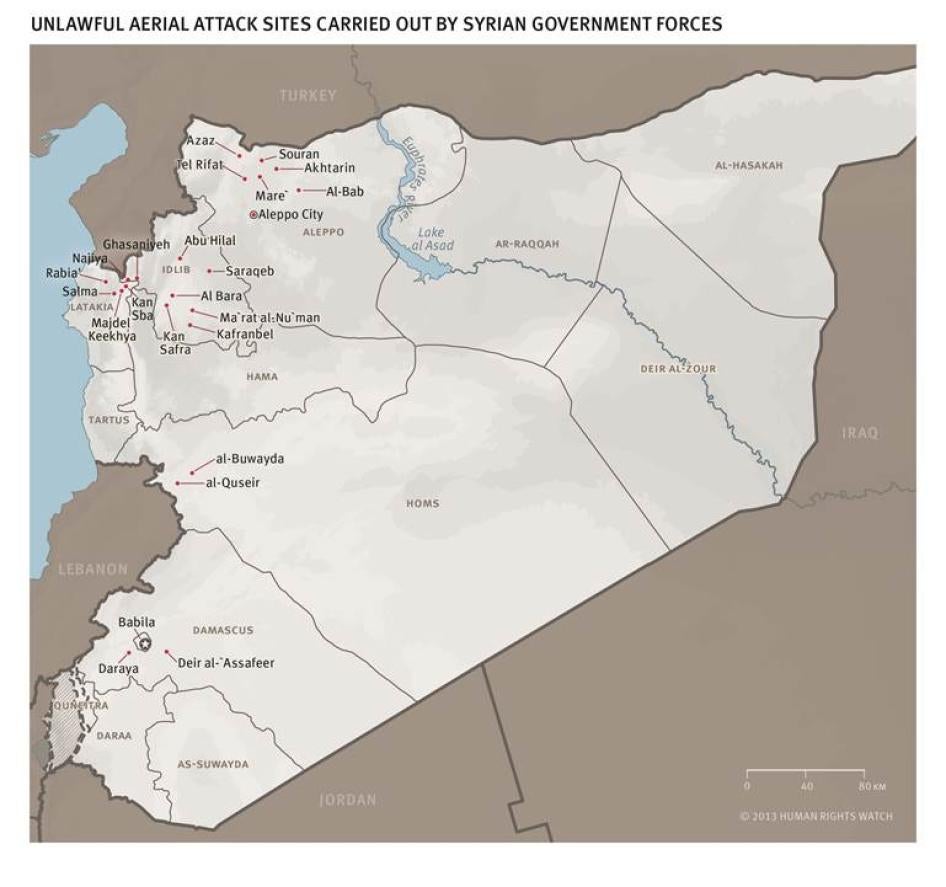
In this report, Human Rights Watch documents 59 unlawful attacks, the sites of which we were able to visit. These attacks include deliberate attacks against civilians and indiscriminate attacks—that is air strikes that did not or could not distinguish between civilians and combatants. Both types of attacks are serious violations of international humanitarian law (the laws of war).Human Rights Watch has found that the Syrian Air Force appears to have carried out indiscriminate air strikes with knowledge of their indiscriminate effect.
Individuals who commit serious violations of the laws of war willfully—that is intentionally or recklessly—are responsible for war crimes. Syrian government air strikes that have deliberately or indiscriminately killed civilians appear to be part of systematic and widespread attacks against the civilian population that Human Rights Watch previously found amount to crimes against humanity.
This report is based on field investigations conducted in Aleppo, Idlib, and Latakia governorates in August, October and December 2012. Researchers visited 52 sites of government air strikes—some sites had been attacked more than once—in Aleppo, Idlib and Latakia governorates, and witnessed some of the attacks firsthand; they interviewed more than 140 witnesses and victims of the attacks during site visits, by phone, and in camps for refugees and displaced persons in Syria or in neighboring countries, and four defectors from the Syrian Air Force. Attacks on sites visited by Human Rights Watch killed 152 civilians. Human Rights Watch has also included several attacks that we documented through interviews with firsthand witnesses and review of photo and video material, but the sites of which we were not able to visit.
The attack sites examined by Human Rights Watch were in towns and villages controlled by the opposition. Most of the towns and villages had been under opposition control for weeks or months and had seen no recent ground fighting at the time of the attacks.
While government forces carried out sporadic air strikes starting March 2012, regular air strikes against opposition-controlled towns started in late July. The exact number of civilian deaths caused by these attacks is difficult to verify. According to the Violations Documentation Center (VDC), a Syrian monitoring group working in coordination with a network of Syrian opposition activists called the Local Coordination Committees, 4,472 people, most of them civilian, had died as a result of the air strikes between July 2012 and March 22, 2013. The actual number of casualties is probably higher given the difficulties of documentation.
Human Rights Watch gathered information that indicates government forces deliberately targeted bakeries and civilians waiting in breadlines in air strikes as well as in artillery attacks. For this report Human Rights Watch documented in detail eight aerial attacks on four bakeries. For each of these attacks, Human Rights Watch was not able to identify any military target, such as fighters or weapons, in the vicinity. According to the Syrian Revolution General Commission, a local opposition group, Syrian forces have attacked 78 bakeries across Syria, either by air strikes or artillery shelling.
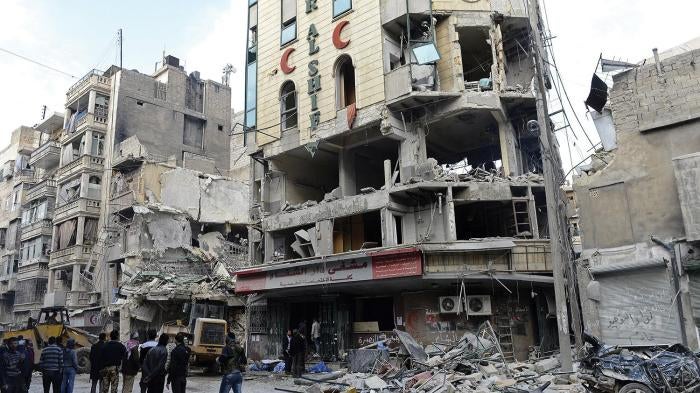
Repeated attacks on two hospitals in the areas visited by Human Rights Watch strongly suggest that the government deliberately targeted these facilities. In Aleppo city, jets launched at least eight attacks on or near a clearly marked hospital, Dar al-Shifa hospital, in the span of four months, and eventually destroyed significant parts of the building so that the hospital could no longer function. Even if opposition fighters were in or near the hospital in Aleppo city, as some information indicates, the hospital should not have been attacked without warning. Moreover, the attacks would have caused disproportionate loss of civilian life compared to any expected military gain, a violation of the laws of war. In Salma in Latakia governorate, helicopters repeatedly dropped improvised aerial bombs in the vicinity of a makeshift hospital, eventually destroying it on October 5, 2012, in what also appears to have been a deliberate attack on a hospital.
In addition to the attacks on the bakeries and hospitals, Human Rights Watch concluded in 44 other cases that air strikes were unlawful under the laws of war. Syrian forces used means (e.g. unguided bombs) and methods (e.g. fighter jets, high-flying helicopters) of warfare that under the circumstances could not distinguish between civilians and combatants, and thus were indiscriminate. In the strikes Human Rights Watch investigated, despite high civilian casualties, damage to opposition headquarters and other structures was minimal and, as far as Human Rights Watch could establish, there were no casualties among opposition fighters. Some of these attacks, particularly in which there was no evidence of a valid military target, may have deliberately targeted civilians, but more information would be needed to reach that conclusion.
Four Syrian Air Force officers who defected told Human Rights Watch that the Syrian Air Force does not have the technology to identify and target specific military objectives in urban areas. They believed their commanders nonetheless ordered air strikes in cities and towns, in part to instill fear in the civilian population in opposition strongholds, and also to deprive the opposition of its support.
Human Rights Watch collected information through field visits, examination of video footage, and interviews with witnesses on dozens of attacks involving cluster munitions, weapons that have been banned by most nations because of their indiscriminate nature. Between July and December Human Rights Watch documented the Syrian armed forces use of air-dropped cluster munitions in populated areas in the governorates of Aleppo, Idlib, Deir al-Zor, Homs, Latakia, and Damascus. An initial review of available information has identified at least 119 locations across Syria where at least 156 cluster bombs have been used since October, 2012, when there was a dramatic rise in the use of cluster munitions by the Syrian Air Force.
The obligation to minimize harm to the civilian population applies to all parties to a conflict. The Free Syrian Army (FSA) and other Syrian armed opposition groups did not take all feasible measures to avoid deploying forces and structures such as headquarters in or near densely populated areas. For example, witnesses told Human Rights Watch that there were opposition fighters in or near the Dar al-Shifa hospital in Aleppo city, which might have led to repeated attacks on that hospital. However, an attacking party is not relieved from the obligation to take into account the risk to civilians from an attack, on the grounds that the defending party has located military targets within or near populated areas.
In 41 attacks documented in this report, Human Rights Watch identified possible targets, such as FSA bases, checkpoints or headquarters, within 50 to 400 meters of the strike, but the strikes often missed their presumed target, causing it limited, if any, damage. According to military experts, the Syrian Air Force has only unguided air-dropped munitions. These strikes killed scores of civilians and caused significant damage to civilian objects and infrastructure.
For example, in al-Bab, a town east of Aleppo city that Human Rights Watch visited, the Syrian Air Force launched several attacks in the vicinity of an FSA base in the southern part of the town on September 3, 2012. The jet first struck a residential building 100 meters south of the base, killing four members of the Said family. A second strike hit just to the north of the FSA base. The FSA base itself was never hit.
Another air strike on Azaz, a town close to the Syrian-Turkish border, on August 15 killed at least 34 civilians, and injured more than 100. Human Rights Watch examined the site about two hours after the attack and identified two FSA facilities that might have been the intended targets of the attack: the local FSA brigade headquarters, located 200-300 meters from the block that was hit, and an FSA prison, located 50-100 meters away. Neither of these facilities was damaged in the attack.
One Azaz resident from the Danoun family, “Ahmed,” told Human Rights Watch that the bombing killed at least 12 members of his family in their homes. When Human Rights Watch interviewed him several hours after the attack he believed that four other family members were still under the rubble. He said:
I was about 100 meters away from the house when I saw the airplane and heard the sound of the bombing and destruction. My three brothers lived here. I buried 12 of my family members today, including my father, my mother, and my sister—my brother’s wife as well. Walid, my brother, was cut into pieces. We didn’t recognize him at first. We buried my brothers’ children also. The youngest was 40 days old.
In many strikes documented in this report, remnants of the munitions and the extent of the destruction demonstrate that the Syrian Air Force used large, high-explosive munitions, sometimes destroying multiple houses in a single attack. Even if legitimately aimed at or striking a military target in a populated area, such weapons likely lead to considerable civilian casualties and civilian property destruction in the vicinity. While these weapons are not considered inherently indiscriminate, cases documented in this report suggest that the Syrian Air Force used them indiscriminately in populated areas. Human Rights Watch believes that, as a matter of policy, military commanders should not order the use of explosive weapons with wide area effects in populated areas due to the foreseeable harm to civilians.
While the August 15 attack on Azaz cited above destroyed about 20 houses, Human Rights Watch was not able to establish the exact munitions used. However, the level of destruction indicates that the effects of the attack would have been so broad that, even if it had hit the presumed target, the effects would have rendered the attack indiscriminate. In other cases, Human Rights Watch was able to identify the munitions used. For example, one of the bombs used in several of the attacks documented by Human Rights Watch, the high explosive fragmentation bomb OFAB 250-270, has a casualty-producing radius of 155 meters, which means that it would likely lead to civilian casualties in populated areas even when it hits a military target.
Human Rights Watch also documented the use of incendiary weapons in five locations: al-Bab in Aleppo, Daraya in Damascus, Ma`rat al-Nu`man in Idlib, Babila in Damascus, and al-Quseir in Homs. At least three of the five attacks resulted in civilian injuries. Incendiary weapons can cause particularly cruel injuries to both civilians and combatants. They are also prone to being indiscriminate because they start fires and cause casualties over large areas without distinction. Human Rights Watch is advocating for stronger international restrictions on the use of incendiary weapons. A complete ban would have the greatest humanitarian impact, but at a minimum there should be no use of incendiary weapons in populated areas.
The Syrian government rarely issues statements or comments on specific attacks by its air force. In the few cases when it has done so, the statements were general and vague, referring to attacks on “terrorists” and destruction of “terrorist headquarters,” without providing any further evidence or details. Where it was possible to match government statements with cases that we documented, Human Rights Watch found no evidence supporting the government claims, such as deaths of FSA soldiers in the attacks or destruction of military objects, with the exception of a government statement about the November 21 attack on a hospital in Aleppo city.
Ending the Killing of Civilians
Human Rights Watch hopes that this report will help galvanize international efforts to end the Syrian armed forces’ unlawful killing of civilians and to aid civilians at risk. The information we have gathered should also assist those seeking to bring the perpetrators of these crimes to justice.
All concerned governments should intensify their efforts to push Syria, and those with influence over Syria, to take immediate steps to end the killing of civilians in Syria. In particular, they should press Syria to end deliberate, indiscriminate, and disproportionate air strikes and other attacks on civilians, including all use of cluster munitions, ballistic missiles, incendiary weapons and explosive weapons with wide-area effects in populated areas.
In addition, all governments and companies should immediately stop selling or supplying weapons, ammunition and materiel to Syria, given compelling evidence that the Syrian government is committing crimes against humanity, until Syria stops committing these crimes. Arms sales and military assistance to the Syrian government may make the individuals involved complicit in these crimes. Governments and others should suspend any current dealings and stop signing new contracts with companies that are supplying such arms and materiel.
Governments should not permit the use of their national territory or airspace for the shipment to the Syrian government of arms, ammunition, and other materiel. The international community should call on Iraq in particular to do more to verify that no arms from Russia and Iran for Syria are passing through Iraq, including by allowing independent, third party monitors to inspect convoys and airplanes crossing Iraqi land or airspace and bound to Syria. The League of Arab States (LAS), the Organization of Islamic Cooperation (OIC) and the UN General Assembly should actively encourage Iraq to accept this monitoring.
Human Rights Watch has repeatedly called upon the UN Security Council to take measures that would pressure the Syrian government to cease ongoing war crimes and crimes against humanity and achieve some degree of accountability for these crimes. These measures include targeted sanctions on the Syrian leadership implicated in crimes, an arms embargo on the Syrian government, and the referral of the situation in Syria to the International Criminal Court.
Russia and China have opposed these measures. They vetoed three proposed Security Council resolutions on October 2011, February 2012, and July 2012 (the third under Chapter VII) intended to increase the pressure on the Syrian government to end abuses and begin a process of political transition by arguing that these resolutions would undermine political mediation efforts and have no positive influence on the government. They also argued that the resolutions did not do enough to acknowledge opposition abuses. These arguments failed to recognize the severity of the Syrian government’s unlawful actions, which to date has caused many of the 70,000 deaths in the country. Russia and China’s refusal to support even mild resolutions have paralyzed the Security Council, preventing it from taking action that would meet its responsibility to protect the Syrian people from serious violations of international human rights and humanitarian law.
Given Russia’s and China’s intransigence, there seems little hope that the Security Council will, in the short term, end this unconscionable abdication of its responsibility. That does not end the responsibility of other governments to redouble their efforts to break this deadlock and to at least take the steps outlined below. In particular, the LAS, the OIC, and Russia and China’s partners in BRICS – India, Brazil and South Africa – should press Russia and China to take action, particularly on issues in which their inaction is most untenable, such as the need for UN cross-border delivery of aid to ease the humanitarian crisis in opposition-held parts of Syria. Governments should greatly expand funding and assistance for such cross-border humanitarian aid by others if the UN is not authorized to act.
Governments should also press the Syrian armed opposition to protect civilians. In particular, the armed opposition should take all feasible precautions to protect civilians from the risk of attack, avoid to the extent feasible deploying military forces in or near densely populated areas, and ensure the compliance of opposition forces with international humanitarian law.
Human Rights Watch has not taken a position on whether the international community should intervene with military force to protect civilians in Syria. As concerned states weigh the potential costs and benefits of such measures, they should at least act on the recommendations contained in this report.
Methodology
This report is based on field investigations conducted in Aleppo, Idlib, and Latakia governorates, Syria, in August, October, and December 2012. Researchers visited 50 sites of air strikes in Aleppo, Idlib, and Latakia governorates and witnessed some of the attacks firsthand (some sites had been attacked more than once); they interviewed more than 140 witnesses and victims of the attacks in these governorates, as well as witnesses from Idlib, Homs, Hama, and Damascus, and four defectors from the Syrian Air Force who had been displaced inside the country or fled to neighboring countries.
The interviews were conducted by Arabic-speaking researchers or with the help of Arabic-English interpreters. Wherever possible, the interviews were conducted in private. Human Rights Watch did not rely on armed opposition groups for logistical assistance during field visits to Syria.
With respect to other strikes, in areas that Human Rights Watch was unable to visit (in Idlib, Homs, Hama, and Damascus), researchers conducted interviews with witnesses who had fled from those areas to Turkey, Lebanon, and Jordan, and in some cases, by phone with witnesses inside Syria.
Human Rights Watch reviewed hundreds of videos filmed by witnesses and, when possible, interviewed them about the content. Arms experts, including from Human Rights Watch, reviewed videos and witness statements to identify weapons and delivery methods.
Gathering information about violations in Syria remains difficult and dangerous. Syria’s government refuses entry to Human Rights Watch and other international human rights groups. While the government has granted access to some journalists, it often places restrictions on their movement or otherwise prevents them from reporting freely.
Because Syrians who speak to foreigners or try to share information through electronic means have faced severe repercussions from the government, Human Rights Watch exercised caution while collecting and publicizing the information it received. To protect witnesses, names of witnesses or places of interviews in this report have, in some cases, been changed or withheld.
During its research, Human Rights Watch focused on aerial attacks that took place in locations Human Rights Watch was able to visit or that resulted in civilian casualties. In this report, Human Rights Watch only used information that contained sufficient detail and was independently corroborated by witness statements, video footage, and casualty lists compiled by activists. We excluded dozens of other accounts and allegations that we documented but could not corroborate.
For each attack, Human Rights Watch attempted to determine whether the strike hit a military target or whether there were any military targets in the vicinity that might have been the subject of the attack. Human Rights Watch did this by examining the site of the attack and the neighborhood, and asking local residents and witnesses whether they knew of any opposition fighters, bases, or vehicles in the vicinity at the time of the attack or whether they believed that the strike had targeted something else. Human Rights Watch also reviewed casualty databases and media reports to establish whether there were any reported opposition fighters killed or injured during the attack, or whether any opposition bases or vehicles were hit.
Casualty numbers in places that Human Rights Watch visited are based on the names and other details provided by relatives, and cross-checked with casualty databases compiled by local activists.
I. Background: From Protests to Armed Conflict
Since anti-government protests began in March 2011,the Syrian authorities have committed a wide range of human rights violations in their attempt to quell the uprising.[1] As demonstrations spread throughout the country in 2011, Syrian government forces, primarily the notorious security services, regularly used force, often lethal, against largely peaceful demonstrators.[2]
Security forces also launched a massive campaign of arrests, arbitrarily detaining hundreds of protesters across the country, routinely failing to acknowledge their detention or provide information on their whereabouts, and subjecting them to torture and ill-treatment.[3] Human Rights Watch documented hundreds of cases of torture in at least 27 different detention centers around the country,where detainees (including children) were subject to a broad range of torture methods, including prolonged beatings, the use of electricity, sexual assault, burning with car battery acid, the pulling of fingernails, and mock execution.[4]
Summary and extrajudicial executions of defecting soldiers,opposition fighters, opposition supporters, as well as civilians who appeared to have had no part in the confrontation with the authorities other than being residents of opposition strongholds, also became part of the government’s attempt to stop the demonstrations.[5]
Unable to quell the protest movement, the Syrian army launched a military assault on Dar`a in April, 2011, in Tal Kalakh in May, and in Baniyas and Latakia along Syria’s coast in May and August respectively.[6] The army succeeded in taking control of Dar`a, but this was followed by even more protests in other parts of the country, and elements of the opposition increasingly took up arms against the government in September 2011, further militarizing the conflict.
Syrian authorities launched another major offensive in February 2012, when its forces started using artillery, sometimes large-caliber, to bombard civilian neighborhoods in Homs and other areas under the control of opposition groups.[7] The army deployed tanks in large numbers as it moved to retake control of Hama. Government forces also planted landmines along the borders of Lebanon and Turkey, and used civilians as human shields during arrest operations, troop movements, and attacks on towns and villages in northern Syria.[8] The military attacks forced increasing numbers of Syrians to seek refuge in neighboring countries.
By May 2012, Human Rights Watch found that the fighting in some parts of Syria had reached the level of an armed conflict, making international humanitarian law, or the laws of war, applicable in those areas.[9] The International Committee of Red Cross (ICRC) in July 2012 publicly concluded that the situation in Syria amounted to a non-international armed conflict.[10]
The conflict in Syria entered a new stage during the summer of 2012, when opposition forces solidified control over significant territory in the north and conducted military operations in Damascus and Deir al-Zor in eastern Syria. Armed opposition groups also committed abuses in areas under their control, subjecting detainees to ill-treatment and torture, and committing extrajudicial or summary executions in Aleppo, Latakia, and Idlib.[11]
In July 2012, armed opposition forces launched attacks in Damascus in an operation termed the "Damascus Volcano and Syrian Earthquake."[12] The height of this operation was a bomb attack on the National Security headquarters on July 18 that immediately killed three senior officials: Defense Minister Daoud Rajiha, Deputy Defense Minister Asef Shawkat, and Assistant Vice President Hassan Turkmani.[13] Media reports indicate that National Security Chief General Hisham Ikhtiyar died on July 20 from injuries sustained in the blast.[14]
Following this attack and the increased presence of opposition fighters in some suburbs of Damascus, the Syrian government deployed its air force, artillery, and ground troops into some Damascus neighborhoods and surrounding towns. In areas where government troops and pro-government militias entered, numerous reports emerged of Syrian security forces summarily executing civilians and captured members of the armed opposition. One of the deadliest of these operations occurred in the Damascus suburbs of Daraya and Ma`damiya between August 20 and 26, when according to local residents Syrian security forces heavily shelled the area before entering and executing a number of people.
Following losses in Damascus in July 2012, opposition fighters concentrated efforts in northern Syria, particularly in Aleppo governorate, where fighting continues at the time of writing, as the opposition struggles to gain and maintain control over territory.
Opposition fighters also increasingly began using car bombs and other explosives throughout Syria to target security force members and infrastructure. In some cases, as with the explosions near a military officers’ club in Aleppo on October 3, 2012,[15] a car bomb near a police station in Bab Touma, Damascus on October 21,[16] and reported suicide bomb attacks targeting a military camp in Dar`a on November 10, dozens of civilians were reportedly killed or injured.[17]
As fighting has intensified, the humanitarian situation in Syria has deteriorated, and the number of refugees has climbed. As of February 27, 2013, 953,310 individuals from Syria in neighboring states had been registered as refugees or were awaiting registration, according to the UN.[18] In February 2013 the United Nations Office for the Coordination of Humanitarian Affairs (OCHA) estimated that two million people were internally displaced, many living in intolerable conditions, and that the conflict was affecting more than four million people inside Syria.[19] According to OCHA, aid delivery continues to be encumbered by high levels of insecurity.
Air Strikes and Casualties
The first documented instance of a Syrian government aerial attack known to Human Rights Watch was a helicopter attack on the town of Azaz in northern Aleppo on March 22, 2012.[20]By late May, the Syrian Air Force was using helicopters to launch attacks almost daily, particularly in opposition-controlled areas in northern Syria.[21] By the end of July 2012, the Syrian government’s reliance on air power increased, and media outlets reported the first jet attack in Aleppo city on July 24.[22]
As of March 22, 2013, the Violations Documentation Center (VDC), a Syrian monitoring group working in coordination with a network of Syrian activists called the Local Coordination Committees, had registered the names, date of death and place of death of 4,472 individuals who had been killed in aerial attacks, most of the civilian.[23] In the 55 attacks investigated by Human Rights Watch, aerial attacks resulted in the deaths of at least 152 civilians. In these cases, the VDC database was either accurate or undercounted the number of civilian deaths.
The governorates where the VDC has recorded the greatest number of deaths from air strikes are the Damascus countryside (1,212 deaths), Aleppo (1,277 deaths), and Idlib (787 deaths).
For several towns in opposition-controlled areas, air strikes are the most frequent cause of death for those registered in the VDC database. For example, in Azaz, in Aleppo governorate, 45 of 75 deaths between August 1, 2012, and March 2013 registered in the VDC database were caused by air strikes.[24] In Souran, five of six deaths registered in the same period were caused by air strikes.
II. Applicable International Humanitarian Law
International Humanitarian Law
International humanitarian law, also known as the laws of war, applies to the armed conflict in Syria.[25] The law applicable to the fighting in Syria, a non-international (internal) armed conflict, includes article 3 common to the four Geneva Conventions of 1949 (Common Article 3), and customary international humanitarian law.[26]
The fundamental tenets of international humanitarian law are civilian immunity and distinction. While humanitarian law recognizes that some civilian casualties are inevitable, it imposes a duty on warring parties at all times to distinguish between combatants and civilians, and to target only combatants and other military objectives.
Civilian objects are those that are not considered military objectives.[27] Military objectives are combatants, including civilians directly participating in the hostilities, and those objects that “by their nature, location, purpose or use, make an effective contribution to military action and whose total or partial destruction, capture or neutralization, in the circumstances ruling at the time, offers a definite military advantage.”[28] In general, the law prohibits direct attacks against what are by their nature civilian objects, such as homes and apartments, places of worship, hospitals, schools, or cultural monuments, unless they are being used for military purposes.[29]
Deliberate, indiscriminate, or disproportionate attacks against civilians and civilian objects are prohibited. Attacks are indiscriminate when they are not directed at a specific military objective, or employ a method or means of warfare that cannot be directed at a military objective or whose effects cannot be limited.[30]
A disproportionate attack is one in which the expected incidental loss of civilian life and damage to civilian objects would be excessive in relation to the concrete and direct military advantage anticipated.[31] The expected danger to the civilian population and civilian objects depends on various factors, including their location (possibly within or near a military objective), the accuracy of the weapons used (depending on the trajectory, the range, environmental factors, the ammunition used, etc.), and the technical skill of the combatants (which can entail random launching of weapons when combatants lack the ability to aim effectively at the intended target).[32]
In the conduct of military operations, parties to a conflict must take constant care to spare the civilian population and civilian objects from the effects of hostilities.[33] Parties are required to take precautionary measures with a view to avoiding, and in any event minimizing, incidental loss of civilian life, injury to civilians, and damage to civilian objects.[34]
Before conducting an attack, a party to the conflict must do everything feasible to verify that the persons or objects to be attacked are military objectives and not civilians or civilian objects.[35] Discussing Protocol I in its Commentaryon the Additional Protocols, the International Committee of the Red Cross (ICRC) explains that the requirement to take all “feasible” precautions means, among other things, that those conducting an attack are required to take the steps needed to identify the target as a legitimate military objective “in good time to spare the population as far as possible.”[36]They also must take all feasible precautions in the choice of means and methods of warfare to minimize loss of civilian life and property.[37]
International humanitarian law does not prohibit fighting in urban areas, although the presence of civilians places greater obligations on warring parties to take steps to minimize harm to civilians. Forces must avoid locating military objectives within or near densely populated areas, and endeavor to remove civilians from the vicinity of military objectives.[38]Belligerents are also prohibited from using civilians to shield military objectives or operations from attack. "Shielding" refers to purposefully using the presence of civilians to render military forces or areas immune from attack.[39] The unlawful deployment of forces within or near densely populated civilian areas does not relieve opposing forces from taking into account the risk to civilians when conducting attacks. The obligation to respect international humanitarian law does not depend on reciprocity by belligerent forces.[40]
International humanitarian law also explicitly prohibits attacks, “the primary purpose of which is to spread terror among the civilian population,”[41] and reprisals.[42]
Individuals who commit serious violations of international humanitarian law with criminal intent are responsible for war crimes. Criminal intent has been defined as violations committed intentionally or recklessly. [43] Individuals may also be held criminally liable for attempting to commit a war crime, as well as assisting in, facilitating, aiding, or abetting a war crime. Responsibility may also fall on persons planning or instigating the commission of a war crime. [44] Military commanders and civilian leaders may also bear personal responsibility as a matter of command responsibility if they knew or should have known about the commission of war crimes and failed to prevent them or punish those responsible.
Those acts considered to be war crimes can be found in customary law as reflected in the Rome Statute of the International Criminal Court (ICC) and other sources. They include a wide array of offenses, including mistreatment of persons in custody, and deliberate, indiscriminate, and disproportionate attacks harming civilians.[45] When committed as part of a widespread or systematic attack against a civilian population, such offenses constitute crimes against humanity.[46]
Other relevant laws-of-war issues, including attacks on hospitals and the use of cluster munitions and incendiary weapons are discussed in the relevant sections, below.
Unlawful Air Strikes
As noted above, deliberate attacks on civilians are war crimes.[47] Indiscriminate (and disproportionate) attacks carried out with criminal intent are also war crimes.[48] The frequency of government air strikes in Syria that have struck only civilians and civilian objects with high-explosive munitions in populated areas indicates that those ordering the air strikes have been acting deliberately or recklessly.
Additionally, the repeated indiscriminate air strikes carried out by Syrian government forces suggests command responsibility for such attacks. That is, there are Syrian commanding officers who knew or should have known about the unlawful attacks and were legally obligated to take action to deter them or punish those responsible, but failed to do so. [49]
The rebel Free Syrian Army (FSA) themselves have unlawfully contributed to civilian casualties by deploying headquarters and other military objectives in densely populated areas. However, such deployments do not give license to the Syrian government forces to conduct unlawful attacks. In none of the cases documented by Human Rights Watch have Syrian forces given advance warnings of the attacks.
All of the attacks documented in this report appear to have been carried out with unguided munitions dropped without precision by jets and helicopters.The Syrian Air Force does not have guided munitions in its arsenal.[50] Unexploded munitions and munitions identified by their remnants by Human Rights Watch weapons experts were all unguided.
Striking a specific military target with unguided air-to-surface munitions is challenging, according to military experts, as successful targeting depends on a combination of factors: the qualifications and experience of the pilot, availability of equipment that would allow the pilot to distinguish the target from nearby civilian objects, good visibility, proper attack angle, elevation, and speed, to name a few. The ICRC has stated that the use of “weapons which by their nature are incapable of being directed with any certainty to specific military targets, or which in their typical or normal use are not delivered with any certainty to such targets,” are in violation of the principle that parties to an armed conflict must ensure that civilians and civilian objects are respected and protected.[51]
Human Rights Watch investigations found very few Syrian government air strikes that struck FSA military targets, whether FSA fighters or static military objectives. The means (munitions) and methods (bombing by jet fighters and other aircraft) of attack on FSA military targets in various cities investigated by Human Rights Watch raise grave concerns that these air strikes could never adequately distinguish between combatants and civilians.
In addition to standard unguided munitions, the Syrian armed forces have produced and used in civilian areas improvised munitions, “barrel bombs,” made from metal objects such as gas cylinders, oil barrels, and even a folded-up door, which contain a mixture of bulk explosive and fragmentation media (nails, cut up steel rebar, etc).[52] These improvised bombs are mated with a simple timing device, and are then pushed out of a helicopter into a target area.
Syrian forces have used these improvised bombs in an indiscriminate manner, as evidenced by a video posted on YouTube. A soldier is seen using a cigarette to light a fuse on an improvised munition and pushing it out the back of the helicopter that is clearly flying at such a high altitude that it could not hit a target in a populated area with any precision.[53]
In most of the air strikes investigated by Human Rights Watch, as well as dozens of other attacks videotaped and reported by Syrian activists, Human Rights Watch’s analysis of damage and munitions remnants showed that Syrian forces used large, high-explosive weapons.[54] Destruction from such weapons can be so extensive in highly populated areas that even attacks that hit a military objective will still cause indiscriminate or disproportionate harm to civilians and civilian property.
Human Rights Watch found the use in towns of OFAB 250-270 unguided, high-explosive bombs, which can cause injury to people in a 155-meter radius from where it strikes.[55]
In some cases, such as the August 15 attack on Azaz, a small town near the Turkish border, and the December 14 attack on Kansba in Latakia, the damage from the attack was so extensive that it likely resulted from a bomb larger than the OFAB 250-270 or several bombs exploding at the same time, according to Human Rights Watch military experts who reviewed photos of the damage.
Even though Human Rights Watch itself has not documented remnants of bombs larger than the 250-kilogram sized weapons like the OFAB-250-270, videos posted on YouTube show that the government has used larger bombs in populated areas, such as fuel-air explosives (FAEs), popularly known as “vacuum bombs,” which are more powerful than conventional high-explosive munitions of comparable size, and more likely to kill and injure people over a wide area.[56] Eliot Higgins, a well-known and widely cited independent arms expert blogging under the name of “Brown Moses”, has collected videos and analyzed 14 instances of FAE use—most of them in populated areas.[57]
The use of high-explosive weapons in populated areas is not specifically prohibited by international law, although it has been argued that their use in populated areas should be limited or banned altogether given the likelihood of harm to the civilian population. As a matter of policy, Human Rights Watch has called for a halt to the use of explosive weapons with wide area effects in populated areas as being inherently indiscriminate. The UN secretary-general and the ICRC have made similar calls.[58]
The Syrian government rarely issues statements or comments on air strikes. In the few cases when it has done so, the statements have been general and vague, referring to attacks on “terrorists” and destruction of “terrorist headquarters” without providing any further information or details that would lend insight into the legality of the attack. Where it was possible to match government statements with cases that we documented, Human Rights Watch found no evidence supporting the government claims, such as losses to FSA fighters or damage to FSA deployments.
For example, on August 31, Syria’s state-run news agency, SANA, reported that “armed forces carried out an operation in which five terrorist headquarters were destroyed” in al-Bab. But according to local residents interviewed by Human Rights Watch, none of the strikes on August 31 hit buildings used by the FSA. Instead, the Syrian Air Force struck three schools, none of which were used by the FSA. One strike hit two residential houses, killing four civilians. Another strike hit another residential home, but resulted in no casualties because the family was hiding in the basement, and a final strike killed a civilian at a roundabout in the center of town (see section on al-Bab below).[59]
The lack of capacity of the Syrian Air Force to conduct precise air strikes against military objectives in populated urban areas was apparent in Human Rights Watch’s interviews with four Syrian Air Force defectors. They said they did not have the capacity to identify and target specific military objectives, and that they believed their commanders, aware of the indiscriminate nature of the strikes, used them in part to instill fear among the civilian population in opposition-strongholds and to deprive the opposition of local support.
For example, a brigadier general who said that he served in the Ministry of Defense at a military airport near Damascus until he defected in August 2012 told Human Rights Watch that pilots did not have accurate spotting technology, but that from the Syrian government’s perspective, inaccurate strikes served their purpose. Discussing strikes in Aleppo, he said:
It is difficult [for the pilots] to know where they are hitting. Their strike range is maybe 300 to 400 meters from a target. From their perspective it is okay because they find a spot where the FSA is and hit it, give or take a few hundred meters. They [the commanders] want people to be afraid. They want people to move out of Aleppo.[60]
A second brigadier general, who said that he served for 40 years in the air force defense section of the Ministry of Defense before defecting, told Human Rights Watch that “the point of the strikes is to get people to hate the FSA.”[61]
A pilot, a colonel in the Syrian Air Force, who defected in September 2012, told Human Rights Watch:
Ninety percent, even 95 percent of the bombing is random. What’s the purpose? To scare the population, terrorize people, and make them turn their back on the revolution.… Pilots would dive in, attack, but then go back up without shooting. Then they [the commanders] would force them, ordering them to “shoot!”[62]
III. Deliberate Attacks on Bakeries
Through site visits, Human Rights Watch documented eight air strikes on four bakeries in Aleppo city, al-Bab, and Mare`, which killed at least thirty-five civilians who were waiting in line for bread. Human Rights Watch also documented attacks using surface-fire artillery on seven other bakeries.[63] According to a local opposition group, Syrian forces have attacked 78 bakeries across Syria, either by air strikes or by artillery shelling.[64] The pattern and number of these attacks suggest that government forces deliberately targeted civilians at the bakeries and breadlines.
The government issued no statement on the attacks on the bakeries documented by Human Rights Watch.
According to witnesses and Human Rights Watch’s site visits, there were no Free Syrian Army bases in the vicinity of these attacks. Free Syrian Army (FSA) members in the vicinity appear to have been carrying out policing operations and not directly participating in hostilities.
Bakeries are civilian objects protected from attacks. As the bakeries run by the opposition in opposition-controlled areas are the only source of bread for the civilian population, they would also be protected as “objects indispensable to the survival of the civilian population.”[65] The laws of war prohibits attacks that would “destroy, remove or render useless” such objects “for the specific purpose of denying them for their sustenance value to the civilian population, whatever the motive, whether in order to starve out civilians, to cause them to move away, or for any other motive.”[66]
FSA members have been organizing and maintaining order at bread lines. Even if such individuals are armed, under these circumstances, they would be considered to be carrying out a policing function, and thus not subject to attacks. Were such individuals to be regular FSA fighters and thus valid military targets, attacking them by air strike in a crowded area would still amount to an unlawful disproportionate attack.
Aqyoul Bakery, Aleppo City
At around 6 p.m. on August 21, a helicopter dropped two bombs near Aqyoul bakery in the Bab al-Hadid neighborhood in Aleppo city, killing at least 23 people, and injuring more than 30. Human Rights Watch visited the site three days after the attack, reviewed videos filmed immediately before and after the attack, and interviewed witnesses, including two people who had filmed videos.
According to these accounts, a helicopter circled above the area prior to the attack. Shortly after the bakery opened around 5:30 p.m. and people started lining up to buy bread, the helicopter dropped two bombs, one of which struck the edge of a building on the opposite side of the bakery; the second hit about 50 meters away from the bakery.
“Mustafa,” a 17-year-old boy who filmed the aftermath and shared the video, told Human Rights Watch: “It was the worst I’ve ever seen.”[67] The video shows a line of what appears to be either dead or heavily injured people along the wall of the bakery. Many more bodies, some with limbs and heads blown off, can be seen on the ground around the bakery.
“Qais,” a 44-year-old tailor, who worked as a volunteer at the bakery and was wounded in the attack, told Human Rights Watch that in the afternoon of August 21, he had delivered flour to the bakery and was about to leave when the attack took place:
There was black smoke everywhere, and broken glass. The bomb hit the corner of the street, and the shrapnel flew straight into the line. Everyone there was either killed or heavily injured. I saw one man on the ground without a leg, another without an arm, then a 16-year-old boy whom I knew, Rafat Makik Halak, without a head.…One of my cousins, Ahmed, lost his arm and leg, and died afterward. My sister, who was also injured, is still in the hospital.[68]
All witnesses interviewed by Human Rights Watch said that there were no opposition fighters in the immediate area with the exception of a couple of fighters responsible for maintaining order in the breadline.[69]
FSA fighters in the neighborhood said that they were engaged in a fight with government forces one or two kilometers from the bakery on August 21, but that there was no fighting near the bakery.[70]
Kanjou Bakery, Aleppo City
On August 20, a jet struck two apartment buildings in the al-Maysar neighborhood, killing 12 people and wounding 20 to 25 according to local residents. The buildings were located about 50 meters from the bakery, on either side of a parallel street to the one where the bakery is located. The bakery had been attacked at least twice before by artillery fire, according to local residents.[71] Having examined the damage to the buildings, Human Rights Watch believes that the August 20 attack was also directed at the bakery, but fell short. The bomb destroyed the top floor of the building furthest away from the bakery and the bottom floor of the building closest to the bakery, showing the direction and trajectory of the bomb, which would have hit the bakery had it been released an instant later.
The residents said that those killed included four members of the Hidani family, ages 10, 16, 16, and 75, whose house was struck by the bomb. Six of the other victims were killed in the street as they fled from the bakery after hearing the jet. Among the wounded were seven children and five women from the Hidani family.
Residents in the street interviewed by Human Rights Watch believed that the jet had attempted to target the bakery.[72] One resident told Human Rights Watch: “When they heard the jet, people knew that the bakery could be targeted so they ran to hide in our street. The bomb fell short, however, striking our street instead of the bakery.”[73]
When Human Rights Watch visited the area two days after the attack, four FSA fighters were sitting across from the bakery, but there were no indications of any other military activity in the area. According to the FSA soldiers, the nearest FSA base is 400 meters away.
Mare`, Aleppo
Jets attacked the bakery in the eastern part of the town of Mare`, in northern Aleppo governorate, at least three times. Around 9:30 a.m. on August 22, a jet fired a rocket and then dropped a bomb about 30 meters from the bakery, but the bomb failed to detonate. According to 3 witnesses, about 300 people were in line at the time of the attack. Human Rights Watch visited the site on August 23 and saw a crater where the rocket hit, about 35 meters from the bakery.[74]
There were no casualties from the attack, as most people fled when they saw the jet. Earlier in August, Human Rights Watch researchers had driven past the bakery on several occasions and had not seen any FSA presence in the vicinity; two known FSA facilities in Mare` were located in other parts of town.
On September 11, 2012, jets again attacked near the bakery, but there were no casualties.[75]
Al-Bab, Aleppo
A jet bombed a bakery on the outskirts of the town of al-Bab in northeastern Aleppo governorate at least three times, at 4 p.m. and 11 p.m. on August 21, and around 11 p.m. on August 22. The attacks on August 21 did not cause casualties. Witnesses told Human Rights Watch that during the first attack, nobody was near the bakery. During the second attack, people who were waiting in line—about 20 men and 10 women—ran away as soon as they saw the jet approaching, and nobody was wounded. On August 22, the jet dropped two bombs near the bakery. Witnesses told Human Rights Watch that most of the people who were waiting in line fled when they saw the jet, but that three men and one boy were wounded.[76]
Human Rights Watch visited the site of the attacks and examined the craters. One crater was about 10 meters from the bakery; a second was about 50 meters away. There had been no fighting in al-Bab since July, when government forces were forced to withdraw. Witnesses interviewed by Human Rights Watch said that they did not observe any FSA forces or weapons at the bakery.[77]
IV. Attacks on Hospitals
Human Rights Watch documented repeated attacks on two hospitals in the areas visited. In Aleppo city, jets and helicopters launched at least eight attacks on a clearly marked hospital, Dar al-Shifa, in the course of four months, eventually destroying significant parts of the hospital building so that the hospital could not continue to function. In the town of Salma in Latakia governorate, helicopters repeatedly dropped improvised aerial bombs in the vicinity of a makeshift hospital, eventually destroying it on October 15, 2012.
Under the laws of war, hospitals and other medical facilities[78] must be “respected and protected” in all circumstances. Protocol II to the Geneva Conventions, considered reflective of customary international law, specifically provides that all medical facilities “shall not be the object of attack.”[79] They remain protected from attack unless they are “used to commit hostile acts” that are outside their humanitarian function. Even then, they are only subject to attack after a warning has been given setting a reasonable time limit, and after such warning has gone unheeded. The presence of injured combatants does not affect the civilian character of medical facilities.[80] The Rome Statute of the International Criminal Court (ICC) considers it a war crime to intentionally attack “hospitals and places where the sick and the wounded are collected” during non-international armed conflicts.[81]
The repeated attacks on the two hospitals, as well as documented attacks on hospitals and medical staff in other parts of Syria, suggests that government forces deliberately targeted these places because they were hospitals.[82] Information about the presence of opposition fighters in or near the hospital in Aleppo city indicates the need for an inquiry into whether the hospital was being used by opposition for military operational purposes. In any event, no warning was given before the attack, and the attacks caused disproportionate civilian harm beyond any expected military gain, and thus violated the laws of war.
Dar al-Shifa Hospital in Aleppo City [83]
Between August 12 and November 21, aircraft struck on or in the immediate vicinity of the Dar al-Shifa hospital, the main emergency hospital in the opposition-controlled area in Aleppo city, at least eight times. In addition, government forces launched at least one artillery attack at or in the vicinity of the hospital.
On August 14, Human Rights Watch visited the hospital about one hour after a jet had struck the upper floors of the hospital with at least three rockets, and examined the destruction and remnants from rockets used in the attack. Human Rights Watch also documented a similar attack on the hospital on August 12.
During the August 14 visit to the hospital, doctors told Human Rights Watch that because aircraft had attacked the hospital in the past, they had limited the use of the upper floors to emergency surgery. One of the doctors told Human Rights Watch: “We had just finished surgery and moved to the second floor when the rockets hit. If they had hit just minutes before, we would have all been dead.”[84] After the August 14 attack brought further destruction to the upper floors of the building, hospital staff were forced to receive the wounded and conduct emergency operations on only the two lower floors.
Upon return to the hospital on August 24, Human Rights Watch documented a similar attack on the hospital on August 21. The three attacks on the hospital documented by Human Rights Watch killed four civilians and injured five, including three nurses.[85]
Around 3 p.m. on August 24, while two Human Rights Watch researchers were visiting the hospital, a jet struck a building 50 meters away on a parallel street to the hospital. The direction of the incoming bomb, as determined by the damage to the building, suggests that the jet was aiming at the hospital, but that the bomb fell short. As a result of the attack, the building collapsed, injuring several children.[86] The Human Rights Watch researchers had walked past the house approximately five minutes before the strike. The only Free Syrian Army (FSA) presence they saw in the vicinity at the time of the attack was two armed persons in front of the hospital who appeared to be guarding the hospital. Human Rights Watch was present when rescuers brought several injured children, some as young as five years old, to the hospital after the attack. Human Rights Watch did not see any FSA fighters injured in the attack.
In addition to the four attacks documented by Human Rights Watch, international journalists working in Aleppo city as well as local activists reported that government forces struck the hospital or its immediate vicinity four more times.[87] On November 21, in the last attack, a jet dropped a bomb that leveled a contiguous building, part of the hospital and rendered the rest unusable.[88] According to witnesses, up to 40 people were killed, including a doctor, a nurse, and two security guards at the hospital.[89]
The hospital is located in the al-Sha`ar area, a commercial and residential neighborhood in the northeastern part of Aleppo city. In August, when Human Rights Watch visited the hospital, government and opposition forces were fighting in the southwestern part of the city, about five kilometers away from the hospital.
The hospital is an established medical facility and clearly marked with a Red Crescent emblem on the front. Hospital doctors told Human Rights Watch that government forces had used Dar al-Shifa Hospital until opposition forces took control of the area in late July, so its location and purpose should have been known to the government.[90]
Commenting on the November 21 attack, the Syrian government news agency, SANA, reported that Syrian “armed forces … carried out operations targeting terrorist hideouts in…Dar al-Shifa Hospital in al-Sha`ar area….[This and other] operations resulted in the death of tens of terrorists and the destruction of their weapons and equipment.”[91] Human Rights Watch saw no signs of opposition military activity in or around the hospital building during several visits in August. However, one person with knowledge of the situation in the hospital interviewed in January 2013, told Human Rights Watch that he had seen what appeared to be opposition commanders meeting in the hospital on several occasions after August.[92] Another person said that there was a small group of opposition fighters staying in the building that was destroyed in the November 21 attack, and that about 20 of them were killed in that attack.[93]
The presence of opposition fighters in or in the immediate vicinity of the hospital—beyond those providing hospital security—endangered the hospital, medical staff, and patients and thus constitutes a violation of the laws of war. But this did not relieve the government of its responsibility not to attack a hospital without warning or to take all possible precautions to minimize harm to civilians in attacks. Even if the hospital was being used for military purposes at the time they were hit, which is not evident, the attacks were disproportionate.
Makeshift Hospital in Salma, Latakia
On October 15, 2012, a helicopter struck a makeshift hospital in the town of Salma in Latakia governorate using an improvised aerial bomb, causing significant destruction to the building and forcing the hospital to close and move to a new location.
During a visit to the site, Human Rights Watch documented two other attacks in the immediate vicinity, indicating that the hospital might have been deliberately targeted. One bomb exploded right behind the hospital, hitting a building under construction. Another bomb exploded right in front of the hospital, killing one civilian and injuring seven.[94]
A worker at the hospital told Human Rights Watch:
They had been attacking this area a lot of times because of the hospital, but they were not able to hit it. Finally, on October 5, a helicopter dropped several bombs, one of which hit the hospital. Most of the bombs dropped in Salma land around the square in the center or in the area around the hospital.[95]
Local residents and hospital staff told Human Rights Watch that they were convinced that the government knew about the hospital from informers in the area. Human Rights Watch has not been able to establish, however, whether the government knew that the building was used as a hospital. This should be investigated further.
Local residents told Human Rights Watch that although the FSA sometimes passed through, they were stationed outside the town. The government separately had targeted a police station located about 200 meters from the hospital, according to local residents, who said that it was easy to determine when the helicopters were trying to hit the hospital and when they were trying to hit the police station based on where the bombs landed.[96]
V. Cluster Bomb Attacks
Human Rights Watch site visits, interviews with witnesses, and videos posted on YouTube show that the Syrian Air Force has dropped cluster bombs in populated areas in the governorates of Aleppo, Idlib, Deir al-Zor, Homs, Latakia, and Damascus Suburbs on hundreds of occasions.[97] In December 2012 Human Rights Watch visited three sites that had been hit by cluster bombs and confirmed their use.
Cluster munitions explode in the air, sending dozens, even hundreds, of submunitions or bomblets over an area the size of a football field.
A majority of the world’s nations have comprehensively banned the use of cluster munitions in all circumstances through the Convention on Cluster Munitions, which became binding international law on August 1, 2010. Syria is not a party to the convention and did not participate in the 2007-2008 Oslo Process that led to the creation of the treaty, which bans the use of cluster munitions and requires destruction of stockpiles, clearance of areas contaminated with unexploded submunitions, and assistance to victims.
Given the international standard being established by the ban convention, Human Rights Watch opposes any use of cluster munitions by any party at any time. From a legal perspective, for those that have not joined the convention and continue to use cluster munitions, Human Rights Watch presumes cluster munition strikes in or near civilian population centers to be indiscriminate. Cluster munitions, large weapons that consist of dozens or hundreds of smaller submunitions, have a wide-area effect. Furthermore, the models used in Syria cannot be precisely targeted at specific military objectives and, in particular, the submunitions are almost always unguided. As a result, when cluster munitions are fired into civilian areas, civilian casualties and damage to civilian infrastructure are extremely difficult to avoid.
Cluster munitions therefore violate the rule that prohibits attacks that use a method of warfare that cannot be directed at a specific military objective. Thus even for those countries that have not joined the ban convention, when used in populated areas, cluster munitions should be presumed indiscriminate in violation of international law.
In addition to three attack sites in the governorates of Aleppo and Latakia where Human Rights Watch observed unexploded bomblets, an initial review of available information has identified at least 119 locations across Syria where at least 156 cluster bombs have been used between October 2012 and March 2013.[98] While there have been reports of individual cluster bomb strikes since July 2012, the Syrian armed forces significantly increased the use of cluster bombs delivered by aircraft starting in October 2012.[99] Two months later, in December, the Syrian armed forces began using surface-launched rockets containing cluster munitions.[100]
For some of these attacks, Human Rights Watch was able to interview victims, residents and activists who filmed the cluster munitions to confirm the location and circumstances of the attacks. In each video, Human Rights Watch identified cluster bombs or bomblets that had been dropped by aircraft, including helicopters.
Arms experts have identified three types of air-dropped RBK cluster bombs, one containing 150 AO-1SCh antipersonnel fragmentation bomblets, one containing ShOAB0.5 bomblets, and one containing 30 PTAB-2.5M anti-armor bomblets.[101] Each RBK-250-275 AO-1SCh cluster bomb creates a destructive footprint of 4,800 square meters (52,000 square feet), about the size of a football field, according to a standard international air-launched weapons reference guide.[102] The munitions identified were produced in the Soviet Union.[103] In most of the reviewed videos, the visible physical damage to the bombs and the submunitions show them to have been air-delivered.[104]
To ensure that the videos publicly posted showed unique incidents, Human Rights Watch analyzed the types of submunitions deployed, the factory data and production data on the individual bombs and submunitions, the characteristics of the locations where the strikes took place, and the particular damage to the individual bombs and submunitions found. In a number of incidents, phone interviews with witnesses and victims provided additional confirmation of the strikes. Using these points of analysis, a database of unique strike incidents was built, showing a significant rise in the use of cluster munitions by the Syrian forces starting from October 9, 2012.
In the three cluster bomb attacks Human Rights Watch researched through site visits, Human Rights Watch researchers or local residents discovered unexploded bomblets after the attack. Videos posted on YouTube and analyzed by Human Rights Watch show multiple examples of cluster munition bomblets failing to explode on initial impact. This would leave duds that acted like landmines and could explode when handled, posing grave dangers to civilians.[105] In November 2012, for example, one man was killed and one injured when they tried to remove a bomblet that was stuck in the ground in a town in Homs governorate.[106] Human Rights Watch also reviewed videos that showed Syrian children playing with unexploded cluster bomblets, and that children have been killed when unexploded bomblets detonated.[107]
Cases of Cluster Bomb Attacks Documented by Human Rights Watch
Al-Najiya, Idlib, December 15
Just 30 minutes before Human Rights Watch arrived at the village of al-Najiya in Idlib governorate on December 15, a helicopter dropped a cluster bomb on a residential area in the eastern part of town. Although there were many civilians in the town, there were no injuries reported, as most of the civilians had managed to seek shelter before the bomb struck. Three bomblets failed to explode. Human Rights Watch’s examination of the unexploded bomblets established that they were PTAB-2.5M anti-armor bomblets.[108]
A defector from the army who had arrived to disarm and collect the unexploded bomblets told Human Rights Watch that this was the second time that helicopters had dropped cluster munitions in the area. The first time, the cluster bombs had landed in the hills outside town, he said.[109]
Mare`, Aleppo, December 12
Around 3 p.m. on December 12, 2012, a jet dropped four cluster bombs on the town of Mare`, killing four civilians, including one child, and injuring 27. [110] Local residents gathered at least seven unexploded submunitions, some of which were examined by a weapons expert who concluded that an RBK-250 bomb containing PTAB-2.5M anti-armor bomblets had been used. [111] Several videos posted on YouTube show the aftermath of the attack. [112]
Human Rights Watch visited Mare` in the morning of December 12 and again two hours after the attack. Local residents told Human Rights Watch that the people killed in the attack were all civilians.[113] While Human Rights Watch observed a handful of Free Syrian Army (FSA) fighters in the town, they did not see a significant FSA presence. The area that was struck by the cluster munitions also included a school, which FSA fighters had been using when Human Rights Watch visited the town in August 2012. Human Rights Watch did not observe any FSA activity in the school during visits to the town in December. An opposition-run detention facility located on the school premises had also been moved.
Abu Hilal, Idlib, November 27, 2012 [114]
On the morning of November 27, 2012, cluster munition air strikes at Abu Hilal, two kilometers west of the northern city of Idlib, killed at least 12 civilians and wounded at least 10 more according to Human Rights Watch phone interviews with two local residents and a journalist who visited the site four days after the attack. They said that the dead included two women and one child. In the first air strike, at least 10 civilians at an olive oil processing facility were killed and more than 10 were wounded when an aircraft dropped two cluster bombs, the residents said.[115] A separate strike on a nearby olive grove killed two women working there. A journalist who visited the site four days after the attack told Human Rights Watch that the 10 people who were killed at the processing facility were local farmers who had brought their olives there for pressing, and that he saw no signs of military activity or weapons at the site.[116]
Analysis by Human Rights Watch of video footage posted online by Syrian activists of the scene and on the date of the attack indicates that the Syrian Air Force used RBK-250 bombs containing PTAB-2.5M anti-armor bomblets in the attack.[117] Human Rights Watch established the location of the air strike on the olive oil processing facility by matching video from the scene to satellite imagery. A local resident told Human Rights Watch that there was no activity by the FSA “near or around” the facility.[118]
Deir al-`Assafeer, Damascus, November 25 [119]
On November 25, a jet dropped at least three cluster bombs on a playing field in the Saraya neighborhood in the eastern part of Deir al-`Assafeer, near Damascus, killing at least 11 children and injuring others.[120] Two residents told Human Rights Watch by phone that the cluster bomb strike occurred as a group of at least 20 local children were gathered in a field where they usually play. One witness said:
Around 2:50 p.m., a MiG-23 appeared in the sky. I was 100 meters away from the playground. I looked outside and saw the MiG hovering around and then release six cluster bombs as it flew away. I saw two breaking in half. Then I heard a series of small explosions. It sounded like fireworks but of course louder. Then I heard people screaming and running toward the playground. I followed them with the rest of the men who were with me. When I reached the playground, I saw five children dead and many others wounded. The severely injured children were taken to nearby hospitals and the ones with lighter wounds to a field hospital.[121]
Witnesses told Human Rights Watch that there was no FSA base near or around the area at the time of the attack. “There is no FSA equipment, machinery, or anything else around the fields or near the farmlands,” one resident told Human Rights Watch.[122] Another said: “There were no FSA vehicles or machinery visible.”[123] Human Rights Watch has not been able to confirm independently or otherwise the presence of any fighters or military objectives, but the large number of children playing outside at the time of the strike would be consistent with the absence of any fighting in the immediate area.
A Human Rights Watch analysis of videos posted online by Syrian activists of the scene of the attack indicates that Syrian forces used at least three RBK-250-275 AO-1SCh cluster bombs in the strike.[124]
Kansba, Latakia, November 2012
In November 2012, a helicopter dropped at least two cluster bombs on the outskirts of the village of Kansba in Latakia governorate. One bomb failed to release its bomblets and was still lodged into the soft ground when Human Rights Watch visited on December 17, 2012. The second bomb dispersed its bomblets over an area with no houses about 200 meters from the center of the village. Human Rights Watch examined six small craters in the ground where the bomblets had exploded. The police told Human Rights Watch that they had gathered three unexploded bomblets and destroyed them.[125] Photos of the bomblets shown to Human Rights Watch indicate that they were PTAB-2.5M anti-armor bomblets.
Souran, Aleppo, October 30
Around 7:30 p.m. on October 30, a jet dropped at least one cluster bomb on the edge of Souran, injuring three civilians, according to local residents. One member of the local relief committee who was in the area during the attack spoke to Human Rights Watch; he said that he first thought that the jet was attacking them with its machine-gun because he heard many small explosions.[126] Afterwards, however, they realized it was a cluster bomb attack because they found eight bomblets that had failed to explode because they fell on soft ground.
Human Rights Watch examined the site of the attack and documented damage to buildings and streets consistent with the use of cluster bombs.[127] Photos and videos of the bomblets provided by local activists and reviewed by Human Rights Watch show eight PTAB-2.5M anti-armor bomblets.[128]
Eastern al-Buwayda, Homs, October 9-18
Between October 9 and 18, four cluster bomb attacks on the village of Eastern al-Buwayda, near Qusayr, in Homs governorate, wounded at least four people, according to local residents, including two of those wounded. Hamza, a local resident and activist, told Human Rights Watch that the first cluster bomb attack on this village occurred on October 9, when a helicopter dropped a cluster bomb near the house of Umm Nazir, a 60-year-old woman, injuring her and her son. A neighbor described the attack:
It was around 3 p.m. when I heard one small explosion and then a series of explosions, but not very loud. The house didn’t shake when the bomb hit the street. Buildings around where the cluster bomb was dropped…only had small holes but they were not very deep. The cluster bomb hit a street with 10 buildings. The buildings are inhabited, but most residents were not hurt. One woman called Umm Nazir was injured. Her house was 20 meters away from where we found the tail of the bomb. Her 30-year-old son was with her in the same house and was injured. He had injuries all over his body from shrapnel, but they were not deep or severe.[129]
“Hamza” sent Human Rights Watch two videos showing an elderly woman, whom he identified as Umm Nazir, lying in a makeshift hospital with both her legs amputated. Hamza sent Human Rights Watch footage of remnants of the bomb that he says was used on October 9.
Residents said that a helicopter dropped another cluster bomb on Eastern al-Buwayda at approximately 5:30 p.m. on October 16, but there were no casualties. According to local residents, a helicopter dropped another cluster munition on Eastern al-Buwayda, wounding three young men the next day, on October 17, at around 4:30 p.m. to 5 p.m. Human Rights Watch interviewed two men who said they had been wounded by the cluster munition attack: “Hakim,” 27, and “Ayham,” a 22-year-old army defector. Hakim said:
We were standing at the door of a house watching the helicopter hovering over us. Suddenly, I saw something drop from the helicopter. We did not know what to do, so we started running toward the olive trees. Suddenly, I heard a quick succession of explosions and found myself wounded by shrapnel in my back, arms, and side. I was taken to the field hospital, but my injuries were not very severe.[130]
Ayham told Human Rights Watch that he was more seriously injured as he was behind Hakim: “It was as if someone was firing a machine gun. I was injured in my back.” Hakim and Ayham shared with Human Rights Watch a video showing them wounded and being treated at the field hospital for wounds consistent with their evidence. According to a local activist, FSA fighters found four unexploded bomblets from the October 17 strike and disarmed them, a very dangerous activity.
“Abu Habib,” an activist from Qusayr, told Human Rights Watch that a helicopter dropped a cluster bomb on his town at about 11 a.m. on October 18, but that nobody was injured or killed.
In several videos of unexploded bomblets posted on YouTube, Human Rights Watch identified AO-1SCh antipersonnel fragmentation bomblets.[131]
VI. Other Unlawful Air Strikes
In addition to the attacks on bakeries and hospitals and the use of cluster bombs, Human Rights Watch documented through site visits 41 air strikes in Aleppo, Idlib and Latakia governorates that were in apparent violation of the laws of war. Furthermore, through interviews with witnesses and review of video and photographs, but not site visits, Human Rights Watch documented nine other air strikes in Idlib, Homs, Hama and Damascus governorates that may have been unlawful.
These air strikes were all indiscriminate in that they did not attempt to distinguish between combatants and civilians, or used a method or means of attack that could not distinguish between combatants and civilians. Some of the air strikes in which there were lawful military targets may have been disproportionate in that the anticipated civilian loss was greater than the expected military gain of the attack. And some of the air strikes, particularly where no evidence of a military target, may have been deliberate attacks on civilians, but additional information about the apparent intent of the attack would be needed before reaching that conclusion.
Aerial Attacks in Aleppo Governorate
Human Rights Watch examined sites of aerial attacks in six towns and villages in the northern and eastern countryside of Aleppo governorate. The area came under opposition control when government forces withdrew during the summer of 2012. While fighting continued between government and opposition forces at an airport in the area, the towns and villages themselves did not experience any ground fighting, but opposition fighters from some of the towns and villages actively participated in fighting with government forces in Aleppo city. Since August 2012 the government has conducted aerial bombing attacks as part of its military operations in the governorate.
Al-Bab
During visits to al-Bab, a city of approximately 150,000 residents east of Aleppo city, in mid-December 2012, Human Rights Watch documented 24 unlawful attacks. Human Rights Watch collected from relatives and witnesses the names of 44 civilians who died in these attacks. In addition to the three attacks on bakeries in al-Bab described above and an attack using incendiary weapons described below, Human Rights Watch research indicates that 20 attacks did not hit legitimate targets, instead hitting civilian objects such as residential houses, streets, and buildings used by the civilian council.
No Target Identified
For four of the 20 unlawful attacks in al-Bab, Human Rights Watch was not able to identify any potential targets in the vicinity of the site.
On September 3, 2012, a jet struck a residential area in the eastern part of town, killing ten people from the Daher and Rajab families, including four children.[132] Human Rights Watch examined the site, documenting destruction consistent with an air strike.[133] Human Rights Watch was not able to identify any potential target in the vicinity.[134]
Around 11 a.m. on September 20, a fighter jet bombed the house of the al-Mashhoud family in the eastern part of town, killing eight people, including one two-year-old child.[135] A neighbor, who said he was standing on the sidewalk across the street from the al-Mashhoud family house when the attack happened, told Human Rights Watch:
The al-Mashhoud family was just about to leave for Turkey when the attack happened. They had packed their things, and the cars were waiting outside. When they saw the jet, they went back into the house. The plane circled around, dropped one bomb and then another. The first bomb hit right in the middle of the house.[136]
Human Rights Watch examined the site and documented that the al-Mashhoud family house was completely destroyed.[137] Human Rights Watch was not able to identify any military targets in the vicinity.
Around 3 p.m. on November 6, a jet dropped two bombs on a food processing factory on the outskirts of al-Bab, killing seven workers, including five children, and injuring at least another seven.[138] According to workers in the factory interviewed by Human Rights Watch, workers were loading and unloading lentils on seven or eight vehicles, including two trucks, in the courtyard of the factory when the attack happened.[139] One bomb hit the courtyard, spreading ten tons of lentils, while the other bomb hit inside the factory, they said. After the jet dropped the bombs, it circled back and opened fire from its machine-gun, they said.[140]
Workers at the factory said that the state TV channel claimed that the factory was an ammunition factory, but they denied the claim. Human Rights Watch did not see any indication that the factory had been used to make ammunition during its visit in December. Instead, workers were sorting and packing lentils.[141]
In the fourth attack, a jet struck the roundabout in the center of al-Bab on August 31, killing one civilian.[142] Local residents interviewed by Human Rights Watch said that there were no FSA fighters or vehicles in the vicinity.[143]
Failure to Take All Feasible Precautions
Another three of the 20 air strikes hit buildings used by the civilian council in al-Bab, which was not a valid military target. On September 14, 2012, a jet struck the Halima Sa`dia school in al-Bab with two bombs. At the time, the civilian council was using the school, according to civilian council members interviewed by Human Rights Watch.[144] In October, a jet hit a building that the civilian council had designated as a new location for the council, and which, they believed, might have been known to the Syrian forces and prompted the attack.[145] On November 4, 2012, a jet struck another school with four bombs where the civilian council had moved after the September 14 attack, according to civilian council members.[146] One of the bombs in the November 4 attack, identified by a military expert on the ground as an OFAB 250-270, did not explode.[147]
The laws of war obligate warring parties to do everything feasible to verify that the persons or objects to be attacked are military objectives and not civilians or civilian objects, and only attack military objectives.[148] In al-Bab, there appears to be a clear separation between the FSA and the local civilian council. Human Rights Watch visited the civilian council both in August when it was located in the Halima Sa`dia school, and in December in its new location.[149] Members of the civilian council appeared to be civilian: they wore civilian clothes and did not carry arms. They said they were responsible for issues such as schooling, collection of garbage, and humanitarian assistance. On both occasions, Human Rights Watch spent several hours with members of the civilian council discussing humanitarian and rule-of-law issues in al-Bab.
While there were some armed men in the neighborhood of the buildings used by the civilian council during Human Rights Watch’s visits, there appeared to be no significant armed presence or FSA fighters on the territory of the buildings used by the civilian council. Witnesses interviewed by Human Rights Watch said that there were no FSA fighters or vehicles in the vicinity of the buildings at the time of the attacks.
Air Strikes Near Military Objectives
In the 13 remaining attacks of the 20 in al-Bab, Human Rights Watch was able to identify what appeared to be possible military targets in the vicinity of air strikes.
In the center of al-Bab, for example, Human Rights Watch counted nine strikes in the immediate vicinity of a building that the FSA were using. One of the eight strikes hit two residential houses nearby on August 31, killing four people.[150] Another strike on September 28 hit a residential building next to the FSA building, injuring three women.[151] On November 15, a jet attacked the al-Bab post office, which is located close by. The other six strikes on various dates in September and October hit the street, some of them injuring civilians. The FSA building itself was never hit and, at the time of Human Rights Watch’s visit in December, the FSA was moving out of the building.
Likewise, a jet might have targeted an FSA base in the southern part of the town on September 3. The jet first struck a residential building 100 meters south of the FSA base, however, killing at least three members of the Said family.[152] A second strike hit just to the north of the FSA base. The FSA base itself was never hit.[153]
In the afternoon and evening on September 14, fighter jets dropped several bombs on and in the vicinity of the Halima Sa`dia school in the Birar neighborhood, which at the time housed the local civilian council. According to local residents interviewed by Human Rights Watch, one of the first strikes hit a residential house just north of the school, killing one man.[154] Then, they said, the fighter jet struck a residential house just south of the school, killing five civilians, including three women, and injuring about ten civilians.[155] Finally, two bombs struck the building and courtyard of the school itself.[156]
In a similar attack on November 4, a jet apparently targeted another school to which the civilian council moved after the September 14 attack on the Halima Sa`dia school. According to local residents, the first bombs struck and destroyed four houses to the south of the school around 10:30 a.m., killing five civilians.[157] About an hour later, one or more bombs struck to the north of the school, resulting in no casualties. Finally, four bombs, one of which failed to explode, struck the school itself, killing the head of the civilian council.[158] The strikes on the school would likely have resulted in more casualties had the school administration not sent the students home earlier that day because of the jet attacks, members of the civilian council said.[159] An opposition fighter who disassembled the unexploded bomb identified it as an OFAB 250-270.[160]
Azaz
In Azaz, a town close to the Turkish border with approximately 50,000 residents, Human Rights Watch examined three sites of attacks.[161] Jets have attacked Azaz on at least six occasions.
The attacks killed at least 35 civilians and injured more than 100, according to information collected by Human Rights Watch. No FSA fighters were killed or injured in the attacks, according to local residents, medical personnel treating the wounded, and the casualty databases. In two of the attacks, Human Rights Watch identified potential military targets in the vicinity, but the strike appeared to have missed its targets. In the third attack, Human Rights Watch was not able to identify any potential military targets.
At around 3:00 p.m. on August 15, a jet carried out two bombing runs on Azaz. Human Rights Watch had visited the town earlier in the day and returned to the sites about two hours after the attacks.
One of the attacks struck a residential area in the center of the town, flattening more than 20 houses and killing at least 34 civilians, including 9 children, according to the Azaz media center.[162] The media center told Human Rights Watch that it was not able to identify all of those killed, saying that around 50 people were killed in total.[163] Medical personnel informed Human Rights Watch in the evening on August 15 that the death toll from the attack at that time was 46. More than 100 civilians were wounded, they said.[164]
With regards to the attack on the residential area, Human Rights Watch identified two FSA facilities in the vicinity, which might have been the intended targets. One was the headquarters of the local FSA brigade, located in the former building of the Baath party, two streets away from the block that was hit (200-300 meters away). The other was a detention facility where the FSA held “security detainees”—government military personnel and pro-government militia members known as shabeeha (50-100 meters away). Neither of these facilities was damaged in the attack.
One Azaz resident from the Danoun family, Ahmed, told Human Rights Watch that the bombing killed at least 12 members of his family in their homes. He believed that four other family members were still under the ruins. He said:
I was about 100 meters away from the house when I saw the airplane and heard the sound of the bombing and destruction. My three brothers lived here. I buried 12 of my family members today, including my father, mother, and sister, and my brother’s wife as well. Walid, my brother, was cut into pieces. We didn’t recognize him at first. We also buried my brothers’ children. The youngest was 40 days old.[165]
VDC lists the names of 17 people with the family name Danoun who were killed in the attack.
The second strike hit an empty public parking lot on the outskirts of town, resulting in no casualties. Human Rights Watch identified a building the FSA was using at the time of the attack, according to a member of the local FSA, about 200 meters away from the parking lot.[166] The building was not hit in the attack, however.
The third attack in Azaz documented by Human Rights Watch took place around 2:30 p.m. on December 16. Human Rights Watch visited the site of the attack on December 20 and documented damage to several buildings consistent with eye-witness accounts.[167]
According to local residents interviewed by Human Rights Watch, a jet dropped one bomb on the street in the northern part of town, killing one man sitting in a truck on the street at the time of the attack and injuring three, including a 17-year-old girl whose legs were amputated as a result of the injuries.[168]
Mare`
During several visits in August and December 2012 to Mare`, a town with about 15,000 residents north of Aleppo city, Human Rights Watch documented more than 12 strikes from jets between August and December 2012 that killed at least 12 civilians, according to local residents. A geographical analysis of the strikes reveals no particular concentration of the attacks. While some of the attacks struck close to buildings that FSA fighters had been using, according to Human Rights Watch observations, none of the attacks actually struck the buildings.
On at least three occasions, the Syrian Air Force dropped cluster bombs on the town, killing four people in one of the attacks (see Section V).
According to local residents, no FSA fighters were injured or killed in any of the attacks.
The deadliest attack in Mare` took place around noon on September 11, when a jet dropped two bombs in front of a small potato storage shed standing alone on the outskirts of town, killing five civilians, including two 17-year-old children.[169] Others were badly injured. The five men who were killed were among 14 workers loading potatoes onto a truck from the shed when the strike happened, according to relatives and witnesses interviewed by Human Rights Watch.
One of the workers, who managed to seek shelter inside the shed before the bombs exploded, told Human Rights Watch:
We didn’t hear the plane because of the noise from the refrigerator. Suddenly I heard two thumps and saw dust and rocks flying. I ran into the shed and threw myself on the ground. Ten seconds later, the bombs exploded. After the explosion I checked my body. I saw some blood, but all my limbs were intact. But the scene outside was terrifying. One person was split in two. Some people were crying out in pain. Six or seven people were lying on the ground. Some had lost their legs and arms. One man lost his two arms. There were pieces of flesh and blood on the wall.[170]
Human Rights Watch also interviewed a 14-year-old boy whose right arm was amputated as a result of his injuries.[171]
Having dropped the bomb, the jet circled back and opened fire on the shed with its cannon, delaying medical assistance to the wounded, according to witnesses.[172] The shed is located about 100 meters from the town’s main bakery, which jets had attacked at least three times previously, according to local residents.
According to local residents, Duniya TV, a pro-government news station, reported that the attack targeted a terrorist weapons depot. All five witnesses to the attack interviewed by Human Rights Watch, however, insisted that there were no FSA fighters or weapons nearby when the attack happened and that no combatants were killed or injured in the strike. One survivor told Human Rights Watch: “No one had any weapons. We were just working.”[173] Human Rights Watch saw no signs of any military activity by the warehouse during a visit in December.
In another deadly attack, a jet dropped two bombs on one of the main intersections in Mare` at around 3 p.m. on September 12, killing two civilians who were walking on the street at the time of the attack and injuring about 10, some of them severely. [174] The bombs fell on the street right outside Mare`’s municipality building, which was still occupied by the town’s pro-government mayor. Human Rights Watch visited the site on December 11, 2012.
The brother of one of the killed told Human Rights Watch:
I was standing near my shop across the street from the municipality when the jet came. I was afraid for my wife and child, so I ran inside. The jet dropped two bombs. My wife and 10-year-old child were wounded, and my brother was killed. There was no FSA in this place, and there was nothing unusual going on.[175]
Other witnesses interviewed separately by Human Rights Watch also said that there was no FSA presence in the vicinity.[176]A video of the immediate aftermath of the attack posted on YouTube shows no indication of FSA presence.[177] When Human Rights Watch visited the site of the attack in December, civilians were selling gas, food, and other items from stalls in the street. There was no indication of FSA presence.
Other sites visited by Human Rights Watch resulting in fatal casualties include a jet dropping at least three bombs on residential houses on August 21, killing one civilian,[178] and a jet dropping four cluster bombs on the town on December 12, killing four civilians (see Section V).
Human Rights Watch also visited the sites of several attacks that did not result in fatal casualties in Mare`: a residential house and a well in the center of town that were hit on August 24, wounding two civilians; a residential house that was hit on September 23, wounding several members of the same family; and a residential house that was struck with two bombs on October 8.[179] Human Rights Watch interviewed local residents to establish the dates of all these attacks and the number of killed and wounded.
Akhtarin
Local residents in Akhtarin, a town with about 5,000 residents, told Human Rights Watch that jets had attacked the town about 10 times between August and December 2012. At least two of the attacks resulted in casualties, killing a total of seven civilians, including five children. They also told Human Rights Watch that they believed at least some of the attacks had been targeted at a building on the edge of the town, which opposition fighters had used at the times of the attacks. Syrian forces struck the building in November, they said, but it sustained only minor damage. No FSA fighters were injured or killed in any of the attacks, according to local residents interviewed by Human Rights Watch.[180]
Around 1 p.m. on November 7, bombs dropped by a jet destroyed three houses and killed seven civilians, including five children. The strike injured another five civilians, all younger than five years old.[181] A neighbor who rushed to the site to after the attack told Human Rights Watch:
It was tragic. The buildings had turned into a heap of rubble. We started pulling people out using just our hands and shovels. A cupboard and a wall had fallen on the children. They were still alive when we found them, but they died before we could take them to their uncle’s house. There is no clinic or medical center here.[182]
The three houses that were destroyed on November 7 were located about 50 meters away from the building allegedly used by the FSA. According to local residents, many of the strikes happened in the same area.
On August 8, a strike from a jet also injured seven or eight people in the town, according to one of the injured whom Human Rights Watch interviewed in a hospital in Turkey.[183]
On December 10, Human Rights Watch examined the site of the November 7 attack, which was consistent with the account from relatives and neighbors. The site contained three large piles of rubble, indicating where the three houses had stood.[184] Human Rights Watch also confirmed the location of the largely intact building allegedly used by the FSA. Local residents said that the FSA had moved out of the town after the attack. Human Rights Watch saw no sign that the building was in use at the time of the visit.[185]
Souran
In Souran, a small town between Azaz and Mare’, Human Rights Watch examined two sites of attacks on December 10, 2012. In one of the attacks, a jet dropped cluster bombs, injuring three civilians (see Section V). In the second attack, a jet struck a house belonging to the Jomma` family in the center of Souran around 5 p.m. on November 15. Two civilians died immediately, and two others died later from their injuries, according to neighbors and relatives of the killed. About 20 people, including seven children were injured in the attack, they said. The strike also injured three children, aged seven years, five years, and seven months, from the Jomma` family, according to members of the family.[186] One relative living across the street from the house that was hit told Human Rights Watch:
When we heard the plane we ran into the houses. Then the bomb exploded, and the entire area shook. Afterwards I ran out and saw my relative’s house. Five rooms in the house were completely destroyed. Three people from my family died in that attack, and many were injured. Some are still receiving treatment in Turkey.[187]
Human Rights Watch examined the site of the attack on December 10 and documented destruction consistent with the eyewitness accounts. At the time of the visit, workers were rebuilding large parts of a set of buildings around a yard, which formed the Jomma` house. Human Rights Watch also examined cracks in the walls on neighboring houses, allegedly from the bomb that fell on the Jomma` house.[188]
Neighbors and family members also showed Human Rights Watch remnants of the bomb that struck the house, including the fuze used with aviation ordnance. Analysis of the remnants by Human Rights Watch arms experts indicates that the house was struck by an OFAB bomb.
The Jomma` family's house is located in the center of Souran. The closest apparent military target was a building on the outskirts of town that the FSA used, according to local residents and Human Rights Watch’s site visit, about 400 meters away from the Jomma` house. Neighbors and family members interviewed by Human Rights Watch said that there were no FSA fighters, vehicles, or equipment near the house on the day of the attack.[189]
Tel Rifa`t
During visits in August and December 2012 to Tel Rifa`t, a town with about 20,000 residents, Human Rights Watch examined the sites of two attacks.
Around 7 a.m. on August 7, two jets dropped six bombs on the town. At least one struck a civilian house, killing nine members of the Blaw family. Two witnesses described the scene at the home. One of them said:
It was a house belonging to my neighbors, the Blaw family. When we arrived, it was a pile of rubble. It took us three hours to get the trucks and start taking the people out. It was impossible at first to tell how many were inside—they were blown apart into small pieces. There were several small children, with hands and legs torn off, and heads so distorted it was impossible to recognize them. Fatma Blaw [a daughter] was still alive; we rushed her to a hospital in Turkey, but her injuries were too serious and the doctors couldn’t save her. Her two brothers, parents, and four other children died on the spot, but it took us a while to collect their remains. I’ve never seen anything so horrible.[190]
Human Rights Watch examined the site of the attack and confirmed that the Blaw family house was completely destroyed. The house is located across the street from a school where the local opposition administration, a court, and small detention facility were located, guarded by a few armed men.
According to two witnesses, some FSA fighters were sleeping in another school nearby, and they might have been the intended target. One bomb hit that school, but witnesses did not report any wounded or killed fighters.
Air Strikes in Latakia and Idlib Governorates
On December 15-17, Human Rights Watch visited seven sites of air strikes in three towns and villages in the northern part of Latakia and the western part of Idlib governorates. On three occasions, Human Rights Watch was present in the towns when they were being attacked.[191]
The towns and villages visited by Human Rights Watch were under opposition control at the time of the visit and had seen no ground fighting for months. While many towns and villages in these governorates have experienced almost daily aerial attacks according to local residents, the number of civilian casualties was much lower than in Aleppo. For Latakia, for example, VDC had registered 19 deaths by aerial attack as of March 1, 2013. Residents and opposition fighters interviewed by Human Rights Watch said that the low casualty figures were likely due to several factors, including more frequent use of helicopters (as opposed to jets in Aleppo), which gives civilians time to seek shelter before an attack; and massive displacement due to fear of shelling and air strikes; some of the towns and villages visited by Human Rights Watch were almost empty of civilians. Interviews with residents and examination of remnants from the attacks also indicated that the Syrian Air Force used improvised bombs more frequently than in Aleppo.
Kansba, Latakia
On December 17, Human Rights Watch visited three attack sites, including one site attacked by cluster bombs, in Kansba, a village with about 2,000 residents in Latakia governorate.
In November, a helicopter dropped an improvised aerial bomb that landed outside a residential house, killing a woman in her 60s, according to a member of the newly formed local police force.[192] Human Rights Watch visited the site of the attack and documented a large crater about 20 meters from the house and significant damage to several rooms in the house. Local residents said that a helicopter also dropped at least two cluster bombs about 200 meters from the center of the village in November, but there were no reported casualties. (See section on Cluster Bomb Attacks above.)
Around 11:30 a.m. on December 14, a helicopter struck a residential area in the village, completely destroying five houses, according to local residents. Nobody was injured in the attack, they said. One person whose home was destroyed in the attack told Human Rights Watch:
I was about 100 meters away, in the mosque, getting ready for prayer when the attack happened. Luckily, I had sent my wife and children to the neighbor’s house, so she was there when the bomb fell. Five houses were fully destroyed. [193]
Human Rights Watch visited the site on December 17 and documented the complete destruction of several houses.[194] Human Rights Watch also examined remnants of the bomb, thick pieces of steel that are normally found at sites that have been hit by high-explosive bombs. Human Rights Watch was not able to establish the exact munition type used in the attack.
One of the members of the local police force told Human Rights Watch:
There were about 2,000 people living in the village, but most left about seven months ago when the government started using helicopters. Now there are just some opposition policemen and some families. We get hit by about four to five barrel bombs per day. They try to hit mostly inside the village, but no opposition fighters have been killed or injured. The only people who were killed were a civilian man in his 30s and the old woman.[195]
Al-Najiya, Idlib
In al-Najiya, a town with about 10,000 residents in Idlib governorate close to the border with Latakia, Human Rights Watch documented three attacks during a visit on December 15. Around 9:30 a.m. on November 7, 2012, a helicopter dropped two improvised aerial bombs in the northwestern part of town, according to local residents interviewed by Human Rights Watch. One of the bombs hit the main street leading to the center of the town, killing one civilian and injuring two children, ages 15 and 12, they said.[196] A second bomb fell in the field, outside the town, killing a 6 or 7-year-old girl.[197]
A local resident told Human Rights Watch:
We were all here when the bomb struck. We heard the helicopter coming; it passed, circled back, and then struck with two improvised bombs. One man died in the street, and two young children were injured. They had escaped here from the fighting in Salma [the regional center]. There are just regular stores in front of the house: a generator repair store, a TV store, and a place that sells satellite dishes. The nearest FSA checkpoint is three kilometers away. Before the strike, people were just passing by on the road. There were no fighters here. It was just civilians in the street. There are no places here where they keep weapons.[198]
Just thirty minutes before Human Rights Watch arrived in the town, a helicopter dropped a cluster bomb on a residential area in the eastern part of town. Although there were many civilians in the town, there were no reported injuries, as most of the civilians had managed to seek shelter before the bomb struck (see Section V).
A defector from the army who had arrived to disarm and collect the unexploded bomblets told Human Rights Watch that there were three FSA units made up from people in the area, but that they were based outside the village. While Human Rights Watch saw a couple of armed men in the village during the visit, there was no sign of significant military presence in the village. The nearest FSA checkpoint was located a couple of kilometers outside of the village.
As Human Rights Watch was documenting the cluster bomb attack, the helicopter returned and dropped an improvised aerial bomb close to the cluster bomb site. At the time, there were dozens of civilians in the area who had come to see the remnants of the cluster bomb. The bomb failed to explode.
Majdal Keekhya, Latakia
Around 1 p.m. on August 19, a helicopter dropped two bombs on and near a house on the outskirts of Majdal Keekhyh, a small village with about 800 people in Latakia governorate, killing two children. [199] The children’s father, an FSA fighter who was away at the time of the attack and heard about it from his family members and neighbors, told Human Rights Watch:
Five people were in the house when the bombs fell. Two of my children died immediately. The other three were injured and stayed 1.5 months in the hospital. They are trying to attack houses of demonstrators, activists, and just ordinary citizens to make them reject the revolution. This village was liberated a long time ago. There was no FSA in the town. Even I was somewhere else fighting.[200]
Human Rights Watch visited the site of the attack on December 17, which contained a house that had been completely destroyed, and interviewed other members of the family who confirmed the father’s account. Human Rights Watch was not able to identify any possible targets in the vicinity.[201]
Other Documented Attacks
Human Rights Watch has collected information about other attacks based on interviews with residents and victims, but was unable to investigate the sites. While these cases require further investigation, all witnesses interviewed by Human Rights Watch about these attacks said that no opposition fighters were in the immediate vicinity during the attacks. In all cases included below Human Rights Watch also checked the VDC casualty database, which lists no opposition fighters among the casualties for these attacks.
Idlib Governorate
In the afternoon on October 28, 2012, a jet dropped two bombs on the town of al-Bara, killing at least sixteen civilians, including two children and one woman.[202] A witness who was in the town during the attack told Human Rights Watch that FSA fighters from al-Bara were fighting in Ma`rat al-Nu`man at the time of the attack and that none of them were close to the attack. According to witnesses and VDC, there were no non-civilians among those killed or injured in the strike.[203]
Around noon on September 15, a jet dropped a bomb on a residential house in Saraqeb in the Idlib governorate, killing ten people immediately, including three children and two women.[204] One person died two days later from injuries sustained in the attack. According to two witnesses who spoke to Human Rights Watch by phone, an abandoned FSA base was located about 200 meters from the house that was struck. The FSA headquarters in Saraqeb is also located about 500 meters away. The attack did not affect either of the FSA locations, according to the witnesses. Two videos posted on YouTube show the immediate aftermath of the attack.[205]
On August 28, a jet struck a market in Kafranbel next to its main square, killing at least 18 civilians and destroying several stores and a house close to the Grand Mosque.[206] According to two witnesses interviewed by Human Rights Watch, opposition fighters had pushed government forces out of the town on August 10.[207] They said that all “revolutionaries” were outside the village and that there were no FSA in the town at the time of the attack.[208]
On August 24, at 7 a.m., two helicopters attacked the small village of Kan Safra in Idlib, dropping six bombs that killed seven civilians, including at least three children and two women.[209] One witness told Human Rights Watch that no FSA fighters were inside the village, with the closest military checkpoint 15 km away, and that there was no active fighting in the town at the time of the attack.[210]
On August 22, 2012, at around 6:45 p.m., a jet dropped four bombs on the town of Kafranbel. According to an activist who filmed the aftermath of the attack, the bombs fell in a neighborhood referred to as Hajez, immediately killing 11, including 5 women and 5 children, and wounding 37.[211] According to the activist, the FSA had left the town in the days following their conquest of the town on August 10 and were based outside the city at the time of the attack. Kafranbel had witnessed heavy fighting between the Syrian Army and the opposition Free Syrian Army from August 6 to August 10 when the armed opposition overran the last remaining Syrian army stronghold inside the town.[212]
Around 8:30 p.m. on August 15, a jet struck civilian buildings about 500 meters from the Imam Mosque in the town of Saraqeb in Idlib governorate, killing at least five civilians, including one child.[213] According to two witnesses who spoke to Human Rights Watch in Turkey, there were no FSA fighters or targets in the immediate vicinity. One local resident said that FSA fighters were located 300-500 meters away at the time of the attack, but that they were not hit.
Homs Governorate
On November 2, a helicopter dropped an improvised aerial bomb on a residential neighborhood in Eastern al-Buwayda in Homs governorate, destroying two homes and killing at least four people, including two children.[214] Two witnesses who were near the site at the time of the attack and went there immediately afterwards told Human Rights Watch that no FSA fighters were in the neighborhood during the attack and none were among the casualties.[215]
Hama Governorate
On August 28, helicopters hit several homes and a cemetery in the village of Shahranaz in Jabal Shahshabu in the Hama governorate, killing at least five civilians, including four children, and wounding others. A civilian who said she was injured and that her three siblings died in the attack told Human Rights Watch that there were no FSA fighters or opposition military deployments in the village during the attack and that the FSA is based outside the village. Two other members from her family provided similar accounts to Human Rights Watch.[216]
Damascus Countryside Governorate
On August 20, a helicopter struck a residential area in the Khaleej neighborhood of Daraya in Damascus Countryside governorate, killing at least twelve people, including four children, according to two local residents interviewed by Human Rights Watch in Lebanon.[217] Both residents estimated that there were 400-500 FSA soldiers in the woods surrounding Daraya, a town of about 300,000, but that they were not near the strike site at the time of the attack. According to them, the FSA soldiers had mostly moved to the woods surrounding the town, including in the areas neighboring Kafr Susseh, al-Ma`damiya, Sahnaya, and Liwan. A third resident from the neighborhood estimated that the closest FSA position was 10 kilometers away from the strike site.[218]
VII. Incendiary Weapons
During a site visit on December 14, Human Rights Watch confirmed that a jet had dropped an incendiary weapon in an attack in an industrial area in al-Bab where civilians were present on November 29, 2012. Through interviews with witnesses and analysis of videos posted on YouTube, Human Rights Watch also documented the use of incendiary weapons in four other attacks between November 16 and December 3: Daraya in Damascus, Ma`rat al-Nu`man in Idlib, Babila in Damascus, and Al-Quseir in Homs.[219] Eliot Higgins, an arms expert closely monitoring videos of weapons and munitions in Syria, has collected 55 videos showing the use of incendiary weapons, most of them in populated areas.[220]
Incendiary weapons produce extremely painful burns, often down to the bone, and can also cause respiratory damage. The burns are difficult to treat, especially in conflict areas lacking adequate medical facilities, and the treatment itself can be excruciating. Permanent scarring and disfigurement can lead to social ostracism. Incendiary weapons also cause fires that can destroy civilian infrastructure. Their broad area effect means they are prone to being indiscriminate when used in populated areas.
In its review of these videos, Human Rights Watch identified remnants of at least two types of air-dropped incendiary bombs. Markings on the remnants identify them as ZAB-series incendiary aircraft bombs (Zazhigatelnaya Aviatsionnaya Bomba) made by the Soviet Union. The first type is a ZAB-100/105, a 100 kilogram (220 pound) bomb. The second type is an RBK-250 ZAB-2.5 bomb that releases 48 incendiary ZAB 2.5 submunitions over an area the size of a football field. The specific type of flammable substance contained in these submunitions is believed to be thermite.[221] Thermite is used only for its incendiary effect and not for marking, obscuring, illumination, or other military purposes.
Syria has not joined the 1980 Convention on Conventional Weapons (CCW), which has a protocol on incendiary weapons. A total of 106 nations have joined CCW Protocol III, which bans the use of air-delivered incendiary weapons in areas with “concentrations of civilians.” Human Rights Watch is advocating for stronger international restrictions on the use of incendiary weapons. A complete ban would have the greatest humanitarian impact, but at a minimum there should be no use of incendiary weapons in populated areas.
Syria is not known to be a producer or exporter of incendiary weapons. The size of its stockpile of incendiary weapons is not known.
Al-Bab, Aleppo
Around noon on November 29, 2012, a jet dropped four incendiary bombs in an industrial area where many civilians were present on the outskirts of al-Bab. According to witnesses, the bombs bounced off the roof and walls of a warehouse and landed in an adjacent courtyard and garden. Findings during a Human Rights Watch visit to the site on December 14 were consistent with the account.
According to witnesses, one of the bombs failed to ignite. Human Rights Watch examined the unexploded bomb, which had been disarmed by the local Free Syrian Army (FSA), and confirmed by the markings on the bomb that it was a ZAB 100/105. A local munitions expert showed Human Rights Watch nine cylinders that he said he had found inside the bomb. These cylinders, which contain the incendiary material, are another identifying feature of the ZAB 100/105 incendiary bomb. A video posted on YouTube on November 29, 2012, also shows the unexploded munition.[222]
At the time of the attack, several hundred people were lining up to get bread outside a bakery located next to the warehouse, according to workers in the bakery. During a site visit on December 14, Human Rights Watch established that one incendiary bomb had ignited just on the other side of a concrete wall from the crowd of people. During the site visit, which took place around 2 p.m., several hundred people again were standing in line waiting for bread. One of the workers in the bakery told Human Rights Watch:
These bombs were different from other bombs. The explosion was smaller, but there was a lot of smoke. The smoke lasted for perhaps 15 minutes. Four or six people were injured by fragments, as they waited in line for bread. There were a lot of people outside. More than now.[223]
During Human Rights Watch’s visit, there were about a dozen FSA fighters on the street and in the courtyard of the warehouse. Some FSA fighters were practicing target shooting in the courtyard. Human Rights Watch was not able to confirm what was inside the warehouse. Given the concentration of civilians nearby, however, the use of incendiary weapons in this attack appears to be unlawful.
Daraya, Damascus
According to a local activist, the first documented use of an incendiary weapon in Daraya occurred on November 16. An activist in the Damascus suburb of Daraya, which had been heavily bombarded by Syrian forces in the preceding weeks, told Human Rights Watch that he filmed several videos showing ZAB incendiary submunitions being dropped on Daraya at that time:
Warplanes began bombing Daraya with these flammable bombs on November 16—that was the first time we saw these bombs. I saw MiG warplanes releasing small bombs that would catch fire while they were still in the air and keep on releasing some kind of smoke after it comes in contact with a building or ground. The gas-like material it produces has a very bad smell, like an acidic, metallic smell…
On December 1 at around 10 a.m., I was with other activists in the media center when we heard a MiG warplane circling above us. When we went outside, we saw the warplane releasing a very big bomb, which produced an explosion, and then the bomb released things like fireballs producing smaller explosions. I saw four of these fireballs. One of the fireballs hit the street right next to the media center, just 50 meters away. The destruction wasn’t very big as it hit the street, but it did cause a hole to burn in the street.[224]
A picture of the “fireball” that fell next to the media center on December 1 taken by an activist in Daraya clearly shows the remains of a ZAB-2.5 incendiary submunition.[225] According to the activist, a jet released incendiary weapons again on December 2 on Daraya. He said he filmed footage from that attack, which according to him caused no casualties, and posted a video showing a residential home on fire.[226] Both the RBK-250 bomb and the ZAB-2.5 submunitions are visible in the footage.
Three other videos uploaded by the Daraya YouTube channel “Daraya4Media,” associated with the Local Council of Daraya’s media center, also show the remains of burned-out incendiary ZAB submunitions in what appears to be a residential neighborhood. An apartment burned by the submunitions is visible in the video.[227]
Ma`rat al-Nu`man, Idlib
Human Rights Watch analyzed a video posted by “AENNetwork” from the town of Ma`rat al-Nu`man in Idlib governorate on November 20, showing an airplane dropping what appear to be ZAB-2.5 submunitions.[228] Two other videos show ZAB-2.5 submunitions burning on the ground near an apartment building and other buildings on the main Citadel Road on the western outskirts of Ma`rat al-Nu`man.[229]
The videos were posted on the official YouTube channel of the information office of the Revolutionary Command Council of Ma`rat al-Nu`man, a channel that has been posting videos from the town showing Syrian military attacks. The cameraman in each video repeatedly states that the videos were being recorded in Ma`rat al-Nu`man. Human Rights Watch used satellite imagery to confirm that the two videos were filmed on Citadel Road of Ma`rat al-Nu`man.
A video activist in Ma`rat al-Nu`man confirmed to Human Rights Watch that he had filmed some of the videos that were uploaded to the YouTube channel “thesyrianrevolution.” He told Human Rights Watch:
I was in Ma`rat al-Nu`man when the three attacks occurred on November 20, 21, and 28. November 20 was the first time I saw this kind of bomb being used. They are very strange: they ignite in the air and in turn produce fire before they reach the ground.
On November 28, I saw a MiG warplane dropping a big bomb that split in half, causing a big explosion. We thought that was it, but then we saw smaller bombs light on fire just a few meters after the canister released them. The fire bombs were falling quickly. The bombs did not fall in the same place: they spread over about 200 or 300 meters. When the bombs hit the ground we heard a series of small explosions. Then when we went to see the area of impact we saw the bombs producing white smoke.
Some of the [bomblets] fell on the streets between the buildings and others fell in empty fields. Four people were wounded in the street: two civilians and two FSA soldiers.[230]
Al-Quseir, Homs
A video uploaded on December 3 from the town of al-Quseir in Homs governorate shows what appears to be an air strike involving incendiary submunitions in a populated area filmed from a distance, while another video shows burning ZAB-2.5 submunitions on the ground of Ghaleb Radi school in the center of al-Quseir.[231] Both videos were uploaded by the YouTube channel “qmediacenter” of the al-Quseir media center. Using satellite imagery, Human Rights Watch has located the school shown in the video.
A local activist in al-Quseir told Human Rights Watch:
The bombs hit a school called “Ghaleb Radi” Al Rifyat and several residential buildings next to it. The bombs were different than the cluster bombs. They caught fire as they were going down from the MiG warplane. I heard a big explosion and several smaller ones. We saw smoke in the air and when we arrived to the Al Rifiyat street I saw at least nine houses on fire.
Then when I reached the school I saw at least seven bombs burning on the playground and releasing white smoke that had a terrible smell. People were helping the families in the buildings that were on fire. When I went to the field hospital there were at least 20 wounded people that included women and children. I saw at least three of them severely burned like I have never seen before.
The houses of the families of Drisse, Ismael, and Rahmet were burnt. Members of the families I listed were among the injured people. I saw three of them burnt. I am sure that there was much more but I clearly remember I saw a 17-year-old boy with a burn on his back, an older man with burn on his left leg and his chest but from the right side. The third case was also a man but I don’t clearly remember where his injuries were. The three of them were from one of the families.[232]
According to the activist, there was no activity by armed opposition groups in the school, a single-story building. A second activist from Qusair confirmed to Human Rights Watch that at least 19 civilians were injured in the strike, and at least eight homes were severely burned by the incendiary submunitions.[233]
Babila District of Damascus
A video apparently from the Babila district of Damascus posted on YouTube on December 3 showed a Syrian warplane circling overhead, and then showed the remains of an RBK-250 ZAB canister near an apartment building on fire in a densely built-up area, with burning ZAB 2.5 submunitions visible on the road adjacent to the burning apartment building.[234] Throughout the video, the cameraman repeatedly states that he is filming in the Babila district of Damascus; the video was uploaded with an Arabic emblem of “Babila” superimposed.
Recommendations
Human Rights Watch has previously given detailed recommendations concerning the steps that Syrian authorities and others should take to address violations of international human rights and humanitarian law in this conflict. Rather than repeating those recommendations, many of which have been outstanding for more than a year while tens of thousands more Syrian civilians have been killed, we outline below particular steps that we believe the international community should take to end continuing arms sales and support to the Syrian government, to meet the urgent need for humanitarian assistance in opposition-held parts of Syria, and to address Russia’s and China’s reprehensible blocking of meaningful Security Council action. We also outline steps that the Syrian armed opposition should take.
Address Arms Transfers and Technical Support to Syrian Authorities
A number of governments and multilateral organizations have agreed to or implemented embargoes on the sale and supply of arms, ammunition and materiel to the Syrian government. Human Rights Watch reiterates its call on all governments and companies to suspend supplying such weapons and assistance. However, two principal suppliers of arms to the Syrian government continue to flout these embargoes: Iran and Russia. The international community must do more to end this supply, and to insist on verification from neighboring states, particularly Iraq, that there are no shipments of arms to Syria across their territories. The LAS, the OIC, the UN General Assembly, and concerned governments should adopt resolutions reaffirming the importance of ending these shipments and allowing monitoring and verification.
Press Arms Suppliers to Stop Providing Arms, Ammunition and Materiel to the Syrian Government
Governments and arms suppliers should stop selling and providing arms to the Syrian government so long as it continues to commit crimes against humanity. The UN General Assembly, the LAS and the OIC should pass a resolution to reinforce this call for an arms embargo.
To pressure companies to stop supplying the Syrian government with arms, other arms purchasers should suspend any current dealings with these companies, and sign no new contracts with them, until the arms shipments to Syria stop.
Press Iraq to Prohibit Trans-Shipment of Weapons to Syria
According to multiple media reports citing Western intelligence reports, Iran has shipped weapons to Syria by air and overland through Iraq. Iraqi officials have denied such charges, said they regularly request to inspect flights, and reportedly inspected two Iranian flights but found no weapons. News reports also indicate that Russia averted flights containing helicopters bound for Syria following Iraqi requests for flight inspections.
All governments should prohibit the use of national territory or airspace for the transit or trans-shipment to the Syrian government of arms, ammunition, and other materiel, given compelling evidence that the Syrian government is committing crimes against humanity, until Syria stops committing these crimes.
The LAS, the OIC, the UN General Assembly, and concerned governments should press Iraq and other neighboring states to do more to respect this ban, including providing verification that it has inspected all flights from Russia and Iran and all overland trucks from Iran headed to Syria. To verify that no such shipments are taking place, the international community should insist that Iraq allow independent third parties to monitor flights and convoys to Syria, in particular to ensure that Iran and Russia do not deliver arms to Syria across Iraqi territory.
Greatly Expand Cross-Border Humanitarian Relief to Opposition-Held Areas of Syria
The war in Syria, including the deliberate and indiscriminate attacks on civilians detailed in this report, has caused a massive loss of civilian life. At the same time, the conflict has resulted in a humanitarian crisis in which millions of Syrians have been displaced and face severe shortages in food, shelter, fuel, and medical care. The UN has been trying to meet these needs, but its rules require it to operate only with the consent of the government in question, and the Syrian government has so far insisted that all humanitarian aid proceed from government-held territory. The result is that for civilians in opposition-held territory, incoming aid is meeting only a small percentage of their acute humanitarian needs. The Syrian government has refused to consent to UN requests to send aid directly to those areas in need from neighboring states, particularly Turkey, insisting instead that all aid go through Damascus.
As outlined below, Human Rights Watch continues to call for pressure on the Syrian government to consent to the UN’s cross-border delivery of humanitarian assistance. However, in the continuing absence of that consent, Human Rights Watch calls for expanded cross-border delivery of aid by entities other than the UN. In the past few months, concerned governments have begun to fund such aid, mostly delivered by nongovernmental organizations. Human Rights Watch urges governments to greatly expand the amount and pace of that humanitarian assistance as the only feasible way to address the deep, dangerous deprivation faced by those in opposition-held areas.
Press for Security Council Action and Hold Russia and China Accountable
The causes of the Security Council’s paralysis are well known, and are describe above. Russia, backed by China, has refused to allow Security Council measures intended to press the Syrian government to end the killing of civilians. As a result, the Security Council has had no direct impact on stopping the killing of civilians. Even as the civilian death toll in Syria mounts and the humanitarian crisis grows with enormous regional implications, there is little evidence that Russia or China is reassessing its position. Because of this blockage, concerned governments should not wait for the Security Council but should act, individually and collectively, to address the crisis, at least by implementing the recommendations contained in this report. At the same time, they should not ease pressure on Russia and China; they should continue to seek opportunities to press for decisions by the Council that might have some political or humanitarian impact, and highlight the devastating humanitarian consequences if Russia and China continues to reject these steps. The Security Council should:
- Call on all parties to end violations of international humanitarian law, and in particular, on the Syrian government to cease deliberate, indiscriminate, and disproportionate airstrikes and other attacks on civilians, and all use of cluster munitions, incendiary weapons, and explosive weapons with wide-area effects in populated areas;
- Call on Syria to give its consent to cross-border humanitarian relief efforts, including from Turkey;
- Demand that Syria provide immediate and unhindered access and cooperation to independent observers, journalists, and human rights monitors, including the Office of the High Commissioner for Human Rights and the UN Human Rights Council Commission of Inquiry on Syria; and
- Insist that Syria and opposition armed groups grant access by international monitors to all persons detained, in official or unofficial facilities.
Obtaining Security Council action on any of these points would require all concerned parties to intensify their engagement, and in particular, to raise the stakes for Russian and Chinese obstruction. Many concerned governments, including those in the Friends of Syria group, have already expressed their support for stronger Security Council action. But some influential actors could take additional steps to press for Security Council action, as outlined below.
League of Arab States
The LAS suspended Syrian membership and imposed certain economic sanctions and an embargo on arms to the Syrian government in November and December 2011. In June 2012, the Council of the LAS at the ministerial level adopted a resolution that called upon the Security Council to “take forthwith all the necessary measures to protect Syrian civilians and impose a complete cessation of the bloodshed and all acts of violence and crimes committed against the Syrian people.” In March 2013, the LAS transferred Syria's seat in the organization to the opposition. The LAS and its member states should also:
- Press Russia and China to stop preventing the Security Council from taking the specific measures outlined above, including calling for Syria to allow cross-border humanitarian assistance;
- Call on the Security Council to refer the situation in Syria to the International Criminal Court;
- Publicly condemn attacks by both the Syrian government and opposition forces that violate international humanitarian law; and
- Call on all members to enforce the arms embargo on Syria, including in the case of Iraq by providing third-party verification of flights and convoys over Iraqi territory to Syria.
United Nations General Assembly
In contrast to its common practice of deferring to the Security Council on issues that are on the Council’s agenda, the UN General Assembly has adopted four resolutions since December 2011, each by an overwhelming margin (11 times as many “yes” votes as “no” votes). The General Assembly only once explicitly addressed the Security Council’s inaction on Syria, when in August 2012 it deplored “the failure of the Security Council to agree on measures to ensure the compliance of Syrian authorities with its decisions.” Given the Security Council’s continued paralysis, the General Assembly should take additional steps to expose the Council’s failure and call for specific measures to address the Syrian crisis. In particular, the General Assembly should adopt an additional resolution that:
- Calls for all countries and companies to end arms transfers to Syria until such time as Syria ends unlawful attacks against civilians;
- Calls for those who have opposed Security Council action to stop blocking steps to protect the Syrian people, including the measures outlined above;
- Calls on the Security Council to refer the situation in Syria to the International Criminal Court;
- Calls on Syria to allow humanitarian assistance across all its borders; and
- Notes its willingness to consider allowing UN agencies to provide humanitarian assistance through neighboring countries without the Syrian government’s consent, should Syria fail to respond to its request.
India, Brazil, and South Africa
When the Syria crisis began in 2011, all three “IBSA” states were members of the Security Council. During their tenures (Brazil rotated out of the Council at the end of 2011; the terms of India and South Africa ended in 2012), they failed to support a crucial Security Council resolution in October 2011, before the crisis had descended into a full-blown armed conflict. Since leaving the Security Council, they have yet to show leadership regarding measures to address the conflict in Syria. Given their mixed record supporting protection for the Syrian people, their role as influential emerging powers, and their membership with Russia and China in the association of countries referred to as BRICS, these states should urgently call on Russia and China to stop preventing the Security Council from acting, as described above. In particular, to support protection of the Syrian people, India, Brazil and South Africa should:
- Continue to publicly condemn attacks by both the Syrian government and opposition forces that violate international humanitarian law;
- Make public statements, individually and as IBSA, calling for the measures outlined above, including an explicit call for the Syrian government to allow cross-border humanitarian assistance; and
- Urge the Security Council to take the steps outlined above and, in particular, call expressly on Syria to allow cross-border humanitarian assistance.
Organization of Islamic Cooperation
The OIC has repeatedly spoken out regarding the situation in Syria. In particular, the OIC has called on the Security Council “to assume its full responsibilities by putting an end to the ongoing violence and bloodshed in Syria and finding a peaceful and lasting solution to the Syrian crisis.” The OIC’s secretary general, Ekmeleddin Ihsanoglu, has also issued public statements condemning egregious attacks on civilians, such as his statement on February 24, 2013, concerning SCUD missile attacks on Aleppo that killed at least 140 people.
The OIC should now:
- Strengthen the OIC’s call for Security Council action by outlining specific measures the Council should take, including pressing Syria to allow cross-border humanitarian assistance;
- Continue to publicly condemn attacks by both the Syrian government and opposition forces that violate international humanitarian law; and
- Engage directly and actively with Russia and China to urge them to stop blocking Security Council action on Syria, including the steps outlined above.
Engage the Syrian Armed Opposition
In addition to opposing continued military support for the Syrian government and pressing for Security Council action, concerned governments should press the Syrian armed opposition to protect civilians. In particular, governments should call on the leadership of the Syrian armed opposition to:
- Take all feasible precautions to protect civilians and civilian objects under opposition control from the risk of attack;
- Avoid to the extent feasible deploying military forces in or near densely populated areas;
- Ensure the compliance of opposition forces with international humanitarian law; and
- Ensure that members of opposition forces, at all levels of command, receive appropriate training in the laws of war and abide by them. Take appropriate disciplinary measures against members who violate the laws of war or commit human rights abuses, including those in positions of command.
Acknowledgements
This report was researched and written by Ole Solvang, emergencies researcher, and Anna Neistat, associate director for program and emergencies. Lama Fakih, Syria and Lebanon researcher, contributed to the research and editing of the report. The report was edited by Nadim Houry, deputy director in the Middle East and North Africa Division; Sarah Leah Whitson, director of the Middle East and North Africa Division; Clive Baldwin, senior legal advisor; James Ross, legal and policy director; and Tom Porteous, deputy program director. Mark Hiznay, senior researcher in the Arms Division, Priyanka Motaparthy, researcher in the Children’s Rights Division, and Peggy Hicks, global advocacy director, also reviewed the report.
Production, coordination, and research assistance was provided by Kyle Hunter, associate in the Emergencies Division. Ivy Shen, multimedia assistant, Amanda Bailly, multimedia coordinator, and Pierre Bairin, multimedia director, managed the production of photo and video content. Grace Choi, publications director, and Fitzroy Hepkins, administrative manager, prepared the report for publication.
We especially wish to thank Syrian victims and witnesses who shared their stories with us, as well as the Syrians who helped us in our research, often at great personal risk.
[1] “Syria: Security Forces Kill Dozens of Protesters,” Human Rights Watch news release, March 24, 2011, http://www.hrw.org/news/2011/03/24/syria-security-forces-kill-dozens-protesters.
[2] Human Rights Watch, “We’ve Never Seen Such Horror”: Crimes against Humanity by Syrian Security Forces, June 1, 2011, http://www.hrw.org/reports/2011/06/01/we-ve-never-seen-such-horror-0; Human Rights Watch documented several incidents in which demonstrators, at times supported by military defectors, resorted to violence, but during the first stages of the uprising, these incidents of violence by protesters remained exceptional. See: Human Rights Watch, “We’ve Never Seen Such Horror,” p. 27.
[3] “Syria: Rampant Torture of Protestors,” Human Rights Watch news release, April 16, 2011, http://www.hrw.org/news/2011/04/15/syria-rampant-torture-protesters.
[4] Human Rights Watch, Torture Archipelago: Arbitrary Arrests, Torture, and Enforced Disappearances in Syria’s Underground Prisons since March 2011, July 3, 2012, http://www.hrw.org/reports/2012/07/03/torture-archipelago-0; Human Rights Watch, “Syria Torture Centers: Interactive Map,” July 3, 2012, http://www.hrw.org/interactive-map-syria-torture-centers; “Syria: Stop Grave Abuses of Children,” Human Rights Watch news release, June 11, 2012, http://www.hrw.org/news/2012/06/11/syria-stop-grave-abuses-children.
[5] Human Rights Watch, In Cold Blood: Summary Executions by Syrian Security Forces and Pro-Government Militias, April 10, 2012, http://www.hrw.org/reports/2012/04/09/cold-blood-0.
[6] Human Rights Watch, “We’ve Never Seen Such Horror”; “Syria: At Least 16 Killed in Last 48 Hours,” Human Rights Watch news release, July 6, 2011, http://www.hrw.org/news/2011/07/06/syria-shootings-arrests-follow-hama-protest; “Syria: Mass Arrest Campaign Intensifies Activists, Witnesses Estimate 2,000 Arrests Since Late June,” July 20, 2011, http://www.hrw.org/news/2011/07/20/syria-mass-arrest-campaign-intensifies; “Syria: Attacks on Religious Sites Raise Tensions: Armed Clashes Cause Mass Displacement of Minorities,” Human Rights Watch news release, January 23, 2013, http://www.hrw.org/news/2013/01/23/syria-attacks-religious-sites-raise-tensions.
[7] “Syria: Stop Shelling Residential Areas,” Human Rights Watch news release, February 9, 2012, http://www.hrw.org/news/2012/02/09/syria-stop-shelling-residential-areas.
[8] “Syria: Army Planting Banned Landmines,” Human Rights Watch news release, March 13, 2012, http://www.hrw.org/news/2012/03/13/syria-army-planting-banned-landmines; “Syria: Local Residents Used as Human Shields,” Human Rights Watch news release, March 25, 2012, http://www.hrw.org/news/2012/03/25/syria-local-residents-used-human-shields.
[9] Human Rights Watch, “They Burned my Heart”: War Crimes in Northern Idlib during Peace Plan Negotiations, May 3, 2012 http://www.hrw.org/fr/node/106871.
[10] ICRC, “Syria: ICRC and Syrian Arab Red Crescent maintain aid effort amid increased fighting,” July 17, 2012, http://www.icrc.org/eng/resources/documents/update/2012/syria-update-2012-07-17.htm (accessed January 24, 2013).
[11] “Syria: End Opposition Use of Torture, Executions,” Human Rights Watch News Release, September 17, 2012, http://www.hrw.org/news/2012/09/17/syria-end-opposition-use-torture-executions.
[12] Andrew Osborn, “How "Damascus Volcano" erupted in Assad's stronghold,” Reuters, July 20, 2012, http://articles.chicagotribune.com/2012-07-20/business/sns-rt-us-syria-crisis-damascusbre86j17e-20120720_1_midan-southern-hajar-al-aswad-district-assad (accessed January 2, 2013).
[13]“Defense Minister, His Deputy and Assistant Vice-President Martyred in Terrorist Explosion Targeting National Security HQ in Damascus,” Syrian Arab News Agency, July 18, 2012, http://sana.sy/eng/21/2012/07/18/432178.htm (accessed December 10, 2012).
[14] “Hisham Ikhtiyar Dead: Syria's National Security Chief Dies From Wounds After Damascus Bomb Blast,” Associated Press, July 20, 2012, http://www.huffingtonpost.com/2012/07/20/hisham-ikhtiyar-dead_n_1688632.html (accessed October 28, 2012); “Syria attack: Security chief Ikhtiar dies from wounds,” BBC News, July 20, 2012, http://www.bbc.co.uk/news/world-middle-east-18920733 (accessed October 28, 2012).
[15] “Car Bombs Hit Aleppo,” AFP, October 4, 2012, http://www.nation.com.pk/pakistan-news-newspaper-daily-english-online/international/04-Oct-2012/car-bombs-hit-aleppo (accessed October 28, 2012); “Ministry of Interior: 34 Martyred, 122 Injured in Aleppo Terrorist Bombings,” SANA, October 3, 2012, http://sana.sy/eng/337/2012/10/03/444968.htm
[16] “Bomb rocks Damascus as peace envoy meets with Assad,” Los Angeles Times, October 21, 2012, http://latimesblogs.latimes.com/world_now/2012/10/damascus-bomb-peace-envoy.html (accessed Jan 8, 2013); “Huge explosion hits the Old City of Damascus killing at least 13 as Syrian unrest continues,” Associated Press, October 21, 2011, http://www.independent.co.uk/news/world/middle-east/huge-explosion-hits-the-old-city-of-damascus-killing-at-least-13-as-syrian-unrest-continues-8219633.html (accessed January 8, 2013); “Thirteen People Martyred, 29 Injured in Bab Touma Terrorist Blast,” Syrian Arab News Agency, October 21, 2012, http://sana.sy/eng/337/2012/10/21/448286.htm (accessed January 13, 2013).
[17]Karin Laub and Barbara Surk, “Syria Bombings: Twin Suicide Blasts Kill At Least 20 Troops in Daraa,” Associated Press, November 10, 2012, http://www.huffingtonpost.com/2012/11/10/syria-bombings-daraa_n_2108860.html (accessed January 13, 2013).
[18] UNHCR, “Syria Regional Refugee Response - Demographic Data of Registered Population,” February 2013, http://data.unhcr.org/syrianrefugees/regional.php (accessed February 27, 2013).
[19]UN OCHA, “Syria Humanitarian Bulletin, Issue 19,” February 18, 2013, http://reliefweb.int/sites/reliefweb.int/files/resources/Syria%20Humanitarian%20Bulletin%20Issue%2019.pdf (accessed March 1, 2013).
[20] Mahmoud Hsano, “[Plane bombed the city of the Izaz],” March 22, 2012, video clip, YouTube, http://youtu.be/LVHbcE7Sw5k (accessed December 1, 2012).
[21] Helicopters used in the attacks have consisted mostly of Mi-8/17 transport helicopters (which comprise the bulk of Syria’s active helicopter force) and several Mi-25 attack helicopters. Institute for the Study of War, “Syrian Air Force Air Defense Overview,” October 25, 2012, http://www.understandingwar.org/press-media/graphsandstat/syrian-air-force-air-defense-overview (accessed November 13, 2012).
[22] “Syria conflict: Aleppo bombed by fighter planes,” BBC News, July 24, 2012, http://www.bbc.co.uk/news/world-18973719 (accessed January 24, 2013).
[23] The Violations Documentation Center has recorded that 4,044 of the individuals killed by air strikes were civilians. Human Rights Watch has not been able to verify that number. See the VDC database: http://www.vdc-sy.org.
[24] As of January 30, 2013, Azaz was spelled both as Ezaz and Izaz in the VDC database.
[25] For a detailed discussion on applicability of IHL to the conflict in Syria, see Human Rights Watch, “They Burned My Heart”; The International Committee of Red Cross (ICRC) concluded in July 2012 that the situation in Syria amounts to a non-international armed conflict. See: ICRC, “Syria: ICRC and Syrian Arab Red Crescent maintain aid effort amid increased fighting,” July 17, 2012, http://www.icrc.org/eng/resources/documents/update/2012/syria-update-2012-07-17.htm (accessed February 2, 2013). International human rights law, including the International Covenant on Civil and Political Rights (ICCPR), also continues to be applicable during armed conflicts. These treaties guarantee all individuals their fundamental rights, many of which correspond to the protections afforded under international humanitarian law including the prohibition on torture, inhuman and degrading treatment, non-discrimination, and the right to a fair trial for those charged with criminal offenses. It also includes the basic freedom from arbitrary detention.
[26] Geneva Convention for the Amelioration of the Condition of the Wounded and Sick in Armed Forces in the Field, adopted August 12, 1949, 75 U.N.T.S. 31, entered into force October 21, 1950; Geneva Convention for the Amelioration of the Condition of Wounded, Sick and Shipwrecked Members of Armed Forces at Sea, adopted August 12, 1949, 75 U.N.T.S. 85, entered into force October 21, 1950; Geneva Convention relative to the Treatment of Prisoners of War, adopted August 12, 1949, 75 U.N.T.S. 135, entered into force October 21, 1950; Geneva Convention relative to the Protection of Civilian Persons in Time of War, adopted August 12, 1949, 75 U.N.T.S. 287, entered into force October 21, 1950; Convention (IV) Respecting the Laws and Customs of War on Land and the Annexed Regulations Concerning the Laws and Customs of War on Land of 18 October 1907 (Hague Regulations), 3 Martens Nouveau Recueil (ser. 3) 461, 187 Consol. T.S. 227, entered into force January 26, 1910. While Syria is not a party to the Second Additional Protocol that applies to non-international armed conflict, some of the Protocol’s provisions are widely recognized as part of international customary law.
[27] See ICRC, Customary International Humanitarian Law, rule 9, citing Protocol Additional to the Geneva Conventions of 12 August 1949, and Relating to the Protection of Victims of International Armed Conflicts (Protocol I), adopted June 8, 1977, 1125 U.N.T.S. 609, entered into force December 7, 1978, art. 52(1), http://www.icrc.org/customary-ihl/eng/docs/v1 (accessed December 10, 2012).
[28] See ICRC, Customary International Humanitarian Law, rule 8, citing Protocol I, art. 52(2).
[29] Ibid, rule 8, citing military manuals and official statements.
[30] Ibid, rule 12, citing Protocol I, art. 51(4)(a).
[31] Ibid, rule 14, citing Protocol I, arts. 51(5)(b) and 57.
[32] See ICRC, Commentary on the Additional Protocols (Geneva: Martinus Nijhoff Publishers, 1987), p. 684.
[33] See ICRC, Customary International Humanitarian Law, rule 15, citing Protocol I, art. 57(1).
[34] See ICRC, Customary International Humanitarian Law, rule 15, citing Protocol I, arts. 57(1-2).
[35] See ICRC, Customary International Humanitarian Law, rule 16, citing Protocol I, art. 57(2)(a).
[36] See ICRC, Commentary on the Additional Protocols, pp. 681-82.
[37] See ICRC, Customary International Humanitarian Law, rule 17, citing Protocol I, art. 57(2)(a)(ii).
[38] Ibid, rules 22-24.
[39] Ibid, rule 97.
[40] Ibid, rule 140.
[41] Ibid, rule 2, citing Protocol I, art. 51(2).
[42] Additional Protocol I, art 51 (2).
[43] See ICRC, Customary International Humanitarian Law, p. 574, citing for example International Criminal Tribunal for the former Yugoslavia, Delalic case, Case no. IT-96-21-T, Judgment, Trial Chamber II, November 16, 1998.
[44] See ICRC, Customary International Humanitarian Law, p. 554.
[45] See ICRC, Customary International Humanitarian Law, rule 156.
[46] According to the Appeals Chamber in Blaskic: “In light of the customary rules on the issue [Protocol I, arts. 51(2-4), Protocol II, art. 13(2), and the Hague Regulations of 1907, art. 25], the Appeals Chamber holds that attacks in which civilians are targeted, as well as indiscriminate attacks on cities, towns, and villages, may constitute persecutions as a crime against humanity.” International Criminal Tribunal for the former Yugoslavia, Blaskic (Appeals Chamber), July 29, 2004, para. 159.
[47] ICRC, Customary International Humanitarian Law, rule 156.
[48] ICRC, Customary International Humanitarian Law, rule 156.
[49] ICRC, Customary International Humanitarian Law, rule 153.
[50] International Institute for Strategic Studies, The Military Balance 2011 (London: Routledge, 2011), p. 331.
Colin King, ed., Jane’s Explosive Ordnance Disposal 2007−2008, January 15, 2008, (Surrey, UK: Jane’s Information Group Limited, 2008), CD-edition.
[51] International Committee of the Red Cross (ICRC), “Weapons that may Cause Unnecessary Suffering or have Indiscriminate Effects,” (Geneva: ICRC, 1973), http://www.loc.gov/rr/frd/Military_Law/pdf/RC-Weapons.pdf.
[52] Human Rights Watch documented the use of such weapons in populated areas in three attacks examined in this report. Witnesses in Latakia in particular reported that helicopters frequently dropped such improvised bombs. Witnesses were able to determine that a helicopter dropped an improvised bomb because they could either see the barrel (which looks different from a standard bomb) while it was falling or founds remnants of the barrel after the attack. Shrapnel from standard, factory-produced high-explosive bombs are often thick pieces of steel, while an improvised bomb usually leave remnants from the barrel, drum or pipe used as the container and the fragmentation media.
[53] By reviewing satellite imagery, Human Rights Watch established that the helicopter was flying over the town of Dabaa just north of al-Quseir in the Homs governorate. [Throwing barrels of TNT amid the laughter of al-Nasiriya gang], video clip, YouTube [N.D.], http://youtu.be/8IYbsnAfcRQ (accessed January 30, 2013). A second video shows similar improvised munitions in a helicopter hovering over Tel Zubaydah ten kilometer south-east of Homs, but no drop.” Leaked: Syria throwing TNT bombs from helicopter,” video clip, YouTube [N.D.], http://youtu.be/gtoOH9FMZvk (accessed January30, 2013).
[54] For a good overview of weapons used by the Syrian Air Force, see: Brown Moses, “The Weapons of the Syrian Air Force,” Brown Moses (blog), December 31, 2012, http://brown-moses.blogspot.fr/2012/09/the-weapons-of-syrian-air-force.html (accessed February 1, 2013).
[55] Hewson, ed., Jane’s Air-Launched Weapons, Issue 44 (Surrey, UK: Jane’s Information Group Limited, 2004), page 418.
[56] “FNN Syria Vacuum bombs being used to shell civilians,” video clip, YouTube, October 29, 2012, http://www.youtube.com/watch?v=JHYbVmGgvAQ (accessed January 13, 2013); “Douma - A New Air raid with Vacuum Bombs,” video clip, YouTube, January 3, 2013, http://www.youtube.com/watch?v=mnuqhM-9xtI (accessed January 31, 2013).
[57] “Brown Moses: OFAB sightings in Syria,” video playlist, YouTube, [N.D.] http://www.youtube.com/playlist?list=PLPC0Udeof3T4kAEbZ97urYh2aoQy9VdyQ (accessed February 1, 2013). See also: Brown Moses, “Collected ODAB Thermobaric Bomb Evidence,” Brown Moses blog, September 17, 2012, http://brown-moses.blogspot.fr/2012/09/collected-odab-thermobaric-bomb-evidence.html (accessed January 31, 2013).
[58] See: ICRC, “Weapons that may Cause Unnecessary Suffering or have Indiscriminate Effects.”
[59] Human Rights Watch interviews, al-Bab, December 12, 2012.
[60] Human Rights Watch interview with a former brigadier general in the Syrian Air Force, Turkey, October 9, 2012.
[61] Human Rights Watch interview, Turkey, October 2, 2012.
[62] Human Rights Watch interview with former Syrian Air Force colonel, Jordan, November 4, 2012.
[63] For more information about the attacks on bakeries and breadlines, see “Syria: Government Attacking Bread Lines,” Human Rights Watch news release, August 30, 2012, http://www.hrw.org/news/2012/08/30/syria-government-attacking-bread-lines.
[64] “Comprehensive statistical report on targeting the Syrian regime for bakeries and ovens in the Syrian governorates,” Syrian Revolution General Commission, December 28, 2012, http://www.srgcommission.org/index.php?option=com_content&view=article&id=29559:2012-12-28-17-14-16&catid=72:2011-12-21-22-03-48&Itemid=115 (accessed January 28, 2013).
[65] Protocol 1, article 54.
[66] ICRC, Customary International Humanitarian Law, rule 54, citing Protocol I, art. 54; Protocol II, art. 14.
[67] Human Rights Watch interview, Aleppo city, August 24, 2012.
[68] Human Rights Watch interview, Aleppo city, August 24, 2012.
[69] Ibid.
[70] Ibid.
[71] “Syria: Government Attacking Bread Lines,” Human Rights Watch news release.
[72] See “Syria: Government Attacking Bread Lines,” Human Rights Watch news release.
[73] Human Rights Watch interview, Aleppo city, August 22, 2012.
[74] Human Rights Watch site visit, Mare`, August 23, 2012.
[75] Human Rights Watch interviews and site visit, Mare`, December 11, 2012.
[76] Human Rights Watch interviews, al-Bab, August 24, 2012.
[77] Human Rights Watch site visit and interviews, al-Bab, August 24, 2012.
[78] The Geneva Conventions make use of the term “medical units,” which refers to military or civilian establishments used for medical purposes, such as hospitals and other healthcare centers. See: Geneva Convention for the Amelioration of the Condition of the Wounded and Sick in Armed Forces in the Field (First Geneva Convention), art. 18, adopted August 12, 1949, 75 U.N.T.S. 31, entered into force October 121, 1950; Protocol I, art. 8(e).
[79] Hospital and other medical facilities remain protected objects even if it “is guarded by a picket or by sentries or by an escort” or “the personnel of the unit are equipped with light individual weapons for their own defence or for that of the wounded and sick in their charge.” Protocol I, art. 13 (2)(a & b).
[80] Protocol II, art. 11; see also ICRC, Customary International Law, rule 28.
[81] Rome Statute of the International Criminal Court, UN Doc. A/CONF.183/9 of 17 July 1998, corrected by procès-verbaux of 10 November 1998, 12 July 1999, 30 November 1999, 8 May 2000, 17 January 2001 and 16 January 2002, Part 2, Jurisdiction, Admissibility and Applicable Law, http://untreaty.un.org/cod/icc/statute/romefra.htm (accessed December 13, 2011), art. 8(2)(e)(ii) and (iv).
[82] In December 2012, government forces also struck the National Hospital in Azaz. There were no casualties. Human Rights Watch phone interview, January 15, 2015; see also: “Syria: Air Strike on Market Kills and Injures Scores,” Doctors Without Borders news, January 14, 2013, http://www.doctorswithoutborders.org/press/release (accessed January 30, 2013). For reports about other attacks on hospitals and medical staff, see also: Human Rights Watch, “We’ve Never Seen Such Horror,” pp. 30-34, http://www.hrw.org/sites/default/files/reports/syria0611webwcover.pdf; Human Rights Watch, “We Live as In War,” November 2011, http://www.hrw.org/sites/default/files/reports/syria1111webwcover_0.pdf; “Syria: Security Forces Remove Wounded From Hospital,” Human Rights watch news release, September 8, 2011, http://www.hrw.org/news/2011/09/08/syria-security-forces-remove-wounded-hospital. See also: “Syria: Detained medics tortured and killed amid Aleppo crackdown,” Amnesty International news release, June 26, 2012, http://www.amnesty.org/en/news/syria-detained-medics-killed-brutal-bid-silence-dissent-2012-06-26 (accessed January 30, 2013); “Climate of fear in Syria's hospitals as patients and medics targeted,” Amnesty International news release, October 25, 2011, http://www.amnesty.org/en/news-and-updates/report/climate-fear-syrias-hospitals-patients-and-medics-targeted-2011-10-25 (accessed January 30, 2013).
[83] For more information about the August 12 and 14 attacks on the Dar al-Shifa hospital, see “Syria: Fighter Planes Strike Aleppo Hospital,” Human Rights Watch news release, August 15, 2012, http://www.hrw.org/news/2012/08/15/syria-fighter-planes-strike-aleppo-hospital.
[84] Human Rights Watch interview, Aleppo city, August 14, 2012.
[85] Human Rights Watch interview with hospital staff, Aleppo city, August 24, 2012.
[86] Footage of the aftermath: [The massacre caused by the shelling of MiG on civilians], video clip, YouTube, August 22, 2012, http://www.youtube.com/watch?v=_yS5SEyOP_Y&feature=plcp (accessed Feb 1, 2013).
[87] Nick Paton Walsh, “Heart-rending choices in Syrian warzone hospital,” CNN, September 8, 2012, http://www.cnn.com/2012/09/07/world/meast/syria-aleppo-hospital/index.html (accessed January 30, 2013).
[88] [Aleppo al-Sha`ar neighborhood: building completely collapsed by the shelling of barrels], video clip, YouTube, November 21, 2012, http://www.youtube.com/watch?v=A3XG2YbxLy4&feature=youtu.be (accessed January 30, 2013).
[89]Human Rights Watch phone interview, January 29, 2013.
[90] Human Rights Watch interview with hospital staff, Aleppo, August 14, 2012.
[91] Daily Newscast of Syrian TV (video), November 21, 2012, https://syria360.wordpress.com/2012/11/21/sana-headlines-november-21-22-2012/ (accessed January 30, 2013).
[92] Human Rights Watch phone interview, January 29, 2013.
[93] Human Rights Watch written electronic communication, January 29-30, 2013.
[94] Human Rights Watch site visit, Salma, December 16, 2012.
[95] Human Rights Watch interview, Salma, December 16, 2012.
[96] Ibid.
[97] Human Rights Watch has also found that Syrian forces have used soviet-made ground-based BM-21 Grad multi-barrel rocket launchers to deliver 122mm cluster munition rockets containing submunitions of the DPICM-type (dual purpose improved conventional munition) since at least early December. For more information on ground-launched cluster munitions, see “Syria: Army Using New Type of Cluster Munition,” Human Rights Watch news release, January 14, 2013 http://www.hrw.org/news/2013/01/14/syria-army-using-new-type-cluster-munition.
[98] “Syria: Mounting Casualties from Cluster Munitions,” Human Rights Watch news release, March 16, 2013, http://www.hrw.org/news/2013/03/16/syria-mounting-casualties-cluster-munitions.
[99] “Syria: Despite Denials, More Cluster Bomb Attacks,” Human Rights Watch news release, October 23, 2012, http://www.hrw.org/news/2012/10/23/syria-despite-denials-more-cluster-bomb-attacks. In addition to two incidents in July, Human Rights Watch received information about four likely incidents in August. While cluster munitions can also be fired by rockets, mortars, and artillery, cluster munitions in incidents documented by Human Rights Watch in Syria have been delivered by aircraft.
[100] “Syria: Army Using New Type of Cluster Munition,” Human Rights Watch news release, January 14, 2013 http://www.hrw.org/news/2013/01/14/syria-army-using-new-type-cluster-munition.
[101] In addition to cases documented in this report, see “Syria: Mounting Casualties from Cluster Munitions,” Human Rights Watch news release, March 16, 2013, http://www.hrw.org/news/2013/03/16/syria-mounting-casualties-cluster-munitions.
[102]Jane’s Air-Launched Weapons (Issue 44), pp. 422-423.
[103] The identification was made by a review of the markings on the bombs and the submunitions contained inside them, as well as a comparison with the Soviet manuals for the weapons. The munitions identified were manufactured in the 1970s and early 1980s at Soviet state munitions factories. The most numerous submunitions identified are AO-1SCh antipersonnel fragmentation bomblets, and all appear to have been manufactured at a Soviet factory corresponding to the marking code of 55. No country other than the Soviet Union is known to have produced the RBK-250 series cluster bombs, or AO-1SCh and PTAB-2.5M bomblets. Human Rights Watch has no information to indicate that Syria acquired these munitions recently.
[104] The cluster bombs show the wearing away of the paint of the suspension lugs that attach the bomb to the rack of the aircraft, as well as the extension of the ejection rod that breaks apart from the bomb after it is dropped. The physical damage to the stabilization fins on both types of cluster submunitions found in the videos indicates the aerodynamic force exerted on them and the deformation that occurred when they hit the ground. In many of the videos, the force of bombs and submunitions hitting the ground has caused them to be solidly lodged in the earth.
[105] As of October 23, 2012, Human Rights Watch had identified the use of 46 cluster bombs in 35 cluster bomb strike sites. In these attacks, Human Rights Watch identified 136 unexploded bomblets. See: “Syria: Despite Denials, More Cluster Bomb Attacks,” Human Rights Watch news release.
[106] Human Rights Watch phone interview, November 25, 2012. See also: Photograph from “Homs.Up.To.Date.News” Facebook group, November 21, 2012, https://www.facebook.com/photo.php?pid=744714&l=ed18cdf8d8&id=274193632687921 (accessed February 13, 2013).
[107] VDC database casualty entry for “Mahmoud Awad al-Aloush,” VDC Database, December 16, 2012, http://www.vdc-sy.org/index.php/en/details/martyrs/48009 (accessed January 12, 2013).
[108] Human Rights Watch site visit, al-Najiya, December 15, 2012.
[109] Human Rights Watch interview, al-Najiya, December 15, 2012.
[110] Those killed were: Bahaa Omar al-Hajji, Rami Ahmad Nasr (child – 15), Ismaeel Mohammad Najjar, and Mohammad Soheil al-Farrouh. Human Rights Watch e-mail correspondence, December 14, 2012; Human Rights Watch interview, Mare`, December 20, 2012; VDC lists all four victims, although spelling sometimes differ. See also: C.J. Chivers, “Syria Unleashes Cluster Bombs on Town, Punishing Civilians,” New York Times, December 20, 2012, http://www.nytimes.com/2012/12/21/world/middleeast/syria-uses-cluster-bombs-to-attack-as-many-civilians-as-possible.html?_r=0 (accessed January 30, 2013).
[111] Human Rights Watch interview with C.J. Chivers, senior writer, New York Times, who writes extensively on conflict and weaponry, Antakya, December 12, 2012.
[112] See for example: “[Side effects of the bombing - Mare `12-12],” video clip, YouTube, December 12, 2012, http://youtu.be/8JripW9jcbY (accessed January 31, 2013); “[One cluster bombs dropped - Mare `12-12],” video clip, YouTube, December 12, 2013, http://youtu.be/5pL7T98cS4c.
[113] Human Rights Watch interview, Mare’, December 12, 2012.
[114] Human Rights Watch first reported the attack on November 29, 2012. “Syria: Evidence Shows Cluster Bombs Killed Children,” Human Rights Watch news release, November 29, 2012, http://www.hrw.org/news/2012/11/27/syria-evidence-shows-cluster-bombs-killed-children-0.
[115] Those killed included: Al Hajj Eidou, Malik Eidou (child), Abdel Latif Hamdan,Abdel Latif Abdelqader Fa’our, Sho’ban Abdel Karim Hamdan, Ibrahim Ziyad Hamadan, Kasser Abdel Hamide Fa’our, Khadoor (female – first name unknown), Wissan Ali Hbeiter, Bashar Khamiss, Mohammad Ramadan. One woman’s name is not known. Human Rights Watch interview with international journalist, December 4, 2012; “[In Idleb – Martyrs],” video clip, YouTube, November 27, 2012, http://youtu.be/_SR83KMXOKA (accessed January 31, 2013); VDC Casualty Database.
[116] Human Rights Watch phone interview with German journalist, December 4, 2012.
[117] “[In Idleb the devastation caused by warplanes],” video clip, YouTube, November 27, 2012, http://www.youtube.com/watch?v=dSKb_f31LUI&feature=youtu.be (accessed January 30, 2013).
[118] “[Idleb - olive oil press and the remains of the martyrs],” video clip, YouTube, November 27, 2012, http://www.youtube.com/watch?v=d23tC50IGKI&feature=plcp (accessed January 30, 2013).
[119] See: “Syria: Evidence Shows Cluster Bombs Killed Children,” Human Rights Watch news release.
[120] On a video showing the aftermath of the attack, a resident who lives next to the field says that at least six children died in the field from the attack: Shahd al-Lahham al-Omar, 4, Mamdouh Shehab, 11, Mohammed al-Shafouni, 11, Roba Youssef al-Ali, 13, and two other unnamed children. “[New massacre in the village of Deir al-`Assafeer by cluster bombs],” video clip, YouTube, November 25, 2012, http://www.youtube.com/watch?v=H5wWZ6yGCZ8&feature=youtu.be (accessed January 30, 2013). According to local residents, a second cluster bomb remnant was found less than 50 meters away from the field and killed four children in a house: Mohamad Bassel al-Lahham, 5, Eman al-Lahham, 12, `Adnan al-Hussein, 7, and `Anoud Mohammed, 12. An old man was also severely wounded. Human Rights Watch phone interview with local activist, November 26, 2012. A third cluster bomb remnant was found in the farmland 150 meters from the field where the children were playing. The cluster bomb killed Zeinab Othman, 12, and one of her parents. The family was working in the farmland at the time, a resident said. Human Rights Watch phone interview, November 25, 2012. The VDC database also lists eight names, but indicates that 10 children were killed in total.
[121] Human Rights Watch phone interview with local activist, November 26, 2012.
[122] Ibid.
[123] Human Rights Watch phone interview, November 25, 2012.
[124] “[New massacre in the village of Deir al-`Assafeer by cluster bombs],” video clip, YouTube, November 25, 2012, http://www.youtube.com/watch?v=H5wWZ6yGCZ8&feature=youtu.be (accessed January 30, 2013).
[125] Human Rights Watch interview, Kansba, December 17, 2012.
[126] Human Rights Watch interview with local member of relief committee, Souran, December 12, 2012.
[127] Human Rights Watch visit to Souran, December 10, 2012.
[128] Photos on file with Human Rights Watch.
[129] Human Rights Watch phone interview, October 18, 2012.
[130] Ibid.
[131] “[Eastern al-Buwayda: Extracting a missile that did not explode from the ground],” video clip, YouTube, October 10, 2012, http://youtu.be/j4tW_PhqZY4 (accessed January 30, 2013); “[Cham Damascus suburbs al-Buwayda: one of the missiles that fell on the city],” video clip, YouTube, October 9, 2012, http://youtu.be/xkVVNV1GDr4 (accessed January 30, 2013); “[Homs: throwing cluster bombs on al-Buwayda],” video clip, YouTube, October 16, 2012, http://youtu.be/jAreoQGjJZ8 (accessed January 30, 2013); “[Homs-Eastern Bwuayda - cluster bombs],” video clip, YouTube, October 16, 2012, http://youtu.be/-Bk1QcpZcEY (accessed January 30, 2013).
[132] Those killed were: Marwan al Rajab, Dania al Rajab (child - 8), Lana al-Rajab (child – 6), Al Hajj Ibrahim al-Daher, Mahmoud al-Daher, Manara (Mahmoud’s wife), Youssef (child), Soad (child -2 ), Mohamad bin Ali bin Ibrahim al-Daher, al-Haj Mohammed a’lwi al-Rajab. Human Rights Watch interview, al-Bab, December 12, 2012.
[133] Human Rights Watch visit to site, al-Bab, December 12, 2012.
[134] Ibid.
[135] Samah Yassine al-Mashhoud; Adham Yassine al-Mashhoud; Firass Yassine al-Mashhoud; Najah al-Mashhoud; Ahmad Youssef al-Mashhoud; Khawlat Hamzet; Khawlet al-Mashhoud (child - 2), Khetma Kahat. Human Rights Watch interview, al-Bab, December 12, 2012. See also: VDC casualty database.
[136] Human Rights Watch interview, al-Bab, December 12, 2012.
[137] Those killed: Hassan al-Khalaf (child – 13), Walid al-Khalaf (child – 10), Fajer al-Khalaf (child – 13), Hussein Fawaz al-Khalaf (child – 13), Mohamad Jawhar, Khaled Bouzan (child – 17), Khaled al-Abdallah. Human Rights Watch interview and site visit, al-Bab, December 12, 2012.
[138] Ibid.
[139] Human Rights Watch interview, al-Bab, December 12, 2012.
[140] Ibid.
[141] Human Rights Watch site visit, al-Bab, December 12, 2012.
[142] Ibid.
[143] Human Rights Watch interview, al-Bab, December 12, 2012.
[144] Human Rights Watch site visit and interview, al-Bab, December 12, 2012. Human Rights Watch also visited the civilian council in the Halima Sa`dia school in August, 2012.
[145] Human Rights Watch interview, al-Bab, December 12, 2012.
[146] Human Rights Watch site visit and interview, al-Bab, December 12, 2012.
[147] Human Rights Watch interview, al-Bab, December 12, 2012.
[148] See ICRC, Customary International Humanitarian Law, rule 16, citing Protocol I, art. 57(2)(a).
[149] When Human Rights Watch visited the Halima Sa`dia school in August, the school year had not yet started so there were no students in the school. At the time, the civilian explained that they had chosen the school as its location because other government buildings in al-Bab had been destroyed by fighting. The most recent location of the civilian council has been withheld for security reasons.
[150] Those killed: Mustapha Omar al-Faqi; Omar bin Youssef al-Ne’mat; Bassam Rassoul al-Ne’mat; Younis bin Mohammed Jamal al-Ne’mat. Human Rights Watch interview, al-Bab, December 12, 2012.
[151] Human Rights Watch site visit and interview, al-Bab, December 12, 2012. See also: “[Aleppo: al-Bab: effects of the bombing on civilian houses],” video clip, YouTube, September 28, 2012, http://youtu.be/PZM9yP2kCz4 (accessed January 31, 2013).
[152] Those killed: Hajj Adel al-Sheikh Said and his two children Amal and Marwat. Human Rights Watch interview, al-Bab, December 12, 2012.
[153] Human Rights Watch site visit and interviews, al-Bab, December 12, 2012.
[154] The man killed: Shekir Bekri al-Dibou. Human Rights Watch interview, al-Bab, December 12, 2012.
[155] Those killed: Nadimat Mohamad al-Tamrou, Amal Mohamad al-Tamrou, Mohamad Bin Ali Al Jawad al-Tah, his wife Nessrine and child Ahmad Abdel Jawad al-Tah. Human Rights Watch interview, al-Bab, December 12, 2012.
[156] Human Rights Watch site visit and interview, al-Bab, December 12, 2012.
[157] Those killed: Abdulatif Sukkar (56), Mohammed Sukkar (22), Saheer Sukkar (about 24), and Latif Sukkar. Human Rights Watch interview, al-Bab, December 12, 2012.
[158] The name of the head of the civilian council: Adnan Hazah. Human Rights Watch interview, al-Bab, December 12, 2012.
[159] Human Rights Watch interview, al-Bab, December 12, 2012.
[160] Ibid.
[161] “Syria rebel-captured town Azaz lies mostly in ruins,” Los Angeles Times, September 4, 2012, http://articles.latimes.com/2012/sep/04/world/la-fg-syria-azaz-rebels-20120905 (accessed February 1, 2013).
[162] The names of those killed according to the Azaz media center: Seham Samou Darbaleh, Ziad Waleed Ibrahim, Yahya Yasergi, Sara Mohammed Yasergi, Abdul Hafeez Hajj Saeed, Raghad Hisham Dadyka, Ahmed Abdul Rahman Kherfanh, Samir Ahmed El-Helw, Alaa Mustafa Musa, Mohammed Mohammed Khalaf. Lamees Jamal Hilal. Samer Yasergi. Ahmed Yasergi. Amina Yusuf Jameel. Sara Ramado. Yahya Ramado. Daran Ahmed Danoun. Youssef Riad Danoun. Nadira Youssef Danoun. Adeeb Danoun. Youssef Adeeb Danoun. Ahmed Adeeb Danoun. Shahoud Adeeb Danoun. Wissam Adeeb Danoun. Wiaam Abeed Danoun, Amany Adeeb Danoun. Waleed Youssef Danoun. Youssef Samir Danoun. Amina Samir Danoun. Samar Samir Danoun. Ranim Samir Danoun. Tasneem Samir Danoun, Mohammed Khader Samir Danoun, Khadija Danoun, Human Rights Watch correspondence with the Azaz media center, January 15, 2012.
[163] Human Rights Watch phone interview, January 17, 2013.
[164] Human Rights Watch interview, Azaz, August 15, 2012.
[165] Ibid.
[166] Human Rights Watch interview, Azaz, August 15, 2012.
[167] Human Rights Watch site visit, Azaz, December 20, 2012.
[168] Human Rights Watch interview, Azaz, December 20, 2012.
[169] Those killed: Mohammed Najjar, Ahmed Abdullah Najjar (child, aged 17), Mohammed Abdu Najjar (child, aged 17), Bassam Hasan Gham, and Mohamed Zido. Human Rights Watch interview, Mare`, December 11, 2012.
[170] Human Rights Watch interview, Mare`, December 11, 2012.
[171] Ibid.
[172] Ibid.
[173] Human Rights Watch interview, Turkey, October 5, 2012.
[174] Those killed were Jamal Abdusalam Hafex (53) and Mustafa Yunis Akroma. Human Rights Watch interview, Mare`, December 11, 2012.
[175] Human Rights Watch interview, Mare`, December 11, 2012.
[176] Human Rights Watch phone interview, September 12, 2012; Human Rights Watch interviews, Mare`, December 11, 2012.
[177] “[Mare’-Aleppo: warplane shelling resulting in civilians killed and wounded],” September 12, 2012, video clip, YouTube, http://youtu.be/rSwYAZth3P4 (accessed February 19, 2013).
[178] Human Rights Watch interviews, Mare`, December 11, 2012.
[179] Human Rights Watch site visits and interviews, Mare`, December 11, 2012.
[180] Human Rights Watch interviews, Akhtarin, December 10, 2012.
[181] According to neighbors and relatives, the people who were killed were: Khadija Alalo (65), Abu Bakr Alalo (child, aged 3), Jafer Alalo (child, aged 2), Rawan Alalo (child, 6 months old), Kafaa Haj Aref (25), Mahmoud Haj Aref (child, aged 4), Hussein Haj Aref (child, aged 1). Human Rights Watch interview with neighbors and relatives, Akhtarin, December 10, 2012. VDC lists nine people killed on November 7 (the name of the town in VDC is spelled Ekhterin).
[182] Human Rights Watch interview with neighbor, Akhtarin, December 10, 2012.
[183] Human Rights Watch interview, Kilis, Turkey, August 9, 2012.
[184] See also: “[Massacre caused by Assad warplanes in Akhtarin in the suburbs of Aleppo],” November 7, 2012, video clip, YouTube, http://youtu.be/VzTuqx9mrLs (accessed February 19, 2013).
[185] Human Rights Watch examination of site of attack and surroundings, Akhtarin, December 10, 2012.
[186] According to local residents, including close relatives of the killed, and VDC, those killed were: Khadija Jomma` (56), Fatoum Jomma` (32), Maysaa Jomma` (25), and Abdul Kafi Tayfour (30). The members of the Jomma` family were killed in their house. Tayfour, a neighbor, was killed standing on the street. Human Rights Watch interview with local residents, Souran, December 10, 2012.
[187] Human Rights Watch interview with member of Jomma` family, Souran, December 10, 2012.
[188] Human Rights Watch site visit, Souran, December 10, 2012.
[189] Human Rights Watch interviews, Souran, December 10, 2012.
[190] Human Rights Watch interview, Turkey, August 2012.
[191] In addition to the attack on Kansba during a Human Rights Watch visit to the town (see below), a helicopter dropped two bombs on the town of Rabiya` during a Human Rights Watch visit to the town on December 16. The bombs landed on the road, about 200 meters from a police-station. Likewise, a helicopter struck the hillside near the town of Ghasaniyeh on December 15 during a Human Rights Watch visit. Human Rights Watch did not visit the sites of the strike because of security concerns. Local residents later interviewed by phone told Human Rights Watch that there were no casualties in either of the attacks.
[192] The people interviewed by Human Rights Watch did not know the exact date of the strike or name of the woman, but they believed that she was from the Arb Agha family. Human Rights Watch interview, Kansba, December 17, 2012.
[193] Human Rights Watch interview, Kansba, December 17, 2012.
[194] Human Rights Watch site visit, Kansba, December 17, 2012.
[195] Human Rights Watch interview, Kansba, December 17, 2012.
[196] The man who was killed was Mohammed Mustafa Bakour (28). Human Rights Watch interview, al-Najiya, December 15, 2012.
[197] The girl who was killed was Razan Yussef (child, aged 6 or 7). Human Rights Watch interview, al-Najiya, December 15, 2012.
[198] Human Rights Watch interview, al-Najiya, December 15. 2012.
[199] The two killed were Zahra Haj Bakri (child, aged 13) and Haseeb Haj Bakri (child, aged 17). Human Rights Watch interview, Majdal Keekhya, December 17, 2012.
[200] Human Rights Watch interview, Ghasaniyeh, December 15, 2012.
[201] Human Rights Watch visit to Majdal Keekhya, December 17, 2012.
[202] VDC lists 5 as being killed by “warplane shelling” and 11 as killed by “shelling”.
[203] Human Rights Watch email correspondence, October 28, 2012; phone interview, October 29, 2012.
[204] Names of those killed according to one local resident: Fatma Ahmad al-Mohammad, Sakina Jomma` Hilal, Hossam Mohammed Bareesh (child), Nidal Mohammed Aboudi, Nagham Nidal Aboudi (child), Yazan Nidal Aboudi (child), Abdel al-Mo’ine Mohammaed Aboudi, Iftikar al-Jamal, A’yoush al-Shaid, Khdouj Hamad al-Ghanoum. Human Rights Watch interview, October 31, 2012. In addition, VDC lists Bader Mahmoud Sattuf Khaled as being killed in the same attack.
[205] “[Saraqeb: Targeting of children and elderly by the people who want dialogue],” video clip, YouTube, [N.D.] http://www.youtube.com/watch?v=ezbDZaYwlcM&feature=plcp (accessed January 31, 2013); and “[Bodies removed from under the rubble],” video clip, YouTube, [N.D.], http://www.youtube.com/watch?v=ED2V6pvjgfI&feature=plcp (accessed June 20, 2013).
[206] Human Rights Watch interview, Turkey, October 11, 2012.
[207] Ibid. See also footage showing the aftermath of the taking of the checkpoint: “[Syria - Spoils after Kanfranbel checkpoint liberation],” video clip, YouTube, August 10, 2012, http://www.liveleak.com/view?i=559_1344627895 (accessed January 31, 2013).
[208] Human Rights Watch interview, Turkey, October 11, 2012.
[209] The names of the victims are Bara’a Mohammad al Hamdo, Manar Mohammad al Hamdo, Maysa’ Ahmad al Hamdo, Ahmad Mohammad al Hamdo, Maryam Krat, Abdel Razzaq Fahed Khalil, and Huda Hallaq. Human Rights Watch phone interview, August 24,2012
[210] Human Rights Watch phone interview. August 24,2012
[211] Human Rights Watch obtained the names of nine of those killed: four children, Murhaf Thaer al-Allouch, Abdallah Fajr al-Suwayd, Tarek Nuhad Husni, Muhammad Nazeeh al-Hallaq, three women, Zahiya Ali al-`Abi, Saleha Mahmud al-Shayeb, Ibtisam Ahmad al-Kudur, and one of the men, Muhammad Mahmud al-Aswad.
[212] See: “[Syria—Spoils after Kanfranbel checkpoint liberation],” video clip, YouTube, August 10, 2012, http://www.liveleak.com/view?i=559_1344627895 (accessed January 31, 2013).
[213] Names of those killed according to a local resident: Samira al-Telawi, Fatim Qassem al-Ezzo, Adra Sheikh Ahmad, Ayoush Bakeer Ghazoul, Ahmad Yasser al-Obaid al-Shahoud (child, age unknown). Human Rights Watch phone interview, October 31, 2012. VDC lists the same names but identifies shelling as the cause of death. VDC Casualty Database listing for “shelling deaths in Idlib on August 15, 2012.”
[214] According to a local resident, the victims included Madeleine Abdallah Bakar who was eight months pregnant and died with her two children Mostafa Mohamad Bakar (4) and Hanine Mohamad Bakar (2), and Bara` Mohamad al-Ali. Human Rights Watch phone interview, Beirut, November 12, 2012.
[215] Human Rights Watch interview, Beirut, November 14, 2012, and phone interview, November 12, 2012.
[216] Human Rights Watch interview, Turkey, October 11, 2012.
[217] Human Rights Watch interview, Lebanon, November 9, 2012; Human Rights Watch interview, Beirut, Lebanon, November 9, 2012.
[218] Human Rights Watch interview, Lebanon, January 22, 2013.
[219] See also: “Syria: Incendiary Weapons Used in Populated Areas,” Human Rights Watch news release, December 12, 2012, http://www.hrw.org/news/2012/12/12/syria-incendiary-weapons-used-populated-areas (accessed January 31, 2013).
[220] “Brown Moses: ZAB 2.5 cluster bomb sightings in Syria,” video playlist, YouTube, [N.D.], http://www.youtube.com/playlist?list=PLPC0Udeof3T5631AYbZOs5svfZokoR2m8 (accessed January 31, 2013).
[221] See, for example, Nic Jenzen-Jones, “Update: Cluster Munitions in Syria (ZAB-2.5 incendiary submunitions),” post to “The Rogue Adventurer” (blog), November 27, 2012, http://rogueadventurer.com/2012/11/27/update-cluster-munitions-in-syria-zab-2-5-incendiary-submunitions/ (accessed February 19, 2013.
[222] “[al-Bab: one of the death barrels after shelling],” video clip, YouTube, November 29, 2012, http://youtu.be/KfIIwP9O9ko (accessed February 1, 2013).
[223] Human Rights Watch interview, al-Bab, December 12, 2012.
[224] Human Rights Watch phone interview, Beirut, December 5, 2012.
[225] “[Shell containing sulfur compounds – Daraya],” video clip, YouTube, February 12, 2012, http://youtu.be/mO7vijKQeXE (accessed February 1, 2013).
[226] Human Rights Watch phone interview, Beirut, December 5, 2012. “[Daraya, Damascus Suburbs],” December 4, 2012, video clip, YouTube, http://youtu.be/oPJFFxiOPbo (accessed February 19, 2013).
[227] “[Fire bombs thrown on Daraya],” December 4, 2012, video clip, YouTube, http://youtu.be/iLDtEzzeL7w (accessed February 19, 2013; [Daraya: house burnt by warplane shelling], December 4, 2012, video clip, YouTube, http://youtu.be/jlUFpWd4jRQ (accessed February 19, 2013).
[228] “[Shelling of Cluster bombs by warplane],” November 20, 2012, video clip, YouTube, http://youtu.be/Pq_dVrPfLB4 (accessed February 19, 2013).
[229] Video on file with Human Rights Watch. (The file was originally located at http://youtu.be/A3JMz6wYx0M, but the account has since been closed).
[230] Human Rights Watch phone interview, Beirut, December 10, 2012.
[231] “[Shelling by MIG airplane on al-Quseir citry],” December 3, 2012, video clip, YouTube, http://youtu.be/GrwZPF6Nn9M (accessed February 19, 2013); “[al-Quseir: warplane shelling the city with unidentified bombs],” December 3, 2012, video clip, YouTube, http://youtu.be/d5wx7jOOf3w (accessed February 19, 2013).
[232] Human Rights Watch phone interview, Beirut, December 10, 2012.
[233] Human Rights Watch phone interview, Beirut, December 10, 2012.
[234] “[Babila, Damascus],” December 3, 2012, video clip, YouTube, http://youtu.be/wzVqyjpkSWM (accessed February 19, 2013.