
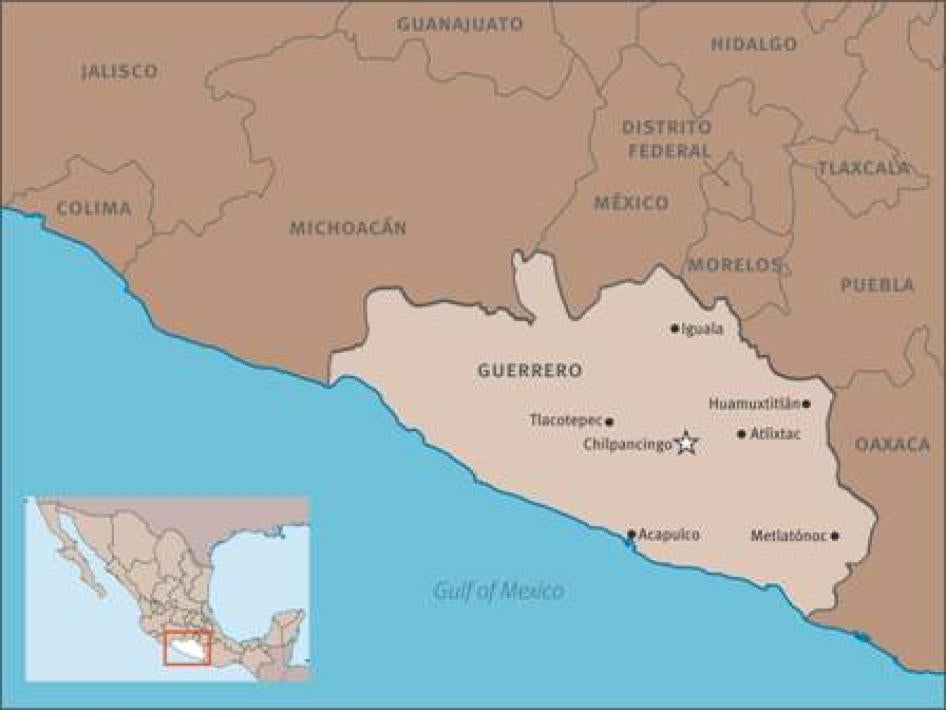
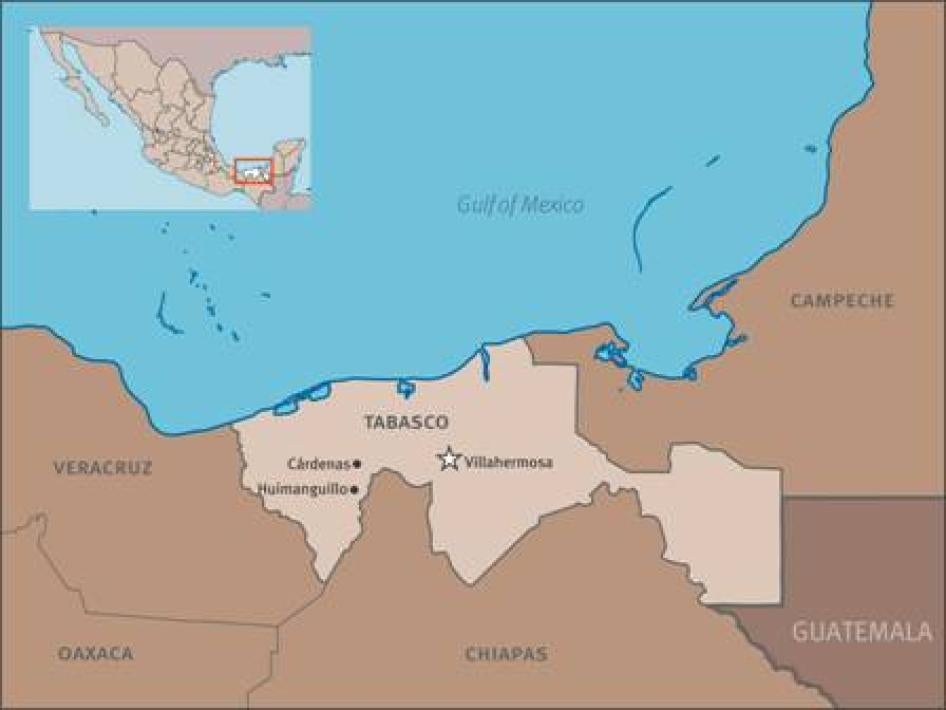
States Where Human Rights Watch Conducted Research
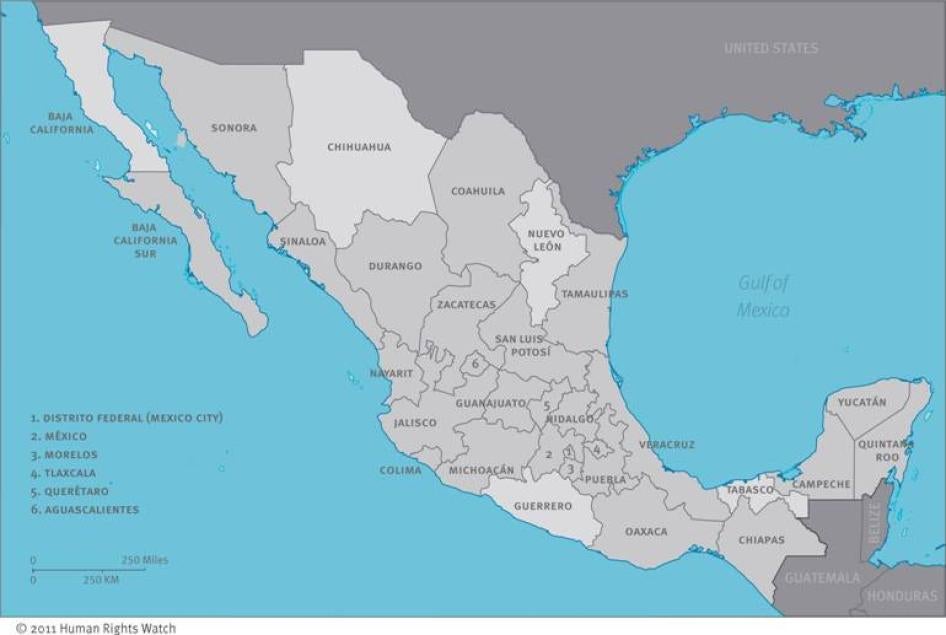
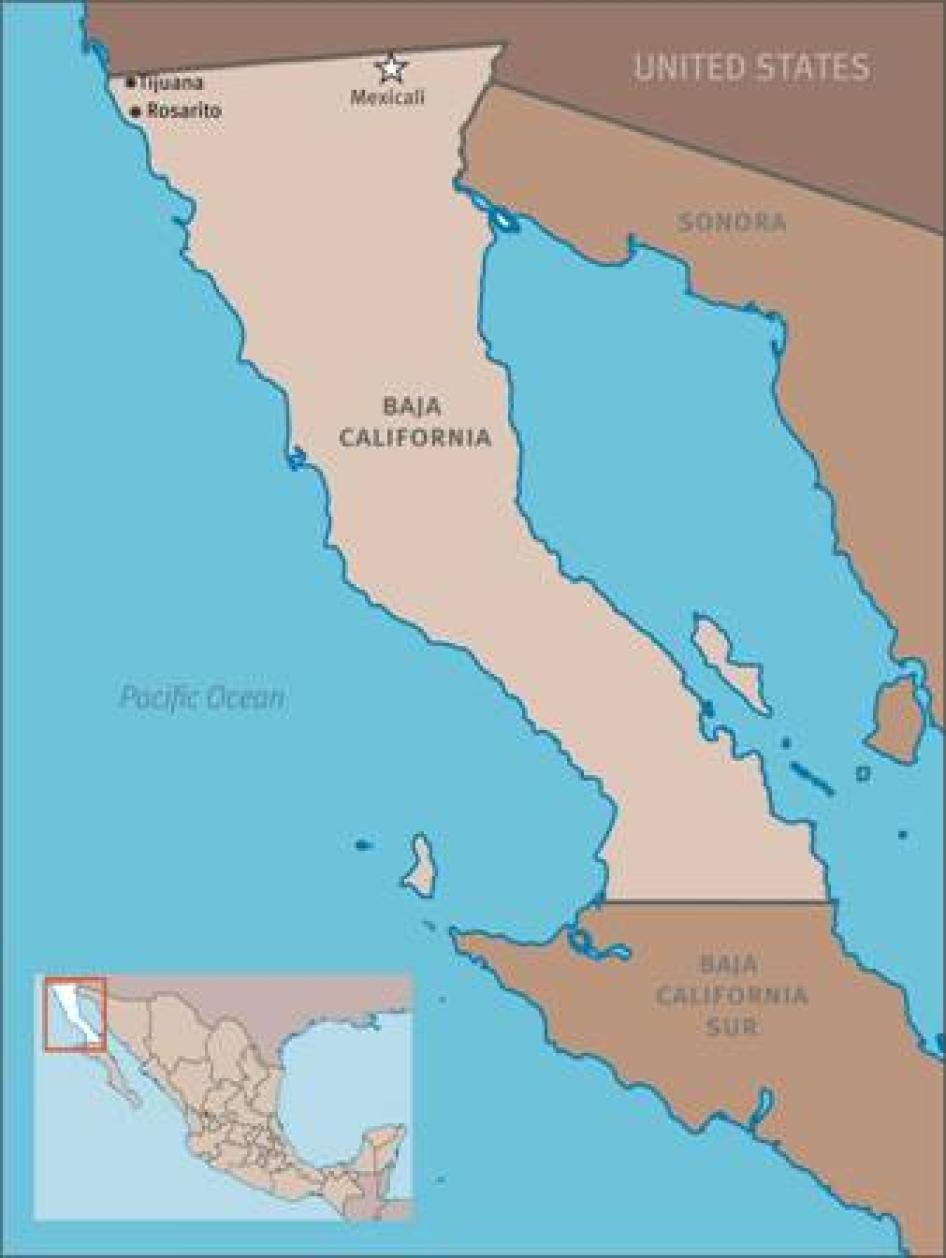
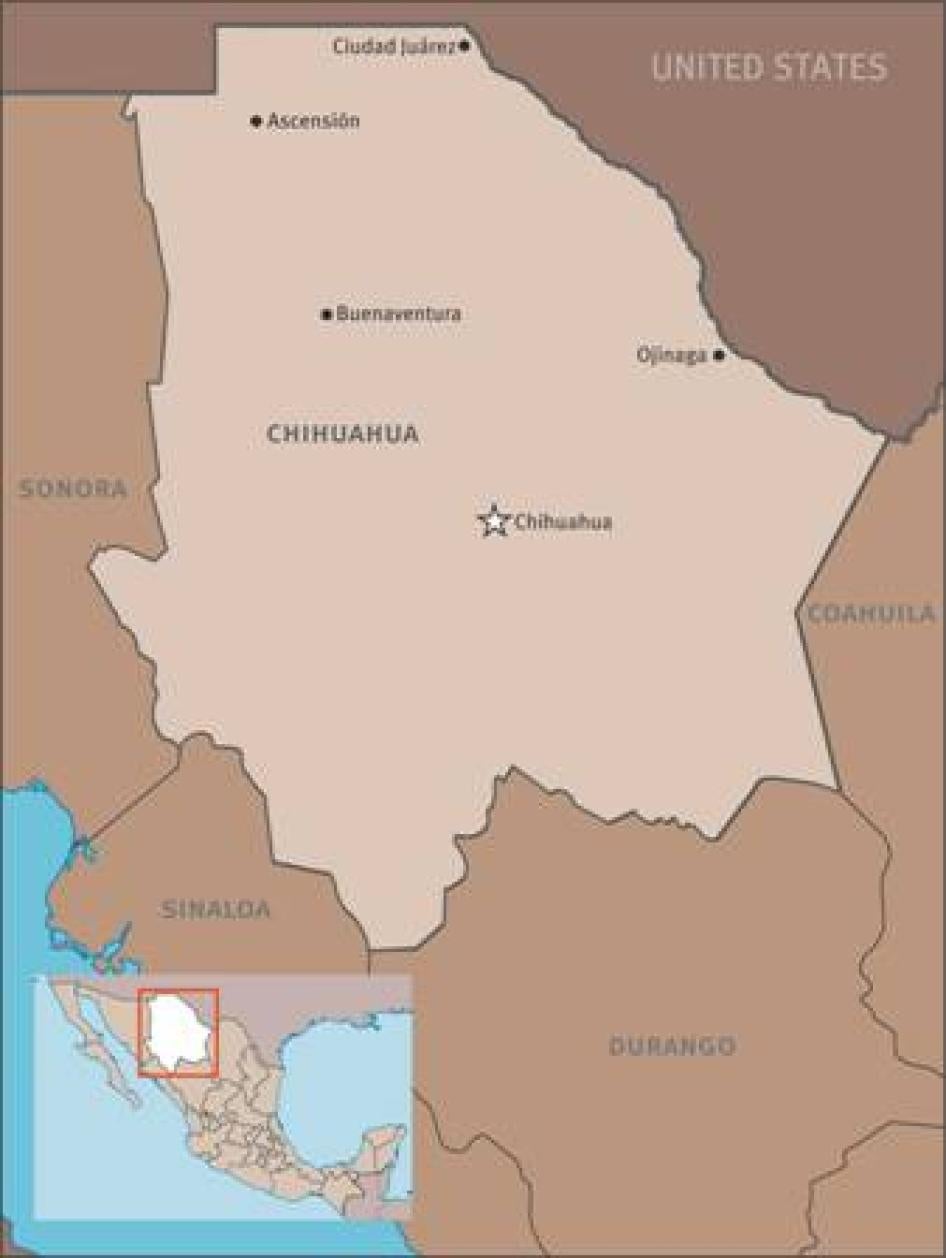
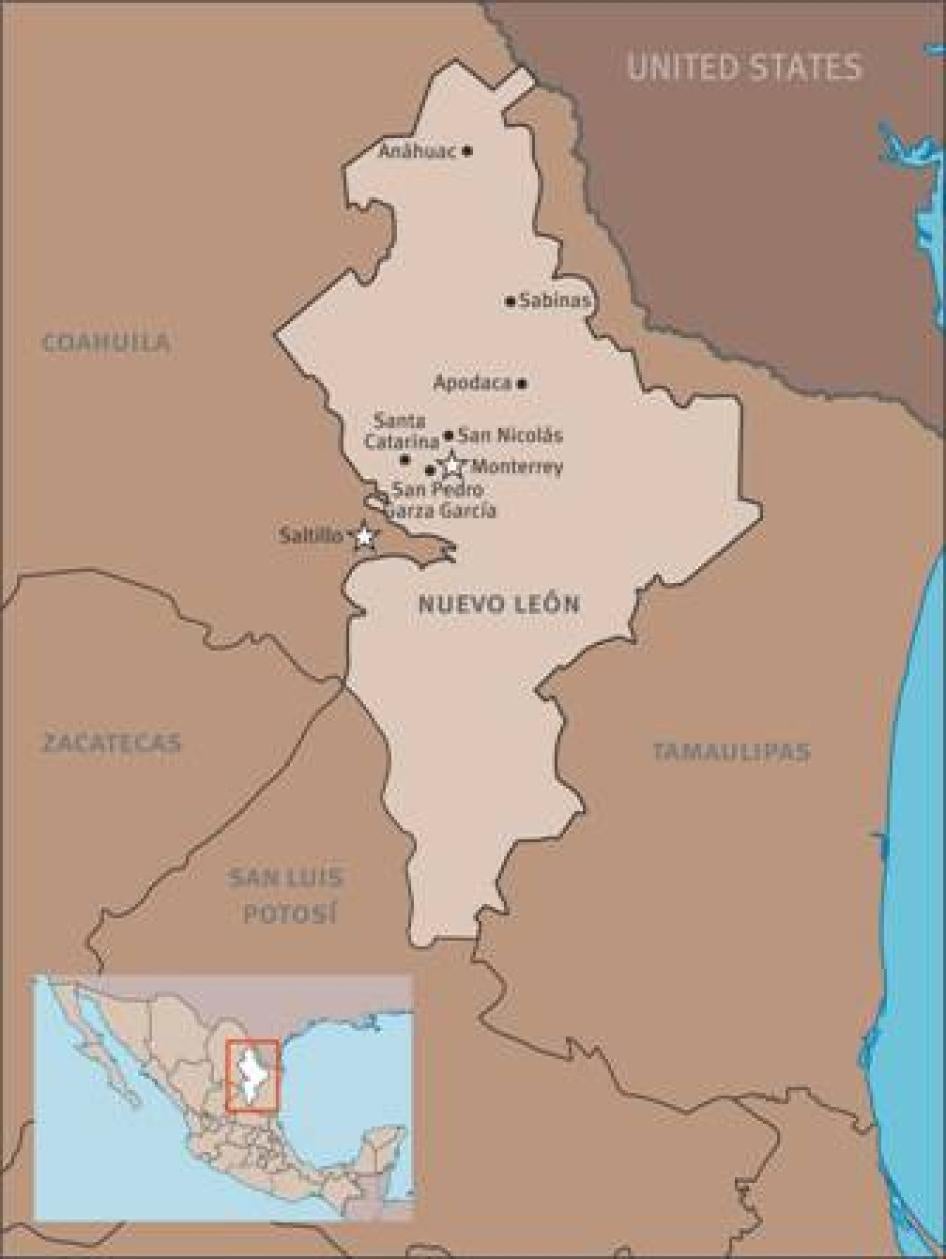
States and Cities Where
|
Glossary of Government Institutions
CNDH National Human Rights Commission (Comisión Nacional de los Derechos Humanos)
PGJM Military Prosecutor’s Office (Procuraduría General de Justicia Militar)
PGR Federal Prosecutor’s Office (Procuraduría General de la República)
SEDENA Ministry of Defense (Secretaría de la Defensa Nacional)
SEGOB Ministry of the Interior(Secretaría de Gobernación)
SEMAR Ministry of the Navy (Secretaría de la Marina)
SSP Ministry of Public Security (Secretaría de Seguridad Publica)
Executive Summary
It has been nearly five years since President Felipe Calderón declared “war” on organized crime in Mexico. In the time since, the country has experienced a staggering rise in violence. After declining steadily for nearly two decades, the overall homicide rate grew by over 260% percent from 2007 to 2010. The government counted nearly 35,000 deaths related to organized crime from December 2006 to the end of 2010, with the number of killings increasing dramatically with each passing year, from 2,826 in 2007 to 15,273 in 2010. There have been more than 11,000 drug-related deaths reported in the Mexican press so far in 2011.
This dramatic surge in violence has been driven in large part by the struggle between and within powerful cartels to control the drug trade and other lucrative illicit businesses such as human trafficking. These groups have committed serious crimes against one another, as well as against members of the security forces. Their illegal activities have also touched virtually every sphere of public life, from extortions of small businesses to blockades of major highways; from closures of schools to nighttime curfews; from mass kidnappings to assassinations of public officials. They have used public displays of violence—from depositing severed heads in town squares to hanging mutilated bodies from overpasses—to sow terror, not only among their rivals, but also within the general population. The impact on Mexican society has been profound.
The Mexican government has a duty to take measures that will help protect Mexicans from crime; and when Mexicans are the victims of crime, the government has obligations to ensure the criminal justice system will function effectively to provide a remedy. When President Calderón took office in 2006, he inherited a country whose cartels were growing in strength, and whose security forces—both military and civilian—had a long track record of being both abusive and ineffective when it came to fulfilling this crucial function.
Rather than taking the necessary steps to reform and strengthen Mexico’s flawed law enforcement agencies, Calderón chose to use them to launch a “war” on Mexico’s increasingly powerful criminal groups. He made the military the centerpiece of his public security strategy, which was almost entirely focused on confronting the cartels with force.
More than 50,000 soldiers are currently involved in large-scale counternarcotics operations across Mexico. In the places where they are deployed, these soldiers have taken on many of the responsibilities of both police and prosecutors—from patrolling neighborhoods to responding to shootouts, from investigating individual crimes to gathering intelligence on criminal groups—even as civilian oversight of the military’s operations has been reduced. The Armed Forces have been joined in their efforts by thousands of officers from the newly reconstituted Federal Police, and more than 2,200 separate state and municipal police forces, though cooperation between these security forces is often limited or superficial.
How have the security forces performed? Two years ago Human Rights Watch set out with this question. To answer it, we conducted in-depth research in five states significantly affected by drug-related violence: Baja California, Chihuahua, Guerrero, Nuevo León, and Tabasco. We conducted more than 200 interviews with a wide array of government officials, security forces, victims, witnesses, human rights defenders, and others. We also analyzed official statistics, gathered data through public information requests, and reviewed case files, legal proceedings, and human rights complaints, among other forms of evidence.
What we have found is a public security policy that is badly failing on two fronts. It has not succeeded in reducing violence. Instead, it has resulted in a dramatic increase in grave human rights violations, virtually none of which appear to be adequately investigated. In sum, rather than strengthening public security in Mexico, Calderón’s “war” has exacerbated a climate of violence, lawlessness, and fear in many parts of the country.
Widespread Human Rights Violations
Human Rights Watch found evidence of a significant increase in human rights violations since Calderón launched his “war on organized crime.” In the five states examined, members of security forces systematically use torture to obtain forced confessions and information about criminal groups. And evidence points to the involvement of soldiers and police in extrajudicial killings and enforced disappearances around the country.
The patterns of violations that emerge in the accounts of victims and eyewitnesses, an analysis of official data, and interviews with government officials, law enforcement officers, and civil society groups strongly suggest that the cases documented in this report are not isolated acts. Rather, they are examples of abusive practices endemic to the current public security strategy.
Torture
Human Rights Watch obtained credible evidence of torture in more than 170 cases across the five states surveyed for this report. The tactics we documented—which most commonly included beatings, asphyxiation with plastic bags, waterboarding, electric shocks, sexual torture, and death threats—are used by members of all security forces.
The apparent aim of such tactics is to extract information about organized crime, as well as to elicit forced confessions that not only accept guilt but also a posteriori conceal the abuses by security forces leading up to and during coercive interrogations. Torture is most often applied between the time when victims are arbitrarily detained and when they are handed over to prosecutors, a period in which they are often held incommunicado on military bases or other illegal detention sites.
Enforced Disappearances
Human Rights Watch documented 39 “disappearances” where evidence strongly suggests the participation of security forces. Although witnesses saw security forces carry out the abductions in these cases, state officials denied having detained the victims or ever having held them in custody.
In addition to cases we documented, the increasing number of cases reported to the UN Working Group on Disappearances, the national and state human rights commissions, and Mexican human rights groups all point to a rising incidence of the practice across the country. However, the crime’s prevalence is obscured by government officials’ classification of nearly all disappearances as levantones, or abductions by organized crime, before cases have even been investigated. And tracking its occurrence has further been obstructed by the fact that 24 of Mexico’s 32 states do not criminalize enforced disappearances.
Extrajudicial Killings
Human Rights Watch obtained credible evidence in 24 cases that security forces committed extrajudicial killings, and in most of these cases took steps to conceal their crimes. These killings fall into two categories: civilians executed by authorities or killed by torture; and civilians killed at military checkpoints or during shootouts where the use of lethal force against them was not justified.
In the majority of these cases soldiers and police tampered with crime scenes, either to falsely present victims as armed aggressors or to cover up their excessive use of force. And in some cases, investigations strongly suggest that security forces manipulated crime scenes to present the impression that extrajudicial killings were executions perpetrated by rival drug cartels.
The Scale of the Abuses
The rising prevalence of torture, enforced disappearances, extrajudicial killings, and other serious abuses is reflected in official statistics.
The National Human Rights Commission has received an increasing number of complaints of human rights violations committed by federal security forces over the course of the Calderón administration, and has directed a growing proportion of its recommendations—comprehensive reports documenting crimes by state officials—toward federal security forces. For example, the commission received 691 complaints of human rights abuses committed by soldiers against civilians from 2003 to 2006; the number increased to 4,803 complaints in the 2007 to 2010 period. And while the commission issued five recommendations concluding federal authorities had committed torture from 2003 to 2006, it issued twenty-five from 2007 to 2010.
In a similar vein, the number of investigations opened by civilian and military prosecutors into crimes committed by security forces against civilians has increased significantly in recent years. According to the Army, for example, military prosecutors opened 210 investigations into crimes committed by soldiers against civilians in 2007, 913 in 2008, and 1293 in 2009.
Finally, international human rights institutions, such as the UN Working Group on Enforced Disappearances, as well as human rights defenders and civil society groups, have also received rising numbers of complaints of human rights violations. All of this evidence, together with the findings detailed in this report, point to a continuing rise in human rights violations by security forces.
Why these victims?
The majority of the victims in the cases documented by Human Rights Watch were young men who came from lower or working-class backgrounds. Many had families and small children. They had a variety of jobs: they were car mechanics and taxi drivers, factory and construction laborers. The victims also included police officers, women and children, and some white-collar professionals and individuals with upper class backgrounds, including a university professor and an architect. The victims of these serious abuses—or their families in the cases of “disappeared” or murdered victims—declared that they were innocent of the wrongdoing of which they were accused and said that they had no knowledge of or ties to any illegal activity.
Our investigations found that, in nearly all cases, the only evidence offered by authorities of suspects’ guilt was incriminating statements given following torture or other abuse. There appeared to be no independent evidence to corroborate these coerced statements and it is not clear what evidence established reasonable suspicion about the individuals prior to their detention. To the contrary, the evidence in several of the cases we researched strongly suggests that authorities erred in targeting these particular individuals. For example, court records establish that a victim of torture who was accused of kidnapping a civilian was not even in Mexico when the alleged kidnapping took place. In other cases, victims have been vindicated by courts, or government bodies have issued statements affirming their innocence.
We wish to emphasize that we are not in a position to determine what factors existed in each case that may have led these victims to be targeted by the security forces. But even assuming that some of the victims whose accounts are provided in this report were criminally culpable, the abuse and litany of serious violations to which they were subjected are unacceptable in any circumstances, categorically prohibited under international law, and must be investigated and punished.
Moreover, while in some cases people accused of serious crimes may have incentives to provide false information, Human Rights Watch has only included cases in this report where victim’s account is corroborated by the testimony of eyewitnesses who saw the abuses take place or attested to other elements of the victim’s account; by medical documentation; by similar patterns in the accounts of different individuals who had no connection with one another; or by investigations by state officials or credible third parties supporting elements of the victim’s account.
Failure to Investigate Human Rights Violations
Military and civilian prosecutors consistently fail to conduct thorough and impartial investigations into cases where evidence suggests civilians have been subjected to grave abuses. Human Rights Watch documented systematic flaws in the investigations into torture, enforced disappearances, and extrajudicial killings which prevent soldiers and police from being held accountable.
Impunity for Torture
The Istanbul Protocol is an internationally recognized set of guiding principles to assess the physical and psychological condition of a potential victim of torture—and Mexico has committed to apply it in cases of suspected ill-treatment. Yet Federal and state justice officials rarely follow it. In addition, prosecutors routinely fail to critically examine evidence of possible mistreatment of detainees, such as medical exams documenting severe injuries or cases in which the “confessions” of several suspects are nearly verbatim copies of one another. Such failures mean that justice officials do not exclude confessions obtained through torture, nor do they collect evidence that is crucial for prosecuting soldiers and police who use abusive tactics. Instead, prosecutors and in some cases judges dismiss victims’ claims as cynical ploys to evade punishment, and systematically classify cases of possible torture as lesser crimes such as “injuries” without adequately investigating the allegations.
Impunity for Enforced Disappearances
The period immediately following an alleged disappearance is critical if investigators are to gather information that may reveal the whereabouts of the victim and prevent the victim ‘disappearing’ indefinitely or being killed in custody. However, justice officials routinely reject requests by victims’ families to open investigations in the immediate aftermath of alleged abductions perpetrated by state officials and sometimes even refuse to register official complaints. Instead, justice officials often direct families to police stations and military bases to see if the victim is in their custody, and make them wait several days before registering an official complaint. Government officials reflexively claim such cases are levantones, or abductions perpetrated by rival cartels, and in many cases accuse victims of having been targeted because they were involved in criminal activities—all prior to conducting an investigation. If and when investigations into disappearances are eventually opened, they are marked by serious shortcomings, such as not interviewing the state officials allegedly involved or tracing calls from victims’ cell phones after their abductions.
Impunity for Extrajudicial Killings
Despite the growing numbers of casualties in “confrontations” between security forces and alleged criminals, most killings are not investigated. In the rare instances in which investigations into such cases are opened, justice officials fail to take basic steps such as conducting ballistics tests or questioning the soldiers and police involved. Rather than question official reports—many of which are marred by inconsistencies and challenged by witness accounts—prosecutors accept security forces’ reports as fact and overlook evidence of excessive use of force or torture leading to death. Furthermore, in more than a dozen cases, families of the victims of killings told Human Rights Watch they had been pressured by the Army to sign settlements agreeing to abandon all efforts to seek criminal punishments for soldiers in exchange for compensation.
Military Justice
Nowhere is impunity more pronounced than in the military justice system. In our 2009 report, Uniform Impunity, Human Rights Watch documented the lack of impartiality and independence that results when the military investigates itself, and recommended that Mexico reform its Military Code of Justice to ensure that all cases of alleged human rights violations committed by the military against civilians be investigated and prosecuted in the civilian justice system. Since that report was released, both the Inter-American Court (in four recent rulings) and Mexico’s Supreme Court have issued judgments that call for such cases to be excluded from military jurisdiction. Yet the practice remains unchanged, as do the results: complaints of human rights violations continue to be sent to the military justice system, where they still go unpunished. In the five states surveyed for this report, military prosecutors have opened 1,615 investigations since 2007 into human rights violations allegedly committed by soldiers against civilians, according to data obtained through public information requests. Not a single one of those military investigations across all five states has resulted in a soldier being convicted. Moreover, the Military Prosecutor’s Office said it opened 3,671 investigations into human rights violations committed by soldiers against civilians from 2007 to June 2011. Only 15 soldiers were convicted during this period: less than one half of one percent.
Dangerous Rhetoric
Despite the fact that human rights violations are not adequately investigated, government officials consistently dismiss victims’ allegations as false and cast the victims as criminals—even as ranking officials publicly profess a firm commitment to upholding human rights. The model for this self-contradictory discourse has been provided by President Calderón, who on the one hand has held up human rights as the “central premise” of his government’s strategy against organized crime, while on the other has expressed his exasperation at hearing complaints “that are not true” of abuses committed by the military. Calderón has also repeatedly asserted that 90 percent of the people killed in drug-related violence are members of criminal groups.
The president’s message has been echoed by civilian and military officials at all levels, from the secretary of the Navy, who recently declared that criminal gangs had tricked civil society groups into “holding up the banner of human rights to try to undermine the reputation of [government] institutions,” to a federal prosecutor in Tijuana, who told Human Rights Watch that detainees’ allegations of torture were false because “the only one who lies is the accused criminal.” Calderón’s statistics are also echoed by local politicians, as in the recent claims by officials in Nuevo León that 86 percent of victims in the state’s violent homicides in 2011 belonged to cartels.
Were such factual claims based on rigorous, objective investigations, Calderón and others would be justified in making them. However, the vast majority of complaints of human rights violations by security forces are never adequately investigated and nearly all alleged drug-related homicides are never prosecuted. Not only does this investigative lacuna raise serious doubts about the basis for the president’s and other officials’ claims, but it also reveals an inherent bias in the government’s attitude towards victims. The rhetoric sends a message to justice officials that victims’ complaints are unfounded and undeserving of serious investigation, while simultaneously conveying to security forces that their abuses are beyond reproach.
For victims of grave human rights violations, their families, and human rights defenders, such rhetoric and the systematic lack of thorough investigations presents a stark choice. They can investigate crimes themselves, often at considerable risk. Or they can watch as their cases languish in government channels. Those who choose the former find themselves facing daunting obstacles, from harassment and death threats by security forces to seemingly endless bureaucratic excuses and dilatory tactics on the part of their supposed advocates in the justice system. In many cases, investigators do not even attempt to conceal their collaboration with the officials accused of abuses, or they openly admit their fear or unwillingness to take on cases implicating security forces. As one prosecutor told a victim’s family, “you can’t win against the military.” After years of flawed, apathetic investigations with little progress, even those victims most committed to pushing for justice usually give up.
Blaming the Victims and the Presumption of Guilt
The presumption of innocence is enshrined as a fundamental right in Mexico’s Constitution, and is a central principle of its justice system, as well as many of the international human rights treaties the country has signed. Its exercise is not only valuable on its own merits, but is also critical to the effective application of justice, because it ensures that prosecutions are based on evidence rather than biases, which in turn leads to holding the right people accountable for committing crimes.
Yet, despite these guarantees, a suspect in Mexico whose rights have been violated by officials seeking to build a criminal case against him often effectively bears twin burdens: he must prove his own innocence while simultaneously proving that his rights were violated by public officials. That is because, in practice, Mexico’s criminal justice system often presumes suspects are guilty until proven innocent, rather than requiring the prosecution to present solid evidence.
The failure to investigate allegations of abuse and rights violations is an abdication of Mexico’s responsibilities under international human rights law, which obligates the state to investigate credible allegations of abuse. The perverse practice in Mexico, however, is that it is victims who are consistently obliged to prove that their rights were violated. Moreover, victims and their relatives are often told that the fact they suffered a human rights violation is proof in itself that they were involved in criminal activity. As the mother of a civilian whom evidence suggests was “disappeared” by police described it, “the official stance is: if something happened to you, it is because you were involved in something bad.”
Some victims of human rights violations may themselves have previously committed crimes. But this does not justify the violation of the fundamental rights of detainees, and the fact that an individual is a criminal suspect should in no way lead authorities to discount his allegations of having been a victim of abuse. To the contrary, all citizens should benefit from the presumption of innocence, and the state should promptly and impartially investigate all allegations of human rights violations. Moreover, as several of the cases in this report demonstrate, there is good reason to believe that a significant portion of people identified as criminal suspects—particularly those in cases where the only evidence against them is a forced confession—are innocent.
Lasting Impact on Victims and Their Families
Serious human rights violations committed by security forces can inflict deep and lasting wounds on victims and their relatives. Victims of torture told Human Rights Watch they experienced ongoing physical and psychological effects as a result of what they endured. A victim of waterboarding said that for months afterwards he could not bear to take a shower because the water reminded him of his torture. Even drinking liquids was difficult for him. Another victim who was suffocated repeatedly and beaten severely to the head said that since his interrogation he has suffered serious short-term memory loss, incapacitating migraines, and the loss of hearing in one ear.
The trauma and fear generated by grave human rights abuses extends to entire families. A young man who witnessed the extrajudicial execution of his brother by Navy officers in their family’s home described feeling terror every time he sees a military convoy pass. He said that since the night of the shooting his family has not returned to the home, because the place is too vivid a reminder of the incident and they do not feel safe living there. Abuses often have a significant economic and social impact on victims’ relatives, as in the case of the uncle who adopted the two young children of his brother and sister-in-law after they were executed by soldiers from the Army.
The families of the disappeared suffer particularly cruel treatment, deprived of a sense of closure as they wait in vain for news about the fate of a loved one. This cruelty is compounded by government officials who, even when all evidence points to the contrary, accuse their loved ones of having been targeted because they were criminals, and by the hollow efforts of authorities to investigate, which leave relatives feeling dispirited and powerless. “We don’t know even know what to do anymore,” the wife of one victim told Human Rights Watch. “We know who did this and we can’t do anything.”
For the relatives of victims of killings by security forces, the fact that those responsible are not prosecuted and that victims are usually publicly branded as criminals is a source of ongoing suffering. And like the families of the disappeared, they continue to struggle to learn what happened to their loved ones. Said one father whose son had been killed by soldiers a year-and-a-half earlier, “They think that as time passes, we’ll forget what happened. We can’t. For us, it’s like it was yesterday. And we can’t resolve this until they admit they made a mistake—and are punished for it.”
Shortcomings of Mexico’s Public Human Rights Institutions
Mexico’s National Human Rights Commission and state human rights commissions have the power to play a central role in preventing human rights violations and ensuring that those that have been committed are investigated and prosecuted. In certain cases, such as the killing of two children by soldiers in Matamoros, Tamaulipas and various cases highlighted in this report, the national commission has conducted solid, in-depth investigations, which demonstrate its ability to carry out complex ballistic, forensic, and crime scene analysis, perform expert medical exams in line with the Istanbul Protocol, and conduct skilled interviews. The national commission has also proven its capacity to marshal its findings into cogent recommendations, which assign responsibility for crimes to government officials and demand criminal investigations. So too have various state commissions carried out thorough investigations into some cases of human rights violations, such as those from Guerrero and Chihuahua cited in this report.
Too often, however, the commissions’ proven capacity is not put to use. In scores of cases, Human Rights Watch found officials from the commissions failed to conduct basic steps to investigate complaints, and either did not open investigations into cases where there was strong evidence of abuses, or closed them prematurely. And in more than a dozen cases, Human Rights Watch found the national commission declined its competence to investigate cases where evidence strongly suggested violations had taken place, and instead redirected them to civilian and military authorities through a practice called “path of orientation” (via de orientación), prior to conducting its own thorough investigations.
Even in cases where the commissions carry out comprehensive investigations, they often undermine the impact of their findings by failing to ensure that their recommendations are implemented. In particular, Human Rights Watch found that the commissions continue to abandon their work on cases when prosecutors open investigations into violations—a practice documented in a previous report by this organization—rather than monitoring the handling of inquiries to ensure that prompt, thorough investigations are undertaken. This lack of oversight contributes to a climate of impunity, allowing authorities with a track record of committing violations to stay in positions of authority where they may repeat abuses. For example, since 1991, the Guerrero State Human Rights Commission has issued 23 recommendations in which it found that the current chief of the investigative judicial police in northern Guerrero committed abuses, including cases of homicide, torture, and extortion. The same individual was also accused of having participated directly in the torture of a victim interviewed by Human Rights Watch for this report.
Finally, the national commission continues to direct recommendations in cases of human rights violations committed by soldiers to the military justice system, virtually guaranteeing impunity. This practice runs counter to judgments of the Inter-American Court and Mexico’s Supreme Court, and contravenes international human rights standards, which a recent reform to Mexico’s Constitution elevated to equal standing as domestic law.
Failure to Improve Public Security
Not only do human rights violations in themselves undermine the rule of law, but they also can be counterproductive in reducing violence, dismantling criminal networks, and building the public confidence in institutions that is critical to effective counternarcotics efforts. Since the outset of Calderón’s “war on drugs,” violent crime has skyrocketed; abusive policing has undermined the investigation and prosecution of criminal suspects; and widespread abuse and corruption has antagonized civilians who otherwise could provide security forces with crucial information.
Homicides tied to drug violence have increased every year since President Calderón implemented his public security strategy. The approximately 15,000 killings allegedly tied to organized crime in 2010, for example, represented an increase of nearly 60 percent from the previous year. In Baja California, Chihuahua, Guerrero, Michoacán, Sinaloa, Nuevo León, and Tamaulipas—all states where the federal government has launched major counter-narcotics operations involving the military—the homicide rate in both 2008 and 2009 reached rates nearly twice as high as what had been the record over the previous two decades. Moreoever, claims by the government that public security operations have been effective in reducing crime in places such as Tijuana are not borne out by the data, which shows that homicides, violent robbery, kidnappings, and extortions remain alarmingly high, despite some ephemeral and modest drops.
President Calderón has repeatedly argued that concerns over the scale of violence in Mexico are overblown, citing the fact that the country’s homicide rate is significantly lower than several countries in Latin America, such as Brazil and Colombia. However, the overall homicide rate provides an incomplete picture of violence in Mexico, because drug-related violence disproportionately affects certain regions more than others. For example, roughly a third of all homicides tied to organized crime in Mexico in 2010 occurred in just five cities, by the government’s own figures. Therefore, a more accurate reading of the severity of the violence can be found by looking at homicide rates in specific states and cities, virtually all of which are trending upwards. For example, in Ciudad Juárez the rate of killings per 100,000 inhabitants rose from 14.4 in 2007, to 75.2 in 2008, to 108.5 in 2009. Not only was Juarez’s rate in 2009 approximately seven times that of Mexico’s national rate, but it is also one of the highest in the world, far surpassing Rio de Janeiro, Brazil, and Medellin, Colombia, cities with some of the highest murder rates in the region.
This rise in violence has not been matched by a rise in criminal prosecutions. While security forces have detained tens of thousands of suspected cartel members—the majority allegedly detained in the act of committing a crime (in flagrante)—only a fraction of these cases have led to investigations, even fewer have resulted in suspects being charged with crimes, and fewer still have led to criminal sentences. For example, of the 35,000 killings the government says were tied to organized crime from December 2006 to January 2011, the federal prosecutor’s office registered 13,845 killings. (According to the Mexican Constitution, if indeed these killings were all tied to organized crime, federal prosecutors have the power to investigate and prosecute them.) The office provided conflicting information as to the number of those cases it was investigating—first reporting it had opened 1,687 homicide investigations, and three months later saying it had only opened 997 investigations. In these cases, only 343 suspects have been charged. And according to statistics provided to Human Rights Watch by the federal judiciary in response to a public information request, federal judges have only convicted defendants for 22 homicides and other injuries tied to organized crime. The results at the state level are similarly abysmal. From 2009 through the middle of 2010, there were more than 5,000 deaths related to organized crime in Chihuahua. During the same period, only 212 individuals were found guilty in state courts for killings, according to information provided by the Chihuahua State Prosecutor’s Office.
Pressed as to why convictions are so rare, justice officials offer a range of explanations: an overwhelming caseload; the complexity and danger inherent in building cases tied to organized crime; and the ambiguity as to whether homicides fall within state or federal jurisdiction, among others. Yet several prosecutors confided to Human Rights Watch that one of the greatest obstacles to effectively investigating and prosecuting such cases is the litany of abuses committed by soldiers and police. Not only do security forces tend to contaminate and manipulate crime scenes, justice officials said, but they also hand over detainees to prosecutors with little more than a confession, which investigators later learn was extracted through beatings, threats, or other violations. As such, prosecutors can either turn a blind eye to likely abuses, building their cases on confessions obtained through violating suspects’ rights, or they can discard tainted evidence and confessions and start their own investigations from scratch.
Abusive policing also undermines civilians’ trust in the security forces, which is critical to gathering the information—such as tips on illicit activities—that is essential for effective law enforcement. President Calderón has appealed repeatedly to citizens to collaborate with the government by reporting crimes. But the confidence upon which cooperation is built must be earned, and many Mexicans do not believe the crimes they report will be adequately investigated, or fear that local law enforcement and justice departments may be infiltrated by organized crime. When coupled with the widespread abuses committed by security forces, which further deepens the public’s disillusionment, it comes as little surprise that many civilians see greater risk in reporting crimes than in staying silent.
This distrust is reflected by the low numbers of both human rights violations and crimes that citizens report to authorities. Prosecutors and human rights officials consistently told Human Rights Watch that only a tiny fraction of victims report abuses, due to a combination of fear and lack of confidence in authorities. A representative of the Chihuahua State Human Rights Commission in Ciudad Juárez, for example, estimates that only one in ten victims of military abuses registers a complaint with his office. And civilians who do not report human rights violations are equally unlikely to report crimes, he added. Meanwhile, national surveys have found that nearly 90 percent of crimes in Mexico go unreported. The lack of reporting, in turn, feeds a cycle of impunity that protects perpetrators and fosters more crime.
Key Recommendations
Ensure all cases of alleged human rights abuses are subject exclusively to civilian jurisdiction.
Reform the Military Code of Justice to prevent investigations into human rights violations falling within military jurisdiction.
The most effective way to address the serious human rights violations documented in this report—and deter future violations—is to ensure that soldiers and police who commit abuses are brought to justice. And the key to holding security forces accountable is conducting prompt, thorough, and impartial investigations into allegations of their crimes against civilians. Such investigations do not take place when the military investigates itself.
One way Mexico can improve accountability is by ending the practice of transferring cases of alleged human rights violations committed by soldiers to military jurisdiction. To this end, President Calderón should immediately present a proposal to Congress to reform the Code of Military Justice, so that it explicitly states that all cases of alleged abuse committed by soldiers against civilians should be investigated and prosecuted in the civilian justice system; and that the military is obliged to cooperate with such investigations and prosecutions. In the event that a case has been transferred to military jurisdiction in violation of the law, the alleged victim should have recourse to an enforceable legal remedy within the civilian justice system to challenge the transfer. In the absence of an adequate reform proposal by Calderón, Congress should draft and pass a reform that meets these standards.
A reform proposal already submitted by Calderón in 2010—which would send cases of torture, rape, and enforced disappearance to civilian jurisdiction, but leave all other alleged human rights violations to be investigated by the military —does not satisfy this requirement. Calderón’s proposal would leave grave abuses such as extrajudicial killings subject to military jurisdiction and would grant significant discretion to military authorities in how to classify abuses, despite their track record of downgrading the severity of crimes, so that offenses remain within military jurisdiction.
Civilian prosecutors should proactively investigate all cases involving alleged human rights violations by soldiers. Until such a reform is passed and implemented, the federal and state attorneys general should instruct civilian prosecutors and justice officials to end the practice of automatically sending cases in which a member of the military is accused of committing a crime against a civilian to military prosecutors. Instead, such allegations should be investigated by civilian prosecutors from the moment they are reported, including undertaking the immediate work of interviewing witnesses and gathering evidence from crimes scenes.
The transfer of cases of alleged military abuses to civilian jurisdiction will not single-handedly resolve the problem of lack of accountability for abuses committed by security forces. As this report shows, the civilian justice system has significant problems of its own, which pose real obstacles to effective investigations. In spite of these flaws, however, the civilian system is significantly more impartial and independent than its military counterpart. The transfer of such cases to civilian jurisdiction is a necessary first step away from a system in which impunity for soldiers is virtually guaranteed.
Improve implementation of justice reform.
Mexico passed a largely positive constitutional reform in June 2008 to transform the civilian justice system from an inquisitorial, written model, to an adversarial, oral one. The reform was aimed at affirming the principle of the presumption of innocence and eliminating perverse incentives for law enforcement officers to obtain confessions through torture, among other worthy goals. But implementation of the reform, which authorities have until 2016 to complete, has been sluggish, and the changes in law have yet to be translated into changes in practice. Many states continue to operate under Mexico’s traditional system and tolerate its most insidious values and practices, while the few states where the new system has been introduced have passed significant counter-reforms or inserted exceptions that undercut the oral adversarial system’s key changes.
The federal and state governments should invest greater resources in implementing the justice reform. This means reforming the justice system concurrently at both federal and state levels to avoid the emergence of two systems operating with conflicting principles. And it means ensuring that steps are taken to change practices as well as laws, such as by scaling up the training of judges, prosecutors, public defenders, judicial investigative police, and other key officials, as well as by doing more to raise awareness among the public as to how the new system works. In addition, state legislators should abolish counter-reforms that run counter to the spirit and object of the justice reform, while other states should refrain from passing them.
Enforce due process guarantees to prevent detainee abuse.
Enforce the prohibition on evidence obtained through torture.
Judges need not wait until the justice reform is fully implemented to address some of Mexico’s most chronic and widespread abuses. Judges should immediately enforce the constitutional ban on any evidence elicited through coercion or other abuses, eliminating the perverse incentive for police and soldiers to beat confessions out of detainees before handing them over to prosecutors. Judges should make no exceptions to the exclusionary rule banning use of evidence obtained through torture, nor should any jurisprudence be applied that violates the object and spirit of the ban. In cases where there is any suspicion of torture or cruel, inhuman, or degrading treatment of suspects, judges should instruct prosecutors to immediately open investigations into possible mistreatment. They should order the prompt application of the Istanbul Protocol to alleged victims. In line with internationally recognized legal principles, judges should place the burden of proof on prosecutors to demonstrate that confessions and other forms of evidence were obtained legally, rather than obligating victims to prove that they suffered torture or other abuses.
Ensure that security forces immediately transfer detainees to the custody of prosecutors.
As this report demonstrates, many of the abuses committed by soldiers and police are perpetrated during unlawful periods of arbitrary detention between when suspects are initially detained and when they are handed over to prosecutors. This occurs when security forces do not immediately transfer detainees to prosecutors as required by law, and hold them incommunicado on military bases, police stations, or in other illegal detention facilities. The key to preventing abuses that take place in this period is investigating and prosecuting the soldiers and police who fail to immediately transfer detainees to prosecutors. To this end, judges should call for prompt investigations into cases where evidence suggests that a suspect was subject to a period of arbitrary detention, as described above. Federal and state prosecutors should initiate investigations ex officio when they believe security forces have delayed the transfer of detainees. In no circumstances should prosecutors or public defenders take a detainee’s confession in a military installation, police station, or illegal detention facility. Nor should detainees ever be held temporarily in these places.
In cases where there is evidence detainees are not promptly transferred to prosecutors, security forces should initiate their own investigations through internal affairs bodies to complement criminal investigations, though such administrative investigations should not be seen as a substitute for those conducted by prosecutors. Meanwhile, the secretaries of the Army and the Navy, the director of the Federal Police, as well as state and municipal police chiefs should issue directives instructing officers under their command to immediately transfer detainees to civilian prosecutors, and state unequivocally that under no circumstances should detainees be held or interrogated on military bases or in police stations. The national detention registry should be strengthened with the aim of safeguarding detainees’ rights as they are transferred through the chain of custody (see below).
Abolish the practice of “arraigo” and use of vague laws to justify arbitrary arrests and preventive detention.
Mexico should abolish the power of arraigo in federal and state legislation, which allows prosecutors, with judicial authorization, to detain individuals for up to 80 days before they are charged with a crime. The practice amounts to arbitrary detention, is inconsistent with Mexico's due process obligations under international law, and contravenes a 2005 decision of the Supreme Court that deemed the practice unconstitutional.
Federal and state legislators can also help reduce illegal arrests by abolishing vague laws that give security forces broad powers to detain civilians without warrants, such as the proliferating state flagrancia and halconeo laws. These laws should be applicable only in exceptional cases when a suspect is caught in the midst of committing a crime or there is evidence he is acting as an informant for criminal gangs. However in practice they are invoked as the basis to detain people with little to no connection to such factual context. Furthermore, in light of the systematic practice of arbitrary detentions, legislators should not pass reforms that expand the discretionary powers of police and soldiers to carry out arrests without judicial warrants, such as the broadening of urgencia powers President Calderón recommended in a September 2010 proposal to reform the Federal Code of Criminal Procedure.
Prosecutors and judges, who have a responsibility to assess the lawfulness of such arrests and the power to dismiss cases against suspects detained illegally, should not “rubberstamp” detentions carried out by security forces without judicial warrants.
Ensure the prompt, thorough, and impartial investigation and prosecution of human rights violations.
Develop protocol for investigating civilian deaths in alleged confrontations with security forces, and pass laws regulating the use of force for Army and law enforcement officers.
All civilian deaths resulting from confrontations with security forces—regardless of whether the victims are allegedly armed men or innocent civilians—should be thoroughly and impartially investigated to determine if state officials used excessive force or carried out extrajudicial executions. Drawing upon best practices developed by the UN Special Rapporteur on Extrajudicial Executions and other experts, the Mexican government should design a protocol for investigating killings by state officials—including deaths at security checkpoints and in custody, as well as in shootouts—rather than simply accepting the accounts of soldiers and police as fact. Furthermore, the Army and legislators should draft use of force laws for the Army, federal police, and local police, which draw upon international standards regulating the use of force. And soldiers and police should be trained in how to put these standards into practice.
Create national databases to track the disappeared and detainees that are designed to protect against abuses.
The Mexican government has invested significant resources in building a national database to track crime through its “Platform Mexico.” It should build upon the best practices learned from this initiative to develop two additional national databases:
- A unified database of the disappeared, which includes data to help identify missing persons such as DNA from victims’ family members, as well as a searchable registry of unidentified bodies that contains systematized physical information, which is fully accessible to victims’ relatives. The criteria for and collection of such data should be synchronized across prosecutors’ offices, human rights commissions, and morgues, among other relevant institutions, to ensure the efficacy of the system.
- A national database to track detainees, with a protocol for immediately registering key information such as the time and location of a detention and who carried it out. Ranking officers should impress upon subordinates the importance of promptly registering detentions, so that justice officials and families can determine the location of detainees, which is essential for identifying due process abuses and preventing abuses. Penalties should be applied when detentions are not properly registered. As with the database of the disappeared, this system should be applied consistently across security forces and justice officials.
Stop the use of rhetoric implying abuse victims are criminals, or that dismisses allegations of abuse before they have been investigated.
How civilian and military leaders talk about human rights can have a significant impact on the practices of state officials, as well as the attitudes of the general public. As such, President Calderón, as well as other elected officials, top military and police officers, and justice officials should refrain from using rhetoric that casts public security and human rights as competing objectives, and instead send the consistent message that they are complementary goals. In particular, officials should stop dismissing the serious allegations of abuse victims and their families as false before they have been adequately investigated, or from characterizing human rights defenders and victims’ advocates as the “useful idiots” of organized crime. Likewise, they should stop reflexively assuming that victims of torture, killings, and disappearances were all engaged in criminal activity before they were detained. As part of this shift, security forces and justice officials should stop presenting suspects to the press and accusing them of having committed crimes before they have been tried, which undermines their right to a fair trial.
To Mexico’s public human rights institutions:
The National Human Rights Commission and state human rights commissions should not close inquiries into victims’ complaints unless and until officials have determined that victims’ allegations are unfounded. In cases where it is uncertain whether such allegations are true, the commissions should undertake thorough, impartial investigaitons to determine their veracity, rather than placing the burden on victims and their families to provide proof. The national commission should end the practice of recommending that any alleged human rights violation committed by soldiers against civilians be subject to military jurisdiction. And it should not redirect cases of alleged human rights violations to prosecutors through vía de orientación unless it has unequivocally determined that no human rights violation has taken place.
The commissions should also end with the practice of abandoning their work on cases after issuing recommendations. Specifically, officials from the commissions should ensure that civilian prosecutors not only open investigations into abuses, but also conduct prompt and thorough inquiries. When state actors fail to implement the recommendations, the commissions should actively press for compliance through tools such as calling government officials to account before the Senate for their lack of compliance, a power granted to them by the recently approved constitutional reform.
Finally, in response to the massive deployment of the Army, Navy, and Federal Police in counternarcotics operations, and the subsequent rise in human rights complaints against these forces, the national commission should strongly consider reallocating its resources to place investigative teams in the states where significant numbers of federal security forces have been deployed. At present, with the exception of ten regional offices on Mexico’s northern and southern borders charged with attending to abuses against migrants, the national commission’s staff is almost entirely based in Mexico City. The strategic placement of these teams would allow the commission to directly receive victims’ complaints, rather than relying on state commissions to channel cases to it; and it will allow the commission to more quickly efficiently investigate and possibly intervene in grave cases where victims’ lives may be at risk, rather than having to dispatch teams from Mexico City.
To the European Union and United States:
To the European Union: Incorporate benchmarks and requirements on human rights into the “Strategic Partnership.”
The European Union has strengthened its bilateral cooperation with Mexico since their May 2010 adoption of a Strategic Partnership, which established an “Integrated Justice and Security Program” focused on building Mexico’s capacity to combat organized crime. The partnership includes an annual human rights dialogue between government officials, and the EU has made a commitment to help advance the rule of law and fundamental rights in Mexico, as well as committed some resources directly to those ends.
Despite these positive steps, however, the EU has done little to establish transparent benchmarks and track progress towards improving the human rights practices of Mexico’s security forces. Nor has the EU been willing to leverage its growing collaboration with Mexico to influence the government to address its systemic human rights problems. The EU should remedy this oversight by publicly identifying a set of human rights priorities, and set targets toward meeting those goals, such as eliminating the use of torture by police officials or ensuring the systematic application of the Istanbul Protocol. And the EU should direct a meaningful portion of its assistance and advocacy efforts towards achieving these goals, including both carrots should they be met and sticks should they not.
To the United States: Retain and enforce the Mérida Initiative’s human rights requirements, and improve public policies to reduce illegal trafficking of arms and drugs.
The United States has appropriated more than $1.6 billion in security assistance to Mexico since 2007 through the Mérida Initiative, a multi-year US assistance package to help combat organized crime. From the outset, the US Congress mandated by law that 15 percent of select Mérida funds be withheld annually until the State Department issued a report that affirmed Mexico was meeting four basic human rights requirements. These requirements include investigating and prosecuting military and police officers accused of committing abuses against civilians in the civilian justice system; improving police transparency and accountability; and prohibiting the use of testimony obtained through torture or other ill-treatment.
The funds pegged to the requirements account for a small portion of overall Mérida assistance. In 2009, for example, only approximately $24m out of the $420 was conditioned upon compliance with the requirements. Nevertheless, the requirements provide a key opportunity to measure Mexico’s human rights progress, and to pressure the Mexican government to address abusive practices.
As such, it is critical that these requirements be kept in place in future installments of the Mérida Initiative. Moreover, Congress should ensure the 15 percent requirements are applied not only to funding directed toward the military, but also toward support and training for the federal, state, and local police—because of their continuing use of torture and other grave violations, and their chronic lack of accountability.
In order for these requirements to be effective, however, they must be enforced. Yet despite clear evidence that the requirements have not been met—including in reports by the US State Department that document the ongoing use of torture, as well as the continued prosecution of soldiers in military courts for human rights abuses—the US has repeatedly released the 15 percent of select funds. In light of the findings of this report, which demonstrate once again that the requirements are not being met, the US should withhold the select funds for the military and police for the forthcoming year. It should continue to withhold funds until all four of the requirements are met.
As the source of many of the high-powered weapons that are used by cartels, and as the market for the lion’s share of the drugs trafficked by criminal groups (and thus a significant part of the income they earn), the US shares significant responsibility for the crisis in Mexico and the rising power of organized crime. As a result, the US government should redouble its efforts to halt the illegal flow of weapons into Mexico, as well as put in place public policies that reduce the demand for narcotics in the US.
If implemented, the recommendations outlined above and those laid out in greater detail in the forthcoming chapters will strengthen the protection of human rights in Mexico. They will also improve the quality of investigations, increase the effectiveness of criminal prosecutions, and rebuild civilians’ confidence in law enforcement, all of which are key ingredients to improving public security.
Methodology
This report is based on nearly two years of in-depth research in five states significantly affected by drug-related violence: Baja California, Chihuahua, Guerrero, Nuevo León, and Tabasco. All are states where federal, state, and local security forces have been deployed in counternarcotics efforts. Together, they represent a diverse cross-section of the country regionally and politically, with at least one state governed by each of Mexico’s three major political parties.
In the course of this research, Human Rights Watch conducted more than 200 interviews with a wide array of actors. These included attorneys general, prosecutors, judges, public defenders, law enforcement chiefs, police officers, legislators, national and state human rights officials, victims and their relatives, civil society groups, human rights defenders, scholars, and journalists, among others. These interviews also included meetings with a range of federal officials, including representatives of the Army, the Ministry of Public Security, the Ministry of the Interior, the Federal Prosecutor’s Office, and the Ministry of Foreign Affairs, as well as senators and representatives.
The findings of these interviews were complemented by a range of official statistics obtained by Human Rights Watch. Such statistics were not easy to come by, and in some cases, though not always, there was good reason to doubt their accuracy. Officials routinely took months to respond to basic requests, such as questions regarding the number of public officials who had been convicted for committing human rights violations. And the responses that were eventually provided—if they were provided at all—were almost always incomplete, or did not correspond to the information solicited.
For example, Human Rights Watch submitted a request on June 8, 2011, to then-spokesman on public security for the executive branch, Alejandro Poire, asking how many of the approximately 35,000 homicides in the government’s database of killings had led to criminal convictions. We received a response a month later arguing that any information regarding ongoing criminal investigations was “strictly confidential,” in accordance with the Constitution. Yet Human Rights Watch had not requested information regarding open investigations, but rather statistics on investigations that had ended in criminal convictions. As such, Human Rights Watch resubmitted the request on August 30, 2011. At the time of writing, we still had not received a response.
Due to the limited responsiveness of government officials to such direct requests through email and other communication, Human Rights Watch submitted more than 50 public information requests through Mexico’s Federal Institutes for Access to Public Information (Instituto Federal de Acceso a la Información y Protección de Datos, IFAI) and its state counterparts. In some cases, this proved an effective channel of acquiring official data, as citations in this report demonstrate. In others, however, the government bodies to which we directed our requests took months to respond, only to deny our requests on technical grounds or redirect our requests to other bodies, which in turn told us they did not have the information.
Meanwhile, the responses we did receive revealed troubling contradictions in official figures. For example, public information requests submitted to the Military Prosecutor’s Office and the Army yielded significantly divergent figures with respect to the number of investigations opened in military jurisdiction. In a June 2011 response, the Army reported that 3,671 investigations had been opened by military prosecutors into crimes by soldiers against civilians since 2007. In contrast, the military prosecutor’s office said in an August 2011 response that it had opened only 1,969 investigations into alleged crimes by soldiers against civilians.
Human Rights Watch also obtained a range of official documents regarding individual cases, including medical examinations, autopsy reports, arrest reports, complaints filed by victims with prosecutors and human rights officials, criminal investigation case files, photographs of crime scenes, videos of oral trials, amparos, and judge’s decisions. These documents were most often provided by victims, their lawyers, and local human rights organizations. And these files were supplemented by additional information gathered independently by victims and their families, who often undertook their own investigations in the face of complacency by prosecutors, such as the identification numbers of police or military vehicles involved in crimes against civilians.
Human Rights Watch attempted to obtain official accounts in all of the cases documented in this report to complement victims’ versions of events. In some cases, however, we were hindered in this effort by the unwillingness of certain authorities to meet with us or to provide information with respect to specific cases.
In some of the interviews conducted by Human Rights Watch, victims, their relatives, and witnesses requested that their names be omitted to protect their identities, out of fear of reprisals; others asked that the cases they shared not be included in the report, driven by similar concerns. Several state officials who spoke candidly about crimes by fellow authorities also asked that their names be omitted, but permitted us to include the government institutions for which they worked. In such cases we have eliminated the name of the source, as indicated in the relevant citations.
Translations from the original Spanish to English are by Human Rights Watch.
Torture
Introduction
Human Rights Watch obtained credible evidence of torture in more than 170 cases across the five states surveyed for this report. All of the security forces involved in counternarcotics operations: the Army, the Navy, the Federal Police, and state, municipal, and judicial investigative police are guilty of having used torture. Irrespective of geographic location or which branch of the security forces implicated, victims provided consistent accounts of the types of physical and mental torture tactics used on them. They included beatings, asphyxiation with plastic bags, simulated drowning, electric shocks, sexual torture, and death threats or mock executions.
A pattern also emerged of the timing of the infliction of torture and the apparent purpose of its use. Most victims were detained arbitrarily under the pretext of being caught in the act of committing a crime (in flagrante, or en flagrancia), and then held unlawfully and unacknowledged for hours or days before being handed over to prosecutors. During this period of “enforced disappearance”—in which victims were often held incommunicado on military bases, police stations, or other illegal detention facilities—detainees were tortured to obtain information about organized crime and to confess to belonging to criminal groups. Their confessions often served a posteriori to justify security forces’ illegal arrests and as the main evidence in criminal charges against them filed by prosecutors.
The cases documented by Human Rights Watch, together with dozens of interviews with officials from human rights commissions, public defenders, prosecutors, and human rights defenders strongly suggest that torture is part of the modus operandi of counternarcotics operations in Mexico, and that its incidence has increased significantly in the context of the “war on drugs.”
Mexico has strong domestic legislation to prevent and punish the use of torture, including a comprehensive constitutional reform passed in 2008 that was designed to eliminate perverse incentives to obtain confessions by force. However, these reforms and Mexico’s obligations under international law have done little to curb what continues to be an endemic practice. As detailed below, Human Rights Watch research found that authorities responsible for preventing torture have been at best passive observers, and at worst active participants, in grave abuses. Prosecutors travel to military bases to take detainees’ confessions in coercive conditions; judicial investigative police pressure detainees to sign false confessions; medical examiners fail to document obvious signs of physical abuse; and judges admit testimony that defendants allege was obtained through torture without first investigating the torture allegations.
Repeatedly, we found that both civilian and military prosecutors fail to adequately investigate and prosecute cases in which there is compelling evidence of torture. Officials rarely apply the Istanbul Protocol, a critical tool for detecting the physical and psychological effects of torture, and routinely fail to conduct basic steps critical to thorough and impartial investigations, such as interviewing victims and collecting evidence. Instead, prosecutors too often reflexively dismiss victims’ allegations of torture as a cynical ploy by criminals to evade punishment. As a result of this chronic lack of investigation, cases of torture are not punished, abusive security forces continue to use tactics that violate civilians’ rights, and a climate of impunity flourishes, which undermines broader public security efforts.
Of the more than 170 cases of torture documented by Human Rights Watch, not a single one has resulted in a state official being convicted for torture—either in the civilian or military justice system. What’s more, despite formal complaints by victims and compelling evidence of mistreatment, in most cases prosecutors have failed to even open investigations into probable mistreatment.
Torture Tactics
In more than 170 cases of torture we examined, victims across five states and from different professions and social classes described being subjected to similar physical and mental torture techniques. The most common techniques used by security forces were beatings, asphyxiation using plastic bags or drowning, electric shocks, sexual torture, and death threats or mock executions. Virtually all of the victims interviewed by Human Rights Watch described several of these tactics being used in succession or simultaneously, compounding their effects. In addition, the majority of victims reported being blindfolded and bound while subjected to these acts, exacerbating their sense of disorientation and vulnerability. As will be seen in later sections, the aim of these tactics was often to elicit information about organized crime groups, as well as to force victims to sign or record confessions incriminating themselves and others.
Common tactics included:
Beatings and other forms of blunt trauma, in which interrogators kick or punch the victim, or beat the victim with blunt objects such as rifle butts or tablas, wooden paddles. Several victims described being wrapped in thin mattresses or cloth before being beaten, apparently to reduce bruising.
One of the police officers took me by the neck, squeezing me very tightly, so I raised my hands and said, “Calm down,” and he squeezed my neck tighter and started to shake it. And at that moment, I felt several blows to my back, which felt like they came from the weapons they were carrying, and they hit me around my left eyebrow and I started to bleed profusely…They lifted me into the truck and kept beating me, pulling me by my hair and throwing me down against the floor while they continued to punch me in the stomach and back.[1]
— Lucino Ramírez Vázquez, Huamuxtitlán, Guerrero
Asphyxiation in which interrogators place a plastic bag over the head of the victim to induce suffocation. Many victims described being suffocated repeatedly until they lost consciousness.
In that moment, I felt pressure over my face with some type of thick plastic, which prevented me from breathing. The person who was interrogating me prolonged the torture by asphyxiating me on several occasions, drawing this out for about two-and-a-half hours, during which I was also hit in the face, the head, and the chest…in all this time, the person who was torturing me was asking me questions about people, like current and ex-police officers, as well as civilians.[2]
— Ricardo Castellanos, Tijuana, Baja California
Asphyxiation by “waterboarding,” in which interrogators immerse or pour water over the victim’s face, causing a sensation of suffocation or drowning.
They took a cloth…and they wrapped it around my head except for my nose… later I learned that this was what they called “the mummy”… They left me like this and began to do the thing with the water again, but this time the water came in directly through my nose. They repeated this three times. That’s when I said, “That’s it, I’ll confess to whatever you want.”[3]
— Marcelo Laguarda Dávila, Monterrey, Nuevo León
Electric shocks, in which interrogators apply electric current using cattle prods (chicharras) or other instruments to the body of the victim. In several cases, victims described being submerged in vats of water, into which the current was applied, apparently to avoid leaving burn marks.
They wrapped the mattress around me and began to give me electric shocks through it. Then he said, “You know when we’re going to stop”…They took me to another place and told me, “Time for your bath, jerk.” The water was really cold and I began to wash myself, and they gave me electrical shocks through the water and said, “Wash yourself well, pig.”[4]
—I srael Arzate Meléndez, Ciudad Juárez, Chihuahua
Sexual torture, in which interrogators force detainees to take off their clothes, grope them, and threaten to assault them sexually.
They pulled down my pants and underwear and left me naked from the waist down… The man who was interrogating me stopped right in front of me and said, “Little Tamara, here’s when everything starts to change, now we’re going to give you love and affection…because here you’re going to have many friends—they’re lining up for you”…and they began to grope me all over. They lifted off my bra and I felt their hands all over my body. They touched my buttocks and insulted me saying, ‘Now you’re going to feel what’s good. You’re good, you damn whore…” That’s when I screamed, “No sir, I committed [the crime], but please don’t do anything to me, I beg you.” And then in a quiet voice he said, “So you’re going to cooperate, you’re going to talk.” And I said, ‘Yes, sir, whatever you say.’”[5]
—Nallely Thamara Lara Sosa, Villahermosa, Tabasco
Death threats and mock executions, in which interrogators threaten to kill or “disappear” detainees or their family members. Several victims said they were taken to isolated locations and forced to dig their own graves; others had pistols held to their heads or inserted in their mouths. Many said that interrogators told them they had killed detainees before.
Again they threatened me…saying that they would kill me if it were necessary, my life meant nothing to them, that they would simply throw my body somewhere once I was dead with some sign, like the ones the cartels put out, and that they wouldn’t get into any trouble.[6]
— Francisco Daniel Flores Ramos, Tijuana, Baja California
Victims consistently said that despite their requests they were denied medical treatment after being tortured, exacerbating both their short-term suffering and the long-term injuries sustained by the tactics.
The Hidden Prevalence of Torture
Dozens of officials from the national and state human rights commissions, human rights defenders, civil society activists, and victims’ group representatives told Human Rights Watch that torture is routinely relied upon by Mexico’s security forces to extract information and confessions, and that its incidence has increased since the Calderón government adopted a more aggressive counternarcotics strategy. This is reflected in the growing number of recommendations issued by the National Human Rights Commission that determined federal officials had committed torture. From 2005 to 2007, the commission issued 4 recommendations concluding federal authorities had committed torture, compared to 28 from 2008 to 2010.[7]Similarly, complaints of cruel, inhuman, or degrading treatment to the commission have increased significantly with each passing year: 330 in 2006; 395 in 2007; 987 in 2008; 1,105 in 2009; and 1,161 in 2010.[8]
Yet at the same time, state prosecutors’ offices report extremely low numbers of torture complaints. Baja California’s state prosecutor’s office, for example, said it received only two complaints of torture from 2007 to 2010,[9] while Guerrero’s said it did not receive any.[10]Human Rights Watch found two reasons for such manifestly inaccurate official torture figures at the local level. Firstly, fear of reprisals and lack of confidence in authorities’ competence or commitment to investigate discourages many victims from filing official complaints. Secondly, as addressed in the section on investigations, evidence strongly suggests that civilian and military officials often classify cases of torture and cruel, inhuman, or degrading treatment as lesser crimes without investigating the victims’ allegations.
Fear of Reprisals and Lack of Confidence in Authorities
Many cases of torture are not reported because of fear. A principal effect of torture—and often its main objective—is to intimidate the victim into silence. In nearly every case of torture documented by Human Rights Watch, victims said their torturers warned them that they would be tortured again, killed, or that their family members would suffer reprisals if they reported the abuses they had suffered. For example, Lucino Ramírez Vázquez said that police in Huamuxtitlán, Guerrero, after punching, kicking, and beating him over several hours with rifle butts, repeatedly warned him not to tell prosecutors how he had been injured. “You fell, and you’re going to say you fell.”[11] A woman in Tijuana said that, after she had been raped and tortured in custody, officials showed her photographs of her children and partner, threatening to target them if she rescinded her false confession.[12]In the face of such threats, many victims decide not to report the crimes to prosecutors.
Victims are also discouraged from reporting cases of torture by chronic distrust of authorities. They often see justice officials as part of the same abusive apparatus as their torturers, a sentiment that is particularly pronounced in those cases where investigative judicial police or prosecutors have participated in their torture, or were present when it was administered. This sense is reinforced by the treatment victims report receiving when they try to register complaints. Many said they were made to wait hours, if not days, before being attended. Some authorities turned them away. In other cases, justice officials advised them not to report abuses, saying it would only create more problems for them. Not only does such treatment add to the violations already suffered by victims, but it also sends a clear message that authorities are not committed to thoroughly and impartially investigating such cases. Victims’ resolve is challenged, and many give up.
This chronic underreporting is not limited to the crime of torture. The National Survey on Insecurity (Encuesta Nacional Sobre Inseguridad), a government poll, found that nearly 90% of victims of crimes in Mexico never report the crimes to authorities.[13] Given the added disincentives to report torture noted above, it is reasonable to assume that the so-called “cifra negra”—or proportion of unreported cases—is even higher among torture victims than it is among victims of crime in general.
National and state human rights commission officials, justice officials, and human rights defenders across Mexico spoke of how fear and distrust is preventing victims from reporting the use of torture in counternarcotics operations. An official from the state human rights commission in Tabasco said that although they had seen “a sharp rise in the frequency and the intensity of the techniques of torture,” most victims decide: “I’m not getting involved in trouble. Better that I keep quiet.” [14] The Chihuahua State Human Rights Commission’s special representative for Ciudad Juárez estimated that the 150 torture complaints against the military in Chihuahua that he received from March 2008 to September 2009 represented less than 10 percent of cases of torture committed by the military. [15] Most victims, he said, were too afraid to report what had happened to them, and did not trust any authorities, including the commission. Alfonso Verde Cuenca—who directs the Civilian Security Council (Consejo Ciudadano de Seguridad), an official body in Monterrey, Nuevo León, charged with acting as an intermediary between citizens, security forces, and the government—said that the majority of victims of torture did not report abuses “because they don’t want to get into trouble.” [16] When asked if his office had received complaints of torture, a state prosecutor in Guerrero conceded, “We don’t have any, because the victims are afraid.” [17] Victor Clark, a human rights defender in Tijuana, Baja California, said that of the 13 families who reported cases of torture by the military to his organization over the previous year, not one had made a formal complaint for fear of reprisals. [18]
The lack of reporting of torture fosters a cycle of impunity. Victims don’t report cases because they are afraid of repression and lack confidence in authorities. As a result, authorities are not held accountable, and continue to use such abusive tactics.
Complicity of Civilian Prosecutors and Judicial Investigative Police in Torture
Civilian prosecutors have a critical role to play in preventing torture. They must respect the absolute prohibition on torture and ill-treatment of detainees and suspects, and avoid any form of collaboration or acquiescence with security forces that use these tactics. They must ensure that the detainees’ due process rights are respected, and call into question any evidence where there is reason to suspect it was obtained through abusive treatment. And in those cases where prosecutors suspect torture or other ill-treatment has occurred, they should take immediate action to investigate them thoroughly and impartially.
However, as the cases in this chapter demonstrate, Human Rights Watch research shows that prosecutors often fail to fulfill these responsibilities. Even worse, in several cases, victims said prosecutors were present while they were tortured, or used the threat of violence by security forces to pressure them into signing forced confessions. In other cases, prosecutors traveled to military bases or other illegal detention locations such as unofficial interrogation centers—where suspects should never be held and which, by their nature, undermine the victim’s ability to provide voluntary testimony without fear of reprisals—to take victims confessions. In several cases, Human Rights Watch found evidence strongly suggesting that prosecutors copied and pasted false confessions from one criminal defendant to another.
For example, Tijuana municipal police officer Ricardo Castellanos was arbitrarily detained and taken to a military base on September 15, 2009, where he said he was beaten, asphyxiated, and given electric shocks while being questioned about his ties to organized crime. After roughly 18 hours, he was transferred to the federal prosecutor’s office, where he was presented before a prosecutor and a public defender while several soldiers stood nearby. Asked to give a statement, Castellanos denied the allegations against him and reported the torture he had suffered at the hands of soldiers. When he finished, he said, the prosecutor handed him a small piece of paper featuring a list of names. Gesturing to the soldiers, the prosecutor said, “These guys told me that you were going to name all of these people.”[19] Castellanos interpreted the prosecutor’s statement to mean the soldiers wanted him to accuse the people on the list in his confession, but he refused to revise his testimony. The following day, Castellanos said, soldiers removed him from his cell and dragged him to a room where they asphyxiated him and threatened to kill his family if he did not confess to the crimes they wanted. When he agreed to do whatever they wanted, he was brought before another prosecutor who said, “We’re going to add to your declaration.” As the soldiers who had tortured him looked on, Castellanos said, the prosecutor rewrote his confession, fabricating a false account that included the names from the list that had been presented to him the day before.[20]
Allegations of use of torture and ill-treatment are particularly directed against judicial investigative police, who are in charge of carrying out investigations under the direction of prosecutors. While in theory these police are only supposed to act under the supervision of prosecutors, officials concede that prosecutors wield little control over them and that they often operate autonomously, assuming investigative powers far beyond their mandate, such as taking confessions.
For example, on October 10, 2009, investigative judicial police arrived in plainclothes at the home of indigenous woman Flora Guevara Ortíz in Metlatónoc, Guerrero. According to her account, they proceeded to search the home and interrogate her and her sons—ages 17, 12, 8, and 6—about a man whose name she did not recognize.[21] When one of Guevara’s sons, a minor, asked officers if they had a search warrant, two officers repeatedly punched him and hit him with rifles. When Guevara screamed for the officers to stop, they began to beat her too. She and her son were then forced into vehicles, where more police officers punched and kicked them repeatedly over a 30-minute drive to the police station. She said the officers threatened to kill her son if they did not provide them with information about a woman who had disappeared. “We’re going to finish off this asshole right here. We’ll kill him and toss him aside because he doesn’t want to talk,” Guevara said the police officers threatened. “Either way, nobody will know [what happened].”[22]
Since 1994 the Guerrero State Human Rights Commission has issued 47 separate recommendations in which it concluded that public officials committed torture, 42 of which involved the judicial investigative police.[23] The mayor of Huamuxtitlán, Guerrero, said that abuses by the judicial investigative police were so widespread that citizens had submitted a petition to her office in 2010 calling for the entire force to be disbanded.[24]
In several cases, Human Rights Watch found evidence that justice officials conspired with security forces in fabricating false confessions from suspects. For example, Nallely Thamara Lara Sosa told Human Rights Watch that she was arbitrarily detained in June 2010 and taken to an illegal detention facility. Upon arriving, she said she was tortured and sexually assaulted by security officers to force her to falsely confess to collaborating in the murder of three women. She said her confession was written by justice officials who worked with her torturers, and that she was forced to sign it without reading it.
That Lara Sosa’s confession was fabricated is supported by the fact that all four criminal defendants in the case offered near-identical confessions. While it is true that similarities in the accounts of accomplices is to be expected and in fact may constitute proof that they collaborated in committing a crime, the pro-forma, word-for-word repetition of insignificant details and the near-identical chronology across confessions strongly suggest that all four accounts were written by one source, not presented by the suspects, who allege they were forced to sign fabricated confessions.[25] The following are just a few of the passages that were repeated virtually verbatim in the confessions:

As the excerpts demonstrate, all of the defendants allege that Cachibombo repeatedly stabbed the victim, after which El Meno took the knife from him. However, the testimony of El Kiko differs in one key respect: after stating that Cachibombo stabbed the victim, El Kiko says that that El Meno “took the knife away from me,” implying that he had been holding the knife. This mix-up makes no sense in the context of El Kiko’s confession, given that Cachibombo was allegedly holding the knife. Rather, the error suggests that fabricators simply forgot to change text in a few select places as they copied the account from Cachibombo to El Kiko.
Complicity of Judges
Judges have a critical role to play in eliminating perverse incentives for torture: Mexican law requires them to bar as evidence at trial any confessions obtained through torture or other forms of ill-treatment. They also have an obligation to ensure that allegations of torture by criminal defendants and other victims are immediately reported to prosecutors, so that they can be investigated, or to directly order investigations in cases where there are signs of torture.
However, as the illustrative cases in this chapter illustrate, judges continue to admit as evidence statements and confessions that defendants allege were obtained through torture without insisting that the torture allegations be properly investigated. And they do so in the face of often significant inconsistencies in law enforcement officials’ accounts of detentions and evidence of due process violations. When suspects claim their confessions are forced, judges consistently put the burden of proof on them and their lawyers to demonstrate that they were abused, rather than obliging prosecutors and other justice officials to show they obtained testimony without violating victims’ rights. Recognizing this phenomenon in Mexico, the UN Subcommittee on Torture has reminded the government that, “the State party bears the burden of proving that its agents and institutions have not committed acts of torture. Victims should not be expected to prove that torture has occurred, particularly as they may have been subjected to conditions that make it impossible to prove,”[26] as is established in international human rights standards.
The use as evidence of statements allegedly obtained through coercion before victims are presented before a judge runs contrary to the Constitutional reforms passed in Mexico in 2008, which establish that all evidence be rendered directly before a judge. This practice also clearly contradicts the Constitutional requirement that all evidence obtained through fundamental rights violations shall be null and void.[27]Moreover, Mexico’s Supreme Court has directly ruled that any “illicit” evidence—or evidence obtained in breach of due process—should be given no probative weight in judicial proceedings:
In the judgment of the Supreme Court, the right to due process—which is embedded in the guarantee of lawfulness protected by Article 14 of our Constitution—ensures the unalienable right to not be judged based on evidence whose procurement is found on the fringes of constitutional and legal requirements…
It can be concluded that forms of proof obtained through the violation of fundamental rights should not carry evidentiary weight. To concede value to such evidence would contradict the guarantee of the presumption of innocence, which entails that nobody can be judged guilty if the crime of which he is accused and his responsibility for it is not proven, circumstances that dictate that the evidence we use to prove such ends should be obtained in a legal manner.[28]
For example, Israel Arzate said he was arbitrarily arrested by the military on February 3, 2010, in Ciudad Juárez and tortured for nearly two days to force him to confess to working for a cartel and acting as their lookout as they carried out a massacre. When brought before a judge on February 11, Arzate said he had been beaten, asphyxiated, given electric shocks, and threatened with death if he did not admit to crimes he did not commit.[29]Yet the judge admitted his confession without requesting any further inquiry.
One of the judge’s arguments for dismissing Arzate’s allegations was that the defendant’s confession was too detailed to have been forced, even though Arzate said he was told exactly what to say by his interrogators, and forced to record and re-record his confession seven times before they were satisfied. “It would be exceptionally uncanny,” the judge said, “for a person to invent a history that runs contrary to his own self-interest, describing with the level of detail the circumstances as evidenced in the case in question.”[30] In addition, the judge said the details of Arzate’s confession aligned too closely with the confession of another defendant to have been falsified, arguing: “The maxims of experience teach us that two people who act with mendacity do not coincide with such precision.” The judge neglected to mention that the other defendant also said he had been tortured before being forced to sign a confession.
The judge went on to argue that the suspect had willingly relinquished his right to remain silent in front of a public defender and prosecutor, despite the fact Arzate said he had been forced to confess. Finally, the judge said that evidence of his alleged torture “is not found to be fully demonstrated,” blaming the suspect’s lawyer for having failed to demonstrate coercion had taken place. The judge did not order that the Istanbul Protocol should be followed and Arzate should be assessed accordingly, despite his allegations of torture. (Later when the CNDH conducted its examination in accordance with the Istanbul Protocol, it concluded that he had in fact been tortured.)[31]
Not only did the judge dismiss Arzate’s allegations that he had been tortured to confess, but the judge also ignored the victim’s claim that he continued to be tortured while being held in preventive detention. In the hearing, Arzate told the judge that soldiers had taken him out of the prison where he was being held to threaten and torture him. He asked the judge who was responsible for approving these ongoing interrogations.[32] The judge did not order any investigation into his claims, but told him to take up the issue with his lawyer, and ruled that Arzate should continue to be held while the prosecutor’s investigation continued.
In August 2009, 17 municipal police from Huimanguillo, Tabasco said they were arbitrarily arrested and subjected to asphyxiation, beatings, mock executions, waterboarding, and electric shocks to force them to confess to working for a drug cartel. Although medical and psychological exams documented serious injuries that were consistent with the abuses they alleged (such as extracted fingernails and post-traumatic stress),[33] and though the accused retracted their confessions in court, a judge concluded that the initial confessions were “made with clear conscience and freedom, without coercion or violence.”[34]In justifying his decision, the judge cited the so-called “principle of procedural immediacy” (principio de inmediatez procesal): he argued that “the initial confessions are the ones that should be assigned the most credit, because their temporal proximity to the events generally makes them truthful, as there is not sufficient time for the person producing them to reflect on the benefits of altering the facts.” This principle was rendered obsolete by Mexico’s 2008 constitutional reform. With respect to the long list of physical injuries exhibited by the defendants, the judge argued that they could have been sustained before or after their confessions—and did not necessarily imply they had been tortured to give confessions, as they claimed. The judge did not order any further inquiries be made into their allegations or recommend prosecutors open an investigation before formally charging them with involvement in organized crime and “inappropriate exercise of public power.”
Complicity of Medical Examiners
Medical exams that accurately record the physical condition of detainees are a key safeguard for preventing torture and are critical to ensuring that acts of torture are documented and punished.[35]The accuracy of such reviews is critical: a medical exam documenting physical injuries can corroborate a victim’s accounts of abuses, whereas one that shows no physical injuries may undercut such allegations. According to Mexico’s Federal Code of Criminal Procedure (Código Federal de Procedimientos Penales), the prosecutor’s office must prepare a “description of the detainee’s physical state” when a detainee is handed over, and the federal torture law establishes that “any detainee or prisoner” has a right to solicit an exam by a medical expert at any time.[36] However, Human Rights Watch examined several cases in which medical examiners apparently failed to document clear signs of torture.
Negligence and Omissions in Civilian Medical Exams
As the illustrative cases in this chapter demonstrate, detainees frequently report instances in which civilian medical experts have failed to document physical evidence of mistreatment of detainees or downplay the severity of their injuries. Human Rights Watch found that the independence with which medical exams are conducted is often compromised by the presence of security officers during the exam. And even in those cases where experts document serious injuries, they often do not offer any conclusions as to what may have caused the injuries or request more comprehensive exams be conducted into possible instances of torture.[37]
A major factor undercutting medical experts’ independence is the fact that they often conduct their exams in the presence of law enforcement officers. The officers present may well be those responsible for having inflicted any injuries. In Chihuahua the form used by medical examiners working for the state prosecutor’s office—known as the “Report on Physical Integrity” (Informe de Integridad Fisica)—contains a box that asks: “Person who accompanies [the suspect].”[38] In the space allotted, the medical examiner notes the law enforcement officer present for the exam and the security force to which he or she belongs, such as the Federal Police or Army. The Chihuahua State Prosecutor’s Office told Human Rights Watch that it is common practice for security officers to be present for the medical exam. When asked whether this might compromise the integrity of the exam by intimidating the detainee or the medical examiner—such as by causing the victim to lie about how injuries were sustained, or discouraging the examiner from asking questions that might implicate the officer present—the deputy attorney general conceded that was a legitimate risk.[39] But he said the security officers’ presence was necessary to ensure the safety of medical examiners.
The presence of security officers in such exams is contrary to the recommendation of the UN Subcommittee on Torture to the Mexican Government “that medical examinations be conducted in accordance with the principle of doctor-patient confidentiality: no one other than medical personnel and the patient should be present during the examination.”[40]Anticipating the argument used by the Chihuahua prosecutors, the subcommittee conceded that, “In exceptional cases, if the doctor considers that a detained person poses a danger, special security measures, such as the presence of a police officer nearby, can be taken.” However, the subcommittee added, “Except in such situations, police officers should not be within hearing or sight of the place where the medical exam is performed.”[41]
In addition, Human Rights Watch found that when victims’ physical condition suggested they had suffered ill-treatment, examiners downplayed the severity of their injuries or overlooked them altogether. In some cases, such assessments were contradicted by further exams conducted by independent medical experts hired by families or by examiners from the CNDH or state human rights commissions.
Another problem is medical examiners' lack of structural independence. Located within prosecutors’ offices and hierarchically subjected to the authority of the attorneys general,[42]they are vulnerable to pressure from investigators, who may push examiners to downplay injuries. Medical examiners told the UN Subcommittee on Torture “that they frequently had to change the medical reports on express orders from staff of the attorney general’s office.”[43]
Such medical negligence was evident in the case of Marcelo Laguarda, who told Human Rights Watch that authorities tortured him to falsely confess that he hired a cartel member to kill someone. Laguarda said that the medical exam he received upon being handed over to prosecutors failed to record the severity of his injuries and that the doctor ignored him when he said he had been tortured.[44] Laguarda’s parents had an independent medical specialist conduct a second medical exam while he was in detention. The exam found that he had injuries including “hemorrhagic markings in a linear formation,” such as those produced by electric shocks, and serious bruising to his jaw, neck, thorax, and fingers of both hands—injuries consistent with the torture he said he suffered.
Evidence of downgrading can also be found in medical experts’ assessment of the severity of injuries. Most medical forms feature a category called “classification of injuries,” in which the examiner is asked to estimate the period of time it will take the detainee to recuperate from injuries, including such choices as: whether the injuries pose an imminent risk to the subject’s life and whether the subject’s healing process will take more than 60 days, between 15 and 60 days, or less than 15 days. In virtually every one of the scores of medical forms Human Rights Watch reviewed in cases of likely torture, examiners concluded that the injuries would take less than 15 days to heal, regardless of the seriousness of the victim’s injuries. This was true even in cases where the suspect had to be sent to a hospital for emergency treatment or even died in custody, most likely as a result of the physical injuries suffered.
For example, on May 13, 2010, six municipal police officers from Cárdenas, Tabasco, were arbitrarily arrested and tortured by fellow police with the aim of eliciting confessions that they worked with drug cartels. A doctor from the state prosecutor’s office examined the six officers after their interrogations and found that four of the six detainees were “healthy and had no recent visible external signs of injury.” [45] However, medical exams conducted on those same four officers days later found they all exhibited serious injuries. The officers and their families told Human Rights Watch that the injuries were inflicted before their first exam, but that medical examiners had deliberately overlooked them. [46] The initial exam of one detainee, for instance, observed “an area of edema” on the stomach, which “becomes aggravated when pressure is applied,” [47] but concluded the injury was not serious. Nevertheless, shortly after that exam was conducted, the detainee had to be rushed to the hospital for an emergency operation. He had been beaten so severely that he was suffering internal bleeding, and part of his intestines had to be removed. [48]
Even in those cases where medical examiners determine that victims present significant injuries, medical forms do not ask doctors to deduce how such injuries may have been sustained or whether victims may have been abused. Nor is there a clear mechanism through which a medical examiner can anonymously request a more thorough medical exam be applied. For example, the Army detained four civilians in Rosarito, Baja California, on June 16, 2009, accusing them of being kidnappers. The four were transported to a military base, where they said they were beaten, waterboarded, and asphyxiated, among other forms of torture, to force them to give false confessions. The mother of two of the victims—herself a nurse—visited them on June 20 and said they exhibited a range of injuries. One’s jaw was so badly injured from beatings that he could not speak, she said; the other was missing several toenails, which he said had been extracted during the interrogation. Both had scarred wrists and hematomas all over their bodies.[49] In an exam administered the next day, a medical expert from the federal prosecutor’s office found serious injuries in all four civilians. In one case, for instance, the expert recorded the following injuries:
Presents ecchymosis of a red coloring, 7.0 by 6.0 cm on the right malar region; pain at movement of the left temporomandibular joint; scab crust of 4.0 by 5.0 cm on the front of the right forearm; multiple dry melicerica crusts, linear, parallel to one another, the biggest 3 cm and the smallest .5 cm, on the front of the left forearm; ecchymosis of a green coloring, 7.0 by 5.0 cm on the right flank; scab crusts of .5 cm on the right elbow, ecchymosis of a red coloring of 5.0 cm on the left renal cavity; ecchymosis of a violet coloring, 5.0 by 4.0 cm on the back of the right thigh; pain at the touch of both thigh muscles; upon inspection, observed hyperemia of the left tympanic membrane.[50]
Yet despite documenting these various “injuries characteristic of external trauma” in all four civilians—which were serious enough for the expert to recommend follow-up medical exams for each of the detainees—the expert still concluded the injuries would take less than 15 days to heal.[51]What’s more, despite strong physical evidence suggesting a pattern of abuse, at no point did the examiner raise the question of how these injuries were sustained or call for further investigation into possible mistreatment.
Negligence and Omissions in Military Medical Exams
The downgrading and omission of serious injuries is particularly pronounced among medical examiners in the military justice system, a problem that has been highlighted by the National Human Rights Commission.
Former commission president José Luis Soberanes raised this issue in testimony before Mexico’s Senate in July 2009: “When someone is detained and tortured, normally [the detainee is] certified by a military doctor, and generally the exams from the military doctors say the [detainees] had no injuries…So, it is a repeated practice of military doctors—certifying that there was no torture.”[52]
Human Rights Watch conducted an in-depth review of 74 cases in which the National Human Rights Commission determined the Army had committed acts of torture or cruel, inhuman, or degrading treatment against civilians. In at least 25 of these cases, Human Rights Watch found, the commission found that military medical experts had failed to conduct thorough and impartial medical examinations of detainees who had suffered serious abuses at the hands of soldiers.
For example, in April 2008 the military arbitrarily detained three civilians in Villa Ahumada, Chihuahua, and transported them to a military base, where they told the National Human Rights Commission they were held incommunicado for over 24 hours, beaten, given electric shocks, and asphyxiated with plastic bags, “with the purpose of making them confess to their participation in various unlawful activities.”[53] The commission found that the military medical examiner’s exam significantly downplayed the victims’ injuries and failed to draw any conclusion as to how they had been sustained. The commission found this demonstrated an “act of omission” (actitud omisa) on the part of the examiners:
[W]ho with the purpose of covering up for the likely offenders did not record in a precise manner the injuries evidenced by the detainees; on the contrary, it minimized them, and without giving any justification, failed to make any mention of their nature, the time they would take to heal, or any other detail that would reveal the historical and legal truth behind what happened—a position markedly contradicted by the examinations rendered, separately, by the expert from the Federal Prosecutor’s Office who reviewed the investigation and experts from this national commission.[54]
Similarly, in October 2008, the Army arbitrarily detained four civilians in Ojinaga, Chihuahua, and transported them to a military base, where soldiers tortured them “with the aim of making them confess to their participation in various unlawful activities.”[55] Soldiers tied down two of the victims and forced wooden sticks into their rectums. However, as the National Human Rights Commission noted in its investigation, the military medical expert who examined the victims:
abstained from describing the injuries the detainees exhibited on their bodies as a result of the physical suffering to which they were subjected, and in such conduct not only passively participated in the event, but also violated the second chapter of the Istanbul Protocol, titled “Relevant Ethical Codes,” which examines the fundamental duty of always acting in the best interests of the patient… In this sense, it does not go unnoticed that when the doctors do not bring their actions into line with the relevant ethical codes, by neglecting to provide medical attention, record injuries, or, in a given case, send the detainees to specialists to provide psychological attention, and do not report or worse cover up [the abuses by] other public servants, they do not comply with the fundamental principle that establishes the legal duty to always act in the best interest of the patient, and their actions foster impunity, because one of the crucial pieces of evidence to prove acts of torture are medical exams.[56]
Failures of Prosecutors to Investigate Cases of Torture
Investigating and prosecuting allegations of torture is critical to combating impunity and preventing torture. Yet Human Rights Watch research found that prosecutors routinely fail to conduct investigations when victims’ testimony or other evidence suggests that torture or cruel, inhuman, or degrading treatment may have taken place. Prosecutors rarely follow the Istanbul Protocol, which sets out the proper procedure for the assessment of allegations of torture, including appropriate physical and psychological medical evaluation, documentation and investigation. Nor do they critically examine, or effectively coordinate, the evidence produced by medical examiners, judicial investigative police, crime scene investigators, and other experts under their command whose efforts are essential to prosecuting officials who commit abuses.
Instead, civilian and military prosecutors repeatedly classify potential cases of torture as lesser crimes such as “injuries” (lesiones), or minor bodily harm, without actually investigating the victims’ allegations. They also fail to take steps critical to any credible investigation, such as interviewing victims and preserving crucial forensic evidence. Rather than looking into victims’ allegations, prosecutors too often dismiss them as cynical ploys to evade punishment. The result is that use of torture is not punished and abusive state officials continue to use abusive tactics. Of the cases of torture documented at the outset of this chapter, not a single one resulted in a state official being prosecuted for mistreatment. Indeed, in many of the cases, despite formal complaints and compelling evidence of torture, prosecutors never even opened investigations in response to the allegations of mistreatment.
Failure of Officials from the Federal and State Prosecutors’ Offices to Follow the Istanbul Protocol
Federal and state justice officials rarely follow the Istanbul Protocol, depriving prosecutors both of a key tool for evaluating the claims of alleged torture victims and of potentially decisive evidence against officials who commit abuses.
In August 2003 Mexico became the first country in the world to incorporate into domestic law the Istanbul Protocol, a set of guidelines developed by experts and endorsed by the United Nations on how to evaluate and investigate allegations of torture.[57] The Istanbul Protocol sets out how a physical and psychological assessment of a potential victim, carried out by trained, independent experts, can play an important role in preventing and punishing torture.[58] In adopting the protocol, Mexico committed to train experts to conduct effective and appropriate examinations and to follow the protocol in suspected cases of torture.[59]The Federal Prosecutor’s Office signed an agreement outlining a “Specialized Medical/Psychological Exam for Cases of Possible Torture or Mistreatment” (Dictamen Médico/Psicológico Especializado para Casos de Posible Tortura y/o Maltrato) based on the protocol’s guidelines, to be carried out by experts from the prosecutor’s office.[60]
The Mexican government has repeatedly pointed to its progress in training officials at the federal and state level in how to conduct examinations in line with the protocol,[61]and the federal prosecutor’s office informed Human Rights Watch that it has developed an examination procedure, “whose application allows for the expert investigation of cases of possible physical or psychological torture, or a combination of the two, and/or ill-treatment.”[62]
In practice however, Human Rights Watch found that eight years after adopting the protocol, state officials do not follow it, or do so inconsistently and, in some cases, incorrectly. Prosecutors, public defenders, and judges lack a basic understanding of what it means to perform a medical and psychological exam in line with the Istanbul Protocol and how the exam should be used to effectively investigate and prosecute torture. For instance, numerous prosecutors we interviewed were unaware that the Istanbul Protocol stipulates that a psychological assessment should be conducted as well as a physical one. Officials also offered erroneous views as to when the protocol should be followed—with some suggesting, for example, that victims explicitly have to request it as a special procedure. And public officials offered conflicting views regarding which body is responsible for ensuring that the protocol is used to investigate allegations of torture: some said the duty fell to human rights commissions, while others said it was the responsibility of prosecutors.
As a result, the Istanbul Protocol is only implemented in a small fraction of the cases in which civilians allege torture. The Federal Prosecutor’s Office —which is responsible for investigating cases of alleged abuses committed by federal officials against civilians, including the military and federal police—said it followed the guidelines set out in the protocol in 149 cases from 2006 to 2010. In 35 of those cases, the investigators concluded that there was evidence that federal officials had used torture on the victims.[63] Of those 35 cases, only five investigations remain open (“en proceso”) and only a single case has resulted in officers being convicted for torture, officials from the Federal Prosecutor’s Office told Human Rights Watch. In the remaining 29 cases, officials said, the investigations “did not lead to charges.”[64]
Interviews with federal prosecutors in various states revealed that officials do not systematically follow the protocol when they receive allegations of torture. For example, federal prosecutors in Baja California said they were unaware of a single case in which exams had been carried out as required by the protocol. When Human Rights Watch cited cases in which victims had informed a judge and prosecutors that they had been tortured by the Army—such as the case of 25 police officers who filed formal complaints alleging they had been tortured, and even testified to the alleged abuses in a hearing before the Inter-American Commission[65]—and asked why the procedure set out in the protocol had not been applied, prosecutors responded that “The protocol was not requested and thus was not applied.”[66] Similarly, federal prosecutors in Nuevo León acknowledged that they had never used the protocol, in spite of having opened 74 investigations into alleged abuses by federal officials in 2010 alone.[67]
The failure by state prosecutors’ offices to follow the protocol is happening in the face of an increasing number of complaints of torture and other forms of cruel, inhuman, or degrading treatment. According to formal information requests submitted by Human Rights Watch and interviews with state prosecutors:
- In Baja California, the state prosecutor’s office has never applied an exam following the protocol.[68]
- In Chihuahua, the state prosecutor’s office said it had followed the protocol six times since 2007. The office did not respond to questions regarding the outcome of the process, or whether criminal investigations were opened as a result or whether any officials had been charged or convicted.[69]
- In Guerrero, the state prosecutor’s office has never conducted exams using the guidelines set out by the protocol. It said medical experts conducted one "torture exam” since 2007. When asked about the results of this exam, the office said “it did not know the results of the expert investigation.”[70]
- In Nuevo León, the state prosecutor’s office said it had applied the guidelines of the protocol five times from 2008 to 2010.[71] During this period, no officials were charged with torture.
- In Tabasco, the state prosecutor’s office rejected information requests inquiring about investigations into torture.[72]
That the Istanbul Protocol is so rarely invoked and followed helps explain why so few investigations into torture are opened, and why officials are rarely, identified as responsible for torture, and then held accountable for such acts. Were federal and state prosecutors to follow the process set out in the protocol consistently when faced with allegations of torture, they would be able to identify patterns of abuse, as well as to document and preserve critical evidence to hold officials accountable. The consistent failure to follow the protocol suggests widespread and deep-seated resistance to taking allegations of torture seriously, which in turn protects abusive public officials and fosters impunity.
Failure of Civilian Prosecutors to Investigate Allegations of Torture
Prosecutors’ failure to investigate torture is reflected in the low number of criminal prosecutions for torture in Mexico, which stands in stark contrast to the high incidence of torture described by officials from human rights commissions, victims’ groups, and human rights defenders. According to information obtained through public information requests and interviews with state prosecutors:
- In Baja California, only two investigations into torture have been opened since 2007—one in 2008 and another in 2010. The state prosecutor’s office did not respond to questions regarding whether these investigations had resulted in officials being charged or sentenced.[73] During the same period, the Baja California Human Rights Commission received 66 complaints of torture and 353 of infliction of injuries.
- In Chihuahua, only three investigations into torture were opened between January 2007 and March 31, 2011—two in 2009 and one in 2010. Of these three investigations, one was “temporarily archived” (“archivo temporal”) and the other two were closed after finding no crime had been committed.[74] The Chihuahua Human Rights Commission’s special representative in Ciudad Juárez said that he received approximately 150 complaints of torture between March 2008 and September 2009 just in the city of Ciudad Juárez, all of which were passed along to the Chihuahua State Prosecutor’s Office.[75]
- In Guerrero, no investigations into torture were opened from 2007 to 2010.[76] During the same period, the Guerrero Human Rights Commission received 52 complaints of torture; 41 of cruel, inhuman, or degrading treatment; and 275 of infliction of injuries.
- In Nuevo León, no investigations into torture were opened from 2008 to 2010, according to the prosecutor’s office.[77]During the same period, the Nuevo León Human Rights Commission received 98 complaints of torture and 548 of infliction of injuries.
- In Tabasco, the state prosecutor’s office rejected information requests inquiring about investigations into torture.[78]A Tabasco state prosecutor said only one officer had been subject to an administrative investigation for torture in 2008 and he was dismissed from his job.[79]From 2007 to June 2010, the Tabasco Human Rights Commission received 159 complaints of torture and 386 of infliction of injuries.
In none of the cases of torture documented by Human Rights Watch in the five states surveyed for this report was a single public official convicted for torture, according to information provided by officials to Human Rights Watch.
Prosecutors’ Preemptive Dismissal of Torture Allegations as False
Although federal and state prosecutors acknowledged in interviews that complaints of torture are common, they argued that criminals often fabricated such claims to try to escape punishment. If this argument were based on impartial and effective investigations into allegations of torture that concluded the allegations were unsubstantiated, it could be justified. But in an environment where justice officials do not follow the Istanbul Protocol and do not conduct other fundamental investigative steps in response to allegations of torture, such statements reveal flagrant disregard for the most basic obligations required of the absolute prohibition on torture and respect for the rule of law.
For example, a federal prosecutor in Tijuana, Baja California told Human Rights Watch that “90 percent of the criminals say they were tortured and that they are innocent. That is false. The only one who lies in an investigation is the defendant.”[80] The chief of the special prosecutor’s unit for organized crime in Tabasco said that, after giving their initial confessions voluntarily, all suspects fabricate stories of torture: “Once they have their attorneys present, they deny their declaration and say they were tortured.”[81] When another official from the Tabasco prosecutor’s office was asked about eight in-depth investigations by the Tabasco State Human Rights Commission that concluded that investigative judicial police had committed grave abuses—including torturing detainees to force them to confess—he dismissed them as “minimal” in comparison to the hundreds of arrests carried out by police. “It’s a question of technicalities and conflicting interpretations of the Criminal Code with the [state human rights] commission,” he said of cases where officials had allegedly waterboarded, asphyxiated, and shocked detainees with electric current.[82]
Civilian Prosecutors’ Downgrading of Torture
One of the main reasons prosecutors do not investigate cases of torture is that they classify the abuses that have taken place as a less serious offense. Across all five states surveyed, Human Rights Watch found that whilst there was a the high incidence of complaints of crimes such as “injuries” (lesiones) and “abuse of authority,” on the other hand, there was a very low incidence of formal complaints of torture and cruel, inhuman, or degrading treatment. For example, the government of Nuevo León reported more than 700 complaints of abuse of authority committed by officials since 2008.[83] The prosecutor’s office said that, from 2008 to 2010, it had opened only four criminal investigations into abuse of authority, and 12 into “injuries” inflicted by public officials.[84] During the same period, authorities allege not to have received a single complaint of torture, and said that had not opened a single investigation into a case of torture.[85] Nor was the prosecutor’s office able to provide information as to whether any public officials had been convicted in these cases. When asked how they determined whether abuses alleged by victims rose to the level of torture, state prosecutors gave vague and inconsistent answers that suggested the absence of any criteria.
It is true that not all cases of physical and mental abuse may rise to the level of torture. And Human Rights Watch does not claim to have been able to individually review the thousands of complaints classified as lesser abuses to determine whether they in fact were accurately defined or masked more serious human rights violations. Yet as the cases in this chapter show, and as the inconsistent implementation of the Istanbul Protocol at the state and federal level demonstrates, prosecutors are not investigating the vast majority of allegations of torture and other forms of cruel, inhuman, or degrading treatment. When they act at all, prosecutors too often classify acts of torture as less serious offenses.
Not only does the classification of acts of torture as less serious offenses conceal the depth of a grave problem, but less serious offenses are subject to a different method of investigation. Offenses such as “abuse of authority” are often treated as administrative transgressions to be investigated by internal affairs bodies, rather than as crimes to be investigated by prosecutors. This practice is a violation of the Inter-American Convention to Prevent and Punish Torture, which obligates Mexico to establish “penalties that are commensurate with the seriousness of the offense, so that torture is not put on the same level as offenses such as injury,” a point made by the UN Subcommittee on Torture when it called on Mexico to ensure that “investigation processes do not lead to the classification of torture as a lesser offense.”[86]
Military Prosecutors’ Downgrading of Torture
The practice of downgrading the severity of accusations of torture is particularly pronounced in the military justice system. Human Rights Watch examined numerous cases which were investigated by both the National Human Rights Commission and in the military justice system. In particular, we analyzed 74 cases where the commission found the Army had committed torture or cruel, inhuman, or degrading treatment. In roughly two-thirds of the cases—51 out of 74 cases—we found that acts of torture or cruel, inhuman, or degrading treatment documented by the commission were classified by military justice officials as less serious crimes such as “assault” or “abuse of authority.”
These cases include that of José Fausto Gálvez Munguía, who was arbitrarily detained by the military in Sonora in June 2007.[87] Gálvez told the commission he was subjected to "kicks to the ribs, the pulling of hair, punches to the face, the dragging of his body along the ground; he was forced to drink alcohol that induced vomiting; the insertion of pieces of wood into his feet and under his nails, which were shifted around to make him suffer; the extraction of a nail and his subsequent abandonment in a field in an unconscious state… — all of which constitute acts of torture."[88] Independent medical exams verified Gálvez bore physical wounds that corroborated his description of abuse. Nevertheless, military prosecutors are investigating soldiers for the “injuries" in Gálvez’s case, rather than torture.[89] No soldier has yet been charged in the case.[90]
The cases also include that of a civilian who was detained arbitrarily by the military in Michoacán in September 2008.[91] According to testimony the victim gave the National Human Rights Commission, soldiers:
…used a handkerchief to cover his eyes, removed his shirt; then they placed a plastic bag over his head that impeded his breathing; they covered his head with a shirt, held him face up and poured water on him; they hit him with a whip and stabbed a nail into the sole of his foot; one soldier held him from behind while another punched him in the ribs, then they sat him down, dressed him and loaded him onto a truck where they threw him face down and covered him completely with a blanket, beating his body throughout the journey. Upon arrival at the military barracks in Morelia, they removed his blindfold and covered his face with a cloth bag and continued beating and threatening him until he fainted. When he recovered consciousness the soldiers continued the abuse to make him confess to his participation in various illegal acts.[92]
Medical exams conducted by the commission and prison medical experts documented physical wounds corroborating the victim's description of abuse. Yet despite credible evidence of torture, military prosecutors classified the incident as a case of "abuse of authority.” In July 2010, military prosecutors closed their investigation into the case, "by virtue of the fact that it was not proven that military personnel had caused injuries to the detainee."[93]
Given the opacity of the military justice system with respect to investigations, it is impossible to know how many of the overall number of the cases of alleged “injuries” and “abuse of authority” investigated by military prosecutors are in fact cases of torture. Nonetheless, given the pattern of downgrading torture revealed in Human Rights Watch’s analysis of the National Human Rights Commission’s recommendations and the accompanying military investigations, it is reasonable to assume that a significant number of torture cases are classified as less serious incidents. This is particularly alarming given the high number of investigations opened in the military justice system into such lesser offenses. Across the five states surveyed for this report, military prosecutors opened more than 1,500 investigations into “abuse of authority” and “injuries” committed by the Army against civilians since 2007, compared to only 30 investigations into the crime of torture, according to information obtained by Human Rights Watch through a public information request. These include:
- In Baja California: 24 investigations into torture, 16 investigations into “injuries” and 116 into “abuse of authority.”
- In Chihuahua: 2 investigations into torture, 1 investigation into “violence against people,” 13 investigations into “injuries,” and 880 into “abuse of authority.”
- In Guerrero: 2 investigations into “injuries” and 241 into “abuse of authority.”
- In Nuevo León: 3 investigations into torture, 4 investigations into “injuries,” and 196 into “abuse of authority.”
- In Tabasco: 1 investigation into “injuries” and 44 investigations into “abuse of authority.”[94]
In over 1,500 investigations across the five states surveyed for this report—including both those into “torture” and those into lesser abuses such as “abuse of authority"—not one soldier has been convicted in the military justice system, according to information provided by the Army.[95]
Illegal Detentions and Torture
Acts of torture and cruel, inhuman, and degrading treatment go hand in glove with illegal detentions. In a pattern that manifested itself across the five states surveyed by Human Rights Watch, suspects are detained arbitrarily, often under the pretext of being caught in the act of committing a crime (in flagrante or en flagrancia). Then, in the hours or days between their arrest and being handed over to prosecutors, detainees are effectively “disappeared.” They are held incommunicado and denied access to lawyers and their families—often on military bases, in police stations, or illegal detention facilities. It is during this period that detainees are often tortured to obtain information and forced confessions—confessions which often serve to justify their arbitrary arrests.
Abuse of the “Flagrancia” Exception
Mexico’s constitution requires authorities to obtain a court order before carrying out searches and arrests.[96] For an arrest warrant to be issued, the prosecutor who solicits it must show a judge that evidence of a crime exists, that the suspect is linked to the crime, and that information supports the suspect’s probable culpability. Once the suspect has been arrested, he or she must be presented before a judge “without any delay.”[97] There are two exceptions to the requirement that a judicial warrant be obtained before detaining a suspect: cases of “urgency,” in which there is a “founded risk that a suspect will avoid justice” for a “serious” crime; or when a criminal is caught in flagrante delicto, in the act of committing a crime (detención por flagrancia, in Mexican law).[98]
The Constitution defines the circumstances that justify a flagrancia detention as follows: “Any person can arrest the suspect in the moment that he is committing a crime or immediately after having committed it.”[99] While federal law explicitly empowers police to carry out flagrancia arrests,[100]it also places responsibilities on officials when they exercise that power. Suspects must be registered immediately with state or federal prosecutors,[101]who must, in turn, present suspects before a judge within 48 hours or else release them.[102] Failure to do so constitutes a criminal offense. (In cases involving organized crime, the maximum time period between registration with the prosecutor and appearing before the judge can be doubled to 96 hours.[103]) Once the suspect is charged and turned over to a judge, the judge must certify that the arrest was legal and, if not, release the detainee.[104]
Human Rights Watch found strong evidence that both law enforcement officers and the military use an overly broad interpretation of flagrancia to carry out thousands of arbitrary arrests, and in some cases fabricate false accounts or plant evidence to justify such illegal arrests. Authorities use an overly broad—and in many cases manifestly absurd—interpretation of what constitutes the time period “immediately after” a crime to carry out flagrancia arrests, extending it to days or weeks after crimes have been committed. To justify such arrests, they often point to ambiguous, subjective signs that neither tie suspects to specific crimes nor merit immediate detention, such as “suspicious” behavior. In a well-established pattern, security forces detain suspects without court orders, claiming to have caught them in the act of committing a crime or engaging in suspect behavior; then they use torture and other forms of ill-treatment to obtain confessions in which victims not only admit to crimes, but also validate officials’ false accounts of flagrancia detentions.
The National Human Rights Commission affirmed this pattern in a general recommendation it issued in August 2011 on the “frequent” practice of illegal searches by the military, police, and state and federal justice officials “in the development of the fight against crime.”[105] In particular, the commission highlighted the use of fake flagrancia (la flagrancia simulada) as a “modus operandi of the public officials and the military all around the country.” According to the commission: “it commonly happens that people are arrested during patrols on the grounds of their suspicious attitude and/or nervous behavior, or when officials claim to have caught someone in the act of committing a crime while conducting a routine search.” Following such arrests, the commission said, authorities “justify their actions a posteriori based on the fact that they found information or objects inside the home that allowed them to presume the commission of a crime.”
For example, Adrián Pérez Ríos said in testimony to a judge that he was at his girlfriend’s apartment in Ciudad Juárez, Chihuahua, on July 9, 2010, when federal police arrived and arbitrarily detained him. Though he offered no resistance, Pérez said, he was brutally beaten by six officers.[106]“While they were beating me they asked me where my gun was, if I was the guy who killed federal agents, and where the others were,” Pérez said. His girlfriend verified his account, telling the judge he had been at home all night, and that police had raided her apartment without search orders.[107] He was taken to a police station, where he said he was beaten until he agreed to confess to crimes he did not commit. The arrest report filed by federal police, in contrast, alleged that they had detained Pérez in flagrancia as he fled from a location where he had picked up extortion money, which they said they found on him at the time of arrest.[108](Pérez said the money was planted on him by officers.) A judge dismissed the charges against Pérez, citing the failure of prosecutors to present evidence against him besides his confession, which the suspect said was obtained through torture.[109]
Eliud Naranjo Gómez—33, a municipal police officer—told Human Rights Watch he was detained at 8:45 a.m. on November 9, 2009, when approximately 15 to 20 police and military officers stormed his home in Huimanguillo, Tabasco. Security forces beat Naranjo in front of his wife, son, and father-in-law, he said, then blindfolded him, loaded him into an unmarked car, and drove off—an account that was corroborated by his wife and father-in-law.[110] From there, he said, he was taken to an unknown location where he was tortured until he agreed to confess to working with organized crime. Yet police reports claimed Naranjo Gómez was detained that morning en flagrancia at a checkpoint near Cárdenas, Tabasco. Police alleged they saw him tailing a police convoy in a “suspicious” way and that, after being detained, Naranjo spontaneously confessed to working as an informant for organized crime[111]—an account he later said he was forced to sign under torture. Naranjo has challenged the charges against him on the grounds that he was arbitrarily detained and tortured to produce a false confession, but he remains in prison awaiting a decision on his appeal.[112]
The abuse of flagrancia detentions has been exacerbated by legislative reforms at the state level, which allow for an overly broad interpretation of what constitutes the “immediate” aftermath of a crime in which such arrests can be carried out. For example, a reform approved in Chihuahua in January 2010 defined the “immediate” aftermath of a crime as: “the time lapse understood between the time of the execution of the crime and the arrest, which can take minutes, hours or even days, depending on the circumstances of the case, if and when there has been no suspension of the police investigation likely to lead to the location and detention of the probable actor.”[113] In Nuevo León, the Criminal Procedural Code stipulates that a flagrancia detention may be carried out up to 60 hours after the alleged crime has been committed.[114]
Together with the low threshold of evidence required to tie suspects to crimes, the expansive definition of flagrancia in laws such as Chihuahua’s and Nuevo León’s gives security forces broad discretion to carry out arrests without court orders. Of this practice, the UN Subcommittee on Torture wrote to Mexico: “This assumption of flagrancy is excessive in terms of the time that is allowed to elapse and is incompatible with the principle of presumption of innocence and the legal requirement for a lawful arrest warrant.”[115]
Such vague laws and the abuse of flagrancia by security forces undermine critical safeguards put in place by Mexico’s 2008 justice reform, which was intended to reduce arbitrary arrests and forced confessions. In the words of Mexican constitutional experts Carlos Ríos Espinosa and Daniel González Álvarez, legislation like Chihuahua’s allows the most pernicious practices of the inquisitorial justice system to return “through the back door…Voiding all of the principles of the prosecutorial process. It allows for the overlapping of the investigation and the trial, which is inherent in the inquisitorial procedural models.”[116]
Widespread “Flagrancia” Arrests by the Military and Expanding Investigative Duties
The illegal use of flagrancia arrests is particularly pronounced among the military. The Army detained 31,251 people in counternarcotics operations from December 2006 to April 2011. All 31,251 of these individuals were allegedly detained in flagrancia, according to a response by the Army to a public information request submitted by Human Rights Watch.[117] (The military was unable to provide records for how many of these detainees were eventually charged with crimes or sentenced.[118]) Since that time, soldiers have detained thousands more people. At the time of writing, the Army’s website said it had detained nearly 38,000 individuals from December 2006 to September 2011.[119]Based on the Army’s previous response to Human Rights Watch, it is reasonable to assume that all of these individuals were allegedly detained in flagrancia.
In most of the cases documented by Human Rights Watch, military reports justified flagrancia arrests by claiming soldiers were responding to anonymous tips and complaints by civilians, which arrived via telephone numbers and email addresses set up by the military. Such channels of communication are common in the states where the military is deployed in counternarcotics operations—including Chihuahua, Guerrero, Nuevo León, and Baja California—and allow citizens to communicate directly with local military bases. The military advertises these lines in local newspapers and public flyers, and military authorities promote them in interviews and press conferences.
It is not clear, given the opacity of the military’s decision-making structure, what criteria authorities on military bases use in deciding whether to dispatch soldiers to respond to such complaints and tips. And the military does not make public the numbers of complaints and tips it receives. What is clear, however, is that the military does not seek judicial authorization when responding to such information. Civilian authorities across the five states surveyed in this report—including mayors and police chiefs, judges and prosecutors—told Human Rights Watch that the military rarely consults with them before undertaking such operations, which often result in flagrancia detentions. That the military is independently soliciting these tips and responding to them without civilian oversight or judicial authorization represents a significant and largely unappreciated expansion of its role in everyday public security operations.
For example, in a public letter to Baja California’s Attorney General, the then-ranking general of Mexico’s Second Military Region (which encompasses Tijuana and other parts of Baja California), General Sergio Aponte Polito, acknowledged the role such complaints play in the expanded public security efforts of the military. Aponte Polito said his base had received approximately 2,000 anonymous civilian complaints from 2007 to April 2008,[120] and that soldiers had responded by assuming a robust investigative role—a power Mexico’s laws reserve for prosecutors and investigative judicial police. Polito wrote:
Notwithstanding that according to the Mexican Constitution, the job of investigating crimes, pursuing criminals, and collecting evidence against suspects corresponds to other government agencies—principally to the one that you [as Attorney General of the state prosecutor’s office] represent—I wish to inform you that during flagrancia arrests soldiers have made under my command, and through information obtained from suspects at the moment they were detained in flagrancia, evidence has emerged that makes clear the lines of investigation we should follow to fight crime.[121]
Few military authorities have publicly acknowledged this expanded role as explicitly as Aponte Polito did in this letter. Yet the cases we reviewed and interviews we conducted for this report, together with the tens of thousands of flagrancia arrests conducted by the military, suggest that military response to civilian complaints (that arrive via the special telephone numbers and email addresses set up by the Army and Navy) has become the rule rather than the exception in the states where the military is widely deployed. And it helps explain, in part, why the military’s expanded role in public security efforts has correlated with a significant increase in complaints by civilians of human rights violations committed by soldiers.
For example, the military raided a bar in Ciudad Juárez on February 20, 2010, at approximately 2 a.m. Although they did not present search or arrest warrants, soldiers separated the men and women in the bar, photographed them, and detained three civilians. The detainees were beaten, blindfolded, and loaded into military vehicles.[122]They were driven to a location where they were stripped naked and subjected to various forms of torture, including asphyxiation with plastic bags, electric shocks, beatings, and death threats, until they agreed to confess to working for a cartel. Soldiers claimed that they had raided the bar in response to an anonymous tip, which alleged that two members of “La Linea” drug cartel were there. Upon arriving, the military said, two men whose characteristics matched the informant’s description fled the scene, and were apprehended en flagrancia.[123]However, citing five witnesses’ accounts corroborating the victims’ testimony, medical exams showing physical evidence of torture, and the dearth of proof offered by the military, a judge concluded the detainees were innocent, that the military’s account had been fabricated, and that the suspects had likely been tortured.
In another case, at approximately 1 a.m. on June 11, 2008, soldiers entered the home of Jesus Torrijos Barrón in Ciudad Juárez, Chihuahua, without search or arrest orders, ransacked his home, stole $1,800 pesos, and detained him, according to a complaint his wife filed with the Chihuahua State Human Rights Commission.[124]Torrijos’s wife provided the commission with cell phone video footage from 2:38 a.m. on June 11, which showed the vandalized state of their home after the raid. Although Torrijos’s arbitrary detention was carried out on June 11, the Army claimed it arrested Torrijos in flagrancia on June 14—three days later. In a report, soldiers said they approached Torrijos on the street and saw him throw a plastic bag on the ground, which contained marijuana, then arrested him on the spot.[125]Torrijos was charged with “crimes against health” and “possession with intent to sell drugs,”[126] but when the case went to trial, the evidence presented by his wife and documentation of his earlier arrest revealed clear inconsistencies in the military’s account. According to a representative of the Chihuahua State Human Rights Commission, Torrijos was released in September 2008 when a judge dismissed the charges against him based on those inconsistencies; nonetheless, the judge did not order an investigation into the crimes Torrijos said soldiers had committed, nor did prosecutors open one.[127] However, prosecutors said no investigation had been opened into the likely torture suffered by Torrijos.
Transitory Enforced Disappearance s
Mexican law requires security forces to transfer detainees “without delay” to the prosecutor’s office. However, in case after case Human Rights Watch found that security forces held suspects for hours or days before handing them over to prosecutors. During the time between when they are arrested and handed over to prosecutors, detainees are effectively disappeared: there is often no record of their detention (in part because many arrests are allegedly in flagrancia); their families are not informed of their whereabouts; authorities deny having them in their possession; and detainees are denied access to lawyers or any other outside contacts—all of which leave them more vulnerable to abuse and coercion. When detainees are eventually turned over to prosecutors, security forces often fail to account for the long periods of time detainees are held, or else falsify the time of detentions to make it appear as though the victim was detained at a later time.
Families and human rights defenders who searched for victims during the period they were being held incommunicado told Human Rights Watch that authorities consistently denied having the detainees in their custody. Instead, officials directed families from one civilian authority or security force to another. With federal, state, municipal, transit, and judicial investigative police; the Army and Navy; and federal and state prosecutors all carrying out detentions, families often find themselves engaged in a Kafkaesque search through a seemingly infinite number of possible detention locations. In many of the cases documented in this report, evidence shows that the authorities deliberately lied to families about not having suspects in their custody during this incommunicado period.
It is during this interval of time that victims are most often subjected to torture, research by Human Rights Watch found. Victims described being driven around in vehicles, as well as taken to military bases, police stations, and other off-site detention facilities, where they were interrogated and subjected to abuse. In many of these instances, victims did not even know who their captors were or where they were being held, adding to their feelings of helplessness and vulnerability.
More than 25 victims in five different cases in Tabasco described a near identical pattern of arbitrary detention and torture in the period between when they were arrested and handed over to state prosecutors. Victims said they were detained without an arrest warrant, blindfolded, and loaded into unmarked vehicles by armed, masked men who did not identify themselves. In transit, the victims said they were beaten and interrogated about their ties to organized crime. All of them described being taken to a location where they were led up one set of stairs, turned, and then led up another set of stairs, suggesting the use of the same location as an interrogation center. Then, victims told Human Rights Watch, they were taken to a waiting room where other detainees were also being held, from which they were extracted one by one for interrogation.
The victims in Tabasco described the same torture tactics used by their interrogators: suffocation with plastic bags, beatings, electric shocks, and waterboarding.[128] Several of the victims said their captors threatened to kill them if they did not confess, with victims in three separate cases who did not know one another reporting interrogators using the same threat before beginning to torture them: “We’re going to make you sing.” During their incommunicado detention, which lasted from several hours to a week, victims were not allowed access to lawyers, and their families did not know where they were being held. All said they were tortured until they rendered false confessions; in several cases, they said, prosecutors and even public defenders worked in concert with police who carried out torture. The pattern of abuse across these cases strongly suggests that the incidents described were not isolated acts, but rather a practice followed by law enforcement officials before handing detainees over to prosecutors, who official police reports obtained by Human Rights Watch showed had carried out the arrests.
This practice is particularly pronounced among the military. Soldiers routinely bring suspects they have detained to military bases, where they are interrogated, according to victims, human rights defenders, officials from the national and state human rights commissions, and public defenders. For example, in Chihuahua, where the Army took a central role in public security operations (particularly from 2008 to 2010), the National Human Rights Commission has issued morethan 20 recommendations documenting grave abuses by the military against civilians. In fourteen of these cases, the commission found detainees had been unlawfully transferred to military bases where they were subjected to coercive interrogations.[129]
One of these recommendations was in the case of Juan Ramón Durán Robles and José Guadalupe Rivas González, who were detained without arrest or search orders in Durán’s home on March 30, 2008. According to testimony given to the commission, the victims were beaten and questioned about trafficking drugs and arms before being transported to a military base, where they were held incommunicado for approximately 70 hours. There, they were subjected to torture including beatings, forced asphyxiation, and death threats in order to force them to confess to participating in illegal activities. Gonzalez was given electric shocks so many times to his foot that one of his toes had to be amputated.[130] After soldiers had obtained forced confessions from both men, they handed the detainees over to prosecutors.
A public defender in Chihuahua told Human Rights Watch that it was common practice for the military to transport detainees to bases and interrogate them, often with the tacit approval of prosecutors. “The state prosecutor says to us, ‘Look, we have someone [in custody] but for security reasons—in case there is a shootout, an attempted escape, et cetera—he has to be held on the military base.’ That should happen every once in a while—holding someone on the military base. But all of the detainees?” In Baja California, a representative of the National Human Rights Commission told Human Rights Watch that she had carried out approximately 20 visits to military bases in the state in 2008 and 2009. On every one of her visits, she said, she witnessed civilian detainees being held in military custody, nearly all of whom displayed visible external injuries.[131]
International Obligations to Prevent and Punish Torture
International human rights law categorically prohibits torture, as well as cruel, inhuman, or degrading treatment. This prohibition is included in article 7 of the International Covenant on Civil and Political Rights (ICCPR)[132] and article 5 of the American Convention on Human Rights.[133] Mexico has also assumed the responsibility to prevent and punish torture by ratifying the Convention against Torture and Other Cruel, Inhuman or Degrading Treatment or Punishment (CAT) in 1986,[134] as well as the Inter-American Convention to Prevent and Punish Torture in 1987.[135]In April 2005, Mexico ratified the Optional Protocol to the Convention against Torture and Other Cruel, Inhuman or Degrading Treatment or Punishment, which gives jurisdiction to the UN Subcommittee Torture and Other Cruel, Inhuman or Degrading Treatment or Punishment to conduct in country visits.[136]
Domestic Obligations to Prevent and Punish Torture
The ICCPR, CAT, and other main human rights treaties require Mexico to adopt domestic legislation to meet treaty standards on preventing and punishing acts of torture and ill-treatment.
Mexico’s Federal Law for the Prevention and Punishment of Torture, passed in 1991, makes it a federal crime to practice torture and establishes that no confession or information obtained through the use of torture can be used as evidence at trial.[137]The law also establishes that any official who knows of acts of torture and fails to report it is guilty of a crime.[138] However, according to article 1, the law only applies to federal courts and trials in Mexico City.
In June 2008, Mexico passed a constitutional reform aimed at transforming the justice system from an inquisitorial model—in which most evidence is presented in writing, out of public view—to an adversarial system where the prosecution and defense present competing arguments in oral trials. The reform included several changes aimed at eliminating the practice of torture, most important among them:
- Only evidence presented in a public, oral proceeding should be considered admissible;[139]
- all defendants are presumed innocent;[140] and
- any evidence obtained through torture or other ill-treatment is inadmissible.[141]
Several of the constitutional changes were designed to eliminate the perverse incentives to obtain confessions by force in Mexico’s inquisitorial justice system. For example, under the “principle of procedural immediacy” (inmediatez procesal), judges assign greater weight to suspects’ statements rendered immediately after a crime, on the grounds that initial confessions are more accurate regardless of how they were obtained.[142]
Mexico has until 2016 to implement the constitutional reforms, and so far implementation at the state and federal level has been sluggish. As a result, while on paper the reforms represent a positive step towards preventing and punishing torture, many abusive practices by law enforcement officers, prosecutors, and other public officials persist. As will be seen in forthcoming sections, for example, some judges continue to apply the “principle of procedural immediacy” to assign the highest evidentiary value to defendants’ initial statements, even when evidence strongly suggests they were coerced—running counter to the object and spirit of the reforms.
Flaws in Federal and State Definitions of Torture
The legal definition of torture in Mexican legislation, which can be found in the Federal Law for the Prevention and Punishment of Torture, reads:
A public servant commits the offense of torture if, in exercise of their official functions, they inflict severe pain or suffering, whether physical or mental, on an individual in order to obtain information or a confession from the tortured individual or a third party, or to inflict punishment for an act which that individual has or is suspected of having committed, or to coerce them into engaging or not engaging in a specific act.[143]
This definition of torture does not reflect the definition provided for in international human rights law, as Mexico’s international commitments require.[144] As a result there are acts which should qualify as torture that do not. The Convention against Torture defines torture as:
any act by which severe pain or suffering, whether physical or mental, is intentionally inflicted on a person for such purposes as obtaining from him or a third person information or a confession, punishing him for an act he or a third person has committed or is suspected of having committed, or intimidating or coercing him or a third person, or for any reason based on discrimination of any kind, when such pain or suffering is inflicted by or at the instigation of or with the consent or acquiescence of a public official or other person acting in an official capacity.[145]
While CAT’s definition includes acts committed by individuals with the consent or acquiescence of public officials, the definition of torture in Mexico’s federal legislation only includes acts directly committed by public officials. Furthermore, the Mexican definition limits acts of torture to those aimed at obtaining “information or a confession,” or punishing or coercing an act, whereas international law makes clear that acts of intimidation or coercion for any reason may constitute torture.
These shortcomings in Mexico’s federal legislation are compounded at the state level, where different states establish different definitions from one another and the federal government—the overwhelming majority of which also fail to meet international standards. Fourteen of Mexico’s states have specific laws to prevent and punish torture, while 16 states and the federal district of Mexico City criminalize torture in their penal codes.[146] The state of Guerrero criminalizes torture under the law governing its state human rights commission.[147]
For example, Baja California’s criminal code states:
Any public official of the state or of a municipality who, himself or through a third person, relying on his official authority, inflicts serious pain or suffering on another, be it physical or psychological, with the end of obtaining information or a confession from the tortured person or a third person, forcing the person to act according to their wishes, or punishing the person for a crime the person has committed or is suspected of having committed, commits the crime of torture.[148]
Baja California’s definition of torture differs from the federal one—introducing uncertainty and confusion—but also shares two of the federal law’s main flaws: it does not clearly include within its definition acts carried out by third parties with the “consent or acquiescence of officials”; and it establishes a narrower set of motives than is set forth in international law.
Illustrative Cases
Illegal Detention, Torture, and Sexual Assault of a Civilian, Cárdenas, Tabasco
The Victim’s Account
According to interviews and testimony with Nallely Thamara Lara Sosa, at approximately 1:30 a.m. on June 18, 2010, between 15 and 20 armed, masked men broke down the door of the home of her sister, Fabiola María Lara Sosa, and brother-in-law, Miguel Ángel Crivelly Castillo, where she was living in Cárdenas, Tabasco. [149] The men did not identify themselves as state security officers, nor did they present any search warrants. They went room to room searching for the residents of the house and found Thamara, 22, with her seven-year-old niece, hiding in a bathroom where they had taken shelter upon hearing the break in.
“Open the door or we’ll break it down,” officers said. When Thamara asked who they were, she told Human Rights Watch, they repeated the order. She warned them that she was with a small child and then opened the door. She was detained immediately. When her family asked why she was being taken away, one of the officers said, “She knows what she did.”[150] Officers would not give the family any additional information as to where they were taking her.
The security officers stole several cell phones, watches, and other valuables, as well as $3,000 pesos, while searching the home, according to the family.[151]Thamara said she was gagged, blindfolded, placed in the back seat of an unmarked pick-up truck without license plates, and driven away. The truck was accompanied by two other unmarked pick-ups.[152]
According to testimony Thamara later gave before a judge, as well as her interview with Human Rights Watch, she was driven around blindfolded for approximately 15 minutes before being transferred to another vehicle.[153]Still blindfolded, she repeatedly asked where she was being taken, but was told to shut up.
Thamara estimates she was driven around for another 40 minutes. During that time, she said, officers repeatedly groped her breasts and tried to thrust their hands between her legs. The car eventually came to a stop, and she described being led up one set of stairs, turning, and then being led up another set of stairs—a detail that matches victims’ accounts in several cases documented by Human Rights Watch in Tabasco, suggesting the use of the same location by security officers as an interrogation center.[154]
Upon arriving in a room, she was told that there were three men who had already identified her. When she asked for what, an officer slapped her on the side of the head and told her to tell the truth. Then, she said, officers placed a plastic bag over her head and began to asphyxiate her, punching her repeatedly in the face and yelling, “Talk, you bitch. Talk, you little whore.”
She said officers accused her of helping set up the murder of three women in Cárdenas, Tabasco, which had taken place weeks earlier: “He asked me again, ‘What do you have to do with the killing of the three women from Cárdenas?’ and I told him, ‘No sir, nothing, I swear’…and he told me, ‘Now you’re going to tell us the truth,” and as he said it two men on each side of me started hitting me again, and I cried and responded that I had nothing to do with the murders.”[155]
Next, she said, one of the interrogators said to her, “We’re going to make you sing,”[156] and a man entered the room with a large black garbage bag. He covered her head and torso with the bag and then tied it off. Officers held her down while oxygen ran out. While they held her, she said, officers kept repeating, “Die, die, you little fucker, it’s the least you deserve.” She lost consciousness several times, she said.
According to Thamara, she was then taken to a room where a man in a mask and civilian clothes began to show her gruesome photographs of the three women who had been killed—Thamara’s supposed victims. When the officer arrived at a gruesome photograph showing one of the victims with a stick inserted into her rectum, the man said, “This is what we’re going to do to you.”
Thamara was returned to the interrogation room, where she was blindfolded, bound, and placed on a table. Then, she said officers removed her pants and underwear and threatened to gang rape her.
The man who was interrogating me walked over and stood face-to-face with me, and he said, “Little Tamara, here’s when everything starts to change. Now we’re going to give you love and affection…because here you’re going to have many friends—they’re lining up for you”…and they began to grope me all over. They lifted off my bra and I felt their hands all over my body. They touched my buttocks and insulted me saying, “Now you’re going to feel what’s good. You’re good, you damn whore.” And then he said [to the other officers], “Turn her around and put her on the desk,” and that’s when I screamed, “No sir, I committed [the crime], but please don’t do anything to me, I beg you.” And then the man who was interrogating me said in a whisper, “So you’re going to cooperate—you’re going to talk.” And I said, “Yes, sir. Whatever you say. Ask me whatever you want but don’t rape me.’”[157]
She was then taken to a room where a masked man in civilian clothes presented her with a document that she was told to sign. She obeyed, and then was placed in a vehicle. She said officers drove her to various locations, which she was told corresponded to key events in her confession. Then she was told to sign a second set of documents. As she was signing the documents, she said, officials said to her, “Calm down. Don’t be afraid anymore. Sign everything that is given to you and nobody is going to do anything to you.”
The Family’s Search for the Victim
On the morning of June 18, Thamara's family went to the federal and state prosecutor’s offices, the army, and state and local police. All denied having participated in the raid, and said they did not have any knowledge of where Thamara was being held.[158]Around midday, her family received a call from a friend in the government, informing them that Thamara was indeed being held at the state prosecutor’s office. But when the family inquired at the office, officials again denied holding Thamara. The family submitted an amparo on her behalf that day to find out information about her location, and requested a meeting with the state attorney general. The family was told he was too busy.
The family received conflicting messages from officials as to Thamara’s whereabouts for 36 hours after she was detained. Several officials from the state prosecutor’s office acknowledged she was being held there, while others continued to deny it. At 1 p.m. on June 19, the family was finally allowed to meet with Thamara. She immediately told them she had been tortured and forced to confess to crimes she didn’t commit, and showed them bruises all over her body.
The Authorities’ Account
According to judicial police records, an order to bring Thamara in for questioning was issued at 2:15 a.m. on June 18—nearly an hour after she and her family said she was detained.[159] At 5:08 a.m., Thamara was allegedly handed over to the public prosecutor’s office.[160]Police reports offer no explanation for what happened to Thamara in the several hours between when she was detained and handed over to prosecutors, nor do they detail the circumstances of her arrest.[161]
In a press conference on June 20, the Tabasco state attorney general presented Thamara and two other detainees to the press, accusing them of collaborating in the murder of three women—Dayra Itzamara Gallegos Pereira, Yazmín Itzel Pérez Hidalgo and Ivon Guadalupe Fuentes Ramos—whose bodies were discovered on the side of the road in Habanero, Tabasco, on May 3, 2010.[162]According to Attorney General Rafael González Lastra, Thamara had helped lure the three women to the location on the orders of a local boss of the Zetas criminal organization, where they were raped and killed.[163] González said the killings had been carried out as retribution because one of the women had insulted the Zeta boss.
An initial confession signed by Thamara—which she later said had been written by security officers, and that she’d signed under torture—affirmed this official version of events. According to her confession, the Zeta boss called her and, “he asked me if I was friends with Dayra Itzamara and I answered that I was, so he told me to call her to invite her out so that I could take them out [Dayra and Yazmín], which he said was just a pretext, and that he had an issue with Yazmin Itzel and things he needed to fix with her.”[164] In the initial confession, Thamara said she complied and convinced the three women to travel with her to the location where Zetas were waiting, and where she saw the women raped and murdered. All three detainees incriminated themselves and one another in their alleged confessions.
Negligent Medical Exam
Thamara was given a medical examination by a doctor at the state prosecutor’s office at 2:05 a.m. on June 18.[165]Dr. Sánchez Morales concluded in her report the following: “1. Epidermic excoriation of 5cm in length of lineal form anterior to the left forearm. 2. Epidermic excoriation of 4 cm diameter anterior to the left forearm. Conclusions: 1. The injuries are not life endangering. Will heal in up to 15 days. They do not leave scars. Will not hinder work capability.”[166]
However, an independent medical examination solicited by Thamara's lawyer found that the wounds she exhibited were consistent with torture, and were inflicted during the time period that coincided with her detention. The doctor wrote on June 24: “A) The symptoms she presents are injuries caused by contusions. B) By the coloration of these injuries and their serious inflammatory condition, it is calculated they have been present for 8 to 12 days, which coincides with the time of her detention. C) The injury symptoms she presents are compatible with having been produced by physically tortuous acts.[167]The discrepancy between the exams raises questions about the thoroughness and reliability of the official medical exam.
Removal from Prison
On June 20 and 21, Thamara told Human Rights Watch, she was removed from detention and transported by judicial police to several locations that she was told corresponded to events tied to the crime. She was photographed standing and pointing in various locations, and said officials reviewed the details of the false confession with her. Officials also recorded her admitting to the crime on tape. At one point, she said, she made a mistake regarding the chronology of events. She said her interrogator turned off the tape recorder and told her she had said it wrong. The tape was then rewound and the testimony rerecorded. Her captors warned her that her testimony would have to be retold perfectly to the judge. “You’re going to say what we’ve told you to say, otherwise you know what awaits you,” one official said. “We have a lot of people on the inside,” he added, referring to the prison.
Judicial Process
Thamara’s case was brought before the first district court in Villahermosa on June 23. In her testimony to the judge, she declared: “I declare that the confession I gave on June 18, 2010 was given under duress…as a result, I do not affirm that confession, just as I do not affirm the additions that I made to my confession on June 20, 2010... All that is said there is false, totally false.”[168]
She went on to provide an account of how she was arbitrarily detained, tortured, and sexually assaulted by authorities, as well as forced to sign a confession and memorize an account provided to her by her interrogators.
Yet despite Thamara's allegations of torture, an independent medical exam documenting injuries that were consistent with those allegations, and a gap of several hours during which Thamara had been held by the police before being handed over to prosecutors, the judge ordered her to be remanded to detention on June 27.[169] Thamara remains in prison awaiting trial.
Thamara's family told Human Rights Watch that they filed a formal complaint before the Tabasco State Human Rights Commission on June 19. According to the commission, the case is still being investigated.[170]
Illegal Detention and Torture of Four Civilians, Rosarito, Baja California
Summary
Four civilians were detained by the Army in Rosarito, Baja California, in June 2009. The civilians were taken to an Army base where they said they were held incommunicado for four days and subjected to torture, including beatings, waterboarding, and asphyxiation, and forced to sign confessions. Despite evidence of serious physical injuries, inconsistencies in the Army’s account of arrests, and repeated complaints by the victims’ families to civilian authorities and the National Human Rights Commission, neither civilian justice officials nor the commission conducted independent investigations into the alleged abuses, and instead deferred to the military justice system to investigate. The victims, who say they were forced to confess to crimes under torture and death threats, were subjected to arraigo detention and eventually charged with crimes including kidnapping and organized crime. More than two years after their arrests, despite significant inconsistencies and gaps in official accounts—such as the fact that one of the accused was not in Mexico at the time the alleged kidnapping took place—they are still in prison awaiting trial.
The Government’s Account
According to the Army’s report to federal prosecutors, at 1:30 p.m. on June 16, 2009, they received an anonymous tip about a possible “safe house” being used for kidnap victims in Rosarito. According to the soldiers, the caller reported that, “modern cars came and went in a suspicious manner, suggesting the individuals inside were apparently working for ‘el Kaibil’ or ‘El Teo’”—nicknames of ranking cartel members. The Army allegedly went to the house, where soldiers observed a man standing outside. “This person tried to leave while talking on a cell phone with other people, as a result of which he was immediately detained,” the military account said.[171] The military alleged that the individual, later identified as Ramiro López Vásquez, confessed immediately that the house was a “safe house” where the crime ring to which he belonged held kidnapped victims, and that he was in charge of keeping lookout.[172]
Upon entering the house, according to the soldiers’ account, they found three men: Orlando Santaolaya Villareal, and brothers Rodrigo and Ramiro Ramírez Martínez. The Army also said they found a 66-year-old kidnap victim who had been held for a month, as well as 17 large firearms and 27 bulletproof vests in the house.[173]The kidnap victim later told the press he had been abducted approximately three weeks earlier, on May 24.[174]The four detainees were then taken to the Second Military Zone.
At 12:30 a.m. on June 17, after holding them for roughly 11 hours on the Army base, the soldiers handed the detainees over to federal prosecutors, who in turn asked that the detainees be held by the military while they were awaiting charges.[175]The Army agreed to hold the detainees, who were returned to the military base.
On June 19, federal prosecutors requested arraigo detention for 40 days for the four detainees, which was granted by a judge.[176]The following day, the detainees were transferred from the Second Military Zone to the 28th Infantry Batallion, where they were held for the duration of their arraigo. On July 28, federal prosecutors sought formal arrest orders for the accused, which were granted by a judge, and they were transferred to a federal prison in Tepic, Nayarit.
The Victims’ Account
The four civilians offered a starkly different account of their arrests. According to their accounts, they were arrested in two different locations—neither of which was the safe house where the kidnap victim was found, as alleged by the military. López, the alleged lookout, said he was on a lunch break from his job doing roadwork on a major thoroughfare in Rosarito. According to his testimony, he was talking to his wife on his cell phone when roughly 10 vehicles came to a stop near him and soldiers in military uniforms got out. They asked whom he was speaking to and he answered that he was talking to his wife. A soldier hit him the face with a rifle butt and loaded him into a vehicle.[177]
The Martínez brothers and Santaolaya Villareal said they were detained at a condominium in Rosarito, where they had been staying. Ramiro Ramírez and Santaolaya Villareal said they had rented the apartment for the return of Rodrigo Ramírez, who had been deported from the United States on June 8, and returned to Mexico on June 10.[178] The date of Rodrigo Ramírez’s deportation is corroborated by deportation orders obtained from the United States Immigration Court in Arizona,[179]meaning it would have been impossible for him to participate in the May 24 kidnapping of a victim, as federal prosecutors allege in the charges against him, because he was in detention in the United States at the time.
According to the testimony of Santaolaya Villareal and the Ramírez brothers, at approximately noon on June 16, seven or eight men in plainclothes entered their condominium and began to beat them without provocation. According to their accounts, they were punched, kicked, and asphyxiated over the course of an hour, while their aggressors asked them repeatedly where they were holding the victim. When the three victims insisted they had not kidnapped anyone, they were loaded into unmarked cars and driven to a residential home, which their captors said they had used as a “safe house.” According to Ramiro Ramírez, when they arrived at the home, soldiers brought an alleged kidnap victim out of the house. “The one in charge pointed a pistol at my head and said that if I didn’t admit that [the kidnapped man] belonged to me, he would put a bullet in my head and say that we’d had a shootout,” Ramiro said in his testimony.[180]
According to the victims’ accounts, they were then transferred to the Second Military Zone, where they were beaten, shocked with electric charges to the genitals and other parts of the body, threatened with death, and asphyxiated with plastic bags over the course of four days. The brothers said they were tortured in front of one another to make them confess.[181] Three of the four civilians signed confessions under torture, which they later revoked before a judge, on the grounds that they were rendered under duress. As Santaolaya Villareal told a judge: “They forced me to give my confession by beating me while I was blindfolded.”[182]Similarly, Ramiro Ramírez said, “I never had the chance to read my confession, because they had me blindfolded.”[183]
Medical Exams and Victims’ Injuries
Family members said they did not know where the victims were until they were presented as kidnappers in a press conference on June 20, four days after they had been detained. The Ramírez brothers’ mother, María Isabel Reyna Martínez, was allowed to visit them on June 20. A medical nurse, she told Human Rights Watch the brothers showed clear bruises, burn marks, blood on their bodies and clothing, and other signs of the abuse. Ramiro’s jaw was so badly bruised from beating, she said, that he could not speak. She also said he showed her where several of his toenails had been pulled off.[184]
Medical exams concluded by the military pointed to a wide array of bruises and other wounds, and recommended that the civilians receive follow up treatment. For example, the examination of Ramiro Ramírez listed a litany of injuries, scars, and bruising to his face, arms, abdomen, and back, corroborating the torture tactics he described.[185]
Investigative Failures by Prosecutors and Human Rights Officials
Authorities failed to take basic steps to investigate victims’ claims that they had suffered torture, and in some instances ignored or deliberately discouraged family members from filing complaints.
The mother of the Ramírez brothers said she visited the federal prosecutor’s office on July 20, 21, 22, and 23, and informed an official that her sons had suffered torture and beatings at the hands of the military, and needed medical attention. On October 20, 2009, the victims’ mother went to the federal prosecutor’s office to file a complaint of arbitrary detention and torture. She said she was made to wait for three hours before being told to return the next day. When she returned on October 21, officials told her that because her complaint was against the military, they could not receive it, and directed her to military authorities.[186] “I always got the response that my sons had already been attended to, which is false. In fact, up to now my sons maintain they’ve never been visited by a doctor from the [federal prosecutor’s office] And with respect to the abuses they suffered, the representative [of the prosecutor’s office] always downplayed their mistreatment, arguing that it was just a question of military discipline and ‘that nothing really happened.’”[187]
The families of three of the victims registered complaints with the National Human Rights Commission on June 17 and September 24 in which they alleged the victims had suffered grave abuses, including arbitrary detention and torture.[188] On October 30, the commission informed the families that it had closed the investigation into the abuses. It said the military’s medical examiner determined that the civilians “did not show signs of physical wounds inflicted by torture.”[189] This determination was made despite the fact that the commission had never conducted independent medical exams of the civilians, and that military medical examiner had encountered serious wounds. Furthermore, the commission said, the military was conducting an investigation into alleged abuses, and as a result, “the present case is without grounds for this national commission to continue pursuing the complaint.”[190]The commission later reopened its investigation into the incident.[191]
According to the families, the four civilians are still being held in Nayarit while the investigation continues. A family member of one of the victims said the trial against them had been delayed on seven occasions, initially on account of military officers failing to appear to testify, and later because prosecutors had yet to carry out the “on-site inspection” and other examinations of the alleged safe house.[192]
Illegal Detention and Torture of a Civilian, Ciudad Juárez, Chihuahua
Summary
On February 3, 2010, Israel Arzate Meléndez was arbitrarily detained by soldiers and plainclothes men as he walked down the street in Ciudad Juárez, Chihuahua, and taken to a military base. There, he was held incommunicado and tortured until he confessed to having participated in a high-profile multiple homicide, following a script provided by his interrogators. After being presented to the press, he was transferred to a state prison, but was subsequently removed by police from the state prosecutor’s office and returned to the military base, where he was again tortured.
At his arraignment, Arzate told the judge that his confession had been elicited through torture, and that he had been taken out of prison and tortured anew; the judge ordered his trial nonetheless. Arzate was ordered to be held for six months in preventive detention while the investigation was conducted, which was extended by an additional six months. When that time had expired, another judge ordered Arzate’s arraigo based on his presenting “increased risk to society.” He was transferred to a police detention facility where, at the time of writing, he was still being held.
The Victim’s Account
According to testimony Arzate gave before a judge, as well as the account of events he provides in an 18-page handwritten letter, he left work and was walking to a store near his home on the evening of February 3, 2010, when a truck stopped near him and two plainclothes men got out, asking him if he was Carlos. When he said no, two soldiers stepped out of the vehicle and forced him into the back seat.[193]
Arzate says he was blindfolded and taken to a place where he was told to take off his clothes and lie face down (he would later discover that the place to which he was taken was a military base). After binding his hands and feet, his captors asked him for information. When he replied that he had no idea what they wanted, his captors wrapped a thin mattress around his body, immobilizing him, and gave him electric shocks. Then his captors put a plastic bag over his head and asphyxiated him repeatedly until he lost consciousness. He awoke to more electric shocks. This process was repeated three or four times, according to Arzate’s account, before his captors submerged him in cold water to which they applied pulses of electric current (as will be discussed, a medical exam later applied to Arzate confirmed the presence of numerous burns resulting from electric shocks). Throughout his torture, he said, his captors repeatedly told him to confess what he knew, and made threats such as, “We can keep you here as long as we want. If I want to, I’ll kill you.” He also stated that during his captivity he heard the sounds of other victims being tortured in other rooms nearby.
Arzate said he was subsequently taken to a room where a man dressed in plainclothes began to show him photographs of individuals and asked if he recognized any of them. When Arzate said that he did not, the man told him that they were the people who had helped him carry out the massacre of Villas de Salvárcar. According to the victim, this was the first time he realized the crime for which he was being accused: the high-profile killing of a group of students at a party during the night of January 30 to 31, 2010, in the Villas de Salvárcar neighborhood of Ciudad Juárez. At the time, these killings were the subject of intense media attention and public outcry.[194]
Israel had heard of the massacre and upon being questioned by the man with the photos, assured him that he had no knowledge of who had carried out the killing. At that point, the officer told several uniformed soldiers nearby to take Arzate back to “therapy.” He was blindfolded again, beaten, given electric shocks, and asphyxiated. When he still would not confess, his captors told him his wife’s body would be found “dumped and raped in an empty lot.” At that point, Arzate said, he agreed to admit to whatever they wanted. He said he was handed several pages that he was forced to sign without removing his blindfold and his captors began to tell him that he had to confess to being a “lookout” (halcón) for the killers of Villas de Salvárcar. By this time, according to his account, nearly two full days had elapsed since he had been detained.
Arzate says he was then taken to a room where the man dressed in plainclothes showed him various photographs of people and told him how he should identify them when his confession was filmed. Arzate was also given several pages of notes that contained details of the night of the killing, which he was told to memorize for his confession. A woman was brought in, who was presented as his appointed defense lawyer.
With the soldiers present, the defense lawyer asked him if he had anything to tell her, to which he answered no. Then, a video camera was turned on and Arzate began his confession. Several times, according to Arzate, he made mistakes or forgot details, and the camera was turned off. His captors beat him in front of the defender and a representative of the state prosecutor’s office, and said he would be sent back to “therapy” if he did not do a better job. He said he was forced to make his confession seven times before his captors were satisfied.
During this same sequence of events in the military base, Arzate and a co-defendant in the case, José Dolores Arroyo Chavarría, were forced through more physical abuse and threats to identify one another as having participated in the massacre.[195]
On February 6, state prosecutors presented Israel Arzate to the media as one of the presumed perpetrators of the Villas de Salvárcar massacre.[196]According to a press account, when Arzate was asked if he knew his co-defendant José Dolores Arroyo Chavarría: “‘Yes,’ the detainee said in a quiet voice. But also captured on El Diario’s tape recorder, one could hear the agent from the prosecutor’s office ‘whisper’ to the suspect, ‘His nickname is El Chore,’ so that Arzate Meléndez quickly added, ‘His nickname is El Chore.’”[197]
The Government’s Account
The explanation provided by the Army for Israel Arzate’s detention bears little resemblance to the events narrated by the victim. According to an incident report two military police officers later provided to state prosecutors, they were carrying out a patrol at 7:30 p.m. on February 4, 2010, in Ciudad Juárez when they noticed a jeep that “upon seeing us, sped up,” leading the officers to stop the vehicle. Upon inspecting it, they determined it had been stolen and detained the driver: 24-year-old Israel Arzate Meléndez.[198] Soldiers thus allege that Arzate was detained a full day later than he was detained according to his testimony and the accounts of his family members.
According to official documents, the Army handed over legal custody of Arzate to the state prosecutor’s office at 11:50 p.m. that day. A medical exam conducted by the prosecutor’s office at this time found that Arzate “exhibits multiple skin lesions scattered across the chest region, back and both legs,” which the examiner attributed to an “atypical scattered skin rash,”[199]and concluded that Arzate did not have any injuries.
Despite his formal transfer to the custody of the prosecutor’s office, nonetheless Arzate continued to be physically detained in military facilities, where according to officials, on February 5 at 10:50 a.m., he spontaneously decided to give a confession. Despite being accused of possession of a stolen vehicle, his confession began, “I was detained for the massacre of the teenagers.”[200]Arzate went on to state that he had participated as a lookout in the homicide of 15 people in Villas de Salvárcar, adding that he had also fired at victims of the massacre.
Judicial Process
Arzate was transferred to a state prison to await trial on February 6, 2010. However, according to Arzate, the beginning of his judicial process did not mean the end of torture by the military. Rather, during the first week of his detention in the state facility, officers from the state investigative police removed him from his cell, blindfolded him, and drove him to the Army base where he had been tortured previously. When he was handed over, Arzate said, one of the torturers whom he recognized from his previous interrogation said to him, “You see, man, we can do whatever we want with you. We can bring you here as many times as we want.” Arzate says he was again tortured and threatened with what would happen to him if he did not do what his captors wanted, before being returned to the detention center that night.
Two arraignment hearings were held against Israel in state court on February 10 and 11, 2010, on charges of possession of a stolen vehicle and the crimes of Villas de Salvárcar, respectively. Arzate was not present at the February 10 hearing and was thus arraigned in his absence.[201] Subsequently representatives of the prosecutor’s office announced their intention to drop charges in the stolen vehicle case (although this has not yet happened), with media sources quoting one prosecutor as saying, “We definitely don’t have evidence that Israel Arzate was in possession of the Jeep Cherokee presented by the soldiers when they turned him over for prosecution.”[202]
Arzate did attend his hearing on February 11 (for the charges related to Villas de Salvárcar). There, he informed the judge that he had given his confession under torture. His defense lawyer presented a witness—a parking attendant—who corroborated his account that he had been detained as he walked on the street, not while driving a vehicle. In addition, six witnesses testified to seeing Arzate at a party in a different area of the city on the night that he allegedly helped carry out the killings in Villas de Salvárcar.
Judge Anabel Chumacero Corral, however, ordered Arzate’s trial for homicide charges. As justification, she said Arzate had confessed despite the fact that he had a right to remain silent, and had done so with his defense lawyer and a representative of the prosecutor’s office present. Dismissing his allegations of torture, the judge said that Arzate’s confession was too detailed to have been memorized, arguing: “It would be exceptionally uncanny for a person to invent a story of crimes that runs contrary to his own self-interest, describing with such detail the circumstances.” [203] Further, the judge said that evidence of torture “is not found to be fully proven,” [204] placing the burden of proof on Arzate to demonstrate the torture. The victim had in fact started to show the judge the physical signs of torture on his body at the hearing, but the judge refused to note these, saying that it was not her job to produce evidence. [205] However, neither did the judge order another authority to investigate or to carry out the comprehensive physical and psychological exam in accordance with the Istanbul Protocol, as is required in cases where a victim alleges torture.
In the hearing, Arzate also asked the judge directly who had authorized orders for him to be taken out of the prison to be beaten, referring to his removal for interrogation. To this question, the judge simply told him to take up the issue with his public defender.[206]
The judge gave prosecutors a period of six months to investigate Arzate’s alleged crime, a period that was extended by an additional six months. In February 2011, Arzate’s period of preventive detention was set to expire, since by law it could not exceed one year. However, rather than set Arzate free, Judge Carmen Leticia Prieto Ruíz instead issued an arraigo order against Israel, deciding that for reasons of “increased risk to society” he would continue to be detained, now in a police building known as “the Academy.”[207] On this basis, as of today Israel continues to be detained in irregular detention in “the Academy.”
On February 28, 2011, the Miguel Agustín Pro Juárez Human Rights Center submitted an amparo on Arzate’s behalf, challenging his ongoing detention for the charges related to the crimes of Villas de Salvárcar on the grounds that his confession had been obtained through torture, among other arguments.[208] The amparo was rejected by Chihuahua’s Ninth District Judge on May 19, 2011, relying upon the same arguments as the previous decision.[209]The districtjudge once more placed the burden of proof on Israel to prove that he was tortured, stating: “the defendant has the burden to prove his version, given that when taken together, the context and evidence cited by the judge [whose resolution is under review] reflect the probable participation of the defendant in the crimes for which he is charged, meaning that the presumption of innocence is no longer intact.”[210]
Israel Arzate challenged the cited amparo resolution, but rather than addressing the human rights violations in the case, after reviewing the amparo the First Collegiate Assistant Circuit Tribunal based in Culiacan, Sinaloa, ordered that the same district judge re-decide the amparo, arguing only that there had been a failure to notify all the parties involved.[211]
Despite the fact that Arzate’s homicide trial is suspended during the resolution of his amparos, he has nonetheless been physically brought to a series of 2011 hearings in the trial against four other people accused of participating in the crimes of Villas de Salvárcar, including a hearing at which a protected prosecution witness, presented to identify the responsible parties, pointed at the defendants.[212]Those four defendants were then sentenced to 240 years in prison[213] based on this witness’s identification, despite the notably vague and sometimes contradictory manner in which she testified, raising concerns that Arzate’s physical presence in these hearings will later be cited to argue that he too was identified.
Arzate continues to await the final resolutions of his amparos, while being held under arraigo. The judicial resolutions to date in his case point to a continuing reliance on confessions obtained under torture to convict persons detained by the Army supposedly in flagrancia. Meanwhile, there is no sign of charges being brought against any of the authorities involved in Israel’s alleged arbitrary detention or torture.
Findings of the National Human Rights Commission
The National Human Rights Commission conducted an in-depth investigation into the torture of Arzate and concluded that officials from the military, state prosecutor’s office, investigative judicial police, and the director of the state prison in Ciudad Juárez were responsible for serious human rights violations, including the right to personal integrity and security, legality and judicial security, and against illegal restraint, incommunicado detention, torture, and arbitrary use of force.[214]
The commission found that the military held Arzate incommunicado and tortured him before transferring him to prosecutors. In addition, the commission concluded that the military’s claim that the victim had been transferred to the prosecutor’s custody was refuted by various pieces of evidence, including the fact that Arzate’s confession was recorded on February 5, 2010, on a military base. The video of his confession shows an agent from the prosecutor’s office describing the location as a military base, and was taken in the presence of the victim’s public defender. Neither the prosecutor nor the public defender raised concerns about the ability of the defendant to render an impartial confession on the military base.
The commission found that Arzate’s claims of torture at the hands of military officials were confirmed by reports of medical exams conducted when Arzate was transferred to the state prison February 6. Moreover, the commission’s experts applied a medical exam following the Istanbul Protocol and found that his medical and psychological condition matched the types of torture he described. The exam revealed numerous contusions, skin injuries on the wrists, and multiple “extensive area[s]” of “burns caused by electric current” on his chest and back, among others.[215]
According to evidence obtained by the commission, Arzate was signed out of the state prison on two separate occasions for further interrogation: once on February 9 and once on March 17, when the “deputy prosecutor for the northern region” and investigative judicial police officers removed Arzate from the state prison where he was being held. This confirms Israel’s account that he was taken back out of prison to be beaten, given electric shocks, and asphyxiated in order to force him to cooperate with prosecutors in the Villas de Salvárcar case. In this sense, the commission noted medical forms from February 9 recording recent injuries on Israel’s body (corroborating his report of torture), as well as official documents confirming the illegal removal from prison on March 17.
Illegal Detention and Torture of a Civilian, Monterrey, Nuevo León
Summary
Marcelo Laguarda Dávila was arbitrarily detained, threatened, and beaten by investigative judicial police in Monterrey, Nuevo León, in April 2010, on the grounds that he was responsible for killing a fellow student. He was detained again in September 2010 and subjected to a wide range of torture by investigative judicial police, including electric shocks, water-boarding, sleep deprivation, and asphyxiation, in order to coerce him to confess to the crime. He said state prosecutors and a public defender were present when he was forced to sign a false statement saying he had paid a member of a cartel to carry out a contract killing. Despite clear physical injuries sustained during his detention, state medical officials repeatedly failed to document his injuries. Later, when he was on remand, his family paid a certified independent medical examiner to conduct a medical exam, who recorded serious injuries which would have been sustained by infliction by torture of the kind the victim had described. Although the victim repeatedly told state prosecutors, judges, and the Nuevo León State Human Rights Commission that he was subjected to torture, he has never been given an examination in accordance with the Istanbul Protocol (as is required of state authorities),[216] nor has his initial confession been struck from the record.
First Incident of Illegal Detention, Beating, and Intimidation
Laguarda, age 24, was studying psychology at the Universidad Autónoma de Nuevo León in Monterrey when a classmate of his was murdered on April 21, 2010. Laguarda had previously dated the victim’s girlfriend.[217]
Laguarda told Human Rights Watch that on the night of April 26, his landlady came to his apartment to inform him that someone had just hit his car. When he went downstairs to see what was happening, he was accosted by several plainclothes men who told him “we’re going to kill you” and “we’ve come on behalf of the victim’s family.” The men pulled his shirt over his head and forced him into a car. Other men took his car keys and drove his car behind the car in which he was abducted. It was not until Laguarda heard chatter on a radio that he realized he’d been detained by police, rather than kidnapped.
According to Laguarda, he was taken to the state prosecutor’s office, where he was interrogated by the investigative judicial police regarding his whereabouts on the day of the murder.[218]When he asked to see his detention order and make a phone call, they told him: “We don’t do what you want here; here we do what we want.” According to Laguarda, the officers also said, “You aren’t under arrest here. You aren’t here with us.” The police held Laguarda overnight and released him the next day. But they refused to return his wallet, cell phone, or car.[219]
On May 13, Laguarda returned to the prosecutor’s office with his father to retrieve his car. Investigative judicial police interrogated him, questioning him about his involvement in the murder.[220]Afterwards, he was given the keys to his car, but the battery had been removed, so he had to have the car towed, his father said.[221]
Illegal Detention, Torture, and Forced Confession
According to the state prosecutor’s office, investigators went to Laguarda’s home four months later, on September 13, and presented him with a summons, at which point he “voluntarily” accompanied them to the station. Once there, the victim allegedly immediately offered his full confession for the murder, a crime he had up to then denied adamantly.[222]Authorities said Laguarda chose to give his declaration in spite of warnings by his state-appointed defender, who was allegedly with him from the moment he arrived at the office and had informed him of his right to remain silent. The prosecutor’s office said Laguarda was never held incommunicado and that they never used “any action of intimidation or torture to induce his confession.”[223]
Laguarda’s account of the events in September is starkly different. According to Laguarda, he returned home on September 13 at approximately 12:15 a.m. after having coffee with a friend. When he got out of his car, he said, two men in plainclothes grabbed him and threw him into an unmarked car with three men. Another pick-up truck full of other police waited nearby. The agents began beating him as soon as he was inside the car, informing him that they had come from the prosecutor’s office. In the parking lot of the investigative judicial police headquarters, officers removed Laguarda from the car. He counted 10 agents present, all in plainclothes. A man the other officer referred to as “the commander” kicked him in the ribs.
The agents removed Laguarda’s shirt and attached one end of car jumper cables to his left nipple, saying they were going to shock him unless he signed a piece of paper with his name on it. When Laguarda refused, agents blindfolded him, tied his hands behind his back, and took turns throwing him on the ground. Then they placed a bag over his head and asphyxiated him repeatedly until he lost consciousness. In the midst of the torture, according to Laguarda, officials kept repeating, “Say that it was you already. Torture is for idiots.”
The victim was led into the station. Once inside, he said, he was met again by the “commander,” who kicked him in the testicles. Agents punched him repeatedly in his back until he vomited. According to the victim, “I would ask them, ‘What do you want me to say?’ And they would answer, ‘We don’t want you to say what we want. We want you to say what happened.’” While he was still blindfolded, he said the agents dangled him by his legs over a precipice and threatened to drop him. Then they sat him down in a chair and slapped him every time he started to fall asleep.[224]
Then, he said:
They took a cloth…and they wrapped it around my head except for my nose… later I learned that this was what they called “the mummy”… They left me like this and began to do the thing with the water again, but this time the water was poured directly into my nose. They did this three times. That’s when I said, “Enough, I’ll confess to whatever you want…and then I invented an incredible story that nobody who has heard can believe.”
Laguarda said he fabricated a confession saying that he had gone to a public park and asked a passing stranger—a “gangster”—if he would help him kill his classmate. The stranger said he would put Laguarda in touch with the Zetas, a criminal group, who would carry out the killing for a fee. Laguarda said he paid the Zetas $4,000 pesos.[225]
After he had given this false confession, he said, police then drove him to the park where he had allegedly spoken to the “gangster.” On the ride to the park, an officer punched him repeatedly in the face until the victim felt his jaw dislocate and he was spitting up blood. The victim was brought back to the prosecutor’s office, where he was placed in a room with the prosecutor, “el comandante,” and a public defender.[226]
In front of the others, the commander warned Laguarda not to say he was tortured, and that if he did not sign the confession, “we’ll go back to more water until you decide to sign.” Laguarda asked to speak to his appointed lawyer alone and informed him that he had been tortured. According to the victim, the lawyer urged him to sign the document so that he would not be tortured further and to file a complaint later. Laguarda signed the confession around 8 p.m. on September 13, roughly 20 hours after he had been detained. [227]
Investigation
Laguarda told Human Rights Watch that on September 14 he was taken to the hospital for a medical exam. He said he told the doctor that he had been tortured, but that the doctor examined him hastily and recommended he be x-rayed, which never happened. The victim was then taken to an arraigo center, where he was allowed to call his parents for the first time. A judge ordered his arraigo on September 14 on the grounds that “Marcelo’s confession carries full evidentiary value.”[228]
The victim told Human Rights Watch he was afraid to shower after his torture because the water reminded him of being waterboarded. His mother said that, during visits, he did not even like to drink anything, because it reminded him of having liquids forced into his mouth. She said his jaw was visibly out of place, that he was constantly shaking, and had difficulty walking.[229]The victim’s parents paid a licensed medical specialist to conduct a private medical exam, which concluded on October 4 that the victim had injuries including serious bruising and hematomas to jaw, neck, thorax, fingers of both hands, and knees, and recommended Laguarda be x-rayed.[230]
On October 13, Laguarda’s father lodged a complaint with the Nuevo León State Human Rights Commission that his son had been tortured by investigative judicial police and forced to sign a declaration.[231]On October 14, officials from the commission visited the arraigo center to interview the detainee, and he provided testimony detailing his torture. One of the attending officers who filed a report concluded that the victim “presented dark bruises around the wrists and says he has pain in the jaw, neck, back, ribs, and left leg.”[232]The commission official also said Laguarda told him that “if I see [the police officers who did this], I can recognize them and remember one of them as the commander.”[233] However, a medical exam conducted by the commission’s expert did not record any of these wounds or injuries. Human Rights Watch was unable to determine the reason these injuries were not recorded by the medical examiner.[234]
Laguarda was held in the arraigo center for 55 days before being charged with murder and sent to Topo Chico prison in Monterrey, where he was held while awaiting trial. On September 30, 2011, a judge convicted Laguarda for aggravated homicide (“homicidio calificado”) and sentenced him to 42 years in prison. Among the arguments used by the judge to dismiss Laguarda’s allegations of torture were: “evidence is not conclusive to establish that the injuries apparently found on the body of Marcelo Laguarda Dávila were produced by the beatings or torture of which he says he was a victim.”[235]The judge also invoked the “principle of procedural immediacy” (principio de inmediatez procesal) to argue that Laguarda’s initial confession “carries a greater weight than the ones that come after,” because it was given closer to the act in question, despite the fact his later statements said it was coerced.[236]
At the time of writing, Laguarda’s family had filed an appeal challenging the judge’s ruling.[237]
Illegal Detention and Torture of 6 Municipal Police Officers, Cárdenas, Tabasco
The Victims’ Accounts
According to testimonies of six men and interviews with their families, on the morning of May 13, 2010, six municipal police officers—Juan José Jiménez Barahona, 41; Luis Ceballos Domínguez, 38; Genaro Mendoza Aguilar, 35; Carlos Mario Cerino Gómez, 38; Carlos Mario Hernández May, 38; and José Santos Hernández Meneces, 70— were summoned to the municipal police station in Cárdenas, Tabasco. Upon arriving at approximately 9 a.m., a group of masked, armed men in fatigues detained the officers without showing any arrest warrants, and loaded them into unmarked vehicles.[238]
The officers said they were handcuffed, blindfolded, and driven around for several hours. During that time, they said, they were questioned about their alleged ties to organized crime groups and threatened with beatings and death if they did not provide information. They were dropped at an undisclosed location, which they could not identify because they were blindfolded, and taken one by one for interrogation. The men described identical torture tactics, including asphyxiation, electric shocks to the genitals and other parts of the body, beatings, and waterboarding, with the aim of extracting confessions that they worked with drug cartels.
For example, Juan José Jiménez Barahona later declared that, while seated blindfolded in a room:
I began to hear the beatings of my colleagues—pleas and cries of desperation. Then they approached me and gave me electric shocks… Three or four men tortured me for I don’t know how long, wanting me to confess to what they were saying about people who, without question, are a menace to society. I responded that I didn’t know them, that I didn’t know anyone by those names, and that I had never had ties or contacts like the ones [my interrogators] claimed. Since they couldn’t get me to confess to things I didn’t do… they went back to torturing me, putting a nylon bag over my head, packing tape over my mouth, and tightening the blindfold over my eyes. They kept kicking me, mainly to my stomach, gave me electric shocks, and then abandoned me there.[239]
According to the mens’ testimony and medical examinations that were conducted days later, all six victims exhibited serious bruises and other injuries, which were consistent with the torture they described.
Jiménez Barahona’s condition was the most extreme. Several of the victims said they overheard officers speaking after one of his interrogation sessions, who said Jiménez Barahona was at risk of dying from his injuries. Olan Castillo recalled hearing one of the interrogators tell another, “We’re going to take this asshole to the hospital before he dies on us.”[240]He was taken to a hospital where doctors found he was suffering internal bleeding and inflamed organs, and immediately given a blood transfusion. A section of his intestines had to be removed in an emergency operation.[241]
On May 24, despite a fever and ruptured sutures, Jiménez Barahona was discharged from the hospital and transferred to prison, where he was held in a medical facility for inmates. There, he suffered extreme pain and repeated infections to his wounds. He told Human Rights Watch the medical care he received was irregular and inadequate, and his family said in an interview that they constantly had to bring him extra medicine to supplement the prison’s scarce supply.[242] On a visit to Jiménez Barahona in the state prison in July, Human Rights Watch found him bedridden in a prison medical facility, where he said he was still experiencing severe pain.
The officers’ families said they were not informed of their detention until May 15, two days after they had been detained.[243]During those two days, they had repeatedly sought information from state and federal prosecutors, the municipal police, and the Assistant Attorney General's Office for Special Investigations on Organized Crime (SIEDO) about what had happened to the officers—all of whom denied knowledge of their whereabouts.
Esmeralda García Domínguez said that she was not able to meet with her husband, Luis Ceballos Domínguez, until May 17, five days after he had been detained. During their short visit, she said, he was handcuffed to a chair, with police officers seated to either side of him, who stayed for the duration of their meeting. Ceballos Domínguez told her he had been denied access to a public defender for several days, and that when he was finally allowed to meet with his public defender, the lawyer just read him his confession and then asked his name and address.[244]
The Official Account
According to testimony given to the state prosecutor’s office, the officers were detained on May 13, 2010, in a joint operation conducted by investigative police, municipal police, and the Army.[245]Officials alleged that the suspects were detained on the basis of an order to come in for questioning, which was issued on May 12 by the state’s Special Unit for Combating Kidnapping.[246]Four of the victims allegedly presented themselves voluntarily at the municipal police headquarters at 9:45 a.m., while the remaining two were detained shortly thereafter while on duty.[247]
The detainees were not handed over to the state prosecutor’s office until approximately 11 p.m., 13 hours after they had been detained. Official documents do not account for what happened to the detainees during this period.
In their arrest report, police claimed that Jiménez Barahona “was getting out of one of the official vehicles in which he was transferred to this city to be placed in the custody of judicial authorities, when he accidentally slipped or tripped on the edge of the car, and hit the left side of his body as he fell.”[248]As a result of this accident, according to the official account, he was taken to the hospital.[249]
The state prosecutor’s office alleged that four of the officers gave voluntary confessions, in which they confessed to working with the Zeta cartel.[250]A fifth officer confessed to being a childhood friend of a known member of the gang,[251]while the sixth refused to render a confession.[252]
The detainees’ temporary detention was extended by 48 hours on March 14, and then by another 48 hours, to allow investigators to gather more information.[253]On May 17, the victims were formally charged with organized crime (asociación delictuosa agravada)and the inappropriate use of official authority (ejercicio indebido del servicio publico),[254]and were transferred to a state prison on May 23.
Negligent Medical Examinations
A doctor from the state prosecutor’s office conducted medical examinations on all six of the detainees. In four cases, the exam concluded that the detainees’ bodies “do not show signs of recent trauma or visible injuries.”[255] In the case of Jiménez Barahona, the medical examiner found that he, “Presented an area of bruising of moderate coloring around the upper abdomen, which is exacerbated by pressure applied by fingers, compatible with those caused by a contusion.”[256] Meanwhile, detainee Cerino Gómez showed similar bruising in his abdomen, which the medical examiner also concluded was “compatible with those produced by contusion.”[257] The quality and nature of these initial medical examinations were called into question by the victims and their families, who told Human Rights Watch that their bodies showed multiple, severe signs of physical abuse at the time they were examined by the state’s medical expert.
Furthermore, medical exams conducted days later, when the detainees were presented before a judge, noted several injuries that were left out of the initial exam. In the case of Mendoza Aguilar, for example, who a state medical examiner had certified was healthy and without signs of injuries, the latterhis exam revealed that he found that he, “presented injuries in a scarring phase on both of his ears measuring about 1 cm…that swelling is noted on the left abdomen, which according to the defendant is inflamed because they kicked him.”[258]
Similarly, the doctor who later examined Ceballos Domínguez, who had also previously been given a perfect bill of health, found: “It is noted that there is the skin on the right side of his head and neck is of a reddish color and seems inflamed, with more swelling observed than that on the left side…he also exhibits burns of a doppled formation on his right calf measuring approximately 2 cm, which he says is the result of electric shocks.”[259]
Judicial Process
When presented before a judge to be charged, five of the detainees alleged that they had been subjected to torture to force them to sign false confessions, often while blindfolded. For example, Cerino Gómez stated, “I do not affirm my initial confession, but I do acknowledge my signature on the document, which I signed blindfolded and without knowing what it said, and that the entire confession that I gave was false and was given under torture.”[260]
Ceballos Domínguez declared: “I do not uphold my initial confession, but I do acknowledge my signature on the document, which I signed under duress. I assert that they placed a bag over my head [to suffocate me], and I have scars on my chest and head from the electrical shocks they gave me when they were torturing me; that one of them stood on my stomach and I think they busted one of my guts, and I reserved the right to remain silent…and I do not want to be interrogated by the prosecutor.”[261]
Investigation
An official and medical examiner from the Tabasco State Human Rights Commission allegedly visited the officers on June 11 in the state prison where they were being held, according to a report the Mexican Government provided to the UN Special Rapporteur on Torture.[262] The men told the officials they had been tortured. As a result, the commission filed a complaint with the prison’s director demanding immediate medical and psychological attention for the detainees; the transfer of Jiménez Barahona to a hospital; the conduct of medical examinations of the detainees; and the application of medical exams following the Istanbul Protocol to evaluate signs of torture. While the state government accepted this complaint on June 16, it is not clear whether a medical exam following the Istanbul Protocol was ever conducted.
The Tabasco State Human Rights Commission told Human Rights Watch it opened two investigations into the alleged abuses committed in the case. According to the state commission, they are in a phase of “analysis and resolution” (analisis y determinacion).[263]The families of several of the victims said they also filed a complaint with the National Human Rights Commission on May 25.[264]They said a representative of the national commission visited the victims on June 1—including Jiménez Barahona, who had recently been operated on—but that since that time they had no contact with the national commission.
According to a lawyer for one of the families, as of September 2011—more than a year and a half after the officers were detained—the state prosecutor’s office is still investigating the charges against them. In the meantime, all six officers are still being held in state prison. [265]
Illegal Detention and Torture of Three Civilians, Ciudad Juárez, Chihuahua
The Military Account
According to a press release issued by the Army and soldiers’ testimony later provided by state prosecutors in the arraignment hearing, in the early hours of February 20, 2010, military involved in “Joint Operation Chihuahua” received an anonymous complaint from a civilian that “two individuals belonging to the criminal group called la Línea” were in a bar in Ciudad Juárez.[266]Upon arriving at the bar, soldiers allegedly spotted two men sitting in a Jeep whose descriptions matched those given by the anonymous informant. The officers at the scene alleged that the two men, Jesús Armando Acosta Guerrero and Víctor Manuel Ávila Vázquez, tried to flee when they spotted the soldiers who detained them.[267]
The military said that the men were then handed over to the state prosecutor’s office, where they confessed to belonging to a cell of hitmen for the criminal group known as the Juárez Cartel or La Línea. The press release issued by the military said both of the accused also confessed to having participated in at least six multiple homicides, as well as the killing of a transit policeman.[268]The men also allegedly incriminated themselves and one another in connection with other criminal activities.
Accounts of Victims and Witnesses
The two victims and five witnesses provided a starkly different account of events in a hearing on February 24. According to the victims’ testimonies, the military arrived at the bar at approximately 2 a.m. on February 20. Soldiers separated the men and women inside the bar and photographed them. A waitress who worked there said soldiers took her and other women into a bathroom, where they searched them and “they molested us.”[269]
At least three men—including Acosta and Ávila, patrons who were inside the bar at the time of the raid, and bouncer Guillermo Alejandro López Ramos—were taken outside by soldiers, where they were beaten, blindfolded, and handcuffed before being thrown face down into a vehicle, according to testimony later provided at their trial.
Acosta’s wife, who was talking on the cell phone with her husband at the time the military arrived, told the judge she rushed over to the bar immediately, which was near her home. Upon arriving, she said, she saw soldiers beating her husband and asked why he was being assaulted. A soldier pointed a gun at her, said they were acting under orders of the president, and told her to “fuck off.” She said she visited several government agencies in search of her husband, all of whom denied any knowledge of his whereabouts.
The accounts provided by the manager of the bar, a waitress, the security guard, and Acosta’s wife corroborated the victims’ version of the arrests. All said soldiers had entered the bar without search warrants, separated men and women, and detained the civilians. The bar’s manager also testified that the military confiscated the security surveillance system, which had recorded the raid and would have offered evidence of the abusive way it was carried out.[270]
Acosta, Ávila, and Lopez said they were transported—blindfolded and face down—in the back of a vehicle for approximately 15 minutes before arriving at their destination. Because their blindfolds were not removed, they were unable to identify where they were being held. Then, the three men said, they were stripped naked and subjected to various acts of torture. They were suffocated with plastic bags until they passed out, and awoken by electric shocks to the stomach and testicles. They also said they were beaten with a four-by-four on the forehead, buttocks, and other parts of their bodies. They were threatened with death and told to confess to being members of a cartel. Acosta said he passed out 7 or 8 times from being asphyxiated. Ávila said that one of his torturers said to him: “Nobody knows that I have you here. Your family—nobody is going to hear about it. So you see I can wipe you off the map. You won’t be the first. There are others [that have come before you].”
López said he was released at 5:00 am. Soldiers put him in a car and dropped him off at an intersection in Juárez, warning him: “That if I talked or filed a complaint, they were going to my house. That they had my photo and my information, and they were going to make it worse for me, they were going to fuck me up.”
The torture of Ávila and Acosta continued throughout the night and the next day. Ávila said he and Acosta were put in the back of a truck with picks and shovels and driven to a clearing, where he thought they were going to be executed. It was at that point, he said, that he agreed to confess to whatever his interrogators wanted. According to Acosta and Ávila, soldiers presented them with papers containing a list of crimes they were supposed to admit to having committed, as well as information they were supposed to confess regarding their ties to organized crime. Ávila and Acosta said the soldiers informed them there were representatives of the state prosecutor’s office and public defender’s office present during their interrogation and subsequent confession. This was impossible for the detainees to confirm, because they said their blindfolds were only removed when it was time for them to confess on film. Both defendants later testified that they were denied the right to inform their families or to speak privately with a lawyer. After giving their forced confessions on film, they said they were handed over to the state prosecutor’s office.
When handed over, Ávila and Acosta said they did not inform the doctor who examined them of how they had obtained the bruises they displayed, because there were soldiers present. (However, as will be seen in the forthcoming section, their medical exams revealed serious injuries.) Asked if, when handed over to state prosecutor’s office, he felt safe reporting the abuses he had suffered, Acosta responded, “I was afraid that the soldiers would come back.” Ávila and Acosta were not allowed to make a phone call until Monday, more than 36 hours after they had been detained.[271]
The Judicial Process
On February 24th, an arraignment hearing (audiencia de garantía) was held in front of Judge Dora Imedla Rodíguez Díaz. State prosecutors charged Ávila and Acosta with “attempted homicide” (homicidio en grado de tentativa). In addition to the defendants’ testimony and that of several witnesses—including the bouncer, López, who had also been detained and subjected to torture—the defense also provided the official medical exams conducted by officials when the suspects were handed over to prosecutors and placed in preventive detention, which documented injuries consistent with the torture tactics described by the defendants. Ávila’s medical exam, for example, documented “burns that appear as though they were produced by electric shocks” on his right side, bruising, and pain in his abdomen, back, and head. Acosta exhibited “light hematomas in both sides of his skull,” “multiple circular wounds on the right torso that appear to have been produced by electric burns,” and bruising throughout his body.[272]
The civilian judge found that the prosecution had failed to provide any evidence of the crimes besides the confessions of the two accused, arguing that: “it is noteworthy that…there is no other evidence that ties [the defendants] to the crimes that we are reviewing, so this court cannot assign much weight to these confessions, not only because they were forcibly extracted through violence, but also because they are not congruent with other evidence from the investigation.”[273]The judge also said that the medical evidence “corroborates the claims by these [defendants] regarding the abusive way investigators obtained their forced confessions.” The judge declared the victims were innocent and the charges against the victims were dismissed.
Although the judge determined that the defendants had likely been subjected to acts of torture by soldiers, and rightly dismissed the charges against them on these grounds, she did not order an investigation be opened the alleged human rights violations suffered by the victims. Nor did she call for prosecutors to conduct a thorough medical exam of the defendants following the Istanbul Protocol guidelines, which may have provided further evidence of their having suffered torture. As a result, no soldiers have been investigated or prosecuted for the crimes committed against the victims in this case.
Illegal Detention, and Cruel, Inhuman, and Degrading Treatment of Two Civilians, Including a Minor, Huamuxtitlán, Guerrero
Summary
On December 28, 2009, investigative judicial police in Huamuxtitlán, Guerrero, raided the car repair shop and home of the Ramírez family, and beat several family members who questioned the officers for entering without a warrant. Police then arbitrarily detained an adult and a minor from the shop, loaded them into unmarked vehicles, and drove them around for more than four hours before handing them over to the state prosecutor’s office, all while beating them and threatening to fabricate false charges against them if they filed a complaint about their treatment. An investigation by the State Human Rights Commission found the investigative judicial police had committed acts of cruel, inhuman, and degrading punishment, and that the raid on the shop was illegal. Though several family members have identified the police who participated in the raid, no officers have been charged for any of the crimes. Meanwhile, the Ramírez family has received repeated death threats for pursuing criminal action against the officers.
The Incident
At approximately 11 a.m. on December 28, 2009, investigative judicial police arrived at a car repair shop owned by the Ramírez family in Huamuxtitlán, Guerrero, and began searching the cars there. The family’s home was located behind the shop, and several family members worked there. Lucino Ramírez Joachinillo, 34, approached the police and asked if they had a search warrant.[274]One of the officers responded, “We don’t need authorization from some idiot,” according to several witnesses, and went on searching the cars.[275]Lucino told his family to call the municipal police and inform them that the investigative judicial police were carrying out a search without a warrant.
When the officers tried to make their way from the shop to the Ramírez’s house, Lucino again asked if they had a warrant, and requested they wait until the municipal police arrived before entering the home. This time, according to various witnesses, one of the officers grabbed him by the neck, and several others began to hit him in the chest and back with the butts of their rifles. Lucino’s father tried to intervene to stop the officers from beating him, but he too was beaten. Although he offered no resistance, Lucino was hit on the body and above both of his eyes with rifles. When Lucino’s nephew, 17-year-old Heriberto Ramírez Alvarado, yelled for officers to stop beating him, an officer punched him in the stomach and nose. Lucino and Heriberto were loaded into an unmarked white pick-up, handcuffed, and forced to lie face down.
Lucino’s sister-in-law began filming the unlawful search with a video camera. She said a police officer tore the camera from her hands, threw it to the ground, and confiscated its broken pieces. She then grabbed another camera from their home and started to take photographs of the police beating the civilians. When an officer noticed her taking pictures again, he rushed over to her. She fled, hiding the camera in a bush. When the officer eventually caught up to her, he pointed a gun at her and said, “Where is the camera, you damn whore?” When she refused to tell him, he returned to the car that was leaving with the detainees. The family recovered the camera after police left, and later shared the photographs taken with Human Rights Watch, which show uniformed police searching the garage and carrying off a wounded Lucino.
Lucino and Heriberto did not know where they were being taken. Officers drove them first to the investigative judicial police headquarters in Huamuxtitlán, where they were briefly taken out of the car while the officers talked among themselves. Then they were loaded back into the car, and driven around the city and its outskirts. According to Lucino, they were repeatedly hit with guns and kicked while they were handcuffed.
As the investigative judicial police approached a checkpoint manned by the municipal police, the captors stopped the car and washed the blood from Lucino and Heriberto’s faces. The officers told them that, if asked, they should say they had been injured from falling. Officers also warned them that if they told anyone what had happened, the investigative judicial police would plant arms on them and say they worked for the Beltrán Leyva drug cartel.
At the checkpoint, Lucino and Heriberto were handed over from the investigative judicial police to the municipal police, and then transported to Huamuxtitlán’s city hall. Lucino immediately said he wanted to file a complaint. As he waited to meet with the state prosecutor, he said, one of the officers involved in his detention approached him and whispered into his ear that he and his family would be killed if he said what had happened.
From the time Lucino and Heriberto were abducted to the time they were handed over to the state prosecutor’s office—roughly four hours—their families did not know where they were. Lucino’s parents told Human Rights Watch that, during that period, they received a phone call saying that if they wanted to see their loved ones alive, they would have to pay a considerable quantity of money.[276]
Lucino’s family filmed him filing his oral complaint before state investigators. Family members showed the video to Human Rights Watch, in which bruises and cuts are visible on Lucino’s face, as well as blood on his shirt, and he testified to the abuses he had suffered.[277]
The Investigation
When Lucino and Heriberto were handed over to state prosecutors, they were given medical exams. The exam, in Lucino’s case, concluded that he did not have “grave injuries.” Lucino said the exam grossly underestimated his wounds. He told Human Rights Watch he could not leave bed for a week because of the physical injuries he suffered, and could not work for over a month.
On January 15, state prosecutors registered a formal judicial act (acta ministerial) based on Lucino’s complaint.[278] Lucino’s mother and sister-in-law went to the special prosecutor’s office to review photographs of judicial police officers, and indentified four men as amongst those who had taken part in the raid on their shop. Those identified included the chief of the judicial police in Huamuxtitlán, Humberto Velázquez Delgado. A formal investigation was not officially opened by the state prosecutor’s office until approximately five months after the incident, on May 6, 2010.[279]On May 20, Lucino, Lucino’s father, and Heriberto identified the same four officers who had participated in the raid, as well as three others.[280]
The investigative judicial police account of the arrest, which was signed by Chief Humberto Velázquez Delgado, alleged that the police visited the shop as part of a regional operation to locate stolen cars and find fugitives with outstanding arrest warrants. Velázquez’s report said the operation had been coordinated with civilian authorities and state police.[281] It acknowledged that the police had not had search orders to inspect the Ramírez’s garage, but argued that “the car repair shops were not private property because they are public places, and as such do not require a search order.”
According to the police, Lucino was arrested for punching a police officer that wanted to search his home without a warrant. The police report offered no explanation as to why Heribero Ramírez was also detained, or what happened to the two detainees in the four hours between when they were first detained and when they were handed over to municipal police at a checkpoint, which was less than 30 minutes’ drive away from their home.
Harassment and Threats
In the aftermath of the incident at the Ramírez home, residents of Huamuxtitlán formed a citizen’s council (consejo ciudadano), with the aim of providing an immediate civilian presence in other cases of police abuse. Residents from six neighborhoods joined the group and participated in regular meetings.
On April 6, Lucino received a call on his cell phone from a man who said he had been given the names and addresses of Lucino and his relatives to kill them. The caller warned, “Then prepare yourself for the consequences, some relative of yours is going to be found beheaded or bagged like you see on the news.” The caller said that if Lucino did not leave Huamuxtitlán by noon the next day: “I am going to take one of your kids and behead him outside your house. And believe me, old man, I won’t do this for money, but rather out of pride, and you’re going to see the power I wield around here and in Chilpancingo. Is that what you want for your family?”
Lucino reported the threat immediately to the Guerrero State Human Rights Commission. On April 7, 2010, the commission asked the state to undertake measures to protect Lucino and his family, including patrols by state police and a set of bodyguards from the municipal police. It also requested the judicial police abstain from threatening the Ramírez family and asked the state prosecutor’s office to speed up its investigation. State police and the mayor accepted these measures on April 12 and 13, respectively.[282] According to the Ramírez family, municipal police failed to provide regular bodyguards, as ordered by the commission.
State Human Rights Commission Report
On November 18, 2010, the State Human Rights Commission issued a detailed report on the case, which found, after an exhaustive investigation, that investigative judicial police had committed various abuses, including unlawful search and seizure, arbitrary detention, and cruel, inhuman, and degrading treatment.
The commission found numerous inconsistencies in the investigative judicial police account of the incident. For example, while the chief of investigative judicial police said it was Lucino who punched a policeman—thereby justifying his arrest—his officers claimed it was Heriberto who struck an officer,. Furthermore, contrary to the investigative judicial police claim, state authorities including the mayor’s office and state police denied ever having been notified of the alleged operation in advance.
Medical exams conducted by experts in the state prosecutor’s office identified wounds on the faces and bodies of Lucino and Heriberto, which were consistent with the injuries they alleged to have sustained at the hands of officers. Moreover, both the regional commander of the state police and Huamuxtitlán’s chief prosecutor acknowledged that the detainees showed clear signs of physical injuries.
The commission rejected the investigative judicial police argument that the searches and arrests were justified without judicial orders, concluding: “it has not been shown that [the victims] were committing a crime in flagrante, or presented any emergency, especially because no illicit activity was found in the search of the car repair shop.” The commission went on to conclude that there were no grounds for victims’ detentions, which were carried out arbitrarily.
None of the officers identified by the Ramírez family have been charged in any criminal investigation. Meanwhile, an internal affairs investigation has been opened into possible misconduct by seven police officers in the case, but it remains ongoing, and none of the officers have received administrative sanctions.[283]
Illegal Detention and Torture of Three Police Officers, Mexicali, Baja California
Summary
Three investigative judicial police officers were arrested in June 2009 in Mexicali, Baja California, and transported by municipal police to an Army base in Tijuana where they were subjected to beatings, asphyxiation, and death threats to force them to sign confessions that they had collaborated with drug cartels. After being handed over to federal prosecutors, all three gave declarations attesting to the torture they had suffered, and one filed a formal complaint against the Army and police. Although the military and state prosecutors allegedly opened investigations into the case, no military officers have been convicted for the officers’ alleged torture.
Contradictory Official Accounts
At approximately 8:30 p.m. on June 23, municipal police in Mexicali said they stopped a car matching the description of one reportedly involved in a kidnapping, according to a police report.[284] When they checked the license plate number, they said, they discovered the vehicle was registered as stolen and detained the driver, investigative judicial policeman Denis Alonso Acuña Jiménez. The report said officers found a gun under the driver’s seat, three face masks, and $7,000 in cash.
The following day, June 24, Julio César Magdaleno Meza, 26, and Jorge Lomelí Guillén, 30, both investigative judicial police officers, were detained and brought to the internal affairs division of the state prosecutor’s office in Mexicali for questioning, according to declarations they later provided. As they left, they were stopped by Juan Antonio Rocha Salazar, the subcommander of the investigative judicial police. According to Magdaleno and Lomelí, Rocha said they were being detained for further questioning.[285]
The state prosecutor’s office’s internal affairs division produced two separate reports on June 25, which offered conflicting accounts of the arrests. The first aligned with the information provided in the initial police report, which stated that Acuña had been stopped while driving a borrowed car, in which a weapon and masks were found, which he denied were his. According to this report, when Subcommander Rocha asked Acuña about other illicit activities, he responded that “he was unaware of the situation.”[286]
However, another report, also produced by internal affairs on June 25—offered a conflicting account. In this report, Rocha said that when he questioned Acuña on the night he was detained, Acuña spontaneously confessed that “he was invited by two other agents (Lomelí Guillén and Magdaleno Meza) to get in on a deal with a gangster who was selling cocaine.”[287] According to Rocha’s account, Acuña confessed at the moment he was detained that he was on his way to carry out a kidnapping with Magdaleno and Lomelí, who belonged to a group of corrupt police that extorted “people who made a living selling and buying drugs with the aim of making extra money.”[288]
Therefore, the only piece of evidence tying officers Magdaleno and Lomelí to criminal activity was Acuña’s confession, which was reported completely differently in two internal affairs reports.
The Victims’ Accounts
Magdaleno and Lomelí’s accounts confirmed that they were detained and questioned by internal affairs officers in Mexicali on June 24, and that, as they left, deputy commander Rocha approached them for further questioning. At this point, Lomelí later testified, he asked to see the arrest orders, which Rocha said he did not have. According to Lomelí, when he refused to be handcuffed, officers with Rocha threw him to the ground and beat him, the beginning of which was captured on video taken by an eyewitness.[289]
According to the accounts of Magdaleno and Lomelí, they were then driven by Rocha and other officers to the Second Military Zone in Tijuana. Acuña, who had been held overnight following his arrest, was also brought to the Army base in a separate car. Upon arrival, the three detainees said in their testimonies, they were taken to a room where soldiers bound their hands and covered their eyes with tape. Acuña was taken out first for interrogation, and later recounted in testimony that soldiers forced him, “to recount things that they told me…to which I said no, and they didn’t accept my answer, and hit me harder and forced me to say what they wanted to hear, handing me a written version.”[290]
Magdaleno and Lomelí said they heard Acuña being beaten and crying out in pain before they were interrogated. When Magdaleno’s turn came, he explained that: “they started to hit me in the stomach and the face, asking what cartel I belong to, and who I worked with. They put a bag over my head and asphyxiated me repeatedly, forcing me to say things that are lies.” [291] According to Lomelí, when he was interrogated, “I felt several people hold me down by my legs and knees, while another got on top of my stomach, and another put a bag over my head, and asked me who was my boss. I answered, ‘Which boss?’ And he told me not to be a jerk—that I knew [what he meant], and again he pulled the bag over my face.” [292]
After all three detainees had confessed under torture to collaborating with organized crime, they said they were driven back to Mexicali, where they were handed back over to the internal affairs division. There, the three gave declarations to the federal prosecutor of having suffered torture at the hands of the military.[293] However none of the victims were given medical exams or submitted to the Istanbul Protocol, and were released after rendering their testimony.
Judicial Investigation
On July 10, Magdaleno filed a complaint with the federal prosecutor’s office alleging that he had suffered arbitrary detention, torture, and other abuses at the hands of police and soldiers from the Army.[294] According to information provided by the military, a military prosecutor in Durango opened an investigation into the incident. It is not clear why the case is being investigated by a military prosecutor in Durango when the alleged human rights violations took place in Baja California.[295] Nor is it clear what progress, if any, has been made in the military’s investigation. (Human Rights Watch was not granted a meeting with the Army in Baja California, despite requests.)
The state prosecutor’s office issued arrest orders on August 19, 2011 for Juan Antonio Rocha Salazar for the suspected crimes of “abuse of authority” and “inflicting injuries” (lesiones),[296]and issued formal preventive detention orders on October 2.[297] But according to Magdaleno and lawyer working on the case, at the time of writing, Rocha had still not been detained.[298]
Illegal Detention and Torture of 17 Police Officers, Huimanguillo, Tabasco
Summary
Seventeen municipal police officers were arbitrarily detained in a joint operation by police and the military in Huimanguillo, Tabasco, between August 13 and August 26, 2009. The police officers said they were subjected to torture, including asphyxiation, having their fingernails removed, mock executions, waterboarding, and electric shocks in order to force them to confess to working for organized crime groups. The victims later testified before a judge that they were forced to sign confessions incriminating themselves and other officers, often with state prosecutors and public defenders present. Others said officials forged their signatures on false confessions, which was later verified by an expert examination.
On the basis of their false confessions, the victims were charged with participating in organized crime [and the “inappropriate use of official authority.” Despite the fact that medical exams of the victims showed injuries consistent with abuse and that the 17 men declared before a judge that they had been forced to confess under torture, the judge presiding over the case did not order an investigation into the allegations, or instruct an examination of victims to be conducted. Instead, the judge issued arraigo orders permitting the men to be detained for 30 days, and later affirmed the prosecutor’s charges against them. An appeals judge overturned the decision, concluding that the defendants had been tortured, and freed 13 of the officers. Still, several officers remain in jail and even though a judge concluded that the men had been tortured no investigation has been opened into the allegations.
The Victims’ Account
The 17 municipal police officers said they were detained by plainclothes security officers wearing ski masks. Some were detained at the police station when they reported to work, while others were picked up at their homes. Their testimonies fit a consistent pattern: the security forces involved did not identify themselves, nor did they offer warrants or any justification for the detentions.[299] The men were handcuffed and blindfolded, loaded into unmarked vehicles, and transported to an undisclosed location—in some cases what appears to have been a private ranch, and in others, a building with two sets of stairs, which matches the description of an interrogation center given by victims in several other cases of torture documented by Human Rights Watch.[300] The men’s families were not notified of their arrests until they were handed over to the state prosecutor’s office, which in some cases was more than a week after they had been detained.[301]
For example, José Arturo Aragón Otáñez, chief of municipal police, was accompanying Huimanguillo’s mayor at a public event when, he said:
A white van arrived about 10 meters from where I was standing, from which about eight hooded men emerged with high-powered weapons, including some R-15 rifles. They immediately ran towards me and three of them violently grabbed me, one on each arm and the third on the neck, saying, “Let’s go, I’m delivering you to hell.” And though I offered no resistance, they threw me into the back of the truck, where they immediately held me down and started threatening me with things like, “Stay down, because you are going to die.” They covered my head with a red cloth and packing tape and closed the truck’s door.[302]
According to the police officers who were detained, upon being transported to a building they did not recognize, they were tortured over many hours and in some cases days, and subjected to mock executions, waterboarding, beatings, asphyxiation, and electric shocks.[303]Said José Atila Cupido:
…They sat me down in a chair, and I felt them remove my handcuffs from in front of me and cuff my hands behind my back. Next I felt them tie my feet to the legs of the chair, and then they began to beat me in different parts of my body. They poured water on me and put a bag over my head. And again they started to beat me and to block off my breathing to force me to confess things. Then they threw me to the floor again and three people stood on top of me while I felt others hold down my head and feet. Then they poured water into my nose and mouth and again put a bag over my head preventing me from breathing …A bit later I heard one of them say to the other, “Tie him up good, because we’re going to kill this guy in a little while, and it’s not the first time we’ve done this.”[304]
José Sánchez Pablo later recounted his torture to prosecutors as follows:
Since they couldn’t get the answers they wanted from us, they decided to torture me. First they beat me on various parts of my body, they threw me on the ground and then beat me like an animal…they put a gun to my head, and pretended to fire it several times…They put a cloth over my head, soaked it in water and covered my nose with it and then poured water over it so that it would seep into my nose, torturing me…On five occasions they drowned me with water until I passed out… At around 2 in the morning they placed electric cables on my thighs, giving me shocks.[305]
Several of the detainees interviewed by Human Rights Watch said that they needed to be revived after losing consciousness as a result of torture.[306] Officers described being denied food and water for extended periods, and one said that the only drink he was given was his own urine.[307] The goal of the torture, the victims said in their testimonies to state prosecutors, was to elicit confessions that they worked with organized crime groups. Several of the men said that their signatures were falsified by justice officials. According to Sánchez Pablo:
With the supposed confession I had given, they grabbed my left and right thumbs and pressed them on a piece of paper so as to give my fingerprints. And that signature that is signed there is not mine, so that confession they wrote there is false, because I was blindfolded the entire time and they didn’t let me read what they had written, and I don’t know any of the people they mention there or what crime they have accused me of.[308]
The Official Account and Arraigo
According to police records, there were two rounds of arrests: the first on August 22, and the second on August 26. Soldiers from the Army allege nine of the officers were detained on the morning of August 22 and taken to the state prosecutor’s office.[309]
Officials allege that all nine defendants willingly signed full confessions on the day they were detained, in which they admitted to collaborating with organized crime, often as halcones, or informants tasked with informing cartels of police activities. In all of the cases, the police officers not only incriminated themselves, but also accused the other officers who had been detained that day, often using nearly identical language. The following confession of Darinél Morales Arteaga is representative of the alleged confessions:
…approximately one year ago I started as a halcón—that is to say that I kept watch over places assigned to me for the Zetas or the Gulf Cartel and saw if any officials passed by… there are municipal police officers who help us carry out our job as lookouts, or they advise when there is going to be a police operation. There’s one they call Isaac, another called Chaco, and Vicente, whom they call Chente, as well asRodiver Leyva Rodríguez, Jesús Alberto Aragón Otáñez, Rubicel Escudero Domínguez, Leonardo Escudero Montejo, José Arturo Aragón Otáñez, Luis Alberto López López, Carlos González Vázquez, and Felipe.[310]
On the basis of these confessions, the suspects were ordered to be detained under “urgent” detention orders at 5:59 a.m. August 23.[311]On August 24, a district judge issued arraigo orders permitting the detention of the suspects for an additional 30 days pending further investigation.[312]
On August 26 at approximately 7 a.m., soldiers said they arrested the remaining eight officers [313]and handed them over to state prosecutors.[314] As with the first group of detainees, security forces alleged the second group of detainees signed confessions of their own free will the day they were detained, admitting that they and fellow officers worked with organized crime groups. These confessions were co-signed by a public defender and a state prosecutor, and the detainees were transferred to the state prisonthe following day.[315]
On August 28, all the suspects were presented to the press during a news conference led by Rafael González Lastra, the state attorney general at the time.[316]Gonzáleztold the press they had found sufficient evidence to charge the detainees, and that the accused had already confessed to their ties with organized crime, including being paid wages of up to $20,000 pesos to tip off cartels about the activities of security forces.
Official Medical Examinations
A medical expert from the state prosecutor’s office, Dr. Adriana de la Cruz Álvarez, conducted medical exams on nine of the detainees on August 22.[317] The exams identified bruises and other injuries, and the drug tests of the individuals all came back negative.[318] The injuries included hematomas, hemorrhaging, missing fingernails, markings around victims’ necks, wrists, and buttocks, and other injuries consistent with the torture tactics they later described to a judge.
For example, in the case of Abraham Olan Juárez, the examiner noted bruises on his arms, chest, and his buttocks.[319] Luis Alberto López’s medical exam found “total and partial loss of nails belonging to the ring and middle fingers on his left hand, respectively, with skin excoriation of 3 cm and 1 cm around on the left ring and little finger,” as well as bruises and scars on his chest and clavicle.[320]Despite this evidence, the medical examiner concluded in all of the cases that the victims’ injuries would take less than 15 days to heal. However, victims and their families said some of the injuries took months to heal, while others led to chronic health problems. Human Rights Watch interviewed four of the officers approximately a year after the alleged torture had taken place, in the prison where they were still being held at the time.[321] All said they continued to suffer lasting physical and psychological effects of the torture. One victim said his vision in one eye had been permanently damaged as a result of being punched in the eye; another still walked with a limp; and yet another described persistent headaches and loss of memory since the beating. Many of the officers described experiencing chronic psychological problems since the torture, such as insomnia, anxiety, and depression.
Furthermore, despite many of the medical exams corroborating physical abuse, neither the medical examiner nor the state prosecutor’s office called for further investigation into potential violations. Nor did the test results appear to lead to any inquiry regarding what had caused the documented injuries.
On August 27, several of the officers were examined a second time by doctors when they were transferred to the prison. Again, the medical examinations noted a range of injuries.[322] Yet once again, the medical evidence did not instigate any further investigation into what had caused the injuries.
The officers’ accounts were further supported by the findings of an independent medical examination on September 1, whose review was solicited by the lawyer of three of the detainees. After examining these three detainees, the expert concluded they had suffered “severe injuries” that are “compatible with having been produced by physical acts of torture.”[323]
Judicial Process
On August 28, the victims were brought before Judge Ramón Adolfo Brown Ruiz—the same judge who had issued arraigo orders following their initial arrests. The men declared before the judge that they had been arbitrarily detained and tortured, and that the confessions obtained by the state prosecutor’s office had been rendered under duress. They also said they had been held incommunicado and denied access to a lawyer.[324]
The lawyers for the victims highlighted the medical examinations documenting the detainees’ injuries, as well as the results of an exam conducted by an expert in fingerprinting and document authentication, which found that the signature on the confession of one of the defendants was fabricated.[325] The victims’ defense also highlighted inconsistencies in the official accounts, such as the discrepancy between when police said they detained the officers and witness’s testimonies stating that the victims had been detained earlier. Nonetheless, on September 2, the judge issued detention orders against the defendants for organized crime.[326]
The defendants filed an amparo challenging the judge’s decision on September 21 in the Central Auxiliary District of the 4th Region. Based on medical and psychological evaluations and other evidence, the appeals court overturned the lower court’s decision, ruling on January 21, 2010 that the detainees’ confessions had been made under torture, rendering them inadmissible. The judge wrote:
…The arguments made by the plaintiffs brought before the judge in this case proved to be valid… in the sense that [the officers] were coerced to sign a confession that was not their own, in which they admitted having committed a criminal act attributed to them; and under the circumstances, it is possible to conclude that what the defendants allegedly confessed before a representative of the state should be considered to have been obtained through the use of violence and, as such, lacks evidentiary value, given that the physical mistreatment to which they were subjected undoubtedly strips away the legitimacy of their depositions.[327]
On January 27, 2010 the state prosecutor’s office appealed the district court’s decision, and Judge Ramón Adolfo Brown Ruiz reissued the arrest orders against the suspects. Shortly thereafter, the defendants filed another amparo.
On May 15, 2011 the appeals court again decided in favor of the defendants, ordering that 12 of the police officers be released for “lack of evidence.”[328] However, five officers remained in prison at the time of writing, on the grounds that they were not tortured and therefore the decision does not apply to them.[329]This is despite the fact that these officers said they suffered the same torture techniques and due process violations as the others, and were implicated in the same forced confessions.
Targeted Recommendations to Address Torture
To Federal and State Prosecutors:
- Promptly initiate thorough, impartial investigations in all cases where civilians allege they were subjected to ill-treatment, including the obligatory application of the Istanbul Protocol.
- Open investigations into alleged torture or ill-treatment regardless of whether the accused party belongs to the military, and do not transfer to military jurisdiction those existing cases in which military agents are implicated. This rule should apply even when military prosecutors have opened a parallel investigation into the case in which they classify the abuses as crimes other than torture or cruel, inhuman, and degrading treatment.
- Establish clear criteria to distinguish torture and other forms of ill-treatment from lesser crimes such as abuse of authority, ensuring that all acts that fall within the internationally accepted definition of torture and cruel, inhuman, and degrading treatment are categorized as such. Train prosecutors in how to differentiate between these kinds of abuses.
- Alleged “confessions” rendered on military bases, in police stations, or in other detention facilities where civilians are held illegally should be considered void for their content, and should only be used as evidence in allegations of rights violations. If individuals say they wish to make statements to prosecutors, take such statements only in prosecutors’ offices, and only after any potential witness or defendant has been informed of their rights, including the right to silence, and given the opportunity to speak in private with their lawyers, who should also be physically present during the statements if their clients so wish. Preferably, all such statements should be video-taped.
- Ensure that security forces are not present when detainees are giving statements. In cases where detained individuals may pose a safety risk to prosecutors, ensure that security officers present belong to the prosecutor’s office. In no circumstances should the officers who detained a person be present when his or her statement is given.
- Thoroughly and promptly review the legality of all in flagrante detentions carried out by persons other than agents of the prosecutor’s office. In cases where prosecutors, upon receiving custody of a detainee, are not convinced that the person was detained in the act of committing a crime or immediately thereafter, they should immediately release the person.
To Judges:
- Do not admit any statement that a defendant alleges was obtained through coercion; rather, order an immediate investigation of the allegations to determine if the statement was obtained unlawfully. As a general rule, and especially where there is any doubt about the lawfulness of a statement rendered before a prosecutor, require that statement be rendered directly before a judge, and only after detainees have had an opportunity to discuss their cases in private with their lawyers.
- Require prosecutors to establish that suspects’ statement and other forms of evidence were lawfully obtained, rather than obligating defendants to prove that such evidence was unlawfully obtained.
- Do not admit as evidence any statement or other piece of evidence allegedly obtained from a detainee on a military base, police station, or location where a person was detained illegally or for longer than the constitutionally allotted time period.
- Order prosecutors to open criminal investigations and apply the Istanbul Protocol when defendants allege they were subjected to torture or other forms of ill-treatment. These investigations should continue their course and when appropriate on the evidence lead to the prosecution of any responsible parties. The bar on the admission into evidence of any statement taken under the ill-treament is irrelevant to the requirement to investigate and prosecute.
- Do not bar as evidence medical examinations performed on alleged torture victims by an independent doctor, organization, or human rights institution simply on the basis that it was not performed by an expert from the federal or state prosecutor’s office. Evidence which a party alleging torture seeks to submit as evidence of that torture should be considered prima facie admissible, and subject to testing for credibility and reliability in line with standard rules of evidence.
- Thoroughly and promptly review the legality of all in flagrante detentions, as well as other detentions carried out without judicial orders. In cases where judges determine that detainees were not detained in the act of committing a crime or immediately thereafter, they should order them released.
To Medical Examiners:
- Establish a uniform examination form to be used by medical examiners across federal and state jurisdictions when reviewing detainees’ condition upon being handed over to prosecutors. The form should not only record a detainee’s visible injuries, but should also require examiners to ask whether the detainee is suffering from any other condition possibly indicative of abuse (such as internal injuries, pain, etc.) and to inquire into how such injuries were sustained and when. Examiners should also be asked to indicate whether a victim may be covering up abuses out of fear.
- Incorporate into the form a section where experts can recommend that the Istanbul Protocol be applied in response to indications of possible ill-treatment, regardless of whether the detainee has alleged torture. Such a recommendation should automatically trigger the prompt application of the Istanbul Protocol.
- Ensure that security officers are not present when the medical examinations are carried out. In cases where examiners believe the detainee may pose a safety risk, the security officers present should belong to the prosecutor’s office. In no circumstances should officers who detained a person be present when he or she is examined.
To the Armed Forces:
- The Secretaries of Defense and the Navy should issue decrees instructing all officers under their command immediately to transfer detainees to civilian prosecutors, making clear that military officers should never carry out interrogations of detainees and that under no circumstances should detainees be held on military bases.
- Military prosecutors should automatically transfer to civilian prosecutors all ongoing and future cases in which military members are accused by civilians of torture or cruel, inhuman, and degrading treatment.
- Military prosecutors should not classify cases of alleged torture and other forms of ill treatment as lesser abuses or infractions of military discipline. When there is any question as to whether an alleged abuse rises to the level of torture, the case should be transferred to the civilian justice system for investigation of the allegations.
To Federal and State Legislators:
- Reform federal and state laws to abolish the practice of arraigo detentions.
- Establish a uniform definition of torture in federal and state criminal codes that includes all acts that would fall within the definition of torture in the UN Convention Against Torture and the Inter-American Convention to Prevent and Punish Torture, which have been ratified by Mexico.
- Reform definitions of flagrancia in state laws that provide an ambiguous or overly broad definition of what constitutes the period “immediately after” a crime has taken place.
- Having regard to international standards, and in particular the Inter-American Commission on Human Rights’ Principles and Best Practices on the Protection of Persons Deprived of Liberty in the Americas, 2008, create a registry of detentions that all security forces must complete, one which includes the following entries: the name of the detainee; the exact time and location of detention; the detaining authority (with names of officers); the grounds for the detention (i.e., arrest warrant, urgent detention, or flagrancia arrest, with specification of the alleged criminal activities); the destination to which the detaining officers plan to take the detainee and estimated arrival time; actual arrival time; where the detainee is being held and by whom (including the names of all officers or others who had physical custody of the detainee at any time, noting the exact time of any changes in place or person having custody of the detainee); the time, place, and person who carried out any medical exam of the detainee; the legal status assigned to the detainee and the nature and exact time of any changes in this legal status; the prosecutor’s office staffer in charge of the investigation of the detainee; and the time of the detainee’s first appearance before a judge. The information should be made publicly accessible (making any redactions necessary to protect privacy interests) so that family, friends, legal representatives, and others are able to locate the detainee.
Enforced Disappearances
Introduction
Human Rights Watch documented 39 cases where evidence strongly suggests the participation of security forces or other state officials in enforced disappearances. The cases follow a pattern: victims are arbitrarily detained by soldiers or police, their detentions never officially registered, and they are not handed over to prosecutors. In the immediate aftermath of such detentions, victims’ relatives routinely seek information from security forces and justice officials, who deny having the victims in their custody. In spite of complaints by victims’ families, prosecutors often refuse to open investigations in the days following these abductions, failing to act in the time most critical to preventing torture or execution. Instead, they direct families to police stations and military bases to see if the victim is in custody.
If and when investigations into such “disappearances” are eventually opened, they are rendered ineffective by omissions and shortcomings of prosecutors, who neglect to take basic steps such as questioning the state officials allegedly responsible, and fail to pursue leads such as tracing calls from victims’ cell phones. Too often, government officials reflexively dismiss cases of disappearances as levantones, or abductions perpetrated by cartels, and in many cases accuse victims of having been targeted because they were involved in illicit activities. That such statements are regularly made before cases are investigated reveals an inherent bias. The investigation of enforced disappearances and monitoring of this serious violation is further impeded by the fact that 24 of Mexico’s 32 states do not specifically criminalize it.
The patterns revealed in the cases documented below, together with the rising number of cases reported to the UN Working Group on Enforced Disappearances, Mexico’s national and state human rights commissions, and Mexican human rights and civil society groups, all show that Mexico today has a serious problem with enforced disappearances, which appears to have become a more common practice in the “war on drugs.”
The Prevalence of Enforced Disappearances
Human Rights Watch observed a pattern in 39 “disappearances” documented across the five states surveyed for this report: victims were arbitrarily detained by soldiers or police, whom witnesses identified by their uniforms or marked vehicles. These security forces provided no justification for the detentions, nor did they provide any information as to where they were taking the victims. When victims’ families learned of the abductions—either because they saw them take place, heard from witnesses, or simply realized a relative had disappeared—they sought information from government officials regarding the victims’ whereabouts, including prosecutors’ offices and security forces. In nearly all of the cases we documented, officials denied having detained the victim and had no record of the individual being in their custody, or else said the victim had likely been detained by one security force or another, and would eventually be turned over to justice officials.
For example, on June 23, 2011, at approximately 4 p.m., Jesús Víctor Llano Muñoz, 22, a taxi driver in Sabinas, Nuevo León, was stopped at a Navy checkpoint that had been set up outside of a hotel where the taxi company’s dispatch station is located. His father, also a taxi driver, was at the station at the time. When he saw the Navy personnel remove his son from his taxi and load him into a Navy pick-up truck, he approached and asked why they were detaining his son.[330] An official responded, “If he’s not involved in anything, I’ll hand him over to you.” Shortly afterwards, the truck in which Jesús was being held drove off in a convoy of approximately 20 vehicles. The family filed complaints with the state and federal prosecutors’ offices, both of which denied having information about his case. They also inquired at the Navy and Army bases, which said they were not holding him. His whereabouts remain unknown.
José Guadalupe Bernal Orzúa, 22, was detained by Army soldiers at approximately 10 p.m. on May 23, 2010, outside of his home in Monterrey, Nuevo León. According to Bernal’s mother-in-law, he was detained without explanation, loaded into a military vehicle, and driven off. Bernal's mother, Isabel Orzúa García, went to the Army, Navy, state and municipal police to inquire about her son, but all denied having detained him.[331] She lodged a formal complaint with civilian prosecutors, but she was unsure if an investigation into her son’s disappearance had ever been opened. She said the only visit she received from state officials came the week after her son disappeared, when a plainclothes officer came to her home to ask her if she wanted to retract her formal complaint.
UN experts on enforced disappearances, Mexico’s National Human Rights Commission, and human rights defenders have all observed a rising incidence of enforced disappearances coinciding with the government’s expanding counternarcotics operations. Upon finishing a fact-finding mission to Mexico in March 2011, the UN Working Group on Enforced and Involuntary Disappearance (the UN Working Group) concluded that, “Enforced disappearances happened in the past and continue to happen in the present.”[332] The group said, “the increased numbers of newly admitted cases in 2010 and the high number of new allegations received during the visit could indicate a deterioration regarding enforced disappearances in Mexico.”[333]
The number of complaints of enforced disappearances perpetrated by federal authorities reported to Mexico’s National Human Rights Commission has also increased significantly recent years: 4 in 2006; 7 in 2007; 25 in 2008; 77 in 2009; 77 (again) in 2010; and 134 from January to October 2011.[334]
The rising incidence of enforced disappearances has also been reflected in the growing number of cases documented by human rights defenders and civil society groups. For example:
- Citizens in Support of Human Rights (Ciudadanos en Apoyo de Derechos Humanos, CADHAC), a human rights organization in Monterrey, Nuevo León, received direct complaints of more than 60 enforced disappearances from January to August 2011 in which it said victims’ families provided evidence of the involvement of state officials. The group told Human Rights Watch the number of cases reflected an alarming upsurge that coincided with the growing involvement of federal security forces, particularly the Navy, in public security operations to combat organized crime. In none of these cases have soldiers or police been prosecuted, according to the organization.[335]
- The Fray Juan de Larios Human Rights Center and United Efforts for Our Disappeared in Coahuila (Fuerzas Unidas por Nuestros Desaparecidos(as) en Coahuila, FUUNDEC) documented 117 disappearances in the state of Coahuila from 2007 to March 2011. In 23 of these cases, they collected evidence that suggests the participation of security forces.[336]
- The Committee of Relatives and Friends of People Who Have Been Kidnapped, Disappeared, and Killed in Guerrero (Comite de Familiares y Amigos de Secuestrados y Desaparecidos y Asesinados en Guerrero)—a civil society group in Guerrero—recorded 293 disappearances in the state from April 2005 to May 2011 through direct complaints and reports in the local press.[337] In approximately 200 cases, the committee’s leaders told Human Rights Watch, family members or other witnesses said they saw the victims being detained by uniformed soldiers, law enforcement officers, or justice officials.[338]In none of the cases, representatives of the organization said, have state officials been charged with crimes.[339]
- The Civilian Association Against Impunity (Asociación Ciudadana contra la Impunidad), a civil society group in Tijuana, Baja California, made up of the families of the disappeared, says it received more than 100 complaints of disappearances from family members, nearly all of them since 2007.[340]In 35 cases, the group said, victims’ families collected evidence pointing to the involvement of state officials. In none of the cases, the group’s president told Human Rights Watch, have officials been charged for the crime of enforced disappearance.
Moreover, all of these groups—as well as others in the states surveyed for this report, prosecutors, and officials from the national and state human rights commissions—told Human Rights Watch that the reported cases represent only a small proportion of the total number of enforced disappearances, because many of the families of victims are too afraid of reprisals to report cases. This underreporting can be seen in cases where several victims are abducted by security forces at the same time. In these cases, it is not uncommon for only one or two of the victims’ families to denounce the crime, while the others stay quiet. For example, a woman whose son was allegedly disappeared by security forces in Coahuila along with several work colleagues tried to convene the victims’ families to report the crime, she told Human Rights Watch. But when she asked the families of the other victims to come with her to the state prosecutor’s office, they were too afraid. “One of the other mothers said to me, ‘I have three other children. I don’t want to lose them looking for my first son.’”[341]
Levantones and Blaming the Victims
A critical part of investigating and prosecuting disappearances—and thereby preventing them—is acknowledging that they are taking place. However, Human Rights Watch found that the incidence of enforced disappearance is obscured by officials who classify them a priori as levantones, or abductions by organized crime, before having undertaken serious investigations.
Levantón is not a legal term and as such does not have a set definition, but it implies that a disappearance is carried out by organized crime rather than by state officials and often suggests that the victim was a member of a rival criminal group. [342] The military does not have a public index of statistics on levantones, nor has it explained its methodology for gathering data on the crime. Nonetheless, according to figures the Army provided to the press, it received 18,491 complaints of levantones from December 2006 to 2010, numbers that increased significantly with each year: approximately 2,000 in 2007; 4,025 in 2008; 4,322 in 2009; and 8,021 in 2010. [343] Meanwhile, authorities from the Army’s Fourth Military Zone (IV Región Militar), which includes the states of Nuevo León and Tamaulipas, said they received 1,700 complaints of levantones and kidnappings from January to October 2010. [344]
These statistics are important for several reasons. Despite the imprecision of the term levantón, they represent an acknowledgment by military officials that, by their count, nearly 20,000 civilians disappeared from 2007 to 2010—a staggering figure. And the statistics confirm that the number of disappearances has increased with each passing year, particularly in 2010, a finding that aligns with that of the National Human Rights Commission, the UN Working Group, and Human Rights Watch.
It is, of course, not possible for the military to know who is responsible for the approximately 20,000 disappearances it counted from 2007 to 2010: the overwhelming majority of such cases are never investigated. The very fact that officials label them as levantones before investigations have been undertaken reveals an inherent bias in the government approach to the grave problem of disappearances. While it is likely that criminal gangs are responsible for a significant number of abductions, prosecutors have an obligation to conduct prompt, thorough, and impartial investigations to determine responsibility in every case. Preemptively classifying disappearances as levantones is an abdication of this duty, because it assigns responsibility to criminal groups before—and often in the place of—conducting an investigation. The military has provided no indication of how many levantones have been investigated, or how many of the complaints have been handed over to civilian investigators.
Given the patterns of enforced disappearances documented across five states in this report—including many cases in which security forces and prosecutors blamed drug cartels for crimes committed by state officials—it is reasonable to deduce that a significant number of cases preemptively labeled as levantones are in fact enforced disappearances.
Impunity for Enforced Disappearances
Failure to Promptly Open Investigations
Both the International Convention for the Protection of All Persons from Enforced Disappearance and the Inter-American Convention on Forced Disappearances of Persons obligate State parties to undertake thorough and impartial investigations into cases of alleged enforced disappearances. This obligation arises both when a formal complaint is filed and when the state officials obtain information that an enforced disappearance may have taken place. For example, the International Convention states that authorities “shall examine the allegation promptly and impartially and, where necessary, undertake without delay a thorough and impartial investigation.”[345]
As noted above, research conducted by Human Rights Watch found that justice officials routinely fail to open investigations in the days after receiving complaints of alleged disappearances, a period that the UN Working Group defines as “crucial to obtaining information on the fate of enforced disappearance and preventing murder.”[346]In the five states surveyed for this report, victims’ families said that when they reported disappearances to justice officials, they were told that they needed to wait several days before filing a formal complaint. Justice officials often explained this delay by saying the missing person was likely in the custody of security forces and would eventually be handed over to prosecutors or released. The frequency with which this explanation is given to families reflects prosecutors’ tacit acceptance of the practice of arbitrary detention by security forces, who by law are required to hand over detainees immediately to prosecutors.[347]
In addition, prosecutors routinely recommend that victims’ families visit the offices of security forces operating in the area in order to inquire if they are holding the victim—inquiries that should be undertaken by justice officials.
For example, on June 28, 2011, at approximately 4 a.m., approximately 10 Navy officers in uniform entered the home of René Azael Jasso Maldonado, 26, in Sabinas, Nuevo León.[348] His parents and brother, who live next door and whose home was also searched without a warrant, told Human Rights Watch the soldiers dragged Jasso Maldonado outside and loaded him into a waiting vehicle.[349]The officers did not show an arrest warrant or provide information as to where they were taking him, the family said. Later that morning, the victims’ parents went to the state prosecutor’s office to report his illegal arrest, but an official there told them they had to wait eight days before filing a formal complaint. The next day, the family tried to file a complaint with the federal prosecutor’s office, but they also refused to accept the complaint, and instead advised the family to speak to the Navy, the family told Human Rights Watch.[350]
Similarly, on December 29, 2009, at approximately 8 p.m., according to witnesses, soldiers detained Nitza Paola Alvarado Espinoza, 31, and Jose Angel Alvarado Herrera, 30, as they were driving in Buenaventura, Chihuahua. The soldiers then proceeded to the home of Irene Rocío Alvarado Reyes, 18, and detained her as well. However, when family tried to file a complaint with the state prosecutor’s office on December 30, the prosecutor told them that “he had information that the people were being held in the 35th infantry battalion in Nuevo Casas Grandes, Chihuahua,” and that the family should wait several days before taking any action. Almost two years later, the fate of the three abductees remains unknown, and a subsequent investigation by the National Human Rights Commission concluded that they had been forcibly disappeared by the military.[351]
Omissions and Shortcomings in Civilian Investigations
When investigations are eventually opened by state or federal prosecutors, Human Rights Watch found evidence of serious shortcomings, including not interviewing key witnesses, not visiting the crime scene, and failing to pursue possible leads. Confronted with anemic investigations by authorities, families of victims often undertake gathering evidence themselves, such as requesting cell phone records of the disappeared, questioning security forces allegedly involved in the disappearance, and canvassing neighborhoods for witnesses.
“We need to keep on top of them,” said Reyna Estrada Herrera, whose husband Jaime Ramírez Leyva, 48, was disappeared along with 11 other civilians in Coahuila on March 21, 2009. “If we do not stay on top of them, the investigation goes nowhere.”[352]Estrada and other victims’ families also said prosecutors denied them information about what progress, if any, had been made in the investigation, and that investigators often misplaced case files or closed cases altogether (archivado) without informing the family. In other instances, cases were passed several times over to different prosecutors, who began investigations from scratch, losing whatever information the previous investigator had obtained.
For example, when state investigators made little effort to look into the disappearance of José Rene Luna Ramírez, 23—who was disappeared in Nuevo León on May 2, 2007—his family set about interviewing his neighbors. One neighbor told them she had seen armed men in uniforms bearing the insignia of the federal investigative police (AFI) approach the victim in his driveway, place him in a car, and drive off. The witness wrote down the abductors’ car model and the first four numbers of its license plate, which she gave to the victim’s family. The family handed this information over to investigators, along with the witness’s name and address, but the police never interviewed the witness. When a family member asked the prosecutor why he had not followed up on the lead, he told her she had to bring the witness to his office for him to interview her.[353] Nor, years after the victim’s disappearance, had investigators searched the car information against registration records, according to the victim’s family, missing an opportunity to identify the vehicle involved.
Nitza Alvarado was one of three civilians allegedly detained by soldiers on December 29, 2009, in Buenaventura, Chihuahua, and has not been seen since. On February 3, 2010, a friend of Nitza’s said she received a phone call from a number she did not recognize. When she picked up, she heard Nitza’s voice saying, “Help me, get me out of here. I’m alive, I’m afraid.” Then, her friend heard the voice of a man tell another, “Damn it, the old lady called someone. I told you not to leave her alone,” before the call abruptly cut off. Family members gave the phone number from which the call had originated to the state prosecutor’s office, and the woman who received the call filed a formal complaint before the prosecutor’s office. However, months after the call, investigators had still not traced the number to determine its location or owner, according to meetings the family held with the prosecutors investigating the case.[354]
Efforts by Victims’ Families to Push for Greater Accountability
In several instances, the ineffectiveness of investigations by civilian prosecutors has led families to exert collective, public pressure on state and federal officials to conduct more thorough and effective investigations. But while these efforts have earned some concessions from state authorities, such as public commitments to dedicate more resources to investigations or to create special prosecutors for disappearances, they have not translated into visible progress in investigations.
In February 2009, for example, the families of five victims of alleged enforced disappearances in Nuevo León staged public protests in front of the state house, calling on the state government to conduct more substantive investigations into their cases.[355]When months of protests failed to produce results, in September 2009 the victims’ families initiated a hunger strike, leading the state Attorney General to publicly commit to redoubling the office’s efforts in the investigations. As part of an agreement with the families, prosecutors agreed to hold weekly meetings with the families to update them on progress. More than 20 families of victims participated in the meetings at the outset. But according to various participants interviewed by Human Rights Watch, the meetings failed to produce any progress in the investigations.[356]In December, they were diminished to once every two weeks, and then in February 2010 to once a month. In September 2010, the last meeting was held. In none of the cases were state actors convicted for the alleged enforced disappearances.[357]
Similarly, families of the disappeared in Baja California in 2008 staged public protests to demand the creation of a special prosecutor for the disappeared.[358] When the office was eventually created, only one prosecutor was appointed to deal with more than 200 cases provided by families and civil society groups. More than two years after the office was created, the director of a group of victims’ families told Human Rights Watch that, “In not a single case has there been genuine progress in the investigation.”[359]
Omissions and Shortcomings in Military Investigations
Military prosecutors routinely fail to conduct adequate investigations into alleged enforced disappearances, including not interviewing key witnesses, not visiting the crime scene, and failing to pursue possible leads. As noted above, not a single military officer has been convicted for the crime of enforced disappearance in the military justice system.
For example, Víctor Manuel Baca Prieto, 21, was detained between 10 and 11 pm on February 26, 2009, while eating at an outdoor food stand in Ciudad Juárez, Chihuahua. In the days that followed, two of Victor’s friends came forward to tell his family they had been arbitrarily detained by soldiers on that same night, taken to a military base, and tortured while being questioned about drug cartels. Both said they had seen Víctor being beaten by soldiers, and one gave a declaration to federal prosecutors detailing their arbitrary arrest and torture by soldiers.[360]
Gerardo Baca Portillo, Víctor’s father, said that when he learned his son was missing, he immediately went to various authorities—including the prosecutor’s office, the Army, and the police—to report his son’s disappearance and see if he was being held. All of them denied any knowledge of his detention. Gerardo filed an amparo on March 3 seeking information about his son’s whereabouts and filed complaints with civilian and military authorities.[361] He also provided the civilian prosecutors assigned to the case with the names of Víctor’s friends who were detained that same night, but he said prosecutors did not interview them. The case was eventually transferred to military prosecutors who also failed to take basic investigative steps, such as questioning the soldiers on patrol in the area where Víctor was allegedly detained that night, according to meetings his father had with military investigators handling the case.[362]
According to Gerardo, the military have changed the prosecutor assigned to the case at least five times. One of the prosecutors advised Gerardo not to call or visit the military prosecutor’s office too often because his presence would suggest the military investigator was actually looking into the case, which would result in him being reassigned. He was reassigned shortly thereafter. Gerardo also told Human Rights Watch that one of the military prosecutors had allowed him to read the declaration his son’s friend had given to federal prosecutors regarding his illegal arrest and torture, but that the prosecutor would not allow him to make a copy. “I can’t give you a copy, because we come across as the guilty ones,” the prosecutor told Gerardo.[363] Asked of his confidence in military prosecutors, Gerardo said, “I don’t have much hope. The ones that have done honest work have been taken off [the case].”[364]
Downgrading of the Crime of Enforced Disappearance
Human Rights Watch found strong evidence that military prosecutors classify cases of enforced disappearances as lesser crimes. According to information provided by SEDENA and the military justice system, the military has not sentenced a single officer for the crime of enforced disappearance during the Calderón administration.
The military’s downgrading of the crime of enforced disappearance is evidenced by several cases documented by Mexico’s National Human Rights Commission. For example, on November 14, 2008, Army soldiers entered the home of brothers José Luis and Carlos Guzmán Zúñiga in Ciudad Juárez, Chihuahua, and arbitrarily detained them. The brothers have not been seen since. After conducting an in-depth investigation into the crime, the National Human Rights Commission concluded that "the diverse evidence gathered in the case documents make it possible to prove that the arrest and subsequent disappearance of José Luis and Carlos Guzmán Zúñiga is attributable to public officials from the Army."[365] However, according to SEDENA, it is investigating the case as a crime of "abuse of authority," which the military defines as, “a soldier who treats an inferior in a mode that violates legal norms.”[366]No soldiers have been charged in the case, according to Army.[367]
Similarly, on June 20, 2009, a man went to visit the home of his friend in Los Reyes, Michoacán. Shortly after he arrived, between 5 and 6 p.m., Army soldiers entered the home without a search warrant, saying they had questions about a car parked outside, questioned both civilians, and then detained the man.[368] Following the detention, Army authorities from the 37th Infantry Battalion (37/o Batallón de Infantería) denied having detained the man. His body was discovered on July 8, 2009, in Peribán de Ramos, Michoacán. Upon investigating the case, the National Human Rights Commission concluded that “officers from the Army who participated in the events of June 20, 2009, are responsible for the enforced disappearance of [the man]…that is, the deprivation of freedom by the intervention of state officials and the lack of information regarding the detention or location of the individual.” Nevertheless, according to the Army, it is investigating the case as a crime of “violence resulting in homicide” and “providing false information in their statements,” and not as an enforced disappearance. No soldiers have been charged in the case.[369]
Information obtained through public information requests to the Army points to additional cases of apparent downgrading. In one case from Chihuahua, military authorities indicated that soldiers had been charged with “violence against individuals causing aggravated homicide, and violation of the burial laws in the form of the destruction of bodies.”[370]The military justice code does not include “burial laws,” but the civil criminal code describes the crime as “He who conceals, destroys, or without the appropriate credentials buries the body of a person, whenever the death has been the result of beatings, wounds, or other injuries.”[371] In a separate response from the military, authorities said seven members of the Army—three corporals and four soldiers—were convicted in 2011 of “clandestine burial of a body,” for which they were sentenced to “one year in prison or a fine of 60 days.”[372]Though the military provided no additional background on these cases, the crimes described strongly suggest that military authorities are classifying cases involving likely enforced disappearances and extrajudicial killings by another name. And as the sentence for the latter case indicates, the classification of these abuses as lesser crimes opens the door to much weaker sentences.
Mexico’s International Commitments
Mexico is party to several international treaties, including the Inter-American Convention on Forced Disappearance of Persons and the International Convention for the Protection of All Persons from Enforced Disappearance, that establish obligations to prevent, as well as to investigate and prosecute, cases of enforced disappearances.[373] According to the international convention, “an ‘enforced disappearance’ is considered to be the arrest, detention, abduction or any other form of deprivation of liberty by agents of the State or by persons or groups of persons acting with the authorization, support or acquiescence of the State, followed by a refusal to acknowledge the deprivation of liberty or by concealment of the fate or whereabouts of the disappeared person, which place such a person outside the protection of the law.”
Inadequate, Conflicting, or Absent Domestic Legislation
One of the key obligations in both conventions is that Mexico bring its domestic legislation into line with its international commitments by ensuring that enforced disappearances are a crime under its criminal laws.[374]However, Mexico’s laws fail to adequately criminalize enforced disappearance, offering overly narrow and conflicting definitions, which undermine efforts to prevent, investigate, and prosecute the crime.
The definition of the crime of enforced disappearance in Mexico’s federal law is narrower than the one set out by international conventions. According to Mexico’s federal criminal code, “The public servant who—regardless of whether (s)he has participated in the legal or illegal detention of an individual or various individuals - brings about their secret detention or deliberately conceals information about it, commits the offence of an enforced disappearance.”[375] Such a definition limits enforced disappearances to cases in which officials participate in or are aware of detentions, failing to include the possibility “that enforced disappearances be committed by organized groups or private individuals acting on behalf of, or with the support, direct or indirect, consent or acquiescence” of the state, as pointed out by the UN Working Group on Enforced and Involuntary Disappearances.[376] As a result, Mexico’s definition overlooks the state’s responsibility to investigate and prosecute a whole subset of potential enforced disappearances.
In addition to shortcomings in Mexico’s federal law, as noted above 24 of Mexico’s 32 states have not criminalized enforced disappearances as an offense in their criminal codes. Significantly, the 8 that have done so offer differently worded and in some cases conflicting definitions.[377]Of the five states analyzed for this report, only Baja California and Chihuahua criminalize enforced disappearance in their criminal codes.[378] Guerrero passed a “Law to Prevent and Sanction Enforced Disappearance” in 2005,[379]but to date, the crime is not listed in the state’s criminal code.[380]The definition of enforced disappearance is different in Baja California, Chihuahua, and Guerrero, while in Nuevo León and Tabasco the crime does not exist. Nor does the Military Code of Justice criminalize enforced disappearance, which is relevant because cases of alleged disappearances perpetrated by the military are investigated and prosecuted in the military justice system in Mexico.[381]
The failure of Mexico to criminalize “enforced disappearance” in accordance with international standards and to establish consistent definitions across federal and state laws poses an obstacle to investigating and prosecuting such cases. In Guerrero, for example, the state human rights commission received 50 complaints of enforced disappearances from 2007 to 2010, and issued a recommendation in 2010 documenting three cases in which public officials were responsible for disappearances.[382]Yet during the same period, Guerrero’s state prosecutor’s office did not open a single investigation into the crime of enforced disappearance—a failure that is in part attributable to the fact that the crime is not included in the state’s criminal code.[383]
Similarly, the state of Nuevo León, where Human Rights Watch found strong evidence of enforced disappearances carried out by municipal and state authorities, does not criminalize “enforced disappearances” in its laws. Instead, in Nuevo León a disappearance is most often classified as an “illegal deprivation of liberty” (privación ilegales de la libertad), and it is grouped together with crimes carried out by non-state actors, such as kidnappings.[384]
The Amparo: An Inadequate Legal Remedy
In addition to failing to adequately criminalize “enforced disappearances,” Mexico does not provide an effective legal remedy to the family members of victims of the crime, as is mandated under both the Inter-American and international conventions. The legal mechanism available to present a writ of habeas corpus in Mexico is the amparo, which allows individuals to challenge the grounds for their detention. According to the law, an amparo must be filed by the alleged victim, who must identify the place where he is being detained and the authority responsible.[385]These requirements obviously cannot be met in cases of enforced disappearances because, by the nature of the crime, the victim’s whereabouts and the responsible authorities are unknown. This gives Mexican judges grounds for refusing applications submitted by the families of victims. And although judges sometimes grant amparos filed by the relatives of “the disappeared,” as is the case in several of the cases in this report, it is up to their discretion whether to refuse them on technical grounds.
There are also practical obstacles to filing an amparo. Families with little knowledge of the justice system, particularly those from marginalized parts of the population such as the poor or indigenous communities, are often unaware of their right to file an amparo, and are not informed by authorities that this recourse exists. The costs of hiring a private lawyer to file an amparo can also prove too high for families of limited means.
What’s more, even where families file an amparo in an enforced disappearance case it most often proves to be an ineffective remedy. In large part this is because authorities who are holding civilians routinely deny having them in their custody; it is also because, when amparos are granted, the judicial investigators who search facilities such as army bases or police stations for victims often carry out cursory or incomplete inspections, and notify corresponding authorities in advance of their visits.
For example, Jehú Abraham Sepulveda Garza was arrested by transit police in San Pedro Garza García, Nuevo León, on the night of November 12, 2010, for allegedly driving without his license and registration. He spoke with his wife on his cell phone shortly after his detention, and told her he had been arrested by transit police and was being handed over to investigative judicial police. She never heard from him again. When authorities offered conflicting accounts of what had happened to him after the arrest, his family filed an amparo on November 13.[386] Both the investigative judicial police of Monterrey[387]and the Navy[388]denied having Sepulveda in their custody, and searches by judicial authorities did not find him. However, according to a detention report filed by transit police, as well as testimony two Navy officers later provided to the state prosecutor’s office, Sepulveda had passed through the custody of both the investigative judicial police and the Navy. This strongly suggests authorities deliberately provided false information to a judge in response to the amparo.
Illustrative Cases
Illegal Detention, Illegal Transfer, and Enforced Disappearance of Civilian, San Pedro Garza García, Nuevo León
Summary
Jehú Abraham Sepulveda Garza was arrested by transit police in San Pedro Garza García, Nuevo León, on the night of November 12, 2010, for allegedly driving without his license and registration. Approximately an hour later, Sepulveda was handed over to the investigative judicial police, who interrogated him, and transferred him to the Navy. In none of these instances was his arrest or transfer formally registered by authorities. He has not been seen since. Federal and state officials gave conflicting accounts to the victim’s relatives in the days after his disappearance as to whether he had been detained, and by whom, and resisted opening an investigation into the case. Since that time, officers from the transit police, the investigative judicial police, and the Navy have all given statements to the state prosecutor’s office confirming that they had Sepulveda in their custody at one point. Neither civilian nor military investigations into the incident have led to police or military officers being charged.
The Incident
Jehú Abraham Sepulveda Garza was sitting in a pick-up truck outside of a store in San Pedro Garza García, Nuevo León, at approximately 6:15 p.m. on November 12 when he was approached by the transit police. The police detained him for not having his license or registration with him, and took him to the local police station, according to a record filed by the transit police.[389] Within the hour, and without an arrest warrant, investigative judicial police from Monterrey arrived at the police station, took custody of Sepulveda, loaded him into a vehicle, and drove away with him.
His wife told Human Rights Watch that she called his cell phone at 7:30 p.m., shortly after he had been transferred to the investigative judicial police. [390] He answered, and told her he had not been allowed to make any calls. He said that the investigative judicial police were taking him to their headquarters, but that he had been told he would be released shortly. When she called again an hour later, his phone had been turned off. In response, his family immediately made inquiries about his whereabouts at police stations, army and navy bases, and various state offices. All said they did not have Sepulveda in their custody. [391]
The Investigation
The victim’s family filed an amparo to determine his whereabouts on November 13.[392] In the days following his detention, the state prosecutor’s office and investigative judicial police gave conflicting accounts about the case. Initially, they told the family they had not detained him. Then, on November 14, they told his family and their lawyer that Sepulveda was safe in their custody, and “not to worry,” that they would be able to see him soon. On November 16, an official from the prosecutor’s office told the family that Sepulveda had been transferred to the Navy's custody on the night he was detained—“the cheap way”—meaning with no official papers indicating that the transfer had taken place. Throughout this time, and for several weeks after, Sepulveda’s family members maintained a constant presence at the prosecutor’s office, rotating in shifts to ensure someone was always on hand in case he was released or allowed to meet with his family.
On November 25, two officers from the Navy gave testimony at the state prosecutor’s office in Monterrey, Nuevo León, that on November 12, between 11 p.m. and 12 p.m., two vehicles arrived at the Navy Base where they were stationed in San Nicolás de los Garza, Nuevo León, driven by investigative judicial police.[393]The investigative police had a man in their custody who, they said, “it seemed had ties to organized crime, as a result of which they had brought him to be checked by personnel on our base.”[394] The Navy officers said the man—Sepulveda—told them he had been detained by municipal police “without any justification” when he emerged from a convenience store. The Navy officers said they checked his name against their “database”—though it is not clear to which independent database the officers were referring—to see if Sepulveda had ties to organized crime. When they did not find any record of Sepulveda in the “database,” the officers said, they released him. They said they offered Sepulveda a ride home, but that he told them he preferred to go home in a taxi, and that he had seen him hail a taxi outside the base. They said he left “in healthy physical condition.”[395]
Despite the accounts of the Navy officers and the state investigative judicial police, in response to an amparo filed by Sepulveda’s family to determine his whereabouts, ranking officials from the Navy denied that he was ever in their custody.[396] In December, the family met with the head of the investigative judicial police, Adrian de la Garza Santos,[397]whose officers had taken custody of Sepulveda from the transit police. He too confirmed that Sepulveda had been handed over to the Navy, according to the family.
The family of the victim lodged a formal complaint with the Nuevo León State Human Rights Commission on November 16, 2010. They said the commission had conducted no follow up investigation on their behalf.[398]The state prosecutor's office has opened an investigation into his disappearance.[399] The family also filed a formal complaint with the federal prosecutor’s office in December, which opened an investigation into the case. On April 28, 2011 the family was notified that the federal prosecutor’s office had transferred jurisdiction over the case to the military prosecutor’s office.[400]
Sepulveda’s family has not seen or heard from him since the night he was detained. His wife told Human Rights Watch, “We don’t know even know what to do now. We are really desperate. We know who did this and we can’t do anything.”[401]
Illegal Arrest and Enforced Disappearance of Six Civilians, Iguala, Guerrero
On March 1, 2010, six civilians were abducted from a nightclub in Iguala, Guerrero. Strong evidence points to the participation of the Army in the crime, including security footage showing what appear to be military vehicles participating in the abduction, an eyewitness account and official complaint that put soldiers at the scene of the crime, and statements by the military acknowledging that it conducted a raid that night. While the state prosecutor opened an investigation into the case, it was transferred to the military’s jurisdiction, and military investigators have made no apparent progress in the 18 months following the incident. As of October 2011, no soldiers had been charged with any crime. Meanwhile, family members who have sought thorough and impartial investigations into the alleged enforced disappearances have been subject to threats and, in one instance, have been the target of a direct physical attack.
The Crime
At approximately 10:30 p.m. on March 1, 2010, six civilians were abducted from a night club in Iguala, Guerrero. The victims—owner Francis Alejandro García Orozco, 32, and employees Lenin Vladimir Pita Barrera, 18; Sergio Menes Landa, 22; Olimpo Hernández Villa, 34; Andrés Antonio Orduña Vázquez, 21; and Zozimo Chacón Jiménez, 22—have not been seen since.
Two security cameras located across from the club captured footage of the abduction, which was later shared with Human Rights Watch.[402] The footage shows three unmarked cars drive up and park on the sidewalk outside of the location. A group of individuals get out of the cars and enter the club. Meanwhile, a pick-up truck that appears to be a military vehicle waits across the street. Minutes later, the men emerge from the club with their captives and load them into the waiting unmarked cars. The waiting pick-up truck flashes its lights, and the convoy of unmarked vehicles then departs, followed immediately by the pick-up truck and three other identical pick-up trucks.
As the abduction was taking place, the sister of one of the victims drove towards the club to meet up with her brother. Arriving immediately after the abduction, she told Human Rights Watch that she observed four military pick-up trucks, identifiable by their coloring and the armed, uniformed soldiers standing in the back, driving away from the club.[403]Her testimony is consistent with the security footage, in which she identified for Human Rights Watch her own vehicle arriving at the scene behind the pick-up trucks.
The army had carried out three raids on the club in the months prior to the abduction, according to family members of the victims. During these raids, they said, soldiers entered the club, harassed the owner and staff, and searched customers without presenting warrants, though neither staff nor clients were ever detained.
After the victims were abducted, their families went to military bases in Iguala and Chilpancingo, the state capital, state and federal prosecutors’ offices, and the state and local police to inquire if their loved ones were being held. All the authorities denied that the men were in their custody, and did not provide any information as to where they might be. One of the family members Human Rights Watch interviewed said that when he asked a soldier at the entrance of the Army’s 27th military zone in Iguala whether any civilians were being held inside, the soldier responded, “We don’t have the ones from the club anymore.” The family member said he had never mentioned the club—raising questions as to how the soldier knew this information. His reference to no longer holding “the ones from the club” also suggests that the civilians may have been at the military base at one point. At the entrance to the Third Battalion of Special Forces in Iguala, a soldier told one of the families, “If they [the Army] took them it’s because [the disappeared] did something.”
The Investigation
On March 2, the six victims’ families filed an amparo for arbitrary and incommunicado detention.[404]The amparo was granted by a district judge on March 3, who gave the military 24 hours to investigate the allegations and hand over the civilians if they were in their custody.[405]
The victims’ families also went to the state prosecutor’s office to file a complaint. According to family members, the prosecutor they met with warned them, “If it was the military, we won’t be able to go up against them.” The official tried to dissuade the families from filing a complaint, saying, “Are you aware of the risk you are taking?”[406]Nonetheless, the families filed a complaint against the Army for the crimes of kidnapping and the “deprivation of personal liberty.”[407] According to the complaint, “Having failed to respect the aforementioned constitutional guarantees afforded to [the victims], we have a well-founded fear that the soldiers will torture them, physically and psychologically, and force them to confess to a crime they have not committed or go so far as to deprive them of their lives.”[408]The following day, the families said, they also filed a formal complaint with the Guerrero State Human Rights Commission.
The victims’ families sent a formal complaint to the National Human Rights Commission on March 6,[409] and visited its offices on March 9 to file their complaint in person.[410] They asked the commission to issue protection measures (medidas cautelares) for the victims, which it granted. On March 10 and 11, officials from the commission searched several military installations in Iguala and Chilpancingo, but did not find the victims.[411]
The commission sent requests to the Army, police, SIEDO, and state and federal prosecutors inquiring about the whereabouts of the civilians. Both the Army and the municipal police acknowledged contact related to the incident. The Army reported that it had received an anonymous complaint at the time of the alleged abduction that “various masked and armed individuals” were spotted near the club. The Army said it sent soldiers from the Third Battalion of Special Forces to investigate at 10:30 p.m., but that the soldiers did not encounter any “illegal activity.”[412] The municipal police reported receiving a similar complaint of armed men in the area, and said they too dispatched officers to respond, but that they did not encounter any armed men.[413]
The families met with an Army general and three officials from its human rights division (Dirección General de Derechos Humanos) in Mexico City weeks after the abduction. Family members presented the officials with the videos from security cameras, which, as noted above, show what appear to be military vehicles waiting nearby while the abduction took place. The families said that one official admitted that the military had conducted an independent operation that night. When he shared this information, the victims’ families said, other officers present gave him angry looks, and he did not speak for the rest of the meeting.[414]
The state prosecutor’s office opened an investigation into the crime of “deprivation of liberty” on April 22,[415] but the victims’ families said investigators had done next to nothing to investigate, leaving the families to pursue leads. It was the families who, for example, wrote to a senator on the Federal Communications and Transport Commission requesting security camera footage from the night of the abduction taken on bridges, in hopes of capturing the license plates of the vehicles that participated in the abduction.[416]
In spite of evidence suggesting the participation of soldiers in the crime, the commission closed its investigation into the case on May 7, 2010, and advised the families to channel any evidence to the state prosecutor’s office. The commission’s Marat Paredes Montiel wrote to the families: “It is appropriate to conclude this case, however, by means of redirection. It is suggested that [the complainants] forward all of the evidence in their possession to prosecutor’s office, which is granted exclusive jurisdiction in the investigation and prosecution of crimes by Article 21 of the Mexican Constitution.”[417]Given the strong evidence indicating the participation of soldiers in the disappearances, the commission’s reluctance to investigate the case raises serious concerns.
The families filed a complaint against the military on July 12 through the President’s National Network for Citizen Services (Red Federal de Servicio a la Ciudadanía)[418]—an online complaint service of the executive branch. The service channeled the complaint to the Secretary of Defense on July 16,[419]rather than civilian justice officials. The army responded on August 17 saying, “it corresponds to the [National Human Rights] Commission to resolve this issue in conformity with its legal jurisdiction over the present case.”[420]However, by this point, as noted above, the National Human Rights Commission had already closed its investigation into the disappearances.
Roughly two weeks later, the Army issued another response, stating that a military investigation had been opened into the incident. However, the Army said, up to that point, “there is insufficient evidence to determine that soldiers participated in the incident.”[421]The Army gave no information as to what steps it had taken to investigate the case.
The families met in September 2010 with the Guerrero State Attorney General David Augusto Sotelo Rosas who told them that the investigation into the disappearances had been transferred to the military justice system. In a subsequent meeting, the military prosecutor assigned to the case told the family he was investigating an anonymous call on the night of the disappearance, which said that members of the military had entered the club, and that he was committed to interviewing soldiers who may have been involved.[422] As of October 2011, the family had received no further information on the progress of the military’s investigation.
Threats, Harassment, and Attacks
The victims’ families told Human Rights Watch they had suffered intimidation, threats, and in one instance a physical attack for seeking justice in the case. A week after the civilians disappeared, the families put up posters with the victims’ photographs around Iguala that read: “Army: Return our sons to us.” They said they witnessed soldiers blacking out the text and tearing down the posters. Several days later, one of the families received a telephone call saying, “You are meddling in dangerous things,” and “we know where your sons are.” Fearing attacks on their other children, the parents who received the threat decided to send their other children to live with relatives in another state.[423]
Similarly, days after the families organized a “march against insecurity” on March 22, 2010, one relative received a threatening phone call. A man warned: “Tone down the bravery, you’re kicking up a lot of dust.”
In a separate incident, shortly after reporting the incident to the National Human Rights Commission and the Army in Mexico City, one of the victims’ relatives was driving along a highway when a white pick-up truck without license plates began to follow him. When he tried to evade the vehicle, it repeatedly crashed into the back of his car, and tried to force him off the road.
After the victims’ family members were called to give testimony to military prosecutors in October and November 2010, several reported being followed by civilian and military vehicles. On December 11, military vehicles clustered outside the business of one family member for several hours. As a result of this and other targeted acts of harassment, several of the victims’ families have abandoned their efforts to press authorities to investigate the disappearances. At the time of writing, the victims’ families said that—according to their inquiries with the military prosecutor’s office—no soldiers had been charged in the case.[424]
Arbitrary Detention, Enforced Disappearance, and Extrajudicial Killing of Four Civilians, Ciudad Juárez, Chihuahua
Arbitrary Detention and Disappearance
At approximately 7 p.m. on March 26, 2011, four civilians—Juan Carlos Chavira, 28; Dante Castillo, 25; Raúl Navarro, 29; and Félix Vizcarra, 22—were detained by municipal police in Ciudad Juárez, Chihuahua, according to the Chihuahua State Human Rights Commission. Five eyewitnesses told the Chihuahua State Human Rights Commission’s special representative for attending to victims in Ciuadad Juárez, Gustavo de la Rosa, that police stopped the pick-up truck in which the civilians were travelling and detained them.[425]
Family members of the victims found their abandoned pick-up truck at 1 a.m. on March 27 in a tunnel miles away from where they had been detained. The vehicle's license plates had been removed and its keys left on the floor of the interior.[426]
On March 27, Rosa María and Armida Vázquez—the mother and sister of two of the missing men—went to the offices of the municipal police, federal police, and state and federal prosecutors to ask if they were holding the missing civilians. All denied having the men in their custody. When Armida Vázquez informed the state prosecutor's office that she wanted to file a complaint registering their disappearance and seeking an investigation, she was told to return the following day, according to testimony she gave to the State Human Rights Commission.[427]
Armida Vázquez returned on March 28 and filed an official complaint with state prosecutor’s office and the Chihuahua State Human Rights Commission. She also contacted the municipal police, the federal prosecutor’s office, the Army, and the offices of the Assistant Attorney General's Office for Special Investigations on Organized Crime (SIEDO) in Mexico City requesting information about whether her family members were in their custody, but none of them provided any information as to their whereabouts.[428]
On March 29, families of the victims filed an amparo seeking the location of the detainees, which was granted by a judge. A subsequent search of various police stations by justice officials did not find them on the premises.[429]
The Investigation
Eyewitnesses provided the state human rights commission with the numbers of five police patrol units allegedly involved in the detention of the civilians—417, 420, 504, 506, and 509—which the commission handed over to state investigators.[430] Two of the units allegedly involved were part of the Delta Group, an elite municipal police unit.[431]
In the week following the disappearance of the civilians, the state prosecutor's office commented publicly that it was investigating the case, and the mayor of Ciudad Juárez, Héctor Murguía Lardizábal, said that he had ordered the city's department of internal affairs to investigate.[432]However, the State Human Rights Commission informed Human Rights Watch that state investigators made minimal efforts to seek out witnesses or question the police belonging to the units identified. At the urging of de la Rosa, several eyewitnesses then went to the state prosecutor’s office to provide their accounts of the illegal arrest. Meanwhile, the municipal police denied having detained the four men.[433]
On April 8, a judge ordered the detention of three municipal police officers from the Delta Group, who belonged to the units identified by witnesses, for the crime of enforced disappearance. A hearing in the case began on April 14. That same day, the bodies of the four civilians were discovered, and the hearing was temporarily suspended. Three of the victims’ throats had been slit and one had been asphyxiated; all showed signs of torture. [434]
The state prosecutor’s office opened a separate homicide investigation after the bodies were discovered. On April 15, a judge charged two of the officers with enforced disappearance, car robbery, abuse of authority, and illegal use of force, while the third was charged with enforced disappearance and car robbery.[435]The ombudsman for the Chihuahua State Human Rights Commission called on state prosecutors to broaden the investigation to include at least 15 additional officers allegedly involved in the detention of the victims.[436]
In the hearing for the disappearance charges, prosecutors and witnesses provided testimony that, roughly an hour before their disappearance, two of the victims had intervened to defend a minor who was being assaulted by police. According to witnesses’ testimony, one of the victims tried to stop police from beating the minor and was then hit in the head with a rifle butt and thrown to the ground. Police then allegedly fired two shots near his head.
On the day the police officers were charged with the disappearance, the chief investigator in the case, state prosecutor Mario Ramón González Echavarría, was assassinated outside of his home.[437]
In October 2011, over six months after the victims’ killing, the investigation of the officers for the crime of enforced disappearance had stalled, de la Rosa told Human Rights Watch.[438]And he said that no police had been charged in the victims’ murder.
Attacks and Threats Targeting Victims’ Relatives
In the time since the victims’ bodies were found and three police officers were charged in their disappearance, the victims’ relatives have suffered persistent harassment and threats from state officials, de la Rosa said.[439]Two more of the victims’ relatives were killed in separate incidents, though those responsible were not identified. Furthermore, the victims’ families reported seeing police patrols waiting outside their homes, and being followed by police officers in public. Nearly all of the victims’ families have since left Ciudad Juárez.[440]
Dismissive Rhetoric of Ciudad Juárez Mayor
In September 2011 interview by a Mexican newspaper, Héctor Murguía Lardizábal, the mayor of Juarez, was asked about the enforced disappearance and killing of the four civilians.[441]In particular, the mayor was asked if he was aware of calls by Human Rights Watch to investigate the alleged crimes—including the possible involvement of Ciudad Juárez’s police chief, Julian Leyzaola, whose participation in cases of torture had previously been documented by Human Rights Watch.[442]
Lardizábal responded: “That doesn’t matter to me, what matters is that [Leyzaola] is getting results, and we Juarenses are very happy with him.” He added, “I haven’t received any human rights complaints against [Leyzaola], and if in the past he drank a Pepsi in the wrong place, I don’t know anything about it.” Not only did Mayor Lardizábal, whose job it is to appoint the city’s police chief, imply that human rights violations did not matter so long as his police chief “got results,” but he also compared acts of torture to drinking a soda in the wrong place.
Arbitrary Detention and Enforced Disappearance of a Civilian, Chilpancingo, Guerrero
Summary
On February 5, 2010, Roberto González Mosso was abducted by armed, masked men from the auto shop where he worked in Chilpancingo, Guerrero. He has not been heard from since. Evidence strongly suggests he was disappeared by members of the Army: two Army vehicles accompanied the car in which González’s abductors arrived at the shop, and escorted them away from the scene after he was abducted, according to witnesses. However, the investigation into the case, which is being handled by military prosecutors, appears to have yielded little progress. No soldiers have been charged in the case, according to inquiries with military prosecutors by the Guerrero State Human Rights Commission and human rights defenders in Guerrero.
The Incident
In testimony given to the state prosecutor’s office, the repair shop’s owner said that he was in the shop with his 16-year-old daughter, González, another employee, and several clients around midday when two military hummers drove by slowly and came to a stop a few meters beyond the shop’s entrance.[443]They were followed by a grey Chevrolet Colorado pick-up truck, which stopped directly in front of the shop. Four or five masked men carrying large guns descended from the truck, forced their way into the shop, and violently threw all of the civilians to the ground, forcing them to lie face down. The owner told state investigators: “I heard one of the men say, ‘point him out.’ And I heard a second man say. ‘It’s him.’”[444]Then, the owner said, the armed men picked up González, yelling “Stand up, you son of a motherfucker,” loaded him into the pick-up, and drove away, followed by the two military hummers. Minutes later, the owner said, he saw the same pick-up and military hummers drive by the shop headed in the opposite direction.
González’ wife, Rosa Iris Alcocer Atrisco, told Human Rights Watch that she received a call from her husband’s boss at approximately 1:30 p.m. on February 5, saying that her husband had been picked up by the army.[445]Alcocer, 24, a housekeeper, immediately went to the shop, where the owner informed her in greater detail what had happened. From there, she said, she went to the 35th Military Zone, where she asked whether her husband was being detained. The military denied having any civilians in their custody, and suggested she visit the state prosecutor’s office, as well as the offices of the Joint Unit for Attention to Narcotrafficking (Unidad Mixta de Atención al Narcomenudeo), which she did with her sister-in-law. All denied having any information about González, as did the federal prosecutor’s office. The victim’s wife then returned to the military base, where she asked to speak with a ranking official. A colonel met with Alcocer, and said his soldiers had not participated in any operations that day, and that González was not on the base.
The Investigation
The victim’s wife then went to the office of the Guerrero State Human Rights Commission, where she filed a formal complaint for the arbitrary detention and possible enforced disappearance of her husband by the military.[446]The complaint was passed along to the National Human Rights Commission.
On February 6, the day after the abduction, Alcocer returned with her sister and the victim’s brother to the federal prosecutor’s office, where they inquired if he was being held. The official who spoke with them said that two civilians had been detained the day before, and went to the area where detainees were held to find out who they were. From where Alcocer was sitting, she said, she watched a soldier approach the official and speak quietly to her for several minutes. When the official returned, she said she had made a mistake, and that no civilians had been detained the previous day.[447]
On February 8, the victim’s wife filed a formal complaint with the State Prosecutor’s Office, which opened an investigation into González’ possible enforced disappearance. She also filed an amparo seeking the whereabouts of her husband, which was granted by a district judge on February 10.[448] The court asked various authorities whether they had ever taken González into their custody; all of them denied holding him.[449]The victim’s wife told Human Rights Watch authorities had denied her access to the case file, claiming that it is confidential. State authorities asked Alcocer and her four children, ages 10, 8, 2, and 1, to give blood samples to use for DNA tests in case bodies were discovered. One investigator told Alcocer that the only way to advance the case would be for her to gather more information herself.
Civilian prosecutors transferred jurisdiction over the investigation to military prosecutors in November 2010.[450]According to the victim’s brother, on December 11, 2010, he called the victim’s cell phone and a person answered whose voice he did not recognize. When he asked about the victim, the person hung up. He called again the next day, and a woman answered. When he asked about his brother again, the woman yelled at him not to call again. The victim’s family said that when they reported this information to the military investigator handling the case, he said it was unimportant, and made no effort to trace the location of the cell phone.[451]
The victim’s family has had little contact with military prosecutors since the investigation was opened, and as of August 2011 was unaware of what progress, if any, had been made in the investigation.[452]
Enforced Disappearances of Two State Police Officers, Santa Catarina, Nuevo León
José René Luna Ramírez and José Everado Lara Hernández, both age 23 at the time and both former bodyguards for then-mayor of Santa Catarina, Nuevo León, disappeared on May 2, 2007. Witnesses in both cases allege that the victims were abducted by men wearing the uniforms of state security officers. However, state prosecutors investigating the cases have made little effort to pursue these and other leads pointing to the participation of state officials. And efforts by Lara Hernández’s family to press for more thorough investigations resulted only in threats against the victim’s mother. Neither investigation has led to any officials or other responsible parties being charged or sentenced.
The Abductions
On May 2, 2007, Luna Ramírez was picked up at approximately 6:50 a.m. outside his home as he was preparing to go to work.[453]The victim’s aunt told us that Luna Ramírez’s neighbor witnessed his abduction that morning. The neighbor said men dressed in uniforms bearing the insignia of the federal investigative judicial police (AFI) and carrying “large arms” placed the victim in a white car and drove off. The witness wrote down four numbers of the car’s license plate. The victim’s father lodged a complaint with the state prosecutor’s office in Santa Catarina the same day.
Lara Hernández was picked up at approximately 7:45 a.m. on the same morning as he was leaving the municipal police station where he worked. Witnesses told the victim’s family that he had been forced at gunpoint to get out of his car by three armed men in military uniforms, who loaded him into a waiting truck. His wife lodged a complaint with the state prosecutor’s office the same day.[454]
Investigations and Threats against Families
Families of both victims told Human Rights Watch that prosecutors had done little to investigate the case. Luna Ramírez’s aunt said she repeatedly informed investigators that the victim’s neighbor had witnessed his abduction and had even written down part of the license plate number and car model of his kidnappers. But she said investigators did not bother to interview the witness. When, two years after the incident, she discovered that authorities had still not tried to interview the witness, she returned to the prosecutor’s office to complain. Prosecutors told her that if she wanted them to interview the witness, she would have to arrange the meeting. When the victim’s aunt met with prosecutors to ask if they had made any progress in the investigation, they told her, “If you don’t have news, we don’t either.”
She also told Human Rights Watch she met with the then-mayor of Santa Catarina shortly after the victim’s disappearance, who told her state officials may have been involved in his detention, but did not offer to intervene. The victim’s family lodged a complaint with the Nuevo León State Human Rights Commission in December 2009, but said that besides filling out a form with her complaint, the commission had taken no further action. The family said it has not heard from the commission since that meeting.
In the case of Lara Hernández, the victim’s mother went to the site of his abduction on the day it happened. She told Human Rights Watch that municipal police guarding the crime scene took her to the local office of the state investigative police, where she was made to wait for three hours. She said she was questioned by an officer who informed her she had been brought in for “security reasons.” When she declined to sit down, he told her: “Sit down or we’ll sit you down.” The officer asked about her son’s recent behavior and whether he had been dressing differently. When she told him they should be looking for her son rather than asking questions about him, he yelled, “It’s your fault they are killing more police officers!”—referring to members of organized crime. She said that at one point in the interrogation, he said to her “Don’t you understand that I’m from Sinaloa?” which she took to be a threat.[455]
On September 2, 2011, the UN Working Group on Enforced or Involuntary Disappearances informed the families of Lara Hernández and Luna Ramírez that both cases were being investigated by the group, and that they had requested information from the Mexican government regarding the cases.[456]
On September 16, 2011, a police officer who worked with Lara Hernandez gave a statement to the state prosecutor’s office. He said two fellow police officers told him that Lara Hernández had been abducted by the then-chief of municipal police in Santa Catarina.[457] Meanwhile, another police officer—also on September 16—gave official testimony that two fellow officers had told him they abducted Lara Hernández and handed him over to organized crime.[458]Two officers have been detained under arraigo in connection with Lara Hernandez’s disappearance, according to information obtained from the prosecutor’s office by an NGO in Nuevo León.[459]
Targeted Recommendations to Address Disappearances
To Federal and State Prosecutors:
- Conduct full, impartial, and immediate investigations into all alleged cases of enforced disappearances, including those documented in this report, with a view to prosecuting and punishing all parties responsible for the crime under national and international law.
- End the practice of transferring cases in which a member of the military is accused of being involved in an enforced disappearance to military jurisdiction.
- Develop a national rapid response protocol in conjunction with law enforcement officials for searching for persons who have been reported as disappeared. There should be no waiting period for initiating an investigation into a possible disappearance or for searching for a missing person.
- End the practice of requiring victims’ families to gather evidence of the disappearance of loved ones and possible participation of state officials before opening investigations.
- Train teams of experts in the exhumation and identification of mortal remains so that experts can be deployed quickly when mass graves and other unidentified bodies are discovered.
To Federal and State Legislators:
- Amend the definition of enforced disappearance in federal and state criminal codes to ensure that it is consistent across jurisdictions and includes all conduct included in the definitions established by the Inter-American Convention on Forced Disappearance of Persons and the International Convention for the Protection of All Persons from Enforced Disappearance. In particular, ensure that the definition includes disappearances committed by organized groups or private individuals acting on behalf of, or with the support (direct or indirect), consent, or acquiescence of state officials, as suggested by the UN Working Group on Enforced and Involuntary Disappearances.
- Fulfill the recommendation of the UN Working Group on Enforced and Involuntary Disappearance with respect to adopting a general law on enforced disappearances: “The general law should define the autonomous crime of enforced disappearance; create a specific search procedure for the disappeared person with the participation of family members of victims; and establish a national registry of forcibly disappeared persons with the guarantee that relatives, lawyers, human rights defenders and any other interested person have full access to the registry. The law should allow for the declaration of absence as a result of enforced disappearance. Finally, the general law should be a legal tool for the full support and protection of relatives of the disappeared as well as witnesses and also for the right to integral reparations.”
- Sign into law the provisions of the proposed reform to the Amparo Law (Ley de Amparo) passed by the Senate in October 2011 that would broaden the legal remedies available to victims of disappearances and eradicate the prohibitive demands in the current amparo law that prevent victims’ families from seeking legal action, such as the requirement that they identify the victim’s location or the authority responsible for the disappearance.
- Accept the competence of the UN Committee on Enforced Disappearances pursuant to articles 31 and 32 of the International Convention on Enforced Disappearances on individual and state complaints.
To the Federal Executive Branch:
- Establish a national database of the disappeared that includes data to help identify missing persons such as DNA from victims’ relatives, as well as a searchable registry of unidentified bodies that contains systematized physical information. The criteria for and collection of such data should be synchronized across prosecutors’ offices, human rights commissions, morgues, and among other relevant institutions to ensure the efficacy of the system. Relatives of victims, lawyers, and human rights defenders should be granted full access to the registry.
To All Public Officials:
- Stop using the term levantón to describe disappearances—a term that implicitly criminalizes victims and assigns responsibility to criminal groups before cases have been adequately investigated.
Extrajudicial Killings
Introduction
Nearly 35,000 people were killed in violence related to organized crime from December 2006 to January 2011, according to official statistics. President Calderón has claimed 90 percent of these victims were members of cartels, killed by rival criminal groups or in confrontations with security forces; 6 percent were state officials; and 1 percent were innocent victims. There are significant reasons to question the reliability of those figures, including evidence of widespread tampering with crime scenes by security forces, the dearth of criminal investigations into the killings, and evidence, detailed below, that a significant number of extrajudicial killings are never reported.
It is lawful for security forces to use lethal force when necessary to prevent loss of life and serious injury to themselves or others, provided the force is proportionate to the threat posed. Police and military officers in Mexico often face serious threats from members of organized crime, and as such some killings are likely the result of legitimate use of force by officers during confrontations. It is also reasonable to assume that a significant number of killings are perpetrated by rival criminal groups, which engage in violent battles to control illicit trades and territory.
Human Rights Watch obtained credible evidence in 24 cases that security forces committed extrajudicial killings. These killings fall into two categories: civilians executed by authorities or killed by torture; and civilians killed at military checkpoints or during shootouts where the use of lethal force against them was not justified. In the majority of these cases, strong evidence points to security forces—particularly the military—tampering with crime scenes to manipulate or destroy evidence. In some cases, these tactics seemed aimed at presenting the appearance that the killings had been carried out by drug cartels.
Despite the mounting deaths associated with organized crime, investigations into killings—especially those where initial signs point to the involvement of state officials—have been plagued by mistakes and negligence on the part of prosecutors. Rather than question security forces’ official reports of confrontations—many of which are marred by inconsistencies and conflict with witness accounts—investigators accept such reports as fact, and do not bother to conduct real inquiries. In the rare instances when investigations are opened, prosecutors fail to take basic steps, such as conducting ballistics tests or interviewing witnesses. As a result, investigations are not concluded, those responsible are not brought to justice, and impunity persists.
These failures are especially pronounced in the killings investigated within the military justice system. Not only are investigations by military prosecutors ineffective and opaque, but military authorities also pressure victims’ families to sign compensation agreements prohibiting them from pursuing criminal punishments—a violation of their right to a comprehensive legal remedy. In the two instances during the Calderón administration in which military officers were convicted for killing civilians, they were sentenced to approximately one year in military prison—an extremely lenient punishment that does not reflect the severity of the crime.
Given the lack of thorough and impartial investigations and the repeated manipulation of evidence by soldiers and police, it is impossible to know how many killings are in fact lawful. Yet it is clear that there is no sound empirical foundation for the continued assertion by President Calderón and other state officials that 90 percent of the victims in Mexico’s “war on drugs” are criminals, or that the majority were killed either by rival gangs or in shootouts with security forces. The lack of reliable data is particularly troubling given the evidence, set forth below, that the cases we examined are not isolated ones but examples of a more pervasive practice.
Prohibition of Extrajudicial Killings
An extrajudicial killing is an intentional, unlawful killing by state security forces. In this report we use the term to encompass all unlawful loss of life at the hands of law enforcement agents and the Armed Forces, including not only deliberate targeted unlawful killings but also deaths resulting from excessive use of force. Force used by law enforcement is considered excessive when it contravenes the principles of absolute necessity or proportionality, as interpreted in the UN Basic Principles on the Use of Force and Firearms by Law Enforcement Officials and the UN Code of Conduct for Law Enforcement Officials.[460] In particular, security forces may only use lethal force where it is absolutely necessary to prevent loss of life and serious injury to themselves or others, provided the force is proportionate to the threat posed.
Extrajudicial killings violate basic human rights, including the right to life, the right to liberty and security of the person, the right to a fair and public trial, as well as the prohibition on torture and cruel, inhuman, and degrading treatment or punishment.[461] Under international law, Mexico has an obligation to criminalize and prevent extrajudicial executions. It is also obligated to ensure that any potential violations are promptly, thoroughly, impartially, and independently investigated, that perpetrators are held accountable for their actions, and that victims and/or relatives are provided fair and adequate compensation. These obligations derive from international human rights law, including treaty-based obligations such as the International Covenant on Civil and Political Rights (ICCPR),[462] and the American Convention on Human Rights (ACHR).[463]
According to the jurisprudence of Mexico’s Supreme Court, the use of force by law enforcement officials—an act that by its nature infringes upon certain rights—must comply with the principle of “reasonability” (razonabilidad), which the Court defines as:
1) [The acts] be carried out based on the law and with a lawful end, and with a foundation upon which to act; 2) The force used be necessary for the end sought; 3) The force used be proportional to the circumstances presented. All of the above are framed by the fulfillment of the principles established in article 21 of the Constitution of Mexico, which provide the guiding principles for police activities and respect for all human rights.[464]
Prevalence of Killings and Government Rhetoric
President Calderón has repeatedly claimed that 90 percent of the victims of drug-related homicides are members of cartels, who are killed either by rival criminal groups or in confrontations with security forces. In a public meeting with civil society, for example, he claimed: “more than 90 percent of the deaths are people linked to one or another criminal group in this conflict/war on drugs. About 6 percent are authorities/officials who die as a consequence of criminal attacks. And… approximately 1 percent, the statistic that most hurts society, are innocent victims.”[465]
These figures appear to be drawn from a database of nearly 35,000 “presumed homicides related to organized crime” that the Calderón administration made public in January 2011.[466]Compiled from figures contributed by law enforcement, military, and civilian authorities, the database divides homicides into three broad categories.[467]The first category is labeled “executions,” which the government indentifies mainly by two characteristics: the victims’ bodies show extreme forms of violence, and more than one person was killed. The second category is homicides resulting from “attacks/assaults and confrontations” (agresiones y enfrentamientos), which are generally defined as clashes between authorities and suspected criminals, or between rival criminal groups. And the third is “attacks on authorities” (agresión contra la autoridad), or homicides resulting from attacks by criminal groups that directly target state officials.
The five states surveyed in this report account for a significant portion of the deaths tied to organized crime, according to official government figures. Together, the five states account for nearly 15,000 “executions” from December 2006 to 2010, broken down as follows: 1,901 executions in Baja California; 9,793 in Chihuahua; 2,400 in Guerrero; 683 in Nuevo León; and 183 in Tabasco. The five states also account for more than 1,100 deaths in “attacks and confrontations” from 2006 to 2010, including 119 deaths from “attacks and confrontations” in Baja California; 342 in Chihuahua; 339 in Guerrero; 288 in Nuevo León; and 18 in Tabasco.[468]
Notably, according to the government’s methodology, executions by definition do not include killings by public officials. Therefore it is logical to deduce that, as the government reads the data, none of the thousands of executions listed in the database is an extrajudicial killing. As such, the data provide a grossly inadequate basis for assessing the causes of casualties in the “war on drugs.”
Take, for example, the killing of four civilians whose bodies were discovered on April 14, 2011, in a shallow grave in Ciudad Juárez. Three of the victims’ throats had been slit and the fourth had been strangled. All showed signs of torture.[469] These killings met the two defining characteristics of “executions” used in the government’s database—they were violent and there were multiple victims—and so presumably were classified as executions, with criminal gangs assumed to be the perpetrators. Yet public pressure by the victims’ families, together with determined efforts by the special visitor for the Chihuahua State Human Rights Commission to track down witnesses, paints a different picture. According to five civilians, the victims were last seen being detained by municipal police officers, suggesting their deaths may have been extrajudicial executions.[470] Following an investigation by state prosecutors, several police officers were detained and charged with the disappearances; they are currently in prison in Chihuahua while the investigation continues.[471]
Even if the classification of these killings was changed by the government and the database updated accordingly after charges were brought against the police officers (and we have no reason to believe this was done), the unfortunate reality is that our research indicates that most cases where there is evidence of security force involvement in killings are never investigated. Such cases thus presumably appear in the database as “executions” perpetrated by criminal groups.
Human Rights Watch repeatedly requested information from government officials regarding how many of the approximately 35,000 homicides allegedly tied to organized crime in the database published in January 2011—as well as the thousands more killed since that time—have been investigated; and how many of those investigations have led to suspects being prosecuted and convicted. Yet officials from the Calderón administration, as well as federal, state, and military prosecutors, were consistently unwilling or unable to provide this information. The little information that was shared, after repeated written requests by Human Rights Watch, was opaque and incomplete. However, the data obtained, together with figures amassed in more than 50 public information requests submitted by Human Rights Watch, supports a conclusion that only a tiny fraction of the cases are being adequately investigated and prosecuted. For example, the federal prosecutor’s office informed Human Rights Watch that it registered 13,845 killings from December 2006 to January 2011.[472] (According to the Mexican Constitution, if indeed these killings were all tied to organized crime, federal prosecutors have the power to investigate and prosecute them.[473]) The federal prosecutor’s office provided conflicting information as to how many of these homicides it was investigating—first reporting in May 2011 that they had opened 1,687 homicide investigations,[474] and then in August saying they had only opened 997.[475] Of these investigations, only 343 suspects had been charged as of August. And according to the federal courts, in only 22 cases have federal judges convicted suspects for homicides and other injuries tied to organized crime during this period.[476]
State governments and prosecutors were also unwilling or unable to provide information about how many homicides tied to organized crime had been investigated and prosecuted at the state level. Several states, such as Guerrero and Tabasco, did not answer requests for such information filed in public information requests.[477] And data provided by the states that did respond revealed that only a tiny fraction of homicides have concluded in criminal sentences. For example, the state prosecutor’s office in Chihuahua opened nearly 10,000 investigations into homicides from 2007 to March 31, 2011. In that period, only 242 cases ended in criminal sentences.[478]
The scant data on prosecutions and sentencing available from federal and state prosecutors suggests that the majority of killings are still being investigated, if investigations have been opened at all. When coupled with the cases of likely extrajudicial executions documented in this chapter—which themselves are often passed off as executions, attacks, or confrontations carried out by organized crime—these findings point to a significantly higher incidence of extrajudicial killings than acknowledged by the government. And they raise serious doubts about the credibility of the Calderón government’s claims regarding the criminal ties of nearly all victims and most perpetrators of “homicides related to organized crime.”
Killing by Excessive Use of Force
In several cases, Human Rights Watch found that security forces resorted to lethal force against civilians when it was unnecessary to prevent loss of life or serious injury to themselves or others.
For example, at approximately 9 p.m. on September 5, 2010, seven civilians were driving on a highway near Apodaca, Nuevo León. In a confidential report on the incident submitted to the Senate on October 13, 2010, the military said that the civilians’ car had sped up to pass a military convoy, after which a captain shot at the car’s tires, and then three other soldiers opened fire on the car.[479]Fifteen-year-old Alejandro De León and his father, Vicente, passengers in the car, were both killed. Five other passengers were wounded, including two children, ages 8 and 9. The military admitted that "there was no attack against military personnel" from the car, and that the three soldiers who opened fired after the captain did so "because of inertia." These findings contradict the military’s initial account that soldiers had fired on the vehicle when it failed to stop at a checkpoint.[480] Military prosecutors charged three officers and the captain with the crime of "violence against persons causing homicide," but it is unknown what progress has been made in the investigation.[481] Our request to meet with the military in Nuevo León to discuss details of this and other cases was not granted.
In a separate incident on October 28, 2010, the Army received an anonymous tip that armed men had set up an illegal roadblock near García, Nuevo León. When army vehicles approached the site, armed men scattered and fired at the approaching soldiers, according to official accounts.[482]A witness who was working on a construction site next to where the incident took place said one of the military vehicles began pursue a pick-up truck driven by Fernando Osorio Álvarez, a 36-year-old architect. Soldiers told the driver to stop several times, but when he did not respond, they opened fire on the vehicle, the witness said.[483]Several minutes after the firing stopped, the witness said he heard three shots ring out. Osorio was found dead in the car.
Osorio never fired on the military, nor was he armed, according to two passengers who were in the truck with him.[484]The federal prosecutor’s office and the military released statements saying he had died from wounds “as a result of the confrontation” between the military and the armed criminals.[485]
The federal prosecutor’s office opened an investigation into the incident,[486]as did the military prosecutor’s office.[487] The witness told Human Rights Watch that neither civilian nor military prosecutors interviewed him or other workers in the aftermath of the incident. A representative of the federal prosecutor’s office told Human Rights Watch they were investigating the incident, but offered no additional information on the progress of the investigation.[488]
Presenting Victims of Extrajudicial Killings as “Collateral Damage” or Criminals
In the immediate aftermath of killings, victims are routinely labeled by security forces as criminals or as “collateral damage” (daños colaterales) of shootouts between security forces and armed persons—determinations that are made before an investigation has been conducted into the incidents leading to the deaths. Such preemptive public statements, which are disseminated by security forces and prosecutors in press releases and interviews with journalists, reveal officials’ tendency to accept security forces’ accounts as fact, instead of conducting thorough, impartial investigations. This unquestioning acceptance of official accounts cuts against the presumption of innocence of victims and is especially problematic in light of some officials’ track record of manipulating crime scenes, as described later in this chapter.
For example, Abraham Sonora Ortega, 17, was killed on October 26, 2010, in Atlixtac, Guerrero. A press release issued by the Army the following day alleged that Sonora was an “aggressor” and had been killed when the military repelled an attack by approximately 20 “organized crime members,”[489] in which not a single soldier was wounded. Various news stories in subsequent days cited Army officials and civilian investigators claiming that the victim had been killed after firing on soldiers. For example, in one story sources from the state prosecutor’s office said that the victim “was watching over a field of poppies and upon observing the convoy of soldiers, fired at them with an AK 57 (sic) rifle to scare them off, as a result of which the soldiers responded to the attack.”[490](In its version of events, the prosecutor’s office said there were only two men—one of whom was Sonora—that opened fire on the soldiers, contradicting the military’s account that there were 20 attackers.)
However, Sonora’s parents and members of the small community where he lived said he had left on the morning of his death to look for his family’s donkey that had escaped, that he was unarmed,[491] and that soldiers would not allow them near the scene of the alleged shootout for six hours after shots were fired, pointing their weapons at the victim’s mother when she tried to approach the crime scene.[492]This last fact raises questions about whether or not the victim died immediately and whether the crime scene was tampered with. In her formal complaint before the state prosecutor’s office, the victim’s mother said: “I ask that the soldiers put a stop to this—that they don’t commit these crimes or intimidate us, that they don’t humiliate us in our communities and homes, and that they don’t make up stories that aren’t true, like the ones that appear in the newspapers saying that [my son] was a hitman and a trafficker who was guarding drug crops, because this is not true, it is a lie.”[493] Human rights groups in Guerrero said their inquiries with the military prosecutor’s office regarding what progress if any has been made in the investigation in the case have yielded no response.[494]
Around midnight on March 19, 2010, Javier Arredondo Verdugo, 24, and Jorge Antonio Mercado Alonso, 23, students at Monterrey Institute of Technology in Nuevo León, were killed as they exited the campus. The military initially claimed the students were “hitmen” who were killed in a firefight after opening fire on soldiers,[495] pointing to weapons allegedly found on them as evidence. In the immediate aftermath of the shootings, the state prosecutor’s office supported the military’s account, telling a top university official of the victims, “I assure you 100 percent that they were not students.”[496]Yet security camera footage and a subsequent investigation by the National Human Rights Commission later revealed the victims had been unarmed students; that their identification and other possessions had been confiscated; and that arms had been planted on them.[497]What’s more, autopsies revealed that both victims suffered physical abuse before dying, and that one student’s gunshot wounds were inflicted at point blank range, execution-style.
Manipulating Crime Scenes
In several incidents we investigated in which civilians were killed, security forces provided false accounts of how the killings and manipulated, concealed, or destroyed evidence to make victims appear to be criminals or the casualties of fabricated shoot outs. Meanwhile, the justice officials responsible for investigating the deaths often embraced these “official accounts” before conducting investigations into what happened, betraying a clear lack of impartiality and casting doubt on the objectivity of their future investigations. They also failed to prosecute officials who tampered with evidence.
For example, on April 3, 2010, Martín and Bryan Almanza Salazar, 9 and 5, were killed and five other civilians were wounded when the car they were riding in came under fire near Matamoros, Tamaulipas.[498] The Army claimed the deaths were the result of a shootout between soldiers and criminals, and on April 30 Military Attorney General José Luis Chávez García said in a news conference that a military investigation into the incident had concluded that the children were killed by a grenade fired by criminals.[499]However, a subsequent investigation by the National Human Rights Commission refuted the conclusions of the military's investigation and found that soldiers had manipulated evidence to support its falsified account, including most likely transporting several cars to the crime scene after the incident to present the appearance of a shootout:
…the evidence obtained by this commission shows that the pick-up trucks that were positioned around the victims’ vehicle at the time an officer from the federal prosecutor’s office carried out the inspection [of the crime scene]…may have been placed there with the aim of altering the crime scene and making it appear as though there had been a confrontation, and that the deaths of minors Bryan and Martín Almanza Salazar, as well as the wounds of victims 1, 2, 3, 6, and 9, were caused by crossfire resulting from a confrontation between military officers and members of organized crime. [500]
This manipulation was corroborated by the accounts of the surviving passengers, who told the commission that there had been no shootout with criminals and that the military had opened fire on their vehicle without warning. Neither the military nor civilian investigations have resulted in officers being sentenced for the killing or manipulation of evidence.[501]
Similarly, following a shootout in Anáhuac, Nuevo León, on March 3, 2010, the Army released a statement saying that soldiers had killed eight armed criminals (“delincuentes”) who had opened fire on a military convoy.[502]However, eyewitnesses told Human Rights Watch that two of the individuals presented as criminals were in fact unarmed civilians who were executed by soldiers.[503] According to the eyewitnesses, Rocío Romeli Elías Garza and Juan Carlos Peña Chavarria were caught in the middle of a shootout as they walked out of the factory where they worked. They took shelter in their car, and one of them was wounded in the crossfire. After the shootout ended, soldiers approached the two unarmed civilians, who were pleading for help, and shot them at close range. Then, according to witnesses, they placed bulletproof vests on their bodies and planted guns on them.[504]The victims’ family told Human Rights Watch that in a meeting with the military, a colonel acknowledged that Elías and Peña were innocent civilians and that the military had placed arms on their bodies, claiming it was part of the military’s “procedure” to place arms in the hands of bodies near which they appeared. The state prosecutor's office later issued a statement acknowledging that no evidence suggested Elías and Peña "belonged to any criminal group or organization, nor have they been identified by anyone as participants in the incident in which they lost their lives."[505]
Human Rights Watch met with more than 30 homicide crime scene investigators from Ciudad Juarez and the city of Chihuahua, as well as 16 investigative judicial police from a special unit of the Chihuahua State Prosecutor’s Office assigned to guarding the scene of a crime. According to these officials, key evidence was often missing from the scenes of killings involving security forces or had been tampered with. “At the crime scene, something is always missing,” said one investigator.[506] Another investigator told Human Rights Watch that security forces, “move evidence—sometimes they even remove it. They confiscate arms, they move around vehicles, they adjust bodies.”[507]
For example, crime scene investigators from the Chihuahua State Prosecutor’s Office told Human Rights Watch they arrived at the location of an alleged shootout that resulted in two civilian deaths in September 2010in Ciudad Juárez to find more than 60 soldiers at the crime scene, according to an incident report provided to Human Rights Watch.[508] According to investigators, the soldiers denied them access to the crime scene for over an hour, and threatened them when they began to take photos. When the soldiers eventually departed and allowed them access to the crime scene, investigators found a car containing the bodies of two civilians. Although soldiers said the two had been killed in the shootout, the investigators found extensive evidence suggesting the crime scene had been manipulated. For example, although the victims’ bodies presented multiple gunshot wounds, investigators only found “one shell of caliber 308, the same kind that are used by soldiers in the Mexican Army,” suggesting soldiers had taken the other casings from the bullets that were fired. Also, a witness who lived nearby told investigators that he had seen, “that the soldiers were firing at the vehicle, and that when the vehicle stopped, the witness saw [the soldiers] take the [victims’] bodies out of their car and putting others in their place.” The investigators determined that the placement of the victims’ gunshot wounds did not correspond to the trajectories of bullet holes in the vehicle in which they were found, corroborating the witness’ account that the bodies had been moved.[509]
Framing Extrajudicial Killings as Drug-Related Deaths
In several cases we examined, crime scenes were manipulated to give the appearance that the victim was targeted by criminals in drug-related disputes. Together with the accounts of torture victims—several of whom told Human Rights Watch that security forces who interrogated them threatened to kill them and make their deaths look related to cartel violence—such cases raise concern that in some cases security forces may be covering up extrajudicial killings as violence between rival organized crime groups.
For example, the body of José Humberto Márquez Compeán, 26, was found on March 22, 2010, with signs of torture in an empty lot near the municipality of San Nicolás, Nuevo León. Drugs were found atop his tortured body, which was wrapped in a sheet, suggesting he had died in a drug-related killing. However, photographs in the press revealed that the victim had last been seen the day before when he was detained by the Navy and municipal police, and an investigation by the National Human Rights Commission found that security forces were likely responsible for his execution. The location of the body and the placement of drugs, the commission said, “seem to indicate that the perpetrators of [Márquez’s] death were trying to leave signs that it was another homicide tied to the drug trade.”[510] According to information provided on the Navy’s website, military prosecutors have opened an investigation into the incident, but the institution has not provided any information regarding its progress.[511]
Likewise, federal police detained Arnulfo Antunez Sandoval, 37, on August 26, 2010, in Ciudad Juárez, Chihuahua, as he drove home with his wife and children, according to his wife’s testimony.[512]Antunez’s body was discovered the next day in an abandoned house, without any identification and surrounded by syringes used for intravenous drugs.[513] However, while an initial report filed by investigators hypothesized that the victim had died of a drug overdose, a forensic examiner later determined that he had died of a blunt strike to the head.[514]Chihuahua state prosecutors told Human Rights Watch that the placement of the body suggested that those responsible wanted to make the victim appear to be a drug user, when in fact Antunez had been beaten to death.[515]Although he was last seen in the custody of federal police, no officers have been charged in the case.[516]
Such accounts are underscored by the testimonies of dozens of victims of torture, who said their interrogators told them that they would kill them and, in some cases, would make them look like victims of organized crime. Víctor Manuel Ávila Vázquez, who was tortured by soldiers after being arbitrarily detained in Ciudad Juárez, Chihuahua, told a judge that his interrogators warned him, “Nobody knows that I have you here. Your family—nobody is going to hear about it. So you see I can wipe you off the map. You won’t be the first. There are others [that have come before you”].[517]Francisco Daniel Flores Ramos said that soldiers who tortured him on a military base in Tijuana said, “if they had to kill me they would, that my life didn’t matter to them, that once I was dead they would simply throw my body somewhere with a sign like the ones that the cartels place on bodies, and that they wouldn’t have any problems.”[518]
Tortured to Death
In a handful of cases, evidence strongly suggests that civilians died during or shortly after being tortured by authorities, as a result of the abuse they suffered. In none of these cases, however, has an adequate investigation been conducted into official responsibility.
These deaths include two taxi drivers who were arrested by investigative judicial police in Cárdenas, Tabasco, on November 9, 2009. One was Margarito Landero Acuña, 38, who according to the prosecutor’s office, was arrested at a checkpoint in Cárdenas, Tabasco, because “he was prowling around the patrol routes taken by [police and soliders] in a suspicious way.”[519]When brought to the investigative judicial police station, Landero allegedly confessed voluntarily to having transported drugs to a hotel on one occasion, although he had no drugs on him at the time he was arrested.[520] A medical exam administered that same day found no recent injuries.[521]Landero’s family was never notified of his arrest, and when they inquired about his whereabouts with various authorities, all denied having detained him. As a result, they filed an amparo on his behalf on November 10, alleging that he was being held incommunicado and tortured.[522]
Landero was released on November 11 without charge, nearly two full days after his arrest. He was in such poor physical shape, his family told Human Rights Watch, that he could hardly walk, and when he arrived home he told his family he had been tortured by police.[523] He said his interrogators had crushed his fingers with their boots, waterboarded him, asphyxiated him with plastic bags, jumped up and down on his back, and beaten him repeatedly, forcing him to sign blank pages. He said his interrogators told him that if he told anyone what had happened to him, they would come after his family. Afraid to file a complaint and bedridden by extreme physical pain, his condition worsened with each day. On November 14, the pain became unbearable, and his family took him to the hospital, where he suffered a first heart attack around midday. According to his family, doctors said that he was suffering from severe internal bleeding and that his lungs had filled with blood. At 11 p.m., he suffered his second heart attack and died.
Landero’s parents said a pair of judicial investigative police came to his funeral the day after his death. A uniformed officer approached the victim’s mother and said, “We were with him there,” which she took to mean that he was one of the interrogators who had tortured her son. He asked her what Landero had died of, to which she responded, a heart attack. The officer thanked her and left. The family took the very fact of the visit and questioning to be a threat not to denounce the causes of his death. In addition, though the officials’ visit confirmed that the prosecutor’s office knew of Landero’s death, no investigation has ever been opened into the causes, the family told Human Rights Watch.
In a separate incident, Raúl Brindis, 35, was arbitrarily detained by police and soldiers on the same day as Landero in Cárdenas, Tabasco, and died in custody. While state prosecutors claimed he died of respiratory problems, evidence strongly suggests he too died as a result of torture, including medical exams depicting widespread injuries coinciding with torture[524]and the testimony of another victim who said Brindis was being interrogated at the same clandestine torture site as he was.[525]While an investigation into his death was opened by the Tabasco State Prosecutor’s Office, the family told Human Rights Watch no officers had been prosecuted in the case.[526]
In a case documented by the National Human Rights Commission, soldiers arbitrarily detained two civilians—ages 18 and 16—in Tlacotepec, Guerrero, and beat them so severely that the 18-year-olddied.[527] According to the surviving victim and several witnesses, the soldiers stopped the two civilians as they walked along the road and pointed rifles at them. The 18-year-old tried to flee to a nearby home and was caught by soldiers, who handcuffed him and began beating him. According to testimony documented by the commission, “[the soldiers] threw him several times against a concrete wall, picked him up by his feet and neck, and let him drop onto the stairs of the house.” They then transported the victims to a nearby soccer field, where they stripped the 18-year-old, threatened to rape him, and continued punching and kicking both victims, and beating them with their rifle butts. Then the soldiers abandoned the victims. The 16-year-old carried the older victim, who had lost consciousness, to a nearby road, where a car drove them both to a hospital. He died there hours later.
Autopsies conducted by the commission and the state prosecutor’s office both concluded that the 18-year-old had died of a “severe trauma to the head,” which the commission determined was produced by beatings by the soldiers. The commission’s findings were supported by evidence of physical abuse on the bodies of both victims, such as a broken nose and jaw in the victim who died and various hematomas on the body of the other victim.
Military Justice: Flawed Investigations and Lenient Sentences
Only a small fraction of the cases in which soldiers kill civilians are criminally investigated. That is in part because as a general practice civilian prosecutors defer cases of killings involving soldiers to the military justice system, under the rationale that they may be the result of a breach of military discipline with respect to use of force.
The Mexican Constitution allows for military jurisdiction only for “crimes and faults against military discipline.”[528]This provision makes sense and is consistent with international law, but only so long as breaches of military discipline are not defined so broadly that they include serious criminal acts against civilians, such as extrajudicial executions. However, the Mexican military continues to claim the right to investigate and prosecute killings and other serious human rights violations committed by the military against civilians, relying on a provision of the Code of Military Justice which establishes a very expansive notion of such offenses that includes “faults under common or federal law… when committed by military personnel in active service or in connection with acts of service.”[529]
The use of military jurisdiction to investigate killings committed by soldiers against civilians is supported by the Calderón administration. When President Calderón proposed a reform to the Military Code of Justice in October 2010 that would subject certain types of human rights violations to civilian jurisdiction, the proposal did not include extrajudicial killings—one of several omissions criticized by Human Rights Watch.[530] (At the time of writing the proposal has not been passed.) In a letter to Human Rights Watch, the Interior Ministry’s Subsecretary for Judicial Matters and Human Rights defended the practice of investigating and prosecuting killings in military courts, arguing that homicides committed by the military “cannot be considered outside of the sphere of military discipline.”[531]
While it may be true that all potentially wrongful military killings in some sense can be said to reflect failures of “military discipline,” it in no way follows that Mexican law should or must be interpreted as mandating military jurisdiction in all cases where soldiers are alleged to have wrongfully killed civilians. And while it is true that the use of lethal force by soldiers (as by law enforcement officials) can be legitimate, to argue therefore that any use of lethal force which is not legitimate is a matter of military discipline, represents a profound misunderstanding of the crime of "extrajudicial executions” and also of the state’s obligations with respect to the right to life.
When a state official carries out an extrajudicial execution, it is by definition never justifiable. In times of war, extrajudicial execution is a war crime. In times of peace, it may be a crime against humanity, if it is a crime carried out as part of a state-sponsored widespread attack against the civilian population.[532] To argue that any killing carried out by the military, regardless of the circumstances, could not be considered an extrajudicial execution is simply incorrect. Yet it is according to this flawed logic that killings of civilians by soldiers continue to be transferred de facto to the military justice system.
Since 2007, the military prosecutor’s office has opened 89 investigations into killings of civilians—classified in the categories of homicide, manslaughter, and violence against persons resulting in homicide (homicidio, homicidio culposo, and violencia contra las personas causando homicidio)—according to statistics provided by Army in response to a public information request submitted by Human Rights Watch.[533] According to the same response, not a single soldier has been convicted in military jurisdiction for homicide. However, a separate response to a public information request—also sent by SEDENA to Human Rights Watch—noted that two soldiers had been convicted in military jurisdiction for killings of civilians since 2007. According to this response, one soldier was convicted and sentenced to 23 months in prison for “manslaughter”; and another soldier was convicted and sentenced for 9 months in prison for “violence against persons resulting in homicide.”[534]
International law specifies that states should prosecute and punish perpetrators of serious human rights violations with penalties commensurate with the gravity of the offense. The Rome Statute of the International Criminal Court states, “In determining the sentence, the Court shall … take into account such factors as the gravity of the crime and the individual circumstances of the convicted persons.”[535] Furthermore, case law from the International Criminal Tribunals for Rwanda (ICTR) and the former Yugoslavia (ICTY) supports the notion that the penalty should reflect the gravity of the crimes.[536]For example, an ICTR trial chamber indicated that “the penalty must first and foremost be commensurate to the gravity of the offence,” and that “the more heinous the crime, the higher the sentences that should be imposed.”[537]In Mexico, the leniency of sentences imposed in military courts for killing civilians suggests that even in the very rare cases where such crimes are prosecuted, the punishment is inadequate.
Pressure on Victims’ Families to Accept Compensation from the Military in Exchange for Abandoning Investigations
In the more than a dozen cases of likely extrajudicial killings we examined, victims’ families told Human Rights Watch the military had pressured them to agree to abandon efforts to seek criminal investigations into their loved ones’ deaths in exchange for accepting compensation. Family members consistently said they were given little warning by the military in advance of the meetings in which these arrangements were proposed, were not advised in advance of what would be discussed, and were not advised to bring legal representation. Victims’ families said the agreements offered by the military, which were drafted in advance of the meetings without any consultation with the families, contained clauses stipulating that by accepting the payment they would agree not to seek further investigation or compensation, effectively ceding their right to pursue a comprehensive legal remedy. As the UN Special Rapporteur on Extrajudicial Executions has noted, reparations do not “absolve States of their responsibility to acknowledge wrongdoing where it has occurred,”[538]or to investigate and prosecute crimes.
Families also said they were told they had to decide whether or not to accept the offers in a short period of time—often on the spot and without legal representation—and told they would not be offered a second chance. Even when they accepted, they were not allowed to keep copies of the agreement. In several cases families said that when they refused the offers, the Army pressured them by calling them repeatedly and visiting their homes and workplaces without warning, and in some cases even meeting with their work colleagues and elected officials, who were urged to press families to reconsider the offers. Families told Human Rights Watch these tactics made them feel they had to accept the offers, and that they would suffer repercussions if they did not.
For example, Bonfilio Rubio Villegas, age 29, was killed on June 20, 2009, in Huamuxtitlán, Guerrero, when soldiers opened fire on the bus on which he was riding. José Rubio Villegas, the victim’s brother, told Human Rights Watch that he first was contacted by the military the day after his brother’s killing.[539]A man who identified himself as a military official called his home and said the Army wanted to help cover the costs of the funeral. José had not met with the military and did not know how they had obtained his number, which made him nervous. He told the officer his family was not interested in money from the military and hung up. The officer called back a second time, urging him to accept the offer. “I told them, I don’t want anything to do with you,” José said. “But they didn’t listen to me.”
Two days later, the victim’s brother said, several plainclothes officers came to his home. They identified themselves as human rights officials, and said they had come to offer compensation on the part of the military. Again, he refused their offer, but they returned three more times in October 2009, and went to the home of his parents with similar offers. In the face of repeated refusals, the Army visited the schools where José and his wife worked. On October 26, the city commissioner in the town where José’s parents live asked them to come to his office. When they arrived, several military officials were waiting there. They offered José’s parents a check for $160,000 pesos, which they refused. The family also told Human Rights Watch they were pressured by state education officials—their employers—as well as municipal police to accept the compensation.
In a complaint filed with the State Human Rights Commission on November 27, 2009, the family requested protection measures in response to “various forms of pressure, threats, and intimidation with the aim of making us accept a check from the Army, and that in this way agree to desist from all efforts to obtain justice for the killing of my brother.”[540] The family wrote: “We are worried by the constant pressure the military has applied through third parties, most recently using the Tlapa municipal police, and we’re afraid that they are not going to stop their zealous efforts to harass and pressure us until we accept the payment… for they have invaded our spheres of work, our family, our community, and now even political circles in our city..”
The Nuevo León State Human Rights Commission told Human Rights Watch it had accompanied Susana Álvarez and Oswaldo Osorio Hernández, whose son had been killed by soldiers in October 2010, in the family’s meeting with Army officials. The Army initially proposed the meeting be held at the military base but the family demanded it be held at the office of the commission. According to the human rights official who participated, Army officials arrived with a written agreement, one of the clauses of which was that by signing the family would cede the right to pursue further investigations in the national or international sphere.[541] The military did not call attention to this clause when it explained the agreement to the family. And the human rights official told Human Rights Watch that had the victim’s family been at the meeting alone, they would have signed it without objection to this condition, effectively relinquishing their right to seek a judicial remedy. The commission’s representative demanded the clause be stricken.
The victim’s mother told Human Rights Watch that remuneration alone was an inadequate remedy, and that the soldiers responsible for killing her son should be investigated and prosecuted. “I think they should conduct the investigation,” she said. “Not only for my son, but for the [soldiers] themselves, so that they can be successful in their mission, so that their mistakes can be decreased, so that their training can be improved. Not only for my son, but for future victims.”[542]
Illustrative Cases
Extrajudicial Execution of Two Civilians,
Anáhuac, Nuevo León
Husband and wife Rocío Romeli Elías Garza and Juan Carlos
Peña Chavarría were killed by soldiers on March 3, 2010, when
they were caught in a shootout between soldiers and armed men. Witnesses saw
soldiers move the victims’ bodies and plant arms on them. Although the
victims’ families said military officers admitted in a private meeting
that the victims were unarmed, no soldiers have been charged as a result of
either the civilian or military investigations. Meanwhile, the victims’
families struggled to obtain social benefits for the couple’s surviving
children.
The Incident
Elías and Peña, both 29, were shot by members of the army on March 3, 2010 in Anáhuac, Nuevo León. Two witnesses told Human Rights Watch that the victims were walking to their car from the factory where they worked at approximately 12:15 p.m. when they were caught in a shootout between the military and armed men.[543] Elías and Peña took shelter from the shooting in their car. Then, two armed men involved in the shootout tried to carjack their vehicle, but under pursuit from soldiers, abandoned the effort and fled. After the assailants had left, Peña jumped out of the car and tried to run to safety, but was shot by the military. He retreated to the car, where he and Elías again took cover. When the shooting stopped, Elías raised her hands and pleaded for help for her husband, yelling that they were civilians and were unarmed. She was shot by a soldier standing approximately 10 feet away, according to witness accounts. Soldiers approached the bodies and shot them again from point-blank range.
Then, the witnesses said, the soldiers moved the bodies and planted arms near both victims.[544]One of the witnesses told Human Rights Watch she approached a soldier and asked why they had killed the unarmed civilians. The soldier responded, “They had to pay. They shot two of my partners.”
A statement released the following day by the military said soldiers had killed eight criminals in a shootout.[545]The Nuevo León state prosecutor’s office informed the press that among the “presumed criminals” killed in the incident was an armed woman who was carrying an ID card from a local factory.[546]
The Investigation
Family members of the victims told Human Rights Watch they learned about the shootout from the TV news, where it was reported to have taken place outside the factory where the couple worked.[547] Unable to reach the couple on their phones, the families went to the police station, the state prosecutor’s office, and other authorities to ask if they had been caught in the shootout, but were given no information. Later that night, they received a call from the mayor of Anáhuac, who informed them that the couple had been killed while allegedly participating in the shootout.
The family members were not allowed to retrieve the victims’ bodies until the following day, when they were given death certificates that said the couple had been killed while participating in an “illegal act.”[548]
Witnesses and family members said no one from the federal, state, or military prosecutors’ offices came to interview them after the shootout. On May 5, the victims’ families met with the mayor. When they said they wanted to pressure authorities to investigate, the mayor told them, “That it was best we stayed quiet, because we weren’t going to be able to win against [the Army].”[549]
Family members filed a complaint on March 12 with the state prosecutor's office.[550]Approximately one week later, they received a call from the Army requesting that they meet at the Anáhuac mayor’s office. Approximately 30 officers and soldiers arrived at the meeting, including a colonel and a major from the army’s human rights unit, the victims’ family told Human Rights Watch. According to two family members who attended the meeting, the colonel admitted that the couple had been unarmed civilians caught in crossfire, contradicting the military’s initial reports that they were armed participants. But the colonel said the couple had been shot by criminals, not soldiers.
When the family members asked why the military had planted arms on the victims, the colonel said that it was part of the military’s “procedure” to place arms in the hands of bodies near which they appeared. "When we find a body with a weapon near it, we put the two together, and place the arms on the bodies to connect them to the crime,” the colonel said, according to the family members.[551]
In response, the family asked the military to admit publicly that the couple had been civilians. The colonel said they could not, because it would contradict their initial account and harm the reputation of the institution, the family later told Human Rights Watch. The colonel told them they were interested in “agreeing on a settlement” with the family “to avoid problems in the future with the military.” “We don’t want you to damage the Army’s reputation,” the family recalls the colonel saying. The victims’ families said they took this statement as a warning that they would face reprisals if they denounced the Army. The military also asked for their cell phone numbers and addresses, which the family said they provided reluctantly, fearing that the information could be used to locate them and even exact retribution if they continued to seek justice for their relatives.
The victims’ families said state prosecutors failed to adequately investigate the case. One family member told Human Rights Watch that when he went to visit the office of the investigator in charge of the case in April 2010, the investigator claimed that she had lost the case file.[552] “The prosecutor’s office has done nothing to investigate,” the family member told Human Rights Watch. “Everything that’s in the case file is there because we’ve put it there.” Witnesses who lived in the homes near where the shootout took place told Human Rights Watch they were never interviewed by state, federal, or military investigators.[553]
On August 9, the state prosecutor's office issued a document stating that Elías and Peña "were victims of a confrontation between personnel from the army and assassins," and that no evidence suggested that the two "belonged to any criminal group or organization, nor have they been identified by anyone as participants in the incident in which they lost their lives."[554]On November 25, 2010, an investigation into possible crimes by soldiers was opened in the military justice system, according to a public information request submitted by a local human rights organization. However, according to information provided on the Army’s website at the time of writing, no officers have yet been charged in the crime.[555]
Intimidation and Denial of Benefits to Victims’ Children
Two children, ages 8 and 3, were orphaned by the couple’s killing. Beginning in April 2010, family members of the victims sought financial support for the children from the government in the form of social benefits, to which they are entitled, including aid to support their education and the social security payments of their parents. Family members made more than a half dozen trips from Anáhuac to Monterrey to seek this support through various institutions. For months, the family said, authorities denied them the support on the grounds that the victims were criminals, as alleged by military authorities.[556]
In October 2010, vehicles with tinted windows appeared outside the family’s home, victims’ families said. Several individuals photographed the family members of those killed as they came in and out of the home. The vehicles continued this surveillance and harassment for three days.
More than a year and a half after the killings, both family members and witnesses informed Human Rights Watch that neither civilian nor military investigators had interviewed them and that they had not been told the status of the investigations.
Findings of Violations by the National Human Rights Commission
The National Human Rights Commission conducted an in-depth investigation into the killings, and concluded the Army was responsible for several grave human rights violations including the rights to life, personal safety and integrity, as well as access to justice; and that soldiers were guilty of excessive use of force. The commission affirmed that the victims were not members of organized crime and did not participate in the events leading up to their deaths, as initial military reports had contended. In addition, the commission found that the Army’s account of the incident was not only inaccurate, but that soldiers had manipulated evidence at the crime scene to give the appearance that the victims were armed aggressors.[557]
According to autopsies conducted by the state prosecutor’s office, Elías sustained 14 gunshot wounds, while Peña sustained six. Upon examining the autopsies, the commission’s experts found 12 of Elias’s 14 gunshot wounds exhibited burns, which led them to conclude the shots had been fired from less than 70 centimeters away from her body—at point blank range—revealing a clear intent to kill.[558]
Moreover, the commission found that military officials altered the crime scene by moving the bodies of both victims and planting weapons on them. This was corroborated by witness testimony given to the commission, and the finding that weapons were placed in the victims’ left hands despite the fact that they were both right-handed. Evidence of tampering was also found in the military’s report of the incident, reviewed by the commission, which stated that Peña’s identification card had been found in one of the trucks used by the armed assailants, while the state justice officials who later reviewed the crime scene said it was found in the victim’s pocket. Furthemore, soldiers denied civilian justice officials access to the crime scene for over four hours after the incident, claiming jurisdiction over the investigation and giving soldiers time to tamper with evidence.[559]
On June 15, 2011, the Army agreed to pay reparations for both moral and financial damages to the victims’ families, the commission reported.
Illegal Detention and Extrajudicial Killing of a Civilian, Cárdenas, Tabasco
Summary
Police and soldiers raided the home of Raúl Brindis González on the morning of Novembr 9, 2009— entering forcibly, assaulting the victim in front of his family, and detaining him without an arrest warrant. Brindis’s family immediately inquired with security forces and civil authorities to find out where he was being held, and on what grounds, but all denied having detained him. The next morning, Brindis’s family was told to report to the state prosecutor’s office, where they were told he had died in the custody of the prosecutor’s office that morning of respiratory problems.
Strong evidence suggests Brindis was the victim of an extrajudicial killing while in custody. His family said he was in excellent health when he was detained; a medical exam by the state prosecutor’s office on November 9 documented extensive physical injuries; a forensic examiner told the family his body had been handed over to them on the night of November 9, when authorities claimed Brindis was still alive; and another suspect, who was detained on the same day as Brindis, said he overheard the victim’s name being called for questioning in a facility where he and others were being tortured. Yet authorities maintain Brindis died of natural causes in the custody of the investigative judicial police, and claim he voluntarily confessed beforehand to having worked for an organized crime group. Meanwhile, official investigations into his death have not led to any officials being charged, and state officials have failed to pursue basic inquiries that could help clarify the cicumstances of his death.
Account of the Victim’s Family
At approximately 6 a.m. on November 9, 2009, some 30 police and soldiers raided the home in Cárdenas, Tabasco, where Raúl Brindis Villafuerte and Lydia González Ramírez lived with their son, Raúl Brindis González.[560] Lydia González said the armed men, who wore masks, black shirts, and camouflaged pants—but were not wearing uniforms bearing official insignia—entered the home forcibly without presenting search or arrest warrants. When Raúl Brindis, Sr. asked what they wanted, the men said they were there for his son, whom they did not identify by name. At this point, Raúl Brindis, Jr. emerged from his room, and officers began to beat him without provocation, according to his mother. When his mother pleaded with them to stop, one of the officers pointed his rifle at her and told her to shut up. The victim’s family watched as officers pulled his shirt over his head and dragged him out of the house, where both military vehicles and unmarked cars were waiting. He was loaded into one of the unmarked vehicles and driven off.
The victim’s family immediately went to the federal and state prosecutor’s offices, the military base in Villahermosa, the federal police, as well as local police to inquire if their son was being held, and on what grounds. All of the authorities denied having Raúl Brindis in their custody.
At 8 a.m. on November 10, a state prosecutor visited the Brindis’ home and spoke with the victim’s parents.[561]He told them they should go to the Special Prosecutor’s Office for Combating Kidnapping, a sub-unit of the state prosecutor’s office. The official said that they should bring Raúl Brindis' official identification, as well as medicine and a change of clothes. When his mother asked about her son’s condition, the official said he did not know it.
Raúl Brindis's mother went with his partner, Karla, to the prosecutor’s office at approximately 10:30 a.m. After an hour, they were received by Bladimir López Miranda, a prosecutor. “I have bad news,” he said to Brindis's mother, she later told Human Rights Watch. He said her son had died of pneumonia at 6 a.m., two hours before an official had gone to his family’s home to ask them to come to the prosecutor’s office. López Miranda offered to have the body cremated and to transport the remains to the family.
The victim’s mother told the prosecutor her son had been in perfect health when he was detained by security officers the day before, and had never had any respiratory problems. She demanded to know how he had become sick and died in such a short period, and why he had been detained in the first place. The prosecutor was unable to provide any answers. When the family insisted on seeing Brindis's body, prosecutors said they would have to wait.
Testimony Contradicting Official Account of the Victim’s Death
Two pieces of testimony cast doubt on the official account of the causes of Raúl Brindis’s death: one from an official at the morgue, and another from another suspect who was detained that same night.
Raúl Brindis’s family was asked to identify his body at the morgue at 3 p.m. on November 10. When his mother and his partner arrived—González later told Human Rights Watch—an official pulled them aside and told them that Raúl Brindis’s body had actually been delivered on November 9, and not on the morning of November 10, as the official report claimed. The official also told the family that Raúl Brindis’s body was covered in hematomas and skin burns consistent with the application of electric shocks, and that he had suffered a broken nose—injuries excluded from or downplayed in the autopsy report. The official asked the family not to reveal his/her identity, because of safety concerns. The family observed bruises on the body consistent with those described by the official.
In addition, Eliud Naranjo Gómez, who was detained on the same morning as Raúl Brindis, said that he was taken to an off-site detention facility, though he was unsure of where it was located because he was blindfolded on the journey there. Naranjo Gómez told Human Rights Watch that, at that location, he was subjected to a broad range of torture techniques in order to force him to sign a false confession.[562] He said that, between interrogation sessions, he overheard one of the security officers call out for Raúl Brindis—a man he did not know. He heard another officer say, “He’s that one there,” and then heard a man being taken out of the room for interrogation. This account suggests Raúl Brindis was being held in the same facility, and may have been subjected to the same torture techniques as Naranjo Gómez, which included asphyxiation with a plastic bag, electric shocks, beatings, and simulated drowning.[563]
The Authorities’ Account
According to police records, an order was issued for Raul Brindis to appear for questioning at the prosecutor’s office at 4:30 p.m. on November 8.[564]Police reports allege the victim was detained peacefully at his home on November 9, that he offered no resistance,[565]and was handed over to the state prosecutor’s office at 11 a.m.[566]
At approximately 1 p.m. on November 9, the police claim, the victim rendered voluntary testimony, co-signed by a prosecutor and a public defender, in which he immediately confessed to working for an organized crime group.[567] His confession states: “I was arrested the moment they arrived at my home…by police and soldiers, and I handed myself over voluntarily since I knew they were looking for me because I belong to the Gulf Cartel or the Zetas, for whom I am a lookout.” The victim’s brother told Human Rights Watch the signature that appears on the confession does not correspond to Raúl Brindis’s.[568]
Then Tabasco Attorney General, Rafael González Lastra, gave a press conference on November 11, stating the victim died at approximately 6 a.m. on November 10 due to pneumonia in the custody of the investigative judicial police.[569]González Lastra told the press that at the time of his arrest the victim “presented symptoms of pneumonia which, while in jail, developed and caused his death.” The Attorney General also said the victim had been detained in January 2008 for illegally possessing a weapon reserved for the military, suggesting Brindis had a pattern of criminal activity. However, the victim’s family told Human Rights Watch that while he had been accused of having a weapon, he had never been prosecuted for it.[570]
Medical Examinations
According to a medical exam conducted by experts from the state prosecutor’s office at 11:30 p.m. on November 9—when Brindis was still alive—the victim exhibited a number of contusions and markings.[571] Bruises and marks were found on his neck, right arm, and chest, as well as bruising on his wrists and ankles described as “compatible with friction,”[572]suggesting his extremities may have been constrained during interrogation. Among many injuries noted in the exam were:
1.- Area of epidermic injury of irregular formation of violet color…located in the right upper clavicle region, produced by a contusion.
2. Area of bruising of irregular formation…located on the outter upper right arm, produced by a contusion.
3. Areas of bruising of irregular formations, localized on the chest on both sides of the sternum, compatible with a contusion.
4. Presence of skin excoriation and bruising of a circular formation, around both wrists, compatible with friction.
5. Epidermic bruising and excoriation of semi-circular formations, located on the fronts of both thighs, as well as the right ankle bone and the back of the left foot, compatible with friction.
Despite the various physical injuries noted, the medical exam did not lead experts or prosecutors to inquire further about how the injuries had been sustained.
At 7:20 a.m. on November 10, after the victim had died, the state prosecutor’s office ordered an autopsy to determine the cause of the victim’s death. The order—which was issued by the same official charged with investigating Raúl Brindis—noted that the body exhibited “signs of recent traumatic injuries.”[573] The autopsy report confirmed many of the bruises identified by the state prosecutor’s office’s previous medical exam,[574]and concluded that the cause of death was “acute respiratory failure.” However, like the medical examiners before them, the forensic examiners did not raise questions on the form as to what may have caused the victim’s inability to breathe.
Investigations
Raúl Brindis’ relatives told Human Rights Watch that they filed a formal complaint with the state prosecutor’s office on November 11. They said the state prosecutor’s office has opened both a criminal investigation and an internal affairs inquiry into the events surrounding the death, but that there had been no progress.[575] For example, Brindis’s brother said that, when the family inquired about the progress of the investigation in July 2011, more than a year and a half after his death, officials told him they were still trying to confirm the names of the officers involved in Brindis’s arrest, so that they could interview them. Nor have investigators in either case interviewed the victim’s family. Asked if he had confidence in the investigators in either case, Brindis’s brother said, “It is very clear: nothing is going to come of it. They’re only running us in circles until we get tired of asking.”[576]
The family filed a formal complaint before the Tabasco State Human Rights Commission on November 12, 2009. The complaint led only to a statement calling for an administrative investigation into the events surrounding Brindis’s death, the family said. The commission confirmed that it had issued a “Reconciliation Agreement” (Propuesta de Conciliación) on August 16, 2010 to the state prosecutor’s office, but offered no explanation as to why it had not investigated the case further, given the seriousness of the charges and the fact that the family had filed a formal complaint.[577]The family said that, despite its requests, it had been denied a copy of the reconciliation agreement.
Brindis is survived by his partner, Karla, and his two young children, one of whom was born after his death. They and his parents, who were also his dependents, have difficulty subsisting on Brindis’s social security benefits. They have received no reparations from the state as a consequence of his death, they told Human Rights Watch.
Extrajudicial Killing of a Civilian, Huamuxtitlán, Guerrero
Summary
On June 20, 2009, a civilian was killed in Huamuxtitlán, Guerrero, when soldiers opened fire on the bus in which he was traveling. The military offered contradictory accounts in the immediate aftermath of the incident that appeared to amount to a denial of responsibility for the death. A subsequent investigation by the National Human Rights Commission found the military killed the civilian as a result of use of excessive force, which also put other passengers’ lives at risk.
The victim’s family filed a formal request with the Guerrero state prosecutor’s office that the case not be transferred to military jurisdiction. Nevertheless, civilian prosecutors transferred the investigation to the military prosecutor’s office. In August 2009, a soldier was charged in the case, but more than two years later, the military’s investigation remains ongoing, and the family has no information about its progress. Meanwhile, the family has been subject to persistent harassment from military and civilian authorities to accept a monetary payment as compensation for the death, and in exchange for not pursuing criminal proceedings against those responsible.[578]
The Incident
At 10:30 p.m. on June 20, 2009, soldiers from the Army’s 93rd Infantry Battalion stopped a bus at a checkpoint in Huamuxtitlán, Guerrero. Soldiers ordered passengers to disembark from the bus and searched them. One passenger, Fausto Saavedrea Valera, was detained for wearing boots issued by the military, an act which allegedly constituted “unlawful use of official uniforms and medals,” while the rest of the passengers were allowed to get back on the bus.
The bus driver insisted that the soldiers write in his log book that they had detained one of his passengers, which set off an argument. According to the investigation later conducted by the commission, it is here that accounts diverge: the driver said that after soldiers signed the log, he was given permission to depart; while soldiers said they told him to wait. Then, the bus started to drive off and the soldiers opened fire. Passenger Bonfilio Rubio Villegas, 29, who was seated at the back of the bus, was struck in the back of the neck by a bullet and killed.
Conflicting Military Accounts
The Army offered contradictory accounts in the immediate aftermath of the incident. In an initial account given to the press, the military said that the bus had refused to stop at a checkpoint, causing soldiers to fire warning shots into the air and then pursue the bus in their vehicles. The military claimed that when they caught up with the bus 10 minutes later, they detained the driver and found a passenger had been shot. They also alleged they found 10 kilos of marijuana on the bus.[579]
However, when questioned by state judicial investigative police on the night of the shooting, four soldiers acknowledged that the driver had initially stopped at the checkpoint, and that they had fired on the bus, rather than into the air.[580] Furthermore, judicial investigative police who inspected the bus before the military conducted its review of the crime scene did not find any drugs, nor did soldiers turn up anything in their initial search of the bus, raising suspicions that the drugs were later planted by the military.
The Investigation
On June 20, 2009 the Zaragoza Judicial District Prosecutor’s Office opened an investigation into the incident.[581] On July 16, 2009, the Guerrero State Attorney General’s Special Human Rights Prosecutor opened an investigation into the incident. The victim’s brother, José Rubio Villegas, filed a formal request with the special prosecutor’s office asking that it not transfer the case to military courts. Nevertheless, on September 29, 2009, the special prosecutor handed jurisdiction over to the military prosecutor’s office.[582]
Rubio Villegas’s family filed a complaint with the Guerrero State Human Rights Commission, which handed the investigation over to the National Human Rights Commission on November 27, due to the involvement of federal security forces. Shortly thereafter, the national commission opened an investigation into the case.
The commission issued its findings on February 25, 2011, concluding that the soldiers had used excessive force in the incident, in violation of the passengers’ rights to life, well being, and personal security, which resulted in the unlawful killing of Rubio Villegas. The soldiers, the commission wrote, “placed the people traveling on the bus in grave danger when they shot their firearms at a vehicle full of passengers, which they had already inspected and, as a result, had reason to know that several passengers were onboard, and whose lives, well being, and security they put at risk.”[583]The Army accepted the commission’s recommendation on March 17, 2011, and agreed to open an investigation into the incident.[584]
The military’s investigation led to the filing of criminal charges against one soldier for “manslaughter” on August 15, 2009.[585] But according to information provided by the Army at the time of writing, more than two years after the soldier was charged, the case is still being investigated. Rubio Villegas’s family told Human Rights Watch they had no information on the status of the investigation, and no access to the prosecutors in the military justice system.
Challenging the Use of Military Jurisdiction
On February 11, 2011 and May 2, 2011 Rubio Villegas’s family submitted requests to the Guerrero State Attorney General for an update on the progress of the investigations. The family received a response on May 31, 2011 informing them that the investigation had been transferred to military jurisdiction almost two years earlier—on July 7, 2009—on the grounds that civilian prosecutors lacked competence to investigate the case. In response, the family filed an amparo on June 22, 2011 challenging the prosecutor’s office’s decision to transfer the case to military jurisdiction, arguing that it violated the Mexican Constitution and international treaties.[586]
In a July 28, 2011 report, the sixth military judge defended the use of military jurisdiction in the case, arguing that the alleged offense constituted “a crime against military discipline…considering that it was committed by a soldier in the Mexican Army while carrying out acts of military service.” Rubio Villegas’s family later learned that one soldier was being tried for the killing, for the charge of manslaughter rather than homicide.[587] At the time of writing, the family was still awaiting a response to the amparo filed.[588]
Harassment of the Victim’s Family
Rubio Villegas’s family learned about the incident from the local news on the morning of June 21, and several members immediately set out for the state prosecutor’s office in Huamuxtitlán to learn if Rubio Villegas had been hurt. Family members told Human Rights Watch that after they had given their names, they were made to wait more than five hours before being attended to by someone. When they eventually met with state prosecutors, the victim’s brother said, the meeting resembled an interrogation, with the investigator asking him where his brother had been traveling and why.
The victim’s family members said that in the weeks and months following the killing, members of the Army repeatedly telephoned their homes and visited in person to put pressure on them to accept compensation for Rubio Villegas’s death, in lieu of pursuing criminal charges.[589] When the family members refused the offers, plainclothes officers from the Army visited their workplaces and had civilian authorities—including the city commissioner and investigative judicial police—put pressure on the family, as a result of which the family filed a formal complaint requesting protection from harassment and intimidation.[590]In the complaint, the family said, “We are worried by the constant pressure the military has applied through third parties, most recently using the Tlapa municipal police, and we’re afraid that they are not going to stop their zealous efforts to harass and pressure us until we accept the payment…for they have invaded our spheres of work, our family, our community, and now even political circles in our city.”
Torture and Extrajudicial Execution of a Civilian, Santa Catarina, Nuevo León
On March 21, 2010, municipal police in Santa Catarina, Nuevo León, were attacked by armed men as they transported two detainees. The Navy intervened to support the police and repelled the attack; troops then loaded the two detainees, the chief of police, and a wounded officer onto a military helicopter. The body of one of the detainees, with signs of torture, was found dumped in an empty lot the following day. The Navy and the municipal chief of police offered conflicting accounts of what had happened to the detainees and in whose custody they remained after the helicopter ride.
On June 7, 2011, the National Human Rights Commission released a report finding that security forces had likely participated in the torture and killing of one civilian, as well as the arbitrary detention and cruel treatment of the other. The commission also found those responsible had planted evidence on the victim’s body to give the appearance that he had died in a drug-related dispute.
The Incident
At approximately 11 a.m. on March 21, 2010, a group of police in Santa Catarina allegedly detained two men for criminal acts. Accompanied by Police Chief Eduardo Murrieta, municipal officers were transporting the two men when, at 1:30 pm, they were intercepted by a group of armed men and a shootout ensued, according to police accounts. Two of Murrieta’s bodyguards were killed, while a police officer and one of the detainees were wounded. Navy troops arrived to provide back-up for the police and repelled the attack, according to accounts by the Navy and municipal police.
At approximately 2:30 p.m., a Navy helicopter arrived to transport the two detainees, together with Murrieta and the wounded police officer, to a nearby hospital.[591] News photographers captured images of the detainees as they were being loaded onto the helicopter by the Navy.[592]
The following day, the body of one of the detainees—later identified as José Humberto Márquez Compeán, age 26—was found with signs of torture in an empty lot outside the municipality of San Nicolás. Drugs were found atop his body, which was wrapped in a sheet.
On March 24, the family of the second detainee, Lucio Barajas, went to the Nuevo León State Human Rights Commission to report that he was missing. The commission informed Human Rights Watch that family members withdrew their complaint that afternoon, after receiving a phone call that Barajas had been released. According to the commission, the family said they feared reprisals by the Navy.[593]
Chief of Police Murrieta resigned from his job on April 30. [594]
Conflicting Accounts and Investigation
The Navy and municipal police gave conflicting accounts of what happened to the two detainees in the period between when they were placed on the Navy helicopter on March 21 and the appearance of Marquez’s body on March 22. According to public statements by the Navy, “the support provided by this institution consisted only of the transfer of the wounded and the detained, who were at all times in the custody of Eduardo Murrieta, police chief of Santa Catarina, until their arrival at the university hospital for the medical treatment of the wounded and the continuation of the investigations concerning the detained.” [595] However, Police Chief Murrieta said that he, the two detainees, and the wounded officer had been flown to the hospital by the Navy, where he was given medical attention and separated from the detainees, who allegedly remained in the hands of the Navy. [596]
The National Human Rights Commission Investigation
The National Human Rights Commission, which opened an investigation into the incident on March 24,[597]and requested protection measures for Lucio Barajas on March 25,[598]eventually concluded that neither the Navy nor police account was accurate. On June 7, 2011, the commission released a report finding that the Navy and police had likely participated in the torture and killing of one detainee, as well as the arbitrary detention and cruel treatment of the other.[599]
The commission rejected the Navy’s claim that the two detainees were in Murrieta’s custody throughout the process. Citing coverage from the media and closed circuit cameras at the hospital, as well as testimony from the surviving civilian detainee, Police Chief Murrieta, and hospital officials, the commission determined that the detainees were in the Navy’s custody beginning when they were placed on the Navy helicopter.
The commission also found that, contrary to its accounts, the Navy never handed over the two detainees to hospital officials. Rather, when the military helicopter arrived at the hospital, only Barajas, Murrieta, and the wounded officer were taken off; Márquez was not. Murrieta and the wounded officer were taken to the hospital for treatment, while Barajas was held in the parking lot. The helicopter took off again with Márquez aboard, and returned roughly an hour and a half later without him. At that time, Barajas, Murrieta, and the officer were again loaded onto the helicopter, and taken to the Navy base in San Nicolás. Hospital officials concurred that neither detainee was ever treated in the hospital.
The commission found Márquez had been subjected to torture before his death, citing an autopsy by the state prosecutor’s office that determined the cause of death was “a profound cranial contusion.” In a forensic exam conducted jointly by a military medical expert and a commission specialist in internal medicine concluded that Márquez:
…suffered multiple traumas with diverse instruments; prolonged asphyxiation via an obstruction of the upper airways; mixed cardiogenic and distributive shock, secondary to stress and multiple trauma; cerebral swelling secondary to acute asphyxiation… acute dysfunction of multiple organs secondary to asphyxiation; and provoked death, as well injuries that are unique to subjects who have suffered torture.[600]
The commission concluded that: “it can be established that this is a case of enforced disappearance,” which was “very likely” perpetrated by Navy officers and the police.
As evidence, the commission pointed out that Márquez had last been seen, hours before his death, in the Navy’s custody; that the Navy and police had deliberately lied in their accounts of the incident; that the victim’s body was found only 3 kilometers from the Navy base in San Nicolás; and that the presence of drugs on the victim’s body suggested perpetrators had tried to cover up his death. As the commission wrote, this “seems to indicate that the perpetrators of [Márquez’s] death were trying to leave signs that it was just another homicide connected to the drug trade.”[601]
The Navy accepted the commission’s recommendation on June 16, 2011, and the military prosecutor’s office, federal prosecutors, and state prosecutors all have ongoing investigations in the case.[602]The Navy has made public no details on the progress of its investigation into the case on the section of its website that provides information of investigations tied to recommendations issued by the National Human Rights Commission.[603]
Arbitrary Detention and Extrajudicial Killing of a Civilian, Ciudad Juárez, Chihuahua
Arbitrary Detention and Disappearance
At 12:30 p.m. on August 26, 2010, Arnulfo Antunez Sandoval, age 37, was driving with his wife, Esperanza Gómez García, and his two children in Ciudad Juárez, Chihuahua, when their car was pulled over by federal police. According to a complaint filed by Gómez with the Chihuahua State Human Rights Commission, the officers “opened the driver’s side door and yanked my husband out of the pick up in a bad way.” She said he offered no resistance, and officers placed him in a police car.[604]Gómez followed the several police cars as they drove to the home where she and her husband lived with their children. She watched as officers entered the house, searched it without a warrant, and “tore the place apart,” confiscating the registration for the family’s pick-up truck.[605] The police then drove off with her husband and the documents.
Gómez immediately went to various federal and state police stations, prosecutors’ offices, and other authorities to ask about her husband’s whereabouts, but all denied having detained him or having any knowledge of where he was being held. She filed a complaint with the state human rights commission.[606]The following day, she registered a complaint with the federal prosecutor’s office in which she provided the identification numbers of the federal police units involved in the arrest.[607]
Discovery of the Body
At approximately 12 pm on August 27, two bodies were found in an abandoned house in Ciudad Juárez, one of which was later identified as Antunez. No identification was found on either of the bodies. Abandoned syringes located around the bodies led the investigative judicial police who arrived at the scene to hypothesize in their initial report that the victims had been drug users who died of overdoses.[608]
However, a forensic examiner’s report on Antunez’s body determined his cause of death was hemorrhaging to the brain caused by a blunt strike. “The application of an external force to the skull provoked a fracture… caused the damage and destruction of the central nervous system, with the subsequent loss of vital functions that control the body, which resulted in death,” the examiner concluded.[609]The examiner noted that the body also showed other bruises from a beating. Gómez identified her husband’s body on August 30, four days after he had been detained by federal police officers.
The Investigation
Despite the fact that the victim’s wife had filed a complaint and provided the identification numbers of the two federal police cars carrying the officers involved in the detention, federal prosecutors did little to investigate the officers involved in the case, according to the Chihuahua State Human Rights Commission’s special representative for attending to victims in Ciuadad Juárez, Gustavo de la Rosa. As a result, on September 9, de la Rosa requested the names of the federal police agents who belonged to the car units identified by the victim’s wife. The Federal Police provided the names to de la Rosa on September 15, and he in turn passed them along to state and federal prosecutors.[610]
According to de la Rosa, three separate investigations into the incident were opened: one in the federal police’s internal affairs department, one in the state prosecutor’s office, and one in the federal prosecutor’s office.[611] In a meeting in September 2010, state prosecutors informed Human Rights Watch that they had sought to interview the officers named by the federal police. But they said when they inquired with Federal Police officials, they were informed that the officers had been moved to another state.[612] At the time of writing, none of the investigations had led to charges against federal police officers. According to de la Rosa, the three investigative bodies are not collaborating or sharing information. “Each one is doing his own investigation,” he said, none of which has made any progress.[613]
Extrajudicial Killing of Two Civilians, Monterrey, Nuevo León
Summary
On March 19, 2010, two students were killed as they walked out of a university in Monterrey, Nuevo León. Initial press releases and internal reports by the Army claimed the students were “hitmen” who had been killed after opening fire on soldiers, but the military later revised its story, claiming the civilians had been killed in a shootout between armed men and soldiers. However, evidence documented by prosecutors, forensic examiners, and the National Human Rights Commission raises serious questions about the Army’s account. For instance, the commission concluded that the military planted weapons on the victims’ bodies and prevented civilian investigators from accessing the crime scene for several hours. While some of the victims’ gunshot wounds were initially attributed to organized crime, an autopsy revealed one student’s gunshot wounds were inflicted at point blank range, pointing to the likelihood of an extrajudicial execution.
Civilian and military prosecutors opened investigations into the civilians’ deaths, but neither has led to soldiers being charged with offenses related to the killings, though one soldier has been charged with tampering with the evidence. Meanwhile, the victims’ families said they have received little information from authorities about the ongoing investigations.
The Incident and Conflicting Military Accounts
At approximately midnight on March 19, 2010, an Army convoy was carrying out a patrol in Monterrey, Nuevo León, when it engaged in a shootout with armed criminals. The military offered conflicting accounts of how the confrontation began. In a March 19 press release, the military said it was tipped off about a group of armed men in vehicles and, upon arriving at the reported location, “various vehicles carrying armed men, upon noticing the presence of the Army, attacked the soldiers by shooting at them.”[614]
However, in an April 5 Army report on the incident, the soldiers involved said a truck passed a military vehicle in the patrol and, “began to zigzag…which led us to follow the vehicle, requesting it stop by signaling with headlights.”[615] According to this account, armed men in the car then opened fire on the soldiers, and a firefight ensued, which continued until both vehicles were incapacitated by gunfire. Various vehicles then arrived to support the armed men, the military said. Two men in the truck fled the disabled vehicle and jumped into a pick-up truck “with the characteristics of a state police vehicle,” which sped away. Then, two additional armed men emerged from the disabled truck who, according to the military, “it is now known were named Javier Francisco Arredondo Verdugo and Jorge Antonio Mercado Alonso, who began to run toward the entrance of the Monterrey Institute of Technology… where they fell dead after being wounded in the shootout.”
National Human Rights Commission Findings of Violations
After an exhaustive investigation, the National Human Rights Commission released a report on the incident on August 12, 2010, finding that the military had committed serious human rights violations, including “the arbitrary use of force, cruel and inhuman treatment, tampering with the scene of the crime and unfounded accusations,” and other abuses.[616]
The commission found that Arredondo Verdugo and Mercado Alonso were not armed men and did not come from any of the vehicles that had allegedly opened fire on the Army convoy, but rather were graduate students who had left the university as the shootout was taking place. Video footage from campus security cameras showed the two walking out of the gates of the university at 12:49 am, and then running back through the same entrance at 12:55. Nonetheless, in the immediate aftermath of the shootings, the state prosecutor’s office told university officials of the victims, “I assure you 100% that they were not students.”[617]
A forensic examination conducted by the state prosecutor’s office, which was cited in the commission’s report, found that Alonso had sustained six bullet wounds, two of which “revealed an ‘inlay of dust particles,’ which in evidentiary terms indicates that several shots could have been fired point-blank at a distance of less than one meter,” suggesting he was shot at close range, execution-style. Furthermore, both bodies showed evidence of bruising that, according to the commission, was caused by “the rupture of blood vessels resulting from a forceful hit, which can only be produced when the person was alive at the time the hits were sustained.” In the words of the commission’s medical examiner, this suggested “with a high degree of probability that after having sustained gunshot wounds, bruises were inflicted to the the victims’ faces.”
Initial reports by the state prosecutor’s medical examiner stated that both bodies were found with firearms. However, the commission investigation concluded that the arms found on the victims were the same ones the military had reported finding in the vehicle disabled in the shootout, suggesting that they had been planted on the victims by soldiers. According to the military, neither student was found with any identification, despite the fact that they would have needed their student IDs to enter the campus. Also missing from the crime scene was the backpack one of the students was shown carrying in security footage. It was never recovered.
Roughly an hour after the end of the alleged shootout, the commission reported, the military destroyed the security camera in the entry gate of the university. Investigators from the state prosecutor’s office handed over ballistic evidence collected at the scene of the crime to military personnel, rather than holding onto it for their own investigation.
The commission also reported that military, federal, and state prosecutors’ offices all failed to cooperate with the commission’s investigation, hindering its ability to determine who was responsible for the victims’ deaths. In particular, the commission said, the federal prosecutor’s office refused to share key evidence in its investigation, arguing that the information was “confidential.” On May 1, 2010, however, the federal prosecutor’s office held a press conference in which it revealed significant evidence and initial conclusions in its ongoing investigation, including some of the information it had denied the commission.
On August 27, the Army accepted the recommendation of the commission. [618]
Civilian and Military Investigations
On March 19, both the military and state prosecutors’ offices opened investigations into the incident. On March 22, the state prosecutor’s office handed jurisdiction in the investigation over to federal prosecutors, on account of the involvement of the Army.[619]
On May 1, as noted above, the federal prosecutor’s office presented the initial findings of its investigation in a press conference. Among other findings, it concluded that the two students were killed in crossfire during a shootout between the military and “members of the organized crime.”[620] It concluded that at least one of the bullets that had killed Alonso pertained to a caliber of weapon used by organized crime, and not the military. They gave no information regarding the nature of the other 12 bullets wounds inflicted on the two bodies.[621] Federal prosecutors also said any information relating to possible manipulation of the crime scene by soldiers would be handed over to military prosecutors. The federal prosecutor’s has provided no additional public updates on the investigation’s progress since that time.
According to the Army, on July 19, 2010 military prosecutors charged one officer for manipulating the crime scene in the immediate aftermath of the killings.[622] According to the information provided on the Army’s website at the time of writing, this is the only officer under investigation in the case.[623]
Arredondo’s parents said civilian and military officials’ contact with the family has been limited and erratic. They told Human Rights Watch that federal prosecutors have never interviewed them in connection with the case and have not kept them informed about progress in the investigation. For example, families said they received a telephone call only two hours in advance of the May 1, 2010 press conference held by federal prosecutors to provide information on progress of the investigation—from then-Minister of the Interior Fernando Francisco Gómez-Mont Urueta—telling them to “be ready” for some news in the case.[624]Arredondo’s parents said they have met repeatedly with the Army, but that the military’s investigation had made no progress—a process they described as “wearing you down.” Said Arredondo’s father, “They think that as time passes, we’ll forget what happened. We can’t. For us, it’s like it was yesterday. And we can’t resolve this until they admit they made a mistake—and are punished for it.” The family said they had virtually no contact with the National Human Rights Commission since it had issued its recommendation.
Targeted Recommendations to Address Extrajudicial Killings
To Federal and State Prosecutors:
- Conduct thorough, impartial investigations into all cases where civilian deaths are attributable to agents of the state, including those documented in this report. All relevant evidence should be secured promptly, including identification of possible eyewitness to be interviewed and physical evidence. Gunshot residue tests should be one of the forensic exams conducted on victims to determine if shots were fired at point blank range.
- Create protocols for investigating all deaths which are alleged to have occurred as a result of shootouts between security forces and armed individuals and for all deaths in custody.
- Accounts of events as provided by soldiers, police and other officials should not be automatically accorded more weight than accounts of other witnesses. All official accounts should be assessed for credibility and reliability and compared to statements of other witnesses, physical evidence from the crime scene, and other forensic evidence.
- No conclusions should be reached on the legality of a killing on the basis of an official account without undertaking basic investigative steps to determine how victims were killed and whether the use of force by public officials was justified and proportionate.
- Do not transfer cases to military jurisdiction where evidence suggests that a civilian has been the victim of an extrajudicial killing committed by members of the Armed Forces.
To the Armed Forces and Police:
- Issues instructions that lethal force should only be used as a last resort, when it is proportionate to the threat posed.
- In the event of the death or wounding of a civilian for example in the context of a shootout or accidental killing, do not interfere in any way with the scene of the event. Soldiers and police should not collect evidence such as bullet casings, and their duties should be limited to preserving the scene of the event until civilian investigators arrive.
- Immediately notify civilian prosecutors of shootouts and other confrontations, and grant full access to crime scenes to civilian investigators. Cooperate fully with civilian prosecutors’ investigations, including making officers involved in incidents available for interviews.
- Do not transfer officers implicated in an investigation into killings to other geographical regions until the inquiry into the related incident has been resolved.
- All officers under investigation for possibly unlawful killings should not be permitted to be involved in operations that might require the use of force against civilians until the investigation demonstrates the lawfulness of the killing under review.
- Ensure that all soldiers and police officers on security checkpoints in civilian areas are trained in how to administer checkpoints. This is particularly important in relation to soldiers who may not be otherwise be trained in appropriate standards involved in law enforcement with civilians. Develop a clear protocol for when it is appropriate to stop vehicles, as well as when it is acceptable to open fire on vehicles, in accordance with international standards governing the use of force.
- Do not pressure families of victims of executions or other killings to sign agreements with the Army forfeiting their right to seek criminal prosecutions or administrative investigations into the killings in exchange for compensation. Declare null and void all previous agreements to this effect, and make all such agreements public.
To the Federal Government:
- Homocide victims should not be refered to as criminals unless and until a full and impartial investigation has been conducted, upon which that allegation can be based, or until criminal responsibility has been determined by a judicial process.
- In the national database on homicides tied to organized crime, include information on the number of executions for which investigations have been opened, and of those investigations, the number of cases that have resulted in suspects being prosecuted and/or convicted.
- In deaths from “attacks” and “assaults and confrontations” included in the database—which imply a confrontation between security forces and alleged criminals—provide information regarding whether investigations have been opened into the actions of state officials and the results of those investigations.
To the National Congress:
- Approve a national law regulating the use of force by all security forces, including the Armed Forces, and federal, state, and local police, based on internationally recognized standards.
- Reform the federal law on organized crime to explicitly include homicide as one of the crimes that may be connected to organized crime, which will allow federal prosecutors to claim, and federal judges to grant, federal civilian jurisdiction in cases of killings allegedly tied to organized crime.
Appendix 1: Glossary of Key Legal Terms and Institutions - Amparos, Quejas, Recomendaciones, and National and State Human Rights Commissions
The amparo is a legal remedy designed to protect the rights recognized by the Mexican Constitution, as well as international treaties, when government officials act in violation of these rights. An amparo can challenge laws, acts, or omissions by the government or state officials that violate the rights of an individual or group. The purpose of filing an amparo is to end to the violation of those rights or the unconstitutional application of a law. In the case of an act of omission, the amparo seeks to compel the government and its representatives to comply with their legal obligations.
An amparo is a federal remedy and must be filed with the appropriate federal court, even if the responsible party is a local or state actor. If the amparo is challenging laws, regulations, international treaties, or acts or omissions by a government official, then it must be brought before a district court. If, however, the amparo is challenging a judicial ruling, arbitration award, or decision to end a judicial process, then it must be brought before the corresponding circuit court (Tribunal de Circuito).
Mexico's National Human Rights Commission (Comisión Nacional de Derechos Humanos, CNDH) was created in 1990 to monitor the human rights practices of government institutions and promote increased respect for fundamental rights in Mexico.[625]Originally created as part of the Interior Ministry, the commission became a fully autonomous agency in 1999 through a constitutional reform, which granted it complete independence from the executive branch.[626]
The commission’s mandate entails investigating and documenting human rights abuses, and then employing a variety of instruments to resolve the cases. The commission has the power to receive formal complaints (quejas) of human rights violations allegedly committed by federal officials, including the Armed Forces.
The most common instrument used in cases of serious human rights abuses is a public document that details the violations and identifies steps that government institutions should take to redress them.[627] This document is issued at the conclusion of an in-depth investigation carried out by investigators from the commission, and is formally known as a recommendation (recomendación). A recommendation often contains multiple specific recommendations directed at government agencies. When documenting generalized practices or systemic abuses, the commission also may issue a "special report" or a "general recommendation," which also recommend ways in which the government should address abusive practices. The law governing the commission explicitly states that the "CNDH's role is to follow up and to ensure that the recommendation is totally complied with," including cases in which the "recommendation [has not been] not accepted."[628]
Each of Mexico’s 32 states has a state human rights commission, and its capital of Mexico City also has its own human rights commission. These bodies are empowered to receive formal complaints and issue recommendations directed at state and municipal officials.
Appendix 2: Index of Illustrative Cases
Acknowledgments
This report was written by Nik Steinberg, Mexico researcher at Human Rights Watch. The report was edited by Daniel Wilkinson, deputy director of the Americas Division, José Miguel Vivanco, executive director of the Americas Division, Joe Saunders, deputy program director, and Aisling Reidy, senior legal advisor. Daniel Wilkinson and emergencies researcher Dan Williams both participated in fact-finding missions for this report. Americas researcher Tamara Taraciuk provided critical insight and expert advice and associates Guillermo Farías and Laura Graham contributed to research, logistics, and production. Interns Evelyn Astor, Jon Connolly, Kelsey Crowley, Gabriela Dorantes, Magali Ferreyra Álvarez, Lucia Goyen, José Luis Hernández, Hannah Hetzer, Dania Lopez Beltrán, Mario Alberto Moreno Zepeda, Lucy McDonald Stewart, Alexander Merchant, Salvador Perez, Silvia Sanchis, José Serralvo, Katie Reilly, Karla Torres, Allison Wagner, and Samantha Wyatt all provided valuable research support. Alba Mora, Jessie Graham, Madeleine Bair, and Pierre Bairin assisted in multimedia production for the report, while Anna Lopriore produced the graphics. Grace Choi designed the report’s maps and layout, and Fitzroy Hepkins provided production assistance. Gabriela Haymes translated the report into Spanish.
Human Rights Watch is profoundly grateful to the victims who shared their testimonies with us. As this report demonstrates, human rights violations inflict deep and lasting wounds on victims and their families. Recounting such stories is often extremely painful, and requires individuals to overcome a well-founded fear of reprisals. It was with great courage that these individuals spoke to us, many of whom expressed the hope that, by telling their stories, others would be spared the abuses they had suffered.
Many Mexican organizations and individuals collaborated in the research for this report, and we are deeply indebted to them for their contributions. These partners played a critical in providing expert guidance and advice, as well as documentation of individual cases and patterns of abuse. The organizations and individuals include, but are not limited to, the following:
- In Mexico City (and in the states where they documented cases): the Miguel Agustín Pro Juárez Human Rights Center (Centro de Derechos Humanos Miguel Augustín Pro Juárez); the Mexican Commission of Defense and Human Rights Promotion (Comisión Mexicana de Defensa y Promoción de los Derechos Humanos); FUNDAR, Center of Analysis and Research (FUNDAR, Centro de Análisis e Investigación); and the Institute for Security and Democracy (Instituto para la Seguridad y la Democracia, Insyde).
- In Baja California: the Civilian Association against Impunity (Asociación Ciudadana Contra la Impunidad) and the Civilian Human Rights Commission of the Northwest (Comisión Ciudadana de Derechos Humanos del Noroeste).
- In Chihuahua: the Women’s Human Rights Center (Centro de Derechos Humanos de las Mujeres); the Paso del Norte Human Rights Center (Centro de Derechos Humanos Paso del Norte); Justice for Our Daughters (Justicia para Nuestras Hijas); the Special Representative for Attending to Victims in Ciudad Juárez, Gustavo de la Rosa; and Rafaela Herrera.
- In Guerrero: the Tlachinollan Center for Human Rights in the Montaña (Centro de Derechos Humanos de la Montaña Tlachinollan); the Committee of Families and Friends of the Kidnapped, Disappeared and Killed in Guerrero (Comité de Familiares y Amigos de Secuestrados, Desaparecidos y Asesinados en Guerrero); the Civilian Monitor of the Police (Monitor Civil de la Policía, MOCIPOL); the Guerrero Coaltion of Civilian Human Rights Organizations (Red Guerrerense de Organismos Civiles de Derechos Humanos); and the Workshop of Community Development (Taller de Desarrollo Comunitario, TADECO).
- In Nuevo León: Peaceful Alternatives (Alternativas Pacificas); Citizens in Support of Human Rights (Ciudadanos en Apoyo de los Derechos Humanos, CADHAC); Indigo Report (Reporte Índigo); Reclaiming Security (Retomando la Seguridad); David Pulido, Sanjuana Martínez, and Indira Kempis.
- In Tabasco: Tabasco Human Rights Committee (Comite de Derechos Humanos de Tabasco, CODEHUTAB) and the offices of lawyer Cesar Ramírez.
Human Rights Watch appreciates the willingness of the National Human Rights Commission to provide information for this report, particularly statistics of complaints and recommendations. We also thank the state human rights commissions in the five states surveyed in this report. The United Nations Office of the High Commissioner for Human Rights in Mexico was a source of expert legal analysis and information about cases through its Observation Unit. Though the state of Coahuila was not included in this report, the Fray de Larios Human Rights Center (Centro de Derechos Humanos Fray de Larios) and the United Efforts for Our Disappeared in Coahuila (Fuerzas Unidas por Nuestros Desaparecidos en Coahuila, FUUNDEC) provided critical information on cases of disappearances. We are also grateful to the Mexico City Human Rights Commission (Comisión de Derechos Humanos del Distrito Federal).
Finally, Human Rights Watch would like to thank the government officials we interviewed, as well as the Ministry of Foreign Affairs for helping assist in setting up many government meetings.
[1] Guerrero State Human Rights Commission (Comisión de los Derechos Humanos del Estado de Guerrero, CODDEHUM), formal human rights complaint by Lucino Ramírez Vázquez and Lucino Ramírez Joachinillo, April 7, 2010. The complainants were assisted by lawyers from the human rights organizations Tlachinollan and the Monitor Civil de la Policia y Los Cuerpos de Seguridad de la Montaña.
[2] National Human Rights Commission, “Testimony of Mr. Ricardo Castellanos Hernández” (Comparecencia del Señor Ricardo Castellanos Hernández), January 28, 2010.
[3] Human Rights Watch interview with Marcelo Laguarda Dávila, Monterrey, Nuevo León, December 9, 2010.
[4] Handwritten testimony by Israel Arzate Meléndez, as provided to the human rights organization the Miguel Agustín Pro Juárez Human Rights Center in March 2011 (on file with Human Rights Watch).
[5] Tabasco State Prosecutor’s office (Procuraduría General de Justicia del Estado de Tabasco), “Preliminary Declaration of the suspect Nallely Thamara Lara Sosa (A) Tammy” (Declaración Preparatoria de la Indiciada Nallely Thamara Lara Sosa (A) Tammy), AP-FECS-0126/2010, June 23, 2010.
[6] Flores Ramos, Francisco Daniel, “Complaint: Account of Facts Relevant to My Case 68/2009” (Denuncia: Relato de hechos referente a mi persona dentro de causa penal 68/2009), unpublished, handwritten account of victim’s arrest, detention, and imprisonment, dated March 13, 2010. Provided to Human Rights Watch by Flores’s family in Tijuana, Baja California on April 29, 2010.
[7] Email communication from Ariadne García Hernández, director of relations with international nongovernmental organizations (Directora de ONG Internacionales), National Human Rights Commission, to Human Rights Watch, May 17, 2010. The document provided contains a breakdown of complaints and recommendations by year and the government body responsible. See also Annual Reports 2004 to 2010 (Informes Anuales), National Human Rights Commission, http://www.cndh.org.mx/node/120 (accessed October 22, 2011).
[8] Ibid.
[9] Baja California State Prosecutor’s Office, response to information request 06526 submitted by Human Rights Watch on April 4th, 2011, Folio UCT-06526, April 25, 2011.
[10] Guerrero State Prosecutor’s Office, response to information request 00009811 submitted by Human Rights Watch on April 13, 2011, received via email on August 9, 2011 (on file with Human Rights Watch).
[11] Human Rights Watch interview with Lucino Ramírez Vázquez, Huimanguillo, Tabasco, August 31, 2010.
[12] Human Rights Watch telephone interview with victim’s family member, Ensenada, Baja California, June 13, 2011. The interviewee asked not to be identified out of concern for their safety.
[13] Citizen Institute of Research on Insecurity (Instituto Ciudadano de Estudios sobre la Inseguridad), “National Survey on Victimization and the Perception of Public Security 2011” (Encuesta Nacional de Victimización y Percepción sobre Seguridad Pública 2011), http://www.inegi.org.mx/est/contenidos/espanol/metodologias/envipe/ENVIPE2011_Informe_operativo.pdf (accessed September 16, 2011).
[14] Human Rights Watch interview with Sergio Arturo Avalos Magaña, Tabasco State Human Rights Commission, Villahermosa, Tabasco, July 5, 2010.
[15] Human Rights Watch telephone interview with Gustavo de la Rosa Hickerson, Chihuahua State Human Rights Commission’s special representative for attending to victims in Ciudad Juárez, Ciudad Juárez, Chihuahua, April 15, 2011.
[16] Human Rights Watch interview with Alfonso Verde Cuenca, Monterrey, Nuevo León, December 12, 2010.
[17] Human Rights Watch interview with state prosecutor in Guerrero, Tlapa, Guerrero, September 2, 2010. The interviewee asked not to be identified out of concern for their safety.
[18] Human Rights Watch interview with Victor Clark, Tijuana, Baja California, April 28, 2010.
[19] National Human Rights Commission, “Testimony of Mr. Ricardo Castellanos Hernandez” (Comparecencia del Señor Ricardo Castellanos Hernandez), January 28, 2010.
[20] Human Rights Watch interview with Ricardo Castellanos, Tijuana, Mexico, April 29, 2010. See also Federal Prosecutor’s Office (Procuraduría General de la República), “Testimony of Ricardo Castellanos Hernández” (Comparecencia de Ricardo Castellanos Hernández), January 28, 2010.
[21] Flora Guevara Ortíz, official complaint filed with Guerrero State Prosecutor’s Office, December 18, 2009.
[22] Ibid.
[23] Guerrero State Human Rights Commission, “Recomendations Related to Acts of Torture” (Recomendaciones por actos de Tortura), a list of recommendations issued by the state commission that determined officials had committed acts of torture, provided to Human Rights Watch in meeting, Chilpancingo, Guerrero, September 2, 2010 (on file with Human Rights Watch).
[24] Human Rights Watch interview with Soledad Romero Espinal, municipal president of Huamuxtitlán (presidenta municipal), Huamuxtitlán, Guerrero, August 31, 2010.
[25] Tabasco State Prosecutor’s Office (Procuraduría General de Justicia del Estado de Tabasco), “Statement of the Accused, Jaime Uresty Juárez Alias El Cachibombo” (Declaración del Inculpado Jaime Uresty Juárez Alias El Cachibombo), AP-FECS-0126/2010, June 17, 2010; Tabasco State Prosecutor’s Office, “Statement of the Accused, Isaias Arquimidez Ramos Hernández, Alias ‘El Kiko’ y/o ‘El Pachuco’” (Declaración del Inculpado Isaias Arquimidez Ramos Hernandez Alias ‘El Kiko’ y/o ‘El Pachuco), AP-FECS-0126/2010, June 17, 2010; Tabasco State Prosecutor’s Office, “Elaboration of Initial Statement of the Accused José Manuel Benitez Carballo, Alias El Carballo” (Ampliación de Declaración de Parte Inculpada José Manuel Benitez Carballo, Alias El Carballo), AP-FECS-0126/2010, June 17, 2010; Tabasco State Prosecutor’s Office, “Statement of the Accused, Nallely Thamara Lara Sosa Alias Tammy” (Declaración del Inculpado Nallely Thamara Lara Sosa Alias Tammy), AP-FECS-0126/2010, June 18, 2010.
[26] UN Subcommittee on Prevention of Torture, Report on the Visit of the Subcommittee on Prevention of Torture and Other Cruel, Inhuman or Degrading Treatment or Punishment to Mexico, (Visit took place from August 27 to September 12, 2008) CAT/OP/MEX/1, May 31, 2010,
http://www2.ohchr.org/english/bodies/cat/opcat/spt_visits.htm (accessed September 15, 2011), para. 39.
[27] Constitution of Mexico (Constitución Política de los Estados Unidos Mexicanos), http://www.diputados.gob.mx/LeyesBiblio/ref/cpeum.htm (accessed October 21, 2011), art. 20.
[28] First Chamber of the Supreme Court of Mexico, “File of the Direct Criminal Amparo Trial 9/2008 (Caso Acteal),” October 28, 2009, as reproduced in amparo filed by Israel Arzate Meléndez before a district judge in Chihuahua, Case 136/2010, February 28, 2011. Amparo drafted by and provided to Human Rights Watch by Miguel Agustín Pro Juárez Human Rights Center.
[29] Untitled document in which Israel Arzate Meléndez files an Amparo before district judge in Ciudad Juárez, Chihuahua. case 136/2010, February 28, 2010. (On file with Human Rights Watch)
[30] DVD recording of arraignment hearing of case 10036/2010 against Israel Arzate Meléndez and Jose Dolores Chavarria held in chamber at state prison, Bravos Judicial District (Audiencia de vinculación a proceso dentro de la causa penal 10036/2010 en contra de Israel Arzate Meléndez and Jose Dolores Chavarria en el cereso estatal del Distrito Judicial Bravos), February 11, 2010 (on file with Human Rights Watch).
[31] National Human Rights Commission, Second Visitor, “Medical-Psychological Evaluation about Attention to Possible Victims of Ill-Treatment and/or Torture” (Opinión Medico-Psicológica sobre Atención a Posibles Victimas de Maltrato y/o Tortura), April 15 and 16, 2010.
[32] DVD recording of arraignment hearing of case 10036/2010 against Israel Arzate Meléndez and José Dolores Chavarría held in chamber at state prison, Bravos Judicial District (Audiencia de vinculación a proceso dentro de la causa penal 10036/2010 en contra de Israel Arzate Meléndez and José Dolores Chavarría en el cereso estatal del Distrito Judicial Bravos), February 11, 2010 (on file with Human Rights Watch).
[33] Executive Branch of the State of Tabasco (Poder Ejecutivo del Estado de Tabasco), Special Prosecutor for Combating Kidnapping (Fiscalía especializada para combate al secuestro), “Record of Documents” (Constancia de documentos), AP-FECS-115/2009, August 23, 2009.
[34] Judicial Branch of the State of Tabasco (Poder Judicial del Estado de Tabasco), Second Criminal Court of First Instance of the First Judicial District (Juzgado Segundo Penal de Primera Instancia del Primer Distrito Judicial), “Act of Constitutional Term” (Auto de Termino Constitucional),” September 2, 2009.
[35] Committee Against Torture, “Convention Against Torture And Other Cruel, Inhuman or Degrading Treatment or Punishment,” General Comment No 2, Implementation of article 2 by States Parties, CAT/C/GC/2/CRP. 1/Rev.4, http://www1.umn.edu/humanrts/cat/general_comments/cat-gencom2.html (accessed September 15, 2011).
[36] Federal Code of Criminal Procedure (Código Federal de Procedimientos Penales), http://www.diputados.gob.mx/LeyesBiblio/pdf/7.pdf ( accessed September 16, 2011), art. 7.
[37] This runs contrary to professional codes of practice for medical professionals, which provide duty-based ethical guidelines. In national and international codes of ethics for physicians, nurses, and pharmacists, the codes consistently establish the provider’s first duty to protect patient welfare. See for example: Declaration of Geneva, World Medical Association G.A. Res. (1949), available at http://www.wma.net/e/policy/c8.htm. See generally Physicians for Human Rights, Dual Loyalty and Human Rights in Health Professional Practice (Washington DC: Physicians for Human Rights, 2003), available at http://physiciansforhumanrights.org/library/report-dualloyalty-2006.html. See also World Medical Association International Code of Ethics (1949), available at http://www.wma.net/en/30publications/10policies/c8/index.html.
[38] Chihuahua State Prosecutor’s Office (Procuraduría General de Justicia de Chihuahua), New Criminal Justice System of the State of Chihuahua (Nuevo Sistema de Justicia Penal de Chihuahua), Crime and Forensic Sciences Laboratories (Laboratorios de Criminalistica y Ciencias Forenses), Reports of Physical Integrity (Informe de Integridad Fisica) provided to Human Rights Watch. Human Rights Watch reviewed over 30 “physical integrity reports” from medical exams conducted between November 2009 to September 2010 (on file with Human Rights Watch).
[39] Human Rights Watch Interview with Alejandro Pariente Nuñez, Deputy Attorney General, Northern Zone, Chihuahua State Prosecutor’s Office (Subprocurador de Justicia, Zona Norte, Procuraduría General de Justicia de Chihuahua), Ciudad Juárez, Chihuahua, September 29, 2010.
[40] UN Subcommittee on Prevention of Torture, Report on the Visit of the Subcommittee on Prevention of Torture and Other Cruel, Inhuman or Degrading Treatment or Punishment to Mexico, CAT/OP/MEX/1, http://www2.ohchr.org/english/bodies/cat/opcat/spt_visits.htm (accessed September 15, 2011), para. 133.
[41] Ibid.
[42] For an example of the medical examiners lack of structural independence, see the Law of the Federal Prosecutor’s Office (Ley Orgánica de la Procuraduría General de la República), Federal Prosecutor’s Office, 2009, http://www.diputados.gob.mx/LeyesBiblio/pdf/LOPGR.pdf, art. 9.
[43] Ibid, para. 91.
[44] Dr. Jose Luís Cárdenas, “Results of Medical Exam” (Dictamen Medico), October 4, 2010 in CEDHNL, Segunda Visitaduria General, untitled file containing documents related to Marcelo Laguarda Davila’s case, CEDH/389/2010.
[45] Tabasco State Prosecutor’s Office (Procuraduría General de Justicia del Estado de Tabasco), Forensic Medical Service Directorate (Direccion General del Servicio Medico Forense), untitled documents containing the results of the medical exams for Luís Ceballos Dominguez, Carlos Mario Hernández May, Jose Santos Hernández Meneces, and Genaro Mendoza Aguilar, 1045/2010, AP-FECS-130/2010.
[46] Human Rights Watch interview with Juan Jose Jiménez Barahona at CRESET, Villahermosa, Tabasco, July 3, 2010 and family members, July 4, 2010; Human Rights Watch interview with relatives of five of the six police officers, Cárdenas, Tabasco, July 3, 2010. The interviewees asked not to be identified out of concern for their safety.
[47] Tabasco State Prosecutor’s Office, Forensic Medical Service Directorate (Direccion General del Servicio Medico Forense), document containing the results of Juan José Jiménez Barahona’s medical exam, 1045/2010, AP-FECS-130/2010, May 13, 2010.
[48] Tabasco State Prosecutor’s office, “Initial Declaration of the Accused Juan José Jiménez Barahona” ( Declaración Preparatoria del Inculpado Juan José Jiménez Barahona), May 19, 2010.
[49] Human Rights Watch interview with María Isabél Reyna Martínez González, mother of Rodrigo and Ramiro Ramírez Martínez, Tijuana, Mexico, April 29, 2010.
[50] Federal Prosecutor’s Office, Baja California State Delegation (Delegación Estatal en Baja California), Office of State Experts (Coordinación Estatal de Servicios Periciales), Expertise in Forensic Medicine (Especialidad en Medica Forense), 07386, AP/PGR/BC/TIJ/1577/09/M-V, “Results of Forensic Medical Exam” (Dictamen en material de medicina forense), June 21, 2009.
[51] Ibid.
[52] Senate of Mexico, Office of Social Communication, “Transcript of Meeting with José Luís Soberanes, President of the National Human Rights Commission” (Versión estenográfica de la reunión de trabajo con el C. José Luís Soberanes, presidente de la CNDH), July 14, 2009, http://comunicacion.senado.gob.mx/index.php?option=com_content&task=view&id=10871&Itemid=1 (accessed September 15, 2011).
[53] National Human Rights Commission, Recommendation 59/2009, September 18, 2009, http://www.cndh.org.mx/sites/all/fuentes/documentos/Recomendaciones/2009/059.html (accessed September 15, 2011).
[54] Ibid.
[55] National Human Rights Commission, Recomendation 70/2009, October 27, 2009, http://www.cndh.org.mx/sites/all/fuentes/documentos/Recomendaciones/2009/070.html (accessed September 15, 2011).
[56] Ibid.
[57] Manual on the Effective Investigation and Documentation of Torture and Other Cruel, Inhuman or Degrading Treatment or Punishment (“Istanbul Protocol”), August 9, 1999.
[58] It is important to note that the application of an expert examination following the guidelines of the Istanbul Protocol does not in itself constitute a comprehensive investigation into an alleged case of torture, but rather must be used in conjunction with other investigative techniques. Nor does a negative result in the assessment made pursuant to the protocol necessarily mean that a victim has not suffered torture. In the words of the UN Subcommittee on Torture, “medical examinations conducted in accordance with the Istanbul Protocol are rarely enough to prove torture. Complaints of torture or other ill-treatment cannot and should not be turned around and used against the complainants, employing forensic medical opinions issued in accordance with the Istanbul Protocol to charge them with making false accusations.”
[59] Federal Prosecutor’s Office (Procuraduría General de la República), “End of Torture, Istanbul Protocol” (Fin a la Tortura, Protocolo de Estambul), http://www.pgr.gob.mx/combate%20a%20la%20delincuencia/combate%20a%20la%20corrupcion/derechos%20humanos/Protocolo%20Estambul/fin%20a%20la%20tortura%20protocolo%20estambul.asp (accessed September 15, 2011).
[60] Agreement A/057/2003 (Acuerdo No. A/057/2003), Federal Prosecutor’s Office (Procuraduría General de la República), August 18, 2003, http://www.pgr.gob.mx/normatec/Documentos/ACUERDO%20A-057-03%20_675_.pdf (accessed October 23, 2011).
[61] UN Human Rights Council, Working Group on the Universal Periodic Review, National Report Submitted in Accordance with Paragraph 15 (a) of the Annex to Human Rights Council Resolution 5/1*, A/HRC/WG.6/4/MEX/1, November 10, 2008, http://lib.ohchr.org/HRBodies/UPR/Documents/Session4/MX/A_HRC_WG6_4_MEX_1_E.PDF (accessed September 16, 2011), para. 53 and 55. The Mexican government wrote to the Working Group on the Universal Periodic Review, “To date, officials in 29 federal entities have been trained in the use of the medical/psychological certificate, while 3 states are in the process of training civil servants of the offices of the government procurator in applying the Istanbul Protocol.” The government also reported, “by 2007 the Ministry of Defence had provided training to 702 persons, including lawyers, surgeons, dentists and psychologists, through 20 courses on specialist medical examination of victims of torture.”
[62] Email from Jorge Cruz Becerra, Director of Relations with International Human Rights Bodies (Director de Cooperación con Organismos Internacionales de Derechos Humanos), Federal Prosecutor’s Office (Procuraduría General de la República), to Human Rights Watch, May 31, 2011. Attached to the email was document number (oficio no.) SJAI/CAIA/DGCI/0755/2011, signed by Yessica De Lamadrid Téllez, Director of International Relations Division (Directora General de Cooperación Internacional), Federal Prosecutor’s Office, on May 19, 2011, in which De Lamadrid provided responses to information requests submitted by Human Rights Watch in February 2011.
[63] Ibid.
[64] Human Rights Watch interview with Yessica De Lamadrid Téllez, Director of International Relations Division, Federal Prosecutor’s Office, Mexico City, February 23, 2010.
[65] Inter-American Commission on Human Rights, “Public Security and Human Rights in Tijuana, Mexico,” Audio testimony before the Commission’s 137th Regular Period of Sessions, Washington, DC, November 5, 2009, http://www.oas.org/es/cidh/audiencias/Hearings.aspx?Lang=En&Session=117&page=2 (accessed October 10, 2010).
[66] Human Rights Watch interview with three representatives of the state delegation of the Federal Prosecutor’s Office (Procuraduría General de la República) in Tijuana, Baja California, April 28, 2010.
[67] Human Rights Watch interview with Cuauhtémoc Villarreal Martínez, state delegation of the Federal Prosecutor’s Office, Monterrey, Nuevo León, December 9, 2010. See also email from Cuauhtémoc Villarreal Martínez, to Human Rights Watch, December 13, 2010. The email included a power point presentation with statistics of investigations by federal prosecutors in Nuevo León in 2010 (on file with Human Rights Watch).
[68] Baja California State Prosecutor’s Office, response to information request 06526 submitted by Human Rights Watch on April 4, 2011, Folio UCT-06526, April 25, 2011.
[69] Chihuahua State Prosecutor’s Office, response to information request 016092011 submitted by Human Rights Watch on April 4, 2011, Folio UIFGE-I-151-2011 016092011, June 27, 2011.
[70] Guerrero State Prosecutor’s Office, response to information request 00009811 submitted by Human Rights Watch on April 13, 2011, received via email on August 9, 2011 (on file with Human Rights Watch).
[71] Email from Mayela Quiroga Tamez, Director for Human Rights, Nuevo León State Prosecutor’s Office, to Human Rights Watch in response to an information request submitted by Human Right Watch on December 17, 2010, February 9, 2011.
[72] Human Rights Watch submitted four information requests to the Tabasco State Prosecutor’s office on April 4, 2011. All four were rejected on technical grounds on April 11, 2011. After consulting with staff from the Institute of Transparency and Access to Public Information of the State of Guerrero Human Rights Watch submitted eleven new information requests on April 25, 2011. All eleven were rejected on technical grounds on May 25, 2011.
[73] Baja California State Prosecutor’s Office, response to information request 06526 submitted by Human Rights Watch on April 4, 2011, Folio UCT-06526, April 25, 2011 .
[74] Chihuhua State Prosecutor’s Office, response to information request 016092011 submitted by Human Rights Watch on April 4, 2011, UIFGE-I-15102011 016092011, the response is dated April 27, 2011 but was not sent via email until June 27, 2011.
[75] Human Rights Watch Interview with Gustavo de la Rosa Hickerson, the Chihuahua State Human Rights Commission’s special representative for attending to victims in Ciudad Juárez, Ciudad Juárez, Chihuahua, April 1, 2011.
[76] Guerrero State Prosecutor’s Office, response to information request 00009811 submitted by Human Rights Watch on April 13, 2011, received via email on August 9, 2011.
[77] Email from Mayela Quiroga Tamez, Director for Human Rights, Nuevo León State Prosecutor’s Office, to Human Rights Watch in response to an information request submitted by Human Right Watch on December 17, 2010, February 9, 2011.
[78] Human Rights Watch submitted four information requests to the Tabasco State Prosecutor’s office on April 4, 2011. All four were rejected on technical grounds on April 11, 2011. After consulting with staff from the Institute of Transparency and Access to Public Information of the State of Guerrero Human Rights Watch submitted eleven new information requests on April 25, 2011. All eleven were rejected on technical grounds on May 25, 2011.
[79] Human Rights Watch interview with Sergio Arturo Avalos Magaña, Tabasco State Human Rights Commission, Villahermosa, Tabasco, July 5, 2010.
[80] Human Rights Watch interview with representatives of the Federal Prosecutor’s Office, Baja California delegation, Tijuana, Baja California, April 28, 2010.
[81] Human Rights Watch interview with Carlos Alberto Santiago Hernández, Deputy Prosecutor for Incidents and Social Impact ( Subprocurador de Eventos e Impacto Social), Tabasco State Prosecutor’s Office, Villahermosa, Tabasco, July 7, 2010.
[82] Manasés Silvín Olán, Deputy Prosecutor for Criminal Prosecutions (Subprocurador de Procesos Penales), Tabasco State Prosecutor’s Office, as quoted in “Torturers in the State Prosecutor’s Office: State Human Rights Commission Alleges Barbaric Acts” (Torturadores en PGJ: CEDH; acusan de barbarie), Tabasco Hoy, April 8, 2009, http://www.tabascohoy.com/noticia.php?id_nota=172809 (accessed September 15, 2011).
[83] Nuevo León State Prosecutor’s Office, “Criminal Incidence” (Incidencia Delictiva), http://www.nl.gob.mx/pics/pages/pgj_est_base/TotalDelito.xls (accessed October 23, 2011). The chart lists numbers of complaints of crimes received by the state prosecutor’s office, broken down by year and abuse. The total complaints of abuse of authority were: 261 in 2008; 142 in 2009; 175 in 2010; and 126 from January to September 2011.
[84] Email from Mayela Quiroga Tamez, Director for Human Rights, Nuevo León State Prosecutor’s Office, to Human Rights Watch in response to an information request submitted by Human Right Watch on December 17, 2010, February 9, 2011.
[85] Ibid.
[86] UN Subcommittee on Prevention of Torture, Report on the Visit of the Subcommittee on Prevention of Torture and Other Cruel, Inhuman or Degrading Treatment or Punishment to Mexico, CAT/OP/MEX/1, http://www2.ohchr.org/english/bodies/cat/opcat/spt_visits.htm (accessed September 15, 2011), para. 40; Inter-American Convention to Prevent and Punish Torture, OAS Treaty Series No. 67, entered into force February 28, 1987, ratified by Mexico on February 11, 1987, arts. 1, 6; Inter-American Convention on Forced Disappearance of Persons, 33 I.L.M. 1429 (1994), entered into force March 28, 1996, ratified by Mexico on February 28, 2002, art. 1.
[87] National Human Rights Commission, Recommendation 29/2008, July 11, 2009, http://www.cndh.org.mx/sites/all/fuentes/documentos/Recomendaciones/2008/029.html (accessed September 16, 2011).
[88] Ibid.
[89] SEDENA, “Statistics of the Military Personnel Charged and Convicted for Human Rights Violations during the Current Administration” (Cifras de los militares procesados y sentenciados vinculados con violaciones a los derechos humanos, durante la presente administración), http://www.sedena.gob.mx/images/stories/imagenes/SERVICIOS/DRECHOS_HUMANOS/PROCESADOS__Y_SENTENCIADOS.pdf (accessed October 19, 2011).
[90] Ibid.
[91] CNDH, Recommendation 38/2009, June 15, 2009, http://www.cndh.org.mx/sites/all/fuentes/documentos/Recomendaciones/2009/038.html (accessed September 15, 2011).
[92] Ibid.
[93] SEDENA, “Statistics of the Military Personnel Charged and Convicted for Human Rights Violations during the Current Administration” (Cifras de los militares procesados y sentenciados vinculados con violaciones a los derechos humanos, durante la presente administración), http://www.sedena.gob.mx/images/stories/imagenes/SERVICIOS/DRECHOS_HUMANOS/PROCESADOS__Y_SENTENCIADOS.pdf (accessed October 19, 2011).
[94] SEDENA, response to information request 0000700066911 submitted by Human Rights Watch on April 18, 2011. Human Rights Watch received a partial response on May 3, 2011, for which we submitted a follow-up request on June 27, 2011, and received a response from SEDENA, 0000700203322, on July 5, 2011.
[95] Ibid.
[96] Constitution of Mexico (Constitución Política de los Estados Unidos Mexicanos), http://www.diputados.gob.mx/LeyesBiblio/pdf/1.pdf (accessed September 16, 2011), art. 16.
[97] Ibid.
[98] Ibid.
[99] Ibid.
[100] Federal Code of Criminal Procedure (Código Federal de Procedimientos Penales), http://www.diputados.gob.mx/LeyesBiblio/pdf/7.pdf ( accessed September 16, 2011), art 3.
[101] Ibid, art. 193.
[103] Constitution of Mexico (Constitución Política de los Estados Unidos Mexicanos), http://www.diputados.gob.mx/LeyesBiblio/pdf/1.pdf (accessed September 16, 2011) art. 16.
[104] Ibid.
[105] CNDH, General Recommendation 19, August 5, 2011.
[106] State Investigative Agency (Agencia Estatal de Investigación), “Interview” (Acta de Entrevista), July 10, 2010, Chihuahua State Prosecutor’s Office (Procuraduría General de Justicia del Estado de Chihuahua), Special Unit for Crimes against Personal Freedom (Unidad Especializada en Delitos Contra la Libertad Personal), “Police Investigation File” (Carpeta de Investigación Policial).
[107] Chihuahua State Prosecutor’s Office, Special Unit for the Attention to the Crime of Kidnapping (Unidad Modelo en Atención al Delito de Secuestro), “Testimonial Declaration of Diana Flores Quezada,” July 10, 2010, as reproduced in Chihuahua State Prosecutor’s Office (Procuraduría General de Justicia del Estado de Chihuahua), Special Unit for Crimes against Personal Freedom (Unidad Especializada en Delitos Contra la Libertad Personal), “Police Investigation File” (Carpeta de Investigación Policial).
[108] Ministry of Public Security (Secretaría de Seguridad Publica), Federal Police (Policía Federal), “Narrative Record of the Facts” (Acta Narrativa de los Hechos), July 9, 2010, in Chihuahua Prosecutor’s Office, Special Unit for Crimes against Personal Freedom, “Police Investigation File.” HechosHec
[109] Human Rights Watch interview with prosecutors in Chihuahua State Prosecutor’s Office, Ciudad Juárez, September 29, 2010.
[110] Human Rights Watch interview with Eliud Naranjo Gómez, Villahermosa, Tabasco, July 4, 2010.
[111] Ministry of Public Security of the State of Tabasco (Secretaria de Seguridad Publica del Estado de Tabasco), Ministerial Police Directorate (Direccion de Policía Ministerial del Estado), “Detainees, Vehicles, and Objects are turned over” (Se ponen a disposición detenidos, y vehículos, y objetos), November 9, 2009, as reproduced in Judicial Branch of the State of Tabasco (Poder Judicial del Estado de Tabasco), Fourth Penal Court of the Judicial District del Centro (Juzgado Cuarto Penal del Distrito Judicial del Centro), “Original File Number: 190/2009” (Exp. Original Num: 190/2011).
[112] Human Rights Watch interview with Cesar Ramírez, lawyer at the time for Naranjo Gómez, Villahermosa, Tabasco, July 2, 2010; Human Rights Watch telephone interview with Cesar Ramírez, Villahermosa, Tabasco, July 21, 2011.
[113] Government of the State of Chihuahua, Pamphlet Annexed to the Official Legislative Record ( Folleto Anexo al Periodico Oficial), January 30, 2010.
[114] Criminal Procedural Code for the State of Nuevo León (Código Procesal Penal para el Estado de Nuevo León), http://sg.nl.gob.mx/Transparencia_2009/Archivos/AC_0001_0002_0070911-0000001.pdf (accessed September 16, 2011), art. 174.
[115] UN Subcommittee on Prevention of Torture, Report on the Visit of the Subcommittee on Prevention of Torture and Other Cruel, Inhuman or Degrading Treatment or Punishment to Mexico, CAT/OP/MEX/1, http://www2.ohchr.org/english/bodies/cat/opcat/spt_visits.htm (accessed September 15, 2011), para. 133.
[116] Carlos Ríos Espinosa and Daniel González Álvarez, “The Counterreform of January 30, 2010 in Chihuahua State: New Incentives for Torture”( La contrarreforma procesal penal del 30 de enero de 2010 en el Estado de Chihuahua: Nuevos incentivos para la tortura), http://presunciondeinocencia.org.mx/images/download/reforma_procesal_%20penal_chihuahua_2010.pdf (accessed September 16, 2011).
[117] SEDENA, response to public information request 0000700066811 submitted by Human Rights Watch on April 25, 2011, received a partial response on June 16, 2011.
[118] Ibid.
[119] SEDENA, “Combat of Narcotrafficking: Detainees” (Combate al Narcotráfico: Detenidos), http://www.sedena.gob.mx/index.php/actividades/combate-al-narcotrafico/3276-detenidos (accessed October 24, 2011).
[120] Public Letter by General Sergio Aponte Polito, Commander of Second Military Region, to Rommel Moreno Manjarrez, Baja California State Attorney General, as published in El Universal, April 23, 2008, http://www.eluniversal.com.mx/notas/501268.html (accessed September 15, 2011).
[121] Ibid.
[122] DVD recording of arraignment hearing of case 238/2010 against Jesús Armando Acosta Guerrero and Víctor Manuel Ávila Vázquez, held in the First Chamber of the Bravos Judicial District (Audiencia de Garantía dentro de la causa penal 238/2010 en contra de Jesús Armando Acosta Guerrero y Víctor Manuel Ávila Vázquez en la Primera Sala del Distrito Federal Bravos), February 24, 2010 (on file with Human Rights Watch). The defendants were accused of attempted homicide (homicidio en grado de tentativa). DVD provided to Human Rights Watch by the Chihuahua State Public Defender’s Office.
[123] Ibid.
[124] Chihuahua State Human Rights Commission, complaint filed by Yolanda Hernández, June 17, 2008.
[125] Federal Judicial Branch (Poder Judicial de la Federación), Fifth District Court in the State of Chihuahua (Juzgado Quinto de Distrito en el Estado de Chihuahua), “Case 78/2008-v-9” (Términ0 78/20008-v-9), June 18, 2008.
[126] Ibid.
[127] Human Rights Watch Interview with Gustavo de la Rosa Hickerson, the Chihuahua State Human Rights Commission’s special representative for attending to victims in Ciudad Juárez, Ciudad Juárez, Chihuahua, April 1, 2011.
[128] See, for example, “Illegal Detention, Torture and Sexual Assault of a Civilian, Cárdenas, Tabasco.”
[129] For examples see National Human Rights Commission, Recommendations 28/2009, 54/2009, 70/2009, 50/2010, and 52/2010, http://www.cndh.org.mx/node/32.
[130] National Human Rights Commission, Recommendation 55/2009, http://www.cndh.org.mx/sites/all/fuentes/documentos/Recomendaciones/2009/055.html (accessed September 15, 2011).
[131] Human Rights Watch interview with Gabriella Navarro, Director of Tijuana Office of National Human Rights Commission, Tijuana, Baja California, April 29, 2010.
[132] International Covenant on Civil and Political Rights (ICCPR), adopted December 16, 1966, G.A. Res. 2200A (XXI), 21 U.N. GAOR Supp. (No. 16) at 52, U.N. Doc. A/6316 (1966), 999 U.N.T.S. 171, entered into force March 23, 1976.
[133] Ibid.
[134] Convention against Torture and Other Cruel, Inhuman or Degrading Treatment or Punishment (Convention against Torture), adopted December 10, 1984, G.A. res. 39/46, annex, 39 U.N. GAOR Supp. (No. 51) at 197, U.N. Doc. A/39/51 (1984), entered into force June 26, 1987.
[135] Inter-American Convention to Prevent and Punish Torture, O.A.S. Treaty Series No. 67, entered into force February 28, 1987, ratified by Mexico on February 11, 1987, arts. 1, 6. Inter-American Convention on Forced Disappearance of Persons, 33 I.L.M. 1429 (1994), entered into force March 28, 1996, ratified by Mexico on February 28, 2002, art. 1.
[136] Optional Protocol to the Convention against Torture and Other Cruel, Inhuman or Degrading Treatment or Punishment (OPCAT), adopted December 18, 2002, G.A. res. A/RES/57/199, [reprinted in 42 I.L.M. 26 (2003)], entered into force June 22, 2006.
[137] Federal Law to Prevent and Punish Torture (Ley Federal para Prevenir y Sancionar la Tortura), http://www.diputados.gob.mx/LeyesBiblio/pdf/129.pdf (accessed September 16, 2011).
[138] Ibid, art. 11.
[139] Constitution of Mexico, art. 20, para. B, sect I.
[140] Ibid.
[141] Ibid, art. 20, para. A, sect. IX.
[142] For more examples of the application of the "principle of procedural immediacy” see “The Incentive to Torture” in Human Rights Watch, Mexico- Lost in Transition, May 16, 2006, http://www.hrw.org/reports/2006/05/16/mexico-lost-transition.
[143] Federal Law to Prevent and Punish Torture, http://www.diputados.gob.mx/LeyesBiblio/pdf/129.pdf (accessed September 16, 2011) art.3.
[144] Convention against Torture and Other Cruel, Inhuman or Degrading Treatment or Punishment (Convention against Torture), adopted December 10, 1984, G.A. res. 39/46, annex, 39 U.N. GAOR Supp. (No. 51) at 197, U.N. Doc. A/39/51 (1984), entered into force June 26, 1987, art.4: “1. Each State Party shall ensure that all acts of torture are offenses under its criminal law. The same shall apply to an attempt to commit torture and to an act by any person which constitutes complicity or participation in torture. 2. Each State Party shall make these offenses punishable by appropriate penalties which take into account their grave nature.”
[145] Ibid. Art.1.
[146] UN Subcommittee on Prevention of Torture, Report on the Visit of the Subcommittee on Prevention of Torture and Other Cruel, Inhuman or Degrading Treatment or Punishment to Mexico, CAT/OP/MEX/1, http://www2.ohchr.org/english/bodies/cat/opcat/spt_visits.htm (accessed September 15, 2011).
[147] Law Creating the Guerrero State Human Rights Commission and Establishing the Procedure for Investigating to Enforced Dissapearances (Ley que crea la comisión de defensa de los derechos humanos y establece el procedimiento en materia de desaparición involuntaria de personas), State Government of Guerrero (Gobierno del Estado de Guerrero), 1992, http://guerrero.gob.mx/wp-content/uploads/leyesyreglamentos/13/LCDDHPMDIP.pdf (accessed September 16, 2011).
[148] Baja California State Criminal Code (Código Penal para el Estado de Baja California), Government of the State of Baja California (Gobierno del Estado de Baja California), 2009, http://www.ordenjuridico.gob.mx/Estatal/BAJA%20CALIFORNIA/Codigos/BCOD05.pdf (accessed September 16, 2011), art. 307.
[149] Human Rights Watch interview with Nallely Thamara Lara Sosa, Villahermosa, Tabasco, July 4, 2010. Unless otherwise noted, Thamara’s account of her Illegal detention and torture is based on this interview, which was conducted in the state prison, where she was being held at the time.
[150] Human Rights Watch interview with Miguel Ángel Crivelly Castillo and Fabiola María Lara Sosa, brother-in-law and sister of victim, Villahermosa, Tabasco, July 2, 2010. Unless otherwise noted, the victim’s family’s perspective of Thamara’s arrest and the judicial process is based on this interview.
[152] Human Rights Watch interview with Nallely Thamara Lara Sosa, July 4, 2010.
[153] Tabasco State Attorney General’s office, (Procuraduría General de Justicia del Estado de Tabasco), “Preliminary Declaration of the Accused Nallely Thamara Lara Sosa (A) Tammy” (Declaración Preparatoria de la Indiciada Nallely Thamara Lara Sosa (A) Tammy), AP-FECS-0126/2010, June 23, 2010.
[154] See, for example, “Illegal Detention and Torture of 17 Police Officers, Huimanguillo, Tabasco,” and “Illegal Detention and Extrajudicial Killing of a Civilian, Cárdenas, Tabasco.”
[155] Tabasco State Attorney General’s office, “Preliminary Declaration of the Accused Nallely Thamara Lara Sosa (A) Tammy,” June 23, 2010.
[156] Eliud Naranjo Gómez, another individual who alleged he was tortured in an illegal detention facility in Villahermosa, Tabasco, that matches Thamara’s description, said that his interrogators used nearly the same phrase to threaten him. Naranjo Gómez and Thamara do not know one another, and were interviewed independently from one another on different days. The almost identical threats used by interrogators against them are among several pieces of evidence that correlate across their accounts—as well as those of other victims in Tabasco—strengthening the credibility of victims’ claims, and suggesting a pattern in the abusive interrogation tactics used. Human Rights Watch interview with Eliud Naranjo Gómez, Villahermosa, Tabasco, July 3, 2011.
[157] Tabasco State Attorney General’s office, “Preliminary Declaration of the Accused Nallely Thamara Lara Sosa (A) Tammy,” June 23, 2010.
[158] Human Rights Watch interview with Miguel Ángel Crivelly Castillo and Fabiola María Lara Sosa, brother-in-law and sister Nallely Thamara Lara Sosa, Villahermosa, Tabasco, July 2, 2010.
[159] Executive Branch of the State of Tabasco (Poder Ejecutivo del Estado de Tabasco), Special Unit for Combating Kidnapping (Fiscalía especializada para combate al secuestro), “Order to Bring Individual in for Questioning” (Acuerdo de Localización y Presentación de Persona), AP-FECS-126/2010, June 18, 2010.
[160] Executive Branch of the State of Tabasco, Special Unit for Combating Kidnapping, “Record of Report of Presentation” (Constancia de Informe de Presentación), AP-FECS-126/2010, June 18, 2010.
[161] Executive Branch of the State of Tabasco, Special Unit for Combating Kidnapping, “Ratification of the Agent Who Conducts Arrest” (Ratificación de Agente Aprehensor), AP-FECS-0126/2010, June 18, 2010.
[162] Elda Torres, “Three Young Women Found Killed in Cárdenas” (Hallan tres jovencitas asesinadas en Cárdenas), El Heroico, May 4, 2010, http://www.elheroico.com/2010/mayo/04/Hallan+tres+jovencitas+asesinadas.html (accessed August 31, 2011); José Ángel Castro, “Zeta Boss Ordered the Three Young Women Killed” (Jefe Zeta mandó matar a las tres jóvenes), Tabasco Hoy, June 21, 2010, http://www.tabascohoy.com.mx/noticia.php?id_nota=194527 (accessed August 31,2011).
[163] Hector Andres Trinidad, “Women’s Killers from Cárdenas Detained” (Detienen a feminicidas de Cárdenas), El Heraldo, June 21, 2011, http://www.oem.com.mx/elheraldodetabasco/notas/n1679712.htm (accessed September 8, 2011). See also Executive Branch of the State of Tabasco, Special Unit for Combating Kidnapping, “Declaration of the Accused Nallely Thamara Lara Sosa, Alias Tammy” (Declaración del Inculpado Nallely Thamara Lara Sosa, Alias Tammy), AP-FECS-126/2010, June 18, 2010; “Declaración of the Accused Jaime Uresty Juárez alias El Cachibombo,” (Declaración del Inculpado Jaime Uresty Juárez alias “El Cachibombo”), A- FECS-0126/2010, June 18, 2010.
[164] “Declaration of the Accused Nallely Thamara Lara Sosa, Alias Tammy,” June 18, 2010.
[165] Tabasco State Prosecutor’s Office (Procuraduría General de Justicia del Estado de Tabasco), Medical Service Directorate, (Dirección General del Servicio Medico), untitled document containing medical certificate, AP-FECS-41/2010, AP-FECS-126/2010. June 18, 2010.
[166] Ibid.
[167] Examination by Medical Expert Dr. Herschell Serna Leeder (Dictamen en Materia de Medicina Forense a Cargo del Doctor Herschell Serna Leeder), as reproduced in Judicial Branch of the State of Tabasco (Poder Judicial del Estado de Tabasco), Fourth Criminal Court of First Instance of the First Judicial District (Juzgado Cuarto Penal de Primera Instancia del Primer Distrito Judicial), Original File Number: 118/2010 (Exp. Original Num: 118/2010), AP-FECS-126/2010, June 21, 2010.
[168] Tabasco State Attorney General’s office, (Procuraduría General de Justicia del Estado de Tabasco), “Preliminary Declaration of the Accused Nallely Thamara Lara Sosa (A) Tammy” (Declaración Preparatoria de la Indiciada Nallely Thamara Lara Sosa (A) Tammy), AP-FECS-0126/2010, June 23, 2010.
[169] Human Rights Watch interview with Cesar Ramírez, lawyer for Thamara, Villahermosa, Tabasco, July 2, 2010; Human Rights Watch telephone interview with Cesar Ramírez, Villahermosa, Tabasco, July 22, 2011.
[170] Letter from Dr. Jesús Manuel Argáez de los Santos, president, Tabasco State Human Rights Commission (Comisión Estatal de Derechos Humanos Tabasco) to Human Rights Watch, File number (Oficio número) CEDH-P-445/2011, August 15, 2011. According to the commission, the investigation is 575/2010.
[171] Federal Prosecutor’s Office (Procuraduría General de la República), “Complaint to State Prosecutor’s Office of Acts Possibly Constituting a Crime” (Denuncia al Ministerio Público de hechos posiblemente constitutivos de un delito), in which corporal Rosario Felix Ibarra and soldier Ángel García Gaona, members of the Second Cavalry Regiment (2/o Regimiento de Caballería) of the Second Military Zone in Tijuana, Baja California, present their version of the facts, June 16, 2009; see also “ Military Personnel of the Second Regiment of Motorized Cavalry Free One Person and Detain Four Kidnappers” (Personal Militar del 2/o. Regimiento de Caballería Motorizada, libera a una persona y detienen a cuatro secuestradores), SEDENA, press release, June 16, 2009, http://www.sedena.gob.mx/index.php/sala-de-prensa/comunicados-de-prensa/1857-16-junio-de-2009 (accessed July 29, 2011).
[172] Ibid.
[173] Ibid.
[174] “Four Kidnappers Captured after Operation in Rosarito” (Capturan a secuestradores tras un operativo en Rosarito), El Sol de Tijuana, June 17, 2009, http://narcotijuana.wordpress.com/2009/06/16/capturan-a-cinco-secuestradores-tras-un-operativo-en-rosarito/ (accessed July 19, 2011); Manuel Cordero, “Four Hitmen for ‘El Teo’ Fall in Tijuana” (Caen cuatro sicarios de “El Teo” en Tijuana), El Sol de Tijuana, June 17, 2009, http://www.oem.com.mx/esto/notas/n1207414.htm (accessed July 19, 2011).
[175] Letter from Second Visitorof the National Human Rights Commission to María Isabel Reyna Martínez, CNDH/2/2009/3313/Q, Folio 52691, October 30, 2009.
[176] Ibid. Arraigo number 414/2009, as noted in letter from Second Visitorof the National Human Rights Commission to María Isabel Reyna Martinez.
[177] Federal Judicial Branch (Poder Judicial de la Federación), “Preliminary Declaration by Ramiro López Vásquez” (Declaración Preparatoria de Ramiro López Vásquez), Case 107/2009-III, August 1, 2009.
[178] Federal Judicial Branch, “Addendum to the Testimony of the Accused Ramiro Ramírez” (Ampliación de Declaración del inculpado Ramiro Ramírez), Case 107/2009-III, August 4, 2009; see also Federal Judicial Branch, “Addendum to the Declaration of the accused Orlando Santaolaya Villareal,” Case 107/2009-III, August 4, 2009.
[179] United States Immigration Court of Eloy, Arizona, “Order of the Immigration Judge in the Matter of Ramírez-Martínez, Rodrigo,” Case a# 088-895-978, June 8, 2009 (on file with Human Rights Watch).
[180] “Addendum to the Testimony of the Accused Ramiro Ramírez,” August 4, 2009.
[181] Human Rights Watch interview with María Isabel Reyna Martínez Gonzalez, mother of Rodrigo and Ramiro Ramírez Martínez, Tijuana, Baja California, April 29, 2010.
[182] Federal Judicial Branch (Poder Judicial de la Federación), “Addendum to the Testimony of the Accused Orlando Santaolaya Villareal” (Ampliación de Declaración del inculpado Orlando Santaolaya Villareal), Case 107/2009-III, August 4, 2009.
[183] “Addendum to the Testimony of the Accused Ramiro Ramírez,” August 4, 2009.
[184] Human Rights Watch interview with María Isabel Reyna Martínez Gonzalez, Tijuana, Baja California, April 29, 2010.
[185] Federal Prosecutor’s Office, Baja California State Delegation, State Office of Expert Services (Coordinación Estatal de Servicios Periciales), Office of Forensic Medical Experts (Especialidad en Medica Forense), 07386, AP/PGR/BC/TIJ/1577/09/M-V, “Results of Forensic Medical Exam” (Dictamen en material de medicina forense), June 21, 2009.
[186] Ibid.
[187] Human Rights Watch interview with María Isabel Reyna Martínez Gonzalez, Tijuana, Baja California, April 29, 2010.
[188] Fax from María Isabel Reyna Martínez Gonzalez to National Human Rights Commission, July 17, 2009; fax from Tania I. Villareal, María de los Angeles García, and María Isabel Reyna Gonzalez to National Human Rights Commission, July 17, 2009; National Human Rights Commission, complaint by Tania Iveth Villareal Avalos and María de los Angeles García Torres, September 24, 2009 (on file with Human Rights Watch).
[189] Letter from National Human Rights Commission to María Isabel Reyna Martínez Gonzalez, CNDH/2/2009/3313/Q, 52691, October 30, 2009 (on file with Human Rights Watch).
[190] Ibid.
[191] Human Rights Watch interview with Silvia Vázquez Camacho, human rights defender from the the Mexican human rights organization Comisión Mexicana de Defensa y Promoción de los Derechos Humanos, A.C. (CMDPDH), Mexico City, Mexico, March 25, 2011. According to Vázquez, the National Human Rights Commission’s investigation allegedly remains ongoing.
[192] Human Rights Watch telephone Interview with family member of one of the victims, May 19, 2010. The interviewee asked not to be identified out of concern for their safety.
[193] Testimony provided by Arzate to judge. DVD recording of arraignment hearing of case (causa penal) 136/2010 against Israel Arzate Meléndez and José Dolores Arroyo Chavarría held in chamber at state prison, Bravos Judicial District (Audiencia de vinculación a proceso dentro de la causa penal 136/2010 en contra de Israel Arzate Meléndez and José Dolores Arroyo Chavarría en el Cereso estatal del Distrito Judicial Bravos), February 11, 2010 (on file with Human Rights Watch). See also, handwritten version of the abuses Arzate suffered, written by the victim, provided by the Miguel Agustín Pro Juárez Human Rights Center (Center Prodh) to Human Rights Watch in March 2011. Arzate’s account in the paragraphs that follow is drawn from these two sources.
[194] President Calderón initially said the Villas de Salvárcar massacre was the result of a confrontation between rival bands of “gangsters” (pandilleros), and dismissed the victims were gang members. In the face of outcry from the victims’ families, the federal government was forced to issue a public apology in the following days. See for example Rubén Villalpando, “Gómez Mont Offers Apology for Calderón’s Mistaken Words”(“Gómez Mont ofrece disculpas por palabras equivocadas de Calderón”), La Jornada, February 9, 2010, http://www.jornada.unam.mx/2010/02/09/politica/003n1pol (accessed Oct. 15, 2011).
[195] See Miguel Agustín Pro Juárez Human Rights Center, Additional information and summary: the case of Israel Arzate Meléndez (Información adicional/resumen: el caso de Israel Arzate Meléndez), August 12, 2011, document submitted to UN human rights mechanisms (on file with Human Rights Watch), p. 2. See also, handwritten version of the abuses Arzate suffered, written by the victim, provided by the Miguel Agustín Pro Juárez Human Rights Center (Center Prodh) to Human Rights Watch in March 2011.
[196] Notimex, “Another Presumed Participant in Teens’ Murder Is Caught” (“Cae otro presunto implicado en asesinato de jóvenes,”) Noticieros Televisa, February 6, 2010, http://www2.esmas.com/noticierostelevisa/mexico/estados/136341/cae-otro-presunto-implicado-asesinato-jovenes (accessed on October 15, 2011).
[197] Luz del Carmen Sosa, “Presumed Co-author of Massacre Is Presented” (“Presentan a presunto coautor de la masacre”), El Diario, February 7, 2010. Cited in Miguel Agustín Pro Juárez Human Rights Center, “Additional information and summary: the case of Israel Arzate Meléndez” (Información adicional/resumen: el caso de Israel Arzate Meléndez), August 12, 2011, document submitted to UN human rights mechanisms (on file with Human Rights Watch), p. 2.
[198] Chihuahua State Attorney General’s Office (Procuraduría General de Justicia de Chihuahua), New Criminal Justice System of the State of Chihuahua (Nuevo Sistema de Justicia Penal de Chihuahua), “Certificate of Notice to State Prosecutor’s Office Regarding Suspected Criminal Acts,” (Acta de Aviso al Ministerio Público de Hechos Probablemente Delictuosos), February 4, 2010.
[199] Ibid.
[200] Chihuahua State Attorney General’s Office (Procuraduría General de Justicia de Chihuahua), New Criminal Justice System of the State of Chihuahua (Nuevo Sistema de Justicia Penal de Chihuahua), “Declaration of the Accused” (Declaración del Imputado), February 5, 2010.
[201] Code of Criminal Procedure of the State of Chihuahua (Código de Procedimientos Penales del Estado de Chihuahua), http://www.ordenjuridico.gob.mx/Documentos/Estatal/Chihuahua/wo22376.pdf, art.283.
[202] Carlos Huerta, “Charges to Be Dropped against a Key Character in the Villas de Salvárcar Case” (“Se desisten contra personaje clave en Villas de Salvárcar”), NorteDigital, June 2, 2011. http://www.nortedigital.mx/noticias/local/26595/ (accessed on October 17, 2011).
[203] Arraignment resolution (Auto de vinculación a proceso), case (causa penal) 136/2010 (on file with Human Rights Watch), p. 15.
[204] Ibid.
[205] DVD recording of arraignment hearing of case (causa penal) 136/2010 against Israel Arzate Meléndez and José Dolores Arroyo Chavarría held in chamber at state prison, Bravos Judicial District (Audiencia de vinculación a proceso dentro de la causa penal 136/2010 en contra de Israel Arzate Meléndez and José Dolores Arroyo Chavarría en el Cereso estatal del Distrito Judicial Bravos), February 11, 2010 (on file with Human Rights Watch).
[206] Ibid.
[207] Chihuahua Judicial Branch (Poder Judicial, Estado de Chihuahua), New Criminal Justice System of the State of Chihuahua (Nuevo Sistema de Justicia Penal Chihuahua), Resolution of Judge Carmen Leticia Prieto Ruíz, Case (causa penal) 136/2010, February 6, 2011, p. 4, (on file with Human Rights Watch).
[208] Resolution of indirect amparo 94/2011 (case 136/2010) issued by the Ninth District Judge, Ciudad Juárez, Chihuahua, May 19, 2011 (Resolución del amparo indirecto 94/2011, causa penal 136/2010, emitida por el Juez Noveno de Distrito Ciudad Juárez, Chihuahua el 19 de mayo de 2011), (on file with Human Rights Watch).
[209] Ibid.
[210] Ibid, pp. 43-44.
[211] Resolution of amparo revision 541/2011, indirect amparo 94/2011, September 7, 2011 (on file with Human Rights Watch); the Miguel Agustín Pro Juárez Human Rights Center, the Women’s Network, and the Juárez Migrant Support Center, “Federal Judge Indefinitely Delays Trial of Israel Arzate” (press release), September 20, 2011.
[212] DVD videos of these hearings (in the homicide trial against José Dolores Arroyo Chavarría, Aldo Flavio Hernández Lozano, Juan Alfredo Soto Arias, and Heriberto Martínez) are on file with Human Rights Watch. The hearing at which the prosecution witness appeared occurred on June 21, 2011.
[213] “Judges Give Suspects in Salvárcar Massacre Case 240 Years” (“Jueces dan 240 años de cárcel a implicados en matanza de Salvárcar”), CNN México, July 11, 2011, http://mexico.cnn.com/nacional/2011/07/11/jueces-dan-240-anos-de-carcel-a-implicados-en-matanza-de-salvarcar (accessed on October 15, 2011). The prosecution witness subsequently gave a news interview in which she said that when she had agreed to testify against the defendants, she had understood that as a protected witness she would receive economic benefits through the state prosecutor’s office. Luz del Carmen Sosa, “She Testified against Gunmen in Exchange for Benefits, and Then They Are Taken Away from Her” (“Testificó vs sicarios a cambio de apoyos, y se los quitan”), El Diario, September 8, 2011.
[214] National Human Rights Commission, Recommendation 49/2011, August 30, 2011, http://www.cndh.org.mx/sites/all/fuentes/documentos/Recomendaciones/2011/049.pdf
[215] National Human Rights Commission, CNDH/2/2010/1583/Q, Document (Oficio) No. V2/22937, April 14, 2011, Istanbul Protocol, Israel Arzate Meléndez (on file with Human Rights Watch).
[216] For an explanation of Mexico’s commitments to apply medical exams in accordance with the standards set out by the Istanbul Protocol, see section on “Failure of Officials from the Federal and State Prosecutors’ Offices to Follow the Istanbul Protocol.”
[217] Human Rights Watch interview with Marcelo Laguarda Dávila, Monterrey, Nuevo León, December 9, 2010.
[218] Nuevo León State Prosecutor’s Office (La Procuraduría General de Justicia del Estado de Nuevo León), “Testimonial Statement” (Declaración Testimonial), April 26, 2010.
[219] Human Rights Watch interview with Marcelo Laguarda Dávila, Monterrey, Nuevo León, December 9, 2010.
[220] Nuevo León State Prosecutor’s Office, “Testimonial Statement,” May 13, 2010.
[221] Human Rights Watch interview with Alfonso Laguarda Aguirre and Elva Guadalupe Dávila Valdez, parents of victim, Monterrey, Nuevo León, December 14, 2010.
[222] Nuevo León State Prosecutor’s Office, document in which Héctor Manuel Calzada Ramírez, detective in charge for the 2nd group of crimes against physical integrity (detective responsable del segundo grupo de delitos contra la integridad física), responds to Marcelo Laguarda Dávila’s complaints before Nuevo León State Human Rights Commission, V.2./9025/2010, October 28, 2010, as reproduced in Nuevo León State Human Rights Commission, Second Investigative Unit (Segunda Visitaduría General), file containing documents related to Laguarda’s case, CEDH/389/2010 (on file with Human Rights Watch).
[223] Nuevo León State Prosecutor’s Office , untitled document in which René Morales Hernández, second agent of the state prosecutor’s office specializing in crimes against life and physical integrity, (agente del Ministerio Publico investigador especializado en delitos contra la vida y la integridad física numero dos), responds to Laguarda’s complaints before Nuevo León State Human Rights Commission, October 28, 2010 in Nuevo León State Human Rights Commission, Second Investigative Unit, CEDH/389/2010.
[224] Human Rights Watch interview with Marcelo Laguarda Dávila, Monterrey, Nuevo León, December 9, 2010.
[225] Nuevo León State Prosecutor’s Office, “Informational Statement” (Declaración Informativa), September 13, 2010.
[226] Human Rights Watch interview with Marcelo Laguarda Dávila, Monterrey, Nuevo León, December 9, 2010.
[227] Ibid.
[228] Nuevo León State Judicial Branch (Poder Judicial de Nuevo León), First Criminal Court of the First Judicial District (Juzgado Primero de Preparación de lo Penal del Primer Distrito Judicial), “Arraigo,” September 14, 2010.
[229] Human Rights Watch interview with Alfonso Laguarda Aguirre and Elva Guadalupe Dávila Valdez, December 14, 2010.
[230] Dr. José Luís Cárdenas Cárdenas, “Medical Exam,” (Dictamen médico), October 4, 2010. Provided to Human Rights Watch by Laguarda’s parents (on file with Human Rights Watch.)
[231] Nuevo León State Human Rights Commission, “Agreement in Process,” (Acuerdo en Tramite), October 13, 2010, in Nuevo León State Human Rights Commission, Second Investigative Unit, untitled file containing documents related to Marcelo Laguarda Dávila’s case, CEDH/389/2010.
[232] Nuevo León State Human Rights Commission, untitled report filed by Karina Susana Montalvo, official from the State Human Rights Commission, October 14, 2010.
[233] Ibid.
[234] Nuevo León State Human Rights Commission, “Medical Exam” (Dictamen Medico), October 14, 2010.Provided to Human Rights Watch by Laguarda’s parents.
[235] Judicial Branch of the State of Nuevo León (Poder Judicial del Estado de Nuevo León), Second Criminal Judge of the First District Court of Monterrey (Juzgado Segundo de lo Penal del Primer Distrito Judicial Monterrey, N.L.), “Definitive Sentence is Issued” (“Se Dicta Sentencia Definitiva”), Judge José Luis Pecina Alcalá (Juez Lic. José Luis Pecina Alcalá), September 30, 2011 (on file with Human Rights Watch).
[236] Ibid.
[237] Email from Alfonso Laguarda Aguirre, victim’s father, to Human Rights Watch, October 28, 2011.
[238] Tabasco State Prosecutor’s Office (Procuraduría General de Justicia del Estado de Tabasco), “Preliminary Declaration of the Accused Juan José Jiménez Barahona,” (Declaración Preparatoria del Inculpado Juan José Jiménez Barahona), May 19, 2010; “Preliminary Declaration of the Accused Genaro Mendoza Aguilar” (Declaración Preparatoria del Inculpadado Genero Mendoza Aguilar), May 18, 2010; “Preliminary Declaration of the Accused Luís Ceballos Domínguez” (Declaración Preparatoria del Inculpado Luís Ceballos Domínguez), May 18, 2010; “Preliminary Declaration of the Accused Luís Elías Olán Castillo (A) El Zorro” (Declaración Preparatoria del Inculpado Luís Elías Olán Castillo (A) El zorro), May 18, 2010.
Human Rights Watch interview with relatives of five of the six detained police officers, Cárdenas, Tabasco, July 3, 2010. The interviewees asked not to be identified out of concern for their safety.
Human Rights Watch interview with Juan José Jiménez Barahona at the state prison (Centro de Readaptación Social del Estado de Tabasco), Villahermosa, Tabasco, July 3, 2010.
[239] Tabasco State Prosecutor’s Office, “Preliminary Declaration of the Accused Juan José Jiménez Barahona,” May 19, 2010.
[240] Tabasco State Prosecutor’s Office, “Preliminary Declaration of the Accused Luís Elías Olán Castillo (A) El Zorro,” May 18, 2010.
[241] Tabasco State Prosecutor’s Office, “Preliminary Declaration of the Accused Juan José Jiménez Barahona,” May 19, 2010.
[242] Human Rights Watch interview with Juan José Jiménez Barahona at the state prison (Centro de Readaptación Social del Estado de Tabasco), Villahermosa, Tabasco, July 3, 2010. See also “Tortured like a Prisoner of War,” (Torturado como prisionero de guerra), Tabasco Hoy, May 20, 2010, http://www.tabascohoy.com.mx/noticia.php?id_nota=192972 (accessed September 29, 2011).
[243] Human Rights Watch interview with relatives of five of the six police officers, Cárdenas, Tabasco, July 3, 2010. The interviewees asked not to be identified out of concern for their safety.
[244] Human Rights Watch interview with Esmeralda García Domínguez, Cárdenas, Tabasco, July 3, 2010.
[245] Executive Branch of the State of Tabasco, Special Unit for Combating Kidnapping, “Ratification by the Apprehending Agent” (Ratificación del Agente Aprehensor), for Juan José Jiménez Barahona, Luís Ceballos Domínguez, Carlos Mario Hernández May, José Santos Hernández Meneces, Genaro Mendoza Aguilar, Carlos Mario Cerino Gómez, and Luís Elías Olán Castillo. Signed by Julio Cesar Mayo Zavala, Sublieutenent of Infantry, (Subteniente de Infantería), AP-FECS-130/2010, May 13, 2009. See also “Ratification by the Apprehending Agent” for Juan José Jiménez Barahona, Luís Ceballos Domínguez, Carlos Mario Hernández May, José Santos Hernández Meneces, Genaro Mendoza Aguilar, Carlos Mario Cerino Gómez, and Luís Elías Olán Castillo. Signed by Emilio Álvarez Chable, Investigative Judicial Agent (Agente Ministerial), AP-FECS-130/2010, May 13, 2009.
See also “Ratification by the Apprehending Agent” for Juan José Jiménez Barahona, Luís Ceballos Domínguez, Carlos Mario Hernández May, José Santos Hernández Meneces, Genaro Mendoza Aguilar, Carlos Mario Cerino Gómez, Luis Elian Olan Castillo. Signed by Irvin de Jesús Jiménez Sanches, Subliteutenent of the Air Force, (Subteniente de la Fuerza Aérea), AP-FECS-130/2010, May 13, 2009.
[246] Executive Branch of the State of Tabasco, (Poder Ejecutivo del Estado de Tabasco), Special Unit for Combating Kidnapping, (Fiscalía especializada para combate al secuestro), “Order to Bring Individual in for Questioning” (Acuerdo de Orden de Localización y Presentación de Persona), AP-FECS-130/2010, May 12, 2010.
[247] Army (SEDENA), 57th Infantry Battalion (57/o Batallón de Infantería), Tabasco State Ministry of Public Security, (Secretaría de Seguridad Pública del Estado de Tabasco), “Request for Assistance and Collaboration” (Solicitud de Auxilio y Coloboracion), May 13, 2010.
[248] Ibid.
[249] Executive Branch of the State of Tabasco, Special Unit for Combating Kidnapping, “Accord on Medical Atention” (Acuerdo de Atención Medica), AP-FECS-130/2010, May 13, 2010.
[250] Executive Branch of the State of Tabasco, Special Unit for Combating Kidnapping, “Declaration of Accused Carlos Mario Cerino Gómez, AP-FECS-130/2010, May 13, 2010; “Declaration of Suspect Carlos Mario Hernández May,” AP-FECS-130/2010, May 13, 2010; “Declaration of Accused Genaro Mendoza Aguilar,” AP-FECS-130/2010, May 13, 2010.
[251] Executive Branch of the State of Tabasco, Special Unit for Combating Kidnapping, “Declaration of Accused Luís Ceballos Domínguez,” AP-FECS-130/2010, May 13, 2010.
[252] Executive Branch of the State of Tabasco, Special Unit for Combating Kidnapping, “Declaration of Accused José Santos Hernández Meneces,” AP-FECS-130/2010, May 13, 2010.
[253] Executive Branch of the State of Tabasco, Special Unit for Combating Kidnapping, “Agreement of Legal Extension for Crime in Flagrante” (Acuerdo de ampliación legal por delito flagrante), AP-FECS-130/2010, May 15, 2010.
[254] Executive Branch of the State of Tabasco, Special Unit for Combating Kidnapping, “Agreement of Determination” (Acuerdo de determinación), AP-FECS-130/2010, May 17, 2010.
[255] Tabasco State Prosecutor’s Office, Office of Forensic Medical Services ( Dirección General del Servicio Médico Forense ), medical exams for Luís Ceballos Domínguez , Carlos Mario Hernández May, José Santos Hernández Meneces, and Genaro Mendoza Aguilar, as performed by medical examiner Dr. Luís Antonio Rodríguez Ceballos, file (oficio) 1045/2010, AP-FECS-130/2010, May 13, 2010.
[256] Tabasco State Prosecutor’s Office, Office of Forensic Medical Services, medical exam for Juan José Jiménez Barahona, as performed by medical examiner Dr. Luís Antonio Rodríguez Ceballos, file 1045/2010, AP-FECS-130/2010, May 13, 2010.
[257] Tabasco State Prosecutor’s Office, Office of Forensic Medical Services, medical exam for Carlos Mario Cerino Gómez, as performed by medical examiner Dr. Luís Antonio Rodríguez Ceballos, file 1045/2010, AP-FECS- 130/2010, May 13, 2010.
[258] Tabasco State Prosecutor’s Office, Office of Forensic Medical Services, medical exam for Genaro Mendoza Aguilar, as performed by medical examiner Dr. Luís Antonio Rodríguez Ceballos, file 1045/2010, AP-FECS- 130/2010, May 13, 2010.
[259] Ibid.
[260] Tabasco State Prosecutor’s Office, “Preliminary Declaration of the Accused Carlos Mario Cerino Gómez” (Declaración Preparatoria del Inculpadado Carlos Mario Cerino Gómez), May 18, 2010.
[261] Tabasco State Prosecutor’s Office, “Preliminary Declaration of the Accused Luís Ceballos Domínguez” (Declaración Preparatoria del Inculpado Luís Ceballos Domínguez), May 18, 2010.
[262] UN High Commissioner for Human Rights, Report of the Special Rapporteur on torture and other cruel, inhuman or degrading treatment or punishment - Addendum - Summary of information, including individual cases, transmitted to Governments and replies received, Juan E. Méndez, A/HRC/16/52/Add.1, March 1, 2011, http://ap.ohchr.org/documents/dpage_e.aspx?m=103, (accessed October 1, 2010), para. 136-137.
[263] Letter from Dr. Jesús Manuel Argáez de los Santos, president, Tabasco State Human Rights Commission (Comisión Estatal de Derechos Humanos Tabasco) to Human Rights Watch, File number (Oficio número) CEDH-P-445/2011, August 15, 2011. According to the commission, the investigations are 490 and 555 from 2010.
[264] Email from Rosa Vida López, wife of Juan José Jiménez Barahona, to Human Rights Watch, September 8, 2011. According to Vida López, the complaint is registered with the commission as CNDH/1/2010/2896/Q.
[265] Human Rights Watch telephone interview with lawyer for police officers, Ascención Alberto Villaseñor Estrada, Villahermosa, Tabasco, September 30, 2011.
[266] “Military Personnel Secure Two Suspected Hitmen from the Group Known as the Juárez Cartel or La Línea, and a Vehicle” (Personal militar asegura a 2 presuntos sicarios del denominado cartel de juárez o la Línea, y un vehículo), SEDENA, press release, February 20, 2010, http://www.sedena.gob.mx/index.php/sala-de-prensa/comunicados-de-prensa-de-los-mandos-territoriales/3111-ciudad-Juárez-chih-a-20-de-febrero-del-2010 (accessed April 21, 2011).
[267] DVD recording of arraignment hearing of case (causa penal) 238/2010 against Jesús Armando Acosta Guerrero and Víctor Manuel Ávila Vázquez, held in the First Chamber of the Bravos Judicial District (Audiencia de Garantía dentro de la causa penal 238/2010 en contra de Jesús Armando Acosta Guerrero y Víctor Manuel Ávila Vázquez en la Primera Sala del Distrito Federal Bravos), February 24, 2010 (on file with Human Rights Watch). The defendants were accused of attempted homicide (homicidio en grado de tentativa). DVD provided to Human Rights Watch by the Chihuahua State Public Defender’s Office.
[268] “Military Personnel Secure Two Suspected Hitmen from the Group Known as the Juárez Cartel or La Línea, and a Vehicle,” SEDENA, press release, February 20, 2010.
[269] Testimony provided bywaitress at the bar Mirage. DVD recording of arraignment hearing of case 238/2010 against Jesús Armando Acosta Guerrero and Víctor Manuel Ávila Vázquez, February 24, 2010. The forthcoming testimony, unless otherwise noted are drawn from accounts provided by the victims, their public defender, and civilian witnesses during the hearing.
[270] Ibid.
[271] DVD recording of arraignment hearing of case 238/2010 against Jesús Armando Acosta Guerrero and Víctor Manuel Ávila Vázquez, February 24, 2010.
[272] Ibid.
[273] Ibid.
[274] Human Rights Watch interview with Lucino Ramírez Vázquez, Huamuxtitlán, Guerrero, August 31, 2010. Unless otherwise noted, the account of the victims are drawn the account of Lucino and his family.
[275] Human Rights Watch interview with Lucino Ramírez Joachinillo, Araceli Ramírez Joachinillo, and Diocelina Arzola Romero, Huamuxtitlán, Guerrero, August 31, 2010.
[276] Human Rights Watch interview with Ramírez family, Huamuxtitlán, Guerrero, August 31, 2010.
[277] Ibid.
[278] Guerrero State Prosecutor’s Office (Procuraduría General de Justicia del Estado de Guerrero), “Judicial Act” (Acta Ministerial), ZAR/AM/01/050/2009, April 8, 2010, as cited in Guerrero State Human Rights Commission, Recommendation 124/2010, 18 November, 2010, http://www.coddehumgro.org.mx/coddehumgro2011/archivos/recomendaciones2010/REC.124.pdf (accessed August 2, 2011).
[279] The investigation was assigned number ZAR/01/005/2010, according to the Guerrero State Human Rights Commission, Recommendation 124/2010, November 18, 2010, http://www.coddehumgro.org.mx/coddehumgro2011/archivos/recomendaciones2010/REC.124.pdf (accessed August 2, 2011).
[280] Ibid.
[281] Ibid.
[282] Ibid.
[283] Human Rights Watch telephone interview with two lawyers from Tlachinollan, a Guerrero human rights organization that has been documenting the case, Tlapa, Guerrero, October 21, 2011. The internal affairs investigation is CRM/018/2010/II.
[284] Municipal Police Department (Direccion de Seguridad Pública Municipal), “Detention Record” (Datos de la Detención), 0001559/09, June 23, 2009.
[285] Bureau of Internal Affairs of the Baja California State Prosecutor’s Office (Dirección de Asuntos Internos y Contraloría de la Procuraduría General de Justicia del Estado de Baja California), Internal Affairs Headquarters, Mexicali Zone (Jefatura de Asuntos Internos y Contraloría, Zona Mexicali), “Declaration of the Suspect Jorge Israel Lomelí Guillén” (Declaración del Indiciado Jorge Israel Lomelí Guillén), A.P. 23/2009/MXL, June 25, 2009; “Declaration of Suspect Julio César Magdaleno Meza” (Declaración del Indiciado César Magdaleno Meza), A.P. 23/2009/MXL, June 25, 2009.
[286] Internal Affairs and Comptroller’s Office (Jefatura de Asuntos Internos y Contraloría), Baja California State Prosecutor’s Office (Procuraduría General de Justicia del Estado de Baja California), “Investigation Progress Report” (Avance de Informe de Investigación), June 25, 2009.
[287] Internal Affairs and Comptroller’s Office (Jefatura de Asuntos Internos y Contraloría), Baja California State Prosecutor’s Office (Procuraduría General de Justicia del Estado de Baja California), untitled document in which Juan Antonio Rocha Salazar, operational commander of the Baja California Investigative Judicial Police (Comandante Operativo de la Policía Ministerial del Estado) presents his account of the facts to Florencio Raul Cuevas Salgado, director of the Baja California Investigative Judicial Police (Director de la Policía Ministerial del Estado), June 23, 2009.
[288] Ibid.
[289] “Commander Rocha Beating Investigative Judicial Police Officers” (Comandante Rocha golpeando ministeriales), online video, youtube.com, http://www.youtube.com/watch?v=xHDEq8I-9OM&feature=player_embedded (accessed July 30, 2011).
[290] Bureau of Internal Affairs, Baja California State Prosecutor’s Office, “Declaration of Suspect Dennis Alfonso Acuña Jiménez” (Declaración en Calidad de Indiciado Dennis Alfonso Acuña Jiménez), A.P. 23/2009/MXL, June 25, 2009.
[291] Bureau of Internal Affairs, Baja California State Prosecutor’s Office, “Declaration of Suspect Julio César Magdaleno Meza” (Declaración en Calidad de Indiciado Julio César Magdaleno Meza), A.P. 23/2009/MXL, June 25, 2009.
[292] Bureau of Internal Affairs, Baja California State Prosecutor’s Office, Internal Affairs Headquarters, Mexicali Zone, “Declaration of the Suspect Jorge Israel Lomelí Guillén”, A.P. 23/2009/MXL, June 25, 2009.
[293] Bureau of Internal Affairs of the Baja California State Prosecutor’s Office (Direccion de Asuntos Internos y Contraloría de la Procuraduría General de Justicia del Estado de Baja California), Internal Affairs Headquarters, Mexicali Zone (Jefatura de Asuntos Internos y Contraloría, Zona Mexicali),” Declaration of the Suspect Jorge Israel Lomelí Guillén” (Declaración del Indiciado Jorge Israel Lomelí Guillén), A.P. 23/2009/MXL, June 25, 2009;Declaration of Suspect Dennis Alfonso Acuña Jimenez (Declaración en Calidad de Indiciado Dennis Alfonso Acuña Jiménez), A.P. 23/2009/MXL, June 25, 2009; Declaration of Suspect Julio César Magdaleno Meza (Declaración del Indiciado César Magdaleno Meza), A.P. 23/2009/MXL, June 25, 2009.
[294] State Delegation of Federal Prosecutor’s Office in Tijuana, Baja California (Delegado de la Procuraduría General de la República de esta Ciudad de Tijuana, Baja California), “Complaint” (Denuncia de Hechos), July 10, 2009.
[295] Letter from Jose A. Guevara, director of unit (Titular de la Unidad), Sub-secretariat for Legal Affairs and Human Rights, Division for the Promotion and Defense of Human Rights, Ministry of the Interior (Subsecretaria de Asuntos Jurídicos y Derechos Humanos, Unidad Para la Promoción y Defensa de los Derechos Humanos, Secretaria de Gobernación) to Maureen Meyer, senior associate for Mexico and Central America, Washington Office on Latin America (WOLA), UPDDH/911/339/2010, April 6, 2010.
[296] Arrest Orders (Orden de Aprehensión), Sixth Criminal Judge (Juez Sexto de lo Penal), Case (Causa Penal) 47/2011, File (Oficio) 832/11, Mexicali, Baja California, August 19, 2011 (on file with Human Rights Watch).
[297] Preventive Arrest Orders for the Crimes of Abuse of Authority and Inflicting Injuries (Auto de formal prisión por los delitos de abuso de autoridad y lesiones), Sixth Criminal Judge (Juez Sexto de lo Penal), Case (Causa Penal) 47/2011, Investigation (Averiguación) 37/09/MXLI, Mexicali, Baja California, October 2, 2011 (on file with Human Rights Watch).
[298] Human Rights Watch telephone interview with Silvia Vázquez Camacho, Mexico City, October 26, 2011.
[299] Tabasco State Prosecutor’s Office (Procuraduría General de Justicia del Estado de Tabasco), “Preliminary Declaration of the Accused José Sánchez Pablo,” (Declaración Preparatoria del Indiciado José Sanchez Pablo), August 28, 2009; “Preliminary Declaration of the Accused José Arturo Aragón Otáñez,” August 28, 2009; “Preliminary Declaration of the Accused Jesús Alberto Aragón Otáñez,” August 28, 2009; “Preliminary Declaration of the Accused Javier Gómez Hernández,” August 28, 2009; “Preliminary Declaration of the Accused Augustín Trinidad Hernández,” August 28, 2009; “Preliminary Declaration of the Accused Leonardo Escudero Montejo,” August 29, 2009; “Preliminary Declaration of the Accused Luís Alberto López López,” August 29, 2009; “Preliminary Declaration of the Accused Ezequiel Hernández Pardo,” August 29, 2009; “Preliminary Declaration of the Accused Antonio Urgel Rodríguez,” August 29, 2009; “Preliminary Declaration of the Accused Victor Manuel Machín Concepción,” August 29, 2009; “Preliminary Declaration of the Accused José Atila Cupido,” August 29, 2009; “Preliminary Declaration of the Accused Asunción Pereyra Calderón,” August 29, 2009; “Preliminary Declaration of the Accused Rosario Méndez López,” August 29, 2009; “Preliminary Declaration of the Accused Darinél Morales Arteaga,” August 29, 2009; “Preliminary Declaration of the Accused Abraham Olán Juárez,” August 29, 2009;
[300] See for example, “Illegal Detention, Torture and Sexual Assault of a Civilian, Cárdenas, Tabasco,” and “Illegal Detention and Extrajudicial Killing of a Civilian, Cárdenas, Tabasco.”
[301] Tabasco State Prosecutor’s Office (Procuraduría General de Justicia del Estado de Tabasco), “Preliminary Declaration of the Accused Jesús Alberto Aragón Otáñez,” (Declaración Preparatoria del Indiciado Jesús Alberto Aragón Otáñez), August 28, 2009.
[302] Ibid.
[303] Tabasco State Prosecutor’s Office, “Testimony Behind Bars of the Accused José Sánchez Pablo Alias El Chepe, José Arturo Aragón Otáñez, and Jesús Alberto Aragón Otáñez” (Comparecencia Tras las Rejas de Practica del Indiciado José Sánchez Pablo Alias el Chepe, José Arturo Aragón Otáñez y Jesús Alberto Aragón Otáñez), August 28, 2009.
[304] “Preliminary Declaration of the Accused José Atila Cupido,” August 29, 2009.
[305] “Preliminary Declaration of the Accused José Sánchez Pablo,” August 28, 2009.
[306] Human Rights Watch interviews with four policemen detained in state prison in Villahermosa, Tabasco, July 3, 2010. The interviewees asked not to be identified out of concern for their safety.
[307] “Preliminary Declaration of the Accused José Sánchez Pablo,” August 28, 2009.
[308] Tabasco State Prosecutor’s Office, “Preliminary Declaration of the Accused José Sánchez Pablo,” August 29, 2009.
[309] Tabasco State Prosecutor’s Office, “Ratification of the Apprehending Agent” (Ratificación de agente aprehensor), AP-FECS-115/2009, August 22, 2009. Signed by Tomás Vasconcelos Bravata, secondary captain of infantry (capitán segundo de infantería), Army, 57th Infantry Battalion.
[310] Executive Branch of the State of Tabasco (Poder Ejecutivo del Estado de Tabasco), Special Unit for Combating Kidnapping (Fiscalía especializada para combate al secuestro), “Declaration of the Accused Darinél Morales Arteaga,” AP- FECS-115/2009, August 22, 2009.
[311] Executive Branch of the State of Tabasco, Special Unit for Combating Kidnapping, “Agreement of Legal Detention Due to Urgency” (Acuerdo de detención legal por urgencia), AP-FECS-115/2009, August 23 2009.
[312] Executive Branch of the State of Tabasco, Special Unit for the Combating of Kidnapping, “Request for Arraigo Order,” (Solicitud de Orden de Arraigo), AP-FECS-115/2009, August 24, 2009.
[313] Agustín Trinidad Hernández, José Atila Cupido Flores, Víctor Manuel Machín Concepción, Rosario Méndez López, Asunción Pereyra Calderón, Lidio Alberto García, Ramón Arturo González, Javier Hernández Gómez .
[314] Army, 30th Military Zone (Ejército Mexicano, 30ª Zona Militar), Ministry of Public Security of the State of Tabasco (Secretaría de Seguridad Pública del Estado de Tabasco), report addressed to state prosecutor’s office stating that Agustín Trinidad Hernández, José Atila Cupido Flores, Daniel Oran Ramos, Ezequiel Hernández Pardo, Antonio Urgel Rodríguez, Víctor Manuel Machín Concepción, Rosario Méndez López, Asunción Pereyra Calderón, Lidio Alberto García, Ramón Arturo González de la Cruz, and Javier Hernández Gómez were turned over to the state prosecutor’s office by soldiers, August 26, 2011.
[315] Executive Branch of the State of Tabasco, Special Unit for Combating Kidnapping, “Notification of Detention for Urgency” (Notificación de detención por urgencia), AP-FECS- 115/2009, August 27, 2009.
[316] “Criminal Charges Brought Against Police Officers from Huimanguillo” (Ejercitan acción penal contra los policías de Huimanguillo), Milenio, August 28, 2009, http://impreso.milenio.com/node/8631953 (accessed September 8, 2010).
[317] The individuals examined were Rodiver Leyva Rodríguez, Jesús Alberto Aragón Otáñez, Rubicel Escudero Domínguez, Leonardo Escudero Montejo, José Arturo Aragón Otáñez, Luís Alberto López López, Carlos González Vázquez, Darinél Morales Arteaga, Abraham Olan Juárez.
[318] Office of Forensic Medical Services, (Dirección General de Servicios Médicos Forenses), document containing results of drug tests, AP-FECS-115/2009, August 22, 2010.
[319] Office of Forensic Medical Services, document containing results of Abraham Olan Juárez’ medical exam, carried out by Dr. Adriana de la Cruz Álvarez, AP-FECS-115/2009, August 22, 2010.
[320] Office of Forensic Medical Services, document containing results of Luís Alberto López López’ medical exam, carried out by Dr. Adriana de la Cruz Álvarez, AP-FECS-115/2009, August 22, 2010.
[321] Human Rights Watch interviews with four policemen detained in state prison in Villahermosa, Tabasco, July 3, 2010. The interviewees asked not to be identified out of concern for their safety.
[322] Social Readaptation Center of the State of Tabasco, (Centro de Readaptación Social del Estado de Tabasco), Coordination of Medical Services, (Coordinación de Servicios Médicos), “Medical Certificate of New Entry,” (Certificado Médico de Nuevo Ingreso), for José Sánchez Pablo, José Arturo Aragón Otáñez, Jesus Alberto Aragon Otáñez, Javier Gómez Hernández , Rodiver Leyva Rodríguez, Daniel Olan Ramos, Leonardo Escudero Montejo, Luís Alberto López López, Antonio Urgel Rodríguez, Víctor Manuel Machín Concepción, José Atila Cupido Flores, Asunción Pereyra Calderón, Rosario Méndez López , Darinél Morales Arteaga and Abraham Olan Juárez, August 27, 2009.
[323] Dr. Herschell Serna Leeder, medical exams for Jesús Alberto Aragón Otáñez, Rodiver Leyva Rodríguez, and Javier Gómez Hernández, September 1, 2009, as reproduced in Tabasco State Attorney’s Office (Procuraduría General de Justicia del Estado de Tabasco), Special Unit for Combating of Kidnapping (Fiscalía especializada para combate al secuestro), investigation file related to AP-FECS-115/2009, 1280/2009.
[324] Tabasco State Prosecutor’s Office (Procuraduría General de Justicia del Estado de Tabasco), “Testimony Behind Bars of the Accused José Sánchez Pablo alias El Chepe, José Arturo Aragón Otáñez, and Jesús Alberto Aragón Otáñez,” (Comparecencia tras las rejas de práctica del indiciado José Sánchez Pablo alias El Chepe, José Arturo Aragón Otáñez y Jesús Alberto Aragón Otáñez), August 28, 2009.
[325] Braulio Enrique Granados Martínez, expert in fingerprinting and document authentication, (perito en dactiloscopia y documentoscopia), untitled document containing results of exam, September 2, 2009. The report came to the following conclusion: “Taking into consideration the discrepancies in the intrinsic characteristics found in both the suspicious and non-suspicious signatures, it is determined that the illegible signatures…do not correspond with the hand and writing of the defendant Robider Leyva Rodríguez.”
“Tomando en consideración las discrepancias en los rasgos intrínsecos encontrados en las firmas dubitadas e indubitadas, es como se determina que las firmas…NO CORRESPONDEN AL PUÑO Y LETRA DEL INCULPADO RODIBER LEYVA RODRÍGUEZ.”
[326] Judicial Branch of the State of Tabasco (Poder Judicial del Estado de Tabasco), Second Criminal Court of First Instance of the First Judicial District, (Juzgado Segundo Penal de Primera Instancia del Primer Distrito Judicial), (Auto de Termino Constitucional), September 2, 2009.
[327] Judgment of Indirect Amparo 1249/2009-VI-T, (Juicio de Amparo Indirecto—1249/2009-VI-T), on file with Human Rights Watch.
[328] The officers released were José Arturo Aragón Otáñez, Daniel Olan Ramos, Leonardo Escudero Montejo, Luís Alberto López López, Ezequiel Hernández Pardo, Antonio Urgel Hernández, José Atila Cupido Flores, Rosario Méndez López, Jesús Alberto Aragón Otáñez, Abraham Olan Juárez, José Sánchez Pablo, and Agustín Trinidad Hernández, according to a Human Rights Watch telephone interview with Cesar Ramírez, Villahermosa, Tabasco, July 21, 2011. One of the detainees, Darinél Arteaga Morales, died in prison in March 2011 while awaiting trial of an illness contracted during his detention, according to the attorney.
[329] Ibid. Those still in prison are Javier Gómez Hernández, Rodiver Leyva Rodríguez, Víctor Manuel Machín Concepción, Lidio Alberto García, and Asunción Pereyra, according to lawyer.
[330] Human Rights Watch telephone interview with Jesús Victor Llano Cobos and Virginia Dolores Muñoz, Monterrey, Nuevo León, July 8, 2011.
[331] Human Rights Watch interview with Isabel Orzúa García, Monterrey, Nuevo León, December 10, 2010.
[332] “United Nations Working Group on Enforced or Involuntary Disappearances Concludes Visit to Mexico,” Office of the High Commissioner for Human Rights, press release, March 31, 2011, http://www.ohchr.org/EN/NewsEvents/Pages/DisplayNews.aspx?NewsID=10907&LangID=E (accessed September 20, 2011).
[333] Ibid.
[334] National Human Rights Commission, “Report of Activities 2010,” (Informe de Actividades 2010), “Report of Activities 2009,” (Informe de Actividades 2009), “Report of Activities 2008,” (Informe de Actividades 2008), “Report of Activities 2007,” (Informe de Actividades 2007), and “Report of Activities 2006,” (Informe de Actividades 2006), http://www.cndh.org.mx/node/120 (accessed September 20, 2011); email communication from Gerardo Gil Valdivia, Executive Secretary (Secretario Ejecutivo), National Human Rights Commission to Human Rights Watch, October 28, 2011, which provided 2011 data.
[335] Citizens in Support of Human Rights, (Cuidadanos en Apoyo a los Derechos Humanos, hereafter referred to as CADHAC), “Number of Forced Disappearance Cases” (Número de casos de desapariciones forzadas), provided by email to Human Rights Watch on August 29, 2011. Human Rights Watch telephone interview with Sister Consuelo Morales, director of CADHAC, Monterrey, Nuevo León, August 27, 2011.
[336] “Enforced Disappearance in the State of Coahuila.” Fray Juan de Larios Human Rights Center and United Efforts for Our Disappeared in Coahuila (Centro Diocesano para los Derechos Humanos Fray Juan de Larios y Fuerzas Unidas por Nuestros Desaparecidos/as en Coahuila, FUUNDEC), January 14, 2011, provided to Human Rights Watch via email on April 7, 2011. Human Rights Watch interview with representatives of the Fray Juan de Larios Human Rights Center and FUUNDEC, Saltillo, Coahuila, March 30, 2011.
[337] Committee of Relatives and Friends of People Who Have Been Kidnapped, Disappeared, and Killed in Guerrero (Comite de Familiares y Amigos de Secuestrados y Desaparecidos y Asesinados en Guerrero), Workshop of Community Development or TADECO (nongovernmental organization), (Taller de Desarrollo Comunitario), “General Statistics of Kidnappings, Disappearances, and Killings in Guerrero,” (Estadística General de Secuestrados, Desaparecidos, y Asesinados en Guerrero), provided to Human Rights Watch by email by TADECO, July 11, 2011 (on file with Human Rights Watch).
[338] Human Rights Watch interview with Committee of Relatives and Friends of People Who Have Been Kidnapped, Disappeared, and Killed in Guerrero, TADECO, Chilpancingo, Guerrero, September 1, 2010; Human Rights Watch telephone interview with Javier Monroy, coordinator of TADECO, July 11, 2011.
[339] Ibid.
[340] Human Rights Watch interview with Cristina Palacios, president of the Civilian Association Against Impunity, and Fernando Ocegueda Flores, secretary general, Tijuana, Baja California, April 29, 2010. Human Rights Watch telephone interview with Cristina Palacios, Tijuana, Baja California, May 7, 2011. Civilian Association Against Impunity, “List of Enforced Disappearance,” (Listado de Desaparición Forzada), provided to Human Rights Watch by email by Cristina Palacios, June 28, 2011 (on file with Human Rights Watch).
[341] Human Rights Watch interview with mother of the victim of an enforced disappearance, Saltillo, Coahuila, March 30, 2011. The woman’s name has been omitted out of concern for her security.
[342] In this way, the use of the term levantón is not unlike the Calderón government’s use of the term ejecuciones in its official homicide database to refer to killings of narcos by rival narcos: the implication is always that both the perpetrator and victim are criminals. See, for example: Ana Lilia Perez, “Journey through the North, Land of Levantones,” (Paso del Norte, Tierra de Levantones), Contralínea, June 27, 2010, http://contralinea.info/archivo-revista/index.php/2010/06/27/paso-del-norte-tierra-de-levantones/ (accessed September 20, 2011).
[343] Gustavo Castillo, “18, 491 Levantones in the Country,” (18 mil 491 levantones en el país), La Jornada, January 31, 2011,http://www.jornada.unam.mx/2011/01/31/index.php?section=politica&article=007n1pol (accessed September 20, 2011).
[344] “1700 Disappearances in Nuevo León and Tamaulipas So Far This Year, According to Reports to Soldiers,” (Van mil 700 desparecidos en Nuevo León and Tamaulipas, según reportes a militares), Vanguardia, October 4, 2010, http://www.vanguardia.com.mx/vanmil700desaparecidosennuevoleonytamaulipassegunreportesamilitares-563396.html (accessed September 20, 2011).
[345] International Convention for the Protection of All Persons from Enforced Disappearance, December 20, 2006, Doc.A/61/488. C.N.737.2008, entered into force December 23, 2010, ratified by Mexico March 18, 2008. Italics added by Human Rights Watch.
[346] United Nations Working Group on Enforced or Involuntary Disappearances concludes visit to Mexico,” Office of the High Commissioner for Human Rights, press release, March 31, 2011, http://www.ohchr.org/EN/NewsEvents/Pages/DisplayNews.aspx?NewsID=10907&LangID=E (accessed September 20, 2011).
[347] Constitution of Mexico (Constitución Política de los Estados Unidos Mexicanos), http://www.diputados.gob.mx/LeyesBiblio/pdf/1.pdf (accessed September 16, 2011), art. 16.
[348] Human Rights Watch interview victim’s brother, Oziel Antonio Jasso Maldonado, Monterrey, Nuevo León, October 5, 2011.
[349] Ibid.
[350] Ibid.
[351] National Human Rights Commission, “Recommendation 043/2011,” http://www.cndh.org.mx/recomen/2011/043.pdf
[352] Human Rights Watch interview with Reyna Estrada Herrera, Torreón, Coahuila, March 30, 2011.
[353] Human Rights Watch interview with María Juliana Ramírez Camacho, aunt of the victim, December 11, 2010, Monterrey. According to the aunt, the number of the case file with the state prosecutor’s office is AP 150/2007-II.
[354] Letter from Center for Women's Human Rights (Centro de Derechos Humanos de las Mujeres, CEDEHM), Center for Human Rights Paso del Norte (Centro de Derechos Humanos Paso del Norte), and Commission for Solidarity and Defense of Human Rights (Comisión de Solidaridad y Defensa de los Derechos Humanos, COSYDDHAC) to Dr. Santiago A. Canton, Executive Secretary of the Inter-American Commission on Human Rights, February 26, 2010, in which it details the case of the alleged enforced disappearances of Nitza Paola Alvarado Espinoza, Jose Angel Alvarado Herrera, and Irene Rocío Alvarado Reyes, as provided by CEDEHM and the Centro de Derechos Humanos Paso del Norte to Human Rights Watch, March 9, 2010.
[355] Human Rights Watch interview with Consuelo Morales, director of human rights organization Ciudadanos en Apoyo de Derechos Humanos (CADHAC), Monterrey, Nuevo León, December 9, 2010.
[356] Ibid.
[357] Ibid.
[358] Human Rights Watch interview with Cristina Palacios, president of the Civilian Association Against Impunity, and Fernando Ocegueda Flores, secretary general, Tijuana, Baja California, April 29, 2010. Human Rights Watch telephone interview with Cristina Palacios, Tijuana, Baja California, May 26, 2011.
[359] Human Rights Watch telephone interview with Cristina Palacios, Tijuana, Baja California, May 26, 2011.
[360] Human Rights Watch telephone interviews with Gerardo Baca Portillo, Ciudad Juárez, Chihuahua, April 8, June 20, and August 4, 2011.
[361] Amparo for Deprivation of Liberty and Incommunicado Detention (Amparo por privación ilegal de la libertad y la incomunicación), filed by Gerardo Baca Portillo before District Judge from State of Chihuahua (Juez de Distrito en Turno en el Estado de Chihuahua), Ciudad Juárez, Chihuahua, March 3, 2009 (on file with Human Rights Watch).
[362] Human Rights Watch telephone interviews with Gerardo Baca Portillo, Ciudad Juárez, Chihuahua, April 8, June 20, and August 4, 2011.
[363] Human Rights Watch telephone interviews with Gerardo Baca Portillo, Ciudad Juárez, Chihuahua, June 20, 2011.
[364] Ibid.
[365] National Human Rights Commission, Recommendation 44/2009, July 14, 2009, http://www.cndh.org.mx/sites/all/fuentes/documentos/Recomendaciones/2009/044.html (accessed September 20, 2011).
[366] Code of Military Justice, art. 293.
[367] SEDENA, “Statistics of the Military Personnel Charged and Convicted for Human Rights Violations during the Current Administration” (Cifras de los militares procesados y sentenciados vinculados con violaciones a los derechos humanos, durante la presente administración), http://www.sedena.gob.mx/images/stories/imagenes/SERVICIOS/DRECHOS_HUMANOS/PROCESADOS__Y_SENTENCIADOS.pdf (accessed October 19, 2011).
[368] National Human Rights Commission, Recommendation 40/2011, June 30, 2011, http://www.cndh.org.mx/sites/all/fuentes/documentos/Recomendaciones/2011/040.pdf (accessed September 27, 2011).
[369] SEDENA, “Statistics of the Military Personnel Charged and Convicted for Human Rights Violations during the Current Administration,” http://www.sedena.gob.mx/images/stories/imagenes/SERVICIOS/DRECHOS_HUMANOS/PROCESADOS__Y_SENTENCIADOS.pdf (accessed October 19, 2011).
[370] SEDENA, response to information request 0000700066811 submitted by Human Rights Watch on April 25, 2011, June 16, 2011 (on file with Human Rights Watch).
[371]Federal Criminal Code (Código Penal Federal), http://www.diputados.gob.mx/LeyesBiblio/ref/cfpp.htm (accessed September 20, 2011), art. 280.
[372] SEDENA, response to information request 0000700092011 submitted by Human Rights Watch on June 9, 2011, August 10, 2011 (on file with Human Rights Watch).
[373] Inter-American Convention on Forced Disappearance of Persons, 33 I.L.M.1429 (1994), entered into force March 28, 1996, ratified by Mexico on February 28, 2002. See also International Convention for the Protection of All Persons from Enforced Disappearance, adopted by General Assembly Resolution 61/177 of December 20, 2006, ratified by Mexico on March 18, 2008, arts. 3 – 12, 24, 25.
[374] International Convention for the Protection of All Persons from Enforced Disappearance, art. 4: “Each State Party shall take the necessary measures to ensure that enforced disappearance constitutes an offence under its criminal law”.
[375]Federal Criminal Code (Código Penal Federal),http://www.diputados.gob.mx/LeyesBiblio/ref/cfpp.htm (accessed September 20, 2011), art. 215.
[376] “United Nations Working Group on Enforced or Involuntary Disappearances concludes visit to Mexico,” Office of the High Commissioner for Human Rights, press release, March 31, 2011, http://www.ohchr.org/EN/NewsEvents/Pages/DisplayNews.aspx?NewsID=10907&LangID=E (accessed September 20, 2011).
[377] National Campaign against Forced Disappearances, (Campaña Nacional contra la Desaparición Forzada), “Report on Forced Disappearances in Mexico 2011, (Informe sobre la desaparición forzada en México 2011), March 21, 2011, http://www.comitecerezo.org/IMG/pdf/_espanol_informe_sobre_la_desaparicion_forzada_en_mexico_2011_gtdfonu_21-03-11.pdf (accessed September 20, 2011).
[378] Criminal Code of the State of Chihuahua (Código Penal del Estado de Chihuahua), http://www.inegi.gob.mx/est/contenidos/espanol/sistemas/pryCMD/codigos/cp08.pdf (accessed September 20, 2011), art. 165: “Al servidor público que con motivo de sus atribuciones, detenga y mantenga oculta a una o varias personas, o bien autorice, apoye o consienta que otros lo hagan sin reconocer la existencia de tal privación o niegue información sobre su paradero, impidiendo con ello el ejercicio de los recursos legales y las garantías procesales procedentes, se le sancionará con prisión de quince a cuarenta años y de trescientos a mil días multa, destitución e inhabilitación para el desempeño de cualquier cargo, empleo o comisión hasta por diez años.” See also Oficial Newspaper of the State of Baja California ( Periódico Oficial de Baja California), “Decree No 407” (Decreto No 407), September 24, 2010, http://www.bajacalifornia.gob.mx/portal/gobierno/legislacion/periodico/2010/SECC-III-24-09-2010.pdf (accessed September 20, 2011).
[379] Government of the State of Guerrero, “Law to Prevent and Sanction the Forced Disappearance of People in the State of Guerrero Number 569” (Ley Para Prevenir Y Sancionar La Desaparición Forzada De Personas En El Estado De Guerrero Numero 569), http://mexico.justia.com/estados/gro/leyes/ley-para-prevenir-y-sancionar-la-desaparicion-forzada-de-personas-en-el-estado-de-guerrero-numero-569/ (accessed September 20, 2011).
[380] Criminal Code of the State of Guerrero ( Codigo Penal del Estado de Guerrero), http://www.ordenjuridico.gob.mx/Estatal/GUERRERO/Codigos/GROCOD07.pdf (accessed September 20, 2011).
[381] Code of Military Justice (Código de Justicia Militar), http://www.diputados.gob.mx/LeyesBiblio/pdf/4.pdf (accessed September 20, 2011).
[382] Guerrero State Human Rights Commission, Recommendation 122, November 16, 2010, http://www.coddehumgro.org.mx/coddehumgro2011/archivos/recomendaciones2010/REC.122.pdf (accessed June 10, 2011).
[383] Email from Hipólito Lugo Cortés, General Representative for the Guerrero State Human Rights Commission (Visitador General de la Comisión de Defensa de los Derechos Humanos del Estado de Guerrero) to Human Rights Watch, August 3, 2011.
[384] Criminal Code of the State of Nuevo León, http://sg.nl.gob.mx/Transparencia_2009/Archivos/AC_0001_0002_0053361-0000001.pdf (accessed September 20, 2011), articles 354-358.
[385] Amparo Law (Ley de Amparo), http://www.diputados.gob.mx/LeyesBiblio/pdf/20.pdf (accessed September 20, 2011), arts. 17, 117.
[386] Juicio de amparo 821/2010.
[387] Nuevo León State Prosecutor’s Office, document in which the Nuevo León State Prosecutor’s Office responds to amparo 17098/D. Amp/2010, November 23, 2010.
[388] SEMAR, document in which the Navy denies having detained at any point Jehú Abraham Sepulveda Garza, in response to amparo 17098/D. Amp/2010, November 14, 2010.
[389] San Pedro Garza García Police Department (Dirección de Policía, San Pedro Garza García), “Informational Record, Re: Check of Suspicious Person” (Tarjeta Informativa, Asunto: Chequeo a Persona Sospechosa), November 12, 2010, addressed to Prof. Camilo Cantú Aguilar, Chief of Municipal Security (Secretario de Seguridad Municipal), signed by police officers Felipe de Jesús Álvarez Macías and José Luis Roman Sandoval.
[390] Human Rights Watch interview with Janeth Olazaran Balderas, wife of victim, and Blanca Nelly Sepulveda, sister of victim, Monterrey, Nuevo León, December 10, 2010. Human Rights Watch interview with Janeth Olazaran Balderas, Monterrey, Nuevo León, October 4, 2011.
[391] Ibid.
[392] Nuevo León State Prosecutor’s Office, document in which prosecutors admit amparo, 17098/D. Amp/2010, November 23, 2010.
[393] “Testimonial Declaration” (“Declaración Testimonial”), José Francisco Meneses Gonzales, lieutenant commander of the Navy (Teniente de Fragata Cuerpo General de la Armada de México), as provided to Nuevo León State Prosecutor’s Office (Procuraduría General de Justicia del Estado de Nuevo León), Monterrey, Nuevo León, November 25, 2010 (on file with Human Rights Watch). While the quotes cited above were drawn from Meneses’ testimony, his statement was corrobrated by the testimony of Arnulfo Alejandro García, provided the same day. “Testimonial Declaration” (“Declaración Testimonial”), Arnulfo Alejandro García, third petty officer of the general infantry of the Navy (Tercer Maestre Cuerpo General Infantería de Marina), as provided to Nuevo León State Prosecutor’s Office (Procuraduría General de Justicia del Estado de Nuevo León), Monterrey, Nuevo León, November 25, 2010 (on file with Human Rights Watch).
[394] Ibid.
[395] Ibid.
[396] SEMAR, document in which the Navy denies holding Jehú Abraham Sepulveda Garza, in response to amparo, 17098/D. Amp/2010, November 14, 2010.
[397] Adrian de la Garza Santos is currently the attorney general for the state of Nuevo León, having been promoted from his previous position as chief of the investigative judicial police since the time of Sepulveda’s disappearance.
[398] Human Rights Watch interview with Janeth Olazaran Balderas, Monterrey, Nuevo León, October 4, 2011.
[399] Human Rights Watch interview with Janeth Olazaran Balderas, Saltillo, Coahuila, March 30, 2011.
[400] File 352/2011 (Oficio 352/2011), first investigative agent specialized in crimed committed by public servants (agente investigador número 1 especializado en delitos cometidos por servidores públicos), Nuevo León State Delegation of Federal Prosecutor’s Office (Delegación de la Procuraduría General de la República en el Estado de Nuevo León), Monterrey, Nuevo León, April 28, 2011. File in which civilian investigator transfers jurisdiction in the investigation into Sepulveda’s case to the military prosecutor’s office.
[401] Human Rights Watch interview with Janeth Olazaran Balderas, Monterrey, Nuevo León, December 10, 2010.
[402] Footage from two security cameras located across the street from the club, March 1, 2010, provided to Human Rights Watch by the victims’ relatives in Chilpancingo, Guerrero, September 3, 2010 (on file with Human Rights Watch).
[403] Human Rights Watch interview with María Guadalupe Orozco Urdiera, María del Rosario García Orozco, Laura Estela García Orozco, Víctor Eduardo García Orozco, Claudia Orduña Vázquez, and Félix Pita García (relatives of victims), Chilpancingo, Guerrero, September 3, 2010. Unless otherwise noted, the version of the victims’ relatives is drawn from this account.
[404] Dulce Marely Salgado Chong, Alma Rosa Vázquez Ocampo, Petra Jiménez Bahena, Félix Pita García, and Juana Villa Izazaga, “Indirect Amparo” (Amparo Indirecto), filed with fifth district judge in the state of Guerrero (Juez Quinto de Distrito en el Estado), March 2, 2010.
[405] Daniel Lira Gurrión, secretary of the Fifth District Court in the state of Guerrero (Secretario del Juzgado Quinto en el Estado de Guerrero), “Amparo, List of the Agreement Published on March 3, 2009” (Amparo, Lista del acuerdo publicado el día 3 de Marzo del 2009).
[406] Human Rights Watch interview with Maria Guadalupe Orozco Urdiera, Maria del Rosario García Orozco, Laura Estela García Orozco, Víctor Eduardo García Orozco, Claudia Orduña Vázquez, and Félix Pita García, relatives of victims, September 3, 2010.
[407] Dulce Marely Salgado Chong, Alma Rosa Vásquez Ocampo, Petra Jiménez Bahena, Félix Pita García, and Juana Villa Izazaga, formal complaint to the Guerrero State Human Rights Commission, March 4, 2010.
[408] Ibid.
[409] María del Rosario García Orozco and Félix Pita García, formal complaint to the National Human Rights Commission, March 6, 2010.
[410] National Human Rights Commission, Second Investigative Unit (Segunda Visitaduría General), “Official Record” (Fe de Hechos), File 153654, March 9, 2010.
[411] Letter from Marat Paredes Montiel, National Human Rights Commission, Second General Visitor (Segunda Visitador General), Second Investigative Unit (Segunda Visitaduría General), Re: Notification of Closure of Investigation (Asunto: Se notifica conclusión), letter notifying victims’ relatives of closure of investigation of complaint, file (oficio) 22439, May 7, 2010. Letter documents visits by officials from the commission to the 47th infantry battalion, the 3rd special forces battalion, the 41st and 50th infantry battalions, and the 35th military zone. Also notes the responses to information requests by the Army, Navy, Ministry of Public Security (Secretaría de Seguridad Pública Federal, SSPF), Federal Prosecutor’s Office, Guerrero State Prosecutor’s Office, Guerrero State Ministry of Public Security and Civil Protection (Secretaría de Seguridad Pública y Protección Civil del Estado de Guerrero), and Ministry of Public Security of Iguala, Guerrero (Secretaría de Seguridad Pública del Municipio de Iguala, Guerrero).
[412] Ibid. According to the National Human Rights Commission’s letter, the Army responded via documents DH-V-2521 and DH-VI-2946 on March 12 and 29, 2010, respectively. Both responses were signed by the Army General Director of Human Rights (Director General de Derechos Humanos de la SEDENA).
[413] Ibid. According to the National Human Rights Commission’s letter, the Ministry of Public Security of Iguala, Guerrero (Secretaría de Seguridad Pública del Municipio de Iguala, Guerrero), responded on March 22, 2010.
[414] Human Rights Watch interview with María Guadalupe Orozco Urdiera, María del Rosario García Orozco, Laura Estela García Orozco, Víctor Eduardo García Orozco, Claudia Orduña Vázquez, and Félix Pita García, Chilpancingo, Guerrero, September 3, 2010.
[415] Letter from Marat Paredes Montiel, National Human Rights Commission, Second General Visitor, Second Investigative Unit, Re: Notification of Closure of Investigation (Asunto: Se notifica conclusión), to victims’ relatives, file (oficio) 22439, May 7, 2010. According to item VII, which summarizes the Guerrero State Prosecutor’s Office’s response to the commission, state prosecutors opened an investigation (averiguación previa) HID/SC/04/0249/2010-03 into the crime of “deprivation of liberty” [“privación de la libertad”] on April 22, 2010 (on file with Human Rights Watch).
[416] Letter from Alma Leticia Orduña Vásquez, Petra Landa Tapia, Epifanía Ibarra Villalobos, Félix Pita García, Laura Estela García Orozco, María Guadalupe Orozco, Enrique Alejandro García, Dulce Marely Salgado, Juana Villa Izazaga, and María Nelia Hernández Villa to Ángel Aguirre Rivero, Senator and President of the Senate’s Communications and Transport Commission (Comisión de Comunicaciones y Transportes), April 24, 2010 (on file with Human Rights Watch).
[417] Letter from Marat Paredes Montiel, National Human Rights Commission, Second General Visitor, Second Investigative Unit, Re: Notification of Closure of Investigation (Asunto: Se notifica conclusión), to victims’ relatives , file (oficio) 22439, May 7, 2010.
[418] Letter from María Guadalupe Orozco Urdiera, Félix Pita García, Alma Rosa Vásquez Ocampo, Petra Landa Gómez, Genaro Chacón Ramírez, and Juana Villa Izazaga to Felipe Calderón, President of Mexico, July 12, 2010. Processed via the National Network for Citizen Services (Red Federal de Servicio a la Ciudadanía).
[419] Letter from Juan Manuel Llera Blanco to María Guadalupe Orozco Urdiera, 22173466-44, July 26, 2010. Processed via the National Network for Citizen Services (Red Federal de Servicio a la Ciudadanía).
[420] Letter from Brigadier General Julio Álvarez Arellano, Chief Administrative Officer of the Army’s Office of Attention to Civilians (Jefe de la Oficina de Atención Ciudadana de la Oficialía Mayor de la SEDENA), AC/P- 00002956, August 17, 2010.
[421] Letter from Brigadier General Julio Álvarez Arellano, Chief Administrative Officer of the Army’s Office of Attention to Civilians (Jefe de la Oficina de Atención Ciudadana de la Oficialía Mayor de la SEDENA), AC/P-0003081, August 28, 2010.
[422] Human Rights Watch telephone interview with victim’s relative, Iguala, Guerrero, June 30, 2010. The identity of the individual has been kept anonymous out of concern for his/her safety.
[423] Ibid.
[424] Email communication from victim’s relative to Human Rights Watch, October 21, 2011. The identity of the individual has been kept anonymous out of concern for his/her safety.
[425] Human Rights Watch telephone interview with Gustavo de la Rosa Hickerson, the Chihuahua State Human Rights Commission’s special representative for attending to victims in Ciudad Juárez, Ciudad Juárez, Mexico, April 1, 2011.
[426] Set of six photographs taken on March 27, 2010 by one of the victim’s family, and provided to the Chihuahua State Human Rights Commission on March 28. Copies of photographs were provided to Human Rights Watch by the commission on April 1, 2011. The photographs depict the location of the tunnel where truck was found, the absence of the license plate, and the keys found on the floor of the driver’s seat (on file with Human Rights Watch).
[427] Complaint filed by Rosa María Vázquez, mother of two of the victims, before Jose Luis Armendariz Gonzalez, president of the Chihuahua State Human Rights Commission, and Gustavo de la Rosa Hickerson, March 28, 2011.
[428] Chihuahua State Human Rights Commission, Official Record (Acta Circunstanciada) in which Gustavo de la Rosa Hickerson documents the set of six photographs provided by the family and the telephone calls made to municipal police, the federal prosecutor’s office, the Army, and the offices of the Assistant Attorney General's Office for Special Investigations on Organized Crime (SIEDO) in Mexico City requesting information about whether her family members were in their custody, they all stated that they had not detained the four men, March 28, 2011.
[429] Email from Gustavo de la Rosa Hickerson, the Chihuahua State Human Rights Commission’s special representative for attending to victims in Ciudad Juárez, to Human Rights Watch, May 6, 2011.
[430] Human Rights Watch telephone interview with Gustavo de la Rosa Hickerson, Ciudad Juárez, Chihuahua, April 1, 2011.
[431] Delta stands for Special Tactical Attack Division (Departamento Especial Logístico Táctico de Ataque). The group was originally formed in 2005 under the administration of Ciudad Juárez’s previous mayor, Héctor Murguía Lardizábal. It was reconstituted in October 2010. “Agents Link Ex-Military Deltas with Abduction and Multiple Homicide” (Agentes ligan con 'levantón' y multihomicidio a deltas ex militares), El Diario, April 15, 2011, http://www.diario.com.mx/notas.php?f=2011/04/15&id=c31bf7fbe0e66d9ffe6de28a900414bf (accessed May 18, 2011). See also “Delta Group Surrounded by Controversy Since Its Creation”(Desde su nacimiento rodea la polémica al Grupo Delta), El Diario, April 17, 2011, http://www.diario.com.mx/notas.php?f=2011/04/17&id=ebbe9a93efda9ad99c73e736eb45638d (accessed May 18, 2011).
[432] “Teto Orders Investigation of Police Kidnappers” (Ordena Teto indigar a policias plagiarios), El Mexicano, March 31, 2011, http://www.oem.com.mx/elmexicano/notas/n2023615.htm (accessed May 18, 2011).
[433] “Mexico: Investigate Enforced Disappearances in Ciudad Juarez,” Human Rights Watch press release, Washington, DC, April 4, 2011 (http://www.hrw.org/news/2011/04/04/mexico-investigate-enforced-disappearances-ciudad-Juárez).
[434] Human Rights Watch telephone interview with Gustavo de la Rosa Hickerson, Ciudad Juárez, Chihuahua, April 15, 2011.
[435] Email from Gustavo de la Rosa Hickerson to Human Rights Watch, May 6, 2011. See also “Preventive Detention Ordered for Three Municipal Police Officers in Custody” (Dan formal prisión a los tres policías municipales detenidos), El Diario, April 15, 2011, http://www.diario.com.mx/notas.php?f=2011/04/15&id=cfcfeb22d5bd5c08c1255d14eea66812 (accessed May 18, 2011).
[436] According to the Chihuahua State Human Rights Commission Ombudsman Carlos Gutiérrez Casas, “The commission requested information from [the municipal police], which responded that it was already working with the state prosecutor’s office to resolve this situation. But even though three officers have now been charged, the information provided here and to the prosecutor’s office shows that these three are not the only ones involved, and that approximately 15 officers participated in this disappearance.” [“La CEDH solicitó información a esa dependencia y respondió que ya está colaborando con la Fiscalía General para resolver esta situación. Pero, ahora, aún cuando hay tres consignados, los datos que han sido proporcionados aquí y a la propia Fiscalía establecen que no son los únicos involucrados, entonces aproximadamente hay 15 elementos que participaron en esta desaparición.”] As quoted in Juan de Dios Olivias, “Demand that Investigation Include to Other Police Officers” (Exigen ampliar investigación a otros policías), El Diario, April 14, 2011, http://www.diario.com.mx/notas.php?f=2011/04/14&id=936cc8e4066f350adf735c3eb37dd902 (accessed May 18, 2011).
[437] ”Police Chief in Juárez Killed” (Asesinan a mando policiaco en Juárez), SDP Noticias, April 15, 2011, http://sdpnoticias.com/nota/37570/Asesinan_a_mando_policiaco_en_Juárez (accessed June 10, 2011).
[438] Human Rights Watch telephone interview with Gustavo de la Rosa, October 17, 2011, Mexico City.
[439] Ibid.
[440] Ibid.
[441] Fernando Camacho Servín, “Juarez Mayor Plays Down Accusation against Police Chief for Disappearances” (Minimiza el alcalde de Juárez acusasion contra jefe policiaco por desapariciones), La Jornada, September 10, 2011, http://www.jornada.unam.mx/2011/09/10/politica/010n1pol (accessed September 11, 2011).
[442] Letter from José Miguel Vivanco, Americas director, Human Rights Watch, to President Felipe Calderón, “Human Rights and Public Security,” September 24, 2010, http://www.hrw.org/news/2010/09/17/mexico-letter-president-calderon. See section of the letter, “Tijuana Is Not a Model of Public Security,” which documents human rights violations perpetrated by Julian Leyzaola, then-chief of municipal police of Tijuana, Baja California, and his officers, including arbitrary arrests, incommunicado detention, and torture.
[443] Guerrero State Prosecutor’s Office (Procuraduría General de Justicia del Estado de Guerrero), “Testimony and Judicial Declaration of Eyewitness Claro Albiter Rebollar” (Comparecencia y Declaración Ministerial del Testigo Presencial Claro Albiter Rebollar), FRZC/AM/01/08/2010, February 19, 2010 (on file with Human Rights Watch).
[444] Ibid.
[445] Human Rights Watch interview with Rosa Iris Alcocer Atrisco, Chilpancingo, Guerrero, September 2, 2010; Guerrero State Prosecutor’s Office (Procuraduría General de Justicia del Estado de Guerrero), “Testimony and Judicial Declaration of Rosa Iris Alcocer Atrisco” (Comparecencia y Declaración Ministerial de Rosa Iris Alcocer Atrisco), FRZC/AM/01/08/2010, February 8, 2010.
[446] Rosa Iris Alcocer Atrisco, formal complaint against the Army, as made to the Guerrero State Human Rights Commission, November 27, 2009.
[447] Human Rights Watch interview with Rosa Iris Alcocer Atrisco, Chilpancingo, Guerrero, September 2, 2010. And, Guerrero State Prosecutor’s Office (Procuraduría General de Justicia del Estado de Guerrero), “Testimony and Judicial Declaration of Rosa Iris Alcocer Atrisco” (Comparecencia y Declaración Ministerial de Rosa Iris Alcocer Atrisco), FRZC/AM/01/08/2010, February 8, 2010 (on file with Human Rights Watch).
[448] Federal Judicial Branch (Poder Judicial de la Federación), 7th District Court (Juzgado Séptimo de Distrito), Chilpancingo, Guerrero, 198/2010, February 10, 2010.
[449] Guerrero State Prosecutor’s Office, document in which the 35th Military Zone responds to information request and denies involvement in the detention of Roberto González Mosso, File (oficio) 5368, February 18, 2010 (on file with Human Rights Watch); Guerrero State Prosecutor’s Office, document in which the state prosecutor responds to request for information and denies involvement in the detention of Roberto González Mosso, DEGRO/0621/2010, February 17, 2010 (on file with Human Rights Watch); Guerrero State Prosecutor’s Office, document in which the Assistant Attorney General's Office for Special Investigations on Organized Crime (SIEDO) responds to request for information and denies involvement in the detention of Roberto González Mosso, DEGRO/0621/2010, February 17, 2010 (on file with Human Rights Watch).
[450] Email from Hegel Mariano Ramírez, August 1, 2011. According to the family, the number assigned to the case by military prosecutors is FRZC/AM/01/08/2010.
[451] Ibid.
[452] Ibid.
[453] Human Rights Watch interview with María Juliana Ramírez Camacho, aunt of the victim, Monterrey, Nuevo León, December 11, 2010. According to the aunt, the number of the case file with the state prosecutor’s office is AP 150/2007-II.
[454] Human Rights Watch interview with Maximina Hernández Maldonado, mother of the victim, Monterrey, Nuevo León, December 11, 2010. According to the mother, the number of the case file with the state prosecutor’s office is AP 147/2007.
[455] Sinaloa is a state with a high incidence of drug-related violence, and is the base of one of Mexico’s most powerful drug trafficking organizations, the Sinaloa Cartel. The mother of the victims said she took the comment to mean that he was willing to hurt or kill her if she did not provide the information he wanted.
[456] Letter from UN Working Group on Enforced or Involuntary Disappearances to human rights organization Citizens in Support of Human Rights (Ciudadanos en Apoyo de Derechos Humanos, CADHAC), September 2, 2011 (on file with Human Rights Watch).
[457] Testimony of Luis Federico Rivera Eguía, provided on September 16, 2011, Nuevo León State Prosecutor’s Office, Investigation (Averiguación) 147/2007/11-3, Monterrey, Nuevo León (on file with Human Rights Watch), provided by CADHAC.
[458] Testimony of Jesús Eligio Mena, provided on September 16, 2011, Nuevo León State Prosecutor’s Office, Investigation 147/2007/11-3, Monterrey, Nuevo León (on file with Human Rights Watch), provided by CADHAC.
[459] Email from CADHAC to Human Rights Watch, October 28, 2011.
[460] Basic Principles on the Use of Force and Firearms by Law Enforcement Officials, adopted by the Eighth United Nations Congress on the Prevention of Crime and the Treatment of Offenders, Havana, August 27 to September 7, 1990, U.N. Doc. A/CONF.144/28/Rev.1 at 112 (1990), arts. 4, 5, 7, 9; United Nations Code of Conduct for Law Enforcement Officials, adopted December 17, 1979, G.A. res. 34/169, annex, 34 U.N. GAOR Supp. (No. 46) at 186, U.N. Doc. A/34/46 (1979), art. 3; U.N. Office of the High Commissioner for Human Rights (OHCHR), “Fact Sheet No. 11 (Rev. 1), Extrajudicial, Summary, or Arbitrary Executions,” http://www.ohchr.org/Documents/Publications/FactSheet11Rev.1en.pdf (accessed September 19, 2011).
[461] UN Human Rights Council, Report of the Special Rapporteur on extrajudicial, summary or arbitrary executions, Philip Alston, A/HRC/14/24, May 20, 2010,http://www2.ohchr.org/english/issues/executions/annual.htm (accessed December 17, 2010). See especially “Killings by Law Enforcement Officials or Other Security Forces.”
[462] International Covenant on Civil and Political Rights (ICCPR), adopted December 16, 1966, G.A. Res. 2200A (XXI), 21, U.N. Doc. A/6316 (1966), entered into force March 23, 1976, acceded to by Mexico on March 23, 1981.
[463] American Convention on Human Rights (ACHR) (“Pact of San José, Costa Rica”), adopted November 22, 1969, O.A.S. Treaty Series No. 36, 1144 U.N.T.S. 123, entered into force July 18, 1978, reprinted in Basic Documents Pertaining to Human Rights in the Inter-American System, OEA/Ser.L.V/II.82 doc.6 rev.1 at 25 (1992), acceded to by Mexico on March 2, 1981.
[464]
Supreme Court, Ninth Period, Thesis
P. LII/2010, 162989, Semanario Judicial de la Federación, Vol.
XXXIII, 2011,
P. 66, http://www2.scjn.gob.mx/tratadosinternacionales/InfoTesis.asp?nIus=162989
(accessed September 19, 2011).
[465] Presidency of the Republic, “Second Intervention by the President in the Dialogue for Security with Members of Religious Associations,” August 4, 2010, http://www.presidencia.gob.mx/2010/08/segunda-intervencion-del-presidente-en-dialogo-por-la-seguridad-con-representantes-de-asociaciones-religiosas/ (accessed September 19, 2011).
[466] Presidency of the Republic, “Fatalities Database,” (Base de Datos de Fallecimientos), http://www.presidencia.gob.mx/base-de-datos-de-fallecimientos/ (accessed September 19, 2011).
[467] Presidency of the Republic, “Database of Fatalities by Presumed Criminal Rivalry –Methodology,” (Base de Datos de Fallecimientos Ocurridos por Presunta Rivalidad Delincuencial- Metodología), http://www.presidencia.gob.mx/base-de-datos-de-fallecimientos/ (accessed September 19, 2011).
[468] Ibid.
[469] Human Rights Watch telephone interview with Gustavo de la Rosa Hickerson, the Chihuahua State Human Rights Commission’s special representative for attending to victims in Ciudad Juárez, Ciudad Juárez, Chihuahua, April 15, 2011.
[470] Human Rights Watch telephone interview with Gustavo de la Rosa Hickerson, Ciudad Juárez, Chihuahua, April 1, 2011.
[471] Human Rights Watch telephone interview with Gustavo de la Rosa Hickerson, Mexico City, October 17, 2011.
[472] Email from Jorge Cruz Becerra, Director of Relations with International Human Rights Bodies (Director de Cooperación con Organismos Internacionales de Derechos Humanos), Federal Prosecutor’s Office (Procuraduría General de la República), to Human Rights Watch, May 31, 2011. Attached to the email was document number (oficio no.) SJAI/CAIA/DGCI/0755/2011, signed by Yessica De Lamadrid Téllez, Director of International Relations Division (Directora General de Cooperación Internacional), Federal Prosecutor’s Office, on May 19, 2011, in which De Lamadrid provided responses to information requests submitted by Human Rights Watch in February 2011.
[473] Constitution of Mexico (Constitución Política de los Estados Unidos Mexicanos), http://www.diputados.gob.mx/LeyesBiblio/pdf/1.pdf (accessed September 16, 2011), art. 73, XXI. According to the article 73, “Federal authorities will also be able to claim jurisdiction over crimes from state jurisdiction, when these crimes are connected with federal offenses;…”
[474] Ibid.
[475] Email from César López Pérez, Director of Relations with International Human Rights Bodies (Director de Cooperación con Organismos Internacionales de Derechos Humanos), Federal Prosecutor’s Office (Procuraduría General de la República), to Human Rights Watch, August 25, 2011. Attached to the email was document number (oficio no.) SJAI/CAIA/DGCI/3131/2011, signed by Yessica De Lamadrid Téllez, Director of International Relations Division (Directora General de Cooperación Internacional), Federal Prosecutor’s Office, on August 25, 2011, in which De Lamadrid provided responses to information requests submitted by Human Rights Watch in June 2011.
[476] Board of the Federal Judiciary (Consejo Federal de la Judicatura), response to information request 00674711 submitted by Human Rights Watch on May 31, 2011, August 12, 2011 (on file with Human Rights Watch).
[477] Guerrero State Prosecutor’s Office, response to information request 00009611 submitted by Human Rights Watch on April 13, 2011, July 7, 2011 (on file with Human Rights Watch). Human Rights Watch submitted four information requests to the Tabasco State Prosecutor’s Office on April 4, 2011. All four were rejected on technical grounds on April 11, 2011. After consulting with staff from the Institute of Transparency and Access to Public Information of the State of Tabasco (ITAIP), Human Rights Watch submitted 11 new information requests on April 25, 2011. All 11 were rejected on technical grounds on May 25, 2011.
[478] Chihuahua State Prosecutor’s Office, response to information request 016082011 submitted by Human Rights Watch on April 4, 2011, Folio UIFGE-I-151-2011 016092011, received by Human Rights Watch via email on June 27, 2011 (on file with Human Rights Watch).
[479] Andrea Becerril, “SEDENA Admits that Soldiers Fired on a Family and Killed 2 People,”(Admite la Sedena que militares dispararon contra una familia y mataron a 2 personas), La Jornada, October 14, 2010, http://www.jornada.unam.mx/2010/10/14/politica/017n1pol (accessed September 19, 2011) . See also Ricardo Gómez and Elena Michel, “Army Admits Error in Shooting Family,” (Ejercito acepta error en ataque a familia), El Universal, October 14, 2010, http://www.eluniversal.com.mx/nacion/181173.html (accessed September 19, 2011).
[480] María Alejandra Arroyo, “Soldiers Kill a Young Man and His Father in NL” (Asesinan militares a un joven y a su padre en NL), La Jornada, September 7, 2010, http://www.jornada.unam.mx/2010/09/07/politica/003n1pol (accessed September 19, 2011).
[481] Juan Cedillo, “Soldiers Shoot at Family in NL” (Militares disparan contra familia en NL), El Universal, September 6, 2010, http://www.eluniversal.com.mx/notas/706697.html (accessed September 19, 2011).
[482] “ Federal Prosecutor’s Office Gives Psychological Support to Victims of Confrontation” (PGR da apoyo psicológico a familiares de victima de enfrentamiento), Federal Prosecutor’s Office, press release, October 29, 2010, http://www.pgr.gob.mx/Prensa/2007/bol10/Oct/b124210.shtm (accessed August 8, 2011).
[483] Human Rights Watch interview with witness in García, Nuevo León, December 13, 2010. Witness asked not to be identified out of concern for his/her safety.
[484] Accounts of the two passengers riding with the victim provided to the Nuevo León State Human Rights Commission, reviewed by Human Rights Watch in the commission’s offices with the staff’s permission. Human Rights Watch interview with officials from the Nuevo León State Human Rights Commission, Monterrey, Nuevo León, December 15, 2010.
[485] “Federal Prosecutor’s Office Gives Psychological Support to Victims of Confrontation” (PGR da apoyo psicológico a familiares de victima de enfrentamiento), Federal Prosecutor’s Office, press release, October 29, 2010. See also “Army Breaks Narco Checkpoint, but Kills a Civilian” (Truena Ejército reten de narcos, pero mata a civil), El Norte, October 29, 2010.
[486] “PGR Gives Psychological Support to Victims of Confrontation” (PGR da apoyo psicológico a familiares de victima de enfrentamiento), Federal Prosecutor’s Office, press release, October 29, 2010, http://www.pgr.gob.mx/Prensa/2007/bol10/Oct/b124210.shtm (accessed August 8, 2011).
[487] SEDENA, response to information request 0000700000911 submitted by Ciudadanos en Apoyo de Derechos Humanos (CADHAC) on January 6, 2011, received by CADHAC on January 14, 2011 (on file with Human Rights Watch).
[488] Human Rights Watch meeting with Cuauhtémoc Villarreal Martínez, Delegate of the Federal Prosecutor’s Office in Nuevo León (Delegado de la PGR en Nuevo León), Monterrey, Nuevo León, December 9, 2010.
[489] Untitled press release, SEDENA, October 27, 2010, http://www.sedena.gob.mx/index.php/sala-de-prensa/comunicados-de-prensa-de-los-mandos-territoriales/4750-chilpancingo-gro-a-27-de-octubre-del-2010 (accessed September 19, 2011).
[490] Jesús Rodríguez Montes, “Soldiers Kill a Young Man in Atlixtac; He Shot at Them while Guarding Poppy Field, According to Official Account” (Matan soldados a un joven en Atlixtac; él disparó cuando cuidaba amapola, según la versión oficial), http://www.suracapulco.com.mx/nota1e.php?id_nota=90887 (accessed September 19, 2011). Poppy cultivation is used in the production of illicit drugs such as opium and heroin.
[491] Federal Prosecutor’s Office, Statement of Guadalupe Ortega Munoz and Nicolas Sonora Ibañes (because the mother’s native tongue is an indigenous language, her statement was presented through a translator), October 26, 2010.
[492] Ibid.
[493] Ibid.
[494] Human Rights Watch telephone interview with nongovernmental organization the Civilian Police Monitor, (Monitor Civil de la Policía, MOCIPOL), created by the nongovernmental organizations Tlachinollan, FUNDAR, and Insyde, August 22, 2011.
[495] SEDENA, “Report Signed by the Subdirector for International Affairs of the Army” (Informe suscrito por el subdirector de Asuntos Internacionales de la Secretaría de la Defensa Nacional), April 7, 2010 and email number 8739 from the Commander of the 7th Military Zone, April 5, 2010, reproduced in National Human Rights Commission, Recommendation 45/ 2010, August 12, 2010, http://www.cndh.org.mx/sites/all/fuentes/documentos/Recomendaciones/2010/045.pdf (accessed September 27,2011).
[496] National Human Rights Commission, Recommendation 45/ 2010, August 12, 2010, http://www.cndh.org.mx/sites/all/fuentes/documentos/Recomendaciones/2010/045.pdf (accessed September 27,2011).
[497] Ibid.
[498] “Family Shot; Two Kids Dead,” (Tirotean familia; matan a dos niños), El Mañana , April 6, 2010, http://www.elmanana.com.mx/notas.asp?id=175074 (accessed September 19, 2011).
[499] Rolando Herrera and Silvia Garduño, “Narcos Killed Children” (Mató el narco a niños), Reforma, May 1, 2010.
[500] National Human Rights Commission, Recommendation 36/ 2010, June 16, 2010, http://www.cndh.org.mx/sites/all/fuentes/documentos/Recomendaciones/2010/036.pdf (accessed October 19, 2011)
[501] SEDENA, “Statistics of the Military Personnel Charged and Convicted for Human Rights Violations during the Current Administration” (Cifras de los militares procesados y sentenciados vinculados con violaciones a los derechos humanos, durante la presente administración), http://www.sedena.gob.mx/images/stories/imagenes/SERVICIOS/DRECHOS_HUMANOS/PROCESADOS__Y_SENTENCIADOS.pdf (accessed October 19, 2011).
[502] “Military Personnel repels aggression with firearms in the Municipality of Anáhuac, N.L.” (Personal militar repele agresión con armas de fuego en el municipio de Anáhuac N.L.), SEDENA, press release, March 4, 2010, http://www.sedena.gob.mx/pdf/comunicados/2010/mandos/3960_IVRM.pdf (accessed August 3, 2011).
[503] Human Rights Watch telephone interview with residents of Anáhuac, December 19 and December 20, 2011. Witnesses asked not to be identified for protection.
[504] Ibid.
[505] Nuevo León State Prosecutor’s Office, document related to investigation (Averiguación Previa), 10-2010-III-2, written by Ricardo Garza Sánchez, special agent on crimes against life and physical integrity (Agente del Ministerio Publico Investigador Numero Tres Especializado en Delitos Contra la Vida y la integridad física), August 9, 2010.
[506] Human Rights Watch interview with crime scene investigator from the Chihuahua State Prosecutor’s Office, Ciudad Juárez, Chihuahua, September 29, 2010. The interviewee asked not to be identified out of concern for their safety.
[507] Human Rights Watch interview with crime scene investigator from the Chihuahua State Prosecutor’s Office, Ciudad Juárez, Chihuahua, September 29, 2010. The interviewee asked not to be identified out of concern for their safety.
[508] Chihuahua State Prosecutor’s Office (Procuraduría General de Justicia del Estado de Chihuahua), “Contaminated Crime Scenes” (Escenas Contaminadas), unpublished document provided to Human Rights Watch by the Chihuahua State Prosecutor’s Office, September 30, 2010. The document contains more than 70 accounts from investigators in which crime scenes were contaminated and/or manipulated by security forces. The experts’ identities have been concealed for their protection (on file with Human Rights Watch). This account has been drawn for the document.
[509] Ibid.
[510] National Human Rights Commission, Recommendation 34/ 2011, June 7, 2011, http://www.cndh.org.mx/sites/all/fuentes/documentos/Recomendaciones/2011/034.pdf (accessed September 19, 2011).
[511] SEMAR, "Recommendations by Public Institutions in the Area of Human Rights” (Recomendaciones de Órganos Públicos en Materia de Derechos Humanos), undated, http://www.semar.gob.mx/derhumanos/recomendaciones.pdf (accessed September 23, 2011). The chart provides information regarding the status of investigations into cases where the National Human rights Commission has issued rec0mendations directed at the Navy; however, the last recommendation listed on the chart dates from June 2010, despite the fact that several recommendations have been issued regarding human rights violations committed by the Navy since that time.
[512] Esperanza Gómez García, complaint against the Federal Police, filed with the Chihuahua State Human Rights Commission, August 27th, 2010 (on file with Human Rights Watch).
[513] Chihuahua State Investigative Judicial Police (Agencia Estatal de Investigación), “Police Report” (Reporte policial), submitted by Carlos Martínez Ordonez, agent of the investigative judicial police (Agente de la Policía Ministerial Investigadora), August 27, 2010. The report contains a set of 24 photographs that depict the crime scene, the position of the bodies, and close-ups of their injuries. Several of the images show syringes scattered in the area surrounding the two bodies.
[514] Chihuahua State Prosecutor’s Office (Procuraduría General de Justicia del Estado de Chihuahua), Forensic Medical Bureau (Servicio Medico Forense), autopsy of Arnulfo Antunez Sandoval’s body, August 27, 2010 (on file with Human Rights Watch).
[515] Human Rights Watch interview with prosecutors from homicide division, Chihuahua State Attorney General’s Office (Procuraduría General de Justicia del Estado de Chihuahua), Ciudad Juárez, September 29, 2010. The names of prosecutors interviewed have been omitted out of concern for their security.
[516] Human Rights Watch telephone interview with Gustavo de la Rosa Hickerson, the Chihuahua State Human Rights Commission’s special representative for attending to victims in Ciudad Juárez, Ciudad Juárez, Chihuahua, April 15, 2011.
[517] DVD recording of arraignment hearing of criminal case 238/2010 against Jesús Armando Acosta Guerrero and Víctor Manuel Ávila Vázquez, (Audiencia de vinculación a proceso dentro de la causa penal 238/2010 en contra de Jesús Armando Acosta Guerrero y Víctor Manuel Ávila Vázquez), February 24, 2010 (on file with Human Rights Watch).
[518] Flores Ramos, Francisco Daniel, “Complaint: Account of Facts Relevant to My Case 68/2009,” (Denuncia: Relato de hechos referente a mi persona dentro de causa penal 68/2009), unpublished, handwritten account of victim’s arrest, detention, and imprisonment, dated March 13, 2010. Provided to Human Rights Watch by Flores’s family in Tijuana, Baja California, on April 29, 2010.
[519] Executive Branch of the State of Tabasco (Poder Ejecutivo del Estado de Tabasco), Special Prosecutor for Combating Kidnapping (Fiscalía especializada para combate al secuestro), record of Landero’s detention, November 9, 2009, AP-FECS-170/2009.
[520] Executive Branch of the State of Tabasco, Special Prosecutor for Combating Kidnapping, “Statement of Suspect Margarito Landero Acuña” (Declaración del Probablemente Inculpado Margarito Landero Acuña), AP-FECS- 170/2009, November 9, 2009.
[521] Tabasco State Attorney General’s Office, Office of Medical Services, (Dirección General del Servicio Médico), document registering medical exam results for Margarito Landero Acuña, AP-FECS-170/2009, November 9, 2009.
[522] Guadalupe Landero Acuña, request for an amparo from a district judge, 006075/2009, November 10, 2009.
[523] Human Rights Watch interview with Margarito Landero López, Sr. and Guadalupe Landero Acuña, Cárdenas, Tabasco, July 4, 2010.
[524] Tabasco State Prosecutor’s Office, medical exam of Raul Brindis Gonzalez, November 9, 2009. See also Executive Branch of the State of Tabasco, Special Prosecutor for Combating Kidnapping, “Inspection and Judicial Record of Removal of Cadaver” (Inspección y Fe Ministerial de Levantamiento de Cadáver Lugar Abierto), AP-FECS-170/2009, November 9, 2009.
[525] Human Rights Watch interview with Eliud Naranjo Gómez, Villahermosa, Tabasco, July 3, 2010.
[526] Human Rights Watch interview with Lydia González Ramírez and Rubén Brindis González, mother and brother of victim, Cárdenas, Tabasco, July 2, 2010. Human Rights Watch telephone interview with Lydia González Ramírez and Rubén Brindis González, Cardenas, Tabasco, July 27, 2011.
[527] National Human Rights Commission, Recommendation 38/2011, June 27, 2011, http://www.cndh.org.mx/sites/all/fuentes/documentos/Recomendaciones/2011/038.pdf (accessed September 26, 2011).
[528] Constitution of Mexico (Constitución Política de los Estados Unidos Mexicanos), http://www.diputados.gob.mx/LeyesBiblio/ref/cpeum.htm (accessed October 21, 2011), art. 13: “No one may be tried under private laws or by ad hoc courts. No person or corporation may have any privileges nor enjoy emoluments other than those paid in compensation for public services and which are set forth by the Law. Military jurisdiction prevails for crimes and faults against military discipline; but under no cause and for no circumstance may military courts extend their jurisdiction over persons which are not members of the Armed Forces. When a crime or a fault to military law involves a civilian, the case shall be brought before the competent civil authority.”
[529] Code of Military Justice (Código de Justicia Militar), art. 57(II)(a), http://www.diputados.gob.mx/LeyesBiblio/pdf/4.pdf (accessed October 21, 2011). The Code of Military Justice refers to two types of service: “arms service,” which is any assignment (comisión) that requires the use of firearms; and “economic service,” defined as any assignment that does not require the use of firearms. Ibid., art. 434 (VII) and (VIII). Internal Rules for the Interior Service of the Units, Offices, and Installations of the Mexican Armed and Air Forces (Reglamento para el Servicio Interior de las Unidades, Dependencias e Instalaciones del Ejército y Fuerza Aérea Mexicanos), http://www.diputados.gob.mx/LeyesBiblio/regla/n219.pdf (accessed October 22, 2011).
[530] Letter from José Miguel Vivanco, Executive Director of Human Rights Watch Americas Division, to Manlio Fabio Beltrones Rivera, President of the Senate and Jorge Carlos Ramírez Marín, President of the Chamber of Deputies, November 9, 2010, http://www.hrw.org/news/2010/11/10/letter-president-senate-and-president-house-deputies.
[531] Letter from Jesus Zamora Castro, undersecretary for judicial affairs and human rights, Interior Ministry, to Human Rights Watch, November 10, 2010, (http://www.hrw.org/sites/default/files/related_material/Oficio%20149%202010%20HRW.pdf).
[532] Rome Statue of the International Criminal Court adopted July 17, 1998, Doc. UN. A/CONF. 183/9, entered into force July 1, 2002.
[533] SEDENA, response to information request 0000700092011 submitted by Human Rights Watch on June 9, 2011, August 10, 2011 (on file with Human Rights Watch).
[534] SEDENA, response to information request 0000700066811 submitted by Human Rights Watch on April 25, 2011, June 16, 2011 (on file with Human Rights Watch). In a third case, according to the document, a soldier was convicted to three years in prison but the decision was overturned on appeal.
[535] Rome Statute, art. 78(1). See also; Statute of the International Criminal Tribunal for the former Yugoslavia (ICTY Statute), S.C. Res. 827, U.N.Doc. S/RES/827 (1993), as amended, http://www.un.org/icty/legaldoc-e/index.htm. Art 24(2): “In imposing the sentences, the Trial Chambers should take into account such factors as the gravity of the offence and the individual circumstances of the convicted person.”
[536] For a listing of a number of cases from the International Criminal Tribunal for the former Yugoslavia that address the importance of gravity of the crime in sentencing, see Human Rights Watch, Genocide, War Crimes and Crimes Against Humanity: A Topical Digest of the Case Law of the International Criminal Tribunal for the Former Yugoslavia, (New York: Human Rights Watch, 2006), http://www.hrw.org/reports/2006/07/26/genocide-war-crimes-and-crimes-against-humanity-0, pp. 544-45.
[537] Prosecutor v. Kamuhanda, ICTR, Case No. ICTR-95-54, Judgment (Trial Chamber), January 22, 2004, paras. 760, 765.
[538] UN Special Rapporteur on Extrajudicial Executions Handbook, Project on Extrajudicial Executions, http://www.extrajudicialexecutions.org/LegalObservations?openCategory=0 (accessed September 19, 2011).
[539] Human Rights Watch interview with Jose Rubio Villegas, Tlapa de Comonfort, Guerrero, August 30, 2010.
[540] Guerrero State Human Rights Commission, complaint filed by José Rubio Villegas, November 27, 2009.
[541] Human Rights Watch interview with official from Nuevo León State Human Rights Commission, Monterrey, Nuevo León, December 10, 2010.
[542] Human Rights Watch interview with Susana Álvarez, mother of victim, and father Oswaldo Osorio Hernández, Monterrey, Nuevo León, December 10, 2010.
[543] Human Rights Watch telephone interview with residents of Anáhuac, Nuevo León, December 19 and December 20, 2010. The interviewees asked not to be identified out of concern for their safety.
[544] Ibid.
[545] “Military Personnel Repel Aggression with Firearms in the Municipality of Anáhuac, N.L.”(Personal militar repele agresión con armas de fuego en el municipio de Anáhuac N.L.), SEDENA, press release, March 4, 2010, http://www.sedena.gob.mx/pdf/comunicados/2010/mandos/3960_IVRM.pdf (accessed August 3, 2011).
[546] Mario Alberto Alvarez, “Now ‘War’ Reaches Anáhuac; 6 Die” (Ahora toca ‘guerra’ a Anáhuac; mueren 6), El Norte, March 4, 2010, http://www.elnorte.com/local/articulo/547/1092934/ (accessed August 2, 2010).
[547] Human Rights Watch interview with family members of victims, Monterrey, Nuevo León, December 11, 2010, and telephone interview, December 23, 2010. The family members asked not to be identified out of concern for their safety.
[548] Ibid.
[549] Ibid.
[550] Ibid. See also Human Rights Watch telephone interview with Consuelo Morales of Citizens in Support of Human Rights (Ciudadanos en Apoyo de Derechos Humanos, CADHAC), Monterrey, Nuevo León, February 1, 2011.
[551] Human Rights Watch interview with family members of victims, Monterrey, Nuevo León, December 11, 2010.
[552] Human Rights Watch telephone interview with family member of victims, Anáhuac, Nuevo León, December 23, 2010.
[553] Human Rights Watch telephone interview with residents of Anáhuac, Nuevo León, December 19 and 20, 2010. The interviewees asked not to be identified out of concern for their safety.
[554] Nuevo León State Prosecutor’s Office, document related to criminal investigation 10-2010, written by Ricardo Garza Sánchez, third agent of the Nuevo León State Prosecutor’s Office Specializing in Crimes Against Life and Physical Integrity, (Agente del Ministerio Publico Investigador Numero Tres Especializado en Delitos Contra la Vida y la Integridad Física), August 9, 2010 (on file with Human Rights Watch).
[555] SEDENA, “Statistics of the Military Personnel Charged and Convicted for Human Rights Violations during the Current Administration” (Cifras de los militares procesados y sentenciados vinculados con violaciones a los derechos humanos, durante la presente administración), http://www.sedena.gob.mx/images/stories/imagenes/SERVICIOS/DRECHOS_HUMANOS/PROCESADOS__Y_SENTENCIADOS.pdf (accessed October 19, 2011).
[556] Human Rights Watch interview with family members of victims, Monterrey, Nuevo León, December 11, 2010; Human Rights Watch telephone interview with family member of victims, Anáhuac, Nuevo León, December 23, 2010.
[557] National Human Rights Commission, Recommendation 42/ 2011, June 30, 2011, http://www.cndh.org.mx/sites/all/fuentes/documentos/Recomendaciones/2011/042.pdf.
[558] Ibid.
[559] Ibid.
[560] Human Rights Watch interview with Lydia González Ramírez and Rubén Brindis González, mother and brother of victim, Cárdenas, Tabasco, July 2, 2010. Email communication from Rubén Brindis González to Human Rights Watch, July 26, 2011. Human Rights Watch telephone interview with Lydia González Ramírez and Rubén Brindis González, Cárdenas, Tabasco, July 27, 2011. Unless otherwise noted, the family’s account is drawn from these interviews.
[561] Ibid. The lawyer from the state prosecutor’s office had the last name Bocanegra, according to family members.
[562] Human Rights Watch interview with Eliud Naranjo Gómez, Villahermosa, Tabasco, July 3, 2011.
[563] Ibid.
[564] Executive Branch of the State of Tabasco (Poder Ejecutivo del Estado de Tabasco), Special Prosecutor for Combating Kidnapping (Fiscalía especializada para combate al secuestro), “Order for Locating and Presenting Related Persons” (Orden de localización y presentación de personas relacionadas), AP-FECS-170/2009, November 9, 2009, reproduced in Judicial Branch of the State of Tabasco (Poder Judicial del Estado de Tabasco), Fourth Criminal Court of the Central Judicial District (Juzgado Cuarto Penal del Distrito Judicial del Centro), “Original File Number: 190/2009,” (Exp. Original Num: 190/2011).
[565] Ministry of Public Security of the State of Tabasco (Secretaría de Seguridad Pública del Estado de Tabasco), Investigative Judicial Police (Dirección de Policía Ministerial del Estado), “Detainees, Vehicles, and Objects Are Handed Over” (Se ponen a disposición detenidos, y vehículos, y objetos), November 9, 2009, reproduced in Judicial Branch of the State of Tabasco, Fourth Criminal Court of the Central Judicial District, “Original File Number: 190/2009.”
[566] Executive Branch of the State of Tabasco (Poder Ejecutivo del Estado de Tabasco), Special Prosecutor for Combating of Kidnapping (Fiscalía especializada para combate al secuestro), “Record of Documents” (Constancia de Documentos), AP-FECS-170/2009, November 9, 2009, reproduced in Judicial Branch of the State of Tabasco, Fourth Criminal Court of the Central Judicial District, “Original File Number: 190/2009.”
[567] Executive Branch of the State of Tabasco (Poder Ejecutivo del Estado de Tabasco), Special Prosecutor for Combating Kidnapping (Fiscalía especializada para combate al secuestro), “Statement of the Accused” (Declaración del Imputado), November 9, 2009.
[568] Human Rights Watch telephone interview with Lydia González Ramírez and Rubén Brindis González, Cardenas, Tabasco, July 27, 2011.
[569] “Presumed ‘Zeta’ Dies from ‘Bronchial Respiration Problems’ at Tabasco State Prosecutor’s Office” (Por ‘broncoaspiración’ fallece presunto ‘Zeta’ en la PGJ de Tabasco), Proceso, November 10, 2009, http://www.proceso.com.mx/?p=120162, (accessed August 31, 2011).
[570] Human Rights Watch telephone interview with Lydia González Ramírez and Rubén Brindis González, Cardenas, Tabasco, July 27, 2011.
[571] Tabasco State Prosecutor’s Office (Procuraduría General de Justicia de Tabasco), medical exam of Raúl Brindis González, November 9, 2009 (on file with Human Rights Watch).
[572] Ibid.
[573] Executive Branch of the State of Tabasco (Poder Ejecutivo del Estado de Tabasco), Special Prosecutor for Combating Kidnapping (Fiscalía especializada para combate al secuestro), “Inspection and Judicial Record of Cadaver Removal Open Space,” (Inspección y Fe Ministerial de Levantamiento de Cadáver Lugar Abierto), AP-FECS-170/2009, November 9, 2009.
[574] Office of Forensic Medical Services, (Servicio Médico Forense Centro), document containing findings of autopsy practiced on Raul Brindis González, AP-FECS-170/2009, November 10, 2009.
[575] The file number assigned by the Tabasco State Prosecutor’s Office for the investigation into Brindis’s death is AP-DADC-447/2009, according to the family.
[576] Human Rights Watch telephone interview with Lydia González Ramírez and Rubén Brindis González, Cardenas, Tabasco, July 27, 2011.
[577] Letter from Dr. Jesús Manuel Argáez de los Santos, president, Tabasco State Human Rights Commission (Comisión Estatal de Derechos Humanos Tabasco), to Human Rights Watch, File number (oficio número) CEDH-P-445/2011, August 15, 2011.
[578] Human Rights Watch interview with José Rubio Villegas and Verónica González González, brother and sister-in-law of victim, Tlapa, Guerrero, August 30, 2010. Unless otherwise noted, accounts of the victim’s family are based on this interview.
[579] Adriana Covarrubias, “Army Fires on Bus and a Passenger Dies in Guerrero” (Ejército dispara contra autobús y muere pasajero en Guerrero), El Universal, June 22, 2009, http://www.eluniversal.com.mx/notas/606512.html (accessed August 1, 2010).
[580] Guerrero State Investigative Judicial Police(Policía Ministerial del Estado de Guerrero), “Report of the Director General” (Reporte del Director General), PGJE/DGPM/AG/DH/900/2009, as reproduced in National Human Rights Commission, Recommendation 08/2011, February 25, 2011, http://www.cndh.org.mx/sites/all/fuentes/documentos/Recomendaciones/2011/008.pdf.
[581] According to a written communication from Tlachinollan (a Guerrero human rights organization that has been documenting the case), the investigation was opened by the Zaragoza Judicial District Prosecutor’s Office (Agente del Ministerio Público del Distrito Judicial de Zaragoza) in Huamuxtitlán, Guerrero on June, 20, 2009 with investigation (averiguación previa) number ZAR/02/038/2009, October 28, 2011.
[582] Guerrero State Prosecutor’s Office (Procuraduría General de Justicia del Estado de Guerrero), “Report of the Guerrero State Attorney General’s Special Human Rights Prosecutor” (Informe del Fiscal Especializado para la Protección de Derechos Humanos de la Procuraduría General de Justicia del Estado de Guerrero), PGJE/FEPDH/2595/2009, September 29, 2009.
[583] National Human Rights Commission, Recommendation 08/2011, February 25, 2011, http://www.cndh.org.mx/sites/all/fuentes/documentos/Recomendaciones/2011/008.pdf, (accessed March 1, 2011).
[584] SEDENA, “Statistics of the Military Personnel Charged and Convicted for Human Rights Violations during the Current Administration” (Cifras de los militares procesados y sentenciados vinculados con violaciones a los derechos humanos, durante la presente administración), http://www.sedena.gob.mx/images/stories/imagenes/SERVICIOS/DRECHOS_HUMANOS/PROCESADOS__Y_SENTENCIADOS.pdf (accessed October 19, 2011).
[585] Ibid. According to the document, an investigation by the military, AP: 35ZM/40/2009, led to charges being filed by military prosecutors as case (causa penal) 581/2009.
[586] Email from Tlachinollan to Human Rights Watch, October 28, 2011.
[587] SEDENA, “Statistics of the Military Personnel Charged and Convicted for Human Rights Violations during the Current Administration” (Cifras de los militares procesados y sentenciados vinculados con violaciones a los derechos humanos, durante la presente administración), http://www.sedena.gob.mx/images/stories/imagenes/SERVICIOS/DRECHOS_HUMANOS/PROCESADOS__Y_SENTENCIADOS.pdf (accessed October 19, 2011).
[588] Email from Tlachinollan to Human Rights Watch, October 28, 2011.
[589] Human Rights Watch interview with José Rubio Villegas and Verónica González González, Tlapa, Guerrero, August 30, 2010.
[590] Guerrero State Human Rights Commission, complaint by Jose Rubio Villegas, November 27, 2009.
[591] “The Mexican Navy Provides Information on the Transport of Injured Persons As Well As One Presumed Criminal in Santa Catarina, Nuevo León” (La Armada de México informa sobre transporte de personas lesionadas así como un presunto delincuente detenido en Santa Catarina, Nuevo León), Secretaría de la Marina (SEMAR), press release, March 22, 2010, http://www.semar.gob.mx/sitio_2/sala-prensa/comunicados-2010/1283-comunicado-de-prensa-057-2010.html (accessed August 8, 2011). See also “The Mexican Navy Clarifies Information on Transfer Operation in Nuevo León” (La Armada de México precisa información sobre operativo de traslado en Nuevo León), SEMAR, press release, March 23, 2010, http://www.semar.gob.mx/sitio_2/sala-prensa/comunicados-2010/1284-comunicado-de-prensa-058-2010.html, (accessed August 8, 2011).
[592] María de la luz González, “Navy Distances Itself from Dead Hitman in NL” (Marina se deslinda de sicario muerto en NL), El Universal, March 23, 2010, http://www.eluniversal.com.mx/primera/34647.html (accessed August 8, 2011).
[593] Human Rights Watch interview with lawyers from Nuevo León State Human Rights Commission, Monterrey, Nuevo León, December 15, 2010.
[594] Perla Martínez, “New Chief Named in Santa Catarina” (Designan nuevo mando en Santa Catarina), El Norte, May 6, 2010.
[595] “The Mexican Navy Provides Information on the Transport of Injured Persons As Well As One Presumed Criminal in Santa Catarina, Nuevo León,” SEMAR, press release, March 22, 2010.
[596] Mario Alberto Álvarez, “Police Chief Contradicts the Navy” (Contradice a la Marina jefe policiaco), El Norte, March 28, 2010.
[597] “National Human Rights Commission Opens Investigation into Case in Nuevo León” (CNDH abre investigación sobre caso en Nuevo León), National Human Rights Commission, press release, March 24, 2010, http://www.cndh.org.mx/sites/all/fuentes/documentos/Comunicados/2010/COM_2010_078.pdf (accessed June 8, 2011).
[598] National Human Rights Commission, Recommendation 34/2011, June 7, 2011, http://www.cndh.org.mx/sites/all/fuentes/documentos/Recomendaciones/2011/034.pdf (accessed September 23, 2011).
[599] Ibid.
[600] Ibid.
[601] Ibid.
[602] “The Navy Releases Information on the Acceptance of Recommendations Issued by the National Human Rights Commission” (La Secretaria de Marina-Armada de México Informa sobre Aceptación de Recomendaciones de la CNDH), SEMAR, press release, June 16, 2011, http://www.semar.gob.mx/sitio_2/sala-prensa/comunicados-2011/1639-comunicado-de-prensa-198-2011.html (accessed August 8, 2011).
[603] SEMAR, "Recommendations by Public Institutions in the Area of Human Rights” (Recomendaciones de Órganos Públicos en Materia de Derechos Humanos), undated, http://www.semar.gob.mx/derhumanos/recomendaciones.pdf (accessed September 23, 2011). The chart provides information regarding the status of investigations into cases where the National Human rights Commission has issued rec0mendations directed at the Navy. However the last recommendation listed on the chart dates from June 2010, despite the fact that several recommendations have been issued regarding human rights violations committed by the Navy since that time.
[604] Esperanza Gómez García, formal complaint against the Federal Police with the Chihuahua State Human Rights Commission, August 27, 2010 (on file with Human Rights Watch).
[605] Ibid.
[606] Ibid.
[607] Ibid. See also, Chihuahua State Human Rights Commission (Comisión Estatal de Derechos Humanos-Chihuahua, CEDH-Chihuahua), Official Record (Acta Circumstanciada) in which Gustavo de la Rosa Hickerson, special representative for attending to victims in Ciuadad Juárez (visitador especial para la atención a víctimas), documents that Esperanza Gómez García filed complaint 2857/10 with the Chihuahua State Prosecutor’s Office (Procuraduría General de Justicia de Chihuahua), which was processed by José A. Rascón, official from the federal prosecutor’s office (agente del Ministerio Publico Federal), August 27, 2010.
[608] Chihuahua State Investigative Judicial Police (Agencia Estatal de Investigación), “Police Report” (Reporte policial), submitted by Carlos Martínez Ordonez, agent of the investigative judicial police (Agente de la Policía Ministerial Investigadora), August 27, 2010. The report contains a set of 24 photographs that depict the crime scene, the position of the bodies, and close-ups of their injuries. Several of the images show syringes scattered in the area surrounding the two bodies.
[609] Chihuahua State Prosecutor’s Office (Procuraduría General de Justicia del Estado de Chihuahua), Forensic Medical Bureau (Servicio Medico Forense), autopsy of Arnulfo Antunez Sandoval’s body, August 27, 2010 (on file with Human Rights Watch).
[610] Federal Police, Internal Affairs Bureau of Ciudad Juárez (Policía Federal, Oficina de Asuntos Internos en Ciudad Juárez), “Record of Personnel Belonging to the 1st Company of the 7th Unit of Public Security Who Were Patrolling the Delicias Sector from 11:00 a.m. to 7:00 p.m on August 26, 2010” (Fatiga del personal perteneciente a la 1a compañía de la 7a. Unidad de Seguridad Publica que desempeñara el servicio de patrullaje en el Sector Delicias de las 11:00 a 19:00 hrs, para el dia 26 the Agosto de 2010), September 15, 2010. The document contains the names, rank, car unit numbers, and signatures of the 10 police officers involved in patrolling the area on the day the victim was allegedly detained (on file with Human Rights Watch).
[611] Human Rights Watch telephone interview with Gustavo de la Rosa Hickerson, the Chihuahua State Human Rights Commission’s special representative for attending to victims in Ciudad Juárez (Visitador de la Comisión Estatal de Derechos Humanos-Chihuahua para Atención a Víctimas y Proyectos Especiales), Ciudad Juárez, March 16, 2011.
[612] Human Rights Watch interview with prosecutors from homicide division, Chihuahua State Attorney General’s Office (Procuraduría General de Justicia del Estado de Chihuahua), Ciudad Juárez, September 29, 2010. The names of prosecutors interviewed have been omitted out of concern for their security.
[613] Human Rights Watch telephone interview with Gustavo de la Rosa Hickerson, the Chihuahua State Human Rights Commission’s special representative for attending to victims in Ciudad Juárez, Mexico City, October 17, 2011.
[614] “Military Personnel Repel Attack in the City of Monterrey, N.L.” (Personal Militar repela agresión en el municipio de Monterrey, N.L.), SEDENA, press release, March 19, 2010, http://www.sedena.gob.mx/index.php/sala-de-prensa/comunicados-de-prensa-de-los-mandos-territoriales/3334-general-escobedo-nl-a-19-de-marzo-2010 (accessed August 8, 2011).
[615] SEDENA, “Report Endorsed by the Subdirector for International Affairs of the Army” (Informe suscrito por el subdirector de Asuntos Internacionales de la Secretaría de la Defensa Nacional), April 7, 2010; email number 8739 from the Commander of the 7th Military Zone, April 5, 2010, as reproduced in National Human Rights Commission, Recommendation 45/2010, August 12, 2010, http://www.cndh.org.mx/sites/all/fuentes/documentos/Recomendaciones/2010/045.pdf (accessed September 23, 2011).
[616] Ibid. The information in this section, unless otherwise noted, is drawn from the commission’s recommendation.
[617] National Human Rights Commission, “Official Record” (Acta Circunstanciada), March 23, 2010, as reproduced in National Human Rights Commission, Recommendation 45/2010, August 12, 2010.
[618] “Response of the Secretary of Defense to Recommendation 45/2010 Issued by the National Human Rights Commission” ( Respuesta de la Secretaría de la Defensa Nacional a la recomendación No. 45/2010, emitida por la CNDH) , SEDENA, press release, August 27, 2010, http://www.sedena.gob.mx/index.php/sala-de-prensa/comunicados-de-prensa/4325-27-de-agosto-de-2010-respuesta-a-cndh (accessed August 9, 2011).
[619] The case file opened by the Nuevo León State Prosecutor’s Office was PGJ 15/2010-I-1, while the military prosecutor’s case was filed as 7ZM/28/2010, and the federal prosecutor’s investigation was classified as AP/PGR/DGCAP/DF/027/2010. The identification numbers of the respective investigations were obtained from the National Human Rights Commission, Recommendation 45/2010, August 12, 2010.
[620] “Press Conference on the Nuevo León Case” (Conferencia de prensa del caso Nuevo León), Federal Prosecutor’s Office, press release, May 1, 2010, http://www.pgr.gob.mx/Prensa/2007/bol10/May/b010510.shtm (accessed August 9, 2011).
[621] Ibid.
[622] SEDENA, untitled response to information request 0000700000911 submitted by Ciudadanos en Apoyo de Derechos Humanos (CADHAC) on January 6, 2011, received by CADHAC on January 14, 2011 (on file with Human Rights Watch).
[623] SEDENA, “Statistics of the Military Personnel Charged and Convicted for Human Rights Violations during the Current Administration” (Cifras de los militares procesados y sentenciados vinculados con violaciones a los derechos humanos, durante la presente administración), http://www.sedena.gob.mx/images/stories/imagenes/SERVICIOS/DRECHOS_HUMANOS/PROCESADOS__Y_SENTENCIADOS.pdf (accessed October 19, 2011).
[624] Human Rights Watch telephone interview with Juan Carlos Arredondo, cousin of Javier Francisco Arredondo Verdugo, October 17, 2011; Human Rights Watch telephone interview with Javier Aurelio Arredondo Rodriguez and Haydee Verdugo Villalobos, parents of Arredondo Verdugo, Todos Santos, Baja California Sur, February 3, 2011; Human Rights Watch interview with Juan Carlos Arredondo, New York, July 23, 2010.
[625] Interior Ministry (Secretaría de Gobernación), “Decree by which the National Commission on Human Rights is created as a decentralized agency of the Interior Ministry” (Decreto por el que se crea la Comision Nacional de Derechos Humanos como un organo desconcentrado de la Secretaría de Gobernación), June 5, 1990.
[626] Human Rights Watch, Mexico’s National Human Rights Commission, February 12, 2008, http://www.hrw.org/reports/2008/02/12/mexico-s-national-human-rights-commission.
[627] Law on the National Human Rights Commission (Ley de la Comisión Nacional de los Derechos Humanos), June 29, 1992, http://www.cndh.org.mx/sites/all/fuentes/documentos/conocenos/LEYCNDH2010.pdf (accessed October 1, 2011). Internal Rules of Procedure of the National Human Rights Commission (Reglamento Interno de la Comisión Nacional de los Derechos Humanos), September 29, 2003, http://www.cndh.org.mx/sites/all/fuentes/documentos/conocenos/REGLAMENTO-CNDH2010.pdf (accessed October 1, 2011) .
[628] According to Article 138 of the commission’s Internal Rules of Procedure, the staff "will follow-up after it issues recommendations and will report to the president of the National Commission the status of recommendations, in accordance with the following categories: I. Recommendations not accepted, II. Accepted recommendations, with evidence of total compliance, III. Accepted recommendations, with evidence of partial compliance, IV. Accepted recommendations, without evidence of compliance, V. Accepted recommendations, with unsatisfactory compliance, VI. Accepted recommendations, in time to present evidence of compliance, VII. Recommendations awaiting response, VIII. Accepted recommendations, where compliance has certain specific characteristics. Once the real possibilities to comply with a recommendation have concluded, the follow-up may end with an official document by the chief investigator, which will establish under what category the case will be closed."