“Bring the Gun or You’ll Die”
Torture, Rape, and Other Serious Human Rights Violations by Kenyan Security Forces in the Mandera Triangle
Political Map of Kenya
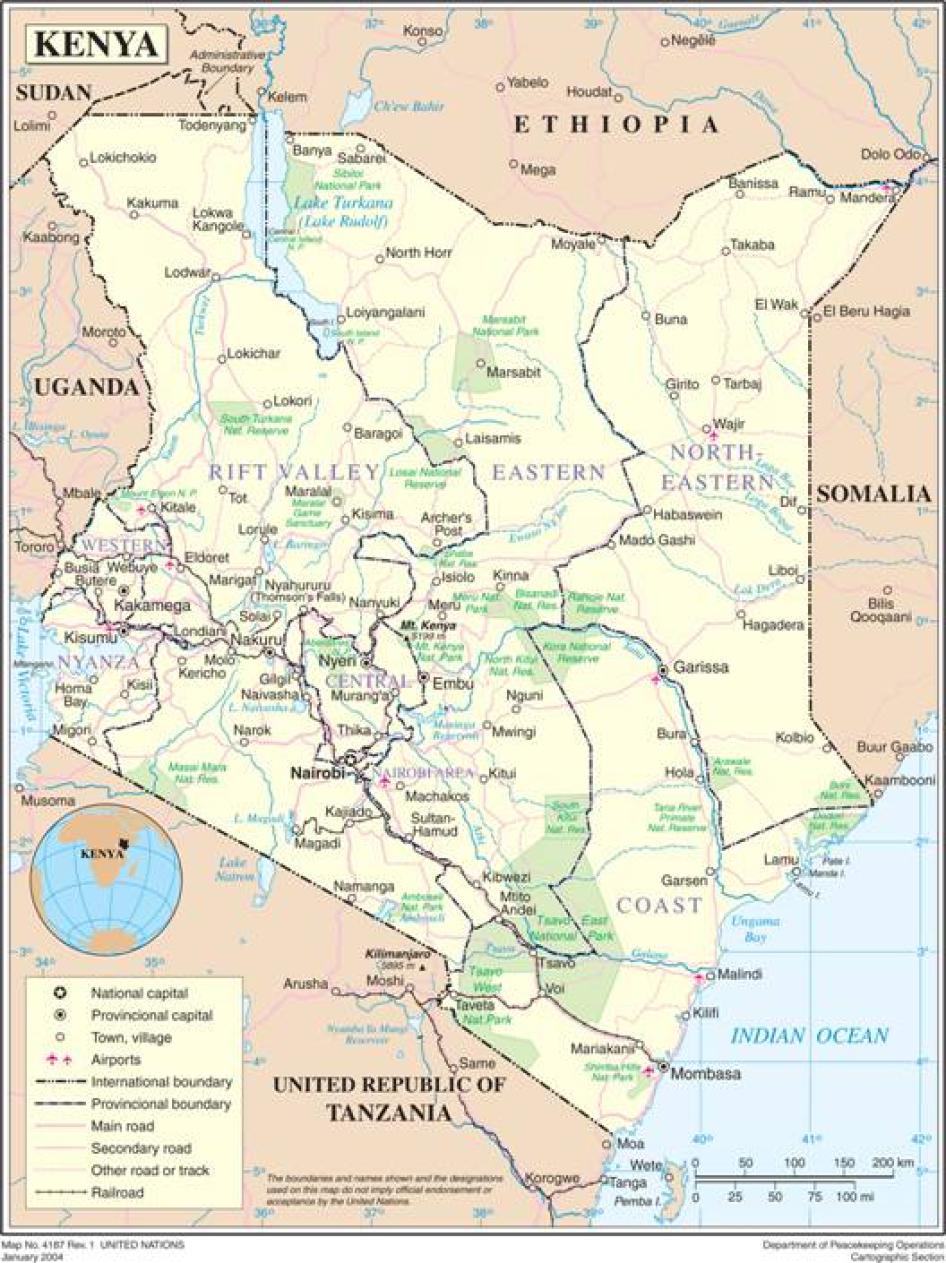
© 2004 UN Cartographic Section
Map of Ethnic Somali Concentration
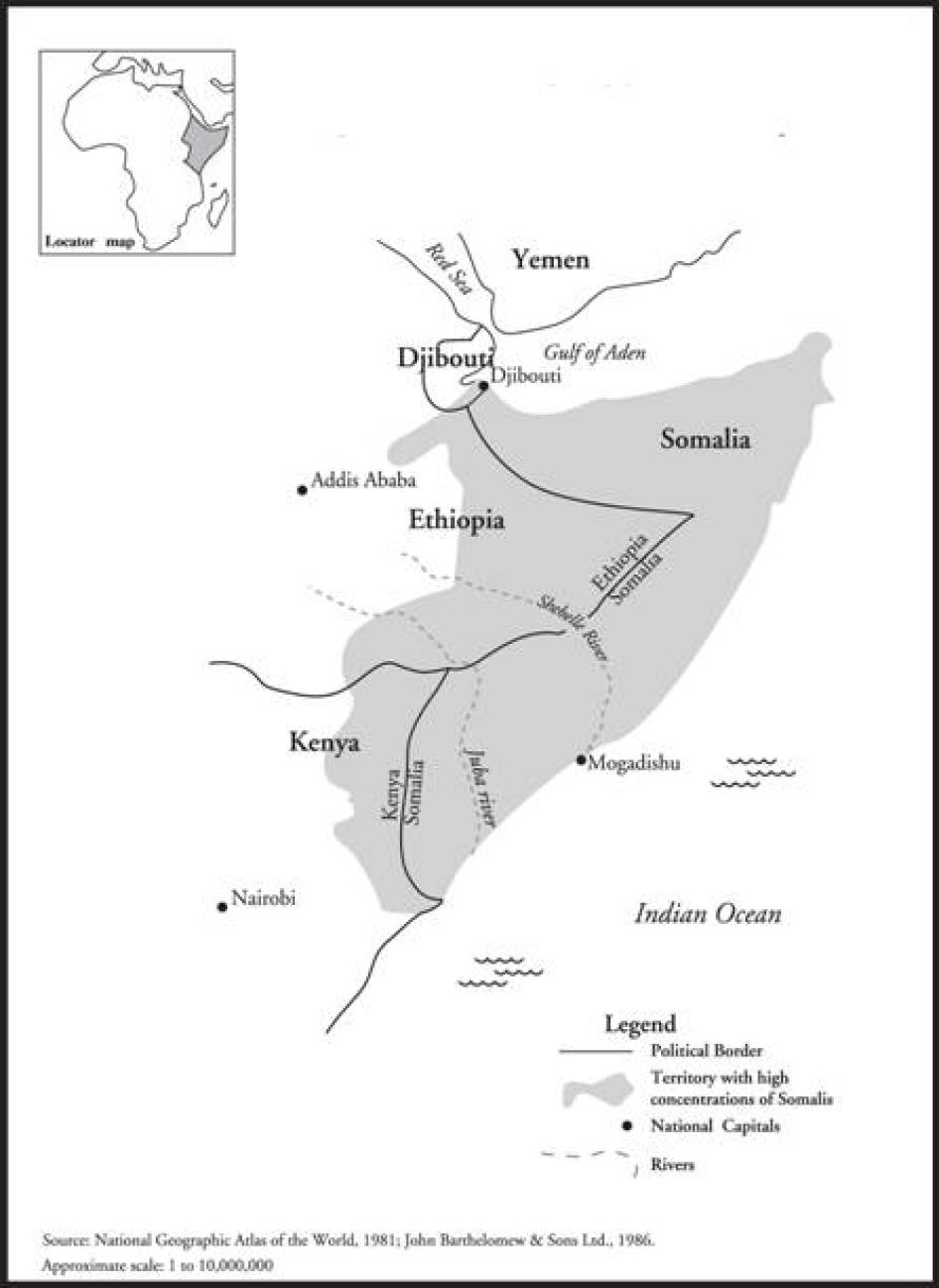
© 2000 Nadine Schuurman
Summary
On October 25, 2008, the Kenyan government launched a joint police-military operation aimed at disarming warring militias in the Mandera region of northeastern Kenya. In fact, this operation was planned as less a law enforcement action than a deliberate and brutal attack on the local civilian population that unfolded systematically over the course of several days.
In this operation, the Kenyan army and police targeted 10 towns and villages, rounding up the population, beating and torturing male residents en masse, and indulging in widespread looting and destruction of property. Members of the security forces raped women in their homes in at least some of the targeted communities while the men were being tortured in the streets. The operation left more than 1,200 injured, one dead, and at least a dozen women raped.
The attacks followed a similar pattern in each community. Starting early in the morning, police and soldiers went around the town beating men, dragging them out of their houses, and forcing them to march or crawl to a central location. Many suffered fractures and injuries from the beatings on the way to the assembly points. Once there, members of the security forces demanded that community members produce and hand over illegal firearms. To force compliance, detainees were made to lie on the ground, and were repeatedly beaten over the course of several hours or an entire day and questioned on the whereabouts of firearms. Human Rights Watch interviewed victims who fainted, vomited blood, and endured continued beating after suffering broken limbs. Some men had their genitals pulled with pliers, tied with wire, or beaten with sticks as a method of torture designed to make them confess and turn over guns.
While the men of each community were being beaten and tortured, members of the security forces went house to house looking for guns, demanding that the women and children at home turn over the weapons of their husbands and fathers. Many women told Human Rights Watch how they were beaten in or near their homes and, in several cases, raped.
In some communities elders pleaded with the commanders to relent and negotiated the release of their men in return for the surrender of the elders’ identity cards, redeemable upon the production of weapons within three days. With the blessing of military commanders, families organized themselves, recovered some weapons from the bush, and purchased others from Somalia in order to hand them over to the police and army and reclaim their identity cards.
Many of those injured, including all but one of the rape victims interviewed by Human Rights Watch, fled to the bush following the operation and treated themselves using traditional methods. Nevertheless, local clinics at Wargadud and Lafey, and the district hospital at El Wak, were overwhelmed. The hospital in El Wak has 32 beds but treated 112 inpatients and roughly 130 more outpatients. The Kenya Red Cross sent mobile clinics to the remote areas and an emergency team to El Wak. They treated more than 1,200 people injured in the attacks and referred several critical cases to Wajir and Nairobi hospitals. One man died from internal bleeding while being transferred. Scores of the men and women injured suffered lasting harm; four months later many complained to Human Rights Watch of debilitating pain that affected their ability to follow their livestock or otherwise earn a living. Several men were still bedridden months after being tortured.
The Kenya National Commission on Human Rights and television crews from both major Kenyan TV networks immediately documented what had happened during the operation and called on the government to suspend the operation and hold its forces to account. The initial police reaction was to deny all allegations despite overwhelming evidence including footage of the overflowing hospital in El Wak. In November 2008 the minister for internal security, George Saitoti, promised an inquiry into the allegations of human rights abuses committed during the operation, but there has been no official follow-up since.
An independent inquiry is needed to establish who within the Kenyan government and operational chain of command was aware of how the operation was planned and conducted and why they failed to stop it. Many victims reported that senior police and army commanders were present and supervised the large-scale beating and torture in at least some of the affected communities. Because of the widespread and systematic nature of the torture meted out during the operation, these abuses could rise to the level of crimes against humanity.
The “Mandera Triangle” area of Kenya’s North Eastern province, sandwiched between the borders of Ethiopia and Somalia, has been unstable since colonial times. Its residents, mainly ethnic Somalis, have frequently been the victims of abuses at the hands of Kenyan security forces, especially during almost three decades of emergency rule imposed on the region. Many of the factors driving conflict in the area are well known. Endemic poverty and unemployment, lack of development, environmental degradation, competition over grazing land and other resources, the proliferation of small arms, and the area’s proximity to Somalia have contributed to serious communal clashes in recent decades.
Pastoralist communities in the Mandera area have cross-border ties with kinsmen in Ethiopia and Somalia. Between July and October 2008 a dispute over a borehole escalated into clashes between two of these clans—the Garre and Murulle—and drew in militias from Ethiopia and Somalia. The fighting left 21 people dead, including three security officers. After mediation efforts failed, the government launched the joint operation to “restore law and order,” and disarm the militias.
The Kenyan police and military have an extensive record of turning security operations into deliberate and brutal attacks on civilian populations. The Mandera joint operation pursued an abusive strategy of mass arbitrary detention, torture, and collective punishment—a strategy similar to that used in Mount Elgon in 2008, where the security forces rounded up and tortured hundreds of men, dozens of whom remain “disappeared.”
Yet the joint operations in Mandera and Mount Elgon are just two examples of a broader pattern of police abuse and impunity; the security forces now appear to be a law unto themselves. Police killed protesters indiscriminately during the violence that followed Kenya’s 2007 elections. The minister for internal security acknowledged to Parliament in February 2009 that police death squads had carried out extrajudicial killings of suspected members of the criminal Mungiki gang over several years. And two human rights activists who helped document those extrajudicial executions were themselves gunned down in March 2009—an attack that even Kenya’s prime minister alleged was carried out by the police. No one has been held to account for any of these and other abuses. The UN special rapporteur on extrajudicial, summary or arbitrary executions, Philip Alston, further criticized abuses by the police and military in unprecedented terms in a May 2009 report.
The government has recently recognized the urgent need for security sector reform and accountability. In May 2009 President Kibaki announced that he had appointed a national task force to fast track police reform. And in June the minister for internal security acknowledged the problem of extrajudicial killings and police abuses during a speech at the UN Human Rights Council. Yet impunity for police abuses is not the result of a few bad apples in the police force, but rather part of a broader crisis of governance and accountability. Politicians and commanders repeatedly plan and authorize brutal operations that violate Kenyan and international law and that include systematic human rights violations as part of the strategy of the operation. The government’s commitment to reform will remain untested until it takes action to replace key officials, undertake sweeping changes in strategy in security operations, and initiate genuine investigations and prosecutions of abusive commanders.
There is a broad consensus that the changes proposed in the report of the Waki Commission to Investigate Post-Election Violence—established in the aftermath of the ethnic violence that followed the contested December 2007 elections—are the right starting point for fundamental root and branch reform of the police service. The national accord that followed the election violence and led to the formation of the coalition government in March 2008 also acknowledged the corrosive effect of impunity and the central role of accountability for Kenya’s future stability. Implementing the proposed reforms and bringing prosecutions would show that the government is serious about ending the impunity that generates these abuses.
Methodology
This report is based on field research conducted by Human Rights Watch researchers in North Eastern province and Nairobi, Kenya, in February 2009. Human Rights Watch visited the towns of Wargadud, El Wak, Elele, Qaramadow, Lafey, and Mandera and interviewed 91 victims of the operation from the towns of Wargadud, El Wak, Elele, Qaramadow, Lafey, Warankara, and Damasa identified by local human rights groups and community leaders. They also interviewed staff of nongovernmental organizations (NGOs), doctors, nurses, and community leaders in the Mandera region and officials from the Kenya National Commission on Human Rights (KNCHR), other NGOs, and diplomats in Nairobi. The researchers interviewed victims from both the Garre and Murulle clans and spoke to leaders of both clans. Interviews were conducted in English and Kiswahili without translators and in Somali and Borana with interpreters.
The district commissioner in El Wak would not speak to Human Rights Watch and refused permission for Human Rights Watch researchers to interview police and military commanders there. Human Rights Watch wrote to Minister for Internal Security George Saitoti on May 5, 2009, presenting its findings and seeking a response to the allegations within three weeks. As this report went to press in late June, no response had been received. The government position has therefore been deduced from statements by ministers and police officials to the press and Parliament.
Recommendations
To the Government of Kenya
- Investigate all claims of arbitrary detention, torture, inhuman treatment, rape, and looting by security forces and prosecute those responsible for the October 2008 Mandera disarmament operation, including the commanding officers who supervised the operation and did nothing to stem abuses by subordinates.
- Establish an independent judicial inquiry into the conduct of the October 2008 disarmament operation in Mandera East and Mandera Central districts. The inquiry should examine the formation of policy, operating procedures, and command responsibility for such joint operations. It should alsorecord complaints from victims as evidence and facilitate the provision of compensation to victims of abuse by state security forces. Special attention should be paid to creating a conducive environment for women and girls who have been sexually assaulted to record their complaints; the inquiry should include trained female investigators and take steps to protect the identity of rape complainants.
- Implement the recommendations of the Waki Commission and the UN special rapporteur on extrajudicial, summary or arbitrary executions as part of the national task force on police reform, chiefly, the establishment of an independent police conduct authority, the merging of the administration and regular police, and the overhaul of police command structures.
- Establish a civilian-led inspectorate to investigate allegations of abuses committed by the military.
- Publicly apologize for the torture, rape, and degrading treatment meted out to civilians in the course of the Mandera disarmament operation of October 2008.
- Pass the National Policy on Small Arms and Light Weapons and conduct future disarmament operations in line with its provisions.
- Sign and ratify the Optional Protocol to the Convention against Torture and other Cruel, Inhuman or Degrading Treatment or Punishment (OPCAT).
To the Kenyan Parliament
- Establish a parliamentary inquiry into the allegations of abuses in Mandera in October 2008 and promptly publish its findings.
- Establish a parliamentary committee to examine the structure, mandate, and rules of engagement of joint security operations between the police and military, and consider the responsibility of ministers for crimes resulting from abusive policies and strategies approved by them.
To the Ministry of Health and Nongovernmental Organizations Working on Women’s Rights, Health Services, and Sexual Violence in Kenya
- Provide accessible and culturally appropriate information to victims about the health-related consequences, including mental health, of sexual assault to enable women to protect their health following sexual assault.
- Provide HIV testing and testing for other sexually transmitted infections, access to available treatment, and counseling services to female victims of sexual abuse by security forces in the Mandera triangle.
To the Kenya National Commission on Human Rights
- Use the commission’s statutory authority to bring a collective legal case against the state for gross violations of the rights of the victims of the Mandera disarmament operation and seek redress and compensation. To that end, engage lawyers to collect affidavits from the affected parties in Mandera.
To the United States, the United Kingdom, and Other International Partners of Kenyan Security Forces
- Support the Kenyan government’s proposed process of police reform as a matter of urgency.
- Vet all individuals for training or assistance programs to ensure that they were not deployed to Mandera as part of the operation in October 2008.
- Condition security sector assistance on accountability for past abuses during operations by the security forces in Mount Elgon, Mandera, and other locations.
- Insist on a human rights component for all security force training programs as a condition of security assistance.
To the United Nations Secretary-General
- On behalf of the whole UN system, urge the government of Kenya to implement the recommendations contained in this report as well as the recommendations of the UN special rapporteur for extrajudicial, summary or arbitrary executions and pledge the support of the UN system to address the concerns raised in this report.
To the United Nations Department of Peacekeeping Operations
- Bar all Kenyan military and police units suspected of committing human rights violations from participating in UN peacekeeping missions until an independent investigation has cleared them of wrongdoing.
Background
The history of Kenya’s North Eastern province, like other remote Kenyan border regions, is one of neglect and discrimination at the hands of successive authorities, first by the colonial British regime in Nairobi and then, after independence in 1963, by the Kenyan government.[1] Despite positive trends in security and governance in the region over the past decade, the abusive October 2008 disarmament operation in the Mandera districts echoes earlier patterns of central government repression.
The province’s “Mandera triangle” is made up of three districts—Mandera West, Central, and East—of arid and undeveloped scrubland bordered by Ethiopia to the north and Somalia to the east. It is largely populated by ethnic Somali pastoralist communities with close ties to their ethnic kinsman in both Ethiopia and Somalia.[2]
The geography and politics of the region have long contributed to a feeling, both in Nairobi and amongst the local population, that the region has little meaningful connection with the rest of Kenya. Even today, the citizenship of many in the Mandera triangle is questioned by the state. In colonial times it was known as the Northern Frontier District (NFD).
In 1960 Italian and British Somaliland became independent and immediately merged to form a single independent state: Somalia. In response to pressure from the Somali delegation at the London talks on Somali independence, in 1960 the British administration in Kenya invited an independent commission to assess the views of Somalis living in the NFD on possible secession from Kenya and unification with Somalia. The commission found that a majority of the population favored unification with Somalia.[3]
However, the British did not follow the commission’s findings, acquiescing instead during the talks that led to Kenyan independence in 1963 to the demands of Kenyan nationalists led by Jomo Kenyatta that the NFD remain part of Kenya. This sparked an armed struggle for secession in the NFD, popularly known as the “Shifta War.”[4]The British bequeathed the war to the independent Kenyan government in December 1963 and the new government immediately declared a state of emergency.[5] It would last for 28 years.
Although Somalia formally renounced its claim to the NFD—thereby formally ending the “Shifta War” in 1967—the state of emergency persisted until 1991.[6] This meant that for over 25 years Kenya effectively “had two separate legal regimes.”[7]The emergency laws, reinforced in 1966 by the North Eastern Province and Contiguous Districts Regulations,[8]“explicitly endorsed instances when the fundamental human rights of the person could be violated,” including enhanced powers of search without warrant, arrest, and detention for up to 56 days without trial, the death sentence for unlawful possession of firearms, and the creation of special courts.[9] The regulations also created “prohibited” zones along the Kenyan-Somali border where unauthorized entry was punishable by a life sentence.[10]
Government repression of ethnic Somalis in North Eastern province continued well into the 1980s, after the so-called “Shifta War” ended, partly due to the identification of Somali communities as sources of cross-border arms-smuggling, banditry, and lawlessness. Successive attempts by the government to establish or restore “law and order” were characterized by abusive or discriminatory operations that failed to treat ethnic Somali Kenyans as legitimate citizens.
One of the worst atrocities by state security forces in independent Kenya’s history occurred in North Eastern province in 1984: the infamous “Wagalla massacre,” also known as the Wajir massacre.[11] In February 1984 security forces rounded up several thousand men from the Degodiya clan in a purported disarmament operation and forced them to remove their clothes and lie down on the Wagalla airstrip for up to five days in the sun, while beating and torturing them. Hundreds of people died on the airstrip from the beatings and some were shot to death. The Kenyan government initially claimed that 57 people had died, but belatedly admitted in 2000 to a much higher death toll of 380.[12]
As Somali refugees began fleeing Somalia’s civil war and streaming into Kenya in the late 1980s, the Kenyan government introduced multiple “screening” operations to distinguish ethnic Somali Kenyan citizens from Somali nationals. The screening operations resulted in many abuses, including the deportation of hundreds of people without due process.[13] The screening operations ended in 1990; however, identity cards issued to ethnic Somalis facilitated continued discrimination and harassment. While the situation has improved in recent years, even today ethnic Somalis still complain that they face prejudice and discrimination while attaining or using identity documents.
Like Kenya’s other border areas, the region has consistently suffered from underdevelopment and insecurity, partly resulting from the emergency regulations and the effective closing of the district for many years, but also due to low government investment, a very thin police presence, and associated banditry and cross-border cattle-raiding.[14] The introduction of large numbers of automatic weapons into the area over the past two decades has exacerbated insecurity.[15] Northeastern Kenya has also suffered from the deterioration of security in neighboring Somalia since 1991 and the long-running conflict in Ethiopia’s Ogaden region. As in Kenya’s other border or “frontier” areas, cross-border clan-based violence has been a recurring event, often sparked by cattle theft or clashes over grazing land or water points. These clashes have regularly claimed lives and seen the theft of livestock that local communities depend on for their livelihood.[16]
In 1998 the Kenyan government appointed a judicial commission to examine the causes of clan and tribal clashes during the 1990s, headed by Justice Augustus Akiwumi. The commission noted that in North Eastern province the traditional practice of cattle rustling had been transformed through the widespread availability of automatic weapons and exacerbated by frequent droughts and a shortage of grazing land and water sources for livestock. The commission also acknowledged that these clashes had a political dimension as clans vie for parliamentary and local government representation that can then be used to dominate local resources and control the best grazing areas for themselves.[17]
The Akiwumi Commission recommended several measures to decrease clan conflict in North Eastern province: opening up the region to development, improving road and telephone communications, improving education, securing the border, increasing marketing outlets for livestock, investing in water resources (boreholes), and taking care to ensure the fair distribution of boreholes.[18]
By the late 1990s, the region’s reputation for total lawlessness and insecurity declined, though it remained prone to criminal and communal violence. Unlike neighboring Wajir and Moyale districts, Mandera was comparatively calm.[19] The improved situation was partly due to positive trends in central government policy, including the introduction of multiparty politics, and factors like the growth of cross-border or regional trade.[20] Local politics played both a positive and negative role. The former Mandera district had been sub-divided into three constituencies in the 1980s—Mandera East, Central, and West—and the identification of these districts and even more local-level “locations” along ethnic or clan lines has sometimes exacerbated tensions, particularly given the way local government officials have used their positions to allocate services, jobs, and water resources as a form of political patronage.[21]
Today, the trends shaping the political landscape in Mandera remain problematic. Since 2007 each of the three former constituencies of Mandera district have in fact become districts themselves, part of the Kibaki government’s move to greatly increase the number of districts earlier that year.[22] At the same time, however, there have been signs of change for the better. The coalition government established after the contested presidential election of December 2007 has paid more attention to northern Kenya than most previous governments, establishing a Ministry of Development of Northern Kenya and Other Arid Lands and announcing the opening of regional abattoirs to promote economic activity for pastoralists. Furthermore, there have been moves towards more local ownership of conflict, with the growth of local peace committees and community-based organizations, the involvement of elders and Islamic leaders in mediation talks, and a less heavy-handed approach by the national government.[23]
The dramatic worsening of the security situation in Somalia since late 2006 has again increased cross-border insecurity, producing cross-border attacks and an increased Kenyan military presence along the border.[24]The conflict has also caused tens of thousands of Somali refugees to flee the fighting in Mogadishu and enter Kenya, despite the border closure, putting enormous pressure on the refugee camps at Dadaab and the land in North Eastern province. Dadaab now houses more than 275,000 refugees—more than any other single location in the world—and is the largest urban development in the region.[25]
The 2008 Clashes at Alango
In July 2008 the provincial administration failed to heed local warnings and drilled a well in Alango, one of the so-called buffer zones and an area of chronic inter-clan conflict between the Mandera East and Central districts where the border was disputed. The drilling provoked renewed conflict between the Garre and Murulle clans—both claimed the right to access the water—resulting in violence that killed 21 people between July and October 2008.[26]
The Garre and Murulle clans both mobilized to collect money and weapons to defend their kin, and both sides received support from allied clans across Kenya’s borders. Borana militia from Ethiopia came to the aid of the Garre while Marehan militia from Somalia rallied to support the Murulle.[27]
The dispute over the borehole at Alango and ensuing clashes between the Garre and Murulle clans were the latest of many similar disputes and clashes in recent years. Indeed, inter-clan disputes are so frequent that well-established mediation structures exist for their resolution. Previous fighting led to the signing of the Garre and Murulle Peace Accord in April 2005.[28]
Tensions over the Alango borehole were linked to disputes over the exact boundary between Mandera East and Mandera Central districts, which created confusion among the population because many people associate administrative boundaries with clan boundaries and thus with their grazing and water rights. All of this was recognized and apparently resolved at a three-day mediation meeting between Garre and Murulle clan elders in July 2008, observed by army and police commanders and district commissioners from both Mandera Central and East.[29]
The government said that it had facilitated dialogue between the two clans three times and had sent a technical team to ascertain the district boundary.[30] While mediation efforts were ongoing, however, the hostilities continued, resulting in the killing of 18 citizens and three policemen during August and September 2008.[31]
Abandoning its previous successful mediated approach to conflict resolution, the government instead stated that a security operation was necessary because the warring clans had “internationalized the conflict by enlisting support of militias from neighboring countries, which amounts to gross violation of the country’s sovereignty and territorial integrity.”[32]However, elders in Wargadud and Elele involved in the mediation claimed that the violence had finished by the time the security operation to disarm the militias began.[33]
A member of parliament, Dr. Abdi Nassir Nuh, voiced what many in the Mandera region expressed to Human Rights Watch when he noted, “What brought the flare-up this year was a very trivial matter, namely allocation [of the borehole].”[34] He said that rather than address the violence in the course of regular policing, the authorities chose to launch a special joint police-military operation to disarm the militias.
Abuses by Kenyan Security Forces
The Security Operation
The joint police-military disarmament operation in the Mandera Triangle began on October 25, 2008. It was ostensibly an attempt to address one of the underlying causes of insecurity in the region by seizing illegal firearms from warring Garre and Murulle communities. For the next few days around 600 personnel from the regular Kenyan police, Administration Police,[35] and Kenyan army targeted Garre and Murulle settlements in the districts of Mandera Central and Mandera East.[36] The approach was simple: security forces terrorized the civilian population through violence while demanding that they turn over illegal weapons if they wanted the violence to stop. By the time the operation was over on October 28, more than 1,200 people from both clans were injured as a result of severe beatings and torture by the security forces; one person died.[37] The government hailed the operation as a success because it claimed to have seized 130 illegal firearms and arrested more than 150 Ethiopian and Somali militiamen found on Kenyan soil and implicated in the clashes that triggered the operation.[38]
The operation swept through Bambo, Gari, and Warankara on October 25; Lafey, Elele, Qaramadow, Wargadud, and Damasa on October 26; and reached the town of El Wak and the village of Qalankalesa on October 28 (see map on page 3).[39] In February 2009 Human Rights Watch visited and conducted interviews in the towns of El Wak, Lafey, Qaramadow, Elele, and Wargadud and spoke to residents of Damasa and Warankara.
The operation unfolded in a largely similar manner in each location. Police, Administration Police, and army personnel attempted to gain an element of surprise by arriving early in the morning, though some people were able to escape and flee into the bush. Men were rounded up en masse and forced to march or crawl to a central gathering point, often beaten by a gauntlet of security force members along the way. The security forces then began house-to-house searches for weapons, often beating, and in at least a few cases, raping women found at home. Widespread looting of homes and businesses by the security forces took place in some communities.
Throughout the length of the operation—the better part of a day in most places—the men who had been rounded up were beaten and ordered to produce illegal firearms in order to escape further punishment. In most cases victims were not even given an opportunity to produce a weapon before they had been thoroughly beaten. The security forces kicked and punched their prostrate victims, beat them with clubs, wires, and iron rods, and squeezed or mutilated the testicles of some of the captive men. In every community visited by Human Rights Watch many of the victims were beaten so severely that their mistreatment rose to the level of torture. At the operation’s conclusion the security forces moved on, leaving the local populace to nurse their wounds and search for lost family members. Many people fled into the bush, fearing further attacks, and spent days or weeks living with their herds before returning to their homes. In some communities, residents fled across the nearby border into Somalia to seek shelter there.
The following section presents a detailed account of how the operation unfolded in some of the communities where serious abuses were most widespread during the operation.[40]
Lafey
An elderly chief told Human Rights Watch that on October 25, the day before the operation came to Lafey town, he was summoned to a meeting with the district officer along with local members of the Kenya Police Reserve and told to surrender his government-issued weapon.[41] The following day he was rounded up and beaten along with everyone else.
Security forces surrounded the town early in the morning of October 26 and began rounding up all the men they could find. A teacher in Lafey was about to leave for school when soldiers arrived at his house: “Soldiers came to my house at 7:30 a.m. I said, ‘I am also an officer of the government, I am a teacher, let us respect each other.’ They said, ‘There is nothing like that today. Today we are in charge.’”[42]Another man was shot at during the initial roundup: “When a soldier was trying to enter my plot I was leaving the toilet,” he told Human Rights Watch. “He shot at me [and missed]—I think he was surprised.”[43]
After being rounded up, men were forced to walk or run to a central point by security forces wielding sticks, batons, and guns. In Lafey, the place of assembly was near the district administration office. There, the men were made to lie down in the sun and described to Human Rights Watch how they were severely beaten intermittently until the late afternoon while members of the security forces periodically shouted at them to produce weapons. The men were beaten with iron rods, clubs, and even metal-tipped canes which had been taken from some of the victims. A primary school teacher detained there described the scene to Human Rights Watch:
They were beating [us] at the camp with anything they could get their hands on, everywhere.... some were stripped naked, there was lots of blood on the ground. Some had arms broken, some legs, blood was flowing from many heads. I was beaten with a club until I fractured a rib. When it stopped, many could not walk, could not sit up. We carried 10 who could not walk.... People were beaten mercilessly, like snakes.[44]
A Koranic teacher at Lafey told Human Rights Watch how he was tortured by members of the security forces who ripped his testicles open with a pair of pliers:
I am one of the teachers teaching Koran so they suspected me, and thought I might give them information. For seven years I haven’t even been to the border.... They stripped me in front of everyone, and pulled my testicles with pliers—all the skin came off and blood poured down, for two weeks it was still bleeding.[45]
While the men were detained at the camp, women said that members of the security forces had gone house to house searching homes, beating up several women they found in their homes while demanding that they turn over illegal weapons. Women were also rounded up and made to sit together in the middle of the main road running through town. Several of them were beaten by members of the security forces who demanded that they identify the whereabouts of firearms and local militiamen.[46] Many of the women there said that at one point two police or soldiers attempted to drag two young women away from the crowd, but ultimately relented when one of their superiors intervened to stop them. One elderly woman in Lafey said:
They took me and started beating me and took me into the sun. Two girls were beaten up on the road. The officers[47] started quarrelling over them in front of us. Hundreds of women were gathered there. I became unconscious when outside there and was taken to the police post. They refused to let me relax there, they just started asking, “Where is your eldest son, how many militias do you know?” They dragged me to that police post. They were kicking and slapping women out there, saying, “Where are your husbands and sons? Where are the militia?” My husband died a long time ago. And my son is far from here.[48]
Members of the security forces also attacked several girls in their homes; the girls alleged that they had attempted to rape them. Three schoolgirls were attacked at home and described security forces attempting to sexually assault them, but claimed they had not succeeded—possibly because of shame. One of them recounted:
He made me lie down and beat me on the buttocks with a club for 30 minutes. He kept asking me, “Where is the gun?” When I reply I don’t know he beat me more, he said I was lying. One tried to force himself on me but I refused and he slapped me.[49]
While rounding people up some members of the security forces even beat children. A mother of a 10-year-old boy who was beaten told Human Rights Watch:
Physically, nothing happened to me, but when they entered my house they broke everything. Six came inside but only two were destroying everything. When they came they asked, “Where is your husband, where is your gun, where are your sons?” I said my husband was with the livestock and I do not have any son. They just started smashing everything. Then they found my young son hiding under the bed and they hit him on the head with a metal rod. They hit him once and he fell down and nearly fainted.[50]
Male victims in Lafey said they were held until the afternoon, alternately beaten and questioned. Eventually elders pleaded with the commanders to stop the beating and agreed to provide weapons. An elder in Lafey recalled:
[We] were pleading with the military to stop and allow us to go and get some weapons. Eventually they relented. There was one commander from the army, one from the police, and one from Administration Police. We agreed to get weapons if they would stop beating our people. We brought 57 guns after two weeks.[51]
In order to recover the weapons, a community leader from Lafey described going to Somalia to negotiate with the militia and recover weapons after the operation. He pointed out, “If elders had been consulted, we would have collected the weapons without being harassed.”[52]
In addition to abusing Lafey’s residents, the security forces looted many homes and stores. Residents interviewed by Human Rights Watch described security forces looting in front of them, while they were supposedly searching the premises. One woman said, “They took 5,000Ksh [US$74] from inside a locked box in the house and destroyed some clothing that was in the box. I cannot wear them now.”[53] Another woman said the members of the security forces who came to her home demanded, “Do you have money, do you have money?” She said she gave them what little money she had, but that “they started smashing our jerry cans—the most valuable thing to us because we use it to get water. They also knocked down my toilet [outhouse].”[54]
A woman told how security forces looted from her husband’s shop:
They came to our home. My husband was in the shop. They asked, “Where is your husband?” and I told them. They searched the house and they looted my husband’s shop—they took around 45,000Ksh [$660] from him. They beat up my husband and marched him to the place where people were being brought together.[55]
Another shopkeeper described how they stole all the sugar, cigarettes, and other provisions from her shop—around 40,000Ksh [$590] worth, she claimed.[56] A male shopkeeper described how members of the security forces beat him in his shop and robbed him of 20,000Ksh [$295] in cash and 30,000Ksh [$440] in provisions.[57]
Most people in Lafey and other towns fled following the operation, and upon their return many found their homes and businesses looted bare. Those who were not there to witness it did not know if it was the police and military or opportunistic neighbors that looted their property. One woman from Lafey who fled to Somalia for several weeks said, “Nobody knows who looted because everyone ran away.”[58]
It was not only households and businesses that were looted by the security forces in Lafey. The solar panels at the primary school in Lafey were also confiscated by security forces. The members of the security forces who took them confronted the headmaster of the school with the charge that local gangs of bandits were using the school’s solar panels to recharge their radios.[59]
In Lafey local councilors claimed that roughly 300 people had been rounded up and detained. They showed Human Rights Watch a list compiled by community members of 170 people who had been beaten, consisting of 115 men, 30 women, and 25 schoolchildren.[60] According to records in the clinic in Lafey, 41 people were treated for second-degree soft tissue injuries resulting from “assault by security forces” in the days following the operation.[61] Many fled, eschewing treatment, and others treated themselves using traditional remedies in the bush.
Elele
At around 8 a.m., on the morning of October 26, army and police officers arrived in Elele, a small community near the larger town of Wargadud. The security forces found only a small number of people in the village because, as one witness described it, “Most ran away very early in the morning or were out with their herds. Immediately when the army vehicles came to town people started running in all directions.”[62]But the operation in Elele was even more brutal and undisciplined than in most other communities: in addition to the severe beating of at least 25 male members of the community, seven women told Human Rights Watch that they were raped in their homes by members of the security forces. More than 10 women were apparently raped in total.
As in other locations, the security forces attempted to cordon off the community and then rounded up all of the men they could find. Those men were gathered next to the road that runs through the town, beaten, and in some cases tortured until late afternoon. At the same time, groups of police officers or soldiers searched homes and raped several women. Late in the day most of the men who had been beaten were taken in a police truck to Wargadud. Once there they were beaten again along with the captured residents of that town until evening and then returned to Elele by the same truck.
One man, a mason, described what happened to him:
That morning we were building a water tank, we were seated there [by the road] as the army and police trucks came. People said, “These are the vehicles of the operation that have come to get us.” Two of the men with me ran away. They rounded the rest of us up including some ladies.... They brought us to the road, told us to remove our IDs and held them. They said, “Where are your guns?” Some people were even ready to accept that they had guns but before they could talk they started beating us.[63]
Victims were taken to a central point in the village. One man recalled the event:
Immediately when they brought us there they started beating us. When they were finished they said, “Where are the guns?” And if you still say you don’t have any, then they beat you again. Some of the personnel who were there and talked our language said to us, “Instead of dying here, just show us your guns.”[64]
An elderly man in Elele described how he was caught at home and tortured, including by members of the security forces who squeezed and twisted his testicles until he fainted:
It was soldiers, police and Administration Police all together. They brought me to the other group that had gathered there [on the road] and told us to lie down. We lay down with our hands straight out like this [stretches his hands out above his head, palms down]. One will walk on your hands and one will walk on your thighs. One will come with a stick with thorns and scrape it against our heads. Two men will stand on both sides hitting us. They told us to tell where our guns are and we said we don’t know and they started getting hold of our testicles.[65]
In Elele only a handful of residents said that they had had firearms and turned them over to the security forces. A victim recounted:
Nobody has a gun in this village. Some people have them in the bushes with the livestock but no one was willing to say that they had one. We thought they would continue to beat us and maybe send us to jail if we said we had them. We just have them to defend our livestock. One man said he had a gun with his animals and they took him to go and get it.[66]
While the men were being rounded up in Elele, members of the security forces went house to house asking the women and children who remained there to surrender weapons. Human Rights Watch interviewed seven women from Elele who said that they were raped. One of these had hospital records confirming her injuries—she had been treated by the Red Cross and airlifted to Nairobi Women’s Hospital due to massive bleeding.[67]The others did not seek medical treatment.
The women were traumatized by what had happened to them. Some broke down crying when recounting the events of October 26. One began her account by saying, “If you want me to remember the incident of that day, I will feel unwell.” She nevertheless insisted on telling her story:
Soldiers came to the house in the morning. They said, “Where is your husband and where is the gun of your husband?” I was told to go into the house. One caught me from behind, one took the child from me. He started opening his trousers. I told them to kill me instead of raping me. They hit me with the butt of a gun at the back, and kicked me in the kidneys. Then, when they had finished they went to the neighboring house.[68]
Another woman from a house nearby told a similar story:
It was 8 a.m. I was at home. I saw people running to the bush and I saw Kenya soldiers surrounding my home. I was pregnant, seven months. Two soldiers threw me into a hut that is in front of our house. They hit me with a big stick behind the head and I fell down. They asked me, “Where is the gun?” I said I have no gun, my husband is working with a bicycle—this is the bicycle you are seeing in front of the house.
They put me in the hut and started raping me. One held my head on the ground, and the other one started raping me, like this [she got on her knees and put her head on the ground]. I fainted because I was pregnant and when I woke up I just found myself damaged from the rape. I ran to the bush where our livestock are. I went with the five children that I could see there at home. After three days I found the rest of my kids in the bush. I came back after six weeks to give birth in Elele. I haven’t seen any doctor or hospital. There is a building of a clinic in Elele but there are no staff.[69]
An older woman described being raped alongside her daughter:
I was sitting outside my house with my daughter. We had seen the soldiers in town, then four of them came to the house and asked for my husband and his gun. I said he is not home and we do not have any gun. They did not understand [Somali]—they just kept motioning to their guns and pointing for me to bring one.
They put us into the house, me and my daughter, she is 20-years-old. They started beating us and removing the clothes from us and put the gun across the door so that we could not run away. They stripped us naked. One was outside and two were inside; one had gone. One was holding me and one was holding my daughter. They succeeded in what they wanted to do. My daughter broke the wall of the hut and ran out naked. I stayed holding my child who was one-year-old, he had been put on the bed by the soldier. I ran to the bush. I haven’t seen my daughter since.[70]
One of the women who was raped in Elele told Human Rights Watch that her attackers were police:
Three police officers came to our house, took my ID card and asked for guns. Two of them raped me. And one wearing a military uniform was outside. When he saw that they had raped me, when I came out and I was bleeding, he ran away.[71]
There is no functioning clinic in Elele; when the mobile Red Cross team came on October 28 they treated people who came out of the bush, according to the community health worker there.[72]All of the women who were raped fled to the bush. A woman who had been particularly badly hurt lost consciousness in the bush. The Red Cross team cut a path for the ambulance and took her to El Wak, and then to Nairobi Women’s Hospital.[73]
Wargadud
Security forces came to Wargadud at dawn on October 26 while some men were already at prayer. One resident told Human Rights Watch, “As I was leaving the mosque, I saw 10 officers in the road. I was told to run to the pitch [field].” On the way to the field that served as the central gathering point, other members of the security forces told him and others to lie down and crawl the rest of the distance along the rocky dirt road. Many of the men were wearing sarongs and many of those who were forced to crawl lost them and were naked by the time they reached the gathering point. “We were told to go like snakes, about 60 of us,” he recalled. “Then they started caning us properly.”[74]
When the men got to the field they were made to lie down as others continued to arrive:
At the pitch there was a commander and an inspector of police. The commander was a police officer sitting in a chair. People were brought from all directions, then we were caned until 1 p.m., about 80 of us. After that, we were told to sing like donkeys [...] like cows, [...] like goats, and told to jump like frogs.
We were there up to 6 p.m. We were not given water that whole time. Some of our women tried to bring us water, but they were beaten and told to go to their homes. We had to lie down and look at the sun with open eyes. Some people were vomiting from the beating. While beating they were asking for guns.[75]
Individuals who fought back or those believed to have specific information were singled out for particularly severe torture. One man in Wargadud resisted the members of the security forces who started beating him outside of his home. “I tried to resist them and they caught hold of me,” he said to Human Rights Watch. “One stood on both of my legs, and another held both of my hands, and a third caught me by the testicles. They tied a plastic cord around [my testicles] and pulled. I went unconscious.”[76]
Numerous witnesses told Human Rights Watch that in the late afternoon a helicopter arrived in Wargadud. One of the men detained on the field said, “A helicopter arrived around 5 p.m. The officer who got out asked in Swahili if any of us had died yet. When the answer was no, he ordered us to be beaten more.”[77]
After several hours of beating and torture, community elders in Wargadud were able to negotiate with the security forces:
Eventually we said we are going to produce guns, just stop beating us. Whoever said he had a gun and would produce it was taken out of the lot to somewhere else. A total of 38 firearms were taken. Some were taken from the bush [where their owners had left them]. Others were given two days, so some went and purchased [guns] across the [Somali] border. During the beating [the security forces] recovered 10 from within the town [included within the 38]. Many of those who said they had guns just said it to stop the beating. Most then went and bought one to give to them. The guns we have with us are just for defending our livestock.[78]
Elders claimed 300 people were rounded up while other witnesses put the figure at 170.[79] Community health workers said that they had records of 173 men and seven women injured as a result of the assault and treated at the clinic in Wargadud.[80]
One woman told Human Rights Watch that she was raped in Wargadud by police officers doing house-to-house searches:
Soldiers came to the house at 5 a.m.—my husband was dragged out of the house, beaten, and taken away. Two of the officers remained behind for me. One of them pushed me into the house and onto the bed. He caned me and hit the child strapped to my chest who was three months old. The other officer was standing outside blocking the door so no one could come in. The one inside raped me. He also stole 5,000 shillings that I had in my underwear which he found when he stripped me. Then he went to the kitchen and took a stick and said, “The gun of your husband is here, bring it!” I said, “My husband is a porter, he doesn’t have any money to buy a gun, and now you have raped me and stolen my money, just leave me alone.” I was crying. The other officer had taken the children outside before, now he forced them all back in and started beating them.[81]
Human Rights Watch also interviewed six other women from Wargadud who claimed police had attempted to rape them but had not succeeded.[82]
El Wak
News of the attacks on Elele and Wargadud on October 26 caused some residents of El Wak to flee before the operation reached the town at dawn on October 28. But many people remained in spite of the stories of torture and looting that were circulating. One resident of El Wak explained, “Before, we heard that there will be an operation but I wasn’t afraid. I am not a shifta [bandit]. I don’t have a gun. I have nothing to hide, I am a driver.”[83]
The operation in El Wak was on a larger scale than in any other community—it appears some 700 men were severely beaten over the course of several hours, with many suffering serious injuries. Security forces scoured the town in the early hours of the morning, rounding up men and ordering them to gather in a large field near the district commissioner’s office. The men described being seriously beaten in their homes or along the way to the field. Once there, they were divided into three groups by age and severely beaten until early afternoon. Many suffered serious injuries.
Human Rights Watch interviewed numerous men in El Wak who told stories similar to this one:
About 60 of us were captured as we were leaving the mosque. Immediately they saw us they started beating us and chasing us. They marched us to the police station while beating us and made us lie down on the road. They were beating us with electrical wire, sticks, rungus [clubs]. They broke my arm with a rungu. They made us crawl like snakes up to the chief’s camp. People from all over town were being brought there to the chief’s camp. There were many serious injuries there, broken limbs and so on.[84]
An elderly woman who lives in the market in El Wak described the scene early in the morning there on October 28:
In the street, I saw the whole market place full of soldiers, beating young men and taking them to the camp—and they were smashing up shops. There was a big black truck, a police one.[85]
Another man in El Wak was at home when the operation began:
At about 5.30 a.m., I saw about 20 police coming down the street, driving people [into groups], beating them, going into each house, dragging people out and beating them and shouting, “Go to the pitch.” Three came into my house, went into the bedroom, smashed the box with clothes in, turned it upside down and dragged me out, leaving my wife and two kids inside.... In front of the police station they made us lie down. They were beating us with sticks, rungus, anything. They weren’t saying anything except beating us and then, “Bring the gun or you’ll die.”[86]
Police not only went house to house but also attacked a group of charity workers in their office. Employees of the Consortium of Co-operative Partners (COCOP), an NGO working with the World Food Programme on food distribution in North Eastern province, described how police knocked on their gate and then climbed over the wall when they refused to open it. Six staff were beaten in the compound. They described being beaten for an hour there before being taken to the pitch with the others.[87]
Roughly 700 men were made to lie down in rows, broken up into three different groups according to age: youth, middle-aged, and elderly.[88] Throughout the day police and military personnel beat them, walked across their prone bodies, and tortured some men by beating or twisting their genitals. Throughout the day they demanded to know the whereabouts of illegal firearms, though the operation’s victims were given scarce opportunity to speak. Several accounts were similar to this one: “At the camp they made us lie on our backs then they aimed the stick at my balls. He was smashing me with a stick that he was wielding with two hands.”[89]
Victims who had served in the army and police were shocked at the crimes that they witnessed. An army veteran told Human Rights Watch, “I used to serve in the army for 21 years in 1 Kenya Rifles. I didn’t get the chance to tell them that I used to serve in the army.”[90]The head of the Kenya Red Cross office in El Wak, who was wearing a jacket clearly marked with the organization’s logo, was among the group and was beaten along with the rest.[91]
The beating and demands for firearms continued from dawn until well into the afternoon. One man described the derision of the security forces when he asked for water:
I fainted. What I can remember is that two people came and caught hold of my hands and legs and threw me under a tree like a sack. It was a bit better than being under the sun. When I woke up there were many other people also lying under the tree, badly hurt. I asked for water. One of the army personnel shook his finger at me and said, “You are joking. Don’t look at us, look down.”[92]
Witnesses in El Wak also described an army helicopter arriving later in the afternoon containing commanders who checked on progress, one of two helicopters that visited during the day.[93]
After several hours of beating and torture and repeated pleading from community elders, the commanders began to engage elders in dialogue about the surrender of weapons. Many elders explained to Human Rights Watch the process by which people were organized into sub-clans and the leaders of each surrendered their identity cards to be redeemed upon supply of an agreed number of weapons. One elder explained how the deal was struck:
We elders told the army chiefs we had no guns. They said, “In that case you’ll have to buy your own lives, and buy firearms.” We protested and then he said, “If you don’t bring guns, many people will lose their lives.” The chief and the major discussed and then the major said, “I don’t care if you buy them or not, what I need is firearms, you have three days.” We agreed and my sub-clan gave seven guns.[94]
His clan subsequently sent representatives to Somalia to buy second-hand weapons. Another victim from El Wak was part of the same process:
At 2 p.m. they took our IDs and said we must bring weapons to get our IDs back. We were divided into sub-clans, the elders in each sub-clan surrendered their ID cards. There are nine elders in my sub-clan and we promised nine guns. We went away, every clan collected the amount of money that is equivalent to the amount of guns they promised. Every gun is 30,000Ksh [$440]. We were given three days by the police to return with nine guns. I could not move because my arm was broken [by members of the security forces]—I was in the hospital. I didn’t have money but my family paid. Some paid 10,000, some 5,000. Others went to buy guns and give them to the police, and then they brought my ID.[95]
For those without weapons the closest small arms market is in the Somali town also called El Wak, just across the border. Many victims described providing money to relatives who purchased weapons from Somalia. “In my clan, one man went to Somalia to buy two guns and a grenade,” one man said to Human Rights Watch. “He sold his animals to pay for it. I was in hospital but I contributed 10,000 shillings. It is 30,000 per gun.”[96]
The government cited the large number of firearms collected during the operation—186 according to the government—as evidence of its success.[97] However, it seems that in fact the disarmament operation may have simply led many victims of the operation to import additional firearms from Somalia.
Kenya’s El Wak is the largest town in the area, the district capital of Mandera Central. The men detained were told to shout numbers in succession as they were released, and so witnesses interviewed by Human Rights Watch confirmed in separate interviews that the total detained was 701.[98] The total number of injured, according to lists of names including ID card numbers compiled by Northern Aid, a local NGO, was 306.[99] El Wak hospital treated 112 inpatients and around 130 outpatients despite having only a 32-bed capacity; patients were sleeping on mats outside and in the corridors.[100] Medical staff at the hospital noted that many other people fled following the operation and so did not seek treatment.[101] When Human Rights Watch asked community leaders to help locate victims willing to give testimony about what happened to them during the operation, over 100 men turned up at once to be interviewed.
One middle-aged man beaten at the pitch in El Wak and in critical condition in the hospital there, Abdillahi Hassan Khala, was transferred to Mandera district hospital in a Red Cross vehicle. He died en route from internal bleeding, according to the medical staff who accompanied him.[102]
The Human Toll of the Operation
Many men and women were severely injured during the operation and many suffered lasting harm as a result of those injuries. Hospital records shown to Human Rights Watch describe fractures, soft tissue injuries, internal bruising of kidneys, respiratory problems, difficulties urinating, and impotence following the beatings.[103] Several victims showed Human Rights Watch x-rays of the fractures they suffered from being beaten during the operation.
Dozens who had suffered genital mutilation and rape as part of their torture described health problems afterwards. Some women complained of continued pain in their kidneys, backs, hips, and problems urinating.[104]One man whose genitals were mutilated by members of the security forces during the operation said, “I have not touched a woman since then.” Another victim of the same form of torture complained to Human Rights Watch, “I have been unable to visit my wife since.”[105] One man excreted blood for several days after the beating.[106] Many others were unable to walk or work for weeks or months. A handful of the victims interviewed by Human Rights Watch were still nearly or completely bedridden four months after the operation.[107]
The numbers of people rounded up, raped, and beaten overwhelmed local medical facilities. The Kenya Red Cross brought in two emergency teams from Nairobi and sent a mobile clinic through the bush, treating people where it could find them.[108]
Human Rights Watch did not obtain total figures for those detained and injured in Bambo, Gari, Warankara, and Damasa. However, the Kenya Red Cross treated more than 1,200 people in the two weeks following the operation after it deployed its mobile clinics and an emergency team to El Wak district hospital. Red Cross medical staff referred four people to the larger hospital at Wajir, nine to Mandera, and two were airlifted to Nairobi: one serious fracture from Warankara and a rape case.[109]
The military only allowed the Red Cross access to those requiring medical attention after the secretary general and representatives from the International Committee of the Red Cross met with military commanders. “There was no warning from the government that this [kind of violence] would happen,” said one Red Cross official. “We were not on good terms with the military during that time. Our branch chair in El Wak was beaten along with everyone else, even though he was wearing a Red Cross jacket.”[110]
Aside from the direct physical effects, the violence has had effects on livelihoods. Some people remain unable to work months after receiving the injuries. Human Rights Watch visited two men who four months after their beatings remained bedridden. As a result children’s school fees are going unpaid and enrollment in the primary school in El Wak has dropped by 295 according to the head teacher there, partly also due to families fleeing the area after the operation.[111]
Thousands of people stayed away from their homes after the operation, some moving to Mandera, some to Wajir, Garissa, and even Nairobi, for several months.[112] Others survived in the bush with their herds or crossed into Somalia for days, weeks, or months.
Patterns of Serious Human Rights Violations in the Mandera Operation
Whether they are police or military, any Kenyan security forces conducting law enforcement activities are bound by Kenyan and international human rights law. Kenya’s constitution and international treaty obligations unequivocally prohibit torture, rape, and other inhuman and degrading treatment.[113]They also provide for the rights to the protection of the home and family, and specific protection of children.[114] The conduct of Kenyan police officers is also governed by the Police Act[115] and the UN Code of Conduct for Law Enforcement Officials.[116]
During the Mandera operation, Kenyan security forces committed numerous, serious, and systematic human rights violations, as described in the previous sections and briefly summarized below. Given the widespread and systematic nature of the violations, the crimes may amount to crimes against humanity, thus placing the crimes within the jurisdiction of international bodies such as the International Criminal Court (ICC), should the Kenyan government fail to act.
The Kenyan government has a legal obligation to carry out prompt and fair investigations into torture and prosecute and punish those military and civilian officials responsible.[117] All states party to the Convention against Torture are responsible for bringing torturers to justice.[118] A full investigation into torture should trace the origin of orders that led to the torture, be they from civilian or military commanders.[119] But the investigation should also determine command responsibility—that is, those who knew or should have known about the abuses—identifying those who were in a position of command yet failed to prevent the abuses or punish those responsible. The Committee against Torture (CAT) has stated that it “considers it essential that the responsibility of any superior officials, whether for direct instigation or encouragement of torture or ill-treatment or for consent or acquiescence therein, be fully investigated through competent, independent and impartial prosecutorial and judicial authorities.”[120]
Torture
A large proportion of the hundreds of people who were rounded up in the Mandera region were severely beaten or mutilated by the security forces.
The Convention against Torture defines torture as “any act by which severe pain or suffering, whether physical or mental, is intentionally inflicted on a person... by or at the instigation of or with the consent or acquiescence of a public official or other person acting in an official capacity.” In order to amount to torture, such pain must be inflicted for specific reasons, including extracting information or a confession, punishment, or intimidation.[121]
In Mandera scores of people were beaten to the point where they lost consciousness, sustained serious physical damage, or suffered deliberate genital mutilation. Human Rights Watch researchers documented these crimes in at least five locations (Lafey, Wargadud, Elele, Qaramadow, and El Wak) and similar crimes are reasonably believed to have occurred in every other community where the operation took place, including Warankara, Bambo, Gari, and Damasa. As such, the acts of torture inflicted by the security forces were both widespread and systematic, and may amount to crimes against humanity.[122]
Rape
Further investigation is required to ascertain how widespread the use of rape and sexual assault was during the Mandera operation. Human Rights Watch interviewed seven rape victims and several women who alleged attempted rape in two communities: Wargadud and Elele. Other community members told Human Rights Watch that they believed many other women had been raped in those locations and possibly others, but the deep social stigma attached to rape in northeastern Kenya and the under-reporting of rape generally in Kenya[123] may have prevented many and perhaps most victims from speaking about their experiences.
As one woman explained, “Officers succeeded in entering the homes of two of my neighbors but the women deny they have been raped. According to our culture it is shameful, so even if someone is on top of you, you [can] deny that you have been raped.”[124] According to a nurse at El Wak hospital, “Because of the stigma they tend to hide what happened to them.”[125]
Further details about the pattern of rape cases would help establish whether the abuses were confined to certain units and locations or were part of a broader policy. But irrespective of the numbers of women who were raped, Kenyan and international law clearly prohibit rape and sexual assault as forms of torture and other ill-treatment, and as discrimination based on sex.
Destruction of Property and Looting
As described above, the security forces looted property and money from homes, businesses, and public buildings in many of the communities that they attacked during the operation. A commissioner from the Kenya National Commission on Human Rights described seeing police and military trucks in Warankara packed with household goods and foodstuffs two days after the conclusion of the operation, and many of the local shops were ransacked.[126]
When Human Rights Watch visited Lafey in February 2009, hundreds of people lined up to present compensation claims for property that they said had either been stolen or destroyed during the operation. An independent inquiry or government commission should address the issue of compensation for all victims of looting and property destruction by government agents.
Responsibility for the Crimes
The operation in Mandera was a joint operation between different units of the police and the military. In many locations it was difficult to distinguish responsibility for individual crimes as victims and witnesses are often confused about the minor differences between uniforms worn by different branches of the security forces.
Further investigation is urgently needed to gather additional evidence and identify those individuals responsible for the abuses and the commanders who supervised the operation. Victims in different locations described both police and military commanders as present during the operation.
Many of the victims interviewed by Human Rights Watch said that the police were more actively engaged in beating and torturing civilians, while army personnel stayed back to cordon off possible escape routes. One victim in Wargadud said, “It was more police and Administration Police than army involved in beating.”[127] Another victim in Elele told Human Rights Watch:
The army came and surrounded the town—they did not come into the village, just cordoned it off. Senior army officers came in—one was Borana—they went around and said, “If you have guns, give them to us and we will leave you.” The army did help round people up. They brought us to an area where AP [Administration Police] and police were waiting and it was them who beat us.[128]
In other locations, however, victims were quite clear that the personnel beating them and walking on their backs were military.[129] In addition, the presence of the green Hughes army helicopter in at least two locations—Wargadud and El Wak—points to the army having played a critical role in the operation.[130]
In El Wak, numerous witnesses identified the commanders of the operation who were present at the beatings by rank, and some by name. The senior police, military, and administrative officers of El Wak district and North Eastern province are well known. For example, two former police officers were caught up in the operation and beaten. One had previously served in El Wak with some of the commanders who were present. He said, “I recognized their ranks. Among the leaders were the OCPD [officer commanding police district] and an army major [with] two crowns [on his uniform].”[131] According to the two former police officers and several other witnesses in El Wak, the senior security officers present at the pitch in El Wak and witnessing the beatings were:
- Josephat Maingi, the provincial commissioner (PC);
- Stephen Chelimo, the provincial police officer (PPO); and
- Major Wambua, the commanding officer of 7 Kenya Rifles regiment, based in Garissa.
Others reported to have been present were the officer commanding police district (OCPD), the deputy OCPD, and the officer commanding station (OCS) for El Wak.[132]
Another victim beaten on the pitch said, “I saw the PPO and the OC [officer commanding] of the operation, a major there.”[133] Yet another man added, “Kenya has done something that no human being can tolerate. They are supposed to send their forces to where the bandits are. Instead of killing bandits they are trying to kill their citizens. The PPO and the PC were here.”[134]
In Lafey several victims claimed that “the district officer was there that day, watching” and that he was present during the operation, witnessing the mistreatment of civilians.[135]
Individual responsibility for the rapes committed during the operation remains unclear for many of the cases documented by Human Rights Watch. The women said their assailants were soldiers or police who were not from the area and whose names they did not know, but that they could identify the perpetrators by sight. Several described their attackers as having red or black braiding similar to that found on regular police or Administration Police uniforms.[136] A woman from Wargadud said that the policemen who attacked her remained in the town for several months afterwards: “I know the ones who raped me,” she said. “They are police officers. I could recognize their faces. After raping me, they stayed here for two months. Now they have been transferred.”[137]
None of the victims have reported the crimes to the police. Some simply laughed when asked by Human Rights Watch if they had done so, incredulous at the idea because the police themselves had been their attackers. However, given the willingness of at least some victims to talk and the detail of their testimonies, an independent inquiry would likely be able to identify those responsible as well as which units were deployed in the communities where rape was carried out. Any independent inquiry should include trained female investigators to take statements and avoid further retraumatization of victims. It should also have the mandate to take appropriate steps to protect the identity of rape complainants and be able to refer them to health and mental health services.
Liability of Commanders
The way in which the Mandera operation was conducted demonstrates that security forces were given orders at a senior level that clearly violate Kenyan and international law. This would not be the first time: Human Rights Watch and other organizations have documented how the joint operation in Mount Elgon followed a similar pattern.[138]
The rounding up and torture of hundreds of people across 10 communities was clearly systematic and indicative of a well-planned operation. The fact that the torture and beating was known and possibly planned at a high level is supported by the consistent accounts of seven individuals interviewed by Human Rights Watch, all of whom described the presence of numerous senior administration officials at the sites of the beatings and torture. One witness added that a senior commander in a helicopter visited during the operation, checked on the status of the operation, asked whether “anyone had died yet,” and then ordered the personnel to continue.[139]
The evidence indicates that security forces committed human rights abuses as part of a deliberate strategy that must have been approved by high-level officials, possibly including the ministers for internal security and defense, both of whom are located within the Office of the President. The consistent pattern of mistreatment and torture described by scores of victims is also evidence of planning.
As such, it is not just the commanders of the Kenyan police, Administrative Police, and army on the ground who should be held to account for the widespread and systematic torture of civilians, but the politicians who knew or should have known about the crimes that resulted from the illegal strategy of the operation, failed to stop it or hold anyone to account, and who bear ultimate responsibility as civilian commanders of the forces.
The Government’s Response
Small arms control and increased security along Kenya’s unstable borders are important and necessary goals for Kenya’s government. There is no question that the government should play a significant role in quelling the alarming episodes of armed violence—both criminal and ethnic—that plague North Eastern province. There are many challenges to doing so: a historically limited state presence in the area, high levels of small arms and private militias, and pastoralist communities with little confidence in the central government or security forces.
But the manner in which the Mandera operation was conducted exposes not just the government’s failure to provide security, but a deeply entrenched willingness to use systematic and abusive force against Kenyan citizens. With justification, the victims of the operation perceived it not as an exercise designed to disarm them, but as an exercise in collective punishment.
Within days of the operation commencing, public allegations of human rights violations emerged. The Kenya National Commission on Human Rights (KNCHR), a statutory government body,[140] mobilized fast, chartered a plane to reach the remote district on October 29, and brought a media spotlight to the activities of the security forces in El Wak and the surrounding areas.[141] Both major Kenyan television stations broadcast footage of brutalized victims displaying their injuries at El Wak hospital and hundreds of residents threatening to burn their national identity cards in protest at the operation.[142]
The KNCHR report concluded:
There had been use of excessive force in the ongoing security operation in the larger Mandera region and the same should be condemned. Widespread gross atrocities continue to be indiscriminately perpetrated against the residents of the area. While it is appreciated that there is the need to disarm the communities and find a lasting solution to the inter-clan conflict, the current approach is unsustainable, unconstitutional and dehumanizing. In addition to the current security operation, various human rights violations have been perpetrated against people living in northern Kenya under the guise of security operations, and it is worrying that the security forces continue to resort to extrajudicial means to resolve insecurity. The ongoing security operation has created a serious humanitarian crisis with regard to medical supplies, food, schooling and displacement.[143]
When interviewed by KNCHR, the provincial police officer (PPO) for North Eastern province, Simon Chelimo, “audaciously denied the allegations of human rights violations despite evidence to the contrary.”[144] He even reportedly told KNHCR officials that the wounds of the hundreds of people in El Wak hospital were self-inflicted.[145]
On November 4, 2008, the minister for internal security, George Saitoti, said that “the operation has been a success.”[146]But he also told the press, “All allegations of torture, rape and other related malpractice will be fully investigated.”[147] The following week his assistant minister told parliament, “On the issue of beating up people, I have constituted a committee to investigate thoroughly and elaborately whether there was such a thing.” He also noted that “[t]he government welcomes substantiated information on particular incidents including but not restricted to, excessive use of force, gender based violence and assault for necessary disciplinary measures.”[148]
Although promising to investigate the allegations, to date the government has taken a harsher line with those who have made allegations than with those security force members who committed the crimes. A former member of parliament, Billow Kerrow, who questioned the operation on television and complained about the treatment of members of his community was arrested and charged with “incitement to violence and disobedience of the law.” His trial is currently ongoing.[149]
The government trumpeted the fact that it had recovered “186 rifles, 6 bombs, 620 detonators and 1,885 rounds of ammunition” as of November 11, 2008, without explaining to the public or to members of Parliament how those weapons had been acquired.[150]
The promises to investigate the abuses were made in November 2008; yet as this report went to press in June 2009, the government has made no statement about the status of any inquiry, nor has there been notice of any action taken against members of the security forces suspected of criminal actions.
Police Reform
Police reform has been high on the agenda of Kenyan human rights groups for many years. It has now emerged as a matter of national urgency in the wake of the woefully inadequate and uneven police response to the post-election violence, the revelations about police death squads ordered to murder suspected Mungiki members, and the systematic torture and disappearance of hundreds of suspected insurgents in Mount Elgon.[151] The Kenyan police have an appalling record of extrajudicial killings, torture, corruption, use of excessive force, mistreatment of people in custody, lack of discipline, and failure to abide by applicable norms. Several high-profile reports have called for far-reaching and urgent police reform, including the report of the Waki Commission to investigate the post-election violence and the report of the UN special rapporteur on extrajudicial, summary or arbitrary executions, Philip Alston.[152]
In response to the presentation of the special rapporteur’s report to the UN Human Rights Council in June 2009, the government acknowledged the problem of extrajudicial killings and the need for reform, committing itself to implementing some of the recommendations of the report.[153]
The scale of reform that is needed is huge. The police have become, in the words of the UN special rapporteur, “a law unto themselves.”[154] As one foreign diplomat put it more mildly, the police are “under-equipped to deal with the security problems in this area.” She went on to note what most Kenyans have come to know, namely that “the police have a very antiquated view of how to build security, there’s no such thing as interrogation by asking questions.... They [the police] genuinely think that you have to beat people so they tell you the truth: this is on purpose, because they think that’s what works.”[155] And even on the same day that Minister Saitoti was acknowledging the need for reform in Geneva, the police released a report exonerating itself of the March 2009 killing of two activists who had collected information on extrajudicial killings.[156]
There was an outcry in Kenya following the joint police-military operation Okoa Maisha (“save lives” in Kiswahili) in Mount Elgon in 2008 when revelations of the scale of the systematic torture of thousands of suspects and the killing of dozens, if not hundreds, came to public attention.[157] Foreign governments suspended military assistance, at least temporarily, instituted vetting procedures for training programs, and redoubled calls for widespread police reform.
The operations in Mandera region reveal an almost identical strategy at work—the rounding up and torture of civilians as a way of responding to insecurity and illegal militias. This strategy and operation was deployed just months after it had proved so disastrous in Mount Elgon. Not only that, but in February and March 2009 the police reportedly conducted similar brutal house-to-house searches, so-called disarmament operations, in Kuria and Samburu districts respectively, leading to yet more allegations of rape, looting, beating, and mistreatment of civilians.[158]
There is now a broad consensus among civil society, donors, and the government of Kenya about the nature of the reforms necessary to clean up the Kenyan police force and begin to build a force capable of protecting the rights of Kenya’s citizens. The core of the necessary reforms was sketched out in some detail in the Report of the Commission to Investigate the Post-Election Violence (the “Waki Commission”). These included: a complete overhaul of the existing police service, its management structures, procedures and enabling legislation; the establishment of an “Independent Police Conduct Authority” to investigate police conduct; and the merging of the Administration Police and regular police, among other measures.[159]
Reinforcing the recommendations of the Waki Commission are the recommendations of the UN special rapporteur on extrajudicial, summary or arbitrary executions. He specifically called for the police commissioner and the attorney general to be replaced, describing the latter as “the embodiment of impunity in Kenya” for his role in blocking prosecutions.[160]
Now that the government has acknowledged the urgent need for reform, the challenge is to make that reform a reality. Investigating and prosecuting those responsible for abuses in Mandera will be a test case of that commitment.
Foreign governments, especially the European Union, have played a strong role in pushing for security sector reform as an essential part of the reform agenda agreed to by the coalition government, and must keep up the pressure. The United States should continue to implement the Leahy vetting process to prohibit the provision of US foreign assistance to any unit of the security forces credibly implicated in human rights violations unless measures are taken to hold the individuals responsible to account. The UK and other nations providing assistance to Kenya’s police and military should implement similar procedures.
Finally, it is worth noting that some officials within the Kenyan government are aware of how disarmament operations should be carried out according to international best practice and the rule of law, as laid out in the draft National Policy on Small Arms. The draft legislation also shows an awareness of the links between small arms proliferation, insecurity, and good governance. If this draft law were passed and implemented as part of a wider effort at security sector reform, and if the government faithfully adhered to it, the policy might offer some way forward to improve security for the unfortunate citizens of North Eastern province and other unstable parts of Kenya. The National Policy on Small Arms states:
The Government of Kenya’s (GoK) approach to addressing the proliferation of SALW [Small Arms and Light Weapons] is founded on the recognition that sustainable, long-term development and prosperity for all of Kenya’s citizens can only be ensured in a safe and secure environment, free from fear. The GoK believes that to create such a safe and secure environment, it is necessary to identify, understand and subsequently address the entire range of factors that create, fuel and enable insecurity and conflict in Kenya. As such, efforts to address specific security challenges or needs, such as the proliferation of SALW or the development of better relations between the police and communities, must complement and be complemented by broader efforts to address underlying economic, social, cultural or political factors that may cause insecurity or conflict. This means implementing a broad range of inter-connected initiatives on specific security related factors, such as SALW control, community-based policing, and conflict management and peace-building. These efforts will also be linked with broader development programmes where appropriate.[161]
Acknowledgements
This report was written by Ben Rawlence, researcher in the Africa division, based on research by Ben Rawlence and Chris Albin-Lackey, senior researcher in the Africa division.
The report was edited by Chris Albin-Lackey and Leslie Lefkow, senior researcher and Horn of Africa team leader in the Africa division; Clive Baldwin, senior legal advisor; and Iain Levine, director of the Program office of Human Rights Watch. Liesl Gerntholtz, director of the Women’s Rights division, also reviewed sections of the report.
Production assistance was provided by McKenzie Price, associate in the Africa division. Anna Lopriore coordinated photo preparation and Grace Choi prepared the report for publication. Nadine Schuurman and John Emerson created the maps.
Additional thanks to the staff of Northern Aid and the Kenya National Commission on Human Rights who assisted in the research for this report.
[1]Africa Watch (now Human Rights Watch/Africa), Kenya: Taking Liberties (New York: Human Rights Watch, July 1991), pp. 268-322. See also Kenya Human Rights Commission, “Foreigners at Home: The Dilemma of Citizenship in Northern Kenya,” February 2009.
[2]Ethnic Somali and Oromo (Borona) pastoralists are the two main groups in Mandera districts. See Kenya Human Rights Commission, “Foreigners at Home,” p. 11. For a discussion of the fluidity of ethnic identity in the Kenya-Somalia border area, see Ken Menkhaus, “Kenya-Somalia Border Conflict Analysis,” report produced by USAID, August 31, 2005, http://www.somali-jna.org/downloads/Kenya-Somalia%20Menkhaus%20(2).pdf, (accessed June 10, 2009), pp. 6-9.
[3]Major H.K. Biwott, “Post-independence low intensity conflict in Kenya,” 1992, GlobalSecurity.org, http://www.globalsecurity.org/military/library/report/1992/BHK.htm (accessed April 27, 2009).
[4]Shifta means bandit and the term was “deliberately used by the government to reduce the political significance of the secessionist war.” Africa Watch, Taking Liberties, p. 271.
[5]For further background see Hannah Whittaker, “Pursuing Pastoralists: the Stigma of Shifta during the ‘Shifta War’ in Kenya, 1963-68,” Eras, Edition 10, November 2008, http://arts.monash.edu.au/publications/eras/edition-10/whittaker-article.pdf (accessed June 10, 2009); and Nene Mburu, Bandits on the Border: The Last Frontier in the Search for Somali Unity (Trenton, New Jersey: Red Sea Press, 2005).
[6]For an account of the emergency regime in the NEP, see Kathurima M'Inoti, “Beyond the 'Emergency' in the North Eastern Province: An Analysis of the Use and Abuse of Emergency Powers.” Nairobi Law Monthly 41, February/March (1992). See also Jennifer Hyndman, Managing Displacement: refugees and the politics of humanitarianism, University of Minnesota Press (2000), p. 44.
[7]Kenya Human Rights Commission, “Foreigners at Home,” p. 19.
[8]These regulations came under the Preservation of Public Security Act. There is not room here to list the many regulations of 1966; M’Inoti (1992) provides a full account of the establishment and continuation of the regime of emergency in “Beyond the ‘Emergency’ in the North Eastern Province.”
[9]Kenya Human Rights Commission, “Foreigners at Home,” p. 20. See also Africa Watch, Taking Liberties, pp. 270 -272.
[10]Kenya Human Rights Commission, “Foreigners at Home,” p. 20.
[11] Africa Watch, Taking Liberties, pp. 273-278.
[12] “Kenya admits mistake over ‘massacre,’” BBC, October 14, 2000, http://news.bbc.co.uk/2/hi/africa/978922.stm (accessed April 22, 2009). Most estimates put the total number of deaths at 2,000 but local groups investigating the atrocity claim up to 5,000 died and that the number of 384 only includes those who were identified. The security forces destroyed the identify documents of many of the people they rounded up, making identification of the dead extremely difficult. Africa Watch, Taking Liberties, p. 274. See also S. Abdi Sheikh, Blood on the Runway—The Wagalla massacre of 1984 (Northern Publishing House: Nairobi, 2007), http://www.scribd.com/doc/2551019/BLOOD-ON-THE-RUNWAY-The-Wagalla-Massacre-of-1984 (accessed April 27, 2009); see also Kenya Human Rights Commission, “Foreigners at Home,” p. 41.
[13]Africa Watch, Taking Liberties, pp. 298-322. Screening of Ethnic Somalis—The Cruel Consequences of Kenya’s Passbook System (New York: Human Rights Watch, September 1990), p. 2.
[14]Nene Mburu, “Contemporary Banditry in the Horn of Africa: Causes, History and Political Implications,” Nordic Journal of African Studies 8, No. 2, 1999, pp. 89-107.
[15] Human Rights Watch, Playing With Fire: Weapons Proliferation, Political Violence and Human Rights in Kenya (New York: Human Rights Watch, May 2002), pp. 22-32.
[16]For a good general background on this, see Menkhaus, “Kenya-Somalia Border Conflict Analysis.”
[17]Report of the Judicial Commission on Tribal Clashes, 1991-1998, Chapter 4, p. 280, http://www.marskenya.org/pdfs/2008/jan_08/Judicial_Commission_Report_On_Tribal_Clashes_In_Kenya/Tribal_Clashes_In_North_Eastern_&_Eastern.pdf (accessed April 22, 2009).
[18]Report of the Judicial Commission on Tribal Clashes, 1991-1998, Chapter 4, p. 283.
[19]Menkhaus, “Kenya-Somalia Border Conflict Analysis,” p. 27.
[20] Menkhaus, “Kenya-Somalia Border Conflict Analysis,” pp. 18-20.
[21]Menkhaus, “Kenya-Somalia Border Conflict Analysis,” pp. 27-35.
[22]Human Rights Watch interviews, El Wak and Mandera, February 2009.
[23]See Menkhaus, “Kenya-Somalia Border Conflict Analysis,” pp. 50-53 for a balanced summary of these trends.
[24]See Human Rights Watch, So Much to Fear: War Crimes and the Devastation of Somalia, ISBN: 1-56432-415-X, December 8, 2008, http://www.hrw.org/en/reports/2008/12/08/so-much-fear-0.
[25]See Human Rights Watch, From Horror to Hopelessness: Kenya’s Forgotten Somali Refugee Crisis, ISBN: 1-56432-465-6, March 30, 2009, http://www.hrw.org/en/reports/2009/03/29/horror-hopelessness, p. 12; Refugees International, “Somalia: Political Progress, Humanitarian Stalemate,” April 3, 2009, http://www.refugeesinternational.org/policy/field-report/somalia-political-progress-humanitarian-stalemate (accessed May 21, 2009).
[26] See Republic of Kenya, Parliamentary Debates, November 11, 2008, Col. 3345; see “Thirteen dead in Mandera clashes over water,” IRIN, September 12, 2009, http://kenvironews.wordpress.com/2008/09/13/thirteen-dead-in-mandera-clashes-over-water/ (accessed April 27, 2009); see also “Kenya: Hundreds injured in operation – activist,” IRIN, October 31, 2008, http://www.irinnews.org/report.aspx?ReportId=81225 (accessed April 27, 2009).
[27]Human Rights Watch interviews, February 2009.
[28]“Crackdown on warring clans nets 47 rifles,” The Nation (Kenya), October 29, 2008, http://www.nation.co.ke/News/regional/-/1070/485322/-/6l19qt/-/index.html (accessed April 25, 2009).
[29]See the report, “The inter clan peace dialogue meeting between the Garreh and Murulle community at Air Time resort Mandera East District 12 to 15 July, 2008,” http://kenyasomali.blogspot.com/2008/10/case-in-which-kenyan-woman-from-garissa.html (accessed April 27, 2009).
[30] Assistant Minister Joshua Orwa Ojode, Ministry of State for Provincial Administration and Internal Security, Parliamentary Debates, November 11, 2008, Col. 3344.
[31] Ibid. See also Kenya National Commission on Human Rights (KNCHR), “Report of the Fact-Finding Mission,” October 29, 2008; and “Crackdown on warring clans nets 47 rifles,” The Nation.
[32]Assistant Minister Ojode, Ministry of State for Provincial Administration and Internal Security, Parliamentary Debates, November 11, 2008, Col. 3345.
[33]The chairman of the peace committee in Elele, a Garre area, told Human Rights Watch, “There was no talking, no listening, just force, the army came. In fact, the clashes had already ended. Because of the killings, the deaths, the elders had already stopped the fighting. The truck with Garre militia had already returned to Ethiopia—the next day the army came.” Human Rights Watch interview, Elele, February 14, 2009. Another elder in Wargadud confirmed these events, Human Rights Watch interview, February 15, 2009.
[34]Hon. Dr. Nuh MP, Parliamentary Debates, government of Kenya, November 11, 2008, Col. 3347.
[35]Kenya’s Administration Police were originally known as the Tribal Police during the colonial era and were created to support the chiefs who governed for the British. Africa Watch, Taking Liberties, p. 91. The Administration Police are supposedly distinguished from regular police by their administrative role, but have identical powers of arrest. Their current role is to protect government offices and other official installations and guard administrative officials, but they are often used to support regular police operations wherever necessary.
[36] Editorial, “Investigate Mandera abuse claims,” The Standard, November 3, 2008, http://www.eastandard.net/InsidePage.php?id=1143998425&catid=16&a=1 (accessed June 10, 2009).
[37] The figure of at least 1,200 represents the number of people injured during the operation who were given medical treatment by the Kenya Red Cross. Human Rights Watch interview with Kenya Red Cross officials, Mandera, February 19, 2009.
[38]Noor Ali, “Kenya arrests 155 Somali, Ethiopian fighters in north,” Reuters, November 5, 2008, http://www.alertnet.org/thenews/newsdesk/L5114704.htm (accessed April 27, 2009).
[39] Human Rights Watch interviews with Kenya Red Cross officials, Mandera; representatives of local NGO, Northern Aid; officials from KNCHR; local councillors and Billow Kerrow, former member of parliament for Mandera Central, February 2009. See also, KNCHR, “Report of the Fact-Finding Mission,” October 29, 2008, which notes that “the areas targeted for disarmament are El Wak, Wargadud, Lafey, Fino and Arabia.”
[40] Human Rights Watch documented a similar pattern of events in Damasa, Warankara, and Qaramadow, but this report focuses on four locations where the events were documented in the most detail: Lafey, Elele, Wargadud, and El Wak. Additional information is on file with Human Rights Watch.
[41] Human Rights Watch interview, Lafey, February 13, 2009. The Kenya Police Reserve (KPR) was established in 1948 through the KPR Ordinance and is supposed to “assist police officers in their duties.” KPR members are legally armed, and in remote areas are allowed to keep their weapons at home. They are legally under the command of the Kenya Police and report on a regular basis to the officer commanding station at the local level. They are required to do so in order to monitor the use of firearms issued to them.
[42]Human Rights Watch interview, Lafey, February 13, 2009.
[43]Human Rights Watch interview, Lafey, February 13, 2009.
[44] Human Rights Watch interview, Lafey, February 13, 2009.
[45]Human Rights Watch interview, Lafey, February 13, 2009.
[46]Human Rights Watch interviews, Lafey, February 13, 2009.
[47] In common parlance, many Kenyans use the term “officer” to refer to any member of the security forces and the police in particular, regardless of rank.
[48]Human Rights Watch interview, Lafey, February 13, 2009.
[49] Human Rights Watch interview, Lafey, February 13, 2009.
[50] Human Rights Watch interview, Lafey, February 13, 2009.
[51] Human Rights Watch interview, Lafey, February 13, 2009.
[52] Human Rights Watch interview, Mandera, February 12, 2009.
[53] Human Rights Watch interview, Lafey, February 13, 2009.
[54] Human Rights Watch interview, Lafey, February 13, 2009.
[55] Human Rights Watch interview, Lafey, February 13, 2009.
[56] Human Rights Watch interview, Lafey, February 13, 2009.
[57]Human Rights Watch interview, Lafey, February 13, 2009.
[58]Human Rights Watch interview, Lafey, February 13, 2009.
[59]Human Rights Watch interview with head teacher, Lafey primary school, February 13, 2009.
[60] Human Rights Watch interviews, Lafey, February 13, 2009.
[61]Human Rights Watch interviews with community health workers, Lafey, February 13, 2009; and clinic records seen by Human Rights Watch.
[62]Human Rights Watch interview, Elele, February 14, 2009.
[63]Human Rights Watch interview, Elele, February 14, 2009.
[64] Human Rights Watch interview, Elele, February 14, 2009.
[65]Human Rights Watch interview, Elele, February 14, 2009.
[66]Human Rights Watch interview, Elele, February 14, 2009.
[67]Human Rights Watch interview, Wargadud, February 15, 2009; and hospital records seen by Human Rights Watch.
[68]Human Rights Watch interview, Elele, February 14, 2009.
[69]Human Rights Watch interview, Elele, February 14, 2009.
[70]Human Rights Watch interview, Elele, February 14, 2009.
[71]Human Rights Watch interview, Wargadud, February 15, 2009.
[72]Human Rights Watch interview, Elele, February 14, 2009.
[73]Human Rights Watch interview, Wargadud, February 15, 2009.
[74]Human Rights Watch interview, Wargadud, February 15, 2009.
[75]Human Rights Watch interview, Wargadud, February 15, 2009.
[76] Human Rights Watch interview, Elele, February 14, 2009.
[77]Human Rights Watch interview, Wargadud, February 15, 2009.
[78]Human Rights Watch interview, Wargadud, February 15, 2009.
[79]Human Rights Watch interviews, Wargadud, February 15, 2009.
[80]Human Rights Watch interview, Wargadud, February 15, 2009.
[81]Human Rights Watch interview, Wargadud, February 15, 2009.
[82]Human Rights Watch interviews, Wargadud, February 15, 2009.
[83]Human Rights Watch interview, El Wak, February 16, 2009.
[84]Human Rights Watch interview, El Wak, February 16, 2009.
[85] Human Rights Watch interview, El Wak, February 16, 2009.
[86] Human Rights Watch interview, El Wak, February 16, 2009.
[87]Human Rights Watch interview with two COCOP staff, El Wak, February 17, 2009.
[88]Human Rights Watch interviews, El Wak, February 16, 2009. There were no children reportedly detained.
[89]Human Rights Watch interview, El Wak, February 16, 2009.
[90]Human Rights Watch interview, El Wak, February 16, 2009.
[91]Human Rights Watch interview with Kenya Red Cross official, Mandera, February 17, 2009.
[92] Human Rights Watch interview, El Wak, February 16, 2009.
[93]Human Rights Watch interviews, Wargadud and El Wak, February 15 and 16, 2009.
[94]Human Rights Watch interview, El Wak, February 16, 2009.
[95]Human Rights Watch interview, El Wak, February 16, 2009.
[96]Human Rights Watch interview, El Wak, February 16, 2009.
[97]Assistant Minister Ojode, Ministry of State for Provincial Administration and Internal Security, Parliamentary Debates, November 11, 2008, Col. 3345; see also, Ali, “Kenya arrests 155 Somali, Ethiopian fighters in north,” Reuters.
[98]Human Rights Watch interviews, El Wak, February 16 and 17, 2009.
[99]List on file with Human Rights Watch.
[100]Mutinda Mwanzia and James Ratemo, “Torture claims against officers surface,” The Standard, October 30, 2009, http://www.eastandard.net/InsidePage.php?id=1143998187&cid=4 (accessed April 27, 2009).
[101]Human Rights Watch interview with duty doctor and nurse, El Wak district hospital, February 17, 2009.
[102]Ibid.
[103]Human Rights Watch interviews with victims and community health workers in Elele, Wargadud, El Wak, and Lafey, February 2009.
[104] Human Rights Watch interviews, Elele and Wargadud, February 14 and 15, 2009.
[105]Human Rights Watch interviews, El Wak and Wargadud, February 15 and 16, 2009.
[106]Ibid.
[107]Ibid.
[108]Human Rights Watch interview with Red Cross official, Mandera, February 17, 2009.
[109]Human Rights Watch interview with Kenya Red Cross official, Mandera, February 17, 2009.
[110]Ibid.
[111]Human Rights Watch interview, El Wak, February 16, 2009.
[112]“Kenya: Hundreds injured in operation – activist,” IRIN.
[113]Chapter V of the Kenya Constitution enshrines in law all the fundamental rights and freedoms of the Universal Declaration of Human Rights. Kenya is also bound by its obligations under the International Covenant on Civil and Political Rights (ICCPR); the Convention against Torture and Other Cruel, Inhuman or Degrading Treatment or Punishment (Convention against Torture); and the African (Banjul) Charter on Human and Peoples’ Rights (ACHPR). ICCPR, adopted December 16, 1966, G.A. Res. 2200A (XXI), 21 U.N. GAR Supp. (No. 16) at 52, U.N. Doc. A/6316 (1996), 999 U.N.T.S. 171, entered into force March 23, 1976, acceded to by Kenya on March 23, 1976; Convention against Torture, adopted December 10, 1984, G.A. res. 39/46, annex, 39 U.N. GAOR Supp. (No. 51) at 197, U.N. Doc. A/39/51 (1984), entered into force June 26, 1987, acceded to by Kenya on March 23, 1997; and ACHPR, adopted June 27, 1981, OAU Doc. CAB/LEG/67/3 rev. 5, 21 I.L.M. 58 (1982), entered into force October 21, 1986, ratified by Kenya on January 23, 1992.
[114]Convention on the Rights of the Child, G.A. res. 44/25, annex, 44 U.N. GAOR Supp. (No. 49) at 167, U.N. Doc. A/44/49 (1989), entered into force September 2, 1990, ratified by Kenya on September 3, 1990; Convention on the Elimination of All Forms of Discrimination against Women (CEDAW), adopted December 18, 1979, G.A. res. 34/180, 34 U.N. GAOR Supp. (No. 46) at 193, U.N. Doc. A/34/46, entered into force September 3, 1981, acceded to by Kenya on September 2, 1990.
[115]Republic of Kenya, Police Act, February 1, 1961, See http://www.kenyalaw.org/kenyalaw/klr_app/frames.php (accessed June 10, 2009).
[116]See United Nations Code of Conduct for Law Enforcement Officials, adopted December 17, 1979, G.A. res. 34/169, annex, 34 U.N. GAOR Supp. (No. 46) at 186, U.N. Doc. A/34/46 (1979), art. 1 cmmt. See also Human Rights Committee, General Comment No. 31, Nature of the General Legal Obligation on States Parties to the Covenant, U.N. Doc. ICCPR/C/21/Rev.1/Add.13 (2004), para. 4.
[117]Convention against Torture, art. 12.
[118] Convention against Torture, arts. 6-9.
[119]Committee against Torture (CAT), General Comment No. 2, para. 9.
[120]CAT, General Comment No. 2, para. 26.
[121]Convention against Torture, art. 1(1).
[122]The attack against a civilian population underlying the commission of crimes against humanity must be widespread or systematic. It need not be both. “Widespread” refers to the scale of the acts or number of victims. A “systematic" attack indicates “a pattern or methodical plan.” Lastly, for individuals to be found culpable for crimes against humanity requires their having relevant knowledge of the crime. That is, perpetrators must be aware that their actions formed part of the widespread or systematic attack against the civilian population. The Rome Statute of the International Criminal Court, of which Kenya is a state party, includes both torture and rape among the acts that may, when committed as part of widespread and systematic attack against a civilian population, constitute a crime against humanity. Rome Statute, Crimes against humanity, http://www.un.org/icc/part2.htm, art. 7.
[123]See, for example, Kinyanjui Murigi, “Quantitative research findings on rape in Kenya between December 30 2007 and June 30 2008,” Task Group, CSI Nairobi, August 2008; Amnesty International, “Kenya: Rape - the invisible crime,” March 2002, http://www.exclusion.net/images/pdf/439_etuda_Kenya_Amnesty_Report_en.pdf (accessed June 5, 2009).
[124]Human Rights Watch interview, Wargadud, February 15, 2009.
[125] Human Rights Watch interview, El Wak, February 17, 2009.
[126]Human Rights Watch interview with KNCHR Commissioner, February 19, 2009.
[127] Human Rights Watch interview, Wargadud, February 15, 2009.
[128]Human Rights Watch interview, Elele, February 14, 2009.
[129]Human Rights Watch interviews, February 2009.
[130] Human Rights Watch interviews, Wargadud and El Wak, February 2009.
[131]Human Rights Watch interview, El Wak, February 16, 2009.
[132]Ibid.
[133]Human Rights Watch interview, El Wak, February 16, 2009.
[134]Human Rights Watch interview, El Wak, February 16, 2009.
[135]Human Rights Watch interviews, Lafey, February 13, 2009.
[136]Human Rights Watch interviews, Elele, February 14, 2009.
[137]Human Rights Watch interview, Wargadud, February 15, 2009.
[138] See Human Rights Watch, All the Men Have Gone: War Crimes in Kenya’s Mt. Elgon Conflict, ISBN: 1-56432-363-3, July 27, 2008, http://www.hrw.org/en/reports/2008/07/27/all-men-have-gone-0 (accessed June 5, 2009); Médecins Sans Frontières (MSF), “Mount Elgon: Does Anybody Care? ,” May 2008, http://www.msf.org/source/countries/africa/kenya/2008/MSF_MtElgon_May2008.pdf (accessed June 5, 2009); KNCHR, “The Mountain of Terror: A Report on the Investigations of Torture by the Military at Mt Elgon,” May 15, 2008; and Philip Alston, “Report of the Special Rapporteur on Extrajudicial, Summary or Arbitrary Executions, Philip Alston, On his mission to Kenya (16-25 February 2009),” report for the UN Human Rights Council, A/HRC/11/2/Add.6, May 26, 2009, http://www2.ohchr.org/english/bodies/hrcouncil/docs/11session/A.HRC.11.2.Add.6.pdf (accessed June 5, 2009).
[139]Human Rights Watch interview, El Wak, February 16, 2009.
[140]The Kenya National Commission on Human Rights is an independent government agency established by an act of parliament in 2002, http://www.knchr.org/index.php?option=com_content&task=view&id=51&Itemid=71 (accessed May 4, 2009).
[141] KNCHR, “Report of the Fact-Finding Mission,” October 29, 2008. See also “Kenya: Hundreds injured in operation – activist,” IRIN.
[142]See KTN news segment, November 2008, http://www.youtube.com/watch?v=-1ZBYeE1vHI&NR=1 (accessed, June 10, 2009).
[143]Ibid. See also Mutinda Mwanzia and James Ratemo, “Torture claims against officers surface,” The Standard, October 30, 2008, http://www.eastandard.net/InsidePage.php?id=1143998187&cid=4 (accessed, April 27, 2009).
[144]KNCHR, “Report of the Fact-Finding Mission,” October 29, 2008.
[145]Human Rights Watch interview with KNCHR officials, Nairobi, February 19, 2009.
[146] Ali, “Kenya arrests 155 Somali, Ethiopian fighters in north,” Reuters.
[147] Ibid.
[148]Assistant Minister Ojode, Ministry of State for Provincial Administration and Internal Security, Parliamentary Debates, Government of Kenya, November 11, 2008, Cols. 3346 and 3347.
[149]Human Rights Watch telephone interview with Billow Kerrow, April 27, 2009. See the NTV news segment, November 5, 2008, http://www.youtube.com/watch?v=kkSsBvt-214 (accessed June 10, 2009); and the original interview that sparked the charges, November 2, 2008, http://www.youtube.com/watch?v=-1ZBYeE1vHI&NR=1 (accessed June 10, 2009).
[150]Assistant Minister Ojode, Ministry of State for Provincial Administration and Internal Security, Parliamentary Debates, Republic of Kenya, November 11, 2008, Col. 3345.
[151] Human Rights Watch, All the Men Have Gone and Philip Alston, “Report of the Special Rapporteur,” May 26, 2009.
[152]See, for example, KNCHR, “Preliminary report on alleged executions and disappearance of persons between June and October 2007,” Nairobi, November 2007, http://www.marsgroupkenya.org/pages/stories/KNCHR_Report/ (accessed April 27, 2009); and KNCHR, “Cry of Blood: Report on Extra-Judicial Killings and Disappearances,” Nairobi, September 2008, http://www.marskenya.org/pdfs/2009/03/KNCHR_crimes-against-humanity-extra-judicial-killings-by-kenya-police-exposed.pdf (accessed April 27, 2009). See also, Human Rights Watch, Ballots to Bullets: Organized Political Violence and Kenya’s Crisis of Governance, March 2008, Vol. 20, No. 1 (A), http://www.hrw.org/en/reports/2008/03/16/ballots-bullets;
“Report of the Commission of Inquiry into Post-Election Violence,” Nairobi, October 16, 2008, http://www.eastandard.net/downloads/Waki_Report.pdf (accessed April 28, 2009); and Philip Alston, “Report of the Special Rapporteur,” May 26, 2009.
[153]Professor George Saitoti, minister for internal security, told the UN Human Rights Council, “The Government acknowledges there have been cases of unlawful killings within the police force, in respect of which investigations into 53 cases have been completed and 81 police officers prosecuted since the year 2000… We have found most of the recommendations in these reports constructive and useful, and remain committed to fulfilling our obligations.” See David Ohito and Beuttah Omanga, “Government eats humble pie in Geneva, accepts verdict,” The Standard, June 4, 2009, http://www.eastandard.net/InsidePage.php?id=1144015973&cid=4& (accessed June 5, 2009).
[154]Philip Alston, press statement on his mission to Kenya, “UN Special Rapporteur on extrajudicial, arbitrary or summary executions, Mission to Kenya, 16-25 February 2009,” http://www.marskenya.org/pdfs/2009/02/Philip_Alston_UN_Press_statement_final.pdf (accessed April 27, 2009).
[155] Human Rights Watch interview with diplomat, Nairobi, February 4, 2009.
[156] Maseme Machuka, “Report finds police, Mutua innocent of activists’ deaths,” The Standard, June 3, 2009, http://www.eastandard.net/InsidePage.php?id=1144015840&cid=159& (accessed June 10, 2009).
[157] Tristan McConnell, “Kenyan troops trained by Britain are condemned for ‘death’ campaign,” The Times, February 26, 2009, http://www.timesonline.co.uk/tol/news/world/africa/article5805036.ece (accessed April 28, 2009).
[158]Peter Atsiaya and Nick Oluoch, “GSU team a dreaded lot in Kuria,” The Standard, February 20, 2009, http://www.eastandard.net/InsidePage.php?id=1144007114&cid=4 (accessed April 28, 2009); and Job Weru, “Samburu residents cry foul over security operation,” The Standard, March 5, 2009, http://www.eastandard.net/InsidePage.php?id=1144008115&cid=4 (accessed April 28, 2009).
[159]“Report of the Commission to Investigate the Post-Election Violence,” Nairobi, October 15, 2009, http://www.eastandard.net/downloads/Waki_Report.pdf (accessed June 10, 2009). For a complete list of the recommendations on police reform, http://www.marskenya.org/Reports/Government/2008/10/Comprehensive_Reform_of_the_Kenya_Police_CIPEV_Specific_Recommendations_15th_October_2008_pp478_481_.pdf (accessed April 28, 2009).
[160]Philip Alston, press statement on his mission to Kenya.
[161]“National Policy on Small Arms and Light Weapons [Draft],” Republic of Kenya, April 2008, http://www.recsasec.org/index.htm (accessed April 27, 2009); see also “In Depth: Guns out of control: the continuing threat of small arms – Kenya: Illegal small arms fuel ethnic strife and crime,” IRIN, May 2006, http://www.irinnews.org/InDepthMain.aspx?InDepthId=8&ReportId=58959&Country=Yes (accessed, April 28, 2009).