
|
In the Shadow of Death:HIV/AIDS And Children's Rights In Kenya html pdf June 2001 (A1304) The government of Kenya is failing to care for millions of children who have been orphaned by AIDS or whose family members suffer from the disease.HIV/AIDS has orphaned about a million children in Kenya and at least 13 million in Africa,and left millions more impoverished and marginalized in many African countries. The disease has also weakened the extended family and other communities to which orphans have traditionally turned.This report charges that the Kenyan government has failed to take responsibility for children who are at higher risk of human rights abuse when the disease ravages their families. As children are forced to become breadwinners, they are pulled out of school and often forced to take on potentially dangerous labor that is inappropriate for children. Leading Kenyan government officials have not spoken out forcefully enough to reduce the social stigma associated with HIV/AIDS, Human Rights Watch said. It called on President Daniel arap Moi to break the "conspiracy of silence" that has fostered discrimination against children affected by the HIV/AIDS crisis. Many children are also unable to inherit property to which they are entitled because they are unable to navigate legal processes that are cumbersome and ill-suited to claimants who are minors.The report focuses on Kenya as an illustrative case of a phenomenon that affects much of Africa. (A1304), 06/01, 35pp, $5.00 Order online Hidden In The Home: Abuse of Domestic Workers with Special Visas in the United States html pdf June 2001 (G1302) The special visas granted to foreigners who work as household domestics in the U.S. leave them vulnerable to serious abuse, Human Rights Watch charged in a report released today. Thousands of these workers, typically women, enter the United States every year to work for diplomats, officials of international organizations, foreign businesspeople, and U.S. citizens temporarily back in the U.S. from their homes abroad. In the fifty-six-page report, Human Rights Watch documents the cases of dozens of workers but believes that many more are exposed to some form of abuse. The most effective recourse for workers in abusive employment relationships is to change jobs. But under U.S. law, these workers' visas are tied to their employers and in most cases they cannot legally change employers. If they leave, they lose immigration status and can be deported. In about ten percent of the cases that Human Rights Watch reviewed, workers were trafficking victims. Employers lured the workers to the United States with false promises about their employment conditions and then held them in servitude. These women worked long hours, up to nineteen per day, and were often paid less than $100 per month. They were rarely allowed outside and were prohibited from speaking to strangers. Some were physically or sexually abused. (G1302), 06/01, 56pp, $7.00 Order online Uprooting The Rural Poor In Rwanda June 2001 (2610) The Rwandan government has violated the basic rights of tens of thousands of people by forcing them to abandon their homes in rural areas and move to makeshift dwellings in government-designated sites, Human Rights Watch charges in this report. The government's massive plan to reorganize life in the rural areas, known as the National Habitat Policy, decreed an end to Rwandans' customary way of living in dispersed homesteads. Many homeowners were forced to destroy their own homes and many families lived for more than a year in hovels made of sticks, mud, and banana leaves. Some who resisted the plan were punished with fines or jail terms, the Human Rights Watch report says. The 91-page report, "Uprooting the Rural Poor in Rwanda," says that from early 1997 through the end of 2000 hundreds of thousands of Rwandans living in Kibungo, Mutara, Kigali-rural, and Ruhengeri provinces left their homes for the sites. Ninety percent of Rwandans live in the countryside and are supposed to be affected by the policy. (2610), 06/01, 102pp, $10.00 Order online Stifling Dissent: the Human Rights Consequences of Inter-factional Struggle in Iran html pdf May 2001 (E1303) The factional struggle behind the current presidential elections in Iran is having a devastating impact on human rights, Human Rights Watch said in a new report released today. The 20-page report says that conservative-dominated institutions in Iran have used arbitrary detention, unfair trial, political violence, and restrictions on basic freedoms in order to prevent the reform movement from enacting its programs. These conservative institutions, which are not elected, include the Judiciary, the Council of Guardians and the office of the Leader of the Islamic Republic. They have launched a wave of repression against the independent media, opposition political activists, independent intellectuals, and reform-minded government officials. The report says that fundamental changes are urgently needed to bring Iran's legal and administrative policies and practices in line with its obligations under international law. (E1303), 05/01, 20pp, $3.00 Order online United States -- Hatred inb The Hallways: Violence & Discrimination Against Lesbian, Gay, Bisexual, and Transgender Students in U.S. Schools May 2001 (2599) To the more than two million lesbian, gay, bisexual, and transgender youth of school age living in the United States and to those who are questioning their sexual orientation or gender identity, Dylan N.'s story is all too familiar. It is a story of harassment, abuse, and violence; a story of deliberate indifference by school officials who disclaim any responsibility for protecting Dylan or ensuring his right to an education; a story of escalating violence; a story of the failure of legal protection; and finally, a story of a young man denied an education because of his sexual orientation. In this report, Human Rights Watch documents attacks on the human rights of lesbian, gay, bisexual, and transgender youth who are subjected to abuse on a daily basis by their peers and in some cases by teachers and school administrators. These violations are compounded by the failure of federal, state, and local governments to enact laws providing students with express protection from discrimination and violence based on their sexual orientation and gender identity, effectively allowing school officials to ignore violations of these students' rights. ISBN 1-56432-259-9, 05/01, 220pp, $20.00 Order online Democratic Republic of the Congo – Reluctant Recruits: Children and Adults Forcibly Recruited For Military Service in North Kivu html pdf May 2001 (A1303) The major rebel group in eastern Congo continues to recruit children to wage war against the Congolese government, Human Rights Watch chargesd in this report. The report details recruitment efforts since late 2000 by the Congolese Rally for Democracy-Goma (RCD-Goma) and the Rwandan army troops who support it. RCD-Goma has repeatedly pledged to demobilize its child soldiers, but has not fulfilled these promises, the report says. As part of the 1999 Lusaka Accords, RCD-Goma agreed to halt the use of children as soldiers. In May 2000, RCD-Goma said it would create a commission to supervise demobilization of child soldiers, but a year later the commission is not functioning effectively. In April 2001, authorities of the rebel movement promised to deliver several hundred children in training at military camps to representatives of the United Nations. But several days later, they reportedly allowed some 1800 new recruits between the ages of 12 and 17 to graduate from training at one of these camps. (A1303), 05/01, 19pp, $3.00 Order online Russia/Chechnya -- Burying the Evidence: The Botched Investigation into a Mass Grave in Chechnya html pdf May 2001 (D1303) Russian authorities have literally buried evidence of extra-judicial executions in Chechnya, said Human Rights Watch. In this 24-page report, the organization documents the Russian government's botched investigation of a mass grave site discovered in late February 2001. This week senior European Union and United Nations officials are preparing for meetings with President Putin in Moscow. Foreign Minister Igor Ivanov will be meeting Secretary of State Colin Powell in Washington on Friday, May 18. Human Rights Watch called on the international community to press Russia at these meetings for a new investigation and for the implementation of last month's U.N. resolution on Chechnya. In late February, fifty-one bodies were found in Dachny, an abandoned village less than one kilometer from the main Russian military base in Chechnya. According to the report, of the nineteen victims whose corpses were identified by relatives, sixteen were last seen as Russian federal forces took them into custody. Two weeks later, the authorities buried the rest of the bodies without prior notice and without performing adequate autopsies or collecting crucial evidence that would have helped to identify the perpetrators. (D1303), 0%/01, 24pp, $3.00 Order online Tunisia: a Lawsuit Against the Human Rights League, an Assault on All Rights Activists html pdf April 2001 (E1303) An impending appeals court ruling in Tunisia threatens to undermine the Arab world's oldest independent human rights organization, according to a report released today by Human Rights Watch and the Observatory for the Protection of Human Rights Defenders. The Observatory is a joint program of the International Federation for Human Rights and the World Organization against Torture. The 28-page report, "A Lawsuit against the Human Rights League, An Assault on All Rights Activists," also accuses the government of Tunisia of waging an all-out campaign against human rights critics, including heavy-handed police actions to block meetings of human rights organizations, physical assaults on men and women activists, passport confiscations, and interruptions in phone service. Human Rights Watch and the Observatory urged the governments of France, and of all the European Union, to monitor the appeals court case against the league that opens April 30, and to pressure the Tunisian government to stop its harassment of human rights monitors. (E1303), 04/01, 28pp, $3.00 Order online Israel, the Occupied West Bank, Gaza Strip, and Palestinian Authority Territories -- Center of the Storm: A Case Study of Human Rights Abuses in Hebron District April 2001 (2602) For the past six months, the West Bank city of Hebron has been the scene of serious and sustained human rights abuses, Human Rights Watch said in a new report released today. The eighty-two page report, Center of the Storm: A Case Study of Human Rights Abuses in Hebron District, documents excessive use of force and unlawful killings by Israeli forces, Palestinian targeting of Israeli civilians, and a systematic policy of Israeli blockades and curfews that amount to collective punishment. The report also brings to light a disturbing pattern of violence committed by Jewish settlers against Palestinian civilians in and around Hebron, often committed with the knowledge of Israeli Defense Force (IDF) soldiers in the area.Human Rights Watch urged the Israeli government and the Palestinian Authority take immediate steps to stop abuses by the forces under their control, and called for an independent, international monitoring presence in the West Bank and Gaza Strip to monitor and report on Israeli and Palestinian abuses. Human Rights Watch researchers spent a total of five weeks in Hebron in November 2000 and February 2001. They completed more than 180 interviews with victims and witnesses to abuses, Israeli and Palestinian officials, international observers, medical and educational personnel, and Israeli settler representatives. (2602), 04/01, 176pp, $15.00 Order online Turkey: Small Group Isolation in F-type Prisons and the Violent Transfers of Prisoners to Sincan, Kandira, and Edirne Prisons on December 19, 2000 html pdf April 2001 (D1302) The Turkish government must bring an end to the isolation regime in the new high security prisons and investigate reports of torture and other abuses by gendarmes during the December transfer, Human Rights Watch said in this report. More than 300 prisoners have been on anextended hunger strike to protest the isolation regime in the new"F-type" prisons, and many are believed to be near death.Human Rights Watch also expressed concern about the isolation regime in place in these new prisons. At the four F-type prisons that are currently in operation-at Edirne, Kandira, Sincan, and Tekirdag-prisoners may leave their cells only once a week if a member of their immediate family visits. Otherwise, they are held permanently either in single-person or three-person cells in what has been termed "small group isolation." These new cell-based facilities are a stark contrast to the large ward-based system that is typical in older Turkish prisons. Human Rights Watch emphasized that the F-type regime contravenes international prison standards and has been criticized by intergovernmental bodies such as the Council of Europe. (D1302), 04/01, 23pp, $3.00 Order online No Escape: Male Rape in U.S. Prisons April 2001 (2580) This ground-breaking new report by Human Rights Watch charges that state authorities are responsible for widespread prisoner-on-prisoner sexual abuse in U.S. men's prisons. The 378-page report is based on more than three years of research and is the first national survey of prisoner-on-prisoner rape. There are some two million inmates in U.S. prisons and jails. Human Rights Watch warned that by failing to implement reasonable measures to prevent and punish rape—and, indeed, in many cases, taking actions that make sexual victimization likely—state authorities permit this physically and psychologically devastating abuse to occur. The group's findings are based on correspondence with more than 200 prisoners spread among thirty-four states, inmate interviews, and a comprehensive survey of state correctional authorities. Certain prisoners are targeted for sexual exploitation the moment they enter a penal facility: their age, looks, sexual preference, and other characteristics mark them as candidates for abuse. Human Rights Watch's research revealed a broad range of factors that correlate with increased vulnerability to rape. These include youth, small size, and physical weakness; being white, gay, or a first offender; possessing "feminine" characteristics such as long hair or a high voice; being unassertive, unaggressive, shy, intellectual, not street-smart, or "passive"; or having been convicted of a sexual offense against a minor. (2580), 04/01, 378pp, $25.00 Order online Canada/Mexico/United States -- Trading Away Rights: The Unfulfilled Promise of NAFTA's Labor Side Agreement html pdf April 2001 (B1302) On the eve of the Quebec summit of Western hemisphere leaders, Human Rights Watch called for the creation of an independent oversight agency to spur remedial action for workers' rights violations."Trading Away Rights: The Unfulfilled Promise of NAFTA's Labor Side Agreement," analyzes the twenty-three complaints filed under the accord since it came into force in 1994. The complaints allege systematic workers' rights violations in all three countries - fourteen in Mexico, seven in the United States, and two in Canada. Companies named as violators include General Electric, Honeywell, Sony, General Motors, McDonald's, Sprint, and the Washington State apple industry. The NAFTA labor provisions, known formally as the North American Agreement on Labor Cooperation (NAALC), are the most ambitious link between trade and labor rights ever implemented, Human Rights Watch said. They include eleven "labor principles" including freedom of association, discrimination, and minimum wage. The accord also requires the signatories to have high labor standards and provide access to fair labor tribunals. (B1302), 04/01, 73pp, $7.00 Order online Uganda in Eastern DRC: Fueling Political and Ethnic Strife html pdf March 2001 (A1302) Ugandan authorities have fueled political and ethnic strife in eastern Congo with disastrous consequences for the local population. In this fifty-page report, "Uganda in Eastern DRC: Fueling Political and Ethnic Strife," documents how Ugandan authorities meddled in rivalries among factions of the rebel Congolese Rally for Democracy (RCD). Some of these quarrels degenerated into military skirmishes in which civilians have been killed and injured. The report shows how Ugandan soldiers intervened in a long-standing dispute between Hema and Lendu peoples, in many cases lending firepower to Hema, sometimes in return for payment. During more than two years of Ugandan occupation, the Hema-Lendu war claimed more than 7,000 lives and displaced an estimated 200,000 people. Uganda has pulled some of its troops out in recent weeks, but not from the areas most affected by the abuses described in the report. (A1302), 03/01, 46pp, $5.00 Order online Scared at School: Sexual Violence Against Girls in South African Schools March 2001 (2572) In schools across South Africa, thousands of girls of every race and economic group are encountering sexual violence and harassment that impede their access to education, Human Rights Watch charged in a report released today. School authorities rarely challenge the perpetrators, and many girls interrupt their education or leave school altogether because they feel vulnerable to sexual assault, Human Rights Watch said. The 138-page report, "Scared at School: Sexual Violence Against Girls in South African Schools," is based on extensive interviews with victims, their parents, teachers, and school administrators in KwaZulu-Natal, Gauteng, and the Western Cape. It documents how girls are raped, sexually abused, sexually harassed, and assaulted at school by their male classmates and even by their teachers. According to the report, girls have been attacked in school toilet facilities, in empty classrooms and corridors, hostel rooms and dormitories. Teachers can misuse their authority to sexually abuse girls, sometimes reinforcing sexual demands with threats of corporal punishment or promises of better grades, or even money. Human Rights Watch called on the South African government and its National Department of Education to develop a national plan of action to address the problem of school-based sexual violence, in broad cooperation with students, parents, teachers, and school administrators. (2572), 03/01, 138pp, $10.00 Order online The 'Dirty War' in Chechnya: Forced Disappearances, Torture and Summary Executions html pdf March 2001 (D1301) European Union governments must press the issue of the "disappeared" in Chechnya when Russian President Vladimir Putin visits Stockholm this week, Human Rights Watch urged in releasing a new report on Chechnya today. The 40-page report, "The 'Dirty War' in Chechnya: Forced Disappearances, Torture and Summary Executions," details the cases of fifty-two "disappeared" individuals who were last seen in the custody of Russian federal forces. Human Rights Watch believes the actual number of "disappeared" is much higher. The mutilated bodies of some of the "disappeared" were later found in unmarked graves in Chechnya, most bearing unmistakable signs of torture. Human Rights Watch said that European governments should act decisively at the United Nations Commission on Human Rights, currently convening in Geneva, to ensure that an international commission of inquiry is formed to investigate human rights abuse in Chechnya. (D1301), 03/01, 42pp, $5.00 Order online Beyond Reason: The Death Penalty and Offenders with Mental Retardation html pdf March 2001 (G1301) Twenty-five U.S. states still permit the execution of offenders with mental retardation and should pass laws to ban the practice without delay, Human Rights Watch said in releasing today the first comprehensive human rights-based analysis of such executions.The United States appears to be the only democracy whose laws expressly permit the execution of persons with this severe mental disability. At least thirty-five mentally retarded people have been executed in the United States since 1976. An estimated two to three hundred currently await execution on death row.In 1989, the U.S. Supreme Court ruled that the execution of persons with mental retardation was not unconstitutional. The court concluded there was no national consensus against such executions because only two states prohibited them. Since then, the number of states that legislatively exempt mentally retarded persons from the death penalty has grown to thirteen, in addition to the federal government. Beyond Reason provides numerous examples of persons who have been sentenced to death despite the profound intellectual limitations they have suffered since birth. (G1301), 03/01, 50pp, $7.00 Order online Chile -- Progress Stalled Setbacks in Freedom of Expression Reform html pdf March 2001 (B1301) Chile's record on freedom of expression has improved little since the end of military rule, Human Rights Watch charged in this report. Although the country has made great progress in prosecuting the abuses of the Pinochet dictatorship, the same repressive defamation laws that the military regime regularly employed against its critics are still in use. Chile is unique among Latin American democracies in considering "contempt of authority" to be a crime against state security, meriting up to five years' imprisonment. The 45-page Human Rights Watch report, Progress Stalled: Setbacks in Freedom of Expression Reform in Chile, calls on the Chilean legislature to repeal provisions of the State Security Law that criminalize speech, as well as to pass other much-needed free expression reforms. Although it has been over a decade since the end of military rule in Chile, reform legislation still languishes in Congress. The criminal codes of eighteen Latin American countries have similar provisions criminalizing "contempt of authority" (known in Spanish as "desacato"). Yet Chile's laws are more repressive in nature and scope, and are used more frequently, whereas in other countries the laws are rarely if ever applied. (B1301), 03/01, 46pp, $5.00 Order online Uganda -- Not a Level Playing Field: Government Violations in the Lead-Up to the Election html pdf February 2001 (A1301) There are serious human rights concerns in the lead-up to Uganda's March 12, 2001 presidential elections that shed doubt on whether the election will be free and fair. Not only is President Yoweri Museveni relying on a biased legal framework, but he is also using the state machinery to obstruct a transparent and fair electoral process. In addition to its financial and structural advantage, arbitrary arrests, attacks, and intimidation have been directed against the political opposition and its supporters, and campaign agents. Since the start of the electoral campaign on January 11, reported cases of violence and arbitrary arrests implicate army soldiers, military intelligence officers, the police, and the Presidential Protection Unit (PPU), as well as local defense units that are trained and armed by the government. Members of the local administration are also involved in harassment and intimidation of the opposition and its supporters. (A1301), 02/01, 12pp, $3.00 Order online Afganistan: Massacres of Hazaras in Afghanistan html pdf February 2001 (C1301) This report documents two massacres committed by Taliban forces in the central highlands of Afghanistan, in January 2001and May 2000. In both cases the victims were primarily Hazaras, a Shia Muslim ethnic group that has been the target of previous massacres and other serious human rights violations by Taliban forces. These massacres took place in the context of the six-year war between the Taliban and parties now grouped in the United National Islamic Front for the Salvation of Afghanistan (the “United Front”), in which international human rights and humanitarian law have been repeatedly violated by the warring factions. Ethnic and religious minorities, and the Hazaras in particular, have been especially vulnerable in areas of conflict, and Taliban forces have committed large-scale abuses against Hazara civilians with impunity. In this report Human Rights Watch calls upon the United Nations to investigate both massacres and to systematically monitor human rights and humanitarian law violations by all parties to Afghanistan’s civil war. (C1301), 02/01, 12pp, $3.00 Order online Protectors or Pretenders: Government Human Rights Commissions in Africa February 2001 (2556) State-sponsored national human rights commissions have become a new vogue among governments, particularly in Africa, over the past decade. While many human rights activists view this trend with skepticism, the United Nations High Commissioner for Human Rights and donor governments are actively championing these institutions as a manifest contribution to human rights. The proliferation of these commissions, many formed by repressive governments, poses something of a dilemma for human rights activists who are more accustomed to challenging the state on rights issues than collaborating with it. The question is: are such state? sponsored human rights bodies to be regarded with suspicion or should their development be encouraged? This report examines how, and whether, the commissions set up by African governments are contributing towards the protection of human rights. Our findings provide an opportunity for governments, the United Nations, and donors, to take stock, and where appropriate, to be more circumspect about their unquestioning enthusiasm for these bodies. (2556), 01/01, 428pp., $25.00 Order online Egypt: Underage and Unprotected -- Child Labor in Egypt's Cotton Fields html pdf January 2001 (E1301) Egyptian children employed by cotton-farming cooperatives work long hours, routinely face beatings at the hands of foremen, and are poorly protected against pesticides and heat, Human Rights Watch said in a this new report. Most of the children are also well below the country's legal minimum age of twelve for seasonal agricultural work, the report charged.The children are employed under the authority of the Agriculture Ministry, and the Egyptian government has a responsibility to ensure compliance with the country's 1996 Child Law. Thereport also documents conditions faced by more than one million rural children who are hired each year from May to July, largely during the school recess, to control cotton leafworm infestations. Working eleven hours a day, seven days a week, the children inspect cotton plants for leafworm eggs and manually remove infected portions of leaves. An agricultural engineer assigned to one of the cooperatives told Human Rights Watch that children were cheaper to hire, more obedient, and had the "appropriate height" for inspecting cotton plants. (E1301) 01/01, 20pp., $3.00 Order online |
 |
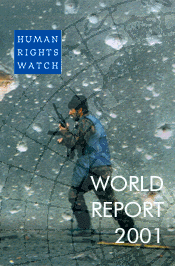
Human Rights Watch World Report 2001 December 2000 (2548), 570 pp., $25.00 Order online
|