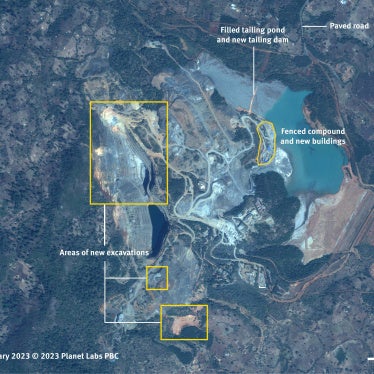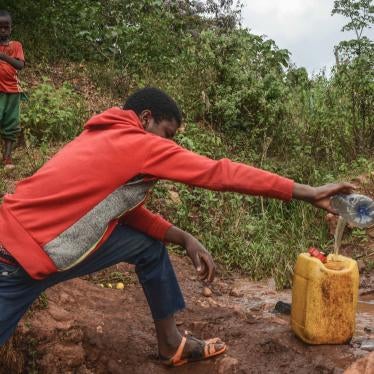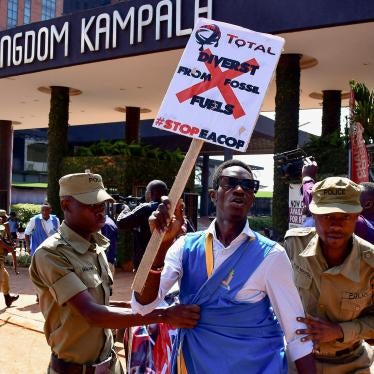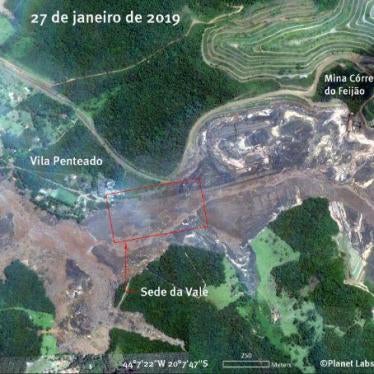

• Whether it is an oil company that relies on abusive private security forces, a tech company that censors or spies on users at the behest of a repressive government, or a corrupt government that siphons off the wealth of its nation, businesses and other economic activities can have negative impacts on people’s rights. Human Rights Watch investigates these and other situations to expose the problems, hold institutions accountable, and develop standards to prevent these activities. This work has included research and advocacy on human rights problems caused by corruption in resource-rich countries such as Equatorial Guinea, Angola, Nigeria, and Burma.
  • Map of Eritrea with location of Bisha Mine.
    International mining firms rushing to invest in Eritrea’s burgeoning minerals sector risk involvement in serious abuses unless they take strong preventive measures. The failure of the Vancouver-based company Nevsun Resources to ensure that forced labor would not be used during construction of its Eritrea mine, and its limited ability to deal with forced labor allegations when they arose, highlight the risk.
  • Without Rules: A Failed Approach to Corporate Accountability

    By Christopher Albin-Lackey, senior researcher

    Some of the most powerful and sophisticated actors on the world stage are companies, not governments. In 2011 alone, oil and gas behemoth ExxonMobil generated revenues of US$467 billion—the size of Norway’s entire economy. Walmart, the world’s third-largest employer with more than 2 million workers, has a workforce that trails only the militaries of the United States and China in size.

    Many global businesses are run with consideration for the well-being of the people whose lives they touch. But others—whether through incompetence or by design—seriously harm the communities around them, their workers, and even the governments under which they work.

    Read the full essay >>

Reports

Extractive Industries

  • Apr 19, 2013
    The World Bank’s “vision” statement will be undermined if it fails to recognize the importance of human rights, nine organizations warned. The human rights and development groups called on President Jim Kim to make a firm commitment to respect, protect, and fulfill human rights in all of its activities.
  • Apr 19, 2013
    Human Rights Watch recognizes that the World Bank operates in countries and environments where there are many human rights challenges. A commitment to human rights would greatly enhance the impact of the Bank’s efforts to reduce poverty and promote inclusive and sustainable development.
  • Mar 25, 2013
    The United Nations Post-2015 Development Agenda should be grounded in human rights, Human Rights Watch said in a letter to the UN High Level Panel of Eminent Persons on the Post-2015 Development Agenda.
  • Feb 20, 2013
    Workers in the copper mining sector in Zambia remain vulnerable to abuse. New Human Rights Watch research found that the government of President Michael Sata, who promised to prioritize labor rights when he took office in September 2011, has made some improvements in supporting the oversight of the mines, but there remains inadequate enforcement of national labor laws designed to protect workers’ rights.
  • Feb 18, 2013
    Latin American and African officials participating in a cross-regional meeting in Equatorial Guinea should press their host, President Teodoro Obiang Nguema Mbasago, to undertake serious human rights and democratic reforms ahead of planned parliamentary elections in May, 2013. President Dilma Rousseff of Brazil, among other officials, is anticipated to attend the Africa-South America Summit scheduled for February 20-23.
  • Jan 21, 2013
    This weekend, more than 140 governments agreed on the text for a new legally binding convention on mercury, a highly toxic metal. It has taken three years and many compromises to get here. What often seemed like a dry and bureaucratic process – delegates arguing over nuance during long night sessions – has very real implications for millions of people around the globe.
  • Jan 15, 2013
    International mining firms rushing to invest in Eritrea’s burgeoning minerals sector risk involvement in serious abuses unless they take strong preventive measures. The failure of the Vancouver-based company Nevsun Resources to ensure that forced labor would not be used during construction of its Eritrea mine, and its limited ability to deal with forced labor allegations when they arose, highlight the risk.
  • Jan 10, 2013
    A proposed international treaty to address the damaging effects of mercury should include specific provisions to protect the health of children and other vulnerable populations, Human Rights Watch said today. Governments are to meet in Geneva beginning January 13, 2013, for a fifth and final round of talks for the treaty. Mercury is a toxic metal that attacks the central nervous system and is particularly harmful to children.
  • Jan 2, 2013
    For many years, Human Rights Watch has investigated situations where companies have had serious human rights problems. Whether it is an oil company that relies on abusive state forces or have abusive private security forces, a construction company that mistreats its workers or a technology company that censors or spies on users at the behest of an abusive government, there are many situations where companies can directly impact human rights.
  • Dec 6, 2012
    The most recent arbitrary detention of a leading opposition politician in Equatorial Guinea on December 4, 2012, raises concerns about human rights conditions in the lead-up to legislative elections in the first half of 2013. Since November 2011, the government has detained at least four high-profile members of the country’s beleaguered political opposition.