“Everyone’s in on the Game”
Corruption and Human Rights Abuses by the Nigeria Police Force
Map of Nigeria
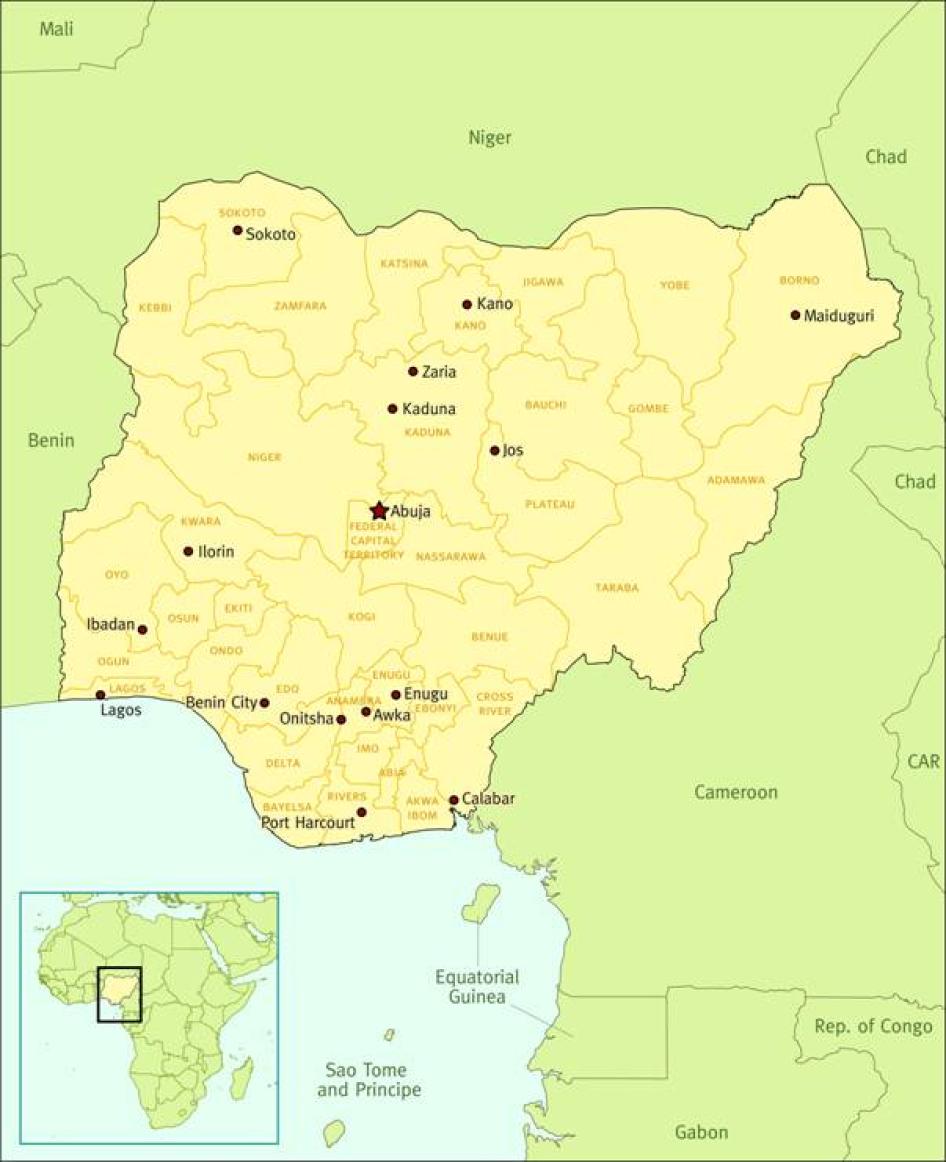
© 2010 John Emerson / Human Rights Watch
Summary
Countless ordinary Nigerians attempting to make precarious ends meet as taxi drivers, market traders, and shopkeepers are accosted on a daily basis by armed police officers who demand bribes and commit human rights abuses against them as a means of extorting money. Those who fail to pay are frequently threatened with arrest and physical harm. Far too often these threats are carried out. Meanwhile, victims of crime are obliged to pay the police from the moment they enter a police station to file a complaint until the day their case is brought before a court. In the shadows, high-level police officials embezzle staggering sums of public funds meant to cover basic police operations. Senior police officers also enforce a perverse system of “returns” in which rank-and-file officers are compelled to pay up the chain of command a share of the money they extort from the public. Those charged with police oversight, discipline, and reform have for years failed to take effective action, thereby reinforcing impunity for police officers of all ranks who regularly perpetrate crimes against the citizens they are mandated to protect.
The Nigeria Police Force, established in 1930, has a long history of engaging in unprofessional, corrupt, and criminal conduct. Over the years, this unwieldy force—Africa’s largest—has proved difficult to effectively manage and control and has become largely unaccountable to the citizens it is meant to serve. Many Nigerian police officers conduct themselves in an exemplary manner, working in difficult and often dangerous conditions—some 250 policemen and women were shot and killed in the line of duty in 2009—but for many Nigerians the police force has utterly failed to fulfill its mandate of providing public security. Indeed, 80 years after its birth, members of the force are viewed more as predators than protectors, and the Nigeria Police Force has become a symbol in Nigeria of unfettered corruption, mismanagement, and abuse.
Extortion, embezzlement, and other corrupt practices by Nigeria’s police undermine the fundamental human rights of Nigerians in two key ways. First, the most direct effect of police corruption on ordinary citizens stems from the myriad human rights abuses committed by police officers in the process of extorting money. These abuses range from arbitrary arrest and unlawful detention to threats and acts of violence, including physical and sexual assault, torture, and even extrajudicial killings.
The police frequently extort money from the public at taxi stands, in marketplaces, or while going about their daily lives. However, the most common venue for extortion occurs at police roadblocks, ostensibly put in place to combat crime. In practice, these checkpoints have become a lucrative criminal venture for the police who routinely demand bribes from drivers and passengers alike, in some places enforcing a de facto standardized toll. Motorists are frequently detained and endure harassment and threats until they or their family members negotiate payment for their release. Extortion-related confrontations between the police and motorists often escalate into more serious abuses. The police have on numerous occasions severely beaten, sexually assaulted, or shot to death ordinary citizens who failed to pay the bribes demanded.
The police commonly round up random citizens in public places, including mass arrests at restaurants, markets, and bus stops. In some cases of blatant deception, plainclothes police officers simply masquerade as commuter minibus drivers, pick up unsuspecting passengers at bus stops, and take them at gunpoint to nearby police stations where they demand money in return for their release. The police often make little effort to veil their demand for bribes, brazenly doing so in open corridors and rarely bothering to question those in detention about any alleged crime. Those who fail to pay are often threatened and unlawfully detained, and at times sexually assaulted, tortured, or even killed in police custody. Many of these abuses are perpetrated as a means to further extort money from ordinary citizens or from fearful family members trying to secure the freedom of those detained.
Second, these criminal acts by the police, coupled with their failure to perform many of their most basic functions, severely undermine the rule of law in Nigeria. The police routinely extort money from victims to investigate a given criminal case, which leaves those who refuse or are unable to pay without access to justice. Meanwhile, criminal suspects with money can simply bribe the police to avoid arrest, detention, or prosecution, to influence the outcome of a criminal investigation, or to turn the investigation against the victim.
Ordinary Nigerians are further denied equal protection under the law due to a widespread practice whereby senior police officers sell for their own personal enrichment police protection to Nigeria’s wealthy elite. By the inspector general of police’s own account, in 2009 at least 100,000 police officers were working as personal guards for the wealthy, at the expense of the majority. In addition, the abject failure of the police to provide for the security of ordinary citizens has led some communities to turn for protection to armed vigilante groups who often operate outside the law and commit further abuses.
Police corruption affects nearly every Nigerian, though it disproportionately impacts Nigeria’s poor. Those in precarious economic situations, scraping out a living day to day, are more susceptible to police extortion because of the profound effects that unlawful detention, or the mere threat of arbitrary arrest, have on their livelihoods. The sums regularly demanded by the police also represent a larger portion of the poor’s income. Moreover, many Nigerians are simply unable to pay the bribes required for basic police services.
Underlying many of these abuses is a cycle of corruption driven by senior police officers who siphon off police funds at the top and enforce a scheme of collecting illicit “returns” from the money extorted by junior officers.
High-level embezzlement of public funds destined for the police force indirectly impacts human rights, as senior officials have squandered and stolen vast sums of money that could have gone toward improving the capacity of the police to conduct patrols, respond to emergency calls, or investigate crimes. In the most notorious case, in 2005, the then-Inspector General of Police Tafa Balogun resigned and was charged with embezzlement, bribe-taking, and laundering more than US$98 million. In a plea bargain agreement later that year, he pleaded guilty to failing to declare his assets. The court sentenced him to six months in prison and ordered his assets seized. The deficits from massive embezzlement and misappropriation of police funds lead the police to routinely demand bribes from complainants to fund criminal investigations and to use torture as their primary tool for collecting evidence from criminal suspects.
Money flows up the chain of command through the informal but widespread system of returns in which subordinates pay their superiors a portion of the money they make from bribes and extortion. Subordinates often pay their superiors to be assigned to positions where they have ample opportunities to extract money from the public. Superior officers frequently set monetary targets for subordinates assigned to these lucrative posts and remove those who fail to meet their targets. Money continues up the chain of command as officers who take returns from their subordinates pay their superiors in turn. This corrupt system of returns not only encourages low-level police officers to commit abuses as a means of extorting money, and effectively punishes those who do not, but it also creates a strong disincentive for senior officers who personally benefit from the system of returns to hold their subordinates accountable for extortion and other abuses.
The Nigerian government and the police leadership have on multiple occasions acknowledged many of the problems described in this report. In recent years, the government has launched several police reform initiatives, increased funding to the police force, and improved police wages. Yet the government has generally failed to hold accountable police officers who squander and steal police funds, much less the rank-and-file who commit abuses. Public complaint mechanisms, internal police controls, and civilian oversight remain weak, underfunded, and largely ineffective. The Nigerian government in general and the police leadership in particular have thus far lacked the political will to address these structural problems, follow through on reform initiatives, and implement effective police oversight and accountability.
Human Rights Watch calls on the Nigerian government to immediately and effectively address the dynamics that have given rise to and sustain endemic police corruption and its related abuses, and ensure that those who perpetrate these crimes are held accountable. The Nigeria Police Force should streamline and prioritize internal controls by establishing a Public Complaints Unit at all police stations and restructuring its largely discredited internal anti-corruption unit, the X-Squad. The Nigerian government should launch an independent inquiry into corruption within the police force, focusing on the embezzlement and misappropriation of police funds, the corrupt system of returns, and the sale of police services by high-level police officials. The Nigerian government, including the National Assembly, and the anti-corruption commissions should improve transparency and accountability in the police force by reforming and ensuring better coordination of oversight mechanisms; and authorities should investigate and prosecute without delay police officers implicated in extortion, embezzlement, and human rights abuses.
Recommendations
To the Government of the Federal Republic of Nigeria
- Establish an independent commission of inquiry with subpoena power to conduct a transparent, comprehensive, and impartial investigation into systemic corruption within the Nigeria Police Force. The commission should focus its investigation on determining:
- The extent of the embezzlement and misappropriation of public funds by senior police officials and its impact on police conduct and services;
- The extent to which senior police officials sell for personal profit the services of junior-level officers to private individuals and companies and its impact on police conduct and services; and
- The extent to which monetary “returns” are passed up to the senior leadership of the Nigeria Police Force and the impact of this system of returns on police conduct and services.
- Prosecute without delay and according to international fair trial standards any police officer implicated in corruption and other serious abuses.
- Improve financial oversight of the Nigeria Police Force.
- Require the Nigeria Police Force to publish quarterly financial reports of total fines collected for vehicular and traffic violations, revenue received from state and local government allocations, and any funding received from private sources.
- Require the Nigeria Police Force to publish quarterly budget execution reports including detailed expenditure reports from each state command.
- Make public the auditor general’s financial audit reports of the Nigeria Police Force for each of the past 10 years.
- Order an independent financial audit of the Nigeria Police Force by a qualified auditing company that conforms to international standards for auditing public sector entities. Ensure that the audit report is made public.
- Reduce political manipulation of the police by setting the term of the inspector general of police to one five-year term, and subjecting the confirmation of appointment as well as removal to a two-thirds majority vote in the Senate, as recommended by the 2008 Presidential Committee on the Reform of the Nigeria Police Force. Propose a constitutional amendment to enshrine these provisions in the Nigerian Constitution.
- Implement without delay the core recommendations of the 2008 Presidential Committee on the Reform of the Nigeria Police Force and prioritize measures addressing financial transparency and oversight, public complaint mechanisms, and monitoring and discipline of police personnel. Ensure that sufficient resources are allocated to enable effective implementation of these recommendations.
To the National Assembly
- Pass the Freedom of Information Bill that would give Nigerians the legal right to compel the Nigeria Police Force and other government institutions to release information such as government budgets, expenditure reports, and financial audits.
- Amend the Code of Conduct Bureau and Tribunal Act to define specific terms and conditions for public access to the asset declarations of public officials, as provided by the Nigerian Constitution.
- Subject the Nigeria Police Force to greater legislative oversight by requiring the inspector general of police to submit quarterly expenditure reports, activity reports of the X-Squad, and the status and outcome of investigations into incidents of police corruption and other serious abuses.
- Hold regular public hearings into the conduct of the Nigeria Police Force in the respective police affairs committees in the Senate and House of Representatives.
- Pass the National Human Rights Commission Amendment Bill that would increase the independence of the commission and empower it to prosecute cases of human rights abuses.
To the Nigeria Police Force
- Streamline and prioritize internal control mechanisms by establishing a Public Complaints Unit at each police station. The unit should include a human rights officer, an anti-corruption officer, and an officer responsible for service delivery complaints. These personnel should be assigned the exclusive duties to:
- Receive and investigate complaints against police officers filed by members of the public;
- Monitor the conditions and treatment of persons held in police custody;
- Liaise with community leaders and civil society organizations regarding incidents of police abuse within the community;
- Report incidents of police abuse, including extortion and bribery to the divisional police officer, the anti-corruption X-Squad, and appropriate internal and external oversight bodies; and
- Protect members of the public who file complaints against the police from harassment, violence, or any other form of reprisal.
- Senior police officers implicated in embezzling and misappropriating police funds or in taking monetary “returns” from subordinate officers; and
- Junior and senior police officers implicated in extorting money from complainants, criminal suspects, and other members of the public.
To the Police Service Commission
- Establish mechanisms for police whistleblowers to anonymously report directly to the Police Service Commission incidents of police extortion, embezzlement, and other corrupt practices.
- Strengthen the investigatory capacity of the Police Service Commission by providing adequate funding, staff, and training to enable the Department of Discipline to independently investigate complaints of police corruption and other serious abuses.
To the Code of Conduct Bureau
- Ensure that all police officers file periodic declarations of the total value of all personal assets, and conduct random audits of these asset declarations.
- Make public the asset declarations of public officials, including police officers, as provided by the constitution.
- Thoroughly investigate and verify the asset declarations of any police officer who fails to fully comply with these provisions, and promptly refer the file to the Code of Conduct Tribunal.
- Publish detailed quarterly reports on the work of the Code of Conduct Bureau including the number of public complaints received, the number of police officers investigated, and the names of police officers disciplined by the Code of Conduct Tribunal.
To the Independent Corrupt Practices and Other Related Offences Commission (ICPC) and the Economic and Financial Crimes Commission (EFCC)
- Expand ICPC investigations into police officers accused of petty corruption, including bribery and extortion, and extend the scope of the operations to target senior police officers implicated in taking monetary “returns” from their subordinates.
- Investigate, arrest, and prosecute according to international fair trial standards, or publicly explain the reasons for not prosecuting, high-level police officials implicated in large-scale corruption, including the embezzlement of police funds.
To Nigeria’s Foreign Partners
- Issue public and private statements denouncing corrupt practices, including bribery, extortion, and embezzlement, and other serious abuses associated with these corrupt practices such as extrajudicial killings, sexual assault, and torture committed by members of the Nigeria Police Force, and call on the Nigeria government to hold abusive police officers accountable.
- Condition funding to the Nigerian government, including financial and technical assistance to the Nigeria Police Force, on measurable progress on holding accountable police officers implicated in corruption and other serious abuses.
- Target funding and technical assistance for the Nigerian government to initiatives that directly improve financial transparency and address accountability for corruption and other serious abuses committed by members of the Nigeria Police Force.
- Require police officers who participate in international missions or training courses to publicly declare the total value of all personal assets.
- Impose visa bans on senior police officers credibly implicated in corruption and other serious abuses.
Methodology
This report is largely based on field research in Nigeria in August and November 2008; April, May, July, and December 2009; and June and July 2010. Human Rights Watch researchers conducted research in three states as case studies: Lagos, Anambra, and Kaduna, representing three of the six geopolitical zones in Nigeria; as well as in the capital, Abuja, and telephone interviews in Rivers State and Ebonyi State. While the levels of police corruption and abuse in some of these states are among Nigeria’s worst, interviews with police officers and civil society leaders who have worked in other states indicate that the patterns of corruption and types of abuses found in these states are representative for the whole of Nigeria.
Human Rights Watch conducted more than 145 interviews with victims and witnesses of police extortion and corruption-related abuse—including market traders, commercial bus drivers and passengers, okada (commercial motorcycle) drivers, sex workers, criminal suspects, and victims of common crimes—and with rank-and-file and senior police officers, federal government and anti-corruption officials, judges, prosecutors, lawyers, religious and civil society leaders, journalists, diplomats, and members of an armed vigilante group. The names and other identifying information of many interviewees have been withheld to protect them from possible reprisal from the police.
Monetary figures throughout the report are calculated from Nigerian naira (₦) to US dollars using the average exchange rate for the respective year.[1]
Background
The Nigerian police have a long history of engaging in unprofessional, corrupt, and criminal conduct, and using excessive and often brutal force.[2] Fifty years after independence in 1960, the Nigeria Police Force has become a symbol in Nigeria of unfettered corruption and abuse. Over the years, this unwieldy force—Africa’s largest, comprising some 371,800 personnel[3]—has proved difficult to effectively manage and control. Through years of neglect and marginalization under military rule, followed by rapid expansion leading up to and during Nigeria’s civilian administrations, the police force has grown into an inefficient and notoriously corrupt institution that is largely unaccountable to the citizens it is intended to serve.
Many Nigerian police officers conduct themselves in an exemplary manner, working in difficult and often dangerous conditions. In 2009, some 250 policemen and women were shot and killed in the line of duty.[4] But for many Nigerians, the police are viewed more as predators than protectors. Indeed, a 2006 nationwide opinion poll conducted by the CLEEN Foundation, a leading nongovernmental organization in Nigeria working on security sector reform, ranked the police force as the most corrupt public institution in Nigeria.[5]
The police leadership has on multiple occasions acknowledged the human rights violations committed by members of the force as well as the poor management and corruption that underlie police misconduct.[6] In an address to senior police officials in September 2009, Inspector General of Police Ogbonna Onovo identified some of these problems:
It is apparent that indiscipline, un-professionalism and widespread corruption have been the bane of the Nigeria Police over the years, a situation that has greatly hampered the quality of service delivery. Our image has been battered time and again, leading to a loss of confidence by members of the public.[7]
Historical Overview
“The Forty Thieves” in Police Uniform during the Early Colonial Period
The first police force was established in 1861 by the British colonial administration in the territories known today as Nigeria.[8] This 100-man contingent was essentially a consular protection force based in Lagos, which later became known as the “Hausa Force,” so-named after the ethnicity of the men recruited into the unit.[9] As the British expanded their reach to the east and north, they formed additional police forces comprised largely of recruits from outside the communities in which they were to be deployed.[10] These early forces were notorious for their abuses and general lawlessness. In 1891, the consul general of the Oil Rivers Protectorate in what is presently eastern Nigeria expressed shock at the “numerous acts of lawlessness and pillage” by the police, who were commonly referred to in the community as the “forty thieves” in police uniform.[11] Similarly, the governor of Lagos colony acknowledged in 1897 that the Hausa Force “no doubt behaved very badly in the hinterland by looting, stealing and generally taking advantage of their positions.”[12]
The primary purpose of the colonial police was to protect British economic and political interests.[13] The police accomplished this objective through the often brutal subjugation of indigenous communities that resisted colonial occupation.[14] The use of violence, repression, and excessive use of force by the police has characterized law enforcement in Nigeria ever since.
Establishing a National Police Force
The British merged Lagos colony and the southern and northern protectorates in 1913 and named the new colony Nigeria.[15] The northern and southern regional police forces were later merged, in 1930, to form the colony’s first national police—the Nigeria Police Force (NPF).[16] The British also established local police forces under the control of traditional leaders.[17] During the colonial period, both the NPF and the local police forces were implicated in numerous acts of abuse and corruption.[18] In 1952, for example, a member of the Nigerian parliament decried the “old sergeants” in the NPF who, he claimed, were “steeped in corruption.”[19] Members of parliament also criticized the NPF traffic division during this period for having “exposed itself to bribery and corruption and thus lowered the prestige of the force.”[20]
Early Years of Independence
Nigeria gained independence from Britain in 1960, and its first constitution devolved substantial power to three regional governments, known as the Northern, Western, and Eastern regions. The federal government retained control of the NPF, but the regional governments continued to maintain their own local police forces.[21] The military government that emerged after two military coups in 1966 disbanded the local police forces amidst allegations that the local police had been used for partisan purposes by the regional governments against political opponents.[22] By 1972, the local police forces were fully integrated into the NPF.[23] Since then, the NPF, a national force under the control of the federal government, has been the sole entity responsible for policing in Nigeria.[24]
Marginalization and Police Corruption under Military Rule: 1966 to 1999
Nigeria’s first four decades following independence were dominated by a series of military coups and successive military dictatorships.[25] The police force—which at independence numbered approximately 12,000—was larger than the military, and thus was perceived by military leaders as a threat.[26] As a result, the NPF was chronically underfunded and marginalized by the military governments during this period.[27]
As the military government of General Olusegun Obasanjo prepared to return Nigeria to civilian rule in 1979, the government embarked on a massive police recruitment campaign while largely discarding recruitment and training standards.[28] By 1979, the NPF had grown to “80,000 ill-trained, ill-motivated and ill-equipped men.”[29] The civilian government was short-lived, however, and was overthrown by a coup in 1983 that resulted in an additional 16 years of military rule.
Internal government and civil society reports during this time consistently identified problems of misconduct within the NPF. A commission set up by the military government in 1967, for example, found that the “despicable image of the police” was in part attributable to “bribery and corruption.”[30] The report of the commission concluded:
[U]nsuitable candidates had bribed their way into the force; “lucrative” stations are bought. The term “lucrative” applies to border stations such as Idiroko and Calabar where smuggling is rampant…. [Bribes are] offered to affect assignment to duties with opportunities for extra income, otherwise styled “moving line” duties. They include traffic, vehicle inspection and criminal investigation duties.[31]
By the early 1990s, the Nigerian police had established a reputation for being “consistently repressive, corrupt, and ineffective,”[32] for taking kickbacks, and also for accepting bribes from criminal suspects to avoid prosecution and other forms of case fixing.[33] The successive military governments installed few effective checks on abuses of police authority, leaving misconduct and corruption to flourish. Over time, morale declined and the police’s deteriorating public image deterred quality candidates from entering the force.[34] As one former senior police official described to Human Rights Watch, “It ended up with most of the people who were joining the Nigerian police, joined it simply because it was a very easy way of making money.”[35]
Rapid Growth under Civilian Rule: 1999 to Present
At the end of military rule in 1999, there were approximately 140,000 police officers in the Nigeria Police Force. This amounted to just one police officer for every 820 Nigerians, well below the United Nations-recommended general benchmark of one police officer per 400 citizens.[36] In response to rising levels of crime that followed the end of military rule, then-President Olusegun Obasanjo ordered the inspector general of police to undertake yet another massive recruitment drive aimed at adding 40,000 police officers per year for five years.[37]
Similar to the recruitment drive of the late 1970s, police authorities made little effort to screen candidates for criminal backgrounds, and many recruits simply bribed their way into the force.[38] By 2008, the police force, at some 371,800, had more than doubled in size in less than eight years.[39] However, the Nigerian government failed to provide a commensurate increase in funding to train, equip, and manage the vastly enlarged force. The 2008 Presidential Committee on the Reform of the Nigeria Police Force noted that police training became further overstretched during this period, and that “[v]ery little, if any, attempt was made to upgrade the police training institutions.”[40] As a result, the committee concluded, Nigeria is now “saddled with a very large number of unqualified, under-trained and ill-equipped officers and men many of whose suitability to wear the respected uniform of the Force is in doubt.”[41]
Structure of the Nigeria Police Force and Its Oversight Bodies
The Nigeria Police Force is a federal government institution with a centralized command structure headed by the inspector general of police (IGP) who reports directly to the president.[42] According to Nigeria’s constitution, the president must “consult” with the Nigeria Police Council prior to appointing or removing the inspector general.[43] However, the council, a civilian oversight body whose membership includes the 36 state governors, has rarely met in the past 10 years.[44] The independent Police Service Commission (PSC) is responsible for appointing, promoting, and disciplining all members of the police force, with the exception of the IGP.[45] However, the PSC has delegated these powers back to the police force for all junior and rank-and-file police personnel.[46] Over the years, civilian oversight of the police has fallen under several government ministries, including the Ministry of Interior and the Ministry of Police Affairs. Since 2008, the Ministry of Police Affairs has had budgetary and general administrative oversight of the police.[47]
Each of Nigeria’s 36 states, as well as the Federal Capital Territory, is served by an administrative unit known as a state command. The state commands are grouped into 12 zonal commands—with two to four states in each zone—each under the supervision of an assistant inspector general of police (AIG). Each state command is headed by a commissioner of police (CP) who is directly accountable to the AIG in the respective zone.[48] State commands are divided into smaller area commands, police divisions (headed by a divisional police officer, or DPO), police stations, police posts, and village police posts.[49] These command structures, police ranks, and the number of police officers at each rank as of 2008 are shown in the chart below.[50]
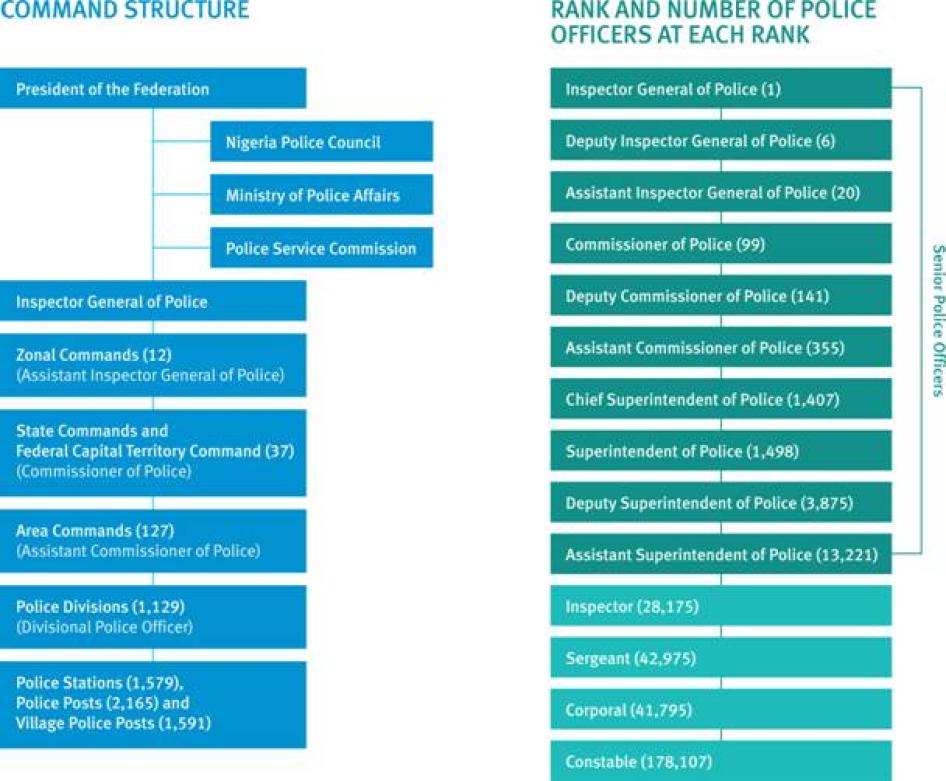
Corruption in Nigeria
This report builds on previous work by Human Rights Watch documenting the link between corruption and human rights in Nigeria, particularly how corruption and mismanagement within local governments in Rivers State have severely impacted access by ordinary Nigerians to basic health care and primary education,[51] and how political violence and corruption have undermined Nigeria’s electoral system and denied ordinary Nigerians their right to freely choose their leaders.[52]
Nigeria has long held the unenviable reputation as having one of the world’s most corrupt public sectors, in which corrupt practices including the theft of public funds, bribery, and kickbacks pervade all levels of government. Between 1999 and 2003, Nigeria ranked last or second-to-last on Transparency International’s annual Corruption Perceptions Index.[53] In 2006, the then-head of Nigeria’s Economic and Financial Crimes Commission, Nuhu Ribadu, estimated that Nigeria lost some $380 billion to corruption between independence in 1960 and the end of military rule in 1999.[54] Nigeria’s corruption epidemic has continued since then. Exact figures of its costs are impossible to determine, but some diplomats estimated that between 1999 and 2007, Nigeria lost a minimum average of $4 billion to $8 billion per year to corruption.[55]
In Nigeria’s four leading oil-producing states, for example, where state budgets alone exceed the total central government budgets of many West African countries, the state and local governments have grossly failed to progressively realize the basic health and education needs of their citizens.[56] Instead, public funds that could have been used to improve the lives of ordinary Nigerians have been squandered and siphoned off by the governing elite.[57] The level of corruption and accompanying lack of development in the major oil-producing states, however, is by no means unique. The federal government’s revenue totaled $45.4 billion in 2008,[58] but 64 percent of Nigerians live on less than $1.25 a day, and the maternal and infant mortality rates in Africa’s largest oil-producing nation are among the worst in the world.[59]
Corruption also lies at the heart of much of the political violence in Nigeria, as politicians use stolen public funds to sponsor criminal gangs to rig elections, which are often marked by violence. Corruption fuels and rewards this violence and contributes to the impunity enjoyed by those responsible for such abuses, which both denies justice to victims and obstructs reform.[60]
Over the past decade, Nigeria has established two anti-corruption commissions to combat the scourge of corruption: the Independent Corrupt Practices and Other Related Offences Commission (ICPC) and the Economic and Financial Crimes Commission (EFCC)—established in 2000 and 2002, respectively. These two law enforcement agencies have made some notable headway. For example, the EFCC secured corruption convictions of several senior government officials, including a former inspector general of police in 2005,[61] and two former state governors in 2007 and 2009, respectively. But the sentences handed down have generally been disproportionately light.[62] Numerous other corruption cases against senior government officials have either gone uninvestigated or have been effectively stalled in the courts.
Despite the efforts of these agencies, corruption in Nigeria is still endemic.[63] Many of Nigeria’s elite appear to remain untouchable. In December 2007, then-EFCC head Nuhu Ribadu took the bold step of arresting former Delta State governor James Ibori and charged him with embezzling and laundering state funds. Two weeks later, the then-inspector general of police ordered Ribadu to resign from his position. Ribadu was later demoted and dismissed from the police force, and, after several death threats and an apparent assassination attempt, fled the country in January 2009.[64]
Definitions of Corruption
There is no single or universally accepted definition of corruption in international law.[65] The World Bank and the nongovernmental group Transparency International generally define corruption as “the abuse of public office for private gain.” The World Bank includes in its definition situations where “public officials accept, solicit, or extort bribes; and when private actors offer bribes to subvert or circumvent public policies for competitive advantage and profit.” The World Bank also classifies as corruption the theft of state assets or the illegal diversion of state revenue, as well as patronage or nepotism by government officials.[66]
The United Nations Convention against Corruption defines “bribery”[67] as “[t]he solicitation or acceptance by a public official, directly or indirectly, of an undue advantage, for the official himself or herself or another person or entity, in order that the official act or refrain from acting in the exercise of his or her official duties.”[68] A similar definition is listed under acts of corruption in the African Union Convention on Preventing and Combating Corruption.[69] Extortion, on the other hand, adds a coercive component. The UN Office on Drugs and Crime has noted that, “Whereas bribery involves the use of payments or other positive incentives, extortion relies on coercion, such as the use or threat of violence or the exposure of damaging information, to induce cooperation.”[70]
Nigerian law provides steep criminal penalties for bribery—known also as “gratification”—and extortion. The Corrupt Practices and Other Related Offences Act 2000, for example, provides that “[a]ny person who offers to any public officer, or being a public officer solicits, counsels or accepts any gratification as an inducement or a reward for … [p]erforming or abstaining from performing … any official act … [is] guilty of an offence and shall on conviction be liable to five (5) years imprisonment with hard labour.”[71] Under the Nigerian Criminal Code, extortion is punishable by up to 14 years in prison.[72]
In the following sections of this report, Human Rights Watch examines the most common and debilitating forms of police corruption in Nigeria, notably bribery, extortion, and related human rights abuses committed largely by rank-and-file police officers, and the embezzlement of public funds, enforcement of a system of “returns,” and abuse of office by senior police officials that drive many of these abuses.
Human Rights Abuses Associated with Police Extortion and Bribery
The police told me they had arrested my son in a robbery…. They beat him up too much. He had wounds on his back and on his body. My son told me they put a stick between his arms and legs and suspended him. If I didn’t pay they would’ve killed him. He is the only son I have. After I paid the money they released the boy to me. No bail bond, no statement, nothing.—Father of a 16-year-old boy arrested in Onitsha, Anambra State, April 19, 2009
Ordinary Nigerians traveling on the country’s roadways, buying or selling at markets, running daily errands, or working within their offices are routinely subjected to police extortion. Those who resist and fail to pay the bribes demanded are often threatened and unlawfully detained, and at times physically and sexually assaulted, tortured, or even killed by the police. Many of these abuses are perpetrated as a means to further extort money from ordinary citizens. The police officers make little attempt to hide the collection of money, exposing the near total lack of political will on the part of Nigerian authorities to hold police officers accountable for their actions.
The frequency of such acts has led many Nigerians to become as complacent about most common forms of police corruption as they are distrustful of the police. Indeed, police corruption has largely become accepted as an inevitable fact of everyday life. As a senior official in the Police Service Commission explained, “People just want to pay and go their way.”[73] The threats and abuses committed by members of the police force have left many Nigerians fearful of their supposed protectors as police brandishing firearms routinely demand that market traders, couriers, and drivers hand over money and other valuables, or face arrest, beatings, detention, or other abuses.
A trader in Lagos described to Human Rights Watch a common perception of the police and their role: “When you have a problem, you should expect the police to help you, to safeguard life and property—but instead, they go the other way.” She illustrated her opinion:
In October [2008] I was going to the market to buy my jewelry. I saw one policeman harassing people on the road, and then three of them stopped the vehicle I was travelling in. I said to myself, “What kind of country is this?” The policemen said they were on “stop-and-search.” One of them had a gun. They told all 18 of us to get down and line up along the road. They said they were searching for anything illegal and threatened that if they found anything, we’d have to settle it there and then or be taken to the station. The one with the gun pushed people around, saying, “You will all pay us something or we’ll take you to the station and you’ll have to pay even more to bail yourself out, so pay up now.”
We understood. We asked how much, and they said ₦2,000 ($17). We started grumbling and eventually said, ok, whatever. Some people gave them ₦1,000, others ₦1,200. I’d only made ₦700 that day, and another lady didn’t have anything. They told us to look for more. Eventually, they let the others go and took the two of us who couldn’t pay the ₦2,000.
As traders we are harassed a lot. When we put our goods on the ground to sell, the police say it’s not allowed, that we have to pay them money to sell there. Other times they take our goods and ask us to pay to bail them out. This happens every day…. The police will chase you away until you pay them something. The police are not protecting us; they are fetching money for their own pockets.[74]
Transport workers are also often targeted by the police for extortion. A local ward chairman of a transport union in Lagos described how police extort money from him on a daily basis:
Five or six sets of police come each day [to the minibus terminal] to ask for money. If we don’t pay, they will block the road. Monthly, for all the police who come to our place, we pay ₦40,000 ($265). Sometimes if I can’t pay they will hold me and take me in their vehicle. I will start negotiating, but if I talk too much they say they will beat me. If I don’t pay them there, they take me to the station and I will pay double.
Tuesday, two weeks ago, the police in mufti [civilian clothes] came into the garage and asked for the chairman. They didn’t find me and then started arresting the drivers. They took four of them to Pedro police station. The drivers negotiated for themselves and each paid ₦1,000 and were released. Two months ago, four or five police in mufti asked for me and I had to dodge them because I didn’t have money. I recognized their faces as police. When I came back they spoiled [slashed the nozzles on] the tires of three or four vehicles.
As chairman, I complain to my branch office. The union leaders will go to the DPO [divisional police officer] and the police will stop for two weeks or a month and then it will start again.[75]
Extortion of Money at Police Checkpoints
The most common venue for police extortion in Nigeria occurs at police roadblocks and checkpoints. On a daily basis throughout Nigeria, drivers of taxis, minibuses, and motorcycles, as well as private motorists are subjected to routine extortion under threat of arrest, detention, and physical injury after being obliged to stop at official or semi-official police roadblocks. These checkpoints, ostensibly put in place to combat rampant and rising crime, have in practice become a lucrative criminal venture for the police. One civil society group in Anambra State estimated that in 2008 the police collected approximately ₦540 million ($4.5 million) in illegal “tolls” from some 70 police checkpoints along Anambra State’s roadways.[76]
Human Rights Watch interviewed 12 commercial drivers and passengers who had money extorted from them, or witnessed money extorted, by armed police officers at roadblocks. The amount paid to or taken by the police ranged from ₦20 to ₦20,000 ($0.13 to $167).[77] Commercial minibus drivers often pay a fixed amount—ranging from ₦20 to ₦100, depending on the location—to the first police officer they encounter at the roadblock and then are usually waived through without incident. If the driver fails to pay, however, their vehicle is “parked.” Police officers then order the passengers to get out of the vehicle and demand money from each passenger or negotiate payment directly with the driver to allow them to leave.
|
Checkpoints in Lagos: A Standardized Toll In some areas of Nigeria, police extortion of money from drivers has become so routine that is has taken on the nature of a standardized toll. In the Bariga district of Lagos, for example, commercial minibus drivers who pass through the checkpoints on multiple occasions each day complained about having to repeatedly bribe the same police officers. The police responded to these complaints by setting up a creative system in which drivers are given a password based on an identifying mark on their vehicles—such as a number on their license plate—to identify which drivers had already paid the daily “toll.” Human Rights Watch interviewed three minibus drivers who described how this password system works. One of the drivers described an average day navigating the police checkpoints: At Evan bus stop, they [the police] ask for ₦50 ($0.33) and give you a number. At the second one, at Olojojo bus stop, they collect ₦100 or ₦50 and will give you a number. At Olorunsogo bus stop, the police will collect another ₦100 and give you another number. Once they give us a number, when I come back for another trip, I will tell them my number and they will [let me] leave. This happens every day.[78] The money collected by the police from the drivers at police roadblocks may appear to be no different from a routine toll, but this money never finds its way into the state treasury. Describing this problem, a civil society leader noted: If the National Assembly passed a law making tolls legal, the police would no longer be interested in carrying out the duty. Their intention is criminal. There is no difference between a police officer using a gun to extort people and an armed robber.[79] |
A university student told Human Rights Watch how in November 2008 police officers in Lagos who stopped the car in which she was riding intimidated the driver into handing over money:
I was coming home from a dance class when we were stopped by two policemen. One asked the driver to show his papers, which he did. Then one of the policemen said, “You will pay me money.” I spoke up saying, “You asked us to stop, we stopped. You asked for papers and he showed them.” I advised the driver not to give them any money, and the police said, “Keep your mouth shut.” The driver gave him ₦1,000 ($8) but he complained, “Hey, my rank is big, I’m a corporal. ₦1,000 is chicken change. Add ₦2,000!” They were really aggressive—the police grabbed the driver, yelling for him to give more money, holding and shaking him.”[80]
Similarly, a 20-year-old woman witnessed the police intimidate and ultimately rob a fellow passenger in a minibus of a large sum of money in Lagos in November 2008. She described what happened:
At around 6:30 p.m. we were stopped by a group of policemen manning a checkpoint under a bridge. There were 10 of us passengers. One of the police entered and told the bus driver to “do his duty.” When the driver asked him what this meant, the policeman said, “You should know … give us ₦500 ($4).” The driver offered ₦50 instead. Angered by this, the policeman ordered everyone out. We told him he had no right to do what he was doing. He said, “You can’t talk to a policeman like that … it’s an offense!” We responded, “No, what you’re doing is an offense!”
One lady passenger had a large amount of money—about ₦50,000 ($417). When they found it, they interrogated her about where she got it, saying it was an offense to carry this kind of money. The other passengers gasped and said, “What kind of an offense is that?” The woman started crying, pleading. She got down on her knees and begged them not to take her money. They threatened to take her to the station and we yelled at them saying she had done nothing wrong. The police told her to give them ₦20,000. When we heard this we screamed, saying, “Why should she do that?” Then one of them said if any of us said anything we would be handcuffed.
The woman sobbed and vowed to lay a curse on the policemen so they wouldn’t see any good things in life. Hearing this, the policemen aimed their guns at her and threatened to shoot her if she did so. Then she fell on the ground shaking. They kept us there for one hour. When the woman got back on the bus we tried to comfort her. We felt so sorry—she was a very poor woman who made her living selling used clothes. She said she’d borrowed the money from her boss because of a problem she had at home and that she had no one else to help her—she said her husband was dead. But the police don’t care about any of this.[81]
The police also frequently impound cars and motorcycles on the pretext that vehicle registration papers are not in order, only to be released after a sum from the driver or owner has been paid. The driver of an okada, or motorcycle taxi, in Lagos explained to Human Rights Watch what happened to him:
In June 2008, I was driving with a passenger when a group of three police stopped me. Two of them had guns. I asked, “What is the problem, sir?” They asked to see my papers and I showed them my registration and driver’s license. They said, “This bike isn’t yours.” I explained that someone gives me the bike to work for him. They said they wanted to meet the person to verify; they seized the bike and took it to the station. When the owner came to the station, they told him he had to pay ₦2,000 ($17). The owner negotiated for a long time with the police until they got it down to ₦1,500. He paid out of his own pocket but of course I had to reimburse him the money. The police gave us no official receipt for the money they took. I did nothing wrong—I showed them all my papers, most okada riders work someone else’s bike, but they said, “Sorry we can’t release you … you have to drop some money.” The incident took two hours from my day. I didn’t argue. I knew I hadn’t broken the law, but in order not to waste time, we just paid the money.[82]
Similarly, a taxi driver is Lagos explained that even when his vehicle’s papers are in order, the police will find a way to extort money. As he put it: “If you have your documents right, they [the police] will use their brain and ask you something you don’t know. They will still find a way to snatch money from you.”[83]
|
Checkpoints in Anambra, Enugu, and Kaduna States Motorists and market traders characterized the problem of police officers extorting money and demanding bribes as a common occurrence on the roads of Anambra and Enugu states in Nigeria’s southeastern region, but less frequent in the northern state of Kaduna. In April 2009, a Human Rights Watch researcher passed through eight police checkpoints from Onitsha, Anambra State’s commercial capital that boasts one of West Africa’s largest markets, to the border with Enugu State, a distance of approximately 50 kilometers. This makes for one checkpoint every six kilometers.[84] The frequency of police checkpoints on the Onitsha-Enugu expressway in Enugu State was similar. Between the Enugu state line and the city of Enugu, a distance of approximately 35 kilometers, the Human Rights Watch researcher passed through five police checkpoints, or one checkpoint every seven kilometers.[85] The police appeared to make little attempt to hide the collection of money; the passing of money from motorist to police was witnessed by the Human Rights Watch researcher. Commercial minibus drivers and civil society leaders interviewed by Human Rights Watch in Kaduna State reported, however, that the state has fewer police checkpoints and that the practice of extortion is not as widespread as in Nigeria’s southern states. As one driver put it, “In the south it is much worse. The police only care about money there.”[86] In the course of research for this report, a Human Rights Watch researcher in April 2009 passed through only three police checkpoints between the city of Kaduna and the boundary of the Federal Capital Territory (roughly 165 kilometers). At one of the checkpoints, a mobile police officer, with pistol in hand, openly demanded money.[87] Members of civil society generally attributed the fewer police checkpoints and incidents of extortion at these checkpoints to lower crime rates, better community solidarity, and higher poverty rates in the north.[88] As a human rights lawyer in Kaduna explained, in “a place like Onitsha, there is so much money, but when you come to a civil service town [like Kaduna], where people hardly make ends meet, the possibility of the police getting anything reasonable is also very, very low.”[89] |
Multiple Nigerian and international experts, including Nigerian police officials, have questioned the efficacy of these checkpoints as a crime-prevention measure. The UN Special Rapporteur on Extrajudicial, Summary or Arbitrary Executions found that rather than combating crime, police checkpoints in Nigeria are “used primarily for the purposes of extorting money from motorists.”[90] Similarly, civil society leaders told Human Rights Watch that police checkpoints seem to do very little to reduce crime and improve security, primarily because members of criminal gangs often pay off corrupt police officers who appear more intent on extorting money from motorists than combating crime.
In what appears to be an admission that these checkpoints do little to serve security objectives, the police leadership has on multiple occasions ordered their removal.[91] However, despite these official declarations, police checkpoints and extortion at them remain common. Indeed a transport union branch leader, who has worked as a minibus driver in Lagos for 25 years, explained that the problem of police extortion at checkpoints “is getting worse.”[92]
The then-minister of police affairs, as well as senior police officers, told Human Rights Watch that official roadblocks had been officially disbanded by 2009 and replaced by temporary “nipping points” or “stop-and-check” operations.[93] Despite this change in nomenclature, as a prominent civil society leader who works on policing issues put it, “Whether nipping points, checkpoints, or stop-and-search, whether permanent or temporary, the fact is at the end of the day, the police still extort.”[94]
Arbitrary Arrests and Detention
Numerous police officers, legal professionals, and civil society leaders characterized the problem of unlawful detention of citizens by Nigerian police officers with the apparent motivation to extort money as a widespread and growing problem throughout Nigeria. They described how the police use specific incidents of crime, and the high levels of crime in general, as a pretext to randomly arrest and detain individuals and groups of citizens.
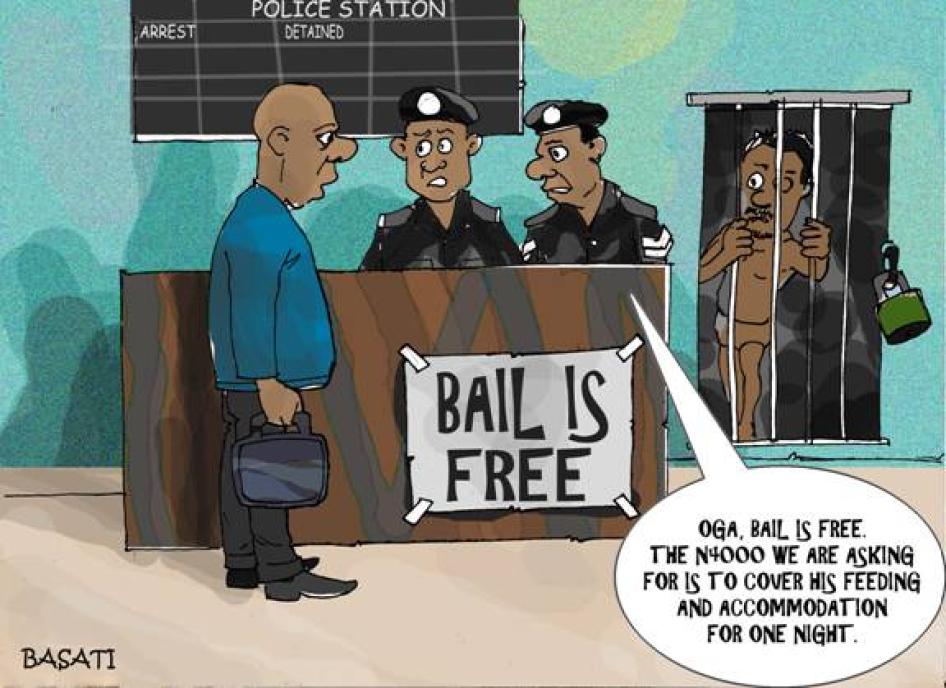
© 2010 BASATI / Human Rights Watch
Once a person is arrested by the police and refuses, or is unable, to pay the money demanded, they are often detained until they negotiate an amount for their release. In many cases, this unlawful detention may last for days or even weeks. Those who do not pay face threats, beatings, sexual assault, torture, or even death. Extended periods of detention leave victims and their friends and family vulnerable to repeated threats and demands for bribes. Using police terminology, a civil society leader in Lagos explained that the police “tend to cast the net very wide so they can arrest as many suspects as possible. This affords them more chances for extortion and corruption.”[95]
Human Rights Watch interviewed 30 people in Lagos, Anambra, and Kaduna states who had personally paid or witnessed someone pay the police to be released, or to have someone else released from police detention. In the vast majority of cases, the person detained was never officially accused of a crime nor formally charged, much less interrogated. The bribes paid to or extorted by the police ranged from ₦800 to ₦398,000 (approximately $5 to $2,636). The average (median) amount paid was ₦3,500 ($23).[96] The police never signed a receipt, nor, except in a few rare instances where lawyers or human rights activists were able to intervene on their behalf, did they return the money.
In Lagos State, a police constable who drives a police van during surveillance patrols described to Human Rights Watch how his team randomly arrested people for the purpose of extorting money from them:
When we would go to their areas, if they were not smoking or fighting, we would pick people for no reason to get money…. We would put them in the van and take them to the station and have their family come to “bail” them—₦2,500, ₦3,000 ($21, $25), a negotiable price…. The ones we don’t take to the station, we search them and take money from them and let them go down [from the van].[97]
Similarly, a police corporal in Lagos explained to Human Rights Watch how his team randomly arrested people when their team did not have enough money to make their weekly “returns”[98] to their superior: “If we don’t have money at the end of the week, we will get money. We will pick someone and arrest them.”[99] When asked what he would do with the people he detained, he responded, “We would tell them to bring ₦5,000 ($33) and let them go; [or] we take ₦2,000 or ₦3,000 and then tell them to go.”[100]
In Kaduna, transport union leaders interviewed by Human Rights Watch explained that payment to the police is “compulsory” to “remove someone from the cell.”[101] One of them recounted:
In the past month we have “bailed out” more than 10 cases [where drivers have been detained by the police]. In every case we have to pay. The minimum is ₦3,000 ($20); the most is ₦20,000 ($132). In all of the [police] stations in Kaduna we have to pay. It is 100 percent.[102]
Police officers and civil society leaders told Human Rights Watch that many of the victims of unlawful detention live a precarious economic existence and largely survive on what they earn as day laborers, drivers, and market traders. While detained, they cannot earn money they need for basic survival and, as a result, readily pay to avoid being held in police custody. A police sergeant in Lagos told Human Rights Watch that the police in his area specifically target market women with this in mind: “By arresting [a market woman], they deprive her of being able to sell. She’ll do anything to pay off the police so she can return to her selling.”[103]
According to police regulations, the police are not permitted to demand or accept money to release a person in police custody, and posters at police stations clearly state that police bail is free. But as one deputy state prosecutor bluntly explained to Human Rights Watch:
There is a big poster there [at the police station] that says “bail is free,” but it’s not like the poster says. You have to pay your way out. There is no doubt about it, no matter the kind of offense. I’ve never heard of a situation where the people go without paying something.[104]
Government officials have on numerous occasions acknowledged this problem. A 2008 report by the Presidential Committee on the Reform of the Nigeria Police Force concluded that the police “extort money from accused persons” and “[t]hose who do not cooperate usually suffer unlawful arrest and detention.”[105] An assistant commissioner of police noted to Human Rights Watch, “This [corruption] leads to the arrest of people arbitrarily. They [the police] detain them, and ask each one to bring money to ‘bail’ themselves. Whoever refuses to pay is charged to court on framed charges.”[106] Despite the pervasiveness of these abuses, the police leadership has failed to put in place effective measures to prevent this practice and rarely holds offending police officers accountable.
Mass Arrests and Detention: “Raiding”
In many cases, police officers round up and detain groups of citizens from public places such as restaurants, bars, bus stops, and markets. Police officers interviewed by Human Rights Watch generally referred to these mass arrests as “raiding.” Several witnesses interviewed by Human Rights Watch described being one of a dozen or more people picked up by the police and transported to a police station. Once at the station, the police, sometimes in the presence of senior officers, demanded money for their release. A police sergeant in Lagos described to Human Rights Watch how these operations are carried out at his station:
In my station they do the raiding every Monday, Wednesday, and Friday. Today is a Thursday—they raided yesterday, they will raid tomorrow. I’ve seen them bring up to 100 people from commuter buses into the station and then compel the drivers to pay. Even today there were people at the station crying about how the police collected money from them. The raiding begins from 7 p.m. They’re supposed to target bad people—ganja smokers, notorious thieves or criminals—but instead they go to the bus stop and take anyone they see.[107]
A market trader in Onitsha described to Human Rights Watch how in December 2007 he and some 50 others were randomly picked up by the police and then unlawfully detained:
On the 8th of December, 2007, after 6 in the evening, we were sitting outside at a restaurant having drinks when eight or nine policemen came to our area. They were wearing black uniforms with guns. They told all of us to stand up and follow them. One of us tried to speak and they slapped him. Nine of us were arrested from the restaurant. They took us to Niger Street where their vehicle was parked. We saw four minibuses and their truck, all full of people, even old women and young girls. They were crying, asking what they had done to deserve such arrest. There were about 50 people arrested at the same time. They took us to the Fegge police station. Once there, they put us into the passage and the offices. They only asked me my name, occupation, and age. They didn’t ask me anything about why I was there [detained]. I picked up my phone and called the people at the CLO [Civil Liberties Organisation], but in the meantime my brother paid ₦6,000 ($47) to get me released. Around 10 o’clock at night—before I’d actually been let go—about three of our [CLO] members came and we were able to get the money back…. My other friends who were detained paid about ₦3,000. The police never came to talk with me again.[108]
Although the police operate under the pretext of a crackdown on crime, often following a particular incident of armed robbery or burglary, the victims of this form of police extortion interviewed by Human Rights Watch were rarely questioned or interrogated about their alleged involvement in a crime. A 63-year-old man described his experience when he and some 20 other men were arrested in September 2008 in the city of Onitsha:
I was sitting at a bar around 7 p.m. drinking palm wine when the police arrived in their vehicle. They arrested everyone at the bar—both young and elderly men—about 20 of us. They told us that a building near there had been burglarized that day, so they were arresting us. We all spent the night in the cell [at Fegge police station]. My son had to pay ₦5,000 ($42) to get me out the next day. The bar owner hired a lawyer and the others were released the following day. I was told they had to pay ₦500 to get out. The police have never come back to question me.[109]
Human Rights Watch also interviewed the man’s son who went to the Fegge police station to secure his father’s release. He told Human Rights Watch that the investigating police officer initially demanded ₦10,000 ($83) for his father’s release, but he returned the next morning and paid the police ₦5,000. When asked whether the police officer gave him a receipt, the son replied, laughing at the apparent absurdity of the question, “How can he give me a receipt?”[110]
|
The Minibus Hoax: “One Chance” Several witnesses and victims of mass arrests described how Nigerian police officers had commandeered a commercial minibus, collected unsuspecting passengers at bus stops, and then diverted the minibus to a nearby police station where they detained them and demanded money for their release.[111] A market trader in Onitsha who is also a member of the Civil Liberties Organisation explained to Human Rights Watch what happened when he fell victim to this crime, known colloquially as “one chance”: Around 6:30 in the evening in August 2007, I entered a commercial bus on Oraifite Street. It was a dark red Mitsubishi L-300. I was going to Ikebuaso Street. Inside were about seven or eight passengers. The driver said he and the others were the police and we should keep quiet. There were three police officers inside. The driver was in mufti [civilian clothes], but had a gun; two more police officers were escorting us on okada motorcycles. They wore black-on-black [uniforms] with bullet-proof vests. Two other passengers entered. They then drove down the street and picked up three or four more passengers. We were all men. There were 13 of us. We were all taken to the Awada police station. When we arrived, they took us to a room and said they would search us one by one. They said that anyone without an ID card was an armed robber and that we should write a statement. I didn’t have my ID card with me. They searched me and found ₦7,000 ($54). After they took our statements, they said we should pull off our shirts. They then told us that if we want to go that night we would have to pay ₦10,000 ($78). Some [of those detained] called people to bring money. No one paid ₦10,000, but some paid ₦3,000, ₦5,000 and were released immediately. The others didn’t have money on them and didn’t have anyone to call. They were crying.[112] The man refused to pay the policemen, and was beaten as a result.[113] |
A 24-year-old advocate with a well-known human rights organization described what happened when he and a friend were arrested by the police on their way to a restaurant in Lagos:
The policeman was armed and had a bulletproof vest with mufti [civilian] clothes underneath. He ordered us to get into a waiting van … it was a yellow commercial 14-seat van. I tried to bring out my ID card, but he cocked his gun and said, “If you try anything, I’ll shoot you.” Inside were four others. The police had scattered and soon brought three more, making nine in total. We didn’t talk.
They drove us to the Area H police station. The first one to come down from the van asked, “What did I do?” and a policeman hit him on the head. They marched us into a room. I still felt a bit confident because I am a human rights worker. When I entered the room I met a huge man dressed in an undershirt sitting by the door. He was a policeman. I was starting to get afraid. I put my hands as if praying and he said, “You better say your last prayer because you won’t come out of this place alive.”
Then one of the policemen who’d detained us said we should register in the main police building. They marched us to the counter and told the officers there to register us but they refused, saying, “Which allegations are we going to label them with?” They started arguing amongst themselves. After some time, one of the officers who’d brought us tore out a piece of paper from a book and wrote down our names. When he came to me, I was so frightened I could barely talk.
When the one who seemed to be the boss came, I gave him my work ID card…. He asked me what I was doing here. I said, “It was your men who arrested me.” He asked what I’d done and I said nothing, only trying to go out to eat. He asked why I’d not shown my card and I told him that his officers didn’t allow me to ID myself. He said, “If we didn’t see this ID you’d have been in a big mess.” I asked why. He said it was because some armed robbers had killed three police the previous week so they were out to arrest the ones who did it.
He told me that I should get going. I told him I couldn’t go without my friend. The boss and the four men who’d arrested us started discussing. Finally they said they couldn’t release us like that. I asked how much they needed and the boss man said I should bring ₦7,000 ($58). I told him I only had ₦5,000. I pleaded with them to accept it. They were reluctant but finally said, “Ok bring it.” The boss said I should give it to one of his men, who counted it then went inside to bring out my friend. After this, they asked us to go. It was a very bad experience.[114]
Prolonged Unlawful Detention: A “Cash Cow”
While most victims who are arbitrarily arrested appear to be detained for a matter of hours, those who are either unwilling or unable to pay are typically held in a police cell overnight, and may be detained for several days or even weeks. Human Rights Watch interviewed 10 people who were detained, or whose family members were detained, for durations of one night to more than a month after they failed to pay the money the police demanded.[115]
Victims, witnesses, and civil society leaders interviewed by Human Rights Watch believed that the police have a financial incentive to prolong the time detainees spend in police custody. As a human rights lawyer in Kaduna put it, “The more time a person stays in custody without being charged to court, the more opportunity the police have to extort money.”[116] A lawyer who heads a civil society organization in Lagos described unlawful detention as a “cash cow” for the police on account of the numerous ways the police find to demand money from the relatives of persons held in police custody: “You have to pay to enter the station, to see your relative, for cleaning supplies like disinfectant to clean the cell your relative is in, and for privileged accommodation so your relative isn’t in a place that’s dirty, damp, unlit.”[117]
Human Rights Watch found that corruption in the police force has directly led to the unlawful deprivation of liberty for countless ordinary Nigerians, in contravention of Nigeria’s international and domestic legal commitments. The UN International Covenant on Civil and Political Rights states, “Everyone has the right to liberty and security of person. No one shall be subjected to arbitrary arrest or detention. No one shall be deprived of his liberty except on such grounds and in accordance with such procedure as are established by law.”[118] Similarly, the African Charter on Human and Peoples’ Rights provides that “no one may be arbitrarily arrested or detained.”[119] The Nigerian Constitution likewise guarantees, “Every person shall be entitled to his personal liberty and no person shall be deprived of such liberty [except] … in accordance with a procedure permitted by law.”[120] The constitution stipulates that for a warrantless arrest, “reasonable suspicion” must exist that the suspect committed a criminal offense.[121] Moreover, the constitution provides that any person who is arrested “shall be brought before a court of law” within 24 hours.[122]
Extortion Using Threats and Acts of Physical Abuse
Persons held in police custody or stopped at police checkpoints or other public locations, and who are unable or unwilling to pay the police, are frequently subjected to threats and acts of physical abuse ranging from beatings to sexual assault, torture, and extrajudicial killings. A police sergeant in Lagos described to Human Rights Watch what happens at his police station to people who have been rounded up in police raids and mass arrests: “What they’re after is money. If people refuse to give them money, I’ve seen policemen at my station beat them up—they take their gun and bang you.”[123]
The Police “Bang You” for Failing to Pay
Human Rights Watch interviewed a market trader in Onitsha, Anambra State, who was arrested in August 2007 by the police along with 12 others and taken to the Awada police station. He described what happened when he refused to pay the ₦10,000 ($78) the police demanded for his release:
I told [the police] I would not give them one naira, and told the others not to pay any money either. The police got mad at me when I said the others shouldn’t pay. Two of them started to beat me. They used their guns to hit me on my face and body. They beat me in front of the others. The police said I was an armed robber and that they would kill me. I was the only one who refused to pay.
After the police had beaten the man, they detained him overnight in a cell. The next morning, a staff member of the Civil Liberties Organisation was able to secure his release.[124]
Members of the public or civil society activists who attempt to speak out against police extortion also face threats and acts of police abuse. A member of the Committee for the Defence of Human Rights described to Human Rights Watch how in September 2007 he was beaten by the police at a Lagos police station after he attempted to recover ₦1,000 ($8) that the police had extorted from his client: “They [the police] beat me with a baton and with their blows. They injured my left eye. As they beat me they said, ‘You will see, we will kill you and nothing will happen to us. Who do you think you are coming to challenge us? You will die today.’” The police then took the man to a cell where he was held overnight and beaten by the other detainees, who were allegedly instructed to do so by the police.[125]
Motorists who refuse to pay the money illegally demanded by the police at checkpoints also risk being physically assaulted by the police.[126] A commercial minibus driver described to Human Rights Watch how in March 2009 he was beaten by a mobile police officer after failing to pay the full “toll” demanded at a police checkpoint in the Bariga district of Lagos:
On that Sunday night, the police stopped me at the Laide bus stop. When they stop me they normally collect ₦50 to ₦100 ($0.33 to $0.66). There were eight or ten police at the checkpoint. Some were mobile police; some wore black-on-black. One of the mobile policemen said, “Where is the money?” He had a big gun. I gave them ₦40. When I asked him for my number [to avoid having to pay again] he said, “You’re crazy.” I said, “You too, you’re crazy.” He then opened the door and started to beat me with his fists. I put my head down as he beat me. I then felt something hit my head and I fainted. The area boys [youth from informal street gangs] later told me that the policeman had hit me with a gun. The next thing I remember I was in a bed in the hospital. I spent two days there. Since then I’ve had headaches.[127]
Human Rights Watch interviewed the bus driver’s brother who filed a complaint with the police over the incident. He said the police officer who beat his brother later agreed to pay ₦5,000 ($33) to help with the medical expenses so that they would not create wahala, or trouble, for him.[128]
Torture as a Tool of Extortion
The UN Special Rapporteur on Torture and Other Cruel, Inhuman or Degrading Treatment or Punishment found in 2007 that “torture and ill-treatment are widely practised in police custody” and are “an intrinsic part of the functioning of the police in Nigeria.”[129]Numerous victims of extortion by the police described having been threatened with or subjected to torture as a means of extracting money from them.[130] Family members of other persons held in police custody described being coerced by police officers who threatened to torture or kill the person detained. The police in turn profit from their brutal reputation as fearful family members will pay large sums of money to free their loved one.
The father of a 16-year-old boy in Anambra State told Human Rights Watch how the police tortured and threatened to kill his son unless he met their demands. The boy was arrested in Onitsha in 2006 and transferred to the Special Anti-Robbery Squad (SARS) office in the city of Awka. The father described what happened when he went to the SARS office to see his son:
The police told me they had arrested my son in a robbery. I said I wanted to bail him. But they said it was not a bailable offense, but a criminal offense and that they will kill him. Then one of the policemen called me out and said he wanted to help me. He said I should bring ₦100,000 ($757) and he would release the boy. I said I didn’t have that much. When we went outside, I pleaded with him and we agreed on ₦50,000. They beat my son up too much. He had wounds on his back and on his body. My son told me they put a stick between his arms and legs and suspended him. If I didn’t pay they would’ve killed him. He is the only son I have. After I paid the money they released the boy to me. No bail bond, no statement, nothing. I had to borrow money from my friends. I am still paying it back.[131]
A market trader in Anambra State told Human Rights Watch how he was arrested in September 2008 and tortured by the police in the SARS unit in the town of Akuzu:
They brought me out around 7 [in the morning] and started tying a tube around my arms from my hand to my shoulder. After six hours they loosened it. They then tied my hands behind my back and put a cane through my arms, put two blocks on my back, and hung me for around two and a half hours.
The police asked my family to pay ₦500,000 ($4,167). After the negotiations, my junior sister ended up paying ₦398,000 (approximately $3,317). After they paid this, they just released me. They never asked me anything else after that. Up to today I am receiving treatment for my hands at the hospital.[132]
Nigeria has ratified a number of international treaties that prohibit torture, including the International Covenant on Civil and Political Rights;[133] the UN Convention against Torture and Other Cruel, Inhuman or Degrading Treatment or Punishment;[134] and the African Charter on Human and Peoples’ Rights.[135] These also require Nigerian authorities to investigate and prosecute those who commit torture and compensate those who suffer it.[136] The Nigerian Constitution also provides that every individual is entitled to “respect for the dignity of his person,” including the right not to be subjected to torture.[137] Despite international and domestic law prohibiting the use of torture, the Nigerian police routinely use torture and other cruel, inhuman, and degrading treatment, and are rarely held accountable for it.[138] Human Rights Watch found that corruption in the police force has both directly and indirectly contributed to the use of police torture in Nigeria.
Sexual Assault Associated with Extortion
The police sometimes use the threat of rape and other forms of sexual assault as a means to extort money from women stopped at checkpoints, accosted by the police in public places, or detained in police custody. In some cases, women are told they have the “option” of providing sex in lieu of payment.[139] In a number of cases documented by Human Rights Watch and Nigerian human rights groups, police officers carried out their threats and subjected their victims to rape and other forms sexual assault, particularly when women who had been detained refused to pay all or part of the demanded sum.[140] Although human rights groups have documented numerous cases of sexual assault, the police officers who commit these crimes are rarely held accountable.[141]
A 20-year-old university student described how in October 2008 police officers approached her at a taxi stand in Lagos, sexually assaulted her by touching her breasts and buttocks, and then demanded that she hand over money and her mobile phone. The policemen threatened to rape her if she did not comply with their demands. She said that one of the policemen justified the extortion by saying, “We’ve not eaten yet; this is the only way to put money in our pockets.” The woman paid ₦10,000 ($83), gave the police her mobile phone and, after being held against her will for two hours in an empty lot, was eventually released.[142]
A 24-year-old market trader in Lagos described how in October 2008 the police stopped a commercial bus in which she was traveling and demanded ₦2,000 ($17) from each passenger. The police detained her and another woman who were unable to pay. On their way to the police station, one of the police officers told the women, “We know you can’t pay, so instead you should offer us sex.”[143]
The Network on Police Reform in Nigeria (NOPRIN), a nongovernmental group, interviewed two women who were detained in a Lagos police station in July 2005. The investigating police officer told the women that they would have to “oblige him with sex” to secure their release. Over the next week the police officer repeatedly raped the two women at the back of the police station.[144]
Human Rights Watch interviewed seven female sex workers in Lagos who described being frequently subjected to police raids and threats of sexual assault or rape by police officers.[145] Sex workers may be particularly vulnerable because the police can detain them under the pretext of cracking down on prostitution, which is illegal in Nigeria. The police’s actions appear to have little to do with enforcing the law, however; sex workers are rarely charged with prostitution offenses.
The sex workers interviewed by Human Rights Watch described frequent police raids in which officers arrive in police vans or commercial minibuses and storm rooms in brothels or round up women standing on the street at night. The police often subject the women to harassment or physical abuse, forcing them into the vans and transporting them to nearby police stations. There, they routinely demand sums of ₦2,000-5,000 ($13-33), as well as sex. The women arrested in brothels said they were sometimes allowed to call their managers to pay the demanded sum, which they then would have to pay back. Women who are unable to pay the police say they are often forced, under threat of being remanded to prison custody, to have sex to secure their freedom. Others are physically assaulted and raped by police officers. The women interviewed by Human Rights Watch said that in general only those who refuse to pay the police or provide sex are charged with prostitution offenses. One sex worker in a Lagos brothel told Human Rights Watch that the police had arrested her 10 times during the previous year at the brothel in which she works: “Every time I have to pay money. The police have never charged me to court.”[146]
A young woman who works as sex worker described the routine nature of these police raids:
I have had this room for a year and some months. The police come and raid usually between 9 and 10 at night. Sometimes they drag us out naked and take us in their bus to the police station. They ask us to stay inside the cell, then we ask our manager to come bail us. After the manager bails us, I pay the manager back—usually ₦3,000 to ₦4,000 ($20 to $26). This year I have been taken to the police station three times. I’ve always been released and have never been charged to court.[147]
Similarly, a law student at Lagos State University who works as a sex worker to pay her way through school described what happened to her during a police raid last year:
I was standing on the street. It was after 10 at night when a police bus stopped in front …. The police dragged me into the bus. There were nine other girls [sex workers] in the bus. The police told each of us that we should pay them ₦3,000 ($20). Some of the girls paid it and were released, but I didn’t have money. At the police station the police asked me what I have to give them. I said I have nothing. They then said I should sleep with them. I said no and begged them to give me my phone so I could call someone to bring money. I called a friend and he came and paid ₦3,000 and the police released me the same night. My friends told me to be careful about the police but I didn’t know it was this bad.[148]
A sex worker in Lagos who was unable to pay the demanded sum described her ordeal:
Last week around 9:30 at night, I was standing outside on the street when the police came and arrested me. They took me in a van with about 10 other girls [sex workers] to Area F police station in Ikeja. At the station they asked us for money to bail ourselves. The police called us prostitutes and slapped one of the girls. They took me to a small office and one of the police said I should bail myself with ₦3,000 ($20), but I didn’t have any money. He said if I don’t have money he is going to sleep with me, and he had sex with me inside the office. He then told me I could go. I was feeling bad. He didn’t use a condom.[149]
Another sex worker who had been detained by police officers from the same police station seven times in the past year described what happened to her when she refused to have sex with the police:
Two months ago, I was standing on the street around 11 at night. Six police came and said I should get in their bus. They took me to Area F police station and said if I give them sex they will let me go. At Area F police station there is a place outside near where they park their cars where the police have sex with girls. They call it the “short time room.” One time I heard a girl screaming there—they were raping her. I talked with her afterward and she told me the police raped her. One of the police officers said I should follow him there [to the “short time room”], but I told him I can’t do it. I said I would bail myself instead. The police don’t use condoms. They said I should pay ₦5,000 ($33). I only had ₦3,000, but they wouldn’t take it. I begged them, but since I refused to give them sex, they took me to the cell. They next day they took me to Alausa [police station] and later charged me to court.[150]
Killed for Failing to Pay a Bribe
In a comprehensive 2009 report, Amnesty International found that the Nigeria Police Force “is responsible for hundreds of extrajudicial executions, other unlawful killings and enforced disappearances every year.”[151] Human Rights Watch interviewed witnesses in several cases of extrajudicial killings by the police linked to failed attempts to extort money. These cases took place when the victims were either in police detention within a police station, or at police checkpoints after commercial minibus drivers failed to pay the money illegally demanded by the police. Numerous other cases of police killings associated with police extortion have been reported in the Nigerian media, including the infamous case of the “Apo Six.”
|
The Extrajudicial Killing of the “Apo Six” On June 7 and 8, 2005, the police in Abuja killed six young Nigerians, most of whom were from Apo village, including Augustina Arebun, a 22-year-old university student.[152] The police initially claimed that the six were armed robbers and had been killed in a gun battle with the police. On June 8, the police called Augustina’s family and demanded a ₦5,000 (approximately $38) ransom for her release.[153] According to the UN Special Rapporteur on Extrajudicial, Summary or Arbitrary Executions, the family was unable to come up with the money and “[s]everal of them were executed a few hours later.”[154] A commission of inquiry found that Deputy Commissioner of Police Ibrahim Danjuma and Chief Superintendent of Police Abdulsalam Othman ordered the “elimination” of Augustina and one of the other survivors, and then covered up the killing of the six.[155] Five police officers were charged with homicide in July 2005, but the trial has since stalled.[156] Othman, however, “escaped” from custody at police Force Headquarters in June 2005 and remains at large, while Danjuma has been free on bail since August 2006.[157] At this writing, no one has yet been held accountable. |
Several other victims of extortion described how the police used death threats to extort money from family members for personal gain. The brother of a 17-year-old boy detained by the police in Anambra State described to Human Rights Watch how in February 2009 the police demanded a ₦100,000 ($662) ransom for his brother’s release. When he refused to pay, the police threatened that his brother would be “transferred to Abuja” where they said he would be killed.[158] Similarly, a father in Anambra State described how in 2006 he paid the police the ₦50,000 ($379) they demanded after threatening to kill his 16-year-old son in police custody.[159]
In December 2009, a student at Rivers State University of Science and Technology, Victor Obrige, was allegedly killed in police custody at the Omoku police station in Rivers State. One of the victim’s brothers told Human Rights Watch that the police, who had brought Victor in for questioning regarding the killing of a local politician, demanded money to release Victor:
I went to the police station that day and after an explanation, the DPO [divisional police officer] said he would grant bail to Victor. We went to the officer in charge of the surveillance department, but he said I should give him money. He first said ₦20,000 ($132) but then went to ₦15,000. I offered to pay him ₦5,000, but he refused. The next day I came back and the surveillance officer said he had handed the case over to the IPO [investigating police officer]. The IPO insisted that unless I gave the ₦15,000, Victor wouldn’t be released.[160]
Five days later the police had still not released Victor. His brother described what he saw when he returned to the police station that evening:
I saw the IPO, the officer in charge of surveillance, and other police officers take my brother out [of the cell] and beat him mercilessly. They were hitting him with their batons and kicking him with their boots. I was afraid and I hid myself. I never knew that they had a plan to beat him to death.[161]
The next day the police informed him that they had taken Victor to the hospital and he had “given up.” When the brother went to the Achibong clinic on December 4 to identify Victor’s corpse, the doctor told him that when Victor arrived at the clinic, he was already dead.[162]
Similarly, a relative of a motorcycle taxi driver, Webara Peba, who was allegedly killed in police custody in June 2009 in Port Harcourt, Rivers State, described what happened:
On June 25, [2009,] the police called Webara to come to the station to discuss a land ownership dispute. They said we should make a statement. Me and Webara went to the State CID [Criminal Investigation Department] police station [in Port Harcourt]. After he gave a statement, they said they would lock him up or we should bring ₦50,000 (approximately $331). The IPO [investigating police officer] and another policeman asked for the money. I said I don’t have money and that they should give us time. They said no, we should give the money now. They said if I didn’t pay they will not release him for bail. I asked, “For what crime?” I said, “Let us pay ₦10,000,” and they said no. They said without the ₦50,000 he could not go.
The family was unable to pay the money and the police refused to release Webara Peba. When the family member returned on June 30, the investigating police officer said they had taken Peba to a hospital but refused to provide details. The family hired a lawyer and later found his body at the Braith Waite Memorial Hospital morgue. The family believes that Peba was tortured in police custody and killed by the police because the family was unable to pay the demanded bribe.[163]
Extrajudicial Killings at Checkpoints
The UN Special Rapporteur on Extrajudicial, Summary or Arbitrary Executions found in 2006 that police “checkpoints provide the occasion for a large number of extra-judicial executions by police.”[164] The vast network of checkpoints that exists in Nigeria leads to numerous confrontations between the police and motorists who refuse to pay the bribes demanded. All too often these confrontations escalate into fatal shootings by the police.[165]
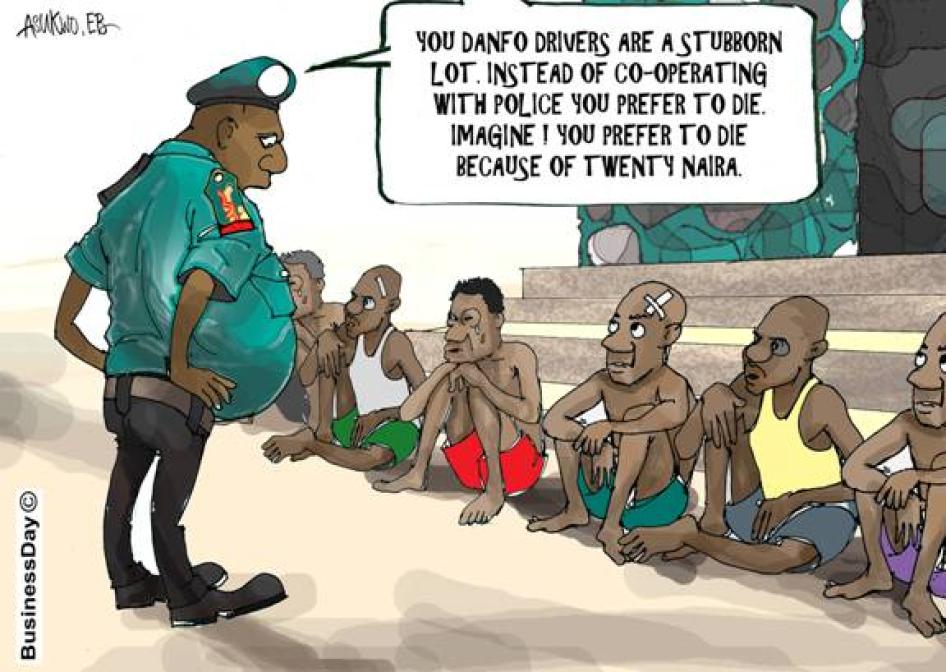
© 2010 BusinessDay
Human Rights Watch interviewed witnesses and family members of the victims in three fatal shootings at police checkpoints in Anambra State. In each of the cases, the altercation between the police and the driver reportedly began after the driver refused to pay the ₦20 bribe (approximately $0.17) that is routinely demanded by the police at checkpoints.[166]
|
Killed for 20 Naira Nkechi Obidigwe, Onitsha, Anambra State On April 25, 2006, Nkechi Obidigwe, a 22-year-old student was allegedly shot and killed by a stray bullet fired by a police officer at a motorist who refused to pay a bribe. This incident occurred at a checkpoint in Onitsha on April 25, 2006. Family members interviewed by Human Rights Watch said that Obidigwe was returning from computer training school around 2:30 p.m. that day when she was shot by a police officer at a checkpoint on Zeke Street in Onitsha.[167] According to media reports, the police officer at the checkpoint shot at a motorcycle driver who refused to pay the ₦20 bribe demanded by the police. The bullet hit Obidigwe instead.[168] Obidigwe was taken to the White Chapel Hospital in Onitsha, but, according to the family members, the doctors refused to treat her without authorization from the police. The police at Fegge police station initially refused to provide the authorization, and by the time it was granted, Nkechi had “given up the ghost.” The family members told Human Rights Watch that the police officer who shot her was later dismissed from the police force but has never been prosecuted. The family has received no compensation from the police.[169] Daniel Offiali, Ogidi, Anambra State On November 9, 2007, a police officer at a police checkpoint in Ogidi, Anambra State, allegedly shot two passengers on a commercial minibus, killing one, 15-year-old student Daniel Offiali. A young man who witnessed the incident described to Human Rights Watch how the minibus was stopped at a police checkpoint around 7:30 a.m., and one of the police officers shot at the bus as it pulled away, killing Offiali and injuring another boy.[170] According to media reports, which provided further details, the shooting took place after the bus driver refused to pay the ₦20 bribe demanded by the police.[171] |
Human Rights Watch requested information from the inspector general of police on a total of 16 incidents of alleged extrajudicial killings associated with extortion by the police at checkpoints, either documented by Human Rights Watch or credibly reported in the media.[172]The force public relations officer responded in a letter to Human Rights Watch on March 26, 2010, stating, “While it may not be possible now to respond to them [the 16 cases] one-by-one, be rest assured that the Nigeria Police views every such case as a case of MURDER for which the offending officers are investigated and dealt with in line with extant laws.”[173] The response referred to only two examples from the 16 incidents in which police officers were dismissed and charged with murder:
[T]he case of the shooting of a woman and her baby at Ilorin on January 3, 2010, has been thoroughly investigated. The four-man patrol team were all arrested and tried internally. Three of them found liable were dismissed and charged to court for murder. Furthermore, on the incident that occurred at Iyere Junction, in Owo, Ondo State on July 13, 2006, the police officer who unlawfully killed Gbenga Ojuade, has since been dismissed and is facing prosecution for murder.[174]
In reality, convictions of Nigerian police officers implicated in capital crimes including the extortion-related extrajudicial killings noted above, are very rare. In one such case, a high court in Ondo State convicted a police officer in March 2009 for killing Alexandra Aroloye at a police checkpoint in September 2004. The court found that the police officer shot and killed Aroloye, a motorcycle rider, after the victim refused to pay the police a ₦20 bribe. The judge rejected the police officer’s claim that the gun had accidentally discharged, asserting, “Unless the courts make it abundantly clear to our policemen that never again will such plea or defence be available to any of them accused of murder, Nigerians will continuously be sprayed with bullets from the police who hide on the plea ‘he was killed by stray bullets or accidental discharge.’”[175]
The Nigerian Constitution guarantees that every person has the right to life and that no one shall be arbitrarily deprived of that right.[176] International treaties ratified by Nigeria, including the International Covenant on Civil and Political Rights, and the African Charter on Human and Peoples’ Rights also prohibit the arbitrary deprivation of the right to life.[177] Human Rights Watch found that corruption in the Nigeria Police Force leads directly and indirectly to extrajudicial killings of Nigerians. As the UN Special Rapporteur on Extrajudicial, Summary or Arbitrary Executions concluded in his 2006 report, the problem of corruption in Nigeria is “closely linked to the issue of extrajudicial executions.”[178]
Impact of Police Corruption on Rule of Law
If police take money, it is terrible because someone’s rights are being violated, somebody is being [abused] and losing something personal … or justice is denied. It affects other systems as well. If the police are corrupt, you’re not likely to have a good criminal justice system. The courts will never work and it will affect the entire chain, and ultimately the prisons. Police corruption is a terrible thing in society. It is the worst form of corruption. —Former senior official in the Nigeria Police Force[179]
Corrupt and unprofessional practices by the Nigerian police have severely undermined the integrity of the Nigerian criminal justice system and, by extension, respect for the rule of law. The police subject victims of crimes to incessant demands for money to investigate and move forward the case, leaving victims who refuse or are unable to pay with little hope for justice. Meanwhile, criminal suspects with money can simply bribe the police to avoid arrest, detention, and prosecution. For their part, high-level police officials have sold off for their own personal enrichment nearly one-fourth of the police force to provide protection for Nigeria’s wealthy elite. This corrupt practice by senior police officials has left the vast majority of Nigerians without adequate security and has further undermined their right to equal protection under the law. Left without adequate police protection, communities have turned for protection to armed vigilante groups who often operate outside the law and have been implicated in further abuses.
Undermining the Criminal Investigation: Justice for Sale
Interviews with victims of crime, police officers, lawyers, and judges indicated how the course and outcome of criminal investigations depend almost entirely on payment by either the complainant or the accused. One civil society activist in Lagos interviewed by Human Rights Watch observed, “Justice is for sale to the highest bidder,”[180] while a former senior police official noted that “to get justice you must have more money than the other party…. Whoever has more money is the one that will ultimately win.”[181]
Requiring Victims to Fund Criminal Investigations: Denying an Effective Remedy
In Nigeria, the police routinely demand money from complainants to fund the criminal investigation into their case, limiting or completely eliminating access to justice for victims who refuse or are unable to pay. Victims interviewed by Human Rights Watch noted that the police often appeared more intent on using their contact with the complainant and suspect to extort money than on conducting a professional and impartial investigation into the crime. Disturbingly, senior police officers and civil society leaders working on policing issues agreed that the Nigerian police rarely initiate an investigation into a crime, even the most serious offenses, and generally will only open a case once money has changed hands.[182] A police sergeant in Lagos described how the process works in his station:
If someone lodges a complaint, the desk officer will demand money. After lodging the complaint, you have to bring money for logistics to work the case—₦1,000-₦2,000 ($8-$17). I hear them [the police] asking for this all the time in our station. After the case has been investigated, they refer it to the investigation department who demands money before sending the case to court—usually ₦2,000-₦3,000 ($17-$25). The case then goes to the divisional crime officer who signs it before it goes to court; to get the signature you need to pay money.[183]
A police corporal in Lagos described his frustration at the lack of resources the police receive to conduct investigations:
It’s very hard to do our job properly. Since I joined the service, it’s been like this—we don’t see anything from above. When you go to the station with a complaint, the investigating officers ask you for ₦2,000 ($17) to even begin investigating. When I go for an investigation, the complainant has to pay transport, buy the pens, the paper to write the statements on and the detention order paper, applications for bail bond, medical papers to get them treated. The complainant is the one who is responsible for the transport to conduct the investigation; they understand and are willing to pay our transport. At times we even ask buses to take us to where we need to go.[184]
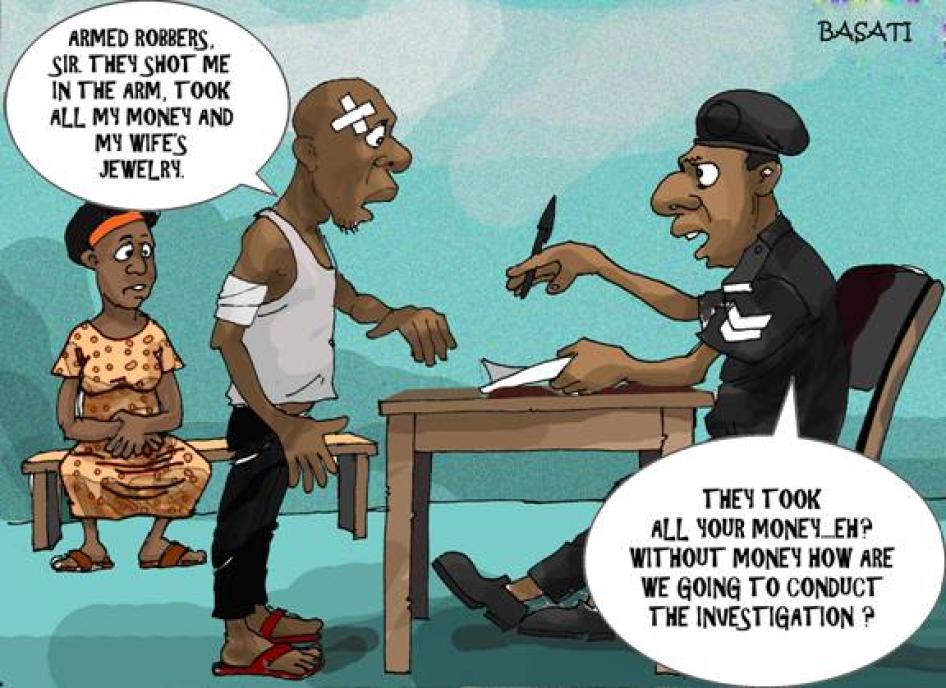
© 2010 BASATI / Human Rights Watch
A judge and several lawyers confirmed this phenomenon. A High Court judge in Lagos with years of experience within the criminal justice system and who presided over several high-profile corruption cases noted, “The victim must routinely pay for their case to be investigated and move forward.”[185] One lawyer in Lagos noted that in his experience, “Money is paid to the police from the very initiation [of the complaint] until the case goes to the DPP [director of public prosecutions].”[186] He further explained, “You also have to pay if the suspect is arrested and bail comes up…. If the accused has been bailed and fails to show up, the complainant must pay for a bench warrant to be enforced.”[187]
Human Rights Watch also spoke with several victims of crimes who said that they had to pay the police to initiate, conduct an investigation, and refer the case to the state prosecutor. An engineer from Ebonyi State described how the police demanded money to investigate the alleged murder of his 22-year-old brother in June 2009:
The IPO [investigating police officer] said I should give him ₦20,000 ($132) to start work. He said it was for stationery, their feeding, and their drinks. I paid ₦20,000…. They later said I should give them another ₦20,000 because they were still working. I gave them another ₦20,000…. In July, the IPO demanded ₦250,000 ($1,656) that I do not have. They said the police don’t work without money. They said if I don’t have money, I shouldn’t go for justice.[188]
Similarly, a market trader in Kaduna described what happened after she filed a complaint with the police in a criminal case:
When I went to the police to file the complaint, I had to pay for the form. They then set up a panel of five police [officers to review my case] and said I must “settle” them. I gave them ₦2,000 each, ₦10,000 total ($13 each, $66 total). They don’t call it a bribe; they would call it transport fees, money for paper, etc. You have to pay money before you get justice. At every point they ask for money. If you don’t pay, they will abandon the case. I have had to pay the police more than ₦20,000 ($132).[189]
Several police officers and civil society leaders told Human Rights Watch that if the complainants are unable or unwilling to pay the money illegally demanded by the police, it is unlikely that the criminal investigation will be completed. A lawyer in Kaduna explained:
If the complainant does not have money to pay, the case will suffer. You have to look for the means or forget the case. If you don’t [pay], they will drag the case. When they say there is no fuel or paper it means you have to do something. There is no way you can escape providing one thing or another if you have a complaint with the police and want it taken seriously.[190]
“Turning” the Case against the Complainant
If the complainant is unable to meet the police’s demands for money, or if the accused in the case offers a bribe to the police, the complainant risks being framed by the police on false charges. A senior official in the Ministry of Police Affairs told Human Rights Watch, “We hear reports that the person who goes to the police as the complainant ends up being the accused.”[191] A lawyer in Lagos noted that in his experience, “As the investigation goes on, the police collect from both sides. If the accused is richer and more powerful, he can pay off the police until the case is turned.”[192] Another Lagos-based lawyer echoed these sentiments: “If the suspect has leverage, the tide might turn against the complainant; from being a complainant he can turn into a suspect overnight.”[193] The 2008 Presidential Committee on Police Reform likewise found:
[T]he complainant is put into all manners of inconveniences, often to the advantage of the suspect, particularly if the suspect is richer or has greater power and visibility. At the point of investigations, attempts are made in some cases to rope in the complainants, who is [sic] then criminalised, while the suspect is allowed to go scot-free.[194]
As a result, the committee concluded, “Few Nigerians report crimes because of the fear of being victimized by the Police.”[195]
Several police officers, including an assistant commissioner of police who has investigated cases of corruption, also explained to Human Rights Watch that they knew of cases in which criminal suspects had bribed police officers to ensure that they were not investigated or arrested, and in some cases even paid money to frame the victim. A state deputy director of public prosecutions confirmed this practice: “If you can’t [pay], and the suspect you are complaining against has wherewithal, you can see the complaint simply slipping out of your hands, and at the end of the day you might turn up to be the suspect not the complainant.”[196]
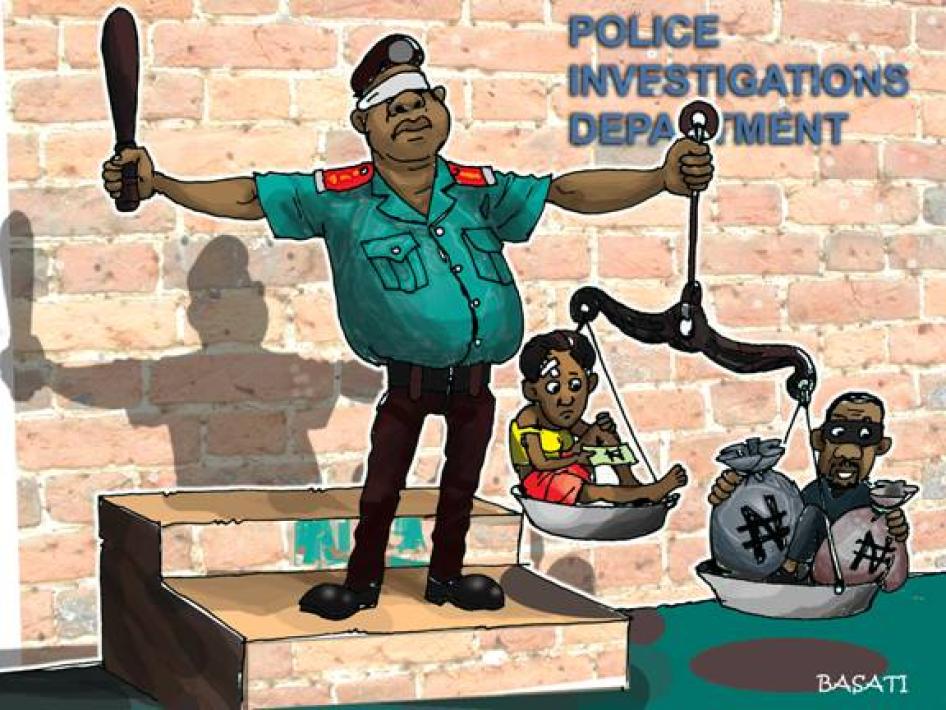
© 2010 BASATI / Human Rights Watch
The assistant commissioner of police further explained, “Criminal statements can be made to be removed from case files just to assist the party in the case that is being investigated, after of course money has been collected. It’s an everyday event.”[197] Similarly, the former senior police official who had investigated cases of police corruption described how criminal suspects often pay money to the police investigator to turn the case against the complainant:
[If you’re the accused,] you turn it. The complainant might be the one that ends up going to jail. If you pay so much money as an accused person, the police can turn it so you made false allegations against the other person. It happens a lot…. It is real. I’m not joking about this.[198]
|
Paying for the Police Investigation: “Anything Can Happen in Nigeria-oh” Human Rights Watch interviewed a man who described how the police at the state command in Awka, Anambra State, demanded money to investigate members of a criminal gang who had threatened to kill and extort money from his family over what was initially a land dispute: In July [2009] we reported this to the police but they told us they would have to be “mobilized.” I had my lawyer give the police ₦20,000 ($132) for transportation money. After my lawyer gave them the money, I called the IPO at the state CID [Criminal Investigation Department]. They [the police] also said, “We need money in advance to show [your] appreciation.” I asked what amount. They said the amount I give “will determine how serious we take the case.” I asked the IPO what happened to the ₦20,000 and he said that it was shared with his superiors and he didn’t get anything…. Every time he moved, he asked for money…. I then decided I didn’t want to do it [pay] anymore because it [his demand for money] was never ending and he didn’t do what he told me he would do. I told him that I wouldn’t give him any more money, and that is where we met a roadblock. He said I must “make him happy” to write a good investigation report to be sent to his superiors on whether to charge the accused. He said, “The report can go either way—whatever happens in this case depends on what is in the report.” After I refused to give him any more money, he said, “Anything can happen in Nigeria-oh.” He started saying subtle threats, telling me that these people could turn around and petition the IG [inspector general], and they would become the complainant and I could become the defendant. I refused to give him any more money…. When I spoke with him in October [2009], he still hadn’t sent the investigation report. In total I gave the police ₦35,000 ($232).[199] The man has since filed a complaint against the investigating police officer with the inspector general of police and the Independent Corrupt Practices and Other Related Offenses Commission (ICPC).[200] Human Rights Watch requested information from the police on the status of the case but no information was provided.[201] |
As a prominent civil society leader that works on policing issues put it, “At the end of the day, corruption controls the investigative process.”[202] The bribery and corruption that drives police investigations severely undermine the rule of law, deny victims of crimes their day in court, and lie at the root of the prevailing culture of impunity in Nigeria.
Police Protection for Sale: Unequal Protection under the Law
According to current Inspector General of Police Ogbonna Onovo, as of August 2009, at least 100,000 police officers—more than one-fourth of Nigeria’s police force—were assigned by their superior officers to work for wealthy individuals or private businesses as security guards and personal orderlies.[203] While the services of these officers have been illegally sold off to provide protection to Nigeria’s elite, the approximately 271,800 police officers who remain are left to protect Nigeria’s other 150 million citizens.[204] The vast majority of ordinary Nigerians who cannot afford to buy police protection are left with inadequate security.
Civil society leaders and police officials interviewed by Human Rights Watch characterized the practice of illegally selling the services of the police to Nigeria’s elite as widespread. Many also believed the practice resulted in a significant financial benefit for senior police officials who personally take in money from private individuals and businesses to assign rank-and-file officers to private posts, and then gain further by extracting “returns” from these same lower-ranking officers. As one civil society leader in Lagos stated, “If you want protection, you apply [for a police escort] and you bribe…. [T]he money doesn’t go into the state coffer. It’s a huge racket.”[205]
The police at all levels of the force are involved in “selling the police” for personal gain, indicated a former senior police official who had investigated the practice.[206] The money the police receive is not accounted for, but “goes to [their] pockets,” he said.[207] In one of the more infamous examples, a court in 2005 found that former inspector general of police Tafa Balogun extorted ₦30 million ($227,000) from the Societe Generale Bank of Nigeria by threatening to withdraw the police assigned to protect the bank’s headquarters. Balogun then laundered the money through one of his front companies.[208]
Police officers assigned to work as guards for private individuals or companies are generally required to pay “returns” to their superiors. A police constable assigned to a bank in Lagos told Human Rights Watch that he receives an extra ₦10,000 ($66) weekly allowance from the bank but has to pay ₦2,000 ($13) a week to his posting officer.[209] Similarly, in Anambra State, a police constable told Human Rights Watch that police officers assigned to banks in the state receive a ₦10,000 weekly allowance from the bank but were “crying” because they have to pay ₦6,000 in returns each week to their superior officers.[210] A 30-year-old police corporal in Lagos described his “moonlighting” assignment:
I was assigned to a guest house owned by a Lebanese man. I started in March 2008. There are four of us at the same place. Other policemen who are friends of mine are stationed at phone, oil, and other companies. When we do this we take off our uniform and wear mufti [civilian clothes] so people don’t identify you as a policeman. I carry a gun and am posted on the roof of the guesthouse. We are there to help because there are some customers that make trouble, or workers who steal from them. Since I’ve been there I’ve arrested two employees for stealing from the kitchen; one stole a chicken from the freezer and the other a carton of milk. I arrested the one—the boss sacked him. The other one dropped the chicken and ran. We have 24-hour shifts—two of us at a time. He pays us ₦4,000 ($33) per week, which gives me ₦16,000 ($133) extra a month.[211]
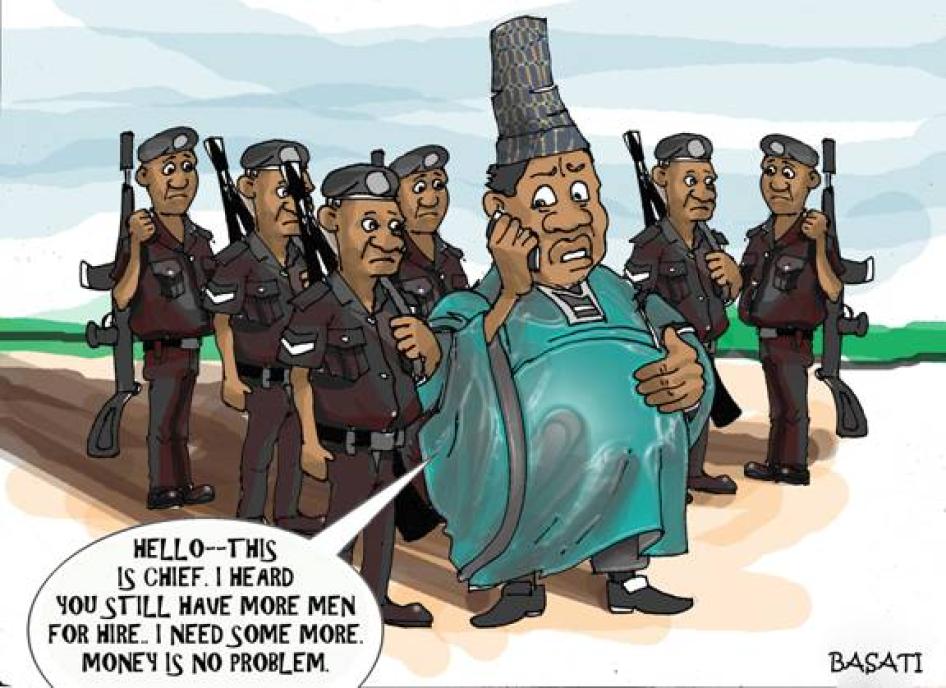
© 2010 BASATI / Human Rights Watch
Inspector General Onovo publicly acknowledged in August 2009 that “most of the police escorts and orderlies were assigned illegally,” and ordered the police officers to return to their stations.[212] However, by March 2010, the police had failed to end the practice due to “the connivance of the high command of the Nigeria Police Force,” according to the then-minister of police affairs.[213] As a former senior police official put it, “The policemen are just doing as they like and they have turned the police into a money-making machine.”[214]
The International Covenant on Civil and Political Rights provides, “Every citizen shall have the right and opportunity … [t]o have access, on general terms of equality, to public service in his country”;[215] everyone has the right to “security of person”[216] without discrimination;[217] and all persons shall be equal before the law.[218] Similarly, the UN Declaration of Basic Principles of Justice for Victims of Crime and Abuse of Power states that all victims of crime “without distinction of any kind” are “entitled to access to the mechanisms of justice.”[219] But with more than one in four police officers in Nigeria sold off for personal security to wealthy individuals and businesses, the vast majority of ordinary Nigerians are left without adequate protection in the face of rampant crime. As the 2008 Presidential Committee on Police Reform concluded, it remains a deeply entrenched “status symbol” for “Nigerian rich men and women to pay for the services of policemen and women and deny the majority of Nigerians police protection.”[220]
Lack of Security and Abuses by Vigilante Groups
One of the indirect results of inadequate policing is the rise of armed vigilante groups such as the Bakassi Boys in southeast Nigeria and the O’odua People’s Congress (OPC) in southwest Nigeria.[221] The failure of the police force to combat violent crime and ensure security for the general population has led some communities over the years to take the law into their own hands. The public maintains a profound distrust in the police who are seen as ineffective, corrupt, and often complicit in crime. The 2008 Presidential Committee on Police Reform concluded that the proliferation of armed vigilante groups stems from the “seeming inability of the Nigeria Police Force to effectively counter or combat the proliferation of crimes.”[222]
Civil society leaders and businesspeople interviewed by Human Rights Watch in Anambra State also noted this link. Asked why the vigilante groups were needed, one market trader said, “The people do not trust the police.” He went on to complain that the police have failed the community and instead “collaborate with the robbers” or “arrest a criminal, collect money from him, and release him.”[223] A market trader in Lagos expressed a similar view: “The police are not protecting us. They are fetching money for their pockets.”[224]
But vigilante groups often act outside the law and have themselves been implicated in serious human rights violations. At times, their methods have been extremely brutal, ruthless, and arbitrary. For example, in 2000 the notorious vigilante group the Bakassi Boys formed in Anambra State and several other southeastern states. They carried out scores of public executions of criminal suspects and arbitrarily detained and tortured hundreds of others.[225] The federal government officially banned the Bakassi Boys in 2002, but vigilante groups continue to operate in Nigeria with varying degrees of support from state governments.[226] In Anambra State, the Bakassi Boys now openly operate as the “Anambra Vigilante Service,”[227] with the endorsement of the state government, and continue to be implicated in abuses.[228]
The Vicious Cycle: Embezzlement and the Corrupt System of “Returns”
This thing [corruption] is like a disease in all of us.—Police sergeant in Lagos, November 27, 2008
A number of mutually reinforcing factors conspire to fuel the rampant levels of corruption within the Nigeria Police Force. The combination of inadequate funding for the police force and embezzlement and mismanagement of existing funds leaves appallingly little to run essential police operations. In part to cover this deficit, the rank-and-file police demand bribes and extort money from members of the public. The systemic practice whereby senior officers demand monetary “returns” from their subordinates further drives these abuses. The prevailing culture of corruption and lack of effective oversight—weaknesses that allow police officials at all levels to evade justice—perpetuate police corruption and its associated abuses.
Human Rights Watch interviewed police officers who described how they joined the police to serve their country but have since become disillusioned by the level of unprofessionalism and misconduct that pervade the police force. A police sergeant in Lagos lamented, “I wanted to be a policeman to serve my motherland, but we’re not doing that.”[229] Similarly, a police corporal in Lagos noted: “When I wear my police uniform and am in the midst of civilians, I feel ashamed of myself … I don’t feel proud of what I’m doing.”[230] The police sergeant told Human Rights Watch he longed for the police force in which he worked and risked his life to be “a dignified force.”[231]
Concerns about the deeply embedded nature of police corruption were echoed by a former member of the Police Service Commission, who said, “Everyone’s in on the game.”[232] A former senior police official who had investigated corruption in the force maintained that most police officers engage in some form of corruption:
There are extremely few who are able to overcome and resist it—very, very few. Some will be very perverse, some will be more direct, some will be a little bit decent, but most do take money. That is the reality. Every policeman who goes to work goes with the expectation that he will take money home that day, one way or another.[233]
While abuses by the rank-and-file, discussed above, are the most observable manifestations of police corruption, two other key dynamics—large-scale embezzlement by mostly senior officers and the corrupt system of returns—underlie and indeed drive many of these abuses.
High-Level Embezzlement of Police Funds
Senior police officials have embezzled and misappropriated staggering sums of public funds meant to cover basic police operations. Several high-level police officials ranging in rank from commissioner of police to inspector general of police have over the years been credibly implicated in and, in at least one case, convicted of the theft of police funds. In most of these cases, however, the federal government and the police leadership have failed to properly investigate, prosecute, or discipline implicated officers, much less take tangible steps to prevent future cases of embezzlement of police funds.
The Case of Former Inspector General Tafa Balogun
The most notorious case of embezzlement by a police officer of funds destined for the police force is that of former inspector general of police (IGP) Tafa Balogun. The case led to his resignation as IGP in January 2005, a position he had held since March 2002. In April 2005 he was charged by the Economic and Financial Crimes Commission (EFCC) with the theft of more than $98 million during his time in office as IGP. Much of this money came directly from the police force budget.[234] Balogun was also accused of having laundered through shell companies large sums of money from bribes and kickbacks he had received while in office.
A former member of the Police Service Commission described how “Tafa Balogun made policing a business.”[235] One of Balogun’s front companies, for example, was later convicted of laundering a ₦30 million ($227,000) bribe paid by the Societe Generale Bank of Nigeria after Balogun had threatened to withdraw police protection from the bank’s headquarters.[236]
On November 22, 2005, Balogun pleaded guilty to charges of failing to declare his assets in a plea bargain agreement with the EFCC and was sentenced to six months in prison.[237] Eight of his front companies were also found guilty of money laundering and the court ordered the seizure of his assets reportedly worth in excess of $150 million.[238] This staggering theft of police funds and resources that could have gone toward legitimate police expenditures would have been enough to fund the total budgeted operating costs of the police force—apart from personnel costs and capital projects—for nearly two and a half years.[239] The conviction was a landmark case in the anti-corruption campaign.
The Case of Kenny Martins and the Police Equipment Fund
Various efforts have been made over the years to improve the police force by purchasing vehicles and equipment with private-sector funding. The most notable and infamous example was the Presidential Committee on Police Equipment Fund, set up in 2006 by then-president Olusegun Obasanjo and headed by the president’s brother-in-law, Kenny Martins.[240] The fund raised some ₦50 billion ($387.5 million) from a combination of government funds and private donations.[241]
Martins and his fellow fund administrators, however, were accused of squandering and embezzling vast sums of money from the Police Equipment Fund. A report by the Nigerian House of Representatives accused Martins and the fund administrators of siphoning off at least ₦1 billion ($7.8 million) for their personal use, and transferring to various individuals and companies at least ₦1.3 billion ($10 million) “for purposes other than police matters.”[242] The House of Representatives report alleged that the fund purchased hundreds of vehicles—including at least 100 BMWs and luxury sport-utility vehicles—that went to people who had no connection with the police.[243] In May 2008, the police charged Martins and his deputy with fraud.[244] At this writing, the case is still awaiting trial. The EFCC in June 2008 also charged Martins, his deputy, and a former permanent secretary in the Ministry of Police Affairs with the embezzlement of public funds.[245] A high court in Abuja dismissed the charges in November 2009, but the EFCC has appealed the case.[246]
Other Corruption Scandals
Several other former police officials have been implicated in the misappropriation of police funds. The Independent Corrupt Practices and Other Related Offences Commission (ICPC) launched an investigation in 2008 into allegations that ₦43 million ($325,758) of ₦557 million ($4.2 million) in state funds transferred in 2006 for the purchase of arms, ammunition, and equipment for the police in Bayelsa State were misappropriated by officials in the Nigeria Police Force and Ministry of Police Affairs.[247] In May 2009, an ICPC official confirmed to Human Rights Watch that the case was “nearing prosecution.”[248]However, at this writing, the ICPC has not filed charges against any of the former officials investigated in the case, nor has the ICPC given any public response regarding the status of the investigation.[249]
In June 2007, another corruption scandal within the Nigeria Police Force emerged after a police constable at Force Headquarters was caught with a bag containing ₦900,000 ($6,977). According to documents from an internal police investigation seen by Human Rights Watch, the constable claimed that the money was for an “unnamed” deputy inspector general of police (DIG). Police investigators searched the office of the police commissioner in charge of budget and found ₦21,650,000 ($167,829) in cash stuffed inside a carton and box. The police investigation report alleged that “The money was being clandestinely evacuated piecemeal [from Force Headquarters] through a constable when intercepted,” and the Force Disciplinary Committee recommended that the outgoing police commissioner in charge of the budget office be dismissed and prosecuted for theft.[250]
After reviewing the case, the Police Service Commission (PSC), however, reversed the disciplinary action against the police commissioner, finding that the internal police “investigation was shoddy” and possibly “a deliberate attempt to nail the officer” without establishing any incriminating evidence against him. The PSC questioned why the police had failed to name the DIG who was said to have been the intended recipient of the ₦900,000, and concluded that it “may be evidence of a cover up” by the police.[251] At this writing, there has been no further investigation into the matter.
Embezzlement Starving Police of Needed Funds
The embezzlement of vast amounts of public funds destined for the police force indirectly impacts Nigerians’ enjoyment of human rights protections by limiting the capacity of the police to conduct criminal investigations and provide protection from violent and other forms of crime. Left with limited investigatory capacity and forensics laboratories in disarray, the Nigerian police routinely resort to extortion in part to fund basic police services, and to torturing criminal suspects as their primary tool for collecting evidence.
An assistant commissioner of police who has investigated numerous cases of corruption told Human Rights Watch that budgeted funds meant for essential operations are routinely “diverted and stolen by the police officers.” The 2008 Presidential Committee on Police Reform found that the police funds are routinely “frittered away through mismanagement.”[252] Other police officials noted that the operational deficiencies experienced by the rank-and-file in police stations throughout Nigeria were less a result of high-level embezzlement, and more due to insufficient resources for too great a need. Despite large budget increases to the police, these officers said, the budget was still insufficient to adequately support police operations on the ground.[253]
While Human Rights Watch is not in a position to determine appropriate funding levels or estimate the proportional impact from the theft of police funds by senior-level police officials, it is clear that the negative implications of this deficit is significantly worsened by embezzlement of funds on the part of senior police officials.
Many of those interviewed noted the stark difference between the resources available to high-level police officials and rank-and-file police officers. During a May 2009 visit to the Lagos State police command, a Human Rights Watch researcher observed how the dingy, under-supplied police stations located throughout Nigeria are far removed from the ornately decorated office of the police commissioner, with its plush leather couches and $50,000 Tandberg 50-inch dual plasma monitors.
Interviews with police officers, civil society leaders, lawyers, and judges working in the criminal justice system suggested that rank-and-file officers receive very few resources to conduct police operations. Junior police officers in Lagos, for example, routinely complained about the police administration’s failure to provide nearly all essential supplies and equipment needed to carry out their work. A sergeant working at an administrative post in a police station in Lagos State explained:
We get none of what we need to do our job; we have to buy everything. We don’t get pens; complaint sheets, we buy; bail bond sheets, we buy; fuel, we buy it. Bonuses for Christmas or Ramadan, forget it. When you get sick we treat ourselves; police officers who are wounded on duty die unless you have family to treat you.[254]
These sentiments were echoed by a police sergeant who had been posted in four state commands. In an interview with Human Rights Watch, he said that the police may provide a patrol vehicle, but “[f]rom the time I have been in the police force—20 years—I have never seen the government fund the fuel or vehicle maintenance and supplies.”[255] A prominent civil society leader and lawyer in Lagos described how he once witnessed a police officer ask his client for “money to buy candles,” and on another occasion saw an officer remove a light bulb from the fixture, explaining to a second officer, “I paid my money to buy that bulb … if you want light, buy your own!”[256]
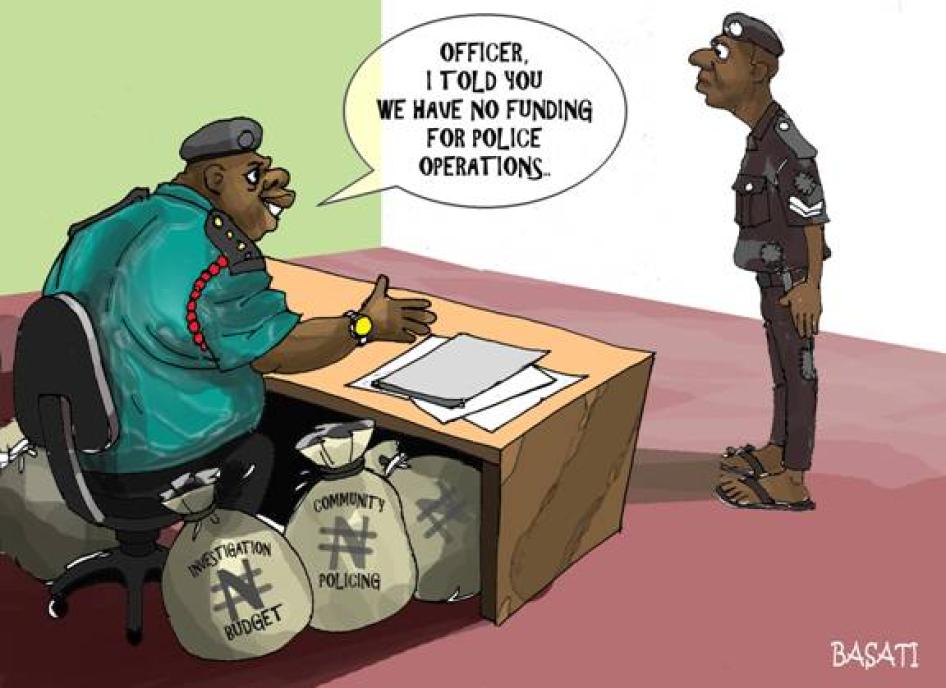
© 2010 BASATI / Human Rights Watch
A high court judge in Lagos with years of experience within the criminal justice system, and who had presided over several key corruption cases, noted that in his experience: “The police do not get money to run operations.”[257] The director of a civil society organization working on policing issues agreed:
Many of the police units and departments don’t have a budget to carry out their function. In the absence of a budget, they have to find ways of raising money to carry out these activities, including things as basic as fueling their vehicles and following up on leads. To do this, they devise quite a number of ways, which include extortion at the roadblocks and also making the complainants fund the investigation.[258]
One police sergeant in Lagos lamented: “You go on patrol and meet your superior, and ask him for fuel. He will say, ‘Where will I get it from?’ So it is up to you to find a way to get fuel.”[259] Some police officers, including this police corporal with nine years of experience on the force, justified police extortion: “They [our superiors] never provide us fuel. That is why we are taking money. I can’t use my own money, so we go outside to chase for money.”[260] A director of a civil society organization that works on policing issues explained, “In the final analysis, it is almost impossible within the environment of a limited budget to [tackle extortion].”[261]
Other people interviewed disagreed that the lack of funding to cover operating costs is fueling corruption and suggested that extortion is mainly used by police officers for their personal enrichment. A prominent human rights lawyer in Kaduna, for example, noted:
The money budgeted for their operations is grossly insufficient, but that doesn’t mean the money they collect is used to run their operations. When somebody demands money by menace, is threatening to frame you of armed robbery or shoot you, of course whatever he collects from you cannot be for anything good.[262]
Several civil society leaders, and most junior police officers interviewed by Human Rights Watch cited poor salaries, benefits, and working conditions as factors driving the police to extort money from the public.[263] But the Nigerian government has made significant strides in improving salaries over the past few years. In 2007, the starting monthly salary for a police constable, the lowest rank in the force, was approximately ₦8,000 ($62). By 2008, it had been increased to ₦26,158 ($217).[264]
|
A “Ghost House” for a Forensic Lab The lack of financial support and the mismanagement of existing resources for one key investigative department—forensics—has had dire consequences for many Nigerians in a criminal justice system where torture remains the primary tool for collecting evidence. The government’s forensic laboratories lie in a state of complete disarray and there is only one forensic pathologist in the entire police force.[265] The 2008 Presidential Committee on Police Reform agreed with this bleak assessment of the forensics capacity of the Nigerian police: “The laboratory currently looks like a ghost house, with little or no activity going on. It had remained in a dismal state, with the existing equipment inadequate and obsolete, while the seven departments [in the laboratory] appear to exist only in name.”[266] The Ministry of Health also operates a forensics laboratory in Lagos, but it has fared no better. According to the 2008 Presidential Committee, the laboratory “lacks adequate equipment, working materials and qualified staff to operate successfully.”[267] These two forensic laboratories serve a country of approximately 150 million people. |
Through a combination of an insufficient budget for essential police services and the mismanagement and theft of those budgeted funds, much of formal policing methods in Nigeria have come to a standstill. The 2008 Presidential Committee on Police Reform found that the police are generally “unable to use scientific methods of observation, investigation and analysis to detect and interpret physical evidence relating to crime found at crime scenes.”[268] The committee concluded that the dearth of trained personnel and equipment largely led to their excessive reliance on “confessions forcibly extracted from suspects.”[269] A human rights lawyer in Lagos echoed these sentiments: “One of the main reasons torture continues is because of its utility to the police right now. It has taken the place of forensic evidence. In the absence of money to conduct meaningful investigations, they use torture.”[270] A prominent civil society leader working on policing issues argued that the Nigeria Police Force has had ample funds over the years to improve its capacity to conduct professional criminal investigations, but police funds that could have been used for these purposes have instead been stolen and squandered by senior police officials.[271]
Corrupt System of Monetary “Returns”
Police officers ranging in rank from constable to assistant commissioner of police described to Human Rights Watch the existence of a scheme of “returns” throughout the police hierarchy, by which superiors demand their subordinates pay informal sums from the money made from bribes and extortion at police posts. Sometimes these amounts influence the process of placement and transfers to posts by the assigning officer. In many cases, superior officers set monetary “targets” for their subordinates and remove from their posts those who fail to meet them. The returns then move up the chain of command as officers who take returns from their subordinates in turn pay their superiors for the same reasons. Several police officers and civil society leaders working on policing issues in Nigeria identified the system of returns as a key dynamic underlying, and indeed driving, the extortion and related abuses perpetrated by Nigerian police officers at all levels.
Human Rights Watch interviewed nine police officers, including two in senior posts, as well as a former senior police official who investigated cases of police corruption and an intelligence operative in the State Security Service, who either personally paid returns or confirmed the existence of the system of returns in the Nigeria Police Force. They characterized the problem as widespread, pervasive, and deeply embedded into the practices of the force. An assistant commissioner of police referred to this practice as “institutional corruption” that “drives the lower ranks to extort money from the public.” Similarly, the former senior police official who had investigated cases of high-level police corruption characterized the problem as follows:
The corruption, the returns, this whole thing, it is so pervasive, so deep, it is what is running the force. It is what is keeping the entire police force going because every posting is determined by that. Every officer who is posted has to make money for him to remain in that post, or if you are not in a good posting, you must struggle to get a good posting.[272]
The 2008 Presidential Committee on Police Reform found that “The taking of bribes and their passage up in the rank structure has almost become institutionalized” in the Nigeria Police Force.[273] According to the former assistant commissioner of police, “The top hierarchy of the force knows these things exist.”[274] A police corporal with eight years of experience in the police force told Human Rights Watch, “They have this business of returns in all the stations I’ve worked in—Ogun, Oyo, and Lagos [states]—it’s the same system.”[275] Another police corporal with nine years of experience on the force in Kwara State and Lagos State said, “All the stations that I have worked at, I have had to pay returns.”[276] Civil society leaders interviewed by Human Rights Watch agreed. The head of a civil society organization who works closely with rank-and-file police officers noted that “The upper level officers have built a network of sharing proceeds derived from corruption among themselves. They all feed fat on it.”[277]
While Human Rights Watch was unable to ascertain how far bribes and money extorted by the rank-and-file advance up the chain of command, several police officers, including an assistant commissioner of police who investigated police corruption, believed it goes all the way up: “The returns are from the lowest level to the highest. The smallest man gives to the DPO [divisional police officer], the DPO to the commissioner of police, and the commissioner of police to the inspector general.”[278] Those in the junior ranks who paid returns to their superiors generally also held the view that the returns went to the top.[279]
Police Recruitment: “All about the Money”
Corruption in the police force often starts during the process of recruitment. To be accepted as a trainee, candidates frequently must pay bribes to the recruitment officers. A police constable in Lagos, who joined the force six years ago, described to Human Rights Watch how he had to bribe a recruiting officer: “After I submitted the application, a police officer said the superiors had already chosen their officers and that I would have to pay if I wanted in. I had to pay ₦20,000 ($159) to an inspector in Ikeja [in Lagos State].”[280] Based on the experience of many new recruits he has talked with, a police sergeant in Lagos explained, “As a civilian wanting to enter the force, the [recruiting] police officer will demand money to join up. New recruits have to pay to get in the force … from ₦50,000 to ₦100,000 ($417 to $833).”[281]
The civil society leader who has worked with rank-and-file police officers pointed out that “Recruitment is not done on the basis of merit—many don’t have proper credentials—they must know someone or give money.”[282] The payment of bribes by recruits sets a precedent for corruption in their work to come. As a former member of the Police Service Commission explained, from the point of entry into the force the recruit learns that police work is “all about the money.”[283]
Payment of Bribes to Obtain and Remain in Lucrative Posts
Once new recruits enter the police force they often have to bribe their superiors to be assigned to lucrative posts—assignments where police officers have ample opportunities to demand bribes and extort money from the public—or to be considered for promotions. A post is considered to be lucrative either as a function of the particular assignment—for example manning a roadblock or directing traffic—or due to their geographic locations, such as commercial centers or regions of the country where the police are more likely to come into contact with wealthy individuals, businesspeople, or market traders.[284] A police corporal in Lagos State explained:
The best posts are traffic and patrol. The traffic officers … are the ones who make good money. Look at me, I’m not shining, but they are shining. They have money to eat 10 times a day and they dress nice. Sometimes I hear them talking at the station: “I arrested them last night and he give me ₦20,000 ($167). I didn’t even expect it-oh!” People really want those postings. Sometimes they give money to their superiors to get what they want.[285]
Similarly, a police sergeant assigned to an administrative post in a Lagos police station described what a lucrative posting is:
Within our station, traffic is the most lucrative department. This is because they have most dealings with the public. Some of them who are even younger than me get ₦1,000 ($8) every day. They give nothing of this to me. I hear them talking about how much they get…. They’ll say, “Oh today I make money-oh, let’s drink beer…. I done do well today.”[286]
A former senior police official who had investigated cases of police corruption described to Human Rights Watch how, in his experience, the process of obtaining duty-transfers generally works:
You buy the posting. For example, you know which roadblocks give money. If you want to be posted there where you can make more money, you must give the person doing the posting money … for you to get to that roadblock you must pay your way to enter. And for you to remain there you must continue to pay.[287]
Once a police officer has been assigned to a specific post, the officer is often expected to make monetary returns to the superior officer to remain in the post or to secure a promotion. Those who fail to meet them will be transferred out of the post and a new officer transferred in.
The former police official who had investigated this practice explained how the system of returns likewise applies to senior officers: “The DPO [divisional police officer] who is in charge of the police station, if he wants to remain the DPO at that place, has to find a way of bribing those at the state headquarters.” He further noted that a state “commissioner of police on his own has to find a way of having good placing with [force] headquarters” by paying the officials in Abuja where the posting is done. He explained that police officers posted to northern states are “desperate” to be transferred to states where economic activity is greater such as Lagos or state commands in the east.[288]
Human Rights Watch interviewed several police officers who described having been given monetary targets by their superiors. According to a 28-year-old police corporal in Lagos, “The boss tells us there is a particular amount that each officer must bring.”[289] Another corporal working on a surveillance team in Lagos described his experience with the system of returns:
There are five of us in the team: two constables, one corporal, one sergeant, and one inspector. At the end of the week there is usually a return that we give to our superiors. At the end of each day we count the money on the way back as someone is driving. We give it to the inspector. At the end of the week the inspector then gives to the DSP [deputy superintendent of police]. The DSP then pays to the DPO [divisional police officer]. My boss, the inspector, tells me that the DSP says he has to pay to his boss. We all put in a donation and give ₦5,000 ($33) a week to our superior. If we don’t do that, they will change us.[290]
Similarly, an intelligence officer with the State Security Service in Anambra State described what he observed at one of the divisional police headquarters in Onitsha:
The DPO [divisional police officer] set up different teams. Each team had to give returns to the DPO each week. If they failed to pay the amount given as a target, they would be removed from their “nice” posts. The person who led the team would drop the envelope at the DPO’s office. There would usually be four, five, or six [police officers] in a team. Some teams gave back ₦20,000 ($132), at times ₦15,000 ($99). It depended on the amount given to them before they started the work for the week.[291]
A police constable who drives a police van in a seven-person surveillance team in Lagos explained how his team divided up the money derived from extorting ordinary citizens, including what was given to their superior:
At the end of the day before going to the station, we park behind the station and count the money together. We will now take the “return,” out of the money…. The superior among us then gives it to the superior at the station— the sum is usually around ₦4,000 ($33) a day—and the remaining we would now share it. The highest I got in one day was ₦5,000 ($42); other days, just ₦2,500 ($21). The amount we got depended on the amount left over [after the return].[292]
Police officers who fail to pay returns to their superiors or meet the targets specified by them are sometimes “punished” and sent to less desirable posts where they have less chance to make money through extortion and bribes. A police constable in Anambra State described what happened to him:
If we don’t pay returns each week, we will be removed. There is a certain amount requested every week that you have to pay. The head of the team is the one who has to pay the return. In my last post I refused to pay my returns and they removed me to desk work. If you are not giving anything, they will be suffering you a lot and put you where you can’t get even one naira.[293]
The former senior police official who had investigated cases of high-level police corruption, observed that in his experience, police officers at all levels participate by paying their superiors in a corrupt struggle to remain in preferred positions: “Those in the poorer states are desperate to go there and unseat you. There’s this ongoing competition…. This [system of] returns is how it happens.”[294]
Denial of Problem by Senior Police Leadership
The senior police leadership, for the most part, denies the existence of the corrupt system of returns in the Nigeria Police Force. In an interview with Human Rights Watch in May 2009, the Lagos State police commissioner strenuously refuted that police officers “make returns” to superior officers: “That is not true…. Nobody does that. If I get such reports, that DPO [divisional police officer] is finished. We have human rights sections and a provost here. No junior officer has ever reported to me that they are asked to give money.”[295] Similarly, the chairman of the Police Service Commission told Human Rights Watch, “I have heard of this but have not received any complaints.”[296]
On the other hand, a senior official at the Police Service Commission acknowledged that “The commission is aware that many police officers picked up on the street [for extortion] make returns to their superior officers.”[297] The police force public relations officer in Abuja alluded to a key problem when investigating these cases: “It is difficult to prove such cases, because it is the junior officer found with the money and then it is his word against the superior officer’s word.”[298]
Whether due to the difficulty of establishing such cases or the leadership’s willfully turning a blind eye to these corrupt practices, the police have failed to hold accountable senior officers who demand or accept returns from their subordinates. A senior official at the Police Service Commission told Human Rights Watch that he was not aware of any cases in which a senior officer had been disciplined, let alone prosecuted, for taking returns from a subordinate officer.[299]
Funding the Nigeria Police Force
The Nigeria Police Force (NPF) receives substantial funding from federal government allocations each year, which are augmented by vast sums of money from the state and local governments as well as from private-sector donations and trust funds. If properly allocated, these combined revenue sources could provide adequate resources for essential police services in Nigeria. But the police administration has failed to disclose in any transparent manner the sources, amounts of revenue received from them, or use of these funds. It appears that much of these resources are lost to theft and mismanagement.
Federal Government Allocations
When Nigeria returned to civilian rule in 1999, the NPF budget stood at ₦22.6 billion ($235.4 million).[300] A decade later, the police budget, at ₦210.7 billion ($1.4 billion), had ballooned five-fold.[301] Most of the increased funding was earmarked toward personnel costs.[302] Police salaries and benefits in 2009 accounted for 82 percent of budgeted expenditures.[303] The increase in personnel costs reflected the dramatic growth of the police force—approximately 230,000 police officers were added to the force during the decade—but also significant increases in salary levels.[304]
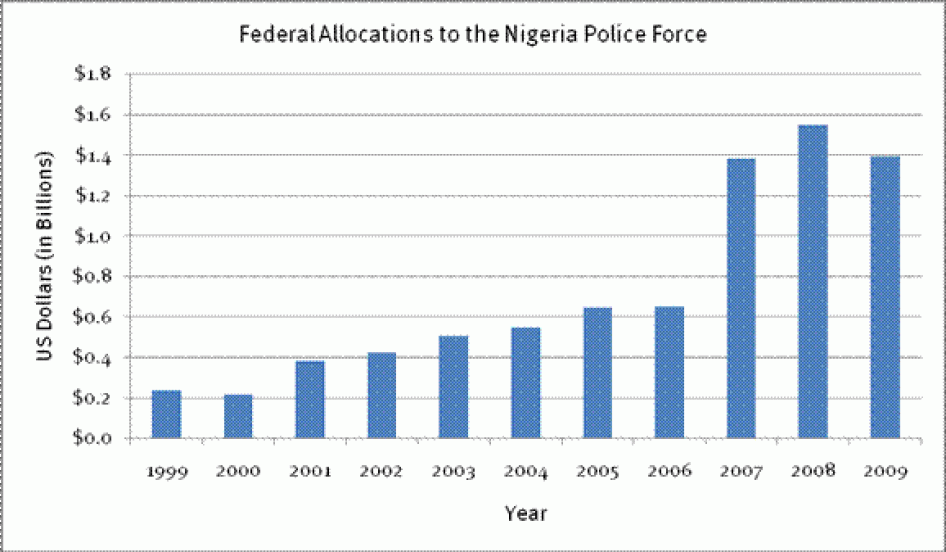
Source: Federal 2008 and 2009 Budget and 2008 Presidential Committee on the Reform of the Nigeria Police Force (1999-2007).[305]
In addition to personnel costs, the police budgeted ₦32.1 billion ($212.6 million) for operating costs and capital expenditures in 2009.[306] Budgeted costs heavily favored high-end purchases and expenditures with limited direct benefit to the public, such as ₦2.7 billion ($18.1 million) for the purchase and outfitting of an additional police helicopter and ₦206 million ($1.4 million) budgeted for international travel.[307] However, substantial funds were also allocated to cover the general operating costs of the police force including ₦1 billion ($6.6 million) for fuel and ₦849.6 million ($5.6 million) for maintenance of its fleet of 8,126 police vehicles—the annual equivalent of $812 and $689 per vehicle for fuel and maintenance, respectively.[308] Even if the budgeted amounts would not meet 100 percent of actual operating costs, it is clear that substantial funding from federal government allocations does exist for police operating costs, including fueling and maintaining police vehicles.
State and Local Government Funds
In addition to the NPF federal budget, state and local governments provide considerable funds to the Nigerian police. The 2008 Presidential Committee on Police Reform found that in some cases state government funding covered at least 50-70 percent of police operating costs within the state.[309] In Lagos State, for example, the police commissioner told Human Rights Watch that the state government provided most of the police vehicles in the state, as well as fuel, armored personnel carriers, bullet-proof vests, and salary subsidies for police personnel.[310] The local government councils in Lagos State also donated more than 100 patrol vehicles to the police in 2009.[311]
Other Sources of Police Funds
Federal, state, and local government funds have been augmented by various public and private sector trust funds. The Lagos State government, for example, established a trust fund in 2007 that has raised ₦5 billion ($33.1 million) for policing and security operations.[312] The most prominent trust fund, however, was the ₦50 billion ($387.5 million) Police Equipment Fund established in 2006 by then-President Olusegun Obasanjo and headed by the president’s brother-in-law.[313] As described above, much of the money ended up squandered or stolen.
Lack of Transparency and Financial Oversight of Police Funds
According to several civil society leaders, senior government officials, and police officers interviewed by Human Rights Watch, there is little transparency or financial oversight for how the $1.4 billion police budget, and the vast sums of money allocated to the police from state and local governments, and other funding sources are actually expended. They noted how this lack of transparency helps mask and greatly facilitates the embezzlement of funds for essential police operations by senior officers.
In 2009, the then-Minister of Police Affairs Ibrahim Lame told Human Rights Watch that there has been serious neglect in the financial oversight of the police and that police reform would require a “total surgical operation.”[314] The “decentralization of the budget is necessary,” he said. “The Ministry [of Police Affairs] must be over and above the police. If not, there will still be problems.”[315] A director of a civil society organization working on policing issues likewise observed that “financial accountability is very weak both within the force and within the oversight mechanisms.”[316]
A former senior police official who served in senior positions at Force Headquarters and presided over internal investigations of corrupt practices within the police force described to Human Rights Watch how, in his experience, police funds are allocated to cover operating costs within the police force:
When the money comes, the inspector general of police decides the way he wants to spend it. They send to a state commissioner an amount that is supposed to be for the running costs of the state command. That [money] is not accountable. What does he do with that? He will sit down, take for his own office, and spend it the way he likes, then he will give to the deputy commissioner and the assistant commissioner, and it goes like that, but nobody is told what you need to do with it. The whole idea of auditing is not there…. In the case of the divisions, the money goes to the divisional police officer and he takes it alone. He doesn’t even bother to give it to the divisional crime officer, because they are making their own money.[317]
While assigned to a high-level posting, he was routinely sent money from his superiors and never asked to account for it:
“At [name of post withheld] they would send me ₦500,000 ($4,667)—just like that…. They will say they’ve given it to me for those things that are needed—buying paper, pencils—it is supposed to be used to run your office, but it’s a system that is completely broken down…. [There is] no accountability, no transparency. Even the auditors are given money, so much money. The internal police auditors are part of the whole scheme.[318]
Human Rights Watch requested copies of the most recent audit reports, and comment from the inspector general of police on steps taken to improve financial oversight and ensure that budgeted funds go toward their intended purposes, but neither the reports nor the information was provided.[319]
The National Assembly has statutory oversight over the implementation of federal budget appropriations, including federal allocations to the Nigeria Police Force. The House of Representatives Public Accounts and Public Affairs Committee is responsible for budgetary oversight but has failed to follow through with public hearings into financial mismanagement of federal funds by the police leadership.[320]
Ineffective Accountability Mechanisms
I would not say corruption was completely eradicated [during my tenure], because to bring it down to zero level was not possible, but I brought it down to a respectable minimum.—Former Inspector General of Police Mike Okiro, August 2009[321]
In the face of widespread and overt corruption at all levels within the Nigeria Police Force, few measures to hold accountable those responsible for corruption or related human rights abuses have been successful, despite the presence of multiple mechanisms for this purpose. Indeed, public complaint mechanisms and internal monitoring and supervision of the police, as well as civilian oversight, remain weak, underfunded, and largely ineffective. Police officers are periodically investigated but they are only rarely held accountable for these crimes. Despite government officials’ having on multiple occasions acknowledged many of the problems described in this report, the Nigerian government in general, and the leadership of the Nigeria Police Force in particular, have lacked the political will to address these structural problems and bring reform, coordination, and adequate funding to the various mechanisms of police oversight and accountability.
Public Complaint Mechanisms
The Nigeria Police Force has set up various mechanisms for the public to file complaints against police misconduct. These include the Public Complaints Bureau, complaint boxes or telephone hotlines at police stations, and human rights desks. As the Lagos State police commissioner told Human Rights Watch when asked about complaints against police misconduct, “Everyone has access to our phone numbers. They can call if they have a problem.”[322] The Nigerian government has also established various external mechanisms where members of the public can report police abuses. Depending on the nature of the complaint, members of the public can file complaints against the police at no fewer than eight government agencies; however, most of these complaint mechanisms lack the resources to investigate the complaints.
|
Public Complaint Mechanisms Police Service Commission (PSC) The PSC, an independent body established in 1960, is responsible for police discipline. In 2008, the PSC’s Department of Police Discipline received 129 complaints from the public—29 of which involved cases of police corruption or extortion. Most of these cases were referred back to the police force to investigate because of lack of resources in the department.[323] Public Complaints Commission (PCC) The PCC, established in 1975, receives complaints against public officials, including police officers. Most complaints against the police are forwarded to the Police Service Commission for processing.[324] Nigeria Police Force – Public Complaints Bureau (PCB) The PCB, established by the Nigeria Police Force in 1979, is run by the public relations officer at the various levels of the force,[325] but the PCB has been largely ineffective and has no budget to carry out its functions.[326] In 2007, the PCB received only 49 complaints from the public.[327] Code of Conduct Bureau (CCB) The CCB was established in 1990 and receives complaints from members of the public against public officials, including police officers, for violating the Code of Conduct for Public Officers. National Human Rights Commission (NHRC) The Nigerian government established the NHRC in 1995. The NHRC received 574 public complaints in 2007 regarding all classes of human rights abuses, including 70 of “degrading treatment” or “unlawful arrest and detention” by members of law enforcement agencies.[328] The NHRC can initiate investigations on its own, but lacks independent prosecutorial power. Draft legislation before the National Assembly would empower the NHRC to prosecute cases of human rights violations.[329] Independent Corrupt Practices and Other Related Offences Commission (ICPC) The ICPC, established in 2000, receives complaints from members of the public against public officials, including police officers, for corrupt practices. Economic and Financial Crimes Commission (EFCC) The EFCC, established in 2002, receives complaints from members of the public regarding cases of financial fraud, money laundering, and other corrupt practices. Ministry of Police Affairs – Police Performance Monitoring (PPM) Division The Ministry of Police Affairs established the PPM Division in December 2008.[330] In its first year, it received about 100 complaints against the police from members of the public, but according to a ministry spokesperson, “very few were investigated” due to funding shortages and the lack of trained investigators.[331] |
Lack of Confidence in Public Complaint Mechanisms
Victims of police abuses, civil society leaders, and several police and government officials told Human Rights Watch that the public seldom use these mechanisms to report police extortion and abuse, and complaints that are filed are rarely investigated. The UN Special Rapporteur on Torture and Other Cruel, Inhuman or Degrading Treatment or Punishment concluded, “Despite knowing that police abuse is wrong, victims feel powerless and are resigned to accept that impunity is the natural order of things when it comes to Nigerian law enforcement.”[332]
Victims of police abuse and extortion often cited fear of further victimization as a key reason for not reporting these abuses. When Human Rights Watch asked a market trader in Kaduna State, who was robbed by the police in July 2008 and then forced to pay to be released from police custody, if he filed a complaint against the police, he insisted, “I will not survive. They will arrest me.”[333] A senior official at the Police Service Commission told Human Right Watch, “They don’t have confidence in the police. They fear for their personal security.”[334] An official at the Independent Corrupt Practices and Other Related Offences Commission expressed a similar view: “If they report the case, the complainant will become the accused. They will put them in jail.”[335] Similarly, a former senior police official who had investigated police corruption explained what typically happens if someone files a complaint against the police: “Nothing will happen to him [the police officer] and the police will go after you.”[336]
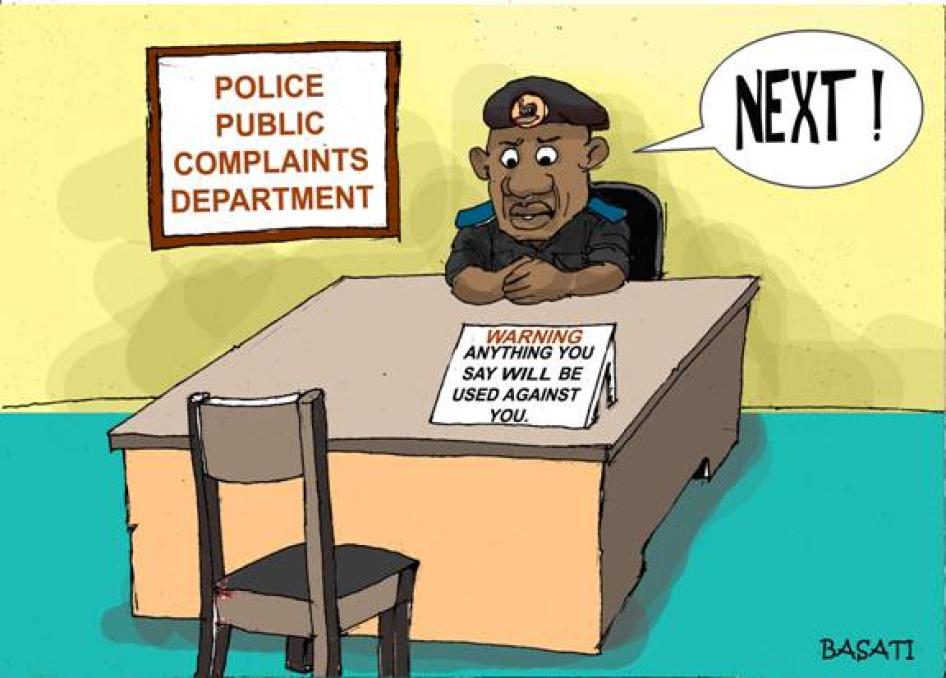
© 2010 BASATI / Human Rights Watch
Nor do members of the public often utilize anonymous complaint mechanisms, such as complaint boxes or hotlines. When asked to explain why, an assistant commissioner of police replied, “What is the point of dropping information at a complaint box if you know it won’t be used?”[337] Moreover, the routine nature of paying bribes in Nigeria has undermined its very perception of a crime worth reporting.
Internal Monitoring Mechanisms
Internally, the Nigeria Police Force has established a Human Rights Desk, which monitors police conduct, and an internal anti-graft unit known as the X-Squad. The inspector general of police and each state commissioner of police also have monitoring teams to investigate incidents of police misconduct. As with the public complaint mechanisms, the internal monitoring units in the police force are poorly funded and lack support from the police leadership to effectively address systemic corruption and abuse within the police force.
X-Squad
The X-Squad, established in 1966, is mandated to investigate officers “involved in bribery and corruption and all other forms of official misconduct.”[338] Acting on complaints from the public or internal reports, the X-Squad deploys plainclothes officers to monitor the operations of police officers manning checkpoints or on patrol, and to arrest those “caught in the course of corrupt practices.”[339] The X-Squad is headed by a commissioner of police in the Criminal Investigation Department at Force Headquarters.[340]
Rather than carry out its mandate, however, the X-Squad widely engages in the same corrupt practices it was designed to investigate, according to several police officers and civil society leaders interviewed by Human Rights Watch who have documented police corruption. An assistant commissioner of police who has investigated cases of police corruption explained that the X-Squad routinely extorts money from junior police officers against whom there are allegations of abuse.[341] Indeed, a former senior police official who had investigated cases of police corruption described it as “one of the most corrupt units” in the police force. He explained:
They are supposed to police the police, [but] they take the money from the corrupt policemen…. They wait for the “robbers” to take money and come and take the money from the “robbers.” They know every divisional police officer who is corrupt and if there’s a complaint against him, if he’s corrupt, they will take some part of it as well. How many of the police officers have been brought to justice? How many policemen have been prosecuted for corruption? If there is none, then what is the use of the X-Squad?[342]
He and others also noted that the X-Squad has had little impact on endemic corruption in the force. According to a prominent civil society leader working on policing issues, the X-Squad does carry out periodic arrests, but these are often made simply to “be seen as doing something and to make a scapegoat of a few of them.”[343] In February 2010, for example, the police in Lagos paraded, in front of journalists, nine junior officers arrested by the X-Squad for extorting money from motorists.[344] The police leadership, however, has rarely backed these periodic raids against rank-and-file officers with criminal prosecutions.
When Human Rights Watch asked the former head of the X-Squad in Kaduna State about efforts to combat police corruption in the state, he replied, “In the two years [that I headed the X-Squad in Kaduna], I never came across a case of extortion or corruption.”[345] Similarly, the police commissioner in Lagos State told Human Rights Watch, “I have a team that goes around—an anti-vice unit for policing the police—that is very extensive.” But when asked about the widespread problem of superior officers taking “returns” from their subordinates in Lagos, he stated, “I have not received any complaints of this.”[346] Human Rights Watch requested information from the police on the work of the X-Squad, including the number and outcome of cases investigated, but no information was provided.[347] The 2008 Annual Report of the Nigeria Police Force simply noted that “[t]he dearth of logistic and financial support among others militated strongly against the effective discharge of X-Squad operations.”[348]
Human Rights Desks
The Nigeria Police Force has designated Human Rights Desks with human rights officers who, in theory, are posted to each police division.[349] The human rights officer is mandated to investigate “suspected illegal arrests” and ensure that “detained persons are not abused” or “cajoled into giving bribes.”[350] The police leadership, however, has failed to establish a budget to carry out this work. In one police station in Lagos, the UN Special Rapporteur on Torture and Other Cruel, Inhuman or Degrading Treatment or Punishment found that detainees were “tortured right behind the Human Rights Desk.”[351] In some stations, the divisional crime officer has been assigned to cover the human rights desk in addition to their other duties, leaving little time for them to carry out human rights work. A few human rights officers are active, particularly in posts that receive external donor support, but in the vast majority of police stations this post does not even exist.[352] In most of the police stations visited by Human Rights Watch, the officer manning the front desk was unfamiliar with the position.
External Anti-Corruption Commissions
The military government in 1990 established a Code of Conduct Bureau, and its sister entity the Code of Conduct Tribunal, to enforce a code of conduct for public officials concerning bribery and abuse of office. Following the end of military rule in 1999, and in recognition of the widespread nature of corruption, the Nigerian government established the Independent Corrupt Practices and Other Related Offenses Commission (ICPC) in September 2000 and the Economic and Financial Crimes Commission (EFCC) in December 2002.[353] The ICPC and the EFCC, which have received substantial support from foreign donors, are tasked with investigating and prosecuting cases of corruption and other financial crimes in Nigeria.
Code of Conduct Bureau and Tribunal
The Code of Conduct for Public Officers in the Nigerian Constitution requires all public officials, including all police officers, to file asset declarations upon taking office, every four years thereafter, and at the end of their term in office.[354] The Code of Conduct Bureau (CCB) is responsible for verifying the asset declaration forms of public officials and referring cases to the Code of Conduct Tribunal, which is empowered to take disciplinary action against those found to be in breach of the code.[355] In 2007-2008, the Code of Conduct Tribunal fined 30 police officers from Oyo State for failing to file asset declaration forms, while five police officers from the Federal Capital Territory were fined in 2009.[356] During this period, not one police official was even referred to the tribunal for falsely declaring assets.[357]
The Nigerian Constitution provides that the asset declarations of public officials should be “available for inspection by any citizen of Nigeria on such terms and conditions as the National Assembly may prescribe.”[358] However, the National Assembly has not only failed to pass legislation defining these terms and conditions, but has also failed to pass the Freedom of Information Bill that would give Nigerians the legal right to compel government institutions to release public records.[359] In the absence of this legislation, the Conduct of Conduct Bureau has refused to make public the asset declaration forms of any public official.[360] With approximately 2.1 million public officials in Nigeria’s civil service, the CCB lacks the personnel and resources to verify all but a few asset declaration forms.[361] While in principle it accepts and investigates complaints by members of the public against public officials, the lack of public access to asset declaration forms of public officials has made the CCB largely a “toothless bulldog.”[362]
Independent Corrupt Practices and Other Related Offences Commission
The ICPC, which targets corruption in the public sector, has been the most successful of Nigeria’s law enforcement agencies in investigating and prosecuting police officers for bribery and extortion. The ICPC established a Special Duties Department (SDD) in 2000 to investigate complaints of corruption against public officials. The SDD, which is comprised of 20 plainclothes operatives, most of whom are on loan from the State Security Service, conducts sting operations using marked bills against public officials accused of bribery and extortion.[363]
Since 2006, the ICPC has charged 20 police officers caught in SDD sting operations for corrupt practices such as demanding bribes from persons held in police custody, extorting money from complainants, and accepting bribes to quash criminal charges.[364] Despite the promising model of the ICPC’s sting operations, the small number of prosecutions against police officers—an average of just five police officers apprehended for bribery each year—pales in comparison to the scale of the problem. The SDD has also failed to target superior officers who take “returns” from their subordinates.[365]
Economic and Financial Crimes Commission
The EFCC, which was established to complement the efforts of the ICPC, focuses on cases of financial fraud, money-laundering, and other financial crimes by both public officials and private citizens.[366] The EFCC has successfully investigated and prosecuted several high-profile corruption cases against senior government officials, including the landmark case described above against former inspector general of police Tafa Balogun in 2005.[367] In 2008, the EFCC filed criminal charges against Kenny Martins and other senior officials of the Police Equipment Fund.[368] However, aside from these two high-profile cases, the EFCC has failed to indict any other public officials for the embezzlement of police funds or any other police officers for corrupt practices.[369]
Police Disciplinary Mechanisms
The Police Service Commission (PSC), an independent body with civilian oversight of the police, has the power to discipline all members of the Nigeria Police Force below the rank of inspector general of police.[370] The PSC has delegated its responsibilities back to the police force for the discipline of junior officials—who represent about 90 percent of the police force.[371] Junior police officers are disciplined by their superior officers in “orderly room” proceedings, under the Force Provost Marshal, and can appeal disciplinary sanctions to the PSC. Senior officers are disciplined before the Force Disciplinary Committee, which forwards disciplinary recommendations to the PSC for approval.
|
Lack of Safeguards for Police Whistleblowers Police officers can report incidents of police misconduct to the Police Service Commission, but the PSC requires police whistleblowers to sign the complaint and requires all such complaints to pass through the inspector general of police.[372] A senior PSC official told Human Rights Watch that police officers rarely report abuses because they “don’t want to sign” the complaint for “fear of victimization.” If a police officer complains against another officer, he noted, “they will even kill him.” The official also explained that because reports of police misconduct must first pass through the inspector general of police, “in many cases it won’t come [to the PSC] because the police don’t want to indict themselves.”[373] |
The PSC has focused its work in recent years on the appointment and promotion of police personnel, but has failed to allocate sufficient resources to investigate incidents of police misconduct.[374] The then-head of the PSC’s Department of Police Discipline explained to Human Rights Watch that the department has only four investigators and has to turn down most cases of police misconduct because of the lack of resources.[375] The PSC conducted only 10 direct investigations in 2008, which represented a “dismal percentage” of the number of reported cases.[376]
According to official police records, 518 junior police officers were dismissed from the police force in 2008 for various disciplinary matters.[377] Human Rights Watch requested information on the number of police officers disciplined for extortion, bribery, and other corrupt practices, but no information was provided.[378] The PSC dealt with a backlog of disciplinary matters from 2007 and 2008 that resulted in the dismissal of 22 senior police officers in 2008—all were ranked chief superintendent of police and below.[379] Only five of these officers were dismissed for corruption-related offenses.[380] In February 2010, the PSC also dismissed former Borno State police commissioner Sambo Mohammed for embezzling ₦16 million ($105,960) in state government funds allocated to the force.[381] At this writing, no criminal charges had been filed against him.[382]
Lack of Accountability
The Code of Conduct for Law Enforcement Officials, adopted by the United Nations General Assembly, emphasizes that “The law must be enforced fully with respect to any law enforcement official who commits an act of corruption, as Governments cannot expect to enforce the law among their citizens if they cannot, or will not, enforce the law against their own agents and within their agencies.”[383]Although dozens of police officers in the past few years have been dismissed from the Nigeria Police Force for extortion, bribery, or the embezzlement of police funds, only a handful have been prosecuted. Moreover, the police leadership and the anti-corruption agencies have failed to crack the systemic corruption in the force manifest in the corrupt system of returns. The police leadership has largely denied the existence, much less scope, of the problem, and appears unwilling to tackle it in a systematic and meaningful way.
The endemic system of returns in the Nigeria Police Force not only directly encourages police officers to extort money from members of the public, and effectively punishes those who do not, but it also greatly impedes superior officers from holding subordinates accountable for extortion and other corrupt practices. As an assistant commissioner of police who has investigated cases of corruption pointed out, the system of returns “contributes enormously to the corruption in the police force … and makes it morally impossible for the boss to check the corrupt activities of his subordinates.”[384]
Even the substantial increase in police salaries has led to little corresponding improvement in the behavior of police personnel. A civil society leader in Lagos argued, “It’s not a question of raising salaries. It’s a question of changing the mentality, changing the norms. The people looting are not poorly paid.”[385] As a prominent civil society leader working on policing issues likewise concluded, without accountability, “corruption has taken on a life of its own.”[386]
Police corruption remains widespread and is openly committed in Nigeria. In April 2009, a Human Rights Watch researcher sat in a small dingy room at a police station in Onitsha, Anambra State, and listened to a police sergeant brazenly attempt to extort ₦30,000 (about $200) from a quiet-spoken man whose car had been “impounded” by the police with his family still inside.[387] The culture of impunity runs deep in the police force. A passenger on a commercial bus in Lagos summed it up as follows: “They [the police] do bad things and feel like they will never go to prison for the badness they do.”[388] In the end, as a senior official at the Police Service Commission concluded, “It is only punishment that can deter.”[389]
Police Reform
The Nigerian government and the police leadership have acknowledged many of the problems in the Nigeria Police Force but have failed to enact meaningful reform. Nigerian civil society organizations, most notably the CLEEN Foundation and the Network on Police Reform in Nigeria (NOPRIN), have actively campaigned over the last decade for security sector reform in Nigeria, conducting extensive research into police abuses, advocating for legislative reform, and working to build the capacity of police personnel.[390] For their part, successive Nigerian administrations have set up panels and committees to examine and make recommendations to reform the deep-seated problems within the Nigeria Police Force, including many of those addressed in this report. Unfortunately, the recommendations brought forward by the civil society groups and contained in government panel reports have been largely ignored and few tangible steps have been taken to implement reform.
Most recently, the late President Yar’Adua inaugurated the Presidential Committee on the Reform of the Nigeria Police Force in January 2008, led by former inspector general of police M.D. Yusuf. The 2008 Presidential Committee reviewed the findings of four government panels since 1995 and painted a discouraging picture of the government’s consistent failure to implement the recommendations of the former committees. As noted by the 2008 Presidential Committee, the report of the 1995 police reform panel “was not considered” by the government;[391] the Nigerian government “completely ignored” the recommendations of the 1997 Vision 2010 committee;[392] the recommendations of the 2002 Tamuno committee “were never implemented”;[393] and as for the Danmadami police reform committee set up by then-president Olusegun Obasanjo in 2006, although the government accepted “a substantial number” of the committee’s recommendations, “very little efforts were made” to implement them.[394]
2008 Presidential Committee
The 2008 Presidential Committee on Police Reform produced a comprehensive report that examined the systemic problems within the Nigeria Police Force, including police corruption. The highly critical report called on the Nigerian government to reform the budgetary process and financial oversight of the police, create a credible public complaint mechanism, prosecute abusive police officers, and revamp the Police Service Commission. The committee also recommended that the police leadership overhaul the anti-corruption X-Squad, create effective monitoring mechanisms, and establish functioning forensic laboratories. The report also defined new guidelines for the appointment, removal, and tenure of the inspector general of police to insulate the police from political manipulation.[395]
The Nigerian government accepted the vast majority of the recommendations, but rejected those on the appointment and removal of the inspector general.[396] The government set up an implementation committee, chaired by the minister of police affairs to oversee the implementation program. However, progress to date has been very limited. In March 2010, then-Minister of Police Affairs Ibrahim Lame took the bold step to publicly lambast the inspector general and top leadership of the Nigeria Police Force for their “deliberate failure” to implement the reforms and condemned the police for the “rising cases” of extrajudicial killings and human rights violations.[397]
Police corruption and the serious human rights violations that are driven by these financial crimes are not isolated from the broader problems facing Nigeria. Reform of these deeply entrenched problems in the Nigeria Police Force will not be easy, notably because of the many vested interests in maintaining the status quo. Police reform must be seen in the bigger picture of the endemic corruption, use of violence as a tool of political manipulation, and the culture of impunity that define the political order of the governing elite in Nigeria today. In the end, as one civil society leader noted, “It starts with the leadership. When the top is corrupt, the tendency is for all to be corrupt.”[398]
Acknowledgments
This report was researched and written by Eric Guttschuss, Nigeria researcher in the Africa Division of Human Rights Watch. It was reviewed and edited by Corinne Dufka, senior West Africa researcher; Thomas Gilchrist, senior associate in the Africa Division; Clive Baldwin, senior legal advisor; and Cassandra Cavanaugh, consultant in the Program Office. The report was prepared for publication by Grace Choi, publications director; Anna Lopriore, creative manager; and Fitzroy Hepkins, mail manager.
Human Rights Watch wishes to thank the many victims, witnesses, and other individuals who came forward to offer testimony and other information for this report.
We also wish to thank the organizations and individuals who offered their assistance in facilitating this research, particularly the CLEEN Foundation; Network on Police Reform in Nigeria (NOPRIN); Civil Liberties Organisation (CLO); Social Justice & Advocacy Initiative (SJAI); Committee for the Defence of Human Rights (CDHR); International Society for Civil Liberties and the Rule of Law (Intersociety); Access to Justice (AJ); Consulting Centre for Constitutional Rights and Justice (C3RJ); Human Rights Monitor (HRM); League of Democratic Women (LEADS); Civil Society Legislative Advocacy Centre (CISLAC); and Center for Environment, Human Rights and Development (CEHRD); as well as government officials within the National Human Rights Commission (NHRC); Independent Corrupt Practices and Other Related Offences Commission (ICPC); Ministry of Police Affairs; Police Service Commission (PSC); and Nigeria Police Force (NPF).
Human Rights Watch expresses its gratitude to those who have generously supported our work on Nigeria.
[1] 1999: ₦96/US$1; 2000: ₦105/$1; 2001: ₦117/$1; 2002: ₦126/$1; 2003: ₦133/$1; 2004: ₦134/$1; 2005: ₦132/$1; 2006: ₦132/$1; 2007: ₦129/$1; 2008: ₦120/$1; 2009: ₦151/$1; 2010: ₦152/$1. Based on historical data by OANDA, http://www.oanda.com.
[2] For a detailed history of the police in Nigeria, see Tekena N. Tamuno, The Police in Modern Nigeria, 1861-1965: Origins, Development and Role (Ibadan: Ibadan University Press, 1970).
[3] Presidential Committee on the Reform of the Nigeria Police Force (2008 Presidential Committee on Police Reform), Main Report, April 2008, p. 20.
[4] According to official police records, 250 police officers were “killed by gun shots” in 2009, in addition to 365 police officers “killed in road traffic accidents” that year. Human Rights Watch email correspondence with Emmanuel Ojukwu, force public relations officer at Force Headquarters, Abuja, April 9, 2010.
[5] Etannibi E.O. Alemika and Innocent C. Chukwuma, CLEEN Foundation, “Criminal Victimization, Safety and Policing in Nigeria: 2006,” 2007, p. 46. Similarly, the 2008 Presidential Committee on Police Reform found that “the Police today is publicly perceived as one of the most corrupt government institutions, with its personnel constantly accused of bribery and extortion in the course performing [sic] their functions.” 2008 Presidential Committee on Police Reform, Main Report, p. 31.
[6] In 1990, for example, then-Force Secretary Ibrahim Coomassie decried the “corruption, lack of supervision, negligence of duty, abuse of office, insubordination … misappropriation of funds … extortion and demanding by menaces” that was “on the increase” by senior police officers. “Discipline: Superior Police Officer (SPOs),” A.I. Coomassie, address delivered at Area Commanders and Assistant Commissioners of Police Seminar held at the Police Staff College, Jos, Plateau State, March 19-23, 1990, cited in Etannibi E.O. Alemika, “Colonialism, State and Policing in Nigeria,” Crime, Law and Social Change, vol. 20, 1993, p. 200.
[7] “A Welcome Address by the Inspector-General of Police Mr. Ogbonna O. Onovo at the Senior Police Officers Conference Holding at the IGP Conference Hall, Force Headquarters, Abuja,” Ogbonna Onovo, September 29, 2009, http://www.nigeriapolice.org/news-mainmenu-2/igp/121-igp-warns-against-indisipline-and-unprofessional-conduct.html (accessed March 30, 2010). Ogbonna Onovo was appointed inspector general of police in July 2009 by then-President Umaru Yar’Adua following the retirement of Mike Okiro, who had served in the position since June 2007.
[8] See “Police Transformation in Nigeria: Problems and Prospects,” Innocent Chukwuma, paper presented at conference on Crime and Policing in Transitional Societies, Konrad Adenaeur Stiftung, in conjunction with the South African Institute for International Affairs, University of the Witwatersrand, Johannesburg, September 2000, p. 127. Prior to British colonization, traditional African policing methods were largely community-based and closely interlinked with social and religious structures, consisting of, for example, age grades (formal organizations whose membership is based on pre-determined age ranges), secret societies, and vocational guilds (hunters, farmers, fishermen, and other professions). See Akin Ibidapo-Obe, “Police Brutality: Dimensions and Control in Nigeria,” in Civil Liberties Organisation, ed., Law Enforcement and Human Rights in Nigeria (Lagos: Civil Liberties Organisation, 1995); and Constitutional Rights Project, Human Rights Practices in the Nigeria Police Force (Lagos: Constitutional Rights Project, 1993).
[9] The Hausa Force was comprised of recruits from the Hausa ethnic group, originally from the north, “most of whom had been freed slaves resident in Lagos.” Tamuno, The Police in Modern Nigeria, 1861-1965, p. 17. The colonial governor of Lagos Colony, H.S. Freeman, explained his justification for the Hausa Force in a December 31, 1863 letter to the Duke of Newcastle: “The men [Hausa] being from the interior and professing the mussulman religion [Islam] are hated by the natives of these parts who have hitherto only known them as their slaves. They are disliked also by the Europeans as being of a more independent character than the Lagos people. They thus have only the government to depend on, and if properly managed will prove a valuable resource to this settlement.” Alemika, “Colonialism, State and Policing in Nigeria,” Crime, Law and Social Change, p. 203.
[10] See “Police Transformation in Nigeria,” Innocent Chukwuma, p. 127 (“[T]his practice of alienating the police from the communities they served, was to ensure that such officials, when deployed to execute punitive expeditions, would act as any army of occupation and deploy maximum violence on the communities.”); and Alemika, “Colonialism, State and Policing in Nigeria,” Crime, Law and Social Change, pp. 202-03.
[11] Letter from Claude MacDonald, consul general of the Oil Rivers Protectorate, to Sir Perry Anderson, August 8, 1891, cited in Tamuno, The Police in Modern Nigeria, 1861-1965, p. 6. See also Alemika, “Colonialism, State and Policing in Nigeria,” Crime, Law and Social Change, p. 205. A police force was established in the Oil Rivers Protectorate in 1889. The Oil Rivers Protectorate was renamed the Niger Coast Protectorate in 1893 and merged with the southern territories of the Royal Niger Company to form the Protectorate of Southern Nigeria in 1900.
[12] Letter from Henry McCallum, Lagos colony governor, to Joseph Chamberlain, colonial secretary, July 9, 1897, cited in Alemika, “Colonialism, State and Policing in Nigeria,” Crime, Law and Social Change, p. 205.
[13] See Alemika, “Colonialism, State and Policing in Nigeria,” Crime, Law and Social Change, p. 203; Tamuno, The Police in Modern Nigeria, 1861-1965, p. 253; and “Police Transformation in Nigeria,” Innocent Chukwuma, pp. 127-28.
[14] See Alemika, “Colonialism, State and Policing in Nigeria,” Crime, Law and Social Change, pp. 202-203 (“The early police forces were organized as mercenary units and employed in several punitive expeditions to main and kill ‘belligerent natives,’ and to burn and loot ‘obstructionist’ villages.”); Tamuno, The Police in Modern Nigeria, 1861-1965, p. 253 (“The police past in Nigeria was also associated with a reign of terror, particularly during the nineteenth century. The record of the early twentieth century had a similar stain.”); and “Police Transformation in Nigeria,” Innocent Chukwuma, pp. 127-28.
[15] Lagos Colony was merged with the Southern Protectorate in 1906 to form the Colony and Southern Protectorate of Nigeria. In the north, the British granted a charter to the Royal Niger Company in 1886, which formed the Royal Niger Company Constabulary. In 1900, the charter was revoked and the British established the Protectorate of Northern Nigeria, which recruited officers from the Royal Niger Constabulary to form the Civil Police and Prisons. The newly consolidated colony was christened Nigeria in 1914, a name coined by Flora Lugard, the wife of Frederick Lugard, the first governor of the Northern Protectorate. Alemika, “Colonialism, State and Policing in Nigeria,” Crime, Law and Social Change, pp. 190-94.
[16] Ibid., p. 195.
[17] The Native Authority Ordinance, no. 4, 1916, and the Protectorate Laws (Enforcement) Ordinance, no. 15, 1924, provided for the establishment of local police forces. See ibid., p. 194.
[18] See, for example, ibid., pp. 204-05; and Tamuno, The Police in Modern Nigeria, 1861-1965, pp. 253-57.
[19] Tamuno, The Police in Modern Nigeria, 1861-1965, p. 257.
[20] Ibid., p. 256. Similarly, a member of parliament recalled how during entrenchment after the Second World War, a traffic warden offered to work “without pay” as an alternative to termination. Between 1952 and 1955, 117 members of the NPF were “convicted of corruption, stealing, false pretences, and ‘other offences of dishonesty.’” Chief Secretary Ralph Grey, statement to Parliament, August 1955, cited in Tamuno, The Police in Modern Nigeria, 1861-1965, p. 255.
[21] At independence there were 12,268 police officers in the NPF. In addition, there were 2,374 police officers in the eight local police forces in the Western Region, while the 61 local police forces in the Northern Region numbered some 6,169. There were no local police forces in the Eastern Region. Ibid., pp. 160-63.
[22] Alemika, “Colonialism, State and Policing in Nigeria,” Crime, Law and Social Change, pp. 206-07. The Working Party on Police and Prisons, a commission established by the military government in 1966, found that in Western Nigeria, “the mass recruitment into local authority forces, of thugs and party stalwart against whom the people should have given protection to the ordinary people. These people, it was alleged, carried out their paid duty of thuggery in local government police uniforms, under the full weight of government support.”
[23] See ibid., p. 207.
[24] The 1979 Nigerian Constitution granted the federal government sole authority over the police in Nigeria. This provision was reaffirmed under the present 1999 Constitution: “[T]here shall be a Police Force for Nigeria, which shall be known as the Nigeria Police Force, and subject to the provisions of this section no other police force shall be established for the Federation or any part thereof.” Constitution of the Federal Republic of Nigeria, 1999, sec. 214(1).
[25] The military ruled Nigeria for nearly 30 of its first 40 years of independence. Military governments were in power from 1966-1979 and from 1983-1999, with the exception of a three-month period in 1993 that saw a short-lived interim civilian administration.
[26] See A. Suleman, “Police Leadership and Professionalism: Environment, Structure and Management Since 1960,” in Tekena N. Tamuno, et al., eds., Policing Nigeria: Past, Present and Future (Lagos: Malthouse Press Limited, 1993), p. 341.
[27] See 2008 Presidential Committee on Police Reform, Main Report, p. 177.
[28] Suleman, “Police Leadership and Professionalism,” in Tamuno, et al., eds., Policing Nigeria, p. 343.
[29] Ibid., p. 343.
[30] Patrick Igbinovia, “Police Misconduct in Nigeria,” Police Studies: The International Review of Police Development, vol. 8, no. 2, Summer 1985, p. 114.
[31] Ibid.
[32] See Alemika, “Colonialism, State and Policing in Nigeria,” Crime, Law and Social Change, p. 187.
[33] Igbinovia, “Police Misconduct in Nigeria,” Police Studies, p. 114.
[34] Human Rights Watch interview with former senior police official, October 6, 2009.
[35] Ibid.
[36] 2008 Presidential Committee on Police Reform, Main Report, p. 22.
[37] Ibid., p. 22.
[38] The 2008 Presidential Committee on Police Reform concluded that police recruitment was done in a “very unwholesome manner,” resulting in “the enlistment of unsuitable candidates, including suspected criminals … and educationally unqualified barely literate entrants into the Police Force.” Ibid., pp. 22 and 84. Similarly, then-Minister of Police Affairs Ibrahim Lame lamented to Human Rights Watch that during this recruitment drive, “we even recruited criminals.” Human Rights Watch interview with Ibrahim Lame, then-minister of police affairs, Abuja, May 4, 2009.
[39] Human Rights Watch interview with Ibrahim Lame, May 4, 2009.
[40] 2008 Presidential Committee on Police Reform, Main Report, p. 22.
[41] Ibid., p. 22.
[42] See Constitution of the Federal Republic of Nigeria, 1999, sec. 215(3).
[43] See ibid., sec. 216(2).
[44] 2008 Presidential Committee on Police Reform, Main Report, p. 168. See Constitution of the Federal Republic of Nigeria, 1999, schedule 3, part I, sec. L. The Nigeria Police Council is comprised of the president, the 36 state governors, the chairman of the Police Service Commission, and the inspector general of police.
[45] See Constitution of the Federal Republic of Nigeria, 1999, schedule 3, part I, sec. M. The eight-member Police Service Commission consists of a chairperson; a retired justice of the Supreme Court or Court of Appeal; a retired police officer at or above the rank of commissioner of police; one representative each of women’s interests, the press, nongovernmental human rights organizations, and organized private sector; and the secretary of the commission. The chairperson and members are appointed by the president and subject to confirmation by the Senate. Police Service Commission (Establishment) Act 2001, part I, sec. 2.
[46] See Police Service Commission, 2008 Annual Report, p. 41. Junior police officers—holding ranks from constable to inspector—comprise 90 percent of the NPF personnel.
[47] The Ministry of Police Affairs was disbanded in 2007 and subsumed as a department within the Ministry of Interior. In December 2008, the Ministry of Police Affairs was again established as a separate ministry. See Ministry of Police Affairs, Hand-Book on Ministry of Police Affairs, p. 9.
[48] See Nigeria Police Force, 2008 Annual Report of the Nigeria Police Force, http://www.nigeriapolice.org/police-annual-report.html (accessed January 17, 2010), p. 81.
[49] See Nigeria Police Force, 2008 Annual Report of the Nigeria Police Force, pp. 81 and 94.
[50] The rank of inspector includes one chief inspector, one deputy chief inspector, 73 principal inspectors, and 634 senior inspectors. The rank of sergeant includes 123 sergeant majors. “Senior police officers” are classified as the rank of assistant superintendent of police and above. Data based on official figures reported in the NPF’s 2008 annual report but do not add up to the total force size of 371,800 reported in official sources elsewhere. Nigeria Police Force, 2008 Annual Report of the Nigeria Police Force, pp. 94 and 132.
[51] See Human Rights Watch, “Chop Fine”: The Human Rights Impact of Local Government Corruption and Mismanagement in Rivers State, Nigeria, vol. 19, no. 2(A), January 2007, http://www.hrw.org/node/11043.
[52] See Human Rights Watch, Criminal Politics: Violence, “Godfathers” and Corruption in Nigeria, vol. 19, no. 16(A), October 2007, http://www.hrw.org/node/10661.
[53] See Transparency International, Corruption Perceptions Index 2009, http://www.transparency.org/policy_research/surveys_indices/cpi/2009 (accessed January 17, 2010).
[54] “Nigeria leaders ‘stole’ $380bn,” BBC News, October 20, 2006, http://news.bbc.co.uk/2/hi/africa/6069230.stm (accessed April 22, 2010).
[55] Human Rights Watch interviews with diplomats, Abuja, April 2007; and telephone interview with diplomat, June 18, 2007. This estimate includes money lost to corruption from the budgets of Nigeria’s federal, state, and local governments, along with money stolen or otherwise diverted from parastatal companies, including the Nigerian National Petroleum Corporation, and equals between 4.25 and 9.5 percent of Nigeria’s total gross domestic product (GDP) in 2006. To put those numbers in perspective, a loss of 9.5 percent of the United States GDP to corruption in 2006 would have translated into $1.25 trillion in stolen funds, or $222 billion (£108.6 billion) in the case of the United Kingdom’s economy. According to the US Central Intelligence Agency World Factbook, in 2006 the GDP of the United States stood at $13.2 trillion, while that of the United Kingdom was estimated at $2.3 trillion. Currency equivalent calculated at $1 = £0.4895.
[56] In 2008, for example, Nigeria’s federal government allocated ₦854.58 trillion (approximately $7.1 billion) to Rivers State, Akwa Ibom State, Bayelsa State, and Delta State, with a combined population of approximately 14.9 million (2006 census data). See the Ministry of Finance monthly allocations, published online at http://www.fmf.gov.ng/FMF_Revenue_Alloc.aspx (accessed May 2, 2010). In comparison, the central government budget of Ghana, with an estimated population of 23.9 million, was $4.5 billion in 2009, while the 2009 budget of the country of Niger, with a population of 15.3 million, was just $320 million. See Central Intelligence Agency, “The World Factbook 2009,” https://www.cia.gov/library/publications/the-world-factbook/index.html (accessed May 2, 2010).
[57] See, for example, Human Rights Watch, “Chop Fine”.
[58] In 2008, the Ministry of Finance distributed N5,446 trillion ($45.4 billion) to the three tiers of government. The federal government received ₦2.213 trillion ($18.4 billion), the 36 states and the Federal Capital Territory were allocated ₦1.992 trillion ($16.6 billion), and the 774 local governments received ₦1.051 trillion ($8.8 billion). “FG, States, LGs Share N5.446 Trillion from Federation Account in 2008,” Ministry of Finance press release, February 1, 2009.
[59] Nigeria has the world’s second-highest number of maternal deaths each year after India. Nearly one in five Nigerian children dies before the age of five, many from easily preventable diseases. In 2009, Nigeria ranked 158th out of 182 countries on the UN Development Programme’s Human Development Index. Current rankings across all countries with data can be found online at http://hdr.undp.org/en/reports/global/hdr2009 (accessed April 22, 2010). See also World Health Organization, “Maternal Mortality in 2005,” http://www.who.int/making_pregnancy_safer/documents/9789241596213/en/index.html (accessed April 22, 2010).
[60] Human Rights Watch, Criminal Politics.
[61] See section below on the case of Tafa Balogun.
[62]One of the former governors, Lucky Igbinedion, the former Edo State governor, was charged in January 2008 with embezzling ₦2.9 billion (approximately $24.2 million) of state funds. In December 2008, Igbinedion pleaded guilty to one charge of failing to disclose his assets in a plea bargain agreement with the EFCC. He was fined ₦3.5 million ($29,167) and released without any jail time. See Tume Ahemba, “Convicted Nigeria ex-governor to pay $25,750 fine,” Reuters, December 19, 2008; and Tony Edike, “Court Convicts Igbinedion, Fines Him N3.5 Million,” Vanguard (Lagos), December 19, 2008.Another former governor, Diepreye Alamieyeseigha of Bayelsa State, was charged in January 2006 with embezzling the equivalent of $55 million of public funds. In July 2007, he pleaded guilty to six counts of failing to disclose his assets in a plea bargain agreement with the EFCC. The court sentenced him to two years in prison and ordered his assets seized. Tume Ahemba, “Nigeria accuses ex-governor of stealing $55 mln,” Reuters, December 20, 2005; and Innocent Anaba, “Alamieyeseigha Pleads ‘Not Guilty’ to All 39 Charges,” Vanguard (Lagos), January 3, 2006.
[63] In 2009, Nigeria ranked 130th of 180 countries in Transparency International’s Corruption Perceptions Index. See Transparency International, Corruption Perceptions Index 2009.
[64] See “Ribadu tells of Nigeria corruption battle,” BBC News, November 10, 2009, http://news.bbc.co.uk/2/hi/africa/8322992.stm (accessed May 5, 2010).
[65] See United Nations Office on Drugs and Crime (UNODC), UN Guide for Anti-Corruption Policies, November 2003, p. 23.
[66] World Bank, Helping Countries Combat Corruption: The Role of the World Bank (Washington, DC: The World Bank, 1997), p. 8; and Transparency International, “Frequently Asked Questions About the Corruption Perceptions Index: 2002,” August 28, 2002.
[67] The term “passive” bribery generally refers to receiving the bribe, whereas “active” bribery refers to offering or paying the bribe. See UN Office on Drugs and Crime, “UN Anti-Corruption Toolkit,” September 2004, p. 11.
[68] United Nations Convention against Corruption, UN Doc. A/58/422, adopted October 31, 2003, entered into force December 14, 2005, ratified by Nigeria December 14, 2004, art. 15(b).
[69] African Union Convention on Preventing and Combating Corruption, adopted July 11, 2003, in Maputo, Mozambique, entered into force August 5, 2008, ratified by Nigeria September 26, 2006, art. 4(1)(a).
[70] See UNODC, “UN Anti-Corruption Toolkit,” p. 14.
[71] Corrupt Practices and Other Related Offences Act 2000, sec. 18.
[72] See “Attempts for Extortion by Threats,” Criminal Code Act 1990, sec. 408.
[73] Human Rights Watch interview with senior official in the Police Service Commission, Abuja, July 17, 2009.
[74] Human Rights Watch interview with 24-year-old trader, Lagos, November 28, 2008.
[75] Human Rights Watch interview with unit chairman from the National Union of Road Transport Workers (NURTW), Lagos, May 1, 2009.
[76] Human Rights Watch interview with Emeka Umeagbalasi, chairman of the International Society for Civil Liberties and the Rule of Law (Intersociety), Onitsha, Anambra State, April 16, 2009. See also “Official Armed Robbery: How Anambra-Based Police Personnel Reportedly ‘Generated’ N3,3 Billion From Illegal Tolls in Past Nine Years,” Intersociety statement, November 17, 2008 (on file with Human Rights Watch). Intersociety estimated in 2008 that there were approximately 70 police checkpoints located on Anambra State roads and that approximately 1,000 commercial minibuses and motorcycle taxis passed through each checkpoint per day. Based on an average “toll” of ₦20, they estimated that the average checkpoint makes ₦20,000 per day. They therefore found that the 70 checkpoints collected approximately ₦1.4 million per day, ₦42 million per month, and ₦504 million per year.
[77] Human Rights Watch interviews in Lagos State, Anambra State, and Kaduna State, November 2008, April 2009, and May 2009.
[78] Human Rights Watch interview with commercial bus driver, Bariga, Lagos, May 1, 2009.
[79] Human Rights Watch interview with Emeka Umeagbalasi, April 16, 2009.
[80] Human Rights Watch interview with 18-year-old university student, Lagos, November 28, 2008.
[81] Human Rights Watch interview with 20-year-old commercial minibus passenger, Lagos, November 27, 2008.
[82] Human Rights Watch interview with okada driver, Lagos, November 27, 2008.
[83] Human Rights Watch interview with taxi driver, Lagos, May 1, 2009.
[84] Human Rights Watch site visit, Anambra State, April 23, 2009.
[85] Ibid.
[86] Human Rights Watch interview with commercial minibus driver, Kaduna, April 28, 2009.
[87] Human Rights Watch site visit, Kaduna State, April 30, 2009.
[88] See Nigeria Police Force, 2008 Annual Report of the Nigeria Police Force, pp. 136-42 (on crime rates in Nigeria).
[89] Human Rights Watch interview with Festus Okoye, executive director of Human Rights Monitor, Kaduna, April 29, 2009.
[90] Report of the UN Special Rapporteur on Extrajudicial, Summary or Arbitrary Executions, Mr. Philip Alston, Mission to Nigeria, January 7, 2006, p. 15.
[91]In 1992, for example, then-Inspector General of Police Aliyu Attah ordered the withdrawal of the mobile police from checkpoints, but checkpoints soon returned under the guise of “stop-and-search” patrols. See Civil Liberties Organisation, Law Enforcement and Human Rights in Nigeria, 1995, pp. 74-75. See also Chris Agbambu, “Remove All Checkpoints Now – Okiro,” Nigerian Tribune (Lagos), October 25, 2008.
[92] Human Rights Watch interview with unit chairman from the National Union of Road Transport Workers (NURTW), Lagos, May 1, 2009.
[93] Human Rights Watch interview with Ibrahim Lame, then-minister of police affairs, Abuja, May 4, 2009.
[94] Human Rights Watch interview with civil society leader, Lagos, November 2008.
[95] Human Rights Watch interview with Olasupo Ojo, executive director of the Committee for the Defence of Human Rights, Lagos, November 24, 2008.
[96] Human Rights Watch interviews in Lagos State, Anambra State, and Kaduna State, November 2008, April 2009, May 2009, and July 2010.
[97] Human Rights Watch interview with police constable, Lagos, November 28, 2008.
[98] See section below on the corrupt system of monetary returns.
[99] Human Rights Watch interview with police corporal, Lagos, April 10, 2009.
[100] Ibid.
[101] Human Rights Watch interview with transport union branch secretary, Kaduna, April 28, 2009.
[102] Human Rights Watch interview with transport union official, Kaduna, April 28, 2009.
[103] Human Rights Watch interview with police sergeant, Lagos, November, 27, 2008.
[104] Human Rights Watch interview with state deputy director of public prosecutions, May 2009.
[105] 2008 Presidential Committee on Police Reform, Main Report, p. 195.
[106] Human Rights Watch interview with assistant commissioner of police, Abuja, May 5, 2009.
[107] Human Rights Watch interview with police sergeant, Lagos, November 27, 2008.
[108] Human Rights Watch interview with market trader, Onitsha, Anambra State, April 17, 2009.
[109] Human Rights Watch interview with 63-year-old man, Onitsha, April 16, 2009.
[110] Human Rights Watch interview with son of 63-year-old man, Onitsha, April 16, 2009.
[111] See also Network on Police Reform in Nigeria and Open Society Justice Initiative, Criminal Force: Torture, Abuse, and Extrajudicial Killings by the Nigeria Police Force, May 2010, http://www.soros.org/initiatives/justice/focus/criminal_justice/articles_publications/publications/nigeria-police-abuse-report-20100519 (accessed July 23, 2010), pp. 87-88.
[112] Human Rights Watch interview with market trader, Onitsha, April 20, 2009. When Human Rights Watch met with the Anambra State police commissioner to discuss these incidents, he said he could not comment without prior approval from the inspector general of police. Human Rights Watch interviews with M.M. Abass, Anambra State commissioner of police, Awka, Anambra State, April 23, 2009; and Fidelis Agbo, Anambra State police public relations officer, Awka, April 23, 2009.
[113] For more on this case, see section below on beatings by the police for failing to pay bribes.
[114] Human Rights Watch interview with human rights advocate, Lagos, November 26, 2008.
[115] Human Rights Watch interviews in Anambra State and Kaduna State, April and May 2009; and telephone interviews in Rivers State in February and March 2010.
[116] Human Rights Watch interview with Rebecca Sako-John, executive director of the League of Democratic Women, Kaduna, April 30, 2009.
[117] Human Rights Watch interview with Joseph Otteh, executive director of Access to Justice, Lagos, November 27, 2008.
[118] International Covenant on Civil and Political Rights (ICCPR), adopted December 16, 1966, G.A. Res. 2200A (XXI), 21 UN GAOR Supp. (No. 16) at 52, UN Doc. A/6316 (1966), 999 U.N.T.S. 171, entered into force March 23, 1976, acceded to by Nigeria July 29, 1993, art. 10(1).
[119] The African Charter on Human and Peoples’ Rights provides: “Every individual shall have the right to liberty and to the security of his person. No one may be deprived of his freedom except for reasons and conditions previously laid down by law. In particular, no one may be arbitrarily arrested or detained.” African [Banjul] Charter on Human and Peoples’ Rights, adopted June 27, 1981, OAU Doc. CAB/LEG/67/3 rev. 5, 21 I.L.M. 58 (1982), entered into force October 21, 1986, ratified by Nigeria June 22, 1983, art. 6.
[120] Constitution of the Federal Republic of Nigeria, 1999, sec. 35(1).
[121] Ibid., sec. 35(1).
[122]Ibid., secs. (35)(4) and (35)(5). If there is no court of competent jurisdiction within 40 kilometers, the constitution provides that the person shall be brought before a court of law within “two days or such longer period as in the circumstances may be considered by the court to be reasonable.”
[123] Human Rights Watch interview with police sergeant, Lagos, November, 27, 2008.
[124] Human Rights Watch interview with market trader, Onitsha, April 20, 2009.
[125] Human Rights Watch interview with member of the Committee for the Defence of Human Rights, Lagos, November 28, 2008.
[126] See, for example, Tunde Odesola, “Four Policemen Assault Driver Over N20 Bribe,” Punch (Lagos), March 26, 2009; and Emma Arubi, “Police Beat Okada Rider to Coma Over N20,” Vanguard (Lagos), June 23, 2008, http://allafrica.com/stories/200806230204.html (accessed December 7, 2009).
[127] Human Rights Watch interview with commercial minibus driver, Lagos, April 15, 2009.
[128] Human Rights Watch interview with brother of commercial minibus driver, Lagos, April 15, 2009.
[129] Report of the UN Special Rapporteur on Torture and Other Cruel, Inhuman or Degrading Treatment or Punishment, Manfred Nowak, Mission to Nigeria, November 22, 2007, p. 18. See also Network on Police Reform in Nigeria and Open Society Justice Initiative, Criminal Force, pp. 65-71.
[130] Human Rights Watch, “Rest in Pieces”: Police Torture and Deaths in Custody in Nigeria, vol. 17, no. 11(A), July 2005, http://www.hrw.org/node/11631, pp. 37-38.
[131] Human Rights Watch interview with father of 16-year-old boy arrested in Anambra State, Onitsha, April 19, 2009.
[132] Human Rights Watch interview with market trader, Onitsha, April 19, 2009.
[133] ICCPR, art. 7 (“No one shall be subjected to torture or to cruel, inhuman or degrading treatment or punishment.”).
[134] Convention against Torture and Other Cruel, Inhuman or Degrading Treatment or Punishment (Convention against Torture), adopted December 10, 1984, G.A. res. 39/46, annex, 39 UN GAOR Supp. (No. 51) at 197, UN Doc. A/39/51 (1984), entered into force June 26, 1987, ratified by Nigeria June 28, 2001.
[135] African Charter on Human and Peoples’ Rights, art. 5 (“Every individual shall have the right to the respect of the dignity inherent in a human being and to the recognition of his legal status. All forms of exploitation and degradation of man particularly slavery, slave trade, torture, cruel, inhuman or degrading punishment and treatment shall be prohibited.”).
[136] See, for example, Convention against Torture, arts. 7, 12, and 14.
[137] Constitution of the Federal Republic of Nigeria, 1999, sec. 34(1)(a) (“no person shall be subject to torture or to inhuman or degrading treatment”).
[138] See Report of the UN Special Rapporteur on Torture and Other Cruel, Inhuman or Degrading Treatment or Punishment, Manfred Nowak, Mission to Nigeria, November 22, 2007, pp. 14-15, 18-19.
[139] See also Network on Police Reform in Nigeria and Open Society Justice Initiative, Criminal Force, p. 79.
[140] Human Rights Watch interviews with victims and witnesses of threats and acts of sexual assault by members of the police, Lagos, November 2008, April 2009, and July 2010. See also Network on Police Reform in Nigeria and Open Society Justice Initiative, Criminal Force, pp. 73-79; Amnesty International, Nigeria: Rape - the Silent Weapon, AFR 44/020/2006, November 2006, http://www.amnesty.org/en/library/info/AFR44/020/2006 (accessed December 1, 2009); and Human Rights Watch, “Rest in Pieces”, pp. 47-50.
[141] See Amnesty International, Nigeria: Rape - the Silent Weapon, pp. 27-29.
[142] Human Rights Watch interview with 20-year-old student, Lagos, November 28, 2008.
[143] Human Rights Watch interview with 24-year-old trader, Lagos, November 28, 2008.
[144] Network on Police Reform in Nigeria and Open Society Justice Initiative, Criminal Force, p. 76.
[145] Human Rights Watch interviews with sex workers in Lagos, July 1-3, 2010.
[146] Human Rights Watch interview with 24-year-old sex worker, Lagos, July 1, 2010.
[147] Human Rights Watch interview with 25-year-old sex worker, Lagos, July 1, 2010.
[148] Human Rights Watch interview with law student and sex worker, Lagos, July 2, 2010.
[149] Human Rights Watch interview with 22-year-old sex worker, Lagos, July 3, 2010.
[150] Human Rights Watch interview with 23-year-old sex worker, Lagos, July 1, 2010.
[151] Amnesty International, Nigeria: Killing at Will: Extrajudicial Executions and other Unlawful Killings by the Police in Nigeria, AFR 44/038/2009, December 2009, http://www.amnesty.org/en/library/info/AFR44/038/2009 (accessed May 6, 2010), p. 1.
[152] The six people killed were Augustina Arebu and her brother Anthony Arebu, Ekene Mgbe, Ifeanyin Ozor, Chinedu Meniru, and Paulinus Ogbonna. See Andrew Walker, “Will Nigeria’s ‘Apo Six’ Ever Get Justice?” BBC News, May 5, 2009, http://news.bbc.co.uk/2/hi/africa/8025260.stm (accessed December 3, 2009).
[153] Walker, “Will Nigeria’s ‘Apo Six’ Ever Get Justice?” BBC News, May 5, 2009.
[154] Report of the UN Special Rapporteur on Extrajudicial, Summary or Arbitrary Executions, Mr. Philip Alston, Mission to Nigeria, January 7, 2006, pp. 7-8. Walker, “Will Nigeria’s ‘Apo Six’ Ever Get Justice?” BBC News, May 5, 2009.
[155] Government White Paper on the Report of the Judicial Commission of Inquiry on the Apo Six (6) Killings by the Police in Abuja Between 7th – 8th June, 2005, November 2005, pp. 15-16, 21-22. See also Report of the UN Special Rapporteur on Extrajudicial, Summary or Arbitrary Executions, Mr. Philip Alston, Mission to Nigeria, January 7, 2006, pp. 7-8.
[156]See Malachy Uzendu, “Abuja Killings: You’ll Face Trial, Court Tells Suspects,” Daily Champion (Lagos), July 13, 2005; and Walker, “Will Nigeria’s ‘Apo Six’ Ever Get Justice?” BBC News, May 5, 2009.
[157] Deputy Commissioner of Police Ibrahim Danjuma was granted bail on medical grounds in August 2006. See Onwuka Nzeshi, “Apo Six: How Garki DPO Escaped, By Police Chief,” ThisDay (Lagos), July 27, 2005, http://allafrica.com/stories/200507270736.html (accessed April 1, 2010); and Ise-Oluwa Ige, Chinyere Amalu, and Inalegwu Shaibu, “Apo Six - Court Grants DCP Danjuma, Acheneje Bail,” Vanguard (Lagos), August 3, 2006, http://allafrica.com/stories/200608030703.html (accessed April 1, 2010).
[158] Human Rights Watch interview with brother of 17-year-old boy detained in Anambra State, Onitsha, April 19, 2009. “Transfer to Abuja” is a euphemism used by the police to describe the killing of a criminal suspect in police custody. See, for example, Amnesty International, Nigeria: Killing at Will, p. 19.
[159] Human Rights Watch interview with father of 16-year-old boy detained in Anambra State, Onitsha, April 19, 2009. For more on this case, see above section on torture as a tool of extortion.
[160] Human Rights Watch telephone interview with brother of Victor Obrige, Omoku, Rivers State, March 2, 2010.
[161] Ibid.
[162] Ibid.
[163] Human Rights Watch telephone interview with relative of Webara Peba, Port Harcourt, Rivers State, February 5, 2010.
[164] Report of the UN Special Rapporteur on Extrajudicial, Summary or Arbitrary Executions, Mr. Philip Alston, Mission to Nigeria, January 7, 2006, p. 15.
[165] Numerous such killings are reported in Nigerian media each year. See, for example, Emmanuel Obe, “Pandemonium as Policeman Kills Citizen at Road Block,” Punch (Lagos), January 8, 2010, http://www.punchng.com/Articl.aspx?theartic=Art20100108424773 (accessed June 8, 2010); Abiodun Fagbemi, “Policeman Kills Mother, Eight Month-Old Baby in Kwara,” Guardian (Lagos), January 5, 2010; Tunde Odesola, “Villagers Flee as Three Die in Police, NURTW Clash,” Punch (Lagos), December 9, 2009; Abiodun Feliz, “N20 bribe: Mopol Kills 70-Yr-Old Man in Osogbo,” Daily Champion (Lagos), November 9, 2009, http://www.champion.com.ng/index.php?news=21865 (accessed December 4, 2009); Lukkey Abawuru, “Police Kill 2 in Lagos Over N20 Bribe,” Daily Champion (Lagos), December 12, 2008; Austin Ogwuda, “Five Cops Arrested Over Killing of Graduate at Checkpoint,” Vanguard (Lagos), November 10, 2008, http://allafrica.com/stories/200811110155.html (accessed December 4, 2009); Rotimi Omole, Joseph Ajayi, and Adeolu Adeyemo, “Policeman Kills Commercial Driver in Ibadan,” Nigerian Tribune (Lagos), July 29, 2008; Jibrin Abubakar and Shehu Abubakar, “Nigeria: Mob Kills ASP in Abuja After Policeman Shot Driver Dead,” Daily Trust (Abuja), December 26, 2006, http://allafrica.com/stories/200612260065.html (accessed December 4, 2009); Emma Arubi, “Police Allegedly Beat Motorcyclist to Death Over N20,” Vanguard (Lagos), July 17, 2006, http://allafrica.com/stories/200607171393.html (accessed December 4, 2009); “Violence in Owo As Police Kill Driver,” Daily Champion (Lagos), July 14, 2006, http://allafrica.com/stories/200607140081.html (accessed December 4, 2009); Emma Amaize, “Police Beat Man to Death Over N20,000 Bribe,” Vanguard (Lagos), June 29, 2006, http://allafrica.com/stories/200606290045.html (accessed December 4, 2009); “Police Arrest Erring Officers in Osun,” Daily Trust (Abuja), April 21, 2006, http://allafrica.com/stories/200604210414.html (accessed December 4, 2009); and Ikenna Okpani, “Policeman Shoots Colleague, Two Others, Over N20,” Daily Trust (Abuja), February 22, 2006. See also United States Department of State, Bureau of Democracy, Human Rights, and Labor, “Country Reports on Human Rights Practices – 2008: Nigeria,” February 25, 2009, http://www.state.gov/g/drl/rls/hrrpt/2008/af/119018.htm (accessed December 4, 2009) (“… on October 31, [2008] a police officer shot and killed 23-year old Gabriel Mordi at a checkpoint in Agbor, Delta State after an argument began over the police attempting to extort money from Mordi’s driver.”).
[166] In addition to the two cases described below, Human Rights Watch interviewed a shop owner in Onitsha who in November 2008 witnessed a mobile police officer shoot a commercial motorcycle driver at the 3-3 Junction in Onitsha. According to media reports, the police officer shot at a commercial minibus driver following a dispute over a ₦20 bribe, but the bullet hit the victim instead. Human Rights Watch interview with shop owner, Onitsha, April 20, 2009; and Emmanuel Obe and Tunde Odesola, “Policeman Kills Cyclist Over Alleged N20 Bribe,” Punch (Lagos), November 4, 2008, http://www.punchng.com/Articl.aspx?theartic=Art20081104385248 (accessed December 4, 2009).
[167] Human Rights Watch interviews with family members of Nkechi Obidigwe, Anambra State, April 20 and 21, 2009.
[168] See Alphonsus Nweze, “Nigeria: Tension in Onitsha As Police Kill 22-Yr-Old Girl,” Daily Champion (Lagos), April 28, 2006, http://allafrica.com/stories/200604280110.html (accessed December 4, 2009). See also Network on Police Reform in Nigeria and Open Society Justice Initiative, Criminal Force, p. 87.
[169] Human Rights Watch interviews with family members of Nkechi Obidigwe, Anambra State, April 20 and 21, 2009.
[170] Human Rights Watch interview with 17-year-old student, Anambra State, April 21, 2009.
[171] See John Ameh, “Mother of slain SSS-II student demands prosecution of cop,” Punch (Lagos), November 12, 2007, http://www.punchng.com/Articl.aspx?theartic=Art20071112304828 (accessed June 10, 2010). See also Network on Police Reform in Nigeria and Open Society Justice Initiative, Criminal Force, p. 87.
[172] Letter from Human Rights Watch to Inspector General of Police Ogbonna Onovo, January 8, 2010.
[173] Letter from Emmanuel Ojukwu, force public relations officer at Force Headquarters, to Human Rights Watch, March 26, 2010.
[174] Ibid.
[175] Niyi Bello, “Policeman to Hang Over Cocoa Merchant’s Murder,” Guardian (Lagos), March 26, 2009.
[176] Constitution of the Federal Republic of Nigeria, 1999, sec. 33(1) (“Every person has a right to life, and no one shall be deprived intentionally of his life, save in execution of the sentence of a court in respect of a criminal offence of which he has been found guilty in Nigeria.”) and sec. 33(2) (“A person shall not be regarded as having been deprived of his life in contravention of this section, if he dies as a result of the use, to such extent and in such circumstances as are permitted by law, of such force as is reasonably necessary - (a) for the defence of any person from unlawful violence or for the defence of property; (b) in order to effect a lawful arrest or to prevent the escape of a person lawfully detained; or (c) for the purpose of suppressing a riot, insurrection or mutiny.”).
[177] ICCPR, art. 6(1) (“Every human being has the inherent right to life. This right shall be protected by law. No one shall be arbitrarily deprived of his life.”). African Charter on Human and Peoples’ Rights, art. 4 (“Human beings are inviolable. Every human being shall be entitled to respect for his life and the integrity of his person. No one may be arbitrarily deprived of this right.”).
[178] Report of the UN Special Rapporteur on Extrajudicial, Summary or Arbitrary Executions, Mr. Philip Alston, Mission to Nigeria, January 7, 2006, p. 25.
[179] Human Rights Watch interview with former senior police official, October 6, 2009.
[180] Human Rights Watch interview with Damian Ugwu, executive director of Social Justice & Advocacy Initiative, November 25, 2008.
[181] Human Rights Watch interview with former senior police official, October 6, 2009.
[182] Ibid.; Human Rights Watch interview with Joseph Otteh, executive director of Access to Justice, Lagos, November 27, 2008; and Human Rights Watch interview with Olasupo Ojo, executive director of the Committee for the Defence of Human Rights, Lagos, November 24, 2008.
[183] Human Rights Watch interview with police sergeant, Lagos, November 27, 2008.
[184] Human Rights Watch interview with police corporal with eight years experience in the force, Lagos, November 27, 2009.
[185] Human Rights Watch interview with High Court judge, Lagos, November 24, 2008.
[186] Human Rights Watch interview with Olasupo Ojo, November 24, 2008.
[187] Ibid.
[188] Human Rights Watch telephone interview with complainant, Ebonyi State, May 6, 2010.
[189] Human Rights Watch interview with market trader, Kaduna, April 27, 2009.
[190] Human Rights Watch interview with Rebecca Sako-John, executive director of the League of Democratic Women, Kaduna, April 30, 2009.
[191] Human Rights Watch interview with senior official in the Ministry of Police Affairs, Abuja, May 4, 2009.
[192] Human Rights Watch interview with Olasupo Ojo, November 24, 2008.
[193] Human Rights Watch interview with Joseph Otteh, November 27, 2008.
[194] 2008 Presidential Committee on Police Reform, Main Report, p. 195.
[195] Ibid., p. 196.
[196] Human Rights Watch interview with state deputy director of public prosecutions, May 2009.
[197] Human Rights Watch interview with assistant commissioner of police, Abuja, May 5, 2009.
[198] Human Rights Watch interview with former senior police official, October 6, 2009.
[199] Human Rights Watch telephone interview with complainant, New York, November 6, 2009.
[200] Ibid. Copy of complaint on file with Human Rights Watch.
[201] Letter from Human Rights Watch to Inspector General of Police Ogbonna Onovo, January 18, 2010.
[202] Human Rights Watch interview with civil society leader, Lagos, April 2009.
[203] Misbahu Bashir, “100,000 Policemen Illegally Posted – Onovo,” Daily Trust (Abuja), August 6, 2009, http://www.news.dailytrust.com/index.php?option=com_content&view=article&id=4001:100000-policemen-illegally-posted-onovo-&catid=46:lead-stories&Itemid=140 (accessed November 11, 2009).
[204] With a force size of approximately 371,800 police, the approximate police-to-population ratio in Nigeria is 1 to 403. In comparison, the force size of the South African Police Service is 1 to 317, and the UK is 1 to 362. See South African Police Service, Police Population Ratio, July 2010, http://www.saps.gov.za/_dynamicModules/internetsite/buildingBlocks/basePage4/BP444.asp (accessed July 22, 2010); UK Office for National Statistics, Police Resources, 2006, http://www.statistics.gov.uk/cci/nugget.asp?id=1767 (accessed July 22, 2010). However, with 100,000 police officers effectively removed from protection of the general population, the effective ratio in Nigeria is one police officer to every 552 Nigerians.
[205] Human Rights Watch interview with Joseph Otteh, November 27, 2008.
[206] Human Rights Watch interview with former senior police official, October 6, 2009.
[207] Ibid.
[208] Mohammed Bashir, “Former Nigerian police chief sentenced to six months in jail for graft,” Associated Press, November 22, 2005.
[209] Human Rights Watch interview with police constable, Lagos, May 3, 2009.
[210] Human Rights Watch interview with police constable, Onitsha, April 22, 2009.
[211] Human Rights Watch interview with police corporal, Lagos, November 27, 2008.
[212] Bashir, “100,000 Policemen Illegally Posted – Onovo,” Daily Trust (Abuja), August 6, 2009.
[213] Misbahu Bashir, “Withdrawal of Orderlies: FG to Discipline Police,” Daily Trust (Abuja), March 5, 2010, http://www.news.dailytrust.com/index.php?option=com_content&view=article&id=15204:withdrawal-of-orderlies-fg-to-discipline-police&catid=1:latest-news&Itemid=119 (accessed March 5, 2010). Then-Minister of Police Affairs Ibrahim Lame stated on March 4, 2010, that the “Nigeria Police have failed to comply with government directives on withdrawal of police orderlies from all citizens who are not entitled to irrespective of their status in the community.” The minister further noted, “Implementation of this directive had been hindered with the connivance of the high command of the Nigeria Police Force.” He then gave the police leadership a two-week ultimatum to comply with the directive or face “disciplinary action.”
[214] Human Rights Watch interview with former senior police official, October 6, 2009.
[215] ICCPR, art. 25; and African Charter on Human and Peoples’ Rights, art. 13(2) (“Every citizen shall have the right of equal access to the public service of his country.”) and art. 13(3) (“Every individual shall have the right of access to public property and services in strict equality of all persons before the law.”).
[216] ICCPR, art. 9; and African Charter on Human and Peoples’ Rights, art. 6 (“Every individual shall have the right to liberty and to the security of his person.”).
[217] ICCPR, art. 2 (each state party shall respect these rights “without distinction of any kind, such as race, colour, sex, language, religion, political or other opinion, national or social origin, property, birth or other status.”); and African Charter on Human and Peoples’ Rights, art. 2 (every individual is entitled to these rights “without distinction of any kind such as race, ethnic group, color, sex, language, religion, political or any other opinion, national and social origin, fortune, birth or other status.”).
[218] ICCPR, art. 14; and African Charter on Human and Peoples’ Rights, art. 2 (“Every individual shall be equal before the law” and “shall be entitled to equal protection of the law.”).
[219] UN Declaration of Basic Principles of Justice for Victims of Crime and Abuse of Power, adopted by General Assembly resolution 40/34 of November 29, 1985, annex, secs. A(3) and (4).
[220] 2008 Presidential Committee on Police Reform, Main Report, p. 152.
[221] For a detailed description of the emergence and methods of the Bakassi Boys and the O’odua People’s Congress, see Human Rights Watch, The Bakassi Boys: The Legitimization of Murder and Torture, vol. 14, no. 5(A), May 2002, http://www.hrw.org/node/78569; and Human Rights Watch, The O’odua People’s Congress: Fighting Violence with Violence, vol. 15, no. 4(A), February 2003, http://www.hrw.org/node/12357.
[222] 2008 Presidential Committee on Police Reform, Main Report, p. 181.
[223] Human Rights Watch interview with market trader, Onitsha, April 22, 2009.
[224] Human Rights Watch interview with market trader, Lagos, November 28, 2008.
[225] For further information, see Human Rights Watch, The Bakassi Boys.
[226] See Mike Okiro, Policing Nigeria in a Democracy, 2009, p. 189. See also Andrew Walker, “Nigeria's Vigilante ‘Jungle Justice,’” BBC News, April 28, 2009, http://news.bbc.co.uk/2/hi/africa/8021468.stm (accessed February 24, 2010).
[227] A leader of the Anambra Vigilante Services interviewed at their headquarters in Onitsha, known as the White House, told Human Rights Watch, “Officially, the name ‘Bakassi Boys’ is banned; but unofficially they know us as that.” Human Rights Watch interview with an Anambra Vigilante Services leader, Onitsha, April 22, 2009.
[228] See letter from the International Society of Civil Liberties and the Rule of Law (Intersociety) to Anambra State Governor Peter Obi, September 9, 2009 (“The Return of Jungle Justice in Anambra State Courtesy of the Anambra-based Vigilante Groups”), http://intersociety-ng.org/resources.htm (accessed July 23, 2010); and Okey Maduforo, “Travails of Nteje Vigilante Victims,” Daily Independent (Lagos), April 7, 2010, http://www.independentngonline.com/DailyIndependent/Article.aspx?id=11610 (accessed July 23, 2010).
[229] Human Rights Watch interview with police sergeant, Lagos, November 27, 2008.
[230] Human Rights Watch interview with police corporal, Lagos, November 27, 2008.
[231] Human Rights Watch interview with police sergeant, Lagos, November 27, 2008.
[232] Human Rights Watch interview with former member of the Police Service Commission, Abuja, August 12, 2008.
[233] Human Rights Watch interview with former senior police official, October 6, 2009.
[234] “Nigerian ex-police chief charged,” BBC News, April 4, 2005, http://news.bbc.co.uk/2/hi/africa/4409291.stm (accessed February 2, 2010); and Human Rights Watch interview with former EFCC official, 2009.
[235] Human Rights Watch interview with former member of the Police Service Commission, Abuja, August 12, 2008.
[236]Federal Republic of Nigeria v. Tafa Adebayo Balogun et al., charge sheet, April 1, 2005, count 46 (on file with Human Rights Watch); and Bashir Adigun, “Former Nigerian police chief sentenced to six months in jail for graft,” Associated Press, November 22, 2005.
[237] Adigun, “Former Nigerian police chief sentenced to six months in jail for graft,” Associated Press, November 22, 2005.
[238] “Nigerian ex-police chief jailed,” BBC News, November 22, 2005, http://news.bbc.co.uk/go/pr/fr/-/2/hi/africa/4460740.stm (accessed November 7, 2009). As part of the plea bargain agreement, Balogun pleaded guilty to the lesser charges of failing to declare his assets, while his front companies received the more serious charges of money laundering. Section 18 of the Money Laundering (Prohibition) Act, 2004, provides that a corporate body may be found guilty and punished for offenses under the Money Laundering Act. Where a corporate body is convicted of an offense under the Money Laundering Act, the court may order the closure of a corporate body and its assets forfeited to the federal government.
[239] The total police operating budget in 2005—apart from personnel costs and capital projects—was ₦8.3 billion ($63.1 million). 2008 Presidential Committee on Police Reform, Main Report, p. 25.
[240] “Report of the House of Representatives Committee on Public Petitions on the Petition by Festus Keyamo, Counsel on Behalf of Godson Ewulum, Alleging Fraud in the Operation of the Presidential Committee on Police Equipment Fund,” House of Representatives Committee on Public Petitions, 2008, p. 2. The Police Equipment Fund was later changed by Kenny Martins to a private foundation known as the Police Equipment Foundation, allegedly without government consent.
[241] Yusuf Alli, “EFCC Issues 7-day Deadline for Return of PEF’s Cash, Cars,” Nation (Lagos), June 20, 2008, http://www.efccnigeria.org/index.php?option=com_content&task=view&id=178&Itemid=2 (accessed November 4, 2009). “Report of the House of Representatives Committee on Public Petitions on the Petition by Festus Keyamo,” House of Representatives Committee on Public Petitions, p. 23.
[242] “Report of the House of Representatives Committee on Public Petitions on the Petition by Festus Keyamo,” House of Representatives Committee on Public Petitions, pp. 25-27.
[243] Ibid., pp. 10, 16, and 21; and Alli, “EFCC Issues 7-day Deadline for Return of PEF’s Cash, Cars,” Nation (Lagos), June 20, 2008.
[244]See Ise-Oluwa Ige, “N50bn Pef Fund - Police Arraigns Kenny Martins, Dumuje,” Vanguard (Lagos), May 7, 2008.
[245] See Godwin Tsa, “Martins, Dumuje, Others Docked, Remanded in EFCC Custody,” Daily Sun (Lagos), June 24, 2008, http://www.sunnewsonline.com/webpages/news/national/2008/jun/24/national-24-06-2008-002.htm (accessed June 9, 2010).
[246]See Sunday Benjamin, “N7.740bn Fraud: Court Frees Kenny Martins, Others,” Daily Trust (Abuja), November 24, 2009, http://www.news.dailytrust.com/index.php?option=com_content&view=article&id=10101:n7740bn-fraud-court-frees-kenny-martins-others&catid=1:latest-news&Itemid=119 (accessed June 9, 2010); and Ikechukwu Nnochirim, “Kenny Martins - EFCC Appeals Judgment,” Vanguard (Lagos), December 1, 2009, http://allafrica.com/stories/200912010526.html (accessed June 9, 2010).
[247]See Dayo Thomas, “ICPC Quizzes Ex-IG, Ehindero,” ThisDay (Lagos), April 3, 2008, http://allafrica.com/stories/200804030649.html (accessed July 26, 2010); Sunday Isuwa, “Ehindero Admits Fixing N557m in Bank,” Leadership (Abuja), April 3, 2008, http://allafrica.com/stories/200804030678.html (accessed July 26, 2010); Musa Simon Reef, “Ehindero in Fresh Trouble - May Be Declared Wanted By ICPC,” Daily Trust (Abuja), October 5, 2008, http://allafrica.com/stories/200810060300.html (accessed July 26, 2010).
[248] Human Rights Watch interview with senior official at the ICPC, Abuja, May 5, 2009.
[249] A senior ICPC official told Human Rights Watch in June 2010 that the case was “still under investigation.” Human Rights Watch interview with senior ICPC official, Abuja, June 29, 2010.
[250] According to the police investigation, on June 7, 2007—the police commissioner’s last day in office—₦900,000 was found on his driver, a police constable, as the constable was leaving the budget office at Force Headquarters. The police then searched the budget office and found the additional cash inside the office. The commissioner stated that the money was the balance of funds provided to the Nigeria Police Force for the 2007 elections and was being used by the police for “public relations” purposes. Decision of the Force Disciplinary Committee, November 27, 2007 (reviewed by Human Rights Watch).
[251] In February 2009, the PSC reversed the dismissal and instead ordered the compulsory retirement of the police commissioner. Decision of the Police Service Commission, February 2009 (reviewed by Human Rights Watch).
[252] 2008 Presidential Committee on Police Reform, Main Report, p. 31.
[253] Over the past decade, the federal government has substantially increased the police budget as the size of the police force has rapidly expanded during this period. See section below on funding for the Nigeria Police Force.
[254] Human Rights Watch interview with police sergeant, Lagos, November 27, 2008.
[255] Human Rights Watch interview with police sergeant, Lagos, November 28, 2008. The sergeant had worked in Cross River, Delta, Imo, and Lagos states. He noted one exception where the Lagos State government provides funds for fuel and maintenance of vehicles of the Rapid Response Squad (RRS). Similarly, a police corporal working in the investigations department in a Lagos State police station told Human Rights Watch that unlike the patrol units, the investigation department does not even have a vehicle—“the complainant has to pay for everything,” he said. Human Rights Watch interview with police corporal, Lagos, November 27, 2008.
[256] Human Rights Watch interview with Joseph Otteh, November 27, 2008.
[257] Human Rights Watch interview with High Court judge, Lagos, November 24, 2008.
[258] Human Rights Watch interview with prominent civil society leader who works on policing issues, Lagos, April 2009.
[259] Human Rights Watch interview with police sergeant, Lagos, November 28, 2008.
[260] Human Rights Watch interview with police corporal, Lagos, April 10, 2009.
[261] Human Rights Watch interview with Innocent Chukwuma, executive director of the CLEEN Foundation, Lagos, April 14, 2008.
[262] Human Rights Watch interview with Festus Okoye, executive director of Human Rights Monitor, Kaduna, April 29, 2009.
[263] A police sergeant in Lagos, for example, told Human Rights Watch, “This problem is caused by our salaries. If we’re paid very well, nobody can take a bribe.” Human Rights Watch interview with police sergeant, Lagos, November 27, 2008.
[264] 2008 Presidential Committee on Police Reform, Main Report, p. 109. In comparison, in 2009, the starting monthly salary for an entry-level school teacher in Nigeria in 2009 was ₦27,557 ($182). Human Rights Watch interview with Peter Obidiegwu, deputy press director, Ministry of Education, Abuja, July 14, 2010.
[265] Human Rights Watch interview with Innocent Chukwuma, Lagos, August 1, 2008.
[266] 2008 Presidential Committee on Police Reform, Main Report, p. 148.
[267] Ibid., p. 148.
[268] 2008 Presidential Committee on Police Reform, Main Report, p. 146.
[269] Ibid., p. 146.
[270] Human Rights Watch interview with Joseph Otteh, November 27, 2008.
[271] Human Rights Watch telephone interview with Innocent Chukwuma, Lagos, June 3, 2010.
[272] Human Rights Watch interview with former senior police official, October 6, 2009.
[273] 2008 Presidential Committee on Police Reform, Main Report, p. 196.
[274] Human Rights Watch interview with assistant commissioner of police, Abuja, May 5, 2009.
[275] Human Rights Watch interview with police corporal, Lagos, November 27, 2009.
[276] Human Rights Watch interview with police corporal, Lagos, April 10, 2009.
[277] Human Rights Watch interview with civil society leader, November 24, 2008.
[278] Human Rights Watch interview with assistant commissioner of police, Abuja, May 5, 2009.
[279] A sergeant in Lagos, for example, told Human Rights Watch that he believed, “At the end of day, the traffic officers give money to their boss, the divisional traffic officer, who then gives it to the DPO, who returns it to the area command, then to the commissioner of police, and then to the IG [inspector general].” Human Rights Watch interview with police sergeant, Lagos, November 27, 2009.
[280] Human Rights Watch interview with police constable, Lagos, November 28, 2008.
[281] Human Rights Watch interview with police sergeant, Lagos, November 27, 2008.
[282] Human Rights Watch interview with civil society leader, November 24, 2008.
[283] Human Rights Watch interview with former member of the Police Service Commission, Abuja, August 12, 2008.
[284] Human Rights Watch interview with prominent civil society leader who works on policing issues, Lagos, April 2009.
[285] Human Rights Watch interview with police corporal, Lagos, November 27, 2008.
[286] Human Rights Watch interview with police sergeant, Lagos, November 27, 2008.
[287] Human Rights Watch interview with former senior police official, October 6, 2009.
[288] Ibid.
[289] Human Rights Watch interview with police corporal, Lagos, November 27, 2008.
[290] Human Rights Watch interview with police corporal, Lagos, April 10, 2009.
[291] Human Rights Watch interview with officer in the State Security Services, Onitsha, April 21, 2009.
[292] Human Rights Watch interview with police constable, Lagos, November 28, 2008.
[293] Human Rights Watch interview with police constable, Onitsha, April 22, 2009.
[294] Human Rights Watch interview with former senior police official, October 6, 2009.
[295] Human Rights Watch interview with Marvel Akpoyibo, Lagos State commissioner of police, Lagos, May 4, 2009.
[296] Human Rights Watch interview with Parry Osayande, chairman of the Police Service Commission, Abuja, May 5, 2009.
[297] Human Rights Watch interview with senior official at the Police Service Commission, Abuja, July 17, 2009.
[298] Human Rights Watch interview with Emmanuel Ojukwu, force public relations officer at Force Headquarters, Abuja, May 5, 2009.
[299] Human Rights Watch telephone interview with Obi Ume-Ezeoke, then-director of the Police Discipline Department, Police Service Commission, Abuja, October 17, 2009.
[300] See 2008 Presidential Committee on Police Reform, Main Report, p. 25.
[301] Federal Budget 2009, Appropriation for “Police Formation and Command,” http://www.fmf.gov.ng/ViewExternalLink.aspx?id=ViewExternalLink.aspx?id=http://www.budgetoffice.gov.ng (accessed November 4, 2009); and 2008 Presidential Committee on Police Reform, Main Report, p. 25.
[302] The police personnel budget increased from ₦16.2 billion ($168.8 million) in 1999 to ₦172.8 billion ($1.1 billion) in 2009, a nearly ten-fold increase. The non-personnel police budget increased from ₦6.4 billion ($66.7 million) to ₦32.1 billion ($212.6 million) during this same period, representing a still-significant four-fold increase. See Federal Budget 2009, Appropriation for “Police Formation and Command”; and 2008 Presidential Committee on Police Reform, Main Report, p. 25.
[303] The police force budget is divided into two categories of expenditures: “Recurrent Expenditures” and “Capital Expenditures.” Recurrent expenditures include salaries and benefits, supplies and materials, fuel and maintenance costs, and all other operational expenses. Capital expenditures largely comprise the funding of construction projects and the purchase of vehicles and equipment.
[304] Since 2007 the starting monthly salary for a police constable, the lowest rank in the force has been increased from approximately ₦8,000 ($62) to ₦26,158 ($203). 2008 Presidential Committee on Police Reform, Main Report, p. 109.
[305] The drop in funding in dollar terms from 2008 to 2009 is due to exchange rate fluctuations between the Nigerian naira and the US dollar. In naira, the 2008 police budget was ₦186.0 billion and was increased in 2009 to ₦210.7 billion.
[306] Federal Budget 2009, Appropriation for “Police Formation and Command.”
[307] Ibid.
[308] Ibid.
[309] 2008 Presidential Committee on Police Reform, Main Report, p. 199.
[310] Human Rights Watch interview with Marvel Akpoyibo, May 4, 2009. Similarly, a state government program in the northern state of Kaduna, known as Operation Yaki, donated 100 patrol vehicles and 250 motorcycles to the police between 2007 and 2008. Funding through Operation Yaki also subsidizes the salaries of 3,000 of Kaduna’s approximately 13,000 police officers. Samuel Aruwan, “Kaduna Budgets N153 Billion for 2009,” Leadership (Abuja), February 4, 2009, http://allafrica.com/stories/200902040329.html (accessed November 1, 2009); and Human Rights Watch interview with Aminu Lawan, Kaduna State police public relations officer, Kaduna, April 29, 2009.
[311] See “Fashola Launches Platform for Ordinary Nigerians to Donate to Security Trust Fund,” Lagos State government press release, October 16, 2009, http://www.lagosstate.gov.ng/index.php?page=news&nid=191 (accessed November 1, 2009).
[312] See Joseph Jibueze, “LSSTF Spends N5b on Security,” Nation (Lagos), August 11, 2009, http://thenationonlineng.net/web2/articles/13692/1/LSSTF-spends-N5b-on-security/Page1.html (accessed November 1, 2009). The Lagos State Security Trust Fund is comprised of both public and private funds. The Lagos State government provided over ₦3 billion to the fund. “Fashola Launches Platform for Ordinary Nigerians to Donate to Security Trust Fund,” Lagos State government press release, October 16, 2009, http://www.lagosstate.gov.ng/index.php?page=news&nid=191 (accessed November 1, 2009).
[313] “Report of the House of Representatives Committee on Public Petitions on the Petition by Festus Keyamo,” House of Representatives Committee on Public Petitions, p. 2.
[314] Human Rights Watch interview with Ibrahim Lame, Abuja, May 4, 2009.
[315] Ibid.
[316] Human Rights Watch telephone interview with Innocent Chukwuma, June 3, 2010.
[317] Human Rights Watch interview with former senior police official, October 6, 2009.
[318] Ibid.
[319] Letter from Human Rights Watch to Inspector General of Police Ogbonna Onovo, January 8, 2010. On March 26, 2010, Human Rights Watch received a written response from the Force Public Relations Office Emmanuel Ojukwu, stating, “Your enquiry contains 66 questions, of which I am afraid the exigencies of service may not now permit response to all of them. Also, in compliance with extant laws, I am not at liberty to oblige some of your requests that border on security.” No information was provided in response to Human Rights Watch’s questions concerning financial audits and transparency.
[320] Human Rights Watch interview with Ibrahim Auwal Musa, executive director of the Civil Society Legislative Advocacy Centre, September 25, 2009; and telephone interview with Innocent Chukwuma, May 13, 2010.
[321] Emma Nnadozie, “Okiro: The $121m Bank Deals,” Vanguard (Lagos), September 5, 2009, http://www.vanguardngr.com/2009/09/05/okirothe-121m-bank-deals (accessed November 10, 2009).
[322] Human Rights Watch interview with Marvel Akpoyibo, May 4, 2009.
[323] Police Service Commission, 2008 Annual Report, p. 25.
[324] Human Rights Watch telephone interview with Obi Ume-Ezeoke, then-director of the Police Discipline Department, Police Service Commission, Abuja, October 17, 2009.
[325] Human Rights Watch interview with Emmanuel Ojukwu, force public relations officer at Force Headquarters, Abuja, May 5, 2009. See also Frank Odita, “The Police and the Public: The Police Perspective,” in Tekena N. Tamuno, et al., eds., Policing Nigeria: Past, Present and Future (Lagos: Malthouse Press Limited, 1993), p. 505.
[326] Human Rights Watch telephone interview with Innocent Chukwuma, executive director of the CLEEN Foundation, Lagos, May 13, 2010.
[327] Nigeria Police Force, 2007 Annual Report of the Nigeria Police Force, p. 52. The 2008 annual report provided no data on the number of public complaints received, but simply noted, “In year 2008, there were fewer complaints against the police.” Nigeria Police Force, 2008 Annual Report of the Nigeria Police Force, p. 26.
[328] National Human Rights Commission, 2007 Annual Report, pp. 22-23.
[329] Human Rights Watch interview with Roland Ewubare, executive secretary of the National Human Rights Commission, Abuja, December 17, 2009.
[330] The Police Performance Monitoring (PPM) Division is under the Police Inspectorate Department at the Ministry of Police Affairs. The functions of the PPM Division include monitoring police performance, receiving and investigating public complaints, and implementing programs that “inculcate the virtue of anti-corruption” and transparency in the Nigeria Police Force. See Hand-Book on Ministry of Police Affairs, pp. 13-14.
[331] Written statement by Matthew Haruna, assistant director, head of press, on behalf of the Minister of Police Affairs, February 1, 2010, emailed to Human Rights Watch February 11, 2010.
[332] Report of the UN Special Rapporteur on Torture and Other Cruel, Inhuman or Degrading Treatment or Punishment, Manfred Nowak, Mission to Nigeria, November 22, 2007, p. 14.
[333] Human Rights Watch interview with market trader in Kaduna, April 27, 2009.
[334] Human Rights Watch interview with senior official at the Police Service Commission, Abuja, July 17, 2009.
[335] Human Rights Watch interview with senior official at the Independent Corrupt Practices and Other Related Offences Commission, Abuja, May 5, 2009.
[336] Human Rights Watch interview with former senior police official, October 6, 2009.
[337] Human Rights Watch interview with assistant commissioner of police, Abuja, May 5, 2009.
[338] Nigeria Police Force, 2008 Annual Report of the Nigeria Police Force, p. 63. See also Tekena N. Tamuno, The Police in Modern Nigeria, 1861-1965: Origins, Development and Role (Ibadan: Ibadan University Press, 1970), pp. 258-59.
[339] Human Rights Watch interview with Innocent Chukwuma, November 24, 2008.
[340] Each state command also has an anti-graft unit under the command of the state commissioner of police (CP), known as either the X-Squad or the CP’s monitoring unit. The X-Squad operatives from Force Headquarters are deployed for special operations to state commands where state-level anti-corruption units are considered ineffective or compromised.
[341] Human Rights Watch interview with assistant commissioner of police, Abuja, May 5, 2009.
[342] Human Rights Watch interview with former senior police official, October 6, 2009.
[343] Human Rights Watch interview with civil society leader, Lagos, April 2008.
[344] Emma Nnadozie, “Show of Shame: As Police Parade 9 Corrupt Officers,” Vanguard (Lagos), February 20, 2010, http://www.vanguardngr.com/2010/02/20/show-of-shame-as-police-parade-9-corrupt-officers (accessed March 2, 2010).
[345] Human Rights Watch interview with Y.Y. Doma, former officer in charge of the X-Squad, Kaduna, April 29, 2009.
[346] Human Rights Watch interview with Marvel Akpoyibo, May 4, 2009.
[347] Letter from Human Rights Watch to Inspector General of Police Ogbonna Onovo, January 8, 2010; and Letter from Emmanuel Ojukwu, force public relations officer at Force Headquarters, to Human Rights Watch, March 26, 2010.
[348] Nigeria Police Force, 2008 Annual Report of the Nigeria Police Force, p. 63.
[349] Human Rights Watch interview with Emmanuel Ojukwu, Abuja, May 5, 2009.
[350] Nigeria Police Force, Schedule of Duties, p. 82. Other duties of the human rights officer include ensuring that complainants are “constantly informed of progress of the investigation of their complaints,” inspecting detention cells, conducting human rights workshops for police personnel, and working “in partnership with” human rights organizations.
[351] Report of the UN Special Rapporteur on Torture and Other Cruel, Inhuman or Degrading Treatment or Punishment, Manfred Nowak, Mission to Nigeria, November 22, 2007, p. 13.
[352] Human Rights Watch interview with Innocent Chukwuma, April 14, 2009.
[353] See the Corrupt Practices and Other Related Offences Act 2000. The National Assembly, in December 2002, passed the Economic and Financial Crimes Commission (Establishment) Act, 2002, and the EFCC was inaugurated in April 2003.
[354] Constitution of the Federal Republic of Nigeria, 1999, schedule 5, part I, sec. 11(1) (“Subject to the provisions of this Constitution, every public officer shall within three months after the coming into force of this Code of Conduct or immediately after taking office and thereafter – (a) at the end of every four years; and (b) at the end of his term of office, submit to the Code of Conduct Bureau a written declaration of all his properties, assets, and liabilities and those of his unmarried children under the age of eighteen years.”). Schedule 5, part II, section 9 of the constitution provides that all members of the Nigeria Police Force are public officials for the purposes of the Code of Conduct. In practice, only senior police officers are required to adhere to these provisions. Human Rights Watch telephone interview with Emmanuel Ojukwu, Abuja, April 15, 2010. See also Constitution of the Federal Republic of Nigeria, 1999, schedule 5, part I, sec. 14(b).
[355] The Code of Conduct Tribunal has the power to remove the public official from office, disqualify the official from holding office for a period of up to 10 years, and order the seizure and forfeiture of all assets “acquired in abuse or corruption of office.” Constitution of the Federal Republic of Nigeria, 1999, schedule 5, part I, sec. 18(2).
[356] Human Rights Watch interview with Abdulmalik Shaibu, chief registrar, Code of Conduct Tribunal, Abuja, June 29, 2010.
[357] Ibid.
[358] Constitution of the Federal Republic of Nigeria, 1999, schedule 3, part I, sec. 3(c).
[359] The National Assembly passed the Freedom of Information Bill in 2007, but then-President Olusegun Obasanjo refused to sign the bill into law before leaving office.
[360] Human Rights Watch interview with Sam Saba, chairman of the Code of Conduct Bureau, Abuja, July 14, 2010. Media Rights Agenda, a nongovernmental group, filed a lawsuit in federal High Court in 2000 seeking to compel the CCB to make public the asset declarations of public officials. The High Court in Lagos, however, ruled against Media Rights Agenda due to the National Assembly’s failure to establish the terms and conditions for public access to the asset declaration forms. Media Rights Agenda did not appeal the ruling. Human Rights Watch interviews with Edetaen Ojo, executive director of Media Rights Agenda, Lagos, July 1, 2010; and Sam Saba, chairman of the Code of Conduct Bureau, Abuja, July 14, 2010.
[361] Human Rights Watch interview with Sam Saba, July 14, 2010.
[362] Human Rights Watch telephone interview with Innocent Chukwuma, May 13, 2010.
[363] Human Rights Watch interviews with ICPC officials, Abuja, June 29, 2010.
[364] Human Rights Watch interview with Muhammed Ali, head of the Special Duties Department, Abuja, June 29, 2010. Since 2000, five police officers have been convicted by the ICPC for demanding and accepting bribes. Human Rights Watch interviews with ICPC officials, Abuja, June 29, 2010.
[365] Human Rights Watch interview with Muhammed Ali, June 29, 2010
[366] See Economic and Financial Crimes Commission (Establishment) Act, 2004, sec. 6(b).
[367] See sections above on corruption in Nigeria and the case of Tafa Balogun.
[368] See section above on the case of the Police Equipment Fund.
[369] Human Rights Watch interview with Emmanuel Akomaye, EFCC secretary, Washington, DC, June 11, 2010. The EFCC spokesperson explained that cases of police bribery and extortion are generally handled by the ICPC instead. Human Rights Watch interview with Femi Babafemi, EFCC spokesperson, Abuja, December 18, 2009.
[370] See Constitution of the Federal Republic of Nigeria, 1999, sec. 153(m). The inspector general of police can only be removed by the president.
[371] See Police Service Commission, 2008 Annual Report, p. 41.
[372] Human Rights Watch interview with senior official at the Police Service Commission, Abuja, July 17, 2009.
[373] Ibid.
[374] Human Rights Watch telephone interview with Innocent Chukwuma, May 13, 2010.
[375] Human Rights Watch interview with senior official at the Police Service Commission, Abuja, July 17, 2009.
[376] Police Service Commission, 2008 Annual Report, p. 25.
[377] See Nigeria Police Force, 2008 Annual Report of the Nigeria Police Force, pp. 170-72.
[378] Letter from Human Rights Watch to Inspector General of Police Ogbonna Onovo, January 8, 2010.
[379] See Police Service Commission, 2008 Annual Report, p. 24. In December 2008, the PSC also dismissed the former head of the EFCC, Nuhu Ribadu, from the police force for insubordination. However, in May 2010, the PSC restored Ribadu’s rank to that of an assistant inspector general of police and reduced the dismissal to retirement. See Yusuf Alli, “Police Commission reinstates Ribadu,” Nation (Lagos), May 25, 2010, http://thenationonlineng.net/web2/articles/47721/1/Police-Commission-reinstates-Ribadu/Page1.html (accessed May 25, 2010).
[380] Human Rights Watch telephone interview with Obi Ume-Ezeoke, April 23, 2010.
[381] According to a press statement by the police service commissioner on February 24, 2010, Sambo Mohammed was also found to have “embarked on wanton and irrational postings and transfers” of police officers for “pecuniary advantage.” See Olusola Fabiyi, “PSC Dismisses Commissioner of Police over N16m Fraud,” Punch (Lagos), February 25, 2010, http://www.punchng.com/Articl.aspx?theartic=Art201002253265276 (accessed on April 8, 2010).
[382] Human Rights Watch telephone interview with Emmanuel Ojukwu, force public relations officer at Force Headquarters, Abuja, April 15, 2010.
[383] UN Code of Conduct for Law Enforcement Officials, adopted by General Assembly resolution 34/169 of December 17, 1979, commentary on art. 7.
[384] Human Rights Watch interview with assistant commissioner of police, Abuja, May 5, 2009.
[385] Human Rights Watch interview with Ezike Ibuchukwu, acting executive director of the Civil Liberties Organisation, Lagos, November 28, 2008.
[386] Human Rights Watch interview with civil society leader, Lagos, November 2008.
[387] The police sergeant at the central police station in Onitsha impounded the man’s car because one of the numbers on the man’s vehicle registration papers did not match the engine number on the rickety old Peugeot 504. The police sergeant demanded ₦30,000 to “resolve” the problem.
[388] Human Rights Watch interview with commercial bus passenger, Lagos, November 28, 2008.
[389] Human Rights Watch interview with Obi Ume-Ezeoke, July 17, 2009.
[390] The Network on Police Reform in Nigeria (NOPRIN) is a network of 39 civil society organizations. For more information, see http://www.noprin.org. For more information on the work of the CLEEN Foundation, see http://www.cleen.org.
[391] 2008 Presidential Committee on Police Reform, Main Report, p. 41. The Inspector General of Police Panel, under M.D. Yusuf, was set up in 1994. The 2008 Presidential Committee found that the “non-implementation” of the 1995 report “largely accounted for the identity and performance crises facing the Force today.” The committee further noted, “Although an attempt was made to draft a White Paper, it was not considered by Government.”
[392] Ibid., p. 44. The Committee on Vision 2010 was set up in 1996 under General Sani Abacha and a report released in 1997. The 2008 Presidential Committee found that “The civilian Government that was ushered in May, 1999 completely ignored the Vision 2010 programme and its recommendations.”
[393] Ibid., p. 49. The Presidential Panel on National Security, headed by Professor Tekena Tamuno, was set up in 2001. The 2008 Presidential Committee concluded that the draft White Paper of the 2002 report “was never considered by the Government” and, as such, the “recommendations were never implemented.”
[394] Ibid., p. 71. The Presidential Panel on Police Reform, headed by retired inspector general of police Muhammad Danmadami, was set up by President Obasanjo in January 2006. The 2008 Presidential Committee concluded that “even though a substantial number of recommendations of the Danmadami Committee were accepted by Government, very little efforts were made by the relevant Government authorities to implement them.”
[395] 2008 Presidential Committee on Police Reform, Main Report, p. 49.
[396] Government White Paper on the Report of the Presidential Committee on the Reform of the Nigeria Police Force, April 2008.
[397]On March 4, 2010, then-Minister of Police Affairs Ibrahim Lame stated that “The current rate of crime across the nation, rising cases of extra-judicial killings, human rights violations, robberies, high profile assassinations and deliberate failure to comply with government directives are testimonies to the sheer incapacity or wilful defiance of the police high command to these recommendations.” Olusola Fabiyi, “Nigeria Police, A Failure – FG,” Punch (Lagos), March 5, 2010, http://www.punchng.com/Articl.aspx?theartic=Art201003052514548 (accessed June 15, 2010).
[398] Human Rights Watch interview with Ezike Ibuchukwu, acting executive director of the Civil Liberties Organisation, Lagos, November 28, 2008.