“Welcome to Kenya”
Police Abuse of Somali Refugees
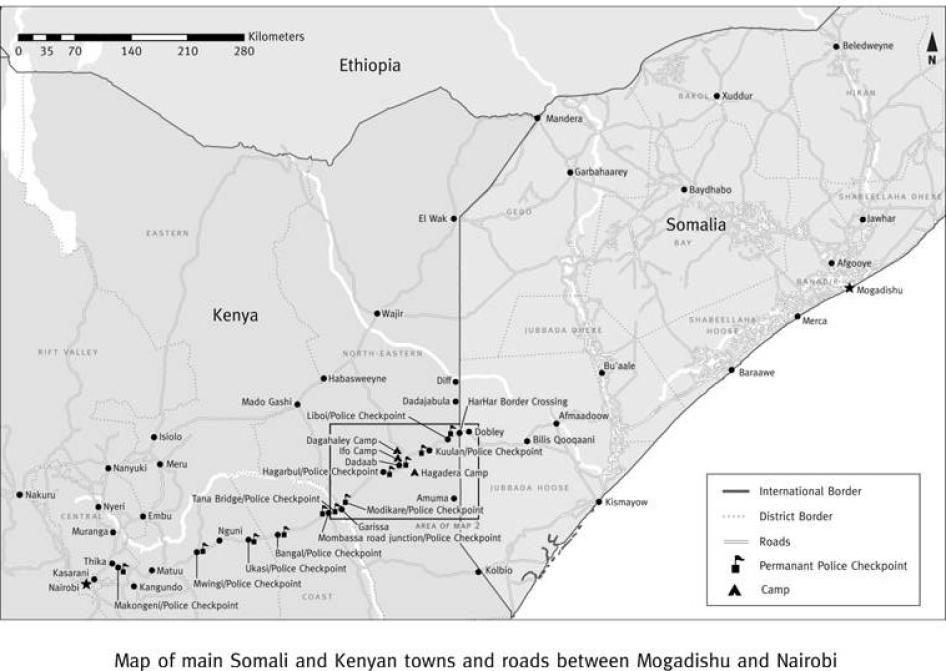
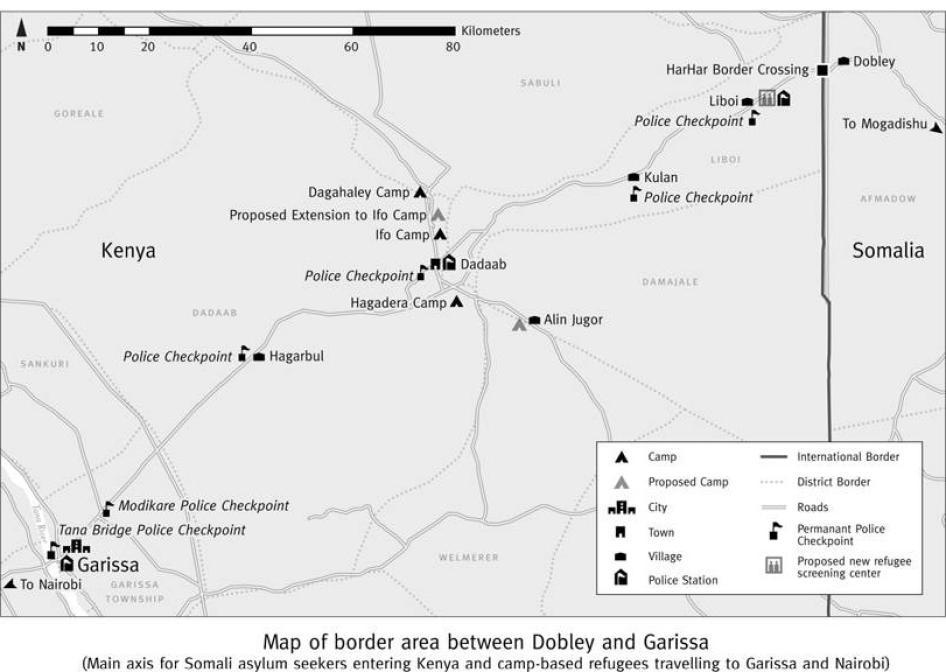
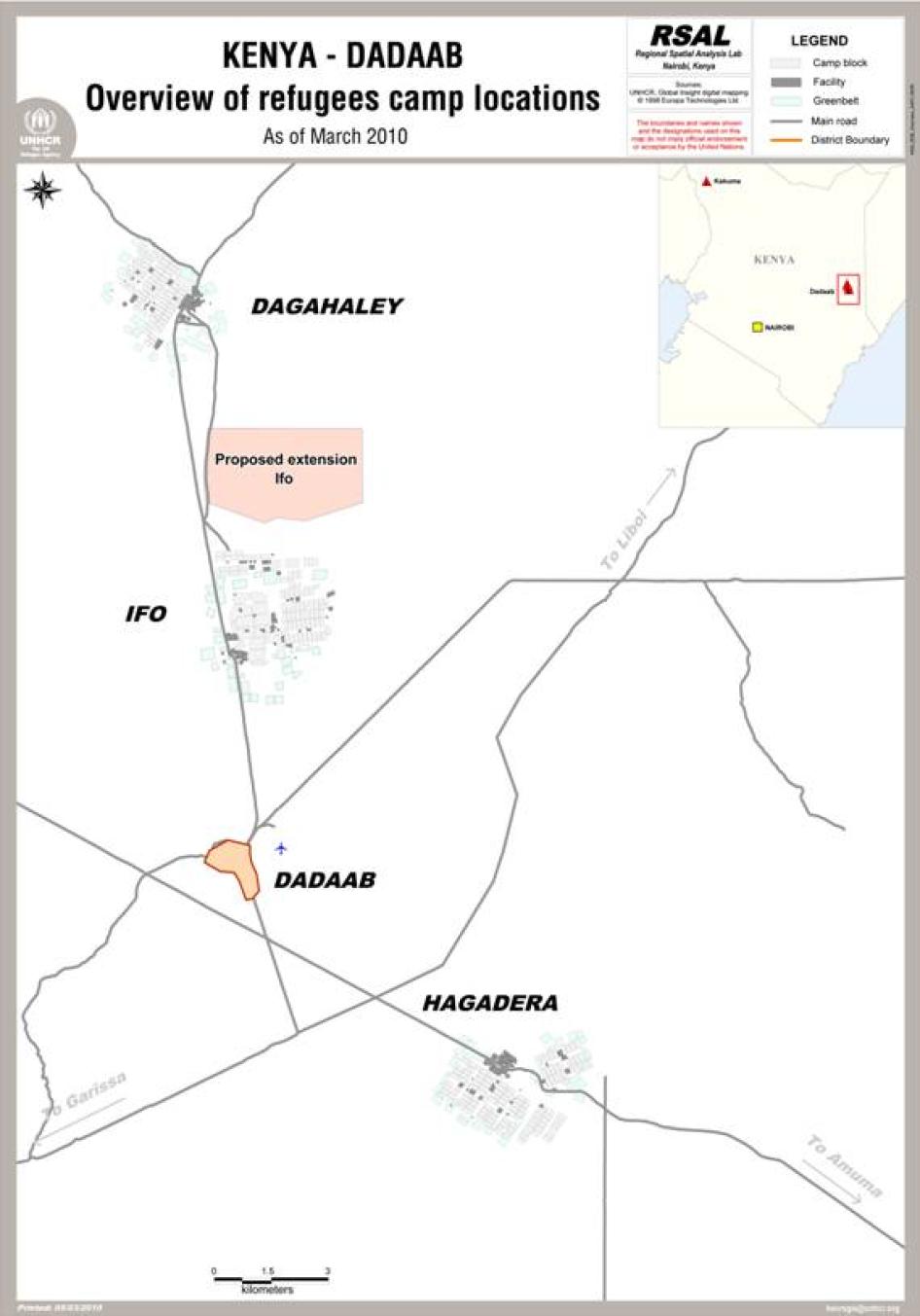
Maps
Kenyan police wearing green uniforms in three cars stopped us a few kilometers before Liboi. The driver talked to them in a language I did not understand, but some of the other passengers understood and said they were the police. At one point they said to the driver, “All men here will be weighed and according to their weight they will give us money – and if they can’t pay, then give us the passengers.” Then they took the men, including my husband, away in a car, leaving the rest of us, seven women with several children. The police told us to get out of the bus. They put me and two women with children to one side. I was pregnant. Then four of them took the other women into the bush. They held us in the bush for three days. On the third day, two of the policemen brought the women back. We knew something bad had happened because they were walking slowly and limping. They had scratches, their clothes were torn, some were barefoot, and one woman had blood on the bottom half of her dress. One was crying. They all looked like they were in shock. They said the police had beaten them. The driver said he thought they had been raped because otherwise they would have also taken all the women and because they could have just beaten us all where we were, next to the bus. Later that day, the police brought back the men and allowed us to leave. The men said the police had beaten them and stolen their money. Human Rights Watch interview (1), Ifo camp, March 9, 2010. The police said, “You are all in trouble - everyone will be weighed.” The driver’s assistant said the police wanted us to pay them money so we could pass. Then some of the police took us eight men to Liboi police station. Others stayed behind with the women. The police held us for three days and two nights in a cell about 3m x 4m. They gave us no food or water. We had to use the cell floor as a toilet. On the second day six policemen tied our hands behind our backs and made us lie down on the floor. They searched our pockets. Some of us struggled and they kicked and punched us. They turned me around. Three of them beat my chest with their rifle butts and two stamped on my chest. Another put his boot on the side of my face. I still have problems breathing. On the third day we heard the police on the phone, discussing with the driver we had left in the bush. That evening they drove us back to the same spot where we had left the bus. The women, children, the driver, and his assistant were all there. We heard one of the officers tell the driver to give him money. Then they let us go. —Human Rights Watch interview (2), Ifo camp, March 9, 2010. Wife (interview 1) and husband (interview 2) were interviewed by two different researchers in different locations at the same time. |
Summary
“We were treated like animals in a truck.”
—Refugee detained at the Garissa police station, in Kenya’s North Eastern Province.
Kenya’s reputation for hospitality towards Somali refugees is turning sour. Two decades after they first started to flee the brutal conflict in their country, Kenya provides asylum to 325,000 registered Somali refugees—and probably an equal number who have not registered. No one doubts the weight of the burden. But the authorities’ increasing demonization of these refugees—80 percent of whom are women and children— as a national security threat has made them among the most vulnerable victims of Kenya’s notoriously corrupt and abusive police force.
Near Kenya’s officially closed border with Somalia, police have free rein to intercept as many as possible of the estimated 10,000 mostly Somali asylum seekers who cross the border every month with the help of people smugglers. Making no distinction between women, children, and men, police often use violence, unlawful detention in appalling overcrowded conditions, and threats of deportation to extort money from them. Some police officers rape women near the border. During the first ten weeks of 2010, hundreds, if not thousands, of Somali asylum seekers unable to pay were unlawfully sent back to Somalia.
The widespread threat of police interception and abuses forces most asylum seekers to travel on small paths away from the main road between the border and the refugee camps, where common criminals (often described by asylum seekers as "men not wearing uniform") also prey upon them, raping women and stealing the little they have.
About half of all Somalis fleeing to Kenya register in the world’s largest refugee settlement, made up of three overcrowded refugee camps near the town of Dadaab in north-east Kenya, now hosting almost 300,000 people. The other half make their way to Nairobi, Kenya’s capital, where very few are able to register as refugees due to the limited capacity of the government and the United Nations High Commissioner for Refugees (UNHCR). In the camps, police responsible for protecting refugees sometimes detain, assault, and extort money from them. Police have also failed to investigate cases of sexual violence between refugees, leading to a climate of impunity for those responsible.
Kenya currently unlawfully confines refugees to camps, denying them their freedom of movement and choice of residence, in contravention of the 1951 Refugee Convention, although thousands have also registered in Nairobi. Under this policy, police arrest refugees travelling without (and at times with) permission, extort money, and sometimes take them to court in Garissa where they are fined or sent to prison.
Only by handing over money to police—either when intercepted in the border areas, or while detained in the Liboi, Dadaab, and Garissa police stations—can refugees pay their way out of the abuse and intimidation.
The systematic and widespread nature of the extortion racket and related abuses by police officers are a direct result of Kenya’s three-year-old border closure and the related closure of a refugee transit center in the Kenyan town of Liboi, 15 kilometers from the border and 80 kilometers from the camps. The transit center previously served as a safe place where the vast majority of Somalis fleeing their country first sought refuge in Kenya and from where UNHCR transported them to the camps. Without it, police have turned the border closure to their advantage, setting up what in the words of a Kenyan who works with Somali refugees is “one big money-making machine.” Kenyan authorities’ increasingly anti-Somali political rhetoric, particularly after a Somali Islamist group’s threat to attack the capital, Nairobi, has helped justify the police’s abusive behavior against Somalis.
Police arresting newly arrived Somali asylum seekers incorrectly tell them they are unlawfully in Kenya and charge them with offenses under Kenya’s Immigration Act which prohibits entry into Kenya without documents and a visa. But the Act does not apply to asylum seekers who, under Kenya’s Refugee Act, have 30 days from the moment they enter the country to register as refugees with the authorities at the nearest office of the Kenyan Refugee Commissioner. For Somalis crossing overland from Somalia, that means the Dadaab camps.
International refugee and human rights law prohibit refoulement, the forcible return of refugees to persecution, of anyone to torture and, in Africa, of civilians to situations of generalized violence. Kenya has every right to regulate the presence of non-nationals on its territory and may therefore normally prevent certain people from entering or remaining in Kenya—including those viewed as a threat to its national security such as members of the Somali Islamist group al-Shabaab. But Kenya may not close its borders to asylum seekers and may not deport them, or registered refugees, back to Somalia.
The fact that police in the border areas allow intercepted asylum seekers to pay their way through checkpoints to reach the camps suggests that personal gain—not national security concerns—is the real reason police arrest, threaten, and falsely charge them with unlawful presence.
Although refugees are victims of police abuses in the border areas and the camps, they nonetheless rely on the police to protect them against crimes by private individuals, including the sexual violence against women and girls that has long plagued the camps and their surroundings. But women and girls who have suffered sexual violence describe an utterly inadequate police response to sexual violence.
The government maintains that police are instructed to conduct proper and timely investigations. However, survivors say their complaints are often ignored rather than investigated, at other times are put on hold while police ask them to produce evidence against the alleged perpetrator, or are abruptly dropped without explanation. In the rare event that the police arrest alleged attackers, survivors say that in most cases the police release them hours or days later and take no further action in investigating or prosecuting the offense. Many women say that alleged attackers have successfully bribed the police to prevent investigations from taking place or to secure their release if arrested.
Kenya’s international and regional human rights commitments oblige the authorities to prevent, investigate, prosecute, and punish violence against all women—including refugee women—in Kenya. There has been important progress in the police’s response to sexual violence during the camps’ nearly two-decade-long existence. Sexual and gender-based violence cases can be prosecuted in a mobile court in Dadaab town every month and the Dagahaley police station has a gender desk to handle these cases. Two more gender desks are planned for Ifo and Hagadera camps. However, the government has not put in place the required police numbers, training, and supervision. Consequently, justice for sexual violence survivors in the camps remains the exception and impunity for perpetrators the rule.
Over a period of six days in the Dadaab camps in March 2010, Human Rights Watch interviewed 102 refugees about police abuses and sexual violence in and around the camps. Half of the interviewees spoke about police abuses, including excessive force leading to death and miscarriages, rape, whipping, beatings, and kicking. Fifteen said the police had arrested and detained them—together with around 220 other people—soon after they had entered Kenya. Eight said that the police had deported them, and 152 others, back to Somalia after they had failed to pay the police money. Despite the limited time Human Rights Watch had to conduct research in the camps, this number suggests that the abuses documented in this report are systematic and widespread.
UNHCR has failed to put in place an effective monitoring system to collect information on the types of abuses documented in this report. The UN refugee agency says that a number of factors have affected its ability to carry out its protection mandate: security concerns that restrict its work in the camps, a lack of human resources and financial capacity, and the absorption of its time and resources in addressing the myriad needs relating to the humanitarian situation in the chronically overcrowded and underfunded camps.
In response to a Human Rights Watch letter to the Kenyan authorities with a summary of this report’s findings, the Minister of State for Provincial Administration and Internal Security informed Human Rights Watch on May 5, 2010, that “any unlawful action that may have been taken by a police officer is not a reflection of government policy.” He also said he had requested an investigating team to look into Human Rights Watch’s findings. The team is to prepare a report which the government “shall review … and test [in terms of] reliability.” In addition, the Minister said that “if any police officer is found guilty of having participated in such atrocities, appropriate action in accordance with the law shall be taken.” The team is made up of a Muslim cleric of Somali origin, two women representatives (a woman from the Dadaab area and a woman from a National Women’s Organization), a youth representative from Dadaab and a representative of the Refugee Consortium of Kenya. Human Rights Watch welcomes the Minister’s decision to set up an investigative team; but this is only a first step.
To help put an immediate end to the widespread abuses described in this report, the Kenyan authorities, UNHCR, and donor countries should take a number of urgent steps.
The Kenyan authorities should immediately instruct the police to end their systematic interception, detention, abuse, deportation, and extortion of asylum seekers crossing the border from Somalia and instruct them to allow asylum seekers to safely travel to the Dadaab refugee camps. The authorities should expedite their plans to open a new refugee screening center in Liboi to ensure the orderly registration of all newly arrived asylum seekers and allow all registered refugees in the camps to freely move throughout Kenya. The authorities should also introduce rigorous monitoring and supervision of police handling of sexual and gender-based violence in the camps by creating a national police task force on sexual violence against refugees in coordination with the National Commission on Gender and Development. Further, the police should ensure sufficient police capacity including through the stationing of female police officers to effectively prevent and respond to sexual violence.
UNHCR should swiftly introduce a new protection monitoring system in the camps to capture further information about abuses of the kind presented in this report and use such information to advocate on behalf of the victims and to prevent further abuses. UNHCR should frequently visit the Liboi, Dadaab, and Garissa police stations to monitor whether or not the police are unlawfully detaining asylum seekers and push for their release. UNHCR should also cooperate with the police in improving the police’s response to sexual violence, including by using UNHCR’s sexual violence data to develop a police patrolling program in the camps aimed at preventing sexual violence.
Donor governments should raise the abuses set out in this report with the Kenyan authorities and call on them to put an immediate end to these practices. They should call on the Kenyan authorities to ensure that all asylum seekers can access Kenyan territory to claim asylum and to expedite their plans to re-open the refugee screening center in Liboi. Donors should also push the authorities and UNHCR to ensure that newly-deployed police in the camps are specifically tasked with improving the police’s prevention of, and response to, sexual violence in the camps. Finally, donors should encourage UNHCR to carry out frequent monitoring in the Liboi, Dadaab, and Garissa police stations and fund UNHCR to set up a new protection monitoring system.
Key Recommendations
To the Government of Kenya
- The Police Commissioner should instruct the police to immediately
- end their violence against asylum seekers and refugees;
- stop arresting and detaining asylum seekers as they cross the border and to release those currently in detention;
- stop extorting money from asylum seekers as they attempt to reach the camps and from refugees as they leave the camps;
- cease all refoulement of Somali asylum seekers.
- Investigate officers accused of raping and assaulting asylum seekers and refugees in the border areas, in the Liboi and Garissa police stations, and in the Dadaab camps and both discipline and prosecute any officers against whom there is evidence of having committed such crimes.
- Ensure that the enforcement of policies aimed at protecting legitimate national security concerns do not prevent Somali and other asylum seekers from entering Kenya.
- Expedite plans to open a new refugee screening center in Liboi to ensure the orderly registration of all newly arrived asylum seekers crossing at or near the HarHar border point between Dobley and Liboi; allow UNHCR to assist Kenya’s Department of Refugee Affairs (DRA) in the registration of new arrivals.
- In line with Kenya’s international and constitutional legal obligations, ensure that all recognized refugees have full freedom of movement throughout Kenya.
- Institute rigorous monitoring and supervision of the police’s handling of sexual and gender-based violence in the camps by creating a national police task force on sexual violence against refugees that would work in coordination with the National Commission on Gender and Development.
- Ensure sufficient police resources to effectively prevent and respond to sexual violence in the camps, including by
- increasing the total number of male and female police officers;
- reducing the high turnover rate among police officers stationed in Dadaab, including by improving the living quarters for police;
- ensuring the long-term stationing in the camps of officers with expertise in responding to sexual and gender-based violence.
To UNHCR
- Introduce a new protection monitoring system in the camps to capture information about abuses such as those presented in this report; use the collected information to advocate on behalf of the victims and to prevent further abuses.
- Frequently visit the Liboi, Dadaab, and Garissa police stations to monitor whether police are unlawfully detaining asylum seekers; where such detention is found to be taking place, push for their immediate release.
- Frequently visit the police stations inside the camps to monitor the treatment of refugees detained there; document allegations and raise incidents of alleged abuse with the authorities.
- Publicly denounce refoulement whenever it is found to have occurred.
- Press the Kenyan authorities to expedite their plans to open a new refugee screening center in Liboi and to allow asylum seekers to freely travel using motorized transportation from the border to Liboi and from Liboi to the camps.
- Advocate for full freedom of movement for refugees, subject only to necessary and lawful restrictions, and work to expand and facilitate free movement of refugees to and from the camps.
- Continue cooperating with the police on improving the response to sexual violence, including by using UNHCR’s data on sexual violence reports in the development of a new police patrolling program in the camps aimed at preventing sexual violence.
- Enhance UNHCR’s monitoring of the police’s response to sexual and gender-based violence cases in the camps by recording arrest and forensic evidence collection rates.
- Raise concerns over Kenya’s police abuses of Somali asylum seekers and refugees at the 2010 meeting of UNHCR’s Executive Committee in Geneva.
To the African Commission on Human and Peoples’ Rights Special Rapporteur on Refugees, Asylum Seekers, IDPs and Migrants in Africa
- Call on Kenya to immediately end the abuses set out in this report and to discipline or charge any police officers found to be responsible.
- Call on Kenya to respect its international obligations to ensure that all asylum seekers can access Kenyan territory to claim asylum and can safely travel to the camps for registration.
- Request to visit the camps and issue a public report on the extent of abuses faced by asylum seekers and refugees travelling to and registered in the camps.
To Donor and Resettlement Governments Providing Support to UNHCR and to Kenya
- Raise the abuses set out in this report with the Kenyan authorities and call on them to put an immediate end to these practices.
- Call on the authorities and UNHCR to ensure that newly-deployed police in the camps are specifically tasked with improving the police’s prevention of, and response to, sexual violence in the camps.
- Call on the Kenyan authorities to respect their international obligations to ensure that all asylum seekers can access Kenyan territory to claim asylum.
- Call on the Kenyan authorities to expedite their plans to open a new refugee screening center in Liboi.
- Raise concerns over Kenya’s police abuses of Somali asylum seekers and refugees and asylum seekers at the 2010 meeting of UNHCR’s Executive Committee in Geneva.
- Encourage UNHCR to frequently carry out monitoring activities in the Liboi, Dadaab, and Garissa police stations.
- Fund UNHCR to set up a new protection monitoring system in line with the recommendations to UNHCR above.
Methodology
This report is based on research conducted in Kenya between March 1 and 18, 2010. It also includes information gathered in October 2008 during an earlier Human Rights Watch research mission.
In March 2010, Human Rights Watch conducted in-depth interviews with 102 Somali refugees (24 adult males, 74 adult females, two girls and two boys) in two of the three refugee camps (Dagahaley and Ifo) near Dadaab town in Kenya’s North Eastern Province. 46 interviews related to sexual violence and other abuses by police in the border areas near Liboi and in Liboi, in the camps, in Dadaab town, and in Garissa; two related to rape by unknown men in the border areas near Liboi; and 54 related to sexual violence among refugees and other private individuals in the camps and police inaction on related complaints.
Human Rights Watch worked with local contacts to identify refugees who had experienced Kenyan police abuses when entering Kenya, in the camps or on the road to Nairobi. Interviews with refugees in Dadaab’s camps were conducted individually in settings isolated from other refugees and lasted an average of 45 minutes. Three Human Rights Watch researchers (one male, two female) conducted the interviews. All interviews were conducted in English and Somali using male and female ethnic Somali interpreters of Kenyan nationality. Estimates of the dimensions of detention cells are based on interviewees’ comparisons with the size of the interview space.
In Dadaab town, Human Rights Watch conducted 14 interviews with staff from United Nations agencies and national and international non-governmental organizations (NGOs), as well as with a representative of the Department of Refugee Affairs (DRA). In Garissa, Human Rights Watch spoke with two individuals about police abuses there, with one NGO and with four officials. In Nairobi, Human Rights Watch conducted a further 12 interviews with staff from United Nations agencies and international NGOs, 5 interviews with staff from Kenyan NGOs, interviews with staff from six embassies and donor agencies based in Nairobi, and an interview with the DRA.
We use the term “asylum seeker” to refer to Somalis who cross the Kenyan border seeking to register as refugees in Kenya. We use the term “refugee” to refer to Somalis who have succeeded in registering. Kenyan law allows asylum seekers 30 days from the date they enter the country to register as refugees. UNHCR and the Kenyan authorities rapidly recognize Somalis who register in the camps as refugees on a prima facie basis, that is, based on their nationality group rather than after an individualized determination. Those registering with UNHCR in Nairobi must go through individualized refugee status determination procedures which as of March 2010 took an average of 18 months.
I. Border and Refugee Transit Center Closures: A Recipe for Police Abuses
Since 1988, hundreds of thousands of Somalis have fled the conflict in their country and tried to seek refuge in neighboring Kenya.[1] In 1991 camps were built to accommodate almost 100,000 refugees in Kenya’s North Eastern Province. Although the number of refugees has fluctuated over the years, most of the original refugee population remain in the camps, joined in the past few years by new influxes of refugees fleeing the recent escalation in the conflict. Since 2006, the number of mostly Somali[2] refugees living in appalling conditions in the overcrowded Dadaab has almost tripled to reach close to 300,000, of whom almost 80 percent are women and children.[3]
On January 3, 2007, as the conflict in Somalia worsened following the December 2006 Ethiopian intervention to oust the Union of Islamic Courts, the Kenyan government closed its border with Somalia, citing the deteriorating situation there.[4] Since then, it has progressively increased the number of police and military in the border areas. Nonetheless, in the last three and a half years, around 150,000 Somalis have succeeded in crossing the border and have registered in the camps.[5] By all accounts, a similar number of Somalis have traveled directly to Nairobi and other Kenyan cities.
The continued cross-border movement gives the impression that the border closure has not affected Somali asylum seekers’ ability to seek refuge in Kenya. The reality, however, is far less rosy. The closure—and that of a refugee transit center in the border town of Liboi—has created a lawless no man’s land in Kenya’s border areas near the camps. Ostensibly in the name of protecting Kenya’s security, police commit widespread abuses against newly arriving asylum seekers, including women, children, and infants and often openly accuse men of being “al-Qaeda,” “al-Shabaab,” and “terrorists.”[6]
Border Closure
“Some of the soldiers [who stopped us near the camps] shouted that we were al-Qaeda and terrorists.”
—Human Rights Watch interview with a 40-year-old Somali refugee, March 2010.
“As Kenya, we have not benefitted from the border closure because these people are still coming and it’s a game of hide and seek.”
—Human Rights Watch interview with the Principal Police Officer for North Eastern Province, March 2010.
Following the intervention of Ethiopian troops in support of the Transitional Federal Government of Somalia (TFG) in December 2006, the Kenyan authorities announced the closure of Kenya’s border with Somalia on January 3, 2007.[7] Referring to concerns that fighters from the Union of Islamic Courts and possibly al-Qaeda operatives might enter Kenya and endanger Kenya’s national security, and echoing statements by the US State Department,[8] Kenya’s then Foreign Minister Raphael Tuju said that Kenya was “not able to ascertain whether these people [Somali refugees] are genuine refugees or fighters and therefore it’s best that they remain in Somalia.”[9] The same day, Kenyan authorities deported 420 mostly women and children to Somalia.[10] National and international agencies condemned the border closure.[11]
Kenya has long had legitimate security fears stemming from the conflict in Somalia and its own experience of deadly terrorist acts.[12] Its concerns have intensified as the conflict has threatened to spill over the border: in November 2008 a Somali militia made an incursion into Kenya’s north eastern town of El Wak,[13] and in June 2009, the Somali insurgent group al-Shabaab began issuing threats against Kenya. “If … Kenya … attack[s] … al-Shabaab…we will attack Kenya and destroy the tall buildings of Nairobi,” said one such statement.[14]
Since 2007, Kenya has increased the number of police and soldiers patrolling the Kenya-Somali border.[15] In June 2009, Kenya sent a number of General Service Units (GSUs) there.[16]
While Kenya’s security concerns are real, the crisis in Somalia has exacerbated longstanding tensions and hostility towards the country’s own sizeable ethnic Somali community as well as the refugee population.[17] For more than twenty years, Kenyan government attitudes towards the Somali refugee community have been dominated by security, rather than humanitarian, concerns.[18] This hostility is not limited to refugees, however. A joint military-police disarmament operation among ethnic Somali communities in Northeast Province’s Mandera region in late 2008 resulted in the death of one man and pervasive torture and beatings of hundreds of Kenyan Somalis.[19] And Kenyan police have for decades routinely conducted sweeps in Nairobi’s Eastleigh neighborhood—home to large numbers of Kenyan Somalis and Somali refugees— demanding bribes, issuing threats, and sometimes violently assaulting individuals.[20]
In one of the most recent such crackdowns, in January 2010, Kenyan police carried out a massive police operation against Somalis living in Eastleigh a few days after large numbers of Kenyan ethnic Somalis and Somali nationals demonstrated in central Nairobi against the deportation of a Jamaican cleric.[21] Some demonstrators reportedly carried flags in support of al-Shabaab.[22] Two days after the Nairobi demonstrations, the police arrested, detained, and deported hundreds of Somalis.[23]
In March 2010, the Provincial Commissioner for North Eastern Province—where the Dadaab camps are located—told Human Rights Watch, “If there is a terror attack in Nairobi, it will be very difficult for all refugees in Kenya,” implying that all Somali refugees would be punished in some way if al-Shabaab attacked the capital.[24]
Despite the closure and increased policing on the border, between January 1, 2007 and April 30, 2010, a little over 140,000 Somali refugees entered Kenya—the vast majority with the help of smugglers—and registered at the Dadaab camps, reflecting the fact that Kenya’s 682-kilometer border with Somalia is porous.[25] In March 2010, Kenya’s Department of Refugee Affairs (DRA) told Human Rights Watch it believed a comparable number had traveled from Somalia directly to Nairobi.[26] In June 2008, Kenya’s immigration minister publicly declared that “the border closure has not achieved what it was intended for.”[27]
The increased tension around a possible al-Shabaab attack and the related anti-Somali sentiment among some Kenyan authorities appears to have led to an approach among Kenyan police that equates all Somali refugees with possible security threats against Kenya. A number of refugees in the camps told Human Rights Watch that police (and in one case soldiers) detaining them repeatedly accused them of belonging to al-Qaeda or al-Shabaab or simply of being “terrorists,” in some cases repeatedly beating them while making such accusations.[28] According to a lawyer working with Somalis in Nairobi, a senior police officer at the Kasarani police station in Nairobi told him after the Sunday January 17, 2010 police sweep against Somalis in Nairobi that “all Somali refugees are related to al-Shabaab.”[29]
NGO workers in the Dadaab camps and Garissa and a senior official in Garissa told Human Rights Watch that the effect of the increased anti-Somali sentiment in Kenya’s political discourse means that even organizations that traditionally speak out on behalf of Somali refugees feel they have to censor themselves and avoid making statements calling for the respect of the rights of Somalis in Kenya.[30]
Closure of the Liboi Refugee Transit Center
Humanitarian workers and Kenyans with a good knowledge of the Kenya-Somali border say that since 2007 the vast majority of Somali asylum seekers have entered Kenya at the HarHar border crossing, 15 kilometers from the Kenyan border town of Liboi.[31] When closing the border, the authorities also closed a UNHCR-run refugee transit center in Liboi where UNHCR registered newly-arrived asylum seekers.[32] Some walked from HarHar to Liboi, and others were picked up at HarHar by UNHCR trucks and driven to the center. After completing registration and health-screening,[33] UNHCR transported refugees to the camps, 80 kilometers away, where they were directed to their plots of land.[34]
Although the Kenyan authorities knew they could not prevent Somali refugees from crossing the porous border, they sought to portray an image of sovereign control in the face of the perceived Islamist threats to Kenya’s security.[35] In their view, the existence of a center welcoming refugees so close to an officially closed border sent a contradictory message.[36]
The closure of the refugee transit center in Liboi has greatly increased the vulnerability of asylum seekers travelling from the border to the camps. Asylum seekers can no longer rely on the safe passage to the camps previously guaranteed by UNHCR’s presence in Liboi. Instead, they have been forced to use smugglers to dodge corrupt and abusive Kenyan police officers between the border at HarHar and the camps.[37]
Between February 20 and March 7, 2010, the District Officer (DO) in Liboi requested UNHCR three times to collect hundreds of newly-arrived asylum seekers in Liboi who had taken refuge near the closed transit center, at the District Officer’s compound, and on the old Liboi airstrip.[38] His requests coincided with the arrival in Liboi of hundreds of villagers from the Somali border town of Dobley who were fleeing four weeks of clashes between al-Shabaab and another Islamic insurgent group, Hizb al-Islam.[39] UNHCR made three trips and brought 700 asylum seekers to the camps for registration.[40] During the same period, an additional 2,000 asylum seekers registered as refugees in the camps, the vast majority almost certainly passing through Liboi or the nearby bush and making their own way to the camps.[41]
Absent a transit center in Liboi, in early March 2010 UNHCR proposed to the Kenyan authorities that a sealed corridor be created between Liboi and Dadaab to ensure that anyone crossing the border in Liboi is taken to the camps and does not travel onwards to Garissa and Nairobi.[42] Under this proposal, officials in Liboi would screen and give newly arrived asylum seekers passes authorizing them to travel to the camp; the authorities would re-open the officially-closed public bus route running from Liboi to Garissa via Dadaab (although buses continued to operate throughout 2009 and early 2010[43]); and if necessary, police officers could travel on the buses to ensure that newly arrived asylum seekers get off at the camps and do not travel onward to Garissa and Nairobi.[44] UNHCR also says it has been working on giving a truck to the DRA for its work in Liboi so that the authorities can deal with the effect of the transit center closure.[45]
Possible Opening of a New Refugee Screening Center in Liboi
Despite public calls since 2008 by Kenya’s own Department of Refugee Affairs to re-open the transit center, until March 2010, there was no progress on this issue.[46] However, in May the Minister wrote to Human Rights Watch confirming that a “security programme … will soon be put in place in collaboration with UNHCR that will ensure all refugees are screened before registration and relocation to camps. The site for the construction of the screening centre along the border has already been identified at Liboi and an MOU to that effect is being worked on and will soon be signed.”[47]
In September 2009, UNHCR submitted a “Security Partnership Project” proposal to the authorities under which 360 extra police officers would work in the camps (up from 130) and under which a registration and screening center for newly arriving asylum seekers would be established, although the proposal does not say where the center would be located.[48]
The presence of an increased number of trained and disciplined police officers in the camps is a much-needed improvement for refugees’ security (see below, Chapter V), but there are at least three reasons why increasing the number of police in the camps before a new screening center is set up in Liboi would likely lead to negative consequences for asylum seekers in the border areas. First, it would encourage new police officers in the camps to leave their duty stations (as is currently the case) and travel to the border where they could more easily extort refugees as they enter Kenya compared to doing so in the camps. Second, it would likely also lead to more police intercepting asylum seekers—and detaining and extorting them—on the very edge of the camps as they arrive there for the first time, a phenomenon Human Rights Watch documented in late 2008.[49] Finally, in the absence of a screening center at the border—which would seek in part to identify people posing a security threat to Kenya—officers in the camps would likely focus mainly on identifying such people instead of carrying out basic community policing duties on behalf of the refugees.
II. Police Abuses against Asylum Seekers near the Dadaab Refugee Camps
“The border closure is one big money-making machine.”
—International NGO staffer, Nairobi, March 3, 2010.
“The Kenyan police call Somalis ‘mbuzi’ – goats – because goats are valuable.”
—Person working with Somalis in Garissa, March 13, 2010.
The border and transit center closure has created the opportunity for Kenyan police operating in the border areas near Dadaab to intercept and extort money from newly arriving asylum seekers and to unlawfully arrest, detain, abuse—and in some cases deport—those who do not pay. Many police officers have willingly and systematically seized the opportunity. Some rape asylum seekers as they cross into Kenya and large numbers of Somalis face unlawful arrest and days and even weeks of arbitrary detention in inhuman and degrading conditions in the Liboi, Dadaab, and Garissa police stations.
Following Human Rights Watch’s reporting on similar abuses taking place in 2008, UNHCR raised the apparent increase in abuses with the Kenyan authorities “at the highest level” in January 2009.[50] The findings set out in this report suggest that the authorities have taken no action to end the abuses.
Under the Kenyan Constitution, which reflects key provisions of international human rights treaties to which Kenya is party, including the International Covenant on Civil and Political Rights,[51] all people in Kenya, including refugees and asylum seekers, are entitled to protection of their property,[52] freedom from arbitrary arrest and detention,[53] and freedom from all forms of inhuman and degrading treatment or punishment.[54]
Extortion and Violence in the Border Areas
Police stationed in the immediate Liboi border area and along the road running to Dadaab and Garissa systematically stop and extort money from thousands of Somali asylum seekers who cross the border in vehicles with the help of smugglers.[55] In some cases, police then rape women and assault men. When Human Rights Watch reported on such abuses in March 2009, a senior DRA official admitted that security forces might cause problems for asylum seekers arriving from Somalia because those forces did “not understand the implications of such actions.”[56] Based on Human Rights Watch’s most recent findings, the Kenyan authorities appear have taken no action to help Kenya’s police officers to better understand the implications of their abuses.
Police Extortion in the Border Areas near Liboi
Human Rights Watch spoke to dozens of Somali refugees who described how police patrolling the border areas near Liboi had stopped their vehicles—carrying an average of around 25 women, children, and men—to extort money from them in exchange for free passage to the camps.[57] Refugees told Human Rights Watch that police sometimes held young children hostage to force their parents to pay money to secure their release.
Many people living and working in Liboi, Dadaab, and Garissa told Human Rights Watch that in their view the police—who, in the words of more than one interviewee, had become (Kenyan Shilling) “millionaires overnight”—were the only beneficiaries of Kenya’s border closure. This echoes views expressed in a public meeting in Garissa in the summer of 2009 during which Garissa community representatives said they felt ashamed that the police were constructing new buildings (homes and for business) in Garissa using the money they were making from their extortion of Somali refugees and asylum seekers.[58]
A driver working in the border areas told Human Rights Watch:
I used to drive from Dobley to the camps about three times a week. Until around July 2009 we never had any problems because every time we met the police, whom we knew well, we paid them money to pass. But in August, there was a big deployment of police and soldiers. The soldiers don’t ask for money and just take people to the Dadaab police station, but the new police officers ask for very large amounts of money to let people pass.[59]
Human Rights Watch spoke to many refugees who had faced extortion on the way to the camps in 2008, 2009, and 2010. The following are just two examples.
A 28-year-old woman from Mogadishu entered Kenya near Liboi with her six children on New Year’s Day 2009, traveling in a convoy of three vehicles. Shortly after crossing the border at dusk, her vehicle broke down. Soon after, policemen approached. The other two vehicles drove off, and she fled into the bush with other passengers and some of her children:
We started running because in Mogadishu we heard about Kenyan police raping Somali women near the border. I fled with two of my children—my new-born baby and my three year-old—and left my other children behind: my physically handicapped seven-year-old daughter and the three others, aged 12, eight, and six. I found my way back to the road and a vehicle picked us up and took us to the camps that same night.
In the morning I called the driver on his phone. He said the police were holding my children and the other passengers and that they would send them back to Somalia if we did not pay them KES 10,000 ($133). He said that all the passengers who had reached the camps should collect the money and give it to one of the drivers of the other two vehicles that had escaped. Once he had delivered the money they would release the car and the passengers. We paid the money and the police released everyone and the car. My children arrived in the camp later the same day.[60]
A 20-year-old man whose leg was blown off by a mortar that landed near his home in Mogadishu in 2006 said:
I crossed the border in a minibus near Liboi at the end of February [2010]. Three Kenyan policemen arrested all of us—four women, seven children, and four men—and walked us around Liboi from 7 in the evening until 2 in the morning until we agreed to pay them KES 3,100 ($41) so that we could continue to the camps. Then they stole our mobile phones and let us go.[61]
Police Violence in the Border Areas near Liboi
Human Rights Watch spoke with a number of refugees who said that police in the border areas near Liboi had assaulted them after stopping their vehicle to extort money from them. Two women said they had been raped, one said she had seen police take away other women who were almost certainly raped, and a number of male refugees said that the police had separated men from the women and children and had taken the men away while leaving the women behind with police officers. Others said that they and their fellow passengers were assaulted with rifle butts, kicked, beaten, and slapped by Kenyan police. In one case, soldiers shot at a moving minibus driving through the bush, killing a young man on board.
Rape and separation of men and women
Human Rights Watch spoke with two women who said police officers had raped them after stopping their vehicles in the border areas.[62] Other refugees said the police separated men and women and children, with some officers driving the men to the Liboi police station and others remaining behind with the women and children.
A married Somali woman with four children, including a 12-day-old baby entered Kenya near Liboi around February 15, 2010 on foot, together with around 25 men, women, and children:
Suddenly we saw ten Kenyan police officers. They had long guns and were wearing green uniforms. When they saw us they shot in the air. Everybody started running, but I had my baby so I could not run. Three of them stopped me. I told them I had a 12-day-old baby and asked them to leave me alone. They ignored me and one of them kicked me on the right side. I fell over with my baby. Then he raped me, with my baby on the ground close by. Then one of the other two men raped me. The third man stood close by. When they finished, they let me go. I grabbed my baby and ran after the others.[63]
A 35-year-old woman who traveled directly from Mogadishu to Liboi in February 2010 in a vehicle with five men, five children, and three women told Human Rights Watch:
It was night time when the driver stopped the car and said, “This is Liboi.” Suddenly, around 10 men approached the car. They were wearing uniforms and black boots and the same belts. They had small guns. The driver said they were “officers.” We did not know the language they were speaking but the driver understood them. They told us to get out of the vehicle. They pushed the women to one side and the men and children to another. Then they gestured at us women to move. They slapped us and hit us with the guns and shouted at us. Four of them took the three of us away. When we stopped we could still hear the faint cries of the children. Then all four men raped each one of us. They also beat us. They kicked me in the stomach and back and on the head. While they raped me they held me in a choke position. I can’t remember how long it took because I was in so much pain. When it was over, they took everything we had—money and some food—and left us. We walked back to the car. The other officers had left. The men told us the officers had beaten and robbed them. Then we drove to the camp.[64]
Three male refugees told Human Rights Watch that when the police stopped their vehicles in the border area they separated the men from the women and children and took the men to the Liboi police station.[65] In all these cases, the men did not know what happened to the women and children. In one of the cases, a 21-year-old man traveling with his wife and one-year-old baby boy said that when the police stopped them at the end of February 2010 on the road to Dadaab south of Liboi, they told the men and single women to get off the vehicle and pregnant women and women with children to stay on the vehicle. Then half of the police officers took the men to the Liboi police station while the other half stayed with the women and children.[66]
Shooting and other violence
A number of refugees told Human Rights Watch that police officers stopped their vehicles in the border areas and assaulted them or that soldiers fired on their vehicles.
A 20-year-old woman who entered Kenya near Liboi with 20 other adults and some children on a pick-up truck in August or September 2009 said:
Just after the driver said we were near Liboi, three Kenyan policemen stopped us and shouted, “Go back to where you came from.” The driver said, “Give them money, otherwise they will take us to jail.” The policemen went to the back of the truck and slapped and hit some of the others with the butts of their guns, telling them to get off. Everyone got off, but I stayed sitting in the front because I was sick. A policeman searched my pockets. Then he hit me in my stomach about two or three times using the butt of his gun and punched me on my thighs and back. Then he stole KES 5,000 ($67) from me. The policemen took the other passengers’ money and then all of them kicked, hit, and slapped them for about five minutes. Then they left us.[67]
Human Rights Watch spoke to a Kenyan minibus driver based in Garissa, who had worked for most of 2008 and 2009 in the border areas between Dobley and the Dadaab camps, but who had stopped because of increased police violence there. He said:
I stopped driving in September 2009 when one night the police stopped the bus three times. Each time they used sticks to beat the men all over, including their heads, and shouted at them, saying they were al-Shabaab and that they had illegally entered Kenya because the border was closed. In one of the places, they also poured hot tea over my assistant’s head.[68]
A woman who crossed into Kenya on January 15, 2010 together with 19 other women in a pick-up truck witnessed Kenyan police in Liboi whip one of the other women:
Five policemen stopped the truck near the Liboi police station. The other women told me that we had to give the police money so we could continue. I gave them everything I had—KES 5,000 ($67)—and the other women also gave the police money. But one woman didn’t have any so the police tugged at her clothes and then whipped her once with a belt on her back and threatened to put her in prison. The driver pleaded with the police to let her go and they let us continue our journey.[69]
Human Rights Watch spoke with a 20-year-old man who crossed the border around February 15, 2010 in a vehicle with 20 women, children, and men. Soldiers patrolling the border area fired shots at the vehicle, killing a man on board:
We crossed the border at around dusk. Soon after we heard shots and the driver accelerated. After a few minutes the bus stopped and I saw that a man who was about 25 years old and sitting in front of me had been shot through the chest. No one else was hit or injured. The man died about 30 minutes later. Just after we stopped, two military vehicles with soldiers arrived. They talked to the driver for about one hour before some of us, including me, were taken to the Liboi police station while other passengers stayed behind. The next morning the police forced everyone in my group back to Somalia.[70]
UNHCR says that in 2009, police also shot and injured a man when they opened fire on a vehicle that failed to stop at a police roadblock.[71]
Unlawful Arrest and Detention of Asylum Seekers and Abusive and Inhumane Conditions of Detention
“In the Garissa police cell, there were so many of us, we could not even sit at night. People complained of being in pain because they could not move. We were like animals in a truck.”
—Human Rights Watch interview with a Somali refugee in Garissa, March 13, 2010.
Police in the border area between Liboi and the camps arrest Somali asylum seekers, usually after they have failed to hand over money.
Refugees told Human Rights Watch that police told them they were under arrest because they had “illegally entered Kenya” or were “illegally in Kenya.”[72] UNHCR confirms that police often arrest asylum seekers intercepted in the border areas and charge them with illegal presence.[73] Kenya’s Immigration Act does prohibit entry into Kenya without a permit, an offense punishable by a fine of up to KES 20,000 (approximately $300) or one year’s imprisonment.[74] However, the Act does not apply to asylum seekers. Under the Refugees Act, asylum seekers have a right to freely enter Kenya and travel within 30 days to claim asylum at the nearest office of Kenya’s Refugee Commissioner.[75] This right applies regardless of whether they have entered Kenya through an official border crossing point or whether they are in possession of identity documentation or a permit to enter Kenya.[76] If police stop a Somali national entering Kenya without a permit, they may only arrest and detain that person if he or she does not wish to claim asylum.
Every refugee Human Rights Watch interviewed about their arrest between the border and camps said that they had told the police they were fleeing violence in Somalia and were trying to reach the refugee camps, but that the police ignored their requests for asylum.
Human Rights Watch asked the Provincial Police Officer in Garissa whether he was aware that his police officers were routinely and unlawfully arresting scores of asylum seekers. He said that no such arrests were taking place. He then added, “If a person is here unlawfully, the law should take its course,” but that if “they surrender to the police station as soon as they arrive, then we cannot arrest them.”[77]
On May 5, 2010, the Minister of State for Provincial Administration and Internal Security informed Human Rights Watch that “the number of refugees from Somalia who have settled in Dadaab camps, who are currently estimated to be over 270,000, is testimony that we do not arbitrarily and unlawfully arrest and detain them in our police cells.”[78] But many of the refugees interviewed by Human Rights Watch said they were first arrested and detained by the police before being released and allowed to register in the camps. The number of camp residents therefore has no bearing on whether they were unlawfully arrested and detained before they registered in the camps.
Asylum seekers unlawfully arrested in the border areas are arbitrarily detained for around four days and nights in the Liboi police station in inhumane conditions where at times they face police violence. If they give in to further extortion at the police station and pay bribes, they are released and can proceed to the camps. If they do not pay, they are unlawfully returned to Somalia or transferred to Dadaab and/or Garissa police stations where they are arbitrarily detained in equally inhumane conditions for days or even weeks at a time. In Garissa they are incorrectly charged with being unlawfully present in Kenya and face further extortion, including after the Garissa court has ordered their immediate release. The aim of charging asylum seekers in Garissa, and the related prolonged detention, appears to be to extort as much money as possible from detainees, using middle men to contact and pressure their relatives in Garissa and Nairobi to pay money to secure their detained relatives’ release.
The Liboi Police Station
Asylum seekers arrested in the border areas who are unable to give police money and who are not immediately deported to Somalia are taken to Liboi police station where they face days of further extortion, detention in inhumane conditions, and ill-treatment.
A number of refugees told Human Rights Watch that police kicked, punched, slapped, and stamped on them and used sticks to assault them.
A 21-year-old man who crossed into Kenya near Liboi at the end of February 2010 was intercepted by police south of Liboi. Five police officers took him and eight other men to the Liboi police station where they were detained in a 4m x 4m cell for five days:
They asked us for money and said that if we didn’t pay, they would beat us. All of us said we had no money, but the police found one man had $150 and took it from him. Then four policemen kicked, punched, and slapped us. For a few minutes, they slapped my face, punched me in the sides, and kicked my legs. They did the same to us every morning of the five days we were detained there and each time they asked us for money. They released us on the sixth day after a Liboi businessman paid the police KES 4,000 ($53).[79]
Echoing many other refugees who told Human Rights Watch that police officers called them “al-Shabaab” or “terrorists,” a 20-year-old refugee—traveling with 18 other people who the police intercepted on the main road between the border and Liboi in February 2010—said:
The police took all of us to the Liboi police station and held us there for seven days. They said that if we each paid KES 10,000 ($133), they would release us and that if we did not pay they would take us to the Garissa court. No one could pay. For the first four days the police came into the cell twice a day and beat the legs of the four young in our group with sticks, saying they were al-Shabaab. They also slapped them in the face. After around four days, four of the men in our group paid about KES 7,000 ($93) each and were released. The rest of us couldn’t pay so we stayed another four days, but at least the beatings stopped.[80]
Asylum seekers are usually held in Liboi for about four days and nights in appalling conditions before being released (if they can pay bribes), or (if they can’t pay) returned to Somalia, or transferred to Dadaab and/or Garissa. Women, girls, and boys under the age of 10 and men and boys over the age of 10 are separated and held in groups of around 15 people in poorly ventilated and extremely hot 3m x 3m or 4m cells. Most refugees said they received no, or almost no, food and water and that they often depended on charitable Liboi locals for both. Some said they were not allowed to use the toilet and had to use the cell floor to urinate and defecate. Others said they were allowed to use a toilet after hours of pleading. Some said they were freed when locals paid police bribes and others said the police stole all their belongings.[81]
Typical of many refugees who told Human Rights Watch of the inhuman and degrading conditions in Liboi was a 20-year-old man from Mogadishu who was arrested near Liboi around February 22, 2010:
They put us 19 men in one very small cell for four nights. The cell was about 3m x 3m and there were three other men in there already. We couldn’t sit down; it was so small. There was very little air, only a small opening near the ceiling, so it was very hot. We were so stressed we could not sleep at night. We had to beg the police to allow us to go to the toilet. Usually after an hour or two of pleading, they let us go. They only gave us one glass of water a day and a little ugali [African porridge made of cornmeal] at lunch so we were always thirsty and hungry. They released us after the elders in Liboi paid the police KES 6,000 ($80) to have us released.[82]
UNHCR says that, despite continued security concerns for UNHCR staff, between January 2009 and end April 2010 it has undertaken 21 “protection border monitoring visits” to Liboi and that it has a “focal person to assess the conduct of government officials at the border.” UNHCR says that this has improved asylum seekers access to asylum procedures, including through pressing the police in Liboi to release asylum seekers so that they can travel to the camps for registration.[83]
The Dadaab Police Station
Asylum seekers who are transferred from Liboi to Garissa are held for between one and four days and nights at one or both of the police stations in Dadaab town (where UNHCR and other aid agencies are based). Human Rights Watch spoke with many refugees who had been detained in Dadaab in small, poorly ventilated, and overcrowded cells (3m or 4m x 3m holding around 15 people) with very little water and little, if any, food. Some were allowed to leave to access the toilet and others said there was one bucket in the cell.
A 31-year-old man told Human Rights Watch how he and 30 other people—10 women, 5 children, 15 men—with whom he was travelling were intercepted and arrested just before they reached the camps on March 6, 2010. The police took all of them to the Dadaab police station where they were held for two days before the police transferred them to Garissa:
They put me in a cell with the other 15 men. They put the women and children in a separate cell. They gave us no food or water. Our cell was about 3m x 4m and there were already ten men there when we got there. It was so full that even standing up we could hardly move. The police did not allow us to leave the cell to go to the toilet so we had to use the floor. Before we left, they forced us to leave all our belongings behind—everything we had brought from Somalia—and we never saw them again.[84]
In another case, a refugee registered in the camps was expecting his six-month pregnant wife, their one-year-old son, and four-year-old deaf daughter to join him from Mogadishu in February 2010, only to find that they had all been arrested and detained in Dadaab. The same man said that, while he was in the police station pleading with the police to be allowed to see his wife, he saw a heavily pregnant Somali woman stumble out of the cell and vomit after complaining about the heat and stench in the cell.[85]
UNHCR says that its officials “regularly visit” the Dadaab police station “to maintain relationships with the police and, most importantly, to ensure that arrested refugees and asylum seekers are treated in accordance with applicable national and international law and to ensure their immediate release if the detention has no legal basis.”[86] Nevertheless, the ongoing detention of asylum seekers in appalling conditions at the Dadaab police station indicates that UNHCR needs to significantly improve its monitoring and advocacy efforts to ensure that the authorities do indeed treat asylum seekers in accordance with applicable laws.
The Garissa Police Station and Magistrates’ Court
If the police at the Liboi police station or in Dadaab fail to extort money from unlawfully arrested asylum seekers in the border areas, the police at the Garissa police station use further detention—coupled with the threat of court proceedings and imprisonment—to try one last time to do so. Police even detain asylum seekers for up to two weeks after the Garissa Magistrates’ Court has ordered their release. Many asylum seekers give in to the extortion and contact relatives in Garissa or Nairobi to pay the police tens of thousands of Kenyan Shillings (hundreds of dollars) to secure their release.
According to people living and working in Garissa, the police first started detaining large numbers of asylum seekers at the Garissa police station in March 2008, after the first large increase in new arrivals of Somalis since the mid 1990s.[87] According to numerous asylum seekers and people working and living in Garissa, the two small cells in Garissa police station are constantly full of detained Somali asylum seekers including large numbers of children and infants.[88] A local community leader who visits the police station at least twice a week told Human Rights Watch:
Everyone knows that in Garissa the police cells are always full of Somalis and that the police take bribes from everyone in the police station. At one point in February [2010], I counted as the police took everyone to court. They were all Somalis and I counted 97 people—men, women, and children.[89]
Most asylum seekers detained in Garissa police station told Human Rights Watch that the police arrested them in the border areas near Liboi or between Dadaab and Garissa before taking them to court in Garissa.[90]
Some asylum seekers bribe their way out of detention before their case goes to court. According to NGO staff and others working in Garissa, police bribes at the Garissa police station range from KES 20,000 ($266) to 50,000 ($666).[91]
Most asylum seekers pay with the help of relatives in Garissa or Nairobi who pay middle men acting as brokers between the police and detainees’ relatives, either directly in cash or through wire transfers.[92] Others go to court where at least one of the magistrates usually dismisses their case because newly arrived asylum seekers cannot be charged with unlawful entry or presence.[93]
Unaware of the law—and of the fact that they were being incorrectly charged with offenses under the Immigration Act that did not apply to them—a number of refugees told Human Rights Watch that they paid bribes to the court’s clerks who told them that paying a bribe would encourage the magistrate to dismiss the case.[94] In other cases, refugees and their relatives pay the clerks money to secure their immediate release after the court has fined them. One refugee said that after the magistrate had fined him KES 10,000 ($133) on around March 7, 2010 for being unlawfully present in Kenya as a newly arrived asylum seeker, the clerks told his relatives that if they paid another KES 10,000 he would be immediately released from custody but if not, he would be detained for three days at the Garissa police station.[95] This case indicates considerable collaboration between the court’s clerks and police based in the Garissa police station.
Refugees say they are usually detained for three days before appearing in court, followed by another three days after the court has dismissed their case while waiting for a UNHCR or police truck to take them to the camps. Two people with close knowledge of the situation said that sometimes asylum seekers are detained for two weeks after magistrates have ordered their release, pending UNHCR transportation to the camps. UNHCR does not have protection monitors working in Garissa which means that until February or March 2010, UNHCR waited for the police to contact—and request trucks from—them in Dadaab to collect up to 60 asylum seekers at time. Local NGOs and lawyers claim that Garissa police further extort asylum seekers even after the court has ordered their release, until newly arrested asylum seekers are brought to the police station. At that point the police call UNHCR to help empty the cells to make way for the newly arrested arrivals.[96]
On March 10, 2010, UNHCR said it had “recently” stopped trucking people from Garissa to the camps and that it had “told the police that arresting asylum seekers was against the law, so they have to deal with it [returning them to the camps once the Garissa court has ordered their release].”[97] UNHCR added that since the change of policy, it was giving fuel to the police to truck asylum seekers back to the camps.[98] UNHCR does not interview asylum seekers returned to the camps from Garissa about their experiences during their arrest and detention in the border areas and Garissa, but it does keep a lists of their names on file.[99]
Detention conditions in Garissa are even worse than in the Liboi and Dadaab police stations. Twenty to 50 detainees, including infants and children, are crammed into cells between 2m x 4m and 3m x 5m in size. At times police provide small amounts of food and water and at others detainees eat nothing or depend on relatives in Garissa. Refugees said that they were not allowed to use toilets and had to use buckets or the floor.[100]
Human Rights Watch spoke with Garissa’s mayor, who says he regularly visits the Garissa police station:
The conditions there are terrible – the stench, the mothers clinging to their babies. It is always packed full of people. I have raised this with the Provincial Police Officer, but nothing has changed.[101]
A 32-year-old woman from Mogadishu was detained at Garissa police station in December 2009. She was eight months pregnant and had a still-birth, apparently as a result of rough police treatment, overcrowding, and poor conditions in the cell:
A policeman slapped me when I refused to enter the cell. Three policemen forced me and others behind me into the cell which was about 4m x 2m. There were at least 12 women in there and it was full. As they pushed me in, I fell over and other people being pushed in behind me stumbled and stepped on my back. I felt a sharp pain in my belly during the four days I was in the cell. There were no windows and hardly any air and it was very hot. It was so full we could not lie down to sleep, so we had to stand or sit. People vomited and urinated on the floor because the police did not allow us to go to the toilet. A month after they released me I gave birth to a still-born baby.[102]
A 42-year-old man, his wife, and their 12 children all aged below ten entered Kenya on January 28, 2010 and traveled in a minibus to the camps where police intercepted the bus at 2 am. After four days in detention in appalling conditions at the Dadaab police station where they repeatedly and unsuccessfully asked the police to contact UNHCR located five minutes from the police station, they were transferred to Garissa the evening of Monday February 1:
Just like in Dadaab, they separated the men from the women and I spent another night separated from my family. On Tuesday morning they took us to court. My children were crying because they had hardly eaten. We told the judge what had happened in Dadaab. I told him I had been crying on one side of the wall and could hear my children crying on the other side and that it was the worst thing that has happened in my life. The judge cried with us and said, “What is this detention of children for?” He ordered us to be released immediately. Then he ordered us to be given food, in the court. Then the police took us back to the police station and we were held for another three days and nights waiting for a UNHCR truck to take us back to the camps. My cell which was about 5m x 3m and there were between 20 and 60 men at a time. There was no room to lie down. When we complained enough, the police allowed us to go to the toilet, but never more than once a day. We were forced to urinate on the floor. My wife said that her cell was so full they had to stand most of the time, including at night time.[103]
Human Rights Watch also spoke with a witness of police violence at the Garissa police station. Detained at the Garissa police station for three nights in mid December 2008, he said:
I was detained with 20 other people in a very small cell. We were like animals in a truck. While I was there, I saw the police severely beat an 18-year-old Somali man in my cell. He was shouting because he had kidney pain. He begged the police to let him out. Three officers came in and attacked him. For about ten minutes, they punched him in the head and kicked him and whipped him with a Nyunyo [a thin rubber whip] all over his body. He lost consciousness.[104]
UNHCR says that in Garissa it has “endeavored to negotiate the release of refugees and asylum seekers arrested and charged with illegal presence in the country, though in most cases police have insisted that defendants be brought before the court,” that it has “negotiated [for] space for children arrested in Garissa to be accommodated at a children’s home,” and that “efforts have been made to ensure that asylum seekers do not remain in detention after being acquitted by the court communication with police and visits to police stations have reduced the period that refugees and asylum seekers are detained.”[105]
Standards Governing the Detention of Asylum Seekers
Prohibition of arbitrary detention
Kenya is a party to the International Covenant on Civil and Political Rights which states that “no one shall be subjected to arbitrary arrest or detention [or] be deprived of his liberty except on such grounds and in accordance with such procedures as are established by law.”[106]
Detention is considered “arbitrary” if it is not authorized by law or in accordance with law. The UN Working Group on Arbitrary Detention has developed principles for determining when the deprivation of liberty of asylum seekers is arbitrary.[107] The principles specifically refer to “places of custody situated in border areas” and to “police premises.” According to these principles, detention “must be founded on criteria of legality established by the law,” detainees must “be brought promptly before a judge or other authority,” and detention may “in no case be of excessive length.”[108] Principle 10 states that “the Office of the United Nations High Commissioner for Refugees (UNHCR) … must be allowed access to the places of custody.” Under Kenya’s Refugee Regulations, UNHCR has a right to visit all detained asylum seekers.[109]
Treatment of detainees and conditions of detention
The United Nations has adopted principles governing the treatment of detainees.[110] The principles set out the basic requirements under international law that all detainees be treated in “a humane manner and with respect for the inherent dignity of the human person,” that arrest and detention be carried out “strictly in accordance with the law,” that no detainees be “subjected to torture or to cruel, inhuman, or degrading treatment or punishment,” that anyone arrested “shall be informed at the time of his arrest of the reason for his arrest and shall be promptly informed of any charges against him,” that during interrogation no detainee be subject to “violence, threats, or methods of interrogation which impair his capacity of decision or his judgment,” that any detainee or his legal representative are entitled to promptly “challenge the lawfulness of the detention,” and that “to supervise the strict observance of relevant laws and regulations, … places of detention … be visited regularly by qualified and experienced persons.”[111] The principles also specifically single out the rights of detained refugees to communicate with the representative of “the competent international organization,” which in a context where UNHCR is present clearly refers to UNCHR.[112]
UN Standards on the Treatment of Prisoners require that children be detained separately from adults and that all prisoners receive adequate food and, at all times, drinking water.[113]
Refoulement of Hundreds of Somali Asylum Seekers in Early 2010
In the space of a few days, Human Rights Watch documented eight separate incidents in which Kenyan police returned Somali asylum seekers to their war-torn country. These eight incidents took place between September 2009 and March 2010 and involved 152 women, children, and men. This sample suggests that hundreds if not thousands of Somalis are being returned to Somalia every month. They join the hundreds if not thousands of Somalis returned to Somalia in 2008 and 2009.[114] In forcing Somalis back across the border, the Kenyan authorities are systematically violating the most fundamental principle of refugee law, the right not to be refouled—forcibly returned to face persecution and other threats to life and freedom.
The Minister of State for Provincial Administration and Security has told Human Rights Watch that “there are no reports or known cases of asylum seekers being returned to Somalia. It is highly unlikely that there is any refugee who has been returned to Somalia by any Government agency or department.”[115]
Refugees told Human Rights Watch they were either forced back across the border directly upon arrival from Somalia after being apprehended in the bush or on the road to the camps, or in most cases forcibly returned after having been detained at the Liboi police station for several days. In all cases, the police first tried to extort money from them.
A 30-year-old woman traveling with her one-and-a-half-year-old son said that Kenyan soldiers—not police—told the driver of the bus carrying her and other Somalis across the border that they could either return to Dobley, in Somalia, or be arrested. The group chose to return to Dobley.[116]
A 30 year-old physically handicapped Ethiopian man traveling with his wife and newborn baby boy—born in Dobley during the journey—crossed into Kenya during Ramadan 2009 (August 21 – September 20, 2009) near Liboi. Police intercepted the minibus near Liboi, detained him, handed his wife and baby to the UN, and deported him to Somalia:
At the police station, the police asked us whether we knew that the border was closed. We said that we didn’t and that we were fleeing problems in Ethiopia and looking for safety in Kenya. Then one of the policemen hit me on the back with his police baton and pushed me into a cell. He said, “If you pay money you will be released.” I gave him KES 7,000 ($93) and said it was for me, my wife and my baby. He took the money but only released my wife and baby. The next day the police told me they had handed my wife and baby over to the UN. Then they drove me and three other men back to where they had stopped us and told us to walk back to Dobley. I came back to Kenya and found my wife and baby in the camps four days later.[117]
A 26-year-old man traveling with his young daughter in a minibus with 25 other people, including eight women and six children, was detained in Liboi around January 25, 2010:
Four Kenyan policemen stopped us between Dobley and Liboi and said, “Give us money or we will send you back.” The driver negotiated with them for two hours, but then they took us to the Liboi police station. They put me in a cell with the 10 other men for eight days and they put my daughter in a cell with the women. After eight days they put all of us in a pick-up truck and the police drove behind the truck to a place in the bush near the border. They told us to get off and walk the rest of the way to Dobley.[118]
Human Rights Watch spoke with a woman who entered Kenya with her 13 children in late January 2010:
The police stopped us on the road from the border to Liboi. We were in the police station for one night. The smugglers talked to the police all night, but they did not agree on a price [for our release]. The next day the police took us back to our bus and drove us to the edge of Liboi. They told the driver to drive us back to Dobley and he did.[119]
Human Rights Watch asked the North Eastern Province’s Provincial Police Officer about police forcing Somalis back across the border. He answered, “I have never heard of cases of refoulement. Returning people to Dobley is not part of our instructions.”[120]
Human Rights Watch also spoke with a senior public figure in Garissa who said that police involved in the January 17, 2010 sweep against Somalis in Nairobi called him in the last week of January to let him know they were deporting 800 Somalis from Nairobi to Dobley in trucks. He saw the trucks pass through Garissa the following day.[121] UNHCR says that it is aware of “the refoulement of 60 persons of Somali origin from Nairobi and an additional 15 persons from Thika Law Courts” [40 kilometers from Nairobi], all of whom were arrested in Nairobi during the sweep.[122] UNHCR also says that in the first four months of 2010 it intervened to prevent the refoulement from Nairobi of 28 asylum seekers and 67 refugees.[123]
UNHCR says it wrote to the Minister of State for Immigration and Registration of Persons to raise UNHCR’s concerns about refoulement that had taken place from Nairobi after the January 2010 police operation. The Minister replied that the matter was in the hands of the President’s Office.[124]
Prohibition of Refoulement
Under its Immigration Law, the authorities have the right to regulate who is present on its territory and may prevent certain categories of people from entering or remaining in Kenya, including those deemed to be a threat to its national interests.[125] Despite legitimate security concerns (see above, Chapter I), Kenyan and international law obliges Kenya to allow asylum seekers access to Kenyan territory to seek asylum and prohibits their refoulement—forcible return—to a place where a person faces a threat to life or freedom on account of race, religion, nationality, membership of a particular social group, or political opinion.[126]International law further prohibits the refoulement of anyone, whatever their status, to a situation where they would be at real risk of torture or cruel, inhuman, or degrading treatment.[127]
Applying the refugee definition in the 1969 OAU Convention Governing the Specific Aspects of Refugee Problems in Africa (OAU Convention), Kenyan law provides that any non-Kenyan in Kenya has the right not to be returned to a place where “the person’s life, physical integrity, or liberty would be threatened on account of external aggression, occupation, foreign domination, or events seriously disturbing pubic order…,”[128] and provides that such a person shall automatically be deemed to be a refugee (“primafacie refugee”).[129] Somalis registering in Dadaab with UNHCR and—to an unknown extent—Somalis registering with the DRA in Nairobi are automatically granted status in Kenya on this prima facie basis.[130]
Kenya may only deny a person refugee status who otherwise qualifies under the criteria in the OAU Refugee Convention if the person falls within one or more categories excluded from refugee status by Kenyan law and then only after it has conducted an individual review of that person’s background.[131]
III. Abuse of Asylum Seekers by Criminals in the Border Areas
Kenya’s police officers are not the only people who have taken advantage of the border and refugee transit center closures. The closures have also made asylum seekers vulnerable to common criminals. The widespread police abuses compel asylum seekers to travel on small paths away from the main Liboi-Dadaab road, where criminals prey upon them, stealing their meager belongings and raping women. Police abuses on more well-traveled roads therefore contribute indirectly to exposing asylum seekers to criminals in the border areas.
Some asylum seekers travel by pick-up truck or minibus. Criminals in the border areas between the HarHar crossing and the camps intercept such vehicles along the main Liboi – Dadaab road and on small paths on either side of the road. To avoid paying smugglers to transport them or to avoid taking cars which the police are likely to hear and intercept, some asylum seekers walk the 100 kilometers from the border to the camps, thereby increasing their isolation and vulnerability if intercepted by criminals.
The lack of safe passage from the border to the camps means that women asylum seekers run the risk of being raped at the hands of criminals as they try to reach the camps undetected. Human Rights Watch spoke with two women who said they had been raped by unidentifiable armed men between the border and the Dadaab camps.
Shortly after crossing the border near Dobley in early January 2010, a pick-up truck carrying a Somali woman and ten other people who were trying to reach the camps was stopped by gunmen. The gunmen shot the tires and the passengers jumped off the back and ran in all directions. The woman told Human Rights Watch:
Three of us, a man, a young girl about ten years old, and I, ran in one direction and two gunmen chased us and caught me. They were not wearing uniforms and had what I know were AK 47s. They spoke English and Somali. Both of them hit me with the butt of their guns in my lower abdomen and then they both raped me. They took everything I had and then they left me.[132]
A 38-year-old woman from Mogadishu traveling with her three children—aged three and a half, five, and 10 years old—left Dobley on February 20, 2010 and traveled for a full night and day in a minibus towards the Dadaab camps through the bush, together with three men and two women with their young children. She said:
At the end of that first day, we drove onto a big road. Soon after that, about ten men with their trousers tucked into their boots and with small guns stopped us. I could not see the color of the clothes. I just remember their boots and belts. The driver later told me they were speaking Swahili. They told us to get out of the car and then they split up the men from the women and children. Four of the men took us three women about 300 meters away and then they attacked us. All four of them pulled my hair, tried to strangle me, tore my clothes, and punched me. Then all four raped me, one after the other. I lost consciousness during the rape. They didn’t say anything to us while they were attacking us. They just threatened us with their guns. After it was over, they just left. A short while later the men and driver and children found us and we drove to Dagahaley camp.[133]
Some asylum seekers walk the 100 kilometers from the border to the camps because they cannot afford to pay smugglers to drive them. This includes asylum seekers whose money has been taken by Kenyan police. It also includes those who want to reduce the risk of being intercepted in a vehicle. Walking in isolated small groups for days in the heat, asylum seekers are particularly vulnerable if they are intercepted by criminals.
Typical of a number of stories in which asylum seekers said the border closure meant they had no option but to walk from the border all the way to the camps, a 28-year-old man told Human Rights Watch:
At the end of February 2010, I walked from Dobley to Liboi because I could not afford the smuggler’s fare to reach the camps. The police stopped me near Liboi. I told them I was going to the camps but they took me to the Liboi police station for four days. I gave them all I had which was KES 1,000 ($13) and they let me go. I had no money left so I walked all the way to Ifo camp through the bush. It took me six days. I ate only biscuits and water and sometimes I met people who gave me some tea.[134]
IV. Police Violence against Refugees in the Dadaab Refugee Camps
“We came to Kenya to flee police brutality, and now [in Kenya] we are still facing police brutality…. But I am a refugee and I was not born in Kenya so nobody will accept my words.”
— Refugee woman living in Ifo camp, March 6, 2010.
Police officers stationed in the border areas are not the only officers committing abuses against Somalis seeking refuge in Kenya’s North Eastern Province. Police stationed inside the camps also commit serious violence against refugees living there.[135] Seven refugees told Human Rights Watch about ten separate incidents during which police had violently assaulted them or during which they had witnessed police assaulting other refugees. One woman said a police officer had raped her and in another case police forced four women to strip naked in public. These incidents happened in 2008, 2009, and 2010, indicating a long-standing and ongoing trend of police violence in the camps.
Only one of the victims, a man, filed an official complaint against the police. In all other cases the victims said that police in the camps had refused to give them an official form required to bring a case to court or expressed no confidence in the Kenyan police’s willingness to investigate abuses by other police officers.
Human Rights Watch documented one case of police rape in the camps that took place in 2009 and it is not clear how widespread this type of abuse might be. A 25-year old woman who was raped by a police officer in Ifo camp in November 2009 said:
I used to sell mira [a leaf that serves as a mild stimulant] near the Administrative Police station in Ifo camp. One of the officers there used to buy mira from me all the time. During Eid [November] 2009, he came to me one night, pushed me against a thorny fence and threatened to hit me with a beer bottle. Then he grabbed the hair at the back of my head and threw me to the ground. He injured my lip [shows scar].Then he raped me. That night I went to sleep outside the Ifo UNHCR compound. The next morning UN officials and staff from CARE took me to the Ifo hospital because I had severe injuries all over my body. I never saw the police officer again because two weeks later he was transferred out of the camps.[136]
Police Violence and Degrading Treatment in Public and in Refugees’ Homes
Refugees spoke to Human Rights Watch about how police officers in the camps had assaulted them or treated them in a degrading manner in public places and in their homes.
A young refugee from Ifo camp said he saw four police officers seriously assaulting two refugees during a strike in February 2010 by 300 refugees working in the Ifo hospital:
During the third week of the strike ten policemen tried to disperse the strikers. Everyone started running. I saw one of the strikers fall and two police officers ran up to him and kicked him in his sides and stamped on his back. Then another one of the strikers intervened and the officers threw him to the ground and kicked him in the side, back, legs, and arms and slapped and punched him in the head. Two other officers joined in and kicked and punched both of them. The officers were calling the two men “kumbamako” which means “your mother’s asshole” and shouted, “This is not Mogadishu. You will know what Kenyan law says. We will detain you forever.” Then they dragged the men away to the Administrative Police post in Ifo camp.[137]
Another refugee said he witnessed police whipping many refugees and beating a woman during food distribution in Ifo camp in early 2008:
There were scuffles during the food distribution and the police used thin rubber tubes to whip many refugees. A woman, around 40 years old, fell and as she tried to get up police whipped her on her back and she fell down again. Then the police whipped her for about three minutes. I later heard she was taken to Ifo hospital and that she had very bad injuries on her back.[138]
UNHCR says that at some point in 2009, it received reports that police abducted four refugees and took them to an unknown location where they beat them to obtain information relating to an alleged theft that had taken place in one of the camps. The reports suggested the police were acting on behalf of a local businessman. UNHCR reported the incident to the police. The police conducted an investigation, but at this writing the police have not shared the results with UNHCR.[139]
In January 2008, eight police officers in one of the Dadaab camps seriously assaulted one of the refugee leaders (called “bloc leaders”) in his home as a result of a disagreement relating to how he had handled a dispute in the bloc he represented:
They came into my house and just started attacking me. They kicked me in the head above my left eye—I still have a scar—and broke my right index finger. One of them stepped on my stomach and I vomited. When some of my relatives tried to help me, they beat them as well. They punched my heavily pregnant sister in the stomach and she had a miscarriage very soon after. My family wanted to complain to the police, but we couldn’t make one because the police in Dadaab would not give us a P3 Form.[140] Because we cannot travel without a movement pass, we could not go to Garissa to get a form. There was no point in telling UNHCR because UNHCR need police escorts for their own security, so why would they create problems for the police?[141]
In early March 2008, five police officers in Ifo camp used sticks to beat a 27-year-old man selling goods in the street and then stole a number of mobile phones he was charging for other refugees. He told Human Rights Watch that in order to obtain a copy of a P3 Form, he had to secretly travel to Garissa because none of the police stations in the camps would give him a form. Human Rights Watch saw a copy of his completed form, which confirmed that in early March 2008 he had received injuries to his stomach, neck, and back, and a copy of a letter from the interviewee’s lawyer addressed to the Garissa Magistrate’s Court.[142]
Human Rights Watch spoke with a refugee living in Ifo camp since 1992 who had been shot by police on October 7, 2009 at around 11 pm, about ten meters from the edge of an NGO compound in Ifo camp. He was walking home after agreeing to buy wood from a wood seller (who often trade at night to avoid arrest for illegally chopping wood). He said:
Suddenly I heard a man telling me to stop. While I turned around, the man, a few meters away, shot me. The bullet hit my lower left side. I fell on the ground and the man dragged me into the NGO compound. I saw he was an Administrative police officer. The police later said that they shot me while I was trying to climb over the fence of the NGO compound but that is not true. I was just walking past it. I was unarmed and the police never claimed I had a gun, not even when the case went to court. The next day they took me to the Dadaab hospital where I had an operation. The same day they took me to the Ifo hospital where I spent two months hand-cuffed to a bed. They only took the handcuffs off when I went to the toilet, even though I was too injured to even walk. The police opened a case against me [for trying to break into an NGO compound] in the Dadaab mobile court. I had to pay KES 20,000 bail money. Then they discontinued the case for no reason. I have heard nothing about the case since late 2009 and I have not got my bail money back.[143]
Human Rights Watch spoke with two women who were among four women forced by police in November 2008 in the Dagahaley camp transit site to strip naked:
A neighbor had told the police that someone in our family had smeared menstrual blood on the wall of a latrine near our shelter. On November 25, we were next to our shelter in the Dagahaley transit center. At about 13:20, two police officers, a man and a woman, from the police station right next to the transit center walked up to us. They spoke Swahili and another refugee interpreted for us. The woman asked how many women there were in our family. We said there were four: the two of us, one of whom was pregnant, a grandmother over 80 and my father’s sister. She told all of us to take off our clothes, put our fingers in our vaginas and put our hands on the wall to see whether we were menstruating. We showed them a clinic card to show that one of us was pregnant so that they would know that it couldn’t possibly be her, but they ignored us. We took off our clothes, in front of about 90 other people who were watching and laughing. One of the men and the children in our family were all crying. Then the police left. We told UNHCR and the camp management NGO. They opened a file on our case and UNHCR told us it was serious and would be taken up with UNHCR in Geneva. A year later UNHCR moved us to another camp and we have not heard anything on our case.[144]
Police Violence in Ifo Camp Police Station
Human Rights Watch spoke with two refugees who described how police seriously assaulted them in the Ifo camp police station.
A refugee said that in early 2010 police at the Administrative police post in Ifo camp whipped and kicked him so violently that he lost consciousness:
When I got to the police station, the police pushed me towards the open cell and kicked me in the back to force me to go inside. In the cell two policemen ripped my shirt and trousers off, so I was only wearing a t-shirt and underpants. Then three other policemen came into the cell and told me to stand facing the wall with my hands above my head, palms against the wall. Then they whipped me on my buttocks and the full length of my legs with a with rubber whip. They also kicked me in the lower and upper back and on my buttocks. Every time I fell down they told me to get up and then continued to whip me. I don’t know how long they did this, but eventually I lost consciousness. Even now I still have back and abdominal pain.[145]
A second refugee, living in the camps since 1996 with his wife and two children, told Human Rights Watch how police officers beat him at the Ifo Criminal Investigation Department (CID) police post in March 2008:
It happened in March 2008. I was at my mother’s house after a long argument with my wife. Suddenly two police officers arrived and took me to the Ifo police post next to bloc 3. A third officer tied my hands with rope in front of me and then tied the rope to my ankles. Then he pushed me into a cell and left. A short while later, the same officer came into the cell and beat me on my back, buttocks, and thighs with a wooden stick. He kicked me in my sides and on my back, stood on my neck, and slapped me. The police held me there for six days and four of those days the officer assaulted me in this way. Sometimes he did it inside the cell. At other times he did it outside the police station in an open area during the day where other refugees could see it happening. After one of my relatives paid the police KES 1,500 ($20), they released me. A few days later, I went back to complain to the police commander about my treatment but he threatened to arrest me again.[146]
V. Police Failures to Respond to Sexual Violence in the Dadaab Refugee Camps
Although the police in the Dadaab camps are themselves the perpetrators of a range of serious abuses against refugees, it is also the police to whom refugee women and girls must turn for access to justice and protection in the face of sexual violence, whether by other refugees or Kenyans. Organizations working in the Dadaab camps say that UNHCR statistics on reports of sexual violence—107 incidents in 2009, the majority involving children[147]—barely begin to capture the extent of the problem.[148] Indeed, sexual violence survivors may be particularly reluctant to report to the police on their ordeal, including because of past abuse by police in Kenya or elsewhere, lack of confidence in the justice system or the police, threats of retaliation from the perpetrator, community pressure to solve conflicts internally, and fear of stigma. But, in spite of all this, some women and girls do come forward.
In March 2010, Human Rights Watch spoke with women and girls who had made this difficult choice. In the course of 60 individual interviews with refugees about sexual or gender-based violence, 20 described rape or attempted rape by private (non-police) actors in the camps or their immediate surroundings since 2007.[149] In 15 out of those 20 interviews, survivors or their close relatives told Human Rights Watch that they had reported the crime to the police. In almost all of those cases, what happened, or failed to happen, in response indicates a dysfunctional camp policing system, which—lacking adequate capacity and oversight—undermines justice and endangers women and girls.
In some cases, survivors reported their rape to the police, but said that after the initial police interview there was no further action. Others said the police told them that the investigation could not go ahead unless they, as the survivor, produced witnesses or called the police if they saw the perpetrator again. In cases where an attack takes place at night time and the survivor cannot not identify her attacker, such instructions effectively mean the end of the case. In cases where the police arrested a suspect, the prospect of justice was often short-lived: women said suspects were released within hours or a matter of days and that the police discontinued their investigation without explanation. Many women said they thought that suspects bribed the police to discontinue investigations or to release them.
Under regional and international law, the government of Kenya has an obligation to prevent, investigate, prosecute, and punish violence against women.[150] The obligation is grounded in the rights of non-discrimination, security of person, and freedom from torture provided in treaties ratified by Kenya[151] and includes ensuring that State actors, such as the police, do not commit such violence and taking all reasonable steps to provide everyone within its territory with effective protection against such violence by private parties.[152] Included in this obligation is the State’s duty to effectively investigate whenever such violence occurs, which international human rights tribunal case law says involves an investigation capable of leading to the identification and punishment of those responsible.[153]
Over the camps’ two-decades-long existence, important progress has been made on these obligations, but they have yet to be effectively fulfilled. In October 1993, a Human Rights Watch report exposed rampant sexual violence against Somali women and girls in and around the camps, much of it associated with attacks on women collecting firewood in the camps’ surroundings.[154] At the time, not a single crime of sexual violence in the camps was known to have been prosecuted.[155] The report called attention to the Kenyan government’s “wholly inadequate response” to the violence and urged UNHCR and the international relief community to scale up protection efforts.[156]
Since that time, there have been significant changes for the better. Nationally, progress has been made through the 2006 Sexual Offenses Act, the creation of a task force to develop implementing regulations for the Act,[157] and continued efforts to improve standards on medical and legal responses to rape.[158] In the Dadaab camps, sexual and gender-based violence cases can now be prosecuted in a mobile court that sits in Dadaab town every month. Other improvements include a new gender desk in one of Dagahaley camp’s police stations, which handles such cases; and two more are due to be set up at police stations in Ifo and Hagadera camps.[159] According to the authorities, police are instructed to carry out proper and timely investigations into all reported cases involving sexual and gender-based violence.[160] The Minister of State for Provincial Administration and Internal Security has also tasked a new investigative team looking into the abuses described in this report to determine what action may be needed to deter violence against refugee women and girls in the camps.[161]
Nonetheless, at this writing, justice for sexual violence survivors in the camps remains the exception and impunity for perpetrators the rule. Lack of police capacity and expertise impedes prevention, investigation, and prosecution of sexual violence, as the attorney general has delegated to the police the responsibility for prosecuting crimes tried in Kenya’s lower courts, which include most sexual offenses. The absence of effective prevention and response continues to undermine the safety of women and girls, who face an increased risk of violence stemming from the camps’ deteriorating humanitarian situation.[162]
But recent developments bring opportunity as well. Under UNHCR’s proposed Security Partnership Project, there would be increased police numbers in the camps. The government should take this opportunity to institute rigorous monitoring and supervision of the handling of sexual and gender-based violence in the camps by establishing a national police taskforce on sexual violence against refugees in coordination with the National Commission on Gender and Development. Further, the government should bolster police capacity for key prevention activities such as patrolling and commit to a staffing plan that guarantees the continuous availability of officers, including more female officers, with expertise in responding to sexual and gender-based violence.
Noted Patterns of Sexual Violence & Consequences for Survivors
In the current environment of impunity, sexual violence presents a very real threat to all refugee women and girls living in the Dadaab camps. The survivors of sexual violence who spoke with Human Rights Watch represented a broad demographic of women young and old, married and single, with and without education, newly arrived and long-residing in the camps. The details of their attacks also varied considerably. The patterns discussed below do not necessarily reflect the majority of survivors’ experiences. Rather, they identify characteristics and experiences shared by some interviewees that may be relevant to assessing and enhancing responses to sexual and gender-based violence in the camps.
Violence against Women without Male Relatives and Minority Women
Interviews with women attacked in 2009 and early 2010 confirm other studies’ findings that women without close male relatives and women from minority clans face a particular risk of sexual violence in the camps.[163] “There is no male in my homestead. My father died. That is why we are vulnerable. I don’t have a brother, a father. I don’t have a shield,” said one woman who was raped multiple times, the first time in front of her mother and sisters.[164]
Women in these situations have difficulty seeking accountability through maslaha, a mediation proceeding based on xeer, Somali clan customary law.[165]Maslaha involves negotiations between the elder male relatives of the parties in dispute (in sexual violence cases, the victim and the perpetrator). Women without close male relatives or women from minority clans do not have representatives who could negotiate successfully on their behalf in these proceedings, meaning that men who attack these women may assume that they are likely to face few repercussions.
Assault of Girls and the Use of Drugs
The majority of sexual violence incidents reported to officials and humanitarian workers in the camps in 2009 involved children. Human Rights Watch received five reports of rape in which the victims were drugged before being raped by perpetrators, mostly through drugs mixed in juice.[166] Three of the five cases involved girls under the age of 18.
A 17-year old from Ifo camp told Human Rights Watch that in early 2009 a neighbor called her into his house and gave her orange juice, after which she lost consciousness and later awoke to find she had been raped. The mother of another teenage girl reported that her daughter had been raped in September 2009 by an acquaintance who “prepared some juice for her. I don’t know what he put in it but she came out of her senses.”[167] One NGO staffer estimated that agencies working in the camps hear of at least one such case every month. Although UNHCR had heard of cases involving drugs, neither they nor the relief agencies working in the camps knew what type of drug was involved.[168]
Cycles of Violence Affecting Women Who Exchange Sex as a Means of Subsistence
Human Rights Watch interviewed six women who exchanged sex for money for their daily subsistence. Some of these women said that they began exchanging sex for money after they had been raped because public knowledge of the rape had eliminated their traditional means of community support. One woman explained: “After the rape I worked as a prostitute for a while. There was another rape and this was the second one. I was spoiled. My girlhood was no longer there. I didn’t have parents. I didn’t have relatives. And everybody knew that I was raped. I can’t get anyone to marry me.”[169]
Women reported that seeking subsistence through exchanging sex exposed them to further violence, including sexual violence. They described facing physical and verbal abuse by community members (especially youths) on a daily basis that constrained their ability to move within the camp, purchase daily necessities, and seek medical care. Regarding rape and daily acts of street violence, the women reported that police did not provide protection or investigate incidents. “The police did not do an investigation [into my rapes]. They do nothing for vulnerable ladies like me. And they abuse me (verbally). They call us prostitutes,” said one woman in Ifo camp who had been raped both before and after she began exchanging sex for subsistence.[170]
Physical Consequences of Rape Related to Female Genital Mutilation (FGM)
Most Somali women in the Dadaab camps have undergone a severe form of female genital mutilation leaving an opening about the size of a matchstick.[171] Women told Human Rights Watch that assailants ripped open their skin before raping them, resulting in painful injuries. Drugged and raped in 2009 at the age of 16 by a neighbor, a young refugee described regaining consciousness after the rape to find that she had been torn open: “When I woke up I was in his bed…. I realized he had raped me because I was bleeding, there was pain in my lower abdomen and my vagina was ruptured…. I didn’t see anything but I suspected he used a razor blade.”[172]
Stigma, Abandonment, and Violence Following Rape
Interviewees reported that victims of rape face tremendous stigma within the refugee community, which seriously affects women’s and girls’ ability to report rape. A number of the women and girls interviewed who had not reported attacks (including before 2007) cited fear of abandonment and rejection by husbands and other relatives. One woman told Human Rights Watch that she had not told her family initially about the rape because of fear at their reaction and that after she realized she was pregnant as a result of the rape they would not believe she had been raped: “My father and my brothers chased me away. My father said I cannot live with you because you have ashamed me. I live [in Ifo camp] with a friend who has a situation similar to me. We are desperate. If I go to Hagadera [camp] to talk with my father about our ration card, he will kill me.”[173]
The continuing insecurity and shame that some survivors face—whether from perpetrators, family members, or others in the community—lead some women to cover their faces to hide themselves or stay indoors. In such cases, their social isolation increased their psychological trauma. Such threats also prevent girls from attending school. One victim’s mother told Human Rights Watch that she and her daughter feared further violence by the perpetrator and harassment from the other students. “She hasn’t been to school in two years, since the day it happened until now…. I am worried that something will happen if she goes to school.”[174]
For unmarried women and girls who become pregnant as a result of rape, the stigma is even greater. In some cases, women were cast out by families who did not believe rape to have been the cause of the pregnancy; in others, the extreme marginalization by relatives and others was motivated, in part, by the knowledge of the rape. Women who had children from rape said that the children also faced stigma because they were born out of wedlock. A 17-year old mother to a 5-year old daughter who was conceived during a rape, said: “My daughter is intimidated by even younger children because she is fatherless….They say her mother is a prostitute. The entire block is abusing me. I can’t take my daughter to school. She is saying, ‘I will go to school when you show me my father.’”[175]
Failures to Investigate and Prosecute Sexual Violence
The 15 women who told Human Rights Watch they had reported attacks to the police survived acts of tremendous brutality. In approaching the police, they frequently defied threats of further violence.
One woman in Dagahaley camp described how she was attacked on a day in October 2009 when she went to collect firewood with a friend outside the camp:
There were two men. One came and hit my friend with a panga [a machete]. When he tried to hit her again, I intercepted and my friend ran away. He punched me in the face. He told me, “Let us go, today I am going to fuck you so that you know how the world is.” He hit me with the blunt side of the panga. He hit me repeatedly all over the body, my back, legs, buttocks, chest, hand … I thought he would kill me for sure. I fell down. He raped me. When he had finished he scooped sand with both hands and put it in my vagina. He did this about five times and each time he was pushing it in with his hands. He asked me my clan and then told me, “Go to the bush and take your firewood and then go home. If you tell anyone or try to look for me, I will kill you.” Then he spit on me and left. I was so weak, I could not move.[176]
The same day she went to the police and told them she could recognize the man if she saw him. But days later, when she went to identify the man in a police lineup, the police turned her away without explanation. Having seen no progress in her case in the months since, she summarized the situation succinctly: “I am 55 years old, a man rapes me and we don’t get help from the police or people working here. My problem is this man who raped me. I want him arrested. I don’t want any other help. I am tired of giving reports. I want them to make sure we are safe from him.”[177]
The same indignation, fear, and resolute commitment to justice came through in interview after interview as survivors described how they had seen the crimes against them dismissed in the various manners described below.
Several interviewees told Human Rights Watch that the police failed to act after they required them to collect evidence. That police would seek the cooperation of a sexual violence survivor is not in and of itself problematic—in fact it is likely to be essential to an effective investigation—but imposing the burden of collecting evidence on the survivors, instead of leading the search for evidence themselves, means the police are abrogating their responsibilities.
Two women said the police told them to produce witnesses before the police could investigate their case.
A woman who was raped along with her 11-year old daughter in the middle of the night in a tent in Ifo camp in 2007 said: “The rape case has been forgotten… [The police] said, ‘If you don’t have witnesses, we can’t solve the case.’ They wouldn’t take my daughter as a witness because she was also a victim and because we are mother and daughter. There was no investigation by the police.”[178]
Even where it is easy for the survivor to identify a witness to her attack, it is unreasonable for the police to require the survivor to bring that witness to the police before the police begin an investigation. It is especially unreasonable in a context in which UNHCR has acknowledged that witness intimidation prevents criminal accountability.[179] A woman in Ifo camp who survived multiple rapes told Human rights Watch: “Sometimes the police do help me. But they ask for witnesses and nobody is coming forward to be my witness. So there is no investigation—they say they cannot investigate.”[180]
In two cases, police told women to contact the police the next time they saw the suspect. Because they never saw him, the police took no action. In one of the cases it was in fact impossible for the woman to see the suspect ever again. She was attacked in 2007 when a man entered her home around 4 a.m., attempted to rape her while she lay next to her daughter, and then fled when she began screaming. “I went to the police at Ifo the following day. They said I have to look for the guy and tell them when I see him. But it was dark and I did not see the man's face.”[181] In the other case, a man raped a 74-year-old woman by day in her home. Although she did not know him, she was confident she could recognize him and told the police who took no action apart from asking her to tell them if she saw him again:
I was raped two years ago [in 2008]. I do not know the man who raped me but I can identify him if he came to me. He was very young. He beat and raped me…. He beat me so much I fell down. I feared he would kill me so I just kept quiet as he was raping me… After the rape, I went to hospital. They gave me medicine and told me to go to the police. I went to the police station in Dagahaley. The police took a report and said, “When you see that man come and tell us.” I returned after some days to ask them what they were doing and they said the policeman who took the report was not there and they did not know where my file was…. I went to the police about three times and they kept saying the man who took my report was not there. I got tired and stopped going.[182]
Even when women can readily identify their assailants, there is no guarantee that the police will promptly cooperate. A girl and a woman who became pregnant after being raped told Human Rights Watch the police had told them their cases would be put on hold until their babies had been born. Both victims knew their assailants and in both cases the assailants had offered to compensate the survivor’s family for what had happened. Despite this, police told both victims that the investigation would be delayed because the police wanted to obtain a DNA sample from the baby to confirm the rapist’s identity. In the remaining months of the victims’ pregnancies, the families have to cope with the knowledge that the perpetrators who threatened further violence against their daughters are still free.
For one of those survivors, the requirement of the DNA test was only the last in a series of police hurdles. The full account of her attempt to seek justice is set out in the text box on page 62. In particular, the police insisted her case be closed because community elders had told them that her family had accepted compensation through maslaha (see description above). It was only after she repeatedly visited a number of police officers at the Ifo police station to persuade them that her family had not accepted any compensation that the police agreed to open a case.
While this is the only incident Human Rights Watch has documented in which the police deferred to the maslaha process, this detailed account raises serious concerns about access to the formal justice system for victims of sexual and gender-based violence. Agencies in the camps told Human Rights Watch that a particular challenge to securing accountability is many women’s choice of using maslaha instead of formal justice mechanisms. According to UNHCR and aid agencies’ standard operating procedures on sexual and gender-based violence these cases should not be handled through maslaha.[183] Nonetheless, in this particular case, the police cooperated with community elders against the victim’s wishes to keep her case out of the formal justice system. Even one such case can have a powerful effect in dissuading victims from coming forward.
One survivor’s burden of proofA 20 year-old woman was raped in January 2010 in Ifo by another refugee, whom the police initially arrested. After visiting the hospital she learned that she was pregnant. The chairman of the block in which I live told the police the elders would solve the case, so the police released the man without consulting my family. The chairman told my mother the man had not killed her daughter and that because he had accepted ‘the mistake’ the elders would resolve the issue. There were no elders from my family…. The elders from the attackers family and five of my uncles [elders from our tribe who are not close family members] met. The elders from his side apologized and said the man admitted he raped me. They gave my uncles KES 10,000 [US$130] to apologize. The elders also asked my mother to accept KES 5,000 [US $ 66]. My mother refused and said “I don’t want the money, just go back. I want to follow the law and I want justice.” ….My mother went to the police station. We spoke to a policeman [name withheld] who told us our case had been solved by the elders with our permission because we had accepted KES 15,000 [$196]... My mother said she did not take any money but he would not listen. The next day we went to the police station and met [the same police officer] but he said our case was solved. The next day we went to [a camp manager]. ... He said he would go to the police to follow up on our case.... He came back and said the police had told him the elders had solved the case and that we had accepted KES 15,000 [$196].… We went back to the police and spoke to [the same police officer]. He said, “Why are you still coming? I told you your case has been solved.” My mother said, “I can’t leave this case unresolved. My daughter is pregnant and I want justice.” Finally, [he] interviewed us and wrote a report. My mother asked the policeman, “What are you going to do for me because my daughter is suffering and the rapist is in the camp and we see him?” [The police officer] said, “We cannot arrest the man because we do not have the evidence that he is the one who raped your daughter. Let her deliver [the baby] and then we will do a DNA test.” When they said this we just went home. We have no option but to wait till I deliver. The only victory I would have wished for is for the man to be in prison right now. |
Investigations Bought and Sold
A number of women told Human Rights Watch that the police gave them no explanation for dropping—and in some cases never opening—an investigation in response to their allegations. Many said the reason was simple, pointing out that an investigation costs money and that just as police expect to be paid to end an investigation, they expect payment to open one.[184] A number of UNHCR and NGO staff working in the camps told Human Rights Watch they were not surprised by these allegations of corruption.[185]
A woman who repeatedly encouraged the police to investigate her allegations and tried to obtain information about her case said:
The police want money. If you don’t pay they will not help you. But I am an old poor woman. If I had money I could have paid them so that this man would be arrested.… I want you to tell those policemen to put these men in prison. I know three other women who have been raped in the camps. Women are not safe here.[186]
In another case, a woman raped in the bush between Dagahaley and Ifo in August 2009 said that because she knew refugees have to pay the police to open a file she did not bother going to the police at all: “I did not tell the police because the police will do nothing for you. They want money from you. I don't have [enough] money.”[187]
Other women said they thought the alleged perpetrator had paid the police to ignore their case.[188] “When I went to the police they did nothing,” said a survivor who was drugged and raped in June 2008 in Ifo at a time when she was exchanging sex for money for basic necessities. “The Somali guy went to the police and paid them and said, ‘Leave her she is a prostitute.’ I know he paid the police because they didn’t do anything.”[189]
Collection of Forensic Evidence
In a context of intimidation, proper collection of forensic evidence is all the more important to secure prosecutions. Despite the police saying they had to carry out DNA tests in the cases mentioned above, it is unclear to what extent the police generally use forensic evidence as part of their investigations into allegations of sexual violence in the camps. The Kenyan authorities say that victims of sexual violence are offered medical examination and treatment, and that health workers submit technical evidence to court if suspects are arrested and charged.[190] However, it is not clear whether medical examinations regularly include the collection and testing of forensic specimens.
Both the government and UNHCR told Human Rights Watch that national guidelines on the medical management of rape apply in the camps.[191] New guidelines were issued in April 2010.[192] At the time that Human Rights Watch was conducting research in the Dadaab camps for this report, the original 2004 guidelines were in effect.[193] The 2004 guidelines required the police to collect forensic evidence to corroborate the victim’s version of events, but specify that evidence relating to the perpetrator’s identity should normally not be collected because of inadequate forensic testing infrastructure in most parts of the country.[194] The 2010 guidelines do not contain similar language. Instead, they introduce a new post-rape care form (PRC) on which health providers can note they have collected, and referred for testing, evidence that might identify the perpetrator.[195]
UNHCR told Human Rights Watch that it “has specifically made budgetary allocations to support forensic evidence analysis when needed for court prosecution.”[196] Further, UNHCR’s current standard operating procedures (SOPs) on sexual and gender-based violence in Dadaab include a health care protocol for specimen collection developed by one of its partners.[197] Given this and UNHCR’s capacity to assist with testing, the police should generally collect and use forensic evidence in sexual violence cases.
Nonetheless, staff working for a health-care NGO in the camps said that collection of forensic specimens was not part of their medical response to rape. Instead, the NGO only completes a P3 form[198] which sets out the NGO’s assessment of the victim’s injuries. Proper completion of the P3 form is important for effective investigations and prosecutions—and UNHCR organized training for medical practitioners on this topic by the magistrate and police prosecutor in 2009[199]—but it should be complemented by specimen collection.
UNHCR’s protection monitoring activities should also include recording when health providers in the camps collect forensic specimens from victims of sexual violence, especially because UNHCR has expertise on the clinical management of rape survivors.[200]
Arrest and Release
Out of 15 cases in which women or their close relatives told Human Rights Watch they had reported a rape to the police, five led to an arrest. In four of those cases, suspects were released and the cases were dropped within hours or days of the arrest. Only one case led to a prosecution. According to UNHCR, in 2009 police in the camps prosecuted 16 cases of sexual and gender-based violence, of which seven resulted in convictions, six in acquittals, and three remained pending at the end of the year.[201]
According to three women—who echoed what other women said about bribes leading police to drop investigations—the police released the suspects in their cases after receiving bribes.[202]
In one case, two men stabbed, bit, and attempted to rape a woman but were chased away by other refugees. “I reported it to the police,” said the survivor. “The police arrested one of the men—the one who bit me on the back—and took him to Dadaab police station. He paid money and was released. I know he paid because when he got out, he told me: ‘You will take me nowhere. I have paid money and now I am a free man. Kenya is money.’”[203]
A woman whose daughter was raped in a toilet in Ifo in 2008 said she was unable to compete with the perpetrator’s bribery: “The police did nothing with the perpetrator. …They arrested him, but he paid money and was released. One day he was in jail, the next day he was in town. When the man was released, no one helped me. I’m poor. I didn’t have money to go to the police and make a case. I have to be patient and wait and leave it in God’s hands.”[204]
Notably, the only interviewee who had seen one of the perpetrators of her 2007 gang rape prosecuted and convicted was herself not convinced of the use of reporting. Based on her experience of reporting and not seeing action taken when she was raped in an unrelated attack in 2009 and on her observation of the handling of others’ cases, she concluded, “Telling the police [about violence] won’t get us much help. If they arrest the person, he will pay money and get out.”[205]
Consequences of Police Inaction
Police inaction in the face of violence against women creates an atmosphere of impunity encouraging further violence and dissuades women from seeking help. As a staff member of the DRA commented, “We report [sexual and gender-based violence] to the police and nothing gets done…. So many women are suffering in silence.”[206] The police’s failure to act exposes the individual survivor to further violence, especially once the perpetrator knows the survivor has reported the attack. For the woman whose daughter was raped in the toilet in Ifo (see above), like for all other refugees in Dadaab, it is almost impossible to leave the camps and thereby escape the possibility of repeated violence:
My first born was raped. A neighbor raped her in the toilet. For two months she was like a crazy woman, worrying that the man was coming back. She couldn’t sleep. He [the perpetrator] lives right next to us. There is nothing more I can do. My daughter comes with me to work [to feel safer]. She is too scared. I tried to go to the UN. The protection office discussed the possibility of resettlement with me. Documents were collected, fingerprinting done, but I have not heard anything since June 2009. We were not given the option of moving to another camp or to a more secure location.[207]
Although UNHCR can relocate refugees at heightened risk of violence, this does not relieve the police of their law enforcement duties. A woman told Human Rights Watch that after the man who raped her daughter was released, she and her daughter feared further violence, both from the man and his relatives who had threatened retaliation for identifying him as a rapist. She reported the threats to the police but the police did no more than refer her to UNHCR’s protection office.[208] Another woman described how she had waited for almost two years, since an attempted rape in the second half of 2008, to see her security situation resolved:
We went to the police and the police asked us to write a statement and they said I should go to the UN’s protection unit. They said the UN needed to move me. The man has threatened me many times. He has said “you are the one who has refused to marry me and I will kill you. Don’t you ever mention my name to anyone. If you don’t shut your mouth and keep walking around saying I wanted to rape you, I will kill you.” I want him to be arrested. I feel my life is in danger because this man keeps coming to me. I need to be moved. I fear going out. I even started covering the whole of my face. I never used to cover my face before.[209]
Police Capacity to Respond to Sexual Violence
The failures described above are symptomatic of the Kenyan authorities’ lack of commitment to build a sustainable police force in the Dadaab camps with the capacity to ensure the refugees’ safety, leading to serious consequences for women and girls in the camps.
Police capacity to respond to violence is limited first and foremost by the inadequate number of police, in particular female police officers, in the camps. According to UNHCR, as of March 2010, there are 230 individuals (officers and support staff) working for the police in the camps.[210] UNHCR says it spent much of 2009 asking the authorities to station an additional 100 to 150 officers in the camps to meet international policing standards,[211] which require one police officer per 400 people (1:400). Whereas Kenya’s official average is 1: 800, the official ratio in the camps is 1:5,500. However, due to the vacancies and to redeployments of the police from Dadaab to elsewhere in North Eastern Province, the actual ratio in early 2010 was around 1:15,000.[212] These figures include members of the Administrative Police, who do not have the mandate to conduct investigations.[213]
Limited police capacity leads to limited UNHCR protection monitoring, including on SGBV. UNHCR says their monitoring requires police escorts and “[o]n most occasions there is a shortage of police escorts to accompany such visits for monitoring.”[214] UNHCR also noted the absence of a strong police command presence to oversee law enforcement.[215] However, UNHCR says it appreciates the police’s regular participation in bimonthly SGBV case conferences in the camps as well as the presence of senior police officers at periodic meetings that discuss SGBV in the camps.[216] If implemented, UNHCR’s proposed Security Partnership Project (see Chapter I) would increase the police’s presence by 360 police officers for the camps and the host community.[217] As noted above, the Project’s proposal to open a new refugee screening center in Liboi should be put into place in parallel with increased police numbers in the camps to ensure that the expanded capacity promotes, rather than undermines, refugee security.
The police’s capacity to respond appropriately and effectively to crimes of sexual and gender-based violence is further limited by both the high turnover among police officers stationed in the camps and by the limited number of women officers. UNHCR’s implementing partners train police officers on how to address SGBV, but say that the frequent transfer of officers means few officers gain experience and expertise on SGBV cases, which reduces the effectiveness of the training.[218]
Further, as of March 2010, there were only six female police officers in the three camps.[219] According to an NGO working in the camps, the police say they cannot respond to UNHCR’s request for more female police officers because there is no suitable accommodation for them in the camps.[220] UNHCR’s Security Partnership Project proposal provides for “proportional” representation of female police officers and suggests that police officers be assigned to Dadaab for between six and twelve months.[221] The proposal includes plans for additional housing for male and female police officers.
Police Capacity to Prevent Sexual Violence
Human Rights Watch received conflicting reports from UNHCR, relief agencies, and refugees about police patrols in the camps, although all agreed that the extent of patrolling was insufficient to meet the need. UNHCR says that “if refugees have problems they approach the police because the police do not do much patrolling.”[222] Another person familiar with the camps went further: “There are vast parts of the camp that are almost not under government rule…. There is lots of impunity there.”[223]
According to organizations working in the camps, the police do not patrol at all, patrol only at night, or patrol only by day. Night patrols are particularly important as the camps have no artificial lighting and the majority of interviewees told Human Rights Watch they were attacked at night. A lack of police vehicles significantly contributes to the lack of patrolling. According to LWF, in late 2009 or early 2010 UNHCR donated three cars to the police, but more are needed to cover a population of almost 300,000 refugees.[224]
Most refugees said they could not remember a time when they had seen a police patrol. One woman said flatly, “The police are not around to stop rape.”[225] Some women noted that, even in the immediate vicinity of the police stations, violence went unchecked, suggesting that capacity problems are at times compounded by deliberate police neglect.[226] “The police are the worst,” said a refugee who was raped in Ifo in 2009. “If the police had been helping, then the rape would not have happened. The Police station is next to the block...The police heard us [during the rape] but they didn’t bother. They don’t even defend us from men who want to force sex.”[227]
VI. Unlawful Restriction on Refugees’ Free Movement and Abusive Imprisonment of Refugees Convicted of Moving without Permission
Since the early 1990s, Kenya has adopted an informal encampment policy for most refugees in Kenya, restricting their movement to the limited confines of refugee camps. Because the policy has never been justified and formalized in specific legal terms, it violates international human rights and refugee law guarantees of refugees’ right to freely move in their country of refuge unless certain specific conditions are met.
Since the entry into force of Kenya’s 2006 Refugees Act, the authorities have introduced procedures allowing a limited number of refugees—less than three percent in 2009—to move outside the camps with “movement passes.” The movement pass procedures are unlawful under international law. Since October 2009, Kenya’s security apparatus has added an additional layer of illegality by unlawfully setting up a “security vetting committee” to screen all refugees’ applications to temporarily move outside the camp.
Refugees found outside the camps without movement passes—including women, children, and infants—are arrested, fined, and imprisoned for months at a time. Some face prison guard abuses in Garissa prison. Since the setting up of the security vetting committee, police at check points near the Dadaab camps have also arrested or turned back refugees traveling with movement passes.
Kenya’s De Facto Encampment Policy
Since the early 1990s, Kenya has—in practice—adopted an encampment policy for the vast majority of refugees in Kenya who live in the Dadaab and Kakuma refugee camps.[228] Under this policy, all refugees registered in the camps may not move outside of the camps unless they receive special permission.[229]
Asylum seekers entering Kenya should, by law, register at the nearest office of the Refugees Commissioner, which in practice means the DRA in Nairobi or UNHCR and the DRA in the Dadaab and Kakuma camps. (Chapter II looked at how the police unlawfully arrest and charge asylum seekers with “unlawful presence” in Kenya as they try to reach the Dadaab camps to register there.) A refugee’s ability to move freely in Kenya—a right under the 1951 Refugee Convention[230]—is therefore dependent on whether he or she enters Kenya through a border crossing near the Dadaab or Kakuma camps or through other points of entry closer to Nairobi. In the case of the camps, the refugee is required to register there and remain confined there unless receiving special permission to leave.
In the case of Nairobi, once registered (after 12 to 18 months in the registration queue), the refugee is free to move and live anywhere in Kenya. To avoid the conditions and the movement restrictions in the camps, tens of thousands of asylum seekers entering Kenya near the camps do not register there. Instead, they travel to Nairobi, braving and paying their way through dozens of police check points to get there. Due to limited UNHCR and DRA capacity, only a limited number register as refugees in Nairobi. UNHCR and the DRA have no way of telling whether they entered Kenya close to the camps in the north and east of the country or through Nairobi.
Keeping Refugees in “Designated Areas”
Under the Refugees Act, the Refugees Commissioner “may, by notice in the Gazette … designate places … in Kenya to be … refugee camps.”[231] Refugees apprehended outside such areas can be charged with “residing without authority outside the designated areas,” an offense which on conviction leads to a fine of up to KES 20,000 (about $300) or imprisonment of up to six months.[232] To date, the Commissioner has not formally designated the Dadaab camps as “designated areas” and refugees are allowed to move significant distances between the camps,[233] which means it is not clear what the camps’ limits might be.[234]
Special Permission to Move with “Movement Passes”
Although the government has not declared the camps to be “designated areas,” it prohibits all refugees living there from moving outside of them—even though it allows travel between the camps—unless they have a temporarily issued “movement pass,” a system that is unlawful under international law.[235] The DRA can issue a pass if a refugee has “a valid reason to travel” outside the camp.[236] The DRA may also issue a special “pupil’s pass” for students registered in the camps.[237] If the DRA refuses an application for a movement or pupil’s pass, it must give “reasons in writing.”[238]
Neither the Act nor the Regulations say what “valid reasons to travel” are. UNHCR and the DRA have created an ad hoc list of reasons which remain unpublished and which are not available in writing. The informal list includes the following: health, education, resettlement interviews in Nairobi, and a catch-all category called “humanitarian requests” or “humanitarian reasons,” which includes family-related reasons (for example, visiting sick relatives, funerals, weddings ) and purchasing goods for trading purposes.[239] As UNHCR says, “It’s an open list because there is no list.”[240]
In 2009, the DRA issued a total of 6,286 movement passes, less than 3 percent of the total camp population by the end of the year.[241]
Security Agencies Taking Over: The “Security Vetting Committee”
In October 2009—four months after al-Shabaab first started issuing threats against Kenya—Kenya’s National Security Council unlawfully set up a “security vetting committee” to screen all refugees’ applications for movement passes.[242] At the time, the Ministry was worried that the Refugee Regulation’s movement pass procedures did not ensure proper security screening of movement pass applicants.[243] The Provincial Commissioner told Human Rights Watch that “the DRA and UNHCR do not have sufficient expertise to review the applications though a security lens.”[244]
By mid March 2010, the committee had met only three or four times, even though it was supposed to have met every two weeks since October 2009.[245] By April 2010, seven months after its creation, the average number of movement passes the committee approved had dropped by almost half, from a monthly average of 524 in 2009 to 284, including a huge drop in medical cases, down from an average of 164 to 35.[246]
NGO workers in the camps say they worry that the lack of regular meetings by the committee means refugees will increasingly become frustrated and travel without movement passes, whereas previously they might have more easily obtained a pass.[247] Towards the end of January 2010, a person working closely with refugees accidentally discovered 20 refugee students detained at the Garissa police station. All 20 were enrolled as students in Nairobi and had been unable to renew their movement passes to travel to Nairobi because the security vetting committee had not met to review their (and other refugees’) cases. As a result, they had tried to reach Nairobi without a pass but were arrested and detained at the Garissa police station. The police released them after their case was explained.[248]
Arrest of Refugees with Valid Movement Passes and Intercepting Ambulances
Al-Shabaab’s threats against Kenya in 2009 and the hardening political discourse against Somalis in general have lead to an increase in reported cases of police turning back or arresting refugees traveling from the camps toward Nairobi with valid movement passes.
Police also say that because refugees produce fake movement passes that are hard to distinguish from valid passes—a fact which the DRA and UNHCR confirmed—they are forced to turn back or arrest refugees traveling with what may turn out to be valid passes.[249] According to two people, the Provincial Commissioner has said that if a Somali is found traveling towards Nairobi without a valid movement pass, all police officers manning check points through which that person has already passed will be sacked.[250]
At times refugees with passes are allowed to continue and at other times they are arrested or turned back to the camps. As one agency official working in Dadaab put it in March 2010, “now we don’t know from one day to the next how restrictive the policy will be.”[251]
At the end of February 2010, police at the Modikare check point just before Garissa arrested four refugees traveling to Garissa for medical care. All four had valid movement passes, and their medical documents. Officers at the check point reportedly looked at the four refugees and said, “You don’t really look sick.” All were returned to the camps. Staff working in the Provincial Commissioner’s office later disputed that they had valid passes, saying that the Provincial Administration had not approved the movement passes.[252]
An eight-month pregnant woman traveling with a valid movement pass was stopped at Modikare checkpoint on December 4, 2009 and watched as police the tore up the pass. She was taken to Garissa police station where she was detained without charges for four days and released without explanation.[253]
In early 2010, police on the road between Dadaab and Garissa stopped an ambulance belonging to one of the medical NGOs working in the camp which was transporting a number of sick refugees to hospital. The police held the ambulance up while ignoring staff's requests to let them rapidly proceed to the hospital, forcing all the patients to get out of the vehicle and searching it.[254]
Human Rights Watch also spoke with a refugee who said he had obtained a movement pass for December 2009 – December 2010 for educational reasons and had traveled towards Nairobi but was arrested at the Kasarani checkpoint just before Nairobi. He was held for three days in a 4m x 3m cell with 15 other men and released without explanation and allowed to continue to Nairobi.[255]
The DRA has taken steps—so far unsuccessfully—to try to prevent the police from turning back or arresting refugees traveling with valid movement passes. It provides police manning the Modikare checkpoint—located nine kilometers north of Garissa—with “daily updates” of refugees traveling with valid movement passes from Dadaab towards Garissa and onwards to Nairobi.[256] As of mid-March 2010, the DRA was also working toward regularly providing the Garissa-based Officer in Charge of the Police Division and the two magistrates in Garissa with a copy of the list to avoid refugees with valid movement passes being detained or taken to court in Garissa.[257] UNHCR says it has also provided police in Garissa with UNHCR phone numbers so that officers at checkpoints can call UNHCR if they have any doubts about a specific movement pass, but as a UNHCR official says, “This clearly hasn’t worked.”[258]
Imprisoning Refugees without Movement Passes and Abuses in Garissa Prison
Refugees found moving outside the camps without movement passes are charged with traveling outside a designated area without permission, contrary to the Refugees Act and Regulations. Some are fined and others, including women with their babies, are sentenced to between one and 12 months in Garissa prison—in a separate building from the police station— where they are held in overcrowded cells and face prison guard violence.[259]
Human Rights Watch spoke with a 32-year-old man with four children living in the camps since 1991. He had just returned to the camp after serving ten months of a one-year sentence in Garissa prison. He left the camp in late January 2009, for the first time since 1991, and traveled with his UNHCR ration card to Garissa to visit his brother who was dying of cancer. He spent 15 days in Garissa before the police arrested him during a general police sweep:
It took three months for my case to come to court. They ignored my ration card [and did not confirm my refugee status] and sentenced me to one year in prison for being in Kenya illegally, even though I have been a refugee here for 18 years. My relatives in the camp tried to inform UNHCR about my case many times, but they could never get into UNHCR’s compound in Ifo camp. Finally they managed to get in and then UNHCR got me released early. The prison cell was small, about 5m x 3m, and there were usually about 20 men in it at any moment. We had to sleep sitting or crammed side by side, lying on our sides. The prison guards beat me about two or three times a month. They just took me out of the cell and beat me right there, in front of the cell door. They told me to sit down and then beat me on my knees. Then they told me to lie down and kicked my thighs and stepped on my back and the back of my knees, punched me on the shoulders and whipped me on the shoulders and thighs with a thin rubber whip. They never said anything, they just beat me. They did this to other prisoners as well, to Kenyans and Somalis.[260]
An 18-year-old refugee, who was one year old when he came to the camps in 1993, left the camp in December 20o9 for the second time in 17 years to work in a hotel in Garissa. He traveled with a student identity letter, which had been sufficient to allow him to travel to Nairobi in May 2008. The letterHi confirmed his status as a student in the camps, but he did not have a separate movement pass. After 10 days working in Garissa, police arrested him and 30 other Somali refugees working in different parts of the town. He was sentenced to three months imprisonment for moving without a movement pass:
When I arrived at the prison, the guards took my wrist watch and never gave it back to me. Then four guards severely beat me with sticks on my legs for about three minutes. I later found out it is a rule that all new prisoners at Garissa prison are beaten the first night they spend there. I served two months in prison in a room that was about 12m x 4m and which had around 70 men in it. I was let out a month early because my sister bribed the prison guards. She paid KES 15,000 ($200).[261]
Human Rights Watch spoke with a registered refugee whose wife and baby daughter spent 22 days in Garissa prison for moving outside of the camps without a movement pass. The man’s wife, also registered in Ifo camp, had briefly returned to Somalia with their two year-old baby to visit his wife’s sick mother.[262] On returning to Kenya she was arrested between the border and Liboi and despite showing police her UNHCR ration card and explaining why she was not in the camps, she was taken to Garissa where the court sentenced her on February 18, 2010 to one month in prison for traveling outside of a designated area without a movement pass. She was released on March 12 and taken to the camps.[263]
On January 18, 2010, the Garissa Magistrate’s Court found four registered refugees guilty of moving outside of the camps without a movement pass, despite hearing evidence that all four had traveled to Liboi to pick up sick, elderly, or pregnant relatives about whom they were worried, given the prevalence of police abuses between the border and the camps. The magistrate fined one of them KES 10,000 ($133) and sentenced the other three to one month in prison.[264]
Refugees found guilty by the Garissa magistrate’s court of moving outside the camps without a movement pass are sentenced to between one and three months imprisonment, with women usually receiving lower sentences than men. However, because the magistrate’s court does not follow their files, some refugees pay police at the Garissa police station around KES 40,000 ($533) to secure their immediate release.[265] In some cases, rather than arresting them, the police between Dadaab and Garissa take women and children off buses and tell them to walk back to the camps.[266]
Legal Principles
Kenya’s international obligations require it to guarantee refugees the right to choose their own residence and to move freely throughout Kenya.[267] Kenya may only limit the movement of people in Kenya—nationals or non-nationals alike[268]—if it is “provided by law … and necessary to protect national security, public order, public health or morals, or the rights and freedoms of others.[269] In addition, these restrictions must be non-discriminatory, in accordance with national law, and be “necessary” to achieve one or more legitimate aims. Any such restrictions on a person’s free movement must be proportionate in relation to the aim sought to be achieved by the restriction, that is, carefully balanced against the specific reason for the restriction being put in place.[270]
Kenyan refugee law provides that “every recognized refugee … shall be entitled to the rights … in the international conventions to which Kenya is party,” thereby recognizing refugees’ right to freedom of movement.[271] However, as set out above, Kenyan refugee law and related regulations allow the authorities to designate certain areas as camps, to confine refugees to those camps, and to exceptionally allow some refugees to travel if they have a movement pass. The Act does not specify the purpose of “designating areas” as camps and does not say under what circumstances the Commissioner “may … designate areas.” Kenya’s Constitution says that a person’s freedom of movement in Kenya may be restricted if it is “reasonably required in the interests of defense, public safety or public order.”[272] These “interests” are the same as those identified by international law, as set out above, and can therefore only be lawfully invoked if they meet the following criteria.
Non-discrimination
Any restriction on freedom of movement must not have a discriminatory effect,[273] which has been described by the Human Rights Committee as:
Any distinction, exclusion, restriction or preference which is based on any ground such as race, color, sex, language, religion, political or other opinion, national or social origin, property, birth or other status, and which has the purpose or effect of nullifying or impairing the recognition, enjoyment or exercise by all persons, on an equal footing, of all rights and freedoms.[274]
Any differential treatment between non-citizens and citizens on the grounds of their citizenship must be strictly justified and is normally limited to political rights (such as the right to vote).[275]
Provided for by national law
Any restriction on freedom of movement must be clearly and precisely set out in domestic law.[276] The principle reasons for this requirement are to prevent officials from taking arbitrary and abusively discretionary decisions[277] and to ensure that people whose right to free movement is restricted understand their rights.
For a legitimate aim
Any restriction on freedom of movement must be justified by one or more of the following legitimate aims under the ICCPR: national security, public order, public health or morals, or the rights and freedoms of others. A state invoking one of these aims as a justification for limiting free movement rights must be specific about how, for example, national security is threatened if the people who are prohibited from moving were allowed to move. The measures taken must be proportionate to the legitimate aim pursued.[278]
Necessary
Any restriction on freedom of movement must be necessary to achieve the aim.
The Human Rights Committee has said that “to be permissible, restrictions must be provided by law, must be necessary in a democratic society for the protection of these purposes and must be consistent with all other rights recognized in the Covenant.”[279]
In accordance with the Siragusa Principles[280] on the limitations of rights protected by the ICCPR, for a restriction to be deemed “necessary” it must: (a) be based on one of the grounds justifying limitations recognized by the relevant article of the Covenant; (b) respond to a pressing public or social need; (c) pursue a legitimate aim; and (d) be proportionate to that aim.
In addition, any assessment as to the necessity of a limitation must be made on the basis of objective considerations.
Proportionate
Any restriction on freedom of movement must be the least restrictive measure possible to achieve the legitimate aim. In deciding how to identify the least restrictive measure possible, the State must balance three factors: (i) the extent of the restriction; (ii) the impact on peoples’ exercise of the right affected, and any other negative impact on their lives; and (iii) why the restriction is necessary to bring about the desired aim.
A state must balance these factors according to the principles outlined above. For example, forcing a group to remain within a camp will be a violation of their freedom of movement, unless the authorities can show: that this is based on clear and precise law; that it is being done to meet a legitimate aim, and is the least restrictive means to achieve that aim (taking into account the numbers affected, the extent of the restriction, the length of time of the restriction and the impact on their lives), and, balancing the impact with the legitimate aim, that it is proportionate and non-discriminatory.
Kenya’s de facto encampment policy, including the movement pass system, fails to meet any of the criteria described above. The policy as such is discriminatory between Kenyan citizens and refugees because the policy allows the former to move and denies that right to the latter. There is no Kenyan law setting out the precise criteria on which the authorities may justify restricting a person’s free movement. The authorities have failed to say why they are restricting the movement of almost 300,000 refugees in Dadaab, and why doing so is necessary to achieve any of their aims. Finally, they have failed to show how restricting all of Dadaab’s refugees to the camps is a proportionate measure to achieve their unstated aim.
Under international law, the movement pass system is also in and of itself unlawful. The law explicitly prohibits states from making freedom of movement “dependent on any particular purpose or reason for the person wanting to move...” and says that the conditions of “clear legal grounds, necessity and proportionality” are not met “if an individual were prevented from travelling internally without a specific permit.”[281]
VII. UNHCR’s Role in Monitoring Violations of the Rights of Asylum Seekers and Refugees
Absent a Kenyan police force willing to protect and respect the rights of asylum seekers and refugees in Kenya’s North Eastern Province, UNHCR should prioritize monitoring police abuses against asylum seekers on their way to the camps and against refugees living in the camps.[282]
However, UNHCR’s protection monitoring in the camps, in Liboi, in Dadaab town, and in Garissa, is limited and is not capturing the type of abuses set out in this report. UNHCR says that it received two reports from refugees for the whole of 2009, and no reports in the first four months of 2010, relating to police abuse against refugees and asylum seekers, and points out that “it is entirely possible that incidents may go unreported.”[283] Without its own information on such abuses, UNHCR cannot effectively advocate with the authorities to end the abuses, although a UNHCR official in Dadaab said that even if UNHCR had more such information, “it is another question how far we could make use of it.”[284]
At least two factors mean UNHCR is unable to carry out effective protection monitoring in the camps. First, UNHCR says that, due to security concerns, it has limited access to areas outside of its own compounds in the camps. Any time a UNHCR staff member wishes to access any location where refugees live and work he or she must be accompanied by police escorts, but that “on most occasions there is a shortage of police escorts.”[285]
Second, UNHCR staff in Dadaab are overwhelmed by the many challenges posed by almost 300,000 refugees living in chronically underfunded camps designed for a third of that number, challenges exacerbated by the long-term underfunding of UNHCR’s operations in Dadaab.[286] UNHCR says that its limited number of staff is working overtime, always juggling different priorities and that it is over-stretched.[287]
UNHCR has a limited number of protection staff dedicated to monitoring serious rights abuses faced by asylum seekers on their way to the camps, refugees in the camps, and refugees moving outside the camps.[288]
Four expatriate protection officers are based in UNHCR’s compound in Dadaab town and do not work in UNHCR’s field offices in the camps.[289] A large part of their work involves training staff working with the DRA and NGOs and liaising with its various partners.[290] As of mid March 2010, the most senior protection position in Dadaab had been vacant for a number of months. In light of funding constraints, UNHCR in Dadaab said that it was not going to get more P-level [expatriate] protection staff.[291]
In addition to the expatriate staff, three Kenyan national “protection assistant” staff, based in the Dadaab sub-office, are supposed to work primarily in UNHCR field offices inside the camps to help identify refugees coming to the field office gates looking for protection-related advice. But as a result of other tasks, they spend much of their time in UNHCR’s sub-office in Dadaab town, which according to UNHCR means there is a problem of “not enough weight in the front row” [i.e. in the camp] and that the protection work structure needs to be “less vertical” [i.e. less focused on reporting from the field offices in the camps to the Dadaab sub-office].[292] UNHCR says it needs more protection assistants to ensure that they can work full time five days a week in the camps.[293]
On January 1, 2010, “reception clerks” began working at the gates of UNHCR’s field offices inside the camps to help deal with the long-term problem of effectively screening the many refugees approaching UNHCR’s offices every day, which UNHCR says has “greatly improved” refugees’ access to UNHCR’s offices in the camps. [294] International NGOs working in the camps said that some of their Kenyan staff had difficulty getting past the security guards at the UNHCR field offices to speak with UNHCR staff. Many refugees told Human Rights Watch about their difficulties in accessing the UNHCR field offices to raise their protection concerns.[295] A lawyer in Garissa said he receives calls at least twice a week from refugees in the camps asking for help because they cannot access UNHCR’s offices to ask about their relatives with whom they had lost contact and who they fear are detained in Garissa.[296]
Many refugees told Human Rights Watch that even if they could access the UNHCR field offices, they have no confidence in UNHCR acting on any of their police-abuse-related concerns. A person working with refugees in Garissa for many years says refugees generally do not trust UNHCR’s Kenyan staff because they believe they have close connections with the Kenyan authorities,[297] a point that many refugees raised when talking with Human Rights Watch.[298] UNHCR says that Somalis are reticent in reporting to UNHCR when there are problems and that to help refugees trust UNHCR with sensitive protection information, it tries to make sure bloc leaders—who represent refugees in the camps—are involved in the protection monitoring system.[299] However, UNHCR also says that these leaders are often part of the problem in terms of helping UNHCR capture the information.[300]
In mid February 2010, UNHCR’s Somali-speaking Kenyan registration staff began interviewing new arrivals registering in UNHCR’s field offices in the camps about problems they faced in Somalia and Kenya on their way to Dadaab.[301] On some days, the protection staff use a questionnaire to ask randomly selected new arrivals general questions, including whether they faced any problems, including violence during their journey and whether they paid anything to get to the camps.[302] The interviews take place in rooms where Kenyan government officials register new arrivals’ identity, making it a far from ideal interview location.[303] According to UNHCR, out of 90 refugees interviewed between February 22 and 24, 2010, one refugee had faced “arrest or torture” by Kenyan police, eight said they had faced such treatment by Somali militia, and the rest said they had faced no abuse, either in Somalia or in Kenya. Not a single interviewee reported having had to pay Kenyan police any money to be allowed to travel from the border to the camps.[304] UNHCR in Nairobi says it has not systematically analyzed their available protection information.[305]
The general nature of the questions and the lack of confidentiality coupled with the timing of the interview (at the moment of registration when new arrivals are most worried about upsetting the authorities) means the procedure is inadequate at best and at worst causes refugees to lose trust in UNHCR.
Recognizing the resource, security, and other constraints of UNHCR’s work, Human Rights Watch nevertheless believes that UNHCR needs to completely overhaul the way in which it collects, analyzes, and advocates on protection information relating to asylum seekers travelling from the border to the camps and in detention in Liboi, Dadaab, and Garissa and on behalf of registered refugees victimized in and outside the camps.
Human Rights Watch has proposed that UNHCR recruit three additional international protection staff—to be based full time in each of UNHCR’s field offices in the camps and who, together with the national protection staff, would set up and manage a new protection monitoring and analysis system—and as many full time paralegals as possible who would collect protection information in the camps.
In early May, UNHCR agreed that such a system would “improve its protection presence in the field” and said it had taken some concrete steps “aimed at improved monitoring, documenting, and responding to protection concerns of refugees and asylum-seekers: … mobilizing NGO partners working in the operation as well as the refugees themselves to be part of a protection network;” recruiting a new set of paralegals who “will be used for collection of information, assisting the SGBV help desk, as well as other awareness raising initiatives targeting the refugee population (with a strong focus on new arrivals),” and identifying “the need for the creation of additional protection posts for the Dadaab camps.”[306] However, UNHCR has cautioned that “security and limited access to every part of the refugee camps remains a key obstacle to the immediate roll out of this process.”[307]
VIII. Comprehensive Recommendations
To the Government of Kenya
In Relation to Police Violence and Extortion against Asylum Seekers and Refugees
- Immediately instruct the Senior Police Officer in Garissa and Officers in Charge of the Liboi, Dadaab camp and town, and Garissa police stations to end police violence against asylum seekers and refugees.
- Investigate officers responsible for raping, assaulting, and extorting asylum seekers and refugees in the border areas, the Liboi and Garissa police stations, and in the Dadaab camps and prosecute any officers against whom there is evidence of having committed such crimes.
- Ensure that Kenyan police stop extorting money from asylum seekers and refugees in exchange for free passage to the camps or to Garissa and discipline or prosecute police officers against whom there is evidence of having been involved in extortion.
- Increase the training of Kenyan police stationed in North Eastern Province on standards for excessive use of force, on corruption, and on the rights of refugees and asylum seekers under the 2006 Refugees Act.
In Relation to Unlawful Police Arrest and Detention of Asylum Seekers
- Instruct the police in the border areas to immediately stop arresting and detaining asylum seekers as they cross the border.
- Immediately release all asylum seekers detained in the Liboi, Dadaab, and Garissa police stations and allow them to proceed to the camps to register as refugees.
- Investigate senior officers responsible for unlawfully arresting and detaining asylum seekers and discipline or charge any engaged in such crimes.
- Take urgent steps to improve the conditions of detention in the Liboi, Dadaab, and Garissa police stations, including by limiting the number of people detained in cells built for much smaller numbers of detainees, by allowing detainees to access toilets outside the cells, and by providing detainees with adequate food and water.
In Relation to Police and Military Refoulement of Asylum Seekers
- Immediately cease all refoulement of asylum seekers.
- Investigate all incidents of refoulement where Kenyan police officers or soldiers are known to have forcibly returned refugees or asylum seekers to Somalia and take appropriate disciplinary action.
In Relation to the Border Closure
- Formally declare the border open for asylum seekers and, in line with Kenya’s obligations under international and Kenyan law, allow Somali and other asylum seekers to cross all parts of Kenya’s border with Somalia, including at all official border posts.
- Expedite plans to open a new refugee screening center in Liboi to ensure the orderly registration of all newly arrived Somali asylum seekers crossing at or near the HarHar border point between Dobley and Liboi; allow UNHCR to assist Kenya’s Department of Refugee Affairs in the screening and registration of new arrivals.
- Allow UNHCR and private transport companies to transport all asylum seekers from the HarHar border crossing to Liboi and then onwards to the camps to help prevent police abuses against asylum seekers on their way to the camps.
In Relation to Freedom of Movement
- In line with Kenya’s international and constitutional legal obligations, and in the absence of any declared and specific national security threat associated with the movement of any person, ensure that all recognized refugees, including those registered in Dadaab, have full freedom of movement throughout Kenya, and ensure that no refugee is arrested on charges of “residing without authority” outside of Dadaab’s camps.
- Provide the Department of Refugee Affairs with increased resources to ensure that all registered refugees in Dadaab are given “Refugee Certificates”—ID cards—and instruct the police to respect the free movement rights of any card holder; pending the issuance of such cards, provide refugees with alternate documentation guaranteeing their freedom of movement.
In Relation to Police Response to Sexual Violence between Refugees in the Camps
- Commit to a staffing plan for the Dadaab camp police stations that substantially increases the number of officers, particularly female officers, reduces the current high turnover rate among police stationed in the camps, and guarantees the continuous availability of officers who have expertise in responding to sexual and gender-based violence.
- Ensure that any new police stationed in the camps are trained and instructed to effectively prevent and respond to cases of sexual and gender-based violence, including training on forensic evidence collection.
- Institute rigorous monitoring and supervision of the police’s handling of sexual and gender-based violence in the camps by creating a national police task force on sexual violence against refugees that would work in coordination with the National Commission on Gender and Development.
- Cooperate with UNHCR, the Ministry of Medical Services, and the Ministry of Public Health and Sanitation to ensure implementation of the National Guidelines on Management of Sexual Violence in Kenya.
- In coordination with UNHCR and partners, rapidly establish the planned gender desk in Ifo’s police station and initiate the process for establishing one in Hagadera.
- Design and implement a police patrolling schedule in the camps that focuses on areas and times of day that present a heightened risk of sexual violence, as determined through analysis of reported incidents.
To the United Nations High Commissioner for Refugees
In Relation to Kenyan Police’s Abuses against Asylum Seekers and Refugees
- Introduce a new protection monitoring system in the camps to help UNHCR collect information about abuses of the kind presented in this report by:
- recruiting new international and Kenyan protection staff to be based full time in the camps, with a clear mandate to collect and analyze such information;
- recruiting Kenyan paralegals to work as protection outreach workers in the camps to collect protection-related information from refugees and from international NGOs working in the camps; and by reducing reliance on refugee bloc leaders as sources of such information.
- Use information collected under the above system to advocate with the Principal Police Officer for North Eastern Province in Garissa and with the Police Commissioner in Nairobi for an end to the abuses.
- Frequently visit the police stations inside the camps to monitor the treatment of refugees detained there; in light of the ongoing abuse of refugees in police stations in Dadaab’s camps, review UNHCR’s protection work with Dadaab’s police to ensure that refugees are more effectively protected against such abuses.
- Document refugees’ and asylum seekers’ allegations and raise incidents of alleged abuse with the heads of the police stations and with the Principal Police Officer for North Eastern Province and the Police Commissioner.
- Publicly denounce refoulement whenever it is found to have occurred.
- Raise concerns over Kenya’s police abuses of asylum seekers and refugees and asylum seekers at the 2010 meeting of UNHCR’s Executive Committee in Geneva.
In Relation Specifically to Kenyan Police’s Arbitrary Arrest and Detention of Asylum Seekers in the Liboi, Dadaab, and Garissa Police Stations
- In line with UNHCR’s entitlement under Kenya’s Refugee Regulations, frequently visit the Liboi, Dadaab, and Garissa police stations to monitor whether or not police are unlawfully detaining asylum seekers; where such detention is found to be taking place, push for their immediate release and raise the incidents with the Principle Police Officer for North Eastern Province and with the Police Commissioner.
- Promote and facilitate regular training of all Kenyan police officers working in the above-mentioned police stations and in the Dadaab camps on the rights of refugees and asylum seekers under the 2006 Refugees Act, the 1951 Refugee Convention, and the 1969 OAU Convention, including their rights to be free from arbitrary detention and all forms of violence and extortion.
In Relation to Freedom of Movement
- Advocate for full freedom of movement for refugees, subject only to necessary and lawful restrictions, and work to expand and facilitate free movement of refugees to and from the camps.
In Relation to the Border Closure
- Press the Kenyan authorities to expedite their plans to open a new refugee screening center in Liboi and to allow asylum seekers to freely travel using motorized transportation from the border to Liboi and from Liboi to the camps.
In Relation to Police Response to Sexual Violence between Refugees in the Camps
- Enhance UNHCR’s monitoring of the police’s response to sexual and gender-based violence cases in the camps by recording arrest and forensic evidence collection rates.
- Ensure that protection mechanisms to relocate women at heightened risk function efficiently in providing immediate security to women and girls and moving them toward durable solutions.
- Continue to train any new police officers stationed in the camps to enable them to effectively prevent and respond to cases of sexual and gender-based violence.
- Work with the Kenyan authorities to support the establishment of gender desks in police stations in all three camps and the creation of a police patrolling program in the camps focused on preventing sexual violence.
To the African Commission on Human and Peoples’ Rights Special Rapporteur on Refugees, Asylum Seekers, IDPs, and Migrants in Africa
- Call on Kenya to immediately end the abuses set out in this report and to discipline or charge any police officers found to be responsible.
- Call on Kenya to respect their international obligations to ensure that all asylum seekers can access Kenyan territory to claim asylum.
- Call on Kenya to expedite their plans to open a new refugee screening center in Liboi to ensure the orderly registration of all newly-arrived asylum seekers crossing at or near the HarHar border point between Dobley and Liboi.
- Call on Kenya to guarantee refugees full and unrestricted freedom of movement throughout Kenya.
- Call on Kenya to prevent, investigate, prosecute, and punish violence against refugee women and girls in the Dadaab camps.
- Request to visit the camps and issue a public report on the extent of abuses faced by asylum seekers and refugees travelling to, and registered in, the camps.
To Donor and Resettlement Governments Providing Support to UNHCR and to Kenya
- Raise the abuses set out in this report with the Kenyan authorities and call on them to put an immediate end to these practices.
- Include in reviews of bilateral aid to Kenya reports on such abuses and Kenya’s violation of international refugee and human rights law.
- Call on the Kenyan authorities to respect their international obligations to ensure that all asylum seekers can access Kenyan territory to claim asylum.
- Call on the Kenyan authorities to expedite their plans to open a new refugee screening center in Liboi to ensure the orderly registration of all newly arrived asylum seekers crossing at or near the HarHar border point between Dobley and Liboi
- Support the Kenyan authorities and UNHCR in ensuring that any new police stationed in the camps are trained and instructed to effectively prevent and respond to cases of sexual and gender-based violence.
- Raise Kenya’s violation of international and human rights law during UNHCR’s 2010 Executive Committee meeting in Geneva.
- Encourage UNHCR to frequently monitor the Liboi, Dadaab, and Garissa police stations.
- Fund UNHCR to set up a new protection monitoring system in line with the recommendations to UNHCR above.
- Call on the authorities and UNHCR to ensure that newly-deployed police in the camps are specifically tasked with improving the police’s prevention of, and response to, sexual violence in the camps.
IX. Acknowledgments
This report was researched and written by Gerry Simpson, refugee researcher and advocate at Human Rights Watch. Testimony on police rape and the chapter on sexual violence between refugees and police investigation failures was researched and written by Meghan Rhoad and Agnes Odhiambo from Human Rights Watch’s Women’s Rights Division. The report was edited by Bill Frelick, director of the Refugee Program, Leslie Lefkow, senior researcher and Horn of Africa Team Leader, and Janet Walsh, deputy director of the Women’s Rights Division. It was reviewed by Clive Baldwin, senior legal advisor, and Iain Levin, Program director. Additional editorial assistance was provided by Valerie Kirkpatrick. Grace Choi, Anna Lopriore, and Fitzroy Hepkins provided production and photo assistance. John Emerson designed two of the three maps in this report.
Human Rights Watch is grateful to all the Somali refugees who agreed to be interviewed for this report.
We would also like to thank all UNHCR staff in Dadaab, Nairobi, and Geneva interviewed for this report and national and international NGO personnel in Dadaab and Nairobi who all gave generously of their time. We would like to thank the Minister of State for Public Administration and Internal Security for responding to our initial findings letter and answering related questions. Finally, we would like to thank all Kenyan officials who agreed to be interviewed for this report and who gave Human Rights Watch permission to visit the Dadaab camps.
[1] Africa Watch (now Africa Division of Human Rights Watch), “Kenya: Taking Liberties,” (New York: Human Rights Watch, July 1991).
[2] Ethiopians travelling to Kenya through Somalia also cross the border near the Dadaab camps. Out of 272,712 refugees and asylum seekers registered in the Dadaab camps as of April 30, 2010, 17,556 were Ethiopian. UNHCR statistics, on file with Human Rights Watch.
[3] As of March 19, 2010, the total number of women and children (under the age of 18) stood at 208,053 out of a total population of 267,844. UNHCR statistics, on file with Human Rights Watch. On overcrowding in the camps, see Human Rights Watch, From Horror to Hopelessness: Kenya’s Forgotten Somali Refugee Crisis, March 29, 2009, http://www.hrw.org/en/reports/2009/03/29/horror-hopelessness. As of mid March 2010, after over three years of negotiations with the authorities, UNHCR said that the Garissa County Council had agreed to extending one of the camps (Ifo), even though there were still some “compensation issues” to be resolved, and that UNHCR was therefore optimistic that it could soon begin the process of decongesting the old camps. Human Rights Watch interview with UNHCR, Dadaab, March 12, 2010. In late March 2010, the U.S. Deputy Assistant Secretary of State, Bureau of Population, Refugees, and Migration said he “praise[d] the decision by local authorities in Dadaab to provide for the expansion of Ifo camp.” “Kenya to expand Africa’s biggest refugee settlement – US official,” Alertnet, April 1, 2010, http://www.reliefweb.int/rw/rwb.nsf/db900sid/ASHU-844QKU?OpenDocument&rc=1&cc=ken, (accessed April 1, 2010).
[4] Human Rights Watch, Shell Shocked: Civilians Under Siege in Mogadishu, August 12, 2007, http://www.hrw.org/reports/2007/somalia0807/.
[5] UNHCR statistics, April 30, 2010, on file with Human Rights Watch.
[6]Al-Shabaab is a radical offshoot of the Islamic Courts Union, the militia-backed coalition that held sway in Mogadishu for part of 2006 before being routed by Ethiopia’s military intervention in Somalia. Some of al-Shabaab’s leaders have ties to al-Qaeda, and the United States, the European Union, and many regional governments have viewed its rise with alarm. As of early 2010, it was the most powerful single armed faction in Somalia, controlling more territory than any other group. Human Rights Watch, "Harsh War, Harsh Peace : Abuses by al-Shabaab, the Transitional Federal Government, and AMISOM in Somalia, ” April 19, 2010, http://www.hrw.org/fr/reports/2010/04/13/harsh-war-harsh-peace.
[7] “Kenyans close border with Somalia,” BBC News, January 3, 2007, http://news.bbc.co.uk/2/hi/africa/6227083.stm (accessed April 10, 2010). Kenya has designated two places on its border with Somalia–Liboi and Mandera–as official border crossings. Department of Immigration, http://www.immigration.go.ke/index.php?id=27 (accessed April 10, 2010).
[8] Noor Ali, “Kenya on alert as Somalia fighting nears border,” Reuters, January 3, 2007, http://www.alertnet.org/thenews/newsdesk/L0383709.htm (accessed April 10, 2010), quoting US State Department spokesman Sean McCormack: “We would be concerned that no leaders who were members of the Islamic Courts which have ties to terrorist organizations including al Qaeda are allowed to flee and leave Somalia.”
[9] “Kenyans close border with Somalia,” BBC News.
[10] Amnesty International, “Denied refuge: The effect of the closure of the Kenya/Somali border on thousands of Somali asylum-seekers and refugees,” May 2, 2007, http://www.amnesty.org/en/library/info/AFR32/002/2007 (accessed April 10, 2010).
[11] For example, Refugee Consortium Kenya (RCK), “Returning Somali Refugees: Kenya is Violating International Law,” January 10, 2007, http://72.3.131.88/uploadedFiles/Investigate/070103percent20RCKpercent20Presspercent20Release.pdf (accessed April, 10, 2010). Amnesty International, “Denied Refuge.”
[12] Global Security,” Attacks on US Embassies in Kenya and Tanzania,” http://www.globalsecurity.org/security/ops/98emb.htm (accessed May 5, 2010); BBC, “Kenya terror strikes targets Israelis,” November 28, 2002, http://news.bbc.co.uk/2/hi/africa/2522207.stm (accessed May 5, 2010).
[13] “Kenya-Somalia: Thousands flee amid fears of fighting along border,” IRIN, http://www.reliefweb.int/rw/rwb.nsf/db900sid/PANA-7LSLDF?OpenDocument&rc=1&cc=ken (accessed February 24, 2009).
[14] “Ethiopia troops 'return to Somalia,” Al-Jazeera, June 22, 2010, http://english.aljazeera.net/news/africa/2009/06/200962012118631841.html (accessed April 24, 2010).
[15] Cyrus Ombati, “More soldiers deployed along Somalia border,” The Standard, November 18, 2008, http://www.eastandard.net/InsidePage.php?id=1143999573&cid=4 (accessed May 4, 2010).
[16]Boniface Ongeri, “GSU deployed in Northern Eastern to beef up security,” East Standard, June 30, 2009, http://www.standardmedia.co.ke/print.php?id=1144018166&cid=159 (accessed May 4, 2010). The GSU specialize in riot control, but are often used in counter insurgency operations and often work with the military.
[17]Human Rights Watch, Bring the Gun Or You’ll Die: Torture, Rape, and Other Serious Human Rights Violations
by Kenyan Security Forces in the Mandera Triangle, June 29, 2009, http://www.hrw.org/node/83973.
[18] See: “Kenya: Taking Liberties,” pp. 269 – 298 (describing abuses in NEP during the state of emergency); pp. 298-323 (describing the second class status of Kenyan Somalis and abuses perpetrated during the screening operations initiated in 1989 to identify refugees from Kenyan nationals); and pp. 342 – 362 (describing general hostility towards refugee communities including widespread police abuses, arbitrary detention, violence and deportation of refugees.)
[19] Human Rights Watch, Bring the Gun or You’ll Die.
[20] Human Rights Watch, Hidden in Plain View: Refugees Living without protection in Nairobi and Kampala, November 2002, http://www.hrw.org/legacy/reports/2002/kenyugan/.
[21] “Somalia: Al Shabaab hails demonstrations in Kenya” Mareeg, January 17, 2010 http://www.mareeg.com/fidsan.php?sid=14935&tirsan=3 (accessed May 4, 2010).
[22] Human Rights Watch interviews in Nairobi with lawyers attending police stations after the police sweep, Nairobi, March 2, 3 and 16, 2010. Non-governmental organizations (NGOs) working with Somalis in Nairobi estimate that police charged between 700 and 1,200 mostly Somali nationals with immigration offenses in the days following the sweep. Human Rights Watch interviews, Nairobi, March 2 and 3, 2010.
[23] Ibid. “Kenyan police raid Somali suburb after riots,” Reuters, January 17, 2010 http://www.reuters.com/article/idUSTRE60G2AC20100117 (accessed May 4, 2010).
[24] Human Rights Watch interview with the Provincial Commissioner for North Eastern Province, March 13, 2010.
[25] Between January 1, 2007 and April 30, 2010, 152,100 new refugees registered in the camps, of whom 94 percent (142,974) were Somali nationals. UNHCR statistics, April 30, 2010, on file with Human Rights Watch. See also Annex II in From Horror to Hopelessness.
[26] Human Rights Watch interview with the DRA, March 17, 2010. UNHCR agreed with this estimate, based on statistics from organizations working in the border areas in Somalia and Kenya. Human Rights Watch interview with UNHCR, Nairobi, March 2, 2010. See also From Horror to Hopelessness, p. 44. Because Somalis are not registered when crossing the border, only a few manage to register with UNHCR in Nairobi and because the DRA does not publish statistics relating to its registration of non-Kenyan nationals in Nairobi (which it also suspended in early March 2010), there is no way of knowing how many Somalis traveled directly to Nairobi or other parts of Kenya such as Mombasa.
[27] Guled Mohamed, “Somali refugees pour into Kenya,” Reuters, June 18, 2008, http://uk.reuters.com/article/worldNews/idUKL187685620080618 (accessed January 18, 2009).
[28] Human Rights Watch interviews with refugees in Ifo and Dagahaley camps, March 7, 9, 10 and 11.
[29] Human Rights Watch interview with lawyer in Nairobi, March 3, 2010.
[30] Human Rights Watch interviews in Dadaab, March 9 and Garissa, March 14 and 15, 2010.
[31] Human Rights Watch interviews with NGO staff, UN agency staff and independent journalists in Nairobi, Dadaab, and Liboi, October 2008 and with NGO workers in North Eastern Province in March 2010. According to NGO staff, in 2009 and early 2010 some of the Somalis fleeing to Kenya from Kismayo were crossing through the Kenyan border town of Amuma, to the south of Liboi and then making their way north to the camps. Human Rights Watch interview with people working in the border areas, March 2010. See also Human Rights Watch, From Horror to Hopelessness, p. 13.
[32] After UNHCR reached an agreement with the then Acting Provincial Commissioner for North Eastern Province and with the DRA, the center briefly re-opened on March 12, 2008, but closed again on May 6, 2008. Human Rights Watch email exchange with UNHCR, Geneva, February 20, 2009. The center closed again in May after a new Provincial Commissioner was appointed. Confidential Human Rights Watch interview, Nairobi, October 2008.
[33] Health screening was carried out in Liboi to identify refugees needing vaccinations once in the camps. Human Rights Watch interview with “Gesellschaft für Technische Zusammenarbeit” (GTZ), Dadaab, October 17, 2008.
[34] Human Rights Watch interview with UNHCR, Dadaab, October 13, 2008, and Lutheran World Foundation (LWF), Dadaab, October 14, 2008. In late 2008, GTZ confirmed that the transit center’s closure has made it more difficult to detect health (including vaccination) needs among new refugees, because once they arrive in the camps, refugees disappear and rarely proactively seek medical advice. Human Rights Watch interview with GTZ, Dadaab, October 17, 2008.
[35] Human Rights Watch interview with Kenyan official, October 2008.
[36] Human Rights Watch interview with UNHCR, Nairobi, October 7, 2008. After the transit center closed, UNHCR continued to register refugees who managed to find their own way to the camps. The Kenyan authorities agreed to this compromise, although they initially set a total limit of 2,000 refugees. When UNHCR continued registering asylum seekers well beyond that limit, the authorities did not intervene. Human Rights Watch interview with UNHCR, Nairobi, October 7, 2008. This unspoken compromise—which sought to avoid embarrassing the government while simultaneously allowing UNHCR to register and assist new refugees in Dadaab—continues to this day.
[37] Human Rights Watch interviews with dozens of refugees in the Dadaab camps, October 2008 and March 2010.
[38] Human Rights Watch interview with UNHCR, Dadaab, March 10, 2010 and with person living and working between Garissa, Dadaab and Liboi, March 12, 2010.
[39]“Somalia clashes leave many dead” Al Jazeera 28 April, 2010 http://english.aljazeera.net/news/africa/2010/04/201042843540618523.html (accessed May 4, 2010).
[40] Ibid.
[41] UNHCR statistics, on file with Human Rights Watch.
[42] Human Rights Watch interview with UNHCR, Dadaab, March 12, 2010.
[43] According to a bus conductor working in the coaches running on the Liboi-Garissa –Nairobi route, the fares for Somalis (which include police bribes) from Liboi to Dadaab town, Garissa and Nairobi respectively are K Sh 1,000 ($ 13), K Sh 6,000 ($ 80) and K Sh 14,000 ($ 187). Human Rights Watch interview, Dadaab, March 7, 2010. These official coaches are not to be confused with the dozens of unofficial minibuses that drive on the road and through the bush between Dobley and the camps.
[44] Human Rights Watch interview with UNHCR, Dadaab, March 10, 2010 and email exchange with UNHCR, May 14, 2010.
[45] Human Rights Watch interview with UNHCR in Dadaab, March 10, 2010.
[46] Human Rights Watch interview with the DRA, Nairobi, October 6, 2008, and with UNHCR, Nairobi, 24 October, 2008 and March 17, 2010. In November 2008, the US embassy in Kenya also called on Kenya to re-open the center, saying that “Kenya is obligated to allow Somalis to cross the border to seek asylum,” and that “a reception center for orderly registration and medical and security screenings is urgently needed to provide protection to the Kenyan host population and for the refugees in the camp.” It urged “the Government of Kenya to re-open and authorize expansion of the Liboi Reception Center near the Somali border to meet the needs of new asylum seekers.” “U.S. Ambassador Ranneberger Visits Dadaab Refugee Camp,” US Department of State, Virtual Presence Post, http://somalia.usvpp.gov/pr_11192008_1.html (accessed January 12, 2009).
[47] Letter from George Saitoti, Minister of State for Provincial Administration and Internal Security, to Human Rights Watch, May 5, 2010. On file with Human Rights Watch. In March 2010, the Provincial Commissioner for North Eastern Province Commissioner told Human Rights Watch said that “[Somali] refugees should be directed through one point – Liboi” and that there was agreement that there should be a “fully fledged migration point [in Liboi] including a customs office and possibly a screening office” which he expected to be built starting in June 2010 and to be fully operational by the end of the year. Human Rights Watch interview with Provincial Commissioner, Garissa, March 12, 2010.
[48] UNHCR, “Security Partnership Project: Government of Kenya and UNHCR,” September 2009. On file with Human Rights Watch. Until March 2010, UNHCR was arguing for it to be located close to Ifo or Dagahaley camps because it was concerned about UNHCR staff security in Liboi due to the proximity to al-Shabaab controlled areas 15 kilometers away across the border. Human Rights Watch interview with UNHCR, Dadaab, March 12, 2010. The Provincial Commissioner dismissed this possibility, due to the distance between the border and the camps (around 80 kilometers) which would mean less governmental control over newly arrived asylum seekers crossing at HarHar/Liboi. Human Rights Watch interview with Provincial Commissioner for North Eastern Province, March 12, 2010.
[49]From Horror to Hopelessness, pp. 23 – 24.
[50] Human Rights Watch email exchange with UNHCR Geneva, February 5, 2009.
[51] International Covenant on Civil and Political Rights (ICCPR), adopted December 16, 1966, G.A. Res. 2200A (XXI), 21 U.N. GAOR Supp. (No. 16) at 52, U.N. Doc. A/6316 (1966), 999 U.N.T.S. 171, entered into force March 23, 1976, http://www2.ohchr.org/english/law/ccpr.htm (accessed March 19, 2008), acceded to by Kenya on May 1, 1972.
[52] Section 75, Constitution of Kenya.
[53] Section 72, Constitution of Kenya.
[54] Section 74, Constitution of Kenya.
[55]“People smugglers” should be distinguished from “human traffickers.” A person smuggler facilitates transportation, including cross-border movement, for a fee that is voluntarily paid by the person being smuggled: “smuggling of migrants” is defined as “the procurement, in order to obtain, directly or indirectly, a financial or other material benefit, of the illegal entry of a person into a State Party of which the person is not a national or a permanent resident.” Article 3(a), Protocol against the Smuggling of Migrants by Land, Sea and Air, supplementing the United Nations Convention against Transnational Organized Crime, http://www.unodc.org/documents/treaties/UNTOC/Publications/TOC%20Convention/TOCebook-e.pdf (accessed June 1, 2010). A human trafficker is a person engaging in unlawful activity involving “the recruitment, transportation, transfer, harboring or receipt of persons, by means of the threat or use of force or other forms of coercion, of abduction, of fraud, of deception, of the abuse of power or of a position of vulnerability or of the giving or receiving of payments or benefits to achieve the consent of a person having control over another person, for the purpose of exploitation.” Article 3(a), Protocol to Prevent, Suppress and Punish Trafficking in Persons, especially Women and Children, supplementing the United Nations Convention against Transnational Organized Crime, http://www.unodc.org/documents/treaties/UNTOC/Publications/TOC%20Convention/TOCebook-e.pdf (accessed April 12, 2010).
[56]Human Rights Watch, “Kenya: Instruct Officials to Protect Somali Refugees,” April 11, 2009, http://www.hrw.org/en/news/2009/04/11/kenya-instruct-officials-protect-somali-refugees.
[57]Human Rights Watch interviews in Ifo and Dagahaley camps, March 6 – 11, 2010. In Dobley, smugglers arrange for an average of around 25 people (men, women and children) to cross the border in minibuses or pick-up trucks and tell the passengers that the fare to the camps includes the cost of paying off corrupt Kenyan police to guarantee free passage to the Dadaab camps or to Garissa. In reality, once Kenyan police intercept a vehicle, the smugglers reportedly “negotiate” with the driver who then turns to his passengers and asks for additional money which, for the most part, passengers don’t have.
[58] Human Rights Watch interview with NGO, name withheld, Nairobi, March 3, 2010.
[59] Human Rights Watch interview, Dagahaley camp, March 8, 2010.
[60] Human Rights Watch interview, Ifo camp, March 7, 2010.
[61] Human Rights Watch interview, Ifo camp, March 8, 2010.
[62] A third woman said that police had taken other women from her vehicle away and had returned with them—cut, disheveled and bleeding—two days later. See text box on page iii.
[63] Human Rights Watch interview, Ifo camp, March 9, 2010.
[64] Human Rights Watch interview, Dagahaley camp, March 9, 2010
[65] Human Rights Watch interviews, Ifo camp.
[66] Human Rights Watch interview, Ifo camp, March 7, 2010. When he was reunited with his wife in the camps a week later, he did not ask her what had happened to the women.
[67] Human Rights Watch interview, Dagahaley camp, March 7, 2010.
[68] Human Rights Watch interview, Dagahaley camp, March 8, 2010.
[69] Human Rights Watch interview, Ifo camp, March 7, 2010.
[70] Human Rights Watch interview, Dagahaley camp, March 9, 2010.
[71] Human Rights Watch email exchange with UNHCR, May 7, 2010.
[72] Human Rights Watch interviews with numerous refugees in Ifo and Dagahaley camps, March 7 – 11, 2010.
[73] Human Rights Watch email exchange with UNHCR, May 6, 2010. UNHCR says that for some time, the police arrested asylum seekers who had reached the camps, took them away and charged them with illegal presence in Kenya. UNHCR says that it has intervened to stop this practice. Human Rights Watch email exchange with UNHCR, May 6, 2010.
[74] Ss. 4 and 13(2)(c), Kenyan Immigration Act, 1967, http://www.immigration.go.ke/act.htm (accessed April 20, 2010). Human Rights Watch interview, Garissa, March 14, 2010.
[75] Refugees Act, 2006, Act No.13 of 2006, http://www.kenyalaw.org/kenyalaw/klr_app/frames.php (accessed April 20, 2010), section 11(1); Refugees (Reception, Registration and Adjudication) Regulations, 2009, http://www.unhcr.org/refworld/docid/4a1c0d782.html (accessed April 20, 2010), reg. 3. In the case of asylum seekers crossing the Somali border, the nearest offices are in the Dadaab camps (UNHCR) and Dadaab town (DRA).
[76] Section 11(1), 2006 Refugees Act.
[77] Human Rights Watch interview, Garissa, March 13, 2010.
[78] Letter from George Saitoti, Minister of State for Provincial Administration and Internal Security, to Human Rights Watch, May 5, 2010. On file with Human Rights Watch.
[79] Human Rights Watch interview, Ifo camp March 7, 2010.
[80] Human Rights Watch interview, Ifo camp March 7, 2010.
[81] Human Rights Watch interviews in Ifo and Dagahaley camp, March 7, 8 and 10, 2010.
[82] Human Rights Watch interview, Ifo camp, March 8, 2010.
[83] Human Rights Watch email exchange with UNHCR, May 6, 2010.
[84] Human Rights Watch interview, Ifo camp March 9, 2010.
[85] Human Rights Watch interview, Ifo camp, March 7, 2010.
[86] Human Rights Watch email exchange with UNHCR, May 6, 2010.
[87] Human Rights Watch interviews, Garissa, March 13 and 14, 2010.
[88] Until 2007, the police station in Garissa only had one cell. In 2007, a second cell for women and children was added. Human Rights Watch interview with the Mayor of Garissa, March 14, 2010.
[89] Human Rights Watch interview, Garissa, March 14, 2010.
[90] Human Rights Watch also spoke with registered refugees detained in Garissa (and at times convicted in Garissa magistrate’s court) for moving outside the camps without authorization. See below, Chapter VI. According to lawyers working there, these are a small minority of cases and the vast majority of Somali detained in Garissa police station are newly arrived, unlawfully detained asylum seekers.
[91] Human Rights Watch interview, Garissa, March 13, 2010.
[92] A senior police officer tells brokers working with the police how much money the police want for a given Somali asylum seeker or refugee in detention. The brokers, many of whom come from prominent and wealthy families in Garissa, pass on the information to the detainees’ relatives who use the broker to transfer the money to the police (or to tell the police the amount is too high). The detainees and their relatives know it is better to pay the police before the case goes to court because if a person is released before going to court they can try to travel from Garissa to Nairobi. On the other hand, once a case has gone to court, then even if the magistrate orders the detainee to be released, (s)he is taken to the camps from where (s)he has to make his or her way through check points between the camps and Garissa if (s)he wants to reach Nairobi. Human Rights Watch interview with person working for years with Somalis in Garissa (name withheld), Garissa, March 13, 2010.
[93] However, a person with good knowledge of these cases says that the outcomes sometimes “vary.” Human Rights Watch interview (name, location and precise date withheld), Kenya, March, 2010. A person working for many years with Somalis in the region says that some magistrates use the court’s clerks to encourage asylum seekers and refugees and their relatives to pay money to secure a favorable judgment. Human Rights Watch interview (name withheld), Garissa, March 13, 2010. UNHCR says that “generally, the courts apply the Refugees Act, 2006 as opposed to the Immigration Act.” Human Rights Watch email exchange with UNHCR, May 7, 2010.
[94] Human Rights Watch interviews with refugees in Ifo camp, March 8 and 10, 2010. A lawyer working in Garissa confirmed that this practice is widespread. Human Rights Watch interview, Garissa, March 15, 2010.
[95] Human Rights Watch interview, Ifo camp, March 9, 2010.
[96] Human Rights Watch interviews with local NGO staff and lawyers working in Garissa, March 13 and 14, 2010. UNHCR first began trucking unlawfully arrested and detained asylum seekers from Garissa to the camps in mid 2009. Human Rights Watch interviews with local NGO staff and lawyers working in Garissa, March 13 and 14, 2010.
[97] Human Rights Watch interview with UNHCR, Dadaab, March 10, 2010.
[98] Ibid.
[99] Human Rights Watch interview with UNHCR, Dadaab, March 10, 2010.
[100] In mid March 2010, Human Rights Watch met with the Provincial Police Officer to share our findings, including on unlawful arrest and detention. According to reports from Garissa, a week or so later a new latrine was being built at the Garissa police station.
[101] Human Rights Watch interview, Garissa, March 14, 2010.
[102] Human Rights Watch interview, Ifo camp, March 11, 2010.
[103] Human Rights Watch interview, Dagahaley camp, March 10, 2010.
[104] Human Rights Watch interview, Garissa, March 13, 2010.
[105] Human Rights Watch email exchange with UNHCR, May 6, 2010.
[106]Article 9, International Covenant on Civil and Political Rights (ICCPR), adopted December 16, 1966, G.A. Res. 2200A (XXI), 21 U.N. GAOR Supp. (No. 16) at 52, U.N. Doc. A/6316 (1966), 999 U.N.T.S. 171, entered into force March 23, 1976, http://www2.ohchr.org/english/law/ccpr.htm (accessed March 19, 2008), acceded to by Kenya on May 1, 1972. Article 6, African [Banjul] Charter on Human and Peoples' Rights (ACHPR), adopted June 27, 1981, OAU doc. CAB/LEG/67/3rev.5, 21 I.L.M. 58 (1982) entered into force October 21, 1986, ratified by Kenya 1992, http://www.achpr.org/english/_info/charter_en.html (accessed May 18, 2010).
[107] United Nations Commission on Human Rights, Report of the Working Group on Arbitrary Detention, E/CN.4/2000/4, December 28, 1999, Annex II, Deliberation No. 5, “Situation Regarding Immigrants and Asylum Seekers,” http://www.unhchr.ch/Huridocda/Huridoca.nsf/0811fcbd0b9f6bd58025667300306dea/39bc3afe4eb9c8b480256890003e77c2?OpenDocument#annexII (accessed April 12, 2010).
[108] Principles 6, 3 and 7 respectively.
[109] Reg. 17(4), Refugees (Reception, Registration and Adjudication) Regulations, 2009, http://www.unhcr.org/refworld/docid/4a1c0d782.html (accessed June 1, 2010).
[110] Body of Principles for the Protection of All Persons under Any Form of Detention or Imprisonment (Body of Principles), adopted December 9, 1988, G.A. Res. 43/173, annex, 43 U.N. GAOR Supp. (No. 49) at 298, U.N. Doc. A/43/49 (1988), http://www.un.org/documents/ga/res/43/a43r173.htm, (accessed April 12, 2010).
[111] Principles 1, 2, 6, 10, 21(2), 32(1) and 29(1) respectively.
[112] Principle 16(2).
[113]United Nations Standard Minimum Rules for the Treatment of Prisoners (Standard Minimum Rules), adopted by the First United Nations Congress on the Prevention of Crime and the Treatment of Offenders, held at Geneva in 1955, and approved by the Economic and Social Council by its resolution 663 C (XXIV) of July 31, 1957, and 2076 (LXII) of May 13, 1977, http://www2.ohchr.org/english/law/pdf/treatmentprisoners.pdf (accessed April 12, 2010), rules 85(2), 87 and 20 respectively.
[114] Human Rights Watch, From Horror to Hopelessness, Chapter IV.
[115] Letter from George Saitoti, Minister of State for Provincial Administration and Internal Security, to Human Rights Watch, May 5, 2010. On file with Human Rights Watch.
[116] Human Rights Watch interview, Ifo camp, March 8, 2010.
[117] Human Rights Watch interview, Ifo camp, March 10, 2010.
[118] Human Rights Watch interview, Ifo camp, March 8, 2010.
[119] Human Rights Watch interview, Ifo camp, March 7, 2010.
[120] Human Rights Watch interview, Garissa, March 13, 2010.
[121] Human Rights Watch interview (name withheld), Garissa, March 15, 2010.
[122] Human Rights Watch email exchange with UNCR, May 6, 2010.
[123] Ibid.
[124] Human Rights Watch interview with UNHCR, Nairobi, March 16, 2010.
[125] Section 4, Kenyan Immigration Act, 1967, Law 25 of 1967, as amended by Law No. 6 of 1972, http://www.immigration.go.ke/act.htm (accessed January 17, 2009).
[126] “No person shall be refused entry into Kenya … if, as a result of such refusal … such person is compelled to return or remain in a country where … the person’s life, physical integrity or liberty would be threatened on account of … events seriously disturbing public order.” Section 18(b), Refugees Act, 2006, Kenya Gazette Supplement No. 97 (Acts No. 13) (2006 Refugees Act), www.refugeelawreader.org/1036/The_Refugees_Act_2006.pdf (accessed January 31, 2009). “No Contracting State shall expel or return (“refouler”) a refugee in any manner whatsoever to the frontiers of territories where his life or freedom would be threatened on account of his race, religion, nationality, membership of a particular social group or political opinion.” Article 33.1, 1951 UN Convention relating to the Status of Refugees (1951 Refugee Convention), 189 U.N.T.S. 150, entered into force April 22, 1954, and its 1967 Protocol Relating to the Status of Refugees, 606 U.N.T.S. 267, entered into force October 4, 1967, http://www.unhchr.ch/html/menu3/b/o_c_ref.htm, (accessed January 25, 2009), acceded to by Kenya on May 16, 1996.
[127]Convention against Torture and Other Cruel, Inhuman or Degrading Treatment or Punishment (Convention against Torture), adopted December 10, 1984, G.A. res. 39/46, annex, 39 U.N. GAOR Supp. (No. 51) at 197, U.N. Doc. A/39/51 (1984), entered into force June 26, 1987, ratified by Kenya February 21, 1997, art. 3, http://www2.ohchr.org/english/law/cat.htm (accessed May 18, 2010).
[128]Section 18(b), Refugees Act, 2006, Act No.13 of 2006, http://www.kenyalaw.org/kenyalaw/klr_app/frames.php (accessed January 13, 2009), applying the OAU Convention definition of a refugee: “no person shall be refused entry into Kenya … or returned to any … country … if as a result … such person is compelled to return to … a country where (b) the person’s life, physical integrity or liberty would be threatened on account of external aggression, occupation, foreign domination or events seriously disturbing pubic order….”. Under the OAU Convention, “no person shall be subjected by a Member State to measures such as rejection at the frontier, return or expulsion, which would compel him to return to or remain in a territory where his life, physical integrity or liberty would be threatened” for reasons that include “external aggression, occupation, foreign domination, or events seriously disturbing public order.” Article 2(3), 1969 OAU Convention Governing the Specific Aspects of Refugee Problems in Africa (OAU Refugee Convention), 1001 U.N.T.S. 45, entered into force June 20, 1974, http://www.africa-union.org/Official_documents/Treaties, (accessed March 13, 2008), ratified by Kenya on June 23, 1992.
[129] Section 3(2), 2006 Refugees Act.
[130] Unless the refugee can be excluded on the basis of exclusion criteria in section 4 of Kenya’s Refugee Act, 2006.
[131] Section 11(5), 2006 Refugees Act.
[132] Human Rights interview, Ifo camp, March 9, 2010.
[133] Human Rights Watch interview, Dagahaley camp, March 9, 2010.
[134] Human Rights Watch interview, Ifo camp, March 11, 2010.
[135] Kenya’s Administrative Police (AP) and the Criminal Investigation Department (CID) are present in all three camps and in Dadaab town.
[136] Human Rights Watch interview, Ifo camp, March 6, 2010.
[137] Human Rights Watch interview, Ifo camp, March 11, 2010.
[138] Human Rights Watch interview, Ifo camp, March 11, 2010.
[139] Human Rights Watch email exchange with UNCHR, May 6, 2010.
[140] A P3 Form is a statutorily prescribed form for victims of violent attack in Kenya who want to prosecute their attacker. Victims take the form to a doctor who fills it in to confirm whether or not the victim’s injuries are consistent with those caused by violence.
[141] Human Rights Watch interview, Dadaab (precise location withheld), March 11, 2010.
[142] Human Rights Watch interview, Ifo camp, March 2010 (precise date withheld).
[143] Human Rights Watch interview, Ifo camp, March 11, 2010.
[144] Human Rights Watch interviews, Dadaab (precise location withheld), March 6 and 8, 2010.
[145] Human Rights Watch interview, Ifo camp, March 2010 (precise date withheld).
[146] Human Rights Watch interview, Ifo camp, March 11, 2010.
[147] UNHCR, its partners, and the police in the Dadaab camps received 267 reports of sexual and gender-based violence in 2009. This statistic includes 107 reports of sexual violence, including incidents of rape, attempted rape, sexual assault, sodomy, and defilement, and 160 reports of other gender-based crimes, including domestic violence in the form of physical, economic, or psychological abuse, female genital mutilation, and early marriage. Human Rights Watch email exchange with UNHCR Dadaab, March 13, 2010.
[148] Human Rights Watch interview with NGO (name withheld), Nairobi, March 3, 2010. According to UNHCR, sexual and gender-based violence is “clearly underreported.” Human Rights Watch interview with UNHCR, Nairobi, March 2, 2010.
[149] Human Rights Watch conducted 62 individual interviews with refugees on the subject of sexual and gender-based violence. More than 50 of those interviewed were survivors, and almost all of the remainder were survivors’ immediate relatives. The majority of the interviews (48) related to sexual violence that had happened inside Kenya, including at the border (discussed in chapters II and III of this report) and within the camp or their surroundings. Of the 40 camp-related incidents involving private actors (non-police), half had taken place in or since 2007. Roughly half of the perpetrators of attacks inside the camps were identified as other refugees known to the victim. The identities of the other perpetrators were unknown, although some women assumed that their attacker was another refugee based on the location.
[150] Committee on the Elimination of Discrimination against Women (CEDAW Committee), General Recommendation 19, Violence Against Women (Eleventh session, 1992), UN Doc. A/47/38, para. 24 (t). The CEDAW Committee authoritatively interprets and monitors state compliance with CEDAW; ICCPR, HRC, General Comment 31, Nature of the general legal obligation on states parties to the Covenant (hereinafter "General Comment 31"), para. 9, U.N. Doc. CCPR/C/21/Rev.1/Add.13 (2004); UN Committee Against Torture (CAT), General Comment No. 2: Implementation of Article 2 by States Parties, 24 January 2008.CAT/C/GC/2.
[151] African [Banjul] Charter on Human and Peoples’ Rights, adopted June 27, 1981, OAU Doc.CAB/LEG/67/3 rev.5, entered into force October 21, 1986, ratified by Kenya January 23, 1992,, arts. 2, 4, 5, 6; International Covenant on Civil and Political Rights (ICCPR), adopted December 16, 1966, G.A. Res. 2200A (XXI), 21 U.N. GAOR Supp. (No. 16) at 52, U.N. Doc. A/6316 (1966), 999 U.N.T.S. 171, entered into force March 23, 1976, ratified by Kenya May 1, 1972, arts. 7, 9; Convention against Torture and Other Cruel, Inhuman or Degrading Treatment or Punishment (Convention against Torture), adopted December 10, 1984, G.A. res. 39/46, annex, 39 U.N. GAOR Supp. (No. 51) at 197, U.N. Doc. A/39/51 (1984), entered into force June 26, 1987, ratified by Kenya February 21, 1997, art. 2; Convention on the Elimination of All Forms of Discrimination against Women (CEDAW), adopted December 18, 1979, G.A. res. 34/180, 34 U.N. GAOR Supp. (No. 46) at 193, U.N. Doc. A/34/46, entered into force September 3, 1981, ratified by Kenya March 9, 1984, arts. 2, 3. See also United Nations Declaration on the Elimination of Violence Against Women, December 20, 1993, G.A. res. 48/104, 48 U.N. GAOR Supp. (No. 49) at 217, U.N. Doc. A/48/49 (1993).art. 4.
[152] Regarding responsibility as to private acts, see ICCPR, HRC, General Comment 31, Nature of the general legal obligation on states parties to the Covenant, para. 9, U.N. Doc. CCPR/C/21/Rev.1/Add.13 (2004); UN Committee Against Torture (CAT), General Comment No. 2: Implementation of Article 2 by States Parties, 24 January 2008.CAT/C/GC/2. Regarding the responsibility of states extending to all within their jurisdiction, see ICCPR, art. 2(1).
[153] See amongst others, the European Court of Human Rights’ decisions in Kaya v. Turkey, judgment of 19 February 1998, Reports of Judgments and Decisions 1998-I, p. 324; Jordan v. the United Kingdom, no. 24746/94, judgment of May 4, 2001; Finucane v. the United Kingdom, no. 29178/95, judgment of July 1 2003; Isayeva v. Russia, 57950/00, judgment of July 27, 2004; Adali v. Turkey, 38187/97, judgment March 31, 2005.
[154] Human Rights Watch, Seeking Refuge, Finding Terror: The Widespread Rape of Somali Women Refugees in North Eastern Kenya, October 1993, http://www.hrw.org/en/reports/1993/10/01/seeking-refuge-finding-terror.
[155] Ibid., p. 18.
[156] Ibid., p. 4.
[157] Letter from George Saitoti, Minister of State for Provincial Administration and Internal Security, to Human Rights Watch, May 5, 2010.
[158] National Guidelines on the Medical Management of Rape/Sexual Violence were published in 2004 and have recently been revised. Ministry of Public Health and Sanitation and Ministry of Medical Services, Government of Kenya, “National Guidelines on Management of Sexual Assault in Kenya,” 2nd Ed. 2009, released April 22, 2010, http://www.gtzkenyahealth.com/blog3/wp-content/uploads/2010/04/SV-GUIDELINES.pdf (accessed May 6, 2010). See also National Commission on Gender and Development, “National Framework towards response and prevention of Gender Based Violence in Kenya,” 2009.
[159] Human Rights Watch interview and email exchange with UNHCR, Dadaab, March 11 and May 14, 2010 respectively.
[160] Letter from George Saitoti, Minister of State for Provincial Administration and Internal Security, to Human Rights Watch, May 5, 2010.
[161] Ibid.
[162] Many interviewees told Human Rights Watch that the congestion and other factors affecting the humanitarian situation in the camp have increased the risk of sexual violence. Human Rights Watch interview with NGO (name withheld), Dadaab, March 5, 2010; Human Rights Watch interview with NGO (name withheld), Dadaab, March 10, 2010; Human Rights Watch interview with DRA, Dadaab, March 5, 2010. For a description of the humanitarian situation in the camps as of February 2009, see Human Rights Watch, From Horror to Hopelessness.
[163] See Refugee Consortium of Kenya, “Specific Needs of Women and Children in Dadaab Refugee Camp,” January 2008, p. 19; UNHCR Evaluation and Policy Analysis Unit, “Evaluation of the Dadaab firewood project, Kenya,” June 2001, pp. 86-89. Human Rights Watch interviews, Ifo camp, March 6, 2010.
[164] Human Rights Watch interview, Ifo camp, March 6, 2010.
[165] Gregory Norton, Land, Property, and Housing in Somalia, Norwegian Refugee Council, UNHCR, UN Habitat: 2008, p.174, http://www.unhabitat.org/pmss/getElectronicVersion.aspx?nr=2601&alt=1 (accessed May 13, 2010).
[166] Human Rights Watch interview, Ifo camp, March 6, 2010.
[167] Human Rights Watch interview, Dagahaley camp, March 9, 2010.
[168] Human Rights Watch interview with UNHCR, Dadaab, March 11, 2010; Human Rights Watch interview with NGO (name withheld), March 12, 2010.
[169] Human Rights Watch interview, Ifo camp, March 8, 2010.
[170] Human Rights Watch interview, Ifo camp, March 6, 2010.
[171] Estimates of FGM prevalence in the camp are upwards of 90 percent. Human Rights Watch interview with NGO (name withheld), Dadaab, March 10, 2010.
[172] Human Rights Watch interview, Ifo camp, March 8, 2010.
[173] Human Rights Watch interview, Ifo camp, March 8, 2010.
[174] Human Rights Watch interview, Ifo camp, March 6, 2010.
[175] Human Rights Watch interview, Ifo camp, March 7, 2010.
[176] Human Rights Watch interview, Dagahaley camp, March 9, 2010.
[177] Ibid.
[178] Human Rights Watch interview, Ifo camp, March 10, 2010.
[179] UNHCR says witness intimidation is one of the major factors leading to impunity in SGBV cases in the camps. Human Rights Watch interview with UNHCR, Nairobi, March 2, 2010.
[180] Human Rights Watch interview, Ifo camp, March 6, 2010.
[181] Human Rights Watch interview, Ifo camp, March 7, 2010.
[182] Human Rights Watch interview, Dagahaley camp, March 9, 2010.
[183] UNHCR, “Standard Operating Procedures for Prevention of/and Response to Sexual and Gender Based Violence in Dadaab Refugee Camps, Kenya,” May 2008, p. 12. As of early May 2010, these procedures were under review.
[184] Human Rights Watch interviews, Dagahaley and Ifo camps, March 6-10, 2010.
[185] Human Rights Watch interview with UNHCR Dadaab, March 12, 2010; Human Rights Watch interview with NGO (name withheld), Nairobi, March 15, 2010.
[186] Human Rights Watch interview, Dagahaley camp, March 9, 2010.
[187] Human Rights Watch interview, Ifo camp, March 10, 2010.
[188] Human Rights Watch interview, Ifo camp, March 6, 2010; Human Rights Watch interview, Dagahaley, March 9, 2010.
[189] Human Rights Watch interview, Ifo camp, March 6, 2010.
[190] Letter from George Saitoti, Minister of State for Provincial Administration and Internal Security, to Human Rights Watch, May 5, 2010.
[191] Letter from George Saitoti, Minister of State for Provincial Administration and Internal Security, to Human Rights Watch, May 5, 2010. Human Rights Watch telephone interview with UNHCR, April 12, 2010.
[192] Ministry of Public Health and Sanitation and Ministry of Medical Services, Government of Kenya, “National Guidelines on Management of Sexual Assault in Kenya,” 2nd Ed. 2009, released April 22, 2010, http://www.gtzkenyahealth.com/blog3/wp-content/uploads/2010/04/SV-GUIDELINES.pdf (accessed May 6, 2010) (“ National Guidelines on Management of Sexual Assault in Kenya 2010”).
[193] Ministry of Health, “National Guidelines on the Medical Management of Rape/Sexual Violence,” 2004, http://www.drh.go.ke/documents/Guidelines_gender.pdf (accessed May 14, 2010).
[194]Ibid., pp.11-12.
[195] National Guidelines on Management of Sexual Assault in Kenya 2010, p. 47.
[196] Human Rights Watch email exchange with UNHCR, May 6, 2010.
[197] UNHCR, “Standard Operating Procedures for Prevention of/and Response to Sexual and Gender Based Violence in Dadaab Refugee Camps, Kenya,” May 2008. As of early May, 2010, these procedures were under review.
[198] As noted above, a P3 Form is a statutorily prescribed form for victims of violent attack in Kenya who want to prosecute their attacker. Victims take the form to a doctor who fills it in to confirm whether or not the victim’s injuries are consistent with those caused by violence.
[199] Human Rights Watch email exchange with UNHCR, May 6, 2010.
[200] See guidelines on post-rape care developed by WHO and UNHCR. UN World Health Organization, Clinical Management of Survivors of Rape. A Guide to the Development of Protocols for Use in Refugee and Internally Displaced Person Situations, January 2005, WHO/RHR/02.08, http://www.unhcr.org/refworld/docid/403b79a07.html (accessed 15 May 2010).
[201] Of the 16 cases, there were eight charges of defilement, six charges of rape and two charges of indecent acts. Human Rights Watch interview with UNHCR, Dadaab, March 11, 2010.
[202] Human Rights Watch interview, Dagahaley camp, March 9, 2010; Human Rights Watch interviews, Ifo camp, March 6, 2010.
[203] Human Rights Watch interview, Ifo camp, March 6, 2010.
[204] Human Rights Watch interview, Ifo camp, March 6, 2010.
[205] Human Rights Watch interview, Ifo camp, March 6, 2010.
[206] Human Rights Watch interview with the DRA, Dadaab, March 8, 2010.
[207] Human Rights Watch interview, Ifo camp, March 6, 2010.
[208] Human Rights Watch interview, Dagahaley camp, March 9, 2010.
[209] Human Rights Watch interview, Dagahaley camp, March 9, 2010.
[210] Human Rights Watch interview with UNHCR, Nairobi, March 2, 2010. According to the Lutheran World Foundation (LWF), who are the camp managers, there are approximately 50 police officers working in the camps’ six police stations. Human Rights Watch interview with Lutheran World Foundation, March 10, 2010.
[211] Human Rights Watch interview with UNHCR, Nairobi, March 2, 2010.
[212] Human Rights interview with UNHCR, Dadaab, March 12, 2010.
[213] Human Rights Watch interview with Lutheran World Foundation, March 10, 2010.
[214] Human Rights Watch email exchange with UNHCR, May 6, 2010.
[215] Human Rights Watch interview with UNHCR, Dadaab, March 12, 2010.
[216] Human Rights Watch email exchange with UNHCR, May 6, 2010; Human Rights Watch interview with UNHCR, Dadaab, March 11, 2010.
[217] UNHCR, “Security Partnership Project: Government of Kenya and UNHCR,” p.5.
[218] Human Rights Watch interview with NGO, Nairobi, March 3, 2010; Human Rights Watch interview with NGO, Dadaab, March 12, 2010.
[219] Human Rights Watch interview with Lutheran World Foundation, March 10, 2010.
[220] Human Rights Watch interview with NGO, Nairobi, March 3, 2010.
[221] UNHCR, “Security Partnership Project,” p.7.
[222] Human Rights Watch interview with UNHCR, Nairobi, March 2, 2010.
[223] Human Rights Watch confidential interview, Kenya, March 2010 [location and exact date withheld].
[224] Human Rights Watch interview with Lutheran World Foundation, March 10, 2010. Police weakness due to lack of transport was also noted by other interviewees. Human Rights Watch interview with NGO (name withheld), Nairobi, March 3, 2010; Human Rights Watch interview, March 2010 [location and exact date withheld].
[225] Human Rights Watch interview, Ifo camp, March 6, 2010.
[226] Human Rights Watch interviews, Ifo camp, March 6, 2010.
[227] Human Rights Watch interview, Ifo camp, March 6, 2010.
[228] As of April 30, 2010, 272,712 refugees and asylum seekers were registered in the Dadaab camps, 63,620 in Kakuma and 45,246 in Nairobi. Of those registered in Nairobi, 21,624 were Somali refugees and 166 were Somali asylum seekers. UNHCR statistics, on file with Human Rights Watch. See also Human Rights Watch, From Horror to Hopelessness, Chapter VI.
[229] Although the 2006 Refugees Act has provided the formal framework for such a policy, at this writing the Kenyan authorities have not made the policy official. Refugees Act, 2006, http://www.rckkenya.org/docs/The%20Refugee%20Act%202006.pdf (accessed June 1, 2010).
[230] Article 26, 1951 Refugee Convention.
[231] S. 16(2)(b), Refugees Act.
[232] S. 25, Refugees Act.
[233] The distance between the northern–most camp, Dagahaley, and the southern-most camp, Hagadera, is 28 km. Refugees are permitted to travel on foot or using motorised transportation between all three camps, including through Dadaab town, although refugees travelling between Hagadera and Dadaab town usually have to pay the police to pass through the checkpoint on the southern edge of the town. Human Rights Watch interview with people living and working in Dadaab and Garissa, March 10 – 13, 2010.
[234] The three separate camps were demarcated in early 2010 and the Kenyan authorities told Human Rights Watch in March 2010 that they plan to gazette them as “designated areas” sometime around June 2010. Human Rights Watch interview with DRA, Dadaab, March 8, 2010. “Gazettes” are legal notices that formally record official government decisions as policy.
[235] Regarding the illegality of the movement pass procedure, see below. The application procedure for movement passes is as follows. Refugees request UNHCR (camp) field offices for an application form. Once completed, they submit the form to DRA staff working inside UNHCR’s field offices in the three camps. If the DRA approves the application, UNHCR prepares a movement pass with the refugee’s photo, name, date of birth, UNHCR ration card number, final destination, and validity period. The DRA then stamps the pass. If the DRA rejects the application, the DRA gives reasons and the applicant can appeal against the refusal. If the appeal is unsuccessful, there is no further appeal. There are no statistics available on the number of refusals, appeals or rejection of appeals. Human Rights Watch interview with Refugee Council Kenya, Dadaab, October 17, 2008, and with person familiar with the application procedures in 2010, name withheld, March 11, 2010.
[236] S. 17, Refugees Act, reg. 35, Refugee Regulations.
[237] Reg. 36, Refugee Regulations.
[238] Reg. 35(4), Refugee Regulations.
[239]Human Rights Watch interview with UNHCR, Dadaab, March 10, 2010.
[240] Ibid.
[241] UNHCR statistics, on file with Human Rights Watch.
[242]Human Rights Watch interview with North Eastern Province’s Provincial Commissioner, March 12, 2010. The District Officer chairs the security vetting committee. Its other members are the National Security Intelligence Services (NSIS), the Kenyanmilitary, the District Officer, the Officer in Charge of Administrative Police, the Criminal Investigation Department (CID), UNHCR, and the Refugee Consortium of Kenya (RCK). Human Rights Watch interview with the DRA, Dadaab, March 8, 2010 and the RCK, Dadaab, March 11, 2010. Under Kenyan law, the committee is unlawful—a point with which UNHCR agrees—because no presidential or cabinet-level decision or regulation established the committee. Human Rights Watch email exchange with UNHCR, May 6, 2010. The Refugee Act of 2006 and the accompanying 2009 Regulations provide for procedures under which the DRA approves or denies applications for movement passes. Under Kenyan law, the only way additional procedures can be promulgated is by new regulations or by an administrative decision which can only be taken by the President or Ministers under Acts of Parliament. The security vetting committee has not been established on the basis of new regulations or an administrative decision.
[243] Human Rights Watch interview, Kenya, March 2010 (location, date and identify withheld). A secondary, though apparently important, issue for the authorities that may have contributed to the establishment of the committee is that some refugees issued with movement passes do not return them upon expiry to UNHCR or the DRA. The authorities say this proves refugees do not return to the camps before their passes expire. Because refugees may simply return to the camps and not bother handing back the movement passes, this may not be the case. However, UNHCR believes that new procedures are required to encourage refugees to return their passes to UNHCR or the DRA before the expiry date. UNHCR says one option may be to deactivate a refugee’s registration record until the pass has been returned, during which time the person would be unable to obtain food in the camps. Human Rights Watch interview, Dadaab, March 10, 2010.
[244] Human Rights Watch interview with North Eastern Province’s Provincial Commissioner, Garissa, March 13, 2010.
[245] Human Rights Watch interview, Kenya, March 2010 (location, date and identify withheld).
[246]In February 2010, the DRA and UNHCR introduced a new system under which refugees had to obtain a referral letter from one of the four health-related NGOs working in the camps to obtain a movement pass on health grounds. In May 2010, UNHCR confirmed that in March the committee began vetting all requests for travel for medical treatment and that this has “negatively impacted individual refugees and the practices of UNHCR and medical agencies,” including a sharp drop in movement passes issued for medical cases. Human Rights Watch email exchange with UNHCR, May 6, 2010.
[247] Human Rights Watch interviews, Ifo and Dagahaely camps, March 7 and 9, 2010.
[248] Human Rights Watch telephone interview, name withheld, April 21, 2010.
[249] Human Rights Watch interviews with The Principal Police Officer for North Eastern Province, March 13, 2010, the DRA, Dadaab, March 8, 2010 and with UNHCR, Dadaab, March 10, 2010.
[250] Human Rights Watch interviews, Kenya, March 2010 (names, locations and precise date withheld).
[251] Human Rights Watch interview, Dadaab, March 2010 (name and precise date withheld).
[252] Human Rights Watch interviews, Dadaab, March 2010 (name and precise date withheld).
[253] Human Rights Watch interview, Ifo camp, March 11, 2010.
[254] Human Rights Watch interviews, March 2 and 12, 2010 (locations and names withheld).
[255] Human Rights Watch interview, Dagahaley camp, March 9, 2010.
[256] Human Rights Watch interview with the DRA, Dadaab, March 8, 2010.
[257] Ibid.
[258] Human Rights Watch interview with UNHCR, Dadaab, March 10, 2010. However, UNHCR is afraid that refugees in the camps will find a way to fake police stamps in the same way as they have been able to fake DRA and UNHCR movement pass stamps. UNHCR says it has considered switching from stamps to issuing movement passes on special watermarked paper but the cost is likely to be prohibitive. As of mid March, 2010, UNHCR was considering providing police at the checkpoint on the edge of Dadaab on the road to Garissa with up-to-date movement pass lists against which police can check passes held by refugees leaving the town and which, if verified, could be stamped and then be automatically deemed valid by all checkpoints on the road to Garissa and Nairobi. UNHCR was also considering organizing special police-escorted buses, possibly with the help of the International Organization for Migration (IOM), which would transport only refugees with valid movement passes who would be screened and would board only in Dadaab. Human Rights Watch interview with UNHCR, Dadaab, March 10, 2010.
[259] The maximum custodial sentence for refugees moving without movement passes is 6 months but in some cases the police and court fails to confirm refugees’ identity and instead sentences them to up to 12 months based on unlawful presence charges under the Immigration Act.
[260] Human Rights Watch interview, Ifo camp, March 8, 2010.
[261] Human Rights Watch interview, Ifo camp, March 8, 2010.
[262]Article 1(C)(4) of the 1951 Convention states that the Convention “shall cease to apply to [a] person… if… he has voluntarily re-established himself in the country which he left or outside which he remained owing to fear of persecution.” Refugee law states that voluntary establishment is not the same thing as simply returning. This means that recognized refugees can return to their home country for brief periods of time and should not have their refugee status revoked simply because they have stepped across the border. UNHCR’s Handbook on Procedures and Criteria for Determining Refugee Status states that, “[v]oluntary re-establishment… is to be understood as return to the country of nationality…. with a view to permanently residing there. A temporary visit by a refugee to his former home country… does not constitute “re-establishment” and will not involve loss of refugee status” (emphasis added). UNHCR, “Handbook on Procedures and Criteria for Determining Refugee Status under the 1951 Convention and the 1967 Protocol relating to the Status of Refugees,” (UNHCR Handbook), 1992, www.unhcr.org/publ/PUBL/3d58e13b4.pdf (accessed April 21, 2010).
[263] Human Rights Watch interview, Ifo camp, March 7, 2010.
[264] Human Rights Watch telephone interview, identity withheld, April 21, 2010.
[265] Human Rights Watch interview, identity withheld, Garissa, March 14, 2010.
[266] Human Rights Watch with UNHCR, Dadaab, March 12, 2010.
[267] Article 26, 1951 Refugee Convention provides that “each Contracting State shall accord to refugees lawfully in its territory the right to choose their place of residence and to move freely within its territory subject to any regulations applicable to aliens generally in the same circumstances.” Article 12(1) of the ICCPR provides that “everyone lawfully within the territory of a State shall, within that territory, have the right to liberty of movement and freedom to choose his residence. ACHPR, Art 12.
[268]UN Human Rights Committee, General Comment 15, The position of aliens under the Covenant, (Twenty-seventh session, 1986),11/04/86, http://www.unhchr.ch/tbs/doc.nsf/(Symbol)/bc561aa81bc5d86ec12563ed004aaa1b?Opendocument (accessed April 23, 2010), paragraphs 2, 7 and 8.
[269]Article 12(3), ICCPR.
[270] Manfred Nowak, UN Covenant on Civil and Political Rights: CCPR Commentary (Kehl am Rein: N.P. Engel, 1993), pp. 386-387.
[271] Section 16(1)(a), 2006 Refugees Act.
[272]The Constitution of Kenya, revised 2001, http://www.bunge.go.ke/downloads/constitution.pdf (accessed April 23, 2010), s. 81(3)(a)).
[273] Articles 3 and 26, 1951 Refugee Convention. Articles 2 and 26 ICCPR.
[274]UN Human Rights Committee, General Comment 18, Non-discrimination, (Thiry-seventh session, 1989), 10/11/89, http://www.unhchr.ch/tbs/doc.nsf/0/3888b0541f8501c9c12563ed004b8d0e?Opendocument (accessed May 18, 2010), paragraph 6.
[275] “The Rights of Non-Citizens” United Nations Office of the High Commissioner for Human Rights, 2006
http://www.ohchr.org/Documents/Publications/noncitizensen.pdf. (accessed June 1, 2010). The ICCPR, Article 12 may permit specific restrictions on non-citizens who are not ‘lawfully in the country’.
[276] UN Human Rights Committee, General Comment 27, Freedom of Movement (Article 12), UN Doc. CCPR/C/21/Rev.1/Add.9, November 2, 1999, http://www.unhchr.ch/tbs/doc.nsf/(Symbol)/6c76e1b8ee1710e380256824005a10a9?Opendocument (accessed April 23, 2010), para 12.
[277] UN Human Rights Committee, General Comment 27, para 13.
[278] Political Rights of Refugees, United Nations High Commissioner for Refugees, PPLA/2003/04, November 2003 http://www.unhcr.org/refworld/pdfid/3fe820794.pdf (accessed May 4, 2010).
[279] UN Human Rights Committee, General Comment 27, para 11.
[280] The Siracusa Principles on the Limitation and Derogation Provisions in the International Covenant on Civil and Political Rights E/CN.4/1985/4, September 28, 1984.
[281] UN Human Rights Committee, General Comment 27, paras 5 and 16.
[282] UNHCR’s traditional protection work focuses on ensuring that asylum seekers are registered, protected from refoulement, have access to refugee status determination, and that recognized refugees have relevant identity and travel documents to help protect their rights under the 1951 Refugee Convention, and, as needed, access to resettlement as an instrument of protection or as a durable solution. With time, UNHCR’s protection mandate has included the broader concept of protection work adopted by most humanitarian agencies which is defined as “all activities aimed at ensuring full respect for the rights of the individual in accordance with the letter and the spirit of the relevant bodies of law, i.e. human rights law, international humanitarian law, and refugee law.” International Committee of the Red Cross (ICRC), “Strengthening Protection in War: A Search for Professional Standards,” 2001, http://www.icrc.org/web/eng/siteeng0.nsf/html/p0783 (accessed April 29, 2010).
[283] Human Rights Watch email exchange with UNHCR, May 7, 2010.
[284] Human Rights Watch interview with UNHCR, Dadaab, March 12, 2010.
[285] Human Rights Watch email exchange with UNHCR, May 6, 2010.
[286] Human Rights Watch, From Horror to Hopelessness. Donors provided UNHCR with an injection of a little over $20m between March and September 2009 in response to its December 2008 supplementary appeal for $92m and in January 2010 Japan gave UNHCR an unprecedented $11m for its Kenyan operations of which $8.4m were allocated to Dadaab. Nonetheless, UNHCR’s operations in Dadaab—like those of its implementing partners—remain seriously underfunded. Human Rights Watch interview with UNHCR, Geneva, February 16, 2010 and in Nairobi, March 16, 2010.
[287] Human Rights Watch interview with UNHCR, Dadaab, March 12, 2010. As of mid March 2010, UNHCR had one staff member for every 2,100 refugees. In the Kakuma camp, in north-western Kenya, that ratio is 1:750. Human Rights Watch interview with UNHCR, Dadaab, March 12, 2010.
[288] UNHCR’s definition of protection staff includes staff working on registration, community service issues, and on eligibility and resettlement matters. None of these areas relate to monitoring human rights abuses against asylum seekers and refugees.
[289] Human Rights Watch interviews with UNHCR, Dadaab, March 10 and 12, 2010.
[290] Human Rights Watch interview with UNHCR, Dadaab, March 10, 2010.
[291] Human Rights Watch interview with UNCR, Dadaab, March 12, 2010.
[292] Human Rights Watch interview with UNHCR, Dadaab, March 12, 2010.
[293] Human Rights Watch interviews with UNHCR, Dadaab, March 10 and 12, 2010.
[294] Human Rights Watch interview with UNHCR, Dadaab, March 6, 2010 and email exchange with UNHCR, May 14, 2010.
[295] Human Rights Watch interviews with two NGOs (names withheld) in Dadaab, March 7 and 9, 2010, and with refugees in all three camps, October 2008 and March 2010.
[296] Human Rights Watch interview, Garissa, March 15, 2010.
[297] Human Rights Watch interview (name withheld), Garissa, March 13, 2010.
[298] Human Rights Watch interviews with numerous refugees, Ifo and Dagahaley camp, March 6 – 11, 2010.
[299] Human Rights Watch interviews with UNHCR, Nairobi and Dadaab, March 2 and 12, 2010. Dozens of refugees told Human Rights Watch that bloc leaders frequently ask refugees for money in exchange for passing on their grievances to UNHCR and that clan differences often means that refugees belonging to minority clans, from which bloc leaders are rarely drawn and elected, are unable to get their bloc leaders to raise their grievances, even if they offer to pay them money. Human Rights Watch interviews with refugees in all three of the Dadaab camps, October 2008 and March 2010 and with NGO worker (name withheld), Dadaab, March 12, 2010.
[300] Human Rights Watch interview with UNCR, Dadaab, March 12, 2010.
[301] UNHCR says that for some time in 2009, UNHCR was asking new arrivals similar questions but it is not sure for how long this was done or why it was stopped. Human Rights Watch interview with UNHCR, Dadaab, March 10, 2010.
[302] Human Rights Watch interview with UNCR, Dadaab, March 10, 2010.
[303] UNHCR says that conducting these interviews inside UNHCR’s registration center is the only place to do the interviews. Human Rights Watch interview with UNHCR, Dadaab, March 12, 2010.
[304] Human Rights Watch interview with UNHCR, Dadaab, March 10, 2010.
[305] Human Rights Watch interview with UNHCR, Nairobi, March 16, 2010.
[306] Human Rights Watch email exchange with UNHCR, May 6, 2010.
[307] Ibid.