Glossary of Slang
“Cats” [chhma]: detainees tasked to watch over “mice” (other detainees)
“Deputy room captains” [anuk kang]: detainees with authority over other detainees of a particular room inside a center, under a “room captain”
“Eat ice cream” [si karem]: perform oral sex
“Eating betel nut” [si sla]: punishment of running against a wall until the detainee’s mouth bleeds
“Eat fully” [si chh 'eth]: have sex
“Frog leaps” [lauth kangkep]: punishment of leaping forward from a squatting position for a certain distance
“Ice” [teuk kak]: methamphetamine in crystal form
“Leader of a work group” / “Deputy leader of a work group” [mei krom / anuk krom]: detainees with authority over a work group (of 10 or so other detainees) under a “room captain” and “deputy room captain”
“Ox’s penis” [k'dor ko]: a police baton
“Room captain” [mei kang or mei bantup]: detainee with authority over a dormitory inside a center
“Rolling like a barrel” [romeal thung sang]:punishment of rolling on the ground for a certain distance
“Roll like a monkey” [sva damdoung]: punishment of rolling forward head-over-heels for a certain distance
“Twisted electrical wire” [kh'sei oy]:cords of electrical wire twisted together to form a whip
“Welcome” [sva khoum]: slapping of the face of a new detainee by others in his or her dormitory
“Ya ma”: methamphetamine
Map of Cambodian Detention Centers
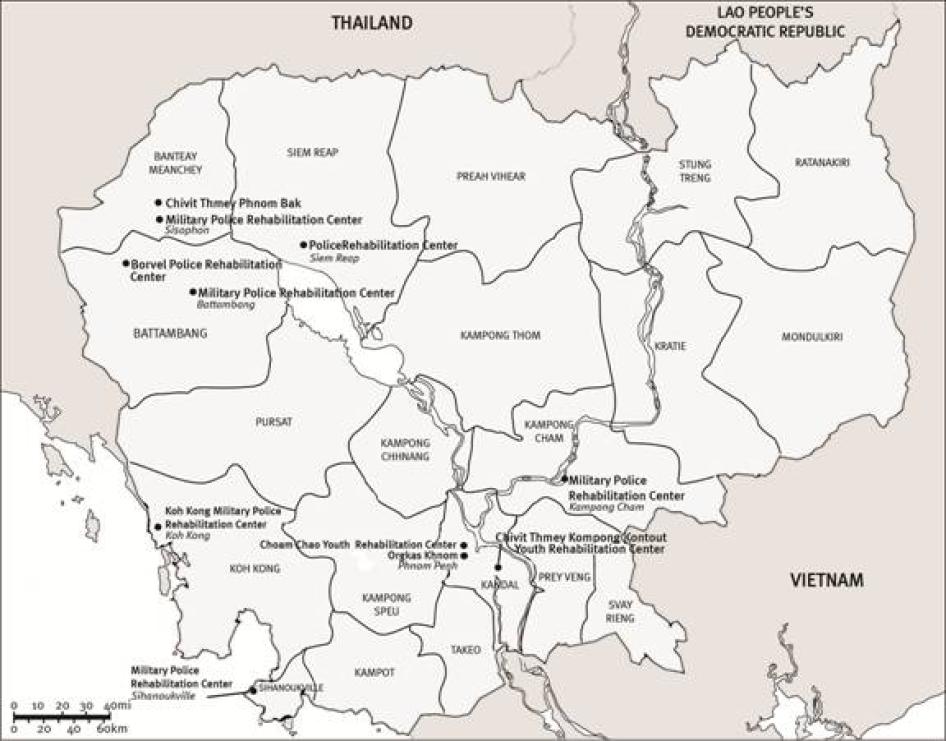
Cambodia’s Government Drug Detention Centers. © 2009 Human Rights Watch
I. Executive Summary
[A staff member] would use the cable to beat people... On each whip the person’s skin would come off and stick on the cable...
—M’noh, age 16, describing whippings he witnessed in the Social Affairs “Youth Rehabilitation Center” in Choam Chao[1]
Cambodians who use drugs confound the notion that drug dependence is a self-inflicted condition that results from a character disorder or moral failing. When Human Rights Watch talked with these people, they were invariably softly spoken and polite. They talked openly and honestly about difficult childhoods (in many cases still underway) living on the streets, or growing up in refugee camps in Thailand. Often young and poorly educated, they spoke of using drugs for extended periods of time. Despite many hardships in their lives, their voices rarely became bitter except when describing their arrest and detention in government drug detention centers. They did not mince words when describing these places. One former detainee, Kakada, was particularly succinct: “I think this is not a rehab center but a torturing center.”[2]
Kakada’s appraisal was borne out by Human Rights Watch’s own research. Many detainees are subjected to sadistic violence, including being shocked with electric batons and whipped with twisted electrical wire. Arduous physical exercises and labor are the mainstays of supposed drug “treatment”. Some detainees are forced to donate their blood. Many suffer symptoms of diseases consistent with nutritional deficiencies. Those detained in such centers include a large number of children under 15, as well as people with mental illnesses. People in such centers are detained in violation of international and Cambodian legal standards.
In Cambodia, “undesirable” people such as the homeless, beggars, people who use drugs, street children and sex workers are often arrested and detained in government centers. This report is an investigation into the treatment of one such “undesirable” group—people who use drugs—by law enforcement officials and staff working at government drug detention centers. While people who use drugs are also sent to general “catch-all” centers, Human Rights Watch believes there are currently 11 centers specifically designated for people who use drugs in Cambodia. The centers are operated by a haphazard collection of government authorities: the military police, civilian police, the Ministry of Social Affairs, Veterans and Youth Rehabilitation (Social Affairs) and Phnom Penh municipal authorities. In 2008, over 2,000 individuals were detained in such centers throughout the country.
A very small number—perhaps 1 or 2 percent of the total—enter these centers voluntarily. Roughly half enter drug detention centers after being arrested by police or unlawfully rounded up by other authorities for drug use or vagrancy. The other half is arrested at the request of their parents or relatives. In such cases the families invariably have to pay for detention despite the fact that Cambodian law requires drug dependency treatment in government facilities to be free.
The process of arrest and subsequent detention appears to follow two broad patterns. In some locations (such as Cambodia’s capital Phnom Penh) poor people who use drugs (as well as other groups of “undesirables”) are regularly rounded up by police, Social Affairs staff and others. If they have enough money, or parents or others are willing to pay, they might bribe their way out of police or Social Affairs detention. If not, they will be sent to a drug detention center. In other locations in Cambodia (such as some provincial capitals), poor people who use drugs will be ignored, or else will be arrested, charged, and sent to prison. In these locations, drug detention centers primarily or exclusively detain people whose family is wealthy enough to pay police and/or center staff for arrest and subsequent detention. Such a distinction is not rigorously observed, as police still regularly clear the streets of provincial capitals, while people are sent to centers in Phnom Penh on the request and payment of their parents or relatives.
Whatever the scenario, Cambodians who use drugs are arrested and detained illegally. Police rarely tell people the reasons for arrest, or misrepresent why they are arresting someone. There is no access to legal counsel in police detention or in subsequent detention in the centers. There is no judicial authorization of detention, nor any oversight or review.
Research has shown that drug dependence is not a failure of will or of strength of character but a chronic, relapsing medical condition with a physiological and genetic basis that could affect any human being. People dependent on drugs have the right to access medically appropriate, effective drug dependence treatment, tailored to their individual needs and the nature of their dependence. However, the “treatment” and “rehabilitation” in the centers is ethically unacceptable, scientifically and medically inappropriate, and of miserable quality.
Sweating while exercising or laboring appears to be the most common means to “cure” drug dependence. Center staff often tell detainees that they must work up a sweat to eliminate drugs from the body. In some centers, this regime of physical exercise and laboring is augmented by military drills, group classes on drug issues and supposed vocational training. In many instances, forced labor and vocational training activities appear motivated only by benefits to the center staff, as opposed to the detainees themselves.
If Cambodian authorities think they are reducing drug dependency through the policy of compulsory detention at these centers, they are wrong. There is no evidence that forced physical exercises, forced labor and forced military drills have any therapeutic benefit whatsoever. After a number of months in the centers, individuals are declared “cured” because drugs are no longer physically present in the body. One former detainee, Puth, identified the obvious flaw in the current approach:
I think that success [cessation of drug use] only happens inside the center but they will use drugs after they are out. The majority [of detainees] return to drugs... some are sent three times, four times, five times to the centers.[3]
The existing system of compulsory drug detention centers is not reducing the number of Cambodians who use drugs. NGO workers and health professionals in Cambodia criticized the centers as “not working” and “[merely] being seen to do something.”[4] Indeed, former detainees said that, rather than “rehabilitate” them, their detention undermined the skills, resources and human relationships many had beforehand, and which help integrate people into their community. According to Chrolong, “After I left [the center] everything had finished. I lost my job, my girlfriend left me, [and] then I started using drugs again. I wasn’t using drugs when they arrested me.”[5]
The real motivations for Cambodia’s drug detention centers appear to be a combination of social control, punishment for the perceived moral failure of drug use, and profit. Indeed, people who do not meet the government’s own criteria for drug dependence are often detained. For example, the National Authority for Combating Drugs [NACD] reports that almost 700 individuals were detained for crystal methamphetamine use in government run centers in 2008, although 25 percent were “not dependent” according to the NACD’s own assessment.
Compounding the therapeutic ineffectiveness of detention is the extreme cruelty experienced at the hands—and boots, truncheons and electric batons—of center staff. Sadistic violence, experienced as spontaneous and capricious, is integral to the way in which these centers operate. Human Rights Watch found the practice of torture and inhuman treatment to be widely practiced throughout Cambodia’s drug detention centers.
The overwhelming majority of those interviewed for this report had either experienced the cruel and inhuman treatment described below or seen it first hand. Former detainees report they were shocked with electric batons, whipped with twisted electrical wire, beaten, forced to perform painful physical exercises such as rolling along the ground, and were chained while standing in the sun. Many of these abuses were for minor infringements of center rules, although sometimes not even that pretext was necessary. In addition, Human Rights Watch received reports of detainees being raped by center staff. Others reported they were coerced into donating their blood to avoid being beaten or to secure their release from the centers.
Center staff routinely appoint certain detainees to carry out the majority of the day-to-day control of other detainees and enforce the rules of the center. Extreme physical cruelty by detainees, sometimes on the direct orders of staff, is commonplace inside the centers.
Former detainees complained to Human Rights Watch about the quality and quantity of the food provided to them. They also reported that they were often hungry. The food provided was often rotten or insect-ridden, and appears to have been grossly deficient both in nutritional and caloric content. Detainees reported symptoms of diseases consistent with nutritional deficiencies.
In 2008 just under one quarter of detainees in government drug detention centers were aged 18 or below. Contrary to international law, they are detained alongside adults. Child detainees told us of being beaten, shocked with electric batons and forced to work. Children also said they were coerced into donating their blood.
In practice, the government drug detention centers also function as a convenient means of removing people with apparent mental illnesses from the general community and public view. Human Rights Watch interviewed former detainees who reported appalling physical violence against people with apparent mental illnesses in the centers. There are no services or resources in the centers for managing mental illnesses.
II. Recommendations
To the National Authority for Combating Drugs, the Ministry of National Defense, the Ministry of Interior, the Ministry of Social Affairs, Veterans and Youth Rehabilitation, and the Phnom Penh Municipality
- Permanently close Cambodia’s drug detention centers and Social Affairs centers where people have been detained in violation of international and Cambodian law
- Release current detainees in Cambodian drug detention centers, as their continued detention cannot be justified on legal or health grounds.
- Ensure a prompt, independent, thorough investigation and legal action (including criminal prosecution) of perpetrators of torture, cruel, inhuman or degrading treatment or punishment, arbitrary detention and other human rights abuses and criminal acts in police detention and in drug detention centers and Social Affairs centers.
Stop the arbitrary arrest of people who use drugs and other “undesirables” such as homeless people, beggars, street children, sex workers, and mentally ill people. - Establish an independent body to directly receive and investigate complaints of torture, cruel, inhuman or degrading treatment or punishment and other abuses committed by law enforcement officers and staff at drug detention centers and Social Affairs centers.
- Permit independent legal and human rights organizations to routinely visit police stations to monitor detention conditions and interview detainees; until they are closed, permit independent legal and human rights organizations to routinely visit all drug detention centers and Social Affairs centers.
To the National Assembly of Cambodia
- Remove the provisions in the current (and draft) drugs law allowing civil courts to force people into drug dependency treatment on the request of that person’s spouse, parents, relatives, or a prosecutor.
- Provide that no one can be subject to
detention and compulsory drug treatment except where strictly necessary subject
to the following conditions:
- On the basis of two clinical opinions by qualified healthcare professionals, where a person lacks the capacity to consent themselves, or is in imminent threat of danger to themselves, due to drug dependency;
- Detention shall be no longer than strictly clinically necessary to return someone to a state of autonomy in which they can take decisions regarding their own welfare; In any event any detention shall be subject to a statutorily defined time limit to review for its continued necessity;
- The person who is detained has the right to the best available health care: this means treatment on an individually prescribed plan (reviewed regularly) and the provision of evidence-based treatment (including, where opioid dependent, opioid substitution treatment); no one in detention and subject to compulsory treatment may be given experimental forms of treatment;
- The detainee or their legal representative has a right to challenge the detention decision before an independent body of addiction experts.
- Reform the legal and policy framework for treatment of drug dependence, including the current Law on Control of Drugs and the draft drugs law currently under development. The process should include consultation with and input from human rights experts to advise on human rights compatible measures and safeguards which should form the basis of such reforms.
- Reform the Law on Control of Drugs so that methadone and buprenorphine are available in Cambodia for the purpose of providing opioid substitution treatment for drug dependency.
To the Ministry of Health
- Expand access to voluntary, community-based drug dependency treatment and ensure that such treatment is medically appropriate and comports with international standards.
- Expand access to voluntary, community-based drug dependency treatment for children, and ensure that such services are age-specific, medically appropriate and include components of education.
- Expand access to voluntary, community-based drug dependency treatment which addresses the special needs of women and girls who use drugs.
- Ensure that no unlawful payments are
demanded for voluntary, community-based drug treatment services provided by the
government, which under Cambodia’s national law on drugs are provided
free of charge.
To United Nations agencies
- Request the permanent closure of Cambodian drug detention centers and Social Affairs centers where people have been detained in violation of international and Cambodian law.
- Clearly communicate to the Royal Government of Cambodia that the system of compulsory drug treatment violates international human rights law and Cambodian law and is not supported by scientific evidence, nor international standards on what constitutes effective drug dependence treatment.
- Review all funding, programming and activities directed to assisting Cambodia’s drug detention centers and Social Affairs centers to ensure no funding is supporting policies or programs which violate international human rights law, such as the prohibitions on arbitrary detention, torture and cruel, inhuman or degrading treatment or punishment.
- Actively encourage the Cambodian government to expand voluntary, community-based drug dependency treatment and ensure that such treatment is medically appropriate and comports with international standards.
- Develop a WHO, UNODC, UNICEF and OHCHR position paper establishing principles for the protection and care of people in drug dependence treatment, including the rejection of treatment systems that, as a matter of course, forcibly detain and treat people who use drugs.
- Support and provide capacity-building projects for drug dependence treatment to staff of the Ministry of Health and nongovernmental organizations.
- UNICEF should support the expansion of access
to voluntary, community-based drug dependency treatment for children (under the
Ministry of Health and nongovernmental organizations) and ensure that such
services are age-specific, medically appropriate and include components of
education.
To UN human rights bodies
To the UN Special Rapporteur on the Human Rights Situation in Cambodia
- Clearly communicate to the Royal Government of Cambodia that the system of compulsory drug treatment violates international human rights law and Cambodian law and is not supported by scientific evidence, nor international standards on what constitutes effective drug dependence treatment.
- Recommend the permanent closure of Cambodian drug detention centers and Social Affairs centers where people have been detained in violation of international and Cambodian law.
- Work with the Royal Government of Cambodia to establish an independent body to directly receive and investigate complaints of torture and other abuses in order to combat impunity.
To the UN Special Rapporteur on Torture and the UN Working Group on Arbitrary Detention
- Raise concerns with the Royal Cambodian Government regarding the allegations of arbitrary detention, torture, cruel, inhuman or degrading treatment or punishment, and other abuses committed against people who use drugs (including children) by law enforcement officers and staff of drug detention centers in Cambodia.
- Request an invitation to visit Cambodia to investigate allegations of arbitrary detention, torture, cruel, inhuman or degrading treatment or punishment, and other abuses committed against people who use drugs, by law enforcement officers and staff of drug detention centers in Cambodia.
To the UN Committee and Subcommittee against Torture, the UN Committee on the Rights of the Child, the UN Committee on the Elimination of Discrimination Against Women
- Request further information from the Royal Government of Cambodia in its periodic reports on the detention and treatment of those detained in drug detention centers in Cambodia, including women and children.
- Include in Concluding Observations, follow-up work and/or visits, recommendations on specific measures directed towards ending abuses against people who use drugs by law enforcement officers and staff at drug detention centers and Social Affairs centers, and holding perpetrators accountable.
To bilateral and multilateral donors and NGOs providing assistance to Cambodia on drugs or HIV/AIDS issues in Cambodia
- Publically call for: i) an end to violations that occur in Cambodian drug detention centers, ii) an investigation into the allegations of such violations, and iii) holding to account those responsible for such violations.
- Raise with interlocutors from the Royal Cambodian Government the allegations of violations, including arbitrary detention, torture and cruel, inhuman or degrading treatment or punishment, and the need to investigate them and hold those responsible to account.
- Review any funding, programming and activities which support the operation of Cambodia’s drug detention centers to ensure that no funding is being used to implement policies or programs which violate international human rights law, such as the prohibitions on arbitrary detention, torture and cruel, inhuman or degrading treatment or punishment.
- Support the expansion of voluntary, community-based drug dependency treatment, including appropriate services for women and children.
- Direct support and capacity-building projects for drug dependence treatment to staff at the Ministry of Health and nongovernmental organizations.
III. Methodology
This report is based on information collected during 11 weeks of field research conducted in Cambodia between February and July 2009. Human Rights Watch interviewed 74 key informants. These key informants included 53 people who currently or formerly used drugs and who had been detained in at least one drug detention center; seven people who currently or formerly used drugs but who had not been detained in drug detention centers; and three people who did not identify themselves as drug users, but who had nevertheless been detained in centers because they were homeless people, beggars, or street children.[6] All former detainees had been detained within three years of the date of their interview. Thirteen of the key informants were under the age of 18. Human Rights Watch also interviewed 11 current or former staff members of NGOs and UN agencies who have knowledge and experience regarding the situation of people who use drugs in Cambodia.
Human Rights Watch interviewed former detainees from seven of the 11 current government drug detention centers, including centers run variously by the Municipality of Phnom Penh, the Ministry of Social Affairs, Veterans and Youth Rehabilitation (Social Affairs), the military police, and civilian police. Interviewees include former detainees from six out of the largest seven centers. Interviews were conducted in the provinces of Banteay Meanchey, Battambang, Kampong Cham, Siem Reap, and the capital, Phnom Penh.
Included in the key informants were a small number of former detainees from one Social Affairs center (at Prey Speu near Phnom Penh) not officially listed as a drug treatment center.[7] It appears that people who use drugs (as well as others) have been regularly detained there. Although some people who use drugs reported being detained at a Social Affairs center at Koh Kor (also known as Koh Romdoul) within the period covered by this report, their testimony was not included here as that center is currently inactive. We were unable to identify and meet with former detainees from certain centers in Banteay Meanchey, Koh Kong, Sihanoukville, or Kandal provinces.
All interviewees provided oral informed consent to participate. Interviews were conducted in private and individuals were assured that they could end the interview at any time or decline to answer any questions without consequence. Interviews were semi-structured and covered a number of topics related to illicit drug use, arrest and detention. Where the interviewees spoke Khmer, interviews were consecutively interpreted between English and Khmer. The identity of these interviewees has been disguised with randomly-selected pseudonyms and in some cases certain other identifying information has been withheld to protect their privacy and safety.
In September 2009, Human Rights Watch wrote to the head of the National Authority for Combating Drugs to request information on Cambodia’s drug detention centers and solicit its response to violations we had documented. This correspondence is attached in Annex 1. As of the beginning on November 2009, Human Rights Watch had received no response to this correspondence.
IV. Background
Drug use in Cambodia
While drugs such as heroin and cannabis were widely used in Cambodia in the 1990’s, the country witnessed a marked increase in ‘ya ma’ (methamphetamine) use in the last decade. Currently, the main illicit substances used in Cambodia appear to be ‘ya ma’ and ‘ice’ (methamphetamine in crystal form). People who inject drugs are most likely to inject heroin. Solvents such as glue are commonly inhaled, especially by street children. Cannabis and, to a much lesser extent, ketamine, are also prevalent. The majority of people who use drugs are between 18 and 25 years old, and few are female. The use of two or more drugs is very common.[8]
Estimates of the absolute number of people who use drugs in Cambodia differ widely. The official government figure for 2008 put the number of people who use drugs at 5,896, a figure very close to the 5,797 for 2007.[9] However, this number is widely considered an underestimation. A 2007 study undertaken by the National HIV/AIDS Program (NCHADS) estimates there to be between 9,100 and 20,100 people who use drugs in Cambodia, of whom approximately 1,100 to 3,000 are people who inject drugs.[10] UNODC has been reported as estimating a population prevalence of drug use of four percent of the entire population, which would signify a figure as high as 500,000 people who use drugs in Cambodia.[11]
Cambodia’s drug detention centers
In 2008, the National Authority for Combating Drugs [NACD] reported that there were 2,382 people detained in government drug detention centers.[12] This figure is a 40 percent increase from the number of people detained in 2007 (1,719).[13] According to the NACD’s data, the majority of individuals (1,483 or 62 percent) were aged between 19 and 25 years. Just 15 individuals (or 0.6 percent) were female. The most commonly reported types of drugs used were methamphetamine (51 percent) and crystal methamphetamine (42 percent).[14] The NACD also reports that just 1 percent of admissions in 2008 were voluntary, with 61 percent via the “family” and 38 percent “judicial”.[15] As discussed below, the category of “judicial” is a misnomer, given that detainees are not detained on the basis of a valid court order or with any judicial oversight. Thus “judicial” means here those who were arrested by the police without the request and/or payment of parents or relatives.
The government data also reveals that in 2008, 563 detainees (or 24 percent) were aged 18 or below. 104 detainees (or 4 percent) were children less than 15 years of age. 116 detainees (or 5 percent) were classified as “street children”.[16]
Cambodia’s government drug detention centers are operated by various government entities: the Military Police of the Royal Cambodian Armed Forces (under the Ministry of National Defense), the Commissariat-General of the National Police, also known as the civilian or penal police (under the Ministry of the Interior), the Ministry of Social Affairs, Veterans and Youth Rehabilitation (also known as Social Affairs) and the Department of Social Affairs of the Municipality of Phnom Penh.[17]
The NACD‘s “Five year national plan on drug control” (2005-2010), which includes plans to develop Cambodia’s system of drug treatment and rehabilitation, claims that human rights principles have been incorporated in Cambodia’s response to drugs.[18] However, in another document, the NACD offers the following frank description of government drug detention centers in Cambodia:
Military-style camps operated by the government are the primary providers of treatment services for illicit drug users in Cambodia. Most of the facilities provide limited educational and health services and focus almost exclusively on exercise and discipline. Most treatment centers are operated by civilian or military police. A few others are operated by the Ministry of Social Affairs (MoSAVY) or Provincial administrations.[19]
Although some centers have existed for a number of years, the regulatory framework for Cambodia’s detention centers was established in 2006. In October 2006, the Prime Minister issued a Circular on ‘The implementation of education, treatment and rehabilitation measures for drug addicts.’ The Circular authorizes provinces and municipalities in Cambodia, “especially those which have many drug addicts... [to] try to find one location to organize a drug addict treatment and rehabilitation center by cooperating with involved ministries and agencies.”[20] The Circular also calls on the Ministries of Interior, National Defense and Justice (although not the Ministry of Health) to organize facilities “to collect drug addicts in order to provide them treatment and education so that they will become good citizens again in society.”[21]
The government’s own published lists of such centers are inconsistent.[22] By cross-checking various lists, and visiting the physical location of a number of centers, an accurate list of the current government drug detention centers for drug dependence in Cambodia is reproduced below:
Nº |
Name of center |
Province |
Run by |
Capacity |
1 |
Orgkas Khnom [“My Chance”] |
Phnom Penh |
Phnom Penh municipality |
Approx. 200 |
2 |
Choam Chao “Youth Rehabilitation Center” |
Phnom Penh |
Social Affairs |
Approx 100 |
3 |
Military Police Rehabilitation Center |
Battambang |
Military Police |
Approx 100 |
4 |
Borvel Police Rehabilitation Center |
Battambang |
Civilian Police |
Approx 200 |
5 |
Chivit Thmey Phnom Bak |
Banteay Meanchey |
Social Affairs |
Approx 120 |
6 |
Military Police Rehabilitation Center |
Banteay Meanchey |
Military Police |
Approx 200 |
7 |
Police Rehabilitation Center |
Siem Reap |
Civilian Police |
Approx 200 |
8 |
Military Police Rehabilitation Center |
Koh Kong |
Military Police |
Approx 30 |
9 |
Military Police Rehabilitation Center |
Sihanoukville |
Military Police |
Approx 40 |
10 |
Military Police Rehabilitation Center |
Kampong Cham |
Military Police |
Approx 20 |
11 |
Chivit Thmey Kampong Kontout “Youth Rehabilitation Center” |
Kandal |
Social Affairs |
Unknown |
The centers on this list are deemed to be for the purposes of drug treatment and rehabilitation.[23] However, it would be misleading to consider the list above as exhaustive. Drug use is a crime punishable by incarceration and (as discussed below) some people who use drugs are not sent to these centers but instead tried and imprisoned for the crime of drug use. Further, our research suggests that in addition to the centers listed, one Social Affairs center (at Prey Speu near Phnom Penh) regularly detains people who use drugs (as well as other groups of “undesirables” such as homeless people, beggars, street children, sex workers, mentally ill people and so on). At the time of this report, the Social Affairs center at Prey Speu was operational.[24] Cambodia also has a small number of privately run and NGO run drug treatment centers.[25]
There are indications that the number of government drug detention centers in Cambodia will rise in the near future. The 2008 annual report on drug surveillance by the Secretariat General of the NACD requests that:
Any province or city that has yet to establish centers for the treatment of drug users should consider establishing a place to keep [people dependent on drugs] with the aim of enhancing the victims’ well-being and contributing to the maintenance of security, social order and safety in the provinces and cities.[26]
Indeed, a media report in early 2009 noted that “His Excellency Deputy Prime Minister and Minister of Interior and [former] Director of National Authority for Combating Drugs Sar Kheng has advised that any province and city that has more than 50 drug users should establish drug user detoxification centers...”[27]During a speech marking the International Day against Drug Abuse and Illicit Trafficking (June 26) in 2009, Prime Minister Hun Sen requested financial contributions to allow the construction a new drug rehabilitation center in Kampong Speu province.[28]
There are indications that international cooperation may play a role in the expansion of Cambodia’s drug detention centers. One likely potential partner is Vietnam. This is despite the fact that Vietnam’s system of compulsory drug treatment has been criticized for having scant regard for medically appropriate drug treatment or the human rights principles that should guide drug dependency treatment.[29] Independent reviews have found that it is not cost effective and that the rate of relapse to drug use for former detainees is around 90 percent.[30]
The 2008 annual report on drug issues by the Secretariat General of the National Authority for Combating Drugs anticipates that the NACD is “prepared to receive Vietnamese delegates to Cambodia in order to discuss the feasibility of [Vietnam] giving Cambodia youth drug detention centers for drug users.”[31] No timeline for this assistance is presented in the report. However, in June 2009, NACD officials visited Ho Chi Minh City in Vietnam. According to media reports, the aim of the visit was to discuss how the two countries could “provide each other with regular assistance in drug control, drug detox facilities, and rehabilitation, and in the management of former drug addicts.”[32] When Vietnam’s Deputy Prime Minister visited Cambodia in September 2009, Cambodian Prime Minister Hun Sen reportedly requested assistance in building rehabilitation centers.[33]
Previous reports of abuses in Social Affairs centers
In recent years, there has been considerable criticism of two particular Social Affairs “rehabilitation” centers. Human rights organizations documented and reported serious abuses that took place in the Social Affairs centers at Prey Speu and Koh Kor.[34] Although not officially listed by the government as drug detention centers, actual or former drug users interviewed by Human Rights Watch reported being illegally detained at these centers.
The Cambodian League for the Promotion and Defense of Human Rights (LICADHO)’s 2009 submission to the UN Human Rights Council's Universal Periodic Review process provides a succinct overview of the human rights abuses alleged to have been committed in these two centers and the lack of serious government investigation into reports of such abuses:
Conditions at both [Prey Speu and Koh Kor] centers were abysmal – even worse than exist in Cambodian prisons – and included gross overcrowding and lack of adequate food, clean drinking water and medical care. In June 2008, LICADHO gained access to the Koh Kor center, despite efforts to prevent this by staff there, and photographed hungry men, women and children detained in padlocked rooms. They included a four-year-old boy, a nine-month pregnant woman, and a comatose elderly woman who subsequently died inside her locked room.
At Prey Speu center, detainees were routinely subjected to sadistic violence. Guards raped female prisoners and severely beat detainees who tried to escape or complained about conditions, according to former detainees interviewed by LICADHO. At least three detainees, possibly more, were beaten to death by guards at Prey Speu during 2006-2008, and five others reportedly committed suicide, according to LICADHO investigations.
LICADHO complaints to the government in mid-2008 led to the release of detainees at Koh Kor and Prey Speu. However, the Ministry of Social Affairs has rejected calls to permanently close the centers, and LICADHO fears that unlawful detentions may resume at either or both of them at any time. There has been no serious government investigation into abuses at the centers, and no prosecution of perpetrators. Staff at Prey Speu center who have allegedly committed rapes and murders - and whom LICADHO has asked the government to suspend pending a full investigation - continue to work there.[35] [Citations omitted]
Cambodia’s Drugs Law
Cambodia’s Law on the Control of Drugs, adopted in 1996 and amended in 2005, provides that consumption of illegal drugs is a criminal offense punishable by imprisonment from seven days to one month and a possible fine of between 25,000 to 100,000 riel (approximately US$6-$24).[36] The same law allows either a Prosecutor or a court “to acquit such principal of the offense from punishment or to give only a warning to such person” if the person is not addicted to illegal drugs and the offense involved “only a very small quantity.”[37]
The drugs law provides that cost of treatment for drug dependency in a hospital, specialized agency or government clinic “shall be entirely the burden of the State.”[38]
Methadone and buprenorphine are both medicines used in opioid substitution treatment (OST) for people dependent on heroin or other opium derivatives.[39] The current drugs law lists both as controlled substances and neither are currently available in Cambodia (although at the time of writing this report there are plans to commence a pilot methadone program).[40]
The current drugs law provides that a person can be ordered into treatment by a wide variety of mechanisms. The prosecutor may issue an order for a person to attend “any detoxicating establishment” after having summoned a person to attend court when charged with the offense of illegal drug consumption. This provision legally requires the issuance of both an initial summons issued by the court and a treatment order from a prosecutor. If the person complies with this order the court itself will not punish the offender.[41]
When someone has been charged with the offense of illegal drug consumption, a court itself may order the person charged “to undertake an appropriate treatment measure[s] in accordance with his/her health condition.” If the person complies with this treatment order, the court has the authority to issue a warning.[42] Similarly, following sentencing, a person who has been convicted of illegal drug consumption may request “medical treatment in accordance with their respective health conditions” instead of serving a sentence.[43]
A spouse, parents, relatives, or prosecutor may also request a civil court to order someone into drug dependency treatment. In this case, the civil court must be convinced that that person is addicted to illegal drugs and “is known as dangerous for others.”[44]
Even if the law in Cambodia were being used as the basis for the detention of people who use drugs–which it is not, in the vast majority of detentions–Human Rights Watch considers that many of these provisions are overly-broad, with few or no procedural safeguards against abuse of these mechanisms. These mechanisms may also violate human rights standards, as they allow a person to be committed to treatment without his or her consent, disregard whether treatment is in the best interests of the patient, and fail to limit the period of such treatment, provide oversight, or review the treatment order. Many people who use drugs may not actually need treatment, as they are not dependent.
Human Rights Watch is particularly concerned that the provision allowing a spouse, parent, relatives, or prosecutor to request detention of a person who is dependent on drugs is open to abuse by family members or others who are not motivated by the best interests of the drug dependent person, but rather by embarrassment and/or the desire to have their family member out of their lives for some time. The provision is also of concern given that the centers do not provide drug dependence treatment that is informed by scientific evidence nor comports with international standards.
With UN assistance, Cambodia is currently finalizing a new Law on Drug Control. Most existing provisions on measures for treatment are reproduced in a substantially similar form.[45] For example, article 72(1) on “compulsory treatment” replicates current article 95 (allowing civil commitment for treatment of people who use drugs on the request of family members or prosecutor). The draft Law on Drug Control also contains broad powers for a court to compel a person to accept drug treatment, similar to those found in the current drugs law.
Human Rights Watch considers that no one should be subject to detention for compulsory drug treatment except in strictly circumscribed conditions. Key among these conditions are that the detention is not simply for anyone dependent on drugs, but only where qualified healthcare professionals establish that a person lacks the capacity to consent themselves, or is in imminent threat of danger to themselves due to drug dependency. The detention itself should be for no longer than strictly clinically necessary to return the person to a state of autonomy in which they can take decisions regarding their own welfare. In any event any detention should be subject to a statutorily defined time limit to review for its continued necessity. The person subjected to compulsory treatment (or their legal representative) must have a right to challenge the necessity of detention before an independent body of addiction experts. Further, the treatment provided should be a medically appropriate individually prescribed plan, subject to regular review, that comports with international standards. Under no circumstances should anyone subject to detention for compulsory treatment be given experimental forms of treatment.[46]
V. Findings
Human Rights Watch was told of abuses during arrest, such as physical torture by police to force confessions or reveal information. Human Rights Watch was also told that police demand money or sex in return for release from police detention.
Cambodia’s drug detention centers detain people who use drugs, people with a history of drug use (but not currently using drugs) and people who have never used drugs. Detention is not for drug treatment; people who do not meet the NACD’s own criteria for drug dependence are nevertheless detained in drug detention centers.
In detention, former detainees reported they were shocked with electric batons, whipped with twisted electrical wire, beaten, forced to perform painful physical exercises such as rolling along the ground, and were chained while standing in the sun. Former detainees reported rapes by staff in the centers. Staff delegate powers to some detainees to enforce discipline and punish other detainees. As a consequence, extreme physical cruelty by fellow detainees is commonplace inside the centers. Former detainees also reported being coerced into donating their blood.
Former detainees complained to Human Rights Watch about the quality and quantity of the food provided to them. Detainees reported symptoms of diseases consistent with nutritional deficiencies.
Many abuses—including the administration of electrical shocks, beatings, and forced labor—were also reported by children. Children also said they were coerced into donating their blood. Human Rights Watch also interviewed former detainees who reported appalling physical violence against people with mental illnesses in the centers.
Abuses during arrest
The military police arrested me... They beat me, hit me, kicked me while arresting me in a pagoda... After they beat us, they sent us to a detention center in the military police station.
—Tonloap [47]
Reports collected by Human Rights Watch suggest that, from first contact with police to detention in the police station, severe beatings and other forms of violence are common. According to former detainees, police use forms of physical torture, such as the administration of electric shocks or beatings with gun butts, to force people to confess or reveal information.[48]Police regularly extort money from people after arrest. People are frequently arrested without a warrant or reasonable cause, without being informed of the reasons for their arrest, or are lied to about the reasons for their arrest. They have no access to a lawyer during their period in police custody or during the subsequent period of detention in the centers. Police in Cambodia often arrest people who use drugs on the request of parents or other relatives. No protections ensure that family members do not act out of embarrassment and/or a desire to have the family member out of their lives for some time.
Cambodians who use drugs are arrested because of drug use and vagrancy, but are also frequently arrested in periodic police sweeps of persons considered “undesirable”. Such round-ups have been occurring regularly in Phnom Penh for many years, often in advance of important national holidays or international meetings. The Staff of the Department of Social Affairs of Phnom Penh, often in cooperation with district and municipal police and civilian authorities, conduct these raids. According to media reports, the Deputy Governor of one of Phnom Penh’s districts justified street sweeps in May 2009 by stating that those picked up by the police “make the city dirty. We collected them in order to clean the city.”[49]
|
Social Affairs truck used to round up groups considered “undesirable” to take them to Social Affairs centers around Phnom Penh. © 2008 Licadho |
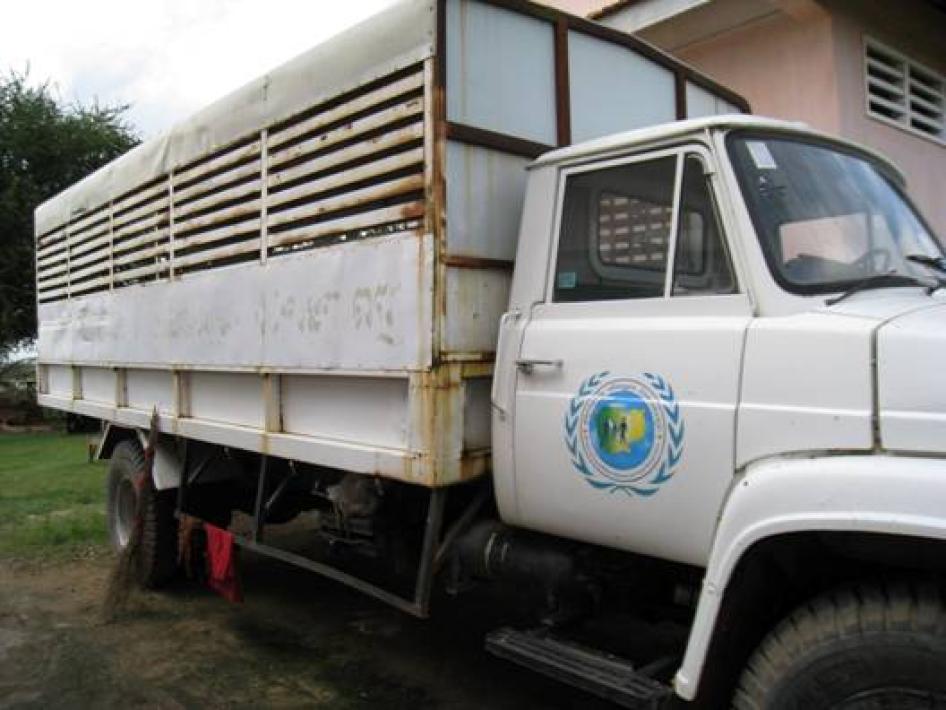
Treated with contempt, people who use drugs are routinely denied basic rights when arrested. Teap, who is 14, reported being beaten and electrocuted in police custody in order to extract a confession.
I was sleeping inside the pagoda compound in the open air... The police asked me, ‘Did you steal someone’s car mirror?’ I said, ‘No, I didn’t.’ Then they arrested me and beat me. Because they beat me I lied and said I stole the mirror. They shocked me with electrical shocks and beat me with ‘the ox’s penis’ [a police baton]... It was the police who shocked me: a tall colonel with a walkie talkie. At first I told him I didn’t know anything and he said ‘This boy’s so stubborn!’ and grabbed an electric shock baton. Then I told him I had stolen it: actually I hadn’t stolen it, I was just scared... They shocked me once. It left a mark on my arm. I lost consciousness so they poured water on me. I saw him holding a stick with sparkling electricity. It hurt. My body was shaking when I got the shock.[50]
Kronhong, age 18, described being tortured by military police, after smoking ‘ya ma’ with a friend, to extract information about who supplied him with drugs.
They brought us to an interrogation center and started questioning, like ‘Who are the sellers [drug dealers]?’ It was inside the military police station. They questioned me for two hours... I did not tell them who are the buyers then they beat me. They kicked me in the face six times, also on my spine and my ribs. They kicked me till I fell over then they lifted me up and smashed me with an AK47 butt.[51]
Duongchem was not told the reason for his arrest and not provided with access to a lawyer. He describes the beating he received from police and the subsequent confession he was forced to sign.
The police asked if I stole anything. I said, ‘No, I’m just a drug user.’ They said ‘You used drugs, where did you get the money?’... They slapped me with their hands and kicked me in the stomach and my shin with their boots. My skin was bleeding and the skin was torn off. They kicked me in the stomach. They beat me to make me confess that I stole something from the market. Two policemen did this in the police station, in the interrogation room... I did not confess but the police still wrote down [a confession]:... At the police station they asked us to put my thumb print on the report... I just did as I was told to do.[52]
Chrolong reported being arrested without a warrant or reasonable cause by a security guard near Wat Phnom in Phnom Penh.
I was walking at night and I came out from a dancing club. I was sitting with my girlfriend... There was no reason given for our arrest. They said ‘You stroll in the night; strolling at night is not good.’ The security guard [who arrested me] said this... I never saw a lawyer.[53]
Information from former detainees interviewed by Human Rights Watch suggests that police often misrepresent the purpose of arrest. For example, Russey explained he was taken into police custody on a false pretext and a promise to be released shortly afterwards, although he was subsequently detained in a drug detention center.
At 11 a.m. they come to arrest me, two military police, one skinny and one fat. [One military policeman] said ‘Little kid, you had a fight. Now let me ask you something at my place. Then I’ll let you go.’ However, when he arrested me he sent me [to the center] without releasing me and I had my head shaved... I never saw a lawyer.[54]
Former detainees told Human Rights Watch that some police demand bribes in return for releasing people from police detention. In this way, some people are able to buy their way out of police custody (and subsequent detention in a drug detention center). For example, Toh described how he was released from police custody following his arrest for drug use.
They sent me to the provincial police station. They said we were using drugs: this was true... They called [our] parents. My mother and my friend’s mother shared [the amount]: all together it was $200 for five [people’s release].[55]
Other former detainees told Human Rights Watch how they were unable to buy their freedom. Putrea said that he was sent to the drug detention center because he was unable to pay the extortion money to have him released from police custody. He explained:
[The police] didn’t tell me why I was arrested. I never saw a lawyer... I was not addicted to drugs. The only difficulty I had was I had no place to sleep and no food... My boss didn’t ‘guarantee’ me [pay the extortion amount] so they accused me of stealing.[56]
Tola said that a drug dealer with whom he was arrested was able to pay for her release, while he was unable to pay the extortion money (and was subsequently detained at the Orgkas Khnom center).
A woman was released for $50: the police lent her a mobile phone and she called up a friend... When the person came with the money, the police let her out. I didn’t get released because I had no money.[57]
Former detainees told Human Rights Watch that arrests of people who use drugs often follow payment by parents or relatives to the police to carry out the actual arrest, as well as for the subsequent period of detention. Sokram, 25, explained that his mother paid military police in Sisophon to arrest him.
My parents called the police to arrest me. [My parents] said I am a drug user and I caused trouble to them. The military police arrested me inside the house while I was sleeping, [at] about 10 p.m. at night. I learned beforehand that I would be arrested and sent to the military police center. My mother told me she paid more than US$200 for the arrest. They paid $50 a month for me to be in the center. I never saw a lawyer. [The police] beat me when I struggled and refused to go.[58]
Srolao, age 23, explained that the police arrested him supposedly on suspicion of stealing a motorcycle, but in fact because his parents paid for his arrest. When he arrived at the center, he was told his parents paid 1,500 baht (approximately US$45) for the arrest.[59] Kuhear, 26 years old, reported being arrested by military police when his mother paid them to do so. The police lied to him about the reasons for his arrest and only revealed the real reason once he was in police custody in the drug detention center.
Four military police came to my house. They said they summoned me [to the military police station] to clarify one question of a quarrel in a restaurant, a quarrel I had with my friends... They said if I didn’t agree to follow them, then I would be handcuffed. I just followed them, it was easier. They intimidated me; they said they would beat me and handcuff me if I refused to go. They had no arrest warrant. I never saw a lawyer... They did not tell me anything about drugs at [my] house, only about a dispute. [Later] in the car, they accused me of using drugs. They said, ‘Did you use drugs? Tell me the truth or I will beat you.’ I said I used. Actually, I stopped using drugs three months before I was arrested...[60]
As one NGO staff member with considerable experience working on drug issues in Cambodia explained to Human Rights Watch,
Though I fully understand the concerns of family—because I understand the chaos... drug use ... can [cause] within a family network—this doesn’t mean a person should be sent to a place [of detention] by family members without due process. There needs to be a mechanism that supports family networks that is more in line with the rule of law.[61]
Abuses against women and girls
Currently, there are no detention facilities specifically for women and girls who use drugs in Cambodia. Cambodian government officials have told the media that they plan to build facilities specifically for women.[62] At present, however, women who use drugs are frequently arrested but rarely sent to drug detention centers. As noted, of the 2382 people admitted to government run centers in 2008, just 15 individuals (or 0.6 percent) were female.[63]
Although rarely detained in drug detention centers, women and girls who use drugs are frequently arrested and face detention in centers (such as Social Affairs centers, but not these exclusively) because they are homeless, beggars, sex workers or members of other “undesirable” groups.
Women who use drugs may be forced to secure their release from police custody following arrest via bribery or in exchange for sex. For example, Roka described how she was released following her husband’s bribe of the police.
I went to buy ‘white’ [heroin]. When I bought it and left the house they arrested me... The police said, ‘If you have money, I will let you go. If you don’t have money, I will send you to prison.’ I said, ‘You should talk to my husband at 12 o’clock.’ This happened three days ago. My husband found the money, $10, to pay the police. At five p.m., my husband came back with $10. At seven p.m. they set me free.[64]
Minea, a woman in her mid-20’s who uses drugs, explained how she was raped by two police officers.
[After arrest] the police search my body, they take my money, they also keep my drugs... They know I never have money, they don’t even ask me [for a bribe]... They say, ‘If you don’t have money, why don’t you go for a walk with me? Then I’ll set you free.’ This happened to me once... They [the police] drove me to a guest house.... How can you refuse to give him sex? You must do it. There were two officers, [I had sex with] each one time. After that they let me go home.[65]
Applicable standards
Arbitrary arrest
Cambodia is a party to the International Covenant on Civil and Political Rights (ICCPR), which prohibits arbitrary arrest or detention.[66] The prohibition against arbitrary arrest or detention means that deprivation of liberty, even if provided for by law, must be necessary and reasonable, predictable, and proportional to the reasons for arrest.[67]The ICCPR further provides an enforceable right to compensation for victims of unlawful arrest or detention.[68]
In order for an arrest to be reasonable, the evidence at hand would have to satisfy an objective observer that there are reasonable grounds to believe that the suspect has committed a crime.[69] The ICCPR requires an arresting authority to immediately inform detainees of the reasons for their arrest.[70] The ICCPR specifies a defendant's right to be informed of charges, to have legal assistance, and not to incriminate him or herself.[71]
Cambodia’s Criminal Procedure Law provides that a person may be arrested without a warrant during or immediately after the commission of a crime.[72] A person who is remanded in police custody shall be immediately informed of the reasons for such a decision.[73] Unfortunately, the law provides that criminal suspects may meet with a lawyer or another person only after 24 hours have lapsed since arrest–a period of time when mistreatment, rape and extortion often takes place.[74]
Torture, cruel and inhuman treatment and the use of force by law enforcement officials
Police inflict serious abuse on detainees, rising to at least the level of cruel, inhuman, or degrading treatment or punishment, and often torture.[75] Police use torture to coerce confessions and testimony from detainees. In evaluating claims of violations of article 7 of the ICCPR, the Human Rights Committee has determined that electric shocks amount to torture where the shocks were used to extract information or confession.[76]Rape in detention also constitutes torture.[77] All ill treatment of detainees violates Cambodia’s obligations under the ICCPR and the Convention against Torture and Other Cruel and Inhuman or Degrading Treatment or Punishment.[78]
As a party to the UN Convention on the Elimination of All Forms of Discrimination against Women (CEDAW), Cambodia has binding legal obligations to protect women and girls from sexual and other forms of gender-based violence perpetrated by state agents and private actors alike.[79]
In addition to the binding provisions of international law above, the UN has developed detailed principles and rules regarding the use of force by police, to ensure compliance with the international standards. The UN Code of Conduct for Law Enforcement Officials expressly limits the use of force by police to situations in which it is “strictly necessary and to the extent required for the performance of their duty.”[80] Similarly, the UN’s Basic Principles on the Use of Force and Firearms by Law Enforcement Officials states that law enforcement officials, in carrying out their duty, shall, as far as possible, apply nonviolent means before resorting to the use of force and firearms.[81] The Basic Principles establish that, “Governments shall ensure that arbitrary or abusive use of force and firearms by law enforcement officials is punished as a criminal offence under their law.”[82]
Abuses in detention
Arbitrary detention
I was smoking drugs in a park... and I was arrested. [The police] sent me to the Social Affairs Department near Wat Moha Montrey. I spent one day and one night there. They did not tell me anything, they just took me into custody. I didn’t see a lawyer... [The next day] at 4 pm, they took me to Orgkas Khnom. They didn’t even ask me my name. I didn’t dare ask any questions because I was afraid they would beat me.
—Mesa [83]
Cambodia’s drug detention centers often detain people who do not meet the NACD’s own criteria for drug dependence. In addition to people who use drugs, the drug detention centers detain a wide variety of people, such as street children, gamblers, alcoholics and mentally ill people. While the motivation for detaining these people is to keep the streets clear of “undesirables”, in other locations in Cambodia (such as provincial capitals), poorer people who use drugs are more likely to be arrested, charged, and sent to prison, than detained in drug detention centers. In such places, centers hold primarily or exclusively those detainees whose parents or family members buy places in the centers. This is despite the fact that the national drugs law provides that the state shall bear the costs of drug treatment in government facilities. The official length of detention varies from center to center. In practice the length of detention depends on the discretion of center staff, some of who can be bribed to secure release. In sum, the detention of people who use drugs in Cambodia can only be characterized as inherently random and unpredictable.
The manner in which people who use drugs in Cambodia are detained must also be characterized as illegal. Even the flimsy due process requirements under the national drugs law to affect the detention of people who are dependent on drugs are ignored in practice. Whatever the arrangement of their arrest and subsequent detention, detainees bypass the court system. At no stage do detainees have access to legal representation. There are no orders from prosecutors followed by court summons, police charges followed by court-issued treatment orders, or court hearings. No judicial or other independent body authorizes the commencement of detention or reviews the necessity of continuing detention. There is no practical opportunity for detainees to appeal their detention. In this way, people are detained without any due process protections.
Following arrest, people are typically held briefly in police stations, district government offices or the offices of the Provincial Social Affairs department, before being taken to a drug detention center. Where the centers are operated by the military police or the civilian police, the place of subsequent detention may be within the same police compound as the police office where they are taken upon arrest; they are simply registered and then detained in another part of the compound. As one NGO staff member with considerable experience working on drug issues in Cambodia explained:
People can be placed in these centers—they can’t leave. The time they spend there is completely at the discretion of the people running the center. Basically, people are detained with no recourse to the law whatsoever.[84]
Officially, the Social Affairs centers provide rehabilitation services to people who stay there voluntarily. Indeed, under Cambodian law, the Social Affairs “Youth Rehabilitation Center” at Choam Chao is supposed to be an “open” center.[85] M’noh, age 16, was detained there in 2008. He explained the reality of this supposedly “open” center:
If anyone tried to escape, he would be punished... Some people managed to escape, some didn’t. Most who were punished for escaping would be beaten unconscious. Beatings like this happened every day.[86]
A wide variety of people are detained in the centers. For example, Kakada, 28 years old, described his fellow detainees at the “Youth Rehabilitation Center” in Choam Chao:
There are glue sniffers, injecting drug users, gamblers, people who fight each other and have been arrested, alcoholics, ‘ya ma’ smokers, very old people and young kids who are beggars along Monivong [street in Phnom Penh]. Sleeping on the street causes disorder, that’s why they are arrested.[87]
Pok described his fellow detainees in the police-run center in Borvel district, Battambang province:
There were two women and the rest were men. [The women] are karaoke singers but also drug users... There were crazy people who had lost all memory. There were two of them. There were three or four elderly people... They said that these adults will stay there for the rest of their lives. There were also two or three children, about 15 or 16. They were there because they did not listen to their parents and used ‘ya ma’.... Some [detainees] are ‘ya ma’ smokers, [other detainees are] people who use domestic violence in families... People who are alcoholics or domestic violence [perpetrators] get freed one or two months later.[88]
The diverse scope of detainees is not limited to Social Affairs centers. Makara reported that in the Orgkas Khnom center, the main drug detention center in Phnom Penh, “There’s also those who are street kids, injecting drug users, those with mental health problems.”[89] Momeh, a disabled 15-year-old child living on the street but who had never used drugs, was detained at the civilian police center in Siem Reap.[90] Trach, a former detainee of the same center in Siem Reap, explained:
There were ‘ya ma’-, ‘ice’-, ‘k’ [ketamine], glue- [using] people, marijuana people, methamphetamine users... There are people with mental health problems, crazy people, recyclers, homeless people, alcoholics who beat their children when they drink, homeless kids.”[91]
Authorities are aware that actual drug dependence is not a prerequisite for entry into government drug detention centers. Some centers force detainees to undergo an assessment of drug use upon admission to the center; most centers do not. According to a draft report of a joint report of the centers conducted by WHO and the Cambodian government, assessment tools such as the “Severity of Dependence Scale” [SDS] and urine testing “are not used as part of any exclusion criteria.”[92]
It is unlikely that the NACD’s “Severity of Dependence Scale” [SDS] is reliable even when it is used, given that the assessment is administered to new arrivals by staff with little or no health care training, let alone clinical training in drug dependence issues.[93] Regardless, people who do not meet the NACD’s own criteria for drug dependence are detained for supposed “treatment” and “rehabilitation”. The NACD reports that almost 700 individuals were detained for crystal methamphetamine use in government run centers in 2008, although 25 percent of these individuals were “not dependent”.[94]
A number of former detainees, including those who frankly discussed their own drug use, told Human Rights Watch that they were not using drugs during the stage of life when they were arrested. For example, Svay said that he was detained at the Orgkas Khnom center for three months despite the fact that his urine test on admission did not reveal any prior drug use. He explained: “The doctor of the center told me, ‘You are free from any drugs... They arrest both users and non-drug users’.” [95]
In some provincial towns in Cambodia, former detainees believed that whether someone is prosecuted criminally or detained in drug detention centers depends on family wealth. In these parts of Cambodia, people whose families cannot buy a spot in drug detention centers are sent to prison, whereas those with money can bypass prison for drug detention centers. The centers hold primarily or exclusively those detainees whose parents pay the centers to detain them. Detention costs between US$50 and $200 per month, an amount usually paid by family members directly to the center.[96] This practice is contrary to the Cambodian drugs law, which provides that cost of treatment for drug dependency “shall be entirely the burden of the State.”[97]
Toh was imprisoned in 2009 for the crime of illegal drug use, although he had never been detained in the drug detention center of the town in eastern Cambodia in which he lives.
There is a rehab center inside the military police station... I don’t know why they didn’t send me there... They did not tell me about it. They said ‘You are guilty so you must go to jail.’ The police did not ask if I wanted to go to the rehab center. No one from [this poor neighborhood] has been to the military police [rehabilitation] center... There are a lot of people who use drugs in this community: no-one has ever gone to the rehab center, just straight into prison. The military police center is only for the rich families.[98]
Chab, a former drug user from the same community, agreed with this point: “The practice of law has two ways: the [rich] parents complain and the kids are sent to the military police while if the police arrest you [without money], you are sent to jail.”[99]
According to former detainees, authorities running these centers appear to go to some effort to hide the fact that they only detain people where there is a financial incentive to do so. Pok is someone who uses drugs in a provincial town with a drug detention center run by the military police. He regularly sniffs glue, but “stopped using ‘ya ma’ because it was too expensive.” He was clear about why he is not normally detained in the center in the town where he lives and why he was recently detained for a (comparatively) short period:
They arrest only the kids who have parents who can afford [to pay for detention]. I think they only arrested us [glue sniffers] to ‘fill in’ the population in the center when the high-ranking officials visit the center. In the center [before we were arrested], there were ‘ya ma’ smokers but no glue sniffers, that’s why they arrested us... This was for those who come to visit, like [the Prime Minister’s wife] Bun Rany. She came to visit when I was there... She gave donations and supported the center so we had enough food to eat. I was released after 15 days.[100]
The official periods of detention vary from center to center--in some places it is three months, in others it is six months to a year. In practice, the actual length of detention is at the discretion of center staff. Tonloap described how his mother’s payment to the military police center in Sisophon secured his release after a two-week period of detention.
[The military police] said ‘...You know, when your parents come to ‘guarantee’ or ‘sponsor’ you, you will be released.’ [To] me, this meant paying money. An official said this... He said this to everybody. I stayed about two weeks. Actually, they should have released me the same day but my mother did not have the right amount. They asked for 150,000 riel [approximately US$ 36] but she had 100,000 riel [approximately US$ 24] .... She paid this to the military policeman who is a commander...[101]
Ill treatment
They chained [the detainees] at the ankle and attached it to the flagpole in the sunlight in the middle of the day. I saw it two or three times... I saw someone chained in their underwear: this is punishment for running away.
—Trach [102]
Sadistic violence, experienced as spontaneous and capricious, is integral to the way in which drug detention centers operate. The overwhelming majority of those interviewed for this report had either experienced the cruel and inhuman treatment described below or seen it first hand. Cruel and inhuman treatment was reported in all centers covered by this report. Sometimes abuses occurred as apparent punishment for breaking internal regulations of the centers, such as prohibitions on smoking, quarrelling with other detainees and escaping. However, cruel and inhuman treatment is often meted out without explanation or ostensible justification.
Thouren described being shocked with an electric baton by staff on a number of occasions, such as when he was caught smoking inside the Orgkas Khnom center.
On one occasion, I got shocked by a [electric] baton. It made me faint for a minute. It was the staff [who shocked me]. They said ‘You know you aren’t allowed to smoke.’ It’s like a burning sensation, real pain, you are shaking. It made me fall down to the ground.... I’ve been shocked three or four times. You get it for smoking, arguing, fighting. They have a couple of batons they leave on a wall charging.[103]
Tola described electrical shocks being administered to punish his fellow detainees in the Orgkas Khnom center after an unsuccessful escape attempt. After being recaptured,
[The guards] did not shock [the escapees] immediately. The next morning, they asked ‘Who planned this?’ Then they started to find out who was the ringleader. When they found two ringleaders they started to shock them. They brought the ringleaders to the room, questioned them, then shocked them. I did not see this, but when the men came back to the room I asked what happened to them. [One man] showed me a big wound on his abdomen. He said it was from being shocked... He said he fell after he got shocked on the floor and felt exhausted... The skin looked like it was scalded, it was red and blistered.[104]
Kronhong related being given an electric shock in the center run by the civilian police in Siem Reap. He was punished by being electrocuted for having run away from the center on a previous occasion.
They [re-]arrested me and shocked me... They dare not shock me here [in town, when I was re-arrested] because they are afraid the tourists can see... It was a policeman [who shocked me]. He shocked me in front of my room. First they beat me, then they shocked me and I lost consciousness and they poured water on me and they pushed me into my room. They punched me on the head until I had bumps. When they shock [you], you lose energy and you can’t walk. You feel dizzy and you lose energy. ‘This is because you ran away,’ the policeman said.[105]
In addition to administering electric shocks, staff also use whips made out of cords of electrical wire twisted together. Kakada, 28, tells of being whipped with electrical wire in the Social Affairs “Youth Rehabilitation Center” in Choam Chao:
The guard beat me with a whip of eight twists of electrical wire. He asked me to kneel down and cover my genitals.... Then he started to whip me on my back with twisted electrical wire. It was about my wrist’s size. He beat me many times, about 10 times. I was in such pain. Sometimes I cry alone, after the beating, because it was so painful. I did not commit any mistake: why did they beat me like this? After whipping, they slapped me in the face. My mouth was bleeding, my back was bleeding...[106]
Another former detainee M’noh, 16 years old, described witnessing whippings with electrical wire in the Social Affairs center in Choam Chao:
[The staff member] would use the cable to beat people. He had three kinds of cable, made from peeling off the plastic from an electrical wire. One cable was the size of a little finger, one is the size of a thumb and one is the size of a toe. He would ask which you prefer. On each whip the skin would come off and stick on the cable.[107]
Staff also beat detainees with other instruments at hand. Thouren was beaten for smoking a cigarette in the Orgkas Khnom center:
They got the water hose, doubled it in half, and beat me with it. They do it in the back of the center so no one can see. The only thing the kids can hear is your yelling. They beat me about 10 times, on my back. It was like a hose that you water your car with. They made me take my shirt off. It was the guards who did this: three [were] standing and watching, laughing, and one... did the beating.[108]
Kuhear described being beaten by a military police trainer because the staff member was drunk: “He had a stick from a branch of a tree. He entered the room and beat us. He beat me, he beat us all. I recognized he was drunk because of his reddened face.”[109] Vicheaka described a beating he witnessed in the Social Affairs center in Prey Speu:
I saw the guards beat people up. I saw them beat those who had been rearrested after they had escaped. The sticks were about as thick as my arm. I saw them break one man’s leg. I saw the guard lift the leg up--it was broken.[110]
Detainees are also raped in the centers. One former male detainee, Kronhong, age 18, reported being forced to perform oral sex on the commander of the military police center in which he was detained:
Because I was a newcomer I had to do massage for all the others. The first week I arrived I never got a good sleep because I had to give massages. Sometimes I had to give massages to the military police and sometimes the commander... He asked me to press his hands, his feet, to step on him, to pound him a long time, to pull his hair, until he fell asleep. This was... the big director [of the center]. After him, I had to do massage for his subordinates too... You know, the massages were both normal and sexual... Some massages I had to give were sexual... If I did not do this, he would beat me. The commander asked me to ‘eat ice cream’ [perform oral sex]. I refused and he slapped me... Performing oral sex happened many times... how could I refuse?[111]
The Cambodian human rights organization LICADHO has documented serious human rights abuses, including gang rapes by staff, which allegedly took place in the Social Affairs center at Prey Speu.[112] Former detainees from Prey Speu interviewed by Human Rights Watch corroborated these reports. Trabek, a drug user who had been detained at Prey Speu, reported witnessing gang rapes by center staff on numerous occasions:
I saw this with my eyes... They got the girl out from the room. She was a girl who could not speak... They brought her to the classroom: no-one sleeps there. They brought the girl [to the room], unlocked the room, and locked her in. They raped her... I saw three men... it’s very difficult and shameful to describe. The woman screamed out all the time and there was a big struggle inside... They are staff working in the center [who raped her]... ‘Normal’ women also got raped. The guards use a pretext to get the women out of the room, like they made a mistake. Sometimes they raped the same women five days consecutively because there were no new arrivals. Sometimes they were sex workers, sometimes not. They raped a mute woman about five or six times. I saw this with my own eyes. Other times I heard her scream.... I just heard the way [she] tried to make a sound: the voice was stranger than usual. The room was just next door. It was always the same three guards [who raped women], sometimes there were others.[113]
Lolok, a homeless woman who was detained in Prey Speu, reported:
You know, beautiful women and nice women were taken away to be raped... After they were taken away, those girls disappeared. They were about 19, 20 years old. I saw two women taken away from my room... One guard asked [another guard], ‘Hey, what happened to the beautiful girl last night? How did you do that?’ [The second guard replied] ‘Before I released her I ate fully [slang for having sex].’[114]
Detainees are also subjected to painful physical punishments. One common form of physical punishment is the punishment of “rolling like a barrel”, i.e. making detainees roll on the ground over a certain distance. The hardness and sharpness of the stones and rocks causes intense physical pain to the detainees. This suffering is exacerbated by often having to first remove some items of clothing. Sao demonstrated the punishment of “rolling like a barrel” to Human Rights Watch by rolling a water bottle over the interview table, explaining:
After beating, they order those [being] punished to “roll like a barrel” on the small stones. You have to roll about 50 meters and then back again... It is not smooth ground but bumpy with many stones. The ground would cause you pain to even walk on it without shoes. [After this punishment] the body would be cut, grazed. It was the commander and guards that did this [ordered this].[115]
Atith described being punished by having to “roll like a barrel” and perform other physical exercises, and then being beaten and whipped, in the Orgkas Khnom center.
Staff asked me to roll on the ground.... I had to take off my shirt and trousers and roll on the ground “like an oil barrel”. I had to roll about 100 meters, then back 100 meters. After rolling I stood up and fell on my face because of dizziness. My body was a mess because of the ground. It was very painful.... There were cuts over my body, especially my forearms because I used them to protect my head. Then they made us do “frog leaps” for 100 meters [forward] then back 100 meters on the same road. Then I had to “roll like a monkey”, 100 meters [forward] then back again. It hurt so much I felt nothing: I just followed their order[s]. [Then] they hit my buttocks with a wooden pole you use to carry baskets. They hit twice with full force. You could see a red stripe on me caused by the stick. Then they used a whip of electrical wire – 3 or 4 wires twisted together. They beat me on the buttocks three times [with the electrical wire] it was more painful than the stick. I was bleeding... This happened to me twice: once for quarrelling, once for smoking a cigarette.[116]
Srokaneak described his punishment in the Social Affairs “Youth Rehabilitation Center” in Choam Chao. After being recaptured after a failed escape attempt,
They tortured me... the guards gave an order to kneel down. I had to walk on my knees about 15 meters, 50 times. This was in front of the center, where we did exercises. It was so painful. When I did not complete it, I had to do something else. I did only about 20 times. [My knees] were bleeding and the skin was off the knees. Then I “rolled like a barrel”: you roll forward on the ground, then back, about 50 or 70 meters. It hurt my back bone and my shoulder bone. Some skin came off and it cut my skin. I had to do it one time, back and forth. After this they asked me to clench my jaw and slapped me on the face.[117]
Kronhong describes being punished in Siem Reap’s civilian police center by being made to stand on one leg in the sun in chains and then being shackled.
I stood until I fell. It was very hot... I had to stand on one leg with my arms out: if I drop my foot they beat me. I did not stand all day, only two hours then I could not endure [more]. Then they beat me. After standing [like this] I was sick for one week... They chained both of my ankles, they screwed it tightly. I was nine and a half days in shackles... [My friend] was shackled about two weeks. When they opened the door we had to walk in shackles to the dining room. We were also in shackles in the room.[118]
Abuses by detainees
Many abuses that occur in the centers are committed by detainees against other detainees. However, to characterize these abuses as spontaneous acts of detainee-on-detainee violence would be profoundly misleading. Rather, center staff delegate authority to trusted detainees. These detainees carry out the majority of the day-to-day control of other detainees and enforce the rules of the center. As Proveuk explained, “I hardly saw the [actual] guards: the inmates who were there before me were running the place.”[119] The authority delegated to these detainees extends to the power to enforce discipline and punish detainees. Extreme physical cruelty by these detainees, sometimes on the direct orders of regular staff, is commonplace.
Puth explains that these detainees strictly enforce the rules of everyday life inside the centers:
You know I was beaten one or two times with a ruler... It isn’t the manager of the center [who does the beatings] but the chief of the dormitory is delegated to beat people. If you fall into the wrong line at meal time or have loud conversations in the room, then you’ll be beaten.[120]
In Social Affairs centers, detainees that enforce rules are commonly referred to as “cats” [chhma] who are tasked to watch over “mice” (the other detainees). As Duongchem, age 20, explained, “We [detainees] are considered like a mouse and the guards of the room are like a cat. If the mice run, the cats chase... The “cats” and the staff are friends.”[121] “Cats” are tasked with keeping order, for reporting possible escape attempts and for punishing those who break certain rules. M’noh, 16 years old, was a “cat” during his most recent period of detention. He explained his role as a “cat” in the following terms:
I was a ‘cat’. The ‘cats’ are responsible or in charge of the inmates. I had the right to beat someone who made a mistake... There were four ‘cats’ including me. I slept outside, in front of the door. Each of us had one key... We had a separate [food] ration from the rest of the inmates: we had special rice and sour soup with oil and the insides of a banana tree... I was responsible for one room, 20 or 21 inmates, to make sure no one went missing. If someone escaped, we shouted until someone was arrested... I slapped people. For example, if they didn’t form a line properly, or [were] doing exercise wrong, I would slap them on the cheek. If it was a little mistake, [they received] two or three slaps. If it was a serious mistake, it would involve being beaten by [all] people [in the room] two or three times...[122]
In the other centers (i.e. those run by the Municipality of Phnom Penh, the military police or the civilian police), the disciplinary hierarchy is more complex. Each individual dormitory within a center will have a designated room captain [Mei Kang or Meh Bantup] and one or two deputy room captains [Anuk Kang]. The detainees may also be divided into work groups (of 10 or so), with each group having a leader and deputy leader [Mei Krom and Anuk Krom]. Thouren, a former detainee in his mid 30’s, explained to Human Rights Watch why he was chosen as a room captain [Mei Kang] and what his position involved:
I was the room captain because of my size, my muscle. I can intimidate a lot of people. At time to eat, I yell out, ’Attention!’ If you don’t do it, I walk up and slap you, or take you to the bathroom and punch [you]... I would go into rooms to check they were clean and neat. I was doing the staff’s jobs... [The staff] say, ‘Make sure everything is ok, that they do everything right.’ They tell you to keep order, [that there is] no smoking, the rooms are kept looking nice, that all the inmates do their work. They say, ‘Keep them in check, give them a beating.’ You can use your hand, a stick, whatever you want to use, it’s up to you. There are no rules. [As room captain], you get to eat well, you have people massaging you—if your body is aching, you call a couple of guys to massage you. You have guys who tie your mosquito net [in place]... When parents come and bring their children food, you get half. You are basically the king.[123]
In this way, detainees are used by staff to carry out physical abuse and other disciplinary measures against other detainees. Sometimes staff punish detainees themselves and then order supplementary punishment, perhaps in the form of a serious beating, by other detainees. At other times, detainees are ordered to carry out all the punishment themselves.
Human Rights Watch received a number of reports of staff ordering a large number of detainees to beat a particular detainee, often under the supervision of detainees. This appears to be common immediately after the arrival of a new detainee. New detainees are initiated into the disciplinary regime of the centers by a “welcoming” beating; having all detainees carry out these beatings serves to legitimate and reinforce the disciplinary hierarchy in the centers among all detainees. Duongchem’s testimony is representative of this practice:
[Shortly after arrival] I was knocked out. Other inmates beat me—I don’t know how many. They just covered me with a blanket and beat me... They beat me in the face, my chest, my side. I don’t know how long it lasted, but it was in the room I slept in. The staff had ordered the inmates to beat me. The staff said ‘The new chicken has arrived, let’s pluck its feathers and eat it!’ It was a staff person [who said this]... He walked me to the room [and gave the order]... He locked the door and the kids started beating me.[124]
Trabek described witnessing one brutal form of punishment for smoking cigarettes called “eating betel nut”.
In Orgkas Khnom, they make you smoke a cigarette and then you have to run against the wall until you break your teeth... One man who was caught smoking had to smoke a cigarette and run against a wall. But he stopped just before the wall. The room captain said ‘What, you don’t know how to run against a wall?’ and grabbed his head and smashed it against the wall until he lost consciousness.[125]
Trabek noted the bitter irony of this punishment, given that the room captains themselves are those who sell cigarettes to detainees at a considerable profit.
The closeness of the relationship between the actual staff and the detainees who enforce rules makes any reporting of abuses by detainees impossible; they enjoy the same level of impunity as actual staff. Proveuk said that he was beaten by detainees on arrival. He explained, “If you tell the guards it will be more difficult for you. You can’t tell the guards because [if you do], once the door is closed, you are beaten again.”[126] Thouren, himself a former room captain, explained, “[The other detainees] could not complain [about detainee-on-detainee abuses]: if they do complain, they get beaten again. They don’t complain. People know not to complain.”[127]
There is a striking similarity between the testimonies of former detainees of drug detention centers and those, collected by human rights organizations in Cambodia, of former prisoners incarcerated in the country's prisons. The latter describe a substantially similar system of control in prisons: certain inmates are given positions of authority (such as 'chief of cell', 'chief of building' and so on) over fellow prisoners; violence is meted out, on the instructions of prison guards, to inmates who allegedly break prison rules or try to escape; and, in some prisons, new inmates are reportedly “welcomed” by mass beatings by fellow prisoners. These similarities provide yet more proof that punishment, rather than treatment and rehabilitation, are central aims of drug detention centers.[128]
Coerced blood donation
A number of former detainees reported donating blood while in detention. This practice is shrouded in secrecy, with detainees being instructed not to talk about blood donations to other detainees. According to Sarika, age 15:
I used to see the staff selecting the fat and healthy kids [to go] outside the center, about 10 of them, but I don’t know why. If we asked they would beat us, saying ‘Why do you want to know?’ They took them outside the center for half a day. I never asked where they went. They said that this is a secret, both the staff and those kids said this... The staff came and pointed their finger at these people [to summon them], because they can do anything in that place... [The other detainees] never told me what happened. They were told by others not to tell other inmates when they got back... When they came back they had bandages on the crook of their arm. They walked with their arm held like this [with one forearm folded up close to the chest]. They looked very pale.[129]
Coerced blood donation was reported by former detainees of the Social Affairs “Youth Rehabilitation Centre” in Choam Chao as well as the military police center in Banteay Meanchey. Based on interviews with former detainees, it appears that the practice of blood donation in the centers involves either a van with medical staff coming to the center from nearby hospitals or clinics, or staff from the center taking detainees to the hospitals. A number of detainees reported that this was a voluntary practice and that they were able to say no to the requests for donations. Some former detainees report they were remunerated for their blood donation. However, some former detainees reported to Human Rights Watch that they were coerced into donating. Coercion takes the form of being intimidated into donating blood because of fear of reprisals by staff, as well as donating in order to secure release from a center.
Malis, 16 years old, reported he was forced to donate his blood:
The [staff] said ‘Please help the people who have accidents.’ The [staff] walked me to where I got my blood pumped. They said ‘Now, little kid, I want to tell you that a hospital needs our rehab center to donate blood because the hospital needs type A and B. Your blood is similar and they lack that type of blood.’ I said ‘I can’t! Pumping blood is scary!’ He said, ‘[It’s] no problem,’ and walked me to the pumping van. I felt very scared. They forced me.
He explains:
Three of us had our blood pumped. It was in the van: it was big and equipped with machines. They make you lie down then you stretch out your hand and they use a kind of bandage to tie your arm and they start pumping.[130]
Duongchem explains that he donated blood because he felt threatened by a staff member:
[The staff member] talked to me a few days before [doctors came to the center]... He said, ‘If you donate blood and don’t want to get hurt by the inmates, I can help you.’ There was a meaning [to his sentence]. I thought to myself that this was his threat. I was afraid of being beaten and also afraid of [a different staff member]. He said, ‘Hey, little brother, if you don’t want to get beaten and bullied you should donate the blood and I will tell them not to bully you.’
When doctors came to the center to take blood donations a few days later, Duongchem describes the presence of these staff pressuring detainees into donating their blood:
Those kids [who donated their blood] were afraid of [the staff member] who was there: before, he beat people with electrical wire, cruelly. He did not call [people to donate], but he stood behind the kids. The kids were so nervous. There were only two staff [present]... When kids see [those staff members] arrive it’s like seeing a tiger. They were trembling. I was the only one who volunteered. The rest were scared and this is why they donated blood.[131]
Teap, 14 years old, explains that he donated blood in order to receive money and to secure his release from a center. A van came to the center to collect blood from the detainees.
There were five people who donated. Me, I was the youngest, the rest were adults. I was 13... They said it was not forced, but voluntary. They said each would get $20 and get free. Because I wanted to leave the center, I donated my blood. They said if you donated your blood, you can get money and walk away. I got money: I got $20. I took a motorcycle taxi to [a nearby city].[132]
Beng also reported that he donated blood at two different hospitals in order to receive money and in order to be released from a center. In total, he reported donating blood about ten times and released from the center three times.
[The boss of the center] said ‘Pump the blood and I’ll give you money.’ I got $10- from [the first hospital] doctor... The boss of the center] said ‘I’ll give you money and I’ll let you go.’ ... [In the second hospital] I got money: the same amount... [While] I got $10, [the boss of the center] got $50. I stood outside and I saw the medic pass the money to him. It was a woman medic. It was $50, I saw this... In [the first hospital]: I stood behind [the boss of the center] and saw him. The doctor gave money to [the boss of the center], $50.[133]
Applicable standards
Arbitrary detention
Human Rights Watch considers that Cambodia’s drug detention centers routinely hold people in violation of international and Cambodian law. Article 9(1) of the ICCPR declares that “No one shall be subjected to arbitrary arrest or detention [or] be deprived of his liberty except on such grounds and in accordance with such procedures as are established by law.”[134] Detention is considered “arbitrary” if it is not in accordance with law. It is also arbitrary when it is random, capricious, or not accompanied by fair procedures for legal review.[135] International law grants a detainee the right to challenge the lawfulness of his or her detention by petitioning an appropriate judicial authority to review whether the grounds for detention are lawful, reasonable and necessary.[136]
The UN Human Rights Committee has confirmed that Article 9(1) “is applicable to all deprivations of liberty, whether in criminal cases or in other cases such as, for example, mental illness, vagrancy, drug addiction, educational purposes, immigration control, etc.”[137] [emphasis added].
Article 14 of the ICCPR provides basic fair trial rights, including the presumption of innocence, the right to a public hearing and to review in case of criminal conviction “by a higher tribunal according to law.”[138] The UN Working Group on Arbitrary Detention has previously noted that it has been
informed by several sources that, in some countries, the disabled, drug addicts and people suffering from AIDS are detained in places that are incompatible with their state of health, sometimes without treatment and without it having been established that their detention is justified on medical or public health grounds. The Group is concerned because it is vulnerable persons that are involved, people who are often stigmatized by social stereotypes; but it is concerned above all because often such administrative detention is not subject to judicial supervision... With regard to persons deprived of their liberty on health grounds, the Working Group considers that in any event all persons affected by such measures must have judicial means of challenging their detention.[139]
International human rights law obliges the state to provide an enforceable right to compensation for violations of the right to liberty of the person and to security of the person.[140]
The Constitution of Cambodia provides that “[t]he prosecution, arrest, or detention of any person shall not be done except in accordance with the law.”[141] Illegal arrest or detention is punishable by imprisonment of up to 10 years if the detention last for longer than one month.[142] The Minister of Social Affairs, Veterans and Youth Rehabilitation issued an Instruction in August 2008, prohibiting the forced “collection or management of vagabonds” in Social Affairs centers. The same Minister issued an instruction in August 2006, establishing that the Social Affairs center in Choam Chao is “an open center”, meaning that people should not be detained there against their will.[143]
Human Rights Watch considers that the provisions in the national drugs law are overly broad and open to abuse.[144] Under the Law on the Control of Drugs a person can be ordered into treatment through a wide variety of mechanisms. However these mechanisms require:
- a treatment order from the prosecutor (following the issuance of a court summons);[145]
- a criminal court treatment order (before trial, once someone is charged or in place of a sentence, once convicted);[146] or
- a civil court order (on the petition of a spouse, parents, relatives, or prosecutor if convicted once the court is satisfied that that person is addicted to illegal drugs and “is known as dangerous for others.”)[147]
As noted in the discussion of Cambodia’s drug law, these minimal requirements are insufficient to protect the human rights of people who use drugs in Cambodia. However, in reality, even these steps are not complied with. There is no judicial authorization of detention, nor any oversight of detention or opportunity for review.
Torture and cruel and inhuman treatment
According to the ICCPR, “all persons deprived of their liberty shall be treated with humanity and with respect for the inherent dignity of the human person”[148] and “[n]o one shall be subjected to torture or to cruel, inhuman or degrading treatment or punishment.”[149] The Convention against Torture, to which Cambodia became a party in October 1992, contains a similar absolute prohibition on the use of torture. The UN’s Standard Minimum Rules for the Treatment of Prisoners states that “[c]orporal punishment ... and all cruel, inhuman or degrading punishments shall be completely prohibited as punishments for disciplinary offences.”[150] WHO and UNODC note that “[i]nhumane and degrading practices and punishment should never be part of treatment of drug dependence.”[151] The Constitution of Cambodia states that “[c]oercion, physical ill-treatment or any other mistreatment that imposes additional punishment on a detainee or prisoner shall be prohibited. Persons who commit, participate or conspire in such acts shall be punished according to the law.”[152] For its part, the criminal law provides that “[n]o detainee shall be subjected to cruel, inhuman or degrading treatment or punishment, nor be beaten or tortured.”[153]
All of the forms of ill treatment described in this report are strictly prohibited under international law. For example, the painful physical exercises or being shackled and made to stand in the sun violates the prohibition on torture, and cruel and inhuman treatment or punishment. Some of the ill-treatment unquestionably constitutes torture. For example, the administration of electric shocks and beatings (including whippings and blows with a rifle butt or bludgeons) have been considered a form of torture by the Special Rapporteur on Torture.[154]
A number of instances of sexual abuse of detainees by staff documented in this report involve staff members who use force, the threat of force, or other means of coercion to compel a detainee to engage in sexual activities. Rape has been authoritatively defined as “a physical invasion of a sexual nature, committed on a person under circumstances which are coercive.”[155] Rape and other forms of sexual assault in detention are torture.[156]
Cambodia has a clear legal obligation to investigate credible allegations of torture and cruel and inhuman treatment or punishment. The Convention against Torture obliges states to investigate wherever there are reasonable grounds to believe an act of ill-treatment has been committed, even where a victim does not initiate the complaint.[157]
Abuses by detainees
In defining torture and cruel, inhuman or degrading treatment or punishment, the Convention against Torture includes not only acts committed by public officials, but also acts committed with their “acquiescence”.[158]
The UN Minimum Standard Rules for the Treatment of Prisoners provides “[n]o prisoner shall be employed, in the service of the institution, in any disciplinary capacity.”[159] The Minimum Standard Rules are explicitly incorporated into Cambodia’s criminal code.[160]
Coerced blood donation
Because of the invasive nature of coerced blood donation, this practice violates an individual’s right to bodily integrity.[161] Remuneration for blood donation is also against Cambodian law.[162]
WHO recommends that blood donation should be voluntary and non-remunerated. According to WHO:
The global burden of disease due to unsafe blood transfusion can be eliminated or substantially reduced through an integrated strategy for blood safety which includes... [c]ollection of blood only from voluntary non-remunerated blood donors from low-risk populations...[163]
Taking blood from populations at high-risk of HIV infection, such as people who use drugs, endangers the safety of Cambodia’s blood transfusion system. According to data from November 2008, 3 percent of donated blood units were not screened for HIV “in a quality assured manner.”[164] In 2006, a UNAIDS-sponsored report recognized:
The majority of [blood] donations are from replacement donors and the system continues to be infiltrated by paid donors. The government has limited budget for ensuring blood safety, which remains a critical issue. Coverage of blood screening is variable and there are no set standards or procedures for ensuring quality.[165]
Drug treatment and living conditions
Denial of drug dependence treatment
They made me exercise... I was vomiting. I felt they just exploited me. I just wanted to get out [of Choam Chao.]... If I was tired and could not do exercise then the room captain would come and beat me.
—Srokaneak, age 22 [166]
In terms of the ethical standards applicable to treatment, WHO and UNODC advise that drug dependence should be considered as any other health-care condition.[167] Some of the key principles associated with positive treatment outcomes include:
- Drug dependence is a chronic and relapsing disease;
- No single treatment is appropriate for everyone;
- An individual’s treatment and services plan must be assessed continually and modified as necessary to ensure that it meets his or her changing needs;
- Medications are an important element of treatment for many patients, especially when combined with counseling and other behavioral therapies;
- Detoxification is only the first stage of addiction treatment and by itself does little to change long-term drug abuse; and
- Treatment must attend to multiple needs of the patient (often including mental health issues).[168]
As WHO and UNODC note, “neither detention nor forced labor have been recognized by science as treatment for drug use disorders.”[169]The human rights principles applicable to effective drug dependence treatment are discussed in greater detail below.
Human Rights Watch found that the mainstays of treatment in Cambodia’s drug detention centers were forced physical exercise and labor. Those in charge of the centers were determined to make the detainees sweat with the stated aim of removing drugs from the body. Indeed, sweating while exercising or laboring appears to be the main means for treating drug dependence in the centers. In some centers, this regime of physical exercise is augmented by military drills, group classes on drug issues and supposed vocational training. As with all activities in the centers, participation is frequently enforced by physical brutality on the part of center staff or detainees.
Cambodia’s NACD is itself surprisingly candid about the quality of supposed drug dependence treatment inside the centers:
Most of the facilities provide limited educational and health services and focus almost exclusively on exercise and discipline. ... In most cases no assessment of participants’ physical or mental health is undertaken on admission to the center. None of the centers provide formalized medical detoxification services, and no medication is used to stabilize residents in acute distress (from withdrawals). The focus of the facilities is on rehabilitation of illicit drug users. Drug dependence rehabilitation generally involves activities such as exercise, vocational training such as haircutting and farming, counselling on morals/religion, and group counselling sessions.[170]
Experts dispute that the policy of compulsory detention at these centers is working. A Cambodian health professional gave his personal assessment of Cambodia’s system of compulsory drug treatment:
My personal opinion is that it doesn’t work. When they are released without a good package of treatment- including counselling, psychological support, options for them when they are released for shelter- then they’ll go back to addiction. There are no social services to help them find a way to stay off drugs... [Those in charge of the centers] don’t think of this stuff... They see [treatment] as three months [detention], the drug is out of the body, so they are “cured”. But it’s not working: [former detainees] relapse! They just get rid of these people, they say ‘there’s no more drug users in Phnom Penh’ [and that] ‘there are no more people on the street’. But it’s not working.[171]
As one NGO staff member with considerable experience working on drug issues in Cambodia explained,
The measure of [drug dependence treatment in Cambodia] is whether... someone’s body contains no drugs when they step out the gate [of a center]. There is no follow up, there are no alternative lifestyle strategies... and there is no cooperation with agencies or organizations that might be able to provide such alternative strategies. This means that many former drug using people have no choice but to return to the places containing the associative factors of their previous drug use.[172]
Forced physical exercise
Across the centers covered in this report, former detainees reported having to perform rigorous physical exercises on a regular basis. Often these sessions begin early in the morning--at 6 or 7 o’clock--and might be followed by an equally grueling session in the afternoon. Exercises might involve running, calisthenics and training exercises such as push-ups. The declared goal of such exercises is to make detainees “sweat out” the drugs from their bodies in order to “cure” them of their addiction. The director of the military police center in Sisophon explained the approach in an article in a Cambodian newspaper: “Here we train them the same as military police, make them fit, make them sweat out the badness.”[173]
According to Russey, 17 years old and a former detainee of the military police center in Battambang:
[Daily exercises included] abdominals, push-ups, hand and feet movements, [a movement called] ‘crow jumping’. It was for our health: to be wise and strong. ‘When you exercise you sweat, and when you sweat the drug substance will be removed’– the commander of the military police said this, before the exercise started. After this speech, we started exercise.[174]
M’noh, age 16, explained the exercises in the Social Affairs “Youth Rehabilitation Center” in Choam Chao:
There were 12 kinds of exercises, including ‘push ups’. [In a session] we had to do 50-100 ‘push ups’. If you dared to rest on the ground, you had to do an additional 20. If you couldn’t do this you were beaten. We also had to cross our legs, do arm exercises, sit-ups, raising your hand and touching the ground, stand on one foot with two hands straight in front... [The exercises] would last for 1 hour once a day, sometimes less. It was 5 days a week. They said it was detoxifying to the addictive substances. The big boss [of the center] said... ‘Doing exercise will make you sweat and the addictive substances will come out through the sweat.’[175]
Former detainees report the exercises were extremely grueling. According to Kuhear, “I felt miserable [when exercising]. I never had such training before.”[176] Despite the physical demands of these exercises, former detainees report being beaten if they were unable to complete them or made a slight mistake in performing them. According to Veary, “I was beaten when I did something wrong like [a mistake] in doing the exercises or falling in line... Sometimes they used the slat from the bed or a branch from a tree.”[177]
Forced labor
People in the centers pass much of their time clearing grass, growing vegetables, or tending to animals in the center. The consequences of not performing such labor are serious. This is particularly the case for detainees who report being sick inside the center. Mesa, 24 years old, described being shocked with an electric baton by a staff member of the Orgkas Khnom center to force him to work when he was sick:
One day I was under the blanket with a fever and a headache and my body was weak. I was shivering on the floor... The group chief came in by the order of the room captain to get me out, twice. I told the group chief I could not. Then [a staff member], the military trainer, said, ‘Let me see the sick man!’ He came in with an electric baton and shocked me. [178]
People who are dependent on drugs will experience withdrawal symptoms after they stop taking drugs, such as abdominal cramps, nausea, vomiting, bone and muscle pain, insomnia, and anxiety.[179] Staff also force detainees to work when their sickness is related to withdrawal from drugs. Indeed, laboring in the field is claimed as therapeutic: as with the physical exercise, staff explain that sweat will remove the illegal drugs from their bodies. As Kumpheak explained:
[After I entered the Orgkas Khnom center] I felt sick for about two weeks but they allowed me to rest for only three days. I asked permission to stay [resting] longer, but they did not allow [this]. One of the staff in the center said ‘If you do not work and sweat, the drug substance will remain a long time. Laboring is to sweat away the drugs and you will recover.’... I believed that if I labored harder the drug would go away through the sweat. It was difficult to work but I kept at it. I felt exhausted while I was working. My joints were painful. I felt tired and dizzy, I was vomiting. I had to hoe the ground and dig the pond to make a fish pond. We [also] planted vegetables.[180]
Puth describes his process of forced labor during withdrawal from drugs in the Orgkas Khnom center:
I had diarrhea, stomach pains. The next morning [after entering the Orgkas Khnom center] I could not get up. Then they told me to go and hoe the ground to sweat the drugs away. The guards asked the leader of the dormitory to order me to hoe the ground as an ‘antidote’ to the drug. I told them that I could not do it. They asked me to go and see the doctor in the center to get some medicine... The doctor said the medicine was for diarrhea and stomach pains... [The doctor gave me] four or five tablets, but it didn’t help. I was so exhausted. Then the dormitory leader beat me up with a ruler... I told him that I needed rest, but he said I was pretending. He said ‘You still can walk...’[181]
According to Thouren, who was also detained at the Orgkas Khnom center, “[w]hen you are drug sick [withdrawing from drugs], you feel like you are going to die. But when you have to work on top of it, it’s like torture.”[182]
In addition to forced labor inside the center, Human Rights Watch received reports of work gangs of detainees that labor outside some centers. These labor schemes appear small in scale and differ from center to center. Labor in work gangs might involve cleaning streets and public parks. In a speech in May 2009, the Prime Minister called on the NACD to set up more drug detention centers, adding “you must mobilize [people dependent on drugs] to help support the society in order to repay their indecent deeds... they have to clean the public spaces, roads, gardens, maintain roads, sewage system and [undertake] canal renovation.”[183]
At other times, work gangs might perform construction work, sometimes on a building owned by center staff or private individuals. While some detainees were paid small amounts of money for their construction labor, others were paid nothing. Detainee accounts received by Human Rights Watch indicate that such construction work was motivated by benefits to center staff, as opposed to the detainees themselves.
Sokram describes the intermittent construction work he carried out while detained at the military police center in Banteay Meanchey:
We did work: broke stones, carried soil, did masonry... It was only sometimes [we did this labor], when they needed manpower. For example, someone needs some construction work done, it is required [of us to work] two weeks or a month... I was never paid, nor the others.[184]
Duongchem reported working in construction on apparently private projects around the center where he was detained. He also reported being beaten in order to make him work.[185] Veary, 23 years old and a former detainee of the Social Affairs run center in Choam Chao, described helping construct a building nearby the center owned by staff:
There was construction work, to build a house for the staff [member]. Each time they brought two or three people [from the center] to work. It was right in front of the center. We were porters, we carried cement bags. After work, we came back [to the center]. I just carried cement. We worked until the house was completed. I worked every day for three months. We worked from 7 a.m. until lunchtime, had lunch break from 11-1, then started at 1 until 5:30 p.m. It was only for 2 or 4 people [who worked on this building]. [A staff member] gave us 1,000 to 2,000 riel [approximately US$ o.25-0.50] a day.[186]
In addition to forced labor, “vocational training” activities take place inside some centers. For example, these might involve learning haircutting, motorcycle repairs or carpentry. Some centers also have English or Khmer language classes. However, in the case study below, one detainee related his vocational training experience in carpentry. Like the forced construction labor (above), the vocational training in this case exploits the detainees’ labor for the benefit of center staff.
“Made by the victims”: A case study of “vocational training”Vicheaka, a former detainee of the Orgkas Khnom center, explained his carpentry work: I did carpentry and made [wooden] chairs... We [also] improvised rubbish bins and flower containers from abandoned tires... I have seen them outside [the center]: a lot of people buy them. They also buy chairs... One chair is [worth] about $15—the parents buy them. Some [parents] buy chairs and donate them back to the center... so we inscribe their name on the chair. The teacher kept the money... Some people come to the center to order chairs: some parents order 5 chairs, others order 10 chairs, then take them home. Each chair is 50,000 riel, about $12. The rubbish bins are $15, the flower containers are $10. The rubbish bins sell well: the parents buy them and put them out the front of their house. We spray paint the rubbish bins “Made by the victim” in white paint.[187] When asked if he was able to use these skills outside Orgkas Khnom, Vicheaka replied: “I don’t have money to do this outside Orgkas Khnom. I have no transport to find customers. I need money for tools, for materials, communication with buyers. They did not give me this [support] when I left [the center].”[188] |
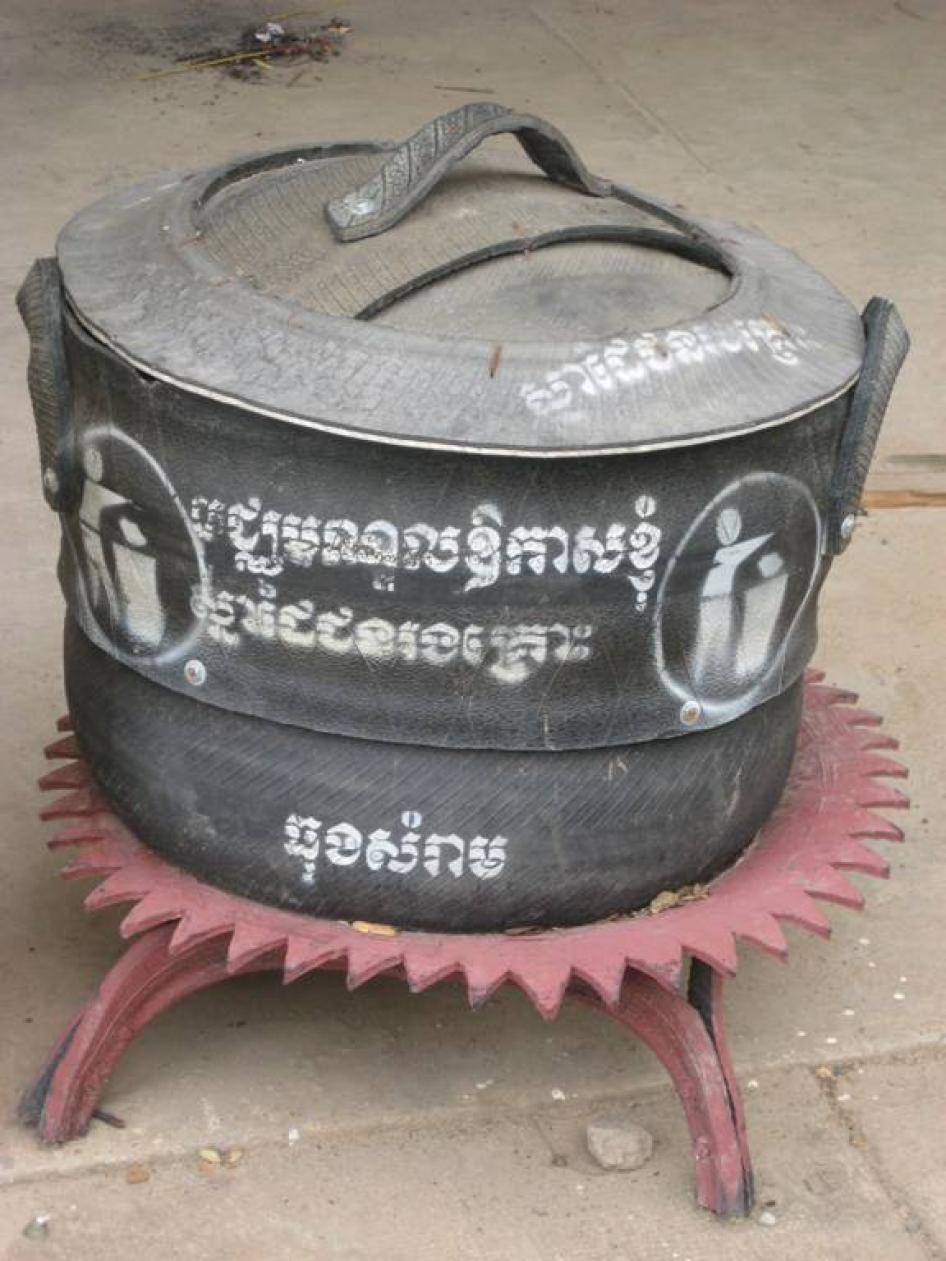
“We spray paint the rubbish bins with ‘Made by the victim’ in white paint.” © 2009 Human Rights Watch
Forced military drills
In addition to a strict regime of physical exercises and laboring, former detainees also report that they are drilled to march in military formations. M’noh, age 16, described the military drills at the Social Affairs “Youth Rehabilitation Center” in Choam Chao:
We would march and hold our hands like we carry a gun. Each movement would be consistent. At the time, we would sing the national anthem. [The exercise] was like carrying [a] gun, like a military parade. We had to salute the commanders. You had to say ‘Yes! I accept the order!’ It’s like a physical exercise: when you do it, you sweat... They would call ‘One, two, one, two...’ When they call one, the left foot lifts, then two the right foot. Every step must be consistent with those in the front and back. They didn’t tell us why [we had to do this].[189]
Puth described the military exercises in the Orgkas Khnom center:
We had to stand at attention, stand at ease, turn left, turn right, march like on parade, salute the officers. If you turn the wrong way then you are slapped on the face... [or] if they called ‘Attention’ and you turned, then you are slapped.[190]
Former detainees are under no illusions about the usefulness of such military drills. According to Angkear, “We had to learn military drills... It was a waste of time... I just followed what they told me, like turn left, turn right, turn around, stand to attention...”[191]
As with the daily physical exercises, participation and correct performance of the drills was enforced by beatings.
Group classes
Detainees may also attend group classes: in some centers this is once a day, in other centers it may be twice a day (a “Good Morning” class and a “Good Afternoon” class) while in others the classes are much less regular. The classes cover education on drug issues, lectures demanding that detainees should change their behavior, as well as self-criticism and criticism of others.
Kuhear, a former detainee of a military police center, describes his daily classes:
A military policeman was the teacher. Sometimes, when he was busy, we missed a class. This was from 2-4 p.m.... I know some articles [of the drug law]. ‘Drugs can cause physical, mental and spiritual impact. It causes impact on the liver, it causes central nervous system damage.’ We learnt this from [the staff member]. He talked about the law, if someone causes battery, injury to others, they could be imprisoned from 1-3 years. They also explained about the impact of drug use.[192]
Kanha describes the classes he attended in the Orgkas Khnom center. The “Good Morning” class was led by a staff member, while the “Good Afternoon” class was led by a room captain. Both talked about the effects of drugs and the need for detainees to “correct” themselves.
In the ‘Good Afternoon’ class the room captains tell the new people [the same information as in the “Good Morning” class]. If someone keeps silent and concentrates on what he says, then it’s ok. If someone does not listen and concentrate, he could be beaten. [The room captain] would repeat what [the staff] said, like ‘Outside you used drugs, now you should stop. You should find a job and not beat your family.’ He said the same thing every day... those who did not listen to him would be beaten.[193]
Food
Former detainees complained to Human Rights Watch about the quality and quantity of the food provided to them. Detainees generally were given food three times per day, but several detainees reported they were provided insufficient amounts of food and that they were often hungry. The food provided was sometimes rotten or insect-ridden. It also appears to have been grossly deficient both in nutritional and caloric content, particularly given the exercise and labor regime in the centers. Reports of insufficient food were more common among detainees who had been admitted without their parents paying for their arrest and detention. Detainees reported symptoms such as numbness and swelling, which are consistent with diseases caused by nutritional deficiencies.
Sarika described the food as “awful. We had porridge in the morning, mixed with fly’s eggs, even some worms....”[194] In Srokaneak’s words,
Once or twice a week they would make porridge [for breakfast]. Then there was rice and soup... We had this for lunch and dinner. It was tasteless, more liquid than vegetables. I could never get full. You were full for a short period of time then you start starving again.[195]
For detainees whose parents paid for their detention, parents would also supplement the food rations provided by the centers. According to Putrea,
The soup was like pig’s food. In the morning, for breakfast, we had porridge and salted soybeans. We felt hungry just sitting inside the room. For lunch we had steamed rice and sour soup... the vegetables inside the soup were indescribable. We ate only the vegetables we planted, like morning glory [and] green beans. The vegetables were not good. Sometimes the vegetables had worms and the worms would float in the soup. Dinner was the same [type of] food... The rich kids had separate food: they had dried sardines, noodles, beef, chicken. Parents bought this from outside and gave the raw food to the cooks in the center. The parents paid money for cooking.[196]
Makara’s parents sent him rations of food during his detention. He said that detainees who ate only the food provided by the center would beg him for his food.
Those [detainees] who have no parents find it difficult. They watch you eat food. The food rations in Orgkas Khnom are not enough for them: they don’t have enough to eat. Those who have parents have instant noodles or candy or cakes for snacks... The other [detainees] felt hungry when they saw people eating snacks. Some of those who were arrested would sit and stare at me eating, so I would share [my food]. They said ‘Oh brother, can I share food with you?’ so I passed it on.[197]
A number of former detainees mentioned symptoms of “numbness and swelling” among detainees. Atith explained how it was at the Orgkas Khnom center:
My leg was swollen, all my body swelled up, even my face. This was because of tasteless food... Those who have family to bring them food, they have no swelling. But without food from the family, people swell up... You know the food is vegetable soup every day... Because I had no other food to eat [from my parents], I had only soup. Many people like me, who have no family, swell up. With so much swelling, I could not walk. I felt tired.[198]
Pok reported similar symptoms while detained at the provincial police center in Borvel:
First I started to be numb in my leg and I tried to stand up but could not. Each time I wanted to stand up I used my hand to pull me up by the window or the door. I still could not walk... As many as 20 people had this problem [when I was there]...[199]
Angkear, who was detained for an extended period in 2008 in the Orgkas Khnom center, reported the same symptoms of numbness and swelling during his period of detention. He was limping when he was interviewed by Human Rights Watch two months after his release. He explained:
The soup was not good. The kitchen was very dirty and the food tasteless. There was no fish in the soup and in addition the rice was bad quality. My leg went numb... Inside the center there are many people who have swollen legs because the food is bland. The food they cook is difficult to eat. Outside [the center] you would see this food and not eat it... It was very dirty. One man had not only his leg but also his face, his whole body, swollen... Now I can’t move my foot. The swelling has gone but my foot and toes remain numb.[200]
One hypothesis is that these symptoms of “numbness and swelling” indicate cases of beri-beri. Beri-beri is a disease affecting the nervous system caused by a lack of thiamine (vitamin B1). Advanced cases may cause death. A doctor working with a UN agency visited three centers in mid 2008. The doctor said that some 10-25 percent of detainees in all three centers he visited self-reported ‘numbness and swelling’, which in some cases was severe enough to interfere with the abilities to walk and to stand upright. The doctor hypothesized that the numbness and swelling might be beri-beri.[201] Although a clinical diagnosis of beri-beri was not possible in the circumstances, he told Human Rights Watch: “I observed high rates of reported “numbness and swelling” which seems consistent with thiamine deficiency and is a plausible cause given the [poor] dietary provision in the centers.”[202]
Applicable standards
Drug treatment
The World Health Organization considers that substance dependence is not a failure of will or of strength of character but a chronic, relapsing medical condition with a physiological and genetic basis that could affect any human being.[203]WHO and UNODC note that:
[t]he same standards of ethical treatment should apply to the treatment of drug dependence as other health care conditions. These include the right to autonomy, and self determination on the part of the patient, and the obligation for beneficence and non maleficence [do good/do no harm] on behalf of treating staff.[204]
Forcing people into treatment as a matter of course and en masse involves numerous violations of the human rights of those subjected to these measures.
The Committee on Economic, Social and Cultural Rights (CESCR) has stated that a state’s health facilities, goods and services should be available, acceptable, accessible and of good quality. [205]However, as WHO and UNODC note, “neither detention nor forced labor have been recognized by science as treatment for drug use disorders.”[206] Similarly, neither forced physical exercise nor military drills have been scientifically recognized as forms of treatment. Forcing people to undergo supposed “treatment” that is not evidence-based would violate the requirement that health facilities, goods and services should be culturally and ethically acceptable, scientifically and medically appropriate, and of good quality.
When supposed “treatment” and “rehabilitation” involves detention, such a systemalso violates a number of other rights, such as freedom from arbitrary detention. Further, when supposed “treatment” and “rehabilitation” involves compulsory labor which does not benefit the detainees, or is abusive such a system violates the prohibition on forced labor as enshrined in various international human rights instruments.[207]
The ban on forced labor in international law does not extend to “[a]ny work or service exacted from any person as a consequence of a conviction in a court of law, provided that the said work or service is carried out under the supervision and control of a public authority and that the said person is not hired to or placed at the disposal of private individuals, companies or associations.”[208] However, people detained in Cambodia’s drug detention centers have not been ordered to perform labor as a part of their sentence. In addition, some people report working on apparently private projects around Phnom Penh, or constructing buildings owned by center staff.
The UN Minimum Standard Rules for the Treatment of Prisoners provides that work undertaken be to a prisoner’s benefit, and that it not be subordinated to the purpose of making a financial profit for the institution.[209]
Under the ICCPR, governments must provide “adequate medical care during detention.”[210] Former detainees reported to Human Rights Watch that they were forced to perform grueling physical exercises, to work and to march in military formation. They also reported severe punishment for not being able to complete these tasks.
Such elements of supposed “treatment” and “rehabilitation” may also constitute inhuman or degrading treatment or punishment. For example, the UN Special Rapporteur on Torture has stated that the re-education through labor system in China
and similar methods of re-education in prisons, pretrial detention centres, and other institutions... can also be considered as a form of inhuman or degrading treatment or punishment, if not mental torture.[211]
Where systems of supposed drug “treatment” and “rehabilitation” force people into treatment as a matter of course and en masse, such systems violate the international human rights standards that medical treatment must be based on free and informed consent. The Special Rapporteur on the Right to Health has stated that:
Informed consent is not mere acceptance of a medical intervention, but a voluntary and sufficiently informed decision, protecting the right of the patient to be involved in medical decision-making, and assigning associated duties and obligations to health-care providers. Its ethical and legal normative justifications stem from its promotion of patient autonomy, self-determination, bodily integrity and well-being.[212]
The right to health includes the principle of treatment following informed consent. The CESCR has interpreted Article 12 to include “the right to be free from... non-consensual medical treatment and experimentation.”[213]
Indeed, scientific research from other countries has questioned the effectiveness of compulsory drug treatment. Some research suggests that a lack of internal client motivation in treatment may undermine positive outcomes.[214]Specifically with relation to treatment for methamphetamine dependence, some research has shown that compulsory treatment has been associated with higher rates of relapse than voluntary treatment.[215] Independent reviews of Vietnam’s system of compulsory drug treatment have found that it is not cost effective and that the rate of relapse to drug use for former detainees is around 90 percent.[216]
The CESCR has noted that a state’s obligation to respect the right to health includes the obligation to refrain from applying coercive medical treatments unless on an exceptional basis for the treatment of mental illness or the prevention and control of communicable diseases.[217]
Such exceptional cases should be subject to specific and restrictive conditions, respecting best practices and applicable international standards.[218]As WHO and UNODC note, “only in exceptional crisis situations of high risk to self or others, compulsory treatment should be mandated for specific conditions and periods of time as specified by the law.”[219]
In the absence of clinical opinions by professional healthcare professionals, Cambodia’s system forces people to undergo supposed “treatment” and “rehabilitation” regardless of whether there is an actual lack of capacity on the part of the person to consent to treatment. The system ignores an individual’s treatment needs (if any) and therefore cannot be said to be justified by a demonstrable benefit from the proposed intervention. The system denies an individual the opportunity to cease or modify his or her treatment plan and fails to review the ongoing necessity of treatment. Because of such failings, there are no procedural guarantees that the compulsory intervention will not be provided for longer than strictly necessary.
As a form of diversion from the criminal justice system, where the use and/or possession of drugs remains a criminal or administrative offense, such as is nominally provided for under Cambodia’s drugs law, great care must be taken to ensure that an individual’s autonomy is respected. As WHO and UNODC note, “the patient is entitled to reject treatment and choose the penal sanction instead.”[220]
WHO notes that during withdrawal:
Appropriate supervision is needed and medical services should be available, especially in the presence of confusional states, cerebral seizure or hazards as a consequence of poor nutritional condition. Adequate monitoring has an essential part in the management of withdrawal state. Pharmacological treatment and other methods... can be used to relieve pain, unrest, sleeplessness or other symptoms. Decreasing dosages of a substitute substance may be administered, especially in cases of... opioid dependence.[221]
Non-discrimination in drug treatment services
A noted above, there are no drug treatment services in Cambodia tailored for women and girls. Human Rights Watch does not believe that opening a drug detention center for women is the appropriate policy response to this lack of drug treatment services. Rather, Cambodia should be guided by informed policy positions about how best to meet women’s needs to effective drug treatment services.
According to the CESCR, states must take special care to ensure that women and girls have equal access to health services.[222] Men’s and women’s clinical needs with respect to drug dependence treatment may differ substantially. UNODC considers that programs that provide special services for women are associated with much better treatment outcomes for this population.[223] According to UNODC, drug dependence treatment for women can be made more effective by the following programmatic responses, among others:
- Development of a comprehensive programthat is non-judgmental and non-punitive. Attention to relationships, trauma and concurrent disorders is essential for successful service provision.
- Provision of community-based servicesis cost-effective, less intrusive and accommodates women who have difficulties in entering residential services.
- Provision of facilities and care for pregnant and parenting womenthat is multidisciplinary, comprehensive and coordinated contributes to improved retention and outcomes for mothers and newborns.
UNODC also recommends coupling treatment services with child care and social services and support (such as assistance with job and training opportunities, family therapy and assistance with safe housing).[224]
Food
Article 10 of the ICCPR requires that anyone deprived of their liberty be treated with humanity and dignity, which includes that they be detained in humane conditions. Particularly harsh conditions of detention, including deprivation of food, constitute inhuman conditions of detention in violation of the ICCPR.[225]
The UN Minimum Standard Rules for the Treatment of Prisoners provides: “Every prisoner shall be provided by the administration at the usual hours with food of nutritional value adequate for health and strength, of wholesome quality and well prepared and served.”[226] This standard has been cited with approval by the UN Human Rights Committee when examining the minimum standards that a state must observe in respect of those deprived of their liberty “regardless of a state party’s level of development.”[227]
Specific populations
Children
You know, children have the right to complain about this! I want those children out of those centers, so they can have freedom like me now.
—Chambok, 17 years old, former detainee of the Social Affairs “Youth Rehabilitation Center” in Choam Chao [228]
Cambodia’s drug detention centers hold a large number of children. Indeed, some of the designated drug detention centers—the Social Affairs centers at Choam Chao and in Kandal province—are nominally “Youth Rehabilitation Centers.” As noted above, in 2008 just under one quarter of detainees in government drug detention centers were aged 18 or below. Of these, 104 children were younger than 15. In 2008, 116 detained people were classified as “street children.”[229]Children are arrested and detained without legal authority. Children are detained in the same sleeping quarters as adults. There is an absence of appropriate treatment, education and recreation services at the centers. Human Rights Watch was told that detainees of the Choam Chao “Youth Rehabilitation Center” were given electrical shocks, beaten and forced by “cats” to dance naked.
Many street children are arrested by police or other authorities in street sweeps and taken directly to detention centers without any legal authority whatsoever. Chambok, 17 years old, explained the process of his arrest and detention:
[Those who arrested me] are staff from Social Affairs... They snatched me and threw me in the truck. In the truck there was a cage. There was a logo of Social Affairs [on the truck]... My friends were in the truck, more than five of us... They arrested us at 4 or 5 p.m. and then took us straight to Choam Chao [detention center]. They didn’t tell me why they arrested me: I wonder this too... I never saw a lawyer... They simply put me into the truck and I arrived at Choam Chao [center] at 6 p.m.[230]
Children and adults are commonly detained together. In the course of researching this report, Human Rights Watch interviewed six adults (i.e. over 18 years old) who had been detained in the Social Affairs “Youth Rehabilitation Center” in Choam Chao. Other centers also detain children and adults together. According to Sao, age 24, and a former detainee of Orgkas Khnom center:
In my room, there were about four children, 13-15 years old. They were there for sniffing glue. They were arrested. They work like us. They do military drills like us. They sleep in rooms with adults.[231]
Similarly, Trach, 27 years old, reported that there was no separation of children and adults in the Siem Reap civilian police center:
The youngest [in the center] was 12 or 13... they were glue sniffers. There were about seven or eight kids under 18. They slept with us. Normal kids slept with the crazy people.[232]
Kakada, age 28, described the Social Affairs center at Choam Chao as “a center to bully children.” He reported that the children at the center were given the same military training as the adults:
There are small boys and they bully them like soldiers. They beat them and slap them. The “cats” and the guards [do this]. They are trained like soldiers but I feel such pity because they look like my younger brother. Sometimes I burst into tears with pity. They train them like soldiers to harden their bodies. The guard gave military orders, like turn left, turn right. The training is to make them strong, to make them stay away from drugs... If they fell out of line while rolling [on the ground], the guards kicked them in the head. One boy rolled but did not roll in a straight line... The guard said ‘You, boy, you did not do it.’ He asked the boy to stand up and kicked the boy. He fell back two meters. The guard said, ‘If you cry, I will do it again.’ The boy cried.[233]
Makara, age 25, a former detainee of the Orgkas Khnom center, explained:
[Children] were treated the same [as other detainees]: 100 percent [of detainees] get soldier training, military parades, saluting staff, clearing the grass, hoeing the ground, cleaning the toilet, raising cows and ducks...[234]
Kanha, age 35, a former detainee of the Orgkas Khnom center, explained:
There were people who were 10, 12, 13 years old, maybe about 10 of them [in the center]... Some slept in a different room. But there were 3 boys—one 10 [years old], one 12 [years old] and one 13 [years old]—in my room. They did the same work [as other detainees]: hoeing the ground, go to [Good Morning] class, have military training. Sometimes they were beaten, if they were guilty [of breaking internal rules]. I saw this. Regardless of being a boy or a man, if they made a mistake they were beaten.[235]
Much of the torture and physical abuse by staff described above were reported to Human Rights Watch by children. Human Rights Watch interviewed children formerly detained in the Social Affairs “Youth Rehabilitation Center” in Choam Chao who reported horrific treatment at the hands of the staff and detainees. Despite being a nominal rehabilitation center for youth, the guards have access to electrical batons. Kakada, 28 years old and a former detainee of the “Youth Rehabilitation Center” in Choam Chao, witnessed a fellow detainee in that center being shocked as punishment for attempting to escape:
The guards outside the center have electrical batons. When someone tries to escape the ‘cats’ scream out to those guards with electrical batons.... One man ran and a guard shocked him until he fell on the ground. He lost consciousness.... In that place they think only of beating.[236]
Tonle, 16, another former detainee at the Social Affairs “Youth Rehabilitation Center” in Choam Chao, described being forced to dance naked by the “cats”:
You know, when [the ‘cats’] got drunk they asked all the kids to take off all their clothes and dance. It happened once. Everybody had to do this. It was inside the room. They played karaoke song[s] on the mobile phone. It was about 8 or 9 at night.... More than 20 had to take off their clothes and dance, for about half an hour. If you didn’t take off your clothes you would be beaten.[237]
Chambok, 17, told of being forced to work by being beaten when he was sick:
[In Choam Chao] I cleared the grass. You know if someone does not work you have to go to meet the guard and get the ‘ox’s penis’ [a police baton] three times. They beat me two times because I was sick. They said ‘No, you work!’ I was shivering [at this time], I had malaria.[238]
Khal, age 16, describes daily beatings by “cats” at Choam Chao:
[The ‘cats’] beat me to ‘welcome’ me, but after the welcome they still beat me every day. They used their hands. They said I was a rude boy, that my face was a rude face. I did not do anything wrong. [A ‘cat’] punched me in the chest, many times. [The ‘cat’] ordered his subordinates to beat me. Nobody dared to tell the guards or else [the ‘cat’] would beat us. I didn’t try and tell the guards because I was afraid of being beaten by [the ‘cat’].[239]
Extract from song in Choam Chao “Youth Rehabilitation Center”This song was taught to detainees of the Social Affairs “Youth Rehabilitation Center” in Choam Chao. Detainees reported having been forced to sing it two mornings a week. Dancing in a circle in the middle of the night May I hold your hands? Baby, do not get angry- ... Before I was handsome; I was a soldier. Babe, the salary I had Babe, the salary I had I was a soldier; [with] 2500 [riel salary].[240] ... On the first imprisonment eating the ox’s penis three times [being beaten with a baton three times] is considered as exercise; Baby, as I beg for money Baby, as I beg for money I will promenade you in Choam Chao. Choam Chao, a very happy place where handsome boys sit and uproot grass. Babe, this is Choam Chao center Babe, this is Choam Chao center sitting and uprooting grass seven times a week. |
Abuses against children were reported to Human Rights Watch in centers other than the Social Affairs center in Choam Chao. A former detainee, Russey, 17 years old, describes being beaten by the military police in the center in Battambang to mark his release from the center:
The military police beat me. They used the black ‘ox’s penis’ [a police baton] on my bum... The trainer said ‘This kid is released today so let me give you a beating.’ [Then he asked] ‘Will you rehabilitate yourself? Will you stop [using drugs]? Do you have work?” Then he gave [me] another beating.’[241]
Chamnauth, age 15, was one of the few females interviewed by Human Rights Watch who had been detained in a center other than a Social Affairs center. Like many of her male fellow detainees, she reported she was beaten:
I had to do exercise too [as well as the boys and men]. I did cooking [as labor]. If I made a little mistake, I was beaten. I made a mistake in putting the wrong ingredients in the soup. The chef, a staff, beat me. They whipped my hand with a stick.[242]
Mentally ill
They arrested even crazy people...They were just arrested and thrown in the truck. There were about four [mentally ill] people in the center... They do the work like cleaning the grass and carrying water and watering vegetables. They can not communicate well, that’s why they get beaten up.
—Kakada, age 28, a former detainee of the Social Affairs “Youth Rehabilitation Center” in Choam Chao[243]
In practice, the government drug detention centers also function as a convenient means of removing people with apparent mental illnesses from the general community. Human Rights Watch interviewed former detainees who described appalling physical violence against people who appeared to suffer mental illnesses.
Sao, a former detainee of the Orgkas Khnom center, explained that the center is used to detain people who are apparently mentally ill.
There are crazy people [detained] there. They are not drug users. They don’t know what is wrong and right, they speak during the night, they eat on the ground. They are ‘brainless’ people. They are beaten if they do no labor: after they are beaten, they work. Their families put them there. Some were arrested while they were wandering in the markets.[244]
According to a draft report of a joint assessment of the centers conducted by WHO and the Cambodian government:
There is no provision of mental health services in the centers. The center in Siem Reap was holding patients who were not drug dependent. It seemed that some of their patients were mentally ill and had been placed in the center after being ‘picked up’ by police or other authorities and brought to the center.... Centers do not effectively assess levels of mental health and so it is likely that a population of participants suffer from mental health issues.[245]
Human Rights Watch received reports of cruel and inhuman treatment of people with apparent mental illness. Kakada witnessed one man with an apparent mental illness being severely beaten.
[The staff and other detainees] kick the crazy people because they [mentally ill people] don’t know anything. One crazy man, the guard asked him to use the stick [as a shoulder pole] to carry the water, but the crazy man used the stick to beat someone else because he didn’t know better. The guard snatched the stick and beat him all over until he was seriously injured. We could not help the crazy man: if we tried to help him we would be beaten. The guard beat him too much, on the back, until he vomited blood. He beat him until the man fell on the ground and the stick was broken...[246]
Kuhear told of one beating of an apparently mentally ill man by a room captain, on the direct orders and in the presence of military police.
Four military police stood watching the beating of [a detainee] by the room captain. They said ‘Room captain: beat him until he gets scared!’ [The detainee], because he has a little bit of a mental problem, ate half a bar of soap. ‘Beat him to stop him from eating soap again, beat him to make him spit it out!’ [The first military police officer], the person in charge of work and [the second military police officer], the Deputy Commander of the center said this. Then the room captain beat [the detainee], kicking, punching, kicking with the heel into [the detainee’s] back. At first, the military police were angry [and] then they were laughing.[247]
Mesa said he witnessed the beating of a man with an apparent mental illness:
One [room captain] beat a man who was crazy.... He had two sticks he hid at the head of his bed. One stick was wooden, the other was cane. He asked people to take off the crazy man’s pants and beat him. His buttocks were red. He was a crazy man: he was alone, so quiet. Outside the center he was a normal man but inside the center he became crazy: maybe people beat him a lot.[248]
Applicable standards
Detention of children as a last resort
The UN Convention on the Rights of the Child (CRC)—a binding international treaty to which Cambodia is a party—states that any arrest, detention, or imprisonment of a child must be in conformity with the law and can be done only as a “measure of last resort.”[249] Moreover, children deprived of their liberty have the right to challenge the legality of their detention before a court or other competent, independent and impartial authority, and are entitled to a prompt decision on any such action.[250] This means that in general a child should not be detained unless it is adjudicated that he or she has committed a violent act against someone or is persistent in committing other serious offenses and there is no other appropriate response.[251]
The UN Committee on the Rights of the Child—a body of independent experts empowered with interpreting the CRC and examining whether countries are in compliance with it—has highlighted the need for a range of alternatives to avoid restriction of liberty for children who use drugs.[252] The Committee has expressed concern at non-criminal responses to children who use drugs which are stigmatizing or involve depriving children of their liberty or other civil rights, such as placing children in closed rehabilitative centers. Indeed, the Committee has advocated for the development of non-institutional forms of treatment of children who abuse drugs and for making the placement of children in an institution a measure of last resort. In addition, children living in such institutions should be provided with basic services such as health, education and other social services and maintain contact with their family during their stay. Finally, the Committee has called for the setting of clear standards for institutions and a provision of periodic reviews of the placement of children.[253]
Lack of age-specific programs or services/No separation of adults and children
The detention of persons under age 18 in the same facilities as adults is prohibited under international human rights law.[254] The Committee on the Rights of the Child has noted that children placed in institutions for the purpose of drug treatment are guaranteed at least the same minimum standards as any child deprived of his or liberty.[255] Cambodia’s prison regulations require the separation of adult and child prisoners.[256]
Detention facilities should seek to detect and should treat any physical or mental illness, substance abuse or other condition that may hinder the integration of children into society and should adopt specialized drug prevention and rehabilitation programs administered by qualified personnel. These programs should be adapted to the age, sex and other requirements of the juveniles concerned, and detoxification facilities and services staffed by trained personnel should be available to drug- or alcohol-dependent juveniles.[257]
Torture and cruel and inhuman treatment
Just as with adults, all children detained must be treated with dignity and there is an absolute prohibition on subjecting a child to torture or to cruel, inhuman or degrading treatment or punishment.[258]The Special Rapporteur on torture has noted:
Unlike most adults, children can be deprived of their liberty in a variety of legal settings other than those related to the criminal justice system and are thus reported to be particularly vulnerable to some forms of torture or ill-treatment in an institutional environment.... Unlike detention within the justice system, which in most cases will take place for a predetermined period of time, children are sometimes held in such institutions and subjected to cruel and inhuman or degrading treatment without time limits or periodic review or judicial oversight of the placement decision. Such indeterminate confinement, particularly in institutions that severely restrict their freedom of movement, can in itself constitute cruel or inhuman treatment.[259]
Degrading treatment includes treatment that involves the humiliation of the victim or that is disproportionate to the circumstances of the case. For example, in the cases above, forcing boys to dance naked and corporal punishment for infringing center rules violate Cambodia’s obligation to prevent cruel, inhuman and degrading treatment.
The draft Criminal Code provides that “torture and barbarous acts” are punishable with imprisonment for between seven and 15 years. Where committed on “a person particularly vulnerable due to his/her age” or “on a person particularly vulnerable due to his/her sickness or disability while his/her conditions are apparent or known to the perpetrator” then the punishment is between 10 and 20 years imprisonment.[260]
Mentally ill
Under international human rights law, people with a mental illness are protected from torture or cruel, inhuman, or degrading treatment or punishment. International human rights law also affirms the separate right to health, which requires appropriate mental health care, to the extent feasible, for all people, including the right to proper treatment for mental illness.
The United Nations “Principles for the Protection and Care of People with Mental Illness” establish that involuntary treatment occurs only in cases that satisfy strict criteria. The Principles establish that a patient’s right to medical treatment only with fully informed consent can be limited “only after a fair hearing by an independent and impartial tribunal established by domestic law.” The tribunal must be satisfied that the “patient lacks the capacity to give or withhold informed consent to the proposed plan of treatment or that, having regard to the patient’s own safety or the safety of others, the patient unreasonably withholds such consent” and that the proposed treatment plan is “in the best interests of the patient’s health needs.” Involuntary admission or retention must be initially for a short period (as specified by domestic law) for observation and preliminary treatment, pending review. In cases of involuntary treatment, such treatment shall not be prolonged beyond the period that is strictly necessary for this purpose. Further, the patient shall have the right to be treated in the least restrictive environment and with the least restrictive or intrusive appropriate treatment.[261]
VI. Conclusions
There is no doubt that illegal drug use raises complex and multifaceted challenges for public policy makers. Traditionally, states’ policies on drug use have focused on both supply and demand reduction of drugs. Increasingly, states are incorporating public health perspectives to reduce the immediate harms of drug use, such as the spread of HIV and other blood borne diseases among people who use drugs. Reducing the supply of, the demand for, and the immediate harms associated with drug use are all clearly elements of a state’s policies on drugs, wherever drug use poses a serious threat to public health. But great care must be taken to ensure that the nature and implementation of supply and demand reduction polices are consistent with states’ human rights obligations.
Drug dependence is a chronic, relapsing disease. Drug users, both in and out of detention, have a right to access drug dependence treatment that is medically appropriate and comports with international standards. According to UNODC and WHO, “[t]he human rights of people with drug dependence should never be restricted on the grounds of treatment and rehabilitation.”[262] However, in Cambodia, people who use drugs are treated as though they have lost their human rights.
As “rehabilitation” or “treatment” for drug dependence, such centers are failures. Compounding the therapeutic ineffectiveness of detention itself, detainees are forced to perform activities that have no scientific basis for treating drug dependence, such as forced physical exercises, forced labor and forced military drills. As one NGO staff member with considerable experience working on drug issues in Cambodia explained to Human Rights Watch, “[In the centers] there is a total lack of understanding of addiction as a psychological and social process.”[263] There are no indications that the existing system of compulsory drug detention centers is reducing the number of Cambodians who use drugs.
Rather, the drug treatment centers appear driven by motivations of social control, retribution for the perceived moral failure of drug use, and profit. From the moment they are arrested to when they are finally released from the centers, detainees are subjected to sadistic violence. Violence is perpetrated on detainees who are children or mentally ill, regardless. Staff of centers can use electric batons, whip and beat detainees with impunity and order fellow detainees to do the same. In many instances, center staff exploit the detainees for their own benefit, whether that be forcing detainees to labor or coercing them to donate their blood. The detention of people in these centers and their subjection to such treatment is in violation of all applicable international standards.
VII. Acknowledgements
This report was researched and written by a Human Rights Watch staff member. It was edited and reviewed by Joseph Amon, Director of the Health and Human Rights division, and Rebecca Schleifer, Advocacy Director in the Health and Human Rights division. Aisling Reidy, Senior Legal Advisor; Iain Levine, Program Director; and Sara Colm, Senior Researcher in the Asia division, all with Human Rights Watch, also reviewed the report, as did Jason Barber. Production assistance was provided by Andrea Cottom, Mignon Lamia, Grace Choi, Anna Lopriore, and Fitzroy Hepkins. Human Rights Watch would also like to thank Guy Jarman for the design and creation of the map.
Human Rights Watch is deeply grateful to the many individuals who shared their knowledge and experiences with us. Without their testimony this report would not be possible.
Annex: Correspondence with the Royal Cambodian Government
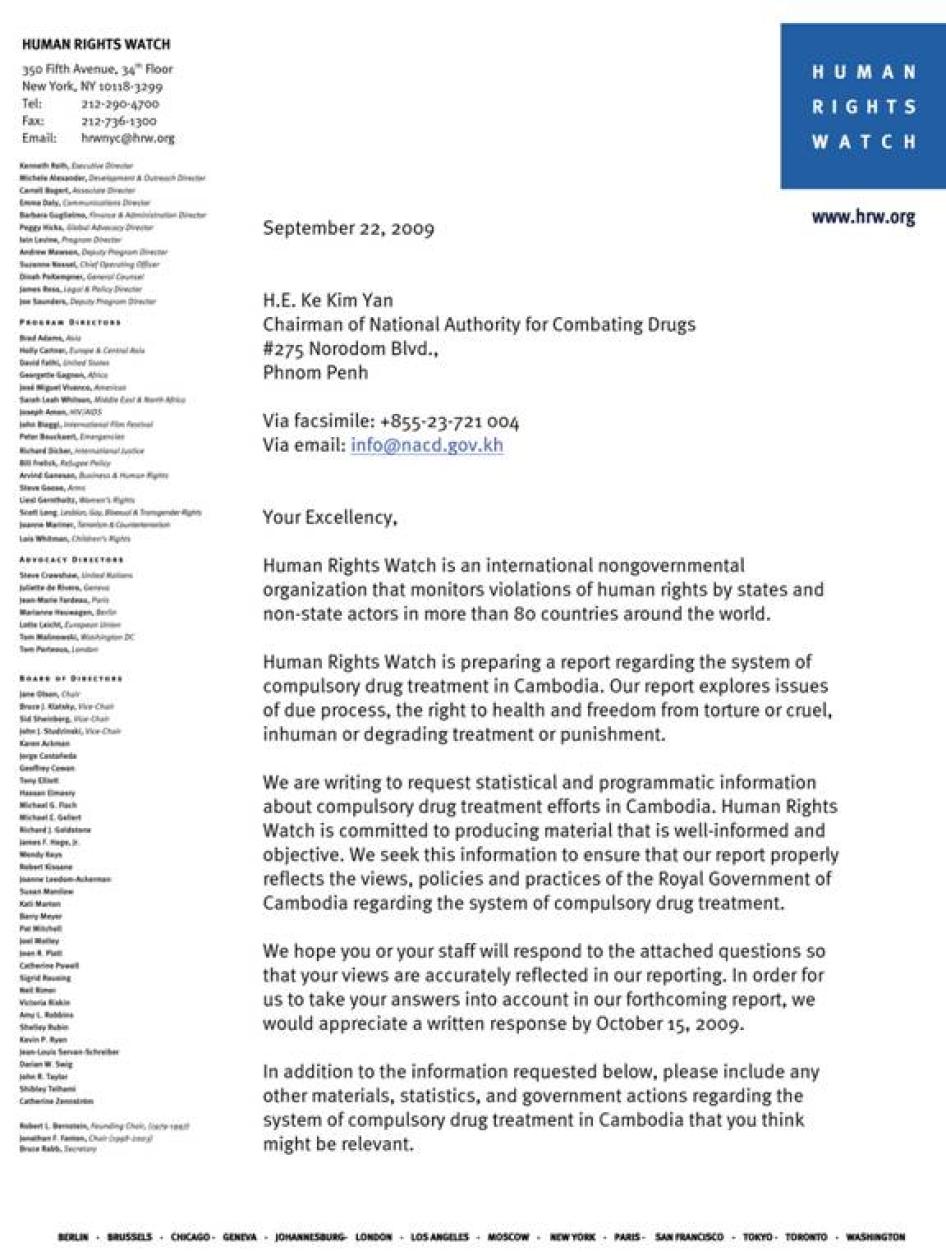
[1] Human Rights Watch interview with M’noh, Phnom Penh, June 2009. The identity of interviewees has been disguised with randomly-selected pseudonyms and in some cases certain other identifying information has been withheld, to protect their privacy and safety.
[2] Human Rights Watch interview with Kakada, Phnom Penh, May 2009.
[3]Human Rights Watch interview with Puth, Phnom Penh, April 2009.
[4] Human Rights Watch interview with Cambodian health professional, Phnom Penh, May 2009; Human Rights Watch interview with NGO worker, Phnom Penh, May 2009.
[5] Human Rights Watch interview with Chrolong, Phnom Penh, July 2009
[6]An additional eight interviews with former detainees were not included in this report, either because the interviewees had been detained in drug detention centers prior to the three year limitation period of this research or because the interviewees were unable to recollect with sufficient clarity when they had been detained. “Child” as used in this report, refers to anyone under the age of 18. Convention on the Rights of the Child (CRC), art. 1, adopted November 20, 1989, 1577 U.N.T.S. 3 (entered into force September 2, 1990). Cambodia ratified the CRC on October 15, 1992.
[7] The Center in Prey Speu also works closely with the Department of Social Affairs, Vocational Training and Rehabilitation of the Phnom Penh Municipality.
[8] Drug Information Center, Secretariat General, National Authority for Combating Drugs, “Summary Report of Drug Data, 2008,” Phnom Penh, April 2009, unpublished (copy on file at Human Rights Watch); National Authority for Combating Drugs, “Report on Illicit Drug Data and Routine Surveillance Systems in Cambodia 2007,” June 2008, pp. 52-54; UNODC/UNAIDS, “Cambodia Country Advocacy Brief: Injecting Drug Use and HIV,” 2009, p. 2.
[9]Drug Information Center, Secretariat General, National Authority for Combating Drugs, “Summary Report of Drug Data, 2008,” Phnom Penh, April 2009, unpublished (copy on file at Human Rights Watch); National Authority for Combating Drugs, “Report on Illicit Drug Data and Routine Surveillance Systems in Cambodia 2007,” June 2008, p. 52.
[10] “Drug User Population Size Estimates 2007,” Surveillance Unit, National Centre for HIV/AIDS, Dermatology and STD's (NCHADS), Ministry of Health, 2008, unpublished (copy on file at Human Rights Watch).
[11]M. Devaney, G. Reid & S. Baldwin, “A situational analysis of illicit drug use and responses in the Asia-Pacific region,” Burnet Institute and Turning Point Alcohol and Drug Center, 2006, p. 10.
[12] “Report from the National Residential Treatment Center Minimum Dataset: 2008,” Drug Information Center, National Authority for Combating Drugs, presented at DHA Technical Working Group Meeting, NAGA World Hotel, June 4, 2009 (copy on file at Human Rights Watch). “Treatment,” as used in this report, is defined as “the process that begins when psychoactive substance users come into contact with a health provider or other community service, and may continue through a succession of specific interventions until the highest attainable level of health and well-being is reached. Treatment and rehabilitation are defined as a comprehensive approach to identification, assistance, health care, and social integration with regards to persons presenting problems caused by the use of any psychoactive substance. These definitions include the notion that substance users are entitled to be treated with humanity and respect.” (WHO Expert Committee on Drug Dependence, Thirtieth Report: WHO Technical Report Series 873, 1998, http://whqlibdoc.who.int/trs/WHO_TRS_873.pdf.) In Cambodia, because detainees do not come into contact with a health provider and there is little or no “identification, assistance, health care, and social integration” inside such centers, it would be misleading to refer to Cambodia’s centers as either treatment or rehabilitation centers. This report refers to Cambodia’s centers as “drug detention centers”.
[13]Given that the NACD has published inconsistent lists of the number of government drug detention centers, these figures may be unreliable and the actual number of detainees might be higher. Drug Information Center, Secretariat General, National Authority for Combating Drugs, “Summary Report of Drug Data, 2008,” Phnom Penh, April 2009, unpublished (copy on file at Human Rights Watch); Data collected from July-December 2007 describe a similar situation to the 2008 figures. The majority of people admitted (50.7percent) were aged from 19-25 years old. Over 9percent were less than 16 years old, and almost 22 percent were aged 16-18. The most preferred drugs were methamphetamine (47 percent) and crystal meth (34 percent). Just 2.3 percent of admissions were voluntary, while 51.4 percent were “family” admissions and 46.4 percent were “judicial admissions.” 1.1 percent of admissions were female. The number of people admitted from July to December 2007 was 740. See National Authority for Combating Drugs, ”Report on Illicit Drug Data and Routine Surveillance Systems in Cambodia 2007,” June 2008, pp 74-75.
[14] Note the data does not reflect use of different types of drugs by the same person, which is a common feature of drug consumption in Cambodia.
[15]“Report from the National Residential Treatment Center Minimum Dataset: 2008,” Drug Information Center, National Authority for Combating Drugs, presented at DHA Technical Working Group Meeting, NAGA World Hotel, June 4, 2009 (copy on file at Human Rights Watch).
[16] Drug Information Center, Secretariat General, National Authority for Combating Drugs, “Summary Report of Drug Data, 2008,” Phnom Penh, April 2009, unpublished (copy on file at Human Rights Watch).
[17] Note that the Ministry of Health is not involved in any aspect of Cambodia’s drug detention centers.
[18]National Authority for Combating Drugs, “The 5-year National Plan on Drug Control 2005-2010,” December 2004, p. 18.
[19] National Authority for Combating Drugs, “Report on Illicit Drug Data and Routine Surveillance Systems in Cambodia 2007,” June 2008, p. 74.
[20]Circular No. 03.SR, Royal Government of Cambodia, Phnom Penh, October 23, 2006.
[21] The same Circular states that “[the] Ministry of Health shall create a drug addict treatment unit at the national level in Phnom Penh, arrange consultation service at provincial-municipal and district referral hospitals to advice [sic] and cure drug addicts sent to the hospitals by their parents, develop technical standards to control drug addict treatment services in communities’ centers and eliminate treatment places that are not authorized by the Ministry of Health.” These activities have not been completed, nor has the Ministry of Health closed centers that are not authorized by it.
[22]For example, the NACD’s 2007 “Report on illicit drug data and routine surveillance systems in Cambodia 2007” lists 13 government detention centers for drug dependence (although this lists contains at least one center that claims to be an NGO.) Meanwhile the NACD’s 2008 annual report lists 10 centers. The 2007 list does not include a Social Affairs “Youth Rehabilitation Center” in Kandal province that appears on the NACD’s 2008 list (despite the fact that this center was operational during the period covered by the 2007 report.) However the 2007 list does include a military police center in Sihanoukville that is absent from the NACD’s 2008 list, despite no indications that the center has ceased to be operational. See National Authority for Combating Drugs, “Report on Illicit Drug Data and Routine Surveillance Systems in Cambodia 2008,” November 2008, p. 12-13; National Authority for Combating Drugs, “Report on Illicit Drug Data and Routine Surveillance Systems in Cambodia 2007,”June 2008, pp. 74-75.
[23]See Drug Information Center, National Authority for Combating Drugs, “List of Drug Treatment Centers,”July 2009, unpublished (copy on file at Human Rights Watch); National Authority for Combating Drugs, “Report on Illicit Drug Data and Routine Surveillance Systems in Cambodia 2008,” November 2008, p. 12-13; National Authority for Combating Drugs, “Report on Illicit Drug Data and Routine Surveillance Systems in Cambodia 2007,” June 2008, pp. 74-75.
[24] Some people who use drugs also reported being detained at a Social Affairs center at Koh Kor (also known as Koh Romdoul) within the period covered by of this report. That center is currently inactive, following the intervention of human rights organizations in mid-2008. However, it has not been officially closed and NGOs fear that people who use drugs, the homeless, and other “undesirables” may again be detained there in the future. As noted above, testimony from those detained in Koh Kor was not included in this report.
[25] It is also worth noting that the government-run Khmer Soviet Friendship hospital in Phnom Penh operates a drug rehabilitation clinic that is slated to shortly begin treating people who are opioid dependent in a trial of methadone maintenance.
[26]National Authority for Combating Drugs, “Report on Illicit Drug Data and Routine Surveillance Systems in Cambodia 2008,” November 2008, p. 4.
[27]Meng Huor, “Provinces with more than 50 drug users must establish detoxification centers” Rasmey Kampuchea, Volume 17, Number 4787, January 6, 2009 (Human Rights Watch translation, copy on file at Human Rights Watch).
[28] Khuon Leakhana and Christopher Shay, “Plans for new rehab center meet with mixed response,”Phnom Penh Post, June 29, 2009.
[29] See, for example, World Health Organization Western Pacific Region, “Assessment of compulsory treatment of people who use drugs in Cambodia, China, Malaysia and Vietnam: An application of selected human rights principles,” 2009, pp. 30-34.
[30] “Does drug rehabilitation in closed settings work in Vietnam,” Duc T. Tran, presentation at Harm Reduction 2009, Bangkok, April 21, 2009, direct attendance by Human Rights Watch researcher.
[31]National Authority for Combating Drugs, “Report on Illicit Drug Data and Routine Surveillance Systems in Cambodia 2008,” November 2008, p. 20.
[32]“Vietnam, Cambodia combat drug crime together,” Vietnam News Agency, June 10, 2009.
[33] “Cambodia, Vietnam cooperate to fight against drug trafficking,” Xinhua, September 21, 2009.
[34]See, for example, Cambodian League for the Promotion and Defense of Human Rights (LICADHO), “Media statement: Illegal arrests & Social Affairs centers: time for government action, not more denials,” November 9, 2008, http://www.licadho-cambodia.org/press/files/193LICADHOPRActionNotDenials08.pdf ; Asian Human Rights Commission, “The State of Human Rights in Eleven Asian Nations- 2008”, December 2008, pp. 87-88, http://www.ahrchk.net/pub/pdf/TheStateofHRin11AsianNations2008.pdf . See also U.N. Office of the High Commissioner for Human Rights, Role and achievements of the Office of the United Nations High Commissioner for Human Rights in assisting the Government and people of Cambodia in the promotion and protection of human rights , A/HRC/12/41, August 5, 2009, para. 28.
[35]LICADHO, “Submission to the United Nations Universal Periodic Review, Cambodia,” April 10, 2009, p. 3. See also Human Rights Watch, “UPR submission: Cambodia,” April 2009, p. 2.
[36]Law on the Control of Drugs, No. 197/01, 9 December 1996, article 98, para 4. Note that according to the UNODC, the 1988 Convention requires that illicit possession of controlled substances must be prohibited, but it does not require criminalprosecution for small quantities. See UNODC, “World Drug Report 2009,” pp. 166-169.
[37]Law on the Control of Drugs, article 98, para 4.
[38]Law on the Control of Drugs, article 89, para 1.
[39] WHO includes methadone and buprenorphine on its Model List of Essential Medicines. The Model List of Essential Medicines is meant to guide health policy-makers in knowing what medicines are necessary to ensure the health of their populations. See WHO, WHO Model List of Essential Medicines, revised March 2005, [http://mednet3.who.int/EMLib/index.aspx].
[40]Law on the Control of Drugs, Table II and III.
[41]Law on the Control of Drugs, article 91.
[42]Law on the Control of Drugs, article 92.
[43]Law on the Control of Drugs, article 93.
[44]Law on the Control of Drugs, article 95.
[45] See Legal Drafting Committee, Royal Government of Cambodia, “Final Draft, Law on Drug Control,” Phnom Penh, March 23, 2009, p. 35-37 (copy on file at Human Rights Watch).
[46] Article 7 of the ICCPR provides that : “No one shall be subjected to torture or to cruel, inhuman or degrading treatment or punishment. In particular, no one shall be subjected without his free consent to medical or scientific experimentation.”
[47] Human Rights Watch interview with Tonloap, Banteay Meanchey, June 2009.
[48] The widespread use of torture by police has been documented by other human rights organizations in Cambodia. See, for example, LICADHO, “Torture in Police Custody,” (2003), p. 9, www.licadho-cambodia.org/reports/files/372003 percent20torture%20briefing%20paper.pdf ; LICADHO, “Prison conditions in Cambodia 2008: Women in prison,” 2008, www.licadho-cambodia.org/reports/files/129LICADHOPrisonWomen2008ENG.pdf.
[49] Daun Penh District Deputy Governor Pich Socheata quoted in Chhorn Chansy and Clancy McGilligan, “Sex Workers, Homeless Swept From Daun Penh,” The Cambodia Daily, May 22, 2009, p. 1.
[50]Human Rights Watch interview with Teap, Cambodia, June 2009.
[51]Human Rights Watch interview with Kronhong, Cambodia, June 2009.
[52]Human Rights Watch interview with Duongchem, Cambodia, June 2009.
[53] Human Rights Watch interview with Chrolong, Phnom Penh, July 2009.
[54] Human Rights Watch interview with Russey, Battambang, June 2009.
[55]Human Rights Watch interview with Toh, Cambodia, June 2009.
[56]Human Rights Watch interview with Putrea, Phnom Penh, May 2009.
[57] Human Rights Watch interview with Tola, Phnom Penh, May 2009.
[58] Human Rights Watch interview with Sokram, Sisophon, June 2009.
[59]Human Rights Watch interview with Srolao, Banteay Meanchey, June 2009.
[60] Human Rights Watch interview with Kuhear, Cambodia, July 2009
[61]Human Rights Watch interview with NGO worker, Phnom Penh, May 2009.
[62] For example, Kep Chuktema, Phnom Penh governor, was quoted in August 2009 as saying “We will establish a new drug-rehabilitation center for women in Phnom Penh”: “Over 100,000 pills of drug substances destroyed in Cambodia,” Xinhua news agency, August 20, 2009. The Municipality of Phnom Penh currently runs the Orgkas Khnom center on the outskirts of Phnom Penh.
[63]“Report from the National Residential Treatment Center Minimum Dataset: 2008,” Drug Information Center, National Authority for Combating Drugs, presented at DHA Technical Working Group Meeting, NAGA World Hotel, June 4, 2009 (copy on file at Human Rights Watch). Of the admissions from July-December 2007, 1.1 percent of admissions were female. The number of people admitted from July to December 2007 was 740: National Authority for Combating Drugs, “Report on Illicit Drug Data and Routine Surveillance Systems in Cambodia 2007,” June 2008, p. 75.
[64]Human Rights Watch interview with Roka, Phnom Penh, May 2009.
[65] Human Rights Watch with Minea, Phnom Penh, May 2009.
[66] International Covenant on Civil and Political Rights, U.N. Doc. A/6316 (1966), entered into force on March 23, 1976, acceded to by Cambodia on May 26, 1992. Article 9 provides in part that: 1. Everyone has the right to liberty and security of person. No one shall be subjected to arbitrary arrest or detention. No one shall be deprived of his liberty except on such grounds and in accordance with such procedure as are established by law. 2. Anyone who is arrested shall be informed, at the time of arrest, of the reasons for his arrest and shall be promptly informed of any charges against him. 3. Anyone arrested or detained on a criminal charge shall be brought promptly before a judge or other officer authorized by law to exercise judicial power and shall be entitled to trial within a reasonable time or to release.
[67] In his authoritative commentary on the ICCPR, Manfred Nowak included elements of injustice, unpredictability, unreasonableness, and non-proportionality in the meaning of arbitrariness. Manfred Nowak, UN Covenant on Civil and Political Rights: CCPR Commentary, (2nd rev. ed.). Kehl am Rhein: Engel, 2005 p.225.
[68]ICCPR, article 9(5). Cambodia ratified the ICCPR on May 26, 1992.
[69] United Nations, Human Rights in the Administration of Justice: A Manual on Human Rights for Judges, Prosecutors and Lawyers, (New York and Geneva: United Nations, 2003), Chapter 5: “Human Rights and Arrest, Pre-Trial Detention and Administrative Detention,” p. 174.
[70] ICCPR, article 9 (2).
[71] ICCPR, article 9 (3) and article 14 (3).
[72]Code of Criminal Procedure, 2007, Article 87.
[73]Article 97.
[74]Article 98. Note that the Standard Minimum Rules for the Treatment of Prisoners provide that “For the purposes of his defence, an untried prisoner shall be allowed to apply for free legal aid where such aid is available, and to receive visits from his legal adviser with a view to his defence and to prepare and hand to him confidential instructions.” United Nations Standard Minimum Rules for the Treatment of Prisoners (U.N. Standard Minimum Rules), adopted by the First United Nations Congress on the Prevention of Crime and the Treatment of Offenders, held at Geneva in 1955, and approved by the Economic and Social Council by its resolution 663 C (XXIV) of July 31, 1957, and 2076 (LXII) of May 13, 1977, para 93. Note that Art 12.2 of the UNTAC code (Provisions Relating to the Judiciary and Criminal Law and Procedure Applicable in Cambodia During the Transitional Period, September 10 1992) states that detention shall take place in accordance with the U.N. Standard Minimum Rules.
[75]Under article 1 of the Convention Against Torture, torture is defined as: “any act by which severe pain or suffering, whether physical or mental, is intentionally inflicted on a person for such purposes as obtaining from him or a third person information or a confession, punishing him for an act he or a third person has committed or is suspected of having committed, or intimidating or coercing him or a third person, or for any reason based on discrimination of any kind, when such pain or suffering is inflicted by or at the instigation of or with the consent or acquiescence of a public official or other person acting in an official capacity. It does not include pain or suffering arising only from, inherent in or incidental to lawful sanctions.”Cambodia ratified the Convention Against Torture on October 15, 1992.
[76]Khomidov v. Tajikistan, Communication No. 1117/2002, 29 July 2004; Muteba v. Zaire, Communication No. 124/1982, 25 March 1983; Arzuaga v. Uruguay, Communication No. 147/1983, 1 November 1985.
[77] The U.N. Special Rapporteur on Torture has noted, “Since it was clear that rape or other forms of sexual assault against women in detention were particularly ignominious violations of the inherent dignity and the right to physical integrity of the human being, they accordingly constituted an act of torture.” Statement of the U.N. Special Rapporteur on Torture to the U.N. Commission on Human Rights,” U.N. Commission on Human Rights, U.N. Doc. E/CN.4/1992/SR.21, Feb. 21, 1992, para. 35.
[78]The ICCPR's article 7 states, “No one shall be subjected to torture or to cruel, inhuman or degrading treatment or punishment.” Cambodia ratified the Convention Against Torture on October 15, 1992. Torture in police custody, including severe beatings and electrocution with electric batons, has been documented by the Cambodian human rights group LICADHO in their report ‘Torture in Police Custody,’ 2003 ,p. 9, www.licadho-cambodia.org/reports/files/372003%20torture%20briefing%20paper.pdf ; ”Prison conditions in Cambodia 2008: Women in prison,” 2008, www.licadho-cambodia.org/reports/files/129LICADHOPrisonWomen2008ENG.pdf . The U.N. Committee on Torture (CAT) expressed its concern with “The numerous, ongoing and consistent allegations of acts of torture and other cruel, inhuman or degrading treatment or punishment committed by law enforcement personnel in police stations and prisons;” Conclusions and recommendations of the Committee against Torture : Cambodia. February 2, 2004 CAT/C/CR/31/7 para. 6.
[79]Convention on the Elimination of All Forms of Discrimination Against Women (CEDAW), G.A. Res. 34/180, U.N. Doc. A/34/46 (entered into force September 3, 1981). Cambodia acceded to the treaty on October 15, 1992, arts. 2, 1.
[80]U.N. Code of Conduct for Law Enforcement Officials, art. 3.
[81]U.N. Basic Principles on the Use of Force and Firearms by Law Enforcement Officials, General Provision 4.
[82]U.N. Basic Principles on the Use of Force and Firearms by Law Enforcement Officials, General Provision 7.
[83]Human Rights Watch interview with Mesa, Phnom Penh, May 2009.
[84] Human Rights Watch interview with NGO worker, Phnom Penh, June 2009.
[85] Ministry of Social Affairs, Veterans and Youth Rehabilitation/ National Committee for Resolving Vagabond’s Problems, “Instruction on policies for resolving vagabond’s problems,” Phnom Penh, August 8, 2008, para 6(2); Ministry of Social Affairs, Veteran’s Affairs and Youth Rehabilitation, “Instruction on the conditions and procedures for admission, administration and rehabilitation of children and children of the age of criminal responsibility at the Choam Chao Youth Rehabilitation Center,” Phnom Penh, August 25, 2006, item 2, (copies on file at Human Rights Watch).
[86]Human Rights Watch interview with M’noh, Phnom Penh, June 2009.
[87]Human Rights Watch interview with Kakada, Phnom Penh, May 2009.
[88]Human Rights Watch interview with Pok, Cambodia, June 2009.
[89]Human Rights Watch interview with Makara, Phnom Penh, May 2009.
[90]Human Rights Watch interview with Momeh, Siem Reap, June 2009.
[91]Human Rights Watch interview with Trach, Siem Reap, May 2009.
[92] V. McDonald et al., Summary Findings by Center, Rapid Assessment of Treatment and Rehabilitation Centers in Cambodia, WHO/NACD-SG/Ministry of Health/UNAIDS, Phnom Penh, 2008 (unpublished), p. 9, (copy on file at Human Rights Watch). According to the NACD, “The SDS [“Severity of Dependence Scale”] is a 5-item questionnaire that provides a score indicating the severity of dependence for different types of drugs. Each of the five items is scored on a 4-point scale (0-3). The total score is obtained by adding the scores for the five questions. The higher the sum total, the higher the level of dependence. The questions are concerned with impaired control over drug taking and with preoccupation and anxieties about drug use.” National Authority for Combating Drugs, ‘Report on Illicit Drug Data and Routine Surveillance Systems in Cambodia 2007’, [June 2008], p 77.
[93]National Authority for Combating Drugs, “Report on Illicit Drug Data and Routine Surveillance Systems in Cambodia 2007,”June 2008, p 77.
[94]“Report from the National Residential Treatment Center Minimum Dataset: 2008,” Drug Information Center, National Authority for Combating Drugs, presented at DHA Technical Working Group Meeting, NAGA World Hotel, June 4, 2009 (copy on file at Human Rights Watch). Similarly, according to NACD data from July-December 2007, 10.6 percent of ‘ya ma’ users, 16.2 percent of crystal methamphetamine users and 15.4 percent of heroin users admitted during this period did not reach the threshold of drug dependence. National Authority for Combating Drugs, “Report on Illicit Drug Data and Routine Surveillance Systems in Cambodia 2007,” June 2008, p. 77.
[95]Human Rights Watch interview with Svay, Phnom Penh, May 2009.
[96]World Health Organization Western Pacific Region, “Assessment of compulsory treatment of people who use drugs in Cambodia, China, Malaysia and Vietnam: An application of selected human rights principles,” 2009, p.10.
[97] Article 89, para 1.
[98]Human Rights Watch interview with Toh, Cambodia, June 2009.
[99] Human Rights Watch interview with Chab, Cambodia, June 2009.
[100] Human Rights Watch interview with Pok, Cambodia, June 2009.
[101]Human Rights Watch interview with Tonloap, Banteay Meanchey, June 2009.
[102]Human Rights Watch interview with Trach, Siem Reap, June 2009.
[103]Human Rights Watch interview with Thouren, Phnom Penh, May 2009.
[104]Human Rights Watch interview with Tola, Phnom Penh, May 2009.
[105]Human Rights Watch interview with Kronhong, Cambodia, June 2009.
[106]Human Rights Watch interview with Kakada, Phnom Penh, May 2009.
[107] Human Rights Watch interview with M’noh, Phnom Penh, June 2009.
[108]Human Rights Watch interview with Thouren, Phnom Penh, May 2009.
[109] Human Rights Watch interview with Kuhear, Cambodia, July 2009.
[110]Human Rights Watch interview with Vicheaka, Phnom Penh, May 2009.
[111] Human Rights Watch interview with Kronhong, Cambodia, June 2009.
[112]LICADHO, “Media statement: Illegal arrests & Social Affairs centers: time for government action, not more denials,” November 9, 2008, http://www.licadho-cambodia.org/press/files/193LICADHOPRActionNotDenials08.pdf . Although not officially listed by the government as a drug rehabilitation center, a number of actual or former drug users interviewed by Human Rights Watch reported being illegally detained at this center. The U.N. Office of the High Commissioner for Human Rights in its report to the U.N. Human Rights Council , documented that people in the detention centers in Phnom Penh in particular Koh Kor (also known as Koh Romdoul) and Prey Speu “were illegally confined and subject to a variety of abuses of power by the staff that included sub-humane conditions of detention, extortion, beating, rape, sometimes resulting in death, and suicide.” The OHCHR noted that “It visited these centres and observed the appalling conditions in which people were held.” Role and achievements of the Office of the United Nations High Commissioner for Human Rights in assisting the Government and people of Cambodia in the promotion and protection of human rights , A/HRC/12/41, August 5, 2009 para. 28.
[113]Human Rights Watch interview with Trabek, Phnom Penh, June 2009.
[114] Human Rights Watch interview with Lolok, Siem Reap, June 2009.
[115]Human Rights Watch interview with Sao, Phnom Penh, April 2009.
[116]Human Rights Watch interview with Atith, Phnom Penh, April 2009.
[117]Human Rights Watch interview with Srokaneak, Phnom Penh, June 2009.
[118] Human Rights Watch interview with Kronhong, Cambodia, June 2009.
[119]Human Rights Watch interview with Proveuk, Phnom Penh, April 2009.
[120]Human Rights Watch interview with Puth, Phnom Penh, April 2009.
[121]Human Rights Watch interview with Duongchem, Cambodia, June 2009.
[122]Human Rights Watch interview with M’noh, Phnom Penh, June 2009.
[123]Human Rights Watch interview with Thouren, Phnom Penh, May 2009.
[124]Human Rights Watch interview with Duongchem, Cambodia, June 2009.
[125]Human Rights Watch interview with Trabek, Phnom Penh, June 2009.
[126] Human Rights Watch interview with Proveuk, Phnom Penh, April 2009.
[127]Human Rights Watch interview with Thouren, Phnom Penh, May 2009.
[128] For information on prison issues, including the use of prisoners to punish and maintain discipline, see: various LICADHO reports including “Prison Conditions 2002 & 2003,” October 2004, http://www.licadho-cambodia.org/reports/files/63Prison%20Conditions%20Report%202002%20and%202003%20-%2011%20Oct%202004.pdf; “Submission to the United Nations Universal Periodic Review, Cambodia,” April 10, 2009, www.licadho-cambodia.org/reports/files/133LICADHOUPRSubmissionCambodia.pdf; and OHCHR report “Towards a Humane Prison Policy for Cambodia,” November 2002, http://cambodia.ohchr.org/download.aspx?ep_id=229.
[129]Human Rights Watch interview with Sarika, Cambodia, June 2009.
[130]Human Rights Watch interview with Malis, Cambodia, June 2009.
[131] Human Rights Watch interview with Duongchem, Cambodia, June 2009.
[132]Human Rights Watch interview with Teap, Cambodia, June 2009.
[133]Human Rights Watch interview with Beng, Phnom Penh, June 2009.
[134] Cambodia ratified the ICCPR on May 26, 1992.
[135] An arbitrary detention includes detentions for which there is no basis in law, or which are not carried out in accordance with the law, but also include detentions with “elements of inappropriateness, injustice, lack of predictability and due process of law.”See, Communication No. 458/1991, A. W. Mukong v. Cameroon (Views adopted on 21 July 1994), in U.N. doc. GAOR, A/49/40 (vol. II), p. 181, para. 9.8.
[136] ICCPR, article 9 (4).
[137]Human Rights Committee, “General Comment 8: Right to liberty and security of the person (Art.9),” 30 June 1982, para 1.
[138]ICCPR, arts 14 (1), (2), (5). The U.N. Body of Principles for the Protection of All Persons Under Any Form of Detention similarly requires that persons “not be kept in detention without being given effective opportunity to be heard promptly by a judicial or other authority. A detained person shall have the right to defend himself or to be assisted by counsel as prescribed by law.”“Body of Principles for the Protection of All Persons under Any Form of Detention or Imprisonment,” principle 11 (1), U.N. General Assembly Resolution 43/173 (1988).
[139] U.N. Working Group on Arbitrary Detention, “Report of the Working Group on Arbitrary Detention, “ 15 December 2003, U.N. Doc No E/CN.4/2004/3 paras 74 and 87.
[140]The ICCPR provides that “Anyone who has been the victim of unlawful arrest or detention shall have an enforceable right to compensation.” Art. 9.5, ICCPR.
[141]Constitution of the Kingdom of Cambodia, 21 September 1993, article 38.
[142] Provisions Relating to the Judiciary and Criminal Law and Procedure Applicable in Cambodia During the Transitional Period (“UNTAC code”), September 10 1992, article 35. A substantially similar provision is found in the draft Penal Code (article 253). Under the draft Penal Code, the period of punishment is between 15 and 30 years if the detention involves “torture or barbarous acts” or if the arrest or detention is carried out “with the intention to extort for a ransom” (article 254).
[143] Ministry of Social Affairs, Veterans and Youth Rehabilitation/ National Committee for Resolving Vagabond’s Problems, “Instruction on policies for resolving vagabond’s problems,” Phnom Penh, August 8, 2008, para 6(2); Ministry of Social Affairs, Veteran’s Affairs and Youth Rehabilitation, “Instruction on the conditions and procedures for admission, administration and rehabilitation of children and children of the age of criminal responsibility at the Choam Chao Youth Rehabilitation Center,” Phnom Penh, August 25, 2006, item 2, (copies on file at Human Rights Watch).
[144]See “Background: Cambodia’s drugs law.”
[145]Article 91.
[146]Article 92-93.
[147]Article 95.
[148] ICCPR, Art. 10.
[149] ICCPR, Art. 7.
[150]U.N. Standard Minimum Rules for the Treatment of Prisoners, para 31.
[151]UNODC/WHO, Principles of drug dependence treatment: Discussion Paper,2008, p. 9.
[152] Constitution of the Kingdom of Cambodia, 21 September 1993, article 38.
[153]UNTAC code, article 12. The draft Penal Code provides that “torture and barbarous acts” are punishable with imprisonment for between 7 and 15 years. Where committed on “a person particularly vulnerable due to his/her age” or “on a person particularly vulnerable due to his/her sickness or disability while his/her conditions are apparent or known to the perpetrator” then the punishment is between 10 and 20 years imprisonment: Article 210 and 211.
[154]Report of the U.N. Special Rapporteur on Torture (1986), E/CN.4/1986/15, para 119.
[155]Judgment, International Criminal Tribunal for Rwanda (ICTR), Prosecutor v. Jean-Paul Akayesu, Case No. ICTR-96-4-T (2 September 1998), para. 38 (hereinafter Akayesu judgment). The Trial Chamber of the International Criminal Tribunal for Rwanda (ICTR) in the Akayesu judgment defined rape as “a physical invasion of a sexual nature, committed on a person under circumstances which are coercive.” In the Akayesu judgment, which involved a Rwandan official who encouraged the rape of Tutsi women during the genocide, the court went on to explain that: "coercive circumstances need not be evidenced by a show of physical force. Threats, intimidation, extortion and other forms of duress which prey on fear or desperation may constitute coercion." One of the issues in Prosecutor v. Dragoljub Kunarac, Radomir Kovac and Zoran Vukovic, Decision of 22 February 2001 (Trial Chamber) was whether forced oral sex could be considered rape, as opposed to a lesser form of sexual assault. They found that forced oral penetration is an extremely serious sexual offense and should therefore be classified as rape. See Prosecutor v. Dragoljub Kunarac, Radomir Kovac and Zoran Vukovic, Decision of 22 February 2001 (Trial Chamber), at para 183.
[156] The U.N. Special Rapporteur on Torture has stated that “[r]ape and other forms of sexual assault in detention are a particularly despicable violation of the inherent dignity and right to physical integrity of every human being; and accordingly constitute an act of torture.” United Nations Special Rapporteur on Torture, Summary Record of the 21st meeting, U.N. ESCOR, Comm’n Hum. Rts, 48th Sess., ¶ 35, U.N. Doc. E/CN.4/1992/SR.21 (1992). International tribunals and other bodies have established that rape is covered by international prohibitions on torture or cruel, inhuman or degrading treatment. See, for example, Aydin v. Turkey, Eur. Ct. of H.R., Judgment of 25 September 1997, paras. 62-88; Prosecutor v. Furundija, ICTY, Case No. IT-95-17/1-T, Judgment of 10 December 1998, paras. 163-86.
[157]Art. 12, United Nations Convention against Torture and Other Cruel, Inhuman or Degrading Treatment or Punishments (CAT), 1465 U.N.T.S. 85, entered into Force June 26, 1987, ratified by Cambodia on October 15, 1992, art. 12. Article 16 (1) provides that just as with torture, each State Party is required to prevent other acts of cruel, inhuman or degrading treatment or punishment which do not amount to torture as defined in article 1 of the Convention, when such acts are committed by or at the instigation of or with the consent or acquiescence of a public official or other person acting in an official capacity. Article 16 explicitly states that the obligations contained in articles 10, 11, 12 and 13 shall apply with the substitution for references to torture of references to other forms of cruel, inhuman or degrading treatment or punishment. Article 10 relates to the training of relevant personnel who may be involved in the custody, interrogation or treatment of any individual subjected to any form of arrest, detention or imprisonment; article 11 refers to ensuring interrogation rules, instructions, methods and practices as well as arrangements for the custody and treatment of persons subjected to any form of arrest, detention or imprisonment in any territory under its jurisdiction, are designed to preventing any cases of ill-treatment; article 12 requires each state party proceed to a prompt and impartial investigation, wherever there is reasonable ground to believe that an act of ill treatment has been committed; article 13 requires that each state party shall ensure that any individual who alleges he has been subjected to ill treatment has the right to complain to, and to have his case promptly and impartially examined by, its competent authorities. The U.N. Principles on the Effective Investigation and Documentation of Torture and Other Cruel, Inhuman or Degrading Treatment or Punishment (2001) makes clear that even reports of torture without evidence must lead to an investigation.
[158]Convention against Torture, arts. 1(1) and 16(1).
[159]U.N. Minimum Standard Rules for the Treatment of Prisoners, para 28(1).
[160]Art 12.2 of the UNTAC code (Provisions Relating to the Judiciary and Criminal Law and Procedure Applicable in Cambodia During the Transitional Period, September 10 1992) states that detention shall take place in accordance with the U.N. Standard Minimum Rules.
[161]See, e.g., art 17 of ICCPR.
[162] The Ministry of Health issued a Proclamation “On the Control of the Quality of Blood Donation” in 1994, which makes remunerated blood donation illegal. Article 7 provides that “Hospitals shall receive without charge blood from the blood donation centers. Recipients of blood shall receive without charge the blood transfusion.” Article 8 establishes that “Anyone trying to use various ways to exploit for personal gain this law or to contradict Articles 4, 5 and 7 in this Declaration shall be punished according to the law.” (Human Rights Watch translation, copy on file at Human Rights Watch).
[163] World Health Organization, “Blood Safety: Aide-memoire for national blood programmes,” WHO/BCT/02.03, 2002. Note also that the International Society for Blood Transfusion’s “Code of Ethics for Blood Donation and Transfusion” states: “Blood donation… shall, in all circumstances, be voluntary and non-remunerated; no coercion should be brought to bear upon the donor. A donation is considered voluntary and non-remunerated if the person gives blood… of his/her own free will and receives no payment for it, either in the form of cash, or in kind which could be considered a substitute for money… The donor should provide informed consent to the donation of blood…” Adopted by General Assembly of International Society for Blood Transfusion, July 12, 2000.
[164] WHO/UNAIDS/UNICEF, “Epidemiological Fact Sheets on HIV and AIDS: Cambodia, 2008 Update,” December 2008, p. 14.
[165] UNAIDS, “Turning the Tide: Cambodia’s Response to HIV & AIDS 1991-2005,” August 2006, p. 66.
[166] Human Rights Watch interview with Srokaneak, Phnom Penh, June 2009.
[167]WHO/UNODC, “Principles of Drug Dependence Treatment,” March 2008, p. 9, www.who.int/substance_abuse/publications/principles_drug_dependence_treatment.pdf.
[168] The [US] National Institute on Drug Abuse [NIDA] has developed 13 principles of effective drug dependence treatment. See NIDA, “Principles of Drug Addiction Treatment: A Research-Based Guide.”
[169] UNODC/WHO, “Principles of Drug Dependence Treatment,” p. 14.
[170]National Authority for Combating Drugs, “Report on Illicit Drug Data and Routine Surveillance Systems in Cambodia 2007,”June 2008, p. 74.
[171]Human Rights Watch interview with Cambodian health professional, Phnom Penh, May 2009.
[172]Human Rights Watch interview with NGO worker, Phnom Penh, May 2009.
[173]Yun Samean and Fergal Quinn, “Tough love for wealthy young troublemakers,” The Cambodia Daily, July 15, 2008.
[174]Human Rights Watch interview with Russey, Battambang, June 2009.
[175]Human Rights Watch interview with M’noh, Phnom Penh, June 2009.
[176] Human Rights Watch interview with Kuhear, Cambodia, July 2009.
[177] Human Rights Watch interview with Veary, Phnom Penh, July 2009.
[178] Human Rights Watch interview with Mesa, Phnom Penh, May 2009.
[179] Withdrawal occurs when someone stops taking a psychoactive substance. According to WHO, “The onset and course of the withdrawal syndrome are time-limited and are related to the type of substance and dose being taken immediately before cessation or reduction of use… Opioid withdrawal is accompanied by rhinorrhoea (running nose), lacrimation (excessive tear formation), aching muscles, chills, gooseflesh, and, after 24-48 hours, muscle and abdominal cramps… Stimulant withdrawal is less well defined than syndromes of withdrawal from central nervous system depressant substances; depression is prominent and is accompanied by malaise, inertia, and instability.” WHO, “Lexicon of alcohol and drug terms,” 1994 [www.who.int/substance_abuse/terminology/who_lexicon/en/].
[180] Human Rights Watch interview with Kumpheak, Phnom Penh, May 2009.
[181]Human Rights Watch interview with Puth, Phnom Penh, April 2009.
[182]Human Rights Watch interview with Thouren, Phnom Penh, May 2009.
[183] Hun Sen, Address at the swearing in ceremony of the new head of the National Authority for Combating Drugs, 19 May 2009 (copy on file at Human Rights Watch).
[184] Human Rights Watch interview with Sokram, Banteay Meanchey, June 2009.
[185] Human Rights Watch interview with Duongchem, Cambodia, June 2009.
[186]Human Rights Watch interview with Veary, Phnom Penh, July 2009.
[187] Human Rights Watch interview with Vicheaka, Phnom Penh, May 2009.
[188] Human Rights Watch interview with Vicheaka, Phnom Penh, May 2009.
[189] Human Rights Watch interview with M’noh, Phnom Penh, June 2009.
[190] Human Rights Watch interview with Puth, Phnom Penh, April 2009.
[191] Human Rights Watch interview with Angkear, Phnom Penh, April 2009.
[192]Human Rights Watch interview with Kuhear, Cambodia, July 2009.
[193] Human Rights Watch interview with Kanha, Phnom Penh, May 2009.
[194]Human Rights Watch interview with Sarika, Phnom Penh, June 2009.
[195]Human Rights Watch interview with Srokaneak, Phnom Penh, June 2009.
[196]Human Rights Watch interview with Purea, Phnom Penh, May 2009.
[197]Human Rights Watch interview with Makara, Phnom Penh, May 2009.
[198]Human Rights Watch interview with Atith, Phnom Penh, April 2009.
[199] Human Rights Watch interview with Pok, Battambang, June 2009.
[200] Human Rights Watch interview with Ankear, Phnom Penh, April 2009.
[201]Beri-beri due to inadequate nutrition has long been one of the most common ailments in Cambodia's prisons. Numbness is the main symptom which patients usually report. See LICADHO, “Prison conditions in Cambodia 2008: Women in prison,” 2008, p. 19, www.licadho-cambodia.org/reports/files/129LICADHOPrisonWomen2008ENG.pdf.Researchers also identified a possible outbreak of beri-beri at a drug detention center, Pusat Serenti Bukit Cabang, Perlis, Malaysia in February 2004. “This outbreak was identified following the presentation of a large number of inmates at a health center with signs and symptoms of ankle oedema [an abnormal accumulation of fluid beneath the skin] and shortness of breath.... This outbreak could have been triggered by poor diet intake of thiamine by the inmates coupled with possible intake of certain thiamine antagonists in their diet.” Fozi K, Azmi H, Kamariah H, Azwa MS., “Prevalence of thiamine deficiency at a drug rehabilitation center in Malaysia,” Med J Malaysia, 61(5) (December 2006), p.519-25.
[202] Human Rights Watch interview with U.N. agency worker, March 2009.
[203]WHO, “Neuroscience of Psychoactive Substance Use and Dependence,” 2004, www.who.int/substance_abuse/publications/en/Neuroscience_E.pdf. See also, WHO, “Management of Substance Dependence,” fact sheet, 2003, www.who.int/substance_abuse.
[204]UNODC/WHO, “Principles of Drug Dependence Treatment,” p. 9.
[205]The Committee on Economic, Social and Cultural Rights is the U.N. body responsible for monitoring compliance with the International Covenant on Economic, Social and Cultural Rights (G.A. res. 2200A (XXI), U.N. Doc. A/6316 (1966), entered into force on January 3, 1976 and acceded to by Cambodia on May 26, 1992).U.N. Committee on Economic, Social and Cultural Rights, General Comment No. 14: The right to the highest attainable standard of health, November 8, 2000, para. 12.
[206]UNODC/WHO, “Principles of Drug Dependence Treatment,” p. 14.
[207] See Article 4 of the Universal Declaration of Human Rights and Article 8 of the ICCPR as well as the ILO’s Forced Labor Convention, 1930. ILO Convention 29 (the Forced Labor Convention) defines forced labor as “all work or service which is exacted from any person under the menace of any penalty and for which the said person has not offered himself voluntarily”: Forced Labor Convention, 1930, art. 2(1).
[208]Forced Labor Convention, 1930, art. 2(1)(d). Cambodia ratified the Convention on 24 February 1969. See also ICCPR, art. 8(3)(c)(i); Manfred Nowak, ICCPR Commentary, 2nd ed., (Kehl: NP Engel, 2005), p. 204-05.
[209]U.N. Standard Minimum Rules for the Treatment of Prisoners, rule 72 (2). The Minimum Standard Rules are explicitly incorporated into Cambodia's criminal code. Art 12.2 of the UNTAC code (Provisions Relating to the Judiciary and Criminal Law and Procedure Applicable in Cambodia During the Transitional Period, September 10 1992) states that detention shall take place in accordance with the U.N. Standard Minimum Rules.
[210] Pinto v. Trinidad and Tobago (Communication No. 232/1987) Report of the Human Rights Committee, vol. 2, U.N. Doc A/45/40, p. 69.
[211]U.N. Commission on Human Rights, “Report of the Special Rapporteur on torture and other cruel, inhuman or degrading treatment or punishment: mIssion to China,” E/CN.4/2006/6/Add.6, March 10, 2006, paras 64, 82 (u).
[212]Special Rapporteur on the right to health, “Report to the General Assembly, August 10, 2009,” A/64/272, para 9.
[213]General Comment No. 14, para. 34.
[214]T. Wild et al, “Perceived coercion among clients entering substance abuse treatment: structural and psychological
determinants,” Addictive Behaviours, 23(1) (1998), p. 81-95; J. Platt et al, “The prospects and limitations of compulsory treatment of drug addiction,” Journal of Drug Issues, 18(4) (1988), p. 505-525; A. Stevens et al, “Quasi-compulsory treatment of drug dependent offenders: an international literature review,” Substance Use and Misuse, 40 (2005), p. 269-283.
[215]M.-L. Brecht et al, “Coerced treatment for methamphetamine abuse: differential patient characteristics and outcomes,” The American Journal of Drug and Alcohol Abuse, 31 (2005), p. 337-356.
[216]See, for example, World Health Organization Western Pacific Region, “Assessment of compulsory treatment of people who use drugs in Cambodia, China, Malaysia and Vietnam: An application of selected human rights principles,” 2009, pp. 30-34; and “Does drug rehabilitation in closed settings work in Vietnam,” Duc T. Tran, presentation at Harm Reduction 2009, Bangkok, April 21, 2009, direct attendance by Human Rights Watch researcher.
[217]General Comment No. 14, para. 34.
[218]Such as the Principles for the Protection of Persons with Mental Illness and the Improvement of Mental Health Care.
[219]UNODC/WHO, “Principles of Drug Dependence Treatment,” p.9.
[220]UNODC/WHO, “Principles of Drug Dependence Treatment,” p.9.
[221] WHO Expert Committee on Drug Dependence, Thirtieth Report: WHO Technical Report Series 873, 1998, p.8. [http://whqlibdoc.who.int/trs/WHO_TRS_873.pdf].
[222]General Comment 14, paragraphs 12 (a)-(d).
[223] UNODC, “Substance abuse treatment and care for women (summary),” http://www.unodc.org/pdf/report_2004-08-30_1_summary.pdf.
[224] UNODC, “Substance abuse treatment and care for women (summary),” http://www.unodc.org/pdf/report_2004-08-30_1_summary.pdf.
[225]Manfred Nowak, U.N. Covenant on Civil and Political Rights, CCPR Commentary (2nd edition) (Khel: N.P. Engel, 2005), pp. 165, 172 - 175, 244 – 9. See for example cases against Uruguay such as Buffo Carball v. Uruguay, No. 33/1978, Massiotti v. Uruguay, No. 25/1978; Madagascar: Marais v. Madagascar, No. 49/1979, Wight v. Madagascar, No. 115/1982; Jamaica: Robinson v Jamaica No. 731/1996 , Pennant v Jamaica, No. 647/1995; Russia: Lantsova v Russian Federation, No. 763/1997.
[226]Para 20(1).
[227] See Mukong v Cameroon, No. 458/1991 para. 9.3.
[228]Human Rights Watch interview with Chambok, Phnom Penh, June 2009.
[229]Drug Information Center, Secretariat General, National Authority for Combating Drugs, “Summary Report of Drug Data, 2008,” Phnom Penh, April 2009, unpublished (copy on file at Human Rights Watch).
[230]Human Rights Watch interview with Chambok, Phnom Penh, June 2009.
[231] Human Rights Watch interview with Sao, Phnom Penh, April 2009.
[232]Human Rights Watch interview with Trach, Siem Reap, April 2009.
[233]Human Rights Watch interview with Kakada, Phnom Penh, May 2009.
[234]Human Rights Watch interview with Makara, Phnom Penh, May 2009
[235] Human Rights Watch interview with Kanha, Phnom Penh, May 2009.
[236] Human Rights Watch interview with Kakada, Phnom Penh, May 2009.
[237] Human Rights Watch interview with Tonle, Phnom Penh, June 2009.
[238]Human Rights Watch interview with Chambok, Phnom Penh, June 2009.
[239]Human Rights Watch interview with Khal, Phnom Penh, July 2009.
[240] Approximately US $ 0.60.
[241]Human Rights Watch interview with Russey, Battambang, June 2009.
[242]Human Rights Watch interview with Chamnauth, Phnom Penh, July 2009.
[243]Human Rights Watch interview with Kakada, Phnom Penh, May 2009.
[244]Human Rights Watch interview with Sao, Phnom Penh, April 2009.
[245]V. McDonald et al., “Summary Findings by Center, Rapid Assessment of Treatment and Rehabilitation Centers in Cambodia,” WHO/NACD-SG/Ministry of Health/UNAIDS, Phnom Penh, 2008 (unpublished), p. 8-9 (copy on file at Human Rights Watch).
[246]Human Rights Watch interview with Kakada, Phnom Penh, May 2009.
[247]Human Rights Watch interview with Kuhear, Cambodia, July 2009.
[248]Human Rights Watch interview with Mesa, Phnom Penh, May 2009.
[249] CRC, art. 37(b).
[250] CRC, art. 37(d).
[251]The U.N. Standard Minimum Rules for the Administration of Juvenile Justice (“Beijing Rules”), adopted by General Assembly resolution 40/33 of 29 November 1985, http://www.un.org/documents/ga/res/40/a40r033.htm.
[252]For example, it recommended that Latvia “Develop and implement alternatives to deprivation of liberty, including probation, mediation, community service or suspended sentences, and measures to effectively prevent and address drug- and/or alcohol-related delinquency.” Latvia CRC/C/LVA/CO/2,para. 62(d) at http://daccessdds.un.org/doc/UNDOC/GEN/G06/428/94/PDF/G0642894.pdf?OpenElement.
[253]Brunei Darussalam CRC/C/15/Add.219, paras. 53 and 54, http://www.unhchr.ch/tbs/doc.nsf/898586b1dc7b4043c1256a450044f331/39be9d499b7a0157c1256df00031b980/$FILE/G0344676.pdf.
[254] ICCPR, art 10(2) and 10(3); and CRC art. 37(c).
[255]U.N. Committee on the Rights of the Child ‘General Comment No. 10 – Children’s rights in juvenile justice’ (9 February 2007) U.N. Doc No CRC/C/GC/10 fn 1.
[256]“Prison Procedure No. 3 – Prisoner Separation,” General Direction of Administration Prisons Department, Ministry of the Interior, art. 3.2.
[257]U.N. Rules for the Protection of Juveniles Deprived of their Liberty, Rule 53 and rule 54. Adopted by General Assembly resolution 45/113 of 14 December 1990, http://www.un.org/documents/ga/res/45/a45r113.htm.
[258]ICCPR art. 7; CRC art. 37(a).
[259]Special Rapporteur on torture and other cruel, inhuman or degrading treatment, Report to General Assembly 2000, A/55/290, paras. 11 and 12, http://www.un.org/documents/ga/docs/55/a55290.pdf.
[260]Articles 210 and 211.
[261]U.N. “Principles for the protection of persons with mental illness and the improvement of mental health care,” adopted by General Assembly resolution 46/119 of 17 December 1991.
[262]UNODC/WHO, “Principles of drug dependence treatment,” 2008, p. 9.
[263]Human Rights Watch interview with NGO worker, Phnom Penh, May 2009.