Sabotaged Schooling
Naxalite Attacks and Police Occupationof Schools in India's Bihar and Jharkhand States
I. Summary
This school has been badly damaged... The whole building has been ruined, the windows are smashed and blown, and the floor is cracked, as are the walls and the ceiling. Even the door is broken. The wall outside that connects to the veranda is also destroyed, everything is in ruins.
- A 16-year-old student whose school in Jharkhand was bombed by Naxalites on April 9, 2009
Sometimes [the security forces] bring culprits back to the school and beat them... I feel very bad when they beat them.
-Indira Parkesh, 16 years old, whose school in Bihar was partially occupied by State Auxilliary Police, as of June 12, 2009
The education of tens of thousands of India's most disadvantaged and marginalized children is being disrupted by the ongoing conflict between Naxalite insurgents and police and other security forces in the eastern states of Bihar and Jharkhand. Security forces are occupying government school buildings as bases for anti-Naxalite operations, sometimes only for few days but often for periods lasting years. Meanwhile, the Naxalites-a longstanding, pan-Indian Maoist revolutionary movement-are directly targeting and blowing up government schools, including those not used or occupied by security forces. The government's failure to promptly repair damaged schools enhances the lasting negative impact of these attacks.
The Naxalites claim that their attacks on schools cause no disruption to children's education because, they assert, they only target schools being used by state security forces in counter-Naxalite operations. Human Rights Watch's research suggests this claim is false. Our research suggests that many schools that have been attacked were not being used by the security forces at the time. Deficiencies in government monitoring make it difficult to get clear information on the extent and pattern of Naxalite attacks. Nonetheless, a combination of Human Rights Watch's own on-the-ground investigations and a survey of public news sources suggest that at least 25 of the schools that were attacked in Bihar and Jharkhand during the year between November 2008 and October 2009 were undefended and not in use by security forces at the time. The Naxalites appear to be attacking government schools because they are often the only government building in the remote rural areas where the Naxalites have their greatest influence and ease of movement. Moreover, undefended schools are a high-visibility, soft target-attacking them garners media attention and increases fear and intimidation among local communities. While the Naxalites do not appear to be targeting students directly, attacks on schools that are not being used for a military purpose are violations of both international humanitarian law and Indian criminal law.
As part of their counter-insurgency operations, police and paramilitary forces are occupying school buildings either temporarily or for extended periods. The security forces may take over entire school facilities and campuses, completely shutting down the school, or occupy part of school buildings, forcing classes to continue in the reduced space and alongside the armed men. Some of these occupations last only days at a time and coincide with extra protection to schools and remote locations during times such as an election, or to serve as a base camp during anti-Naxalite "combing" operations-broad sweeps intended to capture individuals rather than territory. However, many police occupations last for many months and even for several years.
Just as the Naxalites downplay the impact on education of their attacks, the police in Bihar and Jharkhand also claim that their occupation of schools does not disrupt the education of children. Human Rights Watch's research found this to be similarly false. The findings in this report demonstrate that school occupations-whether buildings are taken over entirely or only partially-regularly lead to children dropping out of school or attending less regularly. Indeed, the very presence of heavily armed police and paramilitaries living and working in the same buildings where children are studying will invariably have a detrimental impact on children's studies and frequently puts the authorities in breach of their obligations to realize children's right to education.
Research for this report was conducted in Bihar and Jharkhand during May and June 2009. Human Rights Watch visited 22 schools and interviewed over 130 people, including 48 children ages 7 to 17. Human Rights Watch also interviewed parents, teachers, school principals, members of local education committees, local police, district and statewide government officials, and local and international nongovernmental organizations (NGOs).
Attacks on schools by Naxalites
The Naxalites have frequently bombed schools in government-controlled areas. These attacks typically occur during the evening or night, and are carried out with improvised explosive devices known locally as "can bombs"-metal cans packed with explosive materials. The Naxalites do not appear to target students directly. The scale of the damage to schools that results from the explosions varies widely: from relatively minor structural damage to the periphery of the buildings, to the virtual collapse of the entire structure. The small-scale attacks seem incongruous with the Naxalites' public claim that they attack schools because of their use by the security forces, because such limited peripheral damage does not prevent the security forces from deploying in these structures.
During a spike in school bombings during the lead-up to the Lok Sabha (House of Representatives) elections in April and May of 2009, school bombings were often accompanied by the posting of leaflets or graffiti slogans advocating for a general voter boycott of the elections.
Naxalite fighters and their commanders who take part in attacks on schools are acting in violation of both Indian criminal law and the international humanitarian law prohibition against targeting civilian objects. It is nonetheless the responsibility of the government to respond quickly and effectively to minimize the negative impact of such attacks on children's education. The government should repair or rebuild damaged schools as a priority, and children should benefit from both immediate psycho-social support where necessary, and emergency alternative education. The state governments in Bihar and Jharkhand are, however, failing in this responsibility-enhancing the negative impact of the Naxalites' assaults. None of the attacked schools visited by Human Rights Watch had yet received any government assistance to repair or reconstruct the damaged buildings, even though the attacks occurred between two and six months prior to our visit, and despite claims from the top administrative officials responsible for education in each of the states that such repairs should take no longer than one or two months.
Occupation of schools by security forces
Police and paramilitary police forces are occupying schools for a number of reasons as part of their counter-insurgency efforts against the Naxalites. Security forces may use a school building as a temporary camp or shelter anywhere from a night to ten days or so when they are in a remote rural area conducting combing operations against Naxalite forces, and rely upon sturdy school buildings to provide added security and protection. The public, media, and government officials appear most aware of this use of schools.
However, even senior government officials within the departments responsible for schools and education of each state completely underestimate the duration and nature of some police occupations, in part due to these departments' lack of monitoring of such occupations. Human Rights Watch's research demonstrates that in dozens of cases the security forces are occupying school structures for far longer periods of time. Most of the occupations investigated by Human Rights Watch had lasted between six months and three years, and some educational facilities have been occupied for more than a decade. These long-term occupations may correlate with extended counter-insurgency operations, but in at least two instances investigated by Human Rights Watch, there were no ongoing operations-the police had merely taken parts of a school building after their own police station was attacked and destroyed by the Naxalites, and simply never rebuilt in the years since. In other locations, the security forces have used schools to set up outposts in response to specific security incidents in the area, but made no attempt to establish alternative police stations outside of the schools.
It is the responsibility of the Indian government to determine the level of security required in areas affected by incidents of Naxalite violence. Human Rights Watch is concerned with the use of schools that unnecessarily places children at risk or interferes with their right to education. Our research indicates that security forces are using government school buildings far too frequently, for far too long, and at far too great a cost of the education of students at these schools. Alternatives need to be strategized with great urgency.
Government security forces have occupied primary schools, middle schools, high schools, and, in Jharkhand, part of one college campus. When the security forces take over a school-no matter whether they displace the entire school population or occupy part of the school building while teachers and students attempt to carry on classes in the remaining space-the security forces immediately begin to militarize and fortify the school buildings. Fortification tactics witnessed by Human Rights Watch included the establishment of sturdy sentry boxes on top of school buildings in order to shelter lookouts and guards armed with semi-automatic weapons. Where schools lack boundary walls, trenches may be dug, and protective walls may be constructed from rings of barbed wire and stacks of sandbags. Weapons and munitions are stored within the school grounds and buildings, and security personnel are frequently armed with either semi-automatic weapons or handguns while within the school grounds. Frequently, the security forces occupying the school also add the name of their unit to signs or graffiti on the school buildings. And even after the security forces vacate a school premises, they may nonetheless leave behind these militarized fortifications and markers, creating a risk that the school will be mistaken as a military target.
School principals, teachers, parents, and students consistently reported to Human Rights Watch that they received no prior notification regarding the police occupying their schools. Lack of notification to school authorities deprives the community of the opportunity to prepare better alternatives for continuing studies and eliminates the opportunity for local residents and their children to propose alternative locations for the police presence. Moreover, lack of notification and explanation to the students leaves the children confused and uncertain.
There is also a disturbing lack of civilian influence over the process by which the security forces go about occupying school buildings. For example, representatives from the Bihar and Jharkhand Departments of Human Resource Development-the government department responsible for education and schools-insisted that they vehemently opposed and objected to the use of their schools by security forces, yet they appear powerless to stop the practice or to remove such forces once they are installed. Both departments lacked even basic data on the number of their schools that were currently occupied, the length of these occupations, the units carrying out the occupation, or the justification for these occupations. School principals and teachers frequently told Human Rights Watch that they also opposed the presence of the police and paramilitary police in their schools, yet received no response from local police officials to their complaints, or, as government employees did not feel empowered to object to such government action.
A particularly shocking example of the flagrant lack of civilian authority can be seen in the police response to a public interest litigation case brought before the High Court of Jharkhand in late 2008 objecting to the police occupations. On November 21, 2008, the chief justice of the state's highest court ordered that all occupied schools be vacated by the second week in January 2009. However, at the time of Human Rights Watch's investigation in May and June of 2009, not only were the majority of the cited schools still occupied, but Human Rights Watch found a number of educational facilities occupied by security forces that had not even been disclosed to the court. Human Rights Watch also came across at least two instances of new occupations of schools subsequent to the court's order.
Even if specific instances of police occupations of schools can be justified on legitimate security grounds, the current practice of occupation far exceeds this need. Two superintendents of police told Human Rights Watch that although they need schools for temporary shelter during anti-Naxalite combing operations, the more long-term use of schools was not necessary and could be shifted.
In August 2009 Human Rights Watch published a report, Broken System: Dysfunction, Abuse, and Impunity in the Indian Police, which documented the abysmal work conditions faced by police officers across India, and how these conditions contribute to human rights violations committed by them. The occupation of schools is another example where the failure to ensure the necessary infrastructure to enable the police to discharge a legitimate security role contributes to them violating rights.
Barriers caused to education
Despite claims to the contrary by both sides of the conflict, research by Human Rights Watch demonstrates that indeed both Naxalite attacks and government occupations can cause serious impediments to children's ability to access an education.
Unsurprisingly, the presence of security forces at schools place students unnecessarily at risk of Naxalite attack. Although the bombing incidents investigated by Human Rights Watch indicate that the Naxalites are normally carrying out such attacks during hours when students are not attending school, Human Rights Watch nonetheless identified one assassination carried out in a school hall that was filled with students. Moreover, our research identified instances where the security forces have occupied residential (boarding) schools where students stay overnight; by placing their camps at such schools the forces raise the risk of students being caught in the crossfire during night attacks on the outpost.
In schools where the security forces operate a police station out of just part of a school building while the students remain at the school, Human Rights Watch collected complaints that when the security forces bring criminal suspects back to the school they physically assault and mistreat the suspect in view of the children. Students also told Human Rights Watch of being intimidated by security force personnel who pointed their weapons at them, or questioned them for personal information. Some students also found the environment hostile when security personnel bathed in their underwear in front of them, while other students objected to the men littering the school yards with beer bottles or other empty bottles of liquor.
Both the damage caused to a school's infrastructure by a successful Naxalite attack, as well as more generalized fear and disruption that can result from such an attack, lead to some students dropping out from school or experiencing interruptions to their studies. During both partial and complete occupation of a school by security forces, there is an almost immediate exodus of some students from the school. Girls especially appear likely to drop out following a partial occupation of a school. Although some students may transfer to other schools in the area if their parents can cover the related costs, many students simply drop out of education all together. The increased rate of girl students dropping out is linked to either perceived or experienced instances of harassment by the security forces of girl students.
If the entire school is displaced by either a Naxalite attack or a police occupation, lower quality alternative sites for the school frequently result in an inferior learning environment, such as out-of-doors, in a travelers' shelter, in a disused warehouse, in other government buildings, on the school verandas, in the school courtyard, or at other schools that require students walking longer journeys to attend. Schooling is also generally halted until the alternative site is identified and established.
As well as leading to increased rates of students dropping out of school, long-term occupation of schools also decreases the enrollment rate and the rate of students continuing on to higher years of study. At one school visited by Human Rights Watch, the government had already approved the addition of a residential hostel so that 200 disadvantaged out-of-school girls could start attending the school, and had already started disbursing funding for scholarships for the girls. However, due to the presence of just 10 policemen in two classrooms at the school, parents were unwilling to send their daughters to enroll and benefit from this program.
At another school, the government had already approved the school's expansion to teach classes XI and XII. However, because security forces were occupying eight out of eleven classrooms at the school, there was no space to teach these additional classes. Students told Human Rights Watch how they wanted to continue their studies at the school, but could not do so because of the presence of the security forces.
Where security forces occupy only part of a school building, or if Naxalite attacks damage only part of a school building, this invariably leads to overcrowding by students in the remaining parts of the school. This results in the mixing of students from different grades into one classroom, which leads to greater disruption for students, and impacts their ability to study. A school may attempt to deal with this overcrowding by running shifts and reducing the number of hours of instruction each student receives per week, thus driving students who can afford it to private tuition, while those who cannot afford it fail to complete the full curriculum. Other schools attempt to deal with overcrowding by teaching some classes outside under trees without blackboards and desks and increased distractions. A common result in all these instances is less learning by students and increased truancy.
The police occupation of school buildings can also block children's access to certain facilities. In schools visited by Human Rights Watch, occupations caused students variously to lose access to a science practical room, to a hostel for students from remote geographic areas, to a water pump, to a playing field, to the kitchen that was supposed to provide a mid-day meal, and, not infrequently, to the latrines. (Access to toilets is a globally recognized factor contributing to school attendance by girls.) In one instance of a Naxalite attack investigated by Human Rights Watch, the school latrines and kitchen bore the brunt of the explosion.
The broader context
Universal access to quality education is an indispensable part of India's quest to become a major world economic power and to offer the most opportunity to its children. Yet there is a disturbing hypocrisy in the way that both parties to this conflict act with little concern as to the effect of their actions on children.
Both Bihar and Jharkhand state governments claim that they are endeavoring to achieve education for all students in their state. Indeed, although both states remain at the bottom of India's rankings when it comes to indicators of educational opportunities and outcomes, both governments have been making progress in these areas. However, it is against this backdrop that the use of schools appears so particularly perverse. As one arm of government attempts to increase access to education, another arm is taking educational opportunities that have already been established and invested in away from the state's neediest children. For children this is a disaster, denying their rights and affecting their life chances for ever.
The Naxalites claim that they are fighting a revolutionary "people's war" on behalf of the most marginalized and under-served rural communities of each state. Yet, by damaging and destroying schools that at the time of the attack were functioning centers of education, they are only dampening the opportunities for already disadvantaged children from these communities.
Although this report draws upon research in Bihar and Jharkhand, the problems of attacks on schools by Naxalites and the occupation of schools by police and paramilitary forces is not confined to those states. In September 2008, Human Rights Watch published Dangerous Duty: Children and the Chhattisgarh Conflict, which detailed the use of children by all parties to the conflict in that state, and the adverse impact of the conflict on children's education. In 2008-2009 incidents of Naxalite violence occurred in 13 states across India. Together with Bihar and Jharkhand states, Chhattisgarh and Orissa accounted for more than 86 percent of the total incidents of Naxalite violence throughout 2008, and in mid-June 2009, West Bengal launched a security operation to dislodge Maoist forces who had declared a "liberated zone" in the area under their control in the western part of the state. In each of these other three key Naxalite-affected states, education is also being adversely affected by the insurgency and government counter-insurgency.
The Indian government has announced plans of coordinated operations with concerned state governments to counter increasing armed attacks by Naxalites. The further targeting of government schools by the Naxalites and the occupation of schools by security forces raises serious concern that more and more children may face long-term disruption in education.
II. Recommendations
To the Communist Party of India (Maoist)
Immediately cease attacks against civilian objects, including school buildings, unless and for such time as they are being used for military purposes by police or paramilitary police who are actively participating in anti-Naxalite activities.
Immediately cease attacks against civilian objects, including school buildings, which are military objectives when the expected loss of civilian life and property is disproportionate to the anticipated military gain.
Immediately issue a public statement directing Naxalite members to respect schools and education resource centers as protected civilian objects under international humanitarian law.
To the Indian central government
During the annual Sarva Shiksha Abhiyan (Education for All) budget review process for each state, the Central Ministry for Human Resource Development should obtain from each state affected by Naxalite attacks on schools:
- An update on completion times for repairs and reconstruction of attacked schools;
- An update on the number of schools occupied by security forces during the previous year, the duration of each occupation, and the justification for each occupation;
- An update on whether adequate funds have been received from the national and state governments to provide for basic security facilities for at-risk schools in affected areas by Naxalite attacks, such as exterior overnight lighting and strengthened fortified boundary walls.
Cooperate with states affected by Naxalite attacks to prepare advance rapid response systems, perhaps through a special emergency fund, so that when attacks occur, schools are quickly repaired or rebuilt, and destroyed educational material replaced, so that children can return to school as soon as possible. During reconstruction, students should receive an alternative delivery of education and, where appropriate, psychosocial support.
Promptly repair or rebuild police stations attacked by Naxalite forces rather than transferring the police to local school buildings. Police stations in areas affected by Naxalite violence should not be built close to schools or other civilian structures.
Accede to the Rome Statute of the International Criminal Court, which prohibits intentionally directing attacks against buildings dedicated to education as a war crime, provided they are not military objectives, during international and internal armed conflicts.
To the Bihar and Jharkhand state governments
Do not permit the security forces to use school buildings for camps, outposts, or police stations where it would deprive children of their right to education under international law.
Security forces must take all feasible precautions to protect children and other civilians under their control against the effects of attack by removing them from the vicinity of occupied schools.
Promptly form an Inter-Departmental Working Group including appropriately delegated representatives of the Department of Human Resources, the Department of Youth, the Home Department, and in Jharkhand, the Department of Welfare, and in Bihar, the Department for Scheduled Caste/Scheduled Tribes and the State Human Rights Commission. The Working Group should:
- Visit each village or town within the respective state where a school is currently or was recently occupied by security forces to meet, separately, with school principals, teachers and para-teachers, local education committees, current and former students, parents and guardians, village council leaders, and local police to determine what additional services the school and students may require to address the disruption to their education and take appropriate action.
- Visit each village or town within the respective state where a school has recently been attacked by Naxalite forces to meet with the same groups of stakeholders in order to assess what additional services the school and students may require to address the disruption to their education and to ensure that appropriate infrastructure repairs have been completed.
- Based on these consultations, publish a list of "lessons learned" with recommendations on the appropriate state government response to Naxalite attacks and security force occupations of schools in the future.
- Assist affected schools and students by providing further repairs or construction of school facilities, psycho-social support to children, the provision of remedial education programming, and upgrades to school security infrastructure (for example, providing outside lighting, and strengthened boundary walls).
To Bihar and Jharkhand Departments of Human Resource Development
Establish a monitoring mechanism to track every occupation of a school by security forces, including noting the date of occupation, the duration of occupation, the force conducting the occupation, the number of individuals stationed at the school, the expected date of exit, and the justification for the occupation. In every instance of an occupation of a school, design a plan to return the school to its educational purpose as soon as possible. Take all remedial action to minimize the disruption to children's education.
Designate a senior official in each state capital to oversee and implement high-level monitoring to ensure immediate repair and rebuilding of schools damaged in attacks.
Prepare in advance a rapid response system so that when Naxalite attacks on schools occur, schools are quickly repaired or rebuilt and destroyed educational material replaced, so that children can return to school as quickly as possible.
New schools should not be built adjacent to currently occupied schools or police outposts.
To Bihar and Jharkhand Home Departments
Develop strict guidelines–in consultation with the central government's Home Department–regulating the use of school buildings by police and paramilitary forces, which must take all feasible precautions to minimize harm to the school, students, teachers, and administrators. The guidelines should call upon the police and other security forces to:
- Provide the earliest feasible notification to school principals and local school education committees so as to improve opportunities for local communities to propose alternative sites for occupation and to develop strategies to minimize disruption to students' education.
- To maximize monitoring and transparency, provide immediate notification of the occupation, the justification for the occupation, the size and extent of the occupation, and the expected date of exit, to the Home Department, Department for Human Resource Development, and, in Bihar the Department for Scheduled Caste/Scheduled Tribes and the State Human Rights Commission, and in Jharkhand the Department of Welfare.
- When leaving a school, return the building to the same condition, or better, than it was prior to occupation, including the removal of all vestiges of police occupation, such as sentry posts and barbed wire, and provide compensation to students detrimentally affected.
Provide, any time a school is occupied, immediate temporary resources (such as tents or pre-fabricated units), complete with all necessary facilities such as blackboards, desks, chairs, and educational materials, serviced with both drinking water and toilets, at a safe alternative location, so that classes can continue immediately and safely, and away from the security forces.
Fully investigate allegations of harassment or violence by security forces against children and appropriately discipline or prosecute those responsible, regardless of rank.
Ensure that funds provided by the central government to build new police stations in areas subject to Naxalite attacks are not placed in densely populated areas, including near schools.
Fully investigate cases of attacks on schools and appropriately prosecute those responsible for such attacks.
To the Special Representative to the Secretary-General on Children and Armed Conflict
Make a field visit to areas affected by the Naxalite insurgency and government counter-insurgency to assess the impact of the conflict on children and meet with representatives of parties to the conflict regarding their obligations under international law.
To the United Nations Children's Fund (UNICEF)
Establish a mechanism with civil society and other UN agencies in areas affected by Naxalite violence to monitor attacks on education and other abuses committed against children in the context of the conflict with the Naxalites, including the recruitment and use of children as soldiers, and the killing and maiming of children contrary to international law.
Regularly convey relevant information to the Special Representative to the Secretary-General on Children and Armed Conflict in order to inform reporting to the Secretary-General and the United Nations Working Group on Children and Armed Conflict.
To foreign governments and intergovernmental bodies
Extend the expertise and capacity of existing emergency education assistance programs to areas affected by the Naxalite insurgency to help establish alternative facilities for immediate emergency response following an attack on a school.
Share global experiences in minimizing risk to educational facilities in conflict areas.
III. Methodology
Research for this report was conducted in Bihar and Jharkhand during May and June 2009. Human Rights Watch interviewed over 130 people, including 48 children ages 7 to 17. We also interviewed parents, teachers, school principals, members of local education committees, village officials, local religious leaders, local police, district and statewide government officials, and local and international nongovernmental organizations. Interviews were conducted either directly in English or in Hindi, Santal, and Bengali through the use of an interpreter. No one interviewed received compensation for providing information.
Interviews and field investigations were carried out in the following districts: Ranchi, East Singhbhum, West Singhbhum, Saraikela, and Palamu in Jharkhand; and in Gaya, Aurangabad, Jahanabad, and Patna in Bihar.
Pseudonyms are used for all children quoted in this report. In some cases, adult interviewees also requested that we not use their names because of security considerations or because they were government employees. All instances where pseudonyms have been used are referenced in the footnotes. In order to protect the anonymity of some individuals, school principals are at times identified simply as teachers, and the village head official may be identified simply as a member of the community. Pseudonyms may not match the tribe, caste, or religion of the interviewee.
Occupied and attacked schools were identified from newspaper and newswire sources, publicly filed court documents, and through interviews with local journalists and nongovernmental organizations. However, due to the transient nature and remote location of some schools occupied, and the remote locations of schools attacked by insurgents, Human Rights Watch neither claims nor believes to have collected a comprehensive data set of all attacked or occupied schools.
Human Rights Watch visited 22 schools. Five of them had been attacked by the Naxalites (all through "blastings"-the use of improvised explosive devices or mines), seven were currently occupied in their entirety by one or another paramilitary police unit, seven were currently partially occupied by security forces, two had previously been occupied in whole, three had previously been occupied in part, and two schools fell into two categories.
We also investigated the situation at one school through a series of telephone interviews because a Maoist-called general strike made it unsafe to visit the remote location in person at the time we were in the area. Due to our inability to make a field investigation, Human Rights Watch is not in a position to conclusively determine whether the school in question had come under direct attack during an exchange of gunfire between police occupying part of the school and suspected Naxalite fighters.
Human Rights Watch also collected information through interviews and from publicly published sources on other attacks on schools and occupation of schools that we were not able to directly investigate either due to security or time constraints.
In the immediate aftermath of our field investigation, Human Rights Watch informed in writing (sent by email and courier service with confirmed proof of delivery) the highest administrative officials responsible for education in each state about the schools we had visited that we understood as requiring immediate repairs or reconstruction. We requested that both officials keep Human Rights Watch updated as to their progress in responding to this need. As of November 1, 2009, neither official had chosen to reply.
Human Rights Watch also wrote (sent by courier service with confirmed proof of delivery) to both state's directors general of police, and the superintendents of police of the following districts to request further information on their investigations into attacks on schools within their area of responsibility: Aurangabad, Chatra, Gaya, Giridih, Gumla, Jamui, Latehar, Munger, and Palamu. As of November 1, 2009, none of these police officials had chosen to respond.
Due to security concerns, Human Rights Watch did not conduct interviews with members of the CPI (Maoist) party. This report however incorporates the CPI (Maoist) party's positions by citing its press releases and publications. Moreover, Human Rights Watch wrote an open letter to the general secretary of the Communist Party of India (Maoist), requesting the party to share their perspective on attacks preliminarily believed to have been carried out by armed groups associated with their party on schools, which, at the time of the attacks, were not occupied or being used by the police or paramilitary forces. Because of the underground and banned nature of the party, Human Rights Watch attempted to have the open letter reach the intended recipient by sharing the letter with various internet blogs that post messages or publications sympathetic to the Maoists, or Maoist news releases. We also shared the open letter with other individuals who might have been in a position to pass the letter onto other individuals who might have been able to get the letter closer to the intended recipient. As of November 1, 2009 we had not received a response from the party. However, because we cannot be sure that the open letter reached its intended recipient, we cannot comment on whether this was because the party chose not to respond.
In this report, the world "child" refers to anyone under the age of 18. The Convention on the Rights of the Child states, "For the purposes of the present Convention, a child means every human being below the age of eighteen years unless under the law applicable to the child, majority is attained earlier."[1] No single definition of a "child" currently exists under Indian law. However, the Juvenile Justice (Care and Protection of Children) Act of 2000 defines a child as "a person who has not completed eighteenth year of age" (art. 2(k)), and a person is deemed to have reached "majority" on completion of 18 years under the Indian Majority Act of 1875 (art. 3).
In this report, the term "primary school" refers to a school for students from classes I to IV, a "middle school" to a school for students from classes I to VIII, and "high school" for schools with classes IX and X.
IV. Context and Background
Educational opportunities and outcomes for children in both Bihar and Jharkhand are abysmal. Both Bihar and Jharkhand are also among the states most affected by the Naxalite insurgency. While there is more to the poor condition of education in the two states than the conflict, the behavior of both sides is contributing to make a bad situation worse.
Poor education baseline in Bihar and Jharkhand
Although the right to education is deeply rooted in Indian law, the practice often lags far behind. India's Constitution guarantees that "The State shall provide free and compulsory education to all children of the age of six to fourteen years."[2] The Constitution further states that "The State shall, within the limits of its economic capacity and development, make effective provision for securing the right ... to education" and places a duty upon the state to "promote with special care the educational ... interests of the weaker sections of the people," with particular focus on the scheduled castes and scheduled tribes.[3]
India is also a party to two international treaties-the Convention on the Rights of the Child and the International Covenant on Economic, Social, and Cultural Rights-which guarantee a variety of protections for children to access education. First, states are obliged to make primary education compulsory and available free to all.[4] Second, they must work to make secondary education available and accessible to every child, and take measures such as the introduction of free education and financial assistance.[5] Third, states must progressively make higher education accessible to all on the basis of capacity by every appropriate means.[6] Finally, they must take progressive measures, again on the basis of equal opportunity, to encourage regular attendance at schools and to reduce drop-out rates.[7] The Indian Supreme Court has held that the implementation of international obligations is not conditional upon their incorporation in domestic legislation. Hence state-level authorities are obliged to take measures to directly implement and comply with India's binding international obligations.[8]
India has also committed itself to the United Nations' Millennium Development Goals, which include a pledge to ensure that by 2015 children everywhere will be able to complete a full course of primary schooling.
In order to fulfill these various obligations, the government of India launched Sarva Shiksha Abhiyan (SSA), a program for universalizing elementary "Education For All." The SSA program seeks to open schools in areas without facilities and to improve existing infrastructure by providing grants for the addition of classrooms, toilets, and drinking water. The program also aims to increase the number of teachers where necessary, while also providing training to existing teachers in order to strengthen their capacity.
Despite some signs of incremental progress in the past few years, both Bihar and Jharkhand continue to offer some of the worst educational opportunities and outcomes for children in all of India. The 2001 census indicated that Bihar had a literacy level of just 47 percent-the lowest in India-while Jharkhand's was scarcely better at 54 percent. The national average literacy rate is 65 percent. Of particular concern is the disparity by gender in literacy: in Bihar the female literacy rate is 33 percent, and in Jharkhand it is 39 percent.
India's National University of Educational Planning and Administration (NUEPA) annually computes a ranking of educational opportunities and quality across India using a set of 23 indicators grouped under access, infrastructure, teachers, and outcome indicators.[9] In 2007-2008, at both the lower (classes I to V) and upper (classes VI to VIII) primary school levels, Bihar ranked at the absolute bottom at 35 out of 35 states and union territories, while Jharkhand ranked 33rd.[10]
High numbers of students out of school are of considerable concern in both states. Reasons for high levels of dropping out across the state include poverty, gender discrimination, early marriage, poor quality of teachers and curriculum, and lack of basic facilities at all schools such as drinking water and toilets.[11] In Bihar in 2008, an estimated 6 percent of rural children aged 6 to 14 were out of school, either having dropped out or never having enrolled.[12] Although this reflects a substantial reduction in the number of out-of-school children over the past few years,[13] it still compares unfavorably to a national average rural out-of-school rate of 4 percent.[14] The drop-out rate during the first five years of primary school was 26 percent, and during the next three years of upper primary school, the drop-out rate was 8 percent.[15] In 2007, the percentage of students who had entered in the first grade of primary education and successfully reached class V in Bihar was 54 percent, about half.[16]
In Jharkhand in 2008, an estimated 6 percent of rural children aged 6 to 14 were out of school.[17] The secretary for Human Resource Development in Jharkhand-the state's education department-told Human Rights Watch that she considered enrollment rates in her state to be acceptable, but cautioned that "continuity is a major challenge. The drop-out rate is very high."[18] The drop-out rate in 2008-2009 during the first five years of primary school was 13 percent-worryingly, an increase of almost 5 percentage points in the rate from the preceding year-and the drop-out rate during the next three years of education reached 48 percent.[19] In 2007, the percentage of students who had entered in the first grade of primary education and successfully reached class V in Jharkhand was a worrying 38 percent.[20]
The Indian national average for students-to-classroom ratio in 2006-2007 was around 40:1. Bihar has seen recent improvement in its students to classroom ratio, reducing it to a still high 75:1.[21] In Jharkhand, in 2006-2007, the rate was 65:1.[22] This is an indication that both states are short on school infrastructure.[23]
In interviews, students frequently complained that there were either insufficient teachers assigned to the school, or that teacher assigned to the school had a poor record of turning up to teach. For example, one 15-year-old student in Bihar stated:
Every day not all the classes are taking place... The teachers are not coming regularly to school, despite that there are supposed to be so many teachers. There are supposed to be eight teachers, but on a regular day only four or five teachers turn up. The teachers don't want to have responsibility.[24]
A village elder in Chakri, Jharkhand, said, "Teachers are not attending school. Two teachers come all the way from Jamshedpur. They reach here around 11 a.m. They spend about an hour or two hours and then they go back.[25]
An NGO activist also described teachers' absences: "No government teacher wants to work hard to build up students' skills. They attend only one to three hours of class and after that they come back to their home."[26] One teacher expressed a related concern: "The biggest problem of education is scarcity of teachers. The government does not appoint enough teachers."[27]
The statistics support these perceptions. In Bihar, the student-to-teacher ratio in 2007-2008 was 54:1,[28] whereas in Jharkhand at the primary (class I-V) level the ratio was 45:1 in the year 2008-2009. However, if all the 34,000 teacher vacancies[29] were filled in Jharkhand, the ratio would drop to almost 40. Nonetheless, at present almost 8,000 primary and upper primary schools in Jharkhand have a student-to-teacher ratio higher than 60:1.[30] There were more than 93,500 teacher vacancies in Bihar in the year 2007-2008. Moreover, teacher attendance in Bihar was 86 percent at the primary level and 89 percent at the upper primary level in 2006-2007. Jharkhand similarly suffers from a shortage of qualified teachers, poor retention of teachers, and untrained para-teachers.[31] The state's teacher attendance rate rose to a paltry 84 percent during 2008-2009.[32]
Some observers allege ongoing problems of corruption in the system, particularly with regard to location of job placement and transfers.[33] One human rights activist told Human Rights Watch, "Every teacher wants to work in the town area or surrounding townships. No one wants to go to difficult areas. They give education department staff and officers some bribes not to transfer them to interior schools. [In] all these town areas, teachers are sufficient. In the interior, it is only one or two teachers [per school]."[34]
It is against this dismal background that further barriers to children's access education created by both the Naxalites-who claim they are fighting for the rights and betterment of poor and marginalized communities-and the government-which claims it is committed to achieving education for all and has already made considerable financial investment to try and improve educational opportunities and outcomes-seem particularly perverse.
The Naxalite movement
An armed peasant uprising in May 1967 in the village of Naxalbari in northern West Bengal state marked the beginning of the Maoist revolutionary political movement in India. The term often used to refer to this movement-"Naxalite"-derives from this origin.
There are many different political groups that believe in the Maoist ideology and identify themselves as Naxalites, but chief among them is the Communist Party of India-Maoist (CPI (Maoist), a pan-Indian revolutionary group, formed on October 14, 2004, following the merger of the Maoist Communist Centre of India (MCCI) and the Communist Party of India (Marxist-Leninist) People's War (also known as the People's War Group).
Naxalites call for a total transformation of the existing political system to create a new social order ending what they see as the exploitation of marginalized and vulnerable communities. Naxalites carry out their political agenda through various means including armed attacks against the state.
According to the 2008-2009 annual report of the Indian Ministry of Home Affairs, 1,591 incidents of Naxalite violence occurred in 13 states across India in 2008, including 721 fatalities across eight states.[35] This constituted a 1.2 percent increase in violent incidents when compared to 2007, and a 3.4 percent increase in casualties.[36]
In 2008, Jharkhand and Bihar accounted for 47 percent of all incidents of Naxalite violence nationwide.[37] The Naxalite movement appears stronger in Jharkhand than in Bihar, in part because of Jharkhand's larger population of adivasi (indigenous tribal communities), among whom the movement is more popular because these typically impoverished communities were largely ignored by state-supported development programs, and in part because of its shared border with Chhattisgarh, a state with a significant Naxalite presence.[38] One security analyst with whom Human Rights Watch spoke cautioned that this does not necessarily mean that the Maoist movement is on the decline in Bihar, but rather that it is still trying to consolidate and spread.[39]
In Bihar, most of the left-wing fighters belong to the CPI (Maoist),[40] but in Jharkhand, although the CPI (Maoist) are the most active organization, other Naxalite left-wing extremist groups exist, including the Jharkhand Liberation Tigers, People's Liberation Front of India, Trutiya Sammelan Prastuti Committee, Adivasi Liberation Army, and Jharkhand Prastuti Committee.[41]
Naxalites wage a "people's war" not only by using methods such as organizing the poor to protest against exploitation, government authorities' forcible redistribution of land, and development projects that involve forcible displacement of marginalized communities, but also by attacking police stations to loot arms, destroying state infrastructure like railways or telecommunications towers, assassinating politicians, and extorting from businessmen.[42] In a press statement in 2004, on the occasion of the formation of the Central Committee of the CPI (Maoist), the party's secretaries declared:
The immediate aim and program of the Maoist party is to carry on and complete the already ongoing and advancing New Democratic Revolution in India as part of the world proletarian revolution by overthrowing the semi-colonial, semi-feudal system under the neo-colonial form of indirect rule, exploitation and control... This revolution will be carried out and completed through armed agrarian revolutionary war, i.e. protracted people's war with the armed seizure of power remaining as its central and principal task ... Since armed struggle will remain as the highest and main form of struggle and the army as the main form of organization of this revolution, hence it will continue to play a decisive role, whereas the UF [United Front] will be built in the course of armed struggle and for the seizure of power through armed struggle.[43]
Broadly, all Naxalite cadres operate underground and are organized into two components:an armed wing and a political wing. The political wing is headed by a national level central committee. Naxalites organize their activities in villages through underground village committees. The village committees, in turn, conduct their activities through sangams, village-level administrative units that spread Maoist ideology, aim to increase the support base, assist the armed wing, and organize jan adalats (people's courts).[44] The armed Naxalite wing consists of the standing army (the People's Liberation Guerrilla Army (PLGA)) and other smaller armed guerrilla squads that are assisted by groups of armed informers called jan militias.
Government response to Naxalites
In 2006, Indian Prime Minister Manmohan Singh described the Naxalite movement as the "single biggest internal security challenge ever faced" by the country.[45] He also stated his opinion that Naxalism is not merely a law and order problem, noting that it is directly linked to problems such as underdevelopment, exploitation, lack of access to resources, underdeveloped agriculture, and lack of employment opportunities. Tribal areas, he pointed out, being largely excluded from most public services, are the most deprived, and form a breeding ground for Naxalism.[46]
The government claims that its approach to the Naxalites is therefore not to rely solely on a police and security-oriented approach, but to also focus on development and governance issues, particularly through short-term development programs.[47] Although the primary responsibility for addressing the Naxalite issue rests with state governments, the central government has also contributed heavily to the fight by deploying central reserve paramilitary forces (CRPF) at the request of states to assist state police forces. In 2008, four CRPF battalions (each consisting of approximately 720 constables) were deployed to Bihar, and six to Jharkhand. Nationwide, 37 battalions were deployed on anti-Naxalite duties.[48]
On June 22, 2009, the Indian national government labeled the CPI (Maoist) a terrorist organization under section 41 of the Unlawful Activities (Prevention) Act.[49] The resulting ban on the party came amid a large-scale police and security forces operation against the CPI (Maoist) in Lalgarh area of West Midnapore district, West Bengal, where there had been repeated attacks by the Maoists.
V. Case Study: Tankuppa High School, Bihar
In the early hours of July 4, 2006, hundreds of heavily armed CPI (Maoist) fighters attacked the police station in the town of Tankuppa, in Bihar's Gaya district. Two police officers, U.N. Singh and Ashok Singh, were killed in the attack, and another two officers were injured.[50] Although the police were able to prevent the Naxalites from accessing and looting the station's armory, the attackers succeeded in detonating dynamite that brought down the police station building. With the police station destroyed, the police moved their station to the buildings of the nearby Tankuppa High School, a co-educational day school for classes IX and X.
Three years later, when Human Rights Watch visited in June 2009, the police were still there, occupying eight of the school's eleven classrooms. Around 25 to 40 police are usually based at the school, and one of the teachers identified the current occupying force as being members of the State Auxilliary Police (SAP).[51] The school now has a distinctly militarized appearance. On top of one of the school's two buildings at least two brick sentry boxes and other brick fortifications have been added, while on the second school building at least one other brick sentry box has been constructed. Inside the school grounds, sandbags provide additional fortification, for example for the main gate security.[52]
The activities of the police at the school disturb the children attempting to study there. Sixteen-year-old Indira Parkesh shared one of the problems that upset her: "Sometimes they bring culprits back to the school and beat them ... I feel very bad when they beat them."[53] She added: "I feel bad when I'm studying when [the police] are nearby eating, chatting, and doing things that I can't stand."[54]
Another student complained that the police "take baths in front of the girls and in front of us in their underwear, which is not appropriate in our culture.... Sometimes these police are teasing the girls too."[55] A teacher at the school explained, "The way they are taking baths creates a kind of shame among the girl students."[56]
The police also interact with the students, and interrogate them. Seventeen-year-old Gopal Mehta told Human Rights Watch, "Sometimes the police are asking us questions ... they are asking sometimes 'Where are you going?' and 'Why are you here?'"[57]
The school's seven hundred students must now study in the three non-occupied classrooms. Seventeen-year-old Gopal Mehta, a class X student at the school, said, "We are having the main problem of where to sit because of this."[58] Indira Parkesh explained, "We are facing problems with our studies.... When the students are [all in attendance] we have to stand or sit on the ground ... it is very difficult if you sit on the floor to write, or to take notes on what the teacher is saying."[59] Fellow class X student Sunil Tandel told us, "When all of the students are at school we are forced to sit outside in the hot sun because there is not enough space."[60] A teacher also complained that "when all the children are attending, the students are forced to stand and the teachers are not able to give lectures."[61]
The space problem also appears to affect attendance levels. One of the eight teachers at the school explained that because of the police presence, "the children are not coming regularly, and that is the main reason they are not getting an education."[62]
It is not just the classrooms that the police occupy and prevent the students from using. The police also keep the school's toilets exclusively for their own use, forcing children to go to the toilet in more public spaces, which can often cause anxiety and problems for some students, and in particular for girls. As Indira Parkesh told us, "I generally go to a nearby field [to go to the toilet].... I feel ashamed doing this."[63]
Perhaps the most long-lasting affect that the police occupation will have on many of the children at the school is that it will lead to the end of their educational careers. The Bihar government has already approved that Tankuppa High School can become what is known as a "plus two" school, meaning that the school can expand to also teach students in classes XI and XII-the final years of secondary education, and a prerequisite for any tertiary studies. However, due to the space constraints caused by the police presence, these additional classes have not yet begun.
Class X student Sunil Tandel told us how he wants to continue his studies next year at the school. The next closest alternative school offering classes XI and XII is based in the district headquarters of Gaya,which can take more than an hour to reach from Tankuppa by road. However, the costs associated with attending a far-away school can be prohibitive for many students. As Sunil explained, "If I had money I would go to Gaya and study, but since I don't have money I won't be able to continue."[64] Indira Parkesh was also concerned about the logistics: "If class XI and XII is here then it would be better ... because of the transportation problems in going to Gaya. It is very difficult [to get there]."[65]
VI. Case Study: Belhara High School, Jharkhand
After sunset on April 9, 2009, Maoist rebels entered the village of Belhara in Jharkhand's Palamu district and attacked the high school, a co-educational day school for classes IX and X.
"My house is one kilometer from the school" a local resident told Human Rights Watch. "I heard a very loud explosion. I heard two explosions."[66] Another local resident, who lives five or six kilometers from the school, told us that he too was able to hear the explosion from his house that night.[67] The first explosion occurred around 7:30 p.m. and the second explosion took place approximately 10 to 20 minutes later.
Jay Podhar, a 15-year-old student in the school's class IX, said:
The difference between the two explosions was around ten minutes. When the explosion took place, the noise was very strong. The bricks that were blown by the explosion flew past the middle school [approximately 100 meters away]. It felt like the surface was shaking. The bricks were blown to the wall of the middle school and could have gone further if not for the school.[68]
Rahul Mehta and Bheru Sharma live just behind the high school building. Thirteen-year-old Bheru told Human Rights Watch, "I heard a very loud noise.... When we came a little closer toward the school a second blast took place. After that a slogan was shouted and then they went away, those Naxalites."[69] Rahul, 16, said, "We heard the slogan 'Down with the police camp!' At that time I was standing on the terrace of my house. [The Naxalites] were shouting. They were shouting again and again. It was after both of the explosions that [they shouted the slogan]."[70]
At least two "can bombs"-improvised explosive devices-were detonated at the high school: one on the school's ground floor and one on the first floor. The bomb on the first floor was placed by a wall that separated two classrooms, and blasted a hole between the two rooms and also through the school building's outer wall. The other bomb blasted a small hole of approximately 30 centimeters diameter between the floors of the building. "The doors were broken. The windows were damaged. The rooms have holes on the walls," said Rahul Mehta.[71] "Upstairs where the school benches were kept, they were all broken," said another student.[72] Two students explained that "the building got cracked"-numerous long fractures were created around the building and across the ceiling between floors.[73]
Because of the damage to the building, the students are no longer able to use the classrooms for their studies. Instead, they are studying out on the school's upper and lower verandas.[74] "It's not safe because [the building] is cracked everywhere," a class X student said.[75]
Before the attack, the school had approximately 250 students. Rahul Mehta told us that following the attack, "those students who come from remote areas stopped coming to this school. They were about 20 or 25 in number."[76] Another student estimated that 10 to 15 students stopped coming to school after the attack.[77]
Although many local residents who live near the school heard the slogan "Down with the police camp!" shouted following the explosions, everyone we spoke with confirmed that the police were not in fact occupying the school at the time of the attack. A local resident who works near to the school said, "There was no police camp here at the time. In 2008, the police camped here for one day. They came to visit this place and it got too late in the day, that's why they stayed here."[78] Deval Rao, a 14-year-old member of the school's class IX, remembered the police camping at the school two or three times for two or three days at a time in the past, but noted that "in 2009, the police did not stay here."[79]
On the same night of the bombings, graffiti appeared in red paint on the walls of the adjacent middle school, urging local residents to boycott the upcoming election voting. One statement read: "Attention. Do not vote. If you don't obey, the rifle is ready for use. Up with the Maoists." When polling was held in the village, the middle school-not the high school-was used as the polling station as previously scheduled.
When Human Rights Watch visited the school, almost two months following the attack, the government had made no apparent effort to repair the damage.
VII. Case Study: Dwarika Middle School, Jharkhand
The village of Dwarika lies in a remote part of Palamu district in Jharkhand. The village is 50 kilometers from the district capital of Daltenganj, and requires a slow journey over an unsealed road and twice forging a river. In the surrounding area a number of different Naxalite factions-including the Maoists and splinter groups such as Tritiya Prastuti Committee (TPC), Jharkhand Prastuti Committee (JPC), and Jharkhand Liberation Tigers (JLT)-are said to be present and sometimes compete for resources. The village school consists of two separate buildings for boys and girls in classes I to VII, but no classes have been taught there since late 2008.
Around midnight on the evening of Saturday, November 29, 2008, Naxalites entered the area and detonated at least two "can bombs" at the school.[80] In two separate places, the explosions destroyed a portion of the brick walls dividing classrooms. Four wooden doors were shattered by the explosion. In places, the walls of the school were cracked. "The building was cracked and it might collapse at any time," one local resident told us.[81]
Although Human Rights Watch could not locate anyone who witnessed the bombing, the Naxalites allegedly left a pamphlet posted on the school building justifying the attack on the grounds that the school was used by security forces during their anti-Naxalites operations. Human Rights Watch wrote to both the superintendent of police in Palamu and the director general of police in Ranchi, requesting a copy of the pamphlet, but they did not respond.
Local residents confirmed that different units of security forces did at times camp at the school. "They used to come and go; they don't stay permanently," one local resident told us.[82] Local residents said that security forces had stayed for two to three days in the week or so before the attack. However, everyone that we spoke with agreed that the security forces had left the school building well before the attack.
"After the explosion everything was stopped and the school was closed down," one parent said. "It stopped because the building was damaged so [one] could no longer teach there. The doors were damaged and the walls were cracked."[83]
It was difficult for children to get a good education at Dwarika Middle School even before the Naxalite attack on the school. As a number of parents told us, in 2008 the school lost both of its government teachers; one died and the second retired. Although another teacher was appointed by the government to come to the school, he apparently quickly transferred away.[84] One local resident believed the new teacher was afraid of coming to the area because it was "affected by the Naxalites" so "he went back by pretending one reason or another."[85]
When no government teacher was turning up to teach at the school, a young man from the village was recruited by the local residents to teach in return for a salary of 10 rupees (US$0.21) per student. That came to an end after the attack.
Local residents have tried to make some emergency repairs to reinforce the building, funded privately with money collected from local residents, rather than with money from the government.[86]
As one father of five children-three of whom were studying at the school until the explosions-told us:
You can see the situation. The Naxalites have blown up the school... since the buildings are damaged there are no classes. So my children are not going to school. I am not able to send my children to study outside of the village. We are poor people. We live in the forest. We till the land to earn our livelihood. There were 250 students studying at the school and all of them are getting spoiled because of no class in the school... [Now, my children] do not do anything. They play around the village... grazing cattle and doing like that.... Those who are able to send their children out of the village have sent their children to study in other villages. But poor people like us cannot send our children to study out of the village. About 200 people cannot afford to send their children to study. Those who are not able, how can they send?[87]
Another local resident, though someone without children at the school, predicted that it was perhaps only 20 students who had actually dropped out from all studies.[88]
Another father of five told us that because of the lack of classes in the local school his school-age daughters were now studying at a nearby special government school for girls, but because there was no comparable special program for poor boy students, his 12-year-old son was no longer able to attend a government school and had gone to study at a local madrasah, an Islamic religious school. He explained:
Now my son is wandering and playing. We are Muslim and there is a madrasah. So we sent our son to study there. Every day teaching goes on there from 8 a.m. to 10 a.m. and 2 p.m. to 4 p.m. At the madrasah they study Urdu and some of them will be selected to become [Muslim clerics]. A government school [would be] better because one can get any kind of job [after studying there], either in the government or the private sector, and it increases one's knowledge. I am not able to send my son to the private school because I am a poor person.[89]
With the middle school no longer operating, local students can also no longer benefit from the provision of the mid-day meal program, which many of the children need for basic health and nutrition.
On the afternoon that Human Rights Watch visited Dwarika village-June 7, 2009-a group of perhaps 40 to 70 CRPF paramilitaries arrived at the village and set up camp in and around the school. They arrived in an anti-mine vehicle and two trucks. The officer-in-command, a member of the Jharkahand state police, informed us that the police were there on a combing operation in response to intelligence that Naxalites in the areas were collecting levies, and that the police might stay at the school for 10 days, or perhaps longer.[90]
VIII. Attacks on Schools by Naxalites
The arson or bombing of school buildings by the Naxalites violates both Indian law and international law. Such attacks would violate, for instance, domestic law provisions against arson and use of explosives, among others.[91]
To the extent that the Naxalite hostilities with the government rise to the level of an armed conflict, international humanitarian law applies. Under international humanitarian law, schools and educational institutions are civilian objects that are protected from attack. They may only be attacked if, and only for such time as, they are military objectives. Military objectives are those objects that contribute to the military action and whose destruction under the existing circumstances would offer a definite military gain.[92] International humanitarian law also forbids acts or threats of violence the primary purpose of which is to spread terror among the civilian population.[93]
Thus a school is normally protected from deliberate attack, unless, for instance, security forces involved in military operations were using it to deploy. In case of doubt whether a school building is being used for a military purpose, it must be presumed to be a protected civilian object.[94]
Attacks on school buildings currently being used for military purposes must be neither indiscriminate nor disproportionate. An indiscriminate attack is one in which the attack is not directed at a specific military objective or the methods or means used cannot differentiate between combatants and civilians.[95] A disproportionate attack is one in which the expected loss of civilian life and property is excessive compared to the anticipated military gain of the attack.[96]
Methods
Naxalites have attacked school buildings and targeted people in them. For instance, on July 9, 2008, during an awards ceremony at S.S. High School in Bundu, Ranchi district, 20 to 25 armed Maoist fighters stormed the school hall filled with students and opened fire. Ramesh Singh Munda, a member of the Jharkhand legislative assembly, was shot and died later in hospital.[97] Two of his bodyguards, and an 18-year-old former student of the school, were also killed in the attack.[98]
Attacks carried out by the Naxalites on schools have tended to occur in the evening or at night. Each of the attacked schools visited by Human Rights Watch was attacked during the night. Frequently, the Naxalites use one or more improvised explosive devices, known locally as "can bombs"[99]-steel cans packed with explosive materials. In the past few years the Naxalites have depended for explosives primarily on gelignite (sometimes referred to in India as "gelatin"), as well as dynamite, potassium nitrate, ammonium nitrate, and emulsion explosives.[100]
Eyewitness descriptions of the explosives used at the attack on Gosain-Pesra Middle School in Bihar may be consistent with the Naxalites also using remote-controlled bombs that can be detonated from a distance. A local resident who lives very close to Gosain-Pesra Middle School told Human Rights Watch what happened on the night of April 14, 2009:
The "jungle raj"-the Maoists-they fixed the mines and blew up the school ...they came around 11 or 11:30 at night.... I was sleeping outside [to protect the recently harvested] corn. When the Naxalites came they surrounded me.... They were all dressed up in military uniforms that were multicolored [camouflaged] green, brown, and black. [Some wore] black cotton pagri [a head covering made of a long scarf-like piece of cloth wound around the head]. They had guns, carbines, rifles, AK-47s [assault rifles]. They had sophisticated guns. Three people on one motorbike came in the beginning. The rest of the people came on an autorickshaw [motorbike taxi] ... and in different groups walking. They [also] came in pickups. Thirty to forty people.... In every house they put two or three cadres. They spread mines over [the school] then they went to the bridge and set off the blast... It took around 30 to 45 minutes to plant the mines and between 12 or 12:15 a.m. it was blasted.[101]
The explosives used during the attack on Gosain-Pesra collapsed half of the two-story structure to the ground (see figure 1). Some explosions cause far less damage, however. At Barwadih Primary School, for example, the explosions were quite small. One parent, who has two sons at the school, described the damage: "The wall [of one of the toilets] was cracked and collapsed. The toilet has become useless now.... The ceiling of the kitchen was blown up. And the septic tank of the toilet was also damaged. And the wall of the school was cracked" (see figure 2).[102]
But even a small explosion can cause structural damage to a building sufficient to make it unsafe for student use. As described in more detail in the case study in chapter VI, although the two explosions at Belhara High School caused only small holes in the floor and walls of the school, the explosions also created cracks that ran all around the building, prompting local residents to consider the building too dangerous for classes to continue inside.
Motivation for attacks
The Naxalites justify their attacks on schools on the grounds that all the schools attacked were being used by the government security forces and therefore legitimate military targets. Our investigation found this claim to be false. To the contrary, our research found that the Naxalites have attacked numerous schools that were not occupied by the security forces at the time of the attack. Instead, the Naxalites appeared to be targeting schools because they are normally undefended government structures whose damage or destruction maximizes publicity and spreads terror among the local community.
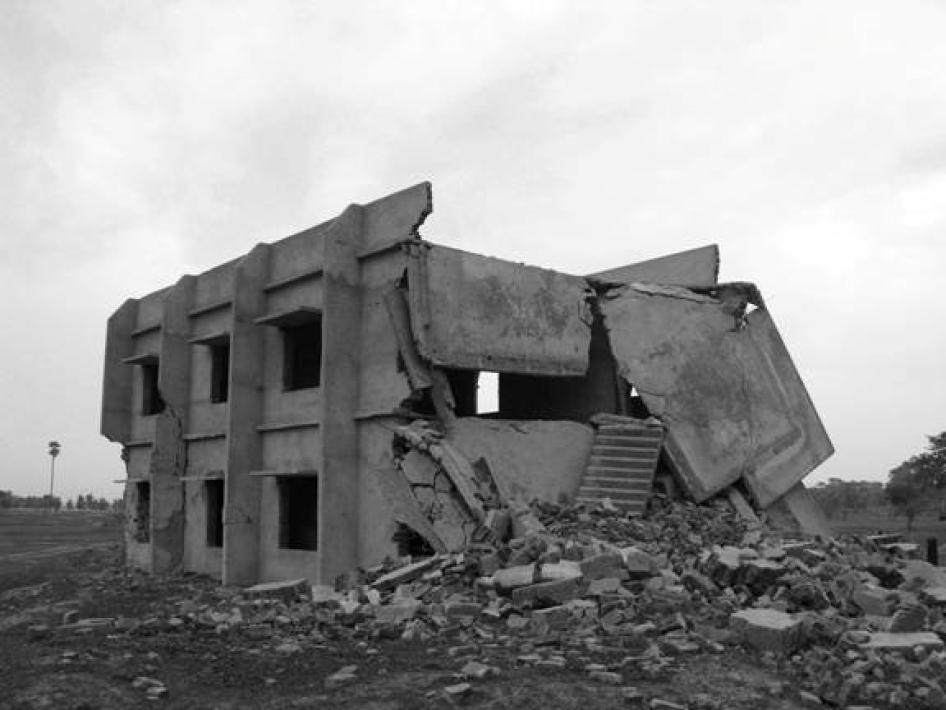
Figure 1: The damage caused to the new school building at Gosain-Pesra by a series of explosions set by Naxalite fighters on April 14, 2009. © 2009 Bede Sheppard / Human Rights Watch
In an anonymous article in CPI (Maoist) Information Bulletin in November 2008, in reaction to the Human Rights Watch report, "Being Neutral is Our Biggest Crime: Government, Vigilante, and Naxalite Abuses in India's Chhattisgarh State,"[103] the author defended the Naxalites' attacks on schools:
Destruction of school buildings by Naxalites is another issue that HRW [Human Rights Watch] gets concerned about. It asks Naxalites not to destroy school buildings despite its own recognition of the fact of police occupation of school buildings and using these as camps for carrying out combing operations against Naxalites. In fact, never before has school building activity taken up on such a grand scale and fast pace in the remote areas of
Dantewada, Bijapur and other Maoist stronghold areas of Chhattisgarh as after the launching of salwa judum [a state-supported vigilante group aimed at eliminating Naxalites]. This is with the sole intention of setting up police camps under the government policy of carpet security system. School buildings are like military fortresses providing defence for the security forces. Maoist attacks on school building should be seen in this specific context instead of blaming them of disrupting education to children when the very purpose of these buildings is different. In fact, Maoists had explained in 2006 itself why they were destroying the school buildings[:]
"As for destroying schools used by CRPF as their camps, neither the people nor our Party think it is wrong. The schools, once they are occupied by these forces, are transformed into torture chambers and concentration camps and there is no hope that they will once again be used as schools in the near future.... Education of the adivasis [tribal communities] is not affected by destruction of school buildings used by the security forces but by the destruction of entire villages (up to 900 villages had been uprooted since June 2005) by the state police, para-military forces and Salwa Judum goondas [thugs] with active police support"[104]
In the same issue of the CPI (Maoist) Information Bulletin, editorial comments on another article regarding the conflict in Chhattisgarh, stated: "No school was destroyed by the Maoists if it was not used by the police as its camp. You cannot show a single instance where we had destroyed a school that was really meant for education purpose."[105]
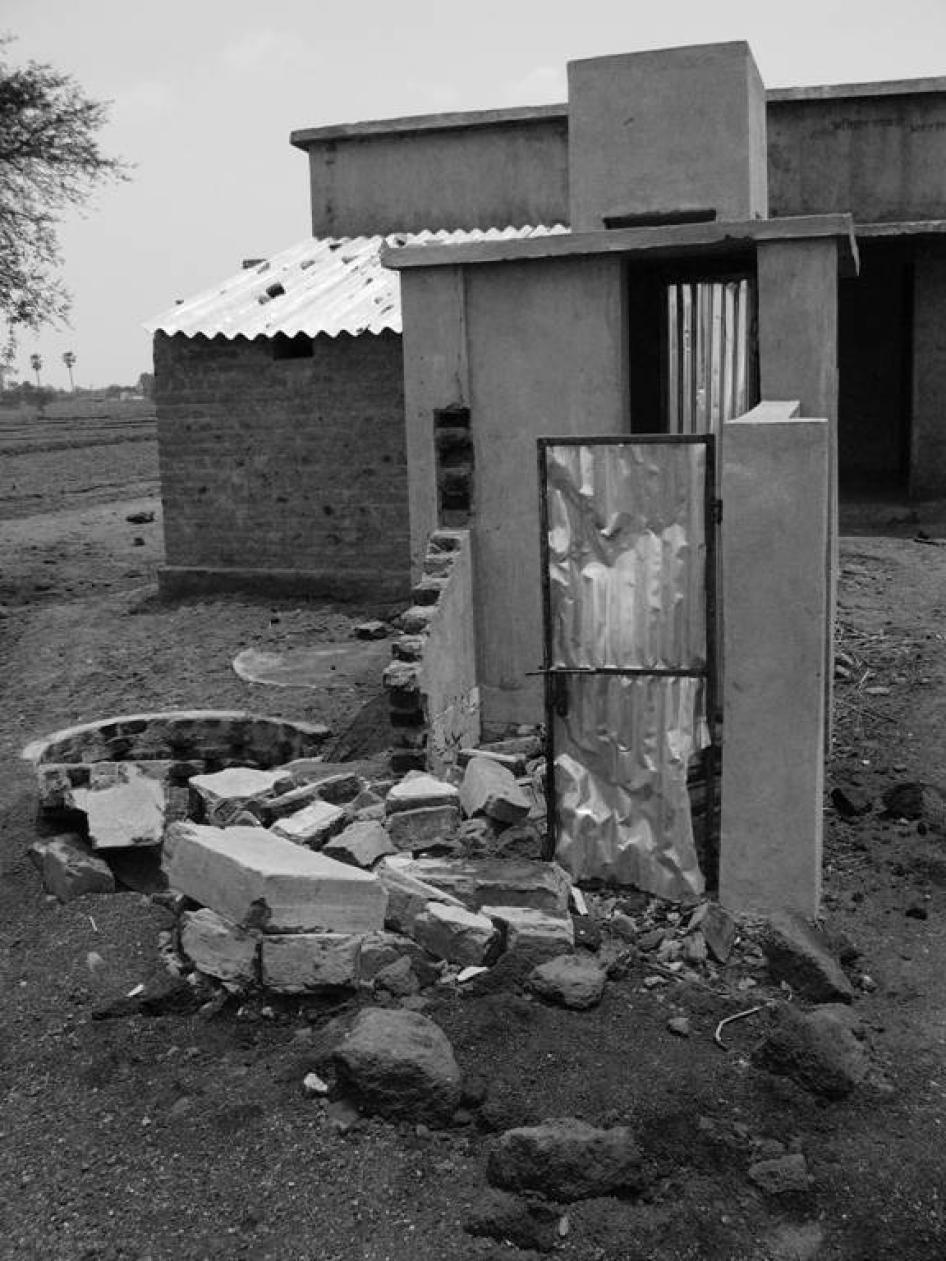
Figure 2: The damage cause to the toilet block at Barwadih Primary School, by an explosive device left by Naxalite fighters on April 11, 2009. © 2009 Bede Sheppard / Human Rights Watch
Such claims are also made by the Naxalites at the scene of the attack. For example, following the explosions at Belhara High School, local residents heard the insurgent fighters shout "Down with the police camp!" although students told us that the school was not in fact occupied at the time of the attack.[106] Similarly, an eyewitness told Human Rights Watch that prior to blowing up Gosain-Pesra School, which the police were not occupying at the time,[107] the Naxalite fighters had told her "that the building is not for children's study but to [host] the police."[108]
This justification-that the Naxalites are merely attacking schools used by security forces engaged in counter-insurgency activities-is taken at face value by many government officials, journalists, NGO workers, and the broader public. For example: the chief government official in charge of education in Jharkhand told Human Rights Watch:
I have a sense, but I don't have supportive data, that unless schools are used to house police forces, schools are left out of the Naxalite situation. The basic [concern] is that public common buildings could be used for [hosting] police.... If the building is a school, then they target the school. As such, I don't see that schools are targeted on their own.[109]
Human Rights Watch recognizes that some attacks carried out against schools were indeed conducted while security forces occupied the building. For example, in the very early hours of April 15, 2009, Maoist fighters attacked a government school being used as a camp by the Border Security Force (BSF) in Dhansa valley, Rohtas, in Bihar,[110] and on August 25, 2009, Maoists opened fire on a CRPF camp based at a school in Bundu, Ranchi, in Jharkhand.[111]
The lack of public government monitoring means it is incredibly difficult to get clear information on the extent and pattern of Naxalite attacks. Nonetheless, a combination of Human Rights Watch's own on-the-ground investigations and a survey of public news sources suggest that in at least 25 attacks on schools carried out in Bihar and Jharkhand in the year between November 2008 and October 2009, there were apparently no security forces present at the schools at the time of the attacks.[112] In some attacks, the Naxalities also stole school property-such as the school desks and benches from the old school buildings at the Gosain-Pesra Middle School-which is the unlawful seizure of non-military property in violation of international humanitarian law.[113]
Some observers have suggested that the Naxalites view the school buildings-and in fact any well-built structures-as threatening because of their possible future use by the security forces in launching attacks. For example, the Secretary of Human Resource Development in Bihar told us:
Once a pucca [permanent] construction comes in a rural area, in the past the [Naxalites] take it as a threat. They feel that if any building is there then the police can come and ... this building will be used for police forces. This is the normal apprehension that we have seen on the ground.[114]
A member of the CPI (Maoist) Central Committee from Chhattisgarh, known as Comrade Kosa, in an interview criticizing the methods allegedly used by the government to suppress the Maoist movement in his state said: "Huge funds are sanctioned for the construction of pucca school buildings so as to serve as camping places for the police and central forces."[115]
Attacking a civilian object because of possible future use as a military objective is nonetheless a violation of international humanitarian law.[116]
Human Rights Watch finds it likely that most Naxalite attacks on undefended schools are motivated by the relative ease that such "soft" targets can be attacked and the publicity garnered in doing so. Schools are often the only government building present in the rural areas where the Naxalites have greater influence and ease of movement. Moreover, schools are a high-visibility target and attacking them is likely to both increase media coverage of the Naxalites' activities and spread fear and intimidation among the local communities.
As one government official explained, "If they want to attack any government infrastructure then a school building is very handy, because they are all over now.... This is one place were the government gives no resistance. If you attack a police station, you will get resistance. But in a remote area a building with no security is very easy [to target]."[117]
One local security analyst viewed the anxiety that some may feel about the potential for lost educational opportunity as part of the apprehension created among the local population. He told Human Rights Watch:
When the [security] operations are over [the security forces] leave the place. Then the Maoists try to show, "you were supporting them!" They have this feeling that schools were used with the support of local population so they want to frighten them, so they blow up the schools. What they want is first of all to make the people afraid of them, and the first thing to do is hamper the education, and it as from this they can have the youth joining them. What happens when you attack these schools is students stop going and there is a fear. [There is] not the same fear created if you attack [another kind of] government building."[118]
The spike in attacks on schools during the lead-up to the Lok Sabha (House of Representatives) elections in April to May 2009 illustrates this view of the attacks. During many of these attacks, the bombings were often accompanied by the posting of leaflets or graffiti slogans advocating for a general voter boycott of the elections. Ranjit Singh, an eyewitness to the bombing of Gosain-Pesra Middle School, told Human Rights Watch, "They pasted a poster in front of my house. In the morning as soon as the police arrived, the police took it down. In the poster they wrote 'Don't Vote.' [On] April 16 the vote was to take place. There was a polling station in the [old building of the] middle school.[119]
At Barwadih Primary School-where the police were not present at the time of the attack, and had in fact never stayed at the school-the Naxalites also left a pamphlet, which was then taken by the police.[120] A teacher who had heard that the pamphlet mentioned the Naxalite election boycott, explained:
[At first] it was not clear [who had carried out the attack] but then they found the pamphlet and we came to know it was done by the Naxalites. The incident took place during the time of the general elections, so it is thought that it happened to create fear among the general public and police forces. Their motive was not to cause more damage to the school because they planted the bomb below the tank of the toilets.... The Naxalites could have placed the bomb in the new building or the old building to cause damage to the school.... The Naxalites did it to terrorize people because [the Naxalites] had boycotted the election and they made the bomb explosion in the school not to damage the whole building but to create fear in the police and the public.[121]
Ram Nair, a father with two sons at the school complained: "I don't know why the Naxalites did this. It happened randomly. We don't have any enmity with the Naxalites. It just happened suddenly so it is very difficult for us to guess the reason."[122]
Slow government response
Although it is the Naxalites who bear responsibility for the attacks on schools and whose fighters and commanders should be held criminally accountable for violations of the law, it is nonetheless the responsibility of the government to respond quickly and effectively to minimize the negative effect caused to children's education. The government should quickly repair or rebuild damaged or destroyed schools. Children should benefit from both immediate psychosocial support where necessary and emergency education alternatives. The governments in both Bihar and Jharkhand are, however, failing in this responsibility.
None of the attacked schools visited by Human Rights Watch had yet received any government assistance to repair or rebuild the damaged buildings, despite the attacks having occurred between two and six months prior to our visit.[123]
Yet, according to government officials, the time to commence rebuilding should be much faster. The Secretary of Human Resource Development for Jharkhand told us that "it should be quite fast because the decision-making is decentralized. [Approximately] one month."[124] Her counterpart in Bihar told us similarly, "Getting the funds sometimes will take time, so the school might start [rebuilding] after a few weeks. But reconstruction will usually take a month, or two months.... These are emergencies."[125]
Both state governments insisted that insufficient funding was not a concern for rebuilding, and that funding for repairs and rebuilding would require no further authorization from political bodies in the respective state capitals that would cause delays.[126]
There have also been allegations of Naxalites extorting money allocated for school construction either from schools or from the construction companies.[127]
IX. Occupations of Schools by Security Forces
As outlined in chapter IV, the central and state governments of India are obliged by the Indian constitution and international law to provide all children with free and compulsory primary education and to work to make secondary education available and accessible to all.[128] Indicating the importance of ensuring that existing education facilities are used for their designated purpose, under the Requisitioning and Acquisition of Immovable Property Act of 1952, the central government is barred from requisitioning or acquiring a school property, or teacher housing, even if it is determined that such a property is needed for any public purpose.[129] In both Bihar and Jharkhand, courts have previously found cause to order the police to remove their presence from schools.[130]
Moreover, as outlined in chapter VIII, in situations of armed conflict, international law protects civilian infrastructure such as schools from becoming targets of attack, unless they are being used for military purposes. When the Indian security forces transform schools into military objectives for extended periods-by turning them into military strongholds with barbed wire emplacements, sandbags and sentry boxes, for instance-they have an obligation to take all feasible precautions to protect civilians from attack and to remove them from the vicinity.[131] Thus it is unlawful to use a school simultaneously as an armed stronghold and as an educational center. When a structure ceases being used as a school altogether, the authorities must either relocate the school's teachers and students to a safe locale where education can continue or they are denying children the right to an education under international human rights law.
Methods
Security forces in Bihar and Jharkhand have occupied primary schools, middle schools, high schools, and part of a tertiary education campus and a teacher training center. In some cases schools are occupied entirely, meaning that all educational functions at the school either stop completely or are displaced to alternative locations. However, in many cases, the security forces only occupy part of the school facilities, and the school is compelled to attempt to continue to operate in the remainder of the campus.
Least disruptive to education is when the security forces use a school building as a temporary camp or shelter for a night or two, though 10-day occupations have been reported, when conducting combing operations against Naxalite forces in remote areas. It is this use of schools that the media and government officials appear most aware. However, even senior government officials within the departments responsible for schools and education of each state completely underestimate the duration and nature of police occupations. In fact, most of the occupations investigated by Human Rights Watch had lasted between six months and three years.
For example, as of May 2009, at Mahulia High School, in Jharkhand's East Singhbhum, five out of 10 classrooms plus the school's hostel and playground were occupied by the CRPF, and had been since October 2008. A student described the police presence: "[The police] have fenced their area-fenced the boundary that they have made. They have captured the science practical room and a hand pump, and the hostel as well, with barbed wire."[132]
At Kasma Middle School, in Aurangabad district, Bihar, the police had occupied two of the 15 classrooms since 2005. But as the school principal explained, "They have only two rooms, but they occupy the whole building by hanging their clothes and leaving their things everywhere."[133] Indeed, when Human Rights Watch visited the school, camouflaged pants and underwear were hanging from a washing line in the school courtyard, while in addition to the two rooms completely occupied by the police, another two classrooms had beds in them, which the police used for sleeping (see figure 3).[134] A member of the local school committee said: "The way the police are staying here, [maybe] after a lifetime they will still be here."[135]
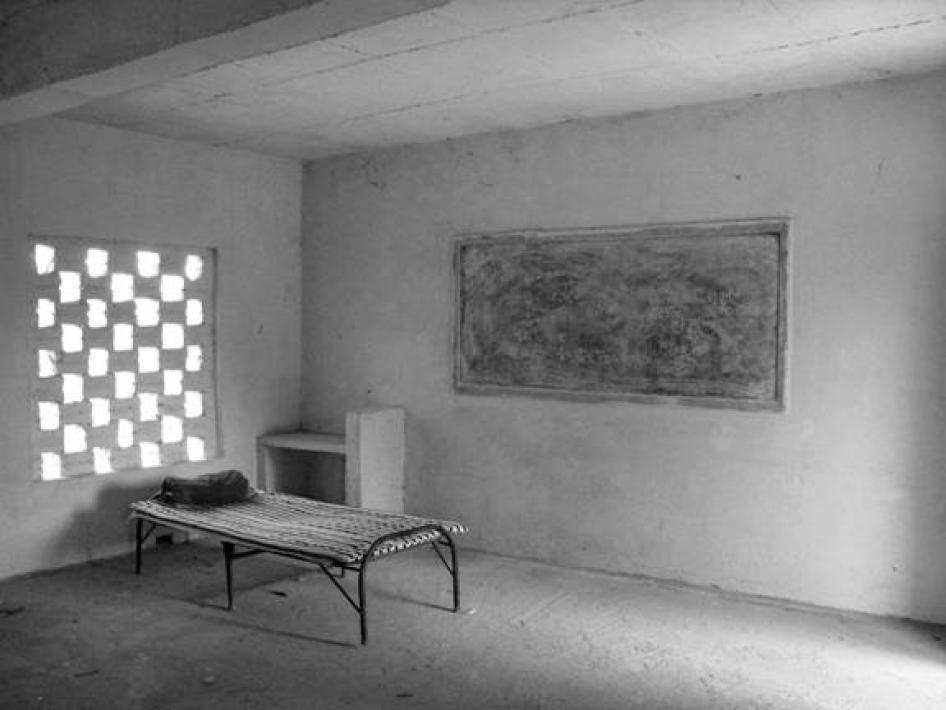
Figure 3: Security forces fully occupied two rooms at Kasma Middle School, Bihar, when Human Rights Watch visited on June 14, 2009. In addition, beds were set up in two other classrooms for the security personnel to sleep. © 2009 Bede Sheppard/Human Rights Watch
At Ganesh Lal Agrawal College, in Daltenganj, in Palamu district, which provides education to class XI and XII students as well as tertiary education, part of the campus has been occupied since 1996, and is currently occupied in part by the 134th battalion of the CRPF.[136]
Matiabandhi High School had been occupied in part for at least two years, and at the time Human Rights Watch visited in May 2009 the occupying force was the Special Task Force (STF), including constables from Jharkhand and West Bengal.[137]
SAP and CRPF paramilitaries came to stay in part of the high school in Sikeria, Jahanabad, Bihar for only six months, in the second half of 2007, and after the security situation in the area improved, they left the school.[138]
In contrast, Digha Middle School and Bhita Ramda Middle School in Jharkhand's East Singhbhum district, and the Project Girls High School and the nearby teacher training center in Imamganj, in Bihar's Gaya district, have been occupied by the police in their entirety. Bhita Rambda Middle School has had police forces there since February 14, 2008. The Project Girls High School in Imamganj, Gaya, has been occupied for more than a decade.
Militarization of schools
As soon as the security forces occupy a school-whether the entire campus or just part of the school buildings-they immediately begin to militarize and fortify the school buildings and grounds.
On June 7, 2009, Human Rights Watch visited Tal Middle School in Palamu district of Jharkhand, when it appeared that CRPF paramilitaries, under local command, were that very day reoccupying the school, which had previously been occupied and then vacated. We witnessed security personnel digging a trench around the school, establishing fortifications with sandbags on the roof of the school, and filling sandbags for additional fortifications.[139]
At Matiabandhi school there were brick fortifications on the roof of the building (see figure 4) as well as fortifications from sandbags, and one edge of the school's courtyard was fenced off completely with rings of barbed wire and sandbags.[140]
When Human Rights Watch visited Bhita Ramda Middle School, it was surrounded by barbed wire three rings high and sandbags. There were newly added sentry boxes on the roof and out in front of the school. Armed men in camouflage roamed around the school.[141] The Project Girls High School of Imamganj retained the sign with the school's name, but also had a sign on the school gate marking the presence of a Bihar Battalion and blue camouflage painting on parts of the building.[142]
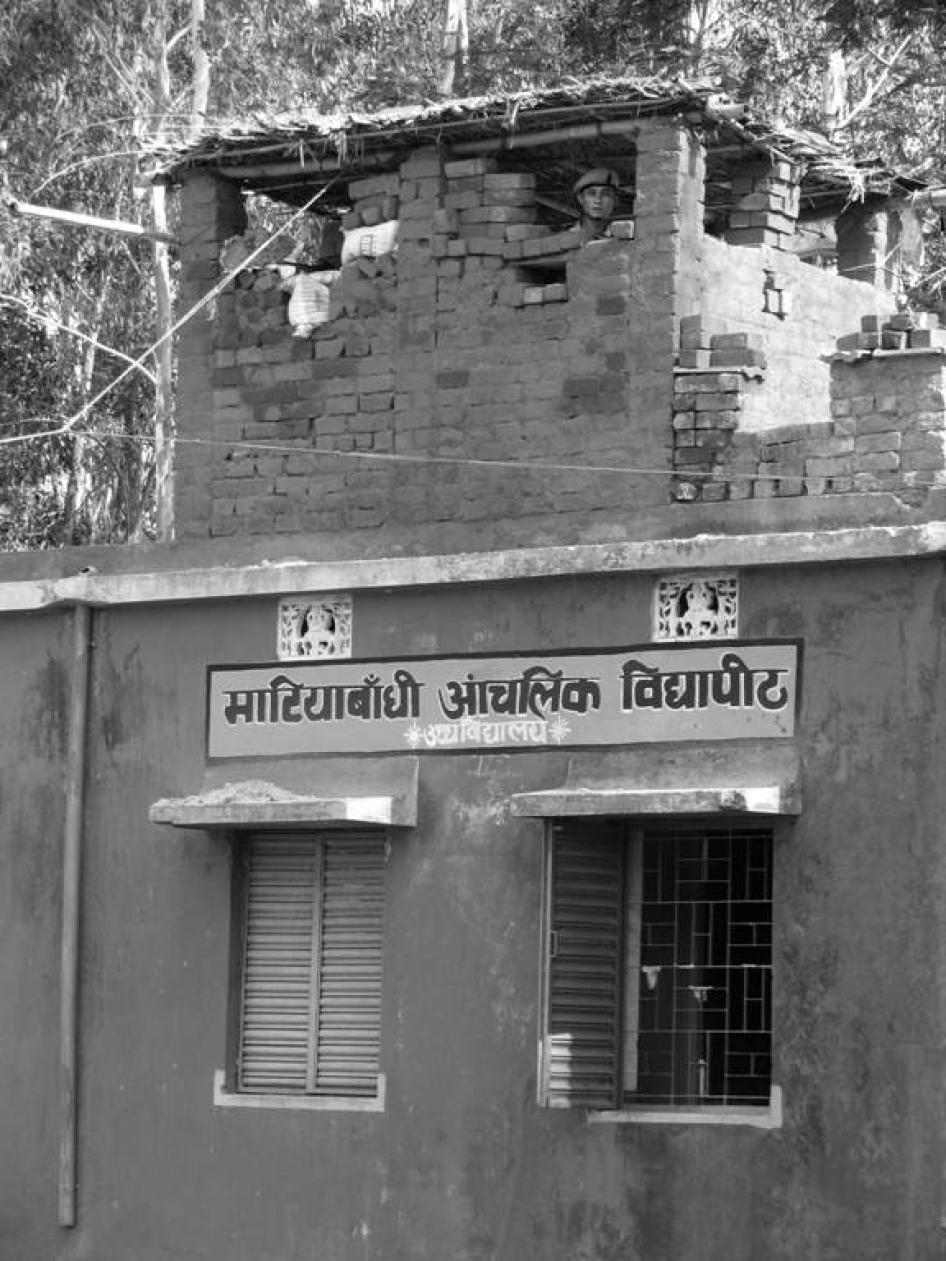
Figure 4: An armed paramilitary police force sentry guard surveys the surroundings from inside the brick fortification on the roof of Matiabandhi High School, Jharkhand. © 2009 Kennji Kizuka / Human Rights Watch
In all of the schools we documented, security personnel would often carry their weapons within the school grounds, including semi-automatic rifles, or, as 13-year-old student Kirti Chowdhury described them: "Long guns. Big guns,"[143] and as eight-year-old Kunisha Singh put it: "Big, big size guns."[144] Ten-year-old Murli Ahmed confided: "We were scared of the weapons."[145]
The security forces may also store munitions within the schools in addition to the ammunition carried by the security forces. Fifteen-year-old Jaipal Munda told us that he had seen "small explosives" at his school.[146] Ten-year-old Chandra Manjhi listed things he had seen at his school: "I have seen explosives, bullets, weapons, and a playing ball."[147]
Human Rights Watch also visited some schools that had been recently vacated by the police. In some instances, the manner in which the police had conducted this process raised ongoing concerns about the security and well-being of the schools and the students. In particular, at Saraidih Middle School in Palamu district, although the police had vacated the property, the school retained three complete permanent sentry boxes on the roofs of the school building, one partial-brick fortification on one roof of the school, and one brick fortification in the school courtyard. Sandbag fortifications also remained in part on the roof of the school. A sign on the front of the school gate still proclaimed that the school was the location of "JAP 7" (Jharkhand Armed Police, seventh battalion). Moreover, the new location for the police camp is now directly adjacent to Saraidih High School.[148]
Similarly, at Kamgarpur Primary School in Palamu district, the school retained four permanent sentry boxes on the roofs of the school building. The school building also maintained graffiti markings and other signs such as "CTJWC" (Counter Terrorism and Jungle Warfare College) and "STF" (Special Task Force) (see figure 5). Moreover, at the time of our visit, armed security personnel were continuing to conduct armed vehicle checks directly outside of the school.[149]
Lack of notification
School principals, teachers, parents, and students consistently reported to Human Rights Watch that they received no prior notification regarding the police occupying their schools. Lack of notification to school authorities deprives them of the opportunity to prepare better alternatives for continuing studies. Lack of notification to communities also eliminates the opportunity for local residents to propose alternative locations for the police presence. Finally, lack of notification and explanation to the students leaves many children confused and uncertain.
Fifteen-year-old Jaipal Munda remembered the day the police took over his school:
They turned up during the school day. I was in class and when the police arrived, suddenly the students found this exciting, so we went out of class to see what was going on, and by evening they had set up their tents, and since then they've been living in the school. About 60 to 65 police came on that day in about two or three police vans.... There are ten rooms in the school ... [and] since the day they arrived they occupied about seven rooms, and classes were since then only in three classrooms and in the vacated school office.[150]
The headmaster at one school told us, "The local district superintendent of police came along with the [local member of the Legislative Assembly] and ordered me to vacate space for a police camp.... They came with their baggage and asked us to vacate the building immediately."[151]
The principal at another school told Human Rights Watch:
The local police station informed me verbally that the police were going to come stay here [at the school] for the [2005] election. But then they just stayed on. The police have already told me, "Go get an order from the [superintendent of police] saying to vacate the school!"... I have nothing written from anywhere from the government [explaining this], but the local police say that for the protection of the area, one battalion of [Special Armed Police] will stay here.[152]
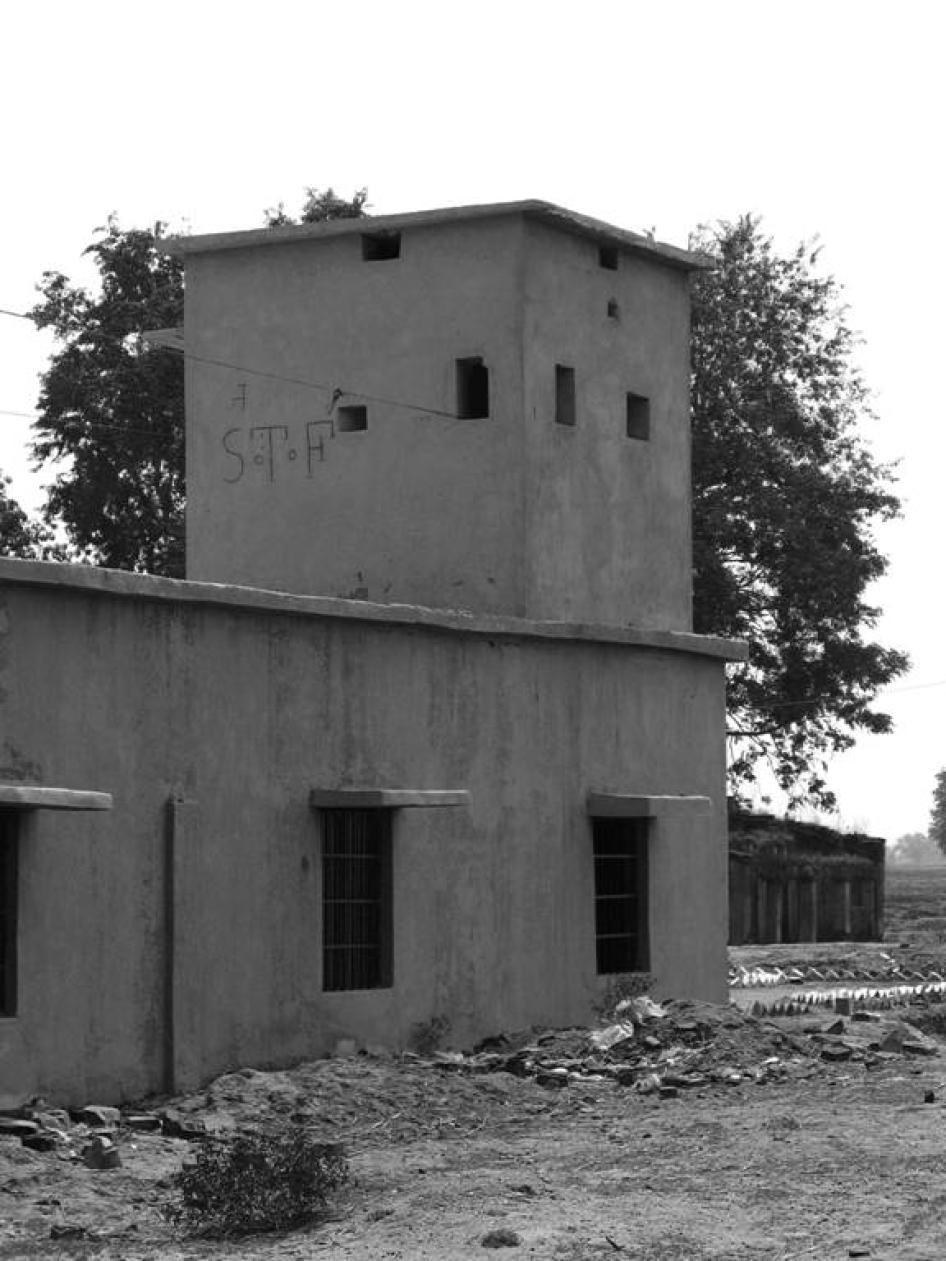
Figure 5: Graffiti reading "STF" (Special Task Force) is still visible on a sentry post atop Kamgarpur Primary School, Jharkhand, even though the police vacated the building for another government building almost adjacent. © 2009 Bede Sheppard / Human Rights Watch
Similarly, parents do not always even receive notification by the government or school authorities. One parent told Human Rights Watch, "The school did not notify me of anything. My daughter and her friends told me."[153]
Teachers are not explaining the situation to students. On the day that police took over part of Mahulia High School, according to Sudesh Lakra, "The teachers said don't go to toward those classrooms where the police are, go to the other classrooms. The teacher didn't explain why the police were here. They just said, 'Don't go toward the camp or into the fields.'"[154] Another student at Mahulia said, "We talk among ourselves about the police, but we don't know why they are here, or how long they will stay."[155]
Lack of civilian influence
There is a worrying lack of civilian control over the process by which the security forces go about occupying school buildings.
The Department of Welfare in Jharkhand, which runs special schools for the benefit of adivasi, as early as November 2005 wrote to the Home Department of Jharkhand requesting that police and CRPF paramilitary forces be removed from its schools and hostels.[156] In November 2008, the cabinet of the government of Jharkhand ordered that all police in education institutions should be removed immediately.[157]
The highest government official responsible for education in Jharkhand state told Human Rights Watch, "We are very clear. We will not allow schools to be used for any other purpose than teaching.... Whenever we receive reports [of school occupations] we try and resolve and get [the police] shifted. We are very clear on that point.... We write to the DGP [Director General of Police]."[158]
Her counterpart in Bihar told Human Rights Watch, "Our view is that we oppose [occupations] tooth and nail. But we also recognize that if you take this life and security then they have government power. So we sensitize the district magistrate and the [superintendents of police] and in various meetings we propose that this be as little as possible."[159]
A principal at a partially occupied school told Human Rights Watch, "We felt the studies of the children were being disturbed [by the police occupation] but we were helpless to do anything because it was the will of the government."[160] A para-teacher at another school commented, "Only the headmaster has contacted the higher authorities-the district education officer, who expressed his helplessness as the police camp was organized in coordination with the deputy commissioner of this district."[161]
Some principals and teachers feel constrained from objecting to the security forces' presence because they are government employees. One principal asked: "I am a government employee. What am I supposed to do when told to by the government [to accept this]?"[162]
One particularly shocking example of the flagrant lack of civilian authority over the use of schools can be seen in the police response to a public interest litigation case brought before the High Court of Jharkhand in late 2008 objecting to the police occupations. On November 21, 2008, the chief justice of the highest court in the state ordered that all occupied schools be vacated by the second week in January 2009. However, at the time of Human Rights Watch's investigation in May and June of 2009, not only did the majority of the schools that the police had informed the court about still remain occupied, but we found a number of schools that were occupied by security forces that had not even been disclosed to the court. We also came across at least two instances of new occupations of schools subsequent to the court's order. As of August 2009, the court was still monitoring the process.
Lack of monitoring
The lack of monitoring by the state administration over the use of their schools by the police and paramilitary police is particularly alarming. The most senior administrative government officials responsible for education in each state told Human Rights Watch that they kept no database or list of occupied schools, and were therefore unable to tell Human Rights Watch the number of schools occupied, the duration of these occupations, the police or paramilitary police carrying out the occupation, the expected departure date of the forces, or the reason for the occupation.[163] The government's education personnel are therefore failing to collect even basic information that is vital to assessing the necessity and reasonableness of these occupations. Such information and public transparency on these matters could inform government and public action to mitigate the harm of such occupations on children's access to education.
It is also unclear whether the responsible police officials themselves are aware of the extent of police occupations. For example, in a sworn affidavit to the High Court of Jharkhand, Deputy Superintendent of Police in Jharkhand (Security) Jharkhand Mantralaya submitted what he claimed was a list of schools occupied by the police.[164] However, research by Human Rights Watch in just three districts indicated that at least four educational facilities were occupied by the police and did not appear on the list given to the court.[165] Since our research was not intended to be comprehensive, it is possible that additional occupied schools were omitted from the list presented to the court. This suggests that either the police were unaware of the full extent of their occupations, or that they deliberately presented an inaccurate and incomplete list to the High Court.
In East Singhbhum in Jharkhand, the superintendant of police, Navin Singh, told Human Rights Watch that there were only three police camps in schools, and in those schools they did not occupy the entire school but just some of the rooms. However, Human Rights Watch visited six occupied schools in East Singhbhum,[166] and does not believe that this was the complete number of occupied schools in the district. Thus the district superintendant of police was either unaware of, or sought to minimize, the extent of his own force's occupation of schools. The latter option gained extra credence when, at the end of the interview, the superintendent of police quizzed the Human Rights Watch researcher on which schools he had visited, and then proposed at least five villages. Indeed, the superintendent of police was of the view that increasing awareness of police occupations was a "strategy of the Naxalites ... so that the village does not establish [police] camps. The cry is raised by the front organizations of the Naxalites."[167]
The United Nations Children's Fund (UNICEF), which is involved in education, child protection, and emergency programming in India, also does no independent monitoring of either the number of schools attacked by the Naxalites or the number of schools occupied by security forces.[168] UNICEF usually takes a lead role with regards to protection issues for children in armed conflicts around the world.
Motivation
Police and paramilitary police forces in Bihar and Jharkhand are taking over and occupying schools for a number of reasons as part of their counter-insurgency efforts.
Security forces frequently use school buildings as a temporary camp or shelter when they are in a remote rural area conducting combing operations against Naxalite forces, relying upon the sturdy structure of the school buildings to provide added security and protection. In some instances, the use of schools as bases during counter-insurgency operations simply continues for many months. The superintendant of police in Garwa, for example, stated, "If police go for an operation in the night, it is not possible to stay in the open so often they stay in the school buildings, sometimes on the veranda."[169] Navin Kumar Singh, superintendant of police in East Singhbhum, said, "During elections, forces temporarily stay in these schools ... because they don't have alternative structures."[170]
But many of the longer-term occupations are being carried out for different reasons. The Deputy Inspector General of Police (Personnel) for Jharkhand justified the presence of security forces in schools as follows:
[Eighteen] districts of the State of Jharkhand are under the influence of CPI (Maoist), a banned ultra-left violent organization functioning with avowed aim of overthrowing the present system of government ... through violent means.... [T]he Jharkhand Police has been trying its level best and [is] deploying its best possible machineries to control and eliminate their threat to the civil society at large by conducting vigorous operations regularly.... [T]he authorities of the State could have been established in the said remote areas of the State only after the establishment of police [outposts] thereby creating a sense of security in the civil society.... [D]ue to the endeavour of the Jharkhand Police the remarkable success has been achieved in the counter insurgency operations against the Naxalite outfits.... [T]he newly created State of Jharkhand was lacking buildings and infrastructures in the remote areas of the State. The Jhakrhand Police had no other alternative than to deploy the police/paramilitary forces in ... part of the buildings/campuses.[171]
In some locations, the security forces have used schools to set up outposts in response to specific security incidents that happened in the area. A local resident in Matibandhi, for example, explained why he understood the police had set up an outpost in his village: "There was a rumor because of the MCC [Maoist Communist Centre[172]] influence-they were grabbing land. After that the camp came. The Naxalites were demanding to increase labor rates for workers. After the administration heard that they sent the forces."[173] Constables based at the school, however, told Human Rights Watch that the camp had been set up in response to the killing of a local politician. Either way, the justification for the establishment of the camp in the school dated back at least two or three years.
Similarly, the police first came to occupy the primary school in Chakri following an incident in the village in 2004 when Naxalite fighters killed at least two local residents,[174] and the police first came to occupy the school in Digha after Naxalites killed two local residents in 2007.[175] Yet both schools remained occupied as of Human Rights Watch's visit in late May 2009.
The Superintendant of Police in East Singhbhum, Navin Singh, told Human Rights Watch:
The Naxalites have engaged in mindless violence. When the villagers don't start listening, they engage in mindless violence. The villagers [come to the police and] say, "We will not go unless the police put a camp. A part of this school you may use." Slowly we try to shift if a permanent camp is necessary. We construct alternative structures. We are there because of the demand of the people. We want to withdraw from the schools but the villagers will not allow us to withdraw.... There is already a committee [so] if the villagers do not want it, they will vote ... and throw us out. If the villagers do not want it, they will throw us out.... If we remove these camps, the Naxalites will be able to take these children. They can't come as often with the camps... They are even taking children forcibly.[176]
Some local residents we spoke to were very grateful for the security provided by the police presence in their villages-although not necessarily for the presence in their schools. Ranjan Pramanik's brother Badel Chandra Pramanik was killed by Naxalite fighters along with a local adivasi government official, Nimai Murmu, on September 6, 2007. He summed up the problem: "We want a school. We need a school. We are unhappy with the temporary [alternative school] facility. But at the same time we need the police."[177]
In two instances investigated by Human Rights Watch, the police took over part of a school building after their own police station was attacked and destroyed by the Naxalites, and had simply never rebuilt the station in the ensuing years. In Aanti village, in Bihar, the police came to occupy half of the school after their police station was attacked by the Maoists.[178] A member of the local school committee said, "So we want the police station to be built again so our boys and girls can study in a proper environment."[179] A similar situation occurred with the security forces occupying the high school in Tankuppa following the destruction of the police station in 2006, as described in chapter V.
Human Rights Watch has recently documented the abysmal work conditions faced by police officers across India, and how these conditions contribute to human rights violations committed by the police.[180] Low-ranking police officers often work in difficult conditions and are required to be on call 24 hours a day, every day. Instead of shifts, many work long hours, sometimes living in tents or filthy barracks at the police station. Many are separated from their families for long stretches of time. They often lack necessary equipment, including vehicles, mobile phones, investigative tools, and even paper on which to record complaints and make notes.[181]
A May 2006 report by the Bihar Police Association indicated that over 300 police stations, 92 police pickets, and over 100 town outposts located in districts affected by Naxalite violence were without boundary walls and minimum infrastructure.[182] However, in 2008-2009, the central government committed 98.6 million rupees (US$2.05 million) to Aurangabad, 61.9 million rupees ($1.28 million) to Gaya, 96 million rupees ($1.99 million) to Chatra, and 142 million rupees ($2.96 million) to Palamu districts for the development of special infrastructure in states affected by Naxalite violence to cater to critical infrastructure gaps, which cannot be covered under the normal provisions of various existing schemes, such as by providing secure camping grounds at strategic locations and interior areas, and enhancing security at vulnerable police stations and outposts.[183] It is not clear if these funds are being effectively used.
Alternatives to use of schools
Human Rights Watch understands that security forces patrolling in dangerous environments require protection. Sometimes, more traditional portable accommodations such as tents may not be adequate to meet the self-defense protection requirements of these forces in hostile areas.
Nonetheless, our research indicates that security forces are using government school buildings far too frequently, for far too long, and at far too great a cost of the education of students at these schools, and alternatives need to be strategized with great urgency.
In some instances it may be acceptable for the security forces to establish their presence in tents or other forms of temporary accommodation that can be trucked in with the forces. As one government official remarked, "In a normal condition if you are police [out for] a week or 10 days they can have tents. Now with modern technology the Home Department should be able to find a solution."[184]
Some senior police officials themselves believe the current practice and extent of occupations of schools far exceeds any justifiable security need. Two superintendents of police told Human Rights Watch that although they need schools for temporary shelter during anti-Naxalite combing operations, the more long-term use of schools were not necessary. One superintendent of police told Human Rights Watch: "A permanent camp can always be vacated-that is not very difficult."[185] Another told Human Rights Watch, "We are totally committed to shifting the camps. We have land and funds."[186]
When the police prepared to vacate Saraidih Middle School in Jharkhand, it took just two or three months to construct a new building to house the police, which was built next to the village's high school.[187] The moves are not always welcomed by the rank and file: a member of the Jharkhand Armed Police on sentry duty complained that he preferred staying at the school building because the new facilities are "made from metal" and too hot.[188]
At Sanjaygram, in Saraikela, in Jharkhand, a unit of around 20 female police were housed for approximately two years, until March 2009, in the hostel of a boys-only Scheduled Tribe Residential School.[189] According to a police constable who had stayed at the hostel until she was moved to an alternative site at the Saraikela police station, she much preferred the new location, because the latrines at the school were not in good condition, there was no good drinking water, and the market was too far away.[190]
Sometimes the availability of alternative government facilities for displaced schools, such as the village halls where the classes were relocated to in Bhita Ramda, or the government building where security forces eventually relocated in Kamgarpur, suggests that the police could use these facilities instead of the school. This indicates that school buildings are not being viewed as a location of last resort.
Reversing the police practice of using schools for indefinite periods raises various security issues. Even withdrawing from an occupied school is not necessarily a simple matter. One superintendent of police told Human Rights Watch, "There are places we want to withdraw from schools but the villagers say 'We will be killed if you withdraw.'"[191] Another superintendent of police said, "In all the cases the police in schools have made [the villagers] feel very secure there... So I think the biggest hurdle is to convince the villagers. Infrastructure you can always clear... But convincing the [public] have not always been easy for us."[192]
The police in Jharkhand believe that "in all probability" if the security forces leave the school buildings they will be blown up by the Naxalites.[193] They estimated as of November 2008 15 buildings previously occupied and then vacated by security forces had been subsequently attacked by the Naxalites.[194]
Responsibility for any attack on an undefended school lies with the party that carries out the attack. However the police authorities should recognize the threat to schools caused by occupations and take measures to avert future problems. Far too often the security forces have acted in a manner that shows little regard for the social impact of their actions. The result has been a great many children whose limited educational opportunities have been made even worse, and whose security has been risked by close proximity to military targets.
It will take some creativity and resources to address this issue. But the use of schools by the police and paramilitaries that unnecessarily infringes on children's right to an education needs to stop.
X. Barriers to Education
Both sides to the conflict-the government and the Naxalites-claim that their actions with respect to schools cause no interference with children's education. The superintendant of police in East Singhbhum told Human Rights Watch, "Education is not affected. Most of the rooms are made available. The studying does not suffer.... It's not that we're having these things at the cost of the school."[195] The superintendent of police in Garwa said, "In the schools where the camps are, only two to three rooms have been occupied, so the studies are not disturbed."[196] The Naxals have similarly countered that their attacks on school buildings does not disturb or affect the education of local communities.[197]
Research by Human Rights Watch shows that both of these claims are false, and that both Naxalite attacks and government occupations can cause serious impediments to children's ability to access an education.
Endangering lives of children
Unsurprisingly, attacks on schools and the presence of security forces at schools places students unnecessarily at risk. Although the bombing incidents investigated by Human Rights Watch indicate that the Naxalites are generally carrying out such attacks during hours when students are not attending school, we identified one assassination of a local politician carried out by the Naxalites in a school hall that was filled with students.[198]
The security forces have placed children at risk of being involved in nighttime attacks by partially occupying residential (boarding) schools, such as the Scheduled Tribe School in Sanjaygram, Saraikela (recently vacated as of the time of our visit on June 3, 2009) and Chota Nagra, in West Singhbhum. By placing camps at such schools, the security forces are raising the risk that these students could be caught in the crossfire during night attacks on the security force's outpost.
At Chota Nagra, CRPF paramilitaries have taken over various buildings, including four of the 40 rooms of a residential school run by the Jharkhand Welfare Department. In the early morning of April 23, 2009, the Maoists attacked the CRPF force in the village. This attack may have been related to the use of the school as a voting station for elections that day. Between 1 and 1:30 a.m., the Maoists triggered either a "can bomb" or a mine tied to a tree in the village. According to the police, the Maoists then started firing indiscriminately, to which the CRPF paramilitary based at the school responded in kind.[199]
Some students were staying in the residential school that night. Another teacher who was sent to the school to assist as a polling officer was also staying overnight in the residential school. He told Human Rights Watch:
Around 1:30 at night I heard an explosion. I woke up suddenly with this explosion. The explosion echoed in my head for a while. When that stopped the firing started. When the explosion happened I couldn't understand what was happening. And then I remembered that [I had read in the papers that] the Naxalites had warned that if the administration stayed at the school then they would attack. The window was open so we closed the window. At first I was afraid, but then I felt less afraid when I remembered that there were [police] forces there. After about half an hour the firing stopped. Around 2 o'clock at night. I could not see anything because of the fear. The firing was not continuous-there was a break. There were two rounds of firing.... We [polling officers] went to the children's room and we saw they were frightened. We tried to stop them being frightened. We told them we were there to protect them. [Then] there was quiet, and slowly, slowly, normalcy returned and we slept. None of the police personnel came to visit us [to check on us].... I am guessing that the firing came from both sides [the police and the Naxalites]. I was confused as to which direction the firing was coming from. But there was a sentry on top of the roof of the building where we were staying and he may have been firing.[200]
Because of security concerns raised by a Maoist-called strike at the time of our visit to the area, Human Rights Watch was unable to visit the school site in Chota Nagra. Accordingly, we have not been able to verify accounts of the incident. However, information from telephone interviews and secondary sources suggests that the security forces placed students and other civilians staying in the residential hostel at unnecessary risk by deploying near them.[201]
Witnessing police violence
At two schools, Human Rights Watch heard accounts from students who witnessed police commit violence on school grounds against apprehended suspects. Indira Parkesh from Tankuppa High School, discussed in chapter V, described feeling "very bad" when police brought suspects back to her school and beat them. A school committee member for Aanti Middle School in Bihar, half of which is occupied by the police, told Human Rights Watch:
Sometimes the police bring culprits [to the school campus], and when these culprits enter the police start beating them, and when this happens all the children run to go and see what is happening, and this is one way that the standard of education is going down... Every time these police bring the culprits, they do all their actions in the school ground in the field. Both the boys and the girls go watch.[202]
Increased student dropout rates
At some schools there is an almost immediate exodus of students in response to either a Naxalite attack or a police occupation. Girls appear to be more likely than boys to drop out following a partial occupation of a school.
A father with a daughter in class III at Bhita Ramda Middle School stated that after the police came to the school in early 2008, half the students dropped out. When the police took over the school building entirely and classes were shifted to the village hall behind the school, "the number of students has decreased from 250 to 80 students now. Some of them have dropped out. Some of them have transferred to other schools."[203] A boy in class VII at the school said: "There were 281 students before the police came. Now it has decreased. Now there are around 50 students. Because of the police the students are not coming.... Some students fear the police. Some of them have left to work at home. Some study at home and some have totally left the school."[204]
According to a social worker in Chota Nagra, in Jhakrkhand's West Singhbhum district, "There were more children before the police came.... Between the primary and middle school 100 students have left the school. They go to Manoharpur, 45 kilometers and 2 hours away, or Barajanda, about 26 kilometers and an hour-and-a-half away."[205]
Class X student Sudesh Lakra estimated that there were about 800 students at Mahulia High School, and around 120 in her class. After the police occupied part of the school, the numbers dropped to 500 in the school and 70 in her class.[206] Lona Mehra told Human Rights Watch that 115 students were in her class at Mahulia High before the police arrived, after which about 15 students dropped out.[207] A para-teacher at her school explained that "when the police camp started, the students found difficulties sitting in the classrooms because of the shortage of space. Many of them dropped out. They only came during the time of the examinations."[208]
School occupations can also lead to decreased retention of students between school years (sometimes referred to as the "transition rate"). A particularly clear example of this is Tankuppa High School where the government has approved the school's expansion to also teach grades XI and XII. However, because police currently occupy eight out of the eleven classrooms, there is no room to teach these additional classes. As described in the chapter V case study, students expressed how they wanted to continue their studies, but could not afford to go to the next closest school offering these grades because of its distance from their village. As a result, they said they would drop out of school at the end of the year.
Naxalite attacks on schools can, unsurprisingly, also cause students to drop out. Following the destruction of the new school building at Gosain-Pesra Middle School, approximately "10 to 15 children are not coming [to school anymore] out of fear," one father said.[209]
Nearby, in Patluka where the school was damaged by Naxalites in April 2009, villagers have claimed that fear of their return has kept the teachers from returning to open the school. Three months after the attack, the school had still not re-opened.[210]
Following the bombing and shooting involving Naxalite and CRPF forces based at Chota Nagra Residential School and Chota Nagra Middle School in West Singhbhum in Jharkhand, a number of the students left the school out of concern for their safety.[211] According to a teacher at the middle school, more than half of the students at the residential school-most of whom were present during the attack-left the school in the days following the attack: "Some of the students took permission from the superintendent of the school and some of their parents came and applied to take the children out of the school."[212]
Lower enrolment of new students
Not only do police occupations of schools prompt students to leave schools, they also create a disincentive for students to enroll in school.
At Kasma Middle School, in Aurangabad district, the government has approved the addition of a hostel so that 200 disadvantaged girls currently not receiving any education can attend the school. The school's principal explained the problem caused to this plan by the presence of just 10 police at the school:
This whole area is very underdeveloped, and the government gave me permission [in late 2008] to teach 200 girls at the school on a residential basis. The District Commission has [already allocated] 1.4 million rupees [US$28,600] for this purpose. From Patna, officials have already come here to appoint the teachers.... These are girls who are already married, who are engaged to be married, or girls who do not have anywhere else where they can enroll.... [But] the parents of these girls do not want their girls to come here while the police are here. Because if we open the residential school then the girls will have to stay here all 24 hours in the campus with the police, so the parents do not want to send them. Maybe they think there is the possibility of sexual misconduct or abuse.... I want to open the residential school because it will benefit the girls and the local villagers, but because of these police I cannot open it and it is a setback for these disadvantaged girls.... The public wants these police moved so that these girls can stay here for their higher studies.[213]
Overcrowding
Where police partially occupy schools, the resulting space constraints cause increased overcrowding of classrooms.
Eight-year-old Kunish Singh complained to Human Rights Watch about the overcrowding at Aanti Middle School in Bihar's Gaya district caused by the police's occupation of two out of three of the school buildings. Eventually Kunish's father moved her to a private school, but she recalled:
Many times I was studying outside. Because there is no space, children have to go outside, and my friends ask me to come with them. Because sometimes the teachers called us outside because of the shortage of room, so we studied outside.... I didn't like it, because outside there are a lot of things going on, and lots of students are outside, and we can't study properly.[214]
A member of the local school committee at Aanti Middle School described the impact of the 25 police present there:
I feel that we have a lack of school buildings and because of that the children are running away from school. In the whole school there are 14 rooms, but half of them are occupied by the police. Half of the school buildings have about 500 or 600 students using it, and many of them are sitting under a tree. The police occupied half of the school buildings, and because of that the children are forced to sit under the tree to have their classes... When the classes are outside, the teachers are not able to use the blackboard so all the studies are conducted orally, and the proper education system cannot continue.[215]
Thirteen-year-old Arup Das at Mahulia High explained, "It is difficult to study because class IX and class X sit and study together now. It means one teacher comes for both classes, so the other class makes noise, and we have trouble listening to the studies."[216]
Overcrowding puts strains on existing resources. Mahulia High School student Taral Varma complained, "For the sitting arrangements, on one bench five or six students now sit together...[where] four persons used to sit."[217] Fourteen-year-old Koche Ansai put the situation at his school in Sargardih bluntly: "There is not enough space so I want [the police] to move.... The number of students cannot fit in a single place. The rest of the students sit on the veranda."[218]
Increased truancy
The presence of police and paramilitaries in schools, resultant overcrowding and other problems related to police occupation may also cause increased truancy from school.
In East Singhbhum, 15-year-old Samresh Jaipal told Human Rights Watch: "I used to go to school every day-six days per week. But because of the difficulties with the lack of space I now go only two, three, or four times per week."[219] Because he does not complete his studies during the hours he now attends school, he and some of his classmates "use private tuition teachers to complete the whole syllabus."[220] Fifteen-year-old high school student Sudesh Lakra said, "I pay 150 rupees [US$3.11] to the teacher per month. Every day I go to study [at the teacher's house] for two hours, in a group. But there are some students who can't afford to do this."[221] His classmate, Shivaji Naidu elaborated, "Some students go to private tuition, others don't because some lack money to go. Some of them stay in class only, while some of them have failed because they cannot study properly."[222]
One school committee member in Bihar told Human Rights Watch:
Children are running away from the school because there is not enough room for sitting. They are dropping out.... They leave the school when there is no proper arrangement for sitting, and the sun is falling on them [while sitting outside], so they leave. Because of too much cold or heat these students leave the school.[223]
Truancy is also likely to increase when the police make use of specific facilities previously dedicated to encouraging school attendance by marginalized populations. At Mahulia High School, students from remote areas used to stay at a residential hostel at the school. When the police took over part of the school, however, they also cordoned off the hostel with a barbed wire fence. "Around 20 or 25 students used to stay in the hostel," class X student Tek Alam explained, "[Now], sometimes they visit the school, but they are not regular."[224] A para-teacher confirmed this, "The students who were at the hostel have left and now have to come from home. Now they are not regular, they are skipping classes, some have dropped out."[225]
Lower quality alternative sites for schooling
Both occupation of schools by police and the destruction of school buildings by Naxalite attacks can displace children from their traditional learning centers to alternative sites. Frequently these alternatives turn out to be inferior and inadequate replacements: under trees, in a travelers' shelter, in a disused warehouse, on the school verandas, in the school courtyard, in a community hall, in a primary health center, or at other schools that require students to walk long distances to attend.
In Digha, 14-year-old Arja Kendra explained that since the police have taken over her middle school entirely, classes have now moved to the village hall, which takes her 30 minutes to walk to from the site of the school.[226] According to a parent with an eight-year-old daughter at the school, it took about three months from the date when the police took over the school until classes were shifted to the town hall: "Education was stopped more or less during this time... [My daughter] spent the time at home."[227]
Another parent complained that there was insufficient infrastructure at the village hall:
There is a shortage of rooms, and the students are having some difficulties because the facilities that were there at the school are not there [at the new location]. There are no tables, chairs, no furniture. They have to sit on the floor to study. There is no toilet facility there. They have to go to the toilet in the fields or behind the walls.[228]
Following the Naxalite attack on the middle school in Chonha village, Bihar, and the subsequent occupation of the school by the Bihar Military Police, classes for the school were held in a travelers' shelter that is partially exposed to the elements.[229] Because of the relocation of classes, the students no longer have access to toilets, and there are no longer facilities to provide students with the required midday meal. As one parent told Human Rights Watch, "When people are hearing about these problems, parents are taking their children out [of the school].... When the school is reconstructed these children will return."[230]
In the village of Saraidih, when the police took over the middle school, classes were first shifted to the high school. Kavita Kishore, 15, described the problems that were created: "When the police occupied the school, we first went to study at the high school for about two months, until the headmaster of the high school complained that his students were facing problems [because of the overcrowding], so we were asked to seek somewhere else, so we were sent to the health center."[231] A teacher at the school told Human Rights Watch about the conditions at the health center: "Initially we had difficulty running the classes. There were problems [like] no blackboards. So later on it was arranged. We made the facility usable ... within one month. [The new] blackboards were arranged from the villagers' funds. The public donated the money."[232] A student from class VIII, Naakesh Kiro, also remembered that the floor had to be plastered, and complained that because of space issues "some classes were mixed together in one room-two teachers and two classes in the same room. While one class was being given homework the other was taking class."[233] Kavita Kishore also recalled that at first the classrooms at the health center were "too dirty."[234]
In Chakri village, the police came to occupy the primary school in 2004. In 2005, a new building was constructed as a school next to the old occupied school. During the school's occupation, education came to a stop for many students. Yuti Marandi, who is now ten years old, but was around six at the time, remembered: "The police came and they stayed in the school. We couldn't go to school. I stayed at home until a new building was made. It took about one year... The teaching was not going on. That made me feel bad. The studies were not going on. I used to go to the field [during my time at home] to help my mother in the rice paddies."[235]
But once the new school building had been constructed in Chakri, the police then took over the new building as well. One parent said that when this second occupation occurred the local residents were too fearful to complain: "We are afraid of the police. That's why we didn't raise any incidents."[236] Some students have therefore started attending school at another primary school approximately one kilometer away or are studying in the town hall beside the school. One boy said that although he had completed classes I through III at the old school, when he transferred to a new school, he was made to go back and start again with class I.[237] A father with an eight-year-old daughter studying at the town hall complained that the improvised school site lacked the necessary infrastructure, such as a toilet for the children.[238]
Bhita Ramda Middle School was taken over completely by the police, forcing studies into the adjacent village hall. A father of a girl in class III at the school complained: "Earlier the studies used to go on, but now only paperwork is going on. They only take attendance and no studying is going on."[239] He said:
[The temporary premises] has very small rooms. There is not enough space to fit there... The latrines are used by the police and not by the students. Some students are sitting on the floor because of the chairs and desks are being used by the police. We need a school. The government should provide the facility to build another school or [the police] should leave the school."[240]
A 10-year-old student at the school said, "Before the police came the school was running well. Now it is not running well. Because of the presence of the police we don't like to study like we used to do. Whatever the chairs and tables we used to use, all the good ones were taken by the police, and all the bad and broken ones were left for us children."[241]
A 12-year-old student explained what happened when the police took over all of Kampgarpur Primary School for approximately one year: "Some students shifted to another school that was a 30-minute walk away.... [Other] students were sitting outside of the school below the [banyan] tree."[242]
At Mahulia high school, all practical science had been cancelled because of the police presence. Said one student: "We cannot use...the practical science room, [the police] have captured it. So there has been no science, nothing practical, since the police came."[243]
When the Naxalites bombed the new school building at Gosain-Pesra in Gaya, Bihar, they also stole the doors from the old school building, as well as "benches, chairs, paper, everything,"[244] thus leaving the school with distinctly poorer facilities.
Gender-based harassment of girl students by police
Many girls, teachers, and parents shared with Human Rights Watch their concerns regarding the harassment of girl students by police based in schools. Sometimes people described generalized fear and anxiety about the police presence. Even without a specific instance of harassment, the mere presence of police in the school can result in some girls staying at home. For example, 15-year-old Geeta Kesri said, "We are scared of mixing with the police. In case these police people may try to take advantage of us and we may get into trouble... The police should quit and leave the school."[245]
One mother told Human Rights Watch, "I was a little worried when I learned about the police camp [at the school] to send my daughter to the school ... I am always worried when my daughter is outside."[246]
Another mother said, "My girl did not want to go to the school alone. She took company of the other girls after the police came."[247]
Other people we interviewed described widespread harassment of girl students or shared specific examples of direct harassment. The principal of a middle school observed:
Every three months the [Special Armed Police] troops transfer, and the previous team [we had here], were much worse. When the teachers were not there, sometimes they forcibly entered into the classroom where the girls were sitting. The girls and their parents did not like it. The troops used to talk to the girls. I don't want to give the troops a chance to misbehave so I have to work a lot at that.... If they just want to talk to someone, then they would talk to [the students in] class I to V as well, but always they are going to talk to classes VII and VIII.[248]
A teacher at the same school confirmed the problem: "The girls complain that when we are not there [the police] come and talk to them. And [the girls students] ask 'Why are they talking to us girls? Why are they not talking to the boys?' ... As soon as we enter the classroom, the troops leave."[249]
One teacher related the following incident:
In my school there are no latrines or bathrooms, so the girls go outside toward the river. Two girls had gone for the latrine toward the river, when a jawan [constable] also went to that side and when the girls were washing, the jawan was watching them. The girls felt very insecure and felt he would do something to them, so they ran to the headmaster and complained. So the headmaster went and complained, and the [police] major said that he will take care of this, and the jawan was transferred to another place. This was around one year ago. The girls were around 13, or 14, or 15.... Some [other] teasing incidents occur, like the police winking to tease the girls.[250]
A father at Matiabandhi, where the police have taken over part of the high school campus, complained:
The problem is that the parents cannot go into [the school grounds]. The girls are afraid to enter into the school. There is a fear. We don't feel secure with 60 to 70 men there... They bathe in their underwear while girls are there. They do physical activities and program there in the school, [which] disturbs the studying.[251]
Police intimidation and harassment of students
Many students, teachers, and parents shared examples with Human Rights Watch of police intimidation and harassment of children.
Two students told Human Rights Watch that the police used to point their weapons at them. In Sanjaygram, in Saraikela district, Jharkhand, Uday Munda, a nine-year-old boy from the Ho tribe said that when he saw the armed police, "I used to be frightened.... They used to show that they could kill... I was scared... [and] I would run away."[252]
One young boy in class V said that he was afraid of the school in his village that was occupied entirely by the police. In particular he did not like it when the police "sometimes aim [their weapons] toward us if we go near."[253]
A teacher from Chota Nagra said:
Most of the girls are being affected by the teasing. The police laugh at them. The police ask the boys about the village: "Who is coming to the village?", "Are there any criminals in the village?" Because of this most of the boys and girls have fear of the police.[254]
Another teacher at a partially occupied school told Human Rights Watch:
The number of students decreased after the occupation. Around 25 students have left. The teachers went to the village and tried to convince the local residents to send their children to school. The teenage girls were afraid to come.... Sometimes the jawans scold the students and [glare intimidating] at the children, and the children feel threatened by these incidents and sometimes don't come to school for one or two days. When the teacher learns this they go to the village to encourage the child to return to school. The teacher tried to convince them to come, but because of these incidents, fear remains, and this hampers their studies. I have had to do this [convincing students to return to school] 30 to 40 times.... Sometimes the jawan shout and howl, and they even use abusive language. But we [teachers] can't say anything against them.[255]
Fifteen-year-old Jaipal Munda, a student in Matiabandhi, explained, "Sometimes the police talk to us, asking whether we are students or outsiders.... When the school wasn't yet open in the mornings, some students are checked by the police, verifying if they are really students. Some of them were abused by the police-[the police] would scold them 'Why do you come early? You should come on time.'"[256] He added: "Sometimes they used to tease the girls verbally."[257]
Atmosphere hostile to children and education
The conduct of the police and the way they maintain their occupied areas within a school creates an atmosphere that is hostile to children and neither safe nor comfortable for education. The acts by police detailed above, such as physically mistreating suspects or bathing in their underwear, are not only patently inappropriate behavior in front of children but also incompatible with a learning environment.
In addition, students objected to the police littering the school yards with beer bottles or other empty liquor bottles. When Human Rights Watch visited Kasma Middle School, where at least two rooms of the school are fully occupied by the police, we noticed empty beer and spirit bottles littering the school yard by the see-saw.[258]
Shyam Babu is the student union president at Ranchi University and a student of Ganesh Lal Agrawal College in Daltenganj, a tertiary education institution which also admits students ages 14 and older to attend classes XI and XII at the campus. Since 1996, CRPF paramilitaries have been based on part of the college campus. Babu told Human Rights Watch:
[The paramilitary presence has] a very big psychological affect on girls and also on boys. The students who are 15 years old cannot understand that the CRPF drink and they think they can do so too... And the language used by the CRPF is very rough. And the students of class XI and XII are very sensitive. If they are new on campus and they hear this kind of language and see these activities it gives a bad impression and encourages a wrong way of life... The canteen of our college and the CRPF is common. When they come to take tea, or to take breakfast, our students also go there.[259]
Reduced provision of "mid-day meal" scheme
Following a Supreme Court decision in 2001, the Indian government is obliged to provide a cooked meal to all children in government and government-assisted primary schools for at least 200 days each year.[260] The objectives of the National Programme of Nutritional Support to Primary Education scheme are to improve the nutrition of school students, as well as to encourage school enrolment and attendance.
However, in a number of schools visited by Human Rights Watch, the occupation of the schools has ended this program through disruptions or loss of access to kitchens. For example, there is no longer a daily meal at the temporary location for students displaced by the police camp at Bhita Ramda Middle School,[261] and it is irregular at Chakri Primary School.[262] There has been no mid-day meal since the attack on Chonha Middle School displaced the students to temporary facilities.[263]
Reduced access to toilets
Access to basic facilities, such as drinking water and toilets, has been demonstrated to be an important factor for retaining children, especially girls, at school.[264] But in a number of cases investigated by Human Rights Watch, the occupying police refused to let the students use such facilities, even when the government had made the expenditure to invest in such facilities, because the police wanted to use them exclusively.
Lona Mehra, a 15-year-old girl who studies at Mahulia High School, explained, "It becomes very difficult for a girl to stay in school for such a long time without a toilet. We are not allowed to go and use the toilet in the police camp."[265] Students from Digha Middle School, Chakri Primary School, and Bhita Ramda Middle School, who were displaced by a police camp to study in alternative buildings, also said the new locations had no toilets.[266]
At Barwadih Primary School a bomb set by the Naxalites under the stool pit made the toilets unusable. According to a teacher at the school, the toilets were newly built:
We got the toilet facilities after a long time [waiting] but now it is damaged by the Naxalites' explosion. Particularly during the rainy season girl students face problems for going to the toilet because they have to walk to the open space for more than two kilometers. They find it difficult to meet this challenge.[267]
Police blocking access to recreational facilities
Cultural, social, and recreational programs can play an important part in children's educational, physical, and social development.[268] At some schools, police occupations have impeded student's ability to benefit from such programs.
Fifteen-year-old Santosh Gilua told Human Rights Watch: "Some of the cultural and social programs are not being held because [the police] have captured the playground. On Teachers' Day-on September 5-prayers or songs are said, and the police came and told us not to sing songs or play the music loudly, or to play on the horns. When we were playing our musical instruments, the troops came and told us to stop doing this."[269]
"We don't go towards the playground. We're not allowed to go there. Earlier we used to play football there, but now we can't," said 15-year-old Bhuneshwar Dutta.[270]
A local resident from Chota Nagra described how the school was affected: "There was a big playground before. Now the forces have taken it over and there is no playground for the children."[271]
Detriment to non-students
School buildings and campuses often offer services and benefits to the broader community beyond just the immediate students who attend. When a school is occupied or attacked, this broader benefit to society can also be lost. For example, one teacher from Chota Nagra commented:
At the school we run some social work programs, including a national program for girls, that is run by the school and sponsored by the government [of Jharkhand] for girls who have left school, to help them learn how to do [vocational work such as] sewing clothes. Some of the weaker [students] they give them tuition... [But] the girls are mostly afraid of attending these classes because of the jawans [constables]. And when the numbers [of students] increase, the jawans come for inspections. And because of this the girls are afraid of coming to the classes.[272]
Appendix
Secretary Mridula Sinha
Human Resource Development Department
MDI Building
Dhurwa
Ranchi, Jharkhand
INDIA
By email: xxxxxxxxxx;xxxxxxxxxx
Fax: 0651 240 0751
Re: Blasted schools requiring repairs and reconstruction / Schools occupied by the police
June 30, 2009
Dear Secretary Sinha,
Thank you for meeting me on June 19, 2009, to share with me your Department's views on the issues of Naxalite attacks on schools and the occupation of schools by the police and paramilitary police.
I am writing to follow-up on three important issues related to your Department's work and to share some of the preliminary findings of our research.
1) Schools attacked by Naxalites in need of repair and reconstruction
When we met, you requested that I share with you a list of the schools that I had visited that have been blasted by the Naxals and where repair or reconstruction work had yet to begin. I would therefore like to share with you the following list of such schools:
- Dwarika Middle School, in Palamu district, blasted on November 29, 2008. Repairs still required as of June 7, 2009.
- Barwadih Primary School, in Palamu district, blasted on April 11, 2009. Repairs still required as of June 6, 2009.
- Belhara High School, in Palamu district, blasted on April 9, 2009. Repairs still required as of June 6, 2009.
We would very much appreciate an update from your Department informing us once funds have been allocated for the repair or reconstruction of these schools, noting the date upon which such repairs commence, and when the repairs are expected to be completed. Any information to this effect that you provide to us by August 15, 2009, would reach us in time for it to be included in our upcoming report on the situation in Jharkhand.
Considering our preliminary findings that these schools have not received a rapid response in providing necessary funding or support for repairs, we would also like to take this opportunity to request an update on whether repairs have been commenced or completed at the following schools, which have also recently been attacked:
- Dantar Middle School, in Chatra district, blasted on or around June 22, 2008.
- Chak Middle School, in Palamu district, blasted on or around September 28, 2008.
- Satbahni Primary School, in Chatra district, blasted on October 2, 2008.
- Nitar Primary School, in Palamu district, blasted March 21, 2009.
- Saryu Primary School, in Latehar district, blasted on March 31, 2009.
- Banlaat village school, in Gumla district, blasted on March 31, 2009.
- Kiukra (Khukhra) Middle School, in Giridih district, blasted on April 18, 2009.
- Narayanpur village school, in Chatra district, blasted on April 21, 2009.
2) Schools occupied by the police
When we met, you also informed me that your office writes to the Director General of Police whenever you learn of schools that have been occupied by the police to request the police to vacate the schools immediately. I would therefore like to notify you of the following schools that we have documented as being currently occupied by the police. Some schools were occupied in their entirety, while at other schools only some classrooms or areas had been occupied. We would appreciate any updates you can provide on what action your Department takes with regards to these schools, and any responses that you receive from the police. Again, any information you provide us by August 15, 2009, would allow us to reflect these developments in our reportage.
- Mahulia High School in Purbi Singh Bhum district, occupied as of May 30, 2009.
- Matiabandhi / Barajuri High School in Purbi Singh Bhum district, occupied as of May 30, 2009.
- Digha Middle School in Purbi Singh Bhum district, occupied as of May 30, 2009.
- Chakri Primary School in Purbi Singh Bhum district, occupied as of May 31, 2009.
- Bhita Ramda Middle School in Purbi Singh Bhum district, occupied as of May 31, 2009.
- Rangamatia Middle School in Purbi Singh Bhum district, occupied as of May 31, 2009.
- Chhota Nagra Residential Middle School in Paschimi Singh Bhum, occupied as of June 3, 2009.
- Ganesh Lal Agrawal College, Daltenganj, in Palamu district, occupied as of June 7, 2009.
- Dwarika Middle School, in Palamu district, occupied as of June 7, 2009.
- Tal Middle School in Palamu district, occupied as of June 7, 2009.
3) Schools vacated by police not returned to original conditions
Finally, I would like to bring to your Department's attention serious problems that we have identified when visiting schools that have been occupied by the police in the past and recently vacated. Our preliminary research indicates that the police are often not restoring the schools to a condition similar to, or better than, the schools were in prior to the occupation. Of utmost concern, some schools continue to maintain an appearance of militarization, which may heighten the risk of these schools becoming an object of attack by the Naxalites, and may also affect the well-being of children who return to study in these schools.
For example, on June 5, 2009, I visited Saraidih Middle School in Palamu district. Although the police had recently vacated the school, it still retained three sentry boxes on the roofs of the school building, one incomplete brick fortification on one roof of the school, and one brick fortification in the school courtyard. Sandbag fortifications also remained in part on the roof of the school. A sign on the front of the school gate still proclaimed that the school was the location of "JAP 7" (i.e. Jharkhand Armed Police, Seventh Battalion).
Similarly, on June 6, 2009, I visited Kamgarpur Primary School in Palamu district. Again, although recently vacated by the police, the school retained four permanent sentry boxes on the roofs of the school building. The school building also maintained graffiti markings by police and other signs such as "CTJWC" (i.e. Counter Terrorism and Jungle Warfare College) and "STF" (i.e. Special Task Force). Moreover, the police continue to conduct armed vehicle checks directly outside of the school.
Any information that your Department can provide on efforts to restore these schools to their civilian appearance would also be appreciated.
Conclusion
Human Rights Watch appreciates the commitments that you made during our discussion regarding the need to guarantee access to education for all children in Jharkhand. We look forward to hearing from your Department any updates with regard to the situation identified in these schools.
Should you have any questions, please do not hesitate to contact me. I can be reached by email at bede.sheppard@hrw.org, by fax to +1 212 736 1300, or by mail at 350 Fifth Avenue, 34th floor, New York, NY 10118-3299, U.S.A.
Sincerely,
Bede Sheppard
Asia Researcher
Children's Rights Division
* * * * *
Anjani Kumar Singh
Principal Secretary
Department of Human Resource Development
New Secretariat
Patna, Bihar
INDIA
By email: xxxxxxxxxx
Fax: 0612 222 7108
June 30, 2009
Re: Blasted schools requiring repairs and reconstruction / Schools occupied by the police
Dear Secretary Singh,
Thank you for meeting me on June 17, 2009, to share with me your Department's views on the issues of Naxalite attacks on schools and the occupation of schools by the police and paramilitary police.
I am writing to follow-up on two important issues related to your Department's work and to share some of the preliminary findings of our research.
1) Schools attacked by Naxalites in need of repair and reconstruction
When we met, you requested that I share with you a list of the schools that I had visited that have been blasted by the Naxals and where repair or reconstruction work had yet to begin. I would therefore like to share with you the following list of such schools:
- Chonha Middle School, in Gaya district, blasted on or around April 25, 2009. Repairs still required as of June 10, 2009.
- Gosain-Pesraa Middle School, in Gaya district, blasted on April 14, 2009. Repairs still required as of June 11, 2009.
We would very much appreciate an update from your Department informing us once funds have been allocated for the repair or reconstruction of these schools, noting the date upon which such repairs commence and when the repairs are expected to be completed. Any information to this effect that you provide to us by August 15, 2009, would reach us in time for it to be included in our upcoming report on the situation in Bihar.
Considering our preliminary findings that these schools have not received a rapid response in providing necessary funding or support for repairs, we would also like to take this opportunity to request an update on whether repairs have been commenced or completed at the following schools, which have also recently been attacked:
- Choramara Middle School, in Jamui district, blasted on or around March 31, 2009.
- Primary school in Bhimbandh Wildlife Sanctuary area, in Munger district, blasted on or around April 6, 2009.
- Buniyadi Middle School, Patluka, in Gaya district, blasted on April 4, 2009.
- Bhaluhar Middle School, in Gaya district, blasted on April 7, 2009.
- Deora Middle School, in Aurangabad district, blasted on May 5, 2009.
- Chaharkbandha Middle School, in Gaya district, blasted on June 14, 2009.
2) Schools occupied by the police
When we met, you also informed me that your Department attempts to advocate with relevant District Magistrates and Superintendents of Police, whenever you learn of schools that have been occupied by the police in order to minimize and shorten such occupations. I would therefore like to notify you of the following schools that we have documented as being currently occupied by the police. Some schools were occupied in their entirety, while at other schools only some classrooms or areas had been occupied. We would appreciate any updates you can provide on what action your Department takes with regards to these schools, and any responses that you receive from the police. Again, any information you provide us by August 15, 2009, would allow us to reflect these developments in our reportage.
- Chonha Middle School, in Gaya district, occupied as of June 10, 2009.
- Imamganj Project Girls High School, in Gaya district, occupied as of June 10, 2009.
- Tankuppa High School, in Gaya district, occupied as of June 12, 2009.
- Aati Middle School, in Gaya district, occupied as of June 14, 2009.
- Kasma Middle School, in Aurangabad district, occupied as of June 14, 2009.
Conclusion
Human Rights Watch appreciates the commitments that you made during our discussion regarding the need to guarantee access to education for all children in Bihar. We look forward to hearing from your Department any updates with regard to the situation identified in these schools.
Should you have any questions, please do not hesitate to contact me. I can be reached by email at bede.sheppard@hrw.org, by fax to +1 212 736 1300, or by mail at 350 Fifth Avenue, 34th floor, New York, NY 10118-3299, U.S.A.
Sincerely,
Bede Sheppard
Asia Researcher
Children's Rights Division
* * * * *
Ganapathi (Muppala Lakshman Rao)
General Secretary
Communist Party of India-Maoist
Open Letter
July 3, 2009
Re: Request for comment on schools in Jharkhand and Bihar
Dear General Secretary:
I am a researcher in the children's rights division of Human Rights Watch, one of the world's leading independent organizations dedicated to defending and protecting human rights. Human Rights Watch is a nonprofit, nongovernmental organization. Established in 1978, Human Rights Watch is known for its accurate fact-finding, impartial reporting, effective use of media, and targeted advocacy. Each year, Human Rights Watch publishes more than 100 reports and briefings on human rights conditions in some 80 countries.
In May and June of 2009 we conducted an investigation in Jharkhand and Bihar on the issues of attacks on schools and the police use of schools. We are extremely concerned about the detrimental effect that both these attacks and occupations have on children's ability to access education. We will soon be issuing a report based on information collected during the research mission. Before we issue this report, however, we wish to solicit your comment and views on these issues.
First, we would be interested in learning your perspective on the use of schools by police and paramilitary police.
Second, we would like to learn your perspective on attacks preliminarily believed to have been carried out by armed groups associated with your Party on schools, which, at the time of the attacks, were not occupied or being used by the police or paramilitary.
In particular, we would like to receive your comment on the following incidents:
In Bihar:
- Choramara Middle School, in Jamui district, attacked on or around March 31, 2009.
- Buniyadi Middle School, Patluka, in Gaya district, attacked on April 4, 2009.
- Primary school in Bhimbandh Wildlife Sanctuary area, in Munger district, attacked on or around April 6, 2009.
- Bhaluhar Middle School, in Gaya district, attacked on April 7, 2009.
- Gosain-Pesraa Middle School, in Gaya district, attacked on April 14, 2009.
- Chonha Middle School, in Gaya district, attacked on or around April 25, 2009.
- Deora Middle School, in Aurangabad district, attacked on May 5, 2009.
- Chaharkbandha Middle School, in Gaya district, attacked on June 14, 2009.
In Jharkhand:
- Dwarika Middle School, in Palamu district, attacked on November 29, 2008.
- Belhara High School, in Palamu district, attacked on April 9, 2009.
- Barwadih Primary School, in Palamu district, attacked on April 11, 2009.
- Dantar Middle School, in Chatra district, attacked on or around June 22, 2008.
- Chak Middle School, in Palamu district, attacked on or around September 28, 2008.
- Satbahni Primary School, in Chatra district, attacked on October 2, 2008.*
- Nitar Primary School, in Palamu district, attacked on March 21, 2009.
- Saryu Primary School, in Latehar district, attacked on March 31, 2009.
- Banlaat village school, in Gumla district, attacked on March 31, 2009.
- Kiukra (Khukhra) Middle School, in Giridih district, attacked on April 18, 2009.
- Narayanpur village school, in Chatra district, attacked on April 21, 2009.
*Human Rights Watch requested comment regarding the attack on Satbahni Primary School based on media reports of the incident. Subsequent to distributing this open letter summarizing our preliminary findings, Human Rights Watch came across a CPI (Maoist) affiliated publication from January 16, 2009, claiming that the attack against Satbahni Primary School was carried out while the school was being used as a camp by the police. Human Rights Watch wrote to the superintendent of police for Chatra district requesting more information on this attack, but he did not reply. Because Human Rights Watch has not conducted its own field investigation of this attack, we are not in a position to make any conclusions with regards to the incident at this school. As a result, this incident is not included in our final list of schools attacked while undefended. |
Any information that you provide to us by August 15, 2009, would reach us in time for it to be reflected in our upcoming report. I can be reached by email at bede.sheppard@hrw.org, by fax to +1 212 736 1300, or by mail at Human Rights Watch, 350 Fifth Avenue, 34th floor, New York, NY 10118-3299, U.S.A.
Sincerely,
Bede Sheppard
Asia Researcher
Children's Rights Division
Human Rights Watch
Vishnu Dayal Ram
Director General of Police
* * * * *
Durwa
Ranchi, Jharkhand
INDIA
Fax: +91 651 240 0738
By email: xxxxxxxxxx
July 6, 2009
Re: Information on Naxalite Attacks on Schools
Dear Sir,
We met briefly at your office on June 19, 2009. As I explained at that time, I am a researcher for the international non-governmental organization Human Rights Watch, one of the world's leading independent organizations dedicated to defending and protecting human rights. Human Rights Watch is a nonprofit, nongovernmental organization. Established in 1978, Human Rights Watch is known for its accurate fact-finding, impartial reporting, effective use of media, and targeted advocacy, often in partnership with local human rights groups. Each year, Human Rights Watch publishes more than 100 reports and briefings on human rights conditions in some 80 countries.
When I met with you in Ranchi, I was in Jharkhand conducting research into the issue of attacks on schools by armed Maoist rebels, for an upcoming Human Rights Watch report. As you felt unable to comment on this issue at the time of our meeting, I wanted to contact you again to give you another opportunity to respond.
In particular, I would welcome your answers to the following questions:
1) What is your assessment of the current force strength of the CPI (Maoists) in Jharkhand?
2) In each of the years 2005, 2006, 2007, 2008, and 2009, how many CPI (Maoist) members have been captured in Jharkhand who are under the age of 18 years old?
3) Can you provide a complete list of attacks on government schools carried out in Jharkhand by the Naxals in 2007, 2008, 2009?
4) Can you provide a complete list of schools currently occupied by the police in Jharkhand, including duration of occupation, whether the school is completely or partially occupied, the unit currently occupying the school, and the reason for the occupation.
5) Our reporting would also particularly benefit from any information you can share which was obtained by the police, including copies of the police files, pamphlets or posters left behind, and forensics on the explosive devices used in the following attacks on schools carried out by the Naxals:
- Dwarika Middle School, in Palamu district, attacked on November 29, 2008.
- Belhara High School, in Palamu district, attacked on April 9, 2009.
- Barwadih Primary School, in Palamu district, attacked on April 11, 2009.
- Dantar Middle School, in Chatra district, attacked on or around June 22, 2008.
- Chak Middle School, in Palamu district, attacked on or around September 28, 2008.
- Satbahni Primary School, in Chatra district, attacked on October 2, 2008.
- Nitar Primary School, in Palamu district, attacked on March 21, 2009.
- Saryu Primary School, in Latehar district, attacked on March 31, 2009.
- Banlaat village school, in Gumla district, attacked on March 31, 2009.
- Kiukra (Khukhra) Middle School, in Giridih district, attacked on April 18, 2009.
- Narayanpur village school, in Chatra district, attacked on April 21, 2009.
Any information that you would be able to provide to us by August 15, 2009, would reach us in time for it to be reflected in our upcoming report. I can be reached by email at bede.sheppard@hrw.org, by fax to +1 212 736 1300, or by mail at Human Rights Watch, 350 Fifth Avenue, 34th floor, New York, NY 10118-3299, U.S.A.
Sincerely,
Bede Sheppard
Asia Researcher
Children's Rights Division
Human Rights Watch
* * * * *
Dr. D.N. Gautam
Director General of Police
Patna, Bihar
INDIA
Fax: +91 612 223 0033
July 6, 2009
Re: Information on Naxalite Attacks on Schools
Dear Sir,
We spoke briefly on the telephone on June 15, 2009. As I explained at that time, I am a researcher for the international non-governmental organization Human Rights Watch, one of the world's leading independent organizations dedicated to defending and protecting human rights. Human Rights Watch is a nonprofit, nongovernmental organization. Established in 1978, Human Rights Watch is known for its accurate fact-finding, impartial reporting, effective use of media, and targeted advocacy, often in partnership with local human rights groups. Each year, Human Rights Watch publishes more than 100 reports and briefings on human rights conditions in some 80 countries.
When I called you in Patna, I was in Bihar conducting research into the issue of attacks on schools by armed Maoist rebels, for an upcoming Human Rights Watch report. As both you and your Deputy were unfortunately unable to meet with me to discuss this issue, I wanted to contact you again to give you another opportunity to respond.
In particular, I would welcome your answers to the following questions:
1) What is your assessment of the current force strength of the CPI (Maoists) in Bihar?
2) In each of the years 2005, 2006, 2007, 2008, and 2009, how many CPI (Maoist) members have been captured in Bihar who are under the age of 18 years old?
3) Can you provide a complete list of attacks on government schools in Bihar carried out by the Naxals in 2007, 2008, 2009?
4) Can you provide a complete list of schools currently occupied by the police in Bihar, including duration of occupation, whether the school is completely or partially occupied, the unit currently occupying the school, and the reason for the occupation.
5) Our reporting would also particularly benefit from any information you can share which was obtained by the police, including copies of the police files, pamphlets or posters left behind, and forensics on the explosive devices used in the following attacks on schools carried out by the Naxals:
- Choramara Middle School, in Jamui district, attacked on or around March 31, 2009.
- Buniyadi Middle School, Patluka, in Gaya district, attacked on April 4, 2009.
- Primary school in Bhimbandh Wildlife Sanctuary area, in Munger district, attacked on or around April 6, 2009.
- Bhaluhar Middle School, in Gaya district, attacked on April 7, 2009.
- Gosain-Pesraa Middle School, in Gaya district, attacked on April 14, 2009.
- Chonha Middle School, in Gaya district, attacked on or around April 25, 2009.
- Deora Middle School, in Aurangabad district, attacked on May 5, 2009.
- Chaharkbandha Middle School, in Gaya district, attacked on June 14, 2009.
Any information that you would be able to provide to us by August 15, 2009, would reach us in time for it to be reflected in our upcoming report. I can be reached by email at bede.sheppard@hrw.org, by fax to +1 212 736 1300, or by mail at Human Rights Watch, 350 Fifth Avenue, 34th floor, New York, NY 10118-3299, U.S.A.
Sincerely,
Bede Sheppard
Asia Researcher
Children's Rights Division
Human Rights Watch
* * * * *
Letters similar to the one below were also sent to the superintendents of police of the following districts to request further information on their investigations into attacks on schools within their area of responsibility: Aurangabad, Chatra, Gaya, Giridih, Gumla, Jamui, Latehar, and Munger. |
Acknowledgements
This report was written by Bede Sheppard, researcher in the Children's Rights Division of Human Rights Watch, based on research by the author and Kennji Kizuka, consultant for the Children's Rights Division.
The report was edited by Zama Coursen-Neff, deputy director of the Children's Rights Division; Meenakshi Ganguly, senior researcher for the Asia Division; Letta Tayler, researcher for the Terrorism/Counterterrorism Division; Aruna Kashyap, researcher for the Women's Rights Division; Jo Becker, advocacy director, Children's Rights Division; Naureen Shah, Leonard H. Sandler Fellow in the Asia Division; James Ross, Legal and Policy director; and Andrew Mawson, deputy program director.
Kyle Knight, associate in the Children's Rights Division provided editing and production assistance. Anna Lopriore, creative manager; Ella Moran, video and photography manager; Grace Choi, publications director; and Fitzroy Hepkins, mail manager, provided production assistance.
[1]Convention on the Rights of the Child (CRC), adopted November 20, 1989, G.A. Res. 44/25, annex, 44 U.N. GAOR Supp. (No. 49) at 167, U.N. Doc. A/44/49 (1989), entered into force September 2, 1990, India acceded to the CRC on December 11, 1992,art. 1.
[2] Constitution of India, art. 21A (as amended by The Constitution (Eighty-Sixty Amendment) Act 2002). This fundamental right was recently brought into practical effect by the passage in August 2009 of The Right of Children to Free and Compulsory Education Act. India's Supreme Court in Unni Krishnan J. P. v. State of Andhra Pradesh, A.I.R. 1993 S.C. 2178 at 2253, had already previously found that children had a right to a free education until the age of 14, and that their right to education thereafter was subject to the limits of economic capacity and development of the state.
[3]Constitution of India, arts. 41 and 46.
[4]CRC, art. 28(a); International Covenant on Economic, Social, and Cultural Rights (ICESCR), adopted December 6, 1966, G.A. Res. 2200A (XXI), 21 U.N. GAOR Supp. (No. 16) at 49, U.N. doc. A/6316 (1966), 993 U.N.T.S. 3, entered into force January 3, 1976, acceded to by India on April 10, 1979, art. 13(2)(a).
[5]CRC, art. 28(b); ICESCR art. 13(2)(b); see also Committee on Economic, Social and Cultural Rights, General Comment No. 13, The Right to Education, U.N. Doc. E/C.12/1999/10 (1999), para. 13, p. 74: "The phrase 'generally available' signifies, firstly, that secondary education is not dependent on a student's apparent capacity or ability and, secondly, that secondary education will be distributed throughout the State in such a way that it is available on the same basis to all."
[6]CRC, art. 28(c); ICESCR, art. 13(2)(c).
[7]CRC, art. 28(e). Committee on the Rights of the Child, Concluding Observations Estonia, CRC/C/15/Add.196, March 17, 2003, para. 42, states that possible reasons for students dropping out that states may be required to address include: "overcrowded classrooms, poor school environment as a result of diminished extra-curricular activities, overburdened teachers and closure of schools in rural areas for economic reasons."
[8]Vishaka v. State of Rajasthan, A.I.R. 1997 S.C. 3011.
[9]These variables are: for access, (1) percentage of habitations not served, (2) availability of schools per 1,000 population, and (3) ratio of primary to upper primary schools/sections; for infrastructure (4) average student-classroom ratio, (5) school with student-classroom ratio greater > 60, (6) school without drinking water facilities, (7) school with boy's toilet, (8) school with girl's toilet; for teachers, (9) percentage of female teachers, (10) pupil-teacher ratio, (11) school with pupil teacher ratio > 60, (12) single-teacher schools (in schools with more than 15 students), (13) percentage of schools with three or less teachers, (14) teachers without professional qualification; and for outcomes, (15) gross enrolment ratio – overall, (16) scheduled castes: gross enrolment ratio, (17) scheduled tribes: gross enrolment ratio, (18) gender parity index in enrolment, (19) repetition rate, (20) drop-out rate, (21) ratio of exit class over class I enrolment (primary stage only), (22) percentage of passed children to total enrolment, and (23) percentage of appeared children passing with 60 percent and above marks. See NUEPA, Elementary Education in India: Progress towards UEE (2008), p. 27, http://ncpcr.gov.in/Reports/DISE_Flash_Statistics_06-07.pdf (accessed October 5, 2009).
[10] Press Information Bureau, "Data of D.I.S.E. on Elementary Education for 2007-08 Released," January 19, 2009, http://pib.nic.in/release/release.asp?relid=46801 (accessed August 19, 2009).
[11]Human Rights Watch interviews with Mridula Sinha, secretary of Human Resource Department, Ranchi, Jharkhand, June 19, 2009; with Ramesh Jerai, director, Jharkhandis' Organisation for Human Rights (JOHAR), Chaibasa, West Singhbhum, June 1, 2009; Human Rights Watch phone interview with Nirmal Oraon (not his real name), teacher, Chota Nagra, West Singhbhum, Jharkhand, June 2, 2009.
[12]Assessment Survey Evaluation Research, "Annual Status of Education Report 2008 (Rural)" (2009), http://asercentre.org/asersurvey/aser08/pdfdata/aser08.pdf (accessed August 24, 2009).
[13] Minutes of the 123rd meeting of Project Approval Board held on March 25, 2009, to consider SSA, NPEGEL and KGBV, AWP&B for 2009-10 of Bihar, Annex II.
[14] Assessment Survey Evaluation Research, "Annual Status of Education Report 2008 (Rural)" (2009), http://asercentre.org/asersurvey/aser08/pdfdata/aser08.pdf (accessed August 24, 2009).
[15]Minutes of the 123rd meeting of Project Approval Board held on March 25, 2009, to consider SSA, NPEGEL and KGBV, AWP&B for 2009-10 of Bihar, Annex II.
[16]National University of Educational Planning and Administration, State Report Cards 2006-2007, 2008, p. 11.
[17] Assessment Survey Evaluation Research, "Annual Status of Education Report 2008 (Rural)" (2009), http://asercentre.org/asersurvey/aser08/pdfdata/aser08.pdf (accessed August 24, 2009).
[18] Human Rights Watch interview with Mridula Sinha, secretary of Human Resource Department, Ranchi, Jharkhand, June 19, 2009.
[19]Minutes of the 127th meeting of Project Approval Board held on April 18, 2009, to consider SSA, NPEGEL, and KGBV for 2009-2010 of Jharkhand, Annex 1.
[20] National University of Educational Planning and Administration, State Report Cards 2006-2007, 2008, p. 33.
[21] Minutes of the 123rd meeting of Project Approval Board held on March 25, 2009, to consider SSA, NPEGEL and KGBV, AWP&B for 2009-10 of Bihar, Annex II.
[22]National University of Educational Planning and Administration, State Report Cards 2006-2007, 2008, p. 32.
[23]Ibid., p. xiv.
[24]Human Rights Watch interview with Hetal Shah (not his real name), 15 years old, Tankuppa, Gaya, Bihar, June 12, 2009.
[25]Human Rights Watch interview with Madho Yadav (not his real name), Chakri, East Singhbhum, Jharkhand, May 31, 2009.
[26]Human Rights Watch interview with Bir Singh Sinki, director, Bindrai Institute for Research Study & Action (BIRSA), Chaibasa, West Singhbhum, Jharkhand, June 1, 2009.
[27]Human Rights Watch interview with Viresh Parekh (not his real name), teacher, Tankuppa, Gaya, Bihar, June 12, 2009.
[28]Minutes of the 123rd meeting of Project Approval Board held on March 25, 2009, to consider SSA, NPEGEL and KGBV, AWP&B for 2009-10 of Bihar, p. 2.
[29] Minutes of the 127th meeting of Project Approval Board held on April 18, 2009, to consider SSA, NPEGEL, and KGBV for 2009-2010 of Jharkhand, p. 15.
[30]Minutes of the 127th meeting of Project Approval Board held on April 18, 2009, to consider SSA, NPEGEL, and KGBV for 2009-2010 of Jharkhand, pp.5-6.
[31]Secretary (Education), Jharkhand, paraphrased in Minutes of the 127th meeting of Project Approval Board held on April 18, 2009 to consider SSA, NPEGEL and KGBV for 2009-2010 of Jharkhand, p. 1.
[32] Minutes of the 127th meeting of Project Approval Board held on April 18, 2009, to consider SSA, NPEGEL, and KGBV for 2009-2010 of Jharkhand, Annex 1.
[33]Human Rights Watch interview with Ramesh Jerai, director , Jharkhandis' Organisation for Human Rights (JOHAR), Chaibasa, West Singhbhum, June 1, 2009.
[34] Human Rights Watch interview with Bir Singh Sinki, director, Bindrai Institute for Research Study & Action (BIRSA), Chaibasa, West Singhbhum, Jharkhand, June 1, 2009.
[35]Ministry of Home Affairs, Annual Report 2008-2009, p. 171.
[36]Ibid., p. 16.
[37]Calculated from Ministry of Home Affairs, Annual Report 2008-2009, Annex V, p. 171.
[38]Human Rights Watch phone interview with Ajit Kumar Singh, research associate, Institute for Conflict Management, New Delhi, August 7, 2009. According to the 2001 census, 26 percent of Jharkhand's population and just below one percent of Bihar's population are members of scheduled tribes.
[39]Human Rights Watch phone interview with Ajit Kumar Singh, August 7, 2009.
[40]Human Rights Watch phone interview with Ajit Kumar Singh, August 7, 2009.
[41]Santosh K. Kiro, "Uneasy calm in Maoist bastions," The Telegraph, Kolkata, April 16, 2009.
[42] Human Rights Watch interview with Saket Kumar Singh, Superintendant of Police Garwa, interviewed in Daltenganj, Palamu, Jharkhand, June 9, 2009; Asian Centre for Human Rights, "Naxal Conflict Monitor," vol. II, no. I, April 11, 2007; Independent Citizen's Initiative, "War in the Heart of India, An Enquiry into the Ground Situation in Dantewada District, Chhattisgarh," 2006, http://rightsandresources.org/blog/WarintheHeartofIndia.pdf (accessed July 16, 2007), p. 8; Asian Centre for Human Rights, "The Adivasis of Chhattisgarh, Victims of the Naxalite Movement and Salwa Judum Campaign," 2006, http://www.achrweb.org/reports/india/Chattis0106.pdf (accessed June 7, 2006), p. 13.
[43]Communist Party of India (Maoist) Central Committee (Provisional), "CPI(ML)(PW) and MCCI – Merged, Communist Party of India (Maoist) Emerged," press statement, October 14, 2004, available at http://www.bannedthought.net/india/CPI-Maoist-Docs/Statements/PressStatementOnMerger.htm (accessed August 13, 2009).
[44]Rajat Kujur, "Left Extremism in India: Naxalite Movement in Chhattisgarh & Orissa," Institute of Peace and Conflict Studies Special Report 25, June 2006, http://www.ipcs.org/IPCS-Special-Report-25.pdf (accessed July 9, 2007), p. 2; Shahnawaz Akhtar, "Maoists rule the roost in Giridih," The Telegraph, Kolkata, Jan. 7, 2008; Prakash Singh, "Naxals hold 'Jan Adalat' in Bihar," Times Now, Feb. 27, 2009; "Two 'informers' clubbed to death by Maoists," Indian Express, July 3, 2007.
[45]Prime Minister of India, Manmohan Singh, Addressing the Standing Committee of Chief Ministers on Naxalism, April 13, 2006.
[46]Ibid.
[47]Ministry of Home Affairs, Annual Report 2008-2009, p. 16.
[48] Ibid., p. 19.
[49]Vinay Kumar, "Centre bans CPI (Maoist)," The Hindu, June 23, 2009. The two precursor groups of the CPI (Maoist)-the CPI (Marxist-Leninist) People's War and the Maoist Communist Centre-were already outlawed under the same legislation.
[50] "Maoists blow up Tankuppa outpost," Times of India, July 5, 2006.
[51] Human Rights Watch interview with Viresh Parekh (not his real name), teacher, Tankuppa, Gaya, Bihar, June 12, 2009.
[52] Visit by Human Rights Watch, June 12, 2009. The full range of fortifications on the roof of the school was not visible from the ground level.
[53] Human Rights Watch interview with Indira Parkesh (not her real name), 16 years old, Tankuppa, Gaya, Bihar, June 12, 2009.
[54] Human Rights Watch interview with Indira Parkesh, June 12, 2009.
[55] Human Rights Watch interview with Hetal Shah (not his real name), 15 years old, Tankuppa, Gaya, Bihar, June 12, 2009.
[56] Human Rights Watch interview with Viresh Parekh, June 12, 2009.
[57] Human Rights Watch interview with Gopal Mehta (not his real name), 17 years old, Tankuppa, Gaya, Bihar, June 12, 2009.
[58] Human Rights Watch interview with Gopal Mehta, June 12, 2009.
[59] Human Rights Watch interview with Indira Parkesh, June 12, 2009.
[60] Human Rights Watch interview with Sunil Tandel (not his real name), 15 years old, Tankuppa, Gaya, Bihar, June 12, 2009.
[61] Human Rights Watch interview with Viresh Parekh (not his real name), teacher, Tankuppa, Gaya, Bihar, June 12, 2009.
[62] Human Rights Watch interview with Viresh Parekh, June 12, 2009.
[63] Human Rights Watch interview with Indira Parkesh, June 12, 2009.
[64] Human Rights Watch interview with Sunil Tandel (not his real name), 15 years old, Tankuppa, Gaya, Bihar, June 12, 2009.
[65] Human Rights Watch interview with Indira Parkesh, June 12, 2009.
[66] Human Rights Watch interview with Dipesh Damnle (not his real name), Belhara, Palamu, Jharkhand, June 6, 2009.
[67] Human Rights Watch interview with Hari Anand, Belhara, Palamu, Jharkhad, June 6, 2009.
[68] Human Rights Watch interview with Jay Podhar (not his real name), 15 years old, Belhara, Palamu, Jharkhand, June 6, 2009.
[69] Human Rights Watch interview with Bheru Sharma (not his real name), 13 years old, Belhara, Palamu, Jharkhand, June 6, 2009.
[70] Human Rights Watch interview with Rahul Mehta (not his real name), 16 years old, Belhara, Palamu, Jharkhand, June 6, 2009.
[71] Human Rights Watch interview with Rahul Mehta (not his real name), 16 years old, Belhara, Palamu, Jharkhand, June 6, 2009.
[72] Human Rights Watch interview with Bheru Sharma (not his real name), 13 years old, Belhara, Palamu, Jharkhand, June 6, 2009.
[73] Human Rights Watch interview with Deval Rao, 14 years old, and Rahul Mehta, 16 years old (not their real names), Belhara, Palamu, Jharkhand, June 6, 2009.
[74] Human Rights Watch interview with Dipesh Damnle and Bheru Sharma, 13 years old (not their real names), Belhara, Palamu, Jharkhand, June 6, 2009.
[75] Human Rights Watch interview with Rahul Mehta (not his real name), 16 years old, Belhara, Palamu, Jharkhand, June 6, 2009.
[76] Human Rights Watch interview with Rahul Mehta, June 6, 2009.
[77] Human Rights Watch interview with Bheru Sharma, June 6, 2009.
[78]Human Rights Watch interview with Dipesh Damnle, June 6, 2009.
[79] Human Rights Watch interview with Deval Rao (not his real name), 14 years old, Belhara, Palamu, Jharkhand, June 6, 2009.
[80] Human Rights Watch interviews with Dilawar Modi, Pratik Sen, and Jayesh Kumar (not their real names), local residents, Dwarika, Palamu, Jharkhand, June 7, 2009.
[81] Human Rights Watch interview with Jayesh Kumar, local resident, Dwarika, Palamu, Jharkhand, June 7, 2009.
[82] Human Rights Watch interview with Jayesh Kumar, June 7, 2009.
[83] Human Rights Watch interview with Dilawar Modi (not his real name), Dwarika, Palamu, Jharkhand, June 7, 2009.
[84] Human Rights Watch interviews with Dilawar Modi, Pratik Sen, and Jayesh Kumar (not their real names), Dwarika, Palamu, Jharkhand, June 7, 2009.
[85] Human Rights Watch interview with Jayesh Kumar, June 7, 2009.
[86] Human Rights Watch interview with Jayesh Kumar, June 7, 2009.
[87] Human Rights Watch interview with Dilawar Modi (not his real name), Dwarika, Palamu, Jharkhand, June 7, 2009.
[88] Human Rights Watch interview with Jayesh Kumar, June 7, 2009.
[89] Human Rights Watch interview with Salman Bilgrami (not his real name), Dwarika, Palamu, Jharkhand, June 7, 2009.
[90] Human Rights Watch interview with "officer in command," Dwarika, Palamu, Jharkhand, June 7, 2009.
[91] Indian Penal Code sec. 435 (Mischief by fire or explosive substance with intent to cause damage to amount of one hundred…rupees) and sec. 436 (Mischief by fire or explosive substance with intent to destroy house, etc).
[92] See International Committee of the Red Cross (ICRC), Customary International Humanitarian Law (Cambridge Univ. Press, Cambridge, 2005), citing Protocol I (1977), art. 52: "Civilian objects shall not be the object of attack or of reprisals…. Attacks shall be limited strictly to military objectives…. In case of doubt whether an object which is normally dedicated to civilian purposes, such as … a school, is being used to make an effective contribution to military action, it shall be presumed not to be so used."; see also Prosecutor v. Kordic, IT-95-14/2-A (Judgement December 17, 2004), para 92: "there is no doubt that the crime envisaged of destruction of educational buildings [is] part of international customary law."
[93] See ICRC, Customary International Humanitarian Law (2005), rule 2, citing Protocol II (1977), art. 13(2).
[94] See ICRC, Customary International Humanitarian Law, rule 15, citing Protocol I (1977), art. 57(1).
[95] See ICRC, Customary International Humanitarian Law, rules 11-12, citing Protocol I (1977), art. 51(4).
[96] See ICRC, Customary International Humanitarian Law, rule 14, citing Protocol I (1977), art. 51(5).
[97] Raj Kumar and Sudhir Kumar Mishra, "School a war zone, principal detained," The Telegraph, Kolkata, July 10, 2008; 'Maoists' kill Jharkhand MLA, The Telegraph, Kolkata, July 9, 2008. The July 20, 2008 edition of the CPI(Maoist) Information Bulletin, p. 17,alsodetailed the attack in an article entitled "Maoists annihilate former Minister" under their "News from the Battlefield" section and identified the assailants as Maoists.
[98] Raj Kumar, "Silent tears for slain student," The Telegraph, Kolkata, July 10, 2008.
[99] Alternatively sometimes referred to as "cane bombs."
[100] Human Rights Watch interview with Saket Kumar Singh, Superintendant of Police Garwa, interviewed in Daltenganj, Palamu, Jharkhand, June 9, 2009; "Naxal arms, explosives supplier arrested with huge consignment," Press Trust of India, July 9, 2009; Sanjay Singh, "Explosives seized, Naxal areas on high alert," Indian Express, April 23, 2007; "400 kg. explosives seized in Bihar," Press Trust of India, October 27, 2009; "Naxals setting up arms factories, developing electronic IEDs," Indian Express, June 14, 2009; "Naxals blow up forest rest house," The Hindu, January 31, 2008; "Bihar: Nine killed, weapons looted by Naxals," Press Trust of India, July 1, 2007; Shahnawaz Akhtar, "Gelatine, detonators seized in Giridih," Telegraph, Kolkata, October 16, 2008; "Naxalites blast school building," The Hindu, April 1, 2009; and "Maoists blast dynamite in Bihar school," The Hindu, April 6, 2009.
[101] Human Rights Watch interview with Ranjit Singh (not his real name), Gosain-Pesra, Gaya, Bihar, June 11, 2009.
[102] Human Rights Watch interview with Ram Nair (not his real name), parent, Barwadih, Palamu, Jharkhand, June 6, 2009.
[103] Human Rights Watch report, "Being Neutral is Our Biggest Crime": Government, Vigilante, and Naxalite Abuses in India's Chhattisgarh State, ISBN 1-56432-356-0, July 2008.
[104] "A Review of the Report of Human Rights Watch on human rights violations in Dantewara and Bijapur," CPI(Maoist) Information Bulletin-5, November 5, 2008, available at www.bannedthought.net/India/CPIMIB/MIB-05.doc (accessed August 13, 2009).
[105] Editorial comments on "To help Maoists, activists criticize Salwa Judum," CPI(Maoist) Information Bulletin-5, November 5, 2008, available at www.bannedthought.net/India/CPIMIB/MIB-05.doc (accessed August 13, 2009).
[106] See chapter V.
[107] Human Rights Watch interview with Omar Hembrom (not his real name), local resident, Gosain-Pesra, Gaya, Bihar, June 11, 2009.
[108] Human Rights Watch interview with Puji Singh (not her real name), Gosain-Pesra, Gaya, Bihar, June 11, 2009.
[109] Human Rights Watch interview with Mridula Sinha, secretary of Human Resource Department, Ranchi, Jharkhand, June 19, 2009.
[110] "Maoists pick out poll targets," The Telegraph, Kolkata, April 16, 2009; "On poll-eve, 10 rebels killed in encounter," The Telegraph, Kolkata, April 15, 2009; Madan Kumar and Vishal Sharma, "Maoist triple strike on poll eve," Hindustan Times, April 15, 2009; "A day before polls, Maoist attack on BSF camp in Bihar," Indo-Asian News Service, April 15, 2009; "Maoist guerrillas attack BSF camp in Rohtas," in "New from the battlefield" section, CPI(Maoist) Information Bulletin – 8, May 15, 2009, pp. 28–29.
[111] "Maoists attack CRPF camp in Jharkhand," Press Trust India, August 26, 2009.
[112] In Bihar: Choramara Middle School, Jamui, attacked on or around March 31, 2009 (Gautam Saraka, "Media's close encounter with top rebel," Telegraph, April 6, 2009; "Naxalites blast school building," Hindu, April 1, 2009; South Asia Terrorism Portal, "Bihar Timeline 2009," undated, http://www.satp.org/satporgtp/countries/india/maoist/timelines/2009/ bihar.html (accessed October 22, 2009)); Buniyadi Middle School, Patluka, Gaya, attacked on April 4, 2009 ("Maoists blow up two school buildings," Hindu, April 6, 2009; "Maoists blow up school building," Hindu, April 6, 2009; K. Samu, "Naxal/Maoists," Indian Social Institute, 2009); primary school in Bhimbandh Wildlife Sanctuary area, Munger, attacked on April 6, 2009 ("Maoists blast another school in Bihar,"Hindu, April 8, 2009; "Maoists blast dynamite in schools, no injuries reported," Andhra Jyothy Telugu Newspaper Online, April 6 2009, http://www.andhrajyothy.com/english/ShowNews.asp ?contentid=16366 (accessed October 22, 2009); "School building blown up," Times of India, April 7, 2009); Ketaki school, Aurangabad, attacked on April 6, 2009 (South Asia Terrorism Portal, "Bihar Timeline 2009;" "Maoists blast dynamite in Bihar school," Hindu, April 6, 2009); Bhaluhar Middle School, Gaya, attacked on April 8, 2009 (Abdul Qadir & Nishant Sinha, "Maoists continue attacks ahead of LS polls in Bihar," Times of India, April 9, 2009; South Asia Terrorism Portal, "Bihar Timeline 2009"); Gosain-Pesra Middle School, Gaya, attacked on April 14, 2009 (Visit and interviews by Human Rights Watch, June 11, 2009; Bibhu Prasad Routray, "Maoists and the Elections," South Asia Terrorism Portal, April 20, 2009, http://www.satp.org/satporgtp/sair/Archives/7_41.htm (accessed October 22, 2009); South Asia Terrorism Portal, "Bihar Timeline 2009"); Chonha Middle School, Gaya, attacked on April 25, 2009 (Visit and interviews by Human Rights Watch, June 10, 2009; "Maoists blow up school, health centre in Bihar," Times of India, April 27, 2009; "Police mute witness to rebel operation, villagers livid" Telegraph, April 27, 2009); Deora Middle School, Aurangabad, attacked on May 5, 2009 (Press Trust of India, "Naxalites blow up culvert ahead of repolling in Bihar," Business Standard, May 5, 2009; "Maoists strike to disrupt repolling in Orissa, Bihar" Deccan Herald, May 6, 2009); Chaharkbandha Middle School, Gaya, attacked on June 14, 2009 ("Rebels blow up 3 govt offices in Gaya hamlet," Telegraph, June 16, 2009; "Reds blast 3 govt buildings in one go," Times of India, June 16, 2009; South Asia Terrorism Portal, "Bihar Timeline 2009"); and Gerua Primary School, Banka, attacked on October 21, 2009 (Indo-Asian News Service, "Maoists blow up Bihar school," Thaindian News, October 21, 2009; "Maoists blow up school in Bihar, clash with police," Prokerala, October 21, 2009; "Maoists blast school bldg & engage cops in firing," Times of India, October 22, 2009); and in Jharkhand: Dwarika Middle School, Palamu, attacked on November 29, 2008 (Visit and interviews by Human Rights Watch, June 7, 2009; "Maoists blow up school in Palamau," Telegraph, December 1, 2008; Indo-Asian News Service, "Maoist blow up school building in Jharkhand," Thaindian News, November 30, 2008); Nitar Primary School, Palamu, attacked on March 21, 2009 ("Maoist blow up school, health centre," Hindu, March 23, 2009; "Maoists blow up school building, health centre," Tribune India, March 22, 2009; South Asia Terrorism Portal, "Jharkhand Timeline 2009," undated, http://www.satp.org/satporgtp/countries/india/maoist/timelines/2009/JHARKHAND.html (accessed October 28, 2009)); Ghansitola Primary School, Latehar, attacked on March 30, 2009 (South Asia Terrorism Portal, "Jharkhand Timeline 2009;" "Naxalites raze public buildings to prevent make-shift camps," Press Trust of India, March 31, 2009); Saryu Primary School, Latehar, attacked on March 31, 2009 (Indo-Asian News Service, "Jharkhand Maoists blow up two schools buildings," Thaindian News, March31, 2009); Banlaat village school, Gumla, attacked on March 31, 2009 (Indo-Asian News Service, "Jharkhand Maoists blow up two schools buildings," Thaindian News, March31, 2009; Raj Kumar, "Maoist mines blow up school blocks," Telegraph, April 6, 2009); Moktama village school, attacked on April 2, 2009 (South Asia Terrorism Portal, "Jharkhand Timeline 2009;" "Maoists blow up BJP leader's house in Jharkhand," Times of India, 2 April, 2009); Project High School, Makka village, Lohardaga, attacked on April 5, 2009 (South Asia Terrorism Portal, "Jharkhand Timeline 2009;" Uttam Mukherjee, "Maoists blow up school in Lohardaga," Times of India, April 6, 2009); Belhara High School, Palamu, attacked on April 9, 2009 (Visit and interviews by Human Rights Watch, June 6, 2009; Raj Kumar, "State police launch leaflet war on rebels," Telegraph, June 26, 2009; "Maoists strike twice in Palamu in 24 hrs," United News of India, April 10, 2009; Indo-Asian News Service, "Maoists blow up 11th government building in Jharkhand" Thaindian News, April 10, 2009); Barwadih Primary School, Palamu, attacked on April 11, 2009 (Visit and interviews by Human Rights Watch, June 6, 2009; Raj Kumar, "State police launch leaflet war on rebels," Telegraph, June 26, 2009); Kiukra (Khukhra) Middle School, Giridih, attacked on April 18, 2009 (Shahnawaz Akhtar, "Maoists blow up school," Telegraph, April 21, 2009; Indo-Asian News Service, "Maoists blow up school building in Jharkhand," Thaindian News, April 20, 2009; "Maoists blow up a school in Jharkhand," One India, April 20, 2009; South Asia Terrorism Portal, "Jharkhand Timeline 2009"); Narayanpur village school, Chatra, attacked on April 21, 2009 (Raj Kumar, "State police launch leaflet war on rebels," Telegraph, June 26, 2009; Indo-Asian News Service, "Maoists blow up railway station, school in Jharkhand," Thaindian News, April 22, 2009; "Maoist rebels seize Indian train," BBC News, April 22, 2009, http://newsvote.bbc.co.uk/mpapps/pagetools/print/news.bbc.co.uk/2/hi/south_asia/8011593.stm?ad=1 (accessed October 26, 2009)); Kaura Middle School, attacked on May 24, 2009 (South Asia Terrorism Portal, "Jharkhand Timeline 2009;" Sudhir Kumar Mishra, "Rebels strike again 2 dead," Telegraph, May 24, 2009); Nawadih Middle School, Chatra, attacked on October 13, 2009 (South Asia Terrorism Portal, "Jharkhand Timeline 2009;" "Maoists on rampage: School blown up, office set ablaze," Indian Express, October 13, 2009); Haridih Middle School, Giridih, attacked on October 27, 2009 (Gaea Times, "Maoists blow up two schools in Jharkhand," Breaking New 24/7, October 27, 2009, http://blog.taragana.com/n/maoists-blow-up-two-jharkhand-schools-208055/ (accessed October 27, 2009); "Maoists blow up 2 school buildings, security beefed up," Times of India, October 27, 2009; "Maoist ultras blow up two schools in Jharkhand," Press Trust of India, October 27, 2009; Indo-Asian New Service, "Maoists blow up two Jharkhand schools," Track.in, October 27, 2009, http://trak.in/news/ maoists-blow-up-two-jharkhand-schools/17482/ (accessed October 27, 2009)); and Dharpahari Middle School, Giridih, attacked on October 27, 2009 (Gaea Times, "Maoists blow up two schools in Jharkhand," Breaking New 24/7, October 27, 2009, http://blog.taragana.com/n/maoists-blow-up-two-jharkhand-schools-208055/ (accessed October 27, 2009); "Maoists blow up 2 school buildings, security beefed up," Times of India, October 27, 2009; "Maoist ultras blow up two schools in Jharkhand," Press Trust of India, October 27, 2009; Indo-Asian New Service, "Maoists blow up two Jharkhand schools," Track.in, October 27, 2009, http://trak.in/news/maoists-blow-up-two-jharkhand-schools/17482/ (accessed October 27, 2009)).
[113] ICRC, Customary International Humanitarian Law, rule 50, citing, e.g. Lieber Code (1863), art. 45.
[114] Human Rights Watch interview with Anjani Kumar Singh, principal secretary of Human Resource Development Department, Patna, Bihar, June 17, 2009.
[115] "Interview with comrade Kosa," CPI (Maoist) Information Bulletin-6, January 15, 2009.
[116] See ICRC, Customary International Humanitarian Law, rule 8, citing Protocol I, art. 53(2): "[M]ilitary objectives are limited to those objects which by their nature, location, purpose or use make an effective contribution to military action and whose total or partial destruction…in the circumstances ruling at the time, offers a definite military advantage" [emphasis added].
[117] Human Rights Watch interview with Anjani Kumar Singh, principal secretary of Human Resource Development Department, Patna, Bihar, June 17, 2009.
[118] Human Rights Watch phone interview with Ajit Kumar Singh, research associate, Institute for Conflict Management, New Delhi, August 7, 2009.
[119] Human Rights Watch interview with Ranjit Singh (not his real name), Gosain-Pesra, Gaya, Bihar, June 11, 2009.
[120] Human Rights Watch interview with Salkhan Paliwar, parent, and Rabindra Tirkey, teacher (not their real names), Barwadih, Palamu, Jharkhand, June 6, 2009.
[121] Human Rights Watch interview with Rabindra Tirkey (not his real name), teacher, Barwadih, Palamu, Jharkhand, June 6, 2009.
[122] Human Rights Watch interview with Ram Nair (not his real name), parent, Barwadih, Palamu, Jharkhand, June 6, 2009.
[123] See also"Students forced to study under trees ever since Maoists destroyed school in Jharkhand," Asian News International, July 16, 2009, reporting that 260 students at Ghasitola school, in Latehar, Jharkhand, had been attending classes under trees in their school compound ever since the school was blown up by Maoists fighters two months prior to the report; "Fear of Maoists keeps school shut for 3 months," Indo-Asian News Service, July 18, 2009, reporting that Paluka Bunyadi School, in Gaya district in Bihar had not been reopened three months after the school was blown up.
[124] Human Rights Watch interview with Mridula Sinha, secretary of Human Resource Department, Ranchi, Jharkhand, June 19, 2009.
[125] Human Rights Watch interview with Anjani Kumar Singh, principal secretary of Human Resource Development Department, Patna, Bihar, June 17, 2009.
[126] Human Rights Watch interviews with Mridula Sinha, secretary of Human Resource Department, Ranchi, Jharkhand, June 19, 2009; and Anjani Kumar Singh, principal secretary of Human Resource Development Department, Patna, Bihar, June 17, 2009.
[127] "Naxalites extort funds meant for development of schools in Jharkhand," Asian News International, July 23, 2009; Human Rights Watch telephone interview with child protection staff of an international NGO based in India (name and organization withheld at interviewee's request), May 7, 2009.
[128] SeeConstitution of India, arts. 21A, 41, 46; Unni Krishnan J. P. v. State of Andhra Pradesh, A.I.R. 1993 S.C. 2178 at 2253; CRC, arts. 28(a)-(e); and IESCR arts. 13(2)(a)-(c).
[129] Requisitioning and Acquisition of Immovable Property Act (No. 30 of 1952), art. 3(2)(b). Under the Indian constitution, matters pertaining to requisition or acquisition of property by the state are under the "Concurrent List," meaning that either the union government or the state government can create legislation to deal with these matters.
[130]Shashi Bhusan Pathak v. State of Jharkhand and Others, W.P.(P.I.L.) No. 4652 of 2008, High Court of Jharkhand in Ranchi, order of November 20, 2008; Inqualabi Nava Yuva Sabha and another v. State of Bihar and Others, C.W.J.C. No. 4787 of 1999, High Court of Judicature at Patna.
[131] See ICRC, Customary International Humanitarian Law, rule 22, citing Protocol I, art. 58(c); and rule 24, citing Protocol I, art. 58(a).
[132] Human Rights Watch interview with Tek Alam (not his real name), 15 years old, Mahulia, East Singhbhum, Jharkhand, May 30, 2009.
[133] Human Rights Watch interview with Agha Noor Ali, principal, Kasma, Aurangabad, Bihar, June 14, 2009.
[134] Visit by Human Rights Watch, June 14, 2009.
[135] Human Rights Watch interview with Rahul Suresh (not his real name), school committee member, Kasma, Aurangabad, Bihar, June 14, 2009.
[136] Human Rights Watch interview with Shyam Babu, 21 years old, Student Union President Ranchi University, student at Ganesh Lal Agrawal College, Daltenganj, Palamu, Jharkhand, June 8, 2009.
[137] Human Rights Watch interview with two constables and the sub-inspector of force occupying the Matiabandhi High School, Matiabandhi, East Singhbhum, Jharkhand, May 30, 2009.
[138] Human Rights Watch interview with Satyam Urmila (not his real name), teacher, Sikeria, Jahanabad, Bihar, June 15, 2009.
[139] Visit by Human Rights Watch June 7, 2009.
[140] Visit by Human Rights Watch, May 30, 2009.
[141] Visit by Human Rights Watch, May 31, 2009.
[142] Visit by Human Rights Watch, June 10, 2009.
[143] Human Rights Watch interview with Kirti Chowdhury (not his real name), 13 years old, Tankuppa, Gaya, Bihar, June 12, 2009.
[144] Human Rights Watch interview with Kunisha Singh (not her real name), 8 years old, Aanti, Gaya, Bihar, June 13, 2009.
[145] Human Rights Watch interview with Murli Ahmed (not his real name), 10 years old, Saraidih, Palamu, Jharkhand, June 5, 2009.
[146] Human Rights Watch interview with Jaipal Munda (not his real name), 15 years old, Matiabandhi, East Singhbhum, Jharkhand, May 30, 2009.
[147] Human Rights Watch interview with Chandra Manjhi, 10 years old, Bhita Ramda, East Singhbhum, Jharkhand, May 31, 2009.
[148] Visit by Human Rights Watch, June 5, 2009.
[149] Visit by Human Rights Watch, June 6, 2009.
[150] Human Rights Watch interview with Jaipal Munda (not his real name), 15 years old, Matiabandhi, East Singhbhum, May 30, 2009.
[151] Human Rights Watch interview with headmaster of a middle school, date and location withheld.
[152] Human Rights Watch interview with Agha Noor Ali, principal, Kasma, Aurangabad, Bihar, June 14, 2009.
[153] Human Rights Watch interview with Gargi Mahto (not her real name), parent, Mahulia, East Singhbhum, May 30, 2009.
[154] Human Rights Watch interview with Sudesh Lakra (not his real name), 15 years old, Mahulia, East Singhbhum, May 30, 2009.
[155] Human Rights Watch interview with Shibu Pandey (not his real name), 15 years old, Mahulia, East Singhbhum, May 30, 2009.
[156] Counter Affidavit of Fidelis Soreng, additional secretary, Welfare Department, Shashi Bhushan Pathak v. State of Jharkhand and others, W.P. (P.I.L.) No. 4652 of 2008, High Court of Jharkhand at Ranchi, para. 6 and Annex A.
[157] Counter Affidavit of Fidelis Soreng, additional secretary, Welfare Department, Shashi Bhushan Pathak v. State of Jharkhand and Others, No. 4652 of 2008, High Court of Jharkhand at Ranchi, para. 7 and Annex B.
[158] Human Rights Watch interview with Mridula Sinha, secretary of Human Resource Department, Ranchi, Jharkhand, June 19, 2009.
[159] Human Rights Watch interview with Anjani Kumar Singh, principal secretary of Human Resource Development Department, Patna, Bihar, June 17, 2009.
[160] Human Rights Watch interview with middle school principal, date and location withheld.
[161] Human Rights Watch interview with high school para-teacher, date and location withheld.
[162] Human Rights Watch interview with high school principal, date and location withheld.
[163] Human Rights Watch interview with Mridula Sinha, secretary of Human Resource Department, Ranchi, Jharkhand, June 19, 2009; and with Anjani Kumar Singh, principal secretary of Human Resource Development Department, Patna, Bihar, June 17, 2009.
[164] Supplementary Counter Affidavit on Behalf of Respondent No. 5 to 10, Shashi Bhushan Pathak v. State of Jharkhand and Others, W.P. (P.I.L.) No. 4652 of 2008, High Court of Jharkhand at Ranchi, Annex A.
[165] Human Rights Watch visits to Mahulia High School and Matiabandhi/Barajuri High School, East Singhbhum, May 30, 2009 and Ganesh Lal Agrawal College, Daltenganj, Palamu, June 7, 2009; and Human Rights Watch phone interviews on June 2, 3, and 20 with teachers and local residents regarding Chota Nagra Residential Middle School, West Singhbhum.
[166] Human Rights Watch visits to Mahulia High School, Matiabandhi/ Barajuri High School, Digha Middle School, on May 30, 2009, Charkri Primary School, Bhita Ramda Middle School, and Rangamatia Middle School on May 31, 2009.
[167] Human Rights Watch interview with Navin Singh, Superintendant of Police East Singhbhum, June 1, 2009.
[168] Human Rights Watch phone interview with Angela Walker, chief of Advocacy and Partnership, UNICEF, India Country Office, November 3, 2009.
[169] Human Rights Watch interview with Saket Kumar Singh, Superintendant of Police Garwa, interviewed in Daltenganj, Palamu, Jharkhand, June 9, 2009.
[170] Human Rights Watch interview with Navin Kumar Singh, Superintendant of Police East Singhbhum, June 1, 2009.
[171] Deputy Inspector General of Police (Personnel), Raj Kumar Mallick, in Counter Affidavit on Behalf of the Respondent No. 5 to 10, Shashi Bhushan Pathak v. State of Jharkhand and Others, W. P. (P.I.L.) No. 4652 of 2008, High Court of Jharkhand at Ranchi, paras. (c)-(f).
[172] The interviewee used the older name of one of the constituent parts of the CPI (Maoist), although the group had already merged with the CPI(M-L) by this time.
[173] Human Rights Watch interview with Ranjit Ghosh (not his real name), parent, Matiabandhi, East Singhbhum, May 30, 2009.
[174] Human Rights Watch interview with Madho Yadav (not his real name), local resident, Chakri, East Singhbhum, Jharkhand, May 31, 2009.
[175] Human Rights Watch interview with Badel Chandra Pramanik, local resident, Digha, East Singhbhum, May 30, 2009.
[176] Human Rights Watch interview with Navin Singh, Superintendant of Police East Singhbhum, June 1, 2009.
[177] Human Rights Watch interview with Badel Chandra Pramanik, Digha, East Singhbhum, May 30, 2009.
[178] Human Rights Watch interview with Videsh Choudhary (not his real name), member of school committee, Aanti, Gaya, Bihar, June 13, 2009.
[179] Human Rights Watch interview with Videsh Choudhary (not his real name), member of school committee, Aanti, Gaya, Bihar, June 13, 2009.
[180] Human Rights Watch Report, Broken System: Dysfunction, Abuse, and Impunity in the Indian Police, ISBN 1-56432-518-0, August 2009, http://www.hrw.org/en/reports/2009/08/04/broken-system-0 (accessed August 19, 2009).
[181] Ibid.
[182] "State police body for DGP's removal," Times of India, May 3, 2006; South Asia Intelligence Review, "Bihar Assessment 2008;" see also"Bihar police stations are soft targets," Hindustan Times, July 3, 2007.
[183] Ministry of Home Affairs, Annual Report 2008-2009, Annex VI.
[184] Human Rights Watch interview with Anjani Kumar Singh, principal secretary of Human Resource Development Department, Patna, Bihar, June 17, 2009.
[185] Human Rights Watch interview with Saket Kumar Singh, Superintendant of Police Garwa, interviewed in Daltenganj, Palamu, Jharkhand, June 9, 2009.
[186]Human Rights Watch interview with Navin Kumar Singh, Superintendant of Police East Singhbhum, June 1, 2009.
[187] Human Rights Watch interview with Mani Namdhari, teacher, Saraidih, Palamu, Jharkhand, June 5, 2009.
[188] Human Rights Watch interview with police, Saraidih, Palamu, Jharkhand, June 5, 2009.
[189] Human Rights Watch interview with Uday Munda (not his real name), 9 years old, Sanjaygram, Saraikela, Jharkhand, June 3, 2009.
[190] Human Rights Watch interview with police constable, Sanjaygram, Saraikela, Jharkhand, June 3, 2009.
[191]Human Rights Watch interview with Navin Kumar Singh, Superintendant of Police East Singhbhum, June 1, 2009.
[192] Human Rights Watch interview with Saket Kumar Singh, Superintendant of Police Garwa, interviewed in Daltenganj, Palamu, Jharkhand, June 9, 2009.
[193] Deputy Inspector General of Police (Personnel), Raj Kumar Mallick, in Counter Affidavit on Behalf of the Respondent No. 5 to 10, Shashi Bhushan Pathak v. State of Jharkhand and Others, W. P. (P.I.L.) No. 4652 of 2008, High Court of Jharkhand at Ranchi, para. (j).
[194] Deputy Inspector General of Police (Personnel), Raj Kumar Mallick, in Counter Affidavit on Behalf of the Respondent No. 5 to 10, Shashi Bhushan Pathak v. State of Jharkhand and Others, W. P. (P.I.L.) No. 4652 of 2008, High Court of Jharkhand at Ranchi, para. (j) and Annex D.
[195] Human Rights Watch interview with Navin Kumar Singh, Superintendant of Police East Singhbhum, June 1, 2009. See alsoDeputy Inspector General of Police (Personnel), Raj Kumar Mallick, in Counter Affidavit on Behalf of the Respondent No. 5 to 10, Shashi Bhushan Pathak v. State of Jharkhand and Others, W. P. (P.I.L.) No. 4652 of 2008, High Court of Jharkhand at Ranchi, para. (b): "[I]n most of these schools, education is not affected and regular classes are being held where students from nearby villages take admission and undergo regular classes despite the deployment of security personnel…. [Further,] in most of the places the security forces have either occupied part structure or some portion of the campuses without any way obstructing the schools/institutions to undertake their job of imparting education to students/pupils. Thus, allowing the teaching to progress unhind[ered] without in any way affecting the sensitivity of the students."
[196] Human Rights Watch interview with Saket Kumar Singh, Superintendant of Police Garwa, interviewed in Daltenganj, Palamu, Jharkhand, June 9, 2009.
[197] "A Review of the Report of Human Rights Watch on human rights violations in Dantewara and Bijapur," CPI (Maoist) Information Bulletin-5, November 5, 2008, available at www.bannedthought.net/India/CPIMIB/MIB-05.doc (accessed August 13, 2009); Letter from Ganapathi, secretary general, CPI (Maoist) to the Independent Citizen's Initiative, October 10, 2006, http://www.cgnet.in/N1/maoistreplytoici/view?searchterm=reply (accessed October 5, 2009), para. 5.
[198] Raj Kumar, "Silent tears for slain student," The Telegraph, Kolkata, July 10, 2008.
[199] "3 poll staff injured, 3 missing in Maoist attacks," Times of India on Mobile, April 23, 2009; "Maoists attack polling party, encounter in Bansdera," Sakaal Times, April 23, 2009.
[200] Human Rights Watch telephone interview with Khiru Lal (not his real name), teacher, location withheld, June 3, 2009.
[201] Human Rights Watch telephone interviews with Khiru Lal, Moti Sandar, Binod Mahto, and Nirmal Oraon (not their real names), June 2, 3, and 20, 2009.
[202] Human Rights Watch interview with Videsh Choudhary (not his real name), member of school committee, Aanti, Gaya, Bihar, June 13, 2009.
[203] Human Rights Watch interview with Anos Rai (not his real name), parent, Bhita Ramda, East Singhbhum, Jharkhand, May 31, 2009.
[204] Human Rights Watch interview with Chandra Manjhi (not his real name), 10 years old, Bhita Ramda, East Singhbhum, Jharkhand, May 31, 2009.
[205] Human Rights Watch phone interview with Binod Mahto (not his real name), social worker, Chota Nagra, West Singhbhum, Jharkhand, June 2, 2009.
[206] Human Rights Watch interview with Sudesh Lakra (not his real name), 15 years old, Mahulia, East Singhbhum, May 30, 2009.
[207] Human Rights Watch interview with Lona Mehra (not her real name), 15 years old, Mahulia, East Singhbhum, May 30, 2009.
[208] Human Rights Watch interview with Theodore Bhagat (not his real name), para-teacher, Mahulia, East Singhbhum, May 30, 2009.
[209] Human Rights Watch interview with Omar Hembrom (not his real name), father, Gosain-Pesra, Gaya, Bihar, June 11, 2009.
[210] "Fear of Maoists keeps school shut for 3 months," Indo-Asian News Service, July 18, 2009.
[211] Human Rights Watch phone interview with Lal Kora (not his real name), village resident, Chota Nagra, West Singhbhum, Jharkhand, June 2, 2009.
[212] Human Rights Watch phone interview with Nirmal Oraon (not his real name), teacher, Chhota Nagra, West Singhbhum, Jharkhand, June 2, 2009.
[213] Human Rights Watch interview with Agha Noor Ali, principal, Kasma, Aurangabad, Bihar, June 14, 2009.
[214] Human Rights Watch interview with Kunisha Singh (not her real name), 8 years old, Aanti, Gaya, Bihar, June 13, 2009.
[215] Human Rights Watch interview with Videsh Choudhary (not his real name), member of school committee, Aanti, Gaya, Bihar, June 13, 2009.
[216] Human Rights Watch interview with Arup Das (not his real name), 13 years old, Mahulia, East Singhbhum, Jharkhand, May 30, 2009.
[217] Human Rights Watch interview with Taral Varma (not his real name), 15 years old, Mahulia, East Singhbhum, Jharkhand, May 30, 2009.
[218] Human Rights Watch interview with Koche Ansari (not his real name), 14 years old, Sargardih, East Singhbhum, Jharkhand, May 31, 2009.
[219] Human Rights Watch interview with Samresh Jaipal (not his real name), 15 years old, Mahulia, East Singhbum, May 30, 2009.
[220] Human Rights Watch interview with Samresh Jaipal, May 30, 2009.
[221] Human Rights Watch interview with Sudesh Lakra (not his real name), 15 years old, Mahulia, East Singhbhum, Jharkhand, May 30, 2009.
[222] Human Rights Watch interview with Shivaji Naidu (not his real name), 15 years old, Mahulia, East Singhbhum, Jharkhand, May 30, 2009.
[223] Human Rights Watch interview with Videsh Choudhary (not his real name), member of school committee, Aanti, Gaya, Bihar, June 13, 2009.
[224] Human Rights Watch interview with Tek Alam (not his real name), 15 years old, Mahulia, East Singhbhum, Jharkhand, May 30, 2009.
[225] Human Rights Watch interview with Theodore Bhagat (not his real name), para-teacher, Mahulia, East Singhbhum, May 30, 2009.
[226] Human Rights Watch interview with Arja Kendra (not her real name), 14 years old, Digha, East Singhbhum, Jharkhand, May 30, 2009.
[227] Human Rights Watch interview with Irma Dhiren (not his real name), parent, Digha, East Singhbhum, Jharkhand, May 30, 2009.
[228] Human Rights Watch interview with Pradeep Soren (not his real name), parent, Digha, East Singhbhum, Jharkhand, May 30, 2009.
[229] Human Rights Watch interview with Viresh Parekh (not his real name), parent, Chonha, Gaya, Bihar, June 10, 2009.
[230] Human Rights Watch interview with Viresh Parekh, June 10, 2009.
[231] Human Rights Watch interview with Kavita Kishore (not her real name), 15 years old, June 5, 2009.
[232] Human Rights Watch interview with Mani Namdhari (not his real name), teacher, Saraidih, Palamu, Jharkhand, June 5, 2009.
[233] Human Rights Watch interview with Naakesh Kiro (not his real name), 14 years old, Saraidih, Palamu, Jharkhand, June 5, 2009.
[234] Human Rights Watch interview with Kavita Kishore, June 5, 2009.
[235] Human Rights Watch interview with Yuti Marandi (not her real name), 10 years old, Chakri Primary School, May 31, 2009.
[236] Human Rights Watch with Kamlesh Chatterjee (not his real name), parent, Chakri, East Singhbhum, Jharkhand, May 31, 2009.
[237] Human Rights Watch with Teklal Gagrai (not his real name), age unknown, currently in class V, Chakri, East Singhbhum, Jharkhand, May 31, 2009.
[238] Human Rights Watch with Kamlesh Chatterjee (not his real name), parent, Chakri, East Singhbhum, Jharkhand, May 31, 2009.
[239] Human Rights Watch interview with Anos Rai (not his real name), parent, Bhita Ramda, East Singhbhum, Jharkhand, May 31, 2009.
[240] Human Rights Watch interview with Anos Rai, May 31, 2009.
[241] Human Rights Watch interview with Chandra Manjhi (not his real name), 10 years old, Bhita Ramda, East Singhbhum, Jharkhand, May 31, 2009.
[242] Human Rights Watch interview with Rasik Rai (not his real name), 12 years old, Kamgarpur, Palamu, Jharkhand, June 6, 2009.
[243] Human Rights Watch interview with Sudesh Lakra (not his real name), 15 years old, Mahulia, East Singhbhum, Jharkhand, May 30, 2009.
[244] Human Rights Watch interview with Omar Hembrom (not his real name), Gosain-Pesra, Gaya, Bihar, June 11, 2009.
[245] Human Rights Watch interview with Geeta Kesri (not her real name), 15 years old, May 30, 2009.
[246] Human Rights Watch interview with Gargi Mahto (not her real name), parent, May 30, 2009.
[247] Human Rights Watch interview with Gulab Murmu (not her real name), parent, May 30, 2009.
[248] Human Rights Watch interview with Agha Noor Ali, principal, Kasma, Aurangabad, Bihar, June 14, 2009.
[249] Human Rights Watch interview with Sibu Tagore (not his real name), teacher, Kasma, Aurangabad, Bihar, June 14, 2009.
[250] Human Rights Watch phone interview with Nirmal Oraon (not his real name), teacher, Chota Nagra, West Singhbhum, Jharkhand, June 2, 2009.
[251] Human Rights Watch interview with Ranjit Ghosh (not his real name), parent, Matiabandhi, East Singhbhum, May 30, 2009.
[252] Human Rights Watch interview with Uday Munda (not his real name), 9 years old, Sanjaygram, Saraikela, Jharkhand, June 3, 2009.
[253] Human Rights Watch with Teklal Gagrai (not his real name), age unknown, currently in class V, Chakri, East Singhbhum, Jharkhand, May 31, 2009.
[254] Human Rights Watch telephone interview with Moti Sandar (not his real name), a teacher from Chota Nagra, West Singhbhum, Jharkhand, June 2, 2009.
[255] Human Rights Watch telephone interview with Nirmal Oraon (not his real name), teacher, Chota Nagra, West Singhbhum, Jharkhand, June 2, 2009.
[256] Human Rights Watch interview with Jaipal Munda (not his real name), 15 years old, Matiabandhi, East Singhbhum, May 30, 2009.
[257] Human Rights Watch interview with Jaipal Munda (not his real name), 15 years old, Matiabandhi, East Singhbhum, May 30, 2009.
[258] Visit by Human Rights Watch, June 14, 2009.
[259] Human Rights Watch interview with Shyam Babu, 21 yeats old, Student Union President Ranchi University, student at Ganesh Lal Agrawal College, Daltenganj, Palamu, Jharkhand, June 8, 2009.
[260] People's Union for Civil Liberties v. Union of India & Ors., (S.C. 2001) Writ Petition (Civil) No. 196/2001.
[261] Human Rights Watch interview with Chandra Manjhi (not his real name), 10 years old, Bhita Ramda, East Singhbhum, Jharkhand, May 31, 2009.
[262] Human Rights Watch interview with Kamlesh Chatterjee (not his real name), father, Chakri, East Singhbhum, Jharkhand, May 31, 2009.
[263] Human Rights Watch interview with Viresh Parkeh (not his real name), Chonha, Gaya, Bihar, June 10, 2009.
[264]Barbara Herz and Gene B. Sperling, "What Works in Girls' Education: Evidence and Policies from the Developing World," Council on Foreign Relations (2004), pp. 63-64; Inter-Agency Network for Education in Emergencies' Minimum Standards for Education in Emergencies (2004), pp. 29 and 47-48. See also Bihar Primary Education (Amendment) Act 1959, art. 3(vi)-(vii).
[265] Human Rights Watch interview with Lona Mehra (not her real name), 15 years old, Mahulia, East Singhbhum, Jharkhand, May 30, 2009.
[266] Human Rights Watch interview with Pradeep Soren (not his real name), parent, Digha, East Singhbhum, Jharkhand, May 30, 2009; Human Rights Watch interview with Kamlesh Chatterjee (not his real name), parent, Chakri, East Singhbhum, Jharkhand, May 31, 2009; and Human Rights Watch interview with Anos Rai (not his real name), parent, Bhita Ramda, East Singhbhum, Jharkhand, May 31, 2009.
[267] Human Rights Watch interview with Rabindra Tirkey (not his real name), teacher, Barwadih, Palamu, Jharkhand, June 6, 2009.
[268] See CRC, art. 31: "1. States Parties recognize the right of the child to rest and leisure, to engage in play and recreational activities appropriate to the age of the child and to participate freely in cultural life and the arts. 2. States Parties shall respect and promote the right of the child to participate fully in cultural and artistic life and shall encourage the provision of appropriate and equal opportunities for cultural, artistic, recreational and leisure activity." See alsoCommittee on the Rights of the Child, General Comment No. 7 on "Implementing child rights in early childhood," CRC/C/GC/7/Rev.1 (2006), para. 34: "Play is one of the most distinctive features of early childhood. Through play, children both enjoy and challenge their current capacities, whether they are playing alone or with others. The value of creative play and exploratory learning is widely recognized in early childhood education. Yet realizing the right to rest, leisure and play is often hindered by a shortage of opportunities for young children to meet, play and interact in child-centred, secure, supportive, stimulating and stress-free environments."
[269] Human Rights Watch interview with Santosh Gilua (not his real name), 15 years old, Mahulia, East Singhbhum, Jharkhand, May 30, 2009.
[270] Human Rights Watch interview with Bhuneshwar Dutta (not his real name), 15 years old, Mahulia, East Singhbhum, Jharkhand, May 30, 2009.
[271] Human Rights Watch telephone interview with Binod Mahto (not his real name), social worker, Chota Nagra, West Singhbhum, June 2, 2009.
[272] Human Rights Watch telephone interview with Nirmal Oraon (not his real name), teacher, Chota Nagra, West Singhbhum, Jharkhand, June 2, 2009.