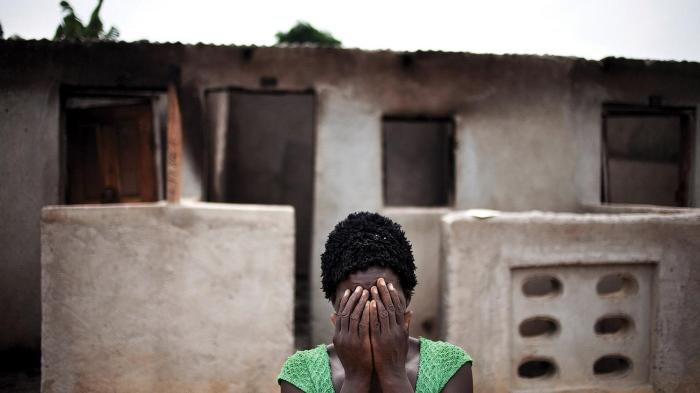
Turning Rhetoric into Reality
Accountability for Serious International Crimes in Côte d’Ivoire
Summary
As he took the oath of office on May 21, 2011, Ivorian President Alassane Ouattara faced considerable challenges, one of which was dealing with the aftermath of the brief but devastating armed conflict following the 2010 presidential elections. To realize his electoral victory, following incumbent President Laurent Gbagbo’s refusal to accept electoral results certified by the United Nations (UN), Ouattara, ultimately turned to former rebel forces for support. These forces had controlled the northern part of the country since the end of the 2002-2003 conflict which was marked by serious international crimes by both Gbagbo’s security forces and the rebels. Under the Gbagbo government, there was no accountability for these crimes.
From 2003 onwards, political and military leaders on both sides implicated in overseeing atrocities retained their positions with complete impunity. By the time pro-Ouattara forces arrested Gbagbo on April 11, 2011, armed forces from both parties had, as was the case in the previous conflict, committed egregious violations of human rights and international humanitarian law. At least 3,000 people were killed and 150 women raped during the crisis, often in targeted acts perpetrated along political, ethnic, and religious lines. Since his May 2011 inauguration, President Ouattara has repeatedly underlined his commitment to hold all perpetrators of serious crimes committed during the crisis to account, including those within his own forces. To date, however, while more than 150 individuals from the Gbagbo camp have been charged with crimes stemming from the post-election crisis, not a single case has been brought against pro-Ouattara forces for atrocities committed during the five-month crisis. It remains unclear whether President Ouattara’s government will finally break from the country’s dangerous legacy of impunity for people close to the government in power.
Based on interviews in Abidjan in September 2012 and follow-up interviews with government officials, lawyers, civil society members, UN representatives, diplomats, and officials from donor agencies, this report analyzes Côte d’Ivoire’s efforts to hold perpetrators of serious international crimes during the post-election crisis to account through independent, impartial, and fair investigations, prosecutions, and trials. It builds upon Human Rights Watch’s report “They Killed Them Like it Was Nothing: The Need for Justice for Côte d’Ivoire’s Post-Election Crimes”(2011), which detailed the war crimes and likely crimes against humanity committed by both pro-Gbagbo forces and pro-Ouattara forces.
The nature and scope of the 2010-2011 violence prompted the International Criminal Court (ICC) to take action. In October 2011, the ICC judges approved the prosecutor’s request to open an investigation, the scope of which was later extended to include crimes committed since September 19, 2002. By the end of November 2011, Laurent Gbagbo, accused by the ICC of being an indirect co-author on four counts of crimes against humanity, had been arrested and transferred to The Hague, where he remains in custody. In November 2012, ICC judges unsealed an arrest warrant against the former first lady, Simone Gbagbo, for crimes against humanity, alleging that she acted as Gbagbo’s “alter ego” in overseeing atrocities in Côte d’Ivoire. At this writing, she remains in custody in Côte d’Ivoire where she has been charged with genocide, among other crimes, for acts committed during the post-election crisis. To ensure compliance with its obligations under the Rome Statute, the ICC’s founding treaty, it is incumbent on the Ivorian government to cooperate with the ICC and surrender her to the court or, as an alternative, challenge the admissibility of her case before the ICC based on national proceedings for substantively the same crimes as exist in the ICC warrant.
The Imperative for Impartial Justice
The limits on the ICC’s ability to try all serious international crime cases make national justice essential to end impunity in Côte d’Ivoire. Since the end of the post-election crisis, President Ouattara has made repeated promises that all of those involved in serious crimes—regardless of political affiliation or military rank—will be brought to justice. Chronic impunity has fed the repeated episodes of violence in Côte d’Ivoire over the last decade. Civil society actors interviewed for this report, including those who have tended to lean towards either former President Gbagbo or current President Ouattara, expressed almost unanimously that impartial justice is a necessary precondition for reconciliation, and that its continued absence will likely fuel more violence in the future.
The pursuit of accountability for serious international crimes often comes with challenges, particularly in a post-conflict situation like that in Côte d’Ivoire. Pursuing justice may prove to be deeply unpopular, including among segments of the population who believe that the forces loyal to President Ouattara who committed serious crimes were justified in doing so. Several civil society activists and a senior diplomat in Abidjan told Human Rights Watch that the one-sided approach to accountability is likely due in part to the president’s still tenuous hold over the entire military. A few government officials and diplomats expressed a need for greater stability and cited the spate of attacks on Ivorian military installations in August and September 2012, many of which were likely carried out by pro-Gbagbo militants, in justifying slow progress toward impartial accountability.
However, the country’s recent history shows that credible justice is essential to break from its repeated episodes of politico-military violence. Rather than cautioning authorities against pursuing impartial justice, the recent security threats show the urgent need to proceed in investigating and prosecuting crimes committed by both sides.
In response to the August 2012 attacks, members of the Republican Forces (Forces Républicaines de Côte d’Ivoire, FRCI), the armed forces of Côte d’Ivoire, committed widespread human rights abuses against young men from pro-Gbagbo ethnic groups, including mass arbitrary arrests, illegal detention, extortion, cruel and inhuman treatment, and, in some cases, torture. Several commanders against whom there is evidence implicating them in overseeing these abuses had been previously implicated for their command role in grave crimes during the post-election crisis. The military’s continued impunity makes it more likely that the same authors will commit the same crimes whenever there are moments of tension. In turn, the abuses have exacerbated the country’s communal divisions, reinforcing the factors that are driving the security threats in the first place.
Simply put, the cost of ignoring justice, despite the real challenges that exist, is too high.
Necessary Steps for Ivorian Authorities to Realize Impartial Justice
Following his inauguration, President Ouattara, within a short period of time, oversaw the creation of a National Commission of Inquiry; a Special Investigative Cell; and a Dialogue, Truth, and Reconciliation Commission.
The National Commission of Inquiry (Commission nationale d’enquête, CNE), which released its report in August 2012, produced a balanced summary that echoed findings from a UN-mandated international commission of inquiry and reports of human rights groups: serious international crimes were committed both by pro-Gbagbo forces and by pro-Ouattara forces. The national commission’s report offered an approximate breakdown of the cumulative human rights violations—including summary executions and acts of torture that led to death—allegedly committed by members of both groups during the crisis. Chief among its recommendations was the need to bring to justice those responsible for such violations.
The Special Investigative Cell, consisting of prosecutors, investigating judges, and judicial police, was established to investigate and prosecute crimes committed during the post-election crisis, including serious international crimes. To date, civilian and military prosecutors have collectively charged more than 150 individuals with post-election crimes. However, none of those arrested, much less charged, with violent crimes (crimes de sang) committed during the post-election crisis come from the pro-Ouattara forces. In Côte d’Ivoire’s politicized environment, the perception persists that judges and prosecutors are too easily influenced by the agenda of the executive branch of government. The lack of meaningful accountability against pro-Ouattara forces for serious international crimes committed during the crisis reinforces this perception, and underscores the growing chasm between the president’s rhetoric and reality.
The steps taken by the government to date, while important, are not enough to support the pursuit of independent and impartial justice. There are a number of areas in which the Ouattara government and Côte d’Ivoire’s international partners could provide practical assistance to put judges and prosecutors in a better position to deliver results when it comes to accountability for serious international crimes.
Strengthening Judicial and Prosecutorial Independence
Judges and prosecutors can only adjudicate cases impartially when they are able to act independently from the legislative and executive branches. Côte d’Ivoire’s constitution recognizes a separation of powers between the executive and the judiciary and guarantees the independence of the judiciary, including investigating judges. In practice, however, while there are judges that act independently, civil society activists underscored to Human Rights Watch that they are the exception rather than the rule.
The Ouattara government has taken notable steps to strengthen judicial independence. A draft law has been prepared by the High Judicial Council (le Conseil supérieur de la Magistrature, CSM)—the body governing the appointment and disciplining of judges—aimed at giving judges more say in appointing their peers. Longer-term initiatives are needed to affect a shift in culture among judges, prosecutors, and those in the executive to combat political interference and corruption. The CSM should consider ways to train judges and prosecutors about its mandate, possible threats to judicial and prosecutorial independence, and the consequences of succumbing to political interference or corruption. Officials in the executive and legislative branches should consider similar measures to sensitize political officials about why the separation of powers is essential and what should (and should not) be done to support it. Since prosecutors are legally under the authority of the minister of justice, the government, in conjunction with Ivorian prosecutors, should establish and consistently implement guidelines aimed at promoting prosecutorial independence. In addition, the government, in conjunction with Ivorian prosecutors, should develop a system of case allocation that promotes the independence and impartiality of prosecutors handling serious international crime cases.
Strengthening Prosecutions
The development and implementation of a more coherent prosecutorial strategy—one that includes criteria used by prosecutors to make decisions about case selection—is another essential part of effectively and impartially addressing serious international crimes. To start, the Special Investigative Cell, with government and donor support as needed, should consider building on the work of the National Commission of Inquiry and conduct a mapping exercise to develop a comprehensive list of the crimes committed by region during the crisis, pinpointing individual suspects where possible. Such a mapping could help identify specific priorities for the office based on the scale of violations, patterns of violence, and leads or sources of evidence, including potential perpetrators. Non-confidential portions of both the mapping exercise and the prosecutorial strategy should be shared with the public to increase understanding about the office’s work and to build trust in its ability to execute its mandate independently and impartially.
To further facilitate the development of a meaningful prosecutorial strategy, the ICC’s Office of the Prosecutor (OTP) should share its analysis of the conflict and other non-confidential materials with staff in the Special Investigative Cell. While this information may be derived from public sources, the analysis could be of significant value to the procureur de la république and the investigating judges with less experience in handling serious international crimes.
There are also a number of steps Ivorian authorities can take to support domestic investigations. Under Ivorian law, investigating judges are the primary investigators of allegations of criminal conduct, with the assistance of the judicial police as needed. The modest staffing of the Special Investigative Cell—only three investigating judges at present—seems insufficient to address the large number of criminal allegations stemming from the post-election period. The previous minister of justice indicated that the ministry would appoint three additional investigating judges; the current minister of justice should do so as soon as possible.
Field investigations are essential and should be intensified, especially since many victims and witnesses are scattered across the country and cannot easily travel to Abidjan to give a statement. But in addition to traveling outside Abidjan, investigating judges and judicial police must be able to cultivate confidence in communities affected by crimes, especially those committed by the Republican Forces. Steps to take in doing this include: recruiting judicial police from all communities affected by the post-election crisis where the crimes being investigated were committed, training investigating judges and judicial police on how to assess the risk to victims and witnesses, and devising ways to approach victims that do not compromise their safety or cause further trauma.
Legal Reforms to Improve Fair Trial Rights of Defendants
Respect for the rights of the accused ensures that judicial processes are, and appear to be, fair and credible. In Côte d’Ivoire, a number of fair trial concerns relate to the jurisdiction of serious crimes, including serious international crimes, under the cour d’assises— a non-permanent court composed of a president, two professional judges, and nine lay jurors, including three alternates. First, while the cour d’assises is by law supposed to sit every three months, it has only been convened twice since 2000, in large part because the process is cumbersome and costly. While it may be possible to convene the cour d’assises for a handful of high-profile cases, the majority of defendants already in custody for post-election crimes appear likely to remain in pretrial detention until the issue of the cour d’assises is resolved, violating their right to be tried within a reasonable time. Further, decisions by the cour d’assises are not subject to appeal, violating a defendant’s right under international human rights law to have his conviction and sentence reviewed by a higher tribunal.
The Ministry of Justice has notably identified the reform of the Code of Criminal Procedure as a priority and formed a working group in late 2012 to address the issues related to the cour d’assises. The creation of a working group is a welcome development, and the group should reach a resolution on these issues as soon as possible.
In addition, under the Code of Criminal Procedure, legal representation for defendants in criminal cases is only mandatory at the cour d’assises phase, which also means that indigent defendants only have access to legal aid at this late stage of proceedings. This risks compromising the quality of representation provided, which is especially problematic in complex cases involving serious international crimes. Ivorian authorities should make mandatory at an earlier stage of the proceeding the provision of a lawyer for defendants in criminal cases and legal aid for those who are indigent.
Establishing a Framework for Witness Protection and Support
Trials of serious crimes can be extremely sensitive and create risks to the safety and security of witnesses and victims who may testify to deeply traumatic events. Identifying and implementing a strategy for witness protection will be crucial in convincing victims and witnesses, particularly of crimes committed by pro-Ouattara forces, that they can bring complaints.
In the short term, the government, with support from donors as necessary, should sponsor training workshops for prosecutors, investigating judges, and police investigating serious international crime cases to support the protection of witnesses. Such training could cover how to assess potential risks to witnesses and how to use discrete security measures to prevent or minimize such risks. Similar training should be provided to judges and other courtroom staff working on serious international crimes regarding in-court measures that can be used to protect witnesses and minimize trauma. Ivorian authorities should also consider establishing a safe house for witnesses facing temporary threats to their safety.
Over the longer term, Ivorian authorities should establish a law(s) to create a system to protect witnesses. In devising such a law(s), Ivorian authorities should consider creating a neutral witness protection unit—meaning it operates for all witnesses, regardless of if they are testifying on behalf of the prosecution or defense, and can enter into relocation agreements with third countries to protect witnesses in extreme circumstances. The benefits of such a unit potentially extend well beyond managing witnesses in cases of serious international crimes and could include other sensitive or high profile cases.
Providing Security for Judges, Prosecutors, and Defense Lawyers
Judges and prosecutors cannot work independently or impartially if they fear for their safety. The risk of retribution is even greater for judges and prosecutors involved in serious international crime cases, given the gravity and sensitive nature of the underlying crimes. At present, there is no dedicated force to provide protection to judges and prosecutors. The government should bolster security for judges and prosecutors as a matter of priority. Ministry of Justice officials should also consider providing protection as needed for defense attorneys working on serious international crime cases; given the sensitivity of the crimes involved, they are likely to receive threats that could compromise the representation of their clients.
Necessary Steps for International Partners
While Côte d’Ivoire’s international partners have poured money into an array of rule of law projects, their commitment to help Ivorian authorities pursue accountability for serious international crimes has been inconsistent over the last decade. Greater financial and diplomatic support for judicial efforts to handle serious international crimes—including by using funds already designated for rule of law projects to more clearly support the prosecution, trial, and defense of these crimes—could assist Côte d’Ivoire in addressing its dangerous legacy of impunity.
Putting Complementarity into Practice: Building Capacity to Try Serious Crimes
The complementarity principle under the Rome Statute puts responsibility for pursuing justice for serious international crimes squarely on the shoulder of states, with the ICC only intervening as a court of last resort. There has been growing recognition within the European Union (EU), the ICC’s Assembly of States Parties, and the UN, that international partners—including key donor states and the intergovernmental organizations themselves—should use funds designated for rule of law reform projects to more specifically strengthen capacity of national institutions to realize justice for international crimes.
While progress on complementarity in diplomatic circles is welcome, it must be matched by concrete advances on the ground. Experience to date in Côte d’Ivoire reveals that while key donor states and intergovernmental organizations like the EU and the UN have invested significant resources in rule of law reform, support specifically for efforts to pursue justice for serious international crimes has been more limited.
The challenge for the donor community is to capitalize on the Ivorian government’s expression of will and square it with their commitments to complementarity made at the policy level. Côte d’Ivoire’s international partners should think proactively about how assistance designated for justice sector reform could be more specifically targeted to support efforts aimed at bringing to justice and defending perpetrators of serious international crimes. Donors should consult with national authorities to determine how this additional support could be used.
ICC staff can also help by flagging gaps in capacity so that donor support is directed to best effect. Further, during planned missions to Côte d’Ivoire in relation to ICC activities, ICC staff could seek out low-cost or cost-neutral opportunities to provide Ivorian authorities informal training or workshops in areas where weaknesses have been identified, such as witness protection.
Increasing Private and Public Diplomacy
Côte d’Ivoire’s international partners, through private and public diplomacy, have an important role to play in encouraging a political climate that favors independent and impartial justice. Several diplomats and UN officials told Human Rights Watch that they have consistently engaged in private diplomacy on these issues, which is important. However, given the lack of progress toward impartial justice to date, donors should increasingly through their private and public statements put pressure on the government to address issues that impede credible, impartial investigations, prosecutions, and trials, including in the areas identified in this report. Concerted action aimed at helping the Ouattara government end the impunity and divisiveness that defined the Gbagbo era can help avoid a recurrence of large-scale violence. Côte d’Ivoire’s international partners should also continue to emphasize with the government the need to comply with its obligation to cooperate with the ICC in its existing cases—including that of Simone Gbagbo—and its ongoing investigations.
The International Criminal Court
Despite ample evidence of crimes committed by pro-Ouattara forces that fall under the ICC’s jurisdiction, the ICC has only made arrest warrants public against the former president and his wife, Simone. This reflects the Office of the Prosecutor’s decision to pursue a “sequential” approach—meaning it will conclude its investigations against the Gbagbo side before moving on to pro-Ouattara forces.
The OTP has frequently indicated that its investigations are impartial and ongoing. However, as more time has passed without action against anyone from the Ouattara camp, many Ivorians, including Ivorian civil society leaders, have increasingly viewed the ICC as “playing politics” in Côte d’Ivoire and treading lightly around the Ouattara government. In addition to compromising the ICC’s credibility among many Ivorians, the sequencing approach has been mimicked by Ivorian authorities, which has fueled rather than eased tensions.
As the ICC Prosecutor Fatou Bensouda continues investigations in Côte d’Ivoire, she should ensure that cases against individuals from the pro-Ouattara forces are investigated as robustly as those from the Gbagbo side, including seeking from the court’s judges additional arrest warrants where evidence is gathered against those responsible for crimes in the court’s jurisdiction. Indeed, the fact that the ICC is a court of last resort when governments are either unwilling or unable to pursue cases only underscores the imperative of ICC action against those on the Ouattara side who are otherwise beyond the reach of justice. Concrete action against pro-Ouattara individuals where there is evidence of ICC crimes would go a long way toward rehabilitating the ICC’s credibility in Côte d’Ivoire as an impartial institution, and could help create the space for Ivorian authorities to similarly make much-needed progress toward ensuring that all victims have access to justice.
Recommendations
To the Ivorian Government, Particularly the President and the Justice Minister
Bolster Judicial and Prosecutorial Independence
- Finalize and work to pass the draft law on the High Judicial Council (le Conseil supérieur de la Magistrature, CSM) designed to give judges more influence in appointing new judges.
- Ensure sanctions against political officials who try to interfere with the work of prosecutors or judges working on serious international crime cases.
- Make clear publicly and privately that the executive supports the Special Investigative Cell in pursuing post-election crimes committed by both sides. Emphasize that prosecutors and judges will not face negative consequences for pursuing perpetrators linked to the government.
- In collaboration with the procureur général and the procureur de la république, develop and consistently implement guidelines aimed at supporting prosecutorial independence.
- Consider establishing a section of the CSM that would manage, among other things, the appointment and dismissal of prosecutors.
- Consider engaging the mandate of the UN special rapporteur on the independence of judges and lawyers.
Strengthen Prosecutions and Investigations
- Appoint without delay additional staff, including investigating judges, to the Special Investigative Cell.
- Approve plans to embed additional independent legal experts in the Special Investigative Cell.
- Hold regular meetings with staff in the Special Investigative Cell aimed at improving the office’s effectiveness, particularly in supporting underfunded or understaffed areas of the cell and in identifying ways to better engage with victims from both sides of the crisis.
- Request from the Ministries of Interior and Defense the appointment to the Special Investigative Cell of judicial police officers from all communities affected by the post-election crisis.
- Finalize a platform to enable information sharing and coordination between all of the transitional justice institutions, including the Special Investigative Cell and the Dialogue, Truth, and Reconciliation Commission.
Improve Fair Trial Rights of Defendants
- In reforming the cour d’assises, ensure that defendants’ rights to a fair trial within a reasonable time and to an appeal are fully protected as soon as possible.
- Make the provision of a lawyer for defendants in criminal cases mandatory at an earlier stage of the proceeding, as well as the provision of legal aid for indigent defendants.
Better Protect Witnesses, Judges, Prosecutors, and Defense Lawyers
- Sponsor trainings for prosecutors, investigating judges, and police investigating serious international crime cases on how to assess the potential risks to witnesses and how to use discrete security measures to prevent or minimize risk. Provide similar trainings to judges and other courtroom staff working on serious international crimes regarding in-court measures that can be used to protect witnesses and minimize trauma.
- Provide police escorts by specially trained and vetted officers for witnesses traveling to and from court, where beneficial or preferred by the witness.
- Establish safe houses for witnesses facing temporary threats to their safety.
- Devise a draft law(s) for witness protection that provides safeguards inside and outside of the courtroom, and which are consistent with a defendant’s right to a fair trial.
- Consider creating a neutral witness protection unit, which should have operational autonomy to minimize the disclosure of information about witnesses and the authority to facilitate the relocation of witnesses to third countries as needed.
- Bolster security for judges, prosecutors, and defense lawyers working on serious international crime cases as a matter of priority, including by providing escorts as needed in investigations and bodyguards where there is an elevated risk of threats.
- Consider vesting the authority to oversee trials of serious international crime cases with a limited number of judges, as has been done with prosecutors and investigating judges in the Special Investigative Cell, in order to facilitate the protection of judges and to better ensure sufficient expertise in dealing with likely complicated and politicized cases.
- Approach donors to obtain assistance as needed in implementing the above recommendations and to improve the overall capacity of those handling serious international crime cases, including defense attorneys.
Cooperation with the International Criminal Court
- Cooperate with the ICC’s ongoing investigations and cases in Côte d’Ivoire, including in the Simone Gbagbo case, in compliance with the government’s obligations under the Rome Statute.
To the National Assembly
- Pass a law that reaffirms the Special Investigative Cell’s authority to investigate and prosecute crimes, including violent crimes, committed throughout the country during the post-election crisis.
- Pass legislation aimed at providing protection to witnesses inside and outside of the courtroom, while also safeguarding a defendant’s right to a fair trial.
To the High Judicial Council (Conseil Supérieur de la Magistrature)
- Consider ways to sensitize judges and prosecutors, such as through workshops or other training seminars, about the council’s mandate, possible threats to judicial and prosecutorial independence, and the consequences of succumbing to political interference or corruption.
- In coordination with the inspector general, investigate allegations of corruption involving judges and prosecutors and ensure that those who are credibly implicated are appropriately sanctioned.
To Staff in the Special Investigative Cell, Including the Procureur de la République and the Investigating Judges
- Move forward with plans to conduct a mapping exercise to develop a comprehensive list of serious crimes committed by region during the post-election period and to pinpoint suspects where possible, in order to provide the basis for identifying more specific priorities for the office.
- Develop a more comprehensive prosecutorial strategy that includes criteria used by prosecutors to make decisions about case selection.
- Publish non-confidential portions of any future mapping exercise or prosecutorial strategy to increase understanding about the Special Investigative Cell’s work and to build trust in its ability to execute its mandate independently and impartially.
- Intensify field investigations, especially since many victims and witnesses are scattered across the country and cannot easily travel to Abidjan.
- Seek training for investigating judges and judicial police on assessing security risks to victims and witnesses and approaching them in a manner that does not compromise their safety or cause further trauma.
- Consider designating an additional investigative team to coordinate and pursue linkage evidence, meaning evidence linking the “trigger pullers” on the ground with those who gave the orders across all regions, seeking additional resources from the Ministry of Justice as needed.
- Use the Rome Statute definitions of crimes and modes of liability when doing so would extend the reach of justice, including for crimes committed after September 2002.
To the Ministries of Interior and Defense
- Consider favorably requests from the Ministry of Justice to appoint to the Special Investigative Cell judicial police officers from all communities affected by the post-election crisis.
To the United Nations and Intergovernmental and Government Partners (including the European Union, the United Nations Development Program, the United Nations Operation in Côte d’Ivoire, France, and the United States)
- In consultation with national authorities, think specifically about how assistance designated for justice sector reform could be better targeted to support efforts aimed at bringing to justice and defending perpetrators of serious international crimes. For instance, donors that have allocated funds for training judicial personnel could direct some of this support to provide practical training to prosecutors and judges handling violent crimes committed during the crisis.
- Increase private and public diplomacy to press the government to better support prosecutors and judges in pursuing impartial justice in fair and credible trials, and to continue cooperation with the ICC in its cases and ongoing investigations.
To the United States
- Continue with plans to embed independent legal experts in the Special Investigative Cell.
To the United Nations Secretary-General
- Note with concern the absence of impartial accountability and highlight obstacles linked to this ongoing failure in public reports to the UN Security Council.
To the United Nations Independent Expert on the Human Rights Situation in Côte d’Ivoire
- Monitor and highlight obstacles that may compromise the independence and impartiality of judges and prosecutors, especially in relation to serious international crime cases. Continue monitoring and reporting on the Ivorian government’s progress in the implementation of your recommendations in regards to justice for serious international crimes.
To the International Criminal Court
Office of the Prosecutor
- Continue investigations in Côte d’Ivoire against all sides of the conflict with a view to requesting the court’s judges to issue additional arrest warrants, evidence permitting, against individuals from the pro-Ouattara forces responsible for crimes in the court’s jurisdiction.
- Flag gaps in the Ivorian justice system’s capacity so that donor support can be directed to best effect.
- During planned field missions to execute the ICC’s mandate under the Rome Statute, seek out low-cost or cost-neutral opportunities to provide informal training or workshops for Ivorian authorities in areas where weaknesses have been identified, such as witness protection.
- Share with Ivorian authorities the ICC’s analysis of the conflict and other non-confidential materials, in order to help facilitate national-level investigations and prosecutions.
Registry
- Continue with plans to open a field office in Abidjan as soon as possible.
- Authorize field staff to travel outside Abidjan—including to refugee camps in Liberia, for instance—to disseminate information about the court’s mandate, get a sense of the key information gaps that exist, and develop a longer-term outreach and communications strategy that addresses real needs.
Methodology
This report is based primarily on research conducted by two Human Rights Watch staff in Abidjan between September 8 and September 14, 2012.
During the mission, staff conducted approximately 30 interviews with Ivorian government officials, including in the Justice Ministry; legal practitioners, including staff in the Special Investigative Cell and criminal defense lawyers; representatives from a wide range of civil society groups; United Nations officials; diplomats; donor officials; and journalists.
Between October 2012 and February 2013, Human Rights Watch staff conducted additional interviews in person, by telephone, or over email with diplomats, UN officials, International Criminal Court officials, an international expert with knowledge of Côte d’Ivoire’s justice system, and representatives of civil society.
Many of the individuals we interviewed wanted to speak candidly, but did not wish to be cited by name given the sensitivity of the issues concerned. As a result, we have used generic descriptions of interviewees throughout the report to respect the confidentiality of these sources.
I. Background
As he took the oath of office on May 21, 2011, President Alassane Ouattara faced considerable challenges, including dealing with the aftermath of a brief but devastating armed conflict in which heinous crimes had been committed against civilians. Following the refusal of incumbent President Laurent Gbagbo to accept electoral results widely considered free and fair, and certified by the United Nations, Ouattara ultimately turned to former rebel forces for support. These rebel forces had controlled the northern part of the country since the end of the 2002-2003 conflict, which was marked by serious international crimes by both Gbagbo’s security forces and the rebels. Under the Gbagbo government (2000 to 2010), there was no accountability for these crimes.
On both sides, political and military leaders implicated in overseeing atrocities retained their positions with complete impunity. By the time pro-Ouattara forces arrested Gbagbo on April 11, 2011, armed forces on both sides had again committed egregious violations of human rights and international humanitarian law. Twenty-two months after President Ouattara’s May 2011 inauguration, it remains unclear whether his government will finally break from the country’s dangerous legacy of impunity.
Armed Conflict and Political-Military Stalemate, 2002-2007
On September 19, 2002, a rebel group known as the Patriotic Movement of Côte d’Ivoire(Mouvement Patriotique de Côte d’Ivoire, MPCI) launched attacks against strategic targets in Abidjan and against the northern towns of Bouaké and Korhogo.[1] Joined by two armed groups in the western part of the country,[2] the rebels quickly controlled the northern half of Côte d’Ivoire. The three groups formed a political-military alliance known as the Forces Nouvelles, or New Forces, demanding new elections and the removal of President Laurent Gbagbo, whose presidency they perceived as illegitimate due to flaws in the 2000 elections;[3] and an end to the political exclusion and discrimination against northern Ivorians.[4]
Gbagbo’s security forces responded to the rebel attacks by descending on low-income neighborhoods in Abidjan occupied primarily by immigrants and northern Ivorians. Although they carried out these operations for the stated purpose of searching for weapons and rebels, the security forces often simply ordered out all residents and burned or demolished their homes. In displacing over 12,000 people, the security forces carried out numerous human rights abuses, including arbitrary arrests and detentions, summary executions, rape, and enforced disappearances. [5] For their part in the north, the MPCI rebel group summarily executed at least 40 unarmed gendarmes and 30 of their family members in Bouaké between October 6 and 8, 2002; although the number of security forces executed in this event was particularly high, the killing of captured Gbagbo security forces would continue throughout the conflict. [6]
In subsequent months, armed clashes broke out between the two fighting forces. Fighting was particularly intense in the country’s west, where both sides recruited Liberian mercenaries; militia groups, often referred to as community self-defense groups, also fought with Gbagbo’s security forces. [7]
Throughout the conflict, government security forces and the Forces Nouvelles frequently attacked civilian populations perceived to support the other side. Human Rights Watch documented grave crimes committed by all sides, including summary executions, massacres, targeted sexual violence, indiscriminate helicopter attacks, and arbitrary arrests and detention by Gbagbo’s security forces; state-supported violence, including killings, by pro-Gbagbo militia groups; and summary executions, massacres, targeted sexual violence, and torture by the Forces Nouvelles. [8] Both sides recruited Liberian mercenaries who committed large-scale killings of civilians, and both sides used child soldiers. [9]
In May 2003 a ceasefire agreement formally ended active hostilities between the government and the Forces Nouvelles, though occasional breaches of the ceasefire continued through 2005. The country was split in two—as it would remain through 2010—with the Forces Nouvelles controlling the north and the Gbagbo government and security forces controlling the south. Severe human rights violations against civilian populations continued in both parts of the country. On March 25, 2004, Gbagbo’s security forces indiscriminately killed more than 100 civilians in response to a planned march by opposition groups; some 20 more people were victims of enforced disappearances.[10]Violent, pro-Gbagbo militia groups including the Student Federation of Côte d'Ivoire (Fédération Estudiantine et Scolaire de Côte d'Ivoire , FESCI) and the Young Patriots (Jeunes Patriotes) supported security forces in intimidating, extorting, and committing acts of violence against northerners, immigrants, and other people perceived to support the opposition.[11] In the Forces Nouvelles-controlled north, commanders became exceedingly wealthy through extortion and racketeering; with no judicial system there, arbitrary detention, torture, and extrajudicial executions continued against perceived supporters of the Gbagbo government.[12] Sexual violence against women and girls remained widespread in both parts of the country. Armed forces and civilians terrorized women, who found themselves without effective state response due to weak legal and security institutions that failed to prevent violence, prosecute perpetrators, or support victims.[13]
No Truth, No Justice under Gbagbo Government
No one was brought to justice for any of the grave crimes committed during the 2002-2003 armed conflict and its aftermath. Despite clear links between the deep-rooted impunity among the armed groups and the widespread atrocities, the Gbagbo government never prioritized accountability. On April 18, 2003, the Gbagbo government formally accepted the jurisdiction of the International Criminal Court (ICC) “for the purposes of identifying, investigating and trying the perpetrators and accomplices of acts committed on Ivorian territory since the events of 19 September 2002.” [14] Yet in subsequent years, once it became apparent that the ICC would be investigating crimes by pro-Gbagbo forces as well as by the Forces Nouvelles, the government consistently prevented the ICC from visiting Côte d’Ivoire to perform preliminary investigations. [15]
Although the Gbagbo government bore primary responsibility for the failure to ensure accountability, the inconsistent approach of Côte d’Ivoire’s international partners to justice for serious crimes in violation of international law also undermined its pursuit during this period. In 2004 the United Nations created an international commission of inquiry to investigate the crimes committed during the 2002-2003 conflict. However, after six months of field investigations and drafting, the UN Security Council buried the commission’s report; at this writing, the report is still unpublished, although a leaked version is accessible online. The report included an annex with a list of 95 people deemed most responsible for serious crimes, along with specific allegations against them. Radio France Internationale reported that the annex implicated high-level political and military leaders on both sides.[16] The list has never been made public, and the Security Council has not used it to pressure Ivorian authorities to ensure credible domestic investigations and prosecutions. Top UN officials, along with powerful countries on the Security Council, apparently deemed justice at odds with establishing peace in Côte d’Ivoire.
With no justice after the 2002-2003 armed conflict, key political and military leaders on both sides of the politico-military divide, some of whom had overseen serious crimes, remained in command positions as Côte d’Ivoire moved toward the 2010 presidential elections. The aftermath of the elections, which pitted Laurent Gbagbo against his longtime rival, Alassane Ouattara, would again expose the country’s deep political and ethnic fissures and the consequence of longstanding impunity.
Post-Election Violence, November 2010-May 2011
After five years of postponing presidential elections, Ivorians went to the polls on November 28, 2010 to vote in a run-off between incumbent President Gbagbo and former Prime Minister Ouattara. After the Independent Electoral Commission announced Ouattara the winner with 54.1 percent of the vote—a result certified by the UN Operation in Côte d’Ivoire (UNOCI)—Gbagbo refused to step down. [17] Five months of violence followed, in which at least 3,000 civilians were killed and more than 150 women raped, often in attacks perpetrated along political, ethnic, and religious lines.
During the first three months of the post-election crisis, the vast majority of abuses were carried out by security forces and militia groups under Gbagbo’s command. Elite security force units closely linked to Gbagbo abducted neighborhood political leaders from Ouattara’s coalition, dragging them away from restaurants or out of their homes into waiting vehicles. Family members later found the victims’ bodies in morgues, riddled with bullets. Pro-Gbagbo militias manning informal checkpoints throughout Abidjan murdered scores of real or perceived Ouattara supporters, beating them to death with bricks, executing them by gunshot at point-blank range, or burning them alive. Women active in mobilizing voters—or who merely wore pro-Ouattara t-shirts—were targeted and often gang raped by armed forces and pro-Gbagbo militia groups. [18]
As international pressure increased on Gbagbo to step down, the violence intensified. The Gbagbo government-controlled state television station, Radiodiffusion Télévision Ivoirienne (RTI), incited violence against pro-Ouattara groups and exhorted followers to set up roadblocks and “denounce all foreigners.” [19] Hundreds of northern Ivorians and West African immigrants were killed in Abidjan and western Côte d’Ivoire between February and April, sometimes solely on the basis of their name or dress. Mosques and Muslim religious leaders were likewise targeted. Among the worst incidents, Gbagbo’s security forces opened fire on women carrying out a peaceful march and launched mortars into heavily populated Abidjan neighborhoods, killing dozens. [20]
Pro-Ouattara forces launched a military offensive in March 2011 to take control of the country and, as the crisis shifted to full-scale armed conflict, they were likewise implicated in atrocities. President Ouattara signed a decree on March 17, 2011 creating the Republican Forces of Côte d’Ivoire (Forces Républicaines de Côte d’Ivoire, FRCI), comprised primarily at the time of members of the former Forces Nouvelles rebel group. In village after village in western Côte d’Ivoire, particularly between Toulepleu and Guiglo, members of the Republican Forces killed civilians from pro-Gbagbo ethnic groups, including elderly people who were unable to flee; raped women; and burned villages to the ground. In Duékoué, pro-Ouattara forces massacred several hundred people, pulling unarmed men they alleged to be pro-Gbagbo militia members out of their homes and executing them.[21]
Later, during the military campaign to take over and consolidate control of Abidjan, the Republican Forces again executed scores of men from ethnic groups aligned to Gbagbo—at times in detention sites—and tortured others. [22]
By conflict’s end in May 2011, both sides had committed war crimes and likely crimes against humanity, as documented by a UN-mandated international commission of inquiry and human rights organizations. [23] In August 2012 a National Commission of Inquiry created by President Ouattara published a report likewise documenting hundreds of summary executions and other crimes by both sides’ armed forces. [24]
Although the scale of serious human rights abuses has decreased since the end of the post-election conflict, the Republican Forces have continued to engage in arbitrary arrests and detention, extortion, inhuman treatment, and, in some cases, torture, through at least September 2012. [25]
II. Accountability for Post-Election Crimes to Date
National Accountability Initiatives
Since the end of the post-election crisis, President Ouattara has repeatedly promised that all of those involved in serious crimes—regardless of political affiliation or military rank—will be brought to justice. [26] After his inauguration in May 2011, the president swiftly created institutions tasked with providing truth and justice for the post-election crisis. In short order, he established a National Commission of Inquiry (Commission nationale d’enquête, CNE, created June 15, 2011), a Special Investigative Cell (Cellule spéciale d’enquête, created June 24, 2011), and a Dialogue, Truth, and Reconciliation Commission (Commission dialogue, vérité et réconciliation, created July 13, 2011), each of which will be discussed in more detail below. The military justice system is also handling cases in relation to the post-election crisis.
In a January 2012 interview with Le Monde and during an April 2012 visit to western Côte d’Ivoire, Ouattara assured his presidency would be defined by “even-handed justice” and an end to impunity, which he referred to as the country’s “tragedy.”[27]Yet, 22 months after the conflict’s end, Ivorian authorities have only arrested or charged individuals from the Gbagbo camp with crimes related to the post-election crisis.Without swift and determined action, Ouattara’s government is in danger of continuing the country’s principal “tragedy”: impunity for those connected to power.
National Commission of Inquiry
The National Commission of Inquiry was established on the heels of a report published by an international commission of inquiry, created under the authority of the UN Human Rights Council in March 2011 at the request of President Ouattara’s government.[28] The international commission of inquiry’s report, presented at the 16th session of the Human Rights Council on June 15, 2011, concluded that many serious violations of human rights and international humanitarian law were committed by all sides to the conflict.[29] Chief among its recommendations was the need to bring those responsible for such violations to justice.[30]
The National Commission of Inquiry began its field work in January 2012 with the mandate of investigating alleged violations of human rights and international humanitarian law during the post-election crisis.[31] It was established as an administrative, not a judicial, commission, meaning it did not focus on pinpointing individual criminal responsibility.[32] Even before its findings were released, President Ouattara cited the commission’s work as evidence of his commitment to impartiality and promised to ensure that any person implicated in the commission’s report would be subject to judicial investigation.[33] President Ouattara initially indicated that the commission would complete its work in late February or early March, sparking concerns that the commission may not have the time or necessary independence to fulfill its mandate.[34] The mandate was ultimately extended and the commission released a public summary of its report in August 2012; a confidential annex was sent to the prime minister and the minister of justice.
A comprehensive analysis of the commission’s summary is beyond the scope of this report. However, one of the commission’s most significant findings is that crimes were committed both by forces loyal to Gbagbo and by forces loyal to Ouattara. It also offers an approximate breakdown of the cumulative human rights violations—including summary executions and acts of torture that led to death—allegedly committed by these groups during the crisis.[35]
The National Commission of Inquiry’s work emphasizes the need for impartial justice. In discussing the commission’s report, the minister of justice, human rights, and public liberties, Gnénéma Coulibaly, told Human Rights Watch, ‘“No one can say [now] … that only one side is responsible for [abuses]. Every side is responsible and every side needs to admit their level of responsibility.” [36] The need to open judicial investigations against those suspected of committing the violations outlined in the report, regardless of political affiliation, was one of the commission’s key recommendations. [37] Both the current minister of justice and a civil society activist interviewed by Human Rights Watch felt that, since it was produced by a national body, the commission’s report helped depoliticize the idea that both sides had committed egregious crimes, which could pave the way for progress in judicial investigations. [38]
Special Investigative Cell
The Special Investigative Cell was created by the government through an interministerial order in response to the number of crimes committed during the crisis and the reality that the courts were not yet functioning in the crisis’s immediate aftermath.[39] The Special Investigative Cell is attached to the tribunal of first instance in Abidjan and is tasked with conducting criminal investigations in relation to events in Côte d’Ivoire since December 4, 2010.[40] It handles three categories of cases stemming from the crisis: attacks against state security, economic crimes, and violent crimes. It consists of one procureur de la république, three deputy prosecutors, and three investigating judges; senior officials under the previous minister of justice said three more investigating judges would be added. However, at this writing, this had not yet been done.[41] In addition, the military court in Abidjan has completed one major trial for post-election crimes, in which five former Gbagbo military officials, including General Bruno Dogbo Blé, the former head of the Republican Guard, were convicted of abduction and murder. Dogbo Blé was sentenced to 15 years’ imprisonment.[42]
Staff in the Special Investigative Cell, Ministry of Justice officials, and some civil society activists cited the creation of the Special Investigative Cell as evidence that the government has some political will to pursue accountability.[43] Indeed, creating a specialized unit to handle the investigation and prosecution of serious international crimes can help prosecutors, investigating judges, and judicial police develop the expertise needed to handle these often-complex cases.[44] There has been movement towards accountability: more than 150 individuals have been charged with post-election crimes, including Simone Gbagbo, the wife of former President Laurent Gbagbo, and Charles Blé Goudé, Gbagbo’s youth minister during the crisis.[45]
To date, however, none of those charged with post-election crimes comes from the pro-Ouattara forces. [46] The absence of prosecutions against pro-Ouattara forces is especially significant in light of findings by the international commission of inquiry, the Office of the High Commissioner for Human Rights, the United Nations Operation in Côte d’Ivoire, the International Federation of Human Rights, Human Rights Watch, Amnesty International, an Ivorian coalition of human rights organizations known as the Group of Ivorian Actors for Human Rights (Regroupement des Acteurs Ivoriens des Droits de l’Homme), and President Ouattara’s own National Commission of Inquiry about likely war crimes and crimes against humanity committed by pro-Ouattara forces.[47] The skewed approach to accountability to date supports the widely held sentiment in Côte d’Ivoire that the government is only interested in pursuing the Gbagbo side.[48] The last two reports of the UN independent expert on the human rights situation in Côte d’Ivoire have similarly raised concerns about the absence of impartiality when it comes to justice for post-election crimes.[49]
The one-sided approach to accountability thus far in Côte d’Ivoire stands in stark contrast to the consistent promises of impartial justice made by President Ouattara’s government. [50]
Several civil society activists and two senior diplomats in Abidjan told Human Rights Watch that the one-sided approach to accountability is partially due to the precarious control President Ouattara still exerts over the military.[51] One senior diplomat expressed concern that the prosecution of even foot soldiers or low-level commanders from the FRCI could threaten security.[52] Several leaders of an Ivorian professional association also said that the spate of attacks on Ivorian military installations in August and September 2012 further dimmed the prospect for impartial accountability; some felt that the country needed to achieve a measure of stability before impartial accountability could be pursued.[53]
Côte d’Ivoire indeed faced legitimate threats to its national security in the second half of 2012. And the nature of some of the attacks, combined with additional credible evidence, gave weight to the Ivorian government’s theory that many of the attacks were waged by pro-Gbagbo militants.[54]
But, rather than cautioning authorities against pursuing impartial justice, the recent security threats show the urgent need for the Special Investigative Cell to make progress in its investigations into crimes on both sides. The failure to bring to account suspected perpetrators of grave crimes risks emboldening them and others to continue resorting to the same types of abuses during moments of tension. This is precisely what happened in response to the August security threats, after which members of the Republican Forces committed widespread human rights abuses against young men from pro-Gbagbo ethnic groups, including mass arbitrary arrests, illegal detention, extortion, cruel and inhuman treatment, and, in some cases, torture.[55]
In a November 2012 report, Human Rights Watch documented that many of the worst abuses were perpetrated by troops under the command of Ousmane Coulibaly, known by his nom de guerre “Bin Laden.” He was also implicated by Human Rights Watch during the post-election crisis as one of the FRCI leaders under whose command soldiers committed dozens of summary executions and frequent acts of torture during the final battle for Abidjan in April and May 2011.[56] Impunity makes it more likely that the same authors will commit the same crimes. Ongoing abuses by the Ivorian military, and in particular the targeting of people largely on the basis of their ethnicity and perceived political preference, risk further fueling the dangerous communal divisions at the root of the security threats.
Chronic impunity has fed repeated episodes of violence in Côte d’Ivoire for over a decade, underscoring that justice, in addition to giving victims the redress they deserve, is critical to achieving durable stability. As one civil society actor put it, “Justice has to proceed [impartially] if there is to be reconciliation. There was the same hatred, the same animosity, in the killing done by both sides. It will reduce tension if we recognize this and see justice on both sides.”[57]
The imperative of pursuing justice for serious international crimes does not diminish the difficulty in doing so. Holding to account even lower ranking suspects within the forces that helped arrest Gbagbo and consolidate the current government’s hold on power may prove to be deeply unpopular. In a divided society like Côte d’Ivoire, there may be opposition to impartial justice not only by possible targets but also segments of the population who still firmly believe that pro-Ouattara supporters were justified in committing crimes under the circumstances. Moves in the direction of pursuing impartial justice may very well spark outcries.
At the same time, without justice to end the culture of impunity, history risks repeating itself. Another civil society actor put it this way, “If we remain on the path we’re currently on, we will return to where we were before. There will be another crisis…. The impunity of today leads to the crimes of tomorrow.”[58] Indeed, the view that impartial justice is a vital ingredient for reconciliation was shared widely among those interviewed by Human Rights Watch for this report, as was the concern that its absence would fuel violence in the future.[59] cost of ignoring justice is simply too high. Moreover, steps to pursue those suspected of committing serious international crimes that are affiliated with the government in power can go a long way to inspire confidence in the rule of law.[60]
Dialogue, Truth, and Reconciliation Commission
Led by former Prime Minister Charles Konan Banny, the Dialogue, Truth, and Reconciliation Commission is composed of three vice presidents and seven commissioners representing constituencies across Côte d’Ivoire and the diaspora.[61] The CDVR’s stated objectives are to shed light on root causes of the post-election crisis, the acts and patterns of violations, and ways for the country to overcome these legacies through reconciliation and recognition of those who were victimized.[62] It can also make recommendations on institutional reforms with the aim of improving the protection of human rights.[63]
In its preparatory phase, CDVR members travelled around the country to open the process of reconciliation and to inform the public of the CDVR’s mission. This phase concluded with the period of mourning and purification.[64] The CDVR then met with community representatives and sought input from the wider population on how to give meaning to the decree creating the commission. According to a high-level CDVR official interviewed for this report, Ivorians repeatedly stressed that the CDVR should cover events beginning in 2002.[65] The official also expressed concern that the ongoing one-sided justice for post-election crimes could prejudice the implementation of the CDVR’s mandate.[66]
At the time of Human Rights Watch’s field work, the CDVR was still in the process of meeting with communities to discuss, in local languages, its mission and mandate.[67] The CDVR’s mandate was set to end in September 2013, by which point it was supposed to have taken and corroborated victim, witness, and perpetrator statements; written a report of its findings; and determined appropriate reparations, financial and symbolic.[68] In addition, the CDVR has proposed the creation of 36 sub-commissions across the country. At this writing, at least 23 of these commissions were set to be operational to continue with consultations with the local population.[69]
A comprehensive analysis of the CDVR’s work is beyond the scope of this report. CDVR officials expressed frustration to Human Rights Watch, saying their progress has been very slow, in part because of a lack of government funding.[70] However, the commission has received some government funding, in addition to external funding from, among others, the UN Peacebuilding Fund, the West African Economic and Monetary Union, and the African Development Bank.[71] The CDVR has also confronted resistance to its work by members of the pro-Gbagbo Ivorian Popular Front (Front Populaire Ivoirien, FPI).[72] In October 2012, President Ouattara and the CDVR President Banny met to reinvigorate the commission’s work.[73]
Further, at this writing the CDVR had not yet established a formal relationship with the Special Investigative Cell.[74] This is concerning since both institutions are mandated to investigate the same events, meaning they will often be seeking the same information, funding, and witnesses, including detainees who may already be in custody. Lessons from the experience of the simultaneous operation in Sierra Leone of a truth and reconciliation commission and a special court with criminal jurisdiction underscore the importance of establishing from the outset a clear relationship and modalities for addressing the conflicts that emerge between the two institutions.[75] There have been efforts to establish a platform to enable information sharing and coordination between all of the transitional justice institutions in Côte d’Ivoire, although it had not yet been concluded at this writing.[76] Human Rights Watch believes that the minister of justice, human rights, and public liberties should press for the conclusion of such an agreement as soon as possible.
International Steps towards Accountability
Given the repeated episodes of politico-military violence that have plagued Côte d’Ivoire for over a decade, it is unsurprising that the call for international justice for serious international crimes in Côte d’Ivoire has been longstanding. In April of 2003, then-President Gbagbo submitted a declaration under article 12(3) of the Rome Statute, submitting Côte d’Ivoire to the jurisdiction of the International Criminal Court (ICC) for crimes falling under its jurisdiction since September 19, 2002.[77] The validity of the declaration was confirmed by President Ouattara in December 2010, when he asked the ICC to examine crimes committed since March 2004.[78] The request was reaffirmed in May 2011, although this time he asked the ICC to limit its investigation to crimes committed after November 28, 2010.[79]
In October 2011, the ICC judges authorized then-Prosecutor Luis Moreno-Ocampo to open an investigation under his propio motu power, initially for crimes committed after November 28, 2010. ICC judges have since expanded the scope of the investigation to include crimes committed after September 19, 2002, based on the Gbagbo government’s initial request in 2003.[80] Once opened, the investigation initially proceeded swiftly: in late November 2011, former President Gbagbo was arrested on an ICC arrest warrant alleging he was an indirect co-author for four counts of crimes against humanity during the post-election crisis.[81] On November 29, 2011, Ivorian authorities surrendered him to the ICC in The Hague, where he remains in custody pending a decision by ICC judges as to whether there is enough evidence to send his case to trial.[82] In late November 2012 the ICC unsealed an arrest warrant—originally issued in February 2012—against former President Gbagbo’s wife, Simone Gbagbo. She has also been charged with four counts of crimes against humanity allegedly committed during the same period.[83] At this writing, she remains in custody in Côte d’Ivoire where she is charged with genocide, among other crimes, for acts committed during the post-election crisis.[84] The government has indicated that it is “looking closely” at the ICC request for her arrest and surrender.[85] Human Rights Watch strongly urges the Ivorian government to comply with its obligation under the Rome Statute to cooperate with the ICC and surrender Simone Gbagbo to the court or, as an alternative, challenge the admissibility of her case before the ICC because it is trying her for the same events.
The Office of the Prosecutor (OTP), now under the leadership of Fatou Bensouda, has indicated that its investigations are ongoing and impartial.[86] Despite ample evidence of crimes committed by pro-Ouattara forces that could fall under the ICC’s jurisdiction, no one has yet been indicted.[87] The OTP’s lack of action against pro-Ouattara forces reflects its pursuit of a “sequential” approach, where the office conducts investigations against one group at a time—meaning it will conclude its investigations against the Gbagbo side before pursuing pro-Ouattara forces.[88]
Human Rights Watch appreciates the challenges facing the ICC which may make it difficult to pursue all groups at the same time, at least initially. The ICC’s broad jurisdiction means that the prosecutor can, and does, act in a number of unrelated country situations simultaneously, stretching its limited resources. Further, the office must rely to an extent on the government’s permission to access the country to investigate crime scenes and interview witnesses, among other tasks. Against this backdrop, the attraction of proceeding incrementally may seem impossible to resist, especially in the face of ready cooperation by the government to proceed against one side. Indeed, in Côte d’Ivoire, the Ouattara government was ready to help the ICC build a case quickly against Gbagbo, particularly amidst concerns that Gbagbo’s continued presence in the country posed an ongoing security threat. From a practical point of view, the Ivorian government’s incentive to cooperate with the ICC was considerable, as the government sought to achieve its primary goal: Gbagbo’s quick surrender to the ICC.
At the same time, Ivorian civil society activists told Human Rights Watch that the ICC’s quick action against Gbagbo effectively diminished its leverage when it comes to securing ongoing cooperation from Ivorian authorities, especially for ICC orders against forces loyal to the government.[89] Had the Office of the Prosecutor investigated allegations and issued arrest warrants against alleged perpetrators from both sides simultaneously, it would have been in a stronger position to see its orders executed. Adopting a simultaneous rather than a sequential approach was a feasible option, given that many victims of crimes committed by pro-Ouattara forces could have been easily found in refugee camps, internally displaced persons’ camps, and through traditional and neighborhood leaders in pro-Gbagbo areas.
As more time has passed without action against anyone from the Ouattara camp, the ICC has been increasingly viewed as “playing politics” in Côte d’Ivoire, feeding the perception that only one side has access to justice. [90] Ivorian civil society activists and others said the delay in investigations associated with the sequential approach has undermined the ICC’s credibility among the wider population. [91] In a country where the ICC’s legitimacy by example is most needed, the court’s independence and impartiality are now routinely questioned.
In addition to affecting its credibility among the Ivorian population, the ICC’s sequential approach has had an unfortunate spillover effect in Côte d’Ivoire. As one civil society actor interviewed by Human Rights Watch noted,
A lot of Ivorians are waiting for [the ICC] to charge someone from the Ouattara camp. If they stop at Gbagbo, there will be a problem. If they take a couple more from the Gbagbo camp [without anyone from the Ouattara camp], there will be a problem. The ICC needs to be an example of fairness and impartiality to our own justice system, but instead it has the same problems we do here. It’s showing the government here that slow progress [toward pro-Gbagbo trials] and being one-sided is acceptable.[92]
Indeed, Guillaume Soro, Ouattara’s former prime minister and the current head of Côte d’Ivoire’s National Assembly, made this very point when asked about the lack of justice for crimes committed by his side’s forces: “It was precisely in order not to be accused of victor’s justice that we brought in the International Criminal Court … [which] people cannot claim to be complaisant or to pick sides…. Up until now the ICC has been invited to come investigate in Côte d’Ivoire. Yet, the ICC, to my knowledge, has only issued four arrest warrants, [all against the Gbagbo side]. You will agree that the ICC has decided on the basis of its investigations.”[93]
The ICC has consistently emphasized the impartiality of its ongoing investigations in its public messaging around the Gbagbo cases.[94] While such statements are important, they are simply not enough to manage the fallout of pursuing a one-sided approach over the long term—consequences that extend far beyond those to the court’s reputation. The ICC should therefore continue its investigations against pro-Ouattara forces who may have committed crimes in the court’s jurisdiction with a view to, evidence permitting, bringing forth cases as soon as possible. Issuing warrants against members of the pro-Ouattara forces, in addition to reinforcing the ICC’s impartiality, could effectively open the space for prosecutorial and judicial authorities to do the same in Côte d’Ivoire. Additional recommendations for the ICC will be discussed in Section IV of this report.
III. Challenges to Realizing Accountability
The frequent resort to violence in Côte d’Ivoire to resolve disputes on issues ranging from politics to land conflict has laid bare the weakness of the rule of law in the country, further fueled by the lack of credible justice for the grave crimes committed during the decade of violence preceding the 2010 elections. Even before the 2010-2011 post-election crisis, the judicial system was plagued by insufficient material and financial resources, inefficient proceedings, the politicization of its personnel, inadequate case management systems, corruption, and poor public perception. The enormity of the task of re-establishing the rule of law swelled following the post-election crisis.[95]
In the country’s south, seventeen of the twenty six courts were partially damaged or looted during this period; courts effectively ceased to function. In the north, judges and prosecutors had only begun to return to their posts after more than seven years during which the Forces Nouvelles rebel group controlled that part of the country, including de facto policing and judicial functions. Many court officials in the north once again abandoned their posts after conflict resumed. Many prisons in the south were also damaged when armed groups from one side or the other broke them open to create chaos or to target new recruits. By conflict’s end, few prison facilities continued to function in the south; in the north, only three of the eleven prisons were operational prior to the crisis.[96]
Since taking office, President Ouattara’s government has taken steps to address these glaring deficiencies. The government has increased from 2 to 3 percent the amount of the national budget allocated to the justice sector over a five year period.[97] Similarly, donors have poured millions of dollars into the justice sector to support national rehabilitation efforts of the entire system. In April 2012 the Ministry of Justice finalized a national justice sector strategy, which forms the basis for interventions in the justice and prison sectors by the government, the United Nations, the European Union, and other partners from 2012 to 2015.[98] At this writing, the corresponding action plan, which identifies how the priorities will be implemented and will serve as a roadmap for international partners supporting justice reform, had yet to be finalized by the Ministry of Justice.[99]
As mentioned above in Section II, President Ouattara has specifically flagged in his rhetoric the need for independent and impartial justice to address the pervasive problem of impunity for grave crimes. The Special Investigative Cell, the National Commission of Inquiry, and the Dialogue, Truth, and Reconciliation Commission are indeed steps in that direction. But the lack of meaningful accountability against pro-Ouattara forces for atrocity crimes underscores the growing chasm between rhetoric and reality. More concrete action is needed to realize independent and impartial justice.
There are a number of areas where the Ouattara government and donors could provide practical assistance to see results when it comes to accountability for serious international crimes. As a general point, given the complexity of pursuing serious international crimes, all of those engaged in prosecuting, trying, and defending against allegations of serious international crimes would benefit from targeted, practical training to develop their capacity. These trainings should address real needs as identified by the practitioners working on these cases. For instance, prosecutors could be trained in how to use existing modes of liability under Ivorian law to target senior officials who ordered or failed to adequately respond to the commission of serious international crimes.[100] Workshops on the elements of crimes and modes of liability in the Rome Statute and relevant defenses—for prosecutors, judges, and defense lawyers—as compared to domestic law could also be beneficial.
Other areas where the government— with donor assistance as needed— could provide material and technical support to help judicial and prosecutorial authorities strengthen their ability to pursue serious international crime cases include: strengthening judicial and prosecutorial independence, strengthening prosecutions by signaling for prosecutors the need to put in place a more effective and transparent prosecutorial strategy, improving investigative capacity by providing material and technical support as needed, solidifying the legal basis of the Special Investigative Cell, improving the fair trial rights of defendants, establishing an effective system for witness protection, and bolstering security for judges, prosecutors, and defense lawyers. Each of these areas will be discussed in more detail below.
Strengthening Judicial and Prosecutorial Independence
Judicial independence, meaning the real and perceived ability to act without political influence, is the cornerstone of democracy, good governance, and rule of law. Judges must also be able to withstand temptation to circumvent the law for personal gain, both in appearance and reality. It is only when judges and prosecutors can and appear to operate free from influence or corruption that they are able to adjudicate cases impartially—key preconditions to inspire public confidence in the administration of justice. Independence and impartiality are critical when it comes to trying serious international crime cases, which are especially sensitive because they are often committed along ethnic or political lines and their masterminds may continue to occupy positions of power.
At the same time, these core principles are weakest in countries emerging from conflict or violence resulting from the complete breakdown of the rule of law, like in Côte d’Ivoire. Indeed, senior Ministry of Justice officials interviewed by Human Rights Watch pointed to two pivotal judicial decisions as symbols of the politicization of the judiciary: first, in 2000, when the Supreme Court declared Alassane Ouattara, among others, ineligible to stand in the presidential elections; and second, in 2010, when the Constitutional Court nullified the results of the Independent Electoral Commission and declared President Gbagbo the winner of the election.[101] Civil society activists and government officials said that both decisions reflected the lack of independence of the judicial system and helped trigger the onslaught of politico-military violence that resulted in the commission of mass atrocities.
Côte d’Ivoire’s constitution recognizes a separation of power between the executive and the judiciary and guarantees the independence of the judiciary, consistent with international standards.[102] In practice, while there are judges that act independently, one civil society activist underscored to Human Rights Watch that they are the exception rather than the rule.[103] According to the United States (US) State Department, political interference was rampant during the Gbagbo government, as was widespread corruption among judges and prosecutors more concerned about career advancement than implementing the law.[104]
There has been little change in the perception of the judiciary since President Ouattara took office: as one civil society activist put it, the “actors have changed, but the system remains the same.”[105] Several of those interviewed for this report highlighted that because prosecutors by law operate under the authority of the minister of justice, it is extremely difficult for them to act independently.[106] The fact that neither the procureur de la république nor the military prosecutor has brought any cases against pro-Ouattara forces for violent crimes committed during the crisis only reinforces the perception that prosecutors are reluctant or unable to open sensitive cases against individuals close to the executive.[107]
The Ouattara government has taken steps to strengthen judicial independence, most notably by drafting a law on the High Judicial Council (le Conseil supérieur de la Magistrature, CSM)—the body governing the appointment and discipline of judges, with the goal of protecting their independence. The draft law would implement the president’s obligation under the constitution to follow the council’s advice when selecting judges.[108] At this writing, the draft legislation was still pending. While the passing of the law would be a positive step, the president and the chair of the National Assembly would still hold the power to appoint a majority of judges to the CSM. As such, a more neutral process of appointing judges to the CSM is needed to bolster the institution’s—and ultimately the judiciary’s—independence.[109] The government has identified strengthening the independence of the judiciary, including through amending the constitution, as a priority in its April 2012 strategy document mentioned above.[110]
In addition, the government has appointed an inspector general to oversee judicial and corrections services. [111] As of January 2012 the inspector general can initiate an investigation at his or her own initiative, in addition to being tasked to do so by the minister of justice. [112] In October 2012 the government announced that disciplinary proceedings had begun against eight judges for abuse of power, extortion of funds, and corruption . [113]
As for prosecutors, as noted above, while all prosecutors operate under the authority of the minister of justice, this should not be interpreted as the system sanctioning undue political interference in the work of prosecutors. As the UN special rapporteur on the independence of judges and lawyers has noted, where the prosecution is subordinate to executive authority, “it is important to develop clear and adequate policy guidelines as well as codes of conduct and ethics, so that the parameters for action and the authority of the respective actors are clearly defined so as to detect, challenge, and remedy any violation or abuse of authority that may arise.”[114] An independent and impartial case assignment system is also important to protect prosecutors from undue interference.[115]
Human Rights Watch urges the minister of justice, in collaboration with the procureur général and the procureur de la république, to take steps to protect the impartiality and independence of prosecutors, including through developing and consistently implementing policy guidelines and codes of ethics outlined above, as well as through establishing an independent and impartial system for assigning cases. Further, the security of tenure for prosecutors is closely linked to their perceived and actual independence. Their dismissal should be subject to strict requirements, which includes a framework for dealing with internal disciplinary matters and complaints against prosecutors, who should be able to challenge decisions relating to their careers.[116] In this regard, the government may want to consider establishing a section of the CSM for prosecutors.[117]
Other long-term initiatives are needed to affect a cultural shift in the judiciary and in the executive when it comes to combatting a culture permissive of corruption and political interference.[118] In this regard, the CSM should consider ways to sensitize judges and prosecutors, such as through workshops or other training seminars, about its mandate, possible threats to judicial and prosecutorial independence, and the consequences of succumbing to political interference or corruption. Officials in the executive should consider similar measures to sensitize political officials about why the separation of powers is essential and what should and should not be done to support it.
In his 2012 report to the UN Human Rights Council, the independent expert on the human rights situation in Côte d’Ivoire notably referenced the importance of the independence and impartiality of the judiciary in adjudicating crimes from the post-election crisis.[119] His 2013 report also highlighted in greater detail concerns about ongoing impunity for government forces and the lack of impartial justice to date.[120] As he continues his work on justice for serious crimes in Côte d’Ivoire, the independent expert should consider monitoring the issue of judicial independence and impartiality in particular. Indeed, shedding more light on the obstacles to judicial and prosecutorial independence and providing recommendations to address them could help national authorities more effectively tackle these issues, with donor support as needed.
Further, given the longstanding weakness of the judicial system when it comes to independence and impartiality, President Ouattara should consider engaging the mandate of the UN special rapporteur on the independence of judges and lawyers. An important part of the work of the UN special rapporteur is conducting country visits to assess in greater detail the situation of the judiciary and the wider legal system and, where appropriate, make recommendations for its improvement.[121]A country visit can be initiated in two ways: through a request to visit by the UN special rapporteur to the government concerned or by a government directly inviting the UN special rapporteur. Both scenarios require the government’s consent before the mission takes place.[122]
Strengthening Prosecutions
Developing a More Comprehensive Prosecutorial Strategy
A well-developed prosecutorial strategy is essential to define priorities and develop guidelines to pursue these priorities. Since serious international crimes, by their nature, involve hundreds and potentially thousands of victims, developing a sound strategy is especially important to direct finite prosecutorial resources to best effect. Non-confidential elements of the strategy should also be published to cultivate public understanding of the strategy—important to build trust and facilitate investigations—and to manage expectations among victims about what the justice system can deliver.[123]
However, in a place like Côte d’Ivoire where the justice system has not functioned effectively for a number of years, there is limited experience to draw from when developing such a strategy. Given this limited experience, coupled with the sensitivities associated with pursuing pro-Ouattara forces, it is perhaps unsurprising that the Special Investigative Cell has mirrored the International Criminal Court (ICC) in adopting a sequential approach to its prosecutions: first, cell staff told Human Rights Watch, prosecutors will focus on pro-Gbagbo forces, followed by those suspected perpetrators of serious international crimes among the Ouattara supporters.[124] This has been reflected in the Special Investigative Cell’s work to date, with charges brought only against defendants from the Gbagbo camp.
As discussed above, almost all civil society actors interviewed for this report have flagged their frustration with the ongoing impunity for one side of the conflict.
The pursuit of the sequential approach has eroded trust in the independence and impartiality of the Ivorian justice system. This mistrust makes it less likely that victims and witnesses will readily come forward, requiring investigating judges and judicial police to be more proactive in building cases against pro-Ouattara forces. Indeed, staff in the Special Investigative Cell indicated that while the office makes no distinction among victims when it comes to pursuing cases, few victims of crimes committed by the FRCI have come forward with information about possible crimes.[125]
Vague promises about eventually targeting those on the Ouattara side are not enough to quell many Ivorians’ rising impatience with the status quo. Developing and implementing a more comprehensive prosecutorial strategy—one that includes criteria used by prosecutors to make decisions about case selection—is essential. To do so more effectively, staff in the Special Investigative Cell, under the leadership of the procureur de la république and with government and donor support as needed, should consider conducting a mapping exercise to develop a comprehensive list of crimes committed by region during the post-election period, pinpointing individual suspects where possible.[126] Such a mapping could provide the basis for the formulation of initial hypotheses of investigation by giving a sense of the scale of violations, detecting patterns, and identifying potential leads or sources of evidence.[127] The National Commission of Inquiry’s report and confidential annex may have done this to a degree and can provide a useful starting point for this exercise. However, since the commission was not vested with a judicial mandate, the Special Investigative Cell will likely need to undertake some additional work to successfully build criminal cases against individual perpetrators.
Based on the findings of the mapping exercise, staff in the Special Investigative Cell could identify more specific priorities for the office, such as pursuing the most serious crimes, targeting senior officials, or prosecuting certain crimes that have special significance in Côte d’Ivoire, including attacks on minorities and gender-based violence.[128] The strategy could also include information about the factors the office considers when implementing these priorities, such as the availability of witnesses, the quality of evidence, and the legal complexity of the case.[129] Based on a more comprehensive strategy document, the procureur de la république and the investigating judges could then develop a more strategic investigative plan—essentially guidelines on how to structure investigations and collect evidence to support the priorities identified in the strategy document in accordance with the applicable legal standards.[130]
Non-confidential portions of both the mapping exercise and the prosecutorial strategy should be published to increase understanding about the office’s work, build trust in its ability to execute its mandate independently and impartially, and manage expectations about what can be achieved.[131] Should the procureur de la république continue to pursue a sequential approach—despite the concerns raised by civil society and others about the negative consequences of this strategy—the strategy document for the Special Investigative Cell should include specific information about why this approach remains valid. Further, proceeding sequentially when it comes to charging perpetrators should not compromise the immediate collection of evidence against all perpetrators.
In late February 2013, the head of the Special Investigative Cell told Human Rights Watch of her commitment to develop a prosecutorial strategy, with assistance from key partners including the UN Operation in Côte d’Ivoire (UNOCI), the United States Agency for International Development Office of Transition Initiatives (USAID/OTI), and the International Center for Transitional Justice (ICTJ).[132] This commitment, which is welcome, should be operationalized as soon as possible, and should include disseminating non-confidential portions of the strategy to the broader public as discussed above.
Improving Investigations
Under Ivorian law, investigating judges are the primary investigators of allegations of criminal conduct, with assistance by the judicial police as needed.[133] The investigating judge can be put in charge of a case by the prosecutor or civil parties.[134] The investigating judge compiles a dossier or file of the information relevant to the alleged crime and will pass the file on to the prosecutor if he or she determines that the relevant legal threshold to proceed has been satisfied.
There are currently three investigating judges assigned to the Special Investigative Cell; when under the previous minister of justice, the ministry promised an additional three investigating judges, but this had not been finalized at this writing. The modest staffing of the Special Investigative Cell that exists at present seems insufficient to address the large number of criminal allegations stemming from the post-election period alone. Yet Ivorian authorities further increased its caseload in 2012 after giving it jurisdiction over “attacks on state security” related to alleged plans for a coup d’état and the spate of attacks on military installations beginning in August 2012. Human Rights Watch believes that the Ministry of Justice should appoint additional staff to the Special Investigative Cell, including investigating judges, as soon as possible.
Staff in the Special Investigative Cell have made some effort, including through radio and newspaper advertisements, to encourage witnesses to come to its office in Abidjan and give evidence.[135] At the time the research for this report was conducted, very few witnesses or victims of crimes committed by the FRCI had come forward to the Special Investigative Cell’s office in Abidjan.[136] There is no system of witness protection available, which has a chilling effect on the willingness of witnesses to come forward.[137]
According to officials in the Special Investigative Cell and the Ministry of Justice, investigating judges from the Special Investigative Cell have undertaken field missions to several regions of Côte d’Ivoire in order to interview witnesses from both sides.[138] Field investigations are essential and should be intensified, especially since many victims and witnesses are scattered across the country and cannot easily travel to Abidjan to give a statement. But in addition to traveling outside Abidjan, investigating judges and judicial police must be able to build confidence in communities affected by crimes, especially those committed by the FRCI. One way to achieve this is to recruit judicial police from all communities affected by the post-election crisis, since at this writing all 20 judicial police in the Special Investigative Cell come from ethnic groups considered to be pro-Ouattara.[139] Recruiting judicial police from ethnic groups across the country could help victims feel more confident that their concerns will be addressed impartially.
Similarly, the Special Investigative Cell should consider using female judicial police as much as possible when investigating gender-based crimes. Investigating judges and judicial police should also be trained on how to assess the risk to victims and witnesses, approaching them in a way that does not compromise their safety or cause further trauma.
Further, investigative teams are currently divided by region, but this may not effectively uncover the criminal network that facilitated the commission of crimes—a network where orders to commit crimes were executed across different geographic regions. As such, it could be useful to designate an additional investigative team to coordinate and pursue linkage evidence, meaning evidence linking the “trigger pullers” on the ground with those who gave the orders, across all regions.[140] This may necessitate a request by the Special Investigative Cell for additional resources from the Ministry of Justice, which should be seriously considered.
Regularizing the Authority of the Special Investigative Cell
As mentioned above, the government created the Special Investigative Cell through an interministerial order. It is attached to the Tribunal of First Instance of Abidjan. However, an interministerial order does not carry the same normative weight as a formal law or even a presidential decree. As such, questions have been raised as to the Special Investigative Cell’s authority to investigate cases outside of Abidjan.[141] This was less of a problem in the early days of the cell’s operation, as its investigations were largely based in Abidjan.[142] However, as investigations continue throughout the country, the government should reaffirm the Special Investigative Cell’s authority to investigate the crimes it was mandated to pursue, including violent crimes, through a formal law.
Legal Reforms to Strengthen the Fair Trial Rights of Defendants
Respect for internationally agreed upon rights of the accused ensures judicial processes are, and appear to be, fair and credible.[143] The International Covenant on Civil and Political Rights (ICCPR), to which Côte d’Ivoire is party, outlines a number of rights that must be respected to ensure a defendant has a fair trial.[144] Failure to uphold these rights in law and practice risks casting a shadow over efforts to hold perpetrators to account. There are several key areas in the Ivorian Code of Criminal Procedure (Code de procédure pénale) which the government should reform to better protect defendants’ fair trial rights.
Under the Code of Criminal Procedure, the process of investigating violent crimes is divided into two phases: pretrial investigation and trial. Pretrial investigation comprises two levels: first, investigation by the investigating judge and second, if appropriate, investigation by the Chamber of Accusation.
The investigating judge is put in charge of a case by the procureur de la république or a civil party and is tasked with confirming the identity of suspects and examining the evidence supporting the charges against them.[145] If the investigating judge determines that the alleged offense(s) qualifies as a crime, he or she orders the procureur de la république to transfer the case record, along with all evidence, to the Chamber of Accusation.[146] The Chamber of Accusation conducts a second level of investigation, during which it may order new investigative actions and issue subpoenas, arrest warrants, pretrial detention orders, and summons to appear.[147]
If the Chamber of Accusation determines that there are sufficient grounds to proceed to trial, it forwards the case to the court of first instance in matters involving the most serious domestic crimes, known as the cour d’assises.[148] Under the Code of Criminal Procedure, the cour d’assises is a non-permanent court that is supposed to convene in the building of the Tribunal of First Instance every three months.[149] It is composed of a president, two professional judges, and nine lay jurors (three of whom are alternates).[150]
The cour d’assises system as it exists in Côte d’Ivoire is problematic for all defendants of serious crimes, including those related to the post-election crisis, for a number of reasons. First, while the cour d’assises is supposed to convene every three months, in practice it has only convened twice since 2000, in large part because the process is cumbersome and costly.[151] For high-profile cases—such as the case involving Simone Gbagbo—it may be possible to convene the cour d’assises using discretionary funds outside of the ordinary budget for justice matters.[152] However, the majority of defendants already in custody appear likely to remain in pretrial detention until the cour d’assises meets or the law is changed. This violates a defendant’s right to have a trial within a reasonable time under article 9(3) and 14(3)(c) of the ICCPR.[153] The fact that pretrial detention is used for suspects as a rule in Côte d’Ivoire rather than the exception exacerbates the problem.[154]
Further, there is no obligation on the court to provide reasons when deciding upon an accused’s guilt or innocence. Instead, the judges and the jury listen to the oral evidence together, vote on the accused’s guilt or innocence and present the decision to the accused in court.[155] During this procedure, judges and jurors have equal positions on questions of fact; their collective responsibility is supposed to be a guarantee of the fairness of the trial.[156] If a conviction is obtained, then the judges and the jurors rule on the appropriate penalty. Decisions by the cour d’assises are also not subject to appeal.[157] The absence of an avenue of appeal to a higher court violates article 14(5) of the ICCPR, which guarantees that every person convicted of a crime has the right to have his conviction and sentence reviewed by a higher tribunal.
Even prior to the conflict, problems with convening the cour d’assises compromised both victims’ and defendants’ rights. Under Ivorian law, the cour d’assises has jurisdiction over rape cases. After several years of the court not convening, there was an enormous backlog of rape suspects in pretrial detention. The “solution” greatly compromised victims’ right to justice: Offenses were redefined and downgraded to “attacks on purity” (attentat à la pudeur), which could be tried before a lesser court. As a result, the resulting penalties for those convicted were significantly more lenient than they would have been for rape.[158] In dealing with serious international crimes from the post-election crisis, as well as sexual violence cases, the Ivorian government must find a solution that allows the gravest of crimes to come to trial as quickly as possible.
The Ministry of Justice identified the reform of the Code of Criminal Procedure as a priority and formed a working group in late 2012 to address the issues identified with respect to the cour d’assises.[159] Both the EU and the UNOCI have provided technical assistance to the Ministry of Justice in its attempts to reform the Code of Criminal Procedure. One recommendation that has emerged as a result of this assistance is the establishment of a permanent criminal chamber composed of five professional judges, who would have to provide reasons for their decisions and a right of appeal.[160] The provision of reasons is especially important to ensure defendants involved in complex cases involving serious international crimes have a meaningful right of appeal.
In addition, under the Code of Criminal Procedure, legal representation for defendants in criminal cases is only mandatory at the cour d’assises phase.[161] The result is that indigent defendants are only entitled to access legal aid at this late stage of proceedings, which risks compromising the quality of representation provided. Ivorian authorities should make the provision of a lawyer for defendants in criminal cases mandatory at an earlier stage of the proceedings. Similarly, Ivorian authorities should ensure that indigent defendants are entitled to legal aid at this earlier stage.[162] Since the majority of lawyers are located in Abidjan, the legal aid provided should take into account the fact that lawyers may have to travel to other parts of the country to effectively represent their clients.[163]
Establishing a Framework for Witness Protection and Support
Trials of serious crimes can be extremely sensitive and create risks to the safety and security of witnesses and victims who may testify to deeply traumatic events. In Côte d’Ivoire, while the law provides some sanctions for the intimidation of witnesses, there is no system of witness protection in law or as a matter of practice.[164] Senior Ministry of Justice officials interviewed for this report acknowledged that the absence of witness protection has likely already compromised the willingness of witnesses to come forward, especially victims and witnesses of crimes by pro-Ouattara forces.[165]
There are a number of steps the government can take to improve the protection and security of witnesses in the immediate and longer terms. In the short term, the government, with support from donors as necessary, should sponsor trainings for prosecutors, investigating judges, and police investigating serious international crime cases on how to assess the potential risks to witnesses and on discrete security measures that can be used in investigations to prevent or minimize the emergence of risks. Similar trainings should be provided to judges and other staff working on serious international crimes regarding in-court measures that can be used to protect witnesses and minimize trauma. Other areas that could benefit from support from Ivorian authorities include the provision, where beneficial or preferred by the witness, of police escorts by specially trained and vetted officers for witnesses traveling to and from court, as well as the establishment of a safe house(s) for witnesses facing temporary threats to their safety.
As with all capacity building initiatives, these trainings should be practical and based on an assessment of real need, ideally in collaboration with the practitioners the training is meant to target. In this regard, ICC staff may have valuable insight to share—both in assessing the risks to witnesses and in suggesting techniques to minimize them. Indeed, ICC representatives have already provided a presentation about witness protection measures to staff in the Dialogue, Truth, and Reconciliation Commission (CDVR), although this has not yet been done for staff in the Special Investigative Cell.[166]
Over the longer term, Ivorian authorities should consider drafting a law(s) for the protection of witnesses. Areas that should be covered include procedures to assess the risk to witnesses; facilitating court appearances, including through the use of pseudonyms and private courtroom sessions as needed; and measures to protect the confidentiality, integrity, and autonomy of the proceedings, while still ensuring a fair trial, including the right of all persons to be able to challenge the evidence and witnesses against them.[167] The law(s) should also provide physical protection and psychological assistance before, during, and after the proceedings.
Ivorian authorities should also consider creating a neutral witness protection unit—operating for all witnesses, whether they are testifying on behalf of the prosecution or defense—to handle witnesses in the judicial process and with authority to facilitate the relocation of witnesses to third countries as needed. Creating and tasking a specialized unit within a tribunal’s registry to manage the protection of witnesses inside and outside of the courtroom can consolidate experience and standardize practice when it comes to handling witnesses. Further, for witness protection to function properly, separation from the investigation, confidentiality of procedure and operations, and organizational autonomy from regular police are all essential.[168] All three factors are aimed at safeguarding sensitive information relating to protected witnesses by limiting the number of people with access to such information. This minimizes the risk of disclosure. The benefits of creating such a unit potentially extend well beyond the managing of witnesses in cases of serious crimes and could include other sensitive or high profile cases.
Providing Security for Judges, Prosecutors, and Defense Lawyers
Judges and prosecutors cannot work independently or impartially if they fear for their safety. The risk of retribution is even greater for judges and prosecutors involved in cases of serious crimes, given the gravity and sensitive nature of the underlying crimes. In Côte d’Ivoire, judicial security is very limited.[169] The consequences of the limited judicial security available have already been felt: in August 2012, heavily armed assailants attacked the home of an official in the Special Investigative Cell.[170]
At present, there is no dedicated force to provide protection to judges and prosecutors. Protection for judges to the extent that it exists relies on the personal relationship between the president of each tribunal and the police in the area where the tribunal operates.[171] The government should bolster security for judges and prosecutors working on serious international crime cases as a matter of priority, with support from donors as needed. Further, as was done with the Special Investigative Cell, the government should consider vesting the authority to try serious crimes in violation of international law with a limited number of judges. In addition to consolidating resources and building specialized expertise, it would be much easier to develop and implement protection protocols for a specified number of judges actually working on serious international crime cases.[172]
Ministry of Justice officials should also consider providing protection as needed for defense attorneys working on serious international crime cases; given the sensitivity of the crimes involved, they are likely to receive threats that could compromise the representation of their clients.
IV. International Partners
The international community’s support for rebuilding the judicial sector has been longstanding in Côte d’Ivoire. On February 27, 2004, the United Nations Security Council established a peacekeeping mission in Côte d’Ivoire—known as the UN Operation in Côte d’Ivoire (UNOCI, or ONUCI by its French acronym).[173] Included in the resolution creating the UN peacekeeping mission was the mandate to assist the government, together with other international organizations, in “re-establishing the authority of the judiciary and the rule of law throughout Côte d’Ivoire.”[174] However, international partners’ commitment to helping Ivorian authorities pursue accountability for serious international crimes has been inconsistent over the last decade. There has been repeated reference to the need for prosecutions and trials, including by several UN commissions of inquiry, but it was only in 2011 that this need was met with concrete action: first, at the national level, with the creation of the Special Investigative Cell; and second, when the International Criminal Court opened an investigation. These are important developments, but they only represent the first steps on the long road to effectively address the entrenched culture of impunity that has plagued Côte d’Ivoire.
The complementarity principle under the Rome Statute puts responsibility for pursuing justice for serious international crimes squarely on the shoulder of states, with the International Criminal Court (ICC) only intervening as a court of last resort. The Kampala complementarity resolution highlighted “the need for additional measures at the national level as required and for the enhancement of international assistance to effectively prosecute perpetrators of the most serious crimes of concern to the international community.” This helped kick-start discussions on how to better integrate development actors in the fight against impunity. [175]
Since the Kampala resolution was passed, there has been growing and welcome recognition that international partners can use funds already earmarked for rule of law reform projects more specifically towards strengthening capacity to realize national justice for international crimes. In November 2012, the ICC’s states parties reiterated their resolve “to enhance the capacity of national jurisdictions to prosecute the perpetrators of the most serious crimes of international concern in accordance with internationally recognized fair trial standards, pursuant to the principle of complementarity.”[176]
Among donor organizations, the European Union, for instance, adopted an “Action Plan” in 2011 to implement the complementarity principle (among other ICC-related issues), which urged the EU and its member states to “support, as appropriate, the development of training and assistance for judges, prosecutors, officials, legal assistance experts and counsels” in countries unable to “properly proceed with the investigation” of ICC crimes. [177] The European Commission, the EU’s executive arm, has finalized a “toolkit,” essentially a guidance note for designing development programs in recipient countries to support national capacity building efforts to tackle international crimes. [178]
In late 2012, Helen Clark, head of the United Nations Development Programme (UNDP), reiterated her organization’s support for the idea of strengthening national capacity to handle serious international crimes as part of an integrated approach to rule of law reform efforts, flagging that such efforts “must be specifically designed from the outset with a development perspective, to enable their integration with broader justice reform programs and to maximize spill-over benefits for developing the rule of law.”[179] Further, UNDP has identified complementarity as one of the priorities in its global program for conflict-affected countries for 2013, which creates the potential to devote additional staff and financial resources to realizing the concept more concretely in specified countries.[180] At the October 2012 International Center for Transitional Justice and UNDP co-hosted “Greentree” seminar—which included criminal practitioners involved in serious crime cases and policy officials in the areas of international justice, rule of law assistance, and development—Côte d’Ivoire was discussed as a case study to analyze the needs and challenges faced by individual states prosecuting serious international crimes.[181]
Indeed, designating funds specifically for Rome Statute crimes as a “related but distinct” subset of rule of law assistance, not unlike what is already done by states for piracy, terrorism, and organized crime, can encourage cooperation with the recipient government in question when it comes to identifying benchmarks of success. Targeted assistance is necessary given the complexity of cases involving serious international crimes and the specialized expertise needed to try them, whether they are tried under domestic law or the Rome Statute. More engaged participation between the donor and recipient government increases the former’s leverage when it comes to seeing results at the national level.
While policy progress on complementarity in diplomatic circles in the ICC, the EU, and UN is welcome, it must be matched by concrete advances on the ground. As outlined in more detail below, the experience to date in Côte d’Ivoire has revealed that while key donor states and intergovernmental organizations like the EU and the UN have invested significant resources into rule of law reform projects, efforts aimed specifically at supporting efforts to pursue justice for serious international crimes have been more limited.
That is not to suggest that the projects should be donor-driven. On the contrary, without sufficient national buy-in and support for serious international crimes accountability, such projects are destined to fail. But the government in Côte d’Ivoire has exhibited some commitment to accountability, notably through the creation of the Special Investigative Cell, although the pursuit of justice has been one-sided to date. The challenge for the donor community is to capitalize on the government’s demonstration of will and square it with donors’ commitment to complementarity at the policy level. Indeed, the challenges facing the national authorities when it comes to prosecuting and trying cases articulated in Section III illustrate that there are a number of areas that could benefit from additional support. Côte d’Ivoire’s international partners should consult with national authorities to determine how this additional support could be used to best practical effect.
Human Rights Watch also urges donor states and intergovernmental organizations to increase private and public diplomacy on the need for accountability, and particularly the importance of independent and impartial justice for post-election crimes. A number of Côte d’Ivoire’s international partners have engaged in private diplomacy on these issues, which is important. However, given that nearly two years have passed since the end of the crisis and investigations and prosecutions have advanced essentially only against the Gbagbo camp, additional private and public diplomacy appears needed to press the government to put its oft-cited commitment to impartial justice into action. This is especially relevant in light of concerns about rising tensions as a result of the one-sided pursuit of accountability to date, outlined in Section II.
Finally, while it will only handle a handful of cases, the close scrutiny by Ivorians of the ICC’s actions to date—and its undeniable impact on the domestic justice agenda—only underscores why it is essential for the ICC to continue its investigations against pro-Ouattara forces and, evidence permitting, to bring charges as soon as possible. By pursuing pro-Ouattara perpetrators, the ICC could help cultivate a climate in Côte d’Ivoire that expects authorities at the national level to follow suit. Perceived and real inaction at the international and national levels risks stoking long-simmering political tensions that could erupt into new rounds of political and ethnic violence in the future. Recommendations for the ICC’s Office of the Prosecutor are also discussed below.
Financial and Technical Support
At the outset, it should be underscored that coordination among bilateral and multilateral donors—instrumental to avoid duplication, improve efficiency, and capitalize on collective leverage—is strong in Côte d’Ivoire. Under the Gbagbo government, the Ministry of Justice showed little interest in coordinating the relatively few donors in place at the time, so the international stakeholders themselves established regular donor coordination meetings, which were chaired by the EU and UNOCI.[182] The Ouattara government has since identified reforming the justice sector as one of its priorities. The coordination meetings continue and are held every two months.[183] There is also a transitional justice coordination group, which meets monthly.[184]
As mentioned earlier, in April 2012, the Ministry of Justice finalized a national justice sector strategy, which forms the basis for interventions in the justice and prison sectors by the government, the UN, the EU, and other partners from 2012 to 2015. While the creation of the Special Investigative Cell is referenced as a point of context, there is no mention of specific initiatives aimed at improving capacity to deliver justice for serious international crimes. At this writing, the corresponding action plan, which identifies how the priorities will be implemented and will serve as a roadmap for international partners supporting justice reform, had yet to be finalized by the Ministry of Justice.[185] However, the latest draft awaiting government sign-off makes no reference to measures to improve capacity for serious international crimes.[186]
Outside of the action plan, donors can support accountability efforts for serious crimes. For instance, in addition to supporting broader justice sector reform efforts, the United States government provided funds for two independent legal experts to assist the Special Investigative Cell for several months with technical assistance on international standards for organizational, investigative, and prosecutorial processes.[187] The assistance that has already been provided represents the first phase of a two-phased approach.[188] Agreement in principle has been reached between the US and the Ministry of Justice to proceed with the second phase which will also include support to provide independent legal experts within the Special Investigative Cell. [189]
Staff members at UNOCI have also provided support directly to the Special Investigative Cell. The UN Security Council has directed UNOCI “to continue to support national and international efforts to bring to justice perpetrators of grave abuses of human rights and violations of international humanitarian law in Côte d’Ivoire, irrespective of their status or political affiliation” in a manner that is consistent with its authorities and responsibilities.[190] Assistance ranges from logistical support—including escorting investigating judges to western Côte d’Ivoire, providing equipment, and technical support on exhumation—to strategy advice on policy questions.[191]
The EU is one of the largest donors to justice reform efforts: to date, this support has totaled 18 million euros (about US$24 million).[192]There are a number of areas where the general support to the judicial sector can benefit defendants in cases of serious international crimes. For instance, as discussed above, the EU is supporting efforts to improve fair trial guarantees by revising provisions in the Code of Criminal Procedure relating to preventative detention and the cour d’assises.[193] However, the EU is not providing assistance specifically aimed at supporting the prosecution, investigation, defense, or trial of serious international crimes.[194]Consultations are currently underway between the EU, Ivorian government officials, and civil society to identify priority areas to support with the next funding cycle of the European Development Fund (2014-2020).[195]
UNDP’s rule of law assistance has been primarily focused on access to justice and land rights.[196] On the subject of access to justice, at present, the legal aid system which exists under Ivorian law does not function in practice. As such, the UNDP, together with UNOCI, the United Nations Children's Fund (UNICEF), and the EU, is working to put in place six legal clinics throughout the country to offer legal advice and representation with a focus on women and children.[197] The project also includes working with members of the bar association and Ministry of Justice officials to revise legislation to make it easier to access legal aid as needed (for instance, by clarifying definitions about who is eligible to receive assistance and putting in place a more practical system for reimbursement).[198] However, there is no specific support aimed at assisting victims or defendants of serious international crimes.[199] France, another large donor to the justice sector in Côte d’Ivoire, has not directed any of its funds to specifically support capacity building efforts for serious international crimes.[200]
We urge Côte d’Ivoire’s international partners to think proactively about how assistance designated for justice sector reform could more directly support efforts aimed at bringing to justice and defending perpetrators of serious international crimes. For instance, donors that have allocated funds for training judicial personnel could direct some of this support to ongoing capacity development of those prosecutors and judges handling violent crimes committed during the crisis. Training sessions could be designed to match existing needs when it comes to developing skills to facilitate the prosecution and trial of these cases (such as how to build cases using linkage evidence, ways to conduct investigations with maximum discretion, and how to effectively protect witnesses and minimize trauma). Similarly, legal aid assistance programs could direct a portion of already designated funding to support nongovernmental organizations (NGOs), paralegals, and local lawyers dealing with cases of serious international crimes. The provision of such funding could be conditioned by attendance of local lawyers to adequate training on legal representation of victims (for civil parties) and substantive international criminal law, including defenses. Donors could also provide valuable financial and technical support in the areas of witness protection and judicial security.
The assistance should go beyond immediate training to be effective. Donors should consider developing prior definitions of relevant departure points to evaluate results when it comes to cases of serious international crimes. These departure points could be identified in different ways. For instance, since the National Commission of Inquiry report identified more than 1,000 incidents involving possible crimes against humanity or war crimes, donors could require the investigating judges, judicial police, and prosecutors that have received specific training to conduct a specific number of investigations or prosecutions within a set period of time. Of course, when it comes to providing support and developing departure points, buy-in by the national government is essential—which presumably exists in Côte d’Ivoire, at least in the government’s rhetorical commitment to impartial justice to date. Given the strong donor coordination that exists in Côte d’Ivoire, international partners could make a significant impact when it comes to working with the government to improve domestic capacity to handle serious international crimes.
Diplomatic Support for Independent and Impartial Justice
Through private and public diplomacy, international partners in Côte d’Ivoire have an important role to play in helping to encourage a political climate that favors the pursuit of independent and impartial justice. A number of diplomatic officials interviewed by Human Rights Watch indicated that they had repeatedly engaged in private diplomacy with the Ouattara government on both the importance of justice and the need to pursue all allegations, regardless of the author of the crime.[201]
Strategic use of public diplomacy at appropriate times can help build pressure on the government to more robustly support accountability efforts. The EU High Representative Catherine Ashton issued a statement in April 2011 underscoring the need for justice for all perpetrators of human rights abuses.[202] In October 2012, European Commission President Jose Manuel Barroso called for a “wide and frank dialogue that will open the path to real national reconciliation” and “impartial justice.”[203] In December 2012, Ivan Simonovic, UN assistant secretary-general for human rights, stressed the need for accountability for human rights abuses to avoid future violence.[204] The same month, US Ambassador to Côte d’Ivoire Philip Carter III underlined the need for impartial justice as a necessary ingredient for reconciliation.[205]
These statements are important, and can contribute to building a sense of momentum around prioritizing accountability for all perpetrators of serious international crimes. However, as more time passes with action against only one side, diplomats should press the government on the specific steps the government should take (including those identified in Section III) to deliver results at the national level. UN bodies, in their reporting functions, can play a role in this regard.
In his first report to the UN Human Rights Council, the UN independent expert on the human rights situation in Côte d’Ivoire took note of local and international opinion against victor’s justice, but did not delve into the issue further.[206] In his second report to the UN Human Rights Council, he provided deeper analysis about the problem and its impact, as well as the structural problems that compromise the fair trial rights of defendants. The independent expert also organized a conference in Yamoussoukro from February 21-23, 2013 on impunity and impartial justice in Côte d’Ivoire, after which he provided recommendations to the Ivorian government on addressing the country’s legacy of serious international crimes.[207] Diplomats should take note of the independent expert’s in-depth analysis and recommendations to advance discussions on impartial justice with the Ivorian government.
Similarly the UN secretary-general’s reports to the UN Security Council offer an important opportunity to showcase progress—or lack thereof—on the issue of accountability and impartial justice, but the approach to date has been inconsistent.[208] Notably, the June 2012 report by the UN secretary-general made no reference to the lack of impartial justice. The absence is startling since the previous report—issued just three months before—noted with concern the perception of “one sided justice” and urged the government to ensure “that investigations are independent and impartial, and to ensure individuals are brought to justice, irrespective of their political affiliation.”[209] In addition, the July 2012 UN Security Council resolution extending UNOCI’s mandate through July 2013 acknowledges the need for impartial justice but only mentions the work of the National Commission of Inquiry and the Dialogue, Truth, and Reconciliation Commission in this regard; there is no reference to the role of the Special Investigative Cell.[210] The omission of the Special Investigative Cell in this context—while mentioning the other two transitional justice pillars established by President Ouattara—leaves the impression that the UN Security Council views criminal justice as somehow less important.
More recently, in his January 2013 press briefing, the UN secretary-general’s special representative in Côte d’Ivoire denounced ongoing impunity in the country and helpfully flagged the importance of justice for all sides. However, the publicly available December 2012 report of the UN secretary-general makes only passing reference to the need for “equitable justice” without any expression of concern about its absence to date.[211] Consistently flagging concern regarding the lack of impartial justice is essential to maintain pressure on the government to take action to remedy the situation. Human Rights Watch therefore urges the UN secretary-general, in preparing future reports, to provide more details about the government’s pursuit of impartial accountability, including his analysis about the obstacles to its realization.
Indeed, the government’s vague promises of impartial accountability are insufficient to suppress the rising sense of frustration that has emerged due to the gap between rhetoric and reality. As more time passes without concrete action to combat perceptions that the government is only pursuing victor’s justice, Côte d’Ivoire’s international partners should amplify their private and public efforts on the need for accountability for all authors of serious crimes. Donors should step up their engagement to press the government to make concrete progress, including in the areas identified in this report: supporting judicial independence, strengthening capacity in investigations and prosecutions, improving fair trial rights of defendants, establishing a system of witness protection, and promoting judicial security.
In addition, diplomats should continue to stress both privately and publicly their support for the ICC and the importance of the Ivorian government’s cooperation with the institution in its ongoing investigations and cases.
The International Criminal Court
As outlined in Section III, the ICC’s pursuit of only one side of the conflict to date—the losing side—has created perceptions that the ICC has been used as a tool of the government to get rid of its enemies. In addition to compromising the ICC’s credibility, the sequencing approach has been mimicked in Côte d’Ivoire, which has fueled rather than eased tensions. Human Rights Watch therefore urges the ICC prosecutor to continue investigations in Côte d’Ivoire against both sides of the conflict with a view to bringing forward cases against individuals from the pro-Ouattara forces who, evidence permitting, are responsible for crimes in the court’s jurisdiction. Indeed, the fact that the ICC is a court of last resort when governments are either unwilling or unable to pursue cases only underscores the imperative of ICC action against those on the Ouattara side who are otherwise beyond the reach of justice. Concrete action against pro-Ouattara forces would go a long way in rehabilitating the ICC’s credibility in Côte d’Ivoire as an impartial institution, and could help create the space for Ivorian judicial and prosecutorial authorities to do the same. The lack of action by national authorities against the pro-Ouattara forces only underscores the urgency of doing so.
In addition to pursuing evidence and bringing forth charges against pro-Ouattara forces, the ICC can provide valuable support to domestic justice efforts in several cost-neutral ways. First, ICC staff can help by flagging gaps in capacity so that donor support can be directed to best effect.[212]Second, during planned missions to Côte d’Ivoire, ICC staff could seek out opportunities to provide informal training or workshops for national staff in areas where weaknesses have been identified, such as witness protection. Indeed, the ICC has indicated that some training on witness protection has already been provided to staff in the Dialogue, Truth, and Reconciliation Commission (CDVR).[213] Third, given the need to map the post-election crimes as noted in Section III, the Office of the Prosecutor can share its analysis of the conflict and other non-confidential materials to facilitate investigations by national authorities. While this information can be derived from public sources, the analysis may be of significant value to national prosecutors and investigating judges with less experience handling serious international crimes. Such information may also facilitate national efforts to develop a more comprehensive prosecutorial strategy.
The ICC plans to open a field office in Abidjan that will include representatives of the court’s registry handling outreach and communications as well as victims’ participation and reparations. [214] At this writing, the office had not yet opened. While the commitment to establish a field office is welcome, it is disappointing that this commitment has not yet been operationalized nearly 16 months since the opening of the investigation.
In the meantime, ICC staff members have been involved in training Ivorian journalists and NGOs about the ICC’s mandate and its work in Côte d’Ivoire. [215] These efforts notwithstanding, many negative perceptions about the ICC’s work in Côte d’Ivoire have been allowed to take root and thrive throughout the country. Human Rights Watch looks forward to the intensification of the court’s outreach and communications efforts once the field office is operational. Traveling outside Abidjan—including to refugee camps in Liberia, for instance—will be essential to disseminate information about the court’s mandate, get a sense of the key information gaps that exist, and develop a longer-term outreach and communications strategy that addresses real needs.
V. Legal Framework
The procureur de la république and the military prosecutor have initiated cases under Ivorian criminal law for some of the serious international crimes committed during the post-election crisis. There are three main provisions covering serious international crimes in the criminal code: genocide,[216] crimes against the civilian population,[217] and crimes against prisoners of war.[218] In terms of applicable punishments, the 2000 Ivorian constitution abolished the death penalty, although references to it still exist in the criminal code.[219] Human Rights Watch opposes the imposition of the death penalty in all circumstances as an inherently cruel and unusual punishment.
There are a number of differences between the domestic provisions and the definitions under international law. For instance, the intent to partially or totally destroy a political group is included in the definition of genocide under Ivorian law, unlike in the Rome Statute and the Genocide Convention.[220] The UN independent expert on the human rights situation in Côte d’Ivoire has raised concerns about the vagueness of the Ivorian definition of genocide.[221] To date, Ivorian authorities have charged a number of people with genocide for acts allegedly committing during the crisis, including former First Lady Simone Gbagbo.
In addition, a finding of “crimes against the civilian population” requires that the crimes were committed during a time of war or occupation. By contrast, proving crimes against humanity under the Rome Statute requires evidence that the crimes committed against the civilian population are widespread or systematic; they can be committed outside of a formal conflict.[222] Further, “crimes against prisoners of war” under Ivorian law is more limited than the definition of war crimes under the Rome Statute and the Geneva Conventions, both of which include crimes committed against civilians during a time of war.[223]
Côte d’Ivoire ratified the Rome Statute in February 2013.[224] Since Côte d’Ivoire is a monist country, once an international treaty is adopted and published, it theoretically has a higher normative status than national legislation.[225] As such, provisions of the Rome Statute could be used domestically to prosecute and try cases where the elements of the crimes in the treaty are met.[226] Further, the Ivorian government has recognized the ICC’s jurisdiction since September 19, 2002, first under a declaration under article 12(3) of the Rome Statute submitted by then-President Gbagbo, which was later confirmed by President Ouattara in December 2010 and again in May 2011. As such, the Rome Statute definitions—as clearly defined expressions of customary international law recognized by the Ivorian government—could be applied domestically to crimes committed since September 2002 without violating the principle of non-retroactivity.[227] Article 15 of the International Covenant on Civil and Political Rights, to which Côte d’Ivoire is a state party, makes it clear that individuals can be tried and punished for any act or omission which, “at the time when it was committed, was criminal according to the general principles of law recognized by the community of nations.”[228]
Prosecutors and judges should use the Rome Statute when doing so would extend the reach of justice. For instance, it may be advantageous to use the Rome Statute in cases involving alleged “masterminds” of serious international crimes who may otherwise escape accountability because they were not physically present at the scene of the crime. The Rome Statute offers modes of liability not available under Ivorian law, including command responsibility. Command responsibility can be useful to capture the responsibility of senior officials, as it encompasses military and civilian commanders whose subordinates commit international crimes, and who knew or should have known about these crimes and failed to prevent them or hand over those who carried them out for prosecution. While Ivorian law includes complicity as a mode of liability, which would address the liability of those who contribute to the commission of a crime without being physically present, it does not cover the full scope of command responsibility.[229]
Using the Rome Statute definitions of the crimes would also allow prosecutors, defense counsel, and judges to draw from the jurisprudence of the international tribunals, which would contribute to the consistent development of the legal analysis of these crimes. The Rome Statute definitions are not subject to any statute of limitations, unlike domestic crimes.[230] Since judges in Côte d’Ivoire do not have a tradition of referring to international law in their decisions, at the request of the government or lawyers working on serious international crime cases, donors should consider providing support for practical training sessions on the Rome Statute and how it could be applied domestically to most effectively address impunity.[231]
Acknowledgements
This report was written by Param-Preet Singh, senior counsel in the International Justice Program of Human Rights Watch. It is based on research by Param-Preet Singh and Matt Wells, West Africa researcher. The report was reviewed and edited by Matt Wells and Richard Dicker, director of the International Justice Program.
Clive Baldwin, senior legal advisor, provided legal review and Babatunde Olugboji, deputy program director, provided program review. Scout Katovich, associate for the International Justice Program, provided production assistance, and Grace Choi, Kathy Mills, and Fitzroy Hepkins prepared the report for publication.
Matt Solomon, Kate McNeece, and David Sabatelle, interns with the International Justice Program, provided essential assistance in cite checking, proofreading, and finalizing citation.
Human Rights Watch wishes to express appreciation to all of those who agreed to be interviewed for this report, and whose generosity in sharing their insights made this report possible.
[1] International Crisis Group, “Côte d’Ivoire: ‘The War is Not Yet Over,’” Africa Report No. 72, November 28, 2003,http://www.crisisgroup.org/en/regions/africa/west-africa/cote-divoire/072-cote-divoire-the-war-is-not-yet-over.aspx (accessed January 30, 2013), p. 1; Human Rights Watch, Trapped Between Two Wars: Violence against Civilians in Western Côte d’Ivoire, vol. 15, no. 14(A), August 6, 2003, http://www.hrw.org/en/reports/2003/08/05/trapped-between-two-wars, p.9
[2] The Movement for Justice and Peace (Mouvement Pour la Justice et la Paix, MJP) and the Ivorian Popular Movement for the Far West (Mouvement Populaire Ivoirien du Grand Ouest, MPIGO).
[3]Human Rights Watch, Trapped Between Two Wars; Human Rights Watch, “Because they have guns … I’m left with nothing”: The Price of Continuing Impunity in Côte d’Ivoire, vol. 18, no. 4(A), May 26, 2006, http://www.hrw.org/reports/2006/05/25/because-they-have-guns-im-left-nothing, p. 4. Of particular concern was the Supreme Court’s exclusion of Alassane Ouattara, the candidate from the Rassemblement des républicains (Rally of the Republicans, RDR), prior to the 2000 elections. The Supreme Court, which had been dissolved following the December 1999 coup, was widely believed to have been handpicked by coup leader Robert Guei, who was defeated by Gbagbo in the 2000 elections. Human Rights Watch, The New Racism: The Political Manipulation of Ethnicity in Côte d’Ivoire, vol. 13, no. 6(A), August 28, 2001, http://www.hrw.org/node/78097, p.3.
[4] The discrimination was epitomized by the concept of Ivoirité, or “Ivorianness”—an ultra-nationalist discourse that redefined what it meant to be an Ivorian, marginalizing northern Ivorians and accusing immigrants of trying to control the economy. Then-President Henri Konan Bédié originally coined the term in the 1990s, and the Gbagbo government intensified the policy of discrimination and exclusion. For a discussion of Gbagbo-led policies that discriminated against northern Ivorians and immigrants, see International Crisis Group, “Côte d’Ivoire: ‘The War is Not Yet Over,’” pp. 7-8.
[5] Human Rights Watch, Trapped Between Two Wars; Government Abuses in Response to Army Revolt, vol. 14, no.9(A), November 28, 2002, http://www.hrw.org/reports/2002/11/28/government-abuses-response-army-revolt, p. 7; “Des centaines de soldats ont investi hier des bidonvilles,” Le jour, December 12, 2002, p.2.
[6] International Crisis Group, “Côte d’Ivoire: ‘The War is Not Yet Over,’” p. 15; Amnesty International, “Côte D'Ivoire: A Succession of Unpunished Crimes: From the massacre of gendarmes at Bouaké to the mass graves of Daloa, Monoko-Zohi and Man,” AI Index: AFR31/007/2003, February 27, 2003, http://www.amnesty.org/en/library/info/AFR31/007/2003 (accessed January 30, 2013), p.4.
[7]Human Rights Watch, Trapped Between Two Wars; Youth, Poverty and Blood: The Lethal Legacy of West Africa’s Regional Warriors, vol. 17, no. 5(A), April 14, 2005, http://www.hrw.org/node/11796, p.47; International Crisis Group, “Côte d’Ivoire: ‘The War is Not Yet Over,’” pp. 21-25.
[8] Human Rights Watch, Trapped Between Two Wars; International Crisis Group, “Côte d’Ivoire: ‘The War is Not Yet Over,’” pp. 21-27.
[9] Human Rights Watch, Trapped Between Two Wars; International Crisis Group, “Côte d’Ivoire: ‘The War is Not Yet Over,’” pp. 21-27; Human Rights Watch, Child Soldier Use 2003: A Briefing for the 4th UN Security Council Open Debate on Children and Armed Conflict, January 29, 2004, http://www.hrw.org/reports/2004/01/16/child-soldier-use-2003.
[10]Human Rights Watch, Human Rights Violations in Abidjan during an Opposition Demonstration – March 2004, October 14, 2004, http://www.hrw.org/reports/2004/10/14/human-rights-violations-abidjan-during-opposition-demonstration-march-2004, p.1. See also Office of the United Nations High Commissioner for Human Rights, “Report of the Commission of Inquiry on the Events Connected with the March Planned for 25 March 2004 in Abidjan,” S/2004/384 Annex, April 29, 2004, paras. 72, 84 (finding “the indiscriminate killing of innocent civilians and the committing of massive human rights violations,” as “the march became a pretext for what turned out to be a carefully planned and executed operation by the security forces … under the direction and responsibility of the highest authorities of the State.” The commission recommended that “[c]riminal investigations before an independent court should be carried out with a view to prosecuting those responsible … i.e. the commanders of the special units involved within the security forces of Côte d’Ivoire, as well as the so-called parallel forces.” No credible investigation or prosecution was undertaken by Gbagbo’s judicial authorities.).
[11] Human Rights Watch, “The Best School,” Student Violence, Impunity, and the Crisis in Côte d’Ivoire, Index: 1-56432-312-9, May 21, 2008, http://www.hrw.org/node/62207, p. 6; “Because they have guns … I’m left with nothing.”
[12]Human Rights Watch, Afraid and Forgotten: Lawlessness, Rape, and Impunity in Côte d’Ivoire, Index: 1-56432-702-7, October 22, 2010, http://www.hrw.org/node/93700, p. 15; “Because they have guns … I’m left with nothing”; Country on a Precipice: The Precarious State of Human Rights and Civilian Protection in Côte d’Ivoire, vol. 17, no. 6(A), May 4, 2005, http://www.hrw.org/node/11761, p.1.
[13]Human Rights Watch, “My Heart Is Cut”: Sexual Violence by Rebels and Pro-Government Forces in Côte d’Ivoire, vol. 19, no. 11(A), August 2, 2007, http://www.hrw.org/node/10803, pp. 1-7; Afraid and Forgotten, pp. 4-5.
[14] Republic of Côte d’Ivoire, “Declaration Accepting the Jurisdiction of the International Criminal Court,” Abidjan, April 18, 2003, http://www.icc-cpi.int/NR/rdonlyres/9CFE32D1-2FCB-4EB4-ACA0-81C2343C5ECA/279844/ICDEENG7.pdf (accessed January 30, 2013).
[15] Human Rights Watch interview with Ali Ouattara, president of the Ivorian Coalition for the International Criminal Court, Abidjan, July 2011. See also Heinrich Böll Foundation Southern Africa, “Interview: ‘Justice Will Be the Foundation of Sustainable Peace and Stability’: The ICC in Côte d’Ivoire,” Perspectives: Political analysis and commentary from Africa, #1.12, August 6, 2012, pp. 23-25, http://www.boell.de/downloads/2012-08-Perspectives_Africa_1_12.pdf (accessed January 30, 2013).
[16] Philippe Bolopion, “Soro et Simone Gbagbo sur la liste de l’ONU,” Radio France Internationale, January 28, 2005, http://www.rfi.fr/actufr/articles/061/article_33588.asp (accessed January 3, 2013).
[17]The basis of Gbagbo’s claim rested with the December 3, 2010 decision of the Constitutional Council, led by Paul Yao N’Dre, a close ally of Gbagbo, to overturn the electoral commission’s results and to proclaim Gbagbo the victor. The council annulled hundreds of thousands of ballots from northern regions, where Ouattara drew significant support, based on alleged voting irregularities. When the UN special representative of the secretary-general for the UN Operation in Côte d’Ivoire certified the electoral commission’s results, he also “certified that the Constitutional Council’s proclamation [that Gbagbo won] was not based on facts.” Special Representative of the Secretary-General for the United Nations Operation in Côte d’Ivoire, “Statement on the certification of the result of the second round of the presidential election held on 28 November 2010,” Abidjan, December 3, 2010. See also Vijay Nambiar, “Dear President Mbeki: The United Nations Helped Save the Ivory Coast,” Foreign Policy, August 17, 2011, http://www.foreignpolicy.com/articles/2011/08/17/dear_president_mbeki_the_united_nations_helped_save_cote_d_ivoire (accessed January 30, 2013).
[18] Human Rights Watch, “They Killed Them Like It Was Nothing”: The Need for Justice for Côte d’Ivoire’s Post-Election Crimes, Index: 1-56432-819-8, October 5, 2011, http://www.hrw.org/reports/2011/10/05/they-killed-them-it-was-nothing.
[19] Human Rights Watch, “They Killed Them Like It Was Nothing¸” p. 105.
[20] Ibid.
[21] Ibid. See also Human Rights Council, “Rapport de la Commission d’enquête internationale indépendante sur la Côte d’Ivoire,” A/HRC/17/48, June 7, 2011, para. 70 ( “2011 COI report”); Amnesty International, “‘They looked at his identity card and shot him dead’: Six Months of Post-Electoral Violence in Côte d’Ivoire,” AI Index : AFR 31/002/2011, May 25, 2011, http://www.amnesty.org/en/library/info/AFR31/002/2011 (accessed January 30, 2013), p. 34; Amnesty International, “‘We want to go home but we can’t’: Côte d’Ivoire’s continuing displacement and insecurity,” AI Index : AFR 31/007/2011, July 28, 2011, http://www.amnesty.org/en/library/info/AFR31/007/2011 (accessed January 30, 2013), p. 14; “Côte d’Ivoire: Massacre in Duekoue and serious abuses against the civilian population all over the country, ” International Federation for Human Rights (FIDH) news release, April 8, 2011, http://www.fidh.org/Cote-d-Ivoire-Massacre-in-Duekoue (accessed January 30, 2012); Opération des Nations unies en Côte d’Ivoire Division des Droits de l’Homme, “Rapport sur les violations des droits de l’homme et du droit international humanitaire commises à l’Ouest de la Côte d’Ivoire,” UNOCI/HRD/2011/02, May 10, 2011, http://reliefweb.int/sites/reliefweb.int/files/resources/Rapport_sur_les_violations_des_droits_de_l_homme_a_l_Ouest.pdf (accessed January 30, 2013), pp. 16-19.
[22] Human Rights Watch, “They Killed Them Like It Was Nothing,” p. 4.
[23] 2011 COI report, para. 119; Human Rights Watch, “They Killed Them Like It Was Nothing”; Amnesty International, “They looked at his identity card and shot him dead”; Amnesty International, “We want to go home but we can’t”; Opération des Nations unies en Côte d’Ivoire Division des Droits de l’Homme, Rapport sur les violations des droits de l’homme et du droit international humanitaire commises à l’Ouest de la Côte d’Ivoire; FIDH,International Federation for Human Rights (FIDH), International Federation for Human Rights (FIDH), “Ivory Coast : Justice to combat human rights violations and insecurity,” November 2, 2012, http://www.fidh.org/Ivory-Coast-Justice-to-combat-12371 (accessed January 30, 2013).
[24] Commission nationale d’enquête, Rapport d’enquête sur les violations des droits de l’homme et du droit international humanitaire survenues dans la période du 31 octobre 2010 au 15 mai 2011, July 2012, http://news.abidjan.net/h/438749.html (accessed January 30, 2013) (“CNE summary”).
[25] Human Rights Watch, "A Long Way from Reconciliation": Abusive Military Crackdown in Response to Security Threats in Côte d’Ivoire, November 19, 2012, http://www.hrw.org/reports/2012/11/18/long-way-reconciliation; “Côte d’Ivoire: Time to put an end to the cycle of reprisals and revenge,” Amnesty International news release, October 26, 2012, http://www.amnesty.org/en/news/c-te-d-ivoire-time-put-end-cycle-reprisals-and-revenge-2012-10-26 (accessed January 31, 2013); “L'ONU dénonce torture et détentions arbitraires en Côte d'Ivoire,” Agence France-Presse, December 1, 2012.
[26] “Ivory Coast president: ‘no one is above the law,’” Associated Press, May 13, 2011; Aymar D, “A propos des exactions à Duékoué / Jeannot Ahoussou, ministre de la Justice : ‘Des soldats marocains seront entendus,’” L’Intelligent d’Abidjan, June 30, 2011; “Le gouvernement ivoirien promet à la CPI l`absence d`impunité,” Reuters, June 28, 2011; Desmond Butler, “AP Exclusive: Ouattara: no knowledge of massacre,” Associated Press, July 30, 2011.
[27] Erik Izraelewicz and Jean-Philippe Rémy, “Ouattara: ‘Rendre la démocratie irréversible en Côte d'Ivoire,’" Le Monde, January 25, 2012; “Ouest ivoirien: Ouattara promet la fin de l'impunité à Duékoué, cité martyre,” Le Nouvel Observateur, April 23, 2012.
[28] The UN Human Rights Council established the Commission of Inquiry in March 2011. UN Human Rights Council, “Situation of human rights in Côte d'Ivoire,” Resolution 16/25, A/HRC/RES/16/25. See also Human Rights Watch, “They Killed Them Like It Was Nothing,” p. 109.
[29] 2011 COI Report, summary.
[30] 2011 COI Report, para. 127(a).
[31] CNE summary, p. 1.
[32] Ibid.; Human Rights Watch interview with two senior Ministry of Justice officials, Abidjan, September 12, 2012.
[33] “Alassane Ouattara, président de Côte d'Ivoire, évoque le futur de son pays, ” Radio France Internationale, January 28, 2012, http://www.rfi.fr/afrique/20120128-alassane-ouattara-cote-d-ivoire-invite-afrique-rfi-boisbouvier (accessed January 25, 2013).
[34] Ibid. See also “Côte d'Ivoire: Inquiry’s Shortcuts Raise Red Flags,” Human Rights Watch news release, February 23, 2012, http://www.hrw.org/news/2012/02/23/c-te-d-ivoire-inquiry-s-shortcuts-raise-red-flags.
[35] CNE summary, p. 31. The National Commission of Inquiry reported documenting 1009 summary executions by pro-Gbagbo forces, and 545 summary executions by Ouattara’s Republican Forces.
[36] Human Rights Watch interview with Gnénéma Coulibaly, minister of justice, human rights, and public liberties, Abidjan, September 7, 2012. At the time of this meeting, Mr. Coulibaly occupied the post of minister of human rights and public liberties, which has since been joined with the Ministry of Justice.
[37] CNE summary, p. 32.
[38] Human Rights Watch interview with Gnénéma Coulibaly, minister of justice, human rights, and public liberties, Abidjan, September 7, 2012; Human Rights Watch interview with civil society actor, Abidjan, September 11, 2012.
[39] Human Rights Watch interview with two senior Ministry of Justice officials, Abidjan, September 12, 2012.
[40] UN Human Rights Council, “Rapport de la Commission d’enquête internationale indépendante sur la Côte d’Ivoire,” A/HRC/17/48, June 14, 2011, http://www.securitycouncilreport.org/atf/cf/%7B65BFCF9B-6D27-4E9C-8CD3-CF6E4FF96FF9%7D/Cote%20d%27Ivoire%20A%20HRC%2017%2048.pdf (accessed January 25, 2013), para. 31. See also Special Investigative Cell, Côte d'Ivoire Ministry of Justice, “Présentation de la Cellule,” undated, http://justice-ci.org/cellule.html (accessed January 25, 2013).
[41] Human Rights Watch interview with two senior Ministry of Justice officials, Abidjan, September 12, 2012; Human Rights Watch telephone interview with UN official, Abidjan, January 4, 2013.
[42] “Ousted Gbagbo general jailed in Ivory Coast,” Reuters, October 11, 2012.
[43] Human Rights Watch interview with civil society actor, Abidjan, September 10, 2012; Human Rights Watch interview with Special Investigative Cell staff, Abidjan, September 11, 2012; Human Rights Watch interview with two senior Ministry of Justice officials, Abidjan, September 12, 2012.
[44] Creating a specialized unit also makes it easier for donors to target assistance aimed at strengthening capacity. See Human Rights Watch, Justice for Atrocity Crimes, pp. 42-43, where interviewees told Human Rights Watch that it would have been better to vest authority to try war crimes, crimes against humanity, and genocide with a limited number of district and cantonal courts as opposed to all courts so donors could direct assistance more effectively.
[45] Charles Blé Goudé was extradited by Ghanaian authorities to Côte d’Ivoire on January 17, 2013, on the basis of an international arrest warrant. See “Ble Goude charged with war crimes in Ivory Coast,” Associated Press, January 21, 2013.
[46] The military prosecutor in Abidjan has opened 77 dossiers implicating certain elements of the FRCI (pro-Ouattara forces) but these cases involve petty crimes. International Crisis Group, “Côte D’Ivoire: Defusing Tensions,” Africa Report No. 193, November 26, 2012, http://www.crisisgroup.org/~/media/Files/africa/west-africa/cote-divoire/193-cote-divoire-defusing-tensions-english (accessed January 25, 2013), p. 15. Of the cases stemming from the post-election violence, 55 individuals have been charged with violent crimes. See UN Human Rights Council, “Report of the independent expert on the situation of human rights in Côte d’Ivoire, Doudou Diène,” A/HRC/22/66, January 7, 2013, http://reliefweb.int/sites/reliefweb.int/files/resources/AHRC2266_French.pdf (accessed February 7, 2013), para. 61 (“2013 report of the UN independent expert”).
[47] 2011 COI report; “U.N. rights chief concerned about new Ivory Coast army,” Reuters, June 15, 2011; “Post-Election Violence Claims More Than 1000 Lives in Western Côte D’Ivoire, According to UNOCI Report,” UN press release, May 26, 2011, http://www.un.org/en/peacekeeping/missions/unoci/documents/unoci_pr_elections26052011.pdf (accessed January 25, 2013); “Côte d’Ivoire: Dignity, Justice and reconciliation must be a priority after the arrest of Laurent Gbagbo,” FIDH press release, April 22, 2011, http://www.fidh.org/Cote-d-Ivoire-Dignity-Justice-and (accessed January 25, 2013); Human Rights Watch, “They Killed Them Like It Was Nothing”; Amnesty International, “They looked at his identity card and shot him dead”; Regroupement des Acteurs Ivoiriens des Droits Humains, “‘Pourquoi sommes-nous arrivés jusque là?’: Rapport sur les violations des droits humains en Côte d’Ivoire de septembre 2002 à mai 2011,” January 30 2013, http://www.raidh-ci.org/images/stories/publications/Rapport-d-enquete-violence-sur-les-violation-des-droits-de-l-homme.pdf (accessed February 4, 2013).
[48] Human Rights Watch three separate interviews with civil society actors, Abidjan, September 10 and 11; International Crisis Group, “Côte D’Ivoire: Faire Baisser la Pression”; Jeffrey Smith, “The Dangers of Victor’s Justice in Côte d’Ivoire,” post to “Freedom at Issue” (blog), Freedom House, April 13, 2012, http://www.freedomhouse.org/blog/dangers-victor%E2%80%99s-justice-c%C3%B4te-d%E2%80%99ivoire (accessed January 25, 2013).
[49] UN Human Rights Council, “Rapport de l’Expert indépendant sur la situation des droits de l’homme en Côte d’Ivoire, Doudou Diène,” A/HRC/19/72, January 9, 2012, http://www2.ohchr.org/english/bodies/hrcouncil/docs/19session/A.HRC.19.72_fr.pdf“”2013 report of the UN independent expert, para. 64.
[50] Dean Nelson, “Ivory Coast’s justice minister admits both sides have ‘blood on their hands’,” The Telegraph, April 15, 2011, http://www.telegraph.co.uk/news/worldnews/africaandindianocean/cotedivoire/8453722/Ivory-Coasts-justice-minister-admits-both-sides-have-blood-on-their-hands.html(accessed January 28, 2013) ); David Lewis, “Ouattara says no exemptions in search for Ivorian justice,” Reuters, May 13; Sarah Leduc, “Promise par Ouattara, la "justice égale pour tous" peine à voir le jour,” France 24, http://www.france24.com/fr/20111206-justice-egale-tous-promesse-plausible-laurent-gbagbo-alassane-ouattara-cpi-guerre-civile-post-elections-cote-ivoire (accessed January 28, 2013); Dean Nelson, “Ivory Coast: Alassane Ouattara calls for justice as questions remain over French role,” The Telegraph, April 14, 2013, http://www.telegraph.co.uk/news/worldnews/africaandindianocean/cotedivoire/8449602/Ivory-Coast-Alassane-Ouattara-calls-for-justice-as-questions-remain-over-French-role.html (accessed January 28, 2013); Barbara Plett, “Ouattara: ‘Justice’ for recent Ivory Coast violence,” BBC News, May 23, 2011, http://www.bbc.co.uk/news/world-africa-13498291 (accessed January 28, 2013).
[51] Human Rights Watch three separate interviews with civil society actors, Abidjan, September 10 and 13, 2012; Human Rights Watch two separate interviews with senior diplomats, Abidjan, September 13, 2012.
[52] Human Rights Watch interview with senior diplomat, Abidjan, September 13, 2012.
[53] Human Rights Watch interview with three members of an Ivorian professional association, Abidjan, September 11, 2012; Human Rights Watch interview with civil society actors, Abidjan, September 14, 2012.
[54] Since April 2012, at least 50 people, including many civilians, have been killed during these attacks. Thousands more have been driven from their homes. Ivorian authorities have been quick to blame the attacks on militants who remain loyal to former President Laurent Gbagbo. Many of Gbagbo’s military and civilian allies remain in exile in Ghana and Liberia. Previous work by Human Rights Watch showed links between these militants in recruiting and organizing for deadly cross-border raids from Liberia into Côte d’Ivoire. See Human Rights Watch, A Long Way from Reconciliation.
[55] Ibid, p. 37.
[56] Ibid, p. 38.
[57] Human Rights Watch interview with civil society actor, Abidjan, September 10, 2012.
[58] Human Rights Watch interview with civil society actor, Abidjan, September 10, 2012.
[59] Human Rights Watch separate interviews with five civil society actors, Abidjan, September 10 and 13, 2012; Human Rights Watch interview with CDVR staff, Abidjan, September 11, 2012. See also Human Rights Watch, “They Killed Them Like It Was Nothing,” p. 111.
[60] The Special Court for Sierra Leone’s case against Sam Hinga Norman, the leader of the Civil Defense Force, a group that fought on the side of the government, enhanced local understanding of the court’s mandate and the credibility of the court in a country where justice had long been compromised by political interference and partiality. Civil society members explained that the court “gained credibility with the indictments of Sam Hinga Norman” and that “no one was ever thinking Sam Hinga Norman would ever be indicted. We thought [he] would have [been spared by] intervention by Kabbah.” See Human Rights Watch, Bringing Justice: The Special Court for Sierra Leone, September 7, 2004, http://www.hrw.org/reports/2004/09/08/bringing-justice-special-court-sierra-leone, pp. 18-19, footnote 75.
[61] CDVR, “Commissions,” undated, http://www.cdvr.ci/comprendre-la-cdvr/commissions.html (accessed January 28, 2013).
[62]CDVR, “CDVR en bref,” undated, http://www.cdvr.ci/comprendre-la-cdvr/cdvr-en-bref.html (accessed January 28, 2013); International Center for Transitional Justice, “Ivory Coast: Hopes and Challenges in Addressing the Legacy of the 2010 Violence,” podcast, June 8, 2012, http://ictj.org/news/ivory-coast-hopes-and-challenges-addressing-legacy-2010-violence (accessed January 28, 2013).
[63] Human Rights Watch interview with CDVR staff, Abidjan, September 11, 2012.
[64] Ibid.; CDVR, “La période de Deuil et de purification des cœurs et des terres,” undated, http://www.cdvr.ci/connaitre-laction-cdvr/phases-preparatoires/periode-de-deuil-et-de-purification-des-coeurs-et-des-terres.html (accessed January 28, 2013).
[65] Human Rights Watch interview with CDVR staff, Abidjan, September 11, 2012.
[66] Ibid.
[67] Ibid.
[68] CDVR, “Réparations,” undated, http://www.cdvr.ci/connaitre-laction-cdvr/reparations.html (accessed January 28, 2013).
[69] Jean-Claude Coulibaly, “ Consultations nationales pour la réconciliation : 23 commissions locales constituées sur 36,” Le Patriote (Abidjan), January 11, 2013, http://news.abidjan.net/h/448553.html (accessed January 28, 2013).
[70] Human Rights Watch interview with CDVR staff, Abidjan, September 11, 2012; International Crisis Group, “Côte D’Ivoire: Defusing Tensions,” p. 12.
[71] Human Rights Watch interview with CDVR staff, Abidjan, September 11, 2012; International Crisis Group, “Côte D’Ivoire: Defusing Tensions,” p. 12; United Nations Security Council, Thirtieth progress report of the Secretary-General on the United Nations Operation in Côte d’Ivoire, S/2012/506, June 29, 2012,http://www.un.org/ga/search/view_doc.asp?symbol=S/2012/506 (accessed January 28, 2013), para. 45 (“June 2012 UNSG report”).
[72] “Côte d’Ivoire: Ouattara et Banny en qu ê te de solutions,” Jeune Afrique, October 12, 2012, http://www.jeuneafrique.com/Article/JA2700p008-009.xml3/ (accessed January 28, 2013).
[73] Ibid.
[74] Human Rights Watch interview with Special Investigative Cell staff, Abidjan, September 11, 2012; Human Rights Watch interview with CDVR staff, Abidjan, September 11, 2012. See also UN Human Rights Council, 2013 report of the UN independent expert, para. 60.
[75] Atlas Project (Paris), “Transitional Justice in Sierra Leone: Analytic Report,” July, 2010, http://projetatlas.univ-paris1.fr/IMG/pdf/ATLAS_SL_Final_Report_FINAL_EDITS_Feb2011.pdf (accessed January 28, 2013), para. 277.
[76] Human Rights Watch telephone interview with donor officials, Abidjan, December 20, 2012; Human Rights Watch telephone interview with UN official, Abidjan, January 4, 2013.
[77] Republic of Côte d’Ivoire, Declaration Accepting the Jurisdiction of the International Criminal Court, April 18, 2003, http://www.icc-cpi.int/NR/rdonlyres/CBE1F16B-5712-4452-87E7-4FDDE5DD70D9/279779/ICDE.pdf (accessed January 30. 2013).
[78] Republic of Côte d’Ivoire, Confirmation de la Déclaration de reconnaissance, December 14, 2010, http://www.icc-cpi.int/NR/rdonlyres/498E8FEB-7A72-4005-A209-C14BA374804F/0/ReconCPI.pdf (accessed January 28, 2013).
[79] Human Rights Watch, “They Killed Them Like It Was Nothing,” pp. 126-127.
[80] Republic of Côte d'Ivoire, International Criminal Court (ICC), ICC-02/11, “Decision Pursuant to Article 15 of the Rome Statute on the Authorisation of an Investigation into the Situation in the Republic of Côte d'Ivoire” (Pre-Trial Chamber III), October 3, 2011, http://www.icc-cpi.int/iccdocs/doc/doc1240553.pdf (accessed January 28. 2013); Situation in the Republic of Côte d'Ivoire, ICC, ICC-02/11, “Decision on the Prosecution's provision of further information regarding potentially relevant crimes committed between 2002 and 2010” (Pre-Trial Chamber III), February 22, 2012, http://www.icc-cpi.int/iccdocs/doc/doc1341467.pdf (accessed January 28, 2013).
[81] In January 2013, the ICC prosecutor amended the document containing the charges and has alleged, in the alternative, that Gbagbo contributed to the commission or attempted commission of crimes “by a group of persons acting with a common purpose.” See Prosecutor v. Laurent Gbagbo, International Criminal Court, ICC-02/11-01/11, “Soumission de l’Accusation du Document amendé de notification des charges, de l’Inventaire amendé des éléments de preuve à charge et des Tableaux amendés des éléments constitutifs des crimes” (Pre-Trial Chamber I), January 17, 2013, http://www.icc-cpi.int/iccdocs/doc/doc1545439.pdf (accessed February 4, 2013).
[82]Prosecutor v. Laurent Gbagbo, ICC, ICC-02/11-01/11, “Warrant Of Arrest For Laurent Koudou Gbagbo” (Pre-Trial Chamber III), November 23, 2011, http://www.icc-cpi.int/iccdocs/doc/doc1276751.pdf (accessed January 28. 2013).
[83]Prosecutor v. Simone Gbagbo, ICC, ICC-02/11-01/12, “Warrant of Arrest for Simone Gbagbo” (Pre-Trial Chamber III), February 29, 2012, http://www.icc-cpi.int/iccdocs/doc/doc1344439.pdf (accessed January 28, 2013).
[84]“Ivory Coast ex-first lady testifies in genocide case,” Agence France-Presse, November 14, 2012.
[85]“Ivorian President to look into ICC’s requested to extradite Simone Gbagbo,” Agence de Presse Africaine, December 1, 2012.
[86] “Statement by ICC Prosecutor following unsealing of Arrest Warrant against Mrs. Simone Gbagbo: The judges have decided, it is now up to the Ivoirian authorities to surrender Mrs. Simone Gbagbo to the Court,” International Criminal Court press release, November 22, 2012, http://www.icc-cpi.int/en_menus/icc/press%20and%20media/press%20releases/Pages/OTP-stetement-22-11-12.aspx(accessed January 28, 2013); “Côte d’Ivoire : ICC Deputy Prosecutor Fatou Bensouda Met With President Ouattara,” U.S. Embassy Abidjan press release, April 4, 2012, http://allafrica.com/stories/201204041067.html (accessed January 28, 2013).
[87] Human Rights Watch, “They Killed Them Like It Was Nothing”; 2011 COI report; Fredrik Dahl, “U.N. rights chief concerned about new Ivory Coast army,” Reuters; “Post-Election Violence Claims More Than 1000 Lives in Western Cote D’Iviore, According to UNOCI Report,” UN press release, May 26, 2011; UN News Centre, “Extrajudicial executions carried out in Côte d’Ivoire, UN reports,” August 11, 2011, http://www.un.org/apps/news/story.asp?NewsID=39283&Cr=Ivoire&Cr1 (accessed January 28, 2013);“Côte d’Ivoire: Massacre in Duekoue and serious abuses against the civilian population all over the country,”FIDH press release, April 8, 2011, http://www.fidh.org/Cote-d-Ivoire-Massacre-in-Duekoue (accessed January 28, 2013); Amnesty International, “We want to go home but we can’t.”
[88] Summary of press conference given by Luis Moreno-Ocampo, December 15, 2011, http://www.un.org/News/briefings/docs/2011/111215_ICC.doc.htm (accessed January 28, 2013).
[89] Human Rights Watch four separate interviews with civil society actors, Abidjan, September 10 and 11. Two civil society actors speculated that the Ivorian government would not readily cooperate with the ICC in relation to its arrest warrants for suspected perpetrators from the Gbagbo side, as this would put the government in a stronger position to refuse cooperation in relation to cases involving pro-Ouattara forces implicated by the ICC. That is, refusing to cooperate in all remaining ICC cases would help shield the government from criticism that it is only interested in protecting its supporters. Human Rights Watch two separate interviews with civil society actors, Abidjan, September 10, 2012.
[90] Human Rights Watch four separate interviews with civil society actors, Abidjan, September 10, 11, and 13, 2012. See also Matt Wells (Human Rights Watch), “What Will the ICC’s Legacy Be in Côte d’Ivoire?” commentary, Le Monde, July 19, 2012, http://www.hrw.org/news/2012/07/19/what-will-icc-s-legacy-be-c-te-d-ivoire.
[91] Human Rights Watch four separate interviews with civil society actors, Abidjan, September 10 and 11; Human Rights Watch interview with three members of an Ivorian professional association, Abidjan, September 11, 2012.
[92] Human Rights Watch interview with civil society actor, Abidjan, September 10, 2012.
[93]“Entretien avec Guillaume Soro,” Radio France Internationale, July 8, 2012, http://www.rfi.fr/emission/20120708-1-guillaume-soro (accessed January 28, 2013).
[94]See, for example, “Ivorian victims will see justice for massive crimes: Mr. Gbagbo is the first to be brought to account, there is more to come,” International Criminal Court statement, November 30, 2011, http://www.icc-cpi.int/en_menus/icc/situations%20and%20cases/situations/icc0211/related%20cases/icc02110111/press%20releases/Pages/%E2%80%9Civorian%20victims%20will%20see%20justice%20for%20massive%20crimes_%20mr_%20gbagbo%20is%20first%20to%20be.aspx (accessed January 28, 2013); “ICC promises to be ‘independent and impartial’ in trial of Côte d'Ivoire's ex-president,” Xinhua, June 2, 2012, http://news.xinhuanet.com/english/world/2012-06/02/c_131627135.htm (accessed January 28, 2013).
[95]UN Security Council, “Twenty-eighth report of the Secretary-General on the United Nations Operation in Côte d’Ivoire,” S/2011/387, June 24, 2011, www.un.org/ga/search/view_doc.asp?symbol=S/2011/387 (accessed January 28, 2013), para. 31.
[96]Ibid.
[97]2012 report of the UN independent expert, para. 29.
[98] Politique Sectorielle du Ministère de la Justice en Côte d’Ivoire, “Document d’Orientation 2012-2015,” April 19, 2012 (“National Justice Strategy”).
[99]June 2012 UNSG report, para. 27. Delays in finalizing the strategy are in large part because of President Ouattara’s recent cabinet shake-up.Robbie Corey-Boulet, “Ivory Coast Has New Cabinet, Security Challenges Remain,” Voice of America, November 28, 2012, http://www.voanews.com/content/ivory-coast-has-new-cabinet-but-security-challenges-remain/1554616.html (accessed January 28, 2013); Human Rights Watch email communication from senior diplomat, Abidjan, December 21, 2012; Human Rights Watch telephone interview with UN official, Abidjan, February 7, 2013.
[100] For instance, it may be possible to pursue senior officials as ‘intellectual authors’ of the crimes, although this mode of liability is not specifically outlined in the criminal code. Human Rights Watch telephone interview with international expert, December 26, 2012.
[101] Human Rights Watch interview with two senior Ministry of Justice officials, Abidjan, September 12, 2012; 2012 report of the UN independent expert, para. 28.
[102] Constitution de la République de Côte d'Ivoire du 23 juillet 2000 http://democratie.francophonie.org/IMG/pdf/Cote_d_Ivoire.pdf, art. 101 (accessed February 22, 2013) (“2000 Ivorian Constitution”); Basic Principles on the Independence of the Judiciary, adopted by the Seventh United Nations Congress on the Prevention of Crime and the Treatment of Offenders, Milan, 26 August to 6 September 1985, U.N. Doc. A/CONF.121/22/Rev.1 at 59 (1985).
[103] Human Rights Watch interview with civil society actor, Abidjan, September 10, 2012.
[104] US State Department, Bureau of Democracy, Human Rights, and Labor, “Country Reports on Human Rights Practices – 2011: Côte d’Ivoire,” May 24, 2012, http://www.state.gov/documents/organization/186399.pdf (accessed February 4, 2013).
[105] Human Rights Watch interview with civil society actor, Abidjan, September 10, 2012. Other interviewees expressed the same sentiment. Human Rights Watch interview with UN official, Abidjan, September 10, 2012; Human Rights Watch three separate interviews with civil society actors, Abidjan, September 10, 2012; Human Rights Watch interview with criminal law practitioner, Abidjan, September 11, 2012.
[106] Human Rights Watch three separate interviews with civil society actors, Abidjan, September 10 and 11, 2012; République de Côte d’Ivoire, Loi No. 97-243 du 25 Avril 1997 Modifiant et Completant la Loi No. 94-440 du 16 Aout 1994 Determinant la Composition, l’Organisation, les Attributions et le Fonctionnement de la Cour Supreme, art. 9.
[107] Notably, however, the International Federation for Human Rights (FIDH) and its two Ivorian organization members, the Ivorian League of Human Rights (LIDHO) and the Ivorian Movement for Human Rights (MIDH) have assisted more than 70 victims from all sides of the conflict in filing civil party actions for serious human rights violations committed during the post-election crisis. “Ivory Coast : FIDH, MIDH and LIDHO support the justice process and assist victims of the Ivory Coast’s post-election crisis,” FIDH press release, May 3, 2012, http://www.fidh.org/Ivory-Coast-FIDH-MIDH-and-LIDHO (accessed February 21, 2013); Human Rights Watch email communication from civil society actor, Paris, January 4, 2013.
[108] 2000 Ivorian Constitution, art. 106; Draft Law on the High Judicial Council, September 7, 2012, unpublished document on file with Human Rights Watch.
[109] Human Rights Watch telephone interview with UN official, Abidjan, January 4, 2013.
[110] National Justice Strategy, p. 40.
[111] Communiqué du Conseil des Ministres, January 18, 2012, http://www.gouv.ci/conseil_print_1.php?recordID=117 (accessed January 28, 2013).
[112] Décret no. 2012-14 du 18 janvier 2012 portant organisation, attributions et fonctionnement de l’Inspection générale des Services judiciaires et pénitentiaires, art. 2, JournalOfficiel de la République de Côte d’Ivoire, January 30, 2012, p. 43.
[113] “Ivory Coast: Justice to combat human rights violations and insecurity,” FIDH press release, November 2, 2012,http://www.fidh.org/Ivory-Coast-Justice-to-combat-12371 (accessed January 28, 2013); UNSG December 2012 report, para. 32.
[114] UN Human Rights Council, Report of the special rapporteur on the independence of judges and lawyers, Gabriela Knaul, A/HRC/20/19, June 7, 2012, paras. 27-28; see also James Hamilton, “Prosecutorial Independence and Accountability,” 2011, http://www.venice.coe.int/webforms/documents/?pdf=CDL-UDT(2011)008-e (accessed January 28, 2013), p. 8.
[115] Ibid. para. 80.
[116] UN Human Rights Council, Report of the special rapporteur on the independence of judges and lawyers, Gabriela Knaul, A/HRC/20/19, June 7, 2012, para. 70.
[117] Indeed, in France, a separate section within the CSM was created for prosecutors. Conseil Supérieur de la Magistrature, “Organisation & Fonctionnement,” undated, http://www.conseil-superieur-magistrature.fr/organisation-et-fonctionnement (accessed January 28, 2013).
[118] Human Rights Watch interview with UN official, September 14, 2012; Human Rights Watch interview with criminal lawyer, Abidjan, September 14, 2012.
[119] 2012 report of the UN independent expert, p. 1.
[120] 2013 report of the UN independent expert, paras 52-75.
[121] The UN special rapporteur on the independence of judges and lawyers is mandated by the UN Human Rights Council to do the following: “(a) To inquire into any substantial allegations transmitted to him or her and to report his or her conclusions and recommendations thereon; (b) To identify and record not only attacks on the independence of the judiciary, lawyers and court officials but also progress achieved in protecting and enhancing their independence, and make concrete recommendations, including the provision of advisory services or technical assistance when they are requested by the State concerned; (c) To identify ways and means to improve the judicial system, and make concrete recommendations thereon; (d) To study, for the purpose of making proposals, important and topical questions of principle with a view to protecting and enhancing the independence of the judiciary and lawyers and court officials; (e) To apply a gender perspective in his or her work; (f) To continue to cooperate closely, while avoiding duplication, with relevant United Nations bodies, mandates and mechanisms and with regional organizations; (g) To report regularly to the Council in accordance with its programme of work, and annually to the General Assembly.” See UN Office of the High Commissioner for Human Rights, “Special rapporteur on the Independence of Judges and Lawyers – Introduction,” 2012, http://www.ohchr.org/EN/issues/Judiciary/Pages/IDPIndex.aspx (accessed January 29, 2013).
[122] Ibid.
[123]UN Office of the High Commissioner for Human Rights, Rule-of-Law Tools for Post-Conflict States: Prosecution Initiatives (New York and Geneva: United Nations, 2006), http://www.ohchr.org/Documents/Publications/RuleoflawProsecutionsen.pdf (accessed January 29, 2013), pp. 5-6 (“OHCHR report on prosecution initiatives”).
[124] Human Rights Watch interview with Special Investigative Cell staff, Abidjan, September 11, 2012.
[125] Human Rights Watch interview with Special Investigative Cell staff, Abidjan, September 11, 2012.
[126] Human Rights Watch telephone interview with international expert, December 26, 2012; see also OHCHR report on prosecution initiatives, pp. 5-6.
[127] Ibid, p. 6.
[128] Human Rights Watch telephone interview with international expert, December 26, 2012.
[129] Human Rights Watch, Justice for Atrocity Crimes: Lessons of International Support for Trials before the State Court of Bosnia and Herzegovina, March 12, 2012, http://www.hrw.org/sites/default/files/reports/bosnia0312_0.pdf, pp. 41-42.
[130]International Criminal Tribunal for the former Yugoslavia (ICTY), ICTY Manual on Developed Practices (Turin: United Nations Interregional Crime and Justice Research Institute, 2009), http://www.icty.org/x/file/About/Reports%20and%20Publications/ICTY_Manual_on_Developed_Practices.pdf (accessed January 29, 2013), p. 14.
[131] OHCHR report on prosecution initiatives, pp. 5-6.
[132] Human Rights Watch interview with Special Investigative Cell staff, Abidjan, February 22, 2013.
[133] République de Côte d’Ivoire, Loi No. 60-366 du 14 novembre 1960 portant Code de procédure pénale, available at http://www.loidici.com/codeprocepenalecentral/codepropenale.php (accessed February 8, 2013), art. 71 (“Code of Criminal Procedure”).
[134] Code of Criminal Procedure, art. 51.
[135] Human Rights Watch interview with Special Investigative Cell staff, September 11, 2012; Human Rights Watch interview with two senior Ministry of Justice officials, Abidjan, September 12, 2012.
[136] Human Rights Watch interview with Special Investigative Cell staff, Abidjan, September 11, 2012.
[137] Human Rights Watch interview with Special Investigative Cell staff, September 11, 2012; Human Rights Watch interview with two senior Ministry of Justice officials, Abidjan, September 12, 2012; Human Rights Watch telephone interview with international expert, December 26, 2012.
[138] Human Rights Watch interview with Special Investigative Cell staff, September 11, 2012; Human Rights Watch interview with two senior Ministry of Justice officials, Abidjan, September 12, 2012.
[139] Human Rights Watch telephone interview with UN official, Abidjan, February 7, 2013.
[140] Human Rights Watch telephone interview with international expert, December 26, 2012.
[141] Human Rights Watch telephone interview with donor official, Abidjan, December 19, 2012; Human Rights Watch telephone interview with UN official, Abidjan, January 4, 2012.
[142] Human Rights Watch telephone interview with UN official, Abidjan, January 4, 2012.
[143] International Covenant on Civil and Political Rights (ICCPR), adopted December 16, 1966, G.A. Res. 2200A (XXI), 21 U.N. GAOR Supp. (No. 16) at 52, U.N. Doc. A/6316/ (1966), 999 U.N.T.S. 171, entered into force March 23, 1976, ratified by Côte d’Ivoire on March 26, 1992, arts. 10 and 14; African [Banjul] Charter on Human and People’s Rights, adopted June 27, 1981, OAU Doc, CAB/LEG/67/3 rev. 5, 21 I.L.M. 58 (1982), entered into force October 21, 1986, arts. 3, 6, 7.
[144] ICCPR, arts. 10, 14; International Covenant on Economic, Social and Cultural Rights, adopted December 16, 1966, G.A. res. 2200A (XXI), 21 U.N.GAOR Supp. (No. 16) at 49, U.N. Doc. A/6316 (1966), 993 U.N.T.S. 3, entered into force Jan. 3, 1976, ratified by Côte d’Ivoire on March 26, 1992.
[145] Code of Criminal Procedure, arts. 51, 78, 79, and 86.
[146] Code of Criminal Procedure, art. 181.
[147] Code of Criminal Procedure, arts. 199, 201.
[148] Code of Criminal Procedure, art. 211, 214.
[149] Code of Criminal Procedure, art. 235. There are nine Tribunals of First Instance in Côte d’Ivoire situated in cities across the country: Abidjan-Plateau, Abidjan-Yopougon, Bouaké, Daloa, Man, Korhogo, Abengourou, Bouaflé, and Gagnoa.
[150] Code of Criminal Procedure, art. 243.
[151] Human Rights Watch interviews with three members of an Ivorian professional association, Abidjan, September 12, 2012; Human Rights Watch telephone interview with international expert, October 1, 2012; Programme d'appui à la reforme et à la modernisation du système judiciaire et pénitentiaire ivoirien (PARMSJP), “Note relative à la révision de la législation en matière pénale et de procédure pénale,” Abidjan, August 17, 2012, pp. 2-3, copy on file with Human Rights Watch (“PARMSJP memorandum”).
[152]Human Rights Watch telephone interview with UN official, Abidjan, February 7, 2013.
[153] PARMSJP memorandum, pp. 2-3.
[154]Under article 137 of the Code of Criminal Procedure, preventative detention is supposed to be used as an exceptional measure but it is widely used in practice. See 2013 report of the UN independent expert, para. 63.
[155]Code of Criminal Procedure, art. 351.
[156]Michel Bonnieu, “The presumption of innocence and the cour d’assises: is France ready for adversarial procedure?” Revue international de droit penal, vol. 72 (2001), p. 15, http://www.cairn.info/revue-internationale-de-droit-penal-2001-1-page-559.htm (accessed February 4, 2013) (“The presumption of innocence and the cour d’assises”).
[157]Human Rights Watch telephone interview with international expert, October 1, 2012. Decisions of the cour d’assises are based on the principle of “intimate conviction” and are meant to express the will of the people. The theory of popular sovereignty and the principle of secrecy of the vote explain why the law does not impose an obligation to give reasons in the decisions. This is also why no proper appeal was originally considered necessary. The presumption of innocence and the cour d’assises, p. 20. In 2001, the French Code of Criminal Procedure—upon which the Ivorian system is based—was amended with the result that in France, the accused now has a right to a new trial before another jury court. See Bron McKillop, “Review of Convictions after Jury Trials: The New French Jury Court of Appeal,” Sydney Law Review, vol. 28 (2006).
[158]Human Rights Watch interviews with representatives from the UN and from Ivorian women’s rights groups, Abidjan, August 2010 and January 2012.
[159] Human Rights Watch telephone interview with UN official, Abidjan, January 4, 2013.
[160] PARMSJP memorandum, pp. 2-3.
[161] Code of Criminal Procedure, art. 274.
[162] Human Rights Watch telephone interview with UN official, Abidjan, February 4, 2013.
[163] Human Rights Watch telephone interview with UN official, Abidjan, February 7, 2013.
[164] République de Côte d’Ivoire, Loi No. 81-640 du 31 Juillet 1981 Instituant le Code Pénal, http://www.loidici.com/codepenalcentral/codepenal.php (accessed February 8, 2013), art. 253 (“Criminal Code”).
[165] Human Rights Watch interview with two senior Ministry of Justice officials, Abidjan, September 12, 2012.
[166] Human Rights Watch telephone interview with ICC staff, The Hague, October 10, 2012; Human Rights Watch telephone interview with UN official, Abidjan, January 4, 2013.
[167] Human Rights Council, “Report of the United Nations High Commissioner for Human Rights on the right to the truth,” A/HRC/15/33, July 28, 2010, http://www2.ohchr.org/english/bodies/hrcouncil/docs/15session/A.HRC.15.33_en.pdf (accessed February 4, 2013), paras. 66-71.
[168] See United Nations Office on Drugs and Crime (UNODC), “Good practices for the protection of witnesses in criminal proceedings involving organized crime,” February 2008, http://www.unodc.org/documents/organized-crime/Witness-protection-manual-Feb08.pdf (accessed January 7, 2013), p. 46.
[169] Human Rights Watch interview with Special Investigative Cell staff, Abidjan, September 11, 2012.
[170] “Un procureur attaqué par des inconnus lourdement armés,” Xinhua, August 9, 2012, http://yakocotedivoire.over-blog.com/article-un-procureur-attaque-par-des-inconnus-lourdement-armes-108965131.html (accessed January 29, 2013).
[171] Human Rights Watch telephone interview with UN official, Abidjan, January 4, 2013.
[172] Human Rights Watch telephone interview with international expert, December 26, 2012.
[173] The force, deployed on April 4, 2004, comprised some 8,000 UN peacekeepers and nearly 1,000 police officers, and was backed by 5,000 more heavily armed French troops belonging to Force Licorne. Force Licorne was originally deployed to Côte d’Ivoire in September 2002 to protect French nationals as the coup d’état unfolded. It was soon tasked with also supporting the cease-fire between the government and rebels and the efforts of the peacekeeping operation. After the Ouagadougou Political Agreement (OPA), Force Licorne was explicitly mandated with supporting UNOCI in the implementation of the OPA. Force Licorne steadily reduced its troop commitment from 2004 on, maintaining about 900 soldiers in Côte d’Ivoire by the eve of the 2010 presidential elections. République Française, Ministère de la Défense et des Anciens Combattants, “Les forces françaises en Côte d’Ivoire,” July 7, 2011, http://www.defense.gouv.fr/operations/cote-d-ivoire/dossier/les-forces-francaises-en-cote-d-ivoire (accessed February 4, 2013).
[174] United Nations Security Council, Resolution 1528 (2004), S/RES/1528 (2004) http://www.un.org/ga/search/view_doc.asp?symbol=S/RES/1528%20(2004)&referer=/english/&Lang=E (accessed February 4, 2013), para. 6(q). The UN peacekeeping mission in Côte d’Ivoire was charged with assisting the government in implementing a national disarmament, demobilization, and reintegration plan, and with protecting civilians under imminent threat of violence. The UN Security Council also imposed an arms embargo on Côte d’Ivoire in November 2004.
[175] Human Rights Watch, Memorandum for the Eleventh Session of the International Criminal Court Assembly of States Parties, November 7, 2012, http://www.hrw.org/sites/default/files/related_material/HRW%20ASP11%20Memorandum%20Final%20ENG.pdf.
[176] International Criminal Court Assembly of States Parties (ICC-ASP), Resolution on Complementarity, ICC-ASP/11/Res.6, http://212.159.242.180/iccdocs/asp_docs/Resolutions/ASP11/ICC-ASP-11-Res6-ENG.pdf
[177]“Council Action Plan to follow-up on the Decision on the International Criminal Court,” 12080/11, July 12, 2011, http://register.consilium.europa.eu/pdf/en/11/st12/st12080.en11.pdf (accessed January 29, 2013).
[178] Ibid.; European Parliament, “Parliamentary questions: EU backing for complementarity between the International Criminal Court (ICC) and national judicial systems, Answer given by Mr Piebalgs on behalf of the Commission,” E-005949/2012, July 27, 2012, http://www.europarl.europa.eu/sides/getAllAnswers.do?reference=E-2012-005949&language=EN (accessed January 29, 2013).
[179] United Nations Development Programme, Keynote address to the 11th Session of the Assembly of States Parties to the International Criminal Court: “Human Development and International Justice,” Helen Clark, November 19, 2012, http://www2.icc-cpi.int/NR/rdonlyres/E10A5253-DA2D-46CE-90B8-7497426E9C39/0/ICCASP11_COMPKeynote_Remarks_HCENG.pdf (accessed February 4, 2013), p.7.
[180] Human Rights Watch interview with two UN officials, New York, February 1, 2013.
[181] International Center for Transitional Justice, et al., "Synthesis Report on 'Supporting Complementarity at the National Level: From Theory to Practice,' Greentree III Retreat," October 25-26, 2012, http://www.ictj.org/sites/default/files/ICTJ-Report-Greentree-III-Synthesis-ENG-2012.pdf (accessed February 8, 2013).
[182] Human Rights Watch email communication from UN official, Abidjan, November 20, 2012.
[183] Human Rights Watch email communication from UN official, Abidjan, November 20, 2012.
[184] Human Rights Watch telephone interview with UN official, Abidjan, January 4, 2013.
[185] June 2012 UNSG report, para 27; Human Rights Watch email communication from senior diplomat, Abidjan, December 21, 2012.
[186] Human Rights Watch email communication from senior diplomat, Abidjan, December 21, 2012.
[187] Human Rights Watch interview with senior diplomat, Abidjan, September 14, 2012. See also “Transitional Justice Specialists: Prosecutorial & Investigative Advisors – Côte D’Ivoire,” Devex, March 28 2012, http://www.devex.com/en/jobs/transitional-justice-specialists-prosecutorial-investigative-advisors-c-te-d-ivoire-18678 (accessed January 29, 2013).
[188] Ibid.
[189] Human Rights Watch telephone interview with donor official, Abidjan, December 19, 2012; Human Rights Watch email communication from donor official, Abidjan, February 26, 2013.
[190] United Nations Security Council, Resolution 2062 (2012), S/RES/2062 (2012), http://www.un.org/ga/search/view_doc.asp?symbol=S/RES/2062(2012) (accessed January 29, 2013), para 13.
[191] Human Rights Watch telephone interview with UN official, Abidjan, January 4, 2013.
[192] Human Rights Watch email communication from senior diplomat, Abidjan, December 23, 2012.
[193] Human Rights Watch email communication from senior diplomat, Abidjan, December 21, 2012.
[194] Human Rights Watch interview with three diplomats, Abidjan, September 13, 2012.
[195] "EU Relations with Côte d'Ivoire," European Union, 2013, http://eeas.europa.eu/ivory_coast/index_en.htm (accessed February 21, 2013).
[196] Human Rights Watch interview with UN official, Abidjan, September 10, 2012; Human Rights Watch meeting with UN official, New York, December 20, 2012.
[197] The clinics will be established in Bondoukou, Bouaké, Guiglo, Korhogo, Man, and San Pedro. June 2012 UNSG report , para 28.
[198] Human Rights Watch meeting with UN official, Abidjan, September 10, 2012.
[199] Human Rights Watch meeting with UN official, New York, December 20, 2012.
[200] Human Rights Watch interview with senior diplomat, Abidjan, September 13, 2012. However, the Ministry of Foreign Affairs has provided some financial support to NGOs assisting more than 70 victims from all sides in launching civil party actions for post-election crimes. Human Rights Watch email communication from civil society actor, Paris, February 8, 2013.
[201] Human Rights Watch three separate interviews with diplomats and UN staff, Abidjan, September 12, 13, and 14, 2012.
[202] “Statement by the High Representative Catherine Ashton on the situation in Côte d'Ivoire,” A 144/11, European Union press statement, April 11, 2011, http://www.consilium.europa.eu/uedocs/cms_data/docs/pressdata/EN/foraff/121482.pdf (accessed January 29, 2013).
[203] Quentin Leboucher, “EU’s Barroso backs I. Coast reconciliation,” Star Africa, October 25, 2012, http://en.starafrica.com/news/eus-barroso-backs-i-coast-reconciliati-258686.html (accessed January 29, 2013).
[204] “UN official calls for justice in wake of human rights violations in Côte d'Ivoire, warns of renewed violence,” United Nations News Centre, December 1, 2012, http://www.un.org/apps/news/story.asp?newsid=43653&cr=cote (accessed January 29, 2013).
[205] Christophe Boisbouvier, “Philippe Carter, ambassadeur des Etats-Unis à Abidjan,” Radio France Internationale, podcast, December 6, 2012, http://www.rfi.fr/emission/20121206-philippe-carter-ambassadeur-etats-unis-abidjan (accessed January 29, 2013).
[206] 2012 report of the UN independent expert, para. 34; Statement by Human Rights Watch at the Human Rights Council on the human rights situation in Côte d'Ivoire, March 21, 2012, http://www.hrw.org/news/2012/03/21/statement-human-rights-council-human-rights-situation-c-te-divoire.
[207] The conference included representatives from the Ivorian government, civil society, the United Nations, donor agencies, and experts on transitional justice in other countries. Human Rights Watch participated.
[208] The reporting requirement is mandated by UN Security Council resolutions. See, for instance, UN Security Council, Resolution 1980 (2011), S/RES/1980 (2011) http://www.un.org/ga/search/view_doc.asp?symbol=S/RES/1980(2011) (accessed February 8, 2013), para. 14; UN Security Council, Resolution 2045 (2012), S/RES/2045 (2012) http://www.un.org/ga/search/view_doc.asp?symbol=S/RES/2045(2012) (accessed February 8, 2013), para. 16.
[209] June 2012 UNSG report; United Nations Security Council, Special report of the Secretary-General on the United Nations Operation in Côte d’Ivoire, S/2012/186, March 29, 2012, http://www.un.org/ga/search/view_doc.asp?symbol=S/2012/186&referer=http://www.un.org/en/peacekeeping/missions/unoci/reports.shtml&Lang=E (accessed February 4, 2013), para. 77.
[210] United Nations Security Council, Resolution 2062 (2012), S/RES/2062 (2012), http://www.un.org/ga/search/view_doc.asp?symbol=S/RES/2062(2012) (accessed January 29, 2013), para. 10: Emphasizes the urgent need for concrete measures to promote justice and reconciliation at all levels and on all sides, including through the active involvement of civil society groups, with the aim of addressing the underlying causes of the Côte d’Ivoire crises, encourages support for transitional justice mechanisms, including the dialogue, truth and reconciliation commission, to adopt a broad-based and comprehensive programme and to increase its activities at the local level throughout the country, further emphasizes the importance of accountability and impartial justice, including through the work of the National Commission of Inquiry, to lasting reconciliation in Côte d’Ivoire, welcomes the adoption of a national justice sector strategy by the Ivorian Government and urges the Ivorian Government to take concrete steps to prevent and respond to inter-communal violence by seeking a broad national consensus on how to address identity and land tenure issues.
[211] United Nations Security Council, “Thirty-first progress report of the Secretary-General on the United Nations Operation in Côte d’Ivoire,” S/2012/964, December 31, 2012, http://www.un.org/ga/search/view_doc.asp?symbol=S/2012/964&referer=http://www.un.org/en/peacekeeping/missions/unoci/reports.shtml&Lang=E (accessed January 29, 2013), para. 22.
[212] The court’s report to the Assembly of States Parties highlights a number of specific areas where capacity-building efforts are especially needed across country situations, and where court expertise could be particularly helpful in designing and planning the provision of such assistance. The report also acknowledges that such efforts can strengthen the court’s legacy or long-term impact and facilitate the court’s eventual exit. See ICC-ASP “Report of the Court on complementarity,” International Criminal Court, ICC-ASP/11/39, October 16, 2012, http://www2.icc-cpi.int/iccdocs/asp_docs/ASP11/ICC-ASP-11-39-ENG.pdf (accessed February 8, 2013).
[213] Human Rights Watch telephone interview with ICC staff, The Hague, October 10, 2012.
[214] Human Rights Watch telephone interview with ICC staff, The Hague, January 11, 2013.
[215] Human Rights Watch telephone interview with ICC staff, The Hague, February 8, 2013.
[216] Criminal Code, art. 137.
[217] Criminal Code, art. 138.
[218] Criminal Code, art. 139.
[219] 2000 Ivorian constitution, art. 2.
[220] See Convention on the Prevention and Punishment of the Crime of Genocide (“Genocide Convention”), 78 U.N.T.S. 277, entered into force January 12, 1951, art. 2; Rome Statute of the International Criminal Court (“Rome Statute”), U.N. Doc. A/CONF.183/9, July 17, 1998, entered into force July 1, 2002, art. 6. During the drafting of the Genocide Convention, the main disagreement regarding the scope of the definition of the crime was whether political groups should be included in the definition of genocide. Many subsequent commentators viewed the exclusion of political groups in the final draft of the Convention as a compromise intended to secure ratification from states that feared external interference in the suppression of internal dissents. See Machteld Boot, Genocide, Crimes Against Humanity, War Crimes: Nullum Crimen Sine Lege and the Subject Matter Jurisdiction of the International Criminal Court (Antwerp: Instersentia, 2002), p. 426; Kok-Thay Eng, Genocide Watch, “Redefining Genocide,” undated, http://www.genocidewatch.org/images/AboutGen_Redefining_Genocide.pdf (accessed January 29, 2013), p. 2.
[221] 2013 report of the UN independent expert, para. 66.
[222]Rome Statute, art. 7.
[223] Rome Statute, art. 8; Geneva Convention relative to the Protection of Civilian Persons in Time of War, adopted August 12, 1949, 75 U.N.T.S. 287, entered into force Oct. 21, 1950, ratified by Côte d’Ivoire on December 28, 1961.
[224] “Côte d’Ivoire ratifies the Rome Statute,” ICC Press Release, February 18, 2013, http://www.icc-cpi.int/en_menus/icc/press%20and%20media/press%20releases/Pages/pr873.aspx (accessed February 24, 2013).
[225] 2000 Ivorian Constitution, art.86. See also Armand Tanoh and Horace Adjolohoun, “International law and human rights litigation in Côte d’Ivoire and Benin,” in Magnus Killander, ed., International law and domestic human rights litigation in Africa (Pretoria: Pretoria University Law Press, 2010), p. 110.
[226] This approach has been adopted by the military courts in Democratic Republic of Congo, which is also a monist country. See Avocats Sans Frontières, “The Application of the Rome Statute of the International Criminal Court by the Courts of the Democratic Republic of Congo,” 2009, http://www.asf.be/wp-content/publications/ASF_CaseStudy_RomeStatute_Light_PagePerPage.pdf (accessed January 29, 2013), pp. 14-18.
[227] Human Rights Watch two separate interviews with civil society actors, Abidjan, September 10 and 12, 2012.
[228] The European Court of Human Rights, in interpreting the same provision in the European Convention on Human Rights, has repeatedly held that it does not prevent the prosecution of serious crimes under international law even if at the time they were committed they were not codified under domestic law. See, for example, European Court of Human Rights, Papon v. France, (Application No. 54210/00), Judgment of 25 July 2002; Reports 2001-XII, available at www.echr.coe.int; European Court of Human Rights, Touvier v. France, (Application No. 29420/95), Commission Decision of 13 January 1997, Decisions and Reports 88-B, available at www.echr.coe.int, p. 161; European Court of Human Rights, Kolk and Kislyiy, (Application Nos. 23052/04 and 24018/04), Decision of 17 January 2006, Reports 2006-I, available at www.echr.coe.int/echr (accessed January 29, 2013). Consistent with this approach, international and hybrid criminal tribunals have allowed prosecution of war crimes and crimes against humanity for conduct prior to the creation of the applicable statutes, and several domestic jurisdictions have done the same. See, for example, Prosecutor v. Norman, Special Court for Sierra Leone (SCSL), Case No. SCSL-2004-14-AR72, “Decision on Preliminary Motion Based on Lack of Jurisdiction” (Child Recruitment) (Appeals Chamber), May 31, 2004, http://www.scsl.org/CDF-decisions.html (accessed September 21, 2007); and Prosecutor v. Hadzihasanovic, ICTY, Case No. IT-01-47-PT, “Decision on Joint Challenge to Jurisdiction” (Trial Chamber), November 12, 2002. (The Hadzihasanovic decision was reversed in part by the Appeals Chamber. See Prosecutor v. Hadzihasanovic, ICTY, Case No. IT-01-47-PT, “Decision on Interlocutory Appeal Challenging Jurisdiction in Relation to Command Responsibility” (Appeals Chamber), November 27, 2002. See also R. v. Finta, Supreme Court of Canada , [1994] 1 SCR 701, March 24, 1994. For a discussion of this case see Judith Hippler Bello and Irwin Cotler, “Regina v. Finta,” The American Journal of International Law, vol. 90, no. 3 (July 1996), pp. 460-476.
[229] See Criminal Code, arts. 25-30, 140. It also may be possible to pursue senior officials as “intellectual authors” of the crimes, although this mode of liability is not specifically outlined in the criminal code. Human Rights Watch telephone interview with international expert, December 26, 2012.
[230] Criminal Code, art. 135.
[231] See Armand Tanoh and Horace Adjolohoun, “International law and human rights litigation in Côte d’Ivoire and Benin,” in Magnus Killander, ed., International law and domestic human rights litigation in Africa (Pretoria: Pretoria University Law Press, 2010), p. 114.