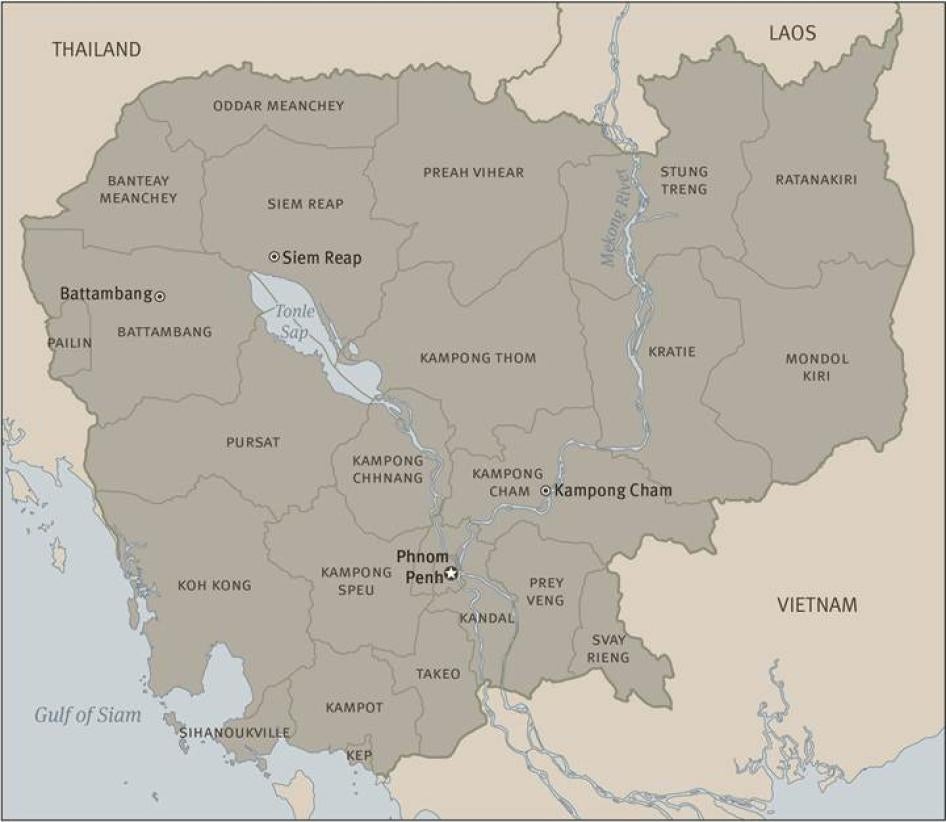
Map of Cambodia
© 2012 Human Rights Watch
Summary
In early 1993, ahead of elections organized by the United Nations, four Cambodian political activists, all recently returned refugees, were abducted by soldiers in Battambang province in northwest Cambodia. The four were taken to a nearby military base. They were never seen again.
Dozens of people witnessed these abductions. Investigations by the United Nations Transitional Authority in Cambodia (UNTAC), the peacekeeping mission created by the 1991 Paris Agreements, revealed the identity of the men responsible. The case became one of the first in which UNTAC’s special prosecutor, created to address the wave of human rights abuses carried out with impunity by government forces, took action.
Though the State of Cambodia (SOC) -- the official name of the country at the time, led then and now by Prime Minister Hun Sen and his Cambodian People’s Party (CPP) -- and the other three parties to the Paris Agreements had formally committed to protecting human rights and to cooperating with UNTAC, the SOC administration and its security forces refused to cooperate with UNTAC’s investigation. The SOC not only denied the involvement of its forces in the abductions, it conducted a campaign of threats and intimidation against witnesses for talking to UNTAC.
Faced with state-sponsored killings and state refusal to bring the perpetrators to justice, on March 8, 1993 an UNTAC special prosecutor issued arrest warrants for six soldiers and their commander, Captain Yon Youm, on charges of murder, battery with injury, illegal confinement, and infringement of individual rights. UNTAC attempted to deliver the warrants to the soldiers’ base in Sangke district in Battambang province, but found the base deserted. None of the seven suspects was ever arrested.
Yon Youm and other members of the SOC security forces remained in uniform and went on to conduct a systematic and officially protected campaign of extortion, kidnapping, and murder between late June 1993 and early 1994. Cambodia’s military prosecutor, UNTAC, and the successor UN human rights field office in Cambodia documented these abuses. According to eyewitness accounts, at least 35 people were abducted and temporarily detained in a secret detention facility in Battambang town. They were then taken to Chhoeu Khmao, a remote location in Ek Phnom district, where almost all were summarily executed.
The main unit responsible for carrying out the abductions and executions was a Special Intelligence Battalion, code-named S-91, of the army’s Fifth Military Region. At that time S-91 was under the direct command of Yon Youm. Despite the evidence against him and the UNTAC arrest warrant, Yon Youm had by 1994 been promoted to the rank of colonel. He is now deputy chief of staff of the Fifth Military Region in Battambang. Neither he nor anyone else responsible for the atrocities in Battambang has ever been held accountable for these crimes.
More than twenty years after the signing of the Paris Agreements, Yon Youm is emblematic of the culture of impunity that continues to characterize the Cambodia of Prime Minister Hun Sen and the CPP. The message to Cambodians is that even the most well-known killers are above the law, so long as they have protection from the country’s political and military leaders.
* * *
On October 23, 1991, the Paris Agreements on a Comprehensive Political Settlement of the Cambodia Conflict were signed by the four warring Cambodian political organizations and 18 states.[1] The Paris Agreements were supposed to bring an end to the post-Khmer Rouge era civil war between the Vietnamese-installed government, led since 1985 by Hun Sen, and the US and Chinese-backed resistance forces, led militarily by the Khmer Rouge and politically by Prince Norodom Sihanouk, Cambodia’s ousted monarch. It was also supposed to usher in a new era of human rights. The promise of Paris was that there would be no more atrocities like those committed by S-91 and Yon Youm, but if they did happen the rule of law would hold perpetrators accountable.
Sadly, the case of Yon Youm and Chhoeu Khmao is not exceptional. The involvement of senior government officials and military, police, and intelligence personnel in serious abuses since the Paris Agreements has been repeatedly documented by the United Nations, the US State Department, domestic and international human rights organizations, and the media. Despite the human rights provisions of the Paris Agreements, the human rights protections in Cambodia’s 1993 constitution, and Cambodia’s accession to the main international human rights treaties, almost no progress has been made in tackling impunity over the past two decades. Instead, perpetrators have been protected and promoted.
Killings, torture, illegal land confiscation, and other abuses of power are rife around the country. More than 300 people have been killed in politically motivated attacks since the Paris Agreements. In many cases, as with members of the brutal “A-team” death squads during the UNTAC period and military officers who carried out a campaign of killings after Hun Sen’s 1997 coup, the perpetrators are not only known, but have been promoted. Yet not one senior government or military official has been held to account. Even in cases where there is no apparent political motivation, abuses such as extrajudicial executions, torture, arbitrary arrest, and land grabs almost never result in successful criminal prosecutions and commensurate prison terms if the perpetrator is in the military, police, or is politically connected. It is no exaggeration to say that impunity has been a defining feature of the country since the signing of the Paris Agreements.
To illustrate the problem, this report details some cases of extrajudicial killings and other abuses that have not been genuinely investigated or prosecuted by the authorities [we have focused on some cases, but could have included many others as the examples are vast]. These cases include:
- The killing of dozens of opposition politicians and activists by the State of Cambodia during the UNTAC period in 1992-93.
- The murder of opposition newspaper editor Thun Bun Ly on the streets of Phnom Penh in May 1996.
- The slaughter of at least 16 people in a coordinated grenade attack on opposition leader Sam Rainsy in March 1997 in which the US Federal Bureau of Investigation (FBI) implicated Prime Minister Hun Sen’s bodyguard unit.
- The campaign of extrajudicial executions of almost 100 Funcinpec-affiliated officials after Hun Sen’s July 1997 coup, including senior government official Ho Sok, in the Ministry of Interior compound.
- The 1999 acid attack that disfigured 16-year-old Tat Marina by the wife of Svay Sitha, a senior government official.
- The 2003 execution-style killing of Om Radsady, a well-respected opposition member of parliament, in a crowded Phnom Penh restaurant.
- The 2004 killing of popular labor leader Chea Vichea.
- The 2008 killing of muckraking journalist Khim Sambo and his son while the two exercised in a public park.
- The 2012 killing of environmental activist Chut Wutty in Koh Kong.
This report is based on information from various sources, including UNTAC documents, reports of UN special representatives and rapporteurs and the Cambodia Office of the UN High Commissioner for Human Rights [previously the UN Centre for Human Rights], reports by Human Rights Watch and other international and local nongovernmental human rights organizations, and media accounts. It is also based on interviews over many years with current and former government officials, members of the armed forces, the police, the judiciary, parliament, and other state institutions, and representatives of political parties, labor unions, the media, and human rights organizations.
The report adopts the definition of impunity put forward in 1997 by Louis Joinet, a former UN special rapporteur on the independence of judges and lawyers:
The impossibility, de jure or de facto, of bringing perpetrators of human rights violations to account—whether in criminal, civil, administrative or disciplinary proceedings—since they are not subject to any inquiry that might lead to their being accused, arrested, tried and, if found guilty, sentenced to appropriate penalties, and to making reparations to their victims.[2]
International treaties to which Cambodia is a party obligate governments to address impunity and provide redress for violations of human rights. The International Covenant on Civil and Political Rights (ICCPR) requires governments to ensure that any person whose rights or freedoms are violated to have an effective remedy before competent judicial, administrative or legislative authorities, “notwithstanding that the violation has been committed by persons acting in an official capacity.”[3]
Recognizing that impunity can be an important contributing element in the recurrence of abuses, the UN Human Rights Committee, the international expert body that monitors compliance with the ICCPR, has stated that governments that violate basic rights “must ensure that those responsible are brought to justice.” Both the failure to investigate and to bring to perpetrators to justice “could in and of itself” be a violation of the ICCPR. [4]
* * *
In the twenty years since Paris, Cambodia has in many ways changed beyond recognition. The Paris Agreements and UNTAC wedged open space for political parties and civil society organizations. By 1998 the Khmer Rouge had collapsed and armed conflict had finally come to an end. Cambodia’s economy has become more integrated with regional economies. Donors and development agencies have succeeded in improving many human development indicators. The isolation of the Cambodian people from most of the rest of the world has come to an end.
Yet the last two decades have also been a story of missed opportunities. Serious abuses and repression continue. Corruption characterizes the economy, political opposition parties and free media have been slowly but steadily quashed, and NGOs face regular threats and constant pressure. Senior officials are not held accountable under law. None of this is surprising, as one leader, Hun Sen, and one political party, the CPP, have dominated Cambodia throughout. Authoritarian with a propensity for violence, Hun Sen has been prime minister for more than 27 years. A formerly communist party that has turned capitalist yet retained its pervasive security apparatus down to the village level, the CPP has been in power since 1979. Neither Hun Sen nor the CPP have shown any intention of developing a genuine democracy or allowing the kind of political pluralism envisioned by the Paris Agreements. Cambodia is in the process of reverting to a one-party state.
Only with a renewed sense of commitment and purpose from foreign governments, the UN, and donors can the many brave Cambodian human rights defenders and civil society activists succeed in transforming Cambodia into the rights-respecting democracy promised in Paris. An essential place to start is by addressing the culture of impunity that pervades the country and fatally undermines all efforts at reform. As the UN special rapportteur on human rights, Professor Surya Subedi, said on the twentieth anniversary of the Paris Agreements, “ T he Agreements will remain relevant until their vision is a reality for all Cambodians.” [5]
I. The Paris Agreements and Developments Since 1991
At the same Kleber Center where in 1973 the United States and Vietnam signed their Paris Peace Agreement, on October 23, 1991, 18 countries, including all five permanent members of the UN Security Council and the four warring Cambodian parties, signed the Agreements on a Comprehensive Political Settlement of the Cambodia Conflict. Cambodians hoped that the Paris Agreements would lead to the end of the more than decade-long civil war with the Khmer Rouge, raise abysmal living standards, and improve respect for basic human rights. Foreign diplomats, who celebrated the new agreement at a reception at the Versailles Palace Library, hoped to cross Cambodia off the list of Cold War issues that had long bedeviled relations among the United States, the Soviet Union, China, and Vietnam.
Because of the unprecedented brutality of the Khmer Rouge period from 1975-1979 and the oppressive one-party rule that followed from 1979-1991, the protection of human rights was a central theme of the Paris Agreements. A section in Annex 1, entitled “Human Rights,” stated that the newly created United Nations Transitional Authority in Cambodia ( UNTAC), would make provisions for:
a) The development and implementation of a programme of human rights education to promote respect for and understanding of human rights;
b) General human rights oversight during the transitional period;
c) The investigation of human rights complaints, and, where appropriate, corrective action.[6]
To bind the four Cambodian parties and 18 signatory states to their human rights commitments, the Paris Agreements were unusually prescriptive in laying out, “ Principles for a New Constitution for Cambodia.” These provisions would be applicable after UNTAC left Cambodia, which it did on schedule in September 1993. Human-rights-related provisions are contained in Annex 5 and include:
2. Cambodia's tragic recent history requires special measures to assure protection of human rights. Therefore, the constitution will contain a declaration of fundamental rights, including the rights to life, personal liberty, security, freedom of movement, freedom of religion, assembly and association including political parties and trade unions, due process and equality before the law, protection from arbitrary deprivation of property or deprivation of private property without just compensation, and freedom from racial, ethnic, religious or sexual discrimination. It will prohibit the retroactive application of criminal law. The declaration will be consistent with the provisions of the Universal Declaration of Human Rights and other relevant international instruments. Aggrieved individuals will be entitled to have the courts adjudicate and enforce these rights….
4. The constitution will state that Cambodia will follow a system of liberal democracy, on the basis of pluralism. It will provide for periodic and genuine elections. It will provide for the right to vote and to be elected by universal and equal suffrage. It will provide for voting by secret ballot, with a requirement that electoral procedures provide a full and fair opportunity to organise and participate in the electoral process.
5. An independent judiciary will be established, empowered to enforce the rights provided under the constitution.[7]
The Paris Agreements mandated the creation of UNTAC, at the time the largest and most expensive UN peacekeeping mission ever. UNTAC, with both civilian and military components, had many tasks, including supervision of a ceasefire; cantonment and disarmament of the Cambodian signatories’ armed forces and the creation of a new national army; control of the existing administration of each party, the largest of which was run by the SOC; the staging of multi-party elections; and the protection of human rights.
Faced with resistance from the SOC and the Khmer Rouge, UNTAC failed or made only partial progress in all these areas. One major accomplishment was presiding over a largely peaceful vote in May 1993 for a Constituent Assembly, although this was marred by a massive campaign of violence and intimidation in the run-up to the election by the SOC against opposition parties and activists. The Khmer Rouge withdrew from the process and carried out many atrocious attacks, often against the ethnic Vietnamese community. The Constituent Assembly adopted a new constitution in September 1993, which includes a long list of fundamental rights that remains in place today, though is largely ignored in practice.
The Paris Agreements were supposed to transform Cambodia. In many ways they did. Over the past 20 years Cambodia has changed dramatically. As of 1991 the country still suffered egregiously from the horrors of the Khmer Rouge period, with a physically and psychologically devastated population, absence of basic infrastructure, and little in the way of health care, education, or industry. Before Paris most Cambodians struggled to obtain basic necessities, due both to the crippling embargo imposed by the US and its allies after the 1979 Vietnamese invasion and the SOC’s mismanaged and corrupt state-controlled economy. Civil rights were routinely trampled upon and government institutions existed outside of the rule of law.
After Paris, the country quickly reintegrated into first the regional and then the world economy. The country was opened to foreign investors, who were given huge tax breaks and other incentives – but with obligatory bribes to government officials at all levels. Some invested in emerging industries such as Cambodia’s garment sector, creating employment for hundreds of thousands. Others operated hand-in-hand with Cambodian officials to plunder the country’s natural resources, particularly its dwindling forests. Roads, schools and health clinics have been built, largely with the more than $10 billion of donor money provided since Paris, though the gains are more evident in urban areas. Cambodia’s large rural population suffers from widening inequality in incomes and opportunities, as well as persistent poverty, despite overall poverty reduction .
One of the most significant accomplishments of the Paris Agreements was to open the country to the world, which over time has had a profound effect on many Cambodians. Paris and UNTAC wedged open space, grudgingly conceded by the CPP, for Cambodians to read and learn about the world – from which most had been closed off for nearly two decades – and their own country. Whereas before Paris open forms of dissent were not tolerated, Cambodians are now free to speak their minds on most subjects, although often at a cost when they do so in a politically confrontational manner. Most significantly, Cambodia now has a thriving and critical nongovernmental sector, which because of government indifference and malfeasance often provides basic services that a more functional state would deliver.
The controversial inclusion of the Khmer Rouge as one of the parties to the Paris Agreements ultimately led to the movement’s demise, as China kept its part of the bargain and cut off aid and military backing, thereby isolating and weakening the Khmer Rouge, who enjoyed virtually no popular support. By 1996 senior Khmer Rouge leaders began defecting to the government. By the end of 1998, both Pol Pot and the murderous movement he controlled were dead, transforming the lives of millions of Cambodians who suffered from war for decades.
Yet the country has made strikingly little progress in creating a culture of good governance and the rule of law. Most Cambodians remain very poor, in part because of breathtaking levels of corruption that have enriched government officials and discouraged honest foreign investors. Despite low official salaries, high-ranking government officials are often very wealthy, owning large villas, luxury cars, and major stakes in business enterprises. Indeed, no one has ever explained how Hun Sen, who has been a government official since 1979, could afford the large house and compound in Kandal province that he has occupied since the mid-1990’s. Corruption is so bad – and is the subject that seems to most anger ordinary Cambodians – that in 2011 the World Bank suspended its assistance to Cambodia. A s long ago as 2005, the World Bank president, James Wolfensohn, said the government’s top three priorities should be, “fighting corruption, fighting corruption, and fighting corruption.” [8]
The state health and education systems remain weak and donor-dependent. Donors have augmented the country’s tiny tax base by providing approximately 50 percent of the state budget since Paris, but this has had the unintended consequence of allowing the government to spend much of its official resources on an inflated army and police, including a de facto private army for Hun Sen.
Since Paris, power has become increasingly centralized in the CPP and now resides primarily with Hun Sen, a former low-level Khmer Rouge commander who has been prime minister since 1985. [9] Eclipsing the party, he now takes all key decisions. All senior civilian and military officials report to Hun Sen, who has installed his own people in almost all of the leading positions in the cabinet, military, gendarmerie, and police. He runs both the government and a parallel network of governing authorities with an iron fist, demanding loyalty before competence. Local officials around the country frequently emulate his practices.
The result is the failure since Paris to build strong institutions to promote good governance, the rule of law, and respect for human rights. The National Assembly is a rubber stamp. The opposition is increasingly marginalized, with Sam Rainsy, the leader of the opposition, living in exile to escape long prison sentences for peaceful political activities.
The military and police have remained under political control since Paris. The security and intelligence forces have been party instruments since their reestablishment after the Khmer Rouge was ejected from power by the Vietnamese army in 1979. Hun Sen has personally controlled the police since the failed July 1994 CPP coup attempt against him, which implicated Chea Sim and members of his faction of the party. As recompense, Hun Sen demanded that Chea Sim allow him to appoint his own man, Hok Lundy, as national police chief. Lundy quickly established a reputation for brutality and became the most feared man in Cambodia. Loyal until his death in a 2008 helicopter crash, he was replaced by Neth Savouen, a relative by marriage of Hun Sen and also notorious for committing human rights abuses since the 1980’s. Neth Savouen is currently a member of the CPP Central Committee. [10]
After many attempts, Hun Sen in 2009 replaced General Ke Kim Yan with General Pol Sarouen as the head of the armed forces. Both are members of the CPP Central Committee, yet Ke Kim Yan is part of CPP President Chea Sim’s faction of the party, while Pol Sarouen has been linked to Hun Sen since their time in the Khmer Rouge in the 1970’s.
The courts and justice system are controlled by Hun Sen and the CPP. Most judges and prosecutors are CPP members who implement party directives, and believe they have no leeway to do otherwise. Most glaringly, Dith Munthy, the chief judge of the Supreme Court, is a member of the CPP’s Permanent Committee of the Central Committee and of the party’s six-person Standing Committee.[11] Like all senior party members, he is expected to place party loyalty over his official responsibilities.
II. Illustrative Cases of Impunity since the Paris Agreements
Long before the Paris Agreements, Cambodians had suffered abuses committed by the government and warring armed forces with impunity. After gaining independence from France in 1953, Cambodians have lived through one abusive regime after another, usually with foreign backing. From 1953-1970, Prince Norodom Sihanouk presided over a state that brooked little dissent and, from time to time, threatened, tortured, and killed its critics and political opponents. After General Lon Nol deposed Sihanouk in 1970, the country was plunged into full-scale civil war, with the US-supported army pitted against the Khmer Rouge, who were fronted by Sihanouk and backed by China and Vietnam. From April 17, 1975, until January 7, 1979, the Khmer Rouge presided over one of the most murderous regimes in human history. Up to two million people, perhaps a quarter of the population, perished from execution, disease, and starvation.
In 1979, Vietnam invaded Cambodia. The Khmer Rouge fled to areas along the border with Thailand. Vietnam created a new one-party state, the People’s Republic of Kampuchea, installing a government and party of Hanoi-trained communists and former Khmer Rouge fighters. The former Khmer Rouge fighters, which included Heng Samrin, Chea Sim, and Hun Sen, soon gained the upper hand, controlling the party and security forces. While the level of abuses under this government did not approach the horrors of the Khmer Rouge period, widespread human rights abuses were committed with complete impunity.
The post-Paris period was supposed to be different. The cases below illustrate that while many things have changed in the ensuing two decades, brutal state-sponsored human rights abuses still occur and, when they do, impunity still reigns.
UNTAC and A-Teams
UNTAC’s “Human Rights Component Final Report,” issued in September 1993, contained an appendix of “investigation statistics” listing types of abuses committed, the number of incidents and victims, and to whom UNTAC attributed responsibility. The report stated that the SOC had been responsible for 39 incidents of “killing of political opponents” that resulted in 46 “casualties” and 25 “killings the primary purpose of which is to intimidate the civilian population and other summary executions” that resulted in 40 “casualties.” The report listed hundreds of other cases of SOC abuses, including enforced disappearances and torture. The numbers in the report understate the extent of the violations since UNTAC could not investigate all cases or specify who was responsible in all cases it did investigate.[12]
Information gathered by UNTAC showed that those who committed abuses, including the police and army, operated as direct agents of the CPP under ministerial-level instructions as well as under the direction of provincial, district, commune and village officials. The perpetrators were involved both in intelligence-gathering activities directed at opposition political parties and individuals connected to those parties, and in suppressing the political activities of the opposition.[13]
UNTAC also gathered extensive evidence of SOC and CPP use of covert groups to carry out abuses. Some existed as distinct entities, while others operated within formal units, surfacing periodically when called into action. Some members of these groups worked for more than one group. They included former members of groups such as the A-3, set up in the 1980’s as “combat police” to fight resistance forces and to root out its suspected supporters in the country.
However, most were new groups set up by the CPP to prepare for the arrival of UNTAC and the return of opposition parties to Cambodia to contest elections. The most important of these groups were the so-called “A-Teams,” “T-Groups,” and “reaction forces,” which were created to obstruct the activities of opposition parties through violence and other means, and to infiltrate UNTAC.[14] These became instrumental in carrying out political violence and sabotage. Many secret groups are mentioned in United Nations files, some civilian and some not. Various code names were used by these groups, including A-90, A-92, A-93, A-48, A-50, S-21, S-22, S-23, X-09, X-90, T-30 T-90, and A-5.
Interviews with members of these units have confirmed their existence and provided details of their orders and the kinds of abuses they committed. Former senior cadres of the Ministry of Interior’s Defense of Political Security directorates were put in charge of strategy, while operational personnel were drawn from, among others, A-3 and Infantry Regiment 70,[15] a unit under direct command of the General Staff Department of the Ministry of Defense [this unit would later become infamous for abuses after it was renamed Brigade 70 and tasked with ensuring security and safety for senior government officials, including the prime minister].[16]
The functions of these groups do not appear to have been well understood until relatively late in UNTAC’s lifespan, by which time political violence was jeopardizing the peace process. An UNTAC report written in April 1993 states that, “A groups,” operating under the command of the Ministry of National Security, were “engaged in activities wholly detrimental to the creation of a neutral political environment.” The same document concluded that the SOC, knowing this was in violation of the terms of the Paris Agreements, had “taken every step to conceal their existence from UNTAC and the populace.” [17]
A Ministry of National Security document entitled “Building up A-92 Forces” obtained by UNTAC describes the role of A-92 in considerable detail. A covert command structure running from the commissioner or deputy commissioners of security in each province was established that recruited people with high standing, such as professors, teachers, medical practitioners, monks, and “other persons with influence among the ranks of the popular masses.” A-92 operatives were directed to infiltrate and subvert “all the various political organizations having a policy of opposition to the Cambodian People’s Party.” The aim was to uncover information about their strategies and supporters, and to disrupt them by seizing control of vital functions, including economic resources. Their functions included creating “misunderstanding among the popular masses about the opposition parties, to foment activities that undermine their reputations and interests, to create contradictions and splits among their forces, and to use pre-emptive methods to prevent the opposition parties from gaining the advantage in the election.”[18]
The document said that A-92 personnel would:
Carry out, either personally or through intermediaries, the destruction and forestallment of the stratagems, plans, methodologies, tricks and activities of the opposition parties which aim at expanding their influence and their membership and to destroy us. They are also to achieve any of a number of goals, primarily those such as eliminating the influence, propaganda and psychological warfare of the opposition parties, and in particular to eliminating their influence among the popular masses.
The document continued: “It is imperative to set up Assistance Groups both in the ministries and in the provinces and municipalities. These are to be selected from among the security forces.… The Ministry specifies that this document is to be kept top secret.”[19]
UNTAC records show that A-Teams and reaction forces encouraged and directed their members to carry out attacks and then cover up evidence of official complicity.[20] As reaction forces had no official links to SOC security forces, police were able to deny involvement. Documents uncovered in Takeo, Prey Veng, and Kampong Cham provinces show that members of the security forces were encouraged to meet quotas for incidents, and cover up CPP complicity by appearing to assist UN investigators. Thus, the same people who were behind the crimes were able to influence investigations.[21]
A former A-Team member, a leader of a covert team in one of Cambodia’s largest provinces, explained how T-90 worked:
T-90 was set up for action. It was made up of drunks, losers, young unemployed men, teenagers who would ride around on motos [motorbike taxis], drink, sing karaoke, etc. Often they would be assigned to start fights with suspects and the police would arrive and arrest both. The T-90 person would be released, while the suspect would be held and tortured or killed. This was hard for UNTAC to detect or even suspect. T-90 targeted opposition party members.[22]
Another former A-Team member explained that A-90 members worked using information gleaned from civilian informants in T-30. When individuals were identified by T-30 as suspects, A-90 would reportedly be responsible for intimidating, detaining or, in some cases, killing them. Many of those who worked for A-90 came from local and district police. [23]
A police document obtained by UNTAC from Tbong Khmum district in Kampong Cham province spoke of the need “to build a reaction force of one person per village” to identify and destroy “targets.”[24] A separate document from Kampong Cham showed that 20 SOC security forces personnel were employed in forming reaction forces in a single district.[25]
A senior SOC operative who admitted being involved in planning killings of opposition activists and participating in meetings of senior officials explained:
The CPP was afraid they would lose the 1993 election, so Sin Song and Sin Sen, [Minister of National Security and head of the national police, respectively] who were responsible for internal security, worked with generals from the police and army to create new structures. A-90 was the hidden force of the police. It was set up to monitor and control the overall situation in Phnom Penh and the country. It was in charge of seeking political movements and opponents. It had staff in charge of researching security matters, both normal and political. A-92 was the hidden forces under the control of the [Ministry of Interior]. A-90 and A-92 could kill, arrest secretly, and kidnap. They were also expected to generate revenue. Every police unit had to provide backup – financially, materially, equipment, etc. When Mok Chito [senior police officer] or my unit discovered something or a target we first had to make a report to our superiors. They take the decision to kill. Mok Chito was involved in lots of killings. Sok Phal was in charge of internal security, while Luor Ramin was responsible for foreigners. A-teams reported to Sok Phal, who reported to Sin Sen. Sometimes they went directly to Sin Sen.[26]
One former A-Team member from Kampong Cham province admitted involvement in many killings, but refused to provide details. He said that A-Teams were responsible for many of the attacks on activists from Funcinpec and the Buddhist Liberal Democratic Party during the UNTAC period:
When the A-Teams arrested someone, people were held in secret places of detention such as safe houses, cages, pagodas, etc. Every time someone was killed a report was sent to superiors. All reached Sin Sen.[27]
One of the consequences of impunity in Cambodia is that because those responsible for abuses were not held publicly accountable, Cambodians, foreign diplomats and journalists alike typically do not know the backgrounds of abusive individuals when they are later promoted or reemerge in official positions. For instance, while Cambodians over a certain age will all know the name of Sin Sen, younger Cambodians and most foreigners have no idea how powerful and widely feared he was in the late 1980s and early 1990s. During UNTAC, Sin Sen was the deputy minister of national security [the de facto national police chief, as no one held that title], a senior member of the CPP, and a representative of the SOC on the Supreme National Council, the body in which all four Cambodian parties were represented and in which Cambodian sovereignty had been placed during UNTAC. Sin Sen has been described by many former A-Team members and present and former security personnel as the architect of the A-Teams and the political violence carried out by the SOC during UNTAC. He was arrested and imprisoned for his alleged role in a failed 1994 coup attempt by CPP elements against co-prime ministers Prince Ranariddh and Hun Sen. He was later pardoned by King Sihanouk as part of a political deal between Funcinpec and the CPP.
Other members of the covert groups are also noteworthy. According to a Ministry of Interior source, the Ministry of Interior’s “Defense of Political Security 1, 2 and 3 Directorates” [codenamed S21, S22 and S23], responsible for covert action against opposition political parties, political intelligence, and counter intelligence, respectively, were renamed and moved to the Ministry of National Security after its creation in 1991. You Sin Long was put in charge of S21. Sok Phal took charge of S22. Luor Ramin ran S23. According to the covert provincial A-Team member:
For the A-Teams in Phnom Penh under Sin Sen were Sok Phal and Luor Ramin. Mok Chito was one of the leaders of the A-Teams in Phnom Penh. Heng Pov worked with Mok Chito. Mok Chito was responsible for kidnapping, while Heng Pov was responsible for selling drugs. Heng Pov planted drugs on people to extract money.[28]
Sok Phal was in charge of the information department at the Ministry of Interior during UNTAC. The information department was, and continues to be, the ministry’s intelligence unit, responsible for spying on and keeping information about Cambodians. Another leading A-Team member explained that:
Sok Phal was in charge of the information department at the MOI. Though he worked for Sin Sen, he also reported directly to Hun Sen during UNTAC. The chain of command during UNTAC was Hun Sen to Sok Phal.[29]
During UNTAC, Luor Ramin was in charge of the Counter-Terrorism Directorate of the Ministry of National Security. According to an UNTAC report, “This body had previously functioned as a political special branch of the security apparatus, responsible for the detection, arrest and interrogation of political suspects.”[30] In a June 1992 interview, Thou Thon, a long-time friend of Luor Ramin and the former administrator of K-2 [the biggest refugee camp along the Thai border], said that Luor Ramin admitted to having arrested many of Thou Thon’s fellow opposition members. He “offered the explanation that he had only been following orders from his superior, Sin Sen [currently a vice-minister of National Security and a member of the Supreme National Council].”[31]
In the document “Building up A-92 Forces,” a section entitled “Management of Command Leadership and Liaison Systems” named the leaders of A-92. It said, “A-92 forces are situated within the overall command of the Security Command of the Ministry of National Security [a line is apparently missing]:
1. Brigadier General Tes Chhoy
2. Brigadier General Chan Ien
3. Sub-Colonel Luor Ramin.”[32]
A-Teams appear to have been dissolved as coherent units amid a reorganization of security personnel following the July 1994 coup attempt, when Hun Sen demanded the ability to appoint a new national police chief [he appointed Hok Lundy and soon consolidated his control of the police at the expense of the Chea Sim and Sar Kheng faction of the CPP]. Members of the security forces interviewed for this report say key officers were reintegrated into units such as the Land Border Police, Interior Ministry Bodyguards, and Intervention Police. Others were redeployed to the Gendarmerie and the Second Prime Minister’s Bodyguard Unit in late 1994.[33]
Reintegrating A-Team personnel into formal units of the police and armed forces did not end the practice of covert activity against political and other opponents. Today, such groups operate within the police. According to former police commanders, they are divided into what are known as “kamlang l’a” or “Good Forces,” principally meaning informants, and “kamlang samngat,” or “Secret Forces.” The existence of these forces and other such groups under the command of senior officials has been reported to Human Rights Watch by sources in the Judicial Police Department at the Ministry of Interior, the Anti-Terrorism Department at the Ministry of Interior, Police Intervention Unit at the Ministry of Interior, in several departments of the Phnom Penh Municipal Police, in the prime minister’s Bodyguard Unit, the Gendarmerie, the Military Intelligence and Research Department, and at the highest levels of the National Police. Responsibility for operations rests wholly with commanders and secrecy means that no member is likely to know more than a handful of others.[34]
No one has ever been held accountable for any of the abuses reported above by UNTAC. Worse, all of the people named above were promoted after UNTAC was dissolved.
- Tes Chhoy later became police commissioner of Kampong Speu province. Chan Ien was later promoted to major general and made chief of the Central Department of Land Borders in the Ministry of Interior.
- Luor Ramin was placed in charge of the Immigration Department at the Ministry of Interior. He was later promoted to head the Anti-Drug Department of the National Police.
- You Sin Long became deputy director of the National Police and is now a general in command of the National Authority for Combating Drugs.[35]
- Mok Chito is now a three-star general in charge of the criminal department of the Ministry of Interior. In this position he reports to national commissioner of police, Neth Savouen, and oversees the criminal, economic and anti-human trafficking police. “He is the ultimate fox in the chicken coop,” said a US diplomat.[36] The United Nations and nongovernmental organizations have documented the involvement of Mok Chito in kidnapping, extortion, and killings over many years.
- Heng Pov later became the national anti-narcotics chief, undersecretary of state at the ministry of interior, chief of police in Phnom Penh, and an advisor on security to Hun Sen.[37] During this period he was implicated in a large number of human rights abuses. He is currently serving more than 90 years in prison after being convicted in 2007 on charges of murder, kidnapping, and extortion, although these crimes were tolerated until he passed information to foreigners accusing Hun Sen of profiting from drug trafficking and responsibility for human rights abuses.[38]
Among all the A-Team leaders, perhaps the most successful has been Sok Phal. Aware of his role in the A-Teams, after the 1993 election Funcinpec officials wanted him removed, but were blocked by the CPP. After the formation of the coalition government in 1993, Sok Phal stayed out of the limelight in his position as the head of the Ministry of Interior’s Information Department. After the departure of UNTAC, few foreigners knew of Sok Phal’s background. In 1997 the US Federal Bureau of Investigation (FBI) found out. The FBI was sent to Cambodia to investigate the March 30, 1997, grenade attack on a rally led by opposition leader Sam Rainsy. Sok Phal was part of the government investigation committee formed after the attack. It was formally led by Teng Savong, a senior police official.[39] According to Tom Nicoletti, the lead investigator for the FBI:
I had to chew out Sok Phal at a meeting. He was intimidating witnesses in front of all of us. I told him to leave and told Teng Savong not to bring him back. But Savong said this guy was from intelligence and he couldn’t control him.[40]
Not only has Sok Phal never been investigated for his role in human rights abuses, he has been favored by Hun Sen and the CPP. In or at least by 2004, Sok Phal was promoted from his post as chief of the General Information Department to that of chief of the Central Security Directorate, which oversees the General Information Department. By 2005 he was again promoted, this time to Deputy National Police Commissioner, in which capacity he oversees the Central Security Directorate. Sok Phal is currently a three-star general and a member of the CPP Central Committee.[41]
S-91 and Chhoeu Khmao, 1992-94
The Vietnamese government in 1979 established a military intelligence unit in the northwest region of Cambodia known until 1990 as "T-6." According to sources familiar with the unit, it was responsible for the arrest and interrogation, and often torture of persons suspected of belonging to the Khmer Rouge or resistance groups. These interrogations were conducted primarily at a villa in Battambang provincial town that served as its headquarters and prison; the villa was also known as "T-6." With the departure of Vietnamese armed forces from Cambodia in 1989-1990, the unit was renamed "S-91." S-91 appears to refer to “santisoke,” or "security," and 1991 refers to the year the organization was turned over to Cambodian leadership and renamed.[42]
In the early 1990’s, over 50 Cambodian soldiers were employed with S-91 as guards, interrogators, executioners, and investigators. Following UNTAC-run elections in 1993, the unit changed names once again, this time to "B-2" for “deuxième bureau,” the French designation of military intelligence. The leadership appears to have remained fairly constant throughout the unit's history, and there is little doubt that they were highly connected within the political structures of the CPP.
The military intelligence establishment included two collaborating organizations. The one known as S-91 or B-2 was directly connected with the Ministry of National Defense. General Toan Saveth, an officer of the Ministry of National Defense's intelligence bureau in charge of Battambang, Banteay Meanchey and Siem Reap provinces, was one leader. Directly under him was General Phal Preunh, said to be responsible for operations in Battambang. UNTAC investigations described Toan Saveth as the leader of the S-91 group. Phal Preunh, who had lost his forearms and one eye, was identified by UNTAC as the person in charge of conducting investigations and executions of those detained by S-91. In addition to his activities at the T-6 compound, he also ran his own detention center in a villa located near Wat Ta Mim near Battambang town.
The second branch of the military intelligence establishment included staff assigned to the Fifth Military Region, comprising Battambang, Pursat and Banteay Meanchey provinces. General Toat Theuan, a deputy chief of staff of the Fifth Military Region, was the overall commander of this group and has been implicated in its previous depredations; other notable figures included Col. Yon Youm, commander of the Fifth Military Region Special Intelligence Battalion, and one of Yon Youm’s deputies named Tep Samrith. Tep Samrith [sometimes called "Lorn"] additionally functioned as the aide de camp of Toan Saveth, and according to UNTAC investigators, was responsible for the arrest and interrogation of S-91's prisoners.
Every one of the above-named superior officers was the subject of extensive UNTAC investigations in 1992 and 1993 that revealed literally dozens of murders, abductions and acts of extortion. Every one also appeared to have received a significant promotion in rank since that time.
The Special Intelligence Battalion included several hundred members in Battambang province. It was divided into at least three units, among them Ko-1, Ko-2 and Ko-3. Ko-1 was based in Tuol Po village, Sangke district, Battambang. Its assignment was to execute persons sent "by the higher echelons" from Battambang. Until the end of April 1994, the unit was commanded by Lt. Col. Kem Vorn and his two deputies, Sith Som and Nip Kosal, the latter of whom was reportedly killed by the Khmer Rouge in March 1994.
The second sub-unit of the Special Intelligence Battalion, Ko-2, was under the command of Lt. Col. Sou Chan Nary, and his deputies Koy Vorn and Kchang Bun Thoeun. Initially sent to protect fishing communities in the Tonle Sap area from the Khmer Rouge, they appear to have usurped any Khmer Rouge "taxation" and demanded exorbitant protection fees from local traders and fishermen who wished to work their concessions and sell their catch to Battambang. Sou Chan Nary and Kem Vorn answered to Yon Youm; all three came from Thmei village in Banan district of Battambang, and were thought to be related.
The third sub-unit was assigned to the Poipet area of Banteay Meanchey province, where UNTAC had discovered and closed unreported lock-ups during the peacekeeping period.
UNTAC documented large numbers of abductions and extrajudicial executions attributed to this group. The first documented killing was of a man named Dam, who was arrested in July 1992 on the accusation that he had stolen a car. In July or August 1992, Dam was placed in a Soviet-type ambulance and taken by Phal Preunh, and a number of lower-ranking S-91 officers to Kampong Preang commune, Sangke district. He was wearing shorts with his hands tied behind his back. There is evidence that Phal shot Dam with an AK-47 assault rifle on Toan Saveth's order. Dam's body was not recovered.
Also in July 1992, an unidentified man was shot dead at point-blank range in Thmei village, Kampong Prieng commune, Sangke district. According to investigators, Phal Preunh and Von Cheuon, a soldier under Preunh's command, had taken the victim from the Fifth Military Region headquarters. Von Cheuon executed him on orders from Phal Preunh for supposedly being a motorcycle thief. The corpse had been mutilated.
The next incident was precipitated by UNTAC’s discovery of the T-6 prison, where over 50 prisoners were estimated to have been detained since January 1992. On August 23, 1993, UNTAC entered the prison, but found all the prisoners had been released or removed hours earlier. Although the UNTAC visit took the prison guards by surprise, Toan Saveth was apparently informed in advance by Toat Theuan, then deputy chief of staff of the Fifth Military Region and a former head of T-6 himself. Toan Saveth then reportedly ordered the killing of two T-6 prisoners, Chhon Chantha [also referred to as Suan Chhanta], accused of being a resistance fighter and found with Funcinpec papers on him when he was arrested earlier that August, and Rith, accused of being a Khmer Rouge cadre, who had been arrested in July 1992. These men allegedly were taken to the Fifth Military Region headquarters in Treng and killed. As many as 10 other prisoners who had been held in T-6 between June and August 1992 were released after paying substantial ransoms in gold or money.
Hun Suorn, a soldier, was killed on the night of April 6, 1992, by two bullets in the chest. He had been abducted that night in Battambang town by four other soldiers with whom he had been playing cards and from whom he had won a considerable amount of money. The soldiers took him to the house of an S-91 officer [believed to be Toat Theuan] located directly opposite another building in Battambang town used by S-91 for detentions. From there he was taken by truck to a local restaurant, and then to the outskirts of town near Wat Kor commune, where he was shot. His body showed signs of torture, and his arms had been bound.
UNTAC police also suspected S-91 involvement in at least one of the dozens of attacks on the royalist Funcinpec party offices prior to the election, in this case an attack on the Sangke district Funcinpec office on March 31, 1993, that killed three people. The strategy of recruiting thugs became a hallmark of S-91 operations as well. The UNTAC raid on T-6 in August 1992 caused a temporary pause in the group's activities, but by September Toan Saveth was reportedly reassembling the group and intimidating former members he suspected might betray it. The group began recruiting notorious robbers, who then continued their banditry under the protection of the unit. But some of these recruits also became S-91's newest victims. The rationale for S-91's activities shifted from controlling political opponents to "using thieves to catch thieves," as Toan Saveth himself explained, echoing Sin Song's explanation for the "reaction forces."
By July 1993 at the latest, S-91 had put the T-6 detention facility back to use. On the morning of July 19, 1993, two S-91 members, Chheang Sarorn, known as Rorn, and Pou Virak, known as Korp or Kaep, visited the houses of Kom Sot and another man and informed them that it had been reported that the two had stolen and pawned a motorcycle, which both men denied. That night, the two were abducted at gunpoint by several S-91 members, including Phouek, Leang Kim Hak, also known as Map, and Sua Seun. They were taken to the T-6 villa where they were undressed and shackled. Tep Samrith interrogated each one about the theft while Phouek beat them, including hitting them on the neck with a B-40 rocket launcher. At midnight they were blindfolded and taken on motorcycles by Map, Phouek, and Sua Seun to Anlong Vil village near Route 5 in Sangke district, where Seun killed Kom Sot by shooting him in the head. The other man escaped.
The next incident occurred two weeks later, when the bodies of Suon Heang, Touch Taylin and Sun Sareuat showed up, along with another severely injured man, close to Anlong Vil village in Sangke district, and two more corpses were found at the same place in Wat Kor commune where Hun Sourn had been killed in April. All the victims had been blindfolded with strips of the same blue-checked scarf, and had been shot in the head late on the night of August 3, 1993. Three of the victims had been invited to have dinner at Phal Preunh's home in order to give biographical information and enlist in S-91. Following the meal, they were abducted by subordinates of Preunh, beaten, and put into a type of jeep. The fourth victim was arrested that night by several S-91 members, including Phouek and Ung Sovann, at Kapko Thmei village in Battambang town. A note had been left at both places with the sign of a skull and crossbones and the words, "The Activity of the Robber Groups Must be Destroyed - T.B. Kh.M." In early August, two more male corpses were found close to the same spot in Anlong Vil, again shot in the head with a message nearby with the same words and skull and crossbones.
These cases were brought to the attention of the transitional government's Ministry of National Security and the Supreme National Council by UNTAC personnel prior to UNTAC’s departure. No action was taken.
The death squads continued after the new government was formed in September 1993. In March 1994, Human Rights Watch began to investigate reports of continuing S-91 extrajudicial executions at Chhoeu Khmao. Ultimately, at least 35 other killings committed between June 1993 and January 1994 in that location became known to the UN Centre for Human Rights, which was established in Phnom Penh to promote and monitor human rights in the country after UNTAC’s departure. The victims of S-91 were usually moderately prosperous traders, businessmen, travelers or passersby who were in the wrong place at the wrong time, as well as some suspected Khmer Rouge members or sympathizers. Many of the victims appear to have been spotted in markets en route to or from the Thai border by the military intelligence network and marked as likely prospects for extortion. Ambushes or abductions were then arranged. Arrests often took place at night in markets, where merchants and petty traders rented stretchers and slept outside on the pavement, or on the road under the guise of bandit attacks on complicit taxi drivers.
Victims were typically held overnight at one of the secret prisons in Battambang, or sometimes longer if it appeared their families could be extorted for ransom. They were systematically robbed of their possessions, and if suspected of Khmer Rouge sympathies, interrogated by Phal Preunh himself. As the use of his villa near Wat Ta Mim became more widely known as S-91's detention facility, Phal Preunh transferred his operation to the house formerly known as the T-6 facility, located on the same side of the river on a street running between Route 5 and the river bank. A new corrugated metal fence went up with a small sentry box, and the refurbished headquarters swiftly became notorious as "Uncle Preunh's place."
From the Battambang detention houses, victims who were not immediately executed were transferred to locations near Chhoeu Khmao. Chhoeu Khmao is the name of an abandoned village some 45 kilometers east of Battambang, on the left bank of the Sangke river, in Prey Chas commune, Ek Phnom district. The area is a vast flood plain, with small villages that subsist on fishing when the rainy season submerges the land. A small temple was the only inhabited site left at Chhoeu Khmao. On the opposite bank is Tuol Po village, which was the site of a small garrison camp for one of the sub-units of the Special Intelligence Battalion of the Fifth Military Region. There was no prison as such at Chhoeu Khmao or the Tuol Po garrison.
Until early 1994, prisoners were sent from Battambang town with specific orders that they be executed as "Khmer Rouge enemies." The members of Ko-1 usually carried out executions in the early hours of the morning or immediately after the victim's arrival. Soldiers would place the victims, blindfolded with arms tied in back at the elbows, onto boats to one of several execution places a few kilometers downstream from Chhoeu Khmao and shoot them point-blank in the head. Bodies would be disposed of in the river, where terrified fishermen would sometimes find them. Local people estimated that as many as 70 people may have been killed in the second half of 1993. The bodies of some of those executed at Chhoeu Khmao were mutilated as well.
At least seven detainees managed to escape in 1993, some after paying substantial bribes to their captors. News of these escapes from Chhoeu Khmao seems to have led to a change in policy there. Instead of executing 16 detainees remaining at the end of 1993, the Ko-1 unit decided to hold them as quiet captives, releasing some conditional on a promise of silence, and forcibly incorporating others into the Ko-1 unit on pain of death.
Toan Saveth reportedly issued an order to the military intelligence group in early 1994 to cease executions at Chhoeu Khmao, apparently out of fear of being exposed, and there is no evidence of executions at that location after January 1994. In early April 1994 a recent Ko-1 recruit was spared execution by Yon Youm for a minor offense on the intervention of another officer. Abductions, however, continued.
Although the group's crimes were very widely known among the population of Battambang, residents there, including very high-ranking provincial military and police officials, were extremely frightened and reluctant to discuss them.
When the extent of the atrocities committed at Chhoeu Khmao was discovered in June 1994, the UN Centre for Human Rights, Human Rights Watch, and Amnesty International communicated confidentially to leaders of the government, urging them to secure the safe release of the remaining detainees, investigate the matter, and prosecute those responsible. That month, the government's military prosecutor, General Sao Sok, conducted an investigation that substantially corroborated the findings above. He recommended that the alleged perpetrators be produced for interrogation. These recommendations were transmitted to the Ministry of National Defense, which issued written instructions to the Royal Cambodian Armed Forces General Staff to implement the military prosecutor's recommendations.
These instructions were ignored. Instead, the then co-prime ministers, Hun Sen and Ranariddh, appointed a special commission to conduct its own investigation. In a report dated July 22, 1994, the commission concluded that no such abuses had taken place. Once the July 22 report began to circulate, the findings of previous investigations, including the military prosecutor's, found their way to the international and local media. In the wake of public outrage, the prime ministers ordered the special commission to resume the investigations.
The commission, composed mainly of CPP members, included the Battambang deputy chief of police and a deputy commander of the Fifth Military Region. Its questioning of witnesses was carried out in the company of large and intimidating entourages of soldiers and journalists. Although the government invited local human rights monitors to observe these investigations, Cambodian human rights groups declined the invitation, saying that they considered the prior investigations to be neutral and adequate.
On December 9, 1994, after its fourth investigative mission to Battambang, the Commission released a report on its findings. It concluded that S-91 was responsible for many arrests. These arrests were, according to the Commission, initially carried out to collect information of importance for the armed forces, but the purpose seemed to have transformed into extortion. The Commission further concluded that they had not found sufficient evidence to confirm the existence of secret detention centers or that executions had occurred.
Hun Sen denied the allegations in a 1995 meeting with members of the Human Rights Action Committee, an umbrella group of Cambodian human rights groups. He accused the UN human rights office in Cambodia of acting outside its mandate by investigating Chhoeu Khmao. He claimed that its report on the issue defamed the government and had damaged the image of Cambodia in the eyes of other countries.[43]
Toan Saveth later was implicated in further crimes. On July 16, 1994, he was arrested when a car containing him and two subordinates stopped less than 100 meters from a police checkpoint on Route 5, south of Battambang provincial town in Moung Russei district, and persons in the car got out and fired a 40 mm M-79 grenade launcher on the police post. Within 24 hours of his arrest, Toan Saveth had been transferred to the Tuol Sleng military prison in Phnom Penh. The news caused jubilation throughout Battambang. In the words of one resident, “It was as though one bar was removed in the prison that holds our hearts.” However, Toan Saveth was released several weeks later, because of an alleged lack of evidence, based on testimony that he was "asleep" in the car at the time of the alleged attack.[44]
On April 11, 1995, Toan Saveth was sentenced in absentia by a Battambang court to 13 years in prison. The court sent an arrest warrant to the Ministry of National Defense, where Toan Saveth was said to be working, but received no response. Toan Saveth still has not been arrested. Senior government officials and members of the armed forces have admitted that he and several other military officers believed to be responsible for the atrocities committed by S-91 continued to hold positions in the Military Intelligence and Research Department.[45]
As of 2004, sources familiar with the operations of the Military Intelligence and Research Department maintained that individuals associated with it were still involved in assassinations, kidnappings and various other crimes, including alleged narcotics trafficking and providing security for casinos along the Thai border.[46] As in the case of other senior military officers, the commanders of the department have also acquired considerable legal business interests, such as hotels, apartment buildings and road construction companies.[47]
None of those involved in S-91 crimes have ever been prosecuted for their involvement in these illegal activities.
Phal Prunh is reportedly dead. Toat Theuan was transferred to Phnom Penh after the disclosure of the Chhoeu Khmao activities. He is now a Major General at the Ministry of Defense in Phnom Penh.
Son Sann grenade attack, 1995
The Buddhist Liberal Democrat Party (BLDP) was formed by a faction of the Khmer People’s National Liberation Front (KPNLF), the main non-communist resistance force fighting the Vietnamese-installed People’s Republic of Kampuchea [later the SOC] from bases along the Thai border. The KPNLF was supported by the United States and founded by Son Sann, a former Cambodian finance minister during the Sihanouk era. Son Sann was well known to Cambodians chiefly because his name appeared on Cambodian money in the 1960s when he was finance minister. After the Paris Agreements, Son Sann, returned to Phnom Penh, from where he operated the BLDP in preparation for the UNTAC-sponsored elections in 1993.
In early 1995, then 83 years old, Son Sann attempted to have Ieng Mouly, the BLDP’s de facto number two, expelled from his seat at the National Assembly. Mouly had taken the position of information minister in the government without his party’s approval. Mouly had been a BLDP-appointed member of the Supreme National Council during UNTAC.
In response, in August 1995 Mouly’s faction held a party congress at Phnom Penh’s Olympic Stadium to expel Son Sann, have himself elected party leader, and claim the BLDP name for his faction alone. The congress received the support of the co-prime ministers. According to Mouly, Hun Sen offered to provide security and financial support:
I needed the support of Hun Sen to make a big splash. I had no money or materials. Hun Sen provided security and high-ranking representatives from his party. I couldn’t say no. To have a big impact I needed this support. I was also worried about security for the congress without Hun Sen’s support. [48]
Son Sann then decided to hold his own party congress. His faction of the BLDP requested permission from the Ministry of Interior to also hold its congress at the Olympic Stadium. The Ministry of Interior refused. Son Sann defied the government and decided to hold the congress on October 1 at his house on Street 338, near the Olympic Stadium.[49]
At the time, the government was claiming that plans by former finance minister and Funcinpec leader Sam Rainsy to start a new political party were illegal. Earlier in the year, Rainsy had been expelled from his seat in the National Assembly and from the Funcinpec party. The co-prime ministers took a similarly hard stand against Son Sann’s planned congress, calling it illegal and launching a media campaign to discourage party members and the public from attending. On the eve of the congress, government security forces blocked all the roads to Phnom Penh to keep attendance at the congress as low as possible. Those with BLDP cards were not allowed to pass.[50]
Before Son Sann held his congress, Mouly told the Phnom Penh Post that he feared violence, saying that there might be “bad elements from outside who want to...create some problems? They may throw three hand grenades and then they can accuse me, they can accuse the government.”[51]
Mouly later said that he was warned that there could be security problems:
Benny Widyono [the UN secretary-general’s representative in Cambodia], told me that if Son Sann had a congress there could be security problems. He said the Khmer Rouge or others could attack and I would get the blame. So I made a public statement that there might be a grenade attack. Before the congress I was also told by a three-star general in the police not to be nearby. [52]
Hun Sen warned in a nationally broadcast speech that if Son Sann proceeded with the party congress, either he or other organizers would be deemed “lawbreakers” and arrested, or there could be “terrorist attacks or bombings,” for which Hun Sen said Son Sann and other BLDP leaders would be held personally responsible.[53]
On September 30, the night before the congress, about 100 people were gathered outside Son Sann’s house. A motorcycle carrying two men drove by. The passenger threw a grenade and the motorcycle sped off. Twenty-eight people were wounded, including Son San’s son Son Soubert, the vice-president of the National Assembly, who had a minor shrapnel wound. There were no fatalities. Soon after, a grenade was thrown into the grounds of a nearby Buddhist temple, Wat Mohamontrei, where supporters of Son Sann from the provinces who had made their way past roadblocks were staying. This was the first incident of major political violence since UNTAC ended its mission in September 1993.
In spite of the dangers, more than 1,000 people attended the congress the next day. Soon after the US ambassador left, the French-trained gendarmerie [also known as military police in Cambodia], armed with machine guns and grenade launchers, waded into the crowd and broke up the rally. Many supporters moved into Son Sann’s compound, but the others were forced to leave.
The government promised to investigate, but there is no evidence that any investigation ever took place.
Killing of Thun Bun Ly, May 1996
On May 18, 1996, at 10.30 a.m., Thun Bun Ly, editor of Udom Kate Khmer (Khmer Ideal) left his house in Phnom Penh and took a motorcycle taxi. According to witnesses, at Street 95 two men on a motorcycle came up from behind. The passenger fired a K-59 pistol, hitting Bun Ly in three places. He died at the scene. A returned refugee, Bun Ly was 39 and left a wife and children. He was a steering committee member of the opposition Khmer Nation Party (KNP), led by Sam Rainsy.
Bun Ly’s body was taken to nearby Wat Lanka, a Buddhist temple, and laid out in traditional Khmer style. In front of a UN human rights worker, armed and uniformed soldiers arrived at Wat Lanka. One put on rubber gloves and reached into the wounds, extracting the bullets, before calmly leaving. Later that day, another man allegedly came to the temple and removed the third bullet.
Earlier on the morning of his death, Bun Ly had gone to Rainsy’s house and returned home. He called a friend and told him that he had been followed home and feared for his safety. That day, Udom Kate Khmer ran a front-page story saying that Bun Ly had been threatened by a major in the police’s anti-terror squad.[54]
In his paper, Bun Ly regularly attacked the co-prime ministers and their parties. A vigorous and inflammatory critic of Vietnamese immigration to Cambodia, in 1995 Bun Ly had been prosecuted and convicted twice for publishing articles critical of the government. He was on bail and his cases were on appeal at the time of his death. At one of his trials, he amused a packed courtroom by explaining that it was the role of the press to critique the government. “It is not my job to hold the testicles of the co-prime ministers,” he said.
Bun Ly frequently received threats and reported them to the UN and human rights groups. He told Amnesty International, “I have been threatened by soldiers and police who keep me under surveillance, and people who know me say I should stop publishing...but the newspaper is my sweat and blood. I won’t forsake it."[55]
No one has ever been arrested or prosecuted for Thun Bun Ly’s killing.
Grenade Attack on Opposition Party Rally, March 30, 1997
On Sunday, March 30, 1997, a handful of children, including Ros Kea, 12, took a ride from Wat Mohamontrey, the Buddhist temple in Phnom Penh where they lived as orphans [and which had been attacked in 1995 in the Son Sann grenade attack]. They jumped into the back of a pickup truck, taking up the offer of 5,000 riels (US$2) to participate in a rally organized by the KNP.[56]
As they waited in the early morning sun in a park across the street from the Royal Palace and the National Assembly, 200 of the real demonstrators arrived after a 10-minute march. Carrying blue banners with white lettering in Khmer and English containing slogans like “Down with the Communist Judiciary” and “Stop the Theft of State Assets,” the last photo of the group looks more like a school picture than a political rally.
Present at the rally was Sam Rainsy, the founder of the opposition Khmer Nation Party (KNP). Since the killing of an opposition journalist in May 1996, Rainsy, who had been minister of finance until his dismissal in 1994 by Co-Prime Ministers Prince Ranariddh and Hun Sen for demanding the acceleration of reforms, had begun staging regular demonstrations over labor rights, corruption, illegal logging, the environment, and the lack of political pluralism. The creation of Cambodia’s first independent labor unions in January 1997 had led to many strikes and demonstrations. Rainsy seemed to be at all of them, and each was met with a heavy police presence that raised tensions.
The government controlled the army, police, the courts, and the media, yet seemed frightened by street protests. Contrary to the new constitution, which guarantees freedom of expression and peaceful assembly as well as Cambodia’s compliance with all of its obligations under international law, the government declared all the rallies illegal.
The UN human rights office in Phnom Penh considered the rally on March 30 to be so innocuous that for the first time it sent no one to monitor it. Yet this demonstration made history for two reasons: it was the first post-UNTAC demonstration formally approved by the Ministry of Interior, and it ended in grenades and carnage. When the grenade-throwing was over, at least 16 people lay dead and dying. More than 150 were injured. Ros Kea was among those killed.
The main target, Sam Rainsy, survived the attack. After the first grenade exploded, Rainsy’s bodyguard, Han Muny, threw himself on top of his leader. He took the full force of a subsequent grenade and died at the scene. Rainsy escaped with a minor leg injury. Body parts of other victims littered the area, and the grisly photos of the dying against the backdrop of the Royal Palace landed the story on the front pages of newspapers around the world and as the lead story on CNN. One photo shows a teenage girl with her legs blown off trying to stand up. She stares at the camera in shock and incomprehension, her long black hair matted with blood, surrounded by dead bodies. She soon died. Cambodian police present not only did not help the injured, but some tried to block bystanders from assisting victims.
The attack took place at a time of extreme political tension. The coalition government of the royalist Funcinpec party and Hun Sen’s CPP was unraveling after armed clashes in Battambang province the previous month. Rainsy’s KNP was seen as a threat in national elections scheduled for the following year. For more than a year, he and his party members had been the subject of attacks and threats from CPP officials and agents.
The attack was well-planned. Members of the personal bodyguard unit of Hun Sen, Brigade 70, were deployed in full riot gear at the rally. The rally was the first time Brigade 70 has been deployed at a demonstration. The elite military unit not only failed to prevent the attack, but was seen by numerous witnesses opening up its lines to allow the grenade-throwers to escape through a CPP-controlled area of Phnom Penh, and then threatened to shoot people trying to pursue the attackers. T he police, which had previously maintained a high-profile presence at opposition demonstrations in an effort to discourage public participation, had an unusually low profile on this day, grouped around the corner from the park. Other police units, however, were in a nearby police station in full riot gear on high alert.
In a speech on the afternoon of the attack, Hun Sen suggested that the leadership of the KNP might have organized the attack to put the blame on the CPP. Instead of launching a serious investigation, he called for the arrest of Sam Rainsy. However, facing resistance in the CPP and an onslaught of domestic and international outrage, he dropped the plan.
The FBI undertook an investigation into the grenade attack because a US citizen, Ron Abney, was among those wounded. The FBI concluded that Cambodian government officials were responsible for the attack, but the chief investigator, Thomas Nicoletti, was ordered out of the country by US officials before he could complete his investigation.[57]
On June 29, 1997, the Washington Post reported:
In a classified report that could pose some awkward problems for US policymakers, the FBI tentatively has pinned responsibility for the blasts, and the subsequent interference, on personal bodyguard forces employed by Hun Sen, one of Cambodia’s two prime ministers, according to four US government sources familiar with its contents. The preliminary report was based on a two-month investigation by FBI agents sent here under a federal law giving the bureau jurisdiction whenever a US citizen is injured by terrorism.... The bureau says its investigation is continuing, but the agents involved reportedly have complained that additional informants here are too frightened to come forward.[58]
While the investigation uncovered a great deal of evidence, as did investigations by the UN human rights office, the Cambodian authorities failed to cooperate. On January 9, 2000, CIA director George Tenet said the United States would never forget an act of terrorism against its citizens and would bring those responsible to justice “no matter how long it takes.” Yet the FBI investigation was abandoned and formally closed in 2005.
Rather than identifying and prosecuting the people who ordered and carried out the grenade attack, the Cambodian government has since handed out high-level promotions to two people linked by the FBI to the attack. The commander of Brigade 70 at the time, Huy Piseth, who admitted ordering the deployment of Brigade 70 forces to the scene that day, is now a lieutenant general and undersecretary of state at the Ministry of Defense. Hing Bun Heang, deputy commander of Brigade 70 at the time, was promoted to deputy commander of the Royal Cambodian Armed Forces (RCAF) in January 2009. In a June 1997 interview with the Phnom Penh Post, Bun Heang threatened to kill journalists who alleged that Hun Sen’s bodyguards were involved. “Why do they accuse us without any basic evidence? We are innocent people, we were not involved in that attack. Publish this: Tell them that I want to kill them … publish it, say that I, chief of the bodyguards, have said this. I want to kill … I am so angry.” [59]
The March 30 grenade attack has cast a long shadow over Cambodian politics that remains today. The attack appears to have been intended to destroy the political opposition in Cambodia.It signaled that pluralism would be opposed by powerful people and would come at a deadly price.
The attack on Sam Rainsy and his supporters remains an open wound in Cambodia, but neither the government nor Cambodia's donors are doing anything to hold those responsible to account. The clear involvement of Hun Sen’s bodyguard unit in the attack and the perpetual failure to address this crime has led some to refer to March 30 as “Impunity Day” in Cambodia.
The July 1997 Coup and Post-Coup Killings, 1997-1998
On July 5, 1997, Second Prime Minister Hun Sen launched what the United Nations described as a coup d’état against First Prime Minister Ranariddh and his Funcinpec party. According to the Special Representative of the Secretary-General for Human Rights in Cambodia, Thomas Hammarberg:
I strongly condemn the violent coup d'état of 5-6 July which has displaced the lawfully-elected government of Cambodia. The overthrow of First Prime Minister Prince Norodom Ranariddh by armed force violates the Cambodian Constitution and international law and overturns the will of the Cambodian people in the 1993 UN-sponsored election. In that poll approximately 90 percent of eligible voters courageously turned out in the face of widespread intimidation and violence to choose a new government.
As the Special Representative of the Secretary-General for Human Rights in Cambodia, I am particularly concerned about the large loss of life and injury in the current violence. The use of mortars, artillery and other heavy weapons in urban areas displayed a callous disregard for the lives and safety of the civilian population.
I am also concerned about the atmosphere of fear and intimidation which now prevails in Cambodia. Few people believe that it is safe to express their views publicly. The offices and residences of Prince Ranariddh, of FUNCINPEC and Khmer Nation Party officials have been attacked and looted by soldiers and police. Immediate steps to restore discipline over all armed forces must also be taken to end the current wave of looting of civilian property.
The safety of all members of the National Assembly, members of opposition political parties, human rights workers and journalists must be protected. No person should be arrested because of their political views. Any persons arrested or detained since the beginning of this action must be fully accounted for and held only in legally-established places of detention. The United Nations, ICRC and other relevant agencies should have full access to all places of detention.
The events of recent days violate the fundamental right of the Cambodian people to choose its government in a democratic fashion. I call on the de facto authorities to reverse this illegal action. The First Prime Minister Prince Norodom Ranariddh must be allowed to reassume his office with full respect for his personal security. No members of the National Assembly should be expelled because they hold different political views.
If the current National Assembly is destroyed through unlawful and violent means, it will be difficult and perhaps impossible for the next national elections scheduled for May 1998 to have any meaning or legitimacy.
Finally, I strongly urge the 18 signatory countries of the Paris Peace Agreements to convene an urgent meeting to discuss these very distressing events. Democratically elected institutions and respect for human rights must be re-established.[60]
The coup was the culmination of months of tension between Funcinpec and the CPP. In April Hun Sen attempted to bribe and intimidate Funcinpec members of parliament to replace Ranariddh as party leader and first prime minister, but failed to obtain enough defectors to succeed. Armed clashes between forces loyal to each party in Battambang province in February and in Phnom Penh in June created a crisis atmosphere. In the days before the coup, forces loyal to Hun Sen disarmed large numbers of Ranariddh’s bodyguards and threatened his remaining forces with arrest if they did not surrender. On July 4, Ranariddh fled to Paris on the advice of his security team, who said they could no longer protect him.
The Chea Sim and Sar Kheng faction of the CPP, including Armed Forces Chief Ke Kim Yan, opposed the coup. But Hun Sen used factions of the army, his private bodyguard unit, which numbered in the thousands, the French-created and trained gendarmerie police, and Khmer Rouge defectors to carry out the coup. After fierce fighting in Phnom Penh, the coup succeeded by the end of July 6.
The coup was followed by a wave of extrajudicial killings, cremations of unidentified bodies under suspicious circumstances, torture, and arbitrary detentions by Hun Sen’s forces. Most of the victims were members of Funcinpec’s security forces, who appeared to have been singled out for attack. A report on August 22, 1997, by the UN human rights office in Cambodia documented 41 and “possibly up to 60 politically-motivated extrajudicial executions” after the coup.[61] Hammarberg later said that there were dozens of other instances of summary killings, murders and disappearances after the coup.
A few cases illustrate the pattern. General Chao Sambath and General Kroch Yoeum were senior Funcinpec military officers. According to the UN:
Gen. Chao Sambath was captured along with Gen. Kroch Yoeum and about thirty of their subordinates on 8 July 1997 … They were captured after being surrounded by the soldiers of paratrooper commando Regiment 911. Eyewitnesses confirmed that there was no exchange of fire during the capture… Gen. Chao Sambath and Gen. Kroch Yoeum were separated from the group and held in a separate building where the officers of Regiment 911 were staying... orders were issued by the RCAF General Staff to execute the two officers… they were executed with three bullets each in the head.[62]
The government never responded to requests to investigate these deaths, instead resorting to outlandish claims. On July 9, General Prum Din, the commander of the Special Military Region, said that Chao Sambath had committed suicide “by biting his tongue.”[63]
Kroch Yoeum’s body was exhumed by the UN in the presence of his wife on October 15, 1997, in Udong district. According to the UN, “His legs were tied. A bullet and two casings were found in the grave… A group of armed soldiers from the local military threatened the group and attempted to stop the exhumation.” The naked body of Chao Sambath was exhumed by the UN in his family’s presence on October 28, 1997, from a nearby grave. His body showed signs of torture.[64]
After the coup human rights investigators learned of the location of a number of shallow graves. With no in-country forensics capacity, they often had to dig up the bodies so the families of missing persons could find out what had happened to their loved ones. Victims were found stripped of all clothes except their shorts, handcuffed and blindfolded, with one or more bullets in the head. One such case was Lt. Col. Sao Sophal. He was arrested on July 8, 1997, along with approximately 35 Funcinpec soldiers and taken to the base of Regiment 911 at Kambol, just outside Phnom Penh. Sao Sophal’s body was exhumed on July 18, stripped to his underwear, hands tied behind his back, with bullet wounds to his head. [65]
UN human rights investigators documented the torture of detainees at the 911 base. Many were forced to drink from the same swamp into which they urinated and defecated. The torture was breathtaking. According to a UN report:
The torture involved beatings with a belt, the wooden leg of a table, a wooden plank, kicking with combat boots and the knees, punches in the face and the body and blows to the blade of the upper part of the nose with the edge of the hand. It also involved death threats, by pointing the end of a gun against the head and threatening to shoot. An iron vice was also used on several detainees, to squeeze their fingers or hands until they responded satisfactorily.
They were tortured to obtain intelligence, extract confessions and make them sign a statement of guilt prepared on a standard model. They were forced to provide biographical details about their military life, their political affiliation and connections; to admit that there was a plan underway by the FUNCINPEC to conspire against the CPP; to confess that they were Khmer Rouge soldiers brought from Pailin or Anlong Veng; to provide lists of names of all senior and other officers they knew were present in Tang Krasang military barracks at the time of the attack on 5-6 July 1997; and to confess that they had been brought to Phnom Penh to fight Hun Sen.
The detainees realized quickly that their interrogators were not interested in finding the truth but wanted solely to obtain certain responses. As one of them explained, in words echoed by several others: “They asked me whether I was a Khmer Rouge from Pailin or Anlong Veng. If I responded that I was not a Khmer Rouge, then they beat me up. So I had to admit to avoid being beaten. They also asked me what was the purpose of the war we were pursuing and who did we want to kill. The expected response was "Hun Sen". The more you resisted the more you would be tortured". One of them described his experience of torture with the iron vice: "They first inserted by thumbs laterally between the jaws of the vice and began to screw it on. They asked whether it hurt. I said yes. Then they screwed it on further. It was very painful. Until I answered to their questions with a lie. If you kept resisting, they would insert both of your hands, side to side, vertically between the jaws of the vice. With this method they could obtain 100% positive answers". A detainee undergoing interrogation saw another detainee who did not belong to his group being interrogated in the room next to his. The interrogators forced the man's head in a bucket of water until he fainted and defecated on himself. Ten days after their release, several of the tortured detainees still had clear marks of blows on the back, shoulders, and arms. Photographs were taken. [66]
After the coup, a UN team went to Kambol to investigate. The commander of Regiment 911, Chap Pheakedei, denied then admitted to the UN of having detained the group, but then disclaimed any knowledge of what happened to them. When the UN team heard the voice of a person locked in the same wooden storage hut in which Sao Sophal had been held, Chap Pheakedei denied his presence. UN staff refused to leave until the man was released. While waiting, Pheakedei’s forces were overheard referring to the UN staff on their hand-held radios, asking, “Should we fry these fish?” The response was, “These fish are too big to fry.” Only when the head of the gendarmerie, Sao Sokha, arrived, was the detainee released. The man refused to discuss his treatment, but the UN monitored his safe return to his home province of Siem Reap.
Regiment 911 has been accused of frequent involvement in serious human rights abuses, including extrajudicial killings, since the 1997 coup. Chap Pheakedei is still its commander and has been promoted to the rank of general. He is considered one of Hun Sen’s most loyal commanders and is a member of the CPP Central Committee.[67]
One of the most notorious cases was the execution of Ho Sok, Funcinpec secretary of state in the Ministry of Interior. He had been the head of Ranariddh’s personal bodyguard unit at the Thai border and was one of the most senior Funcinpec security officials. In April 1997, he came into open conflict with Hun Sen after announcing that a court was preparing a case of drug trafficking against Mong Reththy, a close business supporter of Hun Sen and the CPP. Hun Sen responded that anyone who tried to arrest Reththy would have to “wear a steel helmet.”[68]
Ho Sok had other enemies. Multiple Ministry of Interior sources reported that he and National Police Chief Hok Lundy had been partners in illegal business deals but by 1997 had fallen out. This came to a head on June 17, 1997, when forces loyal to Ho Sok and Hok Lundy engaged in a firefight in central Phnom Penh that rocked the coalition government and killed two. A rocket-propelled grenade landed in the backyard of the US ambassador’s residence.
After the coup began Ho Sok and other Funcinpec officials sneaked into and hid at the residence of the Singaporean ambassador. Ho Sok was arrested on July 7 while trying to escape Phnom Penh. Colonel Mao Dara told UN investigators that he had taken Ho Sok into custody and then took him to the Ministry of Interior.[69]
Ho Sok was interrogated and then left in a room with two unarmed police officers at the Ministry of Interior building that houses the Central Department of the Judicial Police. According to ministry officials, an unidentified man burst into the room and shot Ho Sok dead.[70] Officials admitted that 50 to 60 soldiers were outside the building at the time. They claimed that after shooting Ho Sok, the assailant ran 200-250 meters, climbed over the high ministry walls, and escaped.[71] Ho Sok’s body was reportedly cremated in the middle of the next night, July 8, at a local Buddhist temple.[72] As with Chao Sambath, the authorities initially claimed that Ho Sok had committed suicide in custody. However, the government later claimed that he had been shot dead by people “who were angry with him.”[73]
Police Generals Thong Lim, Ma Chhoeun, and Than Im were initially suspended for negligence in failing to ensure Ho Sok’s security.[74] However, at the request of National Police Chief Hok Lundy, all three were reinstated in September 1997. Minister of Interior Sar Kheng reportedly said that the identity of the killer was known, but no progress has ever been made in holding anyone to account for the killing.[75]
Ma Chhoeun is now reportedly a four-star general in the ministry of interior and director of the Royal School of National Police. He is also a member of the Central Committee of the CPP.[76] General Thong Lim is Director of the Central Department of Security of the National Police and attends international conferences on subjects such as migration and development, such as a 2011 Swiss-sponsored conference.[77] Than Im retired as deputy chief of the ministry of interior’s Central Department of Security.
A non-political victim of the coup was Dok Sokhun, also known as Michael Senior. A Khmer-Canadian journalist who taught English in Phnom Penh, he was shot dead on July 7 after he had taken photographs of government soldiers looting houses near Phnom Penh’s Au Russei market. According to the UN, “he was first shot in the leg by a soldier who took his camera. Another soldier then executed him with three bullets. His wife was an eyewitness to the murder.”[78] No action was taken in this case, despite the presence of many witnesses.
In 1998 the United Nations high commissioner for human rights appointed two experts, Arun Bhagat of India and Peter Burns of Canada, to assess the investigations conducted by the authorities. The two experts concluded in a May 1998 report that none of the cases had been seriously investigated and that a culture of impunity for political homicide seemed deeply imbedded in state institutions. They emphasized that the situation was only likely to change if there was a will do so at the highest levels of government.[79]
Hun Sen’s intentions about undertaking serious investigations into coup-related abuses were made clear on January 23, 1998, when he met UN High Commissioner for Human Rights Mary Robinson. At the meeting and later to the media Hun Sen introduced four people whom he claimed the UN had erroneously listed as killed in its reports. Three of the men, Chin Vannak, So Lay Sak, and Ang Borith, had not been listed in UN reports. The fourth was Chao Khong, a person whom the UN had indeed had listed as having been killed. What Hun Sen did not say, however, was that Khong’s two brothers, Chao Keang, a 25-year old “protégé” of Chao Sambath, and Chao Tea, 29, had been executed after the coup: the UN had simply confused the name of the living brother with his murdered siblings. Chao Keang “had a bullet hole in the right temple, was handcuffed and blindfolded,” while the body of Chao Tea “bore a bullet hole in the left side of the chest and in the right side of the stomach. He was also handcuffed and blindfolded.”[80] After the meeting with Mary Robinson, who had acceded to Hun Sen’s demand that she attend without UN special representative Thomas Hammarberg, Hammarberg issued a strong rebuttal to Hun Sen’s claims.[81]
The killings sent opposition politicians and activists into exile in fear for their lives. Most politicians returned under a deal brokered by Japan, the United States, and the UN to participate in elections in July 1998. The elections were violent and fundamentally flawed. Hun Sen and the CPP gained a majority in the National Assembly and Hun Sen was named sole prime minister. The coup and the elections that followed allowed Hun Sen to consolidate power. He has ruled virtually unchallenged within his party or by the opposition ever since.
In a letter to OHCHR in 1999, the Ministry of Interior stated that police had submitted case files to the courts for action in seven different cases.[82] However, no information has been made public in any of these cases and Human Rights Watch is unaware of any successful criminal prosecutions in connection with human rights abuses related to the coup or its aftermath. Ho Sok is the only person that the government has admitted was killed while in its custody during or after the coup. Despite initial assurances from Hun Sen that his killing and those of others identified by the UN would be seriously investigated and those responsible brought to justice, no action was taken.
Execution of Soy Sophea, Feburary 1998
Before daybreak on the morning of February 23, 1998, three bodyguards for the Kampong Speu provincial governor fatally shot 16-year-old Soy Sophea, pumping more than a dozen AK-47 bullets into his body after he scaled the walls of the governor’s compound.[83]
A person living near the governor’s house said that he was woken up at about 3 a.m. to hear the sound of running in the governor’s compound, following by cries of “Thief! Thief!” The witness said, “I heard fighting in the governor’s compound, then [the sound of] beating and someone crying out ‘Oy! Oy! Don’t beat me, I steal only chickens.’ About half an hour later I heard many shots.”[84]
Several hours later the boy’s sister was told to go identify his body. She told Human Rights Watch:
He had a bullet wound behind the ear, and there were marks of beating on his neck, like they used an iron bar. There were black bruises on each arm from being tied up, and also on his face. His middle left finger was broken. There were many bullet wounds and lots of blood in the lower part of his body. From his waist to his knees there were many bullet wounds. Maybe they used a whole box of bullets from an AK-47 [assault rifle].[85]
Police reports did not mention any torture but stated that a group of thieves jumped into the governor’s compound “in order to steal the governor’s property” and that police on duty at the time “shot to death one thief.” The police report quoted one of the bodyguards as saying that at 4:35 a.m. he heard a goose honk and a dog bark, and saw a stranger climbing over the governor’s wall. He reportedly asked:
“Who are you?” but did not get an answer, and the thief ran away. So I fired a shot to intimidate him in order to arrest him. I shouted at the other bodyguards in order to surround the person to find out whether he had a gun or not. I saw his two other associates. We couldn't know if they had guns or not so we decided to shoot at that person because we wanted to ensure the safety of the governor.
The police report’s conclusion was that Soy Sophea “is a bad person, who along with a number of his associates, has done illegal things which affect public order such as stealing chickens, ducks, wood, pigs, and people’s belongings.”[86]
Soy Sophea’s family filed a complaint with the court and contacted a legal aid organization for assistance. The Kampong Speu Court received the case on April 2, 1998, but no action has ever been taken to initiate a prosecution.
A year after the killing of Soy Sophea, his sister told Human Rights Watch:
I have no hope. The case has gone completely quiet. No one has been helpful in pushing this case, because it involves powerful men. The small people don’t dare do anything against them. When I go to the provincial office, local government workers encourage me to drop the case. An egg cannot break a stone, they say.
Acid Attack on Tat Marina, 16, December 1999
Tat Marina, a karaoke video actress, and Svay Sitha, a close aide to Deputy Prime Minister Sok An, the chief advisor to Hun Sen, had an intimate relationship since early 1999, when she was 15-years-old. On the afternoon of December 5, 1999, Marina, then 16-years-old, was eating at a market stall in Phnom Penh with her three-year-old niece. According to Marina and witnesses, she was yanked to the ground by Khoun Sophal, the wife of Svay Sitha, and at least one other person, who kicked and kneed her in the chest until she fell unconscious. While lying with her face towards the ground, the attackers poured more than a liter of nitric acid over the back of her head.[87]
Marina was severely disfigured. Journalists who visited her at a hospital in Ho Chi Minh City in Vietnam two months after the attack wrote that:
Her head, neck, back, chest and wrists were all ravaged by acid burns. Her ears have been removed. Her lips remain swollen and plastic tubes have been installed in her nostrils to keep her nose from closing. She can see close up, but objects farther away are fuzzy. Some days, she said she can hear; other days she can barely hear at all.[88]
Marina told the journalists that when she looked at herself, "I look like a ghost, so I hate myself, detest myself. Everyone is afraid of me, including my 3-year-old niece. She stopped calling me mom. She will only touch my fingers."[89]
A journalist who interviewed her several years later after she had been treated at the Shriners Burns Hospital in Boston, Massachusetts, where she was admitted less than two months after the attack and treated free of charge, described her face as still being severely disfigured. He noted that she was struggling to breathe. “It sounds almost as though she is breathing through a respirator.”[90]
Following intense media coverage of the attack, the Phnom Penh Municipal Court issued an arrest warrant for Sophal.[91] While there were numerous witnesses to the attack, neither Sophal nor anyone else was charged. The police claimed that they were unable able to locate Sophal, although journalists reported that she was living at home as usual.[92]
According to Marina, shortly before the attack she received repeated telephone threats from a man whose voice she recognized to be that of a relative of Khoun Sophal. It appears that Svay Sitha, who had rented an apartment for Marina in Phnom Penh, was also concerned about her safety, as he arranged for her to move to a new house. The day before the attack, he asked her to prepare to move to the city of Battambang.[93] Following the attack, Sitha paid for some of Tat Marina’s medical expenses, reportedly on condition that she would not file criminal charges against him or his wife.[94]
Sitha and Sophal subsequently divorced. In 2009 Sitha said through a spokesperson that he had himself been victimized by his former wife and that, “he did not have any intention to create such an incident.[95] Yet Sophal remains free. Her role in the crime and cover-up has never been investigated, let alone prosecuted.
Killing of Om Radsady, February 2003
Om Radsady was a senior member of Funcinpec. He was elected as a member of parliament in the 1993 UNTAC election and appointed as chairperson of the National Assembly Commission on Foreign Affairs and Information. He failed to be re-elected in the post-coup election in 1998 and became a senior advisor to Prince Ranariddh, the leader of Funcinpec. He was also a close associate of Co-Interior Minister Prince Norodom Sirivudh and Princess Norodom Vacheara, who succeeded Radsady as chairperson of the foreign affairs commission. [96]
Radsady lived modestly and had a reputation for generosity. He drove a small old car and lived in simple rented houses. He was a rare senior politician in Cambodia never tainted by rumors of corruption. He had no known enemies.
As in the run-up to the 1993 UNTAC election and the post-coup election in 1998, the pre-election period in 2003 was marred by several high-profile killings. On February 18, 2003, at noon on a busy street in central Phnom Penh, an unidentified assailant walked up to Radsady and shot him in front of other Funcinpec members near the Kap Kor market. As the gunman walked away, he calmly returned to take Radsady’s mobile phone, apparently to make it look like the motive for the shooting was robbery. He then escaped by motorcycle. Radsady died four hours later in Calmette Hospital.
At the time of his death, Radsady was helping Funcinpec navigate a bitter public battle between Princess Vacheara and Hun Sen. Vicheara had sued Hun Sen for defamation. In retaliation, Hun Sen was in the process of having the National Assembly lift her parliamentary immunity in order to prosecute her. Within hours of the killing, and before an investigation, the Ministry of Interior issued a statement suggesting that robbery was the motive. [97]
Many in Cambodia believe that the killing was a message to Vicheara, who soon resigned from politics, and the opposition more generally. Two weeks before Radsady's killing, the Venerable Sam Bun Thoeun, a senior monk based at a temple in Oudong, was killed in Phnom Penh while visiting Wat Ounalom. Sam Bun Thoeun was an opponent of the government’s ban on voting by monks, many of whom had become active supporters of the political opposition. The killing led to a degree of tension not in evidence since the violent 1998 post-coup elections, prompting King Norodom Sihanouk to issue a statement calling for calm.
Members of Funcinpec and the opposition Sam Rainsy Party asserted that Radsady's killing had a chilling effect on their members in the 2003 pre-election period. While Ranariddh called the attack a political assassination, other Funcinpec members of the government, such as Co-Minister of Interior You Hokry, made only tepid statements. Some Funcinpec officials said they were afraid to react. As one told the media, “If you look back to the 1993 elections, 1997 and 1998 – they can do anything.”[98]
The police arrested Mom Sophan and Ros Siphat for the killing. The two said they killed Radsady for his telephone, which they said they later threw in the Tonle Bassac River. They were quickly tried and sentenced to 20 years in prison.[99]
As in the case of Chea Vichea below, the two appear to have been arrested as scapegoats to make it appear that the government had solved the case and that the motive was not political. However, as early as March 2003, the Ministry of Interior admitted that it did not believe that theft was the motive for the killing. It formed a committee to investigate, but no progress has been made in the case.[100]
Killings of Labor Union Leaders Chea Vichea and Ros Sovannareth, 2004, and Hy Vuthy, 2007
Rapid growth in Cambodia’s garment industry in the mid-1990s led to jobs for hundreds of thousands of mostly female workers. However, workers frequently complained of poor working conditions and low pay. The workers quickly attempted to organize themselves in an independent union, unaffiliated with official unions created in the 1980s that had formal ties with the CPP after UNTAC.
The government attempted to quash these organizing efforts, but the movement took off with the formation of the Free Trade Union of Workers of the Kingdom of Cambodia (FTUWKC) in late 1996 with the support of opposition leader Sam Rainsy, who was one of its founding members. Supported by Rainsy’s KNP, garment factory workers in early 1997 organized a series of strikes and demonstrations for better pay and improved conditions.
Demonstrating its hostility to independent unions, particularly those allied with opposition parties, the government made public and private threats and engaged in a campaign of intimidation against the union and its members.Many union leaders and members were victims of alleged government attacks. FTUWKC members were among the victims of the March 30, 1997, grenade attack in Phnom Penh.
One of those injured in the grenade attack was FTUWKC activist Chea Vichea. Three years later, after he had become the union’s president, he was beaten by an armed security guard outside the Thai Ya factory in Phnom Penh. Vichea was distributing leaflets calling on workers to attend May Day demonstrations. He was hospitalized for his injuries.
During the next few years Vichea received numerous death threats. On January 22, 2004, two men on a motorcycle shot and killed him in broad daylight in central Phnom Penh. Four months later, on May 7, Ros Sovannareth, a steering committee member of the FTUWKC, was gunned down in a similar fashion as he travelled home after a factory visit.[101]
The police arrested Born Samnang and Sok Sam Oeun for the killing of Chea Vichea. However, it soon became clear to human rights workers, journalists, and others following the cases that both were being used as scapegoats. The absence of credible evidence was also apparent to investigating judge, Hing Thirith, who on March 19, 2004, ordered the release of the two suspects despite allegedly having been instructed by a senior government official to forward the case to trial. Just three days later, on March 22, the Supreme Council of Magistracy, the body tasked with ensuring judicial independence and discipline among judges, met and decided to remove Hing Thirith from his position. After the dismissal became public, the Council took the unprecedented step of publishing the reasons for its decision, claiming that the removal related to a number of old complaints against the judge.[102] Peter Leuprecht, the UN special representative for human rights, responded by saying:
I will continue to pay close attention to this case, considering the numerous procedural irregularities observed with the investigation and prosecution. These include the arrest of the accused without warrant; the dearth of evidence against them; an initial confession of one of the accused, allegedly made under duress after he was beaten and given inducements; indications of entrapment; allegations of executive interference from the investigating judge, Hing Thirith, who dismissed the charges for lack of evidence; the disciplinary action that was announced against the judge shortly after he issued the non-suit order; and the subsequent announcement of his forcible transfer to the remote province of Stung Treng just before the Appeal Court hearing.[103]
In August 2005, Born Samnang and Sok Sam Oeun were each sentenced to 20 years in prison in a trial widely regarded as grossly unfair. In April 2007, the Court of Appeal upheld their convictions despite testimony from numerous witnesses supporting their alibis and the acknowledgement by the prosecutor that there was insufficient evidence.[104]
Few other human rights cases in Cambodia have been met with such strong and persistent international condemnation. In January 2008, for example, six international human rights organizations and the International Trade Union Confederation said in a joint statement that, “The continued imprisonment of Born Samnang and Sok Sam Oeum without any credible evidence against them is of grave concern.” The organizations also urged the Cambodian government to ”take prompt action to address the key issues highlighted by this case: Cambodia’s endemic impunity and lack of rule of law, government interference in the judiciary, intimidation and violence faced by trade union members and leaders, and widespread torture by the police.”[105]
As the result of consistent domestic and international pressure, after nearly five years in prison the two men were released on bail on January 1, 2009, as the Supreme Court returned the case to the Court of Appeal to be reinvestigated.[106] On March 2, 2011, Thach Saveth, the man arrested for the killing of Ros Sovannareth, was also released on bail by the Supreme Court pending a reinvestigation of the case.[107] The cases against the three men have never been formally dismissed. Government officials have said they will not investigate the murder until Born Samnang and Sok Samoeun are officially cleared by the courts. [108]
Chea Vichea and Ros Sovannareth were not the last FTUWKC leaders to be killed. On February 24, 2007, Hy Vuthy, president of the FTUWKC chapter at the Suntex factory in Phnom Penh, was shot dead on his way home after finishing his night shift. As in the cases of Chea Vichea and Ros Sovannareth, the killing was committed by two men on a motorbike. Just as in these cases, the perpetrators have not been brought to justice.[109]
Killing of Khmer Krom Monk Eang Sok Thoeun, February 2007
On February 27, 2007, more than 150 Cambodian police armed with shields, teargas, electric batons, and guns dispersed a peaceful demonstration by 52 monks of Khmer Krom ethnicity[110] outside the Vietnamese embassy in Phnom Penh during the state visit of Vietnamese President Nguyen Minh Triet.[111]Sao Chanthol, representative of the chief of monks for the Phnom Penh municipality, ordered the monks to cease demonstrating and threatened to have all the protesters defrocked and investigated. A stand-off ensued, as police officers began to push the monks into a bus, ostensibly to be defrocked and sent to Vietnam.
After intervention by monitors from several Cambodian human rights organizations and the Office of the High Commissioner for Human Rights in Cambodia, the monks were allowed to leave the bus. Rights groups transported most of the monks to Temple Samaki Reangsay, whose abbot heads the Khmer Krom Buddhist Monk Association in Cambodia and has long provided shelter to Khmer Krom monks and lay people from Vietnam.[112]
That evening Khmer Krom monk Eang Sok Thoeun, who had participated in the demonstration and was very close to the abbot of Temple Samaki Reangsay, was found dead with his throat repeatedly slit, in his temple in Kandal province. Police labeled the killing a suicide, ordered his immediate burial, and prohibited monks from conducting funeral proceedings.[113] Repeated requests to have his body exhumed for autopsy were refused by the Kandal court.[114]Human rights groups who investigated the killing determined it was a murder, not suicide.[115]
On April 20, 2007, police forcibly dispersed another demonstration by around 50 Khmer Krom monks at the Vietnamese and US embassies in Phnom Penh.[116]Later that night one of the monks who had joined in the march was badly beaten by a group of unknown men after returning to his temple.[117]
Killing of Journalist Khim Sambo, July 2008
At 6:30 p.m. on July 11, 2008, a little more than two weeks before Cambodia’s National Assembly elections on July 27, opposition journalist Khim Sambo and his son were killed in a drive-by shooting in Phnom Penh.
Sambo, 47, and his son, Khat Sarinpheata, 21, were fired upon numerous times by a man riding on the back of a motorcycle near Olympic Stadium in central Phnom Penh, where Sambo and his son had been exercising. Sambo died at the scene. His son died the following day in the hospital. The killings appeared intended to send a message to opposition supporters.
Sambo had been a reporter for more than 10 years with Moneaksekar Khmer (Khmer Conscience), a newspaper affiliated with the opposition Sam Rainsy Party (SRP). It was one of the few newspapers in Cambodia that was not dominated by the government or the ruling CPP, which also controlled most television and radio stations. Sambo was known for his hard-hitting articles about government corruption, political affairs, and land grabbing. Two weeks before he and his son were killed, Sambo had published a story under the pseudonym “Sre Ka” in which he mocked National Police Chief Hok Lundy. Although the story did not name Lundy, it obviously alluded to him in alleging that after a losing gambling streak at the Le Macau Casino in the Cambodian town of Bavet on the Vietnamese border, he had ordered the arrest of the casino manager, taking him hostage in an attempt to force him to lend Lundy casino money to continue gambling.[118]
A month before Sambo’s killing, gendarmes arrested Moneaksekar Khmer’s editor, Dam Sith, who was also running as an SRP candidate in the elections, after the paper reported on the foreign minister’s alleged role during the Khmer Rouge regime. Although Sith was released after several days in detention and the foreign minister dropped his lawsuit, criminal charges of defamation and disinformation were never dropped.
The FBI reportedly sent two representatives to assist the Cambodian police with their investigations of the killings. The FBI did not make its findings public. One person interviewed by the FBI told them that he could not provide them with any information because Cambodian police officers were present during the entire interview.[119]
No one has ever been arrested for killing Khim Sambo and Khat Sarinpheata. Since 1993, 13 journalists have reportedly been killed, including Hang Serey Udom.[120] No one is known to have been convicted for any of these killings.[121]
Killing of Environmental Activist, Chut Wutty, April 2012
The most notorious recent case of apparent impunity concerns the killing on April 26, 2012, of Cambodian environmental activist Chut Wutty. Wutty was fatally shot in his car at a logging camp near a mountainous road in the coastal province of Koh Kong. The road leads from the seaport provincial seat of Koh Kong to the summit of the Cardamom Mountains in neighboring Pursat province, snaking through vast forests and past a series of enormous worksites where Chinese-owned companies, most notably the Huadian Corporation, are constructing several hydroelectric dams according to agreements with the Cambodian government.[122] Contracts for the cutting of trees in these areas have been granted to MDS Import/Export, owned by Try Pheap,[123] one of the wealthiest businessmen in Cambodia and a former adviser to Hun Sen, and Timber Green companies, the ownership of which is alleged to be linked to senior figures in the national Ministries of Social Affairs and Defense, according to information gathered by nongovernmental researchers.[124]
However, according to gendarmerie and business sources in Koh Kong interviewed by Human Rights Watch, the deal provides cover for illegal logging overseen for timber businesses by former government forestry officials turned local tycoons. These sources described this as part of a racket protected by the Koh Kong provincial gendarmes through which contraband timber is exported via the Koh Kong port to Vietnam and then to China. In August 2012, Human Rights Watch observed Timber Green loggers delivering luxury wood to a gendarme and company checkpoint near Veal Bey, which a gendarme at the checkpoint said was illegally cut and destined for export to China.[125]
Chut Wutty bled to death from a bullet that entered his leg and travelled up to his stomach as he and two journalists from the English-language Cambodia Daily newspaper were attempting to leave a small loggers’ wood-stocking camp at Veal Bey. Wutty and his companions were suspected of having photographed stocks of timber, including illegally-cut luxury wood and unlawfully-gathered yellow vines, from which an ingredient for the manufacture of the drug Ecstasy can be extracted.[126]
According to accounts by Veal Bey residents, local businesspeople, and various human rights and other nongovernmental investigators who provided information to Human Rights Watch in Koh Kong and Pursat provinces, and in Phnom Penh,Wutty was shot after he was confronted by a team of three Timber Green security personnel and gendarme officers armed with AK-47 assault rifles who were summoned by subordinates at Veal Bey from the above mentioned gendarme and company check-point. These security forces, described as acting primarily under the authority of an armed, masked, and drunk Timber Green employee in military uniform from the checkpoint, insisted that Wutty and the journalists turn over all the photographs they had taken, which they did. Wutty tried to leave, taking the two journalists with him, but was prevented from doing so after he was told that his group first had to meet a senior gendarme officer at their headquarters in Koh Kong. While in the driver’s seat of his car, Wutty was shot amidst a verbal altercation with the security forces, during which a junior gendarme In Rattana, was also fatally shot.[127]
In the immediate aftermath of the incident, Cambodian government authorities provided a series of increasingly implausible accounts of what had happened. The national gendarme spokesperson originally alleged that Wutty had been killed when he opened fire on In Rattana, while the latter fatally shot Wutty in the course of “doing his duty.”[128] Almost immediately, numerous unofficial sources in Koh Kong contradicted this version of events, saying the two had both been killed by someone else,[129] and Wutty’s widow alleged that “third persons” were responsible for her husband’s death, which she believed was a planned murder.[130]
Nongovernment investigators who arrived on the scene soon after the two men died discovered that although Wutty had a handgun in his posession, it was found wrapped in a cloth and had not been fired.[131]
As these facts emerged, the Koh Kong gendarmerie abruptly changed their theory of the case and asserted that Rattana, enraged by arguments with Wutty, had initiated the rifle fire that killed Wutty. Other officials suggested that Rattana died after he had somehow accidently shot himself twice, perhaps being hit by ricochets of his own rounds. Another version said that he had committed suicide out of remorse, though they could not explain how he had shot himself twice while trying to kill himself.[132]
The physical evidence was at odds with both the ricochet and suicide stories.[133] Rattana’s two wounds had been inflicted by an assault weapon fired at such close range that the muzzle-flash seared Rattana’s clothes and his skin, ruling out any possibility of ricochet. One of the two rounds went into his stomach and the other directly into his heart. The severity of the shot to the gut was such that if Rattana had fired it, he would have been in no condition to shoot himself a second time in the heart, whether accidently or intentionally, and it was of course even more unlikely that he had first shot himself in the heart and then fired again.[134]
Amidst general public ridicule of these successive official assertions, the government announced at the end of April 2012 that Hun Sen wanted to establish a committee to conduct a “proper and full investigation” into what had happened. National gendarmerie commander Sao Sokha promised that the committee would uncover the “real situation” behind the two deaths.[135] The committee was chaired by Mok Chito, head of the Judicial Police Directorate of the Ministry of Interior and a man with a long record of human rights abuse and covering up violations.[136] Despite allegations of gendarmerie responsibility for the killings, the committee included one of the national gendarmeries commanders under Sao Sokha. There were also several government officials with no experience of criminal investigation, such as Tith Sothea, a deputy director of the Council of Ministers Press and Quick Reaction Unit,[137] which has routinely denounced allegations of human rights violations in Cambodia.[138] Another government spokesperson called for an end to nongovernmental inquiries, declaring “we have courts, prosecutors, judges, investigators … in place, so let them do their job.”[139]
At the beginning of May 2012, the committee went to Koh Kong, where it was hosted by the provincial gendarmerie.[140] The result was a totally new explanation of Rattana’s death, which was that he had been killed by a Timber Green security guard at the scene, Ran Boroath, as the latter attempted to disarm Rattana.[141] No such event had been previously been described to the many nongovernmental investigators who had visited the scene.[142] As word of the scenario of attributing Rattana’s death to an “unintentional murder” by Boroath spread, a leading Cambodian human rights organization expressed “deep concern about the lack of thorough investigation by the authorities demonstrating an apparent lack of impetus towards seeking justice.” It pointed out that the gendarmerie had a conflict of interest in investigating an incident in which it had itself been involved and stated its fear that the killings would be “pinned on low-ranking officers or security guards,” allowing those truly to blame to go unpunished.[143] After being detained for questioning, Boroath was formally placed under arrest on May 4.[144]
Provincial prosecutors initially introduced two criminal cases in the Koh Kong provincial court, one concerning the death of Chut Wutty. This case was soon “filed without processing,” meaning there would be no serious investigation by the provincial prosecutor, who put forward no suspects for judicial investigation, supposedly because Wutty’s purported killer, In Rattana, was himself already dead.[145]
In the second case, Ran Boroath was indicted for unintentional homicide. On October 22 he was found guilty and sentenced to two years’ imprisonment. However, all but six months of his sentence were suspended. Because of the time he had already been held in pre-trial detention, Boroath was released in early November 2012.[146]
The court’s findings that Boroath had killed In Rattana and that In Rattana had killed Chut Wutty were met with renewed incredulity and consternation.[147] Commenting on the trial, a Cambodian human rights organization noted that no forensic evidence was presented to establish either that In Rattana shot Wutty or that Boroath shot Rattana, and that Boroath’s re-enactment of how he purportedly shot Rattana was not compelling. The only substantive witness to testify in the less than two hours of hearings that constituted Boroath’s trial was So Sopheap, a gendarme officer working for Timber Green who provided the key evidence for the verdict. Strikingly, the masked man who was reportedly the key actor in the events at Veal Bey was not summoned to testify at these summary court proceedings.[148] Several sources interviewed by Human Rights Watch believe he may in fact be the person that shot both Wutty and Rattana.[149] In any case, neither the investigation into nor the judicial conclusions with regard to the death of Chut Wutty can be considered credible.
As in the other cases in this report, unless strong international pressure is put on Hun Sen and the Cambodian government, none of those responsible for the deaths of Wutty and Rattana are likely ever to be brought to justice. Those whose crimes Wutty was trying to expose and who have illegally conspired to cover up the various offenses linked to his and Rattana’s deaths are likely to benefit from state-orchestrated impunity – opening the door for further serious abuses in the future.
III. Recommendations
Since the 1991 Paris Agreements, countless reforms of Cambodian institutions responsible for the administration of justice have been suggested. Year after year donors have proposed, and the Cambodian government has agreed to, significant reforms, such as measures to promote the professionalization of the police and independence of prosecutors and judges. Yet the justice system remains a deeply and unwaveringly politicized institution, with senior officials being political appointees whose primary allegiance is to the prime minister and the ruling CPP.
As early as 1995, UN special representative Michael Kirby recommended that a high-level interdepartmental committee be established to investigate and report on judicial complaints concerning refusal or failure of military, police, or other officials to execute court warrants directed at military, police, or political figures or members of their families.[150] Two years later no improvements were evident and his successor, Thomas Hammarberg, called for determined action to address impunity.[151] Hammarberg’s successors, Peter Leuprecht, Yash Ghai, and Surya Subedi, have repeated these calls. Not only have they been unsuccessful, but Hun Sen has frequently responded to their allegations with angry attacks on their character.
While the UN special representatives and rapporteur and the UN human rights field office have done exemplary work in documenting the problem and making useful recommendations, they have not been backed up by the international community, which does not seem to have adequately grasped the reality of impunity in Cambodia. Donors in particular do not seem to appreciate the corrosive effect that impunity has had on all aspects of governance, including efforts to institute the rule of law and combat the scourge of corruption. In part for this reason, the institution-building efforts demanded and supported by them over 20 years have largely failed, leaving a tragic mark on the post-Paris period.
Diplomats deserve credit for frequent interventions to protect opposition party members, civil society activists, and others when under threat from government officials. Yet foreign governments, the UN, and donors have not put sustained and coordinated pressure on senior officials and government institutions responsible for serious human rights violations. The culture of impunity needs to be addressed head-on, not ignored or downplayed, as so many foreign governments and donors have done over the past 20 years. Governments and donors should end their own culture of talking in generalities and avoiding confronting senior government and ruling party officials.
A good place to start would be examining the backgrounds of key officials. For example, while the United States has been one of the most outspoken critics of the Cambodian government’s human rights record since Paris, its actions toward officials implicated in serious abuses often undermine its words. In March 2006 the FBI awarded a medal to the then Cambodian chief of national police, Hok Lundy, for his support of the US global campaign against terrorism. Hok Lundy, who died in a helicopter crash in 2008, was a notorious human rights abuser and perhaps the most feared person in Cambodia. The medal from the US was used as a major propaganda tool by the Cambodian government, while human rights activists called into question the true intentions of the US. In September 2009, US Secretary of Defense Robert Gates hosted a meeting at the Pentagon in Washington with Cambodian Defense Minister Tea Banh. Tea Banh has presided over the Cambodian military for the past two decades, during which it has committed widespread abuses with impunity. Unsurprisingly, Tea Banh was greeted as a hero by CPP-controlled media upon his return from the United States.
Since 2006, the United States has provided more than $4.5 million worth of military equipment and training to Cambodia. US aid has included counter-terrorism training to personnel from Hun Sen's bodyguard unit and Brigade 70, who have been moved to a special anti-terrorist unit that was created in January 2008. US training has also been provided to members of Division 911. As this report documents, Brigade 70 and Division 911 have been implicated in numerous serious abuses, including arbitrary detentions, targeted killings and other unlawful attacks, torture, and summary executions.
If the promise of the Paris Agreements is ever to be reached, Cambodian authorities and their international backers need to make the end of impunity a key priority. Voluminous documentation exists about individuals in high-ranking official positions in Cambodia. Only with an adequate awareness of the track records of Cambodian leaders they deal with and the situation in which they work can governments, diplomats, and donors begin to press the government to address impunity. Without memory, justice is impossible.
Keeping track of known human rights abusers should be the easy part. A harder but necessary step is to persistently demand the arrest and prosecution of people like Yon Youm, the perpetrators of the March 30, 1997, grenade attack, and other known perpetrators of serious abuses. This would be the best way to celebrate the 20th anniversary of the Paris Agreements and show Cambodians, including the many victims of the past two decades and their families, that the signatures of those 18 countries still have meaning.
Instead of rehashing recommendations contained in a plethora of long discarded donor agreements with the government, Human Rights Watch suggests that the 20th anniversary of Paris be used to restate some basic steps that should be accepted by the government and insisted upon by donors, the UN, and other influential actors in order to address impunity:
- The creation of a professional and independent police service whose leadership is appointed by an independent police commission, which also has the power to audit the police, investigate complaints, and dismiss officers who violate a professional code of conduct.
- The creation of a professional and independent judiciary and prosecution service. Judges and prosecutors should be appointed by an independent judicial commission, which also has the power to investigate complaints and discipline judges and prosecutors who violate a professional code of conduct. This would require a constitutional amendment to transfer powers from the deeply politicized Supreme Council of Magistracy, which currently makes proposals to the King on the appointment of judges and prosecutors to all courts.
- A ban on senior police officials, judges, and prosecutors holding official or unofficial positions of leadership in political parties.
- Revisions to the criminal law to make it a crime to obstruct the administration of justice, including by instructing or putting undue pressure on police officials, judges, or prosecutors to act or not act in a particular manner.
- A demonstrated willingness by the government to respond in a professional and impartial manner to allegations of human rights abuses by victims and their families, human rights organizations and other civil society groups, the UN human rights office and other UN agencies, the media, and others who bring concerns to the government’s attention.
As the human rights organization LICADHO said in a recent report, for any proposed reforms to have an impact:
Cambodia’s donors must be more coordinated in their approach to legal and judicial reform, set stringent benchmarks for measuring improvements, and send a unified message to the government that “mere rhetoric, and enactment of laws that are not enforced, will no longer suffice.” In order to insist on meaningful reforms which have a real impact on the lives of Cambodians, the international donor community must understand, accept and engage with the reality of justice in Cambodia.[152]
To better engage with the “reality of justice in Cambodia,” donors should coordinate their efforts and establish an independent mechanism to monitor the functioning of the police, prosecutors, and judges and regularly assess the implementation of the above principles. Future funding allocations should be driven by the findings of the independent monitoring mechanism.
Acknowledgements
This report was written by Brad Adams, executive director of the Asia division of Human Rights Watch, and Henrik Alffram, consultant in the Asia division. James Ross, legal and policy director, and Joseph Saunders, deputy program director, completed legal and programmatic review respectively.
Human Rights Watch thanks the many external reviewers who provided comments on the draft.
Production assistance was provided by Storm Tiv, associate in the Asia division of Human Rights Watch; Grace Choi, publications director; Fitzroy Hepkins, production manager; and Anna Lopriore, photo editor.
[1] The four Cambodian parties were the ruling State of Cambodia (SOC), which in 1989 changed its name from the People’s Republic of Kampuchea; the Party of Democratic Kampuchea, popularly known as the Khmer Rouge; the royalist Funcinpec party (Funcinpec is a French acronym for the “Front Uni National pour un Cambodge Indépendant, Neutre, Pacifique, et Coopératif,” or the “National United Front for an Independent, Neutral, Peaceful, and Cooperative Cambodia”); and the non-communist Khmer People’s National Liberation Front. Four agreements were signed: Final Act of the Paris Conference on Cambodia; Agreement on a comprehensive political settlement of the Cambodia conflict; Agreement concerning the sovereignty, independence, territorial integrity and inviolability, neutrality and national unity of Cambodia; and Declaration on the rehabilitation and reconstruction of Cambodia.
[2] Question of the impunity of perpetrators of human rights violations (civil and political), revised final report prepared pursuant to Sub-Commission decision 1996/119, October 2, 1997, UN doc. E/CN.4/Sub.2/1997/20/Rev.1.
[3] International Covenant on Civil and Political Rights (ICCPR), adopted December 16, 1996, G.A. res. 2200A (XXI), 21 U.N. GAOR Supp. (No. 16) at 52, U.N. Doc. A/6316 (1966), 999 U.N.T.S. 171, entered into force March 23, 1976, ratified by Cambodia May 1992, art. 2(3).
[4] U.N. Human Rights Committee, General Comment No. 31 on Article 2 of the Covenant: The Nature of the General Legal Obligation Imposed on States Parties to the Covenant, UN doc. CCPR/C/74/CRP.4/Rev.6/2004, para 18.
[5] “Cambodia-20 years on from the Paris Peace Agreements,” United Nations Office of the High Commissioner for Human Rights, News Release, October 21 2011, http://www.ohchr.org/EN/NewsEvents/Pages/Cambodia-20yearsonfromtheParisPeace.aspx (accessed October 31, 2012).
[6] Cambodia Information Center, 1991 Paris Peace Agreements Cambodia Information Center, October 23, 1991,
Annex 1 UNTAC Mandate, Section E: Human Rights art. 16, http://www.cambodia.org/facts/?page=1991+Paris+Peace+Agreements#annex_1
[7] Ibid., Annex 5 Principles for a New Constitution for Cambodia, http://www.cambodia.org/facts/?page=1991+Paris+Peace+Agreements#annex_5
[8] “Rotten at the Core: Graft is slowing Cambodia’s return to better health,” Economist, February 17, 2005, http://www.economist.com/node/3672837 (accessed October 31, 2012).
[9] Hun Sen was co-prime minister with Funcinpec’s Prince Norodom Ranariddh from 1993 until he staged a coup against Ranariddh in July 1997. FUNCINPEC Foreign Minister Ung Huot was then installed as co-prime minister from July 1997 until a new government was formed after the 1998 elections, at which time Hun Sen become the sole prime minister, a position he has held since.
[10] Cambodia’s People’s Party, Members Central Committee, Blogspot UK, http://cpp-party.blogspot.co.uk/p/members-of-cpp-central-committee.html (accessed October 31, 2012).
[11] Ibid.
[12] UNTAC, Human Rights Component Final Report, September 1993.
[13] UNTAC Information/Education Division, SOC/CP documents accessed by Control Team in Sihanoukville, May 17, 1993; UNTAC Control Team, Pre-Mission: Takeo Province, February 27, 1993; UNTAC Control Team, Pre-Mission: Kampong Cham Province, March 11, 1993; UNTAC Information/Education Division, The Takeo Papers, March 15, 1993; UNTAC, Sixth Meeting on Public Security, September 3, 1992; UNTAC Control Team, Prey Veng: Report of the Administrative Sub-team, February 23, 1993; UNTAC Information/Education Division, Translated Documents Accessed by Control Team, April 2, 1993; and UNTAC, Sixth Meeting on Public Security, September 3, 1992; UNTAC Control Team, Findings of the Control Team, April 1, 1993; and UNTAC Information/Education Division, Translated Documents Accessed by Control Team, April 9, 1993.
[14] UNTAC Control Team, Findings of the Control Team, April 16, 1993; UNTAC/Education Division, Translated Document Accessed by Control Team, April 1, 1993; UNTAC Information/Education Division, SOC/CPP Documents Accessed by Control Team in Sihanoukville, May 17, 1993; and UNTAC Information/Education Division, CPP Secessionism, Resignations from the Assembly and Intimidation of UNTAC: Background and Theories, June 13, 1993; and UNTAC Information/Education Division, After the Autonomous Zone, Prey Veng Province June 17-18, 1993.
[15] Brad Adams interview with former A-3 commander, Phnom Penh, March 1, 2000.
[16] Sub-decree 51, October 15, 1994.
[17] ‘Reaction Forces and ‘A’ Groups’, UNTAC Information/Education Division, April 12, 1993.
[18] Ministry of National Security, “Building Up A-92 Forces,” unpublished document on file with Human Rights Watch.
[19] Ibid.
[20] Judy Ledgerwood, “Patterns of CPP Political Repression and Violence During the UNTAC Period,” in Steve Heder and Judy Ledgerwood, eds., Propaganda, Politics, and Violence in Cambodia: Democratic Transition under United Nations Peace-keeping, London: M.E Sharpe, 1996, p. 129.
[21] Interoffice memorandum from Penny Edwards, Info-Ed Division to Mr. John Ryan, Inspector Defence Service, Reaction Forces and “A” Groups, 12 April 1993.
[22] Brad Adams interview, Phnom Penh, March 1, 2000.
[23] Human Rights Watch interview with former A-3 commander, Kampong Cham, December 13, 2003.
[24] SOC: Tbong Khmum district police inspectorate, Response Plan to Plan No. 09 pla. Of 22/12/92 of the Kampong Cham provincial police commissariat, No. 01., 27/1/93; Quoted from a Memo from Penny Edwards, April 12, 1993.
[25] UNTAC files: Unidentified document, Kampong Cham; Quoted from a Memo from Penny Edwards, April 12, 1993.
[26] Brad Adams interview with former SOC police officer, Phnom Penh, March 2000.
[27] Brad Adams interview with former member of A-Team, Phnom Penh, March 1, 2000.
[28] Brad Adams interview with former member of A-Team, Phnom Penh, March 1, 2000.
[29] Brad Adams interview with former member of A-Team, Phnom Penh, December 2001.
[30] UNTAC Report on a Meeting with Thou Thon, Information/Education Division, June 21, 1992. Copy on file with Human Rights Watch.
[31] Ibid.
[32] Ministry of National Security, Building Up A-92 Forces, copy on file with Human Rights Watch.
[33] Human Rights Watch interviews with former A-3 commander in Kampong Cham on December 13, 2003, former senior Ministry of Interior official on January 20, 2004, former A-3 commander on December 8, 2003, and former commander of police department at the Ministry of Interior on May 16, 2004.
[34] Human Rights Watch interview with former officer at the Judicial Police Department of the Phnom Penh Municipal police, Phnom Penh, May 2004; Interview with former officer at the Anti-terrorism Department of the Ministry of Interior, May 23, 2004; Human Rights Watch interviews with gendarmerie commander, Phnom Penh, April 12, 2011; Human Rights Watch Interview with former Phnom Penh police officer, Phnom Penh, April 7, 2011; and Human Rights Watch interview with former military commander, Phnom Penh, April 2011.
[35] Vong Sokheng, “Massive cocaine bust, Thai women arrested,” The Phnom Penh Post, August 15 2012, http://www.phnompenhpost.com/index.php/2012081558002/National-news/massive-cocaine-bust-thai-women-arrested.html
[36] Brad Adams interview with US diplomat.
[37] Phann Ana and Adam Piore, “Heng Pov: Cop, Criminal, Hero or Killer,” The Cambodia Daily, Friday, August 11, 2006, http://www.camnet.com.kh/cambodia.daily/selected_features/cd-6-9-2006.htm
[38] “WikiLeaks: Hok Lundy vs. Heng Pov’s rivalry,” WikiLeaks via Khmerization Blog, July 14, 2011, http://khmerization.blogspot.com/2011/07/wikileaks-hok-lundy-vs-heng-povs.html
[39] Teng Savong is now a Secretary of State at the Ministry of Interior, see Ministry of Interior structure chart, http://www.interior.gov.kh/en/structure-chartand a member of the CPP Central Committee, see Royal Cambodian Army, Blogspot UK, http://royalcambodiaarmy.blogspot.co.uk/2012/10/cpp-central-committee-old-and-new_9.html (accessed October 31,2012).
[40] Brad Adams interview with Tom Nicoletti, Los Angeles, December 2000.
[41] Cambodian People’s Party, Members Central Committee, Blogspot UK, http://cpp-party.blogspot.co.uk/p/members-of-cpp-central-committee.htmlSok Phal also heads a powerful and well-connected family. His daughter, Sok Sopheak, is married to Hun Seang Heng, son of Kampong Cham governor Hun Neng, Hun Sen’s older brother. Sok Phal's sister, Ung Seang Rithy, owns a recruitment agency which has been alleged to be involved in trafficking women and girls to Malaysia. In October 2012 she was appointed head of the Association of Cambodian Recruitment Agencies. See David Boyle, “Record dogs new ACRA chief,” The Phnom Penh Post, October 24, 2012, http://www.phnompenhpost.com/index.php/2012102459382/National-news/record-dogs-new-acra-chief.html “Cambodia/Malaysia: Domestic Workers Face Abuse,”Human Rights Watch, News Release, November 1, 2011, http://www.hrw.org/news/2011/10/31/cambodia-malaysia-domestic-workers-face-abuse (accessed October 31, 2012).
[42] Unless otherwise noted, this section of the report is derived from Human Rights Watch, Cambodia at War, New York: Human Rights Watch, 1995, http://www.hrw.org/reports/1995/03/01/cambodia-war, pp. 68-78. See also Internal Covenant on Civil and Political Rights, CCPR/C/81Add.12, September 23, 1998, http://mineaction.org/hrtreaty/Cambodia%20CCPR%20initial%20report.pdf (accessed October 31, 2012); and International Covenant on Civil and Political Rights, CCPR/C/81/Add.12, September 23, 1998, http://cambodia.ohchr.org/WebDOCs/DocTreatyBodies/ICCPR/InitialRpt_23121998E.pdf (accessed October 31, 2012).
[43] Interview with NGO worker present at meeting, Phnom Penh, April 25, 1995.
[44] Human Rights Watch interview with local resident, Battambang, March 4, 1995.
[45] Human Rights Watch interviews with former senior official, Battambang province, December 8, 2003; Interview with RCAF General, January 13, 2004.
[46] Interviews with RCAF General, January 13, 2004, former judicial police officer at the Phnom Penh Municipal Police, May 15, 2004, and former senior military intelligence official on December 5, 2003.
[47] Human Rights Watch interview with RCAF colonel, December 17, 2004.
[48] Brad Adams interview with Ieng Mouly, Phnom Penh, February 17, 2000.
[49] "Son Sann strives for the right to hold his congress," The Phnom Penh Post, September 22-October 5, 1995.
[50] “Kingdom of Cambodia: Political Violence in Phnom Penh,” Amnesty International, October 3, 1995; “BLDP blood spilled in grenade attacks”, Phnom Penh Post, October 6-19, 1995.
[51] “Son Sann strives for the right to hold his congress,” The Phnom Penh Post, September 22-October 5, 1995.
[52] Brad Adams interview, Phnom Penh, February 17, 2000.
[53] Reaksmei Kampuchea newspaper, September 22, 1995, as translated in US Foreign Broadcasts Information Service, “Daily Report East Asia,” September 26, 1995, pp.65-66; Reaksmei Kampuchea newspaper,September 28, 1995, as translated in US Foreign Broadcasts Information Service, “Daily Report East Asia,” September 28, 1995, p.47; Reaksmei Kampuchea newspaper, October 5, 1995, as translated in US Foreign Broadcasts Information Service, “Daily Report East Asia,” October 5, 1995, pp.65-66; “BLDP blood spilled in grenade attacks,” The Phnom Penh Post, October 6-19, 1995, pp.1-2.
[54] Human Rights Watch, Cambodia: Deterioration of Human Rights in Cambodia, New York: Human Rights Watch, December 1996, Vol. 8, No. 11, http://www.hrw.org/reports/pdfs/c/cambodia/cambodia96d.pdf, p. 11.
[55] Interview with Amnesty International, Phnom Penh, November 14, 1995, reported in Amnesty International, news release, May 16, 1996, “Killing of Thun Bun Ly,” http://www.amnesty.org/en/library/asset/ASA23/005/1996/en/32fb5de5-eafe-11dd-aad1-ed57e7e5470b/asa230051996en.html (accessed October 31, 2012).
[56] Brad Adams interviews with monks, Mohamontrey temple, March 2000.
[57] Brad Adams interview with Tom Nicoletti, December 26, 2000.
[58] R. Jeffrey Smith, “FBI Points Finger in Cambodian Attack,” Washington Post Staff Writer, June 29, 1997, http://www.garella.com/rich/grenpost.htm, p. A20 (accessed October 31, 2012).
[59] The Phnom Penh Post, June 3-16, 1997, p. 3.
[60]Statement by Ambassador Thomas Hammarberg, Special Representative of the Secretary-General of the United Nations for Human Rights in Cambodia, Office of the High Commissioner of Human Rights, July 9, 1997,
http://cambodia.ohchr.org/WebDOCs/DocStatements/1997/Statement_09071997E.pdf
[61] Cambodia Office of the United Nations Centre for Human Rights, “Memorandum to the Royal Government of Cambodia: Evidence of Summary Executions, torture and missing persons since 2-7 July 1997,” 21 August 1997, http://cambodia.ohchr.org/WebDOCs/DocStatements/1997/Statement_21081997E.pdf, p. 2 (accessed October 31, 2012).
[62] Ibid., p. 9.
[63] Ibid., p. 9.
[64] UN High Commissioner for Human Rights, “Grenade attack in Phnom Penh 30 March 1997 and Extrajudicial executions 2-7 July 1997: An assessment of the investigations,” May 13, 1998, pages 5-6.
[65] Cambodia Office of the United Nations Centre for Human Rights, “Memorandum to the Royal Government of Cambodia: Evidence of Summary Executions, torture and missing persons since 2-7 July 1997,” August 21, 1997, http://cambodia.ohchr.org/WebDOCs/DocStatements/1997/Statement_21081997E.pdf, pp. 12-13 (accessed October 31, 2012).
[66] Ibid.
[67] On October 18, 2012, Chap Pheakedei wrote a letter of condolence to King Norodom Sihamoni on the death of King Norodom Sihanouk in which he identifies himself as, “Commander of Special Parachute Brigade 911” of the RCAF Supreme Command, with the rank of full General. “I Would Like to Prostrate Myself Before His Majesty Norodom Sihamoni, King of Cambodia” (Soum Krap Bangkum Tuol Thvay Preah Karuna Preah Bat Samdech Preah Boromaneat Norodom Sihamoni Preah Mahakhsat ney Preah Reachanachak Kampuchea).
[68]Human Rights Watch, Cambodia – Aftermath of the Coup, 1997; Thayer, ‘Drug Suspects Bankroll Cambodian Coup Leader; Narcotics Traffic Booms as Loans, Gifts Flow’, Washington Post, July 22 1997.
[69] UN High Commissioner for Human Rights, “Grenade attack in Phnom Penh, March 30, 1997, and Extrajudicial executions, 2-7 July 1997, an assessment of the investigations,” May 13, 1998.
[70] Ho Sok is not the only person who has been killed with impunity inside the Ministry of Interior. In January 2003 a young man, Prach Sitha, was arrested, brought to the Ministry of Interior and beaten to death by a police officer. The National Police denied that any crime was committed and no one was arrested. See Human Rights Watch, Cambodia: Aftermath of the Coup, New York: Human Rights Watch, 1998, Footnote 16: Joe Cochrane and Saing Soenthrith, “Fears FUNCINPEC Death was ‘Execution,’” Cambodia Daily, July 9, 1997; and Human Rights Watch, Cambodia: 1997 Grenade Attack on Opposition Still Unpunished, news release, March 30, 2009.
[71] UN High Commissioner for Human Rights, “Grenade attack in Phnom Penh 30 March 1997 and Extrajudicial executions 2-7 July 1997: An assessment of the investigations,” May 13, 1998, pp. 10-12.
[72] Cambodia Office of the UN Centre for Human Rights, “Memorandum to the Royal Government of Cambodia: Evidence of Summary Executions, torture and missing persons since 2-7 July 1997,” August 21, 1997, p. 8.
[73] Seth Mydans, “Cambodia Victors Kill Off Losers, Raising the Specter of a Civil War,” The New York Times, http://www.nytimes.com/1997/07/09/world/cambodia-victors-kill-off-losers-raising-the-specter-of-a-civil-war.html (accessed October 31, 2012).
[74] Cambodia Office of the UN Centre for Human Rights, “Memorandum to the Royal Government of Cambodia: Evidence of Summary Executions, torture and missing persons since 2-7 July 1997,” August 21, 1997. For further information on the killing of Hor Sok, see “Kingdom of Cambodia: Hor Sok,” Amnesty International, March 1998, http://www.amnesty.org/en/library/asset/ASA23/006/1998/en/d30ff791-dafe-11dd-903e-e1f5d1f8bceb/asa230061998en.pdf; and UN High Commissioner for Human Rights, “Grenade attack in Phnom Penh 30 March 1997 and Extrajudicial executions 2-7 July 1997: An assessment of the investigations,” May 13, 1998.
[75] “The Fallen and the Free: Killing After Unresolved Killing, Impunity and Violence Reign”, The Cambodia Daily, November 1-2, 2003.
[76] Cambodian People’s Party, Members Central Committee, Blogspot UK, http://cpp-party.blogspot.co.uk/p/members-of-cpp-central-committee.html (accessed October 31, 2012); and Saing Soenthrith, “As Hun Sen States Policy, State-Land Swaps Continue,” February 9, 2012, http://www.cambodiadaily.com/news/as-hun-sen-states-policy-state-land-swaps-continue-563/ (accessed October 31, 2012).
[77] Markets for Migration and Development , Trade and Labour Mobility Linkages – Prospects for Development, Global Forum on Migration & Development, GFMD Switzerland 2011, http://www.gfmd.org/documents/switzerland/m4md/M4MD-Participation-List.pdf
78 UN General Assembly, “Situation of human rights in Cambodia, in accordance with General Assembly resolution 50/200 of 22 December 1995,” A/52/489, October 17, 1997, http://www.unhcr.org/refworld/docid/3ae6af264.html, para. 84 (accessed April 4, 2012).
[79] UN High Commissioner for Human Rights, “Grenade attack in Phnom Penh 30 March 1997 and Extrajudicial executions 2-7 July 1997: An assessment of the investigations,” May 13, 1998, pp. 13, 16.
[80] Cambodia Office of the United Nations Centre for Human Rights, “Memorandum to the Royal Government of Cambodia: Evidence of Summary Executions, torture and missing persons since 2-7 July 1997,” August 21, 1997, p. 14.
[81] Statement by the Special Representative of the Secretary-General for Human Rights in Cambodia, Ambassador Thomas
Hammarberg, January 23, 1998.
[82] Ministry of Interior, General Department, No. 136, May 18, 1999.
[83] Human Rights Watch, Impunity in Cambodia: How Human Rights Offenders Escape Justice, New York: Human Rights Watch, 1998, http:// www.hrw.org/reports/1999/06/01/cambodia-impunity-cambodia-how-human-rights-offenders-escape-justice.
[84] Witness statement to NGO workers, Kampong Speu, June 17, 1998.
[85] Human Rights Watch interview with Soy Sophea’s sister, Kampong Speu, March 12, 1999.
[86] Report from Chbar Mon District Inspection Police Station to Chief of Penal Office, Kampong Speu, February 23, 1999; Report from Kampong Speu Police Station No. 035/98, March 6, 1998; Report by Group of Bodyguards of Governor’s House to Kampong Speu Police Commissioner, undated.
[87] Jeff Smith and Kay Kimsong, “Acid-Laced Vengeance,” Cambodia Daily Weekend, February 5-6, 2000.
[88] Ibid.
[89] Ibid.
[90] Eric Pape, “Faces of the Past and the Future,” Open City, Fall 2006.
[91] Jeff Smith and Kay Kimsong, “Acid-Laced Vengeance,” Cambodia Daily Weekend, February 5-6, 2000.
[92] “Cambodia: 1997 Grenade Attack on Opposition Still Unpunished,”Human Rights Watch, news release, March 30, 2009, http://www.hrw.org/news/2009/03/30/cambodia-1997-grenade-attack-opposition-still-unpunished .
[93] Eric Pape, “Faces of the Past and the Future,” Open City, Fall 2006; and Jeff Smith and Kay Kimsong, “Acid-Laced Vengeance,” Cambodia Daily Weekend, February 5-6, 2000.
[94] “Finding face: Tat Marina moves on,” The Phnom Penh Post, March 27, 2009.
[95] Men Kimseng, “OfficialBlamesWife in 1999 Acid Attack,” Voice of America, August 24, 2009.
[96] Human Rights Watch, The Run-Up to Cambodia's 2003 National Assembly Election, Political Expression and Freedom of Assembly under Assault, A Human Rights Watch Briefing Paper, June 12, 2003.
[97]United Nations General Assembly, 58th session, Situation of human rights in Cambodia, August 22, 2003, http://cambodia.ohchr.org/WebDOCs/DocReports/1-SR-SRSG-Reports/SRSG_HR_CMB22082003E.pdf, p. 8 (accessed October 31, 2012).
[98] “Senior Advisor to Ranariddh Shot, Killed,” The Cambodia Daily, February 19, 2003, p. 2.
[99] "Cambodian court jails two for murder of prince's adviser." Asia Africa Intelligence Wire, 2003, http://www.accessmylibrary.com/coms2/summary_0286-24830880_ITMaccessed October 25, 2012).
[100]The Run-Up to Cambodia’s 2003 National Assembly Election Political Expression and Freedom of Assembly under Assault, A Briefing Paper by Human Rights Watch, June 2003, http://www.hrw.org/legacy/backgrounder/asia/cambodia/cambodia061203.pdf
[101] “Labour Leader’s Murder Fosters Fear,” Human Rights Watch, news release, January 24, 2004, http://www.hrw.org/news/2004/01/22/cambodia-labor-leader-s-murder-fosters-fear.
[102] Press release by the Supreme Council of Magistracy, March 26, 2004.
[103] Statement by Mr. Peter Leuprecht, the Special Representative of the Secretary-General for Human Rights in Cambodia, July 8, 2004.
[104] “Cambodia: Release Scapegoats for Labor Leader’s Murder,” Human Rights Watch, news release, January 22, 2008, http://www.hrw.org/news/2008/01/20/cambodia-release-scapegoats-labor-leader-s-murder.
[105] Ibid
[106] Ibid
[107] CLEC, C.CAWDU, CFSWF, IDEA and LICADHO, “Civil Society Welcomes the Release of Thach Saveth”, Statement, March 2, 2011.
[108] Heng Reaksmey, “No Chea Vichea Film in May Day Protest,” VOA Khmer, May 3, 2010, http://www.voanews.com/khmer-english/news/No-Chea-Vichea-Film-in-May-Day-Protest-92665439.html (accessed October 21, 2012).
[109] ADHOC, LICADHO and CCHR, “Joint Media Statement on the Murder of Hy Vuthy,” February 26, 2007, http://www.licadho-cambodia.org/press/files/144JointPRHyVythyGunnedDown07.pdf (accessed September 21, 2011).
[110] Khmer Krom are ethnic Khmer who are from Vietnam’s Mekong Delta region.
[111] Human Rights Watch, On the Margins: Rights Abuses of Ethnic Khmer in Vietnam’s Mekong Delta, New York: Human Rights Watch, 2009, Footnote 182: Yun Samean, “50 Monks Stage Protest Near Vietnamese Embassy,” Cambodia Daily, February 28, 2007, and “Joint Media Statement On The Crackdown On Peaceful Monks Protest,” LICADHO, ADHOC & CCR, news release, February 27, 2007.
[112] Ibid., Footnote 183: Human Rights Watch interviews with monitors from three different Cambodian human rights organizations who were present during the demonstration and subsequent negotiations with Phnom Penh municipal authorities, Phnom Penh, December 2007.
[113] Ibid., Footnote 184: On March 16, 2007, police erected roadblocks to prevent more than 70 Khmer Krom monks and villagers from holding a funeral ceremony for Eang Sok Thoeun in Kandal Province’s Ang Snoul district. “Police Stop Khmer Krom Moks from Holding Funeral in Kandal,” Cambodia Daily, March 19, 2007.
[114] Ibid., Footnote 185: Prak Chan Thul, “Monk Died Hours After Protesting Against VN,” Cambodia Daily, March 3-4, 2007; Yun Samean, “Calls for Re-Investigation Into Khmer Krom Death,” Cambodia Daily, March 7, 2007; also various monitoring reports by Cambodian human rights organizations.
[115] Ibid., Footnote 186: Human Rights Watch interview with Ang Chanrith, KKHRO, Phnom Penh, Cambodia, January 2008.
[116] Ibid., Footnote 187: Kay Kimsong, “Local and Khmer Krom Monks Clash During Protest March,” Cambodia Daily, April 21-22, 2007; Yun Samean and Elizabeth Tomei, “Opposition Demands Investigation of Monk Scuffle,” Cambodia Daily, April 23, 2007; Vong Sokheng and Charles McDermid, “Religion, politics and race,” Phnom Penh Post, May 4-17, 2007.
[117]Ibid., Footnote 188: Unpublished monitoring report by Cambodian human rights organization. Human Rights Watch interview with Ang Chanrith, executive director of Khmer Kampuchea Krom Human Rights Organization, Phnom Penh,December 13, 2007.
[118] Srey Ka, “A Powerful Person in an Armed Force Who Lost in Gambling and Couldn’t Borrow Casino Money Arrests the Manager as a Hostage” (Neak Mean Amnach knong Kamlang Pradap Avut Chanh Lbeng Khchey Luy Casino Meun Ban Chap Neak Chat Kar Chea Thnou), Moneakseka Khmer, June 28-29, 2008; Vincent MacIsaac, “In cold blood,” South China Morning Post, October 3, 2008, http://www.scmp.com/article/654844/cold-blood (accessed October 25, 2012).
[119] Human Rights Watch interview with witness, Phnom Penh, April 7, 2010 (S110).
[120] According to Luke Hunt, “Cambodia Electioneering Turn Violent as U.S. Offers FBI Help,” World Politics Review, July 15, 2008, http://khmernz.blogspot.co.uk/2008_07_17_archive.html (accessed October 25, 2012), 12 journalists were slain between 1993 and that date in 2008.
[121] For more on attacks on journalists since Paris, please see LICADHO, “Restrictions on the Freedom of Expression in Cambodia’s Media,” LICADHO Briefing Paper, May 2009. http://www.licadho-cambodia.org/reports/files/130LICADHOFreedomofExpressionBriefingPaper2009-Eng.pdf (accessed October 31, 2012)
[122] Zhou Ying, “President Yun Gongmin present at the River Intercepting Ceremony,” China Huadian Corporation, news release, December 31, 2010, http://eng.chd.com.cn/news.do?cmd=show&id=6510 (accessed October 22, 2012).
[123] David Boyle, “Logging in the wild west,” Phnom Penh Post, December 21, 2011; Open Development, “Company Concession Profiles,” http://www.opendevelopmentcambodia.net/concessions/ (accessed October 22, 2012); Human Rights Watch Interviews with MDS loggers in Pursat province, August 23-24, 2012; United Nations Human Rights Council, Report of the Special Rapporteur on the situation of human rights in Cambodia, Surya P. Subedi, Addendum: A human rights analysis of economic and other land concessions in Cambodia, A/HRC/21/63/Add.1 September 24, 2012, http://www.ohchr.org/Documents/HRBodies/HRCouncil/RegularSession/Session21/A-HRC-21-63-Add1_en.pdf (accessed October 24, 2012), p.85.
[124] David Boyle, “Logging in the wild west,” Phnom Penh Post, December 21, 2011; May Titthara, “Chut Wutty investigation wraps following shooting charge,” Phnom Penh Post, May 7, 2012; David Boyle, “Timbergreen principal denies illegal logging,” Phnom Penh Post, May 9, 2012.
[125] Human Rights Watch Interviews in Koh Kong province, August 22-23, 2012.
[126] “In the Cardamom Mountains, Two Deaths Recounted,” Cambodia Daily, April 28, 2012; ADHOC, “Killing of Mr. Chut Wutty–ADHOC Report,” May 4, 2012, http://adhoc-cambodia.org/?p=1593 (accessed October 23, 2012); Olesia Plokhii, “Death of a Forester,” The Daily Beast, August 27, 2012; David O’Shea, “Death in the Forest,” SBS online video, http://www.sbs.com.au/dateline/story/watch/id/601472/n/Death-in-the-Forest (accessed October 25, 2012); Human Rights Watch interview with government forestry officials in Pursat province, August 23, 2012, http://www.thedailybeast.com/newsweek/2012/08/26/death-of-a-forester.html (accessed October 22, 2012); see also United Nations Human Rights Council, Report of the Special Rapporteur on the situation of human rights in Cambodia, Surya P. Subedi, Addendum: A human rights analysis of economic and other land concessions in Cambodia, A/HRC/21/63/Add.1 September 24, 2012, http://www.ohchr.org/Documents/HRBodies/HRCouncil/RegularSession/Session21/A-HRC-21-63-Add1_en.pdf, p. 56 (accessed October 24, 2012).
[127] Human Rights Watch Interviews in Koh Kong and Pursat provinces on August 22-24, 2012.
[128] “Cambodian environmentalist killed in police dispute,” Associated Press, Phnom Penh, April 26, 2012, http://www.pressdisplay.com/pressdisplay/viewer.aspx (accessed October 23, 2012); “Top Cambodian activist dead after police shoot-out,” Reuters, Phnom Penh, April 26, 2012, http://www.trust.org/alertnet/news/top-cambodian-activist-dead-after-police-shoot-out (accessed October 23, 2012); Irwin Loy, Voice of America, “Rights Groups Demand Investigation into Cambodian Activist’s Death,” April 25, 2012, http://www.voanews.com/content.rights-groups-call-for-investigation-into-activists-shooting-death- 149055335/370439.html (accessed October 23, 2012).
[129] Khe Sonang, “The Chairman of the Natural Resource Protection Organization Is Killed by Someone in Koh Kong” (Prathean Angkar Karpear Thunthean Thoamacheat Troeu Ke Banh Samlap neou Kah Kong), Radio Free Asia, April 26, 2012, http://lg-media.blogspot.co.uk/2012cce/04/blog-post_6427.html (accessed October 23, 2012).
[130] Buth Reaksamey Kongkea, “Chut Wutty’s wife says he was targeted for murder,” Phnom Penh Post, April 27, 2012.
[131] Human Rights Watch has viewed photographs from the scene confirming the gun had not been fired. See also ADHOC, “Killing of Mr. Chut Wutty – ADHOC Report,” May 4, 2012, http://adhoc-cambodia.org/?p=1593 (accessed October 23, 2012) and “In the Cardamom Mountains, Two Deaths Recounted,” The Cambodia Daily, April 28, 2012.
[132] Thong Narong, “Respectfully Presented by the Commander of the Koh Kong Provincial Gendarmes to His Excellency the General and Deputy Supreme Commander of the Royal Armed Forces and Commander of the Gendarmes Throughout the Country” (Mebanhcheakar Kang Reachavuthat Khet Koh Kong Soum Kaorup Choun Ek Utdam Neay Utdamsenei Akkeamebancheakar Rorng Kang Yotheapul Khmeraphoumin neung Chea Mebanhcheakar Kang Reachavuthat loe Phtey Prates), April 28-29, 2012; Khy Sovuthy, “Suicide Cited in Military Police Officer’s Death,” Cambodia Daily, April 28, 2012; “Security Guard Charged in Murder Case,” Radio Free Asia, May 4, 2012, http://www.rfa.org/english/news/cambodia/chut-05042012180105.html (accessed October 23, 2012); ADHOC, “Killing of Mr. Chut Wutty – ADHOC Report,” May 4, 2012, http://adhoc-cambodia.org/?p=1593 (accessed October 23, 2012).
[133] David Boyle and May Titthara, “Investigations mount in Chut Wutty slaying,” The Phnom Penh Post, April 30, 2012.
[134] Human Rights Watch has viewed photographs of In Rattana’s body and reviewed nongovernmental sources’ reports on an autopsy conducted at the Koh Kong province referral hospital.
[135] Irwin Loy, “Cambodian Committee to Investigate Killing of Environmental Activist,” Voice of America, April 29, 2012, http://www.voanews.com/content/cambodian-committee-to-investigate-killing-of-environmental-activist-149559265/370493.html (accessed October 23, 2012); Irwin Loy, “Cambodian Environmental Activists Press Murder Probe,” Voice of America, May 1, 2012, http://www.voanews.com/content/cambodian-environmental-activists-press-murder-probe-149818385/370247.html (accessed October 23, 2012); Saing Soenthrith and Abby Seiff, “Families of Slain Men Question Official Version,” Cambodia Daily, April 30, 2012.
[136] See above, pp. 19, 20, 23, 64.
[137] ADHOC, “Killing of Mr. Chut Wutty – ADHOC Report,” May 4, 2012, http://adhoc-cambodia.org/?p=1593 (accessed October 23, 2012).
[138] See, for example, its posting of Pen Ngoeun, “Human Rights, Without Human Responsibility are Nothing, but an Animal Instinct of a Civilized Human Being,” October 19, 2012, http://www.pressocm.gov.kh/inside.php?view=detail&story=3329 (accessed October 23, 2012).
[139] Deutsche Welle News, “Calls for investigation into death of Cambodian activist,” April 30, 2012, http://www.dw.de/calls-for-investigation-into-death-of-cambodian-activist/a-15918061-1 (accessed October 23, 2012).
[140] Human Rights Watch interview with NGO human rights investigators in Koh Kong, August 22, 2012.
[141] “Security Guard Charged in Murder Case,” Radio Free Asia, May 4, 2012, http://www.rfa.org/english/news/cambodia/chut-05042012180105.html (accessed October 23, 2012).
[142] Human Rights Watch interviews in Phnom Penh and Koh Kong, August 13, 20-22, 2012.
[143] “Killing of Mr. Chut Wutty – ADHOC Report,” ADHOC, May 4, 2012, http://adhoc-cambodia.org/?p=1593 (accessed October 23, 2012).
[144] Zakariya Tin, “New Suspect in Murder Case,” Radio Free Asia, May 3, 2012, http://www.rfa.org/english/news/cambodia/suspect-05032012160601.html/ (accessed October 23, 2012); May Titthara, “Shooting suspect to face court,” The Phnom Penh Post, May 4, 2012.
[145] “Provincial court drops Chut Wutty case,” The Phnom Penh Post, October 4, 2012; Cambodia Express News, “The Koh Kong Provincial Court Lays Down a Punishment of Two Years in the Homicide Case Related to the Forest Protection Activist” (Tolakar Khet Koh Kong Phonteatos 2 Chhnam knong Roeung Kheatakam Peakpoan neung Sakamachun Karpear Prey Chhoe), October 22, 2012, http://www.cen.com.kh/localnews/show_detail/22?token=ZTAwMzdhMmViZmViMzFiZjcwZTM5OTBjNzdjNjJl (accessed October 22, 2012).
[146] David Boyle, “Last link in Wutty shooting case walks free,” The Phnom Penh Post, November 2, 2012, http://www.phnompenhpost.com/index.php/2012110259553/National-news/chut-wuttys-alleged-murderer-walks-free.html (accessed November 2, 2012).
[147] Khuon Narim, “Killer in Chut Wutty Case Could Be Free Within Days,” The Cambodia Daily, October 23, 2012; May Titthara, “Wutty Case Wraps with Sentencing,” The Phnom Penh Post, October 23, 2012; Den Ayuthya, “The Koh Kong Provincial Court Issues a Verdict on the Matter of the Killing of Mr. Chhut Wutthy” (Tolakar Khet Kah Kong Chenh Salkram Karanei Samlap Lok Chhut Wutthy), Radio Free Asia, October 22, 2012, http://www.rfa.org/khmer/indepth/forest_activist_killer_sentenced_6ms_in_jail-10222012060849.html (accessed October 22, 2012).
[148] LICADHO, “Conclusion of Two Cases Related to Chut Wutty Slaying Leave More Questions Than Answers,” October 22, 2012.
[149] Human Rights Watch Interviews in Koh Kong and Phnom Penh, August 13, 22-23 and 25, 2012.
[150] The Special Representative of the Secretary-General for human rights in Cambodia, “The situation of human rights in Cambodia,” UN doc. E/CN.4/1995/87/Add.1, February 13, 1995, p. 11.
[151] The Special Representative of the Secretary-General for human rights in Cambodia, “The situation of human rights in Cambodia,” UN doc. E/CN.4/1997/85, January 31, 1997, para.148.
[152] LICADHO “Human Rights in Cambodia: The Charade of Justice,” December 2007, http://www.licadho-cambodia.org/reports/files/113LICADHOReportCharadeJustice07.pdf, p. 29 (accessed April 4, 2012).