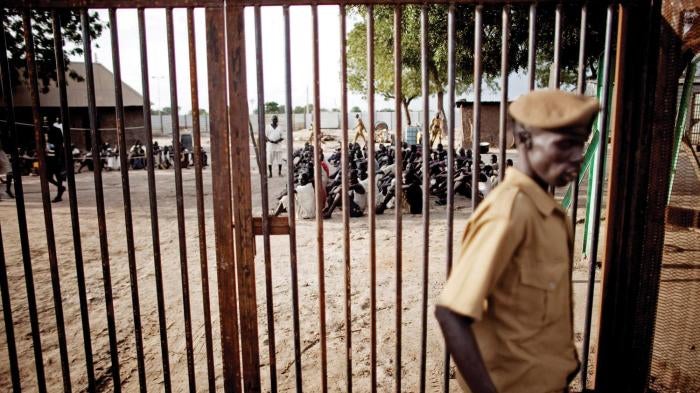
“Prison Is Not For Me”
Arbitrary Detention in South Sudan
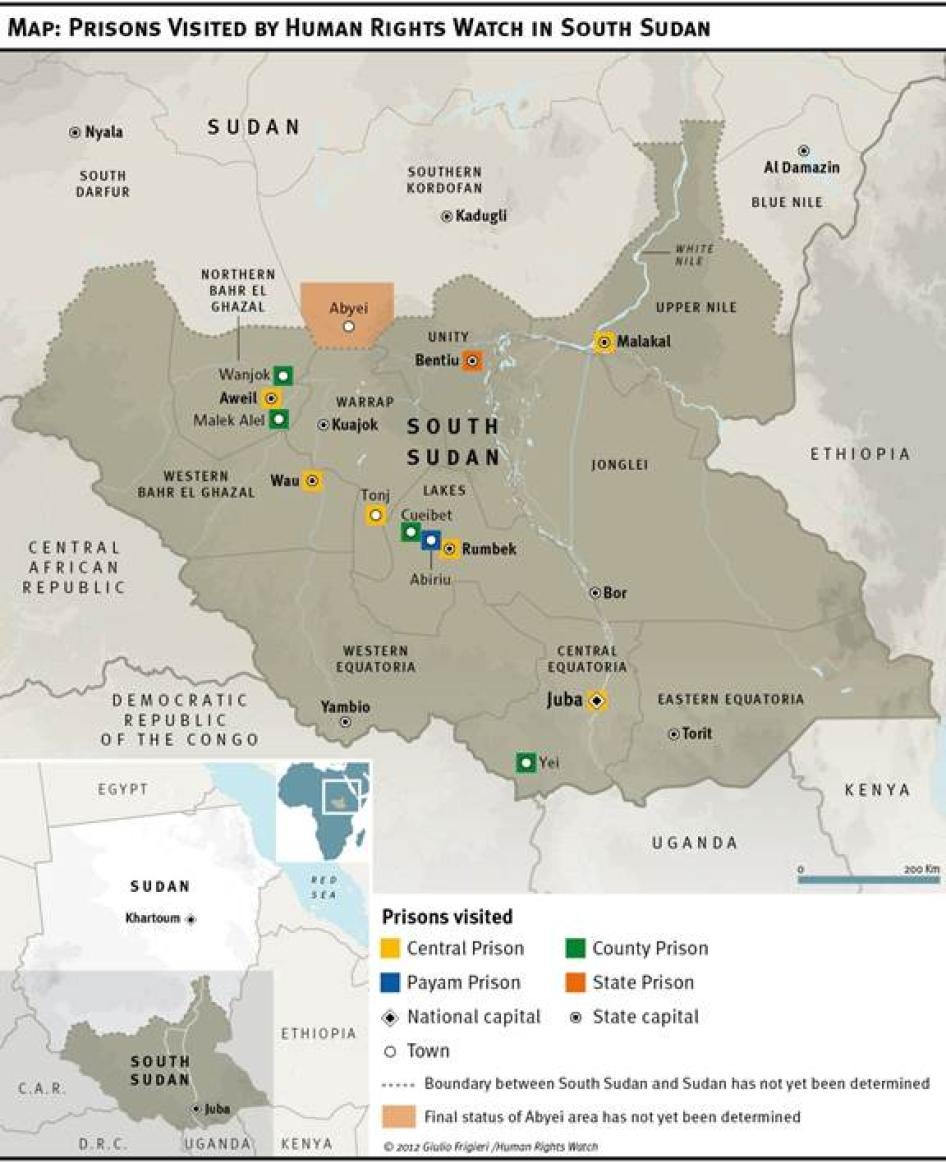
Map: Prisons Visited by Human Rights Watch
Glossary
Administrative divisions: South Sudan is divided into the following administrative divisions, in order of descending size: state, county, payam, boma. A boma, the smallest administrative unit, is equivalent to one village. There are 10 states and 79 counties.
Cattle: Cattle carry significant social, economic, and cultural importance for South Sudan’s cattle-keeping ethnic groups. Cows are often given as bride wealth, blood compensation for homicide, and in compensation for a variety of other wrongs. The monetary equivalent of a cow is approximately US$300.
Child/children: Individuals under 18 are referred to as “children,” in accordance with the Convention on the Rights of the Child and South Sudan’s Child Act.
Condemned: Sentenced to death.
Classification of prisons: South Sudan Prisons Service classifies prisons as “central,” “state,” or “county” prisons. There are central prisons in Juba, Malakal, Wau, Rumbek, Yambio, Bor, Aweil, and Tonj. There are state prisons in Kuajok, Bentiu, and Torit. There are county prisons in most of South Sudan’s 79 counties. There are also small detention facilities in some payams.
Currency: In 2011, South Sudan changed currency from the Sudanese Pound (SDG) to the South Sudanese Pound (SSP). For the sake of simplicity, all local currency amounts are referred to simply as “pounds.” At the writing of the report, the official exchange rate was US$1=2.94 SSP.
Remand: A detained person who has not been convicted of a crime.
Southern Sudan/South Sudan: The research for this report spanned pre-independence and post-independence periods. On independence, the regional government of Southern Sudan became the government of the Republic of South Sudan. “Southern Sudan” is sometimes used when referring explicitly to the pre-independence period. Otherwise, “South Sudan” is used in all contexts.
SPLM/A: Sudan People’s Liberation Movement/Army
UNMISS: United Nations Mission in South Sudan
Summary
On July 9, 2011, crowds cheered and danced in the streets, celebrating the independence of the new nation of South Sudan. Meanwhile, close to 6,000 people, including women and children, languished in South Sudan’s prisons. Some of these inmates could have joined in the festivities, but are behind bars because of chronic weaknesses across the criminal justice system. In South Sudan arbitrary detention is rife, with those who should not have been detained at all spending months or even years in one of the country’s approximately 79 prisons, which are overcrowded and dirty, with food and health care in short supply.
The signing of the Comprehensive Peace Agreement (CPA) in 2005 between the National Congress Party-led Government of Sudan and the Sudan People’s Liberation Movement and Army (SPLM/A) brought an end to 22 years of civil war and granted Southern Sudan regional autonomy. Over the past seven years, the government in Juba has made significant progress in establishing key institutions, including Southern Sudanese police, prisons service, and courts, building necessary infrastructure, and passing new legislation. Yet the legacy of two decades of civil war presents massive challenges to developing a functional criminal justice system, such as a lack of trained civil servants, including judicial officers and police, and budgetary constraints.
In the face of such severe challenges, at independence, South Sudan’s leaders pledged to uphold human rights. President Salva Kiir promised in his independence-day speech to respect and ratify human rights treaties. He also signed into force a new constitution that proclaims the country to be founded on justice, equality, and respect for human dignity and guarantees rights to due process, physical integrity, and protection from unlawful deprivations of liberty.
Despite this new constitution and the relative progress that has been made since the CPA was signed, there are persistent weaknesses in the rule of law in South Sudan, resulting in serious human rights concerns. This report focuses on prison populations and conditions, and documents patterns of arbitrary detention and other human rights abuses in the administration of justice. It challenges the government of South Sudan to ensure that its criminal justice system develops in accordance with human rights norms, rather than allowing systemic weaknesses to fester. An effective and rights-respecting criminal justice system is critical to providing a sense of security, to ending cycles of violence fueled by impunity, and to ensuring accountability while guaranteeing due process rights.
Approximately one-third of prisoners in South Sudan are on remand – that is they have not been convicted of any crime – but are held in prison, often unnecessarily, awaiting the commencement or resolution of their trial. Many remand prisoners were arrested but have not been brought before a judge, and remain in prison because they were never given the option of bail. They wait for police to conclude investigations, for judges to schedule their trial, and for witnesses to appear in court for prolonged periods – sometimes for years.
Some prisoners have not even been accused of any crime. There are inmates detained as proxies, simply to compel the appearance of a relative or friend. As of November 2011, 90 individuals, labeled “lunatics”, were deprived of their liberty because they were said to have demonstrated evidence of mental disability. Some are chained to the floor day and night, naked, and soiled with their own excrement.
The overwhelming majority of prisoners –an estimated 95 percent – go through the criminal justice system without counsel. Most are too poor to pay for a lawyer, and there is no functioning system of legal aid. Most cannot read or write, and with no support from the state, they often have no understanding of the nature of the charges against them or the status of their case. Defendants are sentenced to death even though they have not been able to call and prepare witnesses in their defense.
South Sudan operates a plural judicial system, which includes statutory and customary courts. Customary courts are accessible, familiar, and efficient, but their exercise of judicial powers is not sufficiently overseen by the judiciary, and their criminal jurisdiction is unclear. Individuals can be sentenced to prison for crimes such as “pregnancy” that are not precisely defined and have no statutory basis. Chiefs, state-sanctioned community leaders who preside over customary courts, apply the Penal Code without legal training and impose corporal punishment.
In all of the 12 prisons Human Rights Watch visited in researching this report, people were detained because they cannot pay debts, court-ordered fines, or compensation awards. Many have given up hope that family members will come forward to pay on their behalf, and there is little opportunity to generate income while in prison.
There are people in prison because they are accused or convicted of marital or sexual offenses, such as adultery and elopement. The criminalization of adultery places undue restrictions on the fundamental right to privacy, which includes the freedom to engage in adult consensual sex. Imprisonment for elopement limits the right to marry a spouse of one’s choice.
There are over 150 children in conflict with the law in South Sudan’s prisons. Domestic law allows imprisonment only from age 16, but Human Rights Watch met inmates as young as 13. Children are removed from their families and from school to await trial for extended periods, and sometimes given long sentences for petty offenses such as theft. There are no alternatives to imprisonment, and in all prisons Human Rights Watch visited, children are housed alongside adults.
The prison population has surged since 2005, from approximately 1,500 to almost 6,000 at the end of 2011, according to the Prisons Service. As there has been little expansion of prison infrastructure, this rise in the number of prisoners has contributed to grim conditions. In the overcrowded prisons, inmates sleep in tightly packed cell-blocks, and as a result have difficulty sleeping at night. Facilities rarely allow convicts to be fully separated from remands, children from adults, or even women from men.
As 93 percent of the Prisons Service’s budget goes towards paying salaries for its staff of over 20,000, it has been unable to adequately feed the people who are detained. Mothers with young children are offered no extra rations or services. Prisoners sometimes do not have enough water to bathe. Disease and illness spread easily, but go untreated, unless inmates are able to pay for medicine themselves. Beatings are routine, and some inmates are permanently shackled. In one major prison, 10 inmates died in 2011 alone, mostly of treatable illnesses.
The composition of prison populations – particularly the high number of remands – reflects problems at other levels of the criminal justice system. It is urgent that all justice sector actors and all stakeholders take coordinated action to address these various problems with the ultimate goal of reducing the number of inmates who are arbitrarily detained. The Ministries of Justice, Interior, Health, and the judiciary all need to collaborate more effectively to bring about needed improvements. The government should promptly review the cases of all prisoners and release all but those whose continued detention is strictly justified on the basis of an appropriate court sentence handed down following a fair trial, or those facing serious criminal charges whose appearance for trial would not be guaranteed if they were to be granted pre-trial release.
To improve the situation in the longer term, resource constraints are a major consideration, but some necessary reforms are resource-neutral. Legal and policy reforms, particularly the enforcement of legal limits on remand detention, ending imprisonment for offenses such as adultery, and abolishing the practice of imprisonment for non-payment of debt, will have an immediate and significant impact on reducing the number of prisoners arbitrarily detained. A zero-tolerance policy on corporal punishment and the chaining of inmates for extended periods of time, a degrading and inhuman treatment, will ease the suffering of many prisoners.
The government, with the support of South Sudan’s development partners, should urgently introduce other reforms, such as guaranteeing the right to legal aid, providing proper care for people with mental disabilities outside of prison, and ensuring that rule of law actors are sufficiently trained. Though costly, these changes are crucial components of a criminal justice system that upholds, rather than violates, fundamental human rights.
Key Recommendations
For Immediate Implementation
- The government should formally acknowledge that South Sudan succeeds to all human rights treaties to which Sudan is a party.
- The Ministry of Interior, Ministry of Justice, and the judiciary should review the files of all prisoners to ensure that every prisoner has a file that includes complete and accurate information of the prisoner’s name, age, reason for and date of detention, and length of any sentence. They should ensure that all prisoners are legally detained.
- The Ministry of Justice and the judiciary should order the immediate release of any prisoner who is detained without clear legal authority, lacks necessary paperwork, is in proxy detention, is in detention for failing to fulfill a contractual obligation, or who has overstayed permitted remand periods or a sentence to imprisonment.
- In order to address the current overcrowding, and pending law reform, the Ministry of Justice and the judiciary should consider granting early release to any prisoner whose detention is not on the basis of an appropriate judicial sentence for a serious offense following a fair trial. Prisoners serving sentences for adultery or convicted by customary courts of offenses such as “pregnancy” should be given early release.
- The Ministry of Justice and the judiciary should grant release pending trial for any prisoner whose detention is not justified as necessary to ensure his or her appearance at trial for a serious offense.
- The Ministry of Interior, Ministry of Justice, and the judiciary should develop and implement early release and alternatives to imprisonment such as community service and probation programs.
- The National Legislative Assembly should:
- amend the Code of Criminal Procedure to require that criminal suspects appear before a judge within 24 hours of arrest, as required by the Transitional Constitution;
- amend the Penal Codes so that people are not imprisoned for adultery;
- amend the Judiciary Act and the Local Government Act to ensure adequate monitoring and supervision of customary courts by the judiciary, to clarify and limit the jurisdiction of customary courts over criminal matters, and to establish clear sentencing limits for customary courts; and
- pass legislation to prohibit the incarceration in prison of people solely on the basis of mental disability and to regulate the commitment and discharge of people with mental disabilities to a medical facility in compliance with international standards.
- The Ministry of Interior, Ministry of Justice, and the judiciary should issue clear instructions for police, prosecutors, and judges to uphold the constitutional requirement that all criminal suspects appear before a judge within 24 hours of arrest. Procedures should be promulgated to implement this rule.
- The judiciary should exercise oversight over pre-trial detention as required under the Code of Criminal Procedure by ensuring that remand detention orders are renewed every seven days and that permission is sought from the Court of Appeal for pre-trial periods that exceed six months.
- The Ministry of Interior, Ministry of Justice, and the judiciary should issue clear instructions prohibiting detention of persons in proxy of criminal suspects and indeterminate and indefinite detention for failure to pay debts.
- The Ministry of Justice and the judiciary should examine the practice of imprisonment for non-payment of debt with a view to abolishing it. So long as imprisonment remains available as a legal consequence for non-payment of debt, it should be strictly limited to situations of non-fulfillment of a court ordered payment, should only be used as a last resort and for as short a period as possible, and in any event, no longer than the six-month limit on imprisonment for debt in the Code of Civil Procedure.
- The Ministry of Health and Ministry of Interior should clarify responsibility for providing health care and medicine for prisoners, ensure improved coordination, and develop a detailed plan for the improvement of prison health services and conditions.
- The Ministry of Health should, in consultation with disabled persons’ organizations, develop a national plan for the provision of mental health services, including a medical facility for individuals with mental disabilities and community-based treatment options such as outpatient services.
- The Prisons Service should prohibit corporal punishment in its standing orders and regulations. It should ensure the enforcement of the prohibition by adopting a zero-tolerance policy against its use, holding prison staff accountable for using corporal punishment, and providing prison officers with additional training in the prohibition of corporal punishment.
- The Prisons Service should prohibit the use of chains and leg irons in its standing orders and regulations. It should end the practice of applying other forms of restraints as punishment. Restraints, when used for security measures, should be used only when absolutely necessary, and then for the shortest period of time possible.
Methodology
This report is based on research conducted between March 2011 and January 2012. Researchers visited 12 of South Sudan’s approximately 79 prisons, in seven of South Sudan’s 10 states: Juba and Yei prisons in Central Equatoria state; Rumbek, Cueibet and Abiriu prisons in Lakes state; Malakal prison in Upper Nile state; Wau prison in Western Bahr el Ghazal state; Aweil, Wanjok and Malek Alel prisons in Northern Bahr el Ghazal state; Tonj prison in Warrap state; and Bentiu prison in Unity state. The director general of South Sudan Prisons Service granted Human Rights Watch researchers unfettered access to the prisons.
The research focused on arbitrary detention and conditions in prisons under the authority of the South Sudan Prisons Service, a directorate of the Ministry of Interior. As nine of the prisons visited can be described as larger prisons, with populations over 200, the findings are most representative of such facilities. In order to better understand the experiences of prisoners prior to arriving in prison, researchers also visited police holding cells in Juba, Yei, Rumbek, Malakal, and Bentiu.
Researchers conducted interviews with more than 250 prisoners. Those interviewed were selected randomly, but with special care taken to ensure that prisoners interviewed represent a cross-section with respect to gender, age, detention status (remand or convicted), and severity of sentence. The majority of those interviewed were accused or convicted of murder, theft, or marital or sexual offenses, or were in prison for non-payment of debt, fines, or compensation awards.
Researchers questioned prisoners about the charges against them, the trial process, and prison conditions. Interviews varied in length from approximately 10 minutes to one hour. Prison staff usually, with few exceptions, allowed researchers to interview prisoners one at a time, in semi-private settings, such as in an empty office or in a corner of the prison compound. Interviews were conducted in English, Arabic, Dinka, and Nuer languages with assistance from independent interpreters in most instances. All prisoners were informed of the purpose of the interview and its voluntary nature, and verbally consented to be interviewed. As prisoners sometimes revealed sensitive information regarding their charges or convictions, or were critical of the government institutions, all prisoners interviewed have been given pseudonyms to avoid any potential security risk.
At every prison visited, researchers conducted interviews with members of the prison administration, and interviewed a total of approximately 35 Prisons Service staff. Research also included examination of prisoners’ files, particularly in Juba and Bentiu. Researchers communicated in person, by telephone, or by email, with over 80 central and state-level government officials, judges, prosecutors, customary court chiefs, private lawyers, United Nations officials, donors, and representatives of nongovernmental organizations.
I. Criminal Justice in the New Nation
“[We] are only at the beginning of the long, winding and challenging road of development.”
–President Salva Kiir, Washington, DC, December 2011[1]
When South Sudan declared independence from Sudan on July 9, 2011, it joined the ranks of the world’s least-developed nations.[2] Only 27 percent of adults are literate,[3] and less than half of primary school age children are in school.[4] An estimated 80 percent of South Sudan’s population of 8.26 million live without access to any toilet facility, and 38 percent have to make a one hour round-trip by foot to fetch drinking water.[5] The maternal mortality rate of 2,054 per 100,000 live births is the highest in the world.[6]
Such chronic underdevelopment is the result of the Sudanese government’s political and economic marginalization of Sudan’s southern territories, combined with decades of brutal civil war. With this legacy, since the signing of the Comprehensive Peace Agreement (CPA) in 2005 that brought an end to Sudan’s civil war,[7] the then semi-autonomous regional government of Southern Sudan, now the Republic of South Sudan, has confronted massive challenges in all sectors of governance.
Over the past seven years, the government in Juba has worked to develop a functioning criminal justice system, and it has made significant progress in establishing Southern Sudanese police, prisons service, and courts, constructing necessary infrastructure, and passing new legislation. These efforts are ongoing. However, for a number of reasons, including a shortage of skilled and highly trained civil servants and inadequate resources, there are persistent weaknesses in all rule of law institutions.
Weaknesses in the Police Service
The Southern Sudan Police Service was formed in 2005 under the Ministry of Interior. The Police Service Act, which dates only to 2009, defines as its duties to “prevent, combat and investigate crime,” to “maintain law and public order,” to “protect the people…and their properties,” and to “uphold and enforce” the Constitution.[8] Yet it is largely unable to provide these services because it lacks sufficient resources and trained personnel. One senior judge described police as the “weakest link” in the criminal justice system.[9]
South Sudan’s history of war and secession is directly reflected in the composition of the Police Service. Prior to the CPA, there were two different systems of civilian government in South Sudan. In territories held by the national government, including the towns of Juba, Wau, and Malakal, the national police and courts were operating according to the laws of Sudan. At the same time, in areas held by the SPLM/A, there was an SPLM/A civilian police force and a judiciary that relied on laws developed by the SPLM/A. In 2005, the Police Service brought together both former Government of Sudan police as well as former SPLA police.[10]
The security arrangements agreed upon under the CPA provided for the disarmament, demobilization, and reintegration (DDR) of former combatants as well as for the dissolution of all armed groups other than the Sudan Armed Forces (SAF) and the SPLA.[11] As a result, following the CPA, thousands of former SPLA combatants and members of numerous militia groups were transferred to both the police and prisons services. In addition, since South Sudan gained independence, the Police Service has received over 4,000 police of Southern Sudanese origin who had continued to serve in the North. There are currently a total of approximately 55,000 police personnel.[12]
The Police Service operates under significant constraints. In 2011, 95 percent of the Police Service’s budget was spent on salaries, leaving little funds for infrastructure and equipment.[13] Police stations and holding cells are generally derelict structures –sometimes simply thatched mud huts called tukuls, metal containers, or trees to which detainees are chained. Police detainees are not provided with food. Many rely on relatives to bring them meals or on the generosity of other inmates, while others spend days on end without eating. Police officers lack important supplies such as paper and official forms. Insufficient transportation and communication equipment also significantly hamper their ability to carry out responsibilities such as completing investigations or taking detainees to court.
Largely as a result of the high numbers of former combatants, the Police Service faces significant training and capacity challenges. Many of its members are still learning to interact with civilians in a manner appropriate for civilian police. An estimated 90 percent of police personnel are illiterate in both Arabic and English, making it difficult for them to carry out basic policing functions such as writing crime reports or managing cases.[14] Many have received little or no training, and therefore lack knowledge of law enforcement, human rights, or fundamental legal texts.[15] In addition, police are concentrated in the capitals of South Sudan’s 10 states, with few officers present in the vast and sometimes difficult to access rural areas, where 83 percent of South Sudanese reside.[16] As a result of these challenges, police may fail to establish the foundation for fair trials – proper arrests, legal police detention, and thorough investigations –because they are not present, lack sufficient resources or know-how.
Since 2005, there have been efforts by the government, with donor support, to build the capacity of the Police Service through training programs. A police-training complex outside of Juba opened in 2009, and includes a police college, police academy, and a basic training school. There are also smaller training centers in each of the 10 states.[17] UNMISS Police (UNPOL) has conducted training and also has personnel co-located in police stations to provide on-the-job mentoring. Some police have also travelled for training programs in Kenya or Uganda.[18] Despite these important initiatives, the Police Service continues to lack well-trained personnel, as not all police staff have benefitted from these programs, and those who have may still need additional training.[19]
While facing significant internal challenges, the Police Service is saddled with the task of preventing crime and ensuring security in a context of growing criminal activity, constant instability, and where there is a proliferation of small arms among civilians. Urban areas have seen a rise in criminal activity, such as armed robbery and murder.[20] Clashes between the military and rebel militia groups and inter-communal violence have resulted in large-scale population displacement and thousands of civilian deaths.[21] According to the UN Office for the Coordination of Humanitarian Affairs, in 2011 over 3,400 people died in conflict incidents.[22]
While many shortcomings can be traced to the fact that the Police Service operates in a challenging context and is under-equipped, under-staffed, and under-trained, there are also cases of physical abuse, in clear violation of basic human rights standards.[23] No fewer than 17 inmates in five different states told Human Rights Watch they were beaten or tortured in police custody before being transferred to prison. According to a medical officer at Juba prison, prisoners sometimes arrive, “with bruises all over their bodies. When we ask them what has happened, they tell us that they were tortured by the police.”[24] A 15-year-old who had spent two months in police custody, said that on multiple occasions, police tied him in a bag, kicked and beat him with sticks and guns, then cut his feet with razor-blades while ordering him to confess to murder.[25] In one widely publicized case, police officers in Juba tortured and inserted stones and glass bottles into the vagina of a woman accused of theft, causing a miscarriage and damage to her uterus.[26] Such abuses compromise the integrity of the entire criminal justice process.
Complexities of a Plural Legal System
In addition to challenges related to human and material resources, South Sudan’s judicial system confronts the complexities of a plural legal structure, which includes both statutory and customary courts and draws on multiple sources of law. The basis for criminal punishment is an amalgam of British-introduced common law embodied in statutes and the generally unwritten customs of over 50 indigenous ethnic groups.[27] There is also evidence that Islamic law continues to have subtle influences on judicial practices. This mixture of traditions blends adversarial and punitive theories of justice with consensual and restorative ones. The strategy for developing, rationalizing, and structuring the legal system is the subject of ongoing internal debate.[28] This report highlights some key areas where existing structures, processes, and criminal punishments run afoul of international human rights standards.
The Statutory System
The Judiciary Act of 2008 sets out the statutory system. The Supreme Court in Juba is the highest court in South Sudan, followed by three regional Courts of Appeal. There is a High Court in each of the 10 states, which has original jurisdiction over all homicide cases and also hears appeals from lower courts. According to the Judiciary Act, there should also be statutory courts in every county and payam.[29] In reality, however, due in part to staff shortages, the absence of court infrastructure in rural areas, and insecurity in some parts of the country, there are statutory courts in only some of South Sudan’s 79 counties, and none at the payam level.[30]
Whereas a fully staffed judiciary would count more than 250 judges, there are currently only 125 across the country.[31] With judges and prosecutors clustered primarily in main towns, it is difficult and sometimes impossible for rural litigants to file complaints or appeals.[32] Instead, most people rely on customary courts and do not appeal their decisions to the statutory courts.[33] The most common impact of staff shortages is extended periods of pre-trial detention, described in detail in Section III.
When the CPA set up the semi-autonomous government of Southern Sudan in 2005 and granted it powers to legislate,[34] the then regional assembly began passing a new body of laws. The Penal Code and Criminal Procedure Code were passed in 2008. Despite various donor-funded trainings for personnel in the judiciary and Ministry of Justice,[35] many judges and prosecutors still lack sufficient knowledge of these laws. Human Rights Watch saw many prisoner files that cited the 2003 penal code developed by the SPLM/A or the 1991 penal code passed in Khartoum, even though convictions took place long after 2008.[36] Many judges and prosecutors did their legal training in Arabic in a Sudanese university and are not fully literate in English, South Sudan’s official language and the only language in which laws are published. Sections III and IV of this report highlight areas where laws are misunderstood, cases of misapplication, and a general failure of judges and prosecutors to ensure that criminal processes take place in accordance with domestic law.
The Customary System
Traditional chiefs preside over customary courts, deciding cases according to the “customs, traditions, norms and ethics” of their respective communities.[37] Proceedings generally take place under large trees and are open to the public. The Local Government Act of 2009 establishes a hierarchy of customary courts at the county, payam, and boma levels,though the reality on the ground rarely conforms to this neat structure.[38] The criminal jurisdiction and sentencing power of customary courts are unclear, and as a result these courts hear all kinds of cases, and there is no apparent government effort to rein them in.[39] Chiefs are not part of the official state judiciary, but their decisions are enforced by state law enforcement. While decisions from county level customary courts can be appealed to statutory courts,[40] in practice, most people are not aware of such avenues or how to go about exercising their right to appeal.
The government of South Sudan is committed to maintaining a place for customary law in its developing legal system. Customary law is seen as an element of South Sudanese cultural identity that the SPLM/A fought to defend and preserve, and a necessary component of a judicial system that reflects the values and needs of South Sudanese.[41] The status of customary law is explicitly protected by the 2011 Transitional Constitution, as a source of law, as a right of ethnic communities, and as justiciable by both traditional chiefs and the statutory courts.[42]
During the long civil war between Sudan government forces and the SPLM/A, responsibility for the administration of justice was for the most part left in the hands of traditional chiefs.[43] While the formal judiciary has become more active since the CPA was signed in 2005, with the establishment of more courts and additional judges, some estimate that customary courts handle 80 to 90 percent of both civil and criminal cases.[44] They play a critical role in meeting demands for dispute resolution, as they are generally more accessible, particularly to rural litigants. Their procedures are less cumbersome and more familiar to most South Sudanese.[45] In contrast to statutory courts, they hear cases quickly, with a hearing and judgment sometimes taking place within a single day.
Customary law is described as embracing reconciliation and community harmony as principle tenets and is therefore seen by foreign observers and South Sudanese alike as having the ability to promote and maintain community cohesion. Rulings intend to restore that which has been lost or damaged, through compensation awards, often measured in the form of cows or other livestock. Historically, prison sentences were not among the sanctions imposed by customary courts. Murder, for example, is sanctioned under the customary law of many groups through a payment referred to as blood compensation to the family of the deceased.[46]
Customary law, however, is evolving, and traditional chiefs now draw on elements of state justice, commonly imposing punitive penalties involving prison sentences, and citing provisions of the Penal Code. Their procedures and rulings raise serious human rights concerns relating to the lack of due process protections, particularly when they result in deprivations of liberty. Such concerns are discussed in sections III and IV of this report.
Bringing South Sudanese customary justice systems in line with international human rights standards is a complex endeavor, as customary law is deeply intertwined with local cultural, social and economic systems.[47] Yet however complicated reform may be, defendants facing criminal charges have the same rights to due process and to a fair trial, both in customary and statutory courts.
Prisons: The End Point
As prisons are the final stage in the criminal justice system, the weaknesses of the police and due process failures in the courts are evident in the testimonies of prison inmates and the composition of the prison population. Due in part to increasing activity of police and courts, prison populations are rising sharply. The South Sudan Prisons Service estimates there were only approximately 1,500 prisoners in 2005, while there are now approximately 6,000. In Juba prison, the population has increased five-fold, from under 200 in 2005 to close to 1,000.[48]
According to the Prisons Service, as of November 2, 2011, there were a total of 5,767 men, women and children in state and county prisons across the country.[49] Of this figure, 7 percent were female and 93 percent male; 30 percent were on remand, awaiting the completion of police investigations or trials. On the death row were 182 men and women. Ninety individuals were labeled as “lunatics,” because they were said to have showed evidence of mental disabilities. One hundred and sixty-eight children were accused or convicted of crimes, and 55 others were in prison accompanying their mothers, either because they are infants or because there is no one else to care for them.[50]
The Prisons Service does not compile data on the crimes of which inmates are accused or convicted. A 2008 survey in nine major prisons found that 38 percent of inmates were convicted or accused of murder, 35.7 percent for theft crimes, 10.9 percent for debt, and 8.7 percent for adultery.[51] Interviews by Human Rights Watch with prison administrators confirmed that these continue to be the most common reasons for imprisonment.
The limited staff competence, poor training and infrastructure, and paucity of funds compound the problems prisoners experience with the police and courts. As with the Police Service, the Prisons Service has incorporated a large number of demobilized SPLA soldiers and members of other armed groups. Many have received only three months of training in prison administration.[52]
Among prison staff, there is also a high level of illiteracy and insufficient knowledge of prison regulations, and as such prison files are often in disarray. The Prisons Service Act, art. 62 stipulates that every prisoner’s record should include information about his identity, the detention warrant, the offense for which he is accused or convicted, and the length of his sentence, yet files are generally not organized, and information may be missing or inaccurate. There are inmates for whom the Prisons Service is unable to produce a single written document justifying their detention or even confirming their name. For example, the prison administration at Bentiu was unable to provide Human Rights Watch with the files of approximately 30 of the 162 convicted prisoners. In Tonj, four out of nine prisoners interviewed had no files and in Aweil, two prisoners had no available files. As such, it at times becomes impossible to ascertain why a person is detained, whether the detention is legal, and how long that person will be in detention.
The Prisons Service is bloated due to massive incorporation of demobilized soldiers following the CPA. Incredibly, the number of prison staff, about 20,000, is more than three times the number of prisoners.[53] The Prisons Service used 93 percent of its 2011 budget to pay salaries, leaving little funds for improvements to infrastructure or to provide adequate food and medicine for those in detention.[54] There are 10 major state prisons and additional facilities in counties and payams, many of which are temporary structures. The prisons in Bor, Aweil, Wau, Yambio, Juba, Rumbek, and Malakal have benefited from renovations funded by international donors, but are overcrowded and still require health and sanitation services. Facilities in Tonj were built in the 1940s and have not been recently renovated, and those in Bentiu consist of traditional thatched tukuls and two rooms whose roofs and walls are constructed entirely of corrugated metal sheets.
II. South Sudan’s Obligations under International and Domestic Law
“South Sudan is founded on justice, equality, respect for human dignity and advancement of human rights and fundamental freedoms.”
–Transitional Constitution of the Republic of South Sudan, 2011[55]
In his independence-day speech on July 9, 2011, President Salva Kiir pledged that South Sudan would abide by international conventions and seek accessions as soon as possible.[56] Although at this writing, South Sudan has yet to ratify or deposit instruments of succession to any major international or regional human rights treaties,[57] international law favors the automatic continuation of human rights obligations from predecessor to successor states.[58] South Sudan therefore inherited from Sudan a responsibility to respect, protect and fulfill rights guaranteed under the International Covenant on Civil and Political Rights (ICCPR),[59] the Convention on the Rights of the Child (CRC),[60] the International Covenant on Economic, Social and Cultural Rights (ICESCR),[61] the Convention on the Rights of Persons with Disabilities (CRPD),[62] and the African Charter on Human and Peoples’ Rights (African Charter).[63] Given the difficulties of the post-conflict context described in the previous section of this report, compliance with these obligations will require continuous effort to ensure that government institutions have necessary training, personnel, resources, and knowledge of the rights of citizens. Through the Transitional Constitution, which entered into force the day South Sudan gained independence, government officials confirmed their commitment to rise to this challenge.
Due to the continuing nature of human rights obligations, from the pre-secession through post-independence periods, people in South Sudan have maintained the right to be to be free from arbitrary detention.[64] South Sudan must provide for the protection of basic rights to due process. Defendants facing criminal charges must be granted a fair hearing by a “competent, independent and impartial tribunal.”[65] They must have adequate time and facilities to prepare their defense,[66] and be granted free legal assistance when they cannot afford counsel.[67] Trials must occur without undue delay,[68] and those who are found guilty must be granted the right to have their convictions reviewed by a higher tribunal.[69]
By virtue of its human rights obligations, South Sudan must also ensure that the treatment and conditions of those deprived of their liberty meet certain standards. Prisoners retain their human rights and fundamental freedoms; there should be no restrictions on their rights nor should they be subjected to any hardship or constraint, other than what is unavoidable as a result of their imprisonment.[70] Article 10 of the ICCPR requires that “[a]ll persons deprived of their liberty shall be treated with humanity and with respect for the inherent dignity of the human person.”[71] The African Charter on Human and Peoples’ Rights also protects every individual’s human dignity and prohibits all forms of degradation, including torture, and cruel, inhuman or degrading punishment and treatment.[72] Under international law, the prohibition on torture is without exception or derogation.[73]
Numerous international instruments provide further guidance on the protection and respect of human rights of criminal defendants and persons deprived of their liberty. The most comprehensive are the UN Standard Minimum Rules for the Treatment of Prisoners.[74] Other relevant instruments include the Body of Principles for the Protection of All Persons under Any Form of Detention or Imprisonment and the Basic Principles for the Treatment of Prisoners.[75] The UN Rules for the Protection of Juveniles Deprived of their Liberty and the UN Standard Minimum Rules for the Administration of Juvenile Justice lay out additional specifications of the conditions under which children may be detained.[76]
At the regional level, the African Commission on Human and Peoples’ Rights has adopted instruments containing recommendations to improve protections of those encountering African criminal justice systems. It addressed due process rights in the 1992 Resolution on the Right to Recourse Procedure and Fair Trial[77] and the 2003 Principles and Guidelines on the Rights to a Fair Trial and Legal Assistance in Africa.[78] The 1996 Kampala Declaration on Prison Conditions[79] and the 2002 Ouagadougou Declaration and Plan of Action on Accelerating Prison and Penal Reform in Africa[80] both target the dire conditions common in many prisons in Africa.
Under domestic law, the Transitional Constitution, the Code of Criminal Procedure, the Child Act, and the Prisons Service Act all provide due process protections. The bill of rights in the Transitional Constitution protects the rights to life and to dignity, to liberty and security of the person;prohibits torture and forced labor;and contains special provisions on the rights of women, children, persons with special needs, and the elderly.[81] It also provides for equality before the law and enumerates requirements for fair trials, which are also elaborated in the Code of Criminal Procedure.[82] The Child Act guarantees protections for children in conflict with the law in line with international standards, and prohibits the imprisonment of children under the age of 16.[83] The Prisons Service Act lists the rights of prisoners, including to adequate food, water and sanitation. The standing orders of the Prison Service outline operating procedures for South Sudan’s prisons.[84] They are inspired by and incorporate most provisions of the UN Standard Minimum Rules for the Treatment of Prisoners.
* * *
South Sudan should strengthen its human rights framework by formally acknowledging that it continues to be bound by treaties ratified by Sudan. It should also accede to other human rights treaties that would assure those in its territory additional human rights protections related to criminal justice and detention conditions. These include the Convention against Torture and Other Cruel, Inhuman or Degrading Treatment or Punishment (CAT), the Convention on the Elimination of all forms of Discrimination against Women (CEDAW), the Protocol to the African Charter on the Rights of Women in Africa (Maputo Protocol), and the African Charter on the Rights and Welfare of the Child (ACRWC).
III. Gaps in the Right to Due Process
“I have stayed here for five years, and have not seen a plaintiff, and have not seen a judge. The court has not called the case. The attorney general doesn’t know the law. The police don’t know the law.”
–Remand prisoner, Aweil Central Prison, April 15 2011.[85]
One of the most pervasive sentiments among prisoners in South Sudan is frustration with the unknown, with prisoners left perplexed and wondering: why was I brought here, when will I go to court, what is my conviction, when will I be set free? While it may not be surprising that those incarcerated believe that they have been unfairly deprived of their liberty, there is evidence that such sentiments are well justified. In South Sudan, it is not unusual to wait over a year before going to trial, and legal aid is almost totally absent. Customary courts sentence defendants without clear jurisdiction over criminal cases. Indeed, arrests, detentions, and prosecutions may be so flawed as to render continued incarceration arbitrary, in violation of human rights law.[86]
Unnecessary or unlawful deprivation of liberty is a concern that the government of South Sudan needs to urgently address. While training and capacity building are important long-term objectives, the new nation should take certain immediate measures to remedy existing weaknesses. It should implement to the fullest extent possible domestic laws governing pre-trial detention and the provision of legal aid and adopt key legal reforms to clarify and limit the jurisdiction and sentencing power of customary courts.
Extended Pre-Trial Detention
International law requires that pretrial detention be “an exception and as short as possible”[87] and that defendants be tried “without undue delay.”[88] In South Sudan, suspects may wait in prison for long periods before their investigations are complete and before trials commence. Partially completed trials can drag on due to adjournments, missed court dates or the absence of key witnesses. Under domestic law, the total period of pre-trial detention should not exceed six months, except with the consent of the relevant Court of Appeal, but this limit is often not respected.[89] Official figures put the figure of inmates on remand at 30 percent of the total number of inmates.[90]
Remanded Pending Investigation
Individuals arrested on suspicion of having committed an offense are detained pending criminal investigation or the filing of charges, usually in a police cell.[91] Criminal suspects have a right under international law to be brought “promptly before a judge,”[92] and South Sudan’s Transitional Constitution prohibits police from holding them more than 24 hours without producing them in court.[93]
South Sudan’s rule-of-law institutions are yet to introduce procedures to fulfill these rights. There is insufficient knowledge among police, prosecutors, and judges of this “24-hour rule” which was introduced by the Transitional Constitution in July 2011 and conflicts with the 2008 Code of Criminal Procedure, which allowed prosecutors to approve detention for investigation up to seven days.[94] A circular from the Chief Justice clarified that the constitution prevails and called on judges to regularly visit prisons and police detention centers to monitor detention periods,[95] but Human Rights Watch found little evidence that this is taking place.
Without a timely initial appearance, detainees are not able to ask for release pending trial. South Sudanese law does provide for release on bail or on execution of a personal bond,[96] but justice authorities rarely use it.[97] Human Rights Watch’s research suggests that most defendants are unaware that bail is a legal option and lack legal advice on how to apply for release. Under international law, detention before trial should only be used to the extent that it is necessary “to prevent a person arrested on a criminal charge from fleeing, interfering with witnesses or posing a clear and serious risk to others.”[98] Absent an appearance, judges are unable to adequately consider whether there are grounds to necessitate continued detention, or whether conditions are met for bail.[99] Even when judges do approve continued detention, they do so on the basis of a detainee’s paperwork alone, rather than an in person appearance of the suspect. Indeed, a police officer in Juba explained that detainees are only physically taken to court if they make such request.[100]
Judicial oversight of remand detention should begin with the initial appearance and extend over the entire pre-trial period. When a prisoner is on remand pending investigation, a judge must approve his continued detention every week, up to a maximum of three months. If detention exceeds three months, the law requires that approval be sought from the Court of Appeal.[101] Human Rights Watch examined remand records in all prisons visited and found that renewals are not occurring in accordance with these provisions of the Code of Criminal Procedure.
Human Rights Watch met many prisoners who said they spent over a week in a police station, and were then transferred to prison, where they continued to wait, often for months, before the investigation of their case was complete. Authorities attribute such delays to insufficient training, the lack of investigative officers, or the absence of the prosecutor, whose responsibility it is to supervise investigations.[102] With limited funds, communication abilities, and sometimes a lack of transportation, police confront practical hurdles in completing investigations, especially when a crime occurred far from where a criminal suspect is being detained. One police officer in Wau explained that an investigator may travel to a rural area to gather evidence and record statements for a murder investigation, only to return without locating the witnesses, or even the victim’s family.[103] Even considering these challenges, investigations are not always completed as quickly as they could be. As one officer in Juba admitted, “[s]ometimes investigators are negligent and do not do their work.”[104]
Remanded Pending Trial
Following the completion of a criminal investigation and the filing of charges, a suspect’s file is transferred to the relevant court, and the suspect is usually taken to prison to await trial.[105] The total period of remand pending trial should not exceed one month, but Human Rights Watch’s research suggests that it regularly does.[106] Prisoners may languish in prison, sometimes for years, as their trials proceed at a snail’s pace. Under domestic law, a judge should continue to renew detention warrants weekly, and prison directors have a responsibility to ensure this occurs.[107] Human Rights Watch observed that the warrants for many remand prisoners had long expired.[108]
Officials in the justice sector complained that judges are often away on holiday or for training; sometimes they are called to Juba or transferred to another location. When judges are absent, a backlog of cases builds. In Northern Bahr el Ghazal state, Human Rights Watch was told in April 2011 that there had not been a sitting of the high court in six months as its president was abroad receiving medical treatment.[109] Both Western Bahr el Ghazal and Unity states have only one high court judge, leaving all murder cases in each state to be handled by a single individual.[110]
Even once a trial has begun, it may continue indefinitely with repeated adjournments, leaving inmates bewildered. Parties may fail to appear in court. In some cases, proceedings may take place far from where the crime occurred, and victims or witnesses may be simply unable to attend because there is no available or affordable transportation, or because attending would require them to walk long distances by foot. As there are no effective systems for communicating with or summoning witnesses, they may have no idea their presence is required. Sometimes even prisoners miss their own trial dates because the police or prison administration fails to ensure that they make it to court. The disorganization of prison and court records or the failure of the prosecutor to present all necessary evidence to the judge may also slow down a trial.
One male inmate recounted that in the last year and a half, he had made five trips to Wanjok county court, yet his trial has still not commenced as the family of the woman he is accused of killing has repeatedly failed to appear.[111] Another remand has been in Wau prison for over five years and has made an astounding 17 unproductive trips to court –each time there is no plaintiff, no police officer or no judge, and on one occasion, none of the above was in court.[112] A young woman in Wanjok interviewed by Human Rights Watch said that the witnesses against her seem to have realized that if they do not show up in court, she will remain in prison indefinitely.[113]
* * *
Unnecessary and extended pre-trial detention contributes to overcrowding and imposes significant financial costs. Increasing the use of bail would both free up space and save resources. Police, prosecutors and judges should work together to ensure that pre-trial detainees appear in court within 24-hours and are informed of their right to apply for bail. Bail should be granted when required conditions are met. Judges should exercise oversight over pre-trial detention, renewing detention orders weekly as required by law, and releasing people if they are on remand in excess of the legal limits.
Absence of Effective Legal Aid
The overwhelming majority of individuals in prison –an estimated 95 percent according to the Ministry of Justice–make their way through South Sudan’s criminal justice system without counsel.[114] In all of the prisons Human Rights Watch visited in South Sudan, nowhere did researchers meet more than one inmate who had had contact with a lawyer, except in Juba where only four of the 49 prisoners interviewed had lawyers. Out of 41 prisoners researchers spoke with in Bentiu, only one had counsel.
Given high illiteracy rates and low education levels, without legal aid, most prisoners are unable to follow the status of their case or to effectively participate in their trial. It is difficult for them to understand and challenge the evidence presented against them or to call and prepare witnesses in their defense, and almost impossible for them to contest a forced confession or seek redress for torture or mistreatment by police. Most defendants are also unable to advocate for bail or for a reduced or non-custodial sentence.
Legal defense is especially important for those charged with crimes that carry heavy sentences. “The people who have killed need lawyers; this is their right,” insisted an administrator of Bentiu Prison.[115] In South Sudan, defendants accused of murder may be convicted and sentenced to death without any legal assistance.[116] Seven inmates on death row told Human Rights Watch that they had acted in self-defense, that the killing was accidental, or that they were not even present when an incident occurred. Without counsel, none were effectively able to present and argue these defenses in court.[117]
Those who are convicted have the right to file an appeal, but few are able to exercise it without counsel. The Prisons Service Act and standing orders require the prison administration to assist every convicted prisoner to file an appeal, and in some cases this occurs.[118] These interventions, written by prison staff who do not receive legal training, although called an appeal, are really that in a name only. They are not based on an analysis of the court judgment or trial transcript, or of the judge’s legal or factual findings; rather they are a brief pleading to re-examine the case. One typical appeal seen by Human Rights Watch was titled “Complain of the Sentence” and stated simply “I am requesting your good office [the Court of Appeal] if you could kindly take serious step for my case. So that I would be out from the prison. Because I am innocent of the case in which I was sentenced of.” Filing such a plea can result in a review of the conviction by a higher tribunal, however, while helpful, the assistance provided by the Prisons Service is no substitute for nor does it satisfy the right to counsel or the right of convicted prisoners to appeal.
South Sudan has not made sufficient progress towards fulfilling the right of those facing criminal charges to legal aid under international law, which requires that detained individuals who cannot afford an attorney be assigned legal counsel by a judicial or other authority without payment.[119] A directorate of legal aid and human rights was established within the Ministry of Justice in 2006, but has provided legal aid in a total of only six cases.[120] There is currently no functioning system for the provision of legal aid, and no steps have been taken to educate defendants of their right to counsel.[121]
The domestic legal framework does not sufficiently guarantee access to free legal counsel for those without means. The constitutional right to free legal aid is limited to those charged with a “serious offense.”[122] The Code of Criminal Procedure requires defendants desiring legal aid to personally make an application to the Minister of Justice in Juba.[123] As defendants lack understanding of the role of defense counsel, are unaware of the right to legal aid, and do not know how to apply for it, few are able to file requests, meaning that in practice, the right to counsel is elusive.[124] While in some cases judges have applied for legal aid on behalf of defendants, they have no legal obligation to do so.[125] Judges routinely proceed to hear cases in the absence of defense counsel. The result is that most of those convicted cannot be said to have received fair trials.
* * *
The Ministry of Justice should take steps, in collaboration with the Bar Association, to implement an effective legal aid scheme across South Sudan. All prisoners sentenced to death, children, and prisoners with mental disabilities should be provided counsel and the right to appeal as a matter of priority.
Imprisonment by Customary Courts
As arbiters of rights and disputes, under international law, customary courts must guarantee individuals who seek justice before them the same rights they have in the statutory system. In its Principles and Guidelines on the Right to a Fair Trial and Legal Assistance in Africa, the African Commission states that traditional courts “are required to respect international standards on the right to a fair trial.”[126]
Lack of Sufficient Monitoring and Independence
In the determination of criminal charges against them, defendants have the right to be tried by an independent and impartial tribunal, established by law.[127] In South Sudan, customary courts are not part of the official state judiciary, and there is no specific reference to them in the Judiciary Act. While the power of each chief to adjudicate disputes should be defined and delegated by the judiciary, in practice, there has been no formal conferral of powers.[128] The judiciary also does not sufficiently monitor customary courts’ exercise of judicial functions.
In their current structure, customary courts are more closely linked with the executive branch than they are to the judiciary, which raises concerns about their ability to be independent.[129] They are established and regulated by the Local Government Act and are administered by the local government at the county level.[130] Many chiefs who hear cases take on judicial functions while at the same time holding executive authority within the local government.[131] The Local Government Act provides that the president of a county-level customary court is “answerable to the County Commissioner for the performance of the Court.”[132] Customary court fees and fines are revenue for local government councils.[133] County commissioners furthermore have the power to remove members of customary courts.[134] This structure makes them vulnerable to political influence. Indeed, one high court judge complained that county commissioners sometimes improperly interfere with proceedings before customary courts.[135]
Unclear Jurisdiction
The right to be tried by a competent tribunal requires that the tribunal’s jurisdiction be defined by law and that those exercising judicial functions have the appropriate training.[136] The jurisdiction of customary courts, however, is far from clear. The Local Government Act states that in general, customary courts “shall not have the competence to adjudicate on criminal cases.”[137] At the county level, customary courts can hear “criminal cases with a customary interface,” but only when such a case is referred by a statutory court.”[138] The sentencing power of customary courts is sometimes understood to be six months in prison or 150 pounds (approximately $51).[139] Customary courts at county, payam, and boma levels, however, all regularly hear criminal cases, including murder, and regularly impose sentences far exceeding six months.[140]
Another concern is the chiefs’ lack of legal training. In criminal cases, customary courts will cite to and apply a handful of provisions from the Penal Code. Yet chiefs have no training in statutory criminal law and little, if any, knowledge of the related procedural and evidentiary rules. Individuals convicted by customary courts for violations of the Penal Code therefore cannot be said to be convicted, “in accordance with procedures prescribed by law,”[141] as required by the Transitional Constitution and international law.
The variety of customary sanctions also raises human rights concerns. Some clearly violate international law and should be immediately halted, such as the compensation of murder with the exchange of a girl child, which is practiced in some areas of Eastern Equatoria state.[142] Customary courts may apply corporal punishment, also at variance with international standards and South Sudan’s domestic law.[143] Human Rights Watch also saw cases in which a customary court had imposed two rounds of sanction for the same crime, appearing to violate the prohibition against double jeopardy.[144]
Customary Crimes not Covered by the Penal Code
Customary courts sentence people for crimes that do not exist in the Penal Code or in any written form. International law requires that crimes be adequately detailed in the law, encompassing the principles of legal certainty and foreseeability.[145] The African Charter prohibits the infliction of penalties “for an offence for which no provision was made at the time it was committed.[146]
While there are continuous debates in South Sudan about whether customary law should be recorded or codified, it is certain that criminal punishments for acts such as “elopement” or “playing sex”–crimes that are nowhere precisely defined or written –violate the rights of the accused under international and domestic laws. The Ministry of Justice has recently chosen a strategy of “ascertaining” the customary laws of the numerous ethnic groups in South Sudan, yet this process is only beginning.[147] While studies have been done on customary law, and efforts have been made to document its application, there is still significant uncertainty of its content, leaving it very difficult for someone unfamiliar with the law of a particular ethnic group to know what the rules are or to predict how sanctions may be applied.
Other Procedural Violations
There are myriad other violations of procedural rights that occur in customary courts. As lawyers do not appear before these courts, the lack of access to defense counsel is as much a concern as it is in the formal system. In Aweil, Human Rights Watch interviewed two Ugandans and one Kenyan who complained of customary court proceedings being held in South Sudanese languages they were unable to understand, and with no translation.[148] Human Rights Watch met one man in Bentiu prison who said he never had any trial at all. While in police custody in November 2010, he said a chief simply came and showed him a judgment sentencing him to five years for murder and to pay compensation in cows.[149]
The story of a 13-year-old girl in Yei prison convicted for “moving at night” is illustrative of several problems with customary court proceedings. She explained that she ran away from home to visit her sister. She said of her trial: “The payam chief told me not to talk at the court, so I did not talk. They only listened to the accuser. No one spoke for me.” She was sentenced to prison for six months and to corporal punishment – “At the court, I was caned 10 times on the buttocks by a policeman.”[150]
* * *
The administration of customary courts is contentious and has been debated within national ministries and the judiciary. This issue will require more discussion of how to insulate these courts from political interference, without eroding their cultural value and authority, and while continuing to recognize the flexible judicial and administrative functions often played by traditional chiefs.
If customary courts are to continue hearing criminal cases, the government should urgently act to clarify their jurisdiction and sentencing powers and to provide customary court judges with additional training in the exercise of these functions. The government should also pass legislation that requires customary court proceedings and sanctions to comply with fair trial standards. The government should ensure that legal aid is available to defendants who appear before customary courts, especially if they desire to appeal convictions into the statutory system.
IV. “Prison is not for Me”
“I don’t think about the future. It is only God and the Government who know whether I will stay or be released.”
–Female prisoner, Bentiu prison, October 2011[151]
There are several categories of people in South Sudan’s prisons who simply should not be there. Some are imprisoned in order to compel appearance of a relative or friend. Others are accused or convicted of adultery or other sexual crimes. Police, judges, and medical workers imprison people with mental disabilities, even when they have committed no criminal offense. Such detentions – like those resulting from serious procedural flaws described in the last section of this report – are also “arbitrary” under international law because they cannot be justified by any legal basis, or otherwise violate basic rights and freedoms.[152]
Those who are detained for failure to pay civil debt, court fines, or compensation awards should also not be in prison. These detentions are arbitrary because they are often indefinite, discriminatory on the basis of sex, directly depend on a persons’ socio-economic status not the offense they commit, and are in direct contravention of the ICCPR’s prohibition against imprisonment for failure to fulfill a contractual obligation.[153]
Imprisonment is also an inappropriate sanction for many of the children in conflict with the law in South Sudan’s prisons. Detention is given for petty crimes as a matter of course, not as a last resort, as is required under international law.[154] Sentencing and imprisonment of children often violates provisions under domestic law, and no single prison in South Sudan provides conditions for the detention of children in line with international standards.
Proxy Detention
There has been repeated criticism over the past years of the practice of detaining relatives or friends of criminal suspects in order to compel their appearance.[155] Human Rights Watch met women being held in lieu of their sons in both Rumbek and Bentiu and heard anecdotes of proxy detentions in other prisons, demonstrating that people continue to be imprisoned for other’s crimes.[156]
The file of a 60-year-old woman in Bentiu prison indicated that she was convicted in October 2011 by a customary court for kidnapping and sentenced to one month in Bentiu prison. She told Human Rights Watch: “My son took a girl that he loved. Her family refused to let her marry him, so they went off to Khartoum in July… The girl’s brother brought me to the police… The court put me here so that my son will return.”[157] When Human Rights Watch spoke to her, she had been in prison for 10 days.
* * *
Proxy detentions are arbitrary and illegal because the detained person did not commit any crime, and there is no legal basis on which to justify the detention. Police, prosecutors, judges, and chiefs should immediately cease detaining, charging, or convicting individuals simply because the primary investigation target or accused person cannot be found. They should collaborate to secure the immediate release of all those currently in proxy detention.
Imprisonment for Marital and Sexual Offenses
Across South Sudan, both women and men are serving time for a variety of acts related to marriage and sex, the criminalization of which restricts their rights to marry a spouse of their choice, to privacy, and to physical autonomy. International human rights law protects the right of individuals of a marriageable age to marry, with the full consent of both parties.[158]
The rights to privacy and to physical autonomy incorporate the right to engage in adult consensual sexual activity in private.[159]
Restrictions on these rights are deeply rooted in what one recent report referred to as South Sudan’s “dowry economy.”[160] Marriages in South Sudan are entered into as agreements between families, and concluding a marriage requires the negotiation and payment of bride wealth in the form of cattle, other animals, or increasingly money, from a man and his family to a woman and hers.[161]Such payments vary depending on the ethnic group, social status, and wealth of the families involved, but generally range from a number of goats to 30 head of cattle.[162] Respect for this framework is important for family honor as well as family finances. Pre-marital sexual relationships decrease the bride wealth a woman or girl will fetch for her family; adultery breaches the contract families have entered into. Elopement without a formal agreement may deprive a woman or girl’s family of an important revenue source, which may also impact the ability of her male relatives to afford bride wealth for their own marriages.
Many observers and academics surmise that the Islamic law prohibition of zina (sex outside marriage) and other mores reflected in Sudan’s legal system may have influenced and deepened South Sudanese conceptions of sexual transgressions.[163]
The Right to Marry
One way communities regulate marriage is to penalize the act of “elopement,” which generally involves pre-marital sex with the intent of marriage, without the blessing of concerned families or the payment of bride wealth. In October 2011, there were five men in Bentiu prison convicted of elopement by customary courts. In August 2011 in Rumbek, there were 15 men in prison, charged or convicted of elopement by statutory courts.[164]
The term elopement is not in the Penal Code. Chiefs and judges, however, sometimes rely on provisions against kidnapping or abduction as a legal basis for imposing prison sentences.[165] Indeed, some elopements may involve a man taking a woman and having sexual intercourse with her in order to compel her and her family to consent to marriage, or to lower the required bride wealth.[166] Criminal punishment may be an appropriate sanction for such acts.
However, some “elopements” end in prison sentences, despite two parties consenting. A young woman who was brought to Rumbek prison in August 2011 recounted:
I eloped with my boyfriend. My parents didn’t like him. They wanted me to marry an old man I did not love…a cattle keeper, very wealthy, with grey hair, three wives and other children. The court said, ‘you have to agree with what your family has said.’”[167]
The presiding county court judge sentenced both her and her boyfriend to each serve seven years and pay 500 pounds (approximately $170).[168]
Indeed, a woman or girl may end up in prison for attempting to marry without the consent of her family, as well as for refusing to marry the man her family has chosen for her, or for running away from her husband after bride wealth has been paid.[169] Such was the case of an 18-year-old woman in Lakes State, who had been in prison for four months and summed up her crime as “not liking an old man.”[170] Early and forced marriage is widespread in South Sudan, where two in five girls marry before the age of 18 and 11 percent before age 15.[171] Women and girls are not sufficiently protected from this form of sexual violence; prosecutions against people who force them to wed against their will are rare. Besides a provision against “kidnapping or abducting a woman to compel her marriage,” the Penal Code does not criminalize forced marriage.[172]
Human Rights Watch also met women who were imprisoned because they requested a divorce. Divorce is not widely accepted in South Sudanese society, and requires a woman’s family to return all or part of the bride wealth to the husband.[173] Researchers met one woman who said she left her husband and was imprisoned until she reimbursed the value of the bride wealth payment, 5,000 pounds (approximately $1,700), herself.[174] Another woman who tried to divorce her husband, because “he was a drunkard and could not look after me and the children,” said she was imprisoned in mid-2011 and fined 600 pounds (approximately $200) by a customary court that ruled it was her husband, not her, who should ask for a divorce.[175]
Rights to Privacy and to Autonomy
Statutory judges and traditional chiefs draw on an array of charges to imprison people for what is often consensual sex.[176] The most common charge is adultery, defined by the Penal Code as consensual intercourse with the spouse of another person, with 18 as the minimum age of consent. It is punishable with customary compensation awards, court fines, and/or up to two years imprisonment.[177] A 2008 survey of South Sudan’s prison population found that 8.7 percent of inmates were charged with or convicted of adultery.[178]
“Pregnancy” and “playing sex” (a common South Sudanese expression for sexual intercourse) are other charges Human Rights Watch found listed in prisoner files, usually in rulings from customary courts.[179] The numbers of individuals imprisoned for these crimes was especially high in Rumbek, where a UN corrections advisor counted 25 men in prison for “pregnancy,” and one for “playing sex,” with sentences up to 15 years.[180]
Sexual offenses discriminate against women in particular, as women’s ability to engage in consensual sex is even more restricted than men’s. Women interviewed by Human Rights Watch explained that adultery is a consequence of unhappy marriages women cannot escape –where husbands beat them, neglect them, or fail to provide food.[181] But while legally married, a woman who is unhappy, has no effective relationship with her spouse, or may not have seen him in years, may still be convicted of adultery.
Although the total number of women in prison –407 as of November 2011 – is much lower than men, a high percentage of women have been accused of sexual offenses. In Aweil, Wau, Malakal, and Rumbek, Human Rights Watch found that most of the women in prison were accused or convicted of adultery. In Rumbek, for example, of 27 women and girls in prison, approximately 20 were there for adultery.
While women are imprisoned for engaging in consensual sex, they are not sufficiently protected from sexual violence.[182] The Penal Code explicitly excludes “sexual intercourse by a married couple” as capable of constituting rape.[183] As trials for sexual offenses rarely probe the question of a woman’s consent and sometimes fail to enforce 18 as the minimum age of consent, cases of adultery or “pregnancy” may in fact have involved an element of force. But studies indicate that this is often left unaddressed.[184]
* * *
Contending with these problems in South Sudan is extremely challenging and will require a range of reforms, including amending the Penal Code so that people are not imprisoned for adultery, and the establishment of safeguards to protect the right of individuals of a marriageable age to enter into consensual marriages. The judiciary and traditional chiefs should ensure that all trials for sexual offenses adequately assess the question of consent, to both ensure protection of liberties and provide accountability for nonconsensual acts.
People with Mental Disabilities
“We are supposed to be seen as human beings, and be cared for and helped, because we are not bad.”
–“Lunatic,” age 25, Juba Central Prison, November 2011[185]
South Sudan is currently unable to fulfill the guarantee of its Transitional Constitution that all people with disabilities “shall be provided with the necessary care and medical services.”[186] In South Sudan there are no mental health facilities anywhere in the country. The minister of health estimated that there are perhaps one or two psychiatrists in all of South Sudan.[187] The government hospital in Juba provides the only psychiatric care services available, and its psychiatric ward has only 15 beds. According to George Nazario, who oversees this ward, the hospital is unequipped to house anyone who presents behavioral challenges or poses a security risk.[188]
According to officials who spoke to Human Rights Watch, it is due to this lack of available care that approximately 90 men and women are held in prisons across the country because of actual or perceived mental disabilities.[189] This group of individuals – officially labeled by the Prisons Service as “lunatics” – are deprived of their liberty “for their own safety and that of the general public.”[190] Very few are accused of any criminal offense. They are unable to appeal their incarceration, and most are imprisoned with no release date. In prison, they receive insufficient and ineffective medical care and live in conditions often significantly worse than other prisoners. It is critical that the government develop an alternative plan to guarantee the rights of people with mental disabilities.
Lack of Available Care
Many individuals in prison due to actual or perceived mental disabilities are initially brought to the police or to the hospital by their own families, who feel unable to provide for their care.[191] According to George Nazario, proper medication could allow some to remain in their communities.[192] Such treatment, however, is beyond the means of most South Sudanese.[193] Furthermore, due to societal misconceptions, many do not see mental disabilities as treatable, or attribute them to curses or witchcraft.[194] The only option some families see is to hand their relatives over to the state.
With no mental health facility and with irregular supplies of medicine, the government is also ill-equipped to provide proper care. According to the minister of health, “The only solution is a hospital or a center where we can deal with these cases.”[195] Many government and prison officials agreed.[196] But with limited resources and priorities to increase access to primary health care, provide immunizations, and decrease maternal mortality, little attention is currently given to mental health. “If we have funding for such a facility; we will welcome it,” said the minister of health.[197]
The Criminalization of Mental Disabilities
“Mentally ill people are not criminals. They should not be kept in prison.”
–Dr. Michael Milly Hussein, minister of health, November 2011.[198]
People with mental disabilities are placed in prison through a process that effectively criminalizes their disabilities. Human Rights Watch reviewed the prison files of 51 out of 64 individuals detained as “lunatics” at Juba Central Prison. Of the 51, only three files showed any indication that the individual in question may have committed any crime.[199] Detaining these individuals discriminates against them on the basis of mental disability – the only basis for their detention – in violation of international human rights law.[200]
Their prison files generally include a police intake form requesting a psychiatric evaluation along with the evaluation itself. These evaluations, rarely more than two sentences long, reveal how disability becomes grounds for imprisonment. The evaluation of one inmate, typical of most others said:
Old case of mental illness, a relapse. Needs to be in custody for her safety and for the public at large because she is much disturbing, violent and aggressive to people. She is to be under treatment in custody until she recovers from the illness.
The evaluation of another inmate read:
Abnormal behaviour provoked by alcoholic intoxification with personality disorder. Suggested be kept for drying out in Sanatorium of Juba Central Prison.
On the basis of the police referral and psychiatric recommendation, a judge then decides whether to order a person detained under section 143 of the Code of Criminal Procedure, which allows for an arrest when “there is reason to fear the commission of a breach of peace or disturbance of public tranquility.”[201] People with mental disabilities are not taken to court and so rarely appear in person before a judge. The written orders seen by Human Rights Watch repeat the psychiatric recommendation, cite the Code of Criminal Procedure, and order individuals to be imprisoned. “Never in my life have I been to court,” said one inmate, imprisoned following an attempt to commit suicide.[202]
Some people with mental disabilities are imprisoned without any procedure at all. There are case files that are incomplete, missing, or never assembled. Among the 51 files of individuals imprisoned in the “lunatic” ward at Juba Central Prison, 13 files contained no psychiatric evaluation and 10 included no court document. Prison officials were completely unable to locate the files of 13 inmates. George Nazario, who oversees the psychiatric ward in Juba Teaching Hospital as well as the people with mental disabilities in Juba prison, acknowledged that “there is some mismanagement…Sometimes…I find that someone has been brought and just put inside [the prison] without following the right procedures.”[203] Similarly, in Bentiu, after multiple searches, prison officials gave up looking for the file of a man who has been detained for over two years. “He talks to himself about the war,” was the only explanation of his alleged mental disability or justification given for his detention.[204] There was no document to confirm his identity, no indication of whether a psychiatric evaluation was ever performed, and no one could say precisely how long he had been there.
Indefinite Detention with no Right to Appeal
When judges order the detention of a person with a mental disability, they very rarely set a date for release or for the renewal of the detention order. The criminal procedure provision used to detain people provides only for an “arrest” and states no maximum period of continuous detention. Letters from the court seen by Human Rights Watch typically say: “He should be imprisoned until he recovers.” Only five of the files examined in Juba gave limited sentences, all of six months. Domestic law is silent on procedures for releasing inmates with mental disabilities.[205]
People with mental disabilities have little or no choice in the decision to arrest them or keep them in prison.[206] The medical assistants at Juba prison recounted: “Some of them are questioning us, ‘why am I brought here? Did I cause a crime?’ They ask us this, and we tell them that they are brought here for safety.”[207] A man who had been in Yei prison for four months without having committed any crime said he had repeatedly asked the prison officials to let him go, to no avail.[208] “Prison is not for me. Let me be free,” insisted a 25-year-old inmate in Juba prison.[209] Yet inmates with actual or perceived mental disabilities are unable to appeal their detention, as they have no access to legal assistance.[210]
Of the files examined by Human Rights Watch in Juba prison, researchers found that inmates with actual or perceived mental disabilities had been in prison for on average 19 months. The file of one young man indicated that he was first imprisoned in 2004, when he was only 15 years old. According to prison officials, several inmates have been in prison for over 20 years, and one man for over 30.[211]
Inadequate and Ineffective Treatment
Treatment in Juba prison’s “lunatic ward” is inadequate, sometimes forced, and generally acknowledged as ineffective. The director general of the South Sudan Prisons Service told Human Rights Watch, “If they had good food and medication, they would heal.”[212]
The medical officers in Juba prison have insufficient medication to properly treat inmates with mental disabilities.[213] Relatives of people with mental disabilities may be given prescriptions and required to pay for and bring the medication themselves. One inmate in charge of overseeing those with mental disabilities said: “The government does not bring anything; it is the families… If the families don’t bring medicine, there is no treatment.”[214] One of the medical assistants concluded that “the government is neglecting mental people here.”[215]
Prison officials sometimes administer drugs, usually sedatives, against the will of the patient.[216] “When I refused the injection, they caught me by force. What kind of doctor injects you by force?” asked one inmate.[217] Such treatment infringes on prisoners’ right to health, which includes the principle of treatment on the basis of free and informed consent.[218]
Inhumane Conditions
The minister of justice described the living conditions of inmates with mental disabilities as “awful” and admitted that they “cannot be said to meet human rights standards.”[219] In Juba prison, male inmates with mental disabilities are housed together in a section of the male ward. In one room, some are chained to the floor day and night, naked, and soiled in their own excrement. In another, over 40 inmates stay together at night, although they are free to roam the prison compound during the day. With no bedding, they sleep on bare concrete floors.
Some inmates with mental disabilities have a tendency to urinate and defecate on floors in their rooms, and prison officials do not provide adequate cleaning materials. “There is no soap and detergent so that they can be really cleaned…The last time we had soap was six months ago…Now, we only pour water on the floor,”[220] explained one inmate who oversees cleaning. Both rooms smell heavily as a result.
Supposedly imprisoned “for their own safety,” in Juba, male inmates with mental disabilities are not sufficiently protected from each other.[221] Fights at night, when inmates are locked in the room together, are frequent, resulting in injuries and one death in 2010.[222] An inmate described his time in the “lunatic ward:”
When I was brought here, I didn’t believe I would come out of that place. At night, people fight themselves. Some use razor blades. Others they insult, others they cry. Others are innocent. Others are angry. Others laugh but are not happy. Others are quiet. Others do not wear clothes – they move naked.
Female inmates with mental disabilities in Juba prison are mostly kept in solitary confinement, in similar conditions as the men. Human Rights Watch found one woman sitting outside, alone, in the alley behind the cell-block, where she was chained to a large piece of metal day and night.
In other prisons across South Sudan, conditions are no better. In Malakal, four inmates with mental disabilities are naked and tied outside to trees during the day. In Aweil, five are each kept in solitary confinement, some of them in chains. They are rarely allowed to go to the toilet, and so they defecate in their cells.
The prisoner in Juba assigned to oversee those with mental disabilities advised families to come and take their relatives for treatment elsewhere, “because in prison, no one cares for them, and their mental disorder will increase all the time.”[223] Verbal abuse negatively impacts these inmates: “People here call us crazy. This makes us angry, and makes us feel crazier. We should be kept in a better place.”[224]George Nazario advised the Prisons Service to stop using the term “lunatic:” “When you say, ‘go to the lunatic ward,’ the patients will not feel well…They feel that someone who is called a lunatic is not a human being.”[225]
* * *
Police, health workers, judges, and prison officials are all complicit in the arbitrary incarceration of people with mental disabilities. The Ministry of Health should develop a national plan for the provision of mental health services, including a facility for individuals with mental disabilities as well as community-based treatment, and seek external support as necessary.[226] In the interim, the Ministry should work to increase the capacity of the psychiatric ward of Juba Teaching Hospital, with the goal of removing individuals from the prison and making available services in a hospital setting.
At the same time, the Ministry of Justice and the judiciary should ensure prosecutors and judges do not seek or order the detention of people with mental disabilities who have not been accused of a crime. Prisons should refuse to hold individuals without a legal warrant for detention. The National Legislative Assembly should ensure that imprisoning individuals on the basis of disability is explicitly prohibited under domestic law and pass legislation to regulate the commitment and discharge of people with mental disabilities to a medical facility in compliance with international standards.
While long-term solutions are developed and introduced, the Prisons Service should immediately review all cases where persons are detained on grounds of mental disability, and immediately release those whose detention does not comply with international human rights law. As the prison system cannot provide treatment for individuals with mental disabilities, no one should be detained for the purpose of treatment. The Prisons Service should also urgently and immediately take all possible steps to improve the living conditions of all individuals with mental disabilities, who remain in detention, particularly with regards to sanitation. The Prisons Service and the Ministry of Health should collaborate to ensure the availability of appropriate treatment.
Imprisonment for Debt
According to a 2008 survey, approximately 10.9 percent of inmates South Sudan were detained for failure to pay civil debt, court fines or victim compensation awards.[227] Debtors are often imprisoned for prolonged or indeterminate periods. Many have given up hope that family members will come forward with contributions on their behalf, and there is little opportunity for income generation while in prison. This widespread phenomenon not only violates the rights of those detained, but also makes it even more difficult for them to pay.
Civil Debt
A common critique of justice processes in South Sudan is the failure of courts, both customary and statutory, to distinguish between civil and criminal matters. As a high court judge commented, “In many cases, the cause of action is civil in nature, and should not be punished with prison.”[228] A 26-year-old woman in Juba prison, for example, said she bought meat on credit from a local butcher and was late in paying him back. The butcher had her arrested and a high court judge sentenced her to prison, indefinitely, until she repaid the debt in full. When researchers spoke with her, she had been in prison for eight months.[229]
Such detentions due to civil debt directly violate the ICCPR’s prohibition on imprisonment “merely on the ground of inability to fulfill a contractual obligation.”[230] South Sudan’s Code of Civil Procedure, furthermore, clearly establishes the conditions under which a judgment debtor can be detained – following an examination of his ability to pay, and only where he has refused to pay, has recklessly contracted other debts, or has transferred property in bad faith to obstruct the execution of the judgment.[231] Where a judgment debtor is committed to prison, in no case can he be detained for more than six months.[232]
Fines
People convicted of crimes in South Sudan are often required to pay a fine to the state.[233] The Penal Code permits imprisonment for non-payment of fines, but states: “the court which sentenced the offender may direct that upon default of payment of the fine, the offender shall be sentenced to imprisonment for a certain term.”[234]
Judges often fail to specify the term of imprisonment that should result from non-payment of a fine. One man in Aweil had served his two-year prison sentence, and paid 31 cows in compensation to the victim’s family, but remained with a fine of 1,000 pounds (approximately $340). He had no idea how he would pay or when he would be released.[235] Some prisons apply a system whereby such fines may be paid off with time in prison. This practice is applied inconsistently and does not appear to be based on any provision in law.
Compensation Orders
Victim compensation is a critical element of criminal punishment in South Sudan. This is in large part due to the strong influence of customary legal systems, which tend to emphasize restorative over punitive justice. Under customary law, acts of murder, adultery, theft, and injury are all dealt with through awards of compensation, often in the form of cows or other livestock, from the perpetrator to the injured party. Today, both statutory and customary courts impose sentences of terms of imprisonment together with customary compensation awards.
The Penal Code provides that when a court issues a conviction, it may also award compensation to any person injured by the offense.[236] Compensation is routinely ordered in cases of adultery and murder.[237] Men convicted of adultery are generally required to compensate a woman’s husband (the aggrieved party), in addition to serving terms of imprisonment and paying court fines. In one typical murder conviction, a court in Tonj, in March 2011, sentenced a woman to three years in prison, a fine of 3,000 pounds (approximately $1,020), and to pay the relatives of the deceased 31 cows in customary compensation.[238]
The same six-month limit on detention that applies to civil debt also applies to orders for compensation made during criminal trials. The Penal Code states that such orders should be sent to a civil court for execution in accordance with the rules governing execution of judgments as set forth in the Code of Civil Procedure.[239] The indefinite detention of individuals who have failed to pay compensation awards therefore violates domestic law. “People are not supposed to stay forever until they pay,” said a county court judge in Yei.[240]
Other South Sudanese justice sector officials, however, explained that compensation awards must be paid regardless of the economic situation of the debtor; that failing to pay compensation results in serious personal risk; and that there is no option but to keep individuals in prison until they somehow manage to pay. At all prisons visited by Human Rights Watch, prison staff explained that continued detention of some debtors was necessary for their own protection, whether or not the individual in question wanted this kind of protection. The result is that in practice, many individuals stay in prison indefinitely.
Indefinite Detention
Unpaid debts often result in indefinite or indeterminate periods of imprisonment. In some cases, prison records include no specific release date. In February 2011, a customary court had ordered a young man in Malek Alel County Prison to pay six cows in unpaid bride wealth to his wife’s family; his prison record said nothing of the length of time he should serve.[241] Similarly, a 21-year-old man, who was imprisoned in January 2011 and had spent four months in Malakal prison when Human Rights Watch met him, said that the chief had ordered his detention until he paid five additional cows in bride price.[242] In Bentiu, Human Rights Watch saw 17 warrants where a traditional chief or statutory judge had either given no sentence of imprisonment at all or had written that imprisonment would last, “until he pays.”
Even when courts do give a determinate sentence, when debts are unpaid, many inmates remain in prison far past their official release date. There were 28 such cases in Bentiu.[243] A man in Aweil prison was sentenced in 2007 to one year in prison and 15 cows in compensation; four years later and after paying 10 of the required cows, he remained in prison.[244] A 44-year-old widow in Yei had overstayed her three-month sentence for theft by six months; when asked about the 5,000 pounds (approximately $1,700) in compensation she was ordered to pay, she explained: “I have no money.”[245] An official in Bentiu Prison spoke especially vocally against this practice: “A man can be sentenced to 10 years in prison. When the 10 years are finished and the compensation is not paid, the person will remain in prison…The problem is that such a prisoner could be here forever.”[246]
While the logic of imprisoning people for non-payment is to compel them or their families to pay, many have no means of repaying debts, and prolonged imprisonment makes it even more difficult for debtors being held to repay. One man said in frustration, “before, I worked as a driver … [and] was paid 500 pounds (approximately $170) a month. If only I could work, then I could pay back the money. But I am stuck here. I cannot work and pay them back.”[247] A 66-year-old man convicted of adultery wished he could return to his fields to grow sesame and sorghum and sell these crops to pay off his fine.[248] A man from the Dinka ethnic group told of the challenge of convincing relatives to contribute cows while he is in prison: “You know, amongst our people, you must spend 20 days with a relative just to get one cow.”[249]
Debts are particularly difficult for foreigners, or those whose homes and kinship networks are far from where they are imprisoned. A Ugandan man in Aweil complained that if he could only make a phone call to Uganda, he could find someone to borrow money from, but has been unable to do so.[250] A man from Yambio, in prison over six hours by car away, in Yei, said of his case, “The chief said I have to stay in prison until I pay. I said that all my people are in Yambio, I cannot pay here…I have no idea when I will be released.”[251] There are several former Sudan Armed Forces (SAF) soldiers in prison in Bentiu on convictions of murder by military tribunals. When SAF withdrew from Unity state in 2007, they stayed behind in prison.[252] One former soldier from Darfur has overstayed his sentence by three years and still owes 20,000 pounds (approximately $6,800). “I don’t have any idea where this money will come from,” he said.[253]
Impact on Women and Persons of Limited Means
The imposition of imprisonment for monetary debt has a particularly negative impact on women. In South Sudan, women have limited access to property. As a result, they are much less likely than men to be able to pay off contractual debt, fines, or fulfill compensation orders. A woman imprisoned in Aweil for murder was told that if she paid the 31 cows in compensation she would be released, but her husband has abandoned her, and she has no cows of her own.[254] A 50-year-old woman in Bentiu was never sentenced to any time in prison, yet she served over three years because she was unable to pay 1,650 pounds (approximately $560) to the family of a child she was convicted of injuring. Her only son was an SPLA soldier who died during the war; her brother was in Ethiopia; her sister was poor and old. “I don’t have any relatives who can pay the money,” she told Human Rights Watch.[255]
The fact that the ability to pay compensation is dependent largely on the wealth of the perpetrator’s family means that inevitably imprisonment for fines and debt has a disproportionate impact on those with low income, and persons end up in prison simply because they are poor. Those who can quickly pay off a fine or offer sufficient monetary satisfaction to a victim’s family will spend significantly less time in prison, and sometimes will never be detained at all. This creates large disparities in the dispensation of justice. Harsh sentences are imposed on some and not others for similar crimes. In Bentiu prison, one man condemned to death for murder in 2011 recounted: “My trial was not fair…They [the relatives of the deceased] first asked for compensation, but when they found that I couldn’t pay, they said that I should be killed.”[256]
* * *
There is an urgent need for the Ministry of Justice and the judiciary to address the issue of imprisonment for debt, with a view to its abolition. In the meantime, they should review cases of all imprisoned debtors and immediately release those still in prison simply due to inability to pay a debt, or who have already overstayed legal limits. They should amend the Code of Civil Procedure to ensure that the consequences for non-payment of for civil debt, fines and compensation orders, comply with South Sudan’s international obligations, in particular the prohibition on imprisonment for failure to fulfill a contractual obligation. So long as imprisonment remains available as a legal consequence for non-payment of debt, it should be strictly limited to situations of non-fulfillment of a court ordered payment, should only be used as a last resort and for as short a period as possible, in any event no longer than the six-month limit on imprisonment for debt currently in the Code of Civil Procedure. Courts should establish simple and clear procedures to facilitate arrangements for paying off debts and switch to use of non-custodial sentences, to allow debtors to work and pay off fines.
Children in Conflict with the Law
One-hundred and sixty-three boys and five girls were incarcerated in South Sudan as of November 2011, all living alongside adults.[257] Many of them are removed from their families and from school to await trial for extended periods, and then given sentences that contravene domestic law. Even if ordered to spend time in a rehabilitation center (referred to in South Sudan as a “juvenile reformatory”), there is no rehabilitation center in the country for children. And there are virtually no educational opportunities behind bars.
Extended Pre-trial Detention
Children are subject to the same long periods of pre-trial detention as adults, in violation of their right to be brought “as speedily as possible for adjudication.”[258] Under the Child Act, children should be detained pending trial “only in exceptional circumstances, for most serious cases, as a measure of last resort and for the shortest possible period.”[259] Of the 168 children in South Sudan’s prisons, 50 were in pre-trial detention.[260] One 16-year-old in Juba prison said he had been on remand for 12 months and had never been to court.[261]
Overuse of Incarceration
Children convicted in South Sudan’s justice system will almost invariably end up in prison. Limitations on the sentencing of children to detention under domestic law are often not implemented. At the same time, there are no programs or dedicated facilities in place for children in conflict with the law.
Under international law and South Sudan’s Child Act, sentencing of children should be non-custodial wherever possible; the Convention on the Rights of the Child (CRC) recommends guidance and supervision orders, counseling, probation, foster care, education and vocational training as alternatives to institutional care.[262] South Sudan is currently implementing a fledgling juvenile probation program, staffed by social workers and probation officers who can recommend the diversion of children from the formal justice system; the dropping of charges; the release of the child to a parent, guardian or other fit person; an “appropriate placement;” or detention in a secure facility.[263] Where they are present, social workers and probation officers play a positive role in overseeing and advocating on behalf of children in conflict with the law.[264] Yet their numbers are insufficient and the lack of actual programs or facilities for children limits their ability to reduce the number of children living behind bars.[265]
Sentencing limitations under domestic law are often not implemented. The Penal Code prohibits the imprisonment of any person under 16 years of age,[266] and provides that where possible, detention of all children should take place in a “reformatory,” rather than in prison.[267] As the only “reformatory” in South Sudan was destroyed during the civil war, even when a judge orders a child to spend time in a reformatory, she or he will in fact simply be sent to prison.[268] Human Rights Watch interviewed 10 prisoners who were under age 16. Children, prison officers, officials in the Ministry of Justice, and judges all expressed frustration at the absence of a facility for child offenders. After considering the file of a 13-year-old in Bentiu prison, a high court judge said: “This [child] is not supposed to be in prison, he should be in a reformatory. But we don’t have a reformatory…We have no place to send these boys.”[269]
Domestic law also says that detention of any form, whether in a rehabilitation facility or in a prison, should only be imposed if a child is convicted of a “serious offence involving violence against another person.”[270] The African Commission has called for a similar restriction.[271] Yet, according to a 2008 assessment, in South Sudan most children in prison are held for relatively minor, non-violent offenses, such as theft or possession of stolen property.[272] A 13-year-old boy was sentenced to two years imprisonment in Malakal for stealing a phone. He was first arrested by soldiers, who he said held and beat him for 15 days before taking him to the police station. He had no lawyer, and no adult relative was present at his trial. “The judge gave two years and no one argued,” he said.[273]
The Child Act provides that “no child shall be arrested, detained or imprisoned where a financial penalty, imposed by any authority or in a settlement of any case, has not been paid, including by his or her family.”[274] Yet the judgment of a 13-year-old in Bentiu prison convicted of theft states that he must remain in prison until his father pays 17,000 pounds (approximately $5,780).[275]
The Child Act further allows judges to suspend sentences completely or partially, on medical, vocational, or scholastic grounds.[276] It also provides that children accused of offenses can be diverted from the formal criminal justice system, for their cases to instead be handled through restorative justice processes such as family conferences of victim-mediation.[277] Human Rights Watch is unaware of the extent to which either of these mechanisms for avoiding the imprisonment of children is being used.
Lack of Rehabilitation or Education
The primary objective of placing children in an institution should be to provide them a chance for social rehabilitation and reintegration.[278] In South Sudan, services for incarcerated children and the conditions of their detention do not conform to international or domestic law, and as a result, the future may be bleak for many of the children who enter the prison system.
Key to rehabilitation and reintegration is the fulfillment of the right to education of children in detention.[279] International standards provide that “[e]very juvenile of compulsory school age” who is deprived of his or her liberty “has the right to an education suited to his or her needs and abilities.”[280] Education should be designed to prepare children for their return to society, and enable them to be productive members of their communities.[281]
Several children interviewed by Human Rights Watch complained that they were unable to continue their studies while detained. Classes are either non-existent, inconsistent, or students lack adequate educational materials. There are no classes at all at Bentiu prison, where 24 children are imprisoned. The prison director explained that the Ministry of Education had refused to send and pay for a teacher.[282] In Malakal, there are sporadic classes for children, but insufficient pens and paper.[283] When Human Rights Watch visited Yei prison, prisoners and prison officials explained that classes had stopped due to lack of books and other necessary materials.[284] On a positive note, in April 2012, probation officers at Juba prison began transporting over 20 child inmates every day for classes and vocational training. In general, however, children will leave prison having benefitted from little or no education.
Contact with peers, family members, and the wider community is essential for preparing children for their eventual reintegration into society.[285] Family visits in South Sudan’s prisons are often constrained to certain days of the week, limited by time, or allowed only if visitors make some payment. In Aweil, no exceptions are made for children. One 15-year-old explained that when his mother visits, he can only speak to her for five minutes and only after she pays the one pound (approximately $.30) fee.[286] A child in Yei prison similarly complained that his mother and sisters have to pay one pound per person to visit him.[287]
Children are held in prison together with adults, in violation of clearly established standards.[288] This exposes children to risks of violence, exploitation, and physical or sexual abuse.[289] A traditional chief complained: “The mixing of children is a problem. I think if they are in with other criminals, they will be corrupted and steal more.”[290] In Wau, Yei, and Juba prisons, Human Rights Watch found that male children have separate sleeping quarters, but are within the same compound as the adult men and mingle with adults during the day. In Aweil, though there is a newly renovated male juvenile wing, it was being used to house “officials” when Human Rights Watch visited. In Malakal, Rumbek, and Bentiu, no distinction was made between juvenile and adult male facilities. In all the prisons researchers visited, girls were detained alongside women.[291]
Children deprived of their liberty have the right to adequate food, health care, and sanitation, all of which are critical to proper development.[292] Yet children in South Sudan’s prisons live in the same filthy conditions as adults. They survive on the same rations, which are almost uniformly insufficient in both quantity and vitamin content.[293]
***
South Sudan’s Child Act provides a clear road-map for bringing the juvenile justice system in line with international standards. Police, prosecutors, and judges should work to ensure that its provisions are properly applied, particularly rules on pre-trial detention, the sentencing of children, and the use of alternatives to imprisonment. The full implementation of these provisions will contribute to ensuring that children are incarcerated only as a last resort.
A pre-requisite to reducing the number of children in prison will be for the Ministry of Interior and the Ministry of Gender, Child, and Social Welfare to collaborate in the development, expansion, and implementation of non-custodial alternatives to imprisonment for children in conflict with the law.
While non-custodial alternatives should be favored over any form of institutionalization, centers for children in conflict with the law, with rehabilitation as their primary objective, will facilitate the separation of detained children from adults and allow for the provision of services tailored to children. The design of such centers should take into consideration international standards calling for the placement of children in the least restrictive setting possible, with a preference for “open” facilities that are small and integrated into the social, economic, and cultural environment of the community.[294]
In the absence of an alternative facility for children, the Prisons Service should immediately work to separate children from adults. It should collaborate with the Ministry of Education to ensure that children in prison are not deprived of their right to education, and work to improve the conditions in which children are detained. In the words of one government minister, “We cannot just throw away children who are in conflict with the law.”[295]
V. Poor Prison Conditions
“The people in prison are in conflict with the law, but they are South Sudanese, and they are human beings. They need to be treated with dignity.”
–Michael Makuei, minister of parliamentary affairs, November 2011.[296]
The poor living conditions and treatment of prisoners in South Sudan compound the injustices related to how and why they are detained. Infrastructure is rudimentary and in some prisons, damaged or crumbling. Cells are severely overcrowded and lack sufficient ventilation. Without proper nutrition or hygiene, prisoners are vulnerable to illness and disease. When they fall sick, they rarely receive proper care. They are also routinely beaten and chained.
All prisoners deserve respect based on their inherent dignity as human beings.[297] When South Sudan incarcerates an individual, it undertakes the responsibility to assure that that person is placed in accommodation that “is of such size, and is equipped with adequate lighting, ventilation, sanitary installations, bedding, clothing and other equipment, as is necessary for the preservation of the prisoner’s physical and mental health,” as clearly stated in the Prison Act.[298]
Conditions in South Sudan’s prisons clearly do not comply with international or domestic law and standards on prisoners’ welfare, and much of what Human Rights Watch witnessed violates the prohibition on inhuman and degrading conditions. Government officials, especially the Prisons Service, readily acknowledge the urgent need for improvement. Some of these improvements will require a significant increase in funds, over the long-term. Others require increased coordination, particularly between the Ministry of Health and the Prisons Service, and between the Prisons Service and the Police. Issues such as corporal punishment and chaining can for the most part be remedied through policy changes and the effective communication of proper disciplinary and restraint methods to prison staff.
Crumbling Infrastructure and Overcrowding
The infrastructure of South Sudan’s prisons is dilapidated and the prisons are becoming increasingly overcrowded. The United Nations Development Programme (UNDP) has overseen renovations in some prisons, but in others there have been none at all. There is an entirely new prison in Bor and partial renovations are complete or underway in Aweil, Wau, Yambio, Juba, Rumbek, and Malakal. In Wau, for example, some cells have been reconstructed, the walls around the prison were reinforced, new zinc sheeting was put on the roof and a clinic was constructed. Bentiu prison, however, has not benefited from renovations and was described by William Kaya, president of the High Court in Bentiu as “more of a warehouse than a prison.”[299] The wards consist of two large windowless rooms constructed entirely of corrugated iron sheets, and three other structures with mud walls and thatched roofs. Tonj prison, which houses over 300 prisoners, was constructed by the British in the 1940s and has never been modernized. The cells have no electricity, running water, or toilet facilities.
Prisons outside of state capitals are often made of temporary materials. Wanjok county prison, which houses over 250 prisoners, is surrounded only by a grass fence. About 60 inmates sleep in a large thatched tukul whose roof is in a state of disrepair, and there are holes in the roof of the cell where the female prisoners sleep, giving them little protection from the rain. In Malek Alel county prison, female inmates share a tukul with the prison’s supply of sorghum, as there is no separate space for storing food.
This limited infrastructure increasingly houses a steadily growing number of inmates. Aweil prison was built in the 1920’s for 150 inmates. In May 2008 there were 191 prisoners, and in April 2011, the number rose to 401.[300] Wau prison was built in 1942 to house 100 prisoners. In May 2008 it held 278 and by April 2011 there were 524 inmates living there.[301] In a similar interval of three years, the population of Juba prison went from 553 to 857,[302] and in Rumbek, from 234 to 547.[303]
Prisoners in almost all prisons visited by Human Rights Watch complained that due to overcrowding, they have difficulty sleeping at night. Locked in dormitories with so many other people and with poor ventilation, they said the heat is extreme and that they have trouble breathing.[304] They are packed like sardines, making sleep almost impossible. “If you try to stretch out, you will hit people,” said one prisoner.[305] “If someone moves another prisoner’s blanket, then a fight will break out,” said another.[306] Occasionally, prisoners reported being forced to sleep in turns.[307]
Many sleep on concrete or dirt floors, often with little more than a piece of cardboard, an empty food sack, or a ragged sheet. Those who have mattresses have generally acquired them from outside the prison. A prisoner in Yei showed Human Rights Watch skin rashes he attributed to sleeping on the bare floor. The exception to this general lack of bedding was Juba prison, where several of the wards are outfitted with bunk beds. There are, however, not enough, and in many cases two people share one bed.[308]
Because of overcrowding and insufficient infrastructure, none of the 12 prisons visited by Human Rights Watch properly segregate remand from convicted prisoners, and children from adults.[309] If in some cases these groups are separated at night, but are free to mingle during the day. The Prisons Service is even unable to ensure that female inmates are sufficiently segregated from males, and in some prisons, they are in close proximity. In Malakal, Tonj, and Bentiu, women and girls are locked into separate sleeping quarters at night, but within the same enclosure as men. In Rumbek, there is a door separating the men’s and women’s wards, but it is often ajar and Human Rights Watch saw male guards and prisoners wandering through. Only in Juba did researchers observe that female prisoners are uniformly guarded by female officers.
Lack of Proper Food and Nutrition
Nearly every prisoner interviewed complained about prison rations. In some prisons, food is in short supply. Prisoners in Wau, Tonj, Yei, and Rumbek reported eating only once a day. There are some occasions where prisoners said they have gone a day, or even two, without any food whatsoever. The Malek Alel county prison relies on food deliveries from Aweil, the state capital, but the contractor is unreliable, explained one inmate: “If we get a sack of sorghum then we will eat it until it is finished. But after that we can wait for days before we get any more, just eating a bit of broth.”[310]
Diets consist of some combination of sorghum, beans, bread, and broth. Only in Aweil did prisoners say they eat meat on a daily basis.[311] Green vegetables or fruit are extremely rare. Prisoners complained of upset stomachs and diarrhea, which they attributed to unclean or poorly prepared food. Some fortunate prisoners said they are able to supplement prison diets by purchasing food or by having nearby relatives deliver it to the prison, but most inmates either have no money or no close relatives to bring them meals.
There are no special diets provided for pregnant or lactating women, or for children in prison with their mothers. One female prisoner in Tonj county prison gave birth to a son four days after her incarceration. Now nine-months-old, her young child is growing up sharing her daily ration of sorghum cake and beans.[312] Although prison officials in Aweil may provide one extra piece of bread and an extra piece of meat to women with children, the bread is often too hard for young children to eat.[313] In most prisons, women are allowed to purchase milk or porridge to feed their children, but few women in prison have money.
Government officials blamed inadequacy of prison diets on lack of sufficient funds. The director general of the Prisons Service told Human Rights Watch that since 2007, there has been no budget allocated by the central government to provide food in prisons.[314] State governments are thus left to budget for and organize the provision of rations on their own.[315] In some cases, not enough money reaches the prison. The Wau prison administration reported problems paying its contractors, resulting in the occasional interruption of food supplies.[316] The director of Bentiu Prison estimated he would need four times his current monthly budget to provide adequate food for the over 300 inmates at the prison.[317] “Sometimes we go without eating for a day,” said a 60- year-old widow in the women’s section of Bentiu prison.[318]
Dignity and Hygiene
It is a struggle for prisoners in South Sudan to keep themselves clean, due to insufficient facilities, water, soap, and other sanitary supplies.[319] Prisoners complained to Human Rights Watch of an acute shortage of bathing stalls for female prisoners in Aweil; [320] of bathing in a wheelbarrow in Tonj; [321] and of being forced to “spend a long time without taking a bath” in Bentiu due to limited water supplies.[322] Where provided, prisoners only receive one small piece of soap per week, and no extra provision is made for women with children. “This is not enough to wash myself, and my clothes, and my child,” said a woman on death row with her one-year-old son.[323] Sanitary pads are not provided to women; those who can afford to, purchase their own, but most use scraps of cloth.
Prisoners are generally unable “to comply with the needs of nature when necessary in a clean and decent manner,” as called for by international and domestic standards.[324] They are often locked inside their cells at night, and many dormitories do not have internal toilet facilities. “If you need to urine, you use the container [jerry can] and then in the morning, you empty it,”[325] explained one inmate in Bentiu. Diarrheal disease, common among inmates, exacerbates this limited access to toilet facilities.[326] In Tonj prison, toilets are too few; there are only two for 300 people, and prisoners have no privacy when using them as they have no doors.[327] In Aweil, the toilets are filthy; an assessment by the Northern Bahr el Ghazal state Ministry of Health reported that pit latrines were overflowing into a nearby home.[328]
There are also insufficient cleaning supplies. Interviews conducted by Human Rights Watch in October 2011 revealed that Juba prison had been without sponges or disinfectants for the previous six months, and that cells and toilets were cleaned with water alone.[329] “There are flies and everything smells of urine,” said a nurse assistant in Bentiu.[330]
Access to Health Care
South Sudan’s prisons exist in a context where the general population often does not have access to basic health care.[331] Yet in spite of its massive development challenges, South Sudan is bound to provide those it incarcerates with health conditions and care that meet certain minimum standards.[332] The Prisons Service Act, moreover, promises prisoners the right to “regular and adequate medical care,”[333] but prisoners too often receive no treatment at all.
Given the overcrowding, lack of ventilation, unhygienic conditions, poor sanitation, and poor nutrition, it is not surprising that almost every prisoner interviewed by Human Rights Watch spoke of some ailment. There were reports of skin problems at every prison: in Yei and Wanjok inmates complained of itching constantly because they live with lice or ticks,[334] and medical workers in Juba told of dermatitis and chickenpox.[335] Many inmates complained of malaria, stomach pain, headaches, fever, or diarrhea. “If one person gets sick, we all get sick,” concluded a prisoner in Malakal.[336] Indeed, very rarely would an inmate enjoy good health while incarcerated in South Sudan.
Lack of Treatment
Not a single prison visited by Human Rights Watch was equipped with a clinic able to provide basic health care. In Tonj prison, there is no medical clinic at all, and in Bentiu, prisoners are treated out of a one-room office that cannot fit even a single bed. Those prisons that do have clinics often lack basic necessities such as running water, disinfectant, and gloves.
The supply of medicine available in prison clinics is both limited and erratic. When available, drugs consist only of pain-killers and anti-malarials,[337] and even these and other routine medical supplies often run out.[338] Researchers met a 23-year-old woman in Cueibet county prison serving an eight-month sentence for adultery, who said her seven-month-old child was sick with malaria, but that prison officers told her the prison had no money for medication.[339] In Aweil the prison director admitted that the prison clinic had no drugs, and that inmates have died due to a lack of medicine.[340] The deputy director of Bentiu prison said: “There is a clinic here in the prison, but no medicine.”[341]
Drug shortages are hardly surprising, given that neither the Prisons Service nor the Ministry of Health assume primary responsibility for providing treatment. The director general of the Prisons Service said that the Ministry of Health is “responsible for the health of prisoners” and “supposed to supply the clinics with basic medicine.”[342] The minister of health, however, told Human Rights Watch that “daily health can be taken care of by the Prisons Service.”[343] Neither institution seems to have the available budget for medication. This has resulted in considerable frustration at the level of the prisons.
In many cases the only way for prisoners to get medication is if they pay for it themselves. Prisoners at all facilities visited by Human Rights Watch complained that if they cannot pay, their ailments go unaddressed. A remand in Wau who had been suffering from a skin infection for the past six months said at the hospital, the doctor gave him a list of medicines that he had no money to buy.[344] In Malakal, an inmate said he was not provided any treatment for the wounds he sustained as a result of being beaten by prison guards: “They whipped me and there was blood. The doctor said I need money for the right medicine, but I did not have any money. I am still in pain.”[345]
Limited Access to Community-based Care
Where care is unavailable within the prison, inmates should be transferred to outside clinics or hospitals. But access to community-based care poses a problem for many inmates, either because officers refuse to take them for treatment[346] or because there is no available vehicle or fuel.[347]
Even if inmates arrive at an outside clinic or hospital, medical workers complain of the security risk they pose or of the fact that they are accompanied by prison guards, and are reluctant to treat them. Sometimes, discrimination is explicit and inmates are turned away. One 20-year-old convicted female said she had been to the Tonj hospital seven times, but they refused to give her medicine. She said they told her, “Why did you kill a person? I cannot give someone like you medicine.”[348]
Access to external health facilities is especially limited for remand detainees, as neither the Prisons Service nor the Police Service adequately assumes responsibility for their health. Prison authorities say and the Prisons Service Act provides that taking remands to the hospital is the responsibility of police.[349] Too often however, the police are of no help. A 16-year-old remand in Yei who complained of abdominal pain and headaches said: “I have told the prison guards I feel sick, and they took me to the police station, but the police brought me back. I have never received medication and have never seen a doctor.”[350] Sometimes even internal prison clinics are not made available to remands, leaving them with sometimes significantly less access to care than their convict counterparts.
HIV and TB
Voluntary HIV counseling and testing is rarely offered to prisoners in South Sudan, and the prevalence rate among inmates is unknown.[351] Human Rights Watch spoke with several HIV-positive inmates who were not receiving regular treatment, for many of the same reasons described above. Two inmates in Yei said they had no medicine.[352] A female inmate in Juba said she often goes weeks without treatment, and receives a different medicine each time she visits the hospital.[353] As she is on remand, the prison guards take her to the police when she needs to go to the hospital, but the police sometimes simply put her in a cell for a few days and then escort her back to the prison.[354] The prison medical assistant spoke of five other HIV-positive women who had been in prison for a month, and had not been taken to the hospital for treatment.[355]
The World Health Organization (WHO) has advised that prisons should conduct entry and regular screenings for tuberculosis.[356] South Sudan’s prisons do not regularly test for TB, despite persistent coughing among some inmates and individually-diagnosed cases. The Prisons Service’s standing orders call for the isolation of prisoners with infectious or contagious diseases,[357] yet in Juba, the prison medical assistant told Human Rights Watch there was no space to isolate a TB-positive female inmate.[358] She was living in the same cramped dormitory as all the other female prisoners, and their children.
Deaths in Prison
Deaths in prison are clear indications of the urgency with which the health standards in prisons must be improved. The Prisons Service headquarters does not keep statistics on deaths of prisoners. Through interviews with prisoners and prison officials, researchers obtained information of some deaths, but were unable to compile comprehensive data either of the number of inmates who have died or what caused their death.
In Wau, prisoners spoke of two deaths in 2010 and one in 2011.[359] In Aweil, an assessment by the state Ministry of Health reported that there were 10 deaths in 2011.[360] A convicted prisoner there said that two of his cell-mates had died in the past year. One “got aggressive…so they [the prison administration] put him in solitary confinement, and he died there.”[361] The second had “a lot of blood in his stool and he didn’t get treatment.”[362]
According to the Bentiu prison director, about 10 to 15 inmates have died of a disease referred to locally as “rutoba,” including five in 2011.[363] Human Rights Watch interviewed one inmate, a former SPLA soldier condemned to death, who told us that due to this illness, he had been unable to walk for almost a year. First, his legs swelled and eventually, they were unable to support his body weight. At night, his heart and legs hurt, and he has difficulty sleeping. Other prisoners must carry him when he wants to move, including when he needs to relieve himself:
At night, there is a jerry can. When I need to defecate, they carry me and put me on the top of the jerry can and I use the bathroom. It is very difficult, but there is no other way.
Four of his cell-mates have died of the same illness, and two others, like him, cannot walk. “This disease kills many in the prison,” he said.[364] The prison nurse said that no treatment was available at the prison clinic.[365]
The continued detention of seriously ill prisoners, where measures cannot to be taken to address or accommodate their illness, may constitute cruel and inhuman treatment or punishment.[366] In cases such as the situations described above, the continued detention of patients in acute need of care and unable to receive it in prison, should be considered inhuman and degrading punishment and be promptly ended.
* * *
All prisons are clearly in need of trained medical staff and supplies to treat at least the most common of illnesses. The Ministry of Health and the Ministry of Interior should develop a detailed plan for the improvement of prison health services and conditions, and clarify their respective responsibilities. The Ministry of Interior should clarify the responsibilities of the Prisons Service and the Police Service with respect to the health of remands.
Punishments that Amount to Torture or Ill-treatment
Corporal Punishment
Under international and domestic law, prisoners must not be subject to disciplinary measures that constitute cruel, inhuman or degrading treatment or punishment.[367] The UN Standard Minimum Rules explicitly prohibit all use of corporal punishment.[368] The Transitional Constitution clearly grants children the right to be free from corporal punishment, but neither the Prisons Service Act nor the Prisons Service’s standing orders explicitly restrict the use of corporal punishment against all prisoners.[369]
In South Sudan beating prisoners appears to be part of routine operating practices. Prisoners in all facilities said both prison officials and other prisoners with disciplinary authority beat them with sticks, canes, or whips. The most common sanction consisted of 5 to 10 lashes for fighting, quarrelling, or disobeying prison guards. Attempting escape, drinking alcohol, or smuggling contraband into the prison results in heavier punishments, sometimes along with periods of solitary confinement.[370]
In several prisons, guards themselves recounted administering beatings. One in Wau said: “If there is a fight or a disturbance…we will punish the prisoners at fault with either solitary confinement, beating, or both.”[371] In Tonj, guards unabashedly walked around the prison compound carrying whips. One of them told Human Rights Watch: “We have rules. The prisoners are like children. The first time they do something wrong, you must explain. It is only afterwards that you can beat [them].”[372]
Such punishments sometimes have significant health impacts. Two men in Malakal said beatings left them wounded and bleeding.[373] A female inmate in Juba told researchers that six women were caned when they arrived at the prison because they were accused of adultery.[374] Three inmates in Yei independently described a sanction for serious misbehavior: a prisoner is stripped naked, doused with salt-water, and beaten severely 25 to 50 times. He is then left in solitary confinement for seven days, denied food and water on the first day, and beaten every morning.[375] One remand said he had been punished in this manner three times and that once, he urinated blood for two days.[376] Female inmates in Yei said if they disobey orders, prison guards take them behind the women’s ward and beat them.[377] “It is painful. You cry. There is swelling.”[378]
Chained for Extended Periods of Time
International and domestic standards provide that restraints should not be applied as punishment; they should only be a “temporary control measure” and not used any longer than is strictly necessary.[379] The UN Standard Minimum Rules specifically prohibit the use of chains or irons,[380] but there is no parallel provision under domestic standards.[381]
Many prisoners in South Sudan live in heavy shackles, sometimes temporarily but often permanently. In several facilities, prisoners and prison officials told researchers that inmates were placed in leg chains or chained to trees as a form of punishment for various kinds of disobedience.[382] In all facilities visited, Human Rights Watch observed that chains are placed permanently on certain classes of prisoners. Prisoners condemned to death, of which there are close to 200 in South Sudan, are permanently chained.[383] Inmates accused of or convicted of murder are also often chained. According to an inmate in Cueibet county, those who have committed adultery or stolen cows are all shackled, as are new arrivals during their first two or three days in prison.[384]
Wearing chains 24 hours a day is extremely uncomfortable, and many inmates live in them for years. A remand in Yei prison accused of murder said: “They [chains] get very hot, and they cause you to reduce in weight…You must also bathe with the chains on, [although] you cannot take off your pants.”[385] The irons frequently cause wounds around the ankles, which sometimes become infected.[386] “These chains,” protested a prison nurse, “are not fit for human beings.”[387] This practice not only contravenes international and domestic standards for the use of restraints, it also constitutes cruel and inhuman treatment.
* * *
The Prisons Service should immediately halt the use of corporal punishment for all prisoners as well as the use of chains and leg irons as instruments of restraint. The Prisons Service should prohibit both practices in its Standing Orders and regulations and provide prison officers with additional training in appropriate discipline methods in addition to being made aware of the prohibition against corporal punishment. It should end the practice of applying restraints as punishment and ensure that tools of restraint are used only temporarily, and when absolutely necessary. As the primary rationale for restraining prisoners is to prevent escape, infrastructure development projects should include the fortification of prison perimeters.
Prison Labor
Prisoners work on prison construction projects, tend prison farms, and are sometimes dispatched to the private homes of senior prison officials. International and domestic standards place important constraints on the nature of prison labor. Prison labor must not be afflictive but rather vocational or rehabilitative in nature.[388] The work must not be driven by motives for financial profit.[389] No prisoner should be forced to work for private entities, such as private landowners.[390] When working for the government, only convicts and not remands may work, they must be medically assessed to check if they are fit and healthy for work,[391] and they must be treated and remunerated fairly on terms close to what free workers receive.[392]
While prisoners told Human Rights Watch that they want to work rather than sit idle, practices observed in South Sudan’s prisons raise concerns, particularly in light of plans to increase prison labor. The Prisons Service’s strategic plan envisions five mechanized farms, rice production, a coffee farm, poultry and dairy production, and fishing camps.[393] Such work can provide an important source of physical activity and vocational training for inmates. But currently, prison labor is almost always unremunerated. On occasion, inmates are given a few pounds for a day’s work, but are more often expected to labor for no pay. Prisoners in Tonj prison told Human Rights Watch that they are sometimes beaten for refusing to work, even when they say they are ill.[394]
* * *
Before moving forward with plans to increase the involvement of prisoners in productive labor, the Prisons Service should ensure that prisoners’ labor never constitutes forced labor and that there is a fair and transparent system for remunerating inmates and for administering prisoner accounts. This would allow prisoners to contribute to support of family members outside of prison, provide income from which they could pay debts or fines, and have funds to facilitate their post-incarceration reintegration. There should also be financial systems for accounting for funds raised through prison labor and a zero-tolerance policy against beating inmates. Where prisoners are involved with farming, the food produced through farm labor should be used to supplement prisoner diets.
VI. Government Initiatives and International Support
The government of South Sudan is well aware that its criminal justice system is currently unable to foster security, provide accountability, guarantee due process rights of those facing criminal charges, and ensure that those in its custody live in conditions that respect human dignity. Its post-independence three-year development plan envisions a transformation of security and rule of law agencies “into modern, professional, accountable, adequate, affordable” bodies that provide “appropriate services to the people of South Sudan.”[395] Despite significant goodwill in government to address key problems, concrete changes are too few, uncoordinated, and implementation is slow. Meanwhile prison populations continue to rise.
Government Initiatives
In the months leading up to and following independence, justice sector officials embarked on or planned for various initiatives aimed to improve the criminal justice system. These include a survey in 2011 of prison populations to determine the number of people on remand and why, and the establishment in mid-2011 of a review board in Juba to assess the legal status of juvenile remand warrants.[396] There is discussion of expanding this review board to other locations and to additional categories of prisoners.
At the end of 2011, the Ministry of Justice, with assistance from UNDP, completed a three-year strategy for the provision of legal aid.[397] The primary objectives of the strategy are to raise the level of awareness of the right to legal aid and to enhance the provision of legal aid services for people accused of serious offenses as well as for vulnerable populations through an effective and efficient legal aid system. It envisions a system of legal aid in which the services of private advocates are contracted by the Ministry of Justice’s Directorate of Human Rights and Legal Aid and paid for out of a legal aid fund. The target during the first year of implementation is for a minimum of 300 people to receive legal aid, but as of April 2012, the strategy lacked funding and implementation had not yet commenced.[398]
Justice officials told Human Rights Watch of hopes to set up mobile courts to review and process remand cases across the country,[399] but as of March 2012, the judiciary had not yet identified funding to implement this project. In January 2012, the judiciary commenced the recruitment of over 100 additional judges.[400]
In July 2011, President Kiir promised in his 100-day action plan to construct two new prisons in Warrap and Unity states.[401] The Prisons Service is hopeful that these structures, planned to house 1,500 inmates each, will alleviate overcrowding in prisons and improve conditions for prisoners in these states, where current facilities are inadequate, but Human Rights Watch observed that little progress had been made towards this promise, and that the source of funding remains unclear.[402] At the beginning of 2012, the Prisons Service was also actively working to secure land and plan for the construction of juvenile reformatory outside of Juba.
While these are progressive projects and proposals, the government should prioritize certain low-cost initiatives that would have an immediate impact on reducing the number of arbitrary detentions and the prison population as a whole. Such initiatives should include ensuring the legality of pre-trial detention, enforcing maximum limits for periods of remand, and developing law reforms that increase availability of bail. With approximately 8.7 percent of the prison population accused or convicted of adultery, the decriminalization of adult consensual sex, as required by human rights law, would have an immediate impact on the reduction of the prison population. The same can be said for concerted attention to the issue of imprisonment for debt. With legal reforms and the correct implementation of existing laws, many of the approximately 10.9 percent of people in prison for debt could be let free. The development of alternatives to incarceration should also be a priority. A reduced prison population would allow the justice sector to focus on providing accountability for serious crimes and ensuring the due process rights of those facing criminal charges.
Reducing the prison population would also immediately lessen the costs of incarceration. In light of the already insufficient funds available for prisoner food and health care, and the potential impact of budget reductions due to the loss of oil revenue,[403] the government should take all steps possible to ensure that incarcerations are legal under international and domestic law, and strictly necessary. At the same time, the government will need to commit more funding to provide minimum standards of care for people in prisons.
The government should ensure that all initiatives are well-coordinated across rule of law institutions, and that there is an active forum for discussion of criminal justice issues that concern multiple ministries. The Prisons Service, Police, Ministry of Justice, the judiciary, Ministry of Health and Ministry of Gender, Child and Social Welfare do not meet on a regular basis. Existing forums should be more effectively utilized, or new inter-ministerial working groups should be formed to address issues in the criminal justice system, particularly arbitrary detention.[404]
International Support
International donors have funded rule of law and security sector projects for several years, primarily through a multi-donor fund managed by the United Nations Development Programme (UNDP) and increasingly through bilateral projects.[405] These projects have supported Police, the Prison Service, the Ministry of Justice, the judiciary, and the South Sudan Human Rights Commission, and have funded non-governmental organizations to promote access to justice over the past six years.
The support has focused largely on trainings and infrastructure projects. With support of UNDP and other bilateral donors, a police-training complex was opened in 2009 and graduated its first batch of over 5,000 police trainees in 2010, after a year-long training course.[406] Prosecutors and Ministry of Justice administrative staff have received training funded by the Belgian government and carried out by the organization RCN Justice & Démocratie.[407] The International Development Law Organization (IDLO), with funding from the Netherlands, the European Union, and the United States Department of State Bureau of International Narcotics and Law Enforcement Affairs (INL), has conducted training for judges in procedural law, substantive law, and legal English.[408] There have been several rounds of trainings for prison service staff over the past years, supported by UNDP and bilateral donors, and a training center for Prison Service staff was completed outside of Juba at Lologo in early 2012. While a full review of such trainings is outside the scope of this report, Human Rights Watch encourages donors to continue such support and to ensure that trainings are of a sufficient duration and reach a substantial portion of the targeted institutions.[409] Donors should also ensure that training programs include strong human rights components and that they are targeted towards addressing existing human rights concerns.[410]
Infrastructure projects, though clearly important for improving conditions, do not necessarily lead to more humane prisons. In the context of its program for support to police and prisons, UNDP oversaw renovations in Bor, Aweil, Wau, Yambio, Juba, Rumbek, and Malakal prisons. Better monitoring of infrastructure projects and renovated buildings by donors and the Prison Service is needed to ensure that new facilities are constructed according to plans, properly equipped and well maintained.[411]
The donor community should also undertake activities that harness the good will of actors in the sector to improve criminal justice across the board. Donors should support initiatives to reduce arbitrary detentions and over-crowding, such as a prisoner census or case review panels, and the expansion of alternatives to incarceration. They have an important role in supporting the government’s development and implementation of a strategy and action plan for improving juvenile justice and for addressing concerns related to the incarceration of people with mental disabilities. While the justice system becomes more active, the importance of getting a legal aid scheme off the ground grows. Donors have supported the development of a three-year legal aid strategy; they should be more forthcoming with funds to ensure its implementation.
While working to create a more efficient criminal justice system or to improve prison infrastructure, donors and international organizations should also consider whether the most basic needs of those incarcerated are being met. They should work closely with the Prison Service to design programs that would ensure that adequate funds are allocated for food and health care. They should also consider supporting the Prison Service in the development of prison farms, as a sustainable way of improving prison food security.
As a first step, donors should improve coordination in the criminal justice sector through regular coordination meetings at the national and state levels, and ensure that the projects they fund are part of a coherent strategy. The Prisons Service convenes a weekly meeting, attended by its primary development partners, UNMISS, UNDP, the UN Office on Drugs and Crime (UNODC), and INL, and other ministries do the same. According to South Sudan’s development plan, a central mechanism for aid coordination in South Sudan are sector working groups comprised of government agencies involved in a given sector and development partners.[412] The rule of law sector working group, however, which includes Police, Prisons, the Ministry of Justice, and the judiciary, does not currently meet on a regular basis. Human Rights Watch encourages donors to increase coordination on criminal justice issues among themselves, and between themselves and government institutions, and to ensure that they are aware and responsive to the major issues that give rise to arbitrary detention.
UNMISS
The United Nations Mission in South Sudan (UNMISS), established on July 8, 2011, following South Sudan’s independence and the end of the predecessor peacekeeping mission in Sudan, is mandated, among other things, to help build South Sudan’s capacity “to provide security, to establish rule of law, and to strengthen the security and justice sectors.”[413]
The mission includes a group of approximately 900 police officers (UNPOL) whose role is to train, mentor, and advise the Police Service, and to support the development of systems and processes of crime prevention and accountability. They are collocated with the Police Service to provide on-the-job training.[414]
The mission’s Rule of Law and Security Institutions Support Office (ROLSISO) leads work on justice, corrections, and security sector reform. Among its stated goals is: “Strengthened capacity of South Sudan to end prolonged, arbitrary detention and establish a safe, secure and humane prison system.”[415] This office could play an important role in promoting criminal justice reform, particularly through advocating, at a national level, for necessary legal, policy, or operational changes, and supporting improved coordination across ministries.
ROLSISO includes a Justice Advisory Section, whose plans include the provision of technical assistance on criminal justice law reform and training workshops on the functioning, oversight and independence of the judiciary. It also plans to provide advice to the government on prolonged, arbitrary detention, to help address capacity gaps in the judiciary, prosecutorial or legal aid services, and to provide support for mobile courts.[416] Human Rights Watch urges this section to implement these listed activities as efficiently as possible.
ROLSISO also includes a Corrections Advisory Section, which provides advice and technical assistance to the Prisons Service and has more than 50 corrections advisors, largely drawn from prisons services in contributing African countries. The advisors are assigned to state and county prisons across South Sudan, and their activities are to include daily mentoring of prison service staff and capacity development of the Prison Service through targeted trainings. Staff in Juba have supported the Prisons Service in the development of strategic plans, in completing the Prisons Service Act and the standing orders, and in drafting regulations. The section’s goals include the provision of technical assistance for the establishment of an Inspectorate Unit to monitor prison operations and investigate prison incidents and for the development of a comprehensive plan for the management of prison medical services, including care for people with mental disabilities in prison.[417]
Human Rights Watch urges corrections advisors to routinely check warrants to ensure detentions are legal, press for the release of those whose detentions are not legal, monitor cases of concern, and build support among local justice actors for alternatives to imprisonment.[418] Juba-based staff should also help develop community service and rehabilitation options and policies that could be implemented nationally. They should continuously advocate for improvements to prison conditions, health care, and medical care, and community-based services for people with mental disabilities.
VII. Recommendations
To Strengthen South Sudan’s Human Rights Framework
- The government should formally acknowledge that South Sudan succeeds to all the human rights treaties to which Sudan is a party.
- The government should take the necessary steps to ensure the prompt ratification, without reservations, of the Convention against Torture and Other Cruel, Inhuman or Degrading Treatment or Punishment (CAT), the Convention on the Elimination of all forms of Discrimination Against Women (CEDAW), the Protocol to the African Charter on the Rights of Women in Africa (Maputo Protocol) and the African Charter on the Rights and Welfare of the Child (ACRWC).
To Improve Coordination among Rule of Law Actors
- The President of the Republic of South Sudan should ensure effective inter-ministerial collaboration on the recommendations outlined below, through the use of existing mechanisms or by establishing a new working group.
General Measures to Reduce Arbitrary Detention
- The Ministry of Interior, Ministry of Justice, and the judiciary should review the files of all prisoners to ensure that every prisoner has a file that includes complete and accurate information of the prisoner’s name, age, reason for and date of detention, and length of any sentence. They should ensure that all prisoners are legally detained.
- The judiciary should order the immediate release of any prisoner who is detained without clear legal authority, lacks necessary paperwork, is in proxy detention, is in detention for failing to fulfill a contractual obligation, or who has overstayed permitted remand periods or a sentence of imprisonment.
- In order to address the current overcrowding, and pending law reform, the Ministry of Justice and the judiciary should consider granting early release to any prisoner whose detention is not on the basis of an appropriate judicial sentence for a serious offense following a fair trial. Prisoners serving sentences for adultery or convicted by customary courts of offenses such as “pregnancy” should be given early release.
- The Ministry of Interior, Ministry of Justice, and the judiciary should develop and implement early release and alternatives to imprisonment such as community service and probation programs.
- The South Sudan Human Rights Commission should increase prison and police cell monitoring. It should investigate and publish reports on arbitrary detentions and violations of due process rights.
- International development partners should support special initiatives that address arbitrary detentions and violations of due process rights. Such initiatives could include a prisoner census, case review panels, or pilot projects on alternatives to imprisonment such as community service and probation.
- International development partners should continue to support training of rule of law actors, including traditional chiefs.
- The United Nations Mission in South Sudan should ensure its corrections advisors work closely with Prisons Service staff to address individual cases of concern, as well as systemic flaws and inhumane prison conditions.
To Address Concerns Related to Pre-trial Detention
- The Ministry of Justice and the judiciary should grant release pending trial for any prisoner whose detention is not justified as necessary to ensure his or her appearance at trial for a serious offense.
- The National Legislative Assembly should amend the Code of Criminal Procedure to require that criminal suspects appear before a judge within 24 hours of arrest, as required by the Transitional Constitution.
- The Ministry of Interior, Ministry of Justice, and the judiciary should issue clear instructions for police, prosecutors, and judges to uphold the constitutional requirement that all criminal suspects appear before a judge within 24 hours of arrest. Procedures should be promulgated to implement this rule.
- The judiciary should exercise oversight over pre-trial detentions as required under the Code of Criminal Procedure, by ensuring that remand detention orders are renewed every seven days and that permission is sought from the Court of Appeal for pre-trial periods that exceed six months.
To Improve Access to Legal Aid
- The Ministry of Justice should take steps, in collaboration with the Bar Association, to implement an effective legal aid scheme across South Sudan. All prisoners sentenced to death, children, and prisoners with mental disabilities should be provided counsel and the right to appeal as a matter of priority.
To Address Concerns Related to Imprisonment by Customary Courts
- The National Legislative Assembly should amend the Judiciary Act and the Local Government Act to ensure adequate monitoring and supervision of customary courts by the judiciary, to clarify and limit the jurisdiction of customary courts over criminal matters, and to establish clear sentencing limits for customary courts.
- The National Legislative Assembly should pass legislation that requires customary court proceedings and sanctions to comply with fair trial standards.
To End the Practice of Proxy Detention
- The Ministry of Interior, Ministry of Justice, and judiciary should issue clear instructions prohibiting the detention of persons in proxy of criminal suspects and should order their immediate release.
To Address Concerns Related to Imprisonment for Marital and Sexual Offenses
- The National Legislative Assembly should amend the Penal Code so that people are not imprisoned for adultery.
To End Imprisonment of People Due to Actual or Perceived Mental Disabilities
- The National Legislative Assembly should pass legislation to prohibit the incarceration in prison of people solely on the basis of mental disability and to regulate the commitment and discharge of people with mental disabilities to a medical facility in compliance with international standards.
- The judiciary should issue clear
instructions prohibiting judges from ordering detention in prison of people
with mental disabilities who have not committed
a crime. - The Ministry of Heath should, in consultation with disabled peoples’ organizations, develop a national plan for the provision of mental health services, including a medical facility for individuals with mental disabilities and community-based treatment, such as outpatient services.
- The Ministry of Health and Ministry of Interior should urgently increase the capacity of the psychiatric ward in Juba Teaching Hospital with the goal of removing individuals with mental disabilities from Juba Central Prison and making available services in a hospital setting.
- International development partners should, in cooperation with the Ministries of Health and Interior and in consultation with disabled people’s organizations, support the establishment of community-based mental health services and a mental health facility.
To End Imprisonment for Failure to Pay Debt
- The Ministry of Justice and judiciary should issue clear instructions prohibiting indeterminate and indefinite detention for failure to pay debts.
- The Ministry of Justice and the judiciary should examine the practice of imprisonment for non-payment of debt with a view to abolishing it. So long as imprisonment remains available as a legal consequence for non-payment of debt, it should be strictly limited to situations of non-fulfillment of a court ordered payment, and should only be used as a last resort and for as short a period as possible, and in any event no longer than the six-month limit on imprisonment for debt currently in the Code of Civil Procedure.
To Address Concerns Related
to the Imprisonment of Children in
Conflict with the Law
- The Prisons Service should immediately separate children and adults in prisons, during the day and at night.
- The Ministry of Interior should work with the Ministry of Education to provide access to primary school education for all children in prison.
- The Ministry of Interior should take steps to establish a juvenile facility where children in conflict with the law may benefit from education and rehabilitation.
- The Ministry of Interior, Ministry of Justice and judiciary should take steps to ensure that police, prosecutors, judges, and prison officials know and implement the standards in the Child Act, particularly relating to pre-trial detention and the sentencing of children, and that incarceration of children is used as a last resort and only for serious crimes.
- The Prisons Service should ensure probation officers are assigned to handle child cases. They should advocate for early release, bail, probation, or other alternatives to imprisonment.
- The Ministry of Interior should collaborate with the Ministry of Gender, Child, and Social Welfare in the development, expansion and implementation of non-custodial alternatives to imprisonment for children in conflict with the law.
- International development partners should, in cooperation with government counterparts in the Ministries of Gender, Child and Social Welfare, Justice, and Interior, support the establishment of a juvenile facility where children in conflict with the law may benefit from education and rehabilitation.
To Improve Prison Conditions
- The Ministry of Health and Ministry of Interior should clarify responsibility for providing health care and medicine for prisoners, ensure improved coordination, and develop a detailed plan for the improvement of prison health services and conditions.
- The Ministry of Interior should immediately transfer all prisoners who are seriously ill and cannot be treated in detention to medical facilities for treatment.
- The National Legislative Assembly and the Ministry of Finance should ensure that the national budget allocates sufficient funds to the Prisons Service to create conditions consistent with international standards, particularly with regards to food, health, and sanitation.
- The Prisons Service should prohibit corporal punishment in its standing orders and regulations. It should ensure the enforcement of the prohibition by adopting a zero-tolerance policy against its use, holding prison staff accountable for using corporal punishment, and providing prison officers with additional training in the prohibition of corporal punishment.
- The Prisons Service should prohibit the use of chains and leg irons in its standing orders and regulations. It should end the practice of applying other forms of restraints as punishment. Restraints, when used for security measures, should be used only when absolutely necessary, and then for the shortest period of time possible.
- The Ministry of Interior should take all possible steps to improve infrastructure, food, health care, and hygiene in prisons.
- The Ministry of Interior should clarify the responsibilities of the Prisons Service and the Police Service with respect to the health care of remand prisoners.
- The Prisons Service should establish fair and transparent systems for remunerating inmates for their labor, administering prisoner accounts, and accounting for funds raised through prison labor.
- International development partners should ensure interventions promote humane conditions inside prisons, including by monitoring newly constructed facilities to ensure they are used in a manner that promotes fulfillment of basic rights of detained persons, and by providing supplemental hygiene items, food, and medical supplies.
Acknowledgments
This report was written by Elizabeth Ashamu, fellow in the Africa division, based on research she conducted with Jehanne Henry, senior researcher with the Africa division, and Joshua Craze, research consultant, with assistance from Human Rights Watch staff Carolyn Kindelan and Lindsey Hutchison. Jehanne Henry and Leslie Lefkow, deputy director of the Africa division, edited the report. It was reviewed by Aisling Reidy, senior legal adviser; Babatunde Olugboji, deputy program director; Agnes Odhiambo, researcher in the women’s rights division; Julianne Kippenberg, senior researcher in the children’s rights division; Joseph Amon; director of the health and human rights division; and Shantha Barriga, researcher and advocate on disability rights.
Lindsey Hutchison, associate in the Africa division, coordinated the production of this report, as well as provided editing and formatting assistance. Grace Choi, publications director; Kathy Mills, publications specialist; Ivy Shen, multimedia production assistant; and Fitzroy Hepkins, administrative manager, prepared the report for publication.
Human Rights Watch expresses its gratitude to the prisoners who shared their experiences with us. We also thank the government officials, lawyers, United Nations staff, and representatives of nongovernmental organizations who contributed expertise and information to this report. We are especially appreciative of the South Sudan Prisons Service, for allowing us to visit prison facilities, conduct interviews, and review files.
[1] President Salva Kiir, speech at International Engagement Conference in Washington, DC, December 14, 2011, http://paanluelwel2011.wordpress.com/2011/12/14/remarks-of-h-e-dr-salva-kiir-to-the-international-engagement-conference-on-south-sudan-washington-d-c-14th-december-2011/ (accessed May 8, 2012).
[2]According to the National Bureau of Statistics, 50.6 percent of South Sudan’s population lives below the poverty line, with the poverty line calculated at 72.9 pounds (approximately $25) per person per month. Southern Sudan Centre for Census, Statistics and Evaluation, “Poverty in Southern Sudan: Estimates from NBHS 2009,” March 2010, p. 4.
[3]Southern Sudan Centre for Census, Statistics and Evaluation, “Statistical Yearbook for Southern Sudan, 2010,” p. 48.
[4]Government of Southern Sudan, “Education Statistics for Southern Sudan: National Statistical Booklet 2010,” February 2011, http://southsudan.ed-assist.net/2010/SSD_2010_Stat_Booklet_National_2011Mar29_FINAL.pdf (accessed March 2, 2012).
[5]Southern Sudan Centre for Census, Statistics and Evaluation, “Key Indicators for South Sudan,” February 2011, http://ssnbs.org/storage/key-indicators-for-southern-sudan/Key%20Indicators_A5_final.pdf (accessed February 17, 2012), p. 7.
[6] Ibid.
[7] The CPA was signed by the Government of Sudan and the Sudan People's Liberation Movement/Army (SPLM/A) in January 2005, bringing an end to the 22-year civil war that started in 1983. It granted regional autonomy to Southern Sudan and provided for the sharing of oil revenues between the parties. It further set a timetable by which Southern Sudan would hold a referendum on its independence.
[8] Police Service Act, 2009, art. 3.
[9] Human Rights Watch interview with a judge (name withheld), Juba, July, 2011.
[10] The North-South Institute, “Police Reform in Southern Sudan,” June 2009, p. 19.
[11] The Comprehensive Peace Agreement Between The Government of The Republic of The Sudan and The Sudan People's Liberation Movement/Sudan People's Liberation Army (CPA), signed January 9, 2005, chapter VI, arts. 1(c), 3(e), 7, http://unmis.unmissions.org/Portals/UNMIS/Documents/General/cpa-en.pdf (accessed January 30, 2012) (“The Comprehensive Peace Agreement”).
[12] Human Rights Watch interview with Gordon Kur Micah, deputy inspector general of police, Juba, May 7, 2012.
[13]The 2011 budget allotted 253,842,973 pounds for salaries (approximately $86,341,147); 11,743,345 pounds for operating expenses (approximately $3,994,335); and 2,545,682 pounds for capital expenses (approximately $865,878). Government of Southern Sudan, Ministry of Finance and Economic Planning, “Approved Budget,” 2011, p. 351.
[14] The North-South Institute, “Police Reform in Southern Sudan,” p. 6.
[15]The North-South Institute, “Police Reform in Southern Sudan,” p. 24.
[16] South Sudan Ministry of Gender, Child and Social Welfare et al., “Gender-Based Violence and Protection Concerns in South Sudan,” November 2011, p. 39; Southern Sudan Centre for Census, Statistics and Evaluation, “Key Indicators for South Sudan,” February 2011, http://ssnbs.org/storage/key-indicators-for-southern-sudan/Key%20Indicators_A5_final.pdf (accessed February 17, 2012), p. 7.
[17]The primary development partners supporting police training are the United Nations Development Program (UNDP), the Department for International Development (DFID), Norway, and the United States.
[18] Human Rights Watch interview with Gordon Kur Micah, deputy inspector general of police, Juba, May 7, 2012.
[19] Since the national police-training complex opened in 2009, approximately 7,000 individuals have completed training programs there. Human Rights Watch interview with Jackson Elia Hariba, director of training, South Sudan Police Service, Juba, May 11, 2012.
[20] In December 2012, the legislative assembly passed a resolution on insecurity that expressed concern for “increasing criminal activities (murders, money laundering and counterfeits, immoral acts, etc.) perpetrated by foreign nations and South Sudanese alike in Juba and other towns of South Sudan.” National Legislative Assembly, Resolution on Insecurity in South Sudan, No. 65/2011, December 19, 2011, on file with Human Rights Watch.
[21]Some of the most serious incidences of inter-communal violence have occurred between the Murle and Lou Nuer communities in Jonglei state. Attacks in December 2011 and January 2012 affected an estimated 140,000 people. See “South Sudan – Justice Needed to Stem Violence: Prosecute those Responsible, Seek International Investigation,” Human Rights Watch news release, February 10, 2012, http://www.hrw.org/news/2012/02/10/south-sudan-justice-needed-stem-violence.
[22]UN Office for the Coordination of Humanitarian Affairs (OCHA), “Cumulative number of deaths reported during conflict incidents in 2011 by county-Status 31/12/11: 3,406 deaths,” December 31, 2011. UN OCHA also reported 350,473 new conflict related displacements in 2011. UN OCHA, “Cumulative figures of new conflict related displacement reported in 2011-Status 31/12/11: 350,473 IDPs,” December 31,2011.
[23]Evidence of physical abuse of detainees by police officers, while not the subject of this report, is increasingly emerging into public view.
[24] Human Rights Watch interview with Danstan Mabruk, medical assistant, Juba Central Prison, November 1, 2011.
[25] Human Rights Watch interview with B.J,. prisoner, age 15, Juba Central Prison, October 19, 2011.
[26] Human Rights Watch interview with K. R., prisoner, Juba Central Prison, July, 2011. This case was publicized in the local press, and the President’s Office assisted in transporting the woman to Uganda for medical care. The police officers accused of this torture were acquitted by the Central Equatoria state high court in May 2012.
[27] World Vision International and the Southern Sudan Secretariat of Legal and Constitutional Affairs, “A Study of Customary law in Contemporary Southern Sudan,” March 2004, p. 6.
[28] For discussion of the development of South Sudan’s legal system following the CPA, see Manfred O. Hinz, “ ‘…to develop the customary laws into the common law of the Sudan…’ Customary Law in Southern Sudan: A strategy to strengthen Southern Sudanese customary law as a source of law in an autonomous legal system,” Report for the Government of Southern Sudan Ministry of Legal Affairs and Constitutional Development, 2009; United States Institute for Peace (USIP) and Rift Valley Institute (RVI), “Local Justice in Southern Sudan,” 2010; Francis M. Deng, Customary Law in the Modern World: The crossfire of Sudan’s war of identities (London: Routledge, 2010).
[29] Judiciary Act, 2008, art.7.
[30] Human Rights Watch interview with Lako Tranquilo Nyombe, supreme court justice, Juba, January 18, 2012.
[31] Human Rights Watch interview with Lako Tranquilo Nyombe, supreme court justice, Juba, January 18, 2012.
[32] Government of South Sudan (GoSS), Ministry of Justice Legal Aid Strategy (2011-2013), July 2011, p. 6.
[33] According to USIP and RVI, while people may be aware that they can appeal, they may feel that doing so is too costly, distant, or difficult. USIP and RVI, “Local Justice in Southern Sudan,” p. 52.
[34] The Comprehensive Peace Agreement, chapter. II, part III, art. 3.5.6.
[35] The International Development Law Organization (IDLO) has provided trainings for judges in procedural and substantive law and in legal English, with support from the European Union, the Netherlands, and the United States Department of State, Bureau of International Narcotics and Law Enforcement Affairs (INL). RCN Justice & Démocratie has provided trainings for prosecutors and Ministry of Justice administrative staff, with support from the government of Belgium.
[36] This is linked to the fact that South Sudan’s judicial system has brought together individuals who served within SPLA-held territories during the civil war and are familiar with SPLM/A laws, and South Sudanese who worked for the Government of Sudan applying the laws of Sudan.
[37] Local Government Act, 2009, art. 98(1).
[38] The Local Government Act establishes “C” courts at the county level, chaired by a county paramount chief, “B” courts at the payam level, chaired by a head chief, “A” courts at the boma level, chaired by a chief, and “town bench courts” in each town council. Local Government Act, arts. 99-102. In practice, there is considerable variation in the nomenclature and structure of customary courts. For a detailed explanation, see USIP and RVI, “Local Justice in Southern Sudan,” pp. 19-20.
[39] For discussion of the ambiguity of customary court jurisdiction, see Manfred O. Hinz, “Customary Law in Southern Sudan: A strategy to strengthen Southern Sudanese customary law as a source of law in an autonomous legal system,” pp. 107-108; Haki, “Combatting Gender Based Violence in the Customary Courts of South Sudan,” 2011, p. 3.
[40]Local Government Act, art. 99(3).
[41] Francis M. Deng, Customary Law in the Modern World, p. 13; USIP and RVI, “Local Justice in Southern Sudan,” p. 11.
[42]Transitional Constitution of the Republic of South Sudan, 2011, arts. 5(c), 33,126 and167. The Transitional Constitution entered into force on July 9, 2011. It outlines the procedures for the drafting and adoption of a permanent constitution. It will remain in force until a permanent constitution is passed. Transitional Constitution, arts. 201-203.
[43] In areas under SPLA control, military courts also played a role in judicial administration, with commanders organizing chief’s courts or themselves considering legal disputes, even between civilians. Monyluak Alor Kuol, Administration of Justice in the SPLA/M Liberated Areas: Court Cases in War-Torn Southern Sudan (Oxford: Refugee Studies Programme, 1997), p. 10. According to a report by World Vision, the subordination of chiefs to the military during the war significantly weakened their status and power. World Vision International and the Southern Sudan Secretariat of Legal and Constitutional Affairs, “A Study of Customary law in Contemporary Southern Sudan,” p. 15.
[44] United Nations Office of Drugs and Crimes (UNODC), “South Sudan: Needs Assessment Report of Legal Aid,” p. 5;
[45] USIP and RVI, “Local Justice in Southern Sudan,” p. 83.
[46] The amount and currency of blood compensation (also called blood wealth or dia, the equivalent under Islamic law) varies among ethnic groups. Among the Dinka, it generally ranges between 30-40 heads of cattle. For other groups, it may take the form of monetary payment. Francis M. Deng, Customary Law in the Modern World , p. 130; World Vision International and the Southern Sudan Secretariat of Legal and Constitutional Affairs, “A Study of Customary law in Contemporary Southern Sudan,” p. 59.
[47] For discussion of universal human rights norms in relation to customary systems in South Sudan, see World Vision International and the Southern Sudan Secretariat of Legal and Constitutional Affairs, “A Study of Customary law in Contemporary Southern Sudan,” p. 48-50; USIP and RVI, “Local Justice in Southern Sudan,” p. 84-85; Ministry of Justice Legal Aid Strategy (2011-2013), p. 94-100; Francis M. Deng, Customary Law in the Modern World; Jeffrey L. Deal, “Torture by Cieng: Ethical theory meets social practice among the Dinka Agaar of South Sudan,” American Anthropologist, vol. 122 (2010), p. 563-575.
[48] Human Rights Watch interview with Rodento Tongun, public relations officer, South Sudan Prisons Service, Juba, May 17, 2012.
[49] Republic of South Sudan, Ministry of Interior, South Sudan Prisons Service, “Morning parade and General security level for prisoners within 24 hours in ten (10) states,” Ref: DPS/DCO/RSS/J/55.D.1, November 2, 2011. It is unlikely that these numbers are fully representative of the entire prison population, as the Prisons Service does not systematically collect statistics from all prisons, particularly some county or payam facilities.
[50] South Sudan Prisons Service, “Morning parade,” November 2, 2011.
[51] South Sudan Prisons Service et al., Vulnerable Groups in Southern Sudan Prisons: A Preliminary Assessment (Canada: University of the Fraser Valley Press, 2008), p. 15.
[52] Human Rights Watch interview with Yoannes Orach Tipo, deputy director, Bentiu Prison, October 24, 2011.
[53] Human Rights Watch telephone interview with Prisons Service officer, March 2, 2012. See also “Criminal Justice in Sudan: A United States Inter-Agency Government Report on the Capacity of the Criminal Justice Sector in Sudan,” p. 19. The Prisons Service has embarked on a program to register and screen all of its current staff, with the goal of reducing this number. However, it continues to incorporate demobilized soldiers.
[54]The national budget allocated a total of 139,500,500 pounds (approximately $47,449,150) to the Prisons Service, with 129,192,798 pounds (approximately $43,943,128) for wages; 4,982,702 pounds (approximately $1,694,796) for operating costs; and 5,324,500 (approximately $2,542) for capital expenses. Of this, each of the ten states received a transfer of 120,000 pounds (approximately $40,816) for operational costs. Government of Southern Sudan, Ministry of Finance and Economic Planning, “Approved Budget,” 2011, pp. 15, 353.
[55] Transitional Constitution of the Republic of South Sudan, 2011, Part I, art. 1(5).
[56] President Salva Kiir independence-day speech, July 9, 2011, http://www.gurtong.net/ECM/Editorial/tabid/124/ctl/ArticleView/mid/519/articleId/5440/President-Kiirs-Independence-Speech-In-Full.aspx (accessed February 19, 2012).
[57] The exception is the Mine Ban Treaty to which South Sudan deposited notification of succession on November 11, 2011. Convention on the Prohibition of the Use, Stockpiling, Production and Transfer of Antipersonnel Mines and on their Destruction, adopted 18 September 1997, entered into force March 1, 1999.
[58] The 1978 Vienna Convention on Succession of States in Respect of Treaties, representative of the current status of international law, provides for the continuity of obligations in respect of all treaties that were binding on a predecessor state. Vienna Convention on Succession of States in Respect of Treaties, adopted August 22, 1978, 1946 U.N.T.S. 3, entered into force November 6 1996, art. 35. The UN Commission on Human Rights and UN Treaty bodies have also underlined the continuing nature of human rights treaty obligations on successor states. UN Commission on Human Rights, “Succession of States in respect of international human rights treaties,” Resolutions 1993/223, 1994/16 and 1995/18; UN Human Rights Committee, General Comment 26, Continuity of obligations (Sixty-first session, 1997), Compilation of General Comments and General Recommendations Adopted by Human Rights Treaty Bodies, U.N. Doc. CCPR/C/21/Rev.1/Add.8/Rev.1 (1997), p. 173.
[59] International Covenant on Civil and Political Rights (ICCPR), adopted December 16, 1966, G.A.Res. 2200A (XXI), 21 U.N. GAOR Supp. (No. 16) at 52, U.N. Doc. A/6316 (1966), 999 U.N.T.S.171, entered into force March 23, 1976, ratified by Sudan on March 18, 1986.
[60] Convention on the Rights of the Child (CRC), adopted November 20, 1989, G.A. Res. 44/25,annex, 44 U.N. GAOR Supp. (No. 49) at 167, U.N. Doc. A/44/49 (1989), entered into force September 2, 1990, ratified by Sudan on August 3, 1990.
[61] International Covenant on Economic, Social and Cultural Rights (ICESCR), adopted December16, 1966, G.A. Res. 2200A (XXI), 21 U.N. GAOR Supp. (No. 16) at 49, U.N. Doc. A/6316 (1966), 993 U.N.T.S. 3, entered into force January 3, 1976, ratified by Sudan on March 18, 1986.
[62] Convention on the Rights of Persons with Disabilities (CRPD), adopted December 13, 2006, G.A. Res. 61/106, Annex I, U.N. GAOR, 61st Sess., Supp. (No. 49) at 65, U.N. Doc. A/61/49 (2006), entered into force May 3, 2008, ratified by Sudan on April 24, 2009.
[63] African [Banjul] Charter on Human and Peoples' Rights, adopted June 27, 1981, OAU Doc.CAB/LEG/67/3 rev. 5, 21 I.L.M. 58 (1982), entered into force October 21, 1986, ratified by Sudan on February 18, 1986.
[64] ICCPR, art.6; African Charter, art. 6.
[65] ICCPR, art.14(1); African Charter, art.7(1).
[66] ICCPR, art.14 (2)(b); African Charter, art.7(c).
[67] ICCPR, art.14 (3)(d); African Charter, art.7(c).
[68] ICCPR, art.14 (3)(c); African Charter, art.7(d).
[69] ICCPR, art.14(5).
[70] United Nations (UN) Human Rights Committee, General Comment 21, Article 10, Humane Treatment of Persons Deprived of Liberty (Forty-fourth session, 1992), Compilation of General Comments and General Recommendations Adopted by Human Rights Treaty Bodies, UN Doc. HRI/GEN/1/Rev.7 (1994), para. 3.
[71] ICCPR, art. 10.
[72] African Charter, art. 5; In its 2002 Guidelines and Measures for the Prohibition and Prevention of Torture, Cruel, Inhuman or Degrading Treatment or Punishment in Africa (The Robben Island Guidelines), the Commission established concrete measures states should take to implement the prohibition of torture. African Commission on Human and Peoples’ Rights, Robben Island Guidelines, 2002, http://www.achpr.org/english/declarations/declaration_robbenislands_en.html (accessed March 3, 2012).
[73] ICCPR, art. 7.
[74] United Nations (UN) Standard Minimum Rules for the Treatment of Prisoners (Standard Minimum Rules), adopted by the First United Nations Congress on the Prevention of Crime and the Treatment of Offenders, held at Geneva in 1955, and approved by the Economic and Social Council by its resolution 663 C (XXIV) of July 31, 1957, and 2076 (LXII) of May 13, 1977.
[75] Body of Principles for the Protection of All Persons under Any Form of Detention of Imprisonment (Body of Principles), adopted December 9, 1988, G.A. Res. 43/173, annex, 43 U.N. GAOR Supp. (No. 49) at 298, U.N. Doc. A/43/49 (1988); Basic Principles for the Treatment of Prisoners.
[76] United Nations (UN) Rules for the Protection of Juveniles Deprived of their Liberty, adopted December 14, 1990, G.A. Res. 45/113,annex, 45 U.N. GAOR Supp. (No. 49A) at 205, U.N. Doc. A/45/49 (1990); United Nations (UN) Standard Minimum Rules for the Administration of Juvenile Justice (“The Beijing Rules”), adopted November 29, 2985, G.A. Res. 40/33, annex, 40 U.N. GAOR Supp. (No. 53) at 207, U.N. Doc. A/40/53 (1985).
[77] African Commission on Human and Peoples’ Rights, “Resolution on the Right Recourse and Fair Trial,” ACHPR/Res.4(XI)92 (1992), http://www.achpr.org/english/resolutions/resolution09_en.html (accessed February 1, 2012).
[78] African Commission on Human and Peoples’ Rights, “Principles and Guidelines on the Rights to a Fair Trial and Legal Assistance in Africa,” http://www.iag-agi.org/bdf/docs/fair_trial_and_legal_assistance_in_africa.pdf (accessed February 1, 2012).
[79] The Kampala Declaration on Prison Conditions in Africa arose out of an international seminar on prison conditions in Africa held in September 1996 in Kampala, attended by members of the African Commission on Human and Peoples’ Rights, Ministers of State, prison commissioners, judges, international, regional and national NGOs and Inter-Governmental Organizations (IGOs). The Declaration was subsequently annexed to a resolution by the United Nations Economic and Social Council. “Kampala Declaration on Prison Conditions,” annexed to Economic and Social Council (ECOSOC), “International cooperation for the improvement of prison conditions,” Resolution 1997/36, http://www.un.org/documents/ecosoc/res/1997/eres1997-36.htm (accessed February 1, 2012)
[80] African Commission on Human and Peoples’ Rights, “Ouagadougou Declaration and Plan of Action on Accelerating Prison and Penal Reform in Africa (2002),” http://www.achpr.org/english/declarations/declaration_ouagadougou_en.html (accessed February 1, 2012)
[81] Transitional Constitution, arts.16, 17, 30.
[82] Transitional Constitution, arts. 14, 19; Code of Criminal Procedure, 2008, art. 6.
[83] Child Act, 2008, chapter X.
[84] Standing Orders, South Sudan Prisons Service, June 2009. The Prisons Service is currently drafting a set of regulations.
[85] Human Rights Watch interview with Q. Z., prisoner, Aweil Central Prison, April 15 2011.
[86] The ICCPR and the African Charter prohibit arbitrary detention. ICCPR, art.9(1); African Charter, art. 6. See also CRC, art. 37(b). According to the United Nations Working Group on Arbitrary Detention, detention can be considered arbitrary “[w]hen the total or partial non-observance of the international norms relating to the right to a fair trial…is of such gravity as to give the deprivation of liberty an arbitrary character.” Fact Sheet No. 26, section IV "Criteria Adopted by the Working Group to Determine whether a Deprivation of Liberty is Arbitrary," UN Working Group on Arbitrary Detention
[87] ICCPR, art. 9. See also UN Human Rights Committee, General Comment No. 8 on the International Covenant on Civil and Political Rights, Article 9, U.N. Doc. A/40/40 (1982). The UN Human Rights Committee has made clear that detention before trial should be used only to the extent that it is lawful, reasonable, and necessary. Necessity is defined narrowly: “to prevent flight, interference with evidence or the recurrence of crime” or “where the person concerned constitutes a clear and serious threat to society which cannot be contained in any other manner.” UN Human Rights Committee, Hugo van Alphen v. the Netherlands, Communication No. 305/1988 (1990), para. 5.8. International standards provide that except in special cases, a person detained on a criminal charge shall be entitled to release pending trial subject to certain conditions. Body of Principles, prins 38-39; United Nations Standard Minimum Rules for Non-custodial Measures (“The Tokyo Rules”), adopted December 14, 1990, G.A. Res. 45/110, annex, 45 U.N. GAOR Supp. (No. 49A) at 197, U.N. Doc. A/45/49 (1990), paras. 6.1-6.2 (“Pretrial detention shall be used as a means of last resort in criminal proceedings.”).
[88] ICCPR, art.14; Transitional Constitution, art.19(6).
[89] Code of Criminal Procedure, art. 100. Because the Courts of Appeal sit only in Juba, Rumbek, and Malakal, and because there is no effective communication system within the judiciary, it is extremely difficult for the Courts of Appeal to exercise this role. Some rule of law actors suggest that this provision may require reform.
[90] South Sudan Prisons Service, “Morning parade,” November 2, 2011.
[91] Due to the long periods of remand pending investigation and the limited services and lack of food in police stations, suspects are often transferred to prison before this phase is complete.
[92] ICCPR, art.9; Body of Principles, principles 10, 11 and 37. See also, African Charter, art. 7. The Human Rights Committee has interpreted “promptly” to mean that delays in bringing detainees before an impartial judge must not exceed a few days. ICCPR, General Comment No. 8, para 2. The African Commission has determined that detaining an individual for over one month without being brought before a judge violated his fair trial rights under the African Charter and has recommended that time in police custody should not exceed 48 hours. African Commission on Human and Peoples’ Rights, Huri-Laws v. Nigeria, Comm. No. 225/98 (2000),http://caselaw.ihrda.org/doc/225.98/ (accessed January 5, 2012); The Ouagadougou Declaration and Plan of Action on Accelerating Prisons and Penal Reforms in Africa.
[93] Transitional Constitution, Art.19(4).
[94] Code of Criminal Procedure Act, art. 64.
[95] Judicial Circular No. 2/2011, August 4, 2011 (JOSS/OCJ/J/1-1).
[96]Code of Criminal Procedure, Chap. X.
[97] Human Rights Watch interview with Idriss Al-Nour, director of legal administration, Bentiu, October 28, 2011; Human Rights Watch interview with Wilkens Odhiambo, judicial affairs officer, UNMISS, Juba, July, 2011.
[98] Principles and Guidelines on the Right to a Fair Trial and Legal Assistance in Africa, para.M(1)(e); see also UN Human Rights Committee, Hugo van Alphen v. the Netherlands, Communication No. 305/1988 (1990), para. 5.8.
[99] The considerations for setting, reducing or denying bail are outlined in the Code of Criminal Procedure, art. 128.
[100] Human Rights Watch interview with a police officer (name withheld), Juba, February 5, 2012. The prosecutor general told Human Rights Watch that it is only the case diary that needs to be taken to court. Human Rights Watch interview with Filberto Mayuot Mareng, prosecutor general, Juba, May 17, 2012.
[101] Transitional Constitution, Art.19(4); Judicial Circular No. 2/2011, August 4, 2011 (JOSS/OCJ/J/1-1).
[102] Human Rights Watch interview with John Luk Jok, minister of justice, Juba, November 3, 2011; Human Rights Watch interview with Khalid Ismail, public prosecution attorney, Northern Division Police Station, Juba, November 2, 2011.
[103] Human Rights Watch interview with Achuil, court police, Wau Central Prison, April 27, 2011.
[104] Human Rights Watch interview with a police officer (name withheld), Juba, February 5, 2012.
[105] In rural areas they may remain in a police cell if no other facility exists.
[106] Code of Criminal Procedure Act, art. 100; Human Rights Watch observation of prisoners’ files.
[107] Code of Criminal Procedure Act, art. 100. “The Prison Director shall prior to the expiration of a remand warrant, inform the authority which authorized detention in writing of the imminent expiration of the warrant. If an extension of a remand warrant is not delivered to the Prisons Service personnel, the Prison Director shall immediately transport the prisoner to the nearest police station.” Prisons Service Act, 2011, art. 86.
[108] One woman in Aweil, for example, had been on remand over three years, and her remand warrant had not been renewed for over four months. The remand warrant of one man in Wau had not been renewed in three years. Human Rights Watch observation of prisoners’ files.
[109] Human Rights Watch interview with Sabri Wani Lado, deputy director of public prosecutions, Aweil, April 20, 2011.
[110] Human Rights Watch interviews with Isaac Majak Rek, president of the high court, Wau, April 25, 2011; William Kaya, president of the high court, Bentiu, October 27, 2011. Under the Code of Criminal Procedure, only high courts have jurisdiction over murder cases. Code of Criminal Procedure, art. 12(a).
[111] Human Rights Watch interview with N.Z., prisoner, Wanjok County Prison, April 21, 2011.
[112] Human Rights Watch interview with Q.L., prisoner, Wau Central Prison, April 10, 2011.
[113] Human Rights Watch interview with B. O., prisoner, Wanjok County Prison, April 21, 2011.
[114] Ministry of Justice Legal Aid Strategy, p. 9.
[115] Human Rights Watch interview with Yoannes Orach Tipo, deputy director, Bentiu Prison, October 24, 2011.
[116] Of the 10 inmates condemned to death interviewed by Human Rights Watch, only one had a lawyer. In interviews with the then 46 condemned inmates at Juba prison, UNODC found that not a single one had been represented at trial. UNODC, “South Sudan: Needs Assessment Report of Legal Aid,” p. 3.
[117] In view of this and other systemic flaws in South Sudan’s justice system, Human Rights Watch has called on South Sudan to immediately place a moratorium on capital punishment, with a view towards abolition. Human Rights Watch and Amnesty Internationa, South Sudan: A Human Rights Agenda, June 30, 2011, http://www.hrw.org/news/2011/06/30/south-sudan-human-rights-agenda.
[118] Prisons Service Act, art. 61(2); Standing Orders, South Sudan Prisons Service, No. 1, art. 5.1.4-5.
[119] ICCPR, art. 14(3)(d); Body of Principles for the Protection of All Persons under Any Form of Detention of Imprisonment, Principle 17.
[120] In most of these cases, the request for legal aid was made by the judge hearing the case. In all cases, private lawyers were hired and paid for by the Directorate of Human Rights and Legal Aid to represent the accused persons. Human Rights Watch interview with Stephen Kang, director of human rights and legal aid, Ministry of Justice, Juba, October 18, 2013; Ministry of Justice Legal Aid Strategy, p. 10.
[121]A Legal Aid Strategy was prepared by the Ministry of Justice, with support from UNDP, in August 2011. At this writing, implementation has not yet commenced. NGOs are increasingly working to fill the gap in legal assistance, but their impact on this systemic problem has so far been limited. UNODC, “South Sudan: Needs Assessment Report of Legal Aid,” p. 4.
[122] “Any accused person has the right to defend himself or herself in person or through a lawyer of his or her own choice or to have legal aid assigned to him or her by the government where he or she cannot afford a lawyer to defend him or her in any serious offence.” Transitional Constitution, art.19(7).
[123] “Every person accused before any Court under this Act, may as of right, be defended by a pleader; provided that, in the case of serious offences, if the accused is a pauper the Minister, on application by the accused, and if satisfied that it is necessary in the interest of justice, shall appoint an advocate to defend the accused and pay all or part of the cost.” Code of Criminal Procedure, art. 184.
[124] In a survey conducted by the Ministry of Justice, 100 percent of suspects in detention on serious offenses interviewed returned a negative response to the question of awareness of the right to legal representation. Ministry of Justice Legal Aid Strategy, pp. 7-8. According to an official at the Ministry of Justice, the Ministry rarely receives requests for legal aid. Human Rights Watch interview with Stephen Kang, director of human rights and legal aid, Ministry of Justice, Juba, October 18, 2011.
[125] In the few cases where legal aid has been provided, it has been at the request of the judge. Human Rights Watch interview with Stephen Kang, director of human rights and legal aid, Ministry of Justice, Juba, October 18, 2011; Ministry of Justice Legal Aid Strategy, p. 8.
[126] Principles and Guidelines on the Right to a Fair Trial and Legal Assistance in Africa, art.Q(a).
[127] ICCPR, art. 14.
[128] Local Government Act, art. 105(4); Judiciary Act, art. 19; Human Rights Watch interview with Chan Reec Madut, chief justice of the supreme court, Juba, March 23, 2012.
[129] The right to an independent and impartial tribunal requires that judicial bodies have independence from the executive branch. Principles and Guidelines on the Right to a Fair Trial and Legal Assistance in Africa, art.Q(a).
[130] Local Government Act, 2009, chapter X, The Customary Law Council and Courts.
[131] USIP and RVI, “Local Justice in Southern Sudan,” p. 25.
[132] Local Government Act, art. 99(5).
[133] Local Government Act, art. 74(2).
[134] Local Government Act, art. 102.
[135] He gave an example of a county commissioner ordering a customary court to consider a murder case, rather than allowing it to go a statutory court. Human Rights Watch interview with a high court judge (name withheld), October, 2011.
[136] Principles and Guidelines on the Right to a Fair Trial and Legal Assistance in Africa, art. A(4)(b),(c) and (k).
[137] Local Government Act, art. 98(2).
[138] Local Government Act, arts. 98(2), 99(7)(c).
[139] There is no sentencing limit specified in the Local Government Act. However, customary courts are sometimes understood to have jurisdictional limits parallel to payam courts. The Criminal Procedure Act limits the jurisdiction of payam courts, although there is an inconsistency within the Act. Article 8(d) specifies the sentencing limit as six months or 150 Sudanese pounds while article 15 gives the limit as one year or 300 pounds.
[140] Human Rights Watch observation of prisoners’ files; Human Rights Watch interviews with William Kaya, president of the high court, Bentiu, October 27, 2011; county court judge, Yei, April 20, 2011; Peter Said Marjan, head chief, Yei payam court, April 19, 2011; high court judge, Yei, April 19, 2011.
[141] Transitional Constitution, arts.12, 19(3).
[142]Human Rights Watch interview with Leben Moro, professor, University of Juba, October 18, 2011. According to an analysis of customary laws in Eastern Equatoria, in Bari and Lotuka laws, the family of a perpetrator may offer a sister or daughter of marriageable age to go live with the family of a murder victim as an alternative to other remedies or depending on the marital status of the murdered person, if a man. C. Jones-Pauley and S. Chivusia, Penal Justice in Southern Sudan: Facilitating Traditional Leaders’ Councils in Determining the Rules of Community and Customary Laws in Eastern Equatoria State, South Sudan, July 2008, pp. 57, 62.
[143] Corporal punishment often violates the right to be free from cruel, inhuman or degrading treatment. Under the Child Act, “no child shall be subjected to corporal punishment by chiefs, police, teachers, prison guards or any other person in any place or institution, including schools, prisons and reformatories.”art. 37(a); See also UN Standard Minimum Rules for the Administration of Juvenile Justice, para. 17.3. For further discussion on the use of corporal punishment in customary courts see UNICEF, A Juvenile Justice Assessment of Southern Sudan (Draft), 2009, p. 32.
[144] One 30-year-old male prisoner in Bentiu had been in prison since November 2010, after being convicted by a customary court for adultery and sentenced to one month in prison, to pay 2,600 pounds to the husband of the woman, and 1,400 pounds to the court. His file contained a second judgment dated March 2011, which sentenced him to an additional two months in prison, to pay four cows to the woman’s husband, and two cows as a court fine. Human Rights Watch interview with B. G., prisoner, Bentiu Prison, October 26, 2011 and observation of prisoner’s file.
[145] ICCPR, art.15; see Manfred Nowak, UN Covenant on Civil and Political Rights: CCPR Commentary, 2nd rev. ed, (Kehl am Rhein: Engel, 2005), p. 361.
[146] African Charter, art. 7(2).
[147] See Manfred O. Hinz, “Customary Law in Southern Sudan: A strategy to strengthen Southern Sudanese customary law as a source of law in an autonomous legal system.”
[148] Human Rights Watch interviews with N. L., prisoner, Aweil Central Prison, April 17, 2011; P.I., prisoner, Aweil Central Prison, April 19, 2011; J. M., prisoner, Aweil Central Prison, April 20, 2011. International and national law require an interpreter to be provided when an accused cannot understand the language of proceedings against him. ICCPR, art. 14(3); Principles and Guidelines on the Right to a Fair Trial and Legal Assistance in Africa, art. N(4); Code of Criminal Procedure, arts. 203, 256.
[149] Human Rights Watch interview with K. B., prisoner, Bentiu Prison, October 26, 2011 and observation of prisoner’s file.
[150] Human Rights Watch interview with C. Z., prisoner, age 13, Yei County Prison, April 20, 2011 and observation of prisoner’s file. According to a member of a local civil society organization involved in monitoring of customary court proceedings, the inability of women or children to speak before customary courts is widespread. Human Rights Watch interview with Edmuund Yakani, program coordinator, Community Empowerment for Progress Organization (CEPO), March 19, 2012. Women’s freedom to speak in public is, in general, restricted. According to a recent survey, only one-third of men thought that a woman should be allowed to speak in public without the consent of her husband. South Sudan Ministry of Gender, Child and Social Welfare et al, “Gender-Based Violence and Protection Concerns in South Sudan,” p. 12.
[151] Human Rights Watch interview with O. A., prisoner, Bentiu Prison, October 25, 2011.
[152] According to the UN Working Group on Arbitrary Detention, detentions are arbitrary “When it is clearly impossible to invoke any legal basis justifying the deprivation of liberty,” and “When the deprivation of liberty results from the exercise of fundamental freedoms…” See Fact Sheet No. 26, section IV "Criteria Adopted by the Working Group to Determine whether a Deprivation of Liberty is Arbitrary," UN Working Group on Arbitrary Detention, http://www.ohchr.org/Documents/Publications/FactSheet26en.pdf (accessed January 5, 2012).
[153] ICCPR, art. 11.
[154] CRC, art.37(b); Principles and Guidelines on the Right to a Fair Trial and Legal Assistance in Africa, art.O(j).
[155] See for example “Gender-Based Violence and Protection Concerns in South Sudan,” November 2011, p. 28; USIP and RVI, “Local Justice in Southern Sudan,” p. 27.
[156] Human Rights Watch interviews with L. X., prisoner, Rumbek Central Prison, August 8, 2011; O. K., prisoner, Bentiu Prison, October 25, 2011; Anna Karlsson, UNPOL officer, Malakal Central Prison, April 9, 2011; Arop Deng, private lawyer, Bentiu, October 22, 2011.
[157] Human Rights Watch interview with O. K., prisoner, Bentiu Prison, October 25, 2011.
[158] ICCPR, art. 23. See also Transitional Constitution, art. 15. South Sudanese law does not explicitly define a marriageable age, however, there is an evolving consensus under international law that 18 should be the minimum age for marriage. The Committee on the Rights of the Child, for example, has urged that the minimum age for marriage with or without parental consent should be 18 for both boys and girls. UN Committee on the Rights of the Child, General Comment No. 4, Adolescent Health and Development in the Context of the Convention on the Rights of the Child, (Thirty-third session, 2003), para. 20. See also CEDAW Committee, General Recommendation No. 21, Equality in Marriage and Family Relations, (Thirteenth Session, 1994), para. 36.
[159] UN Human Rights Committee, Decision: Nicholas Toonen v. Australia, CCPR/c/50/D/488/1992, April 14, 1994, http://www1.umn.edu/humanrts/undocs/html/vws488.htm (accessed May 19, 2012), para 8.7.
[160] United States Institute of Peace (USIP), “Dowry and Division: Youth and State Building in South Sudan,” November 2011, p. 4. For further discussion on marriage in South Sudan, see World Vision International and the Southern Sudan Secretariat of Legal and Constitutional Affairs, “A Study of Customary law in Contemporary Southern Sudan,” p. 34.
[161] In South Sudan, the term dowry is more commonly used to describe this exchange. “Dowry,” however usually refers to the wealth or property that a bride brings to a marriage. This report uses the more precise term of “bride wealth.”
[162] According to a study of customary laws in Central Equatoria, among the Kakwa ethnic group, “Bride price may be paid in the form of 5-10 cows, 12-25 goats, and six chickens, or between 5,000 and 10,000 Sudanese Pounds (approximately $3,400) but all are negotiable, and it is not mandatory to pay at once.” Godfrey Maliamungu, “The Women’s Positive Customary Rights among the Customary Laws of the Kakwa, Pojulu, Nyamgbara, Baka, Mundu and Avukaya Communities,” November 25, 2009, p. 16. A 2010 survey found average monetary value of bride wealth to be approximately 10,000 pounds (approximately $3,400). “Gender-Based Violence and Protection Concerns in South Sudan,” November 2011, p. 76.
[163] See for example USIP and RVI, “Local Justice in Southern Sudan,” p. 60; Haki, “Combatting Gender Based Violence in the Customary Courts of South Sudan,” p. 3.
[164] Human Rights Watch observation of prisoners’ files in Bentiu; List of male inmates, their crimes, and sentences provided to Human Rights Watch by Margaret Orik, corrections advisor, UNMISS, Rumbek Central Prison, August 4, 2011.
[165] Human Rights Watch observation of prisoners’ files in Bentiu and Rumbek.
[166] “Gender-Based Violence and Protection Concerns in South Sudan,” November 2011, p. 23.
[167] Human Rights Watch interview with S. C., prisoner, Rumbek Central Prison, August 6, 2011.
[168] She was sentenced by a county court judge under Penal Code art. 273 (Kidnapping or Abducting a Woman to Compel her Marriage, etc.). Human Rights Watch observation of prisoner’s file.
[169] Human Rights Watch interview with Margaret Orik, corrections advisor, UNMISS, Rumbek Central Prison, August 4, 2011;
[170] Human Rights Watch interview with I. M., prisoner, Abiriu Payam Prison, August 5, 2011.
[171] USIP, “Dowry and Division,” p. 3.
[172] See Penal Code, art. 273. The Child Act, however, provides that “Every female child has a right to be protected from sexual abuse and exploitation and gender-based violence, including…early and forced marriage.” It also provides that individuals who infringe on the rights of a child can be sentenced to up to seven years in prison. See Child Act, arts. 22(4), 30.
[173] World Vision International and the Southern Sudan Secretariat of Legal and Constitutional Affairs, “A Study of Customary law in Contemporary Southern Sudan,” pp. 5, 60; “Gender-Based Violence and Protection Concerns in South Sudan,” November 2011, p. 23; USIP and RVI, “Local Justice in Southern Sudan,” p. 60.
[174] Human Rights Watch interview with S. Z., prisoner, Juba Central Prison, April 14, 2011.
[175] She told Human Rights Watch that because she could not pay, she would remain in prison for one year. Human Rights Watch interview with I. M., prisoner, Cueibet County Prison, August 5, 2011. For other accounts of women being fined because they request divorce, see Local to Global Protection, “South Sudan: Waiting for Peace to Come, Study from Bor, Twic East and Duk Counties in Jonglei,” September 2011, pp. 54-56.
[176] This report focuses on the criminalization of consensual sex between adults under statutory and customary law. It is important to note that statutory and customary courts also impose prison sentences for consensual sex between adolescents. Human Rights Watch interviewed a 17-year-old boy in prison for impregnation; and two 15-year-old boys in prison respectively for rape and the “ruin of a girl." All said they had engaged in consensual sex. Human Rights Watch did not review court records, so was unable to confirm whether convictions were based on the fact that girls were under 18, or that there was a lack of consent. Human Rights Watch interviews with E. C., prisoner, age 17, Rumbek Central Prison, August 4, 2011; Q. L., prisoner, age 15, Rumbek Central Prison, August 4, 2011; O. Q., prisoner, age 15, Malek Alel County Prison, April 22, 2011. Under the Penal Code provision on rape, as 18 is the minimum age of consent to sexual activity, any sexual relations with a minor are considered statutory rape. Penal Code, art. 247(2). While the Committee on the Rights of the Child has called on states to set a minimum age for sexual consent, it also requires that such laws “closely reflect the recognition of the status of human beings under 18 years of age as rights holders, in accordance with their evolving capacity, age and maturity.” UN Committee on the Rights of the Child, General Comment No. 4, Adolescent Health and Development in the Context of the Convention on the Rights of the Child, (Thirty-third session, 2003), para. 9. South Sudan should consider legal reforms to take into account the “evolving capacity” of adolescents to consent to sexual activity; to ensure that laws do not punish the same population they are designed to protect (children); and to decriminalize consensual sexual activity among peers.
[177] Penal Code, art. 266.
[178] South Sudan Prisons Service et al., Vulnerable Groups in Southern Sudan Prisons, p. 15.
[179] Human Rights Watch observation of prisoners’ files in Rumbek and Bentiu.
[180] List of male inmates, their crimes, and sentences provided to Human Rights Watch by Margaret Orik, corrections advisor, UNMISS, Rumbek Central Prison, August 4, 2011. Many of these men were sentenced by the Lakes state high court under the Lakes State Customary Law Act, which was passed by the Lakes state legislative assembly as a codification of customary law crimes. Lakes State Customary Law Act, 2010. The application of this law has been the source of significant controversy. See, for example, Mangang Mayom, “Lakes state government criticized over customary law,” Sudan Tribune, March 28, 2011, http://www.sudantribune.com/Lakes-state-government-criticized,38436 (accessed March 3, 2012).
[181] Human Rights Watch interviews with B. K., prisoner, Wanjok County Prison, April 21, 2011; A. B., prisoner, Tonj County Prison, April 12, 2011; F. C., prisoner, Malek Alel County Prison, April 22, 2011.
[182] “Gender-Based Violence and Protection Concerns in South Sudan,” November 2011, p. 34.
[183] Penal Code, art. 247.
[184] See for example Haki, “Combatting Gender Based Violence in the Customary Courts of South Sudan,” pp. 25-26, 45.
[185] Human Rights Watch interview with O. L., prisoner, Juba Central Prison, November 2, 2011.
[186]Transitional Constitution, art.30(2).
[187] Human Rights Watch interview with Michael Milly Hussein, minister of health, Juba, November 3, 2011.
[188] Human Rights Watch interview with George Nazario, clinical mental health officer, Juba Teaching Hospital, November 4, 2011. George Nazario has a two-year diploma in general medical services and a three-year diploma in mental health.
[189] South Sudan Prisons Service, “Morning parade,” November 2, 2011.
[190] Human Rights Watch interview with George Nazario, clinical mental health officer, Juba Teaching Hospital, November 4, 2011. This is the phrase often repeated in psychiatric evaluations seen by Human Rights Watch in prisoner files.
[191] Human Rights Watch interview with George Nazario, clinical mental health officer, Juba Teaching Hospital, November 4, 2011.; social worker, Juba Prison, November 1, 2011; police lawyer, Juba, February 5, 2012.
[192] Human Rights Watch interviews with George Nazario, clinical mental health officer, Juba Teaching Hospital, November 4, 2011; Danstan Mabruk, medical assistant, Juba Central Prison, August 11, 2011. The CRPD guarantees people with mental disabilities the right to live in the community. CRPD, art. 19.
[193] According to the National Bureau of Statistics, 50.6 percent of South Sudan’s population lives below the poverty line, with the poverty line calculated at 72.9 pounds (approximately $25) per person per month. Southern Sudan Centre for Census, Statistics and Evaluation, “Poverty in Southern Sudan: Estimates from NBHS 2009,” March 2010, p. 4.
[194] South Sudan Prisons Service et al., Vulnerable Groups in Southern Sudan Prisons, p. 89; Human Rights Watch interviews with George Nazario, clinical mental health officer, Juba Teaching Hospital, November 4, 2011; Leben Moro, professor, University of Juba, October 18, 2011.
[195] Human Rights Watch interview with Michael Milly Hussein, minister of health, Juba, November 3, 2011.
[196]Human Rights Watch interview with John Luk Jok, minister of justice, Juba, November 3, 2011.
[197] Human Rights Watch interview with Michael Milly Hussein, minister of health, Juba, November 3, 2011.
[198] Human Rights Watch interview with Michael Milly Hussein, minister of health, Juba, November 3, 2011.
[199] One had committed murder, two had attempted suicide. Human Rights Watch observation of prisoners’ files.
[200] Detentions are arbitrary under international law where there is no legal basis to justify them. The CRPD states that detention cannot be justified on the basis of a disability. There should therefore be some basis, one that does not discriminate based on disability, underlying a deprivation of liberty. CRPD, art. 14.
[201] Criminal Procedure Code, art. 143 “Arrest warrant if breach of peace is likely: When it appears to a Public Prosecution Attorney, and in his or her absence, a Magistrate or Court… upon the report of a policeman or upon other information (the substance of which report or information shall be recorded by the Public Prosecution Attorney, Magistrate or Court) that there is reason to fear the commission of a breach of peace or disturbance of public tranquility, and that such breach of peace or disturbance of public tranquility cannot be prevented otherwise than by the immediate arrest of any person, such Public Prosecution Attorney, Magistrate or Court may at any time issue a warrant for his or her arrest.” Some cases, especially those prior to 2008, rely on the 1991 Criminal Procedure Act, which states, “Where report has been presented, to the Prosecution Attorneys Bureau, or to the court, that a person is likely to commit whatever may disturb public peace, or tranquility, it may issue summons for such person….The court…may issue an arrest warrant for the person concerned, and detain him…” Criminal Procedure Act, Sudan, 1991, art. 118 (unofficial translation).
[202] Human Rights Watch interview with H. I., prisoner, Juba Central Prison, November 4, 2011.
[203] Human Rights Watch interview with George Nazario, clinical mental health officer, Juba Teaching Hospital, November 4, 2011.
[204] Human Rights Watch interview with prison officer, Bentiu Prison, October 25, 2011.
[205] In Juba, recommending release is at the discretion of George Nazario, who writes to court to recommend that it order an inmate be released. Human Rights Watch interview with George Nazario, clinical mental health officer, Juba Teaching Hospital, November 4, 2011.
[206] The CRPD requires respect for the individual autonomy and choices of people with disabilities. CRPD, art.3(a) and 12.
[207] Human Rights Watch interview with Danston Mabrouk, medical assistant, Juba Central Prison, November 1, 2011.
[208] Human Rights Watch interview with K. A., prisoner, Yei Central Prison, April 20, 2011.
[209] Human Rights Watch interview with H. I., prisoner, Juba Central Prison, November 4, 2011.
[210] International human rights law requires South Sudan to ensure the right of all detainees, including those detained because of mental health difficulties, the right to petition an appropriate judicial authority to review whether the grounds for detention are lawful, reasonable, and necessary. ICCPR, art.9 (4).
[211] Human Rights Watch interview with Felix Kayidri, deputy director, Juba Central Prison, March 6, 2012.
[212] Human Rights Watch interview with Abel Makoi Wol, director general, South Sudan Prison Service, Juba, November 3, 2011.
[213] Human Rights Watch Interviews with Danstan Mabruk, medical assistant, Juba Central Prison, August 11, 2011; Abel Makoi Wol, director general, South Sudan Prison Service, Juba, November 3, 2011; Robert Leggat, corrections coordinator, UNMISS, Juba, November 3, 2011.
[214] Human Rights Watch interview with George Nazario, clinical mental health officer, Juba Teaching Hospital, November 4, 2011.
[215] Human Rights Watch interview with Danstan Mabruk, medical assistant, Juba Central Prison, November 1, 2011.
[216] ICESCR, art. 12; The Committee on Economic, Social and Cultural Rights is the UN body responsible for monitoring compliance with the ICESCR. UN Committee on Economic, Social and Cultural Rights, General Comment No. 14: The right to the highest attainable standard of health, UN Doc. E/C.12/2000/4, adopted August 11, 2000, para. 34.
[217] Human Rights Watch interview with O. L., prisoner, Juba Central Prison, November 2, 2011.
[218] ICESCR, art. 12; U.N. Committee on Economic, Social and Cultural Rights, General Comment No. 14: The right to the highest attainable standard of health, UN Doc. E/C.12/2000/4, adopted August 11, 2000, para. 34.
[219] Human Rights Watch interview with John Luk Jok, Minister of Justice, Juba, November 3, 2011.
[220] Human Rights Watch interview with I. L., prisoner, Juba Central Prison, November 3, 2011.
[221] The Prison Service’s Standing Orders require that prisoners sleeping in dormitories “shall be carefully selected as being suitable to associate with one another” and that there should be regular supervision at night. Standing Orders, South Sudan Prisons Service, No. 2, art. 3.1.2.
[222] Human Rights Watch interviews with I. L., prisoner, Juba Central Prison, November 3, 2011; Robert Leggat, corrections coordinator, UNMISS, Juba, November 3, 2011; George Nazario, clinical mental health officer, Juba Teaching Hospital, November 4, 2011.
[223] Human Rights Watch interview with I. L., prisoner, Juba Central Prison, November 3, 2011.
[224] Human Rights Watch interview with O. L., prisoner, Juba Central Prison, November 2, 2011.
[225] Human Rights Watch interview with George Nazario, clinical mental health officer, Juba Teaching Hospital, November 4, 2011.
[226] The CRPD explicitly grants persons with disabilities the right to live in the community, and requires states parties to take appropriate measures to facilitate the enjoyment of this right by offering “a range of in-home, residential and other community support services, including personal assistance necessary to support living and inclusion in the community, and to prevent isolation or segregation from the community.” CRPD, art. 19.
[227] South Sudan Prisons Service et al., Vulnerable Groups in Southern Sudan Prisons, p. 5.
[228] Human Rights Watch interview with George Lado Tartisio, court of appeal judge, Juba, July, 2011.
[229] Human Rights Watch interview with N. Z., prisoner, Juba Central Prison, April 15, 2011.
[230] ICCPR, art. 11.
[231]Code of Civil Procedure, art. 235.
[232]Code of Civil Procedure, art. 236.
[233] Fines may be imposed as the sole punishment, or in addition to sentences of imprisonment and/or orders to pay compensation.
[234] Emphasis added. Penal Code, art. 13.
[235] Human Rights Watch interview with B. M., prisoner, Aweil Central Prison April17, 2011.
[236] “A Court which convicts any accused person, whether or not the said Court passed any sentence as set forth in section 8, may order the offender to pay compensation to any person injured by his or her offence, if such compensation is in the opinion of the Court recoverable in a civil suit.” Penal Code, art.21(1).
[237] The Penal Code specifically provides for customary compensation in adultery and murder cases. “Whoever…commits the offence of adultery…shall be addressed in accordance with the customs and traditions of the aggrieved party and in lieu of that and upon conviction, shall be sentenced to imprisonment for a term not exceeding two years or with a fine or with both. Penal Code, art. 266. “Whoever…commits the offence of murder [shall] be sentenced to death or imprisonment for life, and may also be liable to a fine; provided that, if the nearest relatives of the deceased opt for customary blood compensation, the Court may award it in lieu of death sentence with imprisonment for a term not exceeding ten years.” Penal Code, art. 206.
[238] Human Rights Watch interview with B. C., prisoner, Tonj County Prison, April 12, 2011 and observation of prisoner’s file.
[239] Penal Code, art. 21.
[240] Human Rights Watch interview with a county court judge, Yei, April 20, 2011; Human Rights Watch interview with high court judge, Yei, April 19, 2011; Human Rights Watch interview with Arop Deng, private lawyer, Bentiu, October 22, 2011.
[241] Human Rights Watch interview with N. C., prisoner, Malek Alel County Prison, April 22, 2011.
[242] Human Rights Watch interview with I. L., prisoner, Malakal Central Prison, April 9, 2011.
[243] Human Rights Watch examination of prisoner files.
[244] Human Rights Watch interview with K. Z., prisoner, Aweil Central Prison, April17, 2011.
[245] Human Rights Watch interview with K. K., prisoner, Yei County Prison, April 20, 2011.
[246] Human Rights Watch interview with Yoannes Orach Tipo, deputy director, Bentiu Prison, October 24, 2011.
[247] Human Rights Watch interview with Q. F., prisoner, Aweil Central Prison, April 15, 2011.
[248] Human Rights Watch interview with N. L., prisoner, Wanjok County Prison, April 21, 2011.
[249] Human Rights Watch interview with Q. F., prisoner, Aweil Central Prison, April 15, 2011.
[250] Human Rights Watch interview with N. L., prisoner, Aweil Central Prison, April 17, 2011.
[251] Human Rights Watch interview with E. B., prisoner, Yei County Prison, April 20, 2011.
[252] While under the terms of the CPA, redeployment of SAF forces to northern Sudan should have been completed by July 2007, SAF did not complete withdrawal from Unity state until the end of 2007. Comprehensive Peace Agreement, annex 1, art. 18.1.
[253] Human Rights Watch interview with N. Z., prisoner, Bentiu Prison, October 27, 2011.
[254] Human Rights Watch interview with B. M., prisoner, Aweil Central Prison, April 14 2001.
[255] Human Rights Watch interview with O. A., prisoner, Bentiu Prison, October 25, 2011. This prisoner was released in December 2011 with the assistance of a pro-bono attorney.
[256] Human Rights Watch interview with N. F., prisoner, Bentiu Prison, October 25, 2011.
[257] South Sudan Prisons Service, “Morning parade,” November 2, 2011.
[258] CRC art. 40(2)(b); ICCPR, art.10(2)(b); UN Standard Minimum Rules for the Administration of Juvenile Justice, Rule 19.1.
[259] Child Act, art. 184(1).
[260] South Sudan Prisons Service, “Morning parade,” November 2, 2011.
[261] Human Rights Watch interview with D. K., prisoner, age 16, Juba Central Prison, April 21, 2011. Extended pre-trial detention of children has also been documented in recent studies. UNICEF, A Juvenile Justice Assessment of Southern Sudan (Draft), p. 19; South Sudan Prisons Service et al., Vulnerable Groups in Southern Sudan Prisons, p. 56.
[262] Child Act, arts. 181(2), 184(1); CRC, art. 40(4); The UN Rules for the Protection of Deprived of their Liberty states that “All efforts shall be made to apply alternative measures.” para. 17; The Principles and Guidelines on the Right to a Fair Trial and Legal Assistance in Africa state that: “Non-custodial options which emphasize the value of restorative justice should be given primary consideration and restrictions on the personal liberty of a child shall only be imposed after careful consideration and shall be limited to the possible minimum.” art. O(o)(ii).
[263] Child Act, art. 179(3)
[264] In Juba, for example, three juvenile inmates are on probation. They are living with their parents, attend school and come to the prison every week to check in. Human Rights Watch interview with Simon Lopole, probation officer, Juba Central Prison, February 3, 2012.
[265] Human Rights Watch interview with Abel Makoi Wol, director general, South Sudan Prison Service, Juba, January 16, 2012; UNICEF, A Juvenile Justice Assessment of Southern Sudan (Draft), p. 21. Human Rights Watch interview with Simon Lopole, probation officer, Juba Central Prison, February 3, 2012.
[266] Penal Code, art.9(a); Child Act, art. 182(1)
[267] Child Act, art. 184(3).
[268] The former juvenile reformatory at Lologo, in Central Equatoria State, was destroyed during the war and has been reconstructed, but now serves as a Prisons Service training facility. One child in Rumbek prison was convicted at age 15 of raping a 14-year-old girl. The judge ordered him to five years in a reformatory, but he is serving this time in prison. Human Rights Watch interview with Q. L., prisoner, age 15, Rumbek Central Prison, August 4, 2011 and observation of prisoner’s file.
[269] Human Rights Watch interview with William Kaya, president of the High Court, Bentiu, October 27, 2011.
[270] Child Act, art. 184(3).
[271] The Principles and Guidelines on the Right to a Fair Trial and Legal Assistance in Africa provide that “A child shall not be sentenced to imprisonment unless the child is adjudicated of having committed a serious act involving violence against another person or of persistence in committing other serious offenses and unless there is no other appropriate measure.” Art. O(o)(iii).
[272] South Sudan Prisons Service et al.,Vulnerable Groups in Southern Sudan Prisons, p. 63.
[273] Human Rights Watch interview with D. B., prisoner, age 13, Malakal Central Prison, April 8, 2011. In Yei prison, a 14-year-old also accused of theft is similarly serving a sentence of two years. Human Rights Watch interview with L. N., prisoner, age 14, Yei County Prison, April 19, 2011.
[274] Child Act, art. 182.
[275] Human Rights Watch interview with H. O., prisoner, age 13, Bentiu Prison, October 21, 2011.
[276] Child Act, art. 183.
[277] Child Act, arts. 153-160.
[278] ICCPR, art.14(4). See also, article 10(3), stating that “the essential aim of [the penitentiary system] shall be [the juvenile prisoners’] reformation and social rehabilitation.” ICCPR General Comments, General Comment No. 17: Rights of the Child (1989), 2; Child Act, art. 135. South Sudan’s Child Act lists “reformation, social rehabilitation and reintegration of the child” as overriding objectives of the juvenile justice system. Child Act, art. 135; Prisons Service Act, art. 66.
[279] The right to education is set forth in the CRC and the ICESCR, which specify that primary education must be compulsory and free to all. CRC, art 28; ICESCR, art. 13. Secondary education should “be made generally available and accessible to all by every appropriate means.” ICESCR, art. 13.
[280] UN Rules for the Protection of Juveniles Deprived of their Liberty, article 38.
[281] Ibid. UN Standard Minimum Rules for the Administration of Juvenile Justice, art. 26.1. The UN Rules for the Protection of Juveniles Deprived of their Liberty, provide that youths do not lose their right to education when they are confined. “Every juvenile of compulsory school age” who is deprived of his or her liberty “has the right to an education suited to his or her needs and abilities,” education that should be “designed to prepare him or her for return to society.” art. 38.
[282] Human Rights Watch interview with Osman Moatat Gesh, director, Bentiu Prison, October 28, 2011.
[283] Human Rights Watch interview with D. B., prisoner, age 13, Malakal Central Prison, April 8, 2011; D. O., prisoner, age 17, Malakal Central Prison, April 9, 2011.
[284] Human Rights Watch interview with C. Z., prisoner, age 13, Yei County Prison, April 20, 2011; T. A., prisoner, Yei County Prison, April 19, 2011; Human Rights Watch interview with Alfred Lobojoy, prison official, Yei County Prison, April 19, 2011.
[285] UN Rules for the Protection of Juveniles Deprived of their Liberty, art. 59; The Prisons Service Act provides that juvenile prisoners shall “be permitted to remain in contact with their families through additional visits and by other means.” Art. 66(c)
[286] Human Rights Watch interview with Z. L., prisoner, age 15, Aweil Central Prison April 14, 2011
[287] Human Rights Watch interview with K. S., prisoner, age 16, Yei County Prison, April 19, 2011.
[288] CRC art. 37(c); ICCPR art. 10 (2)(b); Child Act, art. 185(3).
[289] Children, as adults, are subjected to corporal punishment. Human Rights Watch did not find instances of other kinds of exploitation and abuse. However, Human Rights Watch reports on Burundi and Zambia describe cases of sexual abuse in prisons, illustrating the potential risk children are placed at when imprisoned with adults. Human Rights Watch, Burundi-Paying the Price: Violations of the Rights of Children in Detention in Burundi, March 2007, http://www.hrw.org/reports/2007/03/14/paying-price, pp. 34-38; Human Rights Watch, Zambia-Unjust and Healthy: HIV, TB and Abuse in Zambian Prisons, April 2010, http://www.hrw.org/reports/2010/04/27/unjust-and-unhealthy-0, pp. 32, 45.
[290] Human Rights Watch interview with Ishmael Wanga, executive boma chief, Yei, April 19, 2011.
[291] According to the prison statistics, there are only five girls in South Sudan’s prisons. South Sudan Prisons Service, “Morning parade,” November 2, 2011.
[292] UN Rules for the Protection of Juveniles Deprived of their Liberty, paras. 30, 37; See also Child Act, art. 187.
[293] See section V for further details on prison conditions.
[294] UN Standard Minimum Rules for the Administration of Juvenile Justice, art. 19.
[295] Human Rights Watch interview with Michael Makuei, Minister of Parliamentary Affairs, Juba, November 1, 2011.
[296] Human Rights Watch interview with Michael Makuei, Minister of Parliamentary Affairs, Juba, November 1, 2011.
[297] ICCPR, art.10; Convention on the Rights of the Child, art.37; Basic Principles for the Treatment of Prisoners, prin. 1.
[298] Prisons Service Act, art. 63.
[299] Human Rights Watch interview with William Kaya, president of the High Court, Bentiu, October 27, 2011.
[300] South Sudan Prisons Service et al., Vulnerable Groups in Southern Sudan Prisons, p. 10; Human Rights Watch interview with Dio Luach Akok, prison director, Aweil Central Prison, April 14, 2011.
[301] South Sudan Prisons Service et al., Vulnerable Groups in Southern Sudan Prisons, p. 10; Human Rights Watch interview with John Machar Awer, deputy director, Wau Central Prison, April 9, 2011.
[302] South Sudan Prisons Service et al., Vulnerable Groups in Southern Sudan Prisons, p. 10; South Sudan Prisons Service, “Morning parade,” November 2, 2011.
[303] South Sudan Prisons Service et al., Vulnerable Groups in Southern Sudan Prisons, p. 10; Rumbek Central Prison record from August 3, 2011. Only Malakal and Bentiu Prisons have not seen comparable growth rates.
[304] See for example Human Rights Watch interviews with Q. Z., prisoner, Aweil Central Prison, April 15 2011; C. Z., prisoner, Yei County Prison, April 20, 2011.
[305] Human Rights Watch interview with N.Z., prisoner, Bentiu Prison, October 27, 2011.
[306] Human Rights Watch interview with B.M., prisoner, Aweil Central Prison April17, 2011.
[307] Human Rights Watch interviews with B. K., prisoner, Wanjok County Prison, April 21, 2011; M. A., prisoner, Wanjok County Prison, April 21, 2011.
[308] Human Rights Watch interview with G. R., prisoner, Juba Central Prison, April 14, 2011.
[309] ICCPR, art.10; UN Standard Minimum Rules for the Treatment of Prisoners , paras. 9-11; United Nations (UN) Human Rights Committee, General Comment 21, Article 10, Humane Treatment of Persons Deprived of Liberty (Forty-fourth session, 1992), Compilation of General Comments and General Recommendations Adopted by Human Rights Treaty Bodies, UN Doc. HRI/GEN/1/Rev.7 (1994), paras. 9, 13; Standing Orders, South Sudan Prisons Service, No. 7, art. 6.4.
[310] Human Rights Watch interview with B. J., prisoner, Malek Alel County Prison, April 22, 2011.
[311] Human Rights Watch interviews with B. M., prisoner, Aweil Central Prison, April 17, 2011; B.B., prisoner, Aweil Central Prison, April 20, 2011; Q. Z., prisoner, Aweil Central Prison, April 15, 2011.
[312] Human Rights Watch interview with B.C., prisoner, Tonj County Prison, April 12, 2011.
[313] Human Rights Watch interview with B.M., prisoner, Aweil Central Prison, April 14 2001.
[314] Human Rights Watch interview with Abel Makoi Wol, director general, South Sudan Prison Service, Juba, November 3, 2011
[315] According to the 2011 national budget, each of South Sudan’s 10 states received a transfer of 120,000 pounds (approximately $40,816) for operational costs for the Prisons Service. Government of Southern Sudan, Ministry of Finance and Economic Planning, “Approved Budget,” 2011, p. 15.
[316] Human Rights Watch interviews with prison officials, Wau Central Prison, April 10-22, 2011.
[317] Human Rights Watch interview with Osman Moatat Gesh, director, Bentiu Prison, October 28, 2011.
[318] Human Rights Watch interview with O. C., prisoner, Bentiu Prison, October 25, 2011.
[319] International and domestic standards require that prisons should provide adequate bathing installations, toilet articles, toilet facilities, and cleaning supplies necessary for the general hygiene of prisoners. Standing Orders, South Sudan Prisons Service, No. 2, art. 3.1.5; UN Standard Minimum Rules for the Treatment of Prisoners, paras.12-19; Standing Orders, South Sudan Prisons Service, No. 3, art. 3.1; No. 19, art. 3.6; UN Standard Minimum Rules for the Treatment of Prisoners, paras. 15-19.
[320] Human Rights Watch interview with B. B., prisoner, Aweil Central Prison, April 20, 2011.
[321] Human Rights Watch interview with C. A., prisoner, Tonj County Prison, April 13, 2011.
[322] Human Rights Watch interview with H.O., prisoner, Bentiu Prison, October 25, 2011.
[323] Human Rights Watch interview with K. R., prisoner, Juba Central Prison, October 18, 2011.
[324] Standing Orders, South Sudan Prisons Service, No. 2, art. 3.1.5; UN Standard Minimum Rules for the Treatment of Prisoners, paras. 12-14.
[325] Human Rights Watch interview with N. Z., prisoner, Bentiu Prison, October 27, 2011.
[326] One third of South Sudanese do not have access to health care. Southern Sudan Centre for Census, Statistics and Evaluation, “Statistical Yearbook for Southern Sudan, 2010,” p. 78.
[327] Human Rights Watch interviews with C. A., prisoner, Tonj County Prison, April 13, 2011; B. Z., prisoner, Tonj County Prison, April 12, 2011.
[328]Republic of South Sudan, Northern Bahr el Ghazal State Ministry of Health, Directorate of Preventable Medicine, “Report of Assessment in Aweil Prison,” December 2011.
[329] Human Rights Watch interviews with I. L., prisoner, Juba Central Prison, November 3, 2011; O. L., prisoner, Juba Central Prison, April 16, 2011.
[330] Human Rights Watch interview with Peter Deng Aban, nurse assistant, Bentiu Prison, October 27, 2011.
[331] Two-thirds of South Sudanese in rural areas.
[332] The Human Rights Committee has repeatedly determined that the ICCPR requires governments to provide “adequate medical care during detention.” See for example Pinto v. Trinidad and Tobago (Communication No. 232/1987), Report of the Human Rights Committee, vol. 2, UN Doc A/45/40, p. 69.
[333] Prisons Service Act, art. 77; The Prisons Service’s Standing Orders also provide that, “Sick prisoners who require medical specialist or dental treatment shall be transferred to civil hospitals or placed in the prison clinic.” No. 2, art. 3.5.1.
[334] Human Rights Watch interviews with B. D., prisoner, Yei County Prison, April 20, 2011; B.O., prisoner, Wanjok County Prison, April 21, 2011.
[335] Human Rights Watch interview with Dhieu Yuol, clinical officer, Juba Central Prison, October 18, 2011.
[336] Human Rights Watch interview with H. L., prisoner, Malakal Central Prison, April 8, 2011.
[337] The prison nurse in Wau listed the following: paractemol, chloroquine, quinine and injections for malaria. Human Rights Watch interview with Joseph O’Chella N’Dango, prison nurse, Wau Central Prison, April 24, 2011.
[338] Human Rights Watch interviews with K. R., prisoner, Malakal Central Prison, April 8, 2011; B. D., prisoner, Malek Alel County Prison, April 22, 2011.
[339] Human Rights Watch interview with B. M., prisoner, Cueibet County Prison, August 5, 2011.
[340] Human Rights Watch interview with Dio Luach Akok, prison director, Aweil Central Prison, April 14, 2011.
[341] Human Rights Watch interview with Yoannes Orach Tipo, deputy director, Bentiu Prison, October 24, 2011.
[342] Human Rights Watch interview with Abel Makoi Wol, director general, South Sudan Prison Service, Juba, November 3, 2011
[343] Human Rights Watch interview with Michael Milly Hussein, minister of health, Juba, November 3, 2011.
[344] Human Rights Watch interview with Q. L., prisoner, Wau Central Prison, April 10, 2011.
[345] Human Rights Watch interview with L. R., prisoner, Malakal Central Prison, April 8, 2011.
[346] The prison administration in Aweil would not allow an inmate to go for an operation for hemorrhoids because it was deemed non-essential and would require extended time outside of the prison. This was confirmed by the prison administration. Human Rights Watch interview with Q. F., prisoner, Aweil Central Prison, April 15, 2011.
[347] Human Rights Watch interview with prison official, Wanjok County Prison, April 21, 2011.
[348] Human Rights Watch interview with B. C., prisoner, Tonj County Prison, April 12, 2011.
[349] The Prisons Service Act provides that: “The Prisons Service shall not be obliged to convey remand prisoners to the courts, hospitals or other locations outside the prison institution they shall be escorted by Police Service personnel, but may do so in case of emergency when authorized by the Prison Director.” art. 84.
[350] Human Rights Watch interview with K. S., prisoner, Yei County Prison, April 19, 2011.
[351] The prison nurse at Bentiu said there had never been HIV testing offered at the prison. In Yei, Juba, Rumbek, and Wau, some inmates were tested in 2010, but had not been testing since. Human Rights Watch interviews with I. Q., prisoner, Wau Central Prison, April 10, 2011; B. O., prisoner, Wau Central Prison; N. R., prisoner, Wau Central Prison, April 11, 2011.
[352] Human Rights Watch interview with U. I., prisoner, Yei County Prison, April 20, 2011; E. B., prisoner, Yei County Prison, April 20, 2011.
[353] Human Rights Watch interview with F. L., prisoner, Juba Central Prison, April 15, 2011.
[354] Human Rights Watch interview with F. L., prisoner, Juba Central Prison, April 15, 2011.
[355] Human Rights Watch interview with Danstan Mabruk, medical assistant, Juba Central Prison, January 24, 2012.
[356] Joint United Nations Programme on HIV/AIDS (UNAIDS), “WHO Guidelines on HIV Infection and AIDS in Prisons,” UNAIDS Best Practice Collection, 1993, http://data.unaids.org/Publications/IRC-pub01/JC277-WHO-Guidel-Prisons_en.pdf (accessed March 3, 2010), pp. 7-8. Domestic policies specify that upon admission, prisoners should be given a medical screening. Standing Orders, South Sudan Prisons Service, No. 18, 4.1.1.
[357] Standing Orders, South Sudan Prisons Service, No. 18, 4.2.1.
[358] Human Rights Watch interview with Danstan Mabruk, medical assistant, Juba Central Prison, January 24, 2012.
[359] Human Rights Watch interview with C. O., prisoner, Wau Central Prison, April 10, 2011; H. N., prisoner, Wau Central Prison, April 10, 2011; N. R., prisoner, Wau Central Prison, April 11, 2011.
[360]Republic of South Sudan, Northern Bahr el Ghazal State Ministry of Health, Directorate of Preventable Medicine, “Report of Assessment in Aweil Prison,” December 2011.
[361] Human Rights Watch interview with Q. F., prisoner, Aweil Central Prison, April 15, 2011.
[362] Ibid. Other inmates also confirmed these deaths.
[363] Human Rights Watch interview with Osman Moatat Gesh, director, Bentiu Prison, October 28, 2011. Human Rights Watch was unable to determine more specific information about this illness, which is also referred to as rheumatoid arthritis. According to interviews with prisoners and prison officials this disease is caused by prolonged lack of exercise, malnutrition, and cramped sleeping spaces, and symptoms include joint pain, burning skin, racing heart, headaches, and eventual wasting of the body. Human Rights Watch email communication with Pilar Cuesta, UNMIS Human Rights Officer, Bentiu, December 30, 2011; Human Rights Watch interviews with Martin Taban, acting medical director, Bentiu hospital, October 27, 2011; Peter Deng Aban, nurse assistant, Bentiu Prison, October 27, 2011. Other medical experts consulted by Human Rights Watch suggested that the symptoms could be caused by vitamin-B deficiency or extra-pulmonary TB. Human Rights Watch email correspondence with Darin Portnoy, December 7, 2011.
[364] Human Rights Watch interview with N. F., prisoner, Bentiu Prison, October 25, 2011.
[365] Human Rights Watch interview with Peter Deng Aban, nurse assistant, Bentiu Prison, October 27, 2011. The common treatment is diclofenac sodium.
[366] See e.g. Mouisel v. France, European Court of Human Rights, Application No. 67263/01, judgment of November 14, 2002. The court found that the national authorities did not take sufficient care of a prisoner who was suffering from cancer, to ensure that he did not suffer inhuman treatment. The court found his continued detention entailed particularly acute hardship that caused suffering beyond that inevitably associated with a prison sentence and treatment for cancer. The Court observed that although there is no general obligation to release prisoners suffering from ill health, states have an obligation to protect the physical integrity of persons who had been deprived of their liberty in particular by providing medical assistance.
[367] The UN’s Standard Minimum Rules for the Treatment of Prisoners state that “[c]orporal punishment ... and all cruel, inhuman or degrading punishments shall be completely prohibited as punishments for disciplinary offences.” UN Standard Minimum Rules for the Treatment of Prisoners, para. 31. The Prisons Service Act provides that “all disciplinary measures in prison institutions constituting cruel, inhuman or degrading treatment or punishment that may compromise the physical or mental health of a prisoner is strictly prohibited.” Prisons Service Act, art. 91(6).
[368] UN Standard Minimum Rules for the Treatment of Prisoners, para. 31
[369] Transitional Constitution, art. 17(1)(f). A prison officer in Malakal told researchers that “the law allows us to whip inmates, but not the juveniles.” Human Rights Watch interview with Romano, court liason officer, Malakal Central Prison, April 9, 2011.
[370] Human Rights Watch interviews with B. M., prisoner, Aweil Central Prison April17, 2011; L. S., prisoner, Wanjok County Prison, April 21, 2011; M. A., prisoner, Wanjok County Prison, April 21, 2011; Q. L., prisoner, Wau Central Prison, April 10, 2011; B. M., prisoner, Wau Central Prison, April 10, 2011; B. O., prisoner, Wau Central Prison, April 10, 2011; J. L., prisoner, Tonj County Prison, April 13, 2011; T. F., prisoner, Malakal Central Prison, April 8, 2011; N.Z., prisoner, Bentiu Prison, October 27, 2011; T. O., prisoner, Bentiu Prison, October 24, 2011; G. R., prisoner, Juba Central Prison, April 14, 2011; K. S., prisoner, Juba Central Prison, August 11, 2011; U. I., prisoner, Juba Central Prison, April, 2011.
[371] Human Rights Watch interview with a prison guard (name withheld), Wau Central Prison, April 24, 2011.
[372] Human Rights Watch interview with a prison guard (name withheld), Tonj County Prison, April 13, 2011.
[373] Human Rights Watch interviews with Q. V., prisoner, Malakal Central Prison, April 8, 2011; N. F., prisoner, Malakal Central Prison, April 8, 2011.
[374] Human Rights Watch interview with G. R., prisoner, Juba Central Prison, October 18, 2011.
[375] Human Rights Watch interview with K. S., prisoner, Yei County Prison, April 19, 2011; T. P., prisoner, Yei County Prison, April 19, 2011; T. A., prisoner, Yei County Prison, April 19, 2011.
[376] Human Rights Watch interview with T. P., prisoner, Yei County Prison, April 19, 2011.
[377] Human Rights Watch interview with B. B., prisoner, Yei County Prison, April 20, 2011; K. K., prisoner, Yei County Prison, April 20, 2011; Human Rights Watch interview with C. Z., prisoner, Yei County Prison, April 20, 2011.
[378] Human Rights Watch interview with B. B., prisoner, Yei County Prison, April 20, 2011.
[379] UN Standard Minimum Rules for the Treatment of Prisoners, para. 33; Standing Orders, South Sudan Prisons Service, No. 26, art. 6.2.
[380] UN Standard Minimum Rules, para. 33.
[381] In fact, the definition of “hard restraint” in the Standing Orders includes “handcuffs, leg irons, body belts, and chains.” Standing Orders, South Sudan Prisons Service, No. 26, art. 4.
[382] Human Rights Watch interviews with L. S., prisoner, Wanjok County Prison, April 21, 2011; B. D., prisoner, Malek Alel County Prison, April 22, 2011; A. P., prisoner, Aweil Central Prison, April 16, 2011.
[383] This was the case at all prisons visited by Human Rights Watch. According to the Prisons Service, there were 182 people on death row as of November 2, 2011. South Sudan Prisons Service, “Morning parade,” November 2, 2011.
[384] Human Rights Watch interview with T. B., prisoner, Cueibet County Prison, August 5, 2011.
[385] Human Rights Watch interview with T. A., prisoner, Yei County Prison, April 19, 2011.
[386] Human Rights Watch interview with N. Z., prisoner, Bentiu Prison, October 27, 2011; K. O., prisoner, Rumbek Central Prison, August 4, 2011.
[387] Human Rights Watch interview with Peter Deng Aban, nurse assistant, Bentiu Prison, October 27, 2011.
[388] UN Standard Minimum Rules for the Treatment of Prisoners, para. 71(1).The Prisons Service Act provides that convicted prisoners “shall be deployed in a program of rehabilitative or productive labour, where available.” Prisons Service Act, art. 69.
[389] Ibid, art. 72(2).
[390] The International Labor Organization’s Convention 29 on Forced Labor, which Sudan has ratified, states that only convicts can be compelled to work in prison; such work must at all times be supervised by a public authority; and prisoners may not be “hired to or placed at the disposal of private individuals, companies or associations,” which means that prison labor for private entities may be only by consent of the prisoner, whether convict or remand. International Labor Organization, “Convention 29 on Forced Labor,” ratified by Sudan on June 18, 1957 http://www.ilo.org/ilolex/cgi-lex/convde.pl?C029 (accessed January 26, 2012); UN Standard Minimum Rules for the Treatment of Prisoners, para. 73(1).
[391] International Labor Organization, “Convention 29 on Forced Labor,” art. 11. See also UN Standard Minimum Rules for the Treatment of Prisoners, para. 71(2) (stating that prison labor is subject to the “physical and mental fitness” of prisoners as determined by a medical officer).
[392] International Labor Organization, “Convention 29 on Forced Labor,” arts. 12-14. UN Standard Minimum Rules for the Treatment of Prisoners, paras. 73(2), 76(1), (2), and (3). The South Sudan Prisons Service Standing Orders provide that “remuneration shall be in accordance with the type of work involved and the pay scales set by the Director General of Prisons.” No. 29, 1.
[393] Southern Sudan Prisons Service, Five years Strategic Development Plan. September 2010. Ref: DPS/DGO/GoSS/J/
[394] Human Rights Watch interview with B. C., prisoner, Tonj County Prison, April 12, 2011; Q. L., prisoner, Tonj County Prison, April 12, 2011.
[395] South Sudan Development Plan, p. 114.
[396] By October 2011, this board had released most of the juveniles there on remand. The review board is comprised of one senior judge, two prosecutors, police, court liaison officers and probation officers.
[397] Ministry of Justice Legal Aid Strategy (2011-2013).
[398] The estimated budget required for implementation of the three-year strategy is $4,890,000.
[399] Human Rights Watch interviews with Abel Makoi Wol, director general, South Sudan Prison Service, Juba, November 3, 2011; John Luk Jok, Minister of Justice, Juba, November 3, 2011; George Lado Tartisio, court of appeal judge Juba, October 19, 2011; Chan Reec Madut, chief justice of the supreme court, Juba, October 21, 2011. As of March 2012, the judiciary had not yet secured funding to implement this plan.
[400] Human Rights Watch interview with Lako Tranquilo Nyombe, supreme court justice, Juba, January 18, 2012.
[401] Human Rights Watch interview with Abel Makoi Wol, director general, South Sudan Prison Service, Juba, October 15, 2011.
[402]Human Rights Watch interview with Abel Makoi Wol, director general, South Sudan Prison Service, Juba, October 15, 2011
[403] In February 2012, the Government of South Sudan halted oil production and export through Sudan. As oil accounted for 98% of national revenue, the government has imposed significant reductions in the budgets of most institutions.
[404] Some states have rule of law forums, often co-chaired by UN staff, which have been helpful for addressing key problems and cases.
[405] The Multi-Donor Trust Fund (MDTF), a pooled fund administered by the Word Bank, was established in 2005 to act as the main financing vehicle for donors to channel funding towards reconstruction and development. The largest contributing donors are Netherlands, Norway, UK, Canada, and the European Union. It has been heavily criticized for dispersing funds too slowly. It ended in 2012, and with South Sudan’s independence, donors are funding more projects bilaterally.
[406] “UNDP Supports Training of Over 5, 000 police officers,” Sudan Tribune, December 4, 2010, http://www.sudantribune.com/South-Sudan-UNDP-supports-training,37156 (accessed May 11, 2012). Another 1,053 police trainees completed a course in November 2011. “Batch 2A of Police Graduates in Rajaf,” Gurtong Trust, November 25, 2011, http://www.gurtong.net/ECM/Editorial/tabid/124/ctl/ArticleView/mid/519/articleId/6085/Batch-2A-Of-Police-Graduate-In-Rajaf.aspx (accessed May 11, 2012).
[407] Two rounds of 12 weeks course on procedural and substantive law were completed in February 2012 for approximately 35 legal counsel selected from Juba and the other 10 states. Further, 25 administrative staff from the Ministry of Justice headquarters in Juba were trained for one month in office management and basic computer skills. Human Rights Watch email correspondence with Richard Okot, head of mission, RCN Justice & Démocratie, May 7, 2012.
[408] IDLO is planning to complete four-week training course sin substantive law and legal English for three groups of 25 judges in the first half of 2012. “IDLO and Judiciary of South Sudan Deliver Four-Week Training for County and High Court Judges,” http://www.idlo.int/english/Media/Pages/NewsDetail.aspx?IdNews=348 (accessed May 9, 2012).
[409] There are currently plans being developed for the establishment of a legal training institute, to provide bar admission courses, continuing legal education for government lawyers, and trainings for other government staff.
[410] Donors should also ensure that programs do not themselves undermine human rights, as in the case of police training at Rajaf, where in 2010, there were incidents of rape, cruel and inhuman treatment, and extrajudicial killings. See “South Sudan: Improve Accountability for Security Force Abuses,” Human Rights Watch news release, February 8, 2011, http://www.hrw.org/news/2011/02/08/south-sudan-improve-accountability-security-force-abuses.
[411] On a visit to the Juba women’s prison in July 2011, for example, female inmates told Human Rights Watch that only prison officers were using the newly refurbished class room. In January, months after the renovation of the Juba clinic had been finished, there was still no medicine. When Human Rights Watch visited Rumbek prison, construction on the clinic was finished, but there was no generator or furniture.
[412] “SWGs [Sector Working Groups] are a highly effective mechanism for bringing spending agencies and DPs [Development Partners] together in a coherent and coordinated way. As outlined in the Government’s aid strategy, SWGs are intended to evolve to support coordinated sector-based approaches between government institutions and DPs. As part of this process, they will be the primary structure through which the routine monitoring of SSDP [South Sudan Development Plan] activities will take place… The SWGs will need to carry out regular, in depth and independent assessments of member agencies to evaluate progress against stated indicators and to ensure that activities are being undertaken as planned...” South Sudan Development Plan, pp. 137-149.
[413] UN Security Council Resolution 1996 (2011), S/RES/1996 (2011), http://www.un.org/ga/search/view_doc.asp?symbol=S/RES/1996(2011) (accessed February 1, 2012).
[414] Description of United Nations Police activities, http://unmiss.unmissions.org/Default.aspx?tabid=4307&language=en-US (accessed May 9, 2012).
[415] See ROLSISO Work Plan, on file with HRW.
[416] Description of Rule of Law and Security Institutions Support Office (ROLSISO) activities, http://unmiss.unmissions.org/Default.aspx?tabid=3476&language=en-US (accessed May 6, 2012).
[417] Ibid.
[418] While UN human rights officers are also expected visit prisons regularly, corrections officers are often best placed to press for these reforms.