• Turkey’s Justice and Development Party government maintained economic growth in 2012 despite a slowdown and has taken a strong focus on developing a leading regional role. However, the government failed to take convincing steps to address the country’s worsening domestic human rights record and democratic deficit.  Prosecutors and courts continue to use terrorism laws to prosecute and prolong the incarceration of thousands of Kurdish political activists, human rights defenders, students, journalists, lawyers, and trade unionists. Free speech and media remain restricted, and there are ongoing serious violations of fair trial rights.

  • The lobby of the Divan Hotel near Taksim Sqaure in Istanbul, Turkey after police teargassed the entrance on June 15, 2013.
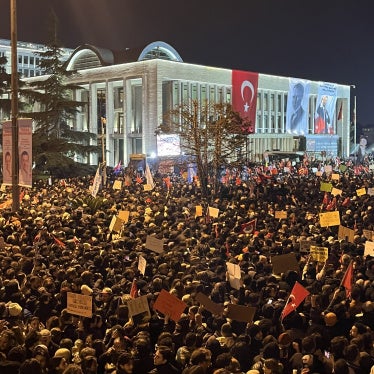
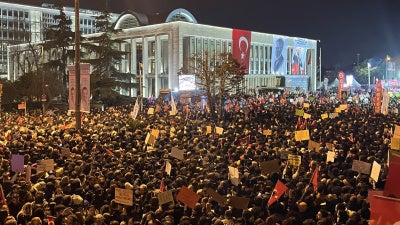
    The Erdoğan government’s use of force in a clampdown on protesters over the weekend has precipitated a deepening human rights and political crisis in Turkey. Human Rights Watch documented a huge wave of arbitrary detentions and police attacks on people who were on hospital premises, as well as on a hospital itself and on makeshift health clinics. With the trade union confederations declaring a strike on June 17, 2013, there were signs of further clampdown on demonstrations in the evening.

Featured Content

Reports

Turkey

  • Jul 1, 2013
    Iraqi, Jordanian, and Turkish border guards are pushing back tens of thousands of people trying to flee Syria. Iraq, Jordan, and Turkey have either closed numerous border crossings entirely or allowed only limited numbers of Syrians to cross, leaving tens of thousands stranded in dangerous conditions in Syria’s conflict-ridden border regions. Only Lebanon has an open border policy for Syrians fleeing the conflict.
  • Jun 21, 2013
    After the Turkish government’s forcible evacuation of Taksim Gezi Park on June 15, bringing to an end the 19-day occupation, police cordoned off the park. Regular police officers now guard its entrance from the square, seated on white plastic garden chairs in a long line at the top of the main steps. The park is sealed off with tape as though it were a crime scene.
  • Jun 18, 2013
    The Erdoğan government’s use of force in a clampdown on protesters over the weekend has precipitated a deepening human rights and political crisis in Turkey. Human Rights Watch documented a huge wave of arbitrary detentions and police attacks on people who were on hospital premises, as well as on a hospital itself and on makeshift health clinics. With the trade union confederations declaring a strike on June 17, 2013, there were signs of further clampdown on demonstrations in the evening.
  • Jun 17, 2013
  • Jun 14, 2013
    It has been a long and eventful week in Istanbul. It will be hard for many who were there to forget the scenes reminiscent of war on the streets around Taksim Square and Gezi Park, the site of the protests, on Tuesday evening and into the night. After apparently conciliatory tweets from Istanbul governor Hüseyin Avni Mutlu to the young protesters occupying Gezi Park just a day earlier, and following indications that the prime minister was ready to sit down to talks over the protests on Wednesday, both leaders made an astonishing about-face.
  • Jun 11, 2013
    The Turkish government’s decision to send riot police into Taksim Square and to teargas tens of thousands of peaceful protesters has all but destroyed efforts to foster a peaceful dialogue between the government and protesters. The demonstrators have been demanding an end to development of Taksim Square and Gezi Park in Istanbul.
  • Jun 11, 2013
  • Jun 6, 2013
    Spend a night in Istanbul’s Taksim Square, and it becomes very clear why protesters are there. They feel that the government ignores them, overlooks them and excludes them. They say their voices are not heard, and that the government serves its own constituency, telling everyone else how to live and what not to say.
  • Jun 1, 2013
    Prime Minister Recep Tayyip Erdoğan’s government should end police violence and excessive use of force against protests across Turkey. Officials should uphold the right to peaceful protest and free speech.
  • May 29, 2013
    Sevan Nişanyan, a Turkish-Armenian journalist, wrote a blog entry last September stating that critical comments about religion don’t constitute hate speech. “Making fun of an Arab leader who claimed he contacted God hundreds of years ago and received political, financial and sexual benefits is not hate speech,” he said. “It is an almost kindergarten-level test of what is called freedom of expression.”