VAAGN MNATSAKANIAN: “In the first days of the war, we had no idea that such a tragedy could take place.”
TETIANA BURAK: “That’s why a lot of people didn’t evacuate.”
MYKHAILO PURYSHEV, MARIUPOL RESIDENT AND HUMANITARIAN VOLUNTEER: “With the onset of the war, everyone’s life changed. Everything changed.”
VOICE IN VIDEO: “Stay back!”
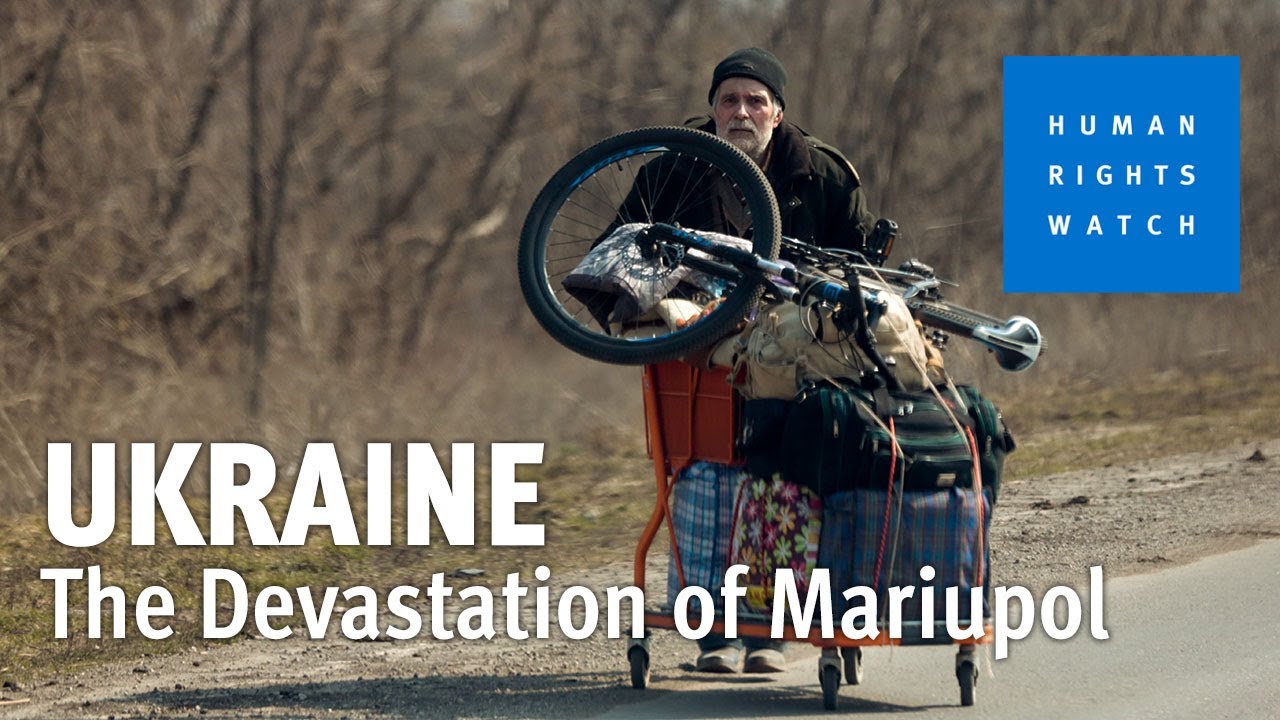
This is the story of Russia’s assault on Mariupol.
A strategic port city in southeastern Ukraine.
These are the interviews, videos, photos, and 3D models that Human Rights Watch, SITU Research, and Truth Hounds used to reconstruct the struggles residents faced as Russian forces took over the city.
This is Mariupol after Russian forces occupied the city. Russia’s full-scale military invasion of Ukraine began on February 24, 2022, as its forces attacked Ukrainian positions defending Mariupol.
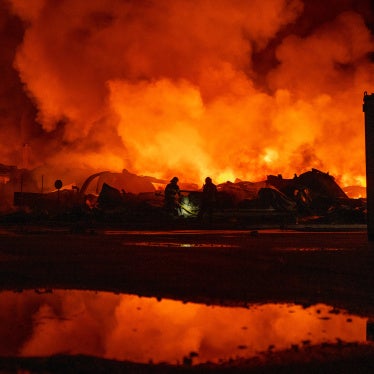
The city was pounded by explosive weapons for weeks.
Much of Mariupol was seriously damaged in the Russian assault. Human Rights Watch and SITU Research conducted a detailed damage assessment of the destruction. While satellite imagery shows damage to rooftops, our modeling reveals more. We used over 850 videos and photos of buildings that we found online and verified, in addition to satellite imagery, to capture the extent of the devastation in the city center. Buildings with damage are seen here in red. Our analysis shows that 93% of the 477 high-rise apartment buildings in this area were damaged. Some of this imagery could help prove war crimes. Our focus was Mariupol’s main avenue, Myru or “Peace” Avenue, and the immediate surrounding area, the city center, which includes cultural hubs, hospitals, schools, and universities.
And this is Mariupol before.
DMYTRO KULYK: “It’s [was] a town with about half a million inhabitants.”
HALYNA MOROKHOVSKA: “Recently, it had blossomed. We had new parks. The city center was well-developed.”
NATALIIA TKACHENKO: “In general, the city was becoming modern and vibrant.
For Russian forces, Mariupol was a strategic prize. It would give them control of one of Ukraine’s largest ports and a land corridor between occupied Crimea to the west and areas Russia had been controlling in Donbas, to the northeast.
As the attack on the city began, tens of thousands of civilians huddled in shelters and basements to escape Russian bombing and shelling. Many people we spoke to relocated to the city center, which they believed to be safe.
DENYS SHEVTSOV: “Most people moved in all directions. To a bomb shelter, to a basement. Some stayed in their apartments. But we believe it isn’t safe to stay in the apartment... We are in the basement now. This is our makeshift bomb shelter. These are the conditions we live in. About 40 people live here with us, about 15 children.”
DENYS SHEVTSOV: “This morning, our yard was heavily shelled. Basically, all the cars were destroyed, and the windows.”
Russian forces used a variety of explosive weapons in Mariupol including aerial bombs and ground-launched artillery, such as projectiles and rockets. The use of these weapons in populated areas is the greatest threat to civilians in contemporary armed conflicts and heightens the risk of unlawfully indiscriminate attacks.
HALYNA MOROKHOVSKA: “An aerial bomb hit the dormitory. My face was torn up. I had cuts everywhere. My arm, chest, stomach, legs.”
VOICE IN VIDEO: “It’s coming from that side.”
VOICE #2 IN VIDEO: Come into the entryway...
DMYTRO KULYK: “Dead bodies became an ordinary sight for me. We were told that seven people died that one day. Two children and five adults.
Under the laws of war, parties have an obligation to do everything feasible to minimize harm to civilians.
These are the maternity and pediatric units of a hospital that Russian forces bombed on March 9.
At least three people were killed, including a pregnant woman and her baby, who was stillborn after the attack. Seventeen people were injured. In this case, witnesses told us that there were no Ukrainian military personnel, vehicles, or installations close by at the time. A deliberate strike on a hospital not being used to carry out attacks harmful to the enemy, is a war crime.
Humanitarian volunteer Mykhailo Puryshev was about 400 meters from the hospital by Pryazovskysi State Technical University.
MYKHAILO PURYSHEV: “Everyone is very, very afraid. Everyone is very afraid. You hear that, don’t you? The rumbling. It’s Mariupol... “
MYKHAILO PURYSHEV: “I heard an airplane approaching… And I shouted “Airplanes!” and we all ran... “
MYKHAILO PURYSHEV: Fucking hell! Go down!
MYKHAILO PURYSHEV: “When I went outside, I saw the full horror of what had happened.”
VOICE IN VIDEO: “Was it a mine?”
MYKHAILO PURYSHEV: “No, an airstrike most likely.”
VOICE IN VIDEO: “Grandma...”
MYKHAILO PURYSHEV: “Drag her, drag her!”
At least two people were killed on the spot. Witnesses said there were no military targets at the university. An attack that is not directed at a specific military objective is a laws-of-war violation and a possible war crime. Numerous images posted on social media and given to us by witnesses helped us assess the damage to parts of the university campus. The fighting damaged vital infrastructure, knocking out the city’s electricity grid, which in turn cut essential services.
DENYS SHEVTSOV: “So, we’re left without gas, without water, without power. We are absolutely isolated from civilization. No internet, no updates. Nothing.”
DMYTRO KULYK: ‘’If you want to wash your hands, this is the only way. So we pick up snow, put it in a bucket. Then we put the bucket on an open fire and boil the water.”
DENYS SHEVTSOV: “Here is our field stove. We live like in the Stone Age in caves. This is what I call really living it up during the war. Bacon, pasta. And shells are flying overhead. As long as they don’t make barbecue out of us.”
DENYS SHEVTSOV: “The city was destroyed. And every day, the city was getting destroyed more and more.”
DMYTRO KULYK: “I am telling you, day after day, these explosions became more frequent. Every day, they got louder and more hellish.”
We used satellite imagery, photos, and videos to track damage across Mariupol. We found 86 out of 89 schools and universities were damaged, and all the city’s 19 hospital campuses. The damage to these facilities devastated health care and education across the city.
VAAGN MNATSAKANIAN: “Every day we thought about when we could leave. But we realized that the city was completely closed off and there was no way to leave.”
In the first two weeks of March, multiple attempts to provide safe passage out of the city failed in the face of Russian obstruction. Arbitrary restrictions on the evacuation of civilians or the delivery of aid would amount to a violation of the laws of war and possible war crimes.
In early March, hundreds of people had gathered at the Donetsk Academic Regional Drama Theater, for shelter and in the hope of getting safe passage out of Mariupol.
Nataliia Tkachenko arrived on March 12 after an attack destroyed her home.
NATALIIA TKACHENKO: “They gave us a bit of food. A soup in the afternoon, a cup of boiled water in the morning and evening. It was something. At home there was no water, no food, nothing. It was dark, there was no electricity. It was impossible to use the toilets. There was no water. Nobody was cleaning them. It was a nightmare. No one was walking around the theater. Only kids were running around because kids will be kids. They were playing and laughing.”
At least 500 people were sheltering at the theater on March 16. Giant Cyrillic letters spelling “children” were painted on the ground in front and at the back of the theater. These words were clearly visible on satellite imagery.
Nataliia was bringing water inside, by the main entrance.
NATALIIA TKACHENKO: “And at that moment, the bomb struck. The shockwave hit us. Everything was flying around. Cement got in my mouth, eyes, everywhere. Shards of wood and glass. I couldn’t hear anything except the humming, the cracking.”
Satellite imagery, videos, and photographs of the theater show that the central part of the roof and the northern and southern walls were destroyed. At least 15 people were killed and the total number has not been determined. Given the absence of a military target at the theater, it appears that Russian forces deliberately attacked civilians, which would amount to a war crime.
Those responsible for war crimes in Mariupol should be held to account. By reviewing official Russian government statements, social media posts, and obituaries of Russian soldiers, we identified 17 military units that took part in the 2022 siege of Mariupol.
Considering the extent of the military operation, the highest levels of Russian command likely knew the situation in the city and were involved in the planning, execution, and coordination of the actions of the Russian and Russia-affiliated forces.
Those responsible for the conduct of Russian forces during the siege of Mariupol include President Vladimir Putin, the Commander-in-Chief of the Armed Forces, Minister of Defense Sergei Shoigu, and Chief of the General Staff of the Armed Forces, Valery Gerasimov, among others.
As the battle for the city raged, food and other basic supplies ran low.
VOICE IN VIDEO: Wait. Step back a little.
MIKHAILO PURYSHEV: You may crush others! Please!
MIKHAILO PURYSHEV: “The worst problem was probably not with food or heat, but with medication. And people were just dying because there was none. The people who suffered the most were older people and children.”
Thousands were killed in attacks. Others died from health complications due to lack of medicine and clean water.
MIKHAILO PURYSHEV: “Mariupol is a big, big, big, big cemetery. There were a lot of people left under the rubble. So it remains to be seen how many people died there.”
TETIANA BURAK: “We were horrified at what we saw because there were burnt multi-story houses and bodies in the streets.”
HALYNA MOROKHOVSKA: “It was impossible to count them because people were buried under the debris, on the roads.”
Many were buried in a makeshift trench grave in the Old City Cemetery.
VAAGN MNATSAKANIAN: “We filled one trench [with bodies] completely. There were about 200 bodies.”
These bodies from the trench grave and many other makeshift graves across the city were exhumed and reburied in the city's cemeteries when Russian forces took over. We estimated the minimum number of people killed by fighting or who died of poor conditions. To do so, we counted graves in two types of burial sites. In some cases, we counted individual graves visible in high resolution satellite imagery. We also estimated the number of bodies buried in trench-type graves. We verified footage at two cemeteries which allowed us to count the plaques, sticks with a small wooden panel, in a given area. We then used this sample size to extrapolate to other parts of the cemeteries. In five cemeteries in and around Mariupol between March 2022 and February 2023, we estimated at least 10,284 new burials.
We do not know how many of these people were civilians. Considering average annual death rates in Mariupol, we calculated more than 8,000 people would not have died were it not for the attack on the city. This is likely a significant underestimation of the total number of dead, as many graves contained multiple bodies and the remains of others were likely buried in the rubble and taken away during demolition efforts.
With the city still under Russian occupation and much of the physical evidence destroyed, the full death toll may never be known.
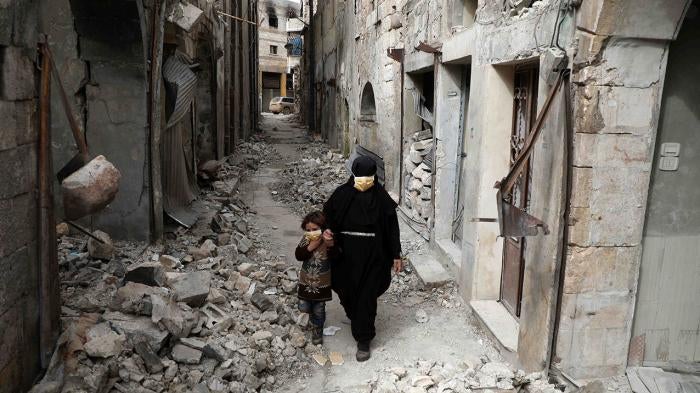
DENYS SHEVSTOV: “Look around. What is going on, what’s happening in our Mariupol. It’s completely destroyed. Completely gone, just disappeared. Just nothing. Just ruins.”
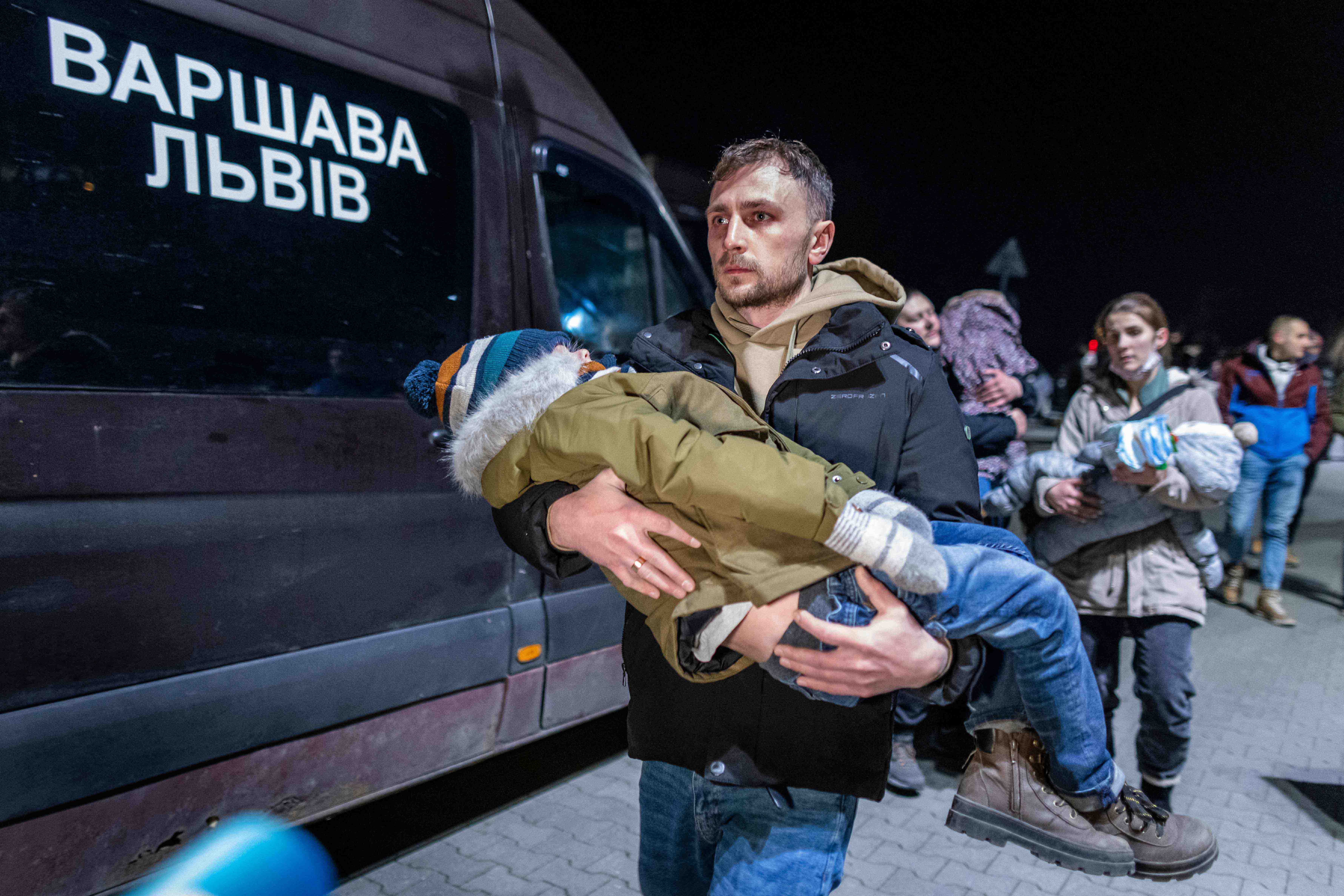
With attacks by Russian forces continuing, tens of thousands of residents found their way out of the city at great personal risk beginning in mid-March.
DENYS SHEVSTOV: “We were hoping war suddenly will stop and finally we realized this is not going to happen, we decided to run away. We hope we will be fine but overall, it’s been horrible, just horrible.”
By mid May 2022, Russian forces had full control of the city.
The bombs might have stopped now but the city’s tragedy is far from over.
The psychological effects of the fighting, displacement, and the losses that Mariupol’s residents experienced will reverberate for years to come.
DMYTRO KULYK: “Mariupol is a city that has become hell.”
TETIANA BURAK: “People should know what is happening.”
VAAGN MNATSAKANIAN: “We realized that no matter how much we want our pre-war life, our city, our friends, our loved ones, our apartments, we won’t get them back”
This footage is from October 2022. Since occupying the city, Russian forces are demolishing buildings and constructing new ones. Russia is also replacing Ukrainian culture with its own.
For justice to be done, the survivors of Mariupol need reparations for their losses. The loss of their homes, their loved ones, their livelihoods, and the impact on their mental health.
Russian officials and military commanders credibly implicated in war crimes committed in the city need to be brought to justice.
NATALIIA TKACHENKO: “When I got to Ukrainian territory, my first words were, “These people should be punished!””
END