Imperatives for Immediate Change
The African Union Mission in Sudan
Glossary
AMISAfrican Union Mission in Sudan: Generic name for the mission, but also used in this report to describe the mission from its establishment in June 2004 to its first enhancement in October 2004
AMIS IIAfrican Union Mission in Sudan II: The mission from the first enhancement in October 2004 until the second enhancement effective from July 2005
AMIS II-EAfrican Union Mission in Sudan II-Enhanced: The current mission, in operation since July 2005
A.U.African Union
Chapter VIIChapter of the Charter of the United Nations that provides for a UN military response to threats to the peace and acts of aggression.military enforcement by states.
CFCCeasefire Commission
CONOPS Military Concept of Operations
DITFDarfur Integrated Task Force, a body reporting to the African Union Peace and Security Council
DPKOUnited Nations Department of Peace Keeping Operations
CivPolCivilian police observers within AMIS
FOCFull Operational Capacity
GoSGovernment of Sudan
HCFAHumanitarian Ceasefire Agreement, signed on April 8, 2004, in N'Djamna, Chad
JanjaweedEthnically-based militias backed by the Government of Sudan
J.C.Joint Commission, the reporting body of the Ceasefire Commission established under the April 2004 Humanitarian Ceasefire Agreement
JEMJustice and Equality Movement, one of two principal rebel groups fighting the Government of Sudan in Darfur
MilObsMilitary Observers
MSCMilitary Staff Committee under the African Union Peace and Security Council
P&SCAfrican Union Peace and Security Council
PSOInternational Peace and Security Operation
QRFQuick Reaction Force
SLASudan Liberation Army/Movement, one of two principal rebel groups fighting the Government of Sudan in Darfur
UNMISUnited Nations Mission in Sudan, responsible for 10,000 peace support troops deployed in Sudan pursuant to the north-south peace agreement.
I. Summary
The conflict in Sudan's Darfur region is far from over. Since it began in February 2003, two million people have been expelled from their homes by the Sudanese government's campaign of crimes against humanity and "ethnic cleansing" conducted in the name of counterinsurgency, and are trapped in refugee camps in neighboring Chad or in internally displaced persons' (IDP) camps inside Darfur. Small-scale attacks by government forces and government-backed militias continue against civilians, while the actions of rebel groups and opportunistic bandits further subject Darfur's civilian population to abuse and insecurity. Ethnic cleansing threatens to become consolidated, as civilians remain confined in camps exposed to violence and human rights abuse that prevent them from returning to their homes and claiming back their land.
This report examines the evolving role in the Darfur conflict of the African Union Mission in Sudan (AMIS) from its inception as a ceasefire monitoring body in June 2004 to its current incarnation, AMIS II-Enhanced (AMIS II-E). The report identifies ways AMIS II-E can be immediately strengthened to improve protection for civilians. It also looks at factors that must be taken into account in any further transformation of AMIS II-E, one possible direction being incorporation into a United Nations mission (an option that is reportedly to be considered at the January 2006 African Union summit meeting). The report is based on an expert technical military assessment of the African Union Mission in Sudan as well as on Human Rights Watch's extensive research and reporting on the human rights and humanitarian crisis in Darfur.[1]
On April 8, 2004, the Sudanese government and two Darfur rebel groups-the Sudan Liberation Army and the Justice and Equality Movement-signed an African Union-mediated humanitarian ceasefire agreement in which the A.U. was mandated to send military observers to monitor and report on the ceasefire.Hopes were high for the success of this all-African operation, the first ever by the A.U., created in 2004.But the ceasefire was more fiction than reality: with all parties repeatedly in breach of the ceasefire agreement, AMIS was confronted early on by challenges and expectations beyond its capabilities. The Sudanese government's failure to protect civilians-indeed its continued attacks on civilians-increased pressure on the observer mission to take on the role of proactive civilian protection.
October 2004 saw an increase in numbers of AMIS personnel as well as changes to the mission mandate and structure.AMIS was transformed from a contingent primarily of unarmed military observers to a major operation that included armed force protectors, unarmed civilian police, and support teams. By then the military mandate of AMIS was essentially four-fold: to monitor and observe compliance with the ceasefire agreement; to assist in confidence building measures; to contribute to a secure environment by facilitating humanitarian assistance and returns of internally displaced persons; and to contribute to overall security. But while the mandate of the mission may have been clear, its effective implementation remained a concern. Mission personnel lacked training, operational capacity and political initiative to achieve the mandate through proactive mission operations within the mission's rules of engagement in the face of continuing lack of respect for the ceasefire agreement. Poor planning, logistical difficulties and external factors such as weather compounded the mission's problems and hampered its impact from the start.
Faced with a potential failure of this high-profile undertaking, the A.U. decided in the first quarter of 2005 to accept military planners and budgetary and logistical experts from outside the continent to provide training and improve operations, as well as to bring in substantial military equipment, such as armored personnel carriers. This marked a significant change in the approach and capacity of AMIS. The A.U. led a March assessment mission with the participation of the United Nations Department of Peacekeeping Operations (DPKO), the European Union, the United States, Canada, and other international partners.The outcome of this assessment resulted in a jump-start for the mission's initially slow deployment: at a May 2005 conference, international donors pledged over U.S. $312 million to enhance the AMIS mission from 3,320 personnel to a total of 7,700 personnel. The assessment mission recommended no change to AMIS's mandate, but a re-prioritization of tasks to achieve the mandate: contributing to a secure environment was given top priority, recalling the mission's specific task from October 2004 to "[p]rotect civilians whom it encounters under imminent threat and in the immediate vicinity, within resources and capability, it being understood that the protection of the civilian population is the responsibility of the Government of Sudan."[2]
The full deployment of the enhanced mission AMIS II-E that was to have taken place by September 2005 had not been achieved as of year's end, however. A further assessment mission of AMIS II-E was conducted on December 10-20 by the African Union, the United Nations and other concerned international actors. In view of that assessment mission's imminent presentation of findings, it is crucial to look closely at AMIS's performance to date, including its weaknesses and strengths, to determine what next steps are necessary to ensure AMIS has immediate maximum impact on civilian protection and contributes to the reversal of "ethnic cleansing" in Darfur. A central conclusion drawn from the examination undertaken here by Human Rights Watch is that the African Union Mission in Sudan must provide a more aggressive response to the persistent violence against civilians in Darfur and must be equipped and supported to do so. As a top priority, the mission and its partners need to complete the entire AMIS II-E deployment of military troops, civilian police and equipment. The Sudanese government until very recently refused entry into Darfur for months of vital equipment needed by AMIS to fulfill its mandate.All possible pressure must be put on the Sudanese government to stop impeding the full deployment and operations of AMIS.
At present, the only available option for civilian protection in Darfur is aggressive patrolling by AMIS troops properly equipped with armored personnel carriers (APCs), attack helicopters and other necessary equipment with clearly defined and understood rules of engagement among all troops that permit them to use deadly force to protect civilians. AMIS's mandate and mission tasks already provide for the protection of civilians under imminent threat, but AMIS forces need to apply their rules of engagement more proactively. The rules of engagement must be clarified or modified so that deadly force is explicitly permitted to protect civilians, including humanitarian operations under imminent threat. This change also requires that the decision to use deadly force be delegated from the force commander to the sector commanders in the field where decisions to escalate are most imperative and must be made on a timely basis. As well, AMIS should deploy in each sector, fully equipped (with artillery) quick reaction forces to respond immediately to civilians and humanitarian operations under imminent threat with rules of engagement that provide for the use of deadly force.To further strengthen civilian protection, AMIS civilian police (CivPol) tasks should be augmented and reformulated to provide CivPols with the power to arrest persons engaged in criminal activity.
These are steps that would bolster the existing AMIS II-E. Debate is ongoing as to whether AMIS could and should be further transformed including through integration into a non-A.U. institution. The possibility of placing the AMIS operation under U.N. authority is one option under serious consideration, primarily for financial reasons, and at this writing it is reported to be on the agenda of African Union summit meeting in Khartoum, Sudan, on January 23-24, 2006. Over and above the objective of fiscal stability, reasons of logistical enhancement and the well-established and tested command and control structure needed for such a large mission may well recommend that AMIS be "blue-hatted" or folded into the U.N. peace support mission running parallel to AMIS in the rest of Sudan. This merger would be desirable only so long as it would not reduce the mandate, mission tasks, rules of engagement or equipment AMIS has or plans to acquire. As African Union leaders and A.U. and U.N. planners consider this option, they will need to ensure that any attempt to integrate or acquire AMIS operations does not diminish in any way the response capability of the mission in protecting civilians.Even if a decision were made to "blue hat" AMIS, it is clear that any transfer would take many months.In the short term, AMIS can take immediate measures to improve civilian protection and resources and political pressure must be applied to ensure that it has the capacity, will and support to protect civilians in Darfur.
This report was researched and written by staff and consultants in the Africa Division of Human Rights Watch. Primary research sources were the reports of the AMIS military planners, and interviews with African Union, United Nations, European Union, NATO and Canadian government personnel and military plannersand diplomats.
II. Recommendations
Recommendations for Current AMIS operations
Having completed a detailed examination of the technical capacities of the AMIS II-E, and in view of our extensive research on the situation in Darfur, Human Rights Watch makes the following recommendations for ways in which mission operations may be immediately improved to protect civilians and which are urgently needed whatever the mission's future evolution might be. A second set of recommendations follows on the possible transfer of AMIS to a United Nations mandate.
To the African Union
- In view of escalating insecurity across Darfur, urgently put in place measures to immediately enhance the performance of AMIS II-E. To this end:
oExpedite the completion of AMIS II-E in its entirety, including the full deployment of all 6,171 military personnel, 1,560 civilian police and equipment;
oProactively and aggressively interpret AMIS's mandate to protect civilians and humanitarian operations;
oClarify that AMIS rules of engagement apply to the tasks of protecting civilians and humanitarian operations under imminent threat, and ensure that the rules allow for use of deadly force in the execution of these tasks;
oDelegate more control over the use of deadly force to sector commanders, to increase effectiveness;
oEnsure that the rules of engagement are supported and implemented by sector commanders and understood by soldiers through practical training. To this end, ensure that troop contributing countries provide soldier rules of engagement cards in the appropriate language, and that these cards are disseminated;
oDeploy in each sector fully equipped quick reaction forces to respond immediately to imminent threats to civilians and humanitarian operations, with rules of engagement that provide for the use of deadly force;
oProvide civilian police with some arrest powers (particularly in areas where no Government of Sudan presence exists), facilities, equipment, and procedures to enable them to detail and document alleged perpetrators before turning them over to the Sudanese authorities; and
oPressure the government of Sudan to desist from any action hindering the deployment and full operationalization of the Canadian-loaned armored personnel carriers, and other equipment and supplies.
- As recommended in the A.U., U.N., and E.U. March 2005 assessment of AMIS, ask donors to provide attack helicopters to enhance AMIS's capacity to protect civilians.[3]
- Change the composition of the ceasefire monitoring teams and remove members of the parties to the conflict from the investigative body. They should retain the right to see and comment on the commission's findings before they are published, but within a limited (e.g. one-week) period. If any party disagrees with the final report it should file a dissenting report.
- Due to Sudanese government obstruction of AMIS operations, ensure that Sudanese President Omar El Bashir is not elected to the presidency of the A.U. at the January 2006 African Union Summit.
- Pending a decision on transfer of the mission to a United Nations mandate:
oStart planning for additional troops above the AMIS II-E levels of 6,171, including staff checks with troop contributing countries and discussions with donors about securing logistical and financial resources to support an increased force posture;
oUrgently generate and deploy additional civilian police above the AMIS II-E levels of 1,560 to provide improved visibility and protection around camps for internally displaced persons and vulnerable villages; and
oAssess the impact of the current operational command and control structure via force and mission headquarters, which competes with a "national" linear command and control structure (in which troop contributing countries nominate a national commander to oversee sector commanders, who in turn oversee national battalion groups).
To the Government of Sudan
- Ensure that Sudanese military forces and police cooperate fully with African Union Mission in Sudan forces. Deploy only experienced units of the Sudanese government armed forces in Darfur.
- Immediately remove all obstacles to the deployment and operation of AMIS by:
oExpediting deployment and operationalization of the Canadian-loaned APCs, tactical air support and other equipment and services requested by AMIS;
oExpediting entry procedures for the A.U. and its partner personnel, and facilitating their full and unimpeded access throughout Darfur;
oSupporting A.U. requests for any additional AMIS troops and civilian police and for policing powers to AMIS police;
oEnsuring that all state security forces and government-backed forces cease committing violations of human rights and humanitarian law;
oUnconditionally ceasing to provide arms and logistical, financial, and other support to all militia groups, and disarm them; and
oFacilitating safe and unhindered access for humanitarian relief operations to all civilians in need of assistance throughout Darfur.
To the United Nations Security Council
- Urge member states to continue to provide the African Union Mission in Sudan with funding including with sufficient cash to enable AMIS to effectively protect civilians and humanitarian operations, and with all necessary communication, logistical and technical support. Promptly pass a resolution demanding that the Sudanese government fully cooperate with the A.U. and the continuing AMIS mission, and desist from placing any obstacles in the way of AMIS deployment and operations.
To partner Governments: the United States, the European Union and its member states, and the member states of the Arab League
- Ensure adequate allocation of funding for the completion of AMIS II-E deployment, infrastructure, and ongoing operations pending any change to the mission's status. Fund the urgent enhancement of AMIS's ground and aerial mobility. Insist that the government of Sudan promptly and fully remove obstacles to the deployment of AMIS and fully support and facilitate AMIS operations.
- Pending a decision on transfer of the mission to a United Nations mandate:
oSupport planning for additional troops above the AMIS II-E levels, including pledging logistical and financial resources to support an increased force posture, and providing attack helicopters to enhance AMIS's capacity to protect civilians; and
oSupport an immediate and substantial expansion of the AMIS civilian police component through logistical and financial support and expertise.
Recommendations on a possible transfer to a U.N. mandate
To the United Nations Security Council and the African Union Peace and Security Council
- Ensure that the U.N. Security Council and the African Union Peace and Security Council work closely to develop plans, building on the recommendations of the forthcoming A.U.-U.N. assessment mission report, to ensure sustainable and long-term protection in Darfur, through a likely transition to a U.N. mandated force.
- Ensure that any United Nations mission mandated for operations in Darfur preserves and strengthens the capacity to act robustly to protect civilians.
- Should AMIS be folded into the existing United Nations Mission in Sudan, ensure that any merger does not diminish the mandate, mission tasks, rules of engagement or equipment AMIS has or plans to acquire, unless these are rendered unnecessary by a durable peace agreement.
- Recognize that a mission in Darfur requires rapid reaction forces, APCs, helicopters and attack helicopters, and a more robust profile than the current U.N. Mission in Sudan is deploying. Define the terms of reference for operations in Darfur accordingly.
- Ensure close collaboration by the U.N. Department of Peacekeeping Operations with A.U. headquarters and AMIS personnel to ensure that the successive evaluations of AMIS operations are fully reflected in planning and implementation of a U.N. mission in Darfur.
To the Government of Sudan
- Should the African Union and the United Nations Security Council decide on the transfer of the African Union Mission in Sudan to a U.N. mandate, cooperate fully with the United Nations in the deployment and operations of forces under a U.N. mandate in Darfur, including accepting inclusion of forces from outside Africa as part of such a mission.
To the United Nations and African Union member governments
- Contribute personnel, equipment, funding and other resources to any mission under U.N. auspices that replaces the African Union Mission in Sudan.
III. Background: Mission Evolution from Ceasefire Commission to AMIS II-E Conception
A. April 2004 agreement establishing Ceasefire Commission and AMIS
In April 2003 two rebel groups, the Sudan Liberation Army/Movement (SLA) and the Justice and Equality Movement (JEM), attacked and destroyed several Sudanese air force planes on the ground in Fashir, the principal city of Darfur.[4]Soon after, the Sudanese government launched a counterinsurgency campaign of "ethnic cleansing" against civilians of the Fur, Zaghawa and Masalit ethnic groups-the same ethnicities as the rebels-assisted by militias drawn from rival ethnic groups, known as the "Janjaweed," whom the government supported, armed and trained. By mid-2004, hundreds of thousands of civilians had been displaced, thousands had been killed, and hundreds of villages had been burned and looted.[5]
On April 8, 2004, under the auspices of Chadian mediation, representatives from the Darfurian rebel movements and the Government of Sudan (GoS) signed the Humanitarian Ceasefire Agreement (HCFA) in N'Djamna, Chad, along with its Protocol on the Establishment of Humanitarian Assistance in Darfur. In doing so, the parties agreed to accept an automatically renewable cessation of hostilities; to create conditions allowing for the delivery of emergency relief, including the facilitation of humanitarian assistance; and to establish a Ceasefire Commission (CFC) to monitor the Agreement along with a Joint Commission (JC) to which it would report.[6]
In agreeing to the establishment of a Ceasefire Commission, the parties to the HCFA accepted an offer from the African Union (which had been closely involved in bolstering the peace process leading to the agreement at N'Djamna) to monitor ceasefire compliance. The A.U. Special Envoy for Sudan, Ambassador Baba Gana Kingibe, had met with Sudanese and Chadian government officials in March 2004 to discuss the role of the African Union in the Darfur crisis, and in late March, Ambassador Sam Ibok of the A.U. Peace and Security Department had led a team to N'djamna for further meetings on the A.U.'s role in addressing the situation. These discussions had paid particular attention to the humanitarian consequences of the ongoing conflict and the possible mobilization of assistance from the international community, primarily African states. Following the signing of the Humanitarian Ceasefire Agreement, the A.U. Peace and Security Council (P&SC) on April 13, 2004, requested that its Chairperson dispatch an urgent reconnaissance mission to prepare for the deployment of the CFC and to assess the need for a Protection Force for its military observers.[7]
The P&SC reported that in addition to a dramatically deteriorating humanitarian crisis, attacks against civilians had increased "both in scale and brutality."[8] Accordingly, immediate technical consultations concluded with an A.U. proposal for the CFC, including the possible deployment of an unspecified number of African Military Observers (MilObs) to monitor the Humanitarian Ceasefire Agreement. This plan was submitted to the Sudanese parties for approval on April 29, 2004. In a follow-up reconnaissance mission, representatives from the A.U., the Chadian mediation, and the international community met with the Sudanese parties, U.N. agencies and humanitarian organizations to obtain information required for rapidly launching operations.[9]
The Ceasefire Commission, with the African Union Monitoring Mission (AMIS) as its operational arm, was launched with the May 28, 2004 signing in Addis Ababa of the Agreement on the Modalities for the Establishment of the Ceasefire Commission and the Deployment of Observers in Darfur. This second agreement by the Sudanese parties determined the composition and mandate of the CFC, as well as the modalities for its monitoring and verification of alleged violations, and made provision for a protection element for the MilObs.
B. AMIS and AMIS II
After an advance mission to secure the headquarters site at Fashir and to negotiate the Status of Mission Agreement with the Government of Sudan in Khartoum, AMIS became operational on June 19, 2004 when CFC Chairman then-Brig. Gen. Festus Okonkwo of Nigeria reported for duty.[10]
During the period from the April signing of the Humanitarian Ceasefire Agreement to the June beginning of AMIS/CFC operations, the absence of commitment to the ceasefire by parties to the conflict was already evident, with forced displacement and attacks on civilians continuing unabated (although access by humanitarian agencies improved-see below). That AMIS was effectively monitoring the absence of a ceasefire, rather than its maintenance, was evident from the mission's earliest reports. Consequently, the A.U. almost immediately began rethinking AMIS's operations.
The P&SC Chairperson's report on July 4, 2004, three weeks after AMIS became operational, expressed concern about ceasefire violations by all parties to the conflict, as well as ongoing abuses of international human rights and humanitarian law, such as the aerial bombardment of villages by the Sudanese government. The Chairperson also recalled the Sudanese government's September 2003 commitment, and a reaffirmation of this commitment in June 2004, to control and disarm "irregular groups" contributing to the lawlessness and insecurity in Darfur.[11]
The A.U.'s Peace and Security Council on July 27, 2004, requested that the CFC assess the situation in Darfur and submit recommendations on how to enhance the effectiveness of AMIS's impact on the ground. This resulted in the introduction of a MilOb Protection Force of 310 troops.[12]Despite regular patrols by MilObs "to promote confidence building," the P&SC between July and October noted continuing violations of the ceasefire, including alleged Janjaweed raids; helicopter attacks, arson, destruction of civilian life and property, and hindrance of a CFC investigation by Sudanese government forces; and a range of abuses by the SLA/M (ambush, assault and abduction of health workers; extortion of commercial goods; recruitment and arming of child soldiers, and unlawful collection of taxes).[13]
On September 1 the parties agreed to a Protocol on the Improvement of the Humanitarian Situation in Darfur, primarily concerned with the free movement of humanitarian workers throughout the region. By October the Sudanese government was curbing abuses and refrained from large-scale coordinated attacks on villages-although village destruction was well advanced by then. It agreed to work with the International Organization for Migration on planning returns of internally displaced people, but displacement, carried out through small-scale government and militia attacks, continued to mount. Describing the situation in Darfur as an uneasy calm in which lawlessness "continued unabated," the CFC Chairperson's October 2004 report noted a serious humanitarian situation amid these violations, despite an increase in the number of agencies operating in Darfur.[14]
The September Protocol on the Improvement of the Humanitarian Situation included the request by the parties that the A.U. take all necessary steps to "strengthen AMIS on the ground." However, there was no agreement on a plan to facilitate AMIS monitoring functions or on implementation procedures for the Protocols. Additionally, no modalities for neutralizing and disarming the Janjaweed militias were established.[15]
Rethinking AMIS operations, and the transition to AMIS II
The report of the CFC Chairman on October 20, finding that AMIS, where deployed, had contributed to overall security but was limited by issues of logistics and scale, proposed to increase the military component to 2,341 and to introduce a civilian police (CivPol) component of 815. Effectively broadening the AMIS mandate from simply monitoring compliance of the HCFA, the October plan called for a "balanced force" capable of implementing a mandate that would include instructions to:
monitor"proactively";
report any violations of the CFC in accordance with the guidelines established in the relevant agreements;
assist in "the process of confidence-building";
contribute to the security of the environment to allow for the delivery of humanitarian assistance;
contribute to the security of the environment for the "longer-term objective of supporting the return of IDPs and refugees to their homes"; and
Contribute to the improvement of the security situation in Darfur, "it being understood that the responsibility for the protection of the civilian population lies with the GoS."[16]
Endorsing this plan for a transition to what became known as AMIS II, the P&SC also decided that within the framework of AMIS's revised mandate, it should perform a number of tasks including "Protecting civilians whom it encounters under imminent threat and in the immediate vicinity, within resources and capability, it being understood that the protection of the civilian population is the responsibility of the government of Sudan."[17] The P&SC determined that the enhancement of AMIS to commence in November 2004 should be completed within 120 days of receiving its mandate.[18]
(For detailed analysis of the AMIS mandate and rules of engagement, see Section V, below.)
Logistical challenges
Under AMIS, five CFC sector sites, each with two MilOb teams to conduct verification and investigation, were established in Darfur at El Fashir, Nyala, El Geneina, Kabkabiyah and Tine, and at Abch in Chad. The plan for AMIS II increased sector sites from five to eight in Darfur with the addition of Kutum (Sector 6), Zalingue (Sector 7), and El Daien (Sector 8). The new AMIS II sectors would give rise to 15 MilObs Groups Sites (MGS), including one in Abch, comprising two MilObs teams and protection forces per site, each of which would have an operational radius (by ground) of 60-70 kilometers.[19]
The Chairperson's report to the P&SC on July 4, 2004 cited logistical problems hampering initial efforts to deploy the MilObs in Darfur, in particular a lack of accommodation in Fashir as well as slow construction of camps at regional sites. By September "organizational constraints" were still being cited, including poor infrastructure, as the mission continued to experience delays in the construction or improvement of office and accommodation sites as well as transportation routes between the sectors. Significant progress to overcome the accommodation problem was reported in early 2005, however.
Elements of personnel deployment were slow under AMIS's deployment schedule: although the protection element of 310 to support roughly 30 AMIS MilObs already operating in Darfur arrived in the region, in two companies provided by Rwanda and Nigeria, in late August,[20] by January 2005 the CFC Chairman reported that only 7 of the intended 815 CivPols were on the ground.[21]The target full operational capacity (FOC) assumed that all forces would be in place by midApril 2005, but only 2,200 of the full 3,320 were in place by that time.
Recognizing these severe shortcomings, the Chairperson acknowledged that much more needed to be done "if the deployment [was] to be completed with the urgency required by the evolving complexity of the situation."[22] To address this reality, the Ceasefire Commission in January 2005 established the Darfur Integrated Task Force (DITF) at A.U. headquarters in Addis Ababa with the aim of supporting AMIS with "strategic planning and support." The DITF would be responsible for scheduling deployment and coordinating with international partners to this effect.[23]However, the DITF in turn reportedly faced problems getting personnel and accommodation.[24]
Insufficient funding for AMIS was a further obstacle to mission planning and implementation. The P&SC in October 2004 updated its appeals for international support but by April 2005 only U.S.$43 million of U.S.$248 million pledged had been received in addition to substantial in-kind contributions. Most of the cash pledge was for "personnel costs." However, the CFC Chairman in April 2005 stated that the mission was not experiencing any financial difficulties.[25]
AMIS II Operating Environment
The period following the October 2004 plan was marked by a deterioration in the human rights situationon account of a government militaryoffensive taken under pretext of securing "safe areas" for the U.N. In its attacks on civilian villages during this period, the Sudanese government deployed Antonov aircraft and helicopter gunships in violation of its earlier agreement with the A.U.,[26] and this led to the end of peace negotiations with the rebels for another seven months.
In late January 2005, the Security Council referred the case of Darfur to the International Criminal Court for crimes against humanity. After more government attacks on villages in Darfur in February, the government refrained from such attacks for several months as AMIS's deployment unfolded slowly (see below). However, Janjaweed attacks continued, notably against civilians in Jabel Marra in April 2005 and rebel abuses and banditry began to increase, with more attacks on AMIS itself as well as on commercial vehicles. The April 2005 report by the CFC Chairperson concluded that compliance with the Ceasefire Agreement was "insufficient" and the security situation in Darfur was "unacceptable" during the period in question.[27]
C. From AMIS II to the Beginnings of AMIS II-E
AMIS first and second phase effectiveness
The evolution from AMIS to AMIS II and ultimately towards AMIS II-E was clearly directed by the various assessments of mission effectiveness in the face of the grave external challenge of the security environment. In particular, neither AMIS nor AMIS II was deployed, structured or mandated to replace host nation security responsibilities, but rather to contribute to security, yet there was a clear and continuing reality on the ground that the Sudanese government had abrogated its responsibility to protect its own citizens.
There were internal structural and operational shortcomings in AMIS and AMIS II aside from the logistical and donor support challenges mentioned above.Some of these related to the Civilian Police (CivPol) component. It was clearly a mistake in the initial conception of AMIS that a civilian police component was lacking, an absolutely critical partner in the overall mandate. This oversight, while recognized in the Chairman's October report leading to AMIS II, probably cost the mission countless weeks and perhaps months of progress.
The CivPol tasks developed within AMIS II centered on confidence building, mentoring of the Government of Sudan police capability in and around IDP camps, as well as investigating non-compliance with the ceasefire.[28] However, one aspect of CivPol work is illustrative both of the achievements of confidence building, and the shortcomings arising from inadequate rules of engagement: CivPol as well as AMIS military patrols began to accompany women and girls gathering firewood, a necessary task that exposed them to attack and rape.These patrols were very well received by displaced persons and hundreds of people began to participate, including men. But sexual violence against women and girls continued to be rampant as no measures had been undertaken to seriously investigate or prosecute any of these crimes. Those few women who reported sexual assaults to the Sudanese police in many cases found they were mocked and humiliated. Unmarried women and girls who became pregnant from these rapes were threatened with jail for adultery on the basis of pregnancy outside marriage. The inability of CivPols to arrest those implicated meant that, even if they gathered sufficient evidence to identify the rapist or attacker, their investigation was disregarded by the Sudanese police and it never resulted in arrests or trials.[29]
One significant achievement was the A.U.'s use of the reports detailing government involvement in attacks to pressure the government of Sudan to cease flying Antonov airplanes in Darfur; it also secured the government's agreement to cease offensive flights in Darfur altogether. As the government had previously denied all use of airpower in its offensive military operations, being able to confront it with evidence was instrumental in securing agreement. Publication of the ceasefire violations and other findings on the Internet provided the greater public with information on AMIS's work and benefited policymakers and donors, although the information usually did not trickle down to the civilian population.
As described above, the period after AMIS II came into being but before its increased numbers were deployed was marked by deterioration in the human rights and humanitarian situation arising from the government's South Darfur offensive in November-December 2004 and January 2005.
Once AMIS II began its enhanced deployment, in early 2005, marginal improvement in security was evident, noted by the reduction in both ceasefire violations and some rights abuses. With the inclusion of a Combat Support component including intelligence, communications and engineers and Combat Service Support such as logistics and military police capability, the force was more balanced and had an integral, albeit limited, self-sustainment capacity. This allowed the force to be mobile for greater distances and time enhancing its security role and visibility. Many international sources indicated to Human Rights Watch that security improved just by the increased AMIS II deployment and patrolling footprint.
March 2005 Assessment
Despite some improvements, the ceasefire violations, militia attacks, lawlessness, human rights abuses, and humanitarian crisis continued. The P&SC led a joint assessment mission in March 2005 with the U.N. and other international partners to identify "all possible" means to strengthen AMIS and to further enhance its effectiveness. Citing changes in the dynamics of the demands placed on military observers, the Chairperson reported to the P&SC that there existed an "increasing need for AMIS to be much more proactive." Although this assessment mission did not see a need to alter the mission's mandate, it recommended the re-prioritization of certain operational tasks, including focusing on improved humanitarian access, confidence-building, and coordination with Sudanese police. While the mission report states that the A.U. force should "be in a position to promote a secure environment across Darfur," it also acknowledges that "the need for permanent deployment in all areas will be proportional to the level of responsibility assumed by the GoS and the rate of IDP returns." The mission, noting the limits of AMIS II despite having almost reached full troop deployment, identified weaknesses in its structure, including "command and control, logistic support and operational practice."[30]
In a paper published in April 2005, Commander Seth Appiah-Mensah, military advisor to the special representative of the chairperson of the African Union Commission (SRCC) and head of the AMIS headquarters in Khartoum, suggested that many of the shortfalls and limitations experienced by AMIS were due to a "seriously constrained" concept of operations (CONOPS), a "chronic lack of resources," serious "strategic and operation gaps," and effectively crippling intelligence and communication gaps.[31]In addition, difficulties with contractors have been cited.[32] Many of these issues, including a problematic lack of civil-military coordination and critical problems with the provision of adequate medical services, were acknowledged and reflected upon in the report of the March 2005 assessment.[33]
To address these problems, and to improve support of the mission's troubled CivPol component, the assessment exercise recommended a two-pronged enhancement of AMIS II, with a "possible follow-on operation" to be decided upon pending the full completion of the first two phases. Phase One was scheduled for completion by the end of May 2005 in the capacity detailed in the October 2004 enhancement (AMIS II) of the original plan (AMIS). Phase Two (AMIS II-E), envisioned a significant strengthening of AMIS II, with expectations for this phase described as "improved compliance" with the N'Djamna Agreement and security-including access to humanitarian relief-for IDPs and other vulnerable populations, recognizing that the Sudanese government is ultimately responsible for the welfare of civilians. Measurement for success in a projected Phase Three would be the reversal of ethnic cleansing-that is, the "return and resumption of livelihoods of IDPs and refugees with levels of security comparable to that which existed before the outbreak of the current conflict, in February 2003." The implication of anticipating this third phase and the resulting stability was that a political settlement would accompany the increase in AMIS presence, allowing for the mission to assist in the resettling and securing of the entire region.[34]
IV. Mandate and Rules of Engagement
Military planners typically use three related but linked concepts: mandate, mission tasks, and rules of engagement. As of October 2004, AMIS's expanded mandate was to monitor and observe compliance with the Humanitarian Ceasefire Agreement of April 8, 2004 and all such agreements in the future: to assist in the process of confidence building and to contribute to a secure environment for the delivery of humanitarian relief and, beyond that, the return of IDPs and refugees to their homes, in order to assist in increasing the level of compliance of all parties with the Humanitarian Ceasefire Agreement and to contribute to the improvement of the security situation throughout Darfur.[35]
The mission tasks define the military activities required to give effect to the mandate.[36] Rules of engagement are a means for providing guidance and instructions to the commanders and personnel within the framework of political and military objectives. They define the circumstances, degree, and manner in which force may be applied to accomplish the mission tasks, and are designed to ensure that the application of force is carefully controlled.[37]
Among the criticisms of the A.U. forces is that their mandate is insufficient to provide civilian protection on the ground.[38]Such criticisms may reflect unrealistic expectations of what AMIS can do or a narrow view or misunderstanding that AMIS's current mandate, tasks and rules of engagement do not permit proactive and aggressive action to protect civilians. Yet from the wide range of source documentation consulted by Human Rights Watch, it seems that the mandate is sufficiently open-ended to permit flexibility in mission tasking to permit robust protection of civilians and humanitarian operations. Such flexibility suggests that with good intelligence capabilities and high force mobility, and with AMIS forces operating under clear, well understood and widely disseminated rules of engagement that permit deadly force to protect civilians and political will, AMIS should be able to engage belligerents to prevent attacks against civilians rather than only reacting to them. It is notable that the mission tasks have been more proactive since the Assessment Mission in March 2005 and that AMIS II-E tasks could be further enhanced.
The current AMIS II-E operation does not require a change in mandate to permit the troops to provide robust civilian protection-AMIS can do that now with its current mandate.A change in mandate might be necessary in the event that the mission was re-oriented to achieve broader goals, such as a peace enforcement mission under Chapter VII of the U.N. Charter.[39]
It is the AMIS rules of engagement that need change-it is not so much a question of what can or cannot be done within the mandate, but rather that commanders at the lowest levels and their troops do not have clear instructions as to what they are authorized to do.In particular, the rules of engagement need to be amended to clarify their applicability to the protection of civilians and humanitarian operations under imminent threat as stated in the mandate and to specifically permit the use of deadly force in the execution of these tasks. Political will is needed to effect such a change.
A. AMIS mandate and its perceived limitations
The Protection Force under the Humanitarian Ceasefire Agreement was initially deployed with the responsibility of protecting the ceasefire observers and ensuring that its protocols could be effectively monitored, allowing for the investigation of any alleged ceasefire violations.
In the more than a year-and-a-half since AMIS's inception, it has been evident that while the negotiations of April 2004 anticipated good faith by all parties, such genuine respect for the ceasefire and its protocols has not actually materialized in the wake of these agreements.[40] While AMIS may not be mandated with enforcing (rather than monitoring) peace in Darfur, it has the flexibility in its mandate to protect civilians suffering from the continued hostilities. However, such an opportunity has largely been hampered either by confusion surrounding the mandate (as detailed below), or by a lack of will and problems within the chain of command and communications on the part of commanders to implement the mission tasks and rules of engagement proactively for this cause.
One representative from the nongovernmental organization (NGO) community noted that "there is actually a lot of confusion among not only the Sudanese civilians but even humanitarian aid organizations about exactly what the role of the African Union mission is supposed to be."[41]Disappointment with the A.U.'s mandate and hence its performance on the part of both the protection force within AMIS and civilians, particularly with regard to violence in the camps, has been expressed. One DITF official told Human Rights Watch that "we don't react, we don't go proactively."[42] AMIS personnel reportedly told one independent assessment team that they wanted to protect civilians but under the current mandate this task was not practically possible.[43] One commander told Human Rights Watch, "I need a stronger mandate, like a peace enforcement mandate."[44] In an El Geneina IDP camp, a resident reported that the A.U. presence is notable but that they "just come and write reports which don't go anywhere," leaving the residents still living in fear.[45] These limitations are not derived from an insufficient mandate; rather, confusion is evident concerning how the A.U. role is determined by mission tasks and rules of engagement, as well as mandate.
Mission tasks
The mission tasks seemed well articulated when the mandate was revised in October 2004 (see Section III.B, above) and reiterated in the March 2005 assessment. However, from various reports (including some of those quoted above) there seems to be confusion over how AMIS troops are to react to civilian emergencies and where the priority of response rests, partly a result of several actual or suggested revisions to the task list in quick succession. The March 2005 assessment suggested a change in priorities principally by moving the task to "contribute to creation of a secure environment" to the top and placing monitoring of the ceasefire agreement (the top priority task for both AMIS and AMIS II) further down the list.[46] A Military Concept of Operations drawn up for AMIS II-E in May 2005 gave the protection force a revised mission task list that elevated the protection of civilians and humanitarian operations but without the requisite capacity or clear and sufficient rules of engagement to successfully undertake that task.[47]
AMIS has reportedly encountered difficulties in fulfilling its mission tasks to monitor the ceasefire and to investigate alleged violations. One reason (stemming from the lack of commitment to the ceasefire by the warring parties) is that AMIS has been inundated by ceasefire violations overwhelming its institutional capacity to deal with the incidents and often only resulting in a simple condemnation or a partial investigation of the hostilities in question.
The procedures for conducting investigations, whereby each party to the ceasefire commission is represented in the team investigating ceasefire violations, are problematic.A.U. officials were quoted as stating candidly that "all parties to the conflict were breaking the truce."[48] Investigating team members representing the group accused of a ceasefire violation have refused to sign reports, with the result being an atmosphere of non-cooperation at odds with the concept of a "confidence building" exercise foreseen in the ceasefire agreement.[49] In an incident in which it was charged that the JEM had been involved in hostilities, the JEM representative refused to go to the investigation and "basically held the team hostage to that." In addition, civilians being questioned about certain events feel intimidated by the presence of a member of the accused group on the team questioning them.[50] The current structure effectively prevents the ceasefire commission from conducting serious investigations of ceasefire violations which is particularly troubling when evidence of abuses clearly exists but is unattainable because victims and witnesses are unwilling to testify.
In view of the parties' failure to comply with the ceasefire agreement, the composition of the ceasefire monitoring teams should be changed, with the parties no longer being a part of the investigative body. They should retain the right to see and comment on the commission's findings before they are published, but within a limited (e.g. one-week) period. If any party disagrees with the final report it should file a dissenting report. However, these difficulties should not detract from AMIS's other mission tasks, particularly those of higher priority, such as curbing abuses against civilians.
B. Rules of Engagement
No rules of engagement were drawn up for the earliest phase of AMIS, but rules of engagement were drafted in February 2005 for the mission tasks reflecting the mandate as expanded the previous October, including civilian protection.To Human Rights Watch's knowledge, these rules are still current and remain in draft form.[51]
AMIS troops are responsible for protecting the mission in all its manifestations and elements, in addition to protecting observer patrols during their operations. With regard to civilians, AMIS troops are to "be prepared to protect civilians under imminent threat in the immediate vicinity, within means and capabilities and in accordance with the Rules of Engagement." Such protection responsibilities as outlined in AMIS's mandate also apply to humanitarian agencies and their representatives while in operation.Use of deadly force is authorized only for A.U. personnel for self-defense (including to resist abduction of oneself or detention of other A.U. personnel). Use of non-deadly force is authorized to protect A.U. installations and equipment, to protect (other unspecified) installations and goods, to prevent the escape of detainees, and to confront any party limiting or intending to limit freedom of movement.[52]
In addition to the right to self-defense, AMIS draft rules of engagement include provisions for military necessity, resolution of a situation by non-hostile means, the duty to warn before resorting to force, as well as other expected conditions for engaging another party in hostile action, such as the use of proportional force and avoidance of collateral damage (civilians and civilian objects).
The rules of engagement are ambiguous concerning the use of force to protect civilians, and are not sufficiently developed or detailed to allow for the reactive or proactive protection of civilians at sector and company level, where the patrolling Protection Forces encounter daily challenges. Specifically, the rules do not stipulate how they are to be applied to protect civilians and humanitarian operations "under imminent threat."There is no rule explicitly stipulating use of deadly force to protect civilians and humanitarian workers under such circumstances-only non-deadly force is mentioned. This gap sets up a serious dilemma for unit and sub-unit commanders about what they can and cannot do. Rule No. 5.2 states that "when competent local authorities are not in a position to render immediate assistance, detention of any person who creates or threatens to create civil unrest with likely serious consequences for life and property is authorized." While the rules allow for the taking into custody of individuals who commit or intend to commit a hostile act, they do not specify what level of force is permitted unless the act is committed against A.U. personnel or A.U. installations and goods. The rules of engagement also empower the designated AMIS personnel to search individuals or groups "for weapons, ammunition and explosives" and to disarm individuals "when so directed by the Force Commander."[53] As far as the unarmed civilian police are concerned, the relevant rules governing their actions do not provide them with "executive powers of arrest and capacity for criminal investigation."[54]
The draft rules of engagement delegate authority and discretion over the use of force to commanders under a system of command responsibility, and place control of the decision to use deadly force with the Force Commander (based in Fashir).[55] While there is a mechanism that allows the Force Commander to delegate or amend the rules of engagement, it presupposes that good information and flow of communications down below sector level exist, but communications are still a work-in-progress in AMIS. Without good communications in place throughout AMIS's area of operations, it is not possible to delegate in critical situations or where time is of the essence.In practice, battalion, company and platoon commanders may not be able to seek clarification of the rules or get permission quickly enough to act.The national characteristics of sector command and control superimposed over the AMIS command and control structure also serve to exacerbate the problems with the application and use of the rules of engagement by soldiers.
Lack of understanding of the rules of engagement
The February 2005 rules of engagement state that commanders "must seek clarification" if the rules are unclear or inappropriate. Additionally, all commanders of national contingents must ensure that those under their command understand the rules of engagement. Finally, commanders are responsible for training in the rules of engagement on a regular basis (at a minimum of once per month), particularly when reinforcements and replacements are deployed.[56]
However, difficulties faced in applying the rules to attacks on civilians and on AMIS itself suggest greater clarity is needed. In one incident in August 2005, still under investigation, it appeared that one group of soldiers abandoned a comrade who was shot presumably by rebels and fell off their AMIS vehicle near Nyala. The soldier was not dead, as they thought, and his captors released him. There was consternation within AMIS about the seeming failure to act vigorously in self-defense, and concern that if AMIS troops could not protect themselves, they certainly could not protect civilians.[57]On October 8, during two robbery incidents near Nyala, AMIS engaged the assailants, sustaining five AMIS dead and several wounded, its largest casualties to date. Two civilian drivers belonging to an AMIS contractor were also killed. One attacker was believed wounded.[58]
As the force becomes more experienced and procedures develop, it is likely that sector commanders and the troops below them will become more comfortable with their various roles and better utilize the rules of engagement, especially with more delegation by the Force commander. Nonetheless, the rules of engagement need to be more explicit, better communicated, and all troops need to be trained on them.[59]Human Rights Watch was told by A.U. military officers that each individual soldier has, or is supposed to have, in his possession laminated rules of engagement that fit into the pocket,[60] but mere possession of a pocket card is insufficient to properly guide the individual soldier, if untrained in the rules of engagement. Other sources however indicate that not all soldiers have ROE cards nor know how to rely on them. The rules of engagement remain in draft form and need to be approved for troop contributing countries and AMIS Headquarters to make proper use of them[61]. The draft rules of engagement are five pages long plus annexes, a total of twenty pages in all, some written in technical legal language.
V. Establishing AMIS II-E
With support from its international partners, NATO and the United Nations, the African Union finalized preparations to launch AMIS II-E on July 1, to be completed at the end of September 2005. In many ways, this expanded mission was challenged with the high expectations associated with being the first all-African peace support mission.[62] The A.U. viewed AMIS II-E in particular as "a test of its capacity to bring peace and security to the continent" in addition to its ability to effectively absorb contributions from the international community.[63]
A. AMIS II-E structure
On April 25, 2005, a meeting of the A.U. Peace and Security Council's Military Staff Committee (MSC) evaluated the conclusions and proposals of the March 2005 joint assessment.[64] Applauding AMIS II efforts where deployed and acknowledging "prevailing constraints" afflicting the mission, the resultant MSC report found that although security had improved "relatively," the level of violence and compliance with the Humanitarian Ceasefire Agreement were still unacceptable.[65] Like the March 2005 assessment, the Committee concluded that the mission was overstretched at its current strength and would therefore require further expansion along with the appropriate additional logistical support. However, it criticized the proposal arising from the March assessment (for 5,887 military personnel, 1,560 civilian police, plus necessary support staff, to be deployed in full by August[66]) as lacking "basic elements of a balanced military force required to deal with the situation in Darfur."[67] The MSC instead found that a more realistic military component would be comprised of 6,171 troops in addition to a civilian police component of 1,560 personnel. The number of MilObs Group Sites was to increase from fifteen to twenty-nine. The revised force structure, as presented by the MSC to the P&SC and included in the enhanced plan adopted by the P&SC, is included in Annex 2 of this report (Figure 1).[68]
B. AMIS II-E deployment
The DITF created a deployment schedule for the enhanced AMIS mission as outlined by the MSC proposal.[69] Along with aid from international partners, the DITF determined the strategic airlifting of the military protection force for AMIS II-E, as shown in Annex 2 of this report (Figure 2). Each of the eight battalions would be deployed to its sector within periods ranging from about seven to fifteen days. AMIS police were primarily expected to be transported via civilian channels.[70]
While the deployment of the first five battalions was consistent with the original DITF schedule, the mission met delays prior to the full deployment of the third Nigerian contingent. Citing logistical difficulties including a lack of aviation fuel,[71] the DITF presented a revised schedule, moving the original completion deadline from September 30 to October 22, 2005. By late December 2005, 6,964 AMIS personnel were deployed, including 5,645 of 6,171 military personnel and 1,320 of 1,560 civilian police. At this point, AMIS was reportedly waiting on the deployment of an additional 768[72] personnel from South Africa to complete the mission's protection force component.[73]
Other setbacks were also experienced during this period with the deployment of the civilian police component of the enhanced A.U. mission. In several sites, including Abu Shok and Kalma, AMIS II-E was confronted by a delay in the construction of offices and accommodation,[74] and complications with local subcontractors of mission contractor Uniteam further delayed progress and deployment.[75] By September 12, 2005, the DITF reported eighteen of thirty civilian police stations completed by Uniteam in Nyala and Zalingue.[76] At this point, the DITF Head of Police was scheduled for an assessment mission to check and verify the logistical problems cited as delaying the deployment of the remaining civilian police. Also in late September, DITF reported that 618 MilObs were on the ground. [77]
(For a chart of AMIS deployment and expansion in the period July 2004 to July 2005, see Annex 2 of this report, Figure 3.)
C. Support to AMIS II-E
Following a second joint assessment mission with the A.U. in early May 2005, the United Nations Security Council expressed its support for AMIS, emphasizing approval of the mission's effectiveness where deployed despite continuing hostilities observed by the DPKO. The U.N. Security Council called on the international community to increase coordination of its assistance to the A.U. during the mission's anticipated expansion, understanding that a short-term solution to the Darfur crisis-accompanying a long-term political solution-would require an enhanced A.U. Mission in the region. The U.N. Secretary-General proposed U.N. aid contributions in the form of technical assistance and training programs to improve AMIS operational capacity during its expansion.[78] Likewise, NATO offered training opportunities to support this next phase of the A.U. Mission.[79]
Also in May, following an international donors pledging conference, the European Union stated its support for the upcoming expansion of AMIS, agreeing on May 28, to "lend all possible support to military, police and civilian efforts." This included the provision of technical assistance, military observers, training as required, strategic and tactical transportation, and aerial observation, "if required by the AU."[80] The conference, which included the E.U., U.S. and other donors, also saw significant pledges from other international partners.
Funding and in-kind contributions, including training
The May conference provided AMIS II-E with an estimated budget of U.S.$312 million, primarily composed of in-kind pledges. As shown in the table in Annex 2 of this report (Figure 4), many of the initial pledges to AMIS II-E arising from the May donors conference were for logistical support, in-kind contributions, and training opportunities for A.U. personnel, and. it soon became clear that cash needs had been somewhat marginalized during the pledging exercise. A.U. officials praised the generous provision of "aircrafts, transportaccommodation and military hardware," while lamenting that "only a fraction [about a quarter] of the cash needed" had been offered, much less provided, to sustain the mission."[81] By August, officials announced that the A.U. was experiencing an urgent shortage of funds sufficient to support the full deployment of AMIS II-E, let alone a possible follow-on mission,[82] particularly if there remained no political solution to the Darfur crisis.[83] It was anticipated that the mission might face difficulties paying its troop's salaries within three months if the international community failed to provide the cash necessary to finance sustained operations, estimated at an additional U.S.$173 million.[84] Current estimates suggest that to sustain the mission until March 2006, AMIS must close a funding gap of U.S.$4.6 million.[85]
(See "Prognosis," below, for the implications of the reported absence of committed funding beyond March.)
As part of E.U., U.N. and NATO assistance to the expanded A.U. Mission, a number of key training exercises were conducted during the months from July to October 2005, several of which addressed the deficiencies noted in the mission earlier. In addition to U.N. communications assistance and APC training provided by Canada, AMIS received a two-phase capacity-building program from NATO to train some thirty military officers in peace support operations, as well as a NATO training program for DITF to enhance coordination and military planning.[86]
On August 28, AMIS II-E completed a Map exercise (MAPEX) supported by the U.N. with cooperation from the E.U. and NATO.This training program sought to enhance the capacity of AMIS personnel in managing complex peacekeeping operations.It focused particularly on effective planning and coordination, including the sharing of key operational information (these were identified as key weaknesses by previous assessments as well as the post-exercise briefing). In addition, the briefing identified a need for "clear understanding of responsibilities" at all levels of command as well as training in essential functions for the civilian police component.[87]
This training, coupled with the creation of a Joint Operations Centre, common in UN or similar peace support operations should have enhanced AMIS capacity to manage the mission and its forces. However, it appears that the creation of a JointOperationsCenter has not been completed or is not being proceeded with.[88]The failure to establish the Center is not good for a mission already under stress to carry outs its mandate and tasks, and reflects poorly on AMIS leadership.
Sudan Government Obstruction of Assistance
By mid-September, the DITF reported having 647 vehicles on the ground, expecting the remaining 170 AMIS II-E vehicles to be delivered by the end of the month.[89] However, in early October, A.U. Special Envoy for Sudan Ambassador Baba Gana Kingibe complained that 105 APCs donated by Canada "were sitting in a dock in Dakar because the AU had not received Sudanese government permission to bring them into Sudan."[90] Following an escalation in violence, including the killing of AMIS soldiers in the October incident at Nyala mentioned above, Kingibe blamed this delay in part for severely limiting the mission's ability to respond effectively to the hostilities.[91] By December, all 105 APCs were in theater with parts and training for gunnery and driving.[92]
Additionally, difficulties in acquiring Sudanese visas for CivPol trainers contributed to holding up deployment of the 1,560-strong CivPol component of AMIS II-E.[93]
Operating Environment
As of October 2005, the Sudanese government continues to commit war crimes and crimes against humanity against those civilian populations perceived to be linked to the rebels because of shared ethnicity. Despite repeated demands from the international community, including the U.N. Security Council, there has been no serious action to disarm the militias, end impunity, or support the African Union's efforts to protect civilians.Instead, the Sudanese government continues to pursue a variety of steps that further entrench and consolidate the ethnic cleansing that it and its militias have committed. Impunity for war crimes and crimes against humanity is pervasive.[94] AMIS is operating in an environment that reflects a broad failing by the Sudanese government to reverse "ethnic cleansing" in Darfur. Instead of disarming the militias, Khartoum has incorporated them into security, police and military forces. The Sudanese leadership continues to implement policies that permit continuing attacks on civilians, and perpetuate a climate of fear and intimidation through structural and institutional abuse throughout Darfur carried out by military and paramilitary forces, militia groups and civilian officials.
The months from September 2005 to January 2006 have witnessed a deteriorating situation in Darfur.[95]Some U.N. agencies have pulled out, and the activities of humanitarian agencies have been severely restricted by the escalation of ceasefire violations, violations of humanitarian law, and human rights abuses. Violence has included banditry, small scale attacks on villages and IDP camps and direct attacks against A.U. personnel.[96] The government of Sudan was reported to have used helicopter gunships at the time of several Janjaweed attacks in October 2005, which resulted in the deaths of over thirty civilians. The A.U. also alleged that government forces participated on an attack against an A.U. compound in Tawika in October 2005.[97] On September 19 two Rwandan protection force troops were shot at allegedly by members of the Janjaweed militia while inspecting a reported violent incident.[98] Also in September, three Nigerian protection force troops and their two civilian drivers were killed, while thirty-eight AMIS personnel were abducted.[99] Reports even emerged that the Sudanese government had been painting its vehicles white, the color of AMIS vehicles, resulting in restrictions being imposed on AMIS patrols by the opposing rebel movements.[100]
Prior to these recent attacks many saw AMIS-though limited-as a "beacon of security" for both IDPs and humanitarian agencies.[101] Direct attacks on AMIS personnel have critically altered the security dynamic and its demands on the AU mission in Darfur. These ceasefire violations led A.U. Special Envoy Kingibe to highlight once again the serious disconnect between the expectations of the HCFA and the commitment displayed by all parties. After fourteen months of regular ceasefire violations, A.U. Special Envoy Kingibe stated that he could "conclude no good faithfrom any party" and urged that those involved recognize a "clear need to review rules of procedure and joint commission."[102] The ceasefire violations often involve attacks on and abuses of civilians and demonstrate the parties' lack of good faith not only in meeting their commitments to observe and monitor the ceasefire but to protect civilians.
Kingibe's connection between the mission's operating difficulties and the ceasefire commission structure is appropriate. Although the context in which the CFC was initially conceived has changed dramatically, the Commission itself has not evolved accordingly. Thus, the impression that ceasefire reporting is a structural or procedural issue unrelated to AMIS performance in protecting civilians is largely mistaken. Understanding the ceasefire monitoring and reporting process-and how its initial conception reflects many of the same behaviors and attitudes carried over to the successor mission-is essential in understanding how AMIS relates to civilians in Darfur. It highlights the role of each of the parties in hindering investigations, which relates directly to transparency, accountability and most importantly, credibility with civilians. Due to a pervasive lack of respect for the ceasefire agreement, the structure of the CFC is largely irrelevant to AMIS's current operating environment, hindering its response capabilities and blocking its civilian protection capacity. If the AU cannot investigate and identify perpetrators of attacks because of structural problems with the Commission and continuous violations, impunity will persist and civilians will continue to not fully trust the A.U. and its authority in bringing their attackers to justice. The Ceasefire Commission is a good example of the rough enhancement of AMIS in Darfur and the institutional delay in implementing adjustments to meet changing demands on the mission's operations.The resulting procedural problems have been responsible for many of the practical hindrances outlined below in planning and reporting violations-including those in which civilians are targeted or victimized. Furthermore, the March 2005 assessment found that more effective use of the CFC and its work could-if integrated properly with the mission's Police, Military and Humanitarian components-improve force operations including proactive planning for contingency requirements.[103]
In addition to the internal constraints affecting AMIS operations, the humanitarian crisis also poses challenges for and highlights the limitations of the AMIS force.Inextricably tied to this is the requirement to protect civilians in what is a very complex environment. First, there are over 280 IDP locations housing over 1.88 million IDPs and roughly 35-40 vulnerable population centers. Second, there are about 50 major NGOs throughout Sudan and all the U.N. agencies, and their numerous sub-sites, represented in Darfur. The AMIS force cannot protect all the IDPs simultaneously, and not all need simultaneous protection, but IDPs who move out of camps and back to villages need protection, as do the routes they take, and not all routes can be protected simultaneously. Last, humanitarian efforts need a modicum of protection to ensure secure delivery of relief, although not all agencies agree to have direct protection. AMIS II-E must prioritize threatened areas and groups against resource constraints.
VI. AMIS II-E Performance Assessment
The AMIS mission up to early 2005 was beset by shortcomings in deployment footprint, troop strength, support to humanitarian organizations, protection of civilians, training, staff planning, rules of engagement, priority of tasks, mobility, communications, logistics, and collaboration with CivPol. Account has been taken of these problems in AMIS II-E, and it is clear that more AMIS troops on the ground have had an immediate and positive effect on baseline security where they are present. However, as noted above, the mission has not implemented its mandate in a proactive way, with the exception of firewood patrols and the presence of CivPol in internally displaced persons camps. External and internal factors still negatively affect AMIS II-E's performance.
When compared with its predecessors, AMIS II-E has improved logistics planning and execution capacity, improved communications, and improved operational command and control. Each of these, if positively built upon, could contribute to creating the secure environment necessary for civilian protection and indirectly contribute to the peace process and disarmament. Specific areas where AMIS II-E is deficient and needs bolstering, as well as areas where AMIS II-E's development is on track, are described below.
A. Planning and Logistics
Planning
A.U. mission planning activity was and is largely undertaken by ad-hoc A.U. staff from various military traditions rather than staff officers of a well-trained, cohesive, procedurally experienced military alliance. The A.U. staff is for the most part uncomfortable with the NATO/E.U. continental staff system and unfamiliar with the particulars of its diverse organization, and favors implementing work and planning through an institution that has much to learn and needs the experience to address both immediate and future challenges. To unfamiliar eyes this may appear a cumbersome process-inefficient, slow and imbedded with foreign perspectives-and may give the impression of a flawed or misguided mission and an ineffective force. It must be recognized that like any peace support operation, national agendas and national contingents are not homogenous. Each contingent has varying degrees of skill and will to execute the mission, and this is reinforced by national decisions on how to respond to critical situations as they arise. However, as more and more non-A.U. partner expertise and training creep into A.U. processes that already accommodate an understanding of the A.U.'s complex composition, adaptive change and growth will become evident and the strength of the operation to take on its own challenges will grow accordingly.
Logistics and Infrastructure
Most agree that the largest problem facing AMIS and AMIS II was logistics, and remains a challenge for AMIS II-E. The commonly held view is that logistical planning lagged significantly behind political and operational decision making processes (and in the case of CivPol was initially excluded almost entirely). African Union headquarters lacked the staff capacity to conduct well coordinated logistical planning on the scale needed for such an operation, but this is being addressed.
The criterion behind Sector site locations was population density. This made operational sense, since the role of MilObs, CivPol and humanitarian relief is focused on these population centers, driving the Protection Forces deployments. According to the military deployment plans for AMIS II and AMIS II-E, twenty-eight locations needed camps built or built up. A camp construction spreadsheet for July 25 suggests that twenty-seven were in progress. The construction plan accounted for "Austere Camps" first followed by upgraded versions known as "Final Camps." As of the end of July all of the camps save one (Nyala Overflow) were complete enough to occupy (six had minor limitations). Of the 27 camps, and two-thirds were nearing Final Camp status.[104] By January 2006, the Chairperson of the Commission reported that "camp development has proceeded in accordance with the planned capacity, although the pace of deployment of the additional force has resulted in the over crowding of some camps."[105] In addition, accommodation for CivPol camps had been provided in all sectors and group sites. However, only twenty-six of the proposed sixty-five "static police posts in the IDP camps and designated villages have been completed and are operational." The January 2006 update cites some delays responsible for hindering the operational effectiveness of these posts, including a lack of language assistants and structural defects, both of which are reportedly being addressed. It should be understood that any delay in the accommodation of AMIS II-E personnel compromises the effectiveness and timely impact of the mission.[106]
Additionally, the force still lacks a full self-sustaining fuel capacity, and continues to have difficulties in fuel contracts and government of Sudan bureaucracy in approval processes. There are two main issues: lack of storage facilities in theatre, and problems transporting the fuel from Khartoum to Fashir and beyond. Problems with fuel may be heightened in the context of operationalization of the 106 APCs deployed in the eight AMIS sectors.It is not clear how operating fuel for these vehicles will be transported into Darfur and out to the sectors.Concerns have been expressed to Human Rights Watch that the Sudanese government or potentially the Chadian government could obstruct operational use of the APCs by interfering in efforts to get fuel stocks into Darfur and built up.[107] Fuel provision is an issue currently being worked on by Canada.[108]
The contingent of each A.U. troop contributing country arrives with limited technology of their own for command and control, or mobility. This puts added demand on the international community to supply such equipment, train its users (or train the trainers), and demands that a sound operational logistic plan supports the operational plan.
B. Operations and Technology
Command structure and reporting
A noticeable dearth of A.U.-written documentation on AMIS, AMIS II and AMIS II-E exists. For example, at least one, if not three, full military estimates should have been completed for the mission and its military force deployment plans. As a result, among available sources no concrete criteria could be found which formed the basis for developing force structure, force deployments, force operations and force operating procedures (although they may exist). It is essential to note that the ceasefire commission headed by the force commander made sense when the original AMIS mandate was limited to MilObs and ceasefire monitoring, but once that mission was amended the Command Structure should have been also. The ceasefire commission aspect of the enlarged and amended AMIS IIE mission should have been re-named, and assigned to an Assistant Chief of Staff for Ceasefire Monitoring, or the Senior MilObs officer.Failure to have made such changes impacts on the ability of AMIS II-E to correctly carry out its mission, since participation in creating a secure environment has been made a higher priority than cease fire monitoring. This failure impinged on the force commander's ability to effectively manage both elements when being directed by different political staffs in the A.U.The failure of this and other operations decisions strongly suggests that the leadership of AMIS is either politically handcuffed or poorly led internally. A force such as AMIS cannot hope to succeed under either circumstance.A new force commander is expected to take up the post in January.
(For an organigram of the current mission command structure, see Annex 2 of this report, Figure 5.)
Within the mission the reporting process has been excessively convoluted: the requirement of having the parties to the conflict agree to findings before making final reports directly impacts on AMIS' ability to obtain good information and to issue clear, timely factual statements about what has occurred.Better reporting procedures would enhance MilObs contribution to the overall process.
Operations
A number of sources indicate that over and above the challenge of securing funding mentioned in the previous section, there is a problem in managing funds that already exist, and in securing pledged funds. The A.U. is in need of more money, and although donor pledges have helped, the expanded mission (particularly airlift costs) has really taken a toll on A.U. finances. One source noted that there have been no broken promises, but a need exists for the A.U. to meet its financial reporting and audit commitments to unfreeze various pledges.[109]No evidence of malfeasance exists, but a lack of capacity to carry out those tasks is present, as the same A.U. personnel managing the Darfur mission are also required to produce reports for donors. Donor reporting is absolutely necessary since the A.U. is using public funds, but the international community needs to be aware of capacity issues.
A.U. troop contributing countries have sometimes struggled to identify and deploy properly trained staff officers, particularly those with appropriate language skills. Many A.U. officers are schooled in the United States, Canada, France, the United Kingdom or elsewhere, and have thus acquired the capacity for logistical planning for a large operation, but most troop contributing countries have previously contributed to U.N. missions that were often Western-led operations, thus leaving the A.U. troops with limited operational experience above the tactical level. The E.U./NATO sponsored staff officer training and MAPEX have helped to change that situation.
AMIS has one company-sized quick reaction force (QRF), based in Force headquarters in Fashir. AMIS should create within the existing force structure QRFs to operate out of each of the eight sectors of Darfur, and donors should equip them with sufficient rotary wing capacity and capability, i.e. transport and attack helicopters and other necessary equipment. This would serve as a powerful deterrent and send a message to the warring parties that the international community is impatient with continuing violence against civilians.
A source told Human Rights Watch that the Sudanese government is planning or has assigned a regular army officer, called a technical expert, to each AMIS sector headquarter. This move would provide the Sudanese government with insight into AMIS sector operations but it would also provide the government with opportunities for interfering with AMIS operational activities. Such measures on the part of the Sudanese government are disturbing and demonstrate its continuing attempts to hamper AMIS's protection efforts. [110]
The AMIS civilian police (CivPol) component is critical for civilian protection, although its mode of operating with mistrusted Sudanese police is highly problematic.The static CivPol posts as established are good, as they maintain a visible presence for IDPs which helps build trust and confidence. But the planned augmentation of AMIS II CivPol that called for the replacement of mobile patrolling of 25 major villages operating out of IDP camps with static posts by CivPols was delayed and has just begun.To strengthen civilian protection, AMIS civilian police tasks should be reformulated to provide CivPol with powers of arrest, in addition to manning 24-hour police posts in internally displaced persons camps and some villages and patrolling with Sudanese police.
Technology
The mobility factor is absolutely critical for reaching Full Operational Capability (FOC) and for addressing the changing nature of hostilities. This applies most particularly to helicopters and APCs. Helicopters, medium transport in nature, are for logistical re-supply, movement of MilObs and Protection Forces patrols. A significant improvement over AMIS II, the larger aerial capacity of AMIS II-E will have a multiplying effect that is in many respects equivalent in value to additional static troops.The use of helicopters for logistics makes a great deal of operational sense, especially given the challenging terrain and the effect of weather on ground transportation, particularly of heavy re-supply loads. The MilObs will need to move around frequently to monitor the ceasefire and humanitarian relief. Protection Forces can be deployed into hot spots, or into areas to increase a presence, and a QRF inserted as necessary. The Canadian government has continued to donate helicopters, bringing the mission's total to twenty-five.[111]
The March assessment called for attack helicopters. None were apparently offered by any government.Attack helicopters are not usually found in international peace and security operations (PSOs) unless it is an intervention force under Chapter VII of the UN Charter. AMIS is neither a PSO nor an intervention force, thus it seems donor countries reluctant to provide open offensive capabilities for AMIS forces. This may be a sound decision from a conflict management perspective, but the humanitarian community can rightly point to the limitations this places on AMIS II-E's ability to respond to protect civilians.If however, AMIS II-E is presented with open hostilities, stronger response capability like attack helicopters as a deterrent would be useful.
Similarly, the APCs provide a mobility capacity exceeding the value of a larger static footprint (although difficult to measure at this time). APCs carry the physical intimidation message, they offer protection for AMIS and civilians, they can cover long distances at relatively high speed, and, if necessary, they can provide firepower. APCs will significantly enhance the AMIS II-E capacity to fulfill its mission, once fully deployed and operational. As noted above, however, the 105 armored personnel carriers have just arrived in country. Moreover, according to one source, the APCs that are now in Darfur will likely not be used in a quick reaction force role in each sector. The placement of Sudanese government army technical experts in AMIS sector headquarters, mentioned above (see "Operations") may have coincided with the government's decision to allow the APCs into Darfur, and may account for AMIS's reluctance to use the APCs in sector quick reaction force capacities to avoid government scrutiny.[112]
A related concern is the operational capacity of AMIS to deploy the APCs in the sectors and train personnel to operate them. The Sudanese government's long delay in allowing these vehicles to enter Darfur has dramatically limited AMIS' ability to carry out its mission tasks. Moreover, given the difficulty in mobility even for APCs in some areas of Darfur, valuable time has been lost for training of drivers and crew. By late December, although training for gunnery and driving had been completed for the APCs deployed, tactical training had yet to be completed.[113]This could limit AMIS's capacity to react quickly and robustly to unanticipated attacks and protect civilians.
Initially, the MilObs and small protection capability had a 60-70 kilometer range from a MilObs site. With the expanded MilObs and Protection Force footprint, coupled with allocation of APCs and helicopters, the area of influence for each site is or will be roughly 200+km. While more troops would provide a larger physical static presence, the AMIS II-E forces with its mobility capacity can cover all or most of Darfur. This should indicate how essential appropriate equipment can be for augmenting AMIS impact on the ground and in meeting specific and ever-changing threats to AMIS personnel, civilians and humanitarian workers.
The rainy season, roughly June to September renders mobility into some areas nearly impossible by road. Aerial capacity is severely limited as well at certain periods, grounding most helicopters in heavy rains. This environment demands an all-weather aerial and mechanical capacity for re-supply, pre-positioning and protection of stocks or repositioning, as well as force protection. No capability entirely ensures this, so an all-weather capability demands an array of vehicles and aerial platforms that collectively reduce the periods of inactivity due to environmental conditions. To date, AMIS II-E has limited equipment to address weather-related problems confronting operations.
C. Prognosis
Even after the full deployment of AMIS II-Ehas been achieved, the mission will likely require additional troops and resources, given the recent surge of attacks upon it and displaced civilians, and the likelihood of a further deterioration in security. Growing banditry and serious intra-rebel power struggles, impunity for the government-allied Janjaweed militias and a continuing government policy of attacking and subjugating civilians on the basis of their ethnicity or proximity to rebel areas will continue to worsen security in Darfur. AMIS should plan for expansion of the present mission to strengthen its response to immediate needs of civilian protection, whatever the third-phase expansion plans predicated on a political settlement.
In his April 2005 report to the A.U. Peace and Security Council, the CFC Chairman noted that "large-scale returns are not anticipated" during Phase II-E; rather, he identifies this as the aim of the possible follow-on operation, AMIS III, which would allow for returns and security throughout the Darfur region. If planned, it was recommended that this third phase-providing for some 12,300 personnel-be completed prior to the spring 2006 planting season. Measurement for success in Phase Three would be the reversal of ethnic cleansing; that is, the "return and resumption of livelihoods of IDPs and refugees with levels of security comparable to those which existed before the outbreak of the current conflict, in February 2003."[114] The implication of anticipating this third phase and the resulting stability was that a political settlement would accompany the increase in AMIS presence, allowing for the mission to assist in the resettling and securing of the entire region.[115] In view of Darfur's deteriorating security situation and given the need to reverse ethnic cleansing, AMIS must plan to increase troop levels, but it must also take immediate measures to improve protection. Future enhancements should not distract from what can be done now; AMIS cannot and does not need to wait for a political settlement to strengthen civilian protection.
The planning, logistical and operational issues discussed above suggest that when serious consideration is being given to expanding AMIS II-E to AMIS III, then engaging A.U. staff in researching logistics viability and resources availability need to begin immediately along with initial logistical planning, including potential contractual arrangements. The combat service support capacity imbedded at sector level and the new JointLogisticsOperationCenter will greatly assist in this aspect of staff work and logistics coordination. An expanded AMIS force will require a commensurate expansion of AMIS logistical capabilities.
The January 12 report of the Chairperson of the Commission to the A.U. Peace and Security Council states that the future of AMIS depended exclusively on the voluntary contributions of foreign partners, that "no commitment has been made by our partners for funding of the Mission beyond March 2006," and that therefore "[t]he time has come to make a pronouncement on the future of the AU mission in Darfur and the ways and means to adapt it to the present challenges, including the hand-over to the United Nations at the appropriate time."[116] AMIS recommended that consideration be given to how an international presence can be sustained in Darfur in 2006 and beyond, considering all the viable alternatives and cognizant of the uncertainty of sustaining funding based on a system of voluntary contributions.[117]It stressed that if other institutions are to be involved, contingency planning should begin now.
The deputy special representative of the U.N. Secretary-General for Sudan, Taye-Brook Zerihoun, was quoted as telling the P&SC that the A.U. summit meeting in Khartoum on January 23-24 would need to make a recommendation to this effect to the U.N. Security Council,[118] although it was also reported that the U.N. had already begun drawing up plans for deployment to Darfur, Secretary-General Kofi Annan telling reporters on January 12 that the U.N. was planning "an expanded force with troops from outside Africa." and would be seeking the agreement of the Government of Sudan for this.[119]
Annan nevertheless warned that any takeover by the United Nations would take months, and that AMIS still urgently needed financial contributions."[120]AMIS also noted that any transfer would take time and that "it is inevitable that AMIS presence in Darfur will be maintained for the next 6-9 months."[121]
VII. Conclusion
Whether or not it is decided to place peacekeeping in Darfur under United Nations auspices, certain measures should now be urgently undertaken to improve AMIS's immediate impact on civilian protection. These include: (1) full deployment of troops and civilian police under AMIS II-E; (2) an immediate increase in the numbers of AMIS civilian police deployed in Darfur; (3) ensuring that the Sudanese government provides full access and operationalization of all the armored personnel carriers, and accompanying weapons and ammunition, provided to AMIS by the Canadian government and other countries and other logistical equipment for use in Darfur; (4) changes in the rules of engagement to clearly permit use of deadly force to protect civilians, and delegation of authority to use deadly force from the Force Commander to responsible officers in the field; (5) aggressive patrolling; and (6) creation of quick reaction units in each sector to back up and extend the patrols with a further and immediate increase in mobility, such as more armored personnel carriers and helicopters.
AMIS does not need a new mandate to protect civilians; the rules of engagement need to be clarified to permit the use of deadly force to protect civilians and aggressively applied by the troops on the ground. Additionally, AMIS can do much more with the forces it has. By being robust and by mobilizing international diplomatic support, the mission can take this critical step forward.
Formal consideration of placing AMIS under U.N. authority is reported to occur soon. Reasons of fiscal stability have been given, but the well-established and tested command and control structure needed for such a large mission might also justify that AMIS be "blue-hatted." One option that has reportedly received serious consideration is folding the AMIS operation into the U.N. Mission in Sudan and specifically placing it within the Department of Peacekeeping Operations of the U.N.-which is managing the 10,000 peace support troops pursuant to the north-south peace agreement. A.U. and U.N. Planners will need to address several key issues as they consider this option.The terms of reference of the two military operations are not the same: a peace exists in southern Sudan but not in Darfur. The need for civilian protection is much greater in Darfur and as a consequence AMIS requires rapid reaction forces, APCs, helicopters and attack helicopters, and a more robust profile than the U.N. Mission is deploying in the rest of Sudan.Should any combination of the forces take place, it would be necessary to preserve and strengthen the capacity of the Darfur operation to act decisively to protect civilians. Any merger that would diminish the mandate, mission tasks, rules of engagement or equipment AMIS has or plans to acquire would not be advisable-unless these are rendered unnecessary by a durable peace agreement.
At least in the short-term, however, AMIS is the only game in town. For however long AMIS is to continue as an A.U. mission, resources and political pressure should be applied to make sure that it has the capacity, will and backing to protect civilians in Darfur.
Annex 1: The AMIS mandate
As of October 2004, AMIS's expanded mandate included the following primary objectives at paragraph 4:
- to monitor and observe compliance with the Humanitarian Ceasefire Agreement of April 8, 2004 and all such agreements in the future,
- to assist in the process of confidence building,
- to contribute to a secure environment for the delivery of humanitarian relief and, beyond that, the return of IDPs and refugees to their homes, in order to assist in increasing the level of compliance of all Parties with the Humanitarian Ceasefire Agreement and to contribute to the improvement of the security situation throughout Darfur;
In order to meet these objectives, the following tasks were delineated at paragraph 6:[122]
- Monitor and verify the provision of security for returning IDPs and in the
vicinity of existing IDP camps;
- Monitor and verify the cessation of all hostile acts by all the Parties;
- Monitor and verify hostile militia activities against the population;
- Monitor and verify efforts of the GoS to disarm Government controlled
militias;
- Investigate and report about allegations of violations of the Humanitarian
Ceasefire Agreement;
- Protect civilians whom it encounters under imminent threat and in the
Immediate vicinity, within resources and capability, it being understood
that the protection of the civilian population is the responsibility of the
GoS;
- Protect both static and mobile humanitarian operations under imminent
threat and in the immediate vicinity, within capabilities;
- Provide visible military presence by patrolling and by the establishment of
temporary outposts in order to deter uncontrolled armed groups from
committing hostile acts against the population;
- Assist in the development of proactive public confidence-building
measures;
- Establish and maintain contact with the Sudanese police authorities;
- Establish and maintain contact with community leaders to receive
complaints or seek advice on the issues of concerns;
- Observe, monitor and report the effective service delivery of the local
police;
- Investigate and report all matters of police non-compliance with the
Humanitarian Ceasefire Agreement.
Annex 2: Figures 1 to 5
Figure 1: Military Staff Committee Protection Force recommendations for AMIS enhancement, April 25, 2005[123]
MSC Protection Force Recommendations for AMIS Enhancement, 25 April 2005[124] | ||
Unit |
Staff |
|
Force HQ El Fashir |
Force HQ Reserve |
120 |
Light Engineering Company |
100 |
|
EOD Section |
10 |
|
Military Platoon |
60 |
|
FHQ HQ Company |
196 |
|
HQ Staff |
66 |
|
Joint Operations Centre |
5 |
|
Sectors and Team Sites |
Force |
|
Sector Forces |
1 El Fashir |
1 battalion of 680 MilOb Protectors |
2 Nyala |
1 battalion of 680 MilOb Protectors |
|
3 El Geneina |
1 battalion of 680 MilOb Protectors |
|
4 Kabkabiyah |
1 battalion of 538 MilOb Protectors |
|
5 Tine |
1 battalion of 538 MilOb Protectors |
|
6 Kutum |
1 battalion of 538 MilOb Protectors |
|
7 Zalingue |
1 battalion of 538 MilOb Protectors |
|
8 El Daien |
1 battalion of 680 MilOb Protectors |
|
Abch, Chad |
1 platoon of 40 MilOb Protectors |
Figure 2: AMIS II-E Deployment Detail: July 2005 to January 2006[125]
AMIS II-E Deployment Detail, 1 July 2005 22 October 2005 | |||||||||
State |
Sector |
Support |
Troops |
D/R |
Schedule |
Begin |
Deadline |
Finish |
|
1 |
Nigeria |
2 Nyala |
NATO (UK) |
680 |
Roto, 196 |
1 Jul |
1 July |
14 Jul |
12 Jul |
2 |
Rwanda |
1 El Fashir |
NATO (US) |
680 |
Depl only |
17 Jul |
17 July |
29 Jul |
26 Jul |
3 |
Rwanda |
7 Zalingue |
NATO (US) |
538 |
Depl only |
29 Jul |
29 July |
9 Aug |
7 Aug |
4 |
Nigeria |
8 Al Deain |
EU (DE) |
680 |
Roto, 392 |
10 Aug |
10 Aug |
18 Aug |
16 Aug |
5 |
Senegal |
5 Tine |
EU (FR) |
538 |
Roto, 196 |
18 Aug |
-------- |
29 Aug |
29 Aug |
6 |
Nigeria |
3 El Geneina |
NATO (UK) |
484 |
Depl only |
19 Sep |
19 Sept |
29 Sep |
5 Oct |
7 |
Rwanda |
4 Kabkabiyah |
NATO (US) |
538 |
Depl only |
30 Sep |
-------- |
7 Oct |
5 Oct |
8 |
S. Africa[126] |
6 Kutum |
NATO (NL) |
550 |
Depl only |
12 Oct |
-------- |
22 Oct |
-------- |
1 El Fashir |
NATO (NL) |
210 |
Depl only |
-------- |
-------- |
------- |
-------- |
||
Other Contributions* | |||||||||
-- |
Nigeria |
8 Al Deain |
EU (DE) |
196 |
Roto, 392 |
10 Aug |
10 Aug |
18 Aug 05 |
16 Aug |
-- |
Gambia |
F HHQ |
NATO |
196 |
Roto, 196 |
8 Oct |
-------- |
11 Oct 05 |
complete |
-- |
Kenya |
1 El Fashir |
Civ Air |
60 |
Depl only |
8 Oct |
-------- |
11 Oct 05 |
complete |
*Nigeria and Gambia: rotation elements; Kenya: Military Platoon based at CFC HQFigure 3: AMIS to AMIS II-E: Deployment Targets and Progress, July 2004 July 2005[127]
Initial Mission |
07/04 Status |
Expansion I Target |
10/04 Status |
Expansion II Target |
01/05 Status |
04/05 Status |
05/05 Status |
Expansion III Target |
||
CFCHQ |
Chair (AU) |
1 |
1 |
1 |
1 |
1 |
1 |
1 |
40[128] |
66[129] |
Vice-Chair (EU) |
1 |
1 |
1 |
1 |
1 |
1 |
1 |
|||
AU Rep |
1 |
1 |
1 |
1 |
1 |
1 |
1 |
|||
GoS Rep |
2 |
2 |
2 |
2 |
2 |
2 |
2 |
|||
SLM Rep |
2 |
2 |
2 |
2 |
2 |
2 |
2 |
|||
JEM Rep |
2 |
2 |
2 |
2 |
2 |
2 |
2 |
|||
Chad Rep |
2 |
2 |
2 |
2 |
2 |
2 |
2 |
|||
Protection Element |
--- |
300[130] |
310[131] |
1703 |
790[132] |
1647[133] |
1732 |
5288[134] |
||
DITF |
--- |
--- |
--- |
--- |
18 |
-- |
12 |
12 |
--- |
|
CivPol |
--- |
--- |
--- |
--- |
815 |
7 |
245 |
413 |
--- |
|
MilObs |
AU Contributing Members |
60 |
22 |
80 |
66 |
450/570 |
285 |
376 |
452 |
542 |
Sudanese Parties |
36 |
2 |
36 |
36 |
36 |
47 |
96 |
|||
International Community |
18 |
4 |
18 |
15 |
17 |
13 |
32 |
|||
Chad Mediation |
18 |
0 |
18 |
18 |
18 |
18 |
32 |
Figure 4: Initial Estimate of Pledges, AMIS II-E Pledging Conference, May 26, 2005[135]
Total(USD) |
Types (USD) |
Received (USD) |
Balance (USD) |
||||
Country |
Pledge |
In Kind |
In Cash |
In Kind |
In Cash |
In Kind |
In Cash |
EU |
72,136,000.00 |
0.00 |
72,136,00.00 |
------ |
29,427,417.65 |
-------- |
42,708,582.35 |
Canada |
133,000,000.00 |
133,000,000.00 |
--------------- |
0.00 |
----------------- |
133,000,000.00 |
----------------- |
UK |
36,259,541.98 |
36,259,541.98 |
--------------- |
0.00 |
----------------- |
36,259,541.98 |
----------------- |
Germany |
2,580,000.00 |
0.00 |
2,580,000.00 |
------ |
0.00 |
------------------ |
2,580,000.00 |
France |
2,580,000.00 |
0.00 |
2,580,000.00 |
------ |
0.00 |
------------------ |
2,580,000.00 |
USA |
50,000,000.00 |
50,000,000.00 |
--------------- |
0.00 |
----------------- |
50,000,000.00 |
----------------- |
Sweden |
1,548,000.00 |
||||||
Turkey |
50,000.00 |
0.00 |
50,000.00 |
------ |
50,000.00 |
------------------ |
0.00 |
OIC |
250,000.00 |
0.00 |
250,000.00 |
------ |
0.00 |
------------------ |
250,000.00 |
LAS |
100,000.00 |
0.00 |
100,000.00 |
------ |
0.00 |
------------------ |
100,000.00 |
Netherlands |
8,127,000.00 |
8,127,000.00 |
--------------- |
0.00 |
----------------- |
8,127,000.00 |
----------------- |
Norway |
5,160,000.00 |
5,160,000.00 |
0.00 |
0.00 |
----------------- |
5,160,000.00 |
----------------- |
Ghana |
20,000.00 |
0.00 |
20,000.00 |
------ |
0.00 |
------------------ |
20,000.00 |
Mauritania |
50,000.00 |
0.00 |
50,000.00 |
------ |
0.00 |
------------------ |
50,000.000 |
Italy |
459,648.00 |
0.00 |
459,648.00 |
------ |
459,648.00 |
------------------ |
0.00 |
Luxemburg |
95,250.00 |
0.00 |
95,250.00 |
------ |
0.00 |
------------------ |
95,250.00 |
Finland |
317,500.00 |
0.00 |
317,500.00 |
------ |
0.00 |
------------------ |
317,500.00 |
Total |
312,732,939.98 |
232,546,541.98 |
6,502,398.00 |
0.00 |
29.937,065.65 |
232,546,541.98 |
48,701,332.35 |
The AMIS budget prepared in April 2005 for the pledging conference was set at U.S.$465.9 million for one year including a cash requirement of U.S.$254.1 million. Pledges received at the May 2005 conference totaled U.S.$312.7 million. As of October 2005, only U.S.$65.4 million, or about 25%, of the cash requirement had been received. By January 2006, total funds for the mission have been "almost exhausted," with an additional U.S.$4.6 million required to sustain the mission until March 31, 2006.[136]
Figure 5: Organigram of the AMIS command structure[137]
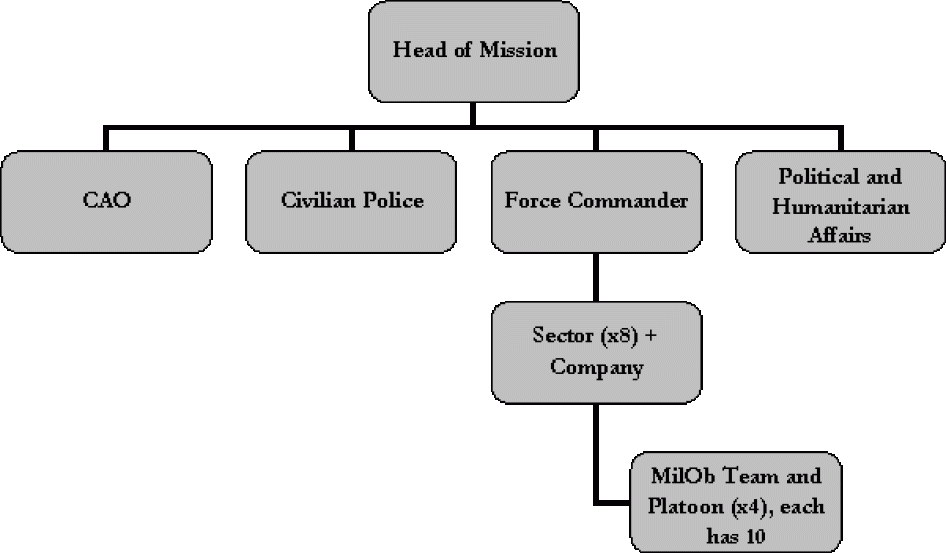
[1]See "Darfur in Flames: Atrocities in Western Sudan," A Human Rights Watch Report, vol. 16, no.5 (A), April 2004; "Darfur Destroyed: Ethnic Cleansing by Government and Militia Forces in Western Sudan," A Human Rights Watch Report, vol. 16, no. 6(A), May 2004; "Darfur Documents Confirm Government Policy of Militia Support," A Human Rights Watch Briefing Paper, July 20, 2004; "Empty Promises: Continuing Abuses in Darfur, Sudan," A Human Rights Watch Briefing Paper, August 11, 2004; "If We Return We Will Be Killed," A Human Rights Watch Briefing Paper, November 2004; "Targeting the Fur: Mass Killings in Darfur," A Human Rights Watch Briefing Paper, January 24, 2005; "Sexual Violence and its Consequences among Displaced Persons in Darfur and Chad," A Human Rights Watch Briefing Paper, April 12, 2005; and "Entrenching Impunity: Government Responsibility for International Crimes in Darfur," A Human Rights Watch Report, vol. 17, no.17(A), December 2005. All are available at http://www.hrw.org/doc/?t=africa&c=sudan.
[2]African Union, Communiqu (PSC/PR/Comm.(XVII)), African Union Peace and Security Council 17th Meeting, October 20, 2004, Addis Ababa.
[3]A May 2005 United Nations report on assistance to AMIS states, "AMIS has already identified and informally made available to donors a number of specific items in this regard [items required for expansion], including operations support (attack helicopters)". See: United Nations, Report of the Secretary-General on U.N. Assistance to the A.U. Mission in the Sudan (General/ S/2005/285), May 3, 2005[online] http://www.sudantribune.com/article.php3?id_article=9677; European Union, "Council Joint Action (2005/557/CFSP)" Official Journal of the European Union,L188, July 18, 2005, pp. 46-51 [online] http://europa.eu.int/eur-lex/lex/LexUriServ/site/en/oj/2005/l_188/l_18820050720en00460051.pdf; African Union, The AU Assessment Mission to Darfur, Sudan 10-22 March 2005: Report of the Joint Assessment Team, March 22, 2005.
[4]Administratively, Darfur is divided into three states-North Darfur, South Darfur, and West Darfur; Fashir is in North Darfur.
[5]For Human Rights Watch's extensive coverage of developments in Darfur, see the reports listed in footnote 1.
[6]African Union, Report of the Chairperson of the Commission on the Situation in the Sudan (Crisis in Darfur) (PSC/PR/2(V)), African Union Peace and Security Council Fifth Session,April 13, 2004, Addis Ababa [online] http://www.iss.co.za/AF/RegOrg/unity_to_union/pdfs/centorg/PSC/130404darfurrep.pdf; African Union, Communiqu (PSC/PR/Comm.(V)), African Union Peace and Security Council Fifth Session, April 13, 2005, Addis Ababa [online]http://www.africa-union.org/News_Events/Communiqu%C3%A9s/13%20AprilCommuniqu%C3%A9%20_Eng.pdf.
[7]African Union, "AU Dispatches a Reconnaissance Mission to Darfur," African Union Press Release No. 039/2004, May 7, 2004.
[8]African Union, Report of the Chairperson (PSC/PR/2(V)), April 13, 2004.
[9]The reconnaissance mission looked at possible camp locations; IDP camp conditions; security issues; and possible logistics plans to support a monitoring mission in the regions of El Fasher, Nyala and Al Geneina. See"African Union, "African Union Submits Proposals to the Sudanese Parties for the Establishment of a Ceasefire Commission on the Agreement for a Humanitarian Ceasefire on the Conflict in Darfur," African Union Press Release No. 35/2004, April 29, 2004.
[10]African Union, Overview of the AU's Efforts to Address the Conflict in the Darfur Region of the Sudan (CONF/PLG/2(I)), African Union Pledging Conference for the AU Mission in the Sudan (AMIS): An Opportunity for Partnership for Peace, May 26, 2005, Addis Ababa [online] http://www.africa-union-org/psc/pledging%20conference/Overview%20en.pdf; African Union, "The Sudanese Parties Sign the Agreement on the Modalities for the Establishment of the Ceasefire Commission and the Deployment of Observers in the Darfur," African Union Press Release No. 51/2004, May 28, 2004.
[11]African Union, Report of the Chairperson of the Commission on the Situation in Darfur (the Sudan) (CONF/PLG/3(I)), African Union Peace and Security Council 12th Meeting, July 4, 2004, Addis Ababa [online] http://www.africa-union.org/DARFUR/Report%20-%20Sudan%20_Darfur.pdf.
[12]African Union, Overview of the AU's Efforts to Address the Conflict in the Darfur Region of the Sudan (CONF/PLG/2(I)), May 26, 2005.
[13]African Union, Report of the Chairperson of the Commission on the Situation in Darfur (the Sudan) (PSC/PR/2(XVII)), African Union Peace and Security Council 17th Meeting, October 20, 2004, Addis Ababa [online] http://www.africa-union.org/News_Events/Communiqus/Report%20-%20Darfur%2020%20oct%202004.pdf.
[14]African Union, Report of the Chairperson (PSC/PR/2(XVII)), October 20, 2004.
[15]African Union, Report of the Chairperson (PSC/PR/2(XVII)), October 20, 2004.
[16]African Union, Report of the Chairperson (PSC/PR/2(XVII)), October 20, 2004.
[17]African Union, Communiqu (PSC/PR/Comm.(XVII)), October 20, 2004. This P&SC decision on protecting civilians also included the caveat that it was "understood that the protection of the civilian population is the responsibility of the government of Sudan."
[18]African Union, Report of the Chairperson of the Commission on the Situation in the Darfur Region of the Sudan (CONF/PLG/3(I)), African Union Peace and Security Council 23rd Meeting, Libreville, January 10, 2005.
[19]African Union, Report of the Chairperson (PSC/PR/2(XVII)), October 20, 2004.; Cdr. Seth Appiah-Mensah, "AU's Critical Assignment in Darfur," African Security Review, Vol.XIV, No. 2, Spring 2005, pp. 7-21, [online] http://www.issafrica.org/pubs/ASR/14No2/F1.pdf.
[20]"More African Troops to Deploy in Darfur," AfricanFront.com, August 20, 2004, [online]: http://www.africanfront.com/
[21]African Union, Report of the Chairperson (CONF/PLG/3(I)), January 10, 2005.
[22]African Union, Report of the Chairperson (CONF/PLG/3(I)), January 10, 2005.
[23]African Union, Report of the Chairperson of the Commission on the Situation in the Darfur Region of the Sudan (CONF/PLG/3(I)), African Union Peace and Security Council 28th Meeting, April 28, 2005, Addis Ababa; African Union, Overview of the AU's Efforts to Address the Conflict in the Darfur Region of the Sudan (CONF/PLG/2(I)), May 26, 2005.
[24]Human Rights Watch interview, Addis Ababa, June 27, 2005.
[25]African Union, Report of the Chairperson (CONF/PLG/3(I)), April 28, 2005.
[26]See Human Rights Watch report, Entrenching Impunity: Government Responsibility for International Crimes in Darfur, December 2005, Volume 17, No. 17(A), pp.40-55.
[27]African Union, Report of the Chairperson (CONF/PLG/3(I)), April 28, 2005.
[28]African Union, The AU Assessment Mission to Darfur(PSC/PR/2(XLV)), March 22, 2005.Annex D.
[29]Human Rights Watch interview, Addis Ababa, September 14, 2005.
[30]African Union, Report of the Chairperson (CONF/PLG/3(I)), April 28, 2005.
[31]Appiah-Mensah, "AU's Critical Assignment in Darfur," Spring 2005.
[32]Appiah-Mensah, "AU's Critical Assignment in Darfur," Spring 2005; Human Rights Watch interviews, Addis Ababa, June 27-30 and September 12, 2005. Of particular note are reported difficulties between AMIS and the U.S. government contractor Pacific Architects and Engineers (PAE), such as PAE subcontractor Medical Support Solutions (MSS) reportedly not being able to deal with "certain emergency cases" in its Darfur facility, according to the article by Appiah-Mensah. Problems with sufficient medical services were also cited as a significant concern in the March 2005 assessment report. Commander Appiah-Mensah was a participant in the assessment mission. The January 2006 Chairperson's Report to the A.U. Peace and Security Council states that "[f]ollowing the new enhancement, the Mission has been able to cope with the requirements for life support elements, such as food and medical services." See African Union, Report of the Chairperson of the Commission (PSC/PR/2(XLV)), January 12, 2006.
[33]African Union, The AU Assessment Mission to Darfur(PSC/PR/2(XLV)), March 22, 2005,
[34]HRW Interviews, Addis Ababa, June 27-30, 2005; African Union, Report of the Chairperson (CONF/PLG/3(I)), April 28, 2005.
[35]See Annex at the end of this report for the mandate of AMIS.
[36]For each task, there is an identified force package (such as infantry unit armored detachment or aircraft support) which provides the military capabilities to carry out the task.
[37]See, for example, the rules on use of force for the Canadian Forces: http://www.dcds.forces.ca/jointDoc/docs/uof_e.pdf.
[38]See, for example, Opheera McDoom, "Darfur Refugees Say Arab Militias Attack Camp Daily." AlertNet, October 6, 2005. [online] http://www.AlertNet.org/thenews/newsdesk/112861012185.htm.
[39]See Charter of the United Nations, available at http://www.un.org/aboutun/charter/index.html
[40]A mandate expansion to embrace full peacekeeping functions was mooted almost from the beginning: When the P&SC in July 2004 requested the CFC assessment and recommendations that led to the transition to AMIS II with its expanded mandate, it had instructed that the assessment should consider the "possibility of transforming the said mission into a full-fledged peacekeeping mission with the requisite mandate and size, to ensure the effective implementation of the Humanitarian Ceasefire Agreement of 8 April 2004." African Union, Communiqu (PSC/PR/Comm.XIII), African Union Peace and Security Council 13th Meeting, July 27, 2004, Addis Ababa [online] http://www.africa-union.org/News_Events/Communiqus/Communiqu%20_Eng%2027%20july%2004.pdf.
[41]"The African Union in Darfur: A NewsHour with Jim Lehrer Transcript," Interview of Sally Chin and Jonathan Morgenstein of Refugees International (RI) by Ray Suarez, Public Broadcasting Station, October 5, 2005, [online] http://www.pbs.org/newshour/bb/africa/july-dec05/darfur_10-shtml.
[42]Human Rights Watch interview at DITF, Addis Ababa, June 27, 2005.
[43]"The African Union in Darfur: A NewsHour with Jim Lehrer Transcript," Interview of Sally Chin and Jonathan Morgenstein of Refugees International (RI) by Ray Suarez, Public Broadcasting Station, October 5,2005,
[44]Human Rights Watch interview, AMIS sector commander, July 22, 2005.
[45]Opheera McDoom, "Darfur Refugees Say Arab Militias Attack Camp Daily," October 6, 2005.
[46]The March list prioritized tasks as follows: 1) Contribute to creation of a secure environment; 2) Establish confidence building measures; 3) Conduct monitoring; 4) Provide Force Protection; 5) Protect civilians in imminent danger; 6) Coordinate with CivPol; 7) Conduct patrolling.
[47]The May AMIS II-E CONOPS list prioritized tasks as follows: 1) Protect MilObs; 2) Protect civilians in imminent danger; 3) Provide area security for humanitarian operations; 4) Escort humanitarian convoys as necessary; 5) Provide secure environment through establish temporary outposts and intense patrolling; 6) Provide secure environment for return of IDPs; 7) Provide secure environment for CivPol; 8) Secure lines of communications; 9) Carry out preventative deployments as necessary; 10) Prepare to deploy between belligerent parties.A.U. Military Concept of Operations, AMIS II Expansion May 2005, confidential A.U. memorandum, reviewed by Human Rights Watch.
[48]Tsegaye Tadesse, "AU Says Has Film of Sudanese Security Force Attacks," AlertNet, October 5, 2005, [online] http://www.alertnet.org/thenews/newsdesk/112858976079.htm
[49]Human Rights Watch interviews, Addis Ababa, September 13, 2005.
[50]"The African Union in Darfur: A NewsHour with Jim Lehrer Transcript," Interview of Sally Chin and Jonathan Morgenstein of Refugees International (RI) by Ray Suarez, Public Broadcasting Station, 5 October 2005.
[51]Rules of engagement are kept confidential. Human Rights Watch received a copy of the draft rules of engagement (dated February 2005) from the AU headquarters in Addis Ababa in September 2005 that was current at that time.
[52]Rule No. 1.14 of the African Union Rules of Engagement for AMIS reads: "Use of non-deadly force against any person and/or group that limits or intends to limit freedom of movement is authorized."This rule means that a fighting force or group of belligerents that hinders freedom of movement could be subject to the use of non-deadly force to clear the blockage.For example, if AMIS was escorting a humanitarian convoy that was stopped by belligerents it could use non-deadly force (including negotiation and non-deadly forms of force) to secure movement of the humanitarian convoy.
[53]"Rules of Engagement for the Military Component of the African Union Mission in Sudan (AMIS)," African Union, February 2005.
[54]African Union, Conclusions of the Third Meeting of the Military Staff Committee, Third Meeting of the Military Staff Committee of the Pace and Security Council, April 25, 2005, Addis Ababa[online] http://www.iss.co.za/AF/RegOrg/unity_to_union/pdfs/centorg/PSC/2005/28mil.pdf
[55]"Rules of Engagement for the Military Component of the African Union Mission in Sudan (AMIS)," African Union, February 2005.
[56]"Rules of Engagement for the Military Component of the African Union Mission in Sudan (AMIS)," African Union, February 2005.
[57]Human Rights Watch interviews, Addis Ababa, September 12-16, 2005.
[58]Press release, AMIS, Khartoum, October 9, 2005. The A.U. initially condemned the SLA for the deaths of the AMIS personnel in the October 8 attack, but then stated that the circumstances of the incident and the identity of the perpetrators were still under investigation. "AU will seek Security Council action on Darfur security,"Associated Press, October 10, 2005, [online] http://www.sudantribune.com/article.php3?id_article=12017
[59]There is another variable, however: In a multinational mission, each nation interprets the rules of engagement in its own way, and its own rules of engagement take precedence in practice, although this is not desirable in theory. In the absence of national rules of engagement in AMIS, the AMIS February 2005 rules of engagement would be used but interpreted by the national troops in their own way. The October 8 skirmish, involving Nigerians, indicates that the Nigerians interpret the rules of engagement to allow them to engage with deadly force.
[60]Human Rights Watch interview, Addis Ababa, September 15, 2005. Other sources however indicate that not all soldiers have ROE cards nor know how to rely on them.
[61]Human Rights Watch interview with EU officials in Addis Ababa, December 15, 2005.According to military sources, the AMIS rules of engagement should be approved by the AU Peace and Security division. Troop contributing countries are to translate the rules into national languages, print and disseminate rules of engagement cards and train their troops on the rules.Since the AMIS rules of engagement are in draft form, it is possible that each troop contributing country is using national rules of engagement (based on national requirements and laws) if they have them in addition to or in place of the AMIS rules of engagement.Without formal approval of the AMIS rules of engagement by the A.U., either no rules of engagement exist for some soldiers and commanders leaving them uncertain on how to use force and react to threats and/or some troops and commanders are using national rules of engagement (which take precedence where no rules of engagement exist for the multilateral force they are contributing to) that may not be consistent with AMIS' mandate and missions tasks.
[62]Human Rights Watch interviews, Addis Ababa, June 27-30, 2005.
[63]African Union, Overview of the AU's Efforts to Address the Conflict in the Darfur Region of the Sudan (CONF/PLG/2(I)), May 26, 2005
[64]African Union, Overview of the AU's Efforts to Address the Conflict in the Darfur Region of the Sudan (CONF/PLG/2(I)), May 26, 2005; African Union, Conclusions of the Third Meeting of the Military Staff Committee, April 25, 2005.
[65]Cdr. Seth Appiah-Mensah, "AU's Critical Assignment in Darfur," Spring 2005.
[66]African Union, Overview of the AU's Efforts to Address the Conflict in the Darfur Region of the Sudan (CONF/PLG/2(I)), May 26, 2005
[67]African Union, Conclusions of the Third Meeting of the Military Staff Committee, April 25, 2005.
[68]African Union, Conclusions of the Third Meeting of the Military Staff Committee, April 25, 2005.
[69]African Union, Conclusions of the Third Meeting of the Military Staff Committee, April 25, 2005.
[70]HRW Interviews, Addis Ababa, June 27-30, 2005.
[71]Human Rights Watch interview, Addis Ababa, September 13, 2005.
[72]South Africa has been requested to deploy one battalion of 538 personnel, a reserve company of 120 personnel, a light engineering company of 100 and an Explosive Ordnance Disposal team of 10 personnel. See footnote 73.
[73]African Union, Report of the Chairperson (PSC/PR/2(XLV)), January 12, 2005.
[74]Human Rights Watch interview, Addis Ababa, September 13, 2005.
[75]Darfur Integrated Task Force, "Weekly Report No. 16 Covering 16th August to 12th September 2005," African Union, September 20, 2005; Human Rights Watch interview, Addis Ababa, September 13, 2005. Uniteam is a construction company from Norway responsible for constructing camps and accommodations for civilian police in IDP camps.
[76]Darfur Integrated Task Force, "Weekly Report No. 16 Covering 16th August to 12th September 2005," September 20, 2005.
[77]Darfur Integrated Task Force, "Weekly Report No. 16 Covering 16th August to 12th September 2005," 20 September 2005.
[78]United Nations Security Council, Press Release SC/8383, May 12, 2005.
[79]Darfur Integrated Task Force, "Weekly Report No. 16 Covering 16th August to 12th September 2005," 20 September 2005.
[80]European Union, "Council Joint Action 2005/556/CFSP," Official Journal of the European Union,L188, July 20, 2005, pp. 43-45. [online] http://europa.eu.int/eur-lex/lex/LexUriServ/site/en/oj/2005/l_188/l_18820050720en00430045.pdf; European Union, "Council Joint Action 2005/557/CFSP," July 18, 2005, pp. 46-51.
[81]"African Union Short of Funds for Darfur Mission," IRIN, August 18, 2005, [online]http://www.alertnet.org/thenews/newsdesk/IRIN/941f118f11c7ec82d6aecab81dd36c09.htm; African Union,Report of the Chairperson of the Commission on the Situation in Darfur (the Sudan) (PSC/PR/2 (XLV)), African Union Peace and Security Council 45th Meeting, Addis Ababa, January 12, 2006.
[82]"African Union Short of Funds for Darfur Mission," IRIN, August 18, 2005; Human Rights Watch interview, Addis Ababa, September 13, 2005.
[83]Human Rights Watch interview, September 13, 2005.
[84]"African Union Short of Funds for Darfur Mission," IRIN, August 18, 2005.
[85]African Union, Report of the Chairperson(PSC/PR/2 (XLV)), January 12, 2006; "AU may hand over Darfur mission to UN," Reuters, January 12, 2006. [online] http://www.cnn.com/2006/WORLD/africa/01/12/sudan.au.reut/index.html
[86]Darfur Integrated Task Force, "Weekly Report No. 16 Covering 16th August to 12th September 2005," September 20, 2005.
[87] African Union, "Support to the African Union: MAPEX Post-Exercise Briefing," African Union presentation; Darfur Integrated Task Force, "Weekly Report No. 16 Covering 16th August to 12th September 2005," September 20, 2005.
[88]Human Rights Watch interview, Addis Ababa, December 15, 2005.
[89]Darfur Integrated Task Force, "Weekly Report No. 16 Covering 16th August to 12th September 2005," September 20, 2005.
[90]Tadesse, Tsegaye, "AU Says Has Film of Sudanese Security Force Attacks," AlertNet, 6 October 2005, [online] http://www.alertnet.org/thenews/newsdesk/112858976079.htm.
[91]Darfur Integrated Task Force, "Weekly Report No. 16 Covering 16th August to 12th September 2005," September 20, 2005.
[92]Human Rights Watch telephone interview, Foreign Affairs Canada Analyst/Sudan Task Force member, December 21, 2005.
[93]Human Rights Watch interview, Addis Ababa, September 13, 2005.
[94]Human Rights Watch report, "Entrenching Impunity: Government Responsibility for International Crimes in Darfur, December 2005, Volume 17, No. 17(A), pp.40-55.
[95]"AU Press Statement on the Deteriorating Security Situation in Darfur," African Union, October 1, 2005; African Union, Report of the Chairperson (PSC/PR/2(XLV)), January 12, 2006.
[96]"Continuing Darfur Violence Threatens Relief Effort," Catholic World News, September 29, 2005, [online]http://www.cwnews.com/news/viewstory.cfm?recnum=39892; African Union, Report of the Chairperson (PSC/PR/2(XLV)), January 12, 2006.
[97]Tsegaye Tadesse, "AU Says Has Film of Sudanese Security Force Attacks," October 5, 2005.
[98]African Union, "AU Press Statement," October 1, 2005
[99]"AU Extends its Mission's Mandate in Darfur for 3 Months," Deutsch Press Agentur, October 21, 2005, [online] http://www.reliefweb.int/rw/RWB.NSF/db900SID/LSGZ-6HDDRD?OpenDocument.
[100]"AU Press Statement," African Union, October 1, 2005; African Union, Report of the Chairperson (PSC/PR/2(XLV)), January 12, 2006.
[101]"The African Union in Darfur," Public Broadcasting Station, October 5, 2005.
[102]African Union, "AU Press Statement," October 1, 2005.
[103]African Union, The AU Assessment Mission to Darfur, Sudan 10-22 March 2005: Report of the Joint Assessment Team, March 22, 2005.
[104]Some discrepancies are noted in the logistical planning of camps. The July 25 spreadsheet depicts four sites not noted on the military CONOPS and omits nine camps designated by the COP. No explicit data has revealed the reason for the discrepancies, however, it may be merely different village name translation and/or operational decisions led to changes in sites, since writing of the COP.
[105]African Union, Report of the Chairperson of the Commission (PSC/PR/2(XLV), January 12, 2006, p.15.
[106] African Union, Report of the Chairperson of the Commission (PSC/PR/2(XLV), January 12, 2006, p.17.
[107]Human Rights Watch interview, Ottawa, December 12, 1005.
[108]Human Rights Watch interview, Ottawa, December 13, 2005.
[109]Human Rights Watch interview, Ottawa, October 6, 2005.
[110]Human Rights Watch interview, Ottawa, December 12, 2005.
[111]African Union, Report of the Chairperson (PSC/PR/2 (XLV)), January 12, 2006.
[112]Human Rights Watch interview, Ottawa, December 12, 2005.
[113]Human Rights Watch telephone interview, Foreign Affairs Canada Analyst/Sudan Task Force member, December 21, 2005.
[114]African Union, Report of the Chairperson (CONF/PLG/3(I)), April 28, 2005.
[115]HRW interviews, Addis Ababa, June 27-30, 2005; "Report of the Chairperson of the Commission, April 28, 2005.
[116]"AU may hand over Darfur mission to UN," Reuters, January 12, 2006, [online] http://www.cnn.com/2006/WORLD/africa/01/12/sudan.au.reut/index.html
[117]African Union, Report of the Chairperson(PSC/PR/2 (XLV)), January 12, 2006.
[118]"AU may hand over Darfur mission to UN," Reuters, January 12, 2006.
[119]"UN plans Darfur peacekeeper force," BBC News, January 13, 2006, [online] http://news.bbc.co.uk/1/hi/world/africa/4608642.stm
[120]"UN plans Darfur peacekeeper force," BBC News, January 13, 2006.
[121]African Union, Report of the Chairperson (PSC/PR/2 (XLV)) January 12, 2006.
[122]See AU PSC communiqu of October 20, 2004, [online] http://www.africa-union.org/News_Events/Communiqus/Communiqu%20_Eng%2020%20oct%202004.pdf
[123]African Union, Conclusions of the Third Meeting of the Military Staff Committee, April 25, 2005.
[124]Breakdown for military observers can be seen in column "Enhancement II Goal" of "AMIS to AMIS II-E: Deployment Targets and Progress, table (Figure 3, below).
[125] African Union, Press Release No. 117/2004, December 23, 2004; African Union, Press Release No. 39/2005, July 15, 2005; African Union, Information Update No 1: Current Status of the Military Deployment for the Enhanced AMIS, July 20, 2005; African Union, Information Update No 2, July 26, 2005; African Union, Information Update No 4, August 16, 2005; African Union, Report of the Chairperson (PSC/PR/2(V)), April 13, 2004; African Union, Report of the Chairperson (CONF/PLG/3(I)), July 4, 2004; African Union, Report of the Chairperson (PSC/PR/2(XVII)), October 20, 2004; African Union, Report of the Chairperson (CONF/PLG/3(I)), January 10, 2005; African Union, Report of the Chairperson (CONF/PLG/3(I)), April 28, 2005; African Union, Report of the Chairperson(PSC/PR/2 (XLV)), January 12, 2006;The AU Assessment Mission to Darfur, Sudan 10-22 March 2005: Report of the Joint Assessment Team, March 22, 2005; African Union, Conclusions of the Third Meeting of the Military Staff Committee," April 25, 2005; African Union, Overview of the AU's Efforts to Address the Conflict in Darfur (CONF/PLG/2(I)), May 26, 2005; Darfur Integrated Task Force, Weekly Report No. 16, September 20, 2005; Henri Boshoff, "The African Union Mission in Sudan: Technical and Operational Dimensions," African Security Review, Vol. XIV, No.3, 2005, p. 58 [online] http://www.iss.co.za/pubs/ASR/14No3/AWBoshoff.htm; Cdr. Seth Appiah-Mensah, "AU's Critical Assignment in Darfur," Spring 2005.
[126] The South Africa contribution includes a battalion of 538 personnel in addition to a Reserve Company, a Light Engineering Platoon, and an Explosive Ordnance Disposal (EOD) Section.
[127] See sources, footnote 123; Additional military and civilian personnel are part of all three phases of AMIS, not represented here.
[128] This number includes support staff located at CFC HQ.
[129] Figure represents HQ staff increase to 66 only.
[130] The decision to increase the MilOb minimum from 60 to 80 and to provide a protection force of 300 elements was announced at the 3rd Ordinary Session of the Assembly of Heads of State and Government, held in Addis Ababa from 6 to 8 July 2004.
[131] Includes contributions from Nigeria (155) and Rwanda (155).
[132] Includes contributions from Nigeria (202), Gambia (196), and Rwanda (392).
[133] Includes contributions from Nigeria (587), Gambia (196), Senegal (196), Kenya (35 Military Platoon), South Africa (241), and Rwanda (392).
[134] Total protection force includes an additional 100 for light engineering company, 10 for EOD Section, and 5 for Joint Ops Centre. Figure shown in table includes a Force HQ Reserve of 120, a Military Platoon of 60 and a FHQ HQ Company of 196.
[135] Based on A.U. table, except that 20,427,417.65 "received" contribution is added to "received" total. Note Sweden's contribution is accounted for in neither the received contributions category nor the remaining balance. A.U. table acquired in Addis Ababa, September 2005. See African Union, Overview of the AU's Efforts to Address the Conflict in Darfur (CONF/PLG/2(I)), May 26, 2005.
[136]African Union, Report of the Chairperson, (PSC/PR/2 (XLV)), January 12, 2006.
[137]Henri Boshoff, "The African Union Mission in Sudan: Technical and Operational Dimensions," African Security Review, Vol. XIV, No.3, 2005, p. 58 [online] http://www.iss.co.za/pubs/ASR/14No3/AWBoshoff.htm.