Development without Freedom
How Aid Underwrites Repression in Ethiopia
Map of Ethiopia
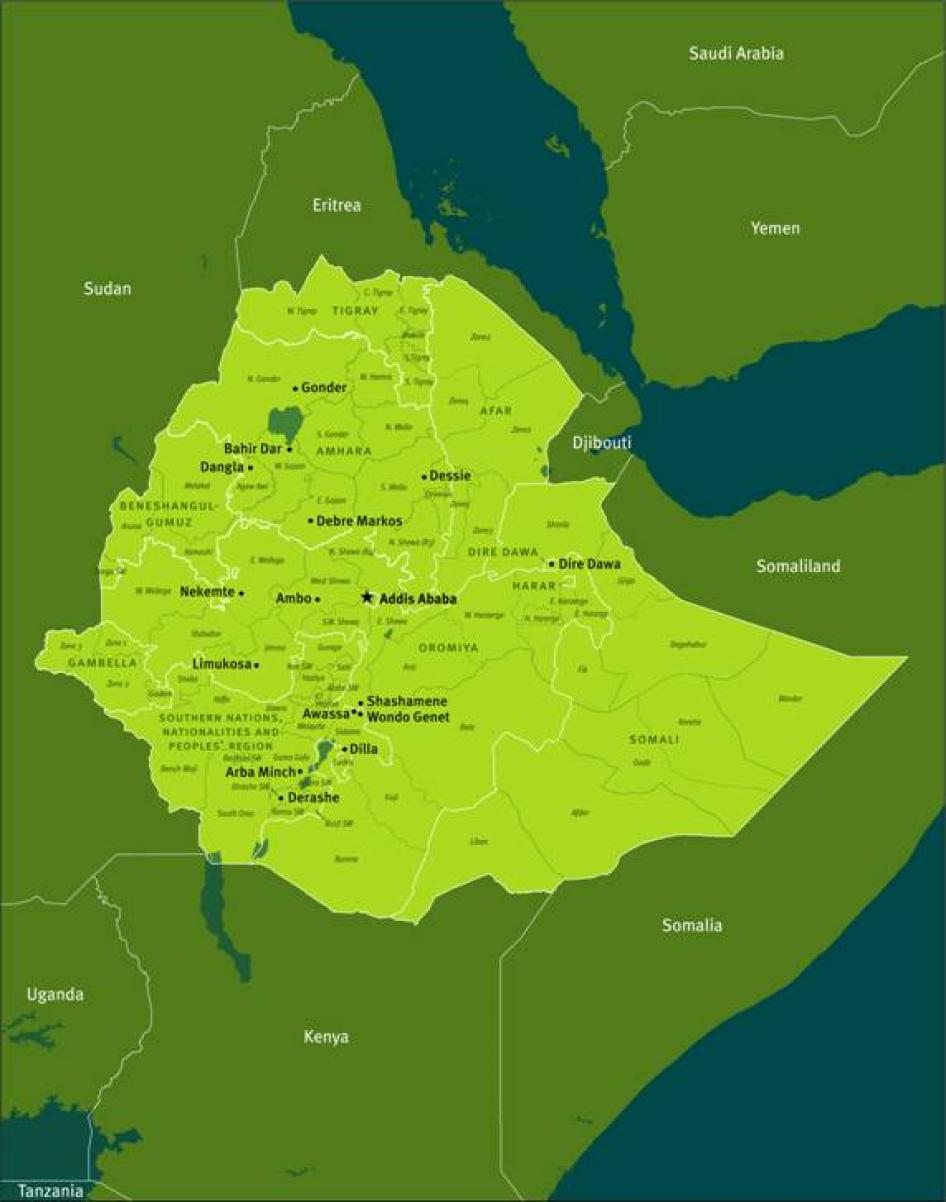
© 2010 John Emerson/Human Rights Watch. Cities and towns shown on this map were visited by Human Rights Watch in 2009 in the course of research for this report.
Glossary of Abbreviations
BPR Business Process Re-Engineering
CIDA Canadian International Development Agency
CSO law Charities and Societies Proclamation
CUD Coalition for Unity and Democracy
CAS Country Assistance Strategy
DIP Democratic Institutions Program
DFID United Kingdom Department for International Development
DAG Development Assistance Group
EPLF Eritrean People’s Liberation Front
EHRCO Ethiopian Human Rights Council
EPRDF Ethiopian People’s Revolutionary Democratic Front
ETA Ethiopian Teachers’ Association
EC European Commission
EU European Union
GEQIP General Education Quality Improvement Project
HABP Household Asset Building Programme
ICAS Interim Country Assistance Strategy
IDA International Development Association of the World Bank
ILO International Labour Organization
IMF International Monetary Fund
JRIS Joint Review and Implementation Support
JSRP Justice Sector Reform Programme
MDGs Millennium Development Goals
NGO Nongovernmental Organization
ODA Official Development Assistance
OECD Organisation for Economic Co-operation and Development
OFDM Oromo Federalist Democratic Movement
OLF Oromo Liberation Front
OPDO Oromo People’s Democratic Organization
PSNP Productive Safety Net Programme
PBS Protection of Basic Services
PSCAP Public Sector Capacity Building Programme
SNNPR Southern Nations, Nationalities and Peoples’ Region
SIDA Swedish International Development Agency
TPLF Tigray People’s Liberation Front
UNICEF United Nations Children’s Fund
UNDP United Nations Development Programme
USAID United States Agency for International Development
WFP World Food Programme
Summary
Ethiopia is one of the poorest countries in the world. Half of Ethiopia’s 85 million people live below the poverty line, and 10 to 20 percent rely on food aid every year. A large percentage of the population needs government assistance in the form of food, seeds, fertilizer, and cash support.
Ethiopia is also one of the world’s largest recipients of foreign development aid. It receives approximately US$3 billion in funds annually—more than a third of the country’s annual budget—from external donors, including the World Bank, the United States, the European Commission, the United Kingdom, Germany, the Netherlands, Canada, and Japan. Indeed, Ethiopia is today the world’s second-largest recipient of total external assistance, after Indonesia and excluding wartime Iraq and Afghanistan.
Foreign donors insist that their support underwrites much-needed agricultural growth, food security, and other putatively non-political programs. However, Human Rights Watch research shows that development aid flows through, and directly supports, a virtual one-party state with a deplorable human rights record. Ethiopia’s practices include jailing and silencing critics and media, enacting laws to undermine human rights activity, and hobbling the political opposition.
Led by the ruling Ethiopian People’s Revolutionary Democratic Front (EPRDF), the government has used donor-supported programs, salaries, and training opportunities as political weapons to control the population, punish dissent, and undermine political opponents—both real and perceived. Local officials deny these people access to seeds and fertilizer, agricultural land, credit, food aid, and other resources for development.
Such politicization has a direct impact on the livelihoods of people for whom access to agricultural inputs is a matter of survival. It also contributes to a broader climate of fear, sending a potent message that basic survival depends on political loyalty to the state and the ruling party. In a meeting with Human Rights Watch in December 2009, Ethiopian Prime Minister Meles Zenawi denied that there was a policy of using government services to discriminate against the opposition and punish dissent. Civil servants who were interviewed separately by Human Rights Watch contradicted him.
Ethiopia’s foreign donors are aware of this discrimination, but have done little to address the problem or tackle their own role in underwriting government repression. As a result, Ethiopia presents a case study of contradiction in aid policy. Donors acknowledge that aid is most effective when defined by accountability and transparency, and when programs are participatory. But development agencies have turned a blind eye to the Ethiopian government’s repression of civil and political rights, even though they recognize these rights to be central to sustainable socioeconomic development.
Donors defend the decision to support the government by pointing to Ethiopia’s stability—particularly when compared to neighboring Somalia—and by highlighting the country’s progress in meeting development indicators. Indeed, both the Ethiopian government and its principal donors contend that Ethiopia has made progress on economic development and in achieving the United Nations Millennium Development Goals. (According to its own reports to the United Nations, Ethiopia is on track to achieve six out of eight goals by 2015, although other statistics are less optimistic.) Some donor officials also argue that broad economic progress outweighs individual political freedoms. Frequently, they also concede that existing monitoring programs are simply not able to track the political manipulation of donor-supported services.
The Ethiopian population pays a heavy price for this approach to development.
During a six-month investigation conducted between June and December 2009, Human Rights Watch interviewed more than 200 people in 53 kebeles (villages or neighborhoods) and 27 woredas (districts) across three regions of Ethiopia, as well as in the capital, Addis Ababa. Drawing on interviews with donor officials and victims of human rights violations in Ethiopia’s rural areas, and analysis of donor and government programs and policies, Human Rights Watch researchers found that local officials in these different parts of the country discriminated against the government’s political opponents when distributing government services. The affected services, partly financed by Ethiopia’s largest donor programs, are the Protection of Basic Services (PBS) program and the Productive Safety Net Programme (PSNP). Both are World Bank-led multi-donor initiatives.
For example, Human Rights Watch found evidence that money from the Protection of Basic Services program—which funnels $3 billion over three years into district government budgets for agriculture, roads, health, and education—is being used in some areas to encourage teachers and farmers to join the ruling party, even though these benefits should not be allocated according to political affiliation. The Productive Safety Net Programme—a cash-for-work program for vulnerable populations worth $2 billion over three years—is controlled by local officials who also can restrict its use to those who join the ruling party. Local officials even offered to “forgive” opposition members in need of food and give them access to the program if they wrote a letter of regret to the administration for aligning with the opposition. Meanwhile, the World Bank’s Public Sector Capacity Building Programme, which is used to train civil servants, is simultaneously a vehicle for government officials to indoctrinate trainees on the ruling party’s ideology, and to target opposition supporters in the name of weeding out under-performing staff.
The sensitivity of this issue, and of any independent reporting in Ethiopia, was demonstrated when Human Rights Watch tried to interview farmers from the northern Tigray region who alleged that they were not allowed to participate in the food-for-work program for political reasons. When Ethiopian government officials learned about the meetings, the farmers were detained and the researcher deported. A foreign journalist who tried to interview the same farmers was also detained and threatened with deportation.
In early 2010, the Development Assistance Group (DAG), a consortium of 26 donor agencies, conducted its own investigation into its members’ mechanisms for detecting the politicization of aid. The resulting report found that donor programs were vulnerable to politicization by the Ethiopian government, but also stated that existing safeguards were working well. In an official response to Human Rights Watch, the DAG maintained that its programs were achieving results and that its monitoring mechanisms were sufficient.
Donor policy has been remarkably unaffected by Ethiopia’s deteriorating human rights situation or donors’ purported concerns over the “political capture” of their funds. In 2005, for example, donors suspended budget support due to electoral violence in which state security forces used excessive force against protestors, killing 200 and arresting over 30,000 people. The same year, the World Bank noted that donor assistance could be compromised if the Ethiopian government did not make progress on political governance. Yet within months, aid was flowing again and even increased under the newly conceived Protection of Basic Services program. Furthermore, a World Bank Country Assistance Strategy in 2008 proposed an imminent return to direct budget support—money with even fewer conditions attached—and presented the EPRDF’s undemocratic character as a technical challenge, rather than one of political will, that could be addressed by providing increased assistance.
Nor did donor policy significantly change toward Ethiopia following the flawed May 2010 general election in which the EPRDF won 99.6 percent of parliamentary seats after a long campaign of intimidating political opponents, restricting civil society and media, and linking government services and educational and job opportunities to support for the ruling party. As of January 2010, when Ethiopia’s new Charities and Societies Proclamation came into effect, it was illegal for human rights groups receiving more than 10 percent of their budget from international sources to operate within Ethiopia.
Donors’ unwillingness to seriously weigh the impact that their funding has on bolstering repressive structures and practices raises general concerns about donor policy toward Ethiopia, and underlines the importance of ensuring that development assistance fulfills long-term goals for the benefit of the population rather than donors’ political or security considerations.
These concerns also mean that donor strategy toward Ethiopia needs fundamental rethinking. In light of the government’s human rights violations, direct budget support to the government should not even be considered, and programs supported by international funds should be independently monitored. Credible audit institutions should examine aid to Ethiopia in the context of whether it contributes to political repression. External donors must also demand that Ethiopia does more than pay lip service to respecting fundamental human rights; they must be more vocal about the steps Ethiopia should take to ensure that its citizens enjoy the rights to which they are entitled under the country’s constitution and international human rights law.
Recommendations
To the Government of the Federal Democratic Republic of Ethiopia
- Discipline or prosecute in accordance with international fair trial standards any state or party officials implicated in violations of human rights or partisan allocation of services.
- Amend the Charities and Societies Proclamation, the Mass Media and Freedom of Information Proclamation, and the Anti-Terrorism Proclamation to bring them into line with Ethiopia’s constitution and its obligations under international law regarding freedom of expression, association, and peaceful assembly.
- Implement the International Labour Organization’s recommendations regarding the rights of association of civil servants, the immediate registration of the independent National Teachers’ Association, and the initiating of an independent inquiry into allegations of torture of trade union members.
- Cease using schools as sites of partisan political activity.
- Issue clear statements to the public and directly to all government entities explaining that all educational facilities, including teacher training colleges, universities, and civil service colleges, are open to all qualified applicants, regardless of political affiliation.
- Guarantee unrestricted access to all areas of Ethiopia to international media and independent human rights investigators, and cease harassment of Ethiopian media.
To Ethiopia’s Principal Foreign Donors in the Development Assistance Group
The World Bank, the United States, the European Commission, Key European Union Member States (Austria, Belgium, Denmark, Finland, France, Germany, Ireland, Italy, the Netherlands, Spain, Sweden, and the United Kingdom), Norway, Switzerland, and Japan
- Insist on a credible, independent, international investigation—without the participation of the Ethiopian government—into the EPRDF’s use of government services and other donor-supported programs as tools to entrench single-party rule and restrict the rights to freedom of expression, association, and peaceful assembly; participation in public life; and non-discriminatory access to food and education.
- Rule out a return to direct budget support until there is significant improvement in the human rights situation in Ethiopia and accountability for past abuses.
- Include in all agreements with the Ethiopian government provisions for independent monitoring of all programs funded or partly funded by donors.
- Suspend funding to the Democratic Institutions Program until benchmarks related to this program are met, such as improving the structural independence of key institutions within the program and repealing or amending repressive legislation such as the Charities and Societies Proclamation.
- Condition further funding of the General Education Quality Improvement Project until benchmarks related to this program are met, such as implementation of the International Labour Organization’s recommendations regarding the rights of association of civil servants, the immediate registration of the independent National Teachers’ Association, and the initiating of an independent inquiry into allegations of torture of trade union members.
- Ensure and exercise the ability to observe trainings funded by donors.
- Invite national parliamentary bodies and audit institutions to examine the manner in which development assistance is underwriting political repression by the Ethiopian government, and the extent to which this is done.
- Publicly call on the Ethiopian government to repeal or substantially amend the Charities and Societies Proclamation, which restricts and undermines independent civil society activity.
- Press the Ethiopian government to ensure non-discrimination and non-partisan equality of access to government services and food security programs.
- Publicly condemn intimidation and harassment of media and civil society organizations.
To the World Bank
- Explicitly include ways of monitoring partisan politicization and “political capture” of donor assistance when preparing subsequent Country Assistance Strategies for Ethiopia.
- Consider Ethiopia’s Protection of Basic Services program and Productive Safety Net Programme as potential pilots for the Nordic Trust Fund approach, which examines how human rights relate to the World Bank’s core work and mission.
To United Nations Agencies Operating in Ethiopia
- Suspend the Democratic Institutions Program until benchmarks related to this program are met, such as improving the structural independence of key institutions within the program and repealing or amending repressive legislation such as the Charities and Societies Proclamation.
- Establish a country office of the Office of the United Nations High Commissioner for Human Rights.
Methodology
This report is based on interviews with more than 200 individuals during three separate research missions in Ethiopia between June and December 2009. Two Human Rights Watch researchers spent a total of five and ten weeks each in the country. Interviewees included farmers, rural villagers from areas vulnerable to food insecurity, urban residents, students, teachers, civil servants, and businesspeople. They were members of the ruling party, opposition parties, and people unaffiliated to any political party from both rural villages and urban areas. Human Rights Watch also met with human rights activists, Ethiopian and foreign journalists, foreign diplomats, international aid officials, opposition politicians, serving and retired Ethiopian government officials, and members of Ethiopia’s House of Peoples’ Representatives.
Human Rights Watch interviewed individuals from 53 kebeles (villages or neighborhoods) in 27 woredas (districts) in Amhara and Oromia regions and in the Southern Nations, Nationalities and Peoples’ Region (SNNPR). Human Rights Watch also interviewed people from the capital, Addis Ababa, and the country’s second-largest city, Dire Dawa. Several other individuals were interviewed in Europe and the United States. The accounts of rural residents were echoed by current and former civil servants in regional and national government who spoke to Human Rights Watch on condition of anonymity, as well as opposition and former ruling party supporters who had previously served in government posts.
Human Rights Watch used various intermediaries to locate persons to interview and different interpreters in order to minimize the risk of biased or distorted information. All interviews with individuals alleging or witnessing abuses were conducted privately in secluded locations in English, Amharic, Tigrinya, Afaan Oromo, Sidaamu-afoo, Gedeo, and Dirashe, with translators where necessary.
Ethiopia is one of the most challenging environments in Africa for human rights research. As described in this report, the government’s administrative structures reach into every community and even into most households. Families often must register visitors with kebele officials, and in many rural villages there is pervasive fear of voicing critical views. It is almost impossible for outsiders—including other Ethiopians—to visit a rural village without generating questions and potentially serious repercussions for local residents from local security and kebele officials. It is therefore extremely difficult to conduct research outside Addis Ababa in a manner that ensures confidentiality and security for the victims and witnesses of abuses. All interviewees expressed concern for their safety when talking to Human Rights Watch, and many people declined to be interviewed because of personal safety concerns.
Human Rights Watch has omitted names and other identifying details of most of the individuals who met with our researchers to minimize the chance of government reprisal.
On December 22, 2009, Human Rights Watch Executive Director Kenneth Roth met with Prime Minister Meles Zenawi and other government officials. Human Rights Watch presented its preliminary findings in detail in a March 21, 2010 letter to the government, but received no response.
Human Rights Watch also discussed its concerns and preliminary findings with officials from international donor agencies. In Addis Ababa, London, Washington, and Brussels, Human Rights Watch met with diplomats and aid officials from the World Bank, the European Union, the United States, the United Kingdom, France, Spain, Germany, the Netherlands, Norway, Sweden, Denmark, Finland, Ireland, Canada, and Japan, as well as UN agencies, specifically the World Food Programme, the Office for the Coordination of Humanitarian Affairs (OCHA), and the United Nations Children’s Fund (UNICEF). Human Rights Watch wrote to all the donors through the Development Assistance Group (DAG) and shared preliminary research findings. Both Human Rights Watch’s letter to the DAG and its response are included as annexes to this report.
Background
Ethiopia’s government—the ruling coalition of the Ethiopian People’s Revolutionary Democratic Front (EPRDF)—has overseen economic growth and some reduction in poverty since ousting Mengistu Haile Mariam’s “Derg” military regime in 1991.[1]
Between 1998 and 2000, war with neighboring Eritrea disrupted Ethiopia’s economic development efforts, and Official Development Assistance (ODA) briefly dried up. The end of tensions renewed the government’s focus on economic growth and poverty. International donors, impressed with the country’s economic progress, stepped up financial aid to assist the transition and reconstruction. This reached an all-time high of US$3.3 billion in 2008, the last year for which data are available, and amounts are projected to rise.[2]
This increased financing, together with the Ethiopian government’s commitment to growth and tackling poverty, has led to impressive gains when it comes to meeting the United Nations Millennium Development Goals (MDGs) on poverty reduction, according to Ethiopian government and UN data.[3] Yet despite the apparent progress, Ethiopia remains one of the world’s poorest countries, where international relief assistance and food aid is required to feed between 10 and 20 percent of the population each year.[4]
The Architecture of Repression: The EPRDF State
You have to understand that at the grassroots level, everything is organized according to the EPRDF ideology. Everything is organized and controlled by cells.
—Teacher, Gonder, September 18, 2009
The EPRDF is a coalition of four ethnic parties (from the main regions: Oromia, Amhara, Tigray, and SNNPR) dominated by Prime Minister Meles Zenawi’s Tigray People’s Liberation Front (TPLF). The TPLF was a secular Marxist revolutionary movement and, along with the Eritrean People’s Liberation Front (EPLF), principally responsible for the Derg’s military defeat.
The struggle against the Derg was waged against a backdrop of poverty and famine. The 1984 famine in Tigray and Wollo that garnered world attention was a key event in the civil war and the history of the TPLF. From the outset, the TPLF was deeply concerned with the politics of food and development, working with farmers to provide agricultural inputs and improve yields.[5] The TPLF understood the importance of peasant support and had a reasonable record of engaging and respecting civilians.[6]
The TPLF—now EPRDF—ideology is organized around the principle of “Revolutionary Democracy,” which holds that the party is both the engine of development and the forum for debate and democracy. Individual rights are subordinate to broader societal and governmental concerns; collective rights are privileged over individual ones and—unlike liberal democracy that relies on elected representatives—the population is to be continually engaged in the decision-making process.[7] Prime Minister Meles has described the term’s meaning:
When Revolutionary Democracy permeates the entire society, individuals will start to think alike and all persons will cease having their own independent outlook. In this order, individual thinking becomes simply part of collective thinking because the individual will not be in a position to reflect on concepts that have not been prescribed by Revolutionary Democracy.[8]
After the terror of the Derg regime, the EPRDF established a nominally multi-party democratic government. Furthermore, the 1995 constitution incorporated a wide range of human rights standards, including many of Ethiopia’s international treaty obligations.[9]
But despite these initial promising signs, the EPRDF’s human rights record has become increasingly oppressive, and democracy a hollow concept in a country steered by a powerful party-driven government in which the distinction between party and state is almost impossible to define.[10]
Except for a brief period during the 2005 general election, the government has severely restricted the rights to freedom of expression and association, arbitrarily detained political opponents, intimidated journalists, shuttered media outlets, and made independent human rights and elections monitoring practically impossible.[11] Citizens are unable to speak freely, organize political activities, or challenge government policies without fear of reprisal.[12] Key state institutions and representative bodies, such as parliament and woreda and kebele councils, have become politicized and fallen under the ruling party’s control. State officials face little accountability for the abuses they commit.
At the core of the government’s ability to control ordinary rural and urban Ethiopians is the local-level kebele, an administrative structure originally used for development and land reform for millions of rural peasants. Inherited from the Derg and used by the TPLF during the civil war, the kebele has since become a useful method of control and political repression.[13]
The April 2008 local elections proved to be a milestone in consolidating control at the local level in both rural and urban areas. Before the elections, the government vastly expanded the number of seats on kebele and woreda councils, increasing kebele seats from 15 to 300 for a total of between 3.5 and 4 million candidates. Only the EPRDF was able to field candidates in all constituencies, and most opposition groups boycotted the elections. That meant that when the EPRDF won over 99.9 percent of the kebele and woreda seats, the ruling party had total control of the rural majority of the Ethiopian population.[14] As one opposition leader explained to Human Rights Watch:
There are seven cabinet members in the kebele administration…. If you see the political affiliation of all of these persons, no one not in the ruling party can assume these positions—except possibly teachers. This structure is there to tie the farmer-peasant hand to foot.[15]
The Structure of the KebeleThe kebele council is the primary unit of representation at the village or neighborhood level, and is comprised exclusively of party members. Kebele administration is in the hands of a seven- or eight-member kebele cabinet, theoretically elected by the council, and kebele officials, including a kebele manager. Kebele officials determine eligibility for food assistance, make referrals for secondary health care, provide recommendations for jobs and educational opportunities, and control access to state-distributed resources such as seeds, fertilizers, credit, and other essential agricultural inputs. They also run the community social courts, which deal with minor claims and disputes, as well as local prisons and, in some places, local militia that are used to maintain law and order.[16] Citizens must go to kebele officials for a whole range of administrative functions, including any kind of government documentation. In some cases, citizens must seek kebele permission to repair their home. If the kebele authorities do not consider a citizen favorably, daily life can become extremely difficult. In many areas, there are also now sub-kebele structures—cells comprising between 30 and 90 households. Below these is another tier of cells of five households, each one headed by a ruling party member, sometimes attended by armed militiamen answerable to the kebele chairman. Human Rights Watch documented the existence of these cells prior to the 2005 and 2010 elections, and their use to organize forced labor of farmers, compel attendance at political meetings, and monitor speech and association.[17] |
Rural inhabitants described a local structure in which the leader of each cell was a ruling party member, and all the civil servants in the kebele were ruling party members.[18] A 2009 International Crisis Group report noted:
Neighbourhood-level “cadres” report minor occurrences to kebelle officials, including residents’ whereabouts and visitors. According to many, “their main task is to monitor the people, spy on people and report to the kebelle.” Barely visible to outsiders and foreigners, this party control discourages dissent and constantly reminds people who is in charge. It allows the EPRDF to keep a tight grip on opposition supporters and reward its own.[19]
For example, kebele officials control access to land, even though it is supposed to be periodically redistributed so that adults who want to cultivate will get their fair share. As a result, local officials can both deprive farmers at any time of legal access to their farms and harvest the land they cultivated, without any real possibility to appeal.
Furthermore, as the state and the ruling party have become fused, the interests of the government and the EPRDF have become virtually inseparable. Local officials, often with little understanding of, or sympathy for, the peasantry, rely entirely on the party for survival and “do not distinguish between the state, which they claim to represent on a local level, the party that supports them and their own positions and power.”[20] As one kebele official said during the 2000 elections, “You are voting for the opposition? All right, ask your party to give you land. The constitution says the state owns the rural land. We don’t give land to those who are not loyal to us.”[21]
Voting in such an environment is not simply a matter of political preference, but of life and death. Supporting the ruling party can bring economic and social benefits, including access to development assistance. On the other hand, voting for the opposition may result in loss of land, resources, jobs and education, and the very means of survival for oneself and one’s family.
EPRDF and Elections
The EPRDF’s record on multi-party democracy is poor.
The 1992 woreda, or district, elections were largely uncontested, but where opposition parties did contest seats—such as in Oromia region—there was intimidation and violence, including assaults on opposition candidates and supporters, threats against their families, and arbitrary detention and closure of party offices by authorities.[22]
In 1995 and 2000, the EPRDF dominated polls in federal and regional elections. Opposition parties, which criticized the uneven playing field, mostly boycotted the elections, but did win several dozen seats in the main assembly, the House of Peoples’ Representatives.[23]
The 2005 elections were a different story. Despite some significant problems, the campaign and elections were, until one month prior to the polls, the most open in Ethiopia’s history. Opposition parties were able to campaign, at least in Addis Ababa and other key urban centers, access national government-controlled media, and hold rallies, while civil society organizations conducted extensive voter education efforts.[24] But when opposition supporters protested perceived irregularities in the vote counting, the government carried out a vicious crackdown that resulted in 200 people killed and over 30,000 people detained.[25] The opposition eventually won around one-third of the seats in parliament but many of the new opposition members of parliament refused to take their seats following the post-election crackdown.
Among those detained were most of the opposition leadership, prominent journalists, and several civil society activists who were arrested and charged with, among other things, treason and “outrages against the constitutional order.”[26] Almost two years later, after a lengthy, flawed trial in which all of the defendants except two civil society activists refused to recognize the court or mount a legal defense, they were convicted but subsequently pardoned and eventually released from prison.[27] In December 2008, the government rearrested and revoked the pardon of Birtukan Midekssa, the leader of the Unity for Democracy and Justice Party (UDJ), for allegedly violating the terms of her pardon. UN experts in December 2009 determined that her detention was arbitrary in violation of international law. She was released in October 2010.[28]
Between 2005 and the next parliamentary elections in 2010, the government waged a sustained and coordinated campaign against students, teachers, journalists, nongovernmental organizations and opposition supporters using a variety of legislative and extra-legal measures to increase the general population’s support for, and dependence on, the ruling party.[29] The strategy succeeded.
The 2008 local elections delivered over 99 percent of the available seats in woreda and kebele councils to the ruling party, cementing EPRDF control at the local level.[30] The EPRDF then swept the national elections of May 23, 2010, garnering 99.6 percent of the seats. Opposition parties won just one of the 547 parliamentary seats.[31] European election observers concluded the electoral process “fell short of certain international commitments, notably regarding the transparency of the process and the lack of a level playing field for all contesting parties.”[32]
Donor-EPRDF Relations: 2005-2010
The 2005 crackdown set alarm bells ringing in the offices of foreign donors.
Prime Minister Meles Zenawi was in 2005 a member of the British government’s “Commission for Africa,” alongside the United Kingdom’s then-prime minister, Tony Blair, and chancellor, Gordon Brown. The violence and negative publicity was embarrassing for the British government and other donors, such as the World Bank and the European Union, which had generously funded the EPRDF with direct budget support.
On November 11, 2005, the World Bank and donor partners in the Development Assistance Group (DAG), a consortium of all major donors to Ethiopia, suspended direct budget support to the Ethiopian government, committing instead to:
(i) Move away from direct budget support in favor of alternative instruments that would provide greater oversight over poverty reducing expenditures and promote increased accountability; (ii) reduce aid over time if governance does not improve; and (iii) focus on new governance programs.[33]
The World Bank stated that it based its decision to freeze budgetary support on the view that “in an increasingly divided environment, a new instrument was needed to ensure that resource flows to local authorities could be protected from political capture through an enhanced set of checks and balances.”[34]
Donors feared that in the polarized political context of the 2005 post-election violence, the government might manipulate aid to shore up the ruling party’s hegemony. At the same time, they were keen to continue investing in Ethiopia’s economic growth and supporting improvements in human development indicators.
The solution proposed for the years 2006-2008 in the World Bank’s Interim Country Assistance Strategy (ICAS)—the strategy that set the parameters for assistance to Ethiopia—was to focus the bank’s engagement on governance because, it argued, gains in service delivery and infrastructure “are contingent on the extent to which problems of political governance have the potential to adversely impact the development agenda.”[35]
In practice, this focus on governance meant more capacity building of regional administrations and federal government institutions, including parliament. It also led to the Protection of Basic Services (PBS) program, a new instrument for supporting basic service delivery that aimed to channel money to regional and district governments instead of to the federal government.[36] Approved by the World Bank on May 25, 2006, PBS I ran until December 2009. It was succeeded by PBS II, which was approved on May 14, 2009, and will run until December 2011.[37]
PBS was designed to work hand-in-hand with other World Bank programs, such as the Productive Safety Net Programme (PSNP), a food-for-work program, and the Public Sector Capacity Building Programme (PSCAP), both of which were operating before 2005.[38] PBS’s money was intended to supplement government spending in five sectors: roads, health, education, water, and agricultural extension.
The strategy of providing funds to district governments rather than to the federal budget was seen as a way to avoid political risks. But giving money to district governments carried precisely the same risks. While Ethiopia’s national government created the repressive policies, district governments actually implemented them; meanwhile, foreign donors found it hard to monitor and detect misuse of funds at the local level.[39]
The World Bank’s 2006-2008 Interim Country Assistance Strategy noted that the biggest challenge was to “separate political parties from the state.”[40] The World Bank also warned against “weak and eroding institutional checks and balances increasing the risk of capture of decentralization, block grants and the civil service.[41] It concluded that it would seek to adjust its support if the political context worsened and these risks increased, “both to help the country address the risks, and to manage the level of resources entering an environment that may not be conducive to development.”[42]
But as the political context deteriorated in exactly the way described, the bank did not adjust its support. Instead, just two years later, in 2008, it issued a new Country Assistance Strategy (CAS). While noting serious concerns when it came to national political issues, it claimed that Ethiopia had shown “progress in long-term institution building and gradual improvements in governance, perhaps most notably in terms of the transparency and accountability of basic service delivery by local governments.” The bank asserted this progress and made no comment on its earlier concern regarding the potential for the misuse of funds for political purposes.[43] The CAS also argued for a resumption of direct budget support “once donors and Government agree conditions are appropriate.”[44] As the money started to flow again, the donors ignored their earlier concerns about Ethiopia’s governance problems.
Rather than express caution about providing assistance in a highly politicized environment, the 2008-2011 CAS turned the problem around, presenting the government’s undemocratic character as a technical challenge rather than a question of political will, and a problem that could be addressed with increased financial support. The strategy further urged:
Democratic practices at the local level need to take deeper root. More broadly, the media and civil society organizations need to mature and a greater space needs to be created for them, and the effectiveness of national level accountability mechanisms, such as parliamentary oversight committees, courts, and the public audit system, need further strengthening. Progress in these areas will naturally take time, but it deserves sustained attention as transparency and accountability are critical for sustaining the “dual take-off” in the long run.[45]
The suggestion that the government that could reform if given enough time seriously mischaracterized events in Ethiopia after 2005 when—as Human Rights Watch, other organizations, and independent academics reported at the time—there was no genuine possibility for meaningful reform on governance, and democratic space was closing. And yet billions of dollars of development assistance were premised on an unfounded assumption that Ethiopia was moving in a democratic direction. In fact, Ethiopia is a one-party state, where government action in nearly every sphere is directed at promoting EPRDF’s political control, repressing opponents, and suppressing dissent—in exactly the way the 2006 World Bank document had feared.
Donor Strategy toward Ethiopia
I like to compare the current donors to the Italians who built roads for Haile Selassie. Without the Italian roads, the Emperor could not have controlled the state. Without the donors’ money, Zenawi could not hold it together—the PSCAP and PBS and the donor-funded bureaucracy. The donors should be more careful.
—World Bank official, Addis Ababa, [date withheld], 2009
Donor countries continue to provide the Ethiopian government with huge sums for development assistance. This places them in an awkward position. On the one hand, they are aware of the Ethiopian government’s serious human rights violations and their own role in supporting the state apparatus. On the other, they know that confronting the EPRDF government on its human rights record could endanger projects and thwart their efforts to contribute to Ethiopia’s economic development.[46]
In the short term, these donor programs are ostensibly helping the country make progress toward reaching Millennium Development Goals. In the longer term, however, they are fortifying an oppressive political apparatus responsible for serious human rights violations. Donor operations in Ethiopia are also undermining their own human rights policies—stressed by UN agencies and a range of development organizations—outlining that an effective state is one that is accountable and respects human rights.[47]
For example, the UN Millennium Declaration setting out the Millennium Development Goals for reducing poverty states, “Men and women have the right to live their lives and raise their children in dignity, free from hunger and the fear of violence, oppression or injustice. Democratic and participatory governance based on the will of the people best assures these rights.”[48] Meanwhile, the Common Understanding on the Human Rights Based Approach to Development Cooperation, adopted in 2003, states that all programs of development co-operation, policies, and technical assistance should “further the realisation of human rights as laid down in the Universal Declaration of Human Rights and other international human rights instruments.”[49]The importance of the political context of development was also stressed in a joint World Bank/International Monetary Fund report in 2004.[50]
And yet in practice, donors often ignore these principles in their eagerness to finance large development programs aimed precisely at meeting the Millennium Development Goals.[51] Moreover, while World Bank officials in Washington, DC, told Human Rights Watch that the bank regarded open society and the space for the contest of ideas as “very important” for sustainable development, the institution’s actions and statements—and those of its donor partners in Ethiopia—do not demonstrate a belief that fundamental human rights are central to economic development.[52] Indeed, World Bank officials in Addis Ababa told Human Rights Watch that democracy might not be so important for Ethiopians yet, although “maybe in 20 years.”[53]
Donor policy toward Ethiopia is shaped by at least two significant and interlinking factors. The first is the strategic position of Ethiopia in the Horn of Africa, which makes the country a key ally in the region for Western states seeking a bulwark against an intransigent Eritrea, an increasingly effective and radicalized insurgency in Somalia, and possible instability in neighboring Sudan following its referendum in 2011. The second is the genuine, if exaggerated, progress that Ethiopia has made to reduce poverty.[54]
These two realities create a dilemma for donors, compounded by the government’s hard-line response to raising human rights concerns. In 2008, for example, Prime Minister Meles said that he did not need Western aid, and following the election in 2010 said it was “fine and we can move on” if the United States felt that “the outcome of the elections are such that we cannot continue our relationship.”[55]
Western governments have both a strategic and a humanitarian interest in providing financial assistance for development to Ethiopia. But one would be mistaken to think that this aid is improving—or even having a neutral effect—on human rights in the country. The ruling EPRDF neither wants to discuss human rights concerns, nor allow donors to engage in, or fund, independent programs that promote human rights and good governance. By quietly accepting the EPRDF’s misuse of development assistance for partisan political purposes, donor countries are contributing to the oppression of Ethiopia’s vulnerable populations.
Development Programs Vulnerable to “Political Capture”
When the World Bank in 2006 referred to the threat of “political capture” in Ethiopia, it meant that there was a danger that the government could use its donor-funded structures and services to control and oppress the population; severely impinge upon their rights to freedom of expression, association, and assembly; and discriminate against its citizens based on political affiliation. This, it added, would be problematic because a repressive politicized state would be “an environment that may not be conducive to development.”[56]
And yet, this is exactly what Human Rights Watch observed in the villages it visited in 2009.
Researchers found that donor-funded services, resources, and training opportunities were being used as threats or rewards for citizens to join the ruling party and cease supporting the opposition, and that donor mechanisms for monitoring or controlling the misuse of aid programs were inadequate.
International human rights law calls for government assistance to be provided impartially. Denying government assistance, including foreign aid, to individuals and their families because of their perceived or actual political viewpoints or affiliations violates the rights to freedom of expression and association and to take part in public affairs, as provided under the International Covenant on Civil and Political Rights (ICCPR).[57] It is also a form of prohibited discrimination based on “political or other opinion” under the ICCPR and other international human rights treaties.[58]
Denying food aid or educational opportunities because of membership or perceived support for opposition political parties also violates the rights to food and education under the International Covenant on Economic, Social and Cultural Rights (ICESCR).[59] According to the Committee on Economic, Social and Cultural Rights, the expert body that monitors compliance with the ICESCR, it is a violation to discriminate against people because of their political or other opinion, including “both holding and not-holding” particular views or membership in political parties. The committee stated: “Access to food assistance schemes, for example, must not be made conditional on an expression of allegiance to a particular political party.”[60]
The Ethiopian constitution protects fundamental freedoms found in international human rights treaties to which Ethiopia is a party.[61] The constitution also provides that everyone have equal access to government services. In addition, Ethiopian law forbids partisan allocation of state resources or their use to benefit one political party at the expense of others.[62]
In reality, these laws are flouted, and often, by local government officials who have considerable power when it comes to distributing donor-funded seeds, fertilizers, food, micro-loans, and other resources on which Ethiopia’s impoverished majority rural population relies for survival. The resources and personnel used in this way are supported by international funds in the form of various development programs, the most significant of which are World Bank programs channeling money from a range of donors.
World Bank Programs Misused by Ethiopia
In 2008, total aid to Ethiopia was about US$3.3 billion. Official Development Assistance (ODA) to Ethiopia comprises the total amount of funds from abroad, including emergency humanitarian aid.[63] This assistance includes multilateral support (UN, World Bank programs) and bilateral aid (individual government grants to Ethiopia). Table 1 shows the total funds flowing just from multilateral agencies as well as the total aid to Ethiopia from all donors.
Table 1: Annual ODA Total Net Disbursements to Ethiopia[64] (in US$ millions, current prices) | |||||
|
2004 |
2005 |
2006 |
2007 |
2008 |
Multilateral Agencies Only |
747 |
696 |
914 |
1,287 |
1,453 |
Total All Donors |
1,809 |
1,910 |
1,964 |
2,563 |
3,327 |
A range of sources, not just the World Bank, funds World Bank-administered programs in Ethiopia. They account for a large proportion of the multilateral and bilateral funds coming into the country. The Ethiopian government also makes contributions into the “pooled funds” which are then distributed back to it. These programs provide money directly to Ethiopian government institutions, which “own” the programs and administer them jointly with the World Bank.[65] Table 2, below, lists all the donors that contribute aid to Ethiopia. Table 3 lists the main World Bank programs operating in Ethiopia and who pays for them. Four of these programs are at particular risk of political capture and are briefly described below.
Table 2: ODA Total Gross Disbursements to Ethiopia[66] (in US$ millions, current prices) | |||||
Donor |
2004 |
2005 |
2006 |
2007 |
2008 |
Australia |
1.88 |
1.87 |
1.34 |
1.85 |
10.13 |
Austria |
4.30 |
7.64 |
17.59 |
7.18 |
12.66 |
Belgium |
9.44 |
5.34 |
6.60 |
13.13 |
8.77 |
Canada |
59.48 |
64.93 |
62.48 |
90.52 |
152.55 |
Denmark |
2.62 |
4.06 |
5.74 |
6.43 |
7.52 |
Finland |
9.06 |
11.08 |
13.21 |
9.98 |
15.99 |
France |
26.25 |
15.19 |
17.35 |
20.05 |
18.74 |
Germany |
126.09 |
49.86 |
56.76 |
96.48 |
98.25 |
Greece |
1.59 |
1.49 |
1.17 |
2.43 |
3.11 |
Ireland |
42.44 |
44.10 |
50.63 |
58.94 |
72.67 |
Italy |
11.21 |
86.93 |
105.39 |
75.47 |
65.86 |
Japan |
33.33 |
34.17 |
57.85 |
36.03 |
47.12 |
Luxembourg |
0.44 |
0.15 |
1.73 |
0.98 |
1.43 |
Netherlands |
57.52 |
58.66 |
49.76 |
50.76 |
113.63 |
New Zealand |
0.80 |
1.21 |
0.16 |
0.06 |
0.34 |
Norway |
34.04 |
38.07 |
41.80 |
34.14 |
37.28 |
Portugal |
0.01 |
0.08 |
0.13 |
0.13 |
0.21 |
Spain |
0.81 |
4.48 |
9.72 |
27.08 |
60.54 |
Sweden |
50.76 |
68.37 |
41.53 |
44.72 |
46.94 |
Switzerland |
3.24 |
2.65 |
2.76 |
2.43 |
3.15 |
United Kingdom |
147.13 |
75.48 |
164.61 |
291.07 |
253.68 |
United States |
402.03 |
608.61 |
315.78 |
371.73 |
811.37 |
EU Institutions |
112.65 |
163.47 |
194.37 |
364.76 |
460.81 |
Table 3: World Bank Projects in Ethiopia by Donor[67] (in US$ millions, current prices) | ||||||||
Project Name / ID |
Food Security P050383 |
Public Sector Capacity Building P074020 |
Protection of Basic Services P074015 |
Productive Safety Net APL II P098093 |
Protection of Basic Services Additional Financing P106559 |
General Education Quality Improvement APL I P106855 |
Protection of Basic Services Phase II P103022 |
Productive Safety Net APL III P113220 |
Approval Date |
May 30, 2002 |
May 11, 2004 |
May 25, 2006 |
Jan. 9, 2007 |
Dec. 20, 2007 |
Dec. 16, 2008 |
May 14, 2009 |
Oct. 22, 2009 |
Closing Date |
Jun. 30, 2010 |
Dec. 31, 2009 |
Dec. 31, 2009 |
Jun. 30, 2010 |
N/A |
Jul. 7, 2013 |
Dec. 31, 2011 |
Jun. 30, 2015 |
Lending Project Cost (Total) |
110.16 |
397.8 |
2,562.91 |
1,040.1 |
1,804.12 |
417.3 |
3,364.1 |
1,730.4 |
International Development Association (World Bank) |
85 |
100 |
215 |
200 |
215 |
50 |
540 |
480 |
African Development Bank |
|
|
|
|
55 |
|
161.9 |
|
Austria |
|
|
|
|
|
|
10.9 |
|
Canada (CIDA) |
3 |
38.8 |
15.75 |
72.5 |
20.86 |
|
59.8 |
81.8 |
European Commission |
|
|
|
187.8 |
196.04 |
|
67.3 |
78.7 |
Finland (Finnvera) |
|
|
|
|
|
9.6 |
|
|
Germany (KfW) |
|
|
|
|
14 |
|
47.5 |
|
Ireland |
|
|
1 |
44.2 |
|
|
32.9 |
80.6 |
Italy |
4 |
|
|
|
|
20.4 |
10.2 |
|
Netherlands |
|
|
|
34.8 |
7 |
26.4 |
10.9 |
71.3 |
Spain |
|
|
|
|
|
|
40.7 |
|
Sweden (SIDA) |
|
8.6 |
|
23 |
|
12.3 |
|
23 |
UK (DFID) |
3 |
|
296.55 |
138.5 |
136.99 |
31.1 |
295.9 |
324.1 |
USAID |
|
|
|
314.2 |
|
|
|
530.9 |
World Food Programme |
|
|
|
25.1 |
|
|
|
50 |
Other |
7 |
112.9 |
3.86 |
|
|
183 |
657.5 |
|
Borrower (Ethiopia) |
8.16 |
137.5 |
2,030.75 |
|
1,159.23 |
84.5 |
1,428.6 |
10 |
There are many different World Bank programs in Ethiopia, but the most significant in terms of dollar amounts and political manipulation are the Protection of Basic Services (PBS) program (more than $3 billion over three years) and the Productive Safety Net Programme (PSNP) ($1.7 billion over three years). The first supports basic service delivery (water, health, education, agriculture, and roads); the second delivers food and cash for food-insecure populations in return for their participation in public works projects. These programs, together with the Public Sector Capacity Building Programme (PSCAP) and the General Education Quality Improvement Project (GEQIP), are those most likely to be used by the Ethiopian government as tools of political repression, according to Human Rights Watch’s findings.
In addition, the Democratic Institutions Program (DIP) is intended to support domestic accountability mechanisms to improve the overall governance situation in the country. Since it is a key part of the overall aid picture in Ethiopia, its purpose is also briefly described here.
Protection of Basic Services (PBS)
The Protection of Basic Services program is one of the largest and most complex development programs in the world. Every year, it transfers about $1 billion in a “block grant” to the federal government, which then disperses it to regional and district governments. PBS was first approved in May 2006, and was extended again in May 2009.[68] The donor money is mixed with Ethiopian government resources; in 2008-2009, PBS was 36 percent donor funds and 64 percent Ethiopian government funds.[69] The PBS program, in its second phase, involves $3.3 billion over three years, with the World Bank alone accounting for over half a billion dollars, other bilateral donors contributing around a billion, and the Ethiopian government contributing $1.4 billion.[70]
PBS supports five specific service sectors—health, education, water, agricultural extension, and roads—which are delivered at the local level by civil servants, woreda and kebele officials, teachers, nurses, development agents, doctors, and Ministry of Health officials. The kebele chairman and manager are the key figures in the kebele, which is in turn the key unit of organization. Most block grants fund salaries of officials and recurrent expenditure of local governments.[71] These local officials—teachers, agricultural and health extension workers, and kebele staff, whose salaries are paid through PBS—decide how to allocate resources, control militias, and write references for students and job seekers.Among the key material resources that PBS funds are schools, seeds, fertilizer, and other agricultural inputs.
Productive Safety Net Programme (PSNP)
Ethiopia has a long history of relying on foreign food aid in response to natural and man-made disasters.[72] Launched in 2005, the Productive Safety Net Programme aims to provide predictable transfers of food or cash to food-insecure households through a public works program, or direct transfers to those who cannot work. It was intended to address the causes of underlying food insecurity in Ethiopia, with the idea that beneficiaries would over time accrue enough assets to withstand a food shock on their own. Between 7 and 8 million beneficiaries are targeted, based on historical patterns of areas needing food relief. The total program cost of phase three, which was approved in September 2009, is approximately $1.7 billion.[73] Annual spending has been about $350 million.[74]
The safety net program is financed by the Canadian International Development Agency (CIDA), the European Commission (EC), Irish Aid, the Netherlands embassy, the Swedish International Development Agency (SIDA), the United Kingdom Department for International Development (DFID), the United States Agency for International Development (USAID), and the World Bank. The last three donors provide over two-thirds of the funding. The Ethiopian Ministry of Agriculture and Rural Development is responsible for the program’s overall operation.[75]
Public Sector Capacity Building Programme (PSCAP)
The board of the World Bank approved the first phase of the Public Sector Capacity Building Programme in May 2004, and renewed it in March 2010. It is intended “a) to improve the scale, efficiency and responsiveness of publicservice delivery at the federal, regional, and local level; b) to empower citizens to participate more effectively in shaping their own development; and c) to promote good governance and accountability in its public sector.”[76]
Capacity building is seen as a “critical underpinning” to reaching Ethiopia’s development objectives because the local, regional, and federal governments need strengthening to enable them to better use the money provided by donors and the Ethiopian government.[77]
The PSCAP program was originally estimated to cost $398 million, of which the Ethiopian government contributed $55 million, the World Bank $100 million, and other donors provided the rest. A range of donors supported the PSCAP program at its outset in 2004.[78] However, by 2010, many had pulled out for unspecified reasons, leaving CIDA, DFID, the EC, and Italy as PSCAP’s remaining supporters.[79] The resulting shortfall in funds led to Ethiopia’s requesting, and being granted, an additional $185 million in March 2010.
General Education Quality Improvement Project (GEQIP)
The General Education Quality Improvement Project was launched in 2008 to improve teaching and learning conditions in Ethiopian schools.[80] It aims to help train teachers, update the curriculum, and support school infrastructure. Regional governments are responsible for the syllabus and for overseeing training programs through teacher-training colleges. Woreda governments are responsible for paying and recruiting primary and secondary teachers.[81]
The GEQIP is financed by a group of donors: the United Kingdom, the Netherlands, Italy, Finland, and Sweden.[82] The total program cost is $417.3 million, with $62 million earmarked for the Teacher Development Program.[83] It is scheduled to run from December 2008 to July 2013.
The program aims to address the severe capacity problems in the education sector and the shortage of qualified staff. The Teacher Development Program will consist of pre- and in-service training, extra English training, improving selection of entrants to teacher training, and developing a teacher career structure and licensing system that “recognizes professional development and behavior.”[84]
Democratic Institutions Program (DIP)
The Democratic Institutions Program was approved in August 2007 and aims to build the capacity of institutions seen as promoting and protecting democracy in Ethiopia, the rights of citizens, and their participation in the democratic process. These are the national Ethiopian Human Rights Commission, the Ethiopian Institute of the Ombudsman, the House of Peoples’ Representatives, the Federal Ethics and Anti-Corruption Commission, and the National Electoral Board of Ethiopia. The program agreement states that the program is intended to enhance “the capacity of democratic institutions to be effective, sufficient and responsive in promoting and protecting the rights of citizens,” and to empower citizens “to be active and effective participants in the democratic process as well as to respect the rights of others.”[85]
The monitoring mechanisms of all of the programs described above—and their flaws in assessing political capture of resources—are examined in greater detail below.
Politicization of Donor-Supported Government Services
The rural administration is in the hands of EPRDF. The fertilizer is in the hands of TPLF. The government owns all the land. The rural credit companies that provide loans to buy inputs are owned and controlled by the EPRDF. DeDebit is affiliated to TPLF, and the safety net is controlled by EPRDF. Where can a farmer run to? Can he say “no” to these institutions that control his livelihood?
–Siye Abraha, opposition leader and former minister of defense, October 6, 2009[86]
Every tool at their disposal—fertilizer, loans, safety net—is being used to crush the opposition. We know this.
–Senior Western aid official, Addis Ababa, October 5, 2009
Human Rights Watch learned of discrimination or other human rights violations by government officials in a range of locations and sectors across the country. These included agriculture, education, the safety net public works program, food aid distribution, the civil service, and training programs for civil servants.
Donor officials who work with the Ethiopian government are well aware of this government repression. “Intimidation is all over, in every area,” one Western aid agency official told Human Rights Watch. “There is politicization of housing, business, education, agriculture. Many of the people are forced or compromised to join the party because of safety net and so on, many do not have a choice—it is imposed. For others, you are paid to join, or provided with something in kind.”[87]
Many other donor officials also told Human Rights Watch they were aware of reports that their funds were being used to oppress Ethiopian citizens. Indeed, the US State Department human rights country report for 2009 noted “credible reports” during the year that teachers and other government workers were fired if they belonged to opposition political parties, and “frequent credible reports” that local authorities told opposition members to renounce party membership and become EPRDF members if they wanted to access subsidized seeds and fertilizer, food relief, civil service jobs, promotion, retention, student university assignment, postgraduate employment, and other government-controlled benefits.[88]
This knowledge, that aid money is not only being misused, but is being misused to further government efforts that undermine broader development aimed at promoting human rights and good governance, has not deterred donors from making large contributions. Nor has it led to closer monitoring of local government officials, civil servants, and head teachers to see whether they implement decisions in a partisan or discriminatory fashion.
Often, this is precisely what authorities do—marginalize and ostracize those who support the opposition or their family and friends. Sometimes proactive efforts by officials to penalize opposition supporters are not even needed because communities recognize the risk by association. As one human rights activist in Gonder said, “Society voluntarily excludes opposition members who openly support their parties to make sure they are not suspects themselves.”[89] People are wary of being suspected of opposition involvement because they don’t want to lose access to government resources. “Hewas [cell] leaders have publicly declared that they will single out opposition members, and those identified as such will be denied ‘privileges,’” a farmer from a kebele in Kuta Ber woreda said, referring to fertilizers, safety nets, and even emergency aid. “These are government services that farmers hold dear. It’s a powerful threat that the majority can ill afford to ignore.”[90]
Moreover, it is a threat that carries particular weight in a country where the ruling party pervades much of village life, and where community and EPRDF interests are easily conflated. For example, the government has hired, trained, and deployed 30,000 community health workers, who receive mandatory political instructions from EPRDF officials two evenings per month.[91] In addition, before the May 2010 general elections, reports surfaced of officials leveraging government services to encourage support for the ruling party and punish dissent. Human Rights Watch documented house-to-house intimidation by kebele officials in Addis Ababa who told residents that they would lose their house or even their job if they did not register to vote and cast a ballot for the EPRDF.[92]
Withholding of Agricultural Inputs
Farmers consistently reported that officials withheld agricultural inputs—such as hybrid seeds and fertilizer—on the basis of real or perceived political affiliation. These reports came from over 50 farmers in 38 kebeles in 15 woredas in three different regions: in Mecha, Dangla, Mera-Awi, Dabat, Wagara, Macho, and Kuta Ber (Amhara region); in Boricha, Tulla, Wondo Genet, Dale, Yirga Chaffe, Dila Zuria, and Kochore (SNNPR region) and in Ambo (Oromia region).
When farmers complained to development agents, kebele chairmen, or woreda officials about their exclusion from distributions of seeds or fertilizer, they were routinely referred back to the kebele, where officials told them, “You know the system” or “Go and ask your party to help you.”[93] According to a member of the opposition All Ethiopia Unity Party (AEUP) in Wagara, Amhara region:
I was registered for fertilizer, I had prepared my land. But at distribution time, I went to the official who was responsible for distribution. She said she had been ordered by the woreda agricultural officer not to give to me.[94]
A coffee farmer in the south of the country, hundreds of miles away, gave a similar account:
I am marked as an [opposition] member so I did not get any farmer’s assistance—seeds, fertilizer, and materials. I asked them and got the same answer, “This doesn’t concern you, since you hate the government, why would you get help from them?”[95]
One farmer from Dabat woreda in Amhara said he did not even bother to ask for fertilizer from the authorities because “they have already told me I cannot be a beneficiary of any government help because I am a member of an opposition party.”[96]
Such discriminatory withholding of agricultural inputs is not new. Opposition leaders protested, and Human Rights Watch reported on, such tactics well before 2005.[97] According to one account from North Shoa in Amhara, wealthier farmers were forcibly enrolled in the party after the 2005 election and appointed model farmers who received privileged access to credit, state-controlled agricultural inputs, and technical knowledge spread by development agents.[98] Those who did not submit were jailed, sometimes as many as four times.[99]
The repression seriously affected the organized opposition, which was wiped out after the 2005 elections. Some farmers who supported the opposition said authorities had confiscated their land for political reasons in the following woredas: Mecha, Dabat, Tachar Macho, and Wagara (Amhara); Lante and Boricha (SNNPR); and West Shoa zone (Oromia). A farmer in Dabat said that kebele officials harassed him for a year and threatened to arrest him if he did not hand over a three-hectare plot with 50,000 seedlings. He eventually submitted. He said:
The reason they gave me is that the land is common grazing land and that I had it illegally. But the real reason is that I am a member of AEUP. I have owned that land since I was eight years old. I have witnesses that the land has been mine for 45 years.[100]
His current land is not enough to feed his family. He survived in 2008 by selling his animals, but said that in 2009 his family did not have enough to eat.[101]
A former “model farmer,” a group leader in the agricultural extension program with a diploma in agriculture whom the government hired to train other farmers, told Human Rights Watch that the authorities suspended him from his role and confiscated his land in 2009 because he became the local organizer for the AEUP in his area.[102] Two other farmers said that officials promised to return their land to them if they left the opposition party; one was told explicitly, “If you leave the opposition party, we will give you back your land.”[103]
Partisan Access to Micro-Credit Facilities
Many donor officials told Human Rights Watch that rumors of the political awarding of government-provided loans and subsidized interest-rate loans were “common,” and three said that they had firsthand knowledge of the problem.[104]
Government-affiliated organizations control not only seeds and fertilizer, but the loans that farmers need to purchase them. Credit is important to farmers everywhere, but particularly in Ethiopia, where 85 percent of the population lives in rural areas. The majority of these residents are subsistence farmers with minimal assets against which to borrow, for whom micro-credit is a hugely important resource. Millions of Ethiopian subsistence farmers are familiar with the cycle of loans, debt, and tax. Farmers often spend periods of time in kebele jails or must forfeit part of their crop for non-payment.[105]
Individuals reported discriminatory government loan practices in the provision of micro-credit in the following woredas: Loka Abaya, Yirga Chaffe, Misrak-Awassa, Kochore, and Arba Minch (SNNPR); Limukosa (Oromia); and Dangla and Dabat (Amhara). In addition, three donor officials, two former government officials, several journalists and a former parliamentarian all described routine partisan access to micro-credit loans.
Funding for micro-credit comes from Ethiopian central and regional government funds and donors. The Household Asset Building Program (HABP) is the main donor credit program under the purview of the safety net program, which delivers credit through “multipurpose cooperatives as well as the government administrative system and microfinance institutions.”[106] Under the HABP, “Households are provided a one-time highly subsidized credit that ranges from $200-700 to rebuild their asset base or to purchase ‘household extension packages.’ These packages usually consist of various combinations of agricultural inputs based on a business plan developed with support from the extension service.”[107] The program is financed through a federal block grant to regional governments amounting to about $100 million per year.[108]
There is a range of micro-credit activity in Ethiopia. Some micro-credit funds are explicitly controlled by regional governments.[109] Some funds are delivered through dedicated micro-finance banks; others are mass-based associations, and so-called community organizations and farmers’ cooperatives. According to the International Food Policy Research Institute, cooperatives are the primary means by which Ethiopian farmers obtain agricultural inputs and equipment. Even though they are “supposedly organized to advance farmers’ interests and secure them tangible benefits,” the cooperatives are controlled by the party, whose members “routinely fill cooperative leadership positions. Moreover, the cooperatives frequently are more responsive to the desires of the government and donors than to those of members.”[110] Controlling loan distribution allows the party to encourage farmers to join, do its bidding, or punish them if they get out of line.
Interviewees repeatedly mentioned DeDebit and Omo Micro-Finance as two party-affiliated micro-credit organizations involved with systematic and partisan allocation of loans.[111] DeDebit operates predominantly in Tigray province, while Omo is in the south. “In principle, it’s a public organization,” a farmer in the southern region of SNNPR said of Omo, “but it is working under cover for the ruling party, and the only ones who receive loans are EPRDF members.”[112]
A farmer in Gedeo zone said that Omo Micro-Finance officials told him to get a loan from his party if he needed one, and that his wife was told she was ineligible for help because her husband was an opposition member.[113] According to a farmer in SNNPR who is an opposition member, “They [kebele officials] say, ‘This is not from your government, it is from the government you hate. Why do you expect something from the government that you hate?’”[114] Farmers in other parts of SNNPR and Amhara reported to Human Rights Watch similar responses from kebele officials.
In 2008, a young man in Arba Minch, SNNPR, took a loan to start a micro-business with 10 others as part of a “youth association” to provide road-building materials for the woreda. A year later, in June 2009, woreda officials told him that he would have to leave the association if he did not join the ruling party. Since all associations must be party-affiliated, he would also be jobless. “I’m not interested in politics,” he told Human Rights Watch, “but I have few options.”[115] He joined the party a month later.
Belete Etana, a former member of parliament and vice-chair of the House of Peoples’ Representatives public finance committee, said that micro-loan applicants in his constituency needed a letter from the kebele chairman to show they were in “good standing”:
From the outside it looks like a good system, but the poison is hidden. The kebele will say, “We don’t have faith that he will repay the loan.” What can you say? We know, they know, everybody knows the system but there is no way to challenge it.[116]
Political Discrimination in the Productive Safety Net Programme
The safety net is used to buy loyalty to the ruling party. That is money that comes from abroad…. Do those people who send the money know what it is being used for? Let them know that it is being used against democracy.
–Opposition farmer, Dessie, October 3, 2009
The PSNP beneficiary list is a weapon, pure and simple.
–Ethiopian Human Rights Council official, Addis Ababa, September 8, 2009
The Productive Safety Net Programme (PSNP) provides food and cash to vulnerable families in return for work on public projects in approximately 300 woredas. Human Rights Watch interviewed 50 people who described the use of access to the safety net program as a political tool of the ruling party. They came from multiple kebeles within the following 16 woredas: Wagara, Dabat, Belissa, Delante, and Kuta Ber (Amhara); Boricha, Tulla, Wondo Genet, Dale, Yirga Alem, Yirga Chaffe, Dilla Zuria, Kochore, Aletachuko, and Derashe (SNNPR); and Ambo (Oromia). While numbers vary, a UDJ party leader from a kebele in Boricha woreda said that he had personally recorded 188 people in his own kebele who were excluded from the safety net program, and around 90 people who were excluded from humanitarian assistance.[117] The average population of a kebele is around 5,000.
The Development Assistance Group report asserted that a 2009 USAID fact-finding mission to seven woredas found no evidence of political discrimination in this program.[118]
But donors in Addis Ababa are well aware of the risk that a program like PSNP can be used to reinforce political control. As an aid official told Human Rights Watch, “Cash transfer programs are famous for this [becoming tools of political repression]—this is about control, fear, not turning out little believers. It is like China, the party members are not really party members.”[119] Meanwhile, a senior foreign official involved in PSNP said:
There is a big moral dilemma about the PSNP. Yes, we are feeding people, but we are also supporting the government that is repressing its people, that is using it as an instrument of control.[120]
Other community members, such as teachers and officials at the regional and national level who were not considered vulnerable and therefore not eligible for the program, also described politicized access to the program. People seeking access to the safety net program in the north and the south of the country consistently described how kebele chairmen, cell leaders, and sometimes Ministry of Agriculture “development agents” decided who was eligible for the safety net program. Those in charge of the lists either told people outright that their political views disqualified them from inclusion, or their names were simply no longer on lists when the lists returned from being vetted by the woreda office.
According to the PSNP’s Project Implementation Memo, the lists of who should receive food aid were supposed to be decided by community meetings and fixed in 2005, remaining constant for a number of years. However, many interviewees said these rosters had been compiled as recently as 2008 and 2009. They also spoke of two lists: one that contains the names of the people supposed to participate in the program, and another kept by officials that reflects actual distribution.[121]
The recent updates may be rooted in the fact that beneficiaries have been revised and additional areas added.[122] The central point is that although communities are supposed to collectively decide who participates in the safety net program, local officials have a significant opportunity to politicize this assistance by adding—or restricting—food aid to particular individuals. Reviews of the program have noted the problem of giving kebele officials such power.[123]
A farmer in SNNPR recalled how he and his family were rejected from the safety net in 2005 before the last election because, he believed, he was a “marked” opposition member: “The coordinator told me, ‘This doesn’t concern you.’”[124]
A description provided by one former coordinator of the safety net program in an SNNPR kebele appears to confirm the farmer’s account:
The rule was that members of the safety net should be ruling party members…. The committee knows their members and they select those. I received the payroll list of people who should benefit. No GDP [an opposition party in SNNPR] members were on the program. The mass media is saying that the woreda people are helping people through safety net and that there is no hunger. But truly speaking the people are hungry and the safety net is full of manipulation.[125]
In a kebele in Arabure woreda, three farmers who self-identified as opposition supporters told Human Rights Watch that they had managed to register for PSNP and did the work, but were then not paid. One of them explained:
I did the work—all the residents of the kebele can testify that I worked [terracing]—but when the distribution came [two sacks of wheat and 400-500 Birr cash], I didn’t get [any], and my name had been removed from the list. There was also one woman and two men [opposition party members] who were registered and worked, but they did not get the food and cash either. Everyone else [EPRDF party members] who did the work got the food.[126]
Human Rights Watch attempted to interview seven farmers from Tigray region who also claimed that they had worked on PSNP projects but not been paid due to their political affiliation. Desperate to feed their families, and unhappy with the response they received from the woreda and regional government when they complained, they decided to tell their story to independent investigators.[127] The government detained the farmers in December 2009 before they could meet with a Human Rights Watch researcher.[128] A foreign journalist who then attempted to meet with the farmers after they were released from detention in Tigray was himself detained for several days and threatened with deportation.[129]
Safety net participants described how opposition members were excluded from the program. One farmer, a safety net beneficiary from Dale woreda in SNNPR said, “I am not a member of any political party. Sometimes they reject members of the opposition from the program and sometimes they will assign them to very hard work rather than the work the rest of us do.”[130]
One EPRDF member from Dilla zone told Human Rights Watch, “The opposition people don’t receive of course…. They say you are ungrateful, this government has brought peace and security, you don’t deserve it. There is not a single opposition person in the safety net program with me.”[131]
Not only does the government control the PSNP beneficiary lists at the crucial kebele and sub-kebele level, but local party and government officials also control the mechanisms for appeal. Farmers denied access to the safety net program in areas visited by Human Rights Watch described complaining several times without redress. Some farmers in Dilla, SNNPR (southern Ethiopia), said they had complained six or seven times to the zone administration but never received an answer.[132] According to one farmer at the opposite end of the country, in a kebele in Dabat, Amhara region (northern Ethiopia):
When we appealed to the kebele administrators, they said, “Your own political party can judge for you, we cannot give you justice.” The former kebele chairman has said to me since you are a member of the opposition party you cannot have the opportunity to be a part of safety net. The current chairman also said, “You have your own government, you have to go to them for this assistance.”[133]
The uniformity of the responses from kebele and woreda officials to complaints across regions and development programs indicates a governmental policy to deny aid to opposition members or those seen as not supporting the ruling party. Evidence suggests that local officials have been instructed either directly or indirectly by more senior officials on how to distribute aid. Certainly, the individuals on the receiving end of discrimination felt that their treatment was not unique or isolated.
International observers have also noted political discrimination in the PSNP. In a 2006 study examining the targeting design and implementation of the PSNP in its first 18 months of operation, the Overseas Development Institute wrote:
Large-scale relief programs such as the PSNP are political as well as economic and social resources…. Moreover, programs through which resources such as credit, fertilizer, land, food or cash are allocated can be used as mechanisms for rewarding political supporters or punishing detractors.[134]
The International Food Policy Research Institute report on governance and agricultural extension in Ethiopia also noted the use of the program as a political reward: “Households that take part in development programs are rewarded with privileged access to public resources, such as scarce employment in the public work component of the government’s Productive Safety Net Programme.”[135]
A 2009 study of Kuyu woreda in Oromia found that only 60 percent of the households included in the safety net program were poor, and 25 percent of those included in the program thought that it was due to the political orientation of the family head.[136] In other words, people who are not entitled to this kind of relief were nonetheless benefiting from it because of political allegiance. The Overseas Development Institute research team in its report, however, could find “no significant evidence that entire communities or areas were being excluded for voting against the ruling party,” and concluded that political uses of PSNP “appear to be locally specific rather than pervasive or systematic,” but did not cite the basis for such a conclusion.[137] The report also said that it was “crucial” for the “long term transparency and effectiveness of the program” that monitoring processes detect and correct abuses.[138]
Such detection and correction is not happening. A senior donor official involved in running the PSNP program acknowledged to Human Rights Watch that their monitoring mechanisms would not actually detect this misuse of assistance. “If people were excluded for political reasons I don’t think the rapid response teams would pick it up,” the official said.[139] Given that donors are aware of the risks both in cash-transfer programs generally, as well as the risk of repression in the specific Ethiopian context, the lack of monitoring of PSNP misuse for partisan political purposes is a startling gap. The flaws in monitoring are discussed below.
Discrimination in Food Aid Distribution
I am trying to save my children. We are not living. We are sub-human.
–Opposition member with 13 children, Dilla, October 3, 2009
There are children who are malnourished who are not getting assistance in my kebele for political reasons. They are starving to death, they are so sick. There are many…. What we are facing today is unimaginable.
–Opposition supporter, Awassa, October 2, 2009
Discrimination in food aid distribution for political reasons is a violation of international human rights law.
Human Rights Watch documented several cases of politicized food aid distribution. Twenty-one people alleged denial of emergency food aid, or subsidized food, for political reasons in nine woredas out of 27 visited. These were: Debre Markos and Kuta Ber (Amhara); and Yirga Chaffe, Dilla Zuria, Boricha, Dale, Wondo Genet, Misrak and Tulla sub-cities in Awassa (SNNPR). While small, the sample is significant because it provides first-hand accounts of the partisan allocation of food aid, a problem that has been anecdotally reported in many areas and over many years in Ethiopia, especially in recent years in Somali region. Most interviewees who complained of politicization of food aid were opposition party supporters. One was unaffiliated, and two were EPRDF members who described joining the party specifically to receive food. The food aid programs that were the subject of complaints were: subsidized food, food aid, and emergency supplementary feeding for undernourished pregnant women and children.
Several donors said they had knowledge of food aid linked to political affiliation, although most would not discuss it, citing it as a sensitive issue. The head of one international nongovernmental organization based in Addis Ababa conceded that donors were not being honest: “Everybody knows about this kind of intimidation, if you don’t vote for so-and-so, you won’t get your 25 kilograms of wheat.”[140] The Development Assistance Group study acknowledges, “The safeguards that are currently in place limit the scope for distortion but do not eliminate it entirely, particularly at local levels.”[141]
This kind of individual discrimination must also be seen amidst the wider politicization of famine and disaster response by the government, which under-reports food needs in order to promote an image of economic progress, and to mask failings in economic policy.[142]
A farmer in Boricha woreda said:
The NGOs bring the food and give it to the government people, and the government selects who they will give food to. I went to the kebele officials and asked why I don’t get food and they said because I am an opposition party member and I should go to them and ask them for food.[143]
In four kebeles in Yirga Chaffe woreda, opposition members claimed that food relief was denied for political reasons.[144] One man, an opposition member with 13 children in Dilla, said that food aid was distributed “very regularly” because of a general lack of food. “But no matter that they come regularly, we get nothing. The officials condition the assistance. Unless you stop being a member of that opposition party, unless you support us, whatever aid comes, you will not get.”[145]
A farmer in Tulla woreda on the outskirts of Awassa town complained of a politicized process for awarding food aid driven by the woreda officials, with kebele officials reluctantly enforcing district decisions:
[The] kebele chairman is in charge of the assessment…. When they are writing the names, they write everyone’s names. But when the distribution comes we don’t get, we are not on the list anymore. We are told—I was told personally by the kebele chairman, [name withheld]—that he is sorry, “Yes, you need help, we send this to the authority, the authorities look at the membership, they know you are not and that’s why they didn’t send for you. If you want this you must join, that’s the only reason you don’t get it.”[146]
In other areas in SNNPR region, interviewees said distribution of plumpy-nut (a soya and peanut high protein food for children) was being used to discriminate against opposition supporters. Opposition supporters from five different kebeles in Boricha woreda claimed that their children were denied emergency feeding.[147] One man with eight children—the youngest of whom (age eight) was clearly malnourished and weak—said that the kebele chairman asked him why he did not “write a letter of regret” and join the ruling party.[148] Another Boricha resident said officials knew that he deserved food relief, but told him, “This is our time. Your time might come if your party wins the election.”[149] He added children were being denied weekly plumpy-nut distributions because of their parents’ affiliations.
A woman from Boricha said that Ministry of Health extension workers who weighed her child told her that the child was entitled to assistance, but that the kebele chairman denied her the “pink slip” necessary to attend the feeding distribution. A farmer and opposition leader from another woreda in the southern region told a similar story of women and children being required to pay for pink slips:
They did measurements of the women and children; then, those that could not pay or the opposition party members were left out. Those who are doing the assessment are government workers, working in cooperation with GOAL [an NGO] since March 2009. The poor ones have another chance to get it, next time, if they can pay, but the opposition members cannot get it at all…. There are many children whose bellies are swelling.[150]
An elderly man from Gararicatta kebele in Awassa town said he had been to the kebele office many times to inform them that they had got the distribution “wrong”: “Most of us are saying it is better to die than to get food for lying. We are not supporting and we are dying because of it.”[151]
A man interviewed by Human Rights Watch from another area in the south of the country said that he had joined the ruling party in order to get humanitarian assistance, and that “the list of receipts—the proof that I am paying my dues to the party—are required to get relief assistance.”[152] He explained:
Food relief is not related to my economic status at all, only my membership and my payment of dues. It is a reward and at the same time it will keep me in the party. Every member of EPRDF should pay a contribution and will get relief. When you get registered, they want to see receipts of dues and they have a list of paying party members. Six Birr annually [$0.50]. All members of EPRDF in the kebele are getting assistance. In the party meetings they mention the assistance, they say, “EPRDF fought for you for 17 years in order to get you such kind of benefits, you are well off because of us. If the regime changes, you will no longer exist on your land.”[153]
Interviewees gave similar accounts of party officials telling people that the EPRDF had fought for them and now deserved their loyalty if they wanted to benefit from their efforts. A kebele chairman in Boricha woreda, SNNPR, said:
I asked the kebele chairperson, “Why are you discriminating against us?” and he said, “The EPRDF have fought in order to gain such a benefit for its members, and in order to be a beneficiary you should join us.”[154]
Interviewees in every woreda that Human Rights Watch visited said they had complained to woreda offices, and some cases of discrimination are pending in some woreda courts. In one kebele in Dilla zone, 160 people filed a joint suit alleging discrimination in food distribution in mid-2009, according to local farmers.[155]
In addition to emergency rations, each kebele distributes subsidized food to vulnerable populations. In the urban Awassa woredas of Misrak and Tulla, elderly citizens described being denied subsidized wheat, maize, and oil for political reasons.[156] A young woman who joined the EPRDF to get a job in the police described a similar situation in Debre Markos, in Amhara region: “The kebele sells grain at a reduced price—in Addis too—and priority access is given to those who frequent the kebele office—[ruling party] members.”[157]
Opposition politicians and others have often alleged that food is used as a political weapon. In the run-up to the May 2010 elections, farmers supporting the opposition in West Haraghe zone, Oromia, told Voice of America radio that residents committees were denying food aid to citizens that did not vote for EPRDF or its allies in recent elections.[158] An academic study based on the 2005 election results described the correlation between receiving food aid and voting for the ruling party:
Ethiopians who depend on the distribution of emergency food relief are evidently voting for the ruling party, but the motivation is not clear: they may do so out of their own belief that only the EPRDF can ensure the continuation of such assistance, or woreda officials may have coerced voters into believing that the aid would be withdrawn unless they supported the EPRDF.[159]
A World Food Programme study found that nearly half of the one million children receiving supplementary feeding were not supposed to be getting the aid since they were not acutely malnourished; the “false inclusion rate” of those wrongly targeted was 46 percent.[160] The study posits several explanations for why the false inclusion rate was so high, but none of them involves political considerations.
Understanding why that false inclusion rate is so high should be a priority to ensure that the Enhanced Outreach Strategy-Targeted Supplementary Food Programme and other relief feeding programs are not being implemented in a discriminatory manner in other areas too. Food aid monitoring should explicitly focus on politicization. Deliberate discrimination denies Ethiopians much-needed humanitarian aid, and is a violation of their civil and economic rights. (For discussion of the shortcomings of existing monitoring mechanisms, see the section below discussing the donor response.)
Ruling Party Use of State Educational Facilities
In 2008 and 2009 the government carried out nationwide mass trainings for civil servants, teachers, and students in the ruling party’s ideology of “Revolutionary Democracy.” Teachers and civil servants in the towns of Gonder and Dessie (Amhara); Awassa, Dilla, and Yirga Alem (SNNPR); and Ambo (Oromia) told Human Rights Watch these trainings had ambiguous titles such as “Sensitization on Government Policies and Strategy” and were nominally about capacity building. However, they said, they were in fact propaganda meetings that involved both veiled and explicit threats pressuring participants to join the ruling party and avoid opposition political activity or risk losing their jobs or housing. They said speakers at the meetings were government officials and security people.[161]
“You cannot be neutral: either you are with the EPRDF or with the ‘rent seekers’ [other opposition parties],” one regional government official told the audience, according to a civil servant.[162] Another participant in Gonder, a civil servant, recalled a state security official from the zonal administration saying, “‘The only choice for our country is Revolutionary Democracy. The only way to bring development is Revolutionary Democracy.’ He said all opposition parties are ‘rent seekers,’ they are corrupt and so on.”[163]
Donors interviewed by Human Rights Watch said that they were aware of the politicization of education and the use of educational facilities for ruling party activities but do not appear to have taken any steps to amend their approach to these programs.[164]
A donor responsible for administering support to the Protection of Basic Services program acknowledged that the civil service college was “one hundred percent EPRDF.”[165] Meanwhile, a consultant for a major donor employed to examine part of the PSCAP program told Human Rights Watch, “It is clear that our money is being moved into political brainwashing [the capacity building program]—it is money from PSCAP. There is very poor tracking of where funds go in this project.”[166]
While mass trainings are an explicit part of the PSCAP or government capacity building program, political propaganda for the benefit of the ruling party is not. The meetings appear to be paid for by money provided through PSCAP, although regional budgets are fungible. One teacher in Awassa said of a meeting there:
I asked them, “Is being a citizen or an Ethiopian not enough to work in this country?” They told me it is not enough…. Political officials from the zone and town administration called several of us. They told me, “You have lived here for 45 years, for the short time you have left, join us and then you can build a nice house and leave something for your children. If not, you will die without leaving them anything.”[167]
In 2009, training of government and party cadres occurred on a large scale in teacher training colleges and civil service colleges in Bahir Dar, Gonder, and Awassa, in anticipation of the 2010 national elections. Teachers in Awassa complained that thousands of party cadres took over their classrooms, dormitories, and buses for party political training. Party officials used the four teacher training colleges in SNNPR constantly throughout 2009. According to staff, regular teacher training suffered, students were unable to live in the dormitories and had to travel to school, and policemen were posted in the teacher training colleges to protect the cadres.[168] Teachers in SNNPR, Amhara, and Addis Ababa, and the head of the independent National Teachers’ Association, Gemorau Kassa, told Human Rights Watch that the same thing occurred across the country.[169]
A teacher in Ambo, Oromia region, said, “EPRDF meetings are regularly held on school premises though that clearly runs counter to school statute. And more seriously, teachers recruit EPRDF members from the ranks of their students.”[170] A former parliamentarian said most PSCAP money was spent training woreda and zonal cadres, and to “strengthen the political system…. Not to train the employees of the government for better service.”[171]
This misuse of PSCAP funding for partisan political purposes raises serious questions about the program and its monitoring mechanisms. The World Bank official in charge of PSCAP told Human Rights Watch, “We are concerned that [the trainings of civil servants] may have acted as recruitment for the party, but on the other hand [the trainings] opened up discussion on government policy.”[172]
Several World Bank officials expressed concern that PSCAP might involve more than simply training. One official said that PSCAP looked like state building, but worried: “Which state are we building and how? It could be that we are building the capacity of the state to control and repress.”[173]
Political Indoctrination of School Children
I’m not blaming the students—they are victims, they are not doing this willingly or knowingly—party membership is becoming the order of the day, it is what they are growing up with. We are not teaching them about freedom, making independent choices. That is what worries me very much. What will happen when they grow up? How will they make decisions?
–Teacher, SNNPR, September 29, 2009
School children told Human Rights Watch that they were indoctrinated in ruling party ideology during school hours. This is not a new practice; Human Rights Watch reported similar partisan political activity by the ruling party on school premises in Oromia in 2005.[174]
Conducting partisan political activities on school premises and on school time and pressuring students to join the ruling party violates the rights to education protected under the ICESCR.[175] The UN Committee on Economic, Social and Cultural Rights has criticized discrimination in its general comment on the right to education, which must be “accessible to everyone … especially the most vulnerable groups, in law and fact, without discrimination.”[176] School budgets and teachers’ salaries are covered in part by PBS funds.[177] Teacher training and curriculum development is partly supported through the General Education Quality Improvement Project.[178]
Teachers and students in the towns of Gonder, Dessie, Bahir Dar, Awassa, Dilla, Yirga Alem, Ambo, and Arba Minch described week-long school closures during 2009 for party political training of high school students, which were presented as workshops on “government policy.” One student at a training in Awassa said:
We have learned in civics [class] that politics and school have no relationship, but in our school there is propaganda—we are learning about EPRDF. The amazing thing is the teachers are the head of our sub-city, the government officials, they come and teach us about EPRDF. They say, “EPRDF is good, huh?”[179]
The training involved learning about the system of Revolutionary Democracy, as distinct from the “liberal democracy” promoted by the “rent seekers,” and invitations to students to join the ruling party if they loved their country and wanted to assist in making it a middle-income country like the Asian “tiger economies” in the next 20 years.[180]
All students above ninth grade (14 years old) were required to attend five-day trainings on Revolutionary Democracy and EPRDF policy on economic development, land, and education, for which they were paid 25 Birr (approximately $2) per day. At the end of the week, the children were asked to join the EPRDF; in Awassa high school, over 90 percent did so, according to students interviewed.[181]
Some students interviewed by Human Rights Watch said that they thought they needed party membership cards to be accepted to university. While this is not true legally, it is the case in reality.[182] One student recounted:
They took our names and they called us and they said that anytime when they want us they have our phones, names, addresses, and they will call us. And they give us a party form—all of us in the seminar are to fill in [the] form. No one refused to fill. We were not forced, but we are not free. The party ID is very important for us. At university level they will ask for this and if you want other opportunities you will need it.[183]
A high school student in Dessie, Amhara, who was inspired by the example of Birtukan Midekssa, the then-jailed UDJ leader, explained the consequences of joining the opposition:
It has brought dire results to my family, who has been denied all government services. Our access to safety net, emergency aid, and fertilizer is blocked, as is that of all those suspected of links with the opposition. My result was 2.0 for the national exam, which entitles me to maintain my academic pursuit, but I was unable to do so because of my UDJ membership. The kebele refused to issue me with mandatory paperwork from its office in order for me to continue my education, citing my UDJ membership, and, as they alleged, that of my father too.[184]
The politicization of students can create tensions within school, eroding trust between teachers and pupils. A teacher at a training college in SNNPR said that students were told to form a student council that was part of the intelligence arm of the government, and were assigned to spy on teachers: “This is about academic freedom. You make them think, you tell them about the outside world, but they report you.”[185]
A teacher in Gonder expressed outrage that students were forced to attend the trainings: “I asked why they were pushing the political program of one party in schools—it should be a place of education, not political indoctrination.”[186]
The ruling party also controls teacher advancement. Teachers in all regions said that certain positions within schools—such as head teachers, school accountants, and civics teachers—are reserved for party members. Civics gets particular attention because the curriculum is adapted for ruling party purposes and introduces the students to the EPRDF and Revolutionary Democracy. One teacher said that Haile Maryam Desalegn, then-adviser to the prime minister and now the Ethiopian foreign minister and deputy prime minister, delivered a message via video conferencing at a propaganda meeting in which he declared, “Civics is political…. Teachers who teach this subject should promote the ideas of EPRDF.”[187]
A teacher in another SNNPR town echoed that the civics curriculum was partisan: “I am not a member of any political party. But I am already teaching their [EPRDF] policies because that is the curriculum.”[188]
Political Repression of Teachers
Membership in the [government union] ETA is one of the prerequisites for career advancement. Nothing is possible without support of the association.
–Teacher in Dessie, Amhara region, October 3, 2009
Education is an area where central government funds appear to be deployed with twin purposes—to support improvements in education, but also to control the population and suppress dissent.
The EPRDF’s crackdown on teachers’ rights has been especially severe since the 2005 anti-government protests, although the government has viewed teachers as a possible source of dissent almost since taking power in 1991. Over the last two decades, it has used harassment and arbitrary detention to curtail the rights of high school and university teachers, and waged an extensive campaign to limit and control activities of the more than 50-year-old independent teachers union, despite repeated condemnation from the International Labour Organization (ILO).[189]
Donors provide funds for education through the PBS program; indeed it is a priority area for PBS funding. Moreover, they are contributing to the training of teachers through the Teacher Development Program under the General Education Quality Improvement Project.[190] While funds may be supporting positive development outcomes in terms of facilities and training, donors should still be concerned that the ruling party may allocate their support in a partisan way to control the discourse in schools and the teaching profession more widely.
The UN Committee on Economic, Social and Cultural Rights, in its general comment on the right to education, has stated:
Academic freedom includes the liberty of individuals to express freely opinions about the institution or system in which they work, to fulfill their functions without discrimination or fear of repression by the state or any other actor, [and] to participate in professional or representative academic bodies.[191]
The government has refused to register the independent National Teachers’ Association (NTA) and waged a decade-long struggle to stop teachers from organizing independently of the government.[192] Teachers in Arba Minch, Addis Ababa, Awassa, Dessie, Gonder, and Ambo complained that they are forced to contribute a percentage of their salary to the government-controlled Ethiopian Teachers’ Association (distinct from the now-defunct independent Ethiopian Teachers’ Association and the independent NTA, mentioned above) and in some cases to the ruling party as well.[193] They said that government paymasters in the school and woreda automatically deducted EPRDF dues from their salary once they signed up as party members, that they were repeatedly harassed to join the ruling party, and that the Ministry of Education denied them training opportunities if they did not.Teachers in Ambo in Oromia region said that they were forced to join the ruling Oromo People’s Democratic Organization, a member of the ruling EPRDF coalition, or else be suspected of sympathizing with the rebel Oromo Liberation Front.[194]
Their accounts echo those of the US State Department, which in 2009 wrote that there were “credible reports” that teachers and other government workers were fired for belonging to opposition political parties. The Oromo Federalist Democratic Movement and Oromo National Congress opposition groups also said that “the Oromiya Regional Government continued to dismiss opposition party members—particularly teachers—from their jobs,” according to the State Department report.[195] Simply refusing to join the ruling party is enough to be branded a dissident. One teacher in Gonder told Human Rights Watch that he had been accepted to the civil service college six months earlier to do a post-graduate masters program, but had not been allowed to continue because he was not a member of the ruling party:
The dean of the Teachers Training College in Gonder told me that I cannot get the chance until I join the EPRDF. I made a complaint to the head of office of the education bureau in the regional administration, they said the same thing: you cannot get the chance until you join the party.[196]
A teacher in Arba Minch, in the south of the country, told a similar story in which the dean of the teacher training college told him that his “political contribution” had been “inadequate”—plainly referring to his not joining the party.[197] All neutral or opposition-supporting teachers mentioned that superiors had repeatedly requested that they join the party, and two “dissident” teachers in Awassa said kebele officials had pressured their landlords to raise their rents by up to 200 percent.[198] A teacher in SNNPR said:
When you are an independent person you cannot imagine how discriminated against you are in every respect. Sometimes you feel like you are living in an alien country.[199]
Business Process Re-Engineering as a Tool of Repression
They want your life to be unbearable until you join the party.
–Civil servant, Bahir Dar, September 14, 2009
BPR has ceased to be a management science, it is now an ideology. The general trend, the spirit of BPR, is worrying.
–Lecturer, Addis Ababa University, Addis Ababa, September 22, 2009
Business Process Re-Engineering (BPR) is the process of reorganizing how a company or public institution works, reviewing procedures, and reevaluating staff. In Ethiopia, BPR is a government program, supported by donors under the auspices of the Public Sector Capacity Building Programme. It is intended to improve service delivery and capacity within state agencies and ministries, essentially by streamlining procedures, removing non-performing civil servants, and retraining the rest.
According to the World Bank, BPR is achieving some of its goals. Yet many donors, journalists, teachers, and civil society activists described BPR as a political weapon in the hands of the ruling party. Certainly, the process involved, where all state employees must re-apply for their jobs according to a grading system heavily weighted in favor of subjective assessments, is open to abuse in an environment as heavily politicized as Ethiopia.
Human Rights Watch spoke to a number of donors involved in funding BPR, several officials involved in coordinating the programs in their agencies or ministries, and approximately one dozen individuals who assert that they had been unfairly dismissed for political reasons as a result of BPR procedures. Researchers interviewed individuals in Addis Ababa, Awassa, Bahir Dar, and Dire Dawa, Ethiopia’s second city, employed by the Ministry of Agriculture, the Ministry of Customs and Revenue, the Ministry of Health, and the regional governments of SNNPR and Amhara. The cases they documented do not represent a comprehensive study of BPR but raise serious concerns, and merit a full, independent investigation into potential politicization of the program.
Dismissals on the basis of political opinion constitute a human rights violation and contribute to the overall intimidation of independent voices and the restriction of freedom of association and expression in Ethiopia. In this last respect the public and media discourse around the BPR process is already having a restrictive effect, as “BPR’d”—to be fired for political reasons—has become a verb in Ethiopia.
All donor interlocutors acknowledged that BPR could be being used as a political weapon, but few forwarded concrete evidence beyond the anecdotal. Ethiopians working in the administration also acknowledged BPR’s misuse. “Yes, to some degree it [BPR] is politicized,” a staff member at the Ombudsman’s office noted. “There is an agenda, it is a tool that can be used for many purposes. Sometimes 50 people get fired and then 50 new people are hired, and they [the new people] are all party members. So, is it about efficiency?”[200]
The contentious part of BPR is its human resources component. Every government ministry has introduced special proclamations empowering civil service heads to fire staff at will: those who are fired are proscribed from further government employment and cannot appeal the decision to a judicial body.[201] Ministries are meant to establish mechanisms for investigating complaints of unfair dismissal, but directors’ decisions are final.[202] Such proclamations may unlawfully deny dismissed employees a fair hearing.
While an assessment process exists for determining which employees should be retained, fired, and demoted, it is open to manipulation. For example, more than 50 percent of the highly subjective grading system is based on behavior as interpreted by supervisors. A civil servant working for Amhara regional government provided a copy of the BPR scorecard used in her office (see below).[203]
Professionals in Addis Ababa and elsewhere were highly skeptical of the BPR process, although some said that they initially considered it a potentially positive tool. A teacher in Dilla said, “Many offices in Dilla are empty because of BPR. BPR itself is political. I thought it might have something good for us but it is something bad.”[204] A lecturer at Addis Ababa University, until recently a supporter of the EPRDF, said:
The government wants to control everything, every source of life. They don’t want an independent civil society, independent courts, independent press, independent judges. They want judges who are revolutionary democrats. There is a growing reliance on graduates from the civil service college in the judiciary, not Addis Ababa University.[205]
Posting and Assigning Civil Servants: Criteria According to Business Process Re-Engineering
1. Educational Background (25%)
- Qualifications – 15%
- Relevant work experience – 5%
- Quality of personal file – 5%
2. Motivation for Change and Democratization (35%)
- Efforts to know and acceptance of government policies and strategies – 10%
- Cooperativeness and willingness to participate in team work – 8%
- Acceptance of the civil service reform and implementation in practice – 10%
- Avoidance of traditional and unprogressive thoughts – 7%
3. Conduct/Good manner (15%)
- Effective utilization and care of institutions’ property – 3%
- Performance in work and role model to others – 5%
- Free from drugs and alcohol – 3%
- Free from gossip and clique-ism – 4%
4. Service Performance (25%)
- Efficiency and interest in providing appropriate service according to new standardized procedures – 10%
- Problem solving and accomplishing tasks within a given time frame – 5%
- Hostility and politeness – 5%
- Accomplish work speedily and respect work time – 5%
A World Bank official critical of the program funded by his office questioned the emphasis the BPR scorecard placed on conduct. “Fifty to seventy percent of score on BPR depending on behavior? Come on, that’s ridiculous,” the official said. “It is not a professional [set of] criteria at all…. In the long term you will produce a new generation that cannot think.”[206]
A Ministry of Capacity Building official working in the regional government of SNNPR explained the mechanisms for conducting the BPR reviews. He said that there was a committee comprised of sector bureau leaders of the regional government chaired by the vice president of the regional administration, but that the real work of assessing staff was supervised by the technical committee, which was “full of EPRDF cadres.”[207] While a good idea in principle, he said it was “devastating the civil service” at the zonal and district level.[208]
Another serving official in the Amhara regional government described the same process:
It is not a secret, everybody knows what BPR means…. You need 35 percent on the attitude side, your contribution to government and so on, what they mean is your contribution to the party. If you are not a member of the party, you get zero, if you join you get 35 percent so you are already at an advantage on the performance side. Even if you score 50, full marks, on performance you cannot go through. It is a mechanism to get you to join them. They want everyone to be nervous, so they join.[209]
The strategy then appears to be to publicly post lists of employees who have been suspended on full pay to allow them to reflect on their position:
The whole of the civil service is nervous. You can forget about performance-based management, efficiency, customer service, or targets. Everyone is simply worried about politics, there is no other concern, BPR is destroying efficiency, not improving it. They want you to be terrified.[210]
Ethiopians fear reprisals if they complain to the government. Even so, by September 2009 the then-Ethiopian Human Rights Council (now the Human Rights Council) had received 400 complaints about unfair dismissals due to BPR procedures within two ministries alone—the Ministry of Revenue and the Ministry of Foreign Affairs.[211] Complaints were also arriving at the Office of the Ombudsman regarding layoffs and unfair dismissals.[212] A senior Ministry of Agriculture official based in Addis Ababa told Human Rights Watch that he resigned after he was downgraded in the BPR process: “How can I put up with that? So I resigned. They asked me so many times to join the party—I don’t want to, I was fed up.”[213]
As of December 2009, several groups totaling more than 100 former employees of the federal Revenue and Customs ministries had filed court cases against the government for unfair dismissal. Three sacked ministry employees told Human Rights Watch that they felt political discrimination was a factor after refusing to join the EPRDF. One said, “We are out of the chain—the EPRDF club—within the ministry, that’s why we lost our jobs. If you are a member of that chain, you will continue in your job, regardless of your performance.”[214] Another added, “Almost all of those remaining are members of the EPRDF, it is impossible to get a job these days if you are not a member.”[215]
Belete Etana, the former vice-chair of the public accounts committee in the House of Peoples’ Representatives, told Human Rights Watch: “BPR is a system to put loyal people in the right places in the civil service and to purge those who are not loyal to the system.”[216]
The Amharic press has leveled numerous allegations of discrimination in BPR. Opposition lawmakers have also raised the issue in parliament.[217] Yet the World Bank, which funds BPR as part of PSCAP, seems to have a different interpretation. A World Bank official responsible for administering the PSCAP program and BPR within it told Human Rights Watch: “Yes, people are being pushed out. The information I’m getting is that there are a lot of moribund, useless people. Whether they are then replaced with party people I have no evidence. I am told that it has happened.”[218] This official showed little concern when informed that ruling party members were being moved into the vacancies, and did not have any strategy for limiting or even investigating such outcomes. Indeed, despite much anecdotal evidence that the ruling party is misusing the Public Sector Capacity Building Programme for solidifying control, quashing dissent, and limiting rights, the World Bank has yet to proffer a strategy for monitoring the program’s politicization and discriminatory use.
A former World Bank official who had worked in the Ethiopia office said:
I have colleagues who have expressed great concern about the politicization of the civil service…. It is probably fair to say that as long as the capacity of the civil service to deliver is unaffected, they are not too worried about the politicization.[219]
Politicization of Judicial Training
The Justice Sector Reform Programme, another sub-program of PSCAP, is designed to improve the judiciary’s efficiency and professionalism. According to donors, significant progress is being made in the technical aspects of the program, such as computerization of procedures and reductions in the backlog of cases. A consultant for a project funder agreed that progress on judicial management was “excellent.”
Human Rights Watch did not examine the program itself, but is concerned about an incident in which trainee judges were allegedly fired for political reasons—raising questions about whether the program is too focused on technical benchmarks and not enough on the need for a professional and independent judiciary.
Three trainee judges told Human Rights Watch that they and 28 others were unfairly dismissed by the Regional Supreme Court of Amhara for publicly objecting to the political content of the judicial training curriculum. The official reason provided by the court was lack of discipline. The trainees said that part of the training focused on the EPRDF ideology of Revolutionary Democracy, and was conducted by party officials, not legal scholars. “Three times the trainers told us publicly to join the EPRDF. They want every judge to be a member of the party and they want you to do what they say, not what the law says,” said one trainee. The trainee judges said that the lecturer was also a regional government official, and that they were accused of being opposition supporters when they concluded—in an answer to a classroom exercise on the subject—that the former opposition Coalition for Unity and Democracy was not a terrorist organization under the new anti-terror law.
The trainee judges said that normal disciplinary procedures had not been followed when they were subsequently fired. “We were dismissed, no warning nothing, and a circular sent to all government institutions that we are law breakers, not to hire us,” one trainee said.[220] The 28 trainee judges, including the three interviewed by Human Rights Watch, were named in a court circular, seen by Human Rights Watch, which forbids any other public institution from hiring them. The three had since tried to get work in private teaching institutions, but said that their new employers had been threatened and they were fired again.
A senior civil servant in the Amhara regional government familiar with their case confirmed their version of events:
They were dismissed unfairly, it was wrong. They were sacked because they came into conflict with the interests of the regime. Officially, they were sacked for ill-discipline but there was no evidence of that. They asked questions, and the authorities feared that they would cause a disturbance among the other students.[221]
One of the trainee judges said, “What they are doing is not reform of the judiciary but the corruption of the judiciary and indoctrination of judges.”
A donor involved in funding the Justice Sector Reform Programme said:
You hear rumors about the politicization of the judiciary, but how would a donor find out, who is going to tell them? The ones who are out of the country are the ones talking about it; it is risky for a judge to come to a donor here.[222]
The senior civil servant reiterated this point: “The World Bank does not know about the politicization of the program. Who will dare to tell them?” He said he was involved in one donor-funded training project to raise awareness of the social courts (woreda level):
People were trained, but they were not trained in justice, they were trained in EPRDF ideology. It is the same all over…. I feel sorry for the donors, because they give money but where is it going? It goes into private bank accounts, or even if it is spent on “awareness raising” or “capacity building,” it is raising awareness of the party, or building the capacity of the party, not the society.[223]
Repression as Policy
The discrimination is official. It is very sad, some neighbors get services, loans, and so on because they support one party and others do not. Discrimination is daily life for the public, but there is no place to complain. If you speak, you get more problems.
–Belete Etana, former EPRDF parliamentarian, October 16, 2009
Local and national government officials from opposite ends of the country all seem to speak from the same script when it comes to the partisan administration of government services, whether regarding identification cards, teacher training, university entrance, or fertilizer and the safety net. This consistency indicates a systematic government campaign to compel support for the ruling party and convey that those who sympathize with the political opposition should expect nothing from the government.
Most donor officials who spoke with Human Rights Watch acknowledged such a situation existed. “It’s obvious it [the control and politicization] comes straight from the top,” said one.[224] However, this awareness does not seem to have led donors to rethink the effects of their development assistance in solidifying a one-party state that severely restricts the civil and political rights of citizens, and has built a highly centralized apparatus that can project power into the most remote village. A recent International Crisis Group report noted:
In spite of formal policy and rhetoric, Ethiopia has only nominally devolved decision-making power to local levels. All important political decisions must be taken at the centre or be in line with central policies…. A well-organised party network extends from the federal to the regional, from the regional to the woreda, and from the woreda to the kebelle and sub-kebelle levels.[225]
The EPRDF-controlled central government uses its near-total grip on revenue and public expenditure to control regional policies. All the regions (and the woredas beneath them) depend on block grants, the timing and disbursements of which are controlled by the center.
Ethiopia has used its development programs to expand and consolidate a party structure that depends on the center. The party and government have provided educational and administrative opportunities that have benefited loyal local officials and civil servants.[226] Local administrations take few decisions on their own initiative, and plasma video-conferencing in every woreda means that the center can better project its views and decisions across the country.
The linking of livelihoods to political affiliation has been part of an overarching EPRDF strategy since the 2005 electoral debacle, when the party underestimated support for the opposition. The EPRDF multiplied its membership from 700,000 in 2005 to over 5 million by 2010 (one in seven of the adult population).[227] And it encouraged people to join the party, essentially by holding their livelihoods hostage. In 2009, the government also restarted the “voluntary” contributions to government-controlled development associations that purportedly carry out community development work, but which some people see as a further unwelcome tax.[228]
In the run-up to the May 2010 elections, the government sought to politicize schools, media, civil society, and even the private sector.[229] Whatever the accuracy of the claimed 99.6 percent electoral victory, it is clear that the government controlled the process differently than it did in 2005, within a tight public space in which voting was explicitly linked to economic survival.[230] A long-term observer of Ethiopian society and politics explained:
[People] feel they have no right to choose. As they often say: “God only decides who rules,” so an election is futile…. The winner will find out even though the ballot is secret, the election winner has mysterious ways of knowing how each person voted. It could then take revenge on the “culprits” which means putting no less than their survival at risk. This is because all public services, from education to fertilizer, from health care to loans, depend on the good will of local officials of the Party-State, up to and including access to the peasant farmer’s only means of production—land.[231]
In an interview with Human Rights Watch in December 2009, Prime Minister Meles Zenawi denied that there was a policy of discrimination in services and resources to suppress dissent. He added that policy guidelines for local officials are very clear, and that—while he could not vouch for every party member—any individual who violates them would be expelled from the party. “If we get credible reports, we will investigate, not to please anyone, but to ensure the credibility of our party,” he said.[232]
However, a former Ministry of Agriculture senior official and a serving senior official in the Amhara regional government both told Human Rights Watch that all government employees and party workers understood the link between livelihood and party membership. The former Ministry of Agriculture official, who is not a member of any political party, said:
The government controls the economy and they use employment opportunities as a tool of control as well. They offer you the loan or the premises for the micro-business project, then after two or three months they give you the party form for joining. If you don’t join, you are out of that place…. You get work if you are EPRDF.[233]
Opposition political parties have long alleged that the central government has orchestrated this exclusion and politicization.[234] One UDJ official told Human Rights Watch:
Orders are coming from a high level, this is not simply the initiative of the kebele officials—they follow orders. We get info from some of our members who moonlight as EPRDF members and tell us what is discussed at kebele meetings, and the orders that are given from above about us.[235]
The Donor Response
Often we all say, “What are we doing supporting this government? We should get out.” But no one is going to leave. What is the alternative? They have made good strides on the Millennium Development Goals—we help them with that, but it is a big compromise.
–European donor official, Addis Ababa, September 22, 2009
Donor officials responded in a variety of ways when asked about development assistance for Ethiopia and its effect on respect for human rights. Some acknowledged the problem, but did not give adequate consideration to addressing it; some acknowledged and dismissed the problem; and some did not acknowledge it at all.
However, this issue has a history. Donors have long acknowledged the possibility of politicization. Five years ago, aid was suspended and programs redesigned purportedly because of that risk. Today, the same challenges remain, and the freedom and survival of Ethiopia’s most vulnerable citizens are at stake.
In late 2009, allegations of the politicization of the safety net program and food aid resurfaced in the media, and in private from Human Rights Watch’s meetings with donors in Addis Ababa.[236] The response of Ethiopia’s major donors was to demand investigations, while that of the government was to flatly deny the charges. It later promised to take steps if presented with evidence, but avoided establishing a commitment to investigate.[237]
In response, in late 2009, donors commissioned their own investigation, conducted in consultation with the Ethiopian government. The study consisted of desk-based research into four programs: Productive Safety Net Programme (PSNP), Protection of Basic Services (PBS), Humanitarian Relief Programme, and the Enhanced Outreach Strategy of the Targeted Supplementary Food Programme. It aimed at examining “the robustness of the systems and safeguards … which various programs have in place to prevent, detect and address distortion.”[238] Published in July 2010, the study made clear that, “It is not an investigation. It does not seek to prove or disprove allegations of distortion.”[239] Rather it was an evaluation of how donors would go about checking for politicization of their programs, and whether those systems were working.
The study found that the budget support program (PBS) and the safety net program (PSNP) had “relatively robust accountability systems,” but that the relief feeding and supplementary feeding programs faced “important challenges in their accountability systems.”[240] It concluded that the challenge for development partners was to “respond to donor-country demands for accountability while working in ways that also enhance the accountability of partner country governments, through democratic processes, to partner country citizens.” It added that the appropriate response to this challenge was “to invest in domestic accountability: making use of country systems; ensuring that the appropriate safeguards are in place; seeking to strengthen country systems where necessary; and periodically reviewing how the systems are working.”[241]
Donors have already been doing precisely that—investing in domestic accountability—without success.
The Democratic Institutions Program (DIP)—designed to build domestic accountability by supporting parliament, the Office of the Ombudsman, and other institutions—is widely considered a failure; one Western donor official described it as “hopeless.”[242] Moreover, the EPRDF’s 99.6 percent victory in May 2010 and the passage of the repressive Charities and Societies Proclamation (CSO law) makes a mockery of political rights in Ethiopia and any pretense by the government and donors to build the capacity of independent governmental and civil society institutions.
Other DIP-supported institutions, such as the Ethiopian Human Rights Commission and the National Electoral Board, might benefit from the technical capacity building that the DIP provides for staff and offices. However, these institutions require independence from the government—both real and perceived—in order to function appropriately and fulfill an accountable and effective role. The DIP has failed to promote this crucial element; indeed, donor officials admit that promoting structural independence is not even a DIP goal.[243]
Even before the May 2010 elections, several donors privately suggested that the DIP be suspended because it was “a disaster.”[244] As one diplomat said, “If you want to suspend something, if you want to send a message to the government on democracy and human rights, the DIP is it.”[245] If donors were considering suspending the DIP before the elections, then the election outcome and Human Rights Watch research suggests that the program should be suspended immediately.
On March 19, 2010, Human Rights Watch wrote to the World Bank and all major donors to its programs summarizing this report’s preliminary findings and requesting a response.[246] The Development Assistance Group (DAG), in a reply the following month, stated that there were “clear safeguards in place to ensure that aid resources are used properly to achieve intended results.”[247]
However, closer analysis of the DAG study, as well as the views of donor officials themselves, contradict the assertion that accountability systems are working. Moreover, as described above, officials responsible for PBS, PSNP, and other programs in Addis Ababa told Human Rights Watch that the monitoring mechanisms for all these programs would not detect politicization if it were happening.[248]
The July 2010 study commissioned by the DAG said it was responding to allegations from opposition party leaders and Human Rights Watch briefings, as well as information gathered by the US embassy in Oromia, Amhara, Tigray, Somali, and SNNPR regions.[249] It said that:
Development partners have an obligation to take seriously allegations of political distortion in order to meet their responsibilities to their taxpayers and to the people of Ethiopia. Dismissing the allegations as politically motivated would not be credible, and—in an environment where those who seek to bring forward their complaints may fear to be at risk of detention and punishment—inferring from an absence of evidence that there is no political distortion would be disingenuous.[250]
But the study later undercuts this strong rhetorical stance by insisting that the responsibility for investigating specific allegations of politicization lies with the Ethiopian government, not donors, for whom it would be “overstepping our responsibilities and remit.”[251]
Flawed Monitoring
All donor programs are implemented and monitored with the Ethiopian government. Even “independent” donor monitoring of service delivery and program outcomes is done in conjunction with the government, and with its permission. As a result, it is difficult to imagine the circumstances under which independent evaluators would find information critical of how these donor-funded government programs operate.
As the aid management study points out, people are afraid to complain about political discrimination in their villages. Those who spoke to Human Rights Watch would only agree to do so in a safe and secure environment far from their home. As Kenichi Ohashi, the World Bank’s Ethiopia director, told IRIN News, “Unless you go and do some undercover investigation you’re not likely to find it.”[252]
There are also issues relating to the extent of the problem. Much donor discussion of aid distortion centers on lack of donor knowledge of the scale of the problem. Donors suggest that they would be prepared to do something about the problem if it were widespread, but at the same time acknowledge that they have no way of knowing if it is. Human Rights Watch research not only suggests that its scope could be considerable, but that donors are complacent about uncovering the extent to which their assistance is reaching the intended beneficiaries and is being used for partisan political purposes.
Protection of Basic Services
The Protection of Basic Services (PBS) program, like all major aid programs, contains a range of monitoring mechanisms that look at financial accountability and service delivery. Government and donor commitments and progress are assessed through bi-annual Joint Review and Implementation Support (JRIS) missions. In 2009, the Ethiopian government also completed a Financial Transparency and Accountability Perception Survey to investigate citizens’ understanding of local government budgets and see how satisfied they were with the service and responsiveness of local administrations.[253]
The “fairness test” is the principal way that PBS is controlled for political capture. This analyzes distributions by woreda to monitor for political bias by making sure that distributions are consistent with “transparent federal and regional formulae.”[254] The DAG asserted in its letter to Human Rights Watch that there is no evidence of deviation from the formula and that, “Were there political bias in the system, it would be expected that woreda voting patterns would correlate with how much budget they receive. However, this has also proven not to be the case.”[255]
This conclusion is undermined by the fact the EPRDF controls every woreda in the country, and can discriminate against any household or kebele within these administrative areas. A “fairness test” that only examines resource allocation by district does not capture such discrimination at the household level, a fact acknowledged by both a senior official at a leading funder of PBS and a senior official responsible for PBS at the World Bank. The latter told Human Rights Watch that existing monitoring mechanisms “would not capture the kind of politicization you’re talking about.”[256]
The July 2010 DAG study also points out that the safeguards in PBS “would not pick up on access to employment or access to goods and services being shaped by political affiliation or on PBS funds being misused for political training and education.”[257] This is crucial because these are precisely the areas where Human Rights Watch research shows that politicization occurs. In short, PBS funds are at risk of misuse by woredas. It is therefore disconcerting that the donor study concludes in the same paragraph that, contrary to the general thrust of the report, safeguards in PBS “would appear to be working well.”[258]
PBS and Social Accountability
“Social Accountability” is a model of monitoring that promotes accountability through public or community participation. In Ethiopia, the project envisioned NGOs tasked with monitoring basic service delivery and helping hold officials to account.[259] The 2008-2011 Country Assistance Strategy says that this component of the PBS program will “focus on establishing civil society’s role in social accountability, improving the interface with government at national and woreda levels, and giving greater latitude for communities to determine development priorities.”[260]
The idea of subcontracting NGOs to monitor local government was driven by donors’ awareness of the risks involved in providing large sums to local governments without independent checks as to how the money was being used, as well as a desire to see more accountability at the local level, while acknowledging that they could not play that role themselves.[261]
Component 4, as this NGO monitoring scheme is known in the World Bank document, is currently still in its pilot stage. It involves 12 organizations that, between them, have 41 other partner organizations working in around 100 woredas.[262] Two donor officials told Human Rights Watch that it is not yet a viable monitoring mechanism on a broad scale, and is achieving less than they had hoped.[263]
A significant reason for this is the government’s passage of the repressive CSO law, which was adopted in January 2009.[264] First proposed several years ago, the CSO law imposes draconian restrictions on NGO activity, including requiring them to re-register, and forbidding them from receiving more than 10 percent of their funds from foreign donors if they engage in broadly defined human rights, advocacy, conflict resolution, or governance activities. In other words, the law permits NGOs to carry out technical service delivery activities in the development sector, but bars them from activities that pertain to state policy, functioning, and accountability.[265]
The CSO law was partly conceived to address gaps in the regulatory framework for associations. However, the legislation went far beyond Ethiopia’s technical regulatory needs. Initial drafts of the law prompted considerable concern from donors, especially when the text also barred “foreign” NGOs—defined to include domestic NGOs receiving foreign funding—from participating in economic development and poverty alleviation activities.[266] The language, which would have meant all donor development aid passed through the state, was removed after strong donor advocacy. Still, the final text that Ethiopia’s parliament adopted in January 2009 maintained restrictions on human rights and advocacy activity.
Some observers saw the CSO law’s restrictions on NGO monitoring and advocacy as a response to donors’ attempts to minimize their own evaluative role and empower civil-society groups as agents of social accountability.[267] An academic noted:
Component 4 has been a complete failure. Publishing budgets at grassroots is nonsense. Component 4 actually made Ethiopian NGOs a target. Donors wanted them to do the dirty work for them.[268]
When Ethiopia promulgated the restrictive CSO law, the Netherlands and some other donors threatened to withdraw support for phase two of PBS.[269] Sweden followed through.[270] The Ethiopian government assured the World Bank that the draft law would not affect social accountability activities.[271] However, since the law’s adoption, several of the country’s most prominent human rights activists have fled the country, its most prominent human rights groups have dramatically reduced operations and removed human rights activities from their mandates, and an unknown number of organizations have closed entirely.
While donors initially lobbied hard—in private—against the draft CSO law, they have since become complacent about its devastating effect on civil society in Ethiopia, and issued only mild public criticisms.[272] Several European ambassadors even sought to defend the law in meetings with Human Rights Watch.[273]
Currently, the 12 organizations selected by the Ethiopian government to carry out the program evaluations called for under Component 4 are, for the most part, NGOs and “mass-based” civil society organizations, which in Ethiopia are perceived as party-affiliated and controlled.[274] In 2009, they monitored only service delivery, not the politicization of aid distribution.[275] The social accountability model of project evaluation might have been well intended, but has become almost meaningless since the passage of the CSO law.
Productive Safety Net Programme
A donor official responsible for the PSNP in Addis Ababa told Human Rights Watch that there were “many rumors” about the manipulation of aid circulating among development partners that monitored the safety net program. Despite this, politicization was “not a criterion for monitoring,” he said.[276] Another donor official said, “If people were excluded for political reasons, I don’t think the rapid response teams would pick it up.”[277]
The official donor response from the DAG to concerns expressed by Human Rights Watch said that the latest independent impact assessment of PSNP had compared households receiving public works transfers with those that did not. It showed that:
Those in the former category were poorer on a number of levels… If there was widespread patronage or discrimination one would expect a deviation in these figures but these survey findings show that on the whole the program is reaching the intended target group in terms of poverty levels.[278]
However, this impact assessment did not examine the alleged politicization of aid delivery. It is a difficult challenge for donors since only a small number would need to be excluded for political reasons in order to send a repressive message.
There is a program mechanism, the Kebele Appeals Committee, which reports to the woreda and comprises people from the kebele cabinet.[279] A person who is dissatisfied after making a complaint can take the matter further, to the woreda council, which is supposedly separate from the Food Security Task Forces, which decide which households participate in PSNP.
However, this mechanism is compromised because the party controls the kebele and woreda structures at the local level. Interviewees told Human Rights Watch that they either did not bother to appeal to the authorities, or were turned away when they did. Respondents frequently said woreda officials referred them back to the kebele.[280] The Overseas Development Institute study examining the safety net program also described this “circular pattern” of referring appeals back to the kebele.[281]
In the Ethiopian government’s 2009 Financial Accountability and Transparency Survey, 88 percent of respondents said that the safety net selection process was fair.[282] However, the ODI study looked at the appeals mechanisms and found that “overall they are failing to provide an efficient or effective appeals structure.” In a revealing statistic, it also said that, of those households that did not lodge an appeal about targeting, 79 percent said that they did not do so because there was either no one they could complain to, or they did not know who that person was.[283] The study also documented social pressure on people not to appeal, overt threats to those who did, and cases of people forced to rescind appeals.[284]
Even if the Ethiopian government opinion surveys are accurate and objective, donors concede that “they do not disprove outright that kebele officials could control beneficiary lists” for PSNP and for relief feeding programs.[285] Apart from the Ethiopian government’s own opinion surveys, there remains no way of knowing whether or not there is widespread politicization. At a minimum, what is needed is independent monitoring (without the participation of the Ethiopian government) of the politicization risk, with spot checks, and wide monitoring of those excluded to find out why.
Public Sector Capacity Building Programme
Monitoring of the Public Sector Capacity Building Programme (PSCAP) does not address politicization at all. When asked how donors controlled for politicization in PSCAP, the DAG provided no response.[286] The manipulation of PSCAP funding would be hard to catch in simple fiscal monitoring of the program. It is the content of activities that is at issue: partisan political propaganda in schools and in civil service trainings; “professionalization” programs that are actually ruling party indoctrination. As a consultant for a major donor examining PSCAP said:
The accounting might say “fuel,” but fuel for what? … Much of the money is on per diems or travel expenses but you don’t know training in what, the content. The meticulous auditing of the project won’t catch that. They should look at the content of the program. I don’t think this is a secret. People know this is happening but they just can’t stop it. I’ve been stonewalled. No one wants to give me budgets. We don’t look at the content of the training any more than we look at textbooks.[287]
To ensure that they are not funding partisan political indoctrination, donors should more carefully investigate politicization of PSCAP by conducting an independent study that looks specifically at the content of the “bulk training” done under the program and systematically interviewing civil servants and teachers who took part in the program.
A qualitative assessment of the Business Process Re-Engineering (BPR) staff evaluation program is also needed. Given all the allegations about BPR’s use as a political tool, donors should seek to interview a wide cross-section of those dismissed through BPR procedures to find out why they have been fired. Donors should also push the government to rescind clauses in existing BPR proclamations that prohibit appeal upon dismissal, and press for those dismissed under BPR to be allowed to appeal the decision and have a fair hearing before an appropriate employment tribunal.
General Education Quality Improvement Project
In the General Education Quality Improvement Project (GEQIP), donors allocate funds on the basis of an agreed formula to make sure that Ethiopia’s regions and institutions are not treated unfairly.[288] While this controls for one kind of political bias (regional or institutional), it does not monitor, let alone prevent, the way in which individual teachers may be denied training opportunities financed by GEQIP based on their political beliefs or union membership. Were this happening on a large scale, donors would have no way of knowing.
What is needed is monitoring that involves interviews with teachers eligible to participate in the Teacher Development Program funded by GEQIP and possibly teachers moving through the teacher training colleges in the country to assess their perceptions of the political interference in their profession and any discrimination they may have encountered. In addition, donors should assert a pre-condition for further donor funding for the program: the Ethiopian government’s implementation of longstanding decisions from the International Labour Organization and immediate registration of independent teachers’ unions such as the National Teachers’ Association.[289]
Not Just Monitoring
While improved monitoring is important and would produce better information about realities on the ground for donors, focusing only on monitoring the delivery of individual projects and programs obscures the wider picture of development and political repression in Ethiopia.
The Development Assistance Group study on aid management concludes with a discussion: “How much to invest in accountability?” It says development partners should make decisions about the proportion of funds to invest in accountability to prevent distortion on the basis of “systematic and context-specific assessments about the prevalence and cost of distortion (in the short and long term) and the cost of reducing distortion.” It adds, “Decisions … should take account of the relative costs and benefits of investing in program-specific accountability systems, or investing in a country’s own accountability systems.”[290]
Donors should recognize that Ethiopia’s own accountability systems are moribund, and that the principal barrier to detecting distortion is not donor funds or lack of them, but the Ethiopian government: the fear it instills, and the restrictions it places on donors, opposition parties, and on domestic NGOs (the true domestic accountability systems, now defunct) that would independently evaluate government activities.
The challenge of monitoring is a symptom of the larger challenge that faces donors operating in a highly restricted and state-controlled environment.
Better monitoring would improve donors’ understanding of the situation in areas that they are rarely allowed to visit, except when accompanied by government officials. As a World Bank official told Human Rights Watch, “What happens on the ground is rarely captured on paper.”[291] He criticized donors’ lack of understanding of the Ethiopian political context and said, “We need to do much more monitoring, not this weekend ‘Monitoring and Evaluation.’ [Donors] complain and find fault and then start new projects.”[292] The need for better information is even more important given the restrictions on independent media, the government’s obstruction of independent investigators, including international journalists, and the impact of the CSO law on the few Ethiopian human rights organizations that were monitoring and investigating human rights violations in the country.
In 2005, donors suspended all budget support to the government due to concern their programs would be politicized. In the 2010 DAG study, donors asked whether or not their systems would detect politicization if it were occurring: in all key areas, the answer was, despite positive sounding conclusions, “no.” Yet the programs continue.
The next section considers an alternative strategy for policymakers toward Ethiopia.
Alternative Strategies for Policymakers
Donor governments remain unwilling to address the negative consequences of their role in Ethiopia. First, donors themselves claim their relationship with Ethiopia isone of shared values, and that the Ethiopian government is committed to their idea of development.[293] Second, donor agencies appear firmly committed to funding programs regardless of whether they may be underwriting repression counter to their own agencies’ policies.
Western governments seeking to assist the Ethiopian population are admittedly in a difficult position. Without international efforts to provide food assistance to between 10 and 20 percent of the Ethiopian population through emergency feeding programs and the PSNP safety net program, there is little doubt that millions of Ethiopians would face even more severe food shortages. Donors need to be able to help those at risk without contributing to the government’s oppression of the population. It is time that donors begin to confront this crucial issue and devise solutions.
Faced with this difficult challenge, donors have been all too ready to ignore the human rights context, increase aid, and hope for a change of direction by the EPRDF. The current 2008-2011 Country Assistance Strategy for the World Bank, which sets the framework for donor engagement, envisages a return to even less conditionality through direct budget support. This donor policy is based on a view of Ethiopia as a “democratizing” nation. This sentiment, reflective of general donor strategy, suggests wishful thinking, not fact. Existing donor strategy toward Ethiopia is based on flawed assumptions and ignorance of donors’ own assessments.
For example, the 2008-2011 Country Assistance Strategy clearly states that the trajectory of Ethiopia’s democratic transition would be shaped by local elections in April 2008 and parliamentary elections in May 2010.[294] But the conduct of both elections sharply undermined any suggestion that Ethiopia is “democratizing.” Both polls saw fundamental flaws and serious and widespread violations of human rights.[295] Even before the elections, an official from a leading donor government admitted that there had been “no improvement on political governance” since 2005.[296] The elections have indeed been crucial in shaping the environment in Ethiopia—by cementing EPRDF’s complete control of every village in the country.
The donor policy of direct budget support that is based on perceived “shared values” has had many critics over the years.[297] In Ethiopia, the debate is not simply about whether budget support is an effective way to deliver assistance, but whether the method of delivery contributes to government repression. The EPRDF maintains its authoritarian grip with donor money support. And yet Prime Minister Meles Zenawi is seeking a lifting of the 2005 restriction on budget support as well as increased funding from donors.[298] A return to direct budget support in the current circumstances should not even be on the donors’ agenda.
Some World Bank board members and donor nations have attempted to fill the human rights blind spot in the bank’s global operations by starting the Nordic Trust Fund to examine how human rights relate to the bank’s core work and mission. According to an exploratory study, “A baseline survey of Bank staff confirmed that staff are interested in human rights, that they view much of their work as having a human rights angle, but have little or no knowledge of the formal legal and institutional human rights foundations and are interested in learning more, especially as it relates to their on-going work.”[299] The Trust Fund suggested selecting some existing World Bank programs for a pilot scheme to mainstream human rights into bank operations. The bank’s Ethiopia programs, in particular the Protection of Basic Services and Productive Safety Net Programme, would be good places to start.
A new donor strategy should begin with acknowledging at the policy level that the EPRDF government is an agent of both development and political repression, and that both elements need to be considered. First, donors need to take into account that ruling party politicization does not merely occur in specific programs, but applies across the board. Reforms such as creating new appeals mechanisms and citizen rights cards, or training parliamentarians, will mean little unless broader human rights are addressed. Second, revising state laws and policies that unnecessarily restrict independent civil society and the media take on urgent importance. And finally, donors need to work together to press for deeply rooted reforms.
Donors should address the politicization problem at a macro level. According to a former World Bank official:
There needs to be a donor-wide response. How is access to services being filtered across the country? You should not “project-ize” it. How do you respond more strategically to the choices the government makes restricting freedoms of association and expression?[300]
When the Country Assistance Strategy is renewed (the current one expires in 2011), donors should first tackle the Ethiopian government’s strategy of economic development without human rights.
In most countries, civil society provides an alternative channel to state programs for delivering development assistance. But the government has neutralized NGOs through the CSO law and other means. An official working on PSNP said, “The only solution is third party involvement,” but that option has been cut off.[301] Another said, “Donors need CSOs. They need to diversify their support. But all of them want to survive—donors and CSOs—they are all worried about the short term … they are very docile and very divided.”[302] The US State Department inspector general put it best when he noted:
The lack of political freedom in the country makes it difficult for the [embassy’s political] section to find local partners it can work with on democracy and human rights issues. This is demonstrated most strikingly by the law limiting foreign work with nongovernmental organizations, forcing the embassy to focus more on the programs that it can implement, rather than those that are most important.[303]
Getting the CSO law rescinded or drastically amended should be a central part of donors’ approach to Ethiopia in the future. This would not only permit an alternative channel for aid distribution, but would help ensure that Ethiopians can freely associate, express themselves, and again work on critical human rights and governance issues, as is their right.
Lastly, donor countries will exert far more influence on the government if they act together rather than separately. Norwegian diplomats were ejected from Ethiopia in 2007, and donor officials regularly express anxiety about the consequences of speaking frankly to the Ethiopian government. Even though there is a formal grouping of donors—the DAG—there has been considerable division among donor governments regarding recent decisions, with many partners feeling that a few donor nations have undermined donor unity with their open support for the EPRDF.
UK: Leader or Cheerleader?Prime Minister Meles Zenawi’s place on the Africa Commission of Tony Blair confirmed Ethiopia’s position as a donor darling of the United Kingdom. The UK Department for International Development (DFID) has been a leading funder to the Ethiopian government. The UK is the largest bilateral donor after the United States, committing in 2008 nearly £250 million (approximately $450 million in 2008 prices). Ethiopia is the UK’s second-largest development program in Africa with over 250 staff in Addis Ababa. According to donor officials in Addis Ababa, DFID has been the unofficial leader of the donor Development Assistance Group by virtue of the size of its contribution and its special relationship with EPRDF leaders. “They can say things the others cannot,” said one official from another country.[304] However, in meetings with officials from nearly every other donor country, including some ambassadors, Human Rights Watch heard frustration with how DFID was using its influence. Many said that it was not concerned only with lobbying the Ethiopian government, but also with persuading other development partners to their favorable view of the EPRDF, sometimes undermining collective positions on human rights. “We all have problems with DFID,” an aid official from a European government told Human Rights Watch. An official from another European development partner country said: We are extremely concerned about where the UK is going in general. We are at opposite ends of the scale on many, many issues. People are ignoring the fact that in practice and in theory this government is a sort of communist regime that does not believe in individual rights. They believe in Ethiopia’s right to develop. They have a long-term plan for this country and they think they are the only ones who can implement it, and if some people die in the pursuit of Ethiopia’s right to develop then so be it. It is revolutionary. I can’t see the motives behind what the UK is doing. The UK keeps seeing these positive signs and signals that no one else can see.[305] One aid official from a European Union member state referred to DFID officials as “believers” in the EPRDF project, while yet another said, “I’m glad I’m not working for DFID—here you have space to raise things, talk, you can agree to disagree.”[306] DFID’s endorsement of EPRDF policies is significant because the ability of donors to act together to pressurize the government on important human rights issues such as elections or monitoring of politicization in development programs rests on them acting together and sharing an analysis of the problem. Even UK Foreign Office officials told researchers that they “share [Human Rights Watch’s] analysis” of the repressive character of the EPRDF regime. Meanwhile, it was abundantly clear that officials in the DFID office across the road in Addis Ababa did not.[307] Some officials ascribe DFID’s enthusiasm to the practical need to disburse their funds. As one official from another Western government said, “I used to think these PBS zealots were just naïve, but then I began to realize that no, they were actually interested in preserving their programs.”[308] Preserving its programs, and resisting political judgments of ministers about the country’s overall political situation, appears to be amongst DFID’s explicit goals. DFID’s April 2009 internal evaluation of its Ethiopia country program determined: [T]he reputational risk of DFID in Ethiopia remains vulnerable to another “2005-type crisis”. Alongside approaches to safeguarding the programme with appropriate responses, communications need to be stepped up. If such circumstances transpire, then the articulation of key messages to ministers and their constituents may become an important factor in avoiding reactive measures that unduly affect the poor.[309] DFID seems to suggest that protecting its programs and protecting the interests of the poor are one and the same. |
It is obviously unacceptable that under Ethiopia’s donor-supported development programs, people may literally starve because of their political beliefs. Yet, despite saying that their aid “must not be subject to political distortion,” donors to date appear to be willing to pay that price.[310]
Ultimately, if donors care about Ethiopia’s long-term development so that all its citizens can benefit, it is essential that there is democratic space, in which Ethiopians can participate and decide their own future, as well as economic and social rights that exist alongside civil and political rights. As declarations at the international level point out, and as donor policies themselves make clear, development without freedom is not true progress.
Acknowledgements
This report was written by Ben Rawlence, researcher in the Africa division at Human Rights Watch, based on research carried out by Ben Rawlence; Leslie Lefkow, senior researcher and Horn of Africa team leader; and Georgette Gagnon, former Africa director. The report was edited by Leslie Lefkow and Rona Peligal, acting director of the Africa division. It was reviewed by Jim Ross, legal and policy director; Iain Levine, program director; and Danielle Haas, program editor. Additional editorial assistance was provided by Thomas Gilchrist and Amy Auguston, associates in the Africa division. Grace Choi, Anna Lopriore, and Fitzroy Hepkins provided production and photo assistance. John Emerson designed the map. Four anonymous external reviewers provided comments on a draft.
We would like to thank all the Ethiopians and donor officials who agreed to be interviewed for this report, in some cases at great risk to their freedom, their livelihood, or their career. We would like to salute in particular the brave Ethiopians who made this report possible.
Annex 1: Human Rights Watch to Development Assistance Group, March 19, 2010
Kenichi Ohashi Country Director World Bank P.O. Box 5515 Addis Ababa, Ethiopia
RE: Politicization of donor-supported government services in Ethiopia
Dear Mr. Ohashi,
Human Rights Watch would like to share with you the main findings of our recent research in Ethiopia. You are an international donor that provides financial and technical support to Ethiopia’s government services, and as such, we would be interested in receiving your feedback on points detailed at the end of this letter for possible incorporation in a Human Rights Watch report for publication in mid-2010.
Please also find enclosed our forthcoming report on political repression in Ethiopia and its impact on the May 2010 elections entitled ‘One Hundred Ways of Putting Pressure’: Violations of Freedom of Expression and Association in Ethiopia. This report, to be released on March 24, is the first of two reports (the other report to be released in mid-2010 as noted above) Human Rights Watch plans to publish on violations of the rights to freedom of expression, association, and assembly in Ethiopia.
The enclosed report touches on the issue of the Ethiopian government’s leveraging of state resources for partisan political purposes. It describes the manner in which the Ethiopian government excludes opposition supporters from access to state resources and services and the politicization of the civil service and education sector, for example, by requiring employees to attend trainings on party policy and conditioning training and promotional opportunities on ruling party membership. Human Rights Watch’s second report, planned for release in mid-2010, examines in greater detail this politicization of government services in Ethiopia and its human rights consequences. The main findings of the second report are summarized below and we are requesting your feedback on these findings.
Summary of Key Findings
Human Rights Watch’s in-depth research in three regions of the country found that the government is systematically using government services as a tool of repression. We documented numerous examples of kebele and woreda officials excluding opposition members from food for work programs, punishing farmers with the “wrong” political outlook by withholding seeds, fertilizers, and loans and discriminating against teachers and civil servants who refused to join the ruling party.
Human Rights Watch found that despite government denials, these patterns of discrimination appear to be well known throughout all levels of government and are at a minimum tolerated and at worst sanctioned at the highest levels. Moreover, many of the government donor representatives supporting programs affected by these problems appear to be aware of the patterns but accept human rights violations as the price of engaging in development activities in Ethiopia.
Several multilateral programs administered by the World Bank contribute to the financing and reform of the government agents and services that, according to our research, Ethiopia is using in a repressive fashion. The programs are:
- Protection of Basic Services Program (PBS) [US$3364.1m of which IDA/IBRD US$540m][311]
- Productive Safety Net Program (PSNP), [US$1730.4m of which IDA/IBRD US$480m]
- Public Sector Capacity Building Program (PSCAP) [US$397.8m of which IDA/IBRD US$100m]
- General Education Quality Improvement Project (GEQIP) [US$417.3m of which IDA/IBRD US$50m]
As you know, all World Bank programs are delivered within the framework of the Bank’s Country Assistance Strategy for Ethiopia. The current strategy covers the period 2008-2011 and its objectives are to foster economic growth, improve access to and the quality of basic services, reduce vulnerability, and foster improved governance. As you also know, PBS is delivered through a block grant from the federal to the regional governments, consisting (in 2008/09) of 36 percent donor funds and 64 percent Ethiopian government funds.[312] PSNP, PSCAP, and GEQIP are delivered through federal ministries and regional governments, also involving matching funds from the Ethiopian government,[313] and total international contributions comprise around a third of Ethiopian government expenditure.[314]
In our view, the heavily embedded nature of the donor relationship with Ethiopian government structures means that politicization or “political capture” of aid programs should be a high priority for donors; it also means that donors have significant financial leverage to require the government to meet basic standards of fairness, non-discrimination, and respect for human rights in its delivery of basic services, civil service reform, and allocation of state resources.
HRW’s Research Methodology
Our findings are based on interviews with more than 200 individuals during three separate research missions in Ethiopia between June and December 2009. Two researchers spent a total of five and 10 weeks each in Ethiopia. They interviewed a range of witnesses who described the leveraging of government services and jobs for political purposes including farmers, food insecure villagers, students, teachers, civil servants, and business people; they included members of the ruling party, opposition parties, and persons unaffiliated to any political parties. Our researchers also met with Ethiopian human rights activists, Ethiopian and foreign journalists, diplomats, foreign aid officials, opposition politicians, serving and retired Ethiopian government officials, and members of the Federal House of Representatives.
We interviewed residents of 53 kebeles in 27 woredas in the regions of Amhara, Oromia, and Southern Nations, Nationalities and Peoples’ Region (SNNPR), as well as numerous people from Addis Ababa and several from Dire Dawa. Several other individuals were interviewed in Europe and the United States. The accounts from rural residents interviewed were echoed by government civil servants (serving and former) in regional and national government who spoke to HRW on condition of anonymity, as well as opposition and former ruling party supporters who had previously served in government.
Human Rights Watch would be prepared to share more details about interlocutors and locations visited in person, however, security concerns prevent us from doing so on the public record. Ethiopia is one of the most challenging countries in the world to carry out human rights research and the consequences for victims and witnesses of speaking out about their situation can be extremely serious.
For example, in December 2009 farmers from Tigray region who had allegedly complained to the regional government about denial of participation in the PSNP program for political reasons tried to meet with international groups. The government detained and threatened the seven farmers and security agents also detained and threatened with deportation a journalist who subsequently attempted to interview the same group of farmers.
As detailed in the attached report, the Ethiopian government has put enormous pressure on individuals known to have provided information to human rights groups or diplomatic officials including those who contributed to the 2009 US State Department country report on human rights conditions in Ethiopia. It should be a matter of grave concern for all donor representatives working in Ethiopia that any kind of independent information gathering, and particularly human rights research, carries such risks and must be conducted in secrecy. Human Rights Watch highlights this issue because while we urge you to conduct your own monitoring and investigation of the abuses described in this letter, we underline the need to take meaningful precautions to protect the confidentiality and security of those individuals met with, particularly in Ethiopia’s rural areas.
Overview of Research Findings
Human Rights Watch documented patterns of discrimination and politicization of aid that took a number of forms:
- Partisan distribution of agricultural inputs
- Partisan access to micro-credit facilities
- Partisan access to the productive safety net program (PSNP)
- Use of state educational facilities for political purposes
- Political indoctrination of school students
- Political repression of teachers
- Use of the Business Process Re-engineering program (BPR) as a means of purging individuals who fail to support the ruling party
State and party functions are fused in Ethiopia. As described in the attached report, the government uses the structure of woreda and kebele officials—and a new tier of sub-kebele structures—to control the population at the level of the household. The kebele and sub-kebele officials are, in principle and practice, responsible for supervising and approving access to seeds, fertilizer, micro-credit, safety net programs, relief food, and educational opportunities, as well as providing recommendation letters for all citizens in the kebele seeking jobs, business permits, housing, land, and issuing ID cards. As such, state/party officials have significant influence over the livelihoods of citizens.
Human Rights Watch found evidence of kebele and sub-kebele officials systematically abusing their power and authority for political purposes:
Partisan distribution of agricultural inputs
In all the areas Human Rights Watch visited, we found that kebele and woreda officials used or implemented services supported under the PBS program (seeds and fertilizers) in a discriminatory manner. The local government’s exclusion from these services of farmers who were not members of the ruling party or were known to have supported the opposition in 2005 was described with consistent regularity and in strikingly similar terms in 15 woredas (seven in Amhara, seven in SNNPR, and one in Oromia). Kebele and woreda officials (kebele chairmen, development agents) repeatedly told farmers interviewed by HRW that they did not receive inputs because of their political affiliation. Their complaints to local officials were ignored.
In our view, discrimination in service delivery not only undermines development outcomes but also violates the terms of Ethiopia’s commitment to its citizens and to the donors who are supporting its people. A key objective of PBS II is “improving equity and equality (inclusion) in core basic social services,” for Ethiopia’s vulnerable rural population.[315] Politicization of those same services runs directly counter to this goal.
Partisan access to micro-credit facilities
Informants reported the ruling party’s use of access to micro-credit as a tool of social control and repression in eight woredas (five in SNNPR, one in Oromia, and one in Amhara). Two micro-credit organizations that were mentioned repeatedly in connection with partisan allocation of loans were Dedebit (affiliated to the ruling party) and Omo Micro-Finance. Farmers and youth reported to Human Rights Watch attempts to apply for loans being refused on the grounds that they were not members of the ruling party.
Many different programs exist for delivering micro-credit products in Ethiopia, including the Household Asset Building Program (HABP) under the purview of the PSNP program that delivers credit through “multipurpose cooperatives as well as the government administrative system and microfinance institutions.”[316] We would urge donors to ensure that any credit facilities supported by international funds are not subjected to government manipulation and pressure and that access to micro-credit facilities is equitable.
Partisan access to the productive safety net program (PSNP)
Human Rights Watch received accounts of discrimination in access to PSNP activities in 16 woredas (five in Amhara, 10 in SNNPR, and one in Oromia). Kebele chairman, appeals committee chairman and woreda officials denied access to people seeking to participate in the safety net program in all areas visited in similar terms. Those in charge of the lists told people outright that they had not been accepted because of their political views, or their names were included only to be struck off at a later date when the woreda office returned the lists. People spoke of two lists—official and unofficial—used in distributions. In woredas in both SNNPR and Amhara aggrieved residents told HRW that they filed cases in woreda courts for discrimination in PSNP access.
Members of the ruling party in two different woredas in SNNPR told Human Rights Watch that they paid their EPRDF party dues solely to be included on the beneficiary list for relief food and that payment receipts were required to be included on the list. Interviewees also reported that either they did not appeal their exclusion from PSNP because “everybody knows” that opposition supporters cannot get it, or in cases where they did report exclusion, the person designated for handling appeals was a member of the ruling party, or, apologized and said they were powerless to help.
PSNP is targeted at the most vulnerable chronically food-insecure households. Donors acknowledged to Human Rights Watch that problems have arisen in targeting, but claim that overall their program monitoring shows that the safety net is reaching those who need it. At the same time however, some donors told HRW that exclusion on political grounds is not a criteria for monitoring. Without a reliable way of assessing the initial reasons for exclusion, or the delivery of relief food distributed under PSNP, there is no way of knowing if the claims that PSNP is used as a political tool are true. On the evidence gathered by Human Rights Watch, those claims appear to have some basis.
Human Rights Watch welcomes the opening of an investigation by donors into these allegations, urges donors to ensure the investigation is credible, and to make the necessary adjustments to their monitoring to take into account these risks.
Use of state educational facilities for political purposes
In every region Human Rights Watch visited and in Addis Ababa, interviewees mentioned mass trainings of civil servants, teachers, and students during 2008 and 2009 on the ruling party’s ideology of “revolutionary democracy.” These trainings are commonly described as ‘sensitization on government policies and strategy’ but are in fact overt propaganda meetings of the ruling party where attendees are pressured to join the ruling party. Teachers and civil servants described being forced to attend party political trainings and threatened with unspecified consequences if they did not join the ruling party. They told HRW that speakers at the meetings were, “government officials, security people.” HRW found that in teacher training colleges and civil service colleges, political training of other government and party cadres is taking place on a large scale.
Since school budgets are supported under the PBS program[317] and school improvement and teacher training is one of the components of the GEQIP education project,[318] donors should be concerned that partisan political activities are taking place during school time and on school premises. Moreover, several regional government officials in different regions told HRW that PSCAP funds were the main source of financing for these mass propaganda trainings. PSCAP did finance “bulk training of local officials, electorates, public servants, and other stakeholders.”[319] Although the PSCAP program closed in July 2009, implementation continues through 2011. Donors should be concerned at the potential use of such trainings for partisan political purposes; building the capacity of the government and building the capacity of the ruling party by forcing civil servants to join is not the same thing. Donors should ensure that any renewals of the PSCAP program prevent its use as a tool to limit freedom of association and belief.
Political indoctrination of high school students
Teachers and students in all areas described to HRW week-long compulsory sessions during school time in 2009 for party political training of high school students. All students above grade 10 were required to attend trainings at their schools on revolutionary democracy and EPRDF policy on economic development, land, and education. They were paid a per diem of 25 Birr to attend the five-day training. At the end of the week the children were asked to join the ruling EPRDF party. Some students interviewed by HRW were under the impression that they needed the party membership cards to gain admission to university—legally they do not, but in practice it is clear they do.
Teachers told HRW that certain positions within schools are reserved for party members such as head teachers, school accountants, and civics teachers. Civics teachers and classes in particular because, they claim, the curriculum is adapted for party political purposes and introduces the students to the EPRDF and revolutionary democracy.
School budgets and teachers’ salaries are covered in part by PBS funds.[320] Teacher training and curriculum development is partly supported through the General Education Quality Improvement Program.[321] Discriminating against teachers on the basis of their political beliefs and politicizing the curriculum restricts the rights to freedoms of expression and association and in our view risks undermining the goal of the GEQIP to “improve teaching and learning conditions.”[322]
Political repression of teachers
Teachers in all provinces reported to HRW that teachers are forced to contribute a percentage of their salary, whether they want to or not, to the government-controlled Ethiopian Teachers’ Association. They also expressed concerns about their superiors and ruling party members repeatedly harassing and telling them to join the ruling party, and having training opportunities denied because they were not members. Once signed up, union and EPRDF dues were automatically deducted from their salary. Teachers in Oromia reported being forced to join the ruling party (OPDO) and told that if they did not join they would be suspected as OLF sympathizers.
Teachers who join the independent National Teachers’ Association, which the government has refused to register, and other independent minded teachers who criticize the government or refuse to join the ruling party have had their opportunities for promotion and training stopped. Teachers requesting promotion or training opportunities and denied on political grounds, were openly told by superiors that their political activities or lack of a political ‘contribution’ to the party was the reason for the denial. At teacher training colleges, trainee teachers believe that joining the ruling party is a requirement for entry, as it is for university.
Funding for schools and teachers salaries is a major part of PBS spending while teacher training—both on-the-job and pre-qualification training—is supported by the General Education Quality Improvement Program. In our view, politicization of trainee teachers through various means and the harassment of teachers for their political views is not consistent with the goal of improving teaching and learning conditions.[323] Donors should insist on respect for freedom of expression and association in the education sector.
Use of Business Process Re-engineering program (BPR) as a means of purging the civil service of opposition supporters
BPR is part of PSCAP’s component 1, which supports civil service reform to “promote the development of an efficient, effective, transparent, accountable, ethical, and performance oriented civil service.”[324] However, many donors, journalists, teachers, civil society activists, and serving civil servants described the BPR process as a political weapon in the hands of the ruling party, whereby a program designed to remove moribund staff is also being used to selectively fire dissenters and opposition members. Human Rights Watch spoke to a number of donors involved in funding BPR, officials involved in running BPR in their agencies or ministries, and a dozen civil servants who claimed they had been unfairly dismissed for political reasons as a result of BPR procedures. While those who lose their jobs may have a vested interest in crying foul, the officials and donors running BPR acknowledged it was open to political manipulation.
Based on our research, HRW is concerned that this program is being used for political purposes. HRW is also concerned that donor officials responsible for BPR whom it interviewed have received reports of politicization of the program and appear to have no strategy for monitoring the problem despite the potential for it to be used to purge dissenting voices from the civil service.
Our findings suggest that the politicization of: fertilizer; the safety net program; micro-credit; training and promotion of teachers and other civil servants; university entrance; and, high-school students restricts the ability of citizens to exercise their basic rights to freely associate, assemble, express themselves, and hold political beliefs. The consequences of these cases reverberate beyond the individual hardship endured by the affected individuals. Only one farmer needs to be denied seeds or one mother denied a safety net placement for the chilling message to reach the whole village: dissent carries a heavy price. Even where instances of individual persecution or discrimination may be few, the effect on all Ethiopians is wide and significant for the human rights situation throughout the country.
Ethiopian Government Response
In interviews and meetings with Human Rights Watch, Ethiopian government officials denied allegations of discrimination in access to resources and services, claiming that there was no policy of systematic patronage or punishment of the opposition. They noted that while they cannot vouch for every party member, telling HRW, “If we get credible reports, we will investigate, not to please anyone, but to ensure the credibility of our party.”
Inadequate Donor Monitoring
Human Rights Watch interviewed many donor officials responsible for funding and monitoring the PBS, PSNP, and PSCAP. All diplomats and aid officials told HRW that they had heard rumors, or in some cases stated that they accepted that politicization of government services, education, and BPR takes place. All donors acknowledged that their existing monitoring mechanisms would not detect the exclusion of individuals from distributions, loans, or the safety net for political reasons, not least because existing monitoring of all multilateral programs is done in conjunction with the government. “Politicization is not a criteria for monitoring,” one donor official told HRW.
Following donors’ suspension of direct budget support following the election violence and government crackdown in 2005, the original rationale for the Protection of Basic Services program providing district level, sector specific budget support instead of federal level direct budget support was in large part a result of concerns that, “In the uncertain environment following a contested general election in Ethiopia in 2005, Development Partners suspended direct budget support based on an assessment that it could be vulnerable to political capture or diversion from the core priority of basic service delivery.”[325]
The PBS program documents proposed several ways of mitigating that risk. One was a ‘fairness test’ to analyze distributions by woreda to monitor for political bias.[326] The other was ‘social accountability’ using NGOs to monitor service delivery under Component 4 of the PBS I program.[327] Component 4 is still in the pilot stage and the woreda fairness test analyses distributions by woreda, not within each kebele, cell, or household. Human Rights Watch’s research suggests that donor concerns of politicization were correct but that the mechanism for monitoring it in the PBS program is inadequate. As a result of the evolution of party mechanisms of control to the level of household cells, the government can implement discrimination in a highly sophisticated manner, by household, kebele or woreda not necessarily only at the woreda level. The ‘fairness test’ would not capture such discrimination.
As you are aware, the risk that any assistance delivered through the fused state/party apparatus serves a political as well as a developmental agenda, or that the government’s intention to curb freedom of expression and association could supersede the goal of serving the whole population equitably, is ever present in Ethiopia. It is apparent that existing methods of delivering and monitoring assistance do not sufficiently account for this high risk.
In December 2009, following public reports of allegations of discriminatory access to aid-funded services, donors launched an investigation into ‘distortion’ of aid programs in two phases, the first phase to be completed by March 2010. This exercise is welcomed, however, serious questions remain about its mandate and effectiveness given that investigations are being conducted in conjunction with the government authority suspected of authoring the problem.
Request for Feedback
In particular, Human Rights Watch would be grateful for your feedback on the following questions:
How do you ensure your funds are not used for patronage or in a discriminatory fashion, particularly given that these multilateral programs are, by design, implemented and monitored in partnership with the Ethiopian government? Might you consider united insistence by donors on independent monitoring of donor-funded programs?
Do you envisage making any changes to your program’s monitoring systems, in light of acknowledgements by donor officials that existing monitoring mechanisms do not adequately capture politicization of PBS, PSNP, PSCAP, and potentially in other donor programs?
Given that aid delivered through government structures dominated by the ruling party risks being politicized, and given that the CSO proclamation has reduced the pool of independent NGOs willing or able to work with donors, are you considering diversifying your channels of development spending in Ethiopia? Are you considering making a new, united call for the CSO law to be rescinded?
How do you propose to address the risk of kebele officials controlling beneficiary lists in the safety net program, including in relief food distributions that use the same structures?
As the previous 2006-2008 Interim Country Assistance Strategy was drawn up to focus on protecting basic services and did not provide direct budget support because of the risk of “political capture” of funds, why does the existing strategy (CAS 2008-2011) envisage a return to direct budget support before 2011? What has changed in the assessment of the risks of political capture? If such a return to budget support is proposed how will you ensure that any such change has a positive impact on the human rights situation in the country while also helping to support basic service delivery?
We welcome your response and any other comments you may wish to bring to our attention regarding our findings, ideally within the next four weeks, by April 20, 2010, and in advance of our report to be published in mid-2010. Human Rights Watch may publish your response unless you specifically request that it be kept confidential. As mentioned above, we reiterate that we would be pleased to discuss our findings in more detail in person.
Thank you for your attention to this matter.
Sincerely,
Georgette Gagnon Africa Director, Human Rights Watch
CC:
Embassy of France to Ethiopia
Embassy of the Kingdom of the Netherlands to Ethiopia
Royal Danish Embassy to Ethiopia
Embassy of Norway to Ethiopia
Embassy of the Federal Republic of Germany to Ethiopia
Embassy of Canada to Ethiopia
Embassy of the United Kingdom to Ethiopia
Embassy of Italy to Ethiopia
Embassy of Ireland to Ethiopia
Embassy of Sweden to Ethiopia
Embassy of Finland to Ethiopia
Embassy of Spain to Ethiopia
Delegation of the European Commission to Ethiopia
Embassy of the United States to Ethiopia
Italian Ministry of Foreign Affairs
Deutsche Gesellschaft für Technische Zusammenarbeit (GTZ)
Netherlands Development Organization (SNV)
European Commission
Spanish Agency for International Development (AECID)
Swedish International Development Cooperation Agency (SIDA)
Canadian International Development Agency (CIDA)
Norwegian Agency for Development Cooperation (NORAD)
Danish Ministry of Foreign Affairs-DANIDA
Irish Aid
US Agency for International Development (USAID)
Finnish Ministry for Foreign Affairs
UK Department for International Development (DFID)
Agence Française de Développement (AFD)
Mrs. Obiageli Katryn Ezekwesili, Vice President for Africa Region, World Bank
Executive Directors, World Bank
Annex 2: Development Assistance Group to Human Rights Watch, April 20, 2010
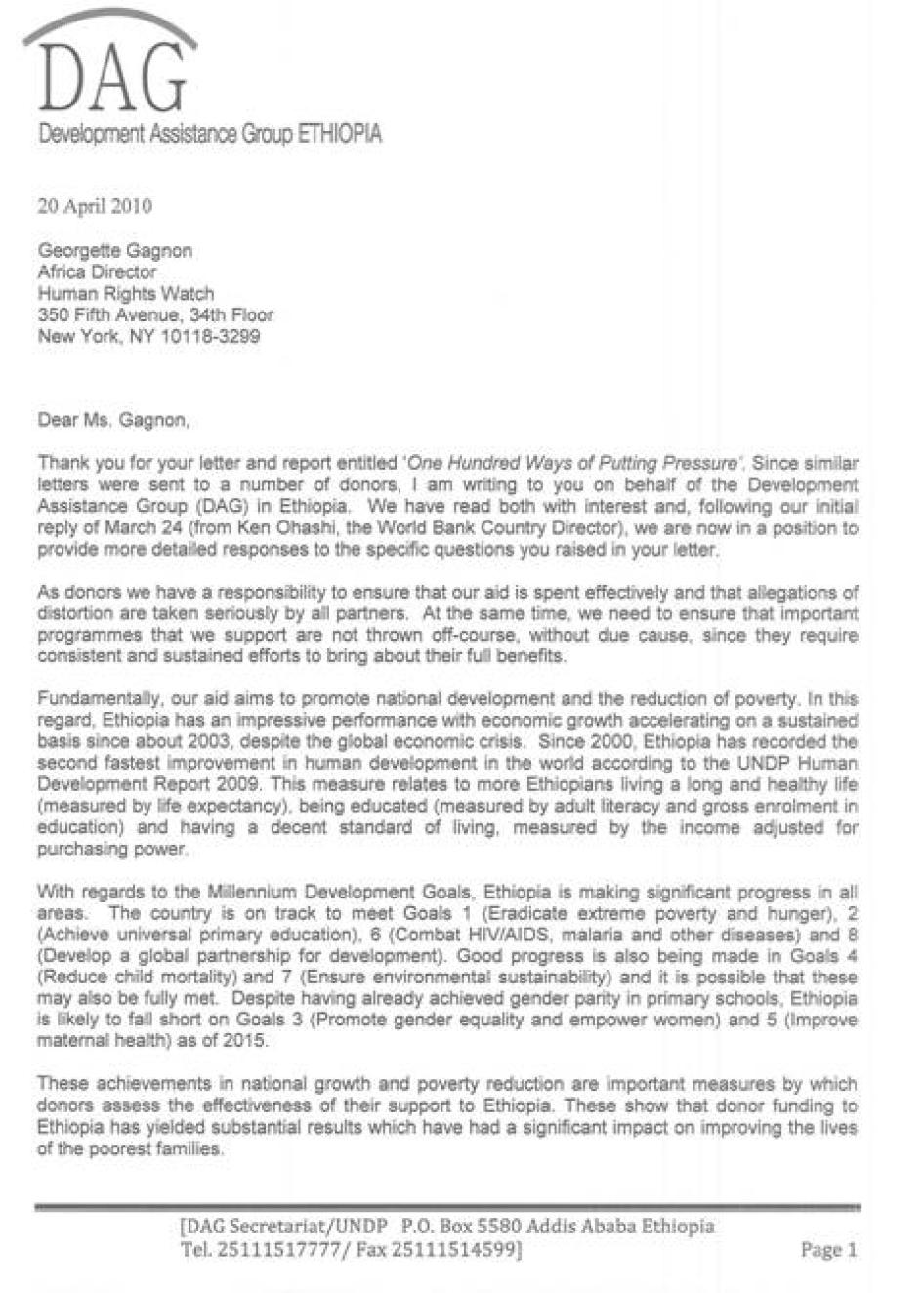
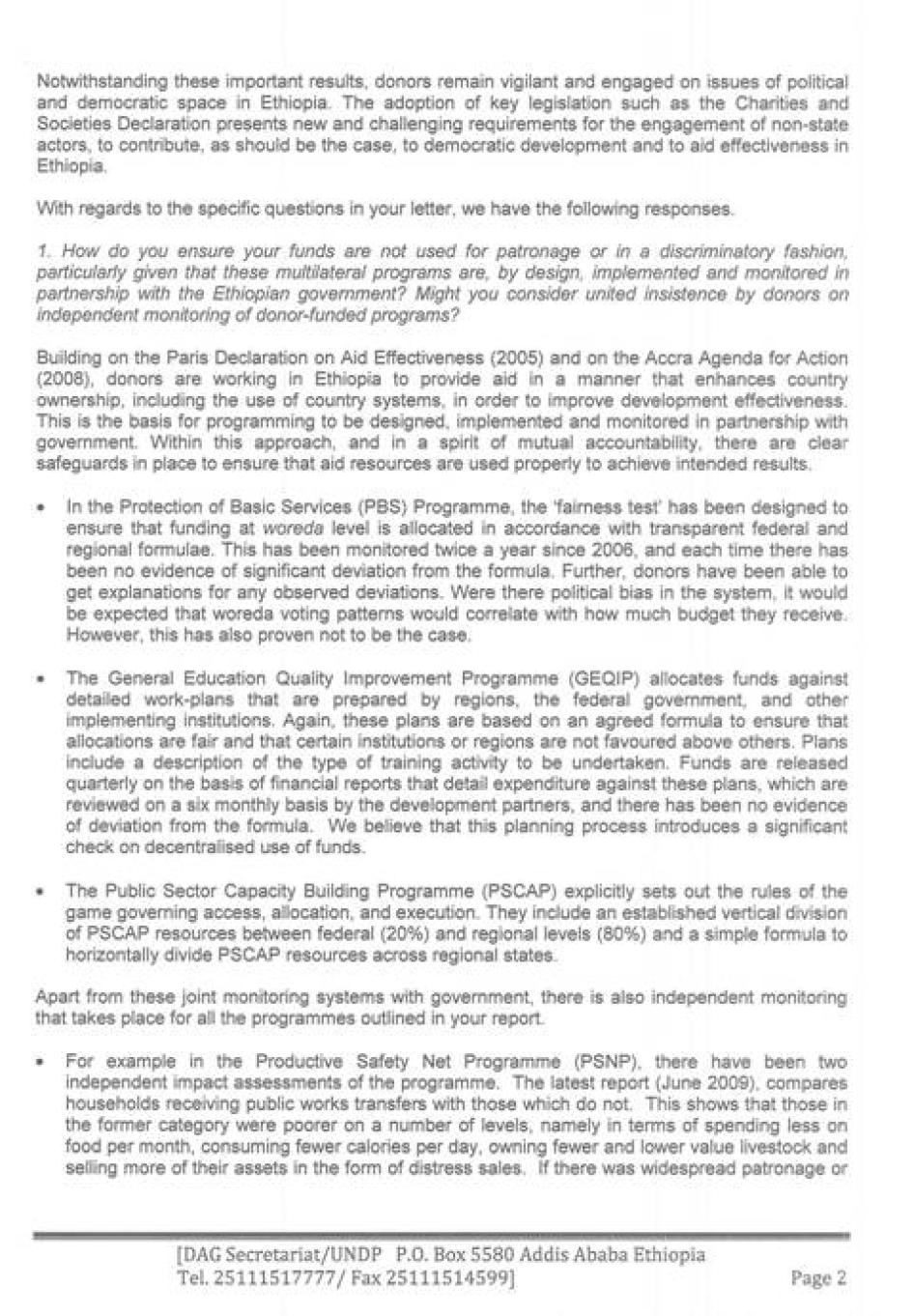
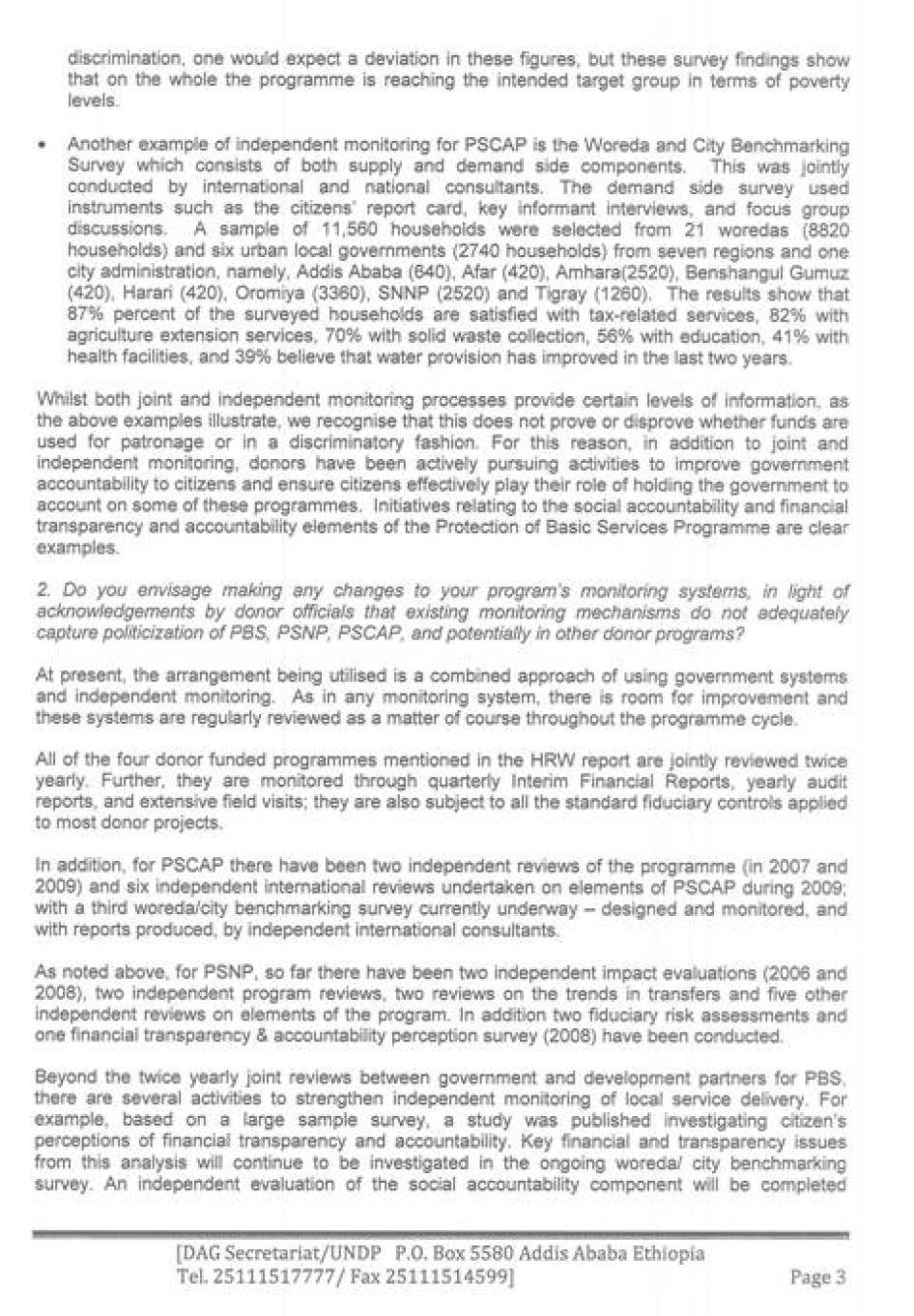
[1] For a detailed description of abuses during the three decades of internal conflict beginning in 1961, see Africa Watch (now Human Rights Watch/Africa), Evil Days: 30 Years of War and Famine in Ethiopia (New York: Human Rights Watch, 1991), http://www.hrw.org/node/78194. On progress toward the Millennium Development Goals, see United Nations Development Programme, “Millennium Development Goals in Ethiopia,” http://www.et.undp.org/index.php?option=com_content&task=view&id=30&Itemid=113 (accessed August 16, 2010) and footnote below.
[2] For OECD figures on ODA, see Table 1 below. The last year for which OECD statistics are available is 2008. See also Hendrik van der Heijden, “Accelerating Development in Ethiopia: Suggested Road Map for Scaling Up External Financing and Aid,” Government of Ethiopia/Development Assistance Group, June 1, 2007, http://dagethiopia.org/index.php?option=com_docman&task=doc_download&gid=38&Itemid=120 (accessed October 11, 2010).
[3] The Millennium Development Goals were established by the United Nations in 2000. See United Nations, “United Nations Millennium Development Goals,” http://www.un.org/millenniumgoals (accessed April 26, 2010). For a summary of Ethiopia’s recent progress toward these goals, see UN Stats, “Millennium Development Goals Indicators: Ethiopia,” http://mdgs.un.org/unsd/mdg/Data.aspx (accessed April 26, 2010); see also Ministry of Finance and Economic Development, Federal Democratic Republic of Ethiopia, “Ethiopia: 2010 MDGs Report: Trends and Prospects for Meeting MDGs by 2015,” September 2010, http://www.undp.org/africa/documents/mdg/ethiopia_september2010.pdf (accessed October 11, 2010). These figures are all based on Ethiopian government data and are contested by other sources. See, for example, Alemayhu G. Mariam, “The Voodoo Economics of Meles Zenawi,” Huffington Post, April 18, 2010, http://www.huffingtonpost.com/alemayehu-g-mariam/ethiopia-the-voodoo-econo_b_542298.html (accessed September 13, 2010); and Economist Intelligence Unit, “Ethiopia: Country Outlook,” July 1, 2010, http://www.ciaonet.org/atlas/ET/Economy/Outlook/20100701_39364.html (accessed September 13, 2010).
[4] United Nations Development Programme, “Human Development Report 2009 – Ethiopia,” http://hdrstats.undp.org/en/countries/country_fact_sheets/cty_fs_ETH.html (accessed June 17, 2010); and Human Rights Watch interviews with aid agency officials (USAID, WFP, EU, OCHA), Addis Ababa, June and September 2009.
[5] For background, see Aregawi Berhe, A Political History of the Tigray People’s Liberation Front, 1975–1991 (London: Tsehai Publishers, 2009); and Siegfried Pausewang, Kjetil Tronvoll, and Lovise Aalen, eds., Ethiopia Since the Derg: A Decade of Democratic Pretension and Performance (London: Zed Books, 2002).
[6] See Alex de Waal, Famine Crimes: Politics & the Disaster Relief Industry in Africa (London: Zed Books, 1997). The TPLF has also been accused of diverting some of the relief efforts to pay for weapons. See Martin Plaut, “Assignment: Aid for Arms in Ethiopia,” BBC News, March 7, 2010, http://www.bbc.co.uk/programmes/p006dyn3 (accessed April 9, 2010); and Berhe, A Political History of the Tigray People’s Liberation Front, 1975-1991.
[7] See “Our Revolutionary Democratic Goals and the Next Step,” Ethiopian Register, 1996, p. 20, on file with Human Rights Watch. See also René Lefort, “Powers – Mengist – and Peasants in Rural Ethiopia: the Post-2005 Interlude,” Journal of Modern African Studies, vol. 48, no. 3, 2010, p. 442: “EPRDF presents the ‘revolutionary democracy’ through which it has supposedly ruled Ethiopia since 1991 as ‘unique and different’ in two main ways from a classical ‘liberal democracy’. First, it aims to secure collective rights, starting with the rights of the ‘nations, nationalities and peoples’ of Ethiopia, while pushing individual rights into the background. Second, a ‘liberal’ democratic system is largely ‘representative’: ‘the political stage is occupied by a few politicians… who substitute for the public at large’, while with the revolutionary democracy, ‘the social forces of the peasants, laborers and majority city dwellers’ are ‘consciously and uninterruptedly engaged’ in the decision making process.”
[8] Meles Zenawi, “Perspectives and ‘Bonapartism,’” in The Gimgema Papers, 2001 (cited by Paolos Milkias, “The Great Purge and Ideological Paradox in Contemporary Ethiopian Politics,” Horn of Africa, vol. 19, 2001).
[9] Ethiopia’s constitution includes the rights to freedom of thought, opinion, and expression (art. 29) and freedom of association (art. 31), which is limited only when associations “undertake acts that needlessly subvert the rule of law and constitutional rule.” During the 1991-94 transitional period, Ethiopia ratified the International Covenant on Civil and Political Rights (ICCPR), the International Covenant on Economic, Social and Cultural Rights (ICESCR), and the Convention against Torture and Other Cruel, Inhuman or Degrading Treatment or Punishment.
[10]See Human Rights Watch, Ethiopia: The Curtailment of Rights, vol. 9, no. 8(A), December 1997, http://www.hrw.org/node/78531; Human Rights Watch, Lessons in Repression: Violations of Academic Freedom in Ethiopia, vol. 15, no. 2(A), January 2003, http://www.hrw.org/node/12373; Human Rights Watch, Targeting the Anuak: Human Rights Violations and Crimes against Humanity in Ethiopia’s Gambella Region, vol. 17, no. 3 (A), March 2005, http://www.hrw.org/node/11813; Human Rights Watch, Suppressing Dissent: Human Rights Abuses and Political Repression in Ethiopia’s Oromia Region, vol. 17, no. 7(A), May 2005, http://www.hrw.org/node/11760; “Ethiopia: Crackdown Spreads Beyond Capital,” Human Rights Watch news release, June 14, 2005, http://www.hrw.org/node/70541; “Ethiopia: Hidden Crackdown in Rural Areas,” Human Rights Watch news release, January 11, 2006, http://www.hrw.org/node/69871; “People Fleeing Somalia War Secretly Detained,” Human Rights Watch news release, March 29, 2007, http://www.hrw.org/node/72239; Human Rights Watch, Shell-Shocked: Civilians Under Siege in Mogadishu, vol.19, no. 12(A), August 2007, http://www.hrw.org/node/10784; “Ethiopia: Repression Sets Stage for Non-Competitive Elections,” Human Rights Watch news release, April 9, 2008,http://www.hrw.org/node/74763; Human Rights Watch, Collective Punishment: War Crimes and Crimes against Humanity in the Ogaden Area of Ethiopia’s Somali Region, ISBN: 1-56432-322-6, June 2008, http://www.hrw.org/node/62176; Human Rights Watch, “Analysis of Ethiopia’s Draft Civil Society Law,” October 13, 2008, http://www.hrw.org/node/88963; Human Rights Watch, “Why Am I Still Here?”: The 2007 Horn of Africa Renditions and the Fate of Those Still Missing, ISBN: 1-56432-380-3, October 1, 2008, http://www.hrw.org/node/75259; “Ethiopia: Charge or Free Ethnic Oromo Terrorism Suspects: Detainees Held Weeks Without Charge,” Human Rights Watch news release, November 27, 2008, http://www.hrw.org/node/76375; Human Rights Watch, So Much to Fear: War Crimes and the Devastation of Somalia, ISBN: 1-56432-415-X, December 8, 2008, http://www.hrw.org/node/76419; Human Rights Watch, “An Analysis of Ethiopia’s Draft Anti-Terrorism Law,” June 30, 2009,http://www.hrw.org/node/84132; Human Rights Watch, “One Hundred Ways of Putting Pressure”: Violations of Freedom of Expression and Association in Ethiopia, ISBN: 1-56432-610-1, March 2010, http://www.hrw.org/node/89128.
[11] See Human Rights Watch, “One Hundred Ways of Putting Pressure.”
[12] Ibid.
[13] Human Rights Watch, Ethiopia: The Curtailment of Rights, p. 8.
[14] National Electoral Board of Ethiopia, “Official Results of the Local Elections and By-Elections Held on April 13 and April 20, 2008,” document on file with Human Rights Watch; see also Lovise Aalen and Kjetil Tronvoll, “The End of Democracy? Curtailing Political and Civil Rights in Ethiopia,” Review of African Political Economy, vol. 36, June 1, 2009, p. 203.
[15] Human Rights Watch interview with opposition leader, Addis Ababa, September 25, 2009.
[16] Each woreda is made up of a varying number of kebeles; the woredas are the constituencies for parliamentary seats. For further description of the kebele system and its role in rural communities, see Human Rights Watch, Suppressing Dissent; and Human Rights Watch, “One Hundred Ways of Putting Pressure.” See also René Lefort, “A short survey of the relationship between powers and peasants in a peasant community of Northern Shoa,” Nord-Sud Aktuell, Quartal 2005, p. 211-221; and Lefort, “Powers – Mengist – and Peasants in Rural Ethiopia: the Post-2005 Interlude,” Journal of Modern African Studies.
[17] See Human Rights Watch, Suppressing Dissent, p. 30; and Human Rights Watch, “One Hundred Ways of Putting Pressure,” p. 22. For an overview of the current kebele structure, see International Crisis Group, “Ethiopia: Ethnic Federalism and Its Discontents,” Africa ReportNo.153, September 4, 2009, pp. 18-19, http://www.crisisgroup.org/en/regions/africa/horn-of-africa/ethiopia-eritrea/153-ethiopia-ethnic-federalism-and-its-discontents.aspx (accessed April 26, 2010).
[18] Human Rights Watch interviews, Ethiopia, June-October 2009.
[19] International Crisis Group, “Ethiopia: Ethnic Federalism and Its Discontents,” p. 19.
[20] Siegfried Pausewang, “Ethiopia: a political view from below,” South African Journal of International Affairs, vol. 16, issue no. 1, 2009, pp. 69-85.
[21] Pausewang, Aalen, and Tronvoll, eds., Ethiopia Since the Derg.
[22] National Democratic Institute for International Affairs/African-American Institute, “An Evaluation of the June 21, 1992 Elections in Ethiopia,” June 1992, http://www.ndi.org/node/12625 (accessed October 11, 2010). For background on political competition and repression in Oromia, see Human Rights Watch, Suppressing Dissent, pp. 9-10.
[23] For a detailed analysis of the first decade of elections, see Pausewang, Tronvoll, and Aalen, eds., Ethiopia Since the Derg; Leonardo R. Arriola, “Ethnicity, Economic Conditions, and Opposition Support: Evidence from Ethiopia’s 2005 Elections,” Northeast African Studies, vol. 10, no. 1, 2008, p. 118.
[24] “Board Chairman Praises Voters and Election Staff,” National Electoral Board of Ethiopia press release, May 15, 2005, http://www.electionsethiopia.org/Whats%20New26.html (accessed February 6, 2010).
[25] “Ethiopia: Crackdown Spreads Beyond Capital,” Human Rights Watch news release, June 15, 2005.
[26] Federal Supreme Court Judgment, on file with Human Rights Watch.
[27] The defendants signed a pardon apologizing for their “attempt to change government organs instituted in accordance with the Constitution, by unconstitutional means.” Unofficial translation of the pardon letter, on file with Human Rights Watch.
[28] See “Ethiopia: Opposition Leader’s Release Just a First Step,” Human Rights Watch news release, October 6, 2010, http://www.hrw.org/node/93467.
[29] See Human Rights Watch, “One Hundred Ways of Putting Pressure.”
[30] Lovise Aalen and Kjetil Tronvoll, “The 2008 Local Elections: The Return of Electoral Authoritarianism,” African Affairs, 108/430 (2008).
[31] An independent candidate won a second seat. National Electoral Board of Ethiopia, “Official Results of the 23rd May 2010 General Election,” http://www.electionethiopia.org/en/ (accessed October 11, 2010).
[32] European Union, Election Observation Mission – Ethiopia 2010, “Preliminary Statement,” Addis Ababa, May 25, 2010, http://www.eueom.eu/ethiopia2010/reports (accessed June 13, 2010).
[33] International Development Association, World Bank, “Interim Country Assistance Strategy for the Federal Democratic Republic of Ethiopia” (ICAS 2006-2008), report no. 35142-ET, May 1, 2006, p. 2.
[34] Ibid., p. 3.
[35] Ibid., p. 1.
[36] Ibid. The Protection of Basic Services program is introduced in the ICAS on p. 17.
[37] PBS I was for $2.56 billion and PBS II for $3.36 billion. See Table 3 below for details.
[38] See section on “Development Programs Vulnerable to Political Capture” for a full description of these programs.
[39] For an overview of the structure of Ethiopian government institutions and the federal-regional relationship, see International Crisis Group, “Ethiopia: Ethnic Federalism and Its Discontents,” pp. 18-19, and Kjetil Tronvoll and Sarah Vaughan, “Structures and Relations of Power: Ethiopia,” Swedish International Development Agency, 2003.
[40] ICAS 2006-2008, p. 8.
[41] Ibid., p. 103.
[42] Ibid., p. 103.
[43] Indeed, the 2008 document mentions the phrase “political capture” only once, on page 61, and then goes on to praise the PBS program for continuing to provide financing despite the recent suspension of direct budget support. World Bank, “Country Assistance Strategy for the Federal Democratic Republic of Ethiopia” (CAS 2008-2011), April 2, 2008, p. 61.
[44] Ibid., p. 18. The CAS noted “concerns about the lack of space for open political discourse” (p. 20) from stakeholder consultations and an assessment by the World Bank’s Independent Evaluation Group that there had been “weak outcomes on private sector development and mixed outcomes on governance” (p. 19).
[45] CAS 2008-2011, p. ii.
[46] For a discussion of the donors’ dilemma, see Helen Epstein, “Cruel Ethiopia,” New York Review of Books, May 13, 2010, http://www.nybooks.com/articles/archives/2010/may/13/cruel-ethiopia/ (accessed October 5, 2010).
[47] In a July 2010 study, the Development Assistance Group noted that accountability for development programs is key to how donors can “work with the Government of Ethiopia to strengthen the capacity of the state to be increasingly accountable and effective in the eyes of its citizens.” Development Assistance Group, “Aid Management and Utilisation in Ethiopia: A study in response to allegations of distortion in donor-supported development programmes,” July 2010, p. 37, http://www.dagethiopia.org/index.php?option=com_docman&task=doc_download&gid=123&Itemid=120 (accessed October 11, 2010).
[48] United Nations General Assembly, Resolution 55/2, United Nations Millennium Declaration, A/RES/55/2 (2000), http://www.un.org/millennium/declaration/ares552e.htm (accessed June 21, 2010).
[49] United Nations Development Group, “Human Rights Based Approach to Development Cooperation Towards a Common Understanding Among UN Agencies,” adopted 2003, http://www.undg.org/index.cfm?P=221 (accessed October 11, 2010).
[50] World Bank and IMF Development Committee, “Global Monitoring Report 2004: Policies and Actions for Achieving the Millennium Development Goals and Related Outcomes,” 2004, http://siteresources.worldbank.org/INTGLOBALMONITORING/Resources/GMR_2004.pdf (accessed October 11, 2010).
[51] See Philip Alston, “A Human Rights Perspective on the Millennium Development Goals,” Millennium Project Task Force on Poverty and Economic Development, 2004.
[52] Human Rights Watch interview with Greg Toulmin, Ethiopia country program coordinator, World Bank, Washington, DC, November 2, 2009.
[53] Human Rights Watch interview with World Bank officials, Addis Ababa, October 7, 2009.
[54] See background section.
[55] Anita Powell, “Ethiopia PM Rebuffs Election Critics,” Associated Press, May 26, 2010.
[56] ICAS 2006-2008, p. 103.
[57] See International Covenant on Civil and Political Rights (ICCPR), adopted December 16, 1966, G.A. Res. 2200A (XXI), 21 U.N. GAOR Supp. (No. 16) at 52, U.N. Doc. A/6316 (1966), 999 U.N.T.S. 171, entered into force March 23, 1976, acceded to by Ethiopia June 11, 1993, arts. 19, 22, and 25.
[58]Ibid., art. 2. See also Convention on the Rights of the Child (CRC), adopted November 20, 1989, G.A. Res. 44/25, annex, 44 U.N. GAOR Supp. (No. 49) at 167, U.N. Doc. A/44/49 (1989), entered into force September 2, 1990, acceded to by Ethiopia May 14, 1991, art. 2.
[59]International Covenant on Economic, Social and Cultural Rights (ICESCR), adopted December 16, 1966, G.A. Res. 2200A (XXI), 21 U.N. GAOR Supp. (No. 16) at 49, U.N. Doc. A/6316 (1966), 993 U.N.T.S. 3, entered into force January 3, 1976, acceded to by Ethiopia June 11, 1993.
[60] Committee on Economic, Social and Cultural Rights, General Comment No. 20, Non-discrimination in economic, social and cultural rights (art. 2, para. 2, of the International Covenant on Economic, Social and Cultural Rights), July 2, 2009, http://www2.ohchr.org/english/bodies/cescr/comments.htm (accessed October 11, 2010), para. 23.
[61] Ethiopia’s constitution includes the right to freedom of religion conscience and thought (art. 27), the right to hold opinions, thoughts, and free expressions (art. 29), and freedom of association (art. 31), which is limited only when associations “undertake acts that needlessly subvert the rule of law and constitutional rule.”
[62]Ethiopia’s constitution provides, “Every Ethiopian citizen shall have the right to equal access to social services run with state funds,” (art. 41, Economic, Social and Cultural Rights), and guarantees the right to join political parties, trade unions, and other workers’ associations (arts. 38 and 42); and the Amended Electoral Law (2007) prohibits political campaigning by government officials and on government property during working hours, Federal Negarit Gazeta, no. 54, June 25, 2007, para. 61.
[63] ODA is a term of the Organisation for Economic Co-operation and Development (OECD), which comprises 30 countries committed to democracy and the market economy. The OECD defines ODA as “Flows of official financing administered with the promotion of the economic development and welfare of developing countries as the main objective, and which are concessional in character with a grant element of at least 25 percent (using a fixed 10 percent rate of discount). By convention, ODA flows comprise contributions of donor government agencies, at all levels, to developing countries (‘bilateral ODA’) and to multilateral institutions. ODA receipts comprise disbursements by bilateral donors and multilateral institutions. Lending by export credit agencies—with the pure purpose of export promotion—is excluded.” OECD, “Glossary of Statistical Terms,” http://stats.oecd.org/glossary/detail.asp?ID=6043 (accessed March 25, 2010).
[64]OECD, “DAC 2a ODA disbursements,” http://stats.oecd.org/Index.aspx?DatasetCode=TABLE2A (accessed October 12, 2010).
[65] Different governments and their aid agencies contribute different amounts to different programs and projects. For a full breakdown of who funds what, see Table 3 below.
[66] OECD, http://stats.oecd.org/Index.aspx?DatasetCode=TABLE2A (accessed October 12, 2010).
[67] World Bank Country Lending Summary, Ethiopia, http://web.worldbank.org/WBSITE/EXTERNAL/PROJECTS/0,,countrycode:ET~menuPK:64820017~pagePK:64414648~piPK:64414956~subTitle:All+Loans~theSitePK:40941~pageNo:1~pageSize:Show%20All,00.html (accessed October 12, 2010).
[68] World Bank, “Project Appraisal Document on a Proposed Grant and Proposed Credit to the Federal Democratic Republic of Ethiopia for a Protection of Basic Services Project” (Project Appraisal Document for a PBS Project), May 2006; and World Bank, “Project Appraisal Document on a Proposed Grant and Proposed Credit to the Federal Democratic Republic of Ethiopia for a Protection of Basic Services Program Phase II Project” (Project Appraisal Document for a PBS Phase II Project), April 22, 2009.
[69] Project Appraisal Document for a PBS Phase II Project, April 22, 2009, p. 6.
[70] For a full breakdown of donor contributions, see Table 3 above.
[71] Project Appraisal Document for a PBS Phase II Project, April 22, 2009, p. 20.
[72] For a summary, see Sue Lautze, Angela Raven-Roberts, and Teshome Erkineh, “Humanitarian Governance in Ethiopia,” Humanitarian Exchange Magazine, issue no. 46, July 2009, http://www.odihpn.org/report.asp?id=3005 (accessed April 2, 2010).
[73] World Bank, “Project Appraisal Document for a Proposed Grant and Proposed Credit to the Federal Democratic Republic of Ethiopia for a Productive Safety Net APL III Project in Support of the Third Phase of the Productive Safety Net Program” (Project Appraisal Document for a PSNP APL III Project), September 25, 2009.
[74] DAG, “Aid Management and Utilisation in Ethiopia,”p. 8.
[75] Project Appraisal Document for a PSNP APL III Project, September 25, 2009.
[76] World Bank, “Public Sector Capacity Building Program Support Project,” http://web.worldbank.org/external/projects/main?pagePK=64283627&piPK=73230&theSitePK=295930&menuPK=295961&Projectid=P107217 (accessed April 2, 2010).
[77] World Bank, “Project Appraisal Document on a Proposed Credit to the Federal Democratic Republic of Ethiopia for a Public Sector Capacity Building Program Support Project” (Project Appraisal Document for a PSCAP Project), March 25, 2004, p. 3.
[78] The donors were: African Development Bank, Canadian International Development Agency, Development Cooperation Ireland (DCI), Department for International Development (DFID), European Commission (EC), Finland, France, Germany, World Bank, Italy, Japan, Netherlands, Swedish International Development Agency, United Nations Development Programme, and United States Agency for International Development. See Project Appraisal Document for a PSCAP Project, March 25, 2004, p. 26.
[79] Ibid., p. 4.
[80] Ibid. p. 11; and World Bank, “Project Appraisal Document on a Proposed Credit to the Federal Democratic Republic of Ethiopia in Support of the First Phase of The General Education Quality Improvement Program (GEQIP)” (Project Appraisal Document for the First Phase of GEQIP), November 24, 2008.
[81] Project Appraisal Document for the First Phase of GEQIP, p. 2.
[82] Ibid., p. 17.
[83] Ibid., p. 7.
[84] Ibid., p. 9.
[85] Government of Ethiopia, “United Nations Development Programme – Ministry of Finance and Economic Development, Multi-Donor Support for the Democratic Institutions Programme,” August 2007, p. 1.
[86] Human Rights Watch interview with Siye Abraha, former minister of defense and former chief executive of EFFORT, the Tigray development association that is responsible for much of the parastatal development work in Tigray province and across the country, October 6, 2009.
[87] Human Rights Watch interview with European aid official, Addis Ababa, September 24, 2009.
[88] US State Department, “Country Reports on Human Rights Practices 2009: Ethiopia,” March 11, 2010, http://www.state.gov/g/drl/rls/hrrpt/2009/af/135953.htm (accessed October 5, 2010).
[89] Human Rights Watch interview with human rights activist, Gonder, September 17, 2009.
[90] Human Rights Watch interview with farmer, Dessie, October 3, 2009.
[91] US Department of State and the Broadcasting Board of Governors Office of Inspector General, “Report of Inspection: Embassy Addis Ababa, Ethiopia,” report no. ISP-I-10-51A, April 2010.
[92] “Ethiopia: Government Repression Undermines Poll,” Human Rights Watch news release, May 24, 2010, http://www.hrw.org/node/90619.
[93] Human Rights Watch interviews, Amhara, SNNPR, and Oromia regions, June and September-October 2009.
[94] Human Rights Watch interview with opposition farmer, Gonder, September 19, 2009.
[95] Human Rights Watch interview with opposition farmer, Dilla, October 3, 2009.
[96] Human Rights Watch interview with opposition farmer, Gonder, September 19, 2009.
[97] Human Rights Watch, Suppressing Dissent, pp. 27-39.
[98] Lefort, “Powers – Mengist – and Peasants in Rural Ethiopia: the Post-2005 Interlude,” Journal of Modern African Studies.
[99] Ibid., pp. 444 and 449.
[100] Human Rights Watch interview with farmer from Dabat woreda, Gonder, September 19, 2009.
[101] Ibid.
[102] Human Rights Watch interview with farmer from Tachar Macho woreda, Gonder, September 19, 2009.
[103] This was the case in Lante and Dabat respectively. Human Rights Watch interviews, June 23 and September 19, 2009.
[104] Human Rights Watch interviews, Addis Ababa, June and September 2009, and London, October 15, 2009.
[105] See, for example, Pausewang, “Ethiopia: a political view from below,” and Lefort, “A short survey of the relationship between powers and peasants in a peasant community of Northern Shoa,” Nord-Sud Aktuell.
[106] Project Appraisal Document for a PSNP APL III Project, September 25, 2009, p. 3.
[107] Ibid.
[108] Ibid., p. 3.
[109] A European donor official involved in the safety net program said: “Micro-loans are politicized, [the banks] are funded federally and regionally—mostly regional governments control them.” Human Rights Watch interview with European aid agency official, Addis Ababa, September 24, 2009.
[110] Tewodaj Mogues et al., “Agricultural extension in Ethiopia through a gender and governance lens,” International Food Policy Research Institute (IFPRI) Ethiopia Strategy Support Program Discussion Paper, no. ESSP2 007, October 2009, http://www.ifpri.org/publication/agricultural-extension-ethiopia-through-gender-and-governance-lens (accessed October 5, 2010), p. 33.
[111] Human Rights Watch interviews, June, September-October, and December 2009.
[112] Human Rights Watch interview with farmer, Dilla, October 3, 2009.
[113] Ibid.
[114] Ibid.
[115] Human Rights Watch interview, Arba Minch, June 23, 2009.
[116] Human Rights Watch interview with Belete Etana, former vice-chair, Public Accounts Standing Committee, House of Peoples’ Representative, London, October 16, 2010.
[117] Human Rights Watch interview with opposition farmer, Awassa, October 2, 2009.
[118] DAG, “Aid Management and Utilisation,” p. 6.
[119] Human Rights Watch interview with consultant to a major donor, Addis Ababa, October 5, 2009.
[120] Human Rights Watch interview with Western aid agency official, Addis Ababa, September 23, 2009.
[121] Human Rights Watch interviews in Gonder and Wollo zones (Amhara) and Sidama and Gedeo zones (SNNPR), September-October 2009.
[122] Ministry of Agriculture and Rural Development, “PSNP Implementation Manual,” 2004.
[123] Kay Sharp, Taylor Brown, and Amdissa Teshome, “Targeting Ethiopia’s Productive Safety Net Programme (PSNP),” Overseas Development Institute, August 2006, http://www.odi.org.uk/resources/download/3035.pdf (accessed October 6, 2010), p. 50.
[124] Human Rights Watch interview with farmer, Dilla, October 3, 2009.
[125] Human Rights Watch interview with farmer and former PSNP coordinator, Dilla, October 3, 2009.
[126] Human Rights Watch interview with opposition farmers, Gonder, September 19, 2009.
[127] Human Rights Watch interviews with Arena-Tigray officials, Addis Ababa, December 9, 2009; and telephone interview with Arena-Tigray officials, Tigray, December 20, 2009.
[128] Human Rights Watch telephone interview with Gebru Asrat, Arena-Tigray leader, December 26, 2009. See also Jason McClure, “Ethiopia jails seven for complaining of aid abuses,” Bloomberg News, December 29, 2009.
[129] Human Rights Watch telephone interviews with Arena-Tigray officials, December 26, 2009; and email correspondence with Jason McClure, January 11, 2010.
[130] Human Rights Watch interview with unaffiliated farmer, Awassa, October 1, 2009.
[131] Human Rights Watch interview with EPRDF farmer, Dilla, October 3, 2009.
[132] Human Rights Watch interviews with opposition farmers, Dilla, October 3, 2009.
[133] Human Rights Watch interview with opposition farmer, Gonder, September 19, 2009.
[134] Sharp, Brown, and Teshome, “Targeting Ethiopia’s Productive Safety Net Programme (PSNP),” p. 50.
[135] Mogues et al., “Agricultural Extension in Ethiopia,” p. 34.
[136] Fekadu Nigussa and Ignatius Mberengwa, “Challenges of Productive Safety Net Program Implementation at Local Level: The Case of Kuyu woreda in North Shewa Zone, Oromia Region, Ethiopia,” Journal of Sustainable Development in Africa, vol. 11, no. 1, 2009, http://www.jsd-africa.com/Jsda/V11N01_Summer2009/PDF/Challenges%20of%20Productive%20Safety%20Net%20Program%20Implementation.pdf (accessed April 23, 2010).
[137] Sharp, Brown, and Teshome, “Targeting Ethiopia’s Productive Safety Net Programme (PSNP),” p. 50.
[138] Ibid., p. 51.
[139] Human Rights Watch interviews with Western aid agency official, Addis Ababa, September 8, 2009; and with former World Bank PSNP staff, London, October 15, 2009. See the section below discussing the donor response.
[140] Human Rights Watch interview with international NGO official, Addis Ababa, June 16, 2009.
[141] DAG, “Aid Management and Utilisation,” p. 29.
[142] René Lefort, “Ethiopia’s Famine: Deny and Delay,” OpenDemocracy, March 24, 2009, http://www.opendemocracy.net/article/email/ethiopias-famine-deny-and-delay (accessed September 11, 2010).
[143] Human Rights Watch interview with opposition farmer, Awassa, October 2, 2009.
[144] Human Rights Watch interviews, Dilla, October 3, 2009.
[145] Human Rights Watch interview, Dilla, October 3, 2009.
[146] Human Rights Watch interview, Awassa, September 23, 2009.
[147] Human Rights Watch interview with Boricha resident and opposition supporter, Awassa, October 2, 2009.
[148] Ibid.
[149] Human Rights Watch interview with opposition supporter, Awassa, October 2, 2009.
[150] Human Rights Watch interview with opposition farmer, Awassa, September 30, 2009.
[151] Human Rights Watch interview with opposition farmer, Awassa, September 30, 2009.
[152] Human Rights Watch interview with EPRDF farmer from Dale woreda, Awassa, October 1, 2009.
[153] Ibid.
[154] Human Rights Watch interview with opposition member, Awassa, October 2, 2009.
[155] Human Rights Watch interview with opposition leader, Dilla, October 3, 2009.
[156] Human Rights Watch interviews with opposition supporters, Awassa, September 28, 2009.
[157] Human Rights Watch interview with trainee detective, Addis Ababa, September 23, 2009.
[158] Jalene Gemeda, “Needy West Harage Residents Accuse Officials of Corruption in Food Aid Distribution,” VOA News, January 15, 2010, http://www.voanews.com/horn/2010-01-15-voa1.cfm (accessed February 3, 2010).
[159] Arriola, “Ethnicity, Economic Conditions and Opposition Support: Evidence from Ethiopia’s 2005 Elections,” Northeast African Studies, p. 133.
[160] Jutta Skau et al., “Outcome evaluation study of the Targeted Supplementary Food (TSF) program in Ethiopia,” World Food Programme, June 2009, http://oneresponse.info/GlobalClusters/Nutrition/Documents/WFP%20Ethiopia%20TSF%20Final%20Report.pdf (accessed April 13, 2009).
[161] Human Rights Watch interviews with teacher who attended teachers’ training in Gonder, September 18, 2009; and with civil servant who attended training, Gonder, September 18, 2009.
[162] Human Rights Watch interview with civil servant who attended training, Gonder, September 18, 2009. The EPRDF frequently refers to opposition parties derogatorily as “rent seekers,” meaning supporters of a liberal economic system in which an upper class seeks rents from the labor of the poor.
[163] Ibid.
[164] Human Rights Watch interviews with donor officials, Addis Ababa, June, October, and December 2009.
[165] Human Rights Watch interview with European donor official, Addis Ababa, June 26, 2009.
[166] Human Rights Watch interview with consultant, Addis Ababa, October 5, 2009.
[167] Human Rights Watch interview with teacher, Awassa, September 29, 2009.
[168] Human Rights Watch interviews with teachers, Awassa, June and September 2009.
[169] Human Rights Watch interviews with teachers, Awassa and Dilla, September and October 2009; and with Gemorau Kassa, Addis Ababa, October 6, 2009.
[170] Human Rights Watch interview with teacher, Ambo, November 14, 2009.
[171] Human Rights Watch interview with Belete Etana, London, October 16, 2009.
[172] Human Rights Watch interview with senior World Bank official, Addis Ababa, October 7, 2009.
[173] Human Rights Watch interview with World Bank official, Addis Ababa, [date withheld], 2009.
[174] Human Rights Watch, Suppressing Dissent, pp. 22-24.
[175] ICESCR, art. 13.
[176] Committee on Economic, Social and Cultural Rights, General Comment No. 13, The right to education, December 8, 1999, E/C.12/1999/10, para. 6.
[177] “The sub-program A1 will finance recurrent expenditures (salaries, operations, maintenance) in the sub-national basic services,” which include education. See Project Appraisal Document for a PBS Project, May 2006, p. 20.
[178] See Project Appraisal Document for the First Phase of GEQIP, November 24, 2008, p. 6. Human Rights Watch reported similar political activity on school premises, targeting Oromo students for abuse and the monitoring of students’ speech by teachers in Oromia in 2005. See Human Rights Watch, Suppressing Dissent, pp. 22-24.
[179] Human Rights Watch interview with high school student, Awassa, October 1, 2009.
[180] Ibid.
[181] Human Rights Watch interviews with high school students, Awassa, October 1, 2009.
[182] Human Rights Watch interviews, Ethiopia, June and September-October 2009.
[183] Human Rights Watch interview with high school student, Awassa, October 1, 2009.
[184] Human Rights Watch interview with high school student, Dessie, October 3, 2009.
[185] Human Rights Watch interview with teacher, Awassa, September 29, 2009.
[186] Human Rights Watch interview with former teacher, Gonder, September 18, 2009.
[187] Human Rights Watch interview with teacher, Awassa, September 29, 2009.
[188] Human Rights Watch interview with teacher, Dilla, October 3, 2009.
[189] See Human Rights Watch, Ethiopia: The Curtailment of Rights.
[190] Project Appraisal Document for the First Phase of GEQIP, November 24, 2008, p. 7.
[191] Committee on Economic, Social and Cultural Rights, General Comment No. 13, The right to education, para. 39.
[192] See Human Rights Watch, “One Hundred Ways of Putting Pressure,” p. 43.
[193] Human Rights Watch interviews, Ambo, November 14, 2009; Arba Minch, June 24, 2009; Awassa June 26,2009; Dessie, October 3, 2009; Dilla, October 3, 2009; Gonder, September 18, 2009; and Addis Ababa, October 7, 2009. Fifty teachers in Arba Minch signed a petition on February 7, 2009, demanding the return of enforced union dues. The Ethiopian Teachers’ Association is a government-controlled professional body that replaced the independent former union of the same name. The former association was forced to change its name to the National Teachers’ Association and has been the victim of a long-running campaign of intimidation and harassment since the early 1990s. For a summary of that history, see Human Rights Watch, “One Hundred Ways of Putting Pressure,” pp. 40-44.
[194] Human Rights Watch interviews with teachers, Ambo, November 14, 2009.
[195] US State Department, “Country Reports on Human Rights Practices 2009: Ethiopia.”
[196] Human Rights Watch interview with teacher, Gonder, September 18, 2009.
[197] Human Rights Watch interview with teacher, Arba Minch, June 24, 2009.
[198] Human Rights Watch interviews with teachers, Awassa, June 26, 2009, and September 30, 2009.
[199] Human Rights Watch interview with teacher, SNNPR, September 29, 2009.
[200] Human Rights Watch interview with official, Office of the Ombudsman, Addis Ababa, September 23, 2009.
[201] See, for example, Council of Ministers Regulation No.155/2008, “Administration of Employees of the Ethiopian Revenues and Customs Authority” (as published in the Federal Negarit Gazeta, no. 49, August 14, 2008, p. 4166), art. 37, “Summary Dismissal”: “Notwithstanding any provision to the contrary, the Director General may, without adhering to the formal disciplinary procedures, dismiss any employee from duty wherever he has suspected him of involving in corruption and lost confidence in him. An employee who has been dismissed from duty in accordance with sub-article (1) of this article may not have the right to re-instatement by the decision of any judicial body.”
[202] Ibid.
[203] Regional Government of Amhara, “BPR Scorecard,” on file with Human Rights Watch.
[204] Human Rights Watch interview with teacher, Dilla, October 3, 2009.
[205] Human Rights Watch interview with lecturer, Addis Ababa University, Addis Ababa, September 22, 2009.
[206] Human Rights Watch interview with World Bank staff, Addis Ababa, October 2009.
[207] Human Rights Watch interview with civil servant, Shashamene, SNNPR, June 26, 2009.
[208] Ibid.
[209] Human Rights Watch interview with civil servant, Bahir Dar, September 14, 2009.
[210] Ibid.
[211] Human Rights Watch interview with EHRCO officials, Addis Ababa, September 8, 2009; and Ethiopian Human Rights Council, “33rd Regular Report” (in Amharic), www.ehrco.org (accessed April 21, 2010).
[212] Human Rights Watch interview with official, Office of the Ombudsman, Addis Ababa, September 23, 2009.
[213] Human Rights Watch interview with former civil servant, Ministry of Agriculture, Addis Ababa, September 21, 2009.
[214] Human Rights Watch interview with former civil servant, Ministry of Revenue and Customs, Addis Ababa, September 22, 2009.
[215] Human Rights Watch interview with former civil servant, Ministry of Revenue and Customs, Addis Ababa, September 22, 2009.
[216] Human Rights Watch interview with Belete Etana, London, October 16, 2009.
[217] Human Rights Watch interview with Bulcha Demeksa, leader of OFDM opposition party, Addis Ababa, June 26, 2009.
[218] Human Rights Watch interview with World Bank official, Addis Ababa, October 7, 2009.
[219] Human Rights Watch telephone interview with former World Bank official, London, October 15, 2009.
[220] Human Rights Watch interview with former trainee judge, Addis Ababa, June 19, 2010.
[221] Human Rights Watch interview with civil servant, Bahir Dar, September 14, 2009.
[222] Human Rights Watch interview with former trainee judge, Addis Ababa, June 19, 2010.
[223] Human Rights Watch interview with civil servant, Bahir Dar, September 14, 2009.
[224] Human Rights Watch interview with Western donor official, Addis Ababa, October 7, 2009.
[225] International Crisis Group, “Ethiopia: Ethnic Federalism and Its Discontents.” See also Paulos Chanie, “Clientelism and Ethiopia’s Post-1991 Decentralisation,” Journal of Modern African Studies, vol. 45, no.3 (2007), pp. 355-384.
[226] Vaughan and Tronvoll, “Structures and Relations of Power: Ethiopia,” p. 43.
[227] René Lefort, “Ethiopia’s election: all losers” OpenDemocracy, July 20, 2010 http://www.opendemocracy.net/ren%C3%A9-lefort/ethiopias-election-all-losers (accessed July 20, 210).
[228] Lefort, “Powers – Mengist – and Peasants in Rural Ethiopia: the Post-2005 Interlude,”Journal of Modern African Studies, p. 452.
[229] Human Rights Watch, “One Hundred Ways of Putting Pressure.”
[230] “Ethiopia: Government Repression Undermines Poll,” Human Rights Watch news release, May 24, 2010.
[231] Lefort, “Ethiopia’s election: all losers,” OpenDemocracy.
[232] Human Rights Watch interview with Prime Minister Meles Zenawi, Addis Ababa, December 22, 2009.
[233] Human Rights Watch interview with former civil servant, Ministry of Agriculture, Addis Ababa, September 21, 2009.
[234] Human Rights Watch interviews with Siye Abraha, UDJ leader, Addis Ababa, October 6, 2009; with Merera Gudina, OPC leader, Addis Ababa, October 1, 2009; and with Bulcha Demeksa, OFDM leader, Addis Ababa, June 26, 2009.
[235] Human Rights Watch interview with UDJ coordinator, Bahir Dar, September 17, 2009.
[236] “Ethiopia: Gov’t rejects politicized food aid claims,” IRIN News, November 24, 2009.
[237] Ibid., and see Human Rights Watch, “One Hundred Ways of Putting Pressure,” pp. 55-57.
[238] Letter from Samuel Nyambi on behalf of the Development Assistance Group (DAG) to Human Rights Watch, April 20, 2010, on file with Human Rights Watch and included as an annex to this report.
[239] Ibid.
[240] DAG, “Aid Management and Utilisation,” p. iv.
[241] Ibid, p. vii.
[242] Human Rights Watch interview with donor official, Addis Ababa, September 7, 2009.
[243] Human Rights Watch interviews with officials responsible for the DIP program, Addis Ababa, December 2009.
[244] Human Rights Watch interviews with European diplomats, Addis Ababa, September 23, 24, and October 5, 2009.
[245] Human Rights Watch interview with diplomat, Addis Ababa, October 5, 2009.
[246] Letter from Human Rights Watch to Kenichi Ohashi, World Bank Ethiopia country director, March 19, 2010, included as an annex to this report.
[247] Letter from DAG to Human Rights Watch, April 20, 2010.
[248] Human Rights Watch interviews with Western aid agency officials, Addis Ababa, June and October 2009.
[249] DAG, “Aid Management and Utilisation,” p. 6.
[250] Ibid., p. 7.
[251] Ibid., p. 3.
[252] “Ethiopia: Government Denies Food Aid ‘Manipulated’ for Political Gain,” IRIN News, June 7, 2010.
[253] Federal Democratic Republic of Ethiopia, “Financial Transparency and Accountability Perception Survey, 2009,” quoted in Letter from DAG to Human Rights Watch, April 20, 2010.
[254] World Bank, Project Appraisal Document for a PBS Phase II Project, April 22, 2009, p. 35; and Letter from DAG to Human Rights Watch, April 20, 2010.
[255] Letter from DAG to Human Rights Watch, April 20, 2010.
[256] Human Rights Watch interviews with DFID official, Addis Ababa, June 19, 2009; and with senior World Bank official, Addis Ababa, October 7, 2009.
[257] DAG, “Aid Management and Utilisation,” p. 18.
[258] Ibid.
[259] According to the World Bank, “Social Accountability mechanisms refer to a broad range of actions (beyond voting) that citizens, communities and civil society organizations can use to hold government officials and bureaucrats accountable. These include citizen participation in public policy making, participatory budgeting, public expenditure tracking, citizen monitoring of public service delivery, citizen advisory boards, lobbying and advocacy campaigns.” See World Bank, “Social Accountability,” http://go.worldbank.org/Y0UDF953D0 (accessed August 17, 2010). For more information on Social Accountability in Ethiopia, see www.ethiosap.org.
[260] CAS 2008-2011, p.32.
[261] Beverly Jones, “Leading Civil Society Up the Governance Path: Civil society as an Instrument of ‘Democratic Structural Adjustment’ – A Case Study from Ethiopia,” paper for INTRAC conference, “Whatever Happened to Civil Society,” November 15, 2008.
[262] See www.ethiosap.org for more details.
[263] One donor official said, “Component 4 is not working.” Human Rights Watch interview with aid official, Addis Ababa, September 8, 2009. Another said, “Component 4 is not completely doomed but it is not ideal.” Human Rights Watch interview with donor official, Addis Ababa, September 25, 2009.
[264] Human Rights Watch, “Analysis of Ethiopia’s Draft Civil Society Law.”
[265] See ibid.; and “Ethiopia: New Law Ratchets Up Repression,” Human Rights Watch news release, January 8, 2009, http://www.hrw.org/node/79133.
[266] See Human Rights Watch, “Analysis of Ethiopia’s Draft Civil Society Law.”
[267] Beverly Jones, “Leading Society Up the Governance Path.”
[268] Human Rights Watch telephone interview with academic specialist on Ethiopia, London, July 30, 2009.
[269] Human Rights Watch interview with Dutch embassy official, Addis Ababa, September 22, 2009.
[270] Human rights Watch interview with Swedish embassy official, Addis Ababa, September 26, 2009.
[271] Letter from Ministry of Finance and Economic Development to Kenichi Ohashi, World Bank, Ref: 2 PA-2/WB-8/09, date unknown, 2009, on file with Human Rights Watch.
[272] “EU Presidency Declaration on Ethiopia’s adoption of the Charities and Societies Proclamation,” Ref: CL09-028EN, January 30, 2009, http://www.europa-eu-un.org/articles/en/article_8459_en.htm (accessed February 2, 2010). See also Human Rights Watch, “Letter to the European Union on their Disappointing Reaction to the Ethiopian NGO Law,” February 10, 2009, http://www.hrw.org/node/80698.
[273] Human Rights Watch interviews with European ambassadors, Addis Ababa, June 2009.
[274] The organizations are: Jerusalem Children Community and Development Organization, Illu Women and Children Integrated Development Association, Oromia Development Association, Zema Setoch Lefithi, Rift Valley Children and Women’s Development Association, Derash Relief and Development Organization, Relief Society of Tigray, Amhara Development Association, Facilitator for Change Ethiopia, Women’s Association of Tigray, Ethiopian Interfaith Forum for Development Dialogue and Action, and Action for Self Reliance Organization. For further information on the NGOs involved in Component 4 and Social Accountability work, see www.ethiosap.org (accessed June 21, 2010). See also Zakaariyaas Mulataa, “Political Nongovernmental Organizations (NGOs) and Governmental Companies in Ethiopia: Political roles of local NGOs and government companies under the ownership of the TPLF/EPRDF regime,” January 2010, on file with Human Rights Watch; and also, for a history of government control of civil society, Vaughan and Tronvoll, “Structures and Relations of Power: Ethiopia.”
[275] Human Rights Watch interview with donor official responsible for PBS, Addis Ababa, June 26, 2009.
[276] Human Rights Watch interview with Western donor official responsible for PSNP, Addis Ababa, September 8, 2009.
[277] Human Rights Watch interview with former World Bank PSNP staff, London, October 15, 2009.
[278] Letter from DAG to Human Rights Watch, April 20, 2010.
[279] See Project Appraisal Document for a PBS Phase II Project, April 22, 2009; and DAG, “Aid Management and Utilisation,” p. 10.
[280] Human Rights Watch interviews, Ethiopia, June-December 2009.
[281] Sharp, Brown, and Teshome, “Targeting Ethiopia’s Productive Safety Net Programme (PSNP),” p. 33.
[282] Federal Government of Ethiopia, “Financial Accountability and Transparency Survey,” quoted in Letter from DAG to Human Rights Watch, April 20, 2010.
[283] Sharp, Brown, and Teshome, “Targeting Ethiopia’s Productive Safety Net Programme (PSNP),” p. 26.
[284] Ibid., p. 32
[285] Letter from DAG to Human Rights Watch, April 20, 2010.
[286] Ibid.
[287] Human Rights Watch interview with consultant to a major donor, Addis Ababa, October 5, 2009.
[288] Letter from DAG to Human Rights Watch, April 20, 2010.
[289] “Complaint against the Government of Ethiopia presented by the Ethiopian Teachers’ Association (ETA), Education International (EI) and the International Trade Union Confederation (ITUC), supported by the International Confederation of Free Trade Unions (ICFTU) and the World Confederation of Labour (WCL),” report no. 353, case(s) no(s). 2516, http://www.ilo.org/ilolex/cgi-lex/pdconv.pl?host=status01&textbase=iloeng&document=4893&chapter=3&query=Ethiopia%40ref&highlight=&querytype=bool&context=0 (accessed October 11, 2010). The International Labour Organization concluded, “The Committee therefore urges the Government to take all necessary measures to ensure that the National Teachers’ Association is registered without further delay so that all teachers may fully exercise their right to form organizations for the furtherance and defence of teachers’ occupational interests without further delay.” And, “It therefore once again urges the Government to take the necessary steps to ensure that the freedom of association rights of civil servants, including teachers in the public sector, are fully guaranteed.” It also recommended that the Ethiopian government, “initiate without delay an independent inquiry into the allegations of torture and maltreatment” of detained teachers.
[290] DAG, “Aid Management and Utilisation,” p. 36.
[291] Human Rights Watch interview with World Bank official, Addis Ababa, [date withheld], 2009.
[292] Ibid.
[293] ICAS 2006-2008; and CAS 2008-2011.
[294] Ibid., p. 2.
[295] See Human Rights Watch, “One Hundred Ways of Putting Pressure,” p. 16; and Human Rights Watch, “Ethiopia: Repression Sets Stage for Non-Competitive Elections,” Human Rights Watch news release, April 9, 2008, http://www.hrw.org/node/74763. See also Aalen and Tronvoll, “The 2008 Local Elections: The Return of Electoral Authoritarianism,” African Affairs. The European Union Election Observation Mission said in its interim report on the May 2010 polls: “The separation between the ruling party and the public administration was blurred at the local level in many constituencies… The playing field for the 2010 elections was not sufficiently balanced, leaning in favor of the ruling party in many areas… The practical implementation of the laws regulating elections deviates in certain cases from the spirit of these commitments, thereby constraining the electoral process and more particularly the full, non-discriminatory enjoyment of fundamental rights… The number of complaints of campaign violations, harassment and intimidation, including cases of violence, voiced both by the opposition and the ruling party rose in the last weeks. The sheer volume and consistency of these complaints is a matter of concern and has to be taken into consideration in the overall appreciation of the electoral process.” See European Union, “Election Observation Mission – Ethiopia 2010, Preliminary Statement,” Addis Ababa, May 25, 2010, p. 1.
[296] Human Rights Watch interview with official from major donor country, Addis Ababa, October 5, 2009. A study following the 2008 local elections, stated: “Ethiopia is not on its way towards democracy; but is confirming its place among authoritarian regimes. It has attempted to ascribe the events following the2005 elections to the ‘infancy of the democratic system of the country’ (Ethiopian Herald, 21 March 2007), indicating that massive human rights violations should be considered as a natural part of the development towards a more democratic society. This is based on a linear understanding of political development, where the ultimate end is democratisation… Ethiopia is not an incomplete democracy; it is rather an authoritarian state draped in democratic window-dressing in which manipulated multiparty elections are a means to sustain power.” From Aalen and Tronvoll, “The End of Democracy?,” Review of African PoliticalEconomy, p. 203.
[297] See, for example, Joel Barkan, “Rethinking budget support for Africa: a political economy perspective,” in Richard Joseph, ed., Smart Aid for Africa (Boulder: Lynne Reiner, 2007); and Dambisa Moyo, Dead Aid: Why Aid Isn’t Working and How There Is Another Way for Africa (London: Allen Lane, 2009).
[298] “Ethiopian PM seeks to stop policy requirements from donors,” Afrik News, October 4, 2010, http://www.afrik-news.com/article18332.html (accessed October 5, 2010).
[299] Nordic Trust Fund, World Bank, “Knowledge and Learning Program for Developing an Informed View of How Human Rights Relate to the Bank’s Core Work and Mission - Approach Paper,” September 25, 2009, on file with Human Rights Watch.
[300] Human Rights Watch telephone interview with former World Bank official, London, October 15, 2009.
[301] Human Rights Watch interview with aid agency official, Addis Ababa, October 7, 2009.
[302] Human Rights Watch interview with World Bank official, Addis Ababa, [date withheld], 2009.
[303] United States Department of State and the Broadcasting Board of Governors Office of Inspector General, “Report of Inspection: Embassy, Addis Ababa, Ethiopia,” report no. ISP-I-10-51A, April 2010, http://oig.state.gov/documents/organization/143590.pdf (accessed October 11, 2010), p. 15.
[304] Human Rights Watch interview with European aid official, Addis Ababa, September 22, 2009.
[305] Human Rights Watch interview with European aid official, Addis Ababa, September 23, 2009.
[306] Human Rights Watch interview with European aid official, Addis Ababa, September 24, 2009.
[307] Human Rights Watch interviews with UK Foreign and Commonwealth Office and DFID officials, Addis Ababa, June, October, and December 2009.
[308] Human Rights Watch telephone interview with Western aid official, Addis Ababa, March 2009.
[309] Christopher Barnett et al., “Evaluation of DFID’s Country Programmes: Ethiopia 2003-2008,” DFID, April 2009, p. 1.
[310] DAG, “Aid Management and Utilisation,” p. 2.
[311] The total project cost reflects the amounts committed by the International Development Association, International Bank of Reconstruction and Development, and other donors including the share of the Government of Ethiopia. For a summary of all the programs mentioned, see: http://go.worldbank.org/K1QKUECO10 (accessed March 17, 2010).
[312] World Bank, “Project Appraisal Document on a Proposed Grant and Proposed Credit to the Federal Democratic Republic of Ethiopia for a Protection of Basic Services Program Phase II Project,” April 22, 2009, p. 6.
[313] World Bank, “Project Appraisal Document on a Proposed Credit to the Federal Democratic Republic of Ethiopia for a Public Sector Capacity Building Program Support Project,” March 24, 2004; “Project Appraisal Document for a Proposed Grant and Proposed Credit to the Federal Democratic Republic of Ethiopia for a Productive Safety Net APL III Project in Support of the Third Phase of the Productive Safety Net Program,” September 25, 2009; and “Project Appraisal Document on a Proposed Credit to the Federal Democratic Republic of Ethiopia in Support of the First Phase of The General Education Quality Improvement Program (GEQIP),” November 24, 2008.
[314] In 2007/08, the proportion of foreign aid in the government budget was 27% and projected to rise. See “Project Appraisal Document, PBS Phase II,” p. 27.
[315] World Bank, “Project Appraisal Document on a Proposed Grant and Proposed Credit to the Federal Democratic Republic of Ethiopia for a Protection of Basic Services Program Phase II Project,” p. 41.
[316] World Bank, “Project Appraisal Document for a Proposed Grant and Proposed Credit to the Federal Democratic Republic of Ethiopia for a Productive Safety Net APL III Project in Support of the Third Phase of the Productive Safety Net Program,” p. 3.
[317] “The sub-program A1 will finance recurrent expenditures (salaries, operations, maintenance) in the sub-national basic services” which include education. World Bank, “Project Appraisal Document on a Proposed Grant and Proposed Credit to the Federal Democratic Republic of Ethiopia for a Protection of Basic Services Program Phase II Project,” p. 20.
[318] See World Bank, “Project Appraisal Document on a Proposed Credit to the Federal Democratic Republic of Ethiopia in Support of the First Phase of The General Education Quality Improvement Program (GEQIP),” p. 6.
[319] See World Bank, “Project Appraisal Document on a Proposed Credit to the Federal Democratic Republic of Ethiopia for a Public Sector Capacity Building Program Support Project,” p. 10.
[320] See footnote 6 [310], above.
[321] See footnote 7 [311], above.
[322] World Bank, “Project Appraisal Document on a Proposed Credit to the Federal Democratic Republic of Ethiopia in Support of the First Phase of The General Education Quality Improvement Program (GEQIP),” p. 5.
[323] Ibid., and see also footnotes 6 and 7 [310 and 311], above.
[324] World Bank, “Project Appraisal Document on a Proposed Credit to the Federal Democratic Republic of Ethiopia in Support of the First Phase of The General Education Quality Improvement Program (GEQIP),” p. 16.
[325] World Bank, “Project Appraisal Document on a Proposed Grant and Proposed Credit to the Federal Democratic Republic of Ethiopia for a Protection of Basic Services Program Phase II Project,” p. 4.
[326] Ibid., p. 35.
[327] Ibid., p. 24.