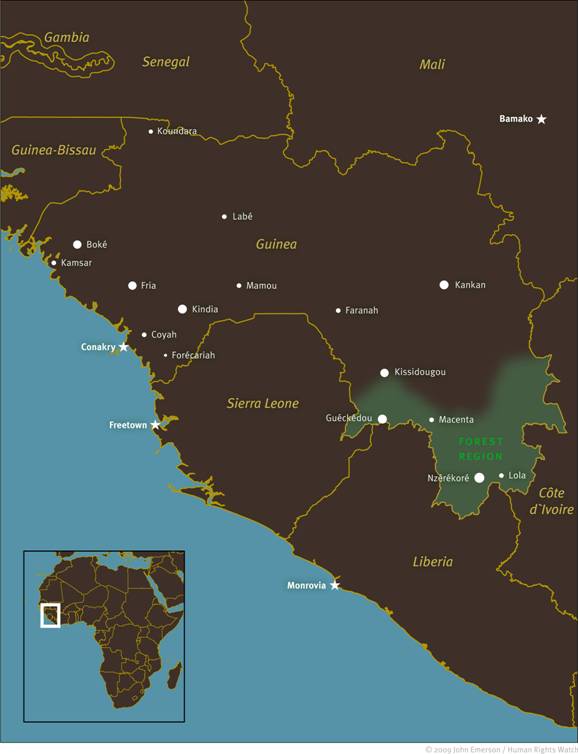
Map of Guinea
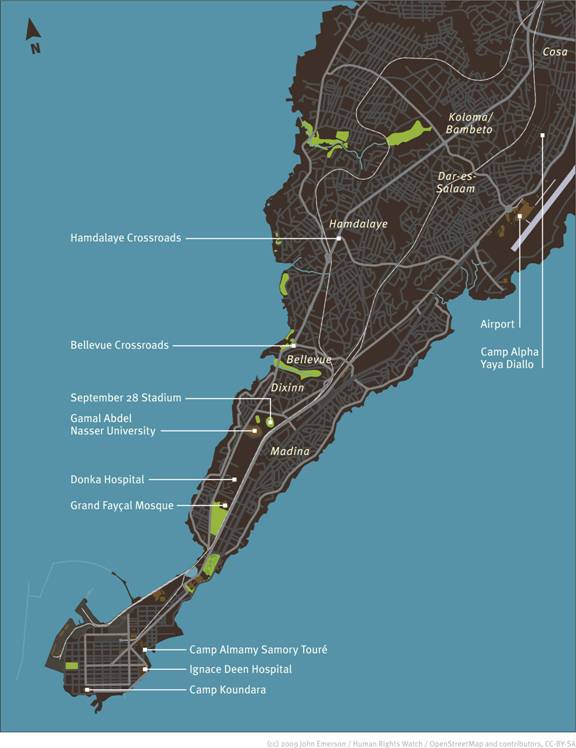
Map of Conakry
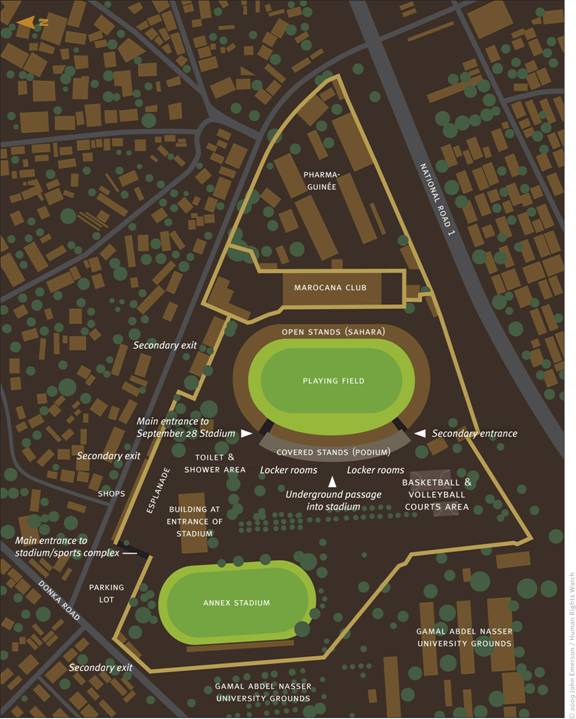
Map of the September 28 Stadium and Surrounding Area
Summary
At around 11:30 a.m. on the morning of September 28, 2009, several hundred members of Guinea’s security forces burst into the September 28 Stadium in Guinea’s capital, Conakry, and opened fire on tens of thousands of opposition supporters peacefully gathered there. By late afternoon, at least 150 Guineans lay dead or dying in and around the stadium complex.
Bodies were strewn across the field, crushed against half-opened gates, draped over walls, and piled outside locker rooms where doors had been pulled shut by the terrified few who had gotten there first. Dozens of women at the rally suffered particularly brutal forms of sexual violence at the hands of the security forces, including individual and gang rape and sexual assault with objects such as sticks, batons, rifle butts, and bayonets. At least four women and girls were murdered during or immediately after being raped; one woman was shot with a rifle through her vagina while laying face up on the stadium field begging for her life.
In the hours and days following the violence, as desperate mothers, fathers, and other family members attempted to find their loved ones, the security forces engaged in an organized cover-up to hide the number of dead. After sealing off the stadium and morgues, security forces removed scores of bodies from those places and buried them in mass graves. For several days, additional abuses—including murder, rape, and pillage—were committed by members of the security forces who had deployed throughout the neighborhoods from where the majority of opposition supporters hailed. Scores of other opposition supporters were arbitrarily detained in army and police camps where many were subjected to serious abuses, including torture. To date, the Guinean government has failed to investigate, much less hold accountable, any member of the Guinean security forces for their role in the killings, rapes, and other abuses.
In the course of an in-depth, on-the-ground investigation into the events of September 28 and their aftermath, Human Rights Watch interviewed some 240 individuals, including victims wounded during the attack, witnesses present in the stadium, relatives of missing people, soldiers who participated in the violent crackdown and the government cover-up, medical staff, humanitarian officials, diplomats, journalists, and opposition leaders. The investigation found that the majority of killings, sexual assaults, and other abuses described in this report were committed by members of the elite Presidential Guard, in particular the unit at the time directly responsible for the personal security of CNDD President Moussa Dadis Camara. Others who committed serious abuses included gendarmes, police, and men in civilian clothes armed with machetes and knives.
The serious abuses carried out by the security forces on September 28 were not the actions of a group of rogue, undisciplined soldiers, as has been argued by the Guinean government. The dearth of any apparent threat or provocation on the part of the demonstrators, in combination with the organized manner in which the security forces carried out the stadium attack—the simultaneous arrival at the stadium of different security units, the coordinated manner of deployment to strategic positions around the stadium in anticipation of the fleeing demonstrators, the failure to use non-lethal means of crowd dispersal, and the presence of officers, including a minister tasked with security responsibilities—suggests that the crimes were premeditated and organized.
The evidence gathered by Human Rights Watch suggests that the killings, rapes, and other abuses committed by the security forces on and after September 28 rise to the level of crimes against humanity. The scale and organization of these crimes strongly suggest that they were both widespread and systematic. As such, the principle of “command responsibility” applies to military commanders and others in position of authority who may be criminally liable for crimes committed by forces under their effective command and control.All those responsible, including those who gave the orders, should be held criminally accountable for their actions, as should anyone who participated in efforts to cover up the crimes and dispose of any evidence.
In a significant display of international revulsion uniting African and other governments as well as regional and international bodies, important international actors—including France, the United States, the European Union, the Economic Community of West African States (ECOWAS), the African Union, and the United Nations—harshly denounced the September 28 violence in Guinea. This was followed by the imposition of arms embargos by ECOWAS and the European Union; travel bans and asset freezes of CNDD members by the EU, the US, and the African Union; and the withdrawal or cancellation of economic and military assistance from the EU and France.
The international community has been equally definitive about the need for those responsible for the September violence to be held accountable. As a result, an African Union and ECOWAS-proposed international commission of inquiry was on October 30 established by UN Secretary-General Ban Ki-moon. The prosecutor of the International Criminal Court on October 14 confirmed that it had initiated a preliminary examination of the situation. Unfortunately, continued economic and diplomatic support for Guinea from China and Libya mars the otherwise unified international response.
Based on the evidence presented in this report, Human Rights Watch recommends that the Guinean government immediately suspend from their duties and promptly investigate, prosecute, and punish in accordance with international standards the security officials believed to be most responsible for the killings, sexual violence, and other abuses committed during the September violence. Human Rights Watch further recommends that the Guinean government acknowledge a more accurate death toll from the September events and facilitate the exhumation, identification, and return to family members of the bodies disposed of by the security forces.
Guinea’s international partners should maintain the demand for accountability and support international efforts to prosecute these crimes if the Guinean authorities fail to meet their obligations to hold accountable those responsible. Lastly, Human Rights Watch calls on the UN secretary-general to promptly make public the report of the international commission of inquiry into human rights violations associated with the September 28 violence, and ensure that its findings are discussed and implemented.
Massacre, Sexual Violence, and Cover-Up
A bloodless coup in December 2008 by a group of military officers following the death of Guinea’s long-time authoritarian president Lansana Conté brought initial hope that it would usher in a period of greater respect for human rights. The coup government, calling itself the National Council for Democracy and Development (Conseil national pour la démocratie et le développement, CNDD) was led by a self-proclaimed president, Captain Moussa Dadis Camara, who pledged to hold elections in 2009 in which neither he nor any other member of the CNDD would run. When, later in 2009, he reversed that pledge, Guinean opposition parties and civil society responded by planning demonstrations across the country. The biggest of these was planned for September 28, 2009, in Conakry, culminating in the rally at the September 28 Stadium.
From the early hours of September 28, tens of thousands of opposition supporters walked toward the stadium from the capital’s suburbs. Security forces made several attempts to stop the unarmed demonstrators from proceeding to the stadium, including by firing live ammunition into groups of marchers. In response to one such incident, marchers ransacked and set on fire a police station, and wounded one police officer. When political opposition leaders entered the stadium at around 11 a.m., they found it packed with tens of thousands of supporters chanting pro-democracy slogans, singing, dancing, and marching around the stadium’s race course carrying posters and the Guinean flag.
Just before 11:30 a.m., a combined force of several hundred Presidential Guard troops, together with gendarmes working for the Anti-Drug and Anti-Organized Crime Unit, some members of the anti-riot police, and dozens of civilian-clothed irregular militiamen arrived at the stadium area. After quickly deploying around the stadium perimeter and positioning themselves near the stadium exits, anti-riot police fired tear gas into the stadium, causing widespread panic. Minutes later, the security forces, led by the Presidential Guard, stormed through the stadium entrance, firing directly into the packed and terrified crowd. Numerous witnesses described the gunmen “spraying the crowd from left to right” until they had emptied the two clips of ammunition many of them carried.
One group of soldiers advanced slowly down the stadium’s playing field as they fired, leaving a trail of injured and dead in their wake. A second group headed for the stands and attacked the opposition party leaders and their associates gathered there, beating some of them so severely that they lost consciousness. Many other soldiers blocked the exits both from inside and outside the stadium.
Witnesses described how the panicked demonstrators were gunned down as they attempted to scale the stadium walls; shot point blank after being caught hiding in tunnels, bathrooms, and under seats; and mowed down after being baited by disingenuous soldiers offering safe passage. Since most of the stadium exits were blocked by the attackers, there was scant opportunity for escape for the trapped protesters, and many were crushed to death inside the stadium by the panicked crowd. Outside the main stadium, on the sports complex grounds, many more opposition supporters were shot, knifed, or bayoneted, often to death, as they tried to escape. Hospital and humanitarian organization records confirm that more than 1,400 persons were wounded during the attack.
Human Rights Watch has not found any evidence that any member of the security forces was wounded or killed inside the stadium or sports complex, demonstrating the one-sided nature of the violence perpetrated by the security forces against the unarmed opposition supporters.
Sexual assaults began minutes after the security forces stormed the stadium gates. Human Rights Watch researchers interviewed 28 victims of sexual violence and documented many more cases from witnesses to the assaults. Of the 28 victims, 18 had been raped by more than one perpetrator. It is not known how many women were raped. A coalition of health and human rights groups had, as of mid-October, identified 63 victims of sexual violence, but given the profound stigma attached to victims of sexual violence in Guinea’s conservative, largely Muslim society, it is widely believed that many women have not come forward for medical treatment or other support.
Victims and witnesses described how members of the Presidential Guard cornered or chased down the panicked women as they fled the hail of gunfire. Women trying to scale fences were pulled down or forced to descend under threat of being shot. Those found hiding under stadium chairs were violently pulled out. After overpowering their victims, the perpetrators ripped or cut off their clothes with a knife, pinned their victim to the ground or across the stadium seats, and raped her in quick succession.
The sexual assaults were most often accompanied by degrading insults, death threats, and extreme physical brutality. The victims described being kicked, pummeled with fists, and beaten with rifle butts, sticks, and batons before, during, and after the sexual assault. Many victims showed Human Rights Watch their bruises; knife wounds on their back, buttocks, and extremities; and fingernail marks on their thighs, wrists, and abdomen. During the sexual assaults against girls and women of Peuhl ethnicity, assailants frequently made ethnically biased comments, insulting and appearing to threaten the Peuhl in particular.
Numerous witnesses described groups of up to 10 girls and women being raped simultaneously on the field and elsewhere in the stadium complex. The Presidential Guard also took many women from the stadium and, in the one case from a medical clinic where they were awaiting treatment, to private residences where they endured days of gang rape. The frequency and number of sexual assaults that took place during and after the protests suggests that it was part of a widespread and organized pattern of sexual abuse, not isolated and random acts by rogue soldiers.
Human Rights Watch found strong evidence, including eyewitness accounts by confidential military sources and medical personnel, that the military engaged in a systematic effort to hide the evidence of their crimes and misrepresent the number of individuals killed during the events of September 28. The government reported the official number of dead to be 57. Human Rights Watch’s investigation found that the actual death toll of the violence on September 28 and the following days is likely to be between 150 and 200.
Beginning immediately after the massacre, members of the Presidential Guard closed off the stadium to medical personnel and over the next several hours removed bodies from the stadium complex in military trucks. Within 24 hours of the stadium violence, the Presidential Guard also took control of the two main morgues in Conakry, at Donka and Ignace Deen Hospitals, and removed bodies for burial in both known and unknown locations. Human Rights Watch spoke with the families of more than 50 persons who were known to have died during the September 28 massacre. In more than half of the cases, the body of the deceased person had never been recovered, and was believed to have been removed by the military directly from the stadium or from the morgues of the hospital.
Human Rights Watch spoke with one source who saw 65 bodies at Conakry’s Almamy Samory Touré military camp that were later removed in the middle of the night, allegedly to be buried in a mass grave. Another source described seeing Presidential Guard troops removing bodies from Donka Hospital in the early morning hours of September 29 and burying them in two mass graves in and around Conakry.
Abuses after the Stadium Violence
In the hours and days after the stadium violence, heavily armed soldiers dressed in camouflage and wearing red berets, and civilians armed with knives, machetes, and sticks, committed scores of abuses in neighborhoods in which the majority of participants in the September 28 rally lived. In some cases, the soldiers and armed civilians appeared to be collaborating to commit abuses. The neighborhoods in which there were attacks, notably Dar-es-Salaam, Hamdalaye, Koloma, Bomboli, and Cosa, are widely considered to be opposition strongholds, and are dominated by residents who are of the Peuhl and Malinké ethnic groups. Numerous victims and witnesses to violence in these neighborhoods told Human Rights Watch how, in the course of the attacks, the soldiers and irregular militia killed, raped, vandalized, and stole from residents. They also repeatedly insulted and made threats against people of Peuhl ethnicity in particular.
Security forces arbitrarily detained scores of men as they fled the stadium, and, to a lesser extent, in the course of the neighborhood attacks that followed, and subjected them to serious forms of mistreatment, including torture. Most were robbed and beaten, sometimes severely, at the time of detention. The worst abuses and longest periods of detention occurred at the Koundara and Alpha Yaya Diallo military camps. In these camps, former detainees described being subjected to frequent beatings with batons, guns, and other instruments; whipping; forced nudity; stress positions; and mock executions. Of the 13 men interviewed by Human Rights Watch who had been detained in at least one of four detention centers, not one had been questioned, interrogated, or formerly arrested, and most were obliged to pay the policemen, gendarmes, or soldiers holding them to secure their release.Detainees were generally given no medical treatment and little food or water during their detention.
Recommendations
To the Government of Guinea
- Provide full cooperation and unhindered access to the international commission of inquiry proposed by the Economic Community of West African States in September, and established by United Nations Secretary-General Ban Ki-moon in October.
- Immediately suspend from their duties and promptly investigate the security officials believed to be most responsible for the crimes committed on and in the days after September 28, 2009, including the officials named in this report.
- Investigate, prosecute, and punish in accordance with international fair trial standards members of the security forces against whom there is evidence of criminal responsibility for these crimes—such as murder, rape, assault, and torture—including those liable under command responsibility for their failure to prevent or prosecute these crimes.
- Fully cooperate with the restrictions imposed on Guinean officials by the African Union, ECOWAS, the European Union, and the United States, including:
- Arms embargos imposed by ECOWAS on October 17 and by the EU on October 27;
- Travel and visa restrictions imposed by the US on October 23, by the African Union on October 23, and by the EU on October 27; and
- An asset freeze imposed by the EU on October 27.
- Ensure that witnesses and others who have information about crimes committed during the September violence are adequately protected from intimidation, threat, or violence.
- Immediately release any remaining people detained without charge following the September violence, or immediately charge them with specific criminal offenses followed within a reasonable timeframe by a fair trial.
- Facilitate the exhumation, identification, and return to family members of the bodies disposed of by the security forces in the immediate aftermath of the September 28 violence, including those bodies taken from the stadium and morgues at Donka and Ignace Deen Hospitals to be buried in mass graves.
- Adequately and speedily compensate victims of the September 28 violence and its aftermath, including family members and dependents of those killed.
- Ratify the Protocol to the African Charter on Human and Peoples’ Rights on the Rights of Women in Africa, signed by Guinea in July 2003, which obligates states to protect women from all forms of violence, especially sexual violence, and to enact and enforce laws to protect women from sexual violence.
- Ensure that the National Observatory for Democracy and Human Rights (Observatoire national de la démocratie et des droits de l’homme, ONDH)—mandated to investigate human rights abuses and conduct human rights education—is fully operational, funded, and allowed to function independently.
- Thoroughly review—and, as necessary, revise—the training curriculum for police and other security forces to ensure comprehensive training on human rights issues, including legal and appropriate interrogation and detention practices, and minimum use of force for crowd control. Provide comprehensive training for police officers on the conduct of investigations into alleged illegal use of force and abuse by security forces. All training should be consistent with international human rights standards, such as the UN Code of Conduct for Law Enforcement Officials and the UN Basic Principles on the Use of Force and Firearms by Law Enforcement Officials.
To the African Union, the Economic Community of West African States, and the European Union
- Demand accountability for the killings, sexual violence, and other abuses committed on and after September 28, and support international efforts to prosecute the crimes if Guinean authorities fail to meet their obligations to hold accountable those responsible for these crimes.
- Call publicly and privately on the Guinean government to ensure that witnesses and others who have information about crimes committed during the September violence are adequately protected from intimidation, threat, or violence.
- Assist the international commission of inquiry by providing them full access to information collected by member states, including intelligence information on the September 28 violence and its aftermath.
- Assist the UN Office of the High Commissioner for Human Rights in ensuring that adequate measures are in place to protect witnesses to the September violence who cooperate with the international commission of inquiry, including by monitoring any actions by the Guinean authorities that threaten witnesses and by assisting with the evacuation and relocation of threatened witnesses if necessary. Provide asylum to threatened witnesses if necessary.
- Fully cooperate with the restrictions imposed on Guinean officials by the African Union, ECOWAS, the European Union, and the United States, including:
- Arms embargos imposed by ECOWAS on October 17 and by the EU on October 27;
- Travel and visa restrictions imposed by the US on October 23, by the African Union on October 23, and by the EU on October 27; and
- An asset freeze imposed by the EU on October 27.
- Provide financial and other support to Guinean nongovernmental organizations to improve the monitoring and documentation of abuses committed by security forces and to undertake advocacy at a national and international level.
To United Nations Secretary-General Ban Ki-moon
- Promptly make public the report of the international commission of inquiry into human rights violations associated with the September violence in Guinea, and ensure that its findings are discussed and implemented.
- Demand accountability for the killings, sexual violence, and other abuses committed on and after September 28, and support international efforts to prosecute the crimes if Guinean authorities fail to meet their obligations to hold accountable those responsible for these crimes.
- Call publicly and privately on the Guinean government to ensure that witnesses and others who have information about crimes committed during the September violence are adequately protected from intimidation, threat, or violence.
- Establish and adequately staff a field presence of the UN Office of the High Commissioner for Human Rights to ensure the monitoring and documentation of:
- Any acts of intimidation against witnesses and others who have information about crimes committed during the September violence; and
- Violations of civil and political rights in the run up to the elections planned for 2010, including any restrictions that hamper the ability of individuals to associate freely, the ability of political parties and their supporters to organize and campaign, and the ability of the press to freely report on electoral developments.
To the United Nations Security Council
- Encourage continued engagement by the UN secretary-general and the UN Human Rights Council on the situation in Guinea.
- Support the establishment of a human rights field operation in Guinea.
To the United Nations Human Rights Council
- Request the international commission of inquiry on the September violence in Guinea to brief members of the UN Human Rights Council on their findings at the council’s 13th session to be held in March 2010.
- Support engagement by relevant special procedures of the Human Rights Council, such as those listed below, and follow up on their recommendations regarding the situation in Guinea.
To the United Nations Special Rapporteurs on Relevant Subject Areas
To the UN special rapporteurs on violence against women; on extrajudicial, summary or arbitrary executions; and on the use of mercenaries as a means to violate human rights and to impede the exercise of the right of peoples to self-determination
- Closely monitor the situation in Guinea and request to visit the country.
To the International Commission of Inquiry
- Include specific recommendations in the commission’s report regarding accountability in accordance with international standards for serious crimes committed as part of the September violence in Guinea, with due consideration to the ability and willingness of the domestic authorities to investigate and prosecute alleged perpetrators.
- Include specific recommendations in the commission’s report regarding the need for an ongoing monitoring presence by the UN Office of the High Commissioner for Human Rights to ensure the monitoring and documentation of any acts of intimidation against witnesses and others who have provided information about crimes committed during the September violence.
To the Prosecutor of the International Criminal Court
- As part of your preliminary examination of the situation in Guinea, consider the findings and recommendations of the international commission of inquiry on Guinea and closely monitor any domestic efforts to prosecute the crimes with a view toward assessing whether your office should seek to open an investigation of crimes committed as part of the September violence.
To Blaise Compaoré, President of Burkina Faso and ECOWAS Mediator on the Crisis in Guinea
- Ensure that accountability for the crimes committed on and after September 28 is part of any proposed solution to resolving the crisis in Guinea.
- Closely monitor the safety of victims and witnesses to the September violence, and intervene to protect individuals under threat if and when such threats occur.
Methodology
From October 12 to 22, 2009, a team of four Human Rights Watch staff members conducted research in Guinea into the massacre, rapes, and related human rights abuses that occurred on and following September 28 in the capital, Conakry.
Human Rights Watch researchers carried out some 240 interviews with victims wounded during the attack, witnesses present in the stadium during the attack, relatives of missing people, soldiers who participated in the violent crackdown and the government cover-up, medical staff, humanitarian officials, diplomats, journalists, and opposition leaders. All but a few interviews were conducted in a language spoken by the interviewee—either French or English. Any others were conducted through the use of interpreters.
Human Rights Watch received and reviewed numerous still photographs and clips of video footage from the September 28 events, which appeared to have been recorded on mobile phones. The photographs and footage were generally obtained through sources available to the public, including internet sites and on compact discs available for sale in Conakry markets. Other photographs and footage were given to Human Rights Watch by interviewees.
Interviewees were identified with the assistance of civil society groups, local aid groups, journalists, political parties, and medical clinics, among others. The interviews were conducted throughout Conakry, as well as in Senegal’s capital, Dakar, and in Paris, France. Most interviews were conducted individually, although they sometimes took place in the presence of family members and friends. Many interviewees expressed fear of reprisals by the security forces, and, for that reason, requested to speak anonymously. They were assured that their names and other identifying factors, or the name of their organization, would not be cited in the report. Details about individuals and locations of interviews when information could place a person at risk have been withheld, but are on file with Human Rights Watch.
I. Background
Guinea, a country of just over 10 million people, has three major ethnic groups—the Peuhl, representing 40 percent of the population; the Malinké, 30 percent; and the Sousou, 20 percent—and a number of smaller ethnic groups, including the Guerzé, Kissi, and Toma, which comprise the remaining 10 percent and live predominantly in the forest region in the southeast.[1] Each ethnic group has its own language, though French remains the country’s official language and Sousou is a lingua franca, particularly in Conakry and amongst the military.[2] Approximately 85 percent of Guineans are Muslim; the other 15 percent, predominantly those from the forest region but also some in Conakry and other large towns, practice Christianity or indigenous beliefs.[3] Despite having almost half of the world’s bauxite reserves and significant deposits of iron ore, gold, and diamonds, Guinea is one of the world’s most impoverished countries.[4]
The human rights of ordinary Guineans have been systematically undermined under the successive leaderships of Ahmed Sékou Touré, president from the time of independence from France in 1958 until 1984, and then Lansana Conté, who led Guinea until his death in December 2008.[5] A bloodless coup following Conté’s death on December 22, 2008, by a group of Guinean military officers calling themselves the National Council for Democracy and Development (Conseil national pour la démocratie et le développement, CNDD), led by a self-proclaimed president, Captain Moussa Dadis Camara, initially brought some hope for greater protection of democracy and respect for human rights.[6] However, since taking power, Dadis Camara and the CNDD government have entrenched military control of the country’s political affairs, failed to hold free and fair elections as they promised, and steadily and violently suppressed the opposition. The perpetrators of these abuses have enjoyed near-complete impunity.[7]
Early actions by Dadis Camara, a previously little-known officer responsible for the military fuel supplies unit, reflected a disregard for democratic principles and the rule of law. Despite the well-known involvement of several military officers within the CNDD in serious past abuses and crimes, including torture, Guinea’s new rulers took no action to vet, much less hold them accountable for their crimes. The Alpha Yaya Diallo military camp, commonly known as Camp Alpha Yaya, in Guinea’s capital, Conakry, has become the de facto seat of government, from where Dadis Camara and his colleagues have largely operated. Since the coup, some 20 military personnel, many linked to the old regime, have been held in irregular detention centers where they have been denied access to their lawyers and families and subjected to severe mistreatment.[8]
Initially, Dadis Camara took concrete steps to root out the high levels of corruption and involvement by government and military officials in drug trafficking that for years had plagued Guinea, a major transit location for cocaine trafficked between Latin America and Europe.[9] However, these efforts were characterized by a number of abuses and serious violations of the rule of law. Throughout 2009, heavily armed soldiers carried out frequent abuses against ordinary Guineans and businesspeople, including theft, extortion, and intimidation of the judiciary.[10]
Upon taking power, Dadis Camara quickly suspended the country’s constitution, dissolved the government, and declared a ban on political and union activity.[11] The new leader initially proposed to hold elections by December 2010,[12] but later, under international pressure, pledged to hold elections in 2009, in which neither he nor any CNDD member would run, and to relinquish control to a civilian-led government,[13] earning him the support of much of the Guinean population. However, few concrete steps to organize elections were taken, and throughout 2009 the CNDD government increasingly restricted freedoms of political expression and assembly. Attempts by opposition parties to campaign ahead of planned presidential elections were repeatedly met with intimidation and attacks by the government.[14] At various times throughout the year, Dadis Camara lifted and reinstated a ban on political and union activity. In response to heightened criticism from the Guinean public, in August he imposed a ban on mobile phone text-messaging and in September a ban on political discussions on radio talk shows.[15]
Opponents of the military regime, which include unions, civil society leaders, and all of Guinea’s major political parties—the Union of Republican Forces (Union des forces républicaines, UFR), the Union of Democratic Forces of Guinea (Union des forces démocratiques de Guinée, UFDG), the Union for Progress of Guinea (Union pour le progrès de la Guinée, UPG), the United Front for Democracy and Change (Front uni pour la démocratie et le changement, FUDEC), the New Democratic Forces (Nouvelles forces démocratiques, NFD), and the Union of Democratic Forces (Union des forces démocratiques, UFD)—banded together to form the umbrella Forum of the Forces Vives of Guinea (Forum des Forces Vives de Guinée). In March the Force Vives presented the CNDD with a timetable for election preparations, with a view toward holding legislative elections in October and presidential elections by December 2009. Though Dadis Camara agreed to this timetable, the CNDD failed to follow through and in May and June 2009 even refused to provide funding for the Independent National Electoral Commission (Commission électorale nationale indépendante, CENI)—the government body charged with organizing and monitoring the elections.
After months of delay, and under mounting pressure from both Guinean civil society and key international stakeholders, Dadis Camara, in August, set January 31, 2010, as the presidential election date. Although he stopped short of declaring his own candidacy, Camara back-tracked on earlier commitments, stating that any member of the CNDD should be “free to put forward their candidacy for the national election if they so desire.”[16] This was widely interpreted by Guineans as meaning that the military leader fully intended to run. Guinea’s opposition viewed Dadis Camara’s presumed candidacy as a spoiler for the election’s credibility, and responded by planning demonstrations of varying sizes across the country.[17] By the end of September, momentum toward mass demonstrations had reached a tipping point, with actions planned by the Forces Vives.
II. Prelude to Massacre at the September 28 Stadium
Choosing a Date for the Opposition Rally
The Forces Vives decided to hold a major rally on September 28, 2009, a date deliberately chosen because of its historical significance in Guinea. On September 28, 1958, France carried out a referendum in its colonies, giving them the choice between immediate independence and remaining a French colony. Guinea was the only French colony to vote “No” and gained its independence days later, on October 2, 1958. Guineans consider September 28, 1958, the day when Guinea stood united for the country’s independence.[18] The stadium in Conakry where the demonstration was to take place is named the September 28 Stadium.
The Forces Vives leaders called for a major opposition rally on this date for two reasons: first, to show the extent of their support among the population, refuting CNDD President Dadis Camara’s claim that the Forces Vives “do not represent anything”;[19] and second, to challenge Dadis Camara’s presumed candidacy in the elections planned for January 2010, which the opposition leaders hoped would return Guinea to civilian rule.
Shortly after deciding to hold the rally, the Forces Vives dispatched opposition leader Jean-Marie Doré, head of the Union for the Progress of Guinea (UPG), to inform Dadis Camara of their plans. Doré described Dadis Camara’s response when they met on September 19:
I went to see Dadis the same night we set the date of the rally, and informed him of our intention to hold a peaceful rally. He wasn’t initially in favor, but I said it would be peaceful and in an enclosed place. He said he was concerned there would be protest marches. I told him this was false, but that there would be large crowds walking to the stadium. He gave us his permission, so I immediately instructed the secretariat of the Forces Vives to send out letters to the director of the stadium, the minister of justice, the minister of the interior, the mayor of Conakry, the minister of youth, and other officials.[20]
Despite Dadis Camara’s apparent agreement to the rally planned for September 28, 2009, the CNDD attempted to prevent it from taking place. On September 22, the minister of youth, Fodéba Isto Keira, announced that the September 28 Stadium would be closed to the public from September 23 until October 11, in the interest of preserving the quality of the stadium’s field for an October 11 football match against Burkina Faso. Keira denied that the closure had anything to do with “politics.”[21]
On Sunday, September 27, the interior minister, Frédéric Kolié, appeared on national television to declare that “all demonstrations on the national territory are prohibited until the national holiday on October 2.”[22] Opposition leaders met in response to the announcement, and decided to go ahead with the rally despite the ban.[23] The same day, Dadis Camara declared September 28 a public holiday, and said that no public rallies would be allowed that day.[24]
Despite the official announcements, the Forces Vives received no official correspondence denying their request for the September 28 rally, and, thus, decided to proceed with the planned rally. According to Oury Bah, the vice president of the Union of Democratic Forces of Guinea (UFDG), the Forces Vives wished to hold the rally to demonstrate to the CNDD the level of popular support for the opposition: “We told our supporters to remain peaceful, even if we couldn’t enter the stadium. Our aim was simply to show that the population supported the opposition.”[25] Opposition leaders did not believe that they would face a violent response from the security forces, because, since Dadis Camara had come to power, they had heard him state publicly on several occasions that he would not deploy the military against the civilian population, unlike his predecessors.[26]
Finally, at 1 a.m. on September 28, Dadis Camara telephoned opposition leader Sidya Touré, leader of the opposition Union of Republican Forces (UFR), at his home. During the conversation, which Touré recounted to Human Rights Watch, Dadis Camara reiterated that September 28 was a public holiday that belonged to all Guineans, and said that the opposition “could not claim the historic date for their own purposes.” He demanded that the opposition call off the rally, and proposed instead that a smaller rally be held on September 29 at the smaller and more remote Nongo Stadium.[27] Touré explained to the CNDD president that calling off the rally would be impossible with such little notice, and that opposition supporters would start moving toward the stadium early the next morning.[28]
Morning March to the Stadium and Attempts by Security Forces to Block Opposition Supporters
From the early hours of the morning of September 28, tens of thousands[29] of opposition supporters walked toward the September 28 Stadium from the suburbs of Conakry, clogging the few main roads along Conakry’s narrow peninsula. At a variety of points along the way, security forces used force to try to block marchers from reaching the stadium, leading to deaths and injuries that pre-figured the events to come. Gendarmes, commanded by Captain Moussa Tiégboro Camara (no relation to the CNDD president, Dadis Camara), the minister charged with the fight against drug trafficking and serious crime, made a final attempt to block opposition leaders from entering the stadium by barring their path, but later retreated, likely because of the sheer size of the crowds.
The day after the massacre at the stadium, Dadis Camara claimed that opposition supporters had ransacked and burned two police stations while marching to the rally on the morning of September 28, arming themselves with guns and explosives, and that they were intent on overthrowing the coup government by force.[30] While some violence by protesters took place as the crowds walked to the stadium—most notably rock throwing and the partial burning of the Bellevue police station—such violence was not widespread. Human Rights Watch did not find any evidence that any weapons had been seized by opposition supporters during the clash at the Bellevue police station documented below, as alleged by Dadis Camara, and has not seen any evidence to suggest that any opposition supporters at the stadium were armed with firearms. Nor has the CNDD provided any evidence to support these charges, such as weapons seized from the stadium.
Shooting of Unarmed Protesters by Gendarmes near the Stadium
At around 9 a.m., anti-riot police attached to the Mobile Intervention and Security Force (Compagnie mobile d’intervention et de sécurité, CMIS) and gendarmes from the Anti-Drug and Anti-Organized Crime Unit under the command of Captain Tiégboro Camara attempted to prevent hundreds of opposition supporters gathered since 7 or 8 a.m. near the entrance to the stadium from entering.[31] Witnesses at the scene told Human Rights Watch that as the crowd grew, Tiégboro arrived to the stadium and ordered opposition supporters to return home. When they did not, he ordered a group of gendarmes to respond with tear gas, and then, almost immediately, with live ammunition. According to witnesses, at least two people were killed and several others were wounded in the incident.[32]A witness explained:
Around 9 a.m., Tiégboro himself arrived at the crossroads near the stadium where we were being blocked. He came down from his armored car and seemed surprised that people were celebrating and being peaceful. He tried to talk to the crowd, but you could tell he was angry. He told everyone they had to leave because no protest was authorized. People refused to go, so he told his gendarmes to fire tear gas and then they also fired their rifles and killed three people, I later saw two of their bodies. The gendarmes fired from right next to Tiégboro. I was standing very near to where he was. He first ordered them to shoot gas, and then he ordered them to fire their guns, and only a few shots were fired.[33]
Clashes at Hamdalaye and Bellevue Crossroads
Torrential rainfall that morning had delayed many more people from setting out to the stadium. As the rains subsided around 8:30 a.m., large crowds of opposition supporters left Conakry’s neighborhoods on foot, packing the main Donka Road leading to the stadium. At both the Hamdalaye and Bellevue crossroads on the main Donka Road, small units of security forces attempted to stop the crowds by firing tear gas, and in the case of Bellevue, by firing live ammunition.
At Hamdalaye crossroads, a group of anti-riot police attempted to stop people amassing there by firing tear gas, but reportedly found the crowd too big to manage and withdrew. Multiple witnesses who had gathered at the Bellevue crossroads described to Human Rights Watch how at around 10 a.m., gendarmes fired tear gas and then live ammunition, killing at least two and wounding others. Among those shot and killed was Mamadou “Mama” Bah, a 20-year-old student, who was hit as he watched the crowd from outside his father’s tailor shop.[34] The crowd then began throwing rocks at the security forces and attacked the local police station, partially burning it and several police vehicles. One policeman was wounded after being hit in the head with a rock and attacked by the opposition supporters.[35] The security forces retreated and the crowd continued on to the stadium.
Attempt to Block Opposition Leaders from Entering the Stadium
While opposition supporters were moving toward the stadium, the main opposition leaders—Sidya Touré, Cellou Dalein Diallo, François Lonsény Fall, Mamadou Mouctar Diallo, and Mamadou Baadiko Bah—met at the house of the UPG leader, Jean-Marie Doré, near the stadium.[36]
Throughout the morning, high-ranking religious officials, including the imam of the Grand Fayçal Mosque, el-Hadj Ibrahima Bah, and the Anglican bishop, the Rt. Rev. Albert Gomez, mediated between Dadis Camara and the opposition leaders in an attempt to avoid violence.[37] As the opposition leaders were about to head toward the stadium, they were informed by phone that the religious leaders were coming to Jean-Marie Doré’s house with a message from the CNDD leader. All but Jean-Marie Doré departed, seeking to join their supporters, while Doré remained to receive the religious leaders and their message. According to Doré, the religious leaders told him that Dadis Camara had agreed not to use violence against participants in the rally if the opposition leaders would go to the stadium and tell their supporters to peacefully disperse and not march on Camp Alpha Yaya, though marching on the military camp had never been an intention of the opposition.[38]
According to numerous witnesses and the opposition leaders themselves, as the group of leaders headed toward the stadium, several dozen gendarmes led by Captain Tiégboro Camara blocked their path in front of the Gamal Abdel Nasser University, which adjoins the stadium grounds. Tiégboro ordered them to turn back, which they refused to do. A tense stand-off ensued. Some minutes later, opposition supporters inside the stadium learned that their leaders were being prevented from entering, and large numbers came out to join the leaders, effectively surrounding Tiégboro and his force. As this happened, Tiégboro told the leaders to go to the stadium and tell people to go home peacefully. According to witnesses, he then ordered his gendarmes to fire into the air a few times to clear an exit path for the gendarmes to depart through the crowd. The crowd then took the opposition leaders on their shoulders and carried them into the stadium.[39] A 39-year-old trader described the ambiance:
When Tiégboro disappeared, we assumed permission to hold our meeting had been given. We walked with our leaders chanting, “Freedom! Freedom!” We said we were tired of 50 years of dictatorship. At around 11 a.m. we all entered the stadium through the main door. It was a wonderful atmosphere ... we were dancing and happy. We chanted, “Long live the nation, we want freedom.”[40]
As they entered, at around 11 a.m., the political leaders came into an arena packed with tens of thousands of jubilant supporters chanting pro-democracy slogans, singing, dancing, and marching around the stadium’s track carrying posters and the Guinean flag. Dozens of demonstrators were praying on the stadium’s field.[41]
III. Massacre at the September 28 Stadium
Human Rights Watch’s investigation into the September 28, 2009 events at the September 28 Stadium, based on more than 240 interviews, has determined that the massacre of an estimated 150 to 200 opposition supporters and rape of dozens of women and girls were organized and premeditated.
At around 11:30 a.m., soon after the opposition leaders arrived at the stadium, a combined force of several hundred soldiers, police, and civilian-clothed militias positioned themselves around the exits to the stadium, fired tear gas, and then stormed the stadium, firing directly at the trapped civilians. Many died from the indiscriminate firing; others were beaten or knifed to death; and still others were trampled to death by the panicked crowd. Outside the main stadium, on the sports complex grounds, many more opposition supporters were killed as they tried to escape. The opposition leaders were brutally beaten, some of them to the point of losing consciousness. Amidst the killing, the security forces also committed widespread rapes, as documented in the next chapter of this report. Human Rights Watch has not found any evidence that any member of the security forces was wounded or killed inside the stadium or within the stadium complex, demonstrating the one-sided nature of the violence perpetrated against the opposition supporters.
Numerous still photographs and clips of video footage from the September 28 events reviewed by Human Rights Watch firmly corroborate the accounts of the numerous victims and witnesses interviewed by Human Rights Watch who described the rally as largely peaceful.[42] Not a single armed protestor is visible in any of the photographs or video. The opposition supporters are seen marching, holding placards (including “No to Dadis,” “Dadis is a liar,” and “End military rule”), shouting slogans, singing songs, and praying inside the stadium. Also, none of the statements made before the rally to the press by opposition leaders showed any intent to incite the crowds to overthrow the CNDD. Rather, their messages almost exclusively called for a return to civilian rule and for Captain Moussa Dadis Camara not to run for president. The photographs and video footage of events before and at the stadium rally reviewed by Human Rights Watch do not provide any support for Dadis Camara’s post-massacre contention that the crowd was armed.
Attack on Rally Participants by Security Forces inside the Stadium
At around 11:30, about 30 minutes after the political leaders entered the stadium, several hundred members of the security forces arrived, mostly aboard vehicles. According to scores of witnesses interviewed by Human Rights Watch, the security forces who perpetrated the violations described in this report consisted of:
- Presidential Guard soldiers dressed in full camouflage uniform and wearing red berets. They were commanded by Lieutenant Abubakar “Toumba” Diakité, then Dadis Camara’s personal aide de camp and chief bodyguard, and Second-Lieutenant Marcel Kuvugi.
- Gendarmes wearing green berets and one of two uniforms: those wearing black T-shirts and camouflage pants formed part of the Anti-Drug and Anti-Organized Crime Unit under the command of gendarme Captain Moussa Tiégboro Camara; those wearing full camouflage uniforms appeared to be part of a second unit of gendarmes.
- Anti-riot police with the Mobile Intervention and Security Force (Compagnie mobile d’intervention et de sécurité, CMIS) wearing black pants and shirts. Many were equipped with riot gear, such as shields and helmets.
- Civilian-dressed militia armed with knives, sticks, and pangas (machetes), many of whom were wearing traditional amulets and fetishes. The majority were believed by witnesses to be from ethnic groups living in the southeastern forest region of Guinea.[43]
The vast majority of the killings and sexual assaults documented by Human Rights Watch were committed by members of the Presidential Guard, or “red berets” as they are more commonly known.
After the security forces reached the stadium, they quickly encircled it, mostly on foot. Anti-riot police then fired tear gas into the stadium from their vehicles, causing widespread panic. Minutes later, Presidential Guard soldiers, and a smaller number of other forces, stormed through the principal entrance, firing directly as they advanced forward into the packed and terrified crowd. Numerous witnesses described the gunmen “spraying the crowd from left to right, left to right.” Many witnesses described the soldiers shooting at people as they tried to climb up over the fences and walls. A retired professor in her sixties, recalled:
All of a sudden, I heard these loud noises—boom, boom—it sounded like a war. That was the firing of the tear gas from outside the stadium. Then, within minutes, the red berets entered. They were everywhere. The youth were on the field. When the soldiers entered, they opened fire right away on that crowd. Everyone went into panic, people were running everywhere—I saw people jump from the top of the covered stands. There was screaming everywhere, screaming so loud, and the crowd started to stampede.[44]
A 65-year-old man described what he saw:
I clearly saw them spraying back and forth, back and forth, and people falling in their path. They fired as they moved down the field. I fell down on top of others who had been shot ... my boubou [clothing] was drenched with the blood of young men. These people are trained to defend us from harm. Instead they turned their guns on us. It was a meeting, not a war. We wanted to talk—we wanted them to listen to us, not shoot and kill us.[45]
A 32-year-old trader told Human Rights Watch that he heard the soldiers yelling, “We’ve come to clean!” as they opened fire into the crowds.[46] A medical student described the different security forces that he saw perpetrating the violence:
I was sure they wouldn’t kill like they did in January 2007,[47] but I was wrong. As soon as the gas was fired I knew there would be trouble so I immediately tried to run out one of the side gates, but when I reached the main gate, I saw the military deploying around the side of the stadium. I immediately ran back to the stadium and moments later saw them flooding in—they were mostly red berets dressed in camouflage, then the gendarmes from Anti-Drug in camouflage pants with black T-shirts, a few from Anti-Gang in all black, and a few regular green beret gendarmes. I saw them firing directly into the people gathered in the stadium, stands, and even at the youth trying to get over the gates and walls to escape.[48]
Many witnesses interviewed by Human Rights Watch described how the attackers continued to shoot at those gathered both on the field and in the stands until they had emptied the two clips of ammunition many of them carried.[49]
A 22-year-old student, described to Human Rights Watch how he watched the shootings start and was then beaten to the ground as he tried to escape:
The first who entered the stadium were the red berets, followed by Tiégboro’s gendarmes and the anti-riot police. They came into the stadium from the main gate and the smaller gates, and immediately began shooting directly at the people. The first victim I personally saw was a young boy, maybe 13 or 14, who was shot down on the field. I was coming down the stands then. There were so many people shot then. I ran down to the field, and then I was hit by a red beret with a wooden stick in my knees. I fell down to the ground, and then four came—a red beret and three dressed in all black uniforms with police berets. They beat me with wooden sticks for five minutes. One of them said, “If you think Guinea belongs to the Peuhl and the Malinké, today you will learn who the real bastards and the mad dogs are.” I couldn’t get up anymore, so I just stayed on the ground. There was a girl next to me, she was nearly naked, only in her underwear, she was crying and bleeding, so I gave her my T-shirt. Then I lost consciousness and woke up at Donka Hospital.[50]
Witnesses recounted how at the far end of the covered stands, as the panicked crowds pushed open another major gate, members of the Presidential Guard stood at the entrance and attacked the crowd as they tried to flee. Many died there from being shot or as a result of being trampled to death. Several witnesses who observed bodies near the stadium exits told Human Rights Watch that many did not appear to have gunshot or knife injuries, indicating that a number of those killed were trampled to death. A shopkeeper in her fifties told Human Rights Watch how she faced gunfire and beatings to escape through an open door, and described walking over the bodies of those who had been trapped:
The crowd kept pushing toward that one available exit. The red berets were hitting people over and over as they exited. I ducked down to avoid being hit, and at about that time there were gunshots and someone right next to me was hit and fell down. I don’t know what happened to that person, the crowd just kept moving. After all that pushing, I finally got out of the door. I was knocked down, and there were bodies all on the ground. I was crawling on dead bodies. I was scared they would shoot me if I lifted my head, so I kept my head down, looking right at the dead bodies.[51]
A 51-year-old businesswoman who survived being trampled as she tried to escape, and then witnessed the killing of an adolescent boy as she hid beneath a number of bodies, pretending she was dead, described her ordeal:
I tried to run out one door which had been forced open by the panicked people. But I fell down and was trampled ... I was almost unconscious. People were on top of me. There was shooting all around. When I came to, people were running out and I was lying on the bodies of the dead. I heard a voice saying, “Oh she opened her eyes ... she’s not dead.” He tried to pull me up but I was too heavy. More shots rang out and he fled. I remained there, now pretending I was dead. As I lay there, I saw a 13- or 14-year-old boy near the door looking for where to escape. A red beret approached him with his gun facing him and I heard the boy yell, “Uncle, uncle ... you’re going to kill me.... Uncle, no, you’re not going to kill me are you?” But he did ... the red beret shot the boy. This was right next to me.... Oh God, when I see that boy I see my own children.”[52]
A 29-year-old hairdresser told Human Rights Watch how she was repeatedly beaten and trampled as she tried to escape from the stadium through the main entrance, and ultimately suffered severe burns when she fell on top of a tear gas canister and lost consciousness:
We ran down the stands toward the fence separating the field from the stands. There were lots of people pushing up against the fence and I was crushed down by the crowd, and then had two people fall down dead on top of me from being shot. I made my way to one of the gates in the fence and a soldier started beating me, but I pushed my way through and was on the grass. Another soldier kicked me to the ground. I got back up and made my way to the big gate. Another soldier yelled at me to stop and hit me with his belt. I fell down, and then others fell on top of me—they were firing tear gas and bullets at us, and I fell down on top of a tear gas canister and was now under people’s feet. I stayed on the ground. When things calmed down a bit, a soldier walked over to see if I was dead. He put his boot on my arm to see if I would move, but I stayed still, acting dead. After a while, I lifted my head and asked someone to help me. I was under 10 dead people, piled on top of me. They moved the bodies to get me out, and I saw I was burned all over my body and arms, my belly and my legs. They took me from the pile of bodies and out of the stadium.[53]
Many of the victims and witnesses interviewed by Human Rights Watch had managed to hide within toilets, locker rooms, and maintenance rooms during the worst of the stadium violence. When they emerged, sometimes hours later, they described seeing many bodies, some of which had been lined up on the field or close to the stadium entrance. A 39-year-old businesswoman who had hidden within a locker room described what she saw after daring to come out:
When I saw the rapes on the field, I was scared, so I ran back up the stairs and then jumped off to get away from the red berets chasing me. I injured my foot in the fall. A young man grabbed me and led me to the locker room, where there were 30 other people. We closed the door because the red berets were coming. The others begged to come in but we couldn’t—if we had, we all would have died. We shut the door. Minutes later, they opened fire ... the people kept begging to be let in. They killed everyone who was outside. Later, when it was safe to come out, we saw so many bodies there.[54]
A schoolteacher in her fifties, who had been hiding inside another locker room or room in the stadium, described the aftermath of the bloody encounter in the then near-abandoned stadium:
When I left the locker room, I went out to complete desolation—there was blood everywhere, lost shoes, glasses, clothes, all scattered around the field. It hit me. I was devastated when I saw a boy’s shirt covered with blood. I bent down and picked up a handful of dirt from the stadium and put it in my bag. I did this twice, because I wanted to take something with me from this day. I continued walking and the first dead body I saw was of a very large woman who had fallen over on her stomach. The military, or perhaps civilians that they had forced, had not been able to move this body into the line with the other bodies. I continued walking and saw a long line of bodies. I said to myself, I must count them, and so I did. I counted 40 on this line, inside the stadium field—I counted them all. They had been laid there, one next to the other in a line. There were others scattered around the stadium still waiting to be moved, and more still outside the field, but there were 40 in that line, I am sure.[55]
Pursuit of Rally Participants by Security Forces outside the Stadium
The killings and other abuses were not limited to the inside of the September 28 Stadium. Human Rights Watch documented numerous killings, beatings, and rapes that were carried out outside the main stadium.
The main stadium is located inside a large sports complex surrounded by high walls; it has a small number of exits with metal gates. Inside the sports complex, there are toilets and showers near the main entrance, a series of basketball and volleyball courts just below the covered stands of the stadium, and a second, smaller “annex” stadium a short distance away, with a high wall separating the sports complex from the neighboring grounds of the Gamal Abdel Nasser University. At the time of the attack, some construction was taking place between the main stadium and the annex stadium, which had left several deep holes in the ground. On the opposite side of the main stadium, another high wall separates the sports complex from the grounds of the private Marocana Club and the grounds of Pharma-Guinée, a pharmaceutical-importing state enterprise.
As panicked opposition supporters escaped from the main stadium, they found the entire sports complex occupied by the security forces and men in civilian dress armed with sticks and knives. Most of the escape routes out of the complex were blocked, and many people were shot or knifed down as they attempted to flee. A 24-year-old graduate student described how he barely escaped getting knifed as he attempted to flee the stadium:
There were three small doors on one side of the stadium that people were trying to escape through. As I was looking for where to escape, I saw a few soldiers come in through the small doors and start firing at people from there. Then I saw some armed men in civilian clothes start attacking people with knifes—it was like the military and these guys were working together. When people tried to push themselves through the doors, the civilians and military [about 10 in total] would knife them as they tried to slip by. I saw about five people wounded like this, including a guy I was trying to flee with. As we pushed by, the civilian-dressed guy stuck him in the shoulder. He fell down, and I continued. I heard them talking in bad French as they were doing this ... “Who told you to come here? We’re going to kill you.”[56]
Many people tried to flee by climbing to the top of the stadium’s covered stands and then jumping down the estimated 10-15 meters to escape. According to witnesses, many people died from injuries sustained by the fall, or from others landing on top of them. Still others were gunned down after surviving the jump. A 41-year-old merchant told Human Rights Watch how he had been forced to jump, injuring his leg in the process, and how he saw 38 bodies at the exterior of the stadium, near the bottom of the covered stands:
The military closed off all the exits. I ran up the covered stands. When I got to the top, I looked back and saw them firing on the field and also now firing coming up the covered stands. I had no choice but to jump—it must have been 30 meters down [sic, an estimated 10-15 meters]. There were lots of people jumping, someone landed close to me and I heard their ankle just snap. When I hit the ground, I lost my breath and couldn’t move. There were soldiers not far from me, and they were firing [at us]. One of the bullets went through my pant leg. I could feel it, but it didn’t enter my skin. There were so many people around, and I was breathing with great difficulty because of the fall.
A red beret came up to me and gave me a kick to the head. He took my money, my cell phone, everything. He then took a knife and put it to my head, but he didn’t cut me, then he left. I lied there, unable to move, and I counted up the dead bodies around me. There were 38. The soldiers kept going through the cadavers and taking stuff. I was lying with dead bodies ... 38 cadavers just at around the place where I jumped off the covered stands. I counted them while I lay there.[57]
Another witness, a 23-year-old hairdresser, saw one of her friends shot dead right next to her as they tried to escape from the area behind the covered stands, and then hid, only to see many more people shot dead in the same area:
As we were running behind the covered stands, outside the stadium, me and two friends, one of my friends was shot in the chest. She fell down and cried out, “Help me!” but there was nothing we could do. I didn’t see who shot her—I think they were behind us. It was just chaos, there were so many people running.... I saw the clinic for the football players, right underneath the covered stands, and we hid there for a short period of time. People were running all around, and I saw so many shot there, I couldn’t even count.[58]
Similar violence took place at the entrance to the stadium grounds, known as the esplanade, a walkway area between the main entrance gate into the sports complex grounds and the main entrance to the stadium. The 23-year-old hairdresser who gave the above account told Human Rights Watch how she saw another friend shot dead as they ran for the main entrance, and how she herself was attacked and stabbed by Presidential Guard soldiers:
Finally, my friend and I ran toward the main entrance, the one that heads out to the road in front of the stadium. As we were running with a number of other people, my friend was shot. The gunshot went through his neck, and he fell to the ground; the blood just flowed through his shirt, and he lay there, dead. I kept running, and as I got close to the main entrance, a red beret knocked me down to the ground and then jumped on me, up and down on my stomach. I could not speak, the pain was so much, and he just kept on jumping. Then another red beret came and stabbed me in the arm with a knife and hit me in the face. They just kept beating me.[59]
Around the basketball and volleyball courts and the small annex stadium, a large crowd of opposition supporters became trapped against the high walls separating the sports complex grounds from the neighboring university grounds. A group of red berets and gendarmes pursued them, firing at the trapped people as they tried to scramble over the walls. A 32-year-old shopkeeper described to Human Rights Watch how five of the group of eight people with whom he was fleeing were shot there, and how others were bayoneted to death as they tried to climb the perimeter walls:
I decided to try and run out of the stadium. At the far gate, one of the doors was open but there were so many people trying to flee, I decided to climb over the closed door.... I ran toward the perimeter wall. Near the basketball court, a group of red berets and gendarmes from Tiégboro’s unit were chasing us. They fired on a group of eight of us, and only three of us were able to get away alive. Five of us were killed, shot down near the wall facing the university. We couldn’t get out there, so we ran back to the broken wall near Donka Road. A group of red berets was there waiting for us, two trucks of them. They were armed with bayonets. I saw one red beret kill three people right in front of us [with a bayonet], so I wanted to run back. But my friend said, “There are lots of us, let’s try and push through,” and that is how we escaped.[60]
A 47-year-old factory owner told Human Rights Watch how he quickly made his way out of the main stadium, only to find himself trapped in the area of the annex stadium, where he saw the killings by members of the Presidential Guard continue:
Toumba [Lieutenant Abubakar “Toumba” Diakité] pointed his rifle in our direction and fired at us, and it was then that I realized they had come to kill.... Outside the main stadium, the red berets were chasing us. We ran toward the small annex stadium. There were people being shot down everywhere, there was blood everywhere on the ground. Near the annex stadium, there were some construction holes in the ground, and I jumped over them. But there was a wall blocking our way near the university, so we were stuck. People were being crushed to death there as they tried to climb up and run away over the roofs of the houses. I finally managed to climb the big wall and was helped over the wall, but I looked back to see the gendarmes still beating people.[61]
Another witness, a 27-year-old shopkeeper, told Human Rights Watch that he had seen many dead in the same area:
There were lots of bodies at the small annex stadium, and they continued to shoot people there. There were also shot-down electrical wires on the ground, electrocuting people.[62]
One witness, a 30-year-old market woman, described being duped by a few Presidential Guard soldiers who indicated to a large group of people that they would be provided safe passage, only to open fire when they drew nearer:
As I ran toward the main entrance, I saw the red berets firing on the high voltage wires. It fell and we were no longer able to go out this way, so we exited out near the stadium annex. I was running with a group of about 25 to 30. When we got to the annex, the red berets circled us and started beating us with pieces of wood—some of them had nails in them. I got away and ran, but about 50 meters away, another one kicked my feet out from under me. I got up again and ran towards the volleyball court. When I got there, I joined up with a big group of us—about 200—all looking for the best place to escape. Some meters away there was a group of red berets who started telling us to run toward them.... They shouted, “Come, come ... here, here,” motioning at a small door near the volleyball courts that leads to the university. When we got about 10 meters away, they took position and opened fire on us. Those in front of me started falling down wounded and dead. They fired and fired at us.[63]
A 19-year-old student who was beaten by security forces and hid in an area under construction behind the stadium recounted to Human Rights Watch:
As I sat there, no more than three meters away, I saw them shoot an old man dressed as an imam in the head while he was praying. The old man was in the process of praying, because in the Muslim faith, if you are going to die, it is necessary to pray before dying. He was in the process of praying and a red beret walked up to him and shot him in the head with a pistol. Nearby, there was another man who wanted to pray. As he kneeled there, one of the ones wearing gris-gris [amulets] said, “Don’t say another prayer,” and came up behind him and slit his throat.[64]
Outside the grounds of the sports complex, the killings continued. According to witnesses, Karim Bangura, a 28-year-old taxi driver from the Matam neighborhood was inside the stadium when the shooting started. He managed to get out of the sports complex and was trying to use his taxi parked outside to assist the wounded. Red berets approached him and demanded the keys of his taxi. When he refused to hand the keys over, the red berets shot him dead and took his taxi, leaving the body behind.[65]
Several victims and witnesses described how individual gendarmes tried to stop members of the Presidential Guard from committing abuses. In some cases, they extracted men and women from an imminent attack and watched over them until they could leave safely. A 29-year-old seamstress helped by one gendarme recounted to Human Rights Watch:
After escaping to the parking area, two soldiers tripped me and started ripping off my clothes, while others who weren’t in uniform brought forward a piece of wood, like they wanted to rape me with it. As they struggled to hold me down, a gendarme dressed in camouflage with a green beret yelled at them, “Leave this girl! It’s not like this.... You also have mothers and fathers.... You should not be doing this!” But the others told him to go away and leave them. He insisted and eventually took me away and told me to hide in a place near the basketball court. I was hiding with about 10 others. While hiding, we saw other red berets stab and kill two men. The gendarme yelled at them to stop doing such bad things, and stood watch over us until it was safe to go.[66]
A 27-year-old secretary recounted how she and some 50 others were assisted by another gendarme:
As I held up a friend who’d been seriously beaten, a gendarme came to our group—we were about 50 or so—and said, “Come ... there is an exit here.” Unfortunately he didn’t see two red berets behind him. One of them started striking us, and kicked my feet from under me, beating me further with his rifle butt. I got up and the gendarme helped us toward the exit. As I left, other red berets were knifing people with their bayonets as they tried to flee out the door.[67]
Over 1,400 opposition supporters were wounded during the attack on the stadium.[68] In addition to the many who received gunshot wounds, large numbers of opposition supporters were cut with knives, bayonets, or machetes; beaten with rifle butts, batons, and sticks; and pummeled, slapped, or kicked by the security forces as they tried to escape. Many others suffered broken bones and severe cuts after being trampled by the panicked crowds, jumping down from the top of the stadium’s stands, or as they tried to climb over walls and fences. Many victims revealed to Human Rights Watch signs of the injuries that they sustained, including bullet entry and exit wounds; scars from knife and machete wounds; and black and blue marks. Three weeks after the events, numerous victims of the stadium violence interviewed by Human Rights Watch continued to limp or required the assistance of a cane or crutch to walk.
High figures of wounded were reported from multiple sources. More than 500 persons were treated for serious injuries at Conakry’s Donka Hospital alone,[69] and many others sought treatment from other hospitals and smaller medical clinics throughout the city. The UN Office for the Coordination of Humanitarian Affairs (OCHA) reported that by November 8, 1,434 persons injured in the September violence had been registered by a crisis committee set up after the events.[70] Of these, 123 had been hospitalized and five had died of their injuries after being hospitalized.[71] Many of the wounded were initially too frightened of further attack by the security services to seek medical attention for their injuries, particularly given the military presence at Donka Hospital on the afternoon of September 28 (see chapter on the military takeover of Donka Hospital below).
During and after the stadium violence, the security forces engaged in widespread theft from those who had attended the rally, including from individuals who had been gravely wounded. Dozens of witnesses described to Human Rights Watch how they were robbed while lying wounded on the ground or while trying to flee from the stadium grounds. They described having their pockets searched, or being threatened at gunpoint to hand over their phones, money, jewelry, cameras, shoes, and identity documents. Other witnesses described soldiers going through the clothing and belongings of people who had been killed during the violence. These acts were usually accompanied by physical abuse.
A 47-year-old factory worker recalled to Human Rights Watch how, after managing to escape from the stadium compound, he was robbed of all his belongings by a policeman:
A policeman stopped me and asked me to empty my pockets, and took my phone and wallet. He patted me down, and at the same time a soldier was trying to hit me in the face with a wooden stick.[72]
A 38-year-old storeowner told Human Rights Watch how he was knocked down and had his money and phone stolen:
At the exit near the university, I found a lot of gendarmes and red berets there. One hit my head with a rifle; it knocked me down and then I took another hit from a gun to my hand and body. They took my papers, my money, and my cell phone.[73]
Attack by Presidential Guard on Opposition Leaders
While the Presidential Guard attacked opposition supporters on the field of the main stadium, their commanders sought out the main opposition leaders who remained on the main podium, together with numerous other high-level party officials. A bodyguard for opposition leader Cellou Dalein Diallo told Human Rights Watch that he saw a group of Presidential Guard soldiers led by Lieutenant Abubakar “Toumba” Diakité and Toumba’s deputy, Second-Lieutenant Marcel Kuvugi, head directly toward the leaders. The witness also saw with this group two other members of the Presidential Guard whom he identified as “Sankara” and “Careka” who, he said, sometimes have worked as drivers for Dadis Camara.[74]
Numerous witnesses interviewed by Human Rights Watch identified Toumba at the scene. A few witnesses interviewed by Human Rights Watch observed Toumba both beating opposition supporters and, in a few cases, firing at people in the covered stands. Toumba is a well-known figure in Guinea because of the regularity with which he has accompanied Dadis Camara to public appearances, many of which have been photographed and televised. Several witnesses noted as well that Toumba is easily recognizable for the distinctive manner in which he wears his red beret, pulled low over his head like an ordinary woolen hat. A 29-year-old hairdresser told Human Rights Watch that she came face-to-face with Toumba as he moved toward the stands, firing in her direction:
The red berets came inside [the stadium] and moved up the stands. We tried to run down, but saw Toumba coming toward us. He had his gun and shot at my brother. My brother fell down and let go of my hand when he saw Toumba pointing his gun, so a young child behind us was shot instead. It was Toumba himself who shot the child. My brother got back up and climbed the fence [separating the stands from the field].[75]
One 47-year-old businesswoman described how she was beaten by Toumba shortly after he arrived at the covered stands:
Toumba himself personally beat me. It happened in the covered area as we were trying to leave. He came to me and said, “Where is Dalein?... We’re going to kill him today, where are your people?” He hit me on my face several times with his hand. While beating me, he said, “What did you come here to do—you are old, why did you come, huh?” I’d never met him before but recognized him from the TV. No one stopped him. Tiégboro was there able to see what was happening, but he didn’t stop him. After this, my husband took me out of the stadium—we left quickly before our leaders were beaten.[76]
As the group of Presidential Guard soldiers accompanying Toumba moved toward the opposition leaders, they and other members of the Presidential Guard who remained on the field continued to fire indiscriminately at crowds of opposition supporters who were trapped in the stands. A 19-year-old student was sitting with a few others in the stands not far from the official podium, when a Presidential Guard soldier shot at them from a short distance, killing her two friends, both age 18, and wounding her:
I was there with my two best friends from school, and suddenly one yelled, “The soldiers have come!” The soldiers came up the stands—I saw three red berets right in front of me. I was in between my two friends and the red berets opened fire and hit my friends next to me. They climbed the stairs and they shot two shots into one of my friends and one shot into the other. I too was wounded in the legs [the witness showed Human Rights Watch two bullet wounds in her lower legs]. There was no distance at all between them and us when they fired, maybe two or three meters. They surrounded me and they kicked me—there were 20 of them by now. They beat me and I fell down, and they thought I was dead. One of them then urinated on me, and I pretended I was dead so they wouldn’t kill me.... Both of my friends were killed, I had to call and tell their parents the news.[77]
A top women’s leader in the opposition was on the podium with the opposition leadership and described to Human Rights Watch how they were attacked:
Toumba was leading the military into the stands to the leaders—he himself is the one who hit [opposition leader] Cellou Diallo. Toumba was wearing a red beret and had attached fetishes to his head, and he was in military uniform. Toumba came up the stands with about 50 red berets. He immediately went to Cellou Diallo and hit him in the head with his gun and then hit him again in the side. Cellou Diallo fell down, and I thought he was dead. When Toumba saw Cellou fall down—I think Toumba also thought he had killed him—he and others started to hit François Fall. I yelled, “They have killed the leaders!” A red beret then swung a gun at me and hit me in the head. Then others were hitting me in the waist and the leg. Then another red beret stabbed me in the hand and in the chest—only one stabbed me, the rest were hitting me.[78]
Mamadou Mouctar Diallo, a young opposition leader who was also on the podium, described the attack by Toumba in similar terms to Human Rights Watch:
We remained on the podium. The military came toward us. Toumba was the first [leading the red berets] and he was with Marcel Kuvugi, his deputy, who played a big role. There were lots of red berets everywhere, but the group that came toward us was more than 20. They were yelling, “There are the leaders!” They came running toward us, Toumba was leading them. He said, “Come to us!” We went toward them. They were saying terrible things, that they would kill us, that they would eat us, that we were bastards, and they were beating us with their guns and kicking us. Cellou Diallo was the last to leave the podium, and he was beaten until he was on the ground—we thought he was dead. We other three opposition leaders, we held on to each other [to protect ourselves].[79]
Several witnesses also identified gendarme Captain Moussa Tiégboro Camara as being present near where the opposition leaders were being beaten. One opposition leader told Human Rights Watch that he saw Tiégboro on the field pointing up at the opposition leaders in the covered stands just moments before the Presidential Guard arrived to the podium area and began beating them.[80]
In addition to the beatings administered to the opposition leaders, the Presidential Guard specifically targeted some of the opposition leaders’ relatives who were near the podium. A relative of opposition leader Sidya Touré, and a political activist herself, told Human Rights Watch how she was beaten and whipped by Presidential Guard soldiers until she was nearly unconscious:
As the red berets were coming up the bleachers, they recognized me as being a relative of Sidya. Four red berets jumped on me, knocking me down. A policeman, a Guinean I recognized, pointed a gun at me and said I would die soon. The red berets turned me over on my stomach, and began to beat me with a whip, over and over. As soon as they recognized me as a relative of Sidya, that was the end of me, I didn’t have a chance. They just kept hitting me until I was in and out of consciousness.[81]
Another relative of opposition leader Sidya Touré told Human Rights Watch of similarly brutal treatment on the podium:
A red beret grabbed me and struck me; he knocked me down and hit me in the face. He then lifted me up, and another red beret recognized me, saying I was the mother of one of the UFR [opposition party] leaders. They started kicking me. I was choking—I couldn’t breathe from being kicked so many times.[82]
The only major opposition leader not on the podium with the other opposition leaders at the time of these beatings was Jean-Marie Doré, who had arrived late at the stadium and found the crowds too large to gain entry to the stadium. He saw the arrival of the Presidential Guard and the shooting into the stadium, and was attacked by a group of five Presidential Guard soldiers just outside the main stadium entrance:
When I arrived, it was impossible for me to get to the official podium to give them my message because of the crowds. It was from there that we saw the arrival of the red berets. It was like one of those Clint Eastwood films, like Iwo Jima, where they just shoot everywhere. Then five red berets dressed in full camouflage came to me and began hitting me. Of the five, two were former fighters from ULIMO [the United Liberation Movement of Liberia for Democracy].[83] I know they were ULIMO because they talked about how they had been looking for me a long time, because I had opposed them in Liberia. They wore gris-gris around their necks. They were on drugs, and stank of alcohol. They demanded my cell phone, money, and jacket. Then they beat me on the head, hands, and shoulders. The two began to argue back and forth how they should kill me—one said, “Let’s shoot him,” and the other said, “No, let’s cut his throat.” They spoke to me in French, but it was bad French. What saved me is that at that moment the gendarme Tiégboro arrived. They were getting ready to kill me, those ULIMO, but I was saved by Tiégboro, who told them, “Leave Mr. Doré.”[84]
After opposition leaders Touré, Mouctar Diallo, and Fall were beaten, they were led out of the stadium by Toumba and placed in his car. Doré, who had remained outside the stadium, was led out by Tiégboro, all the while being beaten by several members of the Presidential Guard. He was then placed in a separate vehicle close to the other opposition leaders.[85] While in the car, Doré and Mouctar Diallo described how Marcel Kuvugi, Toumba’s deputy, had hit the already-wounded Sidya Touré, who was also sitting in Toumba’s vehicle, with a wooden stick, injuring him in the eye. He shouted at the opposition leaders, saying that they were “sons of bitches” and that he would kill them all.[86]
Toumba and Tiégboro then drove the wounded opposition leaders to the Ambroise Paré clinic.[87] When they arrived at the clinic, Kuvugi, who had gone separately to the clinic, threatened to shoot the opposition leaders if “one of those dogs puts his feet on the ground.” He also threatened Tiégboro, saying that he would blow up the clinic with the grenade he was holding if the opposition leaders were allowed to enter.[88] Toumba and Tiégboro then took the opposition leaders to the gendarme headquarters where Kuvugi again followed them and tried to incite the gendarmes to “beat the bastards.” There, Tiégboro took the opposition leaders inside, and called Dadis Camara to inform him where the opposition leaders were being held.[89]
A few hours later, after receiving first aid, Tiégboro told the opposition leaders that Dadis Camara had given instructions to move them to the Pasteur Clinic for further treatment.[90] Cellou Dalein Diallo, who was more seriously wounded than the others, was transferred to the Pasteur Clinic from Camp Almamy Samory Touré, where he had been taken after the stadium.[91] Under armed guard, the four wounded opposition leaders were transferred to the Pasteur Clinic. At 11 p.m., a delegation of government officials, including the prime minister, the religious affairs minister, and religious leaders, including the imam of the Grand Fayçal Mosque and Bishop Gomez came to the clinic. The government officials offered their apologies, but when one of the opposition leaders spoke about the crimes committed at the stadium, Tiégboro, who was also present, became angry, stating that if the security forces committed any crimes, the opposition leaders were equally guilty. The opposition leaders were then informed that Dadis Camara had given orders that they were allowed to go home.[92]
IV. Rape and Other Sexual Assault by Security Forces
Dozens of Guinean girls and women who participated in the September 28 rally at the stadium were subjected to sexual violence of particular brutality, including individual and gang rape and sexual assault with hands and objects such as sticks, batons, shoes, rifle butts, and bayonets. In the wake of the violence at the stadium, many women were held in private residences and gang raped for up to five days. At least four women and girls were murdered during or immediately after being raped. The vast majority of the sexual crimes documented by Human Rights Watch were carried out by members of the Presidential Guard, and, fewer in number, by gendarmes, policemen, and civilian militiamen.
It is difficult to determine the precise number of victims of sexual violence from the September 28 massacre and related events. As of mid-October, 63 victims of sexual violence had been identified by a coalition of health and human rights groups.[93] However, given the profound stigma attached to victims of sexual violence within Guinea’s very conservative, mostly Muslim society, it is widely believed that many victims have not yet been identified by local community-based organizations tasked with facilitating medical and psychological care for them.
Human Rights Watch researchers interviewed 28 victims of sexual violence and documented many more cases from witnesses to the assaults. Of the 28 victims interviewed, 18 had been raped by more than one perpetrator. The victims interviewed by Human Rights Watch ranged in age from 17 to 57 and included women of all socioeconomic classes and occupations: small traders, teachers, civil servants, students, accountants, historians, housecleaners, businesswomen, and journalists, among others.
Of the victims interviewed, 20 were from the Peuhl ethnic group; five from the Malinké ethnic group, two from the Sousou ethnic group, and one Wolof. The majority of victims interviewed by Human Rights Watch believed that they were targeted at random, and that the greater number of Peuhl victims of sexual abuse resulted from the disproportionate presence of individuals from this ethnic group at the opposition rally. However, many Peuhl victims said that their perpetrators made ethnically biased threatening comments during the attacks.
The sexual assaults, the vast majority of which were committed in full view of other security service personnel and rally participants, began minutes after the security forces stormed the stadium gates on the morning of September 28. Victims and witnesses described how groups of Presidential Guard soldiers cornered or chased down the panicked victims who were fleeing the gunfire. Women trying to mount walls or scale over fences to escape were pulled down or forced to descend under threat of being shot. Those found under stadium chairs or tables were violently pulled out from hiding. After overpowering their victims, the perpetrators then ripped or cut off their clothes with a knife, often cutting their victims in the process. After pinning their victim to the ground or across the stadium seats, the perpetrators then took turns raping her in quick succession. Numerous witnesses described groups of up to 10 victims being raped simultaneously in close proximity to each other by individual or groups of perpetrators.
The rapes took place inside the stadium and in several areas around the stadium grounds, including the nearby bathroom and shower area, the basketball courts, and the annex stadium. In addition to the rapes committed at the stadium, five victims interviewed by Human Rights Watch described being taken by the Presidential Guard from the stadium and from a medical clinic where they had sought treatment to at least two private residences, where they endured days and nights of gang rape and other forms of physical and psychological abuse.
The sexual violence was most often accompanied by degrading insults and death threats made all the more terrifying by the indiscriminate killing of demonstrators going on around them. Many victims described the sheer terror that they experienced as the perpetrators argued over whether or not to kill them, or pledged to kill them after the rape in progress was finished. In several cases, witnesses saw these threats being carried out.
Women Killed by Security Forces during or after Sexual Assault
Several victims of sexual violence and numerous other witnesses interviewed by Human Rights Watch provided chilling accounts of how at least four women and girls were killed by members of the Presidential Guard during or immediately after being raped. One victim was bayoneted through the vagina, another was shot in the abdomen, and yet another victim was shot through the head after being raped. Another woman was shot with a rifle through her vagina while laying face up on the stadium field, begging for her life to be spared.
A 30-year-old businesswoman who was raped by two red berets on the stadium field described seeing a young woman raped and then shot point-blank in the head:
The day of the march, I’d met a woman named K. Once inside, we sat side by side and when the shooting started we took off running together. When we reached the field, we were trapped by a group of eight or so red berets. As we ran, they kicked our feet out from under us—hard, forcing us to the ground. About five of them set on me and the others attacked her. They ripped off my clothes and held my arms and legs—two of them raped me. K. was just a meter away. In between the first one raping me and the second, K. was killed. I saw the soldier who had been raping her get up, take his gun, and shoot her in the head. I heard her cry out, “They’re going to kill us.” It was terrifying—I was sure they were going to kill me after they were done.[94]
A 26-year-old housecleaner who was gang raped by three members of the Presidential Guard on the field sobbed as she described seeing a woman raped and then shot in the abdomen:
They ripped off my pants with a knife and three violated me, one after the other. They pointed their guns at me, saying they were going to kill me, and beat me with their rifles. The beat me in my sex after they had finished. As this was happening, I saw a girl about five meters from where I was being raped. After they got off of her, one of them shot her in the abdomen as she was lying there. They shot her with one of their long guns. I saw the blood running down her body.... I saw this just after they had finished with me, but it wasn’t the same group.[95]
A 41-year-old civil servant who was severely beaten by a group of Presidential Guard soldiers, and raped by one, described the rape and murder of a young woman who was shot through her vagina:
I struggled to get to the field, shoving and pushing with the mass of people, but once there I was kicked to the ground by five red berets. They cut off my clothes with a serrated knife with horse hair on the end. They kicked and beat me—one raped me while the others held me down. I was struggling, but they struck me again and again. The one raping me was fast—I closed my eyes while he was on me, I didn’t have the courage to look at him. As I was struggling to get up from the field, I noticed a woman about 22 to 25 years old being raped about 10 meters away. There were about five red berets around her. After one of them got off of her, he took his gun and shoved it inside her vagina and shot her. As he was doing this she pleaded with them, “Help me, no, forgive me please, please, I’m sorry.” Oh God ... I saw them put that gun inside her and fire ... she was on her back with her arms spread out in back. It happened very quickly.[96]
A 35-year-old teacher who was gang raped by three red berets described seeing a woman bayoneted through the vagina a few meters away:
After the shooting began I tried to run, but the red berets caught me and dragged me to the ground. One of them struck me twice on the head with his rifle. After I fell down, three attacked me. One whipped out his knife and tore my clothes, cutting me on the back in the process. I tried to fight but they were too strong. Two held me down while the other raped me. They said they would kill me if I didn’t leave them to do what they wanted. Then the second one raped me, then the third. They beat me all the while, and said again and again they were going to kill all of us. And I believed them—about three meters away another woman was being raped, and after they had finished, one of them took his bayonet and stuck her in her vagina, and then licked the blood from his knife. I saw this, just next to me ... I was so terrified they would also do this to me.[97]
Several witnesses described how other demonstrators tried to stop the perpetrators from sexually assaulting a victim or group of victims. Some were severely beaten. In one case, a woman in her fifties who tried to stop the rape of two younger women was assaulted with a knife by a red beret. One of the women, a 29-year-old seamstress, believed that the older woman had died of her injuries; however, an emergency room doctor interviewed by Human Rights Watch reported treating a victim whose injuries matched those described by the witness.[98] The woman described the incident to Human Rights Watch:
I fled with two others—an older woman of about 55 and a girl of 18. We were caught by four red berets on the field—they pointed their guns at us and ripped our clothes off. The older woman pleaded with them, “These are my daughters, they are young women, leave them.” But they said, “No, this is an order we must execute.” When the woman insisted, one of the red berets grabbed her from behind, ripped off her top and cut her right breast. He moved his knife in a circular motion. While the older woman lay bleeding, they kicked her ... she didn’t move anymore.[99]
Extreme Brutality during Sexual Assaults
The sexual assaults were most often accompanied by additional extreme physical brutality. The victims described being kicked, pummeled with fists, and beaten with sticks, batons, and rifle butts before, during, and after the sexual assault. Many of the victims interviewed by Human Rights Watch removed their clothing to reveal black and blue marks; knife wounds on their back, buttocks, and extremities; and fingernail marks on their thighs, wrists, and abdomen. Several women showed Human Rights Watch the blood-soaked clothing and undergarments that they had worn on the day of the attack. Many said that they had bled for several days following the attacks.
A 27-year-old trader who had scars on her hands, back, and abdomen described her ordeal:
I tried to climb a fence to get away, but I didn’t have the strength to get over it. As I fell, a red beret dragged me back to a passageway where there were three more of them. One pointed his gun at me and ordered me to take off my pants. I refused, and they started beating me. They tore off my pants. One forced me to go on my knees and beat me on the legs, forcing them open. Three of them put their fingers inside my sex, then one put his sex into me. Other red berets were busy with other girls they’d caught at around the same time. They said, “You’re a whore, a dog ... you’ll see, we’ll kill all of you.” I could barely walk. I fell down several times. I was in so much pain and bled for several days. I never thought the soldiers would be thinking about or have time for raping in the middle of their attack. I am not yet married and fear I will never marry now.[100]
A 35-year-old teacher who was raped by two red berets revealed to Human Rights Watch several black and blue marks, as well as scars from fingernail marks on her thighs:
I saw the red berets entering through the main gate and ran, but a group of them trapped me near the main gate. There was firing all around me—people were falling down dead. One of them ripped my clothes off, while others punched me. When they tore off my underwear, they saw that I had my period. One of them pulled out the tampon and forced it inside my mouth. Then he put his hands inside me, violently grabbing, scratching, digging his nails into the inside of my vagina and thighs. As I writhed to get away from them, two more put their hands inside me the same way. After doing this, they left me lying face down, completely naked on the field. My body hurts so badly, but my heart aches even more.[101]
A 17-year-old girl described being cut with a sharp object while being raped by one red beret:
I was caught near the basketball courts by four soldiers in red berets. They ripped off my clothes and while three of them held me down—one by each foot, one by my arms—the other one violated me. I was a virgin before that day. I was really fighting and screaming to try to get away and stop them from doing that to me. While raping me, one of those holding me cut me on the foot, leg, and breast with a sharp object. I couldn’t see what it was—all I know was that I had many cuts. I wasn’t the only one being raped—there were maybe 10 other girls being raped around me by other groups of soldiers. After the first one finished with me, a group of youths started throwing rocks at the military to stop the raping, and the soldiers started chasing them. This is why I wasn’t raped by all four of them.[102]
A 57-year-old woman, who revealed black and blue marks on numerous parts of her body and scars on her right arm, chest, and buttocks, described the attack during which she was also raped by a soldier:
I tried to escape but I’m old and cannot run very fast. I am really suffering. One soldier cut off my clothes with a knife until I was completely naked. He stabbed me in the buttocks and then raped me, while others beat me with the butt of their guns and kicked me. I pleaded with the one violating me and said, “No, don’t do this, I am your mother.” But he said, “You think you’re my mother? Hah!’ Then he beat me some more. I am a Hadjji[103] and even I was left completely naked. I don’t know why they did this.[104]
A 53-year-old woman who witnessed Presidential Guard soldiers kicking a young woman in the vagina described the attack:
Just outside the main gate, I saw three red berets and one in a helmet rip the clothes and underwear off a woman named F. Two of them spread her legs, then one of them kicked his boot, with force, inside her vagina, then kicked her in the ribs. She couldn’t walk. The Red Cross eventually took her away for treatment.[105]
Rape with Foreign Objects
Several victims and witnesses described seeing women raped with foreign objects such as pieces of wood, batons, shoes, rifle butts, knives, and bayonets. One victim interviewed by Human Rights Watch had been raped with a piece of wood. The victims of these brutal attacks were often observed to be lying on the ground with blood flowing from their genital area; several witnesses believed the victims were dead but Human Rights Watch could not confirm this. Doctors and nurses interviewed by Human Rights Watch described treating several women whose genital area had become infected from wood splinters and others who had suffered from internal lesions sustained as a consequence of being raped by a gun barrel or other object. At least one victim died due to her injuries in a hospital emergency room.[106]
A 36-year-old accountant who was raped with a large piece of wood by a group of Presidential Guard soldiers described her ordeal:
On the field I was surrounded by a group of red berets. They ripped my shirt, then my pants, finally my underwear. An old man who’d been caught with me told them not to hurt me. But when he said this, a red beret took out his pistol and shot him three times ... just like that ... in front of me. One kicked me, another one cut me with a knife. Then another yelled, “Bring me that piece of wood!” Then they shoved the wood inside of my sex. Two of them were holding my arms and others were holding my legs. They forced it inside me one, two, three times ... I think they were going to continue until they’d killed me. They only stopped when one of the red berets said, “Stop—it’s enough now.” They left me completely naked. I had many splinters inside of me that got infected. I’m still in so much pain.[107]
A 27-year-old market woman who was gang raped by four Presidential Guard soldiers witnessed another woman being raped with a gun barrel, and while fleeing saw a woman with a shoe protruding out of her vagina:
As the red berets stormed into the covered area of the stadium, I knew I couldn’t flee so I hid under the chairs. Unfortunately, they found me and pulled me out by my hair. They put a gun to my head. One said, “Kill her,” but another one said no. Then they ripped off my pants, ordered me to lean over the chairs, then all four of them raped me. Just a few meters away, another group ripped off the clothes of a girl of about 20 years, then forced her over at the waist, ripped off her underwear, and pushed the gun barrel into her sex. She cried out one time and fell down. I don’t know if she was dead ... she hardly moved, and by this time I was trying to get away. As I fled toward the main gate, I saw a distant family member of mine, lying dead with a shoe sticking out from inside her vagina. Her blouse was half off. I don’t know what killed her but I saw blood all over her body. We haven’t seen her body after that day.[108]
A nurse working in a hospital treating those wounded during the September 28 violence described a conversation she had had with a young woman who had been penetrated by a gun barrel. The victim died of her injuries, the nurse said:
One of the wounded was a young woman who said her name was L. She didn’t know her age but looked to be about 16. She was gravely wounded. She told me that the military had first laid down on [raped] her and then raped her with a gun. The nature of her injury was extreme, suggesting a serious hemorrhage. She had lost a great deal of blood before she arrived. I told her, “You’re going to get well ... just hold on.” But she said, “No, I’m going to die.” She died a few minutes later.[109]
While hiding in a utility room inside the stadium complex, a 52-year-old professional administrator witnessed a group of uniformed soldiers wearing red berets whom she believed to be foreigners raping a woman whom she thought was deceased with a piece of wood. She described what she saw:
I stayed in that room, hidden under a table for a long time. While there I could see out into the stadium through a small hole. When the situation was calming down a bit, I saw the red berets bring three bodies and place them down in front. They were dancing and chanting in a language that wasn’t from Guinea. One of the bodies was a woman. They took a meter-long piece of wood and put it inside her sex—raping her with it. They danced as they did this. I have no idea if the woman was dead or alive, but she wasn’t moving and I suspect she was dead. The men were dressed in camouflage with red berets and shell necklaces. When I saw this, I couldn’t stand it ... I started to cry.[110]
One witness described a woman being raped with a gun barrel, seemingly as a punishment for having attempted to escape from a group of Presidential Guard soldiers and gendarmes:
I saw a group of many women, young to old, being led out of the stadium, all completely nude. There were military around them, red berets and gendarmes. One of the women broke from the group and tried to run away, but two soldiers chased after her. They tackled her to the ground, then spread her legs and put the cannon of the gun into her vagina. They did not shoot, but the second one kept stomping on her with his foot. She was then taken back to the group.[111]
Abduction and Rape
Five women interviewed by Human Rights Watch were taken from the stadium by members of the Presidential Guard to at least two large private houses where they were held against their will and raped by several different armed perpetrators, dressed in military attire and sometimes masked, for a period of three to five days. All were subjected to extremely degrading treatment and suffered repeated beatings and death threats. They were all held by themselves, each in a single room which they believed was locked from the outside. Three were given tea or coffee laced with a substance that led to lapses of consciousness. One was forced to drink alcohol and given a white substance she believed to be cocaine. All of those interviewed were released on a street corner in either the early morning hours or very late in the evening, naked or with a small piece of cloth to cover themselves.
Two of the five women were initially taken by members of the Presidential Guard to the Ratoma Community Health Center in the Ratoma neighborhood. After spending some 30 minutes there, and while still waiting to see a doctor for the injuries they sustained at the stadium, they were forced at gunpoint into a military vehicle and taken to a house where they spent the next four nights. A clinic administrator interviewed by Human Rights Watch denied the incident,[112] but a medical professional working that day at the health center confirmed that the abduction had taken place.[113]
It is difficult to ascertain the total number of women held in the private residences, or if the five victims interviewed by Human Rights Watch were held in more than two venues. Both women taken from the Ratoma Community Health Center said, when interviewed separately, that a total of seven women were taken from the center and held for four nights in one venue. The other victims said that there were six, twelve, and some three women, respectively, in the houses to which they were taken.
A 42-year-old professional woman who was held in a house and gang raped for three days described her ordeal to Human Rights Watch:
As I tried to run from the guns firing [at the stadium], I saw a few red berets raping a young woman. One of them put his gun in her sex and fired—she didn’t move again. Oh God, every time I think of that girl dying in that way ... I can’t bear it. As this happened, another red beret grabbed me hard from behind and said, “Come with me, or I will do the same thing to you.” He led me to a military truck with no windows. In it were about 25 young men and about six women, including me. After some distance they stopped and the soldiers told three or four women to get out. Later they stopped at a second house where they told the women who remained to get out. I was immediately led into a room and the door was locked behind me.
Some hours later three of them came into the room—all dressed in military clothing and with red berets. One of them had a little container of white powder. He dipped his finger in it and forced it into my nose. Then all three of them used me. They used me again the next day, but after a while others came in, two by two. I didn’t know how many or who. I felt my vagina was burning and bruised. I was so tired and out of my head. The first three of them were watching each other as they raped me. One was carrying a bottle of whiskey. He put it on the table and asked, “Do you drink alcohol?” I said no. Then he said, “That was before, now if you want to leave you’re going to drink.”
I was there for three days. At times I had to take one of them in my mouth, and the other one was behind. I am so ashamed. They said, “You don’t really think you’ll leave here alive, do you?” and at times argued among themselves, “Should we kill her now?” “No ... let’s get what we need and then kill her.” At times I heard another woman crying out from a nearby room. On the last day at 6 a.m., the soldiers put a cover over my head, drove for some time, and then let me go on a street corner, completely naked.”
A 26-year-old businesswoman who was abducted by members of the Presidential Guard from the Ratoma Community Health Center described her experience:
When the shooting started [at the stadium], I escaped through a small door. Or at least I thought I escaped. On the other side, I was stopped by the red berets and ordered to get into a green truck. Inside were several red berets. We waited there for some minutes while more girls were put in. Then they drove us to the Ratoma Health Center, where some of us were told to get out.
About 30 minutes later, the military came back. We hadn’t even finished the registration process or seen a doctor. Six or so red berets came into the health center—a few of them had their faces covered with masks. One of them fired a shot. Then they pointed their guns at us and motioned us to go, “You, you, and you.” As we walked to the vehicle, we started crying, but they just beat us and told us to get in.
They took us to a villa, but the car had no windows so I have no idea where it was. It was a large house with a big courtyard surrounded by a high wall. I saw lots of soldiers walking around. Once we got there they put each of us in a different room. Later that afternoon they brought me tea, which was drugged. I immediately got dizzy and lost conscience. I was held for four nights, totally naked.
I don’t know who these people were—they were in uniform and always masked. They were drinking alcohol all the time. They came every night ... sometimes there was one, other times three at the same time. They said to forget about our political leaders, that they were going to stay in power. They were very rough—they jabbed their guns into my stomach, telling me if I resisted they would kill me, kill all the Peuhl. On October 2, they took all seven of us out, put masks on our eyes, and freed us at a roundabout in town. I am so afraid I will get HIV, and pass it on to my family.[114]
Psychological Impact of Rape
With very few exceptions, the victims of sexual abuse interviewed by Human Rights Watch described feeling profound levels of shame and humiliation. They expressed as much anxiety about being rejected by their family members on account of the stigma associated with being victims of rape, as they did fear of becoming pregnant or having contracted sexually transmitted diseases, most notably HIV. Many had yet to seek medical attention out of concern that their plight would become known.
At the time of their interview, very few victims had told their parents, husbands, fiancés, boyfriends, or, in the case of older women, children, for fear of being abandoned or rejected by them. As noted by journalist Ofeibea Quist-Arcton, “[w]omen are the backbone of society, and Guinea is a conservative, majority Muslim society. Sexual attacks on women are a way to force their husbands, partners and families to reject them—thus turning the community against itself.”[115]A 42-year-old professional woman, who was gang raped, succinctly expressed this fear of rejection when interviewed by Human Rights Watch:
I will never tell him. In our culture it is so shameful and my children are young. If he leaves me I can’t easily raise them on my own. When he wants to make love with me, I make excuses—I’m tired, I have my period, I’m not well. But I can’t tell him. I think so much about AIDS—do I have it, will I infect him?[116]
Some of the most visibly distraught girls and women interviewed by Human Rights Watch were those who had been virgins prior to the attack, all of whom were members of the Peuhl ethnic group. Within Peuhl culture, the virginity of a young woman on the night of her marriage is essential to maintain family honor. It is also viewed as a way for a girl to express gratitude to her parents, and for ensuring that her married life will be blessed.[117] As described by a nurse within the emergency room of a Conakry hospital, the final words of a young Peuhl woman who perished after having been raped by soldiers and penetrated by a rifle poignantly illuminated this point:
As she lay dying, she said, “Auntie, please do one thing ... tell my mother that I saved my virginity until this day.... Please tell her.”[118]
A 23-year-old recent university graduate expressed her sadness at the perceived loss of status within her community:
I am stigmatized. I am finished. I was saving this. My grandparents told my family that I have no value because I am no longer a virgin. How can I stay in Guinea when my family feels like this?[119]
A 26-year-old housecleaner who had planned to marry in late 2009 expressed her profound sense of loss:
This was the first time I had experienced sex. With my people, your virginity is so important ... it is a gift you give to your parents, to your family. I bled that day ... this, the bleeding after sex, is something we celebrate on the day of marriage. I have a fiancé, but after this problem he didn’t want to see me, and me too, I just couldn’t bring myself to tell him, or even see him. But he knows. This is why he’s not coming to see me. We were going to marry ... this year.[120]
Nearly all Guineans, men and women alike, interviewed for this report expressed intense shock at the public nature of the sexual assaults—something, they said, had never occurred during previous episodes of violence in Guinea. The victims frequently noted how the humiliation of being raped was dramatically intensified by it taking place in a public place, often in full view of family members, friends, and colleagues. As noted by an older professional woman, “[w]hat happened to Guinean women on September 28 was so shockingly violent—physically, psychologically, and morally.”[121]
After enduring the sexual assault and physical abuse that accompanied it, the victims typically fled or were ordered to flee out of the stadium and into the street, with little or, in many cases, no clothing. As they passed by successive groups of security personnel guarding the exits to the stadium complex, they were once again beaten and further insulted. Many described the shame that they felt at being seen naked and, in some cases, photographed by mobile phones.
Victims of rape and sexual assault interviewed by Human Rights Watch widely questioned the possible motives of the widespread rape of Guinean women. Many victims described how their attackers angrily questioned the right of women to participate in Guinean political life, and felt that the soldiers were punishing them for their activism. This account of a 42-year-old businesswoman who was the victim of gang rape was typical:
They called me a whore and asked, “What did you come here to do, huh? You expect us to respect you? Women we respect are in the home with their husbands and children, not here. This is the last time you’ll go to a meeting like this. You’re getting what you deserve.... This isn’t something women do.”[122]
A similar opinion was reported to have been expressed by the minister of health, Colonel Abdoulaye Chérif Diaby, during his visit to Conakry’s Donka Hospital in the afternoon of September 28. A medical practitioner described what he said to be a group of wounded girls and women within the emergency room:
Instead of supporting the work we were doing, [Minister of Health Diaby] started insulting people. At one point he came over to a group of women victims of rape and other injuries and screamed at them, “Why did you come out of your house? Is it there that they raped you? It is you who brought this upon yourselves! No one told you to come.”[123]
During the sexual assaults against Peuhl girls and women, assailants frequently made ethnically biased comments, insulting and appearing to threaten the Peuhl in particular. One woman who was gang raped by members of the Presidential Guard described how her attackers referred repeatedly to her ethnicity: “Today, we’re going to teach you a lesson. Yes, we’re tired of your tricks ... we’re going to finish all the Peuhl.”[124] Another woman, who described being held at a villa for four nights where she and others were raped and sexually assaulted, recalled that her assailants “...insulted me and said they were going to kill me, kill all of us Peuhl. They said to forget about our political leaders, that they were going to stay in power.”[125] Women who were raped and assaulted at the stadium reported similar ethnic-based comments. One woman who was raped by three Presidential Guard soldiers recalled that her attackers told her, “We’re going to kill all of you, especially you Fullah [Peuhl] people ... we’re going to finish all of you off.”[126] Another woman, who was raped on the stadium’s field, and who saw another young woman being raped and then killed, recounted that some of the red berets were yelling, “We’re going to kill you Peuhl ... you are all bastards!”[127] One woman who was sexually assaulted by two members of the Presidential Guard was told, “You Peuhl women are racist ... it is you who are trying to ruin Dadis ... we’re going to finish with you, you’ll see.”[128]
Command Responsibility for Sexual Violence
The almost simultaneous occurrence of attacks by multiple perpetrators in several different areas of the field, and, later, in different areas of the sports complex, strongly suggests that the sexual violence was organized and part of a widespread pattern, not random acts by rogue soldiers. That many acts of sexual violence were carried out in the presence of or in close proximity to the two highest-ranking officers noted by numerous witnesses to have been present at the scene, suggests that there was either an order or, at the very least, explicit permission to perpetrate acts of sexual violence. This is supported by the widely noted and corroborated absence of public rape by the security forces during previous episodes of violence in Guinea.
Both the commander at the time of the Presidential Guard, Lieutenant Abubakar “Toumba” Diakité, and the minister of state in charge of the fight against drug trafficking and serious crime, gendarme Captain Tiégboro Camara, were observed by witnesses interviewed by Human Rights Watch to have been present when rapes were being perpetrated. However, neither of them, nor any member of the Presidential Guard, was observed by witnesses and victims to have taken proactive measures to stop the sexual violence. The utter failure to stop the attacks by both Toumba and Tiégboro suggests that at least some of the sexual abuse was perpetrated with the consent of members of the military and gendarme hierarchy.
One opposition leader, Mamadou Mouctar Diallo, told Human Rights Watch how he was led out of the stadium by Toumba, past at least a dozen women as they were being sexually assaulted by Presidential Guard soldiers. Diallo noted how Toumba did nothing to stop the rapes:
The opposition leaders were taken slowly out of the stadium, so we saw a lot. As we came down from the podium, I saw a woman naked on the ground surrounded by five red berets who were raping her on the grass.... There were even more rapes outside the stadium. I saw Tiégboro on the field after I’d been beaten; there is no way he wouldn’t have seen the sexual assaults. Just outside the stadium, where the showers are, there was a woman naked on the ground. There were three or four red berets on top of her, and one had pushed his rifle into her [vagina]. She was screaming so loudly in pain that we had to look and see it. All along that passage, there were about a dozen women being raped. Lieutenant Toumba was right next to us and saw it all, but he didn’t do anything to stop the rapes.[129]
Another opposition party leader corroborated this account:
They brought us down to the field of the stadium, and this is where I began to see scenes of rape, absolutely abominable scenes of rape. I demanded an explanation from one of the soldiers, and he just laughed. Neither Tiégboro [who was with us in the stadium] nor Toumba, who was with us at that time, walking us out of the stadium toward his car, gave any orders to stop the rapes of the women.[130]
Several victims and witnesses described how individual gendarmes, and in one case a policeman, tried to stop members of the Presidential Guard from committing sexual assault, and the heated exchanges that followed. An 18-year-old student who had been wounded with a knife by a member of the Presidential Guard described one such exchange:
As I was fleeing, a policeman came up to me and the others and said he would help us escape. But the red beret with the knife said, “Why are you helping her? She’s not going anywhere.” The policeman persisted, “Look, she is bleeding, can’t you see she is suffering?” and continued with me toward the exit. Just then, another red beret tripped me to the ground, kicking and stepping on me and said, “No, I want to see her sex before she leaves here,” but the policeman helped me up and continued to lead me all the way out, yelling, “No, leave her!” When we reached the door he told me to “run, run.” As I ran, I looked back at him and said, “Thank you.”[131]
V. Attacks by Presidential Guard on the Homes of Opposition Leaders
During the afternoon and evening of September 28, tens of soldiers wearing red berets ransacked the houses of three opposition party leaders: Cellou Dalein Diallo, Sidya Touré, and Jean-Marie Doré. Not one of the leaders, all of whom hold leadership positions within the Forces Vives, was at home at the time of the attack. After finding that the different political leaders were not present, the red berets threatened those inside the houses, stole numerous possessions, and destroyed nearly everything of value and numerous other items in the house.
According to witnesses, at around 2:30 p.m. on September 28, at least three military trucks carrying more than 20 soldiers wearing camouflage and red berets arrived at the home of the UFDG president, Cellou Dalein Diallo. They were led by Captain Claude Pivi, minister for presidential security. According to several witnesses at the house, the soldiers fired several rounds from their AK-47s into the air and beat on the gate, demanding that it be opened.[132] Diallo was receiving treatment for the injuries he sustained at the stadium and was not at home, though more than two dozen friends and members of his extended family were in the house. Most were able to escape through a back gate, while others hid in separate annexes of the house.[133]
When no one inside opened the entrance to the compound, the soldiers jumped over the gate, opened it from the inside, and then entered en masse.[134] They parked one military pickup halfway inside the entrance and at least two more outside.[135] Witnesses described how the soldiers then moved from room to room, stealing computers, televisions, papers, clothes, and other valuables, and destroying much of what they did not steal. Human Rights Watch visited the compound three weeks after the events and observed the thorough destruction of the house. Walls, doors, and windows in several rooms had bullet holes. Witnesses reported that the red berets stole three vehicles and over a dozen motorbikes parked outside, and smashed several other vehicles.[136] On one SUV parked within the grounds of the house, Human Rights Watch counted nine bullet holes that were reportedly made during the attack. A security guard for Diallo who was present at the scene collected and showed to Human Rights Watch dozens of bullet casings and an AK clip that was spent of its bullets. He also found empty beer bottles left by the soldiers in the driveway.[137]
After the red berets ransacked the main residence, they moved to an annex of the house where Diallo’s older brother, who was very ill and unable to escape, remained with several friends and family members. Witnesses who were then present told Human Right Watch that when the soldiers arrived at the closed door, they fired into the ceiling and threatened to throw a grenade and kill all those inside if the door was not opened.[138] One witness heard several red berets say, in both Sousou and French, “I’m going to kill all of you.... Cellou is the one ruining this country.”[139] When the occupants opened the door, the soldiers threatened them at gunpoint and proceeded to hit several individuals with fists and the butts of rifles as they exited the room. The soldiers then ransacked the annex.[140]
After the house and annex were ransacked, several soldiers returned to a security guard whom they had found hiding in a toilet in a small building close to the main gate. Soon after their arrival, the soldiers had dragged the guard out onto the ground outside and searched him for keys to the safe inside the house and to the cars outside. The security guard described to Human Rights Watch the injuries he received from the soldiers as they were leaving:
One of [the red berets] hit me hard on the head with the butt of his rifle, and another one hit me on the chin and kicked me with all his might on my head, just above my eyes. As they did this one of them called me a bastard in French. They also stole my phone.[141]
When Human Rights Watch visited the compound, two large bloodstains were still visible on the ground where the red berets had beaten the security guard.
Two witnesses clearly identified Captain Claude Pivi, Dadis Camara’s minister for presidential security, as the leader of the red berets that invaded Cellou Dalein Diallo’s house.[142] While the soldiers ransacked the house and annex, according to the witnesses, Pivi sat in the passenger seat of a vehicle parked at the entrance of the compound. One witness at the house told Human Rights Watch:
Just before they left, I heard Pivi yell out in French to one of the red berets, “Go inside and tell them that the mission is finished.” It was like an order ... from the way he was acting it seemed like he was the one in charge. After this, the red beret went to tell the others and all of them returned to their trucks and left.[143]
The presence of Pivi, a high-ranking member of the CNDD, indicates that authority for the attack on Diallo’s home likely came from the highest levels of government. Later that night, at 3 a.m., a group of armed soldiers returned to the house in an apparent attempt to find Diallo.[144] However, Diallo, knowing that red berets had attacked his house earlier, and still suffering from the injuries he sustained at the stadium, had chosen to remain at the clinic overnight rather than return home at 11 p.m. as he had been ordered by military personnel.[145]
In the early evening of September 28, a group of soldiers wearing red berets similarly ransacked the house of the UFR president, Sidya Touré, who was receiving treatment at a clinic at the time. Soldiers stole four vehicles as well as valuables and papers from inside the house, and then vandalized the rest of the house.[146]
The house of Jean-Marie Doré, president of the UPG, was also visited by a group of red berets who arrived in trucks at around 8:30 p.m. on September 28. Similar to the attacks on Diallo’s and Touré’s houses, Doré was later informed that the military had asked for him upon arrival, apparently unaware that he remained at the clinic.[147] As with the previous two houses, the soldiers stole televisions, radios, food, clothes, papers, and anything else of value, and then proceeded to vandalize the inside and outside the house—including by cutting the water supply.[148] Human Rights Watch visited the compound and documented bullet holes that were reportedly made during the attack in the outside walls of the house and on several cars.
Two of the opposition leaders interviewed by Human Rights Watch believed that the primary aim of the attacks on their houses was to kill them.[149] On the other hand, the stadium attackers had chosen not to kill the leaders earlier in the day. It is unclear whether assassination was the primary purpose. However, at a minimum, the Presidential Guard, with authority from the highest levels of government, sought to further intimidate the political opposition leaders and to impair their political organizations through stealing and desecrating a large number of papers—in addition to stealing for individual soldiers’ financial gain.
VI. Government Cover-Up of the Massacre
Human Rights Watch found strong evidence, including eyewitness accounts by confidential military sources and medical personnel, that the military engaged in a systematic effort to misrepresent the number of individuals killed during the events of September 28. During the stadium violence, members of the military intimidated journalists and confiscated mobile phones and cameras, with the effect of eliminating photographic evidence. Beginning immediately after the massacre, members of the Presidential Guard closed off the stadium to medical personnel and, over the next several hours, removed bodies from the stadium complex in military trucks. In the hours and days that followed, soldiers collected bodies from the two main morgues in Conakry and took them both to known and unknown locations.
On September 29, the government announced that only 57 persons had died during the September 28 violence at the stadium, the vast majority after being trampled to death.[150] This contradicted the figure of a local human rights group, which asserted, quoting hospital sources, that 157 had died.[151] On Friday, October 2, military authorities displayed 57 bodies at the Grand Fayçal Mosque amid chaotic scenes caused by angry family members who did not find the bodies of their loved ones there.[152] Research by Human Rights Watch and others indicates that a much larger number of people were killed by Guinean security forces and irregular militia than the government claimed.
Intimidation of Journalists
Members of the security forces specifically threatened journalists present at the stadium to not report on the massacre. Mouctar Bah, a correspondent for Agence France-Presse and Radio France Internationale, explained to Reporters Without Borders how soldiers had threatened him and a colleague, Amadou Diallo of the BBC. Bah and Diallo have since gone into hiding after receiving death threats:
There were four of them [soldiers]. They shouted, “Get lost!” We said we were journalists and they said, “We don’t give a damn.” A soldier asked me, “Did you see it [the massacre]?” I said I had. “You won’t say anything,” he replied. The soldiers forced us to our knees in front of the bodies. There were bodies everywhere, and pools of blood. They said, “Those bodies, you won’t talk about them. You have seen nothing.”[153]
Another journalist who was threatened by members of the Presidential Guard and a gendarme told Human Rights Watch:
I want to change my workplace because they know who I am. I am afraid. They stole my ID card and my phone. They said, “We know you’re a journalist and if we don’t kill you today, we’ll kill you another day ... we’ll find you. We know where you work. If you talk about this, we’ll come to your office and take you to the camp [Alpha Yaya] and kill you.”[154]
Removal of Bodies from the Stadium and Morgues and Burial in Mass Graves
Following the massacre, bodies were left lying both inside the stadium and around the surrounding stadium grounds. Between 12 and 1 p.m. that day, a Guinean Red Cross ambulance gained access to the stadium on at least three occasions, collecting 15 bodies and numerous wounded persons.[155] But at approximately 1 p.m., the military closed off the exits to the stadium, preventing further medical and humanitarian teams from accessing the wounded and dead.[156] Immediately afterward, members of the Presidential Guard began collecting and removing bodies from the stadium. Within 24 hours, the Presidential Guard also took control of the two main morgues in Conakry, at Donka and Ignace Deen Hospitals, and removed bodies for burial in mass graves.
An ambulance driver described attempting to gain access to the stadium that afternoon:
At around 2 p.m. a line of three ambulances tried to get into the stadium to pick up the wounded, but were blocked at the stadium entrance by the police. They asked where we were going and we told him there are wounded in there and we wanted to pick them up. The policeman told me to wait, which we did. As we waited, we saw many red berets and gendarmes moving about. Five minutes later, he came back and said, “No ... go back.” The doctor tried to explain our mission but the policeman responded, “If we need you we’ll be sure and call you.”[157]
Several witnesses described how members of the Presidential Guard picked up bodies from the stadium complex and put them inside military vehicles. A 41-year-old salesman described to Human Rights Watch how he saw the Presidential Guard remove 38 bodies surrounding him while he lay wounded at the bottom of the covered stands:
At around 1 p.m., I saw a military truck begin to collect bodies. It was the same type of military truck that I later saw on TV bringing the bodies to the mosque on Friday. There were 38 cadavers just where I was, behind the covered stands. The military was collecting bodies as I lay there.[158]
An older woman who had hidden within the toilet during the violence described seeing the military collecting bodies just outside the main stadium entrance. The details of her account suggest that she witnessed the same incident described above:
Many people hid in toilets and behind big sacks of construction materials. Hours later, a red beret found us and ordered us to leave. All of us had been beaten, me badly on my leg. I took a piece of wood to lean on and left, limping, out the main door. As I walked out, I saw the military collecting bodies—I counted 38 of them outside the main gate. I was walking very slowly, leaning on my makeshift cane, which gave me the time to count. There were two women [among the dead], one old and one young. Many had gunshot wounds, and others looked like they’d been stabbed. There was so much blood.”[159]
A 41-year-old market seller who suffers from serious asthma described passing out from what he believed to have been the effect of the tear gas. When he came to, he described the removal of bodies from the stadium complex:
When I came to, I was on the field and had two legs on me, one head, another body—all three were dead. I saw the military in the process of moving bodies into three military pickups and a larger truck. There were still a few shots here and there but the majority of the confusion was over. The ones taking bodies were red berets and a group of gendarmes from the Anti-Drug Unit. I remained still for some time—until about 4 p.m. From where I was I saw bodies all over—in the podium, a few hanging over a wall, on the field. When I saw this, I stayed still until they left. Later, I got up. I was still sick—walking like I was half paralyzed. It happens when I have an attack. I didn’t see any bodies outside. The military left me because they thought I was crazy.[160]
A confidential source inside the Almamy Samory Touré military camp told Human Rights Watch that bodies started arriving at the camp shortly after the massacre:
The first trucks arrived around 1 p.m. There were three of them full of bodies. They entered the big Lansana Conté Auditorium and unloaded the bodies there. There were 47 bodies—two women and 45 men. I saw them all laying there. The soldiers who brought them from the stadium wore green berets and were from the regular army. The bodies just lay there all day. Later in the day, there was a call that the cold room in the morgue at Ignace Deen [Hospital] was overflowing with bodies. The soldiers left in a military truck at 7 p.m., went to Ignace Deen, and took bodies from the morgue. I heard them talking about the operation. I know the two commanders who led the group that went to the hospital. They came back to the camp with 18 bodies—there were no women, only men. I saw them bring the bodies on the truck—they took the 18 bodies and stacked them right on top of the 47 in the auditorium.[161]
The source told Human Rights Watch that on the night of September 28, the Presidential Guard took all 65 bodies from Camp Samory in the middle of the night, allegedly to be buried in a mass grave.[162]
Another source described seeing how members of the Presidential Guard took many bodies from Donka Hospital in the early morning hours of September 29 and buried them in two mass graves in and around Conakry.[163]
Meanwhile, a doctor who was working at a private clinic told Human Rights Watch how relatives of missing people frequently came to his clinic asking if he had seen their missing relatives:
Every day, family members looking for their loved ones come by my clinic asking if I have seen them. Many bring photographs and ask me if I treated them. It’s terribly sad. A few days ago an older man came with a photograph of his 16-year-old daughter. Oh ... he really cried. He asked me if I’d seen her and kept saying he wanted God to bring his daughter back to him. It was so sad. He didn’t want to leave my clinic. He cried as he described how he had gone around to all the morgues, hospitals, clinics, and police stations, but had yet to receive any information about what happened to her. I’ve received about 50 people like him, but his story was particularly sad.[164]
Human Rights Watch spoke with the families of more than 50 persons who were known to have died during the September 28 massacre, and asked them detailed questions about how they had been informed about the death and what had happened to the body of their loved one. In more than half of the cases, the body of the deceased person had never been recovered, and was believed to have been removed directly from the stadium or from the hospital morgues. Human Rights Watch confirmed five cases in which bodies were taken by the military directly from Donka morgue: they were known to have been there either because the person died at the hospital and was taken to the morgue, or because the body had been confirmed to be inside the morgue by relatives. The actual number of bodies taken by the military from the morgues, however, is certainly much higher.
Although the Red Cross was only able to collect 15 bodies at the stadium, dozens more were brought directly to Donka and Ignace Deen Hospitals by local ambulances and private individuals, while a number of other patients died at the hospital. According to official hospital records reviewed by Human Rights Watch, a total of 34 bodies of persons killed during the September 28 violence were registered by Donka Hospital alone.
Presidential Guard soldiers occupied the Donka and Ignace Deen morgues at some point in the late afternoon or evening hours of September 28, preventing people from gaining access and claiming the bodies of their loved ones. According to one doctor who was working at Donka Hospital at the time:
The morgue was militarized, but I’m not sure from what time. I can tell you that from Monday only the red berets could go into the morgue. I was told by one of the orderlies that even they weren’t allowed to take bodies all the way to the morgue. On the way a red beret would take the body and finish wheeling them in.[165]
Another doctor described how he was denied access to the Donka Hospital morgue from September 29:
The military blocked access to the morgues starting the morning of September 29. Even surgeons were denied access when they tried to find someone in the morgue. The morgue was closed for several days with the military blocking the entrance. You were allowed in there if you had specific authorization from the head of the forensic medicine department. He decided who had access to the morgue, with the red berets guarding the entrance.[166]
The morgues remained closed until Thursday, October 1, when the authorities briefly allowed journalists access to a hospital morgue to view some of the 57 bodies that constituted the government’s official death toll from the events of September 28.[167]
The government categorically dismissed claims by relatives, human rights groups, and the opposition that many bodies had disappeared. Environment Minister Papa Koly Koumoura stated that claims of higher death counts were “based on rumors.”[168]
Scuffles broke out at the mosque when many relatives were unable to find the bodies of their missing loved ones, including persons who were known to have been brought to the morgue at Donka Hospital.
Some bodies were collected by relatives directly from the morgues before the public showing at the mosque after paying bribes to soldiers wearing red berets who were guarding the morgues. Oumar Diallo, a 27-year-old driver, was shot in the head at the protest and found by his family in a coma at Donka Hospital, where he died on Tuesday, September 29. After paying a bribe to the soldiers to get the body, the family buried him.[169] Mamadou Sadjaliou Barry, 40, sustained two gunshots in the stomach at the stadium and died at Donka Hospital on Thursday, October 1. A relative who was working at Donka Hospital was able to recover Barry’s body from the hospital and bury it.[170]
The body of Mamadou “Mama” Bah, one of the first people killed on September 28 when gendarmes fired at opposition supporters at the Bellevue crossroads en route to the stadium, was believed to have been disposed of by the military. His body was transported to the Donka Hospital morgue by the local Red Cross, but the body then disappeared from the morgue and had not been recovered as of mid-October. His 69-year-old father explained the incident to Human Rights Watch:
The Red Cross took the body to Donka Hospital morgue, and I followed them myself. At the hospital, I spoke to the doctors and they told me I should come back the next day to collect the body. But the next day, the morgue was encircled by red berets who refused anyone access. We tried to negotiate with them, but they refused. On Friday, I went to the Grand Fayçal Mosque when they displayed the bodies from the Donka morgue, but his body was not there. It had disappeared.[171]
In a second disappearance, a close friend of Hamidou Diallo, a 26-year-old shoe salesman who was shot in the head and killed at the stadium, watched soldiers wearing red berets remove Diallo’s body from the stadium and take it away to an unknown location. Despite an extensive search of the morgues and the military bases, the family was unable to find his body.[172]
A bodyguard for an opposition leader was beaten unconscious outside the stadium and taken to the Donka morgue by the Red Cross who believed that he was dead. At the morgue, he awoke and witnessed the red berets removing bodies from the morgue:
A Red Cross pickup entered the stadium. I was placed on it with eight other bodies—all people who had been killed. They thought I was dead as well. I was surrounded by dead people and I was not responsive, so they threw me on the truck thinking I, too, was dead.... When we got through the stadium entrance, I heard the red berets saying to another Red Cross truck that only military trucks were allowed into the stadium from then on. They took us to the morgue at Donka Hospital. It was then that they realized I was alive. The hospital workers took me inside the morgue and cleaned me up, washing off the blood. The table was completely full, and there were bodies on the floor.
When I got outside, it was around 5:30 or 6 p.m., there were three small pickups. They were of military color and only red berets were around. They were taking bodies from the morgue and putting them in the pickups. I got scared and did not want to stay around, so I fled.[173]
VII. Military Takeover of Donka Hospital
As discussed above, the military’s control of the morgue at Donka Hospital coincided with the removal and subsequent disappearance of dozens of bodies of those believed to have been killed during the September 28 violence. During the afternoon hours of September 28, the military, led by the minister of health, Colonel Abdoulaye Chérif Diaby, insulted patients, threatened medical personnel, and barred entrance to both the wounded and family members—negatively impacting the treatment of and further traumatizing victims of the stadium violence. As one witness observed to Human Rights Watch, “What they did in the stadium was not enough.... They had to come to the emergency room where hundreds lay waiting for medical care.”[174]
Human Rights Watch interviewed eight medical professionals working at Donka Hospital and more than a dozen people who had been wounded during the massacre and received treatment there. The medical professionals described how hundreds of wounded came to the hospital within the first hours of the stadium attack on September 28, filling every corner of the emergency room.[175]
At around 3 p.m., red berets and gendarmes arrived at Donka Hospital in military trucks; one witness who arrived shortly after 3 p.m. told Human Rights Watch that he saw three or four military pickups parked right outside the hospital entrance.[176] Witnesses described the military as wearing camouflage uniforms with red berets, or black T-shirts with camouflage pants and green berets—indicating, respectively, that they were from the Presidential Guard and Anti-Drug and Anti-Organized Crime Unit.[177] Multiple witnesses told Human Rights Watch that upon arrival, the military fired their automatic rifles into the air and then ransacked the pharmacy, which is located outside the main door to the hospital.[178] One medical professional recounted to Human Rights Watch:
A group of red berets entered the hospital emergency room area and fired their guns. They screamed, “Stop treating these people!” Then they destroyed medicines we’d moved from the main pharmacy [which is outside] into the emergency room to make triage [the prioritization of patients for treatment] easier. They grabbed one of my colleagues who had dared to try to stop them, and had said, “Can’t you see these people are dying? We’re here to save their lives—it’s not a political question!”[179]
A 53-year-old woman who was injured at the stadium and went to Donka Hospital for treatment similarly described how a group of 10 red berets entered the emergency room, fired their weapons, and screamed at those who lay wounded to leave the hospital.[180] In addition, one medical professional working in the emergency room told Human Rights Watch that the military gave strict orders that no one was allowed to take pictures of those who were wounded and that no journalists were allowed in the hospital.[181]
One witness described the anger of an emergency room doctor whom she heard scream out at the military shortly after they fired their rifles: “Even in war the wounded have a right to treatment! If you want to shoot us then, do it now ... kill all of us, now!”[182] Another medical professional described how the military blocked the entrance to additional patients and family members:
The military said there were too many people in the hospital and tried to close it down, tried to shut off the entrance. These were Tiégboro’s people. At the entrance to the hospital, there were some parents and family members who had come to help with medicine and to find family, as well as new people wounded coming in. One of the green berets said, “Minister Tiégboro said no more people are to enter. This hospital is closed.”[183]
Soon after the military arrived and closed off the entrance to the hospital, Minister of Health Diaby arrived at Donka Hospital dressed in military uniform. According to one medical professional then present:
When the minister of health entered, a doctor was in the process of examining a patient lying on the ground with a wound to his chest. The patient cried out from the pain. Seeing this, the minister took his foot and kicked him, saying, “You ... who told you to take to the street?” The wound was in his upper chest, and he kicked him one time in the chest. The doctor working on the wounded patient was furious. He took off his shirt and threw it down, saying, “I can’t work like this.... First you come in and bust open the pharmacy, now you’re insulting and kicking our patients.... I simply can’t work under these conditions.”[184]
A doctor interviewed by Human Rights Watch recounted the same incident, but, according to his testimony, the minister lifted his foot up and started to kick in the patient’s direction before pulling back his foot.[185]
The minister left the hospital by 4 p.m. A hospital director then pleaded with the remaining soldiers to leave and let the doctors work; several trucks of soldiers and gendarmes departed soon thereafter and most wounded persons arriving were again able to access the hospital.[186] However, soldiers continued to stand at the entrance to the hospital through the evening, denying access to some family members and injured persons.[187] A woman in her fifties who was wounded at the stadium recounted to Human Rights Watch:
After 4 p.m., I went toward the hospital, to Donka. As I got close, there was this huge man—a gendarme—standing outside the hospital. He was terrifying. He kept pestering me about where I was going, and said to another gendarme, “We need to finish with this dirty race.” I finally made it in [after some pleading]. There were so many wounded patients, I cannot possibly count how many. All of the doctors were covered in blood.[188]
While some braved the presence of the military outside the hospital and forced their way in, many others turned away in fear, denying them any chance at receiving immediate, proper treatment for their injuries.
In addition to the immediate threats against those awaiting treatment and doctors, several medical professionals at Donka Hospital told Human Rights Watch that in the days following September 28, they had been explicitly warned by senior hospital officials not to speak about what they had seen.[189] Moreover, one medical professional described how the hospital’s registry, with all the information identifying patients and their injuries, went inexplicably missing: when he went to look for it to examine a particular case, it had been removed from its normal location. When he asked other medical personnel about the missing registry, he said that he was told to “shut up and not ask after it.”[190]
VIII. Attacks on Opposition Neighborhoods by Military and Civilian Militia
In the hours and days after the stadium violence, heavily armed soldiers dressed in camouflage and wearing red berets, and civilians armed with knives, machetes, and sticks, committed scores of abuses in neighborhoods in which the majority of participants in the September 28 rally lived. In some cases, the soldiers and armed civilians appeared to be collaborating to commit abuses.
Human Rights Watch interviewed 16 victims, relatives of deceased victims, and other witnesses of attacks in neighborhoods. Some witnesses said that they encountered the security forces within their neighborhoods as they returned from the stadium, as if, they believed, they had been deployed to the neighborhoods to wait for the demonstrators’ return. It is unclear to what extent the soldiers and armed civilians had been deployed to the neighborhoods before the attack at the stadium. However, the scale of the neighborhood attacks in addition to their presence in the neighborhoods immediately after the stadium massacre suggests that the attacks in the neighborhoods were both premeditated and organized. These attacks demonstrate, at a minimum, the failure of the CNDD leadership, including Dadis Camara, to take the necessary steps to control the security forces after the stadium violence.
A journalist described how he encountered and tried to avoid several groups of soldiers on his way home from the stadium rally, which he attended:
We were a group of 30 to 40 people moving together. We went toward Madina [a neighborhood southeast of the stadium], but the red berets and gendarmes were blocking all the crossroads, so we stayed near the stadium until 4 p.m. When the road opened we went toward the bridge leading to Madina, but the red berets opened fire on us. No one was wounded. Then we fled into Dixinn [a neighborhood north of the stadium], and they followed us. At around 4:45 p.m., we ran into another group of CNDD supporters and red berets and they fired and killed two people. Then we fled to the Concasseur junction [in Hamdalaye neighborhood] but the red berets were there and they fired on us again, so we went on to Dar-es-Salaam [neighborhood]. There, we found three military trucks with red berets. They beat two women as we watched. They fired in the air so we kept running. We got to our neighborhood [Koloma I] and found two pickups with gendarmes there who had detained a motorcycle driver.[191]
The neighborhoods in which there were attacks, notably Dar-es-Salaam, Hamdalaye, Koloma, Bomboli, and Cosa, are widely considered to be opposition strongholds, and are dominated by residents of the Peuhl and Malinké ethnic groups. Numerous victims and witnesses to violence in these neighborhoods told Human Rights Watch how, in the course of the attacks, the soldiers and irregular militia killed, raped, vandalized, and stole from residents. The attackers also repeatedly insulted and made threats against Peuhls in particular.
A 25-year-old man who was working at a phone card stand in the Koloma I neighborhood described to Human Rights Watch how a small group of red berets came to the area early in the afternoon of September 28. One red beret, whom the witness said appeared to be intoxicated, yelled, “I love the smell of blood, we will kill you all today!” and then opened fire, killing an 18-year-old boy with three shots to the chest and wounding two others.[192]
A group leaving a mosque at around 2 p.m. in Koloma II neighborhood was besieged by some dozen red berets and individuals in civilian dress, wearing gris-gris, who carried knives and were speaking Guerzé, a language of the forest region. While most of those leaving the mosque were able to take refuge back inside, a 44-year-old driver described to Human Rights Watch how several red berets grabbed him from behind and held him as he was stabbed six times by one of the civilian-clothed militia members. People from the neighborhood came out en masse to help him, after which the Presidential Guard moved on.[193]
The Presidential Guard soldiers also committed rape in the neighborhoods. Human Rights Watch interviewed two women, neither of whom participated in the march or rally at the stadium, who were raped by multiple red berets in the Cosa neighborhood in the hours after the stadium attack. One woman, a 35-year-old merchant, recounted her ordeal to Human Rights Watch:
In the afternoon I was on the roundabout selling. I heard the sound of gunfire and immediately ran into a friend’s house. Some minutes later I saw a group of five red berets dressed in camouflage coming into the compound firing their guns. Four of them were masked so only their eyes and mouths were showing. They started insulting us, “You bastards.... You like Cellou [opposition leader Cellou Dalein Diallo], don’t you? And think you’ll take over power, but you won’t. We’ll kill all of you.” I put my hands up in the air and one of them started patting me, looking for money. I had hidden it in my waist, but they knew it was there. It’s where us women usually hide money. They screamed at me to give it up—one of them showed me a [grenade], saying, “Do you see this? Give us the money or else.” I started crying and gave them the money.
After taking it they led me into a nearby house.... They slapped me and ripped off my clothes. I fought but they kept hitting me. They hit me down, then four of them raped me. All of them except the Malinké, who said, “No, don’t do this. It’s not what we came to do. It’s enough now.” But the others didn’t listen. It was quick—one raped me while the others held me down. They kept their masks on the entire time.[194]
A medical professional at Donka Hospital told Human Rights Watch that he had treated another victim of rape for injuries sustained in an attack by red berets in the evening hours of September 30 in the Hamdalaye neighborhood.[195]
Human Rights Watch interviewed a relative of a youth who was killed at the barber shop where he worked in the Cosa neighborhood at around 10 a.m. on September 29, when red berets driving by in a pickup opened fire, hitting him with two bullets in the head. During the youth’s burial service later that day, several soldiers drove by in a truck and fired toward the mourners, though no one was injured.[196] After killing the youth, witnesses reported seeing three soldiers go to the house of a local imam, grab him by his robe, and pull him toward their vehicle, threatening to kill him if he refused to come. When they released him briefly, he escaped back inside and locked the gate.[197]
In Bomboli II neighborhood, one witness described the arrival at midday on September 29 of some 50 militiamen carrying sharpened wooden sticks and machetes, yelling throughout the neighborhood for the men to come outside.[198] The militiamen remained in the neighborhood for some three hours. A resident of Koloma I described to Human Rights Watch how six red berets came to his garage at 11:45 a.m., fired their guns in the air, and broke open the door to enter. The red berets cut off his clothes and told him that the “Peuhls were causing war,” before beating him with the butts of their rifles and robbing him. He escaped when they moved on to rob a woman passing by in the street.[199]
Similarly, in the neighborhood of Dar-es-Salaam, two witnesses told Human Rights Watch about an attack in the early afternoon of September 29 by as many as seven truckloads of red berets. The red berets fired at random, attacked people in their houses and on the streets, looted property, and beat dozens with their rifles.[200] One 43-year-old woman was dragged by a group of masked red berets to the corner of a shop, but by screaming was able to attract the attention of another red beret who told the attackers to let her go. A resident of Dar-es-Salaam, present during the attack, recounted to Human Rights Watch:
They beat me and broke my arm with the butt of a gun, and then forced me to get in one of their pickups. They drove to the Bambeto junction. When we arrived there, they beat us again. At some point, they talked of leaving us there. I told them, “Look, you’ve broken my arm, could you send me to the hospital?” They told me, “Go tell Cellou and Doré [opposition leaders Cellou Dalein Diallo and Jean-Marie Doré] to treat you ... we’re going to kill you all.” They pushed us out of their pickup, me and a young man who was badly bleeding from his head.[201]
IX. Arbitrary Detentions and Abuses in Detention
During and following the violent crackdown on opposition supporters at the September 28 Stadium, scores of men were detained by security forces as they fled the stadium violence, and a smaller number were picked up in the course of the neighborhood attacks that followed. The detained men were then held in arbitrary detention and subjected to serious forms of mistreatment, including torture. Several other men were detained after coming to military camps in search of their missing relatives or friends.
Human Rights Watch interviewed 13 men who had been detained in at least one of four centers of detention for up to 15 days: the Alpha Yaya Diallo military camp, the Koundara military camp, the CMIS anti-riot police base, and the PM3 gendarme detention center. None of those interviewed had been questioned, interrogated, or formerly arrested. Witnesses and victims described how men fleeing the stadium violence were stopped, apparently at random, and forced at gunpoint into military trucks parked outside the entrance to the stadium. Most were robbed and beaten, sometimes severely, at the time of detention. Most of those interviewed by Human Rights Watch were obliged to pay the policemen, gendarmes, or soldiers holding them sums of up to 2.5 million Guinean francs (about US$500) to secure their release.[202]
Detainees were generally given no medical treatment and little food or water in the days they were held in detention. One 43-year-old man who was detained in two military camps reported receiving only three small meals during his entire week of detention, all of which were delivered only after his family had paid money to the guards.[203] Numerous detainees, including a few of those interviewed by Human Rights Watch, were detained with others who had been shot, stabbed, or severely beaten during the stadium violence, yet received no medical treatment while in detention.
Several former detainees interviewed by Human Rights Watch said that the security forces holding them made reference to their ethnicity and perceived support for opposition candidates. One man detained at Camp Koundara was told by a soldier who appeared to occupy a position of command: “We know you people want us out of power, we will kill you before quitting.”[204] A man held for 11 days in Camp Alpha Yaya told Human Rights Watch, “The military kept threatening us, saying, ‘We are going to kill you. You are Peuhl, we are going to eliminate you all.’”[205] Another man detained in Camp Alpha Yaya described a soldier asking all detained men from the Malinké ethnic group to identify themselves, and then admonished them: “How dare you mingle with these Peuhl vermins, trying to burn the country down?”[206]
The worst abuses and longest periods of detention occurred at Koundara and Alpha Yaya. Former detainees held within these camps described being subjected to frequent beatings with batons, guns, and other instruments; whipping; forced nudity; stress positions; and mock executions. There were also credible reports of at least two female detainees being raped.
Abuses at Camp Koundara
According to six former detainees interviewed by Human Rights Watch, some 25 detainees, mostly men, were held within Camp Koundara in what was described as an informal detention center: a large room that appeared to be used for the practice of boxing and martial arts. They described being subjected to beatings and other forms of torture on a daily basis. The victim held for the longest period of time was released after 15 days; however, he said some nine detainees remained at the camp at the time of his release. The soldiers at the camp were wearing camouflage fatigues and red berets.
One of the men was detained after arriving at the camp on his motorbike. He described being forced to strip naked and lay down on his back, at which point a red beret rode the confiscated motorbike over his legs four times, causing severe injuries that were still visible when the victim was interviewed by Human Rights Watch more than two weeks later. On the same day, another red beret poured boiling water over the man, causing severe burns that were also still visible.[207]
Other witnesses and victims described beatings and torture at Koundara being carried out for the apparent amusement of guards believed by the detainees to be intoxicated with alcohol. Two former detainees described how each morning they and about 15 others held with them were whipped 50 times with a piece of rubber as they lie on the ground, a practice ironically referred to as “taking one’s coffee before starting the day.”[208] At night they were whipped an additional 50 times.[209]
Groups of detainees at Koundara were also forced to lie on top of each other, crushing those at the bottom in the process. Those who refused to lie down were beaten until they changed their mind.[210] Detainees described how guards slashed them with knives and forced them, often for long periods, to stand in painful stress positions, stare into the blazing sun, stand upside down on their heads, lie down and be walked on, and act like various animals for the guards’ entertainment.[211] At night, detainees were subjected to terrifying mock executions, according to one of the detained men:
At night, they used to come into the room, call one of us forward, put a pistol to his head and say they were going to kill us. This happened several times during the two nights I was kept there. At least once, the one in charge of the people being held personally put a pistol to one of us, in the main detention room. Twice, they took me outside the main room and into a smaller room around the corner near the toilet. They put the pistol to my head and said, “You say you don’t want Dadis? Then it is your turn to die.” After this, they took out a knife and scraped it up and down my body. It was terrifying—I really thought they were going to kill me.[212]
Abuses at Camp Alpha Yaya Diallo
Human Rights Watch interviewed four men who had been held within one of two detention facilities in the Alpha Yaya Diallo military camp, all of whom had been taken there directly from the stadium by either gendarmes or the Presidential Guard. According to three of the men, some 70 detainees were held in a room that was 6-by-5 meters within the office building of gendarme Captain Moussa Tiégboro Camara.[213] The fourth former detainee said that he was one of 11 held within a room somewhere inside Camp Alpha Yaya. It is unclear whether the facilities were official detention centers or were set up in an ad hoc fashion after the events of September 28. Those perpetrating the abuses at Camp Alpha Yaya were gendarmes under the apparent command of Tiégboro; soldiers, some of whom wore red berets; and militiamen dressed in white shirts and black pants.
One detainee described to Human Rights Watch how he received a black eye and a fractured arm after being beaten by soldiers wearing red berets and gendarmes shortly after arriving at Camp Alpha Yaya. The incident took place in front of the office of CNDD leader Dadis Camara, the detainee said:
Once the truck was full at the stadium, they took us to Camp Alpha Yaya. The driver told us to get out. As soon as we were down, the red berets started hitting us. I was hit on my head with the butt of a gun. That’s also where I had my arm broken. In the truck were about 40 other detainees. We were all beaten after our arrival at the presidency. After my arm was broken, we were told to board the trucks. A soldier came and told the drivers, “Take them to Tiégboro.” When we got there we were taken out two by two. There were two gendarmes, and each would take care of [meaning, beat] one arrestee at a time, before sending him into custody. Each one of us entered naked with only underwear on. Once we were all in, we were told to move to the main room for registration. One hour later, they got us out one after the other for shaving. After the shaving was over, you got beaten before being returned to the detention room.[214]
The three former detainees who said that they were held by the gendarme unit commanded by Captain Tiégboro Camara described being subjected to frequent beatings for four, eight, and 11 days respectively.[215] They said that all but three of the 70 detainees held with them were ethnic Peuhls.[216]
In addition to the beatings by the gendarmes and red berets, two of the detainees described being beaten or threatened by militiamen in the camp. Upon arrival, one detainee described being received by 11 people dressed in white shirts and black plants who attacked the detainees with knives and sticks. The detainee recounted being hit in the head and bleeding, an injury for which he received no treatment during his stay.[217] Another detainee described how two days later a similar group of attackers threatened them:
[On Wednesday], a group came to our cell with knives. Fortunately, they couldn’t get access to the entrance because it was locked. They said they were going to behead us and drink our blood and eat our flesh. They tried to put pressure on the security guard so that he would let them in, but fortunately he refused. After a while, the soldiers told them to go away.[218]
Detainees were also denied the right to pray: when the mostly Muslim men tried to pray inside the detention center, a gendarme told them, “What! Do you think this is a mosque?” and began beating them, pulling at the beards of the elders. An imam who had attempted to lead the prayer was beaten down to the ground by the gendarmes.[219] The former detainee who spent 11 days in this detention facility recounted his mistreatment by the gendarmes to Human Rights Watch:
They spit on me, they insulted me, and the first day they hit me in the mouth with a rifle, which caused me to lose a tooth. We asked for water from the head person watching over us—not Tiégboro—but each time we did they would beat us, with their guns, by hitting and kicking us. They gave us only a little water each day. And for food, the military would only throw us little pieces of what was left from their food, nothing more. On the last day, they beat me very badly again, three or four of them.[220]
One former detainee interviewed by Human Rights Watch said he was held with 10 others in a second venue inside Camp Alpha Yaya. All had originally been detained by the Presidential Guard at the stadium. This group was kept in a single room during their entire detention, and received almost no food or water during their stay. He described to Human Rights Watch how he was severely beaten on his last day of detention before being released with five others:
It was on the last day of my detention that I suffered all of these injuries. They grabbed me, a group of them, and threw me down. They beat me with a club on my arm, my leg, and then took a gun to my head. It was three of them, all of them beating me at the same time. They hit me with the club in my left eye, which is why it is still swollen. This lasted for about 40 minutes. They didn’t really say anything, they just kept beating me. When they were done, they set me free.[221]
X. International Response to the September Violence
The December 2008 coup, delays in organizing elections, and persistent abuses by the military throughout 2009, most notably those associated with the September violence, were met with consistent, strong, and unified condemnation by key international actors, including the Economic Community of West African States (ECOWAS), the African Union, France, the United States, the European Union, and the United Nations.[222] The international response to the December 2008 coup was organized through an International Contact Group for Guinea, which consistently pressured the CNDD to respect human rights and organize elections without delay.[223]
The September 28, 2009 violence was harshly denounced by relevant regional organizations and Guinea’s international partners. The AU quickly condemned the Guinean military’s “indiscriminate firing on unarmed civilians” and called for those personally responsible for the killings and other human rights violations, as well as those in positions of command responsibility, to be held accountable.[224] On October 4, French Foreign Minister Bernard Kouchner declared that “it is no longer possible to work with Dadis Camara” and warned that the situation necessitated “an international intervention.”[225] US Secretary of State Hillary Clinton stated two days later that “[t]he indiscriminate killing and raping that took place under government control by government troops was a vile violation of the rights of the people of [Guinea].”[226] She also called for the perpetrators of sexual violence to be brought to justice: “In broad daylight in a stadium, it was a criminality of the greatest degree.”[227] On the day of the massacre, a spokesman for UN Secretary-General Ban Ki-moon expressed shock at “the loss of life, the high number of people injured and the destruction of property, as a result of the excessive use of force.”[228]
The international declarations of outrage were followed by a series of punitive measures aimed at isolating the CNDD both politically and economically. These included the imposition of arms embargos by ECOWAS and the European Union; travel bans and asset freezes of CNDD members by the EU, the US, and the African Union; and the withdrawal or cancellation of economic and military assistance from the EU and France.[229]
The international community was equally definitive about the need for those responsible for the September violence, including Dadis Camara himself, to be held accountable. As a result, an African Union and ECOWAS-proposed international commission of inquiry was established by UN Secretary-General Ban Ki-moon on October 30, 2009.[230] The commission includes three members—Mohamed Bedjaoui of Algeria, as chairman; Françoise Ngendahyo Kayiramirwa of Burundi; and Pramila Patten of Mauritius—and received support from a team of the UN Office of the High Commissioner for Human Rights (OHCHR). The commission began its work on November 15.[231]
On October 14, the Office of the Prosecutor (OTP) of the International Criminal Court (ICC) confirmed that it had initiated a preliminary examination of the situation in Guinea following the September violence.[232] A preliminary examination of the situation in Guinea is a move that may or may not precede the opening of an investigation by the ICC OTP[233] based on requirements set out in the ICC treaty.[234]
The Guinean foreign minister met with ICC officials on October 20 at the court’s seat in The Hague, the Netherlands. According to a statement by the ICC OTP, the foreign minister affirmed that the judiciary in Guinea is able and willing to ensure justice for the alleged crimes committed during the September violence.[235] The ICC OTP followed up by formally requesting written information on the crimes and plans by national authorities to investigate and prosecute them.[236]
While Guinea’s international partners have so far taken meaningful and concrete measures to ensure adequate investigation of the very serious crimes committed by Guinean security forces on September 28 and in the days that followed, in the next weeks and months they must consistently and unequivocally press the Guinean government to hold accountable those responsible for these crimes. If the CNDD lacks either the political will or capacity to do so, then Guinea’s partners must support international accountability efforts, including at the International Criminal Court as appropriate.
XI. Need for Accountability: Identifying the Main Perpetrators of the September Violence
The crimes documented in this report—including extrajudicial killings, sexual and gender-based violence, unlawful detention, torture, and enforced disappearances of persons and bodies—are all serious crimes under international and domestic law, regardless of whether they are committed in times of peace or war.
Guinean security forces were responsible for the killing of an estimated 150 to 200 unarmed civilians, for brutal sexual violence, and for numerous other abuses on September 28, 2009, and in the days that followed. The dearth of any apparent threat or provocation on the part of the demonstrators, in combination with the organized manner in which the security forces carried out the stadium attack—the simultaneous arrival at the stadium of different security units, the coordinated manner of deployment to strategic positions around the stadium in anticipation of the fleeing demonstrators, the failure to use non-lethal means of crowd dispersal, and the presence of officers, including a minister tasked with security responsibilities—suggests that the crimes were premeditated and organized. These were not the actions of a group of rogue, undisciplined soldiers, as has been argued by the Guinean government.
Legal Considerations
The right to life, enshrined in article 6 of the International Covenant on Civil and Political Rights (ICCPR) and article 3 of the Universal Declaration of Human Rights, is the most fundamental of all human rights.[237] Article 6 of the ICCPR requires that the right to life “shall be protected by law,” and that “[n]o one shall be arbitrarily deprived of his life.”[238] Extrajudicial, summary, and arbitrary killings are absolutely prohibited in times of peace and war.
The only international human rights treaty to specifically mention rape as a human rights violation is the Protocol to the African Charter on Human and Peoples’ Rights on the Rights of Women in Africa, which Guinea signed in December 2003 but has not yet ratified.[239] However, rape and sexual assault are forms of torture and other prohibited ill-treatment. The Rome Statute of the International Criminal Court lists “rape, sexual slavery, enforced prostitution, forced pregnancy, enforced sterilization, or any other form of sexual violence of comparable gravity” among its potential crimes against humanity, which covers acts committed in peacetime or wartime.[240]
An enforced disappearance occurs when security forces or other state agents arrest, detain, or abduct a person (or a person’s body) and then refuse to acknowledge their actions or disclose the fate or whereabouts of the disappeared person.[241] An enforced disappearance is a continuing crime until the “disappearance” is resolved and the fate of the affected person is established.
Crimes against Humanity
The evidence of the scale of killings and severity of other abuses committed by Guinean security forces on and after September 28, 2009, as documented in this report, suggests that these abuses amount to crimes against humanity.
Such crimes, under international customary law and the Rome Statute of the International Criminal Court, are certain acts, including murder, rape, and any other form of sexual violence of comparable gravity, committed as part of a widespread or systematic attack against a civilian population.[242] Unlike war crimes, crimes against humanity can also be committed during times of peace, if they are part of a widespread or systematic attack against a civilian population.
Command Responsibility
The circumstances of many of the killings and abuses described in this report suggest that they were committed with either the consent or an explicit order from Guinean military commanders as high as CNDD President Moussa Dadis Camara. Regular criminal responsibility should mean that anyone who ordered, or was otherwise directly implicated in a crime, should be held criminally liable for those crimes. Furthermore, for serious international crimes, including crimes against humanity, the principle of “command (or ‘superior’) responsibility” applies. This holds commanding officers and others in positions of authority criminally responsible when crimes are committed by forces under their effective command and control, they should have known about the crimes, and they fail either to prevent the crimes or prosecute those responsible.[243]These principles of criminal liability of commanders should apply also to any domestic efforts at accountability.
Right to Accountability
The many victims of gross human rights violations committed during the September violence in Guinea have the right to an effective remedy under international law, which requires effective investigation and prosecution of crimes such as extrajudicial killings, “disappearances,” sexual and gender-based violence, or torture.[244] The state is therefore obligated to take the necessary investigative, judicial, and reparatory steps to identify perpetrators of serious criminal offenses and bring them to justice. This obligation is independent from the expressed wishes of victims, who, for various reasons, including intimidation by state actors such as the security forces themselves, may not press for prosecutions.
If violations rise to the level of crimes against humanity or other international crimes, as the evidence suggests for the September violence in Guinea, all states have an obligation to ensure that those crimes are punished and that those responsible are held accountable.
National Efforts at Accountability for the September Violence
Immediately after the massacre, and under intense pressure from outraged international actors, CNDD President Moussa Dadis Camara vowed to conduct a probe into the events of September 28.[245] An initial attempt to form a national commission of inquiry, on October 7, was rejected by opposition parties and civil society.[246] On October 30, a new 23-member independent national commission of inquiry was created by decree and tasked with investigating the events on and in the days after September 28.[247] The decree made no mention of whether the commission would make recommendations about accountability. The commission’s members were announced on November 2 and included magistrates, lawyers, forensic experts, and five international representatives with consultative status.[248]
Victims, diplomats, and members of Guinean civil society interviewed by Human Rights Watch expressed extreme skepticism as to whether the national commission of inquiry was capable of operating independently, or, given the apparent involvement of high-level CNDD officials in the violence, interested in establishing the truth. There was an overwhelming sense that witnesses testifying before the national commission would face considerable risk of reprisal by state actors, and, as a result, many witnesses interviewed by Human Rights Watch vowed not to cooperate with it. Interviewees were equally skeptical about the ability of the Guinean judicial system to hold accountable those implicated in the killings, rape, and other abuses committed in the course of the September violence.
The Guinean judicial system has historically failed to hold accountable those responsible for ongoing or past violations by state actors, most notably by members of the security forces who have enjoyed near-complete impunity for serious crimes, including murder. Since the CNDD came to power in December 2008, there has been a further weakening of the judiciary due to meddling by the military, an official call for vigilante justice to be meted out against suspected thieves, and an attempt by the government to set up an informal, parallel judicial system run by the military from the Alpha Yaya Diallo military camp. This historical failure to act, coupled with a weak judiciary characterized by a lack of independence from the executive branch, inadequate resources, and corruption, in large part fueled the culture of impunity that gave rise to the September violence, and undermines the victims’ hopes for redress.
Individuals Whose Criminal Responsibility Should Be Investigated
In the course of its investigation, Human Rights Watch identified a number of Guinean officials whose criminal responsibility relating to the crimes committed on and in the days after September 28 should be investigated. The particular criminal responsibility of the individuals listed below requires further investigation, and full and fair trials.
CNDD President Captain Moussa Dadis Camara
CNDD head Captain Moussa Dadis Camara, who is also the commander in chief of the Guinean armed forces, was not observed by those interviewed by Human Rights Watch to be present at the stadium or sports complex during the events on September 28, 2009. He was widely believed to have been at the Alpha Yaya Diallo military camp while his Presidential Guard and other factions of the security forces perpetrated the killings, sexual violence, and other abuses described in this report.
Speaking to journalists in the days following the massacre, Dadis Camara denied personal responsibility for the abuses because he was not present at the stadium on the day of the massacre: “I, myself, was not at the stadium” (“Moi-même je n’étais pas au stade”).[249] Dadis Camara also blamed opposition leaders for going ahead with the demonstration in defiance of a ban he had issued on demonstrations for that day.[250] Moreover, the military leader attempted to distance himself from any blame on the grounds that he was no longer in control of an army that had “taken him hostage.”[251]
The evidence points toward Dadis Camara playing a central role in the September 28 massacre at the stadium and the events that followed. The 1 a.m. telephone call on September 28 that he made to opposition leader Sidya Touré instructing him to cancel the rally, in addition to the negotiations with opposition leaders right up to the start of the crackdown demonstrate that Dadis Camara had a major role in the CNDD’s response to the September 28 opposition rally before it took place. The perpetrators of the massacre were commanded by his aide de camp and head of his personal security, Lieutenant Abubakar “Toumba” Diakité, then one of his closest confidants (see below). Diakité is believed to have departed with his red berets from Camp Alpha Yaya, where Dadis Camara is based, and it is highly unlikely that he would have done so, and carried out such a brutal massacre, without the knowledge of his superior, Dadis Camara.
Aside from any possible responsibility for giving orders to the troops who carried out the abuses, Dadis Camara is also implicated under the principle of command responsibility for his failure to prevent or prosecute the crimes. At this writing, he has failed to ensure that a single person is investigated, much less prosecuted, for the atrocities committed on September 28 and the days that followed. On December 3, Dadis Camara was wounded during an altercation with Lieutenant Abubakar “Toumba” Diakité at the Koundara military camp.[252]
Presidential Guard and Their Commanders
The vast majority of the abuses committed on September 28, 2009, and in the following days, including the widespread killings and sexual violence, were committed by members of the Presidential Guard. The Presidential Guard is an elite military unit comprised of several hundred men. Under former President Conté, the Presidential Guard was situated within a unit called the Autonomous Presidential Security Battalion (Bataillon autonome de la sécurité présidentielle, BASP), and were largely from the Sousou ethnic group. They were one of several elite units that typically wore red berets; the others being the Autonomous Battalion of Airborne Troops (Bataillon autonome des troupes aéroportées, BATA) and the Rangers. After the CNDD coup in December 2008, the BASP ceased to function as it did before, and many of the erstwhile commanders were detained without charge for long periods of time by the CNDD. In the weeks after the coup, Dadis Camara began replacing many of the BASP members with soldiers who were known and trusted by himself and his entourage. Many, but not all, soldiers of the newly constituted Presidential Guard were from ethnic groups in the forest region.
The Presidential Guard, or red beret troops, who entered the September 28 Stadium on the day of the massacre were commanded by Lieutenant Abubakar “Toumba” Diakité (more popularly known simply as Toumba), at the time a close confidant to CNDD President Dadis Camara who has served as Dadis Camara’s personal aide de camp and the head of his personal bodyguard. Diakité personally led the red berets into the stadium, was with the red berets when they fired directly into the crowds of demonstrators, led the group of red berets responsible for the beating and detention of the opposition leaders, and personally witnessed the rape of many women at the stadium without intervening to stop the violence. Dozens of witnesses interviewed by Human Rights Watch, including opposition leaders detained personally by Diakité, placed him at the scene of the September 28 killings and rapes, and described his personal responsibility for the events. On December 3, an altercation between Diakité and Dadis Camara occurred at Camp Koundara during which Diakité fired upon Dadis Camara, wounding him in the arm and head.[253] At this writing, Diakité is being sought by military authorities after he fled into hiding; his whereabouts are unknown.
A second red beret official, Second-Lieutenant Marcel Kuvugi, believed to frequently serve as Dadis Camara’s personal driver, also played a role in the massacre, particularly in the targeted attack on the opposition leaders at the stadium. According to several opposition leaders, Kuvugi violently attacked them on the podium inside the stadium, and then struck Sidya Touré on the head when he was inside Diakité’s car outside the stadium. When the political leaders were taken to the Ambroise Paré Clinic for first-aid treatment, Kuvugi demanded that they be brought directly to the military camp instead, and threatened to shoot them and throw a grenade at them if they got out of the car at the clinic.
The minister for presidential security, Captain Claude “Coplan” Pivi, is the titular most senior commander of the red beret force in charge of presidential security, and thus carries command responsibility for the actions of the Presidential Guard. There are conflicting reports about whether Pivi was present outside the stadium on September 28. However, there is little doubt that Pivi did play a role in the crackdown that followed, including in the attacks on the homes of political leaders on the evening of September 28, when he and red berets loyal to him were seen at the attack on the home of opposition leader Cellou Dalein Diallo.
Anti-Drug and Anti-Organized Crime Unit of the Gendarmes
Gendarme Captain Moussa Tiégboro Camara has since January 2009 been tasked with tackling drug trafficking and serious crime. His official title is minister in the presidency in charge of fighting drug trafficking and organized crime (ministre à la présidence chargé de la lutte anti-drogue et du grand banditisme). Captain Tiégboro gained infamy in June 2009 when he called on youths to set up vigilante brigades and mete out vigilante justice against suspected thieves.[254] Gendarmes personally commanded by Tiégboro on at least two occasions used lethal force against opposition supporters converging on the stadium, resulting in the deaths of at least three unarmed protestors. Later, Tiégboro and gendarmes in his unit entered the stadium together with members of the Presidential Guard. The gendarmes in his unit took an active part in the massacre, and, to a lesser degree, in the sexual violence that followed. Several witnesses told Human Rights Watch that they saw Captain Tiégboro inside the stadium while many of the serious abuses described in this report, including murder and rape, were taking place.
Mobile Intervention and Security Force (CMIS)
The Mobile Intervention and Security Force (Compagnie mobile d’intervention et de sécurité, CMIS) is a police unit numbering about 300-400 individuals who have received specialized training in crowd control and posses riot control equipment, including armored vehicles and tear gas. The CMIS is commanded by Ansoumane Camara.[255] CMIS police officers played a minor role in attempting to prevent opposition supporters from reaching the September 28 Stadium on the morning of September 28. CMIS armored vehicles began the assault by firing tear gas from their specially equipped vehicles into the stadium, and allegedly participated in the attack on the stadium itself, although only a few witnesses interviewed by Human Rights Watch accused them of involvement in the atrocities.[256]
Acknowledgements
This report was researched and authored by Corinne Dufka, senior West Africa researcher; Peter Bouckaert, Emergencies director; Aloys Habimana, deputy Africa director; and Matthew Wells, Africa fellow. It was reviewed by Georgette Gagnon, Africa director; Jon Elliott, Africa advocacy director; Liesl Gerntholtz, women’s rights director; Steve Crawshaw, United Nations advocacy director; Elise Keppler, senior counsel in the International Justice Program; Clive Baldwin, senior legal advisor; and Andrew Mawson, deputy director of the Program Office. Thomas Gilchrist, senior associate in the Africa Division, provided research, editorial, and production assistance. Sam Clearwater, Dakar research assistant, and Bettina Reveyron and Christian Wagner, interns in the Paris office, provided research assistance. The report was translated into French by Griselda Jung and Fanny Mourguet, of the Grenoble-based ATIT agency, Hélène Tagand, and Amadou S. Diallo. Vetting for a faithful translation was provided by Thomas Gilchrist and Peter Huvos, French website editor. John Emerson designed the maps. The report was prepared for publication by Grace Choi, publications director; Anna Lopriore, creative manager; and Fitzroy Hepkins, mail manager.
Human Rights Watch thanks several organizations and individuals for their assistance in this research: Mamadi Kaba, Guinea representative of Rencontre africaine pour la défense des droits de l’homme (RADDHO); Mamadou Aliou Barry, president of the Guinean National Observatory for Democracy and Human Rights (Observatoire national de la démocratie et des droits de l’homme, ONDH); Dr. Thierno Maadjou Sow and the staff of the Guinean Human Rights Organization (Organisation guinéenne de défense des droits de l’homme et du citoyen, OGDH); and the many victims and witnesses who were willing to share their stories, many of whom cannot be named here for reasons of confidentiality and security.
Human Rights Watch expresses its gratitude to those who have generously supported our work on West Africa.
[1] Minority Rights Group International, “World Directory of Minorities and Indigenous Peoples: Guinea Overview,” undated, http://www.minorityrights.org/5503/guinea/guinea-overview.html (accessed November 26, 2009).
[2] Alpha Mamadou Diallo, “Usages et images des langues en Guinée,” http://www.unice.fr/ILF-CNRS/ofcaf/19/DIALLO.pdf (accessed November 10, 2009).
[3] United States Department of State, “International Religious Freedom Report 2009 – Guinea,” October 26, 2009, http://www.state.gov/g/drl/rls/irf/2009/127236.htm (accessed November 10, 2009).
[4] Guinea is ranked 170 of 182 countries in the latest Human Development Index, using figures from 2007. United Nations Development Programme, “Guinea: Human Development Report 2009,” http://hdrstats.undp.org/en/countries/data_sheets/cty_ds_GIN.html (accessed November 9, 2009).
[5] For more information on Lansana Conté and for a brief history of Guinea since independence in 1958, see Human Rights Watch, Dying for Change: Brutality and Repression by Guinean Security Forces in Response to a Nationwide Strike, vol. 19, no. 5(A), April 2007, http://www.hrw.org/node/10974, p. 8.
[6]While many Guineans and a few international observers generally took a positive outlook toward the coup government, the coup was widely condemned abroad, including by the regional bodies the African Union and ECOWAS, which suspended Guinea in December and January, respectively, pending elections. Peace and Security Council of the African Union, “Situation in Guinea, Art. 217,” December 29, 2008, http://www.aumission-ny.org/article.php?numero=217 (accessed November 24, 2009); “ECOWAS suspends Guinea until democracy restored,” Reuters, January 10, 2009. Senegal’s President Abdoulaye Wade, however, stated support for the military junta and its international recognition, as did the president of Libya, Mu’ammar Gaddafi. “Senegal president urges world to back Guinea coup,” Agence France-Presse, December 26, 2008; “Libya’s Al-Qadhafi urges ‘protection’ of Guinea’s unity” (in Arabic), Libyan TV (Tripoli), December 27, 2008, 1230 GMT, reproduced in English translation by BBC Monitoring Service: Middle East, December 27, 2008.
[7] For more on abuses by the CNDD government and Guinean security forces in the lead up to the September 28, 2009 massacre, see “Guinea: Rein in Soldiers,” Human Rights Watch news release, April 27, 2009, http://www.hrw.org/node/82734; “Guinea: Coup Leaders Undermining Rights,” Human Rights Watch news release, July 8, 2009, http://www.hrw.org/node/84328; “Guinea: Respect Rights of Opposition,” Human Rights Watch news release, August 31, 2009, http://www.hrw.org/node/85338.
[8] See “Guinea: Coup Leaders Undermining Rights,” Human Rights Watch news release, July 8, 2009.
[9]Camara first targeted the notoriously corrupt mining sector, blocking and renegotiating contracts. In a campaign led personally by Camara, suspected corrupt officials and drug traffickers were routinely interrogated on primetime television, often by the CNDD president himself in what was known as “The Dadis Show.” In February, Ousmane Conté, the son of the late president, was arrested and confessed to extensive involvement in drug trafficking, as did a number of other close allies to the former regime.
[10]Abuses in the context of the crackdown on corruption and drug trafficking were evident in the first few months of 2009. See “Guinea: Rein in Soldiers,” Human Rights Watch news release, April 27, 2009.
[11]“Guinea constitution dissolved after Conte death: army,” Agence France-Presse, December 23, 2008.
[12] Audio of Captain Camara, available online at “Guinée: La junte s’installe dans le calme,” Radio France Internationale, December 24, 2008, http://www.rfi.fr/actufr/articles/108/article_76537.asp (accessed November 4, 2009).
[13] Dadis Camara reiterated these pledges numerous times in the first several months of 2009. See “Guinea junta pledges 2009 polls,” BBC, January 5, 2009; “Guinée: Le chef de la junte ne se présentera pas aux elections,” Radio France Internationale, May 11, 2009.
[14]See “Guinea: Coup Leaders Undermining Rights,” Human Rights Watch news release, July 8, 2009; “Guinea: Respect Rights of Opposition,” Human Rights Watch news release, August 31, 2009.
[15]“Guinea: Respect Rights of Opposition,” Human Rights Watch news release, August 31, 2009; “Guinea bans political debates on radio, TV,” Reuters, September 2, 2009.
[16]“Guinea rejects U.S. call for junta-free election,” Reuters, August 23, 2009.
[17] See “Anti-junta demonstrators battle police in Guinea,” Agence France-Presse, August 27, 2009; “Guinea anti-junta rally outside US embassy,” Agence France-Presse, August 30, 2009; “20,000 in Guinea demo against coup leader,” Agence France-Presse, September 24, 2009.
[18] Human Rights Watch interview with Jean-Marie Doré, Conakry, October 19, 2009.
[19] Ibid.
[20] Ibid.
[21]Minister Keira told the media, “[T]he stadium is closed ahead of the preparations of a match against Burkina Faso scheduled on October 11. If we leave the stadium open for demonstrations, musical shows or other [events], the lawn will be destroyed before this important game; knowing full well that we don’t have another stadium. So this decision has nothing to do with politics. In any case, I have not even received a request for the holding of a meeting at the September 28 stadium.” “Guinea authorities close down stadium ahead of civil society meeting” (in French), Guineenews.org, September 24, 2009, reproduced in English translation by BBC Monitoring Africa, September 24, 2009; “Le ministre de la jeunesse interdit toute manifestation au stade 28 septembre,” Aminata.com, September 23, 2009, http://www.aminata.com/component/content/article/6204-le-ministre-de-la-jeunesse-interdit-toute-manifestation-au-stade-28-septembre (accessed October 27, 2009).
[22] “Guinea junta moves to ban opposition rally,” Agence France-Presse, September 27, 2009.
[23] Ibid.; “Maintien du Meeting au stade du 28 septembre,” Forces Vives communiqué, September 27, 2009, http://www.aminata.com/component/content/article/6263-maintien-du-meeting-au-stade-du-28-septembre- (accessed December 1, 2009).
[24] Human Rights Watch interview with Jean-Marie Doré, Conakry, October 19, 2009.
[25] Human Rights Watch telephone interview with Oury Bah, November 10, 2009.
[26] Ibid.
[27] Human Rights Watch interview with Jean-Marie Doré, Conakry, October 19, 2009.
[28] Ibid.
[29] International media reports estimated that as many as 50,000 opposition supporters were present inside the stadium and its immediate surroundings when the massacre happened. “‘Dozens killed’ at Guinea protest,” BBC, September 29, 2009; “Foreign gunmen helped Guinea crackdown - witnesses,” Reuters, October 2, 2009.
[30] “Entretien / Guinée: ‘Même le chef de l’Etat ne peut pas contrôler ce mouvement,’” Radio France Internationale, September 29, 2009, http://www.rfi.fr/actufr/articles/117/article_85126.asp (accessed December 1, 2009).
[31] A video available online shows this event, with Tiégboro on top of a car with other members of the security forces appearing to shout at a gathered mass of people. “28Sept,” YouTube video, http://www.youtube.com/watch?v=1RPZXd3LPxI&feature=player_embedded (accessed November 11, 2009).
[32] Human Rights Watch interview with witness present near the stadium, Conakry, October 15, 2009.
[33] Human Rights Watch interview with witness present near the stadium, Conakry, October 15, 2009.
[34] Human Rights Watch interview with relative, Conakry, October 19, 2009.
[35] Human Rights Watch interview with doctor who treated the wounded policeman, Conakry, October 16, 2009.
[36] Human Rights Watch interview with Jean-Marie Doré, Conakry, October 19, 2009. The opposition leaders represent the major contributing factions of the Forces Vives: Sidya Touré, head of the Union of Republican Forces (UFR) and former prime minister of Guinea (1996-1999); Cellou Dalein Diallo, leader of the Union of Democratic Forces of Guinea (UFDG) and former prime minister (2004-2006); François Lonsény Fall, head of the United Front for Democracy and Change (FUDEC) and former prime minister (2004); Mamadou Mouctar Diallo, a youth leader who heads the New Democratic Forces (NFD); Mamadou Baadiko Bah, leader of the Union of Democratic Forces (UFD); and Jean-Marie Doré of the Union for the Progress of Guinea (UPG).
[37] Human Rights Watch interview with Jean-Marie Doré, Conakry, October 19, 2009.
[38] Ibid.
[39] Human Rights Watch interviews with Mamadou Mouctar Diallo, Conakry, October 20, 2009, and two opposition supporters then present near the stadium, Conakry, October 15, 2009.
[40] Human Rights Watch interview with opposition supporter then present near the stadium, Conakry, October 15, 2009.
[41] Video footage of stadium crowd prior to entry of security forces, on file with Human Rights Watch.
[42] The still photographs and clips of video footage from the September 28 events reviewed by Human Rights Watch depicted events occurring in the hours before the security forces entered the stadium or in the immediate aftermath. The clips showed crowds of opposition supporters marching towards the stadium on the morning of September 28; attempts by the security forces to stop them (including exchanges between Captain Moussa Tiégboro Camara and the opposition supporters); the crowd chanting pro-democracy slogans, praying, and marching around the stadium; interviews with opposition leaders at the stadium; and, following the stadium violence, the evacuation of wounded and dead through the streets of Conakry. Several seconds of video footage depict the attack inside the stadium, including video of the attackers arriving at the entrances to the stadium grounds, entering the stadium, firing their weapons into the stadium, and the chaos that ensued as people attempted to flee. Numerous photos available in the public domain—including on international and Guinean news sites, blog sites, and on YouTube—depict naked or partially naked women on the ground, with uniformed men standing over them, as well as individual bodies or lines of bodies.
[43] The exact identity of these civilian-dressed armed men remains a point of dispute at this writing. Some believe that they were Liberians who formerly fought with one of two Guinean-backed rebel movements engaged in Liberia’s civil wars: the United Liberation Movement of Liberia for Democracy (ULIMO) and Liberians United for Reconciliation and Democracy (LURD). Others believe that the men belonged to ethnic groups from the Guinea’s southeastern forest region (Guinée-forestière), who had recently been incorporated into a pro-CNDD militia. Dadis Camara and many other CNDD military officials, including Captain Claude Pivi, are members of ethnic forestiers minorities. A group of some 2,000 largely ethnic forestiers are undergoing training to form a pro-CNDD ethnically based militia at a camp in Kaliah, five kilometers outside the Guinean town of Forécariah. Human Rights Watch interview with member of the Guinean military, October 17, 2009; International Crisis Group, Guinea: Military Rule Must End, Africa Briefing No. 66, October 16, 2009, http://www.crisisgroup.org/home/index.cfm?id=6349 (accessed December 7, 2009), pp. 6-7.
[44] Human Rights Watch interview (name withheld), Conakry, October 15, 2009.
[45] Human Rights Watch interview (name withheld), Conakry, October 17, 2009.
[46] Human Rights Watch interview (name withheld), Conakry, October, 17, 2009.
[47] In January and February 2007, security forces brutally repressed a nationwide strike organized by Guinea’s trade unions to protest corruption, bad governance, and deteriorating economic conditions. See Human Rights Watch, Dying for Change.
[48] Human Rights Watch interview (name withheld), Conakry, October 17, 2009.
[49] Most of the security forces, including the Presidential Guard, carry as a matter of standard practice at least two clips of AK-47 ammunition, taping the two clips together in opposite directions so that they can be quickly changed. Witnesses confirmed to Human Rights Watch that they had seen many members of the Presidential Guard carrying two clips of ammunition, and some witnessed them changing their clips during the killings. Each standard “banana” AK-47 clip carries 50 rounds of ammunition.
[50] Human Rights Watch interview (name withheld), Conakry, October 18, 2009.
[51] Human Rights Watch interview (name withheld), Conakry, October 16, 2009.
[52] Human Rights Watch interview (name withheld), Conakry, October 15, 2009.
[53] Human Rights Watch interview (name withheld), Conakry, October 16, 2009.
[54] Human Rights Watch interview (name withheld), Conakry, October 15, 2009.
[55] Human Rights Watch interview (name withheld), Conakry, October 15, 2009.
[56] Human Rights Watch interview (name withheld), Conakry, October 17, 2009.
[57] Human Rights Watch interview (name withheld), Conakry, October 18, 2009.
[58] Human Rights Watch interview (name withheld), Conakry, October 16, 2009.
[59] Human Rights Watch interview (name withheld), Conakry, October 16, 2009.
[60] Human Rights Watch interview (name withheld), Conakry, October 17, 2009.
[61] Human Rights Watch interview (name withheld), Conakry, October 17, 2009. A 20-year-old journalist also described to Human Rights Watch how she was trapped at the university boundary wall and saw many people shot dead there: “I ran away towards the university, but the walls there were too high [to climb]. There were lots of people there getting shot.” Human Rights Watch interview (name withheld), Conakry, October 18, 2009.
[62] Human Rights Watch interview (name withheld), Conakry, October 18, 2009.
[63] Human Rights Watch interview (name withheld), Conakry, October 18, 2009.
[64] Human Rights Watch interview (name withheld), Conakry, October 20, 2009.
[65] Human Rights Watch interview (name withheld), Conakry, October 21, 2009.
[66] Human Rights Watch interview (name withheld), Conakry, October 20, 2009.
[67] Human Rights Watch interview (name withheld), Conakry, October 19, 2009.
[68] The CNDD’s minister of health, Abdoulaye Chérif Diaby, stated that there were 934 injured in the course of the stadium violence. “Massacre en Guinée: ‘934 blessés’ le 28 septembre (ministre de la Santé),” Agence France-Presse, October 8, 2009. The figure of 1,200 wounded was widely reported in the days following the violence, released by the Guinean Human Rights Organization (OGDH), the same group that released the figure of 157 killed. See “Guinea opposition protest killed 157, 1,200 wounded, human rights group says; gov’t vows probe,” Associated Press, September 29, 2009. Findings from Human Rights Watch’s investigation of the massacre at the stadium also suggest that the total number of injured was at least 1,000.
[69] Hospital records reviewed by Human Rights Watch.
[70] OCHA, “Bulletin Humanitaire Hebdomadaire – Guinée,” November 9-15, 2009. In addition, one opposition political party, the UFDG, registered more than one thousand of its members who had been wounded while escaping from the stadium. “UFDG blessés et victimes de la repression du lundi 28 Septembre 2009 au stade et les jours suivants dans les quartiers,” Union of Democratic Forces of Guinea statement, November 2, 2009.
[71] OCHA, “Bulletin Humanitaire Hebdomadaire – Guinée,” November 9-15, 2009.
[72] Human Rights Watch interview (name withheld), Conakry, October 17, 2009.
[73] Human Rights Watch interview (name withheld), Conakry, October 20, 2009.
[74] Human Rights Watch telephone interview (name withheld), October 26, 2009.
[75] Human Rights Watch interview (name withheld), Conakry, October 17, 2009.
[76] Human Rights Watch interview (name withheld), Conakry, October 15, 2009.
[77] Human Rights Watch interview (name withheld), Conakry, October 20, 2009.
[78] Human Rights Watch interview (name withheld), Conakry, October 19, 2009.
[79] Human Rights Watch interview with Mamadou Mouctar Diallo, Conakry, October 20, 2009. One of the bodyguards of opposition leader Cellou Diallo gave Human Rights Watch a similar account.
[80] Human Rights Watch interview with Sidya Touré, Conakry, October 22, 2009.
[81] Human Rights Watch interview (name withheld), Conakry, October 16, 2009.
[82] Human Rights Watch interview (name withheld), Conakry, October 16, 2009.
[83] Dozens of Liberians who had formerly fought with two Guinea-backed Liberian rebel movements—the United Liberation Movement of Liberia for Democracy (ULIMO) and Liberians United for Reconciliation and Democracy (LURD)—were, from at least 2002 to 2005, incorporated into Guinean elite units, including the Presidential Guard, under late President Conté.
[84] Human Rights Watch interview with Jean-Marie Doré, Conakry, October 19, 2009.
[85] Ibid. (“Tiégboro was in front of me, all the way to the truck. They kept hitting me with batons. As we passed through the terrace, I saw three to five bodies. I kept thinking, don’t fall down, don’t fall down. At the street, I saw Tiégboro and Toumba, as well as Mouctar Diallo, Sidya Touré, and François Fall.”)
[86] Human Rights Watch interviews with Sidya Touré, Paris, October 22, 2009, and Mamadou Mouctar Diallo, Conakry, October 20, 2009.
[87] Human Rights Watch interviews with Mamadou Mouctar Diallo, Conakry, October 20, 2009, and Jean-Marie Doré, Conakry, October 19, 2009.
[88] Human Rights Watch interviews with Sidya Touré, Paris, October 22, 2009; Mamadou Mouctar Diallo, Conakry, October 20, 2009; and Jean-Marie Doré, Conakry, October 19, 2009.
[89] Human Rights Watch interview with Mamadou Mouctar Diallo, Conakry, October 20, 2009.
[90] Human Rights Watch interview with Sidya Touré, Paris, October 22, 2009; Mamadou Mouctar Diallo, Conakry, October 20, 2009; and Jean-Marie Doré, Conakry, October 19, 2009.
[91] Human Rights Watch interview with Mamadou Mouctar Diallo, Conakry, October 20, 2009.
[92] Ibid.
[93] OCHA, “Guinea – Victims of Security Forces Crackdown,” Situation Report No. 3, October 18, 2009, p. 2.
[94] Human Rights Watch interview (name withheld), Conakry, October 19, 2009.
[95] Human Rights Watch interview (name withheld), Conakry, October 19, 2009.
[96] Human Rights Watch interview (name withheld), Conakry, October 19, 2009.
[97] Human Rights Watch interview (name withheld), Conakry, October 16, 2009.
[98] Human Rights Watch interview with doctor at Donka Hospital, Conakry, October 17, 2009.
[99] Human Rights Watch interview (name withheld), Conakry, October 20, 2009.
[100]Human Rights Watch interview (name withheld), Conakry, October 16, 2009.
[101] Human Rights Watch interview (name withheld), Conakry, October 15, 2009.
[102] Human Rights Watch interview (name withheld), Conakry, October 15, 2009.
[103]The Hajj is a religious pilgrimage to Mecca during the month of Dhu al-Hijja. It is the fifth pillar of Islam, a moral obligation that must be carried out at least once in the lifetime of every able-bodied Muslim who can afford to do so.
[104] Human Rights Watch interview (name withheld), Conakry, October 15, 2009.
[105] Human Rights Watch interview (name withheld), Conakry, October 15, 2009.
[106]Human Rights Watch interviews with doctor, Conakry, October 16, 2009, and medical professional in the obstetrics/gynecology unit of a health center, Conakry, October 21, 2009.
[107] Human Rights Watch telephone interview (name withheld), Conakry, November 29, 2009.
[108] Human Rights Watch interview (name withheld), Conakry, October 16, 2009.
[109] Human Rights Watch interview with emergency room medical professional, Conakry, October 16, 2009.
[110] Human Rights Watch interview (name withheld), Conakry, October 15, 2009.
[111] Human Rights Watch interview (name withheld), Conakry, October 16, 2009.
[112] Human Rights Watch interview with clinic administrator, Conakry, October 17, 2009.
[113] Human Rights Watch interview with medical professional, Conakry, October 21, 2009.
[114] Human Rights Watch interview (name withheld), Conakry, October 20, 2009.
[115] Ofeibea Quist-Arcton, “In Guinea, Sexual Violence Fails to Silence Women,” National Public Radio (US), October 21, 2009, http://www.npr.org/templates/story/story.php?storyId=113980654 (accessed November 27, 2009).
[116] Human Rights Watch interview (name withheld), Conakry, October 14, 2009.
[117] Oumar Doumbouya, “Changement culturel et développement social : la nouvelle place des femmes en Guinée,” thesis for Université de Toulouse II – Le Mirail, http://www.whep.info/IMG/pdf/oumar_doumbouya.pdf (accessed November 7, 2009), p. 77.
[118] Human Rights Watch interview (name withheld), Conakry, October 16, 2009.
[119] Human Rights Watch interview (name withheld), Conakry, October 16, 2009.
[120] Human Rights Watch interview (name withheld), Conakry, October 19, 2009.
[121] Human Rights Watch interview (name withheld), Conakry, October 15, 2009.
[122]Human Rights Watch interview (name withheld), Conakry, October 15, 2009.
[123] Human Rights Watch interview with medical professional, Conakry, October 16, 2009.
[124] Human Rights Watch interview (name withheld), Conakry, October 14, 2009.
[125] Human Rights Watch interview (name withheld), Conakry, October 20 2009.
[126] Human Rights Watch interview (name withheld), Conakry, October 16, 2009.
[127] Human Rights Watch interview (name withheld), Conakry, October 19, 2009.
[128] Human Rights Watch interview (name withheld), Conakry, October 15, 2009.
[129] Human Rights Watch interview with Mamadou Mouctar Diallo, Conakry, October 19, 2009, and telephone interview, Conakry, November 28, 2009.
[130] Human Rights Watch interview with Sidya Touré, Paris, October 22, 2009.
[131] Human Rights Watch interview (name withheld), Conakry, October 18, 2009.
[132] Human Rights Watch interview with security guard at Cellou Dalein Diallo’s house, Conakry, October, 16, 2009; Human Rights Watch interview (name withheld), Conakry, October 17, 2009.
[133] Human Rights Watch interview with security guard at Cellou Dalein Diallo’s house, Conakry, October, 16, 2009; Human Rights Watch interview (name withheld), Conakry, October 17, 2009.
[134] Human Rights Watch interview (name withheld), Conakry, October 15, 2009.
[135] Human Rights Watch interview with security guard at Cellou Dalein Diallo’s house, Conakry, October 16, 2009.
[136] Human Rights Watch interviews with Cellou Dalein Diallo, Paris, October 16, 2009, and security guard at Cellou Dalein Diallo’s house, Conakry, October 16, 2009.
[137] Human Rights Watch interview with security guard at Cellou Dalein Diallo’s house, Conakry, October, 16, 2009.
[138] Human Rights Watch interview (name withheld), Conakry, October 16, 2009; Human Rights Watch interview (name withheld), Conakry, October 17, 2009.
[139] Human Rights Watch interview (name withheld), Conakry, October 16, 2009.
[140] Human Rights Watch interview with resident at Cellou Dalein Diallo’s house, Conakry, October 17, 2009; Human Rights Watch interview (name withheld), Conakry, October 16, 2009.
[141] Human Rights Watch interview with security guard at Cellou Dalein Diallo’s house, Conakry, October 16, 2009.
[142] Human Rights Watch interviews with resident at Cellou Dalein Diallo’s house, Conakry, October 17, 2009, and security guard at Cellou Dalein Diallo’s house, Conakry, October 16, 2009.
[143] Human Rights Watch interview with security guard at Cellou Dalein Diallo’s house, Conakry, October 16, 2009.
[144] Ibid.; Human Rights Watch interview with Cellou Dalein Diallo, Paris, October 16, 2009.
[145] Human Rights Watch interview with Cellou Dalein Diallo, Paris, October 16, 2009.
[146] Human Rights Watch interview with Sidya Touré, Paris, October 22, 2009.
[147] Human Rights Watch interview with Jean-Marie Doré, Conakry, October 19, 2009.
[148] Ibid.
[149] Jean-Marie Doré stated, “They came to kill us, they came to finish us off, but none of us were [at home],” and Cellou Dalein Diallo similarly believed that the second visit by red berets to his house, at 3 a.m., was “to look for him, to finish him.” Human Rights Watch interview with Cellou Dalein Diallo, Paris, October 16, 2009. In an interview with Radio France Internationale, Sidya Touré seemed to suggest a similar sentiment, noting his insecurity over the fact that the military came that evening with the belief that he was there. “Les opposants craignent pour leur securité,” Radio France Internationale, October 4, 2009, http://www.rfi.fr/actufr/articles/118/article_85281.asp (accessed November 11, 2009).
[150] The Interior Ministry released a statement on September 29 that reported that 57 were killed in the stadium violence, only four of which died by gunshot. “Guinea opposition protest killed 157, 1,200 wounded, human rights group says; gov’t vows probe,” Associated Press, September 29, 2009.
[151] Ibid.
[152] Human Rights Watch telephone interview with observer present at mosque, October 2, 2009. For description of the October 2 events at the Grand Fayçal Mosque, see “Thousands identify Guinea bodies,” BBC, October 2, 2009; “Tension et échauffourées lors de la remise des corps,” Radio France Internationale, October 2, 2009, http://www.rfi.fr/actufr/articles/118/article_85245.asp (accessed December 8, 2009). For a slideshow of photos taken on October 2 at the Grand Fayçal Mosque, see “In pictures: Guinea mourns victims,” BBC, October 2, 2009, http://news.bbc.co.uk/2/hi/in_pictures/8287742.stm (accessed November 26, 2009).
[153] “Two reporters for foreign media go into hiding after getting death threats,” Reporters Without Borders press release, September 30, 2009, http://www.rsf.org/Two-reporters-for-foreign-media-go.html (accessed November 27, 2009).
[154] Human Rights Watch interview (name withheld), Conakry, October 19, 2009.
[155] Human Rights Watch interview with confidential medical source, Conakry, October 17, 2009.
[156] Human Rights Watch interview with confidential medical source, Conakry, October 17, 2009.
[157] Human Rights Watch interview (name withheld), Conakry, October 21, 2009.
[158] Human Rights Watch interview (name withheld), Conakry, October 18, 2009.
[159] Human Rights Watch interview (name withheld), Conakry, October 15, 2009.
[160] Human Rights Watch interview (name withheld), Conakry, October 17, 2009.
[161] Human Rights Watch interview with confidential military source, Conakry, October 15, 2009.
[162] Human Rights Watch interview with confidential military source, Conakry, October 15, 2009.
[163] Human Rights Watch interview (name withheld), Conakry, October 17, 2009.
[164] Human Rights Watch interview with doctor at small private clinic, Conakry, October 16, 2009.
[165] Human Rights Watch interview with doctor, Conakry, October 19, 2009.
[166] Human Rights Watch interview with confidential medical source, Conakry, October 17, 2009.
[167] “Guinea’s junta accused of hiding bodies after crackdown,” Agence France-Presse, October 1, 2009.
[168] Ibid.
[169] Human Rights Watch interview (name withheld), Conakry, October 18, 2009.
[170] Human Rights Watch interview with doctor, Conakry, October 20, 2009; Human Rights Watch interview (name withheld), Conakry, October 19, 2009.
[171] Human Rights Watch interview (name withheld), Conakry, October 19, 2009.
[172] Human Rights Watch interview with relative of the victim, Conakry, October 19, 2009.
[173] Human Rights Watch interview (name withheld), Conakry, October 16, 2009.
[174] Human Rights Watch interview with witness wounded at stadium and taken to Donka Hospital, Conakry, October 15, 2009.
[175] Human Rights Watch interviews with doctor working at Donka Hospital, Conakry, October 17, 2009; and emergency room nurse working at Donka Hospital, Conakry, October 16, 2009.
[176] Human Rights Watch interview with doctor working at Donka Hospital, Conakry, October 17, 2009.
[177] Human Rights Watch interview with doctor working at Donka Hospital, Conakry, October 17, 2009; Human Rights Watch interview with doctor working at Donka Hospital, Conakry, October 17, 2009.
[178] Human Rights Watch interview with doctor working at Donka Hospital, Conakry, October 17, 2009; Human Rights Watch interview with doctor working at Donka Hospital, Conakry, October 21, 2009.
[179] Human Rights Watch interview with nurse working at Donka Hospital, Conakry, October 16, 2009.
[180] Human Rights Watch interview with woman wounded at stadium and taken to Donka Hospital, Conakry, October 15, 2009.
[181] Human Rights Watch interview with doctor working at Donka Hospital, Conakry, October 17, 2009.
[182] Human Rights Watch interview with woman wounded at stadium and taken to Donka Hospital, Conakry, October 15, 2009.
[183] Human Rights Watch interview with doctor working at Donka Hospital, Conakry, October 17, 2009.
[184] Human Rights Watch interview with doctor working at Donka Hospital, Conakry, October 17, 2009.
[185] Human Rights Watch interview with doctor working at Donka Hospital, Conakry, October 17, 2009.
[186] Human Rights Watch interview with doctor working at Donka Hospital, Conakry, October 17, 2009.
[187] Human Rights Watch interview with doctor working at Donka Hospital, Conakry, October 17, 2009; Human Rights Watch interview with doctor working at Donka Hospital, Conakry, October 17, 2009.
[188] Human Rights Watch interview (name withheld), Conakry, October 15, 2009.
[189] Human Rights Watch interviews with doctors working at Donka Hospital, Conakry, October 17 and 21, 2009.
[190] Human Rights Watch interview (name withheld), Conakry, October 16, 2009.
[191] Human Rights Watch interview (name withheld), Conakry, October 16, 2009.
[192] Human Rights Watch interview (name withheld), Conakry, October 16, 2009.
[193] Human Rights Watch interview (name withheld), Conakry, October 16, 2009.
[194] Human Rights Watch interview (name withheld), Conakry, October 19, 2009.
[195] Human Rights Watch interview with medical professional, Conakry, October 16, 2009.
[196] Human Rights Watch interview (name withheld), Conakry, October 17, 2009.
[197] Human Rights Watch interview with imam, Conakry, October 17, 2009.
[198] Human Rights Watch interview (name withheld), Conakry, October 17, 2009.
[199] Human Rights Watch interview (name withheld), Conakry, October 17, 2009.
[200] Human Rights Watch interview with two residents of Dar-es-Salaam neighborhood, Conakry, October 18, 2009.
[201] Human Rights Watch interview (name withheld), Conakry, October 18, 2009.
[202] Human Rights Watch interview (name withheld), Conakry, October 20, 2009.
[203] Human Rights Watch interview with former detainee at Camp Alpha Yaya and PM3, Conakry, October 19, 2009.
[204] Human Rights Watch interview (name withheld), October 15, 2009.
[205] Human Rights Watch interview (name withheld), Conakry, October 17, 2009.
[206] Human Rights Watch interview (name withheld), Conakry, October 15, 2009.
[207] Human Rights Watch interview (name withheld), Conakry, October 15, 2009.
[208] The practice is known in French as “prendre le café avant de monter.”
[209] Human Rights Watch interviews with two former detainees interviewed separately, Conakry, October 15, 2009.
[210] Human Rights Watch interview (name withheld), Conakry, October 17, 2009.
[211] Human Rights Watch interview (name withheld), Conakry, October 19, 2009.
[212] Human Rights Watch interview (name withheld), Conakry, October 17, 2009.
[213] Human Rights Watch interviews with former detainees, October 15, 2009, and confidential source, Conakry, October 19, 2009.
[214] Human Rights Watch interview (name withheld), Conakry, October 19, 2009.
[215] The individual who was held in the detention center run by Tiégboro for four days was then transferred to PM3 detention center. Human Rights Watch interview (name withheld), Conakry, October 19, 2009.
[216] Human Rights Watch interview (name withheld), Conakry, October 15, 2009.
[217] Human Rights Watch interview (name withheld), Conakry, October 15, 2009.
[218] Human Rights Watch interview (name withheld), Conakry, October 19, 2009.
[219] Human Rights Watch interview (name withheld), Conakry, October 15, 2009; Human Rights Watch interview (name withheld), Conakry, October 19, 2009 (describing how when the men tried to pray, “seven soldiers abruptly entered into our cell and started beating us, saying, ‘This is Forest; it’s not Conakry—no one prays here’”).
[220] Human Rights Watch interview (name withheld), Conakry, October 17, 2009.
[221] Human Rights Watch interview (name withheld), Conakry, October 17, 2009.
[222] Importantly, regional bodies the African Union and ECOWAS quickly condemned the coup and suspended Guinea, in December and January, respectively, pending elections. African Union, “Situation in Guinea,” art. 217, December 29, 2008, http://www.aumission-ny.org/article.php?numero=217 (accessed November 24, 2009); “ECOWAS suspends Guinea until democracy restored,” Reuters, January 10, 2009. Meanwhile, the United States cut all but humanitarian aid in February 2009. Human Rights Watch telephone interview with US State Department official, Washington, DC, October 7, 2009. Senegalese President Abdoulaye Wade, however, stated support for the military junta and its international recognition, as did the president of Libya, Mu’ammar Gaddafi. “Senegal president urges world to back Guinea coup,” Agence France-Presse, December 26, 2008; “Libya's Al-Qadhafi urges ‘protection’ of Guinea's unity” (in Arabic), Libyan TV (Tripoli), December 27, 2008, 1230 GMT, reproduced in English translation by BBC Monitoring Service: Middle East, December 27, 2008.
[223] The International Contact Group for Guinea (ICG-G) was established in February 2009 and had met nine times at this writing, in Conakry, Abuja, New York, Ouagadougou and other cities. The ICG-G is co-chaired by the African Union and ECOWAS, and includes representatives from the United Nations, the European Union, the Mano River Union, the International Organisation of la Francophonie (OIF), the Organisation of the Islamic Conference (OIC), and the Community of Sahel-Saharan States (CEN-SAD), as well as the African members and the permanent members of the UN Security Council.
[224] “Guinea: Statement of the African Union on Events in Conakry,” African Union press release, September 29, 2009.
[225] “Guinée: ‘On ne peut plus travailler avec Dadis Camara’, selon Kouchner,” Agence France-Presse, October 4, 2009.
[226] “Remarks With Pakistani Foreign Minister Shah Mehmood Qureshi After Their Meeting,” US State Department transcript, October 6, 2009, http://www.state.gov/secretary/rm/2009a/10/130314.htm (accessed November 24, 2009).
[227] Ibid.
[228] “Statement attributable to the Spokesperson for the Secretary-General on Guinea,” UN Office of the Secretary-General, September 28, 2009, http://www.un.org/apps/sg/sgstats.asp?nid=4115 (accessed November 24, 2009).
[229] ECOWAS imposed an arms embargo on Guinea at a special summit convened on October 17 to discuss the situations in Guinea and nearby Niger. ECOWAS, “Final Communiqué,” Extraordinary Summit of ECOWAS Heads of State and Government, Abuja, October 17, 2009. The US imposed travel restrictions on top Guinean leaders on October 23. “Guinea: Travel Restrictions,” US State Department press release, October 29, 2009, http://www.state.gov/r/pa/prs/ps/2009/oct/131047.htm (accessed November 24, 2009). The EU and AU followed by imposing comprehensive sanctions, including travel restrictions, an arms embargo, and asset freezes, on October 27 and 29, respectively. See “EU slaps arms embargo, sanctions, on Guinea junta,” Agence France-Presse, October 27, 2009; “African Union imposes sanctions on Guinea junta,” Reuters, October 29, 2009.
[230] “Secretary-General Announces Members of Guinea Commission of Inquiry to Investigate Events of 28 September,” Office of the UN Secretary-General press release, SG/SM/12581, AFR/1902, October 30, 2009, http://www.un.org/News/Press/docs/2009/sgsm12581.doc.htm (accessed November 24, 2009).
[231] The secretariat of the commission, supported by OHCHR, arrived in Conakry on November 15. The members of the commission first met with Secretary-General Ban Ki-moon on November 18. “International Inquiry into Deadly Guinea Crackdown Begins Work – UN,” UNNews Centre press release, November 18, 2009.
[232] “ICC Prosecutor confirms situation in Guinea under examination,” ICC OTP press release, October 14, 2009, http://www.icc-cpi.int/Menus/ICC/Structure+of+the+Court/Office+of+the+Prosecutor/Comm+and+Ref/Guinea/ICC+Prosecutor+confirms+situation+in+Guinea+under+examination.htm (accessed November 28, 2009). Guinea became a state party to the ICC in 2003, which means that genocide, crimes against humanity, and war crimes committed in Guinea or by Guinean nationals are subject to the ICC’s jurisdiction. “Assembly of States Parties: Guinea,” International Criminal Court, updated July 14, 2003, http://www.icc-cpi.int/Menus/ASP/states+parties/African+States/Guinea.htm (accessed November 27, 2009); Rome Statute of the International Criminal Court (Rome Statute), A/CONF.183/9, July 17, 1998, entered into force July 1, 2002, ratified by Guinea July 14, 2003, arts. 12 and 15.
[233] For example, other situations currently under preliminary examination by the ICC OTP include: Afghanistan, Colombia, Côte d’Ivoire, Georgia, and Gaza.
[234] Specifically, the prosecutor must have a reasonable basis to believe that a crime within the court’s jurisdiction has been committed, that the crimes meet a threshold with regard to their gravity, and that the national authorities are unable or unwilling to prosecute. As for gravity, the ICC’s jurisdiction is limited to only the most serious crimes of concern to the international community. To assess whether the alleged crimes have the requisite gravity, the ICC prosecutor considers the scale, nature, manner of commission, and impact of the crimes. With regard to national accountability efforts, the ICC’s jurisdiction is limited to cases where national authorities are unwilling or unable to act to investigate the crimes in question for purposes of prosecution. This is known as “complementarity” and makes the ICC’s international jurisdiction secondary to that of national authorities. Rome Statute, art. 17. See also Human Rights Watch, Courting History: The Landmark International Criminal Court’s First Years, ISBN: 1-56432-358-7, July 2008, http://www.hrw.org/node/62136, pp. 37-39.
[235] “Guinea Minister visits the ICC – Prosecutor Requests Information on National Investigations into 28 September Violence,” ICC OTP press release, October 21, 2009, http://www.icc-cpi.int/Menus/ICC/Structure+of+the+Court/Office+of+the+Prosecutor/Comm+and+Ref/Guinea/Guinea+Minister+visits+the+ICC+_+Prosecutor+Requests+Information+on+National+Investigations+into+28.htm (accessed November 19, 2009).
[236] Ibid.
[237] Universal Declaration of Human Rights, adopted December 10, 1948, G.A. Res. 217A(III), U.N. Doc. A/810 at 71 (1948), art. 3; International Covenant on Civil and Political Rights (ICCPR), adopted December 16, 1966, G.A. Res. 2200A (XXI), 21 U.N. GAOR Supp. (No. 16) at 52, U.N. Doc. A/6316 (1966), 999 U.N.T.S. 171, entered into force March 23, 1976, ratified by Guinea January 24, 1978, art. 6.
[238] ICCPR, art. 6.
[239] Of the African Union’s 53 member states, 27 have ratified the protocol as of this writing. “List of Countries which have Signed, Ratified/Acceded to the Protocol to the African Charter on Human and Peoples’ Rights on the Rights of Women in Africa,” African Union, http://www.africa-union.org/root/au/Documents/Treaties/List/Protocol%20on%20the%20Rights%20of%20Women.pdf (accessed December 2, 2009). The protocol obligates states to protect women from all forms of violence, especially sexual violence, and to enact and enforce laws to protect women from sexual violence. Protocol to the African Charter on Human and Peoples’ Rights on the Rights of Women in Africa, adopted by the 2nd Ordinary Session of the Assembly of the Union, Maputo, July 11, 2003, entered into force November 25, 2005, ratified by Guinea December 16, 2003, arts. 3(4) and 4(2).
[240] Rome Statute, art. 7.
[241] The International Convention for the Protection of All Persons from Enforced Disappearance, which is currently open for signature, defines “enforced disappearance” as “the arrest, detention, abduction or any other form of deprivation of liberty by agents of the State or by persons or groups of persons acting with the authorization, support or acquiescence of the State, followed by a refusal to acknowledge the deprivation of liberty or by concealment of the fate or whereabouts of the disappeared person, which place such a person outside the protection of the law.” International Convention for the Protection of All Persons from Enforced Disappearance, adopted December 20, 2006, UN Doc. A/61/488, C.N.737.2008, opened for signature February 6, 2007, art. 2.
[242] Rome Statute, art. 7.
[243] According to the Rome Statute, “command responsibility” applies where: “That military commander or person either knew or, owing to the circumstances at the time, should have known that the forces were committing or about to commit such crimes; and [t]hat military commander or person failed to take all necessary and reasonable measures within his or her power to prevent or repress their commission or to submit the matter to the competent authorities for investigation and prosecution.” Rome Statute, art. 28(a)(i)-(ii).
[244] See ICCPR, art. 2.
[245] “Guinea opposition protest killed 157, 1,200 wounded, human rights group says; gov’t vows probe,” Associated Press, September 29, 2009.
[246] “Guinée/massacre: l’opposition rejette la commission d’enquête de la junte,” Agence France-Presse, October 8, 2009.
[247] Guinean government decree, “Ordonnance No. 057/CNDD/SGG/2009 portant modiciation de certaines dispositions de l’Ordonnance No. 053/CNDD/2009 relative à la création d’une commission nationale d’enquête indépendante,” October 30, 2009.
[248] Opposition leaders again stated opposition to the new commission. “Guinea opposition shuns new massacre probe,” Agence France-Presse, November 3, 2009.
[249] “Entretien / Guinée: ‘Même le chef de l’Etat ne peut pas contrôler ce mouvement,’” Radio France Internationale, September 29, 2009.
[250] Ibid.
[251] “I’m a hostage of the army, says Guinean leader,” Radio France Internationale, October 1, 2009, http://www.rfi.fr/anglais/actu/articles/118/article_5312.asp (accessed November 10, 2009). See also François Soudan, “Le lundi sanglant de Conakry,” Jeune Afrique, October 6, 2009, http://www.jeuneafrique.com/Articles/Dossier/ARTJAJA2543p028-034.xml0/Le-lundi-sanglant-de-Conakry.html (accessed November 10, 2009), in which Dadis Camara is quoted as saying he is unable to control the actions of his army: “C’est une armée où un caporal peut dire merde à un general!”
[252] See “Guinea junta chief shot, injured by aide: military sources,” Agence France-Presse, December 3, 2009.
[253] Ibid.
[254] “Burn armed robbers, says Guinea crime chief,” Reuters, June 2, 2009; see also “Guinea: Coup Leaders Undermining Rights,” Human Rights Watch news release, July 8, 2009.
[255] Reporters Without Borders, “Two Reporters for Foreign Media Go into Hiding after Getting Death Threats,” September 30, 2009 (reporting that Ansoumane Camara, CMIS commander, intervened to save the lives of the two journalists).
[256] Following the attack, detainees were held at CMIS detention centers, but they were relatively quickly released and did not suffer the same severe abuses as detainees in the custody of other security forces.