Broken System
Dysfunction, Abuse, and Impunity in the Indian Police
Glossary and Abbreviations
Bandobast |
Literally “discipline,” refers to police duties such as patrolling events and security work |
chowki |
Police structure designated as an outpost |
Circle Officer |
Officer in charge of a police circle, which consists of a few police stations |
Daily Diary |
Record police must keep under Police Act of 1861 that includes information regarding complainants, charges, persons arrested, property police take into possession, and witnesses police examine |
Dalit |
Literally “broken people,” a term for so-called “untouchables” who traditionally occupied the lowest place in the Hindu caste system |
DGP |
Director General of Police, the highest-ranking police official of each state police organization |
FIR |
First Information Report, the recorded complaint of a crime filed by police |
hijra |
male-to-female transgender individuals, typically working-class |
IPS |
Indian Police Service, the cadre of senior police administered by the central government |
lathi |
Literally “stick,” the long baton-type weapon carried by most police |
munshi |
Literally “the writer,” a police officer who maintains records |
NHRC |
National Human Rights Commission |
pradhan |
Village official |
SP |
Superintendent of Police, in charge of a police district |
SHRC |
State Human Rights Commission |
SI |
Sub-inspector |
SHO |
Station house officer |
SO |
Station officer, the same as a station house officer |
thana |
Police station |
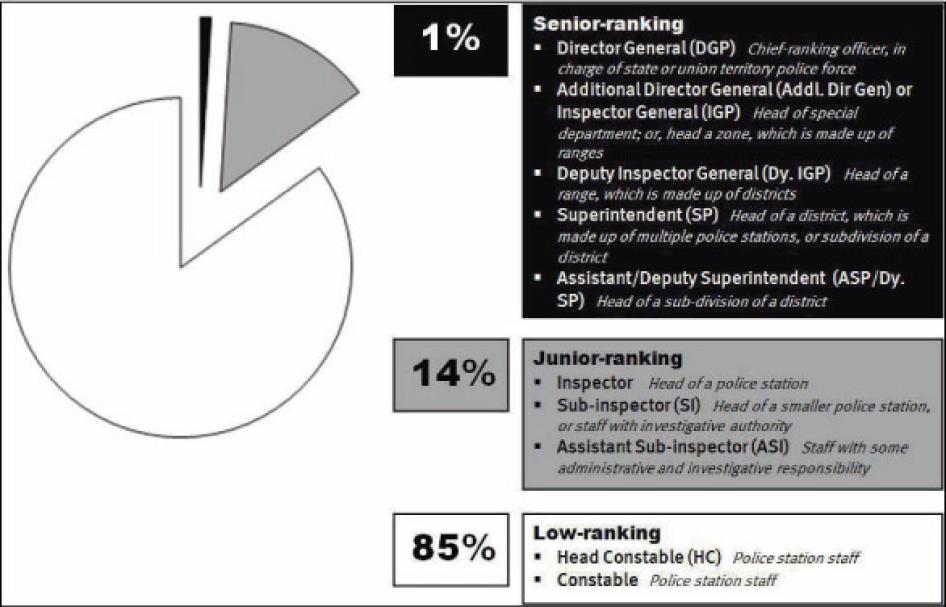
Rank Structure of the Indian Police
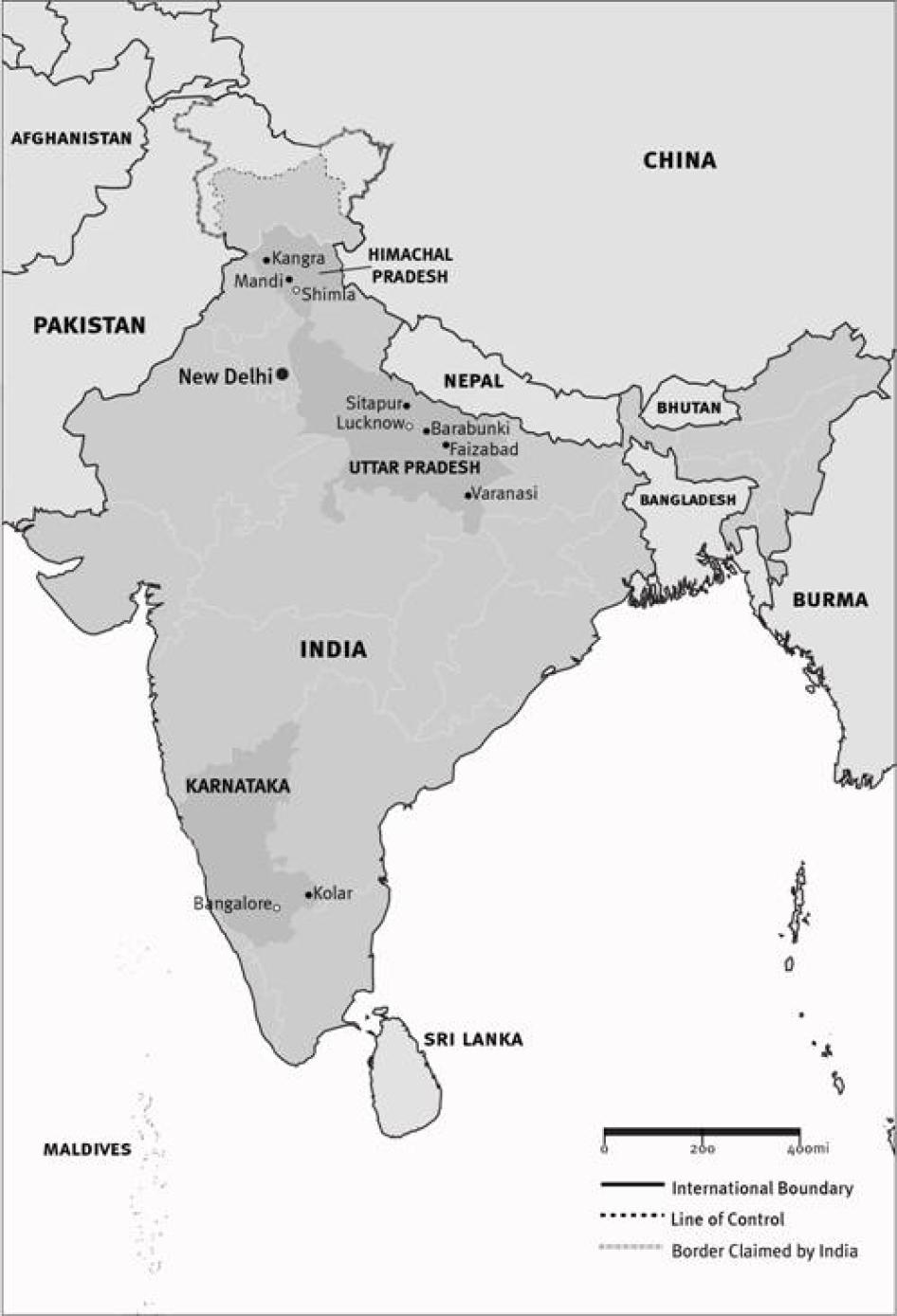
Map of India
© 2009 Human Rights Watch
I. Summary
“This week, I was told to do an ‘encounter,’” a police officer we will call Officer Singh told Human Rights Watch in January 2009. He was referring to the practice of taking into custody and extrajudicially executing an individual, then claiming that the victim died after initiating a shoot-out with police. “I am looking for my target,” he said. “I will eliminate him.”
Working in Uttar Pradesh, Officer Singh is the kind of police officer who should be in prison for misusing his authority. Instead he is protected by his superiors. It is in this way that impunity continues to thrive in India—and the reputation of the police continues to slide.
But as we spoke to Officer Singh, we heard about other aspects of the reality of policing in India. Officer Singh said he had hardly a day off since he began working as a sub-inspector, or investigating officer, for the Uttar Pradesh police ten years ago. “I’ve slept ten hours in the last three days. How is a person who hasn’t slept in three days supposed to behave properly?” he asked. “The pressure cooker will burst.”
Officer Singh described hours crammed with too many duties: patrolling events, escorting VIPs, investigating crime, and, he added without hesitation, fabricating police records. He said he was working on a murder case but had at best a few hours at night to devote to solving it. “I sent evidence to the forensic lab five months ago, but the case is still pending,” he said. Nonetheless, he said he was under tremendous pressure from superiors to solve the case, or face suspension. He admitted that in the past, in similar straits, he had beaten suspects to elicit confessions–that’s what his superiors expected of him. “It is presumed that I’m doing it,” he told Human Rights Watch. “It’s done before them. Sometimes they are doing it.”
Despite his willingness to beat people he determines are criminals—and he made it clear that he had beaten many—Officer Singh said he did not initially intend to be a dishonest and abusive crime fighter. “No one is born corrupt. It’s a tailor-made system: if you’re not corrupt, you won’t survive.”
* * *
Officer Singh’s admissions, though disturbing, would likely be unremarkable to many Indian police officers, criminal suspects, lawyers and other observers. While India rightly touts itself as an emerging economic powerhouse that is also the world’s largest democracy, its police forces—the most visible arm of the Indian state—are widely regarded within India as lawless, abusive and ineffective.
A dangerous anachronism, the police have largely failed to evolve from the ruler-supportive, repressive forces they were designed to be under Britain’s colonial rule. While sixty years later much of India is in the process of rapid modernization, the police continue to use their old methods. Instead of policing through public consent and participation, the police use abuse and threats as a primary crime investigation and law enforcement tactic. The institutional culture of police practically discourages officers from acting otherwise, failing to give them the resources, training, ethical environment, and encouragement to develop professional police tactics. Many officers even told Human Rights Watch that they were ordered or expected to commit abuses.
In its research, Human Rights Watch examined these two separate, but linked issues: abuses by the police against individuals, usually criminal suspects, and the conditions that facilitated and encouraged police to commit those abuses. Our findings, when read alongside other work that has been done by non-governmental organizations (NGOs), the media and even some government bodies, make it clear that misbehavior is deeply rooted in institutional practice. It persists and sometimes flourishes due to government failure to hold abusers accountable and to overhaul the structure and practices that enable abusive patterns of behavior.
Drawing on the extensive existing documentation of human rights abuses by the Indian police, Human Rights Watch conducted its own research and found four clusters of issues warranting attention, addressed in separate subsections of this report: police failure to investigate crimes; arrest on false charges and illegal detention; torture and ill-treatment; and extrajudicial killings.
Traditionally marginalized groups are especially vulnerable to each of the first three abuses. Though stemming from the discriminatory biases of police officers, their vulnerability is also the product of an abusive police culture in which an individual’s ability to pay a bribe, trade on social status or call on political connections often determines whether they will be assisted or abused.
Why do these abuses persist? Part of the problem is the working conditions of individual officers. At the level of the civil police station, where junior and low-ranking police often reside and deal with suspects or victims, we found that civil police, particularly constables, live and work in abysmal conditions. They are often exhausted and demoralized, always on call, working long hours without shifts and necessary equipment, only to return to government-provided tents or filthy barracks for a few hours’ sleep. Junior-ranking officers often face unrealistic demands from their superiors to solve cases quickly. Even if officially encouraged, their use of professional crime investigation techniques is effectively discouraged by the dearth of time, training and equipment with which they operate. These officers also face frequent intervention in investigations by local political figures, who sometimes act to protect known criminals.
To get around these systemic problems many officers take “short-cuts.” Officers told Human Rights Watch they often cut their caseloads by refusing to register crime complaints. At other times, they use illegal detention, torture and ill-treatment to punish criminals against whom they lack the time or inclination to build cases, or to elicit confessions, even ones they know are false.
Such abuses contribute to a climate of fear. Many Indians avoid any contact with the police, believing not only that they will not receive assistance but that they risk demands for bribes, illegal detention, torture, or even death. Facing a reclusive public, the police are unable to get tips from informants or the cooperation of witnesses, which are both critical to solving cases and preventing crime. This, of course, creates a vicious cycle, as crimes go unreported and unpunished and the pressures on the police to deal with rising criminality increase.
The government elected in May 2009 has promised to actively pursue police reform. It should start by recognizing the need to transform the institution from one that enables and encourages officers to commit abuse to one that promotes human rights and the rule of law, without exception.
A critical step is holding abusive officers accountable. Those who commit torture or other abuses must be treated as the criminals they are. There cannot be one standard for police who use violence and another for average citizens. At the same time, the incentives must change for police officers. Officers facing suspension if they disobey illegal orders, or fail to meet their superiors’ expectations to solve crimes without the necessary means, have little incentive to abstain from abuse. In the long-run, a sustainable drop in police abuses requires an overhaul of archaic police laws and structures. Investment in training, personnel and equipment is critical to building the professional, rights-respecting police forces that an emergent India deserves.
The Indian Police: A Dangerous State of Disrepair
Although the police are tasked with battling India’s most pressing problems—including armed militancy, terrorism, and organized crime—a lack of political commitment and investment by the state has left the police overstretched and ill-equipped. There is just one civil police officer for every 1,037 Indian residents, far below Asia’s regional average of one police officer for 558 people and the global average of 333 people.
Police infrastructure is crumbling. Decaying, colonial-era police stations and posts across India are stocked with antiquated equipment and lack sufficient police vehicles, phones, computers, and even stationery. A severe police staffing shortage is compounded by additional demands on an already stretched force. Police are routinely diverted to protect “VIPs”—usually politicians, businesspeople, and entertainment figures. Senior police officials frequently use low-ranking staff as orderlies and even as personal family servants.
The police structure in India is based on a colonial law that did not provide the lower ranks, usually local recruits, with operational authority or advanced professional training. Inexplicably, that system continues six decades after the end of British rule in India. Constables, the bottom rank, make up as much as 85 percent of the Indian police, but for the most part they are not trained to investigate crime complaints.
Junior and low-ranking police are frequently demoralized due to degrading working and living conditions. Police are under constant stress due to the statutory requirement that they be available for duty 24 hours a day, seven days a week—a grueling reality for the police we interviewed, many of whom said they were hardly ever permitted a day off and some of whom, living in barracks, literally had not been given time to see their families for weeks. Police say they are exhausted and have no time for exercise or recreation. The Director-General of Police in Uttar Pradesh boasted to Human Rights Watch,
If you brought a US policeman here he’d commit suicide within one day. [Here], you are literally thrown against the wall. We don’t have a shift of 8 to 10 hours, it is the system we have: we work 24 hours a day.
Many low-ranking police officers live in barracks that are deteriorating, cramped, and without enough beds. A constable in Varanasi, Uttar Pradesh, told Human Rights Watch,
It’s just like I’m a prisoner.... There’s no medical facilities, no toilet.
Junior-ranking police officers have little chance of promotion and are subject to the unrealistic demands of senior officers who are for the most part directly recruited into management positions, and often have no firsthand knowledge of the difficulties the lower ranks face.
Political Interference and Stalled Efforts at Reform
Decades of partisan policing—politically motivated refusal to register complaints, arbitrary detention, and torture and killings sometimes perpetrated by police at the behest of national and state politicians—have resulted in an unprecedented level of public distrust and fear of the police. In a culture of shifarish, or favors, only Indians with powerful connections can be confident they will obtain police assistance. State and local politicians routinely tell police officers to drop investigations against people with political connections, including known criminals, and to harass or file false charges against political opponents. As one police officer told Human Rights Watch:
The problem is that law enforcement is only possible up to a limit. Anti-social elements are protected by the powerful. Police is supposed to be tough on criminals. But criminals are protected, supported and rewarded, so the police who act against them are helpless. No officer is in a position to protect anyone else. They are barely able to protect themselves.
Police at all ranks say that they fear reprimand or punishment if, in the course of doing their jobs, they act against individuals with political connections.
In 2006, the Supreme Court handed down a landmark decision, Prakash Singh and Others v. Union of India and Others, that directed the central and state governments to enact new police laws to reduce political interference. Unfortunately, the central government and most state governments have either significantly or completely failed to implement the Court’s order. This suggests that key government officials have yet to accept the rule of law or the urgency of undertaking comprehensive police reform, including the need to make police accountable for widespread human rights violations. The Indian government also has yet to recognize the immediate need to improve the working and living conditions of low-ranking police which. While those conditions in no way justify the human rights violations committed by police, addressing them is critical to changing a working environment that facilitates, condones, and encourages such violations.
Human Rights Violations by Police
In this report, Human Rights Watch documented four abuses frequently committed by police in parts of India: failure to investigate crimes, arbitrary arrest and illegal detention, custodial torture, and extrajudicial killings.
Failure to Register Complaints and Investigate Crime
Police in India frequently fail to register crime complaints, called First Information Reports (FIRs), and to investigate crimes. Police officers told Human Rights Watch that they are often under pressure from political leaders to show a reduction in crime by registering fewer FIRs. Some said that they face suspension or reprimand if they register too many. Police also blame their failure to investigate cases on insufficient personnel and a reluctance to take on new cases that add to an already heavy workload.
Traditionally vulnerable communities bear the brunt of this neglect. For instance, according to local NGOs, police often do not register complaints or investigate crimes against Dalits (so-called “untouchables”) under special laws enacted to ensure Dalit protection.
Police, including specially designated Crimes Against Women cells, fail to sufficiently aid victims of domestic violence. According to NGOs and police themselves, police often urge victims to “compromise” with their spouses or spouses’ families, even when women allege repeated and severe physical abuse. Women’s rights activists say that police often do not investigate rape cases and re-traumatize victims who approach them for help through their hostile or inadequate response. For example, when 16-year-old Sunita (a pseudonym) became pregnant after she was raped by her cousin, her family members in a village near Sitapur, Uttar Pradesh beat her and threatened to kill her. Police refused to register an FIR for the rape, and advised her to get an abortion and marry someone from another village.
Crime victims who are poor are often unable to obtain police assistance. They cannot afford to pay bribes that police ordinarily demand for FIR registration, or for the costs of investigation that victims are expected to cover on behalf of the police. They are less likely to be able to call local political figures to intervene with police on their behalf, while their perpetrators may have police protection due to political connections.
Illegal Arrest and Detention, Police Torture and Ill-Treatment
Police officers sometimes make arrests in retaliation for complaints of police abuse, in return for bribes, or due to political considerations or the influence of powerful local figures. They also admit that they use unlawful coercion, including torture, to elicit confessions to the charges they fabricate. Police often fail to follow procedures mandated by the Supreme Court in DK Basu v. West Bengal, including production of a suspect before a magistrate within 24 hours of arrest.A Bangalore police officer admitted:
We do use some extralegal methods. You might disagree, but we cannot do all work by the book. Then the police would be completely ineffective.
This failure to “work by the book” is reflected in frequent torture and other ill-treatment of suspects in police custody. Human Rights Watch found that severe ill-treatment sometimes intensifies over the period of an individual’s detention. For instance, in December 2007 police tortured 18-year-old Ram Chandra Prasad, a murder suspect, for five nights in Varanasi to elicit a confession. Prasad told Human Rights Watch:
After they finished tea they pulled off my shirt and trousers. The constable kicked me, and then constables came and held my hands and legs. They drenched me with a bucket of cold water...For one and a half hours, I was beaten like this.... [On the third night] the SI [sub-inspector] and SO [station officer] pressed their feet against my thighs. I felt my veins, it felt like they would burst. They said, “We’ll make you impotent and you’ll be of no use.”
Individuals who are poor and socially or politically marginalized are especially vulnerable to prolonged detention and repeated ill-treatment because they are unable to bribe police to secure their release and are unlikely to have connections to local political figures who can intervene. Twenty-year-old Pradeep Singh died after suffering a severe beating by police in Chitti, Dhankaur, Uttar Pradesh, in January 2007. According to Singh’s family, police arrested Pradeep with two other men. Police released the other two after they paid a police bribe. But Singh’s family, Dalits with little money, were unable to pay the police. Singh’s grandfather Kedara, age 83, visited him in lockup before he died:
When I looked at him, I felt very sad. He couldn’t stand up straight. Why? We are poor people. We don’t have money to give to them. And if it’s our caste, then they beat up all the more.... We don’t have money ourselves, where do we give money to police from? If we gave the police [money], probably it would have helped my boy.
Human Rights Watch’s investigations found that the police sometimes fail to provide arrested children with the special protections afforded under India’s Juvenile Justice Act, such as the requirement to present any detained child before a special Juvenile Justice Board within 24 hours of arrest. Several boys in Bangalore described how police subjected them to electric shocks and prolonged beatings.
Socially and politically marginalized communities are subject to frequent sexual and physical harassment and street beatings by police. Members of the hijra community in Bangalore said that physical harassment and abuse by police had become increasingly routine since 2007.
Bangalore sex workers described police beatings and sexual harassment. One woman told Human Rights Watch,
I was standing on the street. It was quite deserted. A policeman came and slapped me and beat me up very badly. I was lying on the ground. When I begged for water, he unzipped his pants and offered his penis.
Some police officers admit that “using force” to elicit confessions from criminal suspects is their primary investigation tool, rather than gathering forensic evidence and witness accounts. False confessions lead police to gather faulty evidence, which frequently results in cases being thrown of out of court or wrongful convictions.
Impunity for Extrajudicial Killings
Officer Singh, discussed above, described to Human Rights Watch how senior officers boast of ordering killings.
The SP [superintendent of police] will say, “Under my regime, so many criminals were “encountered.” I fear being put in jail, but if I don’t do it, I’ll lose my position.
While the practice is not the norm in most of India, fake encounter killings occur frequently. Many take place in Singh’s Uttar Pradesh state, where the National Human Rights Commission reported 201 complaints of such killings in 2007, more than any other state.
Police are usually the only eyewitnesses to these alleged encounters, which are typically carried out by junior and low-ranking police. Considering the long history and scale of this practice, it is likely that state officials and senior police are not only aware of these killings, but allow, unofficially sanction or even order these killings.
Criminal suspects or their family members are frequently the targets of fake encounter killings. In the cases Human Rights Watch documented, the facts strongly suggested the implausibility of official accounts of the killings.
For instance, Sugriv Singh Yadav, accused of several crimes, died on August 6, 2008, in Faizabad, Uttar Pradesh. According to police, Yadav was shot dead while fleeing on a motorbike after he and three others stole a mobile phone and 10,000 rupees (about US$210) from a man who then complained to the police. But according to an attorney for Yadav’s family: “The motorbike that the robbers were using had not a drop of petrol in it. There was no blood at the site of the incident where Sugriv was apparently shot.”
Obstacles to Police Accountability
Police can usually commit extrajudicial killings with impunity. The Indian media and NGOs have documented hundreds of such killings but their efforts at accountability have been hampered by systematic police deniability. The absence of records, including in many cases a post-mortem examination or registry of arrest and detention, makes it very difficult to disprove the police’s account.
In some cases, police deny any knowledge of or responsibility for killings, even when the subject was last seen alive in police custody. For instance, police deny any involvement in the June 18, 2006, death of Abdul Khalid in Uttar Pradesh state, even though his wife Sakia Begum witnessed his arrest that night. She believes he was later killed in custody and his body was abandoned in a field near her house. Immediately after the arrest, she ran to the police station but found it locked and empty. She told Human Rights Watch:
We were looking all over for him.... Meanwhile, our neighbors called the police to say that there was a body lying in the field near our house. The police took my son there for identification. It was my husband.
Independent investigations are critical to reducing impunity, but despite the presence of the national human rights commissions and their state counterparts, they are rare in much of India.
Police investigations, either initiated by police or undertaken at the direction of external agencies, are often ineffective due to a “code of silence” that makes police unlikely to disclose incriminating evidence. In the absence of an independent investigation, officers who issue illegal orders or pressure subordinates to carry out abuses can lay the blame exclusively on their subordinates.
Criminal prosecution has the potential to check police abuse, but victims often do not file cases because they fear police retaliation. Another major obstacle is section 197 of the Criminal Procedure Code, which provides immunity from prosecution to all public officials unless the government approves the prosecution.
The National Human Rights Commission (NHRC) has the authority to recommend an independent investigation either by another division of the local police or by the Central Bureau of Investigation, but this often results in the police effectively investigating itself. Even where this is done with integrity, the process does not have the appearance of independence and impartiality, leaving victims and families suspicious of the process.
In most cases the NHRC only recommends that state governments provide victims with interim compensation. The award of compensation to victims without proper prosecutions of officers who commit the crimes and their superiors who order them is inadequate to halt recurring violations. The country’s 18 state human rights commissions (SHRCs) vary greatly in resources and willingness to act, and local lawyers and activists describe SHRC staff as inadequate in number, lacking human rights training, and biased against complaints, factors that lead them to routinely defer to police accounts of a given incident.
Even in the exceptional case in which action is taken, the punishment most often consists of temporary suspension or transfer of the offending officer to another police station. Until officers know that they will be prosecuted, fired, or their careers seriously damaged for engaging in abusive behavior, the problem will not go away.
Key Recommendations
The government that came to power after the May 2009 elections has committed itself to initiating police reforms. The police and responsible Union and state authorities should commit to two-track reform: 1) increase accountability for abusive police officers, and 2) change the police structure and working conditions that contribute to abusive patterns of behavior.
There is no time to waste. Police violence and misconduct are so widespread and rooted in institutional practice that public confidence in the police is low and decreasing. Efforts to end abuses will not succeed unless made part of a comprehensive overhaul that includes officially acknowledging the problems— including impunity—and setting out an action plan to overhaul relevant laws and practices.
The following recommendations to both improve the functioning of the police and curtail abuses are drawn from multiple sources, including Human Rights Watch’s research findings, reports by bodies of the Indian government including the Law Commission and the National Police Commission, Indian court decisions, studies by former and current Indian Police Service officers, and reports by local NGOs.
Overhaul police structures and improve working conditions
- Improve conditions for rank and file officers: low-ranking police are overworked and often exhausted due to the requirement they be available for duty 24 hours a day. Some live in filthy, cramped barracks. They are demoralized by limited promotional opportunities and relegation to menial tasks. In such conditions, they are likely to fall into abusive patterns of behavior. Minimum standards for housing and work hours should be developed, for instance, a requirement that station house officers announce and adhere to a monthly work schedule with maximum hours of work and provide for mandatory leave.
- Improve training and equipment: a scarcity of trained personnel can contribute to the likelihood of abusive behavior, such as the “short-cuts” of refusing to register crime complaints to reduce caseloads, and building cases on coerced confessions rather than collection of evidence. Increasing the number of junior-ranking officers trained and authorized to conduct investigations and register complaints, and training constables to assist in crime investigations, is critical. The lack of crime investigation training and equipment effectively discourages officers from building cases on forensic evidence and witness statements, rather than coerced confessions. The investigation curriculum at police academies must be bolstered, including in the use of forensic tools and non-coercive interrogation techniques. Every investigating officer should have access to basic forensic equipment. The training and roles of low-ranking police should be enhanced to include investigation assistance.
- Create a culture that rewards respect for human rights and professional conduct: the skills and potential of junior- and low-ranking police are often underdeveloped, with many staying at the same rank their entire careers. Frustrated officers with nothing to lose are more likely to engage in abusive behavior. To change this environment, provide incentives for better police behavior. Fill more senior- and junior-ranking positions by promotion, rather than direct recruitment. Senior police should actively encourage junior-ranking officers to innovate police station procedures and publicly laud such work.
Enforce the law and hold abusers accountable for violations
- Create a system of effective independent investigations into complaints of police abuse and misconduct: independent and effective investigations into complaints against police are rare in much of India. To reduce impunity, the central and state government should bolster the capacity of the national and state human rights commissions to undertake independent investigations, including the number of investigative staff. The central and state governments should also comply with the Supreme Court’s order in Prakash Singh mandating the establishment of Police Complaints Authorities, and provide such bodies sufficient resources and independence to carry out their duties in a way that creates public confidence.
- Enact laws against torture: strong domestic laws are critical to signaling police that torture is never a permissible means to extract confessions or other information from criminal suspects. The Indian parliament should ratify the Convention Against Torture and amend the Indian Evidence Act to make inadmissible any evidence obtained on the basis of a police interrogation that involved the use of torture or cruel, inhuman, or degrading treatment or other illegal coercion.
- Repeal laws that encourage impunity: section 197 of the Criminal Procedure Code continues to effectively shield many abusive police officials from prosecution for actions taken on “official duty,” permitting abuse to frequently go unpunished and undeterred. The Indian parliament should repeal Section 197, or retain it but define “official duty” to exclude unconstitutional conduct such as arbitrary detention, custodial torture and ill-treatment, and extrajudicial killings.
- Require the reading of rights to suspects and put safeguards into place to deter torture: existing laws regarding arrest and detention are frequently flouted, regarded by some police as impractical. To encourage institutional acceptance of these safeguards and reduce abuse, require police to formally recite the suspect’s rights upon arrest or any informal detention.
A more detailed set of recommendations is included at the end of this report.
Methods and Scope
This report is based on Human Rights Watch field research conducted in India from December 2008 to January 2009. It focuses on the Indian civil police’s routine operations and does not examine police conduct in counter-insurgency situations.
Under India’s federal structure, each of the 28 states and seven union territories administer independent police services. The policing situation varies across India due to differing security and crime concerns, and political context. While we do not purport in this report to present definitive conclusions on the nationwide incidence of any particular problem or abuse, we have tried to build a national perspective, structuring the research with that objective in mind.
Most of the research for this report focused on police practices in three states, chosen in consultation with NGOs working on these issues in India, particularly the Commonwealth Human Rights Initiative in Delhi. The states have taken different approaches to police reform and are geographically diverse: Himachal Pradesh, in the north, operating under a new police law; Karnataka, in the south, in the process of rewriting its police law and considering changes to police resources and management practices; and Uttar Pradesh, which has yet to embark on a comprehensive reform process and from which the National Human Rights Commission has registered a large number of complaints of severe police abuse. We attempted to include cases that show the varying conditions in rural and urban settings, and in both richer and poorer states.
We also consulted national police reform experts and analyzed the extensive available research on policing practices and the human rights record of police nationwide , including government-sponsored studies of the Indian police and criminal justice system, independent scholarship by former senior police and criminal justice experts, and domestic and foreign NGO reports.
This report discusses cases arising since 2005 that illustrate some of the most common human rights violations committed by police. We interviewed more than 60 victims and witnesses, including 37 interviews with victims of police torture or ill-treatment or members of their families. We interviewed eight individuals who were arrested or detained on false charges but who did not suffer torture. Six interviews were with family members and lawyers of individuals who were killed by police in alleged staged shoot-outs or whose death in police custody was covered up, documenting a total of nine such deaths. Eleven interviews were with individuals for whom police had failed to register or investigate crimes. In group interviews, we spoke with more than a dozen individuals who said police had threatened, harassed, and extorted money from them on multiple occasions.
This report also provides our findings from research into institutional problems that exist at the police station level, which have not been widely investigated or reported on to date. We visited 19 police stations in major cities, small cities, and villages. Our access varied greatly but some officers allowed us to spend full days with them to get a better understanding of their day-to-day work demands and practices. We interviewed about 80 police officers of varying ranks. Our interviews with about 45 constables and other low-ranking police took place inside police stations and outside the presence of officers above the rank of assistant sub-inspector; we spoke briefly with about a dozen other low-ranking officers in the presence of their superiors. We interviewed about 20 junior-ranking officers who worked as heads of police stations, investigators, and as assistants to senior police. Many of these individuals spoke on condition of anonymity, fearing their disclosures would lead to their suspension or transfer to other areas. Additionally, we interviewed 14 current senior-ranking police officers, including the chief-ranking officers in Karnataka and Uttar Pradesh. We also interviewed seven former police officers, including former members of the National Human Rights Commission.
In addition, we interviewed about 65 Indian NGO workers, lawyers, and activists. We spoke with officials from the State Human Rights Commissions of Karnataka and Uttar Pradesh and the Lokayukta, a similar body in Himachal Pradesh; officers of the Himachal Pradesh Women’s Commission and the Crimes Against Women Cell in Delhi; and trainers from UNICEF’s Gender Sensitization Project in Karnataka. We consulted with eight experts on police oversight, administration, and crime investigation.
We conducted interviews in either Hindi or English with the assistance of local interpreters. In some cases, we subsequently transcribed translations based on audio and video recordings of the interviews.
II. The Deteriorating State of the Indian Police
The Indian police face an unprecedented level of public distrust. The media derides them as professionally incompetent and criminally negligent. Much of the public fears them as the strong arm of corrupt politicians.[1]
These characterizations are unduly monolithic considering the diversity of India’s 1.43 million police.[2] The Indian Constitution authorizes each of the 28 states to operate its own police service, which includes an armed reserve and civil police.[3] The central government operates civil police services in each of the seven union territories and in the capital, Delhi, in addition to various armed police forces that state governments may request for extraordinary law and order problems.[4] Lacking concurrent jurisdiction, these state and central police services operate independently of one another.[5]
While police administration is decentralized, the central government wields significant influence over state police services. Each state police service draws senior police from the Indian Police Service (IPS), an elite police cadre recruited and trained by the central government.[6] While law and order is primarily a state concern, the principal laws covering police work were enacted by the central government and are national in scope: the Indian Penal Code defines major criminal offenses and the Criminal Procedure Code and Evidence Act regulate police behavior and codify constitutional protections for criminal suspects. Central government laws such as the Prevention of Atrocities Against Scheduled Castes/Scheduled Tribes Act and Protection of Women from Domestic Violence Act give police additional duties and define special criminal offenses.[7]
Colonial Legacies and the Failure to Modernize
The Indian police have long had a strained relationship with the public. India’s state and central police services were organized based on the Police Act of 1861, a law drafted in the wake of the 1857 uprising against British rule that remains in force in the union territories and is the basis for most state police laws. Designed to secure British imperial interests, the Indian police were controlled by civilian administrators accountable to the British government, rather than the local population.[8]
Despite this aspect of civilian control, the Indian police in the colonial era were paramilitary in operation. Geared toward quelling anti-British “disturbances” and general lawlessness rather than preventing and investigating particular crimes, the police developed large armed constabulary forces.[9] A military ethos and distrust of the “native” population meant that the constabulary, the lowest rank comprising at least 80 percent of the police and staffed with Indians, was entrusted with only menial tasks and charged with instilling fear in the public, rather than seeking its cooperation.[10] Scholar Arvind Verma writes:
[S]haped as an instrument of the Raj, [i]t was these police who would baton charge Gandhi’s peaceful followers or shoot to death young people raising Indian flags.[11]
To prevent police from sympathizing with the local population’s problems and the independence movement, the police were structurally sequestered. Senior police, drawn from the elite cadre that would later become the Indian Police Service but initially limited to non-Indians, were deployed to areas with which they had no community ties or experience. Low-ranking police such as constables were physically secluded from the local population, residing in police barracks and working from the police station rather than venturing into villages to address crime complaints or render aid.[12]
India retained the Police Act of 1861 after it gained independence from British rule in 1947, along with many of the structural characteristics described.[13] In the decades that followed, the Indian police remained a force deployed to maintain law and order and support the state, and failed to develop the public service orientation of modern policing.[14] The central and state governments developed large armed police battalions in response to growing levels of social violence, and failed in large part to devote resources to investigative units and crime prevention strategies.[15]
The post-independence Indian police have earned a reputation for brutality in the service of politicians and widespread corruption. In the 1970s, police harassed, beat, and killed resistors during Indira Gandhi’s programs of mass forced sterilization and “slum clearance.”[16] During the Emergency Period of 1975 to 1977, police harassed and extorted members of the general population under the guise of the Maintenance of Internal Security Act, and arbitrarily detained political opponents of Indira Gandhi and the Congress Party.[17]
Communal violence in the following decades featured politically motivated failure to protect religious minorities and police collusion. This was particularly notable during the 1984 mob attacks on Sikhs in Delhi and attacks on Muslims in Mumbai in 1993 and in Gujarat in 2002.[18]
This history of alienation from, and violence against, the Indian public has rendered the police a widely despised group, regarded by the public as corrupt, inept, and ineffective.[19] Yet the police are increasingly tasked with battling India’s myriad public safety problems: armed militancy, terrorism, entrenched gender-based, caste and communal violence, and escalating levels of organized crime, white collar crime, and cyber crime.
A Dangerous State of Disrepair
The police are unequal to these tasks due to a dearth of trained personnel and necessary equipment. Poor living and working conditions not only demoralize police, they result in delays or failures of officers to assist crime victims and investigate crimes.
Poor Infrastructure
The deteriorating state of the police is most visible at police stations.[20] Human Rights Watch researchers visited numerous decaying police stations built before independence and stocked with antiquated equipment. Many lacked basic equipment needed for investigating crimes, preserving evidence, and keeping minimally adequate records.
In rural areas, some police stations lacked electricity. In a station in Uttar Pradesh, police set up desks in the courtyard because power outages render their offices hot and dark. While rural India suffers from inadequate power supply, police stations could be provided with generators and power back-ups.
At a station in Himachal Pradesh, police struggled for several minutes to unclasp and close a pair of rusted, decades-old handcuffs. Some police are equipped with First World War-era rifles and inadequate bullet-proof vests, a deadly combination highlighted by the death of sixteen police during the first seven hours of the November 2008 Mumbai shooting rampage by militants armed with Ak-47s.[21] Many police are unprepared to face or use lethal force due to poor equipment and lack of weapons training. “A constable will fire at best ten rounds in the entire training period,” said Ajai Sahni of the Institute for Conflict Management, a New Delhi think tank that works on security issues. “When a fellow actually has to fire, he doesn’t aim properly.”[22]
Junior officers interviewed by Human Rights Watch said that they have no discretion to use funds for infrastructure improvements. Stations Human Rights Watch visited ordinarily had only one phone line and two handsets, and police said they routinely use their personal mobile phones to communicate with each other.
“Police stations don’t get enough money to function as they’re expected to function,” said a member of Poverty Action Lab of the Massachusetts Institute of Technology, a development project, who has visited dozens of stations in Rajasthan. “Often the money literally doesn’t cover the stationery.”[23]
Police said that limited resources prevented them from responding promptly to calls for help and visiting crime scenes, setting up patrols, and following up on investigation leads.[24] Nationwide, there is an average of about seven police vehicles for every 100 police.[25] In urban areas, the scarcity of police vehicles means police use their own motorcycles.[26] Many police officers we interviewed said the fuel allowance they received covered only a small fraction of the cost they incurred. Some police in rural areas said that they were often expected to take public transportation to reach remote areas, leading to delays in police response.
Andersenpet police station in Kolar, Karnataka, a high-crime area with gangs feuding over local gold deposits, is equipped with only one jeep. The night Human Rights Watch visited the station, the station house officer, or SHO, was out with the jeep when a stream of people injured in a nearby street fight poured into the police station. One man arrived bleeding, having been beaten on his head with a stick. With no police vehicles available, a constable was deputed to flag down an auto-rickshaw (motorcycle taxi) and escort the injured man to the hospital. Soon after, four other wounded men staggered in one-by-one. The police made no attempt to discover where the fight was occurring or to try and stop it. Running out of personnel to escort the injured to the hospital, the head constable merely stopped reluctant auto drivers and put the injured into their cars.
The head constable explained, “These types of fights are common here... We don’t need to attend to them.” He added that he had no alternative, “The jeep is with the SHO. There are only two motorbikes. We don’t have anything available right now.”[27]
Senior police acknowledge that inadequate equipment and supplies breed rampant petty corruption, including demands for payment in exchange for assistance to crime victims. A police officer in charge of a Bangalore police station described a case in which parents told police their daughter had been kidnapped from the area:
If the family were to wait for the police to respond, it would be days before the expense amount [was authorized] and the policeman able to reach the spot using public transport. So, if the father wants results, he will offer to provide transport.”[28]
Another police officer told Human Rights Watch:
The police station is allotted stationery, which is never enough. We even have to buy paper to write the FIRs. Every week, we are sending at least 8 or 10 statements to a number of officers so we have to make multiple copies. How do we fund this? With our salaries? But if we ask the victim to supply the paper, we are accused of corruption.[29]
The central government has made modernization grants to state police services since the 1960s. But many police told Human Rights Watch that they lacked computers, internet connections, and other technological equipment. A constable at the women’s police station in Lucknow noted that while a computer had been allocated to the station, the station house officer had taken it home. Moreover, state governments sometimes fail to spend the modernization grant money they receive, or fail to use the funds for long-term development.[30] Due to poor planning, sometimes police receive new equipment, but not the funding to maintain it or train officers to use it.[31]
Many police officers complain that computers are of little use in the absence of searchable databases and specialized software.[32] India lacks a functional nationwide fingerprint database,[33] and most states and metropolitan areas have not developed criminal history databases accessible to investigating officers. Case diaries and police registers are usually recorded in notebooks or loose leaf paper which are then tied with string and stored in corners of the station or atop tall cabinets.
Telecommunications, transport and data processing equipment—provision of which is inadequate at many Indian police stations—are all critical to effective police work. As noted, the lack of available vehicles prevents police from promptly following up on leads that swiftly turn cold. Information-sharing, through Internet technology and mobile phones, is crucial to coordinating the crime investigation and crime prevention efforts of state and city police forces, particularly when suspects flee the area to escape arrest. On a local level, information-sharing is critical because violent demonstrations and local disputes can quickly escalate. Former senior police officer and member of the National Human Rights Commission K.N. Gupta explains:
Law and order in the present day is much like a conflagration that starts with a spark. The cause of trouble is often obscure but the spread is rapid and the effect is widespread. At the police station level, the station House Officer perceives local incidents but not their wider repercussions. At district or higher levels, senior officers perceive the repercussions but not the causes... Without a communication network linking all levels, there can obviously be no upward flow of information and intelligence or downward control and direction of action... [This] is the root-cause of failure of police operations.[34]
Moreover, the lack of basic crime investigation equipment, discussed in greater detail in Chapter III of this report, means evidence is likely to be contaminated or otherwise compromised, rendering it of little or no use in supporting prosecutions or becoming the basis for acquittals.[35] While it is modern police practice to keep evidence in sealed containers with labels indicating chain of custody, at stations Human Rights Watch visited in Himachal Pradesh, police stored evidence in loosely tied cotton sheets. In Bangalore, Inspector S. Badrinath said that since his police station had only a single investigation kit, with one body bag, they did not use it.[36] A barracks in Shimla, Himachal Pradesh, doubles as an evidence storage room. Investigating officers complain that they lack interrogation rooms or offices in which to write reports.
The inadequacy or absence of such basic equipment makes it all the more likely that police will seek coerced and false confessions and, in the worst cases, secure “justice” by extrajudicially killing criminal suspects, issues discussed in Chapter III.
Older stations appear structured to physically intimidate the public, and even to deter approach. Some stations Human Rights Watch visited featured reporting desks rising above eye level, so that a visitor making a complaint of crime would be unable to view what a police official wrote down. In many rural police stations, witnesses or complainants, particularly the poor or Dalits, are expected to sit on the floor or stand while addressing policemen. The reporting room at the Lucknow women’s police station, where police ordinarily direct victims of rape and domestic violence, was cramped with more than half a dozen police, affording no privacy for the taking of a complaint.
Inefficient Deployment of Personnel
The Indian police suffer from a shortage of personnel. According to the most recently available information, there is a national average of one civil police officer for every 1,037 residents, far below Asia’s regional average of one police officer for 558 people and the global average of one for every 333 people.[37] More than 13 percent of civil police positions are vacant nationwide, but the actual deficit of staff is greater because allocations are based on outdated population figures and suppressed crime registration.[38]
An assistant sub-inspector in Karnataka said that staff shortages are worse in rural areas because police testifying in court proceedings in remote areas are absent for entire days: “Effectively we get five or six persons each shift. Yet, each police station will cover 50 or 60 villages. It is difficult for us to even reach the [crime] scene on time.”[39]
The personnel shortage means heavy workloads, long working hours, often without overtime being paid, and officers on call 24 hours a day, seven days a week. Police say that the resulting stress and frustrations contribute to low morale and pressures to find investigative “short-cuts,” particularly since officers designated for crime prevention and crime investigation work are often diverted to immediate-day-to-day duties such as patrolling demonstrations and religious processions.[40]
The personnel shortage is compounded by misuse of police time. For instance, many police told Human Rights Watch that they spent whole days escorting VIPs visiting their cities or villages. While some individuals who request police escort face serious threats—many Indian politicians have been assassinated—S.R. Darapuri, a former inspector general of police in Uttar Pradesh, said that local politicians, business and entertainment figures often seek police “VIP” escorts as a “status symbol.”[41] In 2009, an estimated 45,900 police nationwide were deployed to protect 13,300 VIPs, with one-fourth of the Delhi police assigned to escort duty and an average of 34 Delhi police assigned to each protected individual.[42] An assistant superintendent of police in Himachal Pradesh who did not wish to be named said, “Each officer in a month will have to do it four or five times, for a full day. I walk alongside them. They [politicians] need to do that to show their control over police.”[43]
Another problem is that low-ranking police are assigned to non-skilled tasks, including serving as orderlies for senior police. Human Rights Watch repeatedly witnessed constables being used as tea servers and personal assistants. While the practice is declining, Human Rights Watch also heard reports of constables assigned as personal servants to the households of senior police. Constables fill data entry and unskilled positions, which in other countries are typically staffed by civilians.[44] An officer in charge of a police station in Bangalore said that his newly trained constables are often well-educated, but face considerable frustration in their jobs. “Their dreams, imagination are totally different from the work,” he said, adding that many left the police for more challenging jobs in the private sector.[45]
Although they make up 85 percent of the Indian police force, constables and head constables have limited qualifications, training and authority.[46] Government commissions have long-recommended transforming constables from “mere automatons, recruited, trained and developed mostly to perform duties of a mechanical character,” to skilled workers with the training necessary to undertake crime investigation and prevention work.[47]
Constables are permitted to assist in crime investigations, but are not trained to do so and have a limited role. While constables designated as munshis are authorized to record complaints in a daily diary, they are not authorized to register First Information Reports and initiate the investigation process. Because junior-ranking officers authorized to lead investigations and register FIRs are overburdened, many crimes go unregistered or poorly investigated. A senior police official in Karnataka explained, “The constable has no power and yet, they form the bulk of the police force.... If you go to complain of a crime, they’ll say come back when the inspector is here.”[48]
At the same time, constables are sometimes the “first responders” to crime scenes, either because they are on beat patrol or because higher-ranking officers are unavailable. First responders should provide emergency assistance to the injured and secure the crime scene by limiting access of bystanders, identifying witnesses, and protecting the evidence–the latter actions are crucial to the success of the entire investigation.[49] But constables are not trained to perform such tasks.[50]
Police at the next rank level—assistant sub-inspectors and sub-inspectors—bear the majority of the burden of investigating common crimes such as theft, and, in smaller stations, murder and rape cases. Yet, like constables, they spend the majority of their time on bandobast duties: patrolling religious processions, political demonstrations and commercial areas. Sub-inspector Jagmohan Prasad, Gonda district, Uttar Pradesh, explained:
Here we do everything in one day: law enforcement, attending to VIPs and all that during the day. Then patrolling at night. In between, we have to write our reports, do investigation. We sleep at about 4 a.m. And have to be back on the job by 9 a.m.[51]
Police are required to be available for work 24 hours a day, seven days a week—a grueling reality for constables and other low-ranking officers. As government employees, police are allowed paid leave. However, in practice, the police chief or district officer may issue a standing order to recall police on vacation or state that no leave is permitted for a certain period or when there are exigencies or staff shortages. Superior officers often deny leave because of staff shortages—several police officers told us that they had to beg for a leave of absence when there was a family need, particularly the marriage of children or siblings.
Many police officers said they work an average of 12 to 16 hours a day, with no weekly or monthly days off.[52] An assistant sub-inspector in Bangalore said that he worked a minimum of 15 to 16 hours every day:
Most of our duty is bandobast because this is a communally tense area. We don’t get a chance to investigate after registering complaints. We register 10 to 15 complaints a day. So many cases are pending, but we don’t have time to follow up. Then our increment [pay] is cut as punishment...We work so hard, and yet, because we can’t do enough, we are punished. Our officers have to realize that there is a limit to what we can do.[53]
Police do not receive overtime pay because the shift system exists only in theory, a fact that the Director-General of Police in Uttar Pradesh boasted of: “If you brought a US policeman here he’d commit suicide within one day. [Here], you are literally thrown against the wall. We don’t have a shift of 8 to 10 hours, it is the system we have: we work 24 hours a day.”[54]
Many police said that their long working hours create stress and frustrations, which they say results in abuses against the public. An inspector in charge of a police station in Kangra, Himachal Pradesh, said:
With all the mental stress, the 24-hour law and order duty, the political pressure, a person may turn to violence. How much can a person take?...We have to keep watch on an accused person, their human rights, but what about us? Living like this 24 hours. We are not claiming that our power makes us born to work all the times. Sometimes we beat or detain illegally, because our working conditions, our facilities are bad. So we are contributing to creating criminals, militants.[55]
Gangaram Azad, a sub-inspector who heads a rural police station in Uttar Pradesh state explained:
We have no time to think, no time to sleep. I tell my men that a victim will only come to the police station because we can give him justice, so we should not beat him with a stick. But often the men are tired and irritable and mistakes take place.[56]
Some senior police officers deny that excessive work burdens require increasing the number of intermediate positions, or changing the role of constables. But junior-ranking officers complained that many of their senior officers have never experienced the life and work of a constable or low-level officer.[57] At least a third of senior police officers are recruited directly into high-ranking positions from the Indian Police Service. Such officers are placed in regions with which they often have no prior experience to limit the possibility of bias or entanglement in local politics. However, that unfamiliarity can limit their understanding of the problems subordinate officers encounter when dealing with, for instance, communal violence and land disputes.[58]
While state promotion schemes vary, with some affording constables the opportunity to test into the next rank after serving for a number of years, Human Rights Watch interviewed dozens of constables who confirmed the “once a constable always a constable” adage. Constables who passed exams report being denied promotions because there are no positions available. The problem is worse for women, who compete for a limited number of positions specifically designated for women.[59]
One reason for the limited opportunity for promotion is the system of direct recruitment to junior- and senior-ranking positions, a vestige of the colonial model. A major government study of the police, the National Police Commission, decried the model in 1979:
With the system of direct recruitment at the level of Sub-Inspector and the relatively meagre number of Sub-Inspectors’ posts compared to the vast numbers of the constabulary, a large majority of the Constables retire as Constables without even one rank promotion in [their] entire career. No system can remain healthy if such a large chunk of its personnel vegetate and waste out after working for nearly 30 years in the same rank at which they entered the system.[60]
Despite repeated calls for reform, limited prospects for promotion continue to demoralize police and make them less motivated to improve their performance.[61] A sub-inspector in Bangalore explained, “Sometimes, for 20, 25 years, the person has the same job. It leads to bad attitude because there are no rewards or compensations to try and do things better.”[62]
Inadequate Training of Personnel
Police performance is severely undercut by the inadequacy of training. For non-IPS officers, pre-induction trainings of six to nine months are military in style and dominated by physical fitness: “foot drills,” “platoon drill,” and ceremonial parades.[63] A Varanasi sub-inspector told us:
My training was very short. Within one year, we were exposed to [investigation techniques] two or three times. We are being “left right, left right” all the time, physical. The most important work of an SI is investigating, but this was the most neglected part.[64]
Even with this orientation, practical skills such as shooting are under-taught. According to a 2002 Bureau of Police Research and Development study, in many states, “[r]ifle training is given with only one field firing practice.”[65]
While academy curriculums include a variety of classroom lectures, in reality many police, especially constables, begin service uninformed about the law and their legal duties.[66] Many crime victims report that police do not know what provisions to register their cases under, and many police Human Rights Watch interviewed appeared unfamiliar with special protective laws like the Protection of Women Against Domestic Violence Act.[67]
Outdated training leaves police unprepared to tackle crimes committed with computers and mobile phones. In tech-capital Bangalore, Inspector Badrinath described having to phone civilian friends to consult on a cyber-crime case, “We need to learn how these problems can be solved. For this, we need new skills.”[68]
Police training is severely underfunded. In 2007, only 1.2 percent of state expenditures on police went toward police training.[69] Many police academies lack basic facilities like blackboards and overhead projectors, and course materials are outdated.[70]
“Training is poor quality because instructors are poor,” said Sanker Sen, former head of the National Police Academy.[71] Academy instructor positions are low-paid and attract police officers with no prior teaching experience or knowledge of the subject they are supposed to teach. Many positions are filled by officers who are given the posting as punishment, and spend much of their time trying to get a transfer as soon as possible.[72] According to the National Police Academy Journal:
[T]he adverse “imprints” that are created in [new recruits’] minds during the training period due to the lethargic, indifferent and overbearing attitude of some training instructors reappear in the form of unhealthy traits such as lack of integrity, corruption, etc. during their active service.[73]
In parts of India, in-service training is extremely infrequent. Many constables told Human Rights Watch they have not been trained since their induction, while others describe attending two or three trainings over the course of decades-long careers.[74] One station house officer said he could not spare personnel to attend trainings held hours away, at district headquarters. But several officers say in-service training is necessary. An inspector in Bangalore said: “We have to adjust to a modernizing world. But we are not given new skills. There should be training every six months: short-term courses that will freshen the team. But that is not given properly.”[75]
Even when police are promoted to positions requiring a different skill set, they may not receive additional training. While some police manuals require training upon promotion, according to Inspector General of Karnataka Police, Kamal Pant, police often have to rely on what they learned pre-induction, “The head constable is now an SHO. He won’t remember what was taught 15 or 20 years ago.”[76]
Police Living Conditions
Low-ranking police often live in barracks or family quarters at or near the police station. Police may receive a housing allowance for private accommodation which, in urban areas, is as little as a fourth of the cost of actual housing. Police interviewed in Bangalore said that the only private housing they could afford required them to commute one to three hours by bus to the police station. Constable S.R. Rajanna explained, “We don’t have our own vehicle and have to depend on public transport which is often unreliable. If it is late at night, we have a lot of trouble reaching home.”[77]
Housing shortages lead some police to live in barracks hours away from the villages in which their families reside. A constable in Mandi, Himachal Pradesh, said, “I want to live with my family but I can’t because I’m in the barracks. I can’t get family quarters and I can’t afford private quarters. We are doing our work, but mentally.... We have mental unrest regarding our families.”[78]
Many police told Human Rights Watch that they feel frustrated when they are denied leave to see families living far from their police stations. A police officer in Uttar Pradesh said, “There is always worry and demands because the family is far away. It can create a lot of stress and make people angry. That anger can come out badly sometimes.”[79]
Some police barracks Human Rights Watch researchers visited had deteriorating walls and some were exposed to the open air. The barracks were typically shared by 12 to 16 constables and head constables and were cramped with trunks, bicycles and equipment—they had fewer beds than assigned personnel. At a Varanasi police station, four constables shared a single bed in a small room. Many police say they lack access to a kitchen and a living area for recreation. An Uttar Pradesh constable told Human Rights Watch, “There is one hand pump. The toilets are broken. Authorities demand that we are on duty 24 hours, but don’t take [care] even of the most basic facilities.”[80]
Many police living in barracks describe getting little sleep. Asked how much sleep he usually received, a constable living in barracks in Mandi, Himachal Pradesh, said, “Sometimes I get one hour. Last night I returned from duty at 5 a.m. and slept two or three hours...It’s not quality rest time because someone else enters, someone’s talking. That’s not restful.”[81]
A constable in Uttar Pradesh said: “On average we get about four or five hours of sleep. Sometimes, we are so tired, we do doze off while on duty. And if the authorities or the media catch us, it means immediate suspension or a cut in salary.”[82]
Another Uttar Pradesh constable described feeling “suffocated” by his living conditions:
We are being exploited. I have to work for 24 hours but I get the wage of a chaprasi [messenger]. I don’t get any leave. My meals are unhealthy and below caloric value. There is no fixed time for meals, sometimes we just get [meals] at nine, sometimes at 12. It’s just like I’m a prisoner. We are suffocating here. I feel like it’s still the British Empire. There’s no medical facilities, no toilet. The funds allocated by the government to constables are taken away by the superiors. You don’t understand the trauma of being here....I took three days’ medical leave and had 25 days’ salary deducted.[83]
Poor work and living conditions never justify violations of human rights, but understanding and addressing these issues is critical to curtailing police abuses.
Political Interference and Stalled Efforts at Reform
Comprehensive reform of the Indian police force has been on the national agenda for more than 30 years. In the late 1970s, senior police officers began agitating for reform upon finding their professional credibility eroded by the politically motivated police brutality of the Emergency Period. The National Police Commission, established during the Janata Party’s post-Emergency government, studied comprehensive reform but the government did not implement its major recommendations.[84]
Since the late 1970s, senior police officers have remained at the mercies of state and local politicians who, acting on ambiguously worded supervisory authority in the Police Act of 1861, intervene in everyday police operations: officers are frequently told to drop investigations against people with political connections and sometimes told to harass or file false charges against political opponents.[85] Refusal means transfer to remote areas, and with it the loss of prestige and the hardship of removing children from good city schools.[86]
Senior police officers have also lost the ability to discipline their ranks as politicians patronize junior-ranking police, intervening in recruitment, appointment and promotions.[87] Former Inspector General of Police S.R. Darapuri said:
There is a flaw in the recruitment process itself. Selection is very much biased and based on recommendations or corruption. Deserving candidates rarely get into the service. And therefore insubordination is a big problem in the force. Seniors are not able to control their juniors because these people have political connections.”[88]
A superintendent of police in Uttar Pradesh explained the pervasiveness of the system of political patronage:
It has become obvious that the police cannot be neutral. Either you comply with every order from the political masters, or you have some strong backing of a leader who protects you. That is how policing is done here.[89]
To combat political interference, and for their own financial gain, senior police court politicians. Scholar David H. Bayley described the evolving situation in 1983:
[T]he intrusion of politics in matters of police management leads to solicitation of further political interference.... [I]n confrontations with politicians, individual self-interest will rarely be put aside. Some few are always prepared to seize what they perceive as a main chance to win influential political friends. This engenders defensive lobbying in others and, for most, calculated passivity as they try to remain as inconspicuous as possible.[90]
This characterization is consistent with the accounts of current and former senior police Human Rights Watch interviewed. At present, many officers say, corruption is pervasive among the senior and junior ranks.[91] Police allegedly buy and sell appointments to positions in the areas most lucrative for extorting money from local businesses and embezzling police funds. Senior police are routinely accused of maintaining lavish lifestyles as “official expenses” as their political allies look the other way.[92]
The failure of senior police to collectively relinquish the benefits of political patronage, along with the desire of state and central government political leaders to keep police officers at their “beck and call,” continues to doom police reform efforts.[93] In 2006, the Supreme Court issued Prakash Singh and Others v. Union of India and Others, a landmark decision directing the central and state governments to enact new police laws. Noting the longstanding history of police reform commissions and the “total uncertainty” regarding when the central and state government would finally act, the Court issued six binding directives to the state governments.
Most of the Court’s instructions are designed to limit the ability of state politicians to make politically motivated decisions regarding police operations and appointment, dismissal and transfer of senior and junior-ranking police officers.[94] The Court also mandated that police officers responsible for law and order duties not engage in crime investigation, and vice versa, a basic specialization present in most modern police services. In a gesture toward proponents of police accountability, the Court mandated establishment of an independent Police Complaints Authorities to adjudicate the public’s complaints of police misconduct, with authority to make binding recommendations.[95]
Prakash Singh’s promise of comprehensive reform remains unrealized and the momentum it created is dissipating. As of April 2009, only 12 states had passed laws claiming to implement all of the Court’s directives, but the Court had not initiated contempt proceedings against the non-compliant states.[96] Instead, in what critics deem a dangerous departure from the sense of urgency articulated in Prakash Singh, in April 2008 the Court established a monitoring committee to review states’ compliance.[97] The committee’s two reports to the Court are unavailable to even the petitioners, stymieing civil society’s ability to voice informed concern over the continued delays. The lack of transparency makes it unclear whether the committee has established a timetable or made minimum demands on non-compliant states. According to the Commonwealth Human Rights Initiative, even new state laws contain provisions incongruent with the Court’s directives.[98] Nevertheless, the committee has indicated it will not assess those laws until it finishes reviewing the responses of completely non-compliant states, a process for which there is no announced deadline.
Even if eventually implemented, the Prakash Singh directives, with their focus on political interference, may fail to significantly reduce arbitrary arrest and detention, torture and other mistreatment, and deaths in police custody.[99] These abuses cannot be ascribed solely to illegitimate political influence, although the problems are linked because of de facto impunity provided by political patrons.
Activists and lawyers have repeatedly pointed out the danger of a reform agenda that seeks to free police from political control without making them more accountable to the public. Indeed, the Supreme Court in Prakash Singh left undisturbed the police’s general immunity from prosecution for serious misconduct, as provided under section 197 of the Criminal Procedure Code.[100] The police reform agenda also does not address the working and living conditions of low-ranking police, who are often the perpetrators of the abuses, carrying out illegal orders or operating within a police culture that condones and facilitates such behavior.
According to Vrinda Grover, a prominent human rights lawyer:
The police reform campaign in this country has been lead by former, retired police. It’s like a trade union movement, it’s trying to get more for your own. For groups to get involved and say this is how human rights is going to be furthered is extremely dangerous. You’re dealing with a force that is extremely powerful, that has acted with a culture of impunity....The answers that are being provided are a small part of the full story.[101]
While changing laws to prevent political figures from exercising undue influence over police is critical, it is equally necessary to ensure that political control is replaced with accountability of the police to the community. Accordingly, police reform efforts should include steps to hold police accountable for human rights violations, an issue discussed in Chapter IV.
III. Human Rights Violations by Police
Police throughout India have long been responsible for a broad array of human rights violations, often committed with impunity. Several police officers interviewed by Human Rights Watch admitted to illegally detaining and torturing individuals—actions they regarded as necessary tactics of law enforcement or crime investigation.
This chapter addresses four clusters of issues in separate subsections: police failure to investigate crimes; arrest on false charges and illegal detention; torture and ill-treatment; and extrajudicial killings. While these abuses have been repeatedly documented within India, this chapter analyzes them in terms of the police culture that contributes to their incidence. It describes how abusive patterns of behavior are deeply rooted in police procedures and practices.
The first three subsections also describe how traditionally marginalized groups are especially vulnerable to abuse. Though stemming from the discriminatory biases of police officers, that vulnerability is also the product of an abusive police culture in which an individual’s ability to pay a bribe, trade on social status, or call on political connections determine whether they will be assisted or abused.
Failures in Crime Registration and Investigation
Throughout India, crime victims frequently face police delays or refusal to investigate their complaints of crime.[102]
To make a complaint, victims of crime ordinarily locate and travel to the police station with jurisdiction to investigate.[103] This station-based focus is the opposite of modern police response systems in which a central call center receives complaints, contacts local police to respond promptly to reported crimes, and monitors developments.[104]
The Indian station-based model has encouraged police neglect and abuse of crime victims. Victims of violence, particularly violence that is gender-based, frequently fail to report crime because they fear being physically harmed at the police station or while traveling to it, especially at night. Those who do attempt to report crime are often rebuffed: repeatedly told to return when the officer-in-charge is available, solicited for a bribe, and told that what occurred is a “private matter” or does not otherwise warrant police attention. Crime victims who are poor and without legal counsel are especially vulnerable to police intimidation. Victims who succeed in getting police to register the initial complaint, or First Information Report (FIR), face further obstacles at the investigation stage, including police extortion and unwillingness to investigate due to indifference and bias.
In contrast, the call center model ensures that a record of a complaint is made because calls are automatically recorded. Victims who phone call centers can avoid the police discouragement and harassment that occurs at stations, since trained and monitored call center personnel perform initial intake. When call centers maintain databases regarding actions taken and officers assigned to investigate, it is easier for crime victims and the community to hold individual police accountable for inaction and to detect failures and delays motivated by bribery or bias.[105]
Police failure to register and investigate cases is detrimental to police work. In a vicious cycle, the problem starts when crimes go unreported and unpunished. The public loses confidence in the police’s ability to do their job, and the community’s fear of crime increases. In the climate of public fear, individuals are afraid to cooperate with and provide information to the police, who may be unable or unwilling to protect them from retaliation by criminals. This, in turn, reduces the ability of police to solve cases and prevent crime, even as pressure on police to deal with rising criminality increases.[106]
Legal Obligations to Investigate Crime
The failure of police to register and investigate criminal offenses that deprive persons of their basic human rights violates the Indian government’s obligations under the International Covenant on Civil and Political Rights (ICCPR).[107] The UN Human Rights Committee (UNHRC), which monitors the compliance of state parties to the ICCPR, has stated that governments must ensure that victims have “accessible and effective remedies” to vindicate their rights under the treaty.[108]This obligation applies even when such violations are committed by private actors.[109]
The Basic Principles and Guidelines on the Right to a Remedy and Reparation, adopted by the UN General Assembly in 2005, calls upon states to “[i]nvestigate violations effectively, promptly, thoroughly and impartially and, where appropriate, take action against those allegedly responsible,” and “[p]rovide those who claim to be victims of a human rights ... violation with equal and effective access to justice, as described ... irrespective of who may ultimately be the bearer of responsibility for the violation.”[110] Accordingly, the government must investigate and provide an effective remedy for crimes implicating the right to life, protection from torture and inhuman treatment, protection of the person, home and family from unjust attack, and discriminatory treatment.[111]
Under the ICCPR, the government is obligated to exercise due diligence “to investigate allegations of violations,” to bring those responsible to justice, and “to make reparation.”[112] The police are to undertake prompt investigations, including efficient and effective collection of evidence, to facilitate proper prosecution of such crimes.[113]The UNHRC in its comments to India's report on its compliance with the ICCPR specifically urged "that judicial inquiries be mandatory in all cases of death at the hands of the security and armed forces and that the judges in such inquiries ... be empowered to direct the prosecution of security and armed forces personnel.”[114]
Police failure to recognize and investigate criminal offenses can also contribute to failure to prevent future crime, as in the case of victims of recurring domestic violence, violating the right of victims to protection from harm through the enforcement of effective criminal laws.[115]
Under article 26 of the ICCPR, every person is entitled “without discrimination to the equal protection of the law.”[116] When a class of victims face police refusal to register and investigate crimes, or when that practice disproportionately impacts a class of victims, the government violates its obligation under article 26. Dalits, tribal groups, women, and poor and marginalized communities such as hijras, sex workers, and transgender people are classes of people in India who are discriminated against, and routinely denied equal protection under the law.
By failing to register crimes, the Indian police are also violating domestic law. The Criminal Procedure Code requires police to register an FIR whenever they receive information that on its face suggests the commission of certain criminal offenses such as murder, rape and theft.[117] The Indian Supreme Court has repeatedly held that police cannot refuse to register an FIR in order to preliminarily investigate or by finding the claim non-credible or unreliable.[118] The registration of an FIR triggers a police investigation that must be completed “without unnecessary delay.”[119] However, police may decline to investigate claims made in an FIR if they are “not of a serious nature” or there is “no sufficient ground” for investigating.[120]
Failure to Register Crimes
Despite legal obligations under Indian and international law, police throughout India frequently fail to register complaints of crime. For instance, Lucknow police reportedly registered FIRs for only 4.5 percent of the complaints they received in 2007.[121] While no national figures exist, the National Human Rights Commission has noted complaints in a “large number of cases” where the police failed to register an FIR or did so but minimized the gravity of the offense.[122] As recently as 2008, the Indian Supreme Court noted police unwillingness to register FIRs:
In spite of law laid down by this Court, the concerned police authorities do not register FIRs unless some direction is given by the Chief Judicial Magistrate or the High Court or this Court. Further experience shows that even after orders are passed by the concerned courts for registration of the case, the police does not take the necessary steps and when matters are brought to the notice of the Inspecting Judges of the High Court during the course of inspection of Courts and Superintendents of Police are taken to task, then only [are] FIRs are registered.[123]
Senior police say that one key reason for frequent nonregistration of crimes is pressure from political leaders to show a reduction in crime.[124] Junior police describe facing suspension or reprimand if they register too many FIRs. Listing his daily tasks, a sub-inspector working outside of Varanasi said, “I must do the daily applications. I must show there’s no theft.” When asked why, he said: “Most of the time we are not registering petty theft. If I registered more cases, I’d be suspended or transferred.”[125]
The large scale of crime suppression is suggested by the unrealistically low rate of crime reported by the Indian government: in 2007, a total of 215,613 violent crimes were registered nationwide, or 19 crimes for every 100,000 residents in India. Bangladesh also suffers from under-registration, but has a higher rate of 83.21 reported crimes per 100,000 residents. In developed countries like Japan and the US, the rate is more than 1,000 reported crimes per 100,000 residents.[126]
Under the current and previous governments of Uttar Pradesh Chief Minister Mayawati, whose Bahujan Samaj Party claims to represent Dalits, police refused to register FIRs in cases involving Dalits. According to former police and local activists, this refusal is in compliance with formal state government policy. On June 12, 2002, Chief Minister Mayawati allegedly signed a secret executive order directing police to refuse to register FIRs for complaints alleging violation of the Scheduled Castes and Scheduled Tribes (Prevention of Atrocities) Act, except for cases of murder and rape. That year, the number of cases registered under the Act fell by 62 percent.[127] While the government later withdrew the order, it continues to influence police behavior.
Former Inspector General of Police S.R. Darapuri explained:
After the Mayawati government came into power, the number of FIRs dropped because she did not want to show an increase in crime. This strategy plays havoc with the common man, but it is good for politics.[128]
Another reason police do not register FIRs is to circumvent their obligation to investigate. “Since police do not have discretion once the FIR is filed, they exercise discretion by not filing the FIR at all,” said Dr. UNB Rao, a consultant for the Delhi Police.[129] While the Criminal Procedure Code authorizes police to decline to investigate complaints under certain circumstances, it requires police to make reports explaining their reasons for doing so. Several police interviewed by Human Rights Watch said in practice, they lacked discretion.[130]
Especially in smaller police stations with only one or two junior-ranking officers, the station house officer, who signs and formally “registers” an FIR, may bear the entire burden of an investigating a case. To lessen their workload, such officers refuse or delay registering FIRs. Inspector General of Police Kamal Pant of the Central Range in Karnataka said: “They receive a complaint, and but once they register an FIR, they cannot set it aside. My men cannot say that his work hours are over and he is going home. They cannot refuse to work.”[131]
The former Director General of the Karnataka Police Srikumar told Human Rights Watch:
The police guidelines say that a station should only investigate 60 cases [per year] but it’s actually 300. This decreases the inclination to register cases. The simplest case takes 100 hours—to get witnesses, going to the spot, interrogation, catching the guy. A police cannot refuse to continue, he can’t say I’m going home after eight hours. It’s a very tall order for the police. It’s not humanly possible.[132]
Discriminatory Refusal to Register and Investigate Crimes
While police describe a general reluctance to register and investigate crime, these practices disproportionately impact traditionally vulnerable communities. Crime victims who are poor cannot afford to pay bribes that police ordinarily demand for registration of the FIR, or for the costs of investigation that victims are expected to cover on behalf of the police.[133] When police delay investigation of a crime until victims are able to collect enough money to pay a bribe, crime scene evidence is destroyed or contaminated and leads “go cold,” making successful prosecution unlikely.[134] Poor crime victims are also less likely to be able to call local influential figures to intervene with police on their behalf, while their perpetrators may have police protection due to their political connections.[135]
For instance, in 2005 Gyaneshwar Pandey was murdered by the defendants in a case in which he was a witness. Although Pandey’s two brothers witnessed his murder, the police refused to register their complaint. Three years later, Pandey’s father said that the police were unwilling to register any new cases against his son’s murderers due to their political connections. “We are poor people. Our lives have no value for the police,” he said.[136]
Additionally, police say they routinely decline to register complaints they deem frivolous or minor, an assessment that trivializes the impact of crime on the poor and effectively excludes them from police protection. A Lucknow rickshaw driver said:
My mobile, watch and money were taken while I was driving the rickshaw. It’s common for thieves to do this at night. I told the constable and he said go to the station. I went to the station and they wouldn’t register it, they just [verbally] abused me.[137]
Another rickshaw driver said: “My mobile phone was also snatched. I took a letter to the police and that’s it—the police [verbally] abused me and said ‘I don’t have time.”[138]
Indian NGOs say that although police cite different reasons for their failure to register FIRs for poor crime victims, the problem is police bias. “It’s not lack of resources, it’s the fact of who the victim is—someone politicians don’t care about,” said Dr. Pramod Kumar, director of the Chandigarh-based Institute for Development and Communication. “Police response varies according to who the person is.”[139]
Discrimination Against Dalit Victims
Local activists and groups said police routinely fail to register and investigate complaints of crimes against Dalits when the perpetrators are of a high caste. Instead, they encourage victims to settle disputes privately or threaten them with false arrest.[140]
In 2006, an upper-caste mob murdered four members of a Dalit family in Khairlanji village in Maharashtra state for having testified against them in a previous crime. Although Bhaiyyalal Bhotmange witnessed the murder of his family, the police initially refused to register his complaint and later failed to investigate and arrest the perpetrators. Only when protests sparked widespread mob violence did police promise justice.[141]
Although police registered an FIR for the murder of Tata Ram, a Dalit farmer living outside of Lucknow, they threatened members of his family with false arrest after the family refused to alter their complaint to remove the names of the alleged high-caste perpetrators. According to Shivbalik, Ram’s 18-year-old son who witnessed the murder, a circle officer told him and his uncle that he would ensure they received money from a farmer accident insurance program if they removed the names of the perpetrators from their complaint. Later, the circle officer threatened to charge Shivbalik and his uncle with Ram’s murder. “Now three of the accused I pinpointed are [said to be] ‘absconding’ [in hiding], but really they are roaming freely in the village,” Shivbalik said. “The people arrested and in custody are not those named by us.”[142]
Local groups say that police routinely fail to register cases under the Scheduled Castes and Scheduled Tribes (Prevention of Atrocities) Act, which criminalizes acts of violence and intimidation against members of scheduled castes and tribes that are committed by non-members.[143] The Act carries greater sentences for offenses already criminalized under the Indian Penal Code, such as murder and rape. According to Justice Ramaswamy, former Supreme Court judge and member of the National Human Rights Commission, police register complaints as Code offenses instead of Act offenses so high-caste perpetrators do not face the higher sentences imposed by the Act.[144] Another police tactic is to register complaints of serious crimes under the Act’s provision criminalizing insults and intimidation, which carries a lesser sentence.[145]
Police stall investigations in cases under the Act, giving perpetrators time to abscond.[146] In a public interest litigation lawsuit, Andhra Pradesh police admitted that 12,039 cases under the Act were delayed due to the failure to file charges, collect evidence, or interview the victim and witnesses, and the busy schedule of officers.[147]
According to the National Campaign for Dalit Human Rights, provisions of the Act meant to ensure proper investigation, such as the requirement that crimes be investigated by a high-ranking police officer who completes his or her investigation within 30 days of the violation, have perversely lead to acquittals on the grounds of failure to comply with these provisions.[148]
Discrimination Against Victims of Gender-Based Violence
While the police usually deny engaging in caste-based discrimination, they admit to treating claims of violence against women and girls differently from other crimes due to their “private” nature. Discriminatory attitudes and lack of sensitization to the dynamics of crimes involving sexual or domestic violence leave victims without critical police aid or the redress to which they are entitled.[149]
The police’s attitude that such crimes are a “private matter” is most plain with regard to police treatment of criminal offenses involving domestic violence, for which police are empowered to make an arrest without a warrant.[150] The Protection of Women from Domestic Violence Act of 2005 was enacted to augment women’s immediate protection from violence through emergency relief, including access to temporary protection orders and domestic violence shelters.[151] But lawyers and activists say that due poor implementation of the law, women facing imminent and life-threatening violence remain almost solely reliant on police aid.[152]
Victims often turn to the police only as a last resort and typically when the violence has escalated. Yet, in interviews with Human Right Watch, virtually all police—including those working at women’s cells and departments—said that they do not treat domestic violence as a normal criminal offense to be registered and investigated, with the perpetrators arrested or monitored.[153] Instead, they encourage “compromise” between domestic violence victims and their spouses or spouses’ families, even when women allege repeated physical abuse. Police fail women victims of violence when they promote reconciliation and ignore police obligations to promote safety and enforce the laws.
A munshi in Kangra, Himachal Pradesh, told Human Rights Watch:
Women do come to the police station to register cases, to report against their husbands for being drunk and for violence. It’s a common diary report. First we try to counsel and patch up before we even put it in the diary. We try to call the husband. If it’s not solved it gets put in the diary. There’s a woman’s cell police in Dharamsala. If a case lingers, gets worse, we’ll send the woman to the woman’s cell to convince her how to solve the misunderstanding with her husband.[154]
That same officer, however, said that of the roughly 200 complaints of domestic violence the station receives every year, police refer only a small handful of cases to the Women’s Cell in Dharamsala, the office charged with managing “all matters pertaining to crimes against women or children.”[155] And such referrals, lawyers and activists told us, often mean continued reconciliation attempts, even if the victim wants a criminal case to be registered.[156]
In a 2006 decision, the Delhi High Court found no gender-based discrimination in the Delhi Crimes Against Women (CAW) Cell’s failure to register the complaint of a woman who was forced to leave her home after her husband beat her multiple times. Delhi High Court Judge Aggarwal explained:
[T]he CAW Cells have been constituted with a social purpose so that the crimes relating to women are dealt with sensitivity [sic].... Firstly an attempt is made to bring about unity between the two spouses so as to make the marriage a success.... This cell is meant to safeguard the marriage and not to ruin it by registering case immediately on the asking of the complainant. Once an FIR is registered it becomes difficult to solve matrimonial tangles and things reaches [sic] such a pass that it cannot be restored back.[157]
Deputy Commissioner of Police HPS Virk, the chief ranking officer at Delhi’s CAW Cell headquarters, told Human Rights Watch that although 90 percent of victims alleged “some kind of violence or another,” the CAW Cell had filed only 100 FIRs out of the 1340 cases it handled in 2007.[158]
“As per law, we have to register the case,” said a police officer at the CAW Cell, referring to a provision of the Criminal Procedure Code requiring police to register complaints whenever they receive information suggesting the commission of certain offenses, including complaints of domestic violence amounting to offenses.[159] “But the existence of the CAW Cell is to not register the case. Not in these cases. Because these are family matters.” Asked whether she would register a case without attempting mediation, if a domestic violence victim insisted, the officer said: “If we register the case then and there it won’t do any good to society.”[160]
Several police officers whom Human Rights Watch interviewed acknowledged that domestic violence faced by victims could constitute a criminal offense. The Delhi CAW Cell officer nevertheless described the mediation process as the only aid police and government could give to domestic violence victims, who she said were otherwise “helpless”:
If any woman is getting [a] beating, she can immediately call 100, and if she requires, needs help, police take her to hospital, take her husband to police station. But sometimes even in a serious matter the wife will plead, “don’t take my husband away,” because what will she do? The social security system is lacking here. There are only one or two government shelters in Delhi.
We counsel to resolve at your own level rather than breaking the marriage...In extreme cases of persistent violence, the lady is not responding to the police [saying] “just to save the marriage,” she has no other place to go. She tries to adjust. We try to reason with her husband that you should keep her properly. In some case we are successful and in some cases we are helpless. We try to contact NGOs to provide her [an] alternative, but such facilities are lacking. Those organizations can’t give beyond some time. Ten to fifteen days is no problem, but after that...in some situations the ladies are helpless.[161]
In fact, police are obligated to inform women who complain of domestic violence of their rights to file a criminal complaint under the Indian Penal Code, to obtain relief under the Protection of Women Against Domestic Violence Act (including protection orders and custody orders), to see a Protection Officer, and to free legal services.[162] Moreover, when police act as mediators they are “perpetuating the tradition of ‘women should be doing the compromise, you don’t have the finances’” said Dr. Shamita Dasgupta, a scholar on violence against women at New York University. “They are speaking to men, patting them on the back, [saying] ‘you shouldn’t do this’...But the message going out from police and society should be that this is a crime, you will be prosecuted.”[163]
Trainers for UNICEF’s Gender Sensitization police program in Karnataka said young police officers often have a more progressive attitude toward domestic violence, but their superiors order them not to register domestic violence cases.[164]
Victims of domestic violence who approached police stations, rather than special cells, described the police’s total failure to register and investigate their complaints.[165] “I went to the police more than ten times,” said Gudiya, a 25-year-old resident of Piprausa, Uttar Pradesh, whose mother-in-law beat her and dragged her by the hair. “They would never write anything down. Police would say, come tomorrow.” Gudiya testified on the police’s inaction at a 2008 nari adalat, or mock trial, regarding domestic violence held by Mahila Samakhya, a local women’s education and development organization.[166] “After the mock trial, they have taken up the case,” Gudiya said. “Before that, they never intervened, never filed an FIR, and never told me about the Domestic Violence Act.”[167]
Police also refuse to register and investigate complaints of rape and physical abuse, and women’s rights activists say that police behavior towards rape victims is often insensitive and aggressive, re-traumatizing the victim.[168] Some police told Human Rights Watch they do not register complaints of rape and physical abuse because they are usually false, and one officer asserted the claims were often brought by the victim’s family to gain leverage in land disputes or retaliate against enemies.[169]
At an Uttar Pradesh police station, a Human Rights Watch researcher witnessed a woman arrive demanding to file a complaint. The sub-inspector in charge was unmoved. “In this area, the women come here all the time making all kinds of allegations,” he said. “We listen to them and then tell them to go home. They are usually lies and exaggerations. We have experience. We know how to make the distinction.”[170] Despite the high rates of complaints from women at the police station, there was no woman constable deputed to attend to the victims.[171]
In Binaora village, near Sitapur, Uttar Pradesh, 16-year-old Sunita became pregnant after she was raped by her cousin in 2007. Her family members beat her and threatened to kill her. When she and activists from a local women’s group approached police, they refused to register an FIR for the rape, advising her to get an abortion and marry someone from another village. Fearing violence from her family members, she fled to the Mahila Samakhya, or rural women’s education and resource center, near Sitapur. After she testified at the 2008 nari adalat, police arrested Sunita’s cousin.[172]
Police stations visited by Human Rights Watch reported no or few FIRS registered for rape or sexual assault, suggesting under-registration. Women’s rights groups say under-registration results from both the outright refusal of police to register cases and victims’ unwillingness to pursue claims due to fear of retribution, stigma, and a belief that police will be unresponsive.[173] This suggests that existing measures to protect victims’ privacy and confidentiality—such as separate reporting rooms, trained women police officers, and witness protection—are not sufficiently implemented.[174]
A male head constable at the Lucknow women’s police station stumbled when asked why the station did not register rape cases, telling us: “There are very few rape cases. They are generally referred to the local thana[police station]. If they come here, they’re registered. There were no rape cases registered at this station last year.”[175]
Arrests on False Charges and Detention without Process
Police have broad authority to arrest without a warrant any individual for whom they have a “reasonable suspicion” of having a connection to (the law uses the phrase “concerned” in) certain types of criminal offenses, or against whom they have received either a “reasonable complaint” or “credible information” of such involvement.[176] This includes individuals found to posses goods that can “reasonably be suspected to be stolen property.”[177] Police can also arrest without a warrant any individual they know is planning to commit certain types of offenses.[178]
The Law Commission of India has noted that domestic law confers “a vast, sometimes absolute and on some other occasions, an unguided and arbitrary power of arrest upon police officers.”[179] (Amendments to the Criminal Procedure Code in 2008 that reduce police authority to make warrantless arrests are not yet in force.)[180] Several studies have shown that many police abuse this power, arresting suspects without sufficient evidence and detaining them without sufficient due process.[181]
Human Rights Watch’s analysis of first-hand accounts and those provided by NGOs and government bodies supports the conclusion that these expansive powers enable a range of police abuses: extortion of local businesspeople with the threat of false arrest; arrest based on false charges to fulfill arrest quotas; arrest in retaliation for complaints of police abuse or other crime; and arrest or detention motivated by bribery, political considerations, or the influence of powerful local figures. Moreover, police frequently fail to abide by judicially mandated procedural safeguards against illegal detention.
Arrest and Detention under International and Domestic Law
The ICCPR requires that arrest and detention be conducted in accordance with procedures established by law.[182] Arrest and detention are prohibited if they are arbitrary, that is, if they are carried out unlawfully or are manifestly disproportionate, unjust, discriminatory or unpredictable.[183] At the time of arrest, the accused has the right be informed of the reasons for the arrest and the charges.[184]
The Indian Constitution establishes a right to life and personal liberty.[185] The Supreme Court has held that these rights inherently limit the police’s expansive arrest authority: police can make an arrest only if, based on an investigation, they have “reasonable belief” in “the person’s complicity” and “the need to effect arrest.”[186]
The Constitution and Supreme Court judgments also establish procedural obligations for police once they make an arrest.[187] Under the Constitution, when police make an arrest without a warrant, they must inform the accused of the grounds for the arrest and the right to bail.[188] Police must produce an arrested person before the nearest magistrate without delay and at most within 24 hours, except in situations authorized by preventive detention laws.[189]
In DK Basu v. West Bengal, the Supreme Court established mandatory procedures for police detention.[190]Police are required to document an arrest in a diary entry and a memo that states the time and place of arrest, is attested by a witness, and is counter-signed by the arrested person. Police stations must post arrest information and send copies of related documents to the area magistrate.[191] Arrested persons are entitled to legal consultation during interrogation and have the right to inform a friend or relative of their detention.[192]
Arrest and Detention Based on False Charges
Human rights groups say that the police frequently arrest and detain individuals on false charges at the behest of powerful local figures or due to other forms of corruption.[193] In the cases documented by Human Rights Watch, discussed below, the accounts of the accused suggest that police fabricated charges or informal accusations, making the arrest and detention of these individuals illegal under international and domestic law.
In December 2008, Neela was abducted from a field in Atariya village, near Sitapur, Uttar Pradesh, and was later raped. When her family reported her disappearance, police refused to register an FIR but apprehended Kamlesh, the man whom Neela’s family believed had taken her. Neela’s brother Guddu said that Kamlesh died in police custody, presumably from torture:
We went to the police station and said, if [Kamlesh] is admitting it, why don’t you register the FIR? The police said, “The FIR won’t do anything, we’ll get your daughter back.” From this we presumed they started torturing Kamlesh. That evening, around 5 or 6 p.m., the police came into the village with [Kamlesh’s] dead body and the wood to burn it as soon as possible. We didn’t see this, but the villagers did. The police told Kamlesh’s family to do the rituals and burn this body. The police gave Kamlesh’s family 25,000 rupees (about US$525) to keep their mouths shut, saying, “We’ll manage this case.”[194]
Police then charged Guddu and other family members with Kamlesh’s murder. The family fled to Lucknow. According to Guddu, police filed the charges to cover up the fact that Kamlesh died from police torture. He told Human Rights Watch, “We are not being pursued by police because they are in a defensive posture, they know what will happen if anyone investigates.”[195]
In a November 2008 case, police arrested Nath Pal and his family for the murder of Pal’s daughter Namita. Pal and his family had camped outside the panchayat bhawan, a local government office, for two months to protest the August 2008 burning and looting of his home in Gokulpur, a village 20 kilometers from Varanasi. He believes that the perpetrators were hired by the local pradhan, or village official, who had recently arrested a political rival Pal had supported. Pal said:
The pradhan thought this would be a good time to get me. He got two people to demolish my house and to throw my daughter in a creek. We somehow managed to get her out, but her health deteriorated.[196]
For the next two months, “we didn’t have any money, any food, if someone came and gave us food we’d have it, that’s all,” Pal said. His daughter Namita’s health worsened severely and on November 6, 2008, she died:
My daughter died at 6 a.m. My family members were crying in mourning. Since it was a busy area, people came to know that my daughter died. At 8 a.m., four vehicles came for me and my family, they forcibly put us into the jeep.[197]
At the station, the Station Officer (SO) allegedly beat Pal severely, and slapped his wife and children. Pal said: “The SO kept saying, ‘You killed your own daughter. You gave her poison.’”[198] But Pal believes the police knew his daughter had died from a combination of her previous injuries and lack of food and accused him of murder to distract the public from the injustice of his predicament. That evening, police took Pal and his family to the hospital to take possession of Namita’s body. They were never taken back to police custody and they presume the charges were dropped. Police refused to give Pal the post-mortem report, insulting him whenever he came to the station. Months later, when he returned with a state political figure, police gave him the report, which showed that his daughter died of malnutrition, not poison.
In an October 31, 2008, case, police detained and beat 40-year-old Naresh Kumar Gupta in Lehartara Anshbadaganv, a village near Varanasi, Uttar Pradesh. Police accused Gupta of stealing a mobile phone but did not file charges. According to Gupta, the police fabricated the accusation because they were bribed by a family against whom he had lodged an FIR:
My family fought with another family. They took 500 rupees (about US$10), so I lodged an FIR for theft and hurt [assault] against two [members of] the other family. The family bribed the police, and they weren’t arrested. They told the constables to come for me, for a compromise...I refused to compromise. On October 31, 2008, at 9 p.m., I was picked up from my house by two constables. They detained me one-and-a-half days. Police charged me for stealing a mobile phone from the family I’d lodged an FIR against.[199]
Police began hitting Gupta when they were unable to locate the phone he had allegedly stolen:
They searched me, my pockets, thoroughly. When they searched me out and couldn’t find it, they started beating me, and told me come we’ll put you in lockup...I started screaming so my family and villagers came and gathered.[200]
Police took Gupta to the station. There, a sub-inspector (SI) threatened to charge Gupta with a more serious crime:
Police in charge, the SI, said, “We’re going to put you behind bars, for possessing drugs and arms.” I said, “This man is just playing a trick. There is no theft, I never stolen any mobile.” Then the SI started beating me with lathi [baton], saying “Don’t try to fool us” in the reporting room. There were three or four other constables there, the munshi was also beating me. They beat me for a half hour, with the lathi, and slapping me and kicking me in the stomach. Then I fell on the ground and they started kicking me on my back. They just kept saying, “You have stolen the mobile. Give us the mobile.”[201]
Police released Gupta the next day with a warning not to “put any application against any police officer.”
There are also allegations of police making false charges at the behest of local political figures. For example, Ram Babu, a locally elected official in Habib Pur village, 30 kilometers from Lucknow, said political opponents used the police to retaliate against him after he appointed a Dalit cook to a local school in compliance with a pro-Dalit regulation. According to Ram Babu, in December 2007, police registered a false embezzlement case against him and he fled the area, returning only after he successfully petitioned a court to intervene on his behalf. In the meantime, police broke into his home and threatened his family:
A block development officer told me that an FIR has been lodged against me, “So run away from the village otherwise they will charge more cases on you and beat you up.” And like this 18 days I stayed away from home because if I stayed at home the police would have beaten me and tortured me. Our house door was broken [by police] and everything else was broken into pieces... They destroyed everything. They threatened the rest of the family and asked them to bring me and said that if they don’t, “We will shut you up in such a way that you won’t be able to get out of it your entire life.”[202]
Torture and Ill-Treatment during Detention Based on False Charges
Police sometimes use torture and other mistreatment to elicit confessions to the charges they fabricate, as the accounts of Nath Pal and Naresh Kumar Gupta, related above, illustrate.
Bhageran Mato, a fruit vendor in Varanasi, believes a station officer targeted him for false arrest in retaliation for his organizing other vendors to stop paying bribes to police. Mato said that at 6:30 p.m. on October 8, 2007, about seven constables, the station officer, and a boy he had never seen before approached him while he was selling bananas in an area where he did not usually work, apart from where he kept his usual stall. Police asked the boy if Mato was the fruit vendor who forced him to steal mobile phones.
“The child said ‘Yes,’ and without inquiry the police dragged me to the SO’s [station house officer] vehicle,” said Mato. When he protested that the child was lying and that other shopkeepers could attest to his good character, the SO punched him in the face.[203]
Mato was taken to a police post, where police showed him a “country-made” (locally constructed) pistol and rifle, which they said they had “recovered” from him. A police officer said, “Now we will take you to the police station, there you will tell us everything about where these arms came from.”[204] Mato said he denied the allegations, responding “You accused me about mobile theft, now illegal arms and you’re telling me to accept this. What is going on?”[205] At the police station, Mato asked the station officer to check the boy’s story. “I said, ‘Ask this boy where my stall is,’ since they had picked me up from a stall different from my usual one.” Mato said the boy did not respond, but instead told the police that Mato used to beat him in his house. So Mato told police to ask the boy where his house was:
The child again went quiet. After this, the SO started beating me, saying, “You are not going to talk anymore. Whatever we have planned, we are going to do, and this child is a witness.” He punched me four times in the face and kicked me in the legs.[206]
Officers then took Mato to the munshi’s office. A constable came and stepped on Mato’s feet for five to ten minutes, crushing his toes, saying,“All thieves speak like this. It’s only when they get a nice thrashing that they confess their crime.”[207] Later that night, constables escorted Mato to another room, where two men in civilian dress kicked and beat him to elicit a confession to yet another charge: running a gang. Later, the station officer called Mato to another room, where constables tied him up before beating him:
There my hands and legs were tied, a wooden stick was passed through my legs. They started beating me badly on the legs with lathis and kicking me. They were saying, “You must name all the members of the 13-person gang.” They beat me until I was crying and shouting for help. When I was almost fainting, they stopped the beating. A constable said, “With this kind of a beating, a ghost would run away. Why won’t you tell me what I want to know?” Then they turned me upside down...They poured water from a plastic jug into my mouth and nose, and I fainted.[208]
When Mato regained consciousness he was in the same room but his hands and legs were not tied. He was again taken to the munshi’s room. The station officer admitted the child was lying and said that Mato would be released the next morning, but he was not. That night, his family came with a lawyer and secured his release.
Denial of Process in Arrest and Detention
Despite the procedural safeguards mandated by the Supreme Court in D.K. Basu, police frequently hold individuals without charge or opportunity to notify outsiders.[209] In December 2008, police detained six Muslim men and two boys who had transported bulls to Bangalore for sacrifice as part of Eid al-Adha celebrations.[210] After Muslim groups protested, the police released the eight men in time to join their families for the Eid celebration.
According to Syed Arif, one of the men arrested, police told the Muslim leaders that police had acted under pressure from Sri Ram Sena and Bajrang Dal, right-wing groups that receive political protection and patronage from the ruling BJP government in Karnataka. Arif told Human Rights Watch, “There are mostly good policemen and we have good understanding with them in our neighborhood. Even this time, the police agreed that we had not done anything illegal. But they said that there was pressure from above because the Hindu groups were protesting.”[211]
Similarly, police never charged 20-year-old Arun Kumar with a crime, but held him at the JP Nagar police station for three days beginning on January 10, 2008. Kumar’s employer, a garage owner, had filed a police complaint after Kumar helped his wife arrange to leave him. Police beat Kumar severely and threatened to file charges against him unless his father paid them a bribe of 20,000 rupees (about US$420). Although Kumar was released upon his father’s payment of the bribe, police continued to threaten Kumar.[212]
Police frequently fail to produce suspects before a magistrate within 24 hours, and do not permit suspects to inform their families of their detention or consult an attorney.[213] Police interviewed by Human Rights Watch say they do not abide by these legal requirements because 24 hours is insufficient time to gather information from the suspect.
A Bangalore inspector who admitted detaining suspects for more than 24 hours before producing them before court said: “We do use some extra-legal methods. You might disagree, but we cannot do all work by the book. Then the police would be completely ineffective.”[214]
Police say they do not permit suspects to meet with relatives and lawyers because evidence would be destroyed. A sub-inspector in Bangalore said: “If we allow them to talk to lawyers, the suspect will send word to their co-conspirators to hide evidence, and to go into hiding. The lawyers are not supposed to act as couriers of information but in effect that is what they do, making our work impossible. So, yes, we don’t think it is very good to let them meet lawyers until we have questioned them.”[215]
These periods of unregulated and incommunicado detention render suspects vulnerable to police torture and other ill-treatment.[216] Varshiya Mohan Seth, a 66-year-old owner of a jewelry shop in Varanasi said police beat him and held him for a day and a half, first at a chowki, or police post, and later at the station, during which time he never saw a magistrate but was presented to journalists as a captured criminal.
At 3 p.m. on July 16, 2008, police came to Seth’s house. A sub-inspector (SI), accompanied by five constables in civilian dress, accused him of possessing stolen gold and jewelry. Police then threw Seth into a non-police vehicle and took him to a deserted railway line. Scared, Seth took police to his shop and let them confiscate all of his merchandise. Seth said, “Instead of taking me to the police station, I was taken to a chowki where they distributed the jewelry among the SI and constables.”[217]
When Seth protested, constables beat him and the sub-inspector broke two of his fingers. Police then bent his head back and poured gasoline in his ear. Seth said:
When they were pouring gasoline in my ears, I was trembling and going through great pain. They said “Sit properly or we’ll kill you.” I kept saying, “Please this is all my life, this is all my jewelry.”[218]
Later that day, Seth was taken the police station and put in lockup. At night, police showed him a television, two mobile phones, and some jewelry and told him to sign a blank piece of paper. Seth said when he refused to sign, the SI started verbally abusing and beating him. Police then took Seth to a room where journalists were waiting:
All police and the SI were standing and the media people were taking photos. I was not allowed to speak, the police were saying they’d solved a good case of theft, they’d recovered these things.[219]
Police did not take Seth to the magistrate’s office until the next day, but the magistrate was not there. “I just signed something because they told me,” Seth said, but because police never filed charges in his case, he was released. Seth said that while senior police told local media in June 2008 that his case would be independently investigated, nothing has happened. Seth believed that his mistreatment with gasoline was causing blindness: “My eyes have gotten weaker and weaker, in one eye I’m going blind. All of my money was robbed away. I used to run a shop, now I must go to another shop as a wage earner. [But] whatever they have taken, I have vouchers showing I bought it legitimately.”[220]
Torture and Other Mistreatment
The Indian Supreme Court has said “dehumanizing torture, assault and death in custody” are so “widespread” as to “raise serious questions about credibility of rule of law and administration of criminal justice.”[221] India’s commitments under international law—having ratified the ICCPR and signed the Convention against Torture, both of which prohibit torture and cruel, inhuman, and degrading treatment—are reflected in domestic laws that condemn torture and, to some extent, provide for procedural safeguards against it.[222] For instance, the Supreme Court has interpreted the constitutional right to liberty and human dignity as an “an inbuilt guarantee against torture or assault by the State or its functionaries.”[223] Directives issued in D.K. Basu v. West Bengal establish detention procedures such as medical examination of individuals in custody upon arrest and every 48 hours.[224]
These legal protections are insufficient because too many police continue to view the use of force to obtain confessions and information as an acceptable and necessary tool for investigating crime and enforcing the law.[225] Police also sometimes physically harass and beat members of vulnerable populations, with no apparent fear of prosecution.[226]
Types of Torture and Ill-Treatment
In our investigations and interviews with police officers and victims, Human Rights Watch heard accounts of various forms of torture and ill-treatment.[227]
Police beatings with lathis, or batons, over varying periods of time is the most common type of abuse described by victims and local human rights groups. Victims of street abuse report that police dragged them by their hair along the street toward police vehicles, and that constables beat them with lathis in front of bystanders. Victims of abuse in police stations and chowkis describe severe and recurring violence.
A man who worked in the Bangalore police for five years as a volunteer described common methods police use to elicit confessions, which were consistent with those recounted by victims and described in reports by local groups:
- Beating of the soles of victim’s feet, which causes excruciating pain but does not leave visible marks. It is most commonly used against petty criminals to elicit information regarding the stolen property or the identity of others involved;
- Waking the victim at 2 a.m., or in the midst of a deep sleep, and beating the victim with lathis. Wooden rods known as “rollers” may be pressed and rolled on the victim’s legs to cause extreme pain;
- Shock treatment administered by using a car’s electrical generator, or dynamo, and applied to ear lobes, nipples, and genitals. This is said to be most commonly used in theft cases;
- In the “Bombay treatment,” tying the victim’s hands and forcing the victim to squat on a rod balanced between two tables. Pressure builds up on the ankle nerve. While the abuse leaves no visible marks, if the victim is left in the position for longer than an hour they may suffer permanent nerve damage;
- In the “aeroplane treatment,” using lathis or other rods to hang a person upside down and beat them.[228]
Human Rights Watch also heard reports of sexually abusive and degrading treatment occurring in police stations. Other groups have reported the police’s practice of dipping rods in chili powder and inserting them into the rectal area of suspects.[229]
Victims provided details of police beatings that occurred in the station courtyard, committed by constables at the direction of or with the active participation of sub-inspectors and other superior officers. Some victims also described intensification of police violence over the period of detention, with police committing the most severe beatings late at night, after they returned from patrolling duties and while they were drunk.
The torture of 18-year-old Ram Chandra Prasad in Varanasi, Uttar Pradesh, over the course of five nights exemplifies this pattern. Prasad worked as an assistant to a pharmacist at a small hospital to support himself as he pursued his art degree. On December 16, 2007, a friend working at the same clinic was shot and killed. Police picked up Prasad the next day, taking him to the Cholapur police station courtyard, where they pulled his arms around a pole supporting a verandah and used their lathis to cane his legs, telling him to confess to the murder of his friend. Caning him again that night, police told Prasad that if he confessed, he would be booked on a lesser offense. Prasad refused. Over the course of the next four nights, Prasad’s beatings shifted to the station officer’s room and grew more severe.
Early during Prasad’s second night, the station officer (SO) told him to confess and slapped him six or seven times. At midnight, he was again taken to the station officer’s room. While the station officer and sub-inspector (SI) drank tea, they told Prasad to “be a good boy” and confess. Prasad refused:
The SO said, “He won’t tell like this, we must do something.” After they finished tea they pulled off my shirt and trousers. The constable kicked me, and then constables came and held my hands and legs. They drenched me with a bucket of cold water. The SI started beating me with slippers. They kept saying, “Confess your crime.” For one-and-a-half hours, I was beaten like this, the cold water thrown on my body.[230]
On his third night at the police station, Prasad was again awoken after midnight and taken to the Station Officer’s room:
The SO said, “Behave like a good boy, confess or we’ll ‘encounter’[231] you in some case.” I said I hadn’t done anything. The SO said, “This boy is very arrogant, we must do something to him.” The SI and SO pressed their feet against my thighs. I felt my veins, it felt like they would break down. They said, “We’ll make you impotent and you’ll be of no use.” I still didn’t confess. For another half hour this happened. I fainted so they dragged me to the lockup.[232]
On his fourth night in the police station, the Station Officer directed a constable to tie Prasad’s hands to a bamboo beam in the Station Officer’s room so that Prasad’s body was left swinging. Then constables beat Prasad with their lathis for a half hour. “I was crying and shouting at the top of my lungs but they weren’t listening,” Prasad said.[233]
The next day, the Station Officer again told Prasad to confess. “They told me to confess, “Otherwise you won’t be able to walk, we’ll beat you until you’re almost crippled.” The Station Officer said that if Prasad confessed, he would make the charge sheet so weak that Prasad would get bail. Prasad again refused, and that night he was again taken to the Station Officer’s room:
They opened my trousers. They tied a rope to my penis and the other end to a table leg. They said, “If you don’t confess your life will be in grave danger.” Then they brought a fine stick from a neem tree. They started hitting the rope with the stick, to create pressure... My penis was bleeding and swollen. It was just five to seven minutes, but it was just unbearable.[234]
Prasad was released the next day, after family and others from the village blockaded the main road to protest. When villagers saw Prasad’s face, legs, and thighs swollen and bleeding, they took him to Varanasi to speak with a state politician. Prasad said that although the next day the Station Officer was demoted and transferred, he never received compensation. Because his parents had to borrow money to pay for his medical bills, Prasad cannot afford to pursue his art degree. He said that the Station Officer has sent people from other villages to tell him to keep quiet. “Me and my family were so terrified that I’d be ‘encountered,’” Prasad said, referring to the practice of police kidnapping and killing an individual. “But no police have come. I’m still very afraid.”[235]
Vulnerability of Marginalized Groups to Torture and Ill-Treatment
Individuals who are poor and socially or politically marginalized are particularly vulnerable to police torture and mistreatment. Poor criminal suspects are unable to bribe police to secure their release and are unlikely to have connections to local political figures who can intervene. As a result, they are targets for prolonged detention and repeated violence.
Police arrested 20-year-old Pradeep Singh at his home in Chitti, Dhankaur, Uttar Pradesh, on the night of January 12, 2007. According to Singh’s family, police beat Pradeep and two other men at a temple and later, at the police station. Police booked them for allegedly stealing a car and firing at police while trying to escape in it. According to Singh’s family, police released on bail the two other men, both members of a “backward class,”[236] after they paid bribes. Singh’s family, Dalits with little money, were unable to pay the bribe and Singh’s detention, and the severe beatings, continued. Singh’s grandfather Kedara, age 83, visited him in the lockup two days after police took him to Dadri Police station. He told Human Rights Watch:
When I looked at him, I felt very sad. He couldn’t stand up straight. Why? We are poor people; we don’t have money to give to them. And if it’s our caste, then they beat up all the more....We don’t have money ourselves, where do we give money to police from? If we gave the police [money], probably it would have helped my boy.[237]
Police later transferred Singh to Dasna jail. When Kedara visited the jail on January 16, his grandson’s health had further deteriorated: “He was ill, he was unconscious. He couldn’t even talk. God knows what happened.”[238]
Police took Singh to a local hospital on January 23, 2007, and later to Meerut hospital, where he died on January 27, 2007. According to his family, a post-mortem showed that his rectum and urinal passage were not functional, and an x-ray report showed fractures in his right hand, neck, and spinal cord. The two men police arrested with Singh were ultimately acquitted. A newspaper article quoted a district magistrate as promising Singh’s grandfather, blind parents, and younger sisters compensation and aid, since Singh was the family’s main earner; however, as of January 2009, they had not received any assistance.[239]
Women and girls, especially those who are poor, are at risk of abuse by police when in custody as criminal suspects, especially when being escorted by male police to court.[240] NGOs told Human Rights Watch that women faced abuse when visiting police stations to inquire after family members in police custody and when seeking to register FIRs, including for incidents of rape.[241]
Kamalamma, a 48-year-old resident of Virasandra village in Karnataka, described being sexually molested by police in March 2007 in her home. She and her husband had contracted to sell 20 trees on their farm to a local business. The day after the wood was cut, a sub-inspector [SI] from Bethmangala police station and two other police came to the farm and demanded three pieces of wood the couple had kept to thatch their roof, and which they had stored in front of their house. Kamalamma was alone, and told the police to return when her husband was available. She said she sat in front of the wood to prevent the police from taking it:
The two constables came and picked me up, holding me by my arms. They also touched between my legs. The SI squeezed my breasts. I struggled. He took my sari off and tied it around my neck, and dragged me. He said, “I’ll put you in jail.” I was dragged with my sari taken off, just my sari blouse and underskirt showing.[242]
Other members of Kamalamma’s village gathered and began to protest as police forced her into the jeep:
In the jeep I was bleeding. I told SI I’d file a complaint. He said, “So go ahead and file a complaint. The public has seen.” In the jeep, he sexually molested me for a half hour to 45 minutes. I was crying, “Oh my god, please help. Please someone help me.” Then the SI pushed me out of the jeep.[243]
Kamalamma filed a complaint against sub-inspector Jayanna with police, but he died shortly after the incident. She is still traumatized by the abuse she suffered. “Now, I see the jeep coming again and again. From that day on, when I lie down I can’t sleep. I can’t enter the village, when I see people, I tremble, I think of what the police did to me.”[244]
Street Beatings and Physical Harassment
Some socially and politically marginalized communities are subject to frequent physical harassment and street beatings by police, in some cases explicitly sanctioned by senior police.[245] Members of Sangama, a group that monitors the arrest and detention of members of the hijra community in Karnataka and neighboring states, say that during 2008 they received an increasing number of reports of physical harassment and abuse.[246] A police inspector in Bangalore confirmed the escalation in abuse, “These people were becoming a nuisance and there were orders from above to keep them in check. They used to be there earlier also, but now we have cracking-down.”[247] Section 377 of the Indian Penal Code, which criminalizes adult and consensual homosexual conduct, enables police to extort hijras and other members of the lesbian, gay, bisexual and transgender (LGBT) community with the threat of arrest.[248]
Seemasri Duta said she and other hijras faced “daily violence” from police on the street, even when not engaging in sex work or begging, “It [police violence] is a daily activity [for us, just like] to bathe, dress.”[249]
In November 2008, police officers beat Duta on Irving Road in Bangalore. Duta told Human Rights Watch, “The police stopped the jeep and he said, ‘You’re standing, you’re not running away, you have [such] guts, you [really have] guts to stand here, how dare you stand here.’ He was angry.”[250] When Duta responded that she was not soliciting passersby for sex work, a police officer accused her of intending to do so. Two officers dragged her through a busy traffic circle to their jeep. She said:
He held my hair and I slipped down, I fell down. Like an animal, he’s just pulling me on the road itself, by my hair, nearly half a kilometer. My jean pants were fully torn, my dress was fully torn....I was just in a bra.[251]
Several bystanders watched the police drag and beat Duta:
The policeman is saying “See, you people, if I hit you, if I hurt you, no one is there to ask you, and no one is there to support you people. I will kick you, see how badly.” He kicked me, he hurt me, my hands and my legs were scratched. The public was just watching, how badly he was treating me, like an animal, [like] the dogcatcher, like how he comes and catches the dog...Because they think that police has every right.[252]
Although badly beaten, Duta fled:
I managed, I felt tired [but] I started to argue, “Why you are hitting me? You don’t have rights to hit me.” [He said] “Oh you’re talking law? I’ll kick you.” Then he said, “I’ll put a false case, a robbery case on you and put you in jail.” When he said this word I was just scared. I just ran away, even [though] I was so tired.[253]
Human Rights Watch also interviewed six women in the sex industry in Bangalore who described being beaten and sexually harassed by police on the street, including women police. One woman said, “I was standing on the street. It was quite deserted. A policeman came and slapped me and beat me up very badly. I was lying on the ground. When I begged for water, he unzipped his pants and offered his penis.”[254]
Another woman said that a female sub-inspector at Ashok Nagar, near MG Road, beat her and threatened her. “She said, ‘I will shoot you with this gun. I will kill you and show you as an unclaimed body.’”[255]
Byatha N. Jagadeesha, a lawyer at the Bangalore-based Alternative Law Forum who works with women who engage in commercial sex work, told Human Rights Watch that female police beat sex workers more often than did male police, who believe they can abuse their authority to coerce the women into providing sexual services.[256]
Women who engage in commercial sex work said police behavior varied. According to one woman, “Constables are exposed to street life, so some of them can be quite helpful. But there are others who are cruel. In every police station, there will be two or three police persons that will harass, want to rob us or want free sex. Sometimes other police people will even warn us about these types, but no action is taken to punish the bad ones.”[257]
Indian law does not impose penal sanctions on sex workers for offering their services. However, people we interviewed said that police at times register false robbery cases against sex workers in order to harass them. One woman said that the police blackmailed a client into filing a complaint against her by threatening to inform his family about his encounter with a sex worker. “He filed a complaint saying that I had stolen a mobile phone. I was badly beaten. The case is still going on.”[258]
According to Vimochana, a women’s rights group in Bangalore, police do from time to time organize sensitization workshops for officers, but such sessions have limited effectiveness because police who commit abuses operate with impunity.[259]
Members of a rickshaw drivers’ union in Lucknow say that police commonly harass and sometimes beat them when they let passengers off in high-traffic areas in which they are not supposed to stop. One rickshaw driver said that police at the Tedi Pullya intersection let the air out of his rickshaw’s tires as he sat counting fares he had collected, having just let passengers off. When he protested that he had paid for his rickshaw license and his revenue dues, the officer and two others began hitting him with their lathis, causing his fingers to bleed and back pain that lasted for two to three days. Telling him to leave the area, they took 90 rupees (about US$2) from his pockets, the equivalent of a day-and-a-half’s earnings.
Abuse of Children
Under India’s Juvenile Justice Act (Care and Protection of Children), children arrested by the police must be placed immediately under the charge of a special juvenile justice police officer or other designated police officer. In no case may children apprehended by the police be held in a police lockup or jail. Within 24 hours of detaining a child, the police are required to produce the child before a special Juvenile Justice Board, consisting of a magistrate with special knowledge or training in child psychology or child welfare and two social workers, at least one of whom must be a woman. The child is sent to an “observation home,” where he may be examined for signs of torture, pending his bail application and the Board inquiry.[260]
However, according to Prakash Kariyappa, an investigator for Bangalore-based South Indian Cell for Human Rights Education and Monitoring (SICHREM), police sometimes fail to place children immediately with officers designated for work with juveniles and hold them for longer than 24 hours before presenting them to a magistrate or juvenile justice board. Bangalore police have beat and administered electric shocks to boys, particularly those living on the street or from poorer families, whom they accuse of petty theft.[261]
Kariyappa, who has interviewed numerous child victims of police violence, said that police periodically round up local teenagers whom they previously have arrested and sometimes torture them, usually over the course of a week, seeking to get them to confess to new crimes or implicate others.[262] According to Kariyappa, police first beat children’s feet so they cannot run away and later, rousing them from deep sleep at 2 a.m., administer electric shocks by connecting a car dynamo, or generator, to their ear lobes, nipples, and genitals. Police use electric shocks because they leave few visible marks that could be discovered during the examination of a child at an observation home.[263]
During a visit to an observation home in Bangalore in December 2008, several children told Human Rights Watch that police had subjected them to electric shocks and beatings during questioning. Some of the children said the police had threatened retribution if they complained of being beaten.
A 17-year-old boy said he was beaten until he confessed:
They picked me from my house at 3 a.m. I was beaten up and kicked on my head, legs and back. I was also given electric shocks. I admitted that I had stolen the phone, but they kept beating me because they wanted me to say I had stolen some other phones also. But I had not stolen them.[264]
He was kept in a police lock-up for four days before being produced before a magistrate judge. The police listed his age as 19:
The magistrate did not ask my age, but he asked if I had been ill- treated by the police. I did not say anything because the police had warned me not to do so. I did not want to be tortured anymore. I went to jail. Later my mother came with a lawyer to the magistrate with documents to show my real age. The magistrate then sent me here.[265]
Five boys described being arrested and beaten severely until they identified accomplices. One boy said:
They were beating us so much, we were scared. We just said the names that first came to mind. They had told us that if we give some names we will be let off and that nothing else would happen. Instead our friends were picked up too and now everyone is angry with us because they had not done anything. But we were scared.[266]
A staff member at the observation home said beatings were common, “Lower rungs of the police who are responsible for cracking the case are often not sensitized enough. I hope that with better training, they will learn to become humane, a little kinder.”[267]
Abuse of Friends or Relatives of a Suspect
Police sometimes detain and beat family members and friends of criminal suspects when they are unable to apprehend the suspects. An assistant sub-inspector in Bangalore told Human Rights Watch: “There are times when the offender is absconding. So an associate is caught, who is harassed. It is not that we don’t realize that he is innocent. But if we don’t harass, we will not get information.”[268]
Even when initially detained for information, family members of criminal suspects are vulnerable to police ill-treatment and extortion. For example, when police were unable to locate Vikram, a suspect for a petty crime, they detained his brothers, Vinod and Stalin, demanding that they reveal Vikram’s whereabouts. But once Vikram surrendered himself at the police station, the beatings continued. Vikram’s brother Vinod told Human Rights Watch:
When Vikram came, the SI made us stand in a triangle and slap each other. The SI said, “If you don’t beat each other, I’ll beat you all with lathi.” They swore at us, calling us “motherfucker.” We were standing just outside the lockup. There were four or five constables, including two women. They didn’t do anything. The SI said to us, “I should not see you in [village name withheld] area, otherwise I’ll put a false case against you.”[269]
Then the SI directed constables to place the brothers in chairs, stand on their thighs, and beat the soles of their feet. Vinod watched police beat his brother Stalin’s back and hands, until he was bleeding. Vikram was beaten for the rest of the night.[270] The SI told Vinod and Stalin that he would file the same charges against them as he had against Vikram. But after their family borrowed 7,000 rupees (about US$150) to pay the SI, they were released.[271]
In another case, a criminal suspect’s father and brother were beaten severely to lure the suspect out of hiding. In August 2008, 25-year-old Narayan phoned his father S. Janardhan after stealing a car and 540,000 rupees in cash (about US$11,300) and having fled the area. Janardhan immediately phoned the police, as did Narayan’s wife. Police questioned various family members at the police station, but let them go.
On November 29, 2008, after a new investigating officer was assigned to the case, police detained Janardhan and Narayan’s mother Mahalaxmi. Janardhan told Human Rights Watch:
The police started beating me. My hands were tied to the back. They kept slapping and kicking me. I cried. I said I did not know where Narayan is. But the policemen refused to believe me. They said, “We will finish you off. Tell us where he is hiding.”[272]
Then police dragged Janardhan to a window and ask him to jump out, “I refused, because I knew they wanted to kill me and make it look like suicide...They also used a wooden roller on my legs. It was really painful. I thought I would never walk again.”[273]
Narayan’s mother Mahalaxmi described hearing her husband’s cries while she was held elsewhere in the police station.[274] That night, police also detained and beat Narayan’s brother Bhaktachalam. After releasing him, they told him to tell everyone that his father was being beaten. Bhaktachalam said, “They thought that if Narayan will get the news that father is being beaten, he will surrender.”[275]
Hearing of the family’s detention, an investigator from the Bangalore-based human rights organization SICHREM visited the police station with Inspector General of Police Bipin Gopalkrishna of the Karnataka State Human Rights Commission. Apparently warned in advance, police denied having Narayan’s father and mother in custody. Police then released Narayan’s mother with the warning that if she told anyone of her husband’s beating, he would be killed and his death would be covered up as a suicide.[276]
An inspector, assistant sub-inspector, and head constable took Janardhan to a guesthouse in Tirupati. At the guesthouse, a police officer gave Janardhan medicine and told him to sign blank sheets of paper. The police held him for two days, as his wounds healed. When they released him, they told Janardhan to pretend that he had come to Tirupati independently to look for Narayan. The police warned him that if he complained about the abuse he suffered, his other son, Bhaktachalam, would be framed as a drug smuggler.[277]
Torture as a Crime Investigation “Tactic”
A common reason police beat criminal suspects is to obtain confessions or other information.[278] Police sometimes use confessions when they initially produce a criminal suspect before a magistrate. They are required to produce suspects within 24 hours of making an arrest, and too often rely on the confession, or information gleaned from or planted in it, to justify keeping the suspect in police custody for continued questioning.[279]
Police also use confessions to “solve” crimes, that is, to clear cases and support prosecutions. Confessions made in police custody are ordinarily not admissible as proof of guilt.[280] However, a suspect’s statements to police are admissible as corroboration of other evidence, a “back door” that leads to police reliance on confessions. For example, if a suspect confesses that he stole a mobile phone, it was the color red, and he stashed it in his closet, the red phone police recover from his closet is admissible and so is the suspect’s statement that the phone was red and in his closet, although his confession that he stole it is not.[281] In addition, even in the case of a coerced confession, the evidence recovered as a result is admissible, a fact that leads to frequent abuse.[282]
Many police officers interviewed by Human Rights Watch admitted that “using force” to elicit confessions from criminal suspects is their primary investigation tactic. They say they frequently use these methods because of large caseloads, limited time, and unrealistic demands from superiors to resolve cases quickly. A sub-inspector working outside of Varanasi told Human Rights Watch:
They say, “investigate within 24 hours” but they never care about how I will do [that], what are the resources...There is use of force in sensational cases because we are not equipped with scientific methods. What remains with us? A sense of panic surrounds our mind that if we don’t come to a conclusion we will be suspended or face punishment. We are bound to fulfill the case, we must cover the facts in any way.”[283]
The Law Commission of India recognized the long-standing problem in its only report on custodial crimes:
[P]rolonged stress and a [sic] long hours of duty in connection with law and order and VIP duty [mean] very little time is left for police to investigate cases for detection of crimes. The police, under pressure of quota of work assigned to them, driven by a desire to achieve quick results, leave the path of patience, reticence and scientific interrogation, instead they resort to the use of physical force in different forms to pressurize the suspect or accused to disclose all the facts known to him.... While the law recognizes the need for use of force by the police in the discharged of their duties on some specified occasions...they use force against the individual in their custody.[284]
No police officers Human Rights Watch spoke with described seeking voluntary confessions; most operated under the assumption that suspects would not confess to crimes unless they were beaten.[285] A police constable in Uttar Pradesh who admitted he had beaten suspects said: “Let me tell you, no offender tells the truth. We have to get it from him.”[286]
Some of the police officers interviewed by Human Rights Watch appeared unaware that interrogation techniques exist that do not involve the use of force. An inspector in Bangalore told Human Rights Watch:
Let me tell you, there is no possibility of solving a crime without using some tough measures. Human rights demands are impractical. This is a criminal we are talking about. If the police were to follow the rules, we would bring a suspect in, ask him politely if he has committed the crime. If he denies it, we will let him go so he can commit more crimes. Is that what society will find acceptable?[287]
In well-functioning criminal justice systems, trained police investigators build cases on forensic evidence and witness accounts and, armed with such evidence, often obtain voluntary confessions that are less likely to be recanted.[288] By contrast, the Indian police interviewed by Human Rights Watch describe soliciting a confession as one of the first steps of crime investigation, with information gleaned from the interrogation becoming the basis for gathering supporting evidence; sometimes police fabricate the evidence to match the false confession.[289] When court inquiry reveals the evidence to be faulty or when the suspect retracts his confession, the prosecution is upended.[290]
A senior police officer in Karnataka explained:
The [investigating officer] has very little time for investigating. So he starts looking for short-cuts. He thrashes the hell out of [the accused] and in most cases she confesses out of fear because if she doesn’t, the beating continues. Then, in a stolen property case, the accused can’t tell where the property is because he didn’t even commit the crime. So he pinpoints his father, who pinpoints another, and some evidence is recovered. When it goes to trial, the evidence doesn’t match what’s described, there’s no conviction. This is a rotten system we have.[291]
Another problem is that police seek confessions instead of gathering other evidence, a process they described as time-consuming and often fruitless. Police consider witness statements of little value because they are unsigned and because witnesses, facing intimidation by perpetrators, often “turn” by the time trial occurs.
Police say they are disinclined to gather forensic evidence because it takes between two and six months to get forensic reports back from state and regional laboratories. A superintendent of police in Uttar Pradesh told Human Rights Watch:
When we are told to produce “quick results” that is impossible without using extraordinary measures. We can use lie detectors or DNA tests. But the scientific aid to investigation is not easily available. It takes time, and then there cannot be quick results. The police are forced to take extreme measures or use third degree methods to get information.[292]
Other police say they rely on confessions because they do not know how else to conduct criminal investigations, having never received such training. They learned interrogation methods on the job, by watching their superiors “successfully” obtain confessions through beatings and other methods described.
Torture and Ill-Treatment to Punish Perpetrators of Crime
In interviews, several police told Human Rights Watch they beat criminals to punish them and deter them from committing crime again.
Some police appear to believe that delivering punishment was a central responsibility of police, notwithstanding its implicit and illegitimate presumption of guilt. For instance, Chandrashekhar Sharma, a sub-inspector in Uttar Pradesh told Human Rights Watch:
The police is a symbol of authority. Even a child is told that if he does wrong, he will be punished by the police. People fear the police because that is the way society is taught to react to us. But let me tell you, there are too many constraints put on the police. After all, the teacher has the right to reprimand an errant student. A father can punish his son. Why should the police be restricted from performing that function in society?[293]
A constable in Uttar Pradesh said: “There are crimes when you feel from within you that you should punish the fellow. Then you can’t hold back.”[294]
Some police said they committed beatings of suspects under orders. According to another constable in Uttar Pradesh:
Often, it is our superiors who ask us to do wrong things. It is hard for us to resist. I remember, one time, my officer had asked me to beat up someone. I said that the man would be refused bail and would rot in jail and that was enough punishment. But that made my officer angry... Sometimes you feel reluctant to act.[295]
Police officers also said that the public approved of their infliction of beatings as punishment, in some cases requesting it.[296]
A male head constable at the women’s police station in Lucknow told us that family members in domestic violence cases often ask police to threaten and beat abusers. With pride, he said: “We do that. We threaten him that we’ll come and beat him. Sometimes we do beat him to teach him a lesson.”[297]
Extrajudicial Killings by Police
The Indian police can be broadly categorized as committing two types of unlawful killings. In the first, suspects die during custodial torture or by execution and police deny all responsibility, claiming instead that there were other causes for the deaths. In the second, known as “fake encounter” killings, the police acknowledge the killings but falsely claim they acted in self-defense or to prevent victims from fleeing arrest.
In parts of India, police commit both kinds of killings with impunity.[298] Efforts by the media and NGOs to document hundreds of such killings during the past decade have been hampered by systematic police denials. The absence of records including post-mortem examinations and registries of arrest and detention ordinarily make it difficult if not impossible to disprove police accounts.[299]
Killings for which Police Deny Responsibility
Police often deny responsibility for killings, even when evidence suggests a victim died in police custody.
For instance, the police deny any involvement in the August 13, 2008, death of Krishnamurthy, a building contractor in the Kolar Gold Fields area in Karnataka, although he was last heard from while in police custody. According to his family, the night he died Krishnamurty and two friends had gone to dinner at a hotel restaurant, where they quarreled with a non-uniformed man who claimed to be a police officer. They left, but near the BEML police station, a constable flagged down Krishnamurthy’s car. Krishnamurthy’s friends told the constable they were not from the area and he let the friends go after they emptied their wallets and gave him more than 3000 rupees (about US$63). The constable sent Krishnamurthy to the police station.
Before reaching the station, Krishnamurthy used his mobile phone to call and alert his friend Parashar Reddy. Hours later, Krishnamurthy called Reddy again and said the police had beaten him severely. Reddy and Krishnamurthy’s brother Vijay Kumar rushed to the station, but according to Kumar a constable there told him, “We don’t know any Krishnamurthy.” Reddy then called a police contact, who gave him the phone number of the constable who apparently responded to the hotel restaurant manager’s complaint about the quarrel. According to Kumar:
When we called the constable, he said he had gone to the hotel. But everyone had already left. When we asked about Krishnamurthy, he said, “There is a temple near the hotel. Krishnamurthy is there, sitting inside his car.”[300]
The constable later claimed that he found Krishnamurthy driving while drunk, stopped him and told him to park and sleep it off. Still at the station, Kumar asked the police to accompany him to the temple but they refused. With Reddy and other friends, Kumar searched for his brother’s car:
We found it near the temple as the police had described. Krishnamurthy was lying in the backseat. We first thought he was unconscious and tried to wake him up. His condition seemed very bad. We went to the police station, but the constable said there was no need to lodge a complaint and that we should go to the hospital. But [when we got there] the doctors said my brother was dead.[301]
The next day, Kumar tried to file a complaint against the police. He said that the friends who had been with Krishnamurthy at the restaurant and in the car changed their stories and supported the police version, denying having seen Krishnamurthy being taken into custody. One of them later called Kumar to apologize. According to Kumar:
He said, “Don’t be angry. The police threatened me. They said I must make the statement they ask or they would charge us with the murder.” But then he offered to come to court and tell the truth as long as he was safe from the police.[302]
The case is still pending in the courts.
Similarly, the police deny any involvement in the death of Abdul Khalid, even though his wife witnessed his arrest. According to Khalid’s wife Sakia Begum, police suspected him of dealing in fake currency and threatened to arrest him unless he paid bribes. On June 18, 2006, at 3 a.m., Sakia Begum heard a loud banging on the door:
It was in the middle of the night and we were scared. When we didn’t open the door, the police came into the house by jumping to our roof. There were six or seven men and they were all wearing police uniforms. They asked my husband for money. They said, “We will kill you if you don’t give us our money.” We said there was no money in the house, so they took my husband away.[303]
Sakia Begum recognized one of the police officers as a constable at a local police station who had previously extorted money from her husband. She ran to the police station but found it locked and empty:
We thought they must have taken him to some other police station or to some secret place. We were looking all over for him and even went to another police station to file a complaint. Meanwhile, our neighbors called the police to say that there was a body lying in the field near our house. The police took my son there for identification. It was my husband. They killed him and threw him in the field.[304]
Despite protests by friends and relatives, police refused to register an FIR in the case. Sakia said, “They would not even take his body for an autopsy.”[305]
Police refusal to take a body for a post-mortem examination makes it virtually unfeasible to investigate possible police involvement in killings. That is particularly true in cases where victims have reason to suspect police officials of having committed the crime but no one witnessed police apprehending the victim or the killing itself.[306]
For instance, when police said they had found the body of Shaqil Urf Abrar on January 3, 2009, Shaquil’s wife Shama suspected the involvement of a constable posted at a police station in Sarojini Nagar. The constable had previously threatened her husband with harm unless he gave him money or information on local criminals. Lucknow police did not let Shama and her family see Shaqil’s body, and cremated it themselves. According to Shama:
The police officer said we’ll get you the dead body of your husband. They said just sign this. I am an illiterate woman, I just signed, but they never gave me the body. The last ceremony, the cremation, was done in police custody. After that, police literally pushed us out of the station, saying we’re not going to have the body.[307]
When Human Rights Watch spoke with Shama four days after she learned of her husband’s death, police had yet to give her any information.[308]
In some cases where witnesses can attest that police took custody of an individual later found dead, police have admitted they had custody but claimed that the death resulted from sudden illness or heart attack.[309]
To foreclose inquiry into such deaths, police deny family and friends access to the body and fail to deliver the body for a post-mortem examination. Apparently to cover up the fact that Kamlesh’s death, as discussed earlier in this chapter, resulted from police torture, police deposited his body in the village along with a pile of wood and ordered his family to performdeath rituals. No post-mortem examination was conducted. As discussed earlier in this chapter, police then filed what appear to have been unsubstantiated charges accusing family members of the murder.
Another police tactic is to claim that the detained individual committed suicide.[310] For instance, police arrested Gita Pasi in August 2006 in relation to an alleged kidnapping of a Yadav caste woman by a member of the local Dalit community. She died at the station and police claimed it was a suicide. According to Pasi’s brother-in-law, the police claim was implausible:
She was kept in the police station all night. In the morning, when we went to meet her, they said she had killed herself. They showed us her body, where she was [tied to] a tree inside the police station. The branch was so low, it is impossible that she hanged herself from it. Her feet were clean although there was wet mud all around and she would have walked through it to reach the tree. It is obvious that the police killed her and then pretended she had committed suicide.[311]
“Fake Encounter” Killings
While in the cases described so far police deny responsibility for killings, in other cases police publicly acknowledge killing individuals, often alleged organized crime figures, terrorists, and violent criminals. In dozens of cases, police have been accused of killing these individuals, who are often petty criminals, in “fake encounter” killings, or fabricated shoot-outs, to win public favor or in furtherance of police officers’ own political or criminal ties.
The frequency of fake encounter killings, characterized by police acknowledgment of involvement but false denial of malfeasance, is unclear. The Indian government reports that in 2007, police killed 250 individuals designated as civilians and injured 616; in 2006, police killed 472 and injured 432.[312]
Human Rights Watch is not in a position to determine how many incidents are genuine police shootings in self-defense rather than shoot-outs staged or falsely reported by police. Half of the shootings reportedly occurred in anti-dacoity, or armed robbery, operations or those “against others,” circumstances unlikely to involve impartial witnesses who can confirm or contradict police accounts.[313] That the Indian police also suffered a high number of fatalities from shootings—59 police died in 2007 and 64 died in 2006, mostly in “extremist/terrorist” operations—suggests a significant proportion did involve an exchange of fire. The National Human Rights Commission has not released nationwide data on killings by police fire since 2005; that year, it reported receiving 84 complaints of fake encounter deaths.[314]
The term “encounter killing” emerged in the late 1980s following a spate of police operations against individuals alleged to be involved in organized crime.[315] “Encounter specialist” police officers often made only faint gestures toward firing in self-defense because they enjoyed vast public support for what the media depicted as vigilante-style heroism in courageously hunting and gunning down criminals. The government awarded gallantry medals and promotions to police who “scored” dozens of encounter deaths, crediting the deaths, rather than arrests, with breaking organized crime’s stronghold on Mumbai and Delhi, and reducing gang violence in Bangalore.[316]In this narrative, the police officer as judge, jury, and executioner was necessitated by the impotence of a clogged court system that, given its low conviction rate, was out of touch with the reality of escalating levels of violence.
The Indian public’s historic tolerance of police killings as a crime-control technique has diminished in the last decade. “Encounter specialists” have been suspended on charges of corruption and police across India face prosecution for fabricating shoot-outs.[317] But the practice persists, and has undoubtedly spread beyond major cities and “specialist” police units into smaller cities and surrounding villages.
According to Human Rights Watch’s analysis of dozens of court cases, cases before the NHRC, information from NGOs, and media accounts, fake encounter killings are usually carried out by station officers, sub-inspectors, and constables—that is, low-ranking police. However, considering the scale of this practice in many locales, it is unlikely that local officials and senior police officers are unaware of the involvement of police in such killings. Doubtlessly, senior officers have also been involved in planning or ordering fake encounters.[318] An Uttar Pradesh sub-inspector, speaking on condition of anonymity, said he and other sub-inspectors had committed killings in the past few years on the orders of a superintendent of police (the officer in charge of a police district):
Now it’s the SP who decides. Ten years ago it was just the constable. The SPs do it to secure their posting. Also because of poor prosecution, because these guys [criminal suspects] can get bail, because of corruption of the judiciary. The SP will say to the DGP, under my regime, so many criminals were encountered.[319]
While some senior police denied the practice, low-ranking officers appear to regard it as a necessary crime control tactic. The sub-inspector quoted immediately above also told Human Rights Watch that, just days earlier, he had been ordered by a superintendent of police to commit a killing. Asked if he would do it, the sub-inspector said:
In these cases, this is a way to do, these are criminals. I am looking for my target, I will eliminate him.[320]
Police officers claim that fake encounter killings only target individuals who are a danger to the public, an assertion often disputed by family members and rights activists. Regardless of their motive, fake encounter killings violate domestic law and the prohibition against arbitrary deprivations of life under international law.[321]
India’s Criminal Procedure Code invites abuse by authorizing police to use all necessary force to effect arrest, without regard to whether a suspect is armed.[322] The Code thus enables police to kill suspects under the pretext of attempting to make an arrest, even if police initiated the exchange of fire and even if the suspect was unarmed. Similarly, police are authorized to use deadly force to make an arrest whenever a suspect “attempts to evade the arrest,” regardless of whether the suspect is armed or dangerous.[323] Because little is required to justify police use of deadly force, police can easily fabricate evidence to substantiate their accounts.[324]
Characteristics of “Fake Encounter” Killings
In police accounts, encounter killings ordinarily occur in the early hours of the morning. The police virtually always claim that the suspect opened fire upon spotting police, and was killed when police returned fire. In some cases, police say a suspect in custody fled and that, when they found him or his hideout, the suspect opened fire. In other cases, police claim they exchanged fire with a suspect fleeing arrest or leaving the scene of the crime, or with a suspect caught during the commission of a crime. In the latter two types of claims, perhaps to justify the absence of bullet-casings from a non-police handgun, police often claim the suspect snatched the handgun of a police officer and turned it on him, leaving the officer no option but to kill him in self-defense.[325] In many cases, police are the only eyewitnesses to these alleged encounters.
In many encounters alleged to be faked, police do not report sustaining injuries. Where police lack bullet-proof vests or jackets, their lack of injury may indicate that the police’s claim of an exchange of fire is false. When asked about newspaper accounts of exchange-of-fire encounters, the sub-inspector who admitted committing fake encounter killings said:
In 99.1 percent, it’s fake. Because we don’t have the equipment. We don’t have the jacket. In a real encounter, the police would also get injured.[326]
Individuals facing criminal charges or their family members are frequently the target of allegedly fake encounter killings.[327] In four cases documented by Human Rights Watch, one which occurred in 2008 and the remainder which occurred in 2006, victims’ families say police targeted victims due to their failure to pay a bribe or because they crossed a powerful local figure who directed police to commit the killing. While such police motives are virtually impossible to establish, the facts in the cases below indicate the implausibility of police’s accounts of the killings.
The Killing of Surgiv Singh Yadav
Sugriv Singh Yadav died on August 6, 2008, in Faizabad, Uttar Pradesh. According to the police, they shot and killed Yadav while he was fleeing from them on a motorbike after he and three others stole a mobile phone and 10,000 rupees (about US$210) from a man.
The police had already lodged several criminal cases against Yadav, and suspected that he was involved in the death of a police officer. Believing the police’s account to be fake, Yadav’s brother successfully petitioned a district court in Faizabad to order a police investigation.
Annirudh Yadav, the lawyer handling the case, told Human Rights Watch that the police story does not hold up:
The motorbike that the robbers were using had not a drop of petrol on it. There was no blood at the site of the incident where Sugriv was apparently shot.[328]
The investigation was ongoing at this writing.
The Killing of Santosh Patel
Nineteen-year-old Santosh Patel left his home in Purabpur village, near Varanasi, Uttar Pradesh, at 5 p.m. on December 13, 2006, to join two friends for dinner. He then disappeared.
In written statements, police said Patel and an accomplice stole a cashbox from a small shop in Harahua market at 6:30 p.m. and fled on his motorbike. Sub-inspector Ravindra Bhusan Maurya of the Harhua police post, drinking tea at a nearby shop, heard noises and called Mahendra Pratap Yadav, inspector for the Badagaon police station, on his mobile phone. Yadav pursued Patel and his accomplice in his jeep from one direction, while Maurya approached from the other. Finding themselves cornered, Patel or his accomplice opened fire. Police fired back in self-defense, killing Patel while his accomplice escaped in the darkness.[329]
Patel’s family disputed the police’s account, and in January 2008 they succeeded in getting an FIR registered against the police and other individuals that alleges a conspiracy to murder Patel. According to Patel’s brother Ramlal, on December 13, Patel’s friends Manoj Kumar Yadav and Bully Yadav called him continually from noon, urging him to attend a dinner party. Two hours after Patel left on his motorcycle for the dinner, one of his brothers received an anonymous call saying that Patel had been in an accident. A neighbor also received an anonymous call saying Patel was at Pragya Hospital Harahua, but when they later checked they found the hospital had no record of him having been there.[330]
In a statement to a local magistrate, Patel’s father, who died in 2008, said police denied knowing Patel’s whereabouts later that night, well after the time of the alleged encounter killing:
I went to Harahua police chowki to inquire into the matter. I was told there that there was not any matter related with an accident....[Later] when I came back to Harahua police chowki, I saw that the motorcycle of [my son] was standing there. When I asked the policemen about that motorcycle, I was told that the dead body of Santosh Kumar Patel had been sent to Badagaon police station.[331]
The next morning, the family read in the newspaper that Patel had been killed in an encounter while supposedly robbing a shop. Patel’s brother Ramlal told us that the police’s account was implausible and internally inconsistent, based on fabricated evidence that did not match the supposed crime:
Police say this happened at 7 p.m. The place of the supposed incident, the nearby residents didn’t hear any fire....The shop that was supposedly a petty shop, why was the cashbox that was recovered full of 500 rupee notes? The statement of the shopkeeper was that the culprit was very built, but [Patel] was small.[332]
Patel’s post-mortem report also showed “blackening of the body,” indicating a shot from very close-range rather than a shoot-out, as alleged by police.[333]
The Killing of Sanjay Singh
A newspaper reported that Sanjay Singh, who allegedly was killed in an encounter with police on June 16, 2006, had been taken into police custody in the presence of his family days before. Singh’s brother Ajay Kumar said that although Singh was wanted for murder and possibly abduction, when police visited the family’s home on June 14, 2006, they said Singh was only wanted for questioning. Nevertheless, the family feared that Singh would be encountered and spent the next two days writing letters to state ministers, senior police, and the state human rights commission. On June 16 they organized a sit-in protest at the district magistrate’s office with more than 200 people. According to Ajay Kumar:
The next day we woke up to two pieces of news. There was news of the protest for the whereabouts of Sanjay Singh. There was also news of a Lucknow police encounter with a criminal known as Sanjay Singh, who had carried a bounty of 25,000 rupees (about US$525) on his head. Prior to this, there had been no information of such amount on his head. The news said that two had started firing at a police picket. The news said one man got away because there was no light, the other was found dead. The charge sheet mentioned only one type of bullet found, either it’s from my brother’s pistol or from the police. They also said my brother had a motorcycle, but how could he since he was taken by police from my house?[334]
Police refused to give Singh’s body to his family for a ceremonial burial.
The Killing of Santosh Kumar “Sanjay” Singh
Santosh Kumar Singh, known as Sanjay, was also taken into police custody in the presence of his family and later reported dead in an encounter with police. On January 31, 2006, Sanjay was visiting a family member on leave from the military at the man’s home in Akatha Village, five kilometers from Varanasi, Uttar Pradesh, when more than two dozen police, including two they identified as Station Officers, detained both men and other relatives. Sanjay’s father said that when he learned his son was detained he went to the office of People’s Vigilance Committee for Human Rights (PVCHR), in Varanasi:
When I got the news that my son was taken by police, I came to the PVCHR office and wrote letters to high level officials saying that police took my son and I fear he’ll be killed by police. After this, we were rushing to all the police stations to see where he was...
I went to the SSP’s office and saw my son. He said, “Please help me, the police are going to kill me.” Immediately the police took him away. It was 9:30 p.m. We tried to see where they went but as we went to Sighur Thana, there was a police barricade. They were not letting anyone through. We heard three to four gunshots. Police officers physically pushed us from the area, saying “leave or you’ll be killed too.”[335]
Sanjay’s father returned home and the next day read in a newspaper that his son had been killed:
Police say that they had just arrested him and taken him and he fled. Police say they searched for him for two to three hours and when they found him, he fired at them and they fired back. But the last time I saw my son his hands were tied. How could he have done this? Police say he already had arms, not police arms. But I saw him in police station, he didn’t have any arms.[336]
According to Sanjay’s father, the Uttar Pradesh SHRC responded to his complaint saying they would investigate the case. The Chief Minister’s office also assured him there would be a Central Bureau of Investigation inquiry, and in July 2008 a circle officer contacted him. However, no FIR has been registered against police.
IV. Obstacles to Police Accountability
While allegations of police abuses are frequently reported in the Indian media, only 28 percent of the 282, 384 complaints filed against police between 2003 and 2007 resulted in police department, magisterial or judicial inquiries, according to the Indian government. During the same period, prosecutions of 8, 736 officers were initiated, but only 1,070 trials were completed and 264 officers convicted.[337] While not conclusive, this data suggests that despite high-profile and successful prosecutions of some abusive officers, many police operate in an environment where impunity is still the norm.
Independent investigations are critical to reducing impunity for police human rights violations. Internal police investigations in India have not fulfilled this role. In some states, internal disciplinary proceedings are hampered by the lack of a police ombudsperson or dedicated internal monitoring unit. In 2006 the Indian Supreme Court ordered the states to create police complaints authorities to investigate complaints of police misconduct, but only about half the states have done so. Most existing bodies do not function properly, and, according to the Commonwealth Human Rights Initiative, none have staff to conduct independent investigations.[338]
Community-led protests in response to particular incidents of police violence sometimes trigger temporary suspension or transfer of junior- and low-ranking police. Government data shows that internal disciplinary proceedings do not ordinarily result in serious disciplinary actions against perpetrators.[339] There is no official nationwide data disclosing how frequently internal proceedings identify higher-ranking police who either ordered or tolerated the alleged abuse. In some cases documented by Human Rights Watch, ad-hoc or informal internal investigations resulted in local police and political figures publicly promising action or compensation to victims, which they ultimately failed to deliver.[340]
Internal police investigations are hampered by an informal police “code of silence” that makes police unlikely to disclose incriminating evidence.[341] External agencies too often charge police themselves with conducting investigations, or defer to police reports, enabling police to insulate themselves from liability. In the absence of an independent investigation, officers who issue illegal orders or pressure subordinates to carry out abuses can lay the blame exclusively on their subordinates.
Sub-inspectors and constables interviewed by Human Rights Watch express a fear of prosecution for the abuses they carry out, reflecting the success of high-profile cases against police. They say they nevertheless follow illegal orders because they fear their superior officers. One sub-inspector said:
If there is an order from an IPS officer, I cannot act independently. I can be suspended or perhaps he will even get his criminal friends to murder me. But if there is an inquiry, he will be the first to come and shout and put me in jail.[342]
Similarly, an assistant sub-inspector in Bangalore said, “We cannot refuse to follow orders, whether to torture or even kill. But of course, if there is an inquiry, we are the ones that are punished.”[343]
Prosecutions of Police
In the cases we documented, some victims of police abuse did not pursue criminal cases against police because they feared retaliation. Many described to Human Rights Watch harassment and intimidation by police and others in their community. For instance, when Bhageran Mato, whose case is described in Chapter IIIabove, wrote a letter to senior police officials and succeeded in getting a complaint lodged with a magistrate judge, he was threatened by police, his former attorney, and local media. He said:
The lawyer who got me released told me, “Withdraw your application, if not I’ll get you charged with the help of police.” The lawyer and police station are close friends. Police started threatening me again, coming to my house. They would terrify me. The constables would come in civil dress and told me to compromise, [saying], “Don’t mess with the police or you’ll be killed in an ‘encounter,’ or sent to jail in an arms case, or prostitution case, you’ll be killed in an accident, we can put anything against you.” Then media people would come. One of the newspaper reporters came to my house and said, “Whatever complaint you have against police, just withdraw it, we’ve helped you a lot, just do me this favor.”[344]
Mato refused to withdraw his complaint and on November 27, 2007, his shop and those of nearby vendors were destroyed. According to Mato, police told the shopkeepers who had helped secure his release to lodge a complaint against him and to sign papers saying he did not appear to have been tortured.
The potential for police intimidation or harassment of individuals complaining of abuse is high because registration of the FIR may require a visit to the very station where the abuse occurred, or interaction with the offending officer. Police motivated to cover-up an abuse can refuse to register an FIR or inaccurately record it and witness statements.[345] In a custodial death case, police can delay registering the FIR until after the body is cremated so that a post-mortem examination cannot be ordered.
Another major hindrance to criminal prosecution of police is Section 197 of the Criminal Procedure Code, which requires state government approval for prosecution of state police.[346]
National and State Human Rights Commissions
The National Human Rights Commission (NHRC) was established in 1993.[347] It is authorized to investigate any violation of human rights or negligence in the prevention of violations either on its own initiative or in response to an individual complaint or a court directive.[348] It has the powers of a civil court to summon witnesses and order production of evidence. It can also, with the government’s concurrence, order any agency or officer to conduct an investigation. At any stage of the inquiry, the NHRC can recommend that the government provide immediate interim relief to victims in the form monetary compensation.[349] It does not have prosecutorial powers, but it may recommend that the government initiate prosecution of officials, or approach the Supreme Court or High Court to issue directions or orders.[350] It also has authority to review and recommend measures to effectively implement human rights safeguards under the Constitution or any law.[351]
In practice, when the NHRC finds a prima facie case of a human rights violation, it usually recommends that the government provide immediate interim relief in the form of compensation but does not recommend prosecution of or disciplinary action against individual offenders.[352] This limits the deterrent effect of NHRC investigations because even when the NHRC identifies individual perpetrators, it does not assess the liability of superior officers who ordered or condoned the actions of other police.
Interim orders as a de facto substitute for final relief do not satisfy the government’s obligation to provide redress under article 2 of the ICCPR.[353] They ordinarily do not require police or other government officials to officially and publicly acknowledge wrongdoing and take steps to prevent future such violations. Interim compensatory relief orders are inadequate for victims who seek other support, such as restitution for what can be long-term medical and psychological care.[354] And while compensatory relief can be crucial for many victims of police abuse, on its own it is inadequate to halt recurring violations by police who, if punished at all, may only be temporarily suspended or transferred to another police station.[355]
Even more detrimental to the NHRC’s effectiveness is its practice of dismissing complaints on the basis of state responses or police reports that disclaim wrongdoing.[356] Suhas Chakma, a lawyer at the Asian Centre for Human Rights, said that in several cases he filed the NHRC failed to provide him an opportunity to review and rebut the police’s response.[357] For instance, the NHRC closed a complaint alleging the 2005 torture of six individuals by the Assam Rifles without affording Chakma a hearing or access to the state’s reply. A Right to Information Act request he later filed revealed the police’s report had corroborated the victims’ claims of police torture.[358]
In 2006, the Human Rights Act was amended. To the disappointment of many human rights lawyers, the government failed to amend the Act to permit the NHRC to inquire into violations occurring more than one year before the date of the complaint; the current one-year “statute of limitations” is unrealistic given the limited access victims may have to counsel and limited awareness of their rights under the Act.[359]
A 2006 amendment permits the NHRC to transfer complaints to state human rights commissions (SHRCs), undercutting the discretion of complainants who want to pursue their claims with the NHRC in light of its expertise and greater resources. The 18 SHRCs vary greatly in resources and will to act, and some exist only in name.[360] Several lawyers and activists described SHRC staff as inadequate in number, lacking human rights training, and biased against complaints, factors which lead them to routinely defer to police accounts of an incident.[361] Uttar Pradesh SHRC investigator and Additional Director General of Police Shailendra Sagar said his staff of three was sufficient because they do not independently investigate most of the 1700 complaints they receive each month. Instead, they “go by” the police version of events:
The first step is to ask the police district for reports. In a large number of cases, this sorts it out... In most cases, we go by the report from police, we’ll go by the version of subordinate officers and what the records say. Like, if the police detained someone for three days, but the record says 24 hours, we get that report from the district – that it was only 24 hours. Then we naturally write to them that this fellow says this, tell us the facts. The police districts don’t always hide the truth, but in the majority of cases they’ll go by the records or a subordinate.[362]
The NHRC itself has noted the tendency of state governments to try to “conceal the truth of underplay the accountability of those involved for the death in custody due to custodial violence or negligence” by “block[ing] the jurisdiction of the commission,” that is, having a SHRC or other state body take the case.[363]
V. Detailed Recommendations
The national government elected in May 2009 has committed to initiating new police reforms. The Indian government at the highest levels should work with state governments, the police, civil society organizations, and the general public to bring about the needed change.
Two-track reform is called for. First, renewed commitment by national and state officials to discipline or prosecute as appropriate police officers who commit human rights violations is essential, with benchmarks to measure progress in implementing the commitment. Consistent and determined prosecution of serious offenders regardless of rank is critical to ending abuse. It sends a strong signal to the police and public that human rights violations are unacceptable and will be prosecuted to the full extent of the law. This chapter includes a series of concrete recommendations on ending impunity.
Second, and in the long-run, a sustainable drop in police abuses in India requires an overhaul of police laws and regulations, and institutional structures and practices that facilitate the abuses. While human rights violations are never justifiable, improvements in these areas are also critical to building professional, rights-respecting police forces.
The following recommendations are drawn from multiple sources, including Human Rights Watch’s research findings, reports by bodies of the Indian government including the Law Commission and the National Police Commission, Indian court decisions, studies by former and current Indian Police Service officers, and reports by Indian NGOs.
To the Union Home Ministry, Union Territory Police, State Home Ministries, and State Police
Reduce human rights violations
1. Ensure registration of First Information Reports
- The Director General of Police should issue clear, consistent, and unambiguous directives to division and district supervising officers to ensure, consistent with the Criminal Procedure Code, that an FIR be registered in every case in which police receive information that on its face suggests the commission of certain criminal offenses. Change police manuals to make failure to register an FIR a ground for disciplinary action and repeal or revise provisions that create unnecessary ambiguity, such as the directive that police not register FIRs for “vague rumors.”
- To reduce the pressure on police to “show” reductions in the crime rate through nonregistration of FIRs, institute household crime surveys such as the International Crime Victim Survey.
- Strictly enforce the requirement that a completed FIR be read to the complainant and that a copy of it be given free of charge. Consider amending the Criminal Procedure Code to require police to record complainant statements that dispute the accuracy of the FIR registered on their behalf.
- Establish that complaints made by phone are a proper basis for the recording of an FIR. In cities and surrounding areas, consider establishing a central call center to record complaints, assign and dispatch police and monitor police response.
- Increase the availability of police to register FIRs by deputizing sub-inspectors and head constables to do so under section 157 of the Criminal Procedure Code.
- To reduce delays and malfeasance, require police to register an FIR for any complaint, regardless of jurisdiction, before transferring a case to the appropriate police station.
- Abolish requirements that head constables in charge of police outposts forward crime complaints to the nearest police station, rather than registering an FIR.
- Monitor registration of FIRs through a program of “decoy visits,” with surveyors posing as complainants attempting to register an FIR.
- Require that when investigating officers exercise discretion to abstain from investigating a case under section 157(1)(b) of the Criminal Procedure Code, they record their reasons for doing so and provide a report to complainants. Make clear that such discretion does not authorize police to refrain from registering an FIR. Consider revising police rules and manuals to set explicit guidelines for the exercise of discretion to abstain from investigation, particularly with regard to petty theft cases and those involving what police may mistakenly regard as a “private” or “civil” dispute.
2.Investigate complaints of gender-based crimes
- Clearly and unequivocally signal, through statements and measures by state officials and the highest-ranking police, that all police, including those at Crimes Against Women Cells and other special departments, must inform women who are victims of domestic violence and other crimes of their right to have an FIR registered under section 498A of the Indian Penal Code and, if a woman requests, must do so without delay.
- Follow the example of the Andhra Pradesh police in establishing procedures in accordance with the Protection of Women from Domestic Violence Act including informing complainants of their rights to: make an application for relief including shelter, medical care, and custody orders; access service providers and Protection Officers; obtain free legal services; and have a complaint filed under section 498A of the Indian Penal Code. Train police regarding these statutory duties and their legal obligations to register an FIR for breach of a protection order and assist in the implementation of such orders.
- Increase the number of women police officers, their promotion opportunities, and the number of women’s police stations to ensure appropriate personnel are available to escort victims of gender-based violence, record their claims and interview them for the purpose of crime investigation.
- Establish clear and explicit guidelines for police intervention in cases of domestic and sexual violence, including standardized arrest policies for perpetrators, the separate categorization of domestic violence in police records, protocols for referring victims of domestic and sexual violence to social, legal and health services, and procedures to protect the privacy and confidentiality of individuals reporting gender-based violence.
- Establish mandatory training for investigating officers regarding gender-based crimes. Training should include investigative methods applicable to sexual and domestic violence, including working with traumatized victims, protecting victims from harassment, and collecting and preserving evidence.
3.Enforce existing law regarding arrest and detention and establish further safeguards
- Clearly and unequivocally signal, through statements and measures by state officials and the highest-ranking police, that the use of torture or other mistreatment in police custody is unacceptable and will not be tolerated. All officers should understand that force may only be used when strictly necessary for the maintenance of security and order, or when personal safety is threatened. Denounce use of threats of false arrest and “encounters” in interrogations as unlawful. Explicitly define acceptable interrogation techniques in police rules and manuals.
- Ensure that police officers implicated in torture and other ill-treatment, regardless of rank, are disciplined or prosecuted as appropriate.
- Strictly enforce guidelines on arrest and detention in the D.K. Basu and the Criminal Procedure Code. In training and practice, emphasize the requirement that police record all arrests and detentions, produce suspects before a magistrate within 24 hours and provide medical examinations of suspects in police custody.
- Consider requiring police, upon arrest or any informal detention of a suspect, to recite the suspect’s rights under the Supreme Court’s D.K. Basu decision and the Criminal Procedure Code. The Basu recitation should include a clear statement of the charge and the suspect’s rights to consult with an attorney, inform others of detention, and to medical examination.
- Allow independent monitoring of detention facilities including station lockups and jails by human rights commissions and civil society groups. Detainees should be permitted to meet privately with representatives of independent organizations conducting monitoring.
- Consider requiring police in cities to videotape interrogations, particularly in murder and other serious crimes, to prevent the use of torture and ill-treatment.
- Work with civil society groups to train police on proper conduct toward women, sexual minorities and children in custody.
- Strictly enforce the provisions of the Juvenile Justice (Care and Protection of Children) Act, in particular the requirement that an apprehended child be placed immediately under the charge of a special juvenile police unit or a designated police officer, and that the child must be produced before a Juvenile Justice Board within 24 hours of apprehension.
- Amend police laws and manuals regarding use of force in arrest to reflect international legal standards, including the UN Code of Conduct for Law Enforcement Officials, and the UN Basic Principles on the Use of Force and Firearms by Law Enforcement Officials. In particular, require that police apply, as far as possible, nonviolent means before resorting to the use of force, use force only in proportion to the seriousness of the offense, and use lethal force only when strictly unavoidable to protect life.
4.Implement procedures for custodial death and encounter killings
- Adopt the Andhra Pradesh High Court’s requirement that an FIR be registered in every case of death allegedly from an encounter killing.
- Codify the NHRC’s revised guidelines regarding encounter deaths in police rules and manuals, implement the prescribed procedures and train police accordingly. In particular, immediately notify the NHRC and SHRC of any custodial death or “encounter killing.” Without exception, send the deceased’s body for post-mortem examination. Provide a written copy of the post-mortem examination to the deceased’s family within 24 hours of the examination.
- Amend police rules and manuals to reflect the UN Principles on the Effective Prevention and Investigation of Extra-Legal, Arbitrary and Summary Executions
End Impunity for Police Abuse and Misconduct
5.Establish police complaints authorities (PCAs) at the state and district level as mandated by the Supreme Court
- Ensure PCAs have the necessary capacity to effectively manage their caseloads. If a PCA sustains a complaint against an officer and the officer is not internally disciplined, police should publicly provide a detailed justification. Sustained complaints should automatically be forwarded to a local prosecutor for review.
- Provide complainants with clear instructions, simple forms, and a telephone contact to check on the status of the investigation. Consider creating an anonymous complaints line for victims and other police to report police misconduct and abuses.
- Establish a unit at the state level to address the legal, social, medical and psychological needs of victims of police abuse and killings during the investigative process.
6.Support external accountability mechanisms
- Establish that under no circumstances should investigations ordered by external agencies such as state human rights commissions be referred to police from the same police station implicated in the complaint.
- End the practice of transferring police alleged to have committed abuses; the practice only endangers other residents. Establish that when a police officer is identified in any FIR regarding conduct which occurred in the course of his duties, the officer should be assigned desk duty or suspended with pay, depending on the charge, until the incident is investigated and resolved.
7.Establish robust internal accountability mechanisms
- Establish an independent internal affairs or “professional responsibility” unit at the state level to promptly and impartially investigate, within a one-year mandatory time limit, all cases of custodial torture and death, and all police shootings that result in death. Internal investigations should be triggered by allegations made to external government agencies such as the NHRC.
- Monitor compliance with the D.K. Basu guidelines and similar provisions in the Criminal Procedure Code. Authorize an independent internal affairs or “professional responsibility” unit at the state level to conduct random checks on police lock-ups and respond to allegations of ongoing or recurrent violations of the D.K. Basu guidelines by police.
8.Establish responsibility of supervising police
- Issue directives to police at the rank of superintendent advising that they are responsible for identifying, preventing, and punishing abuses committed by officers under their supervision, and monitoring officers’ compliance with the D.K. Basu guidelines.
- Discipline or prosecute as appropriate superior officers who knew or should have known of acts of torture and killings, and failed to prevent and punish them.
9.Bolster internal discipline
- Establish a detailed scheme defining police misconduct and prescribing penalties, such as a disciplinary matrix or table describing the range of penalties officers should expect for various offenses, and remove broad discretion in applying discipline. Regularly issue public reports regarding ongoing disciplinary proceedings or investigations.
- b)Establish a policy that under no circumstances should any review agency or officer attempt to dissuade or intimidate a complainant, with disciplinary consequences for those who do so.
10. Reduce inappropriate influences on police behavior
- End the practice of providing money rewards and out-of-turn promotions for “special merit” services. Do not permit police to accept money rewards from private persons or corporate bodies.
- b)Strictly enforce the Supreme Court’s requirements in Prakash Singh regarding fixed tenure for police officers and the establishment of a board to monitor recruitment, appointment and transfer of police. Make information on all transfers and postings available to the public.
Build a Professional, Rights-Respecting Police
11. Increase investigation resources and training
- Increase the number of investigating officer (sub-inspector) positions, as recommended by the 2000 Padmanabhaiah Committee on Police Reforms. Implement the Supreme Court’s directive in Prakash Singh to separate investigation and law order functions of policing by assigning a significant proportion of trained officers exclusively to investigation duties.
- Implement an investigating officer curriculum at police academies. Take steps to attract instructors qualified to teach forensic science.
- Instruct recruits and current investigating officers on the importance of physical evidence, how it is to be found, collected, preserved and delivered to a forensic laboratory. Considering current delays in forensic lab processing, teach investigating officers at-the-scene forensic techniques including elementary ballistic matching and trajectory identification, photography, and examination of physical evidence such as fibers, footprints and debris.
- Train investigating officers on modern, non-coercive techniques for suspect and witness interviewing and questioning.
- Ensure every investigating officer has access to basic forensic equipment such as LED flashlights, tape and envelopes to secure evidence, digital cameras and fingerprinting kits.
- Provide sufficient resources to state and regional forensic labs, including mobile forensic labs, to permit them to return evidence evaluation reports to police within a reasonable period.
- Increase the number of vehicles assigned to police stations, with the goal of ensuring the availability of at least one vehicle on a regular basis.
12. Address the acute shortage of police personnel
- In major cities and surrounding areas, mandate frequent revision of “sanctioned strength,” that is, necessary positions, by evaluating changes in population and crime rates. Develop a long-term plan to reduce the proportion of vacancies, particularly at the rank of sub-inspector and below.
- Establish requirements for the use of police as VIP escorts. Assess security needs of applicants for VIP escort and set a danger or threat baseline for deployment of police. End the practice of deploying officers above the rank of sub-inspector as “ceremonial” VIP escorts.
- End the practice of using constables as orderlies and personal servants. Increase use of civilian staff for menial and unskilled positions, including clerical work.
13. Substantially improve the training and enhance the role of constables
- Revise constables’ police academy curriculum by increasing instruction regarding the law and police’s legal duties. Training should include an introduction to forensic science to ensure they can assist investigating officers in the collection and preservation of physical evidence.
- Train and authorize designated constables to perform substantial investigation work. To ensure only trained officers are given such responsibility, consider creating a “detective” designation for those who complete relevant training and pass a detective exam.
- Train head constables and constables as “first responders”: to render emergency aid, secure crime scenes, and identify potential witnesses.
14. Reduce demoralization and exhaustion of lower-ranking police by substantially improving working and living conditions
- Create incentives for better policing through increased opportunities for promotion for junior- and low-ranking police. Consider increasing the number of available positions at the rank of inspector, sub-inspector, assistant sub-inspector and head constable. Ensure that all police at the head constable and constable levels have the opportunity for promotion through annual exams. Promote successful exam-takers as soon as possible.
- As recommended by the Law Commission of India and National Police Commission, reduce direct recruitment of police to two levels—IPS and non-IPS officers—to increase the potential for promotions, improve motivation across ranks, and reduce corruption in recruitment to officer positions.
- Require that station house officers announce and post a monthly work schedule that includes shifts and duty rotation, planned recreation and rest time, and planned leave. Mandate a weekly day off for all police at and below the rank of sub-inspector.
- End the unofficial practice of requiring police to use personal vehicles and mobile phones for police work or provide an allowance for such use.
- Ensure housing allowances reflect the local housing market. Establish standards for police housing such ratio of beds to assigned police. Increase the availability of “quarters” housing so that more low-ranking police can reside with their families.
To the Indian Police Service
- As the senior-most officers of the Indian police, send strong, consistent, and unambiguous signals to the public and subordinate police that arbitrary arrest and detention, torture and ill-treatment, and extrajudicial killings are illegal and impermissible police tactics.
- Initiate and lead a campaign to professionalize the Indian police as a whole by, for example, introducing stringent recruitment standards for lower-ranking police, technical training, and increased development of specialized units.
- Take the lead in developing strategies that put the Indian police force in step with changes in policing elsewhere in the world, with, for example, a focus on bringing services to the community and replacing the colonial model of station-based policing. Engage in, and urge the government to adopt, long-term planning to integrate computer technology in police work.
- Embrace crime prevention and community partnerships as critical to effective police work. Take the lead in envisioning structural changes, such as lengthening posting periods for station house officers and assistant superintendent of police, to improve police knowledge of the community, facilitating better community cooperation and more efficient crime investigation.
- Give priority to the development of an extensive forensic science curriculum in the National Police Academy.
To the Indian Parliament
- Amend or replace the Police Act of 1861 with legislation conforming to the requirements of the Supreme Court in Prakash Singh. Peg police modernization grants to states to their compliance with the Prakash Singh monitoring committee’s directions.
- Amend the Criminal Procedure Code with regard to FIR registration. To ensure prompt police aid to crime victims, amend Section 154 to explicitly state that a police station must register an FIR regardless of jurisdiction. Also amend it to permit low-ranking police to record an FIR, in consideration of the police personnel shortage. Adopt the 2005 Police Act Drafting Committee’s recommendation to make failure to register an FIR a criminal offense.
- Ratify the Convention against Torture and Other Cruel, Inhuman or Degrading Treatment or Punishment and the International Convention for the Protection of All Persons from Enforced Disappearance. Specifically define torture and enforced disappearances as criminal offenses in the Indian Penal Code.
- Amend the Evidence Act to make inadmissible any evidence obtained on the basis of a police interrogation that involved the use of torture or cruel, inhuman or degrading treatment or other illegal coercion.
- Improve police practices regarding violence against women by amending section 498A of the Indian Penal Code to specifically define domestic violence as an offense. Amend section 375 of the Code to include marital rape in the definition of rape.
- Reduce abuse of provisions of the (Prevention of Atrocities) Scheduled Tribes and Scheduled Castes Act by amending it to clarify that failure to comply with investigative procedure requirements is not grounds for dismissing a case.
- Reduce police extortion of and violence against members of the lesbian, gay, bisexual and transgender (LGBT) community by repealing section 377 of the Indian Penal Code, or amending it to decriminalize adult and consensual homosexual conduct.
- Replace Section 197 of the Criminal Procedure Code, which requires government sanction for the prosecution of police for criminal acts including arbitrary detention, torture and extrajudicial killings. In the event that Section 197 is not replaced, define “official duty” to exclude unconstitutional conduct such as arbitrary detention, custodial torture and ill-treatment, and extrajudicial killings.
- Amend Section 36 of the Protection of Human Rights (Amendment) Act, 2006 to permit the NHRC to inquire into violations pending before other commissions or which occur more than one year before the date of the complaint in consideration of the limited access victims may have to counsel and limited awareness of rights under the Act. Empower the NHRC to issue binding orders, rather than non-binding recommendations to the state governments and police.
To the National Human Rights Commission
- Make public annual reports produced since 2005. Make future reports public no more than two years after their production.
- Do not transfer cases filed with the NHRC to SHRCs unless given express consent to do so by complainants, whose complaints may receive a more fair hearing by the NHRC.
- End the practice of closing investigations upon ordering interim compensation to victims of rights violations.
- Address the legal, social, medical and psychological needs of victims of police violence and their families while investigation is ongoing.
- Monitor the implementation of guidelines on custodial torture and encounter deaths.
- Consider establishing field offices or placing NHRC staff at or near SHRC offices to make the NHRC more accessible to affected communities.
To State Human Rights Commissions
- Create a unit devoted to oversight of the police that is authorized to respond to complaints of ongoing violations by visiting police stations.
- Annually make public information on number of received and pending complaints, and steps taken in response, in addition to annual reports.
- To facilitate independent investigations into alleged violations, increase the number of investigative staff.
- Provide to complainants a copy of police response to complaints and give complainants opportunity to respond.
- Train staff that performs complaints intake in domestic law and human rights legal standards.
To Concerned Foreign Governments and Donors
- Raise whenever appropriate with the Indian government, and at the highest level, concerns over police human rights violations. Call on the Indian government to ensure that police treatment of all individuals conforms to international human rights standards.
- Offer to include specialized police training alongside existing programs for counterterrorism training and assistance.
- Provide increased support for Indian civil society organizations engaged in effective human rights monitoring and delivery of direct assistance to victims of police abuse.
Acknowledgements
This report was written by Naureen Shah, Leonard H. Sandler Fellow at Human Rights Watch, based on research by the author and Meenakshi Ganguly, senior researcher for the Asia Division. The report was edited by Meenakshi Ganguly and Elaine Pearson, deputy director of the Asia Division. It was reviewed by James Ross, legal and policy director, and Joseph Saunders, deputy program director. Andrea Cottom, senior associate for the Asia Division, and Pema Abrahams, associate for the Asia Division, provided administrative and technical assistance, and Grace Choi provided production assistance to the report.
Research was conducted with substantial assistance from the Commonwealth Human Rights Initiative, South India Cell for Human Rights Education and Monitoring, the People’s Vigilance Committee for Human Rights, the National Campaign for Dalit Human Rights and field investigators in Karnataka associated with People’s Watch. We are very grateful to the many other local NGOs, activists and lawyers who generously assisted us. We also wish to thank the police experts and scholars, particularly those at the John Jay College of Criminal Justice in New York, for their invaluable insight on police practices.
Above all, we would like to express our gratitude to all the victims, witnesses and police who agreed to be interviewed for this report regarding their personal experiences.
[1]In a 2005 survey, 87 percent of respondents said the police were corrupt and nearly 75 percent of those who interacted with police said they received poor quality service. Transparency International India, “India Corruption Study 2005,” October 2005, http://www.transparencyindia.org/publication/India%20Corruption%20Study%202005%20in%20PDF.pdf (accessed May 27, 2009), pp. 29-38 (polling about 14,400 people in 20 states). See also Professor Devesh Kapur, Director of the Center for the Advanced Study of India, University of Pennsylvania, “The Specter Haunting India,” India in Transition, December 15, 2008, http://casi.ssc.upenn.edu/iit/kapur (accessed June 17, 2009); J.C. Chaturvedi and Prafullah Padhy, Police Administration and Investigation of Crime (New Delhi: Isha Books, 2006), pp. 1-2.
[2] In 2007, there were 1,095,818 civil police and 329,363 armed police. National Crime Records Bureau, Ministry of Home Affairs, “Crime in India 2007,” http://ncrb.nic.in/cii2007/home.htm (accessed March 28, 2009).
[3]Indian Constitution, art. 246, http://lawmin.nic.in/coi/coiason29july08.pdf (accessed April 27, 2009). The state civil police services also include armed reserves at the district level. See Bureau of Police Research & Development (BPRD), “Data on Police Organisations in India As on 01-01-2007,” http://www.bprd.gov.in/writereaddata/linkimages/All%20Chapters5598831415.pdf.
[4]These police, collectively termed “central police forces,” include: the Assam Rifles, Border Security Force, Central Industrial Security Force, Central Reserve Police Force, Indo-Tibetan Border Police, the National Security Guard, the Railway Protection Force, and the Sashtra Seema Bal. See Bureau of Police Research & Development, “Data on Police Organisations in India As on 01-01-2007,” http://www.bprd.gov.in/writereaddata/linkimages/All%20Chapters5598831415.pdf.
[5] Dilip K. Das & Michael J. Palmiotto, Policing in Canada, India, Germany, Australia, Finland and New Zealand, A Comparative Research Study, (Lewiston, New York: Edwin Mellen Press, 2005).
[6] Ibid.; All India Services Act, 1951, http://www.commonlii.org/in/legis/num_act/asa1951167/ (accessed March 28, 2009).
[7] States can draft their own laws, but the central government must approve them. Apart from Jammu and Kashmir, states are constitutionally required to implement laws enacted by the national parliament and the central government may issue directions to ensure such compliance. Indian Constitution, art. 256.
[8]Police Act of 1861 Sec. 3-4.At the state level, the Chief Minister has “superintendence” authority over police. Each state police service is organized territorially into administrative districts; at the district level, the chief police official’s administrative authority is subject to the “general control and direction” of district administrative officials.
[9] The colonial Indian police were modeled on the Royal Irish Constabulary established by the British in the early 1800s to quash a series of Irish rebellions. After being “perfected” in India, the colonial policing system was implemented in several British colonies. The British developed a strikingly different system for themselves in the Metropolitan Police, an unarmed police service accountable to the local population through the office of the Home Secretary and which focused on prevention of crime through cooperation with the local community. See Dilip K. Das, Arvind Verma, “The armed police in the British colonial tradition: The Indian perspective,” Policing: An International Journal of Police Strategies & Management, Vol. 21.2 (1998), pp. 354-367.
[10] Ibid.; D.H. Bayley, The Police and Political Development in India (Princeton, N.J.: Princeton University Press, 1969).
[11] Das & Verma, “The armed police in the British colonial tradition,” Policing: An International Journal of Police Strategies & Management, pp. 354-367.
[12] Arvind Verma, The Indian Police: A Critical Evaluation, New Delhi: Regency Publications (2005), pp. 10-40.
[13] While reformists frequently prioritize replacing the Police Act of 1861, important police structural characteristics in fact arose from the Police Commission of 1902. Its recommendations, part of a policy of limiting the involvement of Indians in governing that galvanized the early independence movement, included: establishing an exclusively European officer cadre; excluding head constables from investigation work; excluding civilians from clerical positions; establishing district armed reserve forces; and authorizing the district magistrate to inquire into the conduct of subordinate officers. Andrew Fraser, Fraser report: Report of the Indian Police Commission, 1902-03 (Karachi: National Institute of Public Administration, 1965); M.B. Chande, The Police in India (New Delhi: Atlantic Publishers and Distributors, 1997), pp. 85-90.
[14] Farrukh Hakeem, “Emergence of Modern Indian Policing” in Maki Haberfeld and Ibrahim Cerrah, eds., Comparative Policing (Los Angeles; London: SAGE, 2008), p. 179.
[15] David H. Bayley, “The Police and the Political Order in India,” Asian Survey, vol. 23, no. 4, April 1983, pp. 492-93; Das & Verma, “The armed police in the British colonial tradition,” Policing: An International Journal of Police Strategies & Management, pp. 354-367.
[16] See James G. Chadney, “Family Planning: India’s Achilles Heel?,” in Yogendra K. Malik, Dhirendra K. Vajpeyi, eds., India: the years of Indira Gandhi (New York: E.J. Brill, 1988), pp. 92-93; Ranbir Vohra, The making of India: a historical survey , 2nd ed. (Armonk, N.Y.: M.E. Sharpe, 2001), p. 234.
[17] Shah Commission of Inquiry, Interim Report (Delhi: Government of India, Controller of Publications, 1978), paras. 15-16, p. 142; Vohra, The making of India, p. 234.
[18] Human Rights Watch, “We Have No Orders To Save You”: State Participation and Complicity in Communal Violence in Gujarat (New York: Human Rights Watch, 2002), http://www.hrw.org/legacy/reports/2002/india/.
[19] For a discussion of the historical tension between the Indian police and the public, see David H. Bayley, “The Police and the Political Order in India,” Asian Survey, vol. 23, no. 4, April 1983, pp. 494-96.
[20] The Commonwealth Human Rights Initiative (CHRI) has also reported on the problem, noting that “police officers at the thana (police station) are often deprived of the basic necessities required to do their jobs with any level of efficacy.” CHRI, Feudal Forces: Reform Delayed (New Delhi: CHRI, 2008), p. 13. See also N.R. Madhava Menon, ed., Criminal Justice India Series, vol. 3 (Kolkata, India: Allied Publishers Private Limited in collaboration with National University of Juridical Sciences, 2002) p. 40 (in Uttar Pradesh, “[m]ost police station buildings are old and dilapidated and lack minimum essential facilities”).
[21] Soutik Biswas, “'Rot' at heart of Indian intelligence,” BBC News, December 2, 2008; Jeremy Page, “Outgunned Mumbai police hampered by First World War weapons,” The Times (London), December 3, 2008.
[22] Human Rights Watch interview with Ajai Sahni, Executive Director, Institute for Conflict Management, New Delhi, June 15, 2009.
[23]Phone interview with Daniel Keniston, March 3, 2009. Keniston is the co-author of a study of police-community interactions at 150 Rajasthan police stations. See MIT Poverty Action Lab, “Rajasthan Police Performance and Perception Intervention” (draft release), May 2009, http://www.povertyactionlab.org/papers/rajapolice.pdf (accessed June 12, 2009). See also CHRI, Feudal Forces: Reform Delayed, p. 13 (“public complaints cannot be written because paper is frequently out of stock”).
[24] Bangalore Inspector S. Badrinath said: “There aren’t enough patrolling vehicles. Nor are there vehicles for long distance investigation. If a person commits a crime here, then it is difficult for our investigators to follow up if the suspect then goes away somewhere else.” Human Rights Watch interview, December 8, 2008.
[25] See Bureau of Police Research & Development, “Data on Police Organisations in India As on 01-01-2007,” http://www.bprd.gov.in/writereaddata/linkimages/All%20Chapters5598831415.pdf.
[26]“[T]he police suffer from a serious lack of resources… if a vehicle is available for use, then it is without petrol.” CHRI, Feudal Forces: Reform Delayed, p. 13.
[27] Human Rights Watch visit to Andersenpet police station, Kolar Gold Fields, Karnataka, December 14, 2008.
[28] Human Rights Watch interview, details withheld, Bangalore, December 8, 2008.
[29] Human Rights Watch interview, details withheld, Uttar Pradesh, January 9, 2009.
[30]“There is little point in providing funds to raise forces, if no additional planning is done for their proper maintenance,” said Ajai Sahni of the Institute for Conflict Management, noting the problem.Human Rights Watch interview, New Delhi, June 15, 2009.
[31] “[I]rrational provisioning results in surreal situations where hardware is provided (i.e. computers, mobiles, radio sets or forensic equipment), but essential peripherals, maintenance contracts, or training for use are absent.” CHRI, Feudal Forces: Reform Delayed, p. 13.
[32] However, two stations in Himachal Pradesh used specially designed software to register complaints and record daily activity in the police station, and Kangra police told Human Rights Watch that 65 stations in the state also used the system.
[33] Some police officers complained that there was no statewide or nationwide fingerprint database available to them. In fact, the Central Finger Print Bureau is such a database, but it includes only about 826,000 fingerprint “slips.” National Crimes Records Bureau, http://ncrb.nic.in/cfpb.htm (accessed June 22, 2009).
[34] K.N. Gupta, Indian Police and Vigilance in the 21st Century (New Delhi: Anmol Publications, 2002), pp. 7-8.
[35] Human Rights Watch interview with Peter Diaczuk, Director of Forensic Science Training at John Jay College of Criminal Justice, New York, March 9, 2009; James Vadackumchery, Police Criminology and Crimes, (Delhi: Kalpaz, 2002), pp. 200-201 (“Unscientific ways of inspection, defective handling and packaging of evidence resulting in contamination of evidence… became grounds for acquittals”).
[36] Human Rights Watch interview with Inspector S. Badrinath, December 8, 2008.
[37] Our estimate of the Indian police-to-population ratio is based on raw data provided by the Indian government: there are 1,095,818 civilian police for a population of 1,136,600,000. See National Crime Records Bureau, Ministry of Home Affairs, “Crime in India 2007,” http://ncrb.nic.in/cii2007/home.htm (accessed April 27, 2009); Federal Bureau of Investigation, “Crime In the United States 2007,” http://www.fbi.gov/ucr/cius2007/index.html. The Bureau of Police Research and Development estimates that as of 2006, “688 people are required to be looked after by one constable” but does not distinguish between special and armed police and ordinary civil police. See Bureau of Police Research & Development, “Data on Police Organisations in India As on 01-01-2007,” http://www.bprd.gov.in/writereaddata/linkimages/All%20Chapters5598831415.pdf (accessed April 27, 2009). For information on the regional and global average, see Eleventh United Nations Congress on Crime Prevention and Criminal Justice, “The state of crime and criminal justice worldwide,” A/CONF.203/3, February 23, 2005, para. 50.
[38] National Crime Records Bureau, “Crime in India 2007.”
[39] Human Rights Watch interview with K. Mallesh, assistant sub-inspector, Bangalore, December 8, 2008.
[40] J.C. Chaturvedi and Prafullah Padhy explain: “Because most of the manpower in average police station is consumed in other multi-farious duties like guard duties, clerical work, service of summons/warrants, VIP duties, etc., there is hardly any staff available for beat duties, criminal investigation or collection of criminal intelligence.” Police Administration and Investigation of Crime (New Delhi: Isha Books, 2006), p. 14. The problem is long-standing, as recognized by the National Police Commission, a government commission discussed infra at p.35, in a report released in 1983: “The deployment of police personnel in law and order duties at the expense of investigation work in Police Stations, in our view, arises primarily from inadequacy of manpower resources at the Police Station.” See Bureau of Research and Development, National Police Commission Reports, “Seventh Report,” http://www.bprd.gov.in/index1.asp?linkid=281 (accessed March 28, 2009), para. 50.21.
[41] Human Rights Watch interview with S.R. Darapuri, former Inspector General of Uttar Pradesh Police, Lucknow, January 10, 2009. See also Kapur, “The Specter Haunting India,” India in Transition.
[42] Jianggan Li, “Delhi to Cut Down on VIP Security,” Asian Security Review, Jan. 7, 2009; Jug Suraiya, “How VIPs guard us,” Times of India, January 7, 2009. According to another media report, the Mumbai police reported that 87 senior and junior police and at least 1,000 constables were deployed for VIP duty in 2008. Shoaib Ahmed, “Snob Value: 1,000 Cops Serve VIPs Not Mumbai,” CNN-IBN, Dec. 31, 2008.
[43] Human Rights Watch Interview with Assistant Superintendent of Police, Himachal Pradesh, other details withheld, December 19, 2008.
[44] Human Rights Watch interview with Jon Shane, Assistant Professor in Department of Law, Police Science, and Criminal Justice Administration at John Jay College of Criminal Justice, New York, March 4, 2009.
[45] Human Rights Watch interview, details withheld, Bangalore, December 10, 2008. See also N.R. Madhava Menon, ed., Criminal Justice India Series, vol. 3 (Kolkata, India: Allied Publishers Private Limited in collaboration with National University of Juridical Sciences, 2002) p. 40 (“The increasing educational level of constables, a trend noticeable in the recent years, has sharpened the edge of their frustrations with their existing lot within the police system”).
[46] See Bureau of Police Research & Development, “Data on Police Organisations in India As on 01-01-2007,” http://www.bprd.gov.in/writereaddata/linkimages/All%20Chapters5598831415.pdf.
[47] See Bureau of Research and Development, National Police Commission Reports, “First Report,” http://www.bprd.gov.in/index1.asp?linkid=281 (accessed March 28, 2009), para. 2.7. More recently, police scholars have noted: “The constabulary has been groomed in the existing system to be an obedient, mechanical functionary mostly acting in compliance of a specific order from his superior officer and not doing any thing positive on their own initiative or judgement [sic].” N.R. Madhava Menon, ed., Criminal Justice India Series, vol. 3 (Kolkata, India: Allied Publishers Private Limited in collaboration with National University of Juridical Sciences, 2002).
[48] Human Rights Watch interview, details withheld, Bangalore. I.D. Bhandari, additional director of police and head of the Criminal Investigation Division in Himachal Pradesh, admitted that the limits on the authority of constables was a “colonial hang-up.” He added, “Unless the constable changes ranks, he will not be respected by people. The constable should just be used for law and order duties.” Human Rights Watch interview, Shimla, December 22, 2009.
[49] Police Executive Research Forum, Promoting Effective Homicide Investigations (Washington, D.C.: Police Executive Research Forum, 2007), p. 25.
[50] See James Vadackumchery , Indian Police and Miscarriage of Justice (New Delhi: APH, 1997), pp. 48-50.For instance, in Uttar Pradesh, some low-ranking police told us that the accepted method of securing the crime scene was to chase away onlookers, an almost impossible feat in India since people invariably gather in large numbers after any incident.
[51] Human Rights Watch interview with Jagmohan Prasad, sub-inspector, Gonda, January 11, 2009.
[52] Police Act of 1861, sec. 22. No nationwide survey of police working hours exists. In a 2008 survey of 286 police assigned to police stations across Karnataka, 58 percent of police said they worked thirteen hours or more each day. See Dr. D.V. Guruprasad, Karnataka State Police, “A profile of Junior ranks of Karnataka Police: A survey of their Attitudes, Behaviour, Mental makeup and Stress levels,” http://media.ksp.diqtech.com/files/Survey_of_attitudes.htm (accessed Mar. 27, 2009). All government employees, including the police, are entitled to paid annual leave. However, due to shortage of staff, police are often denied leave, or end up on duty without an off-day.
[53] Human Rights Watch interview with an assistant sub-inspector, Bangalore, December 10, 2008, other details withheld.
[54] Human Rights Watch Interview with Vikram Singh, Uttar Pradesh Director General of Police, Lucknow, January 12, 2009.
[55] Human Rights Watch Interview with inspector, Kangra, December 20, 2008, other details withheld.
[56] Human Rights Watch interview with sub-inspector Gangaram Azad, Sitapur district, January 8, 2009.
[57] Indeed, many junior officers complained that, due to their inexperience with “field realities,” their superiors had unrealistic expectations regarding their ability to reduce crime and resolve investigations quickly. Almost all junior police we interviewed said that senior police insulted and threatened them when they failed to meet such demands.
[58] The Indian Police Service (Recruitment) Rules, 1954, http://persmin.nic.in/AisRulesVol2/Rule-03.pdf.
[59] While in some states, police rules require women’s police stations to be staffed by female personnel, including higher ranks, in practice many stations are staffed and headed by male officers. See Times of India, “Men rule women police stations,” March 17, 2009.
[60] See Bureau of Research and Development, National Police Commission Reports, “First Report,” http://www.bprd.gov.in/index1.asp?linkid=281 (accessed March 28, 2009), para. 2.14.
[61] N.R. Madhava Menon, ed., Criminal Justice India Series, vol. 3 (Kolkata, India: Allied Publishers Private Limited in collaboration with National University of Juridical Sciences, 2002), p. 40 (“[L]ack of promotional opportunities within the system are serious demotivating factors that badly affect the quality of performance at constable’s level”).
[62] Human Rights Watch interview with sub-inspector, details withheld, Bangalore, January 15, 2009.
[63] “The words of command and practices are completely based on the Infantry drill of the Army… For constables the emphasis is mostly on outdoor drill and very elementary classroom lecturing on law and police regulations.” BPRD, “Training Needs Analysis of Police personnel Study undertaken by Administrative staff college of India Hydrabad 2001 02,” http://www.bprd.gov.in/writereaddata/mainlinkfile/File672.pdf.
[64] Human Rights Watch interview with inspector, Radisson Hotel in Varanasi, January 15, 2009.
[65] BPRD, “Training Needs Analysis of Police personnel Study undertaken by Administrative staff college of India Hydrabad 2001 02,” http://www.bprd.gov.in/writereaddata/mainlinkfile/File672.pdf.
[66] See Bijo Francis, “India's police: Worse than criminals,” UPI Asia, June 15, 2009 (“Police officers below the rank of superintendent do not even know the basic legal framework of the criminal law, and no regular academic training is provided for these officers”).
[67] The police’s failure to register crimes under special protective laws is discussed in Chapter III.
[68] Human Rights Watch interview with Inspector S. Badrinath, December 8, 2008.
[69] See Bureau of Police Research & Development, “Data on Police Organisations in India As on 01-01-2007, http://www.bprd.gov.in/writereaddata/linkimages/All%20Chapters5598831415.pdf.
[70] Ibid. See also KV Thomas, “Corruption in Indian Police,” National Police Academy Journal, vol. 56 no. 1 (2004), p. 7.
[71] Human Rights Watch interview with Sanker Sen, Delhi, December 2, 2008.
[72] Ibid., see also Sanker Sen, “Training for transformation,” Policespeak, No. 483 (November 1999), http://www.india-seminar.com/1999/483/483%20sankar%20sen.htm.
[73] KV Thomas, “Corruption in Indian Police,” National Police Academy Journal, p. 7.
[74] Some constables we interviewed in Himachal Pradesh, on the other hand, indicated they had attended multiple trainings.
[75] Human Rights Watch interview with inspector, other details withheld, Bangalore, December 10, 2008.
[76] Human Rights Watch interview with Kamal Pant, Inspector General of Karnataka Police, Bangalore, December 11, 2008.
[77] Human Rights Watch interview with S. R. Rajanna, Bangalore, December 8, 2008.
[78] Group interview with constables, translated from Hindi, Sardar Mandi Police Station barracks, Mandi, December 19, 2009.
[79] Human Rights Watch interview, details withheld, Sitapur district, January 8, 2009.
[80] Human Rights Watch interview, details withheld, Gonda.
[81] Group interview with constables, translated from Hindi, Sardar Mandi Police Station barracks, Mandi, December 19, 2009.
[82] Human Rights Watch interview, name withheld, Faizabad, January 11, 2009.
[83] Human Rights Watch Interview with constable, Varanasi police station, other details withheld.
[84] Between 1979 and 1981, the National Police Commission published eight reports recommending a wide range of measures to modernize the police and reduce illegitimate political interference in police administration. The NPC’s recommendations included judicial inquiry into complaints against police under limited circumstances, reduced police immunity from prosecution, creation of police complaint boards, fixed tenure for police chiefs to insulate them from political pressure, guidelines for reducing police harassment of the public, and limits on the use of “third degree” interrogation methods. The Commission’s recommendations were not adopted and its reports were buried by Indira Gandhi's government, which, returning to power in January 1980, regarded the Commission as politically hostile. See Bureau of Research and Development, National Police Commission Reports, http://www.bprd.gov.in/index1.asp?linkid=281 (accessed March 28, 2009); Commonwealth Human Rights Initiative, “The National Police Commission,” http://www.humanrightsinitiative.org/programs/aj/police/india/initiatives/npc.htm (accessed March 28, 2009).
[85] Police Act of 1861, Sec. 3-4. Some state laws diverged from the Police Act of 1861 in giving explicit authority to the executive state government to intervene in operational matters of police work. Bombay Police Act of 1951, Karnataka Police Act of 1963, Delhi Police Act of 1978. Various government bodies and officials have repeatedly recognized the growing problem of political interference. See Prakash Singh v. Union of India, (2006) 8 SCC 1 (describing the government’s repeated recognition of the problem and requiring adoption of new laws to address it); see also See R. Deb, “Police Investigations: A Review” in P. J. Alexander, ed., Policing India in the New Millennium (New Delhi: Allied Publishers, 2002) (terming political interference in investigations a “routine affair”).
[86] A superintendent of police explained: “The risk of constant transfer, the fear of suspension plays a lot on any officer’s morale. We cannot move our families with us so quickly, and that also means that it is a drain on us financially because we have to support two different establishments.” Human Rights Watch interview with Superintendent of Police, details withheld, Uttar Pradesh, January 11, 2009.
[87] N.R. Madhava Menon, ed., Criminal Justice India Series, vol. 3 (Kolkata, India: Allied Publishers Private Limited in collaboration with National University of Juridical Sciences, 2002) pp. 78-79.
[88] Human Rights Watch interview with S.R. Darapuri, former Inspector General of Uttar Pradesh Police, Lucknow, January 10, 2009. Recruitment based on payment of bribes leads to further corruption, as “those personnel who get appointment in the force by paying the highest bid (of bribe) to the Recruitment boards or their agents strive to recoup the bribe money from the very day they join the service.” KV Thomas, “Corruption in Indian Police,” p. 7.
[89] Human Rights Watch interview, January 2009, details withheld.
[90] David H. Bayley, “The Police and the Political Order in India,” Asian Survey, Vol. 23 No. 4, April 1983, pp. 485-90.
[91] See KV Thomas, “Corruption in Indian Police,” pp. 3-9; Human Rights Watch interview with Kamal Pant, Inspector General of Police, Bangalore, December 11, 2008; inspector, details withheld, Faizabad, January 11, 2009; sub-inspector, Varanasi, other details withheld; inspector, details withheld, Bangalore, December 8, 2008.
[92] See Arvind Verma, “Cultural roots of police corruption in India,” Policing: An International Journal of Police Strategies & Management, Vol. 22 No. 3, 1999, pp. 270-71.
[93]“Local politicians have now replaced the British Raj as users of the police as an instrument of repressive control of the populace and to enrich themselves.” Farrukh Hakeem, “Emergence of Modern Indian Policing” in eds. Maki Haberfeld and Ibrahim Cerrah, Comparative Policing, (Los Angeles; London: SAGE, 2008), p. 179.Since the National Police Commission studies in the early 1980s, several government-sponsored commissions made recommendations for police reforms, among themthe Vohra Committee (1993), Ribeiro Committeee (1998), and the Padmanabhaiah Committee on Police Reforms (2000). In 2006, the Police Act Drafting Committee (PADC) produced a “model police act” recommending comprehensive changes to police structure and governance. See Commonwealth Human Rights Initiative (CHRI), Police Reform Debates in India, (New Delhi: CHRI, 2007).
[94] The Court mandated that each state establish a police governance board, with members including the chief minister of the state and director general of police, “to ensure that the State Government does not exercise unwarranted influence or pressure on the State police and for laying down the broad policy guidelines.” The Court also established minimum tenure of two years for the director general of police, with selection limited to the three senior-most officers of the police service. Similarly, the Court established minimum tenure of two years for police officers with operational duties such as the Inspector General of Police in-charge Zone, Deputy Inspector General of Police in-charge Range, Superintendence of Police in-charge district and Station House Officer in-charge of a police station. The Court also directed the states to create a Police Establishment Board to decide “all transfers, postings, promotions and other service related matters of officers of and below the rank of Deputy Superintendence of Police.” Prakash Singh v. Union of India, (2006) 8 SCC 1.
[95] Ibid. The Court also directed the central government to set up a National Security Commission responsible for reviewing measures to upgrade the effectiveness of state police organizations, improve the service conditions of police personnel and ensure proper coordination between police organizations.
[96] See Commonwealth Human Rights Initiative, Feudal Forces: Reform Delayed (New Delhi: CHRI, 2008), pp. 36-48.
[97] Chaired by former Supreme Court Judge K.T. Thomas, the three-person monitoring committee is required to evaluate affidavits from states and union territories alleging difficulties in implementation and assess whether new police acts comply with the “letter and spirit” of the Court’s directives. The committee has a renewable term of two years and is required to report to the Court every six months. See May 16, 2008 Order, Prakash Singh v. Union of India, Writ Pet. (Civil) No. 310/1996 (copy on file with Human Rights Watch). The committee has apparently submitted two reports to the Court, which assess the responses of the central government and six states: Andhra Pradesh, Madhya Pradesh, Uttar Pradesh, Orissa, Jammu & Kashmir, and Maharashtra.
[98] CHRI, Feudal Forces: Reform Delayed, p. 39.
[99] Although, as discussed in Chapter IV, the Supreme Court required states to establish Police Complaints Authorities to investigate complaints of police misconduct, it did not require they take preventive measures against human rights abuses, such as new procedures or a program of police training.
[100] Criminal Procedure Code, sec. 197. This provision is discussed in greater detail in Chapter IV.
[101] Phone interview with Vrinda Grover, January 5, 2009.
[102] As noted below, the Supreme Court and National Human Rights Commission have recognized the problem. Scholarly studies on the Indian police reform have documented and analyzed the issue. N.R. Madhava Menon, ed., Criminal Justice India Series, vol. 17, pt. 1 (Kolkata, India: Allied Publishers Private Limited in collaboration with National University of Juridical Sciences, 2001), p. 109; Chaturvedi and Padhy, Police Administration and Investigation of Crime, pp. 94-98; S.K. Verma, “Police and Human Rights,” in P. J. Alexander, ed., Policing India in the New Millennium (New Delhi: Allied Publishers, 2002), pp. 363-364. Also noted below, Indian NGOs have documented police discrimination in failure to register FIRs and investigate.
[103] Only 8 percent of complaints in 2007 were based on distress phone calls. See National Crime Records Bureau, Ministry of Home Affairs, “Crime in India 2007,” http://ncrb.nic.in/cii2007/home.htm (accessed March 28, 2009). Police stations sometimes refuse to register FIRs for crimes occurring outside of their jurisdiction, even though the Code of Criminal Procedure does not impose a jurisdictional requirement for FIR registration. See Chaturvedi and Padhy, Police Administration and Investigation of Crime, pp. 55-56; Criminal Procedure Code sec. 154-156.
[104] Human Rights Watch phone interview with Stephen Mastrofski, Director, Administration of Justice,
Department of Public & International Affairs, George Mason University, Washington D.C., March 2, 2009.
[105] In parts of India, “E-governance” campaigns are employing Internet technology to shift from the station-based approach and allow crime victims to email complaints to multiple police personnel, increasing efficiency in complaint recording, senior police’s ability to monitor and check lower-ranking police’s behavior, and reducing the possibility that harassment by police will preclude the victim from seeking assistance. A central “data warehouse” is designed to facilitate internal monitoring of what actions police have been taken in response to the complaint, which potentially creates an incentive for prompt police responses. See RK Shastri, A Sinha, and SK Rai, “Enhancement of police force through e-governance in India,” International NGO Journal, vol. 4(5), May 2009, http://www.academicjournals.org/INGOJ/PDF/Pdf2009/May/Shastri%20et%20al,.pdf (accessed June 22, 2009), pp. 277-280.
[106] See Police Executive Research Forum, Promoting Effective Homicide Investigations, (Washington, D.C.: Police Executive Research Forum, 2007) p. 16.
[107] International Covenant on Civil and Political Rights (ICCPR), adopted December 16, 1966, G.A. Res. 2200A (XXI), 21 U.N. GAOR Supp. (No. 16) at 52, U.N. Doc. A/6316 (1966), 999 U.N.T.S. 171, entered into force March 23, 1976. Ratifications and Reservations for the ICCPR can be viewed at http://www.unhchr.ch/pdf/report.pdf (accessed February 16, 2009).
[108] UN Human Rights Committee, General Comment No. 31 on article 2 of the Covenant: The Nature of the General Legal Obligation Imposed on States Parties to the Covenant, U.N. Doc. CCPR/C/74/CRP.4/Rev.6 (2004), para. 15.
[109] According to the Human Rights Committee, in General Comment No. 31:
[T]he positive obligations on States Parties to ensure Covenant rights will only be fully discharged if individuals are protected by the State, not just against violations of Covenant rights by its agents, but also against acts committed by private persons or entities that would impair the enjoyment of Covenant rights in so far as they are amenable to application between private persons or entities.
Ibid., para. 8.
[110]Basic Principles and Guidelines on the Right to a Remedy and Reparation for Victims of Gross Violations of International Human Rights Law and Serious Violations of International Humanitarian Law, G.A. Res. 60/147, U.N. Doc. A/RES/60/147 (Dec. 16, 2005), principles 3(b)-(c).
[111] ICCPR, art. 6,7, 17.
[112]Ibid; General Comment No. 31, paras. 15, 16, 18, 19,
[113] Ibid.
[114]Concluding Observations of the Human Rights Committee: India, August 4, 1997, U.N. Doc No. CCPR/C/79/Add.81, http://www.unhchr.ch/tbs/doc.nsf/(Symbol)/85e8bbf07b5dbdc88025652b005538bd?Opendocument (accessed May 20, 2009), para. 21.
[115] See Human Rights Committee, General Comment No. 31, para. 8 (“There may be circumstances in which a failure to ensure Covenant rights as required by article 2 [on remedies] would give rise to violations by States Parties of those rights, as a result of States Parties' permitting or failing to take appropriate measures or to exercise due diligence to prevent, punish, investigate or redress the harm caused by such acts by private persons or entities”).
[116]ICCPR, art. 26.
[117] Police are required to register an FIR to initiate investigation into a “cognizable” offense, that is, an offense listed in the First Schedule of the Criminal Procedure Code and one for which they are authorized to make an arrest without a warrant. See Criminal Procedure Code Sec. 2, 154, 156. For all other offenses, police are required to record the information provided and may initiate an investigation only by the order of a magistrate judge. Criminal Procedure Code Sec. 155. Anyone who has knowledge of the incidence of a cognizable offense may lodge a report. Police are required to record the report in writing, read it to the informant and have it signed, and to provide a copy to the informant at no cost.Criminal Procedure Code Sec. 154.
[118]Ramesh Kumari v. State (N.C.T. of Delhi) & Others, 2006 (2) SCC 677;State of Haryana v. Bhajan Lal & Others, [1992] Supp. 1 SCC 335, AIR 1992 SC 604; State of West Bengal v. Swapan Kumar Guha & Others, 1982 SCC 561. See also Criminal Procedure Code Sec. 154(1). But see Rajinder Singh Katoch v. Chandigarh Administration & Ors., (crl.) 1432 of 2007, decided October 12, 2007 (holding police were not required to register an FIR before preliminary investigation where violation of rights under a civil law were alleged).
[119] Criminal Procedure Code Sec. 154, 157, 173.
[120] Ibid. Sec. 157.
[121] In response to a Right to Information request, the Office of Senior Superintendent of Police Lucknow stated that police failed to register FIRs for 30,356 complaints in 2006 and 26, 303 complaints in 2007. Times of India, “Police still reluctant to register FIRs,” July 26, 2008.
[122] National Human Rights Commission, Annual Report 2004-2005, sec. 19.9, http://nhrc.nic.in/Documents/AR/AR04-05ENG.pdf.
[123]Lalita Kumari v. Gov’t of UP and Orissa, Writ Pet. (CRL.) No. 68 of 2008, decided July 14, 2008, available at http://www.supremecourtofindia.nic.in/wr6808.pdf. As of this writing, the Indian Supreme Court is considering the issuance of directives giving magistrate judge’s the authority to order police to register FIRs and, if they fail to comply, sentence police to imprisonment for contempt.
[124] See S.K. Chaturvedi, “Good Governance: Police and Human Rights” in Public Governance and Decentralisation, eds. Sweta Mishra et. al (New Delhi: Mittal Publications, 2003), p. 358.
[125] Human Rights Watch interview, details withheld, Varanasi, January 2009.
[126] See National Crime Records Bureau, Ministry of Home Affairs, “Crime in India 2007,” http://ncrb.nic.in/cii2007/home.htm (accessed March 28, 2009); UN Office on Drugs and Crime, “Questionnaire for the Tenth United Nations Survey of Crime Trends and Operations of Criminal Justice Systems, covering the period 2005 -2006,” 2006, http://www.unodc.org/documents/data-and-analysis/CTS10%20replies%20by%20section.pdf (accessed July 22, 2009).
[127] Neerja Chowdhury, “When SC/ST cases disappear in UP, think it’s just maya,” Indian Express, May 4, 2003, http://www.indianexpress.com/oldstory.php?storyid=23246; Farzand Ahmed, “UP tops in crimes against Dalits,” India Today, Jan. 9, 2009, http://indiatoday.intoday.in/index.php?option=com_content&task=view&id=24816&Itemid=1&issueid=10407§ionid=22&limit=1&limitstart=0.
[128] Human Rights Watch interview with S.R. Darapuri, former Inspector General of Uttar Pradesh Police, Lucknow, January 10, 2009. See also Aditi Phadnis, “Mayawati's caste gambit,” Business Standard, August, 25, 2008, http://world.rediff.com/news/article/www/news/2008/aug/25guest.htm (accessed June 19, 2009).
[129] Human Rights Watch interview with Dr. U.N.B. Rao, consultant for Delhi police, Delhi, December 3, 2008.
[130] Criminal Procedure Code Sec. 157.
[131] Human Rights Watch interview with Kamal Pant, Inspector General of Police, Bangalore, December 11, 2008.
[132] Human Rights Watch interview with Srikumar, Director General of Police in 2008, Bangalore, December 9, 2008.
[133] A 2007 study found that 48 percent of households nationwide categorized as “below the poverty line” that interacted with police paid a bribe, usually to get police to register an FIR. Center for Media Studies and Transparency International India, “TII-CMS India Corruption Study 2007 With Focus on BPL Households,” June 2008, http://www.cmsindia.org/cms/highlights.pdf. Former senior police and scholar Arvind Verma writes:
It is usual for the SHO or his officers to demand money to register any citizen complaint and if someone is to be named as a suspect then the charge is naturally more. Furthermore, the complainant has not only to pay for instituting a complaint but also to bear the costs of ‘entertaining’ the officers who come for inquiries. The complainant also ends up paying for the investigative ‘expenses,’ especially transport as the department provides few vehicles to the investigating officers. Subsequent inquires, arrest of the offender(s), prosecution in the courts are of course additional costs that the complainant has to bear if he/she is interested in pursuing the matter.
Arvind Verma, “Cultural roots of police corruption in India,” Policing: An International Journal of Police Strategies & Management, Vol. 22 No. 3, 1999, p. 268.
[134] KV Thomas, “Corruption in Indian Police,” p. 8 (“[O]ften, delay is deliberately contrived so as to obtain some kind of illegal gratification…. This will not only destroy the vital clues and the evidences, but also lead to large number of acquittal of cases.”).
[135] Even when police register a poor crime victim’s FIR, they can manipulate investigation materials to thwart prosecution at the behest of the perpetrator. Because poor crime victims are often illiterate or uneducated, police can add false information to the FIR that, discredited at trial, becomes a basis for the case’s dismissal. Police also sometimes refuse to record statements from important witnesses or record the statements on unnumbered sheets so they can be manipulated. See R. Deb, “Police Investigations: A Review” in P. J. Alexander, ed., Policing India in the New Millennium (New Delhi: Allied Publishers, 2002).
[136] Human Rights Watch interview with Chandrapal Pandey, Faizabad, January 12, 2009.
[137] Group interview, translated from Hindi, Rickshaw Drivers Union, Lucknow, January 8, 2009.
[138] Ibid.
[139] Human Rights Watch joint interview with Dr. Pramod Kumar and Dr. Rainuka Dagar, authors of Mapping Criminal Justice Delivery in India: Towards Development of an Index, New York, March 11, 2009.
[140] Human Rights Watch has previously reported on widespread police abuses directed at Dalits, including illegal detention and custodial torture. See Human Rights Watch, Hidden Apartheid: Caste Discrimination against India's “Untouchables,” vol. 19, no. 3(C), February 2006, pp. 28-30.
[141] Meenakshi Ganguly, “India’s Dalits: Between Atrocity and Protest,” openDemocracy, January 9, 2007 http://www.opendemocracy.net/node/4232.
[142] Human Rights Watch interview with Shivbalik Ram, Lucknow, January 8, 2009.
[143] Scheduled Castes and Scheduled Tribes (Prevention of Atrocities) Act, 1995, Sec. 3. For a discussion of this provision, see Human Rights Watch, Broken People: Caste Violence Against India’s “Untouchables” (New York: Human Rights Watch, 1999), http://www.hrw.org/reports/1999/india/ pp. 183-87. Police failure to register FIRs under the Act is due both to bias and their lack of familiarity with the Act. See Human Rights Watch, Hidden Apartheid: Caste Discrimination against India’s “Untouchables,” p.33.
[144]Justice Ramaswamy, “Attitude and Approach,” unpublished paper presented at Judges Colloquium organized by NHRC and HRLN, December 17-18, 2005, quoted in National Campaign on Dalit Human Rights, “Shadow Report to the UN CERD 2007.” See also Human Rights Watch, Hidden Apartheid: Caste Discrimination against India’s “Untouchables,” p. 34.
[145] Human Rights Watch interview with Dr. Sirivella Prasad, National Campaign for Dalit Human Rights, Delhi, January 5, 2009.
[146] See Human Rights Watch, Hidden Apartheid: Caste Discrimination against India's “Untouchables,” p. 34 n.89.
[147] People’s Commission against Atrocities on Dalits, “Draft Observations & Advises on Effective Measures to address Atrocities against SC & STs,” undated.
[148] Human Rights Watch interview with Dr. Sirivella Prasad, National Campaign for Dalit Human Rights, Delhi, January 5, 2009; Scheduled Castes and Schedules Tribes (Prevention of Atrocities) Rules, 1995, Sec. 7. See also Parimal Dabhi, “Cop-out: Courts also to blame for acquittals,” Indian Express, May 4, 2009 (noting survey by Council for Social Justice finding that most acquittals in Gujarat for offenses under the Act “took place as unauthorized police officers had conducted the investigations”).
[149] The National Commission for Women, a governmental body, has recognized the problem with regard to victims of domestic violence: “When the victim speaks about harassment by the husband which compelled her to approach law enforcement agencies, the insensitivity of the police officers leads to further lewd comments on her, blaming her for the evils. The police take no time in throwing her out of the police station.” National Commission for Women, “Course Curriculum on Gender Sensitisation Of Judicial Personnel,” April 2001, http://ncw.nic.in/pdfreports/Gender%20Sensitization%20of%20Judicial%20Personnal.pdf#page=129, p. 13.
[150] Section 498A of the Indian Penal Code criminalizes “cruelty” to a woman by her husband or husband’s family and imposes a maximum three-year sentence. It defines “cruelty” as “[a]ny willful conduct which is of such a nature as is likely to drive the woman to commit suicide or to cause grave injury or danger to life, limb or health whether mental or physical” or “[h]arassment of the woman where such harassment is with a view to coercing her or any person related to her to meet any unlawful demand for any property or valuable security or is on account of failure by her or any person related to her meet such demand.” Indian Penal Code, Sec. 498A.
[151] Protection of Women from Domestic Violence Act, 2005, sec. 22-27.
[152] While NGOs and police report increasing public awareness of the Protection of Women from Domestic Violence Act, the police appear to remain the primary source to which women turn for government protection; women filed 7,913 applications under the Protection of Women from Domestic Violence Act of 2005 between 2006 and 2007 compared to 75,930 police complaints filed in the year 2007 alone. Lawyers Collective, “Staying Alive, Second Monitoring & Evaluation Report 2008 on the Protection of Women from Domestic Violence Act 2005,” 2008 (reporting number of applications filed between November 2006 and July 31, 2007).National Crime Records Bureau, Ministry of Home Affairs, “Crime in India 2007,” http://ncrb.nic.in/cii2007/home.htm (accessed March 28, 2009) (apparently reporting cases registered during the 2007 calendar year).
[153] Other government officials appear to share this attitude, and an ignorance of provisions of the Protection of Women from Domestic Violence Act that, if implemented, would at least partially fill the void left by police. For instance, Member Secretary Urmila Gian Bharti of the Himachal Pradesh Women’s Commission office handles between 30 to 35 cases of domestic violence a month, 8 to 10 percent of which she estimated were “very violent.” Asked whether she helped women get temporary protection orders under the Act in such cases, she said: “The question of physical protection is not there. We scold him so he does not do it again.”
[154] Group interview with munshi and constables, translated from Hindi, Kangra, other details withheld, December 20, 2008. The munshi, also known as “the writer,” is typically tasked with record-keeping and accounting for a police station.
[155] Himachal Pradesh police, “Particulars of organization, functions and duties,” undated, http://admis.hp.nic.in/himpol/Citizen/PDF/1-particulars%20of%20organisation,functions%20and%20duties%20A.pdf (accessed July 15, 2009).
[156] “The complaint we get from women is that [the Crimes Against Women cells] don’t file the cases, forcing them, even when it’s not suitable, to enter an agreement with the husband,” said Tenzing Choesang, senior researcher for Lawyer’s Collective, an organization that provides legal services to women. Human Rights Watch interview, Delhi, January 3, 2009. See also Human Rights Watch interview with Association for Advocacy and Legal Initiatives, Lucknow, January 9, 2009.
[157] Jasbir Kaur v. State (Govt. of NCT Delhi), WP(Crl) No.134/2006 & CM No.545/2006, July 27, 2006 (official transcription of oral decision). According to the Delhi police, Crimes Against Women cells exist in each of the nine police districts of Delhi and a headquarters in Nanakpura. They are charged with “[t]aking care of the aspect of ensuring better and human treatment to the women victims of crime,” and “deal[ing] with women related crimes like rape, dowry deaths, harassment on account of dowry demand, molestation, eve teasing etc.” Delhi Police, “Right to Information Manual-1,” http://www.delhipolice.nic.in/home/rti/manual-1.htm (accessed Feburary 18, 2008).
[158] Human Rights Watch interview with HPS Virk, Crimes Against Women’s Cell, Nanakpura, New Delhi, January 5, 2009.
[159] Human Rights Watch interview with police officer, other details withheld, Crimes Against Women’s Cell, Nanakpura, New Delhi, January 5, 2009; Criminal Procedure Code Sec. 2, 154, 156.
[160] Human Rights Watch interview with police officer, other details withheld, Crimes Against Women’s Cell, Nanakpura, New Delhi, January 5, 2009.
[161] Ibid. In spite of the Delhi CAW’s cell focus on mediation, the Delhi High Court has held that police lack the authority either to compel the presence of a party for a mediation meeting or to investigate complaints. W.P. (Crl.) No.849/2007, August 8, 2007; W.P. (Crl.) No.1032/2007 and Crl.M.A.No. 8989/07, August 10, 2007.
[162] Protection of Women from Domestic Violence Act, 2005, sec. 5.
[163] Human Rights Watch interview with Dr. Shamita Dasgupta, New York, March 5, 2009.
[164] Human Rights Watch interview with UNICEF Trainers, details withheld. Domestic violence is also treated differently than other crimes by virtue of restrictions on the police’s authority to make arrests. Section 498A of the Indian Penal Code, which criminalizes domestic violence, is a broadly worded provision that critics argue is easily manipulated by false claimants seeking dowry money by harassing their in-laws with the threat of arrest. The Delhi High Court has responded by limiting the power of police to make arrests in any Section 498A case, including domestic violence cases, to those where “allegations are very serious nature and highest magnitude.”Neera Singh v. the State (Govt. of NCT Delhi) & Ors., CRL.M.C.7262/2006, February 23, 2007. Delhi Police, Standing Order No. 330/2007, issue date November 8, 2007. Such restrictions are contrary to UN guidelines regarding law enforcement and violence against women, which call on governments to ensure police have “adequate powers to enter premises and conduct arrests in cases of violence against women.” UN General Assembly, Model Strategies and Practical Measures on the Elimination of Violence against Women in the Field of Crime Prevention and Criminal Justice, Resolution 52/86, February 2, 1998, para. 7.
[165] See also Veronica Magar, “Empowerment Approaches to Gender-Based Violence: Women’s Courts in Delhi Slums” in Rehana Ghadially, ed., Urban Women in Contemporary India, (New Delhi; London: Sage Publications, 2007), pp. 129-131 (including testimonies of domestic violence victims denied police assistance).
[166] Human Rights Watch interview with Gudiya, translated from Hindi, Mahila Samakhya school and resource center, near Sitapur, January 12, 2009. Mahila Samakhya has organized more than thirteen mock trials in ten districts of Uttar Pradesh to discuss cases of “marital problems, violence (rape, dowry related, in the place of work, etc), succession, trafficking in women, fraud, wage disparities as well as land and property matters. Mahila Samakhya, “National Evaluation 2004 Executive Summary,” http://education.nic.in/ms/UPES.pdf (accessed February 19, 2009), p. 6.
[167] Ibid.
[168] Human Rights Watch interviews with Humsafar staff, Lucknow, January 10,2009; Sahayog staff, Lucknow, January 10, 2009; Sheela Ramanathan, Director, Human Rights Law Network-Bangalore, Bangalore, December 9, 2009; Vimochana staff, Bangalore, December 15, 2008.
[169]Human Rights Watch interview with junior-ranking officer, name withheld, Barabunki, January 7, 2009. Workers at Humsafar, a Lucknow-based crisis center for women said they usually had to approach the district magistrate to order police to register FIRs. According to the NGO, police routinely object that the claims are a family matter, that they are fabricated to cover up a “love affair,” or in the case of Dalit victims who are entitled to compensation under the SC/ST Act, to get money. Human Rights Watch interview with Humsafar staff, Lucknow, January 10, 2009. See Scheduled Castes and Schedules Tribes (Prevention of Atrocities) Rules, 1995, Sec. 12(4). Police refusal to register an FIR or investigate is especially likely if a Dalit women is subjected to violence by a perpetrator from a high caste. In a survey of 500 Dalit women in various Indian states conducted in 2004, only 13.8 percent of instances of violence were followed up by police or judicial action. See National Campaign on Dalit Human Rights, “Dalit Women Speak Out: Violence Against Dalit Women in India,” November 2006, pp. 26-27; see also Human Rights Watch, Hidden Apartheid: Caste Discrimination against India's “Untouchables,” p. 51.
[170]Human Rights Watch interview with Chandrashekhar Sharma, sub-inspector, Uttar Pradesh, January 8, 2009.
[171] Under the Criminal Procedure (Amendment) Act, 2008, not yet in force, only women police officers may take statements from rape victims.
[172] Human Rights Watch interview with Sunita, translated from Hindi, Mahila Samakhya school and resource center, near Sitapur, January 12, 2009.
[173] In a well-known case, anti-child marriage activist Bhanwari Devi was gang-raped by five high-caste men in 1992 in retaliation for intervention in the marriage of a one-year-old child. Police initially refused to investigate her case, telling her she was too old and unattractive to merit the attentions of young men. See Human Rights Watch, Broken People: Caste Violence Against India’s “Untouchables” (New York: Human Rights Watch, 1999), http://www.hrw.org/reports/1999/india/ p. 176. See also Kirti Singh, “Violence Against Women and the Indian Law” in Savitri Goonesekere, ed., Violence, Law and Women's Rights in South Asia, (New Delhi: London: Sage Publications, 2004), pp. 96-101 (describing cases of police failure to register FIRs and investigate complaints of rape).
[174] A small 2008 study of police stations in Delhi, Lucknow and Vadodara found that many police stations lacked women police officers or officers with formal training to manage rape cases. Population Council, “A Situation Analysis of Care and Support for Rape Survivors at First Point of Contact in India and Bangaldesh,” September 2008, http://www.popcouncil.org/pdfs/frontiers/FR_FinalReports/ANE_PostRape.pdf (accessed July 15, 2009).
[175] Human Rights Watch interview with male head constable, partially translated from Hindi, Women’s Police Station, Lucknow, January 11, 2009.
[176]Police may make an arrest without a warrant only for “cognizable offenses,” that is, those so designated in the Indian Penal Code or any other law. Criminal Procedure Code, Sec. 41, 2(c). Murder, rape and theft are cognizable offenses. Ibid., First Schedule. Offenses are designated as cognizable based on the need to effect immediate arrest “to prevent the person from committing further offences,” “the need to reassure the public,” “the need of investigation,” and “in some instances, the need to protect the offender from the wrath of public.” Law Commission of India, “177th Report on Law Relating to Arrest,” D.O. No. 6(3)(63)/99-L.C.(LS), December 2001, http://lawcommissionofindia.nic.in/reports/177rptp1.pdf (accessed June 16, 2009), pp. 23-24. For all other offenses, termed “non-cognizable,” police must have a warrant to make an arrest. Criminal Procedure Code, Sec. 41, First Schedule.
[177] Criminal Procedure Code, Sec. 41
[178] Criminal Procedure Code, Sec. 151.
[179] Law Commission of India, “177th Report on Law Relating to Arrest,” D.O. No. 6(3)(63)/99-L.C.(LS), December 2001, http://lawcommissionofindia.nic.in/reports/177rptp1.pdf (accessed June 16, 2009), p. 24.
[180] The Code of Criminal Procedure (Amendment) Bill 2008 received presidential assent in January 2009 but was not in effect as of the date of publication. See Code of Criminal Procedure (Amendment) Act, 2008. The amended Act limits the police’s authority to make warrantless arrests for offenses carrying a maximum punishment of less than 7 years. See ibid., sec. 41.
[181] People’s Watch and its partners across India have documented dozens of cases of illegal arrest and detention, particularly as a precursor to torture. See National Project on Preventing Torture in India (NPPTI), “Annual Report on Torture 2007,” undated, http://www.pwtn.org/preventing_torture.asp (accessed July 15, 2009); NPPTI, “Annual Report on Torture 2008,” undated, http://www.pwtn.org/preventing_torture.asp (accessed July 15, 2009). In it what it terms “failure of the DK Basu judgment,” which established mandatory procedures for police detention described below, the Asian Centre for Human Rights (ACHR) has also documented dozens of cases of illegal arrest and detention, some including also including allegations of torture or ill-treatment. See ACHR, Torture in India 2009 (New Delhi: ACHR, June 2009); see also ACHR, Torture in India 2008 (New Delhi: ACHR, June 2008); ACHR, India Human Rights Report 2009(New Delhi: ACHR, May 2009), ACHR, India Human Rights Report 2008 (New Delhi: ACHR, May 2008); ACHR, ACHR’s Actions Against Torture and Other Forms of Human Rights Violations in India (New Delhi: ACHR, 2009); see also infra note 209.
[182] ICCPR, art. 9.
[183]Manfred Nowak, U.N. Covenant on Civil and Political Rights: CCPR Commentary (N.P. Engel, 2nd ed., 2005), pp. 224-25.
[184] ICCPR, art. 9.
[185] Indian Constitution Art. 21-22.
[186]See Joginder Kumar v. State of U.P., 1994 AIR 1349, 1994 SCC (4) 260. However, the Law Commission of India has argued that police arrest power is “unchecked” because “the courts have also said that reasonableness or justification of an arrest is a matter for the police officer to determine in the given circumstances of each case and that it is not possible to lay down exhaustively what do the expressions ‘credible information’ or ‘reasonable complaint’ or ‘reasonable suspicion’ in section 41(1)(a) mean.” Law Commission of India, “177th Report on Law Relating to Arrest,” D.O. No. 6(3)(63)/99-L.C.(LS), December 2001, http://lawcommissionofindia.nic.in/reports/177rptp1.pdf (accessed June 16, 2009), p. 96.
[187] The National Human Rights Commission (NHRC) has also established guidelines for arrest and detention See NHRC, “NHRC Guidelines for Arrest,” November 22, 1999, http://nhrc.nic.in/Documents/sec-3.pdf (accessed February 17, 2009).
[188] Indian Constitution Art. 22; see also Criminal Procedure Code Sec. 50.
[189] Indian Constitution Art. 22; Criminal Procedure Code Sec. 50.
[190] D.K. Basu v. State of West Bengal, (1997) 1 SCC 416.
[191] Ibid.
[192] Ibid. The Court has established additional notification requirements following the arrest of public servants and members of the military. See Joginder Kumar v. State of U.P., 1994 AIR 1349, 1994 SCC (4) 260.
[193] See supra note 181.The long-standing problem was recognized in exceptionally candid terms by the National Police Commission in 1980: “[I]t is generally known that false criminal cases are sometimes engineered merely for the sake of making arrests to humiliate and embarrass some specified enemies of the complainant, in league with the police for corrupt reasons.” National Police Commission “Third Report,” para. 22.24, quoted in the Law Commission of India, “177th Report on Law Relating to Arrest,” p. 50.
[194] Human Rights Watch interview with Guddu, translated from Hindi, Lucknow, January 8, 2009.
[195] Ibid.
[196] Human Rights Watch interview with Namita Pal, translated from Hindi, Varanasi, January 14, 2009.
[197] Ibid.
[198] Ibid.
[199] Human Rights Watch interview with Naresh Kumar Gupta, translated from Hindi, Varanasi, January 15, 2009.
[200] Ibid.
[201] Ibid.
[202] Human Rights Watch interview with Ram Babu, Lucknow district, January 8, 2009.
[203] Human Rights Watch interview with Bhageran Mato, translated from Hindi, Varanasi, January 15, 2009.
[204] Ibid.
[205] Ibid.
[206] Ibid.
[207] Ibid.
[208] Ibid.
[209]In 2002, the Law Commission of India noted an amicus brief filed before the Supreme Court suggesting that “according to the information received from various States, it was clear that D.K. Basu guidelines are not being followed in most of the States.” The Commission continued:“Can anybody assure that in India, the Police invariably would inform a person in detention that he has a right to call a lawyer at the time of his interrogation? Even if we introduce a rule to that effect and even if the Police record in their diary that such an opportunity was given, one cannot say how much credence can be given to such a noting in India.” Law Commission of India, “180th Report on article 20(3) of the Constitution of India and the Right to Silence,” May 2002, http://lawcommissionofindia.nic.in/reports/180rpt.pdf (accessed June 16, 2009), p. 11.
In an earlier report, the Law Commission noted that police hold individuals in illegal detention with impunity, stating: “It would be interesting to see in how many cases, have the courts punished the police officer for making a wrongful or unjustified arrest. It would not even be one per cent.” Law Commission of India, “177th Report on Law Relating to Arrest.”
Many NGOs have reported receiving numerous complaints of police failure to abide by the D.K. Basu guidelines. For instance, the Asian Human Rights Commission reported in 2006: “the implementation of the law and the Supreme Court’s judgment is limited to pasting the court’s order in a police station. In all the cases dealt with by the AHRC this year, these procedural requirements were found to be being violated by the police.” Asian Human Rights Commission, “India: The Human Rights Situation in 2006,” December 2006, http://material.ahrchk.net/hrreport/2006/India2006.pdf (accessed June 19, 2009); see also Asian Centre for Human Rights (ACHR), India Human Rights Report 2009 (New Delhi: ACHR, May 2009), http://www.achrweb.org/reports/india/AR09/AR2009.pdf (accessed June 20, 2009) (describing dozens of such failures by police in various Indian states).
[210] While the police had reportedly asked the Muslim community leaders to refrain from slaughtering cows to avoid troubling Hindus, the Muslims had understood there was no such restriction on bulls.
[211]Human Rights Watch interview with Syed Arif, Bangalore, December 12, 2008.
[212] In February 2008, Kumar attempted to commit suicide by drinking pesticide, leaving a note that said he could not live through another police beating. He survived, but suffered severe brain damage that, according to his family, reduced his mind to that of a three-year-old child. Human Rights Watch interview with family of Arun Kumar, Bangalore, December 2008.
[213] See supra note 209. The poor and individuals from marginalized communities are sometimes unaware of these rights or their entitlement to legal assistance, emboldening police who know their actions are likely to go unchallenged. See Legal Services Authorities Act, 1987, sec. 12-13 (entitling individuals to legal services if they are in custody or are members of a Scheduled Caste or Scheduled Tribe, women, children, or receive a low income, and have a prima facie case to prosecute or to defend).
[214] Human Rights Watch interview, details withheld, Bangalore.
[215]Human Rights Watch interview, details withheld, Bangalore.
[216] The Law Commission of India noted the long-standing problem in 1994, in its only report on custodial crimes: “Members of the weaker or poorer sections of society, are arrested informally and kept in police custody for days together without any entry of such arrests in the police records. During the informal detention they are subjected to torture, which at times results in death.” Law Commission of India, “152nd Report on Custodial Crimes,” 1994, http://lawcommissionofindia.nic.in/101-169/Report152.pdf (accessed June 16, 2009), para. 1.5; see also supra note 181.
[217] Human Rights Watch interview with Varshiya Mohan Seth, translated from Hindi, Varanasi, January 15, 2009.
[218] Ibid.
[219] Ibid.
[220] Ibid. Human Rights Watch has copies of the vouchers on file.
[221] Dalbir Singh v. State of U.P. and Ors., WRIT PETITION (Crl.) NO. 193 OF 2006, decided 2/3/2009, paras. 8-9. The Court noted that procedural safeguards for arrest and detention established in D.K. Basu v. State of West Bengal, JT 1997 (1) SC 1) “seem[] to have caused not even any softening attitude to the inhuman approach in dealing with persons in custody.” Several human rights organizations in India have documented widespread police torture. Between January 2006 and August 2008, the National Project on Preventing Torture in India documented 6,063 cases of police torture in 47 districts across nine states. People’s Watch, “Torture and Impunity in India,” November 2008, http://www.pwtn.org/tortureandimpunitybook.htm (accessed July 15, 2009). In several reports, the Asian Centre for Human Rights has examined patterns of torture by police, discussing cases it has documented and analyzing media reports of torture. See ACHR, Torture in India 2009 (New Delhi: ACHR, June 2009); ACHR, Torture in India2008 (New Delhi: ACHR, June 2008); ACHR, India Human Rights Report 2009 (New Delhi: ACHR, May 2009), ACHR, India Human Rights Report 2008 (New Delhi: ACHR, May 2008); ACHR, ACHR’s Actions Against Torture and Other Forms of Human Rights Violations in India (New Delhi: ACHR, 2009), all reports available at http://www.achrweb.org/ (accessed July 15, 2009).
[222] ICCPR, arts. 3, 7. Convention against Torture and Other Cruel, Inhuman or Degrading Treatment or Punishment (Convention against Torture), adopted December 10, 1984, G.A. res. 39/46, annex, 39 U.N. GAOR Supp. (No. 51) at 197, U.N. Doc. A/39/51 (1984), entered into force June 26, 1987, art. 1. As a signatory that has not ratified CAT, India is not legally bound to implement the provisions of the treaty but cannot act to defeat its object and purpose. Vienna Convention on the Law of Treaties, article 18, concluded May 23, 1969, 1155 U.N.T.S. 331, entered into force January 27, 1980.
[223]Dalbir Singh v. State of U.P. and Ors., WRIT PETITION (Crl.) NO. 193 OF 2006, decided 2/3/2009, para. 8.
[224]D.K. Basu v. State of West Bengal, JT 1997 (1) SC 1).
[225] Some police interviewed said that although they received “human rights sensitization” training, the message from police leadership or their peers was that they should not abide by unrealistic laws on suspects’ and victims’ rights. One constable explained: “When I joined the force, I was given a lot of training. But when I joined my first police station after the training, my superior officers all laughed and told me, that I must now forget everything that I had been taught. That was all theory. Now I had to face real situations. There can be any number of trainings and workshops. But nothing will work. You can dip me in honey, but how do you know if I absorb any of it?” Human Rights Watch interview, details withheld, Uttar Pradesh, January 8, 2009.
[226] See supra note 221. This issue is discussed at length in the subsection “Street Beatings and Physical Harassment.”
[227] Such accounts should only be viewed as illustrative, not a comprehensive list.
[228] Human Rights Watch interview, other details withheld. These practices are reflected in the testimony of dozens of victims of police torture and ill-treatment, gathered by People’s Watch and its local partners, and in media reports and complaints collected by ACHR. See supra note 221.
[229] See People’s Watch, “Preventing Torture in India,” undated, http://www.scribd.com/doc/15075637/EU-FNS-Presentation- (accessed June 20, 2009); Ami Laws and Vincent Iacopino, “Police Torture in Punjab: An Extended Survey,” Health and Human Rights: An International Journal, vol. 6 no. 1 (2002), p. 204; US State Department, Bureau of Democracy, Human Rights, and Labor, “Country Reports on Human Rights Practices – 2008: India,” February 25, 2009, http://www.state.gov/g/drl/rls/hrrpt/2008/sca/119134.htm (accessed June 20, 2009).
[230] Human Rights Watch interview with Ram Chandra Prasad, Varanasi, translated from Hindi, January 14, 2009.
[231] “Encounter” refers to the practice of police kidnapping and then executing an individual to make it appear like a lawful killing, discussed in subsection D of this Chapter.
[232] Human Rights Watch interview with Ram Chandra Prasad, Varanasi, translated from Hindi, January 14, 2009.
[233] Ibid.
[234] Ibid.
[235] Ibid.
[236] Referred to as “other backward classes” (OBCs) in administrative parlance, backward castes are defined as those whose ritual rank and occupational status are above Dalits but who themselves remain socially and economically depressed.
[237] Group interview with Kedara, Harcharan and Ramvati Singh, family of Pradeep Singh, translated from Hindi, Chitti, Dhankaur, Uttar Pradesh, January 6, 2009.
[238] Ibid.
[239] Ibid.
[240] Although official estimates are low, “[t]orture of women in custody including rape is reported regularly in India.” ACHR, Torture in India 2008, p. 22. Human Rights Watch interview with Sheela Ramanathan, Director, Human Rights Law Network-Bangalore, Bangalore, January 9, 2009.
[241] Human Rights Watch interview with Humsafar staff, Lucknow, January 10,2009; Sahayog staff, Lucknow, January 10, 2009; Sheela Ramanathan, Director, Human Rights Law Network-Bangalore, Bangalore, December 9, 2009.See ACHR, Torture in India 2008, p. 22; National Campaign on Dalit Human Rights, “Dalit Women Speak Out: Violence Against Dalit Women in India,” pp. 9-10.
[242] Human Rights Watch interview with Kamalamma, translated from Telegu, Virasandra village, Karnataka, January 4, 2008. Kamalamma testified about her experience before the People’s Tribunal on Torture held in Bangalore in August 2008. See People’s Tribunal on Torture, “Final Jury Report: Karnataka,” pp. 68-69.
[243] Ibid.
[244] Ibid.
[245] See supra note 221.
[246] See “Police Violence against Activists in Bangalore on October 20, 2008,” Human Rights Watch news release, October 28, 2008, http://www.hrw.org/en/news/2008/10/28/police-violence-against-activists-bangalore-october-20-2008.
[247] Human Rights Watch interview with inspector, other details withheld, Bangalore, December 9, 2008.
[248]See People’s Union for Civil Liberties, Karnataka, “Human Rights Violations in the Transgender Community: A Study of Kothi and Hijra Sex Workers in Bangalore,” 2003, pp. 41-46. In addition to street harassment, police have subjected hijras to sexual violence in public spaces and police stations. Ibid., pp. 46-48. Human Rights Watch has previously reported on the police’s use of Section 377 to harass individuals at risk of HIV/AIDS. Human Rights Watch, Epidemic of Abuse: Police Harassment of HIV/AIDS Outreach Workers in India, vol. 15, no. 5(c), July 2002.
[249] Human Rights Watch interview with Seemasri Duta, Bangalore, Karnataka, December 10, 2008.
[250] Ibid.
[251] Ibid.
[252] Ibid.
[253] Ibid.
[254] Group interview, translated from Hindi, Alternative Law Forum office, Bangalore, December 13, 2008.
[255] Ibid.
[256] Human Rights Watch interview with Byatha N. Jagadeesha, lawyer, Alternative Law Forum, Bangalore, December 13, 2008.
[257]Group interview, translated from Hindi, Alternative Law Forum office, Bangalore, December 13, 2008.
[258]Ibid.
[259]Group interview at Vimochana office, Bangalore, December 15, 2008.
[260] Juvenile Justice (Care and Protection of Children) Act (No. 56/2000 as amended by No. 33/2006), sections 4, 8, and 10 (as amended).
[261] Phone interview with Prakash Kariyappa, April 4, 2009. See also ACHR, Torture in India 2008, pp. 23-25 (“[W]hile there are clear legal protections for children the reality is very different. Children are regularly subjected to torture, placed in illegal detention and at high risk of further violation (detained with adults”). In 1996, Human Rights Watch documented widespread police detention and torture of street children. Human Rights Watch/Asia, Police Abuse and Killings of Street Children in India (New York: Human Rights Watch, 1996).
[262] OnApril 2, 2009,Kariyappaand investigators from the Karnataka State Human Rights Commission raided Bangalore's Ulsoor Gate police station and found four children who told them they had been detained for at least three days. When Human Rights Watch spoke toKariyappa two days after the raid, he said only one of the boys, Mohanraj, said that police administered electric shocks, and that he had been pinpointed by the others. “When I visited, Mohanraj was handcuffed to a table,” Prakash said. “There were visible marks on his legs and foot, where he was beaten so he couldn’t run. But electric shocks don’t leave any marks.” Phone interview with Prakash Kariyappa, April 4, 2009.
[263] Ibid.
[264] Human Rights Watch interview, details withheld, Bangalore.
[265] Ibid.
[266] Human Rights Watch interview, details withheld, Bangalore.
[267] Human Rights Watch interview with Prasad, Parole Officer, Bangalore, December 10, 2008.
[268] Human Rights Watch interview, details withheld, Bangalore.
[269] Human Rights Watch interview with family members of Vikram, other details withheld.
[270] Ibid.
[271] Ibid.
[272] Human Rights Watch interview with Janardhan, Bangalore, December 8, 2008.
[273]Ibid.
[274] Human Rights Watch interview with Mahalaxmi, Bangalore, December 8, 2008.
[275] Human Rights Watch interview with Bhaktachalam, Bangalore, December 8, 2008.
[276] Ibid.
[277] Human Rights Watch interview with Janardhan, Bangalore, December 8, 2008. Family members of criminal suspects also become vulnerable to police abuse when suspects confess to crimes and falsely implicate them. Mohanraj, who said he was subjected to electroshocks, as described at note 262, falsely confessed to police that his father possessed the jewelry he was accused of stealing. He told SICHREM that he did so only after an inspector put a revolver in his mouth and threatened to kill him. Police allegedly then picked up Mohanraj’s father, then beat him and subjected him to electroshocks. SICHREM interview with Mohanraj, Hulsoor Gate Police Station, April 2, 2009.
[278] The Supreme Court recognized the prevalence of the practice in its 1997 landmark D.K. Basu decision, noting: “Experience show that worst violations of human rights take place during the course of investigation, when the police with a view to secure evidence or confession often resorts to third-degree methods including torture.” D.K. Basu v. State of West Bengal, (1997) 1 SCC 416.In 2000, the government-sponsored Padmanabhaiah Committee on Police Reforms reported: “[Police] resort to torture for 'professional objectives' - to extract information or confession in order to solve a case.” Report of Padmanabhaiah Committee on Police Reforms, quoted in REDRESS, “Reparation for Torture: A Survey of Law and Practice in 30 Selected Countries (India Country Report),” May 2003, http://www.redress.org/studies/India.pdf (accessed July 15, 2009), p. 4. More recently, Asian Centre for Human Rights has documented several cases of police torture to extract confessions from criminal suspects. See ACHR, Torture in India 2009, pp. 29-32; ACHR, Torture in India2008, pp. 12-16.
[279] Criminal Procedure Code Section 167. “Due to the present wording” of the provision, “some conventions and practices have developed in several states for the magistrates not to grant police custody unless the investigating officer pleads that the accused has already made a confession and his continued custody is necessary to recover the property.” DP Khanna, “Reform Areas in Criminal Law” in P. J. Alexander, ed., Policing India in the New Millennium (New Delhi: Allied Publishers, 2002).
[280] Confessions made while suspects are in police custody are not admissible unless they are repeated before a magistrate judge. Indian Evidence Act of 1872, sec. 25-26.
[281] Indian Evidence Act of 1872, Sec. 27. According to the Indian Supreme Court: “The basic idea embedded in Section 27 of the Evidence Act is the doctrine of confirmation by subsequent events. The doctrine is founded on the principle that if any fact is discovered as a search made on the strength of any information obtained from a prisoner, such a discovery is a guarantee that the information supplied by the prisoner is true. The information might be confessional or non-inculpatory in nature but if it results in discovery of a fact, it becomes a reliable information.” Bodh Raj v. State of J&K, 8 SCC 45(2002). See also Law Commission of India, “185th Report on the Evidence Act,” 2003, http://lawcommissionofindia.nic.in/reports.htm (accessed June 25, 2009), pp. 152-156.
[282] A confession that “appears to the Court to have been caused by any inducement, threat or promise” is inadmissible. Indian Evidence Act of 1872, Sec. 24. However, evidence that police recover on the basis of coerced confessions, sometimes referred to as “fruit of the poisonous tree,” is admissible in Indian courts. Ibid., Sec. 27; Law Commission of India, “185th Report on the Evidence Act,” pp. 141-156. That is contrary to the law in other common law jurisdictions, such as the United States, where the courts’ exclusion of such evidence in the 20th century gradually reduced police use of torture and ill-treatment in police interrogations, although non-physical police coercion remains a significant problem. Human Rights Watch interview with Saul Kassin, Professor of Psychology at John Jay College of Criminal Justice, New York, March 12, 2009.
[283] Human Rights Watch interview, details withheld, Varanasi, January 2009.
[284] Law Commission of India, “152nd Report on Custodial Crimes,” 1994, http://lawcommissionofindia.nic.in/101-169/Report152.pdf (accessed June 16, 2009), para. 13.3.
[285] Soli Sorabjee, former attorney general of India and member of the Police Act Drafting Committee, said that many police believe that “beating a person to extract confession is the only way of getting at criminals.” Human Rights Watch interview, New Delhi, December 3, 2008.
[286] Human Rights Watch interview, name withheld, Faizabad, January 10, 2009.
[287] Human Rights Watch interview, details withheld, Bangalore, December 15, 2008. Similarly, an assistant sub-inspector in Bangalore said, “We catch a thief. If we beat him, there will be human rights problems. If we don’t beat him, he will not tell the truth and there will be pressure from our bosses because of delay in results.” Human Rights Watch interview, details withheld, Bangalore.
[288] Human Rights Watch phone interview with Detective James Trainum, Washington D.C. Metropolitan Police Department, Violent Crime Case Review Project, March 9, 2009. Trainum is the author of “A False Confession to Murder in Washington D.C.,” in D. Kim Rossmo, ed., Criminal Investigative Failures, ed. D. Kim Rossmo (Boca Raton: CRC Press, 2008), pp. 205-218.
[289] A senior police officer in Karnataka explained, “In our present system, every police officer goes into court and commits perjury when he denies that illegal methods were used in the investigation. Right now the police first catch a fellow and then create evidence to be able to file charges which are in fact false.” Human Rights Watch interview, Bangalore, other details withheld.
[290] Well-known Supreme Court lawyer Rakesh Shukla writes: “In every case the primary object towards which the police direct their attention and energies is to secure a confession. In the meantime, while the police have been occupying themselves in getting the confession, many of the traces of the crime, which if at once followed up would have produced valuable proof, disappear. The confession procured is invariably retracted and is positively worthless as proof. This is the single largest factor for the low rate of conviction.” Rakesh Shukla, “The art of confessing,” Indian Express (reprinted from Popular Jurist), September 24, 2003, http://www.indianexpress.com/oldStory/32085/ (accessed June 20, 2009). Saurav Mishra, a lawyer who practices in the district court in Faizabad, Uttar Pradesh, told us: “Of course there is torture in custody. In fact, in 90 percent of our cases, we don’t actually have to build a defense. Our clients are let off because of police shortcomings.” Human Rights Watch interview with Saurav Mishra, Faizabad, January 11, 2009.
[291] Human Rights Watch interview, details withheld, Bangalore.
[292] Human Rights Watch interview, details withheld, Uttar Pradesh. Similarly, a Bangalore head constable explained, “It is easy to say that we should use technology. If we ask now, we will probably get the equipment after four months. By which time, there is no evidence.” Human Rights Watch interview, details withheld, January 8, 2008.
[293] Human Rights Watch interview with Chandrashekhar Sharma, sub-inspector, Uttar Pradesh.
[294] Human Rights Watch interview with constable, details withheld, Uttar Pradesh, January 10, 2009.
[295]Human Rights Watch interview with constable, details withheld, Uttar Pradesh, January 10, 2009.
[296] For instance, a constable in Faizabad said: “Sometimes, if we don’t beat, even the public says we are not working. What can we do?”Human Rights Watch interview with police constable, Faizabad, January 10, 2009.
[297] Human Rights Watch interview with male head constable, Women’s Police Station, Lucknow, January 11, 2009.
[298] According to ACHR, it learned through a Right to Information Act request that the NHRC received 1,184 complaints of deaths in police custody between April 2001 and March 2009, with most deaths reportedly resulting from torture. ACHR, India Human Rights Report 2009. Arguing that number does not reflect the true extent of the problem, ACHR has compiled and analyzed dozens of media reports of killings from across India in its annual reports. See ACHR, Torture in India 2009; ACHR, Torture in India2008; ACHR, India Human Rights Report 2009 , ACHR, India Human Rights Report 2008; ACHR, ACHR’s Actions Against Torture and Other Forms of Human Rights Violations in India.
[299] For instance, in 2007 magisterial or judicial inquiries were conducted in 73 of 118 reported deaths in police custody, but only seven cases were sent for trial and no police were convicted of wrongdoing. National Crime Records Bureau, Ministry of Home Affairs, “Crime in India 2007,” http://ncrb.nic.in/cii2007/home.htm (accessed March 28, 2009).
[300] Human Rights Watch interview with Vijay Kumar, Kolar, December 14, 2008.
[301] Ibid.
[302] Ibid.
[303] Human Rights Watch interview with Sakia Begum, translated from Hindi, Faizabad, January 11, 2009.
[304] Ibid.
[305] Ibid. Although a state minister gave the Sakia Begum Rs 100,000 in compensation, none of the police were arrested. In another case, police arrested Mahesh Degda at his home at 1 p.m. on October 23, 2003. According to Mahesh’s mother, at 5 p.m. that day police returned with Mahesh and claimed that he had consumed poison. She rushed him to the hospital, where he died. Denying responsibility, police claimed that Mahesh’s mother had poisoned him. In July 2009, the Gujarat High Court ordered a police investigation into the death. Times of India, “Murder case registered against cop after HC order,”July 6, 2009.
[306] The Supreme Court has recognized the problem, noting: “Rarely in cases of police torture or custodial death, there is [sic] any direct ocular evidence of the complicity of the police personnel[,] alone who can only explain the circumstances in which a person in their custody had died.” Dalbir Singh v. State of U.P. and Ors., WRIT PETITION (Crl.) NO. 193 OF 2006, decided 2/3/2009, para. 10.
[307] Human Rights Watch interview with Shama, Barabunki, January 7, 2009.
[308] Ibid.
[309] In such cases, medical personnel may corroborate the account of police officers by delaying the post-mortem exam or writing a false or incomplete post-mortem report. In 1993, the NHRC recognized the problem and directed the states to videotape all post-mortem reports in custodial death cases, but this does not appear to be common practice. Even obviously fabricated or incomplete post-mortem reports may cripple attempts to prosecute police because magistrate and departmental inquiries nevertheless rely on them. For instance, in 2007 the Gujarat High Court noted that a 4-year-long magistrate inquiry into the 1994 death of Rasiklal Jaiswal credited the police’s account that he died of a heart attack, despite finding “obvious negligence” on the part of medical personnel who delayed the post-mortem examination and conducted it improperly. Premilaben W/O Deceased Rasiklal Motilal Jaishwal v. B.M. Jadeja Police Inspector (Spl. Cri. Appln. No. 328 of 1998), http://gujarathc-casestatus.nic.in/gujarathc/briefcasevdetails.jsp?cs=R&ct=SCR.A&cn=328&cy=1998&ctstval=r45hht56nhhj768778&qrytypr=CASE-WISE (accessed April 14, 2009) (noting the magistrate’s finding of “obvious negligence” on the part of medical personnel who signed a post-mortem report stating); see also ACHR, Torture in India 2008, pp. 25-26 (noting other cases of medical personnel collusion in police accounts regarding custodial deaths).
[310] See, e.g., The Hindu, “Youth ‘stabs himself,’ in police station, dies,” July 22, 2004 (police claim man stabbed himself with glass shard believing he would be released from custody); The Hindu, “Man accused in theft case dies in police custody,” August 26, 2005 (police claim man accused of robbery hanged himself from a ventilator grill) ; Anil Sastry, “Custodial death sparks mob violence,” The Hindu, January 12, 2003 (police claim man accused of kidnapping swallowed powder he kept in his pocket during police interrogation); T.V. Sivanandan, “CoD report on death of woman expected in a month,” The Hindu, October 20, 2005 (police claim woman accused of murder strangled herself to death with the string in her petticoat).
[311]Human Rights Watch interview with Jai Jai Ram Pasi, Ramkot, Faizabad district, January 8, 2009.After protests by Dalit rights activists, the Station House Officer was suspended. In a countervailing example, the National Human Rights Commission ordered compensation to the family of a Gautam Singh despite the difficulty in disproving the suicide-in-custody claim by police, although that order to the Chhattisgarhgovernment came more than 10 years after Singh’s death. Singh was found dead on a railway track near Janjgir station on August 28, 1995. The NHRC found “not at all tenable” the police’s claim that Singh escaped from police custody on August 22, 1995 and committed suicide six days later, un-pursued by police all while. “NHRC recommends to Chhattisgarh Government to pay Rupees three lakhs as compensation for custodial death,” NHRC press release, April 11, 2008.
[312] The government claims all of the casualties occurred in “incidents necessitating police firing.” See National Crime Records Bureau, Ministry of Home Affairs, “Crime in India 2007,” http://ncrb.nic.in/cii2007/home.htm (accessed March 28, 2009); National Crime Records Bureau, Ministry of Home Affairs, “Crime in India 2006,” http://ncrb.nic.in/cii2006/home.htm (accessed March 28, 2009).
[313] About 28 percent of incidents in 2006 and 2007 were categorized as “against extremists and terrorists.”
[314] National Human Rights Commission, Annual Report 2004-2005, para. 3.31. The NHRC also received 122 reports of “encounter” deaths from state governments between 2004 and 2005. Ibid. However, ACHR reports it obtained such information through a Right-to-Information Act request. See supra note 298.
[315] Human Rights Watch has previously reported on fake encounters by security forces in Jammu and Kashmir, and in Chhattisgarh by armed reserve police forces and special police officers. See Human Rights Watch, India - Everyone Lives in Fear: Patterns of Impunity in Jammu and Kashmir, pp. 64-86; Human Rights Watch, India -Being Neutral Is Our Biggest Crime, pp. 64-67. We have also reported on extrajudicial killings by police in Punjab and paramilitary forces in Manipur.Human Rights Watch and Ensaaf, India - Protecting the Killers: A Police of Impunity in Punjab, India, October, 2007, pp. 52-91; Human Rights Watch, India - These Fellows Must Be Eliminated: Relentless Violence and Impunity in Manipur, September, 2008, pp. 25-47.
[316] For instance, Mumbai sub-inspector Daya Nayak claimed in 2004 to have killed 83 individuals in encounters during the previous four years; his life was apparently the basis for the 2004 film Ab Tak Chhappan. Calcutta Telegraph, “The decline and fall of encounter specialists,” July 20, 2008.
[317] Several “encounter specialists” previously lauded for claiming dozens of “encounter” deaths have been suspended due to charges ranging from disproportionate financial assets to murder, where false accounts of killings have surfaced. See Sagnik Chowdhury, “The Encounter Endgame,” Indian Express, September 2, 2008. Public pressure following encounter killings of business figures Pradeep Goyal and Jagjit Singh prompted the 2007 resignation of senior police in Delhi. See Pushkar Raj and Shobha Sharma, “Culture of Encounters,” The Tribune, November 4, 2007. In April 2009, an Uttar Pradesh court issued warrants against 35 police for a 1998 encounter killing allegedly staged. See Manish Sahu, “At large after 'encounter,' 35 policemen face NBWs,” Indian Express, April 1, 2009.
[318] Three senior police were arrested in connection with the November 2005 death of Sohrabudin Sheikh, an encounter killing that the Gujarat government later admitted was fake in an affidavit to the Supreme Court. Police had alleged Sohrabudin had ties to the Lashkar-e-Toiba and Pakistan's Inter-Services Intelligence, and was plotting to kill then-Chief Minister Narendra Modi. Journalists and activists allege that state officials covered up the fake encounter of Sheikh, and nine other separate encounters against individuals also accused of plotting to kill Chief Minister Modri. See Dionne Bunsha, “Fake Encounter,” Frontline, vol. 24 no. 9, May 5-18, 2007; Ashish Khetan and Harinder Baweja, “Fake Killings: Unwritten State Policy,” Tehelka , May 19, 2007.
[319] Human Rights Watch Interview with sub-inspector, Uttar Pradesh, other details withheld.
[320] Ibid.
[321] ICCPR, Arts. 2(1), 6(1); Indian Constitution Art. 21. As the Indian Supreme Court has noted: “[T]he gravity of the evil to the community resulting from anti-social activities can never furnish an adequate reason for invading the personal liberty of a citizen, except in accordance with procedure established by the Constitution and laws.” Prabhu Dayal Deorah v. District Magistrate, (1974) 1 SCC 103.
[322] Criminal Procedure Code, sec. 46, authorizes police to use “all means necessary to effect the arrest” of any person who “forcibly resists the endeavour to arrest him, or attempts to evade the arrest.” However, it adds: “Nothing in this section gives a right to cause the death of a person who is not accused of an offence punishable with death or with imprisonment for life such police officer or other person.”
[323] Ibid.
[324] As of this writing, the Supreme Court has stayed a February 2009 decision of the Andhra Pradesh High Court finding that the Criminal Procedure Code requires police to register an FIR for homicide in every alleged encounter death. See A.P. Civil Liberties Committee & Ors. V. Government of Andhra Pradesh, Writ Pet. Nos: 15419 of 2006, 26358 of 1999, 7906 of 2000, 14475 of 2002, 440 of 2003 and 857 of 2008. The NHRC’s guidelines require police to report every encounter death to the Commission and to register an FIR whenever criminal conduct by police is alleged. According to the guidelines, a magistrate judge should inquire into every cases of death from “police action.” However, these requirements do not have the effect of law. See NHRC, “Revised Guidelines/Procedures to be followed in dealing with deaths occurring in encounter deaths,” December 2, 2003, http://nhrc.nic.in/Documents/RevisedGuidelinesDealingInEncounterDeaths.pdf (accessed April 23, 2009).
[325] For instance, in an NHRC case in which the victim's family was awarded compensation, police in Zaheerabad, Andhra Pradesh claimed that when they caught Mohammed Shafi burglarizing a confectionary store, he grabbed a constable's rifle and put his finger on the trigger, leaving a sub-inspector no choice but to fire in self-defense. He pumped four bullets into Shafi at close range. The NHRC found the police's account “woven just to show the killing by the police as a 'genuine encounter.'” NHRC, Case Details of File Number 179/1/2003-2004, Diary No. 7291/JR, direction issued 04/09/2009; Mumtaz Alam Falahi, “AP Government pays Prs. 3 lakh to Mohd Shafi killed in encounter,” Twocircles.net, http://www.twocircles.net/2009feb22/ap_govt_pays_rs_3_lakh_mohd_shafi_killed_fake_encounter_2003.html (accessed July 16, 2009). The NHRC also noted that the firing of four bullets was disproportionate force; an analysis of other NHRC and media reports suggests that use of force greater than that required for self-defense is another characteristic of encounter killings alleged to be fake.
[326] Human Rights Watch interview with sub-inspector, Uttar Pradesh, other details withheld.
[327] Police have also killed in fake encounters individuals who they mistakenly or falsely identify as wanted criminals; the fabrication emerges when the wanted criminal appears in public after the alleged encounter. See, e.g., Manish Sahu, “At large after 'encounter,' 35 policemen face NBWs,” Indian Express, April 1, 2009. Media and NGO accounts allege that police target individuals arbitrarily to fill encounter quotas, although Human Rights Watch did not document any such cases. See, e.g., Times of India, “Youth killed in 'police encounter', parents cry foul,” July 5, 2009 (MBA student with no criminal record killed in an allegedly fake encounter); Asian Human Rights Commission, “India: The fake encounter killing of Abdul Rehman,” No. AS-022-2007, February 2, 2007, http://www.ahrchk.net/statements/mainfile.php/2007statements/908/?print=yes (accessed July 16, 2009) (alleging that victim was targeted for a fake encounter because he sought collection of a debt from the friend of a superintendent of police).
[328] Human Rights Watch interview with Annirudh Yadav, Faizabad, January 12, 2009.
[329] Statement of Ravindra Bhusan Maurya; Crime no. 18/08 u/s 302/120(B) P.S. Badagawn- Varanasi, Police Form No. 342. Originals on file with PVCHR.
[330] Human Rights Watch interview with Ramlal Patel, Varanasi, translated from Hindi, January 14, 2009.
[331] Statement of Complainant, Crime No. 18/08 u/s 302, 120(B) IPC, January 23, 2008, translated from Hindi, original on file with PVCHR.
[332] Interview with Ramlal Patel, Varanasi, translated from Hindi, January 14, 2009.
[333] Post-mortem report of Santosh Patel, copy on file with Human Rights Watch.
[334] Human Rights Watch interview with Ajay Kumar, Varanasi, translated from Hindi, January 14, 2009.
[335] Human Rights Watch interview with family of Santosh Kumar Singh, Varanasi, translated from Hindi, January 14, 2009.
[336] Ibid.
[337] National Crime Records Bureau, Ministry of Home Affairs, “Crime in India 2007,” http://ncrb.nic.in/cii2007/home.htm (accessed March 28, 2009).
[338] In Prakash Singh, the Supreme Court required each state government to set up a Police Complaint Authority, with a state-level body to investigate complaints of “serious misconduct” by high-ranking police and district-level bodies to investigate any complaints against low-ranking police. Prakash Singh v. Union of India, (2006) 8 SCC 1. According to the Commonwealth Human Rights Initiative (CHRI), as of December 2008 only 15 states had established such bodies. While these bodies have the authority to summon and enforce witness attendance, they are practically limited by a lack of sufficient staff; many do not even have office space. Moreover, contrary to the Supreme Court’s directions, state governments have directly appointed the members of the authorities. According to CHRI: “As these members are essentially political appointees, they are much more likely to behave in accordance with what the executive wishes and do nothing that would displeased the government or the police.” CHRI, Feudal Forces: Reform Delayed (New Delhi: CHRI, 2008), pp. 40-43.
[339] According to the National Crime Records Bureau, police departments initiated action disciplinary proceedings against 19,187 officers in 2007. Proceedings were completed with regard to only 8,595 officers. Of these, only 665 officers were dismissed and 4,650 officers faced “major punishment.” National Crime Records Bureau, Ministry of Home Affairs, “Crime in India 2007.” However, other official data suggests that far more officers have been subject to disciplinary proceedings. See Bureau of Police Research & Development, “Data on Police Organisations in India As on 01-01-2007, http://www.bprd.gov.in/writereaddata/linkimages/All%20Chapters5598831415.pdf (reporting that 56,744 “departmental proceedings” were “processed” during 2006).
[340] For instance, according to the family of Pradeep Singh, whose death in police custody is discussed at p. 72, after a village protest the district magistrate promised them 100,000 rupees (about US$2100) in compensation, which was reported in a local newspaper, but they have never received any money. Ram Chandra Prasad, who was beaten severely by police as described on pp. 70-71, told us that the Station Officer he implicated was transferred from his post and that senior police told him they would order an independent investigation, but that no investigation has occurred and he has received no compensation for medical costs. Sakia Begum, whose husband was killed in an allegedly fake encounter as described on pp. 88-89, told us some police she implicated had been suspended but were later given promotions.
[341] “[T]o ensure a modicum of loyalty,” senior police sometimes fail to order investigations into complaints against lower-ranking police. P.D., Malaviya, “Structural Trouble in Police,” in P. J. Alexander, ed., Policing India in the New Millennium (New Delhi: Allied Publishers, 2002), p. 34.
[342]Human Rights Watch interview with sub-inspector, details withheld, Lucknow, January 11, 2009.
[343] Human Rights Watch interview with assistant sub-inspector, Bangalore, December 10, 2008. Additional Director General of Police in Karnataka Dr. Guruprasad denied low-ranking police would follow illegal orders: “If the constable doesn’t want to, he proceeds on leave. He doesn’t need permission. He will have to go a medical board when he comes back.” But he acknowledged that a constable would have to present a medical certificate before the board and, if unable to do so, would face discipline. Human Rights Watch interview with Dr. Guruprasad, Bangalore, December 11, 2008.
[344] Human Rights Watch interview with Bhageran Mato, Varanasi, January 15, 2009.
[345] Redress, “Taking Complaints of Torture Seriously,” September 2004, http://www.redress.org/publications/PoliceComplaints.pdf (accessed April 5, 2009), pp. 51-52.
[346] Criminal Procedure Code, Sec. 197 states: “No Court shall take cognizance of any offence alleged to have been committed by any member of the Armed Forces of the Union whole acting or purporting to act in the discharge of his official duty, except with the previous sanction of the Central Government.”
[347] Protection of Human Rights (Amendment) Act, 2006, http://nhrc.nic.in/HRAct.htm.
[348] The NHRC may also intervene in any court proceeding involving an allegation of a human rights violation. Ibid., sec. 12-14.
[349] Protection of Human Rights (Amendment) Act, 2006, sec. 18(c).
[350] Ibid., sec. 17-18.
[351] Ibid., sec. 12(d). Pursuant to this authority, the NHRC has issued procedural guidelines to police regarding deaths in police custody and alleged encounter killings. For instance, the NHRC requires that police report any case of custodial death or rape to the NHRC within 24 hours of its occurrence, and provide video-film of the post-mortem examination. Police must notify the NHRC of any death from a police encounter and register an FIR whenever a culpable act of homicide is alleged; the case must be investigated by a police station or agency other than the one implicated. See NHRC, “On Custodial Deaths/Rapes,” March 1997, http://nhrc.nic.in/Documents/sec-1.pdf (accessed April 5, 2009) NHRC, “Revised Guidelines/Procedures to be followed in dealing with deaths occurring in encounter deaths,” December 2003 http://nhrc.nic.in/Documents/RevisedGuidelinesDealingInEncounterDeaths.pdf (accessed April 5, 2009); see also National Human Rights Commission, "NHRC's Recommendations on Custodial Justice," http://nhrc.nic.in/disparchive.asp?fno=1375 (accessed June 24, 2008) (encouraging police to adopt a “scientific, professional and humane approach towards persons detained for investigations”).
[352] According to its 2004-2005 Annual Report, which is the most recent publicly available report as of April 2009, the NHRC has awarded compensation in 617 cases since 1993. Although the NHRC has not disclosed the number of cases in which it ordered other action, it is telling that in each of the 12 cases of police abuses and negligence the NHRC chose to highlight in its annual report, it ordered only compensation. National Human Rights Commission, Annual Report 2004-2005, paras. 4.7, 4.21-4.52, 4.66-4.92. According to the Asian Center for Human Rights, its examination of NHRC orders between April 2003 and March 2006 showed that “in a great many cases” the NHRC closes cases once immediate interim relief is paid, rather than ordering final compensation or further prosecution. ACHR, Torture in India 2008, pp. 90-91. However, the NHRC has also noted the refusal of the Uttar Pradesh government to comply with orders to initiate criminal prosecution against police. NHRC, “NHRC camp at Lucknow - draws authorities' attention to failure in filing FIRs and delay in compliance,” January 21, 2007, http://nhrc.nic.in/disparchive.asp?fno=1367 (accessed April 23, 2009).
[353] Under article 2 of the ICCPR, administrative institutions such as the NHRC must ensure victims reparations including “restitution, rehabilitation and measures of satisfaction, such as public apologies, public memorials, guarantees of non-repetition and changes in relevant laws and practices, as well as bringing to justice the perpetrators of human rights violations.” ICCPR art. 2(3) and Human Rights Committee, General Comment No. 31, para. 15-16.
[354] See Human Rights Committee, General Comment No. 31, para. 16 (The ICCPR “requires that States Parties make reparation to individuals whose Covenant rights have been violated. Without reparation to individuals whose Covenant rights have been violated, the obligation to provide an effective remedy, which is central to the efficacy of article 2, paragraph 3, is not discharged. In addition to the explicit reparation required by [specific ICCPR articles], the Committee considers that the Covenant generally entails appropriate compensation.”). The Basic Principles on the Right to a Remedy and Reparation states that “Restitution should, whenever possible, restore the victim to the original situation before the gross violations of international human rights law … occurred. Restitution includes, as appropriate: restoration of liberty, enjoyment of human rights, identity, family life and citizenship, return to one’s place of residence, restoration of employment and return of property…. Compensation should be provided for any economically assessable damage, as appropriate and proportional to the gravity of the violation and the circumstances of each case, resulting from gross violations of international human rights law.” Ibid. paras. 19 & 20.
[355] As the NHRC has noted, in some cases the state governments have refused to comply with interim compensation orders or simply been non-responsive. NHRC, “NHRC pulls up UP Government for insensitivity in cases of human rights violation of citizens and custodial crimes Calls for immediate payment of compensation to victim of police excess,” undated, http://nhrc.nic.in/disparchive.asp?fno=110 (accessed April 23, 2009); NHRC, “NHRC recommends two lakhs rupees to the next of kin of a custodial torture victim,” July 3, 2007, http://nhrc.nic.in/disparchive.asp?fno=1428 (accessed April 23, 2009) (noting lack of response to show-cause notice for interim relief); NHRC, “Illegal detention of 2 Adivasi boys by Kerala police, interim relief recommended,” May 26, 2004, http://nhrc.nic.in/disparchive.asp?fno=758 (accessed April 23, 2009) (noting Kerala government’s response to show-cause notice that compensation not be given while a criminal case is pending).
[356] Between 2004 and 2005, “766 intimations relating to custodial deaths, 46 cases of encounter deaths and 24,936 other cases were also disposed of after calling for reports from the concerned authorities.” National Human Rights Commission, Annual Report 2004-2005, para. 4.5. Part of the problem may be that the NHRC relies on police reports in lieu of an independent investigation because it lacks sufficient staff. See National Human Rights Commission, Annual Report 2004-2005, Sec. 4.19 (“That the Commission has been making certain recommendations through its annual reports for strengthening the Investigation Division by sanctioning additional posts and bringing about changes in the conditions of service of its personnel with a view to facilitate the appointment of well qualified and trained man power. The Commission is still awaiting the Government to fulfill its assurance”).
[357] Human Rights Watch interview with Suhas Chakma, ACHR office, New Delhi, December 6, 2008. See also ACHR, ACHR’s Actions Against Torture and Other Forms of Human Rights Violations in India (New Delhi: ACHR, 2009), p. 152. According to ACHR, the NHRC has also failed to provide reasons for declining to register 123 of its complaints, more than a fifth of the total number it has filed since 2002. Ibid., p. 1.
[358] ACHR, Torture in India 2008, p. 92.
[359] Protection of Human Rights (Amendment) Act, 2006, sec. 4(2).
[360] For instance, the Himachal Pradesh SHRC has not functioned since 2003, but the Lokayukta, another government body, has apparently handled complaints sent to the SHRC since 2006. Human Rights Watch interview with Justice Bhawani Singh, Chairperson, Lokayukta, December 17, 2008. The Chhattisgarh State Human Rights Commission has not investigated any human rights abuses on its own initiative and complainants say it has failed to investigate their claims. Human Rights Watch, India - Being Neutral is Our Biggest Crime, July 14, 2008, http://www.hrw.org/en/reports/2008/07/14/being-neutral-our-biggest-crime-0, pp. 74-75. In contrast, the Karnataka SHRC has conducted surprise inspections of police stations and raided stations where complainants allege there are ongoing violations. See Times of India, “SHRC rescues minors from Ulsoor police,” April 2, 2009.
[361] Uttar Pradesh SHRC Deputy Director of Research Sunil Prasad appeared to confirm these reports of bias, telling Human Rights Watch that 80 percent of complaints the agency received were “frivolous,” filed by “criminals, so just to show the court that they have done it,” with the result that, according to Prasad, in the 48, 682 cases the SHRC has disposed of since its inception, 21, 947 of which implicate police, it has ordered compensation in only 38 and disciplinary action in 100. Human Rights Watch interview with Sunil Prasad, SHRC, Lucknow, January 12, 2009. Gujarat SHRC Secretary Dr. R. L. Meena responded to an NHRC report finding a large number of human rights violations by appearing to his agency’s regard dismissal of complaints as a success: “Of a total of 610 cases, we were able to dismiss 419 by 2007-end while 80 cases are being heard in the courts. The dismissal rate with only four dealing hands at our disposal is quiet satisfactory.” Indian Express, “NHRC ranks Gujarat third in rights violations,” March 20, 2009; The Hindu, “SHRC inquiring into alleged illegal detention at police station,” December 3, 2008.
[362] Human Rights Watch Interview with Additional Director General of Police Shailendra Sagar, SHRC, Lucknow, January 12, 2009.
[363] National Human Rights Commission, Annual Report 2004-2005, para. 19.5. The NHRC cannot investigate any cases that are pending before other commissions, including the state human rights commissions. Protection of Human Rights Act, sec.36(1).