I. Summary
On November 28-29, 2008, deadly clashes between Muslim and Christian mobs and the excessive use of force by security forces left hundreds dead in Jos, Plateau State. Muslim and Christian authorities have collectively documented the deaths of more than 700 people in the two days of violence. In responding to the inter-communal violence, the Nigerian police and military were implicated in more than 130 arbitrary killings, mostly of young Muslim men from the Hausa-Fulani ethnic group. Human Rights Watch documented 133 of these killings but believes that the actual number of arbitrary killings by security forces may be substantially higher than these figures. While most of the inter-communal violence took place on November 28, the vast majority of the killings by the police and military came on November 29, the same day that Plateau State Governor Jonah Jang issued a "shoot-on-sight" order to security forces.
Human Rights Watch researchers documented 15 separate incidents of arbitrary killings by the police during which at least 74 men and boys, all but two of them Muslims, were killed. The vast majority of police killings were perpetrated by the anti-riot Police Mobile Force, commonly referred to as the MOPOLs. Human Rights Watch also documented eight incidents involving the arbitrary killing of 59 men by the military. According to witnesses, all of these victims were Muslim men, most were young, and nearly all were unarmed at the time they were killed.[1]
In December 2008 and February 2009, Human Rights Watch carried out 18 days of on-the-ground research in Jos. Human Rights Watch researchers conducted 151 interviews with Muslim and Christian witnesses, victims, and perpetrators of the violence, human rights activists, religious leaders, local and international journalists, businessmen, Red Cross officials, lawyers, police and military authorities, Plateau State government officials, members of political parties, and electoral officials. Human Rights Watch has in addition conducted extensive research into government discrimination against "non-indigenes" in Nigeria and the causes and context of violence in Plateau State, including the major outbreaks of sectarian violence in Jos in 2001 and Yelwa in 2004.
Human Rights Watch urges these investigative bodies to investigate the allegations of widespread killings by security forces as well as the circumstances surrounding, and consequences of, Governor Jang's shoot-on-sight order. These investigative bodies should ensure that their findings are made public and call on government authorities to prosecute without delay those responsible for the killings and destruction of property, irrespective of which side of the conflict they are on. Human Rights Watch further urges these investigative bodies to call on the federal government to address the root causes of the violence, including passing nationwide legislation banning all forms of discrimination against "non-indigenes" with respect to any matter not directly related to traditional leadership institutions or other purely cultural matters.
II. Background on the Inter-Communal Violence in Jos
Forty-eight years after gaining independence, Nigeria is still a nation deeply divided along ethnic and religious lines. More than 12,000 people have died in inter-communal clashes since the end of military rule in 1999 alone. Plateau State has been particularly hard-hit by this violence. In September 2001, sectarian violence in Jos claimed as many as 1,000 lives.[2] Three years later, more than 700 people were killed in May 2004 in inter-communal clashes in the town of Yelwa.[3]
Human Rights Watch has found that among the root causes of much of the inter-communal violence in Nigeria are government policies that discriminate against "non-indigenes"-people who cannot trace their ancestry to the original inhabitants of an area-essentially relegating millions of Nigerians to the status of second-class citizens.[4] State and local governments throughout Nigeria have enacted policies that deny those designated as non-indigenes access to some of the most important avenues of socio-economic mobility. Non-indigenes are openly denied the right to compete for state and local government jobs or academic scholarships, while state-run universities subject non-indigenes to discriminatory admissions policies and higher fees. As poverty and unemployment have both become more widespread and severe in Nigeria, competition for scarce opportunities to secure government jobs, education, and political patronage has intensified dramatically. Religious, political, and ethnic disputes often serve as mere proxies for the severe economic pressures that lie beneath the surface.
The two days of inter-communal violence on November 28-29, 2008, followed a disputed local government election in Jos North on November 27. The violence pitted predominantly Christian indigenes from the Berom, Afizere, and Anaguta ethnic groups, who largely supported the Christian candidate from the ruling People's Democratic Party (PDP), against Muslim "non-indigenes" primarily from the Hausa-Fulani ethnic group, who largely backed the Muslim candidate from the opposition All Nigeria People's Party (ANPP).
At stake in the local government election was not just control of the large sums of public funds disbursed by the federal government, but also control over determining which ethnic groups would be granted indigene status in Jos.[5] Local governments throughout Nigeria have generally had the discretion to determine who the indigenes are in their communities and to issue "certificates of indigeneity" that serve as documentary proof that the bearer is an indigene of the local government area.
There is widespread disagreement on what sparked the violence. But in the early morning hours of Friday, November 28, following allegations that the governing PDP had rigged the election results, groups of young men from Muslim and Christian communities came together to both defend their neighborhoods from attack, and to attack the homes, businesses, and religious establishments of the opposing side. These mobs were armed with machetes, knives, petrol bombs, rocks, sticks, and in some cases firearms, including locally made hunting rifles and pistols. The vast majority of both perpetrators and victims were young men, although some 50 women and children were also killed. The violence was primarily concentrated in the neighborhoods of Ali Kazaure, Tudun Wada, Nasarawa, Rikkos, Dutse Uku, Congo Russia, Congo Junction, Angwan Keke, Bulbulla, and Angwan Rogo.
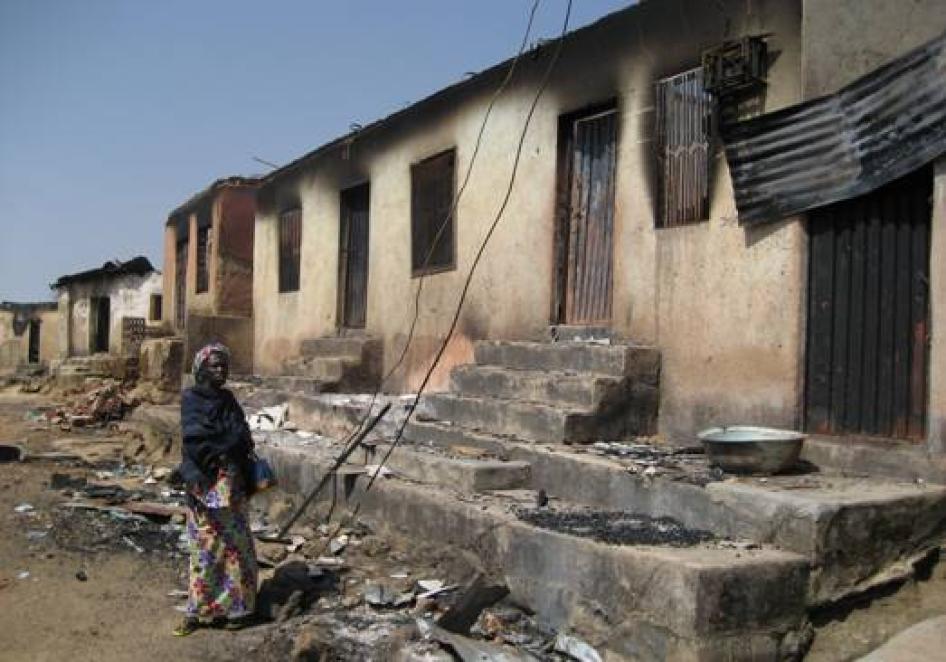
A Christian woman stands outside her home, which was one of some 130 burned by mobs of Muslims in the Ali Kazaure neighborhood. © 2008 Human Rights Watch
Witnesses described to Human Rights Watch how mobs of Muslim youth beat, burned, or bludgeoned to death Christians, in some cases specifically targeting pastors and church officials. One witness from the Yoruba ethnic group said five of his relatives who had come to Jos to attend the wedding of his daughter were among 12 Christians burned alive by a mob of Muslims.[6] Other witnesses described how hundreds of Muslim youth besieged and burned churches and homes belonging to Christian families.[7] Church officials reported that seven Christian pastors and church leaders were killed in the violence and that 46 churches were burned.[8] Local community leaders told Human Rights Watch that Muslim mobs burned 133 houses in a predominately Christian area of the Ali Kazaure neighborhood.[9]
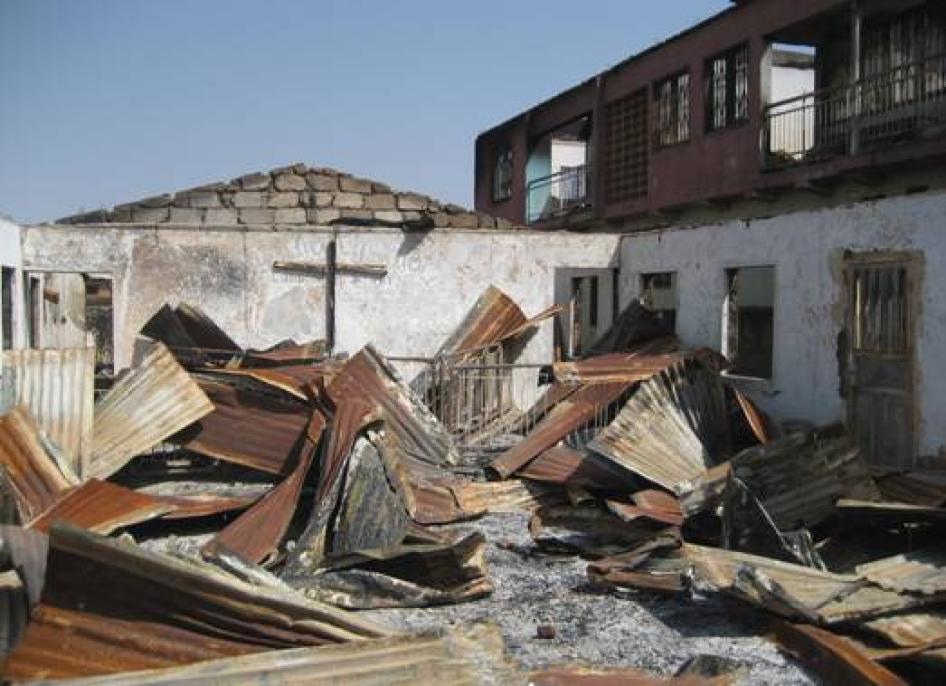
One of the 46 churches burned by mobs of Muslims during the inter-communal violence in Jos. © 2008 Human Rights Watch
Muslim victims and witnesses likewise described how mobs of Christians set ablaze or destroyed 22 mosques, 15 Islamic schools, and hundreds of Hausa-Fulani businesses and homes.[10] On the morning of November 28, five children attending the Al Bayan Islamic boarding school were killed in or near their dormitory by a mob of Christians.[11] Muslim women speaking to Human Rights Watch at a camp for residents displaced by the violence described how Christian youth in Tudun Wada burned their homes and killed their neighbors and family members.[12] The widespread destruction of Hausa-Fulani businesses-including used car lots, gas stations, and the Katako market, which housed several thousand largely Hausa-Fulani traders-resulted in devastating economic loss.
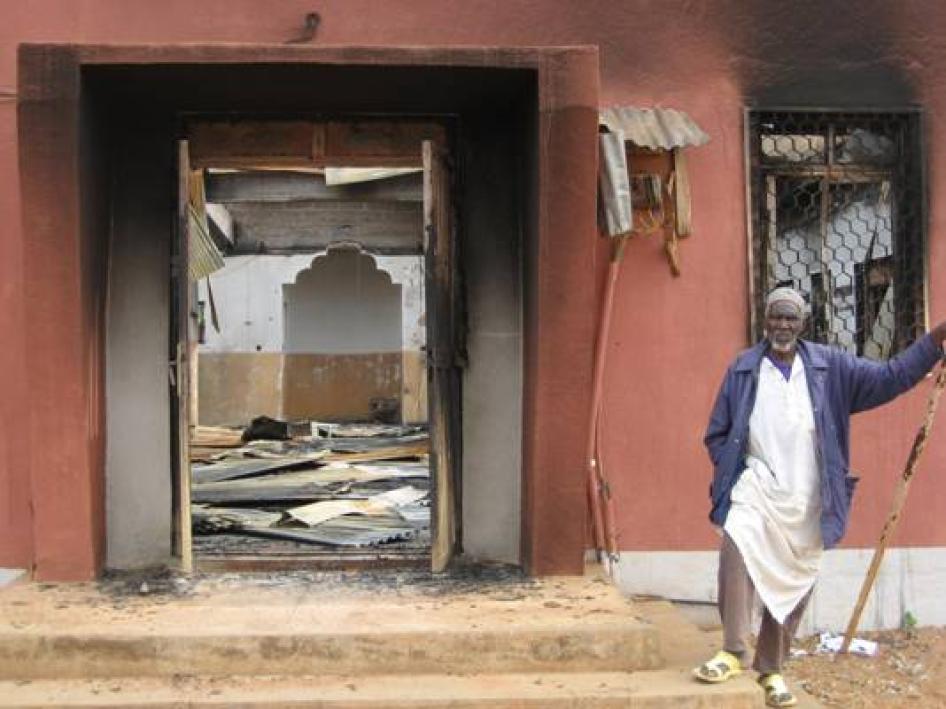
An elderly man stands at the entrance of the Al Bayan secondary school mosque, which was burned by mobs of Christians on the morning of November 28. Five students who lived on campus were killed in the attack. © 2008 Human Rights Watch
The final death toll from the November 28-29 violence is still unclear. Muslim authorities in Jos have registered 632 dead, including several hundred victims buried in three mass burials on November 30 and December 1.[13] Christian authorities have documented 129 deaths.[14] The Plateau State commissioner for information and communications put the initial death toll at 200.[15] Meanwhile, the Yoruba community leader in Plateau State told Human Rights Watch that at least 180 members of the Yoruba ethnic group-both Muslims and Christians-lost their lives in the violence.[16]
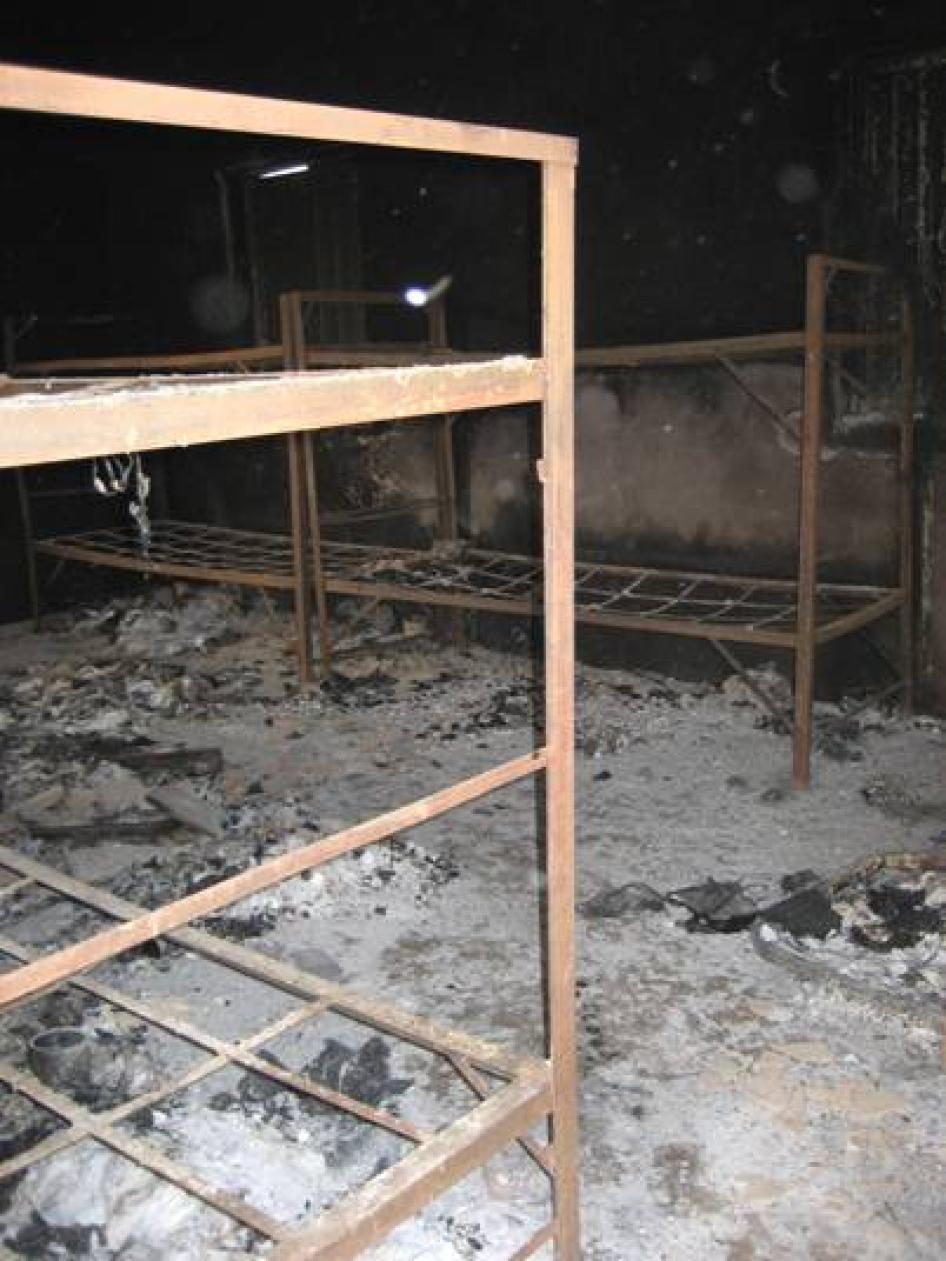
A mob of Christians attacked the Al Bayan Islamic boarding school on the morning of November 28, killing five children in or near this dormitory. © 2008 Human Rights Watch
III. Police, Military, and State Government Response to the Violence
On the morning of November 28, as the mob violence intensified, witnesses complained of the absence of police in many of the worst-affected areas. A prominent Muslim businessman whose three used car lots on Zaria Road were set alight by mobs of Christians on that morning told Human Rights Watch that he had repeatedly called the police and pleaded with them to protect his businesses.[17] A Christian member of the mob interviewed by Human Rights Watch confirmed that while they were burning cars and buildings on Zaria Road a police truck passed them twice but did not stop.[18] Similarly, at the Katako market, which was razed to the ground by a Christian mob on the morning of November 28, witnesses told Human Rights Watch that although the police were present at the scene they did nothing to stop the mob.[19] The Katako market is located adjacent to the divisional police headquarters.
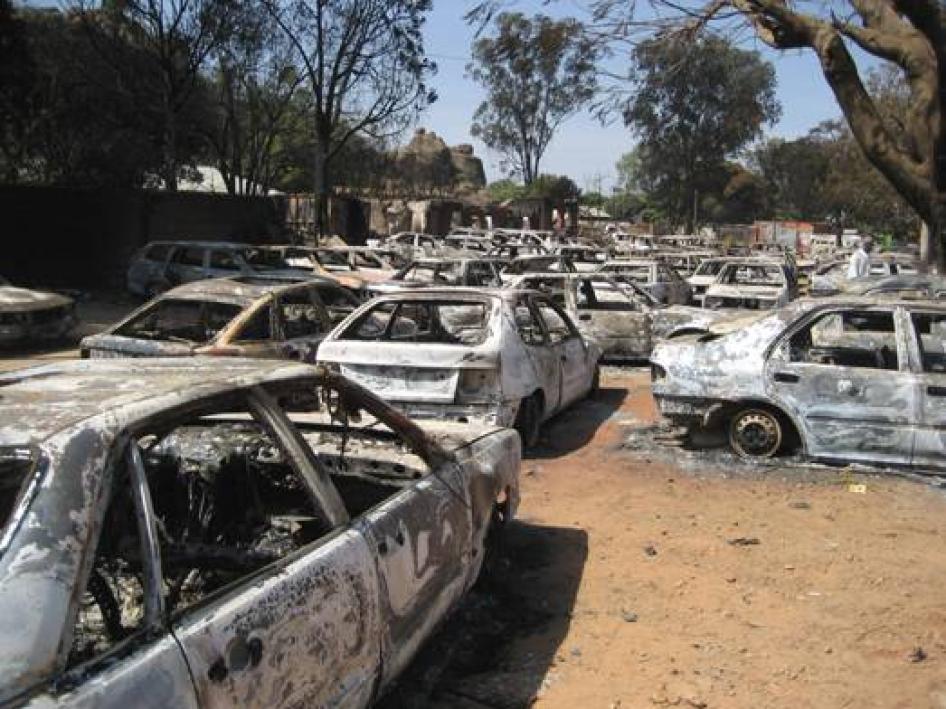
A witness described how a police truck passed by twice, but did not stop, on November 28 as mobs of Christians burned Hausa-owned businesses and car lots on Zaria Road. © 2008 Human Rights Watch
By noon on November 28, the Nigerian army was called in to restore order, and army units from neighboring states began to be deployed on the streets of Jos. Despite the allegations of arbitrary killings by military personnel, witnesses interviewed by Human Rights Watch generally credited the military with having quelled the violence and restored peace, and in some cases with intervening to save the lives of both Muslims and Christians.[20]
Plateau State Governor Jonah Jang issued a public statement on November 28 announcing a dusk-to-dawn curfew and warning citizens that security forces were under orders to return "fire-for-fire."[21] The following day, November 29, the governor imposed a 24-hour curfew in the worst-affected neighborhoods and issued a "shoot-on-sight" order to security personnel.[22] James Mannok, the director of press and public affairs at Plateau State's Government House, confirmed to Human Rights Watch that the governor's shoot-on-sight order applied to anyone breaking the curfew.[23]
While most of the inter-communal violence documented by Human Rights Watch took place on November 28, the vast majority of the alleged killings by the police and military were carried out on November 29, the same day the governor issued the shoot-on-sight order. Human Rights Watch documented 118 cases of alleged arbitrary killings by security personnel that took place on that day alone.
The extent to which the police and military followed the governor's shoot-on-sight order, or indeed the impact the shoot-on-sight order had on the conduct of the security personnel responding to the inter-communal violence, remains unclear. Senior police and military authorities interviewed by Human Rights Watch denied having received or carried out an order to shoot on sight. The Nigerian army spokesperson, Brigadier General Emeka Onwuamaegbu, told Human Rights Watch: "It is one thing for a political leader to issue an order, another for those of us implementing it. Our soldiers went out with very strict instructions to use minimum force and follow the rules of engagement."[24] The assistant commissioner of police in charge of operations in Plateau State, Oga Ero, told Human Rights Watch: "There was no order by my officers to shoot on sight as far as I was aware of."[25] Although Governor Jang is the chief security officer in Plateau State, the police and military are federal security forces under the control of the federal government.
Many of the witnesses interviewed by Human Rights Watch believed that those responsible for these killings may have been persons impersonating police officers and soldiers.[26] However, in many of the incidents documented by Human Rights Watch, other evidence contradicted that notion. This evidence includes the following examples:
- Witnesses observed official police or army vehicles present at the scene of alleged arbitrary killings by security personnel in Angwan Rogo (Bauchi Road), Dutse Uku, Rikkos, and Russo.[27]
- In Angwan Keke, Dutse Uku, Rikkos, and Russo, the same "fake" soldiers or MOPOL officers who summarily executed young men also arrested others and officially transported them to the police detention facilities in Jos.[28]
- Immediately prior to MOPOL officers' killing of 26 Hausa-Fulani men in a compound in Angwan Rogo (Bauchi Road), soldiers told the people to return to their homes and warned them that the MOPOL would arrive shortly and start shooting.[29]
Senior police and military officials interviewed by Human Rights Watch in December denied having received any reports of their forces being involved in arbitrary killings during the violence. When asked to comment on the allegations of killings documented by Human Rights Watch, Assistant Commissioner of Police Oga Ero said, "We have received no reports at police high command that the police were killing people."[30] Brigadier General Emeka Onwuamaegbu likewise informed Human Rights Watch that "I have no evidence or information that Nigerian soldiers were involved in any arbitrary killings."[31]
IV. Witness Accounts of Arbitrary Killings by the Police
Human Rights Watch researchers documented 15 separate incidents of arbitrary killings by the police, during which at least 74 men and boys, all but two of them Muslims, were killed.[32] The vast majority of police killings were perpetrated by the anti-riot Police Mobile Force, commonly referred to as the MOPOLs. Witness statements from seven of these incidents are described below.
Incident 1: Angwan Rogo (Bauchi Road)
On November 29, MOPOLs responded to an altercation in the Angwan Rogo neighborhood between Muslim and Christian youth by chasing down and killing at least 26 Hausa Muslims. Human Rights Watch interviewed six witnesses to the incident, which occurred in a large compound used for repairing cars and motorcycles on Bauchi Road. Two witnesses who helped remove the bodies of the victims guided Human Rights Watch researchers through the scene on December 4, pointing out each place where they had found and later removed a body. In many places, bloodstains, bullet marks, and what appeared to be human remains were clearly visible. There were also a number of spent bullet casings at the scene. The two witnesses said that bodies were found under cars and car parts such as hoods, behind rows of motor scooters, and inside and beside several small wooden structures on the compound.[33] Two other witnesses described how the military had initially tried to calm the situation and warned the Muslim youth to return to their houses because the MOPOLs would arrive in 20 minutes.[34] A 26-year-old mechanic, who witnessed the killings while hiding in the second story of an adjacent building, described what he saw:
In this neighborhood, the Muslims live on this side, and the Christians live on the other side. There is a government quarters across the street and that morning at around 8 a.m. a man took a gun and started firing at Hausas so they would not cross the road. The Hausa young men from this side started gathering across the street from where the man with the gun was. I saw about 200 Hausas gathered this side and eventually there were about 20, including the guy with the gun, on the other side.
Later, soldiers came to try to calm things down. One of them went over to where the Christians were, shot in the air, and told them to go back from the road. The Christian people ran into their community. Then another [soldier] told the Hausas to go back home as well. Some of the Hausas agreed to go back home and the soldiers left. But later, more and more Hausas started gathering. The [Hausa] youths thought the Christians would return and attack this side.
Then between 9 and 10 a.m. the MOPOLs arrived in a heavy truck they use, which they parked about 300 to 400 meters down Bauchi Road. I saw about 20 or more MOPOLs in all, but around 10 of them got down and started creeping toward the compound… like they wanted to surprise the 50 to 60 youths who were still gathered on the road. When they got to the entrance, the MOPOLs opened fire, making all the youths take off running. After this, they started chasing the youths as they ran to seek cover in the compound. I saw them enter one house just across the street from us. We heard shots and later we saw five bodies there. Anyone they found hiding in the garage, they shot them. They combed the garage hunting for people. This went on for about 10 minutes or so. Then they returned to their truck and left. They were dressed like the MOPOLs always dress-with that black top and green trousers, and with all the patches they always wear.[35]
A man who worked at the compound described what he saw that day:
[On November 29, around 8:30-9 a.m.], I was standing [near the back gate of the compound]. I then saw about 30 people running down the path into the compound where I was. They were being shot at by the MOPOLs. I could hear the bullets coming in. People tried to climb over the wall. Other people ran out of the gate. Around eight MOPOLs came down our path. They shot four people right in front of me. The guard who works at the front [of the compound] was afraid and grabbed onto me. He told the police that we worked together. They asked me who this man was. I said he is a colleague. They ignored me and pulled him from me. The MOPOL then shot M. [his colleague] once in the chest. I was right next to him when they shot him. The police who shot him was very close. The people who were killed did not have any weapons.[36]
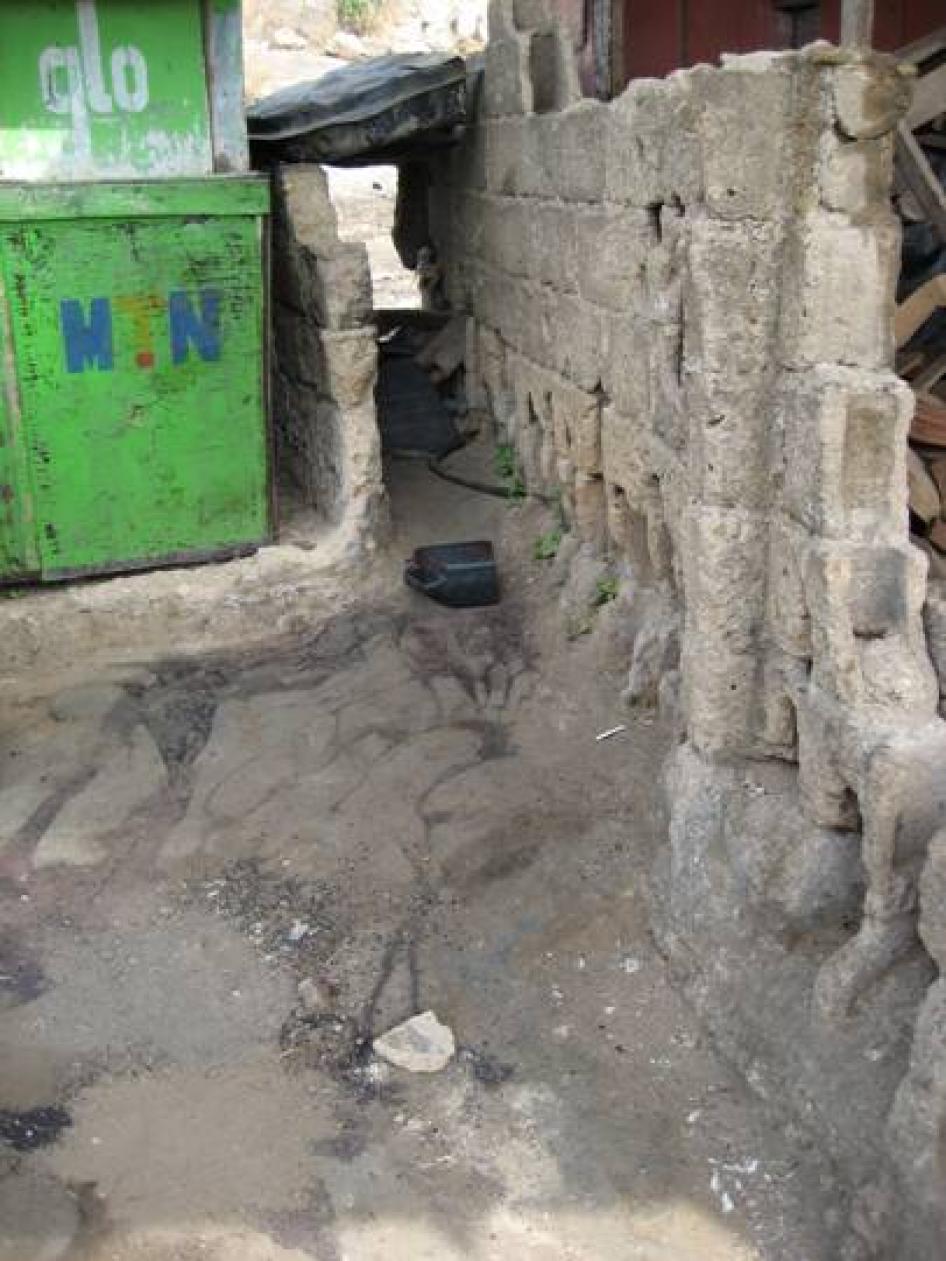
Bloodstains remain on the ground where a Muslim man was allegedly killed by the mobile police on an automobile compound on Bauchi Road. At least 26 Muslims were killed in the same incident on the morning of November 29. © 2008 Human Rights Watch
Incident 2: Rikkos (Angwan Damisa)
Witnesses described how on the morning of November 29, MOPOL officers entered the Angwan Damisa neighborhood in Rikkos and shot and killed eight residents. The MOPOLs shot two unarmed residents in the street and summarily executed six people inside a local bakery.[37] A man who works at the bakery described what he saw that day:
On Saturday around 9:30 a.m. we were sitting in front of the bakery. There were four of us sitting down. There were three people in the shop. A neighbor came from across the street to ask if there was bread. I saw two people walking in our direction. Behind them I saw about seven mobile police. They were in mobile police uniforms. Two were wearing black tops and green trousers. The others were wearing all green. They all had guns. The two men were unaware that the mobile [police] were following them from behind. I saw the mobile police cocking their guns towards this direction. When the two gentlemen turned around and saw the mobile police they ran into the bakery. They had no arms [weapons]. I ran across the street to an alley. I looked back and saw the mobile police enter the bakery. I then heard shooting. The mobile police came out and started shooting outside. They then put the place ablaze. I saw them throw something into the bakery. They also threw something on top of the buildings across the street. They then went to the other side and started shooting and came back and left.
I heard someone crying inside the bakery that they wanted to drink water. The building was burning on one side. When I came inside I saw blood all inside. Only one of them didn't give up [was still alive] but the others were dead. They were all in the same room. I don't know where they were shot because there was blood everywhere. Three of them [the dead] were the staff, including the manager of the bakery. The other was a neighbor-who had come to buy bread-and the other two were the neighbor men [who had run into the bakery]. They were all Muslim, Hausa. The fire was still burning and I called others to come assist me and we removed them from the house. I then took the man who was still alive to the hospital and he died in the hospital. We brought him back and took the six of them to the Central Mosque about 1:30 p.m. on Saturday.[38]
Incident 3: Rikkos (New Layout)
On the morning of November 29, the MOPOLs arrived at the house of a prominent Islamic scholar in Rikkos. Witnesses told Human Rights Watch that they saw the MOPOLs shoot four people in front of the Islamic scholar's house, including two of his family members. They described how the MOPOLs then set the body of his younger brother on fire, burned several cars, and launched tear gas into his house.[39] A resident also described how he witnessed the MOPOLs pull four Muslim Yoruba men out of their house and summarily execute them:
Saturday morning between 8:30-9 a.m., I was outside when I saw four white Hilux vehicles with no markings. I saw eight police wearing MOPOL uniforms-green and black. I thought everything was going to be fine. Immediately I saw the police start shooting. I ran to a rock and hid myself.... [From where] I was hiding in the rock I saw the MOPOL use a gun to hit the door of a house but it did not open. Then the police kicked the door open. Six of the police went inside and two stayed outside. I then saw them take four people out of the house. They lined the people up on the ground in front of the house. The MOPOLs started shooting them. From there I looked down and saw nothing more.[40]
Incidents 4 and 5: Angwan Keke and Bulbulla
On the morning of November 29, mobs of Christians and Muslims clashed in the Angwan Keke neighborhood for about one hour. Shortly after the clashes subsided, a group of MOPOLs entered Angwan Keke and the adjacent neighborhood of Bulbulla shooting into the air and breaking into houses. The 20 residents from both communities interviewed by Human Rights Watch reported that over the next approximately one hour, the MOPOLs broke into at least six houses and executed at least 13 unarmed men and boys they found.[41] The residents also described how the MOPOLs lobbed tear gas into a small mosque and into the home where one of the wounded lay dying.[42] The residents further described how when the MOPOLs left they detained 13 men and boys, all of whom were later reported to be in police custody.[43] A witness to the execution of an unarmed shopkeeper in Bulbulla described what he saw:
As the firing started, A. [the shopkeeper] told us to run into our houses because the police were coming. The police must have seen him run into his shop, so when they got to his place they started yelling for him to come out. I saw four MOPOLs and one policeman. He came out with his arms up, begging for them to leave him. They told him to lay down. He kept saying, "Please God, allow me to live." They were speaking in Pidgin and Hausa. One of them said, "Today you go die," and then he shot him in the side. Then the same MOPOL shot him again. As he was going to shoot him a third time, the other MOPOL said in Hausa, "Leave it, he's already dead." After the MOPOLs left, A. dragged himself into the neighbor's house.[44]
The neighbor described what happened next:
I live next door to Mr. A., the shopkeeper. After being shot by the MOPOLs, he crept, pulling himself along the ground, into my house. I asked him where he was wounded, but he said he didn't know. I lifted up his shirt and saw he'd been shot twice-once in the back and once in the abdomen. As I was trying to stop the bleeding, the MOPOLs came back and threw a tear gas canister into my house. A. died a short time later. After, I picked up five or six bodies-I didn't know their names. The MOPOLs had started killing across the ravine. We heard shots coming from there, and then they came into Bulbulla.[45]
A 45-year-old teacher from Angwan Keke described what he saw:
On Saturday morning at around 7:30, the Christian people from Congo Russia-which is the community just above us-lined up on the hill and rocks and starting shouting and throwing rocks and bottles filled with petrol down at us. One of them had a shotgun and was firing at us. There were about 300 to 400 of them. When we saw this, we picked up stones and sticks and went to defend our border. But our youths were fierce and after about one hour we managed to chase them back into Congo Russia. About 10 minutes later, policemen dressed in the MOPOL uniform came crashing into Angwan Keke. They arrived by foot, I saw four of them dressed the way the MOPOLs dress with black tops and green trousers. As soon as the MOPOLs started shooting, our people started shouting, "Hey, the police are shooting-run, run!" I heard the MOPOLs saying, "Just shoot the bastards," in English. They spent about one hour here breaking doors, jumping into people's houses, throwing tear gas into the mosque and killing people-about seven people including three old men were killed here. They also arrested 13 youths; we later learned that one or two of them are in prison. When they got to the mosque, I heard one of them asking, "Is this not a mosque?" Then another said, "Burn it," but in the end they threw the tear gas in and gassed out three people, including one who was sick. When they left, some of them ran down the ravine and up into Bulbulla neighborhood, while other MOPOLs left with the youth they'd arrested.[46]
Incident 6: Dutse Uku
A young Christian boy from the Dutse Uku neighborhood described the killing of two of his brothers by a MOPOL officer on the morning of November 29. The boy was later detained by the MOPOLs and spent several days in police custody:
At around 7 in the morning, I was inside the house with my family eating when about six mobile police came. They were wearing green trousers and black shirts and all had guns. They dragged me to the road and told me to lie down. One of the mobile police came and took his gun and knocked it on my arm. The other mobile said I should get up and leave. But the other mobile said I should not go home but should get in the car. I got into the car. They asked one of my brothers [who had also been detained] to lie down [on the ground], but he responded that there was no space to lie down. The other mobile came and "packed" him [kicked his legs from underneath him so he would fall]. He then stomped on his back. The other mobile said that he should just waste him. He then shot him in the stomach. My brother is around 19 years old. My other brother was afraid and went to escape and they just shot him from behind. They shot him one time and I saw him lying on the ground. He is 17 years old. The same mobile shot my two brothers. The same mobile also shot another person in the hand. Then they took us to the CID [Criminal Investigation Department].[47]
Incident 7: Congo Junction
A 20-year-old student from Congo Junction described how a MOPOL officer summarily executed his friend inside his house on the morning of November 29:
On Saturday [morning] there were many people trying to cross to Angwan Keke to save the houses that were burning there. On our way there, two Hilux vehicles full of mobile police came. One was black and one was white with no markings on it. We ran away and [five MOPOLs] followed us back. I entered my house with J., my friend who lives at our house as well. He is 20 years old. J. tried to close the door but the mobile police pushed the door with his leg. J. fell down. The policeman then shot him. He shot him twice. Once in his chest; the second time he put the gun in his mouth and shot him. It was a big gun not a pistol. I saw it from behind the door. The policeman then laughed and left the house and left with the others. He was wearing the complete uniform of the mobile police-black shirt and green trousers.[48]
V. Witness Accounts of Arbitrary Killings by the Military
Human Rights Watch documented eight incidents involving the arbitrary killing of 59 men by the military.[49] According to witnesses, all of the victims were Muslim men, most were young, and, according to witness accounts, nearly all were unarmed at the time of the killings. Witness statements from four of these incidents are described below.
Incident 1: Rikkos (Angwan Damisa)
Human Rights Watch interviewed five witnesses in the Rikkos neighborhood, each giving an account independent of the others, who saw the killing of eight men by a soldier in the Nigerian army on the morning of November 29.[50] One of the witnesses described what happened:
I saw a dark green military vehicle pull up on the road with five soldiers. This was around 10 a.m. Seven people were coming from the direction of the mosque. When they saw the military, they ran into a house. My brother was behind them and also ran into the house. At the time they [the people who ran into the house] were carrying nothing in their hands. One of the military men went into the house and brought them out of the house to the road. The military man told my brother to stand to the side. He then shot the group. Some were hit in the chest and stomach. He then said to my brother, "You go." When my brother started moving, he shot him in his leg. My brother went down. He then shot him in the side and the chest. He was shot with three bullets and died at that time. The military man then turned and left. He shouted that everybody should enter their houses. Later in the day, the JNI [Islamic authorities from the Jama'atu Nasril Islam] came in a vehicle and took the bodies to the Central Mosque. They were all Hausas between the ages of 18 and 25. My brother was around 40 years old.[51]
Incident 2: Ali Kazaure
Human Rights Watch interviewed eight witnesses who saw four soldiers enter the Ali Kazaure neighborhood around 11 a.m. on November 29. According to the witnesses, the soldiers entered three houses on two adjacent blocks and killed 25 young men in the three houses and shot and killed two men in the street.[52] Human Rights Watch interviewed witnesses to each of these shootings and visited the houses where bloodstains were still clearly visible on the floors, chairs, or benches.
The owner of the house where five men were allegedly killed by the soldiers described to Human Rights Watch what he saw on the morning of November 29:
On Saturday, after 11 in the morning, I was standing across the street from the room where my sons used to sleep. I saw four military coming. They were wearing green camouflage. I heard gunshots and went into the compound across the street. When I came back I saw the door of the room was open. There were four bodies inside and one body of a man at the door who was injured. He later died. We took four other injured men to the neighbor's house and later to [Jos University Teaching Hospital]. [We] took the four bodies of the dead to the Central Mosque. The military came on Sunday including the general. They asked what had happened and collected the cartridges.[53]
At the second house, witnesses told Human Rights Watch that the soldiers killed eight young men in the house.[54] Human Rights Watch researchers found bloodstains on the chairs and on the ground behind a sofa. In an adjacent room, there was a large bloodstain on the floor with a boot print in the blood. Neighbors also showed Human Rights Watch a spent bullet casing they had picked up at the scene. One of the residents of the house described what he saw that day:
On Saturday, we were sitting in our house. There were 10 of us and we were all Hausas. The door was open and four soldiers came into the house. They were wearing green camouflage uniforms and green hats. Three of them had guns and one of them had a camera. The soldiers told us to come out. Four of my friends went out but I stayed inside. I heard the soldiers tell my friends to kneel down and the soldiers started cussing at them. I heard one of my friends begging them, "For God, please allow us." I then heard gunshots. We were looking for an exit, but the soldiers came inside and shot us. They shot me twice in the leg. The soldiers then went outside and I heard them tell someone that "[i]f you don't stop burning houses, this is what we will do to you."[55]
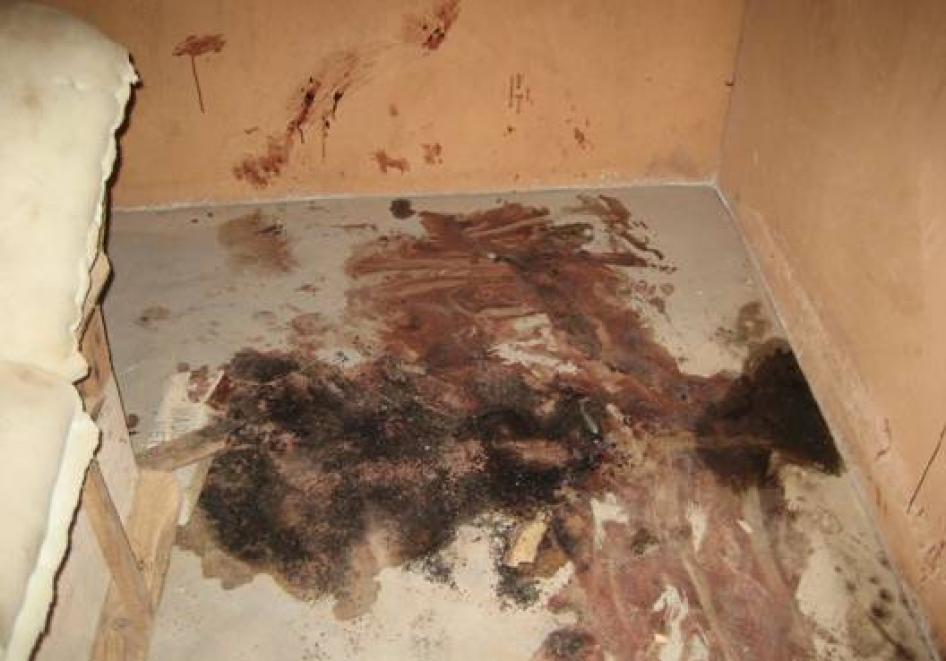
Witnesses described how on the morning of November 29 soldiers entered the courtyard and two rooms of this house in the Jos neighborhood of Ali Kazaure, allegedly killing eight young men in total and leaving bloodstains on the floor, wall, and furniture. © 2008 Human Rights Watch
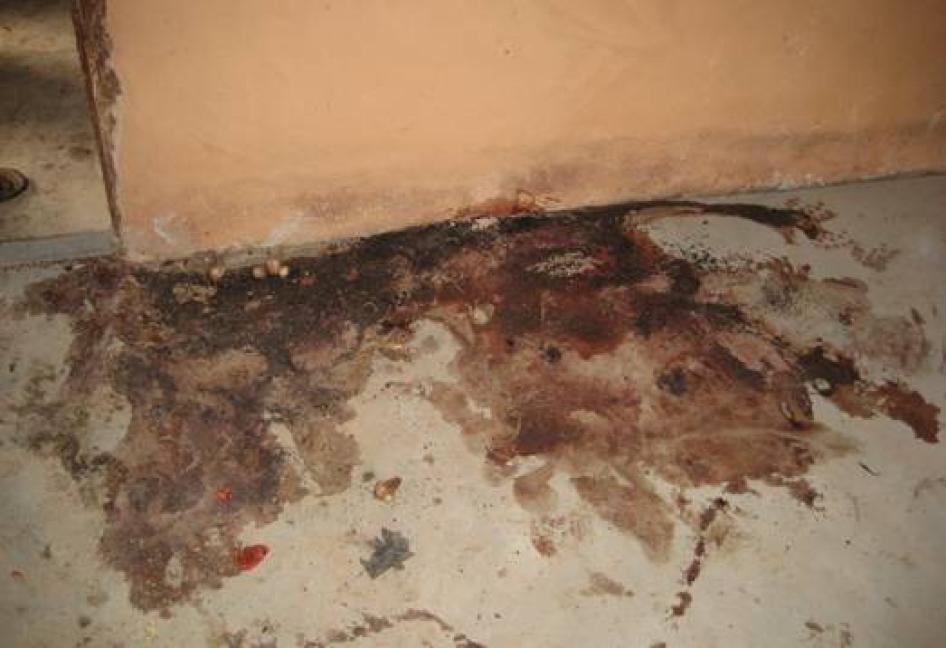
A room adjacent to that in the previous photograph in the house in the Jos neighborhood of Ali Kazuare where eight men were allegedly killed by soldiers on the morning of November 29. © 2008 Human Rights Watch
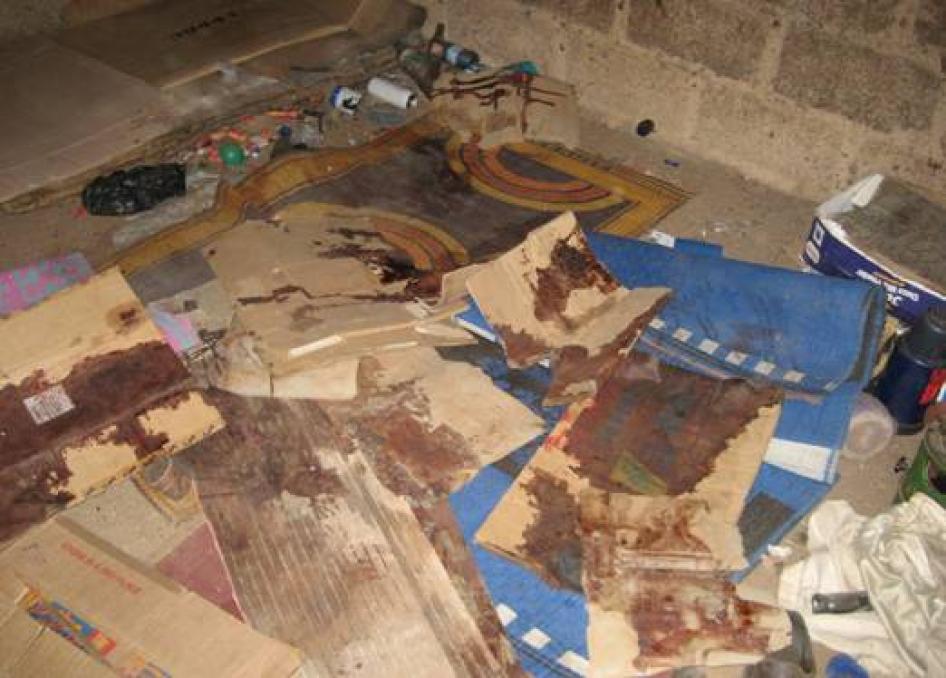
Bloodstained cardboard and mats in a side room of a house in the Jos neighborhood of Ali Kazuare where 12 young Muslim men were allegedly killed by soldiers on the morning of November 29. © 2008 Human Rights Watch
The soldiers are alleged by witnesses to have killed 12 men inside the third house. Two women interviewed by Human Rights Watch described what happened:
On Saturday, November 29, around 12 noon, we heard gunshots, but we couldn't tell where they were coming from. There had been problems in our neighborhood since Friday. Things were going up and down. There was lots of confusion. That morning people had been fighting outside and some of them had run inside our house to hide. Suddenly two soldiers dressed in soldier clothing jumped over our back wall and entered our compound, while at the same time a third one broke through the front door…. They started searching the rooms of the compound shouting, "Give us a chance! We are looking for the men hiding inside this house…. Where are they?" Then two of them asked if there was anyone in the bedroom. We said no, but they went into the bedroom and found the son of the owner, 18-year-old U., who was hiding in the bed. Then they shot him right there in the bed, inside that room. One of the soldiers had a camera around his neck and after shooting U., he took a picture of him. After this, they left and went to the room in the front of the house. We heard lots of gunfire and learned there had been many people killed there. Some of those killed lived there, while others had sought refuge from the troubles on the street.[56]
Another witness confirmed to Human Rights Watch that he heard gunfire around 11 a.m. on November 29. He then heard people crying that many people had been killed at the house. He went over to the house and saw 11 dead bodies in the front room. The bodies were later taken to the Central Mosque.[57]
Incident 3: Rikkos (Gadan Katako)
On the morning of November 29, military soldiers in Rikkos arrested 16 Muslim men. The soldiers marched the group down the street and, according to witnesses, killed 10 of the detainees at various stages along the way. Human Rights Watch interviewed separately three of the six survivors of the death march.[58] One of them, a local shopkeeper, described what happened:
On Saturday, around 9 a.m., I was on my way to my mother's house. The military stopped me and asked me where I was going. They searched me and found nothing and told me I could go. As I continued to my mother's house I saw the military had arrested 15 people. When they saw me walking alone they arrested me and put me with the others. The soldiers were wearing green military uniforms. I don't know how many soldiers there were because they would not let us look at them. The soldiers told us to go. As we started to leave, the military opened fire on us. Five of us at the back were killed. The military said we shouldn't run. The rest of us started walking fast. We were all in a group. They shot again and two people died. As we continued forward toward Tina [Junction], they shot three more. Two of them were dead and the other was shot in his bladder and was injured. When we arrived at Tina Junction they started beating us. The police came-mobile police and conventional police-and took the six of us to CID [Criminal Investigation Division]. At CID they beat us but not [as] much [as] the military. The man who was injured died at CID and the police ordered that they should take him to JUTH [Jos University Teaching Hospital] mortuary. The same day they took us to the prison yard. I was held at the prison yard for 35 days.[59]
Incident 4: Laranto Divisional Police Headquarters
Human Rights Watch interviewed two police officers separately who witnessed a soldier summarily execute an unarmed man at the Laranto Divisional Police Headquarters.[60] The incident took place on the morning of Friday, November 28. One of the police officers described to Human Rights Watch what he saw that day:
I was assigned to the police station by the Katako market. A police inspector arrested a Hausa man and brought him to the front of the police station. One of the soldiers asked the inspector what the man had done. The inspector said that he had found him with a cutlass. The soldier then shot him in the chest. This happened on Friday around 11 a.m. I saw it. The acting DPO [divisional police officer] was also present. After shooting the man, the soldier said, "Anybody you see with a cutlass, you shoot him."[61]
VI. Recommendations
Human Rights Watch recommends these investigative bodies to:
Arbitrary Killings
- Thoroughly and impartially investigate the credible allegations of arbitrary killings by security forces on November 28-29, 2008. Identify the individuals and units who carried out the killings as well as superior officers who may have planned, ordered, or instigated these crimes.
- Determine the circumstances and consequences of the "shoot-on-sight" order given to security personnel by Governor Jonah Jang on November 29, 2008.
- Ensure that victims and witnesses who testify before these respective investigative bodies are provided proper witness protection in cases where the witness may be in danger. Protective measures include holding closed sessions where warranted and expunging names and any identifying information from the investigative bodies' public records.
- Call on government authorities to promptly arrest and prosecute those responsible for organizing and carrying out the killings and destruction of property, including members of the security forces.
- Ensure that the findings and recommendations of these respective investigative bodies are made public.
Government Discrimination against "Non-Indigenes"
Human Rights Watch also urges these investigative bodies to address the root causes of inter-communal violence in Plateau State, including by calling on the federal government to end the nationwide practice of discriminating against non-indigenes. They should:
- Call on the federal government to promptly pass legislation that expressly bars any federal, state, or local government institution from discriminating against non-indigenes with respect to any matter not directly related to traditional leadership institutions or other purely cultural matters.
- Urge the federal government to conduct a broad public education campaign throughout Nigeria focused on the rights that go with Nigerian citizenship and the need to end discrimination against non-indigenes.
VII. About Human Rights Watch
Human Rights Watch is a nonprofit, nongovernmental human rights organization made up of more than 275 staff members around the globe. Its staff consists of human rights professionals including country experts, lawyers, journalists, and academics of diverse backgrounds and nationalities.
Established in 1978, Human Rights Watch is known for its accurate fact-finding, impartial reporting, effective use of media, and targeted advocacy, often in partnership with local human rights groups. Each year, Human Rights Watch publishes more than 100 reports and briefings on human rights conditions in some 80 countries, generating extensive coverage in local and international media.
Human Rights Watch has conducted in-depth research on Nigeria for more than 10 years, publishing more than two dozen reports on human rights violations ranging from political violence, corruption, discrimination, torture, and extrajudicial killing. Please visit the Human Rights Watch website for more of this work on Nigeria: http://www.hrw.org/en/africa/nigeria.
[1] In addition to the 133 arbitrary killings, Human Rights Watch also documented incidents where the military shot and killed a Christian man in the Alheri neighborhood of Jos, and an unspecified number of Muslim youth outside the Fatima cathedral. In these incidents, however, it is unclear from the witness statements whether the military were justified in their use of deadly force.
[2] For more information on the violence in Jos in September 2001, please see: Human Rights Watch, Jos: A City Torn Apart, vol. 13, no. 9 (A), December 2001, http://www.hrw.org/en/reports/2001/12/15/jos.
[3] For more information on the violence in Yelwa in May 2004, please see: Human Rights Watch, Revenge in the Name of Religion: The Cycle of Violence in Plateau and Kano States, vol. 17, no. 8 (A), May 2005, http://www.hrw.org/en/reports/2005/05/24/revenge-name-religion-0.
[4] For more information on the issue of indigeneity in Nigeria, please see: Human Rights Watch, "They Do Not Own This Place": Government Discrimination Against "Non-Indigenes" in Nigeria, vol. 18, no. 3 (A), April 2006, http://www.hrw.org/en/reports/2006/04/24/they-do-not-own-place-0.
[5] Most of Plateau State's original inhabitants come from ethnic groups that are predominately Christian. The largely Muslim Hausa-Fulani ethnic group, which migrated to Plateau State for its rich farmland and grazing pastures, is classified as a non-indigene group, despite having resided in Plateau State for several generations.
[6] Human Rights Watch interview with a resident (name withheld), Jos, December 6, 2008.
[7] Human Rights Watch interviews with residents (names withheld), Jos, December 2008 and February 2009.
[8] Human Rights Watch interview with Reverend Ben Nasara, Jos North chairman of the Christian Association of Nigeria (CAN), Jos, February 11, 2009.
[9] Human Rights Watch interview with Ali Kazaure community leaders, Jos, December 7, 2008.
[10] Human Rights Watch interview with Sheikh Khalid Aliyu, spokesperson for the Jos North Muslim Ummah, Central Mosque, Jos, February 10, 2009; Human Rights Watch interviews with residents (names withheld), Jos, December 2008 and February 2009.
[11] Human Rights Watch interviews with witnesses (names withheld), Jos, December 6, 2008.
[12] Human Rights Watch interviews with residents at the Gangare camp (names withheld), Jos, December 6, 2008.
[13] Human Rights Watch interview with Sheikh Khalid Aliyu, spokesperson for the Jos North Muslim Ummah, February 10, 2009; Human Rights Watch interviews with Jos North Muslim Ummah officials, Jos, December 2008.
[14] Human Rights Watch interview with Reverend Ben Nasara, Jos North chairman of the Christian Association of Nigeria (CAN), February 11, 2009.
[15] Press statement delivered by Nuhu Gagara, Plateau State commissioner for information and communications, Jos, November 30, 2008 (on file with Human Rights Watch). When contacted by Human Rights Watch in February 2009, Plateau State Director of Press and Public Affairs James Mannok told Human Rights Watch that he was unaware of any updates to the official death toll. Human Rights Watch telephone interview with James Mannok, Jos, February 16, 2009.
[16] Human Rights Watch telephone interview with Chief Toye Ogunshuyi, president-general of the Yoruba community in Plateau State, Jos, February 16, 2009.
[17] Human Rights Watch interview with a Hausa businessman (name withheld), Jos, December 3, 2008.
[18] Human Rights Watch interview with a member of a Christian mob (name withheld), Jos, December 9, 2008.
[19] Human Rights Watch interviews with residents and police officers (names withheld), Jos, December 2008.
[20] Human Rights Watch interviews with residents and community leaders (names withheld), Jos, December 2008 and February 2009.
[21] Press statement delivered by Plateau State Governor Jonah Jang, Jos, November 28, 2008 (on file with Human Rights Watch).
[22] Press statement delivered by Nuhu Gagara, Plateau State commissioner for information and communications, Jos, November 30, 2008 (on file with Human Rights Watch). See also Shuaibu Mohammed, "Hundreds Killed in Muslim-Christian Clashes in Nigeria," Reuters, November 29, 2008; Taye Obateru, "Jos Riot Escalates," Vanguard, November 30, 2008; "Death Toll in Jos Riot Rises to 350," ThisDay, November 30, 2008; Jude Owuamanam, "Plateau Crisis: Soldiers Get Shoot-on-Sight Order," Punch, November 30, 2008.
[23] Human Rights Watch interview with James Mannok, Plateau State director of press and public affairs, Jos, December 10, 2008.
[24] Human Rights Watch telephone interview with Brigadier General Emeka Onwuamaegbu, Nigerian army spokesperson, Abuja, December 16, 2008.
[25] Human Rights Watch interview with Oga Ero, Plateau State assistant commissioner of police in charge of operations, Jos, December 11, 2008.
[26] Human Rights Watch interviews with witnesses (names withheld), Jos, December 2008 and February 2009.
[27] Human Rights Watch interviews with witnesses (names withheld), Jos, December 2008.
[28] Human Rights Watch interviews with witnesses and family members of victims (names withheld), Jos, December 2008 and February 2009.
[29] Human Rights Watch interviews with witnesses (names withheld), Jos, December 2008.
[30] Human Rights Watch interview with Oga Ero, Plateau State assistant commissioner of police in charge of operations, December 11, 2008.
[31] Human Rights Watch telephone interview with Brigadier General Emeka Onwuamaegbu, Nigerian army spokesperson, December 16, 2008. Community members in Ali Kazaure told Human Rights Watch, however, that the day after 27 Muslim men in the neighborhood were allegedly killed by soldiers, Chief of Army Staff Lieutenant General Abdulrahman Dambazau visited the scene of the killings and met with the community leaders and residents. Human Rights Watch interviews with residents (names withheld), Jos, December 5, 2008.
[32] Human Rights Watch documented one incident of arbitrary killing by the conventional police in Nasarawa and 14 separate incidents of arbitrary killings by the MOPOLs: Angwan Keke (two incidents), Angwan Rogo (Bauchi Road, Mallam Chai Street, and Motor Park), Bulbulla, Congo Junction (two incidents), Dutse Uku (three incidents), and Rikkos (three incidents).
[33] Human Rights Watch interviews with residents (names withheld), Jos, December 4, 2008.
[34] Human Rights Watch interviews with residents (names withheld), Jos, December 5, 2008.
[35] Human Rights Watch interview with a mechanic (name withheld), Jos, December 5, 2008.
[36] Human Rights Watch interview with a compound employee (name withheld), Jos, December 4, 2008.
[37] Human Rights Watch interviews with residents (names withheld), Jos, February 12, 2009.
[38] Human Rights Watch interview with a resident (name withheld), Jos, February 12, 2009.
[39] Human Rights Watch interviews with residents (names withheld), Jos, December 9, 2008, and February 12, 2009.
[40] Human Rights Watch interview with a resident (name withheld), Jos, February 12, 2009.
[41] Human Rights Watch interviews with residents (names withheld), Jos, December 4, 2008.
[42] Human Rights Watch interviews with residents (names withheld), Jos, December 4, 2008.
[43] Human Rights Watch interviews with family members and community leaders (names withheld), Jos, December 4 and 11, 2008.
[44] Human Rights Watch interview with a resident (name withheld), Jos, December 4, 2008.
[45] Human Rights Watch interview with a resident (name withheld), Jos, December 4, 2008.
[46] Human Rights Watch interview with a teacher (name withheld), Jos, December 4, 2008.
[47] Human Rights Watch interview with a young boy (name withheld), Jos, December 5, 2008.
[48] Human Rights Watch interview with a resident (name withheld), Jos, February 12, 2009.
[49] Human Rights Watch documented eight separate incidents of arbitrary killings by the military: Ali Kazaure (two incidents), Dutse Uku, Laranto, Rikkos (Angwan Damisa and Gadan Katako), and Russo (two incidents).
[50] Human Rights Watch interviews with residents (names withheld), Jos, December 2008.
[51] Human Rights Watch interview with a resident (name withheld), Jos, December 10, 2008.
[52] Human Rights Watch interviews with residents (names withheld), Jos, December 5, 2008.
[53]Human Rights Watch interview with a resident (name withheld), Jos, December 5, 2008.
[54] Human Rights Watch interviews with residents (names withheld), Jos, December 5, 2008.
[55] Human Rights Watch interview with a resident (name withheld), Jos, December 5, 2008.
[56] Human Rights Watch interviews with two residents (names withheld), Jos, December 5, 2008.
[57] Human Rights Watch interview with a resident (name withheld), Jos, December 5, 2008.
[58] Human Rights Watch interviews with three former detainees (names withheld), Jos, February 12 and 17, 2009.
[59] Human Rights Watch interview with a former detainee (name withheld), Jos, February 12, 2009.
[60] Human Rights Watch interviews with police officers (names withheld), Jos, December 2008.
[61] Human Rights Watch interview with a police officer (name withheld), Jos, December 9, 2008.