Pursuit of Power
Political Violence and Repression in Burundi
Glossary of Terms and Acronyms
APRODH: Association for the Protection of Human Rights and Detained Persons (Association pour la Protection des Droits Humains et des Personnes Détenues), a Burundian human rights organization.
BINUB: United Nations Integrated Office in Burundi (Bureau Integré des Nations Unis au Burundi).
CNDD: National Council for the Defense of Democracy, a political party and former rebel movement founded in 1994, run by former rebel leader Leonard Nyangoma. The party’s official name is CNDD, but it is frequently referred to as CNDD-Nyangoma to distinguish it from the ruling party, CNDD-FDD, which split off from CNDD in 1998.
CNDD-FDD: National Council for the Defense of Democracy-Forces for the Defense of Democracy (Conseil National pour la Défense de la Démocratie-Forces pour la Défense de la Démocratie), a former rebel movement. The FDD (Forces pour la Défense de la Démocratie) was initially the armed wing of the CNDD, above. A fission within the movement in 1988 resulted in the formation of CNDD-FDD as a breakoff faction of the original CNDD. CNDD-FDD joined the government in 2004 and was elected into power in 2005, with a majority of Parliament seats and former rebel leader Pierre Nkurunziza as President.
démobilisé: In its literal meaning, a former combatant, from either the former government army or a rebel group, who has gone through the process of demobilization and reintegrated into civilian life. In practice, the term is used in Burundi almost exclusively to refer to former rebels associated with CNDD-FDD.
FDD: Forces for the Defense of Democracy, the armed wing of CNDD-FDD during the rebellion.
FDN: National Defense Forces (Forces de la Défense Nationale), the governmental army, formed in 2004 to integrate members of the former, nearly monoethnic Tutsi army; the former gendarmerie; and the FDD rebels.
FNL: National Liberation Forces (Forces Nationales de Liberation). This term initially referred to the armed wing of the rebel movement Palipehutu-FNL. In January 2009, the Palipehutu-FNL changed its name to simply “FNL” In April 2009, it began disarmament and became a registered political party. See Palipehutu-FNL (below).
FRODEBU: Democratic Front in Burundi (Front pour la Démocratie au Burundi), a political party founded in 1992 as a predominantly Hutu party opposed to the Tutsi-dominated dictatorship of UPRONA.
JPH: Hutu Patriotic Youth (Jeunesse Patriotique Hutu), the civilian youth movement of the FNL. During the armed conflict, JPH members provided logistical support and carried out food and money collection for the FNL rebels.
JVMM: Joint Verification and Monitoring Mechanism, a mechanism established in September 2006 to carry through the implementation of the Comprehensive Ceasefire Agreement. It includes representatives from the Government of Burundi, Palipehutu-FNL, and key international stakeholders.
MSD: Movement for Solidarity and Democracy (Mouvement pour la Solidarité et la Démocratie), a political movement founded in December 2007 by Alexis Sinduhije. MSD has not yet been registered as a political party.
OHCHR: UN Office of the High Commissioner of Human Rights.In Burundi, OHCHR has operated as part of the integrated BINUB mission since 2006.
ONUB: United Nations Operation in Burundi (Operation des Nations Unies au Burundi), a peacekeeping operation in Burundi from 2004 to 2006. The operation was replaced in late 2006 by BINUB, a civilian mission.
Palipehutu-FNL: Party for the Liberation of the Hutu People-National Liberation Forces (Parti pour la Libération du Peuple Hutu-Forces Nationales de Libération), a Hutu rebel movement founded in 1980. See FNL (above).
PNB: National Police of Burundi (Police Nationale du Burundi), established in December 2004 to integrate former police, former gendarmes, and former rebels into a new, unified police force.
Political parties and political movements: Political parties in Burundi must go through a registration process, obtaining approval from the Ministry of the Interior. In this report, “political parties” is used to describe parties that are officially registered. “Political movements” is used more inclusively to include official parties as well as groups such as FNL (prior to April 2009) and MSD, which had not been registered at the time of writing.
SNR: National Intelligence Service (Service Nationale du Renseignement), formerly known as the “Documentation Nationale” (National Documentation).
UPRONA: Union for National Progress (Union pour le Progrès National), a political party founded in 1958 and historically dominated by Tutsis.
Map of Burundi: Sites of Political Violence, 2008-2009
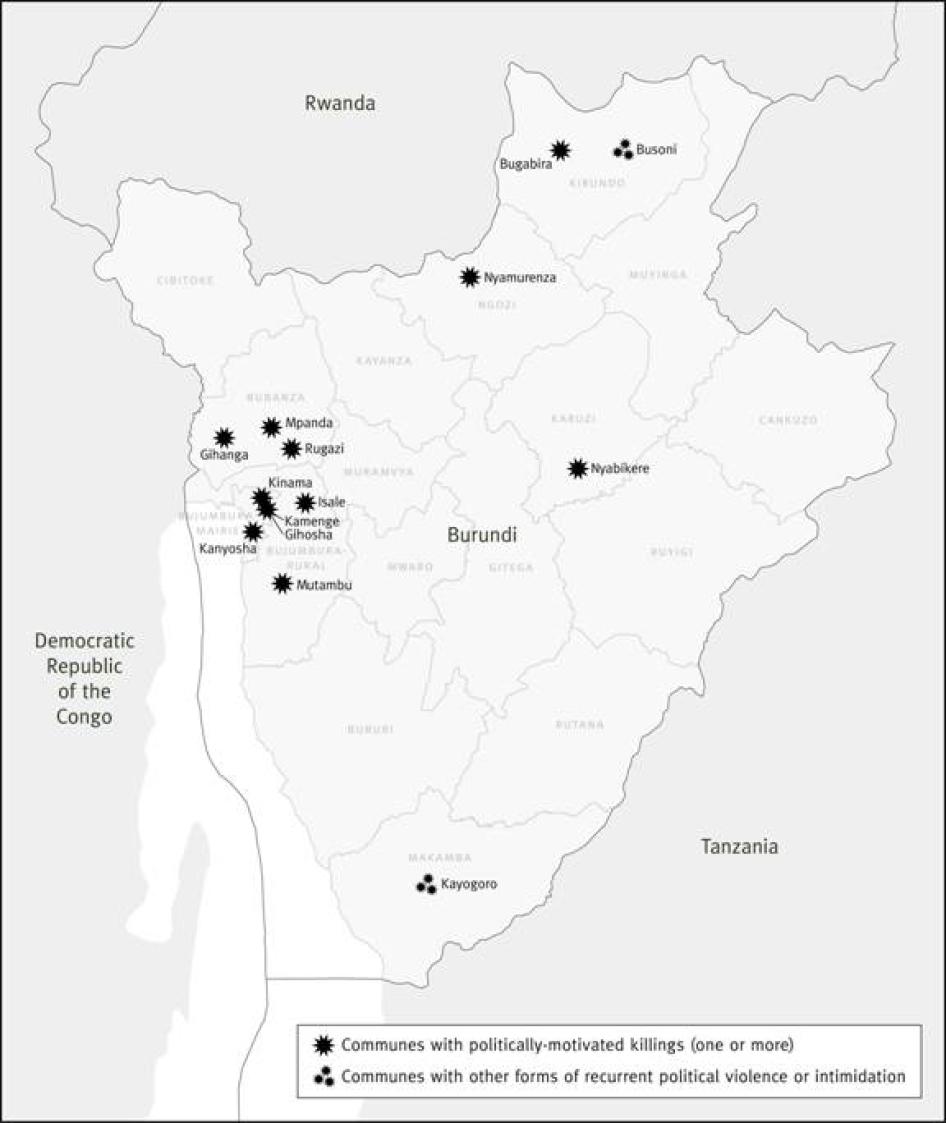
This map illustrates cases of political killings and other forms of violence and physical intimidation that have been documented by Human Rights Watch in 2008 and 2009. The map is not exhaustive; similar abuses may have occurred in other communes, but have not been documented by Human Rights Watch. For information on communes with high rates of politically-motivated arrests, see Annex 2. © 2009 John Emerson http://www.backspace.com
I. Summary
Agreement in April 2009 by the armed opposition National Liberation Forces (Forces Nationales de la Libération, FNL) to disarm and demobilize and the government’s registration of the FNL as a political party represent significant developments in Burundi’s path out of armed conflict towards peace and democracy. The developments may pave the way towards both a final peace agreement and Burundi’s first general elections since the end of military government in 2001 in which all significant political forces compete within the democratic process.
Progress towards peace between the National Council for the Defense of Democracy-Forces for the Defense of Democracy (Conseil National pour la Défense de la Démocratie-Forces pour la Défense de la Démocratie, CNDD-FDD) dominated government and the FNL has been bumpy, with the FNL periodically withdrawing from negotiations. Furthermore, as this report describes, both the CNDD-FDD and the FNL have also deployed political violence and intimidation against opponents and dissenting voices, even while in talks. By and large these abuses have been committed with impunity, revealing a political culture in which violence and repression is deeply rooted.
Particularly in the case of the CNDD-FDD, democratic opponents from across the political spectrum have also been targets of abuse. With the CNDD-FDD and the FNL, both predominantly Hutu, now competing alongside other parties for the electoral support of Burundi’s majority Hutu population, progress in the peace process may alter some of the parameters of one context for human rights abuse—CNDD-FDD/FNL competition—but is not a safeguard against continuing violence, intimidation, and repression.
Over recent years, including in the first few months of 2009, state agents and unofficial proxies acting with the complicity of administrative officials and security forces have carried out killings, beatings, arrests, and other acts of intimidation, and have enforced further limits on the freedom of association. The majority of incidents have been taking place either in the poor outskirts of the capital or in rural areas and small towns. Government officials have done little to investigate incidents or bring perpetrators to justice.
These abuses appear to have largely been beneath the radar of international friends of Burundi’s transition to democratic governance, as they have rarely involved senior political figures (although some have). This lack of attention has been decried by various analysts and Burundian democratic opposition members, for it is in these locations and through these kinds of incidents that fundamental challenges to democracy, rule of law, and respect for human rights are being played out.
As Burundi moves closer to elections, firm action is needed from the government to put a stop to political violence and to end impunity, as well as to create the conditions in which the people of the country are able to freely exercise their civil and political rights by voting for the candidates of their choice.
Competition between CNDD-FDD and the FNL is a key dynamic in which violence and abuse have been used. Much of the violence has directly pitted local government officials and supporters of the CNDD-FDD against FNL combatants and supporters. State agents affiliated with CNDD-FDD, including local administrative officials and police officers, have in some cases been directly implicated in human rights abuses against FNL members. In other cases they have tacitly taken the ruling party’s side by failing to investigate abuses against FNL members. For their part, FNL members have engaged in criminal acts including killings and abductions—some sanctioned by FNL leadership—against state agents, CNDD-FDD members, and dissidents within the FNL.
The most recent wave of violence took place between December 2008 and February 2009. In early December, unidentified assailants burnt down five CNDD-FDD meeting places in Kayogoro, Makamba province, heralding a series of tit-for tat politically-motivated incidents. By the end of February over 50 CNDD-FDD meeting places in at least 10 provinces had been destroyed by arson.
In Kayogoro and Nyamurenza, Ngozi province, in December 2008 FNL activists were arbitrarily detained and beaten by local government officials and CNDD-FDD members, with police complicity. Then in January 2009, a CNDD-FDD activist, who had been a ringleader in the beatings of FNL members in Nyamurenza, was shot and killed; two FNL members have been arrested and charged.
Also, in January 2009, grenades were thrown at the homes of two FNL members in Nyabikere, Karusi province. The next day a CNDD-FDD communal administrator in Nyabikere was attacked and wounded at his home. The administrator had been identified by police in 2008 as a main suspect in the killing of a member of the FNL youth league, but had not been charged or tried.
Meanwhile, in Kayogoro and Busoni, Kirundo province, members of the CNDD-FDD youth league have engaged in what they describe as night-time “sports”—parading through the streets wielding sticks and clubs, threatening members of other political groups, including the FNL, and arresting political opponents.
This cycle of partisan violence harks back to early 2008, when civilians associated with the FNL, the ruling CNDD-FDD, and the intelligence service (Service National du Renseignement, SNR) were victims of targeted assassinations in and around Bujumbura. Killings were traced to demobilized FDD combatants (“démobilisés”) working for the police and the intelligence service, on the one hand, and to FNL members, on the other.
The FNL also has a history of addressing political challenges through violence. In 2007 the FNL—then known as the Party for the Liberation of the Hutu People-National Liberation Forces (Parti pour la Libération du Peuple Hutu-Forces Nationales de Libération, Palipehutu-FNL)—carried out a series of attacks on a group generally known in Burundi as “the alleged FNL dissidents.” These served no legitimate military end but were designed to send a message about what happens to FNL defectors. More recently, in January 2009, high-ranking FNL combatants abducted and abused a civilian FNL supporter who had expressed dissenting views and another FNL dissenter was killed in February 2009.
The widow of one victim who abandoned the FNL to become a police informant and was subsequently killed by FNL members described her husband’s dilemma: “As an FNL member, the CNDD-FDD comes after you. As a CNDD-FDD member, the FNL comes after you.” In all the incidents that took place in early 2008, victims were unable to secure access to justice. The crimes against them were either inadequately investigated or no investigation at all took place. There have been no prosecutions of the perpetrators.
During the violence in early 2008, the FNL was boycotting peace talks with the government and was carrying out sporadic armed attacks. Meanwhile, police and demobilisés regularly arrested and beat alleged FNL members.
The renewed cycle of abuses beginning in December 2008 took place precisely when peace negotiations in Bujumbura were finally moving forward. Furthermore, the ruling CNDD-FDD has a history of targeting democratic opponents as well as those in armed opposition groups. This suggests that a formal peace will not, without further action in support of the rule of law, address local-level, politically-motivated human rights abuses.
Among the serious abuses committed against democratic political opponents in early 2009 was the killing of at least three members of the Democratic Front in Burundi (Front pour la Démocratie au Burundi), FRODEBU, the largest opposition party, in the Kamenge and Kinama neighborhoods of Bujumbura. According to witnesses, CNDD-FDD members and SNR agents were responsible. Another FRODEBU member was killed in Kamenge in similar circumstances around the same time, although in this case the perpetrators have yet to be identified.
These killings followed other attacks on members of FRODEBU and other opposition parties in mid-2007 and early 2008. In addition, in the second half of 2008, the CNDD-FDD-dominated government began to deploy other forms of repression against political opponents. The government expelled 22 opposition members from parliament; illegally shut down opposition parties’ meetings and press conferences; and arrested at least 120 opposition party activists between July 2008 and April 2009, particularly targeting the Movement for Solidarity and Democracy (MSD) and the Union for Peace and Development (UPD-Zigamibanga).
Government and CNDD-FDD officials, as well as FNL leaders, have consistently denied responsibility for acts of violence. Human Rights Watch investigations have found that some incidents were coordinated through established hierarchies, while other abuses were carried out by local activists without consulting their superiors. Neither group’s leaders have condemned abuses by their own members nor have they taken sufficient measures to ensure that they are abiding by the law. There were some limited exceptions: in late 2008, two police officers responsible for abuses were removed from their positions, although they were transferred to headquarters and received no disciplinary sanctions. And in March 2009, the FNL collaborated for the first time with a police investigation into crimes committed by members, resulting in several arrests, although many other crimes attributed to FNL members have gone unsolved.
Local CNDD-FDD officials have said they suspect members of mainstream democratic political parties of being behind some of the recent arson incidents. Human Rights Watch did not find conclusive evidence linking parties other than the FNL and CNDD-FDD to abuses. But opposition parties’ rhetoric has become increasingly vitriolic, which underlines the risk that violence by CNDD-FDD and FNL poses to the wider democratic process. A senior member of one party told Human Rights Watch, “CNDD-FDD took up arms [in the 1990s] because of an absence of democracy. They don’t realize that others can take up arms too. All of the parties have youth that we can mobilize.”
Overall, police officers have failed to enforce laws effectively to prevent and punish human rights abuses. When alleged perpetrators have been arrested, the arrests have often been accompanied by ill-treatment, and have rarely been followed by thorough investigations and prosecutions. Judicial authorities, working within a judicial system plagued by inadequate resources and interference from the executive, have been equally ineffective in enforcing the law.
The continued use of what one citizen described to Human Rights Watch as “the logic of the gun” by CNDD-FDD and the FNL, as well as the government’s failure to move purposefully towards the rule of law in the three years since it took power, raises fear that human rights abuses will escalate with the approach of elections in 2010. CNDD-FDD and the FNL have proved all too ready to commit abuses in efforts to dominate the political landscape, eliminate competitors, and assert power.
International actors have focused on establishing a formal peace and are not paying adequate attention to current human rights violations and accountability for past abuses. European and US diplomats responded strongly to the arrest of a prominent opposition leader in November 2008, but have shown much less public concern about human rights violations affecting ordinary Burundians in rural and marginal urban areas—the most numerous victims of abuse. Neither have diplomats defended the rights of political figures who were “unpopular” in the diplomatic community. The protection of the human rights of all Burundians is fundamental to peace, the transition to democracy, and successful elections.
The Burundian government and all political organizations should end violence against civilians, illegal arrests, and repressive measures orchestrated to intimidate political opponents. Impunity and lack of judicial independence are underlying concerns which clearly need addressing to prevent human rights abuses during the pre-election period. Government officials should investigate and hold accountable persons on all sides who are responsible for abuses. Additionally, Human Rights Watch calls on international partners, particularly those involved in facilitating the peace process and donors to the security sector, to pay particular attention to violence and political repression in rural Burundi, and take measures to assist in ending it.
Meanwhile, early preparations need to be made to ensure that the Independent National Electoral Commission (Commission Electorale Nationale Indépendante), established in early 2009, is well-equipped and has a strong mandate to carry out the timely investigation of election related violence, allegations of irregularities in voter registration, illegal restriction on political campaigning and media bias prior to voting. The CENI should be able to refer cases to the judiciary where necessary.
II. Methodology
This report is based on over 200 interviews conducted by Human Rights Watch in 13 of the 17 provinces of Burundi between May 2007 and April 2009.
Human Rights Watch spoke with dozens of victims of abuses and their family members. Some victims—mostly detained FNL members who had suffered ill-treatment—were encountered on visits to jails and prisons. Journalists, local administrative officials, and human rights observers from Burundian organizations and the UN put Human Rights Watch in contact with other victims and witnesses. Human Rights Watch researchers generally conducted private interviews with one person at a time, though some interviews in Nyamurenza, Nyabikere and Kayogoro communes were conducted with small groups of four to eight victims. Researchers conducted interviews in French or, with the help of an interpreter, in Kirundi or Kiswahili. No incentives were offered or provided to persons interviewed.
Human Rights Watch researchers spoke regularly with representatives of all main political parties and movements during the course of this research to follow human rights abuses and other acts of violence targeting political parties. Information provided by political party activists that is presented in the main text of the report was in almost all cases cross-checked with other sources, including officials from other political parties. Police and judicial officials provided further information on arrests of party activists and acts of political violence, as well as the status of investigations into these abuses.
A number of police officers, CNDD-FDD ex-combatants, and FNL members spoke to Human Rights Watch on the condition of anonymity, providing inside information on abuses committed by members of those groups.
Human Rights Watch also interviewed military and intelligence officials, African Union peacekeepers, representatives of local and international nongovernmental organizations (NGOs), diplomats, and staff of the United Nations (UN).
This report is not a comprehensive account of human rights abuses during the period of research. UN human rights observers, Burundian human rights organizations, and journalists provided Human Rights Watch with reports of dozens of other human rights abuses, including killings, beatings, and arrests. For the purposes of this report, Human Rights Watch focused on incidents which appear to have been politically motivated. The report does not cover several reported cases in which police, soldiers, or SNR agents killed civilians due to conflicts of an apparently personal nature, although these too constituted human rights violations when the state took no action against perpetrators. Neither does the report cover a number of killings committed by FNL members, many of which were apparently carried out in the course of armed robberies.[1]
Among incidents that appeared to be politically motivated, we further focused our research based on the seriousness of the abuse and the likelihood that it would contribute to cycles of violence, as well as our ability to verify the facts based on multiple sources. A Human Rights Watch researcher carried out in-depth field research in Bujumbura, Bujumbura Rurale, Ngozi, and Karusi in order to document politically-motivated murders. Human Rights Watch met with detainees in Bujumbura, Cibitoke, Gitega, Makamba, and Ngozi who were victims of beatings, and in all cases either personally documented scars on their bodies or received collaborating information from BINUB or police officials.
We received reports of a number of other politically-motivated abuses that, while they did not rise to the level of murder, physical violence, or deprivation of liberty, were nonetheless cause for concern. For instance, political party activists (including members of CNDD-FDD) and FNL members frequently reported that they received threatening anonymous phone calls and text messages. Political parties also reported symbolic destruction of property, including the burning of party meeting houses, and the theft of party flags. Human Rights Watch was unable to document all such cases of threats and symbolic violence, although we recognize that such abuses should be treated seriously and investigated by police and judicial authorities, particularly given the history of escalation of political violence in Burundi. In one exception, we document the burning of CNDD-FDD meeting houses, due to both the extent of the phenomenon and the fact that it served as a pretext for further abuses.
For reasons of security, the names of interviewees are omitted from some citations and are replaced with pseudonyms. The pseudonyms used consist of initials that do not match the interviewee’s real name.
III. Recommendations
To the Government of Burundi
- Take necessary steps to ensure that all state security forces, including the police, the army, and the SNR, comply with Burundian and international law regarding searches, arrests, and the treatment of detainees.
- Cease all arrests on the basis of political party membership or activity when such activity does not constitute a crime according to Burundian law. Ensure that all persons in detention, including opposition party members, are brought before independent judges to review their detention and order their release if no grounds for their detention are proven. Those who are tried should be guaranteed a speedy trial in accordance with international fair trial standards.
- Instruct all provincial and communal authorities to permit meetings by all registered parties.
- Apply the constitution equally to all political parties by either reinstating the 22 opposition parliamentarians expelled from the National Assembly as “independents” in June or expelling the pro-government parliamentarians who also qualify as “independents.”
- Immediately cease all collaboration between security forces and armed civilian groups. Open investigations into the conduct of police and intelligence officials who have knowingly collaborated with armed civilian groups and encouraged them to carry out arrests and ill-treatment of alleged FNL members or members of the political opposition.
- Through the prosecutors’ office, continue or reopen investigations into unsolved murders and attempted murders of civilians allegedly affiliated with the FNL, CNDD-FDD, the SNR, and opposition political parties in early 2008 and early 2009, and bring suspects to justice.
- While respecting the law already in place concerning “provisional immunity,” ensure that peace negotiations with FNL result in provisions allowing for the eventual prosecution of those on all sides who have committed serious crimes in relation to the armed conflict.
- Enforce Article 411 of the new criminal code, which penalizes the arbitrary deprivation of liberty by state agents.
- End all interference by the executive branch in the functioning of the judicial system and take all necessary steps to put in place an effective, independent judiciary.
To the FNL
- Instruct all members to respect the law governing activities of political parties.
- Instruct members to abstain from all acts of violence against state agents and all civilians, particularly CNDD-FDD members.
- Assist the police and the prosecutor’s office in investigations that may lead to the arrests of any FNL members who have committed serious crimes that are not covered by provisional immunity, including rape and murder.
To Burundian Political Parties
- Commit to a zero-tolerance policy against any form of political violence by members. Cooperate with police and judicial investigations on any crimes attributed to members.
- Make use of the Burundian judicial system to pursue abuses committed against party members.
- Disband any youth movements involved in the promotion of violence.
To the United Nations
- Press the Government of Burundi to end all politically-motivated arrests and other forms of harassment of opposition party members.
- Carefully monitor the government’s compliance with the criminal procedure code and the independence of the judicial system, and take steps to support the development of an independent, effective judiciary.
- Actively denounce human rights abuses documented by human rights observers on the ground, and regularly raise these issues with the government, requesting specific action to end these abuses.
- Ensure that reporting from all BINUB sections, including the political and security sector reform sections, takes into account human rights violations related to political and security sector reform.
- Monitor the usage of Peacebuilding Fund (PBF) monies disbursed to the Government of Burundi, particularly those disbursed to the police and the SNR, to ensure that these funds contribute to ending impunity and play no role in facilitating human rights abuses.
To International Actors Involved in the Peace Process
- Insist that the Government of Burundi demonstrate its commitment to the peace process by ceasing all arbitrary arrests, intimidation, beating, and extrajudicial executions of alleged FNL members and sympathizers and holding to account those responsible for such abuses.
- Improve utilization of the ceasefire monitoring mechanism as a forum in which to demand clarification of serious human rights abuses by both government and FNL forces, particularly the unsolved murders targeting both sides.
- Pay particular attention to violence and human rights abuses attributed to FNL and CNDD-FDD members in the interior, and use the peace process to seek an end to such abuses.
- Monitor activities of peacekeepers responsible for protecting the FNL delegation, in order to ensure they avoid complicity in human rights violations by FNL members.
To Donor Governments
- Work through the “Groupe de Coordination des Partenaires” (Partners Coordination Group) dedicated to security sector reform to ensure that all security forces are sufficiently trained with regard to criminal procedure, rule of law, international human rights law, and humanitarian law. Condition funding on demands that members of the security forces who commit human rights violations be held accountable.
- Press the Government of Burundi to end all politically-motivated arrests and other forms of harassment of opposition party members.
- Ensure the presence of national and international election observers who are on the ground months in advance of the 2010 elections to monitor any potential election-related human rights abuses.
- Support the development of an effective, independent judiciary by monitoring cases of executive interference in the judiciary and supporting the training of independent judges.
IV. Background
Long Road to Peace
From 1993 through 2003, the Tutsi-dominated government and army fought rebel groups generally identified with the Hutu, the majority people of Burundi. The two principal Hutu rebelgroups, CNDD-FDD and Palipehutu-FNL[2], sometimes fought each other as well as attacking government targets.[3] All parties to the conflict committed grave violations of international humanitarian law.[4]
After peace accords in late 2003[5], the CNDD-FDD joined the government and in elections in July and August 2005 won both a parliamentary majority and the presidency, installing Pierre Nkurunziza as president. He promised that Burundi would be a country with the rule of law where human rights are respected. However, by October 2005, the CNDD-FDD government had been responsible for the extrajudicial execution, torture, and arrest of members of Palipehutu-FNL, which had not yet joined a peace process. For its part, Palipehutu-FNL assassinated local CNDD-FDD officials and civilians suspected of supporting the government.[6]
The government and Palipehutu-FNL signed a Comprehensive Ceasefire Agreement in September 2006. A Joint Verification and Monitoring Mechanism (JVMM) consisting of both parties and international stakeholders was established to support the implementation of the agreement.[7]
However, in July 2007 Palipehutu-FNL returned to the bush, dissatisfied with the progress of implementation talks, and the JVMM was dissolved. After months of inconclusive talks about resuming serious negotiations, in April 2008 the rebels attacked military posts on the outskirts of the capital, Bujumbura, setting off a month of combat that displaced thousands of civilians in Bujumbura Rurale and Bubanza provinces.[8]
Palipehutu-FNL came under heavy pressure to resume negotiations from international actors, including Tanzania where the movement’s leaders were based. The rebels and the government signed a new ceasefire, and in late May talks resumed. The ceasefire monitoring group was reconstituted, alongside a multinational Political Directorate to address political obstacles to ceasefire implementation.[9] South African peacekeepers, operating under the auspices of the African Union, were deployed to guarantee the security of the FNL delegation throughout negotiations.[10]
Talks soon stalled again, when Palipehutu-FNL refused to become a political party and enter the political process unless it could retain the ethnic reference in its name. The government argued that this demand could not be met because the 2005 constitution and a subsequent law on political parties prohibit parties that promote “ethnic exclusion.”[11] The movement also sought half of the government ministries, another demand impossible to satisfy because the constitution provides that ministry-level positions be delegated proportionally to a party’s electoral success.[12]
The peace process advanced when Palipehutu-FNL agreed in December 2008 to the former demand and in January 2009, changed its name to simply “FNL,” in order to begin the process of registration as a political party. The government, in turn, agreed to release FNL “political and war prisoners.”[13] Donors, principally Belgium, contributed to the construction of a large camp to house combatants as they enter the process of disarmament, demobilization, and reintegration (DDR).
In mid-April the government and the FNL reached an agreement according to which 3,500 FNL combatants would be integrated into the national police and army; 5,000 would benefit from a World Bank-funded DDR program; and 10,000 “militants” and 1,000 “associated women” would benefit from a small (US$80) “reinsertion package” and be sent home.[14] FNL members turned in 633 weapons and began the demobilization process, and on April 22, the Ministry of the Interior approved the FNL’s registration as a political party. The apportionment of government posts to the FNL was the major unresolved issue in the peace process at the time of writing.
During most of the period covered by this report, Burundi could not neatly be classified as a “conflict” or “post-conflict” country. Both the 2006 and 2008 ceasefires were violated by both parties. The FNL maintained control of significant otherwise uninhabited portions of the Kibira and Rukoko forests in which FNL members committed murders and abductions. Police and soldiers rarely entered these areas, in part due to fear of FNL ambushes, and in part due to an interpretation of the 2006 ceasefire agreement according to which this would constitute undue harassment of the FNL.[15] However, this limited the authorities’ ability to enforce the law and protect civilians.
In other, populated areas, most notably Bujumbura Rurale, the FNL effectively set up parallel administrations, in which they "patrolled" and at times arrested suspected criminals and meted out justice.[16] Residents also approached the FNL for conflict resolution. Police in these areas were also reluctant to pursue FNL members who committed crimes.[17] One official told Human Rights Watch, “The police don’t really do much about [the FNL]... they’re afraid to get involved. The police and army are afraid to circulate in the [hills] at night. They stay near their positions.”[18] The result has been a contradictory system in which crimes by armed combatants have often gone unpunished, while police and their proxies have subjected civilian members and supporters of the FNL—who make for easier targets—to beatings, arbitrary arrests, and other abuses.
Provisional Immunity
In 2003, when CNDD-FDD was still a rebel movement, it negotiated with the government an agreement that provided both CNDD-FDD combatants and members of the state security forces with “temporary immunity” from prosecution, but gave no further explanation of the concept.[19] A subsequent law, which applied to political leaders returning from exile, clarified that temporary immunity (more often referred to in Burundi as “provisional immunity”) applied to “politically motivated crimes” committed between independence in 1962 and the signing of the ceasefire in November 2003. The law provided no further definition of “politically-motivated” crimes; however, it explicitly excluded the crime of genocide, war crimes, and crimes against humanity from provisional immunity.[20]
Similarly, as a result of negotiations between the CNDD-FDD government and the FNL, a November 2006 law and subsequent presidential decree guaranteed “provisional immunity” from prosecution to FNL members who had committed politically-motivated crimes from 1962 through the signing of the September 2006 ceasefire, excluding genocide, war crimes, and crimes against humanity.[21] The law specifies that provisional immunity remains in place until the establishment of a Truth and Reconciliation Commission and a Special Tribunal in Burundi. The Government of Burundi is in principle committed by the 2000 Arusha Agreement and subsequent talks with the UN to establishing a Truth and Reconciliation Commission and a Special Tribunal, but progress has stalled due to lack of political will.[22]
Provisional immunity does not apply to crimes committed by any group after the September 2006 ceasefire. However, a lack of awareness of the law’s provisions has led some FNL members, victims, and law enforcement officials alike to believe that crimes committed by the FNL even after the ceasefire cannot be prosecuted.[23] This misperception has contributed to impunity for crimes committed by the FNL.
Electoral Stakes
The slow progress of the peace process means that it is now overlapping with the informal start of the 2010 election campaign. The campaign does not officially begin until a date yet to be determined by the national electoral commission, but as early as 2008 parties began to hold mass meetings and undertake mass recruitment of new members.
The multiparty system is still new to Burundi. The country was a one-party state under the Union for National Progress (Union pour le Progrès National, UPRONA) from independence until 1992, and was controlled by a series of Tutsi-run military dictatorships until 2001, with a brief hiatus from 1993 to 1996.[24] The electoral success of FRODEBU, a predominantly Hutu party, in 1993 set the stage for future electoral contests in which UPRONA (still predominantly Tutsi) became increasingly marginalized and parties competed for the majority Hutu vote.[25]
CNDD-FDD won a sweeping victory in 2005 elections, organized in large part by the United Nations Operation in Burundi (Opération des Nations Unies au Burundi, ONUB), a peacekeeping mission. In late 2006, ONUB troops left the country and the UN mission transitioned into a predominantly civilian operation, the United Nations Integrated Office in Burundi (Bureau Integré des Nations unies au Burundi, BINUB). BINUB’s mandate includes the promotion of both democracy and human rights.[26] A political section works with the government and political parties on strengthening democratic institutions, while a human rights section, fused with a pre-existing mission of the Office of the High Commissioner for Human Rights (OHCHR) in Burundi, monitors rights abuses.[27] Another section is dedicated to security-sector reform.
Despite largely peaceful elections in 2005 and ongoing international involvement in the lead-up to the 2010 elections, a number of developments in Burundian politics create a potentially more volatile and unpredictable situation than in the last elections. The electoral outcome in 2010 is much less certain than in 2005, with the largely Hutu electorate up for grabs due to splits within CNDD-FDD, and the FNL’s transition into a political party capable of competing for votes. Several new political movements have emerged, among them the Movement for Solidarity and Democracy (MSD), a group which has attempted unsuccessfully to register as a political party since February 2007. Both MSD and FRODEBU have successfully recruited large numbers of demobilized FDD combatants, some of whom have expressed frustration over CNDD-FDD’s inability to bring about concrete improvements in their lives.[28] Meanwhile, the membership and political influence of UPD-Zigamibanga, a previously minor party, has grown following the absorption of a number of other former CNDD-FDD members. Analysts have argued that in a climate of electoral uncertainty, both the CNDD-FDD dominated government and the FNL may resort to abuses in efforts to gain the upper hand.[29]
Administrative Structure of Burundi[30]Burundi is subdivided into 17 provinces. Each province is run by a governor, appointed by the President (with the exception of Bujumbura Mairie, the capital, which is run by a mayor.) Twelve out of 16 governors and the mayor of Bujumbura are members of CNDD-FDD. Each province is divided into communes, each of which is run by a Communal Administrator, with the support of a Communal Council of 25 members. Communal council members were elected by popular vote, from block lists, in 2005; each council then elected the Communal Administrator. There are 117 communes in Burundi; the overwhelming majority are run by CNDD-FDD members. The Communal Administrator manages public services and communal development projects. He or she also has authority over police based within the commune. Communes are divided into two or three zones, each run by a chef de zone.Chefs de zone are nominated by the Communal Administrator and appointed by the communal council. Their function is to assist the Communal Administrator with local administration. Zones in rural areas are further sub-divided into a number of collines, headed by an elected colline council and a chef de colline, while urban zones are divided into quartiers, each headed by an elected council and chef de quartier. The colline or quartier is the smallest administrative unit recognized by law, though even smaller informal structures exist. Officials at the colline or quartier level are primarily responsible for development projects and conflict resolution. |
V. Settling of Scores: Human Rights Abuses in the Power Struggle between CNDD-FDD and the FNL
“Both sides use the logic of the gun”
—JF, a community worker in Bujumbura, describing CNDD-FDD and FNL using intimidation to gain political power.[31]
The current Burundian government has a history dating back to its election in 2005 of perpetrating human rights violations against suspected Palipehutu-FNL members–including members of their civilian youth league, the Patriotic Hutu Youth (Jeunesse Patriotique Hutu, JPH).[32] Human Rights Watch documented extrajudicial executions, kidnappings, arbitrary arrests, and threats against suspected rebel supporters by Burundian security forces and their proxies, most notably the SNR and former FDD combatants (known as démobilisés, see text box II), in 2005 and 2006.[33] Such incidents diminished after the signing of the September 2006 ceasefire, only to recommence in late 2007 after Palipehutu-FNL returned to the bush. Police were also increasingly responsible for abuses. For example, in a series of events in October 2007 previously documented by Human Rights Watch, police tortured and ill-treated over 20 detainees in a clandestine jail in Muramvya province; many of them were accused of being FNL members.[34]
“Démobilisés” and Partisan Violence in Burundi [35]“Démobilisé” is a French term that refers to any former combatant who has gone through a demobilization program and returned to civilian life. In Burundi, tens of thousands of combatants, from various rebel movements as well as the former army, were demobilized through a World Bank funded program beginning in 2004. The program provided them with start-up materials for small businesses such as hair-cutting and carpentry. Many démobilisés complained that the funds were insufficient, and others said they never received packages at all. The result: thousands of underemployed or unemployed youth with little education or work experience other than that received on the battlefield, loosely organized into groups, but lacking in purpose. A substantial number of démobilisés from CNDD-FDD were recruited by the intelligence service (SNR). Some became full-time intelligence agents, but most worked as occasional informants. Some of the latter also received pay to carry out one-off “missions,” including killings and acts of intimidation documented by Human Rights Watch in 2005 and 2006. Other FDD démobilisés joined the CNDD-FDD youth league, and have recently been accused of carrying out acts of intimidation in this capacity, particularly in the rural areas. Still others have joined the FNL, with the hopes of receiving a second demobilization package. Many former combatants from all sides in the war did not turn in their weapons. Victims often complain of FDD démobilisés who are armed with pistols, grenades, and occasionally Kalashnikovs. Many démobilisés returned to civilian life with relative success and are not known to be engaged in any criminal activity. But as a social category démobilisés nonetheless constitute a volatile, easily manipulated group. The particular démobilisés discussed in this report are members of loosely organized groups of former FDD combatants, who work in an informal capacity with police, intelligence agents, or CNDD-FDD party leaders to carry out acts of violence and repression. This does not exclude the possibility that some acts of violence are carried out on their own initiative, as in personal cases of score-settling. |
In January 2008 Human Rights Watch received further reports of collaboration between SNR officials, certain police officers, and démobilisés based in the Bujumbura neighborhoods of Kanyosha, Kinama, and Kamenge. Residents reported that SNR officials were distributing weapons to démobilisés.[36] This was denied by the SNR, but Human Rights Watch found evidence of both SNR and police officials relying heavily on démobilisés to provide information and carry out “arrests” of suspects, and that a number of démobilisés were armed. The relationship between démobilisés and state agents varied in different locations.
One communal administrator, when asked why police had never attempted to disarm the groups, explained, “Because they work together. When they see something, they tell the police, and the police intervene.”[37] An official in a different commune linked the démobilisés to the SNR rather than the police, complaining, “There is a problem here of managing the démobilisés who work with the [SNR].... They are a corps who walks over the police; the police are afraid of them.”[38]
From January through March of 2008, Palipehutu-FNL and CNDD-FDD partisans faced off in a series of apparent tit-for-tat killings and assaults. Démobilisés were both victims and perpetrators of attacks. Similar patterns emerged, this time in rural Burundi, in December 2008.
The five case studies presented in this chapter document human rights abuses linked to a series of attacks and reprisals by FNL and CNDD-FDD members in and around Bujumbura and in the rural communes of Kayogoro (Makamba province), Nyamurenza (Ngozi province), and Nyabikere (Karusi province). These do not represent the totality of incidents around the country, but these areas were notable for the use of extreme violence in the form of killings and grenade attacks. Human Rights Watch also received reports of the abuse of FNL members— most frequently arbitrary arrests at times accompanied by beatings—and the burning of CNDD-FDD meeting places from several other places.[39]
In all five case studies, FNL members carried out crimes. Most of these took place in territory clearly controlled by government. However, rather than effectively using the justice system to prosecute crimes, state agents generally responded by carrying out human rights violations against suspects.
Case Study 1: Violence in and around Bujumbura, January-March 2008
In late December 2007 rumors circulated that the FNL would attack Bujumbura on January 1, 2008, after the expiration of a deadline set by international facilitators for returning to peace talks. One FNL member was arrested in Bujumbura on January 1 and publicly accused by the police spokesperson of planning military attacks, but these attacks never materialized.[40] Political rhetoric over this period became heated, with the circulation of anonymous written tracts threatening members of both CNDD-FDD and the FNL. A cycle of individual targeted killings began in and around Bujumbura, involving both CNDD-FDD and FNL supporters (including members of JPH).
While it was unclear the extent to which assailants were acting on superior orders, at a minimum both sides seemed to enjoy impunity. Police rarely pursued CNDD-FDD supporters linked to violence and in some cases protected them. As one Kinama resident explained, “Both groups have started to attack each other. But the démobilisés benefit from the support of the police. When [the démobilisés] see a JPH, they chase them and trap them.”[41]
However, police were equally ineffective in carrying out thorough investigations of FNL members actually suspected of crimes. Due to a combination of fear, incompetence, and lack of will, in most cases they failed to arrest perpetrators. Instead, they often responded with arbitrary arrests and other human rights abuses against FNL members, as documented below.
On January 2, 2008, a Palipehutu-FNL “political mobilizer” named Emmanuel, known as “Papillon,” was killed in Kanyosha just outside Bujumbura.[42] The Burundian human rights organization Ligue Iteka identified the perpetrators as démobilisés. Ligue Iteka reported that the same perpetrators shot and gravely injured another FNL member in a nearby area the following day and on January 6 they unsuccessfully sought a third FNL member.[43]
The following week, a series of attacks took place against CNDD-FDD members in Bujumbura’s northern neighborhoods and rural outskirts, areas in which the FNL enjoys strong support. Between January 15 and 18, 2008, an SNR agent and two local CNDD-FDD officials, one of whom was killed—all of them démobilisés—were shot in the Bujumbura neighborhoods of Kinama and Kamenge.[44] The FNL denied responsibility.[45]
Four people affiliated with the FNL were killed over the following four days (discussed below), with witnesses attributing responsibility to démobilisés affiliated with the police and intelligence service.[46] The FNL then appeared to retaliate. Over the next two weeks, three local CNDD-FDD officials in Bubanza and Bujumbura Rurale provinces were killed. At least one of the officials had a long history of problems with FNL members in his commune, who had beaten him in 2007 when he refused to attend a meeting.[47]
There were subsequent killings and assaults in and near Bujumbura of persons associated with CNDD-FDD. On February 2, 2008, an SNR agent and démobilisé in Kanyosha, Diomède Sindiwenumwe, known as “Rumpu,” was seriously injured in a shooting attributed to the FNL by local officials and Kanyosha residents.[48] In mid-February, three police officers were killed when approximately 50 FNL armed with Kalashnikovs and grenades attacked the home of Philibert Nkundwanabake, the administrator of Rugazi commune in Bubanza.[49]
The Killing of Emmanuel Minani, Jospin Nzeyimana, Timothé Ngendabanka, and Frédiane Niyonkuru by CNDD-FDD Supporters
Two sets of killings in late January 2008 targeted individuals affiliated with the FNL. In the first case, Emmanuel Minani, a nurse and civilian FNL member widely known as “Papa Lolo,” was shot dead in Kinama along with his twelve-year-old son Jospin Nzeyimana.[50] Earlier in the month, neighbors had told Minani they had heard he was on a list of people to be killed.[51] On January 20, LN, a family member, observed young men clad in hats and sunglasses pass by the house several times just before the killing, and recognized among them a police officer from the Presidential guard who is a former FDD combatant. She left the house briefly to walk a guest home, heard gunshots on her way back and found Minani dead and his 12-year-old son mortally wounded. Police arrived a moment later, but did not pursue the perpetrators, who had fled in the direction from which the police arrived.
LN gave an interview to a Burundian radio station, naming the perpetrator she had recognized, but he was never called in for questioning. She was afraid to press charges, believing the police to be complicit.[52]
Two days later, on January 22, Timothé Ngendabanka and Frediane Niyonkuru were killed in Kamenge. Their nephew was a former FNL combatant. A few months prior to the double murder, an SNR agent living in the neighborhood accused Ngendabanka of FNL activity, referring to the compound as “an FNL camp,” and telling him “I’m going to exterminate you.”[53]
The night of the murder, TB, who occupied a house in the same compound, said he watched in terror through the crack under his door as a man in boots and a police uniform approached the house and demanded that the door be opened, and then fired on the door. When Ngendabanka and Niyonkuru finally emerged, the man shot and killed them. Niyonkuru was killed while holding her baby in her arms; the infant was grazed by a bullet. According to TB, a police vehicle came about 25 minutes later. When he told police that the assailant had just left, police said “That’s not our job.”
TB said he recognized the assailant’s voice as that of the SNR agent who had previously threatened Ngendabanka. He said the police never returned to investigate the killing and that he was afraid to file a complaint.[54]
The Killing of Freddy Nkunzwenimana by FNL Members
On March 28, FNL members killed Freddy Nkunzwenimana, a former FNL member who joined CNDD-FDD in late 2007. After leaving the FNL, he had moved into a house occupied by démobilisés in Kinama, who were known for harassment of Palipehutu-FNL members. He was suspected of informing on his former colleagues. The day of the shooting, Nkunzwenimana had in fact met with police authorities in this capacity.[55]
Nkunzwenimana was shot multiple times on a Kinama street in broad daylight and succumbed to his injuries two weeks later. CF, a family member who visited him in the hospital, heard his account of the assault before he died:
When he joined the CNDD-FDD, his friends from Palipehutu-FNL didn’t appreciate it. They started to look for him. ... It was his friends from Palipehutu-FNL who shot him.... Freddy saw [one of these friends] with a gun and said “Why do you want to kill me?” [The friend] shot him three times in the thigh, took his phone, and fled.[56]
In interviews with Human Rights Watch, FNL combatants and JPH members acknowledged that their forces in Kinama had killed Nkunzwenimana.[57] One explained, “The FNL looked for him because he knew many of their secrets. That’s why they shot him.”[58] FNL spokesperson Habimana denied responsibility, and an FNL combatant familiar with the case said that the killers had likely acted on their own initiative to settle scores.[59]
Aftermath: The Killing of Daneck Koriciza by Police, August 2008
On August 24, 2008, police from the 3rd Rapid Mobile Intervention Group (Groupement Mobile d’Intervention Rapide, GMIR) based at Camp Socarti in Bujumbura, shot dead Daneck Koriciza, a suspect in the killing of Freddy Nkunzwenimana. Daneck, an FNL member, had just returned home after joining combatants in the bush several months earlier. Witnesses said that on learning he had returned to Bujumbura, police sought Daneck out and killed him near his uncle’s house in Kinama. In a series of contradictory accounts, the police claimed that Daneck shot first, a claim repudiated by witnesses.[60]
Residents of Kinama and neighboring communes reported that following Koriciza’s death, démobilisés began to hunt JPH and FNL members associated with him. In November, PC, a young man who was close to the JPH, told Human Rights Watch that two of these former combatants, armed with pistols, trapped and attempted to “arrest” him on the street. He was freed when local residents emerged from their homes and demanded his release, but told Human Rights Watch in a subsequent telephone interview that he had gone into hiding, fearing for his life.[61]
Case Study 2: FNL Attacks, Arbitrary Arrests, and Ill-Treatment by the Government in Response
Ceasefire Collapse and Increased Harassment
The number of arrests and cases of ill-treatment of alleged FNL rebels, frequent in late 2005 and early 2006, reduced after the signing of the September 2006 Ceasefire Agreement.[62] The ceasefire created a legal status for the rebels, in effect prohibiting the arrest of individuals on the basis of FNL membership alone.[63] However, this provision was not incorporated into Burundian law, which contributed to confusion on the part of some police and judicial officials, and allowed willful misinterpretation on the part of others. Although after the ceasefire FNL members enjoyed “provisional immunity” for past crimes, some officials, in violation of the ceasefire, treated FNL membership itself as a crime.
Police and local officials arrested more alleged Palipehutu-FNL members in late 2007 after negotiations collapsed, though the ceasefire agreement technically remained valid.[64]Démobilisés were often involved in the beating, arrest, and intimidation of alleged FNL members, particularly in the Bujumbura urban communes of Kinama and Kamenge.
For example, RG, a former child soldier who had left the movement in 2005, told Human Rights Watch how in January 2008 the SNR again began to harass him after several years of leaving him alone. He said, “They started looking for me all the time. My mother said they would come to the house, surround it, and intimidate her and my little brother.” The various SNR agents, police, and démobilisés who came to his house on multiple occasions, at times armed with pistols and grenades, never presented an arrest warrant. RG dropped out of high school after agents searched for him there and eventually fled from his home, staying with friends or sleeping outside near a riverbank. He observed, “I’m living like an animal.”[65] Back in 2005 when he had originally left the FNL, he had been arrested by the SNR and tortured to extract information about rebel activity. He was freed the same year and been able to return to his studies.
BN, an FNL member, told Human Rights Watch that he had abandoned combat, but was detained briefly in March 2008 on charges of FNL activity and subsequently harassed by démobilisés. He said, “I am thinking about going back to the bush and joining the rebels again because I would be safer there. But I made an agreement with my church that I would give up combat.”[66] Human Rights Watch later learned that BN, with other former FNL combatants and civilian supporters, did indeed return to Bujumbura Rurale to resume FNL military activity.
Burundian Criminal Procedure Concerning Arrests[67]The Burundian National Police (Police Nationale du Burundi, PNB) is composed of four main units: the Judicial Police, Internal Security Police, Border Police, and Penitentiary Police. Only judicial police officers (officiers de la police judiciaire, OPJs) are authorized to arrest suspects, except in cases in which suspects are caught in the act of committing a crime. In such cases, any citizen can make an arrest but must be immediately transfer the suspect to police custody. Most regular National Intelligence Service (SNR) personnel have the status of OPJ. However, SNR agents and informants who lack this status, including the many démobilisés who work officially and unofficially for the SNR, are not authorized to carry out arrests. Communal administrators have limited policing powers; by law, an administrator can “take any policing measure that he judges necessary to maintain order and public security.” According to government officials consulted by Human Rights Watch, the law is not intended to empower administrators to carry out arrests on their own; rather, administrators, as well as governors, can requisition OPJs to arrest suspects. Once police have arrested a suspect, they must immediately place him or her in a recognized jail under judicial police custody. Judicial police have seven days to carry out investigations before charging a suspect with a crime; in exceptional cases, they may request a seven-day extension from the prosecutor. At the end of this period, police must either release a suspect or file charges, at which point the detainee should be transferred to a prison and the investigation should be taken over by the Prosecutor’s office. Once a suspect has been charged, she or he must be brought before a judge for an initial hearing within 15 days. |
Resumption of Combat and Mass Arrests
As previously described, the FNL briefly resumed open hostilities in April 2008, attacking military posts around Bujumbura with guns, grenades, and mortars. They also launched mortars and rockets at Bujumbura, striking two homes and a university campus.[68] FNL combatants who were concentrated in civilian areas, mostly in Bujumbura Rurale province, also carried out massive looting in the course of hostilities. In at least one case, they were alleged to have burned down houses as they retreated. Local officials and humanitarian aid organizations estimated that over 20,000 civilians were temporarily displaced as a result of combat.[69]
From April through June, the government responded with a campaign of mass arrests which was not limited to those with a direct role in hostilities. Hundreds of Palipehutu-FNL members and suspected civilian supporters were arrested, most of them in late April and early May. Dozens were ill-treated, either at the moment of the arrest or in local jails. For example, TS, a civilian FNL sympathizer, told Human Rights Watch that unknown men in civilian clothing arrested him on the street in Bujumbura on April 29 and beat him over the head with a revolver before turning him over to police.[70] GD, an FNL combatant home visiting his wife, was stopped in the street on April 23 by police together with pistol-wielding démobilisés in civilian clothing. “They all took off their belts and beat me,” he described. He was taken to jail, where in May a Human Rights Watch researcher photographed scars on his head and hands.[71]
MH, a 16-year-old JPH member from Kinama, recounted:
I was arrested on April 21 in Quartier Kanga, around 3 p.m. I was coming from the mosque. I was arrested by démobilisés in civilian clothing, [who] called over the police and said I was FNL. I was beaten badly by the police. They slapped me, there on the road, and then took me to Kanga police post. There they beat me on my arms, hands, and face. One of my arms was dislocated and I had blood running from my nose.... I did not get medical help... While beating me, they said I was FNL.
He was transferred to a local jail where, he said, he was beaten with a baton by a judicial police officer during interrogations over the course of three days. He reported that he suspected financial motives on the part of the men who arrested him, commenting,
The démobilisés are always looking for the JPH. At times they are armed with pistols, grenades, and Kalashnikovs.... They look for us on their own initiative, in order to denounce us and get money from the [SNR].[72]
In Makamba province, untouched by combat, then-Governor Pasteur Bucumi, a CNDD-FDD member, personally arrested five alleged FNL members. They later told BINUB human rights observers that the governor and his police guard had beaten them.[73] The illegal and abusive nature of these arrests spurred the Representative of the High Commissioner for Human Rights in Burundi to send a letter to the Minister of Interior, denouncing the governor’s role in the arrests and ill-treatment.[74] The Governor has not been sanctioned for the abuses.
Abusive arrests continued even after the Palipehutu-FNL leadership returned to Bujumbura and signed a ceasefire on May 25, 2008. On May 30 hundreds of Palipehutu-FNL sympathizers poured into Bujumbura to welcome the return of their leader Agathon Rwasa from Tanzania. Among them were fifteen JPH members from Mugina commune in Cibitoke province, who extended their stay in Bujumbura to attend a JPH meeting in Kinama scheduled for May 31. Just after beginning their meeting, they were surrounded by men in civilian clothing armed with Kalashnikovs, pistols, grenades, and bayonets. They were “arrested” and transported to a house known to be occupied by démobilisés.[75] One, VB, recalled,
They took us to [the compound] and put us in the shower room. They started beating us, and then they took off our clothes and beat us more... They said “We are Peter’s soldiers” [an apparent reference to President Nkurunziza] while they were beating us. They accused us of going to join the rebellion. We denied this, and said we were just there for a meeting to talk about food collection, whether it should continue. We were kicked and beaten with batons and with the butts of guns. They took off all our clothes and took our phones and everything.[76]
Another, GN, told Human Rights Watch:
There were nine who came to arrest us, but when we arrived at the house there were others, a big group of them. They had pistols and Kalashnikovs, and some even had bayonets on their Kalashnikovs. They took us into the little house and started to beat us with batons and belts... One sliced me with a bayonet on the stomach, and they also slapped me in the face.
One of the bandits called the Police Commissioner to come and arrest us. Others disagreed. They said “You shouldn’t have called him; we could have done what we normally do, we could have killed these people. Now we have to wait for the police to come.”
The police finally came, took us on foot to the zone, and put us in jail.... We were in jail for three days with no food or water, and then the Chef de Zone gave us 500 Fbu for food [approximately US$0.50]. Two days later, on Friday, [BINUB human rights observers] came to see us and we were freed.[77]
The police held the victims under the purported charge of “FNL membership,” which is not a crime under Burundian law. Victims told Human Rights Watch that police denied them medical care even though they knew they had been beaten. GN said, “The police did nothing to help us. We had the impression that the police work with [the assailants].”[78] Both Human Rights Watch and BINUB documented scars resembling baton markings on the victims’ backs, and a laceration on the stomach of one.[79]
The same démobilisés were involved in the beating of a civilian Palipehutu-FNL member who was set up in an SNR gun sting in June. An acquaintance called the Palipehutu-FNL member and said he had “a gun to give to the party.” The victim agreed to meet his acquaintance at an address in Kinama to pick up the gun. He arrived at the house occupied by the démobilisés and was invited in. He recalled:
In the house were four people, with three Kalashnikovs and one R-4. They arrested me, took my phone and 80,000 Fbu[80], [and] hit me with a steel cable. While they were beating me, they asked why I collaborated with Palipehutu-FNL. I was also beaten with the butt of a gun across my head. I was beaten for about one hour.[81]
After the beating, the men telephoned the SNR. An SNR official then picked up the victim and transported him to the jail at the SNR headquarters in Bujumbura.[82] Human Rights Watch and BINUB officials visited the victim there, when they observed and photographed scars on his back.
Detention as Intimidation
For several months after the April 2008 FNL attacks, police and other officials in provinces including Bujumbura, Bujumbura Rurale, Cankuzo, Cibitoke, Gitega, Kayanza, Mwaro, Muyinga, and Ngozi explicitly used detention as a preemptive intimidation strategy to deter potential FNL sympathizers from joining combat.[83] Some arrests were carried out by communal and provincial authorities, who had no authority to do so.
In Cibitoke province, where there was no combat, Governor Zéphirin Barutwanayo, a CNDD-FDD member, ordered the arrest of former FNL members, in his words, “to intimidate them into not [taking part in] combat in other areas.” He added, “The administration arrests people when we suspect something, to get information. We question them and they deny everything. We give them time to reflect, then question them again. You’re right that from the point of view of human rights, it’s not legal, but we have to address their political tendencies.”[84]
In June 2008 two JPH members from Kinama, Bujumbura, who had briefly joined the FNL combatants but had left when they discovered that the combatants faced a shortage of food, were pursued by police from Camp Socarti on their return home, even though there was no legal basis for arresting JPH or FNL members who had returned from the battlefield.[85] Police at Camp Socarti also detained two alleged Palipehutu-FNL members for two weeks in mid-July, violating Burundi’s criminal procedure code by not bringing them before a judicial police officer. The detainees were then transferred to the municipal jail, where they spent two more weeks before being released without charge.[86]
By late July 2008, most alleged Palipehutu-FNL members in illegal conditions of detention had been released, but occasional arbitrary arrests continued through April 2009.[87] In Mwaro province, approximately 16 Palipehutu-FNL members were held in a shipping container converted into a clandestine detention cell for two weeks in mid-November, with no access to family members, lawyers, or other visitors. A detainee who had been held in the container for 10 days, before being transferred to an official jail, notified a local human rights association of its existence.[88] Provincial Police Commissioner Fidèle Nsengiyumva denied that they had been detained in this container and refused access to Human Rights Watch, representatives of the local human rights association, and FNL leaders who were authorized by the Joint Verification and Monitoring Mechanism to look into human rights abuses against their members as part of the ceasefire implementation agreement.[89]
FDN Abuses [90]There is a long history of abuses by the army in Burundi. Since the formation of the National Defense Forces (Forces de la Défense Nationale, FDN) in 2004, which integrated government soldiers, gendarmes, and former rebels, the most notorious abuse on record is the killing of 31 civilians in Muyinga in mid-2006. The victims, most or all of them suspected of FNL involvement, were detained in a military camp before being taken out of the camp in a series of convoys, killed, and dumped in the Ruvubu River. The FDN has since undertaken efforts to discipline soldiers responsible for abuses. Human Rights Watch received only a few reports of conduct of FDN soldiers in the course of hostilities in April and May 2008 inconsistent with human rights principles. However, in some cases soldiers did play a role in unlawful arrests in which people were also subjected to beatings and other ill-treatment. In June 2008 Human Rights Watch encountered two detainees at the municipal jail who said they had been arrested and ill-treated by soldiers. One of them said he was arrested by a military officer in Bujumbura who recognized him as a one-time combatant, held at a military camp for four days, and beaten by soldiers with batons before being transferred into police custody. He recounted, “I was beaten the day of the arrest and the next day, on my legs, arms, stomach and back. My whole body swelled up.” A Human Rights Watch researcher documented and photographed scars on the body of a second detainee, who said she had been beaten by FDN soldiers. BINUB human rights officials reported a case of 17 young women, all alleged JPH members, arrested and beaten by FDN troops in Isale commune, Bujumbura Rurale province, on April 29. They were subsequently freed after the intervention of a local official. No FDN soldiers were held accountable for any of the beatings. |
Case Study 3: Violence in Kayogoro Commune, Makamba Province, December 2008 to January 2009
On December 4, 2008, the Palipehutu-FNL committed to changing its name in order to be eligible to register as a political party. Leaders agreed to consult with their base in order to choose a new name, while the government agreed to release “political prisoners.” Ironically, at precisely that moment new evidence of political violence and human rights abuses emerged from some of Burundi’s most remote rural communes.
Many of these incidents took place following new FNL activity in provinces far from the capital, areas that have not historically had a strong FNL affiliation.[91] In some cases, local government officials, in association with CNDD-FDD members, responded to FNL activity, some of it criminal, by carrying out human rights violations including beatings and arbitrary arrests.
On the evenings of December 4 and 5, in Kayogoro commune, Makamba province, just a few kilometers from the Tanzanian border, unknown individuals set fire to five thatched-roof structures used as “headquarters” for local-level chapters of the CNDD-FDD. Local administrative and police officials suspected the FNL. They also reported that armed FNL members visited households throughout the commune on the evening of December 5, attempting to intimidate residents into attending an FNL meeting scheduled for December 6.[92]
On the morning of December 6, a Saturday, FNL members blockaded roads in the small population center of Kibirizi. They attempted to force residents to attend their meeting, rather than participating in mandatory “communal work,” a policy instituted by President Nkurunziza but widely boycotted.[93]
About 400 individuals showed up at the meeting, held in a field near Kibirizi. Some FNL members arrived armed with spears, clubs, and machetes. PN, an FNL member, told Human Rights Watch that the weapons were intended to “assure their safety.”[94] Indeed, the stated intentions behind the meeting did not seem malicious; FNL sympathizers wished to discuss the decision to change their movement’s name.[95] However, FNL members at the meeting proceeded to detain and briefly hold hostage SK, a civilian who walked by (they suspected he was a spy) and two police officers who arrived to shut down the meeting. A third police officer escaped to seek reinforcements. When they arrived, participants fled in all directions.[96]
Back in Kibirizi center, police attempted to identify those who had been at the meeting. They rounded up 20 men and temporarily detained them in an unfinished house guarded by two police officers. A crowd of local citizens who opposed the FNL’s acts of intimidation formed around the house. Led by the communal and provincial CNDD-FDD representatives, a group of démobilisés pulled the detainees out of the house, beat them, and tied their arms behind their backs.[97]
A number of victims and witnesses reported that the Communal Administrator (a CNDD-FDD member), the police chief, and the two other police officers stood by and watched as the detainees were beaten. The detainees were eventually loaded into a police truck and transferred to a local jail.[98] Both officials denied the accusations, claiming they had arrived to find “the population” beating the detainees, and that it was their intervention that put an end to it.[99] However, the two officials provided Human Rights Watch with entirely contradictory versions of events that failed to clarify their whereabouts during the assaults.[100]
Police opened investigations into the alleged FNL members’ activities, but released them after several weeks. On the urging of Avocats Sans Frontières, police also opened an investigation into the ill-treatment of the detainees. The provincial and communal presidents of CNDD-FDD were interrogated, but not arrested. The investigation is currently ongoing.[101]
On January 11 a Burundian radio station reported that a group of armed ex-FDD combatants in Kayogoro had begun “nighttime patrols” in mid-December, visiting houses and threatening residents who were not CNDD-FDD members.[102] Human Rights Watch received subsequent reports that participants were armed with guns and grenades and carried out illegal arrests of suspects, who were detained in Bigina zone—not an official jail—before being freed or transferred to police custody.[103]
On January 18 unidentified assailants attacked the house of the Kayogoro Communal Administrator with grenades and gunshots.[104] He was the second CNDD-FDD administrator to be attacked in the course of a week (see also Case Study 4, below).[105]
Case Study 4: Violence in Nyamurenza Commune, Ngozi Province, January 2009
On the night of December 19, 2008, 19 thatched-roof structures used as meeting places by CNDD-FDD were burned in six different provinces throughout the country.[106] These simultaneous acts of symbolic violence raised local-level tensions between the CNDD-FDD and the FNL, who like in the earlier arson attacks were suspected to be responsible.[107]
On December 25 FNL members held a meeting in Nyamurenza.[108] According to the Communal Administrator, the purpose of the meeting was to discuss organizing a larger meeting to consult on the changing of the name Palipehutu-FNL.[109] However, the meeting was held at night—against the law in Burundi—and no local authorities were notified.
The Communal Administrator (a CNDD-FDD member) and the local police chief (a former FDD combatant)—interviewed separately—told Human Rights Watch that “the population” proceeded to arrest FNL members present at the meeting, which according to the police chief took place in a coffee field, and according to the administrator, took place at a private residence. Both claimed that when they arrived at the location where the meeting had allegedly taken place, they found the suspected FNL members had already been beaten and tied up by a large group of local residents.[110] The administrator and police chief took most of them to jail in the communal vehicle, though at least one victim, YI, was released because of the seriousness of his injuries: his head had been split open by a piece of wood.[111] Others were treated for their injuries at a local clinic in the morning.[112]
As in Kayogoro, the Administrator and police chief claimed to have intervened to stop the violence of the mob. According to an internal BINUB report, the police chief told BINUB investigators the beatings were so serious that had he not intervened, “local officials might have committed the irreparable.”[113]
Victims, all of whom were released from jail between December 26 and January 14, told a different story. Several said they were arrested by police along with the chef de colline and the local level head of the CNDD-FDD. They said they were taken to the Kinyovu police post, and beaten by local CNDD-FDD representatives, a local school director who is a member of CNDD-FDD, the Communal Administrator, and the police chief. According to DM, one of the victims, the beatings became so severe that at one point, “The police told the Communal Administrator to stop beating people. They said ‘If you kill people at our post, we’re the ones who will pay for it.’”[114]
The police chief, who denied being present during the beatings, did acknowledge that when he arrived, the local CNDD-FDD representatives and the school director were present among the “crowd” that had carried out the arrests. He said he took no steps to identify or arrest the individuals who had beaten the detainees, claiming he was “new” to his job and unprepared to carry out on-the-spot investigations. However, he had been in his current position for a year and had been a police officer since 2005.[115]
A local government official not implicated in the incident told a representative of the Burundian human rights organization APRODH that he had evidence supporting the victims’ version, according to which CNDD-FDD representatives, the Communal Administrator, and the police chief were all responsible for the beatings. The local official told APRODH he could not speak out publicly for fear that he would lose his post.[116]
Following the arrests, rumors began to circulate that the FNL had threatened to kill the communal CNDD-FDD president and vice-president, the Communal Administrator, the chef de colline, and the police chief in revenge for the brutal arrests. According to the Communal Administrator, on January 5, an FNL leader, CN, personally threatened communal CNDD-FDD vice-president Anthère Ntarundenga, named by victims as having played a key role in the beatings.[117] On January 7 while returning home from a meeting in Ngozi on a motorcycle Ntarundenga was shot four times outside his gate and died on the spot.[118]
Four suspects in the murder were arrested on January 9, some of them affiliated with the FNL. Two were released and two remained in custody at Ngozi jail for investigations as of this writing; two additional suspects were arrested on January 17 and detained in Nyamurenza.[119] FNL leaders in Bujumbura promised to cooperate with local authorities in identifying and turning over the perpetrators, if they are in fact FNL members.[120]
When contacted by Human Rights Watch, CN, the FNL leader cited by the Communal Administrator denied personal involvement in the case. He said he did not know the victim and had not been in Nyamurenza for a long time.[121]
Case Study 5: Violence in Nyabikere commune, Karusi Province, March 2008 and January 2009
On March 7, 2008, Libère Ntawukirumwansi, a JPH member, was killed at his home in Nyabikere commune, Karusi province. Witnesses said that in previous months the Communal Administrator, a CNDD-FDD member, had publicly stated that FNL members in the commune, including Libère who was mentioned by name, should be “put down” and “decapitated.”[122]
AR, a neighbor, told Human Rights Watch that the day before the killing, an unidentified man on a motorcycle asked her to identify Libère’s house. She did so; minutes later, the man returned with the Administrator and pointed out the house to him.[123]
According to the victim’s father,
The day of the killing, my son came home at 7 p.m. He said people had assaulted him on the way home. He fought them. One had on a police uniform. He didn’t know them. At 9 p.m., after he ate, he went to bed. Then [someone] threw a grenade over the wall into his room... When I heard the grenade, I went into my son’s room to see what happened. I found my son with his legs completely cut off.[124]
Two friends of Ntawukirumwansi provided interviews to a Bujumbura radio station after the killing, accusing the Communal Administrator of having ordered it.[125] Approached by Human Rights Watch, the Administrator refused to discuss the incident, saying, “There are no problems in Nyabikere.”[126] Police identified the Administrator as the primary suspect and transferred the case to the Gitega Prosecutor’s Office for further investigations.[127] The Administrator was not arrested, however.
According to a Nyabikere resident, in July 2008 several JPH members fled to join FNL members in the Kibira forest after continued threats from the Administrator.[128]
On December 19 unknown assailants set fire to CNDD-FDD meeting houses in Nyabikere commune, part of the series of simultaneous attacks throughout the country.[129]
On January 11, 2009, the Governor of Karusi, a CNDD-FDD member, held a meeting in Nyabikere in which he echoed the Administrator’s threats against FNL members, again citing names. Two days later, unknown individuals threw grenades at the homes of two FNL members. The following day, grenades were thrown at the CNDD-FDD Administrator’s house, injuring him and four other people. Meanwhile, the house of another FNL member was also attacked, though no one was injured.[130]
On the night of January 14 and the morning of January 15, 2009, five young men, three of them FNL members on “leave”[131], were arrested in conjunction with the attack on the Administrator’s house. The Governor and his police bodyguards carried out the arrests, even though they had no legal authority to do so. Two of the detainees were those who spoke to a radio station about their friend’s death in March 2008, and at least three of them were among those whose names had been cited by the Governor.[132] The detainees told Human Rights Watch they were beaten and tied up by the Governor and his police guard before being transferred to Karusi jail and then Gitega prison. According to one, the Governor told his police guard, “Give these imbeciles a good beating.” Another detainee said he was spitting up blood and had difficulty seeing through his right eye.[133] At the time of writing, the Karusi prosecutor was investigating the attacks on the Administrator’s house, and the suspects arrested in relation to the attack on the Administrator remained in detention. The prosecutor did not investigate the attacks on the FNL members’ houses.[134]
BINUB human rights officers carried out investigations in Nyabikere and largely confirmed the detainees’ version of events, although one official source told them the Governor arrested FNL members who were “in a clandestine meeting.”[135] However, the detainees said two were stopped at a vehicle checkpoint, while others were arrested at their workplaces.[136] In any case, the arrests were illegal as they were carried out by the Governor and others with no authority to do so.
VI. FNL Abuses: Repression as Political Strategy
FNL leaders, like their government and CNDD-FDD counterparts, have authorized killings and other acts of violence, including abductions, and have failed to prevent their members from committing other crimes. They have carried out armed attacks on camps housing alleged “dissident” members in order to send a political message that they do not tolerate the existence of these groups. They have abducted police, soldiers, intelligence agents, and civilians close to CNDD-FDD, killing at least one, while others have been held as hostages. Even after the FNL began the process of transformation into a political party in early 2009, they murdered one civilian JPH member and abducted and tortured another because the two had expressed dissenting views.
Until March 2009 FNL leaders did not cooperate with police to arrest FNL members suspected of criminal activity, nor did they take sufficient steps to discipline FNL members implicated in murders or robberies. However, in a welcome development towards the end of March, this policy appears to have changed as leaders assisted police in arresting several FNL combatants who were wanted for crimes, among them, Isaac Manirakiza (aka “Sénégalais”), the Commander of the Rukoko camp.[137] However, as yet no one has been arrested for the crimes described in this chapter. None of these crimes qualify for “provisional immunity,” as they all occurred after the ceasefire agreement of September 2006.
Armed Attacks on Dissident Combatants as “Self-Defense”
In late 2007 and early 2008, the FNL carried out killings in order to intimidate or eliminate what it perceived as “competition.” Though the FNL has denied responsibility for killings of individuals close to the CNDD-FDD described in the case studies above, it has acknowledged responsibility for a series of attacks carried out on a group known in Burundi as the “alleged FNL dissidents.” This group claimed to have left the FNL in order to pursue peace.[138]FNLspokesperson Pasteur Habimana has characterized attacks on them as “self-defense,” because the group’s existence was seen as a threat to Palipehutu-FNL’s identity.[139]
In August 2007, shortly after the FNL left ceasefire talks, an armed group claiming to be composed of FNL fighters established a makeshift camp in the Bujumbura suburb of Buterere.[140] They said that they rejected the leadership of Agathon Rwasa and, as the “true” FNL, wanted to continue negotiations.[141] The main FNL said the group did not consist of real FNL fighters and said they had been recruited by the government to provide a compliant partner in negotiations.[142]
In September and October 2007, the FNL attacked the alleged dissidents on multiple occasions, first in Buterere and again after the vast majority turned in their weapons and moved to camps protected by FDN soldiers and African Union (AU) peacekeeping troops.[143] The attacks on dissident camps at Buterere on September 3, Rugazi on September 25, and Gakungwe on October 21 killed 29 unarmed dissidents and one civilian. At Gakungwe, FNL fighters decapitated dissidents and left their heads along the road, a clear message to dissidents or potential defectors.[144]
In addition to military attacks on the camps, the dissidents also said the FNL had carried out a series of targeted assassinations of their members, though the FNL has denied this claim.[145] On October 2, 2007, FNL fighters killed eight combatants in the Kibira attempting to defect from the movement.[146] On October 13 unidentified assailants fired on dissident leaders who were leaving a meeting at the Hotel Albatross in Bujumbura, killing three and seriously wounding another.[147] According to a dissident leader, at least four other dissidents were killed between November 2007 and March 2008.[148] Police investigations into these various attacks did not result in any criminal charges.
FNL spokesperson Pasteur Habimana accepted responsibility for attacks on the camps. He made the broad claim that these operations were “legitimate self-defense,” essential to assuring exclusive use of the name Palipehutu-FNL for his group, and essential for protecting their leader Rwasa. According to Habimana, the government was responsible for increasing the number of dissidents and locating dissident camps near FNL posts, measures intended to weaken his movement.[149]
Regardless of whether the government had encouraged the formation of the FNL dissidents, FNL attacks and the killing of unarmed persons constitute serious crimes. They also set a dangerous precedent, sending a message to FNL troops that even in times of relative peace, violence was an acceptable solution to political disagreement.
Abductions and Attacks on Civilians
FNL members have also been responsible for a number of abductions of civilians, police officers, and soldiers. Abductees have almost invariably been taken into the Rukoko or Kibira forests, areas controlled by the FNL. Some abductions were apparently ordered by the FNL leadership, as their releases were secured by high-level negotiations in Dar es Salaam.[150] Others, especially many of the more recent cases, appear to have been carried out without the leadership’s knowledge, suggesting a lack of discipline within FNL ranks. In the past, the FNL has exercised tight control from the center. However, this control decreased in late 2007 and early 2008, when increased numbers of rapes, cases of assault, and robberies were also attributed to FNL members, many of them recent recruits.[151] The police and prosecutors’ unwillingness or inability to penetrate the movement allowed such crimes to be carried out with impunity.[152]
The FNL abducted at least four civilians and several police officers and soldiers in late 2007 and early 2008 with a view to exchanging them for FNL fighters in official custody. For example, Léonidas Ndereyimana, a local official from Bubanza commune, was abducted in October 2007 and held for two days. Elie Nzobandora and Désiré Sindayigaya were abducted in December 2007 and January 2008 respectively. They were held in Rukoko forest until February, when their freedom was brokered by a Burundian businessman. An SNR agent, Samuel Baphumeko, and an FDN soldier, Ngomirakiza, were being held in Rukoko at the same time as Nzobandora and Sindayigaya.[153] The teenage daughter of a CNDD-FDD official in Musigati commune, Bubanza province, was abducted in February 2008. She was beaten and held hostage in the Kibira forest for two days until her father paid a ransom.[154]
In Kanyosha commune in Bujumbura, also in February 2008, FNL members abducted VG and two other men because they were suspected of working for the SNR. When an FNL member present recognized one of the victims and confirmed that he did not work for the SNR, the men were released.[155]
Abductions ceased temporarily with the resumption of negotiations in May 2008 but resumed again in November, after a number of Palipehutu-FNL members were arrested for participating in unauthorized protests on October 27. On November 13, 2008, combatants based at Kibuye colline, a pre-assembly site[156] in Rugazi commune, Bubanza province, abducted a health center manager.[157] He was held until December 26 when he was freed in exchange for two FNL members held in Bubanza prison. Senior FNL officials in Bujumbura said they were unaware of the hostage-taking for weeks.[158]
FNL combatants were suspected of being behind the abduction of a local official, Alphonse Shikamiro, in Gihanga commune, Bubanza province on November 4, 2008.[159] A senior FNL official denied the movement’s responsibility, but the Kibuye case demonstrated that leaders were not necessarily in control of local events. Shikamiro’s whereabouts and state of well-being were unknown at the time of this writing; police and administrative authorities said he was believed to have been taken to the FNL base in Rukoko forest and killed.[160] Later in November, two soldiers were abducted and seriously beaten by FNL members demanding the release of prisoners. They were released the same day after intervention by an FNL commander.[161]
Killings and Abductions of JPH Members Suspected of Dissent
On January 27, 2009, at a moment when peace negotiations were moving forward and the newly renamed FNL had undertaken the process of registering as a political party, the Burundian radio station Radio Publique Africaine (RPA) received a communiqué from a person who identified himself as Gédéon Uwisezerano, who claimed to be writing on behalf of the “Palipehutu-FNL.” He said he represented a group of combatants that had rejected the name change as well as other compromises made in the negotiations, and that FNL leaders Jacques Bigirimana, Pasteur Habimana, and Anatole Bacanamwo were “no longer recognized by the Palipehutu-FNL.”[162] In a subsequent interview with RPA, “Uwisezerano” (revealed to the journalist as an alias) claimed to be supported by other FNL leaders, Jonas Nshimirimana and Ibrahim Ntakirutimana. He gave FNL chairman Agathon Rwasa a month to determine which side he was on.[163]
FNL leaders publicly denounced the letter in a joint television appearance, and few observers of the peace process appeared to take the letter very seriously. But on January 31 FNL combatants abducted Jean Baptiste Nsabimana, a civilian JPH member from Buterere who had publicly questioned the name change. FNL combatants, under the direction of FNL commander Antoine Bariyanka (known as “Shoot” or “Shuti”), forced him into a Prado Land Cruiser, one of 40 vehicles provided by the South African-led facilitation for the use of the FNL during the peace negotiations. A South African peacekeeper was in the vehicle and observed the abduction. Nsabimana was taken to the Rukoko forest, interrogated about his possible role in what the FNL saw as an attempted internal coup, and tortured.[164] When contacted by a Human Rights Watch researcher several hours after the abduction, FNL spokesperson Pasteur Habimana denied knowledge of the incident, but assured the researcher that if combatants in the Rukoko had in fact taken hostages, he would ensure that they were not ill-treated.[165] Nsabimana was released a week later.
In the meantime, on February 2, FNL combatants abducted Abraham Ngendakumana, another JPH member from Buterere. He was taken from his home by approximately six combatants. A witness identified one as “Bakary.” His wife contacted the police the same night, who said they could not do anything because it was “an internal FNL matter.” Police officials gave her the phone number of the FNL “military chief of staff,” Ibrahim Ntakirutimana, whom she contacted the following day. On February 4 she received a letter signed “FNL,” warning her to “stop making noise.” On February 6 Ngendakumana’s body was found in Mubone zone (Buterere commune, Bujumbura), a location between the victim’s home and the Rukoko forest. He had been decapitated.[166]
FNL chief Ntakirutimana subsequently detained Bakary and another combatant in the Rukoko, allegedly for interrogations about the killing. Asked why they were not turned over to Burundian police or judicial authorities, Ntakirutimana said “They are ours. We won’t turn them over until we are sure they are guilty.”[167] As of this writing, the FNL had not turned over any suspects in the killing.[168]
Abuses by Alleged FNL Dissidents
Like the mainstream FNL, the so-called FNL dissidents who were victims of FNL attacks in late 2007 and early to 2008 have also failed to renounce the use of force. Shuttled around by the government, approximately 3,000 dissidents were eventually settled in Randa and Buramata camps in Bubanza province, where the majority have been held for a year and a half as the peace process between the government and the mainstream Palipehutu-FNL moves slowly forward.
The dissidents have taken advantage of their access to arms and their anonymity in the area to commit serious crimes, including murder, rape, and robbery.[169] Dissident leaders have done little to rein in criminality or turn in suspected offenders to the police.
Dissidents have also used force to accomplish political ends. In February 2008 dissidents held hostage the African Union peacekeepers guarding Randa camp in order to force the African Union ambassador to meet with them.[170] They also refused for several months to turn over a group of over 200 child soldiers to UNICEF for demobilization. According to one UN official, the objective of both actions was to force the UN or AU to arrange for their inclusion in peace talks along with or instead of the main Palipehutu-FNL group.[171] In late April, following the short-lived resumption of combat, UNICEF won the release of the children who were transferred to a demobilization center in Gitega.[172]
On April 22, 2009, the government accepted 250 dissidents for integration into the national police and army alongside the mainstream FNL members to be integrated. Others remained in the camps, and the government had not yet announced a policy for demobilization of the remaining dissidents as of this writing.[173]
VII. Government Repression of Democratic Political Opposition
Competition between the ruling CNDD-FDD and the opposition FNL is only one context of human rights abuse in Burundi. CNDD-FDD officials have also perpetrated human rights violations against democratic political opponents. These have taken a variety of forms ranging from attempts to restrict political freedom, an act of dubious constitutionality barring opponents from parliament, and attacks on opposition politicians. High-profile opposition figures and members of a dissident wing of the CNDD-FDD were arrested in late 2006 and early 2007. State agents or CNDD-FDD démobilisés were behind the killing of at least three FRODEBU members killed in early 2009. The government expelled a group of opposition parliamentarians in June 2008, and at the same time, began carrying out mass arrests of opposition party members, most of them local party representatives in rural communes.
Other incidents could not be definitely traced to government or CNDD-FDD officials, but appeared intended to have a chilling effect on the political opposition. For example, unidentified assailants threw grenades at opposition parliamentarians’ homes in August 2007 and March 2008, and FRODEBU members were killed by unidentified assailants in February 2008 and January 2009.
Abuse of the Judicial System against Opponents
The abuses documented between 2007 and 2009 followed two high-profile cases in which the government attempted to use the judicial system to silence opponents. While these events took place several years ago, they were a significant prequel to more recent arrests, indicating a dangerous readiness to resort to abusive practices for political ends.
In August 2006 officials arrested former President Domitien Ndayizeye, a prominent member of FRODEBU, former Vice-President Alphonse-Marie Kadege of UPRONA, and five other opposition figures and charged them with plotting a coup. Intelligence agents tortured Kadege in an effort to obtain a confession. But in January 2007 he, Ndayizeye, and three others were acquitted by the Supreme Court. Kadege then fled the country. The court convicted two other men, Alain Mugabarabona and Tharcisse Ndayishimiye, ignoring their claim that they had been coerced into making the confessions that constituted the strongest evidence against them. Three of the acquitted filed claims of torture against state agents. Despite the existence of a video showing the torture, no one was charged.[174]
In the second prominent case, a power struggle within CNDD-FDD came to a head in early 2007 when supporters of President Nkurunziza moved to strengthen their control within the party by removing CNDD-FDD president Hussein Radjabu from his post. Police arrested Radjabu and a group of his supporters in April 2007, charging them of “threatening state security.” At his trial before the Supreme Court, one of the accused, Evariste Kagabo, testified that he was tortured by intelligence agents and police. He described the torture in these terms at an appeals hearing:
They ordered the police to rub five small sticks between my fingers, I still have scars [from where skin was removed]. Then they ordered the police to bring a 5-liter bucket [of water]. They tied it to my intimate parts and told me to stand up. It was very painful; I cried out. They told police to bring a rope. They put it in my mouth and pulled to shut me up. Then they put a cord around my throat and pulled until I lost consciousness.[175]
In April 2008 Radjabu, Kagabo, and five others were found guilty. Radjabu, Kagabo, and a third defendant were each sentenced to 13 years, and four others to 10 years imprisonment, while one was acquitted.[176] The proceedings failed to meet international fair trial standards; judges refusing to hear witnesses the defense believed essential for establishing the facts and accepted into evidence Kagabo’s confession obtained through torture.[177]
Although then-chief of staff of the SNR Gervais Ndirakobuca acknowledged to a Human Rights Watch researcher that SNR agents tortured Kagabo, no-one has yet been brought to justice.[178]
Grenade Attacks on Parliamentary Opposition Members
The crackdown on those who opposed CNDD-FDD’s policies, including supporters of Radjabu who left the party after his arrest, took a more violent turn in mid-2007. On several occasions, parliamentarians and other politicians who demonstrated open opposition to the ruling party were then targeted by acts of violence.
In August 2007 69 parliamentarians, from both the opposition and the ruling party, wrote to President Nkurunziza, asking him to meet with the opposition to discuss disputes over the allocation of government posts. The President did not respond to the request. On August 19 the homes of five of the signatories were subjected to nearly simultaneous grenade attacks that killed one bystander.[179] The police formed a special commission of judicial police officers to investigate the attacks, and in an unusual nod to civil society, included a representative of the human rights organization Ligue Iteka. However, the commission never carried out serious investigations and abandoned its work after its president moved on to another post.[180]
In December 2007 a former SNR agent known as “Bienvenu” confessed in a videotaped interview with a human rights organization to having participated in the August attacks.[181] He claimed the SNR had orchestrated the attacks to frighten the opposition into ending the political deadlock.[182] Bienvenu, who was interviewed shortly after he had survived an attempt on his own life by his own agency, apparently fled Burundi after recording the interview. His statement led to no new investigations, and no one was ever prosecuted for the attacks.[183]
The factional struggle within CNDD-FDD in 2007 caused a number of members to leave the party. Then, in January 2008, the party expelled Alice Nzomukunda, first vice president of the National Assembly, who had been outspoken in her criticism of certain party policies. In response, several opposition parties boycotted parliament.
In late February 2008 46 parliamentarians wrote to UN Secretary General Ban Ki-Moon accusing the ruling party of “persecution, arbitrary arrests, extrajudicial executions, and assassination” of its opponents.[184] Then, on March 8, grenades were thrown at the homes of Alice Nzomukunda and three other prominent opposition politicians, Pasteur Mpawenayo, Mathias Basabose, and Zaituni Radjabu, who had abandoned the CNDD-FDD in 2007 and become outspoken critics. The former residence of Leonard Nyangoma, president of the opposition party CNDD, was also targeted.[185] All of them had signed the letter.[186]
The government denied any involvement in the attacks,[187] and police quickly arrested three young men, at least two of whom were or had been JPH members. They were detained beyond the 14-day legal limit for pre-charge detention and were handcuffed for several days and nights.[188] One detainee, SH, said he was beaten with an iron cable and forced to walk on his knees until they bled.[189] A police officer denied these claims but said he had forced the man to squat throughout the interrogation.[190] Family members who brought the young men food were held and interrogated for eight hours.[191] In October the three men were provisionally released due to lack of evidence.[192] Another suspect, also a JPH member, was arrested in late November and was in pre-trial detention at the time of this writing.[193]
Other Attacks and Threats against Political Opponents
This was not the only violence or intimidation against political opponents of the ruling CNDD-FDD. In February 2008 Juma Hakizimana, a FRODEBU member, was arrested by GMIR police as he left FRODEBU’s headquarters in Bujumbura. He was taken to a GMIR camp in the Buyenzi neighborhood of Bujumbura, where he was beaten for three hours and interrogated about party activities before being freed.[194]
Other incidents could not clearly be linked to state agents or CNDD-FDD members, though victims themselves as well as third parties often suspected them. During the political paralysis that characterized the first months of 2008, a grenade attack on February 3 killed Jean Berchmas Nurwaha, a Kanyosha communal council member and FRODEBU member. The killers were never identified, though a local official, a CNDD-FDD member, said he himself believed they were démobilisés from CNDD-FDD.[195]
At least three FRODEBU members and an MSD member in Bujumbura received death threats in February and early March, causing some to flee their homes. The MSD member, OB, said he traced a death threat received by text message to a local CNDD-FDD activist. [196]
In January 2009 FRODEBU began a campaign to recruit demobilized FDD combatants into their party. Days after a mass recruitment ceremony in Kamenge commune, on January 26, one of the new recruits, a démobilisé named Frédéric Misago who had previously worked for the SNR, was shot dead by two unidentified young men outside his home.[197] On February 19 two other démobilisés who had recently left CNDD-FDD to join FRODEBU were killed in Kinama.[198] A journalist told Human Rights Watch he had information that other démobilisés still loyal to CNDD-FDD were involved.[199] No one has been arrested in any of these killings.
On April 2, 2009, Emmanuel Minyurano, a chef de quartier (local administrative official) in Kamenge, was shot and killed while walking home from a neighborhood bar. Witnesses in Kamenge, including MB, a witness detained for questioning, identified the perpetrator as an SNR agent. Police were aware of the suspected perpetrator’s identity, but he had not yet been arrested as of this writing.[200]
Expulsion of Opposition Parliamentarians
In June 2008 after parliament had been paralyzed for nearly a year due to regular boycotts by opposition members protesting the allocation of government and parliamentary posts, the CNDD-FDD sought to regain control by excluding from Parliament 22 assembly members who had been elected when they had been CNDD-FDD members, but who had since left the party. Most of them were close to former party leader Hussein Radjabu. In a decision much criticized by jurists, politicians, members of civil society, and the Geneva-based Inter-Parliamentary Union as unconstitutional, the Constitutional Court permitted the exclusion.
Furthermore, the assembly president, a CNDD-FDD loyalist, allowed parliamentarians who had left opposition parties to ally with CNDD-FDD to retain their seats, and refused to submit their similar case to the court. CNDD-FDD spokesperson Onésime Nduwimana acknowledged in an interview with Human Rights Watch that the move was “political” and may have involved “manipulation” of the Court.[201] While parliament was again able to function, the move further embittered the political atmosphere.[202]
Mass Arrests of Political Opponents
Between June and April 2009, police and local authorities in several parts of the country arrested at least 120 individuals associated with opposition parties and claimed they had committed a variety of offences, including “threatening state security”; participating in illegal meetings[203]; insulting the President; and insulting a magistrate.[204] Hitherto such arrests had usually been limited to party officials working at the national level in Bujumbura.[205] Members of UPD-Zigamibanga[206], MSD, and FRODEBU were among those arrested, as well as former CNDD-FDD members affiliated with the faction of Hussein Radjabu. At times, police who carried out the arrests appeared to be following orders coming from politicians rather from within their formal chain of command.[207] Communal administrators and governors also used the police to carry out politically-motivated arrests; while such officials can legally call on judicial police officers to arrest suspects, proper procedure was frequently bypassed.[208] Such politically-motivated arrests violate the freedom of association, guaranteed by the African Charter on Human and Peoples’ Rights and the International Covenant on Civil and Political Rights.[209]
Some of those arrested were held for weeks or months on political charges. For example, in Kayanza province, Anaias Havyarimana and Honoré Misago, both UPD members and teachers accused of insulting the President after they were overheard criticizing his education policy in a private conversation, were remanded in custody after their arrest in September 2008 until their acquittal in December.[210]
Others were held without charge and released after several days. For example, Apollinaire Nyandwi was arrested in Ngozi province in October because he was in possession of a UPD brochure. Vincent Niyondiku, a 74-year-old man, was arrested in Karusi province in November because he had agreed to let FRODEBU plant a party flag on his property.[211]
Police and local government officials also shut down meetings and press conferences held by opposition parties throughout 2008, without specific reasons to do so, again in violation of the right to freedom of association.[212] In Kayanza province, the administrator of Matongo commune wrote to FRODEBU stating, “[the Governor] has informed us that all FRODEBU meetings of any nature are forbidden,” with no further explanation.[213] Other parties, including UPRONA, CNDD-Nyangoma, and the Democratic Alliance for Renewal (ADR), faced similar prohibitions.[214]
When opposition parties complained about discriminatory treatment, the then-Minister of Interior, Venant Kamana, responded with further restrictions. On October 6, 2008, he signed an ordinance that required all political parties to ask permission to hold meetings and gave local officials the power to prohibit them. The ordinance also stated that local administrative officials—most of whom belong to CNDD-FDD—could attend the meetings or send police to “ensure the security of people and goods as well as good morals.”[215]
Even when parties complied with the new ordinance, they faced repression. On October 8, 2008, the ADR organized a press conference in Bujumbura, with authorization from the city government. Nevertheless, it was closed down by the police. Party activists contacted Minister Kamana by mobile phone to urge him to explain to the police that they had authorization. Kamana agreed, but police refused to take the call. They told ADR they were acting on “other orders.”[216]
In mid-November, Kamana held a meeting with political parties to hear their complaints, which they had raised in letters to him and aired through the media. He subsequently revoked the ordinance requiring parties to request authorization to hold meetings, reverting to the previous system under which parties are required to inform local authorities.[217] A representative of CNDD-Nyangoma told Human Rights Watch that harassment decreased after this change.[218] However, in January 2009, Kamana was removed from his post and replaced by Edouard Nduwimana, the former Governor of Kayanza, who has previously been cited by several political parties for taking repressive measures against them.[219] Reports of opposition party meetings being shut down illegally and of the arbitrary arrest of party activists have continued.[220]
Arrest of MSD President Alexis Sinduhije
On November 3, 2008, police arrested Alexis Sinduhije, the founder of the opposition Movement for Solidarity and Democracy (MSD) (formerly “Movement for Security and Democracy”), and 37 others during a raid on the party’s headquarters, accusing them of “threatening state security.” The police search of the premises was illegal because the search warrant was for a different place altogether and referred to a judicial file that did not yet exist.[221] Sinduhije was an internationally-known journalist before he established the MSD and announced his intention to run for the presidency. Since December 2007 his efforts to register the MSD as a political party had been refused on various counts (for example, that the proposed party name could not include the word “security,” as security was the exclusive domain of the state).[222]
The 37 people detained with Sinduhije were all released by November 10 without charge. For several days Sinduhije was denied visits by his lawyers, family members, human rights observers, and foreign diplomats closely following the case.[223] Unable to find evidence that Sinduhije had threatened state security, on November 11 prosecutors charged him with “insulting the President,” a crime in Burundian law. In a November 28 hearing, the Prosecutor explained that the charge was based on a document in Sinduhije’s possession which stated: “the responsibility for the corruption scandals and the assassinations ordered by the party CNDD-FDD lie with the man who passes his time in prayer meetings.” The Prosecutor said the phrase referred to and insulted President Nkurunziza, a born-again Christian.[224] On February 19, 2009, Sinduhije’s trial opened and he was acquitted on March 12. As of late April, however, the Minister of the Interior continued to refuse to register MSD as a political party.
Sinduhije’s case generated considerable international concern.[225] The fact that he and many of his MSD members, like many members of UPD-Zigamibanga, were one-time supporters of CNDD-FDD led to concern that the arrests were a form of political vengeance, and a warning to the party faithful about what might happen to defectors. According to one observer from the diplomatic community, the ruling party’s message underlying the arrests of MSD and UPD members was: “No traitors.”[226]
VIII. State-Sanctioned Political Intimidation by CNDD-FDD Youth Groups
Towards the end of 2008, CNDD-FDD youth groups in several parts of the country began to mobilize in quasi-military displays of public strength. These displays constitute political intimidation, and the involvement of local officials and the complacent reaction of more senior CNDD-FDD officials suggest that this is sanctioned by the authorities. Beginning in December 2008, residents of Busoni commune, Kirundo province and Kayogoro commune, Makamba province reported “militia-like” activities by former FDD combatants and members of the CNDD-FDD youth league, known as “Imbonerakure.” The youth, with the acquiescence of local administrative, police, and party officials, carried out harassment and arrests of political opponents.
In Kayogoro, for example, CNDD-FDD youth marched through the streets in the evening, armed with sticks and clubs, singing military songs; a journalist who documented these activities said that the song lyrics, in Kirundi, included phrases such as “Those who are not with us are going to have problems.” The journalist also received reports that this group participated in nighttime military training in a field, armed with Kalashnikovs and grenades.[227] A BINUB official reported that a group of at least 12 former FDD combatants along with local administrative officials carried out nighttime patrols, arresting over a dozen members of the political opposition, particularly FNL members. They detained them in an illegal jail cell nearby.[228]
In Busoni commune, Kirundo province, the CNDD-FDD youth league engaged in “night-time sports,” which involved parading with large sticks in military fashion.[229] According to media reports, these youth also chanted threatening slogans about “crushing their opponents.” Jean Minani, a prominent parliamentarian from Busoni and founder of “Frodebu-Nyakuri,” a splinter group of FRODEBU that generally aligns with CNDD-FDD, told Human Rights Watch he had observed the activities. He confirmed that the youth were armed with sticks and clubs, and chanted slogans in Kirundi which roughly translated as “Those who are not with us will be sent into exile or die.” He described the group as “practically a paramilitary group,” and said it was used by local officials to threaten political opponents and carry out arrests.[230]
In both cases the illegal behavior was encouraged or tolerated by government and party officials. The Governor of Makamba dismissed concerns about groups in Kayogoro, referring to them as “local security committees.”[231] CNDD-FDD spokesperson Onésime Nduwimana explained that local party members were attempting to mobilize the community to patrol and find those who were burning down their headquarters. He said the problem was that the patrols had become obligatory, with party members compelling others to participate. He recognized that the forced patrols were interpreted by others as intimidation, and said the police should take over the patrols.[232] In the case of Busoni, Nduwimana said the youth group’s activities were “simply sports”[233] and were not intended to intimidate the political opposition.[234]
The Imbonerakure’s activities in neighboring communes indicated otherwise, according to media and UN reports. In early February in Bugabira commune, Kirundo province, youth group members forcibly dispersed meetings of two political parties, UPRONA and UPD-Zigamibanga.[235] In Butihinda commune, Muyinga province, theImbonerakure beat a pregnant woman who refused to help them transport material to construct a CNDD-FDD meeting place.[236]
Opposition parties have expressed fear that the Imbonerakure are being trained as a pro-government militia.[237] In February one Busoni resident told the local Burundian newspaper Iwacu that the groups were engaged in military training at a shooting range known as Yanza in Busoni. He said the group had attempted to recruit him, but that he had refused. CNDD-FDD officials interviewed by Iwacu denied the allegations.[238] The formation of militias is a violation of Burundian law.[239]
IX. The Reaction of Authorities
Reaction to Abuses Attributed to State Agents and CNDD-FDD Members
Abuses committed by state agents and their proxies have generally met with impunity. Police and judicial officials often fail to investigate crimes, and when they do, case files are often eventually closed with no arrests or prosecutions. Government officials have also interfered with judicial investigations. Human Rights Watch has received consistent reports that some police and SNR officials have been complicit in crimes. In response to reports of abuses by both police officers and démobilisés, police officials have taken some action to limit such abuses, but have not initiated criminal investigations into the alleged perpetrators.
No one has yet been arrested for the 12 murders of alleged FNL and FRODEBU members that Human Rights Watch has documented since January 2008 (see Annex 1). The SNR has categorically denied involvement.[240]
Even where judicial officials have showed some initiative to investigate politically-motivated crimes, action has generally been limited. In June 2008 prosecutors in Karusi province and Gitega province interrogated the communal administrator of Nyabikere commune about his alleged role in the death of Libère Ntawukirumwansi, but then closed the file, claiming not to have sufficient evidence to pursue prosecution.[241] More positively, in Makamba province, judicial authorities showed some willingness to pursue complaints concerning the assault of detainees in Kayogoro commune in December 2008. As of this writing, a Makamba prosecutor has opened investigations into the role of a prominent CNDD-FDD activist in the beatings, though no arrests have yet been made. On the other hand, in Ngozi province, authorities made no effort to pursue those responsible for beating suspected FNL members in Nyamurenza in December 2008.
Neither the SNR nor the police have been willing to officially acknowledge collaboration with démobilisés in several urban neighborhoods, most notably Kinama, who carried out the beatings and illegal arrests of alleged FNL members documented in this report (particularly in May and June of 2008). However in June 2008, LK, a police official speaking to Human Rights Watch on condition of anonymity, acknowledged that some former combatants in Kinama commune, Bujumbura, were known to make illegal arrests and to beat their victims before turning them over to the police or the SNR. He said a senior official at the SNR, Colonel Agricole Ntirampeba, was in contact with these individuals to coordinate the arrest of suspects and their transfer to the SNR, as were several police officers. When asked why LK did not himself arrest the former combatants for illegal arms possession and assault, he said that it was out of his hands because high-ranking authorities were involved. “This comes from my superiors and is beyond my power to stop,” he said.[242] Colonel Ntirampeba himself denied having any contact with démobilisés in Kinama.[243]
After incidents involving the démobilisés in Kinama were raised repeatedly by human rights observers, the police carried out one search at the home of the group, but they only seized weapons and did not made any arrests.[244] The detachment that actually conducted the search was composed of GMIR police from Camp Socarti, among those known to collaborate closely with the démobilisé group.[245]
The number of human rights violations committed by the SNR appeared to reduce in the second half of 2008, though SNR agents played a role in some arrests of opposition members. However, other police violations of the rights of both alleged FNL members and opposition members continued to occur. Police sometimes appeared to act on their own initiative, but sometimes committed abuses at the behest of administrative authorities, as in Nyabikere, where FNL members said police beat them on the orders of the Governor of Karusi.
As of this writing, at least two police officials with a long record of abuses–Fidèle Nsengiyumva, the former Provincial Commissioner of Mwaro, and Désiré Uwamahoro, the former commander of Camp Socarti in Bujumbura—had been removed from their posts and redeployed at headquarters, apparently in response to pressure from human rights groups.[246] But they did not receive disciplinary sanctions. Uwamahoro and two other police officers, officially charged by the Muramvya prosecutor in November 2007 of torturing and beating detainees, have not yet been tried. No investigations took place into the August 2008 police killing of FNL member Daneck Koriciza.
Although the military has rarely been implicated in abuses of a political nature, soldiers implicated in the arrest and beatings of alleged FNL members in Isale and Bujumbura in May 2008 have not been identified or charged.
Police and judicial authorities, as well as CNDD-FDD officials, have been generally unwilling to acknowledge that the arrest of opposition members and other attempts to silence dissent are politically motivated. Police usually argue that arrests are legally correct and justified. For instance, they have argued that various opposition parties’ activities–ranging from holding meetings to passing around articles published by opposition figures–are of a seditious nature (see Annex 2).[247] In one exception, CNDD-FDD spokesperson Onésime Nduwimana acknowledged that the expulsion of the 22 opposition parliamentarians was a political choice.[248]
Furthermore, government officials have actively interfered with the independence of the judicial system. BINUB reported that an assistant prosecutor in Kayanza province freed a number of alleged FNL members in November 2008 after finding no evidence that they had committed any crime. The assistant prosecutor was subsequently threatened by then-Governor of Kayanza Edouard Nduwimana, a CNDD-FDD member, and fled the province.[249]
Rather than taking clear steps to address human rights violations, in general government officials and CNDD-FDD members play down the threat that abuses such as those documented in this report might pose for the electoral process in 2010. For example, CNDD-FDD spokesperson Nduwimana reacted angrily to an International Crisis Group report published in August 2008 forewarning possible election violence; he told Human Rights Watch, “The risk is overstated.... Elections have always been peaceful in Burundi.”[250] In Ngozi, where CNDD-FDD representative Anthère Ntarundenga was killed in January 2009, the governor’s senior advisor (a CNDD-FDD member) told Human Rights Watch, “I don’t anticipate problems in the elections. No political party encourages violence; people don’t want to kill each other for political causes anymore.”[251] In fact, while voting itself proceeded smoothly in both elections in recent Burundian history—in 1993 and 2005—killings and acts of intimidation by armed partisans of various parties marked the 2005 election campaign, as well as the post-election period in both cases.[252]
In November 2008 Burundi’s National Assembly passed a new criminal code which criminalizes torture, improving the opportunity for victims of abuse to secure redress. This positive development was somewhat watered down, however, by the failure to incorporate a provision that existed in the previous criminal code penalizing public officials who knowingly participated in illegal deprivation of liberty. However, senators responded to concern at the loss of this provision,[253] and on February 17, 2009, passed a revised version of the code that reincorporates it. Human Rights Watch is not aware, however, of any case in which the law has led to prosecutions.
Reaction to Abuses Committed By FNL Members and Dissidents
The government has adopted a contradictory stance with regard to abuses committed by the FNL. Despite the high number of arbitrary arrests of alleged FNL sympathizers, FNL members have rarely been arrested for actual crimes, leaving some victims with the sense that police are afraid to extend the rule of law to the movement.[254]
Police officials said their lack of capacity to pursue members of an armed group has prevented them from bringing crimes to justice. One police official complained in April 2008 that despite compelling evidence linking the FNL to killings, “We couldn’t arrest the perpetrators. It’s an armed movement that we can’t penetrate.”[255] Even in March 2009 as the FNL began its transformation into a political party and prepared to disarm, police found it too dangerous to enter the FNL camp in Rukoko in order to arrest suspects.[256]
Confusion around the immunity accorded to the FNL has also contributed to impunity. For example, some Burundians appear to believe that the FNL has immunity from prosecution for all crimes. In one example told directly to Human Rights Watch, FS, a witness to the killing by the FNL of Freddy Nkunzwenimana, the police informant shot in March 2008, said there was no point in filing a complaint because the FNL had “provisional immunity.”[257] In fact, as described above, immunity only applies to crimes related to the armed conflict and committed before the ceasefire in September 2006.[258] Some police seemed to share this misperception.[259]
The FNL, for its part, has defended some crimes and refused to accept responsibility for others. The crimes they have claimed are those of a political nature, such as the attacks on dissidents at Buterere, Rugazi, and Kabezi. The FNL leadership has not acknowledged any contradiction between its willingness to suppress dissent through force and its intention to participate in democratic elections in 2010.[260]
After returning to negotiations, FNL representatives to the peace process expressed willingness to turn over members suspected of committing crimes, as in Nyamurenza commune in January 2009. Agathon Rwasa, speaking in a debate organized by Radio Isanganiro in August, said, “Palipehutu-FNL members who commit crimes should be brought to justice.”[261] However, no members suspected of the crimes documented in this report, including those who killed JPH member Abraham Ngendakumana in February 2009, had been turned over at the time of this writing.
The alleged FNL dissidents, though they initially seemed to have a free rein to loot from surrounding populations[262], came under greater scrutiny as accusations against them mounted. Beginning in February 2008, officials have reported the arrest of dozens of FNL dissidents in Bubanza province for crimes including murder, rape, and theft. Bubanza judicial officials did not keep records on the number of dissidents charged with or convicted of crimes, but unlike the state agents, government proxies, and mainstream FNL combatants who committed crimes documented in this report, the dissidents did not appear to benefit from impunity.
X. Role of International Stakeholders
Both the UN Security Council (in its resolutions) and BINUB have repeatedly pushed for a definitive peace agreement, suggesting it should be the government’s foremost priority.[263] While such a peace agreement will almost certainly carry important human rights dividends, international attention on the peace process has at times not been matched by concern about human rights abuses, including killings and arrests seen as too “minor” to affect its outcome. Focus on the peace process should not detract from attention to ongoing abuses against local level political activists, including FNL and CNDD-FDD members, and the problem of impunity that facilitates such abuses.
The FNL’s return to combat in April 2008 was widely criticized and subsequent steps forward in the peace process have been widely lauded by the UN and foreign governments. However, there have been few public reactions to killings and other acts of violence pitting CNDD–FDD supporters against FNL supporters in Kinama, Kamenge, Nyabikere, Nyamurenzi, and Kayogoro.[264] FNL violence against their own members has also often gone unnoted, including the killing of Abraham Ngendakumana in February 2009 in the midst of negotiations.
South Africa has played a key role in the peace process, providing both negotiators and peacekeeping troops under the aegis of the African Union (AU). Following the abduction of JPH member Jean Baptiste Nsabimana in January 2009 by FNL fighters in a Joint Verification and Monitoring Mechanism (JVMM) vehicle, in the company of a South African peacekeeper, the AU issued clear instructions to peacekeepers to avoid any complicity in FNL crimes.[265] The incident was deeply embarrassing for the AU, but AU Ambassador Mamadou Bâ refused to accept any AU responsibility for allowing the abduction to take place. He said the peacekeeper had not been disciplined, as “we don’t sanction people the first time.” The ambassador told Human Rights Watch it was difficult to track the use of JVMM vehicles, and that in any case, “Problems of FNL versus FNL are not our business.”[266]
In September 2008 Human Rights Watch raised concerns about the lack of attention to political violence in rural areas to a senior diplomat in Bujumbura, suggesting such violence might increase in the lead-up to elections if met with impunity. He responded frankly: “The diplomats don’t care about what happens in the interior of the country.”[267] However, in January 2009, several diplomatic missions raised concerns with Burundian officials about the militia-like activities of CNDD-FDD Youth League members in Kirundo and Makamba provinces, a promising development after previous inattention.[268]
In monthly meetings on human rights organized by OHCHR, members of the diplomatic community in Bujumbura have long expressed concern about the problem of impunity for past crimes, but have failed to take concerted action. In February 2008, responding to the surge of killings in Bujumbura, several members of the diplomatic community present at one such meeting proposed a joint letter from BINUB, the African Union, and the European Union to President Nkurunziza expressing concern that impunity for past crimes was contributing to current violence. Though others present at the meeting expressed support, they proceeded to back out one by one. Over a year later, no such letter had been delivered, though impunity remained a problem.[269]
The response of foreign diplomats to political repression of opposition groups has also been varied. Some even welcomed the expulsion of 22 opposition parliamentarians in June 2008, seeing it as an opportunity to get Parliament working again, despite the illegality of the move, and few have reacted to the July 2008 arrests of two of those parliamentarians, Pasteur Mpawenayo and Gérard Nkurunziza, on questionable charges.[270] The November 2008 arrest of Alexis Sinduhije, who had traveled widely in Africa, Europe, and the United States, caught the attention of diplomats. The United States, United Kingdom, and European Union responded quickly with statements condemning the arrests as politically motivated and in violation of the International Covenant on Civil and Political Rights.[271] However, they have paid little attention to the arrests of minor opposition party activists in the interior.
Human rights officers working under the joint aegis of BINUB and OHCHR have often been assiduous in reporting on and advocating locally for an end to abuses, but BINUB has not often made use of their wealth of information to publicly denounce abuses.[272] BINUB did not sign on to the joint letter on impunity, discussed above. A report on freedom of expression, drafted by human rights officers in 2008, has not yet been published due to disagreements over the timing of the report and the politically sensitive nature of some material within.[273]
UN human rights officers have organized weekly meetings attended by representatives of the police, the army, the SNR, the office of the Prosecutor, Burundian human rights NGOs, and Human Rights Watch to discuss some of the abuses documented in the report. These meetings were instrumental in addressing police, SNR, and FDN misconduct vis-à-vis Palipehutu-FNL and opposition parties, at times leading to the liberation of those detained arbitrarily.
The UN Independent Expert on the Situation of Human Rights in Burundi, Akich Okola, highlighted concerns that unresolved political tensions could dissolve into widespread election related violence at a meeting of the diplomatic community on January 28, 2009. Diplomatic missions intend to send delegations of election observers to monitor the situation in the months leading up to the elections as well as during elections themselves.[274] A UN official expressed concern to Human Rights Watch that as of this writing, the UN had not yet been invited to assist in organizing the elections.[275]
The UN and donors, most notably the UK Department for International Development (DFID), have dedicated substantial resources to Burundi’s judicial system. While new courthouses were built and judicial personnel attended human rights trainings, the lack of independence of the judiciary, and ongoing impunity for human rights abuses, remained as obstacles to the delivery of justice in most of the cases documented in this report.
Donors also contributed to more questionable institutions. The Peacebuilding Fund, a fund established by bilateral donors to support the objectives of the UN Peacebuilding Commission and administered in Burundi by a Steering Committee composed of donors, Burundian officials, and BINUB representatives, agreed in late 2007 to provide US$500,000 to the intelligence service (SNR), in spite of extrajudicial executions and torture attributed to that agency. Some members of the steering committee pushed for funds to be linked to accountability for past abuses, but the majority refused, allowing continued impunity for the serious human rights violations attributed to the SNR between 2005 and 2007.[276]
International actors should already turn their attention towards ensuring the 2010 elections meet regional and international standards allowing the people of Burundi to freely exercise their civil and political rights and to vote for the candidates of their choice. Impunity and lack of judicial independence are underlying concerns which need addressing to prevent human rights abuses during the pre-election period. In addition, national and international observers should be operational well before the official election period so that issues such as politically-motivated arrests, election-related violence, irregularities in voter registration, and media bias can be raised and dealt with prior to voting. Donors should ensure that the Independent National Electoral Commission (CENI) plays a proactive role in investigating such irregularities in a timely manner, referring cases to the judiciary where necessary.
Annex 1: Politically-Motivated Killings/Attacks by Firearm or Grenade, January 2008-April 2009
[277][278]Killings
Date |
Victim |
Victim’s Affiliation |
Commune, Province |
Comments |
April 2, 2009 |
Emmanuel Minyurano |
Local FRODEBU official (chef de Quartier Mirango) and FNL member |
Kamenge, Bujumbura |
Shot by SNR agent |
March 26, 2009 |
Antoine Baransekera |
CNDD-FDD member |
Isale, Bujumbura Rurale |
Shot by FNL combatants; several are detained; a former FRODEBU official, wanted in connection with the case, is in hiding |
February 19, 2009 |
Farida |
FRODEBU; former CNDD-FDD combatants |
Kinama, Bujumbura |
Shot by other démobilisés after leaving CNDD-FDD to join FRODEBU |
February 19, 2009 |
Man (Alida’s husband) |
|||
January 26, 2009 |
Frédéric Misago aka “Mwarabu” |
FRODEBU; former CNDD-FDD member and SNR agent |
Kamenge, Bujumbura |
Shot after leaving CNDD-FDD to join FRODEBU, and recruiting other ex-combatants to do the same |
January 7, 2009 |
Anthère Ntarundenga |
Communal CNDD-FDD vice-president |
Nyamurenza, Ngozi |
Killed shortly after he beat FNL members; two suspects, FNL members, are currently in prison awaiting trial |
November 4, 2008 |
Alphonse Shikamiro |
CNDD-FDD member |
Rugazi, Bubanza |
Kidnapped by FNL members; presumed dead |
August 24, 2008 |
Daneck Koriciza |
FNL combatant |
Kinama, Bujumbura |
Was wanted in connection with attacks on CNDD-FDD members; shot by police |
April 24, 2008 |
Jean-Marie Fumbu |
CNDD-FDD member |
Gihosha, Bujumbura |
Killed in grenade attack by FNL combatants |
April 9, 2008 |
Sylvestre Nikoyandemye aka “Gaforode” |
Local UPRONA official (chef de colline) |
Bugabira, Kirundo |
Killed shortly after a political argument with a police chief |
March 28, 2008 |
Freddy Nkunzwenimana |
CNDD-FDD member, police informant |
Kinama, Bujumbura |
Killed by FNL members |
March 8, 2008 |
Libère Ntawukirumwansi |
FNL member |
Nyabikere, Karusi |
The prosecutors’ office opened an investigation and interrogated the Communal Administrator, but subsequently closed the file |
February 2008 |
Local official |
CNDD-FDD |
Mpanda, Bubanza |
|
February 3, 2008 |
Jean Berchmas Nurwaha |
Local FRODEBU official (communal council member) |
Kanyosha, Bujumbura |
Killed by grenades; local officials suspect CNDD-FDD ex-combatants |
January 31, 2008 |
Raphaël Misago |
Local CNDD-FDD official (chef de zone Mutambu) |
Mutambu, Bujumbura Rurale |
Witnesses cited FNL combatants as perpetrators |
January 23, 2008 |
Local official |
CNDD-FDD (chef de colline Buringa) |
Gihanga, Bubanza |
Local officials suspect FNL |
January 2008 |
Cyprien Pimapima |
Local CNDD-FDD official (chef de zone Buringa) |
Gihanga, Bubanza |
Local officials suspect FNL |
January 22, 2008 |
Timothé Ngendabanka |
Relatives of FNL member
|
Kamenge, Bujumbura |
A witness told HUMAN RIGHTS WATCH that an SNR agent carried out the killing and that police did not do investigations |
January 22, 2008 |
Frediane Nikonkuru |
|||
January 20, 2008 |
Emmanuel Minani, aka “Papa Lolo” |
FNL member |
Kinama, Bujumbura |
Although a witness gave a radio interview citing by name a member of the Presidential Guard involved in the killing, he was never interrogated, and no one was arrested |
January 20, 2008 |
Jospin Nzeyimana (son of Papa Lolo) |
Relative of FNL member |
||
January 18, 2008 |
Jean Baptiste Ntirabampa, aka “Makanaki” |
Local CNDD-FDD official (chef de Quartier Teza) |
Kamenge, Bujumbura |
The victims had received threats from FNL combatants before his death |
January 2, 2008 |
Emmanuel, aka “Papillon” |
FNL member |
Kanyosha, Bujumbura |
Witnesses cited SNR involvement |
Non-fatal Attacks by Firearm or Grenade
Date |
Name of Victim |
Victim’s Affiliation |
Commune, Province |
Comments |
January 18, 2009 |
Nestor Ntakirutimana |
Local CNDD-FDD official (Kayogoro Communal Administrator) |
Kayogoro, Makamba |
Grenade thrown at house |
January 14, 2009 |
Antoine Ciza |
Local CNDD-FDD official (Nyabikere Communal Administrator) |
Nyabikere, Karusi |
Grenade thrown at house; occupants seriously injured; six FNL members arrested and beaten, currently awaiting trial |
January 14, 2009 |
Bienvenu Mugisha |
FNL combatant |
Nyabikere, Karusi |
Grenade thrown at house |
January 13, 2009 |
David |
FNL combatant |
Nyabikere, Karusi |
Grenades thrown at houses after Governor, in public meeting, called for “castrating” FNL members |
January 13, 2009 |
Donatien |
FNL combatant |
||
December 29, 2008 |
Mathias Nijimbere |
CNDD member |
Rumonge, Bururi |
Grenade thrown at house; attackers shouted “chien de Nyangoma” (Nyangoma’s dog), referencing the CNDD President |
June 2008 |
Family “chez Minani” |
Relatives of FNL member |
Kinama, Bujumbura |
Grenade attack; several people injured |
March 29, 2008 |
Family of “Janvier” |
Relatives of FNL member |
Kinama, Bujumbura |
Grenades thrown at house after rumors circulated that Janvier was involved in killing Freddy Nkunzwenimana |
March 8, 2008 |
Alice Nzomukunda |
Former CNDD-FDD parliamentarian |
Rohero, Bujumbura |
Near-simultaneous grenade attacks on houses. Three young men were arrested but provisionally released due to lack of evidence; a fourth, a JPH member, was awaiting trial as of May 2009. No one was arrested for organizing the attacks |
March 8, 2008 |
Mathias Basabose |
Former CNDD-FDD parliamentarian |
Rohero, Bujumbura |
|
March 8, 2008 |
Zaituni Radjabu |
Former CNDD-FDD parliamentarian |
Gihosha, Bujumbura |
|
March 8, 2008 |
Pasteur Mpawenayo |
Former CNDD-FDD parliamentarian |
Gihosha, Bujumbura |
|
March 8, 2008 |
Leonard Nyangoma |
CNDD President |
Rohero, Bujumbura |
|
February 2, 2008 |
Diomède Sindiwenumwe, aka “Rumpu” |
SNR agent |
Kanyosha, Bujumbura |
Shot by FNL |
January 22, 2008 |
Dieudonné |
FNL member |
Kinama, Bujumbura |
Shot; local official suspected demobilized FDD combatants |
January 17, 2008 |
Abdon Gasaba, aka « Dix-tonne » |
SNR agent |
Kamenge, Bujumbura |
Shot; had previously received threats from FNL |
January 15, 2008 |
Magnus Nyandwi |
CNDD-FDD Executive Secretary, Bujumbura |
Kinama, Bujumbura |
Shot; victim said he suspected FNL and pro-Radjabu activists |
Annex 2: Arrests Believed to be Politically-Motivated, July 2008-April 2009
[279]Name |
Party Affiliation |
Dates Held |
Commune, Province |
Reason Given for Detention[280] |
Comments |
Abdoulaye Omar Tunda |
UPD |
April 24-25, 2009 |
Rugombo, Cibitoke |
Possessing traditional medicine (not a criminal offense) |
Arrested and detained by SNR |
Christophe Furaha |
MSD |
April 24-28, 2009 |
Buhiga, Karusi |
Insulting an SNR agent |
|
Crescent Fatiro |
UPD |
April 19-20, 2009 |
Bubanza, Bubanza |
Attending an unauthorized meeting (not a criminal offense) |
The five men were having a drink in a private home |
Idi David |
UPD |
||||
Alexis Havyarimana |
UPD |
||||
Jean Marie Vianney Gapokonyi |
CNDD-FDD |
||||
Juvenal (a student) |
Unknown |
||||
Justin Sindayigaya |
MSD |
April 1-6, 2009 |
Bujumbura |
Insulting the President |
A bus driver, he refused to loan his bus to CNDD-FDD to transport members to a Party Congress. When one member chastised him, he said “Next year you will no longer be in power.” He was then accused of attempting to drive his bus into the Presidential convoy. |
Alexis Ndikumana |
Unknown |
Assistant to Justin Sindayigaya |
|||
Isidore Sibomana |
MSD |
March 11-17, 2009 |
Mabayi, Cibitoke |
Unknown |
|
Joël Sindaye |
MSD |
March 9, 2009-present |
Ngozi, Ngozi |
Misappropriation of labor |
Officially indicted in 2009 for a case dating to 2005; claims innocence |
Fabrice Kanani |
MSD |
March 3-6, 2009 |
Bwambarangwe, Kirundo |
Unknown |
|
|
Ismael Ntakiyiruta (2nd arrest) |
UPD |
Late February-late March, 2009 |
Rumonge, Bururi |
Insulting a government official |
|
Philippe Havyarimana |
MSD |
February 22-27, 2009 |
Mwaro, Mwaro |
Attending an unauthorized MSD meeting |
|
Prosper Hakizimana |
UPRONA |
||||
Student |
Unknown |
||||
Student |
Unknown |
||||
Aisha Nduwimana |
UPD |
January 27, 2009 |
Ngozi, Ngozi |
Having list of UPD members in her home |
|
Ismael Ntakiyiruta (1st arrest) |
UPD |
January 21-late February, 2009 |
Rumonge, Bururi |
Insulting a senior member of CNDD-FDD |
|
Valentin Manirakiza |
UPD |
January 22-25, 2009 |
Gitega, Gitega |
Cutting off the President’s right of way; insulting the President |
The detainee was not in a vehicle |
Doline Nzeyimana |
UPD |
January 22-23, 2009 |
None |
Arrested because wife of above; slapped by police commissioner at time of arrest |
|
Fulgence Ngenzebuhoro |
UPD |
January 20-29, 2009 |
Bukeye, Muramvya |
Holding an unauthorized meeting |
Communal UPD Vice-President; arrested when communal UPD President, Georges Nduwimana, could not be found |
Déo Nshimirimana |
UPD |
January 19, 2009 |
Bukeye, Muramvya |
None |
Family members of Georges Nduwimana, who was sought for allegedly holding an unauthorized meeting. Burundian police and administrative officials often illegally arrest relatives when they cannot find a suspect |
Nestor Nduwayo | |||||
Jean Hatungimana | |||||
Johnson Nkunzimana |
UPD |
January 16-17, 2009 |
Bwambarangwe, Kirundo |
Having unpaid debt (a civil matter); opening a party headquarters without permission (not a criminal offense) |
|
Théophile Minyurano |
UPD |
January 14, 2009 |
Gitega, Gitega |
Participating in an unauthorized meeting |
One of the 22 Parliamentarians expelled in June 2008 |
Zafarani Ndikuriyo |
|
||||
Jean Claude Nintunze |
|
||||
Name unknown |
PPDRR |
December 17-18, 2008 |
Kanyosha, Bujumbura |
None |
Arrested by local official due to party membership; freed by police |
Samson Hakizimana |
FRODEBU |
December 15-19, 2008 |
Gahombo, Kayanza |
Nocturnal noise-making |
Arrested by police chief for listening to a cassette of FRODEBU songs |
Andre Butoyi |
UPD |
December 13-19 2008 |
Muyinga, Muyinga |
Holding an unauthorized meeting in December 2008 |
Spent first night in jail in handcuffs |
Augustin Ntibazukuri | |||||
Jean Marie Gasore |
UPD |
December 8-13, 2008 |
Gashoho, Muyinga |
Unknown |
|
Léonidas Buyoya |
UPD |
November 2008 (for two days) |
Gashoho, Muyinga |
Being party representative without informing communal officials (not a criminal offense) |
|
Aline Ntagwabira |
Ex-CNDD-FDD |
November 22-24, 2008 |
Mutimbuzi, Bujumbura Rurale |
Holding an unauthorized meeting |
The six detainees were arrested in a manioc field by an SNR agent; they said they were discussing a business deal |
Constance Mukagabiro |
Sister-in-law of Hussein Radjabu |
||||
Simon Nani |
UPRONA |
||||
Fidésse Hatungimana |
Unknown |
||||
Ezéchiel Gisumizi |
Unknown |
||||
Daniel Ntimpirangeza |
Unknown |
||||
Dorothée Nyandwi |
MSD |
November 11-28, 2008 |
Ngozi, Ngozi |
Distributing an MSD newspaper |
Officially charged, but then released without trial |
Dieudonné Gikoro |
UPD |
November 8, 2008 (for several days) |
Bwiza, Bujumbura |
Threatening pro-CNDD-FDD youth |
Argued with CNDD-FDD members during National Youth Council elections |
Gérard Nduwimana |
UPD |
November 3-6, 2008 |
Mwakiro, Muyinga |
Disturbing public order |
Wore a watch bearing the image of Hussein Radjabu |
Jean Matabura | |||||
Alexis Sinduhije |
MSD |
November 3, 2008-March 12, 2009 |
Bujumbura |
Arrested for holding an unauthorized meeting, then charged with insulting the President |
Tried and acquitted |
37 people arrested with Alexis Sinduhije |
MSD |
November 3, 2008; released gradually over next week |
Bujumbura |
None |
Rounded up at MSD headquarters; among them were four provocateurs who worked for the SNR |
Vincent Niyondiku |
FRODEBU |
November 3-6, 2008 |
Gisagara, Karusi |
Placing a FRODEBU flag on his property |
|
Antoine Sindamuka |
FRODEBU |
November 3-6, 2008 |
Gisagara, Karusi |
Renting a meeting space to FRODEBU |
|
François Mugabonifaranga |
MSD |
October 29-November 13, 2008 |
Cankuzo, Cankuzo |
Distributing MSD membership cards (not a criminal offense) |
|
Denis Ntiruhungwa |
|
||||
Egide Ndayizeye |
UPD |
October 25-27, 2008 |
Makamba, Makamba |
Attending an unauthorized march |
A school director, he arrived for a state-organized Teacher’s Day march to find it had been canceled; of many educators who arrived, he was the only one arrested, on the Governor’s orders |
Apollinaire Nyandwi |
UPD |
October 21-23, 2008 |
Busiga, Ngozi |
Holding an unauthorized meeting |
Arrested by Communal Administrator |
Idy Sinzinkayo |
UPD |
October 11, 2008; two released October 12, others released October 14 |
Tangara, Ngozi |
Attending an unauthorized meeting |
Arrested by Communal Administrator; each detainee paid a fine of 10,000Fbu ($9) to be freed |
Vital Ndababaye | |||||
Georgette Bigirimana | |||||
Macaire Nahimana | |||||
Mohammed Manirakiza | |||||
Adidja Nsabimana | |||||
Sylvie Nibigira | |||||
Abdul Cishahayo | |||||
Révérien Nibigira | |||||
Saïdi Ndayihanzamaso | |||||
Abelard Muhimpundu | |||||
Hamdan Ndimunkwenge | |||||
Ananie Nkunzimana | |||||
Asmani Ntesa | |||||
Muhammed Niyoyabigize | |||||
Odette Niyonzima | |||||
Seleman Ndikumugongo | |||||
Viateur Nduwimana | |||||
Willy Haragakiza | |||||
Espérance Ntiyankundiye | |||||
Daniel Mbonihankuye | |||||
Honoré Misago |
UPD |
September 22-December 11, 2008 |
Kayanza, Kayanza |
Insulting the President |
Tried and acquitted; both detainees were teachers, who criticized the national education policy in a private conversation |
Anaias Havyarimana | |||||
Melchir Ntahonereka |
UPD |
September 8-11, 2008 |
Muyinga, Muyinga |
Unknown |
|
Claver Nkeshimana |
MSD |
August 13-20, 2008 |
Bugenyuzi, Karusi |
Distributing party membership cards (not a criminal offense) |
Arrested by Communal Administrator; each paid fine of 5000Fbu ($4.50) to be freed |
Thaddée Bizimana | |||||
Emmanuel Bushikoro | |||||
Ndikumasabo | |||||
Zabulon Ndikuriyo |
UPD |
August 11-September 10, 2008 |
Nyanza-Lac, Makamba |
Threatening state security |
Held a party meeting at which a participant allegedly passed around a newspaper article critical of the government |
Boniface Harerimana |
UPD |
August 6, 2008 |
Kayanza, Kayanza |
Disturbing public order |
|
Félix Bucumi |
UPD |
June 30-September 1, 2008 |
Kayanza, Kayanza |
Having photos of Hussein Radjabu in his house |
Arrested by colline “security committee” composed of CNDD-FDD youth league members |
Gérard Nkurunziza |
Ex-CNDD-FDD |
July 15, 2009-present |
Kirundo, Kirundo |
Threatening state security |
Officially charged, but in nine months, has not yet appeared before a judge |
Pasteur Mpawenayo |
Ex-CNDD-FDD |
July 4, 2008-present |
Bujumbura |
Threatening state security |
Suspected in same case as Radjabu, who was convicted in April 2008; awaiting trial |
Acknowledgements
This report was researched and written by Neela Ghoshal, Burundi researcher at Human Rights Watch. It was edited by Alison Des Forges, senior advisor to the Africa division of Human Rights Watch, and Maria Burnett, researcher in the Africa division. The report was reviewed by Andrew Mawson, deputy program director, and Clive Baldwin, senior legal advisor at Human Rights Watch. Sarah Mathewson, associate in the Africa division, provided invaluable production assistance. Françoise Denayer translated this report into French.
Human Rights Watch extends its gratitude to the many victims of human rights abuses who shared their stories with us. We are also grateful for the cooperation of innumerable local administrative officials and to the National Police of Burundi for facilitating our research in the field. We are grateful for the ongoing collaboration with the Burundian human rights organizations Ligue Iteka and APRODH, and to BINUB human rights officers who shared information and discussed this research with us.
Human Rights Watch is grateful to ICCO, Misereor, and Trocaire for funding its work in Burundi.
[1]The Burundian human rights organization Ligue Iteka documented over 90 killings in 2008 by members of the police or army and over 50 killings by FNL members. Ligue Iteka, “Rapport annuel 2008 sur la situation des droits de l’homme au Burundi,” Power Point presentation summarizing report, http://www.ligue-iteka.africa-web.org/IMG/ppt/Situation_des_DH_en_2008_par_la_ligue_Iteka_3_-4.ppt (accessed May 1, 2009).
[2] Palipehutu-FNL changed its name to FNL in January 2009 as part of the peace process, described below.
[3]Palipehutu-FNL was established in 1980 in Tanzanian refugee camps where Hutu had fled following government-inspired violence, while CNDD-FDD was formed following the October 1993 assassination of President Melchior Ndadaye and ensuing violence. The first term in the name of each group originally referred to its political branch, the second term to its fighting force, though the distinction lost meaning over time.
[4]See, for instance, Human Rights Watch, Proxy Targets: Civilians in the War in Burundi, March 1, 1998; Human Rights Watch, Burundi: Neglecting Justice in Making Peace, April 2000, Volume 12, Number 2(A), http://www.hrw.org/reports/2000/burundi/; Human Rights Watch, Everyday Victims: Civilians in the Burundian War, December 22, 2003, http://www.hrw.org/reports/2003/burundi1203/.
[5]Global Ceasefire Agreement between the Transitional Government of Burundi and the National Council for the Defense of the Democracy-Forces for the Defense of Democracy (CNDD-FDD), Dar es Salaam, November 16, 2003, http://www.pcr.uu.se/gpdatabase/peace/Bur%2020031116.pdf.
[6]Human Rights Watch, Burundi: Missteps at a Crucial Moment, November 4, 2005, http://hrw.org/backgrounder/africa/burundi1105/; Human Rights Watch, Warning Signs: Continuing Abuses in Burundi, February 27, 2006, http://www.hrw.org/en/reports/2006/02/27/warning-signs-continuing-abuses-burundi; Human Rights Watch, “We flee when we see them”: Abuses with Impunity at the National Intelligence Service in Burundi, October 6, 2006, http://hrw.org/reports/2006/burundi1006/index.htm.
[7]“Burundi: Joint truce verification mechanism launched,” IRINnews.org, UN office for the Coordination of Humanitarian Affairs, reprinted at http://www.globalsecurity.org/military/library/news/2006/10/mil-061011-irin05.htm (accessed August 26, 2008).
[8]Approximately 100 FNL combatants were killed in the fighting, along with a small number of civilians and government troops.
[9]The Political Directorate is chaired by South Africa and including representatives from Uganda, Tanzania, the UN, the AU, and the European Union, as well as both the Burundi government and FNL.
[10]UN Security Council Resolution 1719 (2006), October 25, 2006, available at http://binub.turretdev.com/images/articles/1719E.pdf (accessed February 24, 2009).
[11]Loi No. 1/010 du 18 mars 2005 portant promulgation de la constitution de la république du Burundi, Art. 78 ; Loi No. 1/006 du 26 juin 2003 portant organisation et fonctionnement des partis politiques, art. 24 et 31.
[12] Loi No. 1/010 du 18 mars 2005 portant promulgation de la constitution de la république du Burundi, Art. 129. Human Rights Watch interview with a Bujumbura-based diplomat, by telephone, October 20, 2008, and with Palipehutu-FNL president Agathon Rwasa, Bujumbura, November 8, 2008.
[13]Declaration of the Summit of the Heads of State and Government of the Great Lakes Region on the Burundi Peace Process: 4 December 2008. Neither international treaty law nor Burundian national law establishes definitions of what constitutes a “prisoner of war” or “political prisoner” in an internal armed conflict. The Burundian government has established a commission including both government and FNL representatives to evaluate the cases of individual FNL members in prison. Such persons are eligible for release if their crime is considered to be of a political nature.
[14]Agence Burundaise de la Presse, “La facilitation dévoile un nouveau plan d’actions,” April 18, 2009. Many of the latter group are recent recruits who joined in hopes of a demobilization package, and were thus not considered “combatants” eligible for integration into the security forces or demobilization.
[15]Human Rights Watch interview with FDN officer, Musigati commune, Bubanza province, February 20, 2008.
[16]Human Rights Watch interview with police official, Mubimbi commune, Bujumbura Rurale province, February 28, 2008.
[17]Human Rights Watch interview with police official, Nyabiraba commune, Bujumbura Rurale province, April 15, 2008.
[18]Human Rights Watch interview with local official, Isale commune, Bujumbura Rurale province, February 28, 2008.
[19] The Pretoria Protocol on Outstanding Political, Defense, and Security Power Sharing Issues in Burundi, November 2, 2003.
[20]Stef Vandeginste, “Immunité provisoire et blocage des négotiations entre le gouvernement du Burundi et le Palipehutu-FNL: Une analyse juridique,” April 28, 2008.
[21] “Provisional immunity,” according to the law, lasts until a Truth and Reconciliation Commission and a Special Tribunal are established in Burundi. Loi no. 1/32 du 22 novembre 2006 portant immunité provisoire de poursuites judiciaires en faveur des membres du mouvement signataire de l’accord de cessez-le-feu du 07 septembre 2006; Décret No 100/357 du 20 décembre 2006 portant application de l’immunité provisoire prévu par l’Accord Global de Cessez-le-feu de Dar es Salaam du 07 septembre 2006.
[22] Arusha Peace and Reconciliation Agreement for Burundi, August 28, 2000, text available at http://www.usip.org/library/pa/burundi/pa_burundi_08282000_toc.html; Stef Vandeginste, Transitional Justice for Burundi: A Long and Winding Road, June 2007, at http://www.peace-justice-conference.info/download/WS10-Vandeginste%20report.pdf (accessed April 26, 2009).
[23] Human Rights Watch interview with FS, Bujumbura, August 23, 2008; informal discussion with police officers, Bujumbura, August 25, 2008; text message sent to Human Rights Watch from JM, an FNL member, April 28, 2009.
[24]In 1993 Burundians elected a Hutu from FRODEBU, Melchior Ndadaye, as President. He was killed by Tutsi army officers four months later. Two Hutu Presidents succeeded him between 1993 and 1996, but actual rule remained in the hands of the army. Pierre Buyoya, a Tutsi from UPRONA, ousted FRODEBU in a 1996 coup d’etat.
[25]Hutus are estimated to make up 85 percent of the population, while 14 percent is Tutsi and one percent is Twa. US Department of State, “Burundi,” http://www.state.gov/r/pa/ei/bgn/2821.htm (accessed February 24, 2009).
[26] In creating BINUB, the UN adopted an experimental model of an “integrated mission” that coordinates between all UN agencies. BINUB’s mandate specifically includes peacebuilding, democracy promotion, security sector reform, and human rights promotion. UN Security Council Resolution 1719 (2006), October 25, 2006, available at http://binub.turretdev.com/images/articles/1719E.pdf (accessed February 24, 2009).
[27]The integrated OHCHR/BINUB office in Burundi currently reports directly to both the UN Department of Peacekeeping Operations (DPKO) through BINUB, which integrates information about human rights abuses into its general reports to the Security Council, and to the High Commissioner on Human Rights in Geneva. Electronic communication to Human Rights Watch from a former OHCHR official, March 24, 2009.
[28]Dieudonné Hakizimana, Christian Bigirimana, and Léandre Sikuyavuga, “Transhumance politique des démobilisés du CNDD-FDD ,” Iwacu no. 17, February 6, 2009, pp. 3-4,
http://www.iwacu-burundi.org/index.php?option=com_content&task=view&id=496&Itemid=613.
[29]International Crisis Group, Burundi : renouer la dialogue politique, Africa Briefing No. 53, Nairobi/Brussels. August 19, 2008; Fred Oluoch, “Burundi: Worries Over Poll Chaos in 2010,” The East African, September 13, 2008, at http://allafrica.com/stories/200809150558.html (accessed April 26, 2009).
[30] Loi No. 1/016 du 20 avril 2005 portant organisation de l’administration communale.
[31]Human Rights Watch interview with JF, Bujumbura, February 15, 2008.
[32]The JPH consists largely of young people in their late teens and twenties, including high school and university students, whose activities in support of the FNL before it disarmed included collecting “taxes,” informing FNL combatants of police and military movements, and conducting political education. In theory, the JPH was an unarmed branch of Palipehutu-FNL, but a number of members in Bujumbura have been known to carry weapons and to move fluidly between the JPH and the armed FNL.
[33]Human Rights Watch, Burundi: Missteps at a Crucial Moment; Warning Signs: Continuing Abuses in Burundi; “We flee when we see them”: Abuses with Impunity at the National Intelligence Service in Burundi.
[34] Human Rights Watch, Every Morning They Beat Me, April 30, 2008, http://hrw.org/reports/2008/burundi0408/.
[35] The information in this text box (continued on the next page) is based on the following sources: Human Rights Watch interview with PK, a demobilized FDD combatant, Bujumbura, February 2008; electronic communication to Human Rights Watch from a BINUB official, March 11, 2009; Pyt Douma with Jean Marie Gasana, Reintegration in Burundi: between happy cows and lost investments, Clingendael Institute, October 2008.
[36]This claim was confirmed in private interviews with some officials but denied consistently by government spokespersons. Human Rights Watch interviews with PK and RS, Kinama and Kamenge residents, Bujumbura, February 1 and July 14, 2008; with BC, a local administrative official, Bujumbura, February 2008; and with police officials, January and February 2008.
[37]Human Rights Watch interview with BC, Bujumbura, May 27, 2008.
[38] Human Rights Watch interview with XD, Bujumbura, February 13, 2008.
[39]Human Rights Watch interview with then-CNDD-FDD Information and Communication Commissioner Gélase Daniel Ndabirabe, Bujumbura, December 26, 2008, and with BINUB official, Gitega, April 3, 2009.
[40]Human Rights Watch interview with FNL member, Rubira, January 15, 2009.
[41]Human Rights Watch interview with RS, Kinama resident, Bujumbura, February 1, 2008.
[42]According to witnesses, Papillon received a phone call from someone claiming to have money to contribute to “the party,” who asked him to come to a location called Bihara. He arrived at a local bar, met two individuals, and left with them. A few minutes later, witnesses heard gunshots and saw the two men running away. They suspected they were former FDD combatants working for the SNR. Human Rights Watch interviews with residents, Bihara, August 20, 2008.
[43] Ligue Iteka, “Insécurité en commune urbaine de Kanyosha,” undated, http://www.ligue-iteka.africa-web.org/article.php3?id_article=2350 (accessed September 19, 2008).
[44]The victims were the Executive Secretary of the CNDD-FDD for Bujumbura Mairie, Patrice Magnus Nyandwi, and SNR agent Abdon Kasaba, both of whom survived the shootings, and local CNDD-FDD official Jean Baptiste Ntirabampa, also known as “Makanaki,” who was killed. Both Kasaba and Ntirabampa had previously reported death threats from FNL members. Human Rights Watch interviews, with local officials, Bujumbura, February 13 and May 2, 2008, and Patrice Magnus Nyandwi, August 12, 2008; Ligue Iteka, Rapport semestriel sur la liberté d’expression au Burundi, Premier Semestre 2008, Bujumbura, October 2008, p. 42.
[45]Human Rights Watch interview with FNL spokesperson Pasteur Habimana, Bujumbura, September 14, 2008.
[46]Human Rights Watch interviews with RS, Kinama resident, Bujumbura, February 2, 2008; with LN, family member of Emmanuel Minani, Bujumbura, February 14, 2008; and with TB, neighbor of Timothé Ngendabanka and Frediane Niyonkuru, Bujumbura, February 25, 2008.
[47]Human Rights Watch interviews with local officials, Gihanga, February 12, 2008, and Mubone, March 4, 2008, and with BINUB official, Bujumbura. February 11, 2008; Memorandum from BINUB human rights officers to Ismael A. Diallo, Director of the Human Rights Division, BINUB, July 3, 2007; Agence Burundaise de la Presse, “Assassinat du chef de la colline Buringa ,” January 24, 2008 ; Agence Burundaise de la Presse, “Assassinat d’un élu collinaire du parti CNDD-FDD ,” January 30, 2008; Agence Burundaise de la Presse, “Un chef de zone Mutambu vient d’être assassiné par des éléments FNL,” February 2, 2008.
[48] A man abducted by FNL combatants shortly after the incident—subsequently released when they realized he was not, as they had thought, an SNR informant—said his kidnappers said they had shot Rumpu and instructed him to deliver a message to certain demobilized combatants and SNR agents that they too were on an FNL hit list. Human Rights Watch interviews with local officials and kidnapping victim, Bujumbura, February 14, 2008, and by telephone, August 18, 2008.
[49]Habimana claimed FNL responsibility for the attack, saying the combatants had acted in self-defense, but an eyewitness told Human Rights Watch the FNL fired first. Nkundwanabake, a CNDD-FDD member, said he had received threats from the Palipehutu-FNL shortly before the attack due to his political affiliation and his attempts to prevent the rebels from collecting taxes. Human Rights Watch interviews, Rugazi, February 26, 2008; Organisation des Médias d’Afrique Centrale, “Actualité burundaise du 25 février 2008,” http://www.omac-afrique.org/article.php3?id_article=987 (accessed August 16, 2008).
[50]Minani had been imprisoned for six months in late 2005 at the Documentation Nationale (the precursor to the SNR) and Mpimba prison, accused of FNL membership.
[51]Human Rights Watch interview with LN, Bujumbura, February 14, 2008.
[52]Ibid.
[53]Human Rights Watch interview with TB, Bujumbura, February 25, 2008.
[54]Ibid.
[55]Human Rights Watch interview with AN, judicial police official, April 10, 2008, and with residents of Kinama, Bujumbura, April 14, 2008 and August 9, 2008.
[56]Human Rights Watch interview with CF, Bujumbura, August 15, 2008.
[57]Human Rights Watch interviews with JM, a JPH member from Kinama, Bujumbura, May 6, 2008; BN, an FNL combatant, Bujumbura, August 11, 2008; JU, an FNL member, Bujumbura, August 26, 2008; and ED, a former FNL combatant from Kinama, Bujumbura, September 15, 2008.
[58]Human Rights Watch interviews with JM, Bujumbura, May 6, 2008.
[59] Human Rights Watch interview with Pasteur Habimana, Bujumbura, September 14, 2008, and with BN, Bujumbura, October 2008.
[60]Human Rights Watch interviews with PNB spokesperson Pierre Channel Ntarabaganyi and with BINUB human rights officials, Bujumbura, August 25, 2008; with US Embassy security official, Bujumbura, August 26, 2008; with Regional Judicial Police Commissioner Gaston Uwimana, by telephone, August 27, 2008; and with residents of Kinama, Bujumbura, August 26 and 27 and September 6, 2008. Police from Camp Socarti have been implicated in a series of human rights violations, some of which are described below. The commandant who reportedly shot Koriciza, Désiré Uwamahoro, is notorious for having tortured alleged FNL members and others in Muramvya province in October 2007, as documented in Human Rights Watch, Every Morning They Beat Me.
[61]Human Rights Watch telephone interview with PC, November 28, 2008.
[62]Before September 2006, FNL members were regularly charged with the crime of “Participation in Armed Bands,” a violation of Articles 419-421 of the Criminal Code. According to the law, “armed bands” are those who seek to “trouble the state” by attempting to destroy or change the constitutional regime, mobilize citizens to take up arms against the state, attack the national territory, or organize massacres. Though the arrest of FNL members was itself in accordance with the law, many arrests involved procedural violations, and on numerous occasions detainees were tortured. Décret-loi no. 1/6 du 4 Avril 1981 portant réforme du code pénal, art. 412, 417, and 419-421; Human Rights Watch, Burundi: Missteps at a Crucial Moment, 2005; Warning Signs: Continuing Abuses in Burundi, 2006; “We flee when we see them”: Abuses with Impunity at the National Intelligence Service in Burundi, 2006.
[63]The ceasefire agreement, hurriedly drafted and signed under pressure from international facilitators, does not clearly do away with such penalties. It states that from the time the agreement takes effect, the Parties will agree not to “Undertake reprisals or acts of intimidation against persons who were involved in the previous activities in support of operations of the other party” (Annexure I, 1.9.3) and that “The government forces shall disengage and stop their operations against Palipehutu-FNL” (Annexure I, 2.1.1). The Parties also agree to cease “any action likely to impede the normal implementation of the peace process” (Article 2, 1.1.7). Burundian authorities generally agreed that these provisions should be understood to prohibit the arrest of individuals on the basis of FNL membership alone. Human Rights Watch interview with FDN General Athanase Kararuza, Bujumbura, March 28, 2008, and with Gaston Uwimana, Bujumbura, August 22, 2008.
[64] In October 2007 Human Rights Watch documented the arbitrary arrest of at least nine civilians accused of being FNL members; they were beaten, tortured, and held in a clandestine detention site for periods of up to three weeks, along with civilians suspected of other crimes. Human Rights Watch, Every Morning They Beat Me: Police Abuses in Burundi.
[65]Human Rights Watch interview with RG, Bujumbura, March 15, 2008.
[66]Human Rights Watch interview with BN, Bujumbura, April 12, 2008.
[67]The information in this text box comes from: Loi No. 1/020 du 31 décembre 2004 portant création, missions, composition, et fonctionnement de la Police Nationale; Loi No. 1/015 du 20 juillet 1999 portant réforme de code de procédure pénale; Loi No. 1/05 du 02 mars 2006 portant statut du personnel du service national de renseignement; Loi No. 1/016 du 20 avril 2005 portant organisation de l’administration communale, art. 26 ; and Human Rights Watch interviews with former Minister of Interior Venant Kamana, by telephone, and police spokesperson Pierre Channel Ntarabaganyi, Bujumbura, (February 11, 2009).
[68]BINUB Division des Droits de l’Homme et Justice—Bureau Régional de Bujumbura Rural, “Rapport Mensuel de Avril 2008 ,” in possession of Human Rights Watch.
[69]Human Rights Watch interviews with communal administrators and humanitarian aid organization staff, Rushubi and Bujumbura, May 2, 2008, Muhuta, May 7, 2008, and Kabezi, May 12, 2008; Norwegian Refugee Council, “Displacement in Bujumbura Rurale Province, Burundi, May 2008,” at http://www.internal-displacement.org/8025708F004CE90B/(httpDocuments)/5459031C84194317C1257449004AA2EC/$file/Report+Displacement+Bujumbura+Rurale+May-08.pdf (accessed April 27, 2009).
[70]Human Rights Watch interview with TS, Bujumbura, May 24, 2008.
[71]Human Rights Watch interview with GD, Bujumbura, May 24, 2008.
[72]Human Rights Watch interview with MH, Bujumbura, May 24, 2008.
[73]BINUB, “Human rights and Justice input for the DSR of 30 May 2008,” unpublished documented transmitted by email to Human Rights Watch, May 30, 2008.
[74]BINUB, “Human rights and Justice input for the DSR of 2 July 2008,” unpublished documented transmitted by email to Human Rights Watch, July 2, 2008.
[75]Human Rights Watch interviews with JPH members, Mugina commune, Cibitoke province, July 22, 2008.
[76]Human Rights Watch interview with VB, Mugina commune, Cibitoke province, July 22, 2008.
[77]Human Rights Watch interview with GN, Mugina commune, Cibitoke province, July 22, 2008.
[78]Ibid.
[79]Human Rights Watch interviews with JPH members, Mugina commune, Cibitoke province, July 22, 2008; Human Rights Watch telephone interview with BINUB official, June 9, 2008.
[80]Approximately US$70.
[81]Human Rights Watch interview, Bujumbura, June 16, 2008.
[82] An SNR official acknowledged that the victim arrived at the jail bearing signs of a beating. Human Rights Watch interviews, Bujumbura, June 16, 2008.
[83]Human Rights Watch visited jails and prisons in Bujumbura, Bujumbura Rurale, Cankuzo, Cibitoke, Muyinga, and Mwaro to document abuses. In other provinces visited by Human Rights Watch, including Muramvya and Ruyigi, prosecutors appeared reluctant to hold FNL members on the basis of membership alone, and freed several such persons who had been detained by the police. Cases in Gitega, Kayanza, Muyinga, and Ngozi were reported by BINUB and the Burundian human rights organization APRODH. Human Rights Watch interviews with Prosecutor Renovat Tabu, Muramvya, May 14, 2008 and Prosecutor Nicodème Gahimbere, Ruyigi, May 15, 2008; BINUB, “Rapport hebdomadaire sur la situation des droits de l’Homme et justice -Semaine du 28 avril au 02 mai 2008,” electronic communication received by Human Rights Watch on May 13, 2008; “Détention de FNL par les forces de sécurité du Burundi ,” internal BINUB document transmitted to Human Rights Watch in May 2008.
[84]Human Rights Watch interview with Governor of Cibitoke Zéphyrin Barutwanayo, May 22, 2008.
[85]Human Rights Watch interviews with JPH members, Bujumbura, August 12, 2008; comments by PNB spokesperson Pierre Channel Ntarabaganyi and PNB Commissioner in Charge of Information, Louis Nkurikiya, meeting at the Office of the High Commissioner of Human Rights, Bujumbura, August 18, 2008.
[86]Human Rights Watch interview with APRODH President Pierre Claver Mbonimpa, Bujumbura, August 19, 2008. A Human Rights Watch researcher consulted the detention registers at BSR jail and Camp Socarti, which confirmed the dates of detention. Camp Socarti is home to the 3rd Rapid Mobile Intervention Group (Groupement Mobile d’Intervention Rapide, GMIR), an urgent response brigade that is not authorized to detain civilians. It was under the commandment of Désiré Uwamahoro through December 2008 and carried out arbitrary arrests, beatings, and tortures of alleged FNL members and others in Muramvya province documented in Human Rights Watch, Every Morning They Beat Me, 2008.
[87] As late as April 2009—even after the FNL began disarmament—BINUB reported that six people were illegally arrested and detained for four days in Ruhororo commune, Ngozi province, on the basis of FNL membership alone. BINUB, “Human rights and Justice Input for the DSR of 20 April 2009,” unpublished document transmitted electronically to Human Rights Watch in April 2009.
[88]Internal report produced by a local human rights organization, transmitted electronically to Human Rights Watch by a UN official, November 11, 2008.
[89]Human Rights Watch interviews with FNL President Agathon Rwasa, Bujumbura, November 8, 2008; with a representative of a local human rights organization, by telephone, November 14, 2008; with residents and police officers, Mwaro, November 14, 2008; and with Aimé Magera, an FNL representative to the Joint Verification and Monitoring Mechanism, Bujumbura, December 2, 2008.
[90]The information in this text box (continued on the next page) comes from: Human Rights Watch, “We flee when we see them”: Abuses with Impunity at the National Intelligence Service in Burundi, October 6, 2006, http://hrw.org/reports/2006/burundi1006/index.htm; Human Rights Watch interviews with detainees, Bujumbura, May 24, 2008; with Military Prosecutor Donatien Nkurunziza, Bujumbura, September 3, 2008; and with BINUB official, Bujumbura, October 27, 2008; BINUB, “Préoccupations récentes de droits de l’homme et justice dans Bujumbura et Bujumbura Rurale », undated memorandum, transmitted to Human Rights Watch in May 2008.
[91] Since 2003, the FNL has largely been based in the provinces of Bujumbura Rurale, Bubanza, Cibitoke, and Kayanza, near the capital, Bujumbura.
[92]Human Rights Watch interviews with Leonidas Kanuma, Economic Advisor to the Governor of Makamba, and Provincial Police Chief Felix Gahitira, Makamba, December 15, 2008, and with Communal Administrator Nestor Ntakarutimana, Kayogoro commune, Makamba province, December 16, 2008.
[93]Human Rights Watch interviews with Ntakarutimana and with Police Chief Jerome Maniraho, Kayogoro, commune, Makamba province, December 16, 2008, and with residents, Kibirizi center, Kayogoro, commune, Makamba province, December 16, 2008. President Nkurunziza introduced a nation-wide policy of mandatory “community work” according to which residents are expected to participate in forced labor each Saturday morning. No existing law governs the practice, but residents are often asked to show their attendance record in order to qualify for basic state services. The FNL, among other opposition groups, has occasionally called on its supporters to boycott the “communal work.” Human Rights Watch telephone interviews with a Burundian attorney and a Burundian political analyst, March 22, 2009. The arbitrary nature of this requirement to work appears to violate article 8 of the ICCPR.
[94]Human Rights Watch interview with PN, Kibirizi, December 16, 2008.
[95]Human Rights Watch interviews with PN and SK, Kibirizi, December 16, 2008.
[96]Ibid.
[97]Human Rights Watch interviews with detainees, BINUB official, and judicial official, Makamba, December 15, 2008, and with detainees and Police Chief Jerome Maniraho, Kayogoro, December 16, 2008.
[98]Human Rights Watch interviews with detainees, Makamba, December 15, 2008, and Kayogoro, December 16, 2008, and with three eyewitnesses, Kibirizi, December 16, 2008.
[99]Human Rights Watch interviews with Communal Administrator Nestor Ntakarutimana and Police Chief Jerome Maniraho, Kayogoro commune, Makamba province, December 16, 2008. Mob justice is a significant problem in Burundi; BINUB documented 88 cases in 2008 in which residents took justice into their own hands, killing or seriously beating suspected criminals. In a number of cases, local officials were implicated in inciting mobs. Electronic communication to Human Rights Watch from BINUB official, February 2, 2009.
[100]Human Rights Watch interviews with Communal Administrator Nestor Ntakarutimana and Police Chief Jerome Maniraho, Kayogoro commune, Makamba province, December 16, 2008.
[101]Human Rights Watch telephone interview with Adrian Nifasha, representative of Avocats sans Frontières, February 2009.
[102]Radio Isanganiro broadcasts, January 11, 12, and 15.
[103]Electronic communications to Human Rights Watch from a Bujumbura-based diplomat, January 21, 2009, and from a BINUB official, January 23, 2009.
[104]Human Rights Watch interview with Burundian journalist, Bujumbura, January 27, 2009; Rema FM, “L’administrateur de kagoyoro fait objet d’une attaque armée ,” January 19, 2009, http://www.remafm.com/spip.php?article1151 (accessed January 20, 2009).
[105]Electronic communication to Human Rights Watch from BINUB official, January 22, 2009.
[106]Human Rights Watch interview with then-CNDD-FDD Information and Communication Commissioner Gélase Daniel Ndabirabe, Bujumbura, December 26, 2008.
[107]In one case, however, a UPD-Zigamibanga member was arrested and charged with arson, although UPD-Zigibimanga said the arrest was politically motivated. Human Rights Watch telephone interview with UPD President Zedi Feruzi, February 25, 2009.
[108]Human Rights Watch interview with FNL members, Kinyovu colline, Nyamurenza commune, Ngozi province, January 21, 2009.
[109]Human Rights Watch interview with Communal Administrator Francois-Xavier Nduwamungu, Nyamurenza commune, Ngozi province, January 20, 2009.
[110]Human Rights Watch interviews with Nduwamungu and communal CNDD-FDD president Dieudonné Niyonzima, Nyamurenza, January 20, 2009, and with Nyamurenza Police Chief Jean Pierre Dodiko, Nyamurenza, January 21, 2009.
[111]Human Rights Watch interview with YI, Kinyovu, January 21, 2009, and with Dodiko, Nyamurenza, January 21, 2009.
[112] Human Rights Watch interview with victims, Kinyovu, January 21, 2009.
[113]Human Rights Watch interview with BINUB official, Ngozi, January 19, 2009.
[114]Human Rights Watch interviews with DM and other victims, Kinyovu, January 21, 2009.
[115]Human Rights Watch interview with Police Chief Dodiko, Nyamurenza, January 21, 2009.
[116]Human Rights Watch telephone interview with representative of APRODH, January 21, 2009.
[117]Human Rights Watch interview with Nduwamungu, Nyamurenza, January 20, 2009.
[118]Ibid.
[119]Human Rights Watch interviews with judicial police official and two detainees, Ngozi, January 20, 2008, and with Police Chief Dodiko and two detainees, Nyamurenza, January 21, 2008.
[120]Human Rights Watch interview with Communal Administrator Francois-Xavier Nduwamungu, Nyamurenza, January 20, 2009.
[121]Human Rights Watch telephone interview with CN, February 25, 2009.
[122]According to one witness, “Often the Communal Administrator came to our work site, saying, ‘You are giving FNL teachings – if you continue, I will harm you.’.” Human Rights Watch interviews with BB, Bujumbura, March 18, 2008, and Nyabikere residents, Nyabikere, March 20, 2008.
[123]Human Rights Watch interview with AR, Nyabikere commune, Karusi province, March 20, 2008.
[124]Human Rights Watch interview with father of Libère Ntawukiruwansi, Nyabikere, March 20, 2008.
[125]Human Rights Watch interview with BB, Bujumbura, March 18, 2008.
[126]Human Rights Watch interview with Communal Administrator Antoine Ciza, Nyabikere, March 21, 2008.
[127]Human Rights Watch telephone interview with a Karusi deputy prosecutor, August 5, 2008; electronic communication from BINUB official to Human Rights Watch, August 6, 2008.
[128]Human Rights Watch interview with BB, Bujumbura, November 14, 2008.
[129]Human Rights Watch telephone interview with DK, Nyabikere resident, January 17, 2009.
[130]Human Rights Watch interview with BB and ID, detainees, by telephone, January 18, 2009, and in Gitega, April 2, 2009, and with BINUB official, Ngozi, January 20, 2009; APRODH, ”Info/APRODH: Assassinat de Ntarundenga Anther en commune Nyamurenza,” electronic communication received by Human Rights Watch, January 16, 2009; electronic communication to Human Rights Watch from BINUB official, January 21, 2009.
[131]Following the May 2008 ceasefire agreement, FNL fighters were to remain in determined “pre-assembly sites” while awaiting demobilization. They were permitted leave the sites to visit their families, but were required to carry an official “leave pass” from their commanders, and to leave behind their weapons and uniforms.
[132]Human Rights Watch telephone interview with DK, Nyabikere resident, January 17, 2009.
[133]Human Rights Watch telephone interviews with BB and ID, January 18, 2009.
[134]Human Rights Watch interviews with BINUB official, Ngozi, January 19, 2009, with BB, ID, and four other detainees, Gitega, April 2, 2009, and with prosecutor Festus Nimbona, Karusi, April 3, 2009.
[135]Electronic communication to Human Rights Watch from BINUB official, January 21, 2009.
[136]Human Rights Watch interviews with BB and ID, by telephone, January 18, 2009, and with BB, ID, and four other detainees, Gitega, April 2, 2009.
[137]Human Rights Watch interview with PNB Commissioner in Charge of Information Louis Nkurikiya, Bujumbura, April 28, 2009.
[138]The veracity of various groups and individuals claiming to be former FNL combatants is questionable. The group discussed here is widely known in Burundi as the “alleged FNL dissidents,” reflecting doubts about their identity. Human Rights Watch interviews with members of the group and others suggest that some are actual former FNL members, while others are not.
[139]Human Rights Watch interview with Pasteur Habimana, Bujumbura, September 14, 2008.
[140]Ligue Iteka, “La tension monte entre des des [sic] éléments du FNL, se trouvant à Buterere, qui se sont scindé deux groupes,” undated, http://www.ligue-iteka.africa-web.org/article.php3?id_article=1985 (accessed August 6, 2008); Radio Télévision Nationale du Burundi, “Des affrontements entre le FNL Palipehutu et les dissidents de ce mouvement armé ont été signalé en commune de Kinama,” September 3, 2007, http://www.burundi-quotidien.com/securite1.html (accessed September 19, 2008).
[141]Human Rights Watch interview with FNL dissident spokesperson Godeship Ntakarutimana, Rugazi, September 26, 2007.
[142]“Le PALIPEHUTU-FNL revendique une attaque au Burundi,” Christophe Casalegno, PANA, September 6, 2007, http://www.intelink.info/fre/actualites/terrorisme/20709060859_le_palipehutu_fnl_revendique_une_attaque_au_burundi (accessed August 7, 2008). This impression was shared by some government representatives, including a high-ranking army official who said the dissident group resulted from “a fracture within Palipehutu-FNL provoked by the government.” Human Rights Watch interviews with military and police officials, Bujumbura, September 19 and October 18, 2007, and April 16 and September 9, 2008. This is also not the first time the FNL has allegedly split between those who do and do not support the peace process. In October 2005 a similar series of events led to a breakaway faction of the FNL under the leadership of Jean Claude Sindayigaya. Similar allegations of Sindayigaya’s relationship with the government were made and this faction never materialized substantially or engaged in successful talks with the government. See Human Rights Watch, Missteps at a Crucial Moment.
[143]Dissidents were disarmed, but not demobilized until April 2009. Up to that point, a small number of (between five and 10) dissidents were permitted to keep their weapons at Rugazi and subsequently at Randa, supposedly to protect their leaders. At Buramata camp, FDN soldiers allowed dissidents to keep weapons inside their tents. Human Rights Watch interviews with dissidents and FDN and AU troops, Rugazi, September 26, 2007, Randa, December 1, 2007, and Buramata, February 11, 2008.
[144]Human Rights Watch interviews with FDN spokesperson, Colonel Adolphe Manirakiza, Bujumbura, September 20, 2007; with FNL dissidents; and with then-Commander of the First Military Region (FDN), General Fabien Nzisabira, Rugazi, September 26, 2007; with Minister of Defense, Lieutenant-General Germain Niyoyankana, Bujumbura, September 27, 2007; and with dissidents and FDN officials, Gakungwe, October 30, 2007.
[145]Human Rights Watch interview with Pasteur Habimana, Bujumbura, September 14, 2008.
[146]Ligue Iteka, «Inertie des institutions étatiques sur fond de calculs politiciens: Rapport annuel sur la situation des droits de l’homme, édition 2007 ,” June 2008, p. 26.
[147]Human Rights Watch interviews with Nestor Banzubaze, dissident leader and survivor of attack, Bujumbura, October 17, 2007.
[148] Human Rights Watch interview with AH, alleged FNL dissident leader, Bujumbura, August 1, 2008.
[149] Human Rights Watch interview with Pasteur Habimana, Bujumbura, September 14, 2008. From early September, the number of dissidents grew from several hundred to several thousand. Habimana was not alone in asserting that the increase resulted from government action, but as government and military officials stated, it was also due to spontaneous gatherings of civilians hoping to pass as combatants in order to share in the expected benefits of a demobilization program. A government commission determined in April 2009 that only 250 qualified for integration into the army, while the numbers to be demobilized were not yet known. Human Rights Watch telephone interview with BINUB official, April 28, 2009.
[150]Arib News, “Jean-Marie RURIMIRIJE revêt l’habit de ‘Facilitateur’,” February 4, 2008.
[151]Memorandums from BINUB human rights officers to Ismael A. Diallo, then Director of the Human Rights Division, BINUB, produced monthly between September 2007 and August 2008.
[152] Human Rights Watch interview with family member of victim and local administrative officials, Bugarama commune, Bujumbura Rurale province, March 4, 2008.
[153]Arib News, “Jean-Marie RURIMIRIJE revêt l’habit de ‘Facilitateur’,” February 4, 2008.
[154]Human Rights Watch interview with local official, Musigati, May 21, 2008.
[155]Human Rights Watch interview with VG, Bujumbura, February 14, 2008.
[156] After the FNL resumed peace talks in May 2008, most of their combatants moved to five “pre-assembly” sites, where they waited to be transferred to an official site for disarmament and demobilization.
[157]Human Rights Watch interviews with Regional Judicial Police Commissioner Gaston Uwimana, Bujumbura, November 21, 2008, and with a local official, Rugazi, December 3, 2008.
[158]Human Rights Watch telephone interview with FNL representative to the Joint Verification and Monitoring Mechanism, Anatole Bacanamwo, December 26, 2008.
[159] Human Rights Watch interview with BINUB official, Bujumbura, November 24, 2008. Human Rights Watch interviews with Gaston Uwimana, Bujumbura, November 21, 2008; BINUB official, Bujumbura, November 24, 2008; and Bubanza Governor Pascal Nyabenda, Bubanza, January 15, 2009; “Un élu collinaire enlevé probablement par le Palipehutu-FNL en commune Gihanga ,” Agence Burundaise de la Presse, November 6, 2008.
[160]Human Rights Watch interviews with Gaston Uwimana, Bujumbura, November 21, 2008 and with Bubanza Governor Pascal Nyabenda, Bubanza, January 15, 2009.
[161]Human Rights Watch telephone interview with FDN spokesperson Colonel Adolphe Manirakiza, November 27, 2008, and with victims, Bujumbura, November 28, 2008.
[162]Palipehutu-FNL “Communiqué de Presse,” January 27, 2009, on file with Human Rights Watch.
[163]Human Rights Watch interview with RPA journalist, Bujumbura, February 1, 2009.
[164]Human Rights Watch interview with DR, JPH member, Bujumbura, January 31, 2009; with DR and HN, JPH members, Bujumbura, February 8, 2009, and with CH, high-ranking FNL member, by telephone, January 31, 2009.
[165] Human Rights Watch telephone interview with Habimana, January 31, 2009.
[166]Human Rights Watch interviews with DR and HN, Bujumbura, February 8, 2009; with residents of Buterere, Bujumbura, February 10, 2009; and with PNB spokesperson Pierre Channel Ntarabaganyi, Bujumbura, February 11, 2009.
[167] Human Rights Watch telephone interview with FNL military chief of staff Ibrahim Ntakirutimana, February 11, 2009.
[168] Human Rights Watch telephone interview with PNB spokesperson Ntarabaganyi, March 25, 2009.
[169]Human Rights Watch interview with local official, Kabezi, October 30, 2007; with police official, Mpanda, Bubanza, May 26, 2008; and with PNB spokesperson Ntabaranganyi, Bujumbura, August 18, 2008 ; “L’insécurité devient préoccupante sur certaines collines de la province Bubanza,,” Agence Burundaise de la Presse, February 4, 2008 ; “Les dissidents du Palipehutu-FNL du site de Randa menacent la sécurité des populations environnantes,” Agence Burundaise de la Presse, March 1, 2008 ; “Les dissidents du Palipehutu-FNL des sites de Randa et Buramata accusés de vols à main armée,” Agence Burundaise de la Presse, March 11, 2008.
[170]Human Rights Watch interview with high-ranking FDN official, Bujumbura, February 21, 2008; with FDN spokesperson Colonel Adolphe Manirakiza, Bujumbura, April 1, 2008; with AH, FNL dissident leader, Randa, February 11, 2008, and Bujumbura, August 1, 2008; and with MT, FNL dissident leader, Buramata, February 11, 2008.
[171]Human Rights Watch interview with LL, UN official, Bujumbura, April 14, 2008; electronic communication to Human Rights Watch from LL, August 20, 2008.
[172]Electronic communication to Human Rights Watch from UN official, August 20, 2008.
[173]Human Rights Watch telephone interview with BINUB official, April 28, 2009.
[174]Video in the possession of Human Rights Watch.
[175]Kagabo testified that former SNR chief of staff Jean Bosco Ngendanganya and Bertin Gahungu, a high-ranking police officer, ordered police officers to torture him. He testified that the following day, under interrogation, he made a false confession. A Human Rights Watch researcher and a Burundian human rights organization visited him in prison shortly afterward and documented scars. Human Rights Watch interviews with Evariste Kagabo, Bujumbura, May 2007, and with APRODH President Pierre Claver Mbonimpa, Bujumbura, January 8, 2009; testimony by Evariste Kagabo, Court of Appeals, Bujumbura, February 9, 2009.
[176]Cour suprême, Arrêt du cas RPS 66, 3 avril 2008, pp. 46-48. French translation by APRODH of the original court verdict in Kirundi, transmitted to Human Rights Watch by email on April 7, 2008.
[177]Cour suprême, Arrêt du cas RPS 66, 3 avril 2008, pp. 46-48; Human Rights Watch interview with Pierre Claver Mbonimpa, Bujumbura, January 8, 2009.
[178] Human Rights Watch interview with then-SNR Chief of Staff Gervais Ndirakobuca, Bujumbura, June 28, 2007. Jean Bosco Ngendanganya was removed from his post and charges of assault prepared against him, but the case has not been pursued. Bertin Gahungu was transferred to a different but equally prominent post within the police.
[179] “Anger at Burundi grenade attacks,” BBC News, August 20, 2008, http://news.bbc.co.uk/2/hi/africa/6955764.stm (accessed November 30, 2008).
[180]Human Rights Watch telephone interview with representative of Ligue Iteka, March 11, 2008.
[181]Bienvenu was one of two survivors of an attack in which the SNR allegedly killed two of its own agents and a driver in December 2007. He and the other survivor, Major Jean-Bosco Nsabimana, known as “Maregarege,” told friends before fleeing the country that they believe the attack occurred because they “knew too much” about crimes allegedly perpetrated by the SNR, and provided videotaped interviews to the press and a human rights organization. Human Rights Watch interviews with a judicial police officer, Bujumbura, January 2007, and a former CNDD-FDD political activist, Bujumbura, January 2008; videotaped statement by “Bienvenu,” filmed by a Burundian human rights organization in December 2007 (on file with Human Rights Watch).
[182]Videotaped statement by “Bienvenu.”
[183]One CNDD-FDD member also told Human Rights Watch that members of his party were responsible for the attacks. Human Rights Watch interview, Bujumbura, January 2009. However, some CNDD-FDD sympathizers accused the parliamentarians of themselves orchestrating the grenade attacks. One article on a pro-CNDD-FDD website cites purported information to this effect from police and judicial authorities, but fails to explain why no efforts were made to lift the parliamentarians’ immunity and prosecute them. Kapoli Xavier, “A qui profite le chaos engendré par les grenades à Bujumbura?,” Burundi Information, March 13, 2008, http://www.burundi-info.com/spip.php?article617&lang=fr (accessed January 18, 2009).
[184]Letter from 46 members of the Burundian parliament to UN Secretary-General Ban Ki-Moon, February 22, 2008.
[185]Human Rights Watch interviews with victims, witnesses, and police officials, Bujumbura and by telephone, March 9, 10, and 11, 2008; Arib News, “Attaques contre parlementaires: l’ancienne residence de NYANGOMA visée,” March 10, 2008.
[186]Human Rights Watch, “Burundi: Investigate Attacks on Opposition,” March 12, 2008, http://hrw.org/english/docs/2008/03/12/burund18269.htm.
[187]“Communiqué du gouvernement sur les attaque à la grenade contre les parlementaires,” Hafsa Mossi, Minister of Information, Communications, Relations with Parliament, and Spokesperson of the Government of Burundi, March 10, 2008.
[188] Human Rights Watch interview with detainees, Bujumbura, April 3, 2008.
[189]Human Rights Watch interview with SH, Bujumbura, April 3, 2008.
[190]Human Rights Watch interview with judicial police officer Prosper Ntirampeba, Bujumbura, April 16, 2008.
[191]Human Rights Watch interviews with detainees’ family members and judicial police officers Prosper Ntirampeba and Méthode Hicuburundi, Bujumbura, March 13 and 14, 2008.
[192]Human Rights Watch interview with Jean Bosco Nduwimana, the defendants’ lawyer, Muyinga, October 15, 2008.
[193] Human Rights Watch telephone interview with Jean Bosco Nduwimana, April 2009.
[194] A police officer working at the camp confirmed that the victim had been arrested and taken to the camp, although he did not observe the beating. Human Rights Watch interview with Juma Hakizimana, Bujumbura, March 3, 2008, and with PNB officer, by telephone, March 2008.
[195]Human Rights Watch interview with local administrative official, Kanyosha, February 14, 2008.
[196] Human Rights Watch interviews with local administrative official and FRODEBU member, Bujumbura, February 14, 2008, and with OB, Bujumbura, March 13, 2008; Ligue Iteka, Rapport semestriel sur la liberté d’expression au Burundi, Premier Semestre 2008, Bujumbura, October 2008.
[197] Human Rights Watch interviews with witnesses, Bujumbura, February 6, 2009; Dieudonné Hakizimana, Christian Bigirimana, and Léandre Sikuyavuga, “Un démobilisé déjà assassiné,” Iwacu, no. 17, February 6, 2009, p. 4.
[198]Organisation des Médias d’Afrique Centrale, “Actualité burundaise du 20 Février 2009,” electronic bulletin received by Human Rights Watch February 21, 2009.
[199] Human Rights Watch interview with Burundian journalist, Bujumbura, April 2009.
[200] Human Rights Watch interviews with MB, Bujumbura, April 8, 2009, and with family member of Emmanuel Minyurano, BINUB official and judicial police officer, April 16, 2009.
[201]Human Rights Watch interview with CNDD-FDD spokesperson Onésime Nduwimana, Bujumbura, September 15, 2008. Asked why the 22 deputies were removed, Nduwimana explained that CNDD-FDD considered a number of options to end deadlock in Parliament. One option considered was to attempt to remove all opposition parliamentarians who had excessive absences due to boycotts. The party determined this would provoke too much protest; they calculated it would be more politically savvy to remove the “Radjabistes,” Nduwimana explained, “It was a political decision – to put things in order. To get rid of the people who had excessive absences, we would not have needed to manipulate the court. It was a political decision not to get rid of those people.”
[202]See Human Rights Watch, “Burundi: Constitutional Court Decision Unseats 22 Lawmakers,” June 17, 2008, http://hrw.org/english/docs/2008/06/17/burund19144.htm; Stef Vandeginste, “Pouvoir et droit au Burundi: un commentaire sur l'arrêt du 5 juin 2008 de la Cour Constitutionnelle dans l'affaire RCCB 213,” Anvers, June 17, 2008, available at http://www.ua.ac.be/main.aspx?c=stef.vandeginste&n=6122 (accessed November 9, 2008); International Crisis Group, Burundi: renouer la dialogue politique; United Nations Human Rights Council, “Rapport de l’expert indépendant chargé d’examiner la situation des droits de l’homme au Burundi, Akich Okola,” A/HRC/9/14, August 15, 2008; Union Interparlementaire, Résolution adoptée à l’unanimité par le Conseil directeur de l'UIP à sa 183ème session (Genève, 15 octobre 2008).
[203]A Ministerial Ordinance in effect from October through November 2008, discussed below, required political parties to request authorization from local authorities to hold meetings.
[204]Human Rights Watch interview with FRODEBU spokesperson Pancrace Cimpaye, Bujumbura, July 15, 2008 and by telephone, November 7, 2008; with UPD-Zigamibanga activists, Ngozi, October 24, 2008, and Makamba, December 16, 2008; with UPD president Zedi Feruzi, Bujumbura, November 6, 2008; with Pasteur Mpawenayo, Gérard Nkurunziza, Hussein Radjabu and Alexis Sinduhije, Bujumbura, November 21, 2008; and with detainees in Bubanza, January 15, 2008; UN Office of the High Commissioner for Human Rights, “Situation des Droits de l’Homme et de la Justice au Burundi: Rapport Mensuel de Novembre 2008.”
[205]Similar arrests occurred, albeit with less frequency, in the first half of 2008. Politically-motivated arrests in the first half of 2008 are well-documented in Ligue Iteka, Rapport semestriel sur la liberté d’expression au Burundi, Premier Semestre 2008.
[206]UPD-Zigamibanga, a party formed in 2000, has in recent months welcomed into its ranks a number of former CNDD-FDD members, including followers of the imprisoned former party leader Hussein Radjabu.
[207]Human Rights Watch has documented informal channels of command within the police, which often result in police who are former FDD combatants taking orders from CNDD-FDD politicians, rather than their direct superiors. Human Rights Watch, Every Morning They Beat Me: Police Abuses in Burundi, 2008.
[208] Loi No. 1/016 du 20 avril 2005 portant organisation de l’administration communale, art. 26 ; and Human Rights Watch interviews with former Minister of Interior Venant Kamana, by telephone, and police spokesperson Pierre Channel Ntarabaganyi, Bujumbura, February 11, 2009)
[209]African (Banjul) Charter on Human and Peoples’ Rights, adopted June 27, 1981, OAU Doc. CAB/LEG/67/3 rev. 5, 21 I.L.M. 58 (1982), entered into force Oct. 21, 1986, ratified by Burundi July 28, 1989, art. 10-11; International Covenant on Civil and Political Rights (ICCPR), G.A. res. 2200A (XXI), 999 U.N.T.S. 171, entered into force March 23, 1976, ratified by Burundi on May 9, 1990, art. 22.
[210]Human Rights Watch interview with a UPD-Zigamibanga activist, Ngozi, October 24, 2008.
[211]Human Rights Watch interviews with Zedi Feruzi, Bujumbura, November 6, 2008, and Pancrace Cimpaye, by telephone, November 7, 2008.
[212]Loi No. 1/006 du 26 juin 2003 portant organisation et fonctionnement des partis politiques ; International Covenant on Civil and Political Rights (ICCPR), art. 22.
[213]Letter from Matongo Communal Administrator Epimaque Manirakiza to the President of Sahwanya-FRODEBU (Matongo Section), March 9, 2008, in possession of Human Rights Watch.
[214]Human Rights Watch interview with ADR president Alice Nzomukunda, Bujumbura, November 7, 2008; Ligue Iteka, Rapport semestriel sur la liberté d’expression au Burundi, Premier Semestre 2008.
[215]Republic of Burundi, Ministry of Interior and Communal Development, Ordonnance Ministérielle No. 530 du 6/10/2008 portant réglementation des réunions et manifestations des parties politiques et autres associations au Burundi,” art. 1, 2, 4.
[216]Human Rights Watch interview with Alice Nzomukunda and Mathias Basabose, Bujumbura, November 7, 2008.
[217]Human Rights Watch interview with then Minister of the Interior Venant Kamana, January 17, 2009; Ordonnance Ministerielle n°530/1208 du 18 novembre 2008.
[218]Human Rights Watch interview with CNDD Secretary General Willian Munyembabazi, Bujumbura, January 12, 2009.
[219]Comment by CNDD spokesperson François Bizimana, round-table debate organized by Radio Isanganiro, Bujumbura, March 25, 2008; Human Rights Watch telephone interview with UPD representative, December 20, 2008; letter from Matongo Communal Administrator Epimaque Manirakiza to the President of Sahwanya-FRODEBU (Matongo Section), March 9, 2008, in possession of Human Rights Watch.
[220] See Annex 2 on arbitrary arrests. A BINUB human rights official stated in a meeting with representatives of the diplomatic community on April 29, 2009, attended by a Human Rights Watch researcher, that he received reports of meetings being shut down “almost every day.”
[221]Human Rights Watch inspection of search warrant on premises, Bujumbura, November 3, 2008.
[222] Human Rights Watch interview with Alexis Sinduhije, Bujumbura, June 18, 2008, and with then-Minister of Interior Venant Kamana, Bujumbura, January 17, 2009.
[223]Human Rights Watch interviews with Sinduhije, Bujumbura, November 9, 2008; telephone interviews with Sinduhije’s lawyer Prosper Niyoyankana and a KW, Bujumbura-based diplomat, November 9, 2008; electronic correspondence from CD, a Bujumbura-based diplomat, to Human Rights Watch, November 10, 2008.
[224]“Burundi: des centaines de sympathisants au procès d'un journaliste,” Agence France Presse, November 28, 2008.
[225]Numerous embassies issued statements condemning Sinduhije’s detention, and high-profile European diplomats, including French Minister of Human Rights Rama Yade and European Union Commissioner for Development and Humanitarian Aide Louis Michel, raised the case with Burundian officials. U.S. Department of State, “Statement by the U.S. Embassy in Burundi: Arrest of Prominent Burundian Journalist, Alexis Sinduhije,” Bujumbura, November 7, 2008; FCO Spokesperson, “Press Release From the United Kingdom’s Foreign and Commonwealth Office on November 7, 2008”; “Déclaration de l’Union Européenne,” Bujumbura, November 7, 2008; Human Rights Watch interviews with diplomats, March 2009.
[226]Human Rights Watch interview with ZE, a senior diplomat, Bujumbura, November 2008; Léandre Sikuyavga, “L’emprisonnement d’Alexis Sinduhije. Peur ou vengeance du CNDD-FDD?,” Iwacu, November 30, 2008, at http://www.iwacu-burundi.org/index.php?option=com_content&task=view&id=332&Itemid=412 (accessed January 18, 2009).
[227]Human Rights Watch interview with Burundian journalist, Bujumbura, January 27, 2009.
[228]Electronic communication to Human Rights Watch from a BINUB official, January 23, 2009.
[229]Human Rights Watch interview with Minister of Defense Germain Niyoyankana, Bujumbura, January 28, 2009; Radio Publique Africaine (RPA) broadcast, January 11, 2009.
[230]Human Rights Watch interview with Jean Minani, Bujumbura, February 4, 2009; Radio Publique Africaine (RPA) broadcast, January 11, 2009.
[231]Human Rights Watch interview with Burundian journalist, Bujumbura, January 27, 2009; Radio Isanganiro broadcast, January 15, 2009.
[232]Human Rights Watch interview with Nduwimana, Bujumbura, January 30, 2009.
[233]Radio Renaissance FM broadcast, January 16, 2009.
[234]Human Rights Watch interview with Nduwimana, Bujumbura, January 30, 2009.
[235]Electronic communication to Human Rights Watch from BINUB official, February 11, 2009.
[236]Burundi Tribune, “Le harcèlement des opposants du pouvoir CNDD-FDD se poursuit en province Muyinga,” February 23, 2009, http://www.burunditribune.com/news.cfm?LANG=F (accessed February 25, 2009).
[237]Agence Burundaise de la Presse, “La question du sport de masse fait par la ligue des jeunes du CNDD-FDD divise l’opinion publique ” February 14, 2009.
[238]Dieudonné Hakizimana and Christian Bigirimana, “Kirundo, milice en formation ou sport de masse?” Iwacu, no. 18, February 20, 2009, p. 3-4.
[239]Loi no. 1/05 du 22 Avril 2009 portant révision du code pénal, art. 593-599.
[240]“Burundi: Le général ‘Mututsi’ nie tout en bloc,” interview conducted by Burundi Réalités, February 15, 2008, and published at http://www.ijambo.com/1120000/2008/02/burundi-le-g-n-ral-mututsi-nie-tout-en-bloc/0000 (accessed September 19, 2008).
[241]Electronic communication to Human Rights Watch from BINUB official, January 27, 2009.
[242]Human Rights Watch telephone interview with LK, June 2008.
[243]Human Rights Watch interview with SNR Chief of Staff Colonel Agricole Ntirampeba, Bujumbura, July 17, 2008.
[244]Human Rights Watch telephone interview with Police Commissioner in Charge of Information Louis Nkurikiya, July 11, 2008.
[245]Human Rights Watch interviews with Kinama police official, Bujumbura, August 8, 2008, and with residents of Kinama, Bujumbura, August 26, 2008.
[246] Human Rights Watch interviews with Regional Judicial Police Commissioner Gaston Uwimana, Bujumbura, November 21, 2008, and with BINUB official, Gitega, April 2, 2009.
[247]Human Rights Watch interview with PNB spokesperson Pierre Channel Ntarabaganyi, Bujumbura, November 3, 2008.
[248]Human Rights Watch interview with CNDD-FDD spokesperson Onésime Nduwimana, Bujumbura, September 15, 2008.
[249]Electronic communication to Human Rights Watch from BINUB official, November 20, 2008. In a similar case in October 2006, the Prosecutor of Muyinga was removed from his post and transferred to a different province after he initiated investigations into FDN killings of 31 civilians. Internal BINUB document dated May 2007, in the possession of Human Rights Watch.
[250]Human Rights Watch interview with Onésime Nduwimana, Bujumbura, September 15, 2008.
[251]Human Rights Watch interview with Senior Advisor to the Governor of Ngozi, Jean Bosco Makera, Ngozi, January 20, 2009.
[252]European Union, “Mission d’Observation Electorale, Elections Législatives, Burundi 2005, Déclaration Préliminaire, Bujumbura, July 6, 2005, http://ec.europa.eu/external_relations/human_rights/eu_election_ass_observ/burundi/prelim_dec.pdf (accessed March 25, 2005); UN News Service, “Burundi orders re-vote in six districts after violence mars elections – UN”; Human Rights Watch, Burundi: Missteps at a Crucial Moment, November 4, 2005, http://hrw.org/backgrounder/africa/burundi1105/
[253]Human Rights Watch, “Burundi: Assembly Abolishes Death Penalty, Criminalizes Torture,” December 3, 2008, http://www.hrw.org/en/news/2008/12/03/burundi-assembly-abolishes-death-penalty-makes-torture-crime.
[254]Human Rights Watch interview with family member of victim, Bugarama, March 4, 2008.
[255]Human Rights Watch interview with police official, Nyabiraba, April 15, 2008.
[256]Human Rights Watch interview with PNB Commissioner Louis Nkurikiya, Bujumbura, April 28, 2009.
[257]Human Rights Watch interview with FS, Bujumbura, August 23, 2008.
[258]Loi no. 1/32 du 22 novembre 2006 portant immunité provisoire de poursuites judiciaires en faveur des membres du mouvement signataire de l’accord de cessez-le-feu du 07 septembre 2006; Décret No 100/357 du 20 décembre 2006 portant application de l’immunité provisoire prévu par l’Accord Global de Cessez-le-feu de Dar es Salaam du 07 septembre 2006.
[259]Informal discussion with police officers, Bujumbura, August 25, 2008.
[260]Human Rights Watch interview with Pasteur Habimana, Bujumbura, September 14, 2008.
[261]Agathon Rwasa, roundtable debate organized by Radio Isanganiro, Bujumbura, August 8, 2008.
[262]Human Rights Watch interview with local administrative official, Kabezi, October 30, 2007.
[263]See, for instance, United Nations Security Council, Resolution 9190 (UNSC/9190, December 6, 2007).
[264]This was reflected in comments made by diplomats and government officials at the January 16, 2009 meeting of Special Envoys in Bujumbura, attended by a Human Rights Watch researcher.
[265]Human Rights Watch telephone interview with RL, a Bujumbura-based diplomat, February 12, 2009.
[266]Human Rights Watch interview with African Union Ambassador Mamadou Bâ, Bujumbura, February 12, 2009.
[267]Human Rights Watch interview with ZE, Bujumbura, September 3, 2008.
[268]Human Rights Watch discussion with Belgian diplomats based in Bujumbura and Brussels, Bujumbura, January 14, 2009; electronic communication from UK diplomat based in Bujumbura to Human Rights Watch, January 21, 2009.
[269]Human Rights Watch interview with ZE, Bujumbura, September 3, 2008.
[270]Human Rights Watch interviews with Bujumbura-based diplomats and with Burundian jurists, Bujumbura, June 2008.
[271]U.S. Department of State, “Statement by the U.S. Embassy in Burundi: Arrest of Prominent Burundian Journalist, Alexis Sinduhije,” Bujumbura, November 7, 2008; FCO Spokesperson, “Press Release From the United Kingdom’s Foreign and Commonwealth Office on November 7, 2008”; “Déclaration de l’Union Européenne,” Bujumbura, November 7, 2008.
[272]Human Rights Watch interviews with and electronic communications from current and former BINUB human rights officials, March 7, March 24, March 28, and April 2, 2009.
[273]Ibid.
[274]Human Rights Watch interviews with representatives of diplomatic missions, July and August 2008.
[275]Human Rights Watch interview with UN official, Bujumbura, January 8, 2009.
[276]Human Rights Watch interview, Bujumbura, February 7, 2008.
[277] The list is non-exhaustive. Additional cases of possible politically-motivated violence are included in Ligue Iteka’s 2008 Annual Report and biannual reports on freedom of expression. The list also omits many other killings of civilians by FNL combatants, police, soldiers and intelligence agents that did not appear to be motivated by political partisanship.
[278] No one had been convicted in any of these killings and attacks as of May 2009. Except where noted, there were no arrests.
[279] This table documents 121 arrests targeting members of opposition parties and movements between July 2008 and April 2009, in which the arrests appeared to be politically motivated and not linked to any evidence of an actual crime. Human Rights Watch received reports of arrests from opposition parties, police officials, BINUB, Burundian NGOs, and the media. Because of the high number of incidents, Human Rights Watch was not able to verify all cases independently. The table does not include the arbitrary arrests of FNL members; although dozens were reported by BINUB and the FNL during the period in question.
[280] Unless otherwise noted, these detainees were never officially charged with crimes; however, we indicate the informal accusations, if any, made against them at the time of their arrests.