War on the Displaced
Sri Lankan Army and LTTE Abuses against Civilians in the Vanni
III. Violations of the Laws of War
Violations by the Sri Lankan Armed Forces
International Law on Conduct of Hostilities
V. Plight of the Internally Displaced
Screening procedures and unknown fate of the detainees
Confinement in internment camps
To the Government of Sri Lanka
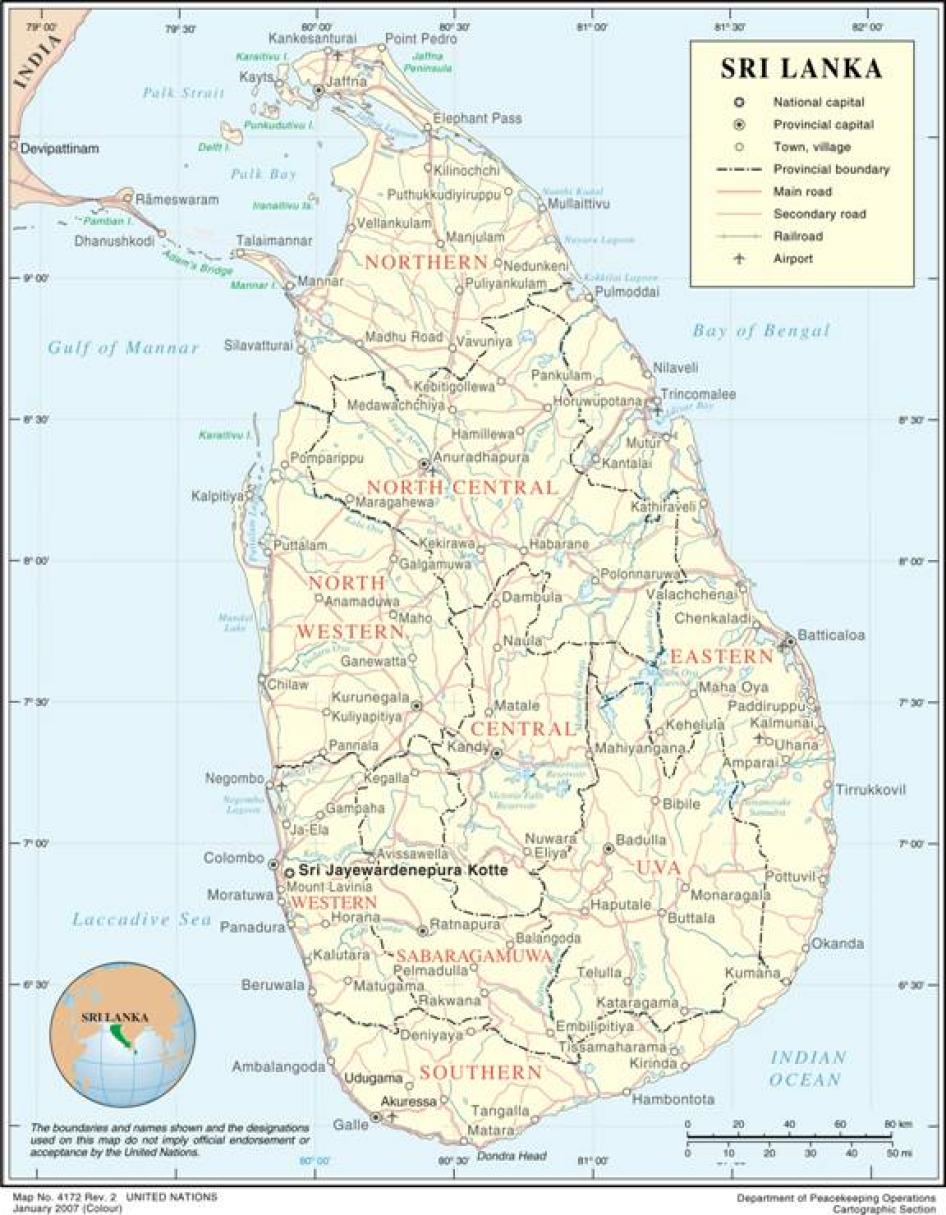
Map of Sri Lanka
I. Summary
After 25 years, the armed conflict between the Sri Lankan government and the separatist Liberation Tigers of Tamil Eelam (LTTE) may be nearing its conclusion. But for the quarter of a million civilians trapped or displaced by the fighting, the tragedy has intensified. Since the fall of the LTTE's administrative center, Kilinochchi, in early January 2009, civilian casualties in the northern Vanni region have skyrocketed-to more than 5,100, including at least a thousand deaths, based on a conservative tally by independent monitors analyzed by Human Rights Watch. More recent information places civilian casualties at 7,000, including 2,000 fatalities. Added to this are the dire hardships faced by the displaced-insufficient food, medical care, and shelter, whether in the combat zone or government-run "welfare villages."
The Sri Lankan armed forces and the LTTE appear to be engaged in a perverse competition to demonstrate the greatest disregard for the civilian population. In the last two months alone, both sides have committed numerous violations of international humanitarian law, the laws of war. While not all loss of civilian life is a laws-of-war violation, the failure of the government forces and the LTTE to meet their international legal obligations has undoubtedly accounted for the high death tolls.
Retreating from Sri Lankan Army (SLA) advances, the LTTE has forcibly taken along all civilians under its control. As the territory held by the LTTE has shrunk-now a short, narrow strip on the northeast coast of the island-the civilian population has been dangerously forced into a smaller and smaller space. In violation of the laws of war, the LTTE has refused to allow civilians to flee the fighting, repeatedly fired on those trying to reach government-held territory, and deployed forces near densely populated areas. The civilians who remain under LTTE control, including children, are subject to forced recruitment into LTTE forces and hazardous forced labor on the battlefield.
The LTTE's grim practices are being exploited by the government to justify its own atrocities. High-level statements have indicated that the ethnic Tamil population trapped in the war zone can be presumed to be siding with the LTTE and treated as combatants, effectively sanctioning unlawful attacks. Sri Lankan forces have repeatedly and indiscriminately shelled areas crowded with civilians. This includes numerous reported bombardments of government-declared "safe zones" and the remaining hospitals in the region.
The plight of displaced persons has been exacerbated by the government's decision in September 2008 to order most humanitarian agencies out of the Vanni. The government's own efforts to bring in food, medical supplies, and other relief with a minimal United Nations role have been insufficient. Continuing fighting, lack of oversight, and the manipulation of aid delivery by government forces and the LTTE have all contributed to the deepening humanitarian crisis.
Displaced persons are increasingly escaping from the battle zone to what they hope is safety within government-controlled areas. Instead, they are finding government internment centers masquerading as "welfare villages." While the government for security reasons should be screening new arrivals, it is instead secretly taking away LTTE suspects to arbitrary detention or possible enforced disappearances.
All displaced persons crossing to the government side are sent to internment centers in Vavuniya and nearby locations. As Human Rights Watch has reported previously, these are military-controlled, barbed-wire camps in which those sent there, including entire families, are denied their liberty and freedom of movement. Humanitarian agencies have tenuous access, but do so at the risk of supporting a long-term detention program for civilians fleeing a war.
The hospital in Vavuniya mirrors the town's internment camps. When Human Rights Watch visited, it lacked even the most basic necessities: many of the hospital beds had no bed sheets, blankets, or pillows. And despite the obvious lack of capacity to handle all of the wounded and attend to their needs, the hospital personnel reportedly were instructed by the authorities not to ask for any assistance from international agencies, and very few agencies have been allowed access to the hospital. Relatives have had difficulty seeing patients, and some have later been visited by the security forces.
Human Rights Watch calls on the Sri Lankan government and the LTTE to act immediately to stop the ongoing slaughter of civilians. Both parties should facilitate the creation of a humanitarian corridor and otherwise respect the laws of war. The LTTE should allow civilians to leave the war zone and the SLA should stop shelling near densely populated areas, safe zones and hospitals. Those displaced civilians who reach the government side should be assisted but not interned. And the government should permit independent media and human rights organizations to go to the conflict area. (More detailed recommendations are set forth at the end of this report.)
Instead of using its victories in the field to promote a more open and democratic nation, the Sri Lankan government has conducted a cynical campaign to prevent all independent public coverage of its military operations and the plight of civilians caught up in the war. While decrying LTTE abuses, it has kept out the media and human rights organizations that could report on them-and on government abuses. It has kept displaced persons who could describe the artillery bombardments locked up in camps and hospitals. It has traded the well-being of tens of thousands of Sri Lankan citizens for protection from international scrutiny. With civilian casualties mounting, it has sought to bury its abuses.
A Note on Civilian Casualties
Civilian casualties have risen dramatically since the LTTE retreated to a roughly 100-square-kilometer (39-square-mile) area in northeastern Mullaitivu district. Because the government has prohibited independent media and human rights organizations from visiting the combat area, information on civilian casualties has been difficult to obtain. Nonetheless, a conservative estimate can be made based on actual counts by independent observers on the ground.
During a three-week period from January 20 to February 13, 2009, independent observers in the Vanni collected information on 5,150 civilian casualties-1,123 deaths and 4,027 injuries-from the current fighting. This number was derived from a compilation of reports that recorded individual casualties, the date and place of the attack, and the nature of the attack. Newly obtained information places total civilian casualties at 7,000, with 2,000 deaths.
Information from other sources supports these findings. For instance, Human Rights Watch obtained a list of patients from Puthukkudiyiruppu (PTK) hospital containing patients' names, age, sex, address, place of injury, type of injury, type of blast, and arrival date at the hospital. The list shows that between January 1 and January 26 alone, this single hospital received 573 patients suffering conflict injuries, 75 of whom died.
II. Methodology
This report is based on research conducted by a Human Rights Watch mission to Sri Lanka from February 3 to 13, 2009. Human Rights Watch conducted over 60 interviews with representatives of local and international nongovernmental and humanitarian organizations, UN agencies, medical personnel, religious leaders, diplomatic representatives, and ordinary civilians affected by the conflict. The interviews were conducted in Colombo and Vavuniya, in English or through a Tamil-English translator.
The research was conducted mainly in Vavuniya where the majority of displaced persons from conflict areas in the Vanni currently are arriving.
The Sri Lankan government has taken numerous measures to deny access to information for independent observers, including representatives of human rights organizations, journalists, and others. Just a handful of international agencies have been allowed access to the internally displaced person (IDP) camps in Vavuniya and especially the hospital where wounded civilians have been brought. Information on the current situation in the Vanni is extremely limited, coming primarily from local staff of international agencies trapped in the conflict area along with other civilians and medical personnel.
The Sri Lankan government's ongoing restrictions on information are denying the Sri Lankan public and the broader international community important information about the situation in the Vanni and the circumstances facing the population there, as well as the role not only of the government, but of the LTTE.
In our research, we focused on interviewing eyewitnesses to violations and seeking additional information from individuals who had access to the displaced persons in the Vavuniya camps and its hospital.
To protect the security of individuals with whom we spoke, we have removed certain identifying information and in some cases used pseudonyms, as specifically indicated at relevant points in the text.
III. Violations of the Laws of War
During the ongoing fighting in the Vanni,[1] both the Sri Lankan armed forces and the LTTE have committed serious violations of international humanitarian law with respect to the conduct of hostilities. The high civilian casualties of the past months can be directly attributable to these violations. Those responsible for willful violations, whatever their rank, should be held accountable for war crimes.
The LTTE has been responsible for deploying their forces within densely populated areas and deliberately firing on civilians to prevent them from fleeing to safety. There is also evidence that the LTTE has used civilians as "human shields."
The Sri Lankan forces have committed numerous indiscriminate and perhaps disproportionate attacks consisting of artillery bombardment and aerial bombing. These include attacks on the government-proclaimed "safe zone" and on clearly marked hospitals. Statements by senior officials indicating that civilians who do not leave LTTE-controlled areas are subject to attack are indicative of an intent to commit war crimes.
Violations by the LTTE
Preventing Civilians from Fleeing the Conflict Zone
The LTTE has deliberately prevented civilians under its effective control from fleeing to areas away from the fighting, unnecessarily and unlawfully placing their lives at grave risk. As the LTTE has retreated in the face of SLA offensive operations, it has forced civilians to retreat with it, not only prolonging the danger they face, but moving them further and further away from desperately needed humanitarian assistance. And as the area that the LTTE controls shrinks, the trapped civilian population has become concentrated, increasing the risk of high casualties in the event of attack and placing greater strains on their living conditions.
More than 200,000 civilians, some already displaced more than 10 times, are believed to be trapped inside the Vanni war zone.[2] Among those trapped are more than 250 national staff members of international organizations, most of whom currently serve as volunteers for local government agents.
The LTTE has long placed restrictions on freedom of movement of those living in LTTE-controlled areas. Movement in and out has been sharply regulated, not only for security, but as part of forced recruitment efforts and for "taxation" purposes. Since 2008, the LTTE pass regime granting permission to individuals to leave the Vanni has grown increasingly strict. The last known case of a person being able to leave on a pass occurred in late January.[3]
As the area controlled by the LTTE has significantly decreased, the situation for displaced persons has become increasingly dire. Higher concentrations of civilians in smaller areas have led to greater casualties and continued blocking of humanitarian assistance has led to a shortage of food, water, and medicines.
As civilians have become more desperate and the LTTE has increasingly lost control, more and more people have tried to flee LTTE-controlled areas. The LTTE has forcibly tried to block these efforts, including by deliberately firing on civilians. In one case reported to Human Rights Watch, on February 7 a group of about 3,000 people tried to cross the front lines, but LTTE cadres stopped them and turned them away. They could not go back because of the heavy shelling in the area and, according to a source, "were stuck on the road," with no shelter and at great risk.[4]
In several cases, the LTTE has deliberately attacked civilians in an effort to prevent them from fleeing. Human Rights Watch learned that displaced persons who had arrived in Vavuniya on February 9 reported that when LTTE forces were retreating in the Suthanthirapuram area, they tried to push civilians back to prevent them from crossing over to the government side. LTTE cadres opened fire on the civilians and injured 17 people.[5] LTTE forces on February 6 also fired on civilians when they tried to cross the front line in Moongkilaaru, killing and injuring an unknown number of people.[6]
Displaced persons in Pampaimadu camp in Vavuniya reported that because the government-declared "safe zone" was no longer safe and SLA forces were advancing, on February 6 a group of about 80 people began walking towards the front line in Visuamadu. The LTTE did not have any fortified positions in Visuamadu, just a few hundred meters from the government lines, but there were several LTTE cadres there. When the group tried to cross, the LTTE cadres opened fire, wounding one or two people.[7] And on February 4 and 5, LTTE cadres fired upon civilians who tried to cross the front line in the Moongkilaaru area.[8]
The mother of a 3-year-old boy with a gunshot wound to the right thigh reported that the LTTE had fired on her family as they were trying to flee to the government-controlled area. Her husband was shot dead and her 8-year-old daughter went missing during the incident.[9]
A 35-year-old father of three, who had just arrived at the College of Education camp in Vavuniya, described how LTTE cadres had shot at civilians attempting to flee:
When we came to Suthanthirapuram, it was full of dead bodies. Bodies were lying along the road. Nobody cared about them. They smelled. We didn't have food for two days. We slept in the field.
Some 150 people started out together, but when we tried to leave, at Suthanthirapuruam, the LTTE tried to stop us. There was only a narrow path to leave by. The LTTE caught us. There was fighting, arguments. They were shooting at us. Many people were injured and killed. It was shocking to see. Only 65 were in my group when we came out. We were separated from the rest along the way.
One father was carrying his child on his back. As they were running from the LTTE, he was holding him by the arms so hard-in order not to lose him-that he broke both of the child's arms.[10]
In another reported case from early February, a group of civilians was hiding in a bunker near a stream in Murasummodday during heavy SLA shelling of LTTE positions. When there was a pause in the shelling, the group left the bunker and started running towards SLA positions that were relatively near. LTTE cadres started firing at them from behind, trying to prevent them from fleeing. And as they approached the SLA positions, the army also opened fire, possibly thinking that they were advancing LTTE forces, although the group was carrying a white flag. Several people were injured.[11]
In another incident, on February 10, 2009 at Udaiyaarkaddu on the western edge of the safe area, 17 to 23 people were killed and 69 injured by LTTE as they were trying to escape to the government-controlled areas. Survivors told an international agency that the actual number of casualties may have been significantly higher as they had to leave many of the dead and seriously wounded behind.[12]
The wounds of those who said they were fired upon by LTTE forces when fleeing support their accounts. Several dozen patients admitted to Vavuniya hospital after February 7 had gunshot wounds in the lower parts of the body, suggesting that the shots were meant to stop their flight, rather than to kill,[13] a view confirmed by a member of the hospital's medical staff.[14]
Putting Civilians at UnnecessaryRisk
The LTTE practice of forcing civilians to retreat with its forces, rather than allowing them to flee to safer areas, has meant that LTTE forces are increasingly deployed near civilians in violation of the laws of war. When military forces deliberately use civilians to protect their positions from attack, it is considered to be "human shielding," which is a war crime.
Several cases were reported to Human Rights Watch in which LTTE forces appeared to be making deliberate use of civilians to shield their positions from attack.
A relief worker told Human Rights Watch that the LTTE placed their positions near an IDP camp in Chundikulam:
People were really packed together, so wherever the SLA bombed or shelled, there were civilian casualties. But the LTTE also put their positions right in front of the IDP camps. I saw that in Chundikulam where I stayed in a camp. When they did this we obviously couldn't go and argue with them because they could just beat or even shoot us.[15]
When the 11th United Nations Humanitarian Convoy was held back at PTK for about a week in January due to heavy fighting (see chapter on humanitarian access below), LTTE forces immediately set up firing positions close to the convoy and started firing artillery. The SLA responded with its own artillery-one shell struck 100 meters from the convoy-but no one was injured.[16]
The LTTE has also continued to place civilians at serious risk by forcibly recruiting civilians for untrained military duty and for labor in combat zones. The LTTE also has a long history of using children under 18 in their forces, including in armed combat, and the UN has reported that it continues to do so. These practices violate international humanitarian law. Since September 2008, the LTTE has increasingly forced people with no prior military experience to fight or perform supportive functions on the front lines, a practice which has led to many casualties. According to one Vanni resident:
It used to just be one person per family, but now everybody above 18 years old had to go [join the LTTE]. All men and young people had to fight, and if they couldn't, they were forcibly taken to work for the LTTE at the front.
They [the LTTE] got the lists of IDPs from the GS [grama sevaka, a village official]-every family had to register there-and then visited every family several times. If anybody tried to hide their sons and daughters, they would come back at night and search the house. Even when families paid them to save their sons and daughters from recruitment, another group [of LTTE cadres] would come back and recruit them anyway. They visited my house three times, looking for my husband.
The workers were taken to the frontline to dig bunkers, collect weapons from killed cadres and SLA soldiers, and so on. It was very dangerous for civilians-about 25 of my neighbors were killed while doing this work. They did not receive any training-the LTTE cadres fetched them from their homes and the next day brought their dead bodies back. Every day, many people were crying in my neighborhood because they lost young children; some even beat up LTTE cadres when they brought the bodies back.[17]
On February 17, the UN Children's Fund, UNICEF, issued a statement expressing grave concern for the safety of children in conflict areas. "We have clear indications that the LTTE has intensified forcible recruitment of civilians and that children as young as 14 years old arenow being targeted," said Philippe Duamelle, UNICEF's representative in Sri Lanka. "These children are facing immediate danger and their lives are at great risk. Their recruitment is intolerable."[18]
Violations by the Sri Lankan Armed Forces
Indiscriminate Attacks
Human Rights Watch has obtained information on recent artillery attacks by Sri Lankan forces that caused high civilian casualties and may have been indiscriminate in violation of the laws of war.
A local staff member with a UN agency described to Human Rights Watch the intensity of one of the bombardments:
Yesterday [February 9], we spoke to our colleagues who are still in the Vanni. I asked them about my mother-I haven't heard anything from her for a month. But they just started yelling in response that they can't go and see anything-they cannot even get out of the bunker to go to the toilet because the shelling continues non-stop. They said there were dead bodies everywhere, and if earlier they used to "count days," now they are "counting the minutes" that they have left.[19]
"Selvaraj S." (not his real name), said that his father had been injured during the SLA shelling of Visuamadu on January 13. Before his father died three days later, Selvaraj visited him in Vavuniya hospital. He told Human Rights Watch:
When the shelling started, my father was near the house, collecting firewood. The shelling, which came from the Kilinochchi area, was heavy-about 15 or 20 shells landed in the area almost simultaneously. He was injured in the leg by a piece of shrapnel and crawled back to the bunker; he lost a lot of blood. The same attack killed at least six people in the vicinity; four of them were dependents of UN staff-two men and two women.
Once there was a pause in the shelling, the family took my father to the PTK hospital, and then moved him to Vavuniya by truck, with the help of the Ministry of Health. They spent eight hours on the road, and by the time they made it to the hospital, he was very weak. Two days later he died from loss of blood and an infection.[20]
"Balakrishnan B." (not his real name), from Vallipunam, a town just outside the government-declared safe zone, recounted to Human Rights Watch the SLA shelling of the town on January 19:
There were about 40-50 people traveling along the road when the shelling started. The shelling lasted for about 15 minutes. About 10 shells landed in the immediate area, but we could hear shells landing further away as well. I was staying in the bunker during this time and for another 30 minutes. When I came out of the bunker, people were crying and shouting. A vehicle had already taken the injured to Vallipunam school [an IDP center]. One shell had landed in the middle of the road, however, killing three people who were still lying there when I came out. The shells were coming from SLA positions, from the southwest. We could hear them when they came in.
Balakrishnan told Human Rights Watch that there were no known LTTE positions in the vicinity at the time of the attack.
Balakrishnan said that seven of his wife's relatives, including two children-eight and six years old-were killed on February 5 by shelling in Mathalan, an area controlled by the LTTE that he believes had come under SLA attack. He was concerned that three other bodies had been found, mangled beyond recognition, and could be those of relatives he had not heard from.[21]
A 6-year-old boy, whose arm and leg had been amputated, told a local relief worker that he had been injured during a shelling. He had been with his family outside their home, cooking food, in Kappapulavu in LTTE-controlled territory, when a shell hit. The boy knew that two of his older brothers were killed in the attack, but had no information on the fate of his parents. He was in the hospital alone as none of his other relatives was able to cross to government-controlled areas.[22]
Concerns of indiscriminate attacks by SLA forces are heightened by reports that they are using multi-barrel rocket launchers. Multi-barrel rocket launchers cannot be targeted with sufficient precision to be accurate against military targets, and their broad area effect makes their use incompatible with the laws of war in areas where civilians or civilian objects (such as schools or hospitals) are located. The use of such weapons in populated areas is indiscriminate in violation of international humanitarian law.
"Premkumar P." (not his real name) described rocket attacks on civilians in a playground in the government "safe area." He told Human Rights Watch that "Sometimes they [the SLA] would use multi-barrel artillery, firing perhaps 40 shells per minute. These shells [rockets] also landed on civilians. One family traveling on a tractor was hit. All of them were completely burned."[23]
A knowledgeable observer told Human Rights Watch that an attack allegedly by the SLA on an area opposite the A35 road on the morning of January 25 appeared to involve multiple rocket launcher systems. He told Human Rights Watch: "The area was completely flattened. As far as I remember, the area was full of displaced persons, tents, etc. only minutes before."[24]
Attacks on the "Safe Zone"
Many of the civilian deaths reported in the past month have occurred in an area that the Sri Lankan government has declared to be a "safe zone."[25] On January 21, the Sri Lankan armed forces unilaterally declared a 35-square-kilometer "safe zone" for civilians north of the A35 road between the Udayarkattu junction and the Manjal Palam (Yellow Bridge) in Mullativu district.[26]The Sri Lankan Air Force dropped leaflets appealingto civilians to move into the safe zone as soon as possible.
During the next days, several thousand people gathered in a large playground located just north of the A35 in the safe zone. The playground also functioned as a food distribution center for the local government agent (GA) and international organizations. Several people located in or around the GA food distribution center told Human Rights Watch that, despite the army declaration of a safe zone in the area, the area was subjected to heavy shelling from SLA positions in the period January 22-29, which killed and injured hundreds of people.
Around 11:45 a.m. on January 22, "Premkumar P." was traveling on his bike on the road parallel to the playground when shelling started. He told Human Rights Watch:
There was heavy shelling, especially where people gathered-near the hospital and where the UN distributed food. People were running around, crying. There was no shelter. Some were trying to hide under trees, like animals. Two shellslanded 50 meters ahead of me. I was very afraid. When I reached the place where the shells landed, I saw that one person had been injured and was being carried away. Two people were lying by the roadside, one young man and one man about 55. They were both dead and covered in blood. The shelling continued during the day. Later I heard that many people were injured and killed. One body that Isaw had had its head cut off by shrapnel.
We could hear where the shelling was coming from. It was coming from the other side of the A35 road [from the area where government forces were located]. We also heard shelling from behind us, but these did not land in the safe zone. They landed on government forces. The LTTE positions were too close to the distribution center. It was impossible for shells from these [LTTE] positions to land in the safe zone.[27]
Two people described to Human Rights Watch the horror of the shelling of the safe zone. One shell that struck inside the playground early in the morning on January 24 killed seven civilians and injured 15. An eyewitness told Human Rights Watch:
One mortar shell came in within ten meters of our location. We heard the screaming sound of the fins before it struck the ground. The shrapnel tore through the tents and temporary shelters just behind our bunker. The mangled body of a young woman landed in the entrance of our bunker. She had been decapitated by the blast. I had never seen that before. I couldn't quite comprehend what I had just witnessed. There was a huge amount of screaming immediately after the impact. The surviving members of the families were in a severe state of stress and running in all directions.
Nothing had been touched when we got out of the bunker in the morning. There were lots of people in bits and pieces lying around. My gut reaction was that I don't want to see this, but I felt that I had to. A woman was lying on her back with two infants, one of which apparently survived. A baby was hanging in the tree under which the family had sheltered. Another baby, decapitated, had been flung into the wire fence surrounding the playground. Lying face down next to the woman was her husband. When the police turned him over, he had horrendous injuries to his face and head. Within three or four meters lay the bodies of two other families. One of the men was severed in half. I think one other was as well, but by this stage I'd had enough. I really didn't want to see any more. One of the mothers had shrapnel injuries to the head and her brains had spilled out on the ground. It disappeared later that day.[28]
Another eyewitness, "Suresh S." (not his real name), recalled the same attack to Human Rights Watch:
We were sleeping in our bunker when shells started falling. It was around 2:45 in the morning. A shell landed about 25 meters from our bunker and killed several people. I did not want to see the dead bodies, but I saw pieces of a young woman hanging in a nearby tree. During our stay there we heard shelling non-stop. Around nine in the morning the next day, we again heard heavy shelling. Fragments were hitting the bunker so we could not go out. We therefore did not see where the shells fell.
We heard both outgoing [LTTE] and incoming [SLA] fire. The ones that landed in the playground, however, came from SLA positions. More than 10 shells landed inside the playground. Just 100 meters away, more than 100 shells fell down.[29]
A source counted 30 killed and 56 injured in and around the playground in little more than 24 hours on January 23 and 24.[30]
A relief worker recounted to Human Rights Watch the information that she received from her colleagues in the safe zone: "From the evening of January 22 there was non-stop shelling until January 29. Our colleagues sent sms-messages [cell-phone text messages] saying that they were seeing eight to 22 people killed every day. That was only what they saw."[31] The New York Times on January 27 cited an unnamed UN official who confirmed that a compound sheltering UN national staff inside the safety zone was shelled on January 24 and 25, killing at least nine civilians and wounding more than 20.[32]
Several shells also hit the A35 road, killing at least five people. During a short break in the shelling, "Suresh S." decided to leave the food distribution center with several other civilians and headed eastward on the A35 in the direction of PTK.
As we traveled to PTK, we saw five dead bodies along the road. We first saw two dead people, apparently a husband and a wife, lying next to the road with their bicycle. A bit further there was another one. Then there was another one. The last dead body was an old woman, perhaps 65 years of age. She was lying in a fetal position under a tree next to the road. It looked like she might have gotten hurt during the shelling and then went to hide under the tree. She must have died like this.[33]
It is not a violation of international humanitarian law for LTTE forces to enter safe zones unilaterally declared by the Sri Lankan government. (Because the "safe zones" were not established by agreement with the LTTE, they cannot be formally considered as "protected zones" as set out in the First and Fourth Geneva Conventions, Protocol I, and in customary humanitarian law.) Several sources told Human Rights Watch that LTTE forces maintained positions in the safe zone (although about two to four kilometers north of the playground), from which they fired on SLA positions. And as LTTE forces retreated, they moved heavy artillery eastward through the northern part of the safe zone.
The SLA is not prohibited from attacking LTTE forces inside a safe zone. At the same time, having declared the area a safe zone for civilians, the SLA encouraged civilians to go to the area, increasing the vulnerability of civilians in the event of an attack. By creating the zone, government forces took on a greater obligation to ensure that they spared civilians from the effects of attacks. Given this civilian presence, attacks on valid military targets in the safe zone should only have been carried out after issuing an effective advance warning that the area was no longer a zone protected from attack.
Attacks on Hospitals
During the fighting in 2009, the few hospitals that exist in LTTE-controlled areas have repeatedly come under artillery attack. This has added immeasurably to the suffering of individuals who have sought help in medical facilities, already horribly overcrowded and dangerously short of medical personnel, equipment, and supplies before the attacks.
"Premkumar P." described the PTK hospital to Human Rights Watch:
There were many wounded there-children, young people, elderly, all kinds of people. Many people had no legs or arms. One person's body was completely burned. There were people everywhere. There weren't enough beds so people were lying on the floor, just on mats. Many of the wounded were from the safe zone.[34]
Human Rights Watch has gathered information from aid agencies and eyewitnesses on more than two dozen incidents of artillery shelling or aerial bombardments on or near hospitals. Hospitals are specially protected under international humanitarian law. Like other civilian objects, they may not be targeted. But under the Geneva Conventions, hospitals remain protected unless they are "used to commit hostile acts" outside their humanitarian function. Even then, they are only subject to attack after a sufficient warning has been given, and after the warning has gone unheeded.[35]
A witness to a PTK hospital attack in mid-January expressed to Human Rights Watch a broader belief that a perceived LTTE presence explained the attack:
When I was in PTK, waiting for the bus to get out-on January 14 or 15, I saw heavy shelling in the hospital area. The bus stop was nearby and I could see shells landing there. People were saying that the SLA was shelling the hospital because there were some LTTE cadres there.[36]
The presence of wounded combatants in hospitals does not turn them into legitimate targets. Deliberately attacking a hospital is a war crime.
Attacks on hospitals in the Vanni (December 15, 2008 – February 10, 2009)
Information compiled by Human Rights Watch from interviews with aid agencies and eyewitnesses
Date
Hospital
Description
12/15/08
Mullaitivu General Hospital
Two patients injured by shelling. Damage to ward and medical equipment.
12/17/08
Vaddakachchi Hospital
10 a.m. Aerial bombing hit refugee settlement 250-300m from the hospital.
12/19/08
Mullaitivu General Hospital
11:30 a.m. Five shells hit hospital, causing damage to wards, operating theater, and the Medical Superintendent's HQ. Two staff wounded.
12/20/08
Mullaitivu General Hospital
Shells hit inside hospital grounds.
12/22/08
Kilinochchi General Hospital
6:20 a.m. Aerial bombing hit near hospital, causing shrapnel damage.
No injuries reported.
12/25/08
Kilinochchi General Hospital
Shells hit hospital grounds, narrowly missing staff. Damage to newborn nursing section, outpatient department, and reception.
12/30/08
Kilinochchi General Hospital
4 p.m. Shells hit hospital, causing damage to the building. No injuries reported.
01/08/09
Tharmapuram Hospital
1:20 p.m. Shells hit Tharmapuran Junction 75 m from the hospital, killing seven.
01/10/09
PTK Hospital
11 p.m. Shells hit IDP settlement located behind PTK hospital.
01/13/09
PTK Hospital
10 a.m. One killed, six wounded when the hospital is hit by shells. Patients fled to the wards to seek shelter.
01/19/09
Vallipunam Hospital
Six people in out-patient ward injured when shell lands in hospital yard.
01/21/09
Vallipunam Hospital
7 p.m. One shell hit hospital.
01/22/09
Vallipunam Hospital
Morning. Five are killed and 22 are injured when shells hit hospital compound.
01/26/09
UDK Hospital
Twelve killed, 40 injured when shells hit hospital.
01/31/09
PTK Hospital
Shrapnel from shells hit hospital.
02/01/09
PTK Hospital
Three attacks. First attack: one person injured by shrapnel inside the hospital. Second attack: one killed, four injured when shell hits hospital. Third attack: one shell hit the women and children ward (no information on casualties).
02/02/09
PTK Hospital
One nurse killed, 10 patients injured when one shell hit hospital.
02/03/09
PTK Hospital
Rocket hit surgical theatre. No information on casualties.
02/05/09
Ponnampalam Memorial Hospital
Sixty casualties inside and outside the hospital due to shelling.
02/10/09
Putumattalan (make-shift hospital for PTK)
Sixteen people killed in shelling attack.
After PTK hospital had been shelled over several days in February, its patients were transferred to a makeshift hospital in a school and community center in Putumattalan village, on the coast. T. Satyamurthy, a doctor working at Putumattalan, told the media that around 100 wounded civilians were arriving at the makeshift hospital each day and that most had shrapnel wounds. "On Friday [February 13], nearly 100 civilians were admitted for injuries; on Thursday [February 12] 87 admitted. They have injuries from shells, burn marks, but we don't have basic medicine to treat them," he said.[37]
The International Committee of the Red Cross (ICRC) reported that even this makeshift hospital had repeatedly come under artillery attack. ICRC spokeswoman Sophie Romanens said, "They say shelling is coming close and there are some patients dead because the place was hit by shells on Monday [February 9]."[38]
Government Statements Regarding Civilian Casualties
As civilian casualties from the fighting intensified in 2009, senior Sri Lankan military officials have made public statements regarding civilian loss of life that raise serious concerns about the military's compliance with its obligations under international law to do everything feasible to minimize civilian casualties.
Military spokesman Brig. Udaya Nanayakkara told the media on January 28 that "There were no civilians killed," and added: "We are targeting the LTTE. We are not targeting any civilians, so there can't be any civilians killed."[39] This statement suggests the military may be defining away the problem-equating the presence of civilians near LTTE positions with LTTE forces themselves-rather than adapting its conduct of the fighting to minimize civilian casualties given the realities on the ground.
A Ministry of Defense statement issued on February 2 states:
While the Security Forces accept all responsibility to ensure the safety and protection of civilians in the Safety Zones, they are unable to give such an assurance to those who remain outside these zones. Therefore, the government, with full responsibility, urges all civilians to come to the Safety Zones; and also states that as civilians who do not heed this call will be among LTTE cadres, the Security Forces will not be able to accept responsibility for their safety.[40]
Sri Lanka's Defense Secretary Gotabhaya Rajapaksa suggested in an interview to media on February 3 that all persons subject to attack by the armed forces were legitimate LTTE targets. He stated: "There are no independent observers, only LTTE sympathizers. Radio announcements were made and movement of civilians started a month and a half ago."[41]
Not all attacks that result in civilian casualties are violations of the laws of war. However, the Sri Lankan government has sought to justify attacks that have resulted in high civilian casualties on the grounds that the civilians failed to heed warnings to flee the areas, and that the LTTE's use of civilians as shields rendered the LTTE fully responsible for any civilian loss.
The Sri Lankan government has claimed it has given warnings to the civilian population to leave the areas under attack. However, these warnings cannot be considered effective because the government knew that civilians were being prevented by the LTTE from leaving areas under its control. More importantly, under international law, civilians who remain in combat zones remain protected from attack so long as they are not directly participating in the hostilities. That means that the civilian presence must still be taken into account when conducting attacks, regardless of the reason for their continued presence.
In addition, the LTTE's practice of deploying near densely populated areas or deliberately using civilians as shields does not make these civilians subject to attack. Violations of the laws of war by one side to a conflict do not justify violations by the opposing side.[42] They do not permit the indiscriminate use of force by Sri Lankan forces in response. When attacks are carried out in such circumstances, all feasible steps must be taken to distinguish between military targets and civilians, the weapons used must be able to discriminate between the two, and the expected military gain from the attack must exceed the anticipated civilian loss.
International Law on Conduct of Hostilities
International humanitarian law (the laws of war) imposes upon parties to an armed conflict legal obligations to reduce unnecessary suffering and protect civilians and other non-combatants.[43] All armed forces involved in a conflict, including non-state armed groups such at the LTTE, must abide by international humanitarian law.[44] Individuals who deliberately or recklessly violate international humanitarian law can be prosecuted in domestic or international courts for war crimes.[45]
International humanitarian law limits permissible means and methods of warfare by parties to an armed conflict and requires them to respect and protect civilians and captured combatants.[46] The fundamental tenets of this law are "civilian immunity" and "distinction."[47] These tenets impose a duty at all times during the conflict to distinguish between combatants and civilians, and to target only combatants.[48] Also protected are civilian objects, which are defined as anything not considered a military objective.[49] Prohibited are direct attacks against civilian objects, such as homes, places of worship, hospitals, and schools, unless they are being used for military purposes.[50]
Humanitarian law prohibits deliberate attacks against civilians and indiscriminate attacks. Indiscriminate attacks are of a nature to strike military objectives and civilians or civilian objects without distinction. Examples of indiscriminate attacks are those that are not directed at a specific military objective or that use weapons that cannot be directed at a specific military objective. Prohibited indiscriminate attacks include area bombardment, which are attacks by artillery or other means that treat as a single military objective a number of clearly separated and distinct military objectives located in an area containing a concentration of civilians and civilian objects.[51] Also prohibited are attacks that violate the principle of proportionality: attacks that are expected to cause incidental loss of civilian life or damage to civilian objects that would be excessive in relation to the concrete and direct military advantage anticipated from the attack.[52]
Humanitarian law requires that the parties to a conflict take constant care during military operations to spare the civilian population and to "take all feasible precautions" to avoid or minimize the incidental loss of civilian life and damage to civilian objects.[53] These precautions include doing everything feasible to verify that the objects of attack are military objectives and not civilians or civilian objects[54] and giving "effective advance warning" of attacks when circumstances permit.[55] They must also avoid locating military objectives near densely populated areas[56] and endeavor to remove a civilian population from the vicinity of military objectives.[57] This obligation is considered especially relevant "where military objectives can not feasibly be separated from densely populated areas,"[58] such as is the case in the current fighting in the Vanni.
The presence of civilians in the vicinity of the fighting places obligations on warring parties to take steps to minimize harm to civilians. Belligerents are prohibited from using civilians to shield military objectives or operations from attack; "shielding" refers to purposefully using the presence of civilians to render military forces or areas immune from attack.[59]
Humanitarian law also requires the humane treatment of civilians and captured combatants. It prohibits violence to life and person, particularly murder, mutilation, cruel treatment, and torture.[60]It is also unlawful to commit rape and other sexual violence; targeted killings of civilians who are not directly participating in the armed conflict; and engage in pillage and looting.
Individuals who commit serious violations of international humanitarian law deliberately or recklessly are responsible for war crimes.[61] These include deliberate, indiscriminate, and disproportionate attacks on civilians, hostage taking, and use of human shields. Commanders and civilian leaders may be prosecuted for war crimes as a matter of command responsibility when they knew or should have known about the commission of war crimes and took insufficient measures to prevent them or punish those responsible.[62]
IV. Humanitarian Access
The humanitarian needs of the more than 2o0,000 civilians trapped in the Vanni have only grown more acute since Human Rights Watch's December 2008 report documenting these needs in detail.[63] According to a February 6 statement by the World Food Program (WFP): "Livelihoods have been almost completely lost, exacerbating the general food insecurity, and traditional coping mechanisms have been exhausted. People depend almost entirely on humanitarian food assistance for survival."[64]
International aid agencies have had very limited access to the Vanni since the Sri Lankan government ordered the UN to leave the region in September 2008.[65] The government has permitted food relief to be delivered, but it has not allowed international aid workers to remain on the ground to ensure that the aid is reaching the population at risk. Since September, the WFP has delivered 8,300 metric tons of mixed food commodities to the area in 11 separate convoys. Since January 16, the WFP has been unable to deliver any food to the area, citing "heavily mined roads and lack of sufficient security guarantees." At this writing in mid-February, a government-organized convoy of 13 trucks carrying 153 metric tons of WFP food into the Vanni area on January 29 was the last food convoy to reach the area.[66]
On February 10, an international agency received information from its staff, which had relocated to a place along the coast, that the only supplies that they had left were rice, flour, and oil. They had run out of water and the nearest water was 1.5 kilometers away. Walking there was extremely risky as the area was frequently shelled-an artillery shell had recently landed just 100 meters from the agency's bunker.[67]
A source indicated to Human Rights Watch that one of the main reasons for the difficulty in organizing convoys in and out of the Vanni was that the SLA and the LTTE were unable to agree on the route to be used. Seeking to use the humanitarian convoys to advance their military positions, both sides insisted on different routes, blocking the delivery of much-needed aid to thousands of civilians.[68]
One individual who joined convoys delivering food supplies on December 23 and 29 said that Sri Lankan government troops used the convoys moving northwards to advance closer to LTTE positions. He told Human Rights Watch that on December 29:
We got to the last SLA checkpoint near Oddusuddan from where the ICRC was supposed to accompany us through no-man's land to the LTTE checkpoint 13 kilometers south of PTK. As soon as we passed the SLA checkpoint, military vehicles joined the convoy and followed the convoy on both sides. LTTE saw it and started firing. The army returned fire and the convoy had to stop for one hour. At this time nobody was injured, but when the same thing happened to the GA [government] convoy the next day, their driver was injured in crossfire.[69]
A second source confirmed that the SLA had used the convoy on December 29 to advance its position, saying that "long lines of SLA troops were walking alongside the convoy."[70]
Beyond shortages of food and water, lack of medical supplies-also due to restrictions on humanitarian access-has been sharply felt at the remaining treatment centers. ICRC spokeswoman Sophie Romanens, while noting that many patients have been evacuated recently, described the situation at the Putumattalan makeshift hospital as critical: "What our people are saying is that people injured by the fighting are coming in [to the makeshift hospital] by the dozen every day. People are still being injured by the fighting and they just can't get the medical treatment that they need there. It is not a hospital…. For them, it is a matter of life and death."[71]
Similar problems have prevented international organizations from evacuating patients and medical staff from the war zone. This has included evacuating patients from the PTK hospital, which came under repeated shelling from Sri Lankan forces. "Premkumar" told Human Rights Watch:
On January 26, the patients [at PTK hospital] were loaded onto trucks to be evacuated. They were unloaded, however, shortly afterwards. Some said that the LTTE had refused to allow the convoy to pass. Some say that the SLA was to blame. Being loaded and unloaded like that was very painful to the patients.
Another source confirmed to Human Rights Watch that about 50 patients were loaded onto the trucks around 11 a.m. on January 26. They were unloaded about three hours later, however. One woman died from her injuries just 10 minutes after she had been loaded onto a truck.
The ICRC was finally able to escort 226 sick and wounded patients requiring urgent medical attention from PTK hospital on January 29. Despite repeated requests from the ICRC, government forces and the LTTE did not grant safe passage to evacuate additional patients and medical staff for nearly two weeks, forcing patients and medical staff to evacuate to the Putumattalan make-shift hospital on February 4.[72] Finally, on February 10 and 12, the ICRC evacuated more than 600 patients by boat from Putumattalan to the district capital of Trincomalee, far away from the fighting.[73]
Under international humanitarian law, the government is responsible for meeting the humanitarian needs of the war-affected population. Parties to an internal armed conflict-in this case the Sri Lankan government and the LTTE-must allow humanitarian relief to reach civilian populations that are in need of food, medicine, and other items essential to their survival.[74] If the government is unable to fully meet this obligation, it must allow the humanitarian community to do so on its behalf. Parties to a conflict must ensure the freedom of movement of impartial humanitarian relief personnel-only in cases of military necessity may their activities or movements be temporarily restricted.[75]
The UN Guiding Principles on Internal Displacement provide authoritative standards on the obligations of governments to internally displaced persons. Under the principles, the authorities are to provide displaced persons "at a minimum" with safe access to essential food and potable water, basic shelter and housing, appropriate clothing, and essential medical services and sanitation.[76] Many of these needs are not currently being met in the Vanni, as documented above and in Human Rights Watch's December 2008 report.
V. Plight of the Internally Displaced
The situation of civilians who manage to escape from areas of active hostilities into government-controlled territory is dire. Instead of providing the internally displaced with the assistance and protection they are entitled to under international law, the Sri Lankan government continues to violate their fundamental rights.
The government has arbitrarily detained people during screening procedures; subjected all internally displaced persons, including entire families, to indefinite confinement in military-controlled camps; and failed to provide adequate medical and other assistance to displaced persons. The government has directly restricted the efforts of relief agencies seeking to meet emergency needs, and has deterred agencies from offering greater support through policies that the agencies rightly perceive as unlawful.
The LTTE's attempts to prevent civilians from fleeing the conflict zone remain the main reason why tens of thousands of people remain trapped. Various sources told Human Rights Watch, however, that many civilians who are able to flee have been reluctant to cross over to the government side because they fear for their life and safety in the hands of the government forces. As one relief worker put it:
If people knew that there was ICRC or other international agency waiting for them on the other side, thousands, virtually all of them, would have run for safety, even if it meant breaking through LTTE cordons. But risking your life to end up in government detention-not many are willing to do this.[77]
In October-December 2008, Human Rights Watch documented the plight of hundreds of civilians detained in de facto internment camps established by the government since March 2008, primarily in Mannar district on the west coast.[78]
The situation has further deteriorated since the beginning of 2009 with the arrival of thousands of new displaced persons in government-controlled areas. The government continues to immediately confine all of them in existing and newly established camps, mostly in Vavuniya district.
The number of newly arrived displaced persons changes daily and is hard to verify, especially since the government does not share lDP registration lists with any international agencies. As of February 16, according to estimates by international agencies working in the area, there were about 30,700 internally displaced in 12 sites in Vavuniya.[79]
Screening procedures and unknown fate of the detainees
Sri Lankan security forces subject people fleeing from LTTE-controlled areas to several stages of screening, ostensibly to separate those affiliated with the LTTE from displaced civilians. While the government has legitimate security reasons for screening displaced persons to identify and apprehend LTTE cadres, the screening procedures need to be transparent and comply with the requirements of international humanitarian and human rights law. So far, none of these requirements have been met and dozens of individuals, perhaps many more, have been detained during the screening process. The fate of such detainees remains unknown, raising fears of possible enforced disappearances and extrajudicial killings.[80]
The military and the police Criminal Investigation Department have set up several screening points for displaced persons leaving the Vanni. Most displaced persons are initially screened during their first encounter with military forces after they have crossed the front line. The army currently transports the displaced persons to one of the hospitals in Kilinochchi where they spend up to 36 hours, being questioned by the security forces. In Kilinochchi, the security forces encourage people to reveal any affiliation that they have with the LTTE voluntarily.
According to several sources, at the Omanthai checkpoint, the main screening point for displaced persons on the main A9 roadway before their arrival in camps in Vavuniya, the army conducts a more thorough screening process. During this screening process, the army has separated dozens of men and women aged 18 to 35, as well as some teenage children, from their families, allegedly for further questioning.
Very little information is available regarding the first two stages of screening and it is not possible to verify whether and to what extent detentions occur in these locations. The government provides no information on who has been arrested. Nor are international agencies provided with the number or registration lists of people arriving at Kilinochchi, and thus no comparison can be made with the number of displaced persons who eventually make it to Vavuniya.[81]
It is clear, however, that persons are arrested at Omanthai checkpoint. The government initially agreed to allow the ICRC and the UN High Commissioner on Refugees to monitor the screening process there.[82] In practice only the ICRC was allowed at the checkpoint, and since February 7, 2009, it too has been barred from monitoring the screening procedure. At this writing, no independent observers are present at the checkpoint.[83]
Meanwhile, dozens if not hundreds of people-mostly young men and women-appear to have been detained at the Omanthai checkpoint as of early February 2009. Some have been released within days and transferred to the IDP camps in Vanunya, but the fate of numerous others remains unknown.
Displaced persons arriving in Vavuniya continue to report to the international agencies working in the camps that for days, and now weeks, they have not had any information regarding the fate and whereabouts of their relatives detained at Omanthai.
For example, one representative of an international agency who has been working in the IDP camps in Vavuniya told Human Rights Watch that during the week of February 2 the military separated 70 to 80 young people from their families at Omanthai checkpoint and detained them. Two days later, many of the young people were brought to the IDP camps, yet the fate of others remained unknown. The agency representative said that at least two mothers approached her saying their children have gone missing.[84]
Another international relief worker told Human Rights Watch that on February 8, 2009, she was approached by about 50 families whose relatives had been detained at Omanthai checkpoint in previous days. Neither the families nor the international worker had any information as to the fate and whereabouts of the detainees.[85]
A local relief worker said:
One woman in the camp told me that she was crossing the Omantai checkpoint with her husband and child on February 3. The husband was detained there, and for a week now she has no information about him. People like her call us all night long, trying to get information about their missing relatives.[86]
"Ahilan A." (not his real name), who managed to meet with several of his family members in the Pampaimadu camp, recounted to Human Rights Watch what his family had told him. After his family managed to cross the front line near Visuamadu on February 6, Sri Lankan forces loaded them onto buses, and drove them to the abandoned hospital in Kilinochchi. There, intelligence officers in uniform and plainclothes questioned the displaced persons before they were taken to the Omanthai checkpoint. In Omanthai they were photographed and registered. Several people, they said, were detained at Omantai, including Ahilan's 26- and 27-year-old cousins. At that time, Ahilan had no news about the whereabouts of his cousins.[87]
Efforts of international agencies, including ICRC and UNICEF (some detainees are children), to obtain the lists of the detainees and any information about their fate and location from the Sri Lankan authorities so far have proved futile.[88]
Confinement in internment camps
Upon arrival in Vavuniya, all displaced persons apparently without exception are subjected to indefinite confinement in de facto internment camps, which the government calls transit sites, "welfare centers," or "welfare villages." Those requiring immediate medical attention are first taken to the hospital, and then to one of the camps (see below).
As of February 16, 2009, eight sites near Vavuniya alone had been allocated for newly arriving displaced persons. Local authorities were not prepared for the large influx of displaced persons and did not allow international agencies to adequately prepare the sites. As a result, the government started putting newly arriving displaced persons into schools and colleges, interrupting the educational process for hundreds of schoolchildren and students, many of whom had to vacate the facilities.
At the same time, relief agencies were struggling to set up additional shelter, water, and sanitation facilities at the last moment, as the displaced persons were being brought to the sites.
Sri Lankan authorities have ignored calls from the international community to ensure the civilian nature of the camps. The perimeters of the sites are secured with coils of barbed wire, sandbags, and machine-gun nests. There is a large military presence inside and around the camps.
The government has rejected the criticism. In February, Brig. Gen. Udaya Nanayakkara told the media: "They have barbed wire around them for the safety of the civilians. If the [LTTE] lob a hand grenade, a lot of people will be killed and we are responsible for their safety."[89]
Several sources reported to Human Rights Watch the presence of plainclothes military intelligence and paramilitaries in the camps. A UN official in Vavuniya told Human Rights Watch that she and colleagues have seen members of paramilitary groups in different camps. In particular, local staff members recognized several members of the People's Liberation Organization of Tamil Eelam (PLOTE), a pro-government Tamil paramilitary organization long implicated in abuses, present at one of the camps.[90]
While officially the camps are run by civilian authorities, in reality the military remains in full control, ensuring, as one relief worker put it, that "nobody gets in or out."[91] Two sources independently told Human Rights Watch that military and CID officers regularly conduct nighttime interrogations inside the camps, summoning young men and women into their premises.[92]
Displaced persons confined in the camps enjoy no freedom of movement and are not allowed any contact with the outside world. Unlike the internally displaced brought to Mannar district in 2008, some of whom were granted passes to leave the camp for a day to go to work,[93] the displaced persons in Vavuniya camps have not to date been allowed to leave the sites on their own. The military delivers those in need of medical assistance to the hospital in Vavuniya, and on rare occasions has also accompanied several displaced persons for a short hospital visit to assist their young children or disabled relatives.
While many of the displaced persons have families in Vavuniya, their relatives have not been allowed to visit them in the camps. Relatives come to the camp sites, trying to find their family members and communicate with them through the fence and barbed wire surrounding the sites, yet they are often chased away by soldiers.
At Menik Farm, the largest of the camps, the military installed a second line of barbed wire to ensure that the outsiders cannot approach the people in the camp close enough to talk to them. A local relief worker told Human Rights Watch:
People from outside were not allowed to approach their relatives in the camp. I was a witness to a heartbreaking scene, when a mother with a very small child came to the gate because her husband came to see her. The child ran to the father, but the military grabbed him. We had to interfere and pushed them very hard to allow the father at least to kiss his son.[94]
The relief worker also said that one woman she spoke with in another camp was not allowed to attend the funeral of her mother who had succumbed to her wounds at Vavuniya hospital. The relief worker said:
I spoke to one woman in the camp-she was crying and screaming. It turned out that her elderly mother, who had been injured and admitted to the hospital, died there on February 7. The elderly woman's body was given to the son, who lived in Vavuniya, but her daughter was not allowed to leave the camp even to attend her mother's funeral. She was in agony because she couldn't pay respects to her mother.[95]
Several relief workers working with displaced persons told Human Rights Watch that many are devastated because they have been separated from their family members and have no information about their relatives-those who stayed in the Vanni, those detained at Omanthai, or even those who may be in Vavuniya but confined in a different camp. International agencies have been trying to assist with family reunification at least for those who made it to Vavuniya, but since the authorities have not provided them with IDP registration lists from different camps, so far it has been virtually impossible.
In apparent efforts to demonstrate that they can handle the influx of displaced persons without assistance from international agencies, and to prevent any communication between displaced persons and the outside the world, Sri Lankan authorities have significantly restricted the access of international relief agencies and local nongovernmental organizations to the camps. Nor have journalists or human rights groups been allowed access.
Until early February, only UNHCR and ICRC were allowed into the camps. However, with more and more displaced persons arriving in Vavuniya daily, the authorities realized that they would not be able to handle the situation on their own. They allowed various UN agencies and international humanitarian agencies to set up necessary facilities and provide emergency assistance in the camps.
That does not mean, however, that the agencies enjoy free access to the camps. Rather, as many representatives from humanitarian agencies told Human Rights Watch, they can never be certain that on any given day they will be allowed to enter the camps. The decision seems to be made on an ad hoc basis by military commanders in charge of the camps.
As a result, much-needed aid often does not reach the internally displaced. For example, on February 11, 2009, an international agency providing assistance and necessary equipment to the handicapped was not allowed to enter one of the camps. Given the large number of displaced persons disabled as a result of their injuries, the access of this agency to the camps is crucial.[96]
Those working in the camps who spoke with Human Rights Watch said that it was virtually impossible for them to talk to displaced persons and interview them about their experiences. The military, CID, and plainclothes paramilitaries were keeping a close watch on any outsiders in the camp, preventing them from talking to the displaced persons. The military made it clear to the international organizations that violating their rules would result in their losing access to the camps, while local relief workers simply feared for their lives should they get noticed, especially by the paramilitaries.
Sri Lankan authorities maintain that detention at the camps is a security measure to protect displaced persons from possible LTTE reprisals. While the government has an obligation to protect internally displaced persons, it cannot do so at the expense of their lawful rights to liberty and freedom of movement.
The Sri Lankan government's treatment of displaced persons violates their fundamental rights under international law. International human rights and humanitarian law during internal armed conflicts prohibit arbitrary detention.[97] The UN Guiding Principles on Internal Displacement, an authoritative framework for the protection of displaced persons derived from international law, provides that, consistent with the right to liberty, internally displaced persons "shall not be interned in or confined to a camp." The principles recognize that "exceptional circumstances" may permit confinement only for so long as it is "absolutely necessary," but the Sri Lankan government has not demonstrated that such circumstances exist.[98]
The UN Guiding Principles set out how the authorities should provide people they plan to relocate with full information about the reasons and procedures for their relocation and should ensure that it is carried out in a way that respects their dignity and security. The principles also require governments to ensure that the displaced have, at a minimum, access to essential food and drinking water, basic shelter, and essential medical services and sanitation. Finally, the principles require that the authorities ensure the right of the displaced to "return voluntarily, in safety and with dignity, to their places of habitual residence or to resettle voluntarily in another part of the country." The authorities should make special efforts to ensure that displaced persons fully participate in the planning and management of their return or resettlement.[99]
The UN Guiding Principles specify that while the primary responsibility for providing humanitarian assistance to internally displaced persons lies with national authorities, they must grant international organizations and other actors providing assistance "rapid and unimpeded access to the internally displaced."[100]
International bodies, including the UN Secretary-General's representative on internally displaced persons[101] and the UN High Commissioner for Refugees have repeatedly called upon the Sri Lankan government to honor its international legal obligations towards displaced persons.[102]
Meanwhile, the Sri Lankan government is proceeding apace with its plan to confine all of the internally displaced from Vanni into so-called "welfare villages"-while the army conducts the screening, clears areas in Vanni of remaining LTTE cadres, and de-mines the area. The "welfare villages," according to the government's plan, are supposed to have schools, banks, playgrounds, shops, and other facilities, yet those living there will not enjoy the right to liberty or the freedom of movement. Rajiva Wijesinha, the Secretary of the Ministry of Disaster Management and Human Rights, told the media, "Of course, it will not be voluntary-we need to check everyone."[103]
Originally, the government proposed to keep the displaced persons in the "welfare villages" for up to three years, but following the protests from UNHCR, said it intends to resettle most of the displaced persons by the end of 2009.[104] The Sri Lankan government's past record with regard to the resettlement of persons displaced by armed conflict does not give cause for optimism that resettlement will happen quickly.[105] On the contrary, it gives reason to be concerned that the government will end up interning those placed there indefinitely.
Inadequate medical assistance at the Vavuniya hospital
The situation of several hundred displaced persons receiving medical assistance at the Vavuniya hospital is dire.
The majority of patients were brought to the hospital on January 28, when the ICRC managed to escort 226 wounded civilians requiring urgent medical assistance, including 51 children, out of the Vanni.[106] Others were either brought to the hospital earlier, by transport organized by the Ministry of Health, or sent to the hospital after they managed to cross to the government side and went through the screening procedures along with other displaced persons.
While the medical staff in the hospital has been trying to do everything possible to assist the wounded, the influx of patients has been far beyond the hospital's capacity.
When Human Rights Watch visited the hospital on February 11, 2009-after some of the patients had already been discharged to the camps or transferred to other hospitals-there were still not enough beds for all the patients, and many of the patients, especially in the male ward, were lying on the floor in the corridor. The maternity ward was also overcrowded with no adequate accommodation provided for newborn babies and their mothers, many of whom were also injured.
Several sources told Human Rights Watch that due to the hospital's lack of capacity, patients were being discharged-and sent straight to the camps-long before their injuries were healed. A relief worker who has been visiting the hospital on a regular basis told Human Rights Watch that she is aware of at least two cases in which elderly patients with serious wounds were discharged and sent to the camps where, in the absence of minimally required sanitary conditions and medical oversight, their wounds got infected. The patients had to be rushed back to the hospital, where both of them died.[107]
Human Rights Watch interviewed two women in the hospital who just gave birth. Both of them were in despair as they were informed that they would be discharged and sent to the camp that day. One of the women had been injured by shelling in the Vanni and had one of her feet amputated. She gave birth through Cesarean section four days earlier and still could not even independently take care of herself, let alone her newborn baby. Another woman gave birth to twins a day earlier and was terrified by the prospect of moving into the camp with her two babies and no one to help her take care of them.[108]
It was obvious that the hospital lacked even the most basic necessities. Many of the hospital beds had no bed sheets, blankets, or pillows, and a number of patients, including at least two children, told Human Rights Watch that they did not have a change of clothes.[109]
Despite the obvious lack of capacity to handle all of the wounded and attend to their needs, the hospital personnel, according to several independent sources, were instructed by the authorities not to ask for any assistance from the international agencies, and very few agencies were allowed access to the hospital.
One local relief worker told Human Rights Watch:
The doctors told me they were forbidden from asking anything from aid workers-the government wants to put up the pretense that they are taking care of the people and don't need to ask for assistance. This way they can also prevent outsiders from seeing the patients and talking to them. But the patients are in desperate need of clothes, food, and other items, so the doctors ask us unofficially, and we try to provide what we can.[110]
An international relief worker told Human Rights Watch that her agency tried to provide assistance to the hospital when the convoy with 226 patients arrived in Vavuniya on January 28, but the hospital did not allow them to. She said:
Authorities in the hospital kept telling us, "Go away, all needs are met." Medical staff are under a lot of pressure-they were instructed by the government not to ask for anything from relief agencies, not to speak about any of the needs, and not to provide any information. They were supposed to demonstrate that the government could handle the influx of patients. Now, however, the situation is so desperate that despite the government orders, medical staff confidentially approach international agencies, asking for medical supplies and other assistance.[111]
The situation of patients is aggravated by the fact that their relatives-even the ones who were allowed to accompany them from the Vanni-have not been allowed to stay with them and have been sent to the camps instead. That has been true even of small children and severely injured patients who require constant attention and assistance.
A local worker with a nongovernmental organization (NGO) who had visited the hospital told Human Rights Watch that at the time of his visit in early February 2009, there were about 10 injured children under seven years of age in the hospital who did not have any relatives with them-some relatives were confined to the camp, some were not able to leave the Vanni.[112]
While initially all relatives were denied access to the patients, by the second week of February, the authorities allowed relatives who reside in Vavuniya to visit their family members during short visitation hours. In several exceptional cases, relatives from the camps were escorted by the military to visit the patients. However, none of the relatives was allowed to stay in the hospital, and no patients were allowed to stay with their families-rather than in the camp-after their discharge.
The medical personnel in the hospital tried to advocate for at least certain categories of patients (amputees and otherwise disabled persons, small children, and mental health patients) to be allowed to stay with relatives after discharge, but they did not succeed.[113]
Human Rights Watch visited all of the hospital wards and most of the patients were in a state of despair, often crying incessantly. One of the patients told Human Rights Watch:
They promised they would allow us to go back after we get treatment. Now our families are back there, and we have no information about them. And we are not much better off. People are dying in the hospital as well; there are no relatives to help us, and there won't be anybody once we go to the camps. Why did they bring us here? We could have just as well died there [in Vanni], because there is nobody here to take care of us, to feed us, and we are likely to die anyway, just through more suffering.[114]
While there are legitimate reasons for limiting access to hospitals-just like the restrictions on access to the camps, the authorities' efforts appear less concerned with security and privacy than with ensuring that the displaced persons have nobody to tell their stories to. This is particularly true for the patients in the hospital, as the majority of them, according to the patients themselves, medical personnel, and relief agency staff, sustained their injuries from SLA shelling, including the shelling of the hospitals and the "safe zone."
The hospital is essentially run by the military and guarded even more closely than the camps. Uniformed servicemen patrol every ward of the hospital, the corridors, and the hospital yard. They register all visitors and watch closely, especially when international relief workers enter the wards. Attempts to communicate with the patients have already led to problems for both patients and the people who tried to talk to them.
For example, relatives from Vavuniya who were allowed to visit patients were thoroughly registered when they entered the hospital, with the military writing down their names, national ID numbers, and residence addresses. From a number of sources, Human Rights Watch received reports that military or CID personnel came to these people's homes the night after they visited their relatives in the hospital and subjected them to questioning. A UN agency representative confirmed two such incidents to Human Rights Watch.[115]
A local NGO worker told Human Rights Watch that after one of his staff members talked to a young woman with a mental disorder in the hospital, the patient "had gone missing" the next day, and the staff member was approached by the CID and questioned about his conversations with the patient. Out of fear for his safety, he had to discontinue his visits to the hospital.[116]
The NGO worker added that he was aware of three cases in which relatives of the patients "had gone missing" after their visits to the hospital. He also said that, according to the information he received in the hospital, in early February several men arrived in a white van to the hospital and abducted the hospital canteen owner "because he used to go to the wards and talk to the patients."[117]
Human Rights Watch documented at least one other case in which a patient had been abducted from the hospital. According to one of the medical staff, the patient, "Rajeevan R." (not his real name), was arrested and brought to Vavuniya along with several other men and accused of being LTTE cadre. However, a judge ruled that the men's affiliation with the LTTE had not been proven, and released them. The men were then moved to one of the IDP camps, and shortly thereafter Rajeevan was admitted to the hospital. The medical staff said that Rajeevan had been tortured in detention and that there were visible marks of beatings on his back. Four or five days later, Rajeevan disappeared from the hospital. The medical staff as well as Rajeevan's relatives tried to find him through the military and police, yet their efforts proved futile. Two weeks later, Rajeevan was readmitted into the hospital. He told the doctors that a joint group of military and paramilitaries had abducted him on his way to the hospital canteen. They drove him away and kept him in detention for two weeks, questioning and torturing him. He did not have much time to share the details of his abduction with the doctors-the next day he was transferred to another hospital in contravention of existing procedures.[118]
The situation in the Vavuniya hospital raises serious concerns regarding the safety and well-being of patients not just in this hospital, but in other hospitals where injured civilians have been evacuated. After some 600 patients were evacuated from the makeshift hospital at Putumattalan to Trincomalee by the ICRC on February 10 and 12, initial reports from Trincomalee hospital suggest that it too has become militarized and access to the patients is similarly restricted.[119]
VI. Recommendations
To the Government of Sri Lanka
Conduct of the Hostilities
- Cease all attacks that violate the laws of war, including artillery bombardment and aerial bombing that does not discriminate between military targets and civilians, or that causes expected harm to civilians and civilian objects that is disproportionate to the anticipated military gain. Investigate and prosecute as appropriate military personnel, regardless of rank, who commit serious violations of the laws of war, which are war crimes.
- Cease attacks on hospitals, including makeshift hospitals. Hospitals used to commit hostile acts are only subject to attack after a reasonable warning has been given that goes unheeded.
- Cease attacks using weapons, such as multi-barrel rocket launchers and heavy artillery, which are indiscriminate when used in or near densely populated civilian populations.
- Cease justifying unlawful attacks on civilians on the spurious ground that civilians who are not in so-called "safe zones" may legitimately be attacked. Violations of the laws of war by the LTTE do not justify attacks by government security forces in violation of the law.
Humanitarian Access and Civil Society
- Facilitate the immediate creation of humanitarian corridors to allow civilians trapped by the fighting to travel to areas away from the fighting.
- Immediately lift the September 2008 order barring humanitarian agencies from the Vanni conflict area in northern Sri Lanka and allow humanitarian agencies to return to assist at-risk individuals and reach all civilians in need. Restrictions on relief should be made on a case-by-case basis and only when there is a specific and justifiable security reason for the restriction. Refusals for valid security reasons should only be for as long as necessary and should not block legitimate humanitarian assistance.
- Allow independent observers, including journalists, access to conflict zones so that accurate and timely information about the situation of civilians in such areas is publicly available.
- Instruct security forces to respect and protect humanitarian aid personnel and their facilities, supplies, and transportation. Personnel who commit abuses against humanitarian organizations and their staff should be disciplined or criminally prosecuted as appropriate.
- Ensure that nongovernmental organizations (NGOs) are able to perform their work without arbitrary government interference: regulation of NGO activities should comply with international standards, be transparent, and follow clearly defined procedures. Registration should ultimately facilitate the work of NGOs and should neither disrupt legitimate NGO activities nor put NGO workers at risk.
- Work with donor governments to establish an international human rights monitoring mission under United Nations auspices to monitor violations of human rights and international humanitarian law by all parties to the conflict.
Displaced Persons
- Abide by the United Nations General Principles on Internal Displacement, including by permitting the freedom of movement of displaced persons, respecting the right of displaced persons to return to their homes, and permitting humanitarian agencies access to displaced persons.
- Permit humanitarian agencies to monitor the intake of displaced persons at checkpoints, such as at Omanthai.
- Immediately end the arbitrary and indefinite detention of civilians displaced by recent fighting at the Kalimoddai, Sirunkandal, and Menik Farm camps in northern Sri Lanka, and at other proposed camps.
- Make public the names of all persons detained by the military and police under Emergency Regulations and other laws, and provide those detained prompt access to their families and legal counsel.
To the Liberation Tigers of Tamil Eelam (LTTE)
- Stop preventing civilians from leaving areas under LTTE control. Respect and facilitate the right to freedom of movement of civilians, including the right of civilians to move to government-controlled territory for safety.
- End all deliberate attacks on civilians, such as on civilians who are seeking to flee LTTE-controlled areas. Appropriately punish individuals responsible for such attacks.
- Do not use civilians as "human shields," and take all feasible steps to avoid placing military targets near civilians.
- Facilitate the immediate creation of humanitarian corridors to allow civilians trapped by the fighting to travel to areas away from the fighting.
- Provide United Nations and humanitarian agencies safe and unhindered access to areas under LTTE control, and guarantee the security of all humanitarian and UN workers, including Vanni residents working as humanitarian or UN staff.
To the Co-chairs of the Tokyo Donors' Conference (Japan, the European Union, Norway, and the United States), India, the United Kingdom, and Other Concerned Governments
- Urgently seek a special session of the UN Human Rights Council on the situation in the Vanni and violations of international humanitarian law by all parties to the conflict.
- Speak out publicly and in private meetings with Sri Lankan authorities and other concerned officials on the situation in the Vanni. Insist that the government adhere to its international legal obligations on human rights and humanitarian matters.
- Urge the government to withdraw its September 2008 order and allow humanitarian agencies access to the Vanni so that they can provide urgent humanitarian assistance and help provide civilian protection.
- Urge the government to ensure the protection of displaced persons, regardless of ethnicity, and end arbitrary detention. Press the government to follow the UN Guiding Principles on Internal Displacement, which provide that, consistent with the right to liberty, internally displaced persons "shall not be interned in or confined to a camp."
- Urge the government to allow the UN and its agencies to conduct a strategic, long-term needs assessment of displaced civilians in the north and permit a follow-up program to implement these needs.
- Press the government to allow independent observers, including journalists, access to conflict zones so that accurate and timely information about the situation of civilians in such areas is publicly available.
- Work with the Sri Lankan government to establish an international human rights monitoring mission under United Nations auspices to monitor violations of human rights and international humanitarian law by all parties to the conflict.
[1] The Vanni, also spelled Wanni, comprises parts of the districts of Kilinochchi (to the north), Mullaitivu (east), Mannar (west), and Vavuniya (south).
[2] World Food Program (WFP), "Sri Lanka: 250,000 People in War Zone Need Food," February 6, 2009, http://www.wfp.org/stories/sri-lanka-vanni (accessed February 18, 2009). Because of restrictions on access placed on humanitarian agencies operating in the Vanni, there is no accurate figure available for the current number of displaced persons there. Estimates made by various government agencies and humanitarian agencies vary widely.
[3] Human Rights Watch, Sri Lanka - Trapped and Mistreated: LTTE Abuses against Civilians in the Vanni, December 15, 2008, http://www.hrw.org/en/reports/2008/12/15/trapped-and-mistreated-0. Trapped and Mistreated contains a detailed analysis of the development of LTTE restrictions imposed on civilians in the Vanni. Several sources told Human Rights Watch that they believed that uncertainty about the fate of displaced persons ending up in government custody also contributed to people's reluctance to leave the area. See the section on IDP camps below.
[4] Human Rights Watch interview, Vavuniya, February 9, 2009.
[5] Human Rights Watch interview, Vavuniya, February 9, 2009.
[6] Human Rights Watch interview with humanitarian official, Vavuniya, February 8, 2009.
[7]Human Rights Watch interview with humanitarian official, Vavuniya, February 8, 2009.
[8]Human Rights Watch interview with humanitarian official, Vavuniya, February 10, 2009.
[9] Human Rights Watch interview, Vavuniya, February 8, 2009.
[10] Human Rights Watch interview, Vavuniya, February 12, 2009.
[11] Human Rights Watch interview, Vavuniya, February 10, 2009.
[12] Human Rights Watch interview, Vavuniya, February 10, 2009.
[13] Human Rights Watch interview, Vavuniya, February 10, 2009.
[14] Human Rights Watch interview with medical worker at Vavuniya hospital, February 11, 2009.
[15] Human Rights Watch interview, Vavuniya, February 9, 2009.
[16] Human Rights Watch interview, Vavuniya, February 8, 2009.
[17] Human Rights Watch interview, February 9, 2009.
[18] United Nations Children's Fund (UNICEF), "More Children Victims of the Conflict," February 17, 2009, http://www.unicef.org/media/media_48044.html (accessed February 18, 2009).
[19] Human Rights Watch interview, Vavuniya, February 10, 2009.
[20] Human Rights Watch interview with "Selvaraj S." (not his real name), Vavuniya, February 10, 2009.
[21] Human Rights Watch interview with "Balakrishnan B." (not his real name), Vavuniya, February 10,2009.
[22] Human Rights Watch interview, Vavuniya, February 10, 2009.
[23] Human Rights Watch interview with "Premkumar P." (not his real name), Vavuniya, February 8, 2009.
[24] Human Rights Watch interview, Colombo, February 6, 2009.
[25] Because the "safe zones" announced by the Sri Lankan government were not established in agreement with the LTTE, they cannot be formally considered as "protected zones" such as set out in the First and Fourth Geneva Conventions, Protocol I, and in customary humanitarian law. Thus, the LTTE could not be considered in breach of an agreement to create a protected zone by deploying within the area set out by the Sri Lankan government. Nonetheless, the SLA, by declaring the area a "safe zone," had an additional obligation to protect the civilians in those areas from attack.
[26] Sri Lanka Army, "Army Declares New Safe Zone for Wanni Civilians," January 21, 2009, http://www.army.lk/morenews.php?id=19769 (accessed February 15, 2009).
[27] Human Rights Watch interview with "Premkumar P.", Vavuniya, February 8, 2009.
[28] Human Rights Watch interview, Colombo, February 6, 2009.
[29] Human Rights Watch interview, Vavuniya, February 11, 2009.
[30] Human Rights Watch interview, Colombo, February 6, 2009.
[31]Human Rights Watch interview, Colombo, February 6, 2009.
[32]Somini Sengupta,"U.N. Staff and Hospital Come Under Shelling as Sri Lanka Fights Cornered Rebels," New York Times, January 27, 2009, http://www.nytimes.com/2009/01/28/world/asia/28lanka.html (accessed February 18, 2009).
[33] Human Rights Watch interview with "Suresh S.", Vavuniya, February 11, 2009.
[34] Human Rights Watch interview with "Premkumar P.", Vavuniya, February 8, 2009.
[35]Protocol Additional to the Geneva Conventions of 12 August 1949, and Relating to the Protection of Victims of Non-International Armed Conflicts (Protocol II), 1125 U.N.T.S. 609, entered into force December 7, 1978. Sri Lanka is not a party to Protocol II.
[36] Human Rights Watch interview, February 9, 2009.
[37] Andrew Buncombe, "Sri Lanka: The war the world forgot," The Independent, February 15, 2009, http://www.independent.co.uk/news/world/asia/sri-lanka-the-war-the-world-forgot-1622488.html (accessed February 18, 2009).
[38] Gethin Chamberlain, "Trapped Sri Lankans 'dying in makeshift hospital' in Delhi," The Observer, February 15, 2009.
[39] "Official: 250-300 Civilians Dead in Sri Lanka War," Associated Press, January 28, 2009, http://www.google.com/hostednews/ap/article/ALeqM5gVoaDFmbCYS-Usz9ACDRIengj21QD9607LQO0 (accessed February 18, 2009)..
[40] Sri Lanka Ministry of Defense, "Come to Security of Safety Zone - Govt. Urges all Civilians," February 3, 2009, http://www.defence.lk/new.asp?fname=20090203_08 (accessed February 16, 2009).
[41] "Can't Ensure Safety of Civilians in LTTE Areas: Sri Lanka," IBN Live, February 3, 2009, http://ibnlive.in.com/news/cant-ensure-safety-of-civilians-in-ltte-areas-sri-lanka/84336-2.html (accessed February 18, 2009).
[42] International Committee of the Red Cross (ICRC), Customary International Humanitarian Law (Cambridge, UK: Cambridge University Press, 2005), Rule 140, citing Common Articles 1 and 3 to the Geneva Conventions.
[43] International humanitarian law on the conduct of hostilities is set out in the Hague Regulations of 1907 and the Protocol Additional to the Geneva Conventions of 12 August 1949, and Relating to the Protection of Victims of International Armed Conflicts (Protocol I), adopted June 8, 1977, 1125 U.N.T.S. 3, entered into force December 7, 1978. Protocol I, which provides the most detailed and current codification of the conduct of hostilities during international armed conflicts, is not directly applicable to the conflict. The Second Additional Protocol of 1977 to the Geneva Conventions (Protocol II) on non-international armed conflicts is also not directly applicable because Sri Lanka is not a party to the protocol. The legal analysis applied in this report frequently references norms enshrined in Protocols I and II, but as an important codification of customary law rather than as a treaty obligation. Customary humanitarian law as it relates to the fundamental principles concerning conduct of hostilities is now recognized as largely the same whether it is applied to an international or a non-international armed conflict.
[44] See generally the discussion of the applicability of international humanitarian law to non-state armed groups in ICRC, Customary International Humanitarian Law, pp. 497-98.
[45] Ibid., Rule 158.
[46] The legal analysis applied in this report frequently references norms enshrined in Protocols I and II, but as an important codification of customary law rather than as a treaty obligation.
[47] Protocol I, Articles 48, 51(2), and 52(2).
[48] Ibid., Article 48 states, "Parties to the conflict shall at all times distinguish between the civilian population and combatants and between civilian objects and military objectives and accordingly shall direct their operations only against military objectives."
[49] Ibid., Article 52(1). Military objectives are combatants and those objects that "by their nature, location, purpose or use make an effective contribution to military action and whose total or partial destruction, capture or neutralization, in the circumstances ruling at the time, offers a definite military advantage." Ibid., Article 52(2).
[50]ICRC, Customary International Humanitarian Law, Rule 8, citing military manuals and official statements.
[51] Protocol I, Article 51(4). Similarly, if a combatant launches an attack without attempting to aim properly at a military target, or in such a way as to hit civilians without regard to the likely extent of death or injury, it would amount to an indiscriminate attack. Ibid., Article 51(5)(a).
51 Ibid., Article 51(5)(b). The expected danger to the civilian population and civilian objects depends on various factors, including their location (possibly within or near a military objective), the accuracy of the weapons used (depending on the trajectory, the range, environmental factors, the ammunition used, etc.), and the technical skill of the combatants (which can lead to random launching of weapons when combatants lack the ability to aim effectively at the intended target). ICRC, Commentary on the Additional Protocols, p. 684.
[53] Protocol I, Article 57.In its authoritative commentary on Protocol I, the ICRC explains that the requirement to take "all feasible precautions" means, among other things, that the person launching an attack is required to take the steps needed to identify the target as a legitimate military objective "in good time to spare the population as far as possible." ICRC, Commentary on the Additional Protocols, p. 682.
[54] If there are doubts about whether a potential target is of a civilian or military character, it "shall be presumed" to be civilian. Protocol I, Article 52(3). The warring parties must do everything feasible to cancel or suspend an attack if it becomes apparent that the target is not a military objective. Ibid., Article 57(2).
[55] Ibid.
[56] Ibid., Article 58(b).
[57] Ibid., Article 58(a).
[58] ICRC, Customary International Humanitarian Law, p. 76.
[59]Ibid., Article 51(7).
[60] Article 3, common to all four Geneva Conventions of 1949, which is binding on all parties to a non-international armed conflict.
[61] Individuals may also be held criminally liable for attempting to commit a war crime, as well as assisting in, facilitating, aiding, or abetting a war crime. Responsibility may also fall on persons planning or instigating the commission of a war crime. ICRC, Customary International Humanitarian Law, p. 554.
[62] Ibid., Rule 153.
[63] Human Rights Watch, Besieged, Displaced and Detained: The Plight of Civilians in Sri Lanka's Vanni Region, December 2008, http://www.hrw.org/en/reports/2008/12/22/besieged-displaced-and-detained.
[64] WFP, "Sri Lanka: 250,000 People In War Zone Need Food," February 6, 2009.
[65] Human Rights Watch, Besieged, Displaced and Detained.
[66] WFP, "Sri Lanka: 250,000 People In War Zone Need Food."
[67] Human Rights Watch interview, Vavuniya, February 10, 2009.
[68] Human Rights Watch interview, Vavuniya, February 8, 2009.
[69] Human Rights Watch interview, Vavuniya, February 10, 2009.
[70] Human Rights Watch interview, Vavuniya, February 10, 2009.
[71] Gethin Chamberlain, "Trapped Sri Lankans 'Dying in Makeshift Hospital' in Delhi," The Observer, February 15, 2009, http://www.guardian.co.uk/world/2009/feb/15/sri-lanka-tamil-tigers (accessed February 18, 2009).
[72]ICRC, "Sri Lanka: ICRC Escorts Sick and Wounded Civilians out of the Vanni," January 29, 2009, http://www.icrc.org/Web/Eng/siteeng0.nsf/html/sri%20lanka-news-290109 (accessed February 18, 2009).
[73]ICRC, "Sri Lanka: ICRC Carries on Evacuation of Sick and Wounded by Sea," February 12, 2009, http://www.icrc.org/web/eng/siteeng0.nsf/html/sri-lanka-news-120209?opendocument (accessed February 18, 2009).
[74] ICRC, Customary International Humanitarian Law, Rule 55.
[75] Ibid., Rule 56 (citing Protocol I, article 71(3), which is viewed as reflective of customary law).
[76]UN Guiding Principles on Internal Displacement, U.N. Doc. E/CN.4/1998/53/Add.2 (1998), noted in Comm. Hum. Rts. res. 1998/50, Principle 18.
[77]Human Rights Watch interview, Colombo, February 6, 2009.
[78]Human Rights Watch, Besieged, Displaced and Detained.
[79] Human Rights Watch received the estimate from one of the international agencies operating in the area.
[80] Human Rights Watch, Recurring Nightmare: State Responsibility for 'Disappearances' and Abductions in Sri Lanka, March 2008, http://www.hrw.org/en/reports/2008/03/05/recurring-nightmare-0.
[81] Human Rights Watch interviews with representatives of various international agencies, February 7-11, 2009.
[82] Human Rights Watch interview with UN official, Vavuniya, October 19, 2008; internal humanitarian contingency planning document on file with Human Rights Watch; Letter from Neil Buhne, UN resident coordinator, to Mahinda Samarasinghe, Minister of Human Rights and Humanitarian Affairs, dated November 28, 2008, on file with Human Rights Watch.
[83] Human Rights Watch interviews with UN officials, Vavuniya, February 9-10, 2009.
[84] Human Rights Watch interview, Vavuniya, February 11, 2009.
[85] Human Rights Watch interview, Vavuniya, February 9, 2009.
[86] Human Rights Watch interview, Vavuniya, February 10, 2009.
[87] Human Rights Watch interview with "Ahilan A.", Vavuniya, February 8, 2009.
[88]Human Rights Watch interviews, Vavuniya, February 10 and 11, 2009.
[89] Gethin Chamberlain "Trapped Sri Lankans 'dying in makeshift hospital' in Delhi," The Observer, February 15, 2009.
[90]Human Rights Watch interview, Vavuniya, February 9, 2009.
[91]Human Rights Watch interview, Vavuniya, February 10, 2009.
[92] Human Rights Watch interviews, Vavuniya, February 11, 2009.
[93] Human Rights Watch, Besieged, Displaced, and Detained.
[94] Human Rights Watch interview, Vavuniya, February 10, 2009.
[95] Ibid.
[96] Human Rights Watch interview, Vavuniya, February 11, 2009.
[97] International Covenant on Civil and Political Rights (ICCPR), adopted December 16, 1966, G.A. Res. 2200A (XXI), 21 U.N. GAOR Supp. (No. 16) at 52, U.N. Doc. A/6316 (1966), 999 U.N.T.S. 171, entered into force March 23, 1976.; ICRC, Customary International Humanitarian Law, Rule 99 and accompanying text.
[98] UN Guiding Principles on Internal Displacement, Principle 12.
[99]Ibid., Principles 18, 28, and 29.
[100] Ibid., Principles 25(2) and 25(3). ("2. International humanitarian organizations and other appropriate actors have the right to offer their services in support of the internally displaced. Such an offer shall not be regarded as an unfriendly act or an interference in a State's internal affairs and shall be considered in good faith. Consent thereto shall not be arbitrarily withheld, particularly when authorities concerned are unable or unwilling to provide the required humanitarian assistance. 3. All authorities concerned shall grant and facilitate the free passage of humanitarian assistance and grant persons engaged in the provision of such assistance rapid and unimpeded access to the internally displaced.")
[101]United Nations Human Rights Council, "Report of the Representative of the Secretary-General on the Human Rights of Internally Displaced Persons, Walter Kälin, Mission to Sri Lanka (14 to 21 December 2007)," May 21, 2008, UN Doc. A/HRC/8/6/Add.4, para. 8.
[102] UNHCR Colombo, Aide Memoire, August 29, 2008.
[103] Jeremy Page, "Barbed Wire Villages Raise Fears of Refugee Concentration Camps," The Times, February 13, 2009, http://www.timesonline.co.uk/tol/news/world/asia/article5721635.ece (accessed February 18, 2009).
[104] Ibid.
[105] For example, approximately 60,000 internally displaced Muslims have been living in 140 welfare centers and 60 relocation sites in Puttalam since 1990. Internal Displacement Monitoring Centre, "Displaced Muslims in Puttalam, Special Report 2007," http://www.internal-displacement.org/idmc/website/countries.nsf/(httpEnvelopes)/C61E749A81AB7537C1257361004635CC?OpenDocument (accessed February 18, 2009).
[106] ICRC, "Sri Lanka: ICRC Escorts Sick and Wounded Civilians out of the Vanni, Situation Remains Critical for Thousands."
[107] Human Rights Watch interview, Vavuniya, February 10, 2009.
[108] Human Rights Watch interviews, Vavuniya, February 11, 2009.
[109]Human Rights Watch interviews, Vavuniya, February 11, 2009.
[110] Human Rights Watch interview, Vavuniya, February 10, 2009.
[111]Human Rights Watch interview, Vavuniya, February 11, 2009.
[112] Human Rights Watch interview, Vavuniya, February 10, 2009.
[113] Human Rights Watch interview, Vavuniya, February 11, 2009.
[114]Human Rights Watch interview, Vavuniya, February 11, 2009.
[115] Human Rights Watch interview, Vavuniya, February 9, 2009.
[116] Human Rights Watch interview, Vavuniya, February 10, 2009.
[117] Ibid.
[118] Human Rights Watch interview, Vavuniya, February 11, 2009.
[119] Human Rights Watch interview with humanitarian official, Vavuniya, February 12, 2009.