On the Margins
Rights Abuses of Ethnic Khmer in Vietnam's Mekong Delta
Map of Mekong Delta Region Provinces, Vietnam
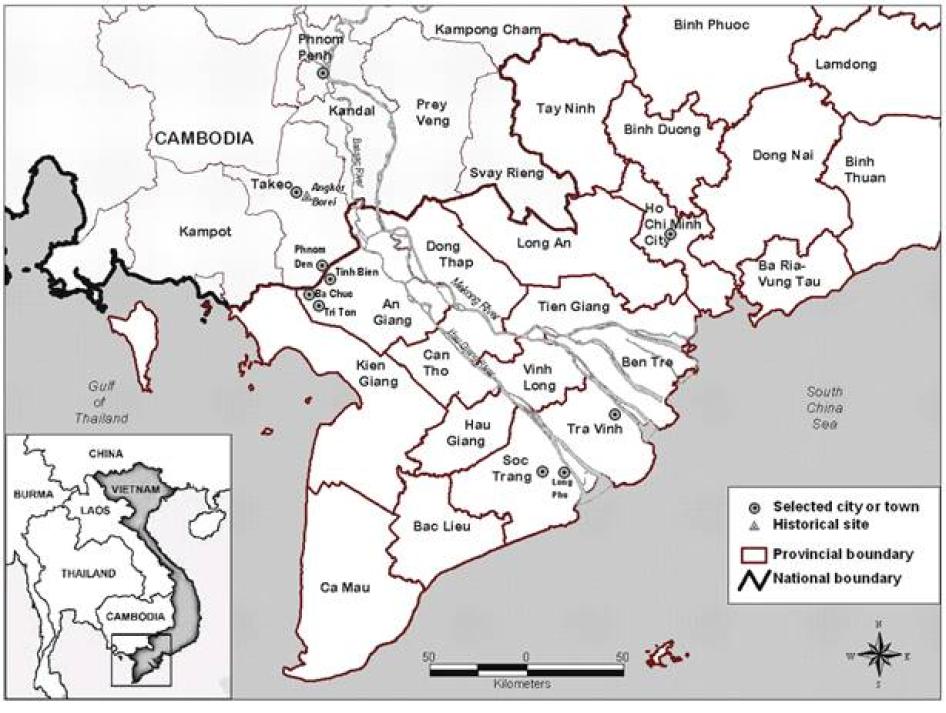
Map: 2008 Human Rights Watch
I. Summary
First the police interrogated me every day, then a couple of times a week. Sometimes they questioned me from morning until 10 p.m. at night--I wasn't allowed to go home.… They slapped the back of my head with their palms and hit me with rolled-up paper. They asked many questions and tried to frighten me by showing me handcuffs.… The confession letter was already written. They forced me to copy what they wrote. If not, they would not allow me to eat or go home. I am not against the Vietnamese government. I abide by Vietnamese law. But they said I was not loyal to the nation.
--Ethnic Khmer Buddhist monk defrocked and placed under house arrest after participating in a peaceful protest in Soc Trang Province in 2007
On February 8, 2007, long-simmering discontent among ethnic Khmer Buddhists in Vietnam over government restrictions on religious freedom and inadequate Khmer-language education led to a rare public protest. Riding on the back of motorcycles and streaming on foot out of a Buddhist Pali School, more than 200 Buddhist monks took to the streets in Soc Trang provincial town. Although the protest was conducted peacefully and lasted just a few hours, the government responded harshly, arresting and dismissing at least 20 monks from the monkhood, and imprisoning five.
The government's response to the protest provides a window into the severe and often shrouded methods used by the Vietnamese authorities to stifle dissent, particularly ethnic-based grievances and demands for religious freedom.
This report details ongoing violations of the rights of the ethnic Khmer minority in southern Vietnam--commonly referred to as Khmer Krom--and the ramifications for ethnic Khmer living across the border in Cambodia and Khmer Krom seeking asylum there.
Drawing on eyewitness interviews in both countries and internalVietnamese government documents, our research shows that Khmer Krom in the Mekong Delta face serious restrictions on freedom of expression, assembly, association, information, and movement. The Vietnamese government prohibits most peaceful protests, bans the formation of independent associations advocating for human rights, and tightly controls all religious organizations. Wary about the possible nationalist aspirations of the Khmer Krom, the Vietnamese government is quick to suppress peaceful expressions of dissent. Adding to tensions in the Mekong Delta, increasing numbers of Khmer Krom farmers are protesting and petitioning the government about the loss of their farmland.
Restrictions on the rights of Khmer Krom in Vietnam have consequences across the border on Khmer Krom who have moved to Cambodia.[1]As a nation whose majority ethnic group is Khmer, the Cambodian government has traditionally been tolerant of Khmer Krom from Vietnam, allowing many to freely cross the border to live, work, or study. The Cambodian government has repeatedly stated that it considers Khmer Krom who have left Vietnam and moved to Cambodia to be Cambodian citizens, which means they should be subject to full protection by the Cambodian state under its Constitution and laws. Yet the Cambodian authorities often react harshly when Khmer Krom become too critical of Vietnam, a close ally of the Cambodian government. After Khmer Krom activists in Phnom Penh conducted a series of demonstrations in 2007 calling for the release of Buddhist monks imprisoned in Vietnam, the Cambodian government began to forcefully disperse such protests and tighten up on other basic freedoms of Khmer Krom living in Cambodia.
The crackdown in Vietnam
The Khmer Krom monks who protested in Vietnam in February 2007 were calling on the government to lift restrictions on the number of days allowed for certain Khmer religious festivals and to allow Khmer Buddhist leaders--not government appointees--to make decisions regarding ordinations of monks and the content of religious studies curricula offered at pagoda schools. The monks also called for more Khmer-language education, primarily at the secondary level, and for course material to include Cambodian culture, history, and geography.
Despite pledges by officials during the protest to address the monks' concerns, within days police surrounded the pagodas of monks suspected of leading the protest and ordered the monks to remain there. Sending a strong message to those who had joined the protest, local authorities and government-appointed Buddhist officials subsequently defrocked at least 20 monks and expelled them from their pagodas. The decision to force a Buddhist monk to give up his saffron or burgundy robes, thereby dismissing him from the monkhood, is traditionally made by the Buddhist community of monks (sangha), and not government officials.
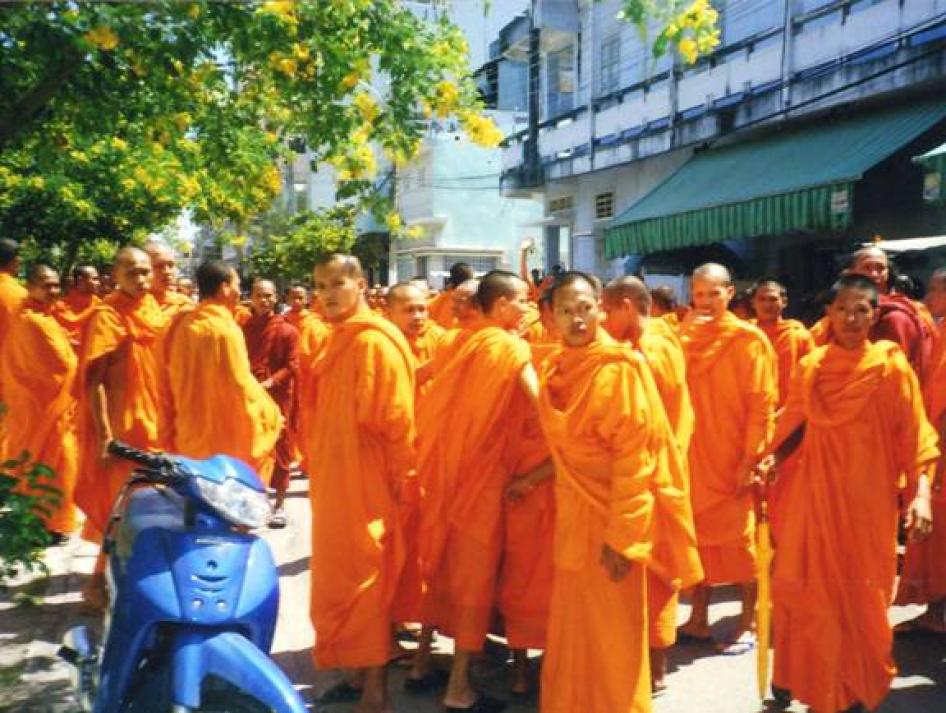
Buddhist monks on their way to Soc Trang town,where they conducted a peaceful protest in February 2007. ©2007 Private
The authorities then sent the defrocked monks to their home villages, where they were placed under house arrest or police detention, without issuing arrest warrants or specifying the charges against them. During interrogations, police beat some of the monks. On May 10, 2007, five monks were sentenced to prison terms of two to four years by the Soc Trang Provincial Court. Another 25 monks were expelled from the Pali School and sent to their home pagodas, where they were placed under surveillance.
The monks' demonstration came at a time of growing desperation by Khmer Krom farmers in the Mekong Delta who are increasingly facing landlessness and poverty. Lacking effective and equitable legal recourse to contest government confiscation of their land-Vietnam does not have an independent judiciary--in 2007 and 2008 Khmer Krom farmers increasingly began to conduct land rights protests in the Mekong Delta, with clashes breaking out on occasions when police officers forcefully dispersed the demonstrations. For example, on February 26, 2008, police used dogs and electric batons to break up a land protest in An Giang Province. Several protesters were injured and nine arrested.
These events were little noticed outside the area at the time. This is not surprising, as they took place in a remote corner of southern Vietnam where there is no independent media and few outsiders venture. Numbering at least one million, the Khmer Krom live in the Mekong Delta region in the southern tip of Vietnam. In contrast to the vast majority of Vietnamese--ethnic Kinh people, who mostly follow Mahayana Buddhism or Roman Catholicism--Khmer Krom are Theravada Buddhists. Many see this form of Buddhism as the foundation of their distinct culture, religious traditions, and ethnic identity.
After the 2007-2008 demonstrations by Khmer Krom Buddhist monks and farmers, the atmosphere became more tense and repressive in the Mekong Delta. In addition to arresting monks and land rights protesters, authorities instituted stricter surveillance of Khmer Krom activists, restricted and monitored their movements, banned their publications, and bugged their telephones.
The most negative impact of the government's response, one Khmer Krom Buddhist abbot from Vietnam told Human Rights Watch, was the arrest and defrocking of the monks. "It is very painful for Khmers when monks are arrested," he said. "Monks are the symbol, the heart of the Khmer people."
Ethnic grievances
Vietnam's official stance towards the ethnic Khmer minority, as one of the country's 54 officially recognized ethnic groups, is to support their right to use their own languages, encourage the preservation and promotion of their ethnic identity and traditions, and implement poverty reduction and economic development programs in areas where they live. In the Mekong Delta the government has provided land and housing to low-income Khmer people, supported industries to create more jobs for Khmer workers, and made financial contributions to some Khmer Buddhist pagodas for renovation.
While some Khmer Krom acknowledge these efforts by the Vietnamese government to support their culture and improve their livelihood, all of the Khmer Krom Buddhist monks and activists interviewed by Human Rights Watch stressed that fundamental issues have yet to be resolved. Compared to Vietnam's seven other geographical regions, the Mekong Delta has the largest number of low-income people in Vietnam (4 million), the highest rate of public school drop-outs, and the second-highest level of landlessness in the country.
Khmer Krom interviewed by Human Rights Watch say that discrimination against them by the Vietnamese government denies them equal rights and opportunities afforded to the majority Kinh population. They say the government bans Khmer-language publications about their history and culture, places restrictions on Buddhist practices, punishes them for peaceful protests or contacts with Khmer Krom advocacy groups abroad, siphons off development aid intended for low-income Khmer Krom farmers, fails to provide sufficient Khmer-language public education, and offers virtually no legal recourse or compensation for confiscation of land.
Religious freedom
In Vietnam, freedom of religion is perceived as a privilege to be granted by the government rather than as an inalienable right, and religious activities deemed to threaten the authority of the Vietnamese Communist Party are banned or carefully monitored and controlled.
Some Khmer Krom Buddhists say they would like to be able to manage and conduct their religious activities under their own monastic code, rather than being required by Vietnamese law--like all religions in Vietnam--to come under the oversight of a government-appointed committee. For Buddhists, this is the Vietnamese Buddhist Sangha (VBS) Executive Council, an organization dominated by government-appointed Mahayana Buddhist officials. It is the VBS--and not Khmer Theravada Buddhist leaders--that makes decisions regarding ordinations, religious ceremonies, and the content of religious studies curricula offered at pagoda schools.
As is the case with other religious adherents in Vietnam, government authorities impose restrictions on Khmer Buddhists, such as not allowing them to travel freely or transfer to another pagoda without official permission. As a young monk told Human Rights Watch, "If we want to move to another pagoda to study we need to write a letter and get permission; we are unable to study freely. For any ceremony, you have to apply for permission two months in advance."
From the Vietnamese government's perspective, religious groups that seek to operate independently of government-authorized committees and manage their own affairs undermine the party's authority. Vietnamese authorities respond harshly to demands for religious independence, particularly in regions such as southern Vietnam where religion has historically been perceived as linked to political movements or foreign powers that challenge the Communist Party's sway over popular allegiance.
Khmer Buddhists say that the defrocking of activist monks in Vietnam's Mekong Delta in 2007 was a serious breach of the Buddhist code, an issue beyond the scope of this report. However, government authorities, and not just Buddhist officials, took part in the decisions to defrock, with police cordoning off pagodas and providing security during monks' defrocking and placement under pagoda arrest. In analyzing defrocking as a human rights abuse, when conducted by government officials rather than a religious organization, it can constitute interference or limitation of the right to practice religion and religious belief. It can also be tantamount to a punishment imposed without any due process, and when conducted violently or in a particularly humiliating way, constitutes inhumane or degrading treatment.
The defrockings carry very serious social consequences as well. Monks interviewed by Human Rights Watch describe the process as extremely degrading, since it implies a very serious moral transgression. One monk was so distraught that he prepared himself for self-immolation. Monks were also filled with outrage at not being allowed to speak or defend themselves in front of their pagodas' congregations, as allowed by Buddhist monastic code. The defrockings also deprived the monks of the privilege of being supported and educated by the monastery, requiring them to support themselves while trying to continue their education in another fashion.
Cambodia's repression of Khmer Krom activists
In Cambodia, the Khmer Krom issue plays to one of the key flashpoints of Cambodian politics: intense and historical popular fear and resentment of Vietnam, and the fact that many Cambodians believe that the Cambodian People's Party of Prime Minister Hun Sen--installed after Vietnam's 1979 invasion that toppled the Khmer Rouge--continues to be under the political control of Vietnam. The Vietnamese issue, and in particular the sense that the once-glorious Angkorian Empire has been weakened over the centuries by Vietnam's acquisition of Cambodian territory, is the fault line on which virtually every popular opposition movement in Cambodia attacks the government, and an issue on which the Cambodian government is extremely sensitive.
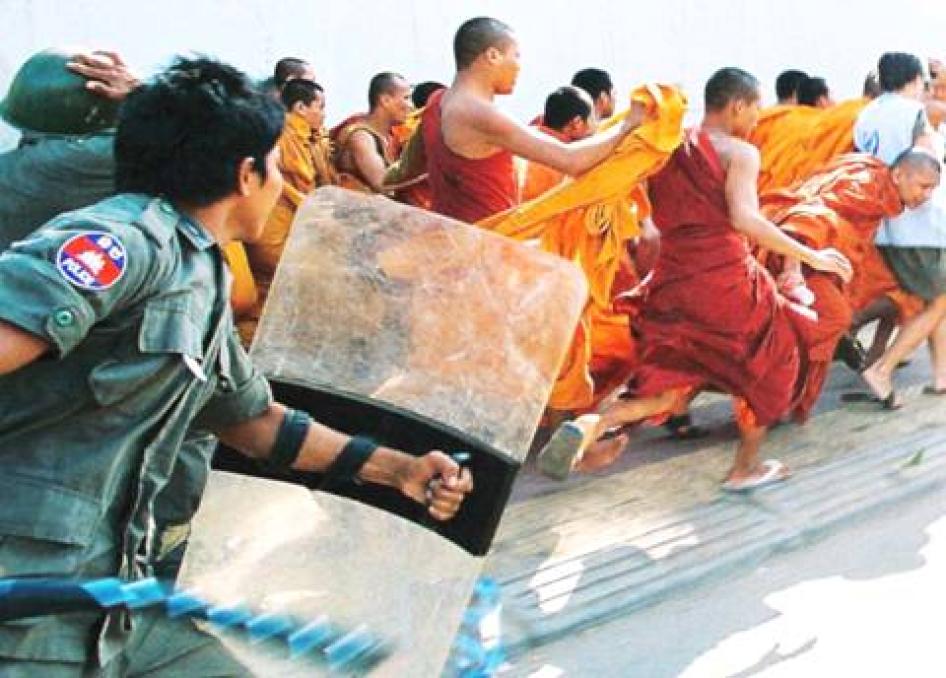
Cambodian riot police chased and beat Khmer Krom Buddhist monks after they tried to deliver a petition to the Vietnamese Embassy in Phnom Penh calling for greater religious freedom for Khmer Krom in Vietnam. ©2007 Heng Chivoan
Because of the affinity between most Cambodians and the Khmer Krom from Vietnam, Cambodian government officials have tolerated a degree of political activism by Khmer Krom in Cambodia--as long as it does not anger or jeopardize Cambodia's relations with Vietnam. However, after Vietnam's harsh response to demonstrations by Khmer Krom monks and land rights activists in 2007, the Cambodian government launched its own crackdown on peaceful protests by Khmer Krom monks after some fled to Cambodia and began to publicly denounce the abuses they had experienced in Vietnam. The murder of Khmer Krom monk Eang Sok Thoeun after he participated in a demonstration in Phnom Penh in February 2007 and the Cambodian authorities' involvement in the arrest, defrocking, and deportation to Vietnam of Khmer Krom abbot Tim Sakhorn in June 2007 sent a chilling message to Khmer Krom in both Vietnam and Cambodia. After being returned to Vietnam, in November 2007 a Vietnamese court sentenced Sakhorn to one year in prison under article 87 of Vietnam's penal code for "undermining national unity."
The repression of Khmer Krom activists in Cambodia and Vietnam had the desired effect of stemming the wave of public protests that in both countries occurred during 2007 and 2008. With neither Vietnam nor Cambodia providing sufficient protection for the basic rights of Khmer Krom, and government authorities in both countries continuing to harass, threaten, and monitor Khmer Krom activists, increasing numbers of Khmer Krom, including close to 50 Buddhist monks and 100 civilians, have fled to Thailand to seek refugee protection there.
The 2007-2008 Mekong Delta protests by Khmer Krom Buddhist monks and farmers, and the Vietnamese government's response to them, are not unique. In many parts of Vietnam, farmers are protesting the loss of their land and local corruption. Followers of other religions, such as Hoa Hao Buddhists, members of the Unified Buddhist Church of Vietnam, as well as Protestants, Catholics, Mennonites, and Cao Dai, face ongoing government restrictions on their religious activities and freedom of assembly. Ethnic minority communities who, like Khmer Krom Buddhists, seek to manage their own religious affairs, such as Hmong and Montagnard Christians in the central and northern highlands, continue to come into conflict with local authorities.
In Vietnam, where independent civil society organizations are not allowed to operate and freedom of association is sharply curtailed, religious organizations sometimes fill unmet needs. Independent religious leaders--such as Thich Quang Do of the Unified Buddhist Church of Vietnam, Mennonite pastor Nguyen Hong Quang, or Catholic priest Nguyen Van Ly--double as human rights defenders, often paying the price by being sent to prison. Religious gatherings, whether they are Buddhist festivals, Catholic prayer vigils, or Montagnard house church meetings, serve religious functions while also providing the space for networking, leadership building, and discussions about social issues.
In the parlance of the Vietnamese Communist Party, popular expression of grievances and any form of social unrest is blamed on conspiratorial plots by "hostile foreign forces" who misuse democracy, human rights, land conflicts, and religious freedom to manipulate and stir up opposition to the government among disaffected and marginalized groups.
The Vietnamese government tends to treat the phenomenon of ethnic-based grievances as evidence of separatist or irredentist movements. Indeed, many Khmer are fiercely nationalistic and resent the loss of ancestral territory in the Mekong Delta to Vietnam. In internal documents, the Vietnamese government has justified its efforts to infiltrate and undermine Khmer Krom groups in Vietnam by claiming they are demanding the creation of an independent nation. By conflating the numerous but localized land rights protests by Khmer Krom farmers in the Mekong Delta with separatist plots, the Vietnamese authorities have not only obstructed justice but set back the prospects of achieving their goal of national unity.
In addition, there is no evidence that the Khmer Krom monks who demonstrated in February 2007 were demanding territorial independence from Vietnam. To the contrary, the five monks were imprisoned on charges of causing public disorder by disrupting traffic, under article 245 of Vietnam's Penal Code, and their detailed indictment makes no mention of separatist demands (see appendix A).
Human Rights Watch takes no position on questions of self determination or the merits of arguments by ethnic Khmer who advocate return of the Mekong Delta region of Vietnam to Cambodia or those of the Vietnamese government that the delta is an integral part of Vietnam. We do, however, support the internationally-recognized right to peaceful protest, a right that Vietnam has also recognized by being a state party to the International Covenant on Civil and Political Rights. The existence of separatist aspirations expressed peacefully is no justification for breaking up demonstrations, defrocking monks, or imprisoning activists.
In December 2008 the Vietnamese government once again called on the national police force to strengthen measures to protect national security and social order, by thwarting public demonstrations and other "peaceful evolution" plots.
Until the Vietnamese government allows the right of peaceful dissent and independent religious and political activities, the situation is only likely to worsen. It should make a determined effort to create space for peaceful dialogue--rather than confrontation or crackdowns--in its relations with the Khmer Krom.
Key recommendations
Human Rights Watch urges the Vietnamese government to:
- Immediately and unconditionally release Khmer Krom Buddhist monks who have been imprisoned or placed under house arrest or pagoda arrest in Vietnam for the peaceful expression of their political or religious beliefs.
- Allow Khmer Buddhists to freely conduct peaceful religious activities in accordance with international legal standards.
- Lift restrictions on Khmer-language publications in Vietnam and end the banning and confiscation of Khmer Krom human rights advocacy materials, including videotapes and printed bulletins. Cease the harassment or arrest of people for disseminating such publications or videos.
- Cease harassment, intimidation, and imposition of criminal penalties on individuals who are in contact with international organizations, including groups that specifically advocate for the rights of Khmer Krom people.
- Allow UN special rapporteurs and human rights organizations to freely conduct field research in the Mekong Delta and monitor the human rights situation there. Allow international human rights organizations and UN agencies, as well as family members, to visit Khmer Krom prisoners.
Human Rights Watch urges the Cambodian government to:
- Abide by the 1951 Refugee Convention, to which Cambodia is a state party, by not returning individuals to countries where their lives or liberty would be threatened. Provide Khmer Krom who have fled from Vietnam and who are not granted Cambodian citizenship the right to seek asylum. Do not deport to Vietnam Khmer Krom with a well-founded fear of persecution in that country.
- Call on the Vietnamese government to allow Khmer Krom monk Tim Sakhorn, a Cambodian citizen who was released from one year's imprisonment in Vietnam on spurious charges in May 2008, to freely return to his home in Cambodia, should he choose to do so.
- Conduct a thorough investigation into the murder of Khmer Krom monk Eang Sok Thoeun in Kandal Province, Cambodia, on February 27, 2007, and bring the perpetrators to justice.
Methodology
This report is based on research conducted between December 2007 and December 2008. Detailed interviews were conducted in Khmer language with Khmer Krom communities in Vietnam, Cambodia, Thailand, Australia, and the United States.
Field research in Vietnam was conducted in March 2008 in the Mekong Delta provinces of Soc Trang, Tra Vinh, Long An, Vinh Long, Can Tho, and An Giang, where Human Rights Watch conducted interviews and conversations in Khmer with Khmer Krom Buddhist monks in their pagodas and with members of the Khmer Krom community. Human Rights Watch has withheld all identifying details of these persons to protect their safety.
Conducting such research carries risks for both interviewer and interviewee. The Vietnamese government does not allow international human rights organizations to conduct research openly in Vietnam without being monitored and escorted by government officials. Vietnamese known to have provided information to human rights organizations face surveillance, interrogation, physical abuse, detention, and imprisonment. Given this reality and in order to protect interviewees from reprisals we did not seek government approval before conducting interviews, limited the time we spent in any given town or in any given interview, and limited the number of interviews. Such constraints inevitably limit our ability to present a full picture. We hope that the government of Vietnam will in the future enable research and inquiry into human rights practices without restriction or sanction.
Research in Cambodia was conducted between December 2007 and November 2008. Detailed individual interviews were conducted with 16 Khmer Krom Buddhist monks, including five who fled the Vietnamese government crackdown after the February 2007 protests. Most of these interviews were conducted individually in private areas of Buddhist pagodas in Phnom Penh. In addition, lengthy conversations took place with four Khmer Krom Buddhist monks in group settings or in public areas of pagodas, where the conversations could be observed but not overheard by others. In Takeo Province, Cambodia, Human Rights Watch conducted five detailed individual interviews and held conversations with five other Khmer Krom people. Human Rights Watch also conducted eight private interviews with Khmer Krom human rights monitors and Khmer Krom Buddhist student activists in Phnom Penh and in Takeo, some of whom have lived in Cambodia since 1979 and others who have arrived since 2005.
In Thailand Human Rights Watch met with three Khmer Krom asylum seekers who fled from Vietnam and Cambodia to register with the offices of the UN High Commissioner for Refugees in Bangkok. Human Rights Watch also held discussions in Canberra and Melbourne, Australia, in December 2008 with Khmer Krom monks and human rights activists from Australia, New Zealand, France, Canada, Cambodia, Vietnam, and the United States.
All those interviewed were informed of the purpose of the interview, its voluntary nature, and the ways in which the data would be used, and orally consented to be interviewed. All were told that they could decline to answer questions or could end the interview at any time. Participants did not receive any material compensation.
Human Rights Watch sought the perspective of the Vietnamese government in a letter sent by fax on September 12, 2008, to the Vietnamese Minister of Foreign Affairs, copied to the Vietnamese Permanent Representative and Deputy Permanent Representative to the United Nations, the Vietnamese Ambassador to the United States, and the Chairman of Vietnam's Committee for Ethnic Minority Affairs. A response from Vietnamese Ambassador Le Cong Phung was received by Human Rights Watch on October 27, 2008. (See appendices E and F for copies of the letters.)
Other sources we consulted included official Vietnamese government documents, internal memos circulated by the Communist Party of Vietnam; news articles from the Vietnamese state press, Cambodian media, and international wire services; academic books, articles, and reports; and interview transcripts from Cambodian human rights organizations, Khmer Krom associations based in Cambodia and the United States, and the Office of the High Commissioner for Human Rights in Cambodia.
We also interviewed diplomats, academics, United Nations officials, and staff working for nongovernmental organizations (NGOs) in Cambodia and Vietnam; the former Chairman of the Cambodian National Assembly's Committee on Foreign Affairs, who led a delegation to Vietnam--including to the Mekong Delta--in November 2007; and staff from the US Commission for International Religious Freedom, which conducted a fact-finding mission to the Mekong Delta in October 2007.
II. Background
The ethnic Khmer minority in Vietnam, known as Khmer Krom ("lower Khmer"), live in the southern-most part of Vietnam, bounded by Cambodia, the Gulf of Thailand, and the South China Sea.[2] Many Cambodians still refer to the southern-most provinces of present-day Vietnam as Kampuchea Krom, or "Lower Cambodia" because they see it as part of the ancestral homeland of the Khmer people.[3]
This Mekong Delta region was formerly part of the Khmer Empire (9th-13th centuries A.D.), which at various times included parts of Thailand, Laos, and southern and central Vietnam. With the decline of the Khmer Empire, by the 17th century increasing numbers of ethnic Kinh, or Viet people, had begun to settle in what is currently the central and southern parts of Vietnam.[4] During the French colonial period (1867-1949), the Mekong Delta region was incorporated into the southwestern part of the French protectorate Cochinchina. In 1949 the French ceded Cochinchina to Vietnam.
The current population of the Mekong Delta's 13 provinces is 17 million, about one-fifth of the total population of Vietnam.[5] Ethnic Khmer, who number more than one million, are the largest ethnic minority group in the Delta, which is also home to Hoa (Chinese) and Cham minorities, in addition to the Kinh people.[6] Today, large numbers of Khmer live in the provinces of SocTrang (where they make up 30 percent of the population), Tra Vinh (30 percent), Kien Giang (13 percent), An Giang, Bac Lieu, Can Tho, Vinh Long, and Ca Mau.[7]
Nationalist movements
During the resistance against French rule in the 1940s, some Khmer Krom supported north Vietnamese Communist forces, or Viet Minh, who had formed alliances with the nationalist Khmer Issarak (Free Khmer) movement in the lower Mekong Delta and in Cambodia.[8] Other Khmer Krom supported the French, including some Buddhist monks who fought in local militias sponsored by the French.[9]
In the 1950s and 1960s, the Republic of Vietnam launched repressive assimilation campaigns, reinforced by a 1956 "nationalization" decree. The government ordered the closure of Khmer pagoda schools, discouraged the use of the Khmer language, and required Khmer Krom to take on Vietnamese surnames.[10] The Franco-Khmer school in Soc Trang was turned into a Vietnamese institution.[11] Republic of Vietnam President Ngo Dinh Diem, a Roman Catholic, implemented anti-Buddhist laws during his 1955-63 regime to restrict the growth of Buddhism throughout Vietnam, including in the Mekong Delta. Land reform policies, including government-sponsored migration of Kinh to the Mekong Delta provinces, deprived Khmer Krom of their ancestral lands.[12]
These "Vietnamization" efforts led to ethno-nationalist movements among the Khmer Krom.[13] They included the Kangsaing Sar, or "White Scarves"movement(Can Sen So in Vietnamese), which aimed to preserve Khmer Krom identity, and the Struggle Front of the Khmer of Kampuchea Krom, led by Khmer Krom Buddhist monk Chau Dara, which initially focused on calling for equal rights for Khmer Krom with the Kinh majority. In 1963 Chau Dara was arrested after the Front raised an army of about 1,500 soldiers and demanded that Vietnam "return" Kampuchea Krom to Cambodia.[14]
Various other ethno-nationalist movements followed among the Khmer Krom, as well as among the Cham, the former inhabitants of the ancient kingdom of Champa in central Vietnam, and ethnic highlanders (often called Montagnards or Dega) of the Central Highlands. These included the Struggle Front for the Liberation of Kampuchea Krom, the Front for the Liberation of Northern Cambodia, and the Front for the Liberation of Champa. In 1964 the Front for the Liberation of Champa and the Struggle Front of the Khmer of Kampuchea Krom merged with Bajaraka, a Montagnard ethno-nationalist group that was the precursor to FULRO, the United Struggle Front for the Liberation of Oppressed Races.[15]
Given the Khmer Krom's history of forming nationalist movements, as well as longstanding xenophobia and animosity between Khmer Kroms and ethnic Vietnamese, the present-day government of Vietnam is sensitive to the possibility of a Khmer ethno-nationalist movement re-emerging within its borders. The government is thus quick to suppress expressions of dissent or Khmer nationalism among Khmer Krom communities in Vietnam.
Engaged Buddhism
Buddhists have peacefully demonstrated for political change in Vietnam and Cambodia since before either country obtained independence from the French. Many prominent nationalists in the anti-colonial struggle were Khmer Krom intellectuals or former Buddhist monks born in southern Vietnam.[16]They recruited members into the movement by going on preaching tours in Khmer Buddhist temples in southern Vietnam and Cambodia in which they called for the preservation of Theravada Buddhism and exhorted people to join the independence movement.[17]
The anti-colonial movements of the 1940s included prominent Khmer Krom monks. In 1942 French colonial police violently cracked down on the "Umbrella War," a peaceful demonstration in Phnom Penh by more than a thousand Buddhist monks and lay people protesting the arrest and defrocking of Achar[18]Hem Chieu, a nationalist monk who had vehemently opposed the French proposal to romanize the Khmer alphabet.[19] The French colonial administration responded to the demonstration, which has been called "the first coordinated act of anti-colonial forces within Cambodia,"[20] by warning the Buddhist Institute and the Pali[21] School in Phnom Penh not to get involved in politics, and prohibiting monks affiliated with either institution to deliver sermons.[22] Many of the protesters fled to Thailand, and the Pali School was closed for more than six months.[23]Achar Hem Chieu was subsequently imprisoned at Poulo Condor (Con Son) prison in Vietnam, where he died in 1943.[24]
In the 1960s a number of Khmer Krom monks were assassinated or executed in Vietnam, including the abbot of Khleang Pagoda in Soc Trang Province in 1960, and the abbot of Chek Chroun Pagoda in Tra Vinh Province in 1963. Despite the repression of Khmer Buddhists, which caused many Khmer Krom to flee to Cambodia, in 1974 the Vietnamese government estimated that there were about 500,000 ethnic Khmer and more than 400 active Khmer pagodas in south Vietnam.[25]
In November 1969 several thousand police violently dispersed a peaceful demonstration in Saigon by 200 Khmer Krom monks from the Mekong Delta who were protesting the government's assimilationist policies. A number of smaller demonstrations by Khmer Krom monks took place in the Mekong Delta the following year.[26]
Some ethnic Khmer in Vietnam not only opposed the government in the south, but actively supported the communist movement.[27] After the reunification of Vietnam in 1975, the Socialist Republic of Vietnam recognized the wartime contributions that some Khmer Krom Buddhist monks and intellectuals had made towards the revolutionary effort and the independence movement that preceded it.[28]
After reunification
New policies on religion and land reform instituted after Vietnam's reunification in 1975, as well intense cross-border fighting between Vietnamese and Khmer Rouge troops in 1978-79, resulted in severe hardship for Khmer Krom communities in the Mekong Delta, including forced displacement from their land and restrictions on Buddhist ordinations and other Buddhist practices.
During the Khmer Rouge regime (1975-79) in Cambodia, however, Vietnamese authorities allowed Cambodian monks who had fled from Cambodia to take up residency in Buddhist pagodas in the Mekong Delta. After Vietnam ousted the Khmer Rouge in 1979, many of these monks returned to Cambodia under the auspices of the Vietnamese government to facilitate the re-ordination of monks in Cambodia's Buddhist sangha,[29] which had been decimated by the Khmer Rouge.
In the mid-1980s the Vietnamese government adopted a more repressive stance towards Khmer Buddhists, based in part on suspicions they were linked to underground movements to topple the new regime, according to Buddhist scholar Ian Harris:
By this time Khmer Krom monks needed an identity card to travel anywhere. In 1984 many monastic libraries were confiscated and monks involved in teaching about Buddhism and Khmer culture were imprisoned. It seems that the Vietnamese believed the Khmer Krom were involved in a subversive organisation, which they called KC-50. The movement was supposed to be backed by the US and sought to reinstate the previous non-communist government. Some 72 Khmer Krom intellectuals, including many monks, were arrested in the campaign against KC-50. The worst suppression occurred in Tra Vinh Province (Preah Trapeang) and this explains the case of Khim Tok Choeng, the chief monk of Preah Trapeang, who was arrested in 1985. His body was finally returned in a sealed Vietnamese-style coffin, his fellow Khmer Krom believing that he had been murdered by having his stomach cut open. Other monks killed around the same time in a similar manner include Vens. Thach Kong, Thach Ret, and the … President of the Central Committee of Theravada monks in Vietnam, Kim Sang, of Wat Chantaraingsei, Ho Chi Minh City.[30]
While overt persecution of Khmer Krom Buddhists by the Vietnamese government abated during the 1990s, observers say that the government simply began to replace "hot" (i.e., forceful, direct, and blatant) approaches with "cold" methods--more subtle strategies to control Khmer Buddhists' freedom of movement, assembly, association, and religion.[31]
Landlessness
During cross border fighting in 1978-79, both Vietnamese troops and Khmer Rouge soldiers forcibly expelled Khmer Krom from their land along the Cambodia-Vietnam border. When the evacuees returned after 1979, many found their houses demolished and ethnic Vietnamese living on their land, making the original owners landless.[32] The Vietnamese government provided most families small plots of land on which they could rebuild their houses, but not land suitable for agricultural purposes, as one Khmer Krom farmer from An Giang Province, Vietnam explained:
There was no land for me to plant rice for my own family. Instead, there were state-owned collectives on land that had been private land before. It was very difficult to survive. The rice fields did not produce enough rice.[33]
A Khmer Krom Buddhist monk told Human Rights Watch:
They said the land is the government's--the people are allowed to just temporarily use it. But then the main people who took land were party cadre, police, and authorities. They collaborated with each other, and did not focus on the people.[34]
In 1988, as part of Vietnam's de-collectivization and the reforms associated with the doi moi (renovation) policy,[35] a household contract system was initiated for farmers, who were allocated specific plots of land under Politburo Resolution 10.
Under Vietnam's 1993 Land Law, the state still retains ownership of all land but provides rights to farmers using and occupying land, including the right to sell, exchange, transfer, lease, inherit, and mortgage their land use rights.[36] Farmers can obtain land use certificates, called "Red Books," which in theory protect them from illegal confiscation of their land.
Researchers have found that in practice, the 1993 Land Law has resulted in many low-income farmers like Khmer Krom selling their land to pay off debts or to simply make ends meet, especially with escalating costs of fertilizer, pesticides, and health care, combined with the declining price of rice.[37] The result has been increased speculation, fraudulent land transactions, and an escalation in land conflicts.
The Land Law stipulates that land disputes are to be resolved through conciliation by the provincial, district, or municipal people's committees. If any party disagrees with the decision of the people's committees they can appeal to higher government administrative bodies, or to the courts.[38] Despite the provisions of the law, many Khmer Krom farmers complain that corrupt local authorities are unresponsive to their land rights complaints or make biased decisions favoring ethnic Kinh or government officials' illegal or below-market value acquisition of their land.[39] As social scientist Phillip Taylor notes, the main disadvantage for many Khmer Krom "has been their limited recourse to the institutions of the state to press their claims, which has tended to back the claims of the settlers against the original inhabitants."[40]
Poverty
While the Mekong Delta is Vietnam's most productive rice-growing region, Khmer Krom reap little of the financial benefits. A study prepared for the government-donor-NGO Poverty Task Force linked poverty rates to ethnicity, finding that the Khmer Krom suffer the highest rates of poverty in the Mekong Delta, in part because they are left with only marginal soils to cultivate.[41]
Land reform policies of the 1980s and 1990s, which provided some "ownership rights" to people living and working on land for a certain amount of time, often left out Khmer Krom who had already been displaced from their land. Other Khmer Krom have sold or mortgaged their land because of their poverty or indebtedness.
Compared to Vietnam's seven other geographical regions, the Mekong Delta region has the largest number of low-income people in Vietnam (4 million) and the second-highest level of landlessness in the country.[42] According to the bilateral donor AusAID, the Khmer Krom are the most "economically and socially disadvantaged" of the three main ethnic minority groups living the Delta.[43]
Many Khmer Krom now work as hired farm laborers on others' land or have stopped working in the farming sector altogether, instead working as hired manual labor at low-income jobs such as portering or recycling that require low skill and educational levels.[44] There is a steady flow of young people leaving the Mekong Delta region to seek factory work in Ho Chi Minh City.[45]
Finding themselves increasingly deprived of land and a source of livelihood, and lacking effective legal avenues for redress, increasing numbers of Khmer Krom have taken to the streets in protest (see section IV, below).
Discrimination
The Vietnamese often sarcastically say that the Khmers are poor because we have too many festivals and traditions. In fact, it's not because of our traditions, but from the Vietnamese stealing the Khmer land.
--Buddhist monk from Soc Trang, December 2007
The Vietnamese government statesthat racial and ethnic discrimination "does not exist" in Vietnam, where "all ethnic groups have, from time immemorial, coexisted peacefully without racial conflicts and discrimination. All ethnic groups in Vietnam, regardless of their size, language, culture, history and level of development, have enjoyed the same rights in all aspects of life."[46]
An article in the state-controlled Voice of Vietnam radio touts government programs for ethnic Khmer:
It is as clear as daylight that more than 1.2 million Khmer people in the southwestern region are happily joining efforts to develop the economy and stabilize their lives… Over the past five years, the State has invested more than VND1 trillion (roughly US$59,000) in building infrastructure facilities for more than 200 communes inhabited by the Khmer. As a result, 108 Khmer pagodas have been built and refurbished, more than 60,000 poor Khmer households have been provided with land to build houses, more than 100,000 households have been granted loans worth VND150 billion (US$8,800) to develop production, and more than 80 percent of the households have had audio-visual equipment, and learned the Khmer language. Provinces densely inhabited by the Khmer such as Tra Vinh and Soc Trang have newspapers available in the Khmer language. Every year, traditional Khmer festivals are held with pomp and circumstance.[47]
Vietnam's 1992 Constitution affirms the rights of ethnic minorities. Article 5 states that the government forbids all acts of ethnic discrimination and guarantees the rights of ethnic groups to use their own language and writing systems, preserve their ethnic identity, and promote their own traditions and culture. Articles 36 and 39 authorize preferential treatment for national minorities in education and health care.[48] The National Assembly's Nationality Council formulates and coordinates minority policy, and a government ministry, the Committee for Ethnic Minorities and Mountainous Areas (CEMMA), oversees minority affairs, including poverty alleviation programs and tax incentives targeting minorities.[49]
Despite the existence of these official policies and programs, the perception of discrimination is widespread among Khmer Krom. Many Khmer Krom complained to Human Rights Watch that the government discriminates against them by not providing enough Khmer-language secondary education, banning Khmer-language publications about their history and culture, placing restrictions on Buddhist practices, punishing them for peaceful protests or contacts with Khmer Krom advocacy groups abroad, siphoning off development aid intended for Khmer Krom, and offering virtually no legal recourse or compensation for confiscation of their land. Phillip Taylor comments:
[N]or, despite mouthing a commitment to an ethnically diverse society, does the state provide concrete practical measures to allow the Khmer to preserve their culture. Indeed, some Khmer Krom [have] argued that camouflaged by a rhetoric of multiculturalism and symbolic gestures that make it appear that the state is trying to help the Khmer, the consistent effect of the state's policies has been to impoverish, isolate, render stupid their people and thereby extinguish their culture.[50]
The actual situation of the Khmer Krom is difficult to ascertain, given the restrictions Vietnam places on human rights research. However, the widespread perception among Khmer Krom of discrimination is itself a cause for concern, and has only been deepened by the government's efforts to deny there is a problem and forcefully punish those who complain.
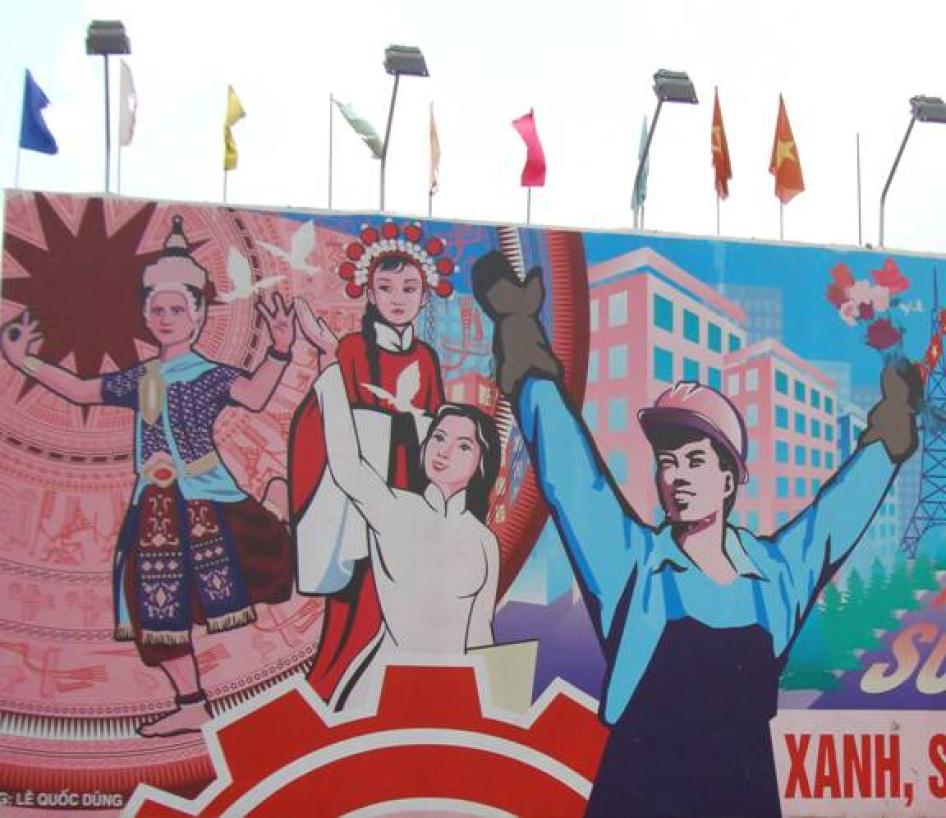
A government propaganda billboard in Soc Trang provincial town exhorts Vietnam's different ethnic minority groups, including a Khmer woman at the far left, to work together to build a beautiful, clean and "civilized" city. ©2008 Human Rights Watch
High illiteracy and school drop-out rates
People all around the world have the right to know their own history. But the Vietnamese government does not give this right to Khmer Krom. They try to dissolve Khmer Buddhism without spilling blood, by not allowing Khmer Krom children to learn their own language. If those children do not know Khmer culture, history and language, they will automatically become Vietnamese.
--Khmer Krom Buddhist student activist, December 2007
At the root of many of the complaints of discrimination is the fact that Khmer Krom are disproportionately poor in the Mekong Delta, and disproportionately lacking in education, two conditions that are mutually reinforcing. Grievances about education, described in the following section, reinforce the sense of marginalization among Khmer Krom in Vietnam.
Many Khmer Krom believe that the government's educational policies are designed to assimilate them into the mainstream society of the majority Kinh population, thwart them from accessing higher education, and weaken the foundation of their culture: the Khmer language.
While the Mekong Delta has a higher percentage of primary and secondary schools than Vietnam's seven other regions, it has the second lowest adult literacy rate and the lowest level of public school enrollments in Vietnam--with one-third of the nation's school drop-outs coming from the delta.[51] Eighty-three percent of the general work force--and 96 percent of the low-income population--lack a high school education.[52]
Poor school attendance rates, created in part by low-income Khmer Krom families needing their children to contribute towards the household economy, contribute to the ongoing cycle of poverty.
"Most of the students with bad learning capacity are of Khmer minority; they cannot speak Vietnamese well and cannot follow the study curriculum," said one teacher in Tra Vinh.[53] Another teacher said that Khmer students were "afraid of school." Unable to speak Vietnamese, they cannot understand the teachers, the teacher said.[54] Khmer Krom students put it this way: "We lack the fees to attend school, we struggle with the language, and schools are frequently located far from our homes."[55]
A 2003 poverty AusAID assessment of the Mekong Delta, which found that many low-income Khmer Krom children do not finish school, recommended that the school system be modified to make it "more accessible, both socially and linguistically, to Khmer students."[56]
The Vietnamese government's stated policy is to encourage all ethnic groups to learn Vietnamese, the national language, while recognizing the right for ethnic minorities to study and use their own written and spoken languages.[57] Government education policies and Vietnam's Law on Education entitle ethnic minority students to full or partial exemption from school fees, as well as scholarships to study at ethnic minority boarding schools.[58]
However, the reality is that Khmer Krom students, in addition to struggling with Vietnamese language, typically do not become well-educated in Khmer language either. Public schools in the Mekong Delta conduct the vast majority of classes in Vietnamese, with at most only two hours a week for Khmer literacy classes.[59]
For most Khmer Krom the only way to learn to read and write Khmer is to study at Pali schools run on a volunteer basis by Khmer Krom monks at Buddhist pagodas or to become a Buddhist monk. This rules out Khmer literacy and education for most girls, who are not allowed to become monks and traditionally are not educated at pagodas. At one Khmer pagoda in Tra Vinh visited by Human Rights Watch, for example, of 50 primary school students studying at the Pali School there, only two were girls. At another pagoda school in Soc Trang, Human Rights Watch found that Khmer Krom students, whose ages ranged from 6-12, could speak Khmer fluently but not one could write their names in Khmer and only one or two could recognize letters of the Khmer alphabet.[60]
III. Crackdown on Protests in the Mekong Delta
I had prepared myself for self-immolation. I had a lighter and gasoline bottle. I'd wrapped my body in cloth already. If they did not comply with my proposals, I would immolate. I said, "If you don't comply, if my body is burned, you will have to take responsibility." I was distraught because I had not done anything wrong.
--Khmer Krom Buddhist monk who was arrested after participating in the peaceful protest in Soc Trang in February 2007
The February 8, 2007, protest by Buddhist monks in Soc Trang had its origins in long-simmering discontent by Khmer Krom Buddhists about government restrictions on religious freedom, freedom of movement, and inadequate Khmer-language education. Prior to the protest in Soc Trang, Buddhist monks in neighboring Tra Vinh Province had conducted a smaller rally on January 19, 2007, to protest the detention of a monk for possessing copies of a bulletin published by an overseas advocacy group, the Khmers Kampuchea-Krom Federation (KKF).[61]
The following in-depth account of the 2007 protests in Tra Vinh and Soc Trang provinces and the government's response to them provides a window into the severe and often shrouded methods used by the Vietnamese authorities to stifle dissent.
Pressure on Buddhist activists in Tra Vinh
Towards the end of 2006 tensions began to grow between Khmer Krom Buddhist monks and government authorities in the Mekong Delta. Monks in several pagodas began to be harassed and come under surveillance for alleged contact with overseas Khmer Krom groups, particularly the KKF, and distribution of KKF advocacy materials such as newsletters and video cassette disks (VCDs).
In November 2006 Tra Vinh provincial authorities summoned a Khmer Krom monk from Kanchong Kompong Lieu Pagoda for questioning for two days. They accused him of forming a dissident group, the Khmer Krom Nationalities Union,[62] and threatened him with imprisonment for allegedly opposing the government.[63] After the Bureau of Religious Affairs issued an order on November 24 forbidding him from leaving his pagoda, even for religious ceremonies, the monk fled from Vietnam.[64]
In December police raided Kanchong Kompong Lieu Pagoda, confiscating bulletins and disks produced by the KKF and placing three monks under pagoda arrest.[65] On December 31, 2006, police arrested a monk from Ta Sek pagoda in Soc Trang. He was detained for a full day and interrogated by officials from the Ministry of Religion, Ministry of Interior, police, and local officials about other monks and their activities.[66]
On January 17, 2007, police detained Thach Thanh, a monk from Kanchong Kompong Lieu Pagoda, for three days after he picked up copies of the KKF bulletin from the Pali Middle School in Soc Trang town.[67]
Other monks wrote a letter to the authorities, calling for Thach Thanh's release. When there was no response, on January 19, about 50 monks from various temples gathered at the commune center in Tra Vinh, where they conducted a peaceful rally from 1 to 3:30 p.m.
As a result police released Thach Thanh, on condition that he admit that he had wrongfully imported anti-government materials from abroad. Within days, however, police summoned for questioning two monks suspected of leading the protest in support of Thach Thanh.[68] Police placed Thach Thanh and the two monks under pagoda arrest and threatened them with defrocking and imprisonment for possessing the KKF bulletin.[69] "Kakada," one of the monks arrested at that time told Human Rights Watch:
When we protested the authorities promised to find a solution but instead they arrested more monks and accused them of disseminating documents.[70]
On January 20, 2007, officials from Hanoi and the provincial Buddhist committee[71] convened a large meeting in which they pressured "Kakada" to confess:
They said if I wanted to remain a monk I had to confess and admit my mistake. Otherwise I would be defrocked. I said no, what I did was legal under Vietnamese and international law. I had not committed any mistake.[72]
The three monks remained under pagoda arrest for more than three months. During that time, police, local authorities, and Buddhist officials repeatedly interrogated them about who their leaders were and accused them of trying to stir up trouble by organizing the protest. In April 2007, religious officials defrocked all three monks.[73]
The 2007 Buddhist protest in Soc Trang
By the end of January 2007, Buddhist monks from a number of different pagodas in Soc Trang Province had been quietly conducting meetings to plan for another, larger protest to call for religious freedom--including the lifting of restrictions on the number of days for celebration of the annual Kathin ceremony,[74] in which lay people give new robes and other offerings to Buddhist monks--and a broader Khmer-language and history curriculum at the Pali Middle School in Soc Trang.[75] Many of the planning meetings were held in Tuk Prae Pagoda in Long Phu district, about 20 kilometers east of Soc Trang provincial town.[76]
On the evening of February 7, approximately 150 monks from 14 pagodas in Long Phu district gathered at Tuk Prae Pagoda in advance of a protest tentatively planned for the next day.[77]
It is not clear whether the 200 monks and novices at the Soc Trang Pali School--who come from half a dozen provinces in the Mekong Delta--had originally intended to join the protest.[78]
The situation changed, however, on the morning of February 8. At 10 a.m. police--who had gotten wind of a possible demonstration and were worried that the Pali School students would join in--blocked the entrance to Khleang Pagoda, where the school was then located, as more than 100 monks attempted to leave the compound to collect their morning alms.[79]
Hearing the news, the monks who had gathered at Tuk Prae Pagoda the night before headed towards Soc Trang town on motorcycle taxis. They were led by several monks, including Kim Muol[80] and Ly Soeung. On the way, traffic police stopped the motorcycle transporting Kim Muol, in what authorities later said was a routine driver's license check.
As word spread that the authorities had prohibited the monks from Khleang Pagoda from going out to collect alms, more monks headed to Soc Trang, where they gathered at the provincial police station. Kim Muol, only briefly detained by police, joined them there. According to the final indictment by the Soc Trang People's Court, obtained by Human Rights Watch:
Although the police did not question the monk who was riding [as a passenger on the motorcycle] a number of adherents gathering in front of Khleang Temple took advantage of this incident to falsely accuse the police of preventing them from going out to collect alms, and afterwards organized a rally in front of the municipal police station.[81]
As morning classes ended at the Pali School at 11 a.m., the monks and novices were finally able to leave Khleang Pagoda, with more than 100 joining the rally at the police station.
The crowd of monks now numbered more than 200. Some waved Khmer Krom Buddhist flags. According to the indictment, the monks shouted various slogans:
'Are youhungry?' 'Yes, we are!'
'Why are you hungry?''Because of the traffic police!'
'Who made you hungry?' 'The traffic police!'
'Are you tired?'[no response recorded]
'Why are you here?' 'We're hungry!'
'You are out in the sun--can you take it?' 'No, but we'll try!'
'Are you united?' 'Yes, we are!'
'Whatdo you want?' 'Equal rights!'[82]
Several monks representing the protesters asked that the police chief come out to address their complaint about the police prohibiting monks at Khleang Pagoda from begging alms that morning. They also demanded that authorities from the Religious Affairs Committee and the Pali School address the issues of religious freedom--including allowing Khmer Krom pagodas to operate under Buddhist, not government, authorities--cultural preservation, and human rights in general for Khmer Krom people.[83]
Provincial authorities, including the head of the Mekong Delta Nationalities Committee, the chairman of the Soc Trang Religious Affairs Bureau, as well as Duong Nhon, the chairman of the Soc Trang Solidarity Association of Patriotic Buddhist Monks and principal of the Pali School, arrived to try to convince the demonstrators to disperse.[84] It is not clear what promises the authorities made to the monks, but by 4 p.m. the monks had returned to their pagodas.
Government officials immediately took steps to identify and punish the leaders of the protest. Police surrounded pagodas of suspected protest organizers in Soc Trang, placing the monks under surveillance and barring them from leaving their pagodas. Within days, officials from the Vietnam Fatherland Front,[85] the provincial Buddhist Sangha Executive Council,[86] and the provincial Bureau of Religious Affairs began to convene meetings in different pagodas to determine the cause of the demonstration and identify the ringleaders.[87]
Pagodas under siege
To avoid defrocking, two monks who had been identified as protest leaders barricaded themselves in the central sanctuary (vihear) of their pagoda for the next 12 days. There was no water for washing and they had to defecate inside the vihear. One of the monks, "Ponleak," told Human Rights Watch:
Many officials were at the pagoda. They sent in letters in falsified handwriting of the abbot asking me to please go and negotiate with the authorities. They tried to use decoys to get me out and arrest me. They called from outside: 'Don't worry, we won't do anything.' I said, 'If you want to negotiate, please provide a written summons. If you do not have proper legal papers, you can bring me somewhere or kill me without anyone knowing.'
I had three conditions: no defrocking, no handcuffs, and we should have the right to speak during negotiations.
I had prepared myself for self-immolation. I had a lighter and gasoline bottle. I'd wrapped my body in cloth already. If they did not comply with my proposals, I would immolate. I said, 'If you don't comply, if my body is burned, you will have to take responsibility.' I was distraught because I had not done anything wrong.[88]
On February 22 the two monks finally left the vihear. They were brought to a meeting in the sala (central meeting hall) of the pagoda, which was filled with government officials¾including high-level cadre from Hanoi¾Buddhist clergy, and lay people. Riot police from Unit 113 surrounded the pagoda. "Ponleak" told Human Rights Watch:
The officials asserted that I did not respect the authorities and had opposed the government. They had no evidence at all.
I said that defrocking must be conducted according to the law. But not only did they violate the law, they violated my right to speak in my own defense and threatened to throw me in jail. They threw me and the other monk into a truck and sent us to Khleang Pagoda, where we were defrocked.
They did not follow the law of Buddhism when they defrocked us. It was not a proper ceremony. They had us take our robes off and then just threw civilian clothes into the room.[89]
Monks defrocked
From February 21 through May 2007, government and Buddhist authorities defrocked at least 20 monks, with 10 monks defrocked from February 21-26 alone.
At 2 a.m. on February 21, authorities defrocked three monks from Tuk Prae Pagoda, followed several hours later by the defrocking of two monks from Sam Rong Pagoda.[90] An eyewitness described the defrocking of one of the monks:
No sooner had he tried to negotiate and protest with the monks from the Buddhist Rules Committee, than the chief of the Soc Trang provincial department for ethnic affairs and former head of the provincial bureau for religious affairs, rushed at him and forcibly pulled his robes off his body, giving him a shirt and trousers to wear. It is painful to remember this.[91]
The next day, February 22, authorities brought four monks (two from Serey Tamoeun Pagoda and two from Ta Sek Pagoda) to the dormitory of Khleang Pagoda, where they were defrocked.[92] On February 26 a monk from Karon Pagoda in Can Tho Province was defrocked in his home village in Bac Lieu Province.[93]
"Russey," one of the monks defrocked in February described what happened:
There were 70 policemen and officials in my temple. I saw the situation was bad and ran to my room. They surrounded my room for one day. They tried to break the door. I was very thirsty, stuck in there with no water. The chief of the provincial monks and five other monks tried to persuade me to 'work' with them [answer their questions]. When I went out to talk with them, the intervention police [unit 113] arrested me.[94]
After defrocking the monks, police then arrested those they concluded were the main ringleaders. On February 23 police arrested and interrogated Ly Suong, Thach Thuong, Ly Thanh Suy, Kim Muol, and Thach Do. On February 26 Danh Tol[95] from Karon Pagoda in Can Tho Province was arrested, followed by the arrest of Ly Hoang on April 20. Ly Thanh Suy and Thach Do were later released to house arrest in their home provinces; the other five were sentenced to prison on May 10.
Between March and May 2007, at least 10 more monks under pagoda arrest were defrocked. They included the abbots of two pagodas in Long Phu district, Soc Trang, and at least four monks from Tra Vinh: three who had been placed under pagoda arrest in January 2007 after the Tra Vinh protest, and a 17-year-old monk from Kanchong Kompong Lieu Pagoda after he attempted to photograph the defrocking of another monk there.[96] In addition, another 25 monks were expelled from the Pali School and sent back to their home pagodas, where they were placed under the surveillance of local authorities. Other monks under pagoda arrest or threatened with defrocking managed to flee from Vietnam.
Surveillance and house arrest
After the authorities defrocked "Russey" in February, they sent him to the district police station in his home town, where police detained and interrogated him for four days: "They asked me, 'Who is the chief of the machine? Who led you?'"[97] After feigning illness, he was eventually allowed to return to his home.
"Ponleak" told Human Rights Watch he was sent to the provincial police station in Soc Trang after being defrocked. Police questioned him for one day, hitting him during interrogation.[98] Before being sent to his home village, where he was placed under house arrest, the police forced "Ponleak" and his parents to sign papers guaranteeing that he would not flee.[99] Once back in his village, police continued to interrogate "Ponleak" from late February through early May, when five other monks were put on trial. "Ponleak" told Human Rights Watch:
First they interrogated me every day, then a couple of times a week. Sometimes they questioned me from morning until 10 p.m. at night--I wasn't allowed to go home. There were three people: one in front, two on each side, plus a guard at the door. They slapped the back of my head with their palm and hit me with rolled-up paper. They asked many questions. I said you cannot force me to confess. I have told you the truth.
They tried to intimidate me--showed me hand cuffs. They used impolite and disparaging words to refer to me--'A' and 'aing.'[100] They threatened that if I didn't answer, I would never see my parents again.
The confession letter was already written. They forced me to copy what they wrote. If not, they would not allow me to eat or go home. This was very painful for me. I cannot confess to accusations that what I did was wrong. They said we were traitors of the nation. I am not against the Vietnamese government. I abide by Vietnamese law. They said I was not loyal to the nation. I replied that the Party and state were like my own parents; I always respect the law of Vietnam. Now you threaten me¾that's a violation of my rights. Then when I protest, you say I oppose the government.[101]
Pressure to spy
In addition to police and local authorities prohibiting some monks from leaving their pagodas, several monks said that police also pressured them to inform on other monks. "Kosal," a Buddhist abbot from Soc Trang told Human Rights Watch:
When I got back to my pagoda after joining the demonstration, I was placed under 24-hour surveillance. Police surrounded my pagoda, which was filled with local authorities. The police would follow me when I went out to beg for alms… Later the police said if I didn't want to be defrocked, I must 'work' with them. 'Your job is to follow the other monks' activities and make reports,' they said.[102]
After he refused to act as a police informant, police placed "Kosal" under pagoda arrest and prohibited him from leaving his temple, which was guarded by police. Despite requests by laypeople from the pagoda that he simply be demoted, not defrocked, on April 19 authorities defrocked "Kosal." They sent him to the commune office, where he was interrogated and photographed by police, and then sent to his home village, where he was placed under surveillance and house arrest. Police officers slung their hammocks next to his house and entered it twice a day to check up on him. As soon as he could, "Kosal" fled from Vietnam.[103]
Several other monks described similar pressure to monitor and inform on other monks. In an interview conducted by the Khmer Kampuchea Krom Community, a Khmer Krom organization in Cambodia, a Khmer Krom monk who fled to Cambodia after the February protests said:
A secret police man tried to get me to spy on a monk at Prasat Kong Pagoda… I didn't dare answer whether I agreed or not. They said if the monk did something I was to tell them, or if there was any strange person in the pagoda or someone from Cambodia, I needed to inform them. This made me very upset, so I fled to Cambodia.[104]
Mistreatment in prison
Of the 20 monks arrested and defrocked between February and May 2007, five remained in detention at Soc Trang provincial prison until May 10, when they were sentenced to prison. The five monks were Ly Hoang, 21, from Sam Rong Pagoda; Kim Muol, 22, from Ta Sek Pagoda; Thach Thuong, 25, and Ly Suong, 32, from Tuk Prae Pagoda; and Danh Tol, 26, from Karon Pagoda in Can Tho Province.[105]
During the monks' two-and-a-half month pre-trial detention, police interrogated them on almost a daily basis, sometimes from early morning until late at night. Some of the monks were beaten during interrogation. In a group letter written by the monks while in prison, they stated:
During the interrogation the Vietnamese authorities used all kinds of tricks and threats: beating us, trying to stir us up and misguide us, or make us lose our minds by using the sweet words of the Vietnamese devil savage tiger. They told us if we agreed to answer in the easy and honest way, they would reduce our sentence…
During interrogation they tried to find out who were the masters, the leaders, the ones who initiated [the protest] and determine all the reasons [for the protest]. Moreover they recorded all of our words on the telephone, between the telecommunication system inside the country and outside. There were at least 300 pages [of interrogation reports]![106]
Police singled out two monks in particular for beatings during interrogation:
Two monks were under the heaviest pressure: they shouted out because they were beaten very severely. It is painful to remember the treatment of Kim Muol by the interrogation cadre, who beat him and punched him twice, one blow on his breastbone and another on his face. It sounded like 'wham wham wham.' Then they grabbed him and tightly squeezed his head in their hands…[107]
Police continued interrogating the imprisoned monks even after their trial, summoning three of them for a "working session" [interrogation] lasting from July 4-6, 2007, in which they forced the monks to write a letter denouncing Khmer Krom activists in other countries.
A new indictment
Indicating the authorities' awareness of the political sensitivity of the case, a first indictment issued by the People's Procuracy (Prosecutor's Office) of Soc Trang Province dated April 2 was superseded by a final, re-worded indictment, dated April 20.[108] The recitation of facts and conclusions in the two indictments differ in several respects. Slogans shouted by the monks during the protest that are reported in the first indictment are deleted from the final indictment. While both indictments charge the monks with "causing public disorder" under Penal Code article 245, in the first indictment the two aggravating factors are "in an organized manner," suggesting conspiracy, and inciting others to cause disorder. In the second indictment, "in an organized manner" is dropped while "causing serious obstructions to traffic or interfering with public activities" is added. It is possible that judicial authorities re-wrote the first indictment, which includes wording that indicates the monks were conducting a political protest, to present the appearance that the arrest and imprisonment of the five monks was not for political reasons, but for violation of traffic laws.
The April 20 indictment lists seven defendants charged in conjunction with the February demonstration. These include five monks whom authorities arrested, defrocked, and placed in detention or house arrest after the protest. Arrest warrants were issued for two other defendants--a monk who was defrocked in February and a motorcycle taxi driver, both of whom had gone into hiding. The indictment states that the Pali School would take appropriate action against an additional six defendants for their involvement in the "riot." The status of these additional cases is unknown to Human Rights Watch.
The May 10 trial
On May 10, 2007, the five monks were sentenced to prison by the Soc Trang People's Court on charges of causing public disorder under article 245 of Vietnam's Penal Code for having "blocked traffic and activities in public areas and inciting people to cause disturbances." The court sentenced Danh Tol and Kim Muol to four years' imprisonment, Thach Thuong to three years, and Ly Suong and Ly Hoang to two years.[109] According to the April 20 indictment:
[D]efendant Danh Tol has been charged with fervently instigating the riot of Buddhist monks and adherents; Kim Muol, upon receiving news of the disturbance in the Soc Trang Municipality, also eagerly incited other monks from Long Phu to join the disturbance in the municipality, worsening the public order situation; and Ly Suong and Thach Thuong have demonstrated the words and behaviors of active accomplices. With regard to Ly Hoang, he directed the riot movements and contributed to severely causing public disorder by provoking the protesting monks and adherents to shout and make noise. Therefore, their criminal behaviors are considered dangerous to society and must be seriously tried before the court of law with the aim of educational deterrence and prevention for the entire society.
As one of the leaders of the protest who fled from Vietnam told Human Rights Watch:
We demonstrated for freedom of religion but they said we had caused social order and disrupted traffic. They did not talk about our demands. They accused us monks of being political, but in court the charges were traffic violations and social disorder.[110]
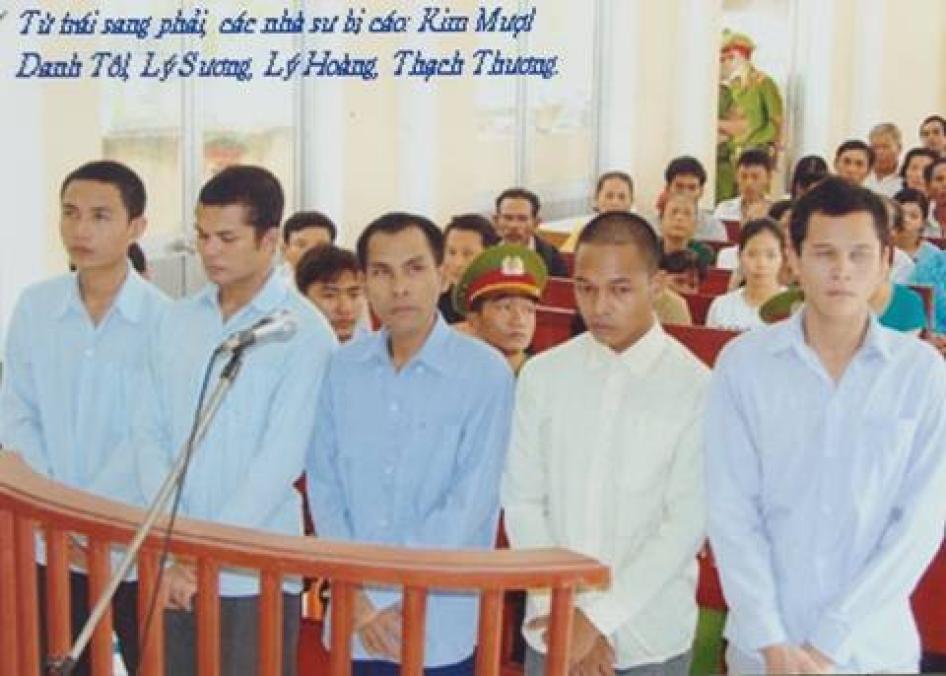
The five defrocked monks during their trial on May 10, 2007. Left to right: Kim Muol, Danh Tol, Ly Suong, Ly Hoang, and Thach Thuong. Ly Suong was released on November 21, 2008. ©2007 Private
Social consequences of forced defrocking
In a country such as Vietnam, where the majority of the population--not just Khmer Krom--follow Buddhism, Buddhist monks, pagodas, and religious practice play a key role in community life. Central to Buddhism is the principle of acquiring merit (bon), with the most valued way to do so being to become a monk. Women, who are not allowed to become monks, acquire merit if their sons enter the monkhood, even briefly, by attending religious ceremonies, observing holy days, and making offerings to monks. Part of the Kathin ceremony that is so valued by Khmer Buddhists is to give gifts to monks, particularly new sets of robes.
Upon entering the monkhood and donning the saffron or burgundy robes, Theravada Buddhist monks pledge to follow Buddhist precepts and discipline. Infraction of these rules is very serious, and can result in a monk being warned or put on probation. The more extreme step of forcibly defrocking a monk, dismissing him from the monkhood, and expelling him from the monastery is taken only for monks who have committed any of the four offenses (bap) that "defeat" a monk and require that he leave the monkhood: engaging in sexual relations, stealing, killing, or falsely claiming to possess superhuman powers.[111] The decision to force a monk to defrock is taken by the community of monks (the sangha), and not governmental officials.[112]
"The validity of these acts is premised on the understanding that they take place within the sangha," writes Harris. "Disrobing is the affair of fellow monks, not of the secular power."[113]
The Buddhist monastic code calls for such decisions to be made through a process called adhikarana-samatha, or the settlement of issues, which is analogous to due process and fair trial rights provided by secular justice systems:
Adhikarana-samatha stipulates, among other things, that an accused monk is to be tried by a community of peers to which he belongs or a committee of them, and that those monks can cross-examine the accused and the accused can defend himself.The same part of the code lists the various disciplinary measures that can be used against a guilty monk, which include, among other things, admission of a breach of discipline and promise not to repeat the act, probation and defrocking.[114]
The defrocking of the activist monks in Soc Trang and Tra Vinh provinces in 2007 was a serious breach of the Buddhist code, an issue beyond the scope of this report. However, government authorities, and not just Buddhist officials, took part in the decisions to defrock, with police sealing off pagodas during the defrockings and physically preventing monks from escaping from pagoda arrest. In analyzing defrocking as a human rights abuse, when conducted by government officials backed up by police, rather than a religious organization, it can constitute interference or limitation of the right to practice religion and religious belief. It can also be tantamount to a punishment imposed without any due process, and when conducted violently or in a particularly humiliating way, constitutes cruel, inhumane, or degrading treatment.
The defrockings carry very serious social consequences as well. Monks interviewed by Human Rights Watch described the process as extremely humiliating, since it implies a very serious moral transgression. They were also filled with outrage at not being allowed to speak or defend themselves in front of their pagodas' congregations, as allowed by Buddhist monastic code. Finally, the defrockings deprived the monks of the privilege of being supported and educated by the monastery, requiring them to earn a living or try to continue their education in another fashion.
Many Khmer Krom Buddhists were outraged by the fact that the authorities went far beyond Buddhist law in defrocking the monks. "Ponleak" described his anger at the process that led to his defrocking:
They pointed at me and another monk, and said we would be defrocked. They had videos of the demonstrations. I wanted to stand up to defend myself. They would not let me talk. I said, 'No matter what, I must be allowed to respond to the accusations against me.' But they had already convicted me--they had made their decision and said I must leave the monkhood.[115]
In response to queries by Human Rights Watch regarding the defrocking of monks for their involvement in peaceful demonstrations, the Vietnamese Ambassador to the United States wrote: "[W]hat can be iterated is that the discipline of monks who have violated religious rules and then are handled according to religious rules is an internal affair of the Vietnam Buddhist Sangha. It is our belief that those monks were dealt with in conformity with Buddhist Charter and rules of the Sangha."[116]
IV. Other Rights Problems Faced by Ethnic Khmer in Vietnam
Suppression of land rights protests
Nowadays in An Giang and Soc Trang the people are protesting about land. All Khmers from there have land problems. And any Khmer who hears about others protesting wants to join.
--Khmer Krom activist, December 2007
We want our land back. Promises were made, but they lied to us. Month after month, year after year, there was no result. When we raised our land problem with the authorities they made promises but never delivered. We said if there were no results, we would demonstrate.
--Khmer Krom protest leader from An Giang Province, June 2008
During 2007 and 2008, Khmer Krom farmers increasingly conducted land rights protests in the Mekong Delta provinces, with some traveling as many as 300 kilometers to Ho Chi Minh City to voice their complaints.[117] In Ho Chi Minh City, they joined peasants and farmers from all over Vietnam, who periodically conduct public rallies to protest land confiscation and local corruption in front of government buildings there.
The nationwide farmers' movement in Vietnam, known as dan oan, or "Victims of Injustice," began to attract international headlines in mid-2007. In one of the longest-running public protests in Vietnam in decades, thousands of landless farmers from 18 provinces--including every province in the Mekong Delta--camped out for almost a month in front of the National Assembly office for reception of public complaints in Ho Chi Minh City, awaiting official responses to grievance petitions they had submitted to the government.[118]
On July 18, 2007, police forcefully dispersed the protesters in Ho Chi Minh City. It is thought that the government decided to move against the protesters after prominent Vietnamese Buddhist monk Thich Quang Do from the banned Unified Buddhist Church of Vietnam (UBCV) left the pagoda where he has been detained for much of the last 20 years to distribute food relief and publicly express his support for the farmers.[119]
Despite the dispersal of the Ho Chi Minh City demonstration-- and the fact that the government severely restricts public protests in general in Vietnam--Khmer Krom villagers continued to conduct land protests.[120] Several Khmer Krom farmers were threatened with arrest after they attempted to demonstrate during the October 2007 visit to the Mekong Delta by representatives of the US Commission for International Religious Freedom.[121] On December 14 and 15, 2007, several hundred Khmer Krom demonstrators from An Giang and Soc Trang provinces protested at the National Assembly building in Ho Chi Minh City after unsuccessfully trying to get a response to their complaints from local officials.[122] Police broke up the demonstration by hitting and shoving the protesters into vehicles transporting them back to their homes.
Khmer Krom villagers say they are protesting in order to demand back or receive just compensation for land that corrupt officials have confiscated in recent years, or that was taken from them by Vietnamese cadre and civilians when Khmer Krom were forcibly evacuated from their land near the Cambodian border in 1977-78.
Farmers from Tinh Bien district, An Giang, explained their grievances in a petition to government authorities in January 2008:
We demand the return of our confiscated farmland because we currently don't have enough land for farming. We have been waiting since we were evacuated to Hau Giang Province after the Vietnam-Cambodia War. Since the evacuation, we have lost all our land and lived in poverty.[123]
The government response to land rights protests in the Mekong Delta became increasingly harsh during 2008.[124] On January 9, 2008, police used electric shock batons to forcefully disperse more than 60 Khmer Krom farmers from Tinh Bien district who had gathered in Long Xuyen city, An Giang, to deliver their petition to the Peoples' Committee.[125] The same day approximately 40 Khmer Krom farmers in Soc Trang marched to Can Tho City to voice their land rights complaints.[126]
Violence broke out again on February 24, 2008, when police reportedly set fire to the home of a Khmer Krom family resisting eviction and arrested the brother of the house owner.[127]
During February 2008 farmers from An Hao village in Tinh Bien district, An Giang, gathered at the village office, with some camping out there for several weeks, to press for compensation they said authorities had promised them for their land. On February 26, 2008, police used dogs and electric batons to break up the protest and force the demonstrators into vehicles to take them back to their homes. Several protesters were injured, and two women, Neang Don [Yon] and Neang Duon [Yuon], were arrested and imprisoned on charges of causing public disorder under article 245 of Vietnam's Penal Code.[128]
Nonetheless, on February 28 more than 100 Khmer Krom farmers from Tinh Bien marched to the village center again. While police blocked them from entering the village office, district and provincial officials came out to talk with the farmers, according to one of the protest leaders:
The police were armed with short guns, short knives on their belts--which they did not use. There was no violence, no one was wounded on either side, we just talked. We said we had complained for a long time, but there had been no results since December.[129]
In March 2008 more protests took place when Khmer Krom farmers from Chi Ka'eng village marched to Chau Laing commune center in Tri Ton[130] district, An Giang, to demand the return of 4,000 hectares of farmland belonging to 500 families.[131]
The demonstrations in An Giang came to a head in April 2008, a week before the traditional Khmer New Year celebrations on April 14. On April 7 there was a confrontation between several hundred Khmer Krom farmers and local authorities in Chi Ka'eng after authorities destroyed a bridge that villagers had built to provide access to their rice fields.[132] At 2 a.m. on April 8, 10 truckloads of riot police, as well as some soldiers, surrounded the village. Using teargas, they broke into the homes of two villagers they suspected of being ringleaders, ransacking their homes and severely beating family members with wooden and electric shock batons.[133]
Afterwards many villagers fled Chi Ka'eng, some going into hiding and others finding temporary refuge in the local pagoda, where the abbot tried to facilitate a solution with the local authorities, who reportedly promised to resolve the land issue within three days.[134] In an interview with Radio Free Asia (RFA) on April 10, a Khmer Krom woman protester said:
Everyone is afraid--the Vietnamese authorities have soldiers monitoring us after cracking down against those who protested or who are helping people in hiding. There are soldiers with electric shock batons everywhere. We are afraid to celebrate Khmer New Year [in mid-April], go to the pagoda, or visit friends because we are afraid the police will crack down again or arrest us.[135]
Another protester told RFA:
Now we land protesters don't dare go anywhere. They [police] are following us all the time, even at night, thinking that we will start another demonstration. I'm afraid they'll mistreat me. Some people have fled to the forest, afraid of being charged with leading and organizing a violent demonstration.[136]
During a visit to An Giang Province in May 2008, government official Son Song Son[137]--member of the Party Central Committee and permanent vice chair of the National Committee for Ethnic Minorities--threatened to defrock the abbot and other monks at the local pagoda in Chi Ka'eng, accusing them of sheltering the two main protest leaders (who had already gone into hiding elsewhere).
Land rights protests by Khmer Krom farmers waned after the April 2008 confrontation in An Giang. One of the protest leaders told Human Rights Watch:
They violate the rights of the ethnic minorities. We have no right to protest about the confiscation of our land. If I demand my land back, they say I want to overthrow the government, start a political movement.[138]
On October 15, 2008, the An Giang People's Court sentenced nine Khmer Krom farmers from Tri Ton and Tinh Bien districts to prison terms of six months to two years on charges of destruction of property and disturbing social order for their involvement in land protests during 2008. The two women arrested after the February 26 protest in Tinh Bien¾Neang Don [Yon] and Neang Duon [Yuon]¾were sentenced to terms of two years and 18 months respectively, but released for time served. The other seven were pardoned and placed under the authority of the local People's Committee for re-education.[139]
During the final weeks of 2008 several small land protests flared up again in An Giang Province. Groups of farmers gathered to submit their grievances about confiscation of their land during the week of December 22 in Cha Lang and An Cu communes in Tri Ton District and An Hao commune in Tinh Bien district.[140]
Restrictions on religious freedom
In contrast to Kinh people, most of whom follow Mahayana Buddhism[141] or Roman Catholicism, Khmer Krom follow Khmer Theravada Buddhism, which they see as the foundation of their distinct culture, religious traditions, and ethnic identity.[142] All religious organizations in Vietnam must obtain legal authorization from the government in order to operate. The government officially recognizes six religions-- Buddhism, Catholicism, Protestantism, Islam, Cao Dai, and Hoa Hao Buddhism¾and 29 "religious organizations," including Theravada Buddhism, which was recognized in February 2008.[143]
The government-controlled Vietnamese Buddhist Sangha (VBS) Executive Council (sometimes referred to as the Vietnamese Buddhist Church)[144] presides over all Buddhist organizations and "sects" in Vietnam other than the Hoa Hao.[145] Defined as a "religious organization" and not a "religion,"[146] Theravada Buddhism falls under the oversight of the VBS Executive Council. The VBS oversees all Buddhist pagodas, places of worship, and Buddhist educational institutes and approves all Buddhist ordinations, donations to pagodas, language training programs, publications, and temple expansions.[147]
According to Buddhist scholar Ian Harris, government authorities in the Mekong Delta prohibit some monks from reading or holding in their pagoda libraries Khmer-language books and publications, other than Buddhist scriptures or publications translated from Vietnamese.[148] Harris reports that monks are required to study Ho Chi Minh's biography and teach Vietnamese history, with many pagodas maintaining shrines to Ho Chi Minh and displaying Communist Party posters on pagoda walls.[149]In addition, the government has authorized construction of non-Buddhist buildings and in at least one instance, even a canal, within some Khmer pagoda compounds, sometimes causing structural damage to the pagodas, according to Harris.
Like other officially-recognized religions in Vietnam, Khmer Theravada Buddhists must request permission prior to conducting many specific activities. Some Khmer monks feel that Buddhists elders¾and not government appointees--should oversee and regulate Buddhist religious ceremonies. At times such requests for permission are not granted, a Khmer Krom Buddhist monk from Soc Trang told Human Rights Watch:
In my temple we were told to request official authorization when we wanted to open a course of study on the Buddha's code of law at our temple's Buddhist school in 2005. The request, which the monks submitted to both the district and provincial levels [of government], was never approved.[150]
Even when authorization is given, strict restrictions can still be imposed. For example, when the Soc Trang Bureau of Religious Affairs granted approval for a pagoda to conduct a ceremony to inaugurate a new temple building in March 2008, the officials instructed the pagoda's abbot to invite only participants from certain provinces, impressing upon him that it was his duty to ensure public safety during the ceremony.[151]
Khmer Krom believe that the government's suppression, modification, or co-optation of traditional Khmer religious and cultural practices, festivals, and ceremonies--which are often intrinsically linked to Khmer Buddhism or the Buddhist calendar--aims to forcefully assimilate Khmer Krom into mainstream Kinh society and culture and destroy Khmer culture.
Oft-cited examples include the government's reduction in the number of days allowed for observance of religious ceremonies such as the annual Kathin celebration,[152] in which lay people give new robes and other offerings to Buddhist monks,[153] and the annual Pchum Ben festival commemorating the ancestors.
Many Khmer Krom also resent the government's modification of the Khmer's customary Boat Festival (Bon Om Tuk) into a "multi-cultural sporting event" for all ethnicities in the Mekong Delta, including boats sponsored by ethnic Vietnamese, Cham, Chinese, and Khmer.[154] Rather than the Buddhist calendar determining the date for the annual festival, it now takes place several times a year, providing entertainment during political holidays in Vietnam such as Liberation Day (April 30) and National Day (September 2).[155]
For many Khmer Krom Buddhists, such government interference strikes at the core of their ethnic and cultural identity. As an ethnic minority living in a region that many Khmer consider part of their cultural heartland, Khmer Krom in Vietnam place a strong emphasis on preservation of Khmer traditions and ethnic identity through their Theravada Buddhist practices.[156]
Because of restrictions imposed on their religious practices, some Khmer Krom Buddhists seek to operate independently of the VBS and other government institutions, which they feel are corrupting and altering traditional Khmer Buddhism. A Khmer Krom activist explained:
Our religion is managed under the control of the Vietnamese religion. We want the right to practice our own Buddhist religion--the real Khmer Buddhism--not the Vietnamese style. We want the Vietnamese government to separate and detach the Khmer religion from Vietnamese religions.[157]
Khmer Krom Buddhists should be allowed to manage their own religious affairs, explained a Khmer monk from Soc Trang:
We monks should be allowed to select our own leaders--they should not be appointed by the government. If we commit an infraction against Buddhist rules, we must be judged and punished by monks, not government authorities.[158]
From the Vietnamese government's perspective, religious groups that seek to operate independently of government-authorized committees and manage their own affairs undermine the authority of the Vietnamese Communist Party. An official government publication on religious issues states that the "plot" to separate the Khmer Theravada Buddhist "sect" from the VBS is linked to activities of "reactionaries abroad" to form a "Khmer Krom State."[159]
In 2004 the United States State Department designated Vietnam a "country of particular concern" (CPC) for its violations of religious freedom. After Vietnam released a number of religious prisoners and passed new legislation streamlining the religious registration process for churches, the US removed Vietnam's CPC designation. However, freedom of religion continues to be perceived as a privilege to be granted by the government rather than as an inalienable right, and religious activities deemed to threaten in any way Communist Party popularity or control are banned or carefully monitored and controlled.[160]
In May 2008 the US Commission on International Religious Freedom, a governmental body created by the US Congress, recommended that the US re-designate Vietnam as a country of particular concern for religious freedom violations, asserting that the decision to lift the designation had been "premature."[161]
Restrictions on freedom of movement
Religious authorities and local officials often do not allow Buddhist monks to travel freely, transfer to another pagoda, change their place of study, or conduct ceremonies without official permission. A young monk told Human Rights Watch:
If we want to move to another pagoda to study we need to write a letter and get permission. We are unable to study freely. For any ceremony, you have to apply for permission two months in advance.[162]
Khmer Krom monks are also effectively denied the right to study in Cambodia, a major study destination for generations of Khmer Krom up until 1975. Khmer Krom who travel to Cambodia to study are subject to police interrogation and threats upon their return to Vietnam. "Vichika," a Khmer Krom monk studying in Phnom Penh who returned to Soc Trang for several days for the funeral of his grandfather, said that provincial police summoned him twice for interrogation about his activities in Cambodia and information about activist monks there. He was told that the authorities in Vietnam were aware that he had joined some of the protests in Phnom Penh during 2007, and threatened to arrest him should he return to Cambodia:
The police told me not to return to Cambodia. If I did, they said I would never be able to return to my birthplace and see my parents again because they would arrest me.[163]
Restrictions on freedom of expression
In Vietnam, where all media is controlled by the government or the Vietnamese Communist Party, criminal penalties apply to publications, websites, and internet users that disseminate information deemed to oppose the government or party, threaten national security, or reveal state secrets. In the Mekong Delta, Vietnamese authorities require a cumbersome vetting of all Khmer-language print materials originating in Vietnam or imported from Cambodia.
Peaceful activism and expressions of dissent by Khmer Krom (as with other ethnic groups, political activists, and members of independent religious organizations in Vietnam) are seen as a threat to "national unity." National security provisions in Vietnam's Penal Code and in press and publication laws effectively criminalize peaceful freedom of expression.[164]
After a visit to Vietnam, including the Mekong Delta, in October-November 2007, the US Commission on International Religious Freedom reported that while the Vietnamese government recognizes diversity among different Protestant congregations, allowing most to operate legally, it has a more repressive stance regarding Buddhists:
[A]mong the Buddhists, peaceful demands for independence are treated as a threat to government control. In addition, peaceful expression of views or demonstrations for greater religious freedom--and the legal and political reforms needed to ensure it--are treated as a challenge to the government's authority…. These actions are indefensible: the government of Vietnam cannot repress religious freedom because it fears a loss of authority.[165]
Government authorities strictly restrict all publications in Khmer, other than Buddhist scriptures. Khmer Krom monks and lay people are not allowed to read Khmer-language books and other publications unless they have been translated from Vietnamese. It is exceedingly rare to find any publications in Khmer imported from abroad, other than Pali texts. According to Buddhist scholar Ian Harris, authorities have confiscated Khmer-language literature from many monastic libraries, sometimes detaining monks who secretly read or keep such publications, particularly magazines about the situation in Cambodia or the Mekong Delta region in Vietnam.[166]
Authorities ban and confiscate Khmer-language publications and films that are perceived to contain anti-government content, such as bulletins and videos produced by the Khmers Kampuchea-Krom Federation (KKF). Those who distribute such publications are subject to arrest and interrogation. A Khmer Krom farmer activist from An Giang, in response to a question as to whether he had ever seen any of the videos produced by KKF, told Human Rights Watch:
There are no KKF videos in my village--we cannot look at such things. They would arrest and beat us. In the past it was forbidden to listen to RFA or VOA. Now if they hear us listening, they insult and scold us, saying we are listening to lies.[167]
Police have searched the pagodas and computers of Khmer Krom monks suspected of submitting articles to the KKF Bulletin or distributing the publication. For example, in February 2007 police in Tra Vinh Province detained Thach Thanh for three days after he picked up copies of the KKF bulletin (see section III, above).[168]
"Kakada," another monk from Tra Vinh, told Human Rights Watch that his problems with local authorities escalated after they found KKF newsletters, including articles he had written for the publication, on his computer. Already under police investigation for having protested the detention of another monk in January 2007, the monk was subsequently defrocked and placed under house arrest:
They weren't happy that I had taught people about Khmer history. They accused me of keeping documents about Khmer history--DVDs, magazines, the KKF bulletin--and disseminating information to the public. They accused me of writing an article in the KKF bulletin about the situation of the Khmer Krom people. It was indeed true. They found the article in my computer. In that article I said that they violate religious rights and there is no land for Buddhist pagodas as well as for rice fields. I wrote what I saw.[169]
"Seyha," who was deputy abbot at his pagoda in Soc Trang, told Human Rights Watch he was branded a troublemaker after authorities caught him reading a KKF bulletin:
They tried to create disturbances in my temple. They used hooligans-- drug addicts, glue sniffers, people drinking alcohol--to create a bad image for the monks and reduce the confidence of the people in me. As deputy abbot, I was the main one targeted. When I tried to defrock or evict the people who were drinking and taking drugs, they called their gang to beat me. I locked my door and they were unable to get in, but I felt very unsafe there.[170]
Before the harassment escalated further, "Seyha" fled from Vietnam.
Khmer Krom activists in Vietnam also come under surveillance and questioning if they are suspected of being in contact with, or members of, international organizations such as the KKF. The indictment of Tim Sakhorn, for example, charged that in addition to distributing copies of the KKF bulletin from his pagoda in Cambodia, he was vice president of the KKF in Phnom Penh and had incited Khmer Krom to conduct land rights protests in An Giang and Ho Chi Minh City.[171]
Statelessness
As one of Vietnam's officially-recognized ethnic minority groups, ethnic Khmer in Vietnam are generally recognized as Vietnamese citizens. According to UNHCR, there are 23,000 stateless people from Cambodia living in Vietnam, including 10,000 refugees, of whom 2,300 live in four UNHCR camps established in the late 1970s in southern Vietnam.[172]The majority are ethnic Chinese or ethnic Vietnamese born in Cambodia who fled to Vietnam during the last 40 years to escape the Khmer Rouge, civil war, and ethnic violence.[173] Some are also ethnic Khmer from Cambodia who remained in Vietnam after being forced across the border in the late 1970s during cross border fighting between Vietnamese and Khmer Rouge troops. UNHCR considers all 10,000 as stateless persons because they cannot return to Cambodia, resettle abroad, or obtain citizenship in Vietnam, according to UNHCR's latest Country Operations Plan for Vietnam:
The possibilities of any long term durable solutions either through repatriation or resettlement is not in the offing and they remain in a vulnerable situation due to their stateless situation.[174]
Until an amended Nationality Law was passed in October 2008,[175] Vietnamese law has required people desiring to naturalize as Vietnamese citizens to obtain written documentation that they have renounced their former nationality.[176] This has posed a stumbling block for individuals from Cambodia living in Vietnam because it is often difficult or impossible, as well as expensive, to obtain such documentation from the Cambodian authorities.[177]It is possible that the status of stateless persons in Vietnam may change after passage of the new law, which provides for dual citizenship and may ease the naturalization process for stateless persons in Vietnam, since they will no longer need to obtain a certificate confirming that they have renounced their Cambodian nationality.
V. Cambodia Cracks Down on Khmer Krom Activists
Our temples are under surveillance by undercover police. Outsiders are trying to infiltrate our pagodas and create divisions among the monks. Monks who were active in the demonstrations have received threats by telephone. Many monks are afraid now--there was one lesson already with the monk who was killed, another lesson with Tim Sakhorn. Some monks have left the monkhood; others have gone into hiding or fled to Thailand to try to seek asylum there.
--A Khmer Krom monk who has lived in Cambodia since 2005
The Vietnamese government's crackdown after the 2007 Buddhist protests led to several dozen Khmer Krom monks and followers fleeing to Cambodia, where they sought refuge in Buddhist pagodas there. The deepening Vietnamese crackdown on Khmer Krom protesters in Vietnam met with increasing levels of outrage--and protest--from Khmer Krom activists in Cambodia. During 2007 the Cambodian government responded to peaceful demonstrations by Khmer Krom monks in Phnom Penh with increasing levels of violence, as well as tightening up on other basic freedoms of Khmer Krom within its jurisdiction. "Minea," a Khmer Krom Buddhist student activist in Cambodia explained:
In Vietnam Khmer Krom monks have been arrested, defrocked, and sent to prison. Over there they have no voice to raise in protest. So the monks who come to Cambodia have to make their voices heard. Because they make demands like this, there is some discrimination against Khmer Krom monks in Cambodia--they are accused of making problems. Some are intimidated or threatened here.[178]
Discrimination and pressure on Khmer Krom for their political activities adds to the hardships faced by Khmer Krom living in Cambodia, the vast majority of whom do not engage in political activity. Although Khmer Krom are often able to assimilate into Cambodian society because of their common language, ethnicity, and culture, the Khmer Krom remain among Cambodia's most disenfranchised communities. Many cannot obtain national identification documents from Cambodian authorities that would make it easier to find regular employment, register births and marriages, and own property. Because they are often perceived as ethnic Vietnamese by Cambodians, many Khmer Krom face social and economic discrimination and unnecessary hurdles to legalizing their status in Cambodia.[179] This is the case even for those who specifically request identification cards by petitioning governmental authorities with the help of human rights organizations.[180]
Attacks on freedom of assembly
During 2007 Khmer Krom monks conducted a series of peaceful rallies and marches in Phnom Penh calling for the release of imprisoned monks in Vietnam. While Khmer Krom demonstrations in Cambodia in the past have called for the return of "Kampuchea Krom" to Cambodia, written appeals and speeches by the monk protesters during 2007 called for Vietnam to respect the rights of indigenous people, resolve Khmer Krom farmers' land conflicts, and release Khmer Krom monks imprisoned in Vietnam.[181]
On February 27, 2007, more than 150 Cambodian police armed with shields, tear gas, electric batons, and guns dispersed a peaceful demonstration of 52 Khmer Krom monks outside the Vietnamese Embassy in Phnom Penh during the state visit to Cambodia of Vietnamese President Nguyen Minh Triet.[182] Sao Chanthol, representative of the chief of monks for the Phnom Penh municipality, ordered the monks to cease demonstrating and threatened to have all the protesters defrocked and investigated. A stand-off ensued, as police officers began to push the monks into a bus, ostensibly to be defrocked and sent to Vietnam.
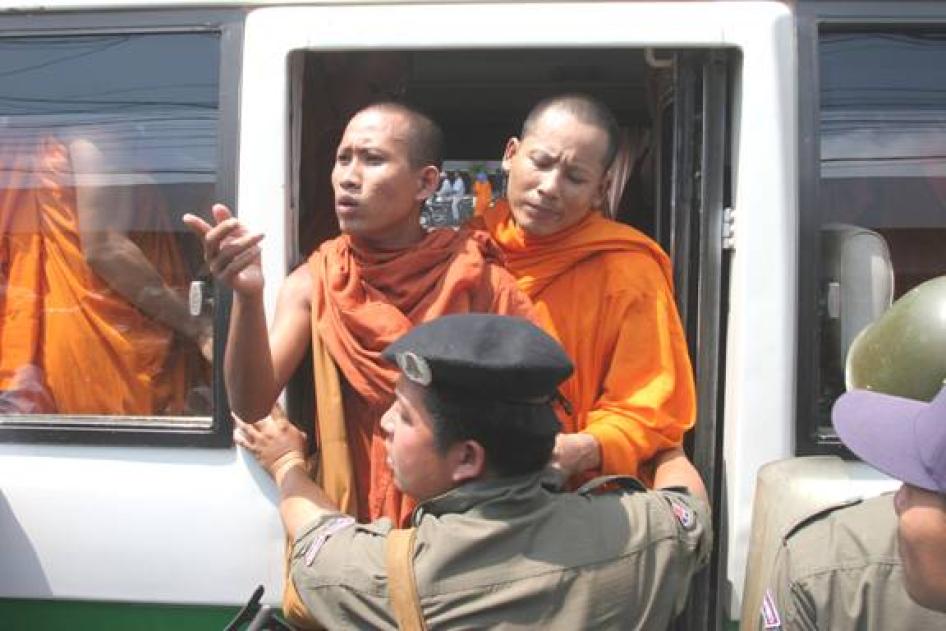
Phnom Penh authorities ordered police to load protesting monks onto busses during a demonstration in Phnom Penh on February 27, 2007, for defrocking and deportation to Vietnam. © 2007 Tang Chhin Sothy
After intervention by monitors from several Cambodian human rights organizations and the Office of the High Commissioner for Human Rights in Cambodia, the monks were allowed to leave the bus. Rights groups transported most of the monks to Samaki Reangsay Pagoda, whose abbot heads the Khmer Krom Krom Buddhist Monk Association in Cambodia and has long provided shelter to Khmer Krom monks and laypeople from the Mekong Delta region of Vietnam.[183]
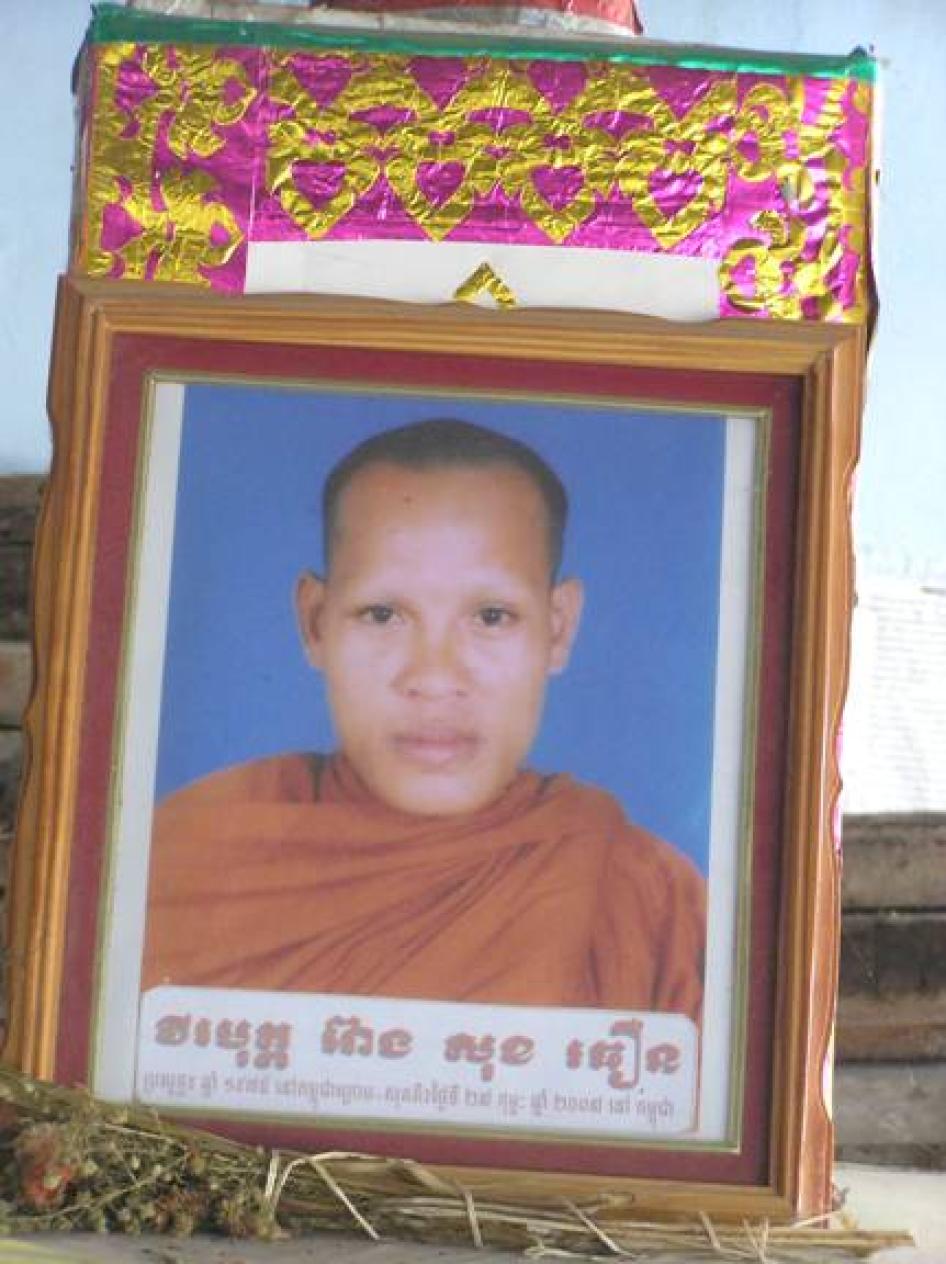
Khmer Krom monk Eang Sok Thoeun was murdered after participating in a demonstration in Phnom Penh. © 2008 Human Rights Watch
That evening Khmer Krom monk Eang Sok Thoeun, who had participated in the demonstration and was very close to the abbot of Samaki Reangsay Pagoda, was found dead in his pagoda in Kandal Province, with his throat repeatedly slit. Police labeled the killing a suicide, ordered his immediate burial, and prohibited monks from conducting funeral proceedings.[184] Repeated requests to have his body exhumed for autopsy were refused by the Kandal court.[185] Human rights groups who investigated the killing determined it was a murder, not suicide.[186]
On April 20, 2007, police forcefully dispersed another demonstration by around 50 Khmer Krom monks at the Vietnamese and US embassies in Phnom Penh.[187]Later that night one of the monks who had joined in the march was badly beaten by a group of unknown men after returning to his pagoda.[188]
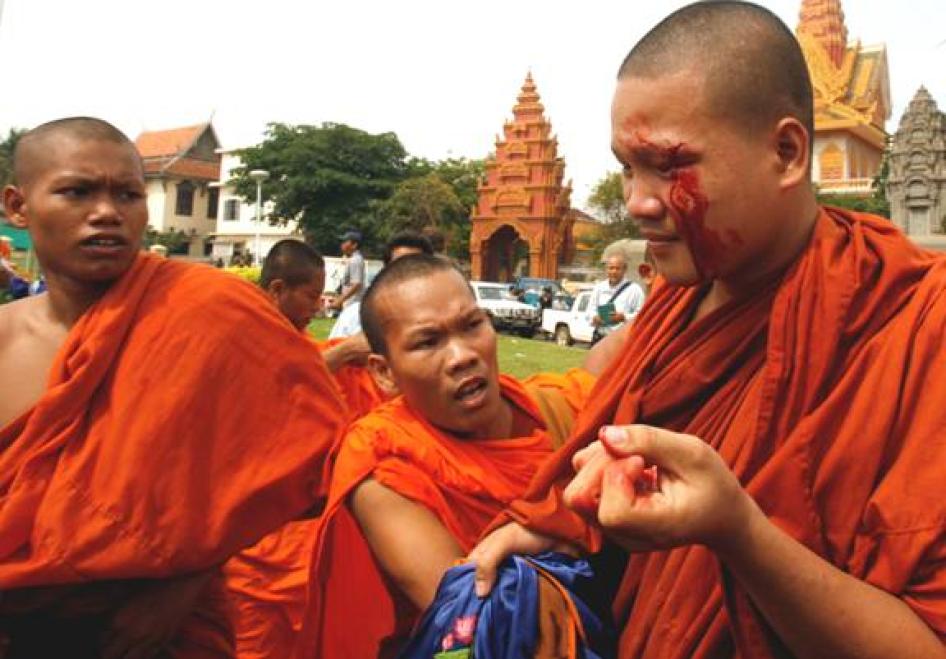
Counter-demonstrators physically attacked Khmer Krom protesters on April 20, 2007 in front of Phnom Penh's Ounalom Pagoda. © 2007 Chor Sokunthea
On June 8, 2007, Cambodia's National Buddhist Monk Committee (Kanna Sang Niyok) issued an order, co-signed by the Ministry of Cults and Religion, banning Buddhist monks from participating in demonstrations. While the order applied only to Cambodia, it was translated into Vietnamese and distributed in pagodas in southern Vietnam--a clear indication that it was targeted at ethnic Khmer on both sides of the border.
The order was no idle threat. On December 17, 2007, riot police carrying shields, and wooden and electric shock batons--and some with assault rifles and revolvers--violently attacked a group of 48 Khmer Krom monks as they attempted to deliver a petition to the Vietnamese Embassy in Phnom Penh protesting Vietnam's imprisonment of monks.[189] As the monks pressed against police lines, the commanding police officer called on his officers to shoot. About 10 police officers moved their rifles and revolvers into a menacing position, but no shots were fired.
When some of the monks again tried to move toward the embassy, anti-riot police beat the monks with their shields and wooden batons, shocked them with the electric batons, hit them with their fists, and kicked them with their boots. The monks tried to defend themselves using their hands and their feet--clad only in plastic sandals--and some threw their plastic water bottles at the police.Two monks were seriously injured after being hit in the head with electric batons, causing one to lose consciousness, and several other monks suffered leg and knee injuries.[190]
Discrimination against Khmer Krom Monks in Cambodia
Cambodian authorities have threatened Khmer Krom monks in Phnom Penh, Banteay Meanchey,[191] and Kompong Speu provinces with expulsion from temples or with being forcibly sent or returned to Vietnam if they meet with Khmer Krom groups, distribute Khmer Krom bulletins covering cultural, religious, and political affairs, or participate in protests. They have pressured Khmer Krom Buddhist and student associations to cease activities and confiscated or banned Kampuchea Krom political and religious bulletins. A leader of a Khmer Krom association in Cambodia explained how the situation had deteriorated since the demonstrations in Vietnam and Cambodia:
Before, we had permission from the Ministry of Interior and from the pagoda to set up our office. Then there was the problem in Vietnam and they asked us to leave the pagoda. Now all of our activities are deadlocked. Other pagodas face the same problems. They ban the monks from joining meetings, ceremonies, and demonstrations held by other Khmer Krom monks. Now some Khmer Krom monks don't dare to speak. It's the same in the provinces. If Khmer Krom monks go to a pagoda, they dare not accept them.[192]
The restrictions the Cambodian government placed on Khmer Krom monks from Vietnam, together with the murder of monk Eang Sok Thoeun, the arrest and imprisonment of Tim Sakhorn, and the government's crackdown on protests by Khmer Krom monks has taken its toll on Khmer Krom activism in Cambodia. Prime Minister Hun Sen reinforced the message in a speech broadcast on national television in February 2008, in which he warned those who would attempt to reclaim Kampuchea Krom that he would provide free coffins and "help to bury your corpses."[193]
The result was that a number of Khmer Krom monks fled to Thailand in 2008, while those who stayed greatly curtailed their public advocacy in Cambodia. For the most part, Khmer Krom monks and activists have stopped conducting public protests in Phnom Penh, opting instead to summon journalists for an occasional press conference at Samaki Reangsay Pagoda to express their concerns.[194]
Even participating in a peaceful meeting within a pagoda can bring reprisals. On December 21, 2008, close to 100 Khmer Krom Buddhist monks, laypeople, human rights activists, and politicians gathered for a meeting with two members of the European Parliament to discuss concerns about rights abuses of Khmer Krom in both Vietnam and Cambodia. Afterwards, the two parliamentarians were barred entry to Vietnam, despite holding Vietnamese visas.[195]
Restrictions on travel, association, and expression
Prior to the 2007 protests Khmer Krom from Vietnam were for the most part able to freely cross into Cambodia to work and study. As the crackdown by the Vietnamese authorities spread, however, some Khmer Krom were denied entry at the border or, if able to cross, had to go underground in Cambodia and change their names to Khmer-sounding names to avoid deportation to Vietnam.[196] Those who attempted to assist Khmer Krom from Vietnam to cross to Cambodia faced threats, intimidation, and arrest.
For example, in February 2007 Vietnamese border police detained a group of 48 Khmer Krom (12 families, including 21 children) from An Giang Province in Vietnam attempting to cross into Cambodia to work on the annual rice harvest, holding them for eight hours before ordering them to return to Vietnam. Desperate for work and money, they tried again to cross, only to be detained overnight, this time by Cambodian border police.
Following the intervention of a local Khmer Krom association in Cambodia's Takeo Province, the group was eventually permitted to enter Cambodia, where the association arranged for temporary shelters and emergency food assistance for the migrants. While in Cambodia, members of the group told the media that part of the reason they left Vietnam was because "there was no rice to eat and no clear policy where land was concerned."[197] The following month, the Takeo provincial court charged the director of the Khmer Krom association with disinformation, which can result in a prison sentence, for describing the 48 as "refugees" in a radio appeal for help. Fearing arrest, he fled the area and has not been able to return.[198]
In February 2007 three Khmer Krom men were sentenced to prison for disinformation for allegedly distributing leaflets in Cambodia criticizing the Cambodian government for not standing up to Vietnam.[199]
As a result of these incidents, as well as the arrest and defrocking of Tim Sakhorn (see below), Khmer Krom human rights associations formerly active in Takeo took down their signboards and greatly scaled back their activities, with some reporting that plainclothes police officers were monitoring their activities.[200] As a Khmer Krom activist in Takeo told Human Rights Watch:
The situation is not like before. Before, people dared to express their opinions, read bulletins, hold a book from the KKF. Now people seem afraid. In their heart people want freedom and their ancestral land but they are afraid. They are still traumatized by what happened here.[201]
The defrocking and arrest of Tim Sakhorn
On June 30, 2007, Cambodian authorities arrested Tim Sakhorn, a leading Khmer Krom activist and Buddhist abbot of Northern Phnom Den Pagoda[202] in Takeo Province, Cambodia. He was driven to the main pagoda in Takeo provincial town, where he was defrocked by Buddhist officials from Phnom Penh and Takeo, in the presence of provincial police, some in civilian clothes. During the defrocking several dozen uniformed police officers surrounded and sealed off the pagoda. Afterwards, Tim Sakhorn was forced into a car and driven away. Provincial police then searched Tim Sakhorn's pagoda, confiscating documents, computers, and cameras. Tim Sakhorn's whereabouts were unknown for weeks until Vietnamese state media reported on August 3 that he was in prison in Vietnam.[203]
Born in An Giang Province, Vietnam, in 1968, Sakhorn and his family moved to Cambodia in 1978,[204] where they were recognized by the Cambodian government as Cambodian citizens.[205] In 1990 Sakhorn became a monk at Northern Phnom Den pagoda. In 2002 Cambodia's Supreme Buddhist Patriarch, Tep Vong, promoted him to abbot--a position only Cambodian citizens can hold.[206] As the local representative of the KKF, Sakhorn actively promoted the rights of Khmer Krom people and provided shelter in his pagoda in Cambodia to Khmer Krom migrants and asylum seekers from Vietnam.
Cambodian authorities defrocked Tim Sakhorn based on a written order by Supreme Patriarch Tep Vong and his deputy Nuon Nget on June 16, 2007, stating that Sakhorn had violated Buddhist rules by harming Cambodian-Vietnamese solidarity and using the pagoda to conduct propaganda.[207] The order was translated into Vietnamese and distributed to Khmer pagodas on both sides of the Cambodia-Vietnam border. Later Sakhorn was also accused of disseminating KKF bulletins and having women in his room.
On August 3, 2007, Vietnamese state media reported that Sakhorn was in prison in An Giang Province, Vietnam, awaiting trial on criminal charges after being arrested for "illegally" trying to enter Vietnam.[208] The Vietnamese government's position was that he was a Vietnamese national of Khmer ethnicity who had confessed to carrying out criminal activities in Cambodia, which warranted him being tried in Vietnam.[209]
Tim Sakhorn's trial
On November 8, 2007, Tim Sakhorn was tried by the Peoples' Tribunal in An Giang Province, Vietnam, on charges of violating Vietnam's national unity policy under article 87 of Vietnam's penal code.[210] He was sentenced to one year in prison, reduced from 15 years by the judge because Sakhorn read out a confession admitting his crimes during the trial.[211] Sakhorn reportedly had no legal representation during the trial.[212]
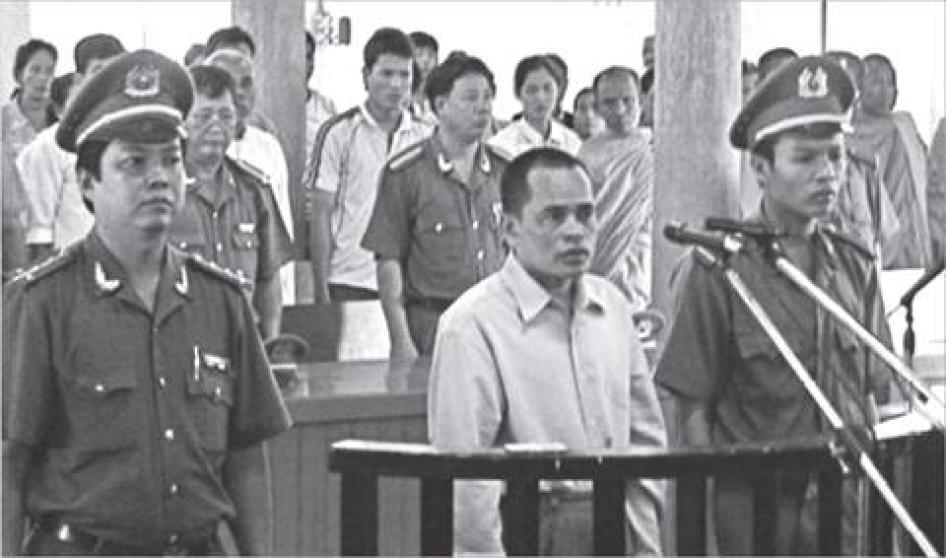
Defrocked Buddhist monk Tim Sakhorn at his trial in November 2007 at the An Giang Peoples' Court in Vietnam. ©2007 Private
Tim Sakhorn's indictment and accounts in the Vietnamese state media stated that Sakhorn had served as a representative in Cambodia of the Khmers Kampuchea-Krom Federation (KKF) since 2005, distributed bulletins and videos about Khmer Krom history and politics, and "incited" Khmer Krom people in Vietnam to file complaints and demonstrate about confiscation of their land.[213]
An article in a Vietnamese state newspaper, Cong An Nhan Dan (Peoples' Police), reported that Tim Sakhorn "volunteered" to confess his crimes:
One of the investigators said that when Tim Sakhorn was first arrested, he was being disingenuous and sought to avoid all responsibility. However, after the investigating officers explained to him the country's policies, the relevant law, and what the conditions for clemency were, he became repentant and remorseful, admitted all of his crimes, and at the same time denounced the group of people and their leaders who had led him into committing his crimes.
On August 5, 2007, Tim Sakhorn stated his views frankly on paper that had been furnished to him by the investigating officers: 'It was because I believed in the false propaganda of ill-intentioned foreigners, that I have committed crimes against the Vietnamese state. After having learned from the Vietnamese government about its laws, and its policies regarding the Khmer people and religion, I am able to distinguish right from wrong, and I understand that I have committed crimes. At the same time I see clearly the humanitarianism and the clemency that the Vietnamese state has afforded to me personally.'
In black and white, Tim Sakhorn 'calls on all of my compatriots not to listen to the slanderous lies of outsiders with bad intentions who are trying to destroy the great unity between Khmers and Vietnamese, between the government and religion. Organizing people in large numbers to file complaints regarding rice fields and other agricultural land is a plot organized by bad people from outside the community…Once again, I call upon anyone still in possession of publications or DVDs of the KKF Federation to turn them in to the village authorities in order to benefit, as I did, from the government's program of clemency.'[214]
Legal violations
The Office of the UN High Commissioner for Human Rights in Cambodia, several UN special rapporteurs,[215] international human rights groups, and diplomats in Phnom Penh and Hanoi raised strong concerns about the enforced disappearance and illegal deportation of Tim Sakhorn, as did Cambodia's retired king, Norodom Sihanouk, in a letter in July 2007 to Prime Minister Hun Sen[216] (For a copy of Hun Sen's response, see appendix D).
The Cambodian government's stripping of Tim Sakhorn's Cambodian citizenship and expulsion of Sakhorn to Vietnam was a blatant violation of the Cambodian Constitution and Cambodian and international law.[217] Tim Sakhorn's status as a Cambodian citizen is undisputed, given written documentation verifying his citizenship (see footnote 205, above), as well as the government's repeated statements that Khmer Krom are recognized as such.
The deportation of Sakhorn to Vietnam, where he was arbitrarily imprisoned, was also a flagrant breach of Cambodia's obligations to protect its citizens, whether in Cambodia or abroad. Both article 33 of Cambodia's Constitution and article 2 of its Nationality Law state that "Cambodian citizens shall not be deprived of their nationality, exiled or arrested and deported to any foreign country unless there is a mutual agreement."[218] There is currently no extradition treaty between Cambodia and Vietnam.[219]
The Cambodia Office of the UN High Commissioner for Human Rights noted that Tim Sakhorn's deportation is "a prima facie violation of the constitutional prohibition of deportation of Cambodian citizens, if indeed Khmer Krom have the status of Cambodian citizens. If they do not, then Khmer Krom claiming persecution should be entitled to seek refugee status under the Convention relating to the Status of Refugees, to which Cambodia is a party."[220]
Faced with criticism over the deportation, a Cambodian government spokesman claimed that Sakhorn had "requested" to be taken to Vietnam.[221] A handwritten letter by Tim Sakhorn requesting to return to his birthplace, as well as a "confession" were subsequently produced.[222] This unlikely scenario was in stark contrast to the report of a local human rights organization, which witnessed Sakhorn being bundled into a car by men in bodyguard uniforms[223] thought to be from Brigade 70, a unit commanded by Lt. Gen. Hing Bun Heang that includes Prime Minister Hun Sen's bodyguard unit. In September 2006 Heang had been appointed as a religious advisor to the newly-formed Senior Buddhist Monk Assembly--created by the government to act as a "supreme court" for disputes involving monks. Heang has been implicated in numerous serious human rights abuses, including the notorious March 30, 1997, grenade attack on an opposition party demonstration that left at least 16 dead and more than 150 injured.[224]
Aftershocks of Sakhorn's arrest
Tim Sakhorn's arrest served as a powerful warning to other Khmer Krom activists and monks in Cambodia.[225] The day after Sakhorn's defrocking, for example, a commune police officer threatened a Khmer Krom activist in Takeo, saying: "You will all fall. Your master has been arrested and sooner or later you will all be arrested and sent back to Vietnam like your master."[226] Monks at Phnom Den Pagoda were placed under surveillance and warned not to collect thumbprints on a petition calling for Tim Sakhorn's release.[227]
Despite the outcry over Tim Sakhorn's deportation, Cambodian authorities continued to harass supporters of the monk. In July 2007, 50 armed policemen blocked a group of 36 Khmer Krom, including relatives of Sakhorn, when they traveled to Phnom Penh to deliver a petition to the National Assembly. Later that month, police in Takeo detained activist Chhim Savuth of the Cambodian Center for Human Rights on the eve of a public forum to discuss Tim Sakhorn's disappearance.
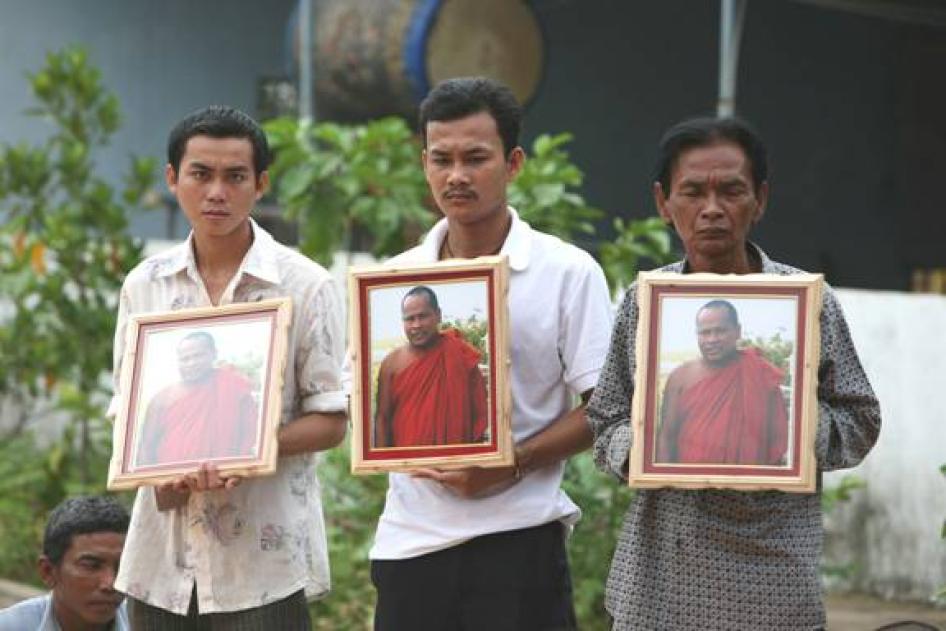
Cambodians hold photos of imprisoned monk Tim Sakhorn during a prayer ceremony calling for the monk's release from prison in Vietnam in August 2007 at Samaki Reangsay Pagoda in Phnom Penh. © 2007 Tang Chhin Sothy
On July 1, 2007, Supreme Patriarch Tep Vong announced that he had "ordered authorities" to defrock and deport to Vietnam another 11 Khmer Krom monks.[228] Buddhist abbots in Phnom Penh and the provinces warned Khmer Krom monks in residence at their pagodas that they would be evicted from their temples if they participated in any future public protests, with two monks in Kompong Speu accused of serving as the "legs" (agents) of Tim Sakhorn.[229]
In November 2007 local authorities in Banteay Meanchey Province ordered four monks to leave their pagoda--or be arrested and "face the same charge as Tim Sakhorn." They were suspected of distributing Khmer Krom advocacy materials. As with Tim Sakhorn, they were subsequently accused of improper behavior including having affairs with women. All four were forced to leave the province, with some eventually fleeing Cambodia altogether.[230]
In Phnom Penh, monks at several pagodas came under increased threat, intimidation, and surveillance in 2008.[231] Police and local authorities periodically drive into the Samaki Reangsay Pagoda compound to ask about monks who have participated in demonstrations, and undercover police are often stationed at the entrance to the pagoda.[232]Khmer Krom monks active in the protests in Phnom Penh have received threatening phone calls. In one such call a monk was told: "If you defrock, you will live. If you want to die, stay a monk."[233] On at least one occasion a person in civilian clothes, armed with a handgun, entered Samaki Reangsay Pagoda in an effort to "persuade" one of the more activist monks to defect to the Cambodian Peoples' Party of Prime Minister Hun Sen.[234]
On the night of May 14, 2008, 10 drunken men, including uniformed police officers, threw rocks at the monks as they attempted to push their way into the pagoda.[235] A monk from Samaki Reangsay Pagoda told Human Rights Watch:
Their strategy is to try to divide us and make us angry. They insulted us like animals. They accused us of becoming monks in order to oppose the government.[236]
Restrictions on Tim Sakhorn after release
On June 28, 2008, Tim Sakhorn was released from prison. The certificate of his release from prison, obtained by Human Rights Watch, states that having completed his sentence, Sakhorn was free to return to Cambodia.[237]Instead, government officials escorted him to Ba Chuc village, his birthplace in An Giang Province, where the authorities had organized a welcome party for him.[238]
After only a few hours in his village, however, government officials escorted Sakhorn on a one-month tour of Vietnam, in which he was in the custody of two police officers 24 hours a day. During the tour he was taken to ethnic Khmer pagodas and a Khmer cultural center in the Mekong Delta, Mahayana Buddhist temples and Pali schools in northern Vietnam, a Cham temple near Hue, a hydro-electric dam near Hanoi, Ho Chi Minh's home in Hanoi, and the popular tourist site of Ha Long Bay.[239] In early August 2008 Tim Sakhorn was sent back to Ba Chuc village, where police officers were posted near his house to monitor his visitors and restrict his movements.[240]
Local officials have reportedly offered Sakhorn a plot of land and a house in An Giang as an apparent incentive to remain in Vietnam.[241] Even before his release from prison, the authorities had him apply for Vietnamese citizenship, swiftly producing a national identification card for him.[242]
Cross-border collaboration in suppression of Khmer Krom
The arrest and deportation of Tim Sakhorn is just one example of the nature of the collaboration between the Cambodian and Vietnamese governments in the suppression of Khmer Krom political activism. On December 6, 2007, Cambodian Minister of Cults and Religion Khun Haing met with Nguyen The Doanh, head of the Vietnamese government's Bureau for Religious Affairs, in Phnom Penh. According to official Vietnamese news sources, the two countries "agreed to continue to co-ordinate in the management of religious activities and make religions an important element of building peace and stability in each country."[243]
Internal Vietnamese government reports and memos have highlighted the extent to which such "coordination" has been aimed at suppressing dissident or controversial groups such as the Khmer Krom. For example, an article by Gen. Luu Phuoc Luong, deputy commander of Vietnam's southwest region, blames "enemy forces and Vietnamese exile groups, and reactionary groups of the Khmer KPC [Kampuchea] Krom" for trying to "destabilize us politically" and recommends "close cooperation with the Cambodian government in order to nip anti-government activities in the bud."[244]
The main thrust of their propaganda is the promotion of the idea of 'separation and self-government,' demanding the creation of an independent Khmer Kampuchea Krom nation, taking advantage of land disputes, problems with deep historical roots, and welfare and democracy problems to mobilize their forces, entice followers, plant flags, organize demonstrations, etc. Their main targets are intellectuals, monks, high school and university students, and officials, to use them to seduce others into their fold; trick people into crossing over into Cambodia to pressure the UNHCR into creating a refugee camp inside Cambodia for the monks and laypeople of our Khmer regions; accuse us of being undemocratic and of violating human rights. Both their immediate and their long-term goal is to destabilize us politically in order to 'internationalize' the 'Khmer Krom problem' and create an independent Khmer Krom state…[245]
Besides collaborating with the Cambodian government to stem Khmer Krom political activism, Gen. Luong proposed that propaganda focus on developing "the tradition of unity" among the different ethnic groups; refuting wrongful views of the "reactionary" Khmer Krom, and properly explaining the true history of Nam Bo (Vietnam's southwest region). As part of the propaganda campaign, in March 2007 the Vietnamese Communist Party began to disseminate a freshly-written history of southern Vietnam that asserted that the Khmer were not its indigenous inhabitants.[246]
A 2007 report by the National Borders Committee of Vietnam's Ministry of Foreign Affairs found that the cooperation between the two governments had already been highly effective in disrupting the political activism of the Khmer Krom:
We have coordinated with our friends (CPP) in Cambodia to put a stop to their activities, including breaking up their schemes to demonstrate in front of our embassy during President Nguyen Minh Triet's official visit and preventing people from crossing the border into Takeo Province so that they will be able to set up 'refugee camps' there.[247]
Meanwhile, a confidential report from 2005 on a top-level meeting of Vietnam's Security Directorate for southern Vietnam makes it clear that government agents have been operating for years within Cambodia and Thailand to monitor, infiltrate, and undermine the Khmer Krom:
General Department V is to direct the force of interdiction in the regions of Kampuchea and Thailand; to coordinate with General Department I and local police forces to verify intelligence, assess the situation, and clearly identify 'subjects' among 'Khmer Krom' organizations seeking to infiltrate; to identify cells of reactionary infiltrators, their organizations, and means of transportation and routes of infiltration in order to design effective measures of interdiction and management.[248]
Citizens, migrants, or refugees?
In Vietnam they say I am a Cambodian but in Cambodia they say I am Vietnamese.
--A Khmer Krom man who works as a garbage collector in Takeo Province, Cambodia
The 1993 Cambodian Constitution does not define who is a Cambodian citizen. This is ostensibly left to the Nationality Law, which was adopted in 1996. But the nationality law focuses primarily on criteria for nationality (sancheat Khmer), providing few specifics about citizenship (pracheapholrot Khmer), other than in article 2, which states: "Any person who has Cambodian nationality is a Cambodian citizen. Cambodian citizens shall not be deprived of their nationality, exiled, or arrested and deported to any foreign country unless there is mutual agreement."[249] Article 4 states that a person has Cambodian nationality at birth if he or she is born in Cambodia or has one or both parents of Khmer nationality.[250] As legal analysts pointed out at the time the law was being debated in the National Assembly, by not clearly defining who is a citizen and who is not, the question of citizenship is left open to interpretation by government officials, some of whom are sympathetic to Khmer Krom, others who are not.
As a policy matter, the Cambodian government has repeatedly and publicly stated that it considers Khmer Krom from Vietnam who move to Cambodia to be Cambodian citizens, and hence constitutionally subject to full protection by the Cambodian state.[251] This position has been confirmed in numerous official documents, including government communiqués to the office of the United Nations High Commissioner for Refugees (UNHCR)[252] and Cambodia's own Ministry of Justice.[253] In a February 2007 meeting with Ellen Sauerbrey, US Assistant Secretary of State for Population, Refugees and Migration, Cambodian Minister of Foreign Affairs Hor Namhong stated once again that "Khmer Krom who are living in the Cambodian territory, are treated and can enjoy equal rights as the Cambodian citizen."[254]
This is important in determining what rights Khmer Krom have to request asylum in Cambodia. Prior to 2005, UNHCR's Cambodia office recognized some Khmer Krom from Vietnam as refugees. That practice ended in August 2005 after an unsuccessful attempt by Khmer Krom from Vietnam to formalize their right to seek asylum in Cambodia. On August 1, 2005, more than 60 Khmer Krom lay people and monks gathered at the offices of UNHCR in Phnom Penh, claiming to have fled crackdowns on religious and other freedoms in Vietnam.[255] In response, the Cambodian government informed UNHCR that the government recognized all Khmer Krom as Cambodian citizens and, therefore, they were not eligible for consideration as refugees.[256] On August 4, 2005, UNHCR informed the group--many of whom UNHCR had interviewed and issued preliminary "Persons of Concern" letters -- that they would not be recognized as refugees, and that it considered their cases closed.[257]
Because UNHCR accepts Cambodian government assurances that Khmer Krom living in Cambodia are citizens of Cambodia and that the Cambodian government is, therefore, responsible for protection of its own citizens, UNHCR's Phnom Penh office rules out all Khmer Krom asylum seekers from Vietnam as ineligible for consideration as refugees.[258]
In reality, however, the Cambodian government does not explicitly recognize most Khmer Krom from Vietnam as citizens. It does not provide them individually with the documents necessary to establish their Cambodian citizenship. And, despite rhetoric to the contrary, the Cambodian government's treatment of many Khmer Krom is contrary to any presumption that they are citizens.[259]
Khmer Krom fleeing to Cambodia to escape political persecution in Vietnam thus face the prospect of a dangerous journey to a third country to seek asylum. As many as 50 Buddhist monks and 100 civilians have fled to Thailand to seek refugee protection. The other option--remaining indefinitely in Cambodia as stateless persons--is fraught with risk. The Cambodian government has proven itself more than willing to collaborate with Vietnam in suppressing Khmer Krom political activism, in several cases even arresting and deporting Vietnamese dissidents.[260]
"Bunroeun," a Khmer Krom man from Vietnam who was recognized as a refugee by UNHCR prior to the August 2005 policy statement to UNHCR by the Cambodian government, told Human Rights Watch that UNHCR subsequently revoked his status and took away his refugee certificate. He described the consequences as follows:
They [UNHCR] said Khmer Krom are Khmer citizens and that I could be registered with the Cambodian government… When I had [refugee] status here, if I had a problem with the police, UNHCR could intervene. Now I am afraid of being abducted, especially after what happened to Tim Sakhorn.[261]
Three years later, "Bunroeun" still lacks a Cambodian national identification card and household registry book despite repeated attempts to secure the documents from local authorities.
When a Khmer Krom from Vietnam seeks refugee recognition from UNHCR, the agency should first positively establish whether the asylum seeker is, in fact, recognized by the Cambodian government as a Cambodian citizen and has been issued an official national identification card before rejecting the application. Those who are not recognized as Cambodian citizens--including Khmer Krom who are Vietnamese citizens or stateless persons--should be fully eligible for UNHCR refugee status determinations. UNHCR should insist on the same approach by the Cambodian government as it carries out refugee status determinations.[262]
UNHCR should hold Cambodia--as a party to the 1951 Refugee Convention-- responsible for protecting those individuals who qualify as refugees. In the absence of protection by the Cambodian government, UNHCR should exercise its own mandate to recognize and protect such refugees.
In the exercise of its mandate on behalf of stateless persons, UNHCR should intervene with the Cambodian authorities on behalf of stateless Khmer Krom seeking assistance to obtain national identification cards establishing their citizenship.[263]
Finally, UNHCR should also be alert to the possibility--as in the case of Tim Sakhorn--of Cambodian authorities forcibly returning individuals with a well-founded fear of persecution to Vietnam. In such cases UNHCR should intervene to prevent their refoulement even if it had previously deemed such Cambodian citizens ineligible for refugee status prior to having been stripped of their nationality.
VI. Recommendations
As a state party to the International Covenant on Civil and Political Rights and other international human rights treaties, Vietnam is obligated to protect basic rights and freedoms of all within its territory, including members of ethnic minority groups.[264] This is all the more important to Vietnam's international standing now that it is serving a two-year seat on the United Nations Security Council. In addition to ending its persecution of Khmer Krom, it is important that the Vietnamese government find ways to address the mutual mistrust between the Khmer Krom and the government.
The Cambodian government has also failed to meet its obligations to protect the rights of Khmer Krom from Vietnam. The government has actively cooperated with Vietnamese authorities in violating the religious and political rights of the Khmer Krom. The Cambodian government needs to clearly establish in its Law on Nationality whether it affords the Khmer Krom the status and protection of Cambodian citizens.[265] It must not send individuals fleeing persecution in Vietnam back to Vietnam and should allow such persons, if not citizens of Cambodia, to seek refugee status under the 1951 Refugee Convention, to which Cambodia is a party.
Human Rights Watch makes the following recommendations:
To the Socialist Republic of Vietnam
Political and religious prisoners
- Fulfill its commitments as a state party to the International Covenant on Civil and Political Rights (ICCPR), article 14, to end arbitrary arrests and detention of people for peaceful expression of their religious or political views.
- Immediately and unconditionally release Khmer Krom imprisoned or placed under house arrest or pagoda arrest for the peaceful expression of their political or religious beliefs.
- Allow international human rights organizations, United Nations officials, diplomats, legal counsel, and family members to have regular access to Khmer Krom prisoners.
Freedom of expression, association, and assembly
- Implement article 21 of the ICCPR, which recognizes the right of peaceful assembly, and article 22 of the ICCPR, which provides for the right to freedom of association with others, by allowing peaceful gatherings and public protests by Khmer Krom individuals and groups.
- Fulfill its obligations under article 19 of the ICCPR, which provides for the right to freedom of expression, by lifting restrictions on Khmer-language publications in Vietnam and the banning and confiscation of Khmer Krom human rights advocacy materials, including videotapes and printed bulletins. Cease the harassment or arrest of people for disseminating such publications or videos.
- Cease all harassment, intimidation, interrogation, and detention of individuals in contact with international organizations, including groups that specifically advocate for the rights of Khmer Krom people in Vietnam.
Freedom of religion
- Fulfill existing government commitments affirming the right to freedom of religion, including article 18 of the ICCPR and Vietnam's 2004 Ordinance on Beliefs and Religions, by allowing Khmer Buddhists to freely conduct peaceful religious activities.
- Recognize as legitimate Khmer Buddhist pagodas that do not choose to join or affiliate with the officially authorized Vietnam Buddhist Sangha.
- Authorize Khmer Theravada Buddhists to register with the government and operate independently of the official Buddhist organization, the Vietnamese Buddhist Church, if they choose to do so.
Land rights
- Improve implementation of Vietnam's 1993 Land Law by streamlining the process of land allocation and issuing of land use certificates for Khmer Krom families; such families should be able to apply for and obtain certificates that can establish long-term land use rights without discrimination.
- End illegal or discriminatory land seizures from Khmer Krom farmers and provide prompt access to an impartial legal system. Provide sufficient compensation, including awards of arable land where appropriate and available.
Discrimination
- Implement provisions in the International Convention on the Elimination of All Forms of Racial Discrimination, to which Vietnam is a state party, as well as relevant provisions in Vietnam's Constitution affirming the rights of ethnic minorities.
- End all forms of discrimination against Khmer Krom in Vietnam, including discrimination in education and employment.
- Develop channels for dialogue and institute participatory decision-making processes involving Khmer Krom leaders and local communities.
Defending and monitoring Human Rights
- Honor its international human rights commitments by cooperating with special procedures of the Commission on Human Rights and extending invitations to visit the Mekong Delta region of Vietnam to UN special rapporteurs for freedom of religion or belief, freedom of opinion and expression, and human rights and fundamental freedoms of indigenous people.
- Allow international human rights organizations to freely conduct field research in the Mekong Delta, monitor the human rights situation, and conduct human rights training programs.
- Invite experienced Cambodian human rights organizations to run human rights education programs for Khmer Krom communities in Vietnam.
To the Cambodian government
- Clearly establish in its Law on Nationality whether it affords Khmer Krom the status and protection of Cambodian citizens.
- Provide national identity cards and other appropriate identity documents such as household registry documents ("family books") to Khmer Krom who are recognized by Cambodian law as Cambodian citizens.
- Ensure that Khmer Krom in Cambodia have equal opportunities in education, employment, and religion, and are entitled to vote and own property.
- Implement provisions in the Cambodian Constitution providing Cambodian citizens abroad full protection by the Cambodian state, with Cambodian government officials asking for consular access to detained citizens and raising concerns directly with Vietnamese diplomats and other Vietnamese government representatives when the rights of Khmer Krom in Vietnam are alleged to have been violated.
- Abide by the 1951 Refugee Convention, to which Cambodia is a state party, by not returning individuals to countries where their lives or liberty would be threatened. Provide Khmer Krom who have fled from Vietnam and who are not granted Cambodian citizenship the right to seek asylum. Do not deport to Vietnam Khmer Krom with a well founded fear of persecution in that country.
- Call on the Vietnamese government to allow Khmer Krom monk Tim Sakhorn, a Cambodian citizen who was released from one year's imprisonment in Vietnam on spurious charges in May 2008, to freely return to his home in Cambodia, should he choose to do so.
- Conduct a thorough investigation into the murder of Khmer Krom monk Eang Sok Thoeun on February 27, 2007, and bring the perpetrators to justice.
To UNHCR
- Conduct refugee status determinations for Khmer Krom asylum seekers in Cambodia who the Cambodian government has not formally recognized as Cambodian citizens and provided official documentation to that effect.
- Insist that Cambodia--as a party to the 1951 Refugee Convention--take responsibility for protecting those individuals recognized as refugees by UNHCR or the Cambodian government, in particular the provisions on non-refoulement (the obligation of states not to return any refugee to a country where their life or freedom may be threatened). Exercise UNHCR's mandate to recognize and protect such refugees in the absence of protection by the Cambodian government.
- Exercise UNHCR's mandate regarding stateless persons by assisting the Cambodian government in resolving nationality issues for stateless Khmer Krom, intervening with the Cambodian authorities on behalf of Khmer Krom seeking assistance to obtain national identification cards establishing their citizenship, and protecting stateless Khmer Krom when the Cambodian government fails to do so.
To Japan, the European Union, United States, and other key donor states to Vietnam and Cambodia
- Press the Vietnamese government to release those imprisoned for peaceful expression of their views.
- Regularly visit Khmer Krom communities in Vietnam, including land rights activists and defrocked and imprisoned monks.
- Use high-level diplomatic contacts with the Vietnamese and Cambodian governments to press for improvement in their respect for fundamental human rights and religious freedom for Khmer Krom communities. Make public and private statements about the situation of Khmer Krom.
- Designate funds for human rights training, rights-related rule of law programs, and civil society capacity-building programs for Khmer Krom communities in Vietnam and Cambodia.
Acknowledgments
This report was researched and written by Asia Division staff from Human Rights Watch, based on interviews conducted with Khmer Krom communities in Vietnam, Cambodia, Thailand, Australia, and the United States. The report was edited by Brad Adams, Asia director for Human Rights Watch, Bill Frelick, Human Rights Watch refugee policy director, Dinah PoKempner, Human Rights Watch general counsel, and Joseph Saunders, Human Rights Watch deputy program director. Production assistance was provided by Andrea Cottom and Jonathan Cohen, associates in the Asia division, and Meg Reber, publications specialist.
Human Rights Watch is grateful to the many individuals and organizations that contributed to this report. In particular, we would like to express our sincere thanks to the Khmer Krom people in Cambodia and Vietnam who agreed to be interviewed for the report, none of whom could be named for fear of reprisals, as well as members of Khmer Krom communities living abroad. We would also like to express our appreciation to staff members from Licadho, the Cambodia Office of the High Commissioner for Human Rights, Jesuit Relief Services, the Khmers Kampuchea Krom Human Rights Organization, the Khmers Kampuchea-Krom Federation, and the Khmer Kampuchea Krom Buddhist Monk Association.
We are also grateful to Venerable Rong Be, Lon Nara, Mey Sovannara, Nguyen Ngoc Bich, and To Thong Kim, who provided assistance with Khmer and Vietnamese translation and interpretation. Finally, we wish to thank Tang Chhin Sothy, Chor Sokhunthea, Heng Chivoan, and Lach Chantha for their photographs and video footage; Andy Maxwell for the map; and Ang Chanrith, Jason Barber, Josh Ounsted, Mathieu Pellerin, and Julie DeRivero for their insights, dedication, and support.
Appendix A: Indictment of the Five Monks[266]
Socialist Republic of Vietnam
Independence -- Liberty -- Happiness
People's Supreme Procuracy
People's Procuracy of Soc Trang Province
File No. 27/KSDT-TA
April 20, 2007
INDICTMENT
The Procurator of the Soc Trang Province People's Procuracy
In accordance with the following:
- Articles 36, 166 and 167 of the Code of Criminal Procedure
- Decision to Prosecute (DP) the criminal case of February 9, 2007 submitted by the Soc Trang Province Police Investigative Unit on grounds of "causing public disorder," as stipulated in Article 245 of the Criminal Code.
- DPs 34, 35 and 36 of February 23, 2007, DP 37 of February 26, 2007 and DP 38 of March 2, 2007, submitted by the Soc Trang Province Police Investigative Unit, against [defendants] Kim Muol, Ly Suong, Thach Thuong, Danh Tol, and Ly Hoang for "having caused public disorder," as stipulated in Article 245 of the Criminal Code.
On the basis of the following, as confirmed by the police investigation:
Defendants Kim Muol, Danh Tol, Ly Hoang, Thach Xuan Hien (formerly an adherent of the Pali Literacy Improvement Middle School,[267] Soc Trang Municipality), Ly Suong, Thach Thuong (formerly a Buddhist monk at Nuoc Man Temple, Long Phu) and Tang Thuy (a Honda motorbike driver).
Around 10:30 a.m., on February 8, 2007, the Soc Trang Municipality traffic police spotted, while on routine patrols, a Honda licensed No. 83F4-7896 carrying a [Buddhist] adherent of the Pali Literacy Improvement School who was collecting alms. Because the driver did not have civilian liability coverage and a driver's license, as required by law, traffic police gave him a citation and temporarily impounded his Honda. Although the police did not question the monk who was riding [as a passenger on the motorcycle] a number of adherents gathering in front of Khleang Temple took advantage of this incident to falsely accuse the police of preventing them from doing going out to collect alms, and afterwards organized a rally in front of the municipal police station. At this time, Danh Tol and Ly Hoang, already out collecting alms, upon being informed of the rally, decided to join in.
Approximately 12 noon of the same day, Danh Tol and Ly Hoang incited over 100 adherents from the Pali school to stage a riot in front of the Soc Trang Province police station. They finally stormed the building, blocked street traffic, and shouted fervently, creating a traffic jam and chaos in the entire area, disturbing routine activities of the Soc Trang Municipal Police and other surrounding government agencies such as the Soc Trang Province Police Administrative Office, the Soc Trang Province Police Investigative Office, the Soc Trang Municipal People's Procuracy, as well as seriously disrupting economic activities of the area's residents.
Around 8 a.m. of the same day, Kim Muol, together with Thach Xuan Hien, incited other adherents who were having classes, such as Thach Do, Dao Chanh Ro Da, Thach Minh, Son Ha, to gather at Nuoc Man Temple, Long Phu, where he contacted monks Ly Suong and Thach Thuong and others. Around 12 noon, while having lunch with the monks he received a telephone call from Trieu Minh Phu, an adherent participating in the rally at the Soc Trang municipal police building, who said that "Soc Trang monks have been prevented by traffic police from doing their going out to collect alms , so they are going to the municipal police building instead" and that "Kim Muol is urged to join." Having finished the call, he incited the Nuoc Man Temple monks to head for a disturbance in Soc Trang. Kim Muol, riding on Tang Thuy's Honda, led a group of 30 monks, also taking rides on Honda motorbikes, to Soc Trang Municipality. Having noticed no one on the premises of Khleang Temple Kim Muol telephoned Phu and was told that "it is over at the Soc Trang Municipal Police station." Kim Muol and the monks headed for the Soc Trang police building to join the Pali school adherents. Tang Thuy passionately joined the monks and adherents in their shouting while Kim Muol was running in and out of the police building to instigate the loud protest of the crowd. Thach Xuan Hien. Ly Suong and Thach Thuong did the same thing, running around to inflame the riot. During the riot, Kim Muol seemed to receive directions over his phone to turn up the volume of his mobile phone so that everyone could hear them shouting noisily while Ly Suong was spotted making telephone calls. With Thach Xuan Hien and Thach Thuong taking pictures, and other monks and adherents talking on their mobile phones, videotaping, and taking pictures, public disorder in the area worsened by creation of a large traffic jam and an expanding crowd of spectators.
Mr. Son Phuoc Quang, executive head of the Mekong Delta Nationalities Committee, was sent to explain about the situation, but he was cursed at in Khmer by Thach Thuong.
At 2:30 p.m. on the same day, the Most Venerable Duong Nhon, chairman of the Soc Trang Solidarity Association of Patriotic Buddhist Monks and principal of the Pali Literacy Improvement Middle School, the Most Venerable Tang No, vice principal of the Pali school, and Lam Ren, chairman of the Soc Trang Province Religious Affairs Committee, as well as other units and offices showed up to plead with the protesting monks and adherents to return to their school. When the government representatives came back at 4 p.m. all [the monks and adherants] had walked home.
Because of their above wrongdoing Danh Tol, Kim Muol, Ly Suong, Thach Thuong, Ly Hoang and Thach Xuan Hien were either suspended from school or disrobed by the Soc Trang Solidarity Association of Patriotic Buddhist Monks.
During the police investigation all the defendants have made sincere declarations and fully admitted to their criminal acts.
As far as Thach Xuan Hien and Tang Thuy are concerned, they fled their localities and went into hiding after committing their crimes. The police investigative unit has issued arrest warrants and decisions to prosecute the two and will put them, once arrested, on a separate trial.
With reference to defendants Danh Bo Pha, Trieu Minh Phu, Thach Do, Dao Chanh Do Ra, Thach Minh, and Son Ha, the school will soon take appropriate action against them, considering their limited involvement in the riot.
It is concluded that:
Defendants Danh Tol, Kim Muol, Ly Suong, Thach Thuong and Ly Hoang have taken advantage of a traffic violation in which traffic police temporarily confiscated a Honda motorbike used by a driver to transport riders without satisfying licensing requirements,[268] falsely accusing the traffic police of prohibiting Buddhist monks from collecting alms with the aim of instigating a protest rally in front of the Soc Trang municipal police station. As a result of their shouting, waving and clasping hands, the riot created traffic chaos in the entire area, disturbing the routine activities of state agencies and economic activities of the people in public places, as well as directly violating public order, the civilized way of life, and socialist behavior.
In this case, defendant Danh Tol has been charged with fervently instigating the riot of Buddhist monks and adherents; Kim Muol, upon receiving news of the disturbance in the Soc Trang Municipality, also eagerly incited other monks from Long Phu to join the disturbance in the municipality, worsening the public order situation; Ly Suong and Thach Thuong have demonstrated the words and behaviors of active accomplices. With regard to Ly Hoang, he directed the riot movements and contributed to severely causing public disorder by provoking the protesting monks and adherents to shout and make noise. Therefore, their criminal behaviors are considered dangerous to society and must be seriously tried before the court of law with the aim of educational deterrence and prevention for the entire society.
It is therefore decided that the defendants whose identities are specified below have committed the following crimes:
- Full name: Danh Tol, born 1981, male
- Permanent household registry: Ba Rong hamlet, Ngan Dua town, Hong Dan district, Bac Lieu Province
- Citizenship: Vietnam; ethnicity: Khmer; religion: Buddhist
- Occupation: former monk
- Educational background: 12/12 years of schooling
- Father: Danh Nhal, born 1949
- Mother: Thi On, born 1951
- Both father and mother are farmers and reside in defendant's household.
- Number of siblings: 05; defendant is the eldest; youngest is 14
- Previous criminal records (convictions / misdemeanors): None
- Temporary detention: February 26, 2007 to date.
- Full name: Kim Muol; born July 18, 1985; male
- A.k.a.: Miet
- Permanent household registry: Tra Set hamlet, Vinh Hai village, Vinh Chau district, Soc Trang Province
- Citizenship: Vietnam; ethnicity: Khmer; religion: Buddhist
- Occupation: former monk
- Educational background: 12/12 years of schooling
- Father: Kim Uol, born 1960; occupation: plowman; resides in defendant's household
- Mother: Tran Thi Vet, born 1956; occupation: housewife; resides in defendant's household
- Number of siblings: 05; defendant is the eldest; youngest is 13
- Previous criminal records (convictions / misdemeanors): None
- Temporary detention: February 23, 2007 to date.
- Full name: Ly Suong, born 1975; male
- A.k.a.: Ly Thuol
- Permanent household registry: Hamlet 5, Long Phu town, Long Phu district, Soc Trang Province
- Citizenship: Vietnam; ethnicity: Khmer; religion: Buddhist
- Occupation: former monk
- Educational background: 11/12 years of schooling
- Father: Ly Dal, born 1931, monk at Nuoc Man Temple
- Mother: Vuong Thi Tu, born 1932; domicile: Khoang Trang hamlet, Long Phu town, Long Phu district, Soc Trang Province.
- Number of siblings: 05; the eldest is 49; defendant is the youngest.
- Previous criminal records (convictions / misdemeanors): None
- Temporary detention: February 23, 2007 to date.
- Full name: Thach Thuong, born 1982; male
- A.k.a.: Thach Suong, Huynh Suong
- Permanent household registry: Ba Rong hamlet, Long Phu village, Long Phu district, Soc Trang Province
- Citizenship: Vietnam; ethnicity: Khmer; religion: Buddhist
- Occupation: former monk
- Educational background: 1/12 years of schooling
- Father: Thach Kret, born 1946; occupation: farmer; resides in defendant's household.
- Mother: Huynh Thi The, born 1932; occupation: laborer; resides in defendant's household.
- Number of siblings: 03; the eldest is 28, youngest 19.
- Previous criminal records (convictions / misdemeanors): None
- Temporary detention: February 23, 2007 to date.
- Full name: Ly Hoang, born January 27, 1986; Male
- A.k.a.: Ral
- Permanent household registry: 260B, Ton Duc Thang Street, Subward 3, Ward 5, Soc Trang City, Soc Trang Province.
- Citizenship: Vietnam; ethnicity: Khmer; religion: Buddhist
- Occupation: former monk
- Educational background: 11/12 years of schooling
- Father: Ly Chiem, born 1947 (deceased)
- Mother: Dinh Thi Khanh, born 1957; occupation: farmer; resides in defendant's household.
- Number of siblings: 05; the eldest is 33, youngest 18
- Previous criminal records (convictions / misdemeanors): None
- Preventive measure: prohibited to leave home since March 2, 2007
Defendants Danh Tol, Kim Muol, Ly Suong, Thach Thuong and Ly Hoang have been charged with "causing public disorder" for having brought the traffic and activities in public places to a standstill, as well as having incited people to cause disturbances in violation of Paragraphs 2.c and 2.d, Article 245 of the Criminal Code.
Article 245: Causing public disorder
1. Those who foment public disorder, causing serious consequences or who have been already administratively sanctioned for such act or sentenced for such offense, not yet entitled to criminal record remission but continue to commit such acts, shall be sentenced to a fine of between one million dong and ten million dong, non-custodial reform for up to two years or between three months and two years of imprisonment.
2. Committing the offense in one of the following circumstances, the offenders shall be sentenced to between two and seven years of imprisonment:
a) Using weapons or committing acts of vandalism;
b) In an organized manner;
c) Causing serious obstruction to traffic or cessation of public activities;
d) Inciting other persons to cause disorder;
e) Assaulting persons who intervene to keep the public order;
f) Dangerous recidivism.
It is decided that:
Defendants Danh Tol, Kim Muol, Ly Suong, Thach Thuong, and Ly Hoang are hereby prosecuted and put on trial by the People's Court of Soc Trang Province for having "caused public disorder," in accordance with Paragraphs 2.c and 2.d, Article 245 of the afore-mentioned Criminal Code.
This Indictment is in lieu of Indictment No. 23 of April 2, 2007.
Attachments:
§Case docket consisting of 408 pages, numbered 1 to 408 For the Procurator
§List of Court witnesses Dinh Gia Hung
§List of material evidences. Signed & Sealed
Distribution list
§Service 1A, Service 2, People's Supreme Procuracy
§Ho Chi Minh City's PT3, People's Procuracy
§Police Investigative Unit, Preliminary Sentence Police
§Case files
§PP files
§Defendants
§Archives
§On-Duty Unit / CT 245
Appendix B: Handwritten Appeals from Khmer Krom in Vietnam
Message for Information
First of all, I would like to respect Excellencies and Officials at all ecclesiastical ranks!
I, who am [name withheld], in [name withheld] pagoda, Kampong Spien district, would like to report about the living standard of the Khmer Kampuchea Krom under the controlling claw of the Vietnamese communists. Presently, the Vietnamese government is exercising the policy of "Coldness Eats Deepness"[269] over the pitiful Khmer people by using methods of nationalization and assimilation.[270] In reality, the Khmer children from the age of three are sent to kindergartens to learn to speak the Vietnamese language so as to make them unable to speak Khmer. In another pitiful example, Khmer children can only learn their language in our pagodas from volunteer teachers. To be precise, Khmer children can only learn their language and literature during the annual three-month vacation from school, when Khmer children can learn Khmer in the pagodas.
In 2007, the Ministry of Education changed the curriculum and reduced the annual school vacation to only two months. During this time they now order the reserve [university] students to go to the areas where Khmers live and gather Khmer children to attend summer school in their [Vietnamese] language so as to make Khmer children unable to have time to study their own language. As for Khmer customs and traditions, they are scattered and have almost disappeared from the soul of the Khmers. The Khmers are the performers, and the Vietnamese are the commanders. To sum up, I am pleased to make this summary report to provide information to verify that the Khmer Krom suffer with each breath they take.
[Signed]
November 16 , 2007
Second Letter: SUMMARY of letter
I am Bhikkhu[271] [name withheld], a monk from Preah Trapeang [Tra Vinh] Province. I would like to submit the following information to the Ministry of Foreign Affairs of the Kingdom of Cambodia and the United Nations.
The Vietnamese remain determined to eliminate Khmers from the territory of Kampuchea Krom. They use all measures from hot to cold, violating the rights and freedoms to speak, ordering monk officials to cruelly excommunicate five monks; namely three monks from Kampong Leo Pagoda, one monk from Phno Pagoda and one monk from Po Tharam Pagoda. Other monks fled into the Kingdom of Cambodia. There are 500 pagodas in Kampuchea Krom and Khmer monks in most pagodas are forced to work secretly for the government. Whoever does not do this is accused of being deceitful.
They prohibit monks from studying most subjects, for example, history and the religious theory.
The Khmer lands have been confiscated without compensation or with unfairly low compensation. This is happening almost everywhere. No one dares to speak.
The authorities ask for reports of places where the Kathin festival is organized, and the amount of money donated to the pagodas. People who serve tea and food in the pagodas are often secret police informants.
Rice production is low because of expensive fertilizers. Khmers have become poor and the vassals of Youns [Vietnamese] in Prey Nokor [Ho Chi Minh City] and other municipalities.
It is unacceptable that the Vietnamese make propaganda everywhere that this territory is not the Khmer territory. This is the territory cleared by them, making it difficult for Khmers to remain any more.
[Signed]
Preah Trapeang
November 17, 2007
Appendix C: Vietnamese State Press Coverage, Tim Sakhorn
Tim Sakhorn's Trial and "Repentance"
Tim Sa Khorn on the Path of Virtue
From Cong An Nhan Dan (Peoples' Police) newspaper, September 14, 2008
At the end of June 2008, Tim Sa Khorn, also known as Tim Khone, Chau Khorn, Thien Soc Khone (An Giang) was reunited with his friends after completing his twelve-month jail sentence. His release was also greeted with satisfaction by the military and police.
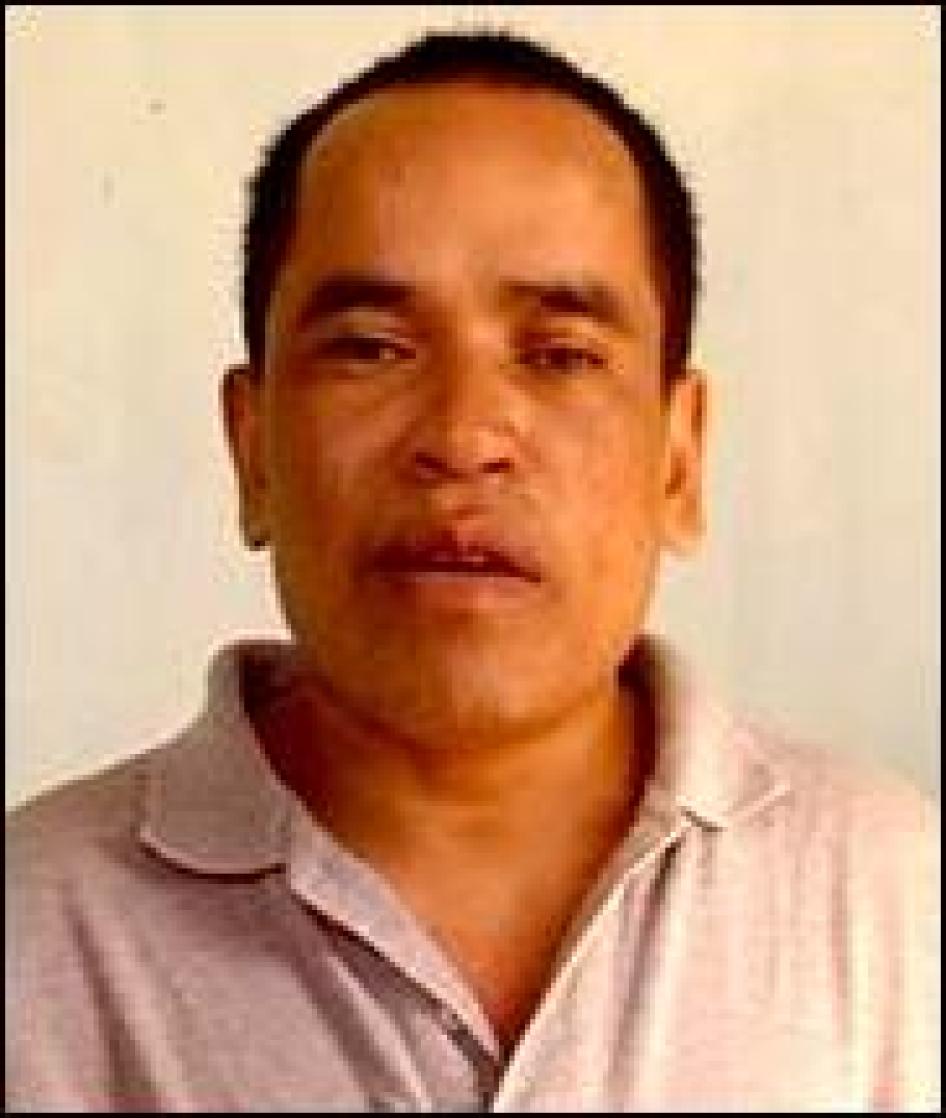
After Tim Sa Khorn's arrest, his right hand men were also exposed. Chau Inh and Neang Phe acknowledged various illegal activities such as receiving money and reactionary publications and DVDs that encouraged demonstrations and the submission of complaints. Both of them read from documents in which they admitted their crimes. Right afterwards, the Peoples Committee of An Cu Village distributed materials to the population to publicize the criminal activities of Tim Sa Khorn and a number of other individuals involved such as Chau Inh, Chau Son, Neang De, Neang Phe, Huynh Ut and Chau Hen.
It should also be noted that prior to the arrest of Tim Sa Khorn, on June 16,2007, Mr. Nuon Nghet, Chairman of the Central Committee of the Buddhist Sangha in Cambodia, sent Document 502/07-DN to Tep Vong, the Supreme Patriarch of the Kingdom of Cambodia. This document included the following sentence: …. Tim Sa Khorn engaged in activities that contravened the rules of the clergy, sowing discord between different nationalities and countries, notably between Vietnam and Cambodia, and used this pagoda as his headquarters for propaganda activities that affected important rules and regulations of the Buddhist Church." Based on this, Chairman Nuon Nghet decided to defrock Tim Sa Khorn. The following day, Tep Vong indicated his accord with this decision.
One of the investigators said that when Tim Sa Khorn was first arrested, he was being disingenuous and sought to avoid all responsibility, However, after the investigating officers explained to him the country's policies, the relevant law, and what the conditions for clemency were, he became repentant and remorseful, admitted all of his crimes, and at the same time denounced the group of people and their leaders who had led him into committing his crimes.
On August 5, 2007, Tim Sa Khorn stated his views frankly on paper that had been furnished to him by the investigating officers: "It was because I believed in the false propaganda of ill-intentioned foreigners, that I have committed crimes against the Vietnamese state. After having learned from the Vietnamese government about its laws, and its policies regarding the Khmer people and religion, I am able to distinguish right from wrong, and I understand that I have committed crimes, at the same time I see clearly the humanitarianism and the clemency that the Vietnamese state has afforded to me personally."
In black and white, Tim Sa Khorn "calls on all of my compatriots not to listen to the slanderous lies of outsiders with bad intentions who are trying to destroy the great unity between Khmers and Vietnamese, between the government and religion. Organizing people in large numbers to file complaints regarding rice fields and other agricultural land is a plot organized by bad people from outside the community…Once again, I call upon anyone still in possession of publications or DVDs of the KKF Federation to turn them in to the village authorities in order to benefit, as I did, from the government's program of clemency."
Although he admitted his shame, and called on others to be vigilant regarding activities of the enemy, Tim Sa Khorn still was nervous and skeptical about his prospects. Prior to the date of his trial, he was uneasy, full of anxiety and worry. During the days right before the trial he could hardly sleep, his mind filled with questions and worries: given the severity of my crimes, how could the court possibly apply the policy of clemency? It is certain that I will receive a heavy sentence. When I leave prison, will I still be in a shape that will allow me to return to my family and friends?
On November 18, 2007, upon hearing the pronouncement of his sentence by the People's Court of An Giang, Tim Sa Khorn breathed a sigh of relief. "To tell the truth, it was not what I expected. The things the investigating officers told me turned out to be true," he said to himself. He quietly gave thanks to the court and especially to the police officers. As he stepped outside the court room, Tim Sa Khorn felt deeply ashamed about his prior activities. As he was returning to the detention center, he heard someone whisper in his ear "do you best to succeed in your reeducation." Khorn couldn't see him, he only nodded his head.
As he was carrying out this very humanitarian sentence, Tim Sa Khorn turned into a kind and impressive person. In addition to the personnel of the prison, he was also regularly visited by senior police officials and representatives of various branches of the police force to give him encouragement. Friends of Tim Sa Khorn were also given opportunities to visit him.
On one occasion, police from the security investigative unit paid him a visit. Tim Sa Khorn, looking very happy, responded to their questions. He was relaxed and smiling. When an officer asked him what he thought about the twelve-month sentence that he was serving, Khorn's whole face wrinkled up with a huge smile: "I was really, really happy! I had thought I would be punished heavily. As for this sentence, I am grateful to the police, grateful to the prosecutor and the court for the clemency, and for providing me with the opportunity of returning to normal life."
When asked where he would live after completing his sentence, he responded immediately: "I will return to my homeland in Ba Chuc and live with my paternal aunt. I won't be a monk any more. If the opportunity arises, I'll get married and make a living from farming." And as for his associates prior to his arrest, Khorn swore "I will cut off all relations with them, now that I know their true faces".
When questioned about his incarceration and his treatment by the investigating cadres and the personnel of the detention center, Tim Sa Khorn replied that he had been treated very well; that the investigating officers had clearly explained the law, which gave him the peace of mind to confess truthfully, that they had given him two new sets of clothing and money to buy extra food. The detention center personnel had also been good to him, his needs were being taken care of, he had medical checkups and was given medication, and that there had been absolutely no pressure or physical ill-treatment.
Most importantly, in the two months that have passed since his release, Khorn has done everything he promised to do. In a recent telephone call with us, the head of the Tri Ton District Police told us that Tim Sa Khorn was benefitting from the policies of the Party and the State in regard to its Khmer citizens. Tim Sa Khorn was enthusiastically engaged in work to benefit his family and his birthplace.
Appendix D: Letter from Cambodian Prime Minister Hun Sen to Norodom Sihanouk Regarding Tim Sakhorn
Royal Government of Cambodia Nation – Religion – King
To His Majesty Norodom Sihanouk, the Father of the Khmer Nation
Revered Majesty,
I received your royal letter dated 06 July 2007 requesting that the royal government review the request made by Mr. Thach Setha, President of the Khmer Kampuchea Krom Community, regarding the case of the defrocking and threats issued against Kampuchea Krom-born monk (the case of a monk by the name of Tim Sakhorn).
I want to inform your majesty that regarding this case, the royal government ordered a research on the spot, and we received the results below:
The abbot of the Pokhanaram Pagoda,[272] Venerable Tim Sakhorn, is a Khmer Kampuchea Krom, he was born in Khla Kroheum village, Bachuk commune, Svay Tong Province, An Giang Province of the Socialist Republic of Vietnam. He stayed at the Pokhanaram Pagoda (Northern Phnom Den Pagoda) located in Phsar village, Phnom Den commune, Kirivong district, Takeo Province. He used the pagoda to serve as a location for distribution of the Khmers Kampuchea-Krom Federation (KKF) magazines, each one of these consisting of 14 to 20 pages, whose content was incitement propaganda with the goal of creating disputes between Cambodia and Vietnam. Monk Tim Sakhorn was stubborn, he did not participate in meetings, and there was no legal authorization for his activities in the pagoda, such as displaying flags with the logo shown on the KKF magazine, building a concrete structure next to the interior fence of the pagoda, illegally ordaining a number of monks coming from Boeng Salang, and attracting a large number of monks and pagoda members [to join] the KKF overseas. All these actions caused displeasure among the monks in the pagoda. A certain number of them left the order, while others asked to study in other pagodas and stayed there…
This monk and his gang demonstrated twice against the Cambodia-Vietnam friendship, and he even went on to fight with student monks and religious monks using axes and sticks to chase and strike 20 monks, causing injuries to 4 to them.
After reviewing the irregular activities of Monk Tim Sakhorn, Supreme Patriarch Tep Vong set up a meeting where 10 monks from all levels took part, to discuss and judge (Monk Tim Sakhorn). They agreed to defrock Bhikku[273] Tim Sakhorn because he committed severe [violations] of the Buddhist rules for monks.
After his defrocking on 30 June 2007, the district authority, the district department of cult and religion, the commune council, and the pagoda committee searched the room of abbot Tim Sakhorn using a search warrant issued by the Takeo provincial court. They found a evidence such as: knife, explicit VCDs, and two women in the room. They also found a letter written by Mr. Tim Sakhorn, asking to return back to his native place (Vietnam).
The spokesman of the Vietnamese Embassy in Cambodia declared that Mr. Tim Sakhorn is currently being jailed by the authority of the Socialist Republic of Vietnam. The exact cause of the imprisonment, we do not know yet.
The above information is provided to Your Majesty for your information.
I take this opportunity to send you my best wishes. May you live in peace from now on.
Please accept, Your Majesty, my faithful devotion.
Phnom Penh, September 28, 2007
[Signed] Hun Sen
Appendix E: Human Rights Watch Letter to the Socialist Republic of Vietnam
September 15, 2008
His Excellency Pham Gia Khiem
Deputy Prime Minister and Minister of Foreign Affairs
Socialist Republic of Vietnam
VIA FACSIMILE
Your Excellency,
Human Rights Watch is a nongovernmental organization based in New York that monitors violations of human rights by states and non-state actors in more than 80 countries around the world.
Human Rights Watch is preparing a report regarding the ethnic Khmer minority in the Mekong Delta region of Vietnam, known as Khmer Krom. Our report, which explores issues of religious freedom, land rights, and freedom of assembly and expression for the Khmer minority in Vietnam, is based in part on in-depth interviews conducted with ethnic Khmer in Vietnam, Cambodia, Thailand and the United States.
We are writing to ensure that our report properly reflects the views, policies, and practices of the Socialist Republic of Vietnam regarding the ethnic Khmer minority in Vietnam.
Human Rights Watch is committed to producing material that is well-informed and objective. We hope you or your staff will respond to the attached questions so that your views are accurately reflected in our reporting. In order for us to take your answers into account in our forthcoming report, we would appreciate a written response by October 1, 2008. We are also happy to provide you with an advance copy of our report, once it is finalized.
Please do not hesitate to include any other materials, statistics, and government actions regarding the ethnic Khmer minority in Vietnam that you think might be relevant.
We look forward to strengthening our dialogue with the Vietnamese government, especially as we consider sending a formal delegation to Vietnam in the future in response to requests from the Vietnamese Embassy in Washington DC.
We also look forward to receiving your input on our previous research and advocacy recommendations regarding human rights issues in Vietnam, including our November 2006 report on Street Children in Hanoi and the listing of Montagnard political and religious prisoners provided to officials from the Bureau of Religious Affairs at their request, during their visit to Washington, DC in November of last year.
Thank you in advance for your time in addressing these urgent matters.
Sincerely,
Elaine Pearson
Deputy Director
Asia Division
cc:
His Excellency Le Luong Minh, Ambassador and Permanent Representative to the United Nations
His Excellency Hoang Chi Trung, Ambassador and Deputy Permanent Representative to the United Nations
His Excellency Le Cong Phung, Ambassador and of Vietnam to the United States
His Excellency Giang Seo Phu, Minister, Chairman of Ethnic Minority Committee
Questions:
1.What is the status of former Khmer Krom Buddhist monk Tim Sakhorn, who was released from An Giang provincial prison in June 2008? Is he currently under house arrest or administrative probation in Vietnam? Is he free to return to Cambodia, should he choose to do so?
2.Why were five ethnic Khmer monks imprisoned after participating in a peaceful protest in Soc Trang Province on February 8, 2007? Has the government taken any steps to investigate reports that some of the monks have been mistreated and beaten while in Soc Trang provincial prison?
3.How many ethnic Khmer Buddhist monks were defrocked, arrested, detained, or dismissed from the Pali Middle School in Soc Trang as a result of having participated in the February 8, 2007 protest in Soc Trang? What is the status of these monks now? Can you provide us with a listing of all monks who were defrocked, arrested, detained, or dismissed from the Pali Middle School during 2007; their current status (re-ordained, or lay person) and present location; and whether they are under house arrest or administrative detention?
4.How many ethnic Khmer land rights protesters are currently in prison, pre-trial detention, police custody, or house arrest/administrative probation? Can you provide any names of these ethnic Khmer detainees, their present location, and under what charges they are being held?
5.Did police use dogs and electric batons to break up a protest in An Hao village, Tinh Bien district, An Giang Province, on February 26, injuring several protesters? What is the current status of Neang Yanh and Neang Yonh who were subsequently arrested because of their involvement in the protest? We understand that they remain in detention in An Giang prison, awaiting trial on charges of causing public disorder under article 245 of Vietnam's Penal Code. Can you tell us the expected date of their trial, whether they have access to defense lawyers of their choosing, whether members of their families have been allowed to visit them in prison, and whether their trials will be open to journalists and members of the public?
6.Are government or other officials authorized to take action against those who read, distribute or publish materials that are published originally or exclusively in Khmer? If so, on what basis does this authorization rest? Are government or other officials authorized to take actions against persons who use such unapproved materials to teach ethnic Khmer in Vietnam about their history, culture, geography and language? Again, if so, please clarify the basis for such authority.
7.7. What is the Vietnamese government doing to address increasing landlessness of ethnic Khmer farmers in the Mekong Delta? What sort of compensation is provided to ethnic Khmer farmers whose land has been confiscated by the government? Is the government working to address longstanding land conflicts caused by forced relocation of Khmer Krom communities from their farmland, particularly in present-day An Giang Province, during cross-border fighting between Vietnamese and Khmer Rouge troops in 1978-79? Is the government considering ways to return confiscated land to ethnic Khmer communities, or offer compensation or alternative plots of arable land?
8.Would the Vietnamese government consider recognizing as legitimate all Khmer Buddhist pagodas that do not choose to join or affiliate with the officially-authorized Vietnamese Buddhist Sangha, as long as their religious activities were conducted peacefully and in accordance with international legal standards?
9.Ethnic Khmer Buddhists in Vietnam have complained that government authorities restrict the number of days they are allow to celebrate and observe certain religious holidays, such as the Kathin celebration. Do government and religious authorities currently allow ethnic Khmer Buddhists to celebrate Kathin for the traditional period of 29 days, rather than three? If so, what prompted the change in policy?
10.Are any restrictions placed on travel by ethnic Khmer Buddhist monks in Vietnam? For example, can Khmer Krom monks freely travel within Vietnam and visit other pagodas, transfer from one pagoda to another, or change their place of study without obtaining official approval from government authorities? If not, what is the reasoning and legal basis for such restrictions?
11.Would the Vietnamese government consider increasing Khmer-language primary and secondary education in the Mekong Delta?
Appendix F: Vietnamese Embassy's Response to Human Rights Watch
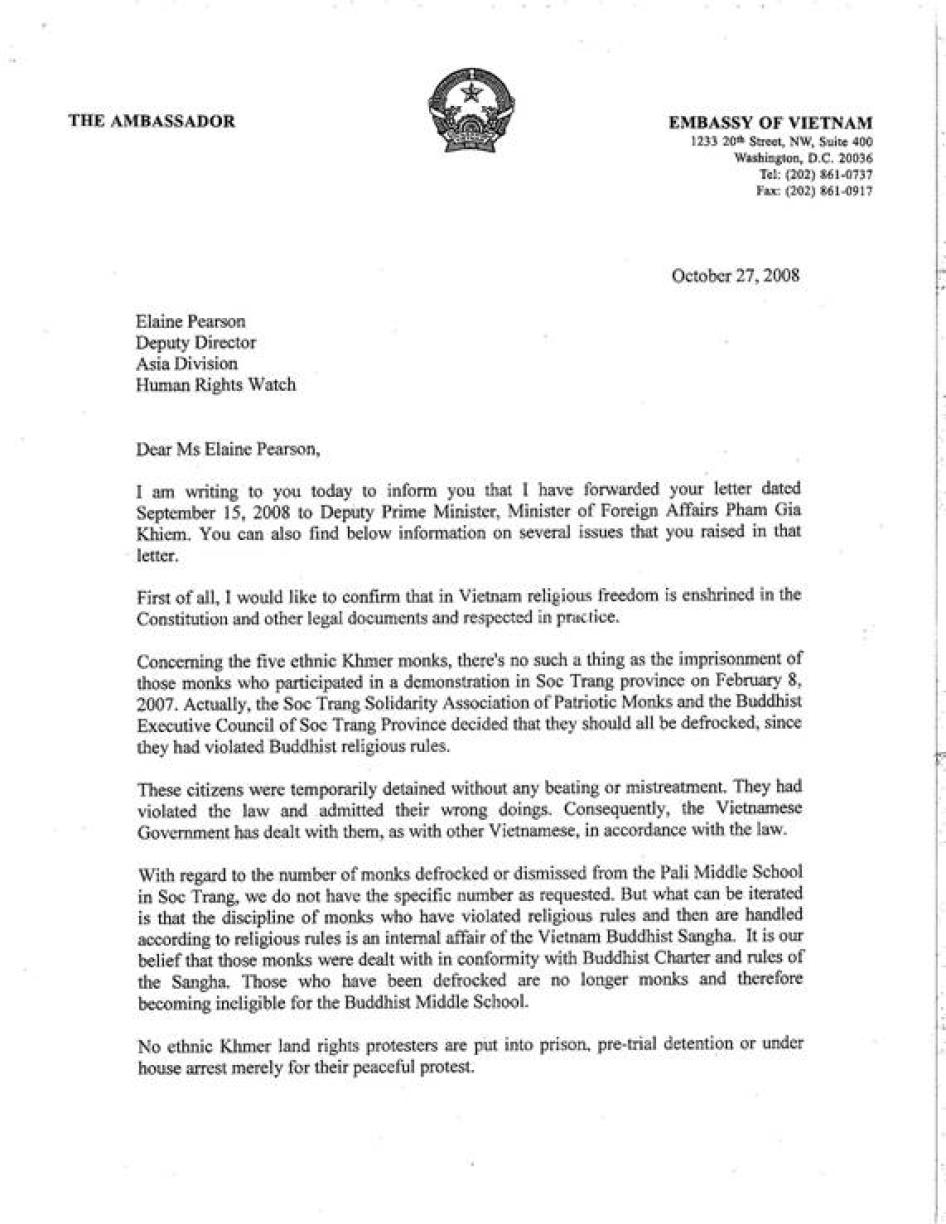
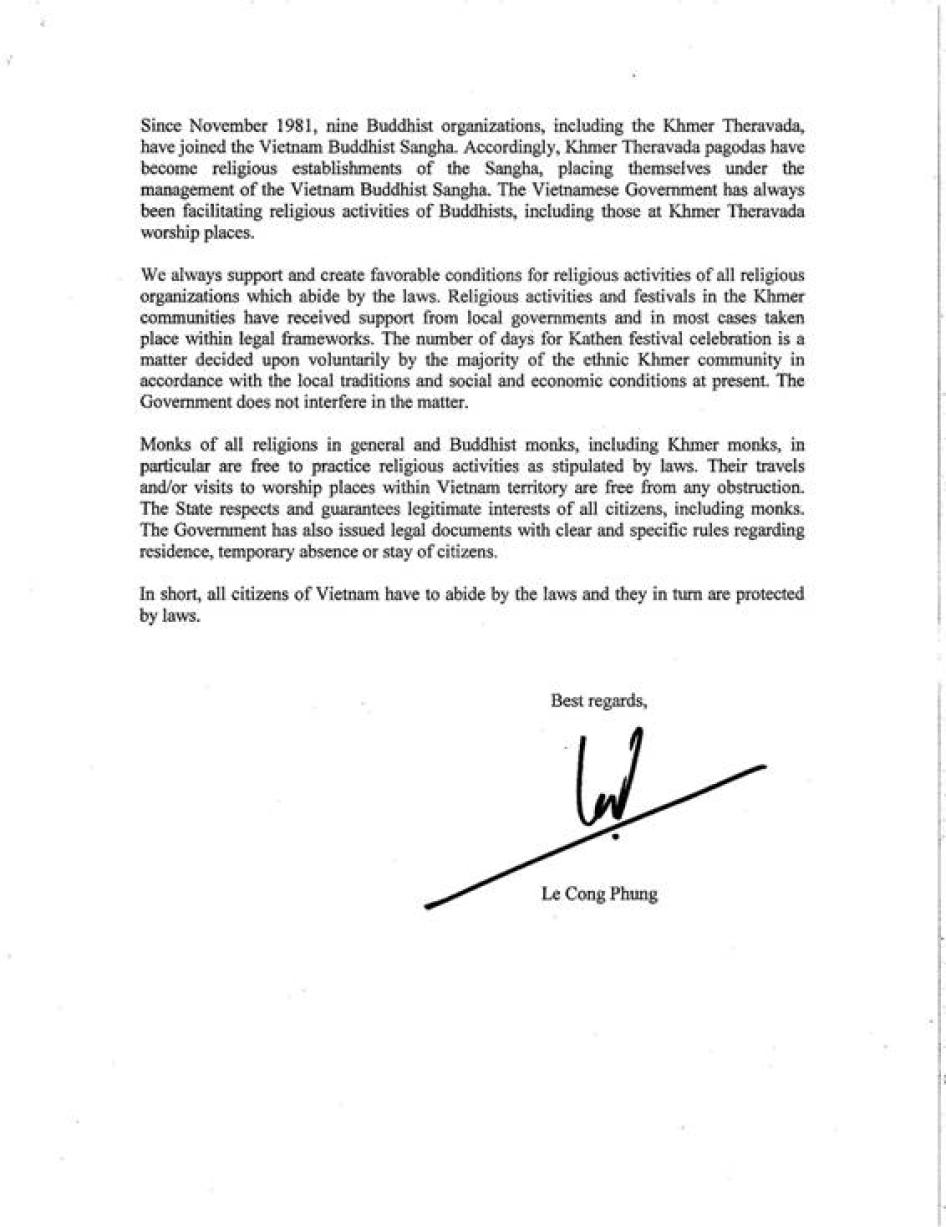
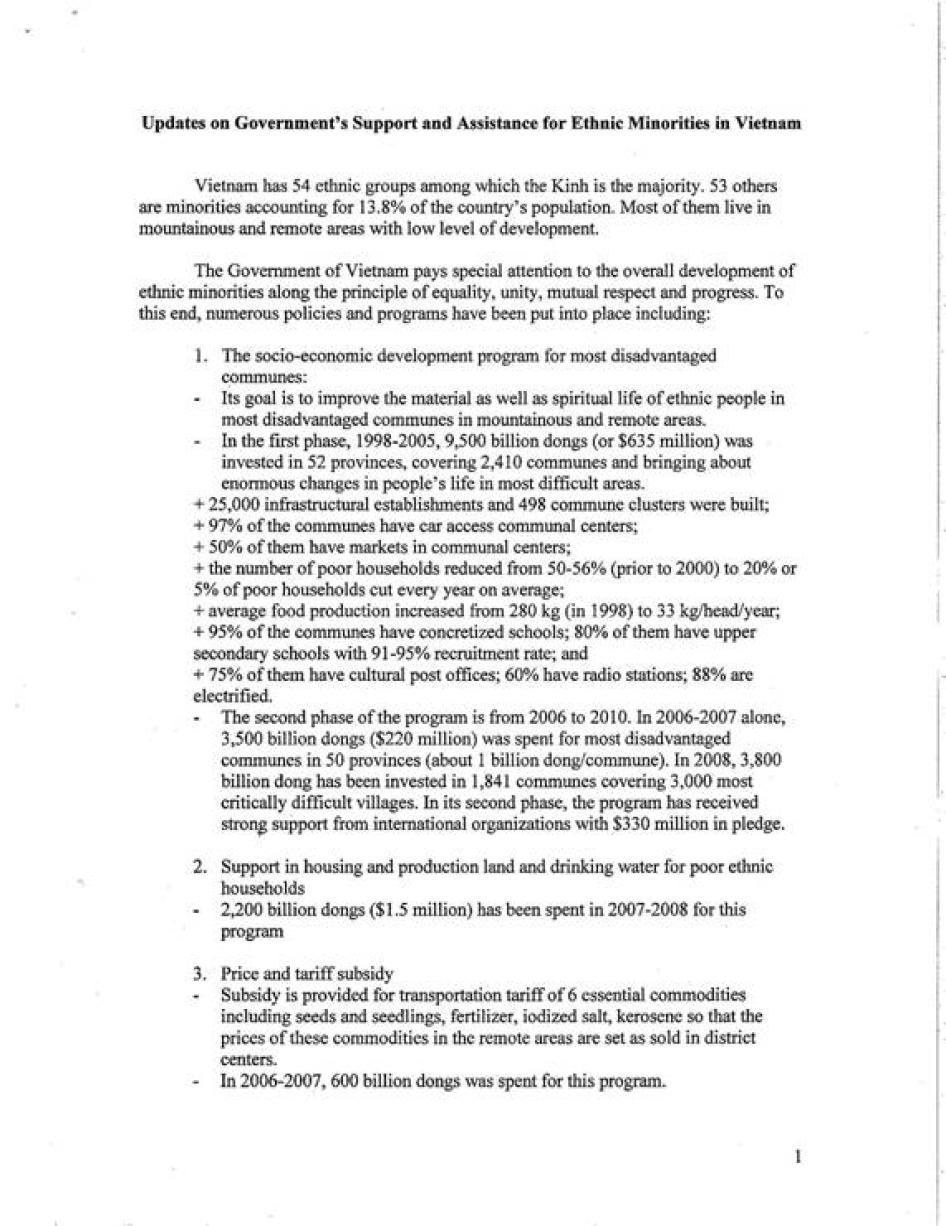
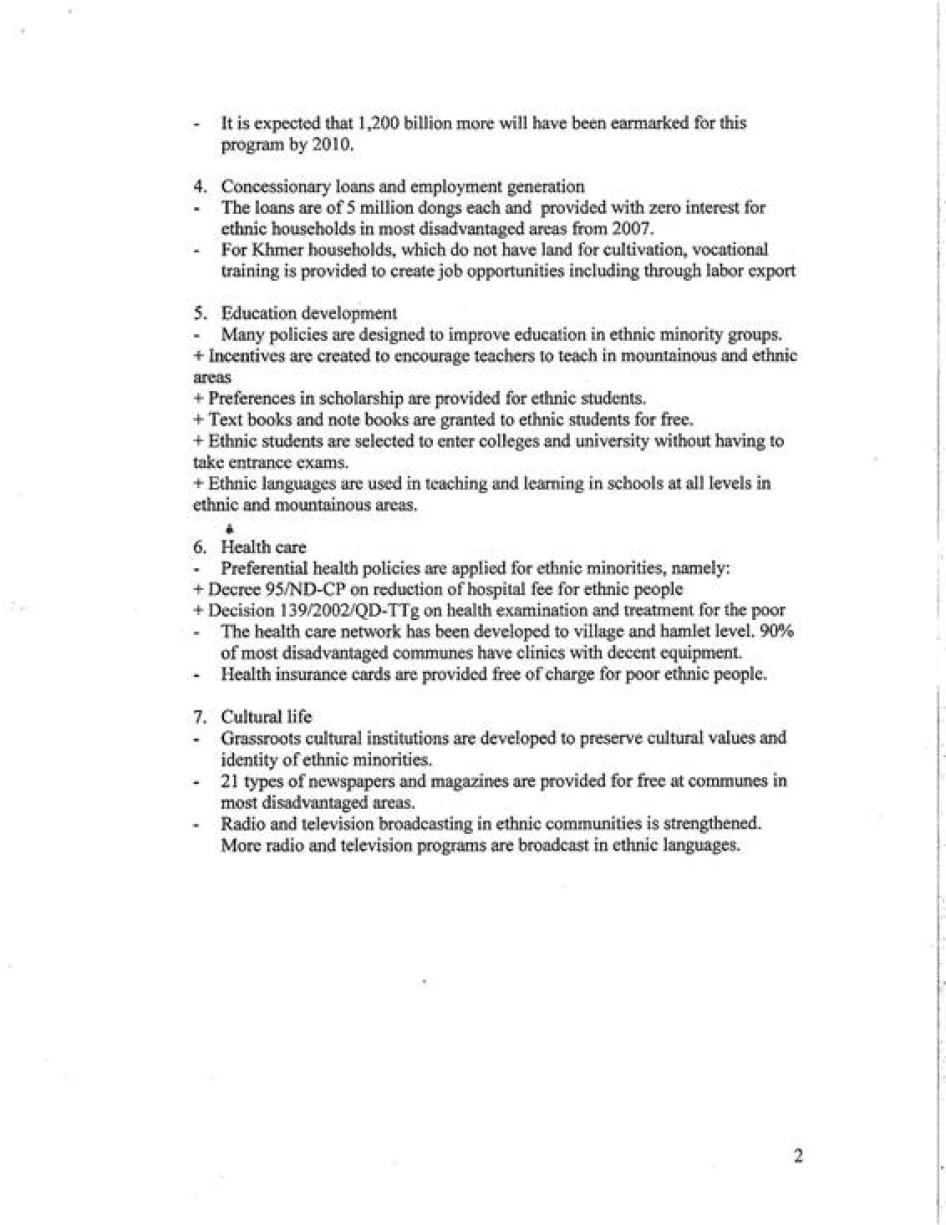
[1] In this report Human Rights Watch uses the term "Khmer Krom" (which means "lower" or "southern" Khmer) to differentiate between ethnic Khmer originating from or residing in present-day southern Vietnam and ethnic Khmer born in Cambodia.
[2] "Khmer Krom" is how the ethnic Khmer minority in Vietnam refer to themselves. They are also known in Vietnamese as "Nguoi Viet Goc mien," (Vietnamese of Khmer origin) or "Nguoi Khmer Nam Bo," (southern Khmer, or Khmer from the southern region).
[3]While many Khmer in Cambodia and in Vietnam consider themselves among the indigenous inhabitants of the Mekong Delta region, the Vietnamese government strongly refutes such assertions, which are beyond the research scope of this report.
[4] Archaeological research conducted in the Mekong Delta during the last decade establishes that the area has been continuously occupied for more than 2,000 years. Pre-Angkorian states, centered around the ancient city of Angkor Borei in present-day Takeo Province of Cambodia and the former port of Oc Eo (O Keo) in present-day Kien Giang Province in Vietnam, originated at least 500 years before the "Funan" era described by Chinese emissaries who visited the Mekong Delta in the third century A.D. Archaeologist Miriam Stark, who has directed extensive research in the Mekong Delta since 1999, states that the Khmer empire of the 9th-14th centuries "represents only the endpoint in a deep historical record, whose origins lie south in the Mekong Delta." Miriam Stark, "Lower Mekong Archaeological Project," University of Hawai'i at Manoa, Department of Anthropology; Miriam Stark, "Excavating the Delta," Humanities, September/October 2001, vol. 22, no. 5; Michael D. Coe, Angkor and the Khmer Civilization (London: Thames and Hudson, 2003), p. 61.
[5] AusAID, Mekong Delta Poverty Analysis, October 2004, http://www.ausaid.gov.au/publications/pdf/mekong_poverty_report_04.pdf (accessed April 20, 2008), p. 20.
[6]Dr. Hoang Nam, "Vietnam Image of the Community of 54 Ethnic Groups," State Committee for Ethnic Minority and Mountainous Area Affairs website, http://www.cema.gov.vn/modules.php?name=Content&mcid=1128 (accessed April 15, 2008); AusAID, Mekong Delta Poverty Analysis, pp. 9-10.
[7] AusAID, Mekong Delta Poverty Analysis, p. 20.
[8] Harris, Buddhism under Pol Pot (Phnom Penh: Documentation Center of Cambodia, 2007), p. 250.
[9] Ibid.
[10] This policy started during the 19th century rule of Emperor Minh Mang, when Khmers were required to assume Vietnamese surnames or five specific patronymics (Danh, Kien, Son, Kim, and Thach). Harris, Buddhism under Pol Pot, p. 250; Gerald Cannon Hickey, Free in the Forest: Ethnohistory of the Vietnamese Central Highlands, 1954-1976 (New Haven: Yale University Press, 1982), p. 61.
[11] Harris, Buddhism under Pol Pot, pp. 250-251.
[12] Hickey, Free in the Forest, p. 61.
[13] Harris, Buddhism under Pol Pot, p. 250.
[14] Hickey, Free in the Forest, p. 61.
[15] FULRO is an acronym for Front Unifie De Lutte De La Races Opprimee. Bajaraka took its name from the first letters of several ethnic groups of the Central Highlands: Bahnar, Jarai, Rhade [Ede], and Koho. Hickey, Free in the Forest, p. 62.
[16] These included Son Ngoc Thanh, Son Ngoc Minh (Achar Mean) and Tou Samouth (Achar Sok). Harris, Cambodian Buddhism: History and Practice (Chiang Mai: Silkworm Books, 2005), pp. 158-159.
[17] Harris, Cambodian Buddhism, pp. 158-159.
[18] An achar is a Buddhist elder or layman.
[19] Penny Edwards, "Making a Religion of the Nation and Its Language: The French Protectorate (1863-1954) and the Dhammakay," in Marston, John and Elizabeth Guthrie, eds., History, Buddhism, and New Religious Movements in Cambodia (Chiang Mai: Silkworm Books, 2006), pp. 63-64, 81.
[20] Harris, Buddhism under Pol Pot, p. 33.
[21] Pali is the liturgical language of Theravada Buddhism.
[22] Edwards, "Making a Religion of the Nation," in Marston, John and Elizabeth Guthrie, eds., History, Buddhism, and New Religious Movements in Cambodia, p. 81.
[23] Penny Edwards, ed., The Buddhist Institute: A Short History, (Phnom Penh: Heinrich Boll Foundation, 2005), p. 62.
[24] Harris, Buddhism under Pol Pot, p. 32.
[25] Ibid, pp. 252-253.
[26] Ibid, p. 252.
[27] In Cambodia several Khmer Krom born in Vietnam, such as Leng Sary and Son Sen, became top leaders of the ultra-nationalist Khmer Rouge, whose platform included regaining "Kampuchea Krom" from Vietnam.
[28] Harris, Buddhism under Pol Pot, p. 253.
[29] In the Pali language, sangha refers to an association or assembly of ordained Buddhist monks.
[30] Harris, Buddhism under Pol Pot, p. 255.
[31] Ibid.
[32] The Concluding Observations of the UN Committee on the Elimination of Racial Discrimination regarding Vietnam's report in 1999 stated: "The Committee is further concerned about the alleged population transfer to territories inhabited by indigenous groups, disadvantaging them in the exercise of their social, economic and cultural rights." See http://www.unhchr.ch/tbs/doc.nsf/898586b1dc7b4043c1256a450044f331/89ab2cc93ea628c5c1256a09004fb1b7/$FILE/G0045116.doc (accessed September 18, 2008).
[33]Human Rights Watch interview with Khmer Krom man, Takeo provincial town, Takeo province, Cambodia, December 23, 2007.
[34] Human Rights Watch interview with "Makara," a Khmer Krom Buddhist monk from Soc Trang province, Vietnam, (location withheld), December 16, 2007. All names in quotation marks in this report are pseudonyms to protect interviewees from government reprisals.
[35]Vietnam's doi moi (renovation) policy, approved at the 1986 Sixth National Congress, launched the country's transition from a socialist, centrally planned economy to a market economy.
[36]Article 20, 1993 Land Law, published in A Selection of Fundamental Laws of Vietnam (Hanoi: The Gioi Publishers, 2001); Tran Thi Thu Trang, "Vietnam's rural transformation: Information, knowledge and diversification," in Duncan McCargo, ed., Rethinking Vietnam (New York: Routledge, Chapman & Hall, 2004), p. 114.
[37] Taylor, "Redressing Disadvantage or Re-arranging Inequality? Development Interventions and Local Responses in the Mekong Delta," in Philip Taylor, ed., Social Inequality in Vietnam and the Challenges to Reform (Singapore: ISEAS, 2004), p. 248; Asian Development Bank, "Vietnam Country Report: Health and Education Needs of Ethnic Minorities in the Greater Mekong Sub-Region," June 2000.
[38] Articles 28.3, 38, and 38.2.c of the 1993 Land Law.
[39] Taylor, "Redressing Disadvantage," in Philip Taylor, ed., Social Inequality in Vietnam and the Challenges to Reform, p. 263; "Giap phap cho tran chap dat dai?" BBC Vietnamese Service, July 7, 2007, http://www.bbc.co.uk/vietnamese/vietnam/story/2007/07/070710_land_disputes_interview.shtml, translation provided by Haroon Akram-Lodhi.
[40] Phillip Taylor notes that the main disadvantage for many Khmer Krom "has been their limited recourse to the institutions of the state to press their claims, which has tended to back the claims of the settlers against the original inhabitants." Taylor, "Redressing Disadvantage," in Philip Taylor, ed., Social Inequality in Vietnam and the Challenges to Reform, p. 248; Asian Development Bank, "Vietnam Country Report: Health and Education Needs of Ethnic Minorities in the Greater Mekong Sub-Region."
[41] The report states: "Poverty in the Mekong Delta region has a strong ethnic dimension. The Khmer ethnic minority accounts for an overwhelming share of ethnic minorities in the region. The provinces with the highest poverty rates [Soc Trang and Tra Vinh] are also those with the largest Khmer populations. Within any province having Khmer people, poverty among them is always substantially higher than among the other ethnic groups." UNDP and AusAid, Mekong Delta: Participatory Poverty Assessment 2003, (Hanoi: July-August 2003), p. 5.
[42] AusAID, Mekong Delta Poverty Analysis, p. 20.
[43] Ibid, p. 27.
[44] Ibid.
[45] UNDP and AusAid, The Regional Poverty Assessment: Mekong River Region, 2003, (Hanoi: March 2004), p. 39.
[46]Vietnam's Ninth Periodic Report on the Implementation of the International Convention on the Elimination of All Forms of Racial Discrimination, October 17, 2000, CERD/C/357/Add 2, October 17, 2000, p. 7.
[47] "Vietnam: Slanderous allegations about the Khmer's life in the southwestern region," Voice of Vietnam, August 17, 2007.
[48] Constitution of the Socialist Republic of Vietnam, 1992, A Selection of Fundamental Laws of Vietnam (Hanoi: The Gioi Publishers), 2001.
[49]See, for example: "Decision No. 173/2001/QD-TTg on Socio-Economic Development in the Mekong River Delta Region in the 2001-2006 Period," November 6, 2001, http://vbqppl3.moj.gov.vn/law/en/2001_to_2010/2001/200111/200111060002_en (accessed April 12, 2008); Ministry of Foreign Affairs, "Vietnam's Achievements in the Protection of Human Rights," Ministry of Foreign Affairs website, http://www.mofa.gov.vn/en/ctc_quocte/ptklk/nr040819162124/ns070731133814 (accessed March 5, 2008).
[50] Taylor, "Redressing Disadvantage," in Philip Taylor, ed., Social Inequality in Vietnam and the Challenges to Reform, p. 262.
[51]In Tra Vinh province, for example, 6,000 students dropped out of state-run schools during the first semester of the 2007-2008 academic year. A Tra Vinh schoolmaster attributed the high drop-out rate to financial difficulties forcing students to go to work rather than school (70 percent) and "inability to learn" (30 percent). "SOS: Pupils dropping like flies in Cuu Long River Delta," VietNamNet Bridge, March 17, 2008.
[52]AusAID, Mekong Delta Poverty Analysis, p. 25; Taylor, "Redressing Disadvantage," in Philip Taylor, ed., Social Inequality in Vietnam and the Challenges to Reform, pp. 105, 241; "Over 147,000 student dropouts in 2007-2008: education ministry," Tuoi Tre newspaper, May 19, 2008; "SOS: Pupils dropping like flies in Cuu Long River Delta," VietNamNet Bridge.
[53] Vinh Tra, "SOS: Pupils dropping like flies in Cuu Long River Delta," VietNamNet Bridge.
[54] Ibid.
[55] Taylor, "Redressing Disadvantage," in Philip Taylor, ed., Social Inequality in Vietnam and the Challenges to Reform, p. 241.
[56] AusAID, Mekong Delta Poverty Analysis, p. 35.
[57] Article 5, Constitution of the Socialist Republic of Vietnam, 1992, A Selection of Fundamental Laws of Vietnam (Hanoi: The Gioi Publishers), 2001; Ninth periodic reports of states parties due in 1999, Addendum, Viet Nam, "Reports Submitted by States Parties under Article 9 of the Convention," International Convention on the Elimination of all Forms of Racial Discrimination, CERD/C/357/Add.2, 17 October 2000, p. 19.
[58] Ninth periodic reports of states parties due in 1999, Addendum, Viet Nam, "Reports Submitted by States Parties under Article 9 of the Convention," International Convention on the Elimination of all Forms of Racial Discrimination, CERD/C/357/Add.2, 17 October 2000.
[59]Taylor, "Redressing Disadvantage," in Philip Taylor, ed., Social Inequality in Vietnam and the Challenges to Reform, p. 262.
[60]Human Rights Watch interviews with Khmer Krom children in Tra Vinh and Soc Trang provinces, Vietnam, March 2008.
[61]There are a number of different Khmer Krom advocacy groups, mostly based outside of Vietnam. One of the most well known, the Khmers Kampuchea-Krom Federation (KKF), does not call for separation of the Mekong Delta provinces from Vietnam, but calls for equal rights, religious freedom, and cultural preservation for Khmer Krom in Vietnam. Since 2003 KKF representatives have participated in the United Nations Permanent Forum on Indigenous Issues (UNPFII), an advisory body providing expert advice and recommendations on indigenous issues to the UN. The Vietnamese government, which refutes assertions that the Khmer Krom are indigenous people, has criticized KKF's participation at the UNPFII. The website of the KKF states: "Our mission is through the use of peaceful measures and the international laws, to seek freedom, justice and the right to self determination for Khmer Krom people who are living under the oppression of the Vietnamese Socialist government. KKF is neutral to Cambodia political parties or groups; for official businesses we deal directly with the government of Cambodia." See: http://khmerkrom.org/eng/?q=node/3 (accessed October 10, 2008). Other more obscure and less active Khmer Krom advocacy groups include the Kampuchea Krom National Liberation Front (KKNLF), which does not rule out the use of violence in their effort to secure independence of "Kampuchea Krom" from Vietnam. Cindy Rodriguez & Matt McKinney, "Long-Distance Revolt From Lowell," The Boston Globe, August 15, 2002; "Cambodia launches investigation into Khmer Krom movement," Deutsche Presse-Agentur, July 25, 2002.
[62] In Khmer the Kampuchea Krom Nationalities Union is called Cholona Sampoan Cheat Niyum Kampuchea Krom. An article in the Cambodia Daily referred to the group as the Patriotic Alliance for Khmer Kampuchea Krom. Yun Samean, "Fearing arrest, Five Khmer Krom Flee to Cambodia," Cambodia Daily, February 13, 2007.
[63] Interview with the monk by Cambodian human rights organization, February 5, 2007; Internal monitoring report by Cambodian human rights organization, April 30, 2007; Yun Samean, "Fearing arrest, Five Khmer Krom Flee to Cambodia," Cambodia Daily, February 13, 2007.
[64] Interview with the monk by Cambodian human rights organization, February 5, 2007; Internal monitoring report by Cambodian human rights organization, April 30, 2007.
[65] "Urgent Appeal on Persecution of Khmer Krom in Vietnam," Unrepresented Nations and Peoples Organization (UNPO), December 20, 2006; Internal monitoring report by Cambodian human rights organization, April 30, 2007.
[66] Human Rights Watch interview with a Khmer Krom monk from Soc Trang, December 15, 2007.
[67] Internal monitoring report by Cambodian human rights organization, April 30, 2007.
[68] Human Rights Watch interview with "Kakada," a Khmer Krom Buddhist monk from Tra Vinh Province, December 15, 2007. See also: Thach Ngoc Thach, "Khmer Krom: Monks Face Continuous Threat," UNPO, April 19, 2007.
[69] Human Rights Watch interview with "Kakada," a Khmer Krom Buddhist monk from Tra Vinh Province, February 2008; Thach Ngoc Thach, "Khmer Krom: Monks Face Continuous Threat," UNPO.
[70] Human Rights Watch interview with "Kakada," Khmer Krom Buddhist monk from Tra Vinh Province, December 15, 2007.
[71] It is unclear whether "Kakada" was referring to the Buddhist Sangha Executive Council of Soc Trang Province, the provincial branch of the VBS whose members are vetted by the government, or the party-affiliated Soc Trang Solidarity Association of Patriotic Monks.
[72] Human Rights Watch interview with "Kakada," a Khmer Krom Buddhist monk from Tra Vinh Province, December 15, 2007.
[73]"UNPO Appeals for Religious Freedom," UNPO press release, April 24 , 2007, http://www.unpo.org/content/view/6625/236/ (accessed April 16, 2008); Thach Ngoc Thach, "Khmer Krom: Monks Face Continuous Threat," UNPO, April 19, 2007; Human Rights Watch interview with "Kakada," a Khmer Krom Buddhist monk from Tra Vinh Province, December 15, 2007.
[74]Kathin is a Buddhist ceremony held at the end of the rainy season in which lay people give new robes and other offerings to monks in order to gain Buddhist merit. Ian Harris, Buddhism Under Pol Pot, p. 262.
[75]While some Khmer literacy classes are offered at the Pali Middle School, courses are almost exclusively taught in Vietnamese. The curriculum covers primarily Buddhism and the Pali language, with no courses offered in Cambodian history, geography, or culture. Located at Khleang Pagoda at the time of the February 2007 protest, the Pali Middle School subsequently moved to a separate building in Soc Trang town. The school's mandate, according to the 1994 prime ministerial decision that established it, is to provide "both complementary education… and literacy classes in Pali and Khmer languages in order to train cadres of the Khmer ethnic group for Southern Vietnam." "Decision No. 675-TTg of the Prime Minister on empowering the president of the People's Committee of Soc Trang Province to issue decision on establishing the Secondary School of Complementary Pali Education in Southern Vietnam," November 15, 1994, http://vbqppl3.moj.gov.vn/law/en/1991_to_2000/1994/199411/199411150001_en (accessed March 5, 2008).
[76]Wat Tuk Prae is the name used by Khmer Krom for the pagoda, which is called Chua Nuoc Man in Vietnamese. Long Phu district is called Andong Tuk ("water well") in Khmer.
[77] Human Rights Watch interview with "Makara," one of the monk leaders of the protest, December 2007.
[78]The Pali Middle School is also referred to in English as the Secondary School of Complementary Pali Education, the Pali Literacy Improvement Middle School, or the Advanced School for Pali Language. In Vietnamese the school is called Truong bo tuc van hoa Pali trung cap Nam Bo, tai Thi xa Soc Trang. In Khmer it is called Sala bum penh vichea thommseksa baley nam bo khet khleang, or Sala Baley Choan Kpueh.
[79]Human Rights Watch interview with "Makara," a Khmer Krom monk from Soc Trang, December 2007.
[80] Kim Muol's name is also spelled Kim Moeun. Human Rights Watch uses the romanized spellings of the names of monks used in the April 20, 2007, indictment of monks who participated in the protest. Indictment, Socialist Republic of Vietnam, People's Procuracy of Soc Trang Province, File No. 27/KSDT-TA, April 20, 2007 (for full translation of the indictment, see Appendix A).
[81]Indictment, Socialist Republic of Vietnam, People's Procuracy of Soc Trang Province, File No. 23/KSDT-TA, April 2, 2007. See appendix A for a translation of the full indictment.
[82]The Soc Trang People's Procuracy issued two indictments: one dated April 2, 2007, which was superseded by a second and final indictment, dated April 20. Slogans shouted by the monks during the protest that are reported in the first indictment are deleted from the final indictment. Indictment, Socialist Republic of Vietnam, People's Procuracy of Soc Trang Province, File No. 27/KSDT-TA, April 20, 2007; and Indictment, Socialist Republic of Vietnam, People's Procuracy of Soc Trang Province, File No. 23/KSDT-TA, April 2, 2007.
[83] Human Rights Watch interview with "Makara," a Khmer Krom Buddhist monk from Soc Trang province, December 16, 2007.
[84]Indictment, Socialist Republic of Vietnam, People's Procuracy of Soc Trang Province, File No. 27/KSDT-TA, April 20, 2007.
[85] The Vietnam Fatherland Front (Mat Tran To Quoc Viet Nam) is an umbrella grouping that includes all of the Vietnamese Communist Party's mass organizations, which it oversees and controls. It includes quasi-governmental organizations such as the Provincial Solidarity Association of Patriotic Monks (in Khmer: Samakhum Preah Song Samaki Snai Ha Cheat). Law on Vietnam Fatherland Front, No. 14119991QHIO, June 12, 1999.
[86]Like the national-level Vietnam Buddhist Sangha Executive Council, members of the provincial-level Buddhist Sangha Executive Council are government-vetted appointees.
[87] KKHRO interview with Khmer Krom monks who participated in the February 8 protest and subsequent meetings, "Briefing Report on Human Rights Situation in Cambodia Investigated by KKHRO, June 10-April 30 2007," KKHRO, April 30, 2007.
[88] Human Rights Watch interview with "Ponleak," Khmer Krom monk from Soc Trang who was defrocked after the February 2007 demonstrations, December 15, 2007.
[89] Human Rights Watch interview with "Ponleak," December 15, 2007.
[90] Human Rights Watch interviews with monks who were defrocked, as well as witnesses to the defrockings, December 2007 and January 2008. Sam Rong Pagoda is also known as Botum Vungsa Samraong Pagoda.
[91] Human Rights Watch interviews with monks who were defrocked as well as witnesses to the defrockings, December 2007 and January 2008. Handwritten letter in Khmer describing the defrocking of monks at Tuk Prae pagoda by an eyewitness, received by Human Rights Watch in January 2008. Copy of the letter on file at Human Rights Watch.
[92] Human Rights Watch interviews with monks who were defrocked as well as witnesses to the defrockings, December 2007 and January 2008. Ta Sek Pagoda is also known as Serey Ta Sek Pagoda.
[93] Human Rights Watch interviews with monks who were defrocked as well as witnesses to the defrockings, December 2007 and January 2008.
[94] Human Rights Watch interview with "Russey," a Khmer Krom monk defrocked after the February 2007 demonstrations, December 2007.
[95] Danh Tol's name is also spelled Yanh Ton.
[96] Human Rights Watch interviews with monks who were defrocked as well as witnesses to the defrockings, December 2007 and January 2008.
[97] Human Rights Watch interview with "Russey," December 2007.
[98] Human Rights Watch interview with "Ponleak," December 15, 2007.
[99] Ibid.
[100] "A" and "aing" are extremely insulting words in Khmer, particularly for Buddhist monks.
[101] Human Rights Watch interview with "Ponleak," December 15, 2007.
[102] Human Rights Watch interview with "Kosal," a Khmer Krom Buddhist abbot from Soc Trang province, December 16, 2007.
[103] Human Rights Watch interview with "Kosal," December 16, 2007.
[104] Video interview by Khmer Kampuchea Krom Community with Khmer Krom monk from Soc Trang, 2007, http://www.youtube.com/user/KampucheaKrom (accessed May 6, 2008).
[105] All of the monks were from pagodas in Soc Trang Province, except for Danh Tol, whose pagoda was in Can Tho Province.
[106] Handwritten letter in Khmer, written by one of the imprisoned monks on behalf of all five, received by Human Rights Watch in January 2008. Sources close to the writer confirmed the handwriting and authenticity of the letter. Copy of the original Khmer-language letter on file at Human Rights Watch.
[107] Handwritten letter in Khmer, written by one of the imprisoned monks on behalf of all five, received by Human Rights Watch in January 2008. Sources close to the writer confirmed the handwriting and authenticity of the letter. Copy of the original Khmer-language letter on file at Human Rights Watch.
[108]Indictment, Socialist Republic of Vietnam, People's Procuracy of Soc Trang Province, File No. 27/KSDT-TA, April 20, 2007; and Indictment, Socialist Republic of Vietnam, People's Procuracy of Soc Trang Province, File No. 23/KSDT-TA, April 2, 2007. Original Vietnamese-language documents on file at Human Rights Watch.
[109] Ung Chan Sophea, "Khmer Krom associations are mobilizing following sentencing of Khmer Krom monks," Cambodge Soir, May 11, 2007.
[110] Human Rights Watch interviews with "Makara," a Khmer Krom activist monk from Soc Trang, Vietnam, December 2007 and January 2008.
[111] Harris, Buddhism under Pol Pot, p. 122.
[112] While Theravada Buddhist monks are allowed to request permission to voluntarily leave the monkhood, essentially "self-defrocking," this should also follow Buddhist discipline, by being overseen by a monk or elder and if possible, taking place on an auspicious day, in order to prevent the former monk from encountering misfortune upon return to civilian life. Ketya Sou, S. Hean and T. Hun, The Ordination Ceremony of Buddhist Monks in Cambodia: Past and Present (Phnom Penh: Center for Advanced Studies, 2005), pp. 158-159.
[113] Harris, Buddhism under Pol Pot, p. 122.
[114]"Cambodia: Monastic code and due process violated in defrocking and deportation of a Buddhist monk," Asian Human Rights Commission press release, July 5, 2007.
[115] Human Rights Watch interview with "Ponleak," December 15, 2007.
[116] Letter to Human Rights Watch from Ambassador Le Cong Phung, Embassy of Vietnam, Washington, D.C., October 27, 2008.
[117] Sok Serei, "Khmer Krom protest to demand a resolution on land dispute," Radio Free Asia, June 18, 2007; "Khmer Krom: Land Must be Returned," Khmers Kampuchea-Krom Federation press release, December 17, 2007.
[118]According to the International Buddhist Information Bureau, protesters came from the following provinces: Tien Giang, Long An, Ben Tre, Dong Thap, Vinh Long, An Giang, Kien Giang, Bac Lieu, Soc Trang, Tra Vinh, Can Tho, Hau Giang, Ca Mau, Binh Duong, Tay Ninh, Binh Phuoc, Lam Dong, Binh Thuan, plus nine Ho Chi Minh City districts."Speaking out in public for the first time in 26 years: Thich Quang Do addresses farmers demonstrating in Ho Chi Minh City against power abuse and state appropriation of lands," International Buddhist Information Bureau, July 17, 2007. See also: Nguyen Dan Que, "Rural Uprisings," July 25, 2007; Nga Pham, "Vietnam hit by mass land protests," BBC Vietnamese Service, July 18, 2007.
[119]The Vietnamese government has long been wary of¾and has thus endeavored to suppress¾religious groups such as the UBCV with the capacity to attract large popular followings competing with the ability of mass-based Party organizations to exert control over the population. "Vietnam: Respect Rights to Free Expression, Assembly: Allow Farmers to Peacefully Protest," Human Rights Watch press release, July 20, 2007; "Speaking out in public for the first time in 26 years: Thich Quang Do addresses farmers demonstrating in Ho Chi Minh City against power abuse and state appropriation of lands," International Buddhist Information Bureau, July 17, 2007.
[120] Decree 38, enacted in 2005, bans public gatherings in front of places where government, party, and international conferences are held, and requires organizers of public gatherings to apply for and obtain government permission in advance.
[121] Human Rights Watch interview with Khmer Krom activist, March 8, 2008.
[122] Ibid.
[123] "Complaint Petition signed by 59 villagers from An Cu village, Tinh Bien District, An Giang province," January 14, 2008.
[124] "Vietnamese Police Use Electric Baton against Elderly Khmer Krom Women," Khmer Krom Network, February 27, 2008; "Land Issue Leads to Violence Against a Khmer Krom Family," Voice of America, March 10, 2008; Sok Serey, "Khmers Krom in Moat Chrouk [An Giang] Province Protest About Land," Radio Free Asia, March 27, 2008; Ouk Savbury, "More than 200 Khmers Krom Beaten by Vietnamese Police," Radio Free Asia, April 9, 2008; "Khmer Krom Shot and Injured as Vietnamese Police Crack Down on Farmers," Khmer Krom Network, April 10, 2008; Sok Khemara, "Khmer Krom Facing Vietnam Violence: Group," Voice of America, April 10, 2008; Sok Khemara, Ouk Savborey, "Vietnam Promises to Resolve Land Issues," Radio Free Asia, April 10, 2008; "Khmer Krom Fear New Year Violence," Voice of America Khmer Service, April 16, 2008.
[125] "Complaint Petition signed by 59 villagers from An Cu village, Tinh Bien District, An Giang province," January 14, 2008; Kim Pov Sottan, "Vietnamese violence against protesting Khmer Krom people: Vietnam puts down Khmer Krom land protest," Radio Free Asia, January 10, 2008.
[126] Khmers Kampuchea-Krom Federation, "Appeal to European Parliament Subcommittee on Human rights, Vietnam," August 25, 2008, http://www.unpo.org/images/stories/KKFDemonstrations/kkf_appeal_epschr_vietnam.pdf (accessed August 28, 2008).
[127] Human Rights Watch interview with Khmer Krom land rights activist, March 8, 2008; Voice of America, "Land Issue Leads to Violence towards a Khmer Krom Family," March 2008; "Vietnamese Authorities Sets House on Fire, Steals Crops and Jails Khmer Krom as Land Issue Spirals Out of Control," KKF Press Release, April 2, 2008; Khmers Kampuchea-Krom Federation, "Appeal to European Parliament Subcommittee on Human rights, Vietnam," August 25, 2008, http://www.unpo.org/images/stories/KKFDemonstrations/kkf_appeal_epschr_vietnam.pdf (accessed August 28, 2008).
[128] Human Rights Watch interview with Khmer Krom farmers from Tri Ton district, An Giang, June 6-7 2008; "Vietnamese Police Uses Electric Baton against Elderly Khmer Krom Women," Khmer Krom Network press release, February 27, 2008.
[129] Human Rights Watch interview with "Samorn," one of the Khmer Krom protest organizers, June 6-7, 2008.
[130] Tri Ton is known as Svay Tong in Khmer.
[131] Sok Serey, "Khmer Krom in Moat Chrouk [An Giang] Province Protest about Land," Radio Free Asia, March 27, 2008, translated by Khmer Krom Nework.
[132] Human Rights Watch interview with Khmer Krom activist, March 8, 2008; Ouk Saybury, "More than 200 Khmer Krom Beaten by Vietnamese Police," Radio Free Asia, April 8, 2008, translated by Khmerization.
[133] Human Rights Watch interviews with Khmer Krom protesters from Chi Ka'eng Kraom village, An Giang, June 2008.
[134] "Vietnam Promises to Resolve Land Issues," Radio Free Asia Khmer Service, April 10, 2008, translated by Human Rights Watch.
[135] Ibid.
[136] "Vietnam Promises to Resolve Land Issues," Radio Free Asia Khmer Service, April 10, 2008, translated by Human Rights Watch.
[137]One of the most powerful ethnic Khmer officials in Vietnam, Son Song Son, also serves as vice chair of the Steering Committee for Vietnam's Southwestern region. He formerly served as chairman of the People's Council in Tra Vinh Province. "Khmer people talk on national unity," Vietnam Net Bridge, September 17, 2008, http://english.vietnamnet.vn/politics/2008/09/804065/ (accessed September 21, 2008).
[138] Human Rights Watch interview with one of the Khmer Krom protest organizers, June 6-7, 2008.
[139] "Vietnamese Sentence Khmer Krom in Unfair Trials," undated report from the KKF received by Human Rights Watch on December 26, 2008; email communication from Khmer Krom activist to Human Rights Watch, December 24, 2008.
[140] Email communication from Khmer Krom activist to Human Rights Watch, December 24, 2008.
[141] Mahayana refers to the type of Buddhism practiced in China, Japan, Korea, and most of Vietnam. Theravada Buddhism, which is the oldest form of Buddhism, is practiced in Sri Lanka, Cambodia, Laos, Burma, and Thailand.
[142] Harris, Cambodian Buddhism.
[143] In February 2008 the government's Committee for Religious Affairs announced that it had granted licenses of operation to 13 "new" religious organizations, including Theravada Buddhism, in addition to the six religions (including Buddhism) and 16 religious organizations already sanctioned by the government. "Vietnamese committee details licensing of religious organizations," Voice of Vietnam Radio, February 21, 2008.
[144] Members of the government-sponsored Vietnamese Buddhist Sangha Executive Council are vetted and approved by the Vietnamese government.
[145] Hoa Hao Buddhism in Vietnam is governed by a state-appointed Hoa Hao Administrative Committee established by in 2001, Nguyen Minh Quang, Religious Issues and Government Policies in Viet Nam (Hanoi: The Gioi Publishers, 2005), p. 26.
[146] "Vietnamese committee details licensing of religious organizations," Voice of Vietnam Radio, February 21, 2008.
[147] The Vietnamese Buddhist Sangha, created after a congress in Hanoi in November 1981, decided to unify nine Buddhist sects into a single organization. Among its stated objectives is to "focus on developing unity and solidarity for the sake of the country." Le Hoang, "Vietnam Buddhist Sangha on journey with nation," Nhan Dan (The People), December 12, 2007.
[148] Human Rights Watch interview with Ian Harris, December 2007, Phnom Penh, Cambodia; Harris, Buddhism under Pol Pot, pp. 255-256.
[149]Regarding the placement in pagodas of shrines to Ho Chi Minh, Harris notes: "Indeed, the chief monk of Svay Torng district, An Giang province… tried to oppose this practice, but the authorities 'withdrew his rights.' He now he lives in Phnom Penh." Harris, Buddhism under Pol Pot, pp. 255-256.
[150] Human Rights Watch interview with "Makara," a Khmer Krom Buddhist monk, December 16, 2007.
[151] "Approval to Hold Say Ma Ceremony," letter from the Department of Religious Affairs, Soc Trang Province, no. 33/BTG, March 4, 2008. Original Vietnamese-language letter on file at Human Rights Watch.
[152]Kathin is a Buddhist ceremony held at the end of the rainy season in which lay people give new robes and other offerings to monks in order to gain Buddhist merit. Harris, Buddhism Under Pol Pot, p. 262.
[153] Cambodian Member of Parliament Son Chhay said that the Vietnamese government lifted its restriction on the length of the Kathin Festival during the parliamentary visit to Vietnam that he led in November 2007. It is not known if the restriction was later re-instated. Human Rights Watch interview with Member of Parliament Son Chhay, Phnom Penh, December 15, 2007.
[154] The Khmer Boat Festival, traditionally called Bon Om Tuk in Khmer, is increasingly referred to in Vietnam as Bon Moha Srap; Khmer for "entertainment festival." In Vietnamese it is called Le van hoa the thao cac dan toc, or "Cultural Sporting Event for all Nationalities." Human Rights Watch interviews with Khmer Krom Buddhist monks from Soc Trang and Tra Vinh provinces, December 2007 and January 2008.
[155] In 2008, for example, the "Mekong Delta Ngo Boat Racing Festival" is scheduled for April 30 (Liberation Day) in Can Tho, followed by the "Fourth Sport and Cultural Festival of Southern Khmer Ethnic Minorities," in November. "National Tourist Year of "Mekong-Can Tho 2008," http://www.vnfestivaltour.com.vn/mainpage/newsdetail.php?l=1&id=161 (accessed April 20, 2008).
[156] Harris, Buddhism under Pol Pot, p. 247.
[157] Human Rights Watch interview with Khmer Krom activist, Takeo, Cambodia, December 23, 2007.
[158] Human Rights Watch interview with "Ponleak," Khmer Krom Buddhist monk from Soc Trang, December 2007.
[159] Nguyen Minh Quang, Religious Issues and Government Policies in Viet Nam (Hanoi: The Gioi Publishers, 2005), p. 58.
[160]"Ordinance on Beliefs and Religions" (21/2004/PL-UBTVQH11), November 15, 2004.
[161] "USCIRF Names 11 Countries of Particular Concern, Keeps Vietnam on List," USCIRF Press Release, May 2, 2008; Letter from the USCIRF to Secretary Rice with 2008 CPC recommendations, May 1, 2008, http://www.uscirf.gov/index.php?option=com_content&task=view&id=2191&Itemid=1 (accessed May 5, 2008).
[162] Human Rights Watch interview with "Vichika," a Khmer Krom monk from Tra Vinh, Vietnam, March 17, 2008.
[163] Human Rights Watch interview with "Keyla," a Khmer Krom monk from Soc Trang, Vietnam, December 29, 2008.
[164]See, for example, articles 80 (spying), 258 (abusing democratic freedoms of association, expression, and assembly to infringe on the interests of the state), 87 (undermining the unity policy), 89 (disrupting security), and 245 (causing public disorder) of the Penal Code of the Socialist Republic of Vietnam, cited in A Selection of Fundamental Laws of Vietnam (Hanoi: The Gioi Publishers, 2001).
[165] United States Commission on International Religious Freedom, "Religious Freedom in Vietnam: Observations and Concerns After Recent USCIRF Trip to Vietnam," Testimony by Commissioner Leonard Leo, Congressional Human Rights Caucus Hearing, December 6, 2007.
[166]Human Rights Watch interview with Ian Harris, December 2007, Phnom Penh, Cambodia; Harris, Buddhism under Pol Pot, pp. 255-256.
[167] Human Rights Watch interview with "Samorn," a Khmer Krom farmer from An Giang province, June 6-7, 2008.
[168] Internal monitoring report by Cambodian human rights organization, April 30, 2007.
[169] Human Rights Watch interview with "Kakada," a Khmer Krom Buddhist monk from Tra Vinh Province, December 15, 2007.
[170] Human Rights Watch interview with "Seyha," a Khmer Krom monk from Soc Trang, March 17, 2008.
[171]The People's Court of An Giang Province, People's Procuracy, Criminal Security Division, "Indictment concerning Tim Sakhorn for the crime of "undermining national unity" under article 87 of Vietnam's Penal Code," October 18, 2007. Vietnamese-language document on file at Human Rights Watch.
[172]UNHCR, "Vietnam 2007 Country Operations Plan," March 2006, pp. 1-3.
[173] Ibid.
[174]UNHCR, "Vietnam 2007 Country Operations Plan," p. 1; Kitty McKinsey, "Stateless former Cambodians caught in Kafkaesque web in Viet Nam," UNHCR News Stories, October 30, 2006.
[175] "Going Native: An amended Nationality Law will allow dual citizenship for expatriates and the Vietnamese Diaspora," Thanh Nien (Youth) Daily, November 15, 2008; "Revised nationality law lives up to overseas Vietnamese's expectations," Vietnam News Agency, November 9, 2008.
[176]Viet Nam's Integration in Progress: Questions and Answers (Hanoi: The Gioi Publishers, 2004), p. 142; Kitty McKinsey, "Stateless former Cambodians caught in Kafkaesque web in Viet Nam."
[177]Kitty McKinsey, "Stateless former Cambodians caught in Kafkaesque web in Viet Nam."
[178] Human Rights Watch interview with "Minea," a Khmer Krom Buddhist student activist, Cambodia, December 16, 2007.
[179]Cambodia's 1996 Nationality Law includes vague requirements for those seeking to become Cambodian nationals, including demonstrating good behavior, moral conduct, ability to speak Khmer, evidence that he or she can live in harmony in Khmer society, and seven years' residence in Cambodia. For those meeting the requirements, naturalization is to be decided upon and conferred through a royal decree, something that rarely happens, and certainly not for most Khmer Krom and other low-income people. In practice, decisions about naturalization as well as citizenship are made by local authorities, based not on the Nationality Law but payment of unofficial fees and bribes. Khmer Krom in Cambodia who cannot afford such fees are at risk of statelessness, unless they obtained Vietnamese citizenship while still in Vietnam. Cambodia's Law on Nationality, promulgated on October 9, 1996.
[180]See, for example, "Appeal Letter to the Cambodian National Assembly, Senate, political parties, and representatives of international and national organizations for intervention from the Ministry of Interior," regarding nationality issues for Khmer Krom in Cambodia and problems obtaining identification cards, Ang Chanrith, executive director, Khmer Kampuchea Krom Human Rights Organization, July 30, 2007.
[181] Copies of Khmer-language flyers distributed by Khmer Krom monks during the 2007 protests on file at Human Rights Watch.
[182]Yun Samean, "50 Monks Stage Protest Near Vietnamese Embassy," Cambodia Daily, February 28, 2007, and "Joint Media Statement On The Crackdown On Peaceful Monks Protest," press release by Licadho, ADHOC & CCHR, February 27, 2007.
[183] Human Rights Watch interviews with monitors from three different Cambodian human rights organizations and OHCHR who were present during the demonstration and subsequent negotiations with Phnom Penh municipal authorities, Phnom Penh, December 2007.
[184]On March 16, 2007, police erected roadblocks to prevent more than 70 Khmer Krom monks and villagers from holding a funeral ceremony for Eang Sok Thoaun in Kandal Province's Ang Snoul district. "Police Stop Khmer Krom Moks from Holding Funeral in Kandal," Cambodia Daily, March 19, 2007.
[185]Prak Chan Thul, "Monk Died Hours After Protesting Against VN," Cambodia Daily, March 3-4, 2007; Yun Samean, "Calls for Re-Investigation Into Khmer Krom Death," Cambodia Daily, March 7, 2007; also various monitoring reports by Cambodian human rights organizations.
[186] Human Rights Watch interview with Ang Chanrith, KKHRO, Phnom Penh, Cambodia, January 2008.
[187]Kay Kimsong, "Local and Khmer Krom Monks Clash During Protest March," Cambodia Daily, April 21-22, 2007; Yun Samean and Elizabeth Tomei, "Opposition Demands Investigation of Monk Scuffle," Cambodia Daily, April 23, 2007; Vong Sokheng and Charles McDermid, "Religion, politics and race," Phnom Penh Post, May 4-17, 2007.
[188] Unpublished monitoring report by Cambodian human rights organization. Human Rights Watch interview with Ang Chanrith, executive director of Khmer Kampuchea Krom Human Rights Organization, Phnom Penh, December 13, 2007; Human Rights Watch interview with monitors at the Office of the High Commissioner for Human Rights, Phnom Penh, March, 2008.
[189] "Cambodia: Ensure Safety of Buddhist Monks," Human Rights Watch press release, December 21, 2007.
[190] Human Rights Watch interviews with three of the protesters, monitors from three Cambodian human rights organizations, and field officers from the Office of the UN High Commissioner for Human Rights in Cambodia who were present during the protest at the Vietnamese Embassy, Phnom Penh, December 18-20, 2007. See also "Cambodia: Ensure Safety of Buddhist Monks," Human Rights Watch press release, December 21, 2007; "Khmer Kampuchea Krom Monks Chased and Assaulted by Police in Phnom Penh," CCHR-CHRAC–CLEC-Licadho Media Statement, December 17, 2007.
[191] For details about the expulsion and threatened defrocking of four Khmer Krom monks staying at O Andong Pagoda in Banteay Meanchey province, Cambodia in November 2007 for alleged affiliation with the KKF, see: Sok Serey, "4 Khmer Krom monks facing forced defrocking," Radio Free Asia, November 17, 2007; Ouk Say Borey, "4 Khmer Krom monks still continue to hide," Radio Free Asia, November 19, 2007; Keo Nimol, "Fleeing Khmer Krom monks have arrived in Phnom Penh," Radio Free Asia, November 21, 2007.
[192] Human Rights Watch interview with "Sophea," a Khmer Krom association leader, Cambodia, December 2007.
[193]"Dire Warning on Kampuchea Krom from Prime Minister," Cambodia Daily, February 28, 2008.
[194] On November 5, 2008, a group of Khmer Krom human rights activists from eight local associations peacefully gathered at the Vietnamese Embassy in Phnom Penh to deliver a petition supporting a European Parliament resolution condemning Vietnam's poor human rights record. Eang Mengleng, "Khmer Krom Give Petition to VN Embassy," Cambodia Daily, November 6, 2008.
[195] Eang Mengleng, "Khmer Krom Leaders Discuss Alleged Rights Abuses with EU," Cambodia Daily, December 22, 2008; Adam Becker and Eang Mengleng, "European Officials Barred VN Entry after Khmer Krom Talks," Cambodia Daily, December 24, 2008.
[196] Khmer Krom people from Vietnam would be identifiable in Cambodia by their surnames from Vietnam, where they have either assumed Vietnamese surnames or specific family names associated with Khmer Krom people (Danh, Kien, Son, Kim, Chau, and Thach).
[197] Yun Samean and Emily Lodish, "Khmer Krom Say Cambodia Better than Vietnam," Cambodia Daily, February 16, 2007.
[198] Unpublished monitoring reports by Cambodian human rights organizations. Yun Samean, "Attempt to Deport 21 Khmer Krom Fails," Cambodia Daily, February 15, 2007; Yun Samean and Emily Lodish, "Khmer Krom Say Cambodia Better than Vietnam," Cambodia Daily, February 16, 2007.
[199] "Role and achievements of the Office of the United Nations High Commissioner for Human Rights in assisting the Government and people of Cambodia in the promotion and protection of human rights," Report of the Secretary-General, Human Rights Council, Seventh session, A/HRC/7/56. February 11, 2008, http://209.85.175.104/search?q=cache:j8gzme44uoQJ:www2.ohchr.org/english/bodies/hrcouncil/docs/7session/A-HRC-7-56.doc+%22Khmer+Krom%22+OHCHR+Cambodia&hl=en&ct=clnk&cd=3&client=firefox-a (accessed March 13, 2008).
[200] Human Rights Watch interviews with Khmer Krom activists in Takeo provincial town and Kirivong district, Takeo, December 23, 2007.
[201] Human Rights Watch interview with Khmer Krom activist in Takeo province, December 23, 2007.
[202]Wat Phnom Den Khang Chheung (Northern Phnom Den Pagoda) is also known as Wat Pokhanaram.
[203]Thanh Nien News, August 3, 2007; "Arrest of Person who Illegally Emigrated to Propagate Activities against Vietnam," Voice of Vietnam News, August 1, 2007 www.vovnews.vn/?page=109&nid=45626 (accessed April 21, 2008); Cheab Mony, "Missing Monk Detained in Vietnam, Embassy Official Confirms," Voice of America, August 2, 2007; "Buddhist monk defrocked in Cambodia now jailed in Vietnam," Deutsche Presse-Agentur, August 2, 2007; "Cambodian rights group demands Vietnam free monk," Agence France Presse, August 3, 2007; Yun Samean, "Missing Monk To Face Trial in Vietnam," Cambodia Daily, August 3, 2007; Kuch Naren, "Jailed Monk's Picture Appears in VN Newspaper," Cambodia Daily, September 8-9, 2007.
[204] In 1978, when Sakhorn was 10 years old, he and his family were forced by the Khmer Rouge to evacuate from Vietnam to Cambodia, where they lived in Kirivong district of Takeo near the Kampot border. The family moved to Phnom Den, Takeo in 1979. Human Rights Watch interview with members of Tim Sakhorn's family, Phnom Den, Takeo, December 23, 2007.
[205] Tim Sakhorn was listed on his father's Cambodian family book, which confers Cambodian citizenship according to article 4.1 of Cambodia's Nationality Law. He also had a Cambodian national identification card, and had voted in the 2007 commune council elections. In addition, Supreme Patriarch Tep Vong and Religious Affairs Minister Chea Savoeun signed an official certificate on May 24, 2002, in which Tim Sakhorn was promoted and recognized as head abbot of Phnom Den Pagoda. According to Cambodian Buddhist rules and regulations, only Cambodian citizens can become head abbots of Buddhist pagodas. "Sanhabat" (Certificate) from the Cambodian Buddhist Monk Committee, Ounalom Pagoda, signed by Supreme Patriarch Tep Vong and Religious Affairs Minister Chea Savoeun, May 24, 2002. Copy of original Khmer-language document on file at Human Rights Watch.
[206] The current Buddhist patriarchs in Cambodia, Tep Vong and Nuon Nget, were among seven monks ordained in September 1979 in Phnom Penh after Vietnamese troops ousted the Khmer Rouge, who banned Buddhism during their four-year rule, defrocked monks and forced them to work in cooperatives, and destroyed Buddhist pagodas and religious texts. Theravada monks from Vietnam and Peoples Republic of Kampuchea Politburo member Chea Sim presided over the ordination of the seven monks--known as the Preah Sang Renakse (United Front Monks) and the "7 January Monks"--after the date of Vietnam's invasion of Cambodia. Harris, Buddhism under Pol Pot, p. 188; Harris, Cambodian Buddhism, pp. 206-207.
[207] "Request to Defrock Bhikku Tim Sakhorn, abbot of Northern Phnom Den Pagoda, Takeo," June 16, 2007, signed by Tep Vong and Non Nget. Copies of original Khmer- and Vietnamese-language documents on file at Human Rights Watch. See also: Yun Samean, "Tep Vong Orders Khmer Krom Monk Defrocked," Cambodia Daily, July 2, 2007.
[208] "Arrest of Person who Illegally Emigrated to Propagate Activities against Vietnam," Voice of Vietnam News, August 1, 2007, www.vovnews.vn/?page=109&nid=45626 (accessed April 21, 2008); Thanh Nien News, August 3, 2007; "Missing Monk To Face Trial in Vietnam," Cambodia Daily, August 3, 2007.
[209] Kuch Naren, "Jailed Monk's Picture Appears in VN Newspaper," Cambodia Daily, September 8-9, 2007.
[210] The People's Court of An Giang Province, People's Procuracy Court, Criminal Security Division, "Indictment concerning Tim Sakhorn for the crime of 'undermining national unity' under article 87 of Vietnam's Penal Code," October 18, 2007. Vietnamese-language document on file at Human Rights Watch.
[211]Kuch Naren, "Khmer Krom Monk Sentenced For Anti-Vietnamese Agitation," Cambodia Daily, November 10-11, 2007. A copy of Tim Sakhorn's handwritten confession, dated August 8, 2007, is on file at Human Rights Watch.
[212]A report by UN Special Representative for Human Rights Defenders Hina Jilini stated that Tim Sakhorn's trial failed to meet international standards "as Mr Tim Sakhorn was denied the right to be represented by a lawyer and to present his defence, including the opportunity to present his own witnesses or cross-examine prosecution witnesses. Instead, he was forced to repeat a text read by the judge." United Nations Human Rights Council, Seventh session, "Report submitted by the Special Representative of the Secretary-General on the situation of human rights defenders, Hina Jilani, Addendum: Summary of cases transmitted to Governments and replies received," A/HRC/7/28/Add.1, March 3, 2008, pp. 407-409. "Venerable Tim Sakhorn's Trial: A Mockery of Justice," KKF Press Release, November 9, 2007.
[213] According to Tim Sakhorn's indictment, he allegedly incited at least four demonstrations in An Giang Province and Ho Chi Minh City by Khmer Krom farmers protesting land grabs: on September 2, 2006; February 7-8, 2007; April 19, 2007; and June 21, 2007. The People's Court of An Giang Province, People's Procuracy Court, Criminal Security Division,"Indictment concerning Tim Sakhorn for the crime of 'undermining national unity' under article 87 of Vietnam's Penal Code," October 18, 2007. Vietnamese-language document on file at Human Rights Watch. For coverage of Tim Sakhorn's trial, see: Minh Ha, "Tim Sakhorn: A Complaint regarding Exploitation of Laws on Public Nuisance and Social Order," An Giang newspaper, November 19, 2007; Kuch Naren, "Khmer Krom Monk Sentenced For Anti-Vietnamese Agitation," Cambodia Daily, November 10-11, 2007; Mayarith, "VN newspaper shows a picture of Monk Tim Sakhorn," Radio Free Asia, September 6, 2007; Sakura, "Travesty of Justice: 'Yuon' sentenced Monk Tim Sakhorn to one year in jail," Sralanh Khmer newspaper, November 9, 2007; "Venerable Tim Sakhorn's Trial: A Mockery of Justice," KKF Press Release, November 8, 2007.
[214] "Tim Sakhorn on the Path of Virtue," Cong An Nhan Dan (Peoples' Police) newspaper, September 14, 2008.
[215] In November 2007 the UN Special Representative on Human Rights Defenders and the UN Special Rapportuer on Freedom of Religion or Belief sent urgent appeals to the Cambodian and Vietnamese governments expressing concern that Sakhorn's arrest, enforced disappearance, illegal deportation, incommunicado detention, and imprisonment was directly linked to his non-violent activities in defense of human rights. United Nations Human Rights Council, Seventh session, "Report submitted by the Special Representative of the Secretary-General on the situation of human rights defenders, Hina Jilani, Addendum: Summary of cases transmitted to Governments and replies received," A/HRC/7/28/Add.1, March 3, 2008, pp. 48-49, 407-409.
[216] "Retired King Sends Letter on Missing Monk to PM," Cambodia Daily, July 11, 2007; "UN Questions Khmer Krom monk's safety," Cambodia Daily, July 9, 2007; "Khmer Krom: Appeal for Fair Trial," Unrepresented Nations and Peoples Organization (UNPO), November 14, 2007.
[217]Arbitrarily depriving a citizen arbitrarily deprived of his or her nationality is a violation of article 15 of the Universal Declaration of Human Rights, adopted December 10, 1948, G.A. Res. 217A (III), UN Doc. A/810 at 71 (1948).
[218]Constitution of the Kingdom of Cambodia, September 21, 1993, http://www.worldlii.org//cgi-bin/disp.pl/kh/legis/tcotkoc371/tcotkoc371.html?query=constitution (accessed April 26, 2008); Cambodia's Law on Nationality, 1997.
[219] Cambodia and Vietnam commenced preliminary negotiations on an extradition treaty in August 2007; see "Viet Nam, Cambodia target 1 billion USD in trade," Vietnamese Ministry of Foreign Affairs news release, August 22, 2007, http://www.mofa.gov.vn/en/nr040807104143/nr040807105001/ns070822100846.
[220] "Role and achievements of the Office of the United Nations High Commissioner for Human Rights in assisting the Government and people of Cambodia in the promotion and protection of human rights," Annual Report Of The United Nations High Commissioner For Human Rights And Reports Of The Office Of The High Commissioner And The Secretary-General, A/HRC/7/56, February 11 , 2008; cited in "Attacks and Threats Against Human Rights Defenders in Cambodia 2007," Licadho Briefing Paper, August 2008, p. 11.
[221] Letter from Henrik Stenman, Acting Director, Office of the High Commissioner for Human Rights in Cambodia to Deputy Prime Minister Sar Kheng, Ref.: OHCHR/097/07, July 9, 2007; Yun Samean, "UN Questions Khmer Krom Monk's Safety," Cambodia Daily, July 9, 2007.
[222] Copies of Tim Sakhorn's handwritten request to return to Vietnam, dated June 30, 2007, and his handwritten confession, dated August 8, 2007, are on file at Human Rights Watch.
[223] In Cambodia, police and soldiers who work as bodyguards or intelligence agents for high-ranking government officials often do not wear regular police or military uniforms showing their names and ranks, but plain, one-colored uniforms. It is often possible to identify them because they carry walkie-talkies and wear their shirts un-tucked, to conceal their weapons.
[224]Human Rights Watch interviews with members of a local human rights organization and others who followed Tim Sakhorn to the pagoda in Takeo town. See also: Khim Sarang, "Fate of defrocked Khmer Krom monk is still unknown," Radio Free Asia, July 1, 2007.
[225] Lachlan Forsyth and Vong Sokheng, "Monk's abduction leaves Takeo tense," Phnom Penh Post, August 19, 2008.
[226] Cambodian human rights organization interview with Khmer Krom activist, Takeo, Cambodia, July 6, 2007.
[227] Cambodian human rights organization interview with Khmer Krom activist, Takeo, Cambodia, July 6, 2007.
[228] While Tep Vong's order to defrock another 11 monks was never carried out, it caused many of the Khmer Krom monks who had participated in the demonstrations in Phnom Penh to go into hiding or flee to Thailand. Tep Vong told the Cambodia Daily: "Those monks beat my monks and accused me of attacking them. They accused me of being a puppet monk and a monk for the authorities." Yun Samean, "Tep Vong Orders Khmer Krom Monk Defrocked," Cambodia Daily, July 2, 2007.
[229] Human Rights Watch interview with Ang Chanrith, executive director of Khmer Kampuchea Krom Human Rights Organization, Phnom Penh, December 13, 2007.
[230] Sok Serey, "Four Khmer Krom monks facing forced defrocking," Radio Free Asia, November 17, 2007, and Ouk Sav Borey, "Four Khmer Krom monks still continue to hide," Radio Free Asia, November 17, 2007; also unpublished KKHRO monitoring reports.
[231] Human Rights Watch interview with Khmer Krom Buddhist monks in pagodas in Phnom Penh, Cambodia, December 2007 and March, May, November, and December 2008.
[232] Human Rights Watch interviews with monks at Samaki Reangsay Pagoda, Phnom Penh, December 2007 and March, May, November, and December 2008, and with Khmer Krom human rights activists, Phnom Penh, March and December 2008.
[233] Human Rights Watch interview with "Vichika," a Khmer Krom monk at Samaki Reangsay Pagoda, Phnom Penh, Cambodia, May 15, 2008.
[234] Human Rights Watch interview with the threatened monk, Samaki Reangsay Pagoda, Phnom Penh, Cambodia, May 15, 2008.
[235] Human Rights Watch interview with monks at Samaki Reangsay Pagoda, Phnom Penh, Cambodia, May 15, 2008. Saing Soenthrith, "Group of About 10 Men Allegedly Attack Monks," Cambodia Daily, May 16, 200.
[236] Human Rights Watch interview with "Vichika,"a Khmer Krom monk at Samaki Reangsay Pagoda, Phnom Penh, Cambodia, May 15, 2008.
[237] "Certificate of Release from Prison," Department of Police, An Giang Province, Temporary Detention Center, No. 910/GCN, dated June 30, 2008. Vietnamese-language document on file at Human Rights Watch.
[238] Human Rights Watch interviews with Khmer Krom Buddhist monks and human rights monitors, Phnom Penh, Cambodia, July 1-2, 2008; "Vietnam: Restore Full Freedom to Buddhist Monk Tim Sakhorn," Human Rights Watch press release, July 3, 2008.
[239]Information about Tim Sakhorn's status after his release from prison was obtained in September 2008 from sources in Vietnam, whose names are withheld to protect their security.
[240] Human Rights Watch interviews with Khmer Krom Buddhist monks and human rights monitors, Phnom Penh, Cambodia, July 1-2, 2008; Khmers Kampuchea-Krom Federation, "Appeal to European Parliament Subcommittee on Human rights, Vietnam," August 25, 2008, http://www.unpo.org/images/stories/KKFDemonstrations/kkf_appeal_epschr_vietnam.pdf (accessed August 28, 2008).
[241] On August 22, 2008, Tim Sakhorn was forced to write a statement saying that he wanted to remain in Vietnam and requesting a house, rice field, and permission to marry. Information about Tim Sakhorn's status after his release from prison was obtained in September 2008 from sources in Vietnam, whose names are withheld to protect their security.
[242]Information about Tim Sakhorn's status after his release from prison was obtained in September 2008 from sources in Vietnam, whose names are withheld to protect their security.
[243] "Vietnam and Cambodia continue with religious co-operation," Vietnam News Agency, December 7, 2007; Kim Pov Sottan, "Hanoi and Phnom Penh cooperate with each other to oppose Khmer Krom," Radio Free Asia, January 4, 2008.
[244] Undated article by Gen. Luu Phuoc Luong, deputy commander of the Southwest Region, Vietnamese-language document translated into English by Human Rights Watch, now available at: http://www.cema.gov.vn/modules.php?name=Content&op=details&mid=7407 (accessed April 15, 2008).
[245] Ibid.
[246]The document was identified as for internal propaganda purposes as well as education of Vietnam's citizens in general. "Strengthening the Roots and the History of the Southern Development Region of Vietnam: Duties of Present Citizens, Document for Internal Propaganda," disseminated by the Vietnamese Communist Party, Central Committee and Southwestern Regional Command, Can Tho, Vietnam, March 8, 2007. Vietnamese-language document translated into English by Human Rights Watch.
[247]National Border Committee, Vietnam Ministry of Foreign Affairs, "Proposal for release on the mission of land border demarcation and marker planting between Vietnam and Cambodia in 2007." Vietnamese-language document translated into English by Human Rights Watch.
[248]Ministry of Public Security, General Security Department, "Minutes of Meeting to Assess the Recent Security and Public Order Situation and Discuss Forthcoming Counter-measures," No. 167/A11 (A12C3), Ho Chi Minh City, April 5, 2005. Vietnamese-language document translated by Human Rights Watch.
[249]Cambodia's Law on Nationality, promulgated on October 9, 1996, article 2, http://www.worldlii.org//cgi-bin/disp.pl/kh/legis/lon189/lon189.html?query=nationality (accessed April 26, 2008).
[250]Cambodia's Law on Nationality, article 4.
[251] In a letter dated December 22, 1992, King Norodom Sihanouk publicly affirmed that all Khmer persons born in Vietnam have the right to Cambodian citizenship with full legal status if they come to reside in Cambodia.
[252] Cambodian Ministry of Foreign Affairs letter Nº. 1419, August 2, 2005.
[253] Letter from the Deputy Prime Minister and Minister of Foreign Affairs to the Minister of Justice, letter Nº. 7725, November 21, 2006.
[254] "His Excellency Deputy Prime Minister Hor Namhong [sic] meets with the US Assistant Secretary of State," Cambodian Ministry of Foreign Affairs news release, February 8, 2007, http://www.mfaic.gov.kh/bulletindetail.php?contentid=2172 (accessed April 26, 2008).
[255] "Dozens of ethnic Khmers in Vietnam seek UN asylum in Cambodia," Agence France Presse, August 2, 2005.
[256] According to UNHCR, the government stated that "[r]elating to Khmer Krom issues, the Royal Government of Cambodia considers that Khmer Krom are Khmer citizens. They can enter-exit Cambodia without visas." Letter from Thamrongsak Meechubot, UNHCR representative in Cambodia, to KKHRO, CAMP/PROT/05/149, August 30, 2005. Cambodian Ministry of Foreign Affairs letter Nº. 1419, August 2, 2005.
[257]Human Rights Watch interviews with several Khmer Krom monks and one civilian who were part of the August 1, 2005, group, Phnom Penh, March 2008. In a 2007 interview with the Cambodia Daily, UNHCR spokesperson Inge Sturkenboom said that Khmer Krom citizens could not be considered refugees or asylum seekers in Cambodia, "because the government has told the UN that Khmer Krom are considered to be Cambodian citizens." "Pleas and Questions Surround Case of Monk Jailed in Vietnam," Cambodia Daily, August 4-5, 2007.
[258]In a written response to an appeal from the Unrepresented Nations and Peoples Organization to UNHCR in September 2005, UNHCR wrote: "UNHCR's competence does not extend to persons who are not in need of international refugee protection […] It is our understanding that Khmer Krom individuals are treated as Cambodian citizens by the Cambodian Government. [...] UNHCR is thus not in a position to extend its refugee mandate to individuals who are recognized as Cambodian nationals or who enjoy the rights and obligations which are attached to Cambodian nationality." "Indigenous Issues: Written statement submitted by the International Federation for the Protection of the Rights of Ethnic, Religious, Linguistic and Other Minorities (IFPRERLOM)," Commission on Human Rights, Sixty-second session, February 13, 2006, http://www.unpo.org/content/view/3980/120/ (accessed March 13, 2008).
[259] Khmer Krom living on the Vietnamese side of the border have similarly little prospect of assistance from the Cambodian authorities. Article 33 of the Cambodian Constitution notes that "Cambodian citizens residing abroad enjoy the protection of the State," while Article 3 of Cambodia's Nationality Law affirms that Cambodian citizens who are living in foreign countries "shall be protected by the State through all diplomatic means." Yet there is no publicly available evidence to suggest that the Cambodian government has genuinely or systemically engaged the Vietnamese government to try and secure the rights of Khmer Krom living in Vietnam. Cambodia's Law on Nationality, promulgated on October 9, 1996; The Constitution of the Kingdom of Cambodia, September 21, 1993.
[260]A number of Vietnamese dissidents, including Khmer Krom, have been arrested in Cambodia and deported to Vietnam, where some have been imprisoned and tortured. Upon release from prison in Vietnam, some have subsequently fled to Cambodia and been recognized as refugees by UNHCR. In at least one case, however, a Khmer Krom who was a member of the Peoples' Action Party, a group opposed to the policies of the Vietnamese government, was rejected for refugee status by UNHCR in Cambodia after being deported from Cambodia and imprisoned for three years in Vietnam. Human Rights Watch interview with Khmer Krom man, September 15, 2007; Ken McLaughlin, "Cambodia Deports 19 to Vietnam: UN protests," San Jose Mercury News, December 6, 1996; "Vietnamese Court Sentences 24 for subversion," Associated Press, September 13, 1999; "Situation of human rights in Cambodia," Report of the Special Representative of the Secretary-General for Human Rights in Cambodia, Mr. Thomas Hammarberg, submitted in accordance with Commission resolution 1996/54, U.N. Doc. E/CN.4/1997/85, January 31, 1997.For more recent cases of Vietnamese dissidents, including recognized refugees, who have been "disappeared" or deported from Cambodia to Vietnam, see: "Vietnam: Refugee Monk's Arrest a Mockery of Justice," joint press statement by Human Rights Watch and Amnesty International, September 17, 2003; "Vietnam: Buddhist Dissident Forced to Flee," Human Rights Watch Press Release, June 23, 2004; The Committee for Human Rights in Vietnam, "Voice of Concerns over the Missing of Mr. Le Tri Tue," press release, February 21, 2008.
[261] Human Rights Watch interviews with "Bunroeun," December 15, 2007, and March 8, 2008.
[262] Since 1994 the decision to grant refugee status in Cambodia has been made by UNHCR in consultation with Cambodian authorities. In October 2008 UNHCR announced that it would be transferring refugee responsibilities to the Cambodian government, after passage of a sub-decree to formalize the legal framework establishing Cambodia's own refugee status determination procedures. Since September 2008 asylum seekers in Cambodia, other than Montagnards from Vietnam, have been interviewed by Cambodian and UNHCR officials in a newly-created Cambodia Refugee Office located at the national police's immigration department headquarters, rather than at the UNHCR office. UNHCR stated that it expects to continue to provide technical advice to the Cambodian government and ensure that international standards are met. Kitty McKinsey, "Cambodia on track to become refugee model for Southeast Asia," UNHCR press release, October 20, 2008, http://www.alertnet.org/thenews/newsdesk/UNHCR/3350b7358515032025fbafda110005b9.htm (accessed October 20, 2008); Doug Gillison, "UNHCR: Police to Process non-Montagnard refugees," Cambodia Daily, October 22, 2009.
[263]In technical terms, Khmer Krom from Vietnam who move to Cambodia are either Vietnamese citizens outside the country of their nationality, stateless persons outside the country of their former habitual residence (Vietnam), or Cambodian citizens who are repatriating.
[264] Vietnam is party to five of the seven major international human rights instruments, all of which obligate it to respect the human rights of the Khmer Krom: the International Covenant on Civil and Political rights (ICCPR), International Convention on the Elimination of All Forms of Racial Discrimination (CERD), Convention on the Elimination of all Forms of Discrimination against Women (CEDAW), International Covenant on Economic, Social and Cultural Rights (ICESCR), and Convention on the Rights of the Child (CRC). The Universal Declaration of Human Rights and the ICCPR guarantee freedoms of expression and opinion, religion and belief, as well as freedom to peacefully advocate for religious freedom and other rights. The ICCPR and CERD call for governments to treat all ethnic minority groups in an equal and non-discriminatory manner. Article 2 of the ICCPR states that members of ethnic minority groups shall not be denied the right to enjoy their own culture, profess and practice their own religion, or to use their own language. Article 30 of the CRC extends this right to ethnic minority and indigenous children. Article 5 of CERD calls for provisions of equal rights to all groups, regardless of race, color or national or ethnic origin, including the right to equal treatment before the law; freedom of movement; freedom of opinion and expression; economic, social and cultural rights, including the right to education freedom of thought, conscience and religion; and political rights.
[265] International Covenant on Civil and Political Rights (ICCPR), G.A. res. 2200A (XXI), 21 U.N. GAOR Supp. (No. 16) at 52, U.N. Doc. A/6316 (1966), 999 U.N.T.S. 171, entered into force Mar. 23, 1976, articles 12 and 13. Cambodia ratified the ICCPR in 1992. The Constitution of the Kingdom of Cambodia, September 21, 1993, article 33.
[266] Translation by Human Rights Watch. Original Vietnamese-language document on file at Human Rights Watch.
[267] Also known in English as the Pali Middle School, the Advanced School for Pali Language, or the Secondary School of Complementary Pali Education.
[268] Translator's note: This refers to the motorcycle driver's lack of a driver's license and liability coverage.
[269] An idiom referring to a strategy to make things look good on the surface while working to defeat or suppress.
[270]Topakniyakam means putting everyone and things under the control of the government in order to unify them as planned, for example, Vietnamization, etc.
[271] A Bhikku is a Buddhist monk who has undergone the higher ordination ceremony. Harris, Buddhism under Pol Pot, p. 260.
[272]Wat Phnom Den Khang Chheung (northern Phnom Den Pagoda) is also known as Wat Pokhanaram.
[273] A Bhikku is a Buddhist monk who has undergone the higher ordination ceremony. Harris, Buddhism under Pol Pot, p. 260.