Besieged, Displaced, and Detained
The Plight of Civilians in Sri Lanka's Vanni Region
Map of Sri Lanka
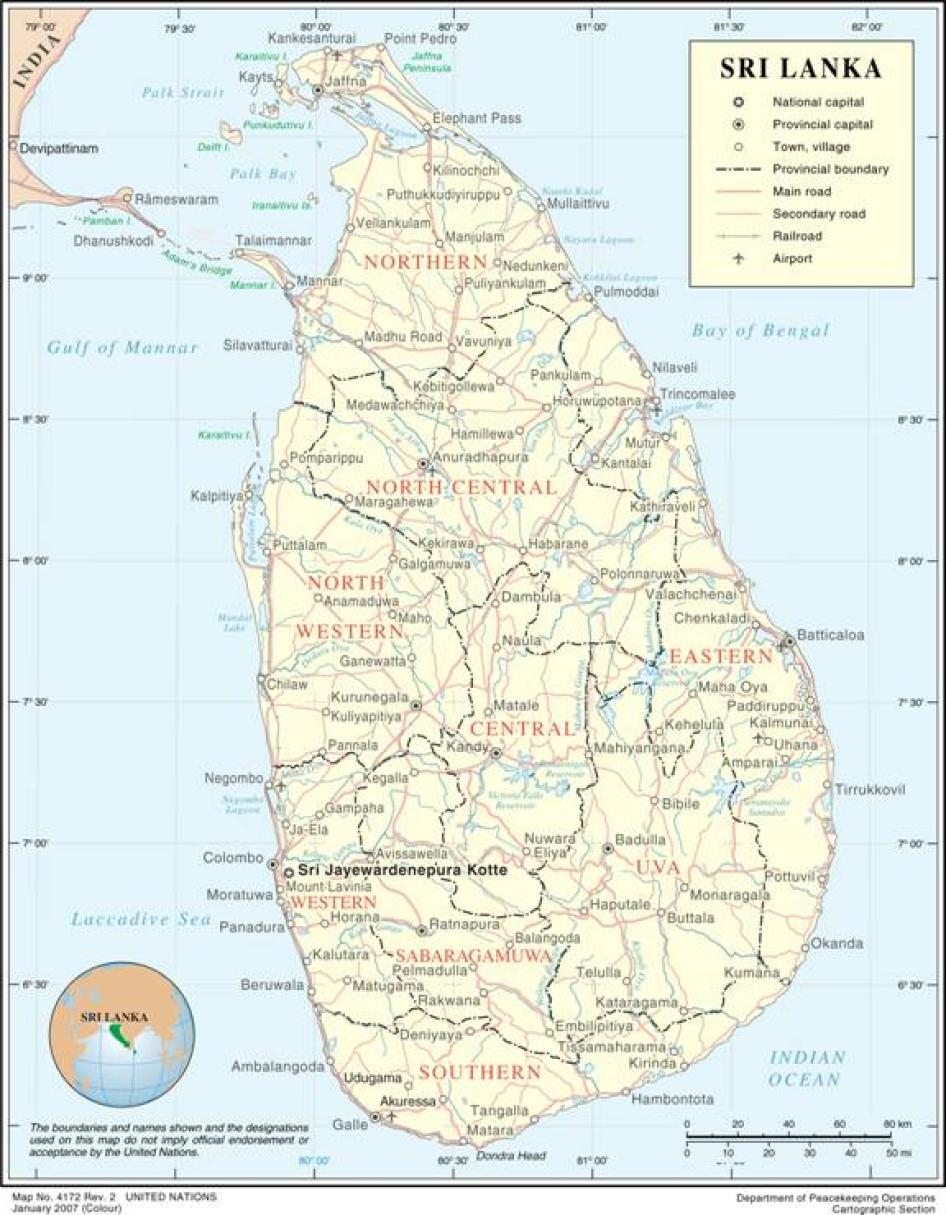
I. Summary
Several hundred thousand ethnic Tamil civilians are currently trapped in intensifying fighting between the Sri Lankan armed forces and the separatist Liberation Tigers of Tamil Eelam (LTTE) in the LTTE's northern stronghold, known as the Vanni.[1] As the LTTE has lost ground to advancing government forces, civilians have been squeezed into a shrinking conflict zone. The encroaching fighting has left many homeless, hungry, and sick, and placed their lives increasingly in danger.[2]
The war in northern Sri Lanka receives little attention in the international media, in part because foreign journalists have not had independent access to the Vanni since fighting intensified in mid-2007. Independent human rights monitors are similarly prevented by the government and the LTTE from going to the area. As a result, the continuing suffering of the people of the Vanni remains largely unknown to the rest of the world.
This report details the Sri Lankan government's responsibility for the plight of displaced civilians in the Vanni, focusing on the humanitarian crisis created by sweeping government restrictions on humanitarian access and the government's policy of indefinitely detaining virtually all civilians fleeing from LTTE-controlled areas in military-guarded camps.
The LTTE has forcibly blocked civilians in areas under its control from crossing into government-held territory, compelling them to move with retreating LTTE forces. As a result, only about a thousand civilians from the Vanni have managed to reach non-combat zones-and most of these, including many families, have been detained in government camps. The LTTE also has continued to force civilians, including children, to join LTTE ranks and to carry out abusive forced labor.
In September 2008, Sri Lankan Defense Secretary Gotabhaya Rajapaksa ordered the United Nations (UN) and international humanitarian agencies to leave the Vanni. This policy has drastically worsened the plight of the civilian population, significantly reducing prospects that essential food, shelter, water, sanitation, and health care would reach affected individuals. Cyclone Nisha, which hit the area to devastating effect in late November, had a greater impact because of these restrictions.
With humanitarian and civilian movement in and out of the Vanni greatly restricted by both the Sri Lankan authorities and the LTTE, affected communities find it increasingly difficult to obtain desperately needed humanitarian assistance.
While the government claims the withdrawal of UN and humanitarian agency staff was necessary to ensure their safety, such agencies work in many conflicts around the world where their security is at greater risk. Sri Lankan officials also have shown overt hostility to outside agencies and humanitarian staff in recent months, suggesting that political considerations or a desire to remove independent observers from the scene might also have been behind the ouster. Human Rights Watch recognizes that continuing fighting in the region raises legitimate security concerns, but urges that UN and humanitarian agencies be allowed to make their own, professional assessments of the risks. Instead of a blanket ban, any restrictions should be implemented on a case-by-case basis and only where there is a situation-specific reason for the restriction. The government should urgently engage in good faith discussions with the UN and humanitarian agencies about allowing them back to assist civilians in need.
Civilians seeking to flee the fighting in the Vanni also continue to be fearful of their treatment by government authorities. The Sri Lankan government has established a policy of detaining civilians fleeing LTTE-controlled areas in search of safety. Most of the families and individuals stopped while crossing into government-controlled areas have been detained indefinitely in military-run camps.[3] Virtually all Vanni residents are ethnic Tamils who have relatives-by choice or compulsion-in the LTTE.
Officials have reason to vet new arrivals to ensure that LTTE fighters are not disguised among them, but at present all who cross, including entire families, are being detained indefinitely in camps with little prospect of joining relatives or host families elsewhere in Sri Lanka. This makes them particularly vulnerable to extrajudicial killings, enforced disappearances, and other human rights abuses rampant in government-controlled territory.[4] Forced to remain, and too fearful to flee, many are now also beyond the reach of the humanitarian agencies who seek to assist them. The government should immediately end the arbitrary detention of civilians seeking to flee the conflict.
As noted above, the Sri Lankan government does not bear sole responsibility for the plight of civilians in the Vanni. On December 15, 2008, Human Rights Watch issued a report documenting LTTE abuses against the civilian population, including preventing civilians fleeing combat zones, and the use of forced recruiting and abusive forced labor.[5] But the government's policies are greatly exacerbating what has become a desperate situation for many. Donors and other governments should press Sri Lanka to immediately reestablish full humanitarian access and allow civilians freedom of movement.
Note on Methodology
This report is based on research conducted by Human Rights Watch in Sri Lanka between October and December 2008, including in Vavuniya and Mannar districts in October 2008. More than 35 in-depth interviews were conducted with officials from United Nations agencies, international and local humanitarian organizations, regional and local analysts, diplomatic representatives, religious leaders, and ordinary civilians affected by the conflict.
Human Rights Watch also obtained and reviewed internal and public documents related to the crisis in the Vanni. Following the research mission, follow-up interviews were conducted over the telephone and other secure means of communications. Because of concerns of official backlash and security considerations, we have withheld the names of some sources.
II. Background: Return to War
By mid-2006, the 2002 ceasefire agreement between the Sri Lankan government and the LTTE was in tatters, as major military operations by both sides resumed in the country's north and east. Initial fighting occurred in the northern Jaffna peninsula and Trincomalee district, before the Sri Lankan army undertook an offensive against LTTE-controlled areas of Batticaloa district in the east.
In July 2007, the Sri Lankan government announced the "liberation" of eastern Sri Lanka from the LTTE[6] and refocused its military offensive on the LTTE's stronghold in the north, the Vanni. The Sri Lankan armed forces first sought to take control of the western seaside district of Mannar, and by early 2008 they began retaking territory in the Vanni itself. Sri Lankan forces made significant gains against the LTTE, and by October 2008 had recaptured most of the territory west of the main north-south A9 highway that divides the Vanni.
As government forces advanced, the LTTE withdrew to fortified positions in the jungles east of the A9 highway. With most of western Vanni under government control, Sri Lankan forces converged on the LTTE administrative headquarters of Kilinochchi. Despite numerous government claims that Kilinochchi would soon fall,[7] at the time of writing, government and LTTE forces remained dug in. Casualty information from either side is rarely credible, but the government decision in mid-October to stop releasing its military casualty figures suggests that its own losses may be high.
Concerns about Civilian Casualties
All parties in Sri Lanka's armed conflict are obliged to abide by international humanitarian law, the laws of war.[8] Because of the sharp restrictions on humanitarian agencies, the media, and human rights groups in the Vanni, there is very little information available on the numbers and causes of civilian casualties from the fighting. The Sri Lankan armed forces have used heavy area shelling and aerial bombing against the LTTE, including numerous attacks on Kilinochchi.[9] The LTTE has frequently shelled areas held by the government, including near the district capital of Vavuniya.[10] Religious officials and others have reported a significant number of incidents with single-digit civilian casualties (see below); despite the wide use of artillery and airpower during the recent offensive, there have been no credible reports of individual attacks causing high civilian casualties, and nothing comparable to the November 8, 2006, shelling of the Kathiravelli School in Batticaloa district, investigated by Human Rights Watch, which killed 62 civilians.[11]
A number of civilian deaths from Sri Lankan artillery and air attacks have been reported to Human Rights Watch. Human Rights Watch does not have information whether LTTE forces deployed among the civilian population or the extent to which their restrictions on civilian movement have contributed to the civilian casualties. A Sri Lankan armed forces artillery attack on August 8, 2008, in the vicinity of the Mullaitivu General Hospital and district offices, resulted in the death of an 18-month-old child and injuries to at least 16 civilians, including the Mullaitivu Government Agent, Imelda Sukumar. An August 30, 2008, artillery attack hit the Puttumurripu displaced persons camp, nine kilometers from Kilinochchi, killing five displaced persons, including two infants.[12] A Sri Lankan air force bombing around Kilinochchi on October 10 killed three female civilians, including Arumainathan Chadrathevi, a 46-year-old teacher, her nine-year-old daughter Achchika, and Usha Manokaran, 33, and wounded several others.[13] Other reported incidents of civilian casualties have been difficult to confirm because of the virtual prohibition on access to the Vanni put in place by both sides.
Sri Lankan military authorities have insisted that they abide by the requirements of international humanitarian law by taking measures to avoid civilian casualties. So long as access to the region is denied to independent observers, such claims cannot be verified. Vanni residents have in any case become accustomed to the conduct of hostilities, knowledge they have used to reduce death and injury from the fighting. Sri Lankan army area bombardments are somewhat predictable-shells are fired in a slowly advancing grid pattern, giving civilians familiar with this tactic time to flee in advance of the shells. Aerial bombings are often preceded by spotter planes, effectively warning the population of impending attacks. In addition, almost all civilians in the Vanni have constructed rudimentary "bunker" shelters, often on the orders of the LTTE. And the LTTE in September relocated all civilians from its embattled administrative center Kilinochchi after the town came under sustained government bombardment; Kilinochchi's hospital functioned until late October, when its patients and staff were transferred to Dharmpuram.
Civilians trapped in the Vanni also face battlefield dangers beyond the bombardments, including from ground combat between the LTTE and Sri Lankan armed forces; incursions by so-called Deep Penetration Units of the Sri Lankan army that have been blamed for a number of killings of civilians; and the widespread use of Claymore mines, often triggered by tripwires that do not distinguish between military targets and civilians.[14] And humanitarian agencies have expressed concern that continual displacement and constant exposure to shelling, bombing, and ground-fire have caused large-scale psychosocial trauma among the displaced population, particularly children.[15]
As the civilian population becomes more concentrated in a smaller area of land, and the fighting moves towards them, the potential for large-scale civilian casualties will greatly increase. Both the LTTE and the Sri Lankan security forces have an obligation under international humanitarian law to allow civilians to leave areas where combatants are deployed, and to take all feasible precautions to minimize the risk to the civilian population.
III. Government Detention Camps for Displaced Persons
Kalimoddai and Sirunkandal detention camps
In the past year, despite the massive forced displacement of civilians in the Vanni, only about a thousand people have crossed LTTE lines into so-called "cleared areas" under government control. Civilians in the Vanni who manage to elude LTTE forced recruitment and labor, and other restrictions on their movement,[16] and reach government areas find they face great risks to their life and liberty. These include the danger of extrajudicial killing and enforced disappeance by government security forces and allied paramilitary groups, and long-term detention in poor conditions in government camps.
Since March 2008, Sri Lankan security forces have detained almost all ethnic Tamil civilians fleeing the Vanni, intercepting them when they approach government-controlled areas. Active fighting around the main A9 road and numerous government and LTTE checkpoints, and the widespread use of landmines by both sides have made travel overland extremely difficult and dangerous. As a result, until the mid-November 2008 LTTE withdrawal from northern Vavuniya district, most civilians fleeing the Vanni did so by sea, bribing local fishermen to take them by boat to the port town of Trincomalee or other government-controlled areas. Small numbers of civilians fleeing the Vanni still attempt to bypass the government security cordon to live in the predominantly Tamil areas of Mannar or Vavuniya, but they face arrest if identified. Following the mid-November 2008 withdrawal of the LTTE from northern Vavuniya district, several hundred civilians who approached the official government checkpoint at Omanthai just north of Vavuniya town were promptly detained and placed into camps (see below).
Tamil civilians seeking to flee fighting in Sri Lanka's north during the 25-year-long civil war have long been subject to arbitrary detention in camps and other restrictions on their freedom of movement.[17] Still, most could hope to stay with relatives or host families in other parts of Sri Lanka. The government's March 2008 decision to establish new camps seems intended to eliminate that possibility entirely.[18] Since then, all Tamils-including whole families-fleeing the Vanni have been detained on the apparent assumption that they are a security threat. No attempt is made by Sri Lankan security forces to distinguish between persons with suspected LTTE links and ordinary civilians. The only exceptions appear to be for some local humanitarian workers and clergy, who have been able to enter and exit the Vanni.
The security forces send Tamils taken into custody to two so-called "welfare centers" in Mannar district (additional camps in neighboring Vavuniya district, as discussed below, have also been established). Kalimoddai camp opened in March 2008; Sirukandal camp opened in July 2008. As of December 15 , 2008, Kalimoddai housed 461 persons (202families)[19] and Sirukandal housed 345 persons (153 families).[20] There were 226 children (persons under 18) in both camps.[21] Many of those detained are young single men who fled the Vanni to avoid forced LTTE recruitment, and families who fled to prevent the forced recruitment of their children.[22]
Since the establishment of the internment policy in March 2008, Sri Lankan authorities have also detained Sri Lankan Tamil refugees who have sought to return from India via sea, and placed them in the Kalimoddai and Sirukandal camps.[23]
Despite repeated assurances from Sri Lankan authorities since April 2008 that many of the displaced persons detained in the two camps, particularly those originally from Trincomalee and Vavuniya districts, would be permitted to leave, as of December 15, 2008, only 65 persons had been released.[24] On October 23, two persons from Kilinochchi district detained in Kalimoddai were allowed to move out of the camp to a host family in Vavuniya; on October 24, 25 persons, including three families who had been detained after returning from India, were released from Kalimoddai and Sirunkandal camps and returned to their home area of Trincomalee.[25]
The civilians in the two camps are being held against their will. The camps are completely fenced, and are closely guarded by Sri Lankan navy and army personnel, and the police. The security forces have refused to allow the civilians to leave the camps-except under tight restrictions described below-and integrate into local communities or live with host families.
In echoes of LTTE population controls, individuals wishing to leave the camp for work or other reasons must request a daily pass from the security forces and leave behind another relative as "guarantor" to ensure their return.[26] The security forces limit the total number of day passes given out each day and those who receive a pass must return by evening. There are also restrictions on where detainees can go. Previously they could only go to nearby Murunkan, but in November, some camp residents-but not young single detainees-were allowed to travel to Mannar town.
Camp residents who are not with families cannot provide relatives as "guarantors" and are thus almost permanently confined to the camp. In order for single men to leave the camp, they must request special permission for a critical situation such as a medical emergency. Ordinary daily needs such as shopping, visiting relatives and friends, or collecting firewood do not usually qualify. On one recent occasion, a group of single camp residents were escorted to go shopping, but such cases are the exception. Only when enough such special individual requests have been made by single detainees is a group allowed to leave the camp. These restrictions have at times put the lives of detained displaced persons in danger: in September, a detained displaced person with a heart condition had to wait three days before being allowed to leave the camp for medical attention.[27]
Available information indicates that the restrictions on movement for displaced persons in the camps are increasingly becoming stricter, particularly for single men. After security incidents such as escape or suicide attempts, the security forces have prohibited young men from leaving the camp altogether for extended periods. After a young man went missing from Kalimoddai in October-it remains unclear whether he escaped or was abducted-virtually no single detainees were allowed to leave the camp under any circumstances, a restriction still in place at the time of finalization of this report on December 15, 2008.[28] The Sri Lankan security forces claim that 13 camp residents have "escaped," but detainees told humanitarian workers the men may have been abducted or "disappeared."[29]
At least five camp residents, all young men, have been arrested from the camps and taken into police custody. Nothing is known about what happened to them thereafter, creating fear among other camp residents, particularly young men.
Conditions in the camps are dire and need urgent attention. Most of the detainees live in temporary emergency tents, and Kalimodai camp is built in a low-lying area prone to flooding in the monsoon season. There are significant concerns about privacy and hygiene in the camps, particularly at Kalimoddai, where there is insufficient space and facilities to house so many families. A request to move the camp residents to a more appropriate location was submitted by the Government Agent of Mannar, but was declined by the Sri Lankan navy on security grounds.[30]
No schools operate in the camps. Children allowed to attend the nearby schools in Murunkan and Parikarikandal are only offered a limited curriculum. On November 2, a number of students were released from Sirukandal to attend schools in Mannar, but their parents were required to remain in the camp. At least four children-down from at least 20 children earlier-in Kalimoddai and Sirunkandal are currently not attending school at all because of the difficulties they face in accessing educational opportunities.[31]
Detainees in the two camps have very limited ability to pursue livelihoods. Most are farmers and fishermen but have no opportunity to engage in work, making them dependent on the assistance provided.
Humanitarian agencies operating in the camp need prior authorization to visit the camps, and are often questioned about the purpose of their visits. Despite the dire needs of the detainees at the two camps, many humanitarian agencies face a difficult dilemma. The military nature of the camps and the restrictions on freedom of movement imposed by the government are inconsistent with international law and basic principles on the treatment of displaced persons. Many agencies feel that providing humanitarian assistance to displaced persons under such circumstances would legitimize unacceptable government detention policies. As a result, humanitarian agencies took a joint decision to limit their assistance to relief assistance, providing emergency water and sanitation facilities, but no infrastructure support that could make these camps permanent.[32] Instead, the agencies decided to focus on advocating for changes in the way the camps are run, particularly allowing freedom of movement for the displaced persons.
The decision by humanitarian agencies to limit their involvement with the detention camps was also motivated by the wishes of the camp residents themselves, who articulated a clear position during a series of consultations. The detainees said they did not want the humanitarian community to provide any kind of assistance that would result in more than a temporary stay in the camps. They did not want their detention legitimized or made more permanent by the building of longer-term camp structures.[33]
The detainees wish to leave the camps as soon as possible. On May 10 and 11, local authorities conducted a survey in Kalimoddai camp (then the only camp for displaced persons from the Vanni). Out of the then camp population of 257 individuals (115 families), only five families indicated they were undecided about remaining in Kalimoddai. The other families indicated they wanted to leave the camp and had alternative places to stay, including with relatives and nearby host families, a much healthier and secure environment for displaced families.[34] Though these findings were presented to the Government Agent of Mannar at the Consultative Committee on Humanitarian Activity (CCHA) meeting held on May 15, no action was taken.
International law on detaining displaced persons
International human rights law and international humanitarian law during internal armed conflicts prohibit arbitrary detention.[35] The UN Guiding Principles on Internal Displacement, an authoritative framework for the protection of displaced persons derived from international law, provides that, consistent with the right to liberty, internally displaced persons (IDPs) "shall not be interned in or confined to a camp." The principles recognize that "exceptional circumstances" may permit confinement only for so long as it is "absolutely necessary," but the Sri Lankan government has not demonstrated that such circumstances exist.[36]
In his May 21, 2008, report to the UN Human Rights Council on his December 2007 visit to Sri Lanka, Walter Kälin, the UN secretary-general's representative on IDPs, emphasized that displaced persons in Sri Lanka, "as citizens of their country," remained "entitled to all guarantees of international human rights and international humanitarian law subscribed by the State."[37] His report noted that, "while the need to address security may be a component of the plan [to receive IDPs], it should be humanitarian and civilian in nature. In particular, IDPs' freedom of movement must be respected, and IDPs may not be confined to a camp" (emphasis added).[38] The UN High Commissioner for Refugees has similarly reaffirmed the rights of IDPs in an Aide Memoire to the Sri Lankan government dated August 19, 2008 (discussed below).
The Sri Lankan security forces have a legitimate right to identify and apprehend suspected LTTE militants found with civilians fleeing the Vanni. Suspected LTTE militants must be treated in accordance with international standards, and not abused, "disappeared," or executed-a continuing problem in Sri Lanka. However, the current blanket detention policy of the Sri Lankan government, placing anyone fleeing the Vanni into camps, violates Sri Lanka's obligations under international humanitarian law and human rights law.
Proposed expansion of the detention policy
The problems faced by the approximately 800 persons displaced from the Vanni who are currently interned in the Kalimoddai and Sirunkandal camps are not unique in Sri Lanka. Although the vast majority of the more than 20,000 persons displaced during the 2007 government military offensive in Mannar district were allowed to stay with host families or in IDP camps without strict movement controls, the Sri Lankan security forces continue to hold an estimated 400 displaced persons from the Musali area under similar movement restrictions in the Nanattan Rice Mill and Church Land "welfare" sites, denying them freedom of movement.[39] A planned return of Musali displaced persons to their areas of origin was suspended in early October 2008 because of concerns about the presence of uncleared mines and ordinance.[40]
In September 2008, the Sri Lankan authorities informed the UN and humanitarian organizations that they were in the process of drawing up contingency plans to keep up to 200,000 displaced people from the Vanni in new camps in Vavuniya district, in case a mass outflux from the Vanni materialized.[41] The government has identified both transit sites and permanent welfare sites that it would like to use to house the displaced persons from the Vanni around Vavuniya. Although the identification and preparation of sites is still in process, the sites include several active schools,[42] public halls,[43] and three large tracts of land in Mannik Farm, Karuvalpuliyankulam, and Kalwadinakulam that are in the process of being cleared and turned into large "welfare centers."[44] Despite repeated requests from humanitarian agencies, government officials have refused to clarify if the same restrictive internment policies adopted in the Mannar-area camps would be extended to the new Vavuniya camps.
Whether the Sri Lankan authorities, the UN, and humanitarian organizations will be able to meet the shelter, water and sanitation, food, education, medical, and other needs of the displaced population in the new camps is an open question, particularly in light of the humanitarian community's decision to limit their involvement in the Kalimoddai and Sirunkandal camps. Addressing these concerns depends in large measure on whether the Sri Lankan authorities will adopt the same unlawful restrictions on freedom of movement for the planned Vavuniya camps, turning them into large-scale internment camps rather than IDP camps that are in accordance with international standards.
According to humanitarians who have attended government meetings on the issue, the current government plan is to receive displaced persons fleeing the Vanni at the Omanthai military checkpoint, where all displaced persons will be screened.[45] The government agreed to allow the International Committee of the Red Cross (ICRC) and UNHCR to monitor the screening process.[46] Those suspected of LTTE involvement will be taken into custody, but the remaining displaced persons will not be allowed freedom of movement; they will be first sent to military-guarded transit camps for a period of around five days, and will then be transferred to the permanent "welfare centers," where they will remain for an unknown period of time under close military guard. Sri Lankan organizations have already expressed concern that the displaced persons will be indefinitely detained, like those at the Kallimodai and Sirunkandal camps.[47]
In response to the government plan to create further camps for displaced persons around Vavuniya, as well as in response to significant protection problems in other IDP sites and with resettlement programs in the east and north, UNHCR wrote an Aide Memoire to the Sri Lankan authorities on August 29, 2008, stating that it wished "to take this opportunity to reiterate that it can only support IDP sites, in which the physical safety and security, protection and well-being of the IDPs is ensured." The Aide Memoire states that the Sri Lankan government "should ensure that IDPs enjoy full and unhindered freedom of movement within, as well as in and out of IDP sites," and reaffirmed that the "preferred option for emergency shelter is the host family arrangement," rather than restrictive camp options.[48]
The LTTE also bears responsibility for the plight of civilians fleeing from the Vanni. The LTTE has frequently used civilian cover to move LTTE combatants into government-controlled areas, either to avoid capture or to carry out attacks, including targeted killings and suicide bombing attacks. For example, Human Rights Watch documented a case in which the LTTE allowed a family to leave the Vanni on condition that they take an LTTE cadre along as a "family member" to escape scrutiny by the security forces.[49] In the case of a mass civilian outflux from the Vanni, there is little doubt among humanitarian officials and Sri Lanka experts that the LTTE would attempt to disguise a large number of LTTE combatants among civilians in order to move them out of the Vanni.
As noted above, the Sri Lankan authorities have an obligation to ensure the security of the civilian population, including by taking into custody suspected LTTE combatants and prosecuting them for cognizable criminal offenses in accordance with international legal standards. Arrivals of large numbers of displaced persons heighten such security concerns, but in no way lessens the obligation to abide by international law.
The LTTE also has international legal obligations towards civilians. Placing LTTE combatants within groups of fleeing civilians at a minimum violates the international humanitarian law requirement to take constant care to spare the civilian population, including by taking all feasible precautions to minimize loss of civilian life and protect civilians under their control from the effects of attacks.[50] Depending on the circumstances, such practices may amount to using civilians as "human shields" (deliberately using civilians to protect a military target from attack)[51] or acts of perfidy (deliberately feigning civilian status in order to carry out attacks), which are war crimes.[52]
Detention of recent arrivals in Vavuniya and Jaffna
The question of how the Sri Lankan authorities will handle new arrivals from the Vanni is no longer just one of future planning; since late November, an increased number of displaced persons from the Vanni have fled directly towards Vavuniya and Jaffna districts. The restrictive policies currently being implemented by the Sri Lankan authorities with these new arrivals confirm that the Sri Lankan government is indeed expanding its internment policy towards displaced persons coming from the Vanni.
Since November 21, a growing number of displaced persons have been detained by Sri Lankan security forces at the Omanthai checkpoint-at least 419 individuals (174 families) by December 15,[53] almost all of them from northern Vavuniya district.[54] This is due to a combination of factors. The LTTE withdrew from some formerly LTTE-controlled areas of northern Vavuniya, including its own checkpoint at Omanthai on the A9,[55] allowing greater numbers of displaced persons to reach the government checkpoint. Secondly, instead of letting civilians through the checkpoint, the Sri Lankan security services since mid-November have closed it completely, and detained civilians who arrive there.[56]
So far, the government has not complied with the most important agreements made with humanitarian agencies on the procedures to be followed should there be an influx of displaced persons towards Vavuniya. The government has not allowed the ICRC and UNHCR to observe the procedures used to screen out suspected LTTE militants at the Omanthai checkpoint, as had been previously requested (see above). Given the Sri Lankan security forces' disturbing record of "disappearances," the inability of the ICRC and UNHCR to monitor these screening procedures is a cause for grave concern. The government also did not implement an agreed-upon registration of the newly arrived displaced persons by civilian authorities that would have helped ensure all displaced persons remain accounted for. The transit sites used by the military were not those agreed upon and assessed by the humanitarian community, and do not have adequate water and sanitation facilities.[57]
The displaced persons screened and detained at the Omanthai checkpoint have all been taken to the Manik Farm area, where some areas of land have been cleared by the authorities, and to Nellukulam. The families are currently staying at a school building and a community hall, where they have been kept under close guard by a heavy military presence. As at Kalimoddai and Sirukandal camps in Mannar, the displaced persons have not been allowed to leave the camps, and some agencies, including the Sri Lankan National Human Rights Commission, have had difficulty accessing the camp.[58] The military commander at Manik Farm has required that all organizations visiting the camp, including UN agencies, the National Human Rights Commission, and all NGOs, have prior written permission from the Vavuniya Government Agent. The Government Agent has indicated to the BBC that the army told her not to allow anyone to visit the camp.[59]
By December 15, at least 155 individuals from the Vanni had attempted to flee by small boats towards the northern Jaffna district, and were intercepted by the navy at sea.[60] Since their arrival, the families have been kept under military guard at the former court complex in Jaffna, with only the ICRC and UNHCR allowed access to them. On November 2, a group of 28 displaced persons fleeing the Vanni were intercepted at sea by the navy and moved to Jaffna town. There they were brought before the Jaffna magistrate, and then sent to Jaffna prison. No legal justification was given for detaining them at the prison, which houses convicted criminals and is notoriously overcrowded and filthy, and so is not an appropriate facility to house displaced persons.[61]
After interventions from lawyers for the displaced persons, they were transferred from the prison on November 25 to the former court complex, where the other displaced from Vanni were already being kept.[62] In early December, the displaced persons were moved from the courthouse premises to the Kopay Teachers' Training Complex, where they are still kept under military guard and not allowed to leave the complex.[63]
A Note on Displacement and Other Figures Used in this Report
Because of restrictions on access placed on humanitarian agencies operating in the Vanni, there is no accurate figure available for the current number of displaced persons there. Estimates made by various government agencies and humanitarian agencies vary widely. Government Agents in the Vanni estimate 350,000 displaced persons, while the United Nations estimates 230,000-300,000. Some government officials suggest there are as few as 100,000. Because the government appears keen to downplay the severity of the humanitarian crisis in the Vanni, the number of displaced persons has become a point of contention. All other figures used in this report have been updated at the time of writing unless stated otherwise.
At a meeting for humanitarian agencies convened by the Government Agent of Vavuniya on November 4, 2008, the Government Agents for Mullaittivu and Kilinochchi stated that they had counted a total of 197,103 displaced persons in Mullaittivu (96,135 persons displaced since August 11, 2006, and 100,968 persons displaced before that date), and 151,000 displaced persons in Kilinochchi (148,109 since August 11, 2006, the remainder before that date), for a total of 348,103 displaced persons. However, the figures of the Government Agents do not take into account that a significant number of the pre-2006 displaced persons have again been displaced by the conflict and are thus counted twice, which inflates the total number.
The most recent (November 2008) figures of the UN High Commissioner for Refugees estimate there are 230,000 displaced in the Vanni, a figure also accepted by the United Nations Resident Coordinator's office.[64] This figure does not include the more than 100,000 registered displaced persons who were displaced prior to August 11, 2006, and which are included in the counts of the Government Agents. However, the UN has been inconsistent in using the 230,000 figure; on a number of occasions, the UN has also estimated the number of displaced persons in the Vanni at around 300,000.[65] Most recently, the UN World Food Program used a lower figure of an "estimated" 200,000 displaced persons in the Vanni in a press statement, without any explanation why their estimates differed from those of the other UN agencies.[66] Officially, the World Food Program continues to use the figure of 238,000 displaced persons.
Estimates from national government officials typically have been lower than those of the humanitarian community and their own Government Agents in the Vanni, which appears to be aimed at downplaying the seriousness of the Vanni's humanitarian crisis. In November 2008, the Ministry of Disaster Management and Human Rights claimed that the actual number of persons displaced since April 2006 was 207,000 persons.[67] During a November 21 ceremony accepting Indian government aid for civilians in the Vanni, Sri Lankan Foreign Secretary Palitha Kohana gave an even smaller number, arguing that the figures of displaced persons in the Vanni were "grossly exaggerated," and stating that he believed there were "around 100,000" displaced persons in the Vanni.[68] It is not clear why the foreign secretary gave a figure only half that estimated by the Ministry of Disaster Management and Human Rights, but the humanitarian plight of the Vanni displaced population has greatly concerned neighboring India, with a large Tamil population in Tamil Nadu state; lowering the figures of affected persons may be an attempt to limit Indian pressure.[69]
Government officials have frequently responded to human rights concerns by arguing over the numbers used rather than about the practices described, which obfuscates the concerns raised. In any complex humanitarian situation, figures of displacement and humanitarian assistance change constantly, as displaced persons move or more humanitarian assistance is brought in. The purpose of this report is to identify patterns of government and LTTE abuses that should be cause for concern, such as restrictions on freedom of movement for displaced persons or interference with the work of humanitarian agencies. Those concerns remain the same whether 200,000, 300,000, or a different number of persons are affected.
IV. Humanitarian Needs in the Vanni and the Forced Departure of the United Nations and Humanitarian Agencies
Current humanitarian needs in the Vanni
The government-ordered withdrawal of all United Nations and international humanitarian staff in September 2008 (detailed below) has had a severe impact on the humanitarian situation in the Vanni. There are an estimated 230,000 to 300,000 displaced persons currently trapped in the Vanni conflict zone, as well as a smaller number of Vanni residents who remain in their homes. Government claims that humanitarian agencies were not necessary because the government itself was able to meet the needs of the Vanni's population proved to be untrue, and reflect a failure to recognize that timely humanitarian assistance depends as much on efficient logistics and distribution systems as on simply delivering the necessary supplies.
The most acute needs have been in the areas of food, shelter, water, sanitation, health care, psychosocial counseling, and education. It is in the non-food sectors that the impact of the ordered withdrawal has been felt most severely; it is these sectors that are not included in the permitted UN shipments into the Vanni and which are most impacted by the absence of qualified humanitarian personnel on the ground.
The provision of basic assistance to IDPs in the Vanni is made more complicated by the fact that many families have had to move multiple times to escape approaching fighting. Each time, new shelters and sanitation facilities need to be constructed and new supply lines established. The monsoon rains continue from October until January or February, so the impact of heavy rains on shelter and sanitation will remain particularly acute during this period.
The government of Sri Lanka has repeatedly asserted that the humanitarian needs of the population in the Vanni are being met, claiming that its own efforts are filling the gap left by the humanitarian departure. For instance, in a December 3, 2008, statement, the secretary-general of the governmental Secretariat for Coordinating the Peace Process, Rajiva Wijesinha, argued that the government was actually providing too much food to the Vanni, and that international criticisms reflected a lack of understanding about available government services: "The free health care and education services Sri Lanka provides are not common elsewhere, which is what doubtless led international commentators to assert that these services were collapsing."[70]
Such statements claiming that the Sri Lankan government is meeting the humanitarian needs of the population in the Vanni are issued regularly by Sri Lankan officials. They appear eager to downplay the extent of humanitarian suffering in the Vanni, particularly after India, which has a substantial Tamil community and has previously intervened militarily in the LTTE conflict, expressed concerns in October about the humanitarian situation in the Vanni.
However, these government statements have not been backed up by convincing statistics that show the level of assistance provided by the government, nor are the distribution mechanisms explained. Most significantly, the rosy picture the government seeks to paint of the humanitarian situation in the Vanni is directly contradicted by the reports of their own government officials on the ground and by the assessments of the United Nations and humanitarian organizations, as discussed below.
The obstruction of humanitarian assistance documented in this report, and the efforts by Sri Lankan officials to downplay the extent of humanitarian suffering in the Vanni, should be distinguished from the exemplary and often courageous efforts made by Vanni-based officials, civil servants, and humanitarian workers who continue to do everything within their power to address the needs of the population. For example, despite the challenges they face, teachers continue to try and provide a stable educational environment for the children in the Vanni, setting up temporary schools and attempting to take their school materials along with them when they are displaced. Human Rights Watch's concerns about the humanitarian situation in the Vanni should in no way detract from these genuinely heroic efforts.
Food
Some food stocks remained in the Vanni at the time the government ordered the humanitarian withdrawal, giving the authorities some buffer before its impact would be felt. But those stocks are now being depleted. Much of the humanitarian effort is now focusing on meeting the essential food needs of the displaced population. Seven large UN food convoys were dispatched to the Vanni between October 2, 2008, and December 15, 2008, carrying a combined load of 4,120 metric tons of food (another food convoy is scheduled for December 18).[71]
Local food prices, particularly for vegetables, have risen sharply, and purchasing capacity for most displaced persons and local communities has decreased because of loss of livelihoods like fishing, farming, and day labor.
The UN World Food Program (WFP) and the government estimate that at least 750 metric tons per week are needed to meet the minimum nutritional requirements of the displaced population in the Vanni-a figure assuming an efficient distribution system with minimal waste or siphoning off of aid-difficult to monitor without a humanitarian presence in the Vanni.[72]
Even the 750 metric tons is an underestimate, since the basic minimum WFP rations per person of 0.5 kilograms[73] for 230,000 persons (the smallest credible estimate of the displaced population) would require a total of 805 metric tons per week, or 3,450 metric tons per month.[74] Based on this formula, the IDP population of the Vanni would require a total of at least 10,350 metric tons of food for the three months between the withdrawal of the UN on September 16, 2008, and the time of finalization of this report, December 15.[75] However, the seven food convoys combined only delivered a total of 4,120 metric tons of food, a shortfall of 6,230 metric tons of food over the minimum nutrition requirements of the displaced population, or 60 percent of the minimum nutrition requirements. Again, these are figures based on the lowest credible estimate of 230,000 displaced persons in need of food aid; the actual numbers of people in need of aid may be significantly higher.
At a December 10, 2008, Inter-Agencies Standing Committee (IASC) meeting, WFP officials estimated that the food deliveries into the Vanni since the September 2008 withdrawal had been 38 percent below the minimum nutrition requirements, but this estimate is based on an estimate of 200,000 IDPs, which is lower than the 230,000 number used by other UN agencies, and also uses the date of the first convoy, October 2, as the starting date for its needs assessment, ignoring the fact that no food deliveries were made in September.[76] Because of this, the WFP figures underestimate the actual food shortcomings in the Vanni.
As a result, a very large gap exists between the minimum daily nutritional requirements of the population and the food being brought into the Vanni. According to humanitarian officials, some of the camps they work in are already down to distributing just two meals per day, and one camp is reportedly surviving on just one meal a day.[77]
Most of the international food assistance is in the form of rice and flour, and does not include other food items that are in critically short supply, such as vegetables, whose prices have skyrocketed. For example, a humanitarian assessment mission found that the price of one kilogram of onions, a staple in Sri Lanka, had risen five-fold from Rs.60 to Rs.300.[78] In a mid-October letter to the humanitarian community, the Government Agent of Vavuniya described "the availability of essential supplementary food items" as "remaining critical."[79]
The government is also sending in additional convoys of non-UN food through Government Agents, but the food on those convoys is destined partly to be sold at the government-organized Multi-Purpose Cooperative Society (MPSC) stores, and not for free distribution to displaced persons. Although these convoys may boost the amount of food locally available, many displaced families do not have the financial resources left to purchase food and so are entirely dependent on free distributions. Some humanitarian agencies have been able to send supplementary food items on two Government Agent-organized convoys, but only in small amounts that will not affect the overall food shortages.[80]
The government has repeatedly claimed that these food convoys are sufficient to fill the gap in needs, but has not provided any details even to the humanitarian agencies on the amounts of food aid it has provided, how it is being distributed, and who it is reaching, normally just publicizing the number of trucks it has sent into the Vanni.[81] Greater transparency by the government on exactly what it is sending into the Vanni would allow the humanitarian community to better assess the needs in specific areas, but it is clear that the food convoys sent in by the authorities come nowhere near to providing the thousands of tons that are needed.
More significant has been the 1,700 tons of humanitarian assistance, including food, clothing and hygiene items, that were contributed by the Indian government in late November and distributed by the ICRC in early December. The Indian assistance aimed to provide 80,000 family parcels of assistance, designed to meet the essential needs of those families for three to four weeks.[82]
Furthermore, the departure of much of the farming community from the productive paddy fields in western Vanni, now under control of the Sri Lankan security forces, means that long-term food security for the Vanni is also at risk.
One of the most important functions of the humanitarian agencies was to fill the gap in food distribution for families who were newly displaced; even before the humanitarian withdrawal, it often took up to eight weeks to register newly displaced (or re-displaced) families in their location and put them on the regular WFP food distribution system. Humanitarian agencies provided these newly displaced families with the rations necessary to survive during this critical period. That emergency food ration capacity has been severely affected by the humanitarian withdrawal from the Vanni, putting newly displaced families at increased risk.
Shelter
Since the start of the monsoon season in October, the shelter needs of the displaced population have rapidly increased. Tens of thousands of displaced persons are currently living without adequate shelter. Many displaced families are currently living in low-lying paddy fields and along river banks. Makeshift shelters from cadjan (palm leaf) are not a substitute for properly constructed shelters, and such local materials are anyway not available in sufficient amounts to meet the shelter needs of the population.[83]
The vulnerability of the displaced population in the Vanni was dramatically illustrated by the impact of Cyclone Nisha. When Cyclone Nisha struck on November 25, 2008, an estimated 60,000 to 70,000 persons, the vast majority of them already displaced from their homes, were forced to relocate to escape the flood waters. Local authorities were reportedly instructed not to publicly release any data on the impact of the cyclone on the Vanni population.[84] An estimated 13,382 shelters were destroyed in Mullaitivu district alone.[85] Thousands of tarps and shelter kits were already stockpiled by the United Nations and humanitarian agencies in Vavuniya, but the authorities insisted that only tarps without humanitarian or United Nations logos would be allowed to enter the Vanni. Sri Lankan officials said they were concerned that tarps with UN or humanitarian logos would be abused by the LTTE to shield their military installations from attack. The practical result was that persons in dire need were denied available assistance.[86]
The lack of adequate shelter has a severe impact on the living conditions of displaced persons: living exposed to the elements, families are unable to keep themselves, their clothes, and food stocks dry, and they suffer from increased rates of disease. A mid-October interagency humanitarian assessment-the most recent one conducted, prior to the devastation of Cyclone Nisha-estimated that as many as 70 percent of the displaced persons in Tharmapuram were living in inadequate makeshift shelters, and concluded that more than 8,000 shelters were urgently needed in the neighboring Puthukudiyiruppu area.[87] Government Agents in Kilinochchi and Mulaithivu districts estimated prior to Cyclone Nisha that at least 24,000 families (some 80,000 persons) were in need of proper shelter.[88]
Water and sanitation
In the crowded conditions in which displaced persons are living, ensuring access to clean, uncontaminated water and properly constructed sanitation facilities becomes a priority to prevent the outbreak of water-borne and communicable diseases. While clean water is generally available to displaced persons, the severe lack of properly constructed latrines means that open defecation is widespread, leading health authorities in the Vanni to express serious concerns about the outbreak of waterborne diseases. As one humanitarian worker explained to Human Rights Watch, "When someone is displaced, they don't bring their toilet with them."[89]
An October humanitarian assessment mission found an urgent need to construct 4,000 new latrines in Tharmapuram and Puthukudiyiruppu areas alone.[90] The November floods further damaged water and sanitation facilities in the Vanni, causing increased concern about the potential outbreak of water-borne diseases.[91] The long-standing blockade on cement shipments entering the Vanni-reportedly to hinder LTTE efforts to build reinforced military defenses-hampers the ability to construct proper latrines.
The inadequacy of proper latrine and washing facilities also increases the danger of sexual and gender-based violence (SGBV) against women, because they are forced to use open-air facilities, often in isolated jungle areas, instead. The dangers posed by the lack of proper shelters is illustrated by the unusually high number of snake bites reported since the withdrawal of the humanitarian community; 194 snake bite patients were admitted to the Tharmapuram hospital in October alone, including two that were fatal.[92] Most of these snake bite incidents are reportedly due to the widespread practice of open defecation caused by the lack of toilet facilities.
Health care and psychosocial counseling
The heavy concentration of displaced persons in a relatively small area of the Vanni has severely taxed existing health care facilities in the area. There has been a sharp increase in diarrhea due to water contamination, fever and cough due to exposure to the elements, snake bites due to inadequate shelter and sanitation facilities, and traffic accidents caused by panicking civilians seeking to flee (540 traffic accidents, including two fatalities, were reported during October in Tharmapuram alone).[93] The caseloads of the few functioning medical facilities has tripled,[94] while the number of medical staff available to respond to this rising caseload has diminished.
While the ICRC plays an important role in supporting the medical system in the Vanni,[95] the withdrawal of other assistance to the medical sector from humanitarian agencies has weakened the medical response capacity. Because of restrictions on movements on certain goods and services into the Vanni, acute shortages of essential medicines including snake serum, antibiotics, pediatric medicines, vaccines, and diabetic medicines have been reported.[96]
UNHCR and UNICEF did include some items with the World Food Program convoys that addressed some of the medical needs of the displaced persons, including two trucks of mosquito nets to prevent the spread of malaria and other mosquito-borne diseases, hygiene kits, medical kits, and pre-natal kits.[97]
One urgent need, particularly for children, is psychosocial support for the stress caused by the nearly continual bombardment and shelling many people have experienced from the fighting. Many independent observers in the Vanni have noticed signs of severe psychological stress among the displaced population.[98] A child protection official explained to Human Rights Watch:
Children in the Vanni are currently suffering stress, and the symptoms are very visible: children crying, screaming, easily [frightened], suffering nightmares, food disorders, and many other symptoms.[99]
Psychosocial counseling and support was traditionally provided by humanitarian organizations that have now been ordered out of the Vanni. The capacity of government agencies and teachers to respond to the high level of psychological stress in the Vanni is severely limited by the lack of trained persons who could provide such support and counseling-some of the only trained counselors present in the Vanni at the moment are teachers (an estimated 5 percent of teachers in the Vanni have received psychosocial training).[100]
Education
Continuity in education is important not only so that children can learn, but also because the school environment creates an environment of relative safety and stability that helps children cope with the strains of living in a conflict zone. Ensuring continuity in education limits the amount of psychosocial trauma experienced by children during conflict.[101]
Because of the massive displacement and concentration of displaced persons in the Vanni, the educational system has become severely stressed. The limited number of schools that continue to function (including schools that are themselves displaced from their original location) have to cope with an influx of tens of thousands of additional students displaced from their original schools. In Puthukudiyiruppu, the authorities have reported an additional 7,848 displaced pupils, while in Tharmapuram the authorities estimate an additional 26,000 displaced pupils.[102] The ability of the authorities to cope with this massive influx of displaced students is further compromised by the fact that dozens of schools in the Vanni are also being used to house displaced persons, and so can no longer be used for their original educational purpose. The situation was further affected by the November floods, when many school buildings were used to provide emergency shelter to people who lost their shelters from flood waters.[103]
The influx of students has strained not only the shelter capacity of the schools, but also their water and sanitation capacity, and has led to an acute shortage of textbooks, stationary, uniforms, and school furniture at the schools.[104] UNICEF did include a number of blackboards and educational materials for primary and secondary students on one of the WFP convoys, but in small quantities.[105]
Government orders the UN and aid agencies to leave
On September 5, 2008, Defense Secretary Gotabhaya Rajapaksa ordered all UN and humanitarian agencies to withdraw from the Vanni, stating that the intensification of the fighting meant the government could no longer guarantee the security of aid workers in the conflict zone.[106] In a directive to the NGOs, he ordered the withdrawal "with immediate effect" of all NGO equipment and non-resident staff from the Vanni. Henceforth, "in consideration of the prevailing security situation," no expatriates or NGO workers, including Sri Lankan nationals who are not residents of the Vanni, would be allowed to pass the Omanthai checkpoint into the Vanni,[107] As the deadline approached, Minister of Human Rights and Disaster Management Mahinda Samarasinghe issued a statement that "we will refuse to treat as relief workers [those] who still remain in the [Vanni]"-a chilling warning to humanitarian workers in a country where at least 29 aid workers have been killed since 2006.[108]
The UN agencies agreed to an almost immediate withdrawal of their staff from the Vanni, announcing on September 15 that it had "been compelled to temporarily relocate from Kilinochchi because of our security assessment that the situation has become too dangerous to remain working from there at this time." No mention was made that their withdrawal was due to the September 5 government directive.[109]
To the frustration of some humanitarian workers, the UN did not seem to have contested the forced withdrawal of humanitarian organizations from the Vanni, or attempted to seek a delay to put alternative humanitarian structures in place. Despite the approaching government offensive on Kilinochchi, the site of its operational humanitarian headquarters for the Vanni, the UN did not implement contingency plans to relocate the UN operations and essential staff to safer locations in the Vanni, such as Puthukudiyiruppu. There was in any case no question about remaining in Kilinochchi because of the heavy shelling and aerial bombing of the town.
Faced with the UN decision to withdraw its staff from the Vanni, humanitarian organizations were also forced to comply with the government order. In the following days, CARE International, the Danish Refugee Council, OXFAM GB, Save the Children, World Vision, the Sewa Lanka Foundation, the Solidar Consortium, and FORUT all closed down their humanitarian programs in the Vanni and withdrew their international and local staff who were not Vanni residents from the conflict zone.[110] The LTTE refused repeated requests by humanitarian agencies and the UN to allow Vanni residents working for the UN to leave the Vanni as well, so humanitarian groups were forced to leave behind more than 300 national staff who were Vanni residents. Concerns remain about the security of these national staff, most of whom currently work as humanitarian "volunteers" under the direction of the Government Agents in the Vanni. The LTTE has attempted to forcibly recruit some former humanitarian workers to join their forces (see below).
Government hostility toward the humanitarian community
The almost immediate withdrawal of the UN and NGOs from the Vanni following the order of the defense secretary remains controversial.[111] One factor that likely weighed heavily on the humanitarian organizations was the August 2006 execution-style slayings of 17 Sri Lankan aid workers working for Action Contre la Faim (ACF), a Paris-based humanitarian organization, in the eastern town of Mutur following the withdrawal of LTTE forces. There are strong indications of the involvement of government security forces in the killings.[112] An inquiry by the attorney general and then a slow-moving investigation into the killings by a Presidential Commission of Inquiry established soon after the killings to examine this and other serious cases have faced government interference and obstruction.[113] To date no one has been held accountable for the killings.
Many humanitarian workers and human rights activists believe that government security forces may have targeted the ACF workers because ACF had ignored other forms of pressure on NGOs to withdraw from the Mutur area. Prior to the killing of ACF staff, the Mutur offices of ZOA Refugee Care, INTERSOS, and the Nonviolent Peaceforce had received threatening anonymous letters or had been attacked with grenades.[114]
Defense Secretary Rajapaksa specified that he wanted to avoid a repeat of the 2006 ACF killings when he ordered the withdrawal of humanitarian staff from the Vanni, saying, "We don't want to get into a situation like that, so we are giving [the aid groups] adequate notice [to withdraw]."[115] The fear of a repeat of such an incident certainly added to the haste with which the UN and NGOs withdrew from the Vanni.
However, the fear of targeted attacks against humanitarian workers was not the only reason for the speedy withdrawal; almost immediately after the withdrawal order, the Sri Lankan forces greatly intensified their shelling and aerial bombing of Kilinochchi, risking the physical security of humanitarian staff.[116] A humanitarian aid worker based in Kilinochchi later described his ordeal to the BBC:
Day after day, the constant rumble of heavy artillery got closer and closer. Twenty-four hours a day, my office, bedroom, kitchen and bunker would be shaking with the thumps of shells landing. The sensation of approaching doom was all too real with this kind of warfare.[117]
One aid official refused to immediately withdraw from the Vanni. Giovanni Porta, the Vanni coordinator for the Dutch aid group ZOA Refugee Care, attempted to remain in the Vanni after the UN withdrawal, and to continue ZOA's vitally important humanitarian programs. Porta did exit from the Vanni prior to the government deadline for the withdrawal of all humanitarian staff on September 29, but Porta and ZOA were immediately accused by the government of supporting the LTTE for his refusal to leave earlier. Defense ministry officials falsely accused Porta of having "joined the LTTE," and falsely suggested that he had informed ZOA of his decision to become "an LTTE fighter."[118] ZOA, which has humanitarian programs throughout Sri Lanka, was threatened by government officials with closure of all of its operations if Porta didn't end his defiance of the government order to withdraw.[119] As explained above, Porta did leave the Vanni prior to the government's deadline for withdrawal, so did not in fact disobey any government orders.
The government's vilification of Porta ignored that he was an experienced and well-respected humanitarian official in the Vanni who had a reputation for being willing to confront the LTTE on its abusive practices.[120] He had his visa cancelled almost immediately after his departure from the Vanni, forcing him to leave Sri Lanka by October 5.[121] The government's attack on such a respected humanitarian official was doubtlessly intended to send a strong message to the rest of the humanitarian community.
The Sri Lankan government was correct in stating that, "as the UN and INGOs [international nongovernmental organizations] are working in the Vanni at the [government's] invitation, the Government has an obligation to ensure the safety and security of all those working there."[122] However, the claim by the authorities that the withdrawal of humanitarian organizations was necessary for the safety of their staff seems hollow given that the ICRC and the locally-based CARITAS workers of the Catholic Church were allowed to continue operations in the Vanni and have not had any significant security incidents since the withdrawal.[123] The UN and humanitarian agencies work in many conflicts around the world where their security is at greater threat than in the Vanni region.
The UN has also shown that it is able to operate in the complex humanitarian environment of the Vanni should the government allow it to do so. At least seven UN food convoys and one interagency UN assessment mission have gone into the Vanni since the withdrawal, with only minor problems (one food convoy had to return after shelling broke out on its route, but managed to reach the area the next day). Humanitarian organizations have similar capacity and experience. Hence, the security of the UN and NGOs themselves is not the main obstacle to continuing humanitarian operations in the Vanni, but rather the government's order to the UN and NGOs to withdraw.
Instead of striving to provide a secure climate for humanitarian assistance, Sri Lankan civilian and military officials and pro-government newspapers have intensified their verbal attacks on the humanitarian community. Humanitarian organizations, particularly those that engage in advocacy and raise human rights concerns, are frequently accused of being pro-LTTE and supporting terrorism, charges that put the physical security of their staff at risk.
For example, on November 21 and 23, 2008, the Lanka newspaper published a series of articles falsely claiming that humanitarian agencies had constructed a bunker system in Kilinochchi for the LTTE (the bunkers, at all UN and NGO offices, had been constructed for the safety of the staff), and had supplied the LTTE with funds, vehicles, and communications equipment.[124] On November 21, several Sri Lankan newspapers quoted Defense Secretary Rajapaksa as stating that he would expel all international NGOs from Sri Lanka if he could: "If I can, I will ban all NGOs [from] coming to Sri Lanka, and also turn back those [who are] already here. None of these NGOs have done anything for the northern people[.]"[125] The government has also asked several prominent humanitarian organizations to end their operations in Sri Lanka and leave the country, and have increasingly refused visas to foreign aid workers.[126] On several occasions, government officials have intimidated humanitarian agencies to prevent them from publicizing critical information, in one case pressuring UNHCR to call off an NGO presentation to the donor community on an extensive Vanni household study.[127] In such a climate of intimidation and threats to their operations, humanitarian actors are reluctant to carry out any kind of public advocacy on the fate of the Vanni's displaced population.
Humanitarian impact of the UN/NGO withdrawal
The government-ordered humanitarian withdrawal from the Vanni is having a serious impact on the remaining population. As already discussed above, there is some controversy over the total number of displaced persons currently in the Vanni, with the most reliable estimates in the region of 230,000 to 300,000, about 70 percent of the present civilian population in the area. The remaining local (non-displaced) population living in LTTE-controlled areas of the Vanni faces almost identical security concerns and humanitarian problems, so the total affected population-displaced and non-displaced-is well over 300,000, even by conservative estimates. Many of the displaced have been displaced since March 2008, and have had to move as many as 10 times since then because of shifting frontlines. They are increasingly in need of food aid, shelter, medical assistance, and other essential services.
Government authorities have stated repeatedly that in the absence of humanitarian agencies present in the Vanni, the government itself will assume primary responsibility for the humanitarian needs of the war-affected population, even though that population is in LTTE-controlled territory.[128]
Under international humanitarian law, the government is indeed responsible for meeting the humanitarian needs of the war-affected population. Parties to an internal armed conflict must allow humanitarian relief to reach civilian populations that are in need of food, medicine, and other items essential to their survival.[129] If the government is unable to fully meet this obligation, they must allow the humanitarian community to do so on their behalf. Parties to a conflict must ensure the freedom of movement of impartial humanitarian relief personnel-only in cases of military necessity may their activities or movements be temporarily restricted.[130]
The UN Guiding Principles on Internal Displacement provide authoritative standards on the obligations of governments to internally displaced persons. Under the principles, the authorities are to provide displaced persons "at a minimum" with safe access to essential food and potable water, basic shelter and housing, appropriate clothing, and essential medical services and sanitation.[131] Many of these needs are not currently being met in the Vanni, as documented above.
According to Minister of Disaster Management and Human Rights Mahinda Samarasinghe, the government intends to distribute food through its network of Government Agents and District Secretaries, using the existing Multipurpose Cooperative Society (MPCS) stores to distribute the rations.[132]
However, this approach ignores the fact that prior to the departure of the humanitarian organizations from the Vanni, government officials administered the distribution system, but NGOs and their local staff carried the actual distribution of most items.[133] Further, the capacity of the government to assume primary responsibility for humanitarian delivery in the Vanni-again, a capacity the government did not assume prior to the September 2008 humanitarian withdrawal-has been further weakened by the large number of government officials who themselves have been forced to flee the conflict in the Vanni. A mid-October UN assessment mission found, for example, that eight of the 16 Grama Sevaka (GS) officers responsible for registering displaced persons in Tharmapuram had fled the area, even though there were still more than 84,000 displaced persons in the Tharmapuram area.[134]
The Sri Lankan authorities, even assuming the best of motives, simply do not have the capacity to meet the immediate and long-term needs of hundreds of thousands of displaced persons in the Vanni. There are serious concerns that Sri Lanka lacks the capacity to handle a possible humanitarian crisis of this scale on its own.Walter Kälin, the representative of the UN secretary-general on the human rights of internally displaced persons, noted in his May 2008 report that the government of Sri Lanka relies heavily on international organizations to supply food and non-food humanitarian assistance, and that most immediate emergency assistance is provided by international agencies and NGOs.[135] Prior to the closing of the Vanni, international agencies had provided significant aid and programming to assist victims of the ongoing conflict there. Similarly, in other parts of Sri Lanka, international agencies have performed a vital role in assisting civilians at risk.
To date, the Sri Lankan government has not demonstrated that it has the capacity to cover the whole range of assistance needed by the civilian population in the Vanni. In particular, the provision of water and sanitation facilities in IDP camps, supplementary feeding, and distribution of non-food items are areas of assistance historically borne by UN agencies and international NGOs. Other areas, such as protection and extra care of vulnerable groups such as separated children, victims of trauma, the elderly, and nursing and pregnant women, are also fields where international actors have specialized expertise.
There are important mitigating factors, including the continuing presence of the ICRC and Caritas, as well as continued presence of more than 300 local staff of the UN and international humanitarian agencies in the Vanni, working as "volunteers" under the direction of the Government Agents.[136] These "volunteers" are UN and INGO national staff whom the LTTE did not allow to leave with the rest of the humanitarian community at the time of the government-ordered withdrawal. With their agencies absent, they are now at greater risk of forced LTTE recruitment and other abuses, and are in part now working for the Government Agents' offices as "volunteers" as a limited form of protection against these risks.
For many of the "volunteers," their situation is fraught with contradictions and challenges; as former employees of non-governmental organizations, they now find themselves working for the government, and are unable to coordinate their work with their former UN and NGO supervisors. Many INGO and UN officials who were allowed to leave the Vanni were devastated by the experience of having to abandon their long-time local staff, and are deeply worried about their long-term security. But with the Sri Lankan authorities refusing to allow humanitarian and UN agencies to operate in the Vanni, or to recognize the status of the national workers as humanitarian workers, those left behind in the Vanni had no choice but to go seek safety by "volunteering" to work for the Government Agents.[137]
These ad-hoc mechanisms are not a substitute for a multi-sectoral humanitarian operation addressing the food, medical, shelter, water and sanitation, education, and other needs of the population. Further, during the fighting in eastern Sri Lanka in 2006 and 2007, the government was not prepared to meet the needs of the war-affected population and the UN and humanitarian NGOs provided the vast majority of humanitarian assistance. It is not at all clear that the government has since developed the capacity and resources to provide assistance on the scale currently required in the Vanni.
Forcing out expatriate humanitarian organizations in the Vanni may also have removed one of the best means of providing some measure of protection from abuses by LTTE and government forces. Protection officials from the UN and humanitarian agencies played a valuable role documenting abuses and advocating, often quietly, for an end to abuses by both the LTTE and the government security forces, particularly in trying to end forced child recruitment by the LTTE. As one international aid worker commented to the BBC, discussing the local protests that briefly delayed the withdrawal of the humanitarian community from Kilinochchi:
The demonstrators were so polite and respectful to us. They were not angry, they were desperate. They understood that we needed to end our operations, and told us that they would manage themselves with shelter and water. It was the prospect of our physical departure that terrified them. With no international presence and no witness to the conflict, they believed that many atrocities would occur and no one would see this.[138]
Since the withdrawal of the UN and humanitarian presence from the Vanni, such protection monitoring, limited as it was, has virtually disappeared. Protection officials say that they have little idea about what is happening in the Vanni today, particularly regarding abuses against the civilian population by the LTTE.
By forcing the UN and humanitarian agencies to withdraw from the Vanni, the government has virtually shut the door on direct, independent reporting on abuses committed by all sides in the conflict (the ICRC operates on the basis of strict confidentiality). The absence of an international humanitarian presence stops any independent checks on the abuse of LTTE influence in the distribution of aid, or the politicization of aid distribution (for example, by using food aid to direct the movement of displaced persons).[139]
The restrictions on independent reporting from the Vanni are so severe that no foreign journalist has gained independent, unrestricted access to the Vanni since the conflict intensified in January 2007, in stark contrast with most other conflicts in the world. Monitoring and reporting of human rights abuses and violations of the laws of war are fundamental to ensuring the protection of the civilian population in times of conflict.
The order to the UN and humanitarian agencies to withdraw from the Vanni appears to be based on the over-optimistic beliefs of Sri Lankan government officials that they would capture the LTTE administrative headquarters of Kilinochchi almost immediately, and score a decisive victory over the LTTE throughout the Vanni soon thereafter. For this reason, the withdrawal order was characterized as a temporary measure to allow the government to finish its offensive. President Mahinda Rajapaksa told journalists on September 16 that the withdrawal order was "a short-term measure. Very soon [the humanitarians] can go back," adding that he was confident that his army could "crush" the LTTE.[140]
However, the government optimism has not been borne out; two months of heavy fighting later, the LTTE remains in control of Kilinochchi, and the Sri Lankan security forces are likely to face a drawn-out counterinsurgency operation in the LTTE jungle strongholds of Mulaitivu even if Kilinochchi falls. At the time of writing, three months after the government order, no humanitarian organizations have been allowed back to the Vanni and there is no sign that the government plans to change its stance. The order to withdraw the humanitarian community needs to be rescinded.
V. Recommendations
To the Government of Sri Lanka
·Immediately lift the September 2008 order barring humanitarian agencies from the Vanni conflict area in northern Sri Lanka and allow humanitarian agencies to return to assist at-risk individuals and reach all civilians in need. Restrictions on relief should only be made on a case-by-case basis and only when there is a specific and justifiable security reason for the restriction. Refusals for valid security reasons should only be for as long as necessary and should not block legitimate humanitarian assistance.
·Immediately end the arbitrary and indefinite detention of civilians displaced by recent fighting at the Kalimoddai, Sirunkandal, and Menik Farm camps in northern Sri Lanka, or at other proposed camps in Sri Lanka.
·Make public the names of all persons detained by the military and police under Emergency Regulations and other laws, and provide those detained prompt access to their families and legal counsel.
·Instruct security forces to respect and protect humanitarian aid personnel and their facilities, supplies, and transportation. Personnel who commit abuses against humanitarian organizations and their staff should be disciplined or criminally prosecuted as appropriate.
·Ensure that nongovernmental organizations (NGOs) are able to perform their work without arbitrary government interference: regulation of NGO activities should comply with international standards, be transparent, and follow clearly defined procedures. Registration should ultimately facilitate the work of NGOs and should neither disrupt legitimate NGO activities nor put NGO workers at risk.
·Allow independent observers, including journalists, access to conflict zones so that accurate and timely information about the situation of civilians in such areas is publicly available.
·Work with donor governments to establish an international human rights monitoring mission under United Nations auspices to monitor violations of human rights and international humanitarian law by all parties to the conflict.
To the Liberation Tigers of Tamil Eelam (LTTE) (see our report Trapped and Mistreated for additional recommendations)
·Stop preventing civilians from leaving areas under LTTE control. Respect the right to freedom of movement of civilians, including the right of civilians to move to government-controlled territory for safety.
·Provide humanitarian agencies and UN agencies safe and unhindered access to areas under LTTE-control, and guarantee the security of all humanitarian and UN workers, including Vanni residents working as humanitarian or UN staff.
To the co-chairs of the Tokyo Donors' Conference (Japan, the European Union, Norway, and the United States) and the World Bank, India, the United Kingdom, and the United Nations
·Speak out publicly, as well as privately, on the situation in the Vanni and other human rights concerns in Sri Lanka. Insist that the government adhere to its international legal obligations on human rights and humanitarian matters.
·Urge the government to withdraw its September 2008 order and allow humanitarian agencies access to the Vanni so that they can provide urgent humanitarian assistance and help provide civilian protection.
·Urge the government to ensure the protection of displaced persons, regardless of ethnicity, and end arbitrary detention. The government should be pressed to follow the UN Guiding Principles on Internal Displacement, which provide that consistent with the right to liberty, internally displaced persons "shall not be interned in or confined to a camp."
·Urge the government to allow the UN and its agencies to conduct a strategic, long-term needs assessment of displaced civilians in the north and permit a follow-up program to implement these needs.
·Press the government to allow independent observers, including journalists, access to conflict zones so that accurate and timely information about the situation of civilians in such areas is publicly available.
·Work with the Sri Lankan government to establish an international human rights monitoring mission under United Nations auspices to monitor violations of human rights and international humanitarian law by all parties to the conflict.
Acknowledgements
The report was researched and written by the Emergencies Division of Human Rights Watch, and was edited by Brad Adams, Executive Director of the Asia Division; Charu Lata Hogg, South Asia researcher; James Ross, Legal and Policy Director; and Joe Saunders, Deputy Program Director.
Human Rights Watch thanks all the courageous individuals who agreed to cooperate with its research in Sri Lanka. We admire their heroic efforts to alleviate the suffering of the civilian population of the Vanni. Many of the persons we interviewed for this report spoke of their personal frustration in not being able to speak out more forcefully about the abuses they witnessed because of the hostility of the Sri Lankan authorities and the LTTE to criticism of their practices. We hope this report gives a voice to the concerns of the humanitarian and protection community in Sri Lanka, and that it will result in greater humanitarian access and better protection of the human rights of the civilian population of the Vanni.
[1] Sometimes also spelled "Wanni." The Vanni comprises parts of the districts of Kilinochchi (to the north), Mullaitivu (east), Mannar (west), and Vavuniya (south).
[2] At the time of writing, the majority of LTTE fighters and the civilian population of the Vanni (who were forced to flee with the LTTE, see below) are mainly based in a small area of land east of the main A9 highway, between the A35 and A34 roads, east of the road that runs from Puthukkudiyiruppu and Oddusuddan (see map).
[3] When displaced persons from the Vanni began arriving in Jaffna district in November 2008, the Sri Lankan authorities detained dozens in the regular Jaffna prison alongside convicted criminals, as discussed below.
[4] Human Rights Watch, Recurring Nightmare: State Responsibility for "Disappearances" and Abductions in Sri Lanka, March 5, 2008. Human Rights Watch interview with humanitarian official, Vavuniya, October 14, 2008; Human Rights Watch interview with priest who works in the Vanni, Vavuniya, October 16, 2008.
[5] Human Rights Watch, Trapped and Mistreated: LTTE Abuses Against Civilians in the Vanni, December 15, 2008, available at http://www.hrw.org/en/reports/2008/12/15/trapped-and-mistreated.
[6] Human Rights Watch press release, "Sri Lanka: Human Rights Situation Deteriorating in the East: Armed Faction is Killing, Kidnapping Civilians," November 24, 2008, available at http://www.hrw.org/en/news/2008/11/24/sri-lanka-human-rights-situation-deteriorating-east.
[7] C. Bryson Hull, "Sri Lankan aid workers to return to north soon," Reuters, September 16, 2008, quoting President Mahinda Rajapaksa as saying, "We can crush [the LTTE]." Many such euphoric statements about the anticipated "liberation" of the Vanni are available on the Ministry of Defense website, www.defence.lk.
[8] The conflict between the Sri Lankan government and the LTTE is considered a non-international armed conflict under international humanitarian law. Applicable law includes article 3 common to the four Geneva Conventions of 1949 and customary international humanitarian law. Common article 3 provides minimum standards for the treatment of all persons in custody, including prohibitions on murder, torture, and other cruel treatment, and the taking of hostages. Customary international humanitarian law sets out, among other things, rules on the means and methods of warfare, including prohibitions on deliberate, indiscriminate, or disproportionate attacks on civilians. International human rights law, such as found in the International Covenant on Civil and Political Rights and the Convention against Torture and Other Cruel, Inhuman or Degrading Treatment or Punishment, is also applicable.
[9] At this writing, aerial bombing has been largely suspended because cloud cover during monsoon season prevents identification of bombing targets.
[10] For example, on September 8, 2008, the LTTE fired artillery shells at the Vanni military headquarters and launched a commando raid on the headquarters. No civilian casualties were reported. Center for Policy Alternatives, "Field Mission to Vavuniya," September 2008.
[11] Human Rights Watch, Return to War: Human Rights Under Siege, vol. 19, no. 11 (c), August 2007.
[12] The dead were: Karuppaih Anatharajah, 28, and his son Anatharajah Gowtham, 2; Thilakeshvari Visvathan, 27, and her one-month-old baby; and Alagesan Luka Pathamalatha, 28. Several others were wounded.
[13] Human Rights Watch interview with religious official, Mannar, October 17, 2008; Internal humanitarian briefing note on the Vanni, September 18, 2008, on file with Human Rights Watch.
[14] A claymore mine is placed above ground, and when it detonates it sprays deadly shrapnel in one direction. Although the limited use of command-detonated claymore mines against military targets under strictly prescribed conditions is permitted under the treaties governing the use of mines, the use of "victim-detonated" claymore mines-in other words, those detonated by a victim touching a tripwire-is strictly prohibited. International Campaign to Ban Landmines, Landmine Monitor Report 2008: Towards a Mine-Free World, Sri Lanka country chapter, November 2008.
[15] Presentation on UN interagency assessment mission of October 17-18, 2008, on file with Human Rights Watch.
[16] See Human Rights Watch, Trapped and Mistreated: LTTE Abuses Against Civilians in the Vanni, December 15, 2008.
[17]See, e.g., University Teachers for Human Rights (Jaffna) (UTHR). Trincomalee: State Ideology and the Politics of Fear, Special Report No. 8, March 7, 1997 ("[T]he most unusual step taken by the Defence Ministry [is] confining Tamil refugees arriving from the North (Vanni) in so called welfare centres in Vavuniya. Conditions for them to move out and go to a place of their choice in Vavuniya town, the South or East of the same country where they are fellow citizens is governed by extremely stringent conditions."); UTHR, A Sovereign Will to Self-Destruct: The Continuing Saga Of Dislocation & Disintegration, Report No. 12, November 15, 1993, p. 3.1.3.3.
[18] United Nations Human Rights Council, "Report of the Representative of the Secretary-General on the Human Rights of Internallly Displaced Persons, Walter Kälin, Mission to Sri Lanka (14 to 21 December 2007)," May 21, 2008, UN Doc. A/HRC/Add.4, para 17.
[19] For the purpose of the count, "families" are defined as either family units or individuals who arrived alone-the count is used to establish the number of "units" of persons, rather than the numbers of families in a traditional sense.
[20] Human Rights Watch communication with UN official, December 15, 2008; Human Rights Watch communication with humanitarian official, December 15, 2008.
[21] This figure was last updated on November 7, 2008. Internal humanitarian report on file with Human Rights Watch.
[22] Human Rights Watch interview with priest, Vavuniya, October 16, 2008.
[23] Pax Romana, "Statement on the IDP Situation in Mannar," 8th Session of the UN Human Rights Council, June 2, 2008; Minutes of Inter-agency Emergency Shelter Coordination Meeting, Colombo, May 26, 2008 (noting that 4 families of 12 persons total continued to be detained at Kalimoddai camp following their return from India); Internal humanitarian report on file with Human Rights Watch.
[24] Human Rights Watch communication with UN official, December 15, 2008.
[25] Human Rights Watch communication with humanitarian official, December 16, 2008.
[26] Ibid.
[27] Ibid.
[28] Human Rights Watch communication with UN official, December 15, 2008.
[29] Human Rights Watch communication with humanitarian official, December 16, 2008; Internal humanitarian report on file with Human Rights Watch.
[30] Internal humanitarian report on file with Human Rights Watch.
[31] Human Rights Watch communication with UNICEF official, December 5, 2008.
[32] Human Rights Watch communication with humanitarian official, December 2, 2008.
[33] Human Rights Watch communication with humanitarian official, December 2, 2008.
[34] Human Rights Watch press release, "Sri Lanka: End Internment of Displaced Persons: Government Illegally Holding Civilians Fleeing Fighting in the North," July 1, 2008.
[35] See International Covenant on Civil and Political Rights (ICCPR), G.A. res. 2200A (XXI), 21 U.N. GAOR Supp. (No. 16) at 52, U.N. Doc. A/6316 (1966), 999 U.N.T.S. 171, entered into force Mar. 23, 1976, article 9; International Committee of the Red Cross (ICRC), Customary International Humanitarian Law (Cambridge, UK: Cambridge University Press, 2005), rule 99 and accompanying text.
[36]Guiding Principles on Internal Displacement, U.N. Doc. E/CN.4/1998/53/Add.2 (1998), noted in Comm. Hum. Rts. res. 1998/50, principle 12.
[37] United Nations Human Rights Council, "Report of the Representative of the Secretary-General on the Human Rights of Internally Displaced Persons, Walter Kälin, Mission to Sri Lanka (14 to 21 December 2007)," May 21, 2008, UN Doc. A/HRC/8/6/Add.4, para. 8.
[38] Ibid., para. 79.
[39] Internal humanitarian report on file with Human Rights Watch.
[40] Human Rights Watch interview with Muslim community official, Colombo, October 8, 2008; Internal humanitarian briefing document on file with Human Rights Watch.
[41] Internal September 2008 humanitarian contingency plan meeting notes, on file with Human Rights Watch.
[42] These include the Gamani Maha Vidayalayam School (active student population: 120) where three halls in disrepair could be repaired and accommodate 120 displaced persons, and the Kalaimahal Maha Vidiyalayam School in Nellukkulam (active student population: 2050) where one hall could accommodate 50 displaced persons. The UN Children's Fund (UNICEF) has raised concerns about the use of active schools with the Government Agent in Vavuniya, and reportedly received assurances that active schools would only be used as a last resort. Internal September humanitarian contingency plan meeting notes, on file with Human Rights Watch.
[43] These include Muttaiah Hall, with space for 120 displaced persons, and Suthananda Hall, with space for 80 displaced persons. Internal September humanitarian contingency plan meeting notes, on file with Human Rights Watch.
[44] Center for Policy Alternatives, "Field Mission to Vavuniya," September 2008.
[45] Internal humanitarian contingency planning document on file with Human Rights Watch.
[46] Human Rights Watch interview with UN protection official, Vavuniya, October 19, 2008; Internal humanitarian contingency planning document on file with Human Rights Watch; Letter of UN resident coordinator Neil Buhne to Minister of Human Rights and Humanitarian Affairs Mahinda Samarasinghe, dated November 28, 2008, on file with Human Rights Watch.
[47] Center for Policy Alternatives, "Field Mission to Vavuniya," September 2008.
[48] UNHCR Colombo, Aide Memoire, August 29, 2008.
[49] Human Rights Watch interview with Tamil journalist, Colombo, October 11, 2008.
[50] See ICRC, Customary International Humanitarian Law, rules 15 and 22.
[51] See ICRC, Customary International Humanitarian Law, rule 97.
[52] See ICRC, Customary International Humanitarian Law, rule 65.
[53] Human Rights Watch communication with UN official, December 15, 2008; Human Rights Watch communication with humanitarian official, December 15, 2008.
[54] Human Rights Watch communication with UN official, September 26, 2008, on file at Human Rights Watch.
[55] At most entry and exit points to the Vanni, the LTTE and government forces operate separate checkpoints in relative proximity to each other. The Omanthai checkpoints were formally established under the 2002 Ceasefire Agreement.
[56] On November 18, the ICRC withdrew its presence from the Omanthai checkpoint, which was established following the 2002 Ceasefire Agreement, stating that they could no longer "obtain all the necessary guarantees for the safe passage of civilians and goods." This was also the date the LTTE formally withdrew its presence from the Omanthai checkpoint, leaving behind a 50 kilometer no-man's land between the government checkpoint at Omanthai and the nearest LTTE presence. Normal civilian movement has virtually stopped through the Omanthai checkpoint. Human Rights Watch communication with humanitarian official, December 2, 2008.
[57] Letter of UN resident coordinator Neil Buhne to Minister of Human Rights and Humanitarian Affairs Mahinda Samarasinghe, dated November 28, 2008, on file with Human Rights Watch.
[58] Human Rights Watch communication with humanitarian official, September 26, 2008, on file with Human Rights Watch; BBC Sinhala language service, "HRC denied access to IDPs," September 25, 2008.
[59] Ibid.
[60] Human Rights Watch communication with UN official, December 15, 2008.
[61] The prison also houses a large number of persons who have sought protective custody fearing threats from the LTTE or the security forces.
[62] Human Rights Watch communication with Colombo-based human rights activist, November 24, 2008.
[63] Human Rights Watch communication with UN official, December 16, 2008.
[64] Human Rights Watch communication with UN spokesperson Gordon Weiss, December 11, 2008.
[65] Presentation on UN interagency assessment mission of October 17-18, 2008, on file with Human Rights Watch.
[66] UN IRIN, "UN transports another food shipment to displaced people in war-torn northern Sri Lanka," December 10, 2008.
[67] Ministry of Disaster Management and Human Rights press release, "AI Statement on Sri Lankan IDPs Subjective and Misleading," November 21, 2008.
[68] B. Muralidhar Reddy, "Aid Distribution: Red Cross, India differ with Sri Lanka," The Hindu, November 21, 2008.
[69] India Ministry of External Affairs media advisory, "On the Telephone Conversation Between President of Sri Lanka and Prime Minister," October 18, 2008.
[70] Secretariat for Coordinating the Peace Process, "Government Services to All in Sri Lanka and Especially to Internally Displaced Persons," Government of Sri Lanka, December 3, 2008.
[71] Human Rights Watch communication with humanitarian official, December 15, 2008.
[72] Human Rights Watch interview with humanitarian official, Colombo, October 8, 2008.
[73] The WFP food ration includes 400 grams of cereals, 60 grams of pulses, 20 grams of oil, and 20 grams of sugar. Human Rights Watch communication with UN spokesperson, December 12, 2008.
[74] The formula used by WFP to estimate nutritional needs is: (number of persons) x 0.5 kg WFP daily ration x 30 days /1,000 (to obtain tonnage). Human Rights Watch communication with UN spokesperson Gordon Weiss, December 13, 2008.
[75] ((230,000 IDPs) x (0.5 kg ration) x (90 days)) / 1,000 = 10,350 metric tons.
[76] Human Rights Watch communication with humanitarian official, December 12, 2008; Human Rights Watch communication with humanitarian official, December 15, 2008.
[77] Human Rights Watch communication with humanitarian official, December 2, 2008.
[78] Presentation on UN interagency assessment mission of October 17-18, 2008, on file with Human Rights Watch.
[79] Letter of Government Agent of Vavuniya to NGO Consortium, dated October 14, 2008, on file with Human Rights Watch.
[80] Human Rights Watch communication with humanitarian official, December 2, 2008.
[81] Human Rights Watch communication with humanitarian official, December 2, 2008.
[82] ICRC press release, "Sri Lanka: Conflict-hit population to receive Indian government aid through ICRC," November 20, 2008; ICRC operational update, "ICRC distributes aid in the Vanni, assists Jaffna flood victims," December 11, 2008; Government of Sri Lanka press release, "50 truck convoy dispatched to Kilinochchi and Mullaitivu," December 2, 2008.
[83] Human Rights Watch communication with protection official, December 2, 2008.
[84] Human Rights Watch communication with protection official, November 27, 2008. The Vanni-based Government Agents later did provide figures to the humanitarian community. According to the Government Agents, 45,000 families were affected by the floods in Kilinochchi district, including 23,000 families who were displaced by the floods, and 21,200 families were affected in Mullaitivu district. Inter-Agency Standing Committee Country Team (Sri Lanka), Situation Report 155.
[85] Inter-Agency Standing Committee Country Team (Sri Lanka), Situation Report 155.
[86] Human Rights Watch communication with protection official, November 27, 2008.
[87] Presentation on UN interagency assessment mission of October 17-18, 2008, on file with Human Rights Watch.
[88] Figures presented by GA of Kilinochchi and Mullaitivu at November 4, 2008, meeting with humanitarian officials in Vavuniya.
[89] Human Rights Watch communication with humanitarian official, November 23, 2008.
[90] Presentation on UN interagency assessment mission of October 17-18, 2008, on file with Human Rights Watch.
[91] Inter-Agency Standing Committee Country Team (Sri Lanka), Situation Report 155.
[92] Inter-Agency Standing Committee Sri Lanka, Situation Report 151, October 30-November 6, 2008.
[93] Ibid.
[94] Presentation on UN interagency assessment mission of October 17-18, 2008, on file with Human Rights Watch.
[95] ICRC operational update, "Sri Lanka: As Rains Arrive, ICRC steps up help for civilians fleeing conflict in the Vanni," November 14, 2008.
[96] Presentation on UN interagency assessment mission of October 17-18, 2008, on file with Human Rights Watch.
[97] Human Rights Watch communication with humanitarian official, December 15, 2008; Human Rights Watch communication with UNICEF spokesperson, December 16, 2008.
[98] Human Rights Watch communication with UN official, December 16, 2008.
[99] Human Rights Watch communication with UN official, December 16, 2008.
[100] Presentation on UN interagency assessment mission of October 17-18, 2008, on file with Human Rights Watch. For the moment, the proper psychosocial response would include counseling parents about the effects of the stress on their children, so that parents understand that the behaviors exhibited by the children are expected behaviors under stress, and aiming to provide, to the extent possible, a stable environment for the children, with regular schedules, normal school attendance, recreational opportunities, and explanations to the children about what is happening around them. Human Rights Watch communication with child protection official, December 16, 2008.
[101] "Report of Graça Machel, Expert of the Secretary-General of the United Nations on the Impact of Armed Conflict on Children," August 26, 1996, UN Doc. A/51/150, para. 185.
[102] Presentation on UN interagency assessment mission of October 17-18, 2008, on file with Human Rights Watch.
[103] Inter-Agency Standing Committee Country Team (Sri Lanka), Situation Report 155.
[104] Presentation on UN interagency assessment mission of October 17-18, 2008, on file with Human Rights Watch.
[105] Human Rights Watch communication with humanitarian official, December 15, 2008.
[106] Ranga Sirilal, "Sri Lanka Orders Aid Workers Out of War Zone," Reuters, September 8, 2008; Government of Sri Lanka, "INGOs asked to quit LTTE-held area, UN 'relocations' to start," September 10, 2008.
[107] Secretary to the Ministry of Defense, Public Security, and Law and Order, Letter dated September 5, 2008, SMOD/320/DEM/GEN(45).
[108] "Sri Lanka sets deadline on aid agencies to quit rebel stronghold," Xinhua, September 29, 2008.
[109] United Nations Office of the Resident/Humanitarian Coordinator, "Statement," September 15, 2008. An earlier UN statement on September 9 "acknowledges the announcement by the Government of Sri Lanka that they can no longer ensure the safety of aid workers in the Vanni, and their request that UN and NGO staff should relocate to government-held territory," and said that the UN was "now evaluating its options." United Nations Office of the Resident/Humanitarian Coordinator, "Statement," September 9, 2008.
[110] Consortium of Humanitarian Agencies, "Final Report of NGO/INGO from Vanni," November 2008. ZOA Refugee Care did not immediately withdraw its staff, but did leave the Vanni before the expiry of the government deadline.
[111]See, e.g., University Teachers for Human Rights (Jaffna), Pawns of an Un-heroic War, Special Report No. 31, October 28, 2008.
[112]See University Teachers for Human Rights (Jaffna), Unfinished Business of the Five Students and ACF Cases – A Time to call the Bluff, Special Report No.30, April 1, 2008.
[113] Ibid; International Commission of Jurists press release, "Sri Lanka: ICJ Inquest Observer Finds Flaws in Investigation into Killing of ACF Aid Worker," April 23, 2007, http://www.icj.org/news.php3?id_article=4151&lang=eng.
[114] Human Rights Watch, Return to War: Human Rights Under Siege, pp. 93-94; University Teachers for Human Rights (Jaffna), Pawns of an Unheroic War, Special Report No. 31,October 28, 2008.
[115] Ravi Nessman, "Aid Groups Ordered Out of the Vanni," Daily Mirror (Colombo), September 8, 2008.
[116] Human Rights Watch correspondence with humanitarian official, December 2, 2008, on file at Human Rights Watch.
[117] "'Pain' of Sri Lanka Aid Pullout," BBC, September 23, 2008.
[118] "INGO Kingpin with Italian passport joins LTTE as fighter," The Island, September 28, 2008.
[119] Human Rights Watch interview with humanitarian official, Colombo, October 8, 2008.
[120] Ibid; Human Rights Watch interview with humanitarian official, Vavuniya, October 16, 2008.
[121] "Foreign Aid Worker Asked to Leave Sri Lanka," Xinhua, October 1, 2008; Human Rights Watch interview with humanitarian official, Colombo, October 8, 2008.
[122] Statement of Minister of Disaster Management and Human Rights Mahinda Samarasinghe, Ministry of Disaster Management and Human Rights press release, "UN, INGOs to relocate humanitarian operations to Vavuniya," September 9, 2008.
[123] International Committee of the Red Cross press release, "ICRC continues humanitarian work in LTTE-controlled area," September 19, 2008.
[124] "The Inside Story of the NGO Operation to Protect Tiger Power in Kilinochchi," Lanka, November 21, 2008; "Here is the NGO Operation to Protect Kilinochchi: Secret Bunkers in NGO offices for the safety of the Tigers," Lanka, November 23, 2008.
[125] "All NGOs other than the UN and ICRC should be banned: Defense Secretary," Divaina, November 21, 2008; "If I have the power, I will ban all NGOs in Lanka except ICRC and UN Agencies," Virakesari, November 21, 2008.
[126] On December 2, the defense ministry reportedly refused to renew the visa of Guy Rhodes, the coordinator of the SOLIDAR NGO consortium. "Chief of SOLIDAR SL ordered to leave," Divaina, December 2, 2008. Ironically, Rhodes had presented a paper entitled "INGO Operational Constraints in the Vanni" in February 2008, focusing on issues such as visa restrictions imposed by the defense ministry. On November 30, the Sunday Times newspaper reported that the Sri Lankan authorities had decided to ask three INGOs-the Norwegian Peoples Aid, the Norwegian-Swedish FORUT, and the Dutch ZOA-to cease their operations in Sri Lanka for their "poor record." All three affected organizations had prominent operations in the Vanni. Leon Berenger, "3 INGOs to be sent home," Sunday Times (Colombo), November 30, 2008.
[127] Human Rights Watch interview with humanitarian official, Colombo, October 10, 2008.
[128] Ministry of Disaster Management and Human Rights press release, "UN, INGOs to relocate humanitarian operations to Vavuniya," September 9, 2008.
[129] See ICRC, Customary International Humanitarian Law, rule 55.
[130] ICRC, Customary International Humanitarian Law, rule 56, citing the First Additional Protocol of 1977 to the 1949 Geneva Conventions, article 71(3), which is viewed as reflective of customary law.
[131] UN Guiding Principles on Internal Displacement, principle 18.
[132] Government of Sri Lanka press release, "Relocation of NGOs and INGOs will not stop relief activities-Minister Samarasinghe," September 16, 2008.
[133] Human Rights Watch interview with humanitarian official, Colombo, October 8, 2008.
[134] Presentation on UN interagency assessment mission of October 17-18, 2008, on file with Human Rights Watch.
[135] United Nations Human Rights Council, "Report of the Representative of the Secretary-General on the Human Rights of Internallly Displaced Persons, Walter Kälin, Mission to Sri Lanka (14 to 21 December 2007)," May 21, 2008, UN Doc. A/HRC/Add.4.
[136]Human Rights Watch communication with humanitarian official, October 10, 2008.
[137] Internal draft report on humanitarian volunteers operating in the Vanni, on file with Human Rights Watch.
[138] "'Pain' of Sri Lanka pull-out," BBC, September 23, 2008.
[139] Human Rights Watch interview with humanitarian official, Colombo, October 8, 2008.
[140] C. Bryson Hull, "Sri Lanka says aid workers to return to north soon," Reuters, September 16, 2008.